The Jap225 index on the H4 time frame was in bullish territory from the beginning of May. However, bears did try to challenge their reign a few times but to no avail. This changed on 23 May when a last higher top formed at 31348. The bears got enough backing to start a shift in the market momentum.
A closer look at the Momentum Oscillator reveals a negative divergence between points “a” and “b” when comparing the tops at 30955 and 31348. This could have alerted technical traders that the bulls might be running out of steam.
Further confirmation of the increasing bearish presence in the market was displayed when the price broke through the 15 and 34 Simple Moving Averages with the Momentum Oscillator following suit by breaking through the 100 baselines into bearish terrain.
A possible critical support level formed when a lower bottom was recorded on 24 May at 30394.
If the bears manage to break through the critical support level at 30394, then three possible price targets can be set from there. Attaching the Fibonacci tool to the lower bottom at 30394 and dragging it to the resistance level at 31348, the following targets may be determined. The first target can be estimated at 30012 (161.8%). The second price target can be expected at 29822 (261.8%) and the third and final target can be estimated at 29440 (423.6%).
If the resistance level at 31348 is broken, the current scenario must be re-evaluated.
As long as the bears maintain the upper hand, the outlook for the Jap225 Index on the H4 time frame will remain bearish.
After a three-year hiatus, scientists in the U.S. have just turned on detectors capable of measuring gravitational waves – tiny ripples in space itself that travel through the universe.
Unlike light waves, gravitational waves are nearly unimpeded by the galaxies, stars, gas and dust that fill the universe. This means that by measuring gravitational waves, astrophysicists like me can peek directly into the heart of some of these most spectacular phenomena in the universe.
Since 2020, the Laser Interferometric Gravitational-Wave Observatory – commonly known as LIGO – has been sitting dormant while it underwent some exciting upgrades. These improvements will significantly boost the sensitivity of LIGO and should allow the facility to observe more-distant objects that produce smaller ripples in spacetime.
By detecting more events that create gravitational waves, there will be more opportunities for astronomers to also observe the light produced by those same events. Seeing an event through multiple channels of information, an approach called multi-messenger astronomy, provides astronomers rare and coveted opportunities to learn about physics far beyond the realm of any laboratory testing.
Ripples in spacetime
According to Einstein’s theory of general relativity, mass and energy warp the shape of space and time. The bending of spacetime determines how objects move in relation to one another – what people experience as gravity.
Gravitational waves are created when massive objects like black holes or neutron stars merge with one another, producing sudden, large changes in space. The process of space warping and flexing sends ripples across the universe like a wave across a still pond. These waves travel out in all directions from a disturbance, minutely bending space as they do so and ever so slightly changing the distance between objects in their way.
When two massive objects – like a black hole or a neutron star – get close together, they rapidly spin around each other and produce gravitational waves. The sound in this NASA visualization represents the frequency of the gravitational waves.
Even though the astronomical events that produce gravitational waves involve some of the most massive objects in the universe, the stretching and contracting of space is infinitesimally small. A strong gravitational wave passing through the Milky Way may only change the diameter of the entire galaxy by three feet (one meter).
The first gravitational wave observations
Though first predicted by Einstein in 1916, scientists of that era had little hope of measuring the tiny changes in distance postulated by the theory of gravitational waves.
Around the year 2000, scientists at Caltech, the Massachusetts Institute of Technology and other universities around the world finished constructing what is essentially the most precise ruler ever built – the LIGO observatory.
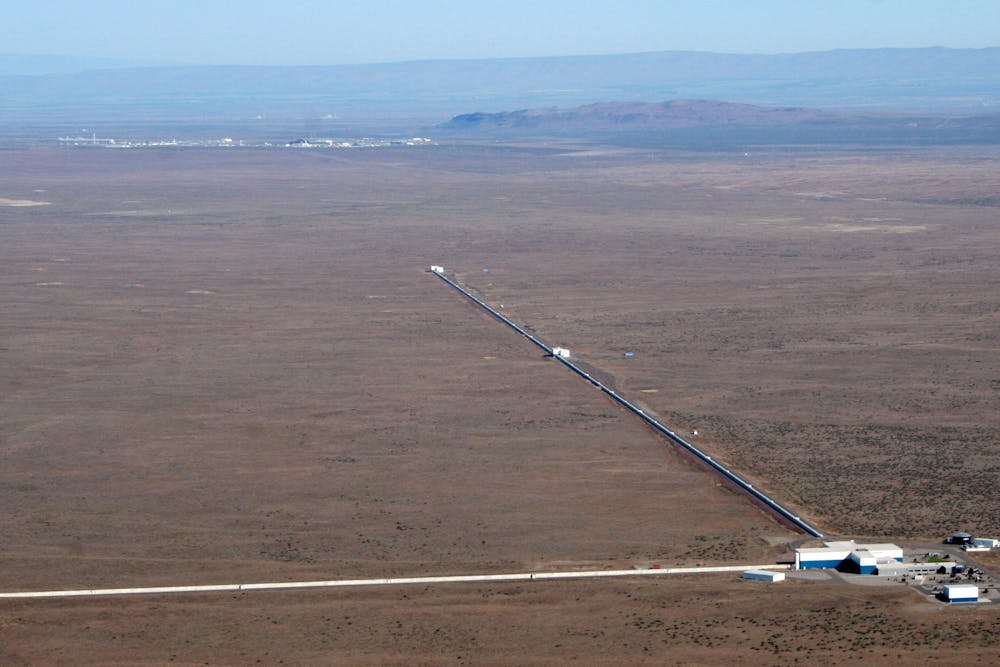
The LIGO detector in Hanford, Wash., uses lasers to measure the minuscule stretching of space caused by a gravitational wave. LIGO Laboratory
LIGO is comprised of two separate observatories, with one located in Hanford, Washington, and the other in Livingston, Louisiana. Each observatory is shaped like a giant L with two, 2.5-mile-long (four-kilometer-long) arms extending out from the center of the facility at 90 degrees to each other.
To measure gravitational waves, researchers shine a laser from the center of the facility to the base of the L. There, the laser is split so that a beam travels down each arm, reflects off a mirror and returns to the base. If a gravitational wave passes through the arms while the laser is shining, the two beams will return to the center at ever so slightly different times. By measuring this difference, physicists can discern that a gravitational wave passed through the facility.
Since 2015, LIGO has completed three observation runs. The first, run O1, lasted about four months; the second, O2, about nine months; and the third, O3, ran for 11 months before the COVID-19 pandemic forced the facilities to close. Starting with run O2, LIGO has been jointly observing with an Italian observatory called Virgo.
Between each run, scientists improved the physical components of the detectors and data analysis methods. By the end of run O3 in March 2020, researchers in the LIGO and Virgo collaboration had detected about 90 gravitational waves from the merging of black holes and neutron stars.
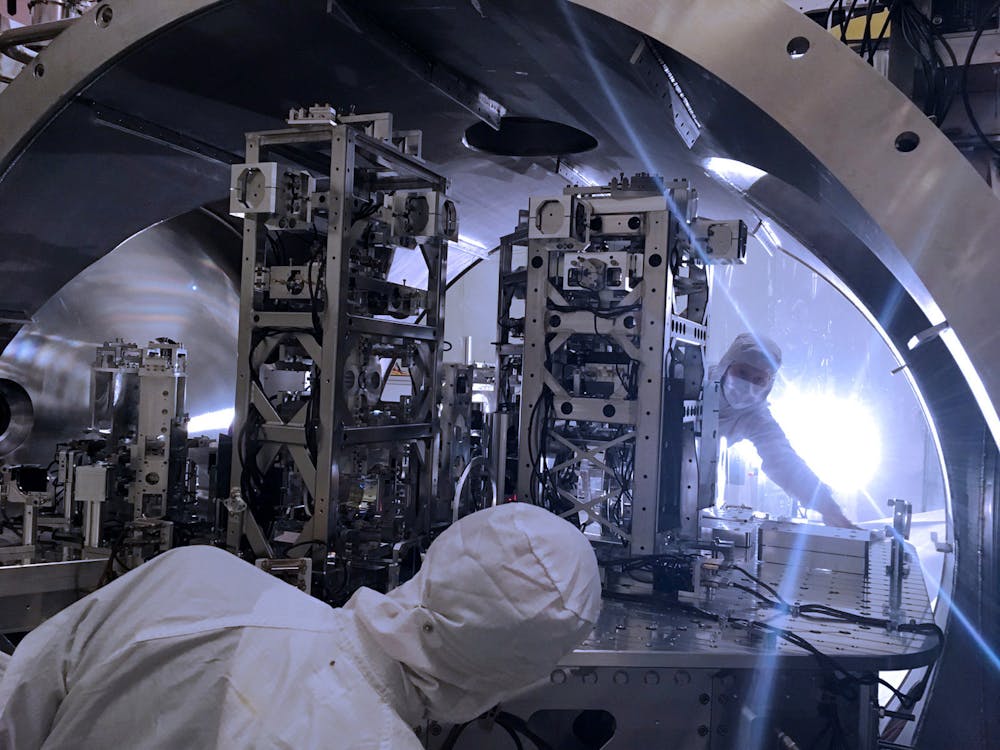
Upgrades to the mechanical equipment and data processing algorithms should allow LIGO to detect fainter gravitational waves than in the past. LIGO/Caltech/MIT/Jeff Kissel, CC BY-ND
One particularly promising upgrade involved adding a 1,000-foot (300-meter) optical cavity to improve a technique called squeezing. Squeezing allows scientists to reduce detector noise using the quantum properties of light. With this upgrade, the LIGO team should be able to detect much weaker gravitational waves than before.
My teammates and I are data scientists in the LIGO collaboration, and we have been working on a number of different upgrades to software used to process LIGO data and the algorithms that recognize signs of gravitational waves in that data. These algorithms function by searching for patterns that match theoretical models of millions of possible black hole and neutron star merger events. The improved algorithm should be able to more easily pick out the faint signs of gravitational waves from background noise in the data than the previous versions of the algorithms.
Astronomers have captured both the gravitational waves and light produced by a single event, the merger of two neutron stars. The change in light can be seen over the course of a few days in the top right inset. Hubble Space Telescope, NASA and ESA
A hi-def era of astronomy
In early May 2023, LIGO began a short test run – called an engineering run – to make sure everything was working. On May 18, LIGO detected gravitational waves likely produced from a neutron star merging into a black hole.
LIGO’s 20-month observation run 04 will officially start on May 24, and it will later be joined by Virgo and a new Japanese observatory – the Kamioka Gravitational Wave Detector, or KAGRA.
While there are many scientific goals for this run, there is a particular focus on detecting and localizing gravitational waves in real time. If the team can identify a gravitational wave event, figure out where the waves came from and alert other astronomers to these discoveries quickly, it would enable astronomers to point other telescopes that collect visible light, radio waves or other types of data at the source of the gravitational wave. Collecting multiple channels of information on a single event – multi-messenger astrophysics – is like adding color and sound to a black-and-white silent film and can provide a much deeper understanding of astrophysical phenomena.
With run O4, astronomers will have access to the most sensitive gravitational wave observatories in history and hopefully will collect more data than ever before. My colleagues and I are hopeful that the coming months will result in one – or perhaps many – multi-messenger observations that will push the boundaries of modern astrophysics.
Yesterday, the leading cryptocurrency was feeling good and rising in value. However, the mood has changed today. But if we step back, we can see that strategically nothing is changing. The market is waiting and saving power until important news about the US national debt comes out.
Another round of debt limit negotiations between Democrats and Republicans is over. There are no results and time is running out. By 1 June, the US federal government will be left without the ability to fund its spending.
Strong support for BTC remains at 26,500 USD. If it is broken, the bears will rush towards 25,200 USD.
The cryptocurrency market capitalisation has fallen to 1.118 trillion USD. BTC’s share fell to 46.3%, while ETH’s share rose to 19.5%.
China launches its own metaverse
A state-owned metaverse has been launched in China. It is a platform for blockchain technology and applications. The metaverse aims to develop new digital technologies.
CoinDesk registers interest in CFX token
CoinDesk has recorded growing user interest in the Conflux Network token, CFX, also referred to as China’s Ethereum. CFX became popular when Hong Kong authorities allowed retail investors to conduct transactions in cryptocurrency.
Attention! Forecasts presented in this section only reflect the author’s private opinion and should not be considered as guidance for trading. RoboForex LP bears no responsibility for trading results based on trading recommendations described in these analytical reviews.
The US stock indices ended Tuesday with a negative result. By the close of trading on the stock market Dow Jones (US30) decreased by 0.69%, and S&P 500 (US500) was 1.12% lower. The Technology Index NASDAQ (US100) fell by 0.26% on Tuesday. Stock indices are down again due to growing concerns about the US default. Yesterday lawmakers concluded another round of debt ceiling talks without a deal. The lack of progress comes just days before June 1st, when the US may default on its debt. But it is worth realizing that the likelihood of default is low because such debates happen almost every year and every time politicians agree. But this time, the politicians really delayed the deadlines.
The minutes from the last FOMC meeting will be released today. Despite the hawkish statements from Fed officials, about 88% of traders continue to believe that the US central bank will suspend the tightening cycle at the June meeting.
The latest economic data showed that the US manufacturing PMI fell into contraction territory from 50.2 to 48.5. The service sector was much better, with the PMI rising from 53.6 to 55.1. The drop in the manufacturing sector is the first wake-up call for the US Federal Reserve in terms of high-interest rates starting to have a negative impact on the economy.
Equity markets in Europe were mostly down yesterday. Germany’s DAX (DE30) decreased by 0.44%, France’s CAC 40 (FR40) fell by 1.33% on Tuesday, Spain’s IBEX 35 (ES35) lost 0.41%, and the British FTSE 100 (UK100) was down by 0.10% yesterday.
The May Eurozone PMI report showed that fears of higher core inflation should be centered around services, while goods inflation is slowing. Services business activity continues to point to strong growth despite the index dropping from 56.2 to 55.9. Meanwhile, manufacturing business activity showed a slowdown for the first time in 6 months. The more than six-month decline in the index indicates a weakening of the manufacturing sector. The divergence between services and manufacturing is growing, with services inflation accelerating again.
According to the International Monetary Fund’s updated forecasts on Tuesday, the British economy will avoid a recession this year. The IMF now thinks the British economy will grow by a modest 0.4% this year, partly as a result of rising wages. Despite the more optimistic estimate, the IMF said that inflation is likely to remain high in the coming years and will not return to the Bank of England’s target of 2% until mid-2025.
At the moment all the factors are adding up to the rise in oil prices. First, the Canadian wildfires are reducing oil supplies in North America. Second, demand in the US is expected to increase after Memorial Day, which unofficially marks the start of summer road trips in America. Third, Saudi Arabia’s energy minister threatened yesterday to cut production sharply if oil prices fall below $70 a barrel. Fourthly, analysts still expect the growth of demand in China (the biggest oil importer).
Asian markets were mostly down yesterday, except the Indian index. Japan’s Nikkei 225 (JP225) decreased by 0.42%, China’s FTSE China A50 (CHA50) fell by 1.57%, Hong Kong’s Hang Seng (HK50) ended the day down 1.25%, India’s NIFTY 50 (IND50) added 0.18%, and Australia’s S&P/ASX 200 (AU200) ended Tuesday negative 0.05%.
The Central Bank of New Zealand (RBNZ) expectedly to raise interest rates by 25 basis points to 5.5%, the highest level in more than 14 years. The RBNZ also said that inflation remains too high and still predicts a recession this year. According to the monetary policy statement (MPS) accompanying the rate decision, the RBNZ expects the official monetary rate at the current level of 5.5% to be the peak and remain at that level until the middle of next year.
S&P 500 (F) (US500) 4,145.58 −47.05 (−1.12%)
Dow Jones (US30)33,055.51 −231.07 (−0.69%)
DAX (DE40) 16,152.86 −71.13 (−0.44%)
FTSE 100 (UK100) 7,762.95 −8.04 (−0.10%)
USD Index 103.56 +0.36 +0.35%
Important events for today:
– New Zealand Retail Sales (m/m) at 01:45 (GMT+3);
– New Zealand RBNZ Interest Rate Decision at 05:00 (GMT+3);
– New Zealand RBNZ Monetary Policy Statement at 05:00 (GMT+3);
– New Zealand RBNZ Press Conference at 06:00 (GMT+3);
– UK Consumer Price Index (m/m) at 09:00 (GMT+3);
– Eurozone German Ifo Business Climate (m/m) at 11:00 (GMT+3);
This article reflects a personal opinion and should not be interpreted as an investment advice, and/or offer, and/or a persistent request for carrying out financial transactions, and/or a guarantee, and/or a forecast of future events.
The Japanese yen, paired with the US dollar, continues to decline. The current USDJPY quote is 138.37.
The strong US dollar, which is in demand as a safe haven asset, is having a remarkable influence on the Japanese yen.
Fresh Japanese statistics have attracted attention. The PMI report turned out positive: the services sector is reviving thanks to the rebound of the tourist flow into the country. Activity is also increasing in the manufacturing sector.
Both reports are favourable for Japan’s economy, which is still lagging behind its global counterparts in terms of recovery. Providers of services report noticeable demand and a record increase in business activity. Service-oriented businesses rebounded noticeably after Japan lifted restrictions on the entry of foreign tourists to the country.
Earlier, Japan presented its first-quarter GDP report, which also turned out favourable. It is clear that the Japanese economy has gained momentum. This could eventually be a good signal for the JPY.
Attention! Forecasts presented in this section only reflect the author’s private opinion and should not be considered as guidance for trading. RoboForex LP bears no responsibility for trading results based on trading recommendations described in these analytical reviews.
The US stock indices traded multidirectional yesterday. By the close of the stock market Dow Jones Index (US30) decreased by 0.42%, S&P 500 (US500) was up by 0.02%. The Technology Index NASDAQ (US100) gained 0.50% on Monday.
The uncertainty in the financial markets still remains. On the one hand, there is still no decision by politicians concerning the US government debt increase. On the other hand, the FOMC is divided on whether to raise the interest rate in June by another 0.25% or to stop the tightening cycle. At the moment, the CME FedWatch tool shows a 75% chance that the US Fed will keep interest rates unchanged next month. But a week ago, there was a 95% chance of that scenario.
On Monday, Intel Corp. (INTC) revealed some new details about the artificial intelligence (AI) computing chip it plans to introduce in 2025. The company plans to radically change its development strategy to compete with Nvidia (NVDA) Corp. and Advanced Micro Devices (AMD) Inc. At a supercomputer conference in Germany on Monday, Intel said its future Falcon Shores chip would have 288 gigabytes of memory and support 8-bit floating-point computing. These specifications are important for artificial intelligence models like ChatGPT services.
Yesterday, China banned some sales of Micron Technology Inc (MU) chips to key industries in its country, citing national security concerns. MU shares fell more than 3%.
Equity markets in Europe also traded without a single dynamic yesterday. German DAX (DE30) decreased by 0.32%, French CAC 40 (FR40) lost 0.18% on Monday, Spanish IBEX 35 (ES35) was up by 0.57%, British FTSE 100 (UK100) closed positive 0.18% yesterday.
The European Central Bank needs to raise interest rates some more and then leave them in restrictive territory for a while to bring inflation down to its medium-term target of 2%, Spanish Central Bank Governor Pablo Hernández de Cos said Monday. Investors expect the ECB to raise borrowing costs above 4% by the end of the summer.
Analysts at UBS are forecasting gold prices rising to $2100 an ounce by the end of 2023 and to $2200 an ounce by the end of 2024 as the reasons are given for the preservation of increased geopolitical risks and high inflation.
Oil prices rose Monday in response to a more positive tone in negotiations between the White House and its congressional Republicans to raise the US national debt ceiling before the June 1 default deadline. Higher demand and gasoline prices have also influenced energy trade sentiment ahead of the upcoming Memorial Day celebration on May 29, which unofficially marks the start of summer car travel in the United States.
European gas prices, which have been falling in recent weeks, are expected to remain low amid record-high supplies of liquefied natural gas by US exporters. European Union gas supplies are safe for the summer, and it is too early to tell if the EU will be able to prevent price shocks in the winter.
Asian markets were mostly up yesterday, except for the Australian index. Japan’s Nikkei 225 (JP225) gained 0.90% on the day, China’s FTSE China A50 (CHA50) jumped by 1.11%, Hong Kong’s Hang Seng (HK50) gained 1.17% on the day, India’s NIFTY 50 (IND50) added 0.61%, and Australia’s S&P/ASX 200 (AU200) was negative 0.22% on the day.
Japan’s Nikkei 225 reached a 33-year high. Japanese stocks have been on the rise over the past two weeks, boosted in large part by strong seasonal reports and bets that the Bank of Japan will maintain its ultra-loose policy. Data on Tuesday showed that the country’s manufacturing sector rose unexpectedly in May, while service sector growth hit a record high, indicating some resilience in the world’s third-largest economy.
S&P 500 (F) (US500) 4,192.63 +0.65 (+0.016%)
Dow Jones (US30)33,286.58 −140.05 (−0.42%)
DAX (DE40) 16,223.99 −51.39 (−0.32%)
FTSE 100 (UK100) 7,770.99 +14.12 (+0.18%)
USD Index 103.26 +0.06 +0.06%
Important events for today:
– Australia Manufacturing PMI (m/m) at 02:00 (GMT+3);
– Australia Services PMI (m/m) at 02:00 (GMT+3);
– Japan Manufacturing PMI (m/m) at 03:30 (GMT+3);
– Japan Services PMI (m/m) at 03:30 (GMT+3);
– Singapore Consumer Price Index (m/m) at 08:00 (GMT+3);
– Eurozone French Manufacturing PMI (m/m) at 10:15 (GMT+3);
– Eurozone French Services PMI (m/m) at 10:15 (GMT+3);
– Eurozone German Manufacturing PMI (m/m) at 10:30 (GMT+3);
– Eurozone German Services PMI (m/m) at 10:30 (GMT+3);
– Eurozone Manufacturing PMI (m/m) at 11:00 (GMT+3);
This article reflects a personal opinion and should not be interpreted as an investment advice, and/or offer, and/or a persistent request for carrying out financial transactions, and/or a guarantee, and/or a forecast of future events.
Asian markets gave up earlier gains on Tuesday as investors adopted a cautious stance after US debt ceiling negotiations ended “productive talks” without a deal. However, President Joe Biden and House Speaker Kevin McCarthy both expressed optimism about reaching a breakthrough to avoid a default. European futures are pointing to a positive open ahead of the preliminary PMI figures for the eurozone in May. Wall Street closed mixed and remains influenced by the US debt ceiling developments. In the currency space, the dollar crept higher drawing strength from hawkish Federal officials while gold fell for a second day amid hints of progress towards avoiding a US default.
Big week for USD
The dollar could be injected with fresh volatility this week due to the US debt limit negotiations, Fed minutes, and top-tier US economic data.
Dollar bulls were able to draw support in the previous session from the productive US debt limit talks and hawkish comments from Fed officials. Midweek, all eyes will be on the minutes from the May FOMC meeting which could offer more clues about the central bank’s next move. After proceeding with a 25-basis point hike in May, the Fed signalled a potential pause. It will be interesting to see what the minutes show in regard to the thinking of policymakers and how united they were around the idea of 5.25% being the peak level of rates. Of course, we have heard from a slew of Fed officials since the meeting which could make the minutes relatively stale.
On the data front, much focus will be on the Fed’s preferred inflation gauge, the Core Personal Consumption Expenditure (PCE) scheduled to be released on Friday. The April PCE report is forecast to show headline prices rising 0.3% month-over-month after March’s 0.1% increase, while the core PCE deflator is projected to rise 0.3%, the same as March. The core personal consumption expenditures price index is seen rising 4.6% year-over-year, the same as seen in March. Any further evidence of cooling inflationary pressures may reinforce the argument around the Fed pausing and eventually cutting interest rates later in 2023.
Currency spotlight – GBPUSD
GBPUSD could see more weakness if the pending UK inflation data on Wednesday shows signs of cooling inflationary pressures. Markets forecast inflation cooling to 8.2% in April, down from the 10.1% in March. If expectations match reality, this would be the sharpest decline in more than 30 years, bringing an end to seven consecutive months of double-digit inflation. Looking at the technical picture, GBPUSD may slip towards 1.2370 on expectations around the BoE potentially pausing rate hikes. A solid breakdown below 1.2370 could signal a further selloff towards 1.2280. If prices push back above 1.2450, bulls may target 1.2550.
Commodity Spotlight – Gold
Gold prices got no love on Tuesday morning, shedding 0.5% as optimism over the US debt ceiling developments dampened its allure. This promises to be another volatile week for the precious metal thanks to the cocktail of risk events and economic releases. If US debt talks continue to head in the right direction and hopes continue to rise over a deal reached, this could drag prices lower as risk appetite returns. Expect gold to also be influenced by the Fed minutes and key US data including the inflation report on Friday. Focusing on the technicals, sustained weakness below $1970 may open a path toward $1945 and $1900 respectively. Bulls need to claw their way back above $2000 to get back into the game.
Problems with the US debt ceiling were back in the spotlight late last week. Investors are scared by the likelihood of default if politicians can’t reach an agreement. While the probability of such a scenario is low, the rise in the dollar last week showed how investors were buying dollars as a safe haven currency. At the close of the stock market on Friday, the Dow Jones Index (US30) decreased by 0.33% (+0.32% for the week), and the S&P 500 Index (US500) fell by 0.14% (+1.58% for the week). The Technology Index NASDAQ (US100) was down 0.24% on Friday (+2.90% for the week).
US President Joe Biden and House Speaker Kevin McCarthy will meet again today to continue negotiations on raising the debt ceiling. Speaking to reporters at the US Capitol, McCarthy said positive discussions had taken place to resolve the crisis. Before leaving Japan after the G7 summit earlier Sunday, Biden indicated that he was willing to cut spending along with tax adjustments to reach an agreement, but the Republicans’ latest ceiling proposal was unacceptable.
In his speech Friday, US Federal Reserve Chairman Jerome Powell hinted at a pause in the rate hike cycle, indicating that the Fed can afford to examine the situation, given how far it has come. Minneapolis Fed President Neel Kashkari also said he might support keeping interest rates on hold at the Central Bank’s next meeting in June to give officials more time to assess the impact of past rate hikes and inflation forecasts.
Stock markets in Europe were mostly up on Friday. German DAX (DE30) jumped by 0.69% (+1.93% for the week), French CAC 40 (FR40) gained 0.61% on Friday (+0.65% for the week), Spanish IBEX 35 Index (ES35) added 0.50% (-0.11% for the week), British FTSE 100 (UK100) was on the rise by 0.19% (+0.03% for the week).
G7 leaders on Saturday agreed to a new initiative to counter economic coercion and pledged to take measures to ensure that any actors attempting to use economic dependence as a weapon would fail and face the consequences. The world is facing an alarming increase in cases of economic coercion aimed at exploiting economic vulnerabilities. Analysts believe that China will be the first to be affected. In turn, the G7 countries call on China to put pressure on Russia to end the war in Ukraine and respect Taiwan’s status and fair trade rules. The statement also commits G7 leaders to deepen cooperation to strengthen supply chains and calls for a greater role for low-income countries in building economic resilience.
Britain on Friday published plans to ban imports of Russian diamonds, copper, aluminum, and nickel and announced new sanctions against Russia targeting companies linked to suspected Ukrainian grain theft.
Oil prices fell Friday as investors fear that US policymakers will fail to agree on a new debt ceiling and trigger a default that would hurt the economy and reduce fuel demand. On the other hand, according to energy company Baker Hughes Co. the number of oil rigs in the US, an indicator of future production, fell by 11 last week to 575, the biggest weekly drop since September 2021. Analysts at the National Australia Bank said that while the possibility of additional rate hikes adds to concerns about weak demand in the United States, oil prices could rise because of stronger demand in China during 2023.
Asian markets traded without a single trend last week. Japan’s Nikkei 225 (JP225) jumped by 4.27% for the week, China’s FTSE China A50 (CHA50) fell by 1.60% for the week, Hong Kong’s Hang Seng (HK50) was down 0.38% for the week, India’s NIFTY 50 (IND50) lost 0.80%, and Australia’s S&P/ASX 200 (AU200) was up 0.31% for the week.
The People’s Bank of China on Monday (PBoC) kept its key lending rate near an all-time low of 3.65%, but the slowdown in the country’s growth has markets bracing for a possible rate cut this year.
In the commodities market, futures on natural gas (+14.43%), cotton (+7.6%), orange juice (+6.86%), gasoline (+6.16%), coffee (+4.29%), cocoa (+2.85%), and WTI oil (+2.66%) showed the biggest gains last week. Futures on soybeans (-6.1%), corn (-5.12%), and wheat (-4.76%) showed the biggest drop.
S&P 500 (F) (US500) 4,191.98 −6.07 (−0.14%)
Dow Jones (US30)33,426.63 −109.28 (−0.33%)
DAX (DE40) 16,275.38 +112.02 (+0.69%)
FTSE 100 (UK100) 7,756.87 +14.57 (+0.19%)
USD Index 103.19 -0.39 -0.38%
Important events for today:
– China PBoC Loan Prime Rate at 04:15 (GMT+3);
– Hong Kong Consumer Price Index (m/m) at 11:30 (GMT+3);
This article reflects a personal opinion and should not be interpreted as an investment advice, and/or offer, and/or a persistent request for carrying out financial transactions, and/or a guarantee, and/or a forecast of future events.
The BTC rate on Friday remains near 26,930 USD. The weekly growth is 2.5%.
The lack of consensus between the US Congress and the White House on the public debt issue is making investors cautious. As the correlation between the Nasdaq and S&P 500 indices and the BTC is restored, everything happening in the US stock market is directly connected.
The support level of 26,500 USD is still watched closely. It is important for the market to secure above 27,000 USD to develop an uptrend towards 29,800 USD.
The capitalisation of the crypto market remains at 1.124 trillion USD. BTC’s share has decreased to 46.3% and ETH’s share to 19.3%.
MicroStrategy is interested in Bitcoin Ordinals capabilities
MicroStrategy is exploring the potential of the Bitcoin Ordinals protocol to effectively use an innovative approach. This protocol is widely used for issuing NFTs, but MicroStrategy believes that its potential is much broader.
Lagrange Labs has raised 4 million USD
Lagrange Labs startup has raised 4 million USD in the pre-seed funding round for the development of the ZK system. The fundraising was led by the 1kx company. The ZK idea involves secure communication between different blockchain networks.
Attention! Forecasts presented in this section only reflect the author’s private opinion and should not be considered as guidance for trading. RoboForex LP bears no responsibility for trading results based on trading recommendations described in these analytical reviews.
Stock markets are buoyant on optimism that the US will raise its debt ceiling, avoiding a default and global economic fallout, but investors now need to avoid complacency, warns the CEO and founder of one of the world’s largest independent financial advisory, asset management and fintech organizations.
The warning from deVere Group’s Nigel Green comes as Wall Street’s S&P 500 index and the Nasdaq Composite both reached their highest levels since August 2022, up 0.9% and 1.5%, respectively, on Thursday.
Meanwhile, Asia-Pacific markets rose on Friday and European markets are set to do the same at the open. US futures are also ticking higher.
The deVere CEO says: “A huge sense of relief is sweeping across stock markets after US policymakers said that a bill to raise the debt ceiling in the world’s largest economy may be put to a vote next week, raising the possibility of a deal to avoid a government default and the serious global economic repercussions that would follow.
“The reports coming out of Washington help restore confidence, stability and certainty – which markets thrive on – as they indicate that the US government will continue to meet its financial commitments.”
He continues: “However, investors must avoid complacency.
“While stock markets are enjoying this wave of buoyancy, with investors appearing to be looking beyond the current interest rate cycle and ahead to the next upswing in the economic cycle, core major bond markets continue to be marked by inverted yield curves, which suggest a recession is looming.
“The inverted yield curve indicates a recession is ahead because it’s a sign of a tight credit market and weak economic growth. The inversion has preceded most US recessions – which, of course, have a huge drag on the global economy – since 1950.
“With this disconnect between stocks and bonds, investors should brace themselves for significant volatility in global financial markets over the next few weeks. We could see a 10% correction.”
deVere believes that four key sectors would be mostly resilient in a recession. These include commodities, such as oil, as their prices typically rise in response to inflation; consumer staples like food, and hygiene products, as demand is likely to remain relatively stable; healthcare, as it provides essential services that are less affected by economic cycles; and utilities, including electricity, gas, and water as demand will also be typically consistent.
“While a resolution of the debt ceiling crisis may provide a temporary relief rally, it doesn’t guarantee sustained market growth or shield against other market risks.
“Investors need to be alive to the real challenges potentially coming down the track that could hit their returns if their portfolios are not properly diversified.”
About:
deVere Group is one of the world’s largest independent advisors of specialist global financial solutions to international, local mass affluent, and high-net-worth clients. It has a network of more than 70 offices across the world, over 80,000 clients and $12bn under advisement.

 Article by ForexTime