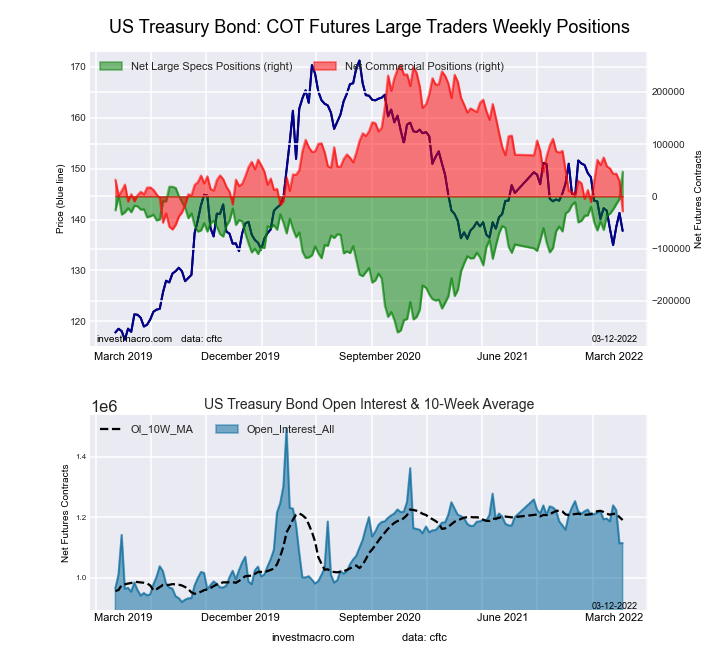
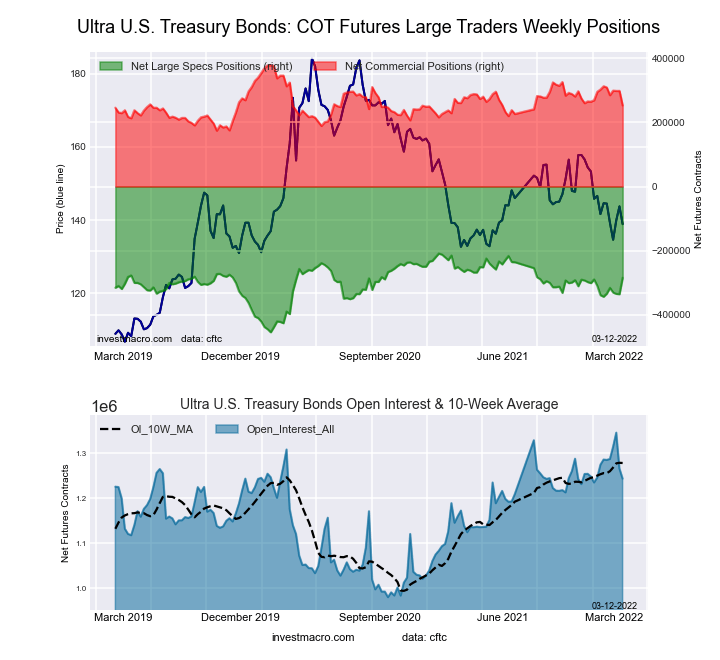
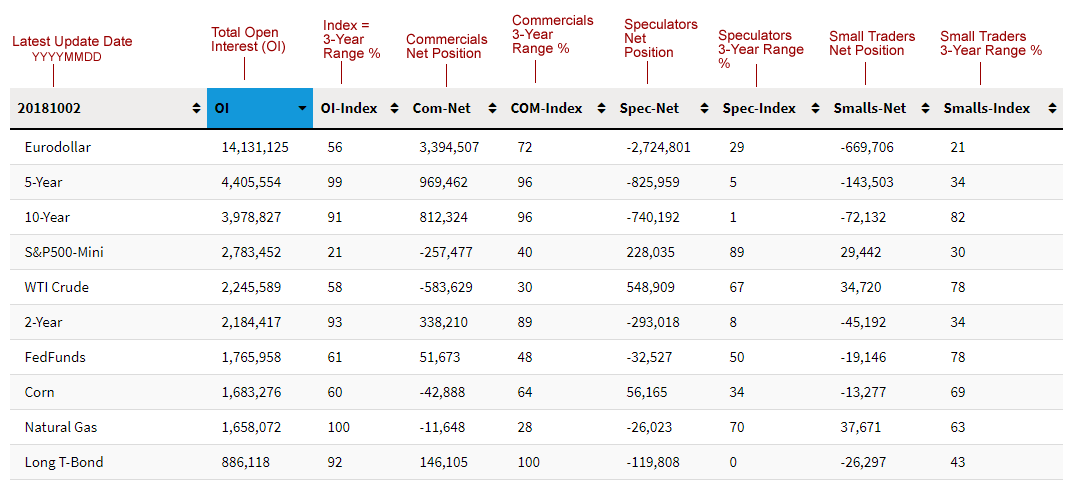
Archive for Bonds – Page 18

10-Year Treasury Bonds Speculator bets surge to 177-week bearish high

By InvestMacro | COT | Data Tables | COT Leaders | Downloads | COT Newsletter

Here are the latest charts and statistics for the Commitment of Traders (COT) data published by the Commodities Futures Trading Commission (CFTC).

The latest COT data is updated through Tuesday March 29th and shows a quick view of how large traders (for-profit speculators and commercial entities) were positioned in the futures markets.

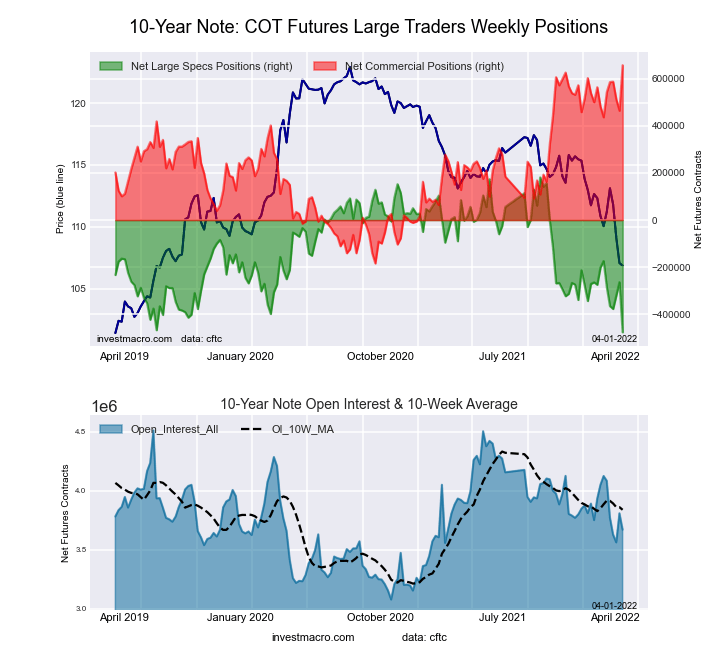
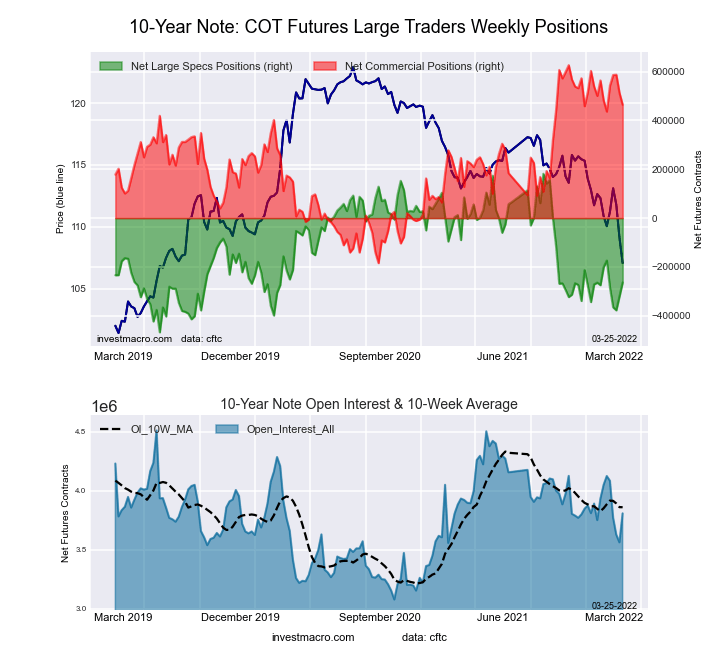
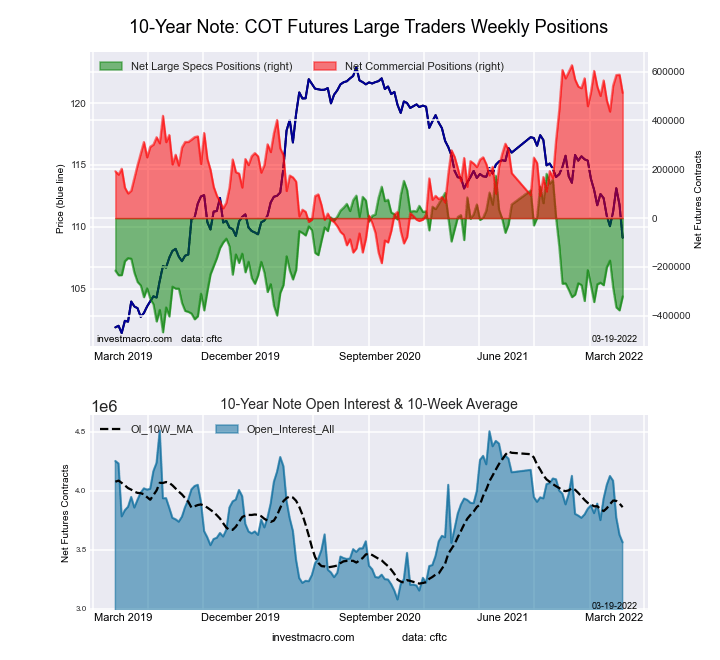
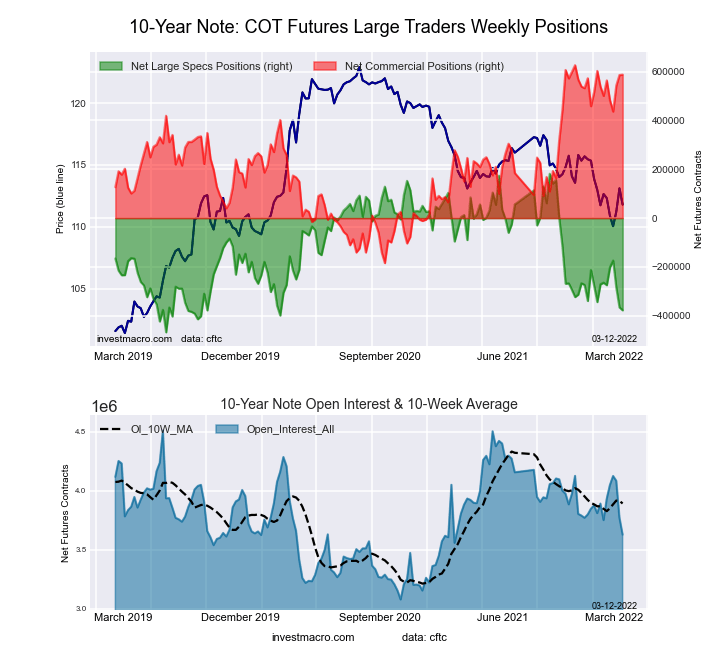
Highlighting the COT bonds data is the surge in the 10-Year Bond bets this week. The speculative position in the 10-Year Bond saw a sharp jump in bearish bets this week (by -212,723 contracts) that marked the largest one-week bearish gain in the past two hundred and seventy-eight weeks, dating all the way back to November 29th of 2016. The 10-Year had shed bearish bets in the previous two weeks but has now seen higher bearish bets in four out of the past six weeks. This rising bearish sentiment has pushed the current net speculator standing (total of -476,557 contracts) to the most bearish level in the past one-hundred and seventy-seven weeks, dating back to November 6th of 2018 when positions were over -500,000 contracts. The 10-Year Bond price has also been dropping sharply and the 10-Year Bond yield rose to the highest level since April of 2019 above the 2.50 percent level this week (interest rates rise as bond prices fall). The outlook for Central Bank interest rate increases likely signals that there is much more weakness ahead for bonds (and gains in bond yields) and speculator sentiment will likely become more bearish.

The bonds markets that saw higher speculator bets this week were Eurodollar (233,321 contracts) and the Ultra 10-Year (17,885 contracts).

The bonds markets that saw lower speculator bets this week were 2-Year Bond (-11,754 contracts), 10-Year Bond (-212,723 contracts), Long US Bond (-16,550 contracts), Fed Funds (-1,024 contracts), 5-Year Bond (-65,052 contracts) and the Ultra US Bond (-25,035 contracts).


Data Snapshot of Bond Market Traders | Columns Legend
Mar-29-2022OIOI-IndexSpec-NetSpec-IndexCom-NetCOM-IndexSmalls-NetSmalls-Index
Eurodollar10,936,41443-2,423,40142,851,68496-428,28310
FedFunds2,130,65381-14,4063835,28764-20,8817
2-Year2,251,10018-59,20270161,88255-102,6800
Long T-Bond1,109,5063316,00190-3,12319-12,87842
10-Year3,669,44941-476,5570657,549100-180,99236
5-Year3,756,30735-361,39020598,86486-237,47416


3-Month Eurodollars Futures:

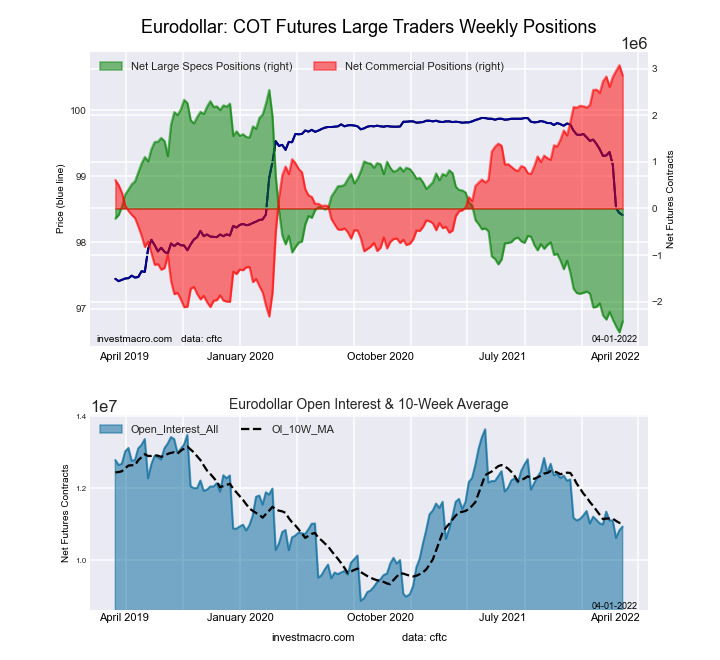
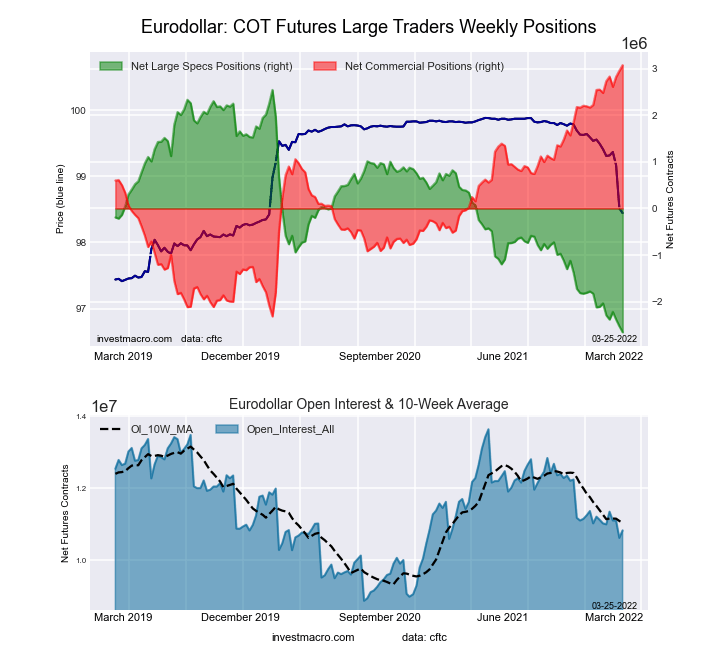
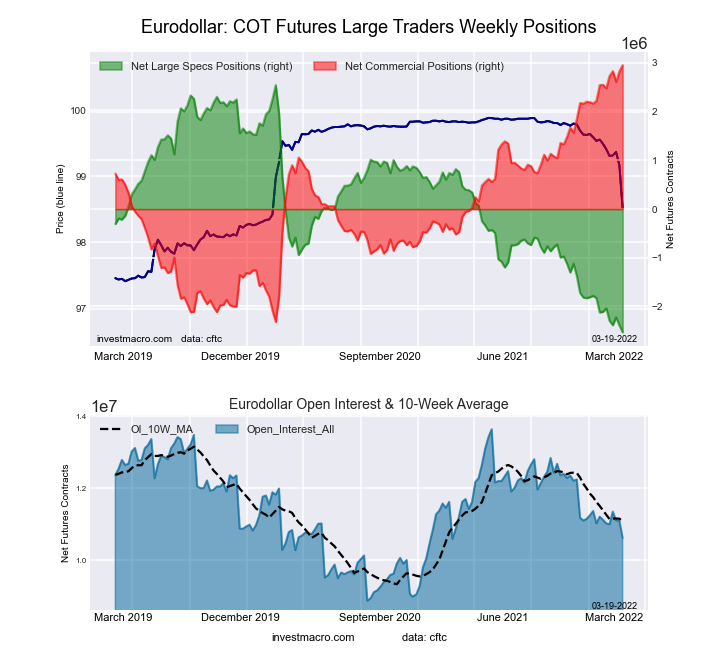
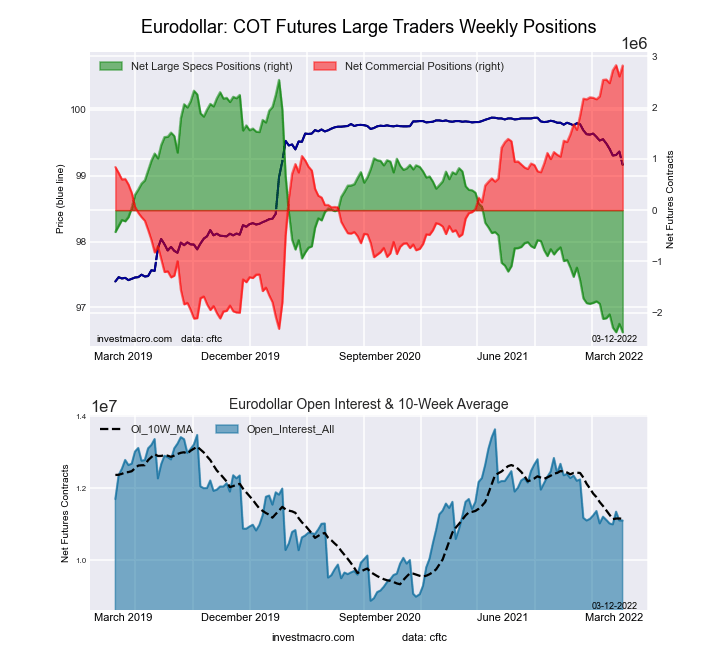
Eurodollar Bonds Futures COT ChartThe 3-Month Eurodollars large speculator standing this week totaled a net position of -2,423,401 contracts in the data reported through Tuesday. This was a weekly increase of 233,321 contracts from the previous week which had a total of -2,656,722 net contracts.

This week’s current strength score (the trader positioning range over the past three years, measured from 0 to 100) shows the speculators are currently Bearish-Extreme with a score of 4.5 percent. The commercials are Bullish-Extreme with a score of 95.9 percent and the small traders (not shown in chart) are Bearish-Extreme with a score of 10.2 percent.

3-Month Eurodollars StatisticsSPECULATORSCOMMERCIALSSMALL TRADERS
– Percent of Open Interest Longs:4.174.73.9
– Percent of Open Interest Shorts:26.248.67.9
– Net Position:-2,423,4012,851,684-428,283
– Gross Longs:447,2928,166,593431,468
– Gross Shorts:2,870,6935,314,909859,751
– Long to Short Ratio:0.2 to 11.5 to 10.5 to 1
NET POSITION TREND:
– Strength Index Score (3 Year Range Pct):4.595.910.2
– Strength Index Reading (3 Year Range):Bearish-ExtremeBullish-ExtremeBearish-Extreme
NET POSITION MOVEMENT INDEX:
– 6-Week Change in Strength Index:-2.52.22.2


30-Day Federal Funds Futures:

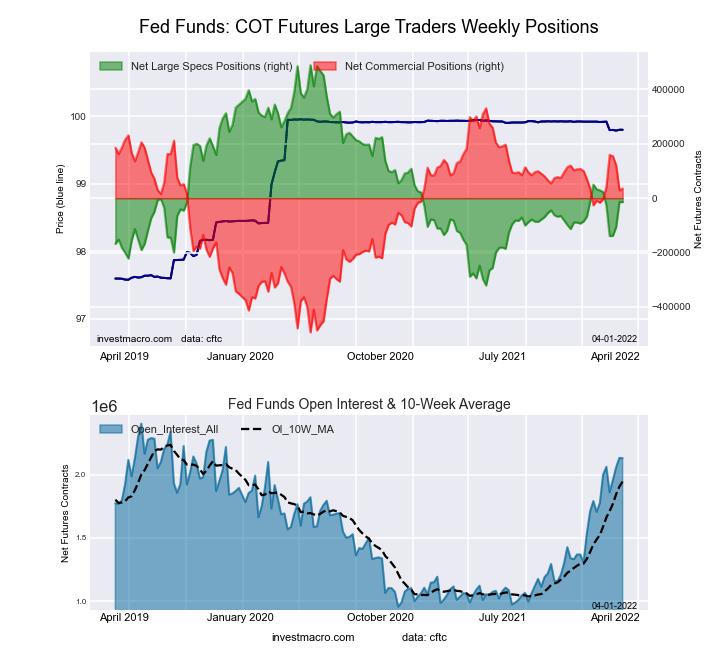
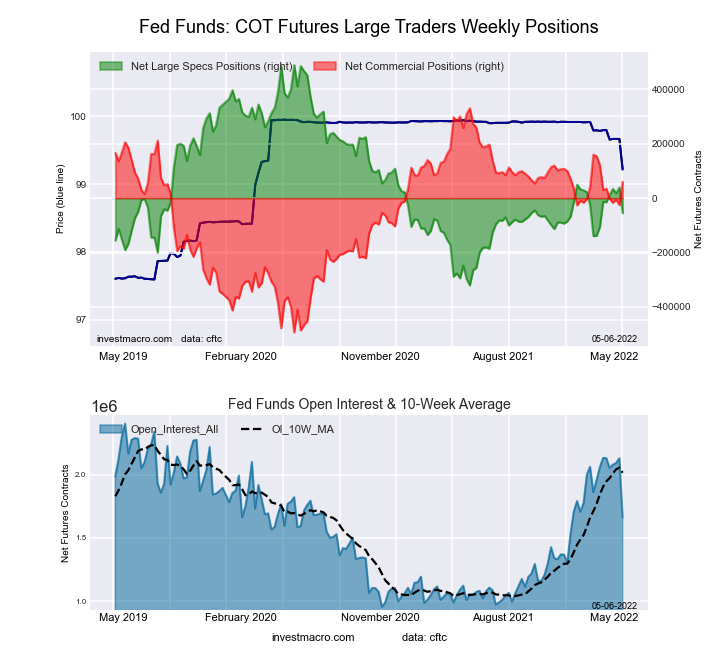
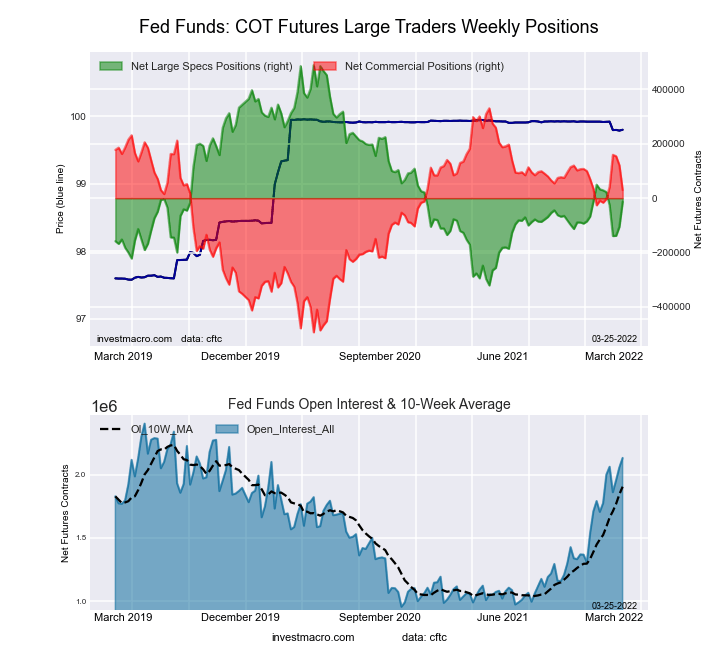
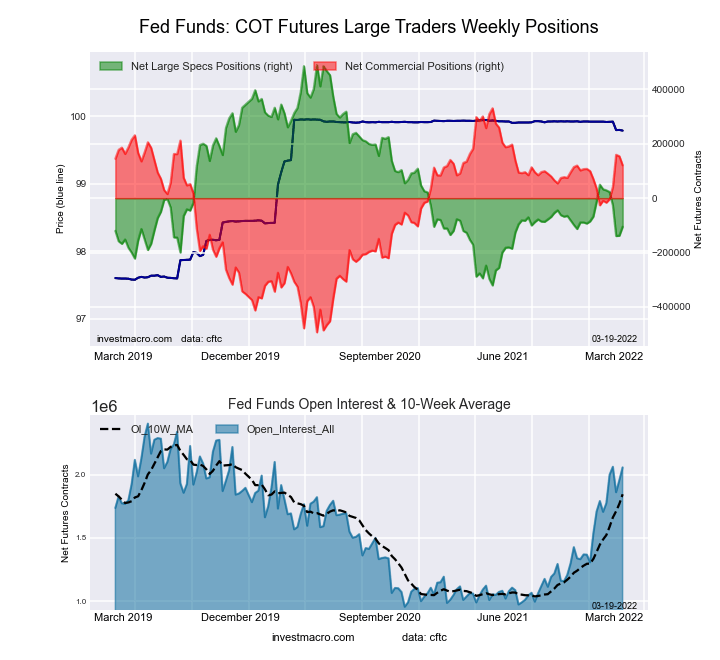
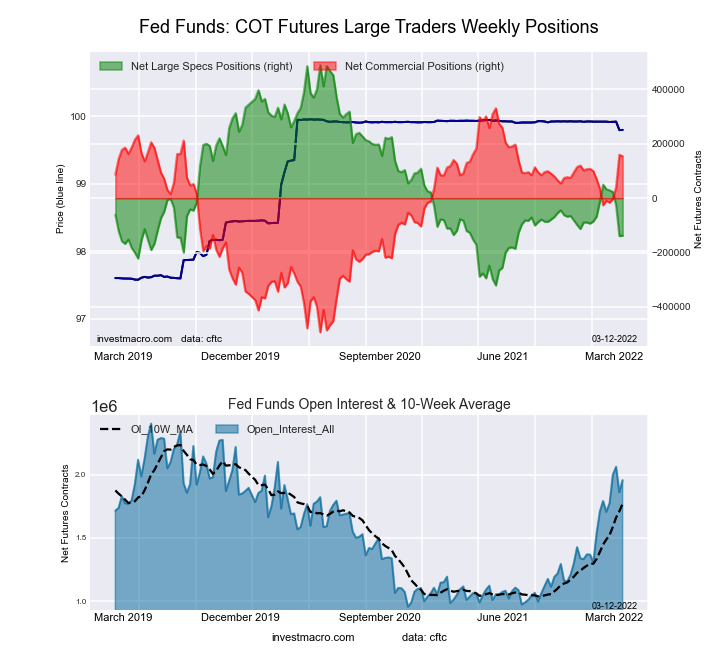
Federal Funds 30-Day Bonds Futures COT ChartThe 30-Day Federal Funds large speculator standing this week totaled a net position of -14,406 contracts in the data reported through Tuesday. This was a weekly decline of -1,024 contracts from the previous week which had a total of -13,382 net contracts.

This week’s current strength score (the trader positioning range over the past three years, measured from 0 to 100) shows the speculators are currently Bearish with a score of 37.8 percent. The commercials are Bullish with a score of 64.2 percent and the small traders (not shown in chart) are Bearish-Extreme with a score of 6.6 percent.

30-Day Federal Funds StatisticsSPECULATORSCOMMERCIALSSMALL TRADERS
– Percent of Open Interest Longs:8.177.11.3
– Percent of Open Interest Shorts:8.875.42.3
– Net Position:-14,40635,287-20,881
– Gross Longs:172,4501,642,23127,817
– Gross Shorts:186,8561,606,94448,698
– Long to Short Ratio:0.9 to 11.0 to 10.6 to 1
NET POSITION TREND:
– Strength Index Score (3 Year Range Pct):37.864.26.6
– Strength Index Reading (3 Year Range):BearishBullishBearish-Extreme
NET POSITION MOVEMENT INDEX:
– 6-Week Change in Strength Index:-4.64.7-4.0


2-Year Treasury Note Futures:

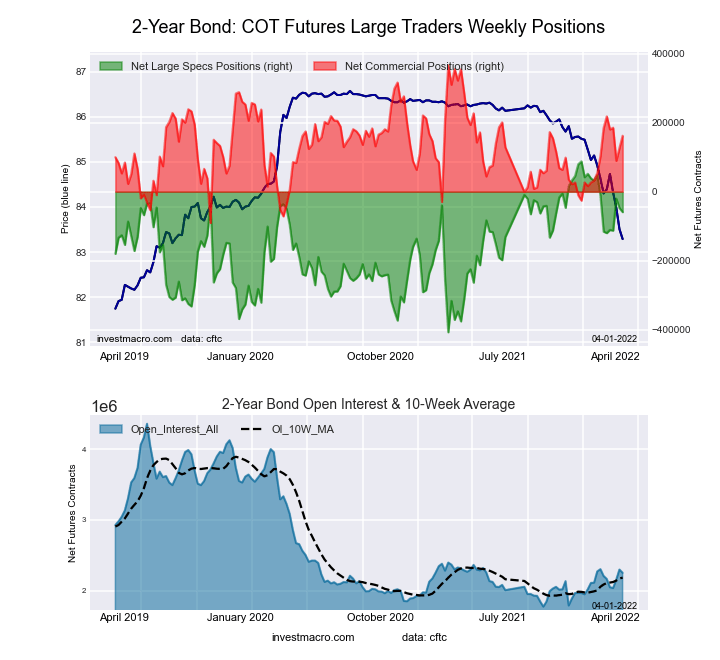
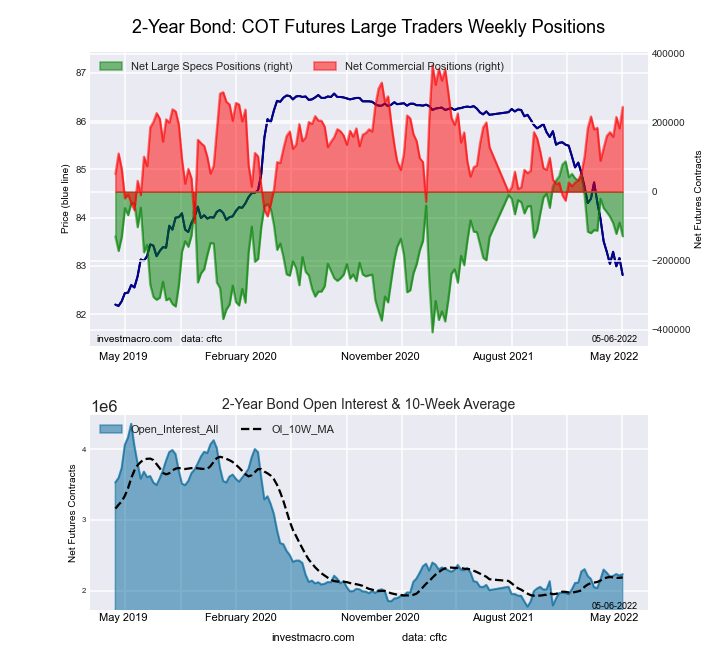
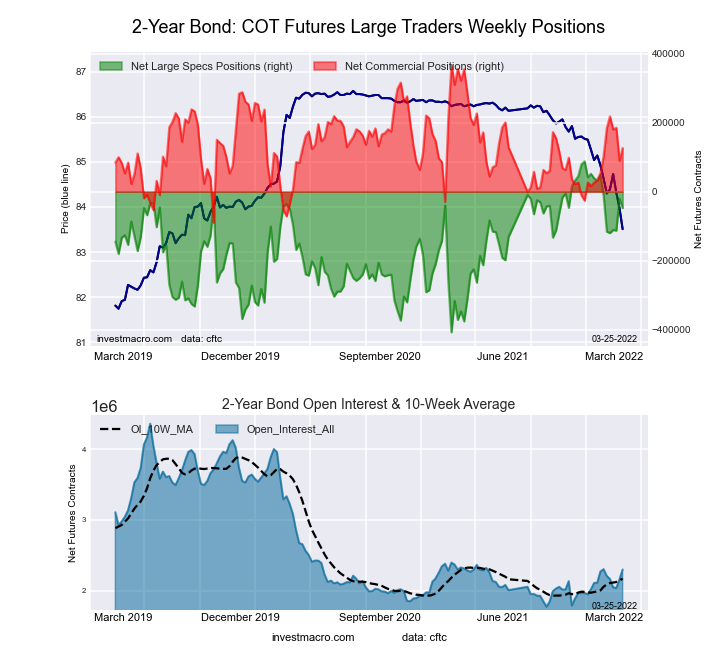
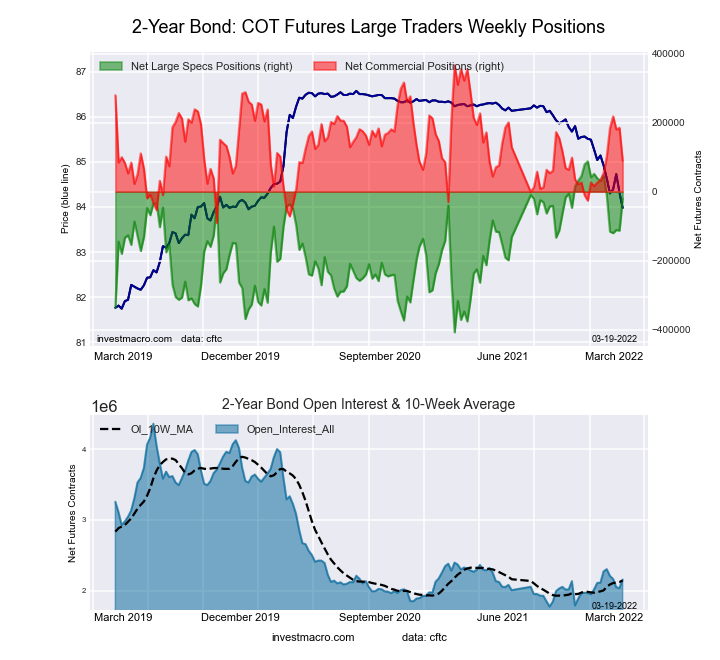
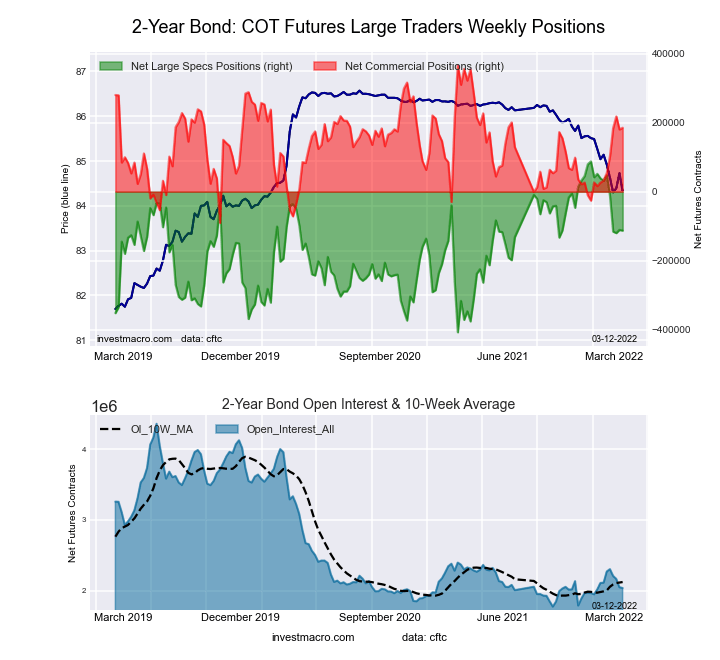
2-Year Treasury Bonds Futures COT ChartThe 2-Year Treasury Note large speculator standing this week totaled a net position of -59,202 contracts in the data reported through Tuesday. This was a weekly reduction of -11,754 contracts from the previous week which had a total of -47,448 net contracts.

This week’s current strength score (the trader positioning range over the past three years, measured from 0 to 100) shows the speculators are currently Bullish with a score of 70.3 percent. The commercials are Bullish with a score of 55.2 percent and the small traders (not shown in chart) are Bearish-Extreme with a score of 0.0 percent.

2-Year Treasury Note StatisticsSPECULATORSCOMMERCIALSSMALL TRADERS
– Percent of Open Interest Longs:14.076.46.2
– Percent of Open Interest Shorts:16.669.210.8
– Net Position:-59,202161,882-102,680
– Gross Longs:314,6641,719,719140,420
– Gross Shorts:373,8661,557,837243,100
– Long to Short Ratio:0.8 to 11.1 to 10.6 to 1
NET POSITION TREND:
– Strength Index Score (3 Year Range Pct):70.355.20.0
– Strength Index Reading (3 Year Range):BullishBullishBearish-Extreme
NET POSITION MOVEMENT INDEX:
– 6-Week Change in Strength Index:11.4-4.9-15.1


5-Year Treasury Note Futures:

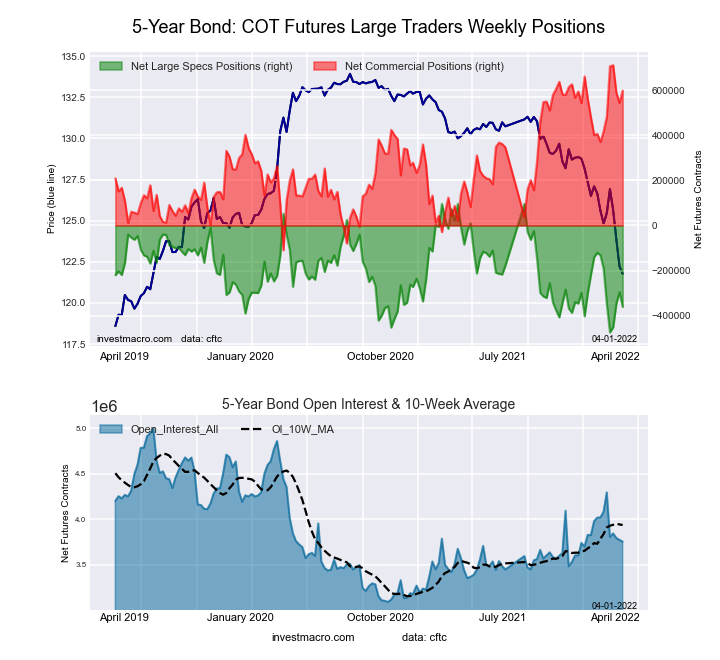
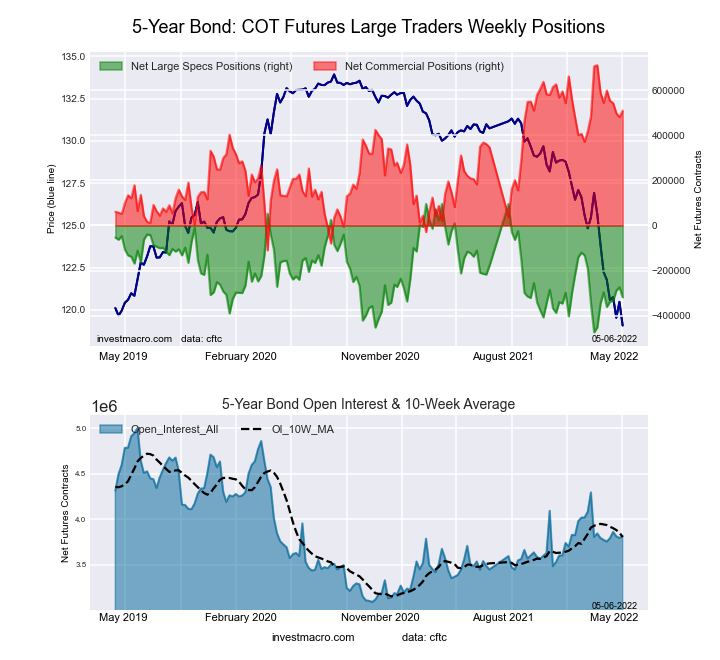
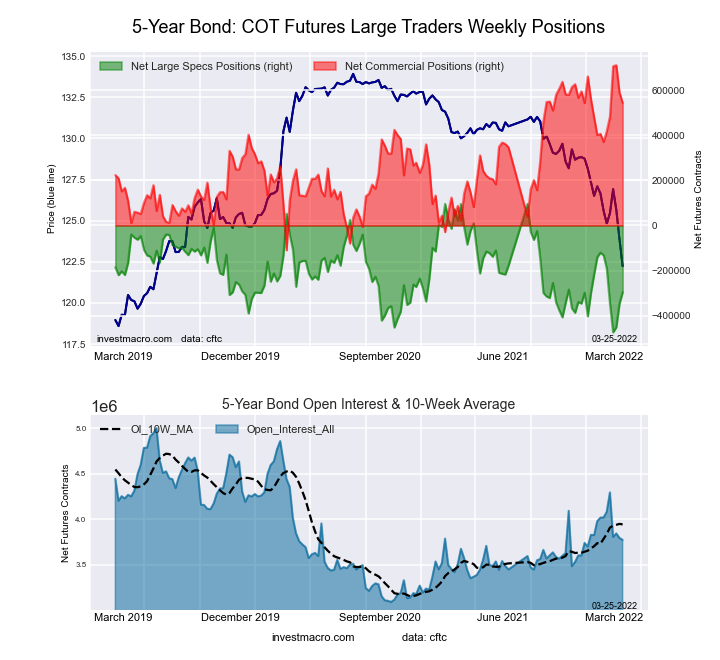
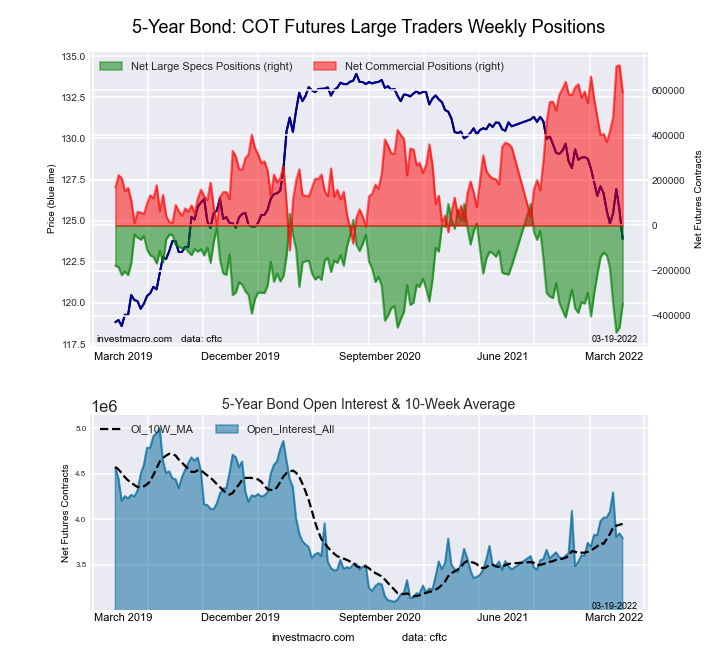
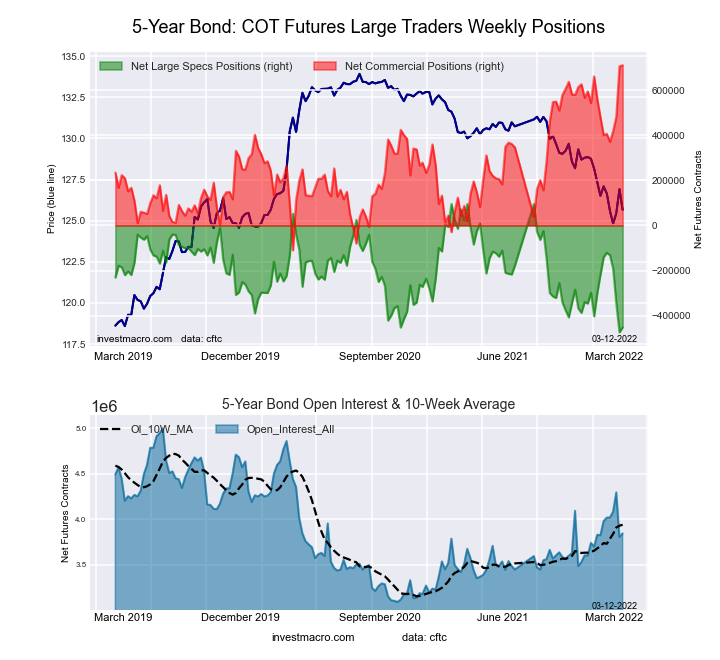
5-Year Treasury Bonds Futures COT ChartThe 5-Year Treasury Note large speculator standing this week totaled a net position of -361,390 contracts in the data reported through Tuesday. This was a weekly fall of -65,052 contracts from the previous week which had a total of -296,338 net contracts.

This week’s current strength score (the trader positioning range over the past three years, measured from 0 to 100) shows the speculators are currently Bearish-Extreme with a score of 19.8 percent. The commercials are Bullish-Extreme with a score of 86.3 percent and the small traders (not shown in chart) are Bearish-Extreme with a score of 15.8 percent.

5-Year Treasury Note StatisticsSPECULATORSCOMMERCIALSSMALL TRADERS
– Percent of Open Interest Longs:8.282.67.2
– Percent of Open Interest Shorts:17.966.613.5
– Net Position:-361,390598,864-237,474
– Gross Longs:309,2363,101,800270,067
– Gross Shorts:670,6262,502,936507,541
– Long to Short Ratio:0.5 to 11.2 to 10.5 to 1
NET POSITION TREND:
– Strength Index Score (3 Year Range Pct):19.886.315.8
– Strength Index Reading (3 Year Range):Bearish-ExtremeBullish-ExtremeBearish-Extreme
NET POSITION MOVEMENT INDEX:
– 6-Week Change in Strength Index:-29.821.9-2.7


10-Year Treasury Note Futures:

10-Year Treasury Notes Bonds Futures COT ChartThe 10-Year Treasury Note large speculator standing this week totaled a net position of -476,557 contracts in the data reported through Tuesday. This was a weekly decrease of -212,723 contracts from the previous week which had a total of -263,834 net contracts.

This week’s current strength score (the trader positioning range over the past three years, measured from 0 to 100) shows the speculators are currently Bearish-Extreme with a score of 0.0 percent. The commercials are Bullish-Extreme with a score of 100.0 percent and the small traders (not shown in chart) are Bearish with a score of 36.5 percent.

10-Year Treasury Note StatisticsSPECULATORSCOMMERCIALSSMALL TRADERS
– Percent of Open Interest Longs:7.580.29.0
– Percent of Open Interest Shorts:20.562.213.9
– Net Position:-476,557657,549-180,992
– Gross Longs:276,5882,941,177328,695
– Gross Shorts:753,1452,283,628509,687
– Long to Short Ratio:0.4 to 11.3 to 10.6 to 1
NET POSITION TREND:
– Strength Index Score (3 Year Range Pct):0.0100.036.5
– Strength Index Reading (3 Year Range):Bearish-ExtremeBullish-ExtremeBearish
NET POSITION MOVEMENT INDEX:
– 6-Week Change in Strength Index:-46.026.318.9


Ultra 10-Year Notes Futures:

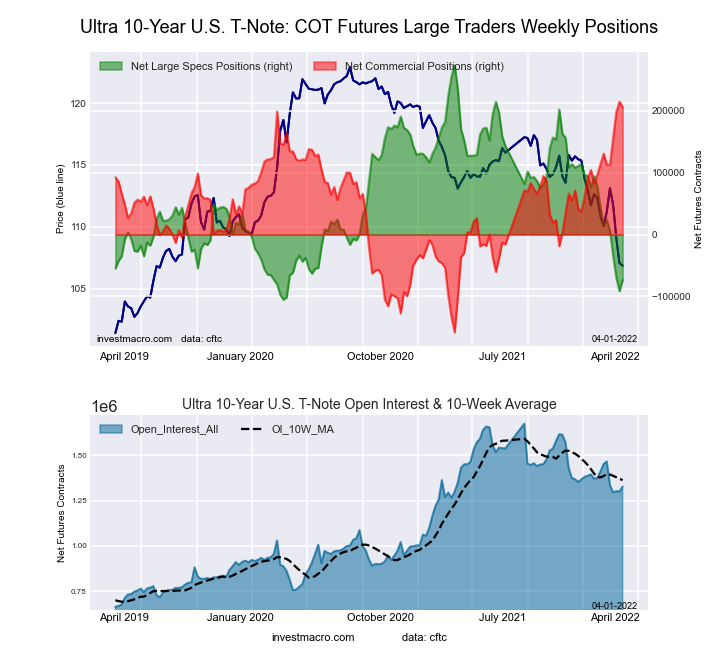
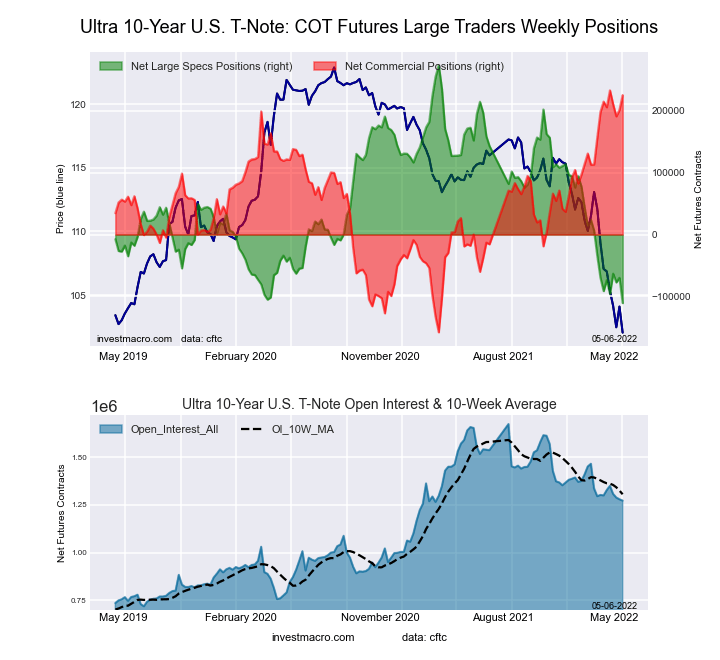
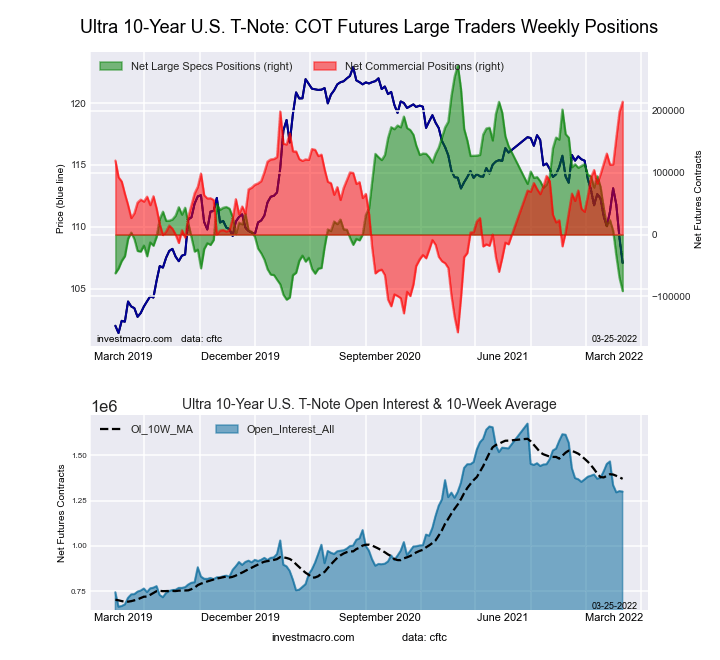
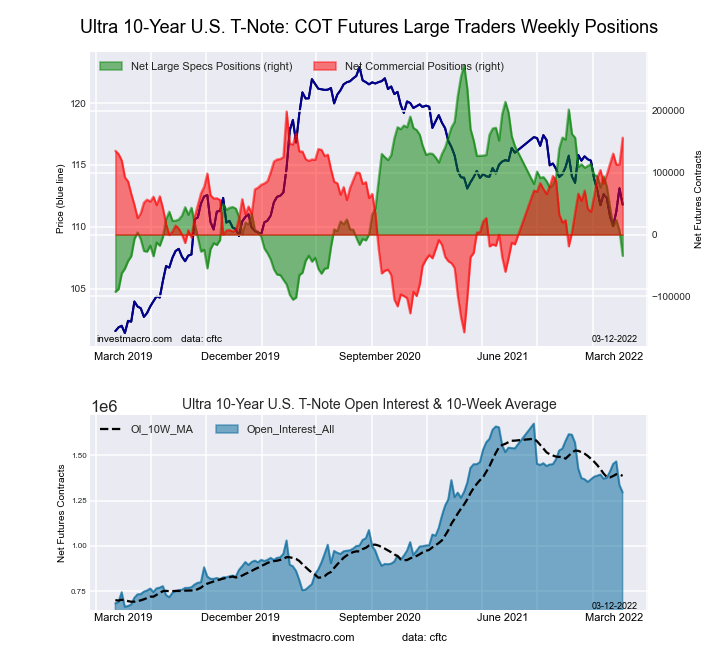
Ultra 10-Year Treasury Notes Bonds Futures COT ChartThe Ultra 10-Year Notes large speculator standing this week totaled a net position of -73,436 contracts in the data reported through Tuesday. This was a weekly boost of 17,885 contracts from the previous week which had a total of -91,321 net contracts.

This week’s current strength score (the trader positioning range over the past three years, measured from 0 to 100) shows the speculators are currently Bearish-Extreme with a score of 8.4 percent. The commercials are Bullish-Extreme with a score of 97.6 percent and the small traders (not shown in chart) are Bearish with a score of 35.8 percent.

Ultra 10-Year Notes StatisticsSPECULATORSCOMMERCIALSSMALL TRADERS
– Percent of Open Interest Longs:9.780.79.0
– Percent of Open Interest Shorts:15.265.218.9
– Net Position:-73,436205,679-132,243
– Gross Longs:128,7351,071,757119,198
– Gross Shorts:202,171866,078251,441
– Long to Short Ratio:0.6 to 11.2 to 10.5 to 1
NET POSITION TREND:
– Strength Index Score (3 Year Range Pct):8.497.635.8
– Strength Index Reading (3 Year Range):Bearish-ExtremeBullish-ExtremeBearish
NET POSITION MOVEMENT INDEX:
– 6-Week Change in Strength Index:-23.120.17.5


US Treasury Bonds Futures:

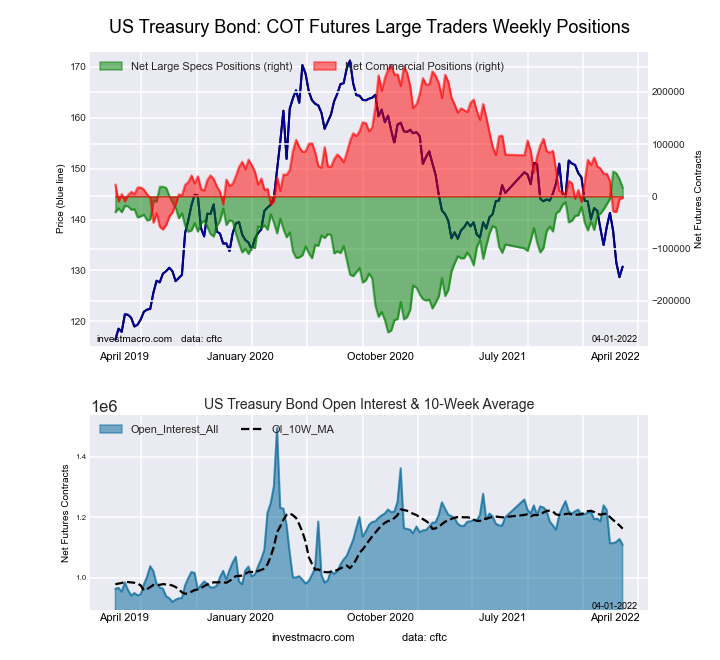
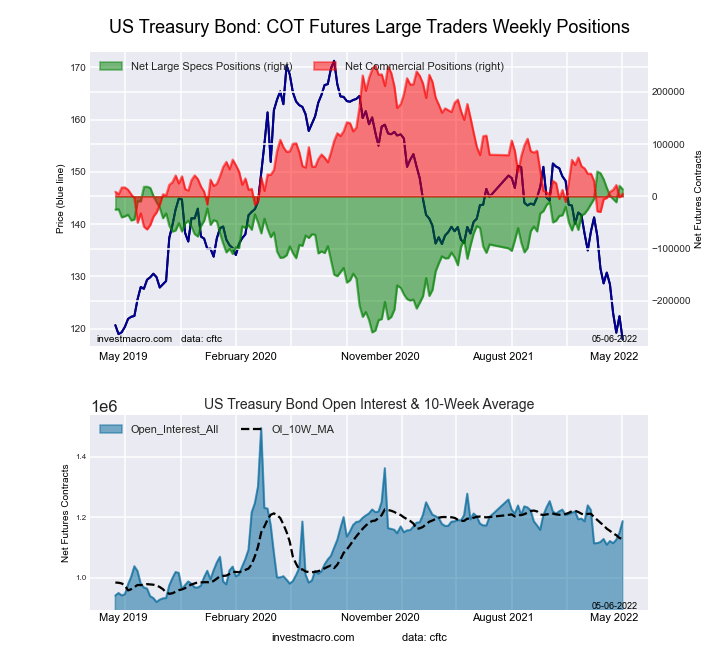
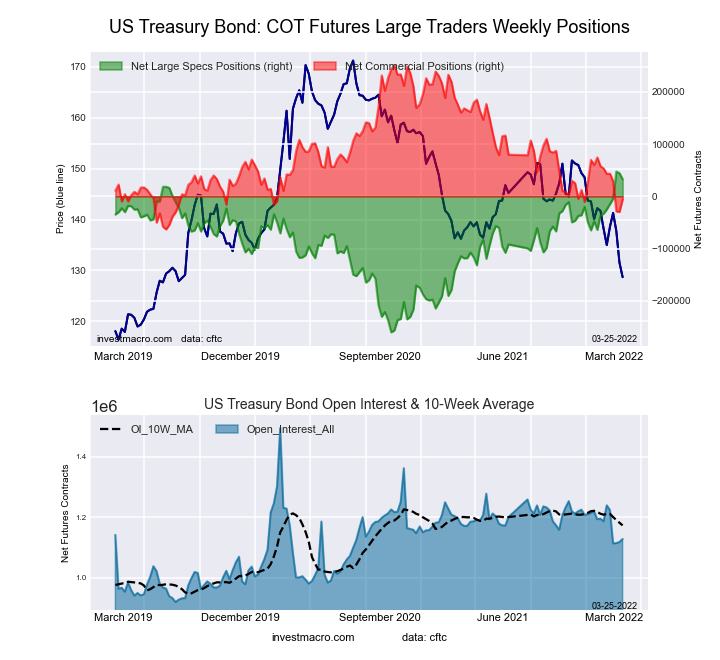
US Year Treasury Notes Long Bonds Futures COT ChartThe US Treasury Bonds large speculator standing this week totaled a net position of 16,001 contracts in the data reported through Tuesday. This was a weekly lowering of -16,550 contracts from the previous week which had a total of 32,551 net contracts.

This week’s current strength score (the trader positioning range over the past three years, measured from 0 to 100) shows the speculators are currently Bullish-Extreme with a score of 89.8 percent. The commercials are Bearish-Extreme with a score of 19.1 percent and the small traders (not shown in chart) are Bearish with a score of 42.4 percent.

US Treasury Bonds StatisticsSPECULATORSCOMMERCIALSSMALL TRADERS
– Percent of Open Interest Longs:9.173.114.6
– Percent of Open Interest Shorts:7.773.415.7
– Net Position:16,001-3,123-12,878
– Gross Longs:100,986810,834161,498
– Gross Shorts:84,985813,957174,376
– Long to Short Ratio:1.2 to 11.0 to 10.9 to 1
NET POSITION TREND:
– Strength Index Score (3 Year Range Pct):89.819.142.4
– Strength Index Reading (3 Year Range):Bullish-ExtremeBearish-ExtremeBearish
NET POSITION MOVEMENT INDEX:
– 6-Week Change in Strength Index:13.3-14.74.1


Ultra US Treasury Bonds Futures:

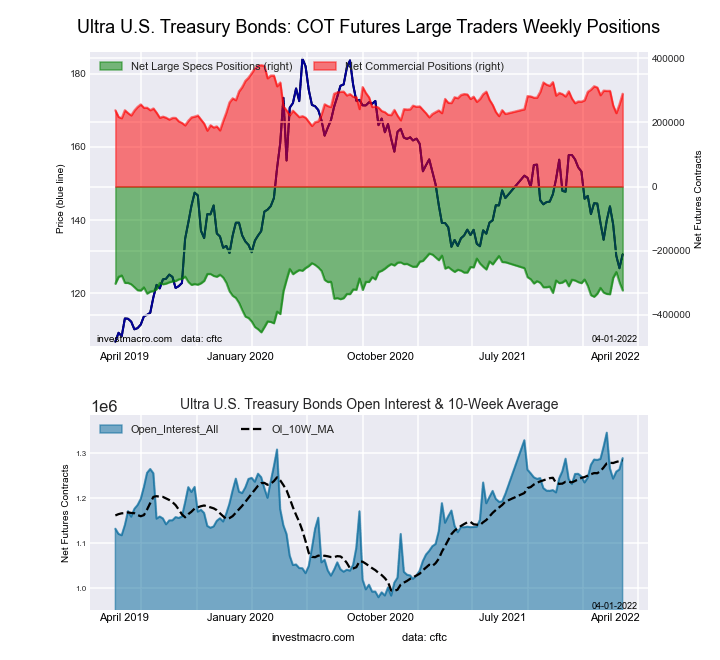
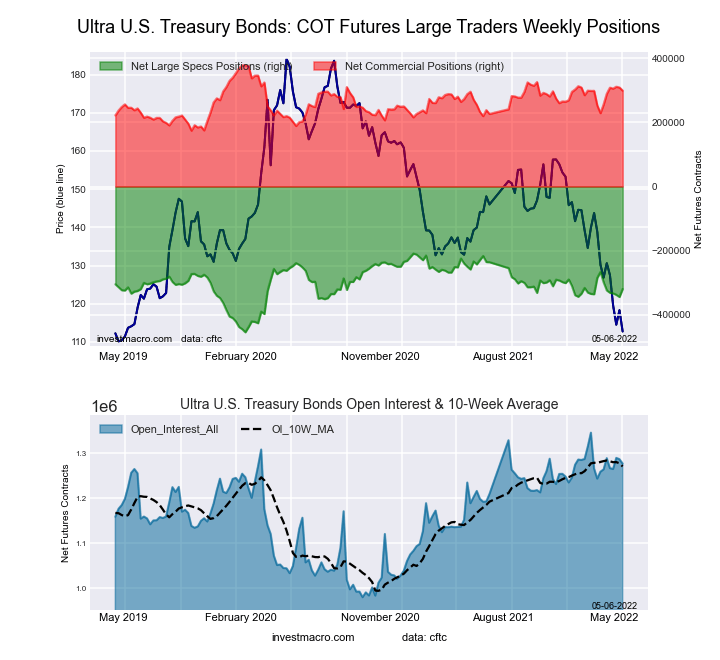
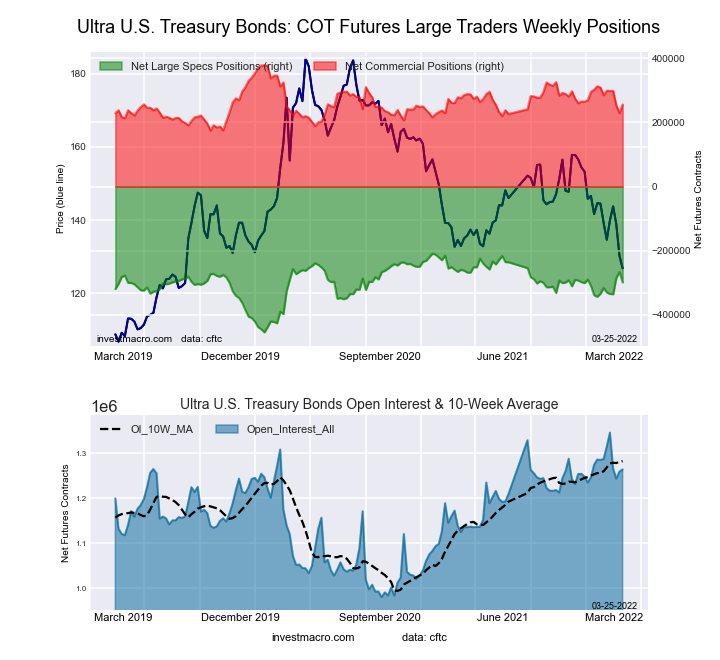
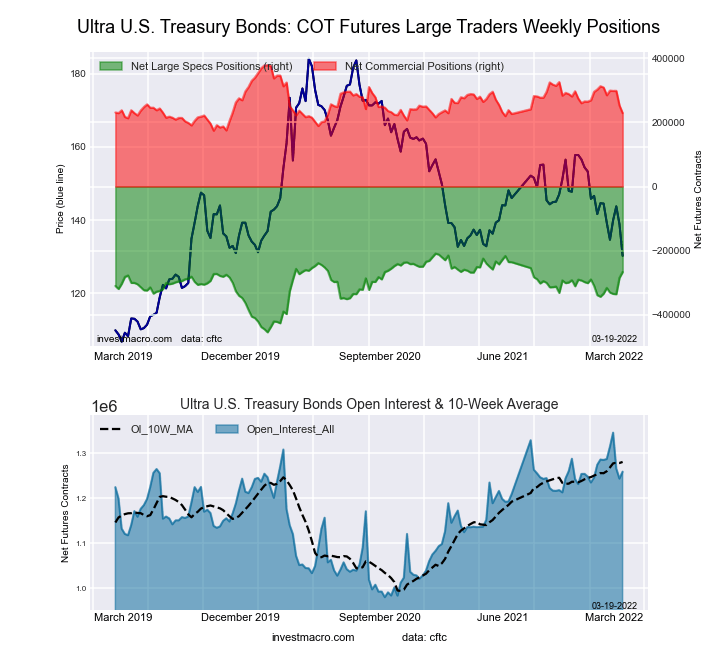
Ultra US Year Treasury Notes Long Bonds Futures COT ChartThe Ultra US Treasury Bonds large speculator standing this week totaled a net position of -323,558 contracts in the data reported through Tuesday. This was a weekly decline of -25,035 contracts from the previous week which had a total of -298,523 net contracts.

This week’s current strength score (the trader positioning range over the past three years, measured from 0 to 100) shows the speculators are currently Bullish with a score of 53.2 percent. The commercials are Bullish with a score of 56.4 percent and the small traders (not shown in chart) are Bullish with a score of 53.1 percent.

Ultra US Treasury Bonds StatisticsSPECULATORSCOMMERCIALSSMALL TRADERS
– Percent of Open Interest Longs:5.382.211.9
– Percent of Open Interest Shorts:30.459.89.2
– Net Position:-323,558288,97034,588
– Gross Longs:68,2821,059,413152,895
– Gross Shorts:391,840770,443118,307
– Long to Short Ratio:0.2 to 11.4 to 11.3 to 1
NET POSITION TREND:
– Strength Index Score (3 Year Range Pct):53.256.453.1
– Strength Index Reading (3 Year Range):BullishBullishBullish
NET POSITION MOVEMENT INDEX:
– 6-Week Change in Strength Index:2.7-4.72.2


Article By InvestMacroReceive our weekly COT Reports by Email

*COT Report: The COT data, released weekly to the public each Friday, is updated through the most recent Tuesday (data is 3 days old) and shows a quick view of how large speculators or non-commercials (for-profit traders) were positioned in the futures markets.

The CFTC categorizes trader positions according to commercial hedgers (traders who use futures contracts for hedging as part of the business), non-commercials (large traders who speculate to realize trading profits) and nonreportable traders (usually small traders/speculators) as well as their open interest (contracts open in the market at time of reporting).See CFTC criteria here.

What is an inverting yield curve and does it mean we’re heading for a recession?

By Luciano Rispoli, University of Surrey 

– One key predictor of downturns in the economy is what is known as the yield curve. This typically refers to the market for what the US government borrows, by issuing bonds and other securities that mature over different time horizons ranging from weeks to 30 years.

Each of these securities has its own yield (or interest rate), which moves up and down in inverse proportion to the security’s market value – so when bonds are trading at high prices, their yields will be low and vice versa. You can draw a chart that plots the yields of securities at each maturity date to see how they relate to one another, and this is known as the yield curve.

In normal times, as a compensation for higher risk, investors expect expect higher rates of interest for money they lend over a longer time horizon. To reflect this, the yield curve normally slopes up. When it instead slopes down – in other words, when it inverts – it is a sign that investors are more pessimistic about the long term than short term: they think a downturn or a recession is coming soon.

This is because they expect the Federal Reserve, the US central bank, is going to cut short-term interest rates in future to stimulate a struggling economy (as opposed to raising rates to cool down an economy that is overheating).

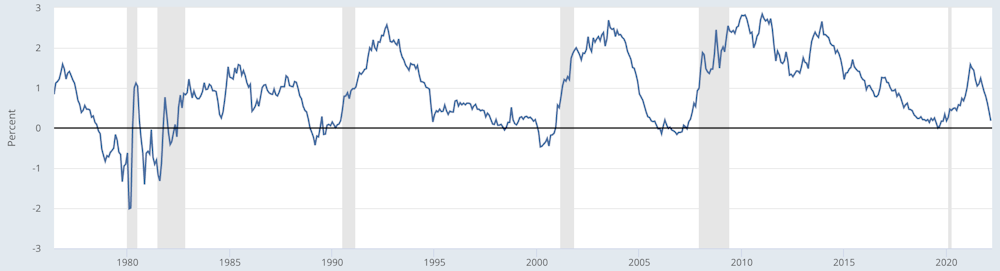
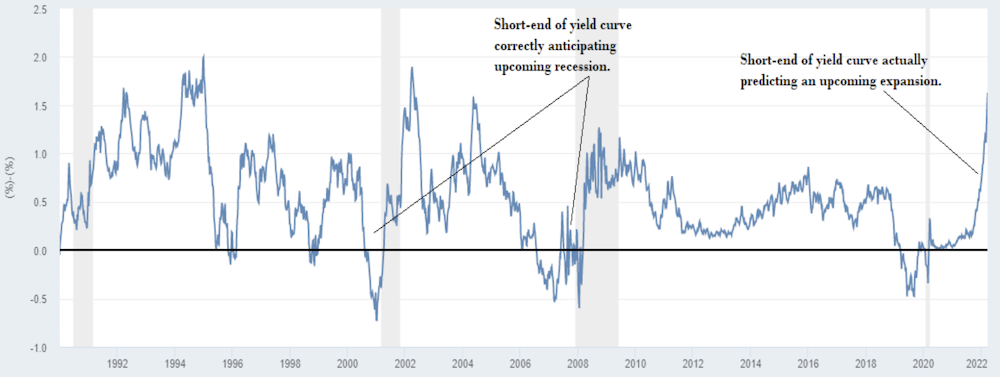
Most closely watched is the relationship between two-year and ten-year US treasury debt. The so-called spread between these two metrics can be seen in the chart below, with the grey areas indicating recessions that have tended to follow shortly after.

Spread between two-year and ten-year treasuries

Spreads between 2-year and 10-year bonds
St Louis Fed

As you can see, the yields of these two securities are getting very close to being the same, and the trend suggests that the two-year will soon have a higher yield – meaning the curve is inverting. The key question is, does an inverted yield curve hint at an upcoming downturn? Not necessarily. Let me explain why.

Inflation expectations

One complication is that bond yields don’t only reflect what investors think about future economic growth. They also buy or sell debt securities depending on what they think is going to happen to inflation. It’s generally assumed that prices will increasingly rise in the years ahead, and investors need to be compensated for bearing that risk, since higher inflation will erode their future purchasing power. For this reason, bond yields contain an element of inflation premium, normally with an increasingly higher premium for bonds with longer maturity dates.

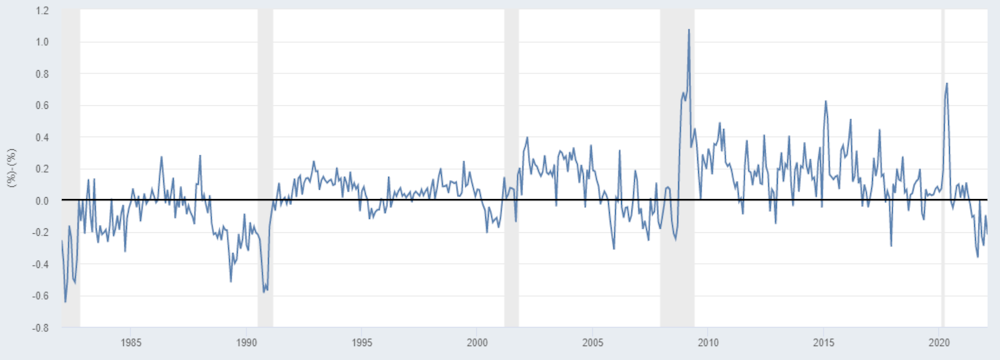
The following chart shows the spread between the inflation expectations built into 10-year and 2-year treasuries. The fact that it is in negative territory suggests the market thinks that inflation may fall, and this may also explain why yields on longer-dated treasuries are lower than on shorter-dated ones. And although inflation would fall in the event of an economic slowdown or recession, there could be a situation where inflation fell but the economy remained buoyant. Hence a yield curve inversion doesn’t have to mean that we are up against an imminent recession.

Inflation expectations (ten-year vs two-year treasuries)

Chart of the spread between inflation expectations in 10-yr and 2-yr treasuries
St Louis Fed

Quantitative easing

Another factor that is potentially affecting the yield curve is the Federal Reserve’s moves to buy government debt as part of its quantitative easing programme (QE). The idea behind QE is that by buying long-term bonds, the Fed is able to keep long-term interest rates low, which decreases the rates on mortgages and other loans, thereby stimulating the economy. Conversely, when sold, lending rates will go up and economic activity will be reduced.

Earlier in March, the Fed started raising the benchmark US interest rate and stopped the asset purchases under the QE programme that it launched in 2020 in response to the COVID pandemic. But it also indicated that it would only start selling these assets after several months of hiking the benchmark rate. Since the benchmark rate is a short-term rate, the yield curve inverting might indicate market expectations that short-term interest rates will be higher than long-term ones for the foreseeable future.

Which yield curve should we consider?

It is also sometimes argued that two-year/ten-year spreads are not the most useful ones to watch, and that instead one should focus on yields at the shorter end of the yield curve. In this set up, if you look at the difference in yields between two-year and three-month treasuries, it is actually steepening: in other words, it is hinting that economic growth is going to increase in the short term.

Economists sometimes argue that these near-term yield curve movements have stronger predictive power than those further out. At the very least, the fact that these are saying something different shows the need to be careful because different data about treasury yields can depict a different (or even opposite) picture depending on what time horizon you are considering.

Spread between two-year and three-month treasury yields

Chart comparing 2-year and 3-month treasury yields over time
St Louis Fed

To summarise, it doesn’t necessarily follow that an inverted yield curve will be followed by a recession. It certainly could mean that, in which case unemployment would likely rise and inflation would potentially come down more quickly than many are expecting. But for now, it’s too early to say. The debt market is certainly signalling that change is coming, though it’s often easier to say in hindsight what it meant than at the present time.The Conversation

About the Author:

Luciano Rispoli, Teaching Fellow in Economics, University of Surrey

This article is republished from The Conversation under a Creative Commons license. Read the original article.


Bonds Speculators take a pause on their 10-Year Treasury Notes bearish bets

By InvestMacro | COT | Data Tables | COT Leaders | Downloads | COT Newsletter

Here are the latest charts and statistics for the Commitment of Traders (COT) data published by the Commodities Futures Trading Commission (CFTC).

The latest COT data is updated through Tuesday March 22nd and shows a quick view of how large traders (for-profit speculators and commercial entities) were positioned in the futures markets.

Highlighting the COT bonds data is the pullback in the 10-Year Bond bearish bets this week. The speculative position in the 10-Year Bond has risen for two straight weeks following three straight weeks of declines (or rising bearish bets). The last two week’s rise has shaved off over 113,886 contracts from the total bearish position and brings the current standing to the least bearish level of the past five weeks at a total of -263,834 contracts. The 10-Year has been under pressure like most all bond markets as the Federal Reserve has started raising interest rates with an outlook of more rate increases to come. The 10-Year yield (as bond prices fall, yields rise) has been sharping surging to the upside with the close this week right around the 2.50 percent level, marking its highest yield since May of 2019. The speculator’s 10-Year bond pullback this week will likely be short-lived and it will be interesting to see if this latest bout of inflation, growth and central bank rate rises will be enough to finally break the multi-decade bull market for bonds.

The bond markets with higher speculator bets were the 10-Year Bond (57,163 contracts), Fed Funds (91,899 contracts) and the 5-Year Bond (50,964 contracts).

The bond markets with lower speculator bets were the 2-Year Bond (-27,015 contracts), Eurodollar (-128,245 contracts), Ultra 10-Year (-21,571 contracts), Long US Bond (-11,687 contracts) and the Ultra US Bond (-32,279 contracts).


Data Snapshot of Bond Market Traders | Columns Legend
Mar-22-2022OIOI-IndexSpec-NetSpec-IndexCom-NetCOM-IndexSmalls-NetSmalls-Index
Eurodollar10,832,33841-2,656,72203,074,395100-417,67313
FedFunds2,132,17681-13,3823829,68263-16,30018
2-Year2,297,31520-47,44873126,53848-79,09010
Long T-Bond1,128,2293632,55195-5,39418-27,15731
10-Year3,807,55351-263,83431464,33980-200,50532
5-Year3,774,45036-296,33831544,38380-248,04513


3-Month Eurodollars Futures:

Eurodollar Bonds Futures COT ChartThe 3-Month Eurodollars large speculator standing this week equaled a net position of -2,656,722 contracts in the data reported through Tuesday. This was a weekly lowering of -128,245 contracts from the previous week which had a total of -2,528,477 net contracts.

This week’s current strength score (the trader positioning range over the past three years, measured from 0 to 100) shows the speculators are currently Bearish-Extreme with a score of 0.0 percent. The commercials are Bullish-Extreme with a score of 100.0 percent and the small traders (not shown in chart) are Bearish-Extreme with a score of 12.5 percent.

3-Month Eurodollars StatisticsSPECULATORSCOMMERCIALSSMALL TRADERS
– Percent of Open Interest Longs:4.275.73.6
– Percent of Open Interest Shorts:28.747.47.4
– Net Position:-2,656,7223,074,395-417,673
– Gross Longs:451,7918,204,977389,102
– Gross Shorts:3,108,5135,130,582806,775
– Long to Short Ratio:0.1 to 11.6 to 10.5 to 1
NET POSITION TREND:
– Strength Index Score (3 Year Range Pct):0.0100.012.5
– Strength Index Reading (3 Year Range):Bearish-ExtremeBullish-ExtremeBearish-Extreme
NET POSITION MOVEMENT INDEX:
– 6-Week Change in Strength Index:-11.911.05.8


30-Day Federal Funds Futures:

Federal Funds 30-Day Bonds Futures COT ChartThe 30-Day Federal Funds large speculator standing this week equaled a net position of -13,382 contracts in the data reported through Tuesday. This was a weekly advance of 91,899 contracts from the previous week which had a total of -105,281 net contracts.

This week’s current strength score (the trader positioning range over the past three years, measured from 0 to 100) shows the speculators are currently Bearish with a score of 38.0 percent. The commercials are Bullish with a score of 63.5 percent and the small traders (not shown in chart) are Bearish-Extreme with a score of 18.3 percent.

30-Day Federal Funds StatisticsSPECULATORSCOMMERCIALSSMALL TRADERS
– Percent of Open Interest Longs:7.177.01.8
– Percent of Open Interest Shorts:7.775.62.6
– Net Position:-13,38229,682-16,300
– Gross Longs:150,8281,640,74438,998
– Gross Shorts:164,2101,611,06255,298
– Long to Short Ratio:0.9 to 11.0 to 10.7 to 1
NET POSITION TREND:
– Strength Index Score (3 Year Range Pct):38.063.518.3
– Strength Index Reading (3 Year Range):BearishBullishBearish-Extreme
NET POSITION MOVEMENT INDEX:
– 6-Week Change in Strength Index:-5.25.6-10.5


2-Year Treasury Note Futures:

2-Year Treasury Bonds Futures COT ChartThe 2-Year Treasury Note large speculator standing this week equaled a net position of -47,448 contracts in the data reported through Tuesday. This was a weekly fall of -27,015 contracts from the previous week which had a total of -20,433 net contracts.

This week’s current strength score (the trader positioning range over the past three years, measured from 0 to 100) shows the speculators are currently Bullish with a score of 72.7 percent. The commercials are Bearish with a score of 47.5 percent and the small traders (not shown in chart) are Bearish-Extreme with a score of 9.9 percent.

2-Year Treasury Note StatisticsSPECULATORSCOMMERCIALSSMALL TRADERS
– Percent of Open Interest Longs:15.973.96.1
– Percent of Open Interest Shorts:18.068.49.6
– Net Position:-47,448126,538-79,090
– Gross Longs:365,7951,697,892140,374
– Gross Shorts:413,2431,571,354219,464
– Long to Short Ratio:0.9 to 11.1 to 10.6 to 1
NET POSITION TREND:
– Strength Index Score (3 Year Range Pct):72.747.59.9
– Strength Index Reading (3 Year Range):BullishBearishBearish-Extreme
NET POSITION MOVEMENT INDEX:
– 6-Week Change in Strength Index:-7.35.25.5


5-Year Treasury Note Futures:

5-Year Treasury Bonds Futures COT ChartThe 5-Year Treasury Note large speculator standing this week equaled a net position of -296,338 contracts in the data reported through Tuesday. This was a weekly lift of 50,964 contracts from the previous week which had a total of -347,302 net contracts.

This week’s current strength score (the trader positioning range over the past three years, measured from 0 to 100) shows the speculators are currently Bearish with a score of 31.2 percent. The commercials are Bullish with a score of 79.7 percent and the small traders (not shown in chart) are Bearish-Extreme with a score of 12.9 percent.

5-Year Treasury Note StatisticsSPECULATORSCOMMERCIALSSMALL TRADERS
– Percent of Open Interest Longs:9.181.67.1
– Percent of Open Interest Shorts:16.967.213.7
– Net Position:-296,338544,383-248,045
– Gross Longs:342,4713,081,019268,697
– Gross Shorts:638,8092,536,636516,742
– Long to Short Ratio:0.5 to 11.2 to 10.5 to 1
NET POSITION TREND:
– Strength Index Score (3 Year Range Pct):31.279.712.9
– Strength Index Reading (3 Year Range):BearishBullishBearish-Extreme
NET POSITION MOVEMENT INDEX:
– 6-Week Change in Strength Index:-28.821.1-2.5


10-Year Treasury Note Futures:

10-Year Treasury Notes Bonds Futures COT ChartThe 10-Year Treasury Note large speculator standing this week equaled a net position of -263,834 contracts in the data reported through Tuesday. This was a weekly advance of 57,163 contracts from the previous week which had a total of -320,997 net contracts.

This week’s current strength score (the trader positioning range over the past three years, measured from 0 to 100) shows the speculators are currently Bearish with a score of 31.4 percent. The commercials are Bullish-Extreme with a score of 80.0 percent and the small traders (not shown in chart) are Bearish with a score of 32.0 percent.

10-Year Treasury Note StatisticsSPECULATORSCOMMERCIALSSMALL TRADERS
– Percent of Open Interest Longs:10.877.97.9
– Percent of Open Interest Shorts:17.865.713.2
– Net Position:-263,834464,339-200,505
– Gross Longs:412,0302,966,196302,390
– Gross Shorts:675,8642,501,857502,895
– Long to Short Ratio:0.6 to 11.2 to 10.6 to 1
NET POSITION TREND:
– Strength Index Score (3 Year Range Pct):31.480.032.0
– Strength Index Reading (3 Year Range):BearishBullish-ExtremeBearish
NET POSITION MOVEMENT INDEX:
– 6-Week Change in Strength Index:-9.5-2.318.6


Ultra 10-Year Notes Futures:

Ultra 10-Year Treasury Notes Bonds Futures COT ChartThe Ultra 10-Year Notes large speculator standing this week equaled a net position of -91,321 contracts in the data reported through Tuesday. This was a weekly decrease of -21,571 contracts from the previous week which had a total of -69,750 net contracts.

This week’s current strength score (the trader positioning range over the past three years, measured from 0 to 100) shows the speculators are currently Bearish-Extreme with a score of 3.6 percent. The commercials are Bullish-Extreme with a score of 100.0 percent and the small traders (not shown in chart) are Bearish with a score of 41.2 percent.

Ultra 10-Year Notes StatisticsSPECULATORSCOMMERCIALSSMALL TRADERS
– Percent of Open Interest Longs:9.780.59.3
– Percent of Open Interest Shorts:16.763.918.8
– Net Position:-91,321214,698-123,377
– Gross Longs:125,9211,045,958120,546
– Gross Shorts:217,242831,260243,923
– Long to Short Ratio:0.6 to 11.3 to 10.5 to 1
NET POSITION TREND:
– Strength Index Score (3 Year Range Pct):3.6100.041.2
– Strength Index Reading (3 Year Range):Bearish-ExtremeBullish-ExtremeBearish
NET POSITION MOVEMENT INDEX:
– 6-Week Change in Strength Index:-35.727.020.8


US Treasury Bonds Futures:

US Year Treasury Notes Long Bonds Futures COT ChartThe US Treasury Bonds large speculator standing this week equaled a net position of 32,551 contracts in the data reported through Tuesday. This was a weekly lowering of -11,687 contracts from the previous week which had a total of 44,238 net contracts.

This week’s current strength score (the trader positioning range over the past three years, measured from 0 to 100) shows the speculators are currently Bullish-Extreme with a score of 95.2 percent. The commercials are Bearish-Extreme with a score of 18.4 percent and the small traders (not shown in chart) are Bearish with a score of 31.0 percent.

US Treasury Bonds StatisticsSPECULATORSCOMMERCIALSSMALL TRADERS
– Percent of Open Interest Longs:9.772.613.8
– Percent of Open Interest Shorts:6.973.116.3
– Net Position:32,551-5,394-27,157
– Gross Longs:109,965819,658156,236
– Gross Shorts:77,414825,052183,393
– Long to Short Ratio:1.4 to 11.0 to 10.9 to 1
NET POSITION TREND:
– Strength Index Score (3 Year Range Pct):95.218.431.0
– Strength Index Reading (3 Year Range):Bullish-ExtremeBearish-ExtremeBearish
NET POSITION MOVEMENT INDEX:
– 6-Week Change in Strength Index:21.3-18.7-5.4


Ultra US Treasury Bonds Futures:

Ultra US Year Treasury Notes Long Bonds Futures COT ChartThe Ultra US Treasury Bonds large speculator standing this week equaled a net position of -298,523 contracts in the data reported through Tuesday. This was a weekly fall of -32,279 contracts from the previous week which had a total of -266,244 net contracts.

This week’s current strength score (the trader positioning range over the past three years, measured from 0 to 100) shows the speculators are currently Bullish with a score of 63.4 percent. The commercials are Bearish with a score of 40.0 percent and the small traders (not shown in chart) are Bullish with a score of 59.1 percent.

Ultra US Treasury Bonds StatisticsSPECULATORSCOMMERCIALSSMALL TRADERS
– Percent of Open Interest Longs:5.681.212.6
– Percent of Open Interest Shorts:29.261.09.2
– Net Position:-298,523255,63042,893
– Gross Longs:70,4251,026,988158,649
– Gross Shorts:368,948771,358115,756
– Long to Short Ratio:0.2 to 11.3 to 11.4 to 1
NET POSITION TREND:
– Strength Index Score (3 Year Range Pct):63.440.059.1
– Strength Index Reading (3 Year Range):BullishBearishBullish
NET POSITION MOVEMENT INDEX:
– 6-Week Change in Strength Index:7.1-14.18.3


Article By InvestMacroReceive our weekly COT Reports by Email

*COT Report: The COT data, released weekly to the public each Friday, is updated through the most recent Tuesday (data is 3 days old) and shows a quick view of how large speculators or non-commercials (for-profit traders) were positioned in the futures markets.

The CFTC categorizes trader positions according to commercial hedgers (traders who use futures contracts for hedging as part of the business), non-commercials (large traders who speculate to realize trading profits) and nonreportable traders (usually small traders/speculators) as well as their open interest (contracts open in the market at time of reporting).See CFTC criteria here.

Bonds Speculators continue to raise Eurodollar bearish bets to 170-week high

By InvestMacro | COT | Data Tables | COT Leaders | Downloads | COT Newsletter

Here are the latest charts and statistics for the Commitment of Traders (COT) data published by the Commodities Futures Trading Commission (CFTC).

The latest COT data is updated through Tuesday March 15th and shows a quick view of how large traders (for-profit speculators and commercial entities) were positioned in the futures markets.

Highlighting the COT bonds data is the steady rise in the Eurodollar bearish bets. Eurodollar futures speculator bets fell for a second consecutive week and for the fourth time in the past five weeks. This has brought the current net position to the most bearish standing of the past one hundred and seventy weeks, dating back to December of 2018. The Eurodollar futures are the largest futures market as open interest in these contracts usually numbers over 10 million contracts (sometimes three times more than the second highest market) and are used to wager or hedge on short-term interest rates (3-month Libor). A declining Eurodollar futures contract shows a rise in (deposit) interest rates while a gaining Eurodollar futures contract shows the opposite. In times of financial upheaval or strong risk-off situations such as the Great Financial Crisis or the recent Covid Crisis, Eurodollar futures have seen strong trends higher and in times of normalization and rising interest rates, Eurodollar futures typically trend downward. The current path to normal interest rates (off the near-zero floor for the Fed Funds) is happening at the moment and the Eurodollar speculator positions are reflecting that with their multi-year lows.

The bond markets with higher speculator bets this week were the 2-Year Bond (92,313 contracts), 10-Year Bond (56,723 contracts), Fed Funds (32,857 contracts), 5-Year (104,839 contracts) and the Ultra US Bond (18,174 contracts).

The bond markets with lower speculator bets this week were the Eurodollar (-143,781 contracts), Ultra 10-Year (-35,370 contracts) and the Long US Bond (-3,130 contracts).


Data Snapshot of Bond Market Traders | Columns Legend
Mar-15-2022OIOI-IndexSpec-NetSpec-IndexCom-NetCOM-IndexSmalls-NetSmalls-Index
Eurodollar10,624,29337-2,528,47702,952,797100-424,32011
FedFunds2,057,32276-105,28127120,85575-15,57420
2-Year2,155,44815-20,4337889,68439-69,25114
Long T-Bond1,118,3013544,23899-29,75211-14,48641
10-Year3,561,44534-320,99723512,81286-191,81534
5-Year3,796,31737-347,30222590,09885-242,79614


3-Month Eurodollars Futures:

Eurodollar Bonds Futures COT ChartThe 3-Month Eurodollars large speculator standing this week recorded a net position of -2,528,477 contracts in the data reported through Tuesday. This was a weekly lowering of -143,781 contracts from the previous week which had a total of -2,384,696 net contracts.

This week’s current strength score (the trader positioning range over the past three years, measured from 0 to 100) shows the speculators are currently Bearish-Extreme with a score of 0.0 percent. The commercials are Bullish-Extreme with a score of 100.0 percent and the small traders (not shown in chart) are Bearish-Extreme with a score of 11.1 percent.

3-Month Eurodollars StatisticsSPECULATORSCOMMERCIALSSMALL TRADERS
– Percent of Open Interest Longs:4.076.63.6
– Percent of Open Interest Shorts:27.848.87.6
– Net Position:-2,528,4772,952,797-424,320
– Gross Longs:421,7828,135,944386,903
– Gross Shorts:2,950,2595,183,147811,223
– Long to Short Ratio:0.1 to 11.6 to 10.5 to 1
NET POSITION TREND:
– Strength Index Score (3 Year Range Pct):0.0100.011.1
– Strength Index Reading (3 Year Range):Bearish-ExtremeBullish-ExtremeBearish-Extreme
NET POSITION MOVEMENT INDEX:
– 6-Week Change in Strength Index:-8.37.63.6


30-Day Federal Funds Futures:

Federal Funds 30-Day Bonds Futures COT ChartThe 30-Day Federal Funds large speculator standing this week recorded a net position of -105,281 contracts in the data reported through Tuesday. This was a weekly advance of 32,857 contracts from the previous week which had a total of -138,138 net contracts.

This week’s current strength score (the trader positioning range over the past three years, measured from 0 to 100) shows the speculators are currently Bearish with a score of 26.6 percent. The commercials are Bullish with a score of 74.6 percent and the small traders (not shown in chart) are Bearish with a score of 20.1 percent.

30-Day Federal Funds StatisticsSPECULATORSCOMMERCIALSSMALL TRADERS
– Percent of Open Interest Longs:3.478.31.5
– Percent of Open Interest Shorts:8.572.42.2
– Net Position:-105,281120,855-15,574
– Gross Longs:70,6011,610,54030,462
– Gross Shorts:175,8821,489,68546,036
– Long to Short Ratio:0.4 to 11.1 to 10.7 to 1
NET POSITION TREND:
– Strength Index Score (3 Year Range Pct):26.674.620.1
– Strength Index Reading (3 Year Range):BearishBullishBearish
NET POSITION MOVEMENT INDEX:
– 6-Week Change in Strength Index:-17.015.819.9


2-Year Treasury Note Futures:

2-Year Treasury Bonds Futures COT ChartThe 2-Year Treasury Note large speculator standing this week recorded a net position of -20,433 contracts in the data reported through Tuesday. This was a weekly advance of 92,313 contracts from the previous week which had a total of -112,746 net contracts.

This week’s current strength score (the trader positioning range over the past three years, measured from 0 to 100) shows the speculators are currently Bullish with a score of 78.1 percent. The commercials are Bearish with a score of 39.4 percent and the small traders (not shown in chart) are Bearish-Extreme with a score of 14.3 percent.

2-Year Treasury Note StatisticsSPECULATORSCOMMERCIALSSMALL TRADERS
– Percent of Open Interest Longs:14.576.36.4
– Percent of Open Interest Shorts:15.472.19.6
– Net Position:-20,43389,684-69,251
– Gross Longs:312,1011,644,077138,269
– Gross Shorts:332,5341,554,393207,520
– Long to Short Ratio:0.9 to 11.1 to 10.7 to 1
NET POSITION TREND:
– Strength Index Score (3 Year Range Pct):78.139.414.3
– Strength Index Reading (3 Year Range):BullishBearishBearish-Extreme
NET POSITION MOVEMENT INDEX:
– 6-Week Change in Strength Index:-13.77.814.3


5-Year Treasury Note Futures:

5-Year Treasury Bonds Futures COT ChartThe 5-Year Treasury Note large speculator standing this week recorded a net position of -347,302 contracts in the data reported through Tuesday. This was a weekly rise of 104,839 contracts from the previous week which had a total of -452,141 net contracts.

This week’s current strength score (the trader positioning range over the past three years, measured from 0 to 100) shows the speculators are currently Bearish with a score of 22.3 percent. The commercials are Bullish-Extreme with a score of 85.2 percent and the small traders (not shown in chart) are Bearish-Extreme with a score of 14.4 percent.

5-Year Treasury Note StatisticsSPECULATORSCOMMERCIALSSMALL TRADERS
– Percent of Open Interest Longs:8.882.36.6
– Percent of Open Interest Shorts:18.066.813.0
– Net Position:-347,302590,098-242,796
– Gross Longs:335,5363,125,740251,950
– Gross Shorts:682,8382,535,642494,746
– Long to Short Ratio:0.5 to 11.2 to 10.5 to 1
NET POSITION TREND:
– Strength Index Score (3 Year Range Pct):22.385.214.4
– Strength Index Reading (3 Year Range):BearishBullish-ExtremeBearish-Extreme
NET POSITION MOVEMENT INDEX:
– 6-Week Change in Strength Index:-39.822.311.9


10-Year Treasury Note Futures:

10-Year Treasury Notes Bonds Futures COT ChartThe 10-Year Treasury Note large speculator standing this week recorded a net position of -320,997 contracts in the data reported through Tuesday. This was a weekly increase of 56,723 contracts from the previous week which had a total of -377,720 net contracts.

This week’s current strength score (the trader positioning range over the past three years, measured from 0 to 100) shows the speculators are currently Bearish with a score of 22.6 percent. The commercials are Bullish-Extreme with a score of 86.0 percent and the small traders (not shown in chart) are Bearish with a score of 34.0 percent.

10-Year Treasury Note StatisticsSPECULATORSCOMMERCIALSSMALL TRADERS
– Percent of Open Interest Longs:8.279.88.7
– Percent of Open Interest Shorts:17.265.514.1
– Net Position:-320,997512,812-191,815
– Gross Longs:293,0432,843,812311,433
– Gross Shorts:614,0402,331,000503,248
– Long to Short Ratio:0.5 to 11.2 to 10.6 to 1
NET POSITION TREND:
– Strength Index Score (3 Year Range Pct):22.686.034.0
– Strength Index Reading (3 Year Range):BearishBullish-ExtremeBearish
NET POSITION MOVEMENT INDEX:
– 6-Week Change in Strength Index:-7.1-6.322.6


Ultra 10-Year Notes Futures:

Ultra 10-Year Treasury Notes Bonds Futures COT ChartThe Ultra 10-Year Notes large speculator standing this week recorded a net position of -69,750 contracts in the data reported through Tuesday. This was a weekly fall of -35,370 contracts from the previous week which had a total of -34,380 net contracts.

This week’s current strength score (the trader positioning range over the past three years, measured from 0 to 100) shows the speculators are currently Bearish-Extreme with a score of 9.3 percent. The commercials are Bullish-Extreme with a score of 99.8 percent and the small traders (not shown in chart) are Bearish with a score of 38.2 percent.

Ultra 10-Year Notes StatisticsSPECULATORSCOMMERCIALSSMALL TRADERS
– Percent of Open Interest Longs:10.579.78.9
– Percent of Open Interest Shorts:15.964.518.8
– Net Position:-69,750198,122-128,372
– Gross Longs:137,3311,038,528116,422
– Gross Shorts:207,081840,406244,794
– Long to Short Ratio:0.7 to 11.2 to 10.5 to 1
NET POSITION TREND:
– Strength Index Score (3 Year Range Pct):9.399.838.2
– Strength Index Reading (3 Year Range):Bearish-ExtremeBullish-ExtremeBearish
NET POSITION MOVEMENT INDEX:
– 6-Week Change in Strength Index:-38.928.327.7


US Treasury Bonds Futures:

US Year Treasury Notes Long Bonds Futures COT ChartThe US Treasury Bonds large speculator standing this week recorded a net position of 44,238 contracts in the data reported through Tuesday. This was a weekly decrease of -3,130 contracts from the previous week which had a total of 47,368 net contracts.

This week’s current strength score (the trader positioning range over the past three years, measured from 0 to 100) shows the speculators are currently Bullish-Extreme with a score of 99.0 percent. The commercials are Bearish-Extreme with a score of 10.7 percent and the small traders (not shown in chart) are Bearish with a score of 41.1 percent.

US Treasury Bonds StatisticsSPECULATORSCOMMERCIALSSMALL TRADERS
– Percent of Open Interest Longs:11.272.114.0
– Percent of Open Interest Shorts:7.374.715.3
– Net Position:44,238-29,752-14,486
– Gross Longs:125,767805,967156,315
– Gross Shorts:81,529835,719170,801
– Long to Short Ratio:1.5 to 11.0 to 10.9 to 1
NET POSITION TREND:
– Strength Index Score (3 Year Range Pct):99.010.741.1
– Strength Index Reading (3 Year Range):Bullish-ExtremeBearish-ExtremeBearish
NET POSITION MOVEMENT INDEX:
– 6-Week Change in Strength Index:26.3-27.85.1


Ultra US Treasury Bonds Futures:

Ultra US Year Treasury Notes Long Bonds Futures COT ChartThe Ultra US Treasury Bonds large speculator standing this week recorded a net position of -266,244 contracts in the data reported through Tuesday. This was a weekly gain of 18,174 contracts from the previous week which had a total of -284,418 net contracts.

This week’s current strength score (the trader positioning range over the past three years, measured from 0 to 100) shows the speculators are currently Bullish with a score of 76.6 percent. The commercials are Bearish with a score of 26.8 percent and the small traders (not shown in chart) are Bullish with a score of 55.2 percent.

Ultra US Treasury Bonds StatisticsSPECULATORSCOMMERCIALSSMALL TRADERS
– Percent of Open Interest Longs:7.080.112.3
– Percent of Open Interest Shorts:28.161.99.3
– Net Position:-266,244228,74237,502
– Gross Longs:87,5871,008,627154,454
– Gross Shorts:353,831779,885116,952
– Long to Short Ratio:0.2 to 11.3 to 11.3 to 1
NET POSITION TREND:
– Strength Index Score (3 Year Range Pct):76.626.855.2
– Strength Index Reading (3 Year Range):BullishBearishBullish
NET POSITION MOVEMENT INDEX:
– 6-Week Change in Strength Index:27.5-39.29.0


Article By InvestMacroReceive our weekly COT Reports by Email

*COT Report: The COT data, released weekly to the public each Friday, is updated through the most recent Tuesday (data is 3 days old) and shows a quick view of how large speculators or non-commercials (for-profit traders) were positioned in the futures markets.

The CFTC categorizes trader positions according to commercial hedgers (traders who use futures contracts for hedging as part of the business), non-commercials (large traders who speculate to realize trading profits) and nonreportable traders (usually small traders/speculators) as well as their open interest (contracts open in the market at time of reporting).See CFTC criteria here.

Interest rates are likely to rise by much less than most people are predicting

By Costas Milas, University of Liverpool 

Inflation was already a serious problem thanks to the bottlenecks in the global supply chain caused by the COVID-19 pandemic. But following Russia’s brutal invasion of Ukraine, and the effect on oil and gas prices, inflationary pressures now look a whole lot worse.

The big question is how central banks will respond. Raised inflation demands higher interest rates, but this risks compounding the global economic damage likely to be caused by the western sanctions against Russia. The Bank of England has been slightly ahead of the curve on tightening monetary policy, having raised the policy rate of interest twice in the last couple of meetings to reach 0.5% and also ending its quantitative easing (QE) programme for increasing the money supply back in December.

The Fed’s QE programme is only coming to an end now, while it has yet to raise interest rates. So with both the Fed and Bank of England about to make their latest monthly decisions, what can we expect?

The story so far

UK consumer price inflation currently stands at 5.5%, more than twice the Bank of England’s 2% inflation target, and it is expected to peak at 7% in April or even higher if there is a sustained surge in energy prices. US inflation, meanwhile, is already nudging 8%.

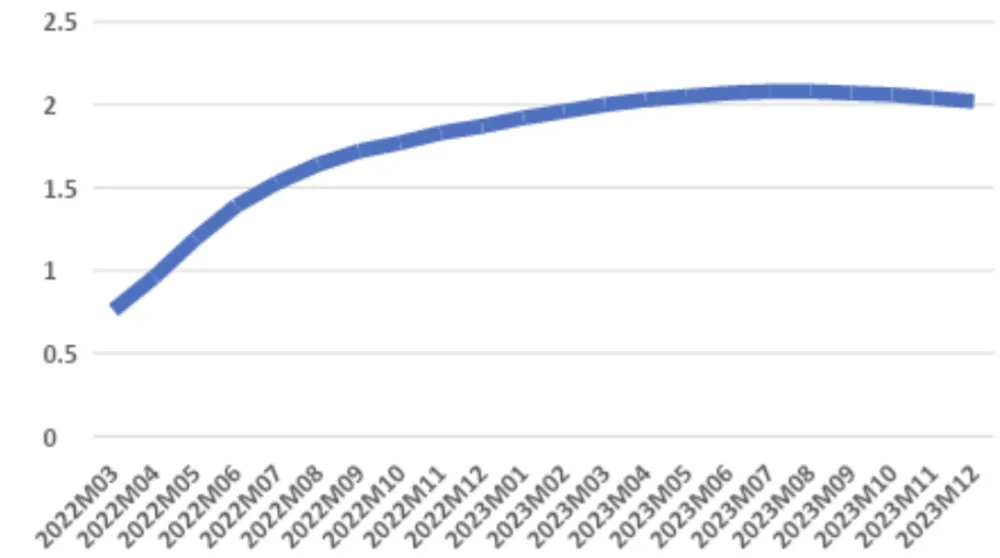
Financial markets currently expect the Bank of England’s Monetary Policy Committee (MPC) to raise the policy rate of interest to 0.75% on March 17 en route to a peak of 2% a year from now, where it is expected to remain until the end of 2023. The US equivalent rate is at 0.25%. It is likely to be increased at the latest meeting for the first time in this cycle by 0.25 or 0.5 points, before possibly heading towards 2% by year end.

Market expectations of UK interest rate (%)

Chart showing where UK interest rates are expected to be heading
Author provided

Yet the reality is that financial markets have consistently overestimated the path of interest rates. In the words of best-selling author Dan Brown in The Da Vinci Code, “Today is today. But there are many tomorrows”.

Forecasting UK rates

I have built a monetary policy tool that I use to predict where UK interest rates are likely to go next. This is based on four different drivers: the Bank of England’s inflation forecast, relative to the official 2% target; the bank’s most recent interest-rate decision; the level of excess demand in the economy, based on Office for Budgetary Responsibility (OBR) data; and an aggregate risk index, on the rationale that heightened perceptions of risk are bad for economic growth because it makes consumers and businesses less likely to spend and invest. This in turn can delay interest-rate rises.

I construct the aggregate risk index by pooling various strands of information: 50% comes from a measure of economic policy uncertainty that records how many UK newspaper articles contain various relevant terms such as “uncertainty”, “economic” and “deficit”; 20% is a financial stress score based on volatility in the pound and in the UK stock and bond markets; 20% is based on stock-market volatility from infectious diseases; and 10% is a measure of global geopolitical risk.

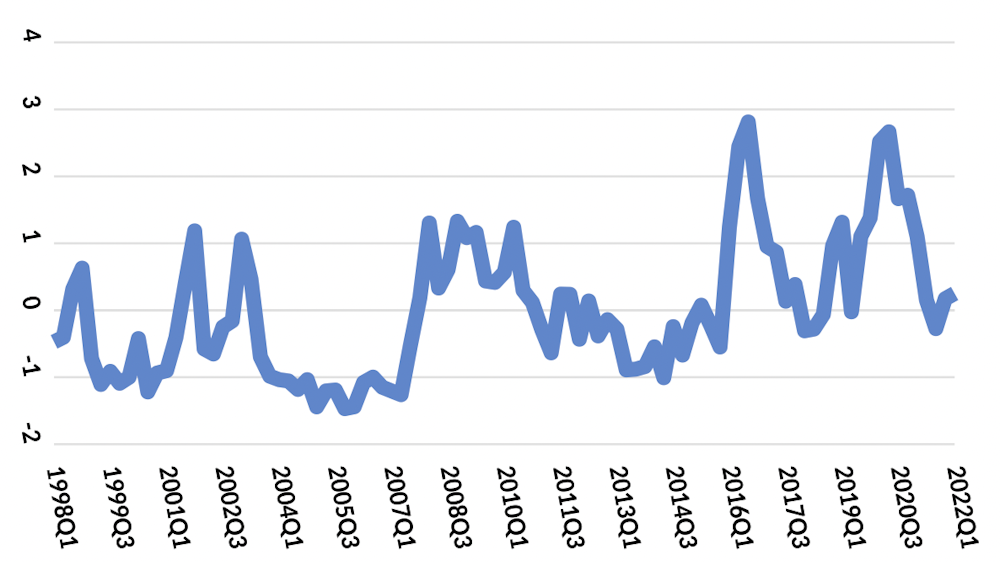
The chart below shows the aggregate risk index over a long period of time. It rose on the back of major events such as the 9/11 terrorist attacks, the 2007-09 global financial crisis and the UK’s decision to leave the EU in 2016. It also rose during the early stages of the pandemic in 2020, and is picking up again following the war in Ukraine, albeit slowly, since apart from the geopolitical risk element the remaining parts of the aggregate index have not risen sharply.

Aggregate risk index, 1998-2022

Chart showing aggregate risk over time
Author provided

My policy tool assumes that inflation remains as high as 3.1% in the first quarter of 2024 – significantly higher than the 2.15% forecast made by the Bank of England prior to the Ukraine invasion. It also assumes that inflation reverts back to the 2% target by the end of 2024.

The tool also assumes a negative effect on UK economic growth: 1 percentage point less than its potential growth in the second and third quarters. This is from raised energy prices, the government’s decision to phase out Russian oil imports by the end of 2022 and general elevated uncertainty related to the war. (It is worth noting that the UK gets around 4% of its gas and around 11% of its oil from Russia.)

As far as the aggregate risk index is concerned, the assumption is that the current crisis does not escalate to a widespread, persistent war. I’m assuming that the index rises to 0.35 in mid-2022 before reverting to zero by the end of 2023.

What happens next

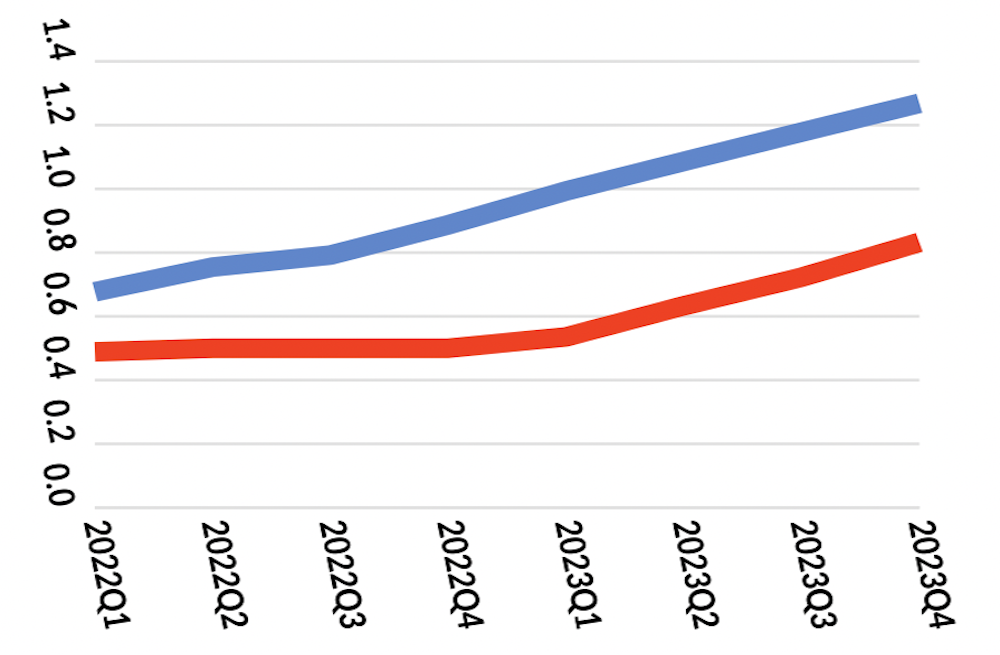
Based on these assumptions, I expect that the MPC’s latest meeting will increase UK interest rates, in line with market expectations, to close to 0.75%. But it will then raise them to just 1.3% by the end of 2023 – considerably less than what financial markets predict. And though I don’t project US rates in the same way, it might be reasonable to expect decisions from the Fed to follow a similar trajectory.

As far as the UK is concerned, different assumptions of the policy tool obviously lead to different interest rate predictions. For example, some might argue that my 10% weighting for geopolitical risk in the total aggregate risk calculation is too low. After all, in 2001 the MPC responded to the 9/11 attacks by holding a special meeting in which it cut the policy rate from 5% to 4.75%.

For this reason, the chart below shows both the policy tool’s interest rate predictions over the next couple of years in blue, and an alternative scenario in red in which each element of the aggregate risk index has a 25% weighting. Interestingly, the alternative scenario predicts that the MPC leaves interest rates unchanged at the upcoming meeting and is even more dovish in 2022 and 2023 than in my main prediction. This is because a higher weight on the (rising) geopolitical risk counteracts, to a large extent, interest rate rises due to rising inflation because it implies more damage to growth.

BoE interest rate predictions 2022-23 (%)

Chart showing interest rate predictions over time
Author provided

Other outcomes are also possible. If, for instance, the ongoing crisis escalates much further, energy price pressures will push inflation well in excess of 3% two years into the future. Yet the risk index would also rise as a result, and UK growth would take a further hit. In such a situation, the Bank of England would face an acute stagflation dilemma. That would make interest rate decisions even harder to predict, since a big hit to UK growth would open the door to interest rate cuts – and potentially more QE.The Conversation

About the Author:

Costas Milas, Professor of Finance, University of Liverpool

This article is republished from The Conversation under a Creative Commons license. Read the original article.

COT Bonds Futures Speculators push 10-Year Treasury Notes to 108-week bearish high

By InvestMacro | COT | Data Tables | COT Leaders | Downloads | COT Newsletter

Here are the latest charts and statistics for the Commitment of Traders (COT) data published by the Commodities Futures Trading Commission (CFTC).

The latest COT data is updated through Tuesday March 8th and shows a quick view of how large traders (for-profit speculators and commercial entities) were positioned in the futures markets.

Highlighting the COT bonds data is the continued bearishness in the 10-Year Bond futures. The speculative position in the 10-Year has seen bearish bets increase for three straight weeks and by a total of -203,657 contracts over this period. This rising bearishness has pushed the 10-Year speculator standing to the most bearish level in the past one hundred and eight weeks, dating back to February 11th of 2020 when the speculator position totaled -398,919 net contracts. The current 10-Year speculator strength index score underscores the weak speculator sentiment and shows an extreme-bearish reading with a 13.9 percent score this week. (The speculator strength index measures the current speculator standing compared to past three years, where above 80 is extreme-bullish , below 20 is extreme-bearish).

The bond markets with higher speculator bets were Long US Bond (51,897 contracts), Fed Funds (1,134 contracts), 5-Year (21,898 contracts) and the Ultra US Bond (50,843 contracts).

The markets with lower speculator bets were the 2-Year Bond (-1,919 contracts), Eurodollar (-164,965 contracts), 10-Year Bond (-11,937 contracts) and the Ultra 10-Year (-40,563 contracts).


Data Snapshot of Bond Market Traders | Columns Legend
Mar-08-2022OIOI-IndexSpec-NetSpec-IndexCom-NetCOM-IndexSmalls-NetSmalls-Index
Eurodollar11,104,55747-2,384,69602,824,449100-439,7538
FedFunds1,956,22469-138,13823154,04179-15,90321
2-Year2,035,83310-112,74659185,17260-72,42613
Long T-Bond1,114,6793447,368100-28,60711-18,76138
10-Year3,627,53438-377,72014587,47195-209,75130
5-Year3,845,49939-452,1414711,489100-259,34810


3-Month Eurodollars Futures:

Eurodollar Bonds Futures COT ChartThe 3-Month Eurodollars large speculator standing this week reached a net position of -2,384,696 contracts in the data reported through Tuesday. This was a weekly decline of -164,965 contracts from the previous week which had a total of -2,219,731 net contracts.

This week’s current strength score (the trader positioning range over the past three years, measured from 0 to 100) shows the speculators are currently Bearish-Extreme with a score of 0.0 percent. The commercials are Bullish-Extreme with a score of 99.9 percent and the small traders (not shown in chart) are Bearish-Extreme with a score of 7.7 percent.

3-Month Eurodollars StatisticsSPECULATORSCOMMERCIALSSMALL TRADERS
– Percent of Open Interest Longs:4.675.83.7
– Percent of Open Interest Shorts:26.150.37.6
– Net Position:-2,384,6962,824,449-439,753
– Gross Longs:514,2608,413,589405,813
– Gross Shorts:2,898,9565,589,140845,566
– Long to Short Ratio:0.2 to 11.5 to 10.5 to 1
NET POSITION TREND:
– Strength Index Score (3 Year Range Pct):0.099.97.7
– Strength Index Reading (3 Year Range):Bearish-ExtremeBullish-ExtremeBearish-Extreme
NET POSITION MOVEMENT INDEX:
– 6-Week Change in Strength Index:-5.35.5-4.0


30-Day Federal Funds Futures:

Federal Funds 30-Day Bonds Futures COT ChartThe 30-Day Federal Funds large speculator standing this week reached a net position of -138,138 contracts in the data reported through Tuesday. This was a weekly advance of 1,134 contracts from the previous week which had a total of -139,272 net contracts.

This week’s current strength score (the trader positioning range over the past three years, measured from 0 to 100) shows the speculators are currently Bearish with a score of 22.6 percent. The commercials are Bullish with a score of 78.6 percent and the small traders (not shown in chart) are Bearish with a score of 21.1 percent.

30-Day Federal Funds StatisticsSPECULATORSCOMMERCIALSSMALL TRADERS
– Percent of Open Interest Longs:2.479.81.3
– Percent of Open Interest Shorts:9.471.92.2
– Net Position:-138,138154,041-15,903
– Gross Longs:46,0201,561,46926,372
– Gross Shorts:184,1581,407,42842,275
– Long to Short Ratio:0.2 to 11.1 to 10.6 to 1
NET POSITION TREND:
– Strength Index Score (3 Year Range Pct):22.678.621.1
– Strength Index Reading (3 Year Range):BearishBullishBearish
NET POSITION MOVEMENT INDEX:
– 6-Week Change in Strength Index:-23.221.918.3


2-Year Treasury Note Futures:

2-Year Treasury Bonds Futures COT ChartThe 2-Year Treasury Note large speculator standing this week reached a net position of -112,746 contracts in the data reported through Tuesday. This was a weekly decrease of -1,919 contracts from the previous week which had a total of -110,827 net contracts.

This week’s current strength score (the trader positioning range over the past three years, measured from 0 to 100) shows the speculators are currently Bullish with a score of 59.5 percent. The commercials are Bullish with a score of 60.3 percent and the small traders (not shown in chart) are Bearish-Extreme with a score of 12.9 percent.

2-Year Treasury Note StatisticsSPECULATORSCOMMERCIALSSMALL TRADERS
– Percent of Open Interest Longs:12.478.66.7
– Percent of Open Interest Shorts:18.069.510.3
– Net Position:-112,746185,172-72,426
– Gross Longs:253,2951,600,373136,835
– Gross Shorts:366,0411,415,201209,261
– Long to Short Ratio:0.7 to 11.1 to 10.7 to 1
NET POSITION TREND:
– Strength Index Score (3 Year Range Pct):59.560.312.9
– Strength Index Reading (3 Year Range):BullishBullishBearish-Extreme
NET POSITION MOVEMENT INDEX:
– 6-Week Change in Strength Index:-29.233.3-3.4


5-Year Treasury Note Futures:

5-Year Treasury Bonds Futures COT ChartThe 5-Year Treasury Note large speculator standing this week reached a net position of -452,141 contracts in the data reported through Tuesday. This was a weekly gain of 21,898 contracts from the previous week which had a total of -474,039 net contracts.

This week’s current strength score (the trader positioning range over the past three years, measured from 0 to 100) shows the speculators are currently Bearish-Extreme with a score of 3.8 percent. The commercials are Bullish-Extreme with a score of 100.0 percent and the small traders (not shown in chart) are Bearish-Extreme with a score of 9.9 percent.

5-Year Treasury Note StatisticsSPECULATORSCOMMERCIALSSMALL TRADERS
– Percent of Open Interest Longs:8.083.16.8
– Percent of Open Interest Shorts:19.864.613.6
– Net Position:-452,141711,489-259,348
– Gross Longs:308,7933,194,985261,858
– Gross Shorts:760,9342,483,496521,206
– Long to Short Ratio:0.4 to 11.3 to 10.5 to 1
NET POSITION TREND:
– Strength Index Score (3 Year Range Pct):3.8100.09.9
– Strength Index Reading (3 Year Range):Bearish-ExtremeBullish-ExtremeBearish-Extreme
NET POSITION MOVEMENT INDEX:
– 6-Week Change in Strength Index:-54.737.70.4


10-Year Treasury Note Futures:

10-Year Treasury Notes Bonds Futures COT ChartThe 10-Year Treasury Note large speculator standing this week reached a net position of -377,720 contracts in the data reported through Tuesday. This was a weekly fall of -11,937 contracts from the previous week which had a total of -365,783 net contracts.

This week’s current strength score (the trader positioning range over the past three years, measured from 0 to 100) shows the speculators are currently Bearish-Extreme with a score of 13.9 percent. The commercials are Bullish-Extreme with a score of 95.2 percent and the small traders (not shown in chart) are Bearish with a score of 29.8 percent.

10-Year Treasury Note StatisticsSPECULATORSCOMMERCIALSSMALL TRADERS
– Percent of Open Interest Longs:8.480.18.3
– Percent of Open Interest Shorts:18.863.914.1
– Net Position:-377,720587,471-209,751
– Gross Longs:305,3242,904,848301,231
– Gross Shorts:683,0442,317,377510,982
– Long to Short Ratio:0.4 to 11.3 to 10.6 to 1
NET POSITION TREND:
– Strength Index Score (3 Year Range Pct):13.995.229.8
– Strength Index Reading (3 Year Range):Bearish-ExtremeBullish-ExtremeBearish
NET POSITION MOVEMENT INDEX:
– 6-Week Change in Strength Index:-17.410.76.1


Ultra 10-Year Notes Futures:

Ultra 10-Year Treasury Notes Bonds Futures COT ChartThe Ultra 10-Year Notes large speculator standing this week reached a net position of -34,380 contracts in the data reported through Tuesday. This was a weekly fall of -40,563 contracts from the previous week which had a total of 6,183 net contracts.

This week’s current strength score (the trader positioning range over the past three years, measured from 0 to 100) shows the speculators are currently Bearish-Extreme with a score of 18.7 percent. The commercials are Bullish-Extreme with a score of 88.2 percent and the small traders (not shown in chart) are Bearish with a score of 41.9 percent.

Ultra 10-Year Notes StatisticsSPECULATORSCOMMERCIALSSMALL TRADERS
– Percent of Open Interest Longs:11.977.69.3
– Percent of Open Interest Shorts:14.665.518.7
– Net Position:-34,380156,564-122,184
– Gross Longs:154,6351,006,050119,951
– Gross Shorts:189,015849,486242,135
– Long to Short Ratio:0.8 to 11.2 to 10.5 to 1
NET POSITION TREND:
– Strength Index Score (3 Year Range Pct):18.788.241.9
– Strength Index Reading (3 Year Range):Bearish-ExtremeBullish-ExtremeBearish
NET POSITION MOVEMENT INDEX:
– 6-Week Change in Strength Index:-34.020.832.7


US Treasury Bonds Futures:

US Year Treasury Notes Long Bonds Futures COT ChartThe US Treasury Bonds large speculator standing this week reached a net position of 47,368 contracts in the data reported through Tuesday. This was a weekly rise of 51,897 contracts from the previous week which had a total of -4,529 net contracts.

This week’s current strength score (the trader positioning range over the past three years, measured from 0 to 100) shows the speculators are currently Bullish-Extreme with a score of 100.0 percent. The commercials are Bearish-Extreme with a score of 11.0 percent and the small traders (not shown in chart) are Bearish with a score of 37.7 percent.

US Treasury Bonds StatisticsSPECULATORSCOMMERCIALSSMALL TRADERS
– Percent of Open Interest Longs:11.971.513.8
– Percent of Open Interest Shorts:7.774.115.5
– Net Position:47,368-28,607-18,761
– Gross Longs:132,656797,310154,047
– Gross Shorts:85,288825,917172,808
– Long to Short Ratio:1.6 to 11.0 to 10.9 to 1
NET POSITION TREND:
– Strength Index Score (3 Year Range Pct):100.011.037.7
– Strength Index Reading (3 Year Range):Bullish-ExtremeBearish-ExtremeBearish
NET POSITION MOVEMENT INDEX:
– 6-Week Change in Strength Index:36.3-32.8-6.8


Ultra US Treasury Bonds Futures:

Ultra US Year Treasury Notes Long Bonds Futures COT ChartThe Ultra US Treasury Bonds large speculator standing this week reached a net position of -284,418 contracts in the data reported through Tuesday. This was a weekly lift of 50,843 contracts from the previous week which had a total of -335,261 net contracts.

This week’s current strength score (the trader positioning range over the past three years, measured from 0 to 100) shows the speculators are currently Bullish with a score of 69.2 percent. The commercials are Bearish with a score of 38.5 percent and the small traders (not shown in chart) are Bullish with a score of 51.2 percent.

Ultra US Treasury Bonds StatisticsSPECULATORSCOMMERCIALSSMALL TRADERS
– Percent of Open Interest Longs:6.780.811.8
– Percent of Open Interest Shorts:29.660.59.3
– Net Position:-284,418252,52031,898
– Gross Longs:83,1731,004,968147,181
– Gross Shorts:367,591752,448115,283
– Long to Short Ratio:0.2 to 11.3 to 11.3 to 1
NET POSITION TREND:
– Strength Index Score (3 Year Range Pct):69.238.551.2
– Strength Index Reading (3 Year Range):BullishBearishBullish
NET POSITION MOVEMENT INDEX:
– 6-Week Change in Strength Index:24.0-29.30.7


Article By InvestMacroReceive our weekly COT Reports by Email

*COT Report: The COT data, released weekly to the public each Friday, is updated through the most recent Tuesday (data is 3 days old) and shows a quick view of how large speculators or non-commercials (for-profit traders) were positioned in the futures markets.

The CFTC categorizes trader positions according to commercial hedgers (traders who use futures contracts for hedging as part of the business), non-commercials (large traders who speculate to realize trading profits) and nonreportable traders (usually small traders/speculators) as well as their open interest (contracts open in the market at time of reporting).See CFTC criteria here.
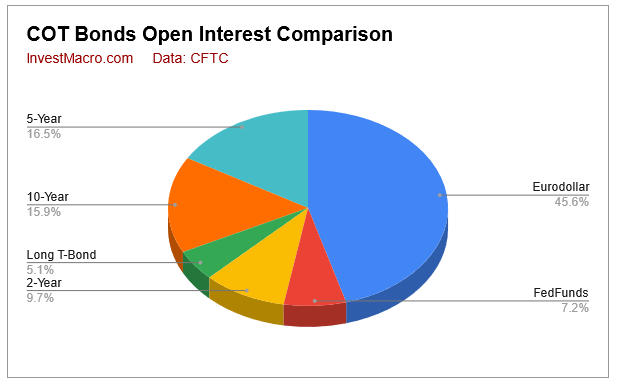
COT Bonds Speculators drop their 5-Year US Treasuries bets to 172-week low

By InvestMacro | COT | Data Tables | COT Leaders | Downloads | COT Newsletter

Here are the latest charts and statistics for the Commitment of Traders (COT) data published by the Commodities Futures Trading Commission (CFTC).

The latest COT data is updated through Tuesday March 1st 2022 and shows a quick view of how large traders (for-profit speculators and commercial entities) were positioned in the futures markets.

Highlighting the COT bonds data is the surge higher in the bearish bets of the 5-Year Bond futures. The speculative bearish position in the 5-Year has increased for four straight weeks and has seen bearish bets change by at least -125,000 contracts in each of the past two weeks. The cumulative decline over the past four weeks has now amounted to a total of -353,515 contracts. This bearishness has pushed the current speculator standing to the most negative level in the past one hundred and seventy-two weeks, dating back to November of 2018. The speculator strength index score also hit a zero percent score this week, reiterating the weakness of the 5-Year speculator sentiment (the speculator strength index is the current speculator standing compared to past three years, above 80 is bullish extreme, below 20 is bearish extreme). Despite the speculator weakness, the 5-Year Bond price this week rose as safe havens were bid with the Russian invasion of Ukraine and the risk-off tone of the markets.

The bond markets with higher speculator positions this week were the 2-Year Bond (9,132 contracts), Eurodollar (163,136 contracts) and the Long US Treasury Bond (10,209 contracts) while the bond markets with lower speculator positions were the 5-Year Bond (-126,803 contracts), 10-Year Bond (-80,691 contracts), Ultra 10-Year (-17,360 contracts), Fed Funds (-112,320 contracts) and the Ultra US Bond (-880 contracts).


Data Snapshot of Bond Market Traders | Columns Legend
Mar-01-2022OIOI-IndexSpec-NetSpec-IndexCom-NetCOM-IndexSmalls-NetSmalls-Index
Eurodollar11,107,90847-2,219,73132,611,33796-391,60618
FedFunds1,860,80663-139,27222159,33279-20,06012
2-Year2,047,62611-110,82760180,39159-69,56414
Long T-Bond1,113,86734-4,5299228,81929-24,29033
10-Year3,772,05849-365,78316585,75495-219,97127
5-Year3,807,23237-474,0390706,436100-232,39717


3-Month Eurodollars Futures:

Eurodollar Bonds Futures COT ChartThe 3-Month Eurodollars large speculator standing this week reached a net position of -2,219,731 contracts in the data reported through Tuesday. This was a weekly increase of 163,136 contracts from the previous week which had a total of -2,382,867 net contracts.

This week’s current strength score (the trader positioning range over the past three years, measured from 0 to 100) shows the speculators are currently Bearish-Extreme with a score of 3.3 percent. The commercials are Bullish-Extreme with a score of 95.7 percent and the small traders (not shown in chart) are Bearish-Extreme with a score of 18.3 percent.

3-Month Eurodollars StatisticsSPECULATORSCOMMERCIALSSMALL TRADERS
– Percent of Open Interest Longs:5.374.83.7
– Percent of Open Interest Shorts:25.351.37.2
– Net Position:-2,219,7312,611,337-391,606
– Gross Longs:591,4208,313,755411,021
– Gross Shorts:2,811,1515,702,418802,627
– Long to Short Ratio:0.2 to 11.5 to 10.5 to 1
NET POSITION TREND:
– Strength Index Score (3 Year Range Pct):3.395.718.3
– Strength Index Reading (3 Year Range):Bearish-ExtremeBullish-ExtremeBearish-Extreme
NET POSITION MOVEMENT INDEX:
– 6-Week Change in Strength Index:-8.07.60.8


30-Day Federal Funds Futures:

Federal Funds 30-Day Bonds Futures COT ChartThe 30-Day Federal Funds large speculator standing this week reached a net position of -139,272 contracts in the data reported through Tuesday. This was a weekly lowering of -112,320 contracts from the previous week which had a total of -26,952 net contracts.

This week’s current strength score (the trader positioning range over the past three years, measured from 0 to 100) shows the speculators are currently Bearish with a score of 22.4 percent. The commercials are Bullish with a score of 79.2 percent and the small traders (not shown in chart) are Bearish-Extreme with a score of 12.1 percent.

30-Day Federal Funds StatisticsSPECULATORSCOMMERCIALSSMALL TRADERS
– Percent of Open Interest Longs:2.378.71.4
– Percent of Open Interest Shorts:9.870.22.5
– Net Position:-139,272159,332-20,060
– Gross Longs:43,1491,464,99226,323
– Gross Shorts:182,4211,305,66046,383
– Long to Short Ratio:0.2 to 11.1 to 10.6 to 1
NET POSITION TREND:
– Strength Index Score (3 Year Range Pct):22.479.212.1
– Strength Index Reading (3 Year Range):BearishBullishBearish-Extreme
NET POSITION MOVEMENT INDEX:
– 6-Week Change in Strength Index:-15.715.15.7


2-Year Treasury Note Futures:

2-Year Treasury Bonds Futures COT ChartThe 2-Year Treasury Note large speculator standing this week reached a net position of -110,827 contracts in the data reported through Tuesday. This was a weekly advance of 9,132 contracts from the previous week which had a total of -119,959 net contracts.

This week’s current strength score (the trader positioning range over the past three years, measured from 0 to 100) shows the speculators are currently Bullish with a score of 59.9 percent. The commercials are Bullish with a score of 59.3 percent and the small traders (not shown in chart) are Bearish-Extreme with a score of 14.2 percent.

2-Year Treasury Note StatisticsSPECULATORSCOMMERCIALSSMALL TRADERS
– Percent of Open Interest Longs:11.778.47.6
– Percent of Open Interest Shorts:17.169.611.0
– Net Position:-110,827180,391-69,564
– Gross Longs:240,0271,605,575155,387
– Gross Shorts:350,8541,425,184224,951
– Long to Short Ratio:0.7 to 11.1 to 10.7 to 1
NET POSITION TREND:
– Strength Index Score (3 Year Range Pct):59.959.314.2
– Strength Index Reading (3 Year Range):BullishBullishBearish-Extreme
NET POSITION MOVEMENT INDEX:
– 6-Week Change in Strength Index:-30.233.6-1.8


5-Year Treasury Note Futures:

5-Year Treasury Bonds Futures COT ChartThe 5-Year Treasury Note large speculator standing this week reached a net position of -474,039 contracts in the data reported through Tuesday. This was a weekly reduction of -126,803 contracts from the previous week which had a total of -347,236 net contracts.

This week’s current strength score (the trader positioning range over the past three years, measured from 0 to 100) shows the speculators are currently Bearish-Extreme with a score of 0.0 percent. The commercials are Bullish-Extreme with a score of 100.0 percent and the small traders (not shown in chart) are Bearish-Extreme with a score of 17.2 percent.

5-Year Treasury Note StatisticsSPECULATORSCOMMERCIALSSMALL TRADERS
– Percent of Open Interest Longs:7.283.17.0
– Percent of Open Interest Shorts:19.764.513.1
– Net Position:-474,039706,436-232,397
– Gross Longs:275,6113,163,442267,288
– Gross Shorts:749,6502,457,006499,685
– Long to Short Ratio:0.4 to 11.3 to 10.5 to 1
NET POSITION TREND:
– Strength Index Score (3 Year Range Pct):0.0100.017.2
– Strength Index Reading (3 Year Range):Bearish-ExtremeBullish-ExtremeBearish-Extreme
NET POSITION MOVEMENT INDEX:
– 6-Week Change in Strength Index:-45.127.88.1


10-Year Treasury Note Futures:

10-Year Treasury Notes Bonds Futures COT ChartThe 10-Year Treasury Note large speculator standing this week reached a net position of -365,783 contracts in the data reported through Tuesday. This was a weekly decrease of -80,691 contracts from the previous week which had a total of -285,092 net contracts.

This week’s current strength score (the trader positioning range over the past three years, measured from 0 to 100) shows the speculators are currently Bearish-Extreme with a score of 15.7 percent. The commercials are Bullish-Extreme with a score of 95.0 percent and the small traders (not shown in chart) are Bearish with a score of 27.4 percent.

10-Year Treasury Note StatisticsSPECULATORSCOMMERCIALSSMALL TRADERS
– Percent of Open Interest Longs:10.577.58.5
– Percent of Open Interest Shorts:20.262.014.3
– Net Position:-365,783585,754-219,971
– Gross Longs:397,0912,925,060319,742
– Gross Shorts:762,8742,339,306539,713
– Long to Short Ratio:0.5 to 11.3 to 10.6 to 1
NET POSITION TREND:
– Strength Index Score (3 Year Range Pct):15.795.027.4
– Strength Index Reading (3 Year Range):Bearish-ExtremeBullish-ExtremeBearish
NET POSITION MOVEMENT INDEX:
– 6-Week Change in Strength Index:-14.55.811.0


Ultra 10-Year Notes Futures:

Ultra 10-Year Treasury Notes Bonds Futures COT ChartThe Ultra 10-Year Notes large speculator standing this week reached a net position of 6,183 contracts in the data reported through Tuesday. This was a weekly reduction of -17,360 contracts from the previous week which had a total of 23,543 net contracts.

This week’s current strength score (the trader positioning range over the past three years, measured from 0 to 100) shows the speculators are currently Bearish with a score of 29.4 percent. The commercials are Bullish with a score of 76.0 percent and the small traders (not shown in chart) are Bearish with a score of 43.5 percent.

Ultra 10-Year Notes StatisticsSPECULATORSCOMMERCIALSSMALL TRADERS
– Percent of Open Interest Longs:14.974.39.3
– Percent of Open Interest Shorts:14.465.818.3
– Net Position:6,183113,368-119,551
– Gross Longs:199,058992,920124,560
– Gross Shorts:192,875879,552244,111
– Long to Short Ratio:1.0 to 11.1 to 10.5 to 1
NET POSITION TREND:
– Strength Index Score (3 Year Range Pct):29.476.043.5
– Strength Index Reading (3 Year Range):BearishBullishBearish
NET POSITION MOVEMENT INDEX:
– 6-Week Change in Strength Index:-18.42.536.5


US Treasury Bonds Futures:

US Year Treasury Notes Long Bonds Futures COT ChartThe US Treasury Bonds large speculator standing this week reached a net position of -4,529 contracts in the data reported through Tuesday. This was a weekly lift of 10,209 contracts from the previous week which had a total of -14,738 net contracts.

This week’s current strength score (the trader positioning range over the past three years, measured from 0 to 100) shows the speculators are currently Bullish-Extreme with a score of 91.8 percent. The commercials are Bearish with a score of 29.3 percent and the small traders (not shown in chart) are Bearish with a score of 33.3 percent.

US Treasury Bonds StatisticsSPECULATORSCOMMERCIALSSMALL TRADERS
– Percent of Open Interest Longs:10.972.813.8
– Percent of Open Interest Shorts:11.370.216.0
– Net Position:-4,52928,819-24,290
– Gross Longs:120,945810,886154,016
– Gross Shorts:125,474782,067178,306
– Long to Short Ratio:1.0 to 11.0 to 10.9 to 1
NET POSITION TREND:
– Strength Index Score (3 Year Range Pct):91.829.333.3
– Strength Index Reading (3 Year Range):Bullish-ExtremeBearishBearish
NET POSITION MOVEMENT INDEX:
– 6-Week Change in Strength Index:15.4-9.9-9.3


Ultra US Treasury Bonds Futures:

Ultra US Year Treasury Notes Long Bonds Futures COT ChartThe Ultra US Treasury Bonds large speculator standing this week reached a net position of -335,261 contracts in the data reported through Tuesday. This was a weekly lowering of -880 contracts from the previous week which had a total of -334,381 net contracts.

This week’s current strength score (the trader positioning range over the past three years, measured from 0 to 100) shows the speculators are currently Bearish with a score of 48.4 percent. The commercials are Bullish with a score of 60.8 percent and the small traders (not shown in chart) are Bullish with a score of 55.1 percent.

Ultra US Treasury Bonds StatisticsSPECULATORSCOMMERCIALSSMALL TRADERS
– Percent of Open Interest Longs:6.280.012.6
– Percent of Open Interest Shorts:32.756.49.6
– Net Position:-335,261297,95337,308
– Gross Longs:79,1201,012,450159,109
– Gross Shorts:414,381714,497121,801
– Long to Short Ratio:0.2 to 11.4 to 11.3 to 1
NET POSITION TREND:
– Strength Index Score (3 Year Range Pct):48.460.855.1
– Strength Index Reading (3 Year Range):BearishBullishBullish
NET POSITION MOVEMENT INDEX:
– 6-Week Change in Strength Index:1.3-2.00.7


Article By InvestMacroReceive our weekly COT Reports by Email

*COT Report: The COT data, released weekly to the public each Friday, is updated through the most recent Tuesday (data is 3 days old) and shows a quick view of how large speculators or non-commercials (for-profit traders) were positioned in the futures markets.

The CFTC categorizes trader positions according to commercial hedgers (traders who use futures contracts for hedging as part of the business), non-commercials (large traders who speculate to realize trading profits) and nonreportable traders (usually small traders/speculators) as well as their open interest (contracts open in the market at time of reporting).See CFTC criteria here.
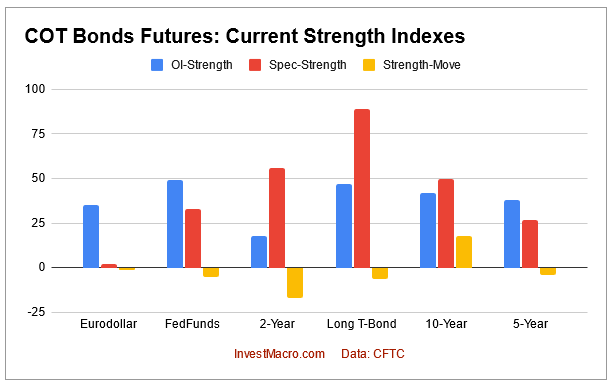
COT Bonds Speculators raised their 10-Year Treasuries bearish bets to 6-week high

By InvestMacro | COT | Data Tables | COT Leaders | Downloads | COT Newsletter

Here are the latest charts and statistics for the Commitment of Traders (COT) data published by the Commodities Futures Trading Commission (CFTC).

The latest COT data is updated through Tuesday February 22nd and shows a quick view of how large traders (for-profit speculators and commercial entities) were positioned in the futures markets.

Highlighting the COT bonds data was the large increase in bearish bets for the 10-Year Bonds. The speculative bearish position in the 10-Year jumped this week by -111,029 contracts and marked the largest one-week rise in bearish positions since November 2nd, a span of sixteen weeks. This decline in sentiment has pushed the overall 10-Year spec positioning to the most bearish level of the past six weeks. Most of the bonds markets we cover saw an increase in their bearish bets this week as the Federal Reserve central bank is widely expected to raise their benchmark interest rate in March.

Joining the 10-Year (-111,029 contracts) with speculator weakness this week were the Eurodollar (-89,630 contracts), 2-Year Bond (-4,201 contracts),  Fed Funds (-49,473 contracts), 5-Year Bond (-155,821 contracts) and the Ultra US Bond (-4,242 contracts). The Ultra 10-Year (9,672 contracts) and Long US Bond (10,107 contracts) saw small improvement in their speculator contracts this week.


Data Snapshot of Bond Market Traders | Columns Legend
Feb-22-2022OIOI-IndexSpec-NetSpec-IndexCom-NetCOM-IndexSmalls-NetSmalls-Index
Eurodollar11,350,31352-2,382,86702,830,166100-447,2996
FedFunds2,062,16876-26,9523641,65565-14,70325
2-Year2,163,98315-119,95958218,05668-98,0971
Long T-Bond1,223,51553-14,7388843,26934-28,53130
10-Year4,083,46370-285,09228543,17890-258,08619
5-Year4,295,78963-347,23619483,37577-136,13944


3-Month Eurodollars Futures:

Eurodollar Bonds Futures COT ChartThe 3-Month Eurodollars large speculator standing this week was a net position of -2,382,867 contracts in the data reported through Tuesday. This was a weekly lowering of -89,630 contracts from the previous week which had a total of -2,293,237 net contracts.

This week’s current strength score (the trader positioning range over the past three years, measured from 0 to 100) shows the speculators are currently Bearish-Extreme with a score of 0.0 percent. The commercials are Bullish-Extreme with a score of 100.0 percent and the small traders (not shown in chart) are Bearish-Extreme with a score of 6.0 percent.

3-Month Eurodollars StatisticsSPECULATORSCOMMERCIALSSMALL TRADERS
– Percent of Open Interest Longs:4.774.14.6
– Percent of Open Interest Shorts:25.749.18.5
– Net Position:-2,382,8672,830,166-447,299
– Gross Longs:536,9908,405,647522,154
– Gross Shorts:2,919,8575,575,481969,453
– Long to Short Ratio:0.2 to 11.5 to 10.5 to 1
NET POSITION TREND:
– Strength Index Score (3 Year Range Pct):0.0100.06.0
– Strength Index Reading (3 Year Range):Bearish-ExtremeBullish-ExtremeBearish-Extreme
NET POSITION MOVEMENT INDEX:
– 6-Week Change in Strength Index:-12.212.9-13.5


30-Day Federal Funds Futures:

Federal Funds 30-Day Bonds Futures COT ChartThe 30-Day Federal Funds large speculator standing this week was a net position of -26,952 contracts in the data reported through Tuesday. This was a weekly decline of -49,473 contracts from the previous week which had a total of 22,521 net contracts.

This week’s current strength score (the trader positioning range over the past three years, measured from 0 to 100) shows the speculators are currently Bearish with a score of 36.3 percent. The commercials are Bullish with a score of 64.9 percent and the small traders (not shown in chart) are Bearish with a score of 25.2 percent.

30-Day Federal Funds StatisticsSPECULATORSCOMMERCIALSSMALL TRADERS
– Percent of Open Interest Longs:7.875.12.5
– Percent of Open Interest Shorts:9.173.13.2
– Net Position:-26,95241,655-14,703
– Gross Longs:161,3571,549,55150,750
– Gross Shorts:188,3091,507,89665,453
– Long to Short Ratio:0.9 to 11.0 to 10.8 to 1
NET POSITION TREND:
– Strength Index Score (3 Year Range Pct):36.364.925.2
– Strength Index Reading (3 Year Range):BearishBullishBearish
NET POSITION MOVEMENT INDEX:
– 6-Week Change in Strength Index:5.0-3.4-29.9


2-Year Treasury Note Futures:

2-Year Treasury Bonds Futures COT ChartThe 2-Year Treasury Note large speculator standing this week was a net position of -119,959 contracts in the data reported through Tuesday. This was a weekly reduction of -4,201 contracts from the previous week which had a total of -115,758 net contracts.

This week’s current strength score (the trader positioning range over the past three years, measured from 0 to 100) shows the speculators are currently Bullish with a score of 58.0 percent. The commercials are Bullish with a score of 67.5 percent and the small traders (not shown in chart) are Bearish-Extreme with a score of 1.5 percent.

2-Year Treasury Note StatisticsSPECULATORSCOMMERCIALSSMALL TRADERS
– Percent of Open Interest Longs:12.176.57.0
– Percent of Open Interest Shorts:17.666.411.5
– Net Position:-119,959218,056-98,097
– Gross Longs:261,7101,655,912150,668
– Gross Shorts:381,6691,437,856248,765
– Long to Short Ratio:0.7 to 11.2 to 10.6 to 1
NET POSITION TREND:
– Strength Index Score (3 Year Range Pct):58.067.51.5
– Strength Index Reading (3 Year Range):BullishBullishBearish-Extreme
NET POSITION MOVEMENT INDEX:
– 6-Week Change in Strength Index:-34.744.2-13.4


5-Year Treasury Note Futures:

5-Year Treasury Bonds Futures COT ChartThe 5-Year Treasury Note large speculator standing this week was a net position of -347,236 contracts in the data reported through Tuesday. This was a weekly decrease of -155,821 contracts from the previous week which had a total of -191,415 net contracts.

This week’s current strength score (the trader positioning range over the past three years, measured from 0 to 100) shows the speculators are currently Bearish-Extreme with a score of 19.3 percent. The commercials are Bullish with a score of 76.9 percent and the small traders (not shown in chart) are Bearish with a score of 43.6 percent.

5-Year Treasury Note StatisticsSPECULATORSCOMMERCIALSSMALL TRADERS
– Percent of Open Interest Longs:7.378.29.5
– Percent of Open Interest Shorts:15.467.012.7
– Net Position:-347,236483,375-136,139
– Gross Longs:314,6123,360,252409,662
– Gross Shorts:661,8482,876,877545,801
– Long to Short Ratio:0.5 to 11.2 to 10.8 to 1
NET POSITION TREND:
– Strength Index Score (3 Year Range Pct):19.376.943.6
– Strength Index Reading (3 Year Range):Bearish-ExtremeBullishBearish
NET POSITION MOVEMENT INDEX:
– 6-Week Change in Strength Index:-8.7-10.034.1


10-Year Treasury Note Futures:

10-Year Treasury Notes Bonds Futures COT ChartThe 10-Year Treasury Note large speculator standing this week was a net position of -285,092 contracts in the data reported through Tuesday. This was a weekly decrease of -111,029 contracts from the previous week which had a total of -174,063 net contracts.

This week’s current strength score (the trader positioning range over the past three years, measured from 0 to 100) shows the speculators are currently Bearish with a score of 28.1 percent. The commercials are Bullish-Extreme with a score of 89.8 percent and the small traders (not shown in chart) are Bearish-Extreme with a score of 18.6 percent.

10-Year Treasury Note StatisticsSPECULATORSCOMMERCIALSSMALL TRADERS
– Percent of Open Interest Longs:10.674.39.4
– Percent of Open Interest Shorts:17.661.015.8
– Net Position:-285,092543,178-258,086
– Gross Longs:432,7643,034,786385,175
– Gross Shorts:717,8562,491,608643,261
– Long to Short Ratio:0.6 to 11.2 to 10.6 to 1
NET POSITION TREND:
– Strength Index Score (3 Year Range Pct):28.189.818.6
– Strength Index Reading (3 Year Range):BearishBullish-ExtremeBearish-Extreme
NET POSITION MOVEMENT INDEX:
– 6-Week Change in Strength Index:9.1-7.30.2


Ultra 10-Year Notes Futures:

Ultra 10-Year Treasury Notes Bonds Futures COT ChartThe Ultra 10-Year Notes large speculator standing this week was a net position of 23,543 contracts in the data reported through Tuesday. This was a weekly boost of 9,672 contracts from the previous week which had a total of 13,871 net contracts.

This week’s current strength score (the trader positioning range over the past three years, measured from 0 to 100) shows the speculators are currently Bearish with a score of 34.0 percent. The commercials are Bullish with a score of 75.9 percent and the small traders (not shown in chart) are Bearish with a score of 33.3 percent.

Ultra 10-Year Notes StatisticsSPECULATORSCOMMERCIALSSMALL TRADERS
– Percent of Open Interest Longs:15.571.39.6
– Percent of Open Interest Shorts:13.963.618.9
– Net Position:23,543112,921-136,464
– Gross Longs:226,7751,045,206140,723
– Gross Shorts:203,232932,285277,187
– Long to Short Ratio:1.1 to 11.1 to 10.5 to 1
NET POSITION TREND:
– Strength Index Score (3 Year Range Pct):34.075.933.3
– Strength Index Reading (3 Year Range):BearishBullishBearish
NET POSITION MOVEMENT INDEX:
– 6-Week Change in Strength Index:-18.75.829.9


US Treasury Bonds Futures:

US Year Treasury Notes Long Bonds Futures COT ChartThe US Treasury Bonds large speculator standing this week was a net position of -14,738 contracts in the data reported through Tuesday. This was a weekly lift of 10,107 contracts from the previous week which had a total of -24,845 net contracts.

This week’s current strength score (the trader positioning range over the past three years, measured from 0 to 100) shows the speculators are currently Bullish-Extreme with a score of 88.1 percent. The commercials are Bearish with a score of 33.9 percent and the small traders (not shown in chart) are Bearish with a score of 29.9 percent.

US Treasury Bonds StatisticsSPECULATORSCOMMERCIALSSMALL TRADERS
– Percent of Open Interest Longs:10.672.914.2
– Percent of Open Interest Shorts:11.969.416.6
– Net Position:-14,73843,269-28,531
– Gross Longs:130,266891,876174,017
– Gross Shorts:145,004848,607202,548
– Long to Short Ratio:0.9 to 11.1 to 10.9 to 1
NET POSITION TREND:
– Strength Index Score (3 Year Range Pct):88.133.929.9
– Strength Index Reading (3 Year Range):Bullish-ExtremeBearishBearish
NET POSITION MOVEMENT INDEX:
– 6-Week Change in Strength Index:18.1-8.4-19.0


Ultra US Treasury Bonds Futures:

Ultra US Year Treasury Notes Long Bonds Futures COT ChartThe Ultra US Treasury Bonds large speculator standing this week was a net position of -334,381 contracts in the data reported through Tuesday. This was a weekly lowering of -4,242 contracts from the previous week which had a total of -330,139 net contracts.

This week’s current strength score (the trader positioning range over the past three years, measured from 0 to 100) shows the speculators are currently Bearish with a score of 48.8 percent. The commercials are Bullish with a score of 60.7 percent and the small traders (not shown in chart) are Bullish with a score of 54.6 percent.

Ultra US Treasury Bonds StatisticsSPECULATORSCOMMERCIALSSMALL TRADERS
– Percent of Open Interest Longs:6.079.711.9
– Percent of Open Interest Shorts:30.857.69.2
– Net Position:-334,381297,78336,598
– Gross Longs:80,6381,072,855159,934
– Gross Shorts:415,019775,072123,336
– Long to Short Ratio:0.2 to 11.4 to 11.3 to 1
NET POSITION TREND:
– Strength Index Score (3 Year Range Pct):48.860.754.6
– Strength Index Reading (3 Year Range):BearishBullishBullish
NET POSITION MOVEMENT INDEX:
– 6-Week Change in Strength Index:-10.11.415.8


Article By InvestMacroReceive our weekly COT Reports by Email

*COT Report: The COT data, released weekly to the public each Friday, is updated through the most recent Tuesday (data is 3 days old) and shows a quick view of how large speculators or non-commercials (for-profit traders) were positioned in the futures markets.

The CFTC categorizes trader positions according to commercial hedgers (traders who use futures contracts for hedging as part of the business), non-commercials (large traders who speculate to realize trading profits) and nonreportable traders (usually small traders/speculators) as well as their open interest (contracts open in the market at time of reporting).See CFTC criteria here.
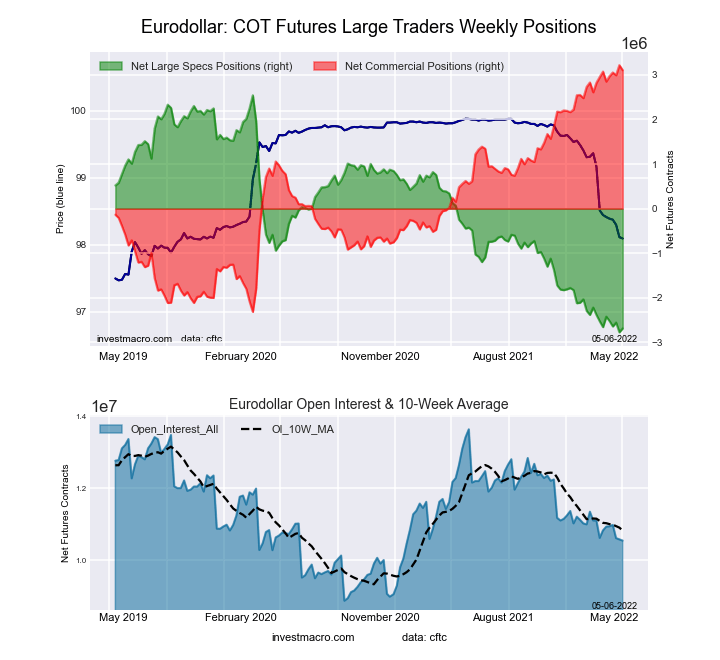
Why the “60 / 40 Balance” May Be Hazardous to Your Portfolio

Notice the similar pattern between these two bond charts

By Elliott Wave International

Financial advisors have long advocated a mix of 60% stocks / 40% bonds to cushion portfolios from downturns in the stock market.

The thinking is that stocks go up in the long-term, hence, that’s where investors should allocate the most. At the same time, advisors acknowledge that stock prices can sometimes go down so “less risky” bonds will provide at least some protection.

The problem with this investment strategy is that bonds can go into bear markets too. Moreover, they can do so at the same time as stocks.

Let’s review what happened during the Great Depression of the early 1930s. Here’s a chart and commentary from Robert Prechter’s 2021 Last Chance to Conquer the Crash:

The chart shows what happened to the Dow Jones 40-bond average, which lost 30% of its value in four years. Observe that the collapse of the early 1930s brought these bonds’ prices below — and their interest rates above — where they were in 1920 near the peak in the intense inflation of the ‘Teens.

Now, let’s review more recent history. Here’s another chart and commentary from the book:

This chart shows a comparable data series (the Bond Buyer 20-Bond average) in recent decades. Notice how similar the pattern is to that of 1915-1929. If bonds follow the path that they did in the 1930s, their prices will fall below the 1981 low, and their interest rates will exceed that year’s peak of 16%.

Conventional analysts who expect bonds to move contracyclically to stocks in the months ahead may be in for a very unpleasant surprise.
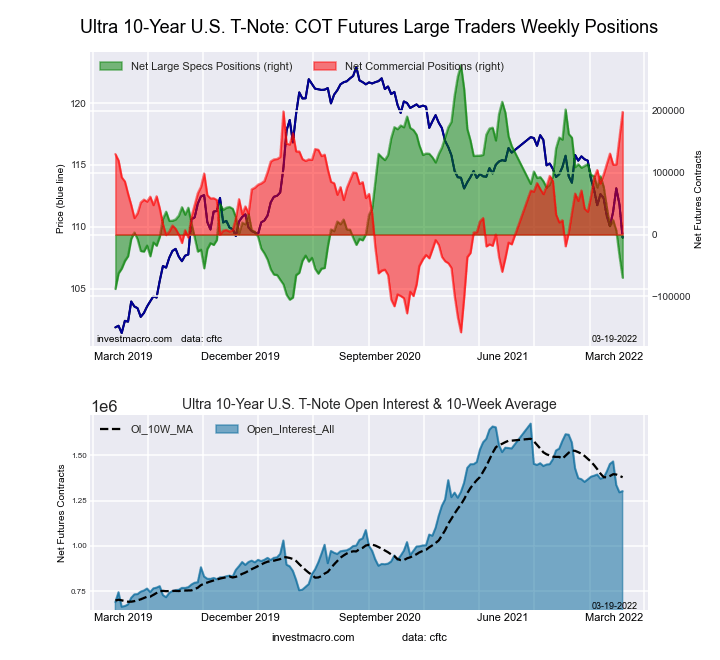
Indeed, the financial pages are all abuzz about the prospects of higher interest rates or bond yields.
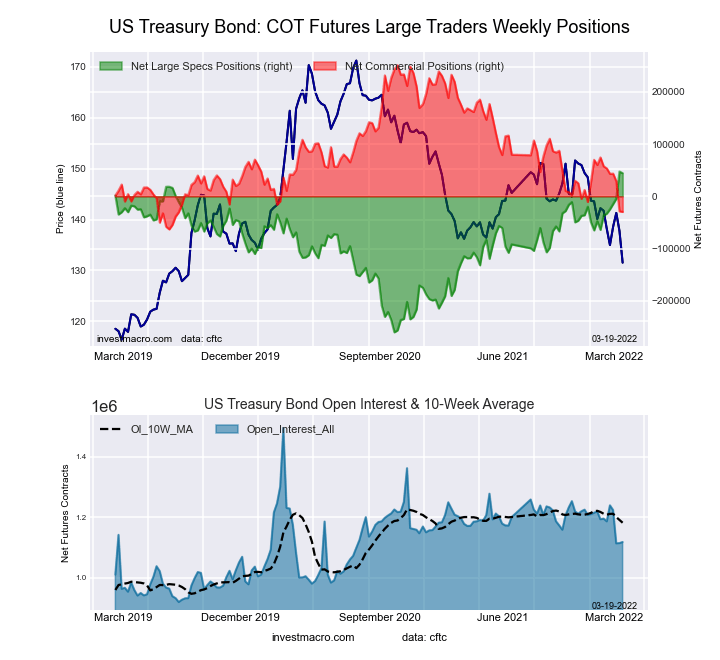
As this Feb. 10 CNBC news item notes:

The yield on the 10-year Treasury note jumped 8 basis points to hit a session high of 2.01%, the first time that the benchmark rate reached the threshold since August 2019.

Elliott Wave International has been preparing subscribers for higher yields for quite some time.

For instance, back in early March 2020, when the yield on the 10-year Treasury note was at a then record low 0.91%, the March 2020 Elliott Wave Financial Forecast, a monthly publication which provides analysis of major U.S. financial markets, said:

This is the first time that 10-year Treasury note yields have dropped below 1%. … Investor ebullience is the only thing that allows for an embrace of no-yield debt. The tidal wave of risk assumption, however, may be turning.

In other words, prepare for higher yields.

Just a few months later, yields hit a bottom and have been trending upward ever since. Mind you, yields had been in a downtrend for some 40 years! Of course, higher yields mean lower bond prices.

All the while, the stock market has been trending lower as well.

Now is the time to know the Elliott wave chart patterns of both bonds and stocks.

If you’re unfamiliar with Elliott wave chart patterns, you are encouraged to read Frost & Prechter’s Wall Street classic, Elliott Wave Principle: Key to Market Behavior.

Here’s a quote from the book:

The Wave Principle is governed by man’s social nature, and since he has such a nature, its expression generates forms. As the forms are repetitive, they have predictive value.

Get detailed insights into these repetitive forms by reading the entire online version of the book for free!

All that’s required for free access is a Club EWI membership, which is also free. If you’re unfamiliar with Club EWI, it’s the world’s largest Elliott wave educational community and offers members free access to a wealth of Elliott wave resources on investing and trading without any obligations.

Become a Club EWI member now by following this link: Elliott Wave Principle: Key to Market Behaviorfree and unlimited access.

This article was syndicated by Elliott Wave International and was originally published under the headline Why the “60 / 40 Balance” May Be Hazardous to Your Portfolio. EWI is the world’s largest market forecasting firm. Its staff of full-time analysts led by Chartered Market Technician Robert Prechter provides 24-hour-a-day market analysis to institutional and private investors around the world.

Does the Fed Really Determine the Trend of Interest Rates?

Here’s what “leads” the effective federal funds rate

By Elliott Wave International

Forbes magazine summed up the Fed’s January statement this way (Jan. 26):

The federal funds rate remains on hold at zero to 0.25% for now, bond purchases should end in March — and then it’s time to raise rates.

The speculation on Wall Street is that the U.S. central bank will raise its federal funds rate by 25 basis points at least twice in 2022. Some Fed watchers expect a bump up as many as four times.

The federal funds rate is the interest rate that banks charge each other to borrow or lend excess reserves overnight and, yes, the central bank sets that rate.

However, what many investors may not realize is that the market leads and the Fed follows. In other words, it’s really the market which determines the trend of interest rates.

The evidence is easily provided. Here’s a chart and commentary from Robert Prechter’s landmark book, The Socionomic Theory of Finance:

No one monitoring the Fed’s decisions can predict when T-bill rates will change, but anyone monitoring the T-bill rate can predict with fair accuracy when the Fed’s rates will change. We demonstrated this ability in August 2007 by predicting that the Fed was about to lower its federal funds rate dramatically.

As you can see, the chart shows when the prediction was made and the aftermath.

Financial history shows other times when the market led, and the Fed followed.

Yet, many Fed watchers point to the early 1980s, when interest rates and inflation had reached historically high levels. The conventional narrative is that then Fed Chairman Paul Volcker decided to strangle the 20% inflation by raising interest rates. In this interpretation, it was the Fed who was proactive. It was the Fed who brought down inflation.

But, the evidence shows that the market was leading and the Fed was following — the whole time.

Here’s another chart, along with commentary, from The Socionomic Theory of Finance:

The chart plots T-bill rates and the effective federal funds rate from 1978 to 1984. T-bill rates peaked four times in 1980-1982. Each of those peaks occurred a month or more before subsequent and reactive peaks in the federal funds rate. The Fed’s rate also lags at bottoms, as depicted on the chart at the lows of 1980, 1981 and 1982-3.

The Socionomic Theory of Finance goes on to say:

That interest rates were in a relentless upward trend during the entire decade of the 1970s and that they have been stuck at zero since 2008 — in both cases despite the Federal Reserve’s contrary desires — is powerful evidence reinforcing the point that the Fed is not in control of interest rates.

So, it’s a myth that the Fed leads the way on the direction of interest rates (and bond yields).

Interest rates (and bond yields) are set by the market and in turn, the market is governed by the repetitive — hence, predictable — patterns of the Elliott Wave Principle.

Get insights into how the Elliott wave model can help you analyze financial markets by reading Frost & Prechter’s Wall Street classic, Elliott Wave Principle: Key to Market Behavior.

Here’s a quote from the book:

Although it is the best forecasting tool in existence, the Wave Principle is not primarily a forecasting tool; it is a detailed description of how markets behave. Nevertheless, that description does impart an immense amount of knowledge about the market’s position within the behavioral continuum and therefore about its probable ensuing path. The primary value of the Wave Principle is that it provides a context for market analysis. This context provides both a basis for disciplined thinking and a perspective on the market’s general position and outlook. At times, its accuracy in identifying, and even anticipating, changes in direction is almost unbelievable.

Here’s the good news: You can read the entire online version for free once you become a Club EWI member.

Club EWI is the world’s largest Elliott wave educational community and is free to join. As a Club EWI member, you’ll enjoy free access to a wealth of Elliott wave resources on investing and trading without any obligations.

Follow this link for free and unlimited access to Elliott Wave Principle: Key to Market Behavior.

This article was syndicated by Elliott Wave International and was originally published under the headline Does the Fed Really Determine the Trend of Interest Rates?. EWI is the world’s largest market forecasting firm. Its staff of full-time analysts led by Chartered Market Technician Robert Prechter provides 24-hour-a-day market analysis to institutional and private investors around the world.