Week Ahead: GER40’s outlook hinges on German election showdown

By ForexTime 

  • Opinion polls point to CDU/CSU return to power
  • GER40 ↑ 12% YTD, one of best performers in FXTM universe
  • Fragmented parliament outcome could spark GER40 selloff
  • Beyond politics, German data to move GER40 via ECB cut bets
  • Technical levels: 22955.9, 22000, 21600

Europe’s largest economy goes to the polls on Sunday 23rd February.

And the outcome will shape its political and economic outlook over the next few years.

Beyond Germany’s snap election, the week ahead is packed with key data and corporate earnings from across the globe:


Saturday, 22nd February

  • US President Donald Trump speech

Sunday, 23rd February

  • GER40: German federal election

Monday, 24th February

  • GER40: Germany IFO business climate
  • EUR: Eurozone CPI
  • SG20: Singapore CPI
  • UK100: BOE Deputy Governors Clare Lombardelli and Dave Ramsden speech

Tuesday, 25th February

  • GER40: Germany GDP
  • MXN: Mexico international reserves, current account
  • TWN: Taiwan industrial production
  • USDInd: US consumer confidence, Fed speech

Wednesday, 26th February

  • TWN: Taiwan GDP
  • NAS100: Nvidia earnings, Fed speech
  • G-20 finance ministers and central bankers meet in Cape Town

Thursday, 27th February

  • EUR: Eurozone consumer confidence, ECB minutes
  • MXN: Mexico unemployment, trade balance
  • SPN35: Spain CPI
  • US500: US GDP, initial jobless claims, Fed speech

Friday, 28th February

  • CAD: Canada GDP
  • FRA40: France CPI, GDP
  • GER40: Germany CPI, unemployment
  • JP225: Japan Tokyo CPI, industrial production, retail sales
  • USDInd: US PCE inflation, income and spending, Fed speech


What is happening?

Millions of voters in Germany will be heading to the polls on Sunday 23rd February to elect a new parliament.

Polls close at 6 pm, after which the first election result projections are published.

The lowdown…

Germany’s ruling coalition collapsed in November 2024 after Chancellor Olaf fired a key minister and called for a no-confidence vote. After losing this vote in December, this triggered a snap general election for 23rd February.

Who are the major players?

  • CDU/CSU = Christian Democratic Union /Christian Social Union
  • AfD = Alternative for Germany
  • SPD = Social Democratic Party
  • Greens = Green Party
  • Left = Left Party
  • BSW = Bündnis Sarah Wagenknecht
  • FDP = Free Democratic Part

According to opinion polls, the CDU/CSU alliance is leading with around 30% support and is likely to return to power.

Note: No party will have enough seats to form a government alone, so a coalition needs to be formed that makes up more than 50% of the seats in the Bundestag.

politico

Source: Politico


What does this mean?

A new government led by the CDU/CSU is seen as a market-friendly outcome with a stable coalition easing economic uncertainty.

Investors are banking on the prospect of lower corporate taxes, falling energy prices and less bureaucracy under their leadership to revive growth in Europe’s largest economy.

What could go wrong?

The election outcome is a fragmented parliament, resulting in fresh political uncertainty and exposing Germany’s economy to downside risks.

How will this impact European markets?

FXTM’s GER40 which tracks the benchmark DAX index has gained 12% year-to-date.

These gains have been fuelled by hopes around the next German government enforcing much-needed reforms to jumpstart Germany’s economy.

In the FXTM universe, the GER40 has outperformed most of its global peers:

  • CHINAH: +18.6%
  • HK50: +17.8%
  • GER40:  +12%
  • SPN35: +11.8%
  • EU50: +11.5%
  • FRA40: +10%
  • NETH25: +6.8%
  • UK100: +6%
  • AU200: +5.8%
  • US500: +4%
  • NAS100: +5%
  • TWN: 2.7%
  • RUS2000: +1.4%
  • JP225: -2.8%

The GER40 which recently hit a fresh all-time high could see extended gains on a market friendly election outcome.

An unfavourable election outcome could spark a selloff as uncertainty over Germany’s political landscape fuels risk aversion.


German data dump could mean more volatility

Beyond politics, top-tier data from Germany throughout the week could bring more trading opportunities on the GER40.

On Monday, the latest IFO business climate figures will be published, followed by GDP on Tuesday and inflation report on Friday.

Traders are currently pricing in a 97% probability of a 25bp ECB rate cut by March with the odds of another cut by April at 62%.

  • The GER40 could push higher if data boosts bets around faster ECB rate cuts.
  • Should data cool bets around ECB rate cuts, the GER40 could trade lower.


Looking at the technical…

The GER40 is firmly bullish on the daily charts as there have been consistently higher highs and higher lows. Prices are trading above the 21, 50, 100 and 200-day SMA.

  • Should the 21-day SMA prove reliable support, this may trigger a rebound toward 22500, the all-time high at 22955.9 and beyond.
  • A break below 22000, may trigger a selloff toward 21600 and 21050.

GER40

By the way…

FXTM also offers the GER40 as a futures CFD named GER40H5 on our platform.

Trading futures as CFDs offer several advantages, particularly for longer-term traders. One of the biggest is the swap-free element – meaning you won’t need to pay swaps or related charges for keeping your position open overnight.

ger40 FUTURES

Click here for more information on futures trading with FXTM.


Forex-Time-LogoArticle by ForexTime

ForexTime Ltd (FXTM) is an award winning international online forex broker regulated by CySEC 185/12 www.forextime.com

Natural gas prices jumped to a 2-year-high. The Mexican peso depreciates to a 3-year low.

By JustMarkets 

The Dow Jones (US30) was up 0.16% on Wednesday. The S&P 500 Index (US500) was up 0.24%. The Nasdaq Technology Index (US100) was up 0.05%. The minutes from the Fed’s January meeting emphasized that policymakers are drawing attention to the need for more evidence of sustained disinflation but warned of inflation risks from potential changes in trade, immigration, geopolitical shocks, and high household spending. The minutes echoed Chairman Powell’s previous statement that the Fed was in no hurry to cut rates further. At the same time, President Donald Trump announced plans to impose 25 percent tariffs on imports of automobiles, semiconductors, and pharmaceuticals beginning April 2. Investors are currently factoring in one rate cut for 2025, with some suggesting the possibility of a second.

The Mexican peso (MXN) weakened to 20.4 per US dollar, nearing a three-year low, amid increased risk aversion following renewed tariff threats from US President Donald Trump. The peso was also pressured by the Bank of Mexico’s (Banxico) recent 50 bps rate cut to 9.50% and its recommendations for further easing, which could narrow the policy gap with the Fed, whose cautious stance reflects stalled disinflation.

Equity markets in Europe mostly fell on Wednesday. Germany’s DAX (DE40) fell by 1.80%, France’s CAC 40 (FR40) closed down 1.17%, Spain’s IBEX 35 (ES35) lost 1.63%, and the UK’s FTSE 100 (UK100) closed 0.63% yesterday. On the political front, European leaders held a second, larger summit in Paris to discuss defense spending plans after US authorities signaled a reduction in defense integration and a softening stance towards Russia.

WTI crude prices fell below $72 a barrel on Thursday, halting three days of gains, after an industry report showed another increase in US crude inventories. API data showed that US crude inventories rose by more than 9 million barrels last week, well above expectations for a 2.8 million barrel increase. If official data is confirmed later today, this could be the fourth consecutive weekly increase.

The US natural gas (XNG) prices climbed to $4.3/MMBtu, nearing a two-year high reached on January 16, as extreme cold weather boosted heating demand and froze oil and gas wells, reducing production. Over the past 13 days, production has fallen by 6.7 Bcf/d to a four-week low of 100.1 Bcf/d.

Palladium (XPD) prices climbed above $1,000 an ounce, extending their 13% gain this year, led by the precious metal’s rally amid growing trade war fears. US President Trump’s tariff threats against countries that continue to impose duties against the US have raised fears of a contraction in global trade, prompting investors to buy safe-haven assets. At the same time, dovish policies from central banks, including the ECB, PBoC, and others, also supported prices.

Asian markets were mostly declining on Wednesday. Japan’s Nikkei 225 (JP225) was down 0.27%, China’s FTSE China A50 (CHA50) was up 0.26%, Hong Kong’s Hang Seng (HK50) decreased by 0.14% cheaper, and Australia’s ASX 200 (AU200) was negative 0.73% for yesterday.

China’s central bank (PBoC) left key lending rates unchanged for the fourth consecutive month in February 2025 amid fluctuations in the yuan and the continued impact of US President Trump’s aggressive trade policies. The one-year prime rate, which serves as a benchmark for most corporate and home loans, remained unchanged at 3.1%, while the five-year prime rate, used as a benchmark for real estate mortgages, remained unchanged at 3.6%. These rates remain at record lows after declines in October and July 2024.

Malaysia’s trade surplus narrowed to MYR3.6 billion in January 2025 from MYR10.2 billion in the same month in 2023, well below market estimates that suggested an increase of MYR14.1 billion. This was the smallest trade surplus since April 2020, when the trade balance showed a deficit, mainly due to a surge in imports.

Australia’s seasonally adjusted unemployment rate rose to 4.1% in January 2025 from December’s 4.0%, matching market estimates. This is the highest unemployment rate since October last year, as the number of unemployed rose by 23,400 to 627,500.

S&P 500 (US500) 6,144.15 +14.57 (+0.24%)

Dow Jones (US30) 44,627.59 +71.25 (+0.16%)

DAX (DE40) 22,433.63 −410.87 (−1.80%)

FTSE 100 (UK100) 8,712.53 −54.20 (−0.62%)

USD index 107.17 +0.12 (+0.11%)

News feed for: 2025.02.20

  • Australia Unemployment Rate (m/m) at 02:30 (GMT+2);
  • China PBoC Prime Rate (m/m) at 03:00 (GMT+2);
  • Switzerland Trade Balance (m/m) at 09:00 (GMT+2);
  • Hong Kong Inflation Rate (m/m) at 10:30 (GMT+2);
  • US Initial Jobless Claims (w/w) at 15:30 (GMT+2);
  • US Natural Gas Reserves (w/w) at 17:30 (GMT+2);
  • US Crude Oil Reserves (w/w) at 18:00 (GMT+2);
  • New Zealand Trade Balance (q/q) at 23:45 (GMT+2).

By JustMarkets


This article reflects a personal opinion and should not be interpreted as an investment advice, and/or offer, and/or a persistent request for carrying out financial transactions, and/or a guarantee, and/or a forecast of future events.

USD/JPY hits two-month low as demand for safe-haven yen surges

By RoboForex Analytical Department

The USD/JPY pair has fallen to a two-month low, trading near 150.07, as geopolitical and trade uncertainties drive investors towards the safe-haven yen.

Key factors behind JPY strength

The yen’s rise is largely due to growing global risk aversion. Earlier this week, US President Donald Trump announced plans to impose 25% tariffs on cars, semiconductors, and pharmaceuticals, sparking fresh concerns about a global trade war.

Additionally, the market is reacting to Trump’s foreign policy statements, particularly regarding the Russia-Ukraine conflict, which has further intensified the demand for safe-haven assets, including the yen.

Domestically, the Bank of Japan (BoJ) is expected to raise interest rates this year, providing fundamental support for the yen. However, uncertainty remains as to whether the BoJ will act in March or delay its decision.

Investors are now awaiting inflation data from Japan, which could provide more clarity on the central bank’s next move.

USD/JPY technical analysis

On the H4 chart, USD/JPY has reached its local downside target at 150.22. A consolidation range is expected to form at these lows. If the pair breaks upwards from this range, a corrective move towards 153.45 could begin. However, after completing this correction, a fifth wave of decline may develop, targeting 148.11. The MACD indicator confirms this outlook, with its signal line positioned below zero and pointing strongly downward, indicating bearish momentum.

On the H1 chart, USD/JPY completed a downward wave to 150.22 and is currently consolidating above this level. If the price breaks upwards, the first corrective wave could extend to 151.82. After reaching this level, a potential pullback to 150.98 may follow before the broader trend resumes. The Stochastic oscillator also supports this view, with its signal line below 20, preparing for a move towards 80, suggesting a short-term correction before further downside.

Conclusion

The Japanese yen continues to benefit from heightened global trade and geopolitical risks, along with expectations of further BoJ tightening. While a short-term correction towards 151.82 is possible, the overall trend remains bearish, with downside targets at 150.22 and potentially 148.11. Market focus will remain on Japan’s inflation data and further developments in US trade policy, both of which could shape the yen’s next major move.


Disclaimer

Any forecasts contained herein are based on the author’s particular opinion. This analysis may not be treated as trading advice. RoboForex bears no responsibility for trading results based on trading recommendations and reviews contained herein.

The RBNZ expectedly cut the rate by 0.5%. Canada’s median inflation rate remains above the target of 2%

By JustMarkets 

On Tuesday, the Dow Jones (US30) Index was up 0.02%. The S&P 500 Index (US500) added 0.24%. The Nasdaq Technology Index (US100) was up 0.23%. Weakness in the consumer staples and communication services sector, highlighted by a 2.7% drop in Meta Platforms shares and a 0.9% decline in Amazon shares, pressured the broader market. However, energy stocks excelled, with Exxon Mobil up 1.8% and Energy Transfer up 1.6%. Market participants are keeping a close eye on policy decisions by the Fed and the White House, especially on tariffs and interest rates.

The Canadian dollar weakened to 1.42 per US dollar, halting its rebound from a 22-year low of 1.455 on January 31, as investors digested mixed inflation data. Annual inflation rose to 1.9% in January from 1.8%, staying at or below the Bank of Canada’s 2% target for the 6th consecutive month and supporting expectations of further easing. While higher gasoline prices led to the increase, tax incentives helped lower food costs. Nevertheless, key indicators such as median and truncated average rates remained at a high of 2.7%, above expectations.

Equity markets in Europe were mostly up on Tuesday. Germany’s DAX (DE40) rose by 0.20%, France’s CAC 40 (FR40) closed 0.21% higher, Spain’s IBEX 35 (ES35) gained 0.98%, and the UK’s FTSE 100 (UK100) closed negative 0.02%. The ZEW Economic Sentiment Indicator for Germany for February 2025 rose 15.7 points to 26, exceeding market expectations of 20 and reaching its highest level since July 2024. It also marked the largest increase in investor confidence since January 2023, ahead of the federal elections, as optimism grew that the new German government would be able to act. Investors also kept an eye on peace talks between Russia and Ukraine and speculated on increased defense spending in Europe. The US and Russian diplomats agreed to set up negotiating teams, although an informal summit of European leaders in Paris ended without concrete action as a proposal to send peacekeeping troops to Ukraine remains divisive.

WTI crude oil prices held near $72 a barrel on Tuesday as diplomatic talks between the US and Russia aimed at ending the war in Ukraine boosted hopes of reduced geopolitical risks. Hopes for an end to the war in Ukraine rose after talks between Russia and the US, but officials warned that one meeting would not ensure a lasting peace.

Asian markets were mostly down on Tuesday. Japan’s Nikkei 225 (JP225) was up 0.25%, China’s FTSE China A50 (CHA50) was down 0.10%, Hong Kong’s Hang Seng (HK50) decreased by 1.59% and Australia’s ASX 200 (AU200) was negative 0.66%.

The RBNZ cut the official money rate by 50bps to 3.75%, bringing the total amount of easing over the past six months to 175bps. The decision came amid signs of slowing inflation, with policymakers keen to revive the struggling economy. While the Central Bank indicated that further easing was possible, it signaled that future steps would be more modest and that the end of the easing cycle was approaching. Governor Adrian Orr hinted at a possible 25bp rate cut in April and May, which would bring the money rate closer to the neutral range from 3.0%.

The offshore yuan depreciated to 7.28 per dollar, marking the third straight session of losses, after US President Donald Trump announced new tariff plans. On Tuesday, Trump unveiled plans to impose 25% tariffs on automobiles, as well as similar duties on semiconductors and pharmaceutical products. Further influencing the sentiment was Donald Trump Jr, the president’s eldest son, noting that the US should be prepared to confront any potential military challenges from China while remaining open to diplomatic talks with its rival.

S&P 500 (US500) 6,129.58 +14.95 (+0.24%)

Dow Jones (US30) 44,556.34 +10.26 (+0.02%)

DAX (DE40) 22,844.50 +46.41 (+0.20%)

FTSE 100 (UK100) 8,766.73 −1.28 (−0.02%)

USD Index 107.03 +0.46 (+0.43%)

News feed for: 2025.02.19

  • Japan Trade Balance (m/m) at 01:50 (GMT+2);
  • Australia Wage Price Index (m/m) at 02:30 (GMT+2);
  • New Zealand RNBZ Interest Rate Decision at 03:30 (GMT+2);
  • New Zealand RNBZ Monetary Policy Statement at 03:30 (GMT+2);
  • New Zealand RNBZ Press Conference at 04:00 (GMT+2);
  • UK Consumer Price Index (m/m) at 09:00 (GMT+2);
  • US Building Permits (m/m) at 15:30 (GMT+2);
  • US FOMC Meeting Minutes at 21:00 (GMT+2).

By JustMarkets


This article reflects a personal opinion and should not be interpreted as an investment advice, and/or offer, and/or a persistent request for carrying out financial transactions, and/or a guarantee, and/or a forecast of future events.

USDJPY eyes key support zones ahead of Japan CPI

By ForexTime

  • Yen best performing G10 currency YTD
  • USDJPY ↓ 2% MTD ahead of Japan CPI
  • Traders see 62% chance BoJ hikes by June
  • Japan CPI sparked moves of ↑ 0.3% & ↓ 0.4% over past year
  • Bloomberg FX model: 74% USDJPY – (149.77 – 153.63)

The Japanese yen is the best-performing G10 currency in the year to date.

It’s gained 3.6% against the dollar, with prices trading around 151.60 as of writing.

YTD

Appetite for the Yen has been boosted by tariff fears with positive Japan data and hawkish BoJ officials fuelling the currency’s upside gains.

Note: Japan published stronger-than-expected GDP figures on Monday. GDP Annualized rose 2.8% in Q4 compared to the 1.1% estimate.

The yen could experience more volatility due to the FOMC meeting minutes this evening and Japan CPI report on Friday.

Taking a quick look at the technicals, prices are under pressure on the weekly charts with weakness below the 21 & 50-week SMA.

USDJPY weekly

Considering how the Yen is expected to be the most volatile G10 currency versus the USD over the next one-week, this could provide fresh trading opportunities.

yen volll


Here are 3 things that may trigger big moves:


    1) FOMC meeting minutes

Fed Chair Jerome Powell has repeatedly stated that the Fed is in no rush to cut interest rates.

With consumer prices rising more than expected in January and Trump’s tariff drama fuelling inflation fears, the Fed is likely to adopt a cautious approach.

Traders are currently pricing in a 50% probability of a 25bp Fed cut by June with a cut only priced in by September.

  • If the minutes reflect this caution, the dollar could appreciate – boosting USDJPY.
  • However, any whiff of hawks could lend the dollar some support – weakening USDJPY.

Over the past 12 months, the Fed minutes have triggered upside moves of as much as 0.2% or declines of 0.3% in a 6-hour window post-release.


    2) Japan January CPI report

The consumer price index, which measures headline inflation could offer clues about when the BoJ will hike rates.

Annual inflation is expected to jump 4.0% from 3.6% in the previous month, while the core reading (excluding food and energy) is seen rising 2.5% to 2.4%.

Traders are currently pricing in a 62% probability of a 25bp BoJ hike by June with a hike fully priced in by September 2025.

If the incoming CPI report triggers major shifts to these bets, it could translate to yen volatility.

Over the past 12 months, the Japan CPI has triggered upside moves of as much as 0.3% or declines of 0.4% in a 6-hour window post-release.


    3) Technical forces

Looking at the charts, the USDJPY is down over 2% month-to-date, trading around support at 151.60.

  • Sustained weakness below 151.60 could open a path toward 150.90 and 149.77 – the lower bound of Bloomberg’s FX model.
  • Should 151.60 prove reliable support, this may trigger a rebound toward the 200-day SMA, 100-day SMA and 153.63 – the upper bound of Bloomberg’s FX model.

usdjpy 23

Bloomberg’s FX model points to a 74% chance that USDJPY will trade within the 149.77 – 153.63 range over the next one-week period.


Forex-Time-LogoArticle by ForexTime

ForexTime Ltd (FXTM) is an award winning international online forex broker regulated by CySEC 185/12 www.forextime.com

Gold to extend its rally as market conditions remain favourable

By RoboForex Analytical Department 

Gold remains steady at 2,930 USD per troy ounce on Wednesday, hovering near last week’s record high of 2,940 USD. Ongoing concerns over US trade tariffs and global uncertainties continue to drive demand for safe-haven assets.

Key factors driving Gold prices

  1. Escalating US trade tensions– On Tuesday, US President Donald Trump announced plans to impose 25% tariffs on automobiles, further escalating global trade disputes. Additional tariffs on semiconductors and pharmaceuticals have also been proposed, intensifying market concerns. Last week, Trump suggested these auto tariffs could take effect by 2 April.
  2. US foreign policy shifts– Reports indicate that the White House may be considering lifting sanctions on Russia as part of diplomatic negotiations, adding to global market uncertainty.
  3. Federal Reserve’s cautious stance– San Francisco Fed President Mary Daly reiterated that inflation remains uneven, supporting the Fed’s view that interest rates should remain unchanged for now. This aligns with the Fed’s earlier signals of maintaining a tight monetary policy, which could keep long-term inflation risks alive, indirectly supporting Gold prices.
  4. Increased bullion demand– Gold shipments from Singapore to the US surged to a three-year high in January, indicating potential disruptions in bullion trading due to price differentials. This signals strong demand and market inefficiencies, contributing to rising gold prices.

Technical analysis of XAU/USD 

On the H4 chart, Gold has formed a consolidation range around 2,911 USD, extending its gains to 2,939 USD. A short-term pullback to 2,911 USD (testing support from above) is possible before the next rally. If Gold breaks higher, the next target will be 2,960 USD. After reaching this level, a correction towards 2,844 USD could follow. The MACD indicator supports this scenario, with its signal line above zero and sharply upwards, confirming strong bullish momentum.

On the H1 chart, Gold is forming a growth wave towards 2,946 USD. After reaching this level, a minor correction to 2,911 USD could occur before a new bullish wave extends towards 2,960 USD. The Stochastic oscillator confirms this outlook, with its signal line below 50 and trending towards 20, indicating a potential correction before the next leg higher. A subsequent rebound towards 80 would confirm further upside potential.


Conclusion

Gold maintains a firmly bullish outlook, supported by geopolitical risks, trade war concerns, and strong demand. While short-term corrections are likely, technical indicators support a continued rally towards 2,960 USD. Traders will closely monitor further developments in US trade policy and Fed monetary signals, as these will shape the next move in Gold prices.


Disclaimer

Any forecasts contained herein are based on the author’s particular opinion. This analysis may not be treated as trading advice. RoboForex bears no responsibility for trading results based on trading recommendations and reviews contained herein.

The RBA has cut interest rates for the first time since 2020. European countries will increase spending on the army

By JustMarkets

US stock indices did not trade yesterday due to the bank holiday.

The Mexican peso held steady at 20.3 per US dollar, showing resilience despite Banxico’s dovish stance, supported by a still high interest rate differential and the temporary postponement of US tariffs on Mexican goods. While the Bank of Mexico’s recent 50bp rate cut to 9.50% and its recommendations for further easing may narrow the policy gap with the Federal Reserve and put pressure on the peso, continued investor demand for high-yielding assets provided support.

Equity markets in Europe were mostly up on Monday. Germany’s DAX (DE40) rose by 1.26%, France’s CAC 40 (FR40) closed 0.13% higher, Spain’s IBEX 35 (ES35) gained 0.47%, and the UK’s FTSE 100 (UK100) closed positive 0.41%. European indices rose thanks to gains in defense sector stocks amid expectations of increased military spending by European governments. European leaders met in Paris to discuss Russia’s invasion of Ukraine after the US signaled limited support and US-Russian talks on the conflict are due to begin this week in Saudi Arabia, although uncertainty remains over Ukraine’s involvement and Europe’s exclusion. Meanwhile, President Trump confirmed plans to impose tariffs on foreign cars from April 2, adding to trade tensions between Europe and the US.

Brent crude oil remained just below $75 a barrel on Monday as investors watched progress on a possible peace deal between Russia and Ukraine that could ease sanctions and boost oil supply. US President Donald Trump has said he may soon meet with Russian President Vladimir Putin to discuss ending the war, with the first talks between the US and Russia due to take place this week in Saudi Arabia. If the talks are successful, more Russian oil could flow to global markets, increasing supply. In addition, Iraq’s Kurdistan region said oil exports could resume next month.

Asian markets were mostly down on Monday. Japan’s Nikkei 225 (JP225) was up 0.06%, China’s FTSE China A50 (CHA50) was down 0.14%, Hong Kong’s Hang Seng (HK50) was 0.02% cheaper, and Australia’s ASX 200 (AU200) was negative 0.22%. On Chinese indices yesterday, traders were taking profits after a rally in the technology sector as they awaited further policy signals from Chinese President Xi Jinping’s meeting with private enterprises including Alibaba, Meituan, Xiaomi Corp, and BYD Co.

The Australian dollar fell below $0.635 on Tuesday, reversing previous gains after the Reserve Bank of Australia (RBA) cut its cash rate by 25 basis points to 4.1%, in line with expectations. This is the first rate cut since November 2020, driven by easing inflationary pressures. The decision recognizes positive progress on inflation, but the council remains cautious about the prospects for further policy easing. The statement also signals the Central Bank’s intention to gradually remove any further monetary restrictions.

The New Zealand dollar slid to $0.571 on Tuesday, breaking a three-day winning streak and retreating from a two-month-high, as investors await the Reserve Bank of New Zealand’s policy meeting. The RBNZ is expected to cut the official money rate by 50 bps on Wednesday, bringing it to 3.75% amid rising unemployment, lower economic growth, and inflation concerns. Traders will also pay attention to RBNZ Governor Adrian Orr’s press conference after the rate decision, which could provide insight into the interest rate outlook. It is expected that the Central Bank may cut the benchmark rate by 25 bps at each of its next two meetings in April and May.

S&P 500 (US500) 6,114.63 0 (0%)

Dow Jones (US30) 44,546.08 0 (0%)

DAX (DE40) 22,798.09 +284.67 (+1.26%)

FTSE 100 (UK100) 8,768.01 +35.55 (+0.41%)

USD Index 106.75 +0.04 (+0.04%)

News feed for: 2025.02.18

  • Australia RBA Interest Rate Decision at 05:30 (GMT+2);
  • Australia RBA Monetary Policy Statement at 05:30 (GMT+2);
  • Australia RBA Press Conference at 06:30 (GMT+2);
  • UK Claimant Count Change (m/m) at 09:00 (GMT+2);
  • UK Average Earnings Index (m/m) at 09:00 (GMT+2);
  • UK Unemployment Rate (m/m) at 09:00 (GMT+2);
  • UK BOE Gov Bailey Speaks at 11:30 (GMT+2);
  • German ZEW Economic Sentiment (m/m) at 12:00 (GMT+2);
  • Eurozone ZEW Economic Sentiment (m/m) at 12:00 (GMT+2);
  • Canada Consumer Price Index (m/m) at 15:30 (GMT+2).

By JustMarkets


This article reflects a personal opinion and should not be interpreted as an investment advice, and/or offer, and/or a persistent request for carrying out financial transactions, and/or a guarantee, and/or a forecast of future events.

Japanese Yen Speculators continue to sharply boost their bullish positions

By InvestMacro

Here are the latest charts and statistics for the Commitment of Traders (COT) data published by the Commodities Futures Trading Commission (CFTC).

The latest COT data is updated through Tuesday February 11th and shows a quick view of how large market participants (for-profit speculators and commercial traders) were positioned in the futures markets. All currency positions are in direct relation to the US dollar where, for example, a bet for the euro is a bet that the euro will rise versus the dollar while a bet against the euro will be a bet that the euro will decline versus the dollar.

Weekly Speculator Changes led by Japanese Yen, Australian Dollar & Canadian Dollar

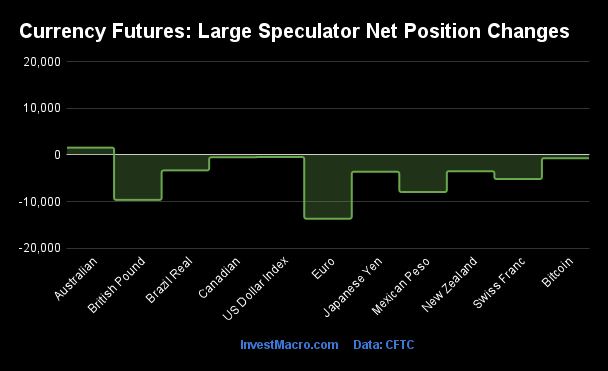
The COT currency market speculator bets were higher this week as eight out of the eleven currency markets we cover had higher positioning while the other three markets had lower speculator contracts.

Leading the gains for the currency markets was the Japanese Yen (35,847 contracts) with the Australian Dollar (9,724 contracts), the Canadian Dollar (9,610 contracts), the British Pound (8,155 contracts), the Mexican Peso (3,588 contracts), the Swiss Franc (3,513 contracts), the Brazilian Real (838 contracts) and the US Dollar Index (757 contracts) also showing positive weeks.

The currencies seeing declines in speculator bets on the week were the EuroFX (-5,811 contracts), Bitcoin (-1,153 contracts) and with the New Zealand Dollar (-246 contracts) also registering lower bets on the week.

Japanese Yen Speculators continue to raise the bullish position

Japanese 10-Year Bond Yields

Japanese 10-Year Bond Yields

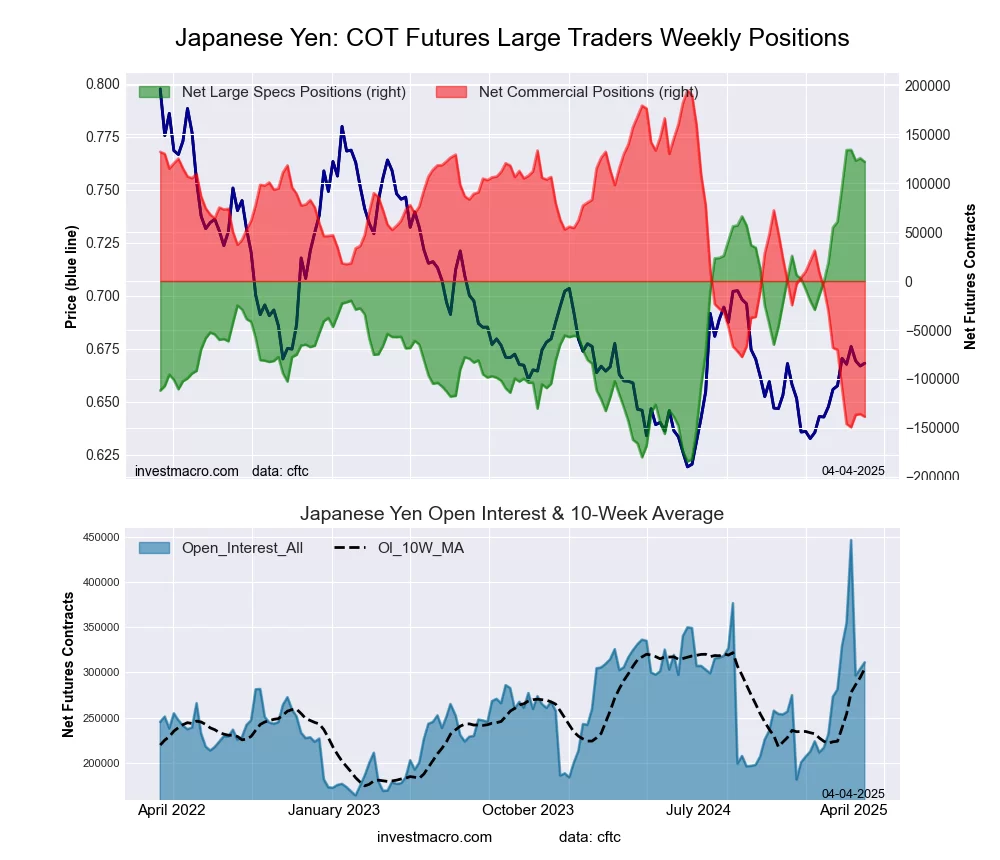
Highlighting the COT currency’s data this week, the story continues to be the continued push higher in bullish bets for the Japanese yen speculators.

Large speculative yen positions surged higher by +35,847 contracts and rose for a fourth consecutive week this week. The JPY position has now jumped by a total of +84,026 contracts over just the past four weeks. These gains have boosted the overall net bullish position to a total of +54,615 contracts this week and marks the most bullish level for the yen bets since October 1st, a span of 20 weeks.

Helping out the yen speculative position is the recent rate hike by the Bank of Japan in January from 0.25 percent to 0.50 percent. The yields on the Japanese 10-year bonds (image above) have also been spiking higher as well in recent weeks with the yields approaching 1.40 percent and reaching the highest levels in fifteen years (since 2010).

The yen exchange rate, despite the improving sentiment by the speculators and rising bond yields, remains near the bottom of its range from the past few years. The yen fell this week versus the US Dollar following four weeks of gains. The USDJPY currency pair trades near the 152.00 currently after hitting support right around the 151.00 early in the week. The pair did reverse lower after hitting resistance when challenging the 154.00 level in the middle of the week and ended at 152.82.


Currencies Net Speculators Leaderboard
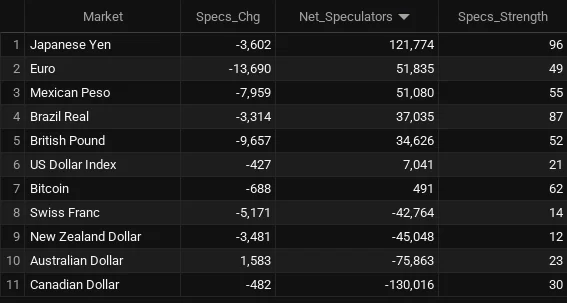
Legend: Weekly Speculators Change | Speculators Current Net Position | Speculators Strength Score compared to last 3-Years (0-100 range)


Strength Scores led by Japanese Yen & Brazilian Real
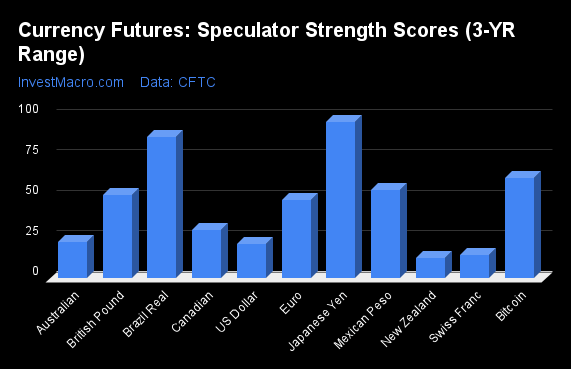
COT Strength Scores (a normalized measure of Speculator positions over a 3-Year range, from 0 to 100 where above 80 is Extreme-Bullish and below 20 is Extreme-Bearish) showed that the Japanese Yen (95 percent) and the Brazilian Real (53 percent) lead the currency markets this week.

On the downside, the EuroFX (4 percent) and the New Zealand Dollar (6 percent) come in at the lowest strength levels currently and are in Extreme-Bearish territory (below 20 percent). The next lowest strength scores are the Canadian Dollar (20 percent) and the Swiss Franc (22 percent).

3-Year Strength Statistics:
US Dollar Index (38.4 percent) vs US Dollar Index previous week (36.8 percent)
EuroFX (4.2 percent) vs EuroFX previous week (6.5 percent)
British Pound Sterling (34.7 percent) vs British Pound Sterling previous week (31.0 percent)
Japanese Yen (95.4 percent) vs Japanese Yen previous week (81.1 percent)
Swiss Franc (22.4 percent) vs Swiss Franc previous week (15.3 percent)
Canadian Dollar (20.4 percent) vs Canadian Dollar previous week (16.1 percent)
Australian Dollar (29.8 percent) vs Australian Dollar previous week (22.9 percent)
New Zealand Dollar (6.2 percent) vs New Zealand Dollar previous week (6.5 percent)
Mexican Peso (36.8 percent) vs Mexican Peso previous week (35.0 percent)
Brazilian Real (53.1 percent) vs Brazilian Real previous week (52.3 percent)
Bitcoin (43.3 percent) vs Bitcoin previous week (68.4 percent)


Japanese Yen & Brazilian Real top the 6-Week Strength Trends
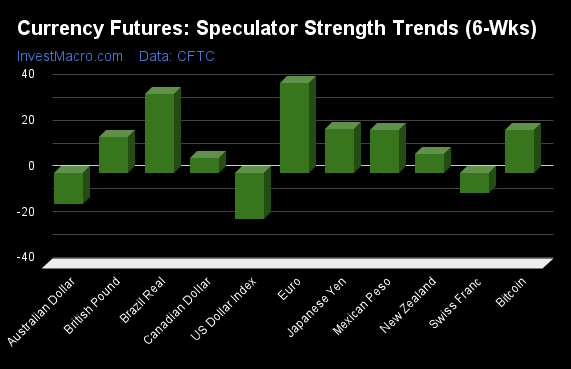
COT Strength Score Trends (or move index, calculates the 6-week changes in strength scores) showed that the Japanese Yen (25 percent) and the Brazilian Real (25 percent) lead the past six weeks trends for the currencies. The US Dollar Index (17 percent), the Canadian Dollar (11 percent) and the Australian Dollar (4 percent) are the next highest positive movers in the trends data.

The Swiss Franc (-12 percent) leads the downside trend scores currently with the British Pound (-11 percent), Mexican Peso (-2 percent) and Bitcoin (-1 percent) following next with lower trend scores.

3-Year Strength Trends:
US Dollar Index (17.5 percent) vs US Dollar Index previous week (16.7 percent)
EuroFX (2.0 percent) vs EuroFX previous week (3.8 percent)
British Pound Sterling (-10.8 percent) vs British Pound Sterling previous week (-13.8 percent)
Japanese Yen (25.2 percent) vs Japanese Yen previous week (6.6 percent)
Swiss Franc (-12.0 percent) vs Swiss Franc previous week (-28.1 percent)
Canadian Dollar (11.1 percent) vs Canadian Dollar previous week (7.3 percent)
Australian Dollar (4.1 percent) vs Australian Dollar previous week (-5.1 percent)
New Zealand Dollar (-1.2 percent) vs New Zealand Dollar previous week (-3.6 percent)
Mexican Peso (-2.5 percent) vs Mexican Peso previous week (-3.4 percent)
Brazilian Real (25.3 percent) vs Brazilian Real previous week (19.9 percent)
Bitcoin (-1.0 percent) vs Bitcoin previous week (20.0 percent)


Individual COT Forex Markets:

US Dollar Index Futures:
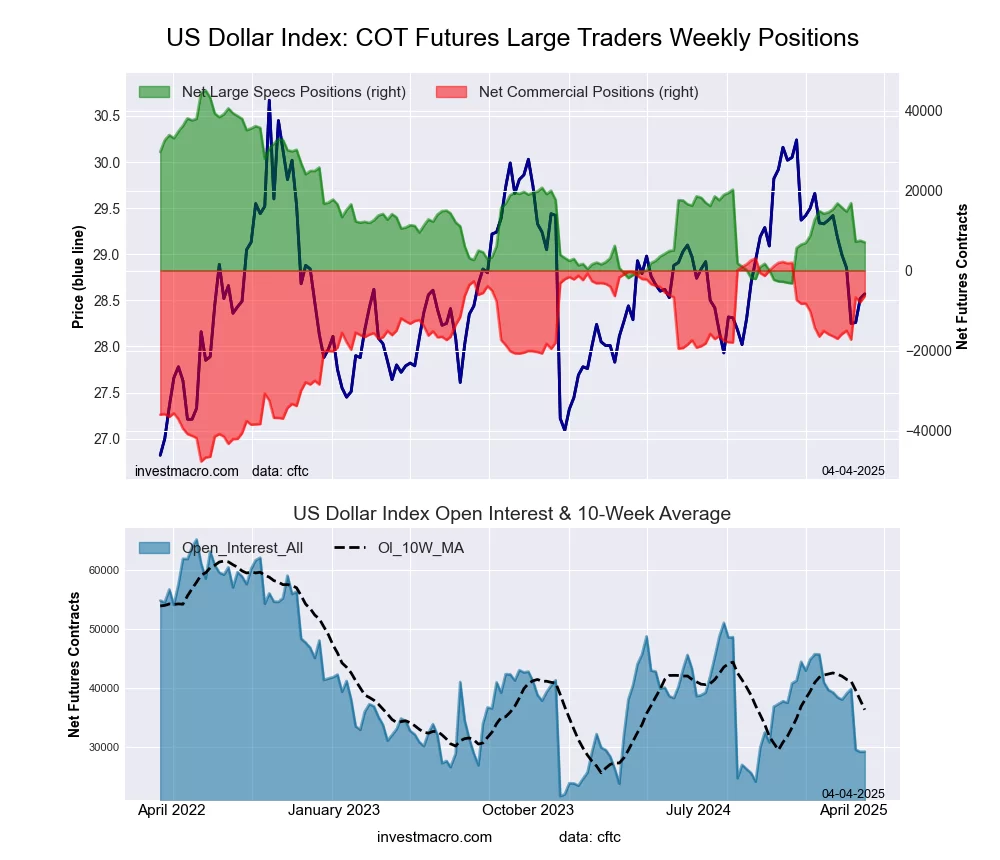
US Dollar Index Forex Futures COT ChartThe US Dollar Index large speculator standing this week reached a net position of 15,296 contracts in the data reported through Tuesday. This was a weekly boost of 757 contracts from the previous week which had a total of 14,539 net contracts.

This week’s current strength score (the trader positioning range over the past three years, measured from 0 to 100) shows the speculators are currently Bearish with a score of 38.4 percent. The commercials are Bullish with a score of 61.7 percent and the small traders (not shown in chart) are Bearish with a score of 38.9 percent.

Price Trend-Following Model: Weak Uptrend

Our weekly trend-following model classifies the current market price position as: Weak Uptrend.

US DOLLAR INDEX StatisticsSPECULATORSCOMMERCIALSSMALL TRADERS
– Percent of Open Interest Longs:66.821.59.0
– Percent of Open Interest Shorts:27.963.36.2
– Net Position:15,296-16,4231,127
– Gross Longs:26,2618,4593,546
– Gross Shorts:10,96524,8822,419
– Long to Short Ratio:2.4 to 10.3 to 11.5 to 1
NET POSITION TREND:
– Strength Index Score (3 Year Range Pct):38.461.738.9
– Strength Index Reading (3 Year Range):BearishBullishBearish
NET POSITION MOVEMENT INDEX:
– 6-Week Change in Strength Index:17.5-16.1-2.6


Euro Currency Futures:

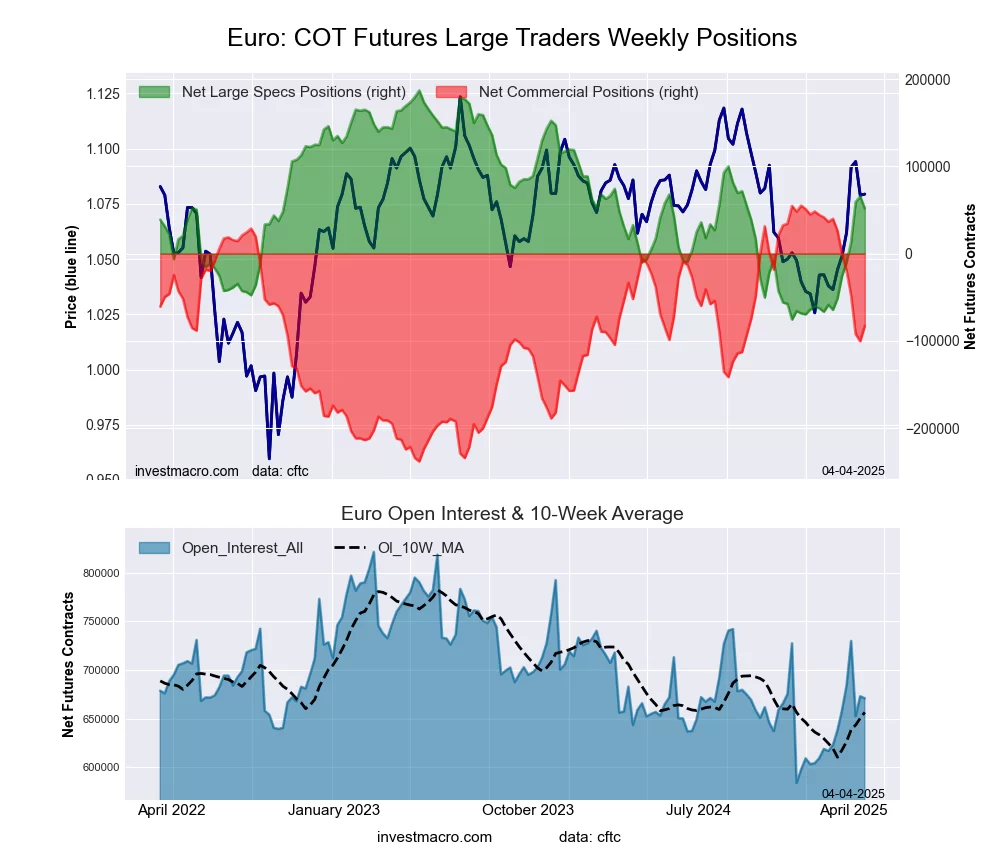
Euro Currency Futures COT ChartThe Euro Currency large speculator standing this week reached a net position of -64,425 contracts in the data reported through Tuesday. This was a weekly reduction of -5,811 contracts from the previous week which had a total of -58,614 net contracts.

This week’s current strength score (the trader positioning range over the past three years, measured from 0 to 100) shows the speculators are currently Bearish-Extreme with a score of 4.2 percent. The commercials are Bullish-Extreme with a score of 94.8 percent and the small traders (not shown in chart) are Bearish with a score of 27.5 percent.

Price Trend-Following Model: Downtrend

Our weekly trend-following model classifies the current market price position as: Downtrend.

EURO Currency StatisticsSPECULATORSCOMMERCIALSSMALL TRADERS
– Percent of Open Interest Longs:26.656.612.2
– Percent of Open Interest Shorts:36.950.28.3
– Net Position:-64,42539,97424,451
– Gross Longs:165,594352,51476,243
– Gross Shorts:230,019312,54051,792
– Long to Short Ratio:0.7 to 11.1 to 11.5 to 1
NET POSITION TREND:
– Strength Index Score (3 Year Range Pct):4.294.827.5
– Strength Index Reading (3 Year Range):Bearish-ExtremeBullish-ExtremeBearish
NET POSITION MOVEMENT INDEX:
– 6-Week Change in Strength Index:2.0-3.813.2


British Pound Sterling Futures:

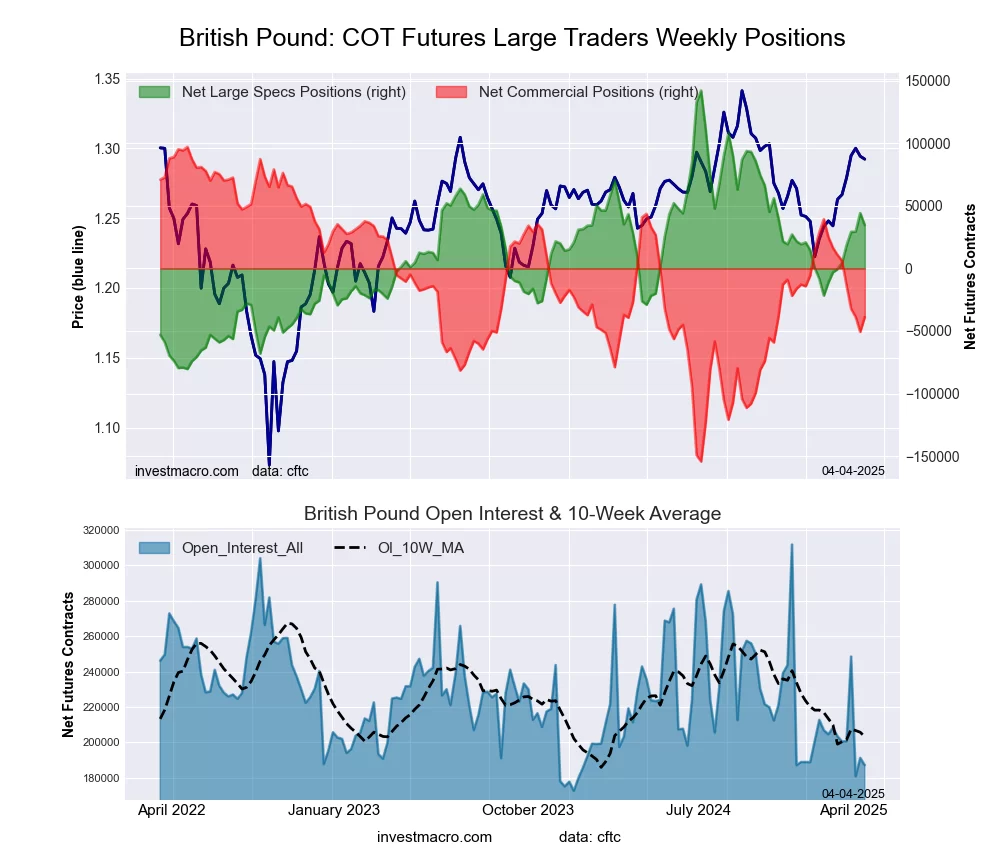
British Pound Sterling Futures COT ChartThe British Pound Sterling large speculator standing this week reached a net position of -3,168 contracts in the data reported through Tuesday. This was a weekly lift of 8,155 contracts from the previous week which had a total of -11,323 net contracts.

This week’s current strength score (the trader positioning range over the past three years, measured from 0 to 100) shows the speculators are currently Bearish with a score of 34.7 percent. The commercials are Bullish with a score of 67.9 percent and the small traders (not shown in chart) are Bearish with a score of 34.2 percent.

Price Trend-Following Model: Downtrend

Our weekly trend-following model classifies the current market price position as: Downtrend.

BRITISH POUND StatisticsSPECULATORSCOMMERCIALSSMALL TRADERS
– Percent of Open Interest Longs:33.250.511.7
– Percent of Open Interest Shorts:34.742.618.1
– Net Position:-3,16816,480-13,312
– Gross Longs:69,087105,18924,316
– Gross Shorts:72,25588,70937,628
– Long to Short Ratio:1.0 to 11.2 to 10.6 to 1
NET POSITION TREND:
– Strength Index Score (3 Year Range Pct):34.767.934.2
– Strength Index Reading (3 Year Range):BearishBullishBearish
NET POSITION MOVEMENT INDEX:
– 6-Week Change in Strength Index:-10.812.2-14.1


Japanese Yen Futures:

Japanese Yen Forex Futures COT ChartThe Japanese Yen large speculator standing this week reached a net position of 54,615 contracts in the data reported through Tuesday. This was a weekly advance of 35,847 contracts from the previous week which had a total of 18,768 net contracts.

This week’s current strength score (the trader positioning range over the past three years, measured from 0 to 100) shows the speculators are currently Bullish-Extreme with a score of 95.4 percent. The commercials are Bearish-Extreme with a score of 3.4 percent and the small traders (not shown in chart) are Bullish-Extreme with a score of 96.5 percent.

Price Trend-Following Model: Weak Downtrend

Our weekly trend-following model classifies the current market price position as: Weak Downtrend.

JAPANESE YEN StatisticsSPECULATORSCOMMERCIALSSMALL TRADERS
– Percent of Open Interest Longs:52.727.018.2
– Percent of Open Interest Shorts:32.852.013.3
– Net Position:54,615-68,15413,539
– Gross Longs:144,15873,89049,809
– Gross Shorts:89,543142,04436,270
– Long to Short Ratio:1.6 to 10.5 to 11.4 to 1
NET POSITION TREND:
– Strength Index Score (3 Year Range Pct):95.43.496.5
– Strength Index Reading (3 Year Range):Bullish-ExtremeBearish-ExtremeBullish-Extreme
NET POSITION MOVEMENT INDEX:
– 6-Week Change in Strength Index:25.2-28.635.6


Swiss Franc Futures:

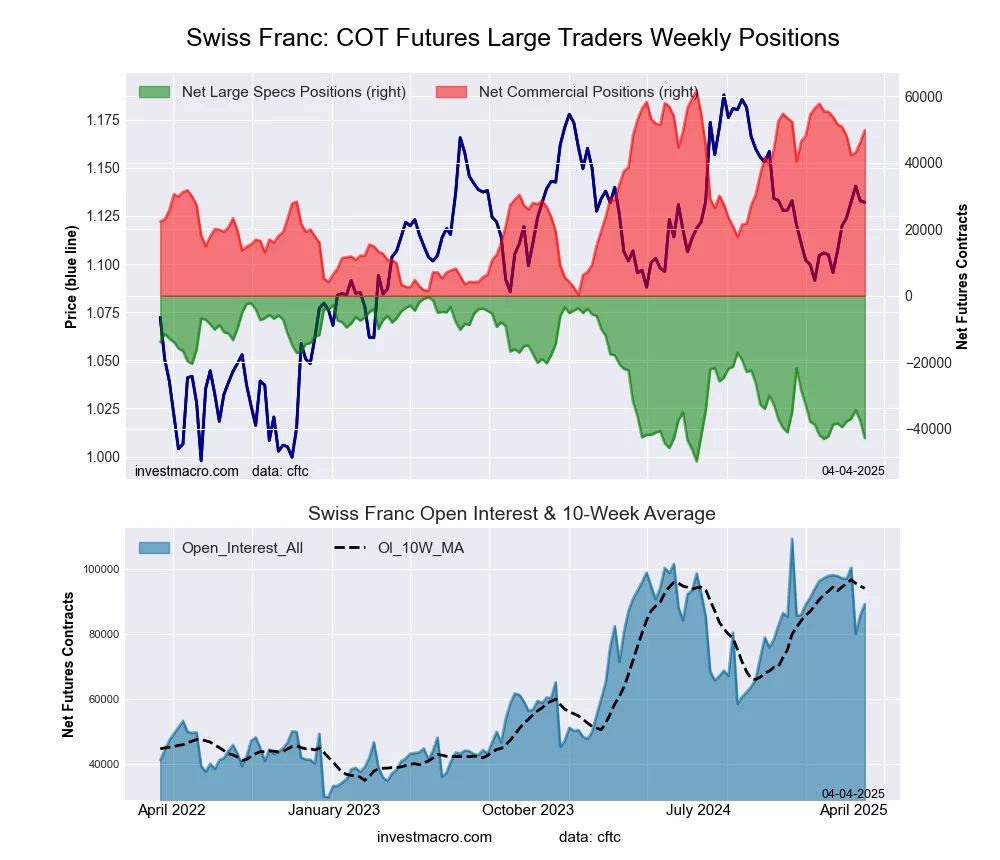
Swiss Franc Forex Futures COT ChartThe Swiss Franc large speculator standing this week reached a net position of -38,745 contracts in the data reported through Tuesday. This was a weekly rise of 3,513 contracts from the previous week which had a total of -42,258 net contracts.

This week’s current strength score (the trader positioning range over the past three years, measured from 0 to 100) shows the speculators are currently Bearish with a score of 22.4 percent. The commercials are Bullish-Extreme with a score of 87.1 percent and the small traders (not shown in chart) are Bearish-Extreme with a score of 15.1 percent.

Price Trend-Following Model: Downtrend

Our weekly trend-following model classifies the current market price position as: Downtrend.

SWISS FRANC StatisticsSPECULATORSCOMMERCIALSSMALL TRADERS
– Percent of Open Interest Longs:5.784.110.0
– Percent of Open Interest Shorts:45.129.325.3
– Net Position:-38,74553,757-15,012
– Gross Longs:5,55382,5369,859
– Gross Shorts:44,29828,77924,871
– Long to Short Ratio:0.1 to 12.9 to 10.4 to 1
NET POSITION TREND:
– Strength Index Score (3 Year Range Pct):22.487.115.1
– Strength Index Reading (3 Year Range):BearishBullish-ExtremeBearish-Extreme
NET POSITION MOVEMENT INDEX:
– 6-Week Change in Strength Index:-12.09.21.1


Canadian Dollar Futures:

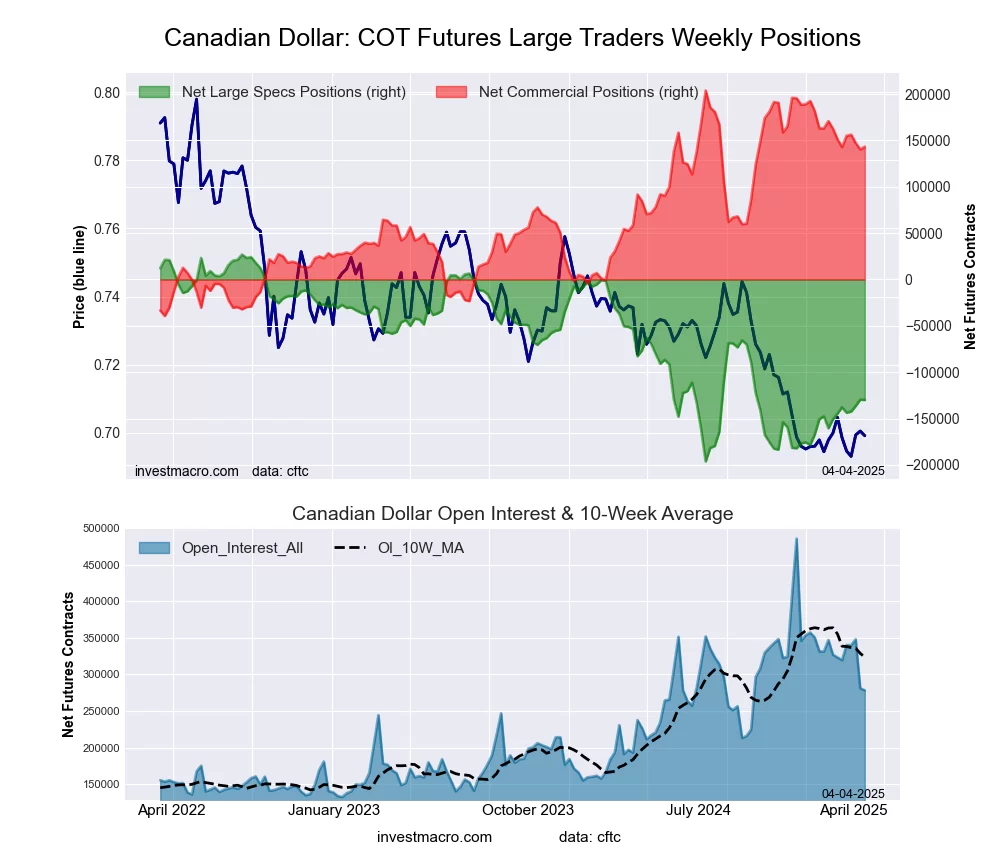
Canadian Dollar Forex Futures COT ChartThe Canadian Dollar large speculator standing this week reached a net position of -150,834 contracts in the data reported through Tuesday. This was a weekly rise of 9,610 contracts from the previous week which had a total of -160,444 net contracts.

This week’s current strength score (the trader positioning range over the past three years, measured from 0 to 100) shows the speculators are currently Bearish with a score of 20.4 percent. The commercials are Bullish-Extreme with a score of 83.1 percent and the small traders (not shown in chart) are Bearish-Extreme with a score of 9.3 percent.

Price Trend-Following Model: Downtrend

Our weekly trend-following model classifies the current market price position as: Downtrend.

CANADIAN DOLLAR StatisticsSPECULATORSCOMMERCIALSSMALL TRADERS
– Percent of Open Interest Longs:5.584.27.7
– Percent of Open Interest Shorts:51.634.511.3
– Net Position:-150,834162,597-11,763
– Gross Longs:17,911275,36025,075
– Gross Shorts:168,745112,76336,838
– Long to Short Ratio:0.1 to 12.4 to 10.7 to 1
NET POSITION TREND:
– Strength Index Score (3 Year Range Pct):20.483.19.3
– Strength Index Reading (3 Year Range):BearishBullish-ExtremeBearish-Extreme
NET POSITION MOVEMENT INDEX:
– 6-Week Change in Strength Index:11.1-10.94.2


Australian Dollar Futures:

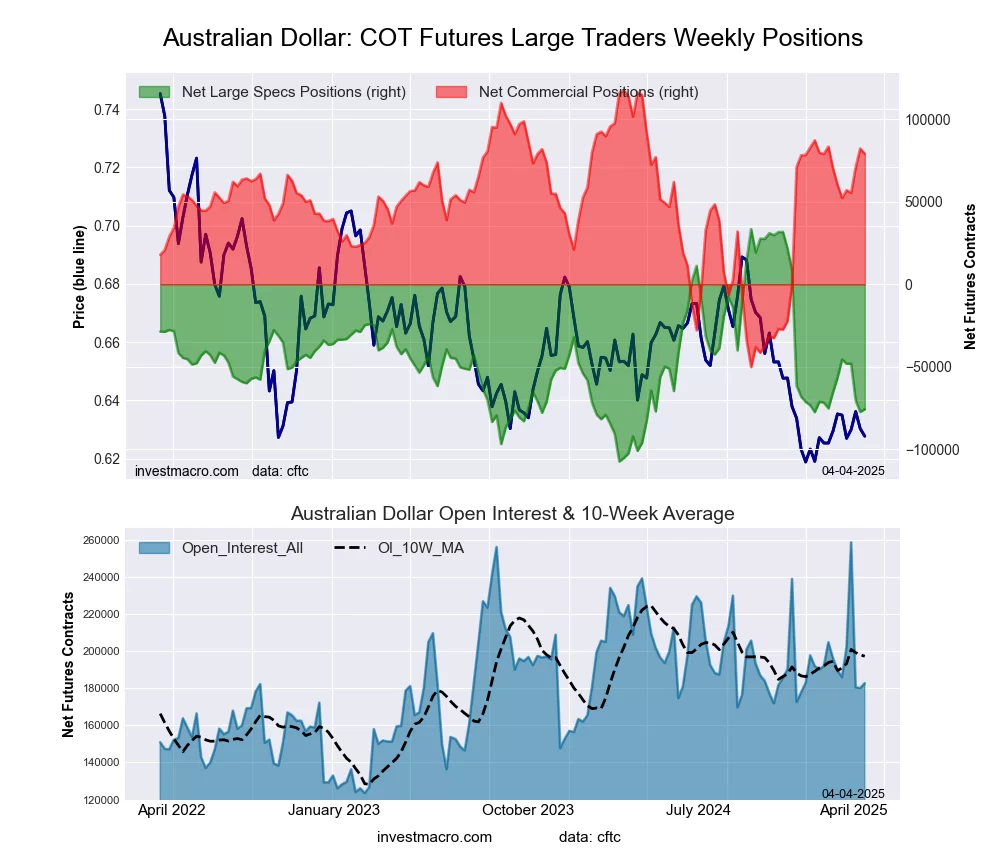
Australian Dollar Forex Futures COT ChartThe Australian Dollar large speculator standing this week reached a net position of -65,585 contracts in the data reported through Tuesday. This was a weekly lift of 9,724 contracts from the previous week which had a total of -75,309 net contracts.

This week’s current strength score (the trader positioning range over the past three years, measured from 0 to 100) shows the speculators are currently Bearish with a score of 29.8 percent. The commercials are Bullish with a score of 71.9 percent and the small traders (not shown in chart) are Bearish with a score of 36.3 percent.

Price Trend-Following Model: Downtrend

Our weekly trend-following model classifies the current market price position as: Downtrend.

AUSTRALIAN DOLLAR StatisticsSPECULATORSCOMMERCIALSSMALL TRADERS
– Percent of Open Interest Longs:20.663.213.7
– Percent of Open Interest Shorts:54.027.316.2
– Net Position:-65,58570,444-4,859
– Gross Longs:40,368123,99126,941
– Gross Shorts:105,95353,54731,800
– Long to Short Ratio:0.4 to 12.3 to 10.8 to 1
NET POSITION TREND:
– Strength Index Score (3 Year Range Pct):29.871.936.3
– Strength Index Reading (3 Year Range):BearishBullishBearish
NET POSITION MOVEMENT INDEX:
– 6-Week Change in Strength Index:4.1-4.85.9


New Zealand Dollar Futures:

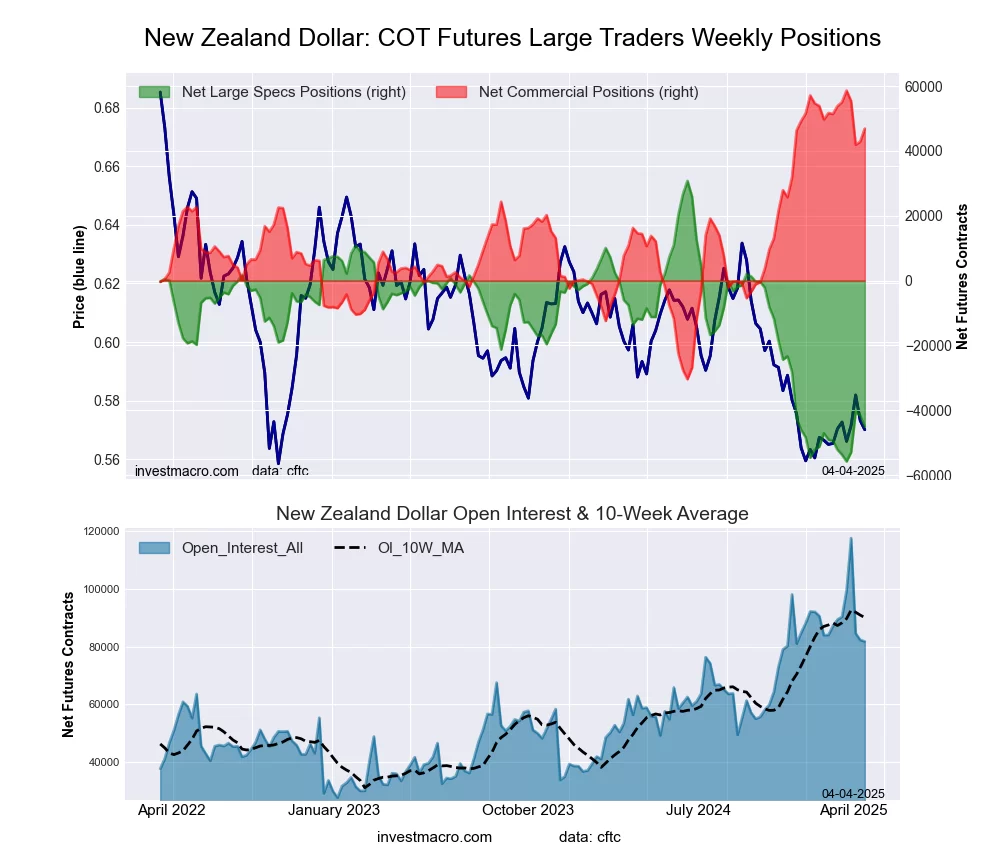
New Zealand Dollar Forex Futures COT ChartThe New Zealand Dollar large speculator standing this week reached a net position of -49,336 contracts in the data reported through Tuesday. This was a weekly fall of -246 contracts from the previous week which had a total of -49,090 net contracts.

This week’s current strength score (the trader positioning range over the past three years, measured from 0 to 100) shows the speculators are currently Bearish-Extreme with a score of 6.2 percent. The commercials are Bullish-Extreme with a score of 93.5 percent and the small traders (not shown in chart) are Bearish with a score of 27.2 percent.

Price Trend-Following Model: Downtrend

Our weekly trend-following model classifies the current market price position as: Downtrend.

NEW ZEALAND DOLLAR StatisticsSPECULATORSCOMMERCIALSSMALL TRADERS
– Percent of Open Interest Longs:12.982.14.7
– Percent of Open Interest Shorts:69.523.27.1
– Net Position:-49,33651,398-2,062
– Gross Longs:11,21871,5674,103
– Gross Shorts:60,55420,1696,165
– Long to Short Ratio:0.2 to 13.5 to 10.7 to 1
NET POSITION TREND:
– Strength Index Score (3 Year Range Pct):6.293.527.2
– Strength Index Reading (3 Year Range):Bearish-ExtremeBullish-ExtremeBearish
NET POSITION MOVEMENT INDEX:
– 6-Week Change in Strength Index:-1.2-0.114.4


Mexican Peso Futures:

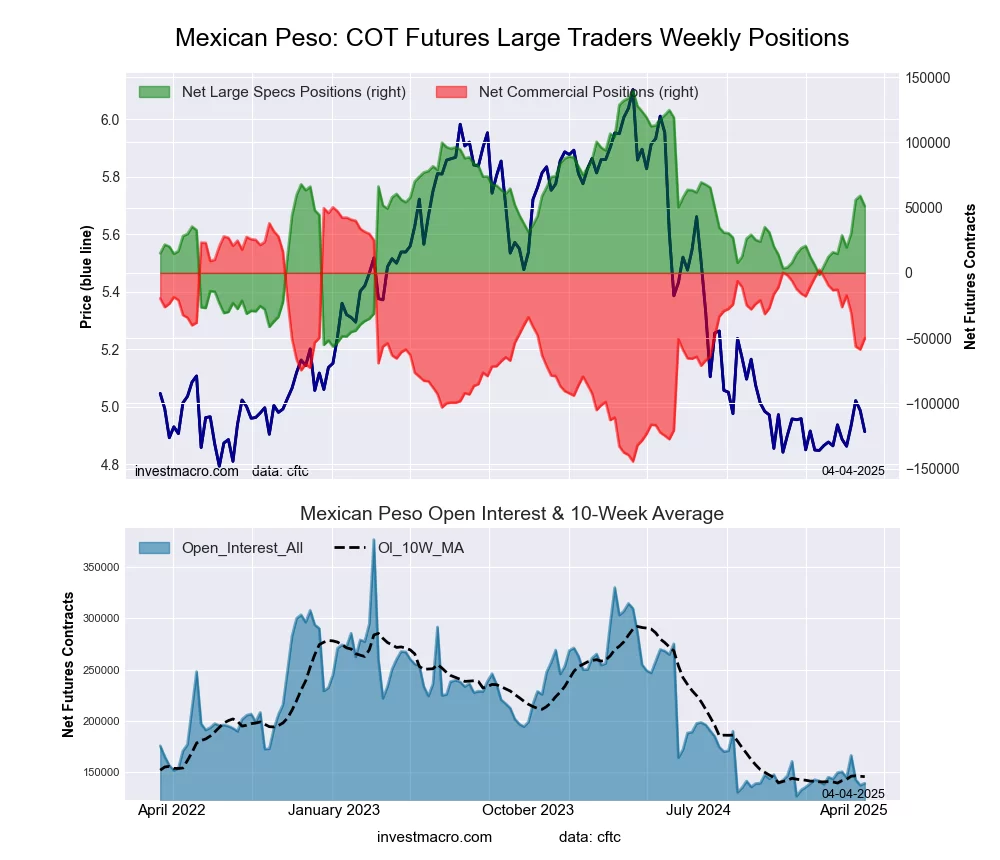
Mexican Peso Futures COT ChartThe Mexican Peso large speculator standing this week reached a net position of 15,850 contracts in the data reported through Tuesday. This was a weekly boost of 3,588 contracts from the previous week which had a total of 12,262 net contracts.

This week’s current strength score (the trader positioning range over the past three years, measured from 0 to 100) shows the speculators are currently Bearish with a score of 36.8 percent. The commercials are Bullish with a score of 67.4 percent and the small traders (not shown in chart) are Bearish-Extreme with a score of 8.4 percent.

Price Trend-Following Model: Downtrend

Our weekly trend-following model classifies the current market price position as: Downtrend.

MEXICAN PESO StatisticsSPECULATORSCOMMERCIALSSMALL TRADERS
– Percent of Open Interest Longs:41.354.12.2
– Percent of Open Interest Shorts:30.363.34.0
– Net Position:15,850-13,270-2,580
– Gross Longs:59,38877,6833,229
– Gross Shorts:43,53890,9535,809
– Long to Short Ratio:1.4 to 10.9 to 10.6 to 1
NET POSITION TREND:
– Strength Index Score (3 Year Range Pct):36.867.48.4
– Strength Index Reading (3 Year Range):BearishBullishBearish-Extreme
NET POSITION MOVEMENT INDEX:
– 6-Week Change in Strength Index:-2.52.40.8


Brazilian Real Futures:

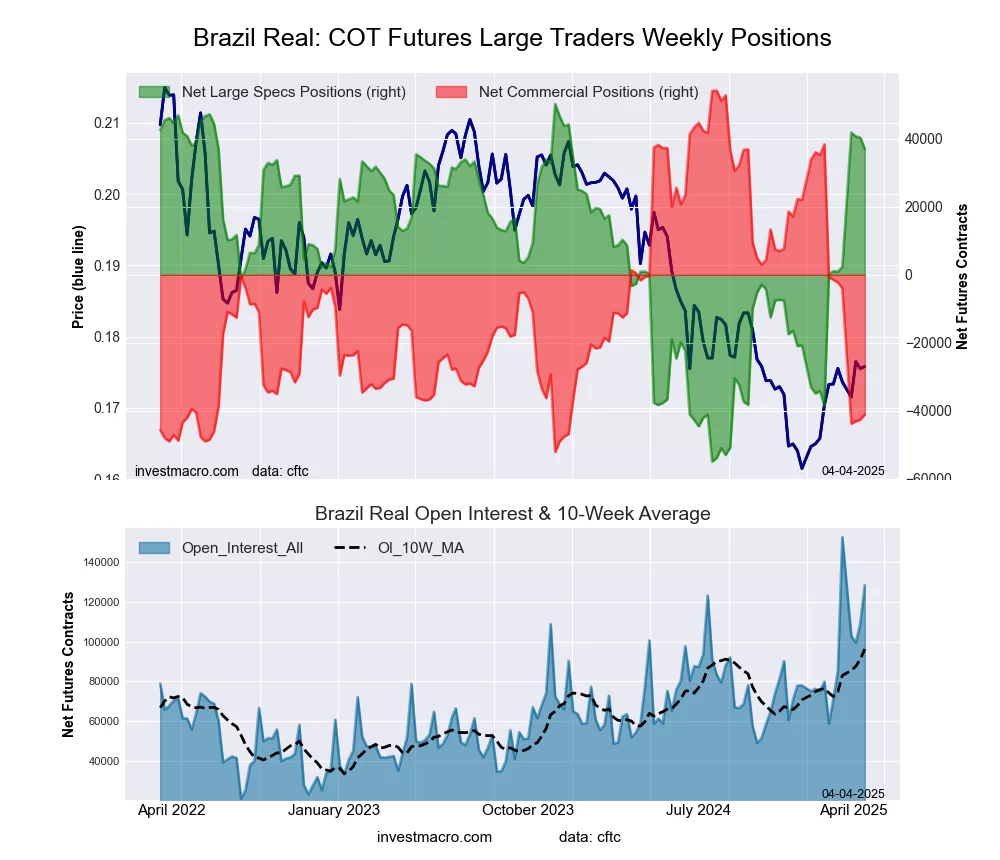
Brazil Real Futures COT ChartThe Brazilian Real large speculator standing this week reached a net position of 1,080 contracts in the data reported through Tuesday. This was a weekly boost of 838 contracts from the previous week which had a total of 242 net contracts.

This week’s current strength score (the trader positioning range over the past three years, measured from 0 to 100) shows the speculators are currently Bullish with a score of 53.1 percent. The commercials are Bearish with a score of 47.9 percent and the small traders (not shown in chart) are Bearish with a score of 22.9 percent.

Price Trend-Following Model: Weak Downtrend

Our weekly trend-following model classifies the current market price position as: Weak Downtrend.

BRAZIL REAL StatisticsSPECULATORSCOMMERCIALSSMALL TRADERS
– Percent of Open Interest Longs:58.531.03.9
– Percent of Open Interest Shorts:57.033.03.4
– Net Position:1,080-1,437357
– Gross Longs:41,73822,1182,795
– Gross Shorts:40,65823,5552,438
– Long to Short Ratio:1.0 to 10.9 to 11.1 to 1
NET POSITION TREND:
– Strength Index Score (3 Year Range Pct):53.147.922.9
– Strength Index Reading (3 Year Range):BullishBearishBearish
NET POSITION MOVEMENT INDEX:
– 6-Week Change in Strength Index:25.3-25.74.4


Bitcoin Futures:

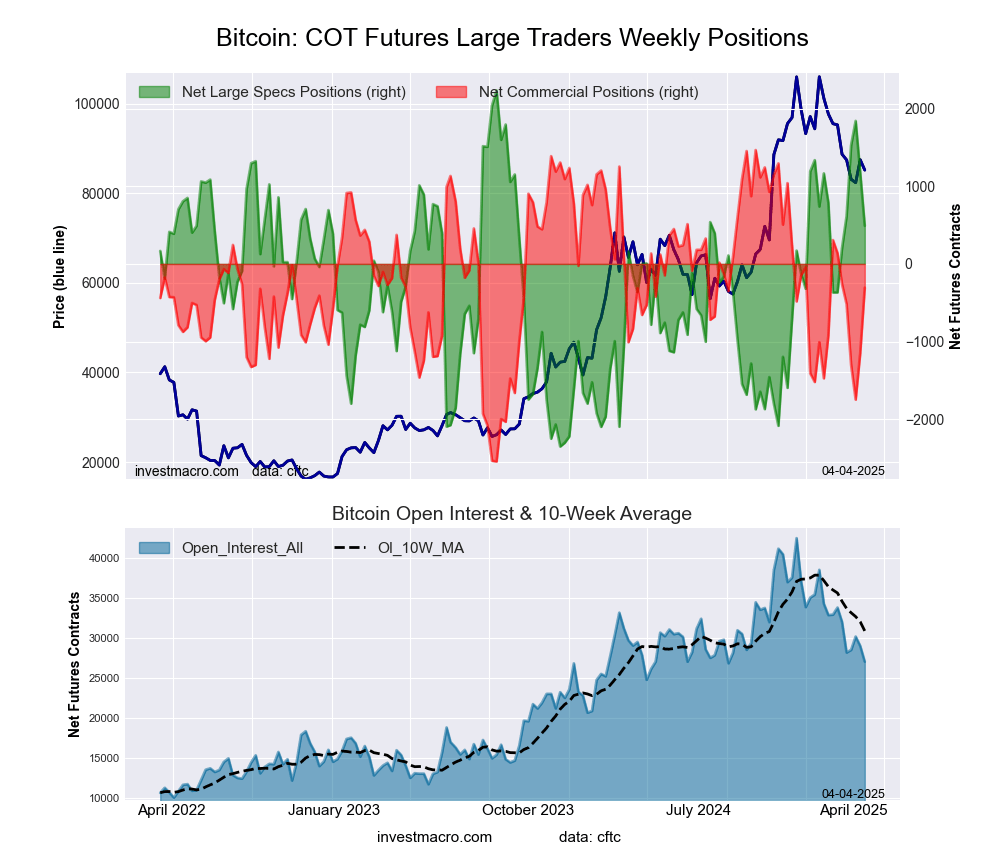
Bitcoin Crypto Futures COT ChartThe Bitcoin large speculator standing this week reached a net position of -367 contracts in the data reported through Tuesday. This was a weekly decrease of -1,153 contracts from the previous week which had a total of 786 net contracts.

This week’s current strength score (the trader positioning range over the past three years, measured from 0 to 100) shows the speculators are currently Bearish with a score of 43.3 percent. The commercials are Bullish with a score of 71.1 percent and the small traders (not shown in chart) are Bearish-Extreme with a score of 14.7 percent.

Price Trend-Following Model: Uptrend

Our weekly trend-following model classifies the current market price position as: Uptrend.

BITCOIN StatisticsSPECULATORSCOMMERCIALSSMALL TRADERS
– Percent of Open Interest Longs:81.35.64.4
– Percent of Open Interest Shorts:82.54.64.2
– Net Position:-36730760
– Gross Longs:26,8021,8341,447
– Gross Shorts:27,1691,5271,387
– Long to Short Ratio:1.0 to 11.2 to 11.0 to 1
NET POSITION TREND:
– Strength Index Score (3 Year Range Pct):43.371.114.7
– Strength Index Reading (3 Year Range):BearishBullishBearish-Extreme
NET POSITION MOVEMENT INDEX:
– 6-Week Change in Strength Index:-1.08.8-22.5


Article By InvestMacroReceive our weekly COT Newsletter

*COT Report: The COT data, released weekly to the public each Friday, is updated through the most recent Tuesday (data is 3 days old) and shows a quick view of how large speculators or non-commercials (for-profit traders) were positioned in the futures markets.

The CFTC categorizes trader positions according to commercial hedgers (traders who use futures contracts for hedging as part of the business), non-commercials (large traders who speculate to realize trading profits) and nonreportable traders (usually small traders/speculators) as well as their open interest (contracts open in the market at time of reporting). See CFTC criteria here.


Speculator Extremes: Steel, US Treasuries & Yen lead weekly Bullish Bets

By InvestMacro 

The latest update for the weekly Commitment of Traders (COT) report was released by the Commodity Futures Trading Commission (CFTC) on Friday for data ending on February 11th.

This weekly Extreme Positions report highlights the Most Bullish and Most Bearish Positions for the speculator category. Extreme positioning in these markets can foreshadow strong moves in the underlying market.

To signify an extreme position, we use the Strength Index (also known as the COT Index) of each instrument, a common method of measuring COT data. The Strength Index is simply a comparison of current trader positions against the range of positions over the previous 3 years. We use over 80 percent as extremely bullish and under 20 percent as extremely bearish. (Compare Strength Index scores across all markets in the data table or cot leaders table)


Here Are This Week’s Most Bullish Speculator Positions:

Steel


The Steel speculator position comes in as the most bullish extreme standing this week. The Steel speculator level is currently at a 100.0 percent score of its 3-year range.

The six-week trend for the percent strength score totaled 21.5 this week. The overall net speculator position was a total of 2,855 net contracts this week with a rise of 4,618 contract in the weekly speculator bets.


Speculators or Non-Commercials Notes:

Speculators, classified as non-commercial traders by the CFTC, are made up of large commodity funds, hedge funds and other significant for-profit participants. The Specs are generally regarded as trend-followers in their behavior towards price action – net speculator bets and prices tend to go in the same directions. These traders often look to buy when prices are rising and sell when prices are falling. To illustrate this point, many times speculator contracts can be found at their most extremes (bullish or bearish) when prices are also close to their highest or lowest levels.

These extreme levels can be dangerous for the large speculators as the trade is most crowded, there is less trading ammunition still sitting on the sidelines to push the trend further and prices have moved a significant distance. When the trend becomes exhausted, some speculators take profits while others look to also exit positions when prices fail to continue in the same direction. This process usually plays out over many months to years and can ultimately create a reverse effect where prices start to fall and speculators start a process of selling when prices are falling.


US Treasury Bond


The US Treasury Bond speculator position comes next in the extreme standings this week. The US Treasury Bond speculator level is now at a 98.8 percent score of its 3-year range.

The six-week trend for the percent strength score was 27.5 this week. The speculator position registered 44,001 net contracts this week with a weekly jump by 48,928 contracts in speculator bets.


Japanese Yen


The Japanese Yen speculator position comes in third this week in the extreme standings. The Japanese Yen speculator level resides at a 95.4 percent score of its 3-year range.

The six-week trend for the speculator strength score came in at 25.2 this week. The overall speculator position was 54,615 net contracts this week with a surged by 35,847 contracts in the weekly speculator bets.


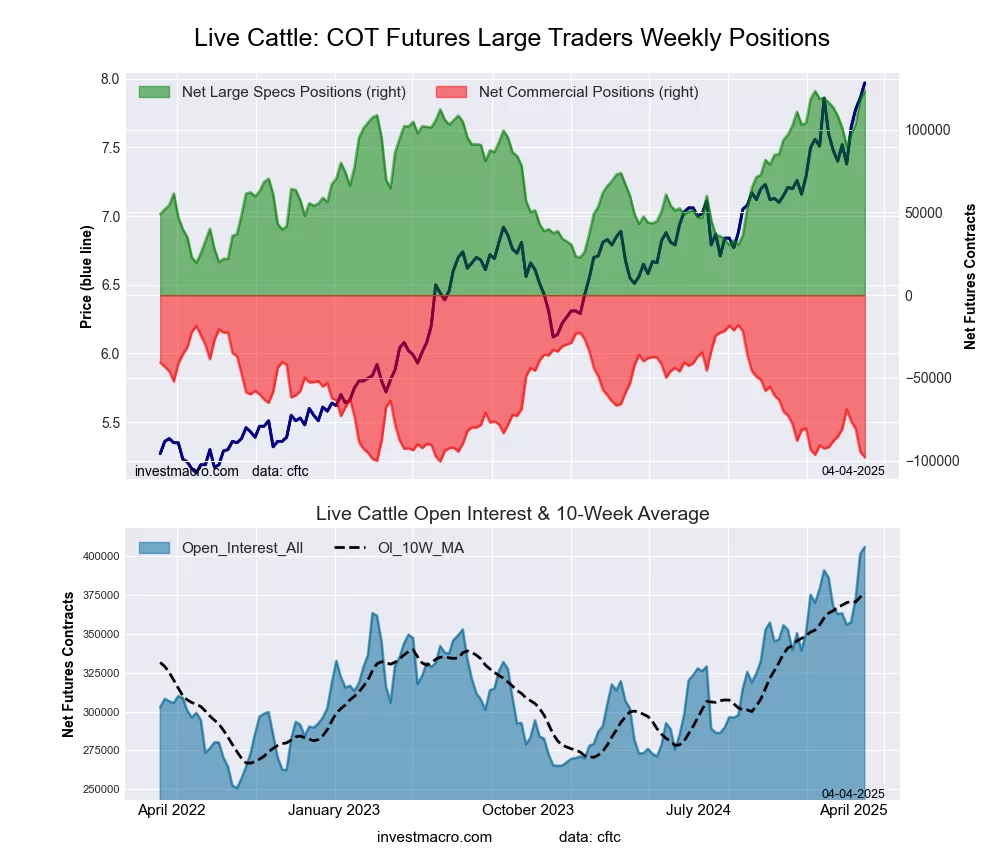
Live Cattle


The Live Cattle speculator position comes up number four in the extreme standings this week. The Live Cattle speculator level is at a 90.5 percent score of its 3-year range.

The six-week trend for the speculator strength score totaled a change of 9.1 this week. The overall speculator position was 113,424 net contracts this week with a dip of -3,015 contracts in the speculator bets.


Gold


The Gold speculator position rounds out the top five in this week’s bullish extreme standings. The Gold speculator level sits at a 88.3 percent score of its 3-year range. The six-week trend for the speculator strength score was 14.1 this week.

The speculator position was 284,504 net contracts this week with a decline of -18,004 contracts in the weekly speculator bets.


This Week’s Most Bearish Speculator Positions:

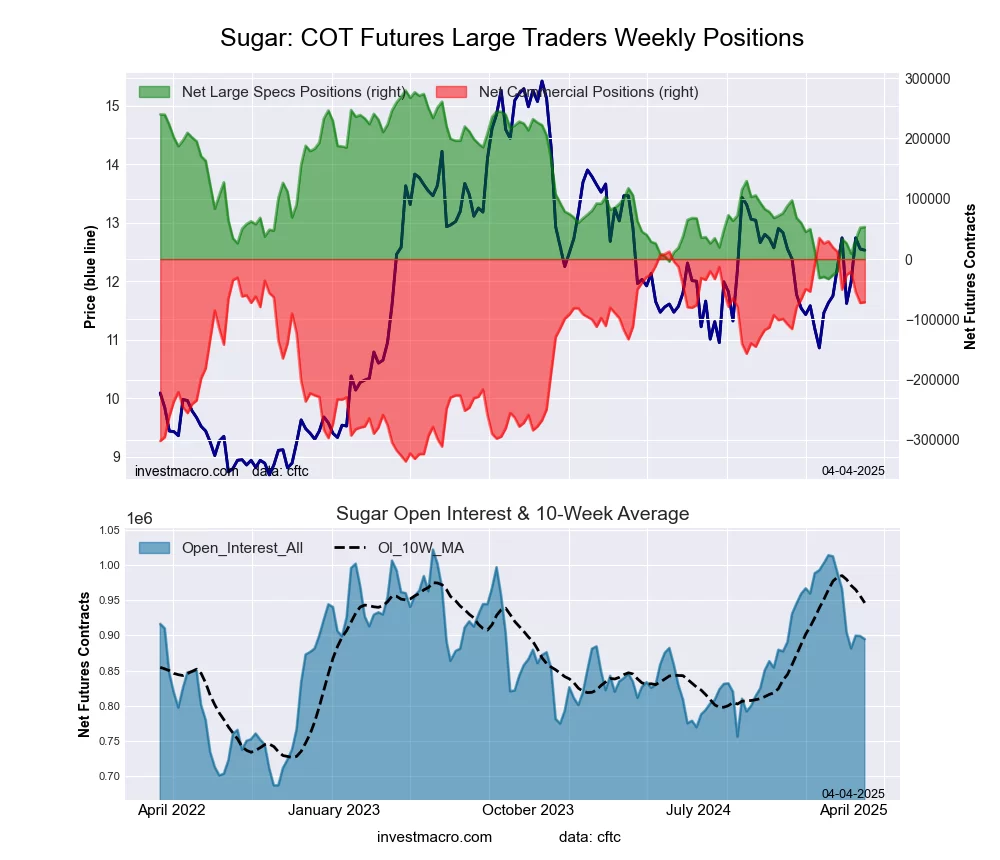
Sugar


The Sugar speculator position comes in as the most bearish extreme standing this week. The Sugar speculator level is at a 2.1 percent score of its 3-year range.

The six-week trend for the speculator strength score was -22.9 this week. The overall speculator position was -26,526 net contracts this week with an increase of 6,583 contracts in the speculator bets.


Euro


The Euro speculator position comes in next for the most bearish extreme standing on the week. The Euro speculator level is at a 4.2 percent score of its 3-year range.

The six-week trend for the speculator strength score was 2.0 this week. The speculator position was -64,425 net contracts this week with a decrease of -5,811 contracts in the weekly speculator bets.


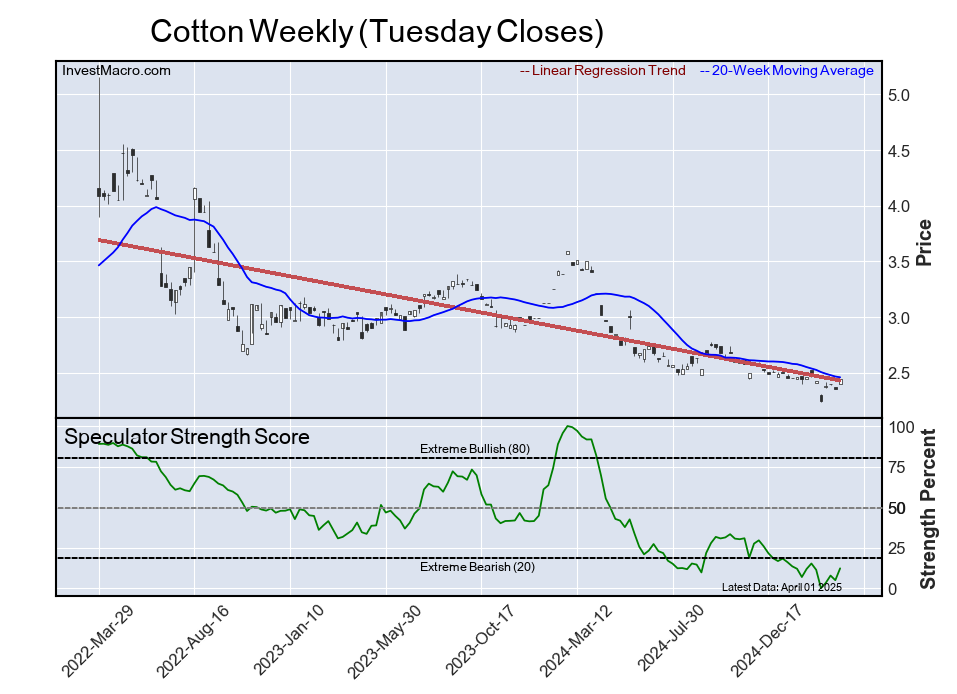
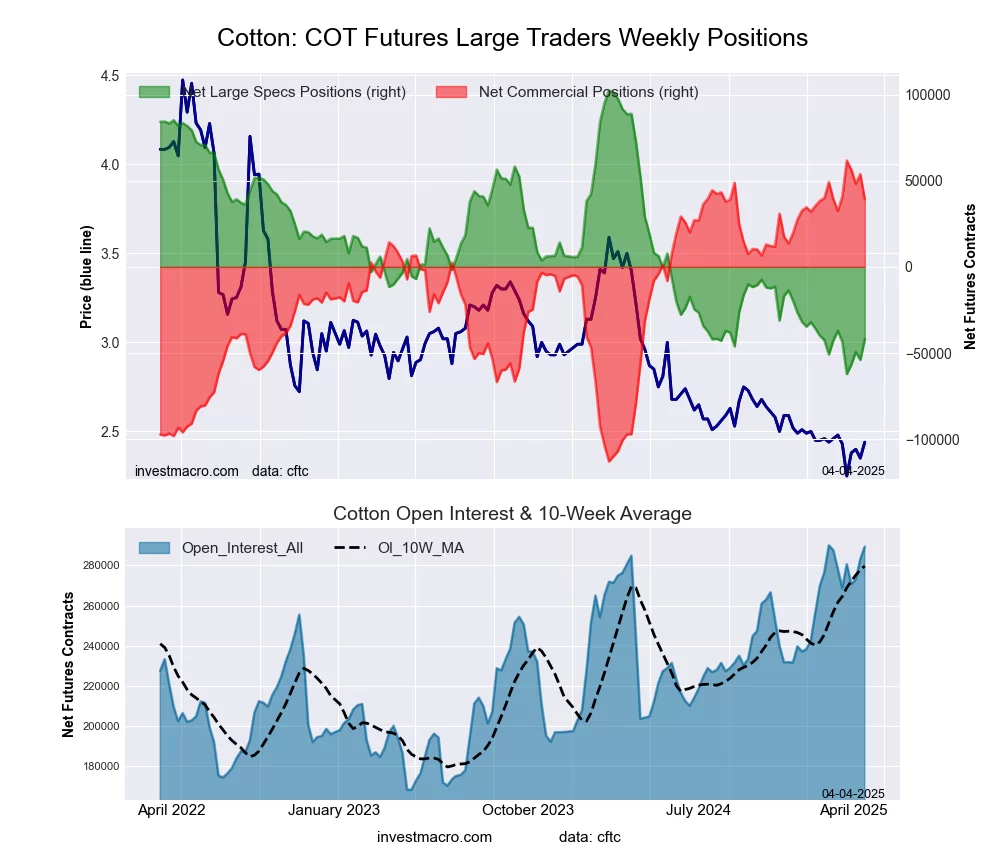
Cotton


The Cotton speculator position comes in as third most bearish extreme standing of the week. The Cotton speculator level resides at a 5.4 percent score of its 3-year range.

The six-week trend for the speculator strength score was -5.2 this week. The overall speculator position was -42,565 net contracts this week with a rise of 8,202 contracts in the speculator bets.


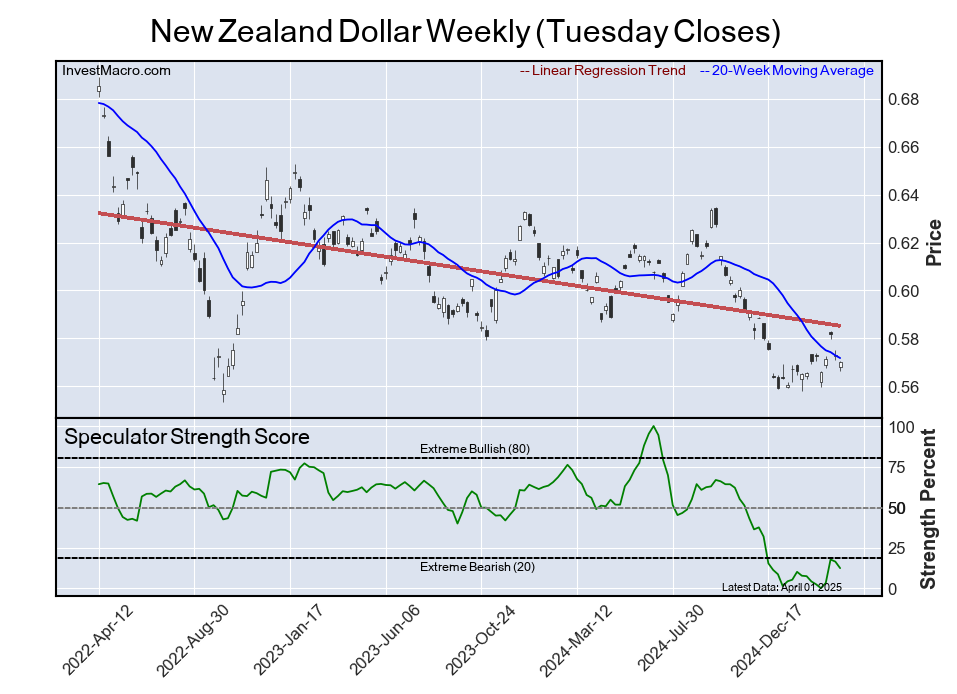
New Zealand Dollar


The New Zealand Dollar speculator position comes in as this week’s fourth most bearish extreme standing. The New Zealand Dollar speculator level is at a 6.2 percent score of its 3-year range.

The six-week trend for the speculator strength score was -1.2 this week. The speculator position was -49,336 net contracts this week with a small dip of -246 contracts in the weekly speculator bets.


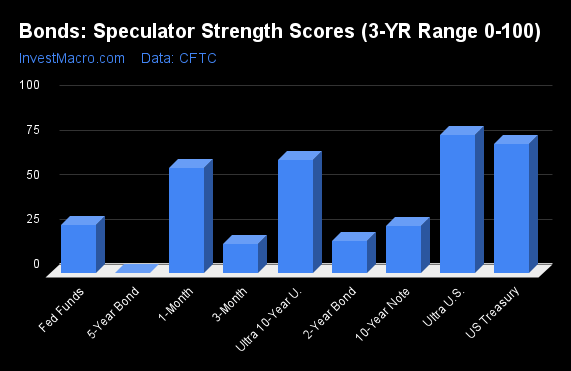
5-Year Bond


Finally, the 5-Year Bond speculator position comes in as the fifth most bearish extreme standing for this week. The 5-Year Bond speculator level is at a 6.5 percent score of its 3-year range.

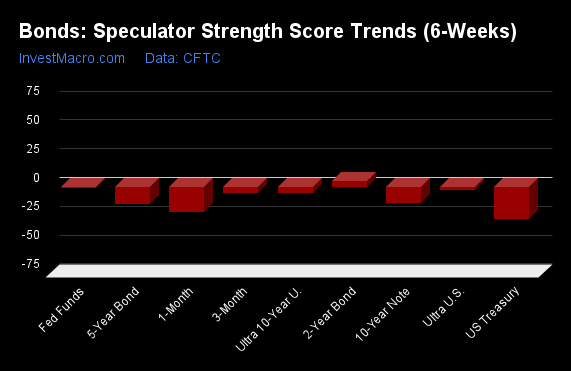
The six-week trend for the speculator strength score was -2.2 this week. The speculator position was -1,861,735 net contracts this week with an advance by 65,931 contracts in the weekly speculator bets.


Article By InvestMacroReceive our weekly COT Newsletter

*COT Report: The COT data, released weekly to the public each Friday, is updated through the most recent Tuesday (data is 3 days old) and shows a quick view of how large speculators or non-commercials (for-profit traders) were positioned in the futures markets.

The CFTC categorizes trader positions according to commercial hedgers (traders who use futures contracts for hedging as part of the business), non-commercials (large traders who speculate to realize trading profits) and nonreportable traders (usually small traders/speculators) as well as their open interest (contracts open in the market at time of reporting). See CFTC criteria here.

COT Metals Charts: Speculator bets led by Platinum, Copper & Steel

By InvestMacro

Here are the latest charts and statistics for the Commitment of Traders (COT) data published by the Commodities Futures Trading Commission (CFTC).

The latest COT data is updated through Tuesday February 11th and shows a quick view of how large traders (for-profit speculators and commercial entities) were positioned in the futures markets.

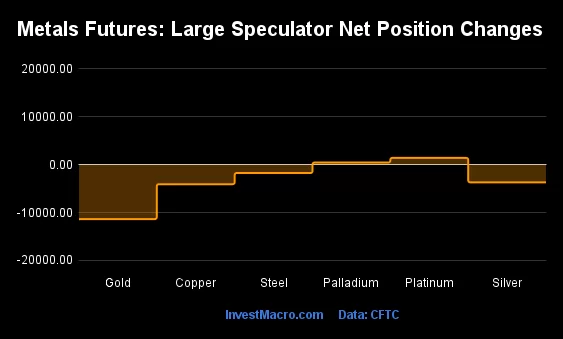
Weekly Speculator Changes led by Platinum, Copper & Steel

The COT metals markets speculator bets were mixed this week as three out of the six metals markets we cover had higher positioning while the other three markets had lower speculator contracts.

Leading the gains for the metals was Platinum (6,755 contracts) with Copper (5,475 contracts) and Steel (4,618 contracts) also showing higher weeks.

The markets with declines in speculator bets for the week were Gold (-18,004 contracts), Silver (-651 contracts) and with Palladium (-450 contracts) also recording lower bets on the week.


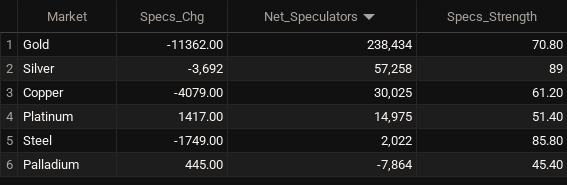
Metals Net Speculators Leaderboard

Legend: Weekly Speculators Change | Speculators Current Net Position | Speculators Strength Score compared to last 3-Years (0-100 range)


Strength Scores led by Steel & Gold

COT Strength Scores (a normalized measure of Speculator positions over a 3-Year range, from 0 to 100 where above 80 is Extreme-Bullish and below 20 is Extreme-Bearish) showed that Steel (100 percent) and Gold (88 percent) lead the metals markets this week. Silver (79.0 percent) comes in as the next highest in the weekly strength scores.

Copper (53 percent) and Palladium (54 percent) come in at the lowest strength levels currently but are above their 3-year midpoint (50 percent).

Strength Statistics:
Gold (88.3 percent) vs Gold previous week (95.1 percent)
Silver (79.0 percent) vs Silver previous week (79.8 percent)
Copper (52.7 percent) vs Copper previous week (47.6 percent)
Platinum (76.8 percent) vs Platinum previous week (60.8 percent)
Palladium (53.8 percent) vs Palladium previous week (57.1 percent)
Steel (100.0 percent) vs Palladium previous week (81.7 percent)


Platinum & Steel top the 6-Week Strength Trends

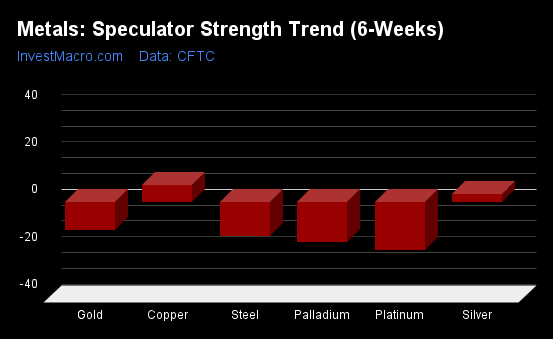
COT Strength Score Trends (or move index, calculates the 6-week changes in strength scores) showed that Platinum (47 percent) and Steel (22 percent) lead the past six weeks trends for metals. Palladium (15 percent) is the next highest positive mover in the latest trends data.

There are no downside trend scores this week.

Move Statistics:
Gold (14.1 percent) vs Gold previous week (20.8 percent)
Silver (14.9 percent) vs Silver previous week (12.9 percent)
Copper (18.8 percent) vs Copper previous week (12.7 percent)
Platinum (47.5 percent) vs Platinum previous week (7.9 percent)
Palladium (15.4 percent) vs Palladium previous week (14.4 percent)
Steel (21.5 percent) vs Steel previous week (11.1 percent)


Individual Markets:

Gold Comex Futures:

Gold Futures COT ChartThe Gold Comex Futures large speculator standing this week was a net position of 284,504 contracts in the data reported through Tuesday. This was a weekly reduction of -18,004 contracts from the previous week which had a total of 302,508 net contracts.

This week’s current strength score (the trader positioning range over the past three years, measured from 0 to 100) shows the speculators are currently Bullish-Extreme with a score of 88.3 percent. The commercials are Bearish-Extreme with a score of 10.7 percent and the small traders (not shown in chart) are Bullish with a score of 62.6 percent.

Price Trend-Following Model: Strong Uptrend

Our weekly trend-following model classifies the current market price position as: Strong Uptrend.

Gold Futures StatisticsSPECULATORSCOMMERCIALSSMALL TRADERS
– Percent of Open Interest Longs:65.013.79.4
– Percent of Open Interest Shorts:11.272.34.6
– Net Position:284,504-309,88825,384
– Gross Longs:343,76672,62249,509
– Gross Shorts:59,262382,51024,125
– Long to Short Ratio:5.8 to 10.2 to 12.1 to 1
NET POSITION TREND:
– Strength Index Score (3 Year Range Pct):88.310.762.6
– Strength Index Reading (3 Year Range):Bullish-ExtremeBearish-ExtremeBullish
NET POSITION MOVEMENT INDEX:
– 6-Week Change in Strength Index:14.1-13.94.9


Silver Comex Futures:

Silver Futures COT ChartThe Silver Comex Futures large speculator standing this week was a net position of 49,710 contracts in the data reported through Tuesday. This was a weekly fall of -651 contracts from the previous week which had a total of 50,361 net contracts.

This week’s current strength score (the trader positioning range over the past three years, measured from 0 to 100) shows the speculators are currently Bullish with a score of 79.0 percent. The commercials are Bearish-Extreme with a score of 18.9 percent and the small traders (not shown in chart) are Bullish with a score of 60.4 percent.

Price Trend-Following Model: Weak Downtrend

Our weekly trend-following model classifies the current market price position as: Weak Downtrend.

Silver Futures StatisticsSPECULATORSCOMMERCIALSSMALL TRADERS
– Percent of Open Interest Longs:48.219.820.0
– Percent of Open Interest Shorts:17.961.38.7
– Net Position:49,710-68,25018,540
– Gross Longs:79,11232,50132,807
– Gross Shorts:29,402100,75114,267
– Long to Short Ratio:2.7 to 10.3 to 12.3 to 1
NET POSITION TREND:
– Strength Index Score (3 Year Range Pct):79.018.960.4
– Strength Index Reading (3 Year Range):BullishBearish-ExtremeBullish
NET POSITION MOVEMENT INDEX:
– 6-Week Change in Strength Index:14.9-17.519.5


Copper Grade #1 Futures:

Copper Futures COT ChartThe Copper Grade #1 Futures large speculator standing this week was a net position of 20,896 contracts in the data reported through Tuesday. This was a weekly rise of 5,475 contracts from the previous week which had a total of 15,421 net contracts.

This week’s current strength score (the trader positioning range over the past three years, measured from 0 to 100) shows the speculators are currently Bullish with a score of 52.7 percent. The commercials are Bearish with a score of 49.0 percent and the small traders (not shown in chart) are Bearish with a score of 41.6 percent.

Price Trend-Following Model: Strong Uptrend

Our weekly trend-following model classifies the current market price position as: Strong Uptrend.

Copper Futures StatisticsSPECULATORSCOMMERCIALSSMALL TRADERS
– Percent of Open Interest Longs:42.630.87.3
– Percent of Open Interest Shorts:34.141.05.7
– Net Position:20,896-24,8423,946
– Gross Longs:104,03275,16917,858
– Gross Shorts:83,136100,01113,912
– Long to Short Ratio:1.3 to 10.8 to 11.3 to 1
NET POSITION TREND:
– Strength Index Score (3 Year Range Pct):52.749.041.6
– Strength Index Reading (3 Year Range):BullishBearishBearish
NET POSITION MOVEMENT INDEX:
– 6-Week Change in Strength Index:18.8-16.3-7.2


Platinum Futures:

Platinum Futures COT ChartThe Platinum Futures large speculator standing this week was a net position of 25,730 contracts in the data reported through Tuesday. This was a weekly lift of 6,755 contracts from the previous week which had a total of 18,975 net contracts.

This week’s current strength score (the trader positioning range over the past three years, measured from 0 to 100) shows the speculators are currently Bullish with a score of 76.8 percent. The commercials are Bearish with a score of 28.8 percent and the small traders (not shown in chart) are Bearish-Extreme with a score of 7.8 percent.

Price Trend-Following Model: Weak Downtrend

Our weekly trend-following model classifies the current market price position as: Weak Downtrend.

Platinum Futures StatisticsSPECULATORSCOMMERCIALSSMALL TRADERS
– Percent of Open Interest Longs:66.116.310.3
– Percent of Open Interest Shorts:35.050.96.8
– Net Position:25,730-28,5932,863
– Gross Longs:54,60013,4378,495
– Gross Shorts:28,87042,0305,632
– Long to Short Ratio:1.9 to 10.3 to 11.5 to 1
NET POSITION TREND:
– Strength Index Score (3 Year Range Pct):76.828.87.8
– Strength Index Reading (3 Year Range):BullishBearishBearish-Extreme
NET POSITION MOVEMENT INDEX:
– 6-Week Change in Strength Index:47.5-32.9-84.4


Palladium Futures:

Palladium Futures COT ChartThe Palladium Futures large speculator standing this week was a net position of -6,574 contracts in the data reported through Tuesday. This was a weekly decrease of -450 contracts from the previous week which had a total of -6,124 net contracts.

This week’s current strength score (the trader positioning range over the past three years, measured from 0 to 100) shows the speculators are currently Bullish with a score of 53.8 percent. The commercials are Bearish with a score of 44.2 percent and the small traders (not shown in chart) are Bullish with a score of 78.4 percent.

Price Trend-Following Model: Downtrend

Our weekly trend-following model classifies the current market price position as: Downtrend.

Palladium Futures StatisticsSPECULATORSCOMMERCIALSSMALL TRADERS
– Percent of Open Interest Longs:34.940.611.6
– Percent of Open Interest Shorts:67.612.57.0
– Net Position:-6,5745,643931
– Gross Longs:7,0148,1632,340
– Gross Shorts:13,5882,5201,409
– Long to Short Ratio:0.5 to 13.2 to 11.7 to 1
NET POSITION TREND:
– Strength Index Score (3 Year Range Pct):53.844.278.4
– Strength Index Reading (3 Year Range):BullishBearishBullish
NET POSITION MOVEMENT INDEX:
– 6-Week Change in Strength Index:15.4-15.74.8


Steel Futures Futures:

Steel Futures COT ChartThe Steel Futures large speculator standing this week was a net position of 2,855 contracts in the data reported through Tuesday. This was a weekly boost of 4,618 contracts from the previous week which had a total of -1,763 net contracts.

This week’s current strength score (the trader positioning range over the past three years, measured from 0 to 100) shows the speculators are currently Bullish-Extreme with a score of 100.0 percent. The commercials are Bearish-Extreme with a score of 0.0 percent and the small traders (not shown in chart) are Bullish with a score of 52.0 percent.

Price Trend-Following Model: Strong Uptrend

Our weekly trend-following model classifies the current market price position as: Strong Uptrend.

Steel Futures StatisticsSPECULATORSCOMMERCIALSSMALL TRADERS
– Percent of Open Interest Longs:30.758.71.1
– Percent of Open Interest Shorts:21.668.30.5
– Net Position:2,855-3,034179
– Gross Longs:9,63018,379348
– Gross Shorts:6,77521,413169
– Long to Short Ratio:1.4 to 10.9 to 12.1 to 1
NET POSITION TREND:
– Strength Index Score (3 Year Range Pct):100.00.052.0
– Strength Index Reading (3 Year Range):Bullish-ExtremeBearish-ExtremeBullish
NET POSITION MOVEMENT INDEX:
– 6-Week Change in Strength Index:21.5-22.219.9


Article By InvestMacroReceive our weekly COT Newsletter

*COT Report: The COT data, released weekly to the public each Friday, is updated through the most recent Tuesday (data is 3 days old) and shows a quick view of how large speculators or non-commercials (for-profit traders) were positioned in the futures markets.

The CFTC categorizes trader positions according to commercial hedgers (traders who use futures contracts for hedging as part of the business), non-commercials (large traders who speculate to realize trading profits) and nonreportable traders (usually small traders/speculators) as well as their open interest (contracts open in the market at time of reporting). See CFTC criteria here.