Archive for Stock Market News – Page 34

Mid-Week Technical Outlook: US Indices In Focus

By ForexTime 

European shares pulsed with life on Wednesday, echoing the upbeat mood in Asian markets after Chinese tech giant Alibaba announced it will split into six business groups.

Easing concerns over the banking sector has contributed to the overall risk-on mood with US futures signalling a positive open. After the chaos witness over the past few weeks, it seems like a sense of normality has returned to markets with the attention back on key economic data and risk events. The next few days could be even more eventful, especially for US markets due to Fed speeches, Senate hearings on Silicon Valley Bank, and the Fed’s preferred measure on inflation.

Given the string of data and risk events expected from the US economy, our attention today falls on US indices with the weapon of choice none other than technical analysis.

S&P 500 approaches 50-day SMA

It has been a choppy week for the SPX500 thanks to fundamental forces.

Prices are trading above the 200 and 100-day Simple Moving Average (SMA) but just below the 50-day SMA. A solid daily close and breakout above 4000 could encourage a move higher toward 4050. Beyond this point, prices may test 4090. Alternatively, sustained weakness under 4000 could trigger a decline towards 3930.

Nasdaq 100 trapped within a range

A major breakout could be on the horizon for the NQ100 index. Although the index is trading well above the 50, 100, and 200-day SMA, prices seem to be consolidating. Support can be found at 12500 and resistance at 12850. A major breakout above 12850 could inspire an incline towards 13200. Should prices slip back towards 12500, this could trigger a decline back toward the 50-day SMA at 12280.

Bonus: Dow Jones bulls gather momentum

The WSt30 index on the D1 time frame started a new uptrend when the market structure changed after a last lower bottom formed at 31411 on 15 March. This happened inside a weekly support zone where the bulls found the price attractive and demand started increasing.

After the lower bottom at 31411, the price broke through the 15 Simple Moving Average and the Momentum Oscillator started moving towards the 100 baseline. Alert technical traders might have noticed this early indication that the bulls might be starting to gather momentum.

A higher top and possible critical resistance level formed on 22 March at 32781 after which the bears tried to take back control of the market. The weekly support zone held however and on 24 March at 31743 the bulls took over again with a higher bottom forming. At this stage, the Momentum Oscillator also crossed the 100 baseline as confirmation of the bullish drive.

If the bulls maintain their momentum and the price breaks through the critical resistance level at 32781, then three possible price targets can be calculated from there. Applying the Fibonacci tool to the higher top at 32781 and dragging it to the higher bottom in the weekly support area at 31743, the following targets may be considered. The first target is likely at 33422 (161%), with the second price target feasible at 34460  (261.8%) if the bulls can manage to break through the weekly resistance level on the way there. The third and final target is possible at 36140 (423.6%) with yet another weekly resistance as a hurdle in the path of the bulls.

If the price at 31743 is broken, the bullish scenario is undone and the scenario has to be re-evaluated.

As long as bulls retain their momentum, the outlook for the WSt30 on the D1 time frame will continue to the demand side.


Forex-Time-LogoArticle by ForexTime

ForexTime Ltd (FXTM) is an award winning international online forex broker regulated by CySEC 185/12 www.forextime.com

Sports Media Co. Posts Stellar Q4/22

Source: Rob Goff   (3/23/23)

The Canadian firm has a “blowout” quarter of significant organic growth that calls for increases to 2023 revenue and EBITDA estimates, noted an Echelon Capital Markets report.

Playmaker Capital Inc. (PMKR:TSX.V; PMKRF:OTCQX) outperformed in Q4/22 such that revenue and EBITDA were “a large step function” above forecasts, reported Echelon Capital Markets analyst Rob Goff in a March 21 research note.

“Results across 2022 support our bullish view towards Playmaker’s organic and inorganic growth as management has assembled high-growth, entrepreneur-driven partners onto its platform, where additional investment, greater platform reach, and an in-house tech stack drive growth and monetization,” Goff wrote.

Attractive Investment Opportunity

The analyst also highlighted that Playmaker’s enterprise value:EBITDA multiple is “irrationally cheap,” and Echelon rates the company Speculative Buy. Playmaker’s current share price is about CA$0.48 per share, and Echelon’s target price on the Ontario-based company is CA$1.20 per share. This price difference indicates a potential 150% return for investors.

Noteworthy Organic Growth

Goff discussed Playmaker’s Q4/22 and full-year 2022 (FY22) revenue and EBITDA, highlighting the company’s outperformance due to the strength of its acquisitions.

Revenue in Q4/22 was US$18.7 million (US$18.7M), which surpassed Echelon’s US$11.1M estimate and consensus’ US$11.9M forecast. Likewise, Q4/22 EBITDA was beat at US$6.6M versus Echelon’s US$4.2M projection and the Street’s US$4M estimate. Goff noted these figures exclude any revenue contribution from the World Cup.

Q4/22 pro forma revenue (US$19M) and EBITDA (US$6.8M) reflect 102% and 96% year-over-year (YOY) growth, respectively.

Playmaker’s impressive organic growth in Q4/22 was due to a 25% YOY increase in overall user sessions over the whole platform, Goff pointed out. Yardbarker performed the best, achieving 86% YOY growth. Also, Wedge, the newly acquired affiliate marketer, yielded US$5.7M in only two and a half months of Q4/22, “one of the key positive surprises on the quarter,” wrote Goff.

Looking at Playmaker’s FY22 results, pro forma revenue and EBITDA came in at US$47.4M and US$15.3M and also were beat, Goff pointed out. As well they reflect YOY growth of 51% for revenue and 36% for EBITDA.

The company ended Q4/22 with US$8.9M of cash and about US$10M of undrawn credit.

Model Estimates Revised

Based on Playmaker’s “significant outperformance” in Q4/22, noted Goff, Echelon raised its 2023 revenue estimates on it by US$6.6M. The updated amount is US$50.5M.

Echelon modestly increased its forecasted EBITDA to US$15.7M from US$15.2M to allow for greater expenses as Playmaker continues growing.


Disclosures:
1) Doresa Banning wrote this article for Streetwise Reports LLC and provides services to Streetwise Reports as an independent contractor. She or members of her household own securities of the following companies mentioned in the article: None. She or members of her household are paid by the following companies mentioned in this article: None.

2) The following companies mentioned in this article are billboard sponsors of Streetwise Reports: None. Click here for important disclosures about sponsor fees. As of the date of this article, an affiliate of Streetwise Reports has a consulting relationship with: None. Please click here for more information.

3) Comments and opinions expressed are those of the specific experts and not of Streetwise Reports or its officers. The information provided above is for informational purposes only and is not a recommendation to buy or sell any security.

4) The article does not constitute investment advice. Each reader is encouraged to consult with his or her individual financial professional and any action a reader takes as a result of information presented here is his or her own responsibility. By opening this page, each reader accepts and agrees to Streetwise Reports’ terms of use and full legal disclaimer. This article is not a solicitation for investment. Streetwise Reports does not render general or specific investment advice and the information on Streetwise Reports should not be considered a recommendation to buy or sell any security. Streetwise Reports does not endorse or recommend the business, products, services or securities of any company mentioned on Streetwise Reports.

5) From time to time, Streetwise Reports LLC and its directors, officers, employees or members of their families, as well as persons interviewed for articles and interviews on the site, may have a long or short position in securities mentioned. Directors, officers, employees or members of their immediate families are prohibited from making purchases and/or sales of those securities in the open market or otherwise from the time of the decision to publish an article until three business days after the publication of the article. The foregoing prohibition does not apply to articles that in substance only restate previously published company releases.  As of the date of this article, officers and/or employees of Streetwise Reports LLC (including members of their household) own securities of Playmaker Capital Inc., a company mentioned in this article.

Disclosures for Echelon Wealth Partners, Playmaker Capital Inc., March 21, 2023

U.S. Disclosures: This research report was prepared by Echelon Wealth Partners Inc., a member of the Investment Industry Regulatory Organization of Canada and the Canadian Investor Protection Fund. This report does not constitute an offer to sell or the solicitation of an offer to buy any of the securities discussed herein. Echelon Wealth Partners Inc. is not registered as a broker-dealer in the United States and is not be subject to U.S. rules regarding the preparation of research reports and the independence of research analysts. Any resulting transactions should be effected through a U.S. broker-dealer.

ANALYST CERTIFICATION

Company: Playmaker Capital Inc. | PMKR:TSXV

I, Rob Goff, hereby certify that the views expressed in this report accurately reflect my personal views about the subject securities or issuers. I also certify that I have not, am not, and will not receive, directly or indirectly, compensation in exchange for expressing the specific recommendations or views in this report.

IMPORTANT DISCLOSURES

Has the Analyst had an onsite visit with the Issuer within the last 12 months? – Meeting with management/investor at Playmaker’s head office (Nov 17, 2022) – Yes.

Overseas Buyers Scoop Up U.S. Shares (Bullish or Bearish)?

“No crowd buys stocks of other countries intelligently”

By Elliott Wave International

The fact that investors from other countries are feverishly buying U.S. stocks might seem like a bullish sign.

On the other hand, consider what Robert Prechter said in his book, Prechter’s Perspective:

No crowd buys stocks of other countries intelligently. For decades, heavy foreign buying in the U.S. stock market has served as an excellent indicator of major tops.

Some of the heaviest foreign buying — whether it’s in the U.S. or another country — tends to occur when a trend is near or at an end.

Looking at an example: In the late 1980s, after years on the sidelines, foreigners became net buyers of Japanese stocks. This coincided with the ending phase of one of the biggest bull markets in history.

Returning to the U.S. but sticking with roughly that same period of history, here’s what the Sept. 2000 Elliott Wave Financial Forecast, a monthly Elliott Wave International publication which covers 50-plus financial markets, had to say as it showed this chart:

ForeignersBuyHighs

This chart of the Dow and foreigners’ net purchases of U.S. equities illustrates how beautifully the pattern has held through the U.S. bull market of the 1990s. The solid lines show the flood of foreign buyers within a month of each high, and the dotted lines show them rushing back out again on the months of the big lows. Early in the decade, when stocks were a bargain, foreigners were net sellers. They did not sustain net purchases until the Dow crossed 8000 in 1997.

By the way, overseas buyers also zealously bought U.S. shares right before the 2007 top.

As a quick reminder, the reason for mentioning all of this is what I said at the outset about feverish overseas buying of U.S. shares presently. Here are more details via this chart and commentary from our March Financial Forecast:

ForeignBuyersRushIn

Foreigners are surging back into U.S. equities. At $42.9 billion in November, the latest reading of foreign purchases is higher than both the 2000 and 2007 buying extremes. It is shy of the December 2020 record of $78.6 billion, but if foreigners flocked to U.S. stocks the way retail investors did in January, we may find that when the latest readings are released, foreign purchases will be at a new record.

One way to utilize the foreign buying (or, selling) indicator is with the Elliott wave model.

If you’re unfamiliar with Elliott wave analysis, or simply need a refresher on the subject, check out EWI’s FreePass for a Changed World event – thru March 31.

FreePass for a Changed World will give you an in-depth look at the analysis you can use to anticipate changes in inflation, interest rates and every other major category of investment concern.

Subscribers gladly pay $97 per month to get the market forecasts you’ll get for free in FreePass for a Changed World. But for FreePass, there’s no credit card required and zero strings attached.

Risks have changed. Opportunities have changed. The world has changed, in very real ways.

Join FreePass for a Changed World now and find out what your new strategies must include.

This article was syndicated by Elliott Wave International and was originally published under the headline Overseas Buyers Scoop Up U.S. Shares (Bullish or Bearish)?. EWI is the world’s largest market forecasting firm. Its staff of full-time analysts led by Chartered Market Technician Robert Prechter provides 24-hour-a-day market analysis to institutional and private investors around the world.

COT Stock Market Speculators raised their SP500-Mini bearish bets

By InvestMacro

Here are the latest charts and statistics for the Commitment of Traders (COT) data published by the Commodities Futures Trading Commission (CFTC).

The latest COT data is updated through Tuesday March 21st and shows a quick view of how large traders (for-profit speculators and commercial entities) were positioned in the futures markets.

* This COT data is fully up-to-date after weeks of delays due to a cybersecurity event that happened in early February to ION Cleared Derivatives (a subsidiary of ION Markets). The hacking incident had disrupted the ability for the CFTC to report large trader positions.

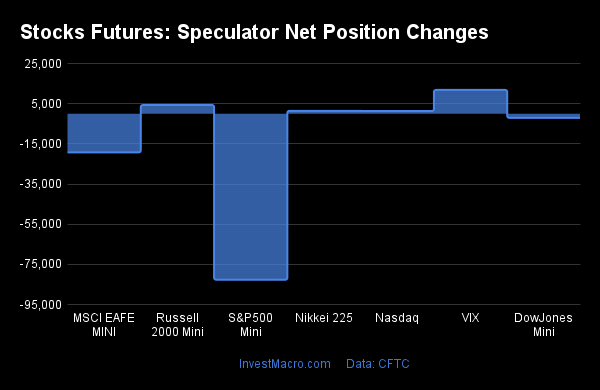
Weekly Speculator Changes led by Russell-Mini & VIX

The COT stock markets speculator bets were higher this week as four out of the seven stock markets we cover had higher positioning while the other four markets had lower speculator contracts.

Leading the gains for the stock markets was the VIX (11,856 contracts) with the Russell-Mini (4,315 contracts), the Nikkei 225 (1,438 contracts) and the Nasdaq-Mini (1,352 contracts) also showing positive weeks.

The markets with the declines in speculator bets this week were the S&P500-Mini (-82,661 contracts) with the MSCI EAFE-Mini (-19,234 contracts) and the DowJones-Mini (-2,068 contracts) also registering lower bets on the week.

Highlighting the COT stocks data this week is the bearish bets in the S&P500-Mini speculative positions. The large speculator position in S&P500-Mini futures dropped this week by over -80,000 contracts and fell for the second time in three weeks. The S&P500-Mini bets have now been in a bearish net position for the past 40 straight weeks, dating back to June 14th of 2022.

The current overall speculator level is currently at a highly bearish net position level of -202,480 speculator contracts with a bearish-extreme strength score level (18.7 percent) and while the 6-week strength trend actually posted a small gain of 2.8 percent (see strength scores further below).

The S&P500 stock futures price has been very resilient over the past month with a combination of rate hikes and a banking crisis not being able to knock the price from its short-term uptrend that started in October. The S&P500 stock futures price closed the week right around the psychological level of 4000.00 after making small gains in the past two weeks.


Data Snapshot of Stock Market Traders | Columns Legend
Mar-21-2023OIOI-IndexSpec-NetSpec-IndexCom-NetCOM-IndexSmalls-NetSmalls-Index
S&P500-Mini2,149,00512-202,48019266,45584-63,97513
Nikkei 22510,4190-930737953413530
Nasdaq-Mini214,87622-5,1207216,85837-11,73831
DowJones-Mini81,74741-22,1481730,06399-7,9150
VIX330,62257-49,6497852,09320-2,44479
Nikkei 225 Yen34,59993,577458,39034-11,96763


Strength Scores led by VIX & Nikkei 225

COT Strength Scores (a normalized measure of Speculator positions over a 3-Year range, from 0 to 100 where above 80 is Extreme-Bullish and below 20 is Extreme-Bearish) showed that the VIX (78 percent) and the Nikkei 225 (73 percent) lead the stock markets this week. The Nasdaq-Mini (72 percent) comes in as the next highest in the weekly strength scores.

On the downside, the DowJones-Mini (17 percent) and the S&P500-Mini (19 percent) are the lowest strength levels currently and are in Extreme-Bearish territory (below 20 percent).

Strength Statistics:
VIX (78.4 percent) vs VIX previous week (70.2 percent)
S&P500-Mini (18.7 percent) vs S&P500-Mini previous week (34.0 percent)
DowJones-Mini (17.4 percent) vs DowJones-Mini previous week (22.8 percent)
Nasdaq-Mini (72.2 percent) vs Nasdaq-Mini previous week (71.4 percent)
Russell2000-Mini (45.0 percent) vs Russell2000-Mini previous week (42.4 percent)
Nikkei USD (73.1 percent) vs Nikkei USD previous week (66.2 percent)
EAFE-Mini (27.1 percent) vs EAFE-Mini previous week (50.7 percent)


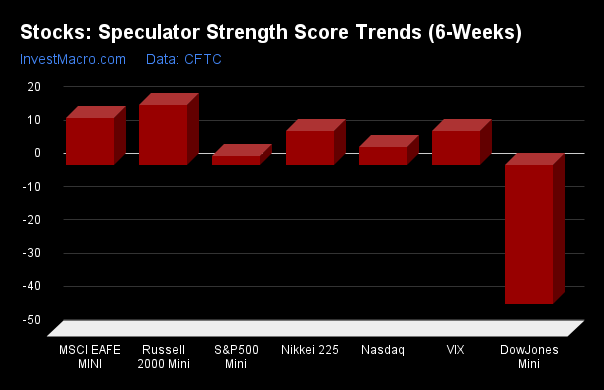
Russell-Mini & MSCI EAFE-Mini top the 6-Week Strength Trends

COT Strength Score Trends (or move index, calculates the 6-week changes in strength scores) showed that the Russell-Mini (18 percent) leads the past six weeks trends for the stock markets. The MSCI EAFE-Mini (14 percent), the Nikkei 225 (10 percent) and the VIX (10 percent) are the next highest positive movers in the latest trends data.

The DowJones-Mini (-42 percent) leads the downside trend scores currently.

Strength Trend Statistics:
VIX (10.4 percent) vs VIX previous week (3.7 percent)
S&P500-Mini (2.8 percent) vs S&P500-Mini previous week (19.0 percent)
DowJones-Mini (-41.8 percent) vs DowJones-Mini previous week (-28.1 percent)
Nasdaq-Mini (5.5 percent) vs Nasdaq-Mini previous week (5.2 percent)
Russell2000-Mini (18.1 percent) vs Russell2000-Mini previous week (8.2 percent)
Nikkei USD (10.4 percent) vs Nikkei USD previous week (12.9 percent)
EAFE-Mini (14.4 percent) vs EAFE-Mini previous week (49.1 percent)


Individual Stock Market Charts:

VIX Volatility Futures:

VIX Volatility Futures COT ChartThe VIX Volatility large speculator standing this week totaled a net position of -49,649 contracts in the data reported through Tuesday. This was a weekly boost of 11,856 contracts from the previous week which had a total of -61,505 net contracts.

This week’s current strength score (the trader positioning range over the past three years, measured from 0 to 100) shows the speculators are currently Bullish with a score of 78.4 percent. The commercials are Bearish-Extreme with a score of 19.8 percent and the small traders (not shown in chart) are Bullish with a score of 79.4 percent.

VIX Volatility Futures StatisticsSPECULATORSCOMMERCIALSSMALL TRADERS
– Percent of Open Interest Longs:17.853.28.0
– Percent of Open Interest Shorts:32.837.58.8
– Net Position:-49,64952,093-2,444
– Gross Longs:58,803175,97126,589
– Gross Shorts:108,452123,87829,033
– Long to Short Ratio:0.5 to 11.4 to 10.9 to 1
NET POSITION TREND:
– Strength Index Score (3 Year Range Pct):78.419.879.4
– Strength Index Reading (3 Year Range):BullishBearish-ExtremeBullish
NET POSITION MOVEMENT INDEX:
– 6-Week Change in Strength Index:10.4-12.920.2


S&P500 Mini Futures:

SP500 Mini Futures COT ChartThe S&P500 Mini large speculator standing this week totaled a net position of -202,480 contracts in the data reported through Tuesday. This was a weekly lowering of -82,661 contracts from the previous week which had a total of -119,819 net contracts.

This week’s current strength score (the trader positioning range over the past three years, measured from 0 to 100) shows the speculators are currently Bearish-Extreme with a score of 18.7 percent. The commercials are Bullish-Extreme with a score of 84.3 percent and the small traders (not shown in chart) are Bearish-Extreme with a score of 13.3 percent.

S&P500 Mini Futures StatisticsSPECULATORSCOMMERCIALSSMALL TRADERS
– Percent of Open Interest Longs:9.578.29.6
– Percent of Open Interest Shorts:18.965.812.6
– Net Position:-202,480266,455-63,975
– Gross Longs:203,1251,681,318205,770
– Gross Shorts:405,6051,414,863269,745
– Long to Short Ratio:0.5 to 11.2 to 10.8 to 1
NET POSITION TREND:
– Strength Index Score (3 Year Range Pct):18.784.313.3
– Strength Index Reading (3 Year Range):Bearish-ExtremeBullish-ExtremeBearish-Extreme
NET POSITION MOVEMENT INDEX:
– 6-Week Change in Strength Index:2.87.8-14.4


Dow Jones Mini Futures:

Dow Jones Mini Futures COT ChartThe Dow Jones Mini large speculator standing this week totaled a net position of -22,148 contracts in the data reported through Tuesday. This was a weekly decrease of -2,068 contracts from the previous week which had a total of -20,080 net contracts.

This week’s current strength score (the trader positioning range over the past three years, measured from 0 to 100) shows the speculators are currently Bearish-Extreme with a score of 17.4 percent. The commercials are Bullish-Extreme with a score of 98.9 percent and the small traders (not shown in chart) are Bearish-Extreme with a score of 0.1 percent.

Dow Jones Mini Futures StatisticsSPECULATORSCOMMERCIALSSMALL TRADERS
– Percent of Open Interest Longs:19.167.512.9
– Percent of Open Interest Shorts:46.230.722.6
– Net Position:-22,14830,063-7,915
– Gross Longs:15,60455,16110,581
– Gross Shorts:37,75225,09818,496
– Long to Short Ratio:0.4 to 12.2 to 10.6 to 1
NET POSITION TREND:
– Strength Index Score (3 Year Range Pct):17.498.90.1
– Strength Index Reading (3 Year Range):Bearish-ExtremeBullish-ExtremeBearish-Extreme
NET POSITION MOVEMENT INDEX:
– 6-Week Change in Strength Index:-41.845.9-30.1


Nasdaq Mini Futures:

Nasdaq Mini Futures COT ChartThe Nasdaq Mini large speculator standing this week totaled a net position of -5,120 contracts in the data reported through Tuesday. This was a weekly gain of 1,352 contracts from the previous week which had a total of -6,472 net contracts.

This week’s current strength score (the trader positioning range over the past three years, measured from 0 to 100) shows the speculators are currently Bullish with a score of 72.2 percent. The commercials are Bearish with a score of 36.9 percent and the small traders (not shown in chart) are Bearish with a score of 31.4 percent.

Nasdaq Mini Futures StatisticsSPECULATORSCOMMERCIALSSMALL TRADERS
– Percent of Open Interest Longs:24.759.114.8
– Percent of Open Interest Shorts:27.151.320.2
– Net Position:-5,12016,858-11,738
– Gross Longs:53,063127,00431,697
– Gross Shorts:58,183110,14643,435
– Long to Short Ratio:0.9 to 11.2 to 10.7 to 1
NET POSITION TREND:
– Strength Index Score (3 Year Range Pct):72.236.931.4
– Strength Index Reading (3 Year Range):BullishBearishBearish
NET POSITION MOVEMENT INDEX:
– 6-Week Change in Strength Index:5.5-8.26.5


Russell 2000 Mini Futures:

Russell 2000 Mini Futures COT ChartThe Russell 2000 Mini large speculator standing this week totaled a net position of -44,988 contracts in the data reported through Tuesday. This was a weekly gain of 4,315 contracts from the previous week which had a total of -49,303 net contracts.

This week’s current strength score (the trader positioning range over the past three years, measured from 0 to 100) shows the speculators are currently Bearish with a score of 45.0 percent. The commercials are Bullish with a score of 55.6 percent and the small traders (not shown in chart) are Bearish with a score of 27.5 percent.

Russell 2000 Mini Futures StatisticsSPECULATORSCOMMERCIALSSMALL TRADERS
– Percent of Open Interest Longs:8.585.64.7
– Percent of Open Interest Shorts:17.876.34.6
– Net Position:-44,98844,694294
– Gross Longs:40,762411,18822,631
– Gross Shorts:85,750366,49422,337
– Long to Short Ratio:0.5 to 11.1 to 11.0 to 1
NET POSITION TREND:
– Strength Index Score (3 Year Range Pct):45.055.627.5
– Strength Index Reading (3 Year Range):BearishBullishBearish
NET POSITION MOVEMENT INDEX:
– 6-Week Change in Strength Index:18.1-11.9-27.7


Nikkei Stock Average (USD) Futures:

Nikkei Stock Average (USD) Futures COT ChartThe Nikkei Stock Average (USD) large speculator standing this week totaled a net position of -930 contracts in the data reported through Tuesday. This was a weekly boost of 1,438 contracts from the previous week which had a total of -2,368 net contracts.

This week’s current strength score (the trader positioning range over the past three years, measured from 0 to 100) shows the speculators are currently Bullish with a score of 73.1 percent. The commercials are Bearish with a score of 34.0 percent and the small traders (not shown in chart) are Bearish with a score of 30.0 percent.

Nikkei Stock Average Futures StatisticsSPECULATORSCOMMERCIALSSMALL TRADERS
– Percent of Open Interest Longs:21.152.626.3
– Percent of Open Interest Shorts:30.044.925.0
– Net Position:-930795135
– Gross Longs:2,2005,4762,743
– Gross Shorts:3,1304,6812,608
– Long to Short Ratio:0.7 to 11.2 to 11.1 to 1
NET POSITION TREND:
– Strength Index Score (3 Year Range Pct):73.134.030.0
– Strength Index Reading (3 Year Range):BullishBearishBearish
NET POSITION MOVEMENT INDEX:
– 6-Week Change in Strength Index:10.4-13.76.6


MSCI EAFE Mini Futures:

MSCI EAFE Mini Futures COT ChartThe MSCI EAFE Mini large speculator standing this week totaled a net position of -14,077 contracts in the data reported through Tuesday. This was a weekly decrease of -19,234 contracts from the previous week which had a total of 5,157 net contracts.

This week’s current strength score (the trader positioning range over the past three years, measured from 0 to 100) shows the speculators are currently Bearish with a score of 27.1 percent. The commercials are Bullish with a score of 68.1 percent and the small traders (not shown in chart) are Bearish with a score of 49.6 percent.

MSCI EAFE Mini Futures StatisticsSPECULATORSCOMMERCIALSSMALL TRADERS
– Percent of Open Interest Longs:7.989.62.2
– Percent of Open Interest Shorts:11.687.60.5
– Net Position:-14,0777,5426,535
– Gross Longs:30,891348,7058,454
– Gross Shorts:44,968341,1631,919
– Long to Short Ratio:0.7 to 11.0 to 14.4 to 1
NET POSITION TREND:
– Strength Index Score (3 Year Range Pct):27.168.149.6
– Strength Index Reading (3 Year Range):BearishBullishBearish
NET POSITION MOVEMENT INDEX:
– 6-Week Change in Strength Index:14.4-14.82.5


Article By InvestMacroReceive our weekly COT Newsletter

*COT Report: The COT data, released weekly to the public each Friday, is updated through the most recent Tuesday (data is 3 days old) and shows a quick view of how large speculators or non-commercials (for-profit traders) were positioned in the futures markets.

The CFTC categorizes trader positions according to commercial hedgers (traders who use futures contracts for hedging as part of the business), non-commercials (large traders who speculate to realize trading profits) and nonreportable traders (usually small traders/speculators) as well as their open interest (contracts open in the market at time of reporting). See CFTC criteria here.

Data Communications Co. Reports Rising Revenues

Source: Streetwise Reports  (3/22/23)

Data Communications Management Corp., which recently announced its acquisition of a similar company, is reporting marked revenue increases in fiscal year 2022 over fiscal year 2021.

Data Communications Management Corp. (DCM:TSX; DCMDF:OTCQX) saw its revenue go up by 20% and its gross profit rise by 33% in the fourth quarter of 2022, as compared to the same quarter in 2021.

For the same period YoY, the printing and marketing services company said EBITDA was up 89.9%.

For the year ending Dec. 31, 2022, revenue was up 16.3%, gross profit was up 21.1%, and EBITDA was up 45.3% over the year ending Dec. 31, 2021, the company said. For that same period, net income rose by 792.4%.

With its recent announcement that it would acquire R.R. Donnelley & Sons’ Canadian operations, “We believe we are well positioned to further accelerate our positive momentum,” Chief Executive Officer and President Richard Kellum said.

Clive Maund rated Data Communications as an immediate strong speculative Buy.

“Combining DCM and RRD Canada will better position our business for sustainable and long-term success serving customers across North America,” Kellum said. “We believe the transaction also represents a compelling strategic opportunity for shareholders, as we expect the combined company to benefit from accelerated sales growth, reduced costs, enhanced financial performance, further operational efficiencies, and ultimately value creation.”

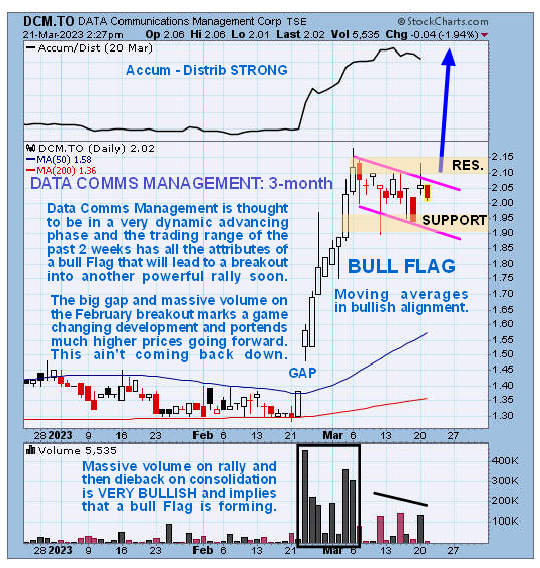
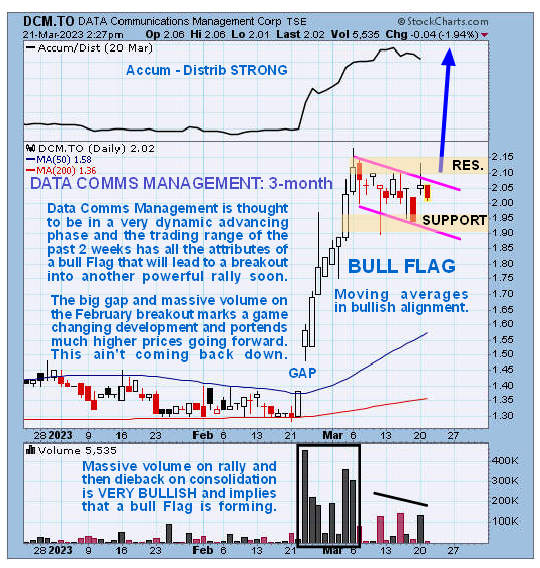
Analyst Clive Maund of CliveMaund.com wrote about the stock this morning. He noted that “after such a big advance, it might be thought that a top is forming, but this pattern has all the attributes of a bull Flag — the persistent heavy volume on the steep advance has been followed by a marked dieback as it has traded sideways, the Accumulation line has held up well, and the trading range can be seen to be tracking within a slightly downsloping parallel trend channel, in other words, a bull Flag.”

He continued, “This implies that the pattern will soon resolve into another powerful upleg that could very well be as big as the first upleg.”

He shared the above chart and went on to rate Data Communications as an immediate strong speculative Buy.

The company’s year-end revenues beat estimates made by eResearch analyst Chris Thompson, who had predicted CA$265.3 million compared to the actual total fiscal year 2022 revenues of CA$273.8 million.

That, along with the acquisition of RRD, could end up affecting Thompson’s future valuation of the company. Both the revenue increase and the acquisition could increase his equal-weighted target price per share to CA$6.02 from CA$4.44, he said.

“However, until the full financials are released, or the merger closes, we are maintaining a Buy rating and a one-year price target of (CA)$4.50,” Thompson wrote.

Acquiring RRD brings in a team that complements DCM’s own workforce, Thompson said.

“We believe the deal will be accretive to DCM’s financial profile as it accelerates DCM’s revenue and EBITDA growth and diversifies its revenue base,” he wrote.

The Catalysts: Revenue Growth, RRD

DCM attributed the revenue growth to a “combination of expansion revenue with existing clients and new business wins.”

The company reported successfully onboarding 35 new enterprise clients in 2022, increases in client and employee engagement, almost 700,000 trees planted in its PrintReleaf sustainability initiative, and productivity improvements, including the revenue-per-associate metric reaching its year-end target of CA$300,000. That’s an increase of 18% compared to 2021.

The company’s year-end revenues beat estimates made by eResearch analyst Chris Thompson, who had predicted CA$265.3 million compared to the actual total fiscal year 2022 revenues of CA$273.8 million.

Fiscal 2022 revenue was up CA$38.5 million vs. 2021, and gross profit jumped CA$14.7 to CA$84.2 million, the company said. Gross profit as a percentage of revenues grew from 1.3% to 30.8%.

Net income rose CA$12.4 million to CA$14 million, and EBITDA grew CA$11.3 million to CA$36.4 million.

There were no restructuring expenses or other adjustments or one-time costs, except for one-time add backs CA$1.9 million in Q4 for costs related to the acquisition of RRD, the company said.

Total debt was lowered 26% YoY to CA$27.3 million.

Revenue for Q4 2022 was up CA$12.2 million over the same period in 2021 to CA$73 million. EBITDA grew CA$4.5 million in Q4 2021 to CA$9.5 million in Q4 2022.

CA$500 Million in Annual Sales From Day 1

The tech-enabled marketing and digital asset management (DAM) sectors are forecasted to grow annually by 15% and 21%, respectively, Thompson has written.

“As DCM executes its ‘digital first’ strategy, we expect revenue from technology-enabled hardware solutions and tech-enabled subscription services and fees to increase,” Thompson has written.

DAM services generated only 1.3% of the DCM’s revenue in 2020. But “with the proliferation of video and digital content, the total DAM addressable market is forecasted to reach US$6 billion by 2025; thus, there is plenty of upside revenue potential,” Thompson wrote.

“We believe this transaction enhances DCM’s capabilities and growth potential,” Thompson wrote on March 10. “RRD Canada has a highly complementary operating model and is expected to add new products, services, and technology capabilities.”

R.R. Donnelly Canada provides print and related services to thousands of customers across the country, had a revenue of about CA$250 million in 2022, and has 1,000 employees. DCM is only buying the Canadian operations of RRD, which has clients in 29 countries.

“We believe this transaction enhances DCM’s capabilities and growth potential,” Thompson wrote on March 10. “RRD Canada has a highly complementary operating model and is expected to add new products, services, and technology capabilities.”

The new company would have more than CA$500 million in annual sales from day one, an expanded customer base, and an enhanced product portfolio, DCM said.

DCM has been in business for 60 years. It helps companies with branding, communications, and logistics and provides customer loyalty programs, data, and content management, location-specific marketing, labels and asset tracking, multimedia campaign management, and workflow management. Its clients are in many industries, including financial services, health care, emerging markets, retail, non-profits, energy, hospitality, and transportation.

Retail: 55%
Management & Insiders: 45%
Institutions: 0%
Strategic Investors: 0%
55%
45%
*Share Structure as of 3/21/2023


Ownership and Share Structure

Management and insiders own about 45% of DCM, including a share program that gives employees close to 4% ownership.

Top insider shareholders include Director Michael Sifton with 10.2% or 4.5 million shares, Board Vice Chairman Greg Cochrane with 7.43% or 3.28 million shares, Chairman of the Board J.R. Kingsley Ward with 5.54% or 2.44 million shares, and the CEO Kellam with 1.66% or 0.73 million shares, according to Reuters.

According to the company, the rest, 55%, is retail. Reuters lists KST Industries Inc. as the top shareholder in the company overall, with 11.69% or 5.15 million shares.

The company is covered by Noel Atkinson of Clarus Securities and Chris Thompson of eResearch. Newsletter writer Clive Maund also covers the stock.

It has a market cap of CA$89.01 million with 44 million shares outstanding, with 27.3 million shares free-floating. It trades in the 52-week range of CA$2.18 and CA$1.01.


Disclosures:

1) Steve Sobek wrote this article for Streetwise Reports LLC. He or members of his household own securities of the following companies mentioned in the article: None. He or members of his household are paid by the following companies mentioned in this article: None.

2) The following companies mentioned in this article are billboard sponsors of Streetwise Reports: Data Communications Management Corp. Click here for important disclosures about sponsor fees. The information provided above is for informational purposes only and is not a recommendation to buy or sell any security.

3) Statements and opinions expressed are the opinions of the author and not of Streetwise Reports or its officers. The author is wholly responsible for the validity of the statements. The author was not paid by Streetwise Reports for this article. Streetwise Reports was not paid by the author to publish or syndicate this article. Streetwise Reports requires contributing authors to disclose any shareholdings in or economic relationships with, companies that they write about. Streetwise Reports relies upon the authors to accurately provide this information and Streetwise Reports has no means of verifying its accuracy.

4) This article does not constitute investment advice. Each reader is encouraged to consult with his or her individual financial professional and any action a reader takes as a result of information presented here is his or her own responsibility. By opening this page, each reader accepts and agrees to Streetwise Reports’ terms of use and full legal disclaimer. This article is not a solicitation for investment. Streetwise Reports does not render general or specific investment advice and the information on Streetwise Reports should not be considered a recommendation to buy or sell any security. Streetwise Reports does not endorse or recommend the business, products, services or securities of any company mentioned on Streetwise Reports.

5) From time to time, Streetwise Reports LLC and its directors, officers, employees or members of their families, as well as persons interviewed for articles and interviews on the site, may have a long or short position in securities mentioned. Directors, officers, employees or members of their immediate families are prohibited from making purchases and/or sales of those securities in the open market or otherwise from the time of the decision to publish an article until three business days after the publication of the article. The foregoing prohibition does not apply to articles that in substance only restate previously published company releases.

Disclosures for eResearch, Data Communications Management Corp., March 10, 2023

ANALYST ACCREDITATION

eResearch Analyst on this Report: Chris Thompson CFA, MBA, P.Eng. Analyst Affirmation: I, Chris Thompson, hereby state that, at the time of issuance of this research report, I do not own common shares, share options, or share warrants of DATA Communications Management Corp. (TSX:DCM).

eRESEARCH DISCLOSURE STATEMENT

eResearch is engaged solely in the provision of equity research to the investment community. eResearch provides published research and analysis to its Subscribers on its website (www.eresearch.com), and to the general investing public through its extensive electronic distribution network and newswire agencies. eResearch makes all reasonable efforts to distribute research material simultaneously to all of its Subscribers. eResearch does not manage money or trade with the general public, provides full disclosure of all fee arrangements, and adheres to the strict application of its Best Practices Guidelines. eResearch accepts fees from the companies it researches (the “Covered Companies”), and from financial institutions or other third parties. The purpose of this policy is to defray the cost of researching small and medium-capitalization stocks which otherwise receive little or no research coverage.

DATA Communications Management Corp. paid eResearch a fee to have it conduct research and publish reports on the Company for one year.

To ensure complete independence and editorial control over its research, eResearch follows certain business practices and compliance procedures. For instance, fees from Covered Companies are due and payable before research starts. Management of the Covered Companies is sent copies, in draft form without a Recommendation or a Target Price, of the Initiating Report and the Update Report before publication to ensure our facts are correct, that we have not misrepresented anything, and have not included any non-public, confidential information. At no time is management entitled to comment on issues of judgment, including Analyst opinions, viewpoints, or recommendations. All research reports must be approved, before publication, by eResearch’s Director of Research, who is a Chartered Financial Analyst (CFA).

All Analysts are required to sign a contract with eResearch before engagement and agree to adhere at all times to the CFA Institute Code of Ethics and Standards of Professional Conduct. eResearch Analysts are compensated on a per-report, per-company basis and not based on his/her recommendations. Analysts are not allowed to accept any fees or other considerations from the companies they cover for eResearch. Officers, analysts, and directors of eResearch are allowed to trade in shares, warrants, convertible securities, or options of any of the Covered Companies only under strict, specified conditions, which restrict trading 30 days before and after a Research Report is published.

Data Communications Co. An ‘Immediate Strong Speculative Buy’

Source: Clive Maund  (3/22/23)

In light of the high-volume advance that went from February to earlier this month, technical analyst Clive Maund takes a look at Data Communications Management Corp.’s 3-month chart to tell you why he believes it is a Buy.

Following a powerful high-volume advance from late February into early this month, Data Communications Management Corp. (DCM:TSX; DCMDF:OTCQX) has been trading sideways in a relatively narrow range for about two weeks now.

Superficially, after such a big advance, it might be thought that a top is forming, but this pattern has all the attributes of a bull Flag — the persistent heavy volume on the steep advance has been followed by a marked dieback as it has traded sideways, the Accumulation line has held up well, and the trading range can be seen to be tracking within a slightly downsloping parallel trend channel, in other words, a bull Flag.

This implies that the pattern will soon resolve into another powerful upleg that could very well be as big as the first upleg. Note the large bullish “dragonfly doji” that occurred about five days into the Flag, whose intraday low so far marks the low for the pattern.

Data Communications Management is therefore rated an immediate strong speculative Buy, and a stop may be placed beneath the lower boundary of the Flag just in case this interpretation is proven incorrect.

Data Communications Management’s website.

Data Communications Management Corp. closed for trading at CA$2.02, $1.48 at 3.30 pm EDT on March 21, 2022.

This article was originally published on March 21, 2023, at 3.40 pm EDT at clivemaund.com


CliveMaund.com Disclosures

The above represents the opinion and analysis of Mr. Maund, based on data available to him, at the time of writing. Mr. Maund’s opinions are his own, and are not a recommendation or an offer to buy or sell securities. Mr. Maund is an independent analyst who receives no compensation of any kind from any groups, individuals or corporations mentioned in his reports. As trading and investing in any financial markets may involve serious risk of loss, Mr. Maund recommends that you consult with a qualified investment advisor, one licensed by appropriate regulatory agencies in your legal jurisdiction and do your own due diligence and research when making any kind of a transaction with financial ramifications. Although a qualified and experienced stock market analyst, Clive Maund is not a Registered Securities Advisor. Therefore Mr. Maund’s opinions on the market and stocks can only be construed as a solicitation to buy and sell securities when they are subject to the prior approval and endorsement of a Registered Securities Advisor operating in accordance with the appropriate regulations in your area of jurisdiction.

Disclosures:
1) Clive Maund: I, or members of my immediate household or family, own securities of the following companies mentioned in this article: None. I personally am, or members of my immediate household or family are, paid by the following companies mentioned in this article: None.

2) The following companies mentioned in this article are billboard sponsors of Streetwise Reports: Data Communications Management Corp. Click here for important disclosures about sponsor fees. As of the date of this article, an affiliate of Streetwise Reports has a consulting relationship with: None. Please click here for more information.

3) Statements and opinions expressed are the opinions of the author and not of Streetwise Reports or its officers. The author is wholly responsible for the validity of the statements. The author was not paid by Streetwise Reports for this article. Streetwise Reports was not paid by the author to publish or syndicate this article. Streetwise Reports requires contributing authors to disclose any shareholdings in, or economic relationships with, companies that they write about. Streetwise Reports relies upon the authors to accurately provide this information and Streetwise Reports has no means of verifying its accuracy.

4) This article does not constitute investment advice. Each reader is encouraged to consult with his or her individual financial professional and any action a reader takes as a result of information presented here is his or her own responsibility. By opening this page, each reader accepts and agrees to Streetwise Reports’ terms of use and full legal disclaimer. This article is not a solicitation for investment. Streetwise Reports does not render general or specific investment advice and the information on Streetwise Reports should not be considered a recommendation to buy or sell any security. Streetwise Reports does not endorse or recommend the business, products, services or securities of any company mentioned on Streetwise Reports.

5) From time to time, Streetwise Reports LLC and its directors, officers, employees or members of their families, as well as persons interviewed for articles and interviews on the site, may have a long or short position in securities mentioned. Directors, officers, employees or members of their immediate families are prohibited from making purchases and/or sales of those securities in the open market or otherwise from the time of the decision to publish an article until three business days after the publication of the article. The foregoing prohibition does not apply to articles that in substance only restate previously published company releases.

Defense Products Firm To Be Cash Flow Positive This Year

Source: Darren Odell  (3/15/23)

This Australian company, which is experiencing sales momentum and attracting defense contractors’ attention, also is a takeout target, noted a Peloton Capital report.

DroneShield Ltd. (DRO:ASX; DRSHF:OTC) will be operating cash flow positive by year-end and “is an acquisition target,” purported Peloton Capital analyst Darren Odell in a March 9 research note.

With respect to achieving this cash goal, the Australian counterdrone products and solutions company has the following many factors working in its favor, Odell wrote.

1) DroneShield recently raised AU$29.4 million (AU$29.4M) through its stock purchase plan resulting from the AU$10.9M placement last month.

“The recent capital raise has provided DroneShield the ability to build inventory in anticipation of material contracts (and fulfill smaller contracts faster) that are expected to close, in the short to medium term,” wrote Odell.

2) DroneShield recently landed two contracts totaling AU$22M.

3) The company has a robust AU$200M sales pipeline consisting of multiple contracts, each worth more than AU$10. Peloton Capital expects DroneShield to close three large and several smaller deals this year.

“Our DroneShield valuation to AU$0.84 is based on increased confidence on the closure of larger contracts in 2023 and beyond,” wrote Odell.

Compared to Peloton’s AU$0.84 target price, DroneShield’s current share price is about AU$0.335. The company is a Buy.

4) Existing contracted customers in the Five Eyes countries will likely buy more products from DroneShield.

5) The U.S. Department of Defense recommends DroneShield.

6) The Russia-Ukraine war has heightened interest in products like those sold by DroneShield.

Attractive to Potential Buyers

With respect to DroneShield likely being acquired, Odell indicated the following factors support the belief it will happen.

1) One of DroneShield’s shareholders, owning about a 5% interest, is Epirus, a California-based unmanned aerial vehicle firm.

2) Private equity backs DroneShield.

3) The U.S. government recommends DroneShield.

4) Global defense contractors have taken note of DroneShield and its recent contracts.


Disclosures:
1) Doresa Banning wrote this article for Streetwise Reports LLC and provides services to Streetwise Reports as an independent contractor. She or members of her household own securities of the following companies mentioned in the article: None. She or members of her household are paid by the following companies mentioned in this article: None.

2) The following companies mentioned in this article are billboard sponsors of Streetwise Reports: None. Click here for important disclosures about sponsor fees. The information provided above is for informational purposes only and is not a recommendation to buy or sell any security. As of the date of this article, an affiliate of Streetwise Reports has a consulting relationship with: DroneShield Ltd. Please click here for more information. The information provided above is for informational purposes only and is not a recommendation to buy or sell any security.

3) The article does not constitute investment advice. Each reader is encouraged to consult with his or her individual financial professional and any action a reader takes as a result of information presented here is his or her own responsibility. By opening this page, each reader accepts and agrees to Streetwise Reports’ terms of use and full legal disclaimer. This article is not a solicitation for investment. Streetwise Reports does not render general or specific investment advice and the information on Streetwise Reports should not be considered a recommendation to buy or sell any security. Streetwise Reports does not endorse or recommend the business, products, services or securities of any company mentioned on Streetwise Reports.

4) From time to time, Streetwise Reports LLC and its directors, officers, employees or members of their families, as well as persons interviewed for articles and interviews on the site, may have a long or short position in securities mentioned. Directors, officers, employees or members of their immediate families are prohibited from making purchases and/or sales of those securities in the open market or otherwise from the time of the decision to publish an article until three business days after the publication of the article. The foregoing prohibition does not apply to articles that in substance only restate previously published company releases. As of the date of this article, officers and/or employees of Streetwise Reports LLC (including members of their household) own securities of DroneShield Ltd., a company mentioned in this article.

Disclosures For Peloton Capital, DroneShield Ltd., March 9, 2023

This report is provided by Peloton Capital Pty Ltd (Peloton) (ABN 22 149 540 018, AFSL 406040) and is general in nature. It is intended solely for the use of wholesale clients, within the meaning of the Australian Corporations Act 2001. This report must not be copied or reproduced, or distributed to any person, unless otherwise expressly agreed by Peloton. This document contains only general securities information or general financial product advice. The information contained in this report has been obtained from sources that were accurate at the time of issue, including the company’s ASX releases which have been relied upon for factual accuracy. The information has not been independently verified. Peloton does not warrant the accuracy or reliability of the information in this report. The report is current as of the date it has been published.

In preparing the report, Peloton did not take into account the specific investment objectives, financial situation or particular needs of any specific recipient. The report is published only for informational purposes and is not intended to be personal financial product advice. This report is not a solicitation or an offer to buy or sell any financial product. Peloton is not aware whether a recipient intends to rely on this report and is not aware of how it will be used by the recipient. Before acting on this general financial product advice, you should consider the appropriateness of the advice having regard to your personal situation, investment objectives or needs. Recipients should not regard the report as a substitute for the exercise of their own judgment.

Peloton may assign ratings as ‘speculative buy’, ‘buy’ and ‘sell’ to securities from time to time. Securities not assigned are deemed to be ‘neutral’. Being assigned a ‘speculative buy’, ‘buy’ or ‘sell’ is determined by a security total return potential, with the total return potential being aligned to the upside or downside differential between the current share price and the targeted price within a specified time horizon, if deemed appropriate. The views expressed in this report are those of the analyst/author named on the cover page. No part of the compensation of the analyst is directly related to inclusion of specific recommendations or views in this report. The analyst/author receives compensation partly based on Peloton revenues as well as performance measures such as accuracy and efficacy of both recommendations and research reports.

Peloton believes that the information contained in this document is correct and that any estimates, opinions, conclusions or recommendations are reasonably held or made at the time of its compilation in an honest and fair manner that is not compromised. However, no representation is made as to the accuracy, completeness or reliability of any estimates, opinions, conclusions or recommendations (which may change without notice) or other information contained in this report. To the maximum extent permitted by law, Peloton disclaims all liability and responsibility for any direct or indirect loss that may be suffered by any recipient through relying on anything contained in or omitted from this report. Peloton is under no obligation to update or keep current the information contained in this report and has no obligation to tell you when opinions or information in this report change.

Peloton does and seeks to do business with companies covered in research. As a result, investors should be aware that the firm may have a conflict of interest which it seeks to manage and disclose. Peloton and its directors, officers and employees or clients may have or had interests in the financial products referred to in this report and may make purchases or sales in those the financial products as principal or agent at any time and may affect transactions which may not be consistent with the opinions, conclusions or recommendations set out in this report. Peloton and its Associates may earn brokerage, fees or other benefits from financial products referred to in this report. Furthermore, Peloton may have or have had a relationship with or may provide or has provided, capital markets and/or other financial services to the relevant issuer or holder of those financial products.

Specific Disclosure: Peloton Capital raised $40.3m for DroneShield (DRO), announced March 2023, for which it earned fees.

Specific Disclosure: The analyst does hold securities in DRO.

Specific Disclosure: The report has been reviewed by DRO for factual accuracy.

Specific Disclosure: As at 9th March, Peloton Capital held c.1m DRO shares and 15m call options. This position may change at any time and without notice, including on the day that this report has been released. Peloton and its employees may from time-to-time own shares in DRO and trade them in ways different from those discussed in research. Peloton Capital may arrange the buying and selling securities on behalf of clients.

Silicon Valley Bank: how interest rates helped trigger its collapse and what central bankers should do next

By Charles Read, University of Cambridge 

A former prime minister of Britain, Harold Wilson, is famous for remarking that a week is a long time in politics. But in the world of finance, it seems everything can change in just two days.

Only 48 hours elapsed between a statement from US-based Silicon Valley Bank (SVB) on March 8 that it was seeking to raise US$2.5 billion (£2 billion) to repair a hole in its balance sheet, and the announcement by US regulator the Federal Deposit Insurance Corporation that the bank had collapsed.

At its peak in 2021, SVB was worth US$44 billion and managed over $200 billion in assets. America’s 16th largest deposit-taking institution just a week ago, it has now become the second biggest banking failure in US history. Only the collapse of Washington Mutual during the 2008 global financial crisis was larger.

Although SVB had been ailing for some time, the speed of its collapse took nearly all commentators – as well as its customers, mostly from the tech sector – by surprise. Tech firms around the world have their cash locked up in SVB deposits and were concerned about how they would pay their workers and their bills until government support was announced in the US, alongside HSBC’s deal to buy SVB’s UK arm.

And it looks like the run on SVB that heralded its collapse – by some metrics the fastest in history – is spreading to other institutions with similar characteristics. On March 12, two days after SVB’s collapse, regulators in New York closed Signature Bank, citing systemic risk.

But was what happened to SVB unpredictable, unpreventable and unavoidable? My research suggests not. My latest book about the history of financial crises, Calming the Storms: the Carry Trade, the Banking School and British Financial Crises Since 1825, was coincidentally launched the day before SVB failed and describes three situations in which a banking crisis may unfold.

Why SVB collapsed

One potential cause is when changes in interest rates between countries cause movements in capital flows to suddenly start or stop as investors chase better rates. This affects the availability of finance. This is what happened during the 2007 credit crunch that preceded the global financial crisis, but it wasn’t behind SVB’s collapse.

SVB’s failure does tie in with the other two situations I describe in my book.

The first is when interest rates rise rapidly. The cause may be a central bank reacting to a surge of inflation, a war or a tight labour market. Indeed, the Federal Reserve, alongside other central banks, has raised rates from a band of 0.25%-0.5% to 4.5%-4.75% over the past 12 months.

Higher rates tighten credit conditions. This makes it harder for financial institutions to finance themselves, while also damaging the value of their existing loans and assets.

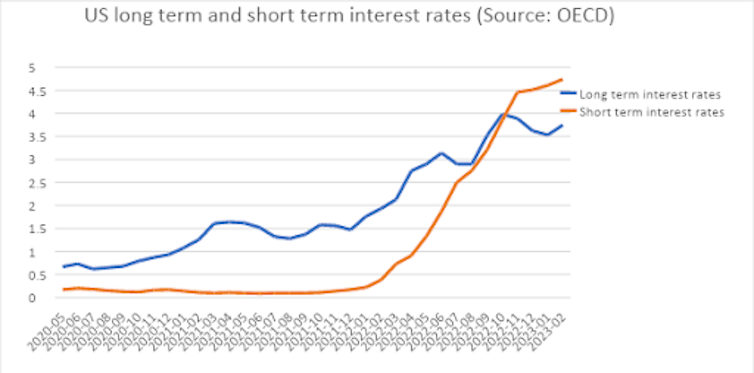
The second is when short-term interest rates rise above long-term rates, as has happened in America over the past few months. During the pandemic, tech startups with spare cash from funding rounds in a world of easy money placed their deposits with SVB. With little demand for loans from this sector, SVB invested most of the money in long-term bonds – mostly mortgage-backed securities and US Treasuries.

In short, SVB was taking funds mainly on short-term deposit and tying them up in long-term investments. Then, over the past few months, short-term rates rose higher than the returns on longer-dated bonds (see chart below). This is because interest rates were soaring, thanks to the Fed’s rate hikes.

US interest rate changes

Line graph showing long- and short-term US interest rates rising over time, with short overtaking long in 2022.
Author provided from OECD data

With funding rounds harder to come by in a high-interest rate environment, tech firms began to withdraw and spend their deposits. At the same time, these higher rates resulted in falling prices for the bonds in which SVB had been investing. That squeezed SVB’s profit margins and put its balance sheet on shaky ground.

This situation was made worse because SVB needed to sell some of its longer-dated bonds at a loss to fund the deposits its customers were withdrawing from the bank. The news of the sales made depositors withdraw more funds, which had to be funded through more sales. A doom loop ensued.

The March 8 announcement that SVB was looking to raise US$2.5 billion to plug the hole in its balance sheet left by these asset fire sales triggered the bank run that finished it off.

Concerns about systemic risk

How worried should we be about the collapse of SVB? It is not a major player in the world’s financial system. It is also almost unique in modern banking in terms of its dependence on one sector for its client base and the vulnerability of its balance sheet to interest rate rises.

But even if SVB’s collapse does not trigger a wider financial crisis, it should serve as an important warning. Rapidly rising interest rates over the past year have made the global economy fragile.

The world’s central bankers are treading a narrowing path of trying to combat inflation without harming financial stability. Central bankers must manage interest rates more carefully, while regulators should discourage the finance sector from borrowing short to lend long without sufficient hedging of the risks this entails.

It is also important that central banks monitor the impact that interest rate differences and cross-border capital flows have on the credit that’s available to both banks and businesses. Even if the failures of SVB and Signature prove to be no more than “little local difficulties” (to quote another past UK prime minister, Harold Macmillan), the systemic risks that their collapse have highlighted can no longer be ignored.The Conversation

About the Author:

Charles Read, Fellow in Economics and History at Corpus Christi College, University of Cambridge

This article is republished from The Conversation under a Creative Commons license. Read the original article.

STOX50 Wobbles As Markets Eye ECB Amid Credit Suisse Drama

By ForexTime 

European shares traded mixed on Thursday as investors remained guarded towards the chaos revolving around Credit Suisse Group AG ahead of the European Central Bank (ECB) meeting.

Despite Credit Suisse receiving a US $54 billion lifeline from the Swiss National Bank, Switzerland’s central bank, some caution still lingered in the air.  The STOX50 Index which represents the 50 largest companies from 11 Eurozone countries struggled for direction this morning amid the lingering unease. However, the banking sector flashed green with Credit Suisse shares rallying over 20% following the emergency loan. With the ECB meeting just a few hours away and investors digesting the series of events concerning Credit Suisse, markets may switch into standby mode until another fundamental spark is brought into the picture.

Taking a brief look at the technical picture, the STOX50 is under pressure on the daily charts. The recent breakdown and daily close below the 4100 support level may open the door to further downside.

It’s all about the ECB meeting…

The European Central Bank is set to announce its rate decision this afternoon at 13:15 GMT.

According to a survey of economists by Bloomberg, most expect a 50-basis point hike. However, when factoring the negative developments concerning Credit Suisse – expectations may differ from reality.

The red flags appeared last week (March 9th) after Credit Suisse was forced to delay the publishing of its annual report thanks to a last-minute query from the US Securities and Exchange Commission. Yesterday (March 15th) the alarm bells rang after Ammar Al Khudairy, the chairman of Credit Suisse’s largest shareholder, Saudi National Bank, said that he would “absolutely not” make further investments in Credit Suisse. These comments sent shockwaves across financial markets and compounded recent fears following Silicon Valley Bank’s failure.

A battle between ECB hawks and doves

There is no doubt that the Credit Suisse drama will add more flavor to the pending ECB meeting.

Growing fears around the overall health of the financial system following the latest developments could empower ECB doves. This may result in the ECB opting for a smaller-than-expected rate hike to prevent further damaging the financial system. On the other hand, inflation still remains hot with core inflation hitting a record high of 5.6% year-on-year in January. This could serve as a strong enough argument for ECB hawks  – resulting in a 50-bp hike. Whatever the outcome, it will be a challenging meeting for the ECB and will certainly set the tone for the euro this month.

How does this impact the STOX50 Index?

Now, this is where things get interesting.

Given today’s environment, a larger-than-expected rate hike may fuel recession risks for the Eurozone while further damaging confidence about the health of the financial system. This would be bad news for European stock markets as the risk aversion, empowers equity bears – sending the STOX50 lower. It will be interesting to see whether the ECB mentions anything about the Credit Suisse situation.  If the central bank strikes a confident tone and suggests that the Credit Suisse situation is temporary, this could boost investor confidence – ultimately supporting the STOX50.

A deep dive into the technicals…

The STOX50 index on the D1 time frame was in a strong uptrend that made a last higher top at 4325.0 on 6 March. The bears then saw an opportunity and started coming into the market in more numbers.

After the top at 4325.0, the price broke through the 15 and 34 Simple Moving Averages (SMA) and the Momentum Oscillator changed course to the downside, both also confirming the increased bearish momentum in the market. A weekly support level was also breached and this became a new resistance level.

A possible critical support level formed when a lower bottom was recorded at 4070.6 on 13 March. Bulls tried to push the market up without success and the price formed a lower top on 14 March at 4190.4, touching the new weekly resistance level.

The very next day the bears broke through the critical support level at 4070.6 and three possible price targets were projected from there. Attaching the Fibonacci tool to the lower bottom at 4070.6, and dragging it to the lower top at 4190.4, the following targets were calculated. The first target can be estimated at 3996.6 (161.8%) which is located at the next weekly support level. The second price target may be calculated at 3876.8 (261.8%) and the price will have to break through yet another weekly support level to reach the third and final target which might be expected at 3682.9 (423.6%).

If the resistance level at 4190.4 is broken, the above scenario is canceled and must be re-assessed.

As long as the bears stay in control, the outlook for STOX50 on the D1 time frame will remain negative.


Forex-Time-LogoArticle by ForexTime

ForexTime Ltd (FXTM) is an award winning international online forex broker regulated by CySEC 185/12 www.forextime.com

Data Communications Co. To Buy Printing Firm

Source: Chris Thompson  (3/14/23)

The strategic merger between these two Canadian entities should enhance the acquirer’s “capabilities and growth potential,” noted an eResearch Corp. report. 

Data Communications Management Corp. (DCM:TSX; DCMDF:OTCQX) agreed to acquire the Canadian operations of R.R. Donnelley & Sons, called Moore Canada (RRD Canada), for CA$123 million (CA$123M), which should provide beneficial synergies, reported eResearch Corp. analyst Chris Thompson in a March 10 research note. The transaction should close in Q2/23.

“We believe the deal will be accretive to Data Communications Management’s financial profile as it accelerates [the company’s] revenue and EBITDA growth and diversifies its revenue base,” Thompson wrote. “It could help accelerate sales growth, lower some organizational costs, and enhance operational efficiency, which could lead to an improved overall financial performance.”

In other news, the analyst reported Data Communications reported strong preliminary full-year 2022 (FY22) financial results, noteworthy for higher-than-expected revenue as well as year-over-year (YOY) increases in revenue, gross profits, and EBITDA.

Boosts to Target Price

Thompson highlighted that the merger and strong FY22 are “positive for the company valuation, according to our model.” Incorporating last year’s revenue increases eResearch’s target price on Data Communications to CA$4.59 per share, whereas accounting only for the acquisition takes it to CA$5.92 per share. Combining both raises it to CA$6.02 per share.

Data Communications is rated Buy.

The private equity investment firm, however, plans to keep its target price as is, now CA$4.50 per share, until the merger closes or final FY22 financial results are released.

Compared to the current CA$4.50 per share target price, this provider of marketing and business communication solutions is currently trading at about CA$2.06 per share, noted Thompson. This price difference implies significant potential gains for investors. Data Communications is rated Buy.

Impacts of the Deal

Thompson highlighted the acquisition should boost Data Communications’ capabilities and growth potential given RRD Canada’s “highly complementary” operating model and the expectation RRD Canada will bring online more products, services, and technological abilities.

RRD Canada provides print and print-related services to thousands of Canadian customers through 10 locations and with 1,000 employees. Last year, RRD generated about CA$250M in revenue. With the merger, Data Communications will be able to offer RRD’s services and solutions to its existing customers and take advantage of cross-selling opportunities.

According to the terms of the share purchase agreement, Data Communications will acquire three RRD Canada-owned sites at an implied value of about CA$30M. After closing, Data Communications plans to pursue a sale and leaseback agreement for each of these locations.

The acquisition would take Data Communications’ 16 locations to 21 and its number of enterprise clients to 400-plus from 250. These additional clients would add scale, for instance, to Data Communications’ marketing workflow technology platform, DCMFlex, and its digital asset management platform, ASMBL.

Snapshot of 2022 Finances

For FY22, Data Communications reported preliminary revenue of between CA$270M and CA$274M. This is higher than eResearch’s estimate of $265.3M and reflects a 15–16.5% increase over FY21 revenue.

Similarly, gross profit last year was between 30.5% and 31%, up 20–21% from that in FY21. FY22 EBITDA was between CA$35.5M and CA$36.5M, a 41–45% YOY increase.

Total debt, net of cash, down dropped about 35% from 2021’s amount. Data Communications plans on paying for the acquisition of RRD entirely through committed credit facilities noted Thompson.

Data Communications is scheduled to release full financial FY22 results on March 21, 2023, and hold an investor call and webcast the next day.

Sign up for our FREE newsletter

Disclosures:

1) Doresa Banning wrote this article for Streetwise Reports LLC as an independent contractor. They or members of their household own securities of the following companies mentioned in the article: None. They or members of their household are paid by the following companies mentioned in this article: None.

2) The following companies mentioned in this article are billboard sponsors of Streetwise Reports: Data Communications Management Corp. Click here for important disclosures about sponsor fees. The information provided above is for informational purposes only and is not a recommendation to buy or sell any security.

3) Statements and opinions expressed are the opinions of the author and not of Streetwise Reports or its officers. The author is wholly responsible for the validity of the statements. The author was not paid by Streetwise Reports for this article. Streetwise Reports was not paid by the author to publish or syndicate this article. Streetwise Reports requires contributing authors to disclose any shareholdings in or economic relationships with, companies that they write about. Streetwise Reports relies upon the authors to accurately provide this information and Streetwise Reports has no means of verifying its accuracy.

4) This article does not constitute investment advice. Each reader is encouraged to consult with his or her individual financial professional and any action a reader takes as a result of information presented here is his or her own responsibility. By opening this page, each reader accepts and agrees to Streetwise Reports’ terms of use and full legal disclaimer. This article is not a solicitation for investment. Streetwise Reports does not render general or specific investment advice and the information on Streetwise Reports should not be considered a recommendation to buy or sell any security. Streetwise Reports does not endorse or recommend the business, products, services or securities of any company mentioned on Streetwise Reports.

5) From time to time, Streetwise Reports LLC and its directors, officers, employees or members of their families, as well as persons interviewed for articles and interviews on the site, may have a long or short position in securities mentioned. Directors, officers, employees or members of their immediate families are prohibited from making purchases and/or sales of those securities in the open market or otherwise from the time of the decision to publish an article until three business days after the publication of the article. The foregoing prohibition does not apply to articles that in substance only restate previously published company releases.

Disclosures for eResearch, Data Communications Management Corp., March 10, 2023

ANALYST ACCREDITATION

eResearch Analyst on this Report: Chris Thompson CFA, MBA, P.Eng. Analyst Affirmation: I, Chris Thompson, hereby state that, at the time of issuance of this research report, I do not own common shares, share options, or share warrants of DATA Communications Management Corp. (TSX:DCM).

eRESEARCH DISCLOSURE STATEMENT

eResearch is engaged solely in the provision of equity research to the investment community. eResearch provides published research and analysis to its Subscribers on its website (www.eresearch.com), and to the general investing public through its extensive electronic distribution network and newswire agencies. eResearch makes all reasonable efforts to distribute research material simultaneously to all of its Subscribers. eResearch does not manage money or trade with the general public, provides full disclosure of all fee arrangements, and adheres to the strict application of its Best Practices Guidelines. eResearch accepts fees from the companies it researches (the “Covered Companies”), and from financial institutions or other third parties. The purpose of this policy is to defray the cost of researching small and medium-capitalization stocks which otherwise receive little or no research coverage.

DATA Communications Management Corp. paid eResearch a fee to have it conduct research and publish reports on the Company for one year.

To ensure complete independence and editorial control over its research, eResearch follows certain business practices and compliance procedures. For instance, fees from Covered Companies are due and payable before research starts. Management of the Covered Companies is sent copies, in draft form without a Recommendation or a Target Price, of the Initiating Report and the Update Report before publication to ensure our facts are correct, that we have not misrepresented anything, and have not included any non-public, confidential information. At no time is management entitled to comment on issues of judgment, including Analyst opinions, viewpoints, or recommendations. All research reports must be approved, before publication, by eResearch’s Director of Research, who is a Chartered Financial Analyst (CFA).

All Analysts are required to sign a contract with eResearch before engagement and agree to adhere at all times to the CFA Institute Code of Ethics and Standards of Professional Conduct. eResearch Analysts are compensated on a per-report, per-company basis and not based on his/her recommendations. Analysts are not allowed to accept any fees or other considerations from the companies they cover for eResearch. Officers, analysts, and directors of eResearch are allowed to trade in shares, warrants, convertible securities, or options of any of the Covered Companies only under strict, specified conditions, which restrict trading 30 days before and after a Research Report is published.