Archive for Stock Market News – Page 33

Trade Of The Week: Time For The SPX500_m To Breakout?

By ForexTime 

The next few days promise to be volatile for the S&P 500 thanks to fundamental and technical forces.

After bouncing within a range for the past two weeks, the index could be waiting for a fresh catalyst to trigger a major bullish or bearish breakout.

Taking a brief look at the technical picture, prices remain in an uptrend despite the period of consolidation with support at 4070 and resistance at 4160. Although the index is trading comfortably above the 50,100 and 200-day SMA, the Relative Strength Index (RSI) signals that prices are flirting near overbought conditions.

Here are 3 reasons why the SPX500_m could breakout this week…

  1. US earnings season kicks off

It’s that time of the year again!

First quarter earnings season kicked off last week, led by banking giants JPMorgan Chase, Wells Fargo, and Citigroup who all comfortably beat expectations for earnings. Given the recent chaos revolving around the banking sector, these results were certainly a welcome development. Nevertheless, fears about a US recession still loom. This could encourage investors to closely scrutinize pending results from the likes of Charles Schwab, Goldman Sachs, and Bank of America among many others this week. When factoring in how financial stocks account for nearly 13% of the S&P 500, their results are likely to trigger volatility.

This week also see’s the release of Tesla’s Q1 results which are expected to show a decline in earnings due to aggressive price cuts. When considering how Tesla is within the top 10 holdings in the S&P 500 and accounts for roughly 1.43% of the total index, its results could spark some action.

Ultimately, if the earnings impress and boost risk sentiment, this may inspire bulls to breakout above the 4160 resistances. However, a set of disappointing earnings could see the S&P500 slip back towards 4070.

  1. Key US economic data and Fed speeches

There are some key US economic releases and Fed speeches that could influence the S&P 500 this week.

On Monday, Richmond Fed President Thomas Barkin will be under the spotlight after stating last week that policymakers still have a long way to go to tame prices. Later in the week, there will be a host of Fed speeches from other policymakers which may influence the S&P 500.

All eyes will be on the Fed Beige Book on Wednesday. If the Beige Book suggests that US economic conditions may be deteriorating, this may prompt the Fed to switch into lower gear on rate hikes. Alternatively, if the Beige Book reiterates its previous release by suggesting that the US economy remains resilient, this hawkish development may enforce pressure on the S&P 500. Attention will also be directed on the US weekly initial jobless claims and US PMI figures for April at the end of the week.

The SPX500_m may find itself under renewed pressure if US economic data beat expectations, the Fed Beige book suggests that the US economy remains on a firm footing and policymakers strike an overall hawkish tone. Alternatively, SPX500_m bulls could attack if US data disappoints, policymakers sound cautious and the Fed Beige book adds to the overall caution.

  1. Technicals are pointing to potential SPX500_m breakout

As highlighted earlier, the SPX500_m could be gearing for a major breakout on the daily timeframe. Although the overall trend looks to be bullish, it may take a potent fundamental spark to conquer the 4160 resistance which was last tested in February 2023. A solid breakout above this point could encourage an incline towards 4200 and levels not seen since August 2022 around 4315. Alternatively, should 4160 prove to be a tough nut to crack, this may open the doors back toward 4070 and 4035 – where the 50-say SMA resides.


Forex-Time-LogoArticle by ForexTime

ForexTime Ltd (FXTM) is an award winning international online forex broker regulated by CySEC 185/12 www.forextime.com

Stock Speculator Changes led by Nasdaq-Mini & S&P500-Mini this week

By InvestMacro

Here are the latest charts and statistics for the Commitment of Traders (COT) data published by the Commodities Futures Trading Commission (CFTC).

The latest COT data is updated through Tuesday April 11th and shows a quick view of how large traders (for-profit speculators and commercial entities) were positioned in the futures markets.

Weekly Speculator Changes led by Nasdaq-Mini & S&P500-Mini

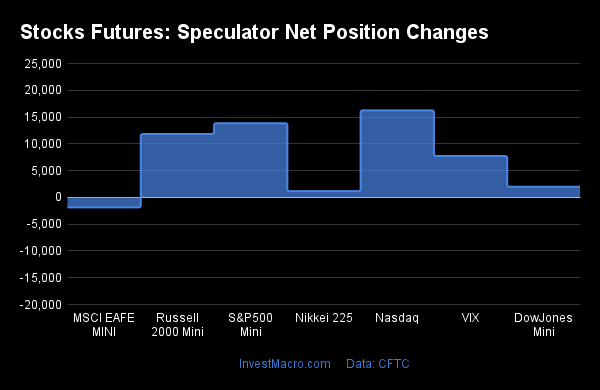
The COT stock markets speculator bets were higher this week as six out of the seven stock markets we cover had higher positioning while the other two markets had lower speculator contracts.

Leading the gains for the stock markets was the Nasdaq-Mini (16,255 contracts) with the S&P500-Mini (13,847 contracts), Russell-Mini (11,825 contracts), VIX (7,720 contracts), DowJones-Mini (1,979 contracts) and the Nikkei 225 (1,165 contracts) also showing positive weeks.

The markets with the declines in speculator bets this week were the MSCI EAFE-Mini (-1,874 contracts) and the Nikkei 225 Yen (-627 contracts) also registering lower bets on the week.


Data Snapshot of Stock Market Traders | Columns Legend
Apr-11-2023OIOI-IndexSpec-NetSpec-IndexCom-NetCOM-IndexSmalls-NetSmalls-Index
S&P500-Mini2,248,46919-307,6122342,01296-34,40020
Nikkei 22511,0352-2,114641,6734044134
Nasdaq-Mini237,47034-2,130747,92031-5,79043
DowJones-Mini90,26348-21,6461928,08591-6,43912
VIX360,85371-49,3667949,2521611492
Nikkei 225 Yen39,569195,9685214,54950-20,51737


Strength Scores led by VIX & Nasdaq-Mini

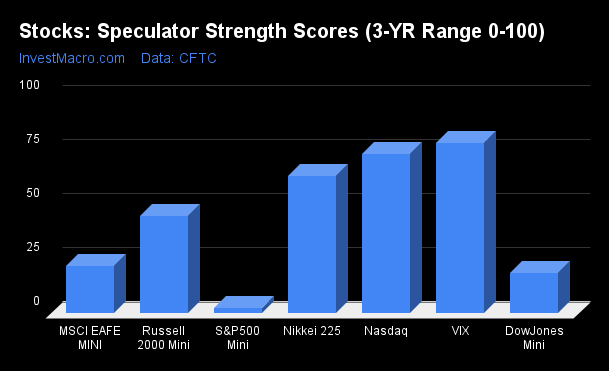
COT Strength Scores (a normalized measure of Speculator positions over a 3-Year range, from 0 to 100 where above 80 is Extreme-Bullish and below 20 is Extreme-Bearish) showed that the VIX (79 percent) and the Nasdaq-Mini (74 percent) lead the stock markets this week. The Nikkei 225 (64 percent) and Nikkei 225 Yen (52 percent) come in as the next highest in the weekly strength scores.

On the downside, the S&P500-Mini (2 percent) and the DowJones-Mini (19 percent) come in at the lowest strength levels currently and are in Extreme-Bearish territory (below 20 percent).

Strength Statistics:
VIX (78.9 percent) vs VIX previous week (73.6 percent)
S&P500-Mini (2.5 percent) vs S&P500-Mini previous week (0.0 percent)
DowJones-Mini (18.7 percent) vs DowJones-Mini previous week (13.5 percent)
Nasdaq-Mini (73.8 percent) vs Nasdaq-Mini previous week (64.8 percent)
Russell2000-Mini (44.9 percent) vs Russell2000-Mini previous week (37.8 percent)
Nikkei USD (63.8 percent) vs Nikkei USD previous week (57.6 percent)
EAFE-Mini (21.8 percent) vs EAFE-Mini previous week (24.1 percent)


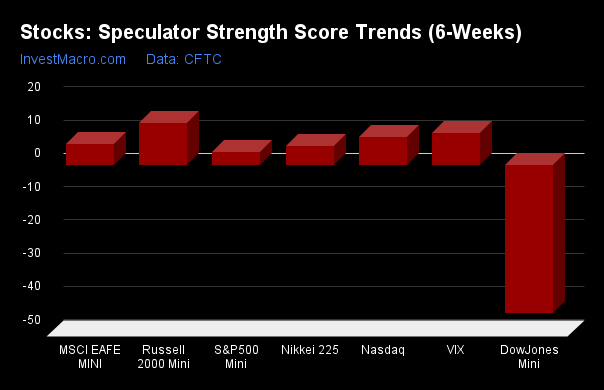
Nasdaq-Mini & VIX top the 6-Week Strength Trends

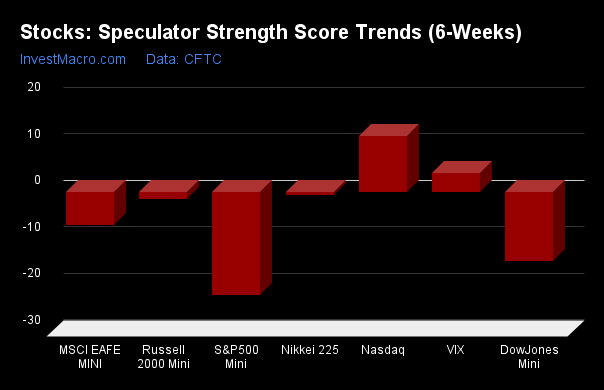
COT Strength Score Trends (or move index, calculates the 6-week changes in strength scores) showed that the Nasdaq-Mini (12 percent) leads the past six weeks trends for the stock markets.

The S&P500-Mini (-22 percent) leads the downside trend scores currently with the DowJones-Mini (-15 percent) coming in as the next market with lower trend scores.

Strength Trend Statistics:
VIX (4.1 percent) vs VIX previous week (-0.7 percent)
S&P500-Mini (-22.2 percent) vs S&P500-Mini previous week (-15.6 percent)
DowJones-Mini (-14.9 percent) vs DowJones-Mini previous week (-19.4 percent)
Nasdaq-Mini (12.1 percent) vs Nasdaq-Mini previous week (-2.4 percent)
Russell2000-Mini (-1.4 percent) vs Russell2000-Mini previous week (-1.4 percent)
Nikkei USD (-0.6 percent) vs Nikkei USD previous week (-6.6 percent)
EAFE-Mini (-7.1 percent) vs EAFE-Mini previous week (-1.9 percent)


Individual Stock Market Charts:

VIX Volatility Futures:

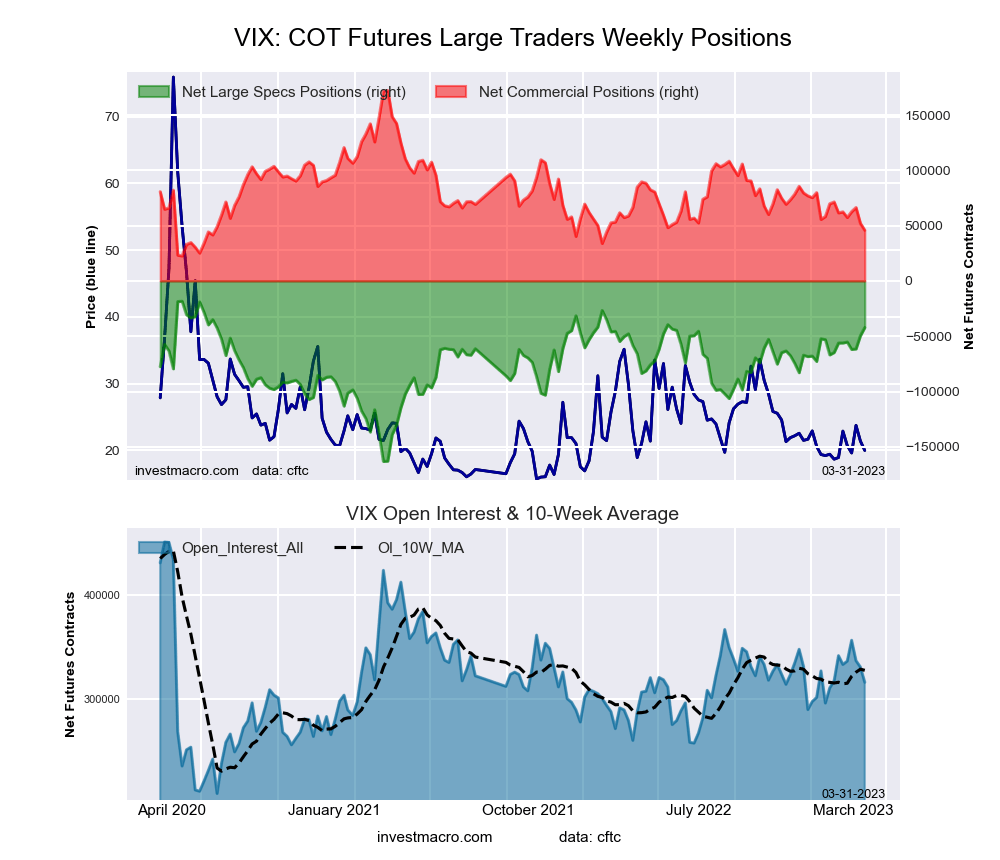
VIX Volatility Futures COT ChartThe VIX Volatility large speculator standing this week was a net position of -49,366 contracts in the data reported through Tuesday. This was a weekly increase of 7,720 contracts from the previous week which had a total of -57,086 net contracts.

This week’s current strength score (the trader positioning range over the past three years, measured from 0 to 100) shows the speculators are currently Bullish with a score of 78.9 percent. The commercials are Bearish-Extreme with a score of 16.4 percent and the small traders (not shown in chart) are Bullish-Extreme with a score of 91.8 percent.

VIX Volatility Futures StatisticsSPECULATORSCOMMERCIALSSMALL TRADERS
– Percent of Open Interest Longs:21.152.37.1
– Percent of Open Interest Shorts:34.738.67.0
– Net Position:-49,36649,252114
– Gross Longs:76,020188,60625,538
– Gross Shorts:125,386139,35425,424
– Long to Short Ratio:0.6 to 11.4 to 11.0 to 1
NET POSITION TREND:
– Strength Index Score (3 Year Range Pct):78.916.491.8
– Strength Index Reading (3 Year Range):BullishBearish-ExtremeBullish-Extreme
NET POSITION MOVEMENT INDEX:
– 6-Week Change in Strength Index:4.1-5.510.4


S&P500 Mini Futures:

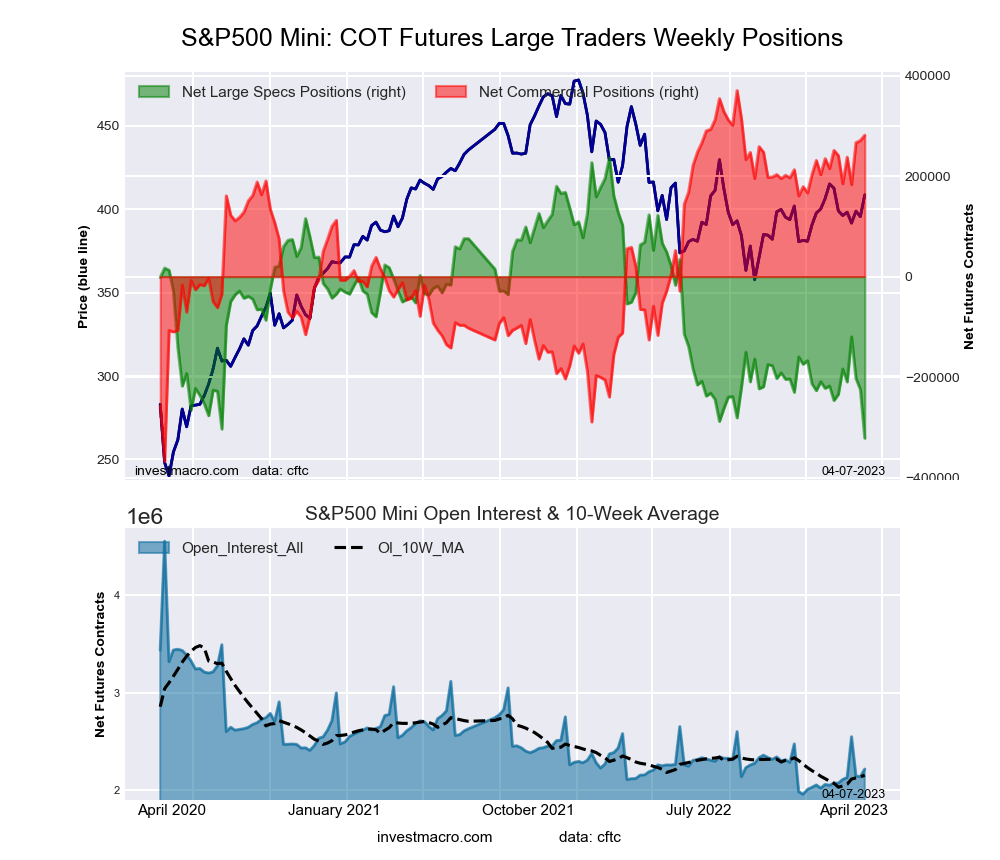
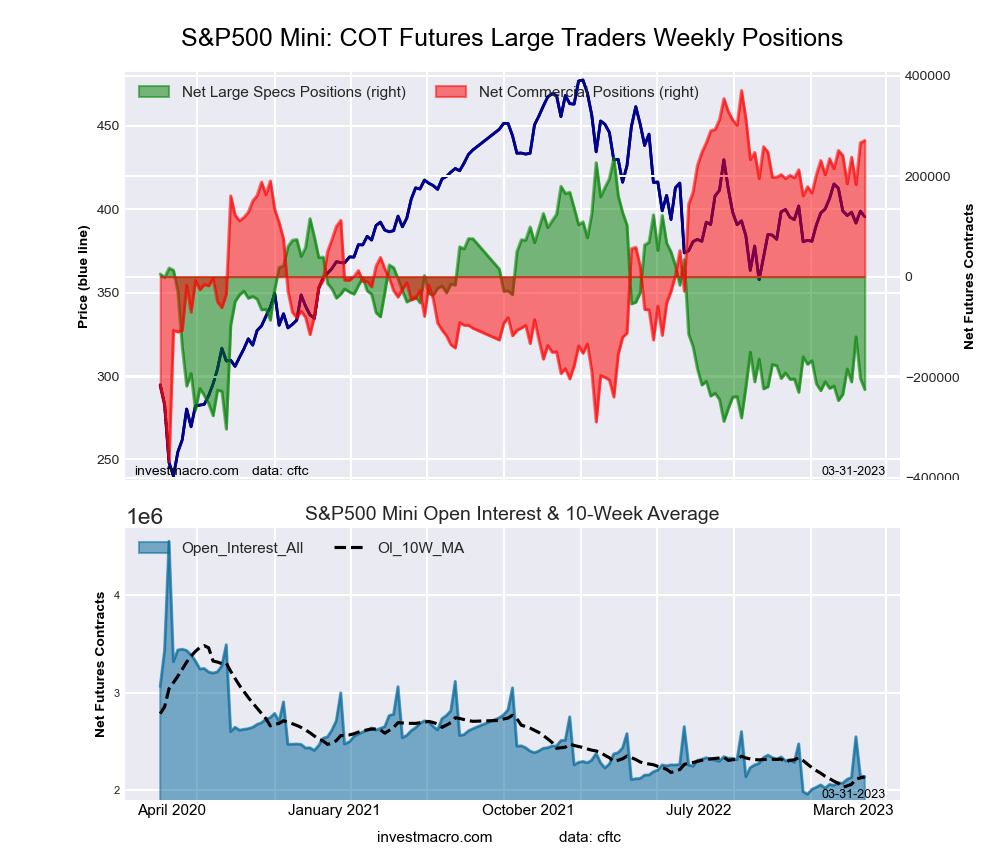
SP500 Mini Futures COT ChartThe S&P500 Mini large speculator standing this week was a net position of -307,612 contracts in the data reported through Tuesday. This was a weekly rise of 13,847 contracts from the previous week which had a total of -321,459 net contracts.

This week’s current strength score (the trader positioning range over the past three years, measured from 0 to 100) shows the speculators are currently Bearish-Extreme with a score of 2.5 percent. The commercials are Bullish-Extreme with a score of 95.7 percent and the small traders (not shown in chart) are Bearish-Extreme with a score of 19.7 percent.

S&P500 Mini Futures StatisticsSPECULATORSCOMMERCIALSSMALL TRADERS
– Percent of Open Interest Longs:9.277.810.1
– Percent of Open Interest Shorts:22.962.611.6
– Net Position:-307,612342,012-34,400
– Gross Longs:207,0071,749,879227,253
– Gross Shorts:514,6191,407,867261,653
– Long to Short Ratio:0.4 to 11.2 to 10.9 to 1
NET POSITION TREND:
– Strength Index Score (3 Year Range Pct):2.595.719.7
– Strength Index Reading (3 Year Range):Bearish-ExtremeBullish-ExtremeBearish-Extreme
NET POSITION MOVEMENT INDEX:
– 6-Week Change in Strength Index:-22.223.8-7.2


Dow Jones Mini Futures:

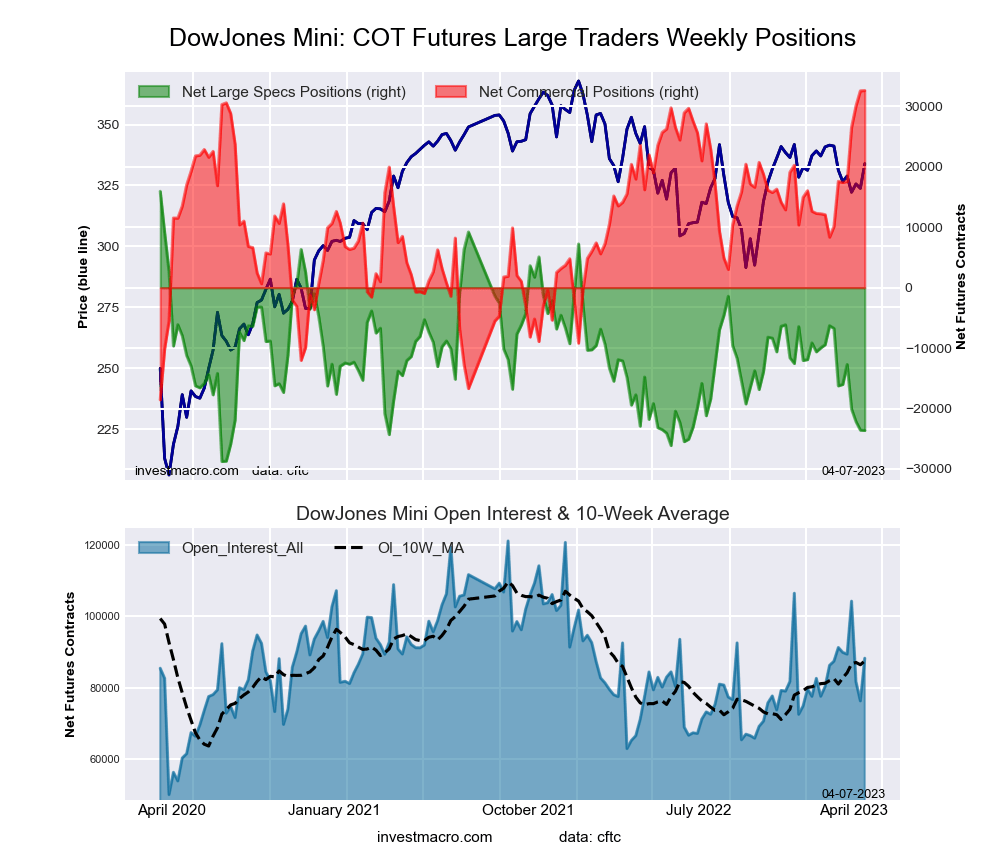
Dow Jones Mini Futures COT ChartThe Dow Jones Mini large speculator standing this week was a net position of -21,646 contracts in the data reported through Tuesday. This was a weekly advance of 1,979 contracts from the previous week which had a total of -23,625 net contracts.

This week’s current strength score (the trader positioning range over the past three years, measured from 0 to 100) shows the speculators are currently Bearish-Extreme with a score of 18.7 percent. The commercials are Bullish-Extreme with a score of 90.8 percent and the small traders (not shown in chart) are Bearish-Extreme with a score of 12.5 percent.

Dow Jones Mini Futures StatisticsSPECULATORSCOMMERCIALSSMALL TRADERS
– Percent of Open Interest Longs:19.367.312.7
– Percent of Open Interest Shorts:43.336.219.8
– Net Position:-21,64628,085-6,439
– Gross Longs:17,41060,76511,475
– Gross Shorts:39,05632,68017,914
– Long to Short Ratio:0.4 to 11.9 to 10.6 to 1
NET POSITION TREND:
– Strength Index Score (3 Year Range Pct):18.790.812.5
– Strength Index Reading (3 Year Range):Bearish-ExtremeBullish-ExtremeBearish-Extreme
NET POSITION MOVEMENT INDEX:
– 6-Week Change in Strength Index:-14.921.7-24.6


Nasdaq Mini Futures:

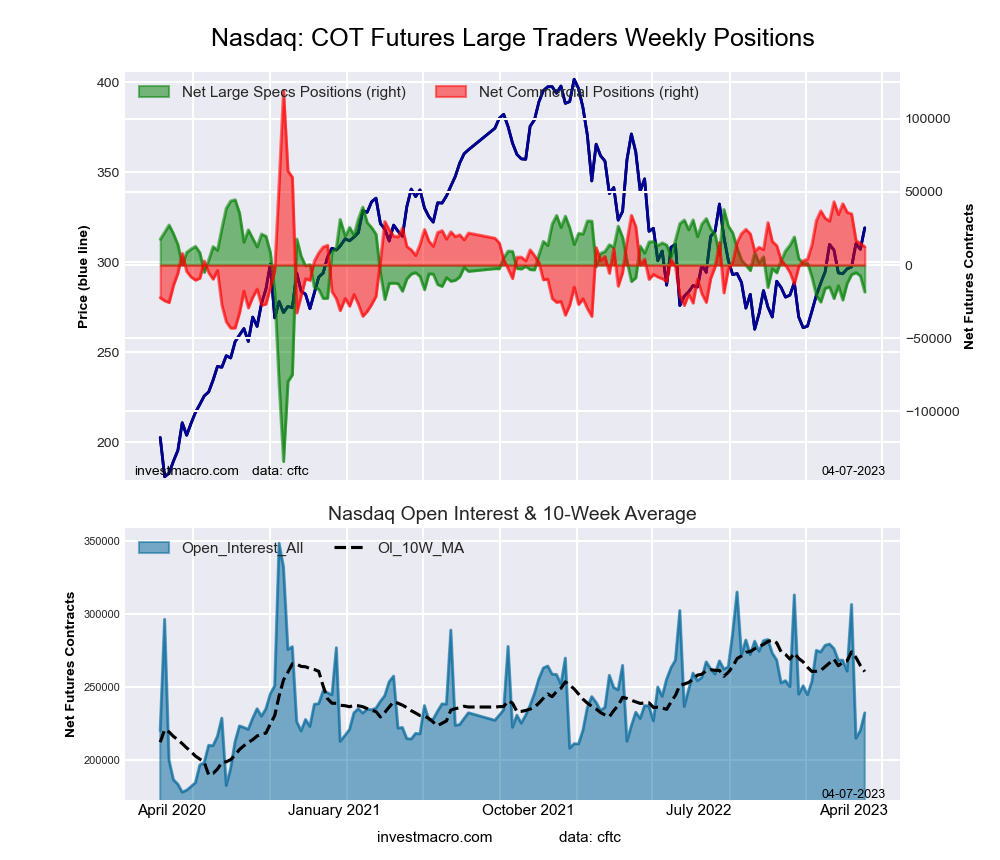
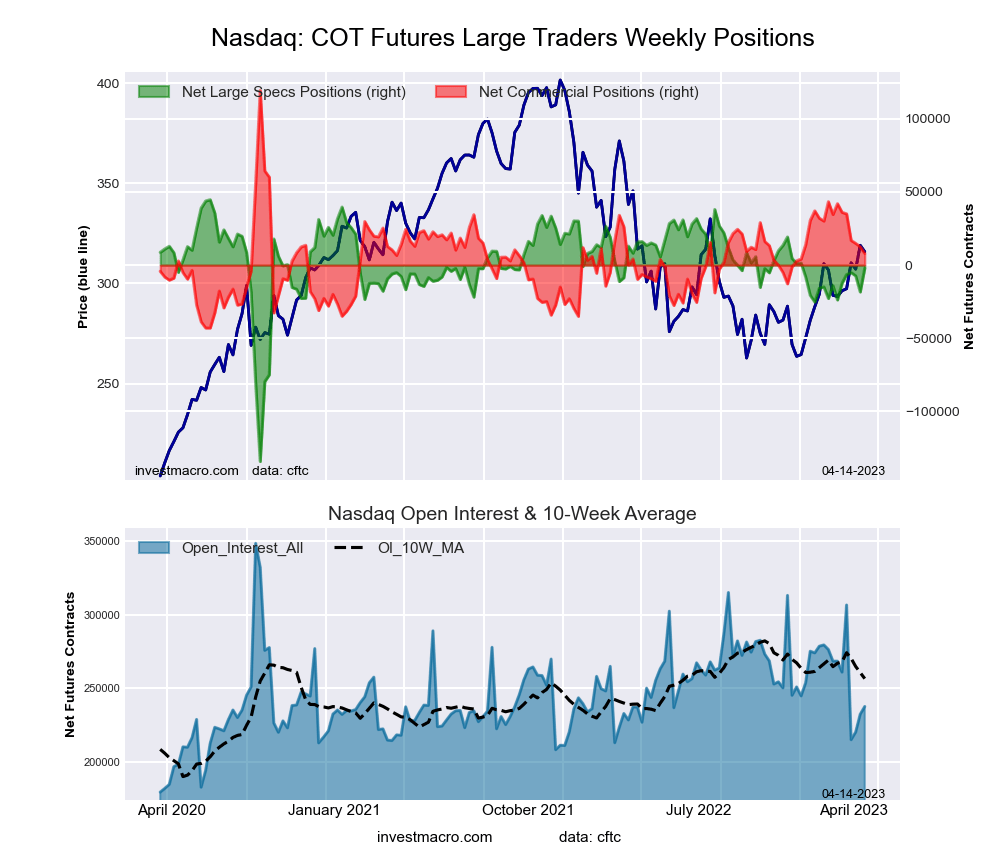
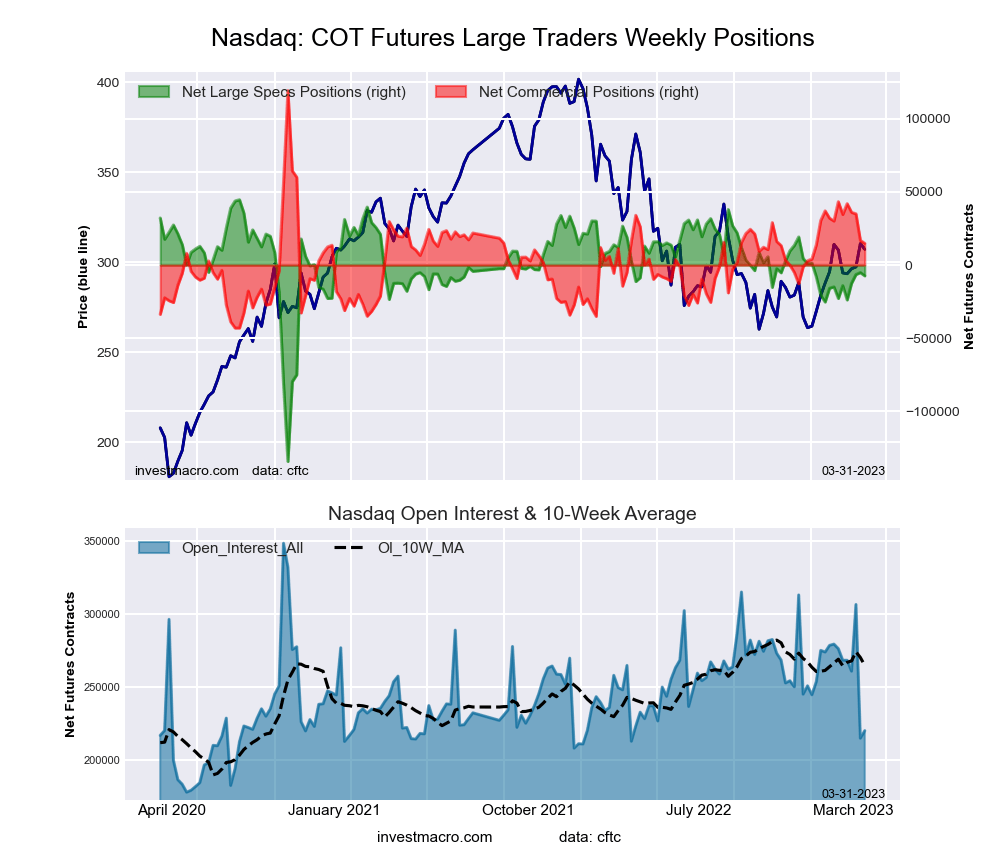
Nasdaq Mini Futures COT ChartThe Nasdaq Mini large speculator standing this week was a net position of -2,130 contracts in the data reported through Tuesday. This was a weekly gain of 16,255 contracts from the previous week which had a total of -18,385 net contracts.

This week’s current strength score (the trader positioning range over the past three years, measured from 0 to 100) shows the speculators are currently Bullish with a score of 73.8 percent. The commercials are Bearish with a score of 31.4 percent and the small traders (not shown in chart) are Bearish with a score of 42.5 percent.

Nasdaq Mini Futures StatisticsSPECULATORSCOMMERCIALSSMALL TRADERS
– Percent of Open Interest Longs:21.761.115.5
– Percent of Open Interest Shorts:22.657.718.0
– Net Position:-2,1307,920-5,790
– Gross Longs:51,607144,97636,868
– Gross Shorts:53,737137,05642,658
– Long to Short Ratio:1.0 to 11.1 to 10.9 to 1
NET POSITION TREND:
– Strength Index Score (3 Year Range Pct):73.831.442.5
– Strength Index Reading (3 Year Range):BullishBearishBearish
NET POSITION MOVEMENT INDEX:
– 6-Week Change in Strength Index:12.1-21.023.1


Russell 2000 Mini Futures:

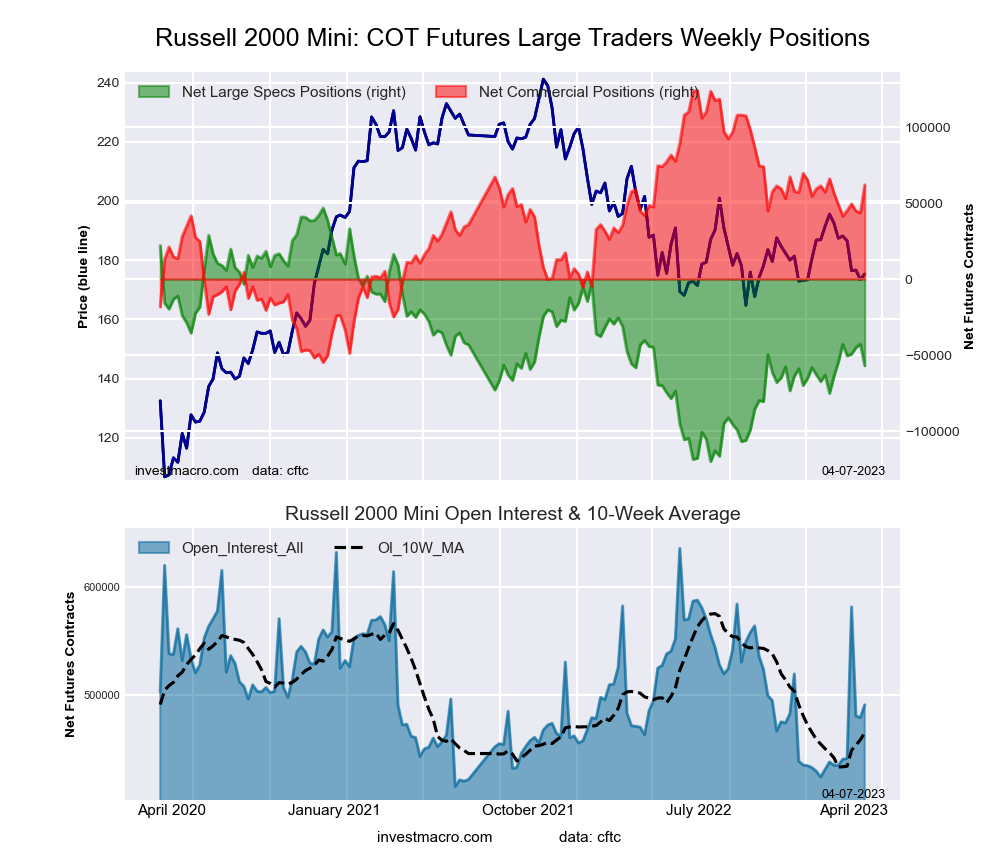
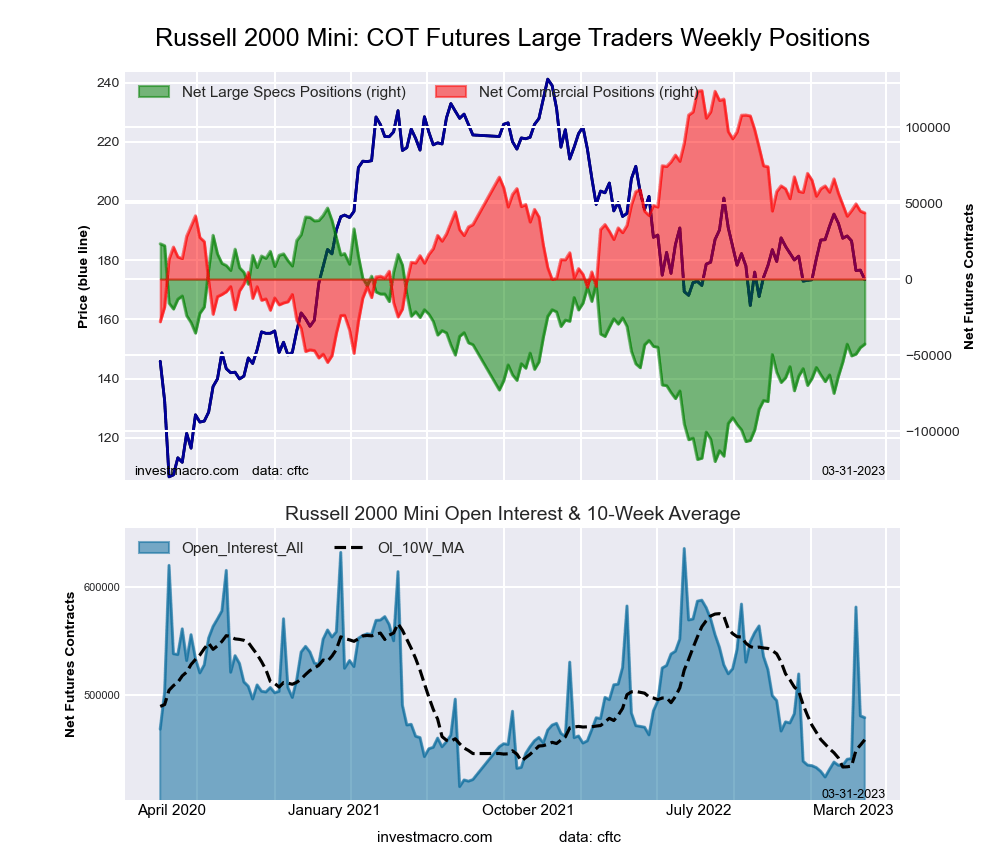
Russell 2000 Mini Futures COT ChartThe Russell 2000 Mini large speculator standing this week was a net position of -45,131 contracts in the data reported through Tuesday. This was a weekly advance of 11,825 contracts from the previous week which had a total of -56,956 net contracts.

This week’s current strength score (the trader positioning range over the past three years, measured from 0 to 100) shows the speculators are currently Bearish with a score of 44.9 percent. The commercials are Bullish with a score of 56.8 percent and the small traders (not shown in chart) are Bearish with a score of 21.4 percent.

Russell 2000 Mini Futures StatisticsSPECULATORSCOMMERCIALSSMALL TRADERS
– Percent of Open Interest Longs:10.683.24.4
– Percent of Open Interest Shorts:19.873.74.7
– Net Position:-45,13146,801-1,670
– Gross Longs:51,942408,76421,546
– Gross Shorts:97,073361,96323,216
– Long to Short Ratio:0.5 to 11.1 to 10.9 to 1
NET POSITION TREND:
– Strength Index Score (3 Year Range Pct):44.956.821.4
– Strength Index Reading (3 Year Range):BearishBullishBearish
NET POSITION MOVEMENT INDEX:
– 6-Week Change in Strength Index:-1.43.0-9.7


Nikkei Stock Average (USD) Futures:

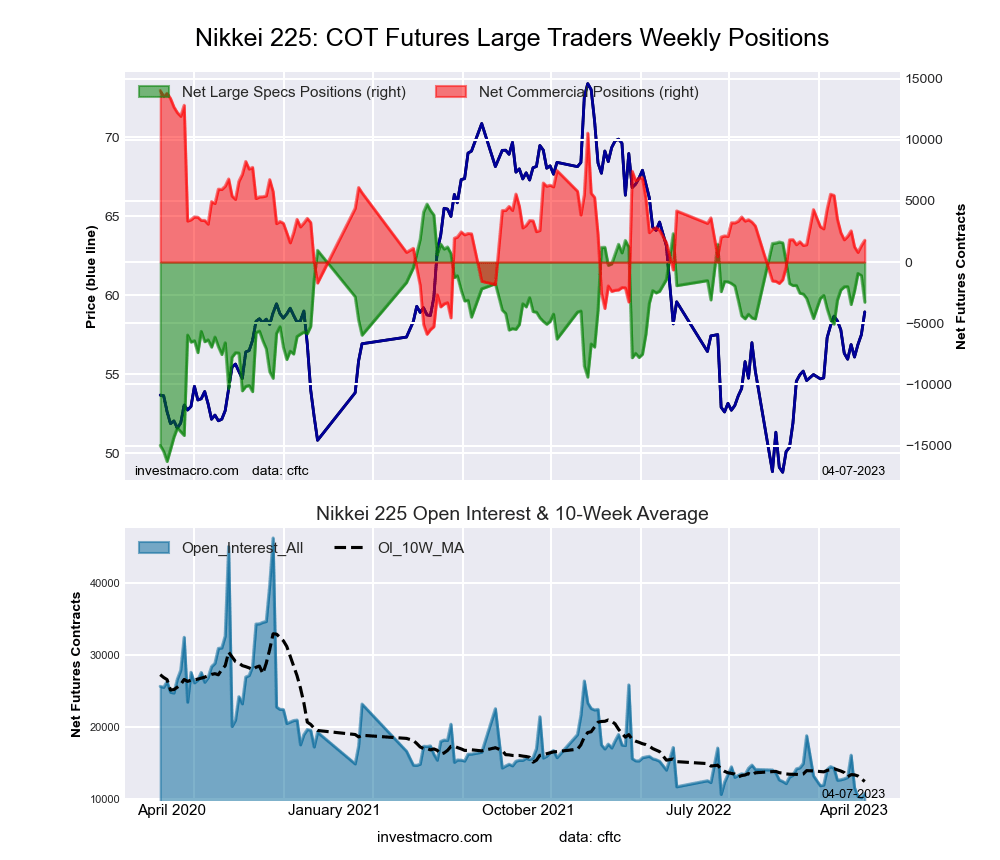
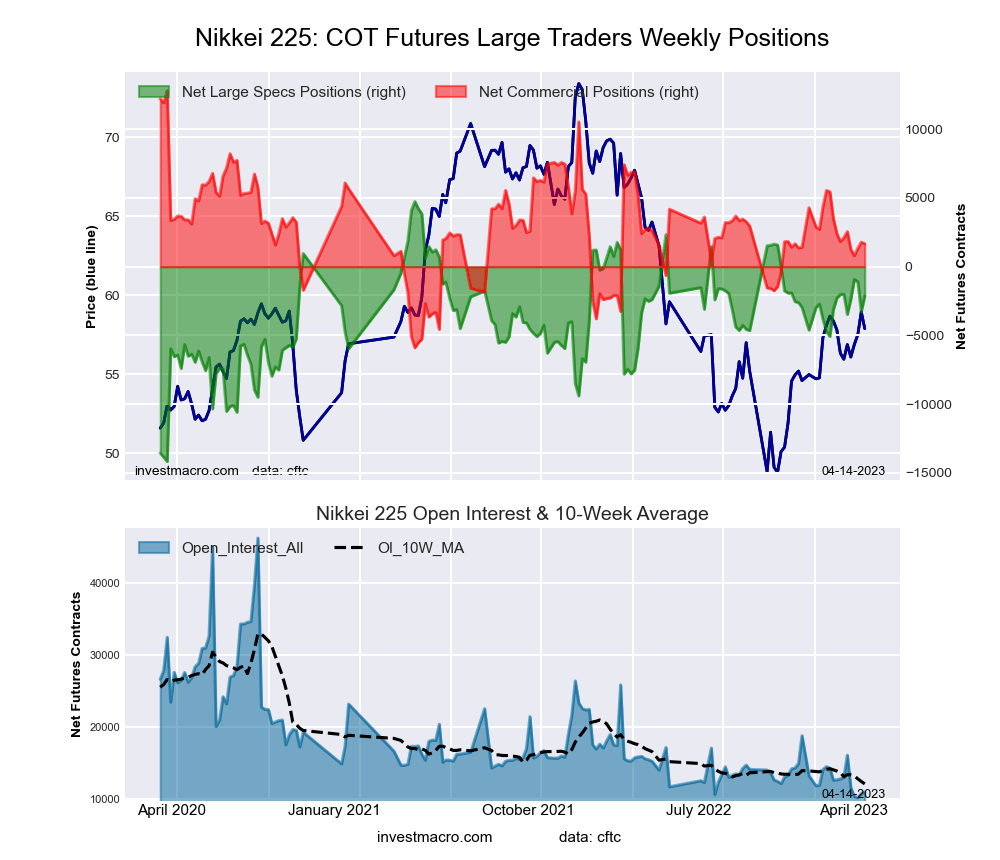
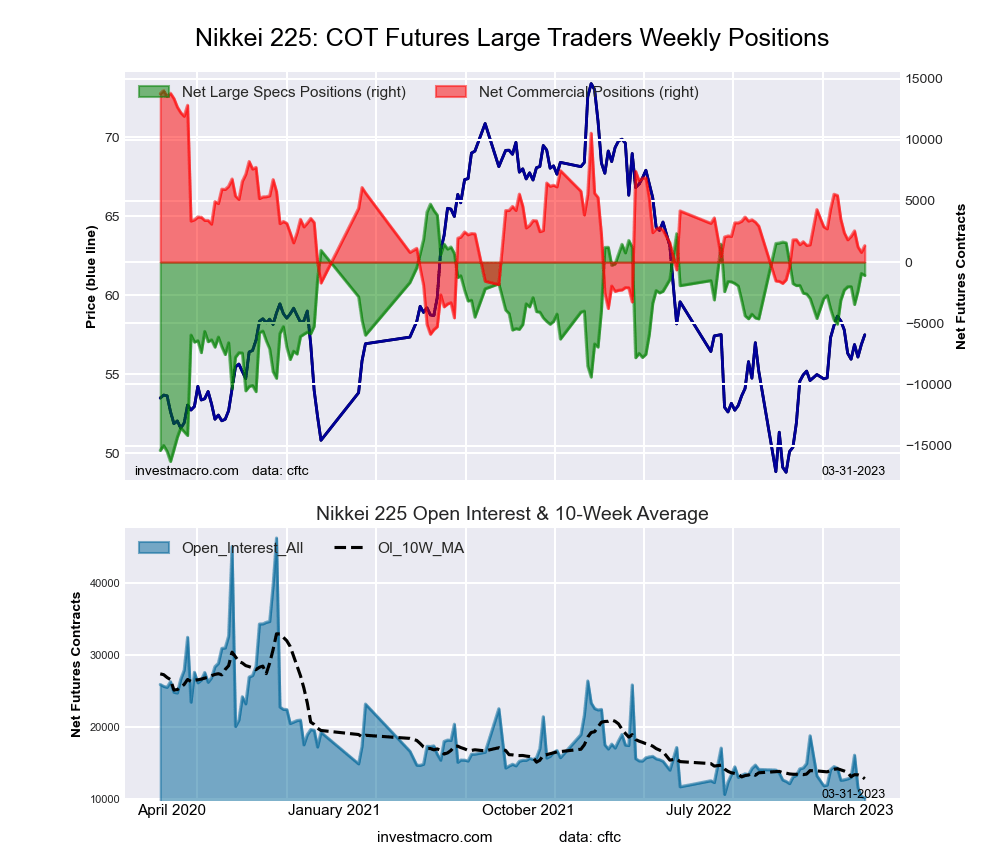
Nikkei Stock Average (USD) Futures COT ChartThe Nikkei Stock Average (USD) large speculator standing this week was a net position of -2,114 contracts in the data reported through Tuesday. This was a weekly increase of 1,165 contracts from the previous week which had a total of -3,279 net contracts.

This week’s current strength score (the trader positioning range over the past three years, measured from 0 to 100) shows the speculators are currently Bullish with a score of 63.8 percent. The commercials are Bearish with a score of 40.4 percent and the small traders (not shown in chart) are Bearish with a score of 33.9 percent.

Nikkei Stock Average Futures StatisticsSPECULATORSCOMMERCIALSSMALL TRADERS
– Percent of Open Interest Longs:19.249.731.1
– Percent of Open Interest Shorts:38.434.527.1
– Net Position:-2,1141,673441
– Gross Longs:2,1215,4823,432
– Gross Shorts:4,2353,8092,991
– Long to Short Ratio:0.5 to 11.4 to 11.1 to 1
NET POSITION TREND:
– Strength Index Score (3 Year Range Pct):63.840.433.9
– Strength Index Reading (3 Year Range):BullishBearishBearish
NET POSITION MOVEMENT INDEX:
– 6-Week Change in Strength Index:-0.6-2.36.9


MSCI EAFE Mini Futures:

MSCI EAFE Mini Futures COT ChartThe MSCI EAFE Mini large speculator standing this week was a net position of -18,360 contracts in the data reported through Tuesday. This was a weekly fall of -1,874 contracts from the previous week which had a total of -16,486 net contracts.

This week’s current strength score (the trader positioning range over the past three years, measured from 0 to 100) shows the speculators are currently Bearish with a score of 21.8 percent. The commercials are Bullish with a score of 72.6 percent and the small traders (not shown in chart) are Bullish with a score of 52.6 percent.

MSCI EAFE Mini Futures StatisticsSPECULATORSCOMMERCIALSSMALL TRADERS
– Percent of Open Interest Longs:7.789.02.9
– Percent of Open Interest Shorts:12.386.21.1
– Net Position:-18,36011,2117,149
– Gross Longs:30,279352,14911,449
– Gross Shorts:48,639340,9384,300
– Long to Short Ratio:0.6 to 11.0 to 12.7 to 1
NET POSITION TREND:
– Strength Index Score (3 Year Range Pct):21.872.652.6
– Strength Index Reading (3 Year Range):BearishBullishBullish
NET POSITION MOVEMENT INDEX:
– 6-Week Change in Strength Index:-7.15.36.8


Article By InvestMacroReceive our weekly COT Newsletter

*COT Report: The COT data, released weekly to the public each Friday, is updated through the most recent Tuesday (data is 3 days old) and shows a quick view of how large speculators or non-commercials (for-profit traders) were positioned in the futures markets.

The CFTC categorizes trader positions according to commercial hedgers (traders who use futures contracts for hedging as part of the business), non-commercials (large traders who speculate to realize trading profits) and nonreportable traders (usually small traders/speculators) as well as their open interest (contracts open in the market at time of reporting). See CFTC criteria here.

3 potential targets for SPX500_m D1

By ForexTime

Here’s a look at the S&P 500 from a technical perspective, even as fundamental traders and investors around the world count down to tomorrow’s (Wednesday, April 12) highly-anticipated US inflation data, as we did in our Week Ahead article published this past Friday.

The SPX500_m on the D1 time frame was in a down trend until a lower bottom formed on 13 March at 3806.1.

The bulls found help and started challenging the bearish resolve.

After the lower bottom, the price pushed though a weekly resistance then turned support level and broke through the 15 and 34 Simple Moving Averages.

The Momentum Oscillator provided even more confirmation for technical traders by breaking through the 100 baseline into bullish territory.

At a weekly resistance level, a higher top formed on 4 April at 4146.9.

The  bears desperately tried to take back the control of the market but could not follow through and on 6 April the bulls overpowered the bears at a support level near 4071.6.

If the price breaks through the weekly resistance level at 4146.9, then three possible price targets are possible from there.

Attaching the Fibonacci tool to the higher top 4146.9 and dragging it to the bottom of the support level at 4071.6, the following targets can be established:

  • 4193.4 (161.8%)
  • 4268.7 (261.8%)
  • 4390.6 (423.6%)

If the support level at 4071.6 is violated, the scenario is no longer applicable and should be re-analysed.

As long as the bulls keep their momentum with demand overcoming supply, the market sentiment for SP500 on the D1 time frame will be bullish.


Forex-Time-LogoArticle by ForexTime

ForexTime Ltd (FXTM) is an award winning international online forex broker regulated by CySEC 185/12 www.forextime.com

Credit Suisse: How the Price of Credit-Default Swaps Provided a Warning

“… exceeded every high-water mark … of the past 15 years”

By Elliott Wave International

Credit-default swaps were invented in the mid-1990s but a lot of people did not become aware of them until around 2000, and that awareness increased dramatically during the 2008 financial crisis. As you may recall, so-called CDSs were all over the news then.

Today, these financial derivatives are in the news again.

In a nutshell, credit-default swaps are insurance against a debt default: The higher the perceived risk of default, the higher the premiums.

With that in mind, back in November, the Global Market Perspective, a monthly Elliott Wave International publication which covers 50-plus financial markets, showed this chart and said:

Just last month, Credit Suisse — the once-venerable Zurich-based global investment bank that [the Global Market Perspective] has warned about for years — saw prices for its credit-default swaps (CDS) shoot past 300, indicating investors’ increasing belief that the bank will default. As shown, CDS prices have exceeded every high-water mark set during every crisis of the past 15 years.

Since then, the price of those CDSs have approximately tripled, climbing north of 1000.

As a March 18 news item from The Financial Times noted:

Cost of insuring Credit Suisse debt dwarfs that of other banks
The price of Swiss lender’s credit default swaps climbs to record high this week

During the same weekend that news item published, Credit Suisse collapsed, and the Swiss government brokered a deal which involved rival UBS buying Credit Suisse for $3.2 billion.

Worries about the global banking sector are not confined to Credit Suisse.

Here’s a March 24 headline (CNBC):

Deutsche Bank shares slide after sudden spike in the cost of insuring against its default

Yet, at least one strategist expressed this (Yahoo! Finance, March 24):

Everything ‘really is fine with Deutsche Bank’ due to capital levels, [chief strategist] says

Other professional observers of the banking sector have also basically said “don’t worry, big banks are in good financial health.” But keep in mind that many of these same observers were caught off guard by what’s already occurred with failed banks.

Elliott Wave International has been warning of this persistent optimism. The time will likely soon arrive when even those who are now expressing the most optimism will shift to pessimism.

That will be the juncture of what Elliott Wave International calls the “point of recognition.”

You want to be prepared before then.

Now is the time to read Elliott Wave International’s special report “How Safe Is My Bank?,” which is valued at $49, yet, you can get it for free by following this link.

This article was syndicated by Elliott Wave International and was originally published under the headline Credit Suisse: How the Price of Credit-Default Swaps Provided a Warning. EWI is the world’s largest market forecasting firm. Its staff of full-time analysts led by Chartered Market Technician Robert Prechter provides 24-hour-a-day market analysis to institutional and private investors around the world.

S&P500-Mini Speculators dropped their positions sharply to multi-year low

By InvestMacro

Here are the latest charts and statistics for the Commitment of Traders (COT) data published by the Commodities Futures Trading Commission (CFTC).

The latest COT data is updated through Tuesday April 4th and shows a quick view of how large traders (for-profit speculators and commercial entities) were positioned in the futures markets.

Weekly Speculator Changes are all lower
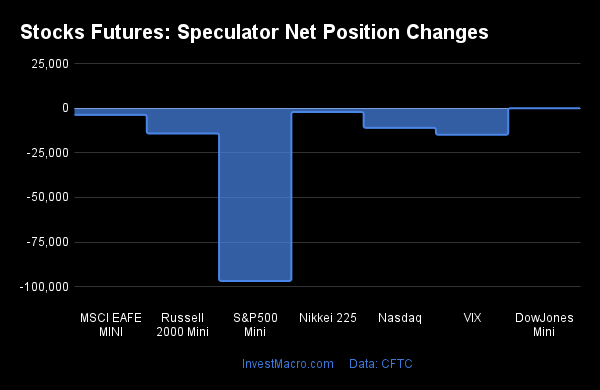
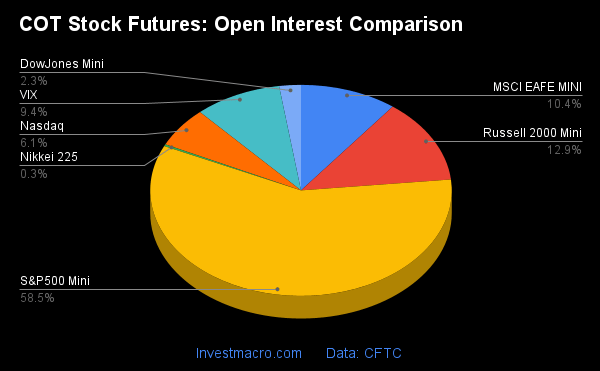
The COT stock markets speculator bets were lower this week as all of the markets we cover had lower speculator contracts.

The markets with the declines in speculator bets this week were the S&P500-Mini (-96,803 contracts), DowJones-Mini (-56 contracts), MSCI EAFE-Mini (-3,797 contracts), Nikkei 225 (-2,185 contracts), VIX (-14,909 contracts), Nasdaq-Mini (-11,037 contracts) and the Russell-Mini (-14,206 contracts) also registering lower bets on the week.

S&P500-Mini Speculators dropped their positions sharply to multi-year low

Highlighting the COT stocks data this week is the continued increases in bearish bets for the S&P500-Mini speculative positions.

The large speculator position in the S&P500-Mini futures dropped sharply this week and fell for the third straight week as well as for the fourth time out of the past five weeks. This week’s speculative decline by -96,803 contracts marks the largest one-week shortfall since last June and the S&P500-Mini bets have now been in a continuous bearish position for the past 42 consecutive weeks, also dating back to last June of 2022.

This week’s overall net speculator position standing of -321,459 contracts is now at the most bearish level since November 8th of 2011, a span dating back for 595 weeks. The speculator strength scores shows a bearish-extreme strength score level at 0 percent (or the absolute bottom) of its 3-year range. The speculator strength score trend (the past 6-weeks change of strength scores) shows a rising downtrend of -16 percent.

The COT speculator’s extreme bearish positioning does not portend a stock market downtrend though as the correlations between speculators and the stock markets are not nearly as strong as other futures markets (which are more trend-following). This can be due to the large amount of hedging positions throughout these markets.

The S&P500-Mini stock futures price has continued on its move higher after bottoming in October near the 3500 level. This week saw the S&P500-Mini futures close above the 4141 level and is up by approximately 18 percent since the most recent bottom in October.


Data Snapshot of Stock Market Traders | Columns Legend
Apr-04-2023OIOI-IndexSpec-NetSpec-IndexCom-NetCOM-IndexSmalls-NetSmalls-Index
S&P500-Mini2,219,51217-321,4590281,4728739,98736
Nikkei 22510,8332-3,279581,784411,49547
Nasdaq-Mini232,18632-18,3856512,556345,82964
DowJones-Mini88,29146-23,6251432,621100-8,9960
VIX355,00868-57,0867456,3912169595
Nikkei 225 Yen36,670136,595549,73037-16,32550


Strength Scores led by VIX & Nasdaq-Mini

COT Strength Scores (a normalized measure of Speculator positions over a 3-Year range, from 0 to 100 where above 80 is Extreme-Bullish and below 20 is Extreme-Bearish) showed that the VIX (74 percent) and the Nasdaq-Mini (65 percent) lead the stock markets this week. The Nikkei 225 (58 percent) and Nikkei 225 Yen (54 percent) come in as the next highest in the weekly strength scores.

On the downside, the S&P500-Mini (0 percent) and the DowJones-Mini (14 percent) come in at the lowest strength level currently and are in Extreme-Bearish territory (below 20 percent).

Strength Statistics:
VIX (73.6 percent) vs VIX previous week (83.9 percent)
S&P500-Mini (0.0 percent) vs S&P500-Mini previous week (17.4 percent)
DowJones-Mini (13.5 percent) vs DowJones-Mini previous week (13.7 percent)
Nasdaq-Mini (64.8 percent) vs Nasdaq-Mini previous week (70.9 percent)
Russell2000-Mini (37.8 percent) vs Russell2000-Mini previous week (46.3 percent)
Nikkei USD (57.9 percent) vs Nikkei USD previous week (69.4 percent)
EAFE-Mini (24.1 percent) vs EAFE-Mini previous week (28.8 percent)


VIX tops the 6-Week Strength Trends

COT Strength Score Trends (or move index, calculates the 6-week changes in strength scores) showed that the VIX (-1 percent) was the highest of the past six weeks trends for the stock markets.

The DowJones-Mini (-19 percent) leads the downside trend scores currently with the Nikkei 225 Yen (-17 percent) coming in as the next market with lower trend scores.

Strength Trend Statistics:
VIX (-0.7 percent) vs VIX previous week (9.7 percent)
S&P500-Mini (-15.6 percent) vs S&P500-Mini previous week (3.9 percent)
DowJones-Mini (-19.4 percent) vs DowJones-Mini previous week (-44.3 percent)
Nasdaq-Mini (-2.4 percent) vs Nasdaq-Mini previous week (8.6 percent)
Russell2000-Mini (-1.4 percent) vs Russell2000-Mini previous week (12.7 percent)
Nikkei USD (-6.6 percent) vs Nikkei USD previous week (6.2 percent)
EAFE-Mini (-1.9 percent) vs EAFE-Mini previous week (6.6 percent)


Individual Stock Market Charts:

VIX Volatility Futures:
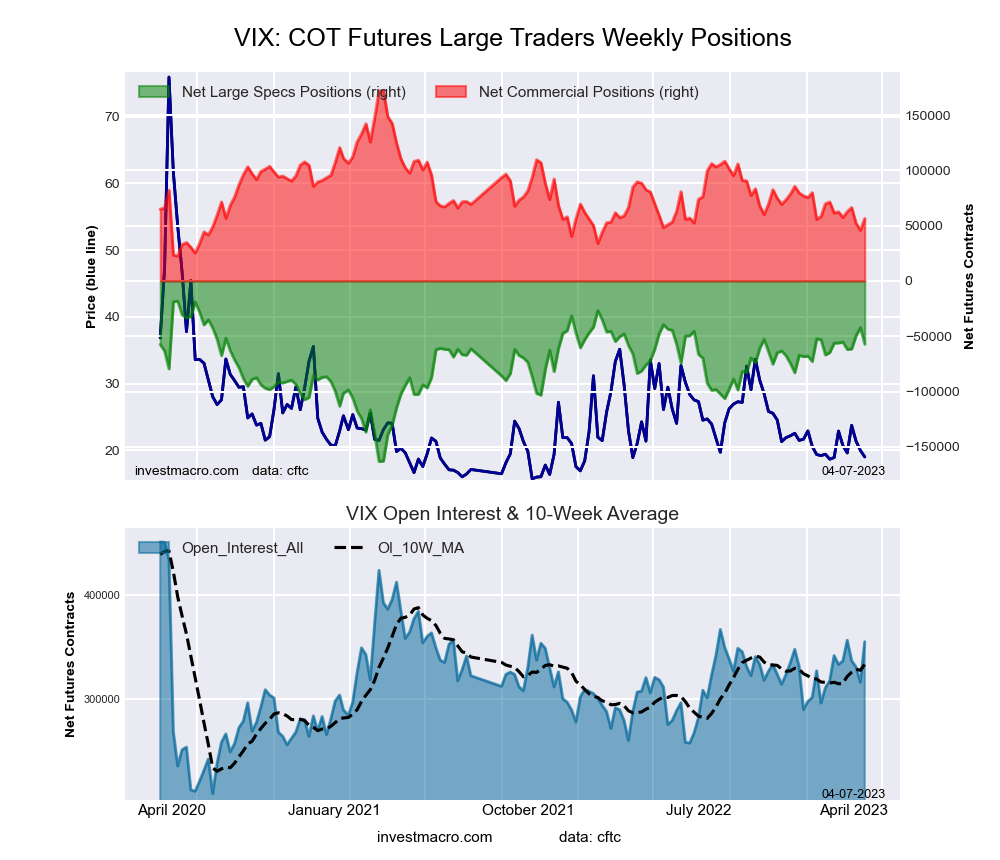
VIX Volatility Futures COT ChartThe VIX Volatility large speculator standing this week recorded a net position of -57,086 contracts in the data reported through Tuesday. This was a weekly lowering of -14,909 contracts from the previous week which had a total of -42,177 net contracts.

This week’s current strength score (the trader positioning range over the past three years, measured from 0 to 100) shows the speculators are currently Bullish with a score of 73.6 percent. The commercials are Bearish with a score of 21.3 percent and the small traders (not shown in chart) are Bullish-Extreme with a score of 94.6 percent.

VIX Volatility Futures StatisticsSPECULATORSCOMMERCIALSSMALL TRADERS
– Percent of Open Interest Longs:20.353.78.1
– Percent of Open Interest Shorts:36.437.87.9
– Net Position:-57,08656,391695
– Gross Longs:72,161190,49428,808
– Gross Shorts:129,247134,10328,113
– Long to Short Ratio:0.6 to 11.4 to 11.0 to 1
NET POSITION TREND:
– Strength Index Score (3 Year Range Pct):73.621.394.6
– Strength Index Reading (3 Year Range):BullishBearishBullish-Extreme
NET POSITION MOVEMENT INDEX:
– 6-Week Change in Strength Index:-0.7-4.133.8


S&P500 Mini Futures:

SP500 Mini Futures COT ChartThe S&P500 Mini large speculator standing this week recorded a net position of -321,459 contracts in the data reported through Tuesday. This was a weekly decline of -96,803 contracts from the previous week which had a total of -224,656 net contracts.

This week’s current strength score (the trader positioning range over the past three years, measured from 0 to 100) shows the speculators are currently Bearish-Extreme with a score of 0.0 percent. The commercials are Bullish-Extreme with a score of 86.5 percent and the small traders (not shown in chart) are Bearish with a score of 35.7 percent.

S&P500 Mini Futures StatisticsSPECULATORSCOMMERCIALSSMALL TRADERS
– Percent of Open Interest Longs:7.476.213.6
– Percent of Open Interest Shorts:21.963.511.8
– Net Position:-321,459281,47239,987
– Gross Longs:163,7661,690,406300,962
– Gross Shorts:485,2251,408,934260,975
– Long to Short Ratio:0.3 to 11.2 to 11.2 to 1
NET POSITION TREND:
– Strength Index Score (3 Year Range Pct):0.086.535.7
– Strength Index Reading (3 Year Range):Bearish-ExtremeBullish-ExtremeBearish
NET POSITION MOVEMENT INDEX:
– 6-Week Change in Strength Index:-15.66.110.1


Dow Jones Mini Futures:

Dow Jones Mini Futures COT ChartThe Dow Jones Mini large speculator standing this week recorded a net position of -23,625 contracts in the data reported through Tuesday. This was a weekly fall of -56 contracts from the previous week which had a total of -23,569 net contracts.

This week’s current strength score (the trader positioning range over the past three years, measured from 0 to 100) shows the speculators are currently Bearish-Extreme with a score of 13.5 percent. The commercials are Bullish-Extreme with a score of 100.0 percent and the small traders (not shown in chart) are Bearish-Extreme with a score of 0.0 percent.

Dow Jones Mini Futures StatisticsSPECULATORSCOMMERCIALSSMALL TRADERS
– Percent of Open Interest Longs:16.268.314.7
– Percent of Open Interest Shorts:43.031.424.8
– Net Position:-23,62532,621-8,996
– Gross Longs:14,30260,31412,942
– Gross Shorts:37,92727,69321,938
– Long to Short Ratio:0.4 to 12.2 to 10.6 to 1
NET POSITION TREND:
– Strength Index Score (3 Year Range Pct):13.5100.00.0
– Strength Index Reading (3 Year Range):Bearish-ExtremeBullish-ExtremeBearish-Extreme
NET POSITION MOVEMENT INDEX:
– 6-Week Change in Strength Index:-19.430.5-37.3


Nasdaq Mini Futures:

Nasdaq Mini Futures COT ChartThe Nasdaq Mini large speculator standing this week recorded a net position of -18,385 contracts in the data reported through Tuesday. This was a weekly lowering of -11,037 contracts from the previous week which had a total of -7,348 net contracts.

This week’s current strength score (the trader positioning range over the past three years, measured from 0 to 100) shows the speculators are currently Bullish with a score of 64.8 percent. The commercials are Bearish with a score of 34.2 percent and the small traders (not shown in chart) are Bullish with a score of 64.2 percent.

Nasdaq Mini Futures StatisticsSPECULATORSCOMMERCIALSSMALL TRADERS
– Percent of Open Interest Longs:16.759.322.0
– Percent of Open Interest Shorts:24.653.919.5
– Net Position:-18,38512,5565,829
– Gross Longs:38,815137,75451,175
– Gross Shorts:57,200125,19845,346
– Long to Short Ratio:0.7 to 11.1 to 11.1 to 1
NET POSITION TREND:
– Strength Index Score (3 Year Range Pct):64.834.264.2
– Strength Index Reading (3 Year Range):BullishBearishBullish
NET POSITION MOVEMENT INDEX:
– 6-Week Change in Strength Index:-2.4-13.649.2


Russell 2000 Mini Futures:

Russell 2000 Mini Futures COT ChartThe Russell 2000 Mini large speculator standing this week recorded a net position of -56,956 contracts in the data reported through Tuesday. This was a weekly lowering of -14,206 contracts from the previous week which had a total of -42,750 net contracts.

This week’s current strength score (the trader positioning range over the past three years, measured from 0 to 100) shows the speculators are currently Bearish with a score of 37.8 percent. The commercials are Bullish with a score of 65.3 percent and the small traders (not shown in chart) are Bearish-Extreme with a score of 11.2 percent.

Russell 2000 Mini Futures StatisticsSPECULATORSCOMMERCIALSSMALL TRADERS
– Percent of Open Interest Longs:9.085.44.2
– Percent of Open Interest Shorts:20.672.85.3
– Net Position:-56,95661,943-4,987
– Gross Longs:44,007419,11120,784
– Gross Shorts:100,963357,16825,771
– Long to Short Ratio:0.4 to 11.2 to 10.8 to 1
NET POSITION TREND:
– Strength Index Score (3 Year Range Pct):37.865.311.2
– Strength Index Reading (3 Year Range):BearishBullishBearish-Extreme
NET POSITION MOVEMENT INDEX:
– 6-Week Change in Strength Index:-1.47.3-33.0


Nikkei Stock Average (USD) Futures:

Nikkei Stock Average (USD) Futures COT ChartThe Nikkei Stock Average (USD) large speculator standing this week recorded a net position of -3,279 contracts in the data reported through Tuesday. This was a weekly lowering of -2,185 contracts from the previous week which had a total of -1,094 net contracts.

This week’s current strength score (the trader positioning range over the past three years, measured from 0 to 100) shows the speculators are currently Bullish with a score of 57.9 percent. The commercials are Bearish with a score of 41.0 percent and the small traders (not shown in chart) are Bearish with a score of 47.1 percent.

Nikkei Stock Average Futures StatisticsSPECULATORSCOMMERCIALSSMALL TRADERS
– Percent of Open Interest Longs:7.752.939.4
– Percent of Open Interest Shorts:38.036.425.6
– Net Position:-3,2791,7841,495
– Gross Longs:8395,7284,266
– Gross Shorts:4,1183,9442,771
– Long to Short Ratio:0.2 to 11.5 to 11.5 to 1
NET POSITION TREND:
– Strength Index Score (3 Year Range Pct):57.941.047.1
– Strength Index Reading (3 Year Range):BullishBearishBearish
NET POSITION MOVEMENT INDEX:
– 6-Week Change in Strength Index:-6.6-0.216.3


MSCI EAFE Mini Futures:

MSCI EAFE Mini Futures COT ChartThe MSCI EAFE Mini large speculator standing this week recorded a net position of -16,486 contracts in the data reported through Tuesday. This was a weekly lowering of -3,797 contracts from the previous week which had a total of -12,689 net contracts.

This week’s current strength score (the trader positioning range over the past three years, measured from 0 to 100) shows the speculators are currently Bearish with a score of 24.1 percent. The commercials are Bullish with a score of 71.0 percent and the small traders (not shown in chart) are Bearish with a score of 49.7 percent.

MSCI EAFE Mini Futures StatisticsSPECULATORSCOMMERCIALSSMALL TRADERS
– Percent of Open Interest Longs:7.389.22.9
– Percent of Open Interest Shorts:11.586.71.3
– Net Position:-16,4869,9216,565
– Gross Longs:28,818351,92811,632
– Gross Shorts:45,304342,0075,067
– Long to Short Ratio:0.6 to 11.0 to 12.3 to 1
NET POSITION TREND:
– Strength Index Score (3 Year Range Pct):24.171.049.7
– Strength Index Reading (3 Year Range):BearishBullishBearish
NET POSITION MOVEMENT INDEX:
– 6-Week Change in Strength Index:-1.91.80.3


Article By InvestMacroReceive our weekly COT Newsletter

*COT Report: The COT data, released weekly to the public each Friday, is updated through the most recent Tuesday (data is 3 days old) and shows a quick view of how large speculators or non-commercials (for-profit traders) were positioned in the futures markets.

The CFTC categorizes trader positions according to commercial hedgers (traders who use futures contracts for hedging as part of the business), non-commercials (large traders who speculate to realize trading profits) and nonreportable traders (usually small traders/speculators) as well as their open interest (contracts open in the market at time of reporting). See CFTC criteria here.

Week Ahead: SPX500_m braces for double whiplash

By ForexTime

Even as we await the pivotal US jobs report due later today (Friday, April 7), while noting that US stock markets have the day off on this Good Friday, traders and investors are also keenly aware of the slate of market-moving events due over the coming week.

The incoming US inflation data as well as the earnings announcements by Wall Street banks may trigger fresh volatility for the S&P 500 in the week ahead.

Monday, April 10

  • IMF/World Bank spring meetings
  • USD: Speech by New York Fed President John Williams
  • Markets closed in UK, Europe, Hong Kong, and Australia


Tuesday, April 11

  • AUD: Australia March business confidence, April consumer confidence
  • CNH: China March CPI and PPI
  • EUR: Eurozone February retail sales
  • USD: Fed Speak – speeches by Chicago Fed President Austan Goolsbee, Philadelphia Fed President Patrick Harker, and Minneapolis Fed President Neel Kashkari

Wednesday, April 12

  • CAD: Bank of Canada rate decision
  • USD: US March CPI, FOMC meeting minutes, speech by Richmond Fed President Thomas Barkin

Thursday, April 13

  • AUD: Australia March unemployment, April inflation expectations
  • CNH: China March external trade
  • EUR: Eurozone February industrial production; Germany March CPI (final)
  • GBP: UK February GDP, industrial production, trade balance; BOE chief economist Huw Pill speech
  • USD: US weekly initial jobless claims; March PPI

Friday, April 14

  • SPX500_m: US earnings season kicks off with Wall Street banks
  • USD: US March retail sales, industrial production; April consumer sentiment


Here’s a breakdown of these two major events that are set to influence the S&P 500 over the coming week:


1) US March consumer price index (CPI) due Wednesday, April 12

The CPI is the index used to measure overall inflation, i.e. the change in prices that consumers pay for goods and services.

And here’s what markets are forecasting for this tier-1 data:

  • CPI year-on-year (March 2023 vs. March 2022): 5.2%
    (an official 5.2% print would mark a slowdown from February’s 6% y/y figure)
  • Core CPI year-on-year: 5.6%
    (core CPI measures the changes in consumer prices excluding more volatile items such as food and energy, as their prices tend to fluctuate more)
  • CPI month-on-month (March 2023 vs. February 2023): 0.2%
    (an official 0.2% print would mark a slowdown from February’s 0.4% m/m figure)
  • Core CPI month-on-month: 0.4%
    (an official 0.4% print would mark a slowdown from February’s 0.5% m/m core CPI)


Overall, stock bulls (those hoping prices will move higher) want to see further evidence that US inflation is slowing down.

After all, stubbornly elevated inflation has been enemy #1 of the US central bank, the Federal Reserve.

And the Fed has raised US interest rates by 475 basis points over the past 12 months in a bid to quell inflation that was running at a multi-decade high.

And the S&P 500, with its higher concentration of US tech stocks, generally, does not like the prospects of US interest rates moving higher if the Fed is forced to prolong its fight against still-stubborn inflation with even more rate hikes.


How might the SPX500_m react to the US inflation data?

  • If the inflation numbers come in higher than market forecasts, then the SPX500_m may be dragged lower, as markets fear more incoming Fed rate hikes.
  • If the inflation numbers come in lower than market forecasts, then the SPX500_m may be pushed higher, should markets rejoice over the prospects of Fed being almost done with its rate hikes.


2) US bank earnings released on Friday, April 14th

Once every quarter, companies whose shares are listed on the US stock markets have to reveal to the public how well it performed financially during the previous quarter.

This period is known as “earnings season”.

And the official curtain raiser is the results out of JPMorgan, the largest US bank.

Also on Friday, other financial heavyweights such as Wells Fargo, BlackRock, and Citigroup are also due to announce their respective earnings.

Why are US bank earnings important for the S&P 500?

  • Financial stocks account for nearly 13% of the S&P 500.
    Given its weight, the market’s reactions to the earnings out of JPMorgan and its peers should have a big influence on how the SPX500_m fares overall leading into next weekend.
  • The health of US banks is widely used as a barometer for the health of the broader US economy. Hence, if US banks are struggling to earn profits, that may suggest deteriorating growth for the world’s largest economy, especially as recession fears are festering across global financial markets.
  • And lest we forget the recent US banking crisis.
    Q1 2023 was certainly a tumultuous time for US banks, as three regional banks collapsed (Silicon Valley Bank, Signature Bank, Silvergate) while the likes of First Republic Bank were left teetering.

    Then came Wall Street to the rescue.

    JPMorgan, Wells Fargo, and Citigroup were among the big US banks that pledged US$30 billion of cash for First Republic Bank in order to prevent yet another collapse.

Hence, any further commentary from these banking C-suites next week about potentially further contagion, or the risk of a wider US banking/financial crisis that ramps up the risk of a recession, would be closely scrutinised by the markets.

How might the SPX500_m react to the US banks’ earnings?

  • If the earnings exceed market expectations, then the SPX500_m may be pushed higher.
  • If the earnings disappoint, then the SPX500_m may be dragged lower.


Week Ahead: all still calm for US stock markets?

Let’s consider the VIX index, which measures how much volatility is expected for the S&P 500 over the next 30 days.

The VIX index is also more commonly known as the stock market’s “fear gauge”.

Note that the 30-day period ahead not only includes the upcoming CPI print and US earnings season, but also the Fed’s next decision on its interest rates due May 3rd.

Yet, the US stock market appears rather sanguine despite such looming event risks, with the VIX index rooted around its lowest levels so far this year.

With the VIX now at 18.40, that’s also lower than the 19.80 level that’s been its average reading over the past 30 years.

Still, that doesn’t mean that we’ll see guaranteed calm next week.

The vigilant trader and investor will certainly be paying close attention to the incoming CPI and earnings results, and awaiting potential opportunities that may be uncovered.


Key levels for SPX500_m

RESISTANCE:

  • 4146.9: latest cycle high
  • 4156.3: 50% Fibonacci retracement from 2022’s plummet (between record high in January 2022 and October’s trough).
  • 4197.3: February 2023 intraday high


SUPPORT:

  • 4070 – 4080: recent cycle low and early March intraday high
  • 50-day simple moving average (SMA)
  • 4,000: psychologically-important level, also close to the 38.2% Fib level

Forex-Time-LogoArticle by ForexTime

ForexTime Ltd (FXTM) is an award winning international online forex broker regulated by CySEC 185/12 www.forextime.com

Explosive Rise in Stock Market Volatility! Why It May Be Ahead

There are now S&P options that expire each day of the week. What that may mean.

By Elliott Wave International

Here’s a Wall Street Journal headline from a couple of months ago that some people may have scanned without much contemplation (Jan. 11):

VIX, Wall Street’s Fear Gauge, Extends Longest Lull Since 2021

While some investors may not consider a subdued VIX highly significant, Elliott Wave International does. As we’ve repeatedly stated: prolonged periods of low volatility in the stock market are inevitably followed by jumps in volatility — and often, those jumps can be quite high.

With the “lull” in the VIX so extended, the next surge higher in volatility may be exceptionally high and last for an exceptionally long period of time.

Yet, there’s at least one more strong reason to expect a super surge in the fear gauge.

This chart and commentary are from the March Elliott Wave Financial Forecast, a publication which provides analysis of major U.S. financial markets:

The CBOE Volatility Index (VIX) is purportedly a measure of expected future volatility in 30-day S&P 500 index options, but in fact it’s a real-time reading of complacency vs. fear. The index has been subdued, declining to 17.06 on February 2 in conjunction with [an Elliott wave] rally. This was the lowest VIX since January 5, 2022, the very day of the Dow’s all-time high. So, investors are as complacent now with respect to a stock market decline as they were when the blue chip indexes hit top tick in the great bull market.

Digging deeper, we find a segment of investors who are using the market to make casino-style bets. According to Bloomberg, more than 40% of the S&P 500’s total options volume occurs in what is known as “zero-day-to-expiry” options, or 0DTE, as shown by this graph. These are options that expire within 24 hours, making them highly sensitive to changes in price because of the lack of time premium. In 2022, the CBOE and CME expanded existing options so that there are now S&P options that expire each day of the week, allowing investors to speculate using these ultra-short-term instruments. Options dealers have to hedge against the risks of outsized moves in 0DTE options, which increases the potential for an explosive rise in volatility.

If another major leg down occurs in the stock market, wrong-way bets in highly leveraged 0DTE options will spike volatility.

The question is: What are the chances that the price downtrend which began in January 2022 will intensify?

While Elliott wave analysis offers no guarantees (no market analytical does), the stock market’s current Elliott wave structure is highly revealing.

If you’d like to learn how you can analyze financial markets using the Wave Principle, read Frost & Prechter’s Wall Street classic, Elliott Wave Principle: Key to Market Behavior. Here’s a quote from the book:

In markets, progress ultimately takes the form of five waves of a specific structure. Three of these waves, which are labeled 1, 3 and 5, actually effect the directional movement. They are separated by two countertrend interruptions, which are labeled 2 and 4. The two interruptions are apparently a requisite for overall directional movement to occur.

[R.N.] Elliott noted three consistent aspects of the five-wave form. They are: Wave 2 never moves beyond the start of wave 1; wave 3 is never the shortest wave; wave 4 never enters the price territory of wave 1.

… Elliott did not specifically say that there is only one overriding form, the “five-wave” pattern, but that is undeniably the case. At any time, the market may be identified as being somewhere in the basic five-wave pattern at the largest degree of trend. Because the five-wave pattern is the overriding form of market progress, all other patterns are subsumed by it.

If you’d like to delve deeper into the Wave Principle, here’s good news: You may read the entire online version of the book free once you become a member of Club EWI, the world’s largest Elliott wave educational community (approximately 500,000 worldwide members).

A Club EWI membership is also free and opens the door to complimentary access to Elliott wave resources on financial markets, investing and trading. Some of these resources (videos and articles) are from Elliott Wave International’s own analysts.

Join Club EWI (free membership) by following this link: Elliott Wave Principle: Key to Market Behavior.

This article was syndicated by Elliott Wave International and was originally published under the headline Explosive Rise in Stock Market Volatility! Why It May Be Ahead. EWI is the world’s largest market forecasting firm. Its staff of full-time analysts led by Chartered Market Technician Robert Prechter provides 24-hour-a-day market analysis to institutional and private investors around the world.

Stock Market Speculators continue DowJones-Mini bearish bets despite stocks uptick

By InvestMacro

Here are the latest charts and statistics for the Commitment of Traders (COT) data published by the Commodities Futures Trading Commission (CFTC).

The latest COT data is updated through Tuesday March 28th and shows a quick view of how large traders (for-profit speculators and commercial entities) were positioned in the futures markets.

Weekly Speculator Changes led by VIX & Russell-Mini

The COT stock markets speculator bets were lower this week as three out of the seven stock markets we cover had higher positioning while the other five markets had lower speculator contracts.

Leading the gains for the stock markets was the VIX (7,472 contracts) with Russell-Mini (2,238 contracts) and MSCI EAFE-Mini (1,388 contracts) also showing positive weeks.

The markets with the declines in speculator bets this week were the S&P500-Mini (-22,176 contracts) with the Nasdaq-Mini (-2,228 contracts), the DowJones-Mini (-1,421 contracts) and Nikkei 225 (-164 contracts) also registering lower bets on the week.

DowJones-Mini bets at lowest level since June

Highlighting the COT stocks data this week is the rise in bearish bets for the DowJones-Mini speculative positions. The large speculator position in the DowJones-Mini futures declined again this week and fell for the third straight week as well as for the fifth time out of the past seven weeks. The DowJones-Mini bets have now been in a continuous bearish position for the past 64 consecutive weeks, dating back to January 4th of 2022.

This week’s net position of -23,569 contracts marks the most bearish level since June of 2022 and the speculator strength scores shows a bearish-extreme strength score level at just 14 percent of its 3-year range. The speculator strength score trend (the past 6-weeks change of strength scores) also shows a strong downtrend of -44 percent which could perhaps be explained by speculators looking to hedge the recent market gains.

The DowJones-Mini stock futures price has continued to be on the uptrend after bottoming in October near the 28,650 level. This week saw the DowJone-Mini futures close above its 50-day moving average and rise by over 3 percent to the 33460 level.


Data Snapshot of Stock Market Traders | Columns Legend
Mar-28-2023OIOI-IndexSpec-NetSpec-IndexCom-NetCOM-IndexSmalls-NetSmalls-Index
S&P500-Mini2,142,23212-224,65615270,97885-46,32217
Nikkei 22510,2260-1,094711,34438-25025
Nasdaq-Mini220,07425-7,3487114,84636-7,49839
DowJones-Mini76,34933-23,5691432,570100-9,0010
VIX315,94150-42,1778445,77114-3,59474
Nikkei 225 Yen33,4977699369,04836-9,74770


Strength Scores led by VIX & Nikkei 225

COT Strength Scores (a normalized measure of Speculator positions over a 3-Year range, from 0 to 100 where above 80 is Extreme-Bullish and below 20 is Extreme-Bearish) showed that the VIX (84 percent), Nasdaq-Mini (71 percent) and the Nikkei 225 (71 percent) lead the stock markets this week. The Russell-Mini (46 percent) came in as the next highest in the weekly strength scores.

On the downside, the S&P500-Mini (14.6 percent) and the DowJones-Mini (14 percent) came in at the lowest strength level currently and are in Extreme-Bearish territory (below 20 percent).

Strength Statistics:
VIX (83.9 percent) vs VIX previous week (78.7 percent)
S&P500-Mini (14.6 percent) vs S&P500-Mini previous week (18.7 percent)
DowJones-Mini (13.7 percent) vs DowJones-Mini previous week (17.4 percent)
Nasdaq-Mini (70.9 percent) vs Nasdaq-Mini previous week (72.2 percent)
Russell2000-Mini (46.3 percent) vs Russell2000-Mini previous week (45.0 percent)
Nikkei USD (70.9 percent) vs Nikkei USD previous week (71.8 percent)
EAFE-Mini (28.8 percent) vs EAFE-Mini previous week (27.1 percent)


Russell-Mini & VIX top the 6-Week Strength Trends

COT Strength Score Trends (or move index, calculates the 6-week changes in strength scores) showed that the Russell-Mini (13 percent) leads the past six weeks trends for the stock markets. The VIX (10 percent), the Nasdaq-Mini (9 percent) and the MSCI EAFE-Mini (7 percent) are the next highest positive movers in the latest trends data.

The DowJones-Mini (-44 percent) leads the downside trend scores currently.

Strength Trend Statistics:
VIX (9.7 percent) vs VIX previous week (10.5 percent)
S&P500-Mini (4.0 percent) vs S&P500-Mini previous week (2.8 percent)
DowJones-Mini (-44.3 percent) vs DowJones-Mini previous week (-41.8 percent)
Nasdaq-Mini (8.6 percent) vs Nasdaq-Mini previous week (5.5 percent)
Russell2000-Mini (12.7 percent) vs Russell2000-Mini previous week (18.1 percent)
Nikkei USD (5.9 percent) vs Nikkei USD previous week (10.9 percent)
EAFE-Mini (6.6 percent) vs EAFE-Mini previous week (14.4 percent)


Individual Stock Market Charts:

VIX Volatility Futures:

VIX Volatility Futures COT ChartThe VIX Volatility large speculator standing this week reached a net position of -42,177 contracts in the data reported through Tuesday. This was a weekly lift of 7,472 contracts from the previous week which had a total of -49,649 net contracts.

This week’s current strength score (the trader positioning range over the past three years, measured from 0 to 100) shows the speculators are currently Bullish-Extreme with a score of 83.9 percent. The commercials are Bearish-Extreme with a score of 14.0 percent and the small traders (not shown in chart) are Bullish with a score of 73.9 percent.

VIX Volatility Futures StatisticsSPECULATORSCOMMERCIALSSMALL TRADERS
– Percent of Open Interest Longs:19.951.98.6
– Percent of Open Interest Shorts:33.337.49.8
– Net Position:-42,17745,771-3,594
– Gross Longs:62,963163,83727,312
– Gross Shorts:105,140118,06630,906
– Long to Short Ratio:0.6 to 11.4 to 10.9 to 1
NET POSITION TREND:
– Strength Index Score (3 Year Range Pct):83.914.073.9
– Strength Index Reading (3 Year Range):Bullish-ExtremeBearish-ExtremeBullish
NET POSITION MOVEMENT INDEX:
– 6-Week Change in Strength Index:9.7-10.78.3


S&P500 Mini Futures:

SP500 Mini Futures COT ChartThe S&P500 Mini large speculator standing this week reached a net position of -224,656 contracts in the data reported through Tuesday. This was a weekly lowering of -22,176 contracts from the previous week which had a total of -202,480 net contracts.

This week’s current strength score (the trader positioning range over the past three years, measured from 0 to 100) shows the speculators are currently Bearish-Extreme with a score of 14.6 percent. The commercials are Bullish-Extreme with a score of 84.9 percent and the small traders (not shown in chart) are Bearish-Extreme with a score of 17.1 percent.

S&P500 Mini Futures StatisticsSPECULATORSCOMMERCIALSSMALL TRADERS
– Percent of Open Interest Longs:9.378.19.7
– Percent of Open Interest Shorts:19.865.511.9
– Net Position:-224,656270,978-46,322
– Gross Longs:199,4721,673,807208,519
– Gross Shorts:424,1281,402,829254,841
– Long to Short Ratio:0.5 to 11.2 to 10.8 to 1
NET POSITION TREND:
– Strength Index Score (3 Year Range Pct):14.684.917.1
– Strength Index Reading (3 Year Range):Bearish-ExtremeBullish-ExtremeBearish-Extreme
NET POSITION MOVEMENT INDEX:
– 6-Week Change in Strength Index:4.03.0-9.0


Dow Jones Mini Futures:

Dow Jones Mini Futures COT ChartThe Dow Jones Mini large speculator standing this week reached a net position of -23,569 contracts in the data reported through Tuesday. This was a weekly lowering of -1,421 contracts from the previous week which had a total of -22,148 net contracts.

This week’s current strength score (the trader positioning range over the past three years, measured from 0 to 100) shows the speculators are currently Bearish-Extreme with a score of 13.7 percent. The commercials are Bullish-Extreme with a score of 100.0 percent and the small traders (not shown in chart) are Bearish-Extreme with a score of 0.0 percent.

Dow Jones Mini Futures StatisticsSPECULATORSCOMMERCIALSSMALL TRADERS
– Percent of Open Interest Longs:16.070.112.9
– Percent of Open Interest Shorts:46.827.424.7
– Net Position:-23,56932,570-9,001
– Gross Longs:12,19053,5049,852
– Gross Shorts:35,75920,93418,853
– Long to Short Ratio:0.3 to 12.6 to 10.5 to 1
NET POSITION TREND:
– Strength Index Score (3 Year Range Pct):13.7100.00.0
– Strength Index Reading (3 Year Range):Bearish-ExtremeBullish-ExtremeBearish-Extreme
NET POSITION MOVEMENT INDEX:
– 6-Week Change in Strength Index:-44.345.6-27.4


Nasdaq Mini Futures:

Nasdaq Mini Futures COT ChartThe Nasdaq Mini large speculator standing this week reached a net position of -7,348 contracts in the data reported through Tuesday. This was a weekly lowering of -2,228 contracts from the previous week which had a total of -5,120 net contracts.

This week’s current strength score (the trader positioning range over the past three years, measured from 0 to 100) shows the speculators are currently Bullish with a score of 70.9 percent. The commercials are Bearish with a score of 35.6 percent and the small traders (not shown in chart) are Bearish with a score of 39.4 percent.

Nasdaq Mini Futures StatisticsSPECULATORSCOMMERCIALSSMALL TRADERS
– Percent of Open Interest Longs:23.360.115.3
– Percent of Open Interest Shorts:26.753.418.7
– Net Position:-7,34814,846-7,498
– Gross Longs:51,309132,37133,614
– Gross Shorts:58,657117,52541,112
– Long to Short Ratio:0.9 to 11.1 to 10.8 to 1
NET POSITION TREND:
– Strength Index Score (3 Year Range Pct):70.935.639.4
– Strength Index Reading (3 Year Range):BullishBearishBearish
NET POSITION MOVEMENT INDEX:
– 6-Week Change in Strength Index:8.6-17.524.3


Russell 2000 Mini Futures:

Russell 2000 Mini Futures COT ChartThe Russell 2000 Mini large speculator standing this week reached a net position of -42,750 contracts in the data reported through Tuesday. This was a weekly rise of 2,238 contracts from the previous week which had a total of -44,988 net contracts.

This week’s current strength score (the trader positioning range over the past three years, measured from 0 to 100) shows the speculators are currently Bearish with a score of 46.3 percent. The commercials are Bullish with a score of 55.0 percent and the small traders (not shown in chart) are Bearish with a score of 24.3 percent.

Russell 2000 Mini Futures StatisticsSPECULATORSCOMMERCIALSSMALL TRADERS
– Percent of Open Interest Longs:8.885.25.0
– Percent of Open Interest Shorts:17.776.15.1
– Net Position:-42,75043,502-752
– Gross Longs:42,013407,84923,878
– Gross Shorts:84,763364,34724,630
– Long to Short Ratio:0.5 to 11.1 to 11.0 to 1
NET POSITION TREND:
– Strength Index Score (3 Year Range Pct):46.355.024.3
– Strength Index Reading (3 Year Range):BearishBullishBearish
NET POSITION MOVEMENT INDEX:
– 6-Week Change in Strength Index:12.7-7.3-25.1


Nikkei Stock Average (USD) Futures:

Nikkei Stock Average (USD) Futures COT ChartThe Nikkei Stock Average (USD) large speculator standing this week reached a net position of -1,094 contracts in the data reported through Tuesday. This was a weekly lowering of -164 contracts from the previous week which had a total of -930 net contracts.

This week’s current strength score (the trader positioning range over the past three years, measured from 0 to 100) shows the speculators are currently Bullish with a score of 70.9 percent. The commercials are Bearish with a score of 37.6 percent and the small traders (not shown in chart) are Bearish with a score of 25.2 percent.

Nikkei Stock Average Futures StatisticsSPECULATORSCOMMERCIALSSMALL TRADERS
– Percent of Open Interest Longs:19.553.926.7
– Percent of Open Interest Shorts:30.240.729.1
– Net Position:-1,0941,344-250
– Gross Longs:1,9935,5072,726
– Gross Shorts:3,0874,1632,976
– Long to Short Ratio:0.6 to 11.3 to 10.9 to 1
NET POSITION TREND:
– Strength Index Score (3 Year Range Pct):70.937.625.2
– Strength Index Reading (3 Year Range):BullishBearishBearish
NET POSITION MOVEMENT INDEX:
– 6-Week Change in Strength Index:5.9-5.5-1.6


MSCI EAFE Mini Futures:

MSCI EAFE Mini Futures COT ChartThe MSCI EAFE Mini large speculator standing this week reached a net position of -12,689 contracts in the data reported through Tuesday. This was a weekly rise of 1,388 contracts from the previous week which had a total of -14,077 net contracts.

This week’s current strength score (the trader positioning range over the past three years, measured from 0 to 100) shows the speculators are currently Bearish with a score of 28.8 percent. The commercials are Bullish with a score of 66.9 percent and the small traders (not shown in chart) are Bearish with a score of 47.6 percent.

MSCI EAFE Mini Futures StatisticsSPECULATORSCOMMERCIALSSMALL TRADERS
– Percent of Open Interest Longs:7.589.72.3
– Percent of Open Interest Shorts:10.788.10.7
– Net Position:-12,6896,5516,138
– Gross Longs:29,761355,2539,028
– Gross Shorts:42,450348,7022,890
– Long to Short Ratio:0.7 to 11.0 to 13.1 to 1
NET POSITION TREND:
– Strength Index Score (3 Year Range Pct):28.866.947.6
– Strength Index Reading (3 Year Range):BearishBullishBearish
NET POSITION MOVEMENT INDEX:
– 6-Week Change in Strength Index:6.6-4.3-9.2


Article By InvestMacroReceive our weekly COT Newsletter

*COT Report: The COT data, released weekly to the public each Friday, is updated through the most recent Tuesday (data is 3 days old) and shows a quick view of how large speculators or non-commercials (for-profit traders) were positioned in the futures markets.

The CFTC categorizes trader positions according to commercial hedgers (traders who use futures contracts for hedging as part of the business), non-commercials (large traders who speculate to realize trading profits) and nonreportable traders (usually small traders/speculators) as well as their open interest (contracts open in the market at time of reporting). See CFTC criteria here.

Telehealth Co. Signs Largest Client Yet

Source: Streetwise Reports  (3/30/23)

Onboarding will begin in April for the health care system that has more than 1,200 care centers in seven states.

Telemedicine company Reliq Health Technologies Inc. (RHT:TSX.V; RQHTF:OTCQB; A2AJTB:WKN) announced it has signed a contract with its largest client yet, a healthcare system with more than 1,200 care centers in seven states.

Onboarding will begin in April at 20 of their skilled nursing facilities, which are expected to add more than 2,000 new patients per month to Reliq’s iUGO platform by the end of the year at an average revenue of US$65 per patient per month.

Skilled nursing facilities are “a very big space for us,” Chief Executive Lisa Crossley said.

Over the last six months, the company has signed three large networks of such facilities, including the newest client.

“That market segment has become incredibly important to us over a very short period of time,” Crossley said. “I think it really speaks to the value proposition we offer to that market segment that we’ve gotten such strong traction in such a short period of time.”

The U.S. skilled nursing facility and rehabilitation market is expected to grow at a compound annual growth rate of 4.5% to US$308.8 billion by 2023, according to a report by Markets and Research.

The U.S. skilled nursing facility and rehabilitation market is expected to grow at a compound annual growth rate of 4.5% to US$308.8 billion by 2023, according to a report by Markets and Research.

“The growing incidences of chronic conditions such as diabetes, paralysis, hypertension, etc., and the rising geriatric population is expected to fuel the market over the next few years,” the report said. “Medicare and Medicaid availability and the growing technologies will play a driving role for the market in the coming years.”

The global telehealth market Reliq serves is anticipated to reach US$380 billion by 2023, according to another Research and Markets report.

The pandemic “led to increased awareness about telemedicine solutions, propelled the adoption rates among patients and providers, and increased the investment activities in the market,” the report said.

Technical analyst Clive Maund of CliveMaund.com recommended the stock shortly after news broke last year that the company’s cash intake went up 485% from the fiscal year 2021 to the fiscal year 2022.

“We, therefore, stay long,” Maund wrote for Streetwise Reports.

The Catalyst: ‘A Very Large Opportunity’

The new client network, which was not identified, has more than 10 million patient encounters per year in New York, Ohio, Maryland, Virginia, Florida, Kentucky, and South Carolina, Reliq said.

Newly discharged patients will get long-term virtual care at home using Reliq’s Transitional Care Management, Remote Patient Monitoring, and Chronic Care Management, and Behavioral Health Integration modules on its platform.

Those patients will bring in an average revenue of US$60 per patient for their first 30 days after discharge and US$65 per patient per month after that.

Technical analyst Clive Maund of CliveMaund.com recommended the stock shortly after news broke last year that the company’s cash intake went up 485% from the fiscal year 2021 to the fiscal year 2022. “We, therefore, stay long,” Maund wrote for Streetwise Reports.

The new client manages a wide variety of care settings, such as primary care clinics, hospice agencies, home health agencies, and hospitals.

“It’s a very large opportunity for us,” Crossley said. “This client is really representative of that very comprehensive, holistic offering that our product and platform represents, and (have) very broad appeal in the market.”

The company also recently announced it had signed 40 new skilled nursing facility clients in California, Florida, and Pennsylvania, adding more than 4,000 new patients per month to iUGO.

This week, it announced it had signed ten new contracts with eight physician practices in Nevada and California and two home health agencies in Texas.

Crossley has said the company services more than 100,000 on iUGO and expects to have as many as 200,000 patients on the platform by the middle of 2023.

Managing Patients at Home

Diseases the company aims to manage at home with iUGO include chronic obstructive pulmonary disease (COPD), congestive heart failure, diabetes, hypertension, and others. Patients get audible reminders to step on a scale, take their blood pressure, or prick their fingers for glucose monitoring. The information is automatically uploaded to the cloud.

iUGO draws on data from fall detection devices, medication tracking, and vitals data to flag patients at home or in facilities who need additional monitoring. It even uses artificial intelligence algorithms in its software.

Reliq is on the cutting edge there, as AI has yet to be widely deployed in health care. But a recent report from McKinsey & Co. and Harvard researchers said that AI adoption could result in savings of 5% to 10% of health care spending, or US$200 billion to US$360 billion annually.

Retail: 91.7%
Management & Insiders: 8%
Institutions: 0.3%
Strategic Investors: 0%
91.7%
8.0%
*Share Structure as of 3/30/2023


“For hospitals, the savings come largely from use cases that improve clinical operations . . .  and quality and safety,” the report’s authors wrote. “For physician groups, the savings also mostly come from use cases that improve clinical operations.”

Ownership and Share Structure

About 8% of Reliq’s shares are owned by insiders, including Crossley, with 1.61% or 3.22 million shares. About 0.3% of the company is owned by institutional investors, including FNB Wealth Management, with 0.02% or 0.03 million shares, according to Reuters.

Other top investors include Eugene Beukman, who owns 0.11% or 0.23 million shares, and Brian Storseth, who owns 0.07% or 0.14 million shares, Reuters said.

Crossley said 91.7% of the company is retail.

The company has 200.6 million shares outstanding, with about 197 million free-floating. It has a market cap of CA$97.4 million and trades in a 52-week range of CA$0.92 and CA$0.36.


Disclosures:
1) Steve Sobek wrote this article for Streetwise Reports LLC and provides services to Streetwise Reports. He or members of his household own securities of the following companies mentioned in the article: None. He or members of his household are paid by the following companies mentioned in this article: None.

2) The following companies mentioned in this article are billboard sponsors of Streetwise Reports: Reliq Health Technologies Inc. Click here for important disclosures about sponsor fees.

3) The article does not constitute investment advice. Each reader is encouraged to consult with his or her individual financial professional and any action a reader takes as a result of information presented here is his or her own responsibility. By opening this page, each reader accepts and agrees to Streetwise Reports’ terms of use and full legal disclaimer. This article is not a solicitation for investment. Streetwise Reports does not render general or specific investment advice and the information on Streetwise Reports should not be considered a recommendation to buy or sell any security. Streetwise Reports does not endorse or recommend the business, products, services or securities of any company mentioned on Streetwise Reports.

4) From time to time, Streetwise Reports LLC and its directors, officers, employees or members of their families, as well as persons interviewed for articles and interviews on the site, may have a long or short position in securities mentioned. Directors, officers, employees or members of their immediate families are prohibited from making purchases and/or sales of those securities in the open market or otherwise from the time of the decision to publish an article until three business days after the publication of the article. The foregoing prohibition does not apply to articles that in substance only restate previously published company releases.
5) This article does not constitute medical advice. Officers, employees and contributors to Streetwise Reports are not licensed medical professionals. Readers should always contact their healthcare professionals for medical advice.

Alibaba’s breakup heralds new era of opportunities in China for investors

By George Prior

The break-up of Alibaba, the Chinese mega-conglomerate, heralds the start of a wave of “enormous opportunities” in China for global investors, according to the CEO and founder of one of the world’s largest independent financial advisory, asset management and fintech organizations.

Nigel Green of deVere Group is speaking out after the Jack Ma-founded business empire said on Tuesday it is planning to split into six units and explore fundraisings or listings for most of them.

Alibaba is a multinational technology conglomerate that operates various e-commerce, retail, and technology businesses, including online marketplaces, payment systems, cloud computing services, and digital media and entertainment platforms.

The deVere CEO says: “This overhaul is the biggest restructuring in Alibaba Group’s 24-year history.

“It is hugely significant, not only because it’s an organisation that has huge influence over the world’s second largest economy, but because we also expect it to represent the end of Beijing-led regulatory crackdowns on various sectors, including tech.”

China has been a magnet for foreign investment for decades as it typically offered buoyant returns and growth potential. But in the last couple of years, there have been a slew of investors shunning the country.

Investors are claiming a myriad of reasons for pulling out.

“One of the main reasons has been Beijing’s unpredictable, full-throttle regulatory crackdowns,” notes Nigel Green.

“One of the most notable regulatory crackdowns in recent years has been on the tech industry. In 2021, the Chinese government introduced new regulations that targeted major tech companies, including Alibaba and Tencent. These regulations included restrictions on monopolistic practices, data privacy, and foreign investment in the sector.

“This led many global investors becoming extra cautious about investing in Chinese tech companies, as they feared additional regulatory blitzes and uncertainty. In turn, this led to a decline in the value of some Chinese tech stocks and a decrease in foreign investment in the sector.

“In addition, the government also introduced new tough regulations in other sectors, such as education and real estate, which again triggered panic and uncertainty for investors because the regulatory attacks were perceived by many as highlighting the Chinese government’s increasing push for control of private enterprise.”

The news of the splitting-up of Alibaba will be welcomed by investors, says the deVere CEO, because it shows Beijing is “cooling its corporate crackdowns” and because the restructuring provides more protections.
“Any new regulations will now likely not impact the whole organization, rather the individual division that that regulation covers.”

He continues: “This is a landmark moment. We expect it to herald the start of a wave of enormous opportunities in China for global investors as other tech titans, and major organisations in other sectors, make similar moves as Beijing appears to be becoming more pro-private enterprise.

“The timing is also bullish for investors as the world’s second largest economy re-opens after years of draconian lockdowns due to Covid. Also because China is transitioning from an export economy to a consumption one that, ultimately, will be more sustainable.”

He concludes: “Alibaba’s break-up will reignite interest and, therefore, capital inflows from global investors seeking to build long-term wealth.”

About:

deVere Group is one of the world’s largest independent advisors of specialist global financial solutions to international, local mass affluent, and high-net-worth clients.  It has a network of more than 70 offices across the world, over 80,000 clients and $12bn under advisement.