Archive for Opinions – Page 69

Trade Of The Week: Will gold conquer $2000 again?

By ForexTime 

  • Gold up roughly 8% since Hamas attack on Israel
  • Precious metal influenced by geopolitical risk and Fed hike bets
  • Watch out for key US data, including September PCE report
  • Gold heavily bullish but RSI overbought on daily charts
  • Key level of interest found at $2000

Gold has been an unstoppable force this month as mounting geopolitical tensions rocked global markets.

The precious metal is up roughly 8% since the Hamas attacks on Israel (October 7th) with prices approaching the key psychological $2000 level – a level not seen since mid-May.

Despite prices retreating last Friday, bulls have entered the new week with renewed vigor as investors closely monitor the developments in the Middle East. It is worth noting that gold has gained 7% month-to-date, its best month since March 2023 thus far. More volatility could be on the horizon for gold thanks to not only geopolitical tensions but Fed hike expectations.

Given the key technical and fundamental forces at play, it will be wise to keep a close eye on gold.

Here are 3 key factors to watch out for:

  1. Heightened geopolitical risks

It is worth noting that gold is a safe-haven asset that investors sprint towards in times of uncertainty.

Mounting tensions in the Middle East represent a major element of uncertainty. This has rattled financial markets, clouded sentiment, and left investors on edge. Concerns remain elevated over the spectre of a wider conflict in the region, especially after the U.S. announced it was sending more military resources. With this development representing a threat to the global economy, markets remain uneasy and gloomy.

  • Should rising tensions between Israel and Hamas spill over into other regions, this could keep gold prices buoyed – pushing the precious metal beyond $2000.
  • Any fresh signs of easing geopolitical tensions may dampen appetite for the precious metal, pulling prices away from the psychological $2000 point.
  1. Fed hike expectations

This will be a week packed with key US economic reports that have the potential to shape Fed rate expectations. Gold remains highly sensitive to monetary policy speculation due to its zero-yielding nature.

It would be wise to keep an eye on the latest US GDP and September PCE report. Real GDP in the third quarter of 2023 is expected to jump to 4.3% up from the 2.1% in the previous quarter. The real mover for gold may be the Fed’s preferred inflation gauge, the Core Personal Consumption which could offer key clues on the Fed’s next move. Fed Chair Jerome Powell is also due to give remarks mid-week which has the potential to move gold, especially if any fresh clues are offered on interest rates.

As of writing, traders are currently pricing in a 1 in 4 chance of a 25 basis point Fed hike by the end of 2023.

  • Gold could push higher if US economic data disappoints and there are signs of cooling inflationary pressures.
  • Should overall US data print and inflation print above market expectations, gold could fall as rate hike expectations jump.
  1. Technical forces

Gold is heavily bullish on the daily charts as there have been consistently higher highs and higher lows. Prices are trading above the 50, 100, and 200-day SMA while the MACD trades to the upside. However, the Relative Strength Index (RSI) signals that prices are heavily overbought – suggesting a potential technical throwback down the road.

A technical throwback is when prices break above a resistance level, but re-tests the resistance before resuming its uptrend.

  • Should the upside momentum hold, bulls could target the psychological $2000 with $2018 acting as the next key point of interest.
  • Sustained weakness below $2000 may encourage a decline back towards $1945 and potentially $1930 – where the 200-day SMA resides.

Currently, Bloomberg’s FX model points to a 75% chance that Gold will trade within the $1931.97 –  $2025.82 range this week.


Forex-Time-LogoArticle by ForexTime

ForexTime Ltd (FXTM) is an award winning international online forex broker regulated by CySEC 185/12 www.forextime.com

Lego’s ESG dilemma: Why an abandoned plan to use recycled plastic bottles is a wake-up call for supply chain sustainability

By Tinglong Dai, Johns Hopkins University; Christopher S. Tang, University of California, Los Angeles, and Hau L. Lee, Stanford University 

Lego, the world’s largest toy manufacturer, has built a reputation not only for the durability of its bricks, designed to last for decades, but also for its substantial investment in sustainability. The company has pledged US$1.4 billion to reduce carbon emissions by 2025, despite netting annual profits of just over $2 billion in 2022.

This commitment isn’t just for show. Lego sees its core customers as children and their parents, and sustainability is fundamentally about ensuring that future generations inherit a planet as hospitable as the one we enjoy today.

So it was surprising when the Financial Times reported on Sept. 25, 2023, that Lego had pulled out of its widely publicized “Bottles to Bricks” initiative.

This ambitious project aimed to replace traditional Lego plastic with a new material made from recycled plastic bottles. However, when Lego assessed the project’s environmental impact throughout its supply chain, it found that producing bricks with the recycled plastic would require extra materials and energy to make them durable enough. Because this conversion process would result in higher carbon emissions, the company decided to stick with its current fossil fuel-based materials while continuing to search for more sustainable alternatives.

As experts in global supply chains and sustainability, we believe Lego’s pivot is the beginning of a larger trend toward developing sustainable solutions for entire supply chains in a circular economy. New regulations in the European Union – and expected in California – are about to speed things up.

Examining all the emissions, cradle to grave

Business leaders are increasingly integrating environmental, social and governance factors, commonly known as ESG, into their operational and strategic frameworks. But the pursuit of sustainability requires attention to the entire life cycle of a product, from its materials and manufacturing processes to its use and ultimate disposal.

The results can lead to counterintuitive outcomes, as Lego discovered.

Understanding a company’s entire carbon footprint requires looking at three types of emissions: Scope 1 emissions are generated directly by a company’s internal operations. Scope 2 emissions are caused by generating the electricity, steam, heat or cooling a company consumes. And scope 3 emissions are generated by a company’s supply chain, from upstream suppliers to downstream distributors and end customers.

Lists of examples of sope 1, 2, 3 emissions sources with an illustration of a factory in the center
What scope 1, 2 and 3 emissions involve.
Chester Hawkins/Center for American Progress

Currently, fewer than 30% of companies report meaningful scope 3 emissions, in part because these emissions are difficult to track. Yet, companies’ scope 3 emissions are on average 11.4 times greater than their scope 1 emissions, data from corporate disclosures reported to the nonprofit CDP show.

Lego is a case study of this lopsided distribution and the importance of tracking scope 3 emissions. A staggering 98% of Lego’s carbon emissions are categorized as scope 3.

From 2020 to 2021, the company’s total emissions increased by 30%, amid surging demand for Lego sets during the COVID-19 lockdowns – even though the company’s scope 2 emissions related to purchased energy such as electricity decreased by 40%. The increase was almost entirely in its scope 3 emissions.

Lego’s tour of how its toy bricks are made doesn’t address the supply chain, where most of Lego’s greenhouse gas emissions originate.

As more companies follow in Lego’s footsteps and begin reporting scope 3 emissions, they will likely find themselves in the same position, realizing that efforts to reduce carbon emissions often boil down to supply chain and consumer-use emissions. And the results may force them to make some tough choices.

Policy and disclosure: The next frontier

New regulations in the European Union and pending in California are designed to increase corporate emissions transparency by including supply chain emissions.

The EU in June 2023 adopted the first set of European Sustainability Reporting Standards, which will require publicly traded companies in the EU to disclose their scope 3 emissions, starting in their reports for fiscal year 2024.

California’s legislature passed similar legislation requiring companies with revenues of more than $1 billion to disclose their scope 3 emissions. California’s governor has until Oct. 14, 2023, to consider the bill and is expected to sign it.

At the federal level, the U.S. Securities and Exchange Commission released a proposal in March 2022 that, if finalized, would require all public companies to report climate-related risk and emissions data, including scope 3 emissions. After receiving significant pushback, the SEC began reconsidering the scope 3 reporting rule. But SEC Chairman Gary Gensler suggested during a congressional hearing in late September 2023 that California’s move could influence federal regulators’ decision.

SEC Chairman Gary Gensler explains the importance of climate-related risk disclosures.

This increased focus on disclosure of scope 3 emissions will undoubtedly increase pressure on companies.

Because scope 3 emissions are significant, yet often not measured or reported, consumers are rightly concerned that companies that claim to have low emissions may be greenwashing without taking action to reduce emissions in their supply chains to combat climate change.

At the same time, we suspect that as more investors support sustainable investing, they may prefer to invest in companies that are transparent in disclosing all areas of emissions. Ultimately, we believe consumers, investors and governments will demand more than lip service from companies. Instead, they’ll expect companies to take actionable steps to reduce the most significant part of a company’s carbon footprint – scope 3 emissions.

A journey, not a destination

The Lego example serves as a cautionary tale in the complex ESG landscape for which most companies are not well prepared. As more companies come under scrutiny for their entire carbon footprint, we may see more instances where well-intentioned sustainability efforts run into uncomfortable truths.

This calls for a nuanced understanding of sustainability, not as a checklist of good deeds, but as a complex, ongoing process that requires vigilance, transparency and, above all, a commitment to the benefit of future generations.The Conversation

About the Author:

Tinglong Dai, Professor of Operations Management & Business Analytics, Carey Business School, Johns Hopkins University; Christopher S. Tang, Professor of Supply Chain Management, University of California, Los Angeles, and Hau L. Lee, Professor of Operations, Information & Technology, Stanford University

This article is republished from The Conversation under a Creative Commons license. Read the original article.

Cocoa prices are surging: west African countries should seize the moment to negotiate a better deal for farmers

By Michael E Odijie, UCL 

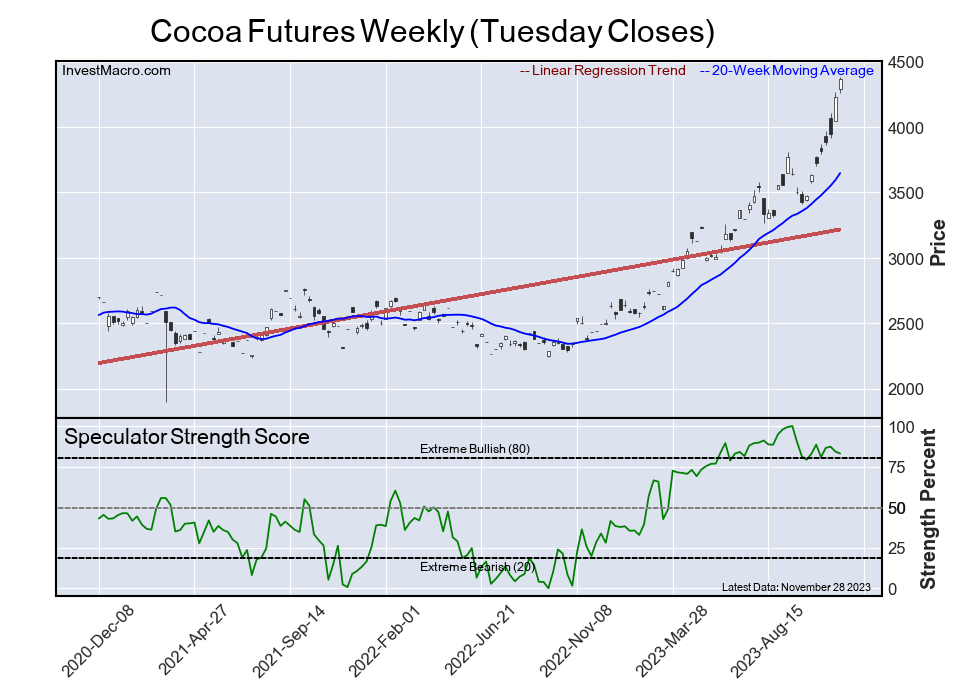
The global price of cocoa is spiking, a direct response to dwindling cocoa output in west Africa. In September, cocoa futures reached a 44-year price peak due to mounting concerns over reduced supplies from the region.

The price surge could prove to be a critical moment for cocoa farming and policy in west Africa.

The cocoa-producing belt of west Africa is responsible for generating over 80% of the total global output. Between them, Ghana and Côte d’Ivoire contribute more than 60% to the global output. Ghana is the second-biggest producer in the world and cocoa is a vital component of the country’s economy.

The global price spike has led west African governments to increase the guaranteed producer prices to farmers. Ghana recently raised the state-guaranteed cocoa price paid to farmers by two thirds. The announcement means that Ghana’s cocoa farmers will be paid 20,943 cedis (US$1,837) per tonne for the upcoming 2023-2024 season, up from 12,800 cedis.

Cameroon, the world’s fourth-largest cocoa producer, raised the price cocoa farmers get to 1,500 CFA francs (US$2.50) per kilogram, a 25% jump from the previous rate of 1,200 CFA francs. This increase is even more significant than Ghana’s when factoring in Cameroon’s single-digit inflation. Additionally, the Cote d’Ivoire government has announced a rise in the producer price.

As an economics researcher who has extensively studied and written about cocoa production in west Africa, I contend that the recent shortages can be harnessed to strengthen the position of cocoa producers. This will enable them to address the structural challenges ingrained in the cocoa production value chain. Rising production costs have not been recognised in the value of cocoa beans. Farmers therefore haven’t been able to earn enough income and this has led to unsustainable farming practices.

In my view, west African countries should use the cocoa shortage as negotiating leverage against multinational corporations to address these structural issues. Both Ghana and Côte d’Ivoire must recognise this pivotal moment. They must take the lead, and frame the current production challenges as deep-seated structural problems requiring solutions, rather than as short-term issues.

What’s driving the change?

Ghana’s cocoa regulator recently indicated that its farmers might not be able to meet some cocoa contract obligations for another season. Ghana’s projected cocoa yield for the 2022/23 planting season was the lowest in 13 years, falling 24% short of the initial estimates of 850,000 metric tonnes.

This trend has been repeated across the region, with production falling in Côte d’Ivoire and Cameroon.

Reduced output means demand can’t be met and global prices rise.

The reduction in cocoa output is attributed to short-term and long-term factors.

Commentators typically emphasise the short-term factors:

  • poor weather conditions
  • black pod disease, which causes cocoa pods to rot
  • the decline in the number of cocoa farmers, some of them selling their land to illegal miners
  • a shortage of fertilisers and pesticides, especially since the conflict in Ukraine has curtailed Russia’s export of potash and other fertilisers.

A number of long-term structural issues have beset cocoa farming in west Africa for decades. They shouldn’t be overshadowed by concerns with short-term problems.

The first is the declining availability of forest land and its connection to increasing production costs.

Over the last two decades, depletion of forest land has led farmers to turn to grasslands for replanting cocoa plants. This requires extensive land preparation, regular weeding around the cocoa trees, pruning, and the application of fertilisers and pesticides. What’s more, the plants are highly susceptible to disease. All these things result in increased labour costs.

None of these additional burdens have been incorporated into the pricing for sustainable cocoa production. In light of the new cost structure, cocoa beans have been undervalued for decades. Farmers have become poorer and are exploring alternative sources of livelihood.

The cost of sustainably cultivating cocoa in grasslands must be reflected in the price that farmers receive. Relying solely on market forces will not achieve this. For instance, every year, typically in September, the Ghana Cocoa Board announces the official producer price for cocoa beans for the upcoming cocoa season on behalf of the government. This official price is based on the anticipated export market price, with an understanding in Ghana that farmers should receive approximately 70% of it. However, the resulting market price, and consequently the producer price derived from it, often falls short of covering the costs of sustainable cocoa cultivation.

A path forward

What would it cost for cocoa farmers to cultivate cocoa beans sustainably, and ensure a living income, without contributing to deforestation or resorting to child labour?

If the market price falls below this cost (which isn’t static), then the farmers face exploitation, giving rise to many of the problems that plague the industry.

A few years ago, Ghana and Côte d’Ivoire pioneered the introduction of the “living income differential” – a premium that cocoa buyers would pay on top of the market price to ensure that farmers earned a sustainable income from their produce. Despite its noble intent, the initiative faltered. It was not well thought through. And it came at a time when these countries had diminished bargaining clout in a saturated market. Now is a favourable moment.

The crisis in the sector puts cocoa producers in a stronger negotiating position.

Ghana and Côte d’Ivoire could collaborate with other regional countries, such as Nigeria and Cameroon, to negotiate a better position for their cocoa farmers, ensuring sustainable cultivation. There are many strategies these countries can explore, including supply management (such as buffer stocks, export controls, or quotas), price premiums and value addition.The Conversation

About the Author:

Michael E Odijie, Research associate, UCL

This article is republished from The Conversation under a Creative Commons license. Read the original article.

Week Ahead: Looming “death cross” teases GBPUSD bears

By ForexTime 

  • GBPUSD set to be driven by technical and fundamental forces
  • Keep eye on UK CPI report, US data dump and Fed speeches
  • Looming “death cross” formation points to further declines
  • GBPUSD remains bearish despite recent bounce
  • Key levels of interest found at 1.2310 and 1.2050

The combination of geopolitical risk and Fed rate expectations injected markets with explosive levels of volatility this week. We could see more action later today due to earnings announcements by Wall Street banks.

And even before things settle down, volatility is likely to intensify in the week ahead thanks to top-tier economic reports and speeches from policymakers among other key risk events:

Monday, October 16

  • CNH: China medium-term lending facility rate
  • JPY: Japan industrial production
  • GBP: BOE chief economist Huw Pill speech
  • USD: US Empire Manufacturing index, Philadelphia Fed President Patrick Harker speech

Tuesday, October 17

  • CAD: Canada housing starts, CPI
  • EUR: Germany ZEW survey expectations
  • GBP: UK jobless claims, unemployment
  • USD: US retail sales, industrial production, New York Fed President John Williams, Richmond Fed President Tom Barkin speech
  • SPX500_m: Goldman Sachs, Bank of America earnings

Wednesday, October 18

  • CNH: China GDP, retail sales, industrial production
  • EUR: Eurozone CPI
  • GBP: UK September CPI
  • USD: US housing starts, Philadelphia Fed President Patrick Harker, New York Fed President John Williams speech
  • NQ100_m: Netflix, Tesla earnings

Thursday, October 19

  • CNH: China property prices
  • AUD: Australia unemployment
  • JPY: Japan trade
  • USD: US initial jobless claims, existing home sales,
  • USD: Fed speak – Federal Reserve Chair Jerome Powell, Chicago Fed President Austan Goolsbee, Atlantia Fed President Raphael Bostic, Philadelphia Fed President Patrick Harker, Dallas Fed President Lorie Logan

Friday, October 20

  • CAD: Canada retail sales
  • CNH: China loan prime rates
  • NZD: New Zealand trade
  • JPY: Japan CPI
  • USD: Philadelphia Fed President Patrick Harker speech

Our focus falls on the GBPUSD which is forming a “death cross” pattern on the daily timeframe.

A death cross happens when an asset’s 50-day simple moving average (SMA) moves below its 200-day SMA. This technical pattern is widely viewed as a signal that prices may continue to fall further in the medium to longer term.

After initially kicking off the week on a positive note amid a weaker dollar, the GBPUSD tumbled aggressively on Thursday thanks to the stronger-than-expected US inflation figures. With the dollar drawing strength from renewed Fed hike bets, the GBPUSD could resume its downtrend.

Here are 3 reasons why GBPUSD could be gearing up for a major move:

  1. UK September Consumer Price Index (CPI)

The latest UK inflation data published on Wednesday, 18th October is likely to influence expectations around the BoE’s next move. Before this key report, the UK will release its latest batch of labour market data on Tuesday, October 17th. Any further signs of the UK jobs market’s cooling may support the argument around the BoE keeping rates on hold for the rest of 2023.

Markets are forecasting:

  • CPI year-on-year (September 2023 vs. September 2022) to cool 6.5% from 6.7% in the prior month.
  • Core CPI year-on-year to cool 6.5% from 6.7% seen in August.
  • CPI month-on-month (September 2023 vs August 2023) to rise 0.5% from 0.3% in the prior month.

As of writing, traders are pricing in a 45% probability of a 25 basis point BoE hike by the end of 2023.

  • Signs of still stubborn inflation may boost bets around the BoE hiking rates one more time before the end of 2023, pushing the GBPUSD towards 1.2310.
  • Should September’s CPI report show signs of cooling inflationary pressures, this could fuel hopes around the BoE keeping rates on hold – dragging the GBPUSD lower as a result.
  1. US data dump + Fed speeches

Dollar volatility could be the name of the game next week due to key US economic data and speeches by a host of Fed officials. After receiving a boost from stronger-than-expected US inflation data, dollar bulls could switch into higher gear if the incoming economic releases support the case for another Fed hike in 2023.

The US Empire manufacturing will be in focus on Monday, with key US retail sales and industrial production figures published on Tuesday and US initial jobless claims on Thursday. These reports will be complemented by speeches from various Fed officials including Fed chair Jerome Powell.

  • If US economic data misses expectations and Fed officials reiterate their dovish remarks, this could hit the dollar as bets rise over the Fed pausing hikes for the rest of 2023.
  • A strong set of economic releases may fuel speculation around the Fed raising rates one more time this year. This may boost the dollar, pulling the GBPUSD lower as a result.
  1. Bearish technical force: Death cross pending

The GBPUSD remains under pressure on the daily charts with the looming “death cross” formation signalling a steeper decline down the road. Although the currency pair experienced a technical bounce from seven-month lows, prices are still trading below the 50, 100, and 200-day SMA while the MACD trades to the downside.

  • Sustained weakness below 1.2310 may keep bears control with the downside momentum opening a path towards 1.2050. A breakdown below this point could trigger a selloff towards 1.1920.
  • Should prices push back above 1.2310, could see prices test 1.2430 – where the 200-day SMA resides.


Forex-Time-LogoArticle by ForexTime

ForexTime Ltd (FXTM) is an award winning international online forex broker regulated by CySEC 185/12 www.forextime.com

Exxon, Apple and other corporate giants will have to disclose all their emissions under California’s new climate laws – that will have a global impact

By Lily Hsueh, Arizona State University 

Many of the world’s largest public and private companies will soon be required to track and report almost all of their greenhouse gas emissions if they do business in California – including emissions from their supply chains, business travel, employees’ commutes and the way customers use their products.

That means oil and gas companies like Chevron will likely have to account for emissions from vehicles that use their gasoline, and Apple will have to account for materials that go into iPhones.

It’s a huge leap from current federal and state reporting requirements, which require reporting of only certain emissions from companies’ direct operations. And it will have global ramifications.

California Gov. Gavin Newsom signed two new rules into law on Oct. 7, 2023. Under the new Climate Corporate Data Accountability Act, U.S. companies with annual revenues of US$1 billion or more will have to report both their direct and indirect greenhouse gas emissions starting in 2026 and 2027. The California Chamber of Commerce opposed the regulation, arguing it would increase companies’ costs. But more than a dozen major corporations endorsed the rule, including Microsoft, Apple, Salesforce and Patagonia.

The second law, the Climate-Related Financial Risk Act, requires companies generating $500 million or more to report their financial risks related to climate change and their plans for risk mitigation.

As a professor of economics and public policy, I study corporate environmental behavior and public policy, including whether disclosure laws like these work to reduce emissions. I believe California’s new rules represent a significant step toward mainstreaming corporate climate disclosures and potentially meaningful corporate climate actions.

Many big corporations are already reporting

Most of the companies covered by California’s climate disclosure rules are multinational corporations. They include technology companies such as Apple, Google and Microsoft; giant retailers like Walmart and Costco; and oil and gas companies such as ExxonMobil and Chevron.

Many of these large corporations have been preparing for mandatory disclosure rules for several years.

Close to two-thirds of the companies listed in the S&P 500 index voluntarily report to CDP, formerly called the Carbon Disclosure Project. CDP is a nonprofit that surveys companies on behalf of institutional investors about their carbon management and plans to reduce carbon emissions.

Many of them also face reporting requirements elsewhere, including in the European Union, the United Kingdom, New Zealand, Singapore and cities like Hong Kong.

Moreover, some of the same U.S. companies, notably banks and asset managers that operate or sell products in Europe, have already started to comply with the EU’s Sustainable Finance Disclosure Regulation. Those regulations require companies to report how sustainability risks are integrated into investment decision-making.

While California isn’t the first place to mandate climate disclosures, it is the fifth-largest economy in the world. So, the state’s new laws are poised to have substantial influence worldwide. Subsidiaries of companies that didn’t have to report their emissions before will now be subject to disclosure requirements. California is in effect exercising its immense market leverage to establish climate disclosures as standard practice in the U.S. and beyond.

California also has a history of being a test bed for future federal U.S. policies. The U.S. government is considering broader emissions reporting requirements. But California’s new rules go further than either the U.S. Securities and Exchange Commission’s proposed corporate climate disclosure rules or President Joe Biden’s proposed disclosure rules for federal contractors.

A chart shows the differences between California's new climate disclosure laws and carbon disclosure and reporting proposals by the SEC and Biden Administration.

The most controversial part of the new disclosure rules involves scope 3 emissions. These are emissions from a company’s suppliers and its consumers’ use of its products, and they are notoriously difficult to track accurately.

California’s new emissions reporting law directs the California Air Resources Board, which will develop the regulations and administer them, to allow some leeway in scope 3 reporting as long as the reports are made with a reasonable basis and disclosed in good faith. It’s also important to note that at this point the disclosure laws don’t require companies to cut these emissions, only to report them. But tracking scope 3 emissions does highlight where companies could pressure suppliers to make changes.

What can disclosures achieve?

The plethora of climate disclosure mandates globally suggest that policymakers and investors around the world perceive climate disclosures as driving actions that protect the environment. The big question is: Do disclosure rules actually work to reduce emissions?

My research shows that voluntary carbon disclosure systems like CDP’s that focus on reporting corporate sustainability outputs, such as having science-based emissions targets, tend not to be as effective as those that focus on outcomes, such as a company’s actual carbon emissions.

For example, a company could earn an A or B grade from CDP and still increase its entitywide carbon emissions, notably when it does not face regulatory pressure.

In contrast, a recent study of the U.K.’s 2013 disclosure mandate for U.K.-incorporated listed firms found that companies reduced their operational emissions by about 8% relative to a control group, with no significant changes to their profitability. When companies report their emissions, they can gain important knowledge about inefficiencies in their operations and supply chains that weren’t evident before.

Ultimately, a well-designed disclosure program, whether voluntary or mandatory, needs to focus on consistency, comparability and accountability. Those traits allow companies to demonstrate that their climate pledges and actions are real and not just a front for greenwashing.The Conversation

About the Author:

Lily Hsueh, Associate Professor of Economics and Public Policy, Arizona State University

This article is republished from The Conversation under a Creative Commons license. Read the original article.

Claudia Goldin’s Nobel Prize win is a victory for women in economics – and the field as a whole

By Veronika Dolar, SUNY Old Westbury 

Economic history has long been chronicled through a male lens, emphasizing the contributions of men and their viewpoints. For proof, just look to the Nobel Memorial Prize in Economic Sciences. It’s been awarded to 90 men since 1969 – and just three women.

The third woman to win the prize, distinguished Harvard labor economist Claudia Goldin, was honored on Oct. 9, 2023, for her decades of work studying the gender pay gap. It wasn’t a victory just for her but for women in the field.

As an economist, I take this issue personally. My field has a huge gender gap. Only 24% of tenure-track faculty in economics are women. In contrast, women make up 43% of tenure-track faculty across academia as a whole.

More than just stocks and bonds

Part of the problem is that economics is often stereotypically associated with finance, money and banking. This narrow perception might not appeal to everyone. Women in particular tend to be drawn to areas that have direct bearing on social challenges.

But economics is about much more than just the stock market. In fact, vast areas of the discipline deal with social issues – health, development, education and, yes, gender inequality.

For instance, labor economists study issues like family leave policies and the gender pay gap – areas that directly affect women’s lives.

It shouldn’t come as a surprise, then, that women have had a greater presence in labor economics than in other subfields.

Women have also historically been drawn to health economics, development economics and education economics. But those fields don’t get as much attention, and the public sometimes doesn’t even recognize them as being part of economics at all.

They may even get the short shrift in Econ 101. A study of introductory economics textbooks found that 75% of people named in them were men. Women weren’t even equally represented in hypothetical examples.

Where are the women?

Not only are women underrepresented as economists, economics as a field has historically ignored the role women play in the economy. Even as the study of family economics gained traction in the 1970s, the pivotal roles of women were often sidelined.

Traditional models often oversimplified households’ decision-making processes and overlooked women’s contributions. This led economists to undervalue the unpaid labor women provided in households and perpetuate stereotypical gender roles in their analyses.

Goldin has challenged these traditional male-centric narratives. Through her groundbreaking research – particularly on wage inequalities and the “motherhood penalty” – Goldin has turned the spotlight on women’s economic roles and challenges.

Her findings reveal the complexities of wage disparities, emphasizing issues like the challenges women face after childbirth. For instance, career interruptions such as maternity leave or reduced work hours to care for children and other relatives can reduce women’s earnings and job prospects in the long term.

It’s vital to note that Goldin’s research doesn’t attribute the gender pay gap to employer discrimination. Instead, her insights advocate for the establishment of robust support systems.

Strengthening child care facilities, improving parental leave policies, offering workplace flexibility and otherwise bolstering policies that support families with kids can play a pivotal role in addressing the wage gap, her findings suggest. In the absence of such supports, women are bound to keep earning less than men after they become parents.

A win for one, a victory for many

Goldin’s Nobel recognition isn’t merely an honor for her individual achievements. It serves as a beacon for women in economics and academia as a whole.

First, her win challenges the historical gender imbalance in such prominent awards, signaling a long-overdue recognition for women’s contributions to economics. It provides hope for young female economists that their work can also achieve such renown.

Beyond this, her Nobel nod underscores a crucial point: Economics is a rich and complex discipline that goes beyond traditional monetary and financial issues. It’s about parenthood. It’s about child care. It’s about people’s struggles. It’s about social change.

In essence, Goldin’s win shows the world just how expansive, inclusive, diverse and interconnected the field really is. Economics isn’t just the dismal science. It’s a human science.The Conversation

About the Author:

Veronika Dolar, Associate Professor of Economics, SUNY Old Westbury

This article is republished from The Conversation under a Creative Commons license. Read the original article.


Mid-Week Technical Outlook: G10 currencies

By ForexTime 

  • Dollar steady ahead of FOMC minutes
  • EURUSD approaches key resistance
  • GBPUSD bulls back in town?
  • USDJPY trapped within wide range
  • USDCAD set to challenge 50-day SMA?

A tense atmosphere gripped financial markets on Wednesday amid mounting geopolitical tensions and incoming US economic data.

Although global equities rose in the previous session on dovish remarks from Fed officials, the overall uncertainty and growing caution may limit upside gains. In the commodity space, oil prices slipped after an early-week surge while gold widened the gap – rising over 0.7% as Treasury yields retreated.

Looking at currencies, the dollar remains relatively stable despite dovish Fed remarks – gaining against most G10 currencies ahead of the FOMC meeting minutes this evening.

The USD Index is wobbling above 105.80 as of writing but could see some more action in the second half of the week, especially with the U.S. inflation data scheduled for release on Thursday.

Given the chaotic cocktail of themes influencing markets, this may present some opportunities across the FX space. Here are a couple of trading setups we are keeping an eye on:

EURUSD approaches key resistance

Euro bulls could make a comeback after prices secured a daily close above the 1.0600 level. Although prices are trading below the 50, 100, and 200-day SMA, the bearish trend may be threatened if a solid breakout above 1.0650 is achieved. This may open a path higher toward the 50-day SMA at 1.0750 and 1.0820 – where the 200-day SMA resides. Should prices keep below 1.0600, this could trigger a decline back towards 1.0500.

GBPUSD bulls back in town?

The GBPUSD may be in the process of a trend reversal after closing above the 1.2275 level. Bulls seem to be gaining momentum on the daily timeframe observed by the six consecutive positive daily candlesticks. Should prices push beyond the 1.2275 level, this could open the doors towards 1.2340 and 1.2540, respectively. A decline back below 1.2275 could see prices slip towards 1.2160.

USDJPY trapped within range

After the aggressive reaction to the 150.00 level earlier this month, the USDJPY remains trapped within a wide range with support at 147.50 and resistance at 150.00. The currency pair remains pulled and tugged by various fundamental forces while the technicals suggest that a breakout could be on the horizon. Should prices slip below 148.40, this may trigger a selloff towards 147.50 and 146.70 – where the 50-day SMA resides. Alternatively, a strong break above 149.30 could see prices re-challenge 150.00.

USDCAD set to challenge 50-day SMA?

The USDCAD has found some support at 1.3570 after falling for four consecutive days. Bears seem to be back in the picture and could switch into a higher gear if a solid breakdown below 1.3570 is achieved. This could result in a decline towards the 50-day SMA at 1.3540 and 1.3450 – a level just below the 200-day SMA can be found. If bulls can push prices back above 1.3640, the first checkpoint can be found at 1.3690 before a possible move back towards 1.3750.


Forex-Time-LogoArticle by ForexTime

ForexTime Ltd (FXTM) is an award winning international online forex broker regulated by CySEC 185/12 www.forextime.com

Europe Races to Ramp up Lithium Supply for Electric Cars

Source: Streetwise Reports  (10/6/23)

As demand for electric cars grows, Europe tries to boost lithium production and reduce reliance on China. But is it too late to catch up? Read to see what three public companies are doing to bridge the gap.

As electric vehicles rapidly gain popularity across Europe, the region is racing to ramp up lithium production, a key component in EV batteries.

For years, Europe has relied heavily on imported refined lithium, mainly from China. But this dependency could now pose an existential threat to European automakers.

China’s Dominance in Lithium

China gained its dominance in lithium by heavily investing in mining and refining capacity decades ago. For example, Chinese battery and EV manufacturer BYD got into lithium mining as far back as 1995.

Whereas in the 1980s, Europe and other developed regions moved away from mining critical minerals like lithium due to high costs and perceived environmental impacts. This effectively handed control of the global lithium supply chain to China.

Now, Chinese firms account for 90% of LFP cell manufacturing worldwide.

This gives China immense economic leverage and battery cost advantages.

Can Europe Catch Up?

With at least a 10-year head start in EV battery technology and production capacity, Chinese manufacturers have already begun exporting electric cars to Europe at very competitive prices.

Last year, China surpassed Turkey as the top exporter of vehicles of all engine types into the European Union. Some industry analysts have concerns that European car manufacturers may struggle to match China’s quick expansion in reasonably priced electric cars.

However, supporters argue Europe can still gain ground in the transition to EVs by incentivizing consumers, securing access to raw materials, and adjusting trade policies.

For example, the EU plans to relax state aid rules and raise extraction targets for critical minerals under their new Critical Raw Materials Act. The legislation aims to help European companies compete with subsidies in the U.S. Inflation Reduction Act.

The EU is also launching an anti-subsidy investigation into Chinese auto imports over unfair competition concerns.

Ultimately, boosting EV adoption in Europe will require making electric cars more affordable through purchase incentives, tax benefits, and charging infrastructure buildout.

On the supply side, Europe will need to accelerate lithium production significantly. However, constructing an entire battery supply chain on home soil will be hugely expensive and time-consuming.

Europe’s Rise In Home-Grown Lithium

To reduce reliance on imported lithium and build a domestic supply, European companies have started constructing the first large-scale lithium refineries on the continent.

For example, in Germany, AMG Lithium of AMG Critical Materials NV (AMVMF:OTCMKTS;AMG:AMS) is nearing completion on a massive lithium hydroxide plant in Bitterfeld-Wolfen. The facility is set to begin operating later this year, with the aim to produce 100,000 tonnes of battery-grade lithium hydroxide annually. This amount would be enough for over 2.5 million electric vehicles.

AMG Lithium already has purchase orders lined up through 2026.

Beyond Germany, several other projects are underway across Europe to extract lithium from domestic resources and build processing plants. For instance, in Portugal, Britain’s Savannah Resources Plc (SAV:LON) is developing a lithium mine to produce spodumene concentrate, a key lithium-containing mineral.

The company notes, “The project is now well established as Western Europe’s most significant spodumene lithium project.”

Another company working to boost the West’s lithium supply is Global Battery Metals Ltd. (GBML:TSX; REZZF:OTCMKTS). At its Leinster Lithium project in Ireland, Global Battery Metals is currently drilling after grab samples of up to 3.75% Li2O. IberAmerican Lithium Corp. (IBER:NEO)

Its claims cover over 525 sq km south of Dublin and are situated next to ILC and Ganfeng’s Blackstairs project. The combined projects could turn into a major lithium district supporting Europe.

Lastly, Spanish company IberAmerican Lithium Corp. (IBER:NEO) is one of the players trying to develop new lithium projects domestically. IberAmerican Lithium has identified significant lithium mineralization at its Alberta II concession in the Galicia region of Spain, with over 25 drill intercepts above 1% lithium oxide.

In September 2023, IberAmerican Lithium revealed it had acquired full ownership of its lithium projects located in the Galicia region of Spain. By acquiring the remaining stake in these concessions, IberAmerican Lithium has complete authority over operations and stands to reap all financial benefits from future production. This complete control provides IberAmerican Lithium with the flexibility to advance the deposits toward lithium production independently.

Streetwise Ownership Overview*

IberAmerican Lithium Corp. (IBER:NEO)

Retail: 39%
Insiders & Management: 36%
Institutional: 25%
39%
36%
25%
*Share Structure as of 9/12/2023


IberAmerican aims to delineate an initial resource of 10 million tonnes grading 1-1.1% lithium oxide through planned exploration drilling in late 2023 and 2024. Success by IberAmerican Lithium could help provide the domestic lithium supplies that European automakers desperately need. Ramping up production at deposits like IberAmerican’s Alberta project will be key for Europe achieving greater self-sufficiency in EV battery metals and reducing reliance on imports from China.

As for the company itself, the company had a starting market of CA$27,375,122, with 109,500,488 shares outstanding, 9,450,000 options, and 18,225,244 warrants expiring September 1, 2026.

About 36% of the company is held by insiders, including CEO Becher, Director and Chairman Eugene McBurney, and Director Miguel del Campa.

About 25% of the company is in institutions, including Delbrook Resource Opportunities Master Fund LP (Grandy Cayman Islands), Jayvee & Co., CI Resource Opportunities Class, and Delbrook Resources Opportunities Fund (Vancouver).

The rest is retail.

The company is currently trading, at the time of writing, at a market cap of ~CA$22 million, with about 110 million shares outstanding.

Conclusion

While China may have a head start, companies like IberAmerican Lithium show Europe still has a fighting chance at establishing its own EV battery supply chain. With major lithium deposits and processing plants now under development, Europe is making strides towards greater self-sufficiency. IberAmerican Lithium’s Alberta II project could be a game-changer, providing a major new source of domestic lithium in Spain’s Galicia region.

If IberAmerican can successfully ramp up production, it would mark a huge step forward in Europe’s pursuit of lithium independence. Other firms are also racing to unlock European lithium resources.

Though it may take a while to get new mines operational, the rapid progress demonstrates Europe’s commitment to securing its EV future. With continued investment and policy support, companies like IberAmerican Lithium can help Europe catch up and become a world leader in the booming electric mobility revolution.


Important Disclosures:

  1. IberAmerican Lithium Corp. has a consulting relationship with an affiliate of Streetwise Reports, and pays a monthly consulting fee between US$8,000 and US$20,000.
  2. As of the date of this article, officers and/or employees of Streetwise Reports LLC (including members of their household) own securities of IberAmerican Lithium Corp. and Global Battery Metals Ltd.
  3. The article does not constitute investment advice. Each reader is encouraged to consult with his or her individual financial professional. By opening this page, each reader accepts and agrees to Streetwise Reports’ terms of use and full legal disclaimer. This article is not a solicitation for investment. Streetwise Reports does not render general or specific investment advice and the information on Streetwise Reports should not be considered a recommendation to buy or sell any security. Streetwise Reports does not endorse or recommend the business, products, services or securities of any company mentioned on Streetwise Reports.

For additional disclosures, please click here.

Currency Speculators continue to pare Euro Bullish Bets to 49-Week Low

By InvestMacro

Here are the latest charts and statistics for the Commitment of Traders (COT) data published by the Commodities Futures Trading Commission (CFTC).

The latest COT data is updated through Tuesday October 3rd and shows a quick view of how large market participants (for-profit speculators and commercial traders) were positioned in the futures markets. All currency positions are in direct relation to the US dollar where, for example, a bet for the euro is a bet that the euro will rise versus the dollar while a bet against the euro will be a bet that the euro will decline versus the dollar.

Weekly Speculator Changes led by New Zealand Dollar & Australian Dollar

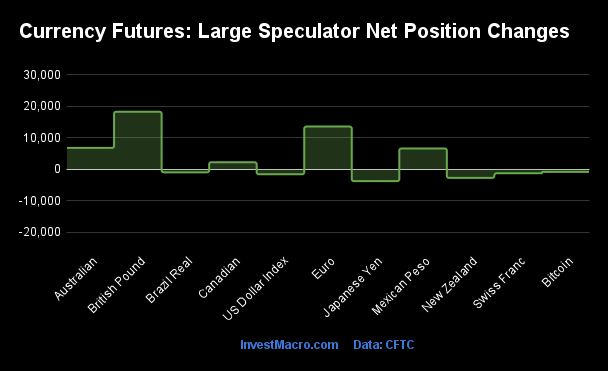
The COT currency market speculator bets were lower this week as five out of the eleven currency markets we cover had higher positioning while the other six markets had lower speculator contracts.

Leading the gains for the currency markets was the New Zealand Dollar (7,531 contracts) with the Australian Dollar (4,828 contracts), Mexican Peso (3,881 contracts), US Dollar Index (2,057 contracts) and the Brazilian Real (1,079 contracts) also showing positive weeks.

The currencies seeing declines in speculator bets on the week were the British Pound (-22,349 contracts) with the EuroFX (-19,456 contracts), the Swiss Franc (-7,627 contracts), the Canadian Dollar (-7,455 contracts), the Japanese Yen (-4,476 contracts) and Bitcoin (-738 contracts) also registering lower bets on the week.

Spotlight: Large Currency Traders continue to pare Euro Bullish Bets to 49-Week Low

Highlighting the COT currency’s data this week is the continued weakness in the Euro Currency speculator positioning. Large speculative Euro positions fell sharply this week by over -19,000 contracts and dropped for a seventh consecutive week. Euro weekly positions have now declined in ten out of the past eleven weeks with a total decline of -99,889 contracts over these past eleven weeks.

This rapid cooling of the speculator bets has now taken the net position from a total of +178,832 contracts on July 18th to a total of +78,943 contracts through Tuesday. This brings the current level to the lowest standing in the past 49-weeks, dating back to October 25th of 2022.

Helping put a dampener on the Euro speculative position has been the likely end of the European Central Bank’s (ECB) rate hiking activity. The ECB recently raised their interest rate in September for a 10th straight meeting to 4 percent. However, the market expectation is that the rate hiking campaign is over for now which combined with subdued growth in the Eurozone puts a limited expectation for strength in the currency.

The Euro currency (EURUSD) spot price (vesus the US Dollar), however, did manage to eke out a small gain this week after falling for eleven straight weeks and touching the lowest level of the year under 1.0500. The EURUSD rebounded off the psychological level of 1.0500 this week and saw gains on Wednesday, Thursday and Friday to close the week right near the 1.0625 exchange rate.


Data Snapshot of Forex Market Traders | Columns Legend
Oct-03-2023OIOI-IndexSpec-NetSpec-IndexCom-NetCOM-IndexSmalls-NetSmalls-Index
USD Index42,3404118,81556-20,166441,35122
EUR702,4333978,94354-104,7525025,80920
GBP241,04562-6,6805117,54556-10,86537
JPY282,68298-113,9882117,86993-3,88146
CHF58,673100-16,7421127,36889-10,62623
CAD189,44353-40,1511738,581821,57026
AUD207,78264-81,9871497,26690-15,27915
NZD52,29162-7,6503510,71769-3,06713
MXN212,5394264,51479-67,248212,73429
RUB20,93047,54331-7,15069-39324
BRL41,0332716,63757-17,643431,00644
Bitcoin14,447651,05682-1,475041922


Strength Scores led by Bitcoin & Mexican Peso

COT Strength Scores (a normalized measure of Speculator positions over a 3-Year range, from 0 to 100 where above 80 is Extreme-Bullish and below 20 is Extreme-Bearish) showed that the Bitcoin (82 percent) and the Mexican Peso (79 percent) currently lead the currency markets this week. The Brazilian Real (57 percent), the US Dollar Index (56 percent) and the EuroFX (54 percent) come in as the next highest in the weekly strength scores.

On the downside, the Japanese Yen (2 percent), the Swiss Franc (11 percent), the Australian Dollar (14 percent) and the Canadian Dollar (17 percent) come in at the lowest strength levels and are in Extreme-Bearish territory (below 20 percent).

Strength Statistics:
US Dollar Index (56.3 percent) vs US Dollar Index previous week (52.9 percent)
EuroFX (53.9 percent) vs EuroFX previous week (62.2 percent)
British Pound Sterling (51.1 percent) vs British Pound Sterling previous week (66.6 percent)
Japanese Yen (2.3 percent) vs Japanese Yen previous week (5.0 percent)
Swiss Franc (10.7 percent) vs Swiss Franc previous week (31.6 percent)
Canadian Dollar (17.1 percent) vs Canadian Dollar previous week (24.1 percent)
Australian Dollar (13.7 percent) vs Australian Dollar previous week (9.3 percent)
New Zealand Dollar (35.5 percent) vs New Zealand Dollar previous week (15.9 percent)
Mexican Peso (78.5 percent) vs Mexican Peso previous week (76.1 percent)
Brazilian Real (57.0 percent) vs Brazilian Real previous week (55.6 percent)
Bitcoin (82.3 percent) vs Bitcoin previous week (93.4 percent)


US Dollar Index & Brazilian Real top the 6-Week Strength Trends

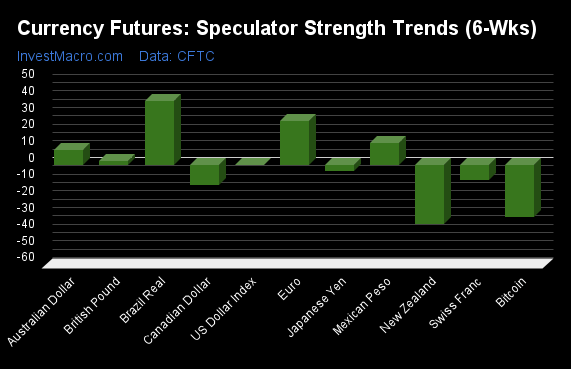
COT Strength Score Trends (or move index, calculates the 6-week changes in strength scores) showed that the US Dollar Index (24 percent) leads the past six weeks trends for the currencies and is the only currency with a positive 6-week trend.

The British Pound (-46 percent) leads the downside trend scores with the Swiss Franc (-35 percent), EuroFX (-34 percent) and the Canadian Dollar (-26 percent) following.

Strength Trend Statistics:
US Dollar Index (23.7 percent) vs US Dollar Index previous week (19.6 percent)
EuroFX (-34.0 percent) vs EuroFX previous week (-26.2 percent)
British Pound Sterling (-45.7 percent) vs British Pound Sterling previous week (-24.5 percent)
Japanese Yen (-11.1 percent) vs Japanese Yen previous week (-17.0 percent)
Swiss Franc (-35.3 percent) vs Swiss Franc previous week (-14.0 percent)
Canadian Dollar (-26.2 percent) vs Canadian Dollar previous week (-19.8 percent)
Australian Dollar (-16.7 percent) vs Australian Dollar previous week (-30.6 percent)
New Zealand Dollar (-3.0 percent) vs New Zealand Dollar previous week (-33.2 percent)
Mexican Peso (-5.6 percent) vs Mexican Peso previous week (-13.1 percent)
Brazilian Real (-2.0 percent) vs Brazilian Real previous week (-10.1 percent)
Bitcoin (-6.9 percent) vs Bitcoin previous week (37.7 percent)


Individual COT Forex Markets:

US Dollar Index Futures:
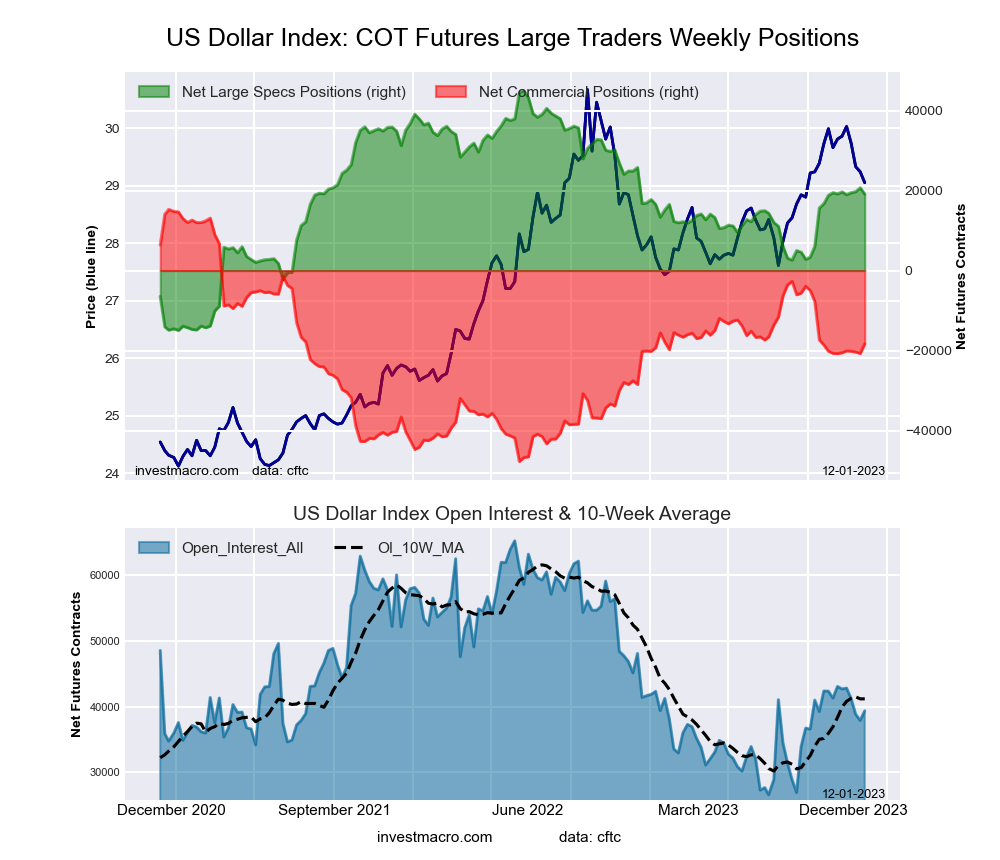
US Dollar Index Forex Futures COT ChartThe US Dollar Index large speculator standing this week recorded a net position of 18,815 contracts in the data reported through Tuesday. This was a weekly advance of 2,057 contracts from the previous week which had a total of 16,758 net contracts.

This week’s current strength score (the trader positioning range over the past three years, measured from 0 to 100) shows the speculators are currently Bullish with a score of 56.3 percent. The commercials are Bearish with a score of 43.7 percent and the small traders (not shown in chart) are Bearish with a score of 22.0 percent.

Price Trend-Following Model: Strong Uptrend

Our weekly trend-following model classifies the current market price position as: Strong Uptrend. The current action for the model is considered to be: Hold – Maintain Long Position.

US DOLLAR INDEX StatisticsSPECULATORSCOMMERCIALSSMALL TRADERS
– Percent of Open Interest Longs:66.319.610.7
– Percent of Open Interest Shorts:21.867.37.5
– Net Position:18,815-20,1661,351
– Gross Longs:28,0578,3134,530
– Gross Shorts:9,24228,4793,179
– Long to Short Ratio:3.0 to 10.3 to 11.4 to 1
NET POSITION TREND:
– Strength Index Score (3 Year Range Pct):56.343.722.0
– Strength Index Reading (3 Year Range):BullishBearishBearish
NET POSITION MOVEMENT INDEX:
– 6-Week Change in Strength Index:23.7-23.14.0


Euro Currency Futures:

Euro Currency Futures COT ChartThe Euro Currency large speculator standing this week recorded a net position of 78,943 contracts in the data reported through Tuesday. This was a weekly fall of -19,456 contracts from the previous week which had a total of 98,399 net contracts.

This week’s current strength score (the trader positioning range over the past three years, measured from 0 to 100) shows the speculators are currently Bullish with a score of 53.9 percent. The commercials are Bearish with a score of 50.0 percent and the small traders (not shown in chart) are Bearish with a score of 20.2 percent.

Price Trend-Following Model: Strong Downtrend

Our weekly trend-following model classifies the current market price position as: Strong Downtrend. The current action for the model is considered to be: Hold – Maintain Short Position.

EURO Currency StatisticsSPECULATORSCOMMERCIALSSMALL TRADERS
– Percent of Open Interest Longs:30.155.311.7
– Percent of Open Interest Shorts:18.970.28.1
– Net Position:78,943-104,75225,809
– Gross Longs:211,783388,47382,432
– Gross Shorts:132,840493,22556,623
– Long to Short Ratio:1.6 to 10.8 to 11.5 to 1
NET POSITION TREND:
– Strength Index Score (3 Year Range Pct):53.950.020.2
– Strength Index Reading (3 Year Range):BullishBearishBearish
NET POSITION MOVEMENT INDEX:
– 6-Week Change in Strength Index:-34.035.8-25.2


British Pound Sterling Futures:

British Pound Sterling Futures COT ChartThe British Pound Sterling large speculator standing this week recorded a net position of -6,680 contracts in the data reported through Tuesday. This was a weekly reduction of -22,349 contracts from the previous week which had a total of 15,669 net contracts.

This week’s current strength score (the trader positioning range over the past three years, measured from 0 to 100) shows the speculators are currently Bullish with a score of 51.1 percent. The commercials are Bullish with a score of 55.5 percent and the small traders (not shown in chart) are Bearish with a score of 36.7 percent.

Price Trend-Following Model: Strong Downtrend

Our weekly trend-following model classifies the current market price position as: Strong Downtrend. The current action for the model is considered to be: Hold – Maintain Short Position.

BRITISH POUND StatisticsSPECULATORSCOMMERCIALSSMALL TRADERS
– Percent of Open Interest Longs:30.756.310.2
– Percent of Open Interest Shorts:33.449.014.7
– Net Position:-6,68017,545-10,865
– Gross Longs:73,911135,63724,678
– Gross Shorts:80,591118,09235,543
– Long to Short Ratio:0.9 to 11.1 to 10.7 to 1
NET POSITION TREND:
– Strength Index Score (3 Year Range Pct):51.155.536.7
– Strength Index Reading (3 Year Range):BullishBullishBearish
NET POSITION MOVEMENT INDEX:
– 6-Week Change in Strength Index:-45.746.1-32.3


Japanese Yen Futures:

Japanese Yen Forex Futures COT ChartThe Japanese Yen large speculator standing this week recorded a net position of -113,988 contracts in the data reported through Tuesday. This was a weekly fall of -4,476 contracts from the previous week which had a total of -109,512 net contracts.

This week’s current strength score (the trader positioning range over the past three years, measured from 0 to 100) shows the speculators are currently Bearish-Extreme with a score of 2.3 percent. The commercials are Bullish-Extreme with a score of 93.2 percent and the small traders (not shown in chart) are Bearish with a score of 45.6 percent.

Price Trend-Following Model: Strong Downtrend

Our weekly trend-following model classifies the current market price position as: Strong Downtrend. The current action for the model is considered to be: Hold – Maintain Short Position.

JAPANESE YEN StatisticsSPECULATORSCOMMERCIALSSMALL TRADERS
– Percent of Open Interest Longs:16.868.713.4
– Percent of Open Interest Shorts:57.127.014.7
– Net Position:-113,988117,869-3,881
– Gross Longs:47,544194,19337,744
– Gross Shorts:161,53276,32441,625
– Long to Short Ratio:0.3 to 12.5 to 10.9 to 1
NET POSITION TREND:
– Strength Index Score (3 Year Range Pct):2.393.245.6
– Strength Index Reading (3 Year Range):Bearish-ExtremeBullish-ExtremeBearish
NET POSITION MOVEMENT INDEX:
– 6-Week Change in Strength Index:-11.16.511.0


Swiss Franc Futures:

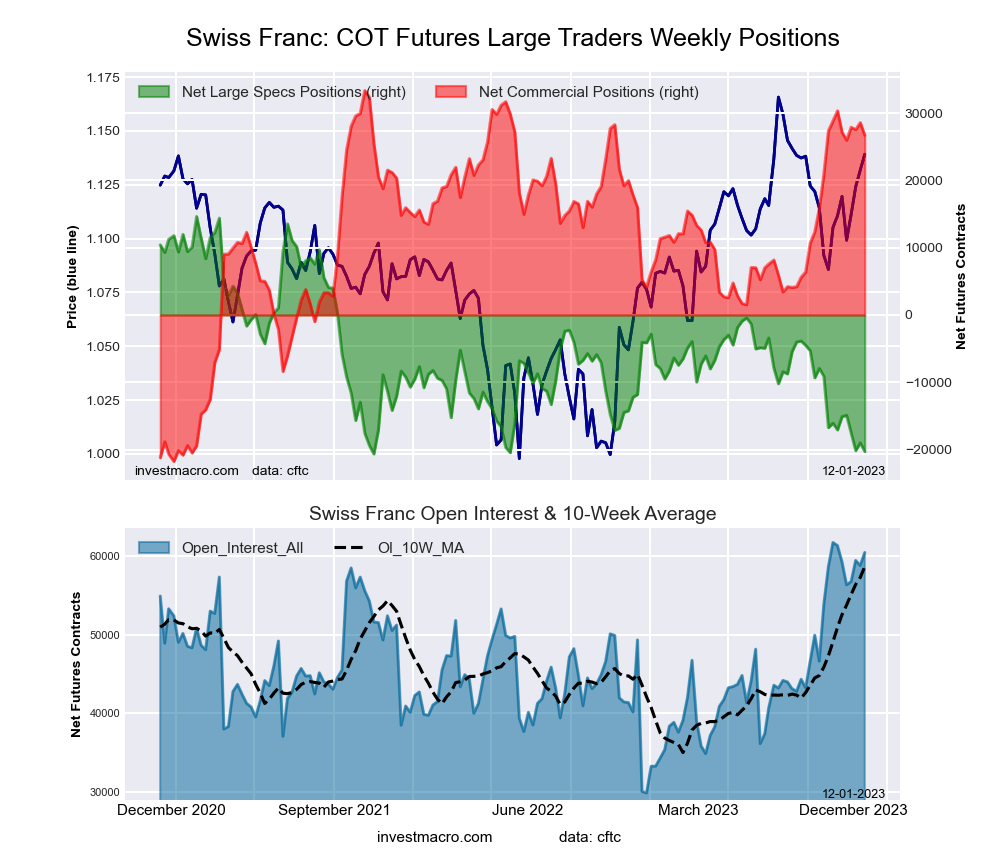
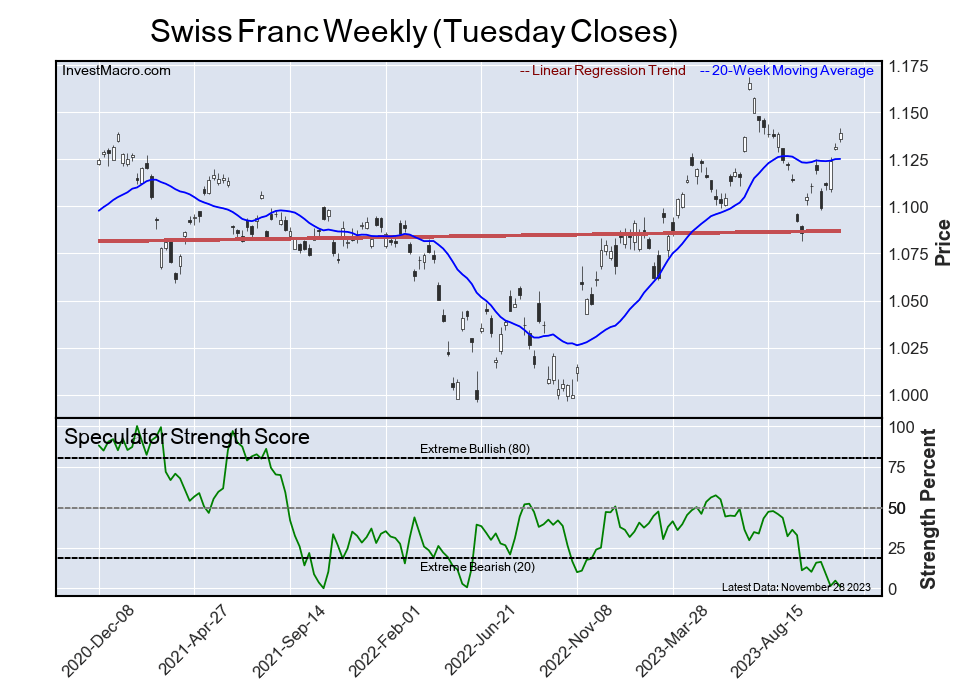
Swiss Franc Forex Futures COT ChartThe Swiss Franc large speculator standing this week recorded a net position of -16,742 contracts in the data reported through Tuesday. This was a weekly fall of -7,627 contracts from the previous week which had a total of -9,115 net contracts.

This week’s current strength score (the trader positioning range over the past three years, measured from 0 to 100) shows the speculators are currently Bearish-Extreme with a score of 10.7 percent. The commercials are Bullish-Extreme with a score of 89.1 percent and the small traders (not shown in chart) are Bearish with a score of 22.9 percent.

Price Trend-Following Model: Strong Downtrend

Our weekly trend-following model classifies the current market price position as: Strong Downtrend. The current action for the model is considered to be: New Sell – Short Position.

SWISS FRANC StatisticsSPECULATORSCOMMERCIALSSMALL TRADERS
– Percent of Open Interest Longs:19.065.615.4
– Percent of Open Interest Shorts:47.518.933.5
– Net Position:-16,74227,368-10,626
– Gross Longs:11,14338,4689,030
– Gross Shorts:27,88511,10019,656
– Long to Short Ratio:0.4 to 13.5 to 10.5 to 1
NET POSITION TREND:
– Strength Index Score (3 Year Range Pct):10.789.122.9
– Strength Index Reading (3 Year Range):Bearish-ExtremeBullish-ExtremeBearish
NET POSITION MOVEMENT INDEX:
– 6-Week Change in Strength Index:-35.339.4-32.0


Canadian Dollar Futures:

Canadian Dollar Forex Futures COT ChartThe Canadian Dollar large speculator standing this week recorded a net position of -40,151 contracts in the data reported through Tuesday. This was a weekly decline of -7,455 contracts from the previous week which had a total of -32,696 net contracts.

This week’s current strength score (the trader positioning range over the past three years, measured from 0 to 100) shows the speculators are currently Bearish-Extreme with a score of 17.1 percent. The commercials are Bullish-Extreme with a score of 82.4 percent and the small traders (not shown in chart) are Bearish with a score of 26.3 percent.

Price Trend-Following Model: Strong Downtrend

Our weekly trend-following model classifies the current market price position as: Strong Downtrend. The current action for the model is considered to be: Hold – Maintain Short Position.

CANADIAN DOLLAR StatisticsSPECULATORSCOMMERCIALSSMALL TRADERS
– Percent of Open Interest Longs:11.467.319.5
– Percent of Open Interest Shorts:32.646.918.6
– Net Position:-40,15138,5811,570
– Gross Longs:21,674127,50236,889
– Gross Shorts:61,82588,92135,319
– Long to Short Ratio:0.4 to 11.4 to 11.0 to 1
NET POSITION TREND:
– Strength Index Score (3 Year Range Pct):17.182.426.3
– Strength Index Reading (3 Year Range):Bearish-ExtremeBullish-ExtremeBearish
NET POSITION MOVEMENT INDEX:
– 6-Week Change in Strength Index:-26.215.312.5


Australian Dollar Futures:

Australian Dollar Forex Futures COT ChartThe Australian Dollar large speculator standing this week recorded a net position of -81,987 contracts in the data reported through Tuesday. This was a weekly lift of 4,828 contracts from the previous week which had a total of -86,815 net contracts.

This week’s current strength score (the trader positioning range over the past three years, measured from 0 to 100) shows the speculators are currently Bearish-Extreme with a score of 13.7 percent. The commercials are Bullish-Extreme with a score of 90.4 percent and the small traders (not shown in chart) are Bearish-Extreme with a score of 15.2 percent.

Price Trend-Following Model: Strong Downtrend

Our weekly trend-following model classifies the current market price position as: Strong Downtrend. The current action for the model is considered to be: Hold – Maintain Short Position.

AUSTRALIAN DOLLAR StatisticsSPECULATORSCOMMERCIALSSMALL TRADERS
– Percent of Open Interest Longs:19.068.610.0
– Percent of Open Interest Shorts:58.521.817.3
– Net Position:-81,98797,266-15,279
– Gross Longs:39,465142,57220,690
– Gross Shorts:121,45245,30635,969
– Long to Short Ratio:0.3 to 13.1 to 10.6 to 1
NET POSITION TREND:
– Strength Index Score (3 Year Range Pct):13.790.415.2
– Strength Index Reading (3 Year Range):Bearish-ExtremeBullish-ExtremeBearish-Extreme
NET POSITION MOVEMENT INDEX:
– 6-Week Change in Strength Index:-16.715.4-5.3


New Zealand Dollar Futures:

New Zealand Dollar Forex Futures COT ChartThe New Zealand Dollar large speculator standing this week recorded a net position of -7,650 contracts in the data reported through Tuesday. This was a weekly increase of 7,531 contracts from the previous week which had a total of -15,181 net contracts.

This week’s current strength score (the trader positioning range over the past three years, measured from 0 to 100) shows the speculators are currently Bearish with a score of 35.5 percent. The commercials are Bullish with a score of 69.1 percent and the small traders (not shown in chart) are Bearish-Extreme with a score of 13.5 percent.

Price Trend-Following Model: Downtrend

Our weekly trend-following model classifies the current market price position as: Downtrend. The current action for the model is considered to be: Hold – Maintain Short Position.

NEW ZEALAND DOLLAR StatisticsSPECULATORSCOMMERCIALSSMALL TRADERS
– Percent of Open Interest Longs:30.464.44.8
– Percent of Open Interest Shorts:45.043.910.6
– Net Position:-7,65010,717-3,067
– Gross Longs:15,89533,6512,497
– Gross Shorts:23,54522,9345,564
– Long to Short Ratio:0.7 to 11.5 to 10.4 to 1
NET POSITION TREND:
– Strength Index Score (3 Year Range Pct):35.569.113.5
– Strength Index Reading (3 Year Range):BearishBullishBearish-Extreme
NET POSITION MOVEMENT INDEX:
– 6-Week Change in Strength Index:-3.03.4-4.3


Mexican Peso Futures:

Mexican Peso Futures COT ChartThe Mexican Peso large speculator standing this week recorded a net position of 64,514 contracts in the data reported through Tuesday. This was a weekly advance of 3,881 contracts from the previous week which had a total of 60,633 net contracts.

This week’s current strength score (the trader positioning range over the past three years, measured from 0 to 100) shows the speculators are currently Bullish with a score of 78.5 percent. The commercials are Bearish with a score of 21.3 percent and the small traders (not shown in chart) are Bearish with a score of 28.6 percent.

Price Trend-Following Model: Strong Downtrend

Our weekly trend-following model classifies the current market price position as: Strong Downtrend. The current action for the model is considered to be: New Sell – Short Position.

MEXICAN PESO StatisticsSPECULATORSCOMMERCIALSSMALL TRADERS
– Percent of Open Interest Longs:42.753.72.8
– Percent of Open Interest Shorts:12.485.41.5
– Net Position:64,514-67,2482,734
– Gross Longs:90,848114,1855,986
– Gross Shorts:26,334181,4333,252
– Long to Short Ratio:3.4 to 10.6 to 11.8 to 1
NET POSITION TREND:
– Strength Index Score (3 Year Range Pct):78.521.328.6
– Strength Index Reading (3 Year Range):BullishBearishBearish
NET POSITION MOVEMENT INDEX:
– 6-Week Change in Strength Index:-5.65.4-0.2


Brazilian Real Futures:

Brazil Real Futures COT ChartThe Brazilian Real large speculator standing this week recorded a net position of 16,637 contracts in the data reported through Tuesday. This was a weekly boost of 1,079 contracts from the previous week which had a total of 15,558 net contracts.

This week’s current strength score (the trader positioning range over the past three years, measured from 0 to 100) shows the speculators are currently Bullish with a score of 57.0 percent. The commercials are Bearish with a score of 43.0 percent and the small traders (not shown in chart) are Bearish with a score of 43.8 percent.

Price Trend-Following Model: Strong Downtrend

Our weekly trend-following model classifies the current market price position as: Strong Downtrend. The current action for the model is considered to be: Hold – Maintain Short Position.

BRAZIL REAL StatisticsSPECULATORSCOMMERCIALSSMALL TRADERS
– Percent of Open Interest Longs:61.031.97.0
– Percent of Open Interest Shorts:20.574.94.6
– Net Position:16,637-17,6431,006
– Gross Longs:25,02913,0862,888
– Gross Shorts:8,39230,7291,882
– Long to Short Ratio:3.0 to 10.4 to 11.5 to 1
NET POSITION TREND:
– Strength Index Score (3 Year Range Pct):57.043.043.8
– Strength Index Reading (3 Year Range):BullishBearishBearish
NET POSITION MOVEMENT INDEX:
– 6-Week Change in Strength Index:-2.06.0-31.0


Bitcoin Futures:

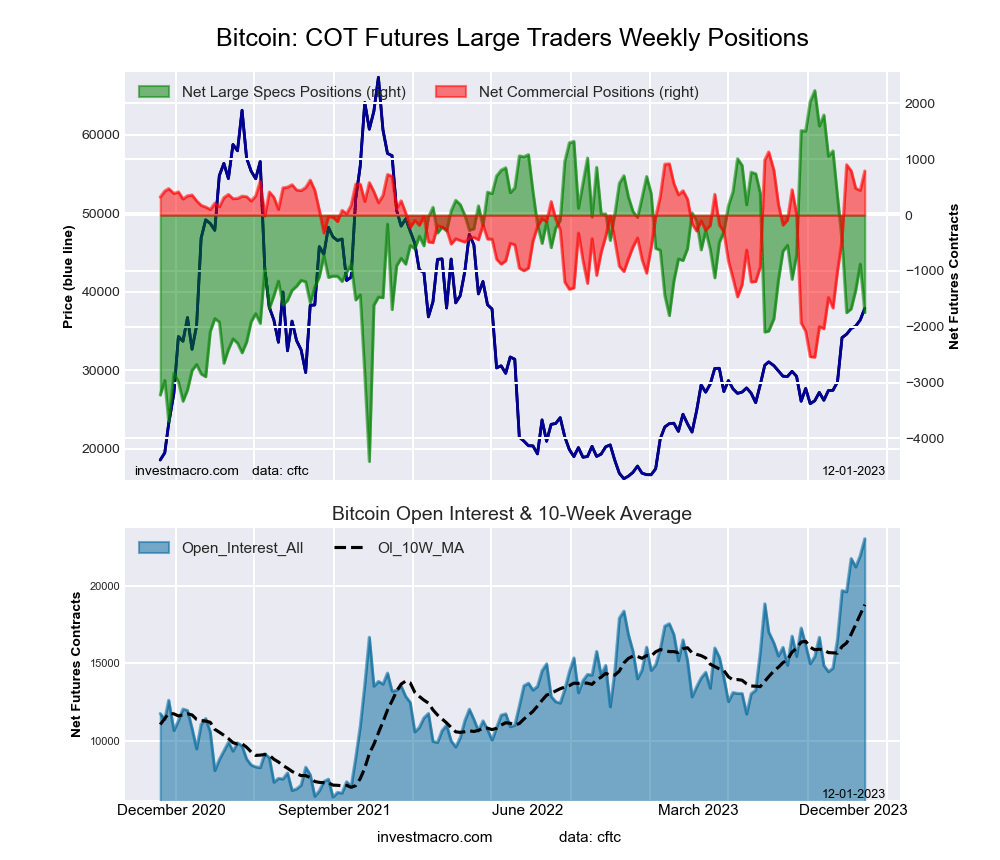
Bitcoin Crypto Futures COT ChartThe Bitcoin large speculator standing this week recorded a net position of 1,056 contracts in the data reported through Tuesday. This was a weekly reduction of -738 contracts from the previous week which had a total of 1,794 net contracts.

This week’s current strength score (the trader positioning range over the past three years, measured from 0 to 100) shows the speculators are currently Bullish-Extreme with a score of 82.3 percent. The commercials are Bearish with a score of 29.1 percent and the small traders (not shown in chart) are Bearish with a score of 22.5 percent.

Price Trend-Following Model: Weak Downtrend

Our weekly trend-following model classifies the current market price position as: Weak Downtrend. The current action for the model is considered to be: Hold – Maintain Short Position.

BITCOIN StatisticsSPECULATORSCOMMERCIALSSMALL TRADERS
– Percent of Open Interest Longs:82.81.18.3
– Percent of Open Interest Shorts:75.511.35.4
– Net Position:1,056-1,475419
– Gross Longs:11,9641611,195
– Gross Shorts:10,9081,636776
– Long to Short Ratio:1.1 to 10.1 to 11.5 to 1
NET POSITION TREND:
– Strength Index Score (3 Year Range Pct):82.329.122.5
– Strength Index Reading (3 Year Range):Bullish-ExtremeBearishBearish
NET POSITION MOVEMENT INDEX:
– 6-Week Change in Strength Index:-6.912.40.1


Article By InvestMacroReceive our weekly COT Newsletter

*COT Report: The COT data, released weekly to the public each Friday, is updated through the most recent Tuesday (data is 3 days old) and shows a quick view of how large speculators or non-commercials (for-profit traders) were positioned in the futures markets.

The CFTC categorizes trader positions according to commercial hedgers (traders who use futures contracts for hedging as part of the business), non-commercials (large traders who speculate to realize trading profits) and nonreportable traders (usually small traders/speculators) as well as their open interest (contracts open in the market at time of reporting). See CFTC criteria here.


Speculator Extremes: VIX, Heating Oil, Dow-Mini & 2-Year lead COT Bullish & Bearish Positions

By InvestMacro 

The latest update for the weekly Commitment of Traders (COT) report was released by the Commodity Futures Trading Commission (CFTC) on Friday for data ending on October 3rd.

This weekly Extreme Positions report highlights the Most Bullish and Most Bearish Positions for the speculator category. Extreme positioning in these markets can foreshadow strong moves in the underlying market.

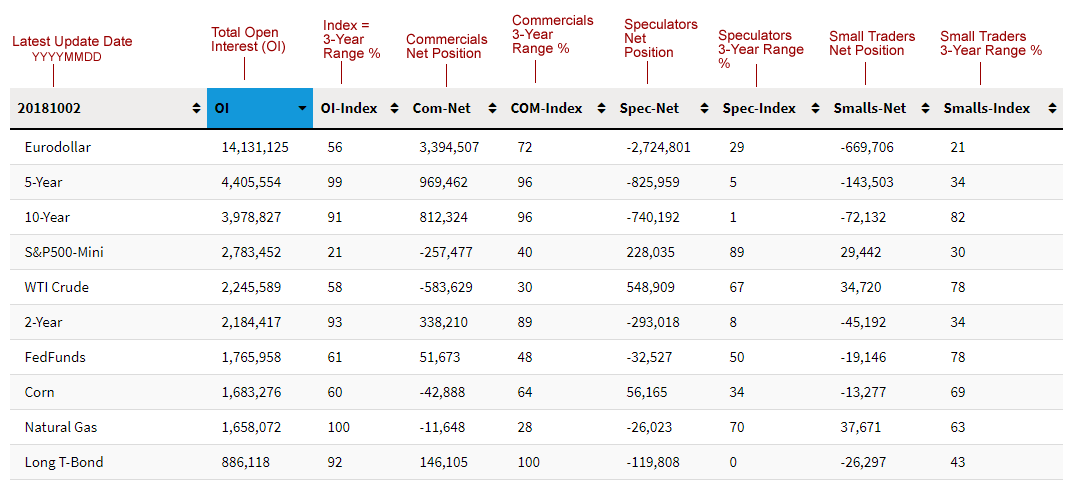
To signify an extreme position, we use the Strength Index (also known as the COT Index) of each instrument, a common method of measuring COT data. The Strength Index is simply a comparison of current trader positions against the range of positions over the previous 3 years. We use over 80 percent as extremely bullish and under 20 percent as extremely bearish. (Compare Strength Index scores across all markets in the data table or cot leaders table)


Here Are This Week’s Most Bullish Speculator Positions:

VIX


The VIX speculator position comes in as the most bullish extreme standing this week. The VIX speculator level is currently at a 94.0 percent score of its 3-year range.

The six-week trend for the percent strength score totaled -4.7 this week. The overall net speculator position was a total of -34,193 net contracts this week with a change of 18,642 contract in the weekly speculator bets.


Speculators or Non-Commercials Notes:

Speculators, classified as non-commercial traders by the CFTC, are made up of large commodity funds, hedge funds and other significant for-profit participants. The Specs are generally regarded as trend-followers in their behavior towards price action – net speculator bets and prices tend to go in the same directions. These traders often look to buy when prices are rising and sell when prices are falling. To illustrate this point, many times speculator contracts can be found at their most extremes (bullish or bearish) when prices are also close to their highest or lowest levels.

These extreme levels can be dangerous for the large speculators as the trade is most crowded, there is less trading ammunition still sitting on the sidelines to push the trend further and prices have moved a significant distance. When the trend becomes exhausted, some speculators take profits while others look to also exit positions when prices fail to continue in the same direction. This process usually plays out over many months to years and can ultimately create a reverse effect where prices start to fall and speculators start a process of selling when prices are falling.


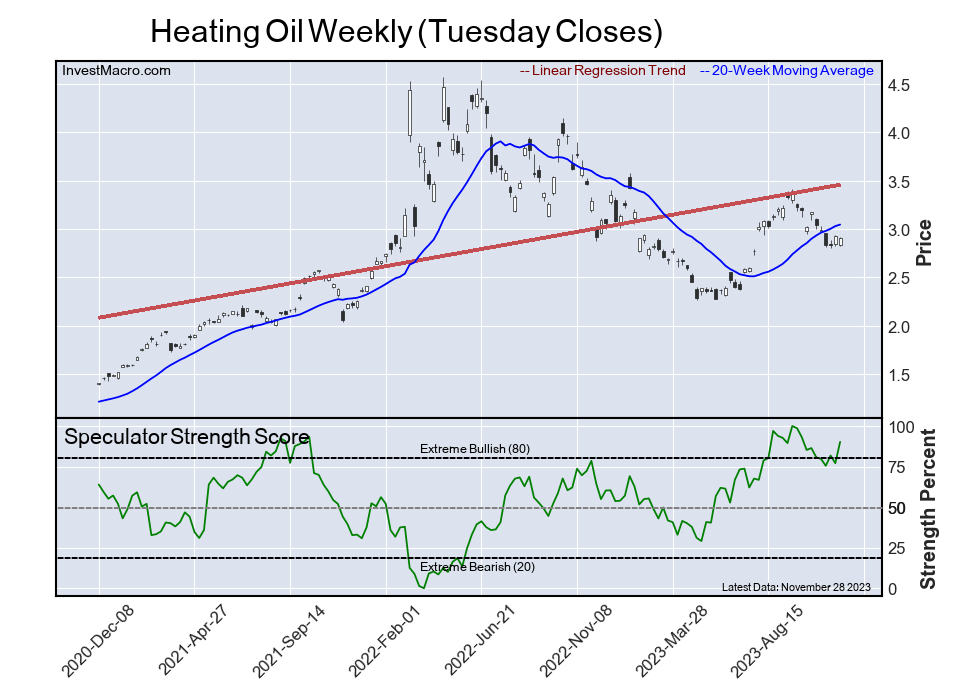
Heating Oil


The Heating Oil speculator position comes next in the extreme standings this week. The Heating Oil speculator level is now at a 93.0 percent score of its 3-year range.

The six-week trend for the percent strength score was -3.9 this week. The speculator position registered 38,946 net contracts this week with a weekly change of -3,181 contracts in speculator bets.


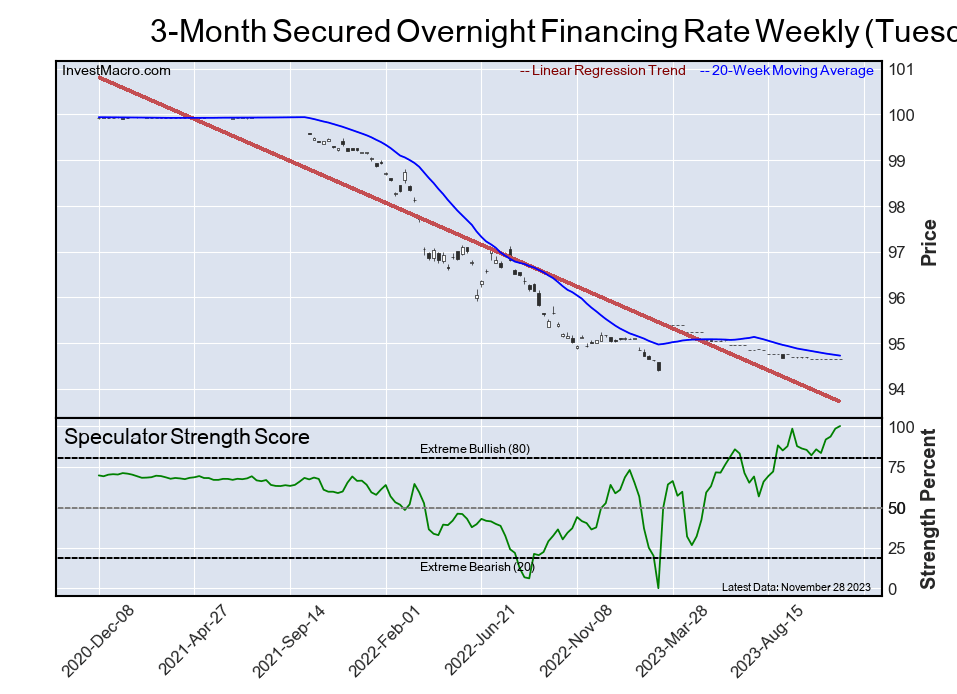
3-Month Secured Overnight Financing Rate


The 3-Month Secured Overnight Financing Rate speculator position comes in third this week in the extreme standings. The 3-Month Secured Overnight Financing Rate speculator level resides at a 87.6 percent score of its 3-year range.

The six-week trend for the speculator strength score came in at 14.4 this week. The overall speculator position was 292,306 net contracts this week with a change of -24,840 contracts in the weekly speculator bets.


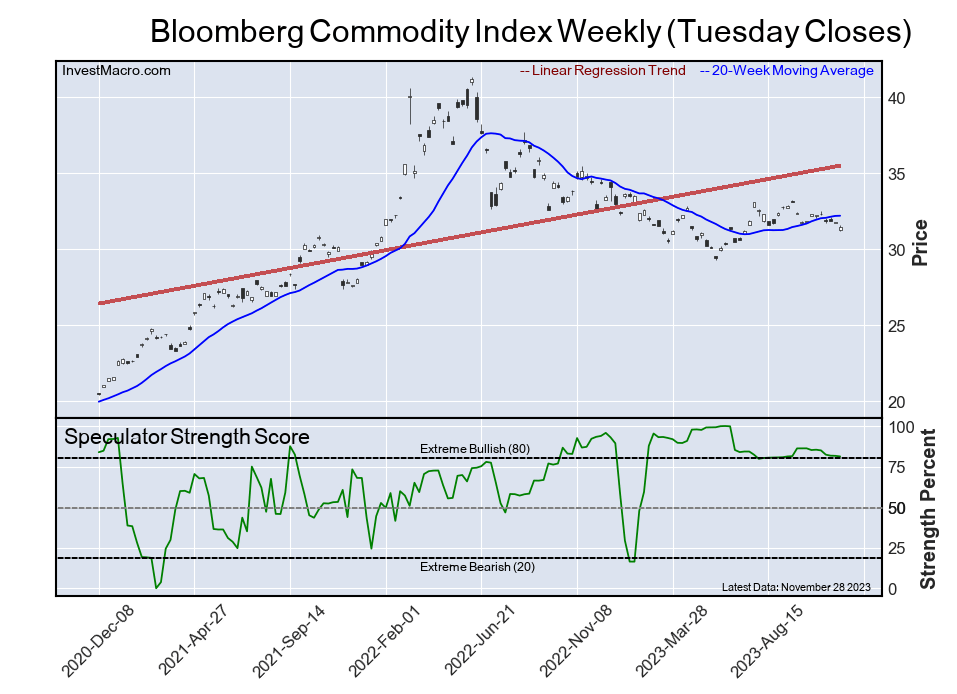
Bloomberg Commodity Index


The Bloomberg Commodity Index speculator position comes up number four in the extreme standings this week. The Bloomberg Commodity Index speculator level is at a 86.2 percent score of its 3-year range.

The six-week trend for the speculator strength score totaled a change of 5.7 this week. The overall speculator position was -5,136 net contracts this week with a change of 1 contracts in the speculator bets.


Bitcoin


The Bitcoin speculator position rounds out the top five in this week’s bullish extreme standings. The Bitcoin speculator level sits at a 82.3 percent score of its 3-year range. The six-week trend for the speculator strength score was -6.9 this week.

The speculator position was 1,056 net contracts this week with a change of -738 contracts in the weekly speculator bets.


This Week’s Most Bearish Speculator Positions:

DowJones Mini


The DowJones Mini speculator position comes in as the most bearish extreme standing this week. The DowJones Mini speculator level is at a 0.0 percent score of its 3-year range.

The six-week trend for the speculator strength score was -42.6 this week. The overall speculator position was -32,447 net contracts this week with a change of -10,829 contracts in the speculator bets.


2-Year Bond


The 2-Year Bond speculator position comes in next for the most bearish extreme standing on the week. The 2-Year Bond speculator level is at a 0.0 percent score of its 3-year range.

The six-week trend for the speculator strength score was -0.5 this week. The speculator position was -1,278,301 net contracts this week with a change of -68,001 contracts in the weekly speculator bets.


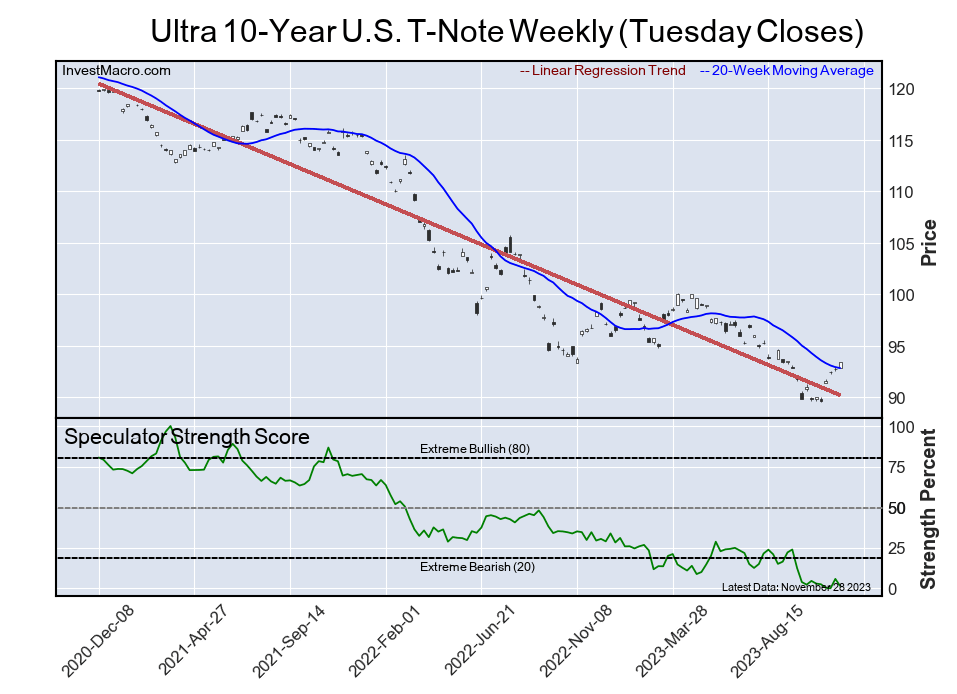
Ultra 10-Year U.S. T-Note


The Ultra 10-Year U.S. T-Note speculator position comes in as third most bearish extreme standing of the week. The Ultra 10-Year U.S. T-Note speculator level resides at a 0.0 percent score of its 3-year range.

The six-week trend for the speculator strength score was -17.8 this week. The overall speculator position was -244,907 net contracts this week with a change of -46,781 contracts in the speculator bets.


Soybeans


The Soybeans speculator position comes in as this week’s fourth most bearish extreme standing. The Soybeans speculator level is at a 0.0 percent score of its 3-year range.

The six-week trend for the speculator strength score was -16.8 this week. The speculator position was 22,503 net contracts this week with a change of -23,985 contracts in the weekly speculator bets.


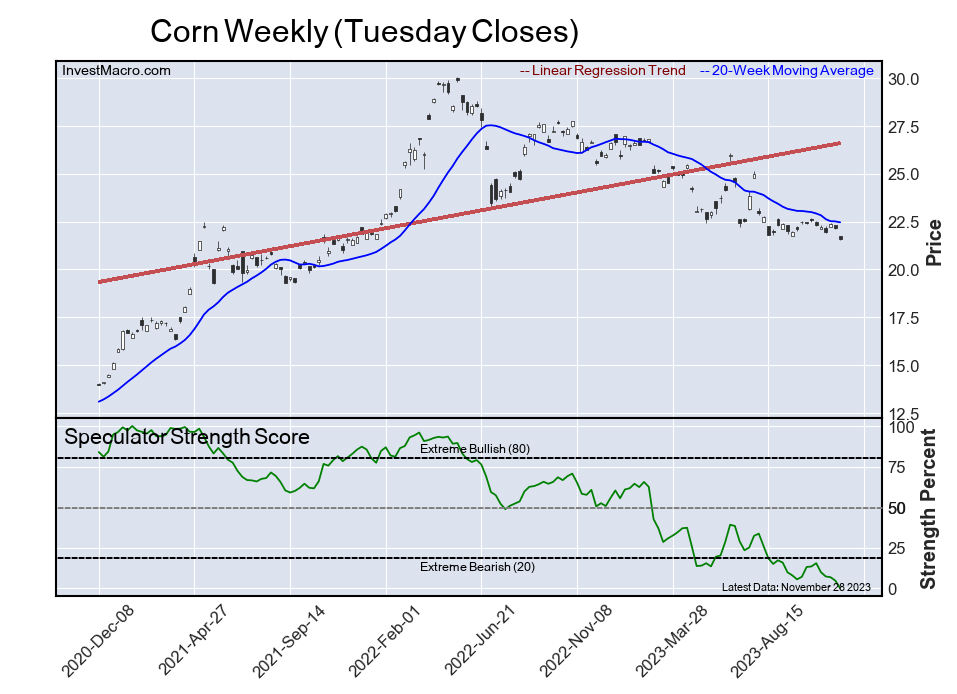
Corn


Finally, the Corn speculator position comes in as the fifth most bearish extreme standing for this week. The Corn speculator level is at a 1.7 percent score of its 3-year range.

The six-week trend for the speculator strength score was -8.4 this week. The speculator position was -107,544 net contracts this week with a change of 10,996 contracts in the weekly speculator bets.


Article By InvestMacroReceive our weekly COT Newsletter

*COT Report: The COT data, released weekly to the public each Friday, is updated through the most recent Tuesday (data is 3 days old) and shows a quick view of how large speculators or non-commercials (for-profit traders) were positioned in the futures markets.

The CFTC categorizes trader positions according to commercial hedgers (traders who use futures contracts for hedging as part of the business), non-commercials (large traders who speculate to realize trading profits) and nonreportable traders (usually small traders/speculators) as well as their open interest (contracts open in the market at time of reporting). See CFTC criteria here.