Archive for Opinions – Page 63

How Red Sea attacks on cargo ships could disrupt deliveries and push up prices – a logistics expert explains

By Gokcay Balci, University of Bradford 

Attacks on international cargo ships in the Red Sea from Houthi-controlled Yemen have seen several cargo vessels hit by missiles and drones in recent days.

In response, global shipping companies and cargo owners – including some of the world’s largest container lines such as Maersk, as well as energy giant BP – have diverted ships from the Red Sea. So far, more than 40 container ships have been diverted, with many rerouted to less direct channels than the Suez Canal – an artificial waterway in Egypt that connects the Mediterranean Sea to the Red Sea.

Opened in 1869, the Suez Canal is one of the busiest canals in the world, carrying around 12% of global trade. In 2022, 23,583 ships used this route. Any disruptions can have severe knock-on effects as these ships deliver goods from one country to another. Ultimately, this can even feed into the prices you pay for certain goods, as well as the time it takes to get things delivered from overseas.

Remember when the container vessel Ever Given got stuck in the Suez Canal for six days in 2021? It affected the shipping lane for weeks, playing havoc with global supply chains and disrupting global trade flow to the tune of billions. Previously, when the Suez Canal closed between 1967 and 1975 due to the six-day war between Israel and a group of Arab states, global trade was also negatively affected. Ships had to sale around South Africa’s Cape of Good Hope instead – a much longer route.

While there is also a Northern Sea route that ships can take, it is not navigable in winter season and not yet commercially viable for many shipping companies. And so, the Suez Canal is the shortest and most suitable sea route between Asia and Europe.

Longer journeys will impact global supply chains

The sailing time between eastern Asia and western Europe can increase by about 25-35% when ships use the Cape route. For instance, a vessel travelling at 13.8 knots per hour (the current average speed of global container ships) between Shanghai, China and the Port of Felixstowe in the UK will see its sailing time increase from an average of 31 days to 41 days when sailing around the Cape.

It’s even worse for exporters shipping goods from say Italy to Dubai – the Cape route could take them 160% more time than the Suez route (12 days versus 32 days). These sailing times could be more for container vessels as they stop at other ports along their routes.

When it comes to comparing costs for the two routes though, the figures are not straight forward. Vessels passing through Suez Canal need to pay a toll. This can be as much as US$700,000 (£550,000) for a vessel carrying 20,000 containers (a typical large container vessel commonly used for east to west trades). But the Cape route could still cost 10% more, even with the canal transit fee, according to research published in 2022. The exact cost difference also depends on current fuel prices, as well as size and the type of vessel.

But it will be the reduced shipping capacity due to longer transit times, not the increased operating costs of shipowners, that will really weigh on global supply chains. This is because freight rates (the price companies pay to transport goods) depend on supply and demand.

It was a supply and demand imbalance that caused shipping costs to skyrocket during the COVID pandemic. Shipping supply was reduced because of disruptions, but demand increased because people were spending more on goods than services during lockdown. This time, the magnitude of freight rate increases is unlikely to be as large because there is no indication of a surge in demand for shipping services.

How shipping disruption affects you

If you live in the UK and have ordered new sofa from a manufacturer in China, you could expect a delay of at least ten days. The prices of certain products could also rise if freight levels increase significantly. An International Monetary Fund forecast shows a doubling of shipping costs could increase consumer price inflation by 0.7% percent.

However, sea freight activity generally has a marginal impact on most consumer prices – it only makes up 0.35% of prices for some types of clothing, for example. On the other hand, oil prices could spike if more energy companies follow BP and stop using Suez Canal, especially if this disruption persists over time. The price of Brent Crude – a global benchmark for oil – has already risen from US$73 on December 12 to about US$78 on December 18 2023.

Although you might not have to pay more for the products you buy, there is another cost of this situation, for people and the planet: increased carbon emissions. More than 3,000 extra nautical miles will be taken by vessels using Cape route, which could generate around 30-35% more carbon emissions than if these ships were sailing the Suez route. The shipping industry already creates 3% of global emissions.

Shipowners will be forced to keep diverting ships from the Red Sea if attacks on vessels continue. Of course, it remains to be seen when and how this problem will be solved. Until it is, uncertainty and change could continue to affect your pocket – and the planet.The Conversation

About the Author:

Gokcay Balci, Assistant Professor in Logistics and Supply Chain, University of Bradford

This article is republished from The Conversation under a Creative Commons license. Read the original article.


Santa Rally: Why the S&P 500 tends to climb this time of year?

By ForexTime 

  • SPX500_m pushing higher today to kick off “Santa Rally” period
  • “Santa Rally” period typically refers to last trading week of December and first 2 trading days of new year
  • S&P 500 has climbed in 4 out of the past 5 “Santa Rally” periods
  • US stocks soared this year due to AI-mania and hopes for Fed rate cuts in 2024
  • SPX500_m should have enough reasons to reach new record high next year


The SPX500_m is edging higher on this first trading day after Christmas.

NOTE: The SPX500_m tracks the underlying S&P 500 index, which is the benchmark used to measure the overall performance of US stock markets.

Gains today (Tuesday, December 26th) and in the days ahead, would prove true the seasonal occurrence of a “Santa Rally”.


What is a “Santa Rally”?

The classic Santa Rally sees US stock markets rising around Christmastime, and going into the new year.

According to research going back to 1950, this “Santa Rally” period specifically refers to the last week of December and the first two trading days of the new year.

This year-end period has produced a positive return for the S&P 500 nearly 79% of the time.

Furthermore, December has historically been a favourable month for US stocks.

According to Dow Jones, the S&P 500 has ended higher in December more often than any other month.

No other similar duration of trading sessions is more likely to be higher.

The statistics also indicate that this seven-day span has averaged a 1.3% gain which is the third-best seven-day run of the year.


Still, market commentators tend to use the ‘Santa Rally’ term quite broadly to refer to either the entire month of December or a relatively longer time period.

After all, the SPX500_m has been soaring since early November, and really for much of this year (more on that in a bit).


“Santa Rally” happened in 4 out of the past five year-end seasons

Hence, if we take further liberties with the supposed timeframe, extending it from the first post-Christmas trading day until the first weekend of the new year, here’s how the S&P 500 has fared during this festive period:

  • 2022 – 2023 = +1.3%
  • 2021 – 2022 = -1%
  • 2020 – 2021 = +3.3%
  • 2019 – 2020 = +1.4%
  • 2018 – 2019 = +4.8%

Of course in some years, stock markets have performed poorly, as was the case at the tail-end of 2021 as stocks continued to struggle with the prospects of incoming Fed rate hikes.

So, seasonality and calendar theories are not a guaranteed way to make profits as it is tough to predict what will impact markets in any given year.


5 potential causes for a “Santa Rally”

There are numerous reasons why the last few days of December and the first couple in the new year are good ones for stock markets.

  1. The January effect is often cited as institutional investors ready themselves ahead of and into the new year, to set up positions for the coming weeks and months.
  2. We also see a rebalancing of portfolios by major institutions for tax-loss selling in December to close out losses, followed by repurchasing in January.
  3. Certainly, the holiday period is a time of lower volumes when liquidity is thin. This can make it easier for bullish investors to move markets during the season of goodwill.
  4. Increased holiday shopping and optimism over the Christmas season may also include investing holiday bonuses.
  5. The impact may simply be a self-fulfilling one as investors know about the trend for a Santa rally so will buy stocks accordingly, leading to further gains.


Santa Rally would cap off a “magnificent” year for US stocks

Of course, 2023 has seen the “Magnificent Seven” take all the plaudits as they have propelled the major indices to (near)record highs.

Here’s a recap of the year so far for these 7 Big Tech stocks:

  • Apple and Nvidia secured new all-time peaks this calendar year.
  • Tesla and Meta more than doubled (climbed over 100% each) over the course of 2023.
  • Amazon, Alphabet (Google’s parent company), and Microsoft have each recorded year-to-date gains of 82.6%, 60.8%, and 56.2% respectively.

All that far surpasses the S&P 500’s year-to-date ascent of 23.8%.


That said, encouragingly the market breadth has broadened in recent months.

In general, the greater the number of stocks that are helping push the overall market higher, the more support the market has.


2023 Recap: What drove US stocks higher this year?

Simply put, US stocks have climbed higher this year due to the AI-mania as well as hopes for Fed rate cuts in 2024.

This once again shows that markets are forward-looking in nature: today’s prices reflects tomorrow’s expectations.

For the first half of the year, much of the gains for US stocks had been due to the optimism surrounding artificial intelligence (AI).

Hence, the stunning double- and triple-digit returns seen for the “Magnificent 7” (Apple, Microsoft, Amazon, Nvidia, Alphabet, Tesla, and Meta).


Then, US stocks pulled back between August through October, as doubts started to creep in about whether the AI-mania had gone too far.

Also, this Aug-Oct period was when markets heeded the Federal Reserve’s (Fed) messaging that interest rates could stay higher for longer as US inflation appeared stubbornly elevated.


However, after the Fed’s final two policy meetings of 2023 (early-November and mid-December), markets ramped up hopes that US interest rates will move lower in the new year.

Such hopes were solidified when FOMC members (Fed officials who vote on interest rates) themselves projected 75-basis points in rate cuts for 2024.

NOTE: US stocks, especially growth/tech stocks, tend to rejoice at the prospects of US interest rates moving lower.
This is because lower interest rates make it cheaper for such companies to borrow money and expand their respective businesses.


Can the SPX500_m keep climbing next year?

US stock markets are expected to enjoy another year of gains ahead, based on 2 key reasons:

1) The aforementioned Fed rate cuts

2) US Presidential Elections seasonality

Since 1980, the S&P 500 has posted an annual gain in every single year featuring a US Presidential Election, except during the 2000 dot com bubble and the 2008 Global Financial Crisis.


The two factors listed above have even prompted Wall Street to forecast a further 7.6% in gains for the S&P 500 over the next 12 months.

If those forecasts prove true, by this time next year …

We could see the S&P 500 index above the 5,100 mark for the first time in its history!


As things stand, the SPX500_m’s highest-ever intraday price now stands at 4820.0, posted on January 4th, 2022.

That said, barring a “black swan” event that blindsides investors and traders in the coming year …

The SPX500_m should have enough reasons to set a new record high in 2024!


Forex-Time-LogoArticle by ForexTime

ForexTime Ltd (FXTM) is an award winning international online forex broker regulated by CySEC 185/12 www.forextime.com

COT Speculator Extremes: Steel, DowJones, Soybeans & Bonds lead Bullish & Bearish Positions

By InvestMacro

The latest update for the weekly Commitment of Traders (COT) report was released by the Commodity Futures Trading Commission (CFTC) on Friday for data ending on December 19th.

This weekly Extreme Positions report highlights the Most Bullish and Most Bearish Positions for the speculator category. Extreme positioning in these markets can foreshadow strong moves in the underlying market.

To signify an extreme position, we use the Strength Index (also known as the COT Index) of each instrument, a common method of measuring COT data. The Strength Index is simply a comparison of current trader positions against the range of positions over the previous 3 years. We use over 80 percent as extremely bullish and under 20 percent as extremely bearish. (Compare Strength Index scores across all markets in the data table or cot leaders table)


Here Are This Week’s Most Bullish Speculator Positions:

Steel


The Steel speculator position comes in as the most bullish extreme standing this week. The Steel speculator level is currently at a 100.0 percent score of its 3-year range.

The six-week trend for the percent strength score totaled 5.6 this week. The overall net speculator position was a total of 130 net contracts this week with a rise by 615 contract in the weekly speculator bets.


Speculators or Non-Commercials Notes:

Speculators, classified as non-commercial traders by the CFTC, are made up of large commodity funds, hedge funds and other significant for-profit participants. The Specs are generally regarded as trend-followers in their behavior towards price action – net speculator bets and prices tend to go in the same directions. These traders often look to buy when prices are rising and sell when prices are falling. To illustrate this point, many times speculator contracts can be found at their most extremes (bullish or bearish) when prices are also close to their highest or lowest levels.

These extreme levels can be dangerous for the large speculators as the trade is most crowded, there is less trading ammunition still sitting on the sidelines to push the trend further and prices have moved a significant distance. When the trend becomes exhausted, some speculators take profits while others look to also exit positions when prices fail to continue in the same direction. This process usually plays out over many months to years and can ultimately create a reverse effect where prices start to fall and speculators start a process of selling when prices are falling.


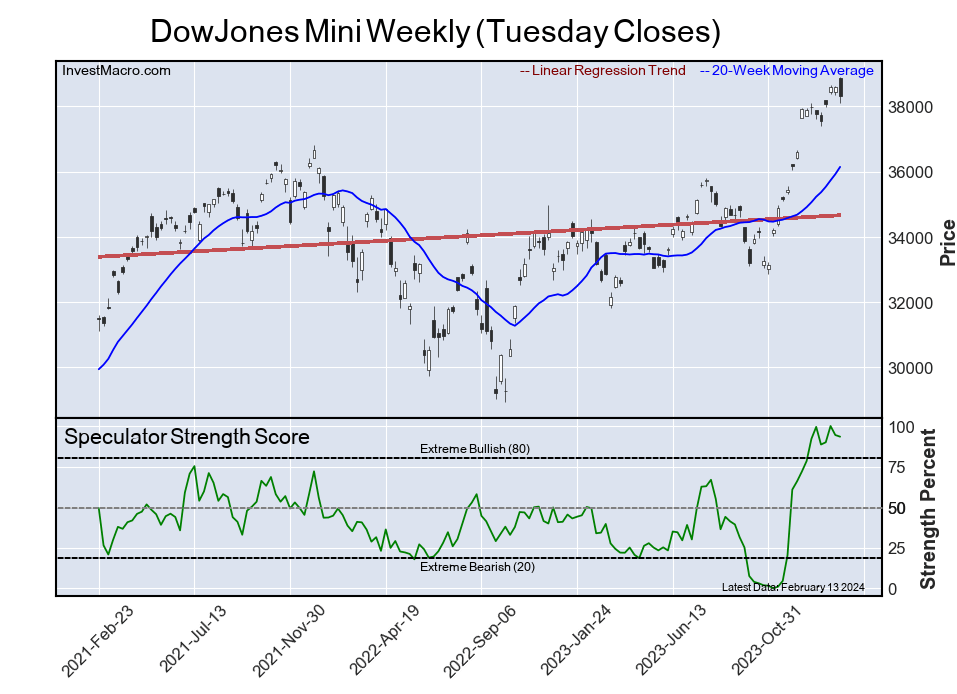
DowJones Mini


The DowJones Mini speculator position comes next in the extreme standings this week. The DowJones Mini speculator level is now at a 95.5 percent score of its 3-year range.

The six-week trend for the percent strength score was 95.5 this week. The speculator position registered 7,123 net contracts this week with a weekly gain of 3,672 contracts in speculator bets.


3-Month Secured Overnight Financing Rate


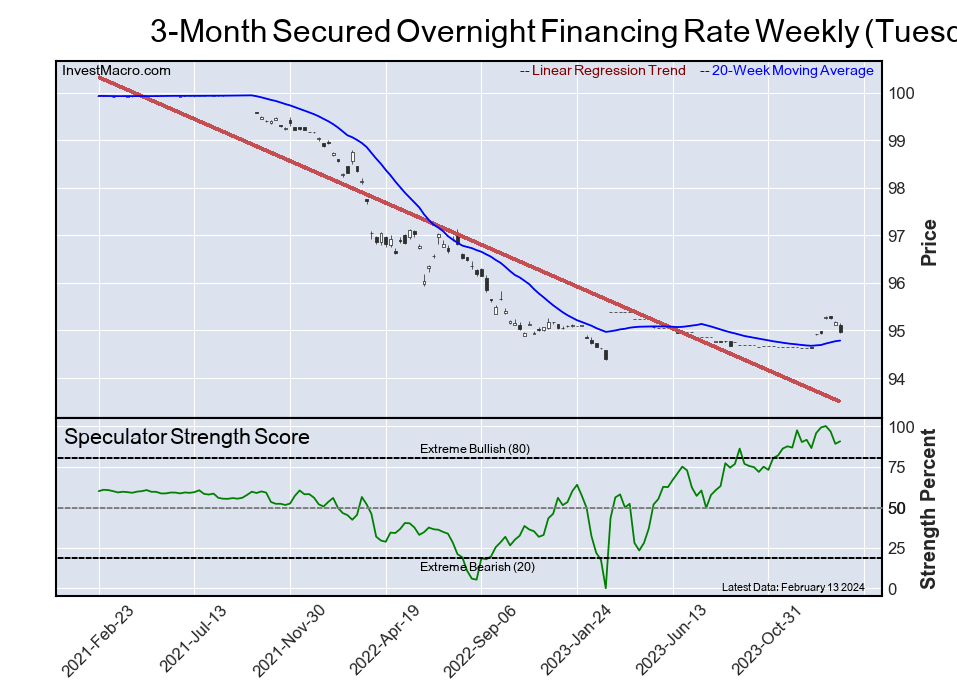
The 3-Month Secured Overnight Financing Rate speculator position comes in third this week in the extreme standings. The 3-Month Secured Overnight Financing Rate speculator level resides at a 92.5 percent score of its 3-year range.

The six-week trend for the speculator strength score came in at 10.1 this week. The overall speculator position was 577,707 net contracts this week with a drop of -140,519 contracts in the weekly speculator bets.


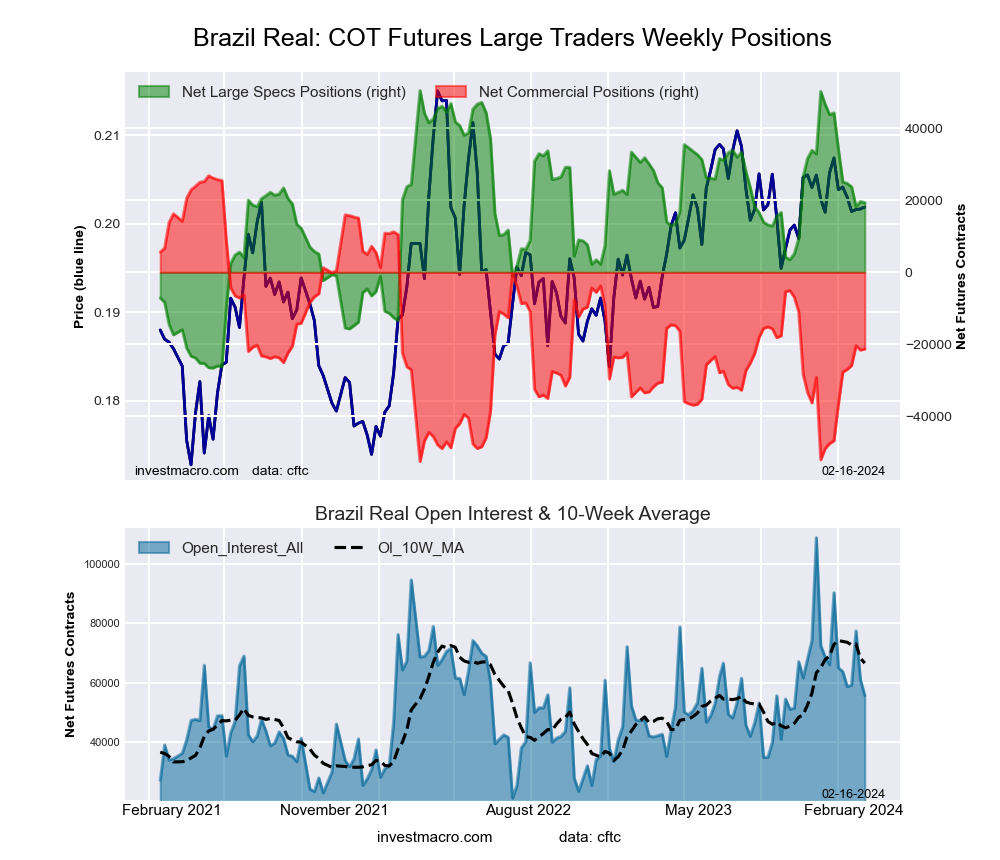
Brazil Real


The Brazil Real speculator position comes up number four in the extreme standings this week. The Brazil Real speculator level is at a 91.4 percent score of its 3-year range.

The six-week trend for the speculator strength score totaled a change of 22.4 this week. The overall speculator position was 43,832 net contracts this week with a decline of -2,832 contracts in the speculator bets.


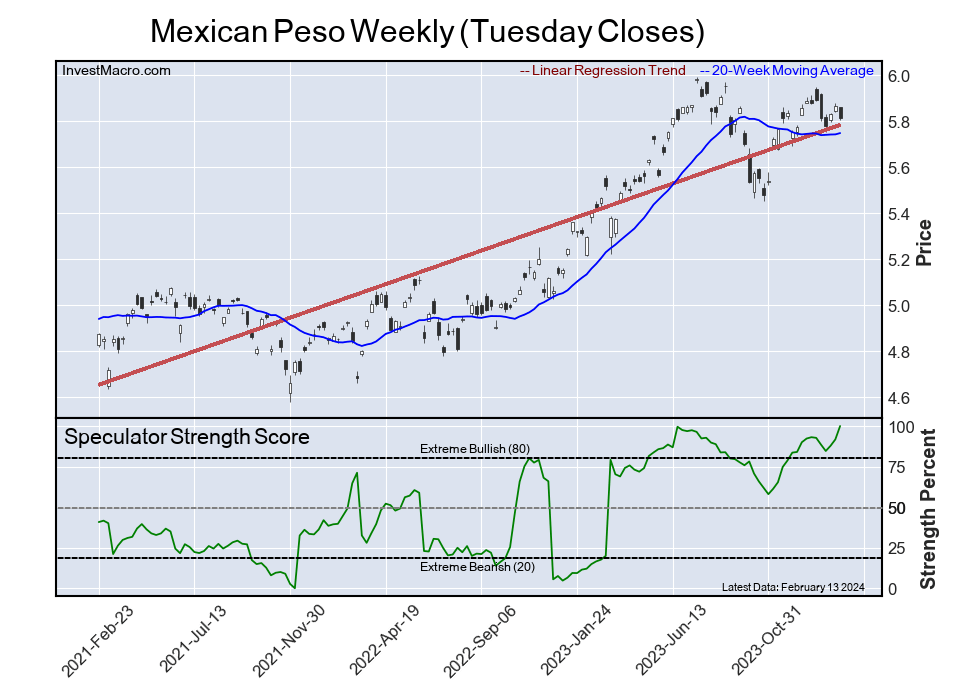
Mexican Peso


The Mexican Peso speculator position rounds out the top five in this week’s bullish extreme standings. The Mexican Peso speculator level sits at a 90.4 percent score of its 3-year range. The six-week trend for the speculator strength score was 28.8 this week.

The speculator position was 84,001 net contracts this week with a boost by 9,876 contracts in the weekly speculator bets.


This Week’s Most Bearish Speculator Positions:

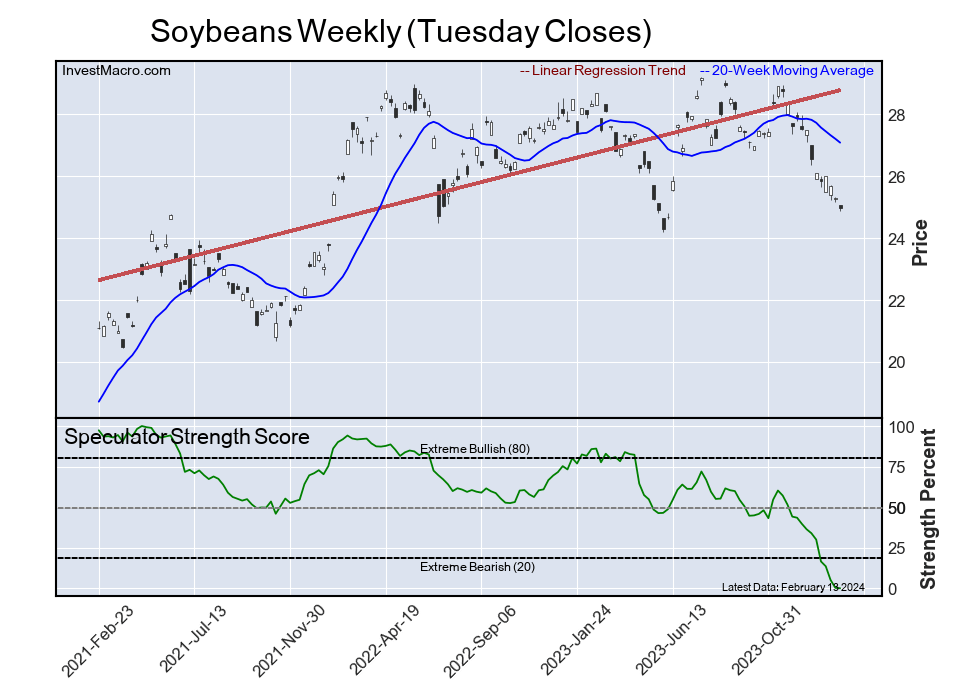
Soybeans


The Soybeans speculator position comes in as the most bearish extreme standing this week. The Soybeans speculator level is at a 0.0 percent score of its 3-year range.

The six-week trend for the speculator strength score was -23.8 this week. The overall speculator position was 1,998 net contracts this week with a drop of -15,541 contracts in the speculator bets.


Ultra 10-Year U.S. T-Note


The Ultra 10-Year U.S. T-Note speculator position comes in next for the most bearish extreme standing on the week. The Ultra 10-Year U.S. T-Note speculator level is at a 2.0 percent score of its 3-year range.

The six-week trend for the speculator strength score was -0.2 this week. The speculator position was -265,218 net contracts this week with an increase by 11,258 contracts in the weekly speculator bets.


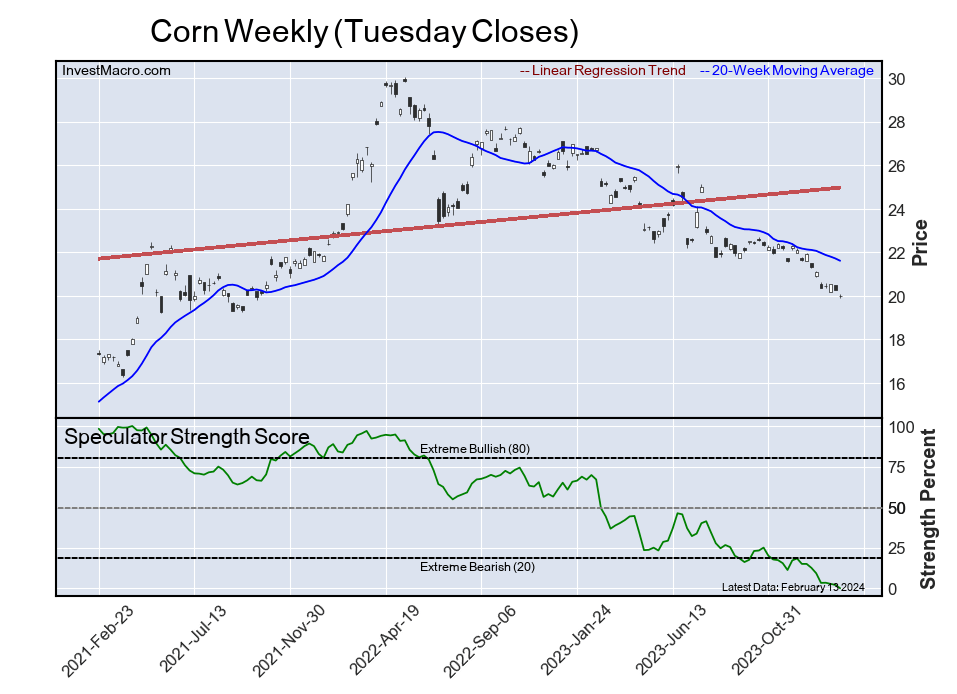
Corn


The Corn speculator position comes in as third most bearish extreme standing of the week. The Corn speculator level resides at a 4.2 percent score of its 3-year range.

The six-week trend for the speculator strength score was -3.1 this week. The overall speculator position was -127,570 net contracts this week with a decrease of -26,355 contracts in the speculator bets.


5-Year Bond


The 5-Year Bond speculator position comes in as this week’s fourth most bearish extreme standing. The 5-Year Bond speculator level is at a 5.1 percent score of its 3-year range.

The six-week trend for the speculator strength score was 2.2 this week. The speculator position was -1,388,222 net contracts this week with a decline of -48,102 contracts in the weekly speculator bets.


Soybean Oil


Finally, the Soybean Oil speculator position comes in as the fifth most bearish extreme standing for this week. The Soybean Oil speculator level is at a 8.6 percent score of its 3-year range.

The six-week trend for the speculator strength score was -18.2 this week. The speculator position was -16,356 net contracts this week with a decrease of -10,552 contracts in the weekly speculator bets.


Article By InvestMacroReceive our weekly COT Newsletter

*COT Report: The COT data, released weekly to the public each Friday, is updated through the most recent Tuesday (data is 3 days old) and shows a quick view of how large speculators or non-commercials (for-profit traders) were positioned in the futures markets.

The CFTC categorizes trader positions according to commercial hedgers (traders who use futures contracts for hedging as part of the business), non-commercials (large traders who speculate to realize trading profits) and nonreportable traders (usually small traders/speculators) as well as their open interest (contracts open in the market at time of reporting). See CFTC criteria here.

How government payments to the vulnerable can multiply to create economic growth for everyone

By Conrad Nunnenmacher, United Nations University; Franziska Gassmann, Maastricht University, and Julieta Morais, United Nations University 

The economic fallout of COVID-19 left people around the world facing a significant threat to their livelihood. As governments scrambled to mitigate the pandemic’s impact on their populations, many decided to use direct payments to support vulnerable citizens.

More than a sixth of the world’s population received some sort of cash transfer in 2020. These programmes were a key source of support for many people during the COVID-19 pandemic, with governments across the globe scaling up or introducing such payments.

Brazil, for example, introduced the Auxílio Emergencial programme, while the US implemented Economic Impact Payments. Both cash transfer programmes aimed to shield vulnerable populations. This was also not exclusive to middle- and high-income countries. Togo, for instance, implemented the Novissi cash transfer programme during the pandemic.

Using cash payments to protect people’s livelihoods and lift the poor out of poverty is not a novel strategy. It can be a simple way to provide basic social protection to people in need, helping citizens to withstand sudden shocks and also facilitating their recovery after a crisis.

Cash assistance as financial burden?

But cash transfers still attract a lot of debate. Besides typical concerns like creating dependency and reducing labour supply, these programmes are costly. This can cause concern about their sustainability and hinder the initial implementation and scale-up.

For example, the Social Assistance Grants for Empowerment programme in Uganda in 2010 became so politicised that it was challenged every step of the way to its implementation and later expansion. Even before its pilot programme, concerns regarding its financial sustainability and the potential creation of welfare dependencies were raised by politicians.

During periods of economic crisis, austerity policies can also directly influence social assistance initiatives. After the 2010 economic crisis, for example, Greece initially suspended and subsequently terminated its housing benefit programme, attributing this decision to budget constraints.

But cash transfer programmes aren’t “handouts”. The positive impacts on the people that receive them are well documented. They are powerful instruments for strengthening household resilience and fostering opportunities that can extend beyond the immediate recipients.

The multiplier effect

There is another vital element of social cash transfers that most people aren’t aware of: the economic multiplier effect. In a recent study with Ugo Gentilini, Giorgia Valleriani and Yuko Okamura of the World Bank, and Giulio Bordon of the UN’s International Labour Organization, we found the multiplier effect can greatly enhance the financial sustainability of social cash transfer programmes.

The core concept is that every dollar transferred that is spent rather than saved can increase the total income in the economy beyond its original value.

Consider a smallholder farmer who uses some of her grant to buy fertiliser at the local market. The local merchant profits from it and then spends this additional income, increasing profits for someone else and setting off a ripple effect through the economy. These taxable gains go beyond the people that get the payment, effectively “multiplying” the original grant’s worth for the economy.

Investing in the entire economy

We reviewed 23 studies of 19 cash assistance programmes across 13 countries and found substantial evidence of this multiplier effect from social cash transfers.

In Brazil, for example, Bolsa Família, the current national social welfare programme of Brazil and one of the largest cash transfer programmes in the world, was found to increase real GDP per R$1 (£0.16) spent by R$1.04. This is a small but positive spillover into the Brazilian economy.

Another noteworthy example is the GiveDirectly initiative in rural western Kenya, a pilot programme that offered a US$1,000 (£791) one-off transfer to 10,500 poor households. This programme led to a strong positive economic shock with a multiplier of 2.5 per US$1. So, every US$1 transferred generated a value of US$2.50 locally – a strong positive spillover to the local economy.

Social cash transfers have the potential to not only support the poor and vulnerable, but also to stimulate the wider economy. Rather than simply accepting the general perception of social transfers as an expense, we should start recognising their true value as an investment in a country’s entire economy.The Conversation

About the Authors:

Conrad Nunnenmacher, PhD Research Fellow in Innovation, Economics, Governance and Sustainable Development, United Nations University; Franziska Gassmann, Professor of Social Protection and Development, Maastricht University, and Julieta Morais, Researcher in Social Protection, United Nations University

This article is republished from The Conversation under a Creative Commons license. Read the original article.

4 business lessons from the Boston Tea Party

By Jay L. Zagorsky, Boston University 

December 2023 marks the 250th anniversary of the Boston Tea Party, one of the most famous events leading up to the Revolutionary War. On the night of Dec. 16, 1773, Colonists marched aboard three ships and threw more than 90,000 pounds of tea into Boston Harbor. No one died, and the only things injured were the tea leaves, but this event helped precipitate a major war.

I am a business school professor who often drives by the Tea Party site while taking his wife to work. Each time, I ponder the lessons this “party” has for people in business. Many aren’t obvious. Here are four that come to mind.

1) Publicity is important

There were actually 10 “tea party” protests across the 13 Colonies in the late 1770s. However, only one ended up in the history books. The others, including a second one in Boston just four months afterward, were largely forgotten. Getting the word out fast, which in those days was done by newspaper, is key. Otherwise, you can do a lot of work that will be ignored.

2) Dramatic changes in the market can cause problems

The volume of tea imports into the Colonies rose at a very fast rate in the four years leading up to the Boston Tea Party. They went from 55 tons in 1770, which was close to the amount dumped in the harbor, to 370 tons the year the tea was dumped. This was an increase of almost seven times. The population of the Colonies was about 2 million people in 1770 and didn’t expand much in that four-year period. Basic economics tells us this dramatic increase in supply without more customers meant the price of tea had to fall a lot.

We don’t know for sure the identities of the ringleaders who convinced people to dump the tea. As a business school professor, I believe it’s clear that some protesters were protecting their commercial interests. Shopkeepers, merchants and smugglers who had stocks of tea on hand didn’t want to see 90,000 more pounds of tea flooding the market. It would make them lose money. Dumping the tea in the harbor was a way of protecting their investment.

3) Even relatively small dollar amounts make big impressions

For all the fuss about the tea that was dumped, the damages weren’t huge. The British East India Company reported 9,659 English pounds in damages. That would be about 1.2 million pounds in today’s money, according to the Bank of England’s inflation calculator. Using the current exchange rate of $1.26 to a British pound means the tea dumped cost about US$1.5 million.

To give you a rough idea of how small this is, last year the U.S. imported half a billion dollars’ worth of tea. In terms of my favorite British import, the destroyed tea was worth about the same price as three Rolls-Royce Phantoms.

4) Timing matters … but it isn’t everything

The Tea Party happened on a night when the tide was especially low, with only 2 feet of water under the ships. Because the tide was so low, much of the tea didn’t get wet. Instead, it ended up in a giant pile, mostly dry, beside the boats. This meant the partygoers had to climb out of the boats and spend hours sloshing in the mud moving the tea into the water.

Given that the tea arrived at the end of November, they could have picked a time that would have made the job less difficult. Nonetheless, the revolutionaries weren’t deterred, since hard work can often overcome the worst timing.

The Tea Act of 1773 helped set the stage for the Revolutionary War.

When it comes down to it, history is more than just stories we tell children. The past contains many lessons for adults, including businesspeople. This incident, which played a key role in inciting the Revolutionary War that freed the American Colonies from British rule, is so much more than a cartoon image of men dumping chests of tea into Boston Harbor.The Conversation

About the Author:

Jay L. Zagorsky, Clinical Associate Professor of Markets, Public Policy and Law, Boston University

This article is republished from The Conversation under a Creative Commons license. Read the original article.

Top 4 global market risks for 2024

By George Prior 

Investors are facing a myriad of uncertainties that pose substantial risks to the stability and performance of global markets – but as ever where there are risks there are also significant opportunities.
Here, Nigel Green, the CEO and founder of deVere Group, one of the world’s largest independent financial advisory, asset management and fintech organizations shares what he believes are the four most significant risks confronting global markets in 2024 and examines their potential impact on investors.
1. Middle East crisis escalation
“One of the most pressing risks facing global markets is the potential escalation of the Middle East crisis. The October 7 attack by Hamas on Israel has heightened concerns about the possibility of the conflict spreading to involve other nations and groups in the region.
“Any escalation could disrupt global oil supplies, leading to increased market volatility. Investors are closely monitoring the situation, as heightened tensions may have profound implications for energy prices and overall market stability.
“Industries tied to energy, transportation, and commodities could experience significant fluctuations. Diversification and risk management strategies will be crucial for investors to navigate potential geopolitical shocks emanating from the Middle East.”
2. Resurgent inflation
“While inflation witnessed a decline from its 2022 peaks in most major economies, including the US, UK and eurozone, the specter of resurgent inflation remains a critical risk in 2024.
“Energy prices, a major driver of inflation, are known for their volatility, and any sudden surge could lead to an increase in the headline inflation rate.
“Central banks, in response, may be compelled to raise interest rates to curb inflationary pressures, defying market expectations of rate cuts.
“For investors, a scenario of rising inflation and higher interest rates poses challenges, particularly in fixed-income investments and interest-sensitive sectors.
“Corporate earnings could be impacted, and the heightened risk of recession may lead to a reassessment of investment portfolios. Investors must remain vigilant and adjust their strategies in response to changing inflation dynamics to preserve capital and optimize returns.”
3. Elections across the globe
“2024 is marked by decisive elections in over 40 countries, representing more than 50% of the world’s GDP.
“Elections introduce an element of political uncertainty, and outcomes can shape economic policies, trade relations, and market sentiments.
“Key players, including the UK, the US, China, India, Taiwan, South Korea, Ireland, South Africa and others, are set to undergo electoral processes that could have far-reaching consequences for global markets.
“Investors are likely to face increased volatility in the lead-up to and aftermath of elections. Shifts in political landscapes typically result in policy changes that impact various sectors, prompting investors to reassess their portfolios.”
4. China’s growth crisis
“Contrary to earlier forecasts, China’s post-COVID-19 reopening has not led to the anticipated growth in 2023.
“The real estate crisis, representing a significant portion of China’s GDP, has been a key impediment to economic recovery.
“As we enter 2024, the prospect of China’s economic stagnation looms large, carrying implications for trade partners and global markets.
“Investors with exposure to China or industries heavily reliant on Chinese demand may face challenges if the economic downturn persists. Supply chain disruptions, reduced consumer spending, and market volatility could ensue, impacting the performance of multinational corporations.”
The deVere CEO concludes: “The interplay of geopolitical tensions, inflationary pressures, electoral outcomes, and China’s economic woes underscores the need for a proactive and diversified approach to investment management to protect and grow personal wealth.”

About:

deVere Group is one of the world’s largest independent advisors of specialist global financial solutions to international, local mass affluent, and high-net-worth clients.  It has a network of more than 70 offices across the world, over 80,000 clients and $12bn under advisement.

Bank of Japan disappoints Yen bulls

By ForexTime 

  • Today, Bank of Japan offered zero guidance on rate hike in 2024
  • USDJPY climbs well past 200-day SMA
  • Higher-than-expected Japan CPI this Friday may see USJPY test 200-day SMA for support
  • Lower-than-expected Japan CPI may see USDJPY test 21-day SMA for resistance
  • Bloomberg model: 74% chance USDJPY will trade between 142.23-146.36 this week

Today, the BoJ maintained its benchmark rate at minus 0.1%, and made no changes to its yield curve control programme.

More disappointingly for JPY bulls (those hoping prices would move higher) …

the Japanese central bank failed to offer any hints of a rate hike in 2024.

This keeps Japan as the last economy that’s still holding on to negative interest rates (-0.1%).


How did the Yen react?

The absence of any “hawkish” clues prompted the Japanese Yen to weaken.

USDJPY surged above its 200-day simple moving average (SMA – a widely followed technical indicator).

The BoJ’s signal today, or lack thereof, also further fuelled the technical rebound in USDJPY, with the latter’s 14-day relative strength index (RSI) having broken below the 30 mark and into “oversold” territory.

NOTE: From the textbook perspective of technical analysis, an asset’s prices tends to rebound once its 14-day RSI breaks below 30.


In fact, at the time of writing, JPY is currently weaker against all of its G10 peers.

NOTE: Markets tend to boost the currency if they believe that economy’s interest rates are going to move higher, and vice versa.


How low could JPY go?

Perhaps not much, as long as markets can continue to hope for a BoJ rate hike in 2024.

And the earlier the better for Yen bulls.

To be clear, markets are still expecting the BoJ to exit its negative interest rates regime and finally jump on the rate-hike bandwagon in April.

Markets are still predicting an 86% chance of such an event, though those 86% odds are slightly lower compared to the 94% chance given prior to today’s BoJ policy decision.

As long as markets continue to hope for a BoJ rates liftoff, that should keep the Yen supported and limit its downside in the interim.

After all, Japan’s headline inflation (as measured by the consumer price index – CPI) has remained consistently above the BoJ’s target of 2% since April 2022.

Evidently, the BoJ wants to get further confirmation that inflation will remain sticky above 2%, before exiting its negative interest rates regime.

So with that in mind …


Look out for the next Japan inflation numbers due Friday (Dec 22nd)!

Economists are forecasting that Japan’s national CPI (consumer price index – which measures inflation) rose by 2.8% year-on-year (November 2023 vs. November 2022).

If so, that would be slightly lower than October’s 3.3% year-on-year CPI figure; but 2.8% is still well above the BoJ’s 2% inflation target.


How might JPY move before Christmas?

Bloomberg’s FX forecast model predicts a 74% chance that USDJPY will move between 142.23-146.36 this week.

  • If Japan’s national CPI this Friday comes in above the market-expected 2.8%, paving the way for a BoJ rate hike, that could see USDJPY re-testing its 200-day SMA for support.

    A daily close below the 200-day SMA may restore USDJPY to revisit the recent cycle low at 140.943 going into the new year.​​​​​​​


  • However, a lacklustre CPI figure this Friday that pushes back forecasts for a BoJ rate hike even further may extend USDJPY’s recovery.

    JPY bulls may be enticed into testing this FX pair’s 21-day SMA for resistance before the long Christmas weekend.


Forex-Time-LogoArticle by ForexTime

ForexTime Ltd (FXTM) is an award winning international online forex broker regulated by CySEC 185/12 www.forextime.com

Why empathy constitutes the ultimate leadership skill

By Julia Milner, EDHEC Business School 

When asked what traits constitute a good leader, you may be tempted to list traditional qualities such as rationality, cool-headedness, and overall, an ability to detach oneself from one’s emotions. However, research has shown that the ability to feel empathy toward one’s colleagues is in fact the most critical leadership skills, and much-overlooked. Empathy is on record for boosting employees’ ability to innovate, engage with the task at hand, balance work and life demands, and not least, motivate them to stay within the company.

So, what stands in the way of more of the good stuff spreading across companies’ higher echelons?

Thinking errors and empathy

For the past decade, I have devoted my career to studying how leaders learn coaching skills, working with young professionals and experienced executives as well as consulting with organisations on leadership development. Empathy was one of the nine core skills we looked into in our latest paper on effective leadership.

Managers, it turns out, rated expressing empathy as the most challenging communication skills, above asking questions and providing feedback.

The trend appears to be linked to a number of old-school thinking errors, such as:

  • All or nothing approach: “If I show a little empathy then I will have crying employees in front of me.”
  • Heavens-reward fallacy: “If I give my empathy, then I expect to be rewarded for it, so the other person owes me something and if they don’t give it back this proves I’m wasting my time.”
  • Implicit stereotype: “Leaders who show empathy are weak, so I better appear strong and tough.”

In truth, a strong leader is an empathic one. We are not weak because we care about others.

Dans un contexte d’augmentation des risques psychosociaux, ignorer les émotions au travail n’aide pas…
Melissa Hogan/Wikimedia commons, CC BY-SA

The challenge of remote working

Another perceived obstacle to empathy has been the culture of remote working. CEOs noted that virtual interactions, be them through e-meetings or e-mails, robbed them of in-person communication cues, such as body language.

However, workers on the receiving end did not appear to believe that remote working inherently privileged unsympathetic behaviour. In fact, some employees preferred e-mails on the basis that they gave them time to think and not react immediately, and sometimes impulsively.

Executives blaming remote working for their behaviour might therefore wish to reflect upon whether cognitive bias or stereotypes listed above, rather than working from home, might be impeding them from tapping into empathy.

Moreover, there are steps that can be taken to translate emotions to the virtual world. Remember: the important thing is not what you say, but how you say it. One of the things we’ve observed is that on video calls, participants often think that a screen means they can forget their own facial expressions. Conversely, some managers are so focused on how they present themselves that they stare at their own image and lose focus on listening.

It’s all about finding the right balance and getting used to showing empathy virtually. Managers should not forget their voice either, particularly during video calls, because the voice becomes very important when participants are doing several things at once, listening without necessarily looking at you all the time. In other words, signs of agitation or stress in the voice, or leaving little room for questions, will send signals of a lack of empathy.

Strengthen the empathy muscle

To get around these obstacles, here are a few tips on how to start showing empathy:

  • In every interaction, always remember to listen, ask questions and signal that show you’ve understood the messages – without falling into artificial communication. This will strengthen your empathy “muscle” through training and experience.
  • Record a video during daily interactions. Even if it’s initially strange to see ourselves on video or to analyse the “how” of our communication, these debriefing sessions can help identify certain mistakes.
  • Try to find someone who is known for their empathy. Observe and ask questions to improve.

Ignoring emotions at work doesn’t help to foster a productive environment. It’s high time we recognised empathy as the essential leadership skill that it is.The Conversation

Empathy at work: How to do it in four practical steps (Julien Milner).

About the Author:

Julia Milner, Professeure de leadership, EDHEC Business School

This article is republished from The Conversation under a Creative Commons license. Read the original article.


Japanese Yen Speculators reduce bearish bets to lowest since August

By InvestMacro

Here are the latest charts and statistics for the Commitment of Traders (COT) data published by the Commodities Futures Trading Commission (CFTC).

The latest COT data is updated through Tuesday December 12th and shows a quick view of how large market participants (for-profit speculators and commercial traders) were positioned in the futures markets. All currency positions are in direct relation to the US dollar where, for example, a bet for the euro is a bet that the euro will rise versus the dollar while a bet against the euro will be a bet that the euro will decline versus the dollar.

Weekly Speculator Changes led by the Japanese Yen & British Pound

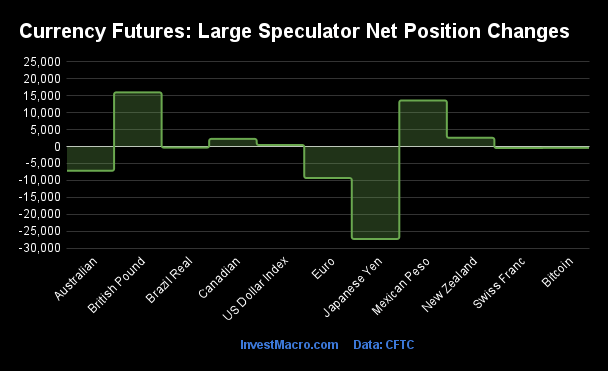
The COT currency market speculator bets were higher this week as eight out of the eleven currency markets we cover had higher positioning while the other three markets had lower speculator contracts.

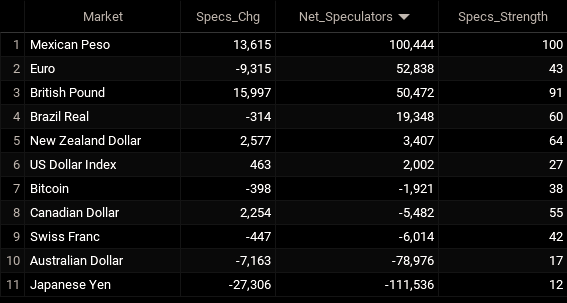
Leading the gains for the currency markets was the Japanese Yen (23,825 contracts) with the British Pound (9,916 contracts), the Australian Dollar (5,341 contracts), the Swiss Franc (3,378 contracts), the New Zealand Dollar (2,962 contracts) and the Mexican Peso (669 contracts) Bitcoin (183 contracts) and the Canadian Dollar (2,603 contracts) also showing positive weeks.

The currencies seeing declines in speculator bets on the week were the EuroFX (-5,033 contracts), the Brazilian Real (-3,580 contracts) and the US Dollar Index (-2,343 contracts).

Japanese Yen Speculators reduce bearish bets to lowest since August

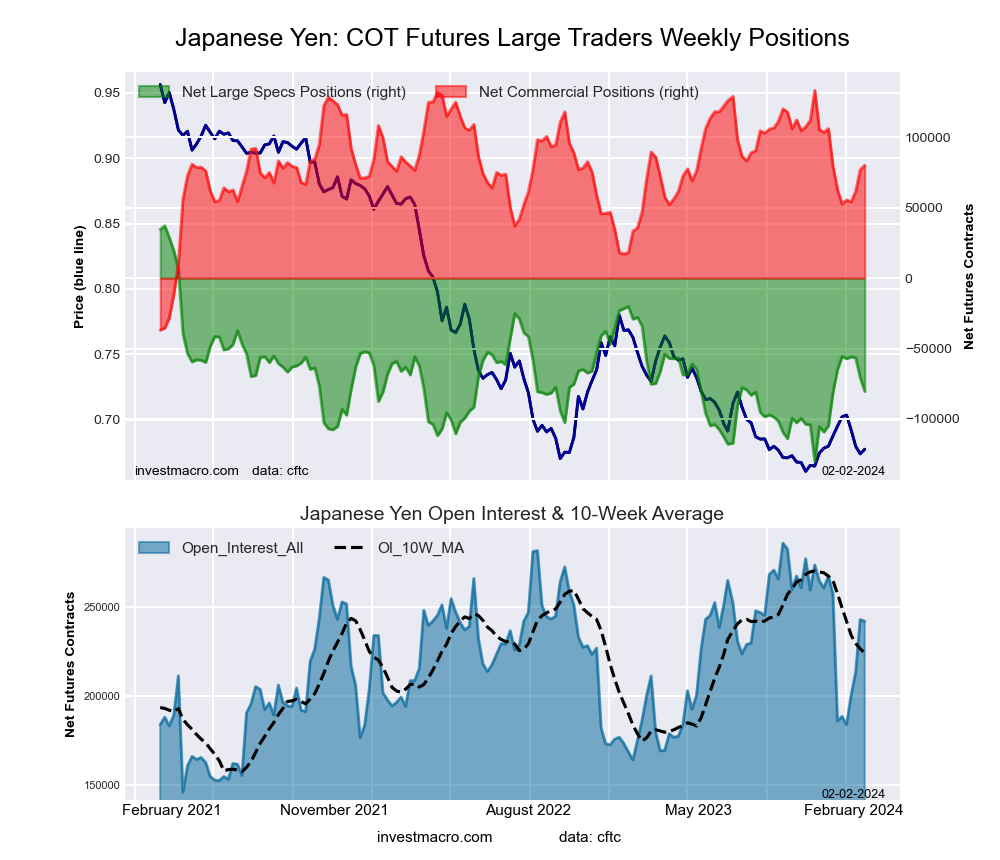
Highlighting the COT currency’s data this week was a sharp boost in sentiment for the Japanese yen speculators. Large speculative yen positions rose strongly this week by over +23,000 net contracts and gained for a second straight week as well as for the third time in four weeks. Over these past four weeks, the yen speculator bets now have improved by a total of +49,118 contracts.

This turn in sentiment has taken the overall bearish net positioning for speculators down to a current level of -81,131 contracts, marking the least bearish level since August.

The yen exchange rate continued to improve as well this week versus the US Dollar. The USDJPY currency pair fell for a fifth consecutive week this week (a lower USDJPY exchange rate means USD weakness and JPY strength) and closed at the 142.13 level. The USDJPY is off it’s most recent high in November by about 7 percent.

Helping the yen’s fortunes lately has been a general speculation that the Bank of Japan will look to end its negative interest rate policy sometime in the coming new year. Also, on the US Dollar side, this is combined with the US Federal Reserve’s dovish interest rate hold last week that has lent credence to the outlook that US interest rates will be on hold or even possibly be reduced over 2024.


Data Snapshot of Forex Market Traders | Columns Legend
Dec-12-2023OIOI-IndexSpec-NetSpec-IndexCom-NetCOM-IndexSmalls-NetSmalls-Index
USD Index41,3453817,60154-18,0324743115
EUR792,14984147,32783-182,3572135,03035
GBP243,6776321,58171-20,10134-1,48055
JPY257,58180-81,1312779,527741,60457
CHF65,186100-14,4741719,31375-4,83944
CAD213,87371-55,2451361,19390-5,94810
AUD208,92764-52,3404154,86858-2,52846
NZD58,30877-13,4882013,1097537954
MXN269,0746274,12584-79,064144,93943
RUB20,93047,54331-7,15069-39324
BRL68,6465446,66495-48,95552,29156
Bitcoin21,21189-2,067351,188087933


Strength Scores led by Brazilian Real & Mexican Peso

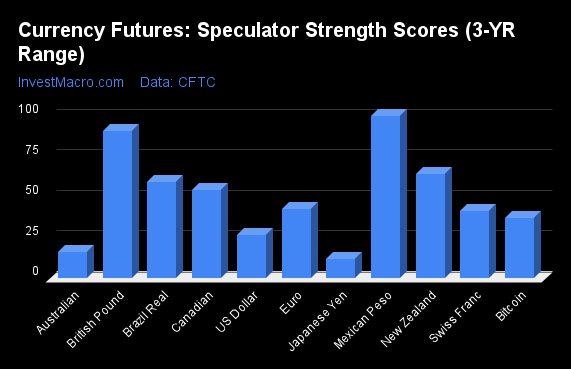
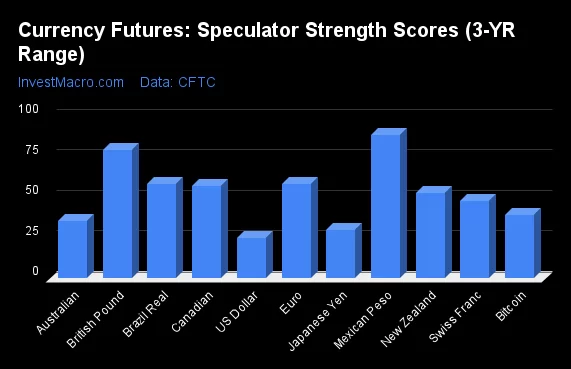
COT Strength Scores (a normalized measure of Speculator positions over a 3-Year range, from 0 to 100 where above 80 is Extreme-Bullish and below 20 is Extreme-Bearish) showed that the Brazilian Real (95 percent), the Mexican Peso (84 percent) and the EuroFX (83 percent) lead the currency markets this week.

On the downside, the Canadian Dollar (13 percent) and the Swiss Franc (17 percent) come in at the lowest strength levels currently and are in Extreme-Bearish territory (below 20 percent). The next lowest strength scores are the New Zealand Dollar (20 percent) and the Japanese Yen (27 percent).

Strength Statistics:
US Dollar Index (54.3 percent) vs US Dollar Index previous week (58.2 percent)
EuroFX (83.1 percent) vs EuroFX previous week (85.2 percent)
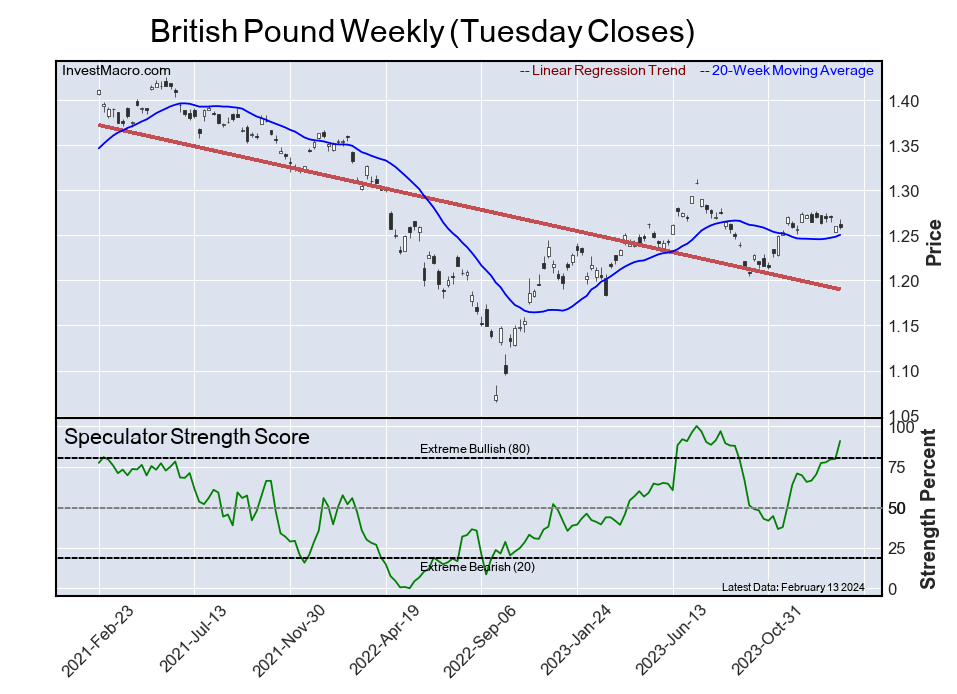
British Pound Sterling (70.8 percent) vs British Pound Sterling previous week (63.9 percent)
Japanese Yen (27.2 percent) vs Japanese Yen previous week (14.0 percent)
Swiss Franc (17.5 percent) vs Swiss Franc previous week (7.9 percent)
Canadian Dollar (12.7 percent) vs Canadian Dollar previous week (10.5 percent)
Australian Dollar (40.8 percent) vs Australian Dollar previous week (36.0 percent)
New Zealand Dollar (20.3 percent) vs New Zealand Dollar previous week (12.6 percent)
Mexican Peso (84.4 percent) vs Mexican Peso previous week (84.0 percent)
Brazilian Real (95.0 percent) vs Brazilian Real previous week (99.7 percent)
Bitcoin (35.3 percent) vs Bitcoin previous week (32.5 percent)


Brazilian Real & British Pound top the 6-Week Strength Trends

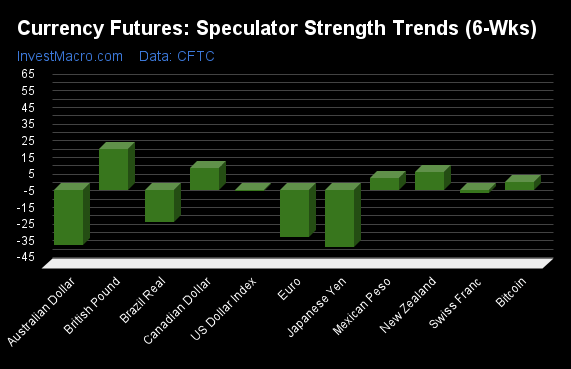
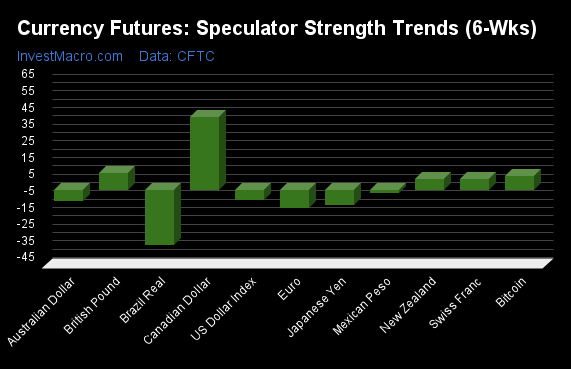
COT Strength Score Trends (or move index, calculates the 6-week changes in strength scores) showed that the Brazilian Real (48 percent) and the British Pound (29 percent) lead the past six weeks trends for the currencies. The EuroFX (26 percent), the Mexican Peso (26 percent) and the Australian Dollar (21 percent) are the next highest positive movers in the latest trends data.

The Canadian Dollar (-5 percent), Bitcoin (-5 percent), the US Dollar Index (-2 percent) and the New Zealand Dollar (-2 percent) lead the downside trend scores this week.

Strength Trend Statistics:
US Dollar Index (-2.3 percent) vs US Dollar Index previous week (0.5 percent)
EuroFX (26.4 percent) vs EuroFX previous week (28.6 percent)
British Pound Sterling (29.1 percent) vs British Pound Sterling previous week (21.0 percent)
Japanese Yen (12.6 percent) vs Japanese Yen previous week (-2.9 percent)
Swiss Franc (1.2 percent) vs Swiss Franc previous week (-7.8 percent)
Canadian Dollar (-5.0 percent) vs Canadian Dollar previous week (-7.7 percent)
Australian Dollar (20.8 percent) vs Australian Dollar previous week (23.3 percent)
New Zealand Dollar (-1.7 percent) vs New Zealand Dollar previous week (-9.4 percent)
Mexican Peso (26.1 percent) vs Mexican Peso previous week (21.7 percent)
Brazilian Real (48.4 percent) vs Brazilian Real previous week (58.5 percent)
Bitcoin (-4.8 percent) vs Bitcoin previous week (-27.0 percent)


Individual COT Forex Markets:

US Dollar Index Futures:
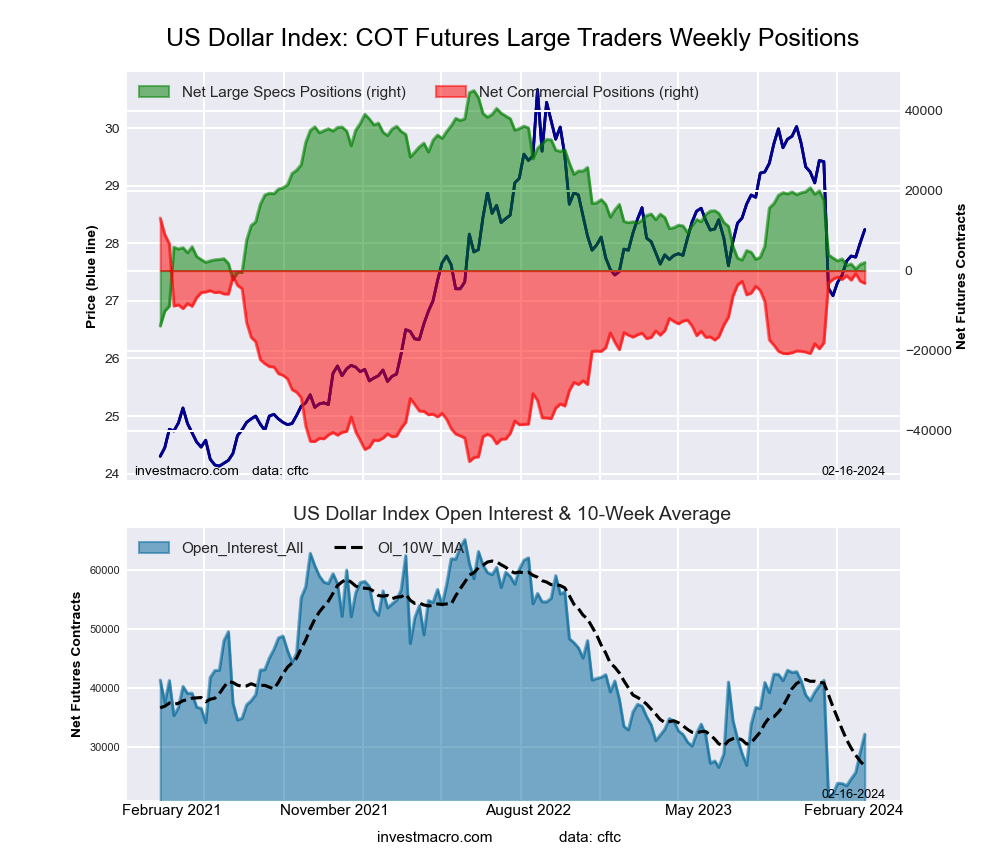
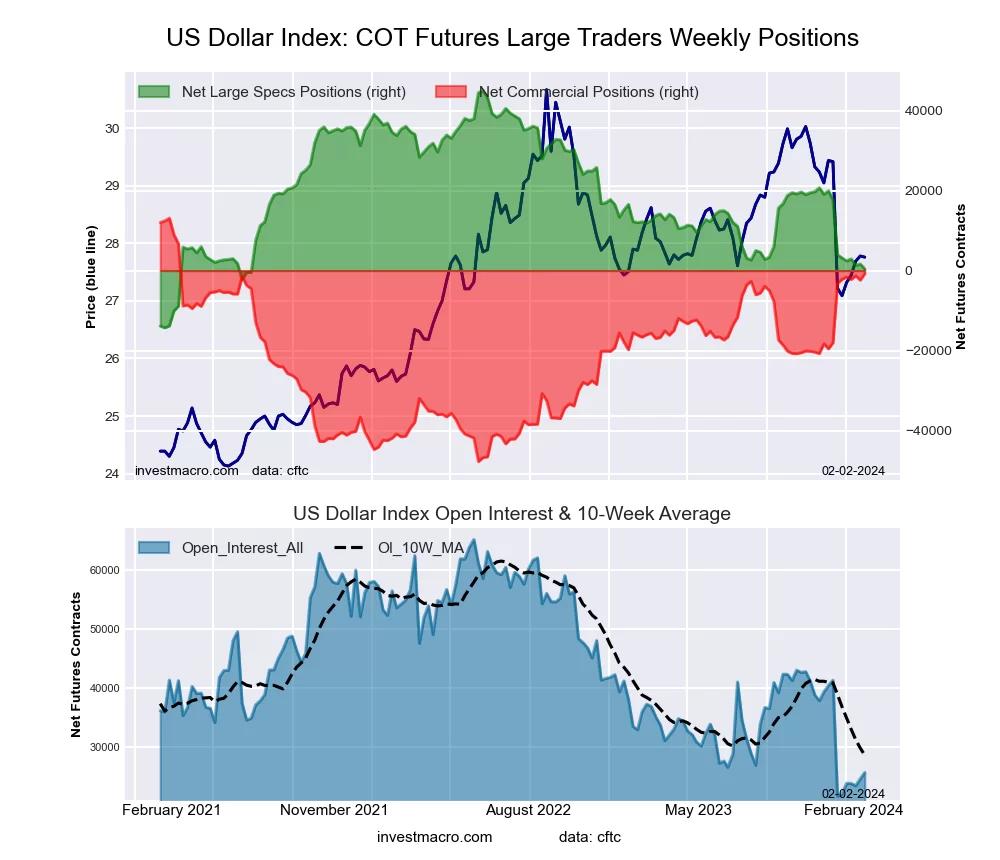
US Dollar Index Forex Futures COT ChartThe US Dollar Index large speculator standing this week recorded a net position of 17,601 contracts in the data reported through Tuesday. This was a weekly fall of -2,343 contracts from the previous week which had a total of 19,944 net contracts.

This week’s current strength score (the trader positioning range over the past three years, measured from 0 to 100) shows the speculators are currently Bullish with a score of 54.3 percent. The commercials are Bearish with a score of 47.1 percent and the small traders (not shown in chart) are Bearish-Extreme with a score of 14.6 percent.

Price Trend-Following Model: Weak Uptrend (Possible Trend Change)

Our weekly trend-following model classifies the current market price position as: Weak Uptrend. The current action for the model is considered to be: Hold – Maintain Long Position.

US DOLLAR INDEX StatisticsSPECULATORSCOMMERCIALSSMALL TRADERS
– Percent of Open Interest Longs:68.018.67.5
– Percent of Open Interest Shorts:25.462.26.5
– Net Position:17,601-18,032431
– Gross Longs:28,1007,6773,116
– Gross Shorts:10,49925,7092,685
– Long to Short Ratio:2.7 to 10.3 to 11.2 to 1
NET POSITION TREND:
– Strength Index Score (3 Year Range Pct):54.347.114.6
– Strength Index Reading (3 Year Range):BullishBearishBearish-Extreme
NET POSITION MOVEMENT INDEX:
– 6-Week Change in Strength Index:-2.33.3-8.1


Euro Currency Futures:

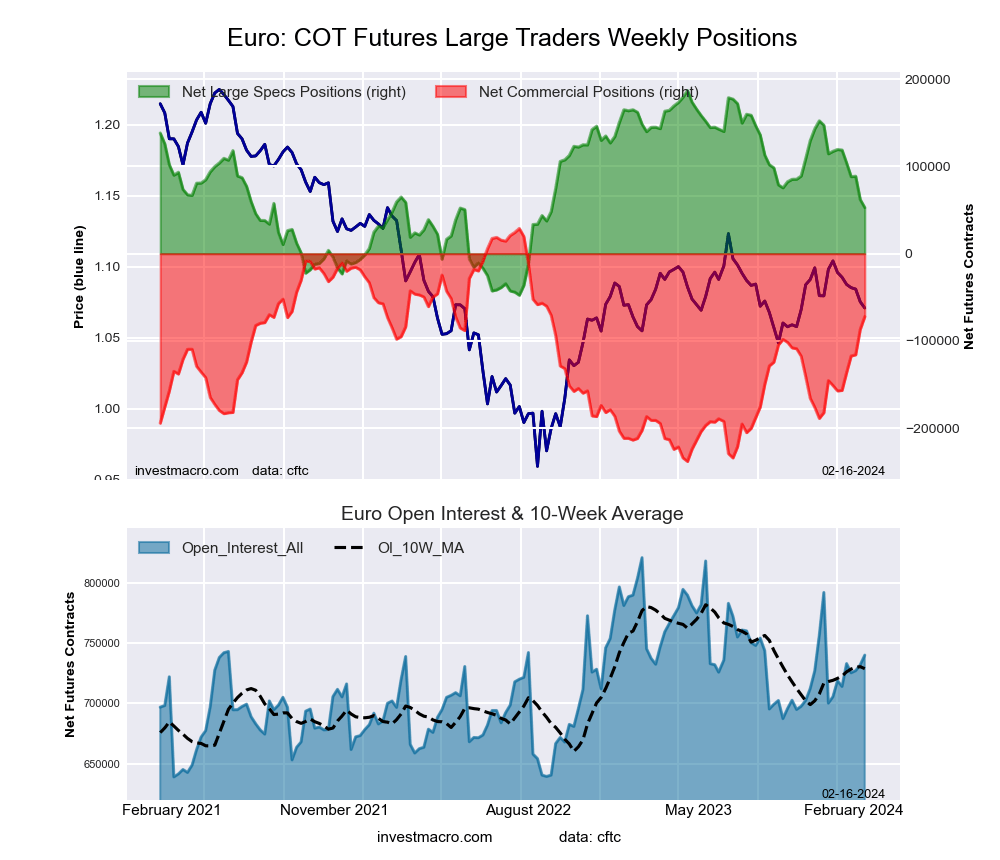
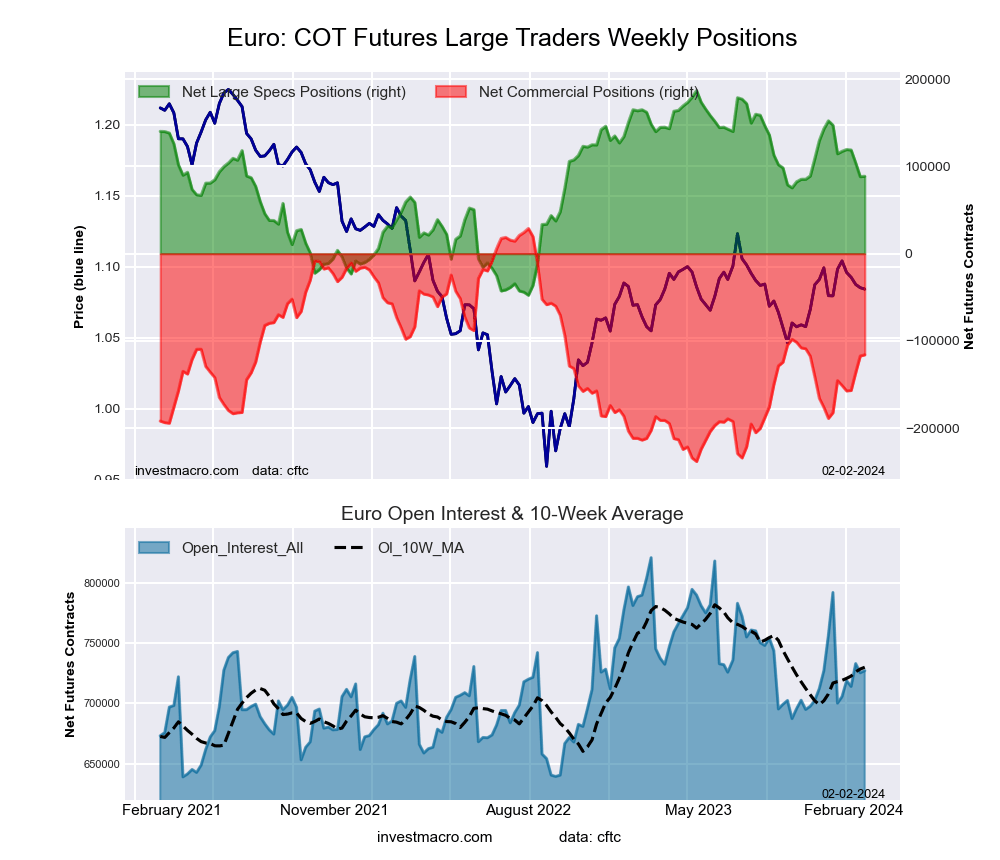
Euro Currency Futures COT ChartThe Euro Currency large speculator standing this week recorded a net position of 147,327 contracts in the data reported through Tuesday. This was a weekly decline of -5,033 contracts from the previous week which had a total of 152,360 net contracts.

This week’s current strength score (the trader positioning range over the past three years, measured from 0 to 100) shows the speculators are currently Bullish-Extreme with a score of 83.1 percent. The commercials are Bearish with a score of 20.9 percent and the small traders (not shown in chart) are Bearish with a score of 34.9 percent.

Price Trend-Following Model: Weak Downtrend (Possible Trend Change)

Our weekly trend-following model classifies the current market price position as: Weak Downtrend. The current action for the model is considered to be: Hold – Maintain Short Position.

EURO Currency StatisticsSPECULATORSCOMMERCIALSSMALL TRADERS
– Percent of Open Interest Longs:29.354.712.7
– Percent of Open Interest Shorts:10.777.78.2
– Net Position:147,327-182,35735,030
– Gross Longs:231,837433,209100,250
– Gross Shorts:84,510615,56665,220
– Long to Short Ratio:2.7 to 10.7 to 11.5 to 1
NET POSITION TREND:
– Strength Index Score (3 Year Range Pct):83.120.934.9
– Strength Index Reading (3 Year Range):Bullish-ExtremeBearishBearish
NET POSITION MOVEMENT INDEX:
– 6-Week Change in Strength Index:26.4-27.418.2


British Pound Sterling Futures:

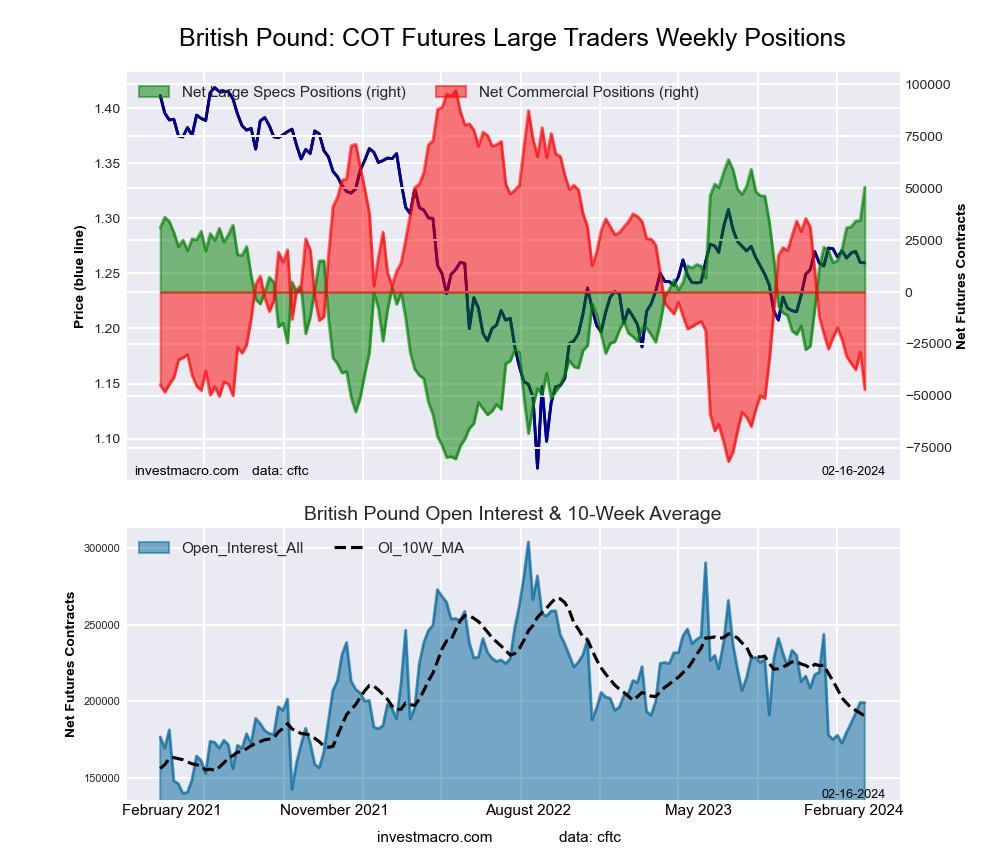
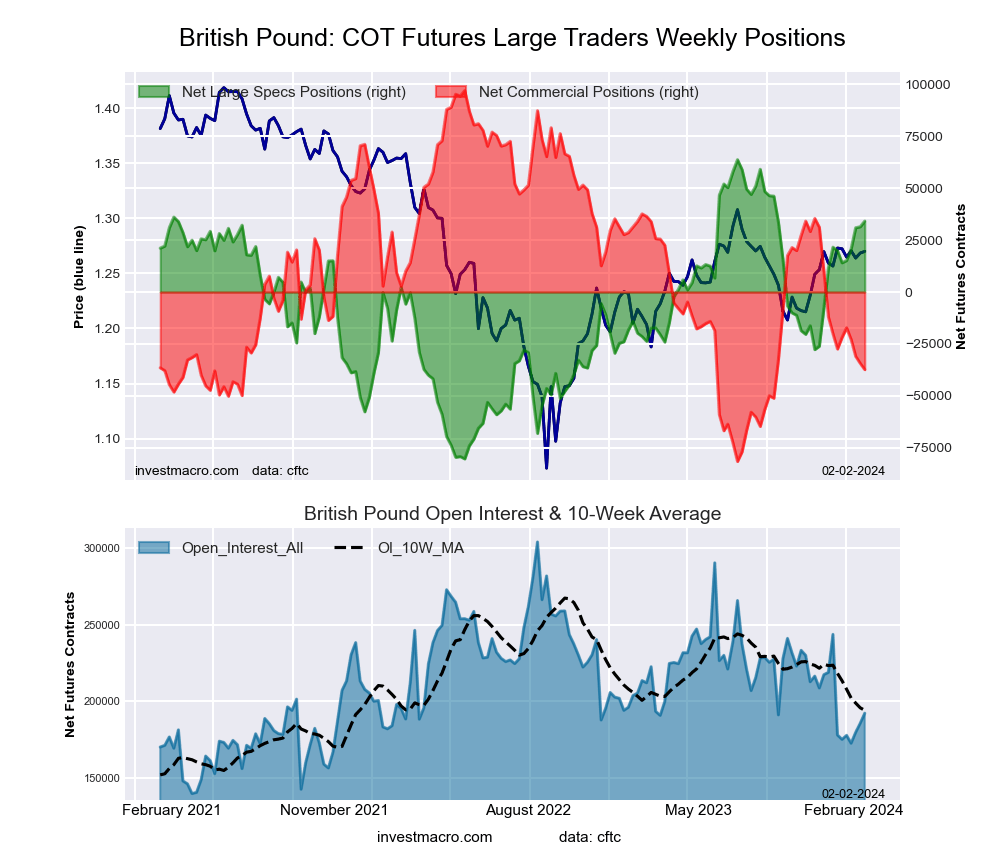
British Pound Sterling Futures COT ChartThe British Pound Sterling large speculator standing this week recorded a net position of 21,581 contracts in the data reported through Tuesday. This was a weekly increase of 9,916 contracts from the previous week which had a total of 11,665 net contracts.

This week’s current strength score (the trader positioning range over the past three years, measured from 0 to 100) shows the speculators are currently Bullish with a score of 70.8 percent. The commercials are Bearish with a score of 34.4 percent and the small traders (not shown in chart) are Bullish with a score of 55.1 percent.

Price Trend-Following Model: Weak Downtrend (Possible Trend Change)

Our weekly trend-following model classifies the current market price position as: Weak Downtrend. The current action for the model is considered to be: Hold – Maintain Short Position.

BRITISH POUND StatisticsSPECULATORSCOMMERCIALSSMALL TRADERS
– Percent of Open Interest Longs:29.647.418.3
– Percent of Open Interest Shorts:20.755.718.9
– Net Position:21,581-20,101-1,480
– Gross Longs:72,011115,62044,638
– Gross Shorts:50,430135,72146,118
– Long to Short Ratio:1.4 to 10.9 to 11.0 to 1
NET POSITION TREND:
– Strength Index Score (3 Year Range Pct):70.834.455.1
– Strength Index Reading (3 Year Range):BullishBearishBullish
NET POSITION MOVEMENT INDEX:
– 6-Week Change in Strength Index:29.1-30.424.1


Japanese Yen Futures:

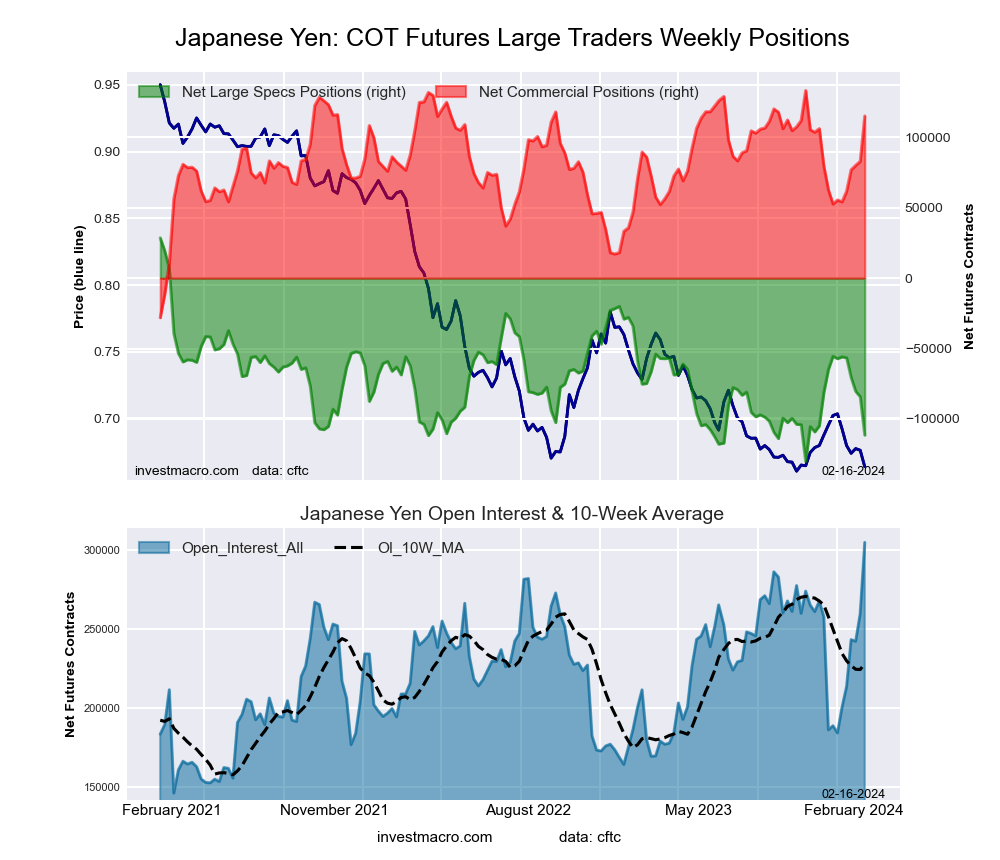
Japanese Yen Forex Futures COT ChartThe Japanese Yen large speculator standing this week recorded a net position of -81,131 contracts in the data reported through Tuesday. This was a weekly gain of 23,825 contracts from the previous week which had a total of -104,956 net contracts.

This week’s current strength score (the trader positioning range over the past three years, measured from 0 to 100) shows the speculators are currently Bearish with a score of 27.2 percent. The commercials are Bullish with a score of 74.0 percent and the small traders (not shown in chart) are Bullish with a score of 56.7 percent.

Price Trend-Following Model: Weak Downtrend (Possible Trend Change)

Our weekly trend-following model classifies the current market price position as: Weak Downtrend. The current action for the model is considered to be: Hold – Maintain Short Position.

JAPANESE YEN StatisticsSPECULATORSCOMMERCIALSSMALL TRADERS
– Percent of Open Interest Longs:11.067.115.1
– Percent of Open Interest Shorts:42.536.214.4
– Net Position:-81,13179,5271,604
– Gross Longs:28,226172,75638,804
– Gross Shorts:109,35793,22937,200
– Long to Short Ratio:0.3 to 11.9 to 11.0 to 1
NET POSITION TREND:
– Strength Index Score (3 Year Range Pct):27.274.056.7
– Strength Index Reading (3 Year Range):BearishBullishBullish
NET POSITION MOVEMENT INDEX:
– 6-Week Change in Strength Index:12.6-13.610.8


Swiss Franc Futures:

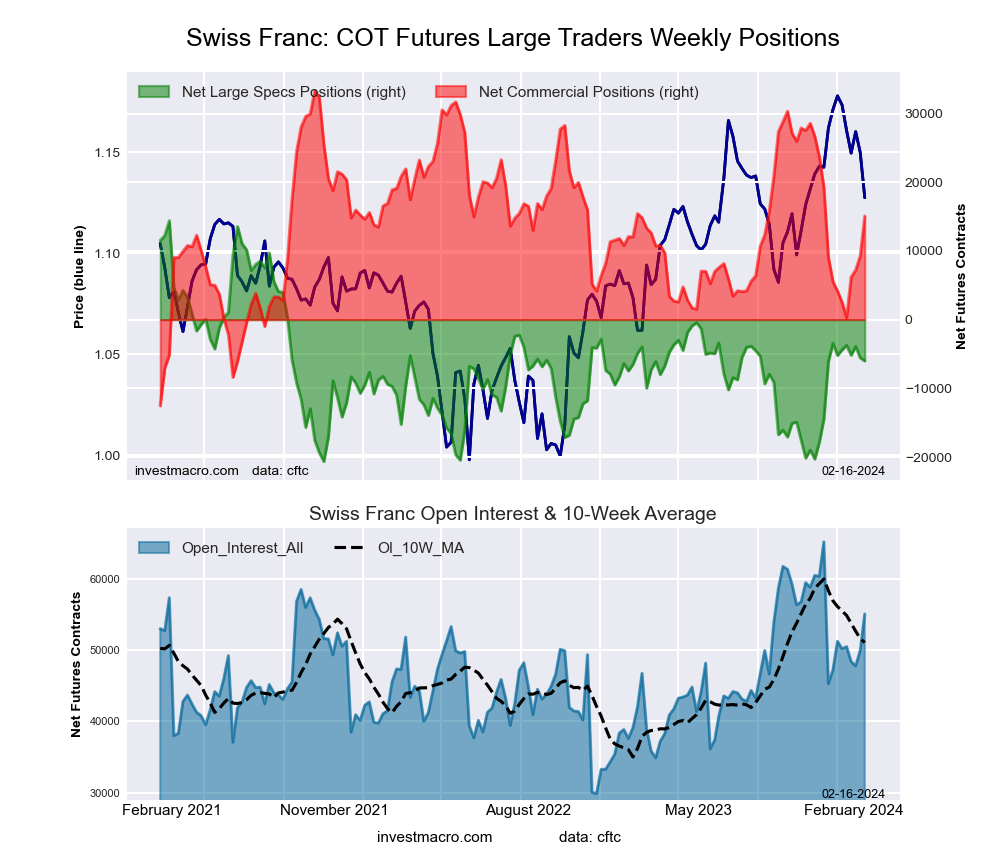
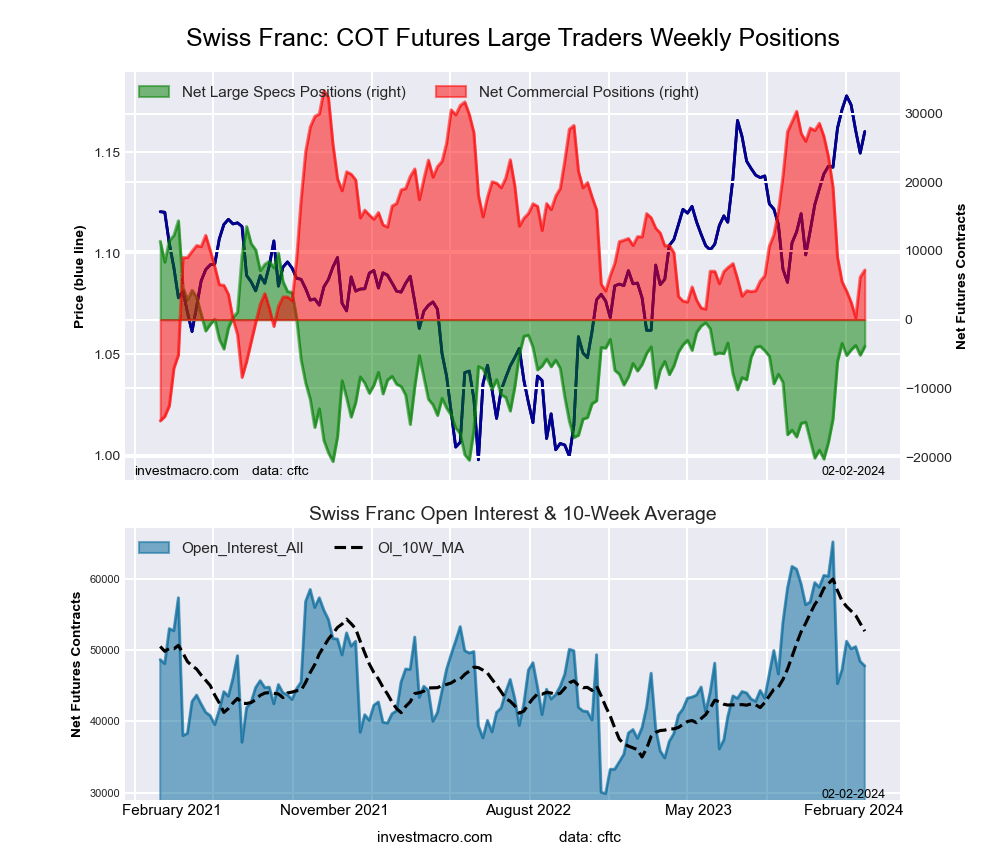
Swiss Franc Forex Futures COT ChartThe Swiss Franc large speculator standing this week recorded a net position of -14,474 contracts in the data reported through Tuesday. This was a weekly rise of 3,378 contracts from the previous week which had a total of -17,852 net contracts.

This week’s current strength score (the trader positioning range over the past three years, measured from 0 to 100) shows the speculators are currently Bearish-Extreme with a score of 17.5 percent. The commercials are Bullish with a score of 74.5 percent and the small traders (not shown in chart) are Bearish with a score of 43.8 percent.

Price Trend-Following Model: Weak Downtrend (Possible Trend Change)

Our weekly trend-following model classifies the current market price position as: Weak Downtrend. The current action for the model is considered to be: Hold – Maintain Short Position.

SWISS FRANC StatisticsSPECULATORSCOMMERCIALSSMALL TRADERS
– Percent of Open Interest Longs:6.165.219.6
– Percent of Open Interest Shorts:28.335.627.0
– Net Position:-14,47419,313-4,839
– Gross Longs:3,97042,48912,788
– Gross Shorts:18,44423,17617,627
– Long to Short Ratio:0.2 to 11.8 to 10.7 to 1
NET POSITION TREND:
– Strength Index Score (3 Year Range Pct):17.574.543.8
– Strength Index Reading (3 Year Range):Bearish-ExtremeBullishBearish
NET POSITION MOVEMENT INDEX:
– 6-Week Change in Strength Index:1.2-12.122.4


Canadian Dollar Futures:

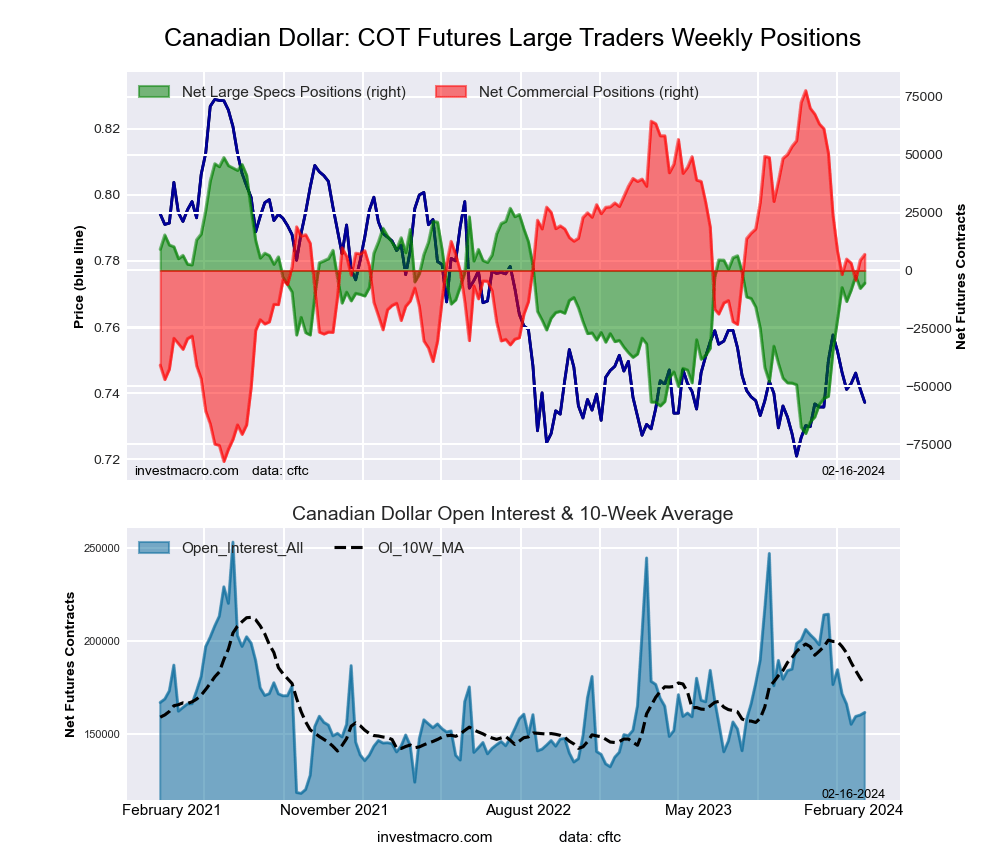
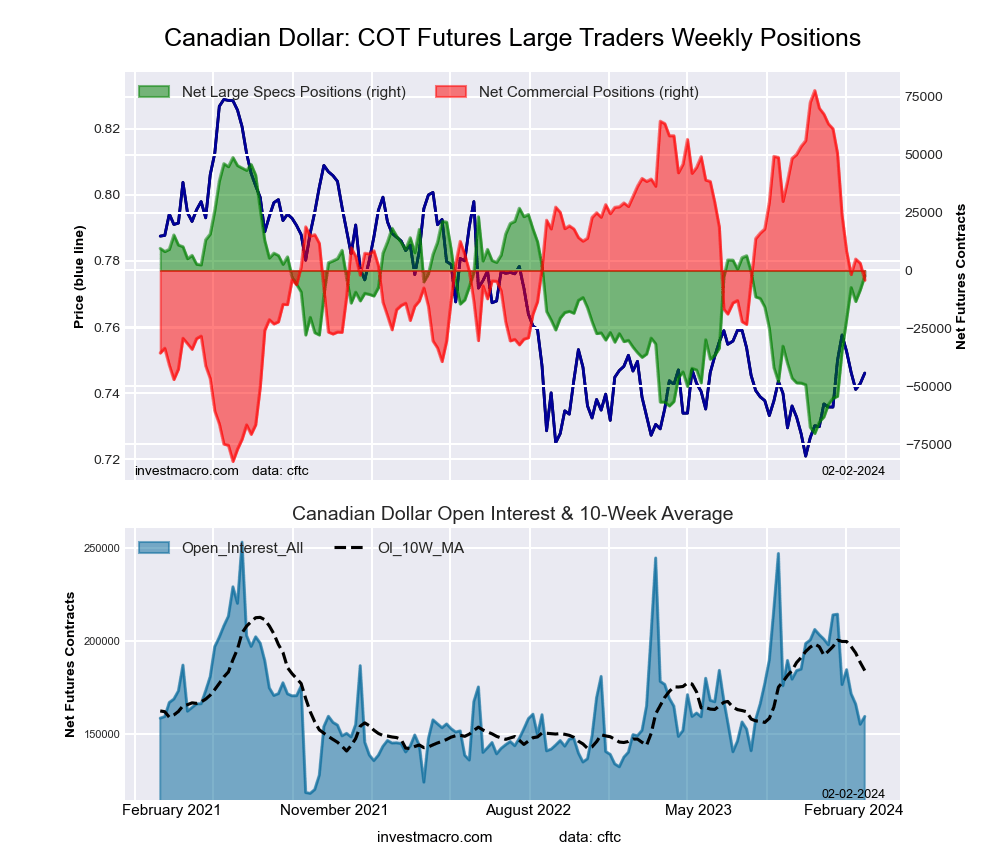
Canadian Dollar Forex Futures COT ChartThe Canadian Dollar large speculator standing this week recorded a net position of -55,245 contracts in the data reported through Tuesday. This was a weekly lift of 2,603 contracts from the previous week which had a total of -57,848 net contracts.

This week’s current strength score (the trader positioning range over the past three years, measured from 0 to 100) shows the speculators are currently Bearish-Extreme with a score of 12.7 percent. The commercials are Bullish-Extreme with a score of 89.7 percent and the small traders (not shown in chart) are Bearish-Extreme with a score of 9.6 percent.

Price Trend-Following Model: Weak Downtrend (Possible Trend Change)

Our weekly trend-following model classifies the current market price position as: Weak Downtrend. The current action for the model is considered to be: Hold – Maintain Short Position.

CANADIAN DOLLAR StatisticsSPECULATORSCOMMERCIALSSMALL TRADERS
– Percent of Open Interest Longs:9.171.913.3
– Percent of Open Interest Shorts:34.943.216.1
– Net Position:-55,24561,193-5,948
– Gross Longs:19,457153,67828,390
– Gross Shorts:74,70292,48534,338
– Long to Short Ratio:0.3 to 11.7 to 10.8 to 1
NET POSITION TREND:
– Strength Index Score (3 Year Range Pct):12.789.79.6
– Strength Index Reading (3 Year Range):Bearish-ExtremeBullish-ExtremeBearish-Extreme
NET POSITION MOVEMENT INDEX:
– 6-Week Change in Strength Index:-5.03.21.7


Australian Dollar Futures:

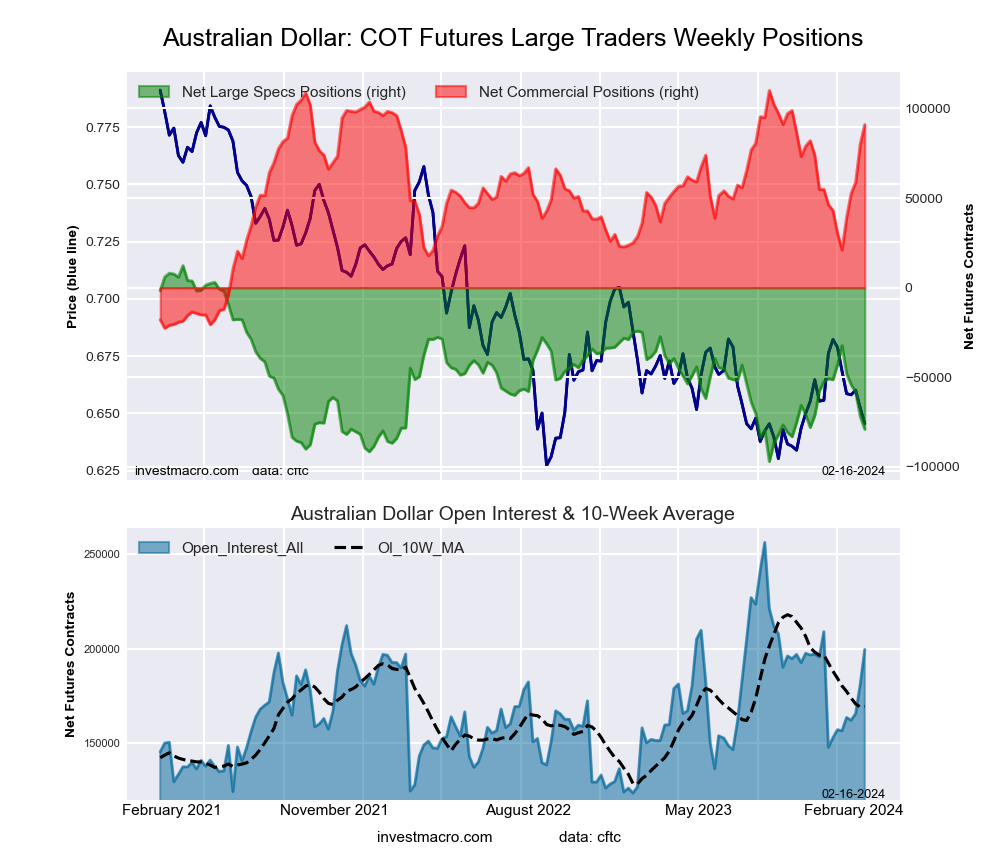
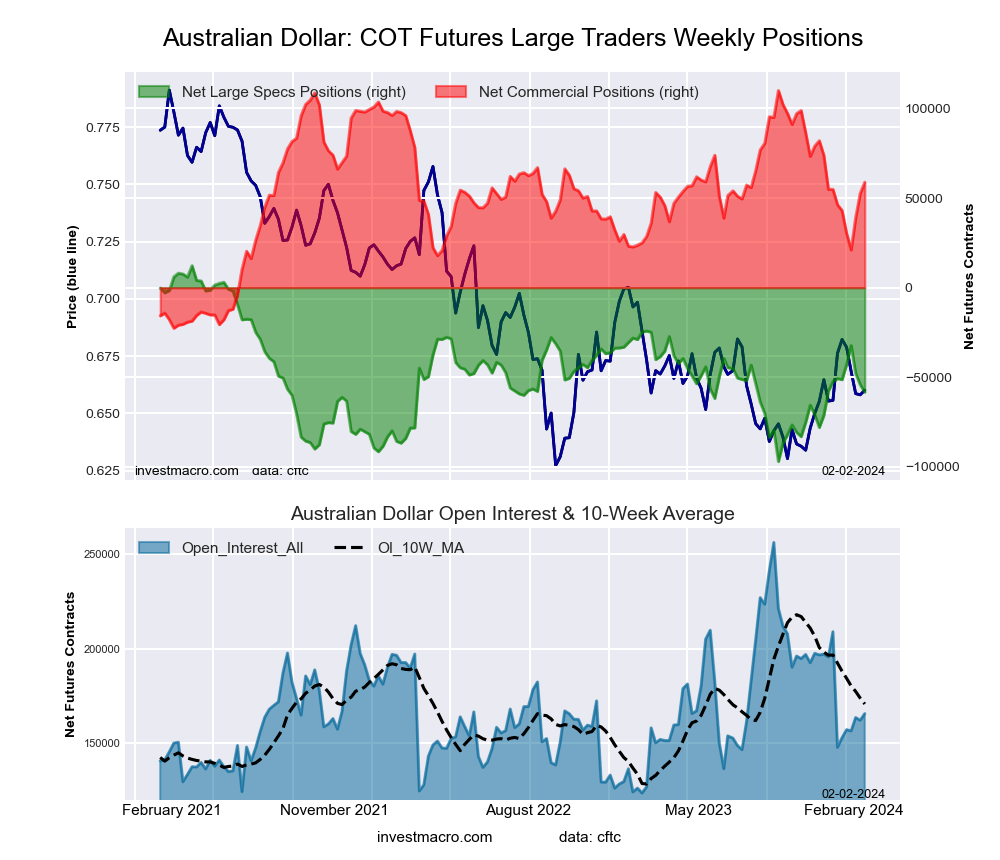
Australian Dollar Forex Futures COT ChartThe Australian Dollar large speculator standing this week recorded a net position of -52,340 contracts in the data reported through Tuesday. This was a weekly gain of 5,341 contracts from the previous week which had a total of -57,681 net contracts.

This week’s current strength score (the trader positioning range over the past three years, measured from 0 to 100) shows the speculators are currently Bearish with a score of 40.8 percent. The commercials are Bullish with a score of 58.4 percent and the small traders (not shown in chart) are Bearish with a score of 46.3 percent.

Price Trend-Following Model: Strong Uptrend

Our weekly trend-following model classifies the current market price position as: Strong Uptrend. The current action for the model is considered to be: New Buy – Long Position.

AUSTRALIAN DOLLAR StatisticsSPECULATORSCOMMERCIALSSMALL TRADERS
– Percent of Open Interest Longs:14.867.110.7
– Percent of Open Interest Shorts:39.940.811.9
– Net Position:-52,34054,868-2,528
– Gross Longs:30,967140,17222,411
– Gross Shorts:83,30785,30424,939
– Long to Short Ratio:0.4 to 11.6 to 10.9 to 1
NET POSITION TREND:
– Strength Index Score (3 Year Range Pct):40.858.446.3
– Strength Index Reading (3 Year Range):BearishBullishBearish
NET POSITION MOVEMENT INDEX:
– 6-Week Change in Strength Index:20.8-23.821.4


New Zealand Dollar Futures:

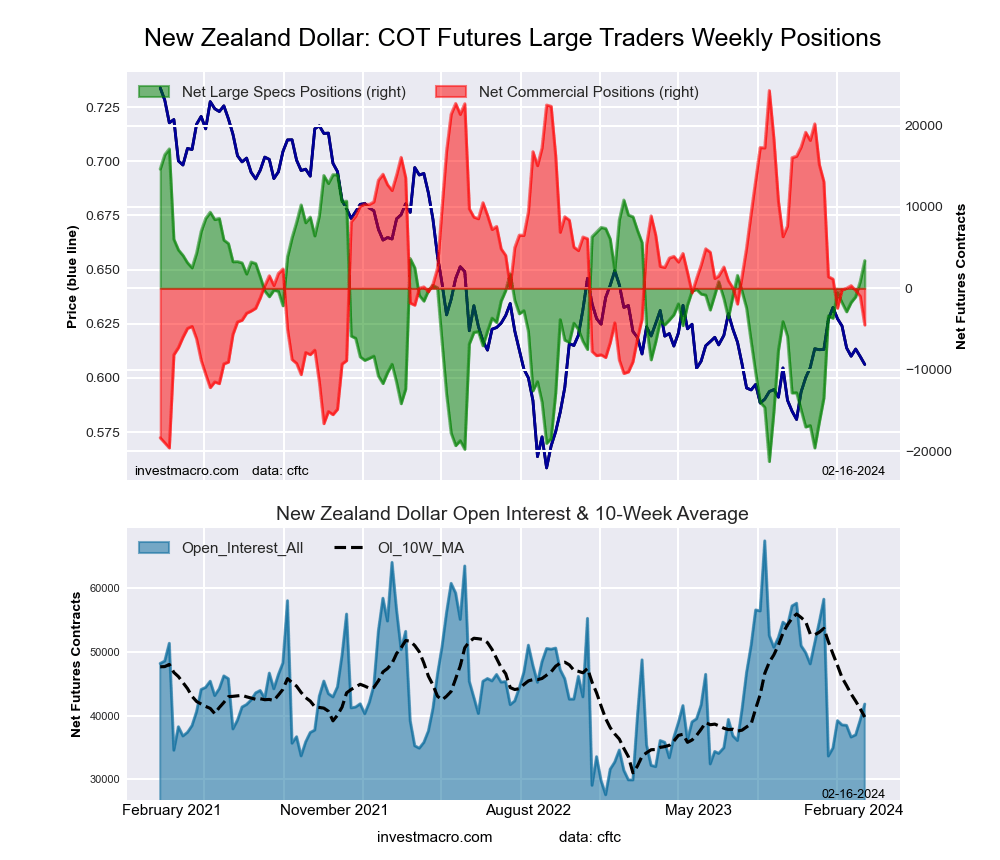
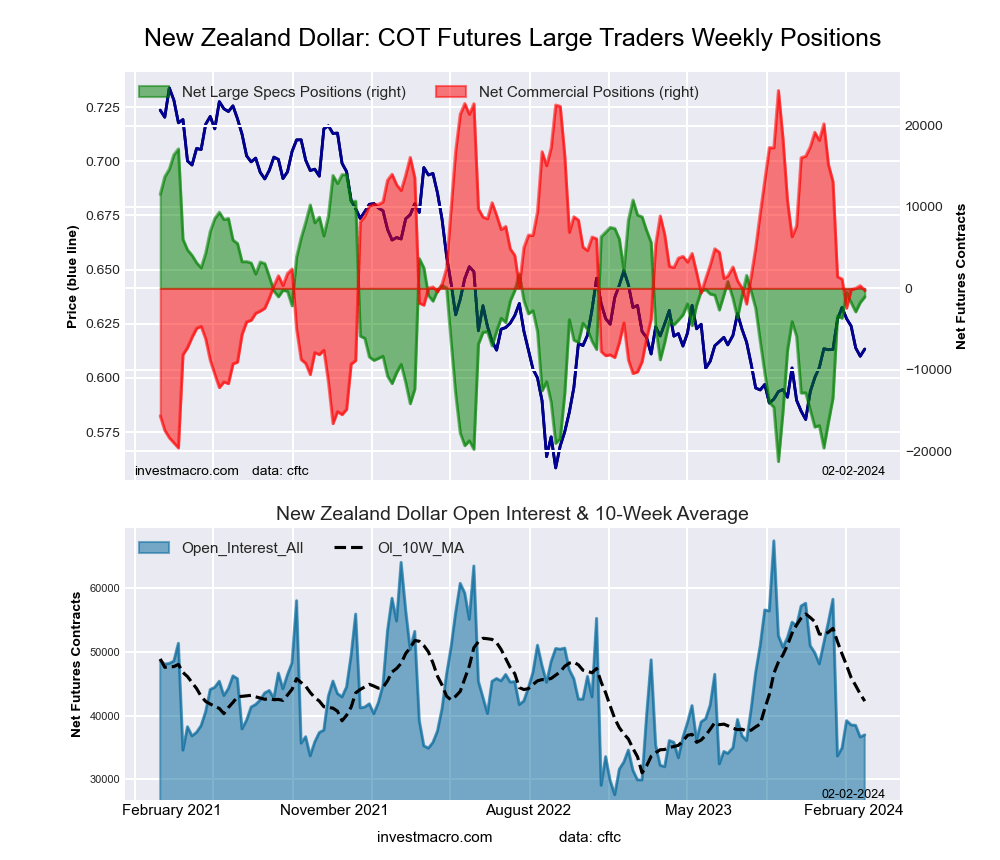
New Zealand Dollar Forex Futures COT ChartThe New Zealand Dollar large speculator standing this week recorded a net position of -13,488 contracts in the data reported through Tuesday. This was a weekly increase of 2,962 contracts from the previous week which had a total of -16,450 net contracts.

This week’s current strength score (the trader positioning range over the past three years, measured from 0 to 100) shows the speculators are currently Bearish with a score of 20.3 percent. The commercials are Bullish with a score of 74.6 percent and the small traders (not shown in chart) are Bullish with a score of 54.5 percent.

Price Trend-Following Model: Strong Uptrend

Our weekly trend-following model classifies the current market price position as: Strong Uptrend. The current action for the model is considered to be: New Buy – Long Position.

NEW ZEALAND DOLLAR StatisticsSPECULATORSCOMMERCIALSSMALL TRADERS
– Percent of Open Interest Longs:22.859.37.7
– Percent of Open Interest Shorts:45.936.87.1
– Net Position:-13,48813,109379
– Gross Longs:13,27334,5884,515
– Gross Shorts:26,76121,4794,136
– Long to Short Ratio:0.5 to 11.6 to 11.1 to 1
NET POSITION TREND:
– Strength Index Score (3 Year Range Pct):20.374.654.5
– Strength Index Reading (3 Year Range):BearishBullishBullish
NET POSITION MOVEMENT INDEX:
– 6-Week Change in Strength Index:-1.7-7.145.2


Mexican Peso Futures:

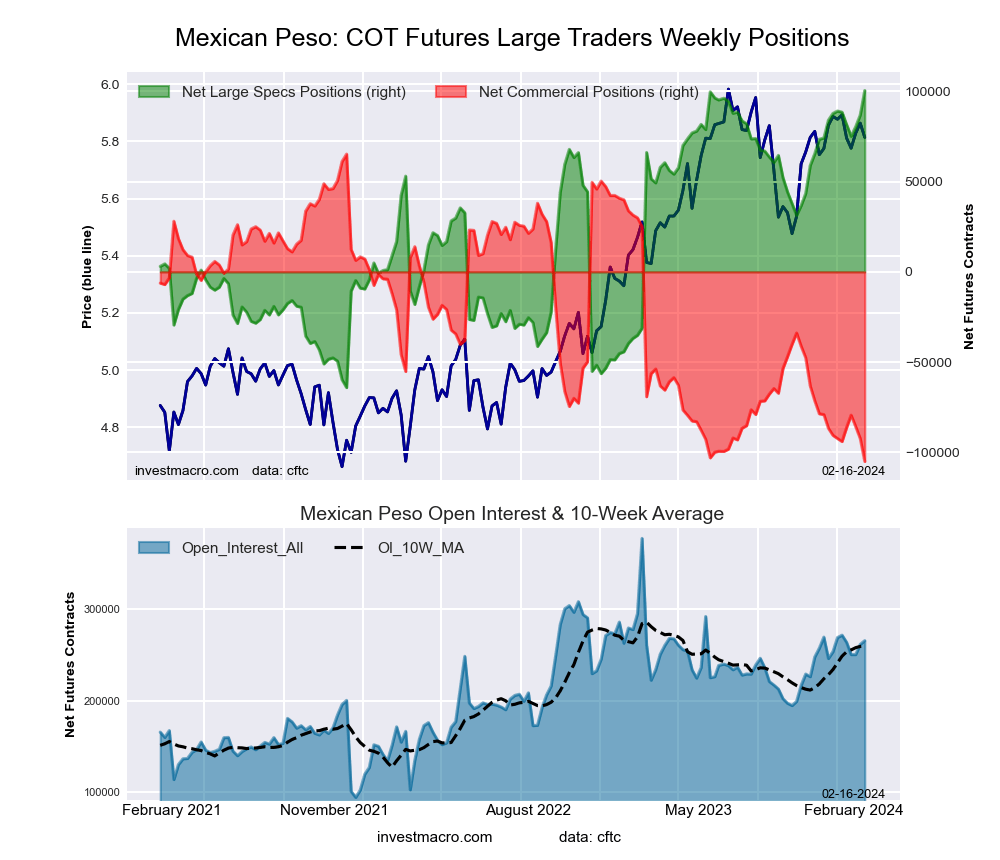
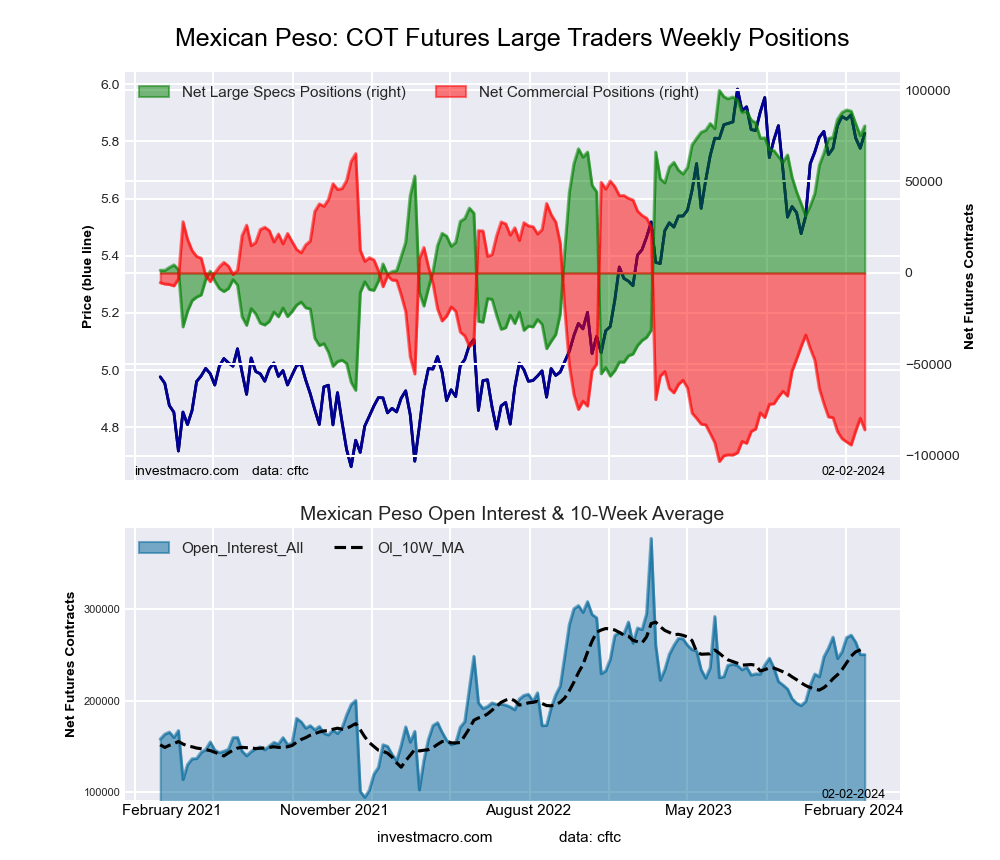
Mexican Peso Futures COT ChartThe Mexican Peso large speculator standing this week recorded a net position of 74,125 contracts in the data reported through Tuesday. This was a weekly increase of 669 contracts from the previous week which had a total of 73,456 net contracts.

This week’s current strength score (the trader positioning range over the past three years, measured from 0 to 100) shows the speculators are currently Bullish-Extreme with a score of 84.4 percent. The commercials are Bearish-Extreme with a score of 14.2 percent and the small traders (not shown in chart) are Bearish with a score of 42.7 percent.

Price Trend-Following Model: Weak Downtrend (Possible Trend Change)

Our weekly trend-following model classifies the current market price position as: Weak Downtrend. The current action for the model is considered to be: Hold – Maintain Short Position.

MEXICAN PESO StatisticsSPECULATORSCOMMERCIALSSMALL TRADERS
– Percent of Open Interest Longs:42.549.72.6
– Percent of Open Interest Shorts:15.079.10.7
– Net Position:74,125-79,0644,939
– Gross Longs:114,396133,8476,875
– Gross Shorts:40,271212,9111,936
– Long to Short Ratio:2.8 to 10.6 to 13.6 to 1
NET POSITION TREND:
– Strength Index Score (3 Year Range Pct):84.414.242.7
– Strength Index Reading (3 Year Range):Bullish-ExtremeBearish-ExtremeBearish
NET POSITION MOVEMENT INDEX:
– 6-Week Change in Strength Index:26.1-26.815.0


Brazilian Real Futures:

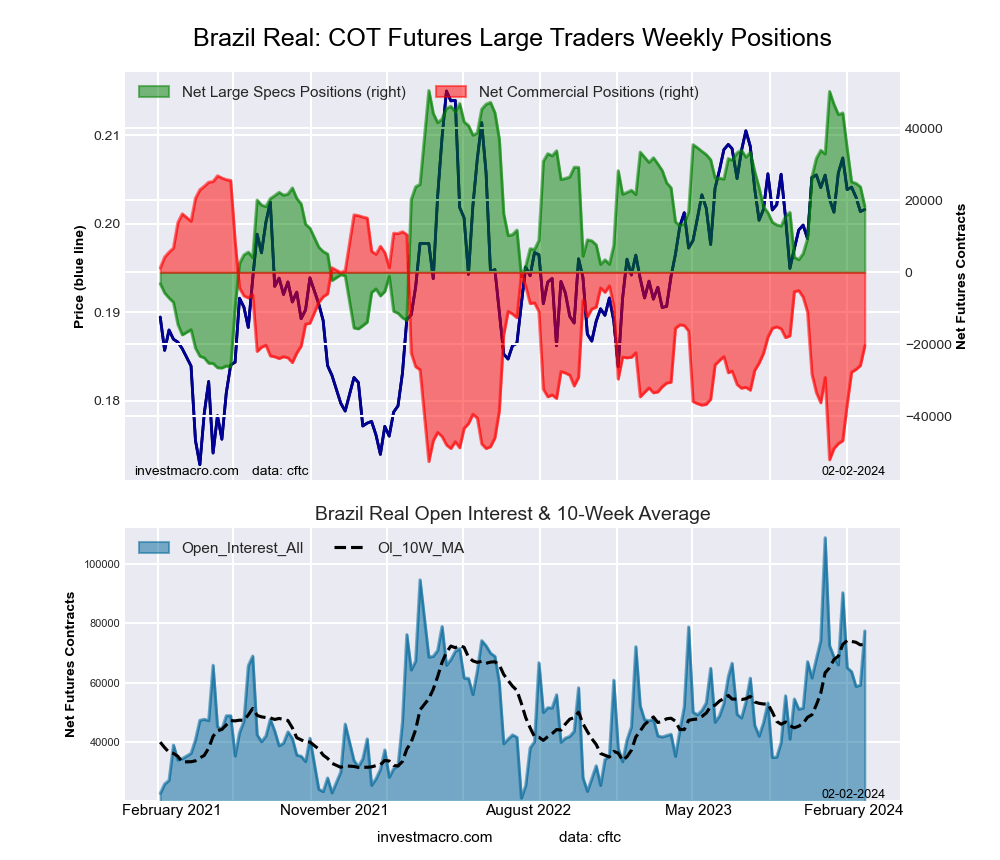
Brazil Real Futures COT ChartThe Brazilian Real large speculator standing this week recorded a net position of 46,664 contracts in the data reported through Tuesday. This was a weekly decrease of -3,580 contracts from the previous week which had a total of 50,244 net contracts.

This week’s current strength score (the trader positioning range over the past three years, measured from 0 to 100) shows the speculators are currently Bullish-Extreme with a score of 95.0 percent. The commercials are Bearish-Extreme with a score of 4.5 percent and the small traders (not shown in chart) are Bullish with a score of 55.8 percent.

Price Trend-Following Model: Weak Downtrend (Possible Trend Change)

Our weekly trend-following model classifies the current market price position as: Weak Downtrend. The current action for the model is considered to be: Hold – Maintain Short Position.

BRAZIL REAL StatisticsSPECULATORSCOMMERCIALSSMALL TRADERS
– Percent of Open Interest Longs:73.320.95.5
– Percent of Open Interest Shorts:5.392.32.2
– Net Position:46,664-48,9552,291
– Gross Longs:50,30514,3753,767
– Gross Shorts:3,64163,3301,476
– Long to Short Ratio:13.8 to 10.2 to 12.6 to 1
NET POSITION TREND:
– Strength Index Score (3 Year Range Pct):95.04.555.8
– Strength Index Reading (3 Year Range):Bullish-ExtremeBearish-ExtremeBullish
NET POSITION MOVEMENT INDEX:
– 6-Week Change in Strength Index:48.4-47.85.7


Bitcoin Futures:

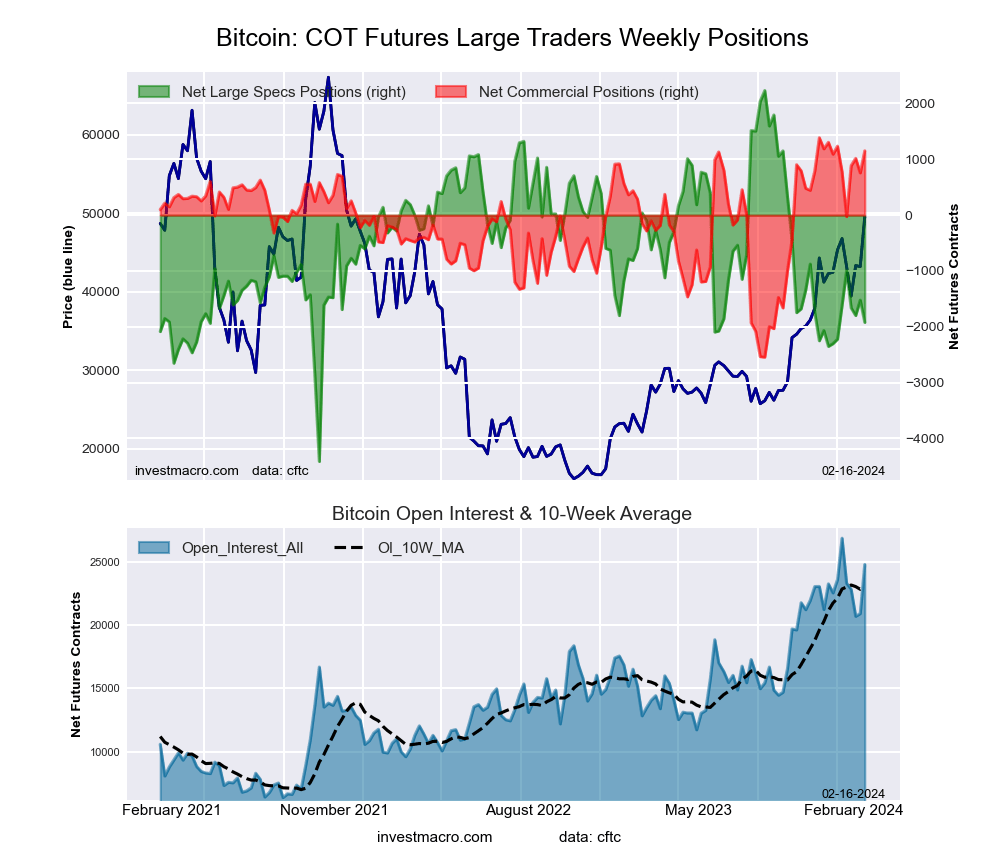
Bitcoin Crypto Futures COT ChartThe Bitcoin large speculator standing this week recorded a net position of -2,067 contracts in the data reported through Tuesday. This was a weekly increase of 183 contracts from the previous week which had a total of -2,250 net contracts.

This week’s current strength score (the trader positioning range over the past three years, measured from 0 to 100) shows the speculators are currently Bearish with a score of 35.3 percent. The commercials are Bullish-Extreme with a score of 94.9 percent and the small traders (not shown in chart) are Bearish with a score of 32.9 percent.

Price Trend-Following Model: Strong Uptrend

Our weekly trend-following model classifies the current market price position as: Strong Uptrend. The current action for the model is considered to be: Hold – Maintain Long Position.

BITCOIN StatisticsSPECULATORSCOMMERCIALSSMALL TRADERS
– Percent of Open Interest Longs:74.17.97.8
– Percent of Open Interest Shorts:83.82.33.7
– Net Position:-2,0671,188879
– Gross Longs:15,7141,6841,654
– Gross Shorts:17,781496775
– Long to Short Ratio:0.9 to 13.4 to 12.1 to 1
NET POSITION TREND:
– Strength Index Score (3 Year Range Pct):35.394.932.9
– Strength Index Reading (3 Year Range):BearishBullish-ExtremeBearish
NET POSITION MOVEMENT INDEX:
– 6-Week Change in Strength Index:-4.87.30.8


Article By InvestMacroReceive our weekly COT Newsletter

*COT Report: The COT data, released weekly to the public each Friday, is updated through the most recent Tuesday (data is 3 days old) and shows a quick view of how large speculators or non-commercials (for-profit traders) were positioned in the futures markets.

The CFTC categorizes trader positions according to commercial hedgers (traders who use futures contracts for hedging as part of the business), non-commercials (large traders who speculate to realize trading profits) and nonreportable traders (usually small traders/speculators) as well as their open interest (contracts open in the market at time of reporting). See CFTC criteria here.

Speculator Extremes: SOFR-3M, Steel, Ultra 10-Year & Soybeans lead Bullish & Bearish Positions

By InvestMacro 

The latest update for the weekly Commitment of Traders (COT) report was released by the Commodity Futures Trading Commission (CFTC) on Friday for data ending on December 12th.

This weekly Extreme Positions report highlights the Most Bullish and Most Bearish Positions for the speculator category. Extreme positioning in these markets can foreshadow strong moves in the underlying market.

To signify an extreme position, we use the Strength Index (also known as the COT Index) of each instrument, a common method of measuring COT data. The Strength Index is simply a comparison of current trader positions against the range of positions over the previous 3 years. We use over 80 percent as extremely bullish and under 20 percent as extremely bearish. (Compare Strength Index scores across all markets in the data table or cot leaders table)


Here Are This Week’s Most Bullish Speculator Positions:

3-Month Secured Overnight Financing Rate


The 3-Month Secured Overnight Financing Rate speculator position comes in as the most bullish extreme standing this week. The 3-Month Secured Overnight Financing Rate speculator level is currently at a maximum 100.0 percent score of its 3-year range.

The six-week trend for the percent strength score totaled 25.1 this week. The overall net speculator position was  718,226 net contracts this week with a strong gain of 206,446 contract in the weekly speculator bets.


Speculators or Non-Commercials Notes:

Speculators, classified as non-commercial traders by the CFTC, are made up of large commodity funds, hedge funds and other significant for-profit participants. The Specs are generally regarded as trend-followers in their behavior towards price action – net speculator bets and prices tend to go in the same directions. These traders often look to buy when prices are rising and sell when prices are falling. To illustrate this point, many times speculator contracts can be found at their most extremes (bullish or bearish) when prices are also close to their highest or lowest levels.

These extreme levels can be dangerous for the large speculators as the trade is most crowded, there is less trading ammunition still sitting on the sidelines to push the trend further and prices have moved a significant distance. When the trend becomes exhausted, some speculators take profits while others look to also exit positions when prices fail to continue in the same direction. This process usually plays out over many months to years and can ultimately create a reverse effect where prices start to fall and speculators start a process of selling when prices are falling.


Steel


The Steel speculator position comes next in the extreme standings this week. The Steel speculator level is now at a 97.6 percent score of its 3-year range.

The six-week trend for the percent strength score was 8.3 this week. The speculator position registered -485 net contracts this week with a weekly dip of -318 contracts in speculator bets.


1-Month Secured Overnight Financing Rate

The 1-Month Secured Overnight Financing Rate speculator position comes in third this week in the extreme standings. The 1-Month Secured Overnight Financing Rate speculator level resides at a 97.3 percent score of its 3-year range.

The six-week trend for the speculator strength score came in at 52.6 this week. The overall speculator position was 93,215 net contracts this week with a small rise by 6,248 contracts in the weekly speculator bets.


Brazil Real


The Brazil Real speculator position comes up number four in the extreme standings this week. The Brazil Real speculator level is at a 95.0 percent score of its 3-year range.

The six-week trend for the speculator strength score totaled a change of 48.4 this week. The overall speculator position was 46,664 net contracts this week with a change of -3,580 contracts in the speculator bets.


DowJones Mini


The DowJones Mini speculator position rounds out the top five in this week’s bullish extreme standings. The DowJones Mini speculator level sits at a 87.6 percent score of its 3-year range. The six-week trend for the speculator strength score was a huge gain of 85.5 this week.

The speculator position was 3,451 net contracts this week with an increase of 3,143 contracts in the weekly speculator bets.


This Week’s Most Bearish Speculator Positions:

Ultra 10-Year U.S. T-Note


The Ultra 10-Year U.S. T-Note speculator position comes in as the most bearish extreme standing this week. The Ultra 10-Year U.S. T-Note speculator level is at a 0.0 percent score of its 3-year range.

The six-week trend for the speculator strength score was -4.4 this week. The overall speculator position was -276,476 net contracts this week with a drop of -8,621 contracts in the speculator bets.


Soybeans


The Soybeans speculator position comes in next for the most bearish extreme standing on the week. The Soybeans speculator level is at a 0.5 percent score of its 3-year range.

The six-week trend for the speculator strength score was 0.5 this week. The speculator position was 17,539 net contracts this week with a dip lower by -2,759 contracts in the weekly speculator bets.


WTI Crude Oil


The WTI Crude Oil speculator position comes in as third most bearish extreme standing of the week. The WTI Crude Oil speculator level resides at a 3.3 percent score of its 3-year range.

The six-week trend for the speculator strength score was -27.7 this week. The overall speculator position was 151,599 net contracts this week with a decline of -17,391 contracts in the speculator bets.


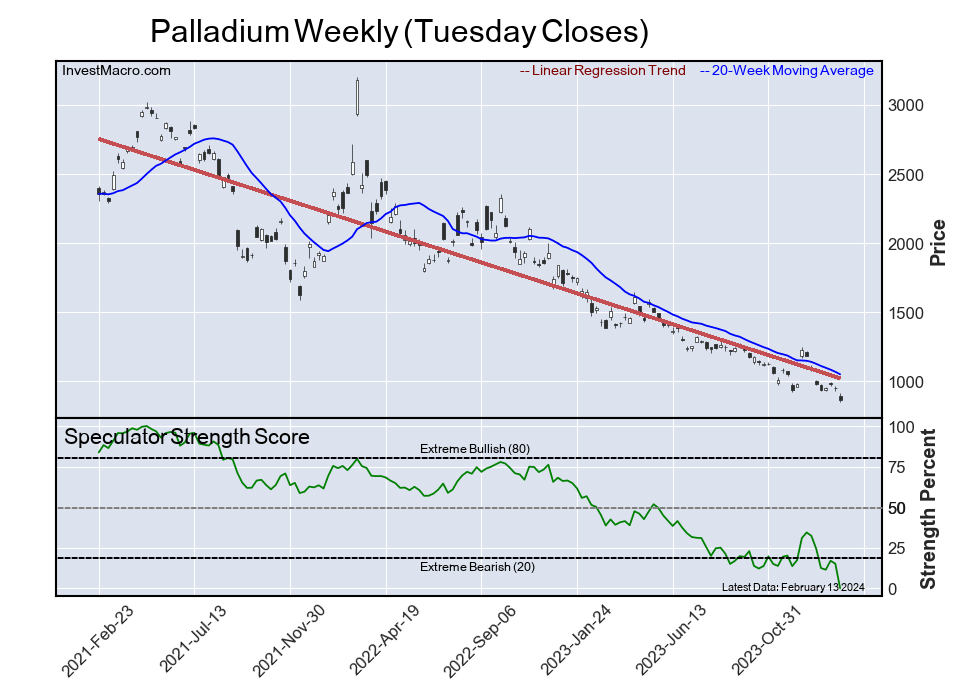
Palladium


The Palladium speculator position comes in as this week’s fourth most bearish extreme standing. The Palladium speculator level is at a 5.6 percent score of its 3-year range.

The six-week trend for the speculator strength score was -2.5 this week. The speculator position was -10,638 net contracts this week with a small rise of 614 contracts in the weekly speculator bets.


Lean Hogs


Finally, the Lean Hogs speculator position comes in as the fifth most bearish extreme standing for this week. The Lean Hogs speculator level is at a 6.3 percent score of its 3-year range.

The six-week trend for the speculator strength score was -8.4 this week. The speculator position was -28,455 net contracts this week with a drop of -3,765 contracts in the weekly speculator bets.


Article By InvestMacroReceive our weekly COT Newsletter

*COT Report: The COT data, released weekly to the public each Friday, is updated through the most recent Tuesday (data is 3 days old) and shows a quick view of how large speculators or non-commercials (for-profit traders) were positioned in the futures markets.

The CFTC categorizes trader positions according to commercial hedgers (traders who use futures contracts for hedging as part of the business), non-commercials (large traders who speculate to realize trading profits) and nonreportable traders (usually small traders/speculators) as well as their open interest (contracts open in the market at time of reporting). See CFTC criteria here.