Archive for Opinions – Page 57

Palladium Is Good on Every Time Frame

Source: Barry Dawes  (3/6/24)

Barry Dawes of Martin Place Securities shares his thoughts on the current state of gold, silver, nickel, cobalt, and palladium and explains why he believes silver is breaking out and palladium is ready to skyrocket.

Gold makes another new closing high in US$, and much higher prices are coming.

Gold is surging in all major currencies.

Silver is breaking out, and palladium is readying to rocket higher

Key Points

Gold

  • Another new high
  • Strong in all currencies

Gold Stocks

  • More catch-up rally
  • Another few percent before pause
  • But heading much higher

Silver

  • Breaking out

Palladium

  • Ready to rocket higher
  • Strong on all time frames

Nickel

  • Downtrend broken

Gold

Volatility is returning after a very quiet period.

This is a very powerful move after the 4-year consolidation in the box.

The parabolic moves are very clear in gold in most currencies.

This is a vertical move.

In clear air to head higher.

Big break out here against rallying bond prices.

Silver

Silver is looking good here now.

And the big picture is for a very strong move out of this parabolic pattern.

XAU has moved nicely out of that wedge.

The first stop will be 117 with a breather and then to 130.

It will go much higher, but let’s wait and see.

ASX Gold Stocks

Rally to 7700 underway, then much higher.

Bonds

  • Yields still heading lower
  • Gapped lower

Palladium

Good on every time frame.

Nickel

Breaking out.

Head the markets, not the commentators.


Important Disclosures:

  1. Statements and opinions expressed are the opinions of the author and not of Streetwise Reports, Street Smart, or their officers. The author is wholly responsible for the accuracy of the statements. Streetwise Reports was not paid by the author to publish or syndicate this article. Streetwise Reports requires contributing authors to disclose any shareholdings in, or economic relationships with, companies that they write about. Any disclosures from the author can be found  below. Streetwise Reports relies upon the authors to accurately provide this information and Streetwise Reports has no means of verifying its accuracy.
  2. This article does not constitute investment advice and is not a solicitation for any investment. Streetwise Reports does not render general or specific investment advice and the information on Streetwise Reports should not be considered a recommendation to buy or sell any security. Each reader is encouraged to consult with his or her personal financial adviser and perform their own comprehensive investment research. By opening this page, each reader accepts and agrees to Streetwise Reports’ terms of use and full legal disclaimer. Streetwise Reports does not endorse or recommend the business, products, services or securities of any company.

For additional disclosures, please click here.

Lithium-ion batteries don’t work well in the cold – a battery researcher explains the chemistry at low temperatures

By Wesley Chang, Drexel University 

Rechargeable batteries are great for storing energy and powering electronics from smartphones to electric vehicles. In cold environments, however, they can be more difficult to charge and may even catch on fire.

I’m a mechanical engineering professor who’s been interested in batteries since college. I now lead a battery research group at Drexel University.

In just this past decade, I have watched the price of lithium-ion batteries drop as the production market has grown much larger. Future projections predict the market could reach thousands of GWh per year by 2030, a significant increase.

But, lithium-ion batteries aren’t perfect – this rise comes with risks, such as their tendency to slow down during cold weather and even catch on fire.

Behind the Li-ion battery

The electrochemical energy storage within batteries works by storing electricity in the form of ions. Ions are atoms that have a nonzero charge because they have either too many or not enough electrons.

When you plug in your electric car or phone, the electricity provided by the outlet drives these ions from the battery’s positive electrode into its negative electrode. The electrodes are solid materials in a battery that can store ions, and all batteries have both a positive and a negative electrode.

Electrons pass through the battery as electricity. With each electron that passes to one electrode, a lithium ion also passes into the same electrode. This ensures the balance of charges in the battery. As you drive your car, the stored ions in the negative electrode move back to the positive electrode, and the resulting flow of electricity powers the motor.

A diagram showing three boxes, one labeled cathode, one labeled electrolyte, and one labeled anode. Small circles representing lithium ions move to the anode to charge and the cathode to discharge.
When a lithium-ion battery delivers energy to a device, lithium ions – atoms that carry an electrical charge – move from the negative electrode, the anode, to the positive electrode, the cathode. The ions move in reverse when recharging.
Argonne National Laboratory, CC BY-NC-SA

While AA or AAA batteries can power small electronics, they can be used only once and cannot be charged. Rechargeable Li-ion batteries can operate for thousands of cycles of full charge and discharge. For each cycle, they can also store a much higher amount of charge than an AA or AAA battery.

Since lithium is the lightest metal, it has a high specific capacity, meaning it can store a huge amount of charge per weight. This is why lithium-ion batteries are useful not just for portable electronics but for powering modes of transportation with limited weight or volume, such as electric cars.

Battery fires

However, lithium-ion batteries have risks that AA or AAA batteries don’t. For one, they’re more likely to catch on fire. For example, the number of electric bike battery fires reported in New York City has increased from 30 to nearly 300 in the past five years.

Lots of different issues can cause a battery fire. Poorly manufactured cells could contain defects, such as trace impurities or particles left behind from the manufacturing process, that increase the risk of an internal failure.

Climate can also affect battery operation. Electric vehicle sales have increased across the U.S., particularly in cold regions such as the Northeast and Midwest, where the frigid temperatures can hinder battery performance.

Batteries contain fluids called electrolytes, and cold temperatures cause fluids to flow more slowly. So, the electrolytes in batteries slow and thicken in the cold, causing the lithium ions inside to move slower. This slowdown can prevent the lithium ions from properly inserting into the electrodes. Instead, they may deposit on the electrode surface and form lithium metal.

The molecules in fluids move slower at colder temperatures – the same thing happens inside batteries.

If too much lithium deposits on the electrode’s surface during charging, it may cause an internal short circuit. This process can start a battery fire.

Making safer batteries

My research group, along with many others, is studying how to make batteries that operate more efficiently in the cold.

For example, researchers are exploring swapping out the usual battery electrolyte and replacing it with an alternative electrolyte that doesn’t thicken at cold temperatures. Another potential option is heating up the battery pack before charging so that the charging process occurs at a warmer temperature.

My group is also investigating new types of batteries beyond lithium ion. These could be battery types that are more stable at wider temperature ranges, types that don’t even use liquid electrolytes at all, or batteries that use sodium instead of lithium. Sodium-ion batteries could work well and cost less, as sodium is a very abundant resource.

Solid-state batteries use solid electrolytes that aren’t flammable, which reduces the risk of fire. But these batteries don’t work quite as well as Li-ion batteries, so it’ll take more research to tell whether these are a good option.

Lithium-ion batteries power technologies that people across the country use every day, and research in these areas aims to find solutions that will make this technology even safer for the consumer.The Conversation

About the Author:

Wesley Chang, Assistant Professor of Mechanical Engineering and Mechanics, Drexel University

This article is republished from The Conversation under a Creative Commons license. Read the original article.

Is the United States overestimating China’s power?

By Dan Murphy, Harvard Kennedy School 

Which country is the greatest threat to the United States? The answer, according to a large proportion of Americans, is clear: China.

Half of all Americans responding to a mid-2023 survey from the Pew Research Center cited China as the biggest risk to the U.S., with Russia trailing in second with 17%. Other surveys, such as from the Chicago Council on Global Affairs, show similar findings.

Senior figures in recent U.S. administrations appear to agree with this assessment. In 2020, John Ratcliffe, director of national intelligence under President Donald Trump, wrote that Beijing “intends to dominate the U.S. and the rest of the planet economically, militarily and technologically.”

The White House’s current National Defense Strategy is not so alarmist, referring to China as the U.S.’s “pacing challenge” – a reference that, in the words of Secretary of Defense Lloyd Austin, apparently means China has “the intent to reshape the international order and, increasingly, the power to do so.”

As someone who has followed China for over a quarter century, I believe that many observers have overestimated the country’s apparent power. Recent challenges to China’s economy have led some people to reevaluate just how powerful China is. But hurdles to the growth of Chinese power extend far beyond the economic sector – and failing to acknowledge this reality may distort how policymakers and the public view the shift of geopolitical gravity in what was once called “the Chinese century.”

In overestimating China’s comprehensive power, the U.S. risks misallocating resources and attention, directing them toward a threat that is not as imminent as one might otherwise assume.

Let me be clear: I’m not suggesting that China is weak or about to collapse. Nor am I making an argument about China’s intentions. But rather, it is time to right-size the American understanding of the country’s comprehensive power. This process includes acknowledging both China’s tremendous accomplishments and its significant challenges. Doing so is, I believe, mission critical as the United States and China seek to put a floor underneath a badly damaged bilateral relationship.

Headline numbers

Why have so many people misjudged China’s power?

One key reason for this misconception is that from a distance, China does indeed appear to be an unstoppable juggernaut. The high-level numbers bedazzle observers: Beijing commands the world’s largest or second-largest economy depending on the type of measurement; it has a rapidly growing military budget and sky-high numbers of graduates in engineering and math; and oversees huge infrastructure projects – laying down nearly 20,000 miles of high-speed rail tracks in less than a dozen years and building bridges at record pace.

But these eye-catching metrics don’t tell a complete story. Look under the hood and you’ll see that China faces a raft of intractable difficulties.

The Chinese economy, which until recently was thought of as unstoppable, is beginning to falter due to deflation, a growing debt-to-gross domestic product ratio and the impact of a real estate crisis.

China’s other challenges

And it isn’t only China’s economy that has been overestimated.

While Beijing has put in considerable effort building its soft power and sending its leadership around the world, China enjoys fewer friends than one might expect, even with its willing trade partners. North Korea, Pakistan, Cambodia and Russia may count China as an important ally, but these relationships are not, I would argue, nearly as strong as those enjoyed by the United States globally. Even in the Asia-Pacific region there is a strong argument to say Washington enjoys greater sway, considering the especially close ties with allies Japan, South Korea and Australia.

Even though Chinese citizens report broad support for the Communist Party, Beijing’s capricious COVID-19 policies paired with an unwillingness to use foreign-made vaccines have dented perceptions of government effectiveness.

Further, China’s population is aging and unbalanced. In 2016, the country of 1.4 billion saw about 18 million births; in 2023, that number dropped to about 9 million. This alarming fall is not only in line with trends toward a shrinking working-age population, but also perhaps indicative of pessimism among Chinese citizens about the country’s future.

And at times, the actions of the Chinese government read like an implicit admission that the domestic situation is not all that rosy. For example, I take it as a sign of concern over systemic risk that China detained a million or more people, as has happened with the Muslim minority in Xinjiang province. Similarly, China’s policing of its internet suggests concerns over collective action by its citizens.

The sweeping anti-corruption campaign Beijing has embarked on, purges of the country’s military and the disappearance of leading business figures all hint at a government seeking to manage significant risk.

I hear many stories from contacts in China about people with money or influence hedging their bets by establishing a foothold outside the country. This aligns with research that has shown that in recent years, on average as much money leaves China via “irregular means” as for foreign direct investment.

A three-dimensional view

The perception of China’s inexorable rise is cultivated by the governing Communist Party, which obsessively seeks to manufacture and control narratives in state media and beyond that show it as all-knowing, farsighted and strategic. And perhaps this argument finds a receptive audience in segments of the United States concerned about its own decline.

It would help explain why a recent Chicago Council on Global Affairs survey found that about a third of American respondents see the Chinese and American economies as equal and another third see the Chinese economy as stronger. In reality, per capita GDP in the United States is six times that of China.

Of course, there is plenty of danger in predicting China’s collapse. Undoubtedly, the country has seen huge accomplishments since the People’s Republic of China’s founding in 1949: Hundreds of millions of people brought out of poverty, extraordinary economic development and impressive GDP growth over several decades, and growing diplomatic clout. These successes are especially noteworthy given that the People’s Republic of China is less than 75 years old and was in utter turmoil during the disastrous Cultural Revolution from 1966 to 1976, when intellectuals were sent to the countryside, schools stopped functioning and chaos reigned. In many cases, China’s successes merit emulation and include important lessons for developing and developed countries alike.

China may well be the “pacing challenge” that many in the U.S. believe. But it also faces significant internal challenges that often go under-recognized in evaluating the country’s comprehensive power.

And as the United States and China seek to steady a rocky relationship, it is imperative that the American public and Washington policymakers see China as fully three-dimensional – not some flat caricature that fits the needs of the moment. Otherwise, there is a risk of fanning the flames of xenophobia and neglecting opportunities for partnership that would benefit the United States.The Conversation

About the Author:

Dan Murphy, Executive Director of the Mossavar-Rahmani Center for Business and Government, Harvard Kennedy School

This article is republished from The Conversation under a Creative Commons license. Read the original article.

Is Energy Transfer (ET) a Buy Opportunity Amidst Acquisition Momentum?

By Ino.com

As a merger frenzy sweeps across the U.S. oil industry, pipeline operators are seizing the opportunity to join the fray. Fueled by ambitions to enhance scale, optimize assets, and capitalize on lucrative export markets, they’re making their mark by jumping on the merger bandwagon.

Natural gas pipeline operator Energy Transfer LP’s (ET) recent merger and acquisition endeavors stand out as a shining example in this dynamic landscape. Commanding a market cap of approximately $49 billion, ET is a powerhouse in the energy industry, boasting one of the most extensive and diverse portfolios of assets in the U.S.

Owning and operating over 125,000 miles of pipelines and vital infrastructure, ET’s strategic footprint covers 44 states, tapping into every major U.S. production basin.

Despite its vast footprint, ET made significant moves last year, securing two major deals. It acquired Lotus Midstream for close to $1.50 billion and merged with Crestwood Equity Partners, a fellow Master Limited Partnership (MLP), in a deal worth $7.10 billion.

ET’s Co-CEO Tom Long, in the fourth-quarter conference call, conveyed the company’s steadfast belief in the rationale behind consolidation within the energy sector and indicated that the company will continue assessing potential opportunities for further consolidation.

That said, ET’s acquisition of Lotus Midstream’s Centurion Pipeline assets marks a pivotal expansion for the company, amplifying its presence in the thriving heart of the Permian Basin. This strategic move bolsters ET’s capacity for transporting and storing crude oil and elevates its connectivity across key markets.

The Centurion assets, located across some of the most active areas of the Permian Basin, boast substantial gathering volumes from prominent producers, fortifying ET’s access to crucial downstream markets characterized by consistent demand. These assets serve as direct conduits to major hubs such as Cushing, Midland, Colorado City, Wink, and Crane, unlocking a network of unparalleled opportunities for ET to thrive and flourish.

Meanwhile, last year November, ET successfully completed its merger with Crestwood Equity Partners LP, solidifying its dominant position in the midstream sector. The transaction boosts ET’s distributable cash flow per unit, bringing in substantial cash flows from long-term contracts and acreage dedications.

In its fourth-quarter earnings release, the company emphasized the transformative impact of its merger with Crestwood, projecting an impressive $80 million in annual cost synergies by 2026, with an anticipated $65 million to be realized by 2024 alone.

These synergies, however, are just the tip of the iceberg, with further benefits expected to emerge from enhanced financial and commercial alignments in the near future. Moreover, during the fourth quarter, ET’s assets surged to unprecedented heights with the addition of new growth projects and acquisitions.

Notably, Natural Gas Liquids (NGL) fractionation volumes soared by a remarkable 16%, establishing a new record for ET. Similarly, NGL transportation volumes witnessed a substantial uptick of 10%, also setting a new benchmark.

Meanwhile, NGL exports experienced an impressive surge of over 13%, reflecting the company’s expanding global reach. Additionally, both crude oil transportation and terminal volumes witnessed substantial increases, soaring by 39% and 16%, respectively.

For the fiscal year 2024, the company expects its growth capital expenditures to range from $2.40 billion to $2.60 billion and maintenance capital expenditures are expected to be between $835 million and $865 million. The forecasted adjusted EBITDA for the same period is expected to hover somewhere between $14.50 billion and $14.80 billion.

Apart from mergers and acquisition endeavors, ET is dedicated to returning its unitholders’ value through quarterly distributions. The company’s annual dividend of $1.26 translates to an 8.58% yield on the prevailing price level, while its four-year average dividend yield is 10.24%. Its dividend payouts have grown at a CAGR of 10.8% over the past three years.

With a surge of roughly 14% over the past year, analysts on Wall Street are forecasting a potential increase in the stock’s value, estimating it to reach $18.22 within the next 12 months. This suggests a potential upside of 25.4%. The price target varies, ranging from a low of $15 to a high of $22.

Bottom Line

ET emerges as a formidable player in the energy industry, driven by its aggressive growth strategy and slew of acquisitions.

The company’s major deals, including the merger with Crestwood and the acquisition of Lotus Midstream’s Centurion Pipeline assets, demonstrate its commitment to expanding its footprint and enhancing its capabilities. Additionally, ET’s strong operational performance in the fourth quarter underscores its remarkable ability to capitalize on growth projects and acquisitions.

Moreover, the company’s attractive dividend yield, the potential for further acquisitions this year, analyst’s bullish forecasts for ET’s stock value, and its robust growth prospects all point toward promising opportunities for investors.

With these factors in mind, investors could closely monitor ET’s shares for potential gains in the future.

By Ino.com – See our Trader Blog, INO TV Free & Market Analysis Alerts

Source: Is Energy Transfer (ET) a Buy Opportunity Amidst Acquisition Momentum?

Trade Of The Week: EURCAD knocks on major resistance

By ForexTime

  • BoC/ECB combo could rattle EURCAD
  • Both central banks expected to hold rates
  • Keep eye on updated ECB economic projections
  • EURCAD bullish on D1 but RSI overbought
  • Key levels of interest at 1.4650 & 1.4750

A central bank combo featuring the Bank of Canada (BoC) and European Central Bank (ECB) may rock the EURCAD this week.

The minor currency pair has been trapped within a wide range since December 2023, with support at 1.4475 and resistance at 1.4750.

However, a bullish presence can be felt on the daily charts with prices approaching key resistance.

The EURCAD could be on the cusp of a major breakout.

Here are 3 reasons why:

  1. BoC rate decision

The Bank of Canada is expected to leave interest rates unchanged at 5% on Wednesday.

Given how economic growth surprised to the upside in Q4 and inflation fell to its lowest since June 2023 at 2.9%, the BoC may not be in a rush to cut interest rates. Nevertheless, much attention will be directed towards the policy statement for more clues on the central bank’s next policy move. Interestingly, traders are pricing in only a 32% probability of a 25-basis point BoC cut by April with this jumping to 86% by June 2024.

  • If the BoC signals that rates will remain higher for longer until there are more signs of cooling inflation, this may boost the Canadian Dollar.
  • Should the BoC strike a dovish note and hint that a rate cut could be around the corner, the CAD may weaken – pushing the USDCAD higher as a result.


  1. ECB rate decision

Markets widely expect the European Central Bank to leave interest rates unchanged on Thursday.

So much focus will be on the fresh forecasts from the ECB’s staff economists and Lagarde’s press conference for fresh clues on future policy moves. It is worth noting that inflation has edged lower in the euro area while economic data remains soft. Traders are currently pricing in a 21% probability of a 25-basis point ECB cut by April with this rising to 92% by June 2024.

  • Should the ECB sound more hawkish than expected and signals the rates will remain higher for longer, the euro may jump – pushing the EURCAD higher.
  • A dovish sounding ECB that confirms potential rate cuts later this year is likely to weaken the euro, dragging the EURCAD lower.


  1. Technical forces

The EURCAD is respecting a bullish channel on the daily charts with prices trading above the 50, 100 and 200-day SMA. However, the Relative Strength Index (RSI) signals that prices are approaching overbought levels.

  • A solid breakout above 1.4750 may spark a move higher towards 1.4850.
  • Should prices slip below the 100-day SMA at 1.4650, this may open a path towards the 50-day and 200-day SMA at 1.4590.

According to Bloomberg’s FX forecast model, there’s a 77% chance that EURCAD will trade within the 1.45895 – 1.48550 range over the next week.


Forex-Time-LogoArticle by ForexTime

ForexTime Ltd (FXTM) is an award winning international online forex broker regulated by CySEC 185/12 www.forextime.com

Stocks: What This “Record Extreme” May Be Signaling

“The total easily exceeds the prior net long extreme”

By Elliott Wave International

When most everyone agrees on the future trend of a market, it’s almost guaranteed that the market will go in the other direction — sooner rather than later.

The reason why is that there is no one left to convince, hence, the market in question will likely have difficulty going in the predicted direction.

As Robert Prechter notes in a classic Elliott Wave Theorist (a monthly publication which analyzes major financial and cultural trends):

The more convincing the arguments seem, the surer one can be that a consensus is signaling a turn in the other direction.

With that in mind, consider this chart and commentary from the February Elliott Wave Financial Forecast, a monthly publication which covers major U.S. financial markets:

[A] new record was recently reached in the net long position of Small Traders as published weekly in the Commitment of Traders Report. The combined net long futures position of Small Traders in the S&P 500, NASDAQ 100 and DJIA soared to an all-time high of $51.59 billion on January 9. The total easily exceeds the prior net long extreme of $42.06 billion in September 2021.

As you may recall, that prior peak reading in investor sentiment occurred just weeks before the November 2021 top in the NASDAQ indexes.

That doesn’t mean that the exact same scenario will play out again.

However, keep in mind that the patterns of investor psychology tend to be similar each time around — as markets go from an uptrend to a downtrend and then back again.

And these patterns don’t just apply to the typical retail or Main Street investor, they also apply to money managers who may oversee portfolios in the tens of billions of dollars. Here’s a quote from another classic Theorist:

Small traders are typically on the wrong side of the market at the turns. You might think that large traders, because they have a lot more money, are right a lot, but they are likewise usually wrong at the turns.

The repetitive patterns of investor psychology show up as Elliott waves on the charts of widely traded financial markets.

If you are unfamiliar with the Wave Principle, read Frost & Prechter’s Wall Street classic, Elliott Wave Principle: Key to Market Behavior. Here’s a quote from this “must read” book:

Without Elliott, there appear to be an infinite number of possibilities for market action. What the Wave Principle provides is a means of first limiting the possibilities and then ordering the relative probabilities of possible future market paths. Elliott’s highly specific rules reduce the number of valid alternatives to a minimum.

No analytical method can guarantee a particular outcome in financial markets but given Elliott waves reflect the repetitive patterns of investor psychology, the knowledge those waves provide about the market’s position within the behavioral continuum is extensive and second to none.

You may be interested in knowing that you can access the online version of the book for free once you join Club EWI, the world’s largest Elliott wave educational community.

A Club EWI membership is free and allows you access to a wealth of Elliott wave resources on investing and trading without any obligations.

Just follow the link to get started: Elliott Wave Principle: Key to Market Behaviorget instant and free access.

This article was syndicated by Elliott Wave International and was originally published under the headline Stocks: What This “Record Extreme” May Be Signaling. EWI is the world’s largest market forecasting firm. Its staff of full-time analysts led by Chartered Market Technician Robert Prechter provides 24-hour-a-day market analysis to institutional and private investors around the world.

Japanese Yen Speculators sharply renew bearish bets for 7th straight week

By InvestMacro

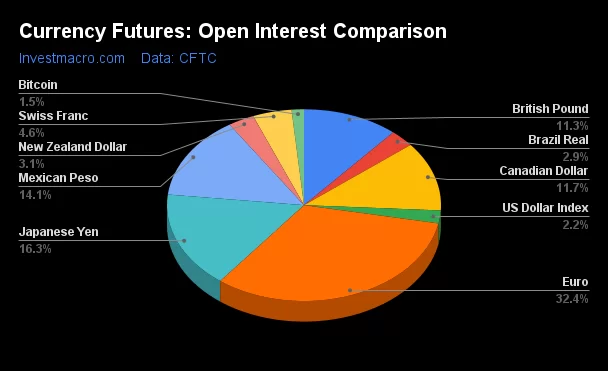
Here are the latest charts and statistics for the Commitment of Traders (COT) data published by the Commodities Futures Trading Commission (CFTC).

The latest COT data is updated through Tuesday February 27th and shows a quick view of how large market participants (for-profit speculators and commercial traders) were positioned in the futures markets. All currency positions are in direct relation to the US dollar where, for example, a bet for the euro is a bet that the euro will rise versus the dollar while a bet against the euro will be a bet that the euro will decline versus the dollar.

Weekly Speculator Changes led by New Zealand Dollar & Australian Dollar

The COT currency market speculator bets were higher this week as six out of the eleven currency markets we cover had higher positioning while the other five markets had lower speculator contracts.

Leading the gains for the currency markets was the New Zealand Dollar (3,431 contracts) with the Australian Dollar (2,699 contracts), the Brazilian Real (1,004 contracts), the US Dollar Index (537 contracts), Bitcoin (131 contracts) and the British Pound (46 contracts) also having positive weeks.

The currencies seeing declines in speculator bets on the week were the Japanese Yen (-11,927 contracts), the EuroFX (-5,162 contracts), the Mexican Peso (-2,181 contracts), the Swiss Franc (-2,058 contracts) and the Canadian Dollar (-515 contracts) also registering lower bets on the week.

Japanese Yen Speculators sharply renew their bearish bets for 7th straight week

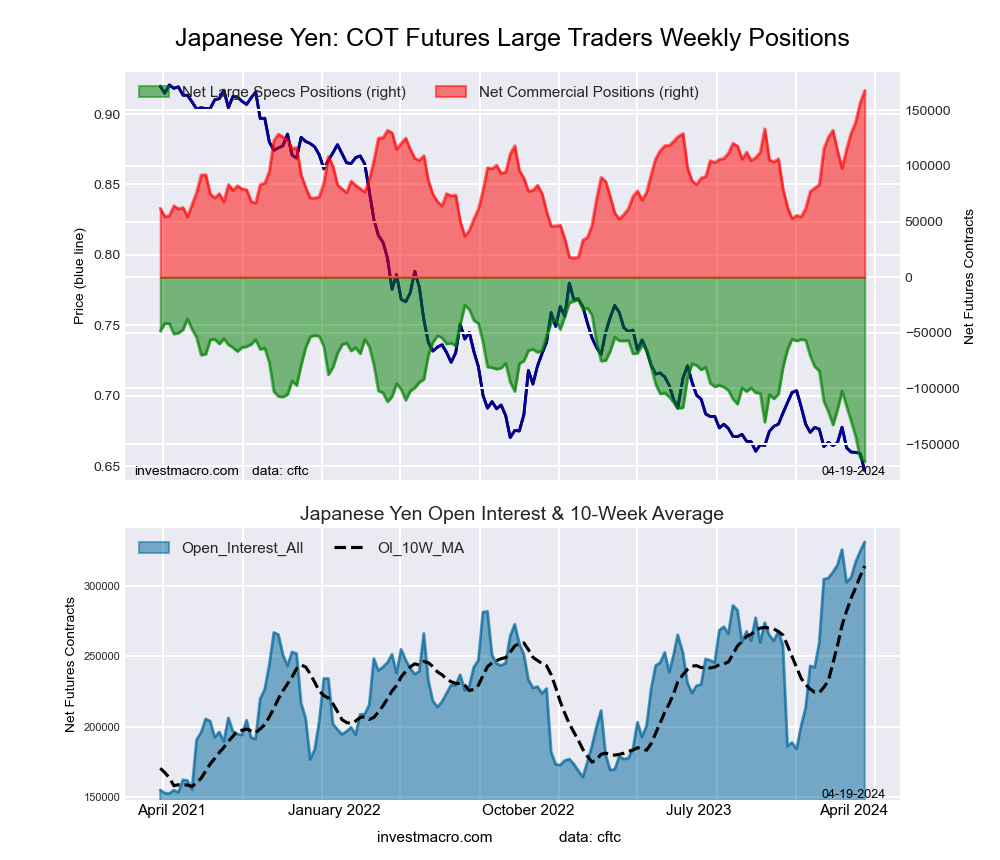
Highlighting the COT currency’s data this week is strong renewal in bearish bets for the Japanese yen speculators. Large speculative yen positions dropped for a seventh straight week this week and have now fallen by a total of -76,756 contracts over these past seven weeks.

This renewed bearishness for the yen has pushed the net position (currently at -132,705 contracts) to the most negative position since November 14th of 2017 (when it fell to -135,999 contracts), the lowest level in a span of 328 weeks.

Just a couple of months ago, the yen speculative positioning had been improving and was at it’s best level in 39-weeks (at -55,568 contracts on December 26th). This optimism was based on the hopes that the Bank of Japan (BOJ) would look to end its negative interest rate policy and its asset-buying program. However, the BOJ has maintained its policy so far in 2024 and speculator hopes for yen strength have been postponed.

The yen exchange rate has taken a large hit in the aftermath with the US Dollar’s exchange versus the yen shooting higher and closing in on the recent 2023 highs. The USDJPY currency pair is up by almost 7 percent since the beginning of the year and has risen in seven out of the past nine weeks. This week’s close was right above the 150.00 level is slightly below the November 2023 high of 151.90.

The USDJPY prices above the 150.00 level are very rare in recent years as these levels had not been reached since 1990 — until this threshold was breached in 2022, 2023 and now in 2024. The yen has now lost approximately 45 percent of its value versus the US Dollar since January of 2021 when the USDJPY traded around 103.00.


Currencies Net Speculators Leaderboard
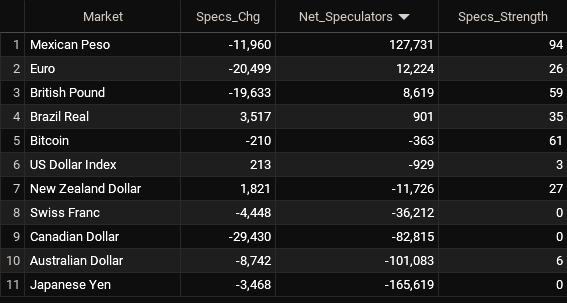
Legend: Weekly Speculators Change | Speculators Current Net Position | Speculators Strength Score compared to last 3-Years (0-100 range)


Strength Scores led by Mexican Peso & British Pound

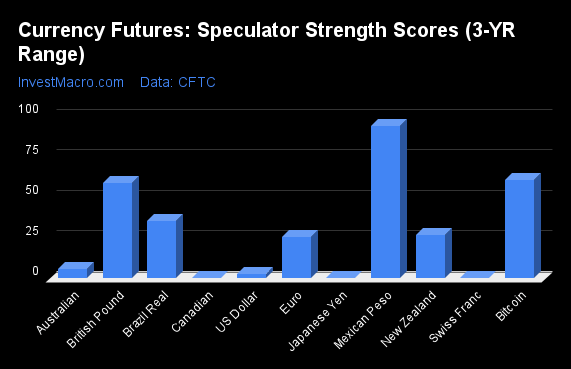
COT Strength Scores (a normalized measure of Speculator positions over a 3-Year range, from 0 to 100 where above 80 is Extreme-Bullish and below 20 is Extreme-Bearish) showed that the Mexican Peso (96 percent), the British Pound (88 percent) and New Zealand Dollar (82 percent) lead the currency markets this week. The Canadian Dollar (58 percent) and the Brazilian Real (57 percent) come in as the next highest in the weekly strength scores.

On the downside, the Japanese Yen (0 percent) and the Australian Dollar (16 percent) come in at the lowest strength levels currently and are in Extreme-Bearish territory (below 20 percent). The next lowest strength scores are the US Dollar Index (20 percent) and the Swiss Franc (25 percent).

Strength Statistics:
US Dollar Index (20.4 percent) vs US Dollar Index previous week (19.4 percent)
EuroFX (47.1 percent) vs EuroFX previous week (49.3 percent)
British Pound Sterling (87.9 percent) vs British Pound Sterling previous week (87.9 percent)
Japanese Yen (0.0 percent) vs Japanese Yen previous week (8.6 percent)
Swiss Franc (24.7 percent) vs Swiss Franc previous week (30.6 percent)
Canadian Dollar (57.9 percent) vs Canadian Dollar previous week (58.4 percent)
Australian Dollar (16.3 percent) vs Australian Dollar previous week (13.8 percent)
New Zealand Dollar (81.6 percent) vs New Zealand Dollar previous week (72.7 percent)
Mexican Peso (96.0 percent) vs Mexican Peso previous week (97.3 percent)
Brazilian Real (57.2 percent) vs Brazilian Real previous week (55.9 percent)
Bitcoin (36.8 percent) vs Bitcoin previous week (34.8 percent)


New Zealand Dollar & British Pound top the 6-Week Strength Trends

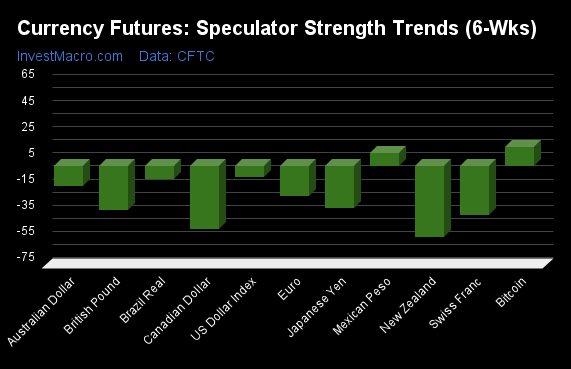
COT Strength Score Trends (or move index, calculates the 6-week changes in strength scores) showed that the New Zealand Dollar (34 percent) and the British Pound (11 percent) lead the past six weeks trends for the currencies. The Canadian Dollar (10 percent) and the Mexican Peso (7 percent) are the next highest positive movers in the latest trends data.

The Japanese Yen (-55 percent) leads the downside trend scores currently with the Australian Dollar (-29 percent), Swiss Franc (-24 percent) and the EuroFX (-18 percent) following next with lower trend scores.

Strength Trend Statistics:
US Dollar Index (1.5 percent) vs US Dollar Index previous week (-2.5 percent)
EuroFX (-17.6 percent) vs EuroFX previous week (-21.7 percent)
British Pound Sterling (10.7 percent) vs British Pound Sterling previous week (17.8 percent)
Japanese Yen (-54.7 percent) vs Japanese Yen previous week (-46.6 percent)
Swiss Franc (-23.5 percent) vs Swiss Franc previous week (-15.8 percent)
Canadian Dollar (10.1 percent) vs Canadian Dollar previous week (5.5 percent)
Australian Dollar (-28.7 percent) vs Australian Dollar previous week (-45.4 percent)
New Zealand Dollar (33.7 percent) vs New Zealand Dollar previous week (21.9 percent)
Mexican Peso (7.4 percent) vs Mexican Peso previous week (4.6 percent)
Brazilian Real (-9.3 percent) vs Brazilian Real previous week (-11.1 percent)
Bitcoin (-14.6 percent) vs Bitcoin previous week (-7.2 percent)


Individual COT Forex Markets:

US Dollar Index Futures:
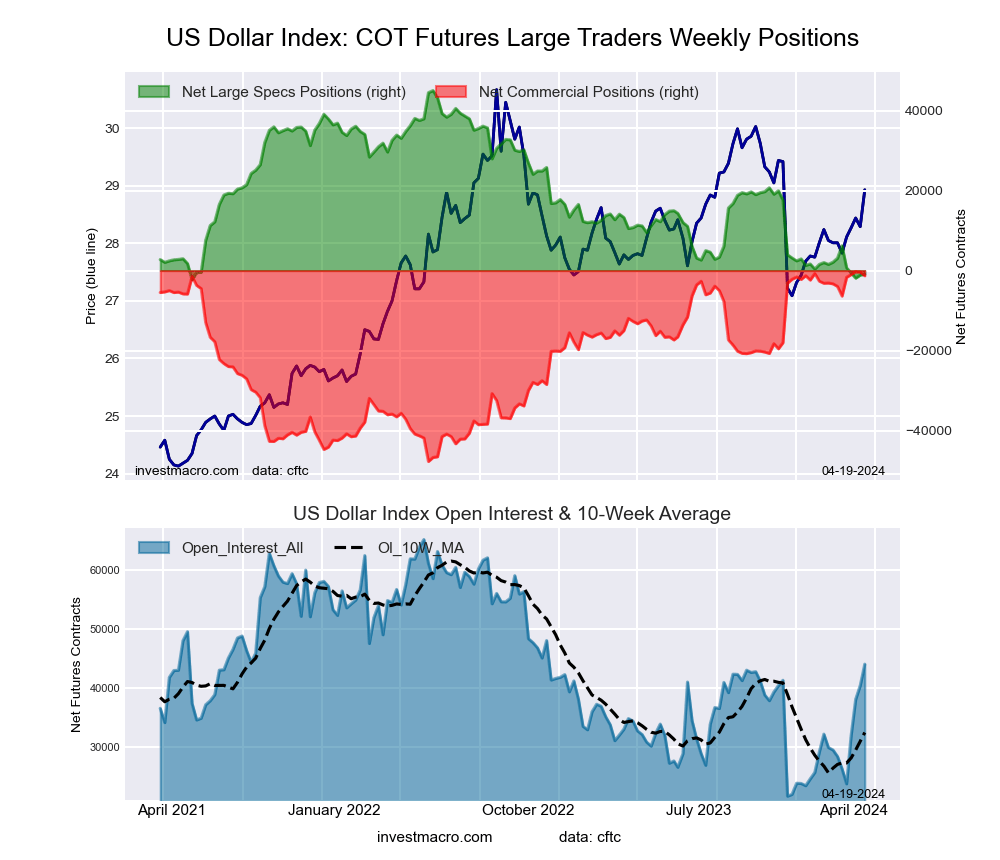
US Dollar Index Forex Futures COT ChartThe US Dollar Index large speculator standing this week reached a net position of 2,083 contracts in the data reported through Tuesday. This was a weekly boost of 537 contracts from the previous week which had a total of 1,546 net contracts.

This week’s current strength score (the trader positioning range over the past three years, measured from 0 to 100) shows the speculators are currently Bearish with a score of 20.4 percent. The commercials are Bullish-Extreme with a score of 81.6 percent and the small traders (not shown in chart) are Bearish with a score of 25.6 percent.

Price Trend-Following Model: Downtrend

Our weekly trend-following model classifies the current market price position as: Downtrend. The current action for the model is considered to be: Hold – Maintain Short Position.

US DOLLAR INDEX StatisticsSPECULATORSCOMMERCIALSSMALL TRADERS
– Percent of Open Interest Longs:63.718.911.5
– Percent of Open Interest Shorts:56.730.27.3
– Net Position:2,083-3,3231,240
– Gross Longs:18,8275,5993,387
– Gross Shorts:16,7448,9222,147
– Long to Short Ratio:1.1 to 10.6 to 11.6 to 1
NET POSITION TREND:
– Strength Index Score (3 Year Range Pct):20.481.625.6
– Strength Index Reading (3 Year Range):BearishBullish-ExtremeBearish
NET POSITION MOVEMENT INDEX:
– 6-Week Change in Strength Index:1.5-3.714.5


Euro Currency Futures:

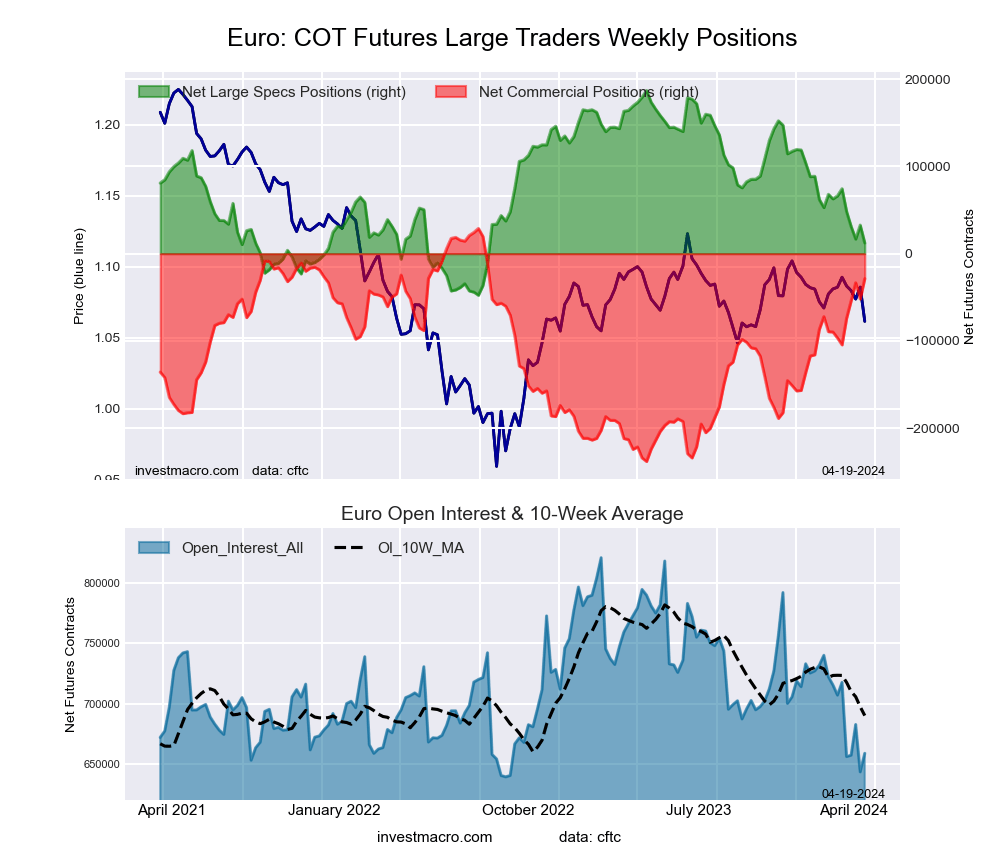
Euro Currency Futures COT ChartThe Euro Currency large speculator standing this week reached a net position of 62,854 contracts in the data reported through Tuesday. This was a weekly decrease of -5,162 contracts from the previous week which had a total of 68,016 net contracts.

This week’s current strength score (the trader positioning range over the past three years, measured from 0 to 100) shows the speculators are currently Bearish with a score of 47.1 percent. The commercials are Bullish with a score of 55.6 percent and the small traders (not shown in chart) are Bearish with a score of 22.1 percent.

Price Trend-Following Model: Uptrend

Our weekly trend-following model classifies the current market price position as: Uptrend. The current action for the model is considered to be: Hold – Maintain Long Position.

EURO Currency StatisticsSPECULATORSCOMMERCIALSSMALL TRADERS
– Percent of Open Interest Longs:28.757.511.2
– Percent of Open Interest Shorts:19.970.07.4
– Net Position:62,854-89,90127,047
– Gross Longs:205,234411,11780,334
– Gross Shorts:142,380501,01853,287
– Long to Short Ratio:1.4 to 10.8 to 11.5 to 1
NET POSITION TREND:
– Strength Index Score (3 Year Range Pct):47.155.622.1
– Strength Index Reading (3 Year Range):BearishBullishBearish
NET POSITION MOVEMENT INDEX:
– 6-Week Change in Strength Index:-17.617.4-8.6


British Pound Sterling Futures:

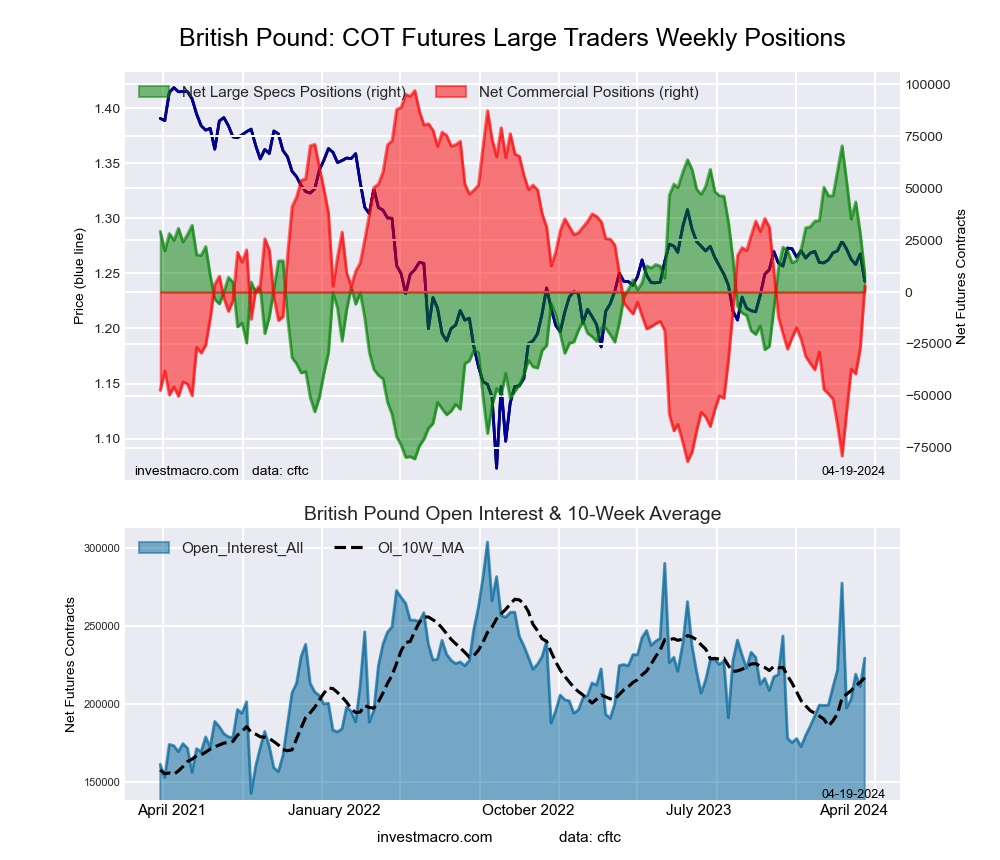
British Pound Sterling Futures COT ChartThe British Pound Sterling large speculator standing this week reached a net position of 46,358 contracts in the data reported through Tuesday. This was a weekly lift of 46 contracts from the previous week which had a total of 46,312 net contracts.

This week’s current strength score (the trader positioning range over the past three years, measured from 0 to 100) shows the speculators are currently Bullish-Extreme with a score of 87.9 percent. The commercials are Bearish-Extreme with a score of 16.8 percent and the small traders (not shown in chart) are Bullish with a score of 68.3 percent.

Price Trend-Following Model: Uptrend

Our weekly trend-following model classifies the current market price position as: Uptrend. The current action for the model is considered to be: Hold – Maintain Long Position.

BRITISH POUND StatisticsSPECULATORSCOMMERCIALSSMALL TRADERS
– Percent of Open Interest Longs:43.635.914.7
– Percent of Open Interest Shorts:21.660.412.2
– Net Position:46,358-51,5905,232
– Gross Longs:91,97075,76231,048
– Gross Shorts:45,612127,35225,816
– Long to Short Ratio:2.0 to 10.6 to 11.2 to 1
NET POSITION TREND:
– Strength Index Score (3 Year Range Pct):87.916.868.3
– Strength Index Reading (3 Year Range):Bullish-ExtremeBearish-ExtremeBullish
NET POSITION MOVEMENT INDEX:
– 6-Week Change in Strength Index:10.7-11.510.2


Japanese Yen Futures:

Japanese Yen Forex Futures COT ChartThe Japanese Yen large speculator standing this week reached a net position of -132,705 contracts in the data reported through Tuesday. This was a weekly decrease of -11,927 contracts from the previous week which had a total of -120,778 net contracts.

This week’s current strength score (the trader positioning range over the past three years, measured from 0 to 100) shows the speculators are currently Bearish-Extreme with a score of 0.0 percent. The commercials are Bullish-Extreme with a score of 98.9 percent and the small traders (not shown in chart) are Bullish-Extreme with a score of 84.9 percent.

Price Trend-Following Model: Weak Uptrend

Our weekly trend-following model classifies the current market price position as: Weak Uptrend. The current action for the model is considered to be: Hold – Maintain Long Position.

JAPANESE YEN StatisticsSPECULATORSCOMMERCIALSSMALL TRADERS
– Percent of Open Interest Longs:16.666.014.0
– Percent of Open Interest Shorts:59.423.413.7
– Net Position:-132,705131,982723
– Gross Longs:51,261204,42543,296
– Gross Shorts:183,96672,44342,573
– Long to Short Ratio:0.3 to 12.8 to 11.0 to 1
NET POSITION TREND:
– Strength Index Score (3 Year Range Pct):0.098.984.9
– Strength Index Reading (3 Year Range):Bearish-ExtremeBullish-ExtremeBullish-Extreme
NET POSITION MOVEMENT INDEX:
– 6-Week Change in Strength Index:-54.757.418.5


Swiss Franc Futures:

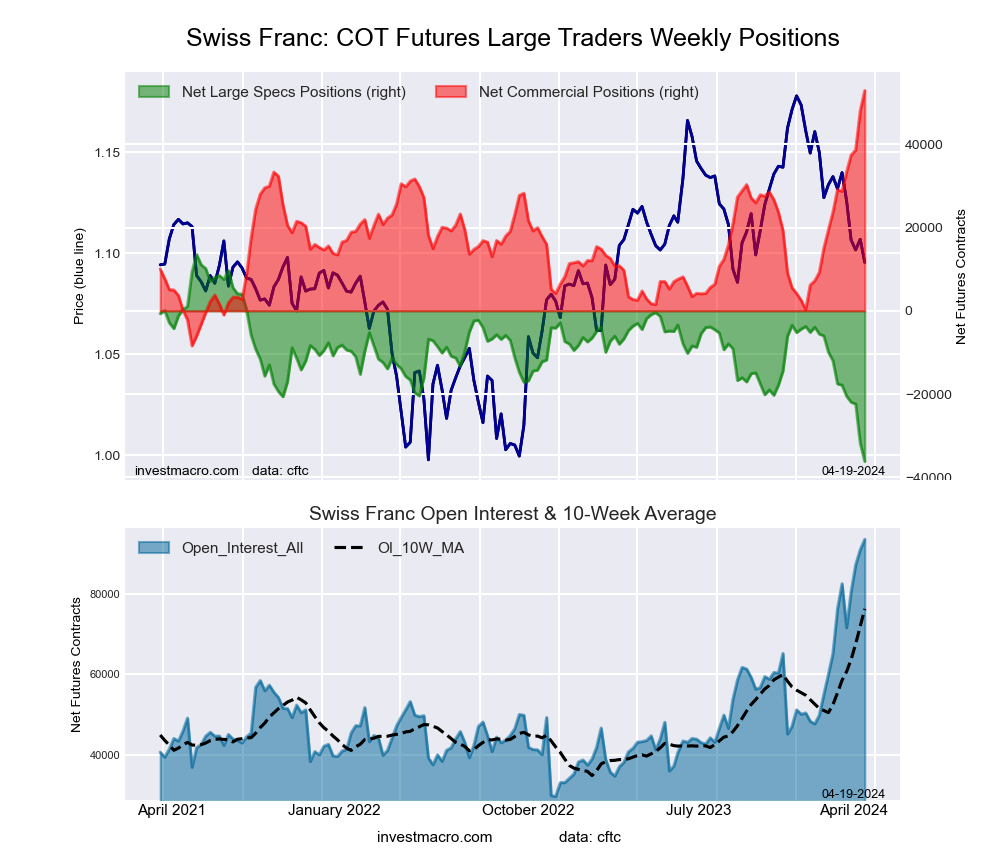
Swiss Franc Forex Futures COT ChartThe Swiss Franc large speculator standing this week reached a net position of -11,981 contracts in the data reported through Tuesday. This was a weekly fall of -2,058 contracts from the previous week which had a total of -9,923 net contracts.

This week’s current strength score (the trader positioning range over the past three years, measured from 0 to 100) shows the speculators are currently Bearish with a score of 24.7 percent. The commercials are Bullish with a score of 76.9 percent and the small traders (not shown in chart) are Bearish with a score of 23.9 percent.

Price Trend-Following Model: Weak Uptrend

Our weekly trend-following model classifies the current market price position as: Weak Uptrend. The current action for the model is considered to be: Hold – Maintain Long Position.

SWISS FRANC StatisticsSPECULATORSCOMMERCIALSSMALL TRADERS
– Percent of Open Interest Longs:24.362.412.7
– Percent of Open Interest Shorts:42.726.130.6
– Net Position:-11,98123,709-11,728
– Gross Longs:15,85740,7168,251
– Gross Shorts:27,83817,00719,979
– Long to Short Ratio:0.6 to 12.4 to 10.4 to 1
NET POSITION TREND:
– Strength Index Score (3 Year Range Pct):24.776.923.9
– Strength Index Reading (3 Year Range):BearishBullishBearish
NET POSITION MOVEMENT INDEX:
– 6-Week Change in Strength Index:-23.556.1-69.1


Canadian Dollar Futures:

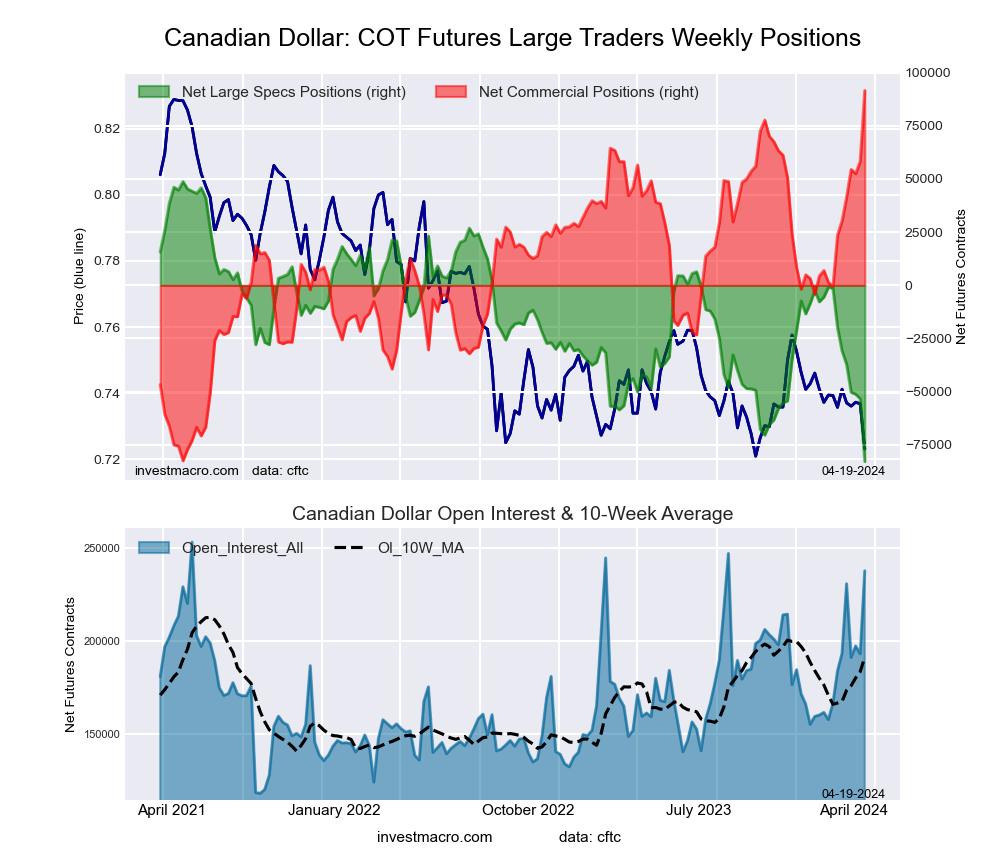
Canadian Dollar Forex Futures COT ChartThe Canadian Dollar large speculator standing this week reached a net position of -1,378 contracts in the data reported through Tuesday. This was a weekly fall of -515 contracts from the previous week which had a total of -863 net contracts.

This week’s current strength score (the trader positioning range over the past three years, measured from 0 to 100) shows the speculators are currently Bullish with a score of 57.9 percent. The commercials are Bullish with a score of 51.1 percent and the small traders (not shown in chart) are Bearish with a score of 27.1 percent.

Price Trend-Following Model: Weak Uptrend

Our weekly trend-following model classifies the current market price position as: Weak Uptrend. The current action for the model is considered to be: Hold – Maintain Long Position.

CANADIAN DOLLAR StatisticsSPECULATORSCOMMERCIALSSMALL TRADERS
– Percent of Open Interest Longs:24.754.417.9
– Percent of Open Interest Shorts:25.554.716.7
– Net Position:-1,378-5731,951
– Gross Longs:41,15890,54629,731
– Gross Shorts:42,53691,11927,780
– Long to Short Ratio:1.0 to 11.0 to 11.1 to 1
NET POSITION TREND:
– Strength Index Score (3 Year Range Pct):57.951.127.1
– Strength Index Reading (3 Year Range):BullishBullishBearish
NET POSITION MOVEMENT INDEX:
– 6-Week Change in Strength Index:10.1-3.4-14.5


Australian Dollar Futures:

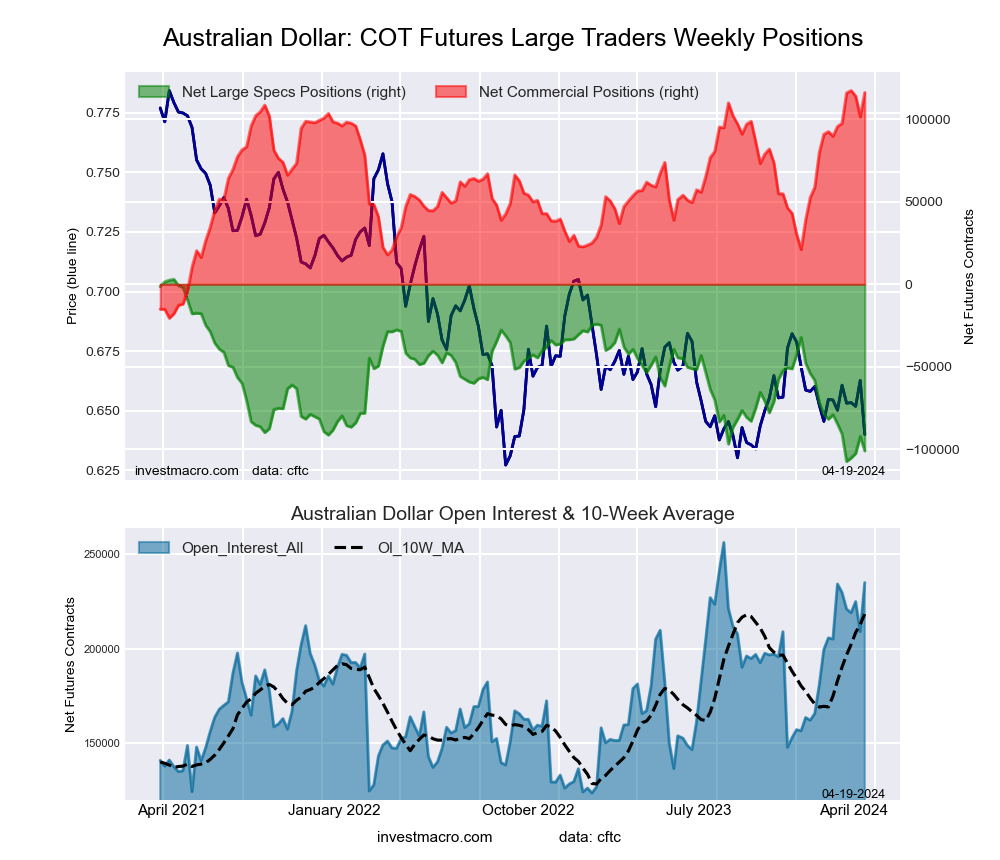
Australian Dollar Forex Futures COT ChartThe Australian Dollar large speculator standing this week reached a net position of -79,176 contracts in the data reported through Tuesday. This was a weekly advance of 2,699 contracts from the previous week which had a total of -81,875 net contracts.

This week’s current strength score (the trader positioning range over the past three years, measured from 0 to 100) shows the speculators are currently Bearish-Extreme with a score of 16.3 percent. The commercials are Bullish-Extreme with a score of 84.5 percent and the small traders (not shown in chart) are Bearish with a score of 27.5 percent.

Price Trend-Following Model: Weak Uptrend

Our weekly trend-following model classifies the current market price position as: Weak Uptrend. The current action for the model is considered to be: Hold – Maintain Long Position.

AUSTRALIAN DOLLAR StatisticsSPECULATORSCOMMERCIALSSMALL TRADERS
– Percent of Open Interest Longs:24.263.19.5
– Percent of Open Interest Shorts:62.819.314.6
– Net Position:-79,17689,777-10,601
– Gross Longs:49,640129,29219,390
– Gross Shorts:128,81639,51529,991
– Long to Short Ratio:0.4 to 13.3 to 10.6 to 1
NET POSITION TREND:
– Strength Index Score (3 Year Range Pct):16.384.527.5
– Strength Index Reading (3 Year Range):Bearish-ExtremeBullish-ExtremeBearish
NET POSITION MOVEMENT INDEX:
– 6-Week Change in Strength Index:-28.738.8-49.0


New Zealand Dollar Futures:

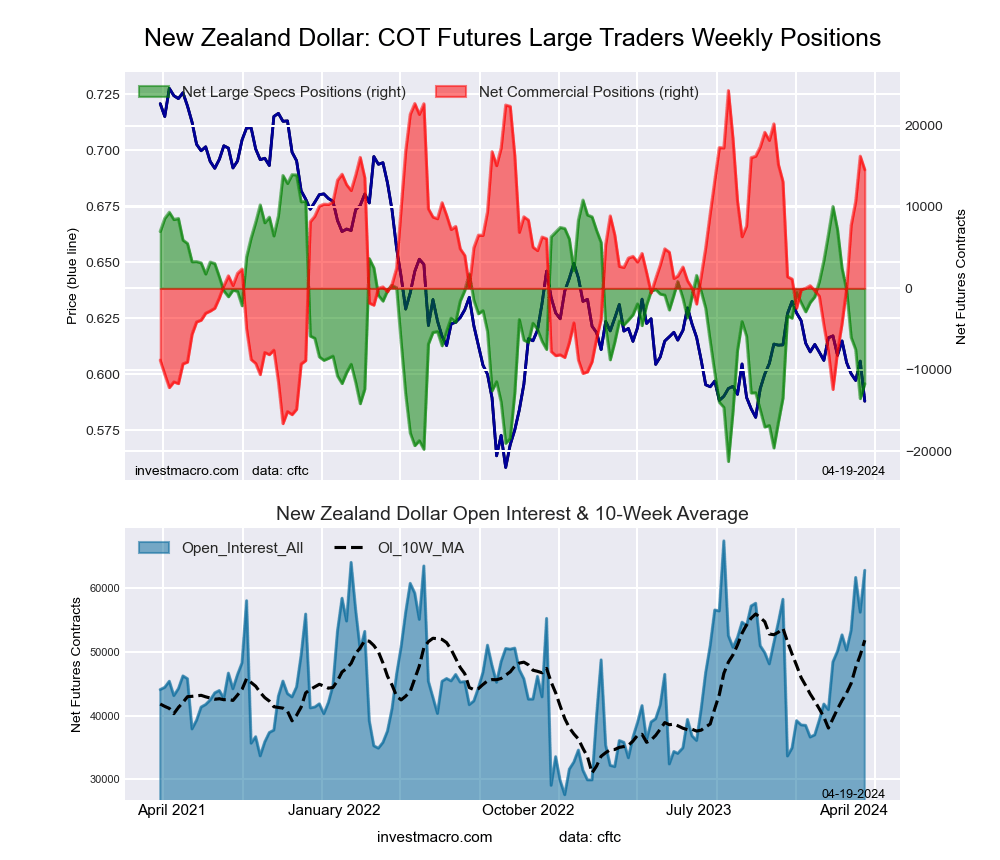
New Zealand Dollar Forex Futures COT ChartThe New Zealand Dollar large speculator standing this week reached a net position of 10,057 contracts in the data reported through Tuesday. This was a weekly gain of 3,431 contracts from the previous week which had a total of 6,626 net contracts.

This week’s current strength score (the trader positioning range over the past three years, measured from 0 to 100) shows the speculators are currently Bullish-Extreme with a score of 81.6 percent. The commercials are Bearish-Extreme with a score of 16.4 percent and the small traders (not shown in chart) are Bullish-Extreme with a score of 84.7 percent.

Price Trend-Following Model: Uptrend

Our weekly trend-following model classifies the current market price position as: Uptrend. The current action for the model is considered to be: Hold – Maintain Long Position.

NEW ZEALAND DOLLAR StatisticsSPECULATORSCOMMERCIALSSMALL TRADERS
– Percent of Open Interest Longs:49.436.110.4
– Percent of Open Interest Shorts:28.761.75.5
– Net Position:10,057-12,4252,368
– Gross Longs:23,94217,4745,020
– Gross Shorts:13,88529,8992,652
– Long to Short Ratio:1.7 to 10.6 to 11.9 to 1
NET POSITION TREND:
– Strength Index Score (3 Year Range Pct):81.616.484.7
– Strength Index Reading (3 Year Range):Bullish-ExtremeBearish-ExtremeBullish-Extreme
NET POSITION MOVEMENT INDEX:
– 6-Week Change in Strength Index:33.7-28.3-6.6


Mexican Peso Futures:

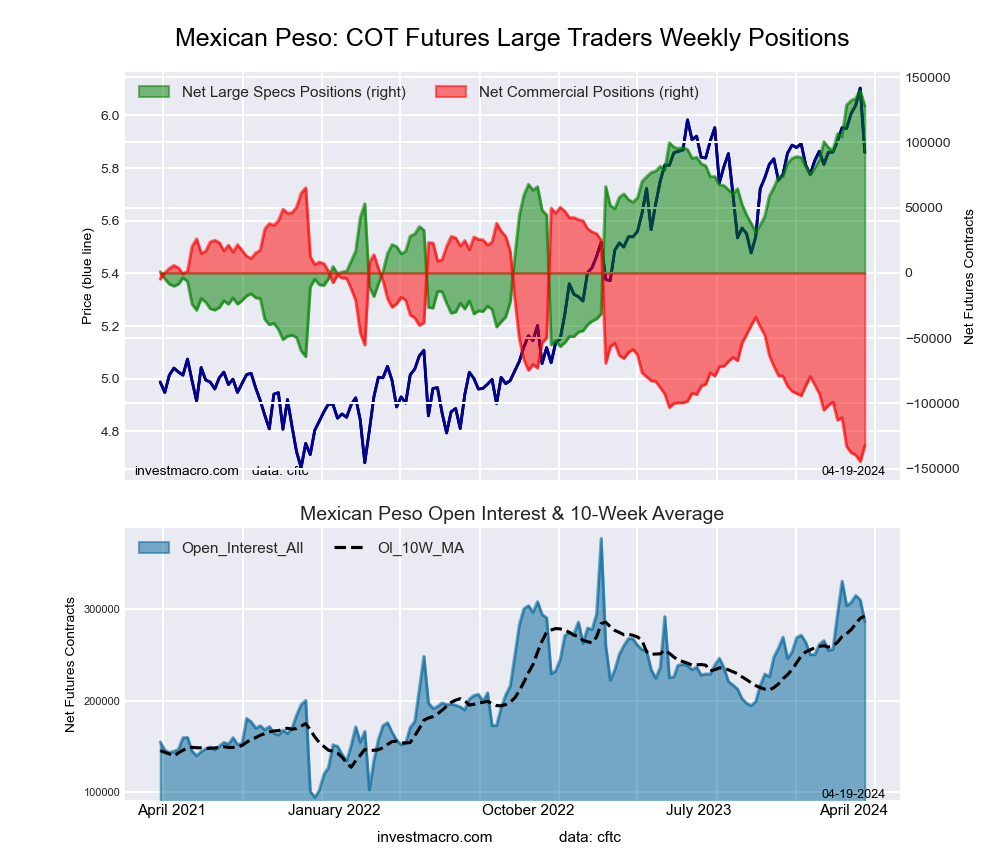
Mexican Peso Futures COT ChartThe Mexican Peso large speculator standing this week reached a net position of 93,814 contracts in the data reported through Tuesday. This was a weekly reduction of -2,181 contracts from the previous week which had a total of 95,995 net contracts.

This week’s current strength score (the trader positioning range over the past three years, measured from 0 to 100) shows the speculators are currently Bullish-Extreme with a score of 96.0 percent. The commercials are Bearish-Extreme with a score of 3.6 percent and the small traders (not shown in chart) are Bearish with a score of 43.6 percent.

Price Trend-Following Model: Uptrend

Our weekly trend-following model classifies the current market price position as: Uptrend. The current action for the model is considered to be: Hold – Maintain Long Position.

MEXICAN PESO StatisticsSPECULATORSCOMMERCIALSSMALL TRADERS
– Percent of Open Interest Longs:57.138.93.1
– Percent of Open Interest Shorts:20.477.61.1
– Net Position:93,814-98,8955,081
– Gross Longs:146,11899,7277,980
– Gross Shorts:52,304198,6222,899
– Long to Short Ratio:2.8 to 10.5 to 12.8 to 1
NET POSITION TREND:
– Strength Index Score (3 Year Range Pct):96.03.643.6
– Strength Index Reading (3 Year Range):Bullish-ExtremeBearish-ExtremeBearish
NET POSITION MOVEMENT INDEX:
– 6-Week Change in Strength Index:7.4-7.42.6


Brazilian Real Futures:

Brazil Real Futures COT ChartThe Brazilian Real large speculator standing this week reached a net position of 17,526 contracts in the data reported through Tuesday. This was a weekly gain of 1,004 contracts from the previous week which had a total of 16,522 net contracts.

This week’s current strength score (the trader positioning range over the past three years, measured from 0 to 100) shows the speculators are currently Bullish with a score of 57.2 percent. The commercials are Bearish with a score of 41.5 percent and the small traders (not shown in chart) are Bullish with a score of 53.7 percent.

Price Trend-Following Model: Weak Uptrend

Our weekly trend-following model classifies the current market price position as: Weak Uptrend. The current action for the model is considered to be: Hold – Maintain Long Position.

BRAZIL REAL StatisticsSPECULATORSCOMMERCIALSSMALL TRADERS
– Percent of Open Interest Longs:47.443.44.6
– Percent of Open Interest Shorts:23.370.31.7
– Net Position:17,526-19,5922,066
– Gross Longs:34,55031,6533,337
– Gross Shorts:17,02451,2451,271
– Long to Short Ratio:2.0 to 10.6 to 12.6 to 1
NET POSITION TREND:
– Strength Index Score (3 Year Range Pct):57.241.553.7
– Strength Index Reading (3 Year Range):BullishBearishBullish
NET POSITION MOVEMENT INDEX:
– 6-Week Change in Strength Index:-9.39.3-2.0


Bitcoin Futures:

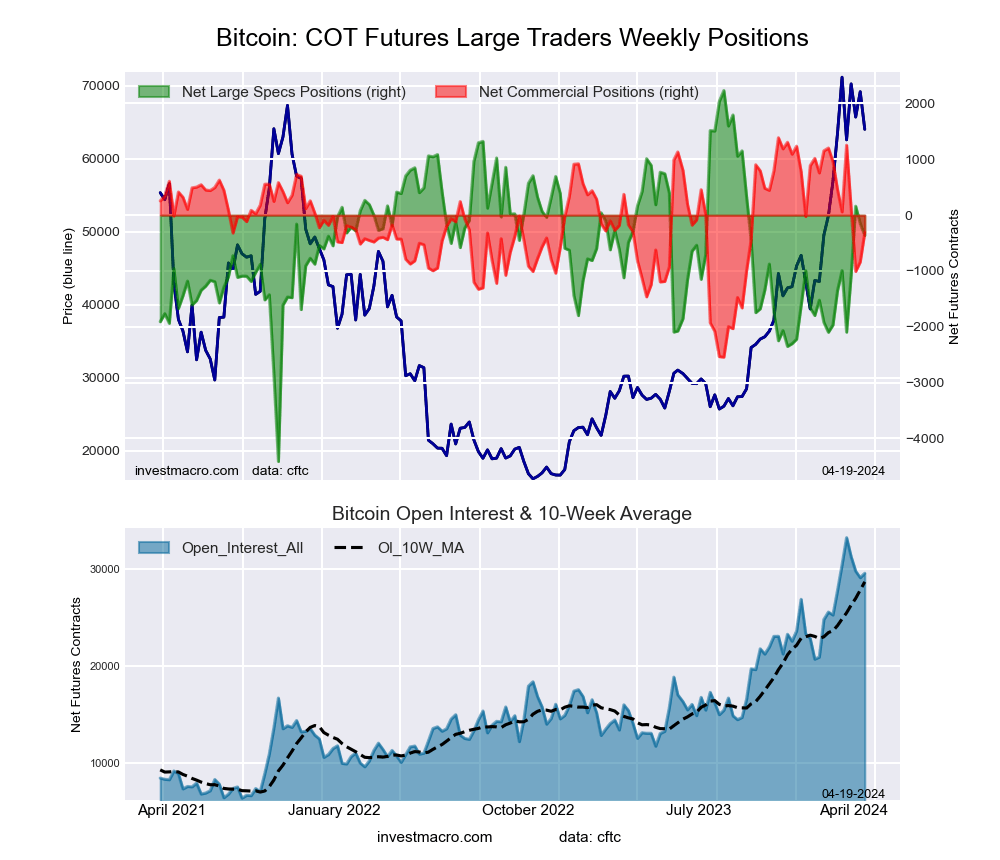
Bitcoin Crypto Futures COT ChartThe Bitcoin large speculator standing this week reached a net position of -1,967 contracts in the data reported through Tuesday. This was a weekly gain of 131 contracts from the previous week which had a total of -2,098 net contracts.

This week’s current strength score (the trader positioning range over the past three years, measured from 0 to 100) shows the speculators are currently Bearish with a score of 36.8 percent. The commercials are Bullish-Extreme with a score of 89.1 percent and the small traders (not shown in chart) are Bearish with a score of 35.8 percent.

Price Trend-Following Model: Strong Uptrend

Our weekly trend-following model classifies the current market price position as: Strong Uptrend. The current action for the model is considered to be: Hold – Maintain Long Position.

BITCOIN StatisticsSPECULATORSCOMMERCIALSSMALL TRADERS
– Percent of Open Interest Longs:79.47.06.8
– Percent of Open Interest Shorts:87.23.22.8
– Net Position:-1,9679601,007
– Gross Longs:20,0341,7591,726
– Gross Shorts:22,001799719
– Long to Short Ratio:0.9 to 12.2 to 12.4 to 1
NET POSITION TREND:
– Strength Index Score (3 Year Range Pct):36.889.135.8
– Strength Index Reading (3 Year Range):BearishBullish-ExtremeBearish
NET POSITION MOVEMENT INDEX:
– 6-Week Change in Strength Index:-14.625.1-0.3


Article By InvestMacroReceive our weekly COT Newsletter

*COT Report: The COT data, released weekly to the public each Friday, is updated through the most recent Tuesday (data is 3 days old) and shows a quick view of how large speculators or non-commercials (for-profit traders) were positioned in the futures markets.

The CFTC categorizes trader positions according to commercial hedgers (traders who use futures contracts for hedging as part of the business), non-commercials (large traders who speculate to realize trading profits) and nonreportable traders (usually small traders/speculators) as well as their open interest (contracts open in the market at time of reporting). See CFTC criteria here.

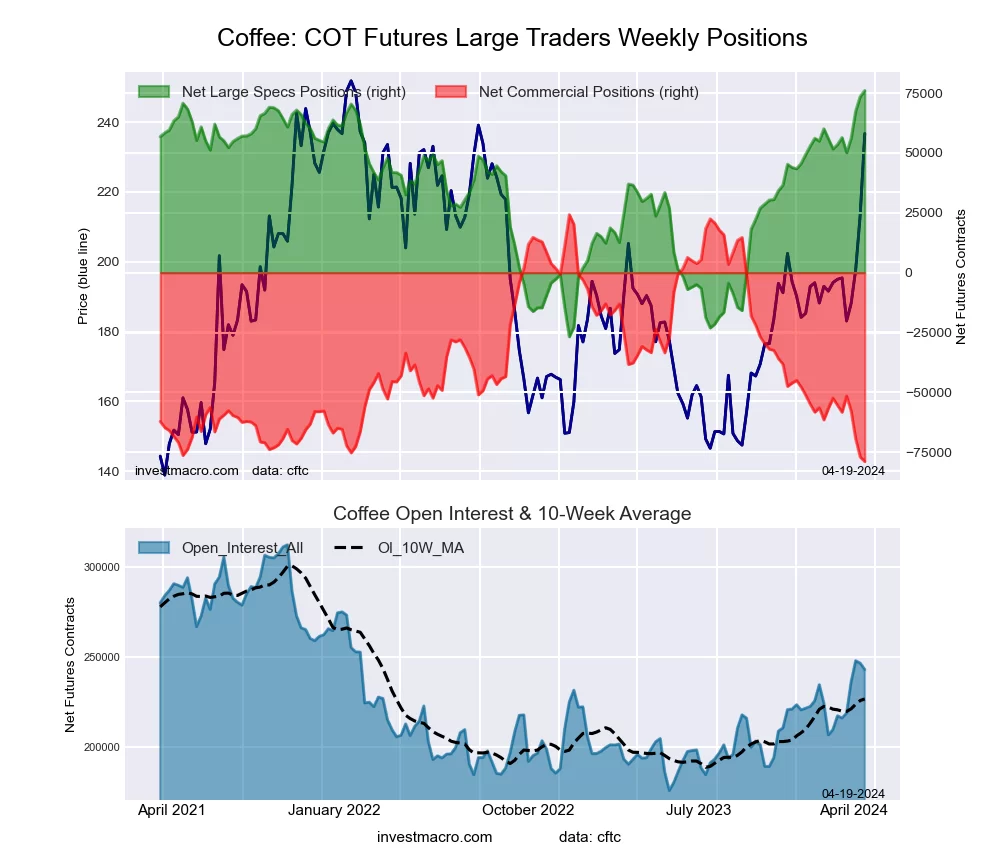
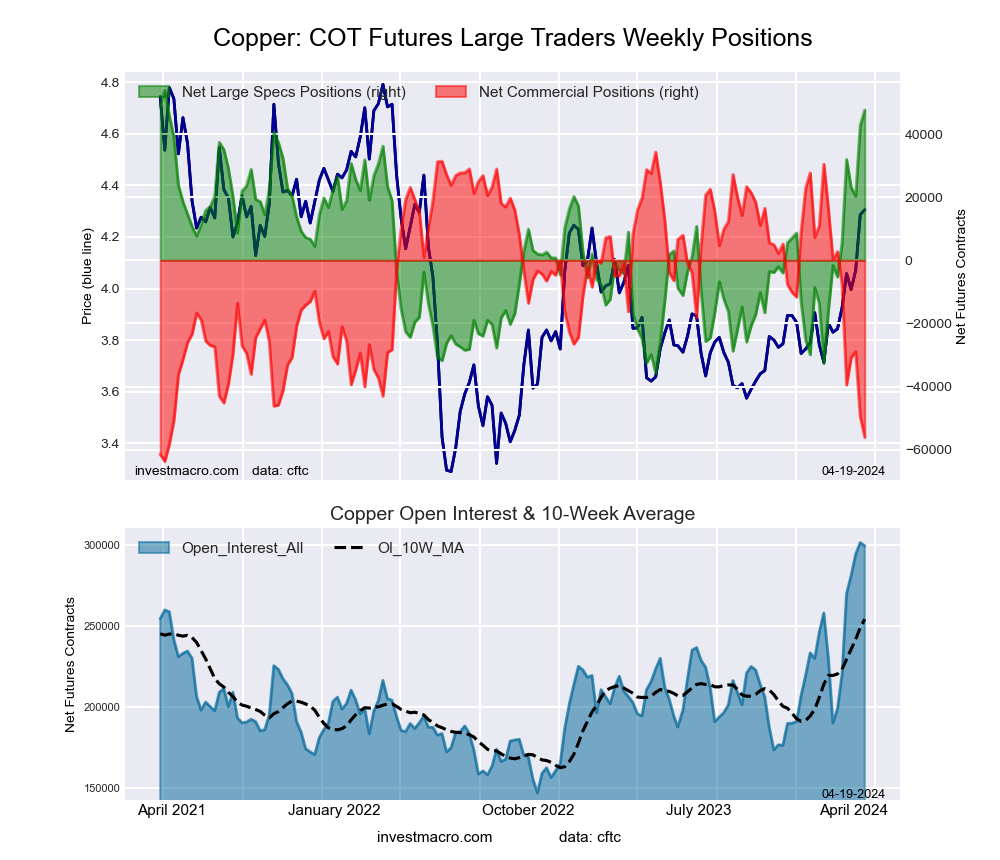
Speculator Extremes: Peso, DowJones, Soybeans & Yen lead Bullish & Bearish Positions

By InvestMacro

The latest update for the weekly Commitment of Traders (COT) report was released by the Commodity Futures Trading Commission (CFTC) on Friday for data ending on February 27th.

This weekly Extreme Positions report highlights the Most Bullish and Most Bearish Positions for the speculator category. Extreme positioning in these markets can foreshadow strong moves in the underlying market.

To signify an extreme position, we use the Strength Index (also known as the COT Index) of each instrument, a common method of measuring COT data. The Strength Index is simply a comparison of current trader positions against the range of positions over the previous 3 years. We use over 80 percent as extremely bullish and under 20 percent as extremely bearish. (Compare Strength Index scores across all markets in the data table or cot leaders table)


Here Are This Week’s Most Bullish Speculator Positions:

Mexican Peso


The Mexican Peso speculator position comes in as the most bullish extreme standing this week. The Mexican Peso speculator level is currently at a 96.0 percent score of its 3-year range.

The six-week trend for the percent strength score totaled 7.4 this week. The overall net speculator position was a total of 93,814 net contracts this week with a dip of -2,181 contract in the weekly speculator bets.


Speculators or Non-Commercials Notes:

Speculators, classified as non-commercial traders by the CFTC, are made up of large commodity funds, hedge funds and other significant for-profit participants. The Specs are generally regarded as trend-followers in their behavior towards price action – net speculator bets and prices tend to go in the same directions. These traders often look to buy when prices are rising and sell when prices are falling. To illustrate this point, many times speculator contracts can be found at their most extremes (bullish or bearish) when prices are also close to their highest or lowest levels.

These extreme levels can be dangerous for the large speculators as the trade is most crowded, there is less trading ammunition still sitting on the sidelines to push the trend further and prices have moved a significant distance. When the trend becomes exhausted, some speculators take profits while others look to also exit positions when prices fail to continue in the same direction. This process usually plays out over many months to years and can ultimately create a reverse effect where prices start to fall and speculators start a process of selling when prices are falling.


DowJones Mini


The DowJones Mini speculator position comes next in the extreme standings this week. The DowJones Mini speculator level is now at a 89.9 percent score of its 3-year range.

The six-week trend for the percent strength score was 1.3 this week. The speculator position registered 18,188 net contracts this week with a weekly gain of 1,460 contracts in speculator bets.


British Pound


The British Pound speculator position comes in third this week in the extreme standings. The British Pound speculator level resides at a 87.9 percent score of its 3-year range.

The six-week trend for the speculator strength score came in at 10.7 this week. The overall speculator position was 46,358 net contracts this week with a small edge higher by 46 contracts in the weekly speculator bets.


Cotton


The Cotton speculator position comes up number four in the extreme standings this week. The Cotton speculator level is at a 85.7 percent score of its 3-year range.

The six-week trend for the speculator strength score totaled a change of 68.4 this week. The overall speculator position was 102,305 net contracts this week with a rise of 7,212 contracts in the speculator bets.


Steel


The Steel speculator position rounds out the top five in this week’s bullish extreme standings. The Steel speculator level sits at a 85.1 percent score of its 3-year range. The six-week trend for the speculator strength score was -4.4 this week.

The speculator position was -2,935 net contracts this week with a loss of -234 contracts in the weekly speculator bets.


This Week’s Most Bearish Speculator Positions:

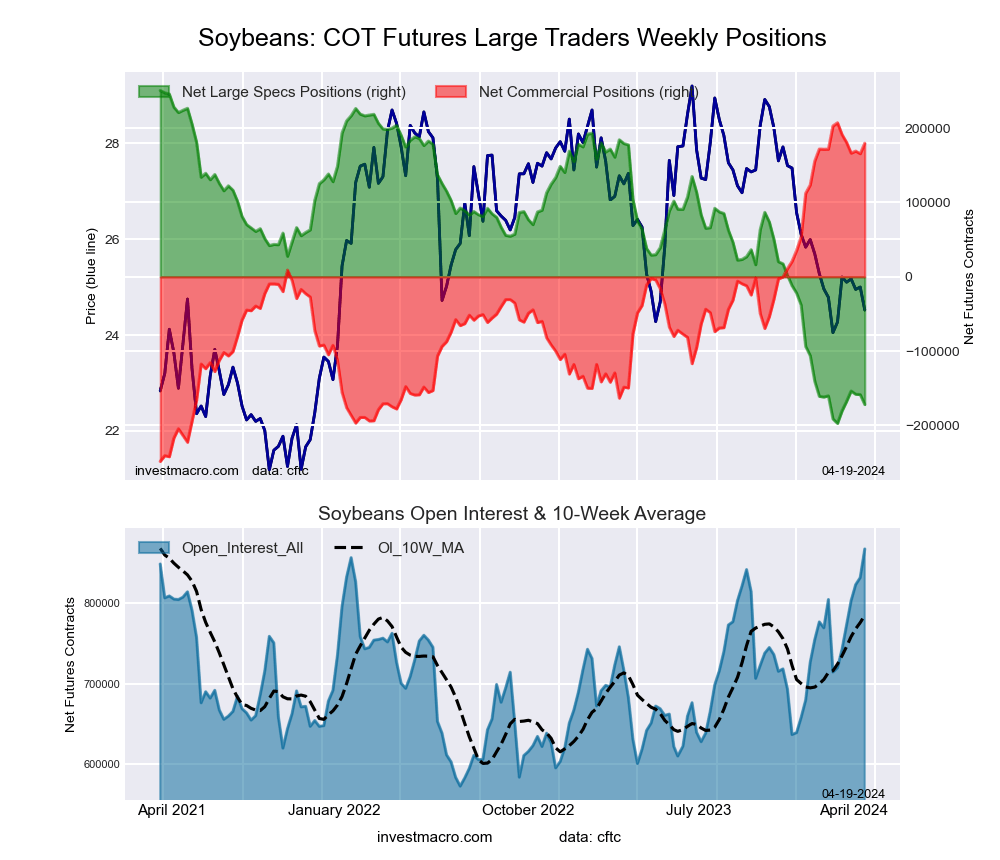
Soybeans


The Soybeans speculator position comes in as the most bearish extreme standing this week. The Soybeans speculator level is at a 0.0 percent score of its 3-year range.

The six-week trend for the speculator strength score was -22.1 this week. The overall speculator position was -191,232 net contracts this week with a drop of -30,944 contracts in the speculator bets.


Japanese Yen


The Japanese Yen speculator position comes in next for the most bearish extreme standing on the week. The Japanese Yen speculator level is at a 0.0 percent score of its 3-year range.

The six-week trend for the speculator strength score was -54.7 this week. The speculator position was -132,705 net contracts this week with a decline of -11,927 contracts in the weekly speculator bets.


Soybean Oil


The Soybean Oil speculator position comes in as third most bearish extreme standing of the week. The Soybean Oil speculator level resides at a 0.0 percent score of its 3-year range.

The six-week trend for the speculator strength score was -7.1 this week. The overall speculator position was -38,926 net contracts this week with a decrease by -4,985 contracts in the speculator bets.


Soybean Meal


The Soybean Meal speculator position comes in as this week’s fourth most bearish extreme standing. The Soybean Meal speculator level is at a 0.0 percent score of its 3-year range.

The six-week trend for the speculator strength score was -22.8 this week. The speculator position was -66,820 net contracts this week with a drop of -21,367 contracts in the weekly speculator bets.


Corn


Finally, the Corn speculator position comes in as the fifth most bearish extreme standing for this week. The Corn speculator level is at a 4.1 percent score of its 3-year range.

The six-week trend for the speculator strength score was -1.6 this week. The speculator position was -232,604 net contracts this week with a boost by 33,463 contracts in the weekly speculator bets.


Article By InvestMacroReceive our weekly COT Newsletter

*COT Report: The COT data, released weekly to the public each Friday, is updated through the most recent Tuesday (data is 3 days old) and shows a quick view of how large speculators or non-commercials (for-profit traders) were positioned in the futures markets.

The CFTC categorizes trader positions according to commercial hedgers (traders who use futures contracts for hedging as part of the business), non-commercials (large traders who speculate to realize trading profits) and nonreportable traders (usually small traders/speculators) as well as their open interest (contracts open in the market at time of reporting). See CFTC criteria here.

Week Ahead: Will US30 hit 40,000 milestone?

By ForexTime 

  • US30 ends Feb over 2% higher
  • Index set to be rocked by high risk-events
  • Watch out for Powell Testimony + NFP report
  • Bulls in control on D1/W1 timeframe
  • Key level of interest at 39300

The extraordinary list of high-risk events could inject markets with fresh volatility in the week ahead!

Investors will be dished out a platter of top-tier data, complemented with key central bank decisions and major political developments across the world:

Monday, 4th March

  • CHF: SNB publishes 2023 results
  • USD: Philadelphia Fed President Patrick Harker speech

Tuesday, 5th March

  • CNH: China National People’s Congress
  • EUR: Eurozone S&P Global Services PMI, PPI
  • GBP: UK S&P Global Services PMI
  • USD: US ISM services, S&P Global Services PMI
  • Super Tuesday in the United States

Wednesday, 6th March

  • EUR: Eurozone retail sales
  • GBP: UK Chancellor presents annual budget
  • CAD: BoC rate decision
  • USD: Fed Chair Jerome Powell testimony, Fed Beige Book

Thursday, 7th March

  • CNH: China trade, forex reserves
  • EUR: ECB rate decision
  • USD: Fed Chair Jerome Powell testimony
  • US President Joe Biden State of Union address

Friday, 8th March  

  • CAD: Canada unemployment
  • EUR: Eurozone GDP, Germany industrial production
  • USD: US February nonfarm payrolls (NFP)

Our focus falls on the US30, which tracks the benchmark Dow Jones Industrial average index – featuring 30 industry leaders in the US economy.

The US30 ended February over 2% higher, bagging its fourth consecutive months of gains thanks to technical and fundamental forces.

Fun fact: The Dow Jones is one of the oldest U.S. indexes, having been created in 1896.

Given how prices are hovering near record highs, the question is whether bulls can keep up the momentum – especially with the 40,000 milestone just a stone’s throw away.

Here are 3 factors that could impact the index:


  1. Fed Chair Powell’s 2-day Testimony

Fed Chair Jerome Powell’s semi-annual testimony before Congress may offer investors crucial insight into future policy moves. Powell is expected to signal that the Fed is not in a rush to cut interest rates until inflation moves closer to the 2% target. It is worth keeping in mind that the US30 which tracks 30 of the largest US companies, remains influenced by Fed rate expectations.

  • If Powell strikes a hawkish note and signals that US rates will remain higher for longer, this may weigh on the US30 – inviting bears back into the scene.
  • Should the Fed Chair sound more dovish than expected and signal that rate cuts could be around the corner, this may push the index higher.


  1. US February NFP report

The US economy is expected to have created 190k jobs in February, a noticeable drop from the blowout 353k jobs added in January. However, this is still above Jerome Powell’s estimated neutral pace of 100k. The unemployment rate is forecast to remain unchanged at 3.7% while average hourly earnings are seen ticking lower to 0.3% month-on-month, down from 0.6% in the prior period.

Note: before the US jobs report on Friday, watch out for other key US data releases earlier in the week and speeches by Fed officials.

Traders are currently pricing in a 90% probability of a 25-basis point cut by June 2024, according to Fed Funds futures.

  • The US30 is likely to trade lower if a strong US jobs report supports the case around the Fed keeping interest rates higher for longer.
  • Should the NFP report disappoint, this could reinforce bets around the Fed cutting rates sooner than expected – boosting the US30 as a result.


  1. Technical forces

The US30 remains in an uptrend on the daily charts as there have been consistently higher highs and higher lows. Prices are trading above the 50, 100 and 200-day SMA while the MACD trade above zero. However, the Relative Strength Index is not far away from overbought territory with some signs of exhaustion below the 39300 level.

  • A solid breakout and daily close above 39300 may open a path towards fresh all-time highs with the next psychological level at 40000.
  • Should 39300 prove to be reliable resistance, this could trigger a decline back towards 38500 and the 50-day SMA at 38170.


Forex-Time-LogoArticle by ForexTime

ForexTime Ltd (FXTM) is an award winning international online forex broker regulated by CySEC 185/12 www.forextime.com

Bringing AI up to speed – autonomous auto racing promises safer driverless cars on the road

By Madhur Behl, University of Virginia 

The excitement of auto racing comes from split-second decisions and daring passes by fearless drivers. Imagine that scene, but without the driver – the car alone, guided by the invisible hand of artificial intelligence. Can the rush of racing unfold without a driver steering the course? It turns out that it can.

Enter autonomous racing, a field that’s not just about high-speed competition but also pushing the boundaries of what autonomous vehicles can achieve and improving their safety.

Over a century ago, at the dawn of automobiles, as society shifted from horse-drawn to motor-powered vehicles, there was public doubt about the safety and reliability of the new technology. Motorsport racing was organized to showcase the technological performance and safety of these horseless carriages. Similarly, autonomous racing is the modern arena to prove the reliability of autonomous vehicle technology as driverless cars begin to hit the streets.

Autonomous racing’s high-speed trials mirror the real-world challenges that autonomous vehicles face on streets: adjusting to unexpected changes and reacting in fractions of a second. Mastering these challenges on the track, where speeds are higher and reaction times shorter, leads to safer autonomous vehicles on the road.

Autonomous race cars pass, or ‘overtake,’ others on the Las Vegas Motor Speedway track.

I am a computer science professor who studies artificial intelligence, robotics and autonomous vehicles, and I lead the Cavalier Autonomous Racing team at the University of Virginia. The team competes in the Indy Autonomous Challenge, a global contest where universities pit fully autonomous Indy race cars against each other. Since its 2021 inception, the event has drawn top international teams to prestigious circuits like the Indianapolis Motor Speedway. The field, marked by both rivalry and teamwork, shows that collective problem-solving drives advances in autonomous vehicle safety.

At the Indy Autonomous Challenge passing competition held at the 2024 Consumer Electronics Show in Las Vegas in January 2024, our Cavalier team clinched second place and hit speeds of 143 mph (230 kilometers per hour) while autonomously overtaking another race car, affirming its status as a leading American team. TUM Autonomous Motorsport from the Technical University of Munich won the event.

An autonomous race car built by the Technical University of Munich prepares to pass the University of Virginia’s entrant.
Cavalier Autonomous Racing, University of Virginia, CC BY-ND

Pint-size beginnings

The field of autonomous racing didn’t begin with race cars on professional race tracks but with miniature cars at robotics conferences. In 2015, my colleagues and I engineered a 1/10 scale autonomous race car. We transformed a remote-controlled car into a small but powerful research and educational tool, which I named F1tenth, playing on the name of the traditional Formula One, or F1, race car. The F1tenth platform is now used by over 70 institutions worldwide to construct their miniaturized autonomous racers.

The F1tenth Autonomous Racing Grand Prix is now a marquee event at robotics conferences where teams from across the planet gather, each wielding vehicles that are identical in hardware and sensors, to engage in what is essentially an intense “battle of algorithms.” Victory on the track is claimed not by raw power but by the advanced AI algorithms’ control of the cars.

These race cars are small, but the challenges to autonomous driving are sizable.

F1tenth has also emerged as an engaging and accessible gateway for students to delve into robotics research. Over the years, I’ve reached thousands of students via my courses and online lecture series, which explains the process of how to build, drive and autonomously race these vehicles.

Getting real

Today, the scope of our research has expanded significantly, advancing from small-scale models to actual autonomous Indy cars that compete at speeds of upward of 150 mph (241 kph), executing complex overtaking maneuvers with other autonomous vehicles on the racetrack. The cars are built on a modified version of the Indy NXT chassis and are outfitted with sensors and controllers to allow autonomous driving. Indy NXT race cars are used in professional racing and are slightly smaller versions of the Indy cars made famous by the Indianapolis 500.

13 people stand beside a race car in a large empty racing stadium
The Cavalier Autonomous Racing team stands behind their driverless race car.
Cavalier Autonomous Racing, University of Virginia, CC BY-ND

The gritty reality of racing these advanced machines on real racetracks pushes the boundaries of what autonomous vehicles can do. Autonomous racing takes the challenges of robotics and AI to new levels, requiring researchers to refine our understanding of how machines perceive their environment, make safe decisions and control complex maneuvers at a high speed where traditional methods begin to falter.

Precision is critical, and the margin for error in steering and acceleration is razor-thin, requiring a sophisticated grasp and exact mathematical description of the car’s movement, aerodynamics and drivetrain system. In addition, autonomous racing researchers create algorithms that use data from cameras, radar and lidar, which is like radar but with lasers instead of radio waves, to steer around competitors and safely navigate the high-speed and unpredictable racing environment.

My team has shared the world’s first open dataset for autonomous racing, inviting researchers everywhere to join in refining the algorithms that could help define the future of autonomous vehicles.

The data from the competitions is available for other researchers to use.

Crucible for autonomous vehicles

More than just a technological showcase, autonomous racing is a critical research frontier. When autonomous systems can reliably function in these extreme conditions, they inherently possess a buffer when operating in the ordinary conditions of street traffic.

Autonomous racing is a testbed where competition spurs innovation, collaboration fosters growth, and AI-controlled cars racing to the finish line chart a course toward safer autonomous vehicles.The Conversation

About the Author:

Madhur Behl, Associate Professor of Robotics and Artificial Intelligence, University of Virginia

This article is republished from The Conversation under a Creative Commons license. Read the original article.