Archive for Opinions – Page 56

Cocoa beans are in short supply: what this means for farmers, businesses and chocolate lovers

By  Michael E Odijie, UCL 

A shortage of cocoa beans has led to a near shutdown of processing plants in Côte d’Ivoire and Ghana, the two countries responsible for 60% of global production. With chocolate makers around the world reliant on west Africa for cocoa, there is significant concern about the impact on the prices of chocolate and the livelihood of farmers. Cocoa researcher Michael Odijie explains the reasons for the shortage.

Why has cocoa production declined sharply in west Africa?

Three factors are at play: environmental, economic cycle related and human.

One environmental factor is the impact of the El Niño weather phenomenon, which has caused drier weather in west Africa. It has contributed to problems on farms, such as the swollen shoot virus disease. As a result, Ghana has lost harvests from nearly 500,000 hectares of land in recent years.

The economic cycle of cocoa production refers to the inherent patterns of expansion and contraction in cocoa farming. For example, as cocoa trees age, they become susceptible to diseases, requiring high maintenance costs. Historically, farmers have tended to abandon old farms and start anew in fresh forests. Unfortunately, finding new forests is now increasingly difficult. Perhaps the most severe issue of all is the lack of fair compensation for sustainable cocoa production

The human factor includes challenges such as illegal mining, which has overtaken numerous farms in Ghana. Sometimes, farmers lease their land to illegal miners in exchange for payment. These mining activities degrade the quality of the land, making it unsuitable for cocoa cultivation.

The global market for chocolate and chocolate products is on the rise. It is projected to grow faster than 4% annually over the next few years. This growing demand for cocoa underscores the urgency in addressing the intertwined issues that relate to the industry’s sustainability.

Have west African governments intervened to help cocoa farmers?

In February 2024, the Ghana Cocoa Board (Cocobod), regulator of the country’s cocoa sector, secured a World Bank loan of US$200 million to rehabilitate plantations affected by the cocoa swollen shoot virus. The board will take over the disease-ridden farms, remove and replace the afflicted cocoa trees, and nurture the new plantings to the fruiting stage before returning them to the farmers.

This practice of Cocobod taking out loans to assist farmers is a longstanding one in Ghana. For instance, in 2018, Cocobod used part of a $600 million loan from the African Development Bank to rehabilitate aging plantations and those hit by diseases. And at the start of the current harvest season in October, the producer price was raised: farmers are paid more, a move made inevitable by the surge in global prices. Also, Ghana Cocobod has established a task force to shield cocoa farms from the harmful impacts of mining. It has cooperated with police to stem the smuggling of cocoa to neighbouring countries, particularly those that offer a stronger currency.

In Côte d’Ivoire, relatively little action has been taken. It appears the government is still assessing the situation. But there have been measures to curb smuggling of cocoa, prompted by the fact that the shortage is driving up prices in neighbouring countries. Côte d’Ivoire does benefit from numerous sustainability programmes initiated by multinational corporations. The current shortage has accelerated these initiatives. Regrettably, some of the programmes do not disclose their data, making it difficult for academics to access and analyse their information.

African governments have yet to address significant structural issues in their interventions.

How have cocoa farmers and cocoa-producing countries’ economies been affected?

At the farm level, although the rise in prices may initially appear beneficial to farmers, the reality is not straightforward. A decrease in output leads to fewer harvests on average, which means that, overall, farmers are not earning more. This issue is compounded by recent economic challenges in west Africa, such as high inflation and currency devaluation, particularly in Ghana. These factors have resulted in farmers becoming poorer.

Another impact of the output decline is a reduction in local processing. Major African processing facilities in Côte d’Ivoire and Ghana have either ceased operations or reduced their processing capacity because they cannot afford to purchase beans. This likely means that chocolate prices worldwide will surge. This, in turn, adversely affects the local production units that have been emerging in recent years.

However, the bargaining power of west African cocoa-producing countries seems to have increased. Now is an opportune moment for these nations to unite and negotiate more favourable terms for their cocoa farmers.

Will chocolate makers eventually turn to cocoa alternatives?

It’s inevitable because continuing to cultivate cocoa under current conditions is unsustainable. I don’t perceive this negatively; I hope it occurs sooner rather than later. In fact, it is already underway with the rise of cocoa butter equivalents, cocoa extenders and artificial flavours (synthetic or nature-identical flavours that mimic the taste of chocolate without the need for cocoa).

The German company Planet A Foods is a leader in this area. It produces cocoa-free chocolate, using technology to transform ingredients such as oats and sunflower seeds into substitutes for cocoa mass and butter.

Overall, this is beneficial for everyone. The demand for cocoa has resulted in mass deforestation and significant carbon emissions, issues that are likely to worsen due to climate change. Moreover, the push for cultivation has led to various forms of labour abuses. Exploring cocoa alternatives is certainly part of the solution.The Conversation

About the Author:

Michael E Odijie, Research associate, UCL

This article is republished from The Conversation under a Creative Commons license. Read the original article.


Mexican Peso Speculator bets touching most bullish levels in 4 years

By InvestMacro

Here are the latest charts and statistics for the Commitment of Traders (COT) data published by the Commodities Futures Trading Commission (CFTC).

The latest COT data is updated through Tuesday March 12th and shows a quick view of how large market participants (for-profit speculators and commercial traders) were positioned in the futures markets. All currency positions are in direct relation to the US dollar where, for example, a bet for the euro is a bet that the euro will rise versus the dollar while a bet against the euro will be a bet that the euro will decline versus the dollar.

Weekly Speculator Changes led by Japanese Yen & British Pound

The COT currency market speculator bets were slightly higher overall this week as six out of the eleven currency markets we cover had higher positioning and the other five markets had lower speculator contracts.

Leading the gains for the currency markets was the Japanese Yen (16,521 contracts) with the British Pound (12,066 contracts), the EuroFX (8,096 contracts), the US Dollar Index (3,087 contracts),  the Brazilian Real (407 contracts) and Bitcoin (358 contracts) also having positive weeks.

The currencies seeing declines in speculator bets on the week were the Canadian Dollar (-11,037 contracts), the Australian Dollar (-6,097 contracts), the New Zealand Dollar (-4,763 contracts), the Mexican Peso (-2,294 contracts) and the Swiss Franc (-319 contracts) also registering lower bets on the week.

Speculators boosting Mexican Peso positions to best levels in 4 years

Highlighting the COT currency data this week is the continued strength in the Mexican peso positioning. Large speculators slightly trimmed (-2,294 contracts) their bullish bets for the Mexican peso this week but have been pushing their bets to multi-year highs over the past month.

Last week, on March 5th, the large speculator position rose by over +12,772 contracts and ascended to the most bullish level (+106,586 contracts) of the past 208 weeks, dating back all the way to March 10th of 2020. Since the beginning of November, speculators have increased their bullish bets in thirteen out of nineteen weeks and have added a total of +72,995 contracts to the overall net bullish standing, going from +31,297 contracts on October 31st to a total of +104,292 contracts this week.

Helping the Mexican peso positioning has been the record high interest rates in Mexico at 11.25 percent which gives the currency an interest rate differential advantage over the other major currencies. The Mexican economy has been on a steady growth path as well with the year-over-year GDP expanding by 2.5 percent in the 4th quarter following 3.5 percent growth in the third quarter of 2023 and 3.4 percent growth in the second quarter.

The Mexican peso exchange rate has been strongly trending higher in the currency markets versus the US Dollar and the other major currencies. The peso exchange level versus the US Dollar, on Thursday, reached its highest level since July of 2023 at just over the 0.0600 exchange rate. The peso has also been higher versus all of the other major currencies we track on a year-over-year basis.

The Bank of Mexico does meet on March 21st with a market expectation of a possible interest rate reduction — so we will see if the peso can continue to shine in 2024 following a great 2023 when the peso had an approximate gain versus the USD by a little over 14 percent.


Currencies Net Speculators Leaderboard

Legend: Weekly Speculators Change | Speculators Current Net Position | Speculators Strength Score compared to last 3-Years (0-100 range)


Strength Scores led by British Pound & Mexican Peso

COT Strength Scores (a normalized measure of Speculator positions over a 3-Year range, from 0 to 100 where above 80 is Extreme-Bullish and below 20 is Extreme-Bearish) showed that the British Pound (100 percent) and the Mexican Peso (99 percent) lead the currency markets this week. The New Zealand Dollar (67 percent), EuroFX (52 percent) and Bitcoin (51 percent) come in as the next highest in the weekly strength scores and above their midpoint (50 percent) of the last three years.

On the downside, the Australian Dollar (6 percent), the Swiss Franc (8 percent) and the US Dollar Index (18 percent) come in at the lowest strength levels currently and are in Extreme-Bearish territory (below 20 percent). The next lowest strength score is the Japanese Yen (27 percent).

Strength Statistics:
US Dollar Index (17.9 percent) vs US Dollar Index previous week (11.4 percent)
EuroFX (52.0 percent) vs EuroFX previous week (48.6 percent)
British Pound Sterling (100.0 percent) vs British Pound Sterling previous week (92.0 percent)
Japanese Yen (27.0 percent) vs Japanese Yen previous week (12.3 percent)
Swiss Franc (8.1 percent) vs Swiss Franc previous week (9.1 percent)
Canadian Dollar (33.2 percent) vs Canadian Dollar previous week (42.4 percent)
Australian Dollar (5.6 percent) vs Australian Dollar previous week (11.2 percent)
New Zealand Dollar (67.4 percent) vs New Zealand Dollar previous week (80.9 percent)
Mexican Peso (98.7 percent) vs Mexican Peso previous week (100.0 percent)
Brazilian Real (45.8 percent) vs Brazilian Real previous week (45.2 percent)
Bitcoin (51.4 percent) vs Bitcoin previous week (46.1 percent)


British Pound & Mexican Peso top the 6-Week Strength Trends

COT Strength Score Trends (or move index, calculates the 6-week changes in strength scores) showed that the British Pound (24 percent) and the Mexican Peso (14 percent) lead the past six weeks trends for the currencies. The US Dollar Index (12 percent), the Bitcoin (12 percent) and the New Zealand Dollar (10 percent) are the next highest positive movers in the latest trends data.

The Swiss Franc (-41 percent) leads the downside trend scores currently with the Australian Dollar (-30 percent), Canadian Dollar (-24 percent) and the Japanese Yen (-19 percent) following next with lower trend scores.

Strength Trend Statistics:
US Dollar Index (12.3 percent) vs US Dollar Index previous week (3.1 percent)
EuroFX (-6.1 percent) vs EuroFX previous week (-9.4 percent)
British Pound Sterling (24.1 percent) vs British Pound Sterling previous week (17.9 percent)
Japanese Yen (-19.4 percent) vs Japanese Yen previous week (-42.8 percent)
Swiss Franc (-40.8 percent) vs Swiss Franc previous week (-36.2 percent)
Canadian Dollar (-23.9 percent) vs Canadian Dollar previous week (-9.6 percent)
Australian Dollar (-29.8 percent) vs Australian Dollar previous week (-28.0 percent)
New Zealand Dollar (9.9 percent) vs New Zealand Dollar previous week (25.5 percent)
Mexican Peso (14.0 percent) vs Mexican Peso previous week (18.4 percent)
Brazilian Real (-12.5 percent) vs Brazilian Real previous week (-20.1 percent)
Bitcoin (12.1 percent) vs Bitcoin previous week (4.7 percent)


Individual COT Forex Markets:

US Dollar Index Futures:

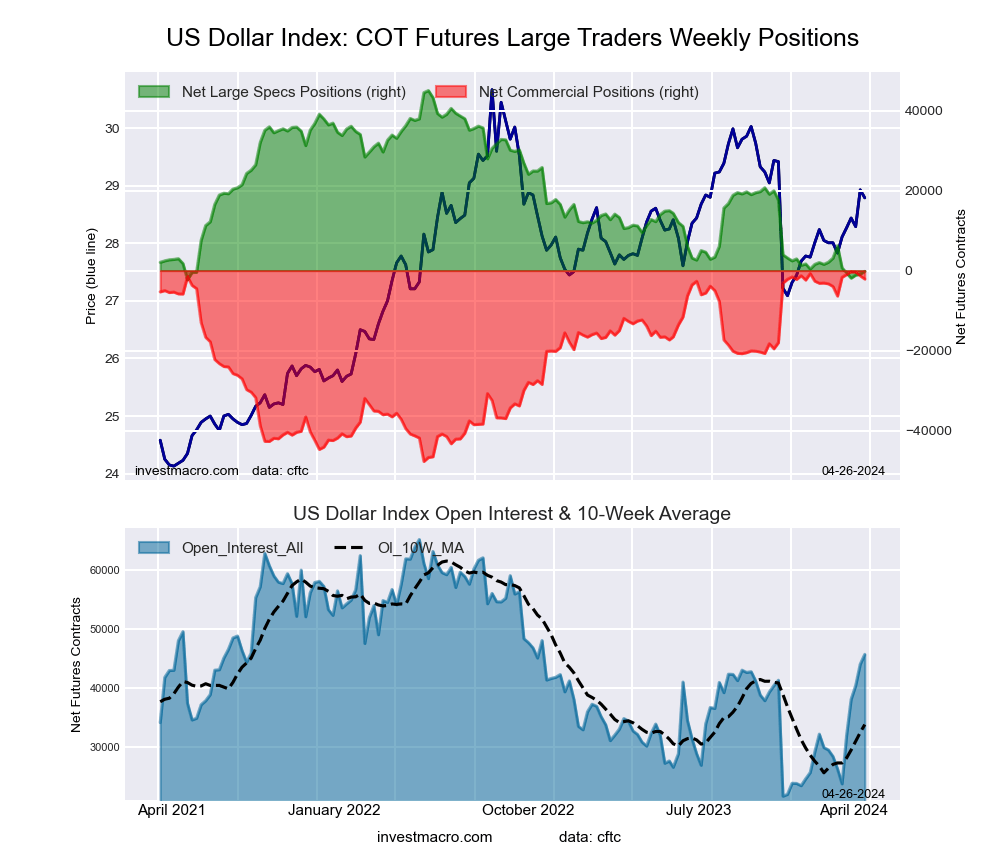
US Dollar Index Forex Futures COT ChartThe US Dollar Index large speculator standing this week totaled a net position of 6,186 contracts in the data reported through Tuesday. This was a weekly advance of 3,087 contracts from the previous week which had a total of 3,099 net contracts.

This week’s current strength score (the trader positioning range over the past three years, measured from 0 to 100) shows the speculators are currently Bearish-Extreme with a score of 17.9 percent. The commercials are Bullish-Extreme with a score of 88.0 percent and the small traders (not shown in chart) are Bearish-Extreme with a score of 13.4 percent.

Price Trend-Following Model: Downtrend

Our weekly trend-following model classifies the current market price position as: Downtrend. The current action for the model is considered to be: Hold – Maintain Short Position.

US DOLLAR INDEX StatisticsSPECULATORSCOMMERCIALSSMALL TRADERS
– Percent of Open Interest Longs:66.611.910.8
– Percent of Open Interest Shorts:43.136.110.1
– Net Position:6,186-6,381195
– Gross Longs:17,5473,1272,853
– Gross Shorts:11,3619,5082,658
– Long to Short Ratio:1.5 to 10.3 to 11.1 to 1
NET POSITION TREND:
– Strength Index Score (3 Year Range Pct):17.988.013.4
– Strength Index Reading (3 Year Range):Bearish-ExtremeBullish-ExtremeBearish-Extreme
NET POSITION MOVEMENT INDEX:
– 6-Week Change in Strength Index:12.3-12.0-2.0


Euro Currency Futures:

Euro Currency Futures COT ChartThe Euro Currency large speculator standing this week totaled a net position of 74,407 contracts in the data reported through Tuesday. This was a weekly increase of 8,096 contracts from the previous week which had a total of 66,311 net contracts.

This week’s current strength score (the trader positioning range over the past three years, measured from 0 to 100) shows the speculators are currently Bullish with a score of 52.0 percent. The commercials are Bullish with a score of 50.0 percent and the small traders (not shown in chart) are Bearish with a score of 27.2 percent.

Price Trend-Following Model: Uptrend

Our weekly trend-following model classifies the current market price position as: Uptrend. The current action for the model is considered to be: Hold – Maintain Long Position.

EURO Currency StatisticsSPECULATORSCOMMERCIALSSMALL TRADERS
– Percent of Open Interest Longs:27.056.011.7
– Percent of Open Interest Shorts:16.770.67.5
– Net Position:74,407-104,60430,197
– Gross Longs:193,998402,08184,306
– Gross Shorts:119,591506,68554,109
– Long to Short Ratio:1.6 to 10.8 to 11.6 to 1
NET POSITION TREND:
– Strength Index Score (3 Year Range Pct):52.050.027.2
– Strength Index Reading (3 Year Range):BullishBullishBearish
NET POSITION MOVEMENT INDEX:
– 6-Week Change in Strength Index:-6.14.34.7


British Pound Sterling Futures:

British Pound Sterling Futures COT ChartThe British Pound Sterling large speculator standing this week totaled a net position of 70,451 contracts in the data reported through Tuesday. This was a weekly increase of 12,066 contracts from the previous week which had a total of 58,385 net contracts.

This week’s current strength score (the trader positioning range over the past three years, measured from 0 to 100) shows the speculators are currently Bullish-Extreme with a score of 100.0 percent. The commercials are Bearish-Extreme with a score of 1.5 percent and the small traders (not shown in chart) are Bullish with a score of 74.6 percent.

Price Trend-Following Model: Uptrend

Our weekly trend-following model classifies the current market price position as: Uptrend. The current action for the model is considered to be: Hold – Maintain Long Position.

BRITISH POUND StatisticsSPECULATORSCOMMERCIALSSMALL TRADERS
– Percent of Open Interest Longs:44.437.610.8
– Percent of Open Interest Shorts:19.066.07.8
– Net Position:70,451-78,9208,469
– Gross Longs:123,285104,33830,123
– Gross Shorts:52,834183,25821,654
– Long to Short Ratio:2.3 to 10.6 to 11.4 to 1
NET POSITION TREND:
– Strength Index Score (3 Year Range Pct):100.01.574.6
– Strength Index Reading (3 Year Range):Bullish-ExtremeBearish-ExtremeBullish
NET POSITION MOVEMENT INDEX:
– 6-Week Change in Strength Index:24.1-23.310.3


Japanese Yen Futures:

Japanese Yen Forex Futures COT ChartThe Japanese Yen large speculator standing this week totaled a net position of -102,322 contracts in the data reported through Tuesday. This was a weekly lift of 16,521 contracts from the previous week which had a total of -118,843 net contracts.

This week’s current strength score (the trader positioning range over the past three years, measured from 0 to 100) shows the speculators are currently Bearish with a score of 27.0 percent. The commercials are Bullish with a score of 69.5 percent and the small traders (not shown in chart) are Bullish-Extreme with a score of 96.5 percent.

Price Trend-Following Model: Strong Downtrend

Our weekly trend-following model classifies the current market price position as: Strong Downtrend. The current action for the model is considered to be: Hold – Maintain Short Position.

JAPANESE YEN StatisticsSPECULATORSCOMMERCIALSSMALL TRADERS
– Percent of Open Interest Longs:16.963.714.6
– Percent of Open Interest Shorts:48.333.713.2
– Net Position:-102,32297,8774,445
– Gross Longs:54,923207,47847,586
– Gross Shorts:157,245109,60143,141
– Long to Short Ratio:0.3 to 11.9 to 11.1 to 1
NET POSITION TREND:
– Strength Index Score (3 Year Range Pct):27.069.596.5
– Strength Index Reading (3 Year Range):BearishBullishBullish-Extreme
NET POSITION MOVEMENT INDEX:
– 6-Week Change in Strength Index:-19.415.312.9


Swiss Franc Futures:

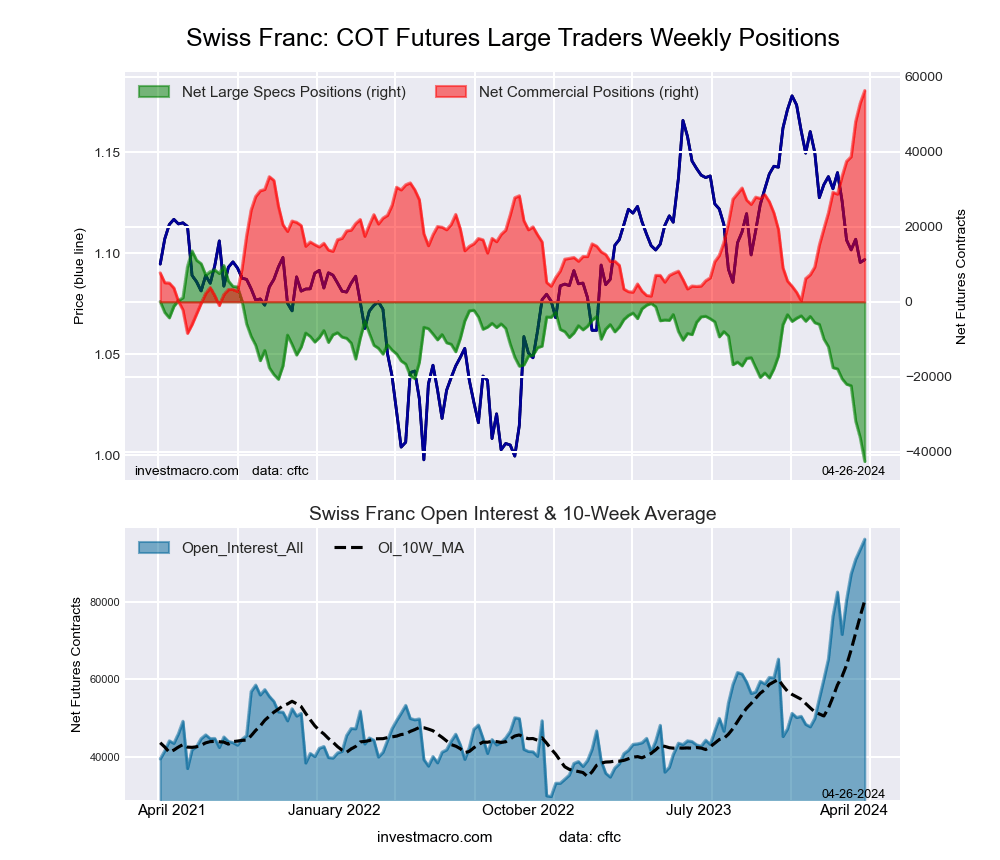
Swiss Franc Forex Futures COT ChartThe Swiss Franc large speculator standing this week totaled a net position of -17,870 contracts in the data reported through Tuesday. This was a weekly reduction of -319 contracts from the previous week which had a total of -17,551 net contracts.

This week’s current strength score (the trader positioning range over the past three years, measured from 0 to 100) shows the speculators are currently Bearish-Extreme with a score of 8.1 percent. The commercials are Bullish-Extreme with a score of 88.9 percent and the small traders (not shown in chart) are Bearish with a score of 28.0 percent.

Price Trend-Following Model: Weak Uptrend

Our weekly trend-following model classifies the current market price position as: Weak Uptrend. The current action for the model is considered to be: Hold – Maintain Long Position.

SWISS FRANC StatisticsSPECULATORSCOMMERCIALSSMALL TRADERS
– Percent of Open Interest Longs:13.669.011.6
– Percent of Open Interest Shorts:35.334.224.8
– Net Position:-17,87028,703-10,833
– Gross Longs:11,23656,8859,575
– Gross Shorts:29,10628,18220,408
– Long to Short Ratio:0.4 to 12.0 to 10.5 to 1
NET POSITION TREND:
– Strength Index Score (3 Year Range Pct):8.188.928.0
– Strength Index Reading (3 Year Range):Bearish-ExtremeBullish-ExtremeBearish
NET POSITION MOVEMENT INDEX:
– 6-Week Change in Strength Index:-40.851.5-34.2


Canadian Dollar Futures:

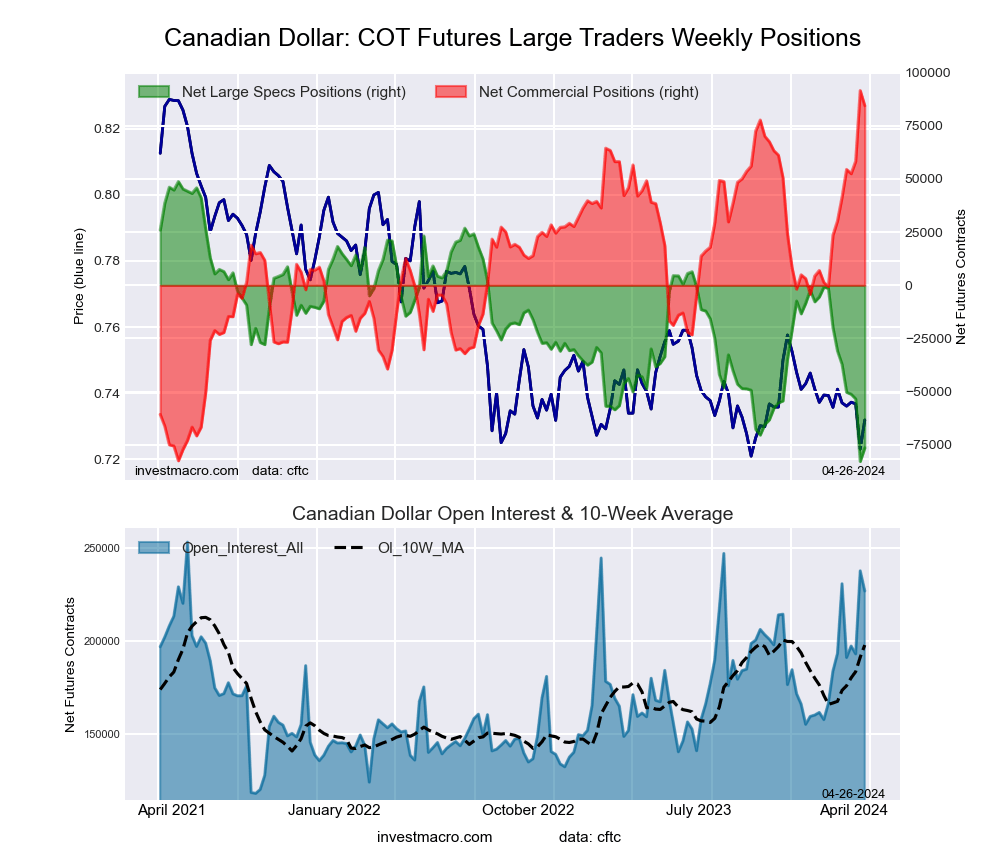
Canadian Dollar Forex Futures COT ChartThe Canadian Dollar large speculator standing this week totaled a net position of -30,874 contracts in the data reported through Tuesday. This was a weekly reduction of -11,037 contracts from the previous week which had a total of -19,837 net contracts.

This week’s current strength score (the trader positioning range over the past three years, measured from 0 to 100) shows the speculators are currently Bearish with a score of 33.2 percent. The commercials are Bullish with a score of 70.4 percent and the small traders (not shown in chart) are Bearish with a score of 24.1 percent.

Price Trend-Following Model: Weak Uptrend

Our weekly trend-following model classifies the current market price position as: Weak Uptrend. The current action for the model is considered to be: Hold – Maintain Long Position.

CANADIAN DOLLAR StatisticsSPECULATORSCOMMERCIALSSMALL TRADERS
– Percent of Open Interest Longs:18.659.015.6
– Percent of Open Interest Shorts:34.643.315.3
– Net Position:-30,87430,296578
– Gross Longs:35,964113,94230,149
– Gross Shorts:66,83883,64629,571
– Long to Short Ratio:0.5 to 11.4 to 11.0 to 1
NET POSITION TREND:
– Strength Index Score (3 Year Range Pct):33.270.424.1
– Strength Index Reading (3 Year Range):BearishBullishBearish
NET POSITION MOVEMENT INDEX:
– 6-Week Change in Strength Index:-23.921.5-13.3


Australian Dollar Futures:

Australian Dollar Forex Futures COT ChartThe Australian Dollar large speculator standing this week totaled a net position of -90,840 contracts in the data reported through Tuesday. This was a weekly lowering of -6,097 contracts from the previous week which had a total of -84,743 net contracts.

This week’s current strength score (the trader positioning range over the past three years, measured from 0 to 100) shows the speculators are currently Bearish-Extreme with a score of 5.6 percent. The commercials are Bullish-Extreme with a score of 90.6 percent and the small traders (not shown in chart) are Bearish with a score of 37.0 percent.

Price Trend-Following Model: Weak Uptrend

Our weekly trend-following model classifies the current market price position as: Weak Uptrend. The current action for the model is considered to be: Hold – Maintain Long Position.

AUSTRALIAN DOLLAR StatisticsSPECULATORSCOMMERCIALSSMALL TRADERS
– Percent of Open Interest Longs:18.166.09.1
– Percent of Open Interest Shorts:57.623.512.1
– Net Position:-90,84097,678-6,838
– Gross Longs:41,591151,73120,858
– Gross Shorts:132,43154,05327,696
– Long to Short Ratio:0.3 to 12.8 to 10.8 to 1
NET POSITION TREND:
– Strength Index Score (3 Year Range Pct):5.690.637.0
– Strength Index Reading (3 Year Range):Bearish-ExtremeBullish-ExtremeBearish
NET POSITION MOVEMENT INDEX:
– 6-Week Change in Strength Index:-29.829.7-15.9


New Zealand Dollar Futures:

New Zealand Dollar Forex Futures COT ChartThe New Zealand Dollar large speculator standing this week totaled a net position of 2,465 contracts in the data reported through Tuesday. This was a weekly reduction of -4,763 contracts from the previous week which had a total of 7,228 net contracts.

This week’s current strength score (the trader positioning range over the past three years, measured from 0 to 100) shows the speculators are currently Bullish with a score of 67.4 percent. The commercials are Bearish with a score of 30.0 percent and the small traders (not shown in chart) are Bullish with a score of 78.3 percent.

Price Trend-Following Model: Weak Uptrend

Our weekly trend-following model classifies the current market price position as: Weak Uptrend. The current action for the model is considered to be: Hold – Maintain Long Position.

NEW ZEALAND DOLLAR StatisticsSPECULATORSCOMMERCIALSSMALL TRADERS
– Percent of Open Interest Longs:31.150.18.9
– Percent of Open Interest Shorts:26.458.35.4
– Net Position:2,465-4,3371,872
– Gross Longs:16,39126,4084,700
– Gross Shorts:13,92630,7452,828
– Long to Short Ratio:1.2 to 10.9 to 11.7 to 1
NET POSITION TREND:
– Strength Index Score (3 Year Range Pct):67.430.078.3
– Strength Index Reading (3 Year Range):BullishBearishBullish
NET POSITION MOVEMENT INDEX:
– 6-Week Change in Strength Index:9.9-9.97.0


Mexican Peso Futures:

Mexican Peso Futures COT ChartThe Mexican Peso large speculator standing this week totaled a net position of 104,292 contracts in the data reported through Tuesday. This was a weekly decline of -2,294 contracts from the previous week which had a total of 106,586 net contracts.

This week’s current strength score (the trader positioning range over the past three years, measured from 0 to 100) shows the speculators are currently Bullish-Extreme with a score of 98.7 percent. The commercials are Bearish-Extreme with a score of 1.1 percent and the small traders (not shown in chart) are Bullish with a score of 52.8 percent.

Price Trend-Following Model: Strong Uptrend

Our weekly trend-following model classifies the current market price position as: Strong Uptrend. The current action for the model is considered to be: Hold – Maintain Long Position.

MEXICAN PESO StatisticsSPECULATORSCOMMERCIALSSMALL TRADERS
– Percent of Open Interest Longs:54.639.72.8
– Percent of Open Interest Shorts:23.073.30.8
– Net Position:104,292-110,8106,518
– Gross Longs:180,140131,1449,172
– Gross Shorts:75,848241,9542,654
– Long to Short Ratio:2.4 to 10.5 to 13.5 to 1
NET POSITION TREND:
– Strength Index Score (3 Year Range Pct):98.71.152.8
– Strength Index Reading (3 Year Range):Bullish-ExtremeBearish-ExtremeBullish
NET POSITION MOVEMENT INDEX:
– 6-Week Change in Strength Index:14.0-14.17.6


Brazilian Real Futures:

Brazil Real Futures COT ChartThe Brazilian Real large speculator standing this week totaled a net position of 8,687 contracts in the data reported through Tuesday. This was a weekly gain of 407 contracts from the previous week which had a total of 8,280 net contracts.

This week’s current strength score (the trader positioning range over the past three years, measured from 0 to 100) shows the speculators are currently Bearish with a score of 45.8 percent. The commercials are Bullish with a score of 52.0 percent and the small traders (not shown in chart) are Bullish with a score of 58.3 percent.

Price Trend-Following Model: Strong Downtrend

Our weekly trend-following model classifies the current market price position as: Strong Downtrend. The current action for the model is considered to be: Hold – Maintain Short Position.

BRAZIL REAL StatisticsSPECULATORSCOMMERCIALSSMALL TRADERS
– Percent of Open Interest Longs:53.339.67.1
– Percent of Open Interest Shorts:35.762.41.9
– Net Position:8,687-11,2532,566
– Gross Longs:26,31419,5323,502
– Gross Shorts:17,62730,785936
– Long to Short Ratio:1.5 to 10.6 to 13.7 to 1
NET POSITION TREND:
– Strength Index Score (3 Year Range Pct):45.852.058.3
– Strength Index Reading (3 Year Range):BearishBullishBullish
NET POSITION MOVEMENT INDEX:
– 6-Week Change in Strength Index:-12.511.64.1


Bitcoin Futures:

Bitcoin Crypto Futures COT ChartThe Bitcoin large speculator standing this week totaled a net position of -994 contracts in the data reported through Tuesday. This was a weekly lift of 358 contracts from the previous week which had a total of -1,352 net contracts.

This week’s current strength score (the trader positioning range over the past three years, measured from 0 to 100) shows the speculators are currently Bullish with a score of 51.4 percent. The commercials are Bullish with a score of 66.2 percent and the small traders (not shown in chart) are Bearish with a score of 34.2 percent.

Price Trend-Following Model: Strong Uptrend

Our weekly trend-following model classifies the current market price position as: Strong Uptrend. The current action for the model is considered to be: Hold – Maintain Long Position.

BITCOIN StatisticsSPECULATORSCOMMERCIALSSMALL TRADERS
– Percent of Open Interest Longs:82.24.95.9
– Percent of Open Interest Shorts:85.44.72.8
– Net Position:-99459935
– Gross Longs:24,9771,4861,800
– Gross Shorts:25,9711,427865
– Long to Short Ratio:1.0 to 11.0 to 12.1 to 1
NET POSITION TREND:
– Strength Index Score (3 Year Range Pct):51.466.234.2
– Strength Index Reading (3 Year Range):BullishBullishBearish
NET POSITION MOVEMENT INDEX:
– 6-Week Change in Strength Index:12.1-24.43.5


Article By InvestMacroReceive our weekly COT Newsletter

*COT Report: The COT data, released weekly to the public each Friday, is updated through the most recent Tuesday (data is 3 days old) and shows a quick view of how large speculators or non-commercials (for-profit traders) were positioned in the futures markets.

The CFTC categorizes trader positions according to commercial hedgers (traders who use futures contracts for hedging as part of the business), non-commercials (large traders who speculate to realize trading profits) and nonreportable traders (usually small traders/speculators) as well as their open interest (contracts open in the market at time of reporting). See CFTC criteria here.

Speculator Extremes: GBP, Peso, Soybeans & Australian Dollar lead Bullish & Bearish Positions

By InvestMacro

The latest update for the weekly Commitment of Traders (COT) report was released by the Commodity Futures Trading Commission (CFTC) on Friday for data ending on March 12th.

This weekly Extreme Positions report highlights the Most Bullish and Most Bearish Positions for the speculator category. Extreme positioning in these markets can foreshadow strong moves in the underlying market.

To signify an extreme position, we use the Strength Index (also known as the COT Index) of each instrument, a common method of measuring COT data. The Strength Index is simply a comparison of current trader positions against the range of positions over the previous 3 years. We use over 80 percent as extremely bullish and under 20 percent as extremely bearish. (Compare Strength Index scores across all markets in the COT data tables or COT leaders tables)


Here Are This Week’s Most Bullish Speculator Positions:

British Pound


The British Pound speculator position comes in as the most bullish extreme standing this week. The British Pound speculator level is currently at a 100.0 percent score of its 3-year range.

The six-week trend for the percent strength score totaled 24.1 this week. The overall net speculator position was a total of 70,451 net contracts this week with an increase of 12,066 contracts in the weekly speculator bets.


Speculators or Non-Commercials Notes:

Speculators, classified as non-commercial traders by the CFTC, are made up of large commodity funds, hedge funds and other significant for-profit participants. The Specs are generally regarded as trend-followers in their behavior towards price action – net speculator bets and prices tend to go in the same directions. These traders often look to buy when prices are rising and sell when prices are falling. To illustrate this point, many times speculator contracts can be found at their most extremes (bullish or bearish) when prices are also close to their highest or lowest levels.

These extreme levels can be dangerous for the large speculators as the trade is most crowded, there is less trading ammunition still sitting on the sidelines to push the trend further and prices have moved a significant distance. When the trend becomes exhausted, some speculators take profits while others look to also exit positions when prices fail to continue in the same direction. This process usually plays out over many months to years and can ultimately create a reverse effect where prices start to fall and speculators start a process of selling when prices are falling.


Mexican Peso


The Mexican Peso speculator position comes next in the extreme standings this week. The Mexican Peso speculator level is now at a 98.7 percent score of its 3-year range.

The six-week trend for the percent strength score was 14.0 this week. The speculator position registered 104,292 net contracts this week with a weekly decline of -2,294 contracts in speculator bets.


Brent Oil


The Brent Oil speculator position comes in third this week in the extreme standings. The Brent Oil speculator level resides at a 91.2 percent score of its 3-year range.

The six-week trend for the speculator strength score came in at 22.0 this week. The overall speculator position was -11,141 net contracts this week with a shortfall of -1,489 contracts in the weekly speculator bets.


Steel


The Steel speculator position comes up number four in the extreme standings this week. The Steel speculator level is at a 87.8 percent score of its 3-year range.

The six-week trend for the speculator strength score totaled a change of -0.2 this week. The overall speculator position was -2,237 net contracts this week with a dip of -560 contracts in the speculator bets.


DowJones Mini


The DowJones Mini speculator position rounds out the top five in this week’s bullish extreme standings. The DowJones Mini speculator level sits at a 85.8 percent score of its 3-year range. The six-week trend for the speculator strength score has been falling recently and was -14.2 this week.

The speculator position was 15,671 net contracts this week with a rise of 1,085 contracts in the weekly speculator bets.


This Week’s Most Bearish Speculator Positions:

Soybeans


The Soybeans speculator position comes in as the most bearish extreme standing this week. The Soybeans speculator level is at a 3.8 percent score of its 3-year range.

The six-week trend for the speculator strength score was -8.9 this week. The overall speculator position was -180,413 net contracts this week with a gain of 16,828 contracts in the speculator bets.


Soybean Meal


The Soybean Meal speculator position comes in next for the most bearish extreme standing on the week. The Soybean Meal speculator level is at a 4.1 percent score of its 3-year range.

The six-week trend for the speculator strength score has been falling and was -9.4 this week. The speculator position was -56,887 net contracts this week with an improvement by 2,622 contracts in the weekly speculator bets.


Australian Dollar


The Australian Dollar speculator position comes in as third most bearish extreme standing of the week. The Australian Dollar speculator level resides at a 5.6 percent score of its 3-year range.

The six-week trend for the speculator strength score was -29.8 this week. The overall speculator position was -90,840 net contracts this week with a drop of -6,097 contracts in the speculator bets.


Swiss Franc


The Swiss Franc speculator position comes in as this week’s fourth most bearish extreme standing. The Swiss Franc speculator level is at a 8.1 percent score of its 3-year range.

The six-week trend for the speculator strength score was a strong shortfall by -40.8 this week. The speculator position was -17,870 net contracts this week with a decline of -319 contracts in the weekly speculator bets.


Corn


Finally, the Corn speculator position comes in as the fifth most bearish extreme standing for this week. The Corn speculator level is at a 9.5 percent score of its 3-year range.

The six-week trend for the speculator strength score was a rise by 4.4 this week. The speculator position was -189,030 net contracts this week with a gain of 41,857 contracts in the weekly speculator bets.


Article By InvestMacroReceive our weekly COT Newsletter

*COT Report: The COT data, released weekly to the public each Friday, is updated through the most recent Tuesday (data is 3 days old) and shows a quick view of how large speculators or non-commercials (for-profit traders) were positioned in the futures markets.

The CFTC categorizes trader positions according to commercial hedgers (traders who use futures contracts for hedging as part of the business), non-commercials (large traders who speculate to realize trading profits) and nonreportable traders (usually small traders/speculators) as well as their open interest (contracts open in the market at time of reporting). See CFTC criteria here.

Robo-advisers are here – the pros and cons of using AI in investing

By Laurence Jones, Bangor University and Heather He, Bangor University 

Artificial intelligence (AI) is shaking up the way we invest our money. Gone are the days when complex tools were reserved for the wealthy or financial institutions.

AI-powered robo-advisers, such as Betterment and Vanguard in the US, and finance app Revolut in Europe, are now democratising investment. These tools are making professional financial insight and portfolio management available to everyone. But although there are plenty of advantages to using robo-advisers, there are downsides too.

Since the 1990s, AI’s role in this sector was typically confined to algorithmic trading and quantitative strategies. These rely on advanced mathematical models to predict stock market movements and trade at lightning speed, far exceeding the capabilities of human traders.

But that laid the groundwork for more advanced applications. And AI has now evolved to handle data analysis, predict trends and personalise investment strategies. Unlike traditional investment tools, robo-advisers are more accessible, making them ideal for a new generation of investors.

A survey published in 2023 showed that there has been a particular surge in young people using robo-advisers. Some 31% of gen Zs (born after 2000) and 20% of millennials (born between 1980 and 2000) are using robo-advisers.

Another survey from 2022 found that 63% of US consumers were open to using a robo-adviser to manage their investments. In fact, projections indicate that assets managed by robo-advisers will reach US$1.8 trillion (£1.4 trillion) globally in 2024.

This trend reflects not only changing investor preferences but also how the financial industry is adapting to technology.

Tailored advice

AI can tailor investment advice to a person’s preferences. For example, for investors who want to prioritise ethical investing in environmental, social and governance stocks, AI can tailor a strategy without the need to pay for a financial adviser.

AI can analyse news and social media to understand market trends and predict potential movements, offering insights into potential market movements. Portfolios built by robo-advisers may also be more resilient during market downturns, effectively managing risk and protecting investments.

Robo-advisers can offer certain features like reduced investment account minimums and lower fees, which make services more accessible than in the past. Other features such as tax-loss harvesting, a strategy of selling assets at a loss to reduce taxes, and periodic rebalancing, which involves adjusting the proportions of different types of investments, make professional investment advice accessible to a wider audience.

These types of innovations are particularly beneficial for people in underserved communities or with limited financial resources. This has the potential to improve financial literacy through empowering people to make better financial decisions.

AI’s multifaced role

AI’s impact on investment fund management goes way beyond robo-advisers, however. Fund managers are using AI algorithms in a variety of ways.

In terms of data analysis, AI can sift through vast amounts of market data and historical trends to identify ideal assets and adjust portfolios in real time as markets fluctuate. AI is also used to improve risk management by analysing complex data and making sophisticated decisions.

By using AI in this way, traders can react and make faster decisions, which maximises efficiency. Other mundane tasks like compliance monitoring are increasingly automated by AI. This frees fund managers up to focus on more strategic decisions.

What are the disadvantages?

One of the biggest concerns regarding AI in this sector is based on how having easy access to advanced investment tools may lead some people to overestimate their abilities and take too many financial risks. The sophisticated algorithms used by robo-investors can be opaque, which makes it difficult for some investors to fully understand the potential risks involved.

Another concern is how the evolution of robo-advisers has outpaced the implementation of laws and regulations. That could expose investors to financial risks and a lack of legal protection. This is an issue yet to be adequately addressed by financial authorities.

Looking ahead, the future of investment probably lies in a hybrid model. Combining the precision and efficiency of AI with the experience and oversight of human investors is vital.

Ensuring that information is accessible and transparent will be crucial for fostering a more informed and responsible investment landscape. By harnessing the power of AI responsibly, we can create a financial future that benefits everyone.The Conversation

About the Author:

Laurence Jones, Lecturer in Finance, Bangor University and Heather He, Lecturer in Data Science/Analytics, Bangor University

This article is republished from The Conversation under a Creative Commons license. Read the original article.


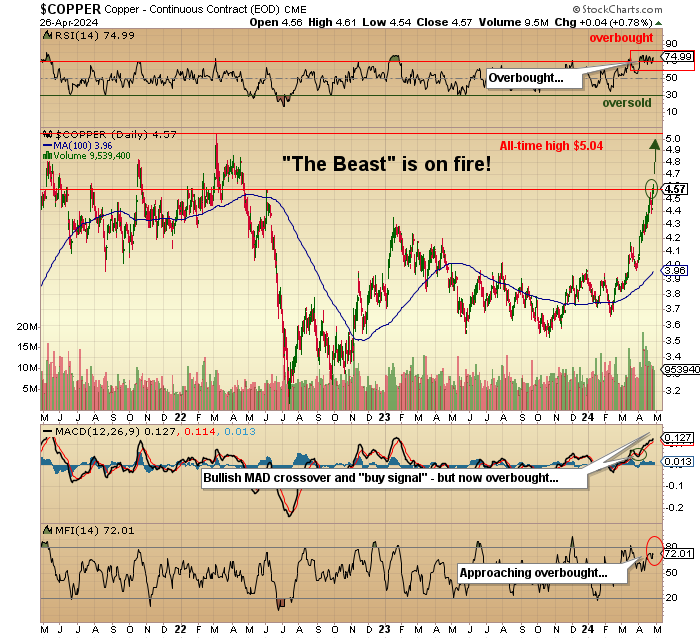
Copper Has a Vital Role in the Modern Economy

Source: John Newell  (3/12/24)

John Newell of Golden Sky Minerals (AUEN.V) explains his view on where the copper market is going and shares one stock he believes is an attractive opportunity for forward-thinking investors.

In the heart of today’s technological and sustainable advancements lies an element whose significance has surged alongside our modern needs: copper. Copper’s role in energy transformation has increased attention in the news and social media within the last three years.

This versatile metal sometimes called the metal of electrification, plays a critical role in powering electric vehicles, enabling flights, advancing renewable energy sources like wind and solar, and facilitating essential communications through networks and systems. Its presence is ubiquitous, found in electrical wiring, appliances, motors, and computers, marking it as a cornerstone of innovation and daily life.

The Surge in Demand

As we navigate through an unprecedented energy transition, copper’s demand is projected to approximately double by 2035. This looming increase highlights a stark reality about our mineral resources: they are the unsung heroes of power generation and usage across the globe.

By 2050, the anticipated annual demand for copper is expected to equal the cumulative usage from 1900 through 2022, illustrating a pivotal moment in its consumption history.

As the graph below from John Gross’s Copper Journal suggests, the demand doubles every ~25 years, and by 2050, demand will likely be 53 MM tons, a jaw-dropping number with limited new supply being discovered or currently being brought to market. Electric Power vehicles and renewable power generation require 3x as much copper as traditional options.

Capital Expenditure Requirements

To meet this burgeoning demand, a substantial investment in capital expenditure (capex) is imperative.

An estimated $200 billion will be necessary over the next decade to bridge the forecasted 10 million tonne copper deficit by 2035. This figure not only underscores the financial commitment needed but also the urgency to act promptly to prevent a supply shortfall.

Global Supply and Future Potential

The future of copper production looks promising, with significant potential in countries such as Chile, Peru, the United States, Canada, Ecuador, Argentina, and the Pacific Rim.

Despite this potential, current production and sanctioned projects indicate a looming supply shortage in the second half of this decade. Compounded by the expected copper price forecast of $4.50 a pound from 2025 through 2027 and a long-term price of four dollars, there’s a clear need to incentivize new supply to meet future demands.

Some analysts are suggesting that copper prices are expected to rise by more than 75% over the next two years amid mining supply disruptions and higher demand for the metal fueled by the push for renewables and demand driven by green energy solutions, according to a report by BMI a Fitch Solutions research unit.

Challenges in Supply

Recent disruptions have already signaled a forthcoming copper deficit in 2024, exacerbated by operational shutdowns and downgrades in production forecasts. Events such as the closure of First Quantum’s Cobre Panama mine, operational disruptions in Chile and Peru due to El Niño, and logistical challenges in the DRC highlight the fragile equilibrium of copper supply.

These disruptions have set the stage for a significant, multi-year deficit, with forecasts predicting a rapid transition from a small surplus to a considerable deficit through 2025.
Innovations and Sustainability in Copper Mining

Amid these challenges, innovation and sustainability remain at the forefront of the copper mining industry. Eight world-class mines are leveraging renewable energy to produce low-carbon copper, showcasing initiatives like the Los Azules project by McEwen Mining and McEwen Copper.

These efforts are complemented by companies like Rio Tinto, which invests capital and technology in development-stage projects to enhance recovery and sustainability.

The Imperative of Copper

Copper’s role in our modern economy cannot be overstated. As demand continues to grow, the imperative to find and develop new sources of supply intensifies.

The wisdom of William Sulzer, a former governor of New York, echoes through time, reminding us of the fundamental importance of mining to human progress and civilization. His words from 1938, praising the miner and prospector, serve as a powerful testament to the enduring value of copper and the mineral resources that fuel our advancement and prosperity.

Excerpt from the Sulzer speech:

“Abandon mining and the value of every commodity would be insignificant, humanity would sink back to the barter-and-exchange age, and financial paralysis would lock in its vice-like grasp the industries of mankind.

It would be the greatest calamity that ever befell the human race, and in less than a century, civilization would revert to the barbarism of pre-history, when primitive man knew nothing about copper, gold, silver, iron, lead, zinc and the other mineral resources of Mother Earth.

Those who decry mining are ignorant of history. If they knew anything about metals, they would know that all business, all industry and all human progress depends on mines.

The wealth from mines, from the dawn of time, is the epic of human advancement of man’s heroic march along the path of progress. Show me a people without mines and I will show you a people deep in the mire of poverty and a thousand years behind the procession of civilization. It was the mines that made the greatness of the past, that made the ancient civilizations, that made Egypt great, that made Rome great and, in modern times, that hive made Spain, England and the U.S. rise beyond the dreams of avarice.

The greatest benefactor of the human race has been the prospector. The most beneficent men of all time are the far-seeing men whose brain and brawn developed the Earth’s mineral resources.

These are men who poured the golden streams of mineral wealth into the lap of civilization, into the channels of trade, into the avenues of commerce and into the homes of happiness.

All honor to the miner. All hail the prospector.”

– William Sulzer, a former governor of New York. from a speech delivered in 1938.

McEwen Mining

With all that said, there is one copper stock that may be worth looking into:

McEwen Mining Inc.’s (MUX:TSX; MUX:NYSE).

McEwen Mining owns 47% of McEwen Copper.

The investment case for McEwen Copper’s Los Azules Project in San Juan Province, Argentina, presents a compelling opportunity for investors looking to capitalize on the future burgeoning copper market.

This presentation dives into the strategic advantages, potential returns, and innovative approaches that make the Los Azules Project a standout investment in the copper exploration sector.

High Growth Potential

Copper’s role in electrification and renewable energy sectors underlines its growing demand. McEwen Copper, with its Los Azules Project, stands at the forefront of tapping into this demand, offering significant growth potential.

McEwen Copper is the eighth largest undeveloped copper project in the world. Copper demand in 2050 is expected to be 53 million metric tons, more than all the copper consumed from 1900-2022

Geopolitical and Economic Stability

The new Argentine government’s commitment to deregulation under President Javier Milei enhances the investment appeal of the country’s mining sector. This political shift, coupled with the strategic alliance between Argentina and the USA, offers a stable investment climate.

Innovation and Sustainability: McEwen Copper’s approach incorporates cutting-edge technologies and a commitment to environmental sustainability, positioning it as a leader in modern, responsible mining practices.

Robust Market Demand

The shift towards green technology, including renewable energy and electric vehicles, drives an unprecedented surge in copper demand.

This trend is set to continue, bolstering the market value of copper exploration and production companies.

Strategic Hedging

Investing in McEwen Copper offers a hedge against potential declines in the U.S. dollar, leveraging copper’s essential role in various industries and its historical price resilience if Los Azules copper resource is equivalent to ~70 million oz gold deposit, with an average annual production of 600,000 ounces at a cash cost of ~$600.00.

Early-Stage Involvement

Investors have the unique opportunity to engage in the early stages of the Los Azules Project, potentially yielding higher returns compared to investments in established mining operations.

Technological and Environmental Leadership

The Los Azules Project is pioneering in employing renewable energy solutions and carbon-neutral mining technologies, setting a new standard for the mining industry.

Supply Constraints

Key copper-producing regions like Panama and Peru are experiencing dwindling supplies, leading to a projected global deficit by 2024.

This scarcity is exacerbated by environmental and ESG concerns that restrict or make difficult new mining developments in jurisdictions like the U.S.

Price Projections

Analysts from BMI, BMO, Goldman Sachs, and Jefferies anticipate copper prices to spike significantly due to the burgeoning deficit, underscoring the lucrative potential of copper investments.

Clean Energy Transition

Copper is indispensable for the clean energy transition, with demand expected to reach 36.6 million metric tons by 2031.

This demand highlights the strategic importance of copper exploration and production.

A New Model for Mining Strategic Partnerships

McEwen Copper is in discussions to raise approximately $100 million for the Los Azules Project, engaging with notable stakeholders like Stellantis NV and Nuton (a Rio Tinto Group venture) to fund feasibility and engineering work.

Sustainable and Innovative Practices

The project is committed to being carbon-neutral, utilizing renewable energy and innovative leaching methods. It represents a significant step forward in environmentally sustainable mining.

Significant Copper Resource: Los Azules is one of the world’s largest undeveloped copper projects, with an estimated resource of 37.6 billion lbs of copper, positioning it to be a major player in the copper industry for decades to come.

Conclusion

The Los Azules Project by McEwen Copper Inc. is not just an investment in a mining operation; it’s an investment in the future of copper, a critical component of the global shift towards sustainable energy and technology.

With its innovative approach to mining, significant growth potential, and the strategic geopolitical context of Argentina, Los Azules represents a unique and attractive opportunity for forward-thinking investors.

I do not currently own McEwen Mining or any interest in McEwen Copper.


Important Disclosures:

  1. John Newell: I determined which companies would be included in this article based on my research and understanding of the sector.
  2. Statements and opinions expressed are the opinions of the author and not of Streetwise Reports, Street Smart, or their officers. The author is wholly responsible for the accuracy of the statements. Streetwise Reports was not paid by the author to publish or syndicate this article. Streetwise Reports requires contributing authors to disclose any shareholdings in, or economic relationships with, companies that they write about. Any disclosures from the author can be found  below. Streetwise Reports relies upon the authors to accurately provide this information and Streetwise Reports has no means of verifying its accuracy.
  3.  This article does not constitute investment advice and is not a solicitation for any investment. Streetwise Reports does not render general or specific investment advice and the information on Streetwise Reports should not be considered a recommendation to buy or sell any security. Each reader is encouraged to consult with his or her personal financial adviser and perform their own comprehensive investment research. By opening this page, each reader accepts and agrees to Streetwise Reports’ terms of use and full legal disclaimer. Streetwise Reports does not endorse or recommend the business, products, services or securities of any company.

For additional disclosures, please click here.

John Newell Disclaimer

As always it is important to note that investing in precious metals like silver carries risks, and market conditions can change violently with shock and awe tactics, that we have seen over the past 20 years. Before making any investment decisions, it’s advisable consult with a financial advisor if needed. Also the practice of conducting thorough research and to consider your investment goals and risk tolerance.

How Florida’s home insurance market became so dysfunctional, so fast

By Latisha Nixon-Jones, Jacksonville University 

Imagine saving for years to buy your dream house, only to have surging property insurance costs keep homeownership forever out of reach.

This is a common problem in Florida, where average insurance premiums cost homeowners an eye-watering US$6,000 a year. That’s more than triple the national average and about three times what Floridians paid on average for insurance premiums in 2018.

What’s more, several major insurance carriers have left the state over the past year, leaving residents with limited alternatives.

As a law professor who specializes in disaster preparedness and resilience, I think it’s important to understand what’s driving costs higher – not least because other states could soon face a similar predicament.

Three primary factors are driving the insurance challenge. First, natural disasters are becoming more common and costly. Second, the price of reinsurance is skyrocketing. And finally, Florida’s litigation-friendly environment compounds the issue by making it easy for customers to sue their insurers.

Disasters, like sea levels, are on the rise

With its location on the beautiful-yet-hurricane-prone Gulf of Mexico, Florida has long been vulnerable to the elements. Natural disasters cost the state $5 billion to $10 billion every year, the federal government estimated in 2018, the last year for which data was available.

Yet that likely understates the case today, since disasters have only become bigger, more common and more expensive since then. For example, climate change has made oceans warmer, which research suggests fuels stronger, more intense hurricanes.

As a result, Florida has experienced billion-dollar disasters an average of four times annually over the past five years – up from about one each year in the 1980s.

This surge in disasters doesn’t just put lives at risk; it also wreaks havoc with the insurance market, as carriers are inundated with claims from one catastrophe after another. This makes it harder for them to turn a profit or obtain reinsurance to protect their stakeholders.

Why reinsurance matters

Insurance companies, in essence, make money two ways. First, they pool risk among policyholders. Risk-pooling is the practice of taking similarly situated individuals or properties, grouping them together, and charging similar prices for insurance since they face the same risk.

Second, they reduce risk by acquiring reinsurance. Reinsurance acts as a safeguard for insurance companies – it’s essentially insurance for the insurers. Reinsurers pledge to cover a specified portion or type of insurance claim – for instance, catastrophic hurricanes – which provides a layer of financial protection.

The new era of climate disasters has thrown a wrench into the process. Reinsurance companies, grappling with a surge in claims due to more frequent and severe disasters, have found themselves forced to raise their premiums for insurance carriers. Carriers, in turn, have passed the burden to policyholders.

To try to navigate these challenges, some companies have chosen to limit coverage for specific types of damage. For example, some insurance companies in Florida will no longer offer hurricane or flood coverage. And in extreme cases, insurance companies have withdrawn entirely from the state.

Understanding this complex relationship between insurers, reinsurers and policyholders is key to understanding the broader implications of the Florida insurance crisis. It underscores the urgent need for comprehensive solutions and collaborative efforts to address evolving challenges in the insurance ecosystem.

Learning from Florida … one way or another

Florida isn’t taking all this sitting down. In December 2022, state lawmakers responded to growing property market instability by passing Senate Bill 2A, a package of insurance reforms.

One major part was a rule change designed to discourage policyholders from suing their insurers. Previously, Florida law let insured individuals recover attorney fees if they secured any amount through litigation against their insurer.

The idea is that making this change will discourage needless lawsuits. However, my research as an environmental justice professor shows that attempts to exclude attorneys from the negotiation process often lead to more expensive litigation and less access to justice.

The bill also restricts assignment of benefits, a mechanism that permits third-party entities like roofing companies to negotiate with insurance companies on behalf of Florida residents. While assignment of benefits increased advocacy, it was also linked to skyrocketing claims costs.

The balancing act between providing ample opportunities and containing costs has sparked debate among justice advocates. Florida’s legislative response reflects an ongoing effort to strike an equilibrium, ensuring fairness and accessibility while addressing the challenges faced by both insurers and policyholders.

Florida’s actions to address the property insurance crisis raise a critical question: Will the state serve as a blueprint for disaster-prone regions, or act as a cautionary tale? After all, states such as California and Louisiana have also seen insurance companies withdrawing from their markets. Will their legislatures draw inspiration from Florida’s?

For now, it’s too early to tell: The policies have only been in place since the latest round of hurricanes. But in the meantime, the rest of the U.S. will be watching – especially policymakers who care about resilience, and those who want to make sure vulnerable populations don’t get the short end of the stick.The Conversation

About the Author:

Latisha Nixon-Jones, Associate Professor of Law, Jacksonville University

This article is republished from The Conversation under a Creative Commons license. Read the original article.

Venezuelan migrants are boosting economic growth in South America, says research

By Jose Caballero, International Institute for Management Development (IMD) 

Venezuela is engulfed in a political and economic crisis, which has forced over 6 million people – some 20% of the population – to flee the country since 2015. The mass exodus began when Venezuela’s economy collapsed, giving rise to rampant inflation, political turmoil and pervasive violence.

Over 80% of those who have left Venezuela have set up a new life in 17 countries across Latin America and the Caribbean. According to a recent report, these displaced migrants are having a positive effect on the economies of their host countries.

Between 2017 and 2030, migrant workers will boost the economies of their host countries by 0.10%–0.25% on average each year. The report, which was published by several leading international financial institutions and the UN Agency for Refugees, focuses on Venezuelan migrants but also covers Cubans and Salvadorans, among others.

The economic impact of migrants in Latin America is significant. But their integration into local job markets and society is poor. The economic benefits derived from migrants across Latin America could be even greater if they are given better access to jobs.

Boosting economic growth

Migration has clear economic benefits for local economies. It leads to an expansion of the workforce, thereby alleviating labour shortages and enhancing economic output.

Migrants bring a diverse range of skills and specialised knowledge to their host countries, which can improve the overall skill level of the local workforce. Their productive capabilities bridge skill gaps in local labour markets and heighten overall productivity.

Most migrant workers will also pay income tax, which increases government revenues. In Colombia, for instance, the income tax contribution of Venezuelan migrants in 2019 was approximately US$38.7 million (£30.1 million), equivalent to 0.01% of Colombia’s GDP.

And when migrants gain employment, they will spend their wages in the host country and create new demand in various other sectors. Greater demand leads to higher growth, which in turn attracts more investment and increases employment opportunities both for local people and migrants.

Underemployed

However, xenophobia and discrimination prevent many migrants from finding jobs in Latin America and integrating into society. According to the report, roughly 30% of the migrants residing in Chile, Colombia and Peru experience discrimination because of their nationality.

Thus, many migrants are forced to take jobs within the informal sector. Over 50% of migrants in Latin America work informally compared to 44.5% of locals.

Migrant workers also often earn lower wages than their local counterparts. In Colombia, the average monthly salary of locals with post-secondary school education is US$1,140. Venezuelan migrants with the same level of education earn just US$644 per month.

Despite this, immigrants still outperform the native-born population in their labour force participation and employment rates. Yet many of the migrants who are in formal employment are overqualified for their roles. In Chile, for instance, 34% of highly educated locals are overqualified for their jobs, compared to over 60% of migrants.

Migrants are often mistakenly assumed to be exclusively low-skilled workers. But the Venezuelan migrant crisis has seen many highly skilled people flee the country too. For example, 65% of the Venezuelans living in Chile and 48% residing in Ecuador have post-secondary school education.

However, most Venezuelans have not officially validated their academic credentials in their host countries. In fact, only 10% of those residing in Chile have completed the certification process.

Many migrants are unaware of the process so lack sufficient documentation about their qualifications. And the complexity of the process also demands investment that many migrants may not have the resources to cover.

To further enhance productivity in Latin America, it is essential to integrate migrant workers into professions that allow them to use their skills.

Access to services

Several other factors hinder the integration of migrants into society across Latin America. The report indicates that migrant workers have significantly lower access to health insurance relative to the native-born population. In Colombia, for example, 96% of local workers have access to health insurance, compared to just 40% of migrants.

Similarly, there are often barriers limiting access to education for migrants. Foreign-born residents and their family members have the right to access public primary and secondary education in the majority of South American countries. But school attendance rates are lower among displaced children than among native children, while the propensity for dropping out of school early appears to be significantly higher among migrant children.

Some people argue that immigration comes with costs, such as the perceived notion that migrants deprive locals of jobs. Nevertheless, the contribution of migrants to Latin American economies underscores the potential benefits. Improving their access to labour markets is thus a crucial tool for fostering long-term growth in Latin American economies.The Conversation

About the Author:

Jose Caballero, Senior Economist, IMD World Competitiveness Center, International Institute for Management Development (IMD)

This article is republished from The Conversation under a Creative Commons license. Read the original article.

Nigeria: botched economic reforms plunge the country into crisis

By Chisom Ubabukoh, O.P. Jindal Global University and Kunal Sen, United Nations University 

Nigeria, Africa’s largest economy, is facing an economic crisis. From a botched currency redesign to the removal of fuel subsidies and a currency float, the nation has been plunged into spiralling inflation and a currency crisis with far-reaching consequences. The question now is: how long before the inferno consumes everything?

On October 26, 2022, the Central Bank of Nigeria announced a bold move – that it had redesigned the country’s highest denomination notes (₦200, ₦500 and ₦1000) and would be removing all old notes from circulation. People were given a deadline of January 31, 2023 (a couple of weeks before a national election) to make this exchange, or all of the old notes would cease to be valid legal tender.

This initiative ostensibly aimed to curb counterfeiting, encourage cashless transactions, and limit the buying of votes during the elections. But, while the intention may have been sound, the execution proved disastrous.

Short deadlines, limited availability of new notes, and inadequate communication created widespread panic. It led to long queues at banks, frustration among citizens, and a thriving black market for the new notes.

The confusion surrounding the currency redesign had an unintended consequence: the beginnings of a loss of confidence in the naira. People began to look to other mediums as a store of value and as a medium of exchange. The obvious choices were foreign currency like the US dollar and the British pound, as well as more stable cryptocurrencies like Tether’s USDT.

The currency redesign was criticised at the time by the then-presidential candidate of the ruling party, Bola Ahmed Tinubu, who saw it as a move to derail his presidential campaign. However, Tinubu won the contested election and, once in power, set out to reshape the economy immediately.

In his inaugural address in May 2023, Tinubu announced that the “fuel subsidy is gone”, referring to the government’s longstanding subsidised petrol policy that ensured Nigerians enjoyed some of the lowest petrol prices in the world. Over the coming days, he would also announce the reversal of the currency redesign policy and the floating of the Nigerian naira on the foreign exchange market.

Fuelling the flames

Other underlying economic conditions around the time of Tinubu’s inauguration included a large amount of foreign debt, dwindling foreign reserves and global economic headwinds. When the removal of the fuel subsidy was announced, it was met with a mix of surprise and elation by many Nigerians, and in particular by international donor agencies like the International Monetary Fund and the World Bank, who had long been advocating for the removal.

But this was all before the effects began to bite. And bite hard they did. The price of Premium Motor Spirit (also known as gasoline or petrol), which used to retail for ₦189 (US$0.12) per litre, increased by 196% practically overnight and began to retail for ₦557 per litre.

One challenge with developing economies like Nigeria is that a rise in fuel price tends to cause the price of everything else to rise. Many industries, particularly those in manufacturing and agriculture, tend to rely heavily on fuel for powering machinery and equipment due to the poor supply of grid electricity nationwide.

Many Nigerian households were significantly affected by the increased prices. But they saw an opportunity in that the savings from the fuel subsidy regime would be redistributed to improve education, healthcare provision and the general welfare of the people, as was promised during the electioneering. The regime cost the country an estimated ₦400 billion a month at its height, after all.

Enter currency devaluation

Then, on June 14, 2023, the Tinubu government ended the policy of pegging the naira to the US dollar, allowing it to float and find its true market value based on supply and demand. The idea was to stop corruption and reduce arbitrage opportunities due to the difference between official and black-market foreign exchange prices.

Currency arbitrage happens when people buy a currency at the lower official exchange rate and immediately sell it at the higher black market rate for a profit. This practice often occurs where there are strict currency controls and black markets offer a truer reflection of a currency’s value based on supply and demand.

However, this was one policy change too many. The naira lost a staggering 25% of its value in one day, and the cascading effects now push the country to the brink.

Nigeria depends heavily on imported commodities, including essential goods like food, fuel and medicine. So the policy escalated the inflationary crisis, pushing inflation to almost 30% (the major driver being food inflation, which reached 35.4%).

Imports in general have become significantly more expensive, and Nigerians are finding their purchasing power being eroded. Wages in Nigeria are pretty fixed. The current minimum wage in the country is ₦30,000 per month and the average monthly income is ₦71,185.

Businesses are also feeling the pinch, facing difficulties accessing the foreign exchange critical for importing raw materials and equipment.

Pheonix or ash?

The Central Bank of Nigeria has implemented measures to counter the crisis. It recently raised interest rates from 18.75% to 22.75% and is selling US dollars through auctions.

Recovery is a possibility and there are already signs of appreciation in the currency. The naira appreciated by 6.89% a day after interest rates were raised. But it will be a long, hard road.

These strategies often come with trade-offs. Higher interest rates can stifle already struggling economic growth, while currency interventions might deplete already strained reserves of foreign currency.

The bottom line is that if the current cost of living crisis continues, civil unrest is likely. Should this happen, who knows what – if anything – will be left behind when the flames are done.The Conversation

About the Author:

Chisom Ubabukoh, Assistant Professor of Economics, O.P. Jindal Global University and Kunal Sen, Professor and Director, World Institute for Development Economics Research (UNU-WIDER), United Nations University

This article is republished from The Conversation under a Creative Commons license. Read the original article.


New FXTM index enters “bull market” today!

By ForexTime

  • FXTM launches brand new CHINAH stock index
  • CHINAH index has now risen over 20% from January low
  • CHINAH is most-volatile and “cheapest” stock index within FXTM universe
  • CHINAH pays higher dividends than many peers
  • Wall Street predicts that CHINAH could climb another 28% over next 12 months


FXTM’s just-launched CHINAH index is enjoying a stellar debut so far!

Since first appearing across FXTM trading platforms on March 4th, this stock index has climbed by almost 4%.

In fact, CHINAH is also outperforming many of its global peers so far in March 2024!

Here’s how major stock indices have each fared on a month-to-date basis:

  • CHINAH: +4.8%
  • UK100: +1.3%
  • EU50: +1.2%
  • US500: +0.4%
  • NAS100: -0.5%
  • JP225: -0.9%

Within the FXTM universe, CHINAH’s month-to-date performance is only currently surpassed, but only just slightly, by the TWN index (+4.9% so far in March 2024).

Technical pullback soon?

In light of its recent runup, CHINAH’s 14-day relative strength index (RSI) is now flirting with the 70 number which marks “overbought” conditions.

This suggests that CHINAH’s prices may soon drop, as this stock index attempts to clear some of the froth from its recent ascent.


More notable is the fact that today (Tuesday, March 12th) …

the CHINAH index has met the textbook criteria for entering a “bull market”.


What is a “bull market”?

According to popular opinion, an asset enters a “bull market” once it has risen by 20% from a recent low.

At the time of writing, with the CHINAH trading above 5950, this stock index is now over 20% higher compared to the intraday low of 4943.24 registered on 22nd January 2024.


What is a stock index?

Imagine a stock index being a basket of many different stocks.

The index measures the overall performance of those stocks inside that “basket”.


What does the CHINAH stock index track?

FXTMs CHINAH stock index tracks the performance of the Hang Seng China Enterprises Index.

This Hang Seng China Enterprises Index aims to capture the overall performance of 50 companies from Mainland China that are listed on the Hong Kong stock market.

The 3 biggest industries represented on CHINAH are:

  • Information Technology
    (35.4% of total index; including Tencent, Alibaba, and Meituan)
  • Financials/Banks
    (25.8% of total index; including CCB – China Construction Bank, ICBC – Industrial and Commercial Bank of China, Bank of China, and Agricultural Bank of China).
  • Consumer Discretionary
    (13.6% of total index, including EV makers such as Li Auto and BYD Company).


Why is CHINAH soaring today (Tuesday, March 12th)?

Here are two reasons:

  • Xiaomi to start selling its electric vehicles later this month

Long known for its affordable smartphones, Xiaomi today announced it will begin selling its electric vehicles (SU7 series) on March 28th across 29 cities.

This news triggered an 11.3% jump in this stock today – its biggest one-day jump since January 2023.

And given the fact that Xiaomi alone accounts for 3.5% of the broader CHINAH index, the jump in Xiaomi’s stocks have also boosted CHINAH in tandem.

NOTE: Xiaomi remains classified as an “Information Technology” stock on this index, despite its multi-billion dollar bet on the EV market, which falls under the “Consumer Discretionary” umbrella.
  • JD.com still climbing post 4Q-earnings beat

JD.com’s Hong Kong listed stocks climbed 7.8% today – its biggest one-day climb since December 2022.

Given that JD.com accounts for 2.4% of CHINAH, the former’s gains also helped propel the latter higher.

The shares of this e-commerce giant has been soaring after posting better-than-expected 4Q earnings last week, while its CEO Sandy XU also predicted that Chinese consumers will benefit from government stimulus this year.

There was also news yesterday (Monday, March 11th) that JD.com’s potential bid for Currys, a British electronics retailer, may have been made easier after another suitor (Elliot Investment Management) decided to walk away.

JD.com has one week, until March 18th, to formally announce its intention to either make a bid for Currys, or walk away.


3 key things to know about the CHINAH index:

1) Most-volatile stock index within the FXTM universe

Of the 18 different stock indices offered by FXTM, this CHINAH index now has the highest 30-day volatility number of 28.17 as of today (Tuesday, March 12th).

For comparison, here are the 30-day volatility readings for some popular stock indices:

  • HK50: 24.17
  • NAS100: 18.84
  • CN50: 18.37
  • JP225: 15.03
  • US500: 12.94
  • EU50: 11.7
  • UK100: 11.09
  • US300: 9.09

And as seasoned traders know, bigger price swings (volatility) translate into larger opportunities to garner potential profits (or losses).


2) CHINAH is the “cheapest” stock index offered by FXTM

To be clear, whether something is considered “cheap” is highly subjective.

A commonly-used metric in deciding whether a financial asset is “cheap” or “expensive” is to use the price-to-earnings ratio, or PE ratio for short.

Simply put, the PE ratio indicates how much an investor would have to pay to access $1 of an asset’s earnings.

Even simpler still, the higher the PE ratio, the more “expensive” an asset is.

(Higher PE ratio = investor has to spend more money to access $1 of an asset’s earnings)

Here’s the PE ratio for the CHINAH index, stacked against some of peers from around the world:

  • CHINAH: 8.2
  • UK100: 11.6
  • EU50: 14.7
  • AU200: 19.5
  • US500: 24.5
  • JP225: 27.8
  • NAS100: 33.1


3) CHINAH pays relatively higher dividends.

Over the past 12 months, CHINAH index has paid out a dividend yield of 3.86% (based on current prices).

That’s significantly higher than the dividend yields currently offered by other popular stock indices (based on current prices):

  • GER40: 3.05%
  • EU50: 2.9%
  • JP225: 1.64%
  • US500: 1.4%
  • NAS100: 0.83%

But wait, there’s more!

Over the next 12 months, Wall Street analysts forecast that members of the CHINAH index will pay out EVEN HIGHER dividends.

This is expected to bring the forward 12-month yield above 4%!

What is “dividend yield”?
Dividends are cash rewards that are given by companies (in this case, companies that are included in the CHINAH index) to its shareholders.
Dividend yield is a % number representing how much money you’re getting back from this asset for every dollar you invest.
The higher the yield, the more money you’re getting back compared to what you put in.


Where’s CHINAH headed next?

Over the next 12 months, Wall Street analysts predict this CHINAH index could return above the 7600 level.

From current prices, this suggests 28% more in potential upside.

For proper context, a number above 7600 would only restore the CHINAH index to levels not seen since January 2023.

A higher-than-7600 CHINAH index would still pale in comparison to its all-time intraday high above 20,609 on November 1st, 2007, before the Global Financial Crisis.

Still, if the Chinese economy can finally get its post-pandemic recovery sustainably underway, aided by government support, that should help restore CHINAH to its former glories.


Forex-Time-LogoArticle by ForexTime

ForexTime Ltd (FXTM) is an award winning international online forex broker regulated by CySEC 185/12 www.forextime.com

Trade of the Week: Yen bulls to clap back?

By ForexTime 

  • JPY is G10’s best-performer today, also month-to-date
  • Yen climbing on creeping bets for imminent Bank of Japan hike
  • Tuesday’s US inflation release will feed market’s main obsession
  • Friday’s Japan wage negotiations results are key for BoJ
  • Bloomberg forecast: USDJPY to trade between 144.48 – 148.65 this week

The Japanese Yen is already off to a strong start this week!

Not only is it the best-performing G10 currency against the US dollar today, but also for the month:

  • So far today (Monday, March 11th): USDJPY is down 0.24% at the time of writing
  • So far this month: USDJPY has fallen by 2.2%
NOTE: USDJPY goes down when the Japanese Yen strengthens against the US dollar.


Why is the Yen climbing?

Markets are starting to restore hopes, once again, that the Bank of Japan (BoJ) is now (finally? truly?) ready to trigger a rate hike.

Markets had previously made similar predictions in recent years past, only to be left sorely disappointed when the BoJ left its rates unchanged, even as other major central banks raised their own rates aggressively in recent years.

Keep in mind that the BoJ is the last central bank to still adopt a negative interest rate regime, keeping its rates at -0.1%.

At present, markets are forecasting the following:

  • 65.7% chance of a BoJ rate hike at its March 19th policy decision
  • 86.4% chance of a BoJ rate hike by its April 26th policy decision
NOTE: A currency tends to strengthen when its central bank is perceived to be raising its benchmark rates.


However, JPY bulls (those hoping the Yen will strengthen) have a lot more ground to cover before their pride can be fully restored.

After all, the Yen has endured a torrid time in recent years.

JPY has been the weakest G10 currency against the US dollar in 2 out of the past 3 years.


Events Watchlist

This week, two key events could determine whether Yen bulls can get some much-needed ammo to stand up to their critics:

1) Tuesday, March 12th: US February inflation data

Here are the economists’ forecasts for the February consumer price index (CPI), which is used to measure headline inflation growth:

  • Headline CPI year-on-year (February 2024 vs. February 2023): 3.1%
    If so, this would match January’s 3.1% year-on-year number
  • Headline CPI month-on-month (February 2024 vs. January 2024): 0.4%
    If so, this would be higher than January’s 0.3% month-on-month number
  • Core CPI (excluding food and energy prices, which are more volatile) year-on-year: 3.7%
    If so, this would be lower than January’s 3.9% month-on-month number
  • Core CPI month-on-month: 0.3%
    If so, this would be lower than January’s 0.4% month-on-month number

Why does this matter?

The Federal Reserve (US central bank) has a mandate to subdue red-hot inflation since the pandemic, which it has done so by aggressively hiking US interest rates in recent years.

Markets want to know how soon could this battle against inflation be over, and when the Fed can begin to return US rates to lower, and more “normal” levels.

This guessing game has been the market’s primary obsession in recent years.

This sets up every monthly CPI data release as arguably the most important piece of economic data for investors and traders worldwide.
Potential Scenarios:

  • Overall, if the US inflation data come in below market expectations, that should pave the way for the Fed to lower its benchmark rates in the months ahead.

    Such expectations should weaken the US dollar, while dragging USDJPY lower.

  • However, if the US inflation data exceed market expectations, that may further delay a Fed rate cut.

    Such expectations should support the US dollar, while potentially prompting USDJPY to unwind some of its recent losses.


2) Friday, March 15th: Japan wage negotiations results

Japan’s largest union group, Rengo, is set to announce the results from its annual wage negotiations.

On average, workers unions are demanding for a pay hike of 5.85% this year – its largest raise since 1993.

For comparison, a year ago, these unions demanded for an increase of 4.49%.
Why does this matter?

Higher salaries would imply stronger spending power among Japanese consumers, which could support inflationary pressures (business can raise prices sustainably).

The Bank of Japan wants to see sustained inflation, despite the headline CPI having exceeded its 2% target since April 2022.

A massive pay hike for Japanese workers could help underpin the country’s inflation outlook while likely paving the way for the long-awaited BoJ rate hike.

Potential Scenarios:

  • If Rengo announces that it secured a higher-than-expected pay raise, that could deliver a massive boost to the Yen.
  • However, if Rengo disappoints Yen bulls and the BoJ with its wage negotiation results, that may pull JPY back lower, while sending USDJPY back closer to recent heights.


Key levels

According to Bloomberg’s FX forecast model, USDJPY is expected to trade within the 144.48 – 148.65 range this week.

Potential resistance:

  • 147.20 region: key battleground between bulls and bears since August 2023
  • 100-day SMA
  • 148.00 – 148.65: price region which includes psychologically-important level and the upper bound of Bloomberg’s forecasted range


Potential support:

  • 200-day SMA
  • 145.00: psychologically-important level
  • 144.48: notable battleground between bulls and bears since 2022 / lower bound of Bloomberg’s forecast model


Watch for technical rebound

Note that USDJPY’s 14-day relative strength index (RSI) is already flirting with the 30 level.

When the 14-day RSI hits or goes below 30, that meets the textbook criteria for “oversold” conditions.

Recall how USDJPY experienced such a technical rebound was seen when the RSI last hit 30 back in December 2023.

Hence, further declines this week may once again trigger another short-lived technical rebound for USDJPY.


Forex-Time-LogoArticle by ForexTime

ForexTime Ltd (FXTM) is an award winning international online forex broker regulated by CySEC 185/12 www.forextime.com