Archive for Opinions – Page 48

The warming ocean is leaving coastal economies in hot water

By Charles Colgan, Middlebury Institute of International Studies 

Ocean-related tourism and recreation supports more than 320,000 jobs and US$13.5 billion in goods and services in Florida. But a swim in the ocean became much less attractive in the summer of 2023, when the water temperatures off Miami reached as high as 101 degrees Fahrenheit (37.8 Celsius).

The future of some jobs and businesses across the ocean economy have also become less secure as the ocean warms and damage from storms, sea-level rise and marine heat waves increases.

Ocean temperatures have been heating up over the past century, and hitting record highs for much of the past year, driven primarily by the rise in greenhouse gas emissions from burning fossil fuels. Scientists estimate that more than 90% of the excess heat produced by human activities has been taken up by the ocean.

That warming, hidden for years in data of interest only to oceanographers, is now having profound consequences for coastal economies around the world.

Understanding the role of the ocean in the economy is something I have been working on for more than 40 years, currently at the Center for the Blue Economy of the Middlebury Institute of International Studies. Mostly, I study the positive contributions of the ocean, but this has begun to change, sometimes dramatically. Climate change has made the ocean a threat to the economy in multiple ways.

The dangers of sea-level rise

One of the big threats to economies from ocean warming is sea-level rise. As water warms, it expands. Along with meltwater from glaciers and ice sheets, thermal expansion of the water has increased flooding in low-lying coastal areas and put the future of island nations at risk.

In the U.S., rising sea levels will soon overwhelm Isle de Jean Charles in Louisiana and Tangier Island in Chesapeake Bay.

Flooding at high tide, even on sunny days, is becoming increasingly common in places such as Miami Beach; Annapolis, Maryland; Norfolk, Virginia; and San Francisco. High-tide flooding has more than doubled since 2000 and is on track to triple by 2050 along the country’s coasts.

Maps show temperatures and sea level rise, with the fastest ris along the Gulf and Atlantic coasts, and lower rates on the Pacific.
Satellite and tide gauge data show sea-level change from 1993 to 2020.
National Climate Assessment 2023

Rising sea levels also push salt water into freshwater aquifers, from which water is drawn to support agriculture. The strawberry crop in coastal California is already being affected.

These effects are still small and highly localized. Much larger effects come with storms enhanced by sea level.

Higher sea level can worsen storm damage

Warmer ocean water fuels tropical storms. It’s one reason forecasters are warning of a busy 2024 hurricane season.

Tropical storms pick up moisture over warm water and transfer it to cooler areas. The warmer the water, the faster the storm can form, the quicker it can intensify and the longer it can last, resulting in destructive storms and heavy downpours that can flood cities even far from the coasts.

When these storms now come in on top of already higher sea levels, the waves and storm surge can dramatically increase coastal flooding.

What Hurricane Hugo’s flooding would look like in Charleston, S.C., with today’s higher sea levels.

Tropical cyclones caused more than $1.3 trillion in damage in the U.S. from 1980 to 2023, with an average cost of $22.8 billion per storm. Much of that cost has been absorbed by federal taxpayers.

It is not just tropical storms. Maine saw what can happen when a winter storm in January 2024 generated tides 5 feet above normal that filled coastal streets with seawater.

What does that mean for the economy?

The possible future economic damages from sea-level rise are not known because the pace and extent of rising sea levels are unknown.

One estimate puts the costs from sea-level rise and storm surge alone at over $990 billion this century, with adaptation measures able to reduce this by only $100 billion. These estimates include direct property damage and damage to infrastructure such as transportation, water systems and ports. Not included are impacts on agriculture from saltwater intrusion into aquifers that support agriculture.

Marine heat waves leave fisheries in trouble

Rising ocean temperatures are also affecting marine life through extreme events, known as marine heat waves, and more gradual long-term shifts in temperature.

In spring 2024, one third of the global ocean was experiencing heat waves. Corals are struggling through their fourth global bleaching event on record as warm ocean temperatures cause them to expel the algae that live in their shells and give the corals color and provide food. While corals sometimes recover from bleaching, about half of the world’s coral reefs have died since 1950, and their future beyond the middle of this century is bleak.

A school of fish with yellow tails swim over a reef in July 2023.
Healthy coral reefs serve as fish nurseries and habitat. These schoolmaster snappers were spotted on Davey Crocker Reef near Islamorada in the Florida Keys.
Jstuby/wikimedia, CC BY

Losing coral reefs is about more than their beauty. Coral reefs serve as nurseries and feeding grounds for thousands of species of fish. By NOAA’s estimate, about half of all federally managed fisheries, including snapper and grouper, rely on reefs at some point in their life cycle.

Warmer waters cause fish to migrate to cooler areas. This is particularly notable with species that like cold water, such as lobsters, which have been steadily migrating north to flee warming seas. Once-robust lobstering in southern New England has declined significantly.

Map shows how the average locations of lobster, red hake and black sea bass changed over 45 year, 1974-2019. Smaller charts show each moving
How three fish and shellfish species migrated between 1974 and 2019 off the U.S. Atlantic Coast. Dots shows the annual average location.
NOAA

In the Gulf of Alaska, rising temperatures almost wiped out the snow crabs, and a $270 million fishery had to be completely closed for two years. A major heat wave off the Pacific coast extended over several years in the 2010s and disrupted fishing from Alaska to Oregon.

This won’t turn around soon

The accumulated ocean heat and greenhouse gases in the atmosphere will continue to affect ocean temperatures for centuries, even if countries cut their greenhouse gas emissions to net zero by 2050 as hoped. So, while ocean temperatures fluctuate year to year, the overall trend is likely to continue upward for at least a century.

There is no cold-water tap that we can simply turn on to quickly return ocean temperatures to “normal,” so communities will have to adapt while the entire planet works to slow greenhouse gas emissions to protect ocean economies for the future.The Conversation

About the Author:

Charles Colgan, Director of Research for the Center for the Blue Economy, Middlebury Institute of International Studies

This article is republished from The Conversation under a Creative Commons license. Read the original article.

Currency Speculators drop Swiss Franc bets to lowest since 2018

By InvestMacro

Here are the latest charts and statistics for the Commitment of Traders (COT) data published by the Commodities Futures Trading Commission (CFTC).

The latest COT data is updated through Tuesday June 4th and shows a quick view of how large market participants (for-profit speculators and commercial traders) were positioned in the futures markets. All currency positions are in direct relation to the US dollar where, for example, a bet for the euro is a bet that the euro will rise versus the dollar while a bet against the euro will be a bet that the euro will decline versus the dollar.

Weekly Speculator Changes led by Japanese Yen & New Zealand Dollar

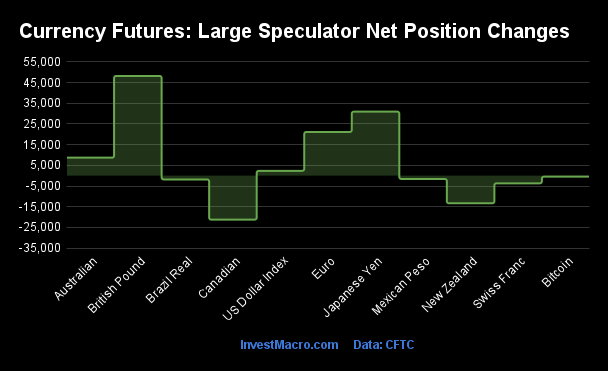
The COT currency market speculator bets were higher this week as seven out of the eleven currency markets we cover had higher positioning while the other four markets had lower speculator contracts.

Leading the gains for the currency markets was the Japanese Yen (23,938 contracts) with the British Pound (17,808 contracts), the Brazilian Real (17,722 contracts), the EuroFX (10,298 contracts),  the New Zealand Dollar (5,159 contracts), the Mexican Peso (3,752 contracts) and the US Dollar Index (713 contracts) also having positive weeks.

The currencies seeing declines in speculator bets on the week were the Canadian Dollar (-5,054 contracts), the Swiss Franc (-1,397 contracts), the Australian Dollar (-1,387 contracts) and with Bitcoin (-363 contracts) also seeing lower bets on the week.

Currency Speculators drop Swiss Franc bets to lowest since 2018

Swiss franc speculator bets fell for a second consecutive week this week and dropped to an overall standing at -45,763 contracts. This is the seventh straight week that the speculator position has now exceeded -40,000 contracts.

The current -45,763 contract position marks the lowest level for CHF bets since August 14th of 2018 (a span of 303 weeks) and the currency is currently tied as the most bearish extreme market of all the futures instruments we cover. The franc speculator position has now been consecutively in bearish territory for 143 weeks, dating back to September 7th of 2021 when the last bullish position was seen.

The Swiss franc exchange rate versus the US dollar has also been lower in 2024 following a strong run higher last year. The Swiss currency, in 2023, hit its highest level versus the USD since 2015 with a decade-high exchange rate above the 1.2000 threshold. Since then, however, the CHF has been heavily under pressure due to a strong dollar and combined with a surprise interest rate cut by the Swiss National Bank (SNB) in March. The franc has fallen by approximately 7 percent versus the dollar this year so far. The Swiss currency could remain under pressure for the time being as the SNB interest rate remains comparatively low at just 1.50 percent and Swiss inflation continues to be moderate with a 1.4 percent annual rate seen in May 2024.


Currencies Net Speculators Leaderboard
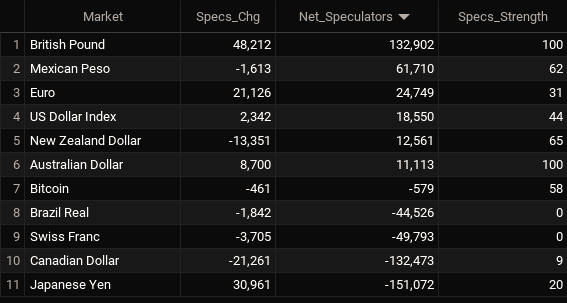
Legend: Weekly Speculators Change | Speculators Current Net Position | Speculators Strength Score compared to last 3-Years (0-100 range)


Strength Scores led by Mexican Peso & British Pound

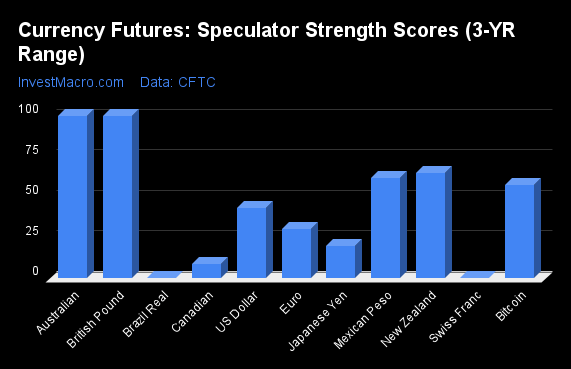
COT Strength Scores (a normalized measure of Speculator positions over a 3-Year range, from 0 to 100 where above 80 is Extreme-Bullish and below 20 is Extreme-Bearish) showed that the Mexican Peso (93 percent), the British Pound (82 percent) and the New Zealand Dollar (81 percent) led the currency markets this week. The Australian Dollar (63 percent) and Bitcoin (50 percent) come in as the next highest in the weekly strength scores.

On the downside, the Canadian Dollar (0 percent), the Swiss Franc (0 percent) and the US Dollar Index (15 percent) come in at the lowest strength levels currently and are in Extreme-Bearish territory (below 20 percent). The next lowest strength score was the Brazilian Real (22 percent).

Strength Statistics:
US Dollar Index (15.2 percent) vs US Dollar Index previous week (13.7 percent)
EuroFX (49.2 percent) vs EuroFX previous week (44.8 percent)
British Pound Sterling (81.9 percent) vs British Pound Sterling previous week (70.1 percent)
Japanese Yen (29.9 percent) vs Japanese Yen previous week (14.9 percent)
Swiss Franc (0.0 percent) vs Swiss Franc previous week (2.4 percent)
Canadian Dollar (0.0 percent) vs Canadian Dollar previous week (3.7 percent)
Australian Dollar (62.5 percent) vs Australian Dollar previous week (64.1 percent)
New Zealand Dollar (80.8 percent) vs New Zealand Dollar previous week (66.2 percent)
Mexican Peso (92.6 percent) vs Mexican Peso previous week (90.8 percent)
Brazilian Real (21.9 percent) vs Brazilian Real previous week (1.9 percent)
Bitcoin (49.6 percent) vs Bitcoin previous week (55.0 percent)


New Zealand Dollar & Australian Dollar top the 6-Week Strength Trends

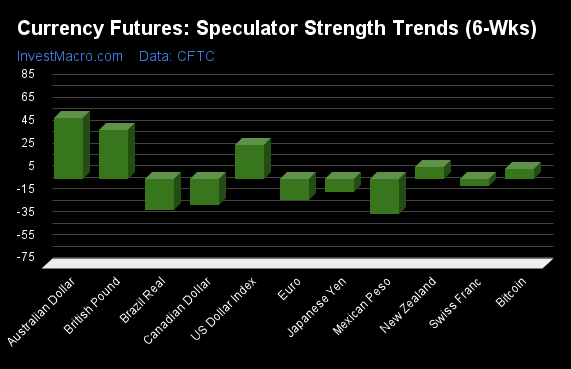
COT Strength Score Trends (or move index, calculates the 6-week changes in strength scores) showed that the New Zealand Dollar (55 percent), the Australian Dollar (50 percent) and the British Pound (46 percent) lead the past six weeks trends for the currencies. The EuroFX (33 percent) and the Japanese Yen (30 percent) are the next highest positive movers in the latest trends data.

The Brazilian Real (-22 percent) leads the downside trend scores currently with Bitcoin (-17 percent), the Canadian Dollar (-11 percent) and the Swiss Franc (-5 percent) following next with lower trend scores.

Strength Trend Statistics:
US Dollar Index (10.8 percent) vs US Dollar Index previous week (10.8 percent)
EuroFX (33.2 percent) vs EuroFX previous week (19.3 percent)
British Pound Sterling (46.0 percent) vs British Pound Sterling previous week (11.1 percent)
Japanese Yen (29.9 percent) vs Japanese Yen previous week (6.0 percent)
Swiss Franc (-5.4 percent) vs Swiss Franc previous week (-13.7 percent)
Canadian Dollar (-11.1 percent) vs Canadian Dollar previous week (-2.7 percent)
Australian Dollar (49.9 percent) vs Australian Dollar previous week (56.9 percent)
New Zealand Dollar (54.6 percent) vs New Zealand Dollar previous week (39.1 percent)
Mexican Peso (0.5 percent) vs Mexican Peso previous week (-3.3 percent)
Brazilian Real (-22.3 percent) vs Brazilian Real previous week (-42.2 percent)
Bitcoin (-16.8 percent) vs Bitcoin previous week (-5.9 percent)


Individual COT Forex Markets:

US Dollar Index Futures:
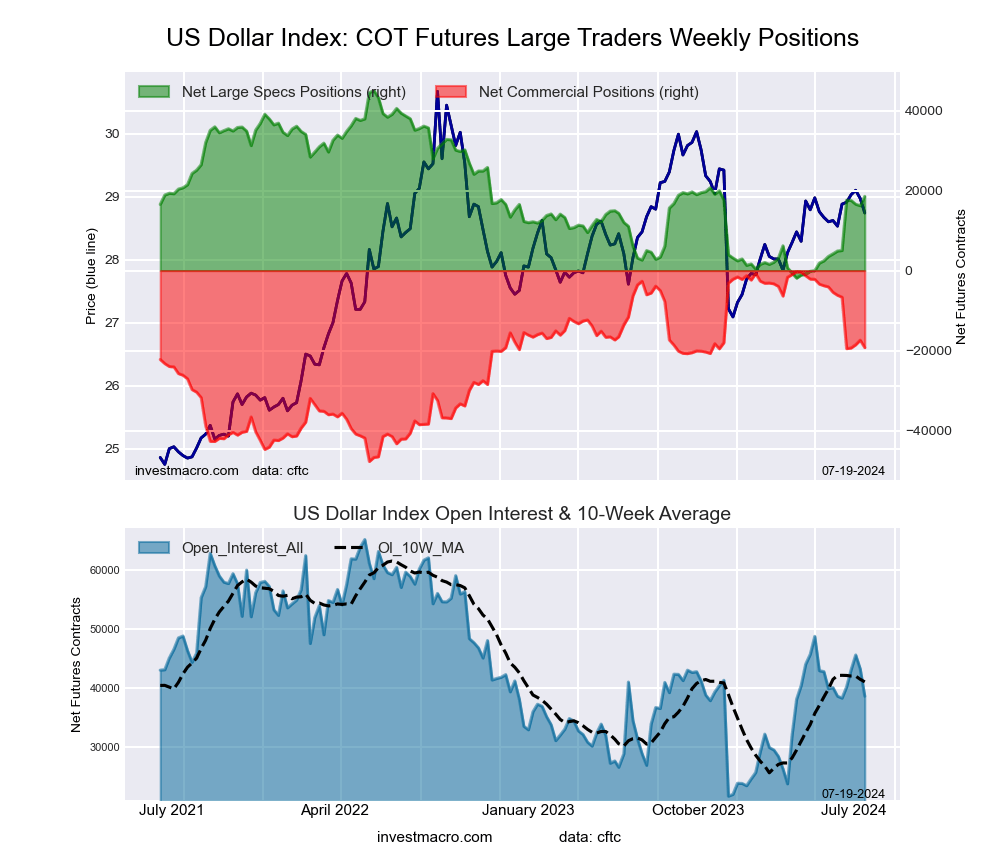
US Dollar Index Forex Futures COT ChartThe US Dollar Index large speculator standing this week was a net position of 4,887 contracts in the data reported through Tuesday. This was a weekly increase of 713 contracts from the previous week which had a total of 4,174 net contracts.

This week’s current strength score (the trader positioning range over the past three years, measured from 0 to 100) shows the speculators are currently Bearish-Extreme with a score of 15.2 percent. The commercials are Bullish-Extreme with a score of 87.6 percent and the small traders (not shown in chart) are Bearish with a score of 26.3 percent.

Price Trend-Following Model: Uptrend

Our weekly trend-following model classifies the current market price position as: Uptrend. The current action for the model is considered to be: Hold – Maintain Long Position.

US DOLLAR INDEX StatisticsSPECULATORSCOMMERCIALSSMALL TRADERS
– Percent of Open Interest Longs:69.415.19.3
– Percent of Open Interest Shorts:56.731.16.0
– Net Position:4,887-6,1841,297
– Gross Longs:26,8035,8453,598
– Gross Shorts:21,91612,0292,301
– Long to Short Ratio:1.2 to 10.5 to 11.6 to 1
NET POSITION TREND:
– Strength Index Score (3 Year Range Pct):15.287.626.3
– Strength Index Reading (3 Year Range):Bearish-ExtremeBullish-ExtremeBearish
NET POSITION MOVEMENT INDEX:
– 6-Week Change in Strength Index:10.8-8.6-12.1


Euro Currency Futures:

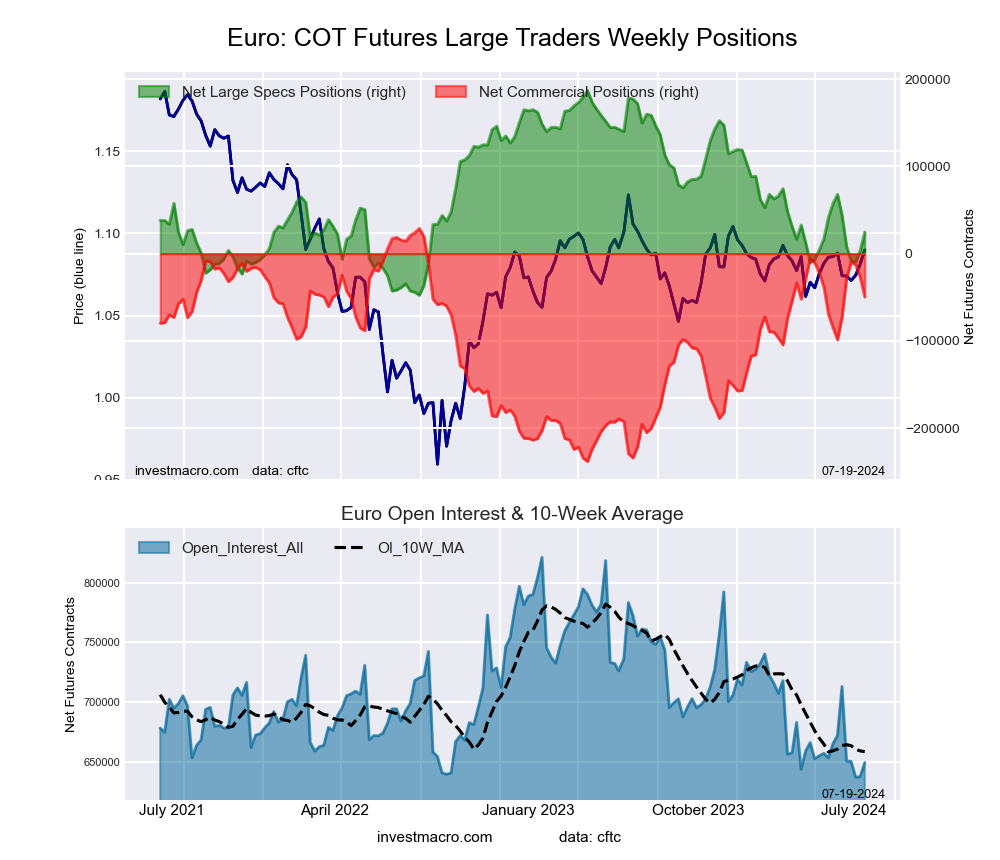
Euro Currency Futures COT ChartThe Euro Currency large speculator standing this week was a net position of 67,870 contracts in the data reported through Tuesday. This was a weekly increase of 10,298 contracts from the previous week which had a total of 57,572 net contracts.

This week’s current strength score (the trader positioning range over the past three years, measured from 0 to 100) shows the speculators are currently Bearish with a score of 49.2 percent. The commercials are Bullish with a score of 52.2 percent and the small traders (not shown in chart) are Bearish with a score of 35.0 percent.

Price Trend-Following Model: Downtrend

Our weekly trend-following model classifies the current market price position as: Downtrend. The current action for the model is considered to be: Hold – Maintain Short Position.

EURO Currency StatisticsSPECULATORSCOMMERCIALSSMALL TRADERS
– Percent of Open Interest Longs:28.157.111.9
– Percent of Open Interest Shorts:18.071.87.3
– Net Position:67,870-98,78630,916
– Gross Longs:188,957383,42379,709
– Gross Shorts:121,087482,20948,793
– Long to Short Ratio:1.6 to 10.8 to 11.6 to 1
NET POSITION TREND:
– Strength Index Score (3 Year Range Pct):49.252.235.0
– Strength Index Reading (3 Year Range):BearishBullishBearish
NET POSITION MOVEMENT INDEX:
– 6-Week Change in Strength Index:33.2-35.030.9


British Pound Sterling Futures:

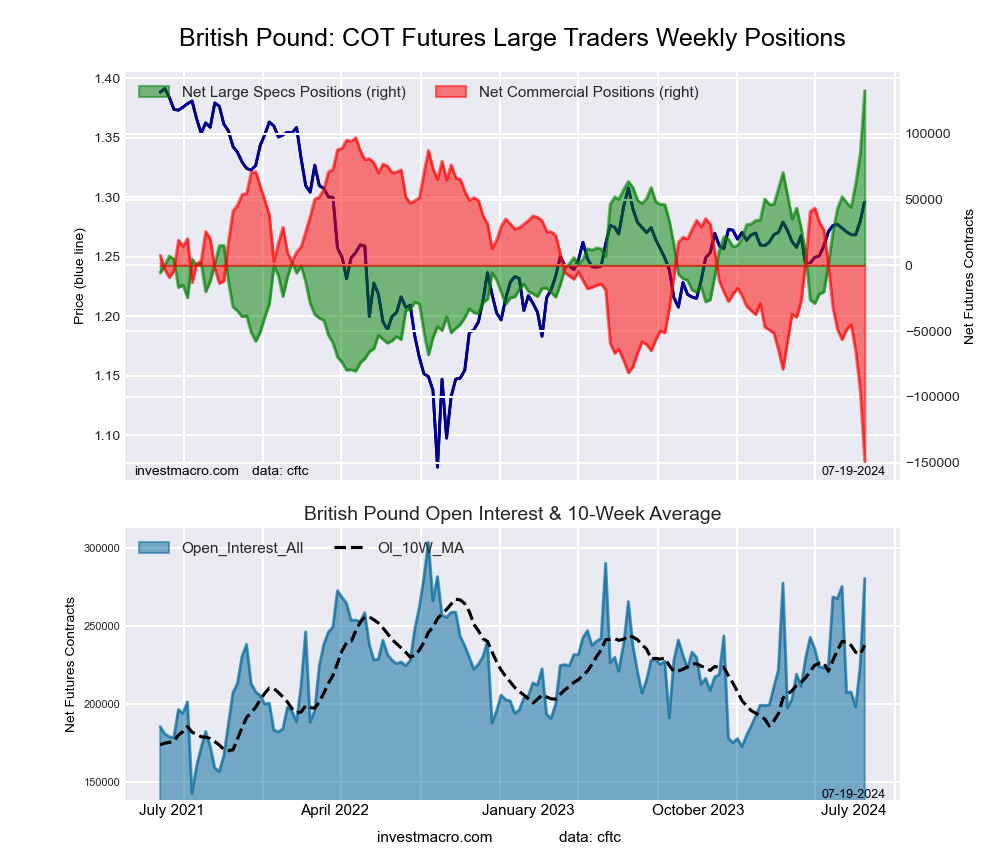
British Pound Sterling Futures COT ChartThe British Pound Sterling large speculator standing this week was a net position of 43,210 contracts in the data reported through Tuesday. This was a weekly increase of 17,808 contracts from the previous week which had a total of 25,402 net contracts.

This week’s current strength score (the trader positioning range over the past three years, measured from 0 to 100) shows the speculators are currently Bullish-Extreme with a score of 81.9 percent. The commercials are Bearish-Extreme with a score of 18.4 percent and the small traders (not shown in chart) are Bullish with a score of 73.9 percent.

Price Trend-Following Model: Weak Downtrend

Our weekly trend-following model classifies the current market price position as: Weak Downtrend. The current action for the model is considered to be: Hold – Maintain Short Position.

BRITISH POUND StatisticsSPECULATORSCOMMERCIALSSMALL TRADERS
– Percent of Open Interest Longs:38.142.112.7
– Percent of Open Interest Shorts:22.060.310.6
– Net Position:43,210-48,7785,568
– Gross Longs:102,118112,71734,034
– Gross Shorts:58,908161,49528,466
– Long to Short Ratio:1.7 to 10.7 to 11.2 to 1
NET POSITION TREND:
– Strength Index Score (3 Year Range Pct):81.918.473.9
– Strength Index Reading (3 Year Range):Bullish-ExtremeBearish-ExtremeBullish
NET POSITION MOVEMENT INDEX:
– 6-Week Change in Strength Index:46.0-50.242.4


Japanese Yen Futures:

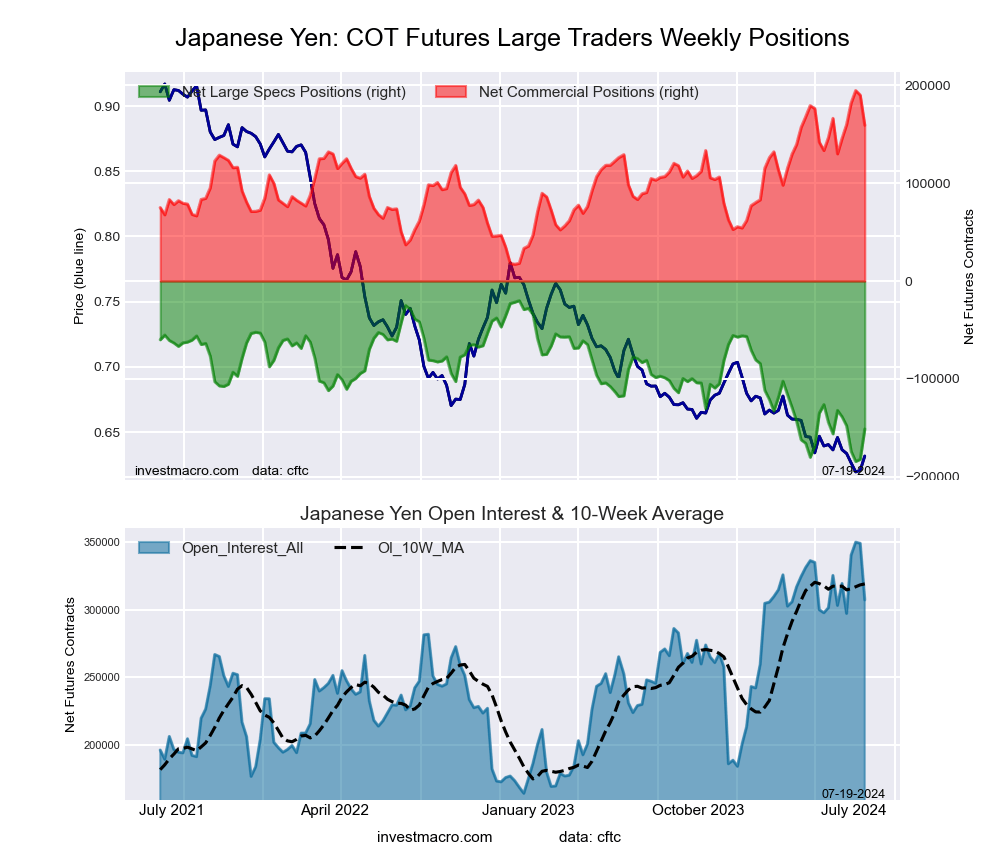
Japanese Yen Forex Futures COT ChartThe Japanese Yen large speculator standing this week was a net position of -132,101 contracts in the data reported through Tuesday. This was a weekly gain of 23,938 contracts from the previous week which had a total of -156,039 net contracts.

This week’s current strength score (the trader positioning range over the past three years, measured from 0 to 100) shows the speculators are currently Bearish with a score of 29.9 percent. The commercials are Bullish with a score of 69.6 percent and the small traders (not shown in chart) are Bullish-Extreme with a score of 89.5 percent.

Price Trend-Following Model: Downtrend

Our weekly trend-following model classifies the current market price position as: Downtrend. The current action for the model is considered to be: Hold – Maintain Short Position.

JAPANESE YEN StatisticsSPECULATORSCOMMERCIALSSMALL TRADERS
– Percent of Open Interest Longs:13.367.614.7
– Percent of Open Interest Shorts:56.924.713.9
– Net Position:-132,101129,8952,206
– Gross Longs:40,427204,83044,416
– Gross Shorts:172,52874,93542,210
– Long to Short Ratio:0.2 to 12.7 to 11.1 to 1
NET POSITION TREND:
– Strength Index Score (3 Year Range Pct):29.969.689.5
– Strength Index Reading (3 Year Range):BearishBullishBullish-Extreme
NET POSITION MOVEMENT INDEX:
– 6-Week Change in Strength Index:29.9-30.44.5


Swiss Franc Futures:

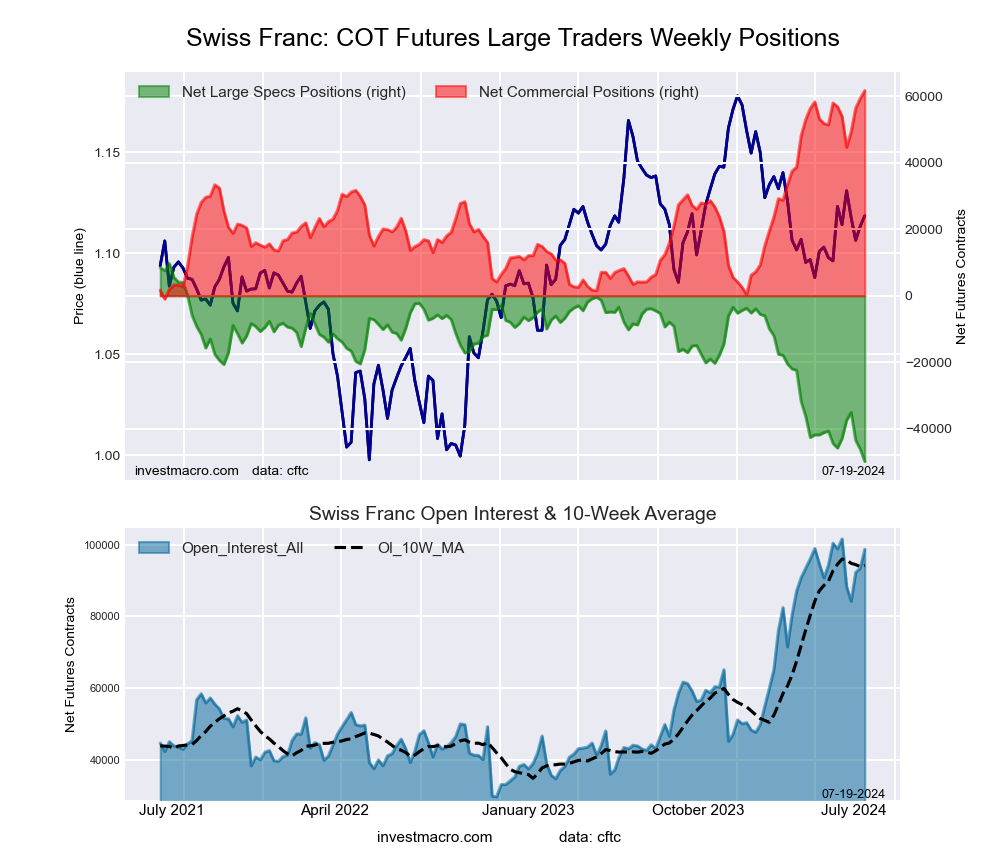
Swiss Franc Forex Futures COT ChartThe Swiss Franc large speculator standing this week was a net position of -45,763 contracts in the data reported through Tuesday. This was a weekly lowering of -1,397 contracts from the previous week which had a total of -44,366 net contracts.

This week’s current strength score (the trader positioning range over the past three years, measured from 0 to 100) shows the speculators are currently Bearish-Extreme with a score of 0.0 percent. The commercials are Bullish-Extreme with a score of 97.8 percent and the small traders (not shown in chart) are Bearish with a score of 27.0 percent.

Price Trend-Following Model: Downtrend

Our weekly trend-following model classifies the current market price position as: Downtrend. The current action for the model is considered to be: Hold – Maintain Short Position.

SWISS FRANC StatisticsSPECULATORSCOMMERCIALSSMALL TRADERS
– Percent of Open Interest Longs:7.878.511.8
– Percent of Open Interest Shorts:54.221.023.0
– Net Position:-45,76356,817-11,054
– Gross Longs:7,75177,53411,667
– Gross Shorts:53,51420,71722,721
– Long to Short Ratio:0.1 to 13.7 to 10.5 to 1
NET POSITION TREND:
– Strength Index Score (3 Year Range Pct):0.097.827.0
– Strength Index Reading (3 Year Range):Bearish-ExtremeBullish-ExtremeBearish
NET POSITION MOVEMENT INDEX:
– 6-Week Change in Strength Index:-5.40.712.3


Canadian Dollar Futures:

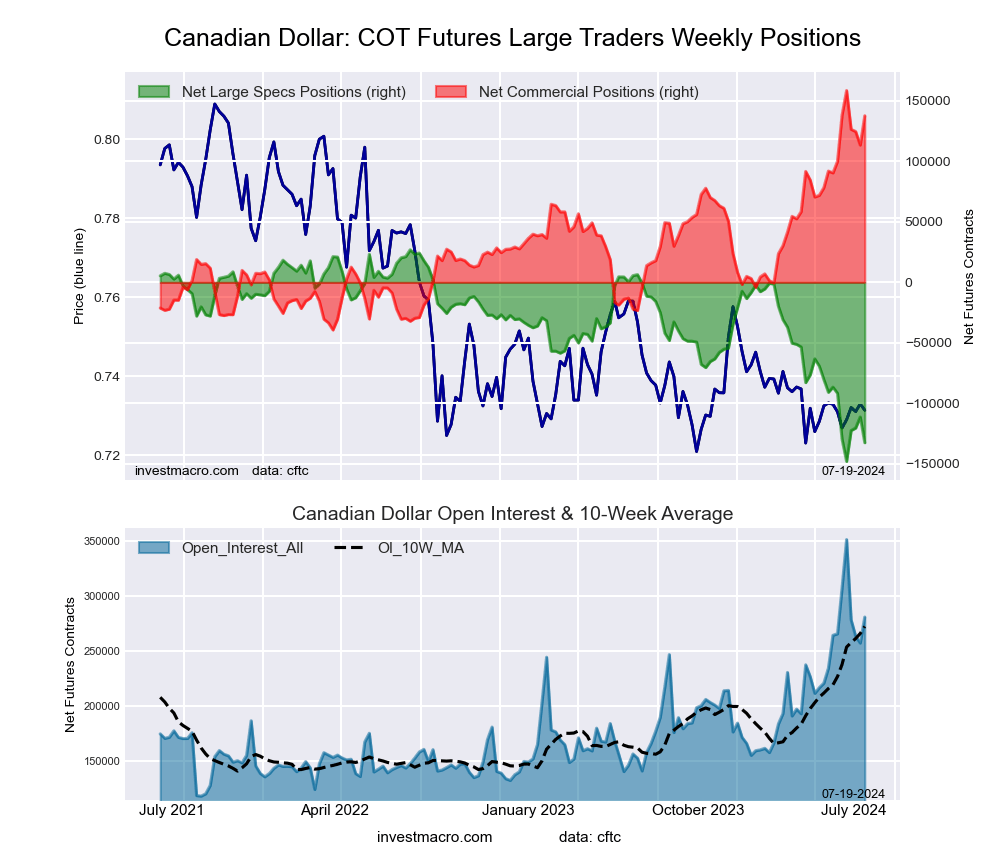
Canadian Dollar Forex Futures COT ChartThe Canadian Dollar large speculator standing this week was a net position of -91,639 contracts in the data reported through Tuesday. This was a weekly decrease of -5,054 contracts from the previous week which had a total of -86,585 net contracts.

This week’s current strength score (the trader positioning range over the past three years, measured from 0 to 100) shows the speculators are currently Bearish-Extreme with a score of 0.0 percent. The commercials are Bullish-Extreme with a score of 100.0 percent and the small traders (not shown in chart) are Bearish-Extreme with a score of 5.1 percent.

Price Trend-Following Model: Strong Downtrend

Our weekly trend-following model classifies the current market price position as: Strong Downtrend. The current action for the model is considered to be: Hold – Maintain Short Position.

CANADIAN DOLLAR StatisticsSPECULATORSCOMMERCIALSSMALL TRADERS
– Percent of Open Interest Longs:14.172.810.4
– Percent of Open Interest Shorts:48.535.213.5
– Net Position:-91,63999,904-8,265
– Gross Longs:37,360193,44927,528
– Gross Shorts:128,99993,54535,793
– Long to Short Ratio:0.3 to 12.1 to 10.8 to 1
NET POSITION TREND:
– Strength Index Score (3 Year Range Pct):0.0100.05.1
– Strength Index Reading (3 Year Range):Bearish-ExtremeBullish-ExtremeBearish-Extreme
NET POSITION MOVEMENT INDEX:
– 6-Week Change in Strength Index:-11.18.9-0.6


Australian Dollar Futures:

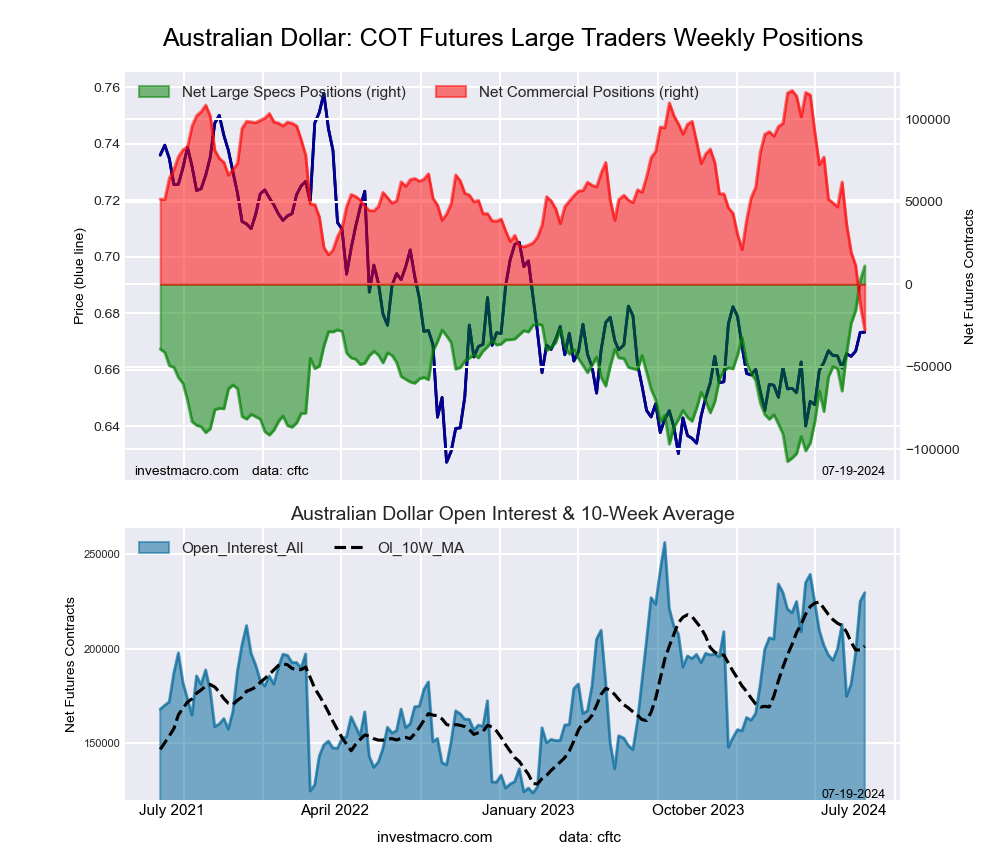
Australian Dollar Forex Futures COT ChartThe Australian Dollar large speculator standing this week was a net position of -51,303 contracts in the data reported through Tuesday. This was a weekly decrease of -1,387 contracts from the previous week which had a total of -49,916 net contracts.

This week’s current strength score (the trader positioning range over the past three years, measured from 0 to 100) shows the speculators are currently Bullish with a score of 62.5 percent. The commercials are Bearish with a score of 34.1 percent and the small traders (not shown in chart) are Bullish with a score of 70.6 percent.

Price Trend-Following Model: Uptrend

Our weekly trend-following model classifies the current market price position as: Uptrend. The current action for the model is considered to be: Hold – Maintain Long Position.

AUSTRALIAN DOLLAR StatisticsSPECULATORSCOMMERCIALSSMALL TRADERS
– Percent of Open Interest Longs:25.958.613.5
– Percent of Open Interest Shorts:51.535.111.3
– Net Position:-51,30346,9234,380
– Gross Longs:51,661117,00026,878
– Gross Shorts:102,96470,07722,498
– Long to Short Ratio:0.5 to 11.7 to 11.2 to 1
NET POSITION TREND:
– Strength Index Score (3 Year Range Pct):62.534.170.6
– Strength Index Reading (3 Year Range):BullishBearishBullish
NET POSITION MOVEMENT INDEX:
– 6-Week Change in Strength Index:49.9-63.462.7


New Zealand Dollar Futures:

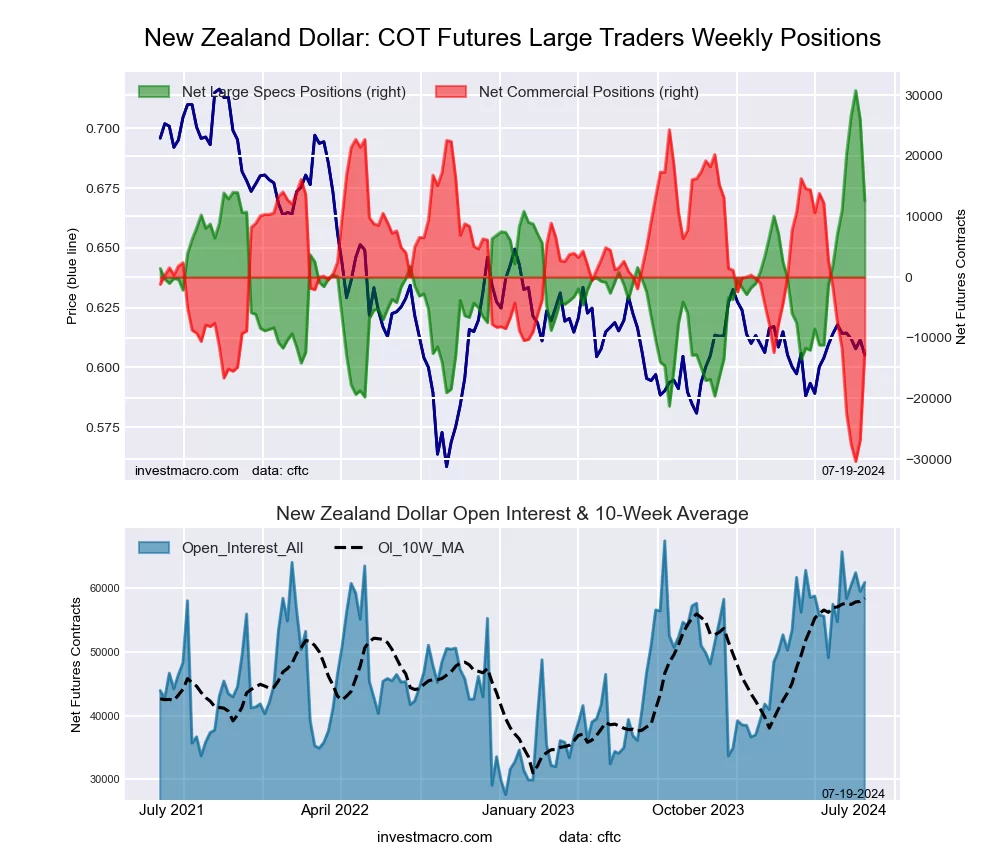
New Zealand Dollar Forex Futures COT ChartThe New Zealand Dollar large speculator standing this week was a net position of 7,205 contracts in the data reported through Tuesday. This was a weekly gain of 5,159 contracts from the previous week which had a total of 2,046 net contracts.

This week’s current strength score (the trader positioning range over the past three years, measured from 0 to 100) shows the speculators are currently Bullish-Extreme with a score of 80.8 percent. The commercials are Bearish with a score of 21.9 percent and the small traders (not shown in chart) are Bullish with a score of 64.8 percent.

Price Trend-Following Model: Weak Downtrend

Our weekly trend-following model classifies the current market price position as: Weak Downtrend. The current action for the model is considered to be: Hold – Maintain Short Position.

NEW ZEALAND DOLLAR StatisticsSPECULATORSCOMMERCIALSSMALL TRADERS
– Percent of Open Interest Longs:54.434.87.4
– Percent of Open Interest Shorts:41.248.86.6
– Net Position:7,205-7,663458
– Gross Longs:29,79119,0654,058
– Gross Shorts:22,58626,7283,600
– Long to Short Ratio:1.3 to 10.7 to 11.1 to 1
NET POSITION TREND:
– Strength Index Score (3 Year Range Pct):80.821.964.8
– Strength Index Reading (3 Year Range):Bullish-ExtremeBearishBullish
NET POSITION MOVEMENT INDEX:
– 6-Week Change in Strength Index:54.6-53.939.1


Mexican Peso Futures:

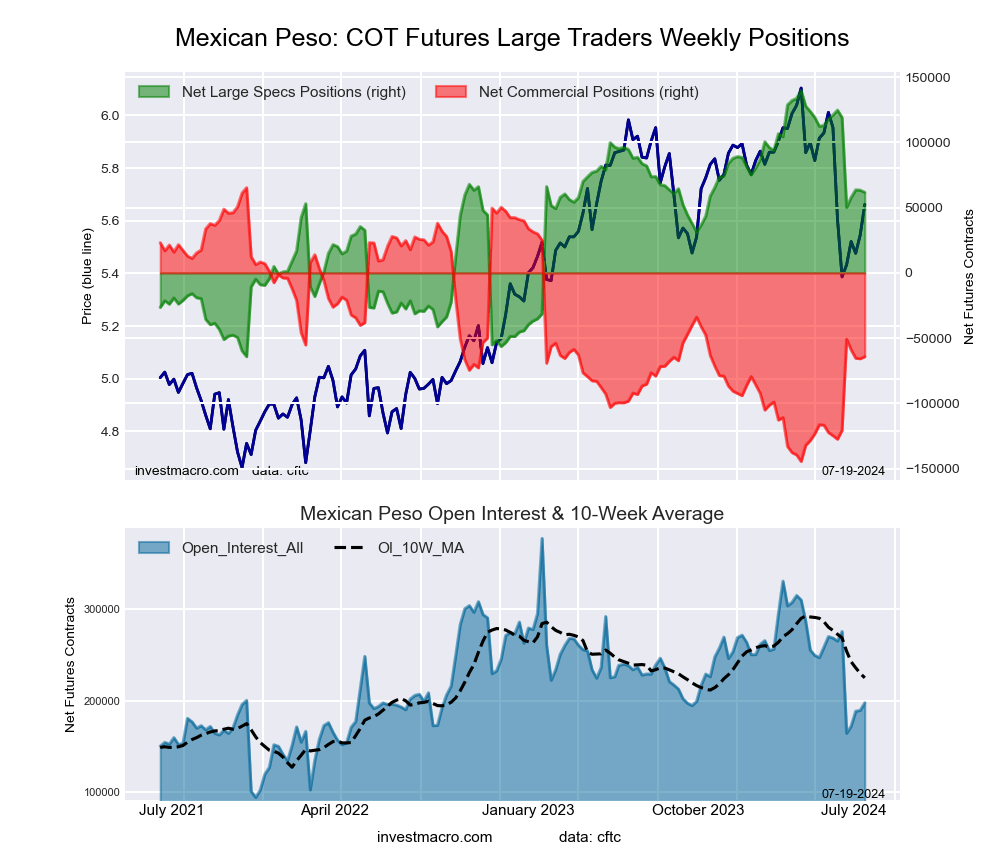
Mexican Peso Futures COT ChartThe Mexican Peso large speculator standing this week was a net position of 124,671 contracts in the data reported through Tuesday. This was a weekly rise of 3,752 contracts from the previous week which had a total of 120,919 net contracts.

This week’s current strength score (the trader positioning range over the past three years, measured from 0 to 100) shows the speculators are currently Bullish-Extreme with a score of 92.6 percent. The commercials are Bearish-Extreme with a score of 8.1 percent and the small traders (not shown in chart) are Bearish with a score of 28.6 percent.

Price Trend-Following Model: Strong Downtrend

Our weekly trend-following model classifies the current market price position as: Strong Downtrend. The current action for the model is considered to be: New Sell – Short Position.

MEXICAN PESO StatisticsSPECULATORSCOMMERCIALSSMALL TRADERS
– Percent of Open Interest Longs:58.137.62.2
– Percent of Open Interest Shorts:11.185.71.2
– Net Position:124,671-127,4102,739
– Gross Longs:153,94399,5525,875
– Gross Shorts:29,272226,9623,136
– Long to Short Ratio:5.3 to 10.4 to 11.9 to 1
NET POSITION TREND:
– Strength Index Score (3 Year Range Pct):92.68.128.6
– Strength Index Reading (3 Year Range):Bullish-ExtremeBearish-ExtremeBearish
NET POSITION MOVEMENT INDEX:
– 6-Week Change in Strength Index:0.50.5-12.7


Brazilian Real Futures:

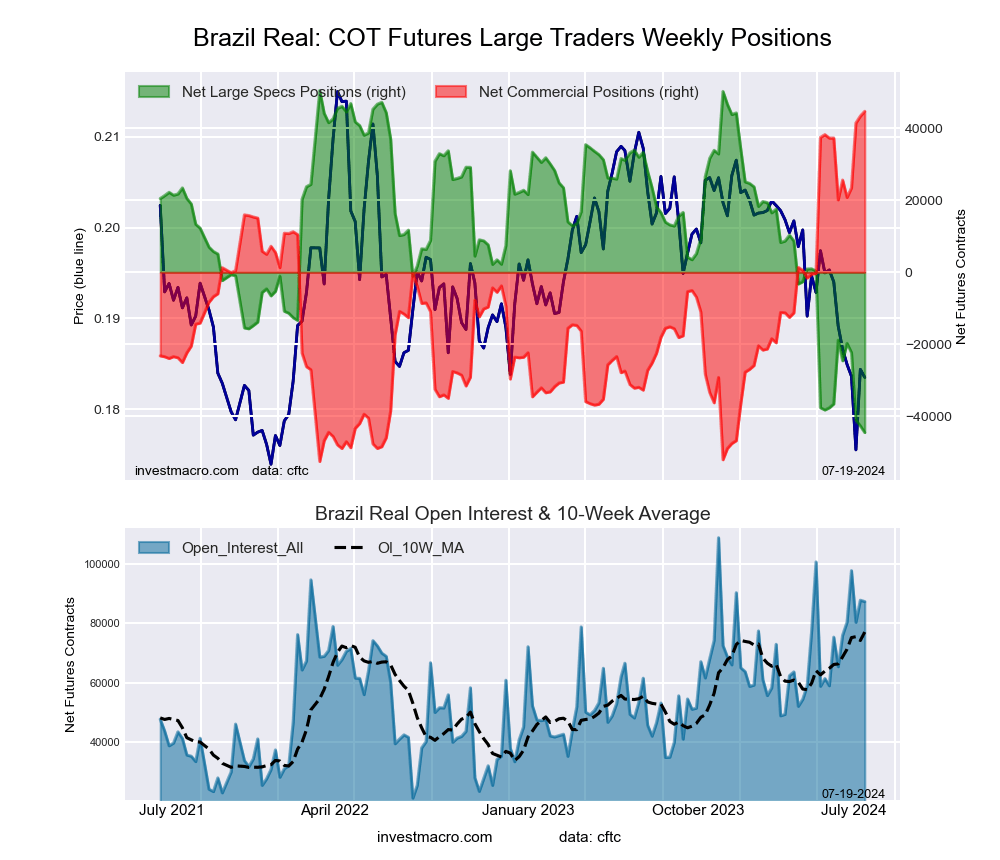
Brazil Real Futures COT ChartThe Brazilian Real large speculator standing this week was a net position of -18,860 contracts in the data reported through Tuesday. This was a weekly boost of 17,722 contracts from the previous week which had a total of -36,582 net contracts.

This week’s current strength score (the trader positioning range over the past three years, measured from 0 to 100) shows the speculators are currently Bearish with a score of 21.9 percent. The commercials are Bullish-Extreme with a score of 80.0 percent and the small traders (not shown in chart) are Bearish with a score of 22.7 percent.

Price Trend-Following Model: Strong Downtrend

Our weekly trend-following model classifies the current market price position as: Strong Downtrend. The current action for the model is considered to be: Hold – Maintain Short Position.

BRAZIL REAL StatisticsSPECULATORSCOMMERCIALSSMALL TRADERS
– Percent of Open Interest Longs:49.347.12.7
– Percent of Open Interest Shorts:78.216.34.7
– Net Position:-18,86020,125-1,265
– Gross Longs:32,23130,7681,785
– Gross Shorts:51,09110,6433,050
– Long to Short Ratio:0.6 to 12.9 to 10.6 to 1
NET POSITION TREND:
– Strength Index Score (3 Year Range Pct):21.980.022.7
– Strength Index Reading (3 Year Range):BearishBullish-ExtremeBearish
NET POSITION MOVEMENT INDEX:
– 6-Week Change in Strength Index:-22.322.8-8.0


Bitcoin Futures:

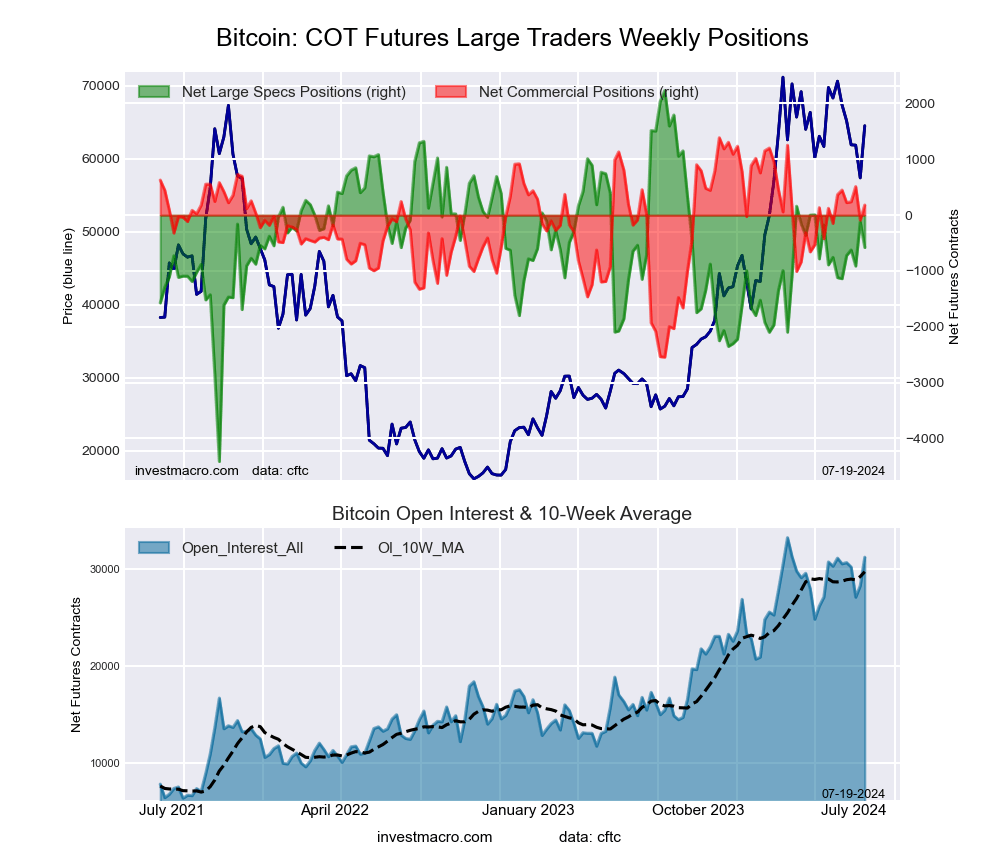
Bitcoin Crypto Futures COT ChartThe Bitcoin large speculator standing this week was a net position of -1,119 contracts in the data reported through Tuesday. This was a weekly lowering of -363 contracts from the previous week which had a total of -756 net contracts.

This week’s current strength score (the trader positioning range over the past three years, measured from 0 to 100) shows the speculators are currently Bearish with a score of 49.6 percent. The commercials are Bullish with a score of 74.0 percent and the small traders (not shown in chart) are Bearish with a score of 30.1 percent.

Price Trend-Following Model: Uptrend

Our weekly trend-following model classifies the current market price position as: Uptrend. The current action for the model is considered to be: Hold – Maintain Long Position.

BITCOIN StatisticsSPECULATORSCOMMERCIALSSMALL TRADERS
– Percent of Open Interest Longs:78.74.75.2
– Percent of Open Interest Shorts:82.33.62.7
– Net Position:-1,119366753
– Gross Longs:24,4701,4721,601
– Gross Shorts:25,5891,106848
– Long to Short Ratio:1.0 to 11.3 to 11.9 to 1
NET POSITION TREND:
– Strength Index Score (3 Year Range Pct):49.674.030.1
– Strength Index Reading (3 Year Range):BearishBullishBearish
NET POSITION MOVEMENT INDEX:
– 6-Week Change in Strength Index:-16.826.02.2


Article By InvestMacroReceive our weekly COT Newsletter

*COT Report: The COT data, released weekly to the public each Friday, is updated through the most recent Tuesday (data is 3 days old) and shows a quick view of how large speculators or non-commercials (for-profit traders) were positioned in the futures markets.

The CFTC categorizes trader positions according to commercial hedgers (traders who use futures contracts for hedging as part of the business), non-commercials (large traders who speculate to realize trading profits) and nonreportable traders (usually small traders/speculators) as well as their open interest (contracts open in the market at time of reporting). See CFTC criteria here.

Speculator Extremes: Silver, Peso, 5-Year & Sugar lead weekly bets

By InvestMacro

The latest update for the weekly Commitment of Traders (COT) report was released by the Commodity Futures Trading Commission (CFTC) on Friday for data ending on June 4th.

This weekly Extreme Positions report highlights the Most Bullish and Most Bearish Positions for the speculator category. Extreme positioning in these markets can foreshadow strong moves in the underlying market.

To signify an extreme position, we use the Strength Index (also known as the COT Index) of each instrument, a common method of measuring COT data. The Strength Index is simply a comparison of current trader positions against the range of positions over the previous 3 years. We use over 80 percent as extremely bullish and under 20 percent as extremely bearish. (Compare Strength Index scores across all markets in the data table or cot leaders table)


Here Are This Week’s Most Bullish Speculator Positions:

Silver


The Silver speculator position comes in as the most bullish extreme standing this week. The Silver speculator level is currently at a 95.5 percent score of its 3-year range.

The six-week trend for the percent strength score totaled -4.1 this week. The overall net speculator position was a total of 56,403 net contracts this week with a decline of -780 contract in the weekly speculator bets.


Speculators or Non-Commercials Notes:

Speculators, classified as non-commercial traders by the CFTC, are made up of large commodity funds, hedge funds and other significant for-profit participants. The Specs are generally regarded as trend-followers in their behavior towards price action – net speculator bets and prices tend to go in the same directions. These traders often look to buy when prices are rising and sell when prices are falling. To illustrate this point, many times speculator contracts can be found at their most extremes (bullish or bearish) when prices are also close to their highest or lowest levels.

These extreme levels can be dangerous for the large speculators as the trade is most crowded, there is less trading ammunition still sitting on the sidelines to push the trend further and prices have moved a significant distance. When the trend becomes exhausted, some speculators take profits while others look to also exit positions when prices fail to continue in the same direction. This process usually plays out over many months to years and can ultimately create a reverse effect where prices start to fall and speculators start a process of selling when prices are falling.


Mexican Peso


The Mexican Peso speculator position comes next in the extreme standings this week. The Mexican Peso speculator level is now at a 92.6 percent score of its 3-year range.

The six-week trend for the percent strength score was 0.5 this week. The speculator position registered 124,671 net contracts this week with a weekly rise of 3,752 contracts in speculator bets.


Coffee


The Coffee speculator position comes in third this week in the extreme standings. The Coffee speculator level resides at a 91.8 percent score of its 3-year range.

The six-week trend for the speculator strength score came in at -4.1 this week. The overall speculator position was 67,649 net contracts this week with a boost of 4,616 contracts in the weekly speculator bets.


Copper


The Copper speculator position comes up number four in the extreme standings this week. The Copper speculator level is at a 90.2 percent score of its 3-year range.

The six-week trend for the speculator strength score totaled a change of 2.5 this week. The overall speculator position was 61,127 net contracts this week with a drop of -4,395 contracts in the speculator bets.


Brent Oil


The Brent Oil speculator position rounds out the top five in this week’s bullish extreme standings. The Brent Oil speculator level sits at a 84.0 percent score of its 3-year range. The six-week trend for the speculator strength score was 20.3 this week.

The speculator position was -14,745 net contracts this week with a gain of 15,361 contracts in the weekly speculator bets.


This Week’s Most Bearish Speculator Positions:

5-Year Bond


The 5-Year Bond speculator position comes in as the most bearish extreme standing this week. The 5-Year Bond speculator level is at a 0.0 percent score of its 3-year range.

The six-week trend for the speculator strength score was -28.9 this week. The overall speculator position was -1,573,037 net contracts this week with a decrease by -195,920 contracts in the speculator bets.


Canadian Dollar


The Canadian Dollar speculator position comes in next for the most bearish extreme standing on the week. The Canadian Dollar speculator level is at a 0.0 percent score of its 3-year range.

The six-week trend for the speculator strength score was -11.1 this week. The speculator position was -91,639 net contracts this week with a decline of -5,054 contracts in the weekly speculator bets.


Swiss Franc


The Swiss Franc speculator position comes in as third most bearish extreme standing of the week. The Swiss Franc speculator level resides at a 0.0 percent score of its 3-year range.

The six-week trend for the speculator strength score was -5.4 this week. The overall speculator position was -45,763 net contracts this week with a dip of -1,397 contracts in the speculator bets.


Sugar


The Sugar speculator position comes in as this week’s fourth most bearish extreme standing. The Sugar speculator level is at a 0.0 percent score of its 3-year range.

The six-week trend for the speculator strength score was -16.0 this week. The speculator position was -4,040 net contracts this week with a decline of -9,145 contracts in the weekly speculator bets.


Cotton


Finally, the Cotton speculator position comes in as the fifth most bearish extreme standing for this week. The Cotton speculator level is at a 3.7 percent score of its 3-year range.

The six-week trend for the speculator strength score was -26.8 this week. The speculator position was -6,691 net contracts this week with a reduction by -14,369 contracts in the weekly speculator bets.


Article By InvestMacroReceive our weekly COT Newsletter

*COT Report: The COT data, released weekly to the public each Friday, is updated through the most recent Tuesday (data is 3 days old) and shows a quick view of how large speculators or non-commercials (for-profit traders) were positioned in the futures markets.

The CFTC categorizes trader positions according to commercial hedgers (traders who use futures contracts for hedging as part of the business), non-commercials (large traders who speculate to realize trading profits) and nonreportable traders (usually small traders/speculators) as well as their open interest (contracts open in the market at time of reporting). See CFTC criteria here.

AI plus gene editing promises to shift biotech into high gear

By Marc Zimmer, Connecticut College 

During her chemistry Nobel Prize lecture in 2018, Frances Arnold said, “Today we can for all practical purposes read, write and edit any sequence of DNA, but we cannot compose it.” That isn’t true anymore.

Since then, science and technology have progressed so much that artificial intelligence has learned to compose DNA, and with genetically modified bacteria, scientists are on their way to designing and making bespoke proteins.

The goal is that with AI’s designing talents and gene editing’s engineering abilities, scientists can modify bacteria to act as mini factories producing new proteins that can reduce greenhouse gases, digest plastics or act as species-specific pesticides.

As a chemistry professor and computational chemist who studies molecular science and environmental chemistry, I believe that advances in AI and gene editing make this a realistic possibility.

Gene sequencing – reading life’s recipes

All living things contain genetic materials – DNA and RNA – that provide the hereditary information needed to replicate themselves and make proteins. Proteins constitute 75% of human dry weight. They make up muscles, enzymes, hormones, blood, hair and cartilage. Understanding proteins means understanding much of biology. The order of nucleotide bases in DNA, or RNA in some viruses, encodes this information, and genomic sequencing technologies identify the order of these bases.

The Human Genome Project was an international effort that sequenced the entire human genome from 1990 to 2003. Thanks to rapidly improving technologies, it took seven years to sequence the first 1% of the genome and another seven years for the remaining 99%. By 2003, scientists had the complete sequence of the 3 billion nucleotide base pairs coding for 20,000 to 25,000 genes in the human genome.

However, understanding the functions of most proteins and correcting their malfunctions remained a challenge.

AI learns proteins

Each protein’s shape is critical to its function and is determined by the sequence of its amino acids, which is in turn determined by the gene’s nucleotide sequence. Misfolded proteins have the wrong shape and can cause illnesses such as neurodegenerative diseases, cystic fibrosis and Type 2 diabetes. Understanding these diseases and developing treatments requires knowledge of protein shapes.

Before 2016, the only way to determine the shape of a protein was through X-ray crystallography, a laboratory technique that uses the diffraction of X-rays by single crystals to determine the precise arrangement of atoms and molecules in three dimensions in a molecule. At that time, the structure of about 200,000 proteins had been determined by crystallography, costing billions of dollars.

AlphaFold, a machine learning program, used these crystal structures as a training set to determine the shape of the proteins from their nucleotide sequences. And in less than a year, the program calculated the protein structures of all 214 million genes that have been sequenced and published. The protein structures AlphaFold determined have all been released in a freely available database.

To effectively address noninfectious diseases and design new drugs, scientists need more detailed knowledge of how proteins, especially enzymes, bind small molecules. Enzymes are protein catalysts that enable and regulate biochemical reactions.

AI system AlphaFold3 allows scientists to make intricately detailed models of life’s molecular machinery.

AlphaFold3, released May 8, 2024, can predict protein shapes and the locations where small molecules can bind to these proteins. In rational drug design, drugs are designed to bind proteins involved in a pathway related to the disease being treated. The small molecule drugs bind to the protein binding site and modulate its activity, thereby influencing the disease path. By being able to predict protein binding sites, AlphaFold3 will enhance researchers’ drug development capabilities.

AI + CRISPR = composing new proteins

Around 2015, the development of CRISPR technology revolutionized gene editing. CRISPR can be used to find a specific part of a gene, change or delete it, make the cell express more or less of its gene product, or even add an utterly foreign gene in its place.

In 2020, Jennifer Doudna and Emmanuelle Charpentier received the Nobel Prize in chemistry “for the development of a method (CRISPR) for genome editing.” With CRISPR, gene editing, which once took years and was species specific, costly and laborious, can now be done in days and for a fraction of the cost.

AI and genetic engineering are advancing rapidly. What was once complicated and expensive is now routine. Looking ahead, the dream is of bespoke proteins designed and produced by a combination of machine learning and CRISPR-modified bacteria. AI would design the proteins, and bacteria altered using CRISPR would produce the proteins. Enzymes produced this way could potentially breathe in carbon dioxide and methane while exhaling organic feedstocks, or break down plastics into substitutes for concrete.

I believe that these ambitions are not unrealistic, given that genetically modified organisms already account for 2% of the U.S. economy in agriculture and pharmaceuticals.

Two groups have made functioning enzymes from scratch that were designed by differing AI systems. David Baker’s Institute for Protein Design at the University of Washington devised a new deep-learning-based protein design strategy it named “family-wide hallucination,” which they used to make a unique light-emitting enzyme. Meanwhile, biotech startup Profluent, has used an AI trained from the sum of all CRISPR-Cas knowledge to design new functioning genome editors.

If AI can learn to make new CRISPR systems as well as bioluminescent enzymes that work and have never been seen on Earth, there is hope that pairing CRISPR with AI can be used to design other new bespoke enzymes. Although the CRISPR-AI combination is still in its infancy, once it matures it is likely to be highly beneficial and could even help the world tackle climate change.

It’s important to remember, however, that the more powerful a technology is, the greater the risks it poses. Also, humans have not been very successful at engineering nature due to the complexity and interconnectedness of natural systems, which often leads to unintended consequences.The Conversation

About the Author:

Marc Zimmer, Professor of Chemistry, Connecticut College

This article is republished from The Conversation under a Creative Commons license. Read the original article.


Job figures are coming out, and here’s my prediction: The markets will overreact to the headlines

By Jeffrey Hart, Auburn University 

As the saying goes, “There are lies, damn lies and statistics.”

And on the first Friday of every month, the American public gets a ton of new statistics to peruse. That’s when the U.S. Bureau of Labor Statistics releases its latest jobs figures. Within minutes of the data drop, news organizations send out push alerts, pundits start opining, and the headlines — and headline numbers — coagulate into a simple narrative, often along the lines of “Jobs are up; the economy is saved” or “Jobs are down; we’re all doomed.”

These narratives consistently influence investors and financial markets.

As a professor of finance, I think these simple storylines aren’t helpful to investors. In fact, they’re actually harmful. Initial narratives stick even when underlying statistics contradict the numbers that make the headlines. So on June 7, 2024, when the latest jobs data will be released, I predict that financial markets will overreact to the headlines.

I get it: There’s so much information in the two job reports the Bureau of Labor Statistics releases each month that you can pick and choose the data you find important. But ignoring nuance isn’t a good investment strategy. And it turns out that economic reality is too complex to fit neatly into a headline. For proof, consider how markets responded to the past two months of jobs data.

Dig into the data

Let’s start with the April jobs numbers, which came out on May 3.

The headline numbers were worse than expected: The unemployment rate ticked up to 3.9% from 3.8% the previous month, and both nonfarm payrolls and private nonfarm payrolls were lower than anticipated.

The stock market rallied on this seemingly bad news because it saw the disappointing jobs reports as a sign that inflation might be slowing. That, in turn, could encourage the Federal Reserve to put interest rate cuts back on the table for 2024 – or at least investors had hoped.

But things look a little more complex when you dig into the data.

The unemployment rate did get worse, rising one-tenth of a percentage point with virtually no change in the labor force participation rate. On its surface, that doesn’t look so good: It seems the unemployment rate has increased by 10 basis points. But that’s because the bureau calculates the unemployment rate only out to one decimal place. But what if you go out to two decimal places?

To do that, you need to crunch some numbers yourself.

You can do that by going to the the bureau’s Current Employment Statistics news release, navigating various rows and columns, and then getting the calculator out to work out a figure for the month that goes one decimal place further than what’s released to the media. Then you have to repeat the process for last month’s data.

When you do that, you can see that the unemployment rate barely budged in April: It rose from 3.83% in March to 3.86%, an increase of just .03%, or 3 basis points. This suggests those seemingly disappointing official unemployment numbers weren’t actually that disappointing after all.

Good headlines, bad news

You’ll see something similar if you look at the March jobs figures, which came out on April 5.

The headline numbers came in much better than expected, and financial markets celebrated. Total nonfarm payrolls came in way above expectations, at 303,000 jobs created, as did private nonfarm payrolls. The official unemployment rate dipped to 3.8%. On its surface, all great news.

But you would get a different perspective if you dig deeper into the data — especially the figures showing how many jobs were created in government and in manufacturing. You have to scroll a few pages into the Current Employment Statistics news release to find the relevant data – in “Employment Situation Summary Table B” – but it’s all there.

If you look at the March statistics, you’ll see that positions in government make up more than 20% of new jobs added. What’s more, the data shows that zero manufacturing jobs were created in March.

This data suggests the March headline numbers — which suggested a very robust job market — may have been deceptively sunny. Too many jobs were created in government, and too few in manufacturing. That’s not a very healthy jobs market.

When pundits and the public ponder the job statistics that come out on the first Friday of each month, they should be be careful not to simply accept the headlines as the entire story.

When it comes to the economy, simple narratives can be misleading.The Conversation

About the Author:

Jeffrey Hart, Senior Lecturer of Finance, Auburn University

This article is republished from The Conversation under a Creative Commons license. Read the original article.


Bitcoin: Breaks $71k ahead of US NFP

By ForexTime 

  • Bitcoin ↑ 5% this week
  • Roughly 4% away from all-time high
  • Over past year NFP triggered moves of ↑ 2.5% & ↓ 1%
  • Key level of interest – $72,000

Are Bitcoin bulls gearing up for another charge higher?

Well, the world’s largest cryptocurrency has jumped almost 5% this week, trading around $71,000 as of writing.

Bitcoin along with other cryptocurrencies seem to be supported by the prospect of lower US interest rates in 2024. But another major factor is the monster inflows into exchange-traded funds holding the tokens.

According to data from Coinglass among other sources, Bitcoin ETFs saw a whopping $886.6 million inflows on Tuesday!

Source: Coinglass 

This was the best day of inflows since mid-March and the second-largest amount since spot ETFs launched this year. These bullish forces may keep the “OG” crypto buoyed ahead of Friday’s US jobs data.

As covered in our trade of the week, the incoming NFP report is likely to influence bets around when the Fed cuts rates in 2024.

Traders are currently pricing in a 75% probability of a 25-basis point Fed cut in November with a move fully priced in by December.

Any changes to these expectations may influence cryptocurrencies which have shown sensitivity to interest rates.

Golden nugget: Over the past year, the US jobs report has triggered upside moves of as much as 2.5% or declines of 1% in a 6-hour window post-release.


What does this mean?

Bitcoin is trading roughly 4% away from its all-time high at $73850.

So essentially, a disappointing jobs report that fuels rate cut bets could push prices closer to all-time highs.

Just to be clear, past price movements do not guarantee future results but can be used to highlight how Bitcoin has reacted to the US jobs report.

It’s not only Bitcoin that may experience big moves on Friday…

  • AVALANCH: ↑ 4.0 % or ↓ 2.0%
  • CARDANO: ↑ 3.4% or ↓ 1.6%
  • SOLANA: ↑ 3.2 % or ↓ 2.7%
  • CHAINLINK: ↑ 3.0 % or ↓ 1.2%
  • DOGECOIN: ↑ 2.8 % or ↓ 1.1%
  • LITECOIN: ↑ 2.2 % or ↓ 1.0%
  • BITCOINC: ↑ 2.0 % or ↓ 1.7%
  • ETHEREUM: ↑ 2.0% or ↓ 1.3%
  • POLYGON: ↑ 1.7% or ↓ 1.5%
  • RIPPLE: ↑ 1.7% or ↓ 1.1%

All 10 cryptos listed above are offered by FXTM as Crypto CFD’s.

Technical outlook…

Bitcoin remains trapped within a range on the weekly charts with bulls approaching the $72,000 resistance.

Prices have turned bullish on the daily charts after the breakout above $70,000. The upside momentum may take the crypto towards the $72,000 resistance level in the short term.

  • A solid breakout above $72,000 could open a path toward the all-time high at $73850.
  • Should prices fall back below $70,000, bears may target $67,000.


Forex-Time-LogoArticle by ForexTime

ForexTime Ltd (FXTM) is an award winning international online forex broker regulated by CySEC 185/12 www.forextime.com

Alibaba’s (BABA) Secret Weapon for Future Growth

By The Ino.com Team

Amid challenging regulatory pressures, economic headwinds, and fierce market competition, Alibaba Group Holding Limited (BABA) has showcased a resilient performance, as evidenced by its latest quarterly results. Shares of the Chinese e-commerce giant have gained more than 7% over the past three months. Moreover, the stock is trading above its 50-day and 200-day moving averages of $76.20 and $78.79, respectively, reflecting a solid momentum.

Alibaba’s diverse business portfolio continues to be a driving force behind its steady financial performance. For the fourth quarter that ended March 31, 2024, BABA’s revenue increased 7% year-over-year to $30.73 billion, beating the analysts’ estimate of $30.42 billion. The growth was driven by robust performances across its core e-commerce and cloud computing segments.

BABA’s strategic investments in Alibaba Cloud infrastructure and its domestic and international e-commerce platforms have spurred double-digit growth in key metrics such as gross merchandise value (GMV). Yet, the company’s income from operations dipped 3% from the prior-year quarter to $2.05 billion.

Navigating through cautious consumer spending in China, Alibaba has observed early signs of recovery in its primary e-commerce operations. Revenue from the Taobao and Tmall Group increased 4% year-over-year to $12.91 billion, while customer management revenue grew 5%, rebounding from a previously flat quarter. Also, revenue from the Alibaba International Digital Commerce Group (AIDC) surged 45% year-over-year to $3.80 billion.

BABA’s CEO Eddie Wu’s commitment to ‘reignite’ growth through further investments is beginning to yield results, as he noted the strategies were “working and we are returning to growth.”

But What’s Behind This Robust Growth?

Alibaba’s secret weapon lies in its digital technology and intelligence arm, Alibaba’s Cloud Intelligence Group, which stood as the company’s second-largest revenue generator last year. Revenue from this segment rose 3% year-over-year to $3.54 billion, driven by the double-digit growth of its public cloud business. Core offerings like elastic computing, databases, and AI products led to a notable triple-digit growth in AI-related revenue in the fourth quarter alone. This surge in demand for advanced AI solutions positions the company to capitalize on the burgeoning AI market.

To foster long-term growth and attract startups and small businesses, Alibaba aggressively slashed prices on over 100 core public cloud products (including Elastic Compute Service (ECS), Object Storage Service, and database product categories) in China. This initiative was later extended globally in April with a 23% average price reduction. Customers ordering through Alibaba’s official website can now enjoy discounts of up to 59% on computing, storage, network, database, and big data products.

“Cloud infrastructure is poised to be the key cornerstone for the future of AI, and our commitment lies in making sure that the foundation for AI development remains affordable,” said Selina Yuan, President of the International Business of Alibaba Cloud Intelligence.

Moreover, Alibaba Cloud’s AI capabilities have rapidly gained traction, with over 90,000 enterprises adopting the Qwen large language model (LLM) within a year of its debut and more than 7 million downloads on open-source platforms like Github. Alibaba Cloud introduced Qwen2.5, the latest addition to its Qwen model family, to meet the growing demand for AI solutions.

Furthermore, Alibaba Cloud recently launched a service to help companies customize and scale generative AI models, from consolidating multiple models to optimizing underlying infrastructure resources. The PAI-Lingjun Intelligent Computing Service, an AI computing platform tailored for high-performance computing tasks, also expanded its reach to Singapore for the first time this year.

Also, the group’s strategic focus on public cloud and operational efficiency resulted in an impressive 49% year-over-year increase in adjusted EBITDA to $848 million in fiscal year 2024. Such growth figures solidify Alibaba Cloud’s role as a crucial driver of the company’s future growth.

Is Price Cuts a Strategic Initiative or a Race to the Bottom?

Alibaba’s recent move to reduce prices across its cloud services has stirred the market. Some say it’s a smart move to attract more customers (especially with the growing demand for AI services), while others fear it could hurt profits in the long run.

With enterprises’ expenditure on generative AI services expected to reach $143 billion in 2027 globally, the timing of BABA’s price adjustments appears strategic, positioning the company to tap into this growing market.

Meanwhile, BABA’s price cuts have sparked a price war among Chinese tech giants, with Baidu Cloud and ByteDance quickly following suit with their competitive offerings. While these cuts benefit consumers, Alibaba’s footing in the global marketplace is tenuous. Despite holding over 30% of China’s Infrastructure as a Service market, Alibaba still trails behind AWS in the broader Asia Pacific region. Alibaba Cloud commands only a small fraction of the global cloud computing market, where AWS, Microsoft Azure, and Google Cloud dominate the landscape.

Making headway against these industry giants is not easy, especially considering their strong foothold in Western markets. While the price cuts may attract budget-conscious customers and bolster Alibaba’s presence in emerging markets, success hinges on maintaining high-quality service and innovation in the long run. Only time will tell if Alibaba’s gamble pays off.

Bottom Line

BABA reported a beat in revenue in the fourth quarter of fiscal 2024; however, the e-commerce giant’s earnings plunged. Despite a weak bottom line, CFO Toby Xu expressed confidence in the company’s business outlook, citing early positive results from strategic investments and partnerships. Alibaba sees AI as a significant driver of innovation and value creation within its ecosystem.

During the March quarter, AI-related revenue delivered “triple-digit growth year-over-year.” The revenue was generated from foundational model companies and internet companies, as well as customers from the financial services and automotive industries.

Analysts expect BABA’s revenue for the first quarter (ending June 2024) to increase 5.1% year-over-year to $34.10 billion. However, its EPS for the ongoing quarter is expected to decline by 15.6% year-over-year to $2.03. Further, for the fiscal year 2025, Alibaba’s revenue is forecasted to reach $140.92 billion (up 8.3% year-over-year), while the consensus EPS estimate of $8.23 indicates a 4.4% decline from the prior year.

In terms of forward non-GAAP P/E, BABA is trading at 9.61x, 39.5% lower than the industry average of 15.88x. Similarly, the stock’s forward EV/EBITDA and Price/Book multiples of 5.94 and 1.31 are 39% and 45.3% lower than the industry averages of 9.73 and 2.40, respectively.

In response to its low valuation, Alibaba’s management repurchased $4.8 billion worth of shares during the fourth quarter. Moreover, earlier this year, the company bolstered its share buyback program by an additional $25 billion, extending it through the end of March 2027.

In further demonstrating its commitment to returning value to shareholders, BABA approved a two-part dividend plan totaling $4 billion. This plan includes a regular cash dividend of $0.125 per ordinary share or $1 per ADS in FY24 and a one-time extraordinary cash dividend of $0.0825 per ordinary share or $0.66 per ADS. Both dividends will be paid out in U.S. dollars to holders of ordinary shares and ADS holders as of the close of business on June 13, 2024.

While the impact of price reductions on Alibaba’s bottom line remains to be seen, achieving double-digit revenue growth across its specific segments amid strategic pricing adjustments underscores the company’s resilience and adaptability in an ever-evolving market landscape.

By Ino.com – See our Trader Blog, INO TV Free & Market Analysis Alerts

Source: Alibaba’s (BABA) Secret Weapon for Future Growth

GBP and Euro Speculator bets rise for multiple weeks

By InvestMacro

Here are the latest charts and statistics for the Commitment of Traders (COT) data published by the Commodities Futures Trading Commission (CFTC).

The latest COT data is updated through Tuesday May 28th and shows a quick view of how large market participants (for-profit speculators and commercial traders) were positioned in the futures markets. All currency positions are in direct relation to the US dollar where, for example, a bet for the euro is a bet that the euro will rise versus the dollar while a bet against the euro will be a bet that the euro will decline versus the dollar.

Weekly Speculator Changes led by British Pound & EuroFX

The COT currency market speculator bets were higher this week as nine out of the eleven currency markets we cover had higher positioning while the other two markets had lower speculator contracts.

Leading the gains for the currency markets was the British Pound (24,349 contracts), the EuroFX (16,097 contracts), the Australian Dollar (6,317 contracts), Canadian Dollar (4,239 contracts), New Zealand Dollar (3,416 contracts), Mexican Peso (3,027 contracts), the Brazilian Real (1,076 contracts), the US Dollar Index (656 contracts) and with Bitcoin (134 contracts) also having a positive week.

The currencies seeing declines in speculator bets on the week were the Japanese Yen (-11,672 contracts) and the Swiss Franc (-3,721 contracts).

GBP and Euro Speculator bets rise for multiple weeks

To start this week’s COT currency roundup, the Euro positions have continued to improve after the speculator contracts dropped into a bearish position in late-April. This was the first time since September of 2022 that Euro bets had fallen into negative territory. Since then, the Euro speculative bets have risen for five straight weeks and by a total of +67,561 contracts in that period. Euro bets, currently at +57,572 contracts, have now climbed back to the best level in the past eleven weeks, dating back to March 12th. The EURUSD exchange rate still has some work to do as it remains below the 1.10 major resistance area.

The British pound sterling speculator contracts rose again this week and has jumped by over +20,000 contracts for the second consecutive week. Overall, the GBP bet have now improved for four straight weeks with a gain of +54,392 contracts in the past four weeks. The speculator standing has now come out of a four-week bearish position (April 23rd to May 14th) and is at the highest level since April. The GBPUSD exchange rate has recently hit its highest level since March and is trading around 1.2600 currently. On a trade-weighted basis, Reuters notes that the GBP is near the highest since Brexit.

The Australian dollar speculator bets rose this week for a second consecutive week and have now improved in eight out of the past ten weeks. The AUD position has gained a total of +57,622 contracts over the past ten weeks and has brought the level from a record bearish position of -107,538 contracts on March 19th to a total of -49,916 contracts this week. The current standing is the least bearish level in the past nineteen weeks, dating back to January 16th.

The US dollar index positions increased slightly again this week and have now risen for eight consecutive weeks. The speculator standing had fallen into a bearish position from March 26th to April 30th before coming back over to a bullish level in these past four weeks. That bearish level had marked the first time the USD index bets had been negative since 2021.

The New Zealand dollar speculator position gained for a second straight week and came out of a bearish level into a bullish position this week. The NZD bets had been bearish or negative for the past ten weeks with a recent bearish high of -12,047 contracts taking place on April 23rd. The NZD positioning has been on a rollercoaster of ups and (mostly) downs since 2021 while the NZDUSD exchange had been on the defensive over that time. However, the exchange rate for the NZD versus the USD has started to see higher lows on the weekly charts and is challenging the downward sloping trendline that started in 2021 – pointing to a possible breakout scenerio.


Currencies Net Speculators Leaderboard

Legend: Weekly Speculators Change | Speculators Current Net Position | Speculators Strength Score compared to last 3-Years (0-100 range)


Strength Scores led by Mexican Peso & British Pound

COT Strength Scores (a normalized measure of Speculator positions over a 3-Year range, from 0 to 100 where above 80 is Extreme-Bullish and below 20 is Extreme-Bearish) showed that the Mexican Peso (91 percent) and the British Pound (70 percent) lead the currency markets this week. The New Zealand Dollar (66 percent), Australian Dollar (59 percent) and the Bitcoin (55 percent) come in as the next highest in the weekly strength scores.

On the downside, the Swiss Franc (0 percent), the Brazilian Real (2 percent), the Canadian Dollar (3 percent), the US Dollar Index (14 percent) and the Japanese Yen (14.9 percent) come in at the lowest strength levels currently and are in Extreme-Bearish territory (below 20 percent).

Strength Statistics:
US Dollar Index (13.7 percent) vs US Dollar Index previous week (12.3 percent)
EuroFX (44.8 percent) vs EuroFX previous week (38.0 percent)
British Pound Sterling (70.1 percent) vs British Pound Sterling previous week (54.0 percent)
Japanese Yen (14.9 percent) vs Japanese Yen previous week (22.2 percent)
Swiss Franc (0.0 percent) vs Swiss Franc previous week (6.4 percent)
Canadian Dollar (3.1 percent) vs Canadian Dollar previous week (0.0 percent)
Australian Dollar (58.7 percent) vs Australian Dollar previous week (52.3 percent)
New Zealand Dollar (66.2 percent) vs New Zealand Dollar previous week (56.5 percent)
Mexican Peso (90.8 percent) vs Mexican Peso previous week (89.3 percent)
Brazilian Real (1.9 percent) vs Brazilian Real previous week (0.7 percent)
Bitcoin (55.0 percent) vs Bitcoin previous week (53.0 percent)


Australian Dollar & New Zealand Dollar top the 6-Week Strength Trends

COT Strength Score Trends (or move index, calculates the 6-week changes in strength scores) showed that the Australian Dollar (52 percent) and the New Zealand Dollar (39 percent) lead the past six weeks trends for the currencies. The EuroFX (19 percent), the US Dollar Index (11 percent) and the British Pound (11 percent) are the next highest positive movers in the latest trends data.

The Brazilian Real (-42 percent) leads the downside trend scores currently with the Swiss Franc (-14 percent), Bitcoin (-6 percent) and the Mexican Peso (-3 percent) following next with lower trend scores.

Strength Trend Statistics:
US Dollar Index (10.8 percent) vs US Dollar Index previous week (9.8 percent)
EuroFX (19.3 percent) vs EuroFX previous week (3.7 percent)
British Pound Sterling (11.1 percent) vs British Pound Sterling previous week (-18.0 percent)
Japanese Yen (6.0 percent) vs Japanese Yen previous week (11.1 percent)
Swiss Franc (-14.1 percent) vs Swiss Franc previous week (-15.3 percent)
Canadian Dollar (-2.8 percent) vs Canadian Dollar previous week (-27.4 percent)
Australian Dollar (52.2 percent) vs Australian Dollar previous week (36.8 percent)
New Zealand Dollar (39.1 percent) vs New Zealand Dollar previous week (34.6 percent)
Mexican Peso (-3.3 percent) vs Mexican Peso previous week (-10.7 percent)
Brazilian Real (-42.2 percent) vs Brazilian Real previous week (-39.5 percent)
Bitcoin (-5.9 percent) vs Bitcoin previous week (-11.1 percent)


Individual COT Forex Markets:

US Dollar Index Futures:

US Dollar Index Forex Futures COT ChartThe US Dollar Index large speculator standing this week reached a net position of 4,174 contracts in the data reported through Tuesday. This was a weekly increase of 656 contracts from the previous week which had a total of 3,518 net contracts.

This week’s current strength score (the trader positioning range over the past three years, measured from 0 to 100) shows the speculators are currently Bearish-Extreme with a score of 13.7 percent. The commercials are Bullish-Extreme with a score of 89.2 percent and the small traders (not shown in chart) are Bearish with a score of 25.9 percent.

Price Trend-Following Model: Uptrend

Our weekly trend-following model classifies the current market price position as: Uptrend. The current action for the model is considered to be: Hold – Maintain Long Position.

US DOLLAR INDEX StatisticsSPECULATORSCOMMERCIALSSMALL TRADERS
– Percent of Open Interest Longs:70.617.59.0
– Percent of Open Interest Shorts:60.231.15.9
– Net Position:4,174-5,4361,262
– Gross Longs:28,3257,0263,621
– Gross Shorts:24,15112,4622,359
– Long to Short Ratio:1.2 to 10.6 to 11.5 to 1
NET POSITION TREND:
– Strength Index Score (3 Year Range Pct):13.789.225.9
– Strength Index Reading (3 Year Range):Bearish-ExtremeBullish-ExtremeBearish
NET POSITION MOVEMENT INDEX:
– 6-Week Change in Strength Index:10.8-8.7-11.4


Euro Currency Futures:

Euro Currency Futures COT ChartThe Euro Currency large speculator standing this week reached a net position of 57,572 contracts in the data reported through Tuesday. This was a weekly gain of 16,097 contracts from the previous week which had a total of 41,475 net contracts.

This week’s current strength score (the trader positioning range over the past three years, measured from 0 to 100) shows the speculators are currently Bearish with a score of 44.8 percent. The commercials are Bullish with a score of 57.5 percent and the small traders (not shown in chart) are Bearish with a score of 22.4 percent.

Price Trend-Following Model: Weak Downtrend

Our weekly trend-following model classifies the current market price position as: Weak Downtrend. The current action for the model is considered to be: Hold – Maintain Short Position.

EURO Currency StatisticsSPECULATORSCOMMERCIALSSMALL TRADERS
– Percent of Open Interest Longs:27.857.212.0
– Percent of Open Interest Shorts:19.169.97.9
– Net Position:57,572-84,65227,080
– Gross Longs:184,656380,22479,849
– Gross Shorts:127,084464,87652,769
– Long to Short Ratio:1.5 to 10.8 to 11.5 to 1
NET POSITION TREND:
– Strength Index Score (3 Year Range Pct):44.857.522.4
– Strength Index Reading (3 Year Range):BearishBullishBearish
NET POSITION MOVEMENT INDEX:
– 6-Week Change in Strength Index:19.3-21.017.1


British Pound Sterling Futures:

British Pound Sterling Futures COT ChartThe British Pound Sterling large speculator standing this week reached a net position of 25,402 contracts in the data reported through Tuesday. This was a weekly increase of 24,349 contracts from the previous week which had a total of 1,053 net contracts.

This week’s current strength score (the trader positioning range over the past three years, measured from 0 to 100) shows the speculators are currently Bullish with a score of 70.1 percent. The commercials are Bearish with a score of 27.7 percent and the small traders (not shown in chart) are Bullish with a score of 76.4 percent.

Price Trend-Following Model: Weak Downtrend

Our weekly trend-following model classifies the current market price position as: Weak Downtrend. The current action for the model is considered to be: Hold – Maintain Short Position.

BRITISH POUND StatisticsSPECULATORSCOMMERCIALSSMALL TRADERS
– Percent of Open Interest Longs:34.643.912.5
– Percent of Open Interest Shorts:25.255.910.0
– Net Position:25,402-32,1736,771
– Gross Longs:93,041118,10933,632
– Gross Shorts:67,639150,28226,861
– Long to Short Ratio:1.4 to 10.8 to 11.3 to 1
NET POSITION TREND:
– Strength Index Score (3 Year Range Pct):70.127.776.4
– Strength Index Reading (3 Year Range):BullishBearishBullish
NET POSITION MOVEMENT INDEX:
– 6-Week Change in Strength Index:11.1-19.738.6


Japanese Yen Futures:

Japanese Yen Forex Futures COT ChartThe Japanese Yen large speculator standing this week reached a net position of -156,039 contracts in the data reported through Tuesday. This was a weekly decrease of -11,672 contracts from the previous week which had a total of -144,367 net contracts.

This week’s current strength score (the trader positioning range over the past three years, measured from 0 to 100) shows the speculators are currently Bearish-Extreme with a score of 14.9 percent. The commercials are Bullish-Extreme with a score of 92.0 percent and the small traders (not shown in chart) are Bullish with a score of 50.9 percent.

Price Trend-Following Model: Strong Downtrend

Our weekly trend-following model classifies the current market price position as: Strong Downtrend. The current action for the model is considered to be: Hold – Maintain Short Position.

JAPANESE YEN StatisticsSPECULATORSCOMMERCIALSSMALL TRADERS
– Percent of Open Interest Longs:8.875.913.0
– Percent of Open Interest Shorts:56.824.816.1
– Net Position:-156,039166,122-10,083
– Gross Longs:28,565246,91142,324
– Gross Shorts:184,60480,78952,407
– Long to Short Ratio:0.2 to 13.1 to 10.8 to 1
NET POSITION TREND:
– Strength Index Score (3 Year Range Pct):14.992.050.9
– Strength Index Reading (3 Year Range):Bearish-ExtremeBullish-ExtremeBullish
NET POSITION MOVEMENT INDEX:
– 6-Week Change in Strength Index:6.0-1.0-25.0


Swiss Franc Futures:

Swiss Franc Forex Futures COT ChartThe Swiss Franc large speculator standing this week reached a net position of -44,366 contracts in the data reported through Tuesday. This was a weekly lowering of -3,721 contracts from the previous week which had a total of -40,645 net contracts.

This week’s current strength score (the trader positioning range over the past three years, measured from 0 to 100) shows the speculators are currently Bearish-Extreme with a score of 0.0 percent. The commercials are Bullish-Extreme with a score of 99.5 percent and the small traders (not shown in chart) are Bearish-Extreme with a score of 15.5 percent.

Price Trend-Following Model: Downtrend

Our weekly trend-following model classifies the current market price position as: Downtrend. The current action for the model is considered to be: Hold – Maintain Short Position.

SWISS FRANC StatisticsSPECULATORSCOMMERCIALSSMALL TRADERS
– Percent of Open Interest Longs:8.980.79.5
– Percent of Open Interest Shorts:53.123.023.0
– Net Position:-44,36657,936-13,570
– Gross Longs:8,94380,9989,553
– Gross Shorts:53,30923,06223,123
– Long to Short Ratio:0.2 to 13.5 to 10.4 to 1
NET POSITION TREND:
– Strength Index Score (3 Year Range Pct):0.099.515.5
– Strength Index Reading (3 Year Range):Bearish-ExtremeBullish-ExtremeBearish-Extreme
NET POSITION MOVEMENT INDEX:
– 6-Week Change in Strength Index:-14.17.514.4


Canadian Dollar Futures:

Canadian Dollar Forex Futures COT ChartThe Canadian Dollar large speculator standing this week reached a net position of -86,585 contracts in the data reported through Tuesday. This was a weekly boost of 4,239 contracts from the previous week which had a total of -90,824 net contracts.

This week’s current strength score (the trader positioning range over the past three years, measured from 0 to 100) shows the speculators are currently Bearish-Extreme with a score of 3.1 percent. The commercials are Bullish-Extreme with a score of 99.1 percent and the small traders (not shown in chart) are Bearish-Extreme with a score of 15.4 percent.

Price Trend-Following Model: Downtrend

Our weekly trend-following model classifies the current market price position as: Downtrend. The current action for the model is considered to be: Hold – Maintain Short Position.

CANADIAN DOLLAR StatisticsSPECULATORSCOMMERCIALSSMALL TRADERS
– Percent of Open Interest Longs:14.171.811.1
– Percent of Open Interest Shorts:46.937.612.5
– Net Position:-86,58590,353-3,768
– Gross Longs:37,299189,74529,401
– Gross Shorts:123,88499,39233,169
– Long to Short Ratio:0.3 to 11.9 to 10.9 to 1
NET POSITION TREND:
– Strength Index Score (3 Year Range Pct):3.199.115.4
– Strength Index Reading (3 Year Range):Bearish-ExtremeBullish-ExtremeBearish-Extreme
NET POSITION MOVEMENT INDEX:
– 6-Week Change in Strength Index:-2.8-0.711.8


Australian Dollar Futures:

Australian Dollar Forex Futures COT ChartThe Australian Dollar large speculator standing this week reached a net position of -49,916 contracts in the data reported through Tuesday. This was a weekly rise of 6,317 contracts from the previous week which had a total of -56,233 net contracts.

This week’s current strength score (the trader positioning range over the past three years, measured from 0 to 100) shows the speculators are currently Bullish with a score of 58.7 percent. The commercials are Bearish with a score of 44.0 percent and the small traders (not shown in chart) are Bullish with a score of 60.1 percent.

Price Trend-Following Model: Strong Uptrend

Our weekly trend-following model classifies the current market price position as: Strong Uptrend. The current action for the model is considered to be: New Buy – Long Position.

AUSTRALIAN DOLLAR StatisticsSPECULATORSCOMMERCIALSSMALL TRADERS
– Percent of Open Interest Longs:27.857.912.6
– Percent of Open Interest Shorts:53.632.512.3
– Net Position:-49,91649,360556
– Gross Longs:53,892112,20924,416
– Gross Shorts:103,80862,84923,860
– Long to Short Ratio:0.5 to 11.8 to 11.0 to 1
NET POSITION TREND:
– Strength Index Score (3 Year Range Pct):58.744.060.1
– Strength Index Reading (3 Year Range):BullishBearishBullish
NET POSITION MOVEMENT INDEX:
– 6-Week Change in Strength Index:52.2-55.043.1


New Zealand Dollar Futures:

New Zealand Dollar Forex Futures COT ChartThe New Zealand Dollar large speculator standing this week reached a net position of 2,046 contracts in the data reported through Tuesday. This was a weekly lift of 3,416 contracts from the previous week which had a total of -1,370 net contracts.

This week’s current strength score (the trader positioning range over the past three years, measured from 0 to 100) shows the speculators are currently Bullish with a score of 66.2 percent. The commercials are Bearish with a score of 36.3 percent and the small traders (not shown in chart) are Bullish with a score of 50.7 percent.

Price Trend-Following Model: Weak Downtrend

Our weekly trend-following model classifies the current market price position as: Weak Downtrend. The current action for the model is considered to be: Hold – Maintain Short Position.

NEW ZEALAND DOLLAR StatisticsSPECULATORSCOMMERCIALSSMALL TRADERS
– Percent of Open Interest Longs:46.843.56.4
– Percent of Open Interest Shorts:43.246.66.9
– Net Position:2,046-1,779-267
– Gross Longs:26,91625,0133,687
– Gross Shorts:24,87026,7923,954
– Long to Short Ratio:1.1 to 10.9 to 10.9 to 1
NET POSITION TREND:
– Strength Index Score (3 Year Range Pct):66.236.350.7
– Strength Index Reading (3 Year Range):BullishBearishBullish
NET POSITION MOVEMENT INDEX:
– 6-Week Change in Strength Index:39.1-39.933.2


Mexican Peso Futures:

Mexican Peso Futures COT ChartThe Mexican Peso large speculator standing this week reached a net position of 120,919 contracts in the data reported through Tuesday. This was a weekly gain of 3,027 contracts from the previous week which had a total of 117,892 net contracts.

This week’s current strength score (the trader positioning range over the past three years, measured from 0 to 100) shows the speculators are currently Bullish-Extreme with a score of 90.8 percent. The commercials are Bearish-Extreme with a score of 9.4 percent and the small traders (not shown in chart) are Bearish with a score of 35.3 percent.

Price Trend-Following Model: Weak Uptrend

Our weekly trend-following model classifies the current market price position as: Weak Uptrend. The current action for the model is considered to be: Hold – Maintain Long Position.

MEXICAN PESO StatisticsSPECULATORSCOMMERCIALSSMALL TRADERS
– Percent of Open Interest Longs:56.539.82.7
– Percent of Open Interest Shorts:11.486.31.2
– Net Position:120,919-124,6983,779
– Gross Longs:151,468106,7427,111
– Gross Shorts:30,549231,4403,332
– Long to Short Ratio:5.0 to 10.5 to 12.1 to 1
NET POSITION TREND:
– Strength Index Score (3 Year Range Pct):90.89.435.3
– Strength Index Reading (3 Year Range):Bullish-ExtremeBearish-ExtremeBearish
NET POSITION MOVEMENT INDEX:
– 6-Week Change in Strength Index:-3.33.5-3.9


Brazilian Real Futures:

Brazil Real Futures COT ChartThe Brazilian Real large speculator standing this week reached a net position of -36,582 contracts in the data reported through Tuesday. This was a weekly rise of 1,076 contracts from the previous week which had a total of -37,658 net contracts.

This week’s current strength score (the trader positioning range over the past three years, measured from 0 to 100) shows the speculators are currently Bearish-Extreme with a score of 1.9 percent. The commercials are Bullish-Extreme with a score of 99.0 percent and the small traders (not shown in chart) are Bearish with a score of 27.7 percent.

Price Trend-Following Model: Strong Downtrend

Our weekly trend-following model classifies the current market price position as: Strong Downtrend. The current action for the model is considered to be: Hold – Maintain Short Position.

BRAZIL REAL StatisticsSPECULATORSCOMMERCIALSSMALL TRADERS
– Percent of Open Interest Longs:9.279.12.9
– Percent of Open Interest Shorts:57.829.63.9
– Net Position:-36,58237,302-720
– Gross Longs:6,94059,6012,182
– Gross Shorts:43,52222,2992,902
– Long to Short Ratio:0.2 to 12.7 to 10.8 to 1
NET POSITION TREND:
– Strength Index Score (3 Year Range Pct):1.999.027.7
– Strength Index Reading (3 Year Range):Bearish-ExtremeBullish-ExtremeBearish
NET POSITION MOVEMENT INDEX:
– 6-Week Change in Strength Index:-42.242.8-13.3


Bitcoin Futures:

Bitcoin Crypto Futures COT ChartThe Bitcoin large speculator standing this week reached a net position of -756 contracts in the data reported through Tuesday. This was a weekly gain of 134 contracts from the previous week which had a total of -890 net contracts.

This week’s current strength score (the trader positioning range over the past three years, measured from 0 to 100) shows the speculators are currently Bullish with a score of 55.0 percent. The commercials are Bullish with a score of 60.9 percent and the small traders (not shown in chart) are Bearish with a score of 33.5 percent.

Price Trend-Following Model: Uptrend

Our weekly trend-following model classifies the current market price position as: Uptrend. The current action for the model is considered to be: Hold – Maintain Long Position.

BITCOIN StatisticsSPECULATORSCOMMERCIALSSMALL TRADERS
– Percent of Open Interest Longs:75.24.05.8
– Percent of Open Interest Shorts:77.74.52.8
– Net Position:-756-148904
– Gross Longs:22,7611,2141,763
– Gross Shorts:23,5171,362859
– Long to Short Ratio:1.0 to 10.9 to 12.1 to 1
NET POSITION TREND:
– Strength Index Score (3 Year Range Pct):55.060.933.5
– Strength Index Reading (3 Year Range):BullishBullishBearish
NET POSITION MOVEMENT INDEX:
– 6-Week Change in Strength Index:-5.94.25.2


Article By InvestMacroReceive our weekly COT Newsletter

*COT Report: The COT data, released weekly to the public each Friday, is updated through the most recent Tuesday (data is 3 days old) and shows a quick view of how large speculators or non-commercials (for-profit traders) were positioned in the futures markets.

The CFTC categorizes trader positions according to commercial hedgers (traders who use futures contracts for hedging as part of the business), non-commercials (large traders who speculate to realize trading profits) and nonreportable traders (usually small traders/speculators) as well as their open interest (contracts open in the market at time of reporting). See CFTC criteria here.

Speculator Extremes: US Treasury Bond, Silver lead weekly Bullish Positions

By InvestMacro

The latest update for the weekly Commitment of Traders (COT) report was released by the Commodity Futures Trading Commission (CFTC) on Friday for data ending on May 28th.

This weekly Extreme Positions report highlights the Most Bullish and Most Bearish Positions for the speculator category. Extreme positioning in these markets can foreshadow strong moves in the underlying market.


To signify an extreme position, we use the Strength Index (also known as the COT Index) of each instrument, a common method of measuring COT data. The Strength Index is simply a comparison of current trader positions against the range of positions over the previous 3 years. We use over 80 percent as extremely bullish and under 20 percent as extremely bearish. (Compare Strength Index scores across all markets in the data table or cot leaders table)


Here Are This Week’s Most Bullish Speculator Positions:

US Treasury Bond


The US Treasury Bond speculator position comes in as the most bullish extreme standing this week. The US Treasury Bond speculator level is currently at a 98.8 percent score of its 3-year range.

The six-week trend for the percent strength score totaled 20.8 this week. The overall net speculator position was a total of 43,836 net contracts this week with a gain of 29,660 contract in the weekly speculator bets.


Speculators or Non-Commercials Notes:

Speculators, classified as non-commercial traders by the CFTC, are made up of large commodity funds, hedge funds and other significant for-profit participants. The Specs are generally regarded as trend-followers in their behavior towards price action – net speculator bets and prices tend to go in the same directions. These traders often look to buy when prices are rising and sell when prices are falling. To illustrate this point, many times speculator contracts can be found at their most extremes (bullish or bearish) when prices are also close to their highest or lowest levels.

These extreme levels can be dangerous for the large speculators as the trade is most crowded, there is less trading ammunition still sitting on the sidelines to push the trend further and prices have moved a significant distance. When the trend becomes exhausted, some speculators take profits while others look to also exit positions when prices fail to continue in the same direction. This process usually plays out over many months to years and can ultimately create a reverse effect where prices start to fall and speculators start a process of selling when prices are falling.


Silver


The Silver speculator position comes next in the extreme standings this week. The Silver speculator level is now at a 96.6 percent score of its 3-year range.

The six-week trend for the percent strength score was 5.3 this week. The speculator position registered 57,183 net contracts this week with a weekly decline of -2,461 contracts in speculator bets.


Copper


The Copper speculator position comes in third this week in the extreme standings. The Copper speculator level resides at a 94.3 percent score of its 3-year range.

The six-week trend for the speculator strength score came in at 16.7 this week. The overall speculator position was 65,522 net contracts this week with a decrease of -6,172 contracts in the weekly speculator bets.


Platinum


The Platinum speculator position comes up number four in the extreme standings this week. The Platinum speculator level is at a 91.6 percent score of its 3-year range.

The six-week trend for the speculator strength score totaled a change of 24.9 this week. The overall speculator position was 27,567 net contracts this week with a dip by -82 contracts in the speculator bets.


Mexican Peso


The Mexican Peso speculator position rounds out the top five in this week’s bullish extreme standings. The Mexican Peso speculator level sits at a 90.8 percent score of its 3-year range. The six-week trend for the speculator strength score was -3.3 this week.

The speculator position was 120,919 net contracts this week with an increase of 3,027 contracts in the weekly speculator bets.


This Week’s Most Bearish Speculator Positions:

Sugar


The Sugar speculator position comes in as the most bearish extreme standing this week. The Sugar speculator level is at a 0.0 percent score of its 3-year range.

The six-week trend for the speculator strength score was -19.3 this week. The overall speculator position was 5,105 net contracts this week with a reduction by-3,316 contracts in the speculator bets.


Swiss Franc


The Swiss Franc speculator position comes in next for the most bearish extreme standing on the week. The Swiss Franc speculator level is at a 0.0 percent score of its 3-year range.

The six-week trend for the speculator strength score was -14.1 this week. The speculator position was -44,366 net contracts this week with a decline of -3,721 contracts in the weekly speculator bets.


Brazil Real


The Brazil Real speculator position comes in as third most bearish extreme standing of the week. The Brazil Real speculator level resides at a 1.9 percent score of its 3-year range.

The six-week trend for the speculator strength score was -42.2 this week. The overall speculator position was -36,582 net contracts this week with a rise of 1,076 contracts in the speculator bets.


Canadian Dollar


The Canadian Dollar speculator position comes in as this week’s fourth most bearish extreme standing. The Canadian Dollar speculator level is at a 3.1 percent score of its 3-year range.

The six-week trend for the speculator strength score was -2.8 this week. The speculator position was -86,585 net contracts this week with a boost of 4,239 contracts in the weekly speculator bets.


5-Year Bond


Finally, the 5-Year Bond speculator position comes in as the fifth most bearish extreme standing for this week. The 5-Year Bond speculator level is at a 5.9 percent score of its 3-year range.

The six-week trend for the speculator strength score was -11.7 this week. The speculator position was -1,377,117 net contracts this week with an increase of 45,688 contracts in the weekly speculator bets.


Article By InvestMacroReceive our weekly COT Newsletter

*COT Report: The COT data, released weekly to the public each Friday, is updated through the most recent Tuesday (data is 3 days old) and shows a quick view of how large speculators or non-commercials (for-profit traders) were positioned in the futures markets.

The CFTC categorizes trader positions according to commercial hedgers (traders who use futures contracts for hedging as part of the business), non-commercials (large traders who speculate to realize trading profits) and nonreportable traders (usually small traders/speculators) as well as their open interest (contracts open in the market at time of reporting). See CFTC criteria here.

What New York City’s Art Auctions Tell You About the Stock Market — and Social Mood

By Peter Kendall | Chief Analyst for U.S. Markets and Cultural Trends

The fall and spring auctions in New York City are the art market’s bellwether sales events. And according to The New York Times, the results from the City’s spring art auction season “tell a story of a masterpiece market come down to earth.” The article notes that the spring sales at Christie’s, Sotheby’s and Phillips delivered $1.4 billion — a 22 percent decrease from total earnings of $1.8 billion in 2023.

While auction experts called it a “respectable finish,” the general art market nervousness is a bad sign for the next major auction season in November. It’s “a momentum-based market,” said one expert about the art industry. “There can be a little bit of a herd mentality.”

We agree wholeheartedly, save for the “a little bit” part. The art scene, like any speculative, freely-traded market, is very much driven by herd mentality. And as such, it often closely tracks the stock market, because both are driven — higher or lower — by waves of social mood. Positive social mood impels demand for fine art and stocks, whereas negative social mood decreases demand.

Signs of weakness in the art market were apparent before this spring auction season. The message of last November’s bidding was decidedly mixed. “While the figures from the fortnight of sales looked impressive, there were still several significant indicators of an art market in flux,” reported Artsy.com. “Each auction house held a sale that cumulatively fell beneath their low estimates,” and there were lots of withdrawals. Sotheby’s modern evening sale, for instance, was reduced to 33 lots from an original 40.

Pablo Picasso

“A notable clutch of works by blue chip artists failed to achieve their low estimates. Works by Jeff Koons, Andy Warhol, Pablo Picasso, and Salvador Dali all hammered below their low targets.”

“Despite a Sagging Art Market,” The New York Times reported that this Picasso from August 1932 did bring a winning bid of $139.4 million, the highest price paid for a work of art in 2023.

“The sale of ‘Femme a’ la montre’ not only cements its status as a masterpiece, but also underscores the enduring fascination and value of Picasso’s work.”

Interestingly, Picasso started the painting at the bottom of a massive decline in the Dow Jones Industrial Average and the start of a multi-decade rally.

With the painting’s record price aligning closely with what we believe is the end of a long upward wave in the stock market, we suspect that the sale will mark a peak for Picasso and many other artists and artworks of “enduring fascination.” The fascination should yield to bafflement at the artistry as well as the prices that were paid for it.

Follow along via our free EWI newsletter and I’ll send you occasional updates like this.

This article was syndicated by Elliott Wave International and was originally published under the headline What New York City’s Art Auctions Tell You About the Stock Market — and Social Mood. EWI is the world’s largest market forecasting firm. Its staff of full-time analysts led by Chartered Market Technician Robert Prechter provides 24-hour-a-day market analysis to institutional and private investors around the world.