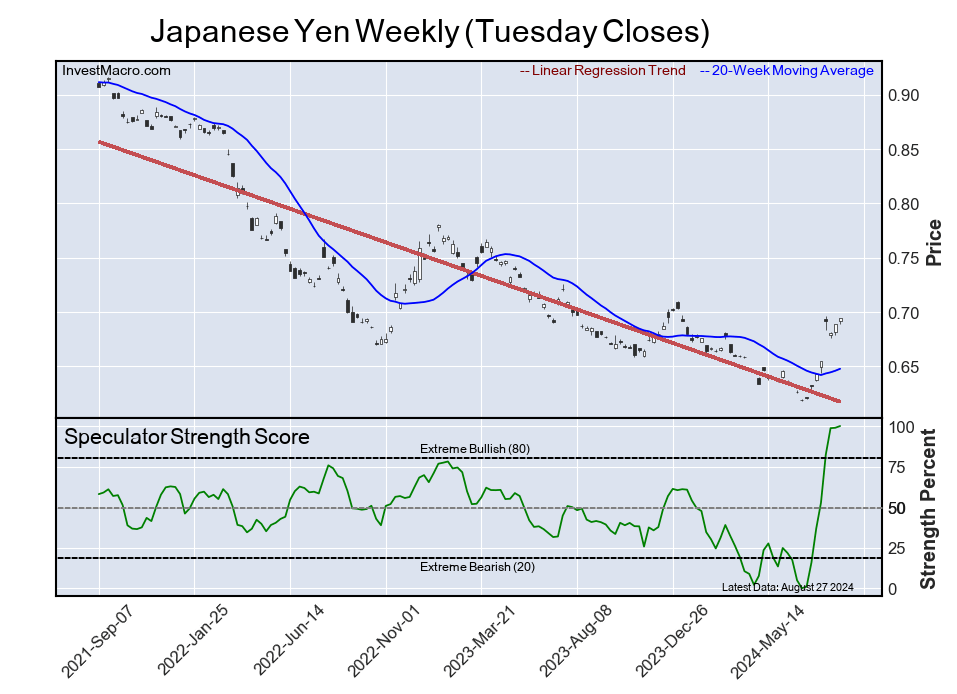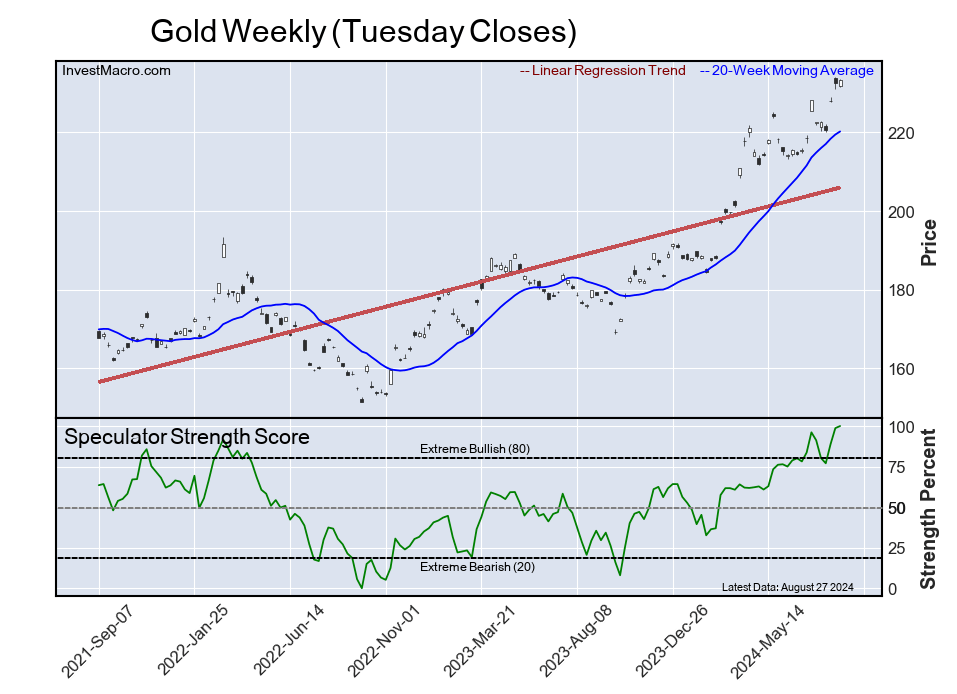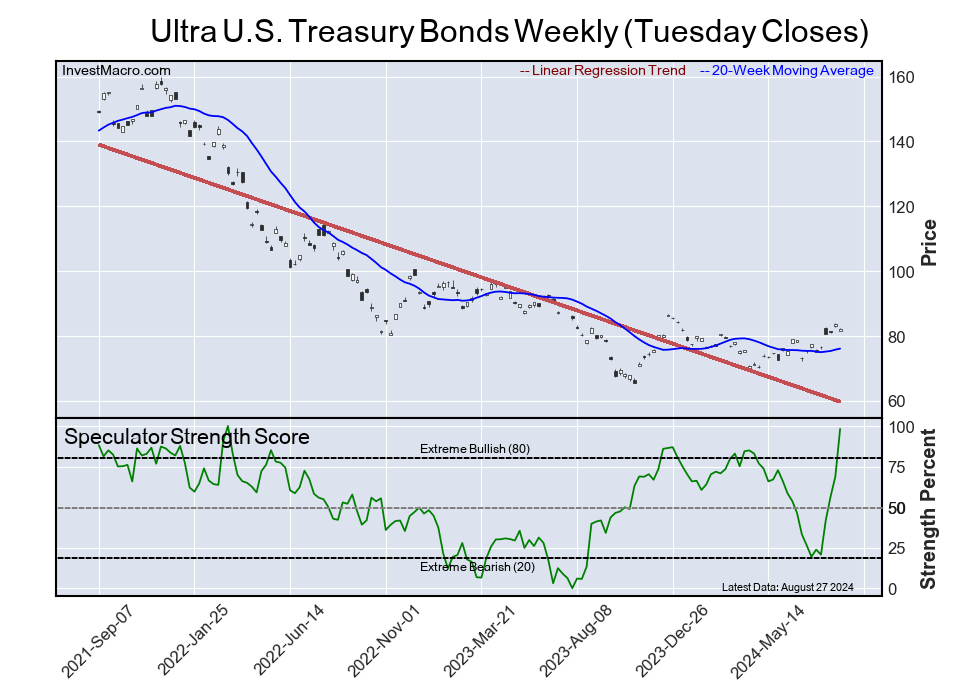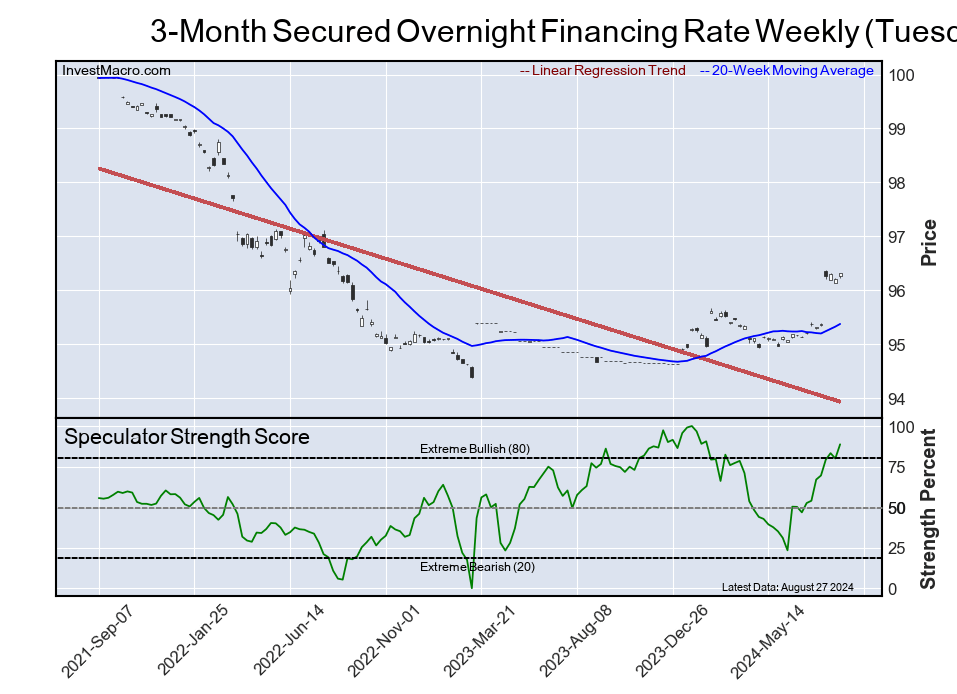
Archive for Opinions – Page 44

NFP Preview: September US rate cut in the bag?

By ForexTime 

  • Fed leaves rates unchanged but signals possible September cut
  • Incoming US jobs report likely to shape expectations
  • NAS100:  NFP sparked moves of ↑ 1.5% & ↓ 0.7% over past year
  • Gold: ↑ 2% this week, ready to retest records?
  • USDInd: Trapped in range, key levels – 103.65 & 104.70

With the Fed rate decision out the way, our focus shifts to Friday’s key US jobs report.

US rates were left unchanged yesterday, but Fed Chair Powell signalled that a cut could happen in September – depending on economic data.

This puts extra focus on the incoming NFP report which may shape bets around how many times the Fed cuts interest rates this year.

Markets expect the US economy to have created 175k jobs in July, compared to the 206k in the previous month while the unemployment rate is expected to remain unchanged at 4.1%.

Ultimately, further evidence of cooling labour markets may solidify expectations around the Fed making a move next month.

Traders have priced in a 25-basis point Fed cut by September with a 90% probability of another cut by November and 87% of a third cut by December!

With all the above said, here are 3 assets that could be rocked by jobs report:

    1) NAS100 braced for triple-risk events

FXTM’s NAS100 could see heightened volatility on Friday due to not only the NFP report but also corporate earnings from Amazon and Apple.

The index staged a sharp rebound mid-week with prices challenging the 19500-resistance level.

  • A solid set of earnings coupled with a soft jobs report could push the index higher.
  • Should tech earnings disappoint or the jobs data print above forecasts, the NAS100 could fall.

Talking technicals..

  • A breakout above 19500 could signal a move toward 20100.
  • Should 19500 prove to be reliable resistance, prices could slip toward the 100-day SMA at 18800.

Golden nugget: Over the past year, the US jobs report has triggered upside moves of as much as 1.5% or declines of 0.6% in a 6-hour window post-release.

NAS100


    2) Gold to retest record highs?

Gold is up roughly 2% this week despite kicking off Thursday’s session on a shaky note.

The precious metal remains supported by geopolitical risk and expectations around lower US interest rates. Given it’s zero yielding nature and sensitivity to US rate speculation, gold could see heightened volatility on Friday.

A soft jobs report is positive for the precious metal while a strong report could drag prices lower.

Focusing on the technical picture..

  • Prices could rise toward the $2438.80 all-time high and beyond if $2425 proves reliable support.
  • A breakdown below this level may open a path back toward the 50-day SMA at $2360 and 100-day SMA.

Golden nugget: Over the past year, the US jobs report has triggered upside moves of as much as 1.0% or declines of 0.8% in a 6-hour window post-release.

Gold


    3) USDInd waits on directional spark

It remains a choppy affair for the USDInd which is trapped within a range on the daily charts.

Bulls and bears are likely to remain entangled in a fierce tug of war until the scales of power shift in one direction. This catalyst could be on the incoming NFP report on Friday.

Support can be found at 103.65 and resistance at 104.70.

  • A breakout above 104.70 may open doors towards the 50/100-day SMA at 105.20.
  • Weakness below 103.65 could see a selloff to 103.27.

USDInd


Forex-Time-LogoArticle by ForexTime

ForexTime Ltd (FXTM) is an award winning international online forex broker regulated by CySEC 185/12 www.forextime.com

‘Twisters’ movie: Two tornado scientists take us inside the real world of storm chasing

By Yvette Richardson, Penn State and Paul Markowski, Penn State


Scientists in a truck outfitted with instruments race toward a storm.
National Severe Storms Lab/NOAA

Storm-chasing for science can be exciting and stressful – we know, because we do it. It has also been essential for developing today’s understanding of how tornadoes form and how they behave.

In 1996, the movie “Twister” with Helen Hunt brought storm-chasing scientists into the public imagination and inspired a generation of atmospheric scientists.

With the new “Twisters” movie hitting theaters, we’ve been getting questions about storm-chasing – or storm intercepts, as we call them.

Here are some answers about what scientists who do this kind of fieldwork are really up to when they race off after storms.

A tornado near Duke, Oklahoma, with a wheat field blowing in the foreground.
Scientists with the National Severe Storms Lab ‘intercepted’ this tornado to
collect data using mobile radar and other instruments on May 24, 2024.
National Severe Storms Lab

What does a day of storm-chasing really look like?

The morning of a chase day starts with a good breakfast, because there might not be any chance to eat a good meal later in the day. The team looks at the weather conditions, the National Weather Service computer forecast models and outlooks from the National Oceanic and Atmospheric Administration’s Storm Prediction Center to determine the target.

Our goal is to figure out where tornadoes are most likely to occur that day. Temperature, moisture and winds, and how these change with height above the ground, all provide clues.

There is a “hurry up and wait” cadence to a storm chase day. We want to get into position quickly, but then we’re often waiting for storms to develop.

A radar image shows a storm cell with a hook at the back suggesting a tornado could form.

A ‘hook echo’ on radar, typically a curl at the back of a storm cell, is one sign that a tornado could form.
The hook reflects precipitation wrapping around the back side of the updraft.

National Severe Storms Lab

Storms often take time to develop before they’re capable of producing tornadoes. So we watch the storm carefully on radar and with our eyes, if possible, staying well ahead of it until it matures. Often, we’ll watch multiple storms and look for signs that one might be more likely to generate tornadoes.

Once the mission scientist declares a deployment, everyone scrambles to get into position.

We use a lot of different instruments to track and measure tornadoes, and there is an art to determining when to deploy them. Too early, and the tornado might not form where the instruments are. Too late, and we’ve missed it. Each instrument needs to be in a specific location relative to the tornado. Some need to be deployed well ahead of the storm and then stay stationary. Others are car-mounted and are driven back and forth within the storm.

A row of seven minivans, SUVS and jeeps with racks on top holding the sorts of instruments one might see in a weather station.

Vehicle-mounted equipment can act as mobile weather stations known as mesonets.
These were used in the VORTEX2 research project. Dozens of scientists, including the authors,
succeeded in recording the entire life cycle of a supercell tornado during VORTEX2 in 2009.

Yvette Richardson

If all goes well, team members will be concentrating on the data coming in. Some will be launching weather balloons at various distances from the tornado, while others will be placing “pods” containing weather instruments directly in the path of the tornado.

A whole network of observing stations will have been set up across the storm, with radars collecting data from multiple angles, photographers capturing the storm from multiple angles, and instrumented vehicles transecting key areas of the storm.

Not all of our work is focused on the tornado itself. We often target areas around the tornado or within other parts of the storm to understand how the rotation forms. Theories suggest that this rotation can be generated by temperature variations within the storm’s precipitation region, potentially many miles from where the tornado forms.

An illustration shows a thunderstorm cloud with an updraft with a smaller downdraft behind it. Both are spinning. A spinning football indicates the type of spin.
Formation of a tornado: Changes in wind speed and direction with altitude, known as wind shear, are associated with horizontal spin, similar to that of a football. As this spinning air is drawn into the storm’s updraft, the updraft rotates. A separate air stream descends through a precipitation-driven downdraft and acquires horizontal spin because of temperature differences along the air stream. This spinning air can be tilted into the vertical and sucked upward by the supercell’s updraft, contracting the spin near the ground into a tornado.
Paul Markowski/Penn State

Through all of this, the teams stay in contact using text messages and software that allows us to see everyone’s position relative to the latest radar images. We’re also watching the forecast for the next day so we can plan where to go next and find hotel rooms and, hopefully, a late dinner.

What do all those instruments tell you about the storm?

One of the most important tools of storm-chasing is weather radar. It captures what’s happening with precipitation and winds above the ground.

We use several types of radars, typically attached to trucks so we can move fast. Some transmit with a longer wavelength that helps us see farther into a storm, but at the cost of a broader width to their beam, resulting in a fuzzier picture. They are good for collecting data across the entire storm.

Smaller-wavelength radars cannot penetrate as far into the precipitation, but they do offer the high-resolution view necessary to capture small-scale phenomena like tornadoes. We put these radars closer to the developing tornado.

An inside look at some of the mobile systems and tools scientists use in storm-chasing, including how team members monitor storms in real time.

We also monitor wind, air pressure, temperature and humidity along the ground using various instruments attached to moving vehicles, or by temporarily deploying stationary arrays of these instruments ahead of the approaching storm. Some of these are meant to be hit by the tornado.

Weather balloons provide crucial data, too. Some are designed to ascend through the atmosphere and capture the conditions outside the storm. Others travel through the storm itself, measuring the important temperature variations in the rain-cooled air beneath the storm. Scientists are now using drones in the same way in parts of the storm.

Symbols show the paths of over 70 balloon-borne probes that the authors’ team launched into a supercell thunderstorm. The probes, carried by the wind, mapped the temperature in the storm’s downdraft region, which can be a critical source of rotation for tornadoes. Luke LeBel/Penn State

All of this gives scientists insight into the processes happening throughout the storm before and during tornado development and throughout the tornado’s lifetime.

How do you stay safe while chasing tornadoes?

Storms can be very dangerous and unpredictable, so it’s important to always stay on top of the radar and watch the storm.

A storm can cycle, developing a new tornado downstream of the previous one. Tornadoes can change direction, particularly as they are dying or when they have a complex structure with multiple funnels. Storm chasers know to look at the entire storm, not just the tornado, and to be on alert for other storms that might sneak up. An escape plan based on the storm’s expected motion and the road network is essential.

In 1947, the Thunderstorm Project was the first large-scale U.S. scientific study of thunderstorms and the first to use radar and airplanes. Other iconic projects followed, including ones that deployed a Totable Tornado Observatory, or Toto, which inspired the ‘Dorothy’ instrument in the movie ‘Twister.’

Scientists take calculated risks when they’re storm chasing – enough to collect crucial data, but never putting their teams in too much danger.

It turns out that driving is actually the most dangerous part of storm-chasing, particularly when roads are wet and visibility is poor – as is often the case at the end of the day. During the chase, the driving danger can be compounded by erratic driving of other storm chasers and traffic jams around storms.

What happens to all the data you collect while storm-chasing?

It would be nice to have immediate eureka moments, but the results take time.

After we collect the data, we spend years analyzing it. Combining data from all the instruments to get a complete picture of the storm and how it evolved takes time and patience. But having data on the wind, temperature, relative humidity and pressure from many different angles and instruments allows us to test theories about how tornadoes develop.

Although the analysis process is slow, the discoveries are often as exciting as the tornado itself.The Conversation

About the Authors:

Yvette Richardson, Professor of Meteorology, Senior Associate Dean for Undergraduate Education, Penn State and Paul Markowski, Distinguished Professor of Meteorology, Penn State

This article is republished from The Conversation under a Creative Commons license. Read the original article.

Happy 50th birthday to the UPC barcode – no one expected you would revolutionize global commerce

By Jordan Frith, Clemson University 

The first modern barcode was scanned 50 years ago this summer – on a 10-pack of chewing gum in a grocery store in Troy, Ohio.

Fifty is ancient for most technologies, but barcodes are still going strong. More than 10 billion barcodes are scanned every day around the world. And newer types of barcode symbols, such as QR codes, have created even more uses for the technology.

I would have been like most people, never giving a second thought to the humble barcode, if my research as a media scholar at Clemson University hadn’t taken a few strange turns. Instead, I spent a year of my life digging through the archives and old newspaper articles to learn about the barcode’s origins – and eventually went on to write a book about the cultural history of the barcode.

While the barcode didn’t herald the end times, as conspiracy theorists once fretted, it did usher in a new age in global commerce.

Barcodes were a grocery-industry invention

While the world has changed a lot since the mid-1970s, the Universal Product Code (UPC) – what most people think of when they hear the word “barcode” – hasn’t. The code first scanned on a package of gum on June 26, 1974, is basically identical to the billions of barcodes scanned in stores all over the world today.

When that first UPC code was scanned, it was the culmination of years of planning by the U.S. grocery industry. In the late 1960s, labor costs were rising rapidly in grocery stores and inventory was becoming increasingly difficult to track. Grocery executives hoped the barcode could help them solve both of those problems, and they ended up being right.

In the early 1970s, the industry created a committee that developed the UPC data standard and chose the IBM barcode symbol over a half-dozen alternative designs. Both the data standard and the IBM barcode symbol are still used today.

Based on meeting notes I found in Stony Brook University’s Goldberg Archive, the people who developed the UPC system felt they were doing important work. However, they had no idea they were creating something that would long outlive most of them.

Even the grocery industry’s optimistic estimates predicted fewer than 10,000 companies would ever use barcodes. As a result, the scanning of the first UPC barcode received little attention at the time.

A few newspapers published short articles about the launch event, but it wasn’t exactly front-page news. Its importance was only apparent years later, as barcodes became one of the most successful digital data infrastructures ever.

Barcodes created a shelf-space revolution

Barcodes didn’t just change the shopping experience at checkout. By making products machine-readable, they enabled vast improvements to inventory tracking. That meant items that sold well could be restocked quickly when the data indicated, requiring less shelf space to be devoted to any individual product.

As barcode expert Stephen A. Brown has written, that reduced need for shelf space allowed for a rapid proliferation of new products. You can blame barcodes for the fact that your grocery store sells 15 types of almost indistinguishable toothpaste.

Similarly, today’s huge grocery stores and superstores likely couldn’t exist without the massive amount of inventory data that barcode systems produce. As MIT professor Sanjay Sharma put it, “If barcodes hadn’t been invented, the entire layout and architecture of commerce would have been different.”

Other industries quickly got on board

The modern barcode was born in the grocery industry, but it wasn’t confined to the grocery aisles for long. By the mid-1980s, the success of the UPC system encouraged other industries to adopt barcodes. For example, within a span of three years, Walmart, the Defense Department and the U.S. automotive industry all began using barcodes to track objects in supply chains.

Private shipping companies also adopted barcodes to capture identification data. FedEx and UPS even created their own barcode symbols.

As the sociologist Nigel Thrift explained, by the end of the 1990s, barcodes had become “a crucial element in the history of the new way of the world.” They helped enable rapid globalization in ways that would be difficult to imagine if barcodes didn’t exist.

Black and white and unnoticed all over

As someone who became so interested in this history that I got a tattoo of my latest book’s International Standard Book Number barcode on my arm, the quiet passing of the barcode’s 50th anniversary feels almost poetic.

I grew up in a world where barcodes were everywhere. They were on all the products I bought, the concert tickets I scanned, the packages I received.

Like most people, I rarely thought about them, despite — or maybe because of — their ubiquity. It wasn’t until I began research for my book that I realized how a barcode on a package of gum set in motion a chain of events that transformed the world.

The barcode of the author’s 2023 book, ‘Barcode,’ tattooed on his arm.
Stevie Edwards

For decades, barcodes have been a workhorse operating in the background of our lives. Modern humans scan them countless times every day, but we rarely think about them because they’re not flashy and just work — most of the time, anyway.

As barcodes keep chugging along in their old age, they’re a reminder that the seemingly boring technologies are often far more interesting and consequential than most people realize.The Conversation

About the Author:

Jordan Frith, Pearce Professor of Professional Communication, Clemson University

This article is republished from The Conversation under a Creative Commons license. Read the original article.

Week Ahead: Trillion Dollar Titans In Focus

By ForexTime 

  • 4 of the so-called “Magnificent 7” set to publish earnings
  • Combined market cap of 4 tech giants over $9 trillion
  • Beyond earnings, key focus remains on AI initiatives
  • Meta could move almost 10% ↑ or ↓ post-earnings
  • Apple biggest company in the world reports results Friday

An exceptional list of key risk events could present fresh trading opportunities in the week ahead.

Rate decisions my major central banks to the US monthly jobs report and corporate earnings from the most valuable companies in the world will be in focus:

Monday, 29th July

  • US30: McDonald’s earnings
  • NETH25: Heineken earnings
  • NAS100: Nvidia & Meta fireside chat

Tuesday, 30th July

  • EU50: Eurozone economic/consumer confidence, GDP
  • GER40: Germany CPI, GDP
  • JP225: Japan unemployment
  • USDInd: US consumer confidence
  • NAS100: Microsoft earnings

Wednesday, 31st July

  • AU200: Australia CPI, retail sales
  • CN50: China PMI’s
  • EU50: Eurozone CPI, Germany unemployment
  • JP225: BoJ rate decision, industrial production, retail sales
  • TWN: Taiwan GDP
  • US500: Meta Platform earnings, Fed rate decision

Thursday, 1st August  

  • CN50: China Caixin manufacturing PMI
  • EU50: Eurozone/Germany manufacturing PMI
  • UK100: BoE rate decision, manufacturing PMI
  • USDInd: initial jobless claims, ISM manufacturing
  • NAS100: Apple, Amazon earnings

Friday, 2nd August

  • US500: US June NFP report

Our attention falls on earnings from the trillion-dollar club after disappointing results from Alphabet and Tesla fanned fears over the A.I. frenzy being overblown.

As of writing, US equities are heading for a second week of declines after recording their worst day since 2020 on Wednesday.

Four of the so-called “Magnificent” 7 tech giants with a combined market cap of over $9 trillion are set to publish their results in the week ahead. This is what you need to know:

    1) Microsoft

Microsoft reports its fiscal fourth quarter earnings on Tuesday 30th after US markets close.

Despite shedding over 6% this month, its shares are still up roughly 10% year-to-date thanks to the A.I. frenzy. The bar has been set quite high with investors looking for solid results to support its whooping $3.1 trillion market valuation. Much focus will be on Microsoft’s Azure cloud platform business which fueled the tech giant’s earnings beat in previous quarters and any fresh updates on its AI initiatives.

Markets are forecasting a 4.9% move, either Up or Down, for Microsoft stocks post earnings.

Micro


    2) Meta Platforms

Meta is set to report second-quarter earnings after US market close on Wednesday 31st July.

Its shares are up almost 30% this year amid the excitement around AI translating to big profit in the tech arena. While the company is expected to report year-over-year revenue and earnings growth, it’s all about the strength of its advertising business. Any new insight on AI opportunities especially after the launch of Llama 3.1 could be welcomed by investors.

Markets are forecasting a 9% move, either Up or Down, for Meta stocks post earnings.

Meta


    3) Amazon

On Thursday 1st of August after US markets close, Amazon will publish its second quarter earnings.

Quarterly revenues are seen rising to $148.8 billion from $134.4 billion in the prior year, equating to a near 11% increase. Still, much focus will be on Amazons cloud computing and advertising business in addition to any updates on AI to gauge its business outlook.

Markets are forecasting a 7% move, either Up or Down, for Amazon stocks post earnings.

Amazon


    4) Apple

The most valuable company in the entire world with a market cap of $3.3 trillion reports its third quarter earnings on Thursday 1st after US markets close.

The titan is expected to report year-over-year revenue and earnings growth. However, attention will be on the performance of iPhone sales – especially due to the challenges in China. Beyond the earnings investors will be looking for any fresh updates on its new AI generative software or possible guidance for the upcoming quarter.

Still, Apple shares are up 13% this year with markets projecting a 4% move, either Up or Down, for Apple stocks post earnings.

Apple


Forex-Time-LogoArticle by ForexTime

ForexTime Ltd (FXTM) is an award winning international online forex broker regulated by CySEC 185/12 www.forextime.com

Broadcom (AVGO) and Micron (MU): Top Picks for Data Center Investment Surge

By The Ino.com Team

The expected record spending on infrastructure by cloud computing leaders such as Microsoft Corporation (MSFT) and Amazon.com, Inc. (AMZN) this year highlights the escalating investments in artificial intelligence (AI) data centers, a trend likely to benefit chipmakers significantly.

Bank of America (BofA) analysts forecast that cloud service provider capital expenditures will reach $121 billion in the second half of 2024, bringing the total to a record $227 billion in 2024. This figure marks a 39% increase compared to the previous year.

c, Microsoft, and Meta Platforms, Inc. (META) are predicted to more than double their spending compared to 2020 levels, while Oracle Corporation (ORCL) is expected to increase its capital expenditure nearly sixfold. The proportion of this spending allocated to data centers is already around 55% and is anticipated to rise further, reflecting the critical role of data centers in supporting advanced AI applications.

While NVIDIA Corporation (NVDA) stands out as the dominant player in the AI GPU market, BofA analysts have highlighted Broadcom Inc. (AVGO) and Micron Technology, Inc. (MU) as compelling alternatives for investors seeking to benefit from this trend.

In this article, we will delve into why Broadcom and Micron are well-positioned to capitalize on growing investments by cloud service providers in AI data centers, evaluate their financial health and recent performance, and explore the potential headwinds and tailwinds they may encounter in the near future.

Broadcom Inc. (AVGO)

Valued at a $732.45 billion market cap, Broadcom Inc. (AVGO) is a global tech leader that designs, develops, and supplies semiconductor and infrastructure software solutions. Broadcom’s extensive portfolio of semiconductor solutions, including networking chips, storage adapters, and advanced optical components, makes it a critical supplier for data centers.

Moreover, Broadcom’s leadership in networking solutions, exemplified by its Tomahawk and Trident series of Ethernet switches, positions it as a critical beneficiary of increased AI data center spending.

In May, AVGO revolutionized the data center ecosystem with its latest portfolio of highly scalable, high-performing, low-power 400G PCIe Gen 5.0 Ethernet adapters. The latest products provide an improved, open, standards-based Ethernet NIC and switching solution to address connectivity bottlenecks caused by the rapid growth in XPU bandwidth and cluster sizes in AI data centers.

Further, Broadcom’s strategic acquisitions, such as the recent purchase of VMware, Inc., enhance its data center and cloud computing capabilities. With this acquisition, AVGO will bring together its engineering-first, innovation-centric teams as it takes another significant step forward in building the world’s leading infrastructure technology company.

Broadcom’s solid second-quarter performance was primarily driven by AI demand and VMware. AVGO’s net revenue increased 43% year-over-year to $12.49 billion in the quarter that ended May 5, 2024. That exceeded the consensus revenue estimate of $12.01 billion. Revenue from its AI products hit a record of $3.10 billion for the quarter.

AVGO reported triple-digit revenue growth in the Infrastructure Software segment to $5.29 billion as enterprises increasingly adopted the VMware software stack to build their private clouds. Its gross margin rose 27.2% year-over-year to $7.78 billion. Its non-GAAP operating income grew 32% from the year-ago value to $7.15 billion. Its adjusted EBITDA was $7.43 billion, up 30.6% year-over-year.

Further, the company’s non-GAAP net income was $5.39 billion or $10.96 per share, up 20.2% and 6.2% from the prior year’s quarter, respectively. Cash from operations of $4.58 billion for the quarter, less capital expenditures of $132 million, resulted in free cash flow of $4.45 billion, or 36% of revenue.

When it posted solid earnings for its second quarter, Broadcom announced a ten-for-one stock split, which took effect on July 12, making stock ownership more affordable and accessible to investors.

Moreover, AVGO raised its fiscal year 2024 guidance. The tech company expects full-year revenue of nearly $51 billion. Broadcom anticipates $10 billion in revenue from chips related to AI this year. Its adjusted EBITDA is expected to be approximately 61% of projected revenue.

Analysts expect AVGO’s revenue for the third quarter (ending July 2024) to grow 45.9% year-over-year to $12.95 billion. The consensus EPS estimate of $1.20 for the ongoing quarter indicates a 14% year-over-year increase. Also, the company has surpassed the consensus revenue and EPS estimates in each of the trailing four quarters.

In addition, the company’s revenue and EPS for the fiscal year ending October 2024 are expected to increase 43.6% and 12.4% from the previous year to $51.44 billion and $4.75, respectively.

AVGO’s shares have gained more than 29% over the past six months and around 74% over the past year. Moreover, the stock is up nearly 40% year-to-date.

Micron Technology, Inc. (MU)

Another chipmaker that is well-poised to benefit from significant data center spending among enterprises is Micron Technology, Inc. (MU). With a $126.70 billion market cap, MU provides cutting-edge memory and storage products globally. The company operates through four segments: Compute and Networking Business Unit; Mobile Business Unit; Embedded Business Unit; and Storage Business Unit.

Micron’s role as a leading provider of DRAM and NAND flash memory positions it to capitalize on the surging demand for high-performance memory solutions. The need for advanced memory products grows as data centers expand to support AI and machine learning workloads. The company’s innovation in memory technologies, such as the HBM2E, aligns well with the performance requirements of modern data centers.

Also, recently, MU announced sampling its next-generation GDDR7 graphics memory with the industry’s highest bit density. The best-in-class capabilities of Micro GDDR7 will optimize AI, gaming, and high-performance computing workloads. Notably, Micron reached an industry milestone as the first to validate and ship 128GB DDR5 32Gb server DRAM to address the increasing demands for rigorous speed and capacity of memory-intensive Gen AI applications.

Further, MU’s strategic partnerships with leading tech companies like Nvidia and Intel Corporation (INTC) position the chipmaker at the forefront of technology advancements. In February, Micron started mass production of its HBM2E solution for use in Nvidia’s latest AI chip. Micron’s 24GB 8H HBM3E will be part of NVIDIA H200 Tensor Core GPUs, expected to begin shipping in the second quarter.

For the third quarter, which ended May 30, 2024, MU posted revenue of $6.81 billion, surpassing analysts’ expectations of $6.67 billion. That compared to $5.82 billion in the prior quarter and $3.75 billion for the same period last year. Moreover, AI demand drove 50% sequential data center revenue growth and record-high data center revenue mix.

MU’s non-GAAP gross margin was $1.92 billion, versus $1.16 million in the prior quarter and negative $603 million for the previous year’s quarter. Its non-GAAP operating income came in at $941 million, compared to $204 million in the prior quarter and negative $1.47 billion for the same period in 2023.

Additionally, the chip company reported non-GAAP net income and earnings per share of $702 million and $0.62 for the third quarter, compared to non-GAAP net loss and loss per share of $1.57 billion and $1.43 a year ago, respectively. Its EPS beat the consensus estimate of $0.53. Its adjusted free cash flow was $425 million during the quarter, compared to a negative $1.36 billion in the prior year’s quarter.

For the fourth quarter of fiscal 2024, Micron expects non-GAAP revenue of $7.60 million ± $200 million, and its gross margin is anticipated to be 34.5% ± 1%. Also, the company expects its non-GAAP earnings per share to be $1.08 ± 0.08.

Analysts expect AVGO’s revenue for the fourth quarter (ending August 2024) to increase 91.4% year-over-year to $7.68 billion. The company is expected to report an EPS of $1.14 for the current quarter, compared to a loss per share of $1.07 in the prior year’s quarter. Further, the company has surpassed the consensus revenue and EPS estimates in each of the trailing four quarters.

MU’s shares have surged over 30% over the past six months and approximately 75% over the past year.

Bottom Line

The substantial surge in capital expenditures by cloud computing giants like Microsoft, Amazon, and Alphabet highlights the importance of AI and data centers in the tech industry’s landscape. Broadcom and Micron emerge as two of the most promising chip stocks for investors seeking to benefit from this trend. Both companies offer solid financial health, significant market positions, and exposure to the expanding data center and AI markets.

While Broadcom’s diverse semiconductor solutions and Micron’s leadership in memory technology make them attractive investment opportunities, investors must remain mindful of potential headwinds, including market competition and geopolitical risks. By evaluating these factors and understanding the growth potential of these companies, investors can make informed decisions in the rapidly evolving technology sector.


By Ino.com – See our Trader Blog, INO TV Free & Market Analysis Alerts

Source: Broadcom (AVGO) and Micron (MU): Top Picks for Data Center Investment Surge

Spot Ethereum ETFs go live!

By ForexTime 

  • Ethereum ETF’s exceed $100 million inflows on debut
  • Collective trading volume of ETFs surpass $1 billion
  • Cryptocurrency ↑ 50% since start of 2024
  • Technical levels – 21 & 50 day SMA

Only a few months ago we discussed the possibility of Ethereum ETFs after Bitcoin paved the way.

Earlier this week, Ethereum ETFs finally went live – marking another watershed moment in the digital asset space. And its debut yesterday did not disappoint, bringing in over $100 million of inflows despite the massive $484 million outflows from Grayscale’s freshly converted Ethereum Trust.

Note: An ETF is a derivative that enables traders to benefit from changes in the underlying asset’s price without owning it.

Like we have seen with Bitcoin ETFs, this crucial development may lead to increased exposure to Ethereum – providing greater and easier access without owning it. In addition, the second crypto adoption could open the floodgates for more ETF adoptions, with fresh anticipation for a Solana ETF soon.

Despite the collective trading volume of the nine new spot ETFs surpassing over $1 billion, Ethereum offered a muted response. Prices are trading around 3466 as of writing, trapped within a range on the daily charts.

Still, Ethereum is up over 50% since the start of 2024 and may push higher if the new Ether ETFs attract fresh inflows from investors and institutions.

Since reaching all-time highs on March 12th, 2024, Ethereum seems to be morphing into a descending triangle.

After bouncing off the support of the descending triangle on July 8th, 2024, the cryptocurrency rallied for 8 consecutive days and has remained in a range for the past 9 days.

The last 6-days have seen Ethereum prices close above its 50-day moving average and the cryptocurrency bulls may look to the following near-term resistance levels.

  • $3547.34: The resistance of the current range-bound channel

  • $3686: An important price level

Ethereum bears on the other hand will have their sights on the following near-term support level.

  • $3408.04; The 50-day simple moving average

  • $3385.39; The support level of the current range-bound area

  • $3262.77; The 21-day simple moving average

Ether


Forex-Time-LogoArticle by ForexTime

ForexTime Ltd (FXTM) is an award winning international online forex broker regulated by CySEC 185/12 www.forextime.com

American Bank Stocks Surge on IB Comeback

Source: McAlinden Research (7/18/24)

 McAlinden Research Partners McAlinden Research takes a look at shares of U.S. banks, which it believes are surging in the wake of recent quarterly earnings.

The latest spate of bank earnings coincided with the SPDR S&P Bank ETF’s (KBE:NYSEARCA) best 5-day span of trading since November 2020, rising by 12% in the period to Wednesday. The market’s positive reaction to second-quarter results was largely based on an ongoing rebound in the investment banking divisions of America’s largest financial institutions and some light at the end of the tunnel for beaten-down regional banks that have languished under persistently high short-term rates at the Fed.

In our July 1 Intelligence Briefing, we noted that results from Jefferies Financial Group, which come in well before most other financial firms, demonstrated a powerful performance from its capital markets and IB businesses. That disclosure resulted in Jefferies’s stock price touching an all-time high. We noted that the bounce in revenues could foreshadow similar strength for its larger peers. This was to be expected as global M&A volumes were up about 8% in Q2 YoY, but JPMorgan, Citigroup, and Wells Fargo reported particularly strong annual increases in their IB revenue of 46%, 60%, and 38%, respectively.

In fact, the Financial Times reports that Q2 was Wall Street’s best quarter for investment banking in more than two years, and four of the five largest US banks (with Goldman Sachs being the exception) announced higher-than-expected investment banking revenues for the quarter.

That was a helpful boost, but U.S. banks will need to see a continued resurgence of M&A to keep an increasing level of fees rolling in. Goldman Sachs noted that M&A volumes were still about 20% below 10-year averages, largely as a result of persistently slow private equity dealmaking volume. Bloomberg notes that PE sponsors have constituted up to 30% of investment banking revenue in some recent years. A burgeoning recovery in the underwriting of new public listings would also help to juice the fortunes of financial shares in quarters to come.

MRP recently highlighted a slight uptick in IPO proceeds YoY in Q1, along with a similarly moderate bounce in the number of initial listings, noting that a critical pillar of any potential IPO market recovery will be an expansion of PE exits. In 2023, US exits fell to a tenth of the 140 recorded in 2021, and it has been a tough start to 2024 as well, as PitchBook data showed only two private equity-backed IPOs over $100 million had been completed by the end of April, raising about $1 billion.

A gradual decline in rates should assist in the bounce-back of M&A activity. Long-term rates in the U.S. have already eased significantly since the end of April, but banks will also need a steeper fall in short-term rates to see earnings improve more significantly. One of the headwinds banks highlighted in second-quarter results was the consistent elevation of funding costs for the capital they lend out. Banks borrow money at the short end of the yield curve and end at the long end and a more than 20-month-long inversion of the 10-year U.S. Treasury yield versus the 3-month yield (10yr-3mo) has continually diminished net interest margins (NIMs which measure interest earned on loans versus interest paid to depositors) across four of the past five quarters.

When short-term rates are high, depositors tend to demand greater compensation for providing banks with their deposits — typically the cheapest source of liquidity for banks. As such, banks end up having to raise rates paid on deposits to compete with money market funds, as well as each other, for flows. Relief on this front is increasingly likely as a continued softening of consumer price inflation and a gradual weakening of labor market tightness is boosting bets on a rate cut in September. In fact, CME’s FedWatch tool calculates that bets made by Fed Funds futures have increased the odds of more than one cut by the end of the year to roughly 95%.


Important Disclosures:

  1. Statements and opinions expressed are the opinions of the author and not of Streetwise Reports, Street Smart, or their officers. The author is wholly responsible for the accuracy of the statements. Streetwise Reports was not paid by the author to publish or syndicate this article. Streetwise Reports requires contributing authors to disclose any shareholdings in, or economic relationships with, companies that they write about. Any disclosures from the author can be found  below. Streetwise Reports relies upon the authors to accurately provide this information and Streetwise Reports has no means of verifying its accuracy.
  2. This article does not constitute investment advice and is not a solicitation for any investment. Streetwise Reports does not render general or specific investment advice and the information on Streetwise Reports should not be considered a recommendation to buy or sell any security. Each reader is encouraged to consult with his or her personal financial adviser and perform their own comprehensive investment research. By opening this page, each reader accepts and agrees to Streetwise Reports’ terms of use and full legal disclaimer. Streetwise Reports does not endorse or recommend the business, products, services or securities of any company.

For additional disclosures, please click here.

McAlinden Research Partners Disclosures
This report has been prepared solely for informational purposes and is not an offer to buy/sell/endorse or a solicitation of an offer to buy/sell/endorse Interests or any other security or instrument or to participate in any trading or investment strategy. No representation or warranty (express or implied) is made or can be given with respect to the sequence, accuracy, completeness, or timeliness of the information in this Report. Unless otherwise noted, all information is sourced from public data.
McAlinden Research Partners is a division of Catalpa Capital Advisors, LLC (CCA), a Registered Investment Advisor. References to specific securities, asset classes and financial markets discussed herein are for illustrative purposes only and should not be interpreted as recommendations to purchase or sell such securities. CCA, MRP, employees and direct affiliates of the firm may or may not own any of the securities mentioned in the report at the time of publication.

Cutting marketing spending often backfires on businesses – new research could help investors distinguish shortsighted cuts from smart ones

By Andre Martin, University of Notre Dame  

Businesses are often tempted to cut their marketing budgets for the short-term savings it provides – but those cuts can cause problems in the long term. A new study my colleague Tarun Kushwaha and I published in The Journal of Marketing proposes a method for predicting whether these counterproductive cuts will take place up to a year in advance.

We gathered transcripts of nearly 25,000 earnings calls held by public companies from 2008 to 2019. We then analyzed how management teams discussed marketing and earnings. We found that the more earnings-oriented language was in a call — think words like “lucrative” or “revenues” — the more likely a management team was to cut their marketing budget for a boost in earnings.

Unlike business-as-usual budget shifts, the motive in these cases was to raise short-term earnings to gain personal profits – for example, to boost stock prices before an executive retires – to raise immediate funds, or to satisfy investor pressure and expectations. These cuts in exchange for a bump in earnings are shortsighted, since investing in marketing tends to grow a company’s market share over time.

Why it matters

Executives often feel pressured to meet short-term earnings targets at the expense of long-term goals, survey data and research have shown. Cutting costs is one way businesses make themselves look better in the short term. And since investing in marketing takes time to pay off, marketing spending often winds up on the chopping block.

My fellow marketing professors call these “myopic” marketing spending decisions – “myopic” being a fancy word for shortsighted. They often happen before initial public offerings, share repurchases and executive retirements.

While these myopic decisions have short-term benefits, they harm investors, customers and other stakeholders in the long term. After companies myopically cut marketing spending, they often lose market value; that’s why such cuts are linked with worse stock-market performance in the long run. A tool that helps investors identify myopic marketing spending would help them protect their portfolios from negative long-term consequences.

Our method isn’t just backward-looking – it can be used to forecast future shortsighted cuts to marketing spending. Investors could use it to analyze publicly available earnings-calls transcripts for useful data up to four times a year. We estimate that for every US$100 invested, using our method to avoid investing in shortsighted companies could return an additional $6.44 over four years compared with conventional methods. Marketing firms and advertising agencies could also use it to identify companies that plan to pare their marketing budgets.

What’s next

As part of our research efforts, my team has published the algorithm and data necessary to replicate our findings. This will let individual investors and other stakeholders gain valuable insights into executives’ intentions regarding the funding of their marketing and research departments.

While our research has primarily focused on transcribed text from earnings calls, we see more potential in analyzing the audio and video from these calls. Audio analysis could reveal insights from tone, pitch, pauses and filler words, while video analysis could capture the brief involuntary facial expressions known as micro-expressions.

The Research Brief is a short take on interesting academic work.The Conversation

About the Author:

Andre Martin, Assistant Professor of Marketing, University of Notre Dame

This article is republished from The Conversation under a Creative Commons license. Read the original article.

Currency Speculators push British Pound bets to Record High

By InvestMacro

Here are the latest charts and statistics for the Commitment of Traders (COT) data published by the Commodities Futures Trading Commission (CFTC).

The latest COT data is updated through Tuesday July 16th and shows a quick view of how large market participants (for-profit speculators and commercial traders) were positioned in the futures markets. All currency positions are in direct relation to the US dollar where, for example, a bet for the euro is a bet that the euro will rise versus the dollar while a bet against the euro will be a bet that the euro will decline versus the dollar.

Weekly Speculator Bets led by British Pound & Japanese Yen

The COT currency market speculator bets were lower this week as five out of the eleven currency markets we cover had higher positioning while the other six markets had lower speculator contracts.

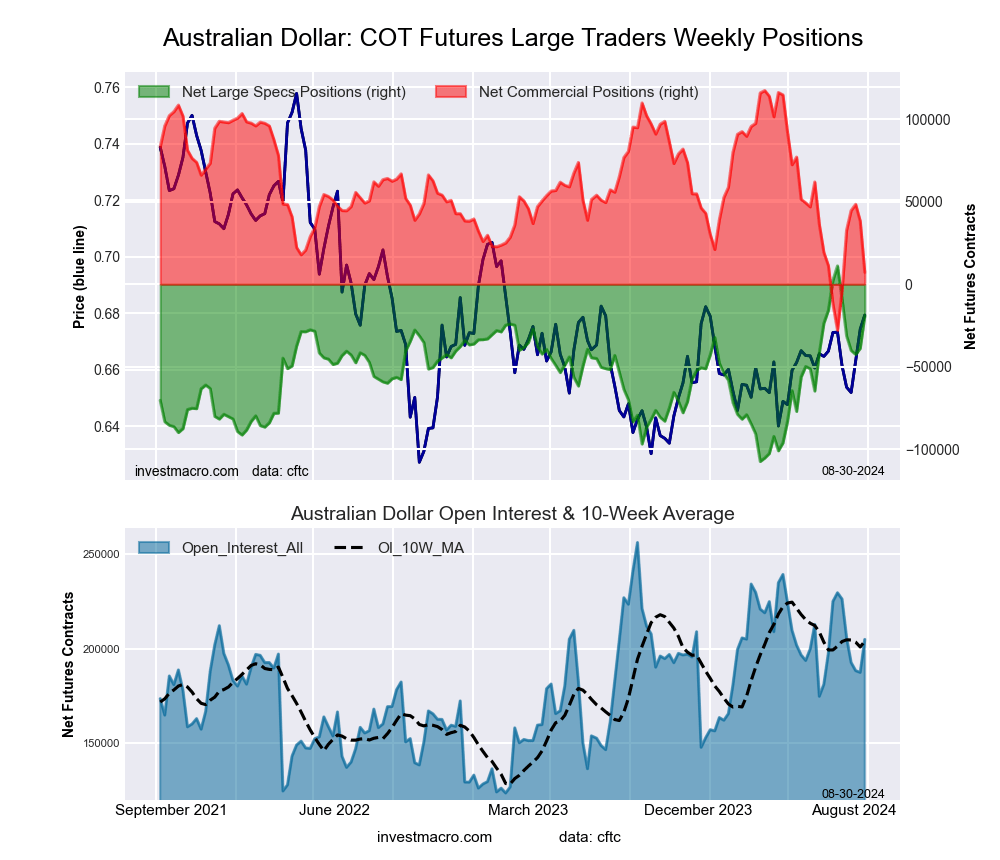
Leading the gains for the currency markets was the British Pound (48,212 contracts) with the Japanese Yen (30,961 contracts), the EuroFX (21,126 contracts), the Australian Dollar (8,700 contracts) and the US Dollar Index (2,342 contracts) also recording positive weeks.

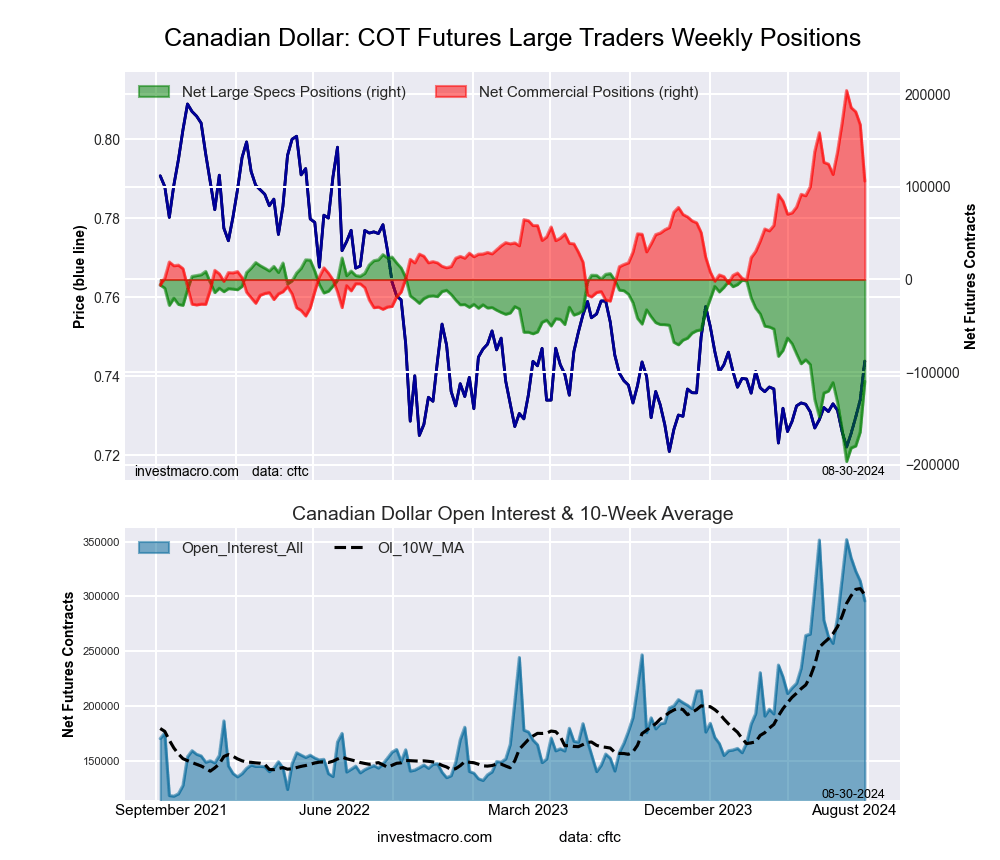
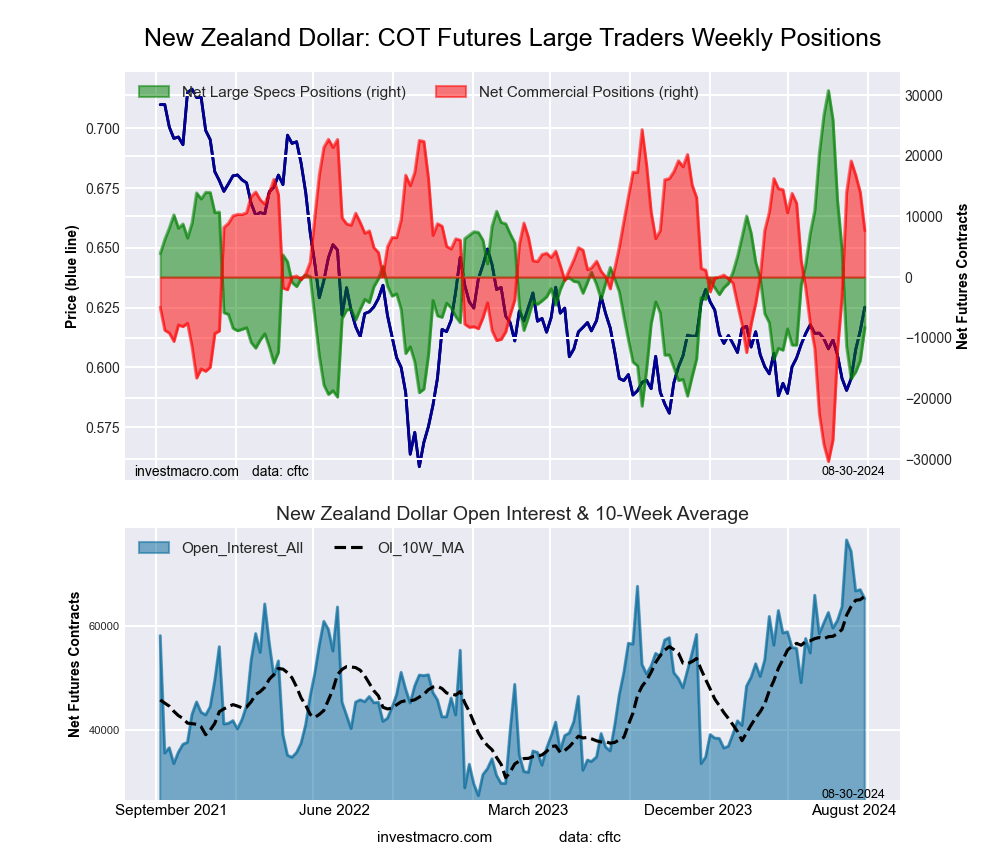
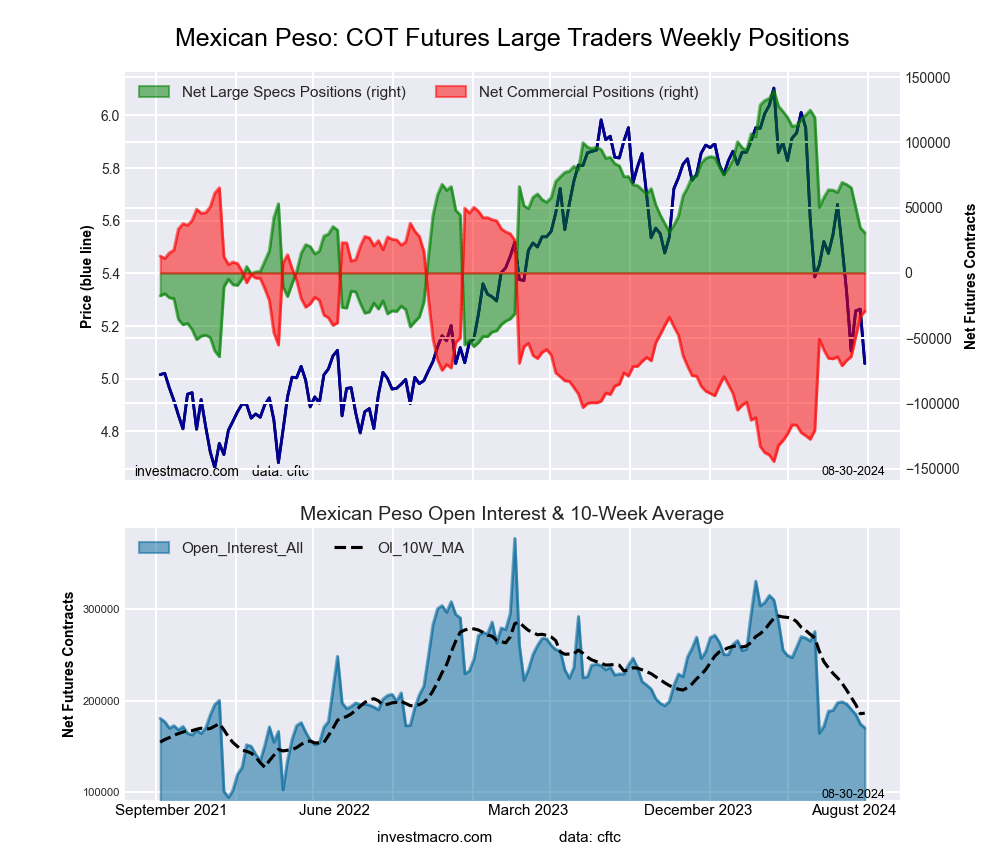
The currencies seeing declines in speculator bets on the week were the Canadian Dollar (-21,261 contracts), the New Zealand Dollar (-13,351 contracts), the Swiss Franc (-3,705 contracts), the Mexican Peso (-1,613 contracts), the Brazilian Real (-1,842 contracts) and with Bitcoin (-461 contracts) also registering lower bets on the week.

Currency Speculators push British Pound bets to Record High

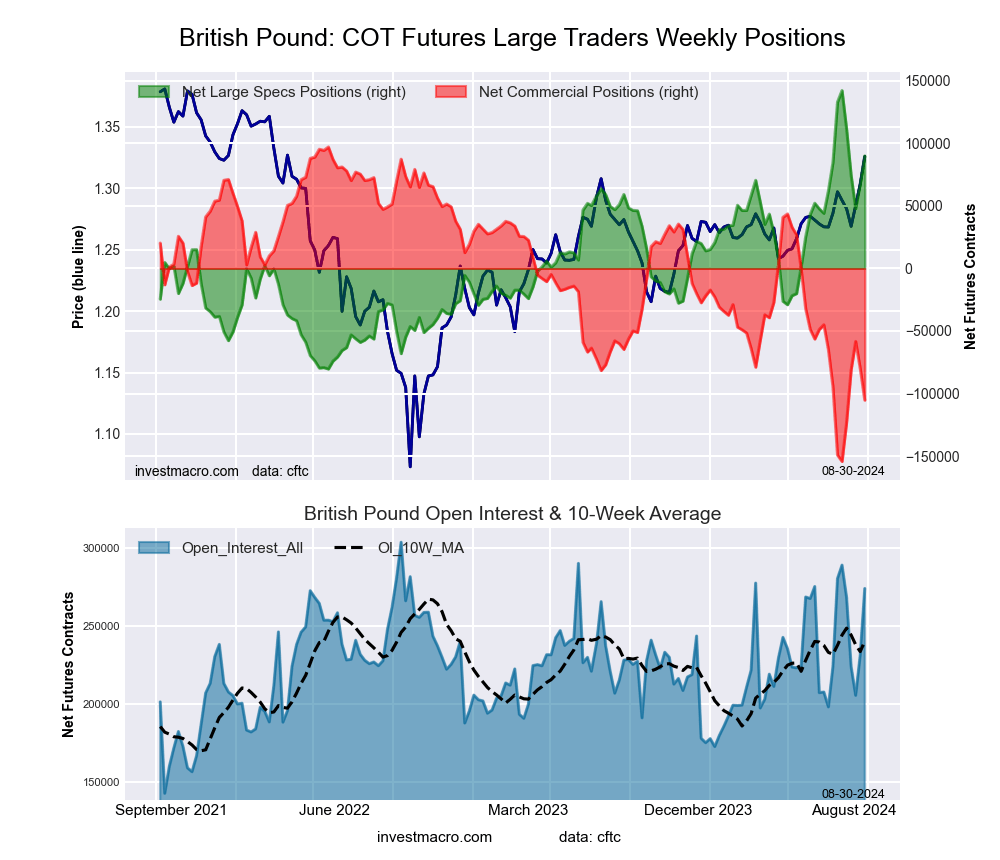
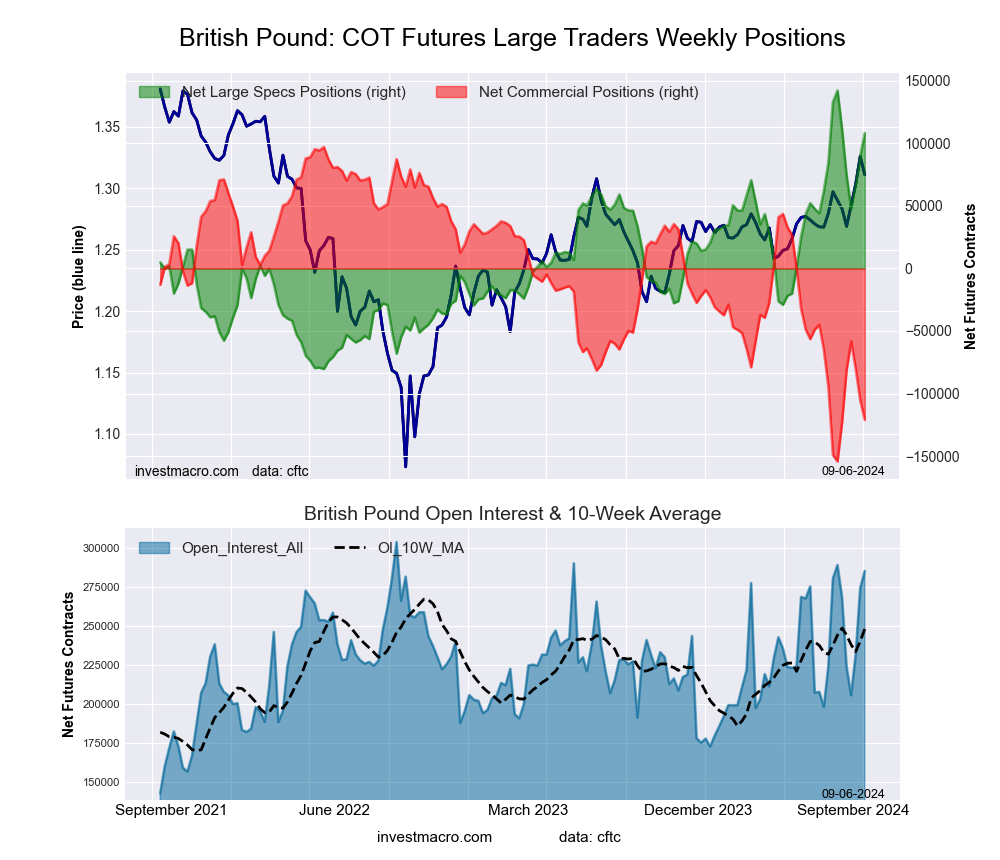
Highlighting the COT currency’s data is the new record high bullish sentiment in the speculator’s positioning of the British Pound Sterling.

Large speculative Sterling positions jumped this week by +48,212 contracts following last week’s rise by +22,649 contracts and the previous week’s (two weeks ago) gain by +17,993 contracts. This week’s rise by over +48,000 contracts is the largest one-week increase on record and pushed the overall net speculator standing to +132,902 contracts – a new all-time record bullish position. This new high level surpasses the previous record high of +98,366 contracts that was recorded on July 17th of 2007.

The GBP position has now gained by +152,977 contracts in just the past nine weeks, going from a bearish level of -20,075 contracts on May 14th to a new record high level this week to complete an incredible sentiment turnaround in a short period of time.

The Pound Sterling exchange rate (GBPUSD currency pair) against the US Dollar has been on the move higher and touched above the 1.3000 level this week for the first time in almost exactly a year. Helping the GBP strength is the outlook that the Bank of England will take longer to cut their interest rate due to sticky inflation while the US Federal Reserve is forecast-ed to start cutting rates this year and the Eurozone is possibly going to reduce their rate again in September.


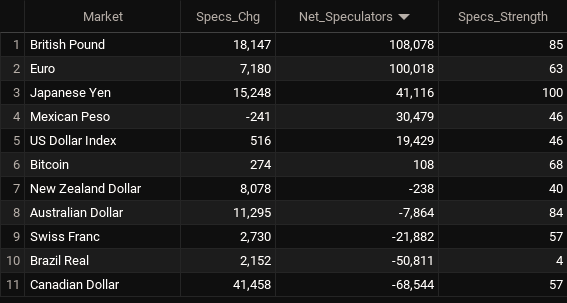
Currencies Net Speculators Leaderboard
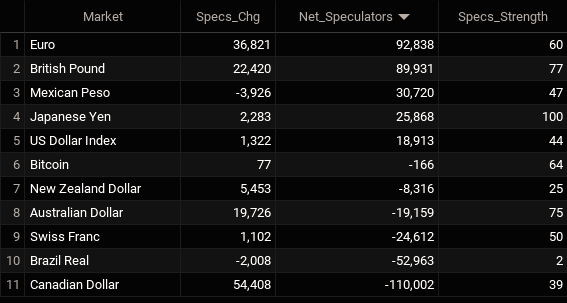
Legend: Weekly Speculators Change | Speculators Current Net Position | Speculators Strength Score compared to last 3-Years (0-100 range)


Strength Scores led by British Pound & Australian Dollar

COT Strength Scores (a normalized measure of Speculator positions over a 3-Year range, from 0 to 100 where above 80 is Extreme-Bullish and below 20 is Extreme-Bearish) showed that the British Pound (100 percent) and the Australian Dollar (100 percent) lead the currency markets this week. The New Zealand Dollar (65 percent), Mexican Peso (62 percent) and Bitcoin (58 percent) come in as the next highest in the weekly strength scores.

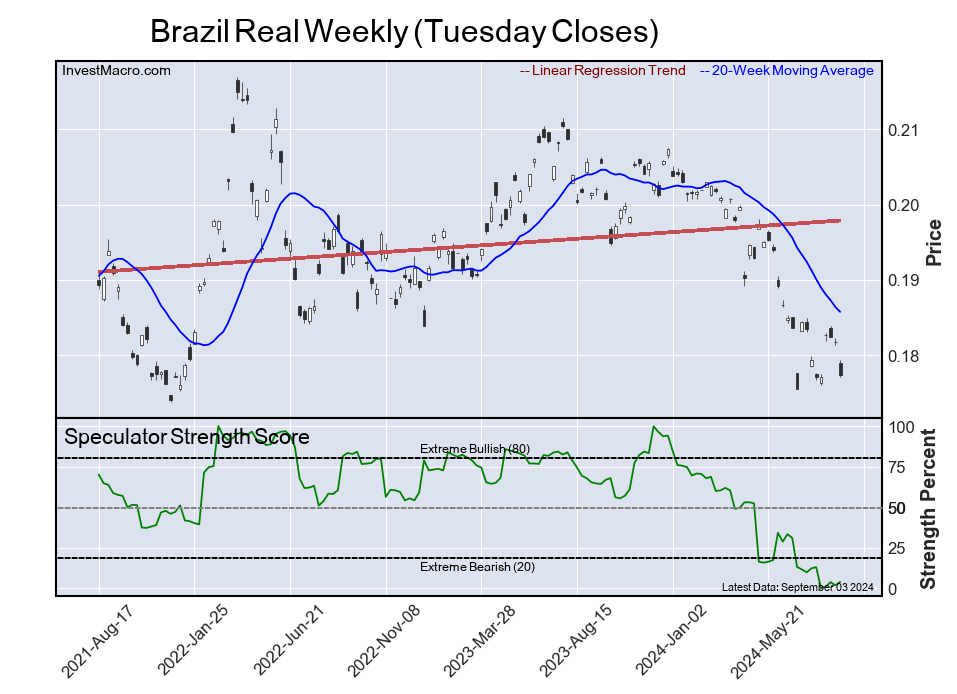
On the downside, the Brazilian Real (0 percent), the Swiss Franc (0 percent) and the Canadian Dollar (9 percent) come in at the lowest strength levels currently and are in Extreme-Bearish territory (below 20 percent).

Strength Statistics:
US Dollar Index (43.6 percent) vs US Dollar Index previous week (38.6 percent)
EuroFX (30.8 percent) vs EuroFX previous week (21.9 percent)
British Pound Sterling (100.0 percent) vs British Pound Sterling previous week (77.4 percent)
Japanese Yen (20.2 percent) vs Japanese Yen previous week (1.3 percent)
Swiss Franc (0.0 percent) vs Swiss Franc previous week (6.2 percent)
Canadian Dollar (8.8 percent) vs Canadian Dollar previous week (21.0 percent)
Australian Dollar (100.0 percent) vs Australian Dollar previous week (92.7 percent)
New Zealand Dollar (65.0 percent) vs New Zealand Dollar previous week (90.7 percent)
Mexican Peso (61.7 percent) vs Mexican Peso previous week (62.5 percent)
Brazilian Real (0.0 percent) vs Brazilian Real previous week (1.9 percent)
Bitcoin (57.7 percent) vs Bitcoin previous week (64.6 percent)


Australian Dollar & British Pound top the 6-Week Strength Trends

COT Strength Score Trends (or move index, calculates the 6-week changes in strength scores) showed that the Australian Dollar (53 percent) and the British Pound (42 percent) lead the past six weeks trends for the currencies. The US Dollar Index (29 percent), the New Zealand Dollar (10 percent) and Bitcoin (8 percent) are the next highest positive movers in the latest trends data.

The Mexican Peso (-31 percent) leads the downside trend scores currently with the Brazilian Real (-27 percent), Canadian Dollar (-23 percent) and the EuroFX (-18 percent) following next with lower trend scores.

Strength Trend Statistics:
US Dollar Index (29.1 percent) vs US Dollar Index previous week (25.7 percent)
EuroFX (-18.4 percent) vs EuroFX previous week (-23.0 percent)
British Pound Sterling (42.1 percent) vs British Pound Sterling previous week (27.8 percent)
Japanese Yen (-11.6 percent) vs Japanese Yen previous week (-15.8 percent)
Swiss Franc (-6.8 percent) vs Swiss Franc previous week (-2.9 percent)
Canadian Dollar (-23.4 percent) vs Canadian Dollar previous week (-14.1 percent)
Australian Dollar (52.6 percent) vs Australian Dollar previous week (44.1 percent)
New Zealand Dollar (10.3 percent) vs New Zealand Dollar previous week (45.9 percent)
Mexican Peso (-30.9 percent) vs Mexican Peso previous week (-28.3 percent)
Brazilian Real (-27.0 percent) vs Brazilian Real previous week (-6.4 percent)
Bitcoin (8.1 percent) vs Bitcoin previous week (9.6 percent)


Individual COT Forex Markets:

US Dollar Index Futures:
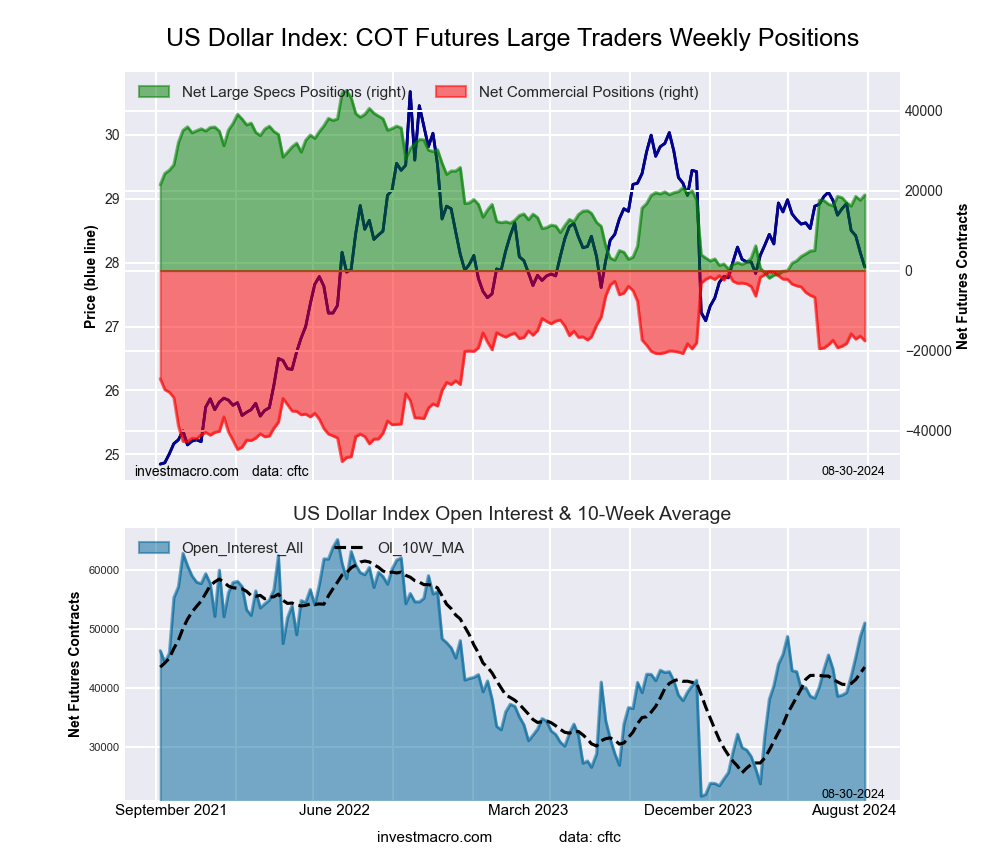
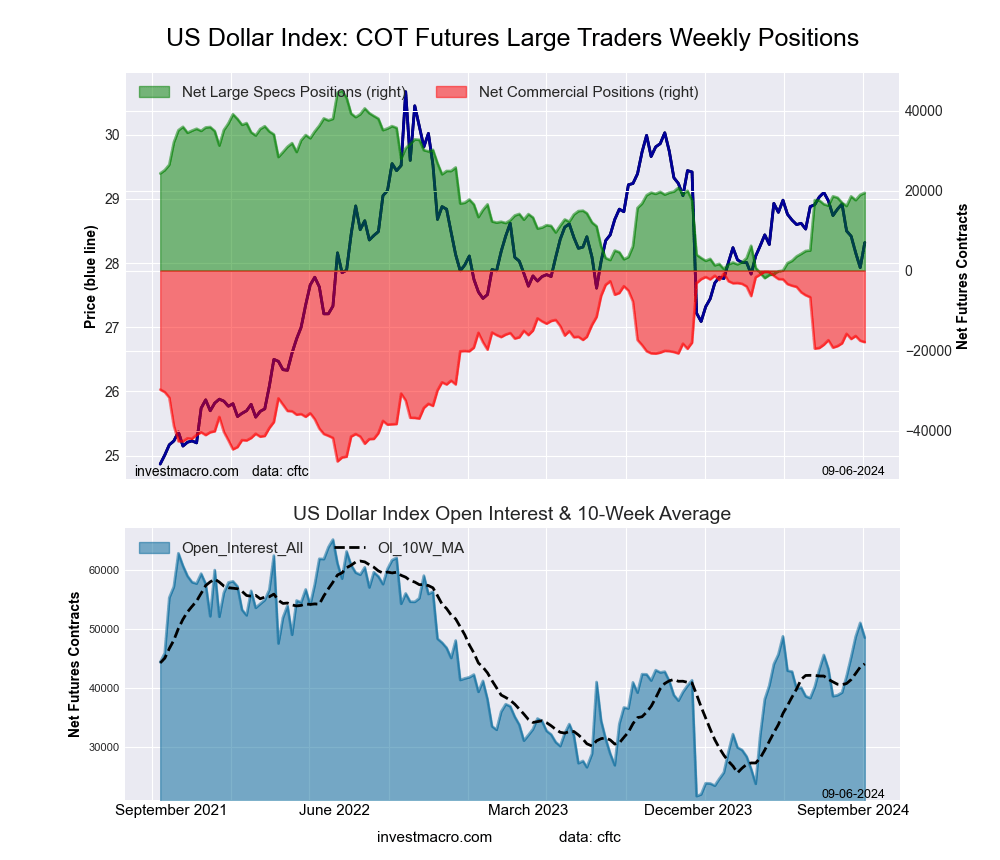
US Dollar Index Forex Futures COT ChartThe US Dollar Index large speculator standing this week was a net position of 18,550 contracts in the data reported through Tuesday. This was a weekly rise of 2,342 contracts from the previous week which had a total of 16,208 net contracts.

This week’s current strength score (the trader positioning range over the past three years, measured from 0 to 100) shows the speculators are currently Bearish with a score of 43.6 percent. The commercials are Bullish with a score of 60.0 percent and the small traders (not shown in chart) are Bearish-Extreme with a score of 19.6 percent.

Price Trend-Following Model: Uptrend

Our weekly trend-following model classifies the current market price position as: Uptrend. The current action for the model is considered to be: Hold – Maintain Long Position.

US DOLLAR INDEX StatisticsSPECULATORSCOMMERCIALSSMALL TRADERS
– Percent of Open Interest Longs:78.59.68.1
– Percent of Open Interest Shorts:30.559.46.2
– Net Position:18,550-19,278728
– Gross Longs:30,3273,6953,141
– Gross Shorts:11,77722,9732,413
– Long to Short Ratio:2.6 to 10.2 to 11.3 to 1
NET POSITION TREND:
– Strength Index Score (3 Year Range Pct):43.660.019.6
– Strength Index Reading (3 Year Range):BearishBullishBearish-Extreme
NET POSITION MOVEMENT INDEX:
– 6-Week Change in Strength Index:29.1-27.6-6.6


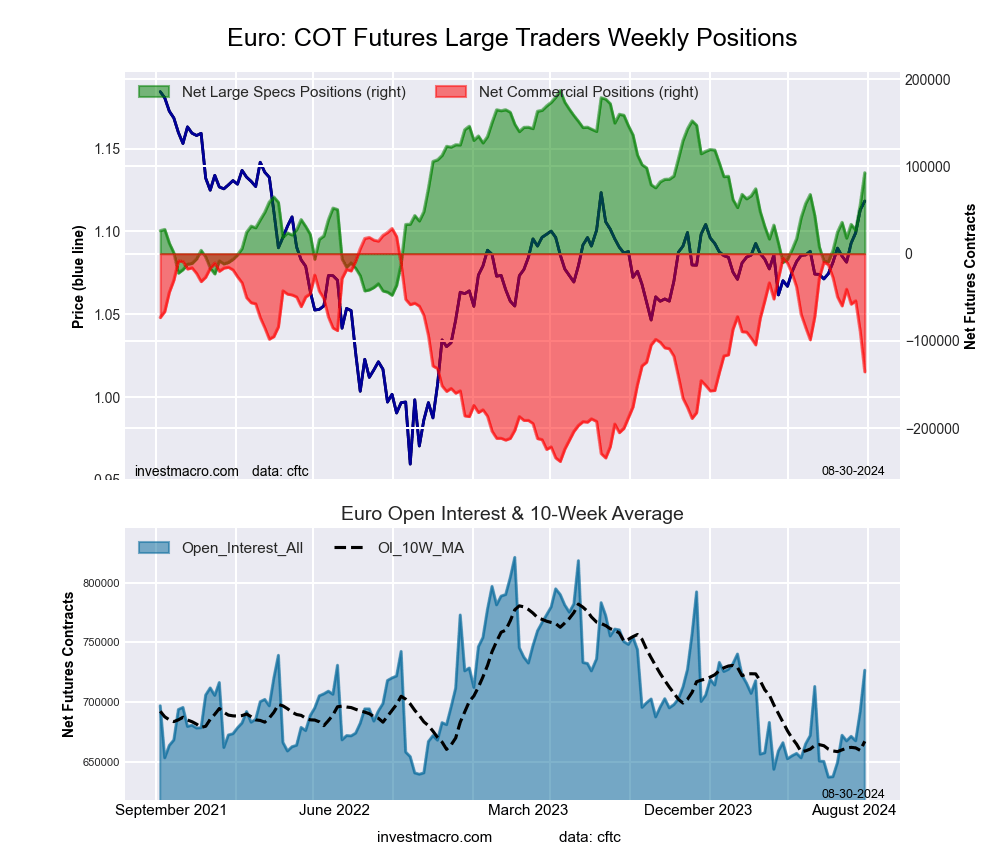
Euro Currency Futures:

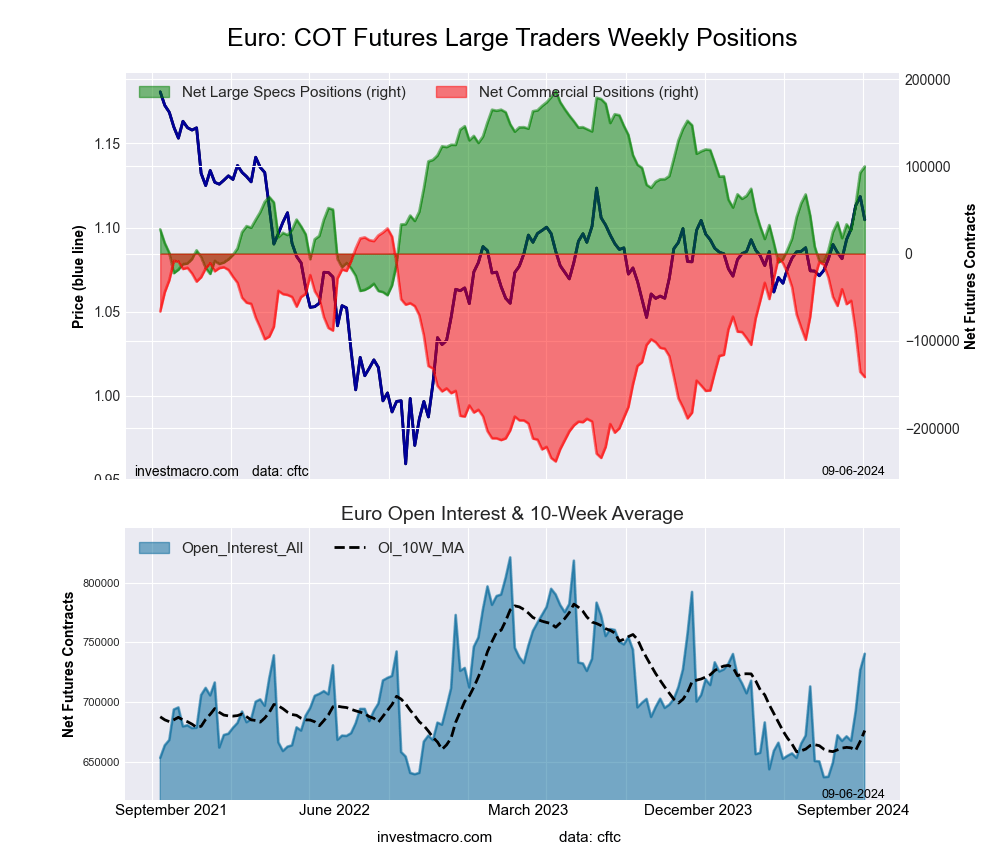
Euro Currency Futures COT ChartThe Euro Currency large speculator standing this week was a net position of 24,749 contracts in the data reported through Tuesday. This was a weekly lift of 21,126 contracts from the previous week which had a total of 3,623 net contracts.

This week’s current strength score (the trader positioning range over the past three years, measured from 0 to 100) shows the speculators are currently Bearish with a score of 30.8 percent. The commercials are Bullish with a score of 70.7 percent and the small traders (not shown in chart) are Bearish with a score of 26.5 percent.

Price Trend-Following Model: Weak Downtrend

Our weekly trend-following model classifies the current market price position as: Weak Downtrend. The current action for the model is considered to be: Hold – Maintain Short Position.

EURO Currency StatisticsSPECULATORSCOMMERCIALSSMALL TRADERS
– Percent of Open Interest Longs:27.757.811.4
– Percent of Open Interest Shorts:23.965.47.6
– Net Position:24,749-49,54924,800
– Gross Longs:179,937375,21774,281
– Gross Shorts:155,188424,76649,481
– Long to Short Ratio:1.2 to 10.9 to 11.5 to 1
NET POSITION TREND:
– Strength Index Score (3 Year Range Pct):30.870.726.5
– Strength Index Reading (3 Year Range):BearishBullishBearish
NET POSITION MOVEMENT INDEX:
– 6-Week Change in Strength Index:-18.418.4-13.9


British Pound Sterling Futures:

British Pound Sterling Futures COT ChartThe British Pound Sterling large speculator standing this week was a net position of 132,902 contracts in the data reported through Tuesday. This was a weekly rise of 48,212 contracts from the previous week which had a total of 84,690 net contracts.

This week’s current strength score (the trader positioning range over the past three years, measured from 0 to 100) shows the speculators are currently Bullish-Extreme with a score of 100.0 percent. The commercials are Bearish-Extreme with a score of 0.0 percent and the small traders (not shown in chart) are Bullish-Extreme with a score of 96.3 percent.

Price Trend-Following Model: Strong Uptrend

Our weekly trend-following model classifies the current market price position as: Strong Uptrend. The current action for the model is considered to be: Hold – Maintain Long Position.

BRITISH POUND StatisticsSPECULATORSCOMMERCIALSSMALL TRADERS
– Percent of Open Interest Longs:65.318.114.3
– Percent of Open Interest Shorts:18.071.28.5
– Net Position:132,902-149,11816,216
– Gross Longs:183,28750,80340,067
– Gross Shorts:50,385199,92123,851
– Long to Short Ratio:3.6 to 10.3 to 11.7 to 1
NET POSITION TREND:
– Strength Index Score (3 Year Range Pct):100.00.096.3
– Strength Index Reading (3 Year Range):Bullish-ExtremeBearish-ExtremeBullish-Extreme
NET POSITION MOVEMENT INDEX:
– 6-Week Change in Strength Index:42.1-40.822.4


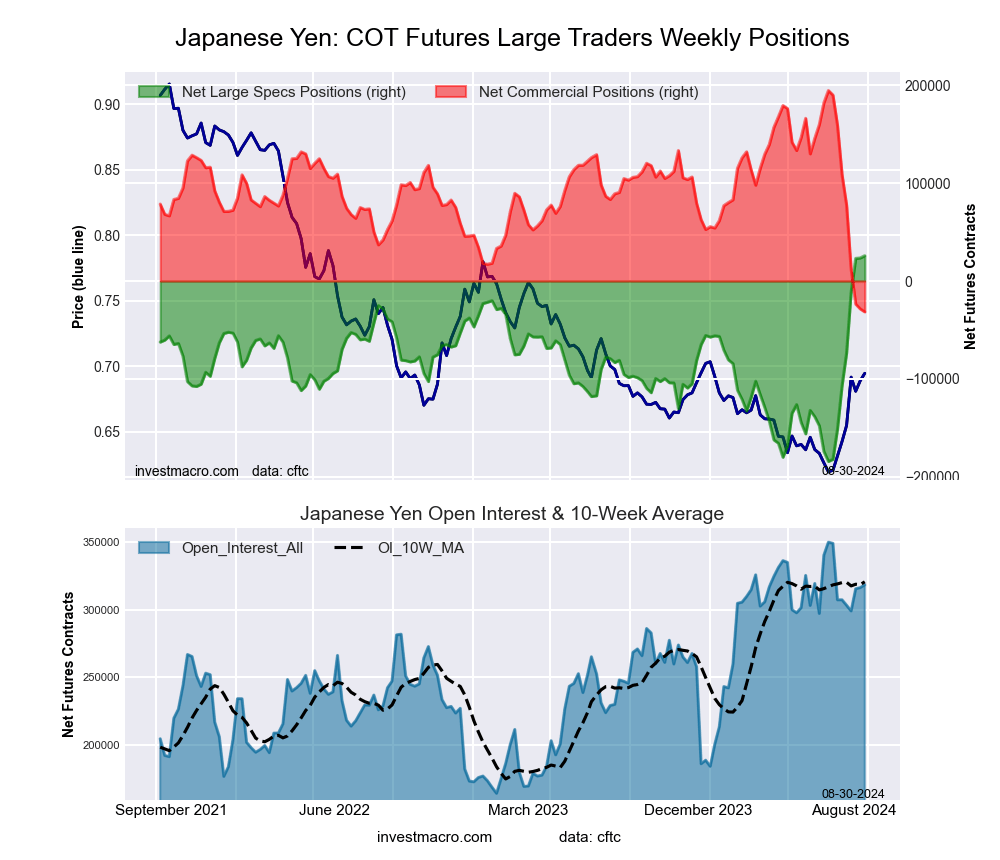
Japanese Yen Futures:

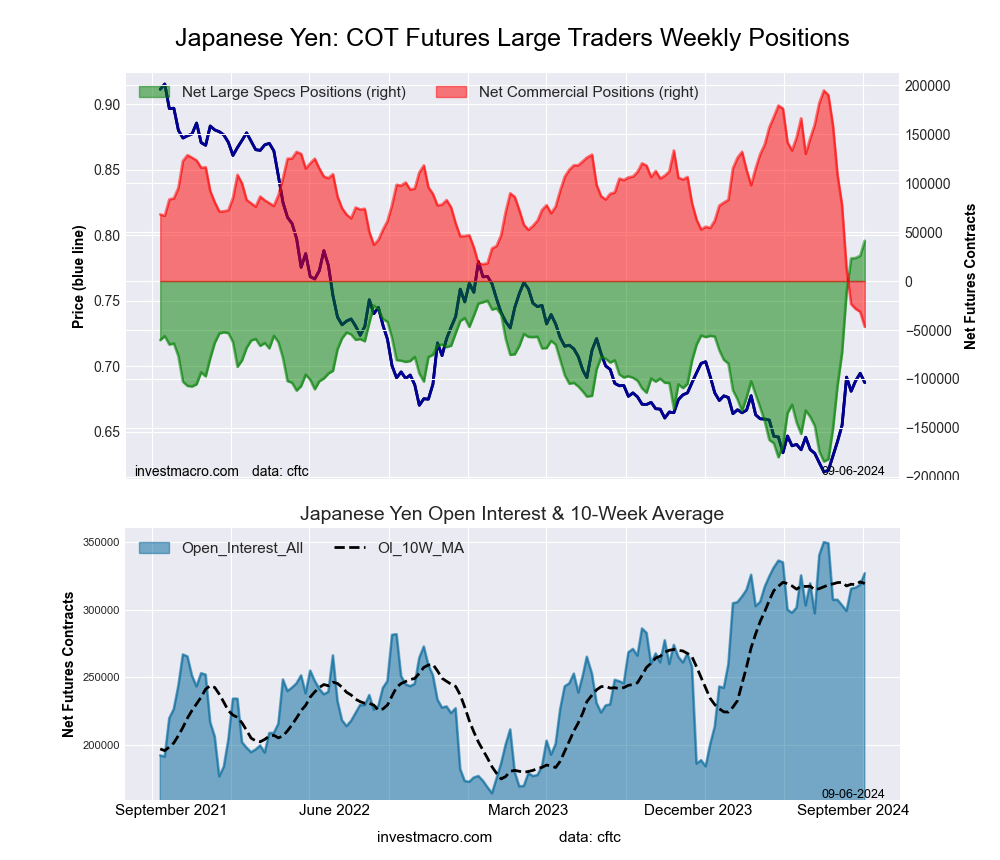
Japanese Yen Forex Futures COT ChartThe Japanese Yen large speculator standing this week was a net position of -151,072 contracts in the data reported through Tuesday. This was a weekly gain of 30,961 contracts from the previous week which had a total of -182,033 net contracts.

This week’s current strength score (the trader positioning range over the past three years, measured from 0 to 100) shows the speculators are currently Bearish with a score of 20.2 percent. The commercials are Bullish-Extreme with a score of 80.0 percent and the small traders (not shown in chart) are Bullish with a score of 57.4 percent.

Price Trend-Following Model: Downtrend

Our weekly trend-following model classifies the current market price position as: Downtrend. The current action for the model is considered to be: Hold – Maintain Short Position.

JAPANESE YEN StatisticsSPECULATORSCOMMERCIALSSMALL TRADERS
– Percent of Open Interest Longs:15.470.312.2
– Percent of Open Interest Shorts:64.618.514.9
– Net Position:-151,072159,089-8,017
– Gross Longs:47,356216,04237,613
– Gross Shorts:198,42856,95345,630
– Long to Short Ratio:0.2 to 13.8 to 10.8 to 1
NET POSITION TREND:
– Strength Index Score (3 Year Range Pct):20.280.057.4
– Strength Index Reading (3 Year Range):BearishBullish-ExtremeBullish
NET POSITION MOVEMENT INDEX:
– 6-Week Change in Strength Index:-11.616.5-32.1


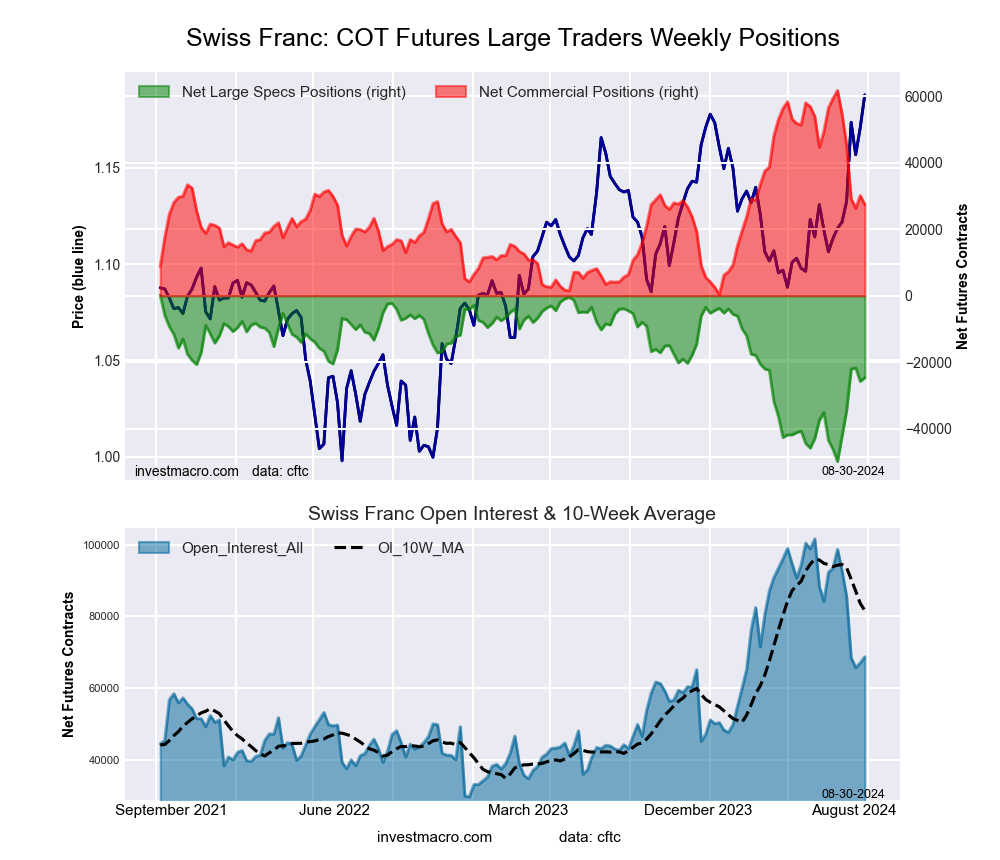
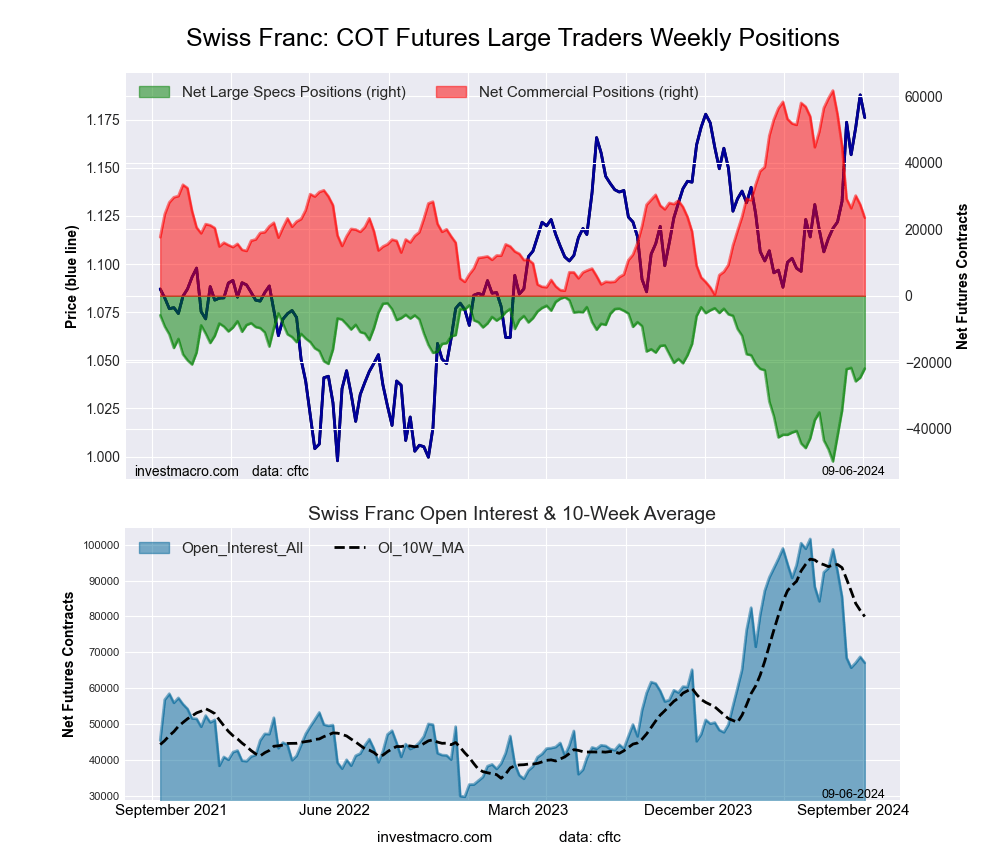
Swiss Franc Futures:

Swiss Franc Forex Futures COT ChartThe Swiss Franc large speculator standing this week was a net position of -49,793 contracts in the data reported through Tuesday. This was a weekly reduction of -3,705 contracts from the previous week which had a total of -46,088 net contracts.

This week’s current strength score (the trader positioning range over the past three years, measured from 0 to 100) shows the speculators are currently Bearish-Extreme with a score of 0.0 percent. The commercials are Bullish-Extreme with a score of 100.0 percent and the small traders (not shown in chart) are Bearish with a score of 23.2 percent.

Price Trend-Following Model: Weak Downtrend

Our weekly trend-following model classifies the current market price position as: Weak Downtrend. The current action for the model is considered to be: Hold – Maintain Short Position.

SWISS FRANC StatisticsSPECULATORSCOMMERCIALSSMALL TRADERS
– Percent of Open Interest Longs:6.682.310.5
– Percent of Open Interest Shorts:57.019.822.5
– Net Position:-49,79361,672-11,879
– Gross Longs:6,49181,21910,344
– Gross Shorts:56,28419,54722,223
– Long to Short Ratio:0.1 to 14.2 to 10.5 to 1
NET POSITION TREND:
– Strength Index Score (3 Year Range Pct):0.0100.023.2
– Strength Index Reading (3 Year Range):Bearish-ExtremeBullish-ExtremeBearish
NET POSITION MOVEMENT INDEX:
– 6-Week Change in Strength Index:-6.87.7-3.7


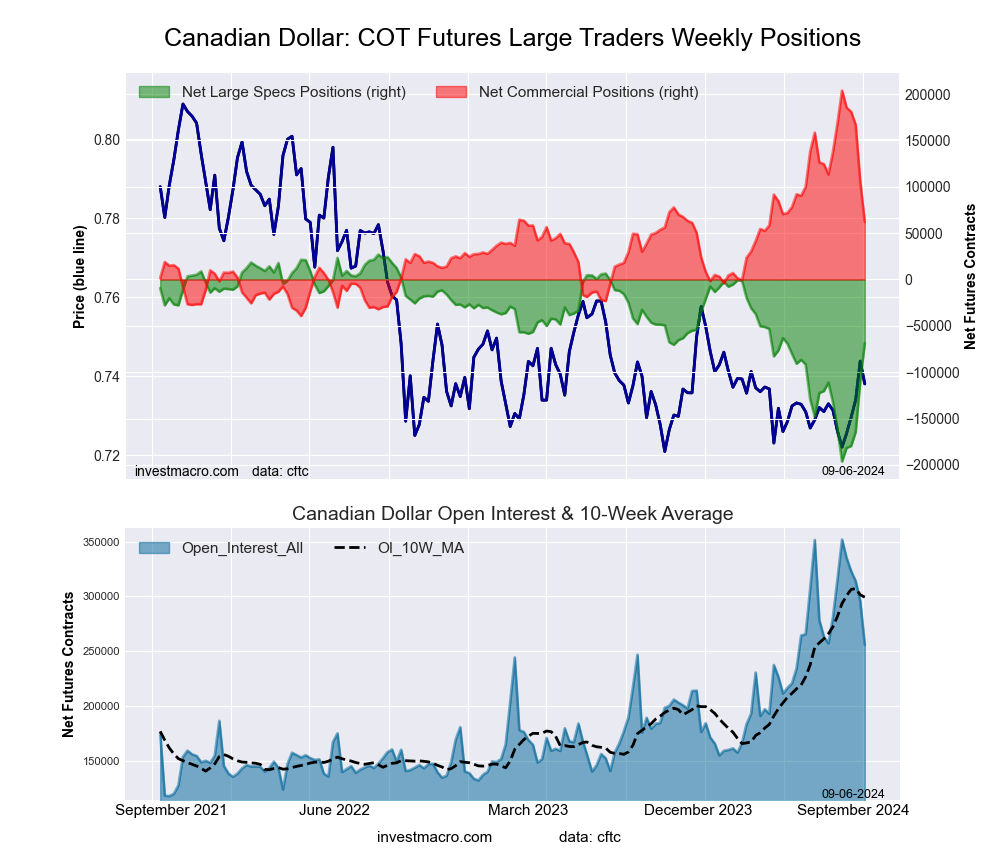
Canadian Dollar Futures:

Canadian Dollar Forex Futures COT ChartThe Canadian Dollar large speculator standing this week was a net position of -132,473 contracts in the data reported through Tuesday. This was a weekly fall of -21,261 contracts from the previous week which had a total of -111,212 net contracts.

This week’s current strength score (the trader positioning range over the past three years, measured from 0 to 100) shows the speculators are currently Bearish-Extreme with a score of 8.8 percent. The commercials are Bullish-Extreme with a score of 89.5 percent and the small traders (not shown in chart) are Bearish-Extreme with a score of 15.7 percent.

Price Trend-Following Model: Strong Downtrend

Our weekly trend-following model classifies the current market price position as: Strong Downtrend. The current action for the model is considered to be: Hold – Maintain Short Position.

CANADIAN DOLLAR StatisticsSPECULATORSCOMMERCIALSSMALL TRADERS
– Percent of Open Interest Longs:8.878.010.3
– Percent of Open Interest Shorts:56.029.012.1
– Net Position:-132,473137,579-5,106
– Gross Longs:24,734219,02729,000
– Gross Shorts:157,20781,44834,106
– Long to Short Ratio:0.2 to 12.7 to 10.9 to 1
NET POSITION TREND:
– Strength Index Score (3 Year Range Pct):8.889.515.7
– Strength Index Reading (3 Year Range):Bearish-ExtremeBullish-ExtremeBearish-Extreme
NET POSITION MOVEMENT INDEX:
– 6-Week Change in Strength Index:-23.419.19.3


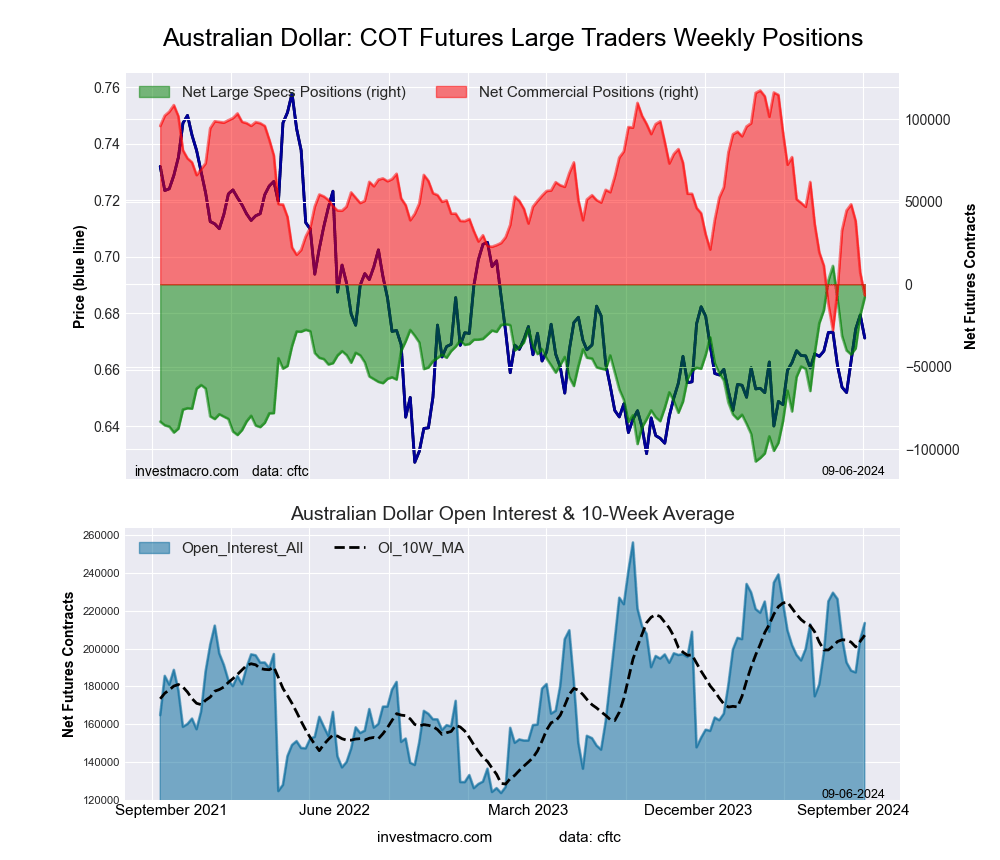
Australian Dollar Futures:

Australian Dollar Forex Futures COT ChartThe Australian Dollar large speculator standing this week was a net position of 11,113 contracts in the data reported through Tuesday. This was a weekly gain of 8,700 contracts from the previous week which had a total of 2,413 net contracts.

This week’s current strength score (the trader positioning range over the past three years, measured from 0 to 100) shows the speculators are currently Bullish-Extreme with a score of 100.0 percent. The commercials are Bearish-Extreme with a score of 0.0 percent and the small traders (not shown in chart) are Bullish-Extreme with a score of 100.0 percent.

Price Trend-Following Model: Uptrend

Our weekly trend-following model classifies the current market price position as: Uptrend. The current action for the model is considered to be: Hold – Maintain Long Position.

AUSTRALIAN DOLLAR StatisticsSPECULATORSCOMMERCIALSSMALL TRADERS
– Percent of Open Interest Longs:46.336.814.9
– Percent of Open Interest Shorts:41.548.97.6
– Net Position:11,113-27,88316,770
– Gross Longs:106,31284,40334,164
– Gross Shorts:95,199112,28617,394
– Long to Short Ratio:1.1 to 10.8 to 12.0 to 1
NET POSITION TREND:
– Strength Index Score (3 Year Range Pct):100.00.0100.0
– Strength Index Reading (3 Year Range):Bullish-ExtremeBearish-ExtremeBullish-Extreme
NET POSITION MOVEMENT INDEX:
– 6-Week Change in Strength Index:52.6-51.432.4


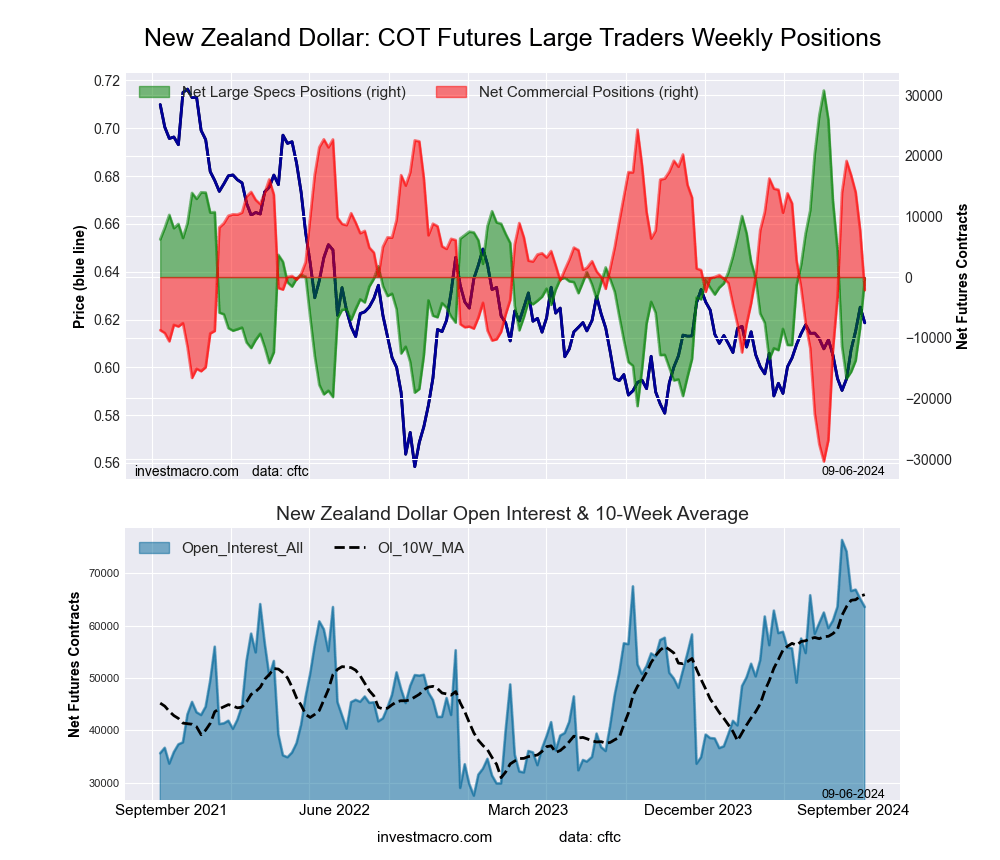
New Zealand Dollar Futures:

New Zealand Dollar Forex Futures COT ChartThe New Zealand Dollar large speculator standing this week was a net position of 12,561 contracts in the data reported through Tuesday. This was a weekly decrease of -13,351 contracts from the previous week which had a total of 25,912 net contracts.

This week’s current strength score (the trader positioning range over the past three years, measured from 0 to 100) shows the speculators are currently Bullish with a score of 65.0 percent. The commercials are Bearish with a score of 33.4 percent and the small traders (not shown in chart) are Bullish with a score of 52.1 percent.

Price Trend-Following Model: Weak Uptrend

Our weekly trend-following model classifies the current market price position as: Weak Uptrend. The current action for the model is considered to be: Hold – Maintain Long Position.

NEW ZEALAND DOLLAR StatisticsSPECULATORSCOMMERCIALSSMALL TRADERS
– Percent of Open Interest Longs:56.632.07.6
– Percent of Open Interest Shorts:35.951.88.4
– Net Position:12,561-12,102-459
– Gross Longs:34,47319,4844,648
– Gross Shorts:21,91231,5865,107
– Long to Short Ratio:1.6 to 10.6 to 10.9 to 1
NET POSITION TREND:
– Strength Index Score (3 Year Range Pct):65.033.452.1
– Strength Index Reading (3 Year Range):BullishBearishBullish
NET POSITION MOVEMENT INDEX:
– 6-Week Change in Strength Index:10.3-8.1-12.8


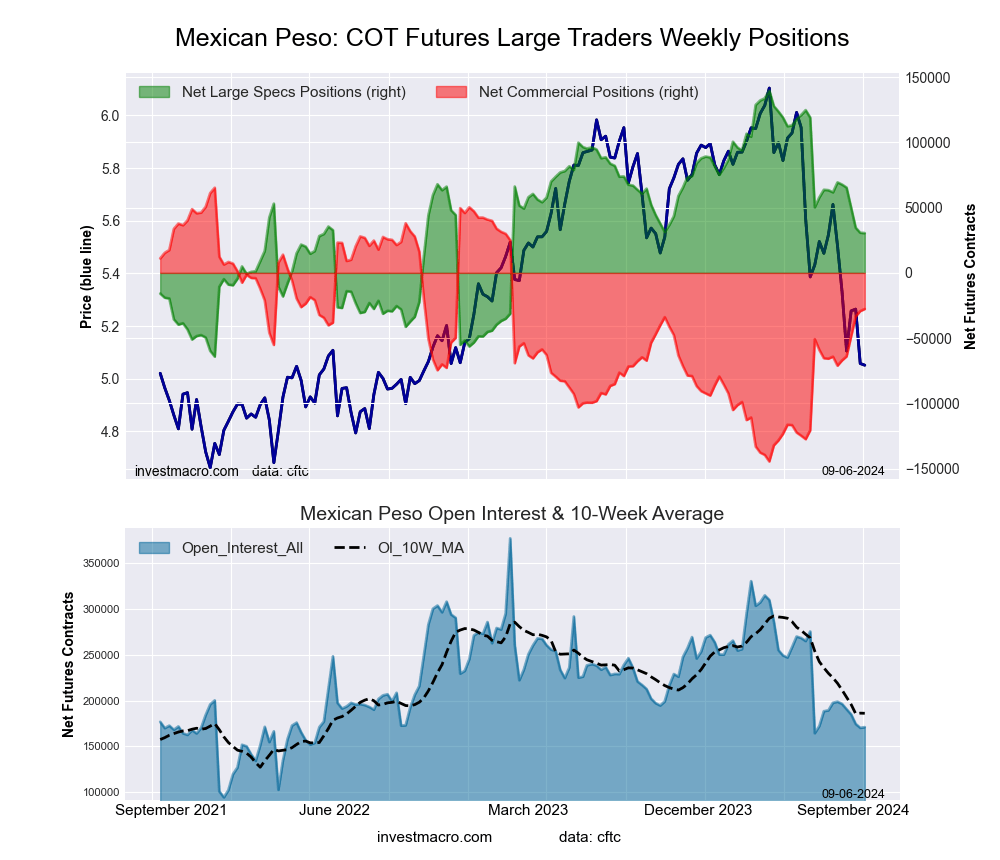
Mexican Peso Futures:

Mexican Peso Futures COT ChartThe Mexican Peso large speculator standing this week was a net position of 61,710 contracts in the data reported through Tuesday. This was a weekly reduction of -1,613 contracts from the previous week which had a total of 63,323 net contracts.

This week’s current strength score (the trader positioning range over the past three years, measured from 0 to 100) shows the speculators are currently Bullish with a score of 61.7 percent. The commercials are Bearish with a score of 38.3 percent and the small traders (not shown in chart) are Bearish with a score of 26.9 percent.

Price Trend-Following Model: Downtrend

Our weekly trend-following model classifies the current market price position as: Downtrend. The current action for the model is considered to be: Hold – Maintain Short Position.

MEXICAN PESO StatisticsSPECULATORSCOMMERCIALSSMALL TRADERS
– Percent of Open Interest Longs:49.946.52.9
– Percent of Open Interest Shorts:18.679.01.7
– Net Position:61,710-64,1822,472
– Gross Longs:98,49591,8665,742
– Gross Shorts:36,785156,0483,270
– Long to Short Ratio:2.7 to 10.6 to 11.8 to 1
NET POSITION TREND:
– Strength Index Score (3 Year Range Pct):61.738.326.9
– Strength Index Reading (3 Year Range):BullishBearishBearish
NET POSITION MOVEMENT INDEX:
– 6-Week Change in Strength Index:-30.930.2-1.7


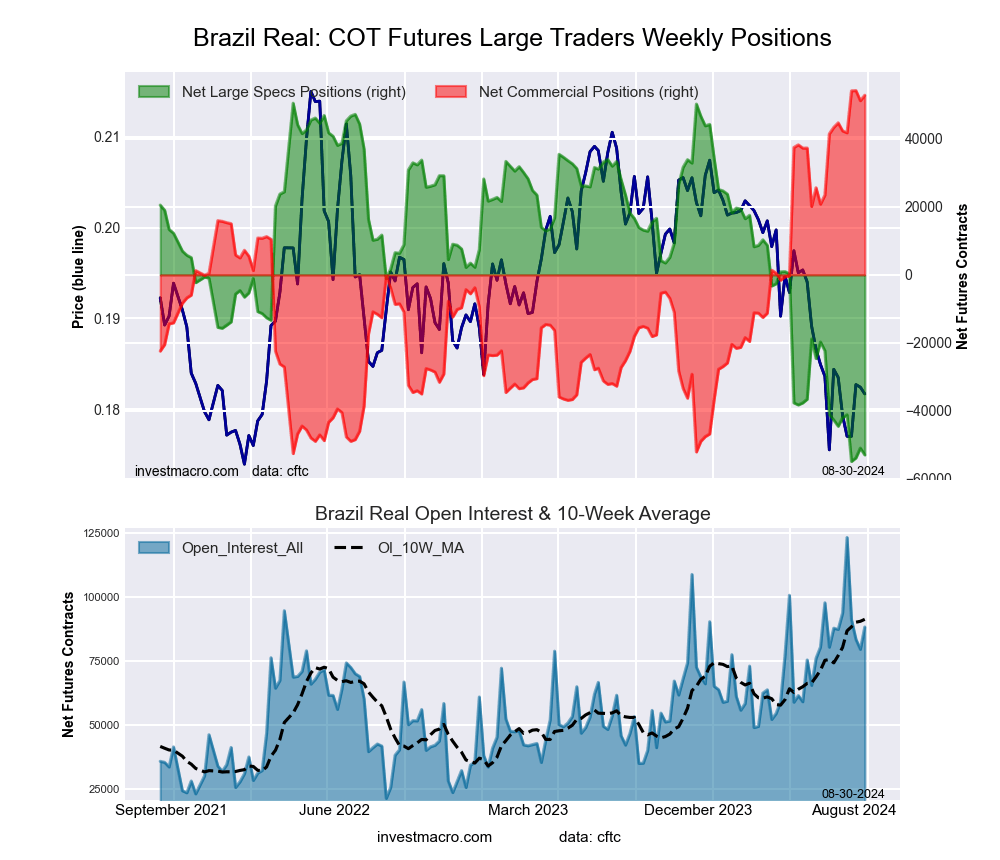
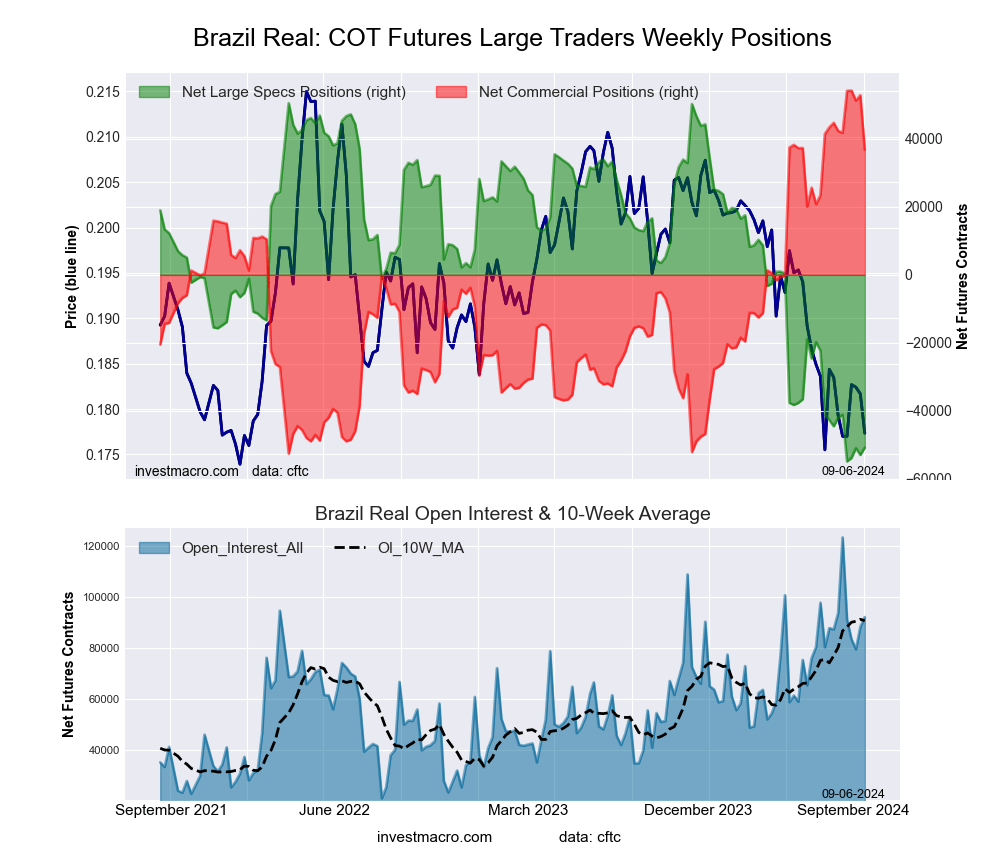
Brazilian Real Futures:

Brazil Real Futures COT ChartThe Brazilian Real large speculator standing this week was a net position of -44,526 contracts in the data reported through Tuesday. This was a weekly lowering of -1,842 contracts from the previous week which had a total of -42,684 net contracts.

This week’s current strength score (the trader positioning range over the past three years, measured from 0 to 100) shows the speculators are currently Bearish-Extreme with a score of 0.0 percent. The commercials are Bullish-Extreme with a score of 100.0 percent and the small traders (not shown in chart) are Bearish with a score of 32.6 percent.

Price Trend-Following Model: Strong Downtrend

Our weekly trend-following model classifies the current market price position as: Strong Downtrend. The current action for the model is considered to be: Hold – Maintain Short Position.

BRAZIL REAL StatisticsSPECULATORSCOMMERCIALSSMALL TRADERS
– Percent of Open Interest Longs:24.272.52.6
– Percent of Open Interest Shorts:75.221.32.8
– Net Position:-44,52644,720-194
– Gross Longs:21,14063,2872,240
– Gross Shorts:65,66618,5672,434
– Long to Short Ratio:0.3 to 13.4 to 10.9 to 1
NET POSITION TREND:
– Strength Index Score (3 Year Range Pct):0.0100.032.6
– Strength Index Reading (3 Year Range):Bearish-ExtremeBullish-ExtremeBearish
NET POSITION MOVEMENT INDEX:
– 6-Week Change in Strength Index:-27.025.310.0


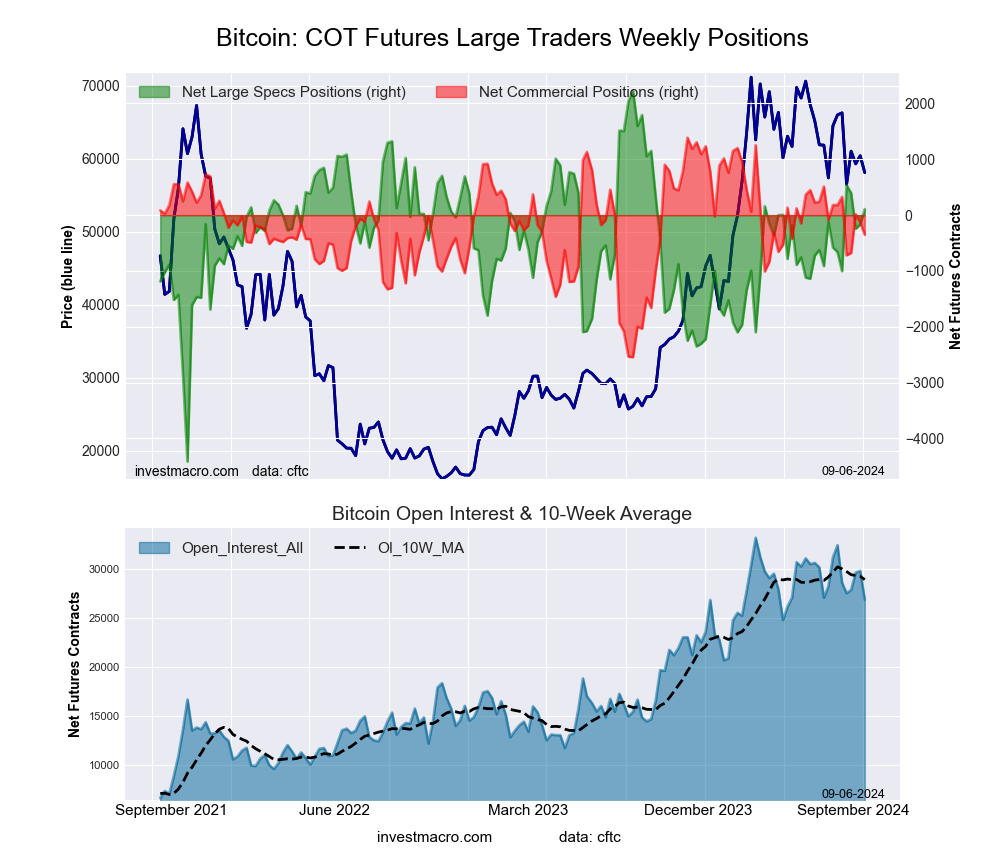
Bitcoin Futures:

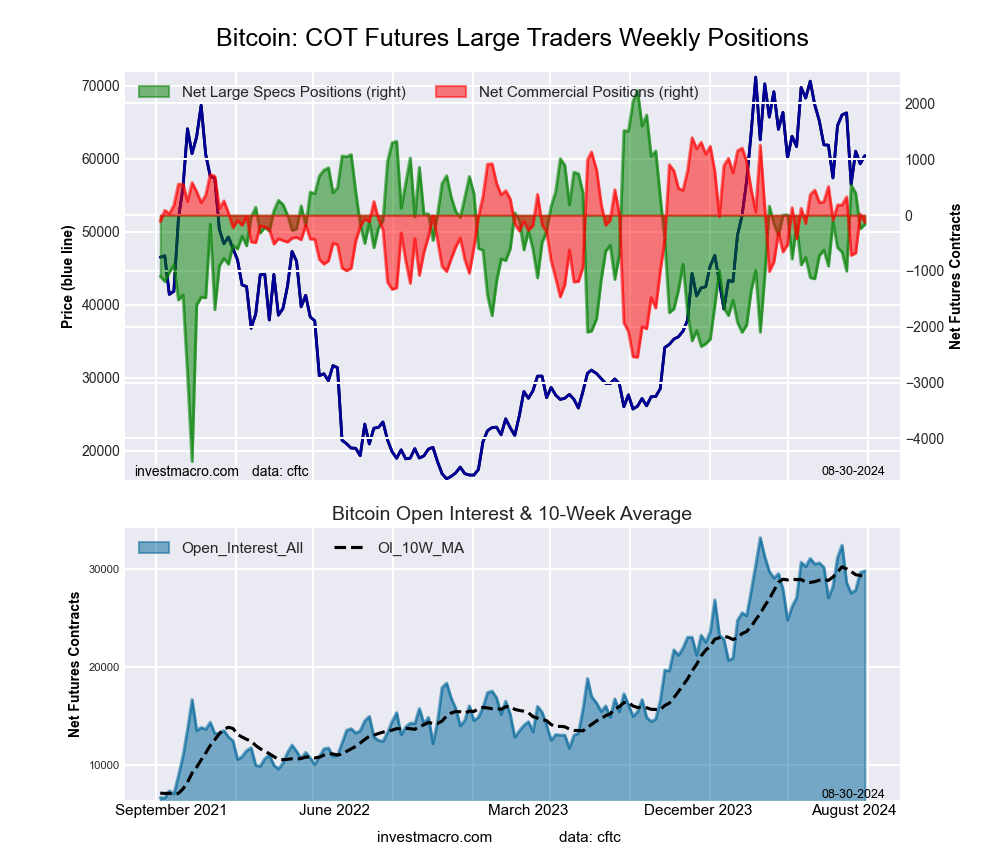
Bitcoin Crypto Futures COT ChartThe Bitcoin large speculator standing this week was a net position of -579 contracts in the data reported through Tuesday. This was a weekly decrease of -461 contracts from the previous week which had a total of -118 net contracts.

This week’s current strength score (the trader positioning range over the past three years, measured from 0 to 100) shows the speculators are currently Bullish with a score of 57.7 percent. The commercials are Bullish with a score of 69.3 percent and the small traders (not shown in chart) are Bearish with a score of 22.0 percent.

Price Trend-Following Model: Weak Downtrend

Our weekly trend-following model classifies the current market price position as: Weak Downtrend. The current action for the model is considered to be: Hold – Maintain Short Position.

BITCOIN StatisticsSPECULATORSCOMMERCIALSSMALL TRADERS
– Percent of Open Interest Longs:79.23.54.7
– Percent of Open Interest Shorts:81.12.93.4
– Net Position:-579181398
– Gross Longs:24,7101,0911,463
– Gross Shorts:25,2899101,065
– Long to Short Ratio:1.0 to 11.2 to 11.4 to 1
NET POSITION TREND:
– Strength Index Score (3 Year Range Pct):57.769.322.0
– Strength Index Reading (3 Year Range):BullishBullishBearish
NET POSITION MOVEMENT INDEX:
– 6-Week Change in Strength Index:8.1-4.7-8.1


Article By InvestMacroReceive our weekly COT Newsletter

*COT Report: The COT data, released weekly to the public each Friday, is updated through the most recent Tuesday (data is 3 days old) and shows a quick view of how large speculators or non-commercials (for-profit traders) were positioned in the futures markets.

The CFTC categorizes trader positions according to commercial hedgers (traders who use futures contracts for hedging as part of the business), non-commercials (large traders who speculate to realize trading profits) and nonreportable traders (usually small traders/speculators) as well as their open interest (contracts open in the market at time of reporting). See CFTC criteria here.

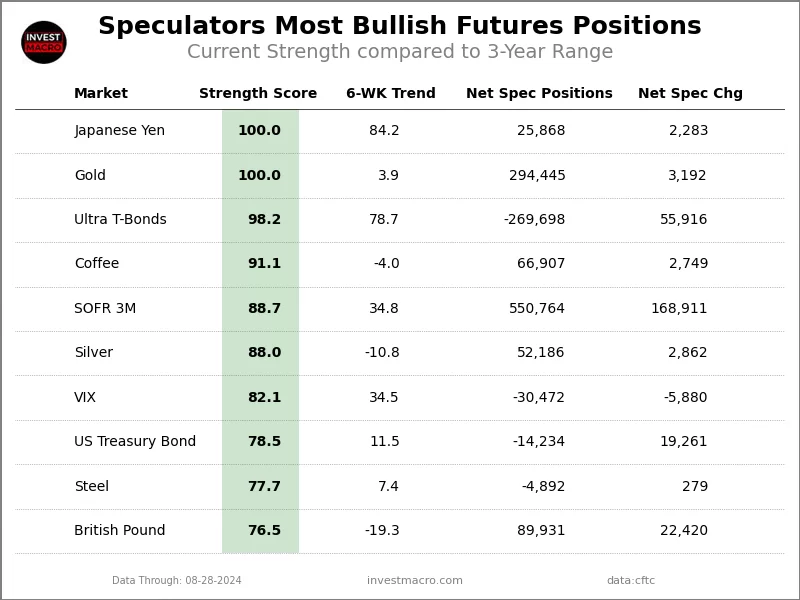
Speculator Extremes: Australian Dollar, Gold & British Pound top Bullish Bets

By InvestMacro

The latest update for the weekly Commitment of Traders (COT) report was released by the Commodity Futures Trading Commission (CFTC) on Friday for data ending on July 16th.

This weekly Extreme Positions report highlights the Most Bullish and Most Bearish Positions for the speculator category. Extreme positioning in these markets can foreshadow strong moves in the underlying market.

To signify an extreme position, we use the Strength Index (also known as the COT Index) of each instrument, a common method of measuring COT data. The Strength Index is simply a comparison of current trader positions against the range of positions over the previous 3 years. We use over 80 percent as extremely bullish and under 20 percent as extremely bearish. (Compare Strength Index scores across all markets in the data table or cot leaders table)


Here Are This Week’s Most Bullish Speculator Positions:

Australian Dollar


The Australian Dollar speculator position comes in as the most bullish extreme standing this week. The Australian Dollar speculator level is currently at a 100.0 percent score of its 3-year range.

The six-week trend for the percent strength score totaled 52.6 this week. The overall net speculator position was a total of 11,113 net contracts this week with a rise of 8,700 contract in the weekly speculator bets.


Speculators or Non-Commercials Notes:

Speculators, classified as non-commercial traders by the CFTC, are made up of large commodity funds, hedge funds and other significant for-profit participants. The Specs are generally regarded as trend-followers in their behavior towards price action – net speculator bets and prices tend to go in the same directions. These traders often look to buy when prices are rising and sell when prices are falling. To illustrate this point, many times speculator contracts can be found at their most extremes (bullish or bearish) when prices are also close to their highest or lowest levels.

These extreme levels can be dangerous for the large speculators as the trade is most crowded, there is less trading ammunition still sitting on the sidelines to push the trend further and prices have moved a significant distance. When the trend becomes exhausted, some speculators take profits while others look to also exit positions when prices fail to continue in the same direction. This process usually plays out over many months to years and can ultimately create a reverse effect where prices start to fall and speculators start a process of selling when prices are falling.


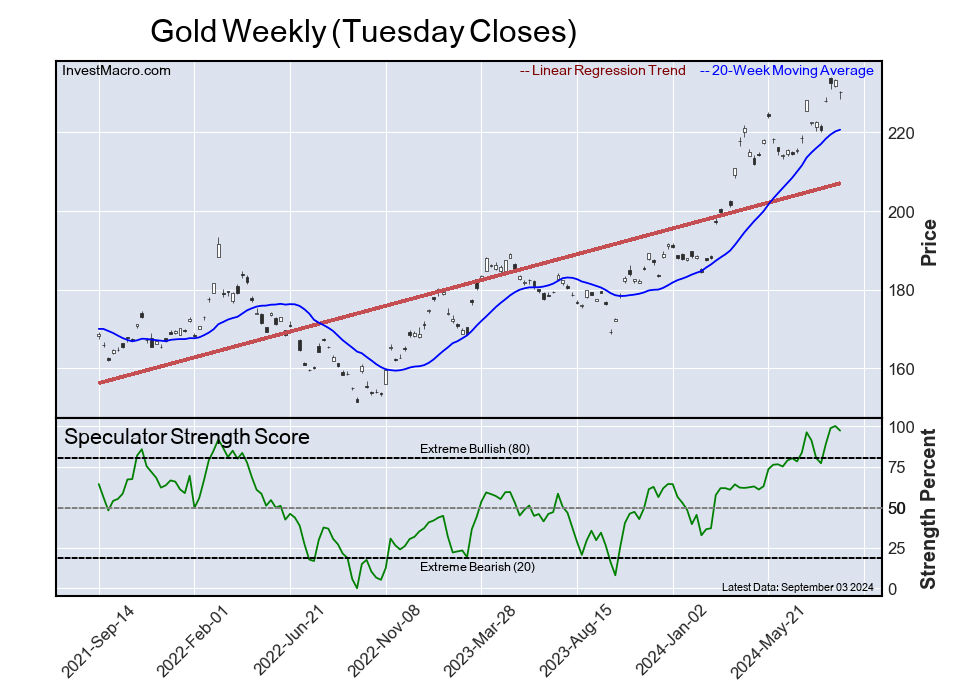
Gold


The Gold speculator position comes next in the extreme standings this week. The Gold speculator level is now at a 100.0 percent score of its 3-year range.

The six-week trend for the percent strength score was 20.5 this week. The speculator position registered 285,024 net contracts this week with a weekly boost by 30,249 contracts in speculator bets.


British Pound


The British Pound speculator position comes in third this week in the extreme standings. The British Pound speculator level resides at a 100.0 percent score of its 3-year range.

The six-week trend for the speculator strength score came in at 42.1 this week. The overall speculator position was 132,902 net contracts this week with a gain of 48,212 contracts in the weekly speculator bets.


Silver


The Silver speculator position comes up number four in the extreme standings this week. The Silver speculator level is at a 98.8 percent score of its 3-year range.

The six-week trend for the speculator strength score totaled a change of 5.1 this week. The overall speculator position was 60,165 net contracts this week with a small edge lower by -891 contracts in the speculator bets.


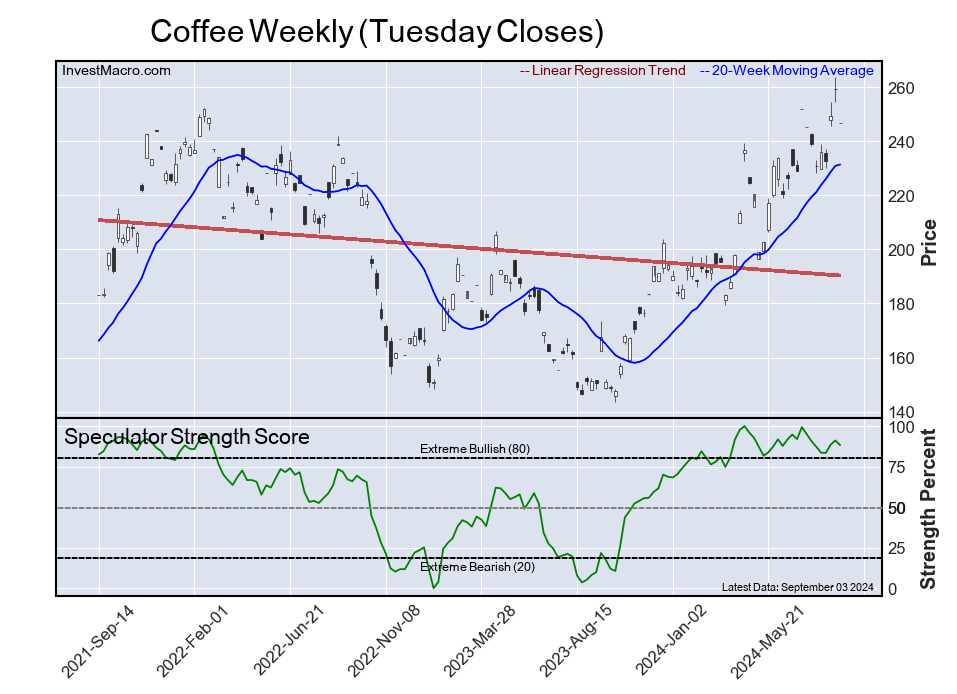
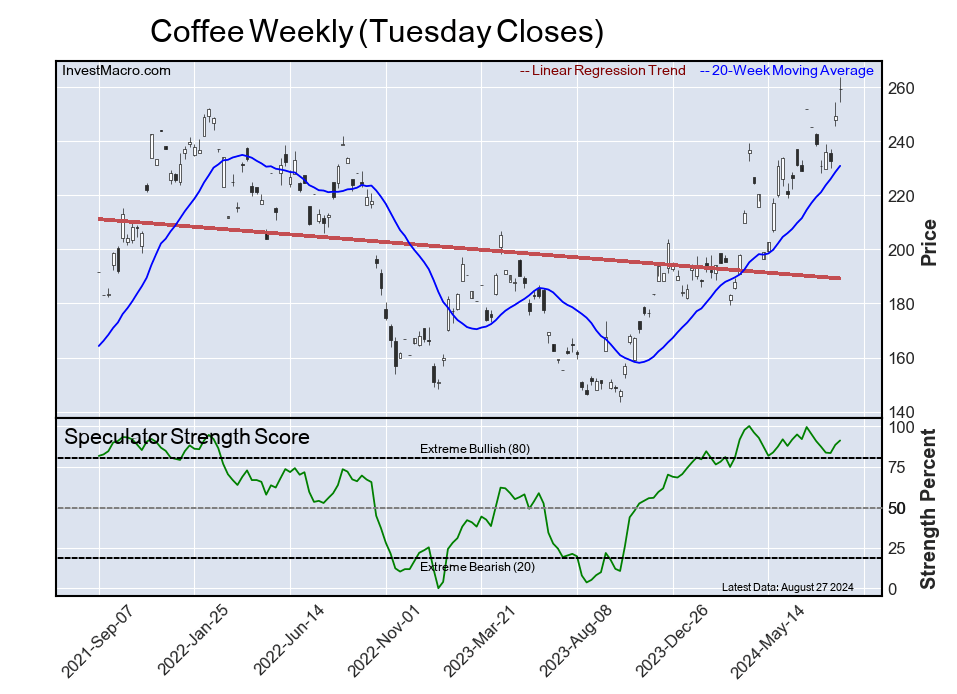
Coffee


The Coffee speculator position rounds out the top five in this week’s bullish extreme standings. The Coffee speculator level sits at a 95.0 percent score of its 3-year range. The six-week trend for the speculator strength score was 3.2 this week.

The speculator position was 70,979 net contracts this week with a decrease of -4,441 contracts in the weekly speculator bets.


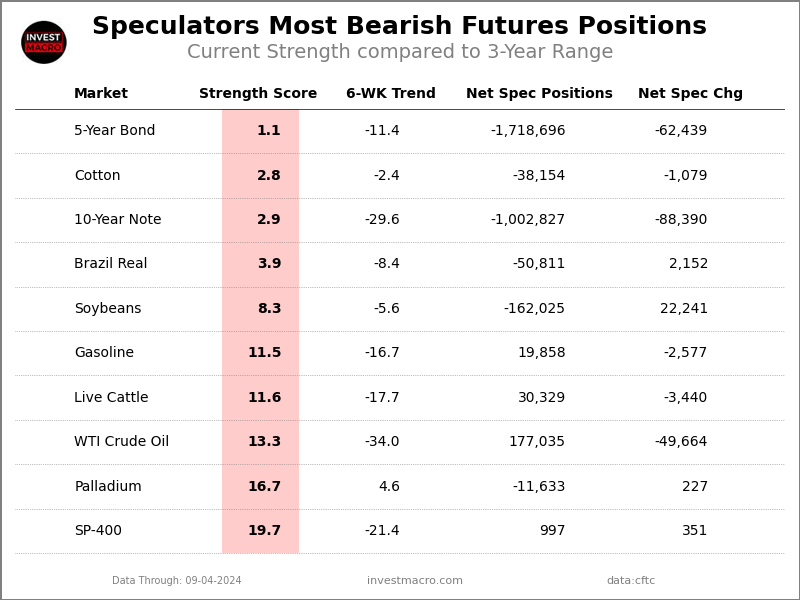
This Week’s Most Bearish Speculator Positions:

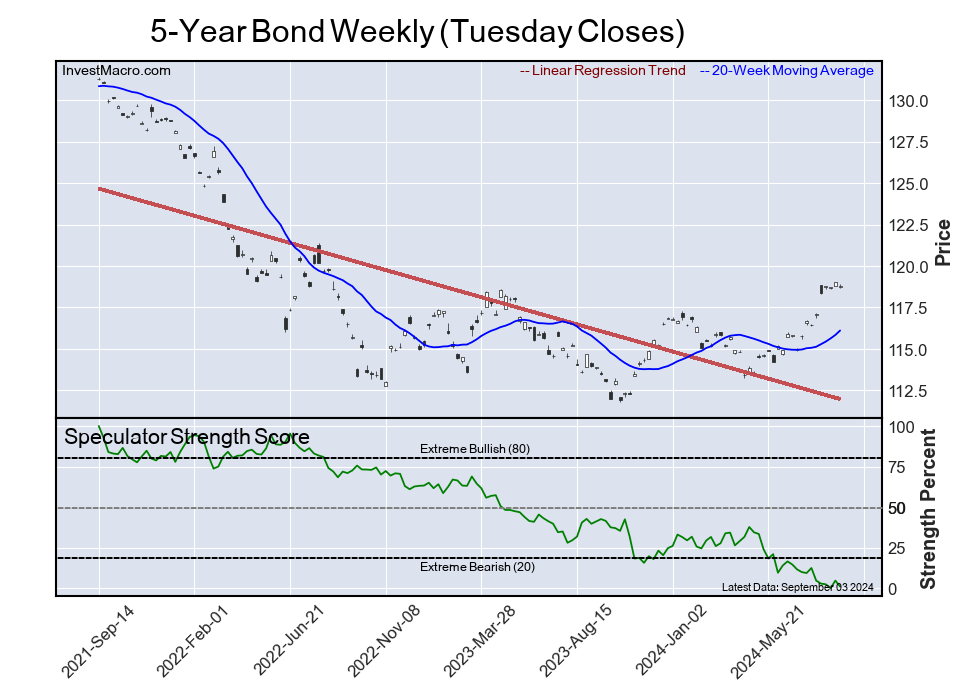
5-Year Bond


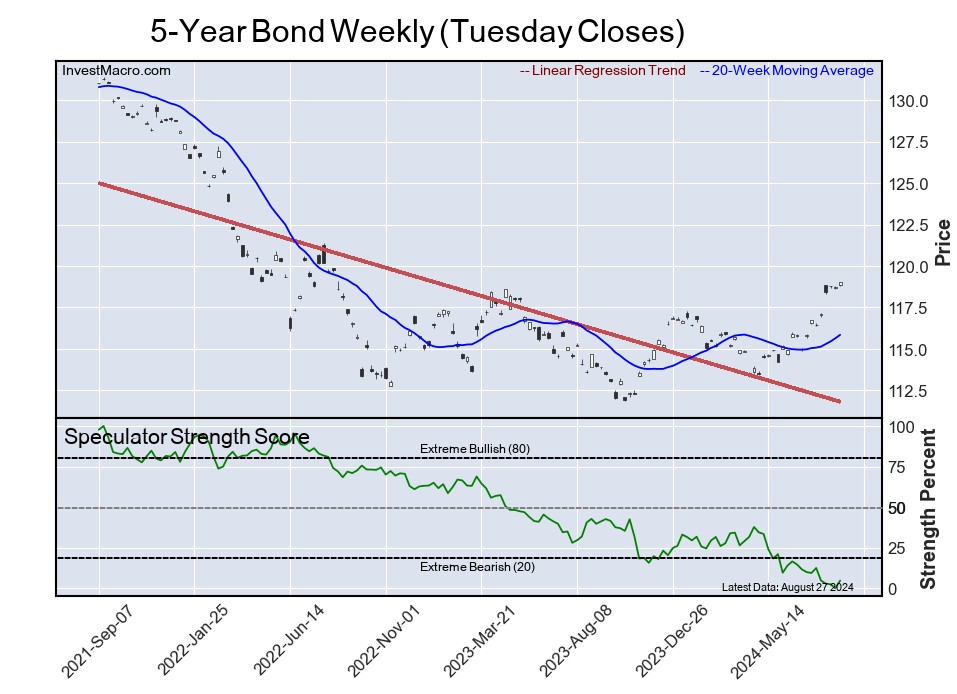
The 5-Year Bond speculator position comes in as the most bearish extreme standing this week. The 5-Year Bond speculator level is at a 0.0 percent score of its 3-year range.

The six-week trend for the speculator strength score was -0.2 this week. The overall speculator position was -1,576,174 net contracts this week with a dip by -9,573 contracts in the speculator bets.


Brazil Real


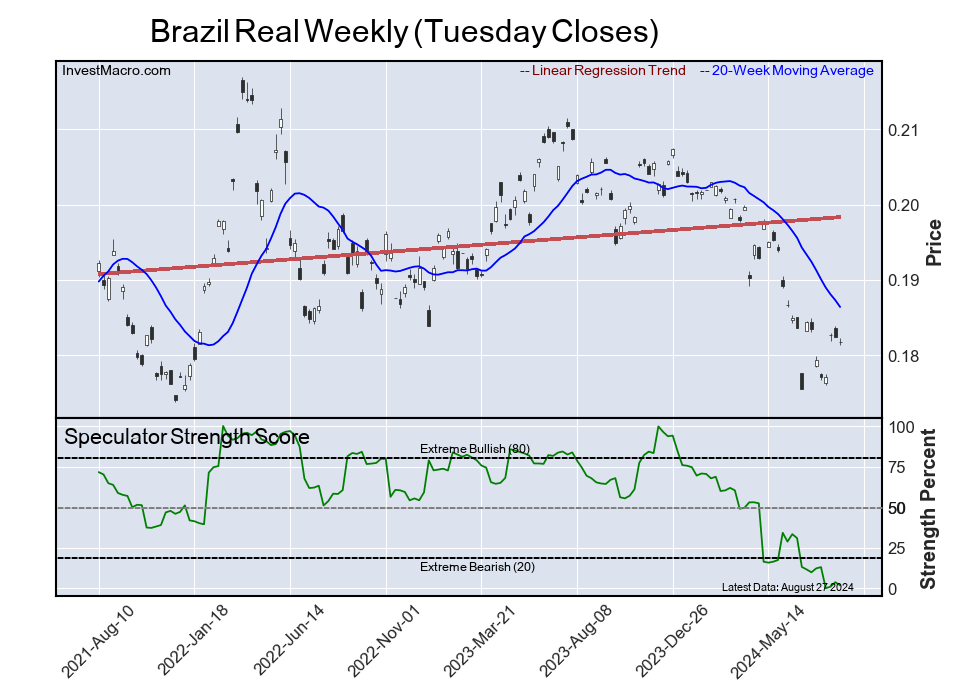
The Brazil Real speculator position comes in next for the most bearish extreme standing on the week. The Brazil Real speculator level is at a 0.0 percent score of its 3-year range.

The six-week trend for the speculator strength score was -27.0 this week. The speculator position was -44,526 net contracts this week with a reduction by -1,842 contracts in the weekly speculator bets.


Swiss Franc


The Swiss Franc speculator position comes in as third most bearish extreme standing of the week. The Swiss Franc speculator level resides at a 0.0 percent score of its 3-year range.

The six-week trend for the speculator strength score was -6.8 this week. The overall speculator position was -49,793 net contracts this week with a drop of -3,705 contracts in the speculator bets.


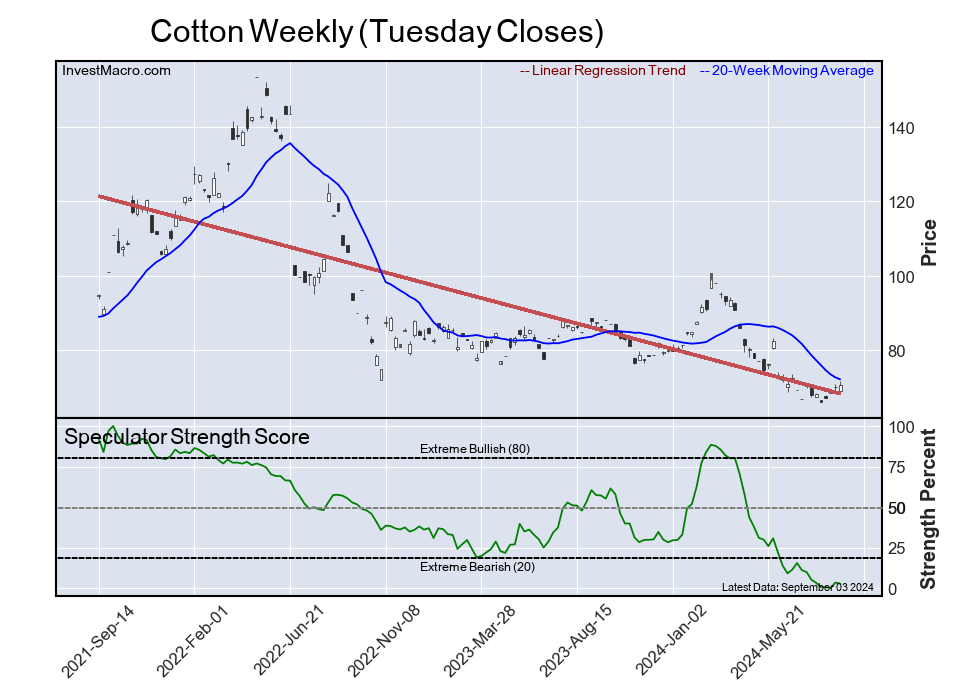
Cotton


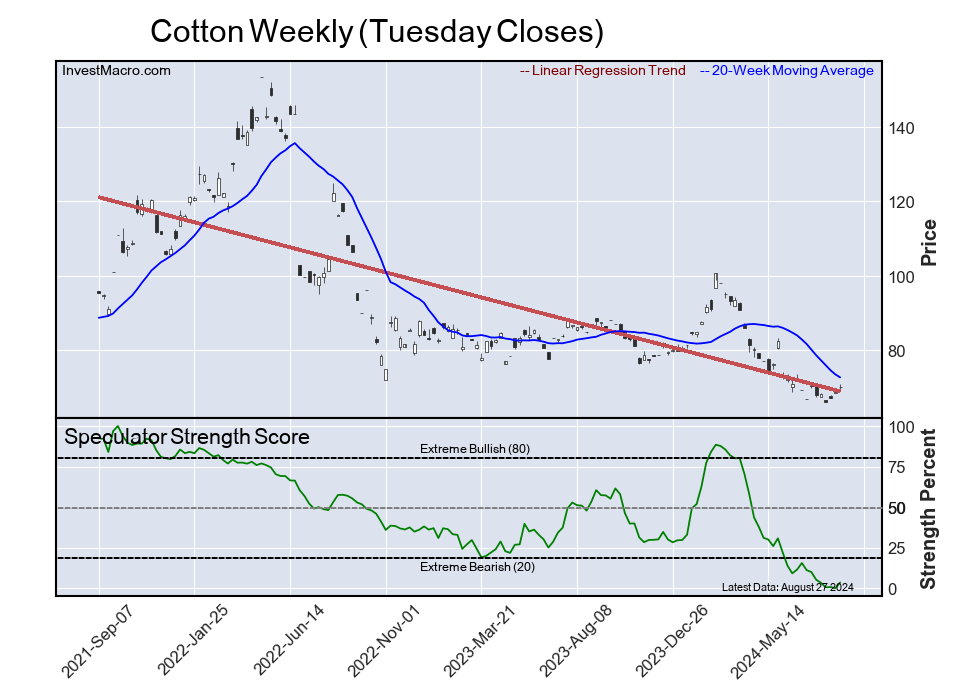
The Cotton speculator position comes in as this week’s fourth most bearish extreme standing. The Cotton speculator level is at a 0.8 percent score of its 3-year range.

The six-week trend for the speculator strength score was -13.3 this week. The speculator position was -26,507 net contracts this week with a decline of -1,998 contracts in the weekly speculator bets.


Corn


Finally, the Corn speculator position comes in as the fifth most bearish extreme standing for this week. The Corn speculator level is at a 3.5 percent score of its 3-year range.

The six-week trend for the speculator strength score was -15.1 this week. The speculator position was -238,816 net contracts this week with an increase of 1,125 contracts in the weekly speculator bets.


Article By InvestMacroReceive our weekly COT Newsletter

*COT Report: The COT data, released weekly to the public each Friday, is updated through the most recent Tuesday (data is 3 days old) and shows a quick view of how large speculators or non-commercials (for-profit traders) were positioned in the futures markets.

The CFTC categorizes trader positions according to commercial hedgers (traders who use futures contracts for hedging as part of the business), non-commercials (large traders who speculate to realize trading profits) and nonreportable traders (usually small traders/speculators) as well as their open interest (contracts open in the market at time of reporting). See CFTC criteria here.