Archive for Opinions – Page 43

Philly schools are in disrepair − the municipal bond market is 1 big reason

By David I. Backer, West Chester University of Pennsylvania 

Graphic reading '43 cents is the share of every dollar loaned to repair Philly schools that is actually spent'
The Conversation, CC BY

Many of Philadelphia’s schools are in terrible shape. The average public school building in the city is over 70 years old, and some are over 120 years old. The state of disrepair, including a lack of air conditioning and incidents of untreated asbestos, mold, crumbling ceilings and flooded hallways, is well documented.

I am a scholar of school finance, with an emphasis on infrastructure. My colleague Camika Royal, who’s an expert on urban education and Philadelphia schools, and I wanted to figure out why the city’s school buildings are like this.

We found that one key figure explains the dire state of the city’s school buildings: Only 43 cents of every dollar loaned to the School District of Philadelphia in recent decades to maintain and repair its buildings was actually spent.

In other words, a majority of the money – the other 57 cents per dollar – meant for building and maintaining Philly schools during the nearly 30-year period we studied, from 1993 to 2021, never actually reached Philly schools.

This is not due to money going missing. Rather, it is an indicator of the overall inefficiency of how maintenance and repairs to Philly’s public school facilities are financed.

Our analysis was published in the June 2024 edition of the peer-reviewed Journal of Educational Administration and History.

Reliance on Wall Street

Pennsylvania, unlike states such as Massachusetts and Wyoming that have robust policies for financing school infrastructure, does not have a statewide program that provides sufficient revenue for school facilities.

The commonwealth’s PlanCon program, for instance, which had reimbursed districts for building costs, was defunded in the wake of the 2008 financial crisis. It hasn’t been fully restored.

While Gov. Josh Shapiro signed the Public School Facility Improvement Grant Program into law in 2024 to provide grants for school buildings statewide, the program – funded with US$100 million – is pitifully small. Philly’s school buildings alone need at least $7 billion for repairs and upgrades, according to Superintendent Tony Watlington.

To get the money it needs for its buildings and infrastructure, the School District of Philadelphia has to sell itself as an investment product on Wall Street. This is done through municipal bonds.

Municipal bonds are basically big loans for local governments’ capital projects.

Investors purchase these municipal bonds because they can make tax-free income when the school district pays them back with interest.

Financial consultants, credit raters, bond lawyers and private banks all benefit from this system as well, since they charge fees for the services helping investors front their money to school districts.

Market mayhem

The municipal bond market is subject to the erratic, competitive and unstable tendencies of Wall Street finance.

Imagine a rusty, outdated plumbing system that’s supposed to get water from a reservoir to a community. While the reservoir might have a lot of water in it, if the pipes are poorly designed and leaking, or the reservoir itself is badly maintained, much less water can get to the community than might be available. It could be that for every 100 gallons of water available, the community gets only 43 gallons.

Looking at the financial history of the school district’s relationship to the municipal bond market from 1993 to 2021, we found two main reasons for the failure of this funding model.

The first is the chaos in credit markets from 1993 to 2001.

In 1986, the Tax Reform Act regulated private banks, making it harder for them to buy and sell private activity bonds, and also taxed interest on certain bonds. This prompted many banks to pull out of that market, reducing their share of municipal debt by 15%. Credit supply went down, demand went up, and so did prices – making it more expensive for municipalities like Philadelphia to borrow.

Then, in 1987, the savings and loan crisis caused state budgets to contract nationally by 5%. This reduced Philadelphia School District revenue, making it more difficult to repay previous bonds while also necessitating further lending.

The second key reason relates to predatory investing strategies that lawmakers and the financial industry use to secure money for the district’s buildings.

After deregulating the kinds of bonds that local governments could sell in 2003, Pennsylvania took control of the Philadelphia School District’s finances. Under the leadership of former Superintendent Paul Vallas, the district used risky and predatory market instruments that ultimately led to a $330 million loss in the wake of the 2008 financial crisis.

Green New Deal for schools

An efficient policy for financing school infrastructure would yield a number closer to a dollar spent for every dollar received in loans. We conclude our paper with recommendations for policies we believe would be more efficient and just.

These include setting up a National Infrastructure Bank at the federal level that would provide appropriate loan financing for collective goods such as school infrastructure. Also, U.S. Rep. Jamaal Bowman of New York has proposed a Green New Deal for Schools that would provide more than $1 trillion in grants for social and physical infrastructure.The Conversation

About the Author:

David I. Backer, Associate Professor of Education Policy, West Chester University of Pennsylvania

This article is republished from The Conversation under a Creative Commons license. Read the original article.

Speculators sharply pare back Japanese Yen bearish bets

By InvestMacro

Here are the latest charts and statistics for the Commitment of Traders (COT) data published by the Commodities Futures Trading Commission (CFTC).

The latest COT data is updated through Tuesday August 6th and shows a quick view of how large market participants (for-profit speculators and commercial traders) were positioned in the futures markets. All currency positions are in direct relation to the US dollar where, for example, a bet for the euro is a bet that the euro will rise versus the dollar while a bet against the euro will be a bet that the euro will decline versus the dollar.

Weekly Speculator Changes led by Japanese Yen & EuroFX

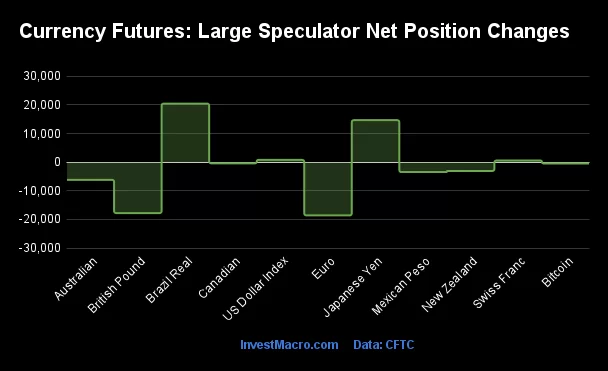
The COT currency market speculator bets were slightly lower overall this week as five out of the eleven currency markets we cover had higher positioning while the other six markets had lower speculator contracts.

Leading the gains for the currency markets was the Japanese Yen (62,106 contracts) with the EuroFX (15,781 contracts), the Canadian Dollar (14,631 contracts), the Swiss Franc (12,447 contracts) and Bitcoin (1,540 contracts) also recording positive weeks.

The currencies seeing declines in speculator bets on the week were the British Pound (-37,072 contracts), the Brazilian Real (-13,724 contracts), the Australian Dollar (-8,829 contracts), the New Zealand Dollar (-5,343 contracts), the Mexican Peso (-2,324 contracts) and with the US Dollar Index (-822 contracts) also seeing lower bets on the week.

Currency Speculators sharply pared back Japanese Yen bearish bets

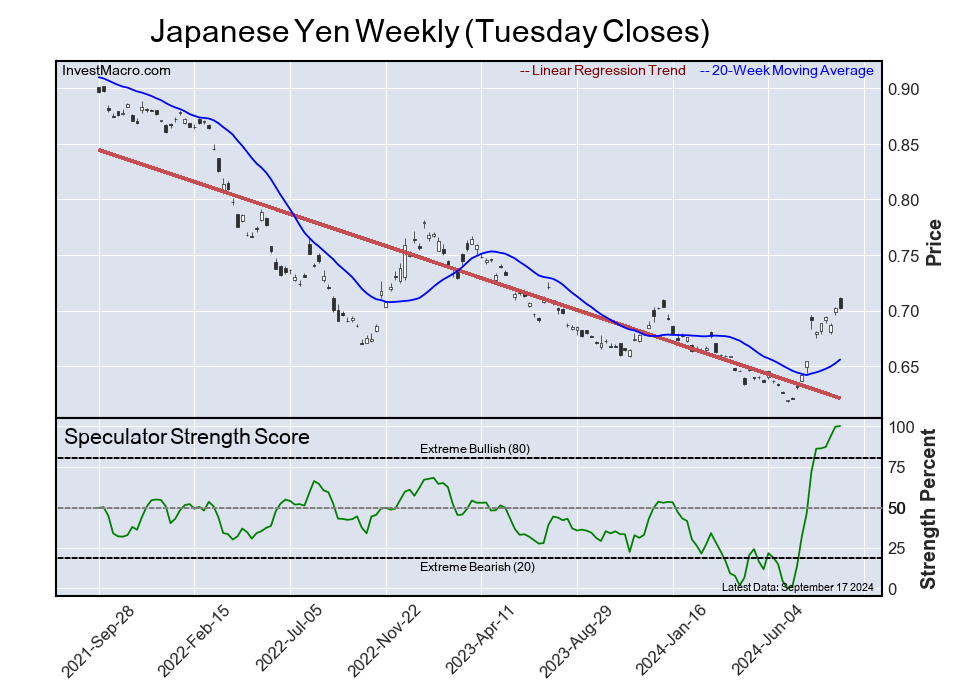
Highlighting the COT currency’s data this week was the large move in the Japanese yen speculator position that took place after last week’s (and the previous Friday) early risk-off trades and volatility spikes.

The Japanese yen speculator contracts saw a huge surge of buying with the yen speculator positioning jumping by over +62,000 contracts on the week. This was the highest one-week gain since March 1st of 2011 when the yen rose by +69,020 contracts. The turnaround in yen positions coincided with an enormous volatility event that shook the financial markets with many focusing the risk-off behavior on an unwind of yen carry trades – where traders sell a low-yielding asset like the yen to invest in a higher yielding like the USD to pocket the interest rate difference.

The yen buying and paring of shorts brought the overall speculator standing to just -11,354 contracts through Tuesday. This puts the speculator positioning back to an almost neutral position after the standing had been at least -100,000 contracts for twenty-four straight weeks from February 13th through two weeks ago on July 23rd. Overall, the yen positioning has now continued to remain in a bearish position for 178 consecutive weeks, dating back to March 16th of 2021.

This possibly could be coming to an end as a change in policy by the Bank of Japan and an unwinding of the carry trade may bring some yen strength back into the market or at least dampen the one-way market action. The yen had lost approximately 50 percent of its value against the US Dollar in the past three years with the USDJPY currency pair reaching multi-decade highs above 162.00 before the latest selloff and unwind of the yen short positioning.


Currencies Net Speculators Leaderboard
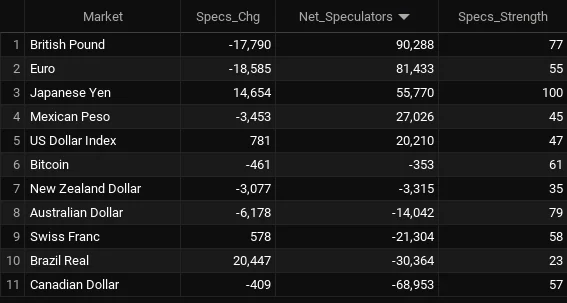
Legend: Weekly Speculators Change | Speculators Current Net Position | Speculators Strength Score compared to last 3-Years (0-100 range)


Strength Scores led by Japanese Yen & Bitcoin

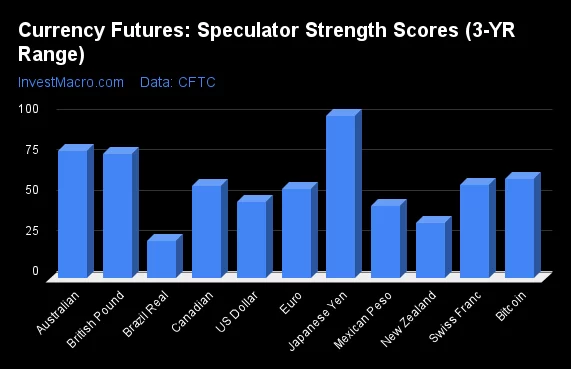
COT Strength Scores (a normalized measure of Speculator positions over a 3-Year range, from 0 to 100 where above 80 is Extreme-Bullish and below 20 is Extreme-Bearish) showed that the Japanese Yen (100 percent) and Bitcoin (75 percent) lead the currency markets this week. The British Pound (70 percent), Mexican Peso (64 percent) and the Australian Dollar (57 percent) come in as the next highest in the weekly strength scores.

On the downside, the Brazilian Real (0 percent), the Canadian Dollar (7 percent) and the New Zealand Dollar (9 percent) come in at the lowest strength levels currently and are in Extreme-Bearish territory (below 20 percent).

Strength Statistics:
US Dollar Index (38.4 percent) vs US Dollar Index previous week (40.2 percent)
EuroFX (34.6 percent) vs EuroFX previous week (27.9 percent)
British Pound Sterling (69.5 percent) vs British Pound Sterling previous week (86.2 percent)
Japanese Yen (100.0 percent) vs Japanese Yen previous week (64.1 percent)
Swiss Franc (50.1 percent) vs Swiss Franc previous week (27.6 percent)
Canadian Dollar (6.6 percent) vs Canadian Dollar previous week (0.0 percent)
Australian Dollar (56.8 percent) vs Australian Dollar previous week (64.2 percent)
New Zealand Dollar (8.7 percent) vs New Zealand Dollar previous week (19.0 percent)
Mexican Peso (63.5 percent) vs Mexican Peso previous week (64.7 percent)
Brazilian Real (0.0 percent) vs Brazilian Real previous week (13.0 percent)
Bitcoin (74.5 percent) vs Bitcoin previous week (51.3 percent)


Japanese Yen & Swiss Franc top the 6-Week Strength Trends

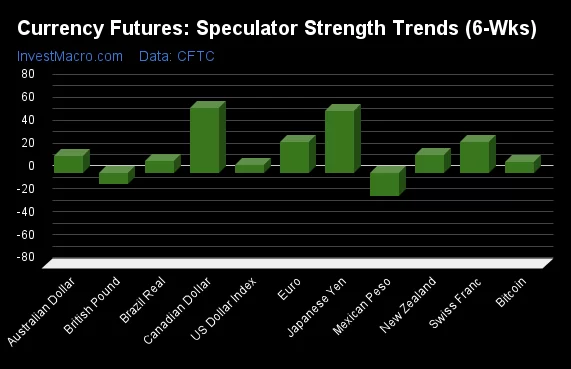
COT Strength Score Trends (or move index, calculates the 6-week changes in strength scores) showed that the Japanese Yen (94 percent) and the Swiss Franc (23 percent) lead the past six weeks trends for the currencies. The EuroFX (18 percent), the Bitcoin (17 percent) and the British Pound (14 percent) are the next highest positive movers in the latest trends data.

The New Zealand Dollar (-83 percent) leads the downside trend scores currently with the Brazilian Real (-31 percent), Canadian Dollar (-27 percent) and the Australian Dollar (-14 percent) following next with lower trend scores.

Strength Trend Statistics:
US Dollar Index (-3.0 percent) vs US Dollar Index previous week (-1.4 percent)
EuroFX (17.9 percent) vs EuroFX previous week (4.2 percent)
British Pound Sterling (13.6 percent) vs British Pound Sterling previous week (28.7 percent)
Japanese Yen (94.0 percent) vs Japanese Yen previous week (43.0 percent)
Swiss Franc (23.5 percent) vs Swiss Franc previous week (5.2 percent)
Canadian Dollar (-26.5 percent) vs Canadian Dollar previous week (-21.7 percent)
Australian Dollar (-13.9 percent) vs Australian Dollar previous week (8.7 percent)
New Zealand Dollar (-83.4 percent) vs New Zealand Dollar previous week (-61.0 percent)
Mexican Peso (3.7 percent) vs Mexican Peso previous week (8.5 percent)
Brazilian Real (-30.9 percent) vs Brazilian Real previous week (-20.3 percent)
Bitcoin (17.5 percent) vs Bitcoin previous week (-4.2 percent)


Individual COT Forex Markets:

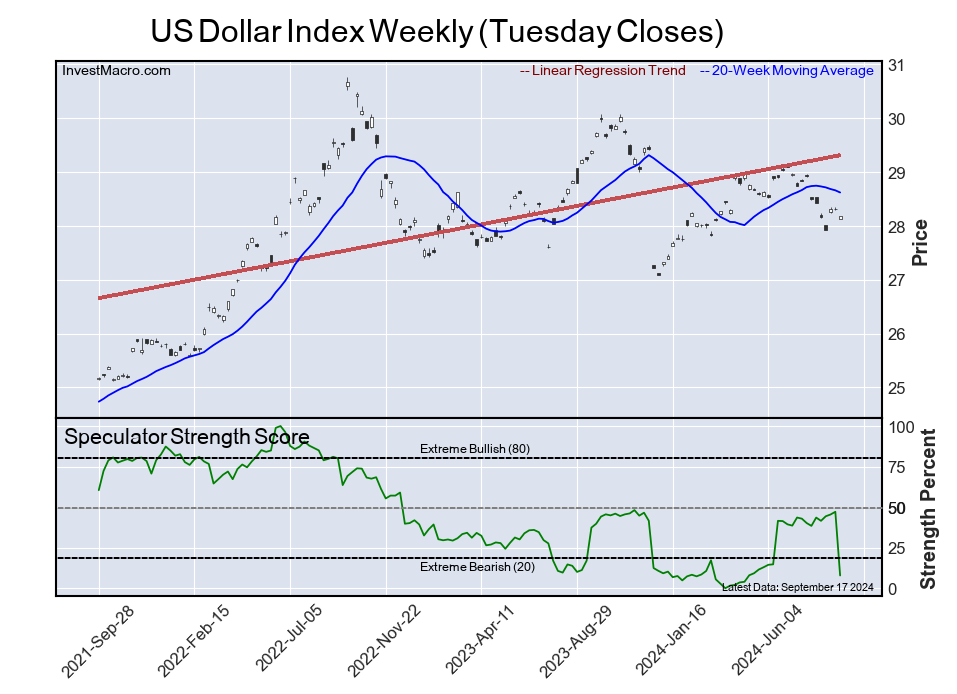
US Dollar Index Futures:
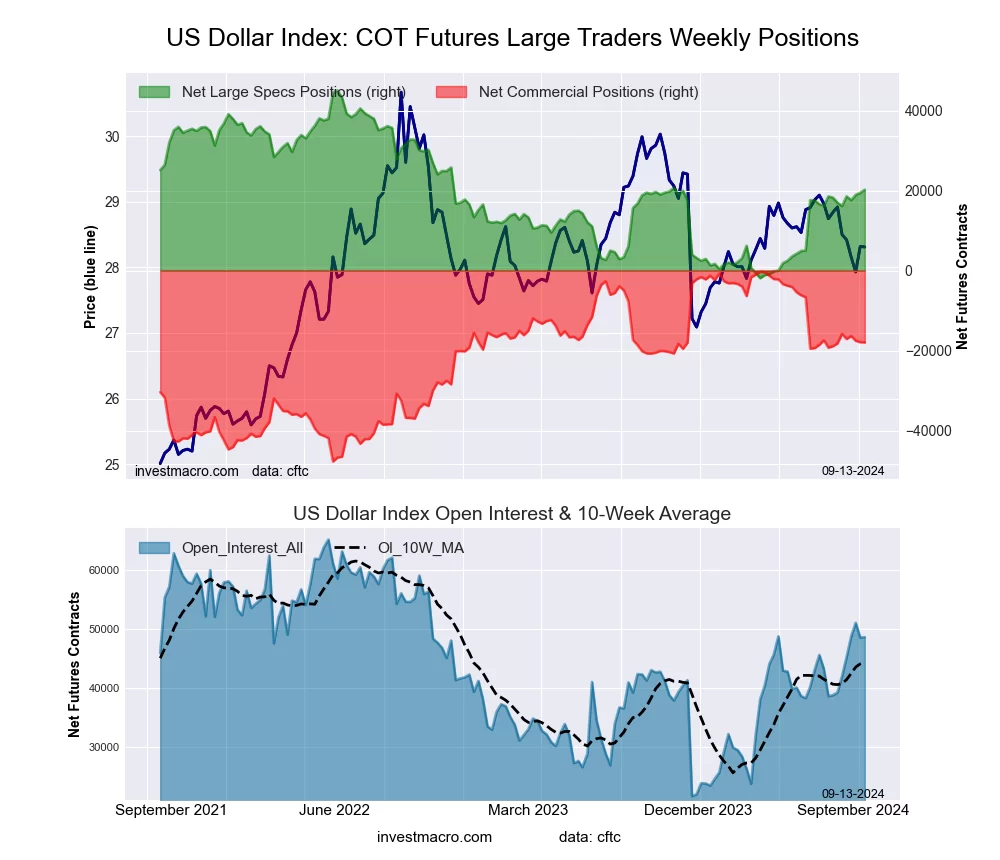
US Dollar Index Forex Futures COT ChartThe US Dollar Index large speculator standing this week resulted in a net position of 16,136 contracts in the data reported through Tuesday. This was a weekly decline of -822 contracts from the previous week which had a total of 16,958 net contracts.

This week’s current strength score (the trader positioning range over the past three years, measured from 0 to 100) shows the speculators are currently Bearish with a score of 38.4 percent. The commercials are Bullish with a score of 67.3 percent and the small traders (not shown in chart) are Bearish-Extreme with a score of 7.6 percent.

Price Trend-Following Model: Weak Uptrend

Our weekly trend-following model classifies the current market price position as: Weak Uptrend. The current action for the model is considered to be: Hold – Maintain Long Position.

US DOLLAR INDEX StatisticsSPECULATORSCOMMERCIALSSMALL TRADERS
– Percent of Open Interest Longs:73.817.96.3
– Percent of Open Interest Shorts:35.455.57.1
– Net Position:16,136-15,827-309
– Gross Longs:30,9967,5022,667
– Gross Shorts:14,86023,3292,976
– Long to Short Ratio:2.1 to 10.3 to 10.9 to 1
NET POSITION TREND:
– Strength Index Score (3 Year Range Pct):38.467.37.6
– Strength Index Reading (3 Year Range):BearishBullishBearish-Extreme
NET POSITION MOVEMENT INDEX:
– 6-Week Change in Strength Index:-3.07.5-25.1


Euro Currency Futures:

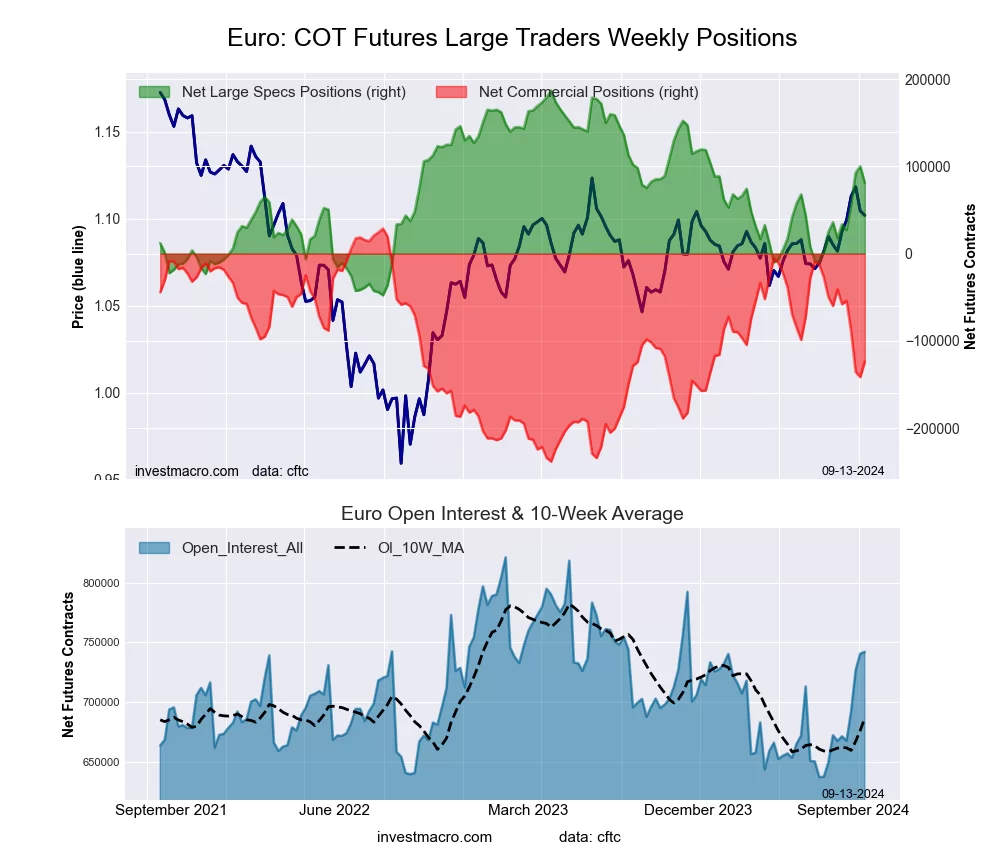
Euro Currency Futures COT ChartThe Euro Currency large speculator standing this week resulted in a net position of 33,580 contracts in the data reported through Tuesday. This was a weekly rise of 15,781 contracts from the previous week which had a total of 17,799 net contracts.

This week’s current strength score (the trader positioning range over the past three years, measured from 0 to 100) shows the speculators are currently Bearish with a score of 34.6 percent. The commercials are Bullish with a score of 67.5 percent and the small traders (not shown in chart) are Bearish with a score of 25.3 percent.

Price Trend-Following Model: Strong Uptrend

Our weekly trend-following model classifies the current market price position as: Strong Uptrend. The current action for the model is considered to be: Hold – Maintain Long Position.

EURO Currency StatisticsSPECULATORSCOMMERCIALSSMALL TRADERS
– Percent of Open Interest Longs:27.757.611.1
– Percent of Open Interest Shorts:22.766.27.5
– Net Position:33,580-57,86024,280
– Gross Longs:185,799386,56874,618
– Gross Shorts:152,219444,42850,338
– Long to Short Ratio:1.2 to 10.9 to 11.5 to 1
NET POSITION TREND:
– Strength Index Score (3 Year Range Pct):34.667.525.3
– Strength Index Reading (3 Year Range):BearishBullishBearish
NET POSITION MOVEMENT INDEX:
– 6-Week Change in Strength Index:17.9-18.013.9


British Pound Sterling Futures:

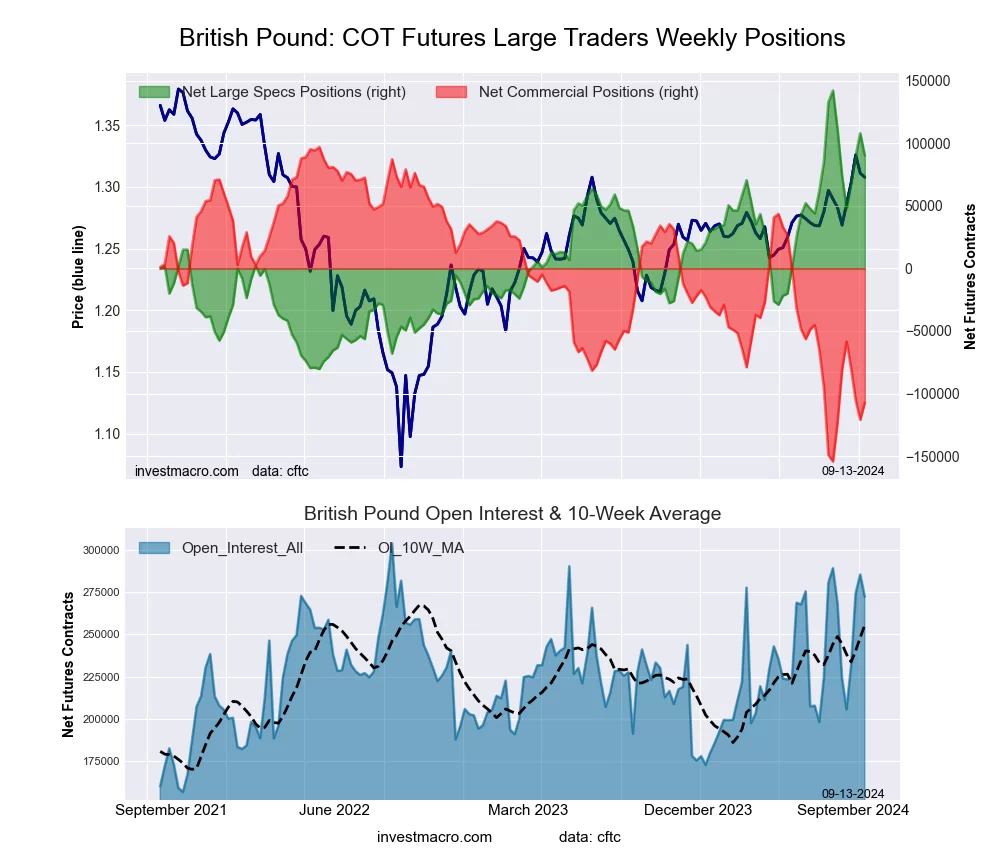
British Pound Sterling Futures COT ChartThe British Pound Sterling large speculator standing this week resulted in a net position of 74,399 contracts in the data reported through Tuesday. This was a weekly decline of -37,072 contracts from the previous week which had a total of 111,471 net contracts.

This week’s current strength score (the trader positioning range over the past three years, measured from 0 to 100) shows the speculators are currently Bullish with a score of 69.5 percent. The commercials are Bearish with a score of 29.1 percent and the small traders (not shown in chart) are Bullish with a score of 76.2 percent.

Price Trend-Following Model: Uptrend

Our weekly trend-following model classifies the current market price position as: Uptrend. The current action for the model is considered to be: Hold – Maintain Long Position.

BRITISH POUND StatisticsSPECULATORSCOMMERCIALSSMALL TRADERS
– Percent of Open Interest Longs:56.326.214.7
– Percent of Open Interest Shorts:23.162.411.8
– Net Position:74,399-81,0806,681
– Gross Longs:126,08058,80033,006
– Gross Shorts:51,681139,88026,325
– Long to Short Ratio:2.4 to 10.4 to 11.3 to 1
NET POSITION TREND:
– Strength Index Score (3 Year Range Pct):69.529.176.2
– Strength Index Reading (3 Year Range):BullishBearishBullish
NET POSITION MOVEMENT INDEX:
– 6-Week Change in Strength Index:13.6-14.312.0


Japanese Yen Futures:

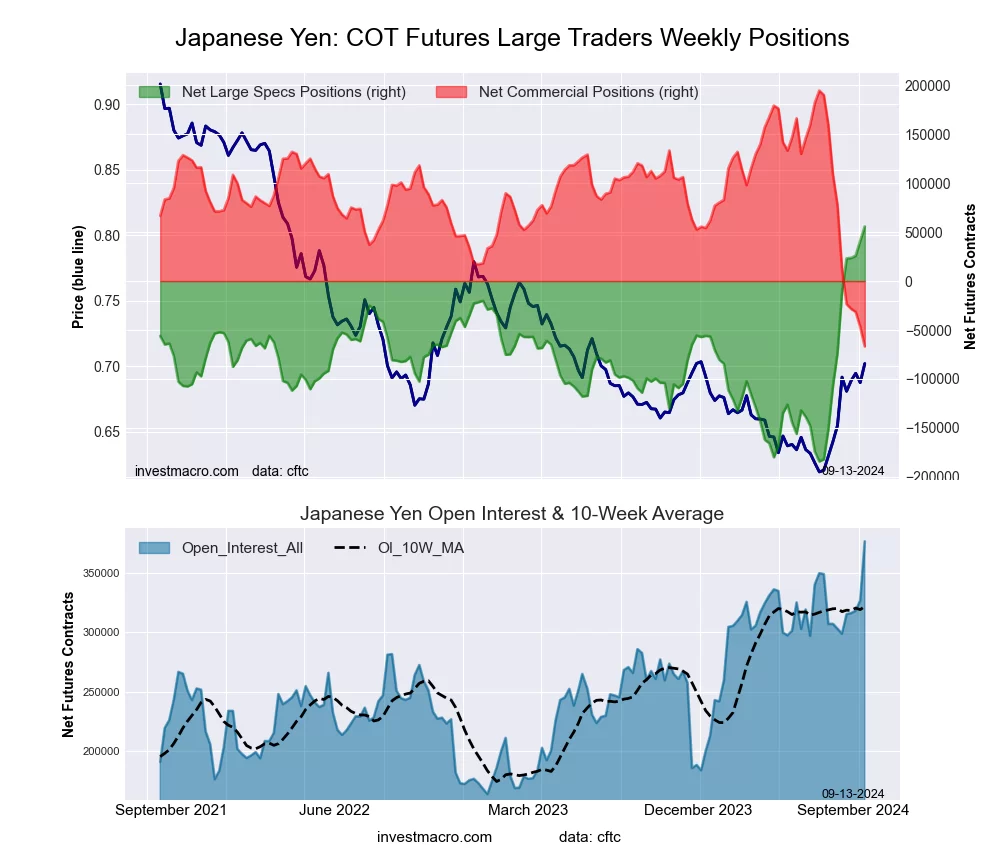
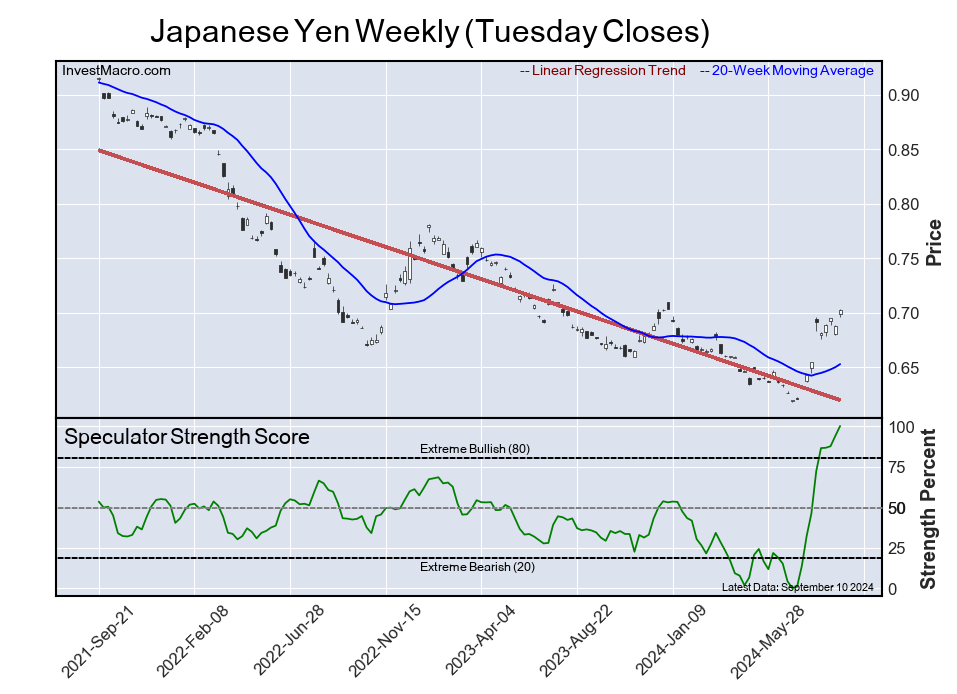
Japanese Yen Forex Futures COT ChartThe Japanese Yen large speculator standing this week resulted in a net position of -11,354 contracts in the data reported through Tuesday. This was a weekly gain of 62,106 contracts from the previous week which had a total of -73,460 net contracts.

This week’s current strength score (the trader positioning range over the past three years, measured from 0 to 100) shows the speculators are currently Bullish-Extreme with a score of 100.0 percent. The commercials are Bearish-Extreme with a score of 0.0 percent and the small traders (not shown in chart) are Bullish with a score of 79.9 percent.

Price Trend-Following Model: Weak Downtrend

Our weekly trend-following model classifies the current market price position as: Weak Downtrend. The current action for the model is considered to be: Hold – Maintain Short Position.

JAPANESE YEN StatisticsSPECULATORSCOMMERCIALSSMALL TRADERS
– Percent of Open Interest Longs:22.164.211.1
– Percent of Open Interest Shorts:25.960.111.4
– Net Position:-11,35412,196-842
– Gross Longs:66,169191,82933,312
– Gross Shorts:77,523179,63334,154
– Long to Short Ratio:0.9 to 11.1 to 11.0 to 1
NET POSITION TREND:
– Strength Index Score (3 Year Range Pct):100.00.079.9
– Strength Index Reading (3 Year Range):Bullish-ExtremeBearish-ExtremeBullish
NET POSITION MOVEMENT INDEX:
– 6-Week Change in Strength Index:94.0-93.022.3


Swiss Franc Futures:

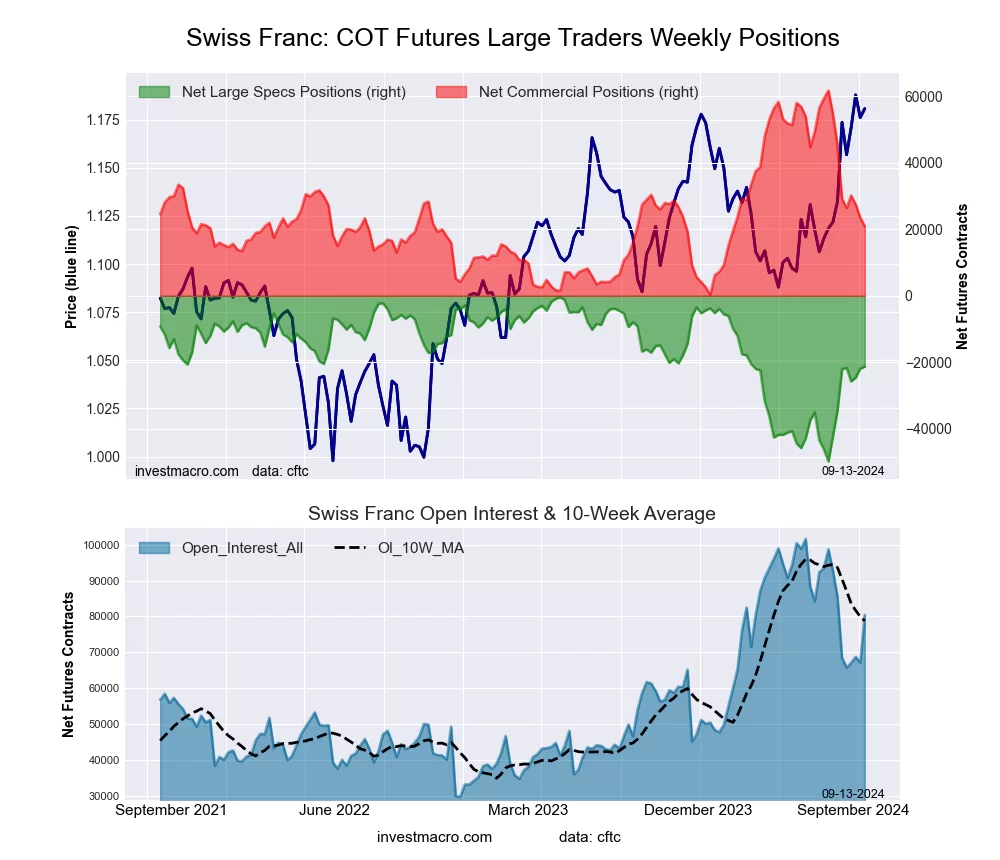
Swiss Franc Forex Futures COT ChartThe Swiss Franc large speculator standing this week resulted in a net position of -22,073 contracts in the data reported through Tuesday. This was a weekly rise of 12,447 contracts from the previous week which had a total of -34,520 net contracts.

This week’s current strength score (the trader positioning range over the past three years, measured from 0 to 100) shows the speculators are currently Bullish with a score of 50.1 percent. The commercials are Bearish with a score of 47.0 percent and the small traders (not shown in chart) are Bearish with a score of 45.1 percent.

Price Trend-Following Model: Strong Uptrend

Our weekly trend-following model classifies the current market price position as: Strong Uptrend. The current action for the model is considered to be: Hold – Maintain Long Position.

SWISS FRANC StatisticsSPECULATORSCOMMERCIALSSMALL TRADERS
– Percent of Open Interest Longs:14.068.616.5
– Percent of Open Interest Shorts:46.226.026.8
– Net Position:-22,07329,131-7,058
– Gross Longs:9,57046,96011,309
– Gross Shorts:31,64317,82918,367
– Long to Short Ratio:0.3 to 12.6 to 10.6 to 1
NET POSITION TREND:
– Strength Index Score (3 Year Range Pct):50.147.045.1
– Strength Index Reading (3 Year Range):BullishBearishBearish
NET POSITION MOVEMENT INDEX:
– 6-Week Change in Strength Index:23.5-32.932.8


Canadian Dollar Futures:

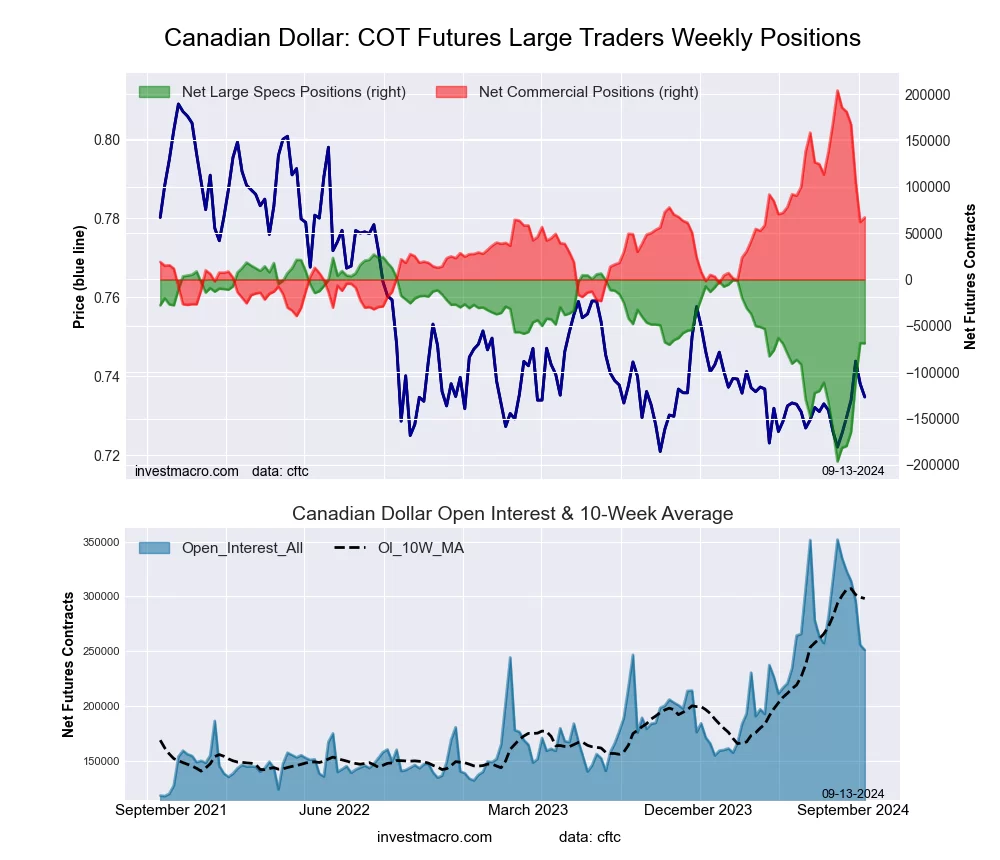
Canadian Dollar Forex Futures COT ChartThe Canadian Dollar large speculator standing this week resulted in a net position of -181,632 contracts in the data reported through Tuesday. This was a weekly boost of 14,631 contracts from the previous week which had a total of -196,263 net contracts.

This week’s current strength score (the trader positioning range over the past three years, measured from 0 to 100) shows the speculators are currently Bearish-Extreme with a score of 6.6 percent. The commercials are Bullish-Extreme with a score of 92.5 percent and the small traders (not shown in chart) are Bearish-Extreme with a score of 19.6 percent.

Price Trend-Following Model: Downtrend

Our weekly trend-following model classifies the current market price position as: Downtrend. The current action for the model is considered to be: Hold – Maintain Short Position.

CANADIAN DOLLAR StatisticsSPECULATORSCOMMERCIALSSMALL TRADERS
– Percent of Open Interest Longs:6.681.89.4
– Percent of Open Interest Shorts:60.826.510.5
– Net Position:-181,632185,438-3,806
– Gross Longs:21,993274,24931,460
– Gross Shorts:203,62588,81135,266
– Long to Short Ratio:0.1 to 13.1 to 10.9 to 1
NET POSITION TREND:
– Strength Index Score (3 Year Range Pct):6.692.519.6
– Strength Index Reading (3 Year Range):Bearish-ExtremeBullish-ExtremeBearish-Extreme
NET POSITION MOVEMENT INDEX:
– 6-Week Change in Strength Index:-26.524.30.3


Australian Dollar Futures:

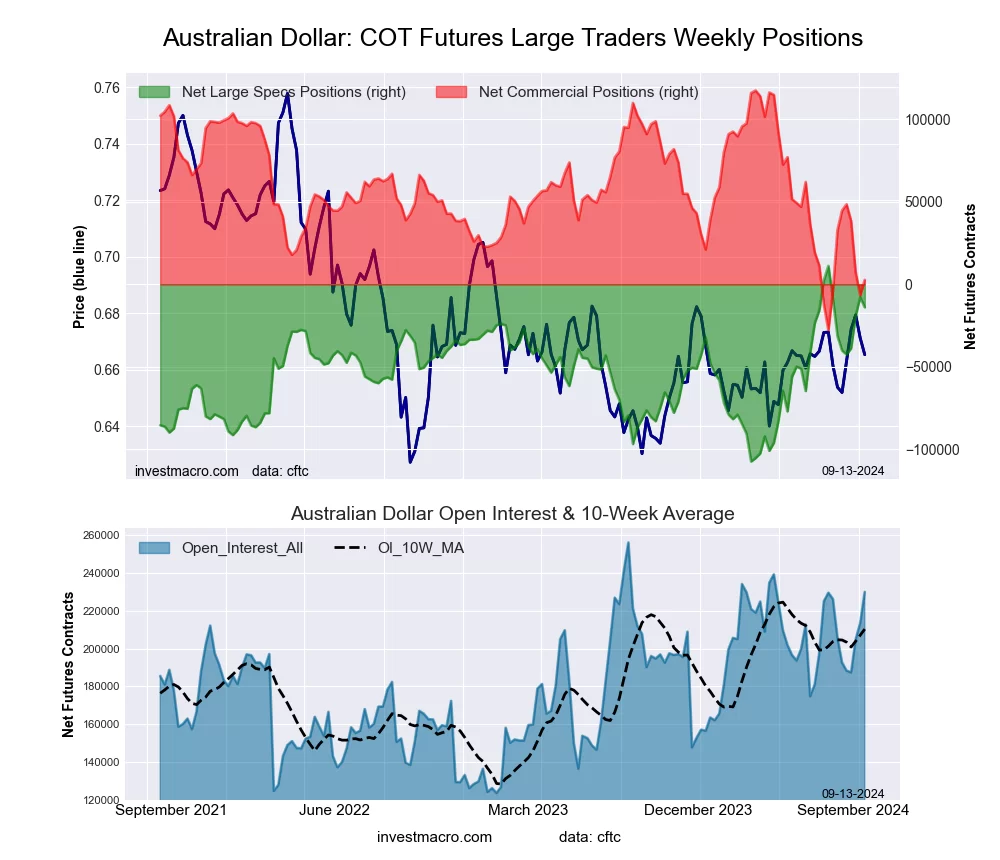
Australian Dollar Forex Futures COT ChartThe Australian Dollar large speculator standing this week resulted in a net position of -40,199 contracts in the data reported through Tuesday. This was a weekly fall of -8,829 contracts from the previous week which had a total of -31,370 net contracts.

This week’s current strength score (the trader positioning range over the past three years, measured from 0 to 100) shows the speculators are currently Bullish with a score of 56.8 percent. The commercials are Bearish with a score of 49.9 percent and the small traders (not shown in chart) are Bearish with a score of 44.3 percent.

Price Trend-Following Model: Weak Uptrend

Our weekly trend-following model classifies the current market price position as: Weak Uptrend. The current action for the model is considered to be: Hold – Maintain Long Position.

AUSTRALIAN DOLLAR StatisticsSPECULATORSCOMMERCIALSSMALL TRADERS
– Percent of Open Interest Longs:35.450.411.7
– Percent of Open Interest Shorts:56.327.114.1
– Net Position:-40,19944,743-4,544
– Gross Longs:68,19397,01922,601
– Gross Shorts:108,39252,27627,145
– Long to Short Ratio:0.6 to 11.9 to 10.8 to 1
NET POSITION TREND:
– Strength Index Score (3 Year Range Pct):56.849.944.3
– Strength Index Reading (3 Year Range):BullishBearishBearish
NET POSITION MOVEMENT INDEX:
– 6-Week Change in Strength Index:-13.917.5-23.2


New Zealand Dollar Futures:

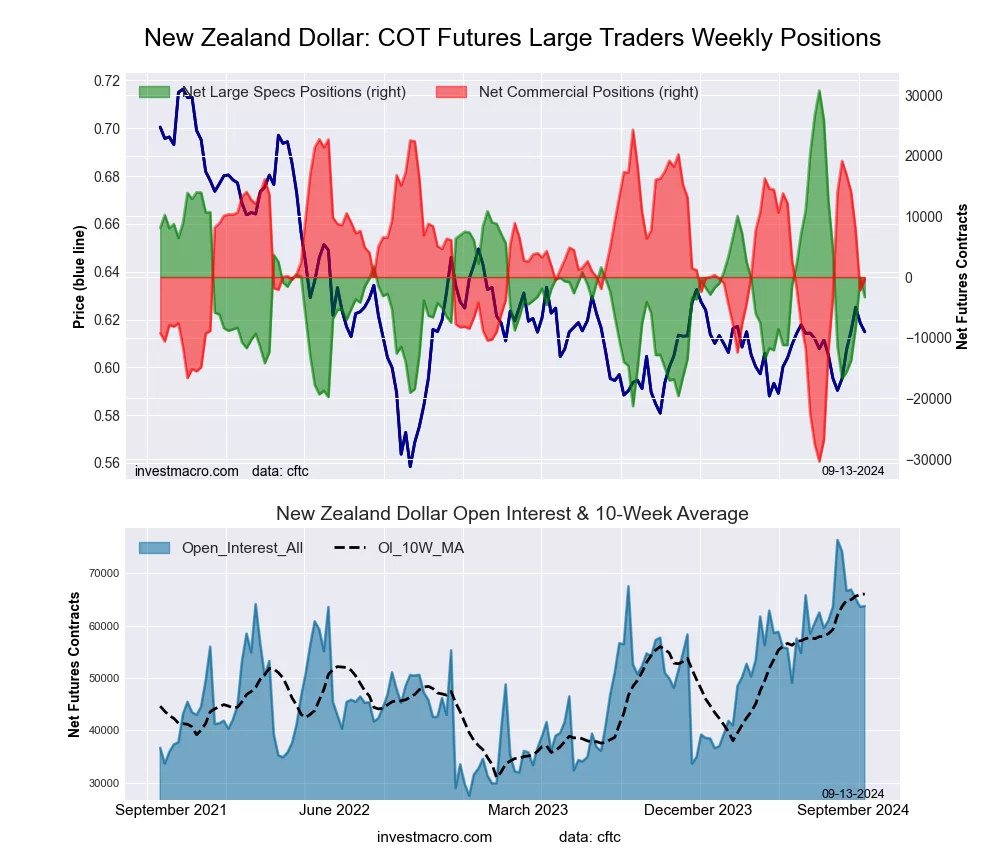
New Zealand Dollar Forex Futures COT ChartThe New Zealand Dollar large speculator standing this week resulted in a net position of -16,751 contracts in the data reported through Tuesday. This was a weekly decrease of -5,343 contracts from the previous week which had a total of -11,408 net contracts.

This week’s current strength score (the trader positioning range over the past three years, measured from 0 to 100) shows the speculators are currently Bearish-Extreme with a score of 8.7 percent. The commercials are Bullish-Extreme with a score of 90.6 percent and the small traders (not shown in chart) are Bearish with a score of 25.2 percent.

Price Trend-Following Model: Weak Uptrend

Our weekly trend-following model classifies the current market price position as: Weak Uptrend. The current action for the model is considered to be: Hold – Maintain Long Position.

NEW ZEALAND DOLLAR StatisticsSPECULATORSCOMMERCIALSSMALL TRADERS
– Percent of Open Interest Longs:26.868.04.9
– Percent of Open Interest Shorts:49.442.28.1
– Net Position:-16,75119,140-2,389
– Gross Longs:19,84350,4423,611
– Gross Shorts:36,59431,3026,000
– Long to Short Ratio:0.5 to 11.6 to 10.6 to 1
NET POSITION TREND:
– Strength Index Score (3 Year Range Pct):8.790.625.2
– Strength Index Reading (3 Year Range):Bearish-ExtremeBullish-ExtremeBearish
NET POSITION MOVEMENT INDEX:
– 6-Week Change in Strength Index:-83.485.4-46.1


Mexican Peso Futures:

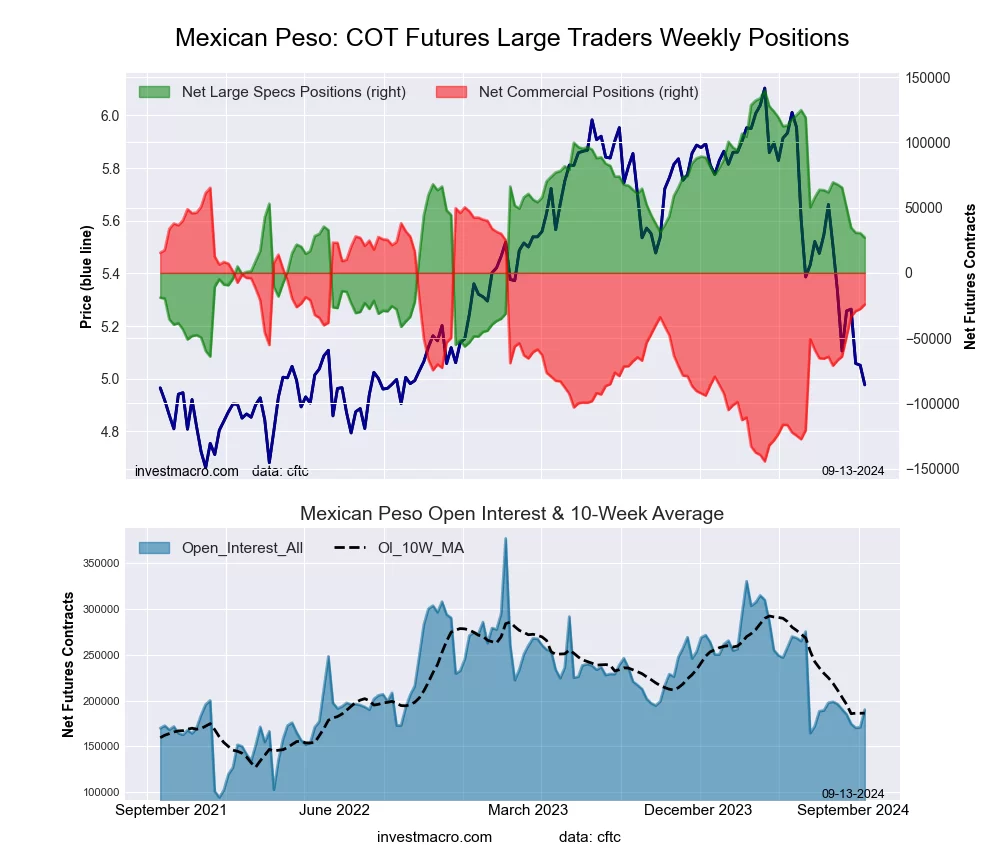
Mexican Peso Futures COT ChartThe Mexican Peso large speculator standing this week resulted in a net position of 65,336 contracts in the data reported through Tuesday. This was a weekly decline of -2,324 contracts from the previous week which had a total of 67,660 net contracts.

This week’s current strength score (the trader positioning range over the past three years, measured from 0 to 100) shows the speculators are currently Bullish with a score of 63.5 percent. The commercials are Bearish with a score of 38.4 percent and the small traders (not shown in chart) are Bearish-Extreme with a score of 2.7 percent.

Price Trend-Following Model: Strong Downtrend

Our weekly trend-following model classifies the current market price position as: Strong Downtrend. The current action for the model is considered to be: Hold – Maintain Short Position.

MEXICAN PESO StatisticsSPECULATORSCOMMERCIALSSMALL TRADERS
– Percent of Open Interest Longs:50.945.62.0
– Percent of Open Interest Shorts:16.679.22.7
– Net Position:65,336-64,007-1,329
– Gross Longs:96,91686,8133,812
– Gross Shorts:31,580150,8205,141
– Long to Short Ratio:3.1 to 10.6 to 10.7 to 1
NET POSITION TREND:
– Strength Index Score (3 Year Range Pct):63.538.42.7
– Strength Index Reading (3 Year Range):BullishBearishBearish-Extreme
NET POSITION MOVEMENT INDEX:
– 6-Week Change in Strength Index:3.7-2.4-15.9


Brazilian Real Futures:

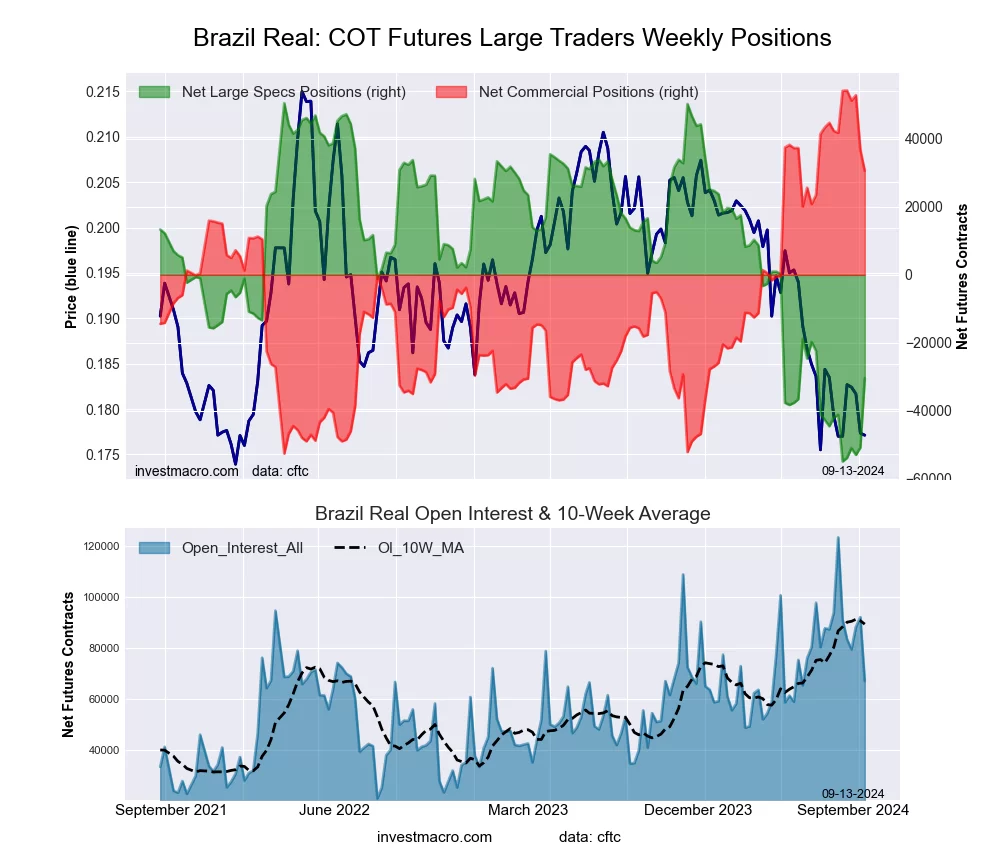
Brazil Real Futures COT ChartThe Brazilian Real large speculator standing this week resulted in a net position of -54,883 contracts in the data reported through Tuesday. This was a weekly decrease of -13,724 contracts from the previous week which had a total of -41,159 net contracts.

This week’s current strength score (the trader positioning range over the past three years, measured from 0 to 100) shows the speculators are currently Bearish-Extreme with a score of 0.0 percent. The commercials are Bullish-Extreme with a score of 100.0 percent and the small traders (not shown in chart) are Bearish with a score of 41.5 percent.

Price Trend-Following Model: Downtrend

Our weekly trend-following model classifies the current market price position as: Downtrend. The current action for the model is considered to be: Hold – Maintain Short Position.

BRAZIL REAL StatisticsSPECULATORSCOMMERCIALSSMALL TRADERS
– Percent of Open Interest Longs:24.171.83.9
– Percent of Open Interest Shorts:84.412.43.0
– Net Position:-54,88354,127756
– Gross Longs:21,98665,4373,508
– Gross Shorts:76,86911,3102,752
– Long to Short Ratio:0.3 to 15.8 to 11.3 to 1
NET POSITION TREND:
– Strength Index Score (3 Year Range Pct):0.0100.041.5
– Strength Index Reading (3 Year Range):Bearish-ExtremeBullish-ExtremeBearish
NET POSITION MOVEMENT INDEX:
– 6-Week Change in Strength Index:-30.928.717.8


Bitcoin Futures:

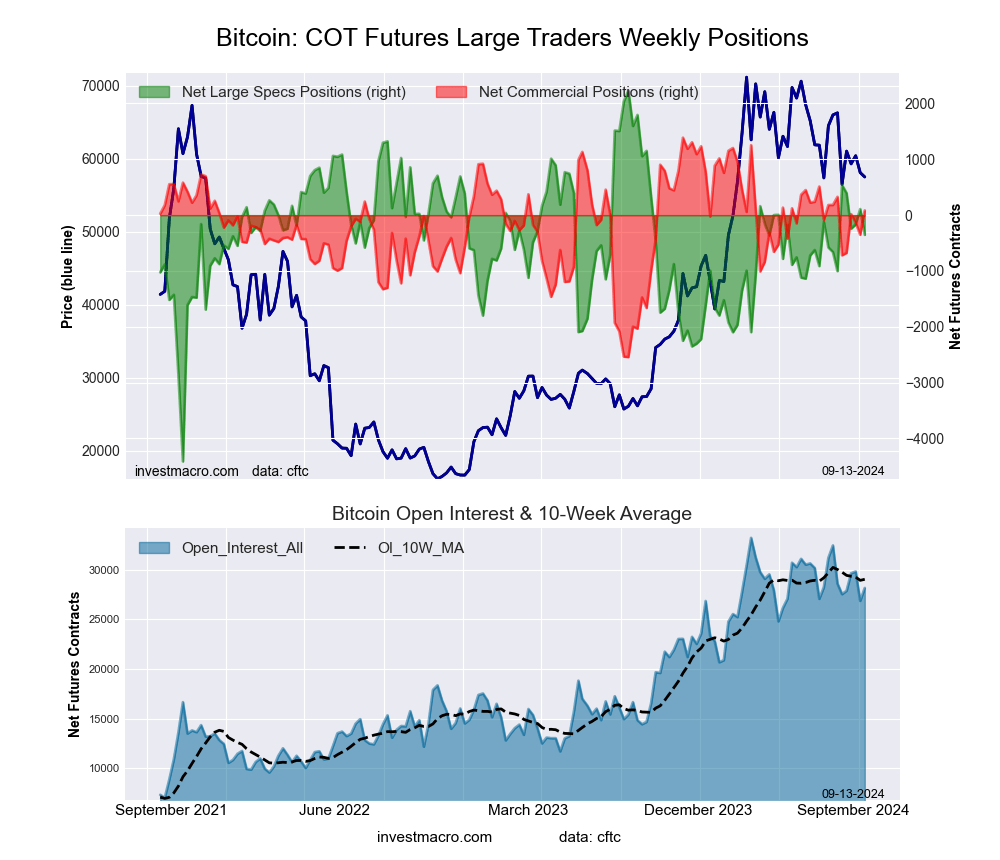
Bitcoin Crypto Futures COT ChartThe Bitcoin large speculator standing this week resulted in a net position of 538 contracts in the data reported through Tuesday. This was a weekly gain of 1,540 contracts from the previous week which had a total of -1,002 net contracts.

This week’s current strength score (the trader positioning range over the past three years, measured from 0 to 100) shows the speculators are currently Bullish with a score of 74.5 percent. The commercials are Bearish with a score of 46.4 percent and the small traders (not shown in chart) are Bearish-Extreme with a score of 17.1 percent.

Price Trend-Following Model: Strong Downtrend

Our weekly trend-following model classifies the current market price position as: Strong Downtrend. The current action for the model is considered to be: Hold – Maintain Short Position.

BITCOIN StatisticsSPECULATORSCOMMERCIALSSMALL TRADERS
– Percent of Open Interest Longs:87.02.14.2
– Percent of Open Interest Shorts:85.04.73.6
– Net Position:538-719181
– Gross Longs:23,9545791,164
– Gross Shorts:23,4161,298983
– Long to Short Ratio:1.0 to 10.4 to 11.2 to 1
NET POSITION TREND:
– Strength Index Score (3 Year Range Pct):74.546.417.1
– Strength Index Reading (3 Year Range):BullishBearishBearish-Extreme
NET POSITION MOVEMENT INDEX:
– 6-Week Change in Strength Index:17.5-24.4-4.6


Article By InvestMacroReceive our weekly COT Newsletter

*COT Report: The COT data, released weekly to the public each Friday, is updated through the most recent Tuesday (data is 3 days old) and shows a quick view of how large speculators or non-commercials (for-profit traders) were positioned in the futures markets.

The CFTC categorizes trader positions according to commercial hedgers (traders who use futures contracts for hedging as part of the business), non-commercials (large traders who speculate to realize trading profits) and nonreportable traders (usually small traders/speculators) as well as their open interest (contracts open in the market at time of reporting). See CFTC criteria here.
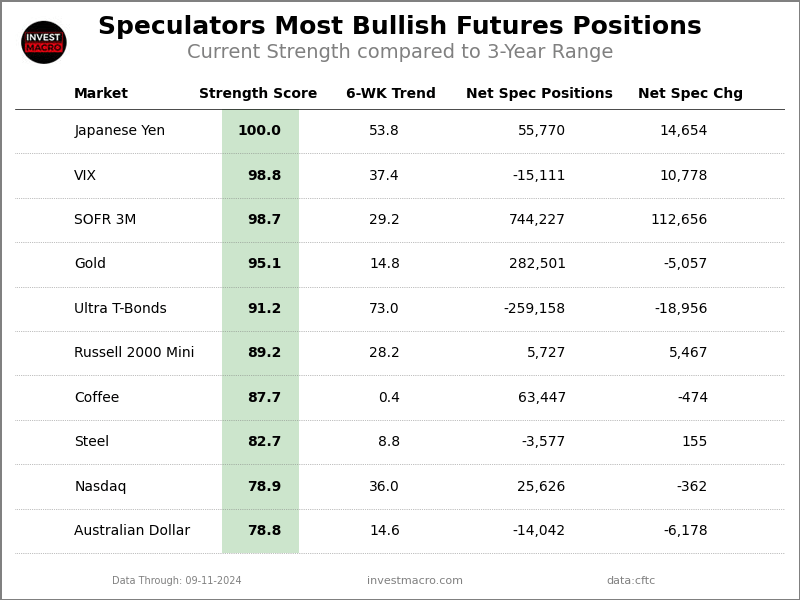
Speculator Extremes: Japanese Yen, Natural Gas & Silver lead Bullish Positions

By InvestMacro

The latest update for the weekly Commitment of Traders (COT) report was released by the Commodity Futures Trading Commission (CFTC) on Friday for data ending on August 6th.

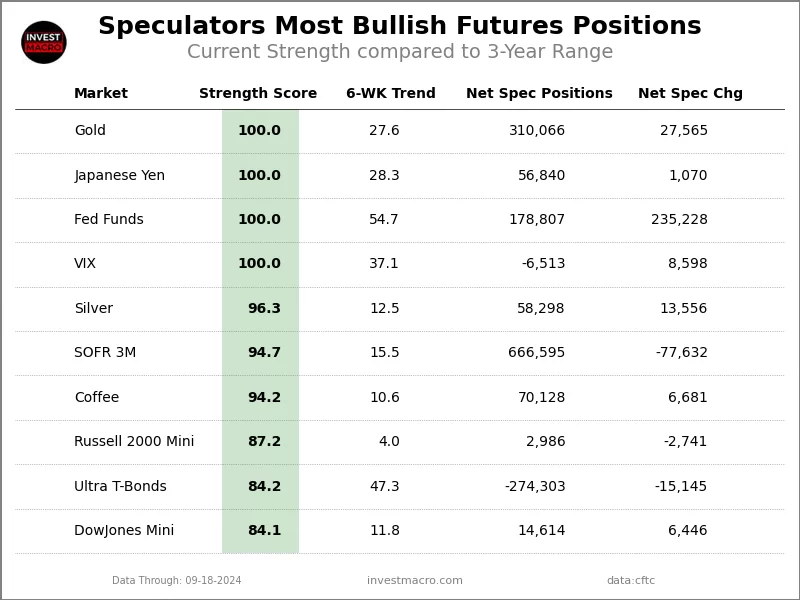
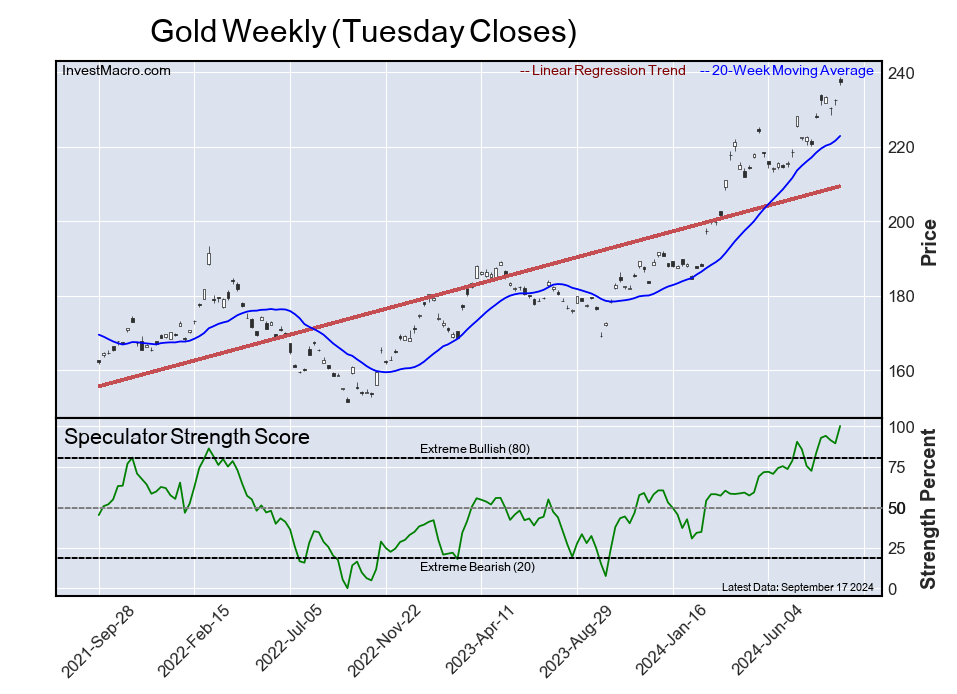
This weekly Extreme Positions report highlights the Most Bullish and Most Bearish Positions for the speculator category. Extreme positioning in these markets can foreshadow strong moves in the underlying market.

To signify an extreme position, we use the Strength Index (also known as the COT Index) of each instrument, a common method of measuring COT data. The Strength Index is simply a comparison of current trader positions against the range of positions over the previous 3 years. We use over 80 percent as extremely bullish and under 20 percent as extremely bearish. (Compare Strength Index scores across all markets in the data table or cot leaders table)


Here Are This Week’s Most Bullish Speculator Positions:

Japanese Yen


The Japanese Yen speculator position comes in as the most bullish extreme standing this week as a volatility spike helped turnaround this currency. The Japanese Yen speculator level is currently at a 100.0 percent score of its 3-year range.

The six-week trend for the percent strength score totaled 94.0 this week. The overall net speculator position was a total of -11,354 net contracts this week with a huge gain of 62,106 contract in the weekly speculator bets.


Speculators or Non-Commercials Notes:

Speculators, classified as non-commercial traders by the CFTC, are made up of large commodity funds, hedge funds and other significant for-profit participants. The Specs are generally regarded as trend-followers in their behavior towards price action – net speculator bets and prices tend to go in the same directions. These traders often look to buy when prices are rising and sell when prices are falling. To illustrate this point, many times speculator contracts can be found at their most extremes (bullish or bearish) when prices are also close to their highest or lowest levels.

These extreme levels can be dangerous for the large speculators as the trade is most crowded, there is less trading ammunition still sitting on the sidelines to push the trend further and prices have moved a significant distance. When the trend becomes exhausted, some speculators take profits while others look to also exit positions when prices fail to continue in the same direction. This process usually plays out over many months to years and can ultimately create a reverse effect where prices start to fall and speculators start a process of selling when prices are falling.


Natural Gas


The Natural Gas speculator position comes next in the extreme standings this week. The Natural Gas speculator level is now at a 88.0 percent score of its 3-year range.

The six-week trend for the percent strength score was 17.6 this week. The speculator position registered -66,340 net contracts this week with a weekly rise of 16,797 contracts in speculator bets.


Silver


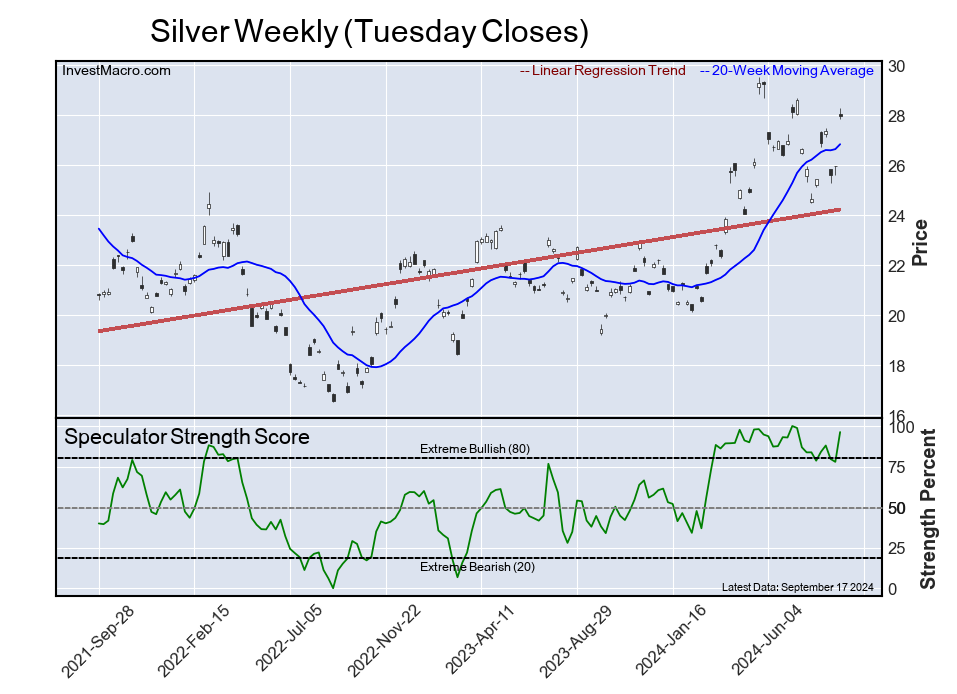
The Silver speculator position comes in third this week in the extreme standings. The Silver speculator level resides at a 83.8 percent score of its 3-year range.

The six-week trend for the speculator strength score came in at -9.3 this week. The overall speculator position was 49,081 net contracts this week with an edge higher by 20 contracts in the weekly speculator bets.


Coffee


The Coffee speculator position comes up number four in the extreme standings this week. The Coffee speculator level is at a 83.6 percent score of its 3-year range.

The six-week trend for the speculator strength score totaled a change of -11.2 this week. The overall speculator position was 59,207 net contracts this week with a dip of -3,809 contracts in the speculator bets.


Russell 2000 Mini


The Russell 2000 Mini speculator position rounds out the top five in this week’s bullish extreme standings. The Russell 2000 Mini speculator level sits at a 83.3 percent score of its 3-year range. The six-week trend for the speculator strength score was 33.6 this week.

The speculator position was -2,595 net contracts this week with a boost of 31,390 contracts in the weekly speculator bets.


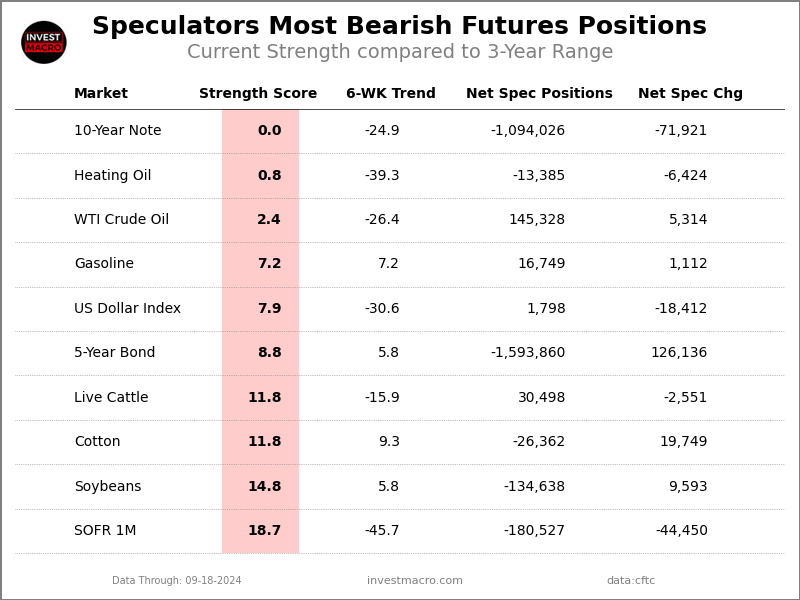
This Week’s Most Bearish Speculator Positions:

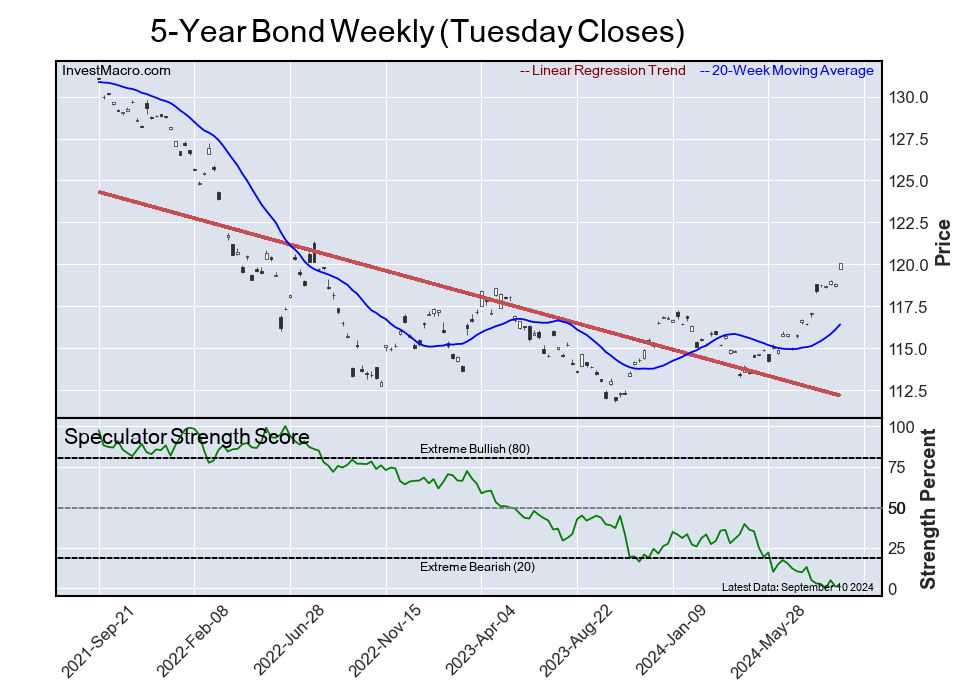
5-Year Bond


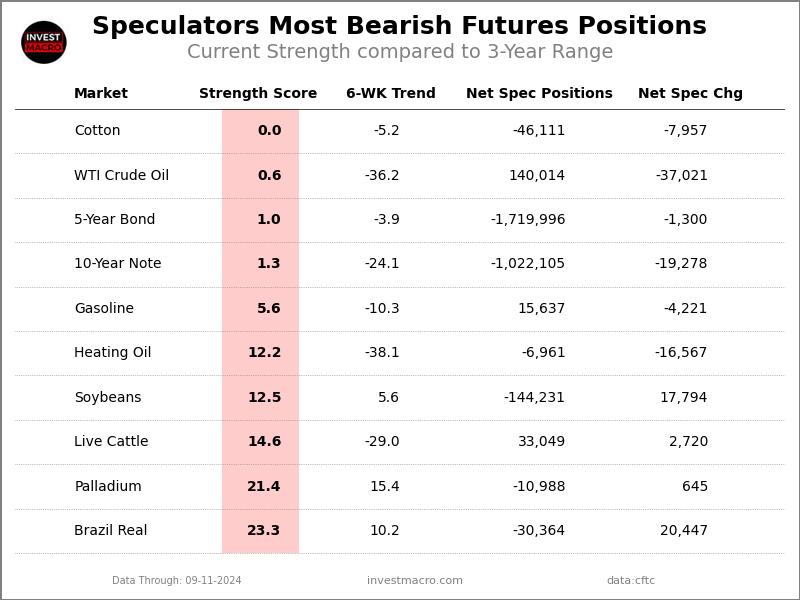
The 5-Year Bond speculator position comes in as the most bearish extreme standing this week. The 5-Year Bond speculator level is at a 0.0 percent score of its 3-year range.

The six-week trend for the speculator strength score was -11.3 this week. The overall speculator position was -1,688,076 net contracts this week with a drop of -32,038 contracts in the speculator bets.


Brazil Real


The Brazil Real speculator position comes in next for the most bearish extreme standing on the week. The Brazil Real speculator level is at a 0.0 percent score of its 3-year range.

The six-week trend for the speculator strength score was -30.9 this week. The speculator position was -54,883 net contracts this week with a decrease of -13,724 contracts in the weekly speculator bets.


Cotton


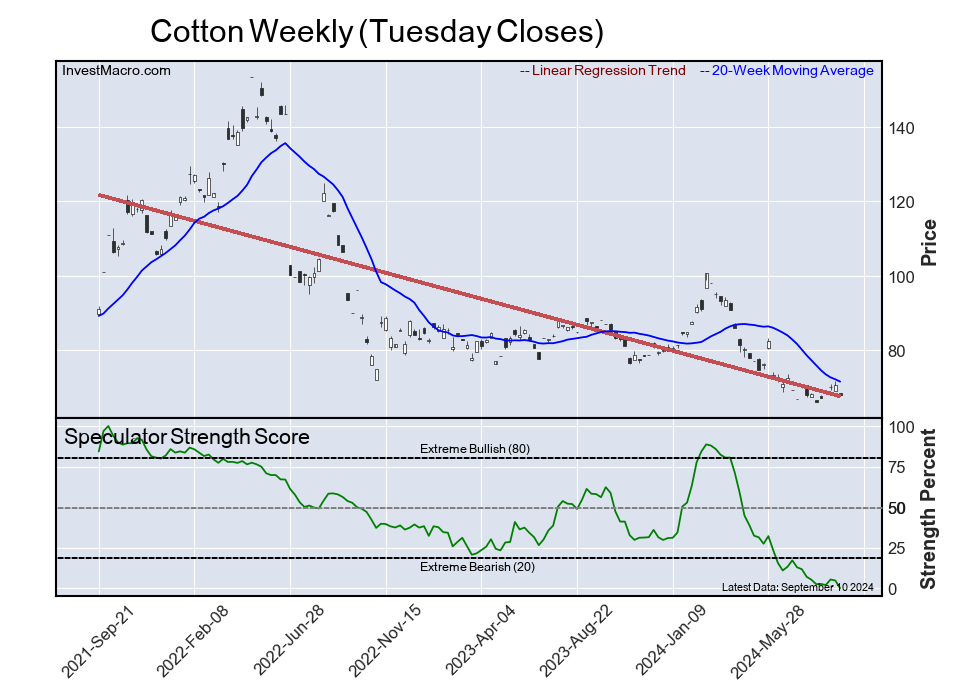
The Cotton speculator position comes in as third most bearish extreme standing of the week. The Cotton speculator level resides at a 0.0 percent score of its 3-year range.

The six-week trend for the speculator strength score was -11.0 this week. The overall speculator position was -41,908 net contracts this week with a decline of -4,567 contracts in the speculator bets.


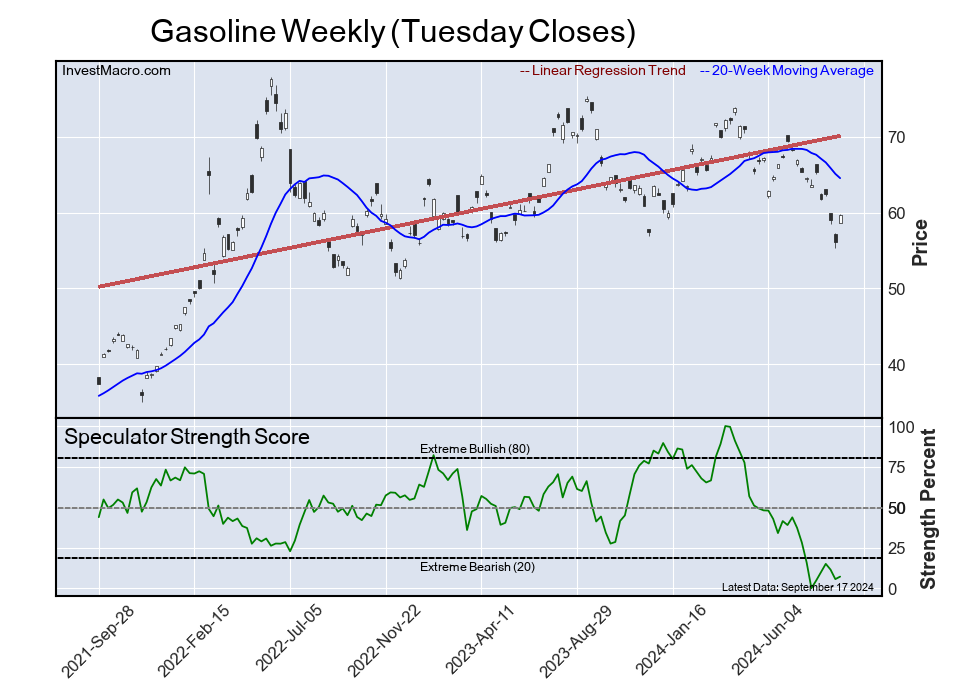
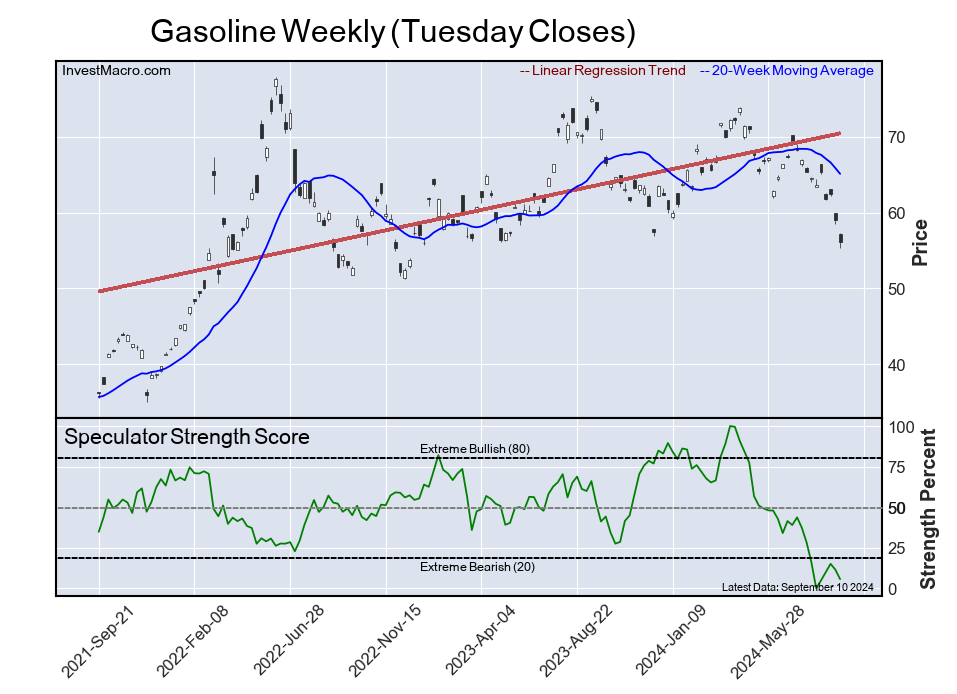
Gasoline


The Gasoline speculator position comes in as this week’s fourth most bearish extreme standing. The Gasoline speculator level is at a 0.0 percent score of its 3-year range.

The six-week trend for the speculator strength score was -41.4 this week. The speculator position was 11,587 net contracts this week with a drop of -11,469 contracts in the weekly speculator bets.


Palladium


Finally, the Palladium speculator position comes in as the fifth most bearish extreme standing for this week. The Palladium speculator level is at a 4.4 percent score of its 3-year range.

The six-week trend for the speculator strength score was -2.2 this week. The speculator position was -13,244 net contracts this week with an edge lower by -153 contracts in the weekly speculator bets.


Article By InvestMacroReceive our weekly COT Newsletter

*COT Report: The COT data, released weekly to the public each Friday, is updated through the most recent Tuesday (data is 3 days old) and shows a quick view of how large speculators or non-commercials (for-profit traders) were positioned in the futures markets.

The CFTC categorizes trader positions according to commercial hedgers (traders who use futures contracts for hedging as part of the business), non-commercials (large traders who speculate to realize trading profits) and nonreportable traders (usually small traders/speculators) as well as their open interest (contracts open in the market at time of reporting). See CFTC criteria here.
Week Ahead: US30 index still sensitive to US recession fears

By ForexTime 

  • Markets still obsessed with deciphering US recession risks
  • Home Depot, Walmart earnings offer pulse on US economy
  • Latest US inflation data also holds clues about Fed’s next moves
  • Economically-sensitive US30 stock index ready to punch above 50-day SMA resistance


Markets are still obsessed about the risks of a US recession.

Traders and investors worldwide are still licking their wounds from the recent plunge across global financial markets, following last Friday’s unexpected rise in the US unemployment rate (4.3% in July).

Against such a backdrop, next week’s US economic data and US earnings releases could shift market expectations surrounding a US recession, and whether the Fed will be forced to cut rates aggressively.


Tuesday, August 13

  • JPY: Japan July PPI
  • AUD: Australia August consumer and business confidence
  • GBP: UK June unemployment, July jobless claims
  • GER40 index: Germany August ZEW survey expectations
  • ZAR: South Africa 2Q unemployment
  • USD index: US July PPI; speech by Atlanta Fed President Raphael Bostic
  • US30 index: Home Depot earnings

Wednesday, August 14

  • NZD: RBNZ rate decision
  • UK100 index: UK July CPI
  • EU50 index: Eurozone 2Q GDP, June industrial production
  • ZAR: South Africa June retail sales
  • US500 index: US July CPI

Thursday, August 15

  • JP225 index: Japan 2Q GDP
  • AU2000 index: Australia July unemployment
  • CNH: China July home prices, industrial production, retail sales, jobless rate
  • GBP: UK 2Q GDP; June industrial production, trade balance
  • NOK: Norway rate decision
  • RUS2000 index: US weekly initial jobless claims; July retail sales and industrial production
  • US30 index: Walmart earnings; speeches by St. Louis Fed President Alberto Musalem, Philadelphia Fed President Patrick Harker
  • CHINAH index: Earnings from Alibaba, JD.com

Friday, August 16

  • SG20 index: Singapore July exports
  • GBP: UK July retail sales
  • TWN index: Taiwan 2Q GDP
  • US400 index: US August consumer sentiment; speech by Chicago Fed President Austan Goolsbee


For the coming week, we focus on the US30 stock index.

After all, the share prices of the 30 companies contained within this stock index are deemed to be more reflective of real economic conditions (as opposed to say growth/tech/AI stocks).

Hence, the imminent earnings releases by these major companies, along with the incoming top-tier economic data, could contribute to outsized trading opportunities for this stock index next week.

The events highlighted below may well determine if the US30 index can conquer its 50-day simple moving average (SMA) resistance that it’s battled with all week long.

US30 index battles 50-day SMA resistance


1) Tuesday, August 13th: Home Depot earnings (before US markets open)

The Home Depot is the world’s largest home improvement specialty retailer, operating over 2,300 stores across North America (including Canada and Mexico).

In other words …

Home Depot’s earnings are reflective of the strength of consumer spending.

Markets are set to interpret this retail giant’s earnings for signs if consumer spending is still resilient, or whether households are already reeling from high interest rates, persistent inflation, and recession fears.

Depending on the earnings release, markets forecast this stock could move by 5.5%, either up or down, once US markets reopen on Tuesday, just hours after the company’s earnings are released.

Home Depot accounts for 5.8% of the US30 index, making it the 4th biggest stock on the Dow Jones Industrial Average index / Dow / FXTM’s US30 index.

That means the market’s reaction to Home Depot’s earnings could sway the broader US30 index in tandem.

Note that Tuesday also features the release of the US producer price index (PPI) and a speech by Atlanta Fed President Raphael Bostic, either of which could also sway the US30 index, in addition to Home Depot’s earnings.


2) Wednesday, August 14th: US July consumer price index (CPI)

The CPI is a widely followed measure of inflation.

And we know that red-hot inflation has been the bane of the Federal Reserve in recent years, though the US central bank has since made substantial progress in quelling it.

However, has it been enough? Or will the Fed be forced to maintain its benchmark rates at its current 23-year high of 5.5%?

Economists predict a soft and manageable uplift to the incoming CPI figures:

  • CPI month-on-month (July 2024 vs. June 2024): 0.2%
    (if so, that would be a return to positive territory from June’s -0.1% month-on-month figure)
  • CPI core (excluding food and energy prices) month-on-month: 0.2%
    (if so, that would be slightly higher from June’s 0.1% month-on-month figure)
  • CPI year-on-year (July 2024 vs. July 2023): 3%
    (if so, that would match June’s 3% year-on-year figure)
  • CPI core year-on-year: 3.2%
    (if so, that would be slightly lower than June’s 3.3% core year-on-year figure)

This incoming inflation data would be read as they pertain to the likelihood of Fed rate cuts, given that the US central bank now has to juggle between subduing inflation and not causing too much damage to the US jobs market, now more so in light of the recent surprise jump in US unemployment.


POTENTIAL SCENARIOS

  • If the CPI comes in higher than expected, that may force the Fed to hold interest rates higher still while risking more damage to the US labour market.

    Should markets then perceive greater odds for a US recession, that could send the US30 index plummeting back below its 100-day SMA and towards its 200-day SMA.


  • If the CPI comes in lower than expected, that should allow the Fed to lower interest rates in September to shore up support for the US labour market.

    If markets then believe that US recession risks are subsiding, that could see the US30 index rejoicing as it punches past its 50-day SMA and perhaps reaching the 40,000 mark.


3) Thursday, August 15th: Walmart earnings (before US markets open)

Walmart is a retail behemoth that serves about 255 million customers per week across some 10,500 stores, drawing over 80% of its revenue from its US customers.

Depending on what Walmart announces, markets forecast this stock could move by 5%, either up or down, once US markets reopen on Thursday, just hours after the company’s earnings are released.

Despite its sheer presence in the physical world, Walmart “merely” accounts for 1.1% of the US30 index.

Still, given how its earnings are reflective of US consumer spending habits, the market may well interpret Walmart’s earnings as an indicator of the US economic outlook.

The shifting odds of a US recession, via Walmart’s earnings, are bound to impact the US30 index’s performance as well.

Note that Thursday also features the release of the weekly US initial jobless claims, as well as July’s retail sales and industrial production data, all of which could sway the US30 index as well, on top of Walmart’s earnings.


Forex-Time-LogoArticle by ForexTime

ForexTime Ltd (FXTM) is an award winning international online forex broker regulated by CySEC 185/12 www.forextime.com

Market “Olympics”: Best-performing financial assets so far in 2024

By ForexTime 

  • US Dollar still reigns, though perhaps not much longer
  • GBP: best-performing G10 currency vs. USD year-to-date (YTD)
  • NETH25: FXTM’s best-performing stock index YTD
  • Cocoa: FXTM’s best-performing commodity YTD
  • Nvidia: best-performing stock on the S&P 500 YTD
  • Solana: FXTM’s best-performing crypto YTD


We’re in the final stretch of the 2024 Olympics, set to end August 11th.

The United States is leading the Olympic medals tally after weeks of sporting conquests across disciplines and arenas.

In similar fashion, we scan across global financial markets and highlight the world champions of their respective asset classes (and within the FXTM universe), so far in 2024 (year-to-date).


G10 currency (vs. US dollar):

  • British Pound

Although GBPUSD is down about 0.3% so far this year, it’s still beating the rest of the G10 pack in terms of being the smallest year-to-date loser against the US dollar. Even the fast-recovering Japanese Yen remains in 6th place.

To be clear, the US Dollar index still boasts a year-to-date gain of 1.77% at the time of writing.

While King Dollar still reigns supreme, its gains may be wiped out over the rest of the year, if the Federal Reserve follows through with the aggressive US rate cuts that markets expect.

If US rates are lowered at a faster pace compared to its G10 peers, that could help push the likes of GBP into a positive year-to-date performance.


Stock Index:

  • NETH25

FXTM’s NETH25 stock index tracks the performance of the AEX index – the Amsterdam Exchange index.

The AEX index measures the overall performance of the 25 biggest and most actively traded shares on Euronext Amsterdam.

Led by semiconductor giant ASML – Europe’s largest tech company by market cap, also the biggest stock on the AEX index – ASML’s surge has also boosted its host index simultaneously.

Despite falling by as much as 8.9% since mid-July, amid the broader declines for global equities, the NETH25 index is still holding onto much of its gains garnered from earlier this year.

The NETH25 is still up about 11% on a year-to-date basis.

However, those year-to-date gains may be further eroded if there’s further selling across global equities amid fears of a US recession that darkens the global economic outlook, as well as lessened spending on semiconductors by AI-industry players.


Metal/Commodity:

  • Cocoa

This global commodity still holds a year-to-date advance of 103%, far beating the likes of gold (+16.9% YTD) and US crude oil (+5.1% YTD).

There has been a global shortage of cocoa, as evidenced by US inventories of cocoa beans falling to their lowest level in over 4 years.

However, such gains may not last.

Markets expect a recovery in west African production of cocoa to recover in the months ahead. The global cocoa market is projected to flip from a deficit into a surplus (more cocoa beans supplied than demanded by sweet-toothed consumers) next year.

With markets well aware of this outlook, no surprise that cocoa prices has only managed lower highs since April 2024, though retaining its triple-digit year-to-date gains, for now.

Overall, global commodities, from cocoa to crude oil, may well see further declines if a US recession is confirmed, along with still-sluggish Chinese economic growth, which combined to weigh down the global economy.


US Stock (on the S&P 500):

  • Nvidia

Much has already been made about how Nvidia has been a star performer on the US stock market in recent years.

It’s been on a seemingly unrelenting quest of posting new record highs at the height of the AI-mania, before crashing back down to earth in recent weeks.

Though having fallen by about 27% since its all-time high set on June 18th …

Nvidia still holds a year-to-date gain of nearly 100%

(99.7% to be more precise, before US markets open on August 8th).

This stock may yet recover back to its record highs, once the ongoing selloff abates.

Wall Street still predicts a 43% upside over the next 12 months, with a target price of $141.35.

If it gets there, that would be a new record high for Nvidia’s stocks in 2025, unless markets believe the artificial intelligence mania has been a lot more hype and its AI-fuelled profits have already peaked.


Cryptocurrency:

  • Solana

Solana’s year-to-date gains stand at 51.5% at the time of writing, exceeding Bitcoin’s YTD advance of 35%.

Given the respective debuts of Bitcoin ETFs and Ethereum ETFs earlier this year, the crypto market’s attentions have now turned to other cryptocurrencies that could be next in the ETF pipeline.

ETFs = Exchange-traded funds, which can be bought and sold like regular stocks on a centralised exchange. ETFs make it easier, and more secure, for investors (both retail and institutional) to gain access to the underlying crypto without having to directly purchase the digital asset.

If the US government turns increasingly pro crypto, especially if we see a return of President Trump to the White House after the November US Presidential elections, then cryptocurrencies stand to be restored to their recent peaks respectively.

Solana bulls (those betting that prices will rise) will be hoping that their favoured crypto could move back closer to the psychologically-important $200 level.


It remains to be seen which specific instrument will sit atop of their respective asset classes by the end of this year.

What’s more certain is that the remaining months of 2024 may yet bring more volatility, in light of heightened geopolitical tensions, fears of a US recession, as well as political uncertainties stemming from the US Presidential Elections.

That should produce large opportunities for traders and investors who remain alert to the macro picture across financial markets.


Forex-Time-LogoArticle by ForexTime

ForexTime Ltd (FXTM) is an award winning international online forex broker regulated by CySEC 185/12 www.forextime.com

Verifying facts in the age of AI – librarians offer 5 strategies

By Tracy Bicknell-Holmes, Boise State University; Elaine Watson, Boise State University, and Memo Cordova, Boise State University 

The phenomenal growth in artificial intelligence tools has made it easy to create a story quickly, complicating a reader’s ability to determine if a news source or article is truthful or reliable. For instance, earlier this year, people were sharing an article about the supposed suicide of Israeli Prime Minister Benjamin Netanyahu’s psychiatrist as if it were real. It ended up being an AI-generated rewrite of a satirical piece from 2010.

The problem is widespread. According to a 2021 Pearson Institute/AP-NORC poll, “Ninety-five percent of Americans believe the spread of misinformation is a problem.” The Pearson Institute researches methods to reduce global conflicts.

As library scientists, we combat the increase in misinformation by teaching a number of ways to validate the accuracy of an article. These methods include the SIFT Method (Stop, Investigate, Find, Trace), the P.R.O.V.E.N. Source Evaluation method (Purpose, Relevance, Objectivity, Verifiability, Expertise and Newness), and lateral reading.

Lateral reading is a strategy for investigating a source by opening a new browser tab to conduct a search and consult other sources. Lateral reading involves cross-checking the information by researching the source rather than scrolling down the page.

Here are five techniques based on these methods to help readers determine news facts from fiction:

1. Research the author or organization

Search for information beyond the entity’s own website. What are others saying about it? Are there any red flags that lead you to question its credibility? Search the entity’s name in quotation marks in your browser and look for sources that critically review the organization or group. An organization’s “About” page might tell you who is on their board, their mission and their nonprofit status, but this information is typically written to present the organization in a positive light.

The P.R.O.V.E.N. Source Evaluation method includes a section called “Expertise,” which recommends that readers check the author’s credentials and affiliations. Do the authors have advanced degrees or expertise related to the topic? What else have they written? Who funds the organization and what are their affiliations? Do any of these affiliations reveal a potential conflict of interest? Might their writings be biased in favor of one particular viewpoint?

If any of this information is missing or questionable, you may want to stay away from this author or organization.

2. Use good search techniques

Become familiar with search techniques available in your favorite web browser, such as searching keywords rather than full sentences and limiting searches by domain names, such as .org, .gov, or .edu.

Another good technique is putting two or more words in quotation marks so the search engine finds the words next to each other in that order, such as “Pizzagate conspiracy.” This leads to more relevant results.

In an article published in Nature, a team of researchers wrote that “77% of search queries that used the headline or URL of a false/misleading article as a search query return at least one unreliable news link among the top ten results.”

A more effective search would be to identify the key concepts in the headline in question and search those individual words as keywords. For example, if the headline is “Video Showing Alien at Miami Mall Sparks Claims of Invasion,” readers could search: “Alien invasion” Miami mall.

3. Verify the source

Verify the original sources of the information. Was the information cited, paraphrased or quoted accurately? Can you find the same facts or statements in the original source? Purdue Global, Purdue University’s online university for working adults, recommends verifying citations and references that can also apply to news stories by checking that the sources are “easy to find, easy to access, and not outdated.” It also recommends checking the original studies or data cited for accuracy.

The SIFT Method echoes this in its recommendation to “trace claims, quotes, and media to the original context.” You cannot assume that re-reporting is always accurate.

4. Use fact-checking websites

Search fact-checking websites such as InfluenceWatch.org, Poynter.org, Politifact.com or Snopes.com to verify claims. What conclusions did the fact-checkers reach about the accuracy of the claims?

A Harvard Kennedy School Misinformation Review article found that the “high level of agreement” between fact-checking sites “enhances the credibility of fact checkers in the eyes of the public.”

5. Pause and reflect

Pause and reflect to see if what you have read has triggered a strong emotional response. An article in the journal Cognitive Research indicates that news items that cause strong emotions increase our tendency “to believe fake news stories.”

One online study found that the simple act of “pausing to think” and reflect on whether a headline is true or false may prevent a person from sharing false information. While the study indicated that pausing only decreases intentions to share by a small amount – 0.32 points on a 6-point scale – the authors argue that this could nonetheless cut down on the spread of fake news on social media.

Knowing how to identify and check for misinformation is an important part of being a responsible digital citizen. This skill is all the more important as AI becomes more prevalent.The Conversation

About the Authors:

Tracy Bicknell-Holmes, Library professor, Boise State University; Elaine Watson, Librarian and Associate Professor, Boise State University, and Memo Cordova, Library associate professor, Boise State University

This article is republished from The Conversation under a Creative Commons license. Read the original article.


Inflation-Resilient Stocks: Why Progressive (PGR) Stands Out

By The Ino.com Team

In July, U.S. consumer confidence unexpectedly ticked up, offering a glimmer of optimism despite ongoing concerns about inflation and rising borrowing costs. The Federal Reserve’s closely watched gauge revealed that inflation eased slightly in June, with the personal consumption expenditures price index inching up by just 0.1% on the month and 2.5% year-over-year. While this slightly improved from May’s 2.6% increase, inflation still hovers above the Fed’s long-term target of 2%, keeping the door open for a potential interest rate cut in September.

In such an inflationary environment, the insurance industry emerges as a safe harbor for investors seeking stability. Insurance isn’t just a safety net; it’s a lifeline for individuals and businesses alike, offering protection from unforeseen events and often fulfilling legal and financial requirements. The industry is notoriously competitive, with many insurers struggling to stand out. However, The Progressive Corporation (PGR) has distinguished itself by excelling in balancing risk and reward.

Progressive’s Strategy for Thriving in Inflationary Times

In recent years, the insurance sector has battled rising inflation, which has driven up repair and replacement costs and impacted profitability. Yet Progressive has adeptly navigated the storm. Since its public debut in 1971, the powerhouse automotive insurer has consistently aimed for a combined ratio of 96%, ensuring it makes $4 in profit for every $100 in premiums received.

While many auto insurers struggled with their worst loss ratios in two decades last year, PGR achieved a combined ratio of 94.5%. This year, they’ve done even better, with a combined ratio of 91.9% in the first half. This strong performance has translated into impressive stock returns, with shares up more than 70% over the past year and nearly 35% year-to-date.

For the second quarter that ended June 30, 2024, PGR’s net premiums earned increased 19% year-over-year to $17.21 billion. Its net income came in at $1.46 billion, or $2.48 per common share, up 322.3% and 335.1% year-over-year, respectively. The company generated total revenues of $35.38 billion year-to-date, compared to $29.66 billion in 2023.

Street expects PGR’s revenue and EPS for the third quarter (ending September 2024) to increase 21.1% and 25.5% year-over-year to $18.89 billion and $2.65, respectively. Moreover, the company has consistently surpassed consensus EPS estimates in each of the trailing four quarters, including the second quarter.

What sets Progressive apart is its innovative approach to insurance. As one of the pioneers in using telematics, or driver data, to price insurance policies, the company has leveraged technology to stay ahead of its competitors.

Moreover, PGR’s non-GAAP PEG ratio is a mere 0.06, indicating that despite its solid growth prospects, the stock is undervalued, making it an attractive option for growth-seeking investors. The company’s strong performance across different market conditions due to its beta of 0.36 further enhances its appeal.

Progressive’s conservative investment strategy, with a focus on shorter-dated debt investments, positions it well to benefit from sustained higher interest rates, making it a strong long-term hold for investors. Morgan Stanley analyst Bob Jian Huang forecasts that the company will capture over 18% of the market by 2028, thanks to its competitive strength and innovative edge.

Progressive vs. Allstate: Which Stock Offers Greater Investment Potential?

While Progressive has adeptly managed rising inflation and repair costs with innovative approaches like telematics, The Allstate Corporation (ALL) has faced its own set of challenges, particularly from natural disasters and high inflation. In 2023, U.S. home insurers experienced their worst underwriting losses this century, with net underwriting losses reaching an eye-watering $15.2 billion. This was largely due to increasing populations in high-risk areas like California and Texas, which exacerbated the impact of natural catastrophes.

To combat these pressures, Allstate has proposed a substantial 34% increase in homeowners’ insurance premiums. This move, pending approval from the California Department of Insurance, aims to mitigate the financial impact of escalating claims and weather-related damages. This isn’t unprecedented, as insurance companies, including State Farm, have also sought similar rate hikes based on claims history and market conditions.

Although this move mirrors PGR’s strategy of adjusting premiums to maintain profitability amidst rising costs, ALL’s focus has been more on addressing the financial stress from natural disasters rather than leveraging technology for competitive advantage.

Despite these hurdles, ALL shares have surged more than 52% over the past year and 22.3% year-to-date, demonstrating strong performance in a turbulent market.

Financially, the company has delivered solid results that are at par with Progressive’s financial performance. ALL’s consolidated net revenues for the second quarter ended June 30, 2024, increased 12.4% year-over-year to $15.71 billion. The company’s adjusted net income amounted to $429 million and $1.61 per share, compared to an adjusted net loss of $1.16 billion and $4.42 per share in the year-ago quarter, respectively. Furthermore, its property-liability insurance premiums earned rose 11.9% year-over-year to $13.34 billion.

Analysts expect ALL’s revenue for the quarter ending September 30, 2024, to increase 8.4% year-over-year to $15.71 billion. Its EPS for the same period is expected to increase 273.6% year-over-year to $3.03. It surpassed the consensus EPS estimates in three of the trailing four quarters.

Moreover, the company’s strong financial health enables it to consistently deliver value to its shareholders. With 13 years of consecutive dividend growth, ALL pays a $3.68 per share dividend annually, translating to a 2.12% yield on the current share price. Its four-year dividend yield is 2.49%. The company’s dividend payouts have grown at CAGRs of 10.3% and 13.5% over the past three and five years, respectively.

Allstate is currently trading at a relatively discounted valuation. The stock’s forward EV/Sales multiple stands at 0.87, which is below the industry average of 3.17x and its five-year median of 0.97x. This attractive valuation provides a margin of safety for investors, reducing downside risk while offering substantial upside potential.

Given these factors, Allstate presents a strong investment case. However, when comparing it to Progressive, ALL’s more traditional approach may not offer the same innovative edge. While both companies exhibit resilience and growth prospects, PGR’s forward-thinking strategies and consistent performance in diverse market conditions position it as the more compelling choice for those seeking robust long-term returns.

By Ino.com – See our Trader Blog, INO TV Free & Market Analysis Alerts

Source: Inflation-Resilient Stocks: Why Progressive (PGR) Stands Out

AIs encode language like brains do − opening a window on human conversations

By Zaid Zada, Princeton University 

Language enables people to transmit thoughts to each other because each person’s brain responds similarly to the meaning of words. In our newly published research, my colleagues and I developed a framework to model the brain activity of speakers as they engaged in face-to-face conversations.

We recorded the electrical activity of two people’s brains as they engaged in unscripted conversations. Previous research has shown that when two people converse, their brain activity becomes coupled, or aligned, and that the degree of neural coupling is associated with better understanding of the speaker’s message.

A neural code refers to particular patterns of brain activity associated with distinct words in their contexts. We found that the speakers’ brains are aligned on a shared neural code. Importantly, the brain’s neural code resembled the artificial neural code of large language models, or LLMs.

The neural patterns of words

A large language model is a machine learning program that can generate text by predicting what words most likely follow others. Large language models excel at learning the structure of language, generating humanlike text and holding conversations. They can even pass the Turing test, making it difficult for someone to discern whether they are interacting with a machine or a human. Like humans, LLMs learn how to speak by reading or listening to text produced by other humans.

By giving the LLM a transcript of the conversation, we were able to extract its “neural activations,” or how it translates words into numbers, as it “reads” the script. Then, we correlated the speaker’s brain activity with both the LLM’s activations and with the listener’s brain activity. We found that the LLM’s activations could predict the speaker and listener’s shared brain activity.

To be able to understand each other, people have a shared agreement on the grammatical rules and the meaning of words in context. For instance, we know to use the past tense form of a verb to talk about past actions, as in the sentence: “He visited the museum yesterday.” Additionally, we intuitively understand that the same word can have different meanings in different situations. For instance, the word cold in the sentence “you are cold as ice” can refer either to one’s body temperature or personality trait, depending on the context. Due to the complexity and richness of natural language, until the recent success of large language models, we lacked a precise mathematical model to describe it.

Our study found that large language models can predict how linguistic information is encoded in the human brain, providing a new tool to interpret human brain activity. The similarity between the human brain’s and the large language model’s linguistic code has enabled us, for the first time, to track how information in the speaker’s brain is encoded into words and transferred, word by word, to the listener’s brain during face-to-face conversations. For example, we found that brain activity associated with the meaning of a word emerges in the speaker’s brain before articulating a word, and the same activity rapidly reemerges in the listener’s brain after hearing the word.

Powerful new tool

Our study has provided insights into the neural code for language processing in the human brain and how both humans and machines can use this code to communicate. We found that large language models were better able to predict shared brain activity compared with different features of language, such as syntax, or the order in which words connect to form phrases and sentences. This is partly due to the LLM’s ability to incorporate the contextual meaning of words, as well as integrate multiple levels of the linguistic hierarchy into one model: from words to sentences to conceptual meaning. This suggests important similarities between the brain and artificial neural networks.

An important aspect of our research is using everyday recordings of natural conversations to ensure that our findings capture the brain’s processing in real life. This is called ecological validity. In contrast to experiments in which participants are told what to say, we relinquish control of the study and let the participants converse as naturally as possible. This loss of control makes it difficult to analyze the data because each conversation is unique and involves two interacting individuals who are spontaneously speaking. Our ability to model neural activity as people engage in everyday conversations attests to the power of large language models.

Other dimensions

Now that we’ve developed a framework to assess the shared neural code between brains during everyday conversations, we’re interested in what factors drive or inhibit this coupling. For example, does linguistic coupling increase if a listener better understands the speaker’s intent? Or perhaps complex language, like jargon, may reduce neural coupling.

Another factor that can influence linguistic coupling may be the relationship between the speakers. For example, you may be able to convey a lot of information with a few words to a good friend but not to a stranger. Or you may be better neurally coupled to political allies rather than rivals. This is because differences in the way we use words across groups may make it easier to align and be coupled with people within rather than outside our social groups.The Conversation

About the Author:

Zaid Zada, Ph.D. Candidate in Psychology, Princeton University

This article is republished from The Conversation under a Creative Commons license. Read the original article.

Speculator Extremes: Coffee, GBP, Gasoline, Cotton & CAD lead Bullish & Bearish Positions

By InvestMacro

The latest update for the weekly Commitment of Traders (COT) report was released by the Commodity Futures Trading Commission (CFTC) on Friday for data ending on July 30th.

This weekly Extreme Positions report highlights the Most Bullish and Most Bearish Positions for the speculator category. Extreme positioning in these markets can foreshadow strong moves in the underlying market.

To signify an extreme position, we use the Strength Index (also known as the COT Index) of each instrument, a common method of measuring COT data. The Strength Index is simply a comparison of current trader positions against the range of positions over the previous 3 years. We use over 80 percent as extremely bullish and under 20 percent as extremely bearish. (Compare Strength Index scores across all markets in the data table or cot leaders table)


Speculators or Non-Commercials Notes:

Speculators, classified as non-commercial traders by the CFTC, are made up of large commodity funds, hedge funds and other significant for-profit participants. The Specs are generally regarded as trend-followers in their behavior towards price action – net speculator bets and prices tend to go in the same directions. These traders often look to buy when prices are rising and sell when prices are falling. To illustrate this point, many times speculator contracts can be found at their most extremes (bullish or bearish) when prices are also close to their highest or lowest levels.

These extreme levels can be dangerous for the large speculators as the trade is most crowded, there is less trading ammunition still sitting on the sidelines to push the trend further and prices have moved a significant distance. When the trend becomes exhausted, some speculators take profits while others look to also exit positions when prices fail to continue in the same direction. This process usually plays out over many months to years and can ultimately create a reverse effect where prices start to fall and speculators start a process of selling when prices are falling.


Here Are This Week’s Most Bullish Speculator Positions:

Coffee


The Coffee speculator position comes in as the most bullish extreme standing this week. The Coffee speculator level is currently at a 87.3 percent score of its 3-year range.

The six-week trend for the percent strength score totaled -4.4 this week. The overall net speculator position was a total of 63,016 net contracts this week with a decline of -3,484 contract in the weekly speculator bets.


British Pound


The British Pound speculator position comes next in the extreme standings this week. The British Pound speculator level is now at a 86.2 percent score of its 3-year range.

The six-week trend for the percent strength score was 28.7 this week. The speculator position registered 111,471 net contracts this week with a weekly drop of -30,712 contracts in speculator bets.


Silver


The Silver speculator position comes in third this week in the extreme standings. The Silver speculator level resides at a 83.8 percent score of its 3-year range.

The six-week trend for the speculator strength score came in at -3.8 this week. The overall speculator position was 49,061 net contracts this week with a reduction by -2,319 contracts in the weekly speculator bets.


Gold


The Gold speculator position comes up number four in the extreme standings this week. The Gold speculator level is at a 83.5 percent score of its 3-year range.

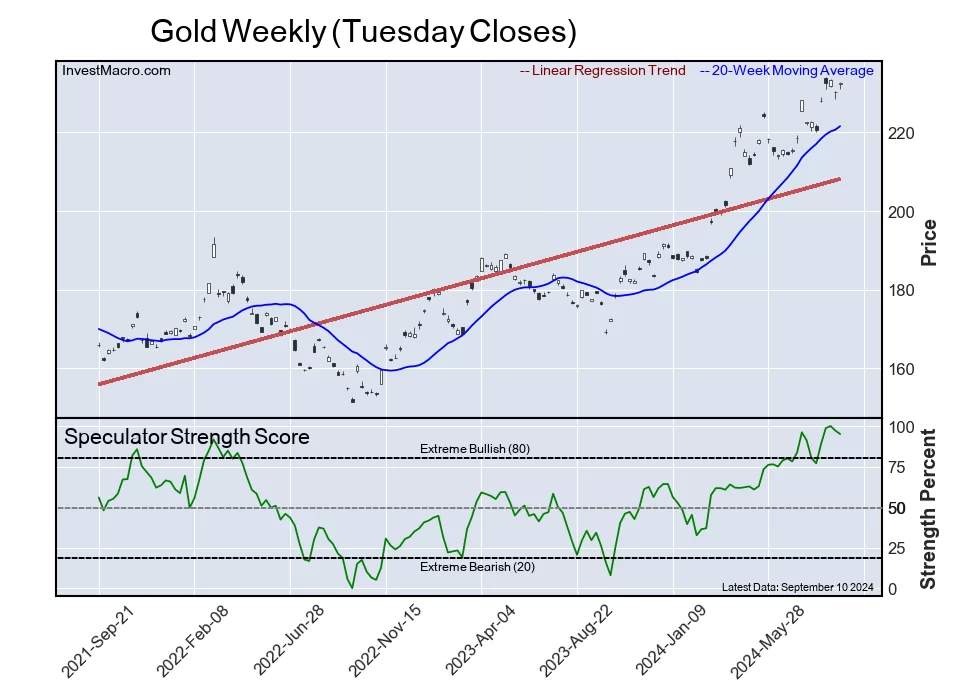
The six-week trend for the speculator strength score totaled a change of 1.5 this week. The overall speculator position was 246,601 net contracts this week with a drop by -26,473 contracts in the speculator bets.


DowJones Mini


The DowJones Mini speculator position rounds out the top five in this week’s bullish extreme standings. The DowJones Mini speculator level sits at a 82.3 percent score of its 3-year range. The six-week trend for the speculator strength score was 19.5 this week.

The speculator position was 13,538 net contracts this week with a gain of 2,172 contracts in the weekly speculator bets.


This Week’s Most Bearish Speculator Positions:


Gasoline


The Gasoline speculator position comes in as the most bearish extreme standing this week. The Gasoline speculator level is at a 0.0 percent score of its 3-year range.

The six-week trend for the speculator strength score was -21.5 this week. The overall speculator position was 23,056 net contracts this week with a decline of -8,827 contracts in the speculator bets.


Cotton


The Cotton speculator position comes in next for the most bearish extreme standing on the week. The Cotton speculator level is at a 0.0 percent score of its 3-year range.

The six-week trend for the speculator strength score was -6.0 this week. The speculator position was -37,341 net contracts this week with a decrease by -3,070 contracts in the weekly speculator bets.


5-Year Bond


The 5-Year Bond speculator position comes in as third most bearish extreme standing of the week. The 5-Year Bond speculator level resides at a 0.0 percent score of its 3-year range.

The six-week trend for the speculator strength score was -11.6 this week. The overall speculator position was -1,656,038 net contracts this week with a slide by -132,777 contracts in the speculator bets.


Canadian Dollar


The Canadian Dollar speculator position comes in as this week’s fourth most bearish extreme standing. The Canadian Dollar speculator level is at a 0.0 percent score of its 3-year range.

The six-week trend for the speculator strength score was -21.7 this week. The speculator position was -196,263 net contracts this week with a decrease of -34,660 contracts in the weekly speculator bets.


Brazil Real


Finally, the Brazil Real speculator position comes in as the fifth most bearish extreme standing for this week. The Brazil Real speculator level is at a 3.5 percent score of its 3-year range.

The six-week trend for the speculator strength score was -22.5 this week. The speculator position was -41,159 net contracts this week with an increase of 839 contracts in the weekly speculator bets.


Article By InvestMacroReceive our weekly COT Newsletter

*COT Report: The COT data, released weekly to the public each Friday, is updated through the most recent Tuesday (data is 3 days old) and shows a quick view of how large speculators or non-commercials (for-profit traders) were positioned in the futures markets.

The CFTC categorizes trader positions according to commercial hedgers (traders who use futures contracts for hedging as part of the business), non-commercials (large traders who speculate to realize trading profits) and nonreportable traders (usually small traders/speculators) as well as their open interest (contracts open in the market at time of reporting). See CFTC criteria here.
Understanding ‘underconsumption core’: How a new trend is challenging consumer culture

By Omar H. Fares, Toronto Metropolitan University and Seung Hwan (Mark) Lee, Toronto Metropolitan University 

A new TikTok trend called “underconsumption core” is gaining traction online. This trend champions minimalism and frugality, and encourages people to maximize the utility of their purchases and buy only what they truly need, challenging the culture of consumerism.

Instead of showcasing large hauls of clothing, makeup or over-flowing fridge shelves, users are posting videos showing thrift store purchases, modest wardrobes and practical, well-used everyday items.

The rise of this trend can be linked to several challenges facing young people today, including increasing economic pressures, environmental concerns and social pressures, all of which are particularly affecting Gen Z and younger Millennials. If you’re also feeling financially squeezed, this trend might resonate with you.

Similar to the deinfluencing trend, underconsumption also appears to be a reaction to overconsumption — especially the way influencers have normalized it by posting haul videos. By promoting underconsumption, online users are rejecting and pushing back against this aspect of “influencer culture.”

Born of necessity

Young people are likely engaging with it as a way to adapt to increasing financial pressures.

For instance, the average federal student loan debt balance in the United States is US$37,574 per borrower, according to the Education Data Initiative. Student debt is a significant financial burden that often forces young adults to prioritize debt repayment over discretionary spending.

Inflation is also continuing to erode Gen Z’s purchasing power. While there are signs of economic relief, such as interest rate cuts in Canada, the cumulative effects of high prices continue to strain young peoples’ budgets.

Underconsumption core represents a growing awareness and adaptation to these economic realities, but it’s not the only reason. Another driver of the underconsumption trend appears to be environmental consciousness.

Environmental concerns

Mass consumerism has created significant environmental problems, including the generation of vast amounts of waste. In Chile’s Atacama Desert, an estimated 11,000 to 59,000 tons of used clothing is sitting in a landfill. This is just one example of how overconsumption is polluting the environment.

A report from ThredUp, an online vintage-resale platform, found that 65 per cent of Gen Z respondents wanted to shop more sustainably. However, one-third felt “addicted to fast fashion,” and 72 per cent said they shopped for fast fashion in 2022. Similarly, researchers from Sheffield Hallam University found 90 per cent of university students bought fast fashion in 2022.

Despite this, many of these same consumers are concerned with sustainability and are actively seeking ways to be more responsible. Our recent study found a consistent shift in consumer attitudes towards sustainability practices, especially in fashion. This is particularly the case with Gen Z, who rely heavily on social media for shopping inspiration.

As younger consumers become more aware of the environmental impact of their purchasing decisions, they are increasingly drawn to sustainable fashion content.

This shift in consumer mentality aligns with the broader cultural phenomenon known as the “Marie Kondo effect,” named after the Japanese organizing consultant. She is an advocate for only keeping things that bring one value and joy. Kondo’s influence has sparked a growing interest in intentional consumption.

However, it is important to note that, in some instances, sustainable consumption behaviours may be driven more by selfish motives than purely altruistic ones. By choosing to consume less or more mindfully, younger individuals can project an image of thoughtfulness, responsibility and uniqueness — qualities that are increasingly valued in the social media landscape.

How to be a healthier consumer

If you are interested in practising healthier consumption habits, it’s important to understand how you can sustain this lifestyle long-term. There are two main strategies you can use to do this.

First, find a way to strike a balance between frugality and quality of life to maintain your overall well-being. Research suggests a mix of experiential spending (such as travel) and material purchases (such as a new smartphone) can lead to greater happiness and satisfaction.

Don’t completely abandon material purchases in favour of experiences. Instead, a thoughtful approach that includes both types of spending, albeit at a reduced overall level, will likely lead to better outcomes. This approach focuses more on mindful consumption, rather than blanket restrictions.

Second, try to focus on improving your financial literacy. Start by creating a budget that ensures basic needs and baseline expenses are met. Seek to understand the types of financial products and solutions that fit your particular needs. This will help you avoid overconsumption and make choices that support long-term financial stability.

Those with higher financial literacy are better equipped to select products that align with their needs and values, rather than falling prey to aggressive marketing or unnecessary features that can lead to overconsumption. For instance, young consumers are likely to spend more on credit cards that offer attractive rewards leading to overconsumption and strained budgets over the long-term.

While the underconsumption trend offers potential benefits, it’s important to approach it in a balanced way. While combining healthy spending habits with financial literacy is key, it shouldn’t be about deprivation. Instead, you should make informed choices that align with your personal values and goals. Done right, underconsumption can lead to financial stability and a more purposeful lifestyle.The Conversation

About the Author:

Omar H. Fares, Lecturer in the Ted Rogers School of Retail Management, Toronto Metropolitan University and Seung Hwan (Mark) Lee, Professor and Associate Dean of Engagement & Inclusion, Ted Rogers School of Management, Toronto Metropolitan University

This article is republished from The Conversation under a Creative Commons license. Read the original article.