Archive for Opinions – Page 42

Recycling more than pop cans: A circular economy for our energy landscapes

By Martin J. Pasqualetti, Arizona State University; Chad Walker, Dalhousie University, and Michelle Adams, Dalhousie University 

From cereal boxes to our distinct milk bags, Canadians have been told that one of the best things we can do for the planet is to embrace the circular economy — reusing, repurposing or reallocating assets to ensure they’re kept within useful circulation as long as possible, and ideally forever.

Originally conceptualized as recycling, we are all familiar with the good feeling that comes from tossing paper, plastic and other materials into the blue bin rather than throwing them in a landfill. It’s time to consider applying an expanded version of this approach to what we call energy landscapes.

Considering the thousands of square kilometres that we have carved, scraped and bulldozed to produce the energy we crave, it is past time we started figuring out how we can recycle energy landscapes and make them useful for new purposes.

In our over-crowded world, we can no longer justify exploiting our landscapes for the energy we need and then simply walking away. We need to embrace a circular economy for our energy landscapes of the past and prepare to recycle the landscapes of the future.

Recycling landscapes

Recycling of energy landscapes comes to two forms; that is, the land itself and the infrastructure we place upon it.

Although rare in Canada, the idea is quickly catching on elsewhere. Lignite pits in Germany have been converted to recreational lakes. A derelict, coal-burning power plant in London has been transformed into an exhibition, condominiums and retail space.

In Nova Scotia, a 14 MW wind farm was developed at the site of the province’s coal-fired Lingan power station, and newly proposed green hydrogen production facilities are to be built on the land of stalled liquefied natural gas projects.

The idea of recycling or reusing applies not just to fossil fuels, but to renewable energy policies as well.

Last summer, the Conservative government of Alberta made decisions on the future land use of renewable energy projects like wind and solar farms. As outlined by academic Ian Urquhart earlier this year, the government’s seven-month moratorium banned all new projects under the rationale they threatened the province’s best agricultural lands and “Alberta’s pristine landscapes.”

However, the restrictions brought in, including a 35-kilometre buffer zone, do not apply to new oil and gas projects. Alberta Premier Danielle Smith’s government therefore created a unique set of recycling concerns around renewables that didn’t apply to fossil fuels.

Reusing space in an energy transition

At a time when more local smart grid projects — bringing together local renewables, battery storage, smart controls, heat pumps and electric vehicles — are being developed, there’s a need to consider how to go beyond recycling to reuse existing space and infrastructure.

Rooftop solar is an obvious choice to better utilize space, though the footprint of household and on-street EV charging infrastructure is similarly unsubstantial compared to your neighbourhood gas station.

Recycling in a clean energy transition will not only have great value in energy landscapes, but also in new clean energy technologies themselves. While we are already slowing the rise of climate change-fuelling emissions, we can go further if we advance the practice of recycling EV batteries and solar panels.

But we can’t stop there. We must also prepare to recycle the landscapes these technologies create.

Abandonment is not an option

Abandoning exhausted energy sites is wasteful, unnecessary and costly. The customary energy life cycle includes exploration, development, extraction, processing, transmission and sometimes reclamation. We advocate for an additional stage: recycling, thus preparing the land to be reimagined for another cycle of useful purpose.

We must take greater care of the precious Canadian landscape, especially those that have paid dearly to provide the energy we need. Once the land gives all it can, we should consider it not the end of the life cycle but as a new beginning.

Recycling energy landscapes as a strategy challenges the status quo. We must chart a path toward ensuring that such landscapes are repurposed to benefit both ecosystems and society, and embrace a circular economy for the land.The Conversation

About the Authors:

Martin J. Pasqualetti, Professor of Geography and Senior Global Futures Scientist, Arizona State University; Chad Walker, Assistant professor, Low-carbon Transitions, School of Planning, Dalhousie University, and Michelle Adams, Associate professor, School for Resource and Environmental Studies, Dalhousie University

This article is republished from The Conversation under a Creative Commons license. Read the original article.

AI pioneers want bots to replace human teachers – here’s why that’s unlikely

By Annette Vee, University of Pittsburgh 

OpenAI co-founder Andrej Karpathy envisions a world in which artificial intelligence bots can be made into subject matter experts that are “deeply passionate, great at teaching, infinitely patient and fluent in all of the world’s languages.” Through this vision, the bots would be available to “personally tutor all 8 billion of us on demand.”

The embodiment of that idea is his latest venture, Eureka Labs, which is merely the newest prominent example of how tech entrepreneurs are seeking to use AI to revolutionize education.

Karpathy believes AI can solve a long-standing challenge: the scarcity of good teachers who are also subject experts.

And he’s not alone. OpenAI CEO Sam Altman, Khan Academy CEO Sal Khan, venture capitalist Marc Andreessen and University of California, Berkeley computer scientist Stuart Russell also dream of bots becoming on-demand tutors, guidance counselors and perhaps even replacements for human teachers.

As a researcher focused on AI and other new writing technologies, I’ve seen many cases of high-tech “solutions” for teaching problems that fizzled. AI certainly may enhance aspects of education, but history shows that bots probably won’t be an effective substitute for humans. That’s because students have long shown resistance to machines, however sophisticated, and a natural preference to connect with and be inspired by fellow humans.

The costly challenge of teaching writing to the masses

As the director of the English Composition program at the University of Pittsburgh, I oversee instruction for some 7,000 students a year. Programs like mine have long wrestled with how to teach writing efficiently and effectively to so many people at once.

The best answer so far is to keep class sizes to no more than 15 students. Research shows that students learn writing better in smaller classes because they are more engaged.

Yet small classes require more instructors, and that can get expensive for school districts and colleges.

Resuscitating dead scholars

Enter AI. Imagine, Karpathy posits, that the great theoretical physicist Richard Feynman, who has been dead for over 35 years, could be brought back to life as a bot to tutor students.

For Karpathy, an ideal learning experience would be working through physics material “together with Feynman, who is there to guide you every step of the way.” Feynman, renowned for his accessible way of presenting theoretical physics, could work with an unlimited number of students at the same time.

In this vision, human teachers still design course materials, but they are supported by an AI teaching assistant. This teacher-AI team “could run an entire curriculum of courses on a common platform,” Karpathy wrote. “If we are successful, it will be easy for anyone to learn anything,” whether it be a lot of people learning about one subject, or one person learning about many subjects.

Other efforts to personalize learning fall short

Yet technologies for personal learning aren’t new. Exactly 100 years ago, at the 1924 meeting of the American Psychological Association, inventor Sidney Pressey unveiled an “automatic teacher” made out of typewriter parts that asked multiple-choice questions.

In the 1950s, the psychologist B. F. Skinner designed “teaching machines.” If a student answered a question correctly, the machine advanced to ask about the problem’s next step. If not, the student stayed on that step of the problem until they solved it.

In both cases, students received positive feedback for correct answers. This gave them confidence as well as skills in the subject. The problem was that students didn’t learn much – they also found these nonhuman approaches boring, education writer Audrey Watters documents in “Teaching Machines.”

More recently, the world of education saw the rise and fall of “massive open online courses,” or MOOCs. These classes, which delivered video and quizzes, were heralded by The New York Times and others for their promise of democratizing education. Again, students lost interest and logged off.

Other web-based efforts have popped up, including course platforms like Coursera and Outlier. But the same problem persists: There’s no genuine interactivity to keep students engaged. One of the latest casualties in online learning was 2U, which acquired leading MOOC company edX in 2021 and in July 2024 filed for bankruptcy restructuring to reduce its US$945 million debt load. The culprit: falling demand for services.

Now comes the proliferation of AI-fueled platforms. Khanmigo deploys AI tutors to, as Sal Khan writes in his latest book, “personalize and customize coaching, as well as adapt to an individual’s needs while hovering beside our learners as they work.”

The educational publisher Pearson, too, is integrating AI into its educational materials. More than 1,000 universities are adopting these materials for fall 2024.

AI in education isn’t just coming; it’s here. The question is how effective it will be.

Drawbacks in AI learning

Some tech leaders believe bots can customize teaching and replace human teachers and tutors, but they’re likely to face the same problem as these earlier attempts: Students may not like it.

There are important reasons why, too. Students are unlikely to be inspired and excited the way they can be by a live instructor. Students in crisis often turn to trusted adults like teachers and coaches for help. Would they do the same with a bot? And what would the bot do if they did? We don’t know yet.

A lack of data privacy and security can also be a deterrent. These platforms collect volumes of information on students and their academic performance that can be misused or sold. Legislation may try to prevent this, but some popular platforms are based in China, out of reach of U.S. law.

Finally, there are concerns even if AI tutors and teachers become popular. If a bot teaches millions of students at once, we may lose diversity of thought. Where does originality come from when everyone receives the same teachings, especially if “academic success” relies on regurgitating what the AI instructor says?

The idea of an AI tutor in every pocket sounds exciting. I would love to learn physics from Richard Feynman or writing from Maya Angelou or astronomy from Carl Sagan. But history reminds us to be cautious and keep a close eye on whether students are actually learning. The promises of personalized learning are no guarantee for positive results.The Conversation

About the Author:

Annette Vee, Associate Professor of English, University of Pittsburgh

This article is republished from The Conversation under a Creative Commons license. Read the original article.

Can Boeing Recover? Analyzing the Company’s Path to Profitability

By The Ino.com Team

Since the start of 2024, aerospace giant The Boeing Company (BA) has faced a turbulent ride, with its stock plummeting over 30%. The decline was primarily triggered by heightened regulatory scrutiny following a severe safety incident involving one of its planes earlier this year.

Boeing has been working hard to enhance its safety protocols and address regulatory concerns. While these efforts show progress, the company’s latest Q2 earnings report has done little to restore investor confidence. The results revealed a larger-than-expected loss and weaker revenue, culminating in a significant leadership shakeup, with the CEO stepping down.

What’s Going on With Boeing?

Last month, Boeing missed the earnings targets by a wide margin. Revenue for the second quarter that ended June 30, 2024, came in at $16.87 billion, down 15% year-over-year. It fell short of the $17.35 billion revenue analysts had anticipated. On the bottom line, the company posted a non-GAAP net loss of $2.90 per share, much worse than the expected negative $2.01 per share. That compared to a loss per share of $0.82 a year ago.

Moreover, the company’s free cash flow, which was positive in last year’s second quarter, has now turned negative. The company has burned more than $8.26 billion so far this year, leaving with just $12.60 billion in its cash reserves against a hefty debt of $57.90 billion. Also, it reported a cash burn of $4.3 billion in just one quarter.

The management attributed the disappointing second-quarter results to two main factors: lower commercial aircraft deliveries and significant losses on fixed-price defense development programs. During the quarter, Boeing delivered just 92 commercial planes (down 32% year-over-year), leading to a corresponding 32% decline in revenue from what was once its largest business segment.

Meanwhile, the defense, space, and security unit experienced a smaller 2% sales dip but posted a loss of $913 million, nearly double the previous year’s loss of $527 million. Profit margins continued to worsen across these segments. The global services division was the only area with slight improvement, reflecting a 3% revenue increase and a 2% rise in operating earnings, but even here, profit margins declined.

Boeing’s disappointing results came during a period of intense scrutiny, as it faces multiple investigations into its safety practices and manufacturing standards. The company recently pleaded guilty to a federal fraud charge tied to its 737 Max following two fatal crashes that killed 346 people. As a result, the FAA has increased its oversight and limited BA’s production capacity after a serious incident involving an Alaska Airlines Max.

Furthermore, CFO Brian West warned that due to “near-term working capital pressures,” the third quarter will likely see another outflow of cash.

Boeing’s Critical Challenges

Boeing’s troubles are no secret; its repair list is long and daunting. For instance, the company’s commercial airplanes unit has struggled with recurring quality control problems, including serious incidents like doors falling off planes.

In the defense sector, Boeing is struggling with the Pentagon’s push for fixed-price contracts, leading to significant financial write-downs, like those from the Air Force tanker deal. That puts Boeing in a tough spot: accept risky fixed-price contracts or risk losing future defense agreements to competitors who will agree to them.

The company’s space segment isn’t faring much better. Boeing’s Starliner crew transport, essential to fulfilling its commercial crew contract with NASA, has been stranded at the International Space Station for over two months. Boeing might face hefty write-downs and losses if it fails to safely return the astronauts. Thus, addressing these challenges head-on seems crucial for the company’s path to recovery.

A New Leader for Boeing: What’s Next?

As Boeing grapples with its ongoing challenges, outgoing CEO Dave Calhoun assured that the company is “making substantial progress” in enhancing its quality management system and preparing for the future. However, Calhoun will not be steering BA through these transitions, as he announced his retirement shortly after the second quarter earnings report.

On August 8, former Rockwell Collins and RTX executive Robert Kelly Ortberg was appointed Boeing’s new CEO. Unlike his recent predecessors, Ortberg brings a background in Mechanical Engineering, which signals a shift towards prioritizing engineering and safety. This move could address previous criticisms of cost-cutting measures and refocus the company on improving aircraft safety, ultimately benefiting shareholders by mitigating the risk of future incidents.

Can Boeing Recover?

Despite recent safety setbacks, BA’s demand for its planes remains surprisingly strong. By the end of the second quarter, the company had amassed a hefty backlog of $516 billion, which includes over 5,400 commercial plane orders. The Farnborough Airshow further highlighted this demand with 118 new orders and commitments worth $17.1 billion.

This indicates that, despite its current challenges, the appetite for the company’s planes is robust. The path to recovery will depend on Boeing’s ability to address safety issues and lift the FAA’s production cap on the 737 MAX. If the company can make these adjustments, it could quickly regain its footing, especially since it showed promising progress in 2023.

Moreover, the air travel market is set to hit new highs this year, with Airbus projecting increased air traffic in the coming years. This provides Boeing with ample growth opportunities, provided it can navigate its current issues. Street expects the company’s revenue to increase by 20.7% year-over-year in the fiscal year 2025, with a projected EPS of $4.06.

Despite the promising growth prospects, investors should be aware of several risks. There’s no guarantee that Boeing won’t face another safety incident, as seen earlier this year, which could disrupt production and financial stability. Additionally, Airbus continues to outpace the company, and the emerging Chinese C919 could erode market share if Boeing faces more setbacks. While the aerospace giant has promising prospects, navigating these risks will be crucial to sustaining long-term growth and investor confidence.

Should you Invest in Boeing?

While BA’s market cap of $110.36 billion might suggest stability, it’s far from a safe bet. With no dividends since 2020 and a streak of unprofitability since 2018, BA’s investment appeal hinges on its turnaround potential.

The big question is whether or not the new CEO, Kelly Ortberg, can turn things around and revive the company’s fortunes. If Ortberg successfully navigates the company’s current challenges, there could be a significant upside. However, until then, investing in BA is decidedly riskier than it once was.

By Ino.com – See our Trader Blog, INO TV Free & Market Analysis Alerts

Source: Can Boeing Recover? Analyzing the Company’s Path to Profitability


Speculators flip Japanese Yen bets into 1st bullish position since March 2021

By InvestMacro

Here are the latest charts and statistics for the Commitment of Traders (COT) data published by the Commodities Futures Trading Commission (CFTC).

The latest COT data is updated through Tuesday August 13th and shows a quick view of how large market participants (for-profit speculators and commercial traders) were positioned in the futures markets. All currency positions are in direct relation to the US dollar where, for example, a bet for the euro is a bet that the euro will rise versus the dollar while a bet against the euro will be a bet that the euro will decline versus the dollar.

Weekly Speculator Changes led by Swiss Franc & Japanese Yen

The COT currency market speculator bets were slightly overall higher this week as six out of the eleven currency markets we cover had higher positioning while the other five markets had lower speculator contracts.

Leading the gains for the currency markets was the Japanese Yen (34,458 contracts) with the US Dollar Index (2,400 contracts), the Canadian Dollar (2,021 contracts), the New Zealand Dollar (1,127 contracts), the Brazilian Real (1,041 contracts) and the Swiss Franc (409 contracts) also seeing positive weeks.

The currencies seeing declines in speculator bets on the week were the British Pound (-26,587 contracts), the Mexican Peso (-15,242 contracts), the EuroFX (-6,597 contracts), the Australian Dollar (-2,417 contracts) and with Bitcoin (-143 contracts) also registering lower bets on the week.

Speculators flip Japanese Yen bets into 1st bullish position since March 2021

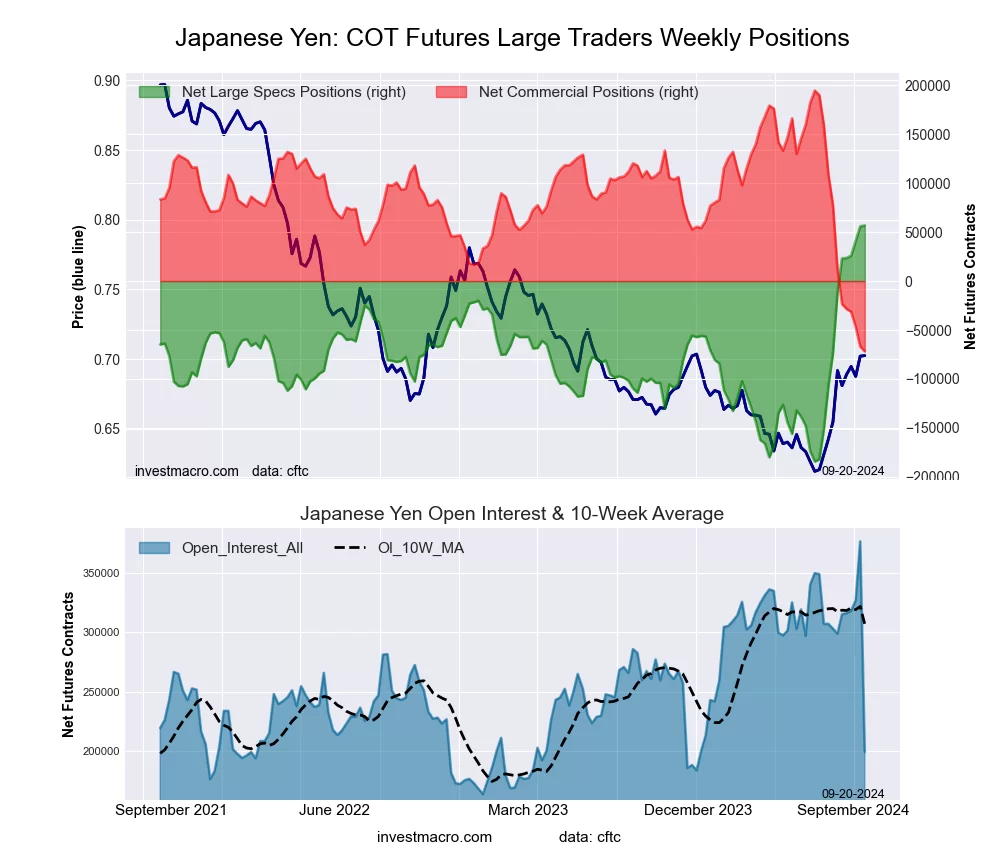
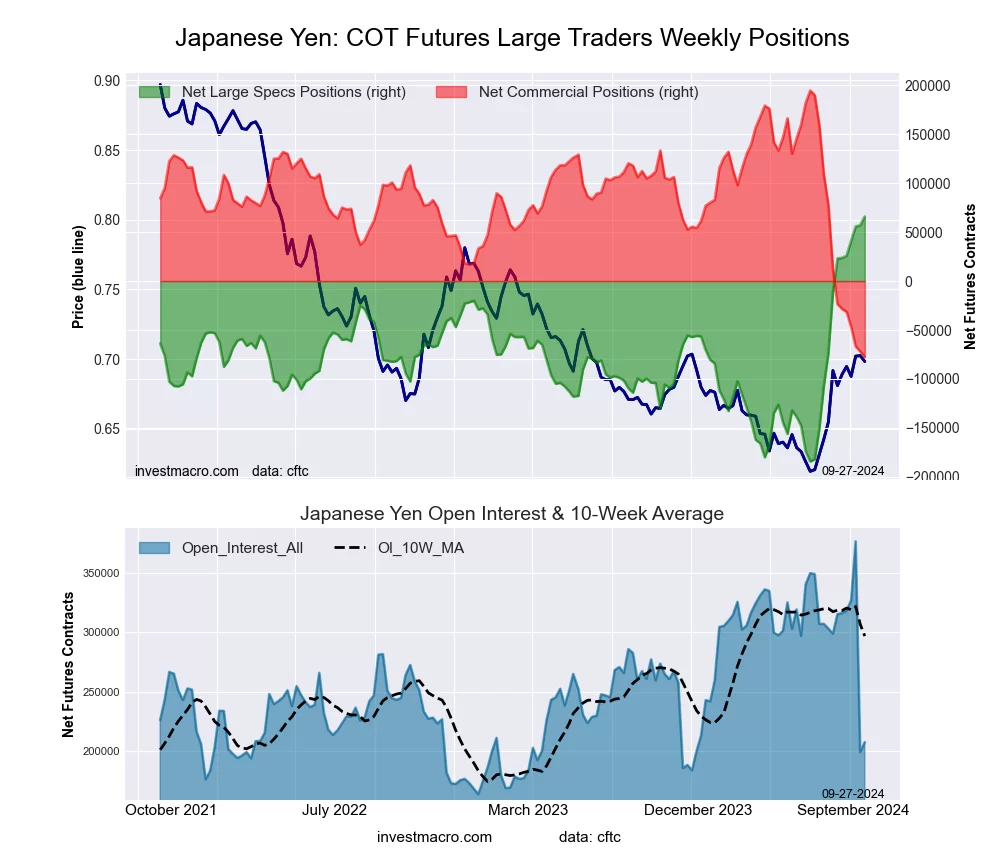
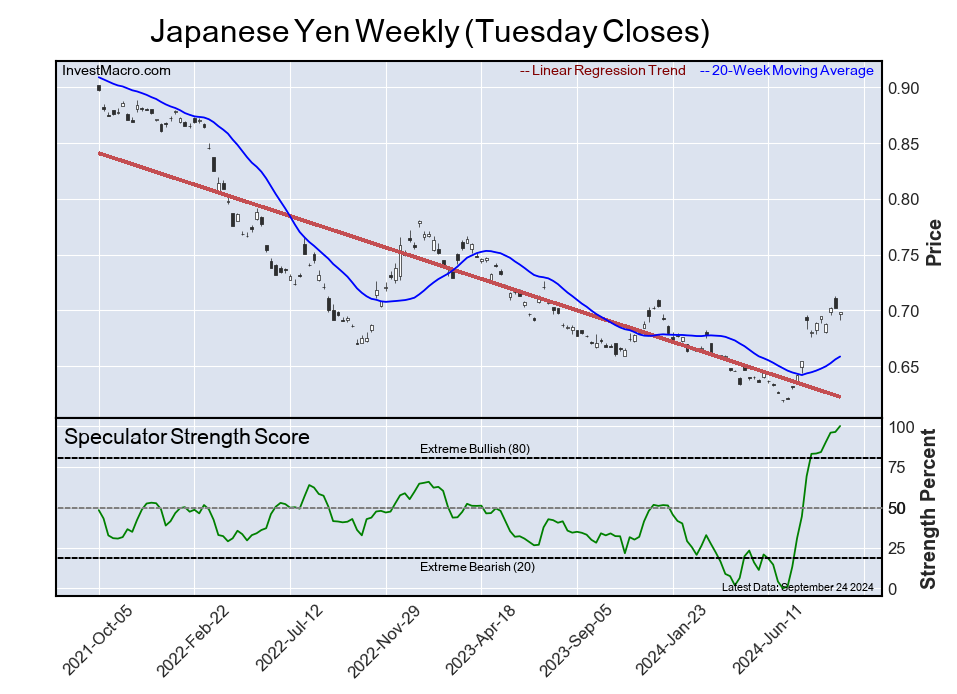
Highlighting the COT currency’s data this week is sharp increase in bullish bets for the Japanese yen speculators. Large speculators followed up last week’s surge in buying of yen contracts with another strong weekly gain by +34,458 net contracts this week. Last week’s jump by +62,105 contracts was the third largest weekly gain on record (following +69,020 contracts on March 1st 2011 and the highest weekly change of +77,690 contracts on October 31st 2006).

Overall, speculators have now boosted yen positions for six consecutive weeks for a 6-week total increase of +207,327 contracts that has brought the positioning from -184,223 contracts on July 2nd to this week’s +23,104 contract level.

This is the first weekly bullish position following 178 consecutive weeks of bearish levels that dated back to March 9th of 2021. The 178-week streak of consecutive bearish positions marks the highest all-time streak – illustrating the depth of bearish sentiment the yen has experienced over the past few years.

The yen exchange rate versus the US dollar has now improved by almost 9 percent from the low-point reached in July, according to this week’s closing prices. The July low (USDJPY level of 161.95) was also the weakest level for the yen against the dollar since 1986. The USDJPY closed out the week at 147.54.


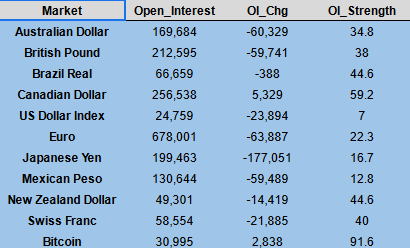
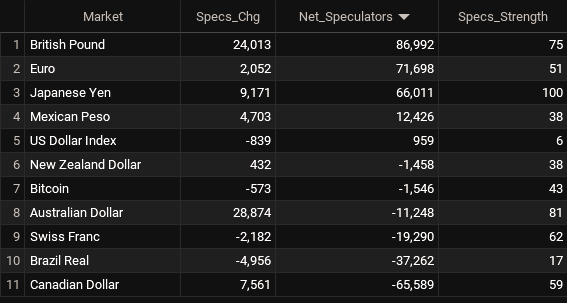
Currencies Net Speculators Leaderboard
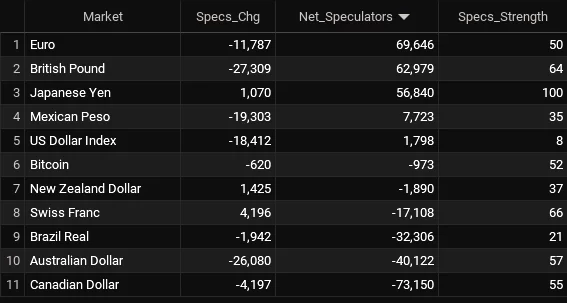
Legend: Weekly Speculators Change | Speculators Current Net Position | Speculators Strength Score compared to last 3-Years (0-100 range)


Strength Scores led by Japanese Yen & Bitcoin

COT Strength Scores (a normalized measure of Speculator positions over a 3-Year range, from 0 to 100 where above 80 is Extreme-Bullish and below 20 is Extreme-Bearish) showed that the Japanese Yen (100 percent) and Bitcoin (72 percent) lead the currency markets this week. The British Pound (58 percent), Mexican Peso (56 percent) and the Australian Dollar (55 percent) come in as the next highest in the weekly strength scores.

On the downside, the Brazilian Real (1 percent), the Canadian Dollar (7 percent) and the New Zealand Dollar (11 percent) come in at the lowest strength levels currently and are in Extreme-Bearish territory (below 20 percent). The next lowest strength score is the EuroFX (32 percent).

Strength Statistics:
US Dollar Index (43.6 percent) vs US Dollar Index previous week (38.4 percent)
EuroFX (31.8 percent) vs EuroFX previous week (34.6 percent)
British Pound Sterling (57.6 percent) vs British Pound Sterling previous week (69.5 percent)
Japanese Yen (100.0 percent) vs Japanese Yen previous week (83.4 percent)
Swiss Franc (52.2 percent) vs Swiss Franc previous week (51.4 percent)
Canadian Dollar (7.5 percent) vs Canadian Dollar previous week (6.6 percent)
Australian Dollar (54.7 percent) vs Australian Dollar previous week (56.8 percent)
New Zealand Dollar (10.9 percent) vs New Zealand Dollar previous week (8.7 percent)
Mexican Peso (56.0 percent) vs Mexican Peso previous week (63.5 percent)
Brazilian Real (1.0 percent) vs Brazilian Real previous week (0.0 percent)
Bitcoin (72.4 percent) vs Bitcoin previous week (74.5 percent)


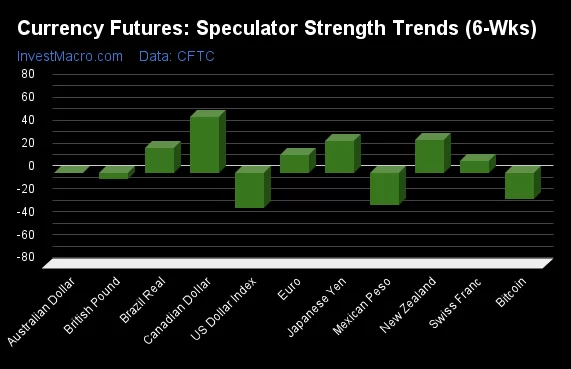
Japanese Yen & Swiss Franc top the 6-Week Strength Trends

COT Strength Score Trends (or move index, calculates the 6-week changes in strength scores) showed that the Japanese Yen (100 percent) and the Swiss Franc (40 percent) lead the past six weeks trends for the currencies. Bitcoin (20 percent), the EuroFX (16 percent) and the US Dollar Index (4 percent) are the next highest positive movers in the latest trends data.

The New Zealand Dollar (-89 percent) leads the downside trend scores currently with the Canadian Dollar (-27 percent), the Australian Dollar (-23 percent) and the Brazilian Real (-12 percent) following next with lower trend scores.

Strength Trend Statistics:
US Dollar Index (4.2 percent) vs US Dollar Index previous week (-3.0 percent)
EuroFX (15.5 percent) vs EuroFX previous week (17.9 percent)
British Pound Sterling (-6.4 percent) vs British Pound Sterling previous week (13.6 percent)
Japanese Yen (100.0 percent) vs Japanese Yen previous week (78.4 percent)
Swiss Franc (40.4 percent) vs Swiss Franc previous week (24.1 percent)
Canadian Dollar (-26.6 percent) vs Canadian Dollar previous week (-26.5 percent)
Australian Dollar (-22.6 percent) vs Australian Dollar previous week (-13.9 percent)
New Zealand Dollar (-89.1 percent) vs New Zealand Dollar previous week (-83.4 percent)
Mexican Peso (-6.6 percent) vs Mexican Peso previous week (3.7 percent)
Brazilian Real (-12.1 percent) vs Brazilian Real previous week (-30.9 percent)
Bitcoin (19.7 percent) vs Bitcoin previous week (17.5 percent)


Individual COT Forex Markets:

US Dollar Index Futures:
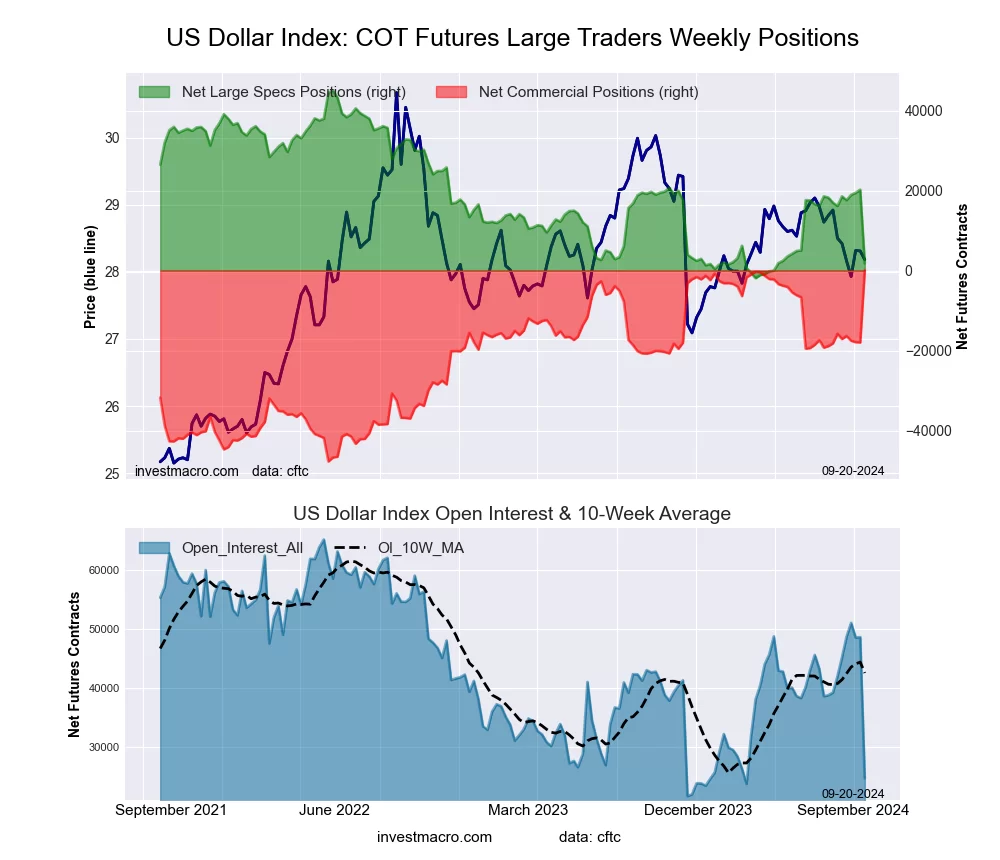
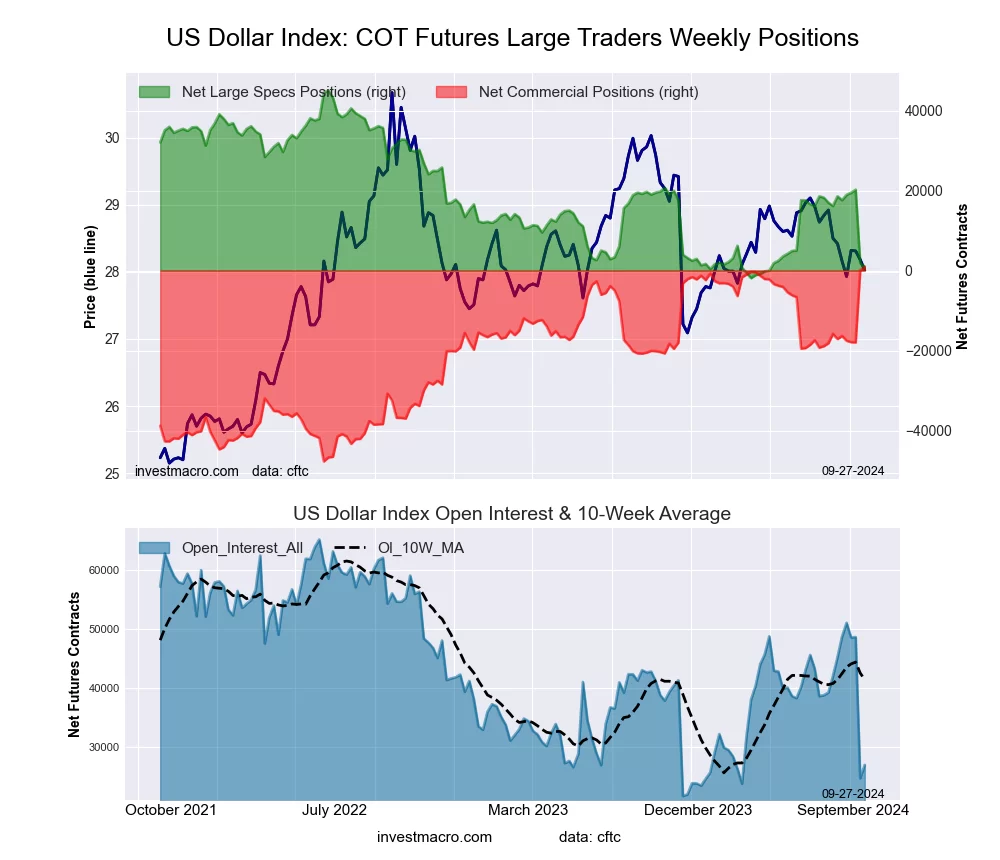
US Dollar Index Forex Futures COT ChartThe US Dollar Index large speculator standing this week totaled a net position of 18,536 contracts in the data reported through Tuesday. This was a weekly boost of 2,400 contracts from the previous week which had a total of 16,136 net contracts.

This week’s current strength score (the trader positioning range over the past three years, measured from 0 to 100) shows the speculators are currently Bearish with a score of 43.6 percent. The commercials are Bullish with a score of 64.5 percent and the small traders (not shown in chart) are Bearish-Extreme with a score of 0.0 percent.

Price Trend-Following Model: Weak Uptrend

Our weekly trend-following model classifies the current market price position as: Weak Uptrend. The current action for the model is considered to be: Hold – Maintain Long Position.

US DOLLAR INDEX StatisticsSPECULATORSCOMMERCIALSSMALL TRADERS
– Percent of Open Interest Longs:74.518.04.9
– Percent of Open Interest Shorts:33.555.88.0
– Net Position:18,536-17,120-1,416
– Gross Longs:33,6868,1382,194
– Gross Shorts:15,15025,2583,610
– Long to Short Ratio:2.2 to 10.3 to 10.6 to 1
NET POSITION TREND:
– Strength Index Score (3 Year Range Pct):43.664.50.0
– Strength Index Reading (3 Year Range):BearishBullishBearish-Extreme
NET POSITION MOVEMENT INDEX:
– 6-Week Change in Strength Index:4.23.0-37.5


Euro Currency Futures:

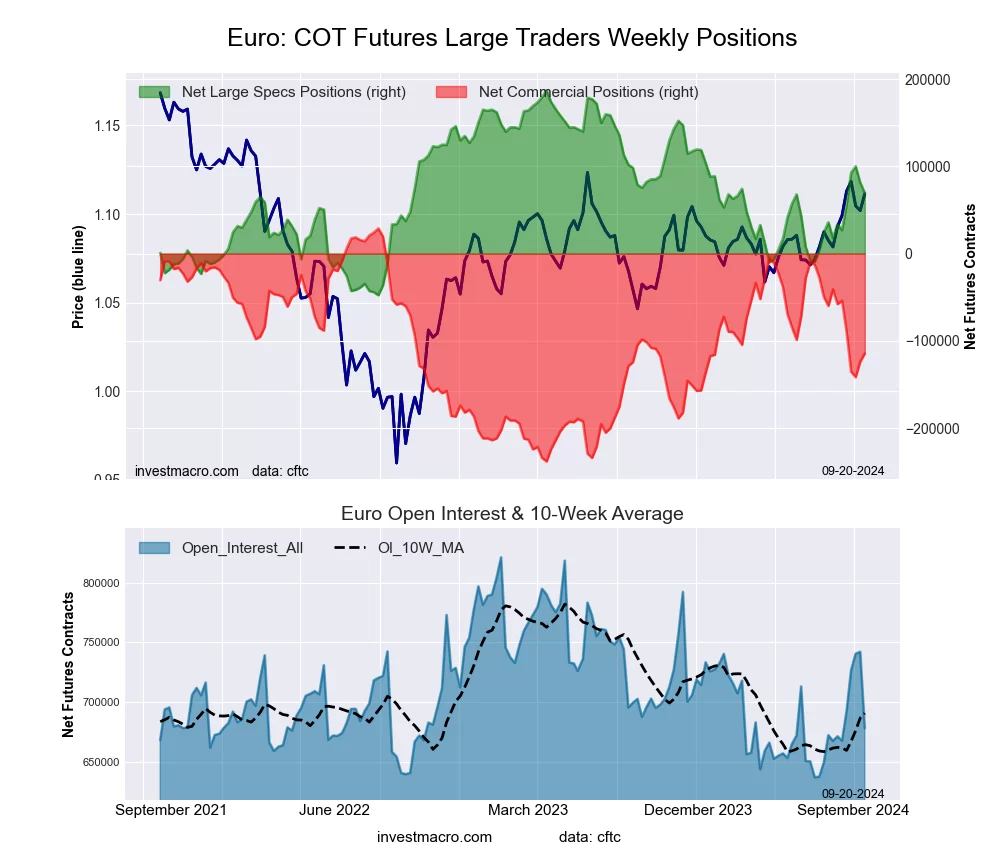
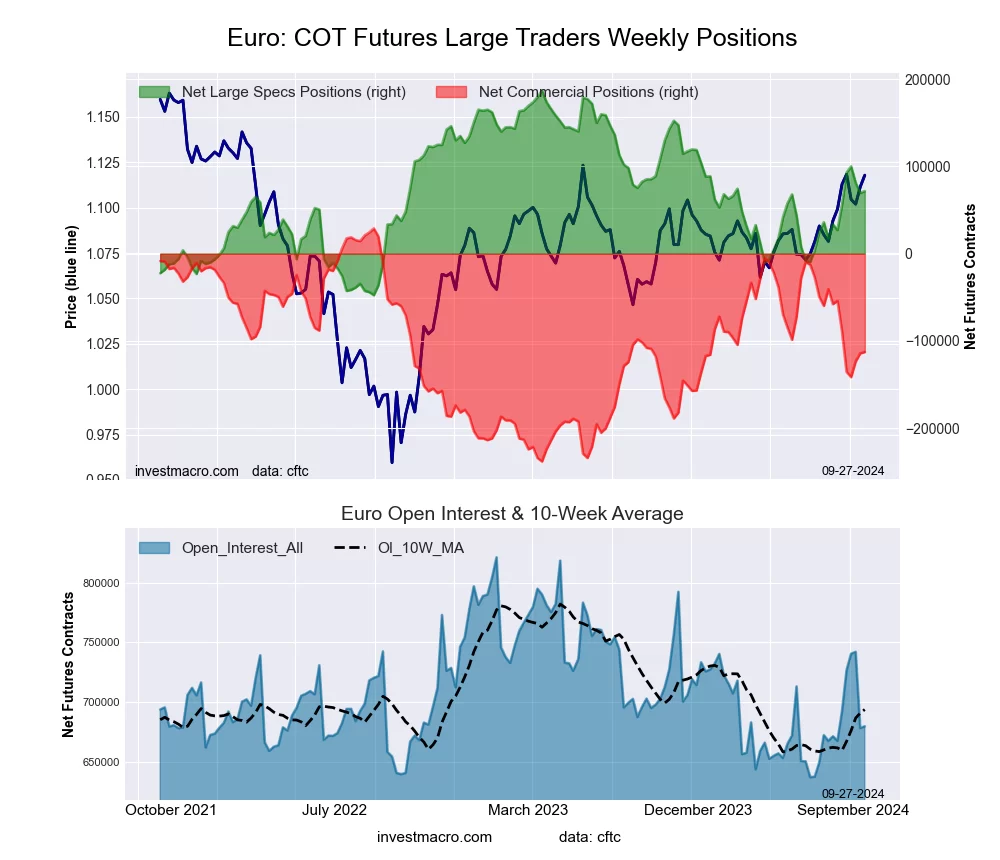
Euro Currency Futures COT ChartThe Euro Currency large speculator standing this week totaled a net position of 26,983 contracts in the data reported through Tuesday. This was a weekly decrease of -6,597 contracts from the previous week which had a total of 33,580 net contracts.

This week’s current strength score (the trader positioning range over the past three years, measured from 0 to 100) shows the speculators are currently Bearish with a score of 31.8 percent. The commercials are Bullish with a score of 69.0 percent and the small traders (not shown in chart) are Bearish with a score of 31.6 percent.

Price Trend-Following Model: Strong Uptrend

Our weekly trend-following model classifies the current market price position as: Strong Uptrend. The current action for the model is considered to be: Hold – Maintain Long Position.

EURO Currency StatisticsSPECULATORSCOMMERCIALSSMALL TRADERS
– Percent of Open Interest Longs:27.357.311.6
– Percent of Open Interest Shorts:23.365.47.6
– Net Position:26,983-54,02727,044
– Gross Longs:182,212382,39477,589
– Gross Shorts:155,229436,42150,545
– Long to Short Ratio:1.2 to 10.9 to 11.5 to 1
NET POSITION TREND:
– Strength Index Score (3 Year Range Pct):31.869.031.6
– Strength Index Reading (3 Year Range):BearishBullishBearish
NET POSITION MOVEMENT INDEX:
– 6-Week Change in Strength Index:15.5-15.510.9


British Pound Sterling Futures:

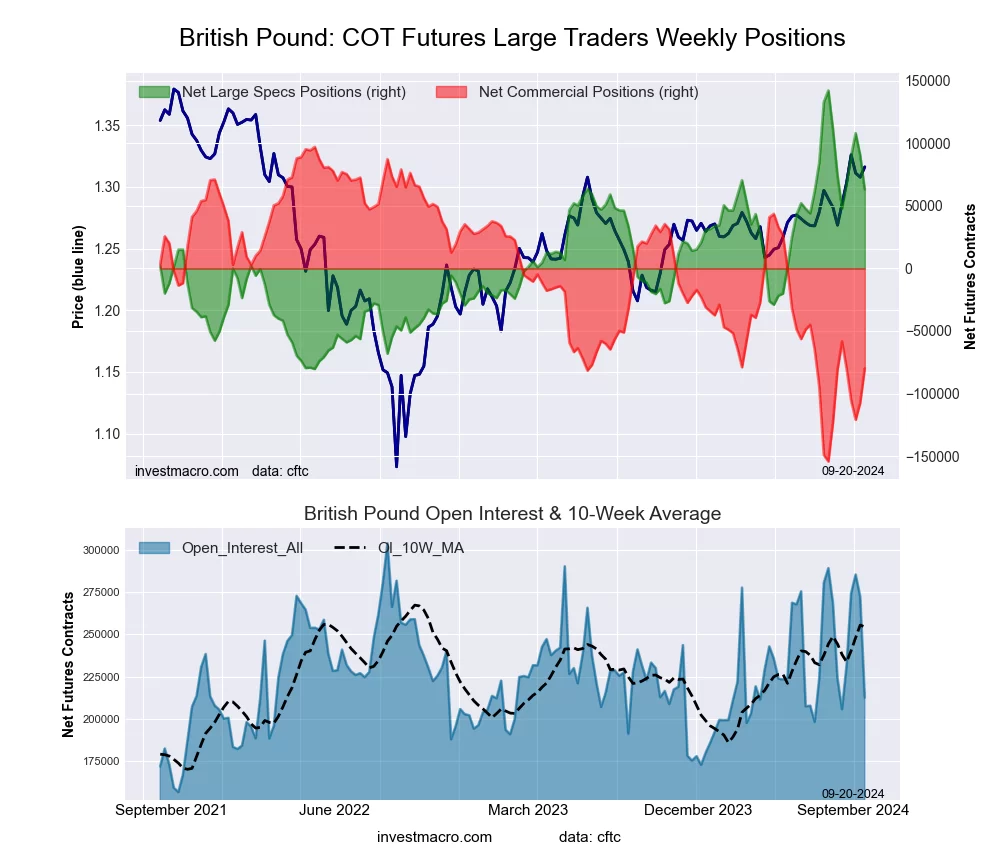
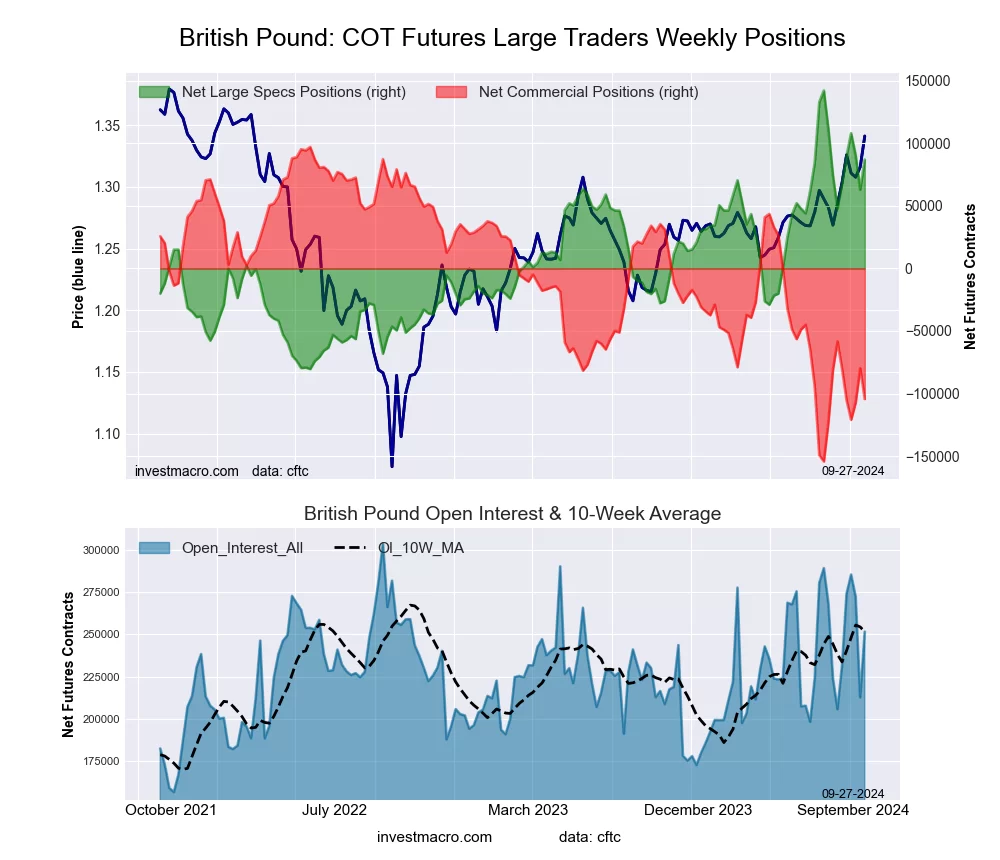
British Pound Sterling Futures COT ChartThe British Pound Sterling large speculator standing this week totaled a net position of 47,812 contracts in the data reported through Tuesday. This was a weekly decline of -26,587 contracts from the previous week which had a total of 74,399 net contracts.

This week’s current strength score (the trader positioning range over the past three years, measured from 0 to 100) shows the speculators are currently Bullish with a score of 57.6 percent. The commercials are Bearish with a score of 38.2 percent and the small traders (not shown in chart) are Bullish-Extreme with a score of 84.3 percent.

Price Trend-Following Model: Strong Uptrend

Our weekly trend-following model classifies the current market price position as: Strong Uptrend. The current action for the model is considered to be: Hold – Maintain Long Position.

BRITISH POUND StatisticsSPECULATORSCOMMERCIALSSMALL TRADERS
– Percent of Open Interest Longs:49.927.817.7
– Percent of Open Interest Shorts:26.756.212.6
– Net Position:47,812-58,34010,528
– Gross Longs:102,60357,13436,458
– Gross Shorts:54,791115,47425,930
– Long to Short Ratio:1.9 to 10.5 to 11.4 to 1
NET POSITION TREND:
– Strength Index Score (3 Year Range Pct):57.638.284.3
– Strength Index Reading (3 Year Range):BullishBearishBullish-Extreme
NET POSITION MOVEMENT INDEX:
– 6-Week Change in Strength Index:-6.42.715.8


Japanese Yen Futures:

Japanese Yen Forex Futures COT ChartThe Japanese Yen large speculator standing this week totaled a net position of 23,104 contracts in the data reported through Tuesday. This was a weekly gain of 34,458 contracts from the previous week which had a total of -11,354 net contracts.

This week’s current strength score (the trader positioning range over the past three years, measured from 0 to 100) shows the speculators are currently Bullish-Extreme with a score of 100.0 percent. The commercials are Bearish-Extreme with a score of 0.0 percent and the small traders (not shown in chart) are Bullish-Extreme with a score of 83.9 percent.

Price Trend-Following Model: Strong Uptrend

Our weekly trend-following model classifies the current market price position as: Strong Uptrend. The current action for the model is considered to be: New Buy – Long Position.

JAPANESE YEN StatisticsSPECULATORSCOMMERCIALSSMALL TRADERS
– Percent of Open Interest Longs:27.660.310.5
– Percent of Open Interest Shorts:20.367.710.4
– Net Position:23,104-23,527423
– Gross Longs:87,101190,06433,201
– Gross Shorts:63,997213,59132,778
– Long to Short Ratio:1.4 to 10.9 to 11.0 to 1
NET POSITION TREND:
– Strength Index Score (3 Year Range Pct):100.00.083.9
– Strength Index Reading (3 Year Range):Bullish-ExtremeBearish-ExtremeBullish-Extreme
NET POSITION MOVEMENT INDEX:
– 6-Week Change in Strength Index:100.0-100.033.7


Swiss Franc Futures:

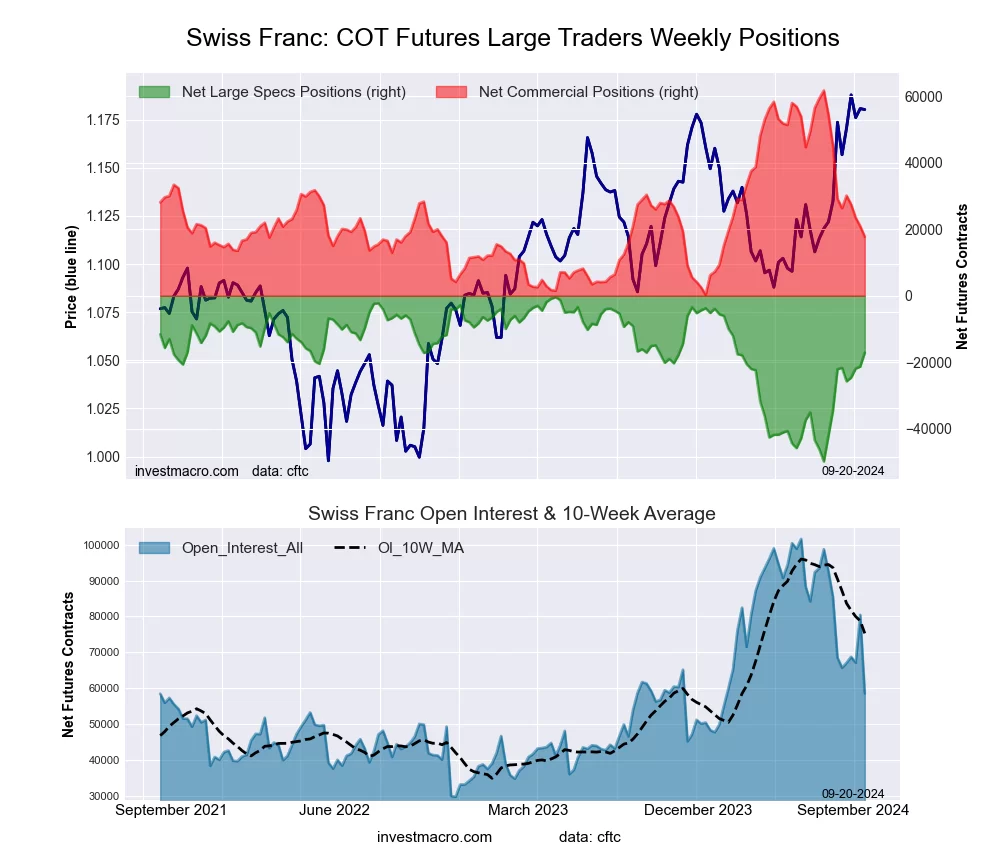
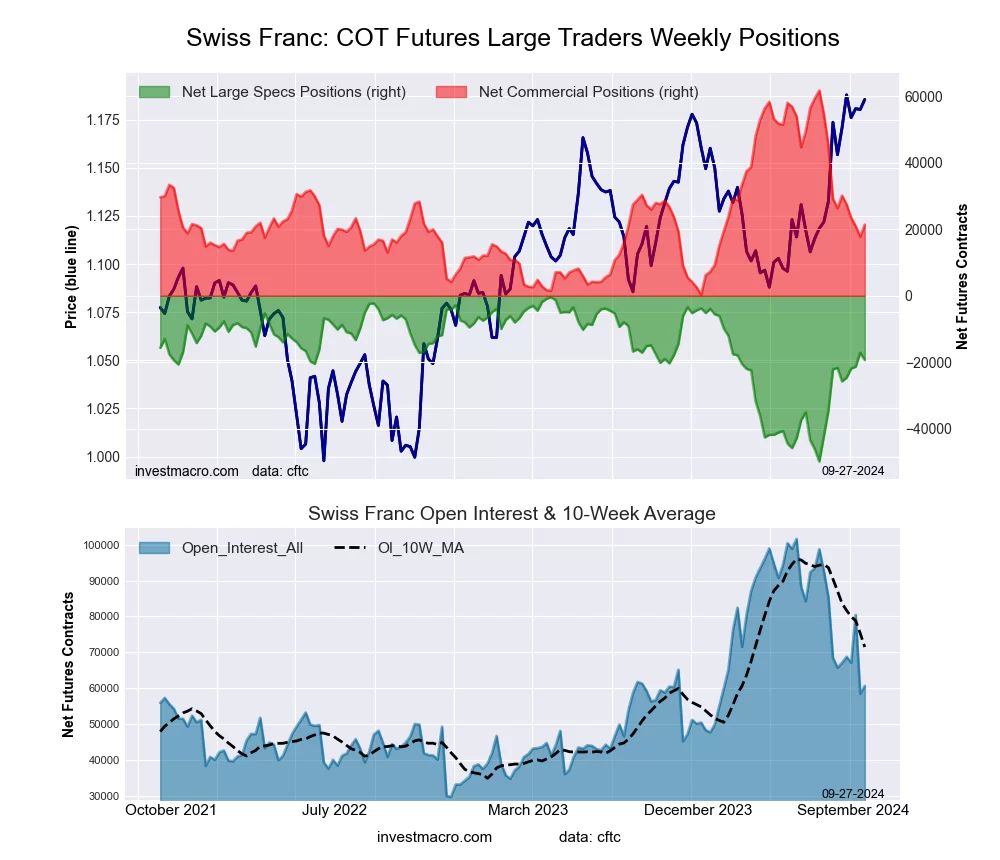
Swiss Franc Forex Futures COT ChartThe Swiss Franc large speculator standing this week totaled a net position of -21,664 contracts in the data reported through Tuesday. This was a weekly boost of 409 contracts from the previous week which had a total of -22,073 net contracts.

This week’s current strength score (the trader positioning range over the past three years, measured from 0 to 100) shows the speculators are currently Bullish with a score of 52.2 percent. The commercials are Bearish with a score of 42.4 percent and the small traders (not shown in chart) are Bullish with a score of 56.1 percent.

Price Trend-Following Model: Strong Uptrend

Our weekly trend-following model classifies the current market price position as: Strong Uptrend. The current action for the model is considered to be: Hold – Maintain Long Position.

SWISS FRANC StatisticsSPECULATORSCOMMERCIALSSMALL TRADERS
– Percent of Open Interest Longs:13.967.018.5
– Percent of Open Interest Shorts:46.926.925.6
– Net Position:-21,66426,308-4,644
– Gross Longs:9,15544,02612,177
– Gross Shorts:30,81917,71816,821
– Long to Short Ratio:0.3 to 12.5 to 10.7 to 1
NET POSITION TREND:
– Strength Index Score (3 Year Range Pct):52.242.456.1
– Strength Index Reading (3 Year Range):BullishBearishBullish
NET POSITION MOVEMENT INDEX:
– 6-Week Change in Strength Index:40.4-49.137.9


Canadian Dollar Futures:

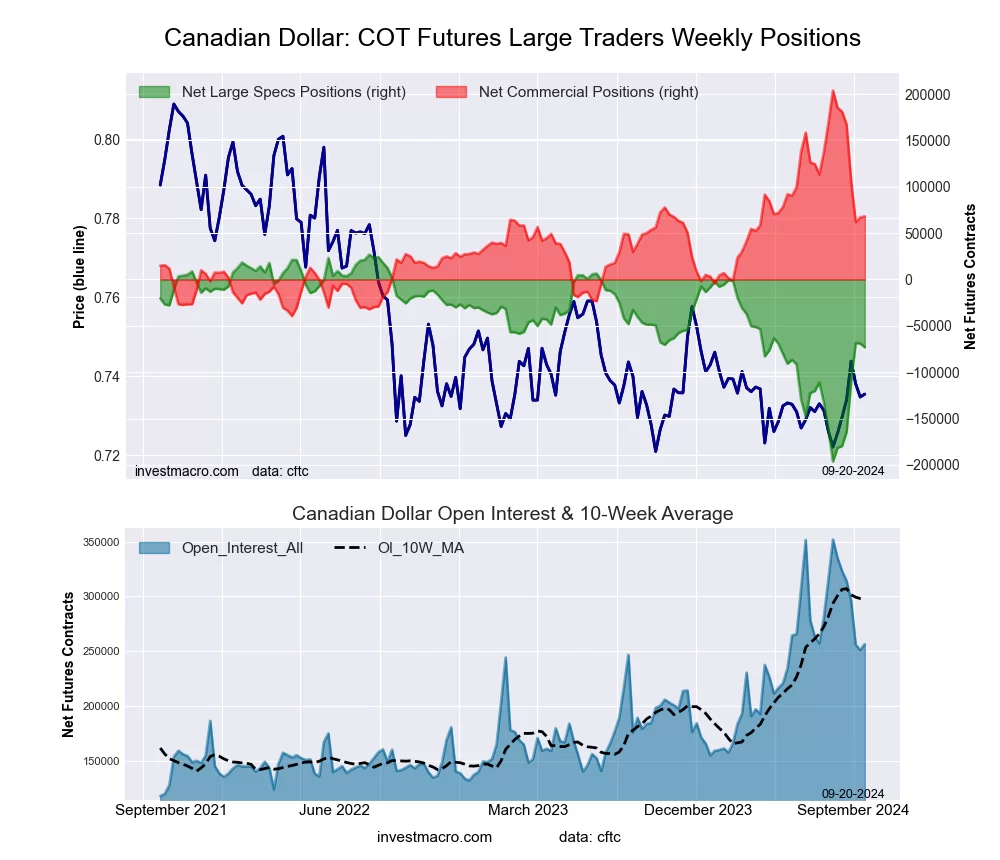
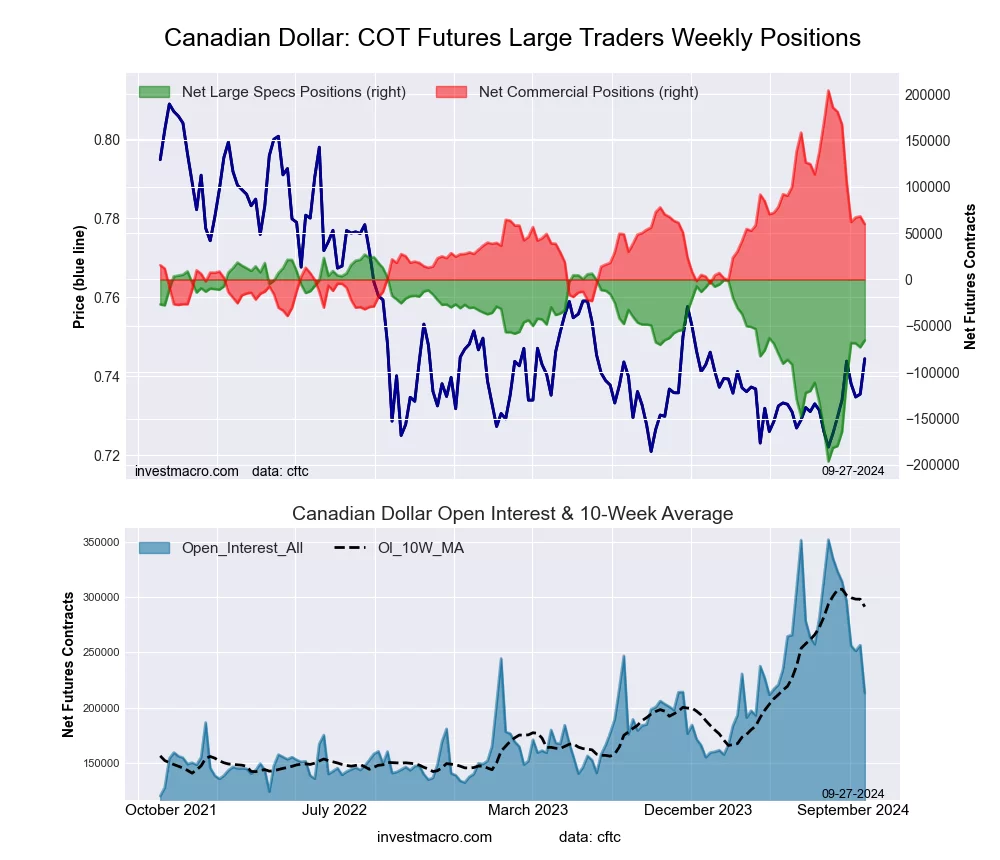
Canadian Dollar Forex Futures COT ChartThe Canadian Dollar large speculator standing this week totaled a net position of -179,611 contracts in the data reported through Tuesday. This was a weekly rise of 2,021 contracts from the previous week which had a total of -181,632 net contracts.

This week’s current strength score (the trader positioning range over the past three years, measured from 0 to 100) shows the speculators are currently Bearish-Extreme with a score of 7.5 percent. The commercials are Bullish-Extreme with a score of 90.6 percent and the small traders (not shown in chart) are Bearish with a score of 26.8 percent.

Price Trend-Following Model: Weak Downtrend

Our weekly trend-following model classifies the current market price position as: Weak Downtrend. The current action for the model is considered to be: Hold – Maintain Short Position.

CANADIAN DOLLAR StatisticsSPECULATORSCOMMERCIALSSMALL TRADERS
– Percent of Open Interest Longs:6.482.19.6
– Percent of Open Interest Shorts:62.026.110.1
– Net Position:-179,611180,958-1,347
– Gross Longs:20,668265,25431,163
– Gross Shorts:200,27984,29632,510
– Long to Short Ratio:0.1 to 13.1 to 11.0 to 1
NET POSITION TREND:
– Strength Index Score (3 Year Range Pct):7.590.626.8
– Strength Index Reading (3 Year Range):Bearish-ExtremeBullish-ExtremeBearish
NET POSITION MOVEMENT INDEX:
– 6-Week Change in Strength Index:-26.623.28.3


Australian Dollar Futures:

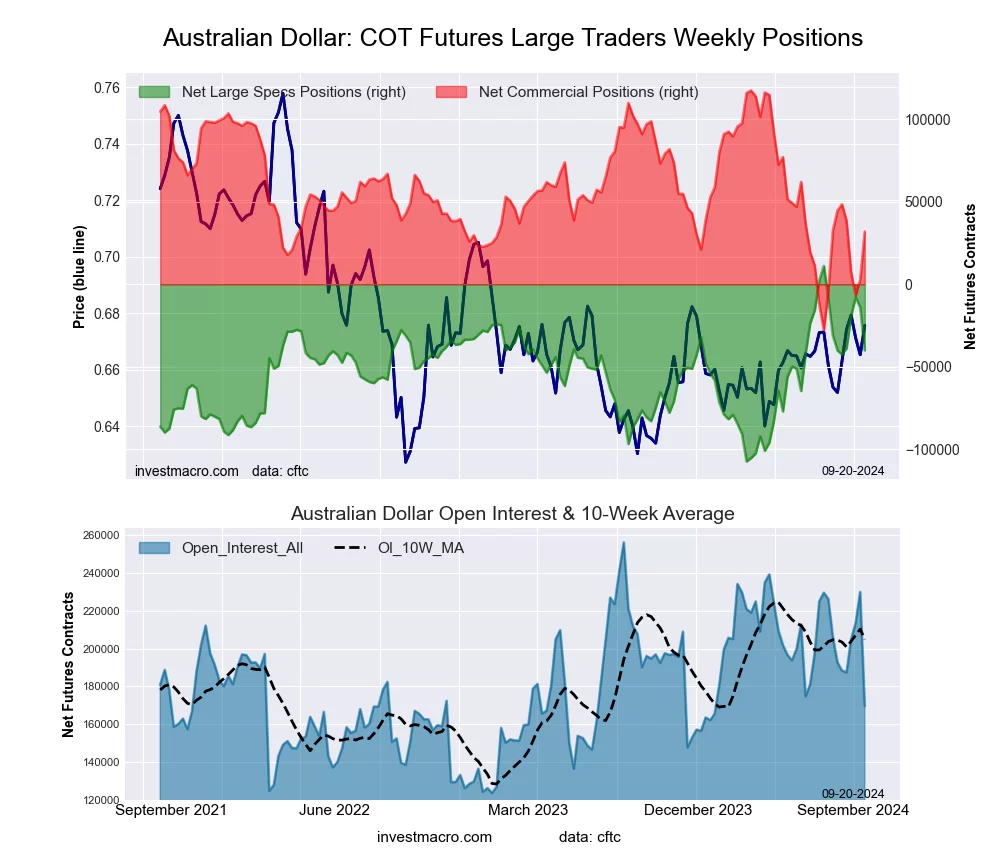
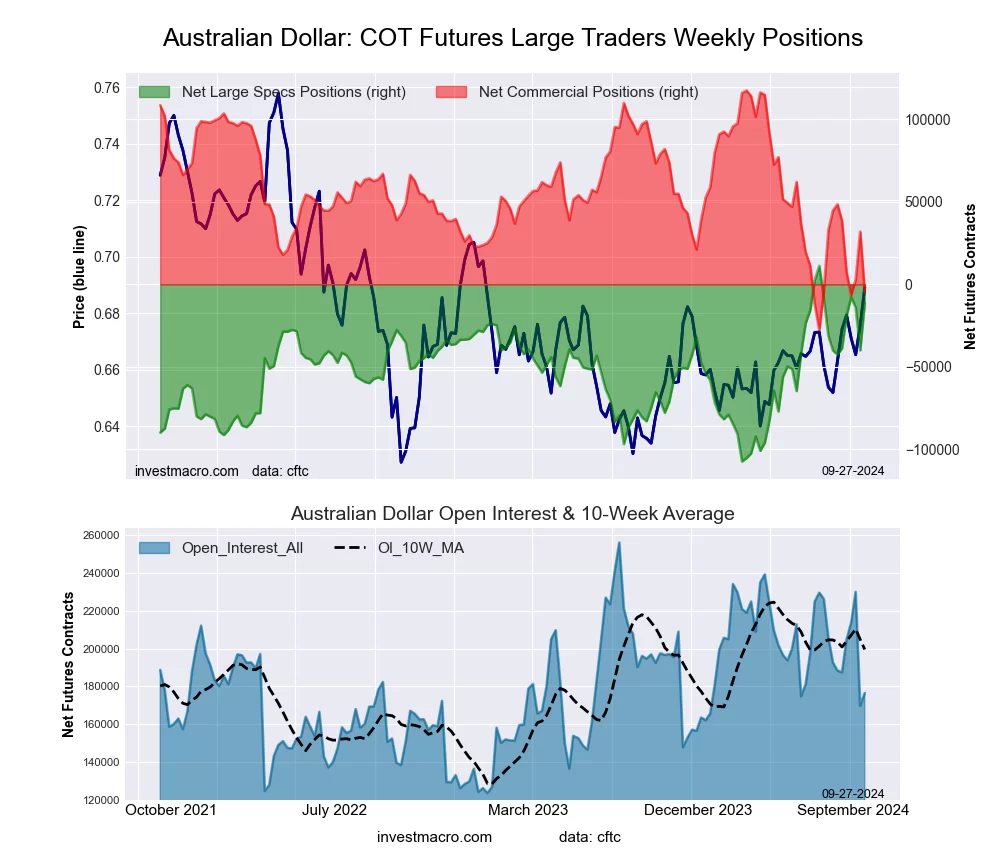
Australian Dollar Forex Futures COT ChartThe Australian Dollar large speculator standing this week totaled a net position of -42,616 contracts in the data reported through Tuesday. This was a weekly reduction of -2,417 contracts from the previous week which had a total of -40,199 net contracts.

This week’s current strength score (the trader positioning range over the past three years, measured from 0 to 100) shows the speculators are currently Bullish with a score of 54.7 percent. The commercials are Bullish with a score of 52.5 percent and the small traders (not shown in chart) are Bearish with a score of 40.9 percent.

Price Trend-Following Model: Uptrend

Our weekly trend-following model classifies the current market price position as: Uptrend. The current action for the model is considered to be: Hold – Maintain Long Position.

AUSTRALIAN DOLLAR StatisticsSPECULATORSCOMMERCIALSSMALL TRADERS
– Percent of Open Interest Longs:34.550.013.1
– Percent of Open Interest Shorts:57.224.216.2
– Net Position:-42,61648,481-5,865
– Gross Longs:65,02894,08424,636
– Gross Shorts:107,64445,60330,501
– Long to Short Ratio:0.6 to 12.1 to 10.8 to 1
NET POSITION TREND:
– Strength Index Score (3 Year Range Pct):54.752.540.9
– Strength Index Reading (3 Year Range):BullishBullishBearish
NET POSITION MOVEMENT INDEX:
– 6-Week Change in Strength Index:-22.625.6-27.2


New Zealand Dollar Futures:

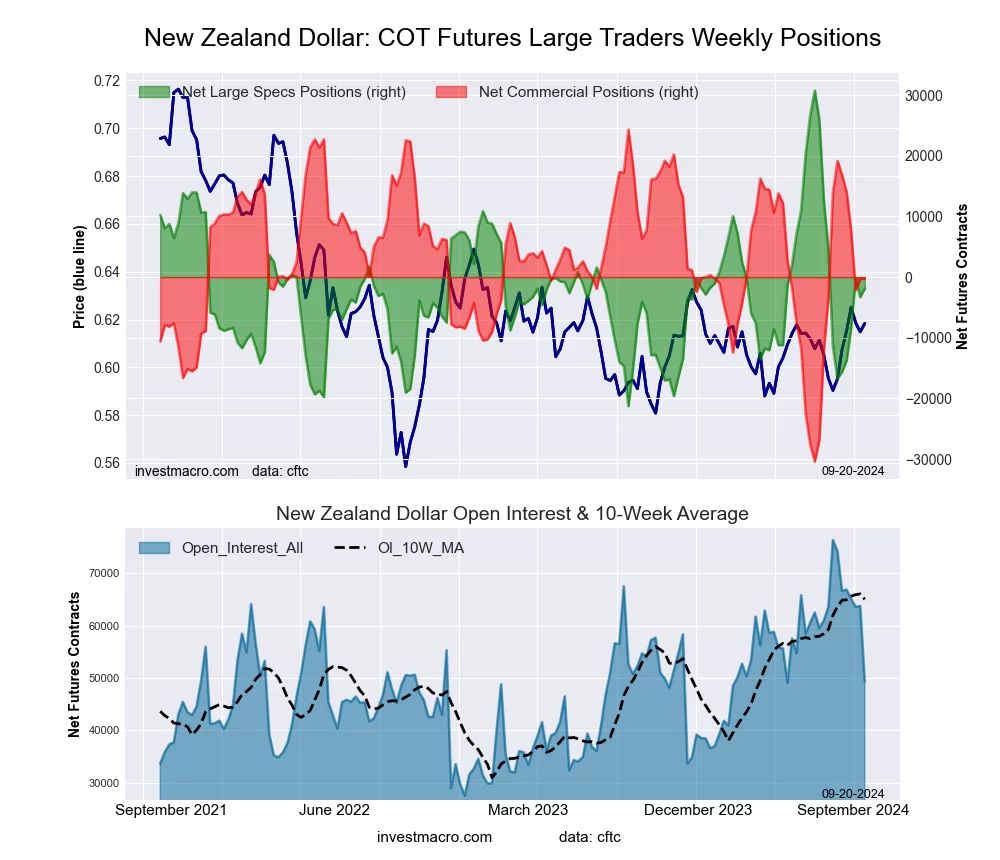
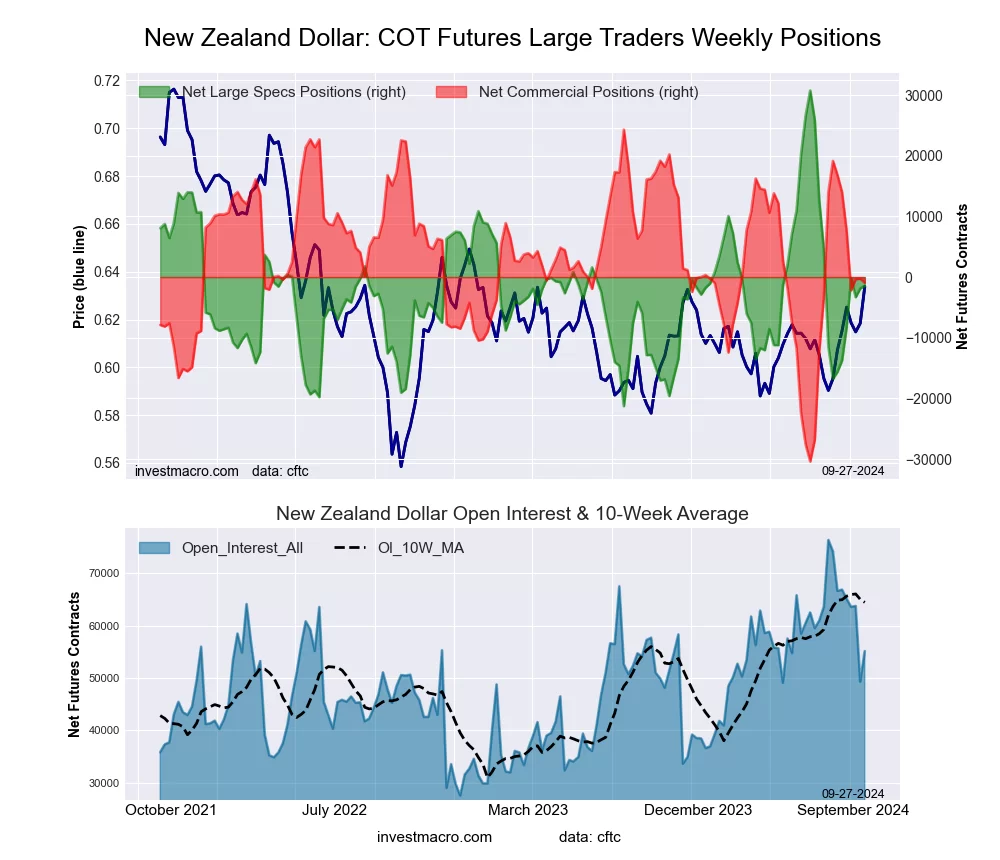
New Zealand Dollar Forex Futures COT ChartThe New Zealand Dollar large speculator standing this week totaled a net position of -15,624 contracts in the data reported through Tuesday. This was a weekly advance of 1,127 contracts from the previous week which had a total of -16,751 net contracts.

This week’s current strength score (the trader positioning range over the past three years, measured from 0 to 100) shows the speculators are currently Bearish-Extreme with a score of 10.9 percent. The commercials are Bullish-Extreme with a score of 86.3 percent and the small traders (not shown in chart) are Bearish with a score of 42.0 percent.

Price Trend-Following Model: Uptrend

Our weekly trend-following model classifies the current market price position as: Uptrend. The current action for the model is considered to be: Hold – Maintain Long Position.

NEW ZEALAND DOLLAR StatisticsSPECULATORSCOMMERCIALSSMALL TRADERS
– Percent of Open Interest Longs:25.667.56.4
– Percent of Open Interest Shorts:49.142.38.1
– Net Position:-15,62416,811-1,187
– Gross Longs:17,05044,9734,240
– Gross Shorts:32,67428,1625,427
– Long to Short Ratio:0.5 to 11.6 to 10.8 to 1
NET POSITION TREND:
– Strength Index Score (3 Year Range Pct):10.986.342.0
– Strength Index Reading (3 Year Range):Bearish-ExtremeBullish-ExtremeBearish
NET POSITION MOVEMENT INDEX:
– 6-Week Change in Strength Index:-89.186.3-11.6


Mexican Peso Futures:

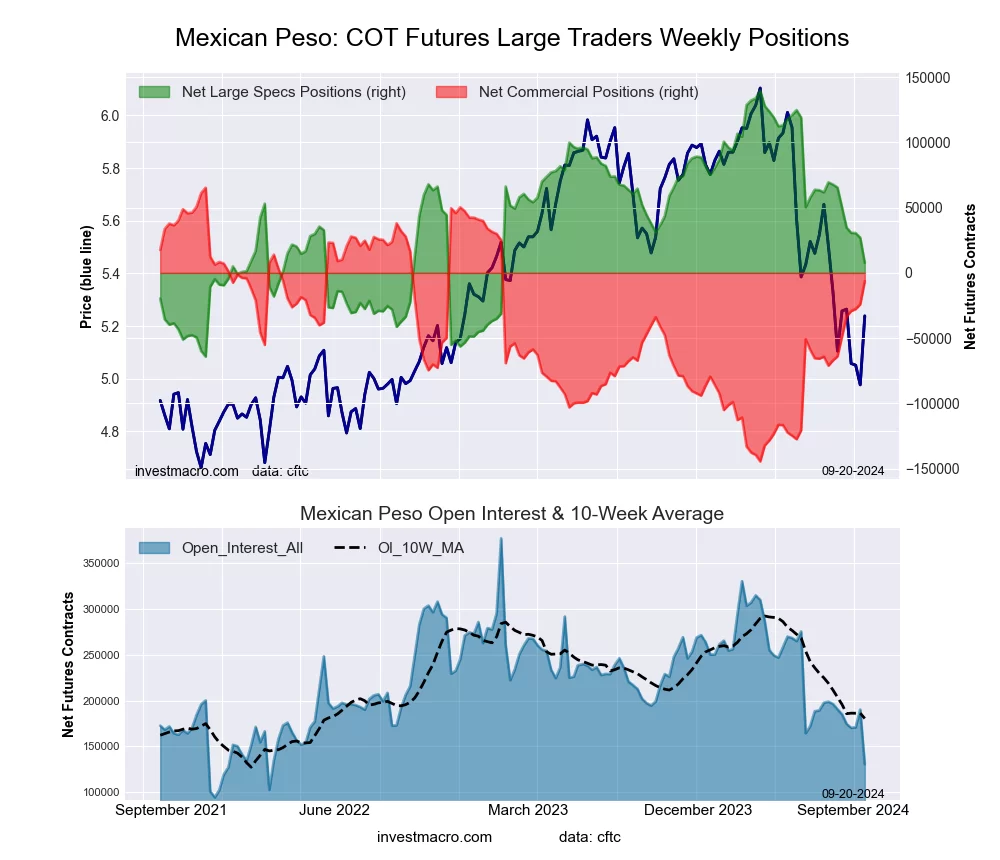
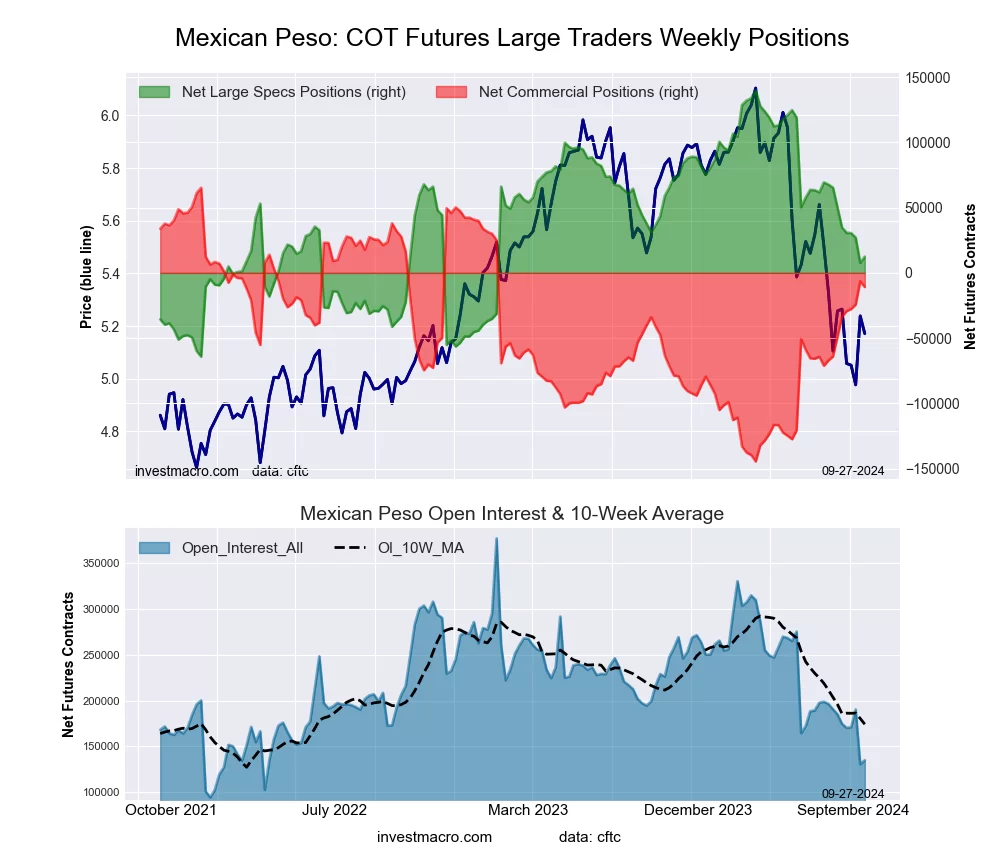
Mexican Peso Futures COT ChartThe Mexican Peso large speculator standing this week totaled a net position of 50,094 contracts in the data reported through Tuesday. This was a weekly decline of -15,242 contracts from the previous week which had a total of 65,336 net contracts.

This week’s current strength score (the trader positioning range over the past three years, measured from 0 to 100) shows the speculators are currently Bullish with a score of 56.0 percent. The commercials are Bearish with a score of 45.7 percent and the small traders (not shown in chart) are Bearish-Extreme with a score of 2.3 percent.

Price Trend-Following Model: Downtrend

Our weekly trend-following model classifies the current market price position as: Downtrend. The current action for the model is considered to be: Hold – Maintain Short Position.

MEXICAN PESO StatisticsSPECULATORSCOMMERCIALSSMALL TRADERS
– Percent of Open Interest Longs:44.451.72.1
– Percent of Open Interest Shorts:17.478.02.8
– Net Position:50,094-48,708-1,386
– Gross Longs:82,18895,6203,845
– Gross Shorts:32,094144,3285,231
– Long to Short Ratio:2.6 to 10.7 to 10.7 to 1
NET POSITION TREND:
– Strength Index Score (3 Year Range Pct):56.045.72.3
– Strength Index Reading (3 Year Range):BullishBearishBearish-Extreme
NET POSITION MOVEMENT INDEX:
– 6-Week Change in Strength Index:-6.67.9-19.8


Brazilian Real Futures:

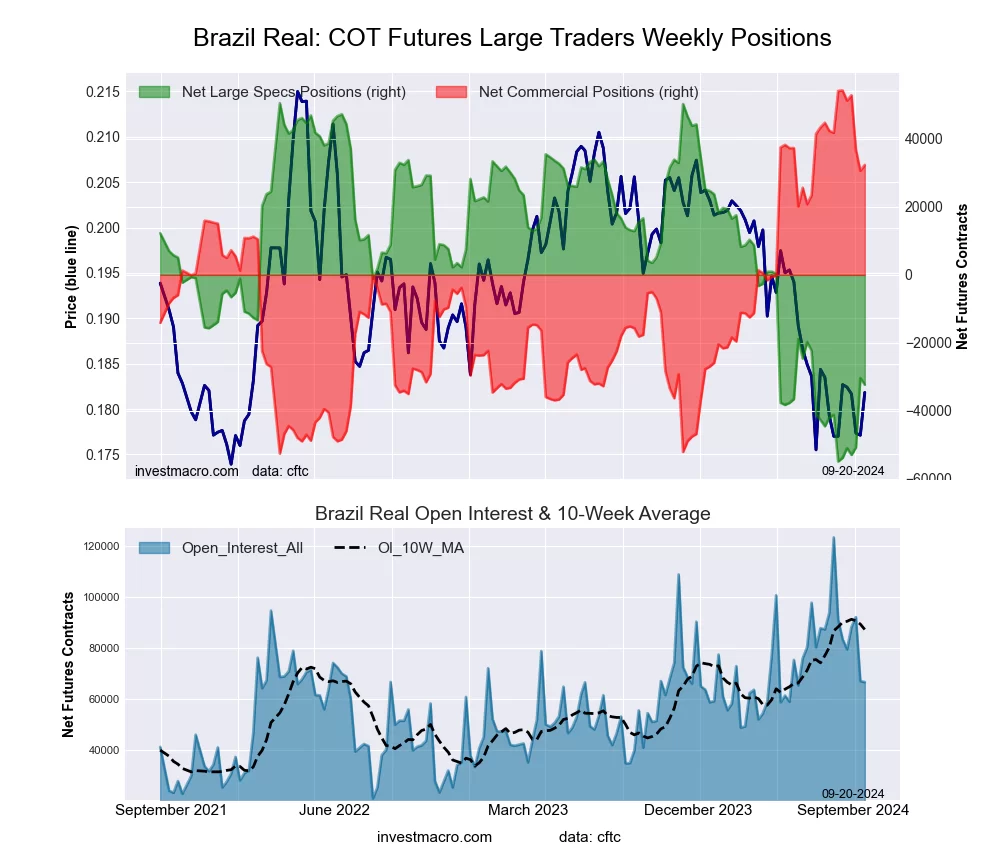
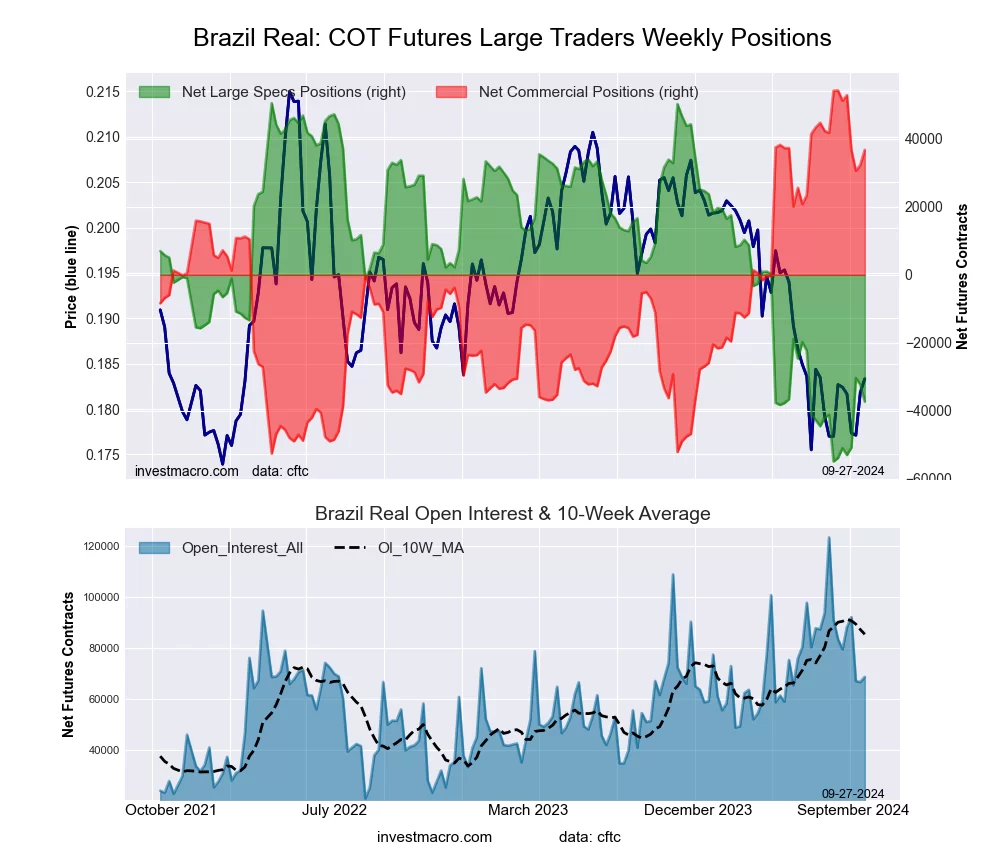
Brazil Real Futures COT ChartThe Brazilian Real large speculator standing this week totaled a net position of -53,842 contracts in the data reported through Tuesday. This was a weekly lift of 1,041 contracts from the previous week which had a total of -54,883 net contracts.

This week’s current strength score (the trader positioning range over the past three years, measured from 0 to 100) shows the speculators are currently Bearish-Extreme with a score of 1.0 percent. The commercials are Bullish-Extreme with a score of 100.0 percent and the small traders (not shown in chart) are Bearish with a score of 30.9 percent.

Price Trend-Following Model: Downtrend

Our weekly trend-following model classifies the current market price position as: Downtrend. The current action for the model is considered to be: Hold – Maintain Short Position.

BRAZIL REAL StatisticsSPECULATORSCOMMERCIALSSMALL TRADERS
– Percent of Open Interest Longs:22.475.02.5
– Percent of Open Interest Shorts:87.010.03.0
– Net Position:-53,84254,218-376
– Gross Longs:18,70062,5922,117
– Gross Shorts:72,5428,3742,493
– Long to Short Ratio:0.3 to 17.5 to 10.8 to 1
NET POSITION TREND:
– Strength Index Score (3 Year Range Pct):1.0100.030.9
– Strength Index Reading (3 Year Range):Bearish-ExtremeBullish-ExtremeBearish
NET POSITION MOVEMENT INDEX:
– 6-Week Change in Strength Index:-12.111.90.3


Bitcoin Futures:

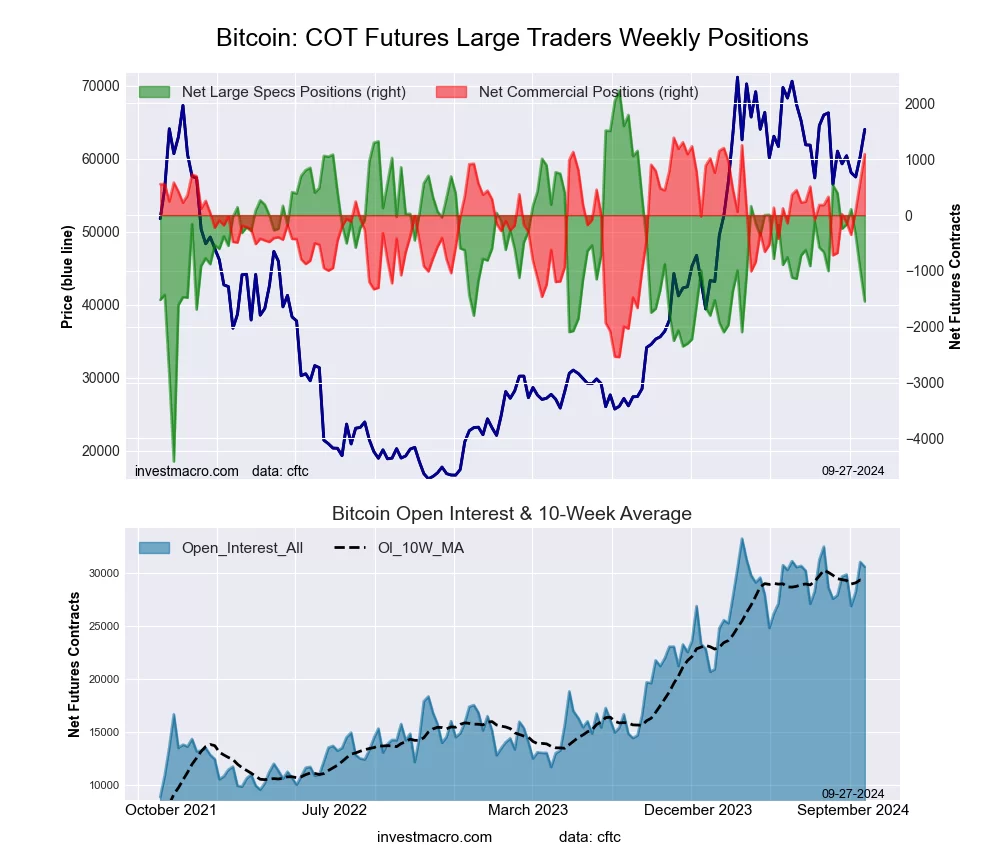
Bitcoin Crypto Futures COT ChartThe Bitcoin large speculator standing this week totaled a net position of 395 contracts in the data reported through Tuesday. This was a weekly reduction of -143 contracts from the previous week which had a total of 538 net contracts.

This week’s current strength score (the trader positioning range over the past three years, measured from 0 to 100) shows the speculators are currently Bullish with a score of 72.4 percent. The commercials are Bearish with a score of 47.5 percent and the small traders (not shown in chart) are Bearish-Extreme with a score of 19.3 percent.

Price Trend-Following Model: Strong Downtrend

Our weekly trend-following model classifies the current market price position as: Strong Downtrend. The current action for the model is considered to be: Hold – Maintain Short Position.

BITCOIN StatisticsSPECULATORSCOMMERCIALSSMALL TRADERS
– Percent of Open Interest Longs:86.52.34.1
– Percent of Open Interest Shorts:85.14.73.1
– Net Position:395-676281
– Gross Longs:24,1216441,148
– Gross Shorts:23,7261,320867
– Long to Short Ratio:1.0 to 10.5 to 11.3 to 1
NET POSITION TREND:
– Strength Index Score (3 Year Range Pct):72.447.519.3
– Strength Index Reading (3 Year Range):BullishBearishBearish-Extreme
NET POSITION MOVEMENT INDEX:
– 6-Week Change in Strength Index:19.7-30.2-2.7


Article By InvestMacroReceive our weekly COT Newsletter

*COT Report: The COT data, released weekly to the public each Friday, is updated through the most recent Tuesday (data is 3 days old) and shows a quick view of how large speculators or non-commercials (for-profit traders) were positioned in the futures markets.

The CFTC categorizes trader positions according to commercial hedgers (traders who use futures contracts for hedging as part of the business), non-commercials (large traders who speculate to realize trading profits) and nonreportable traders (usually small traders/speculators) as well as their open interest (contracts open in the market at time of reporting). See CFTC criteria here.

Speculator Extremes: Yen, VIX, 5-Year & Cotton lead Bullish & Bearish Positions

By InvestMacro

The latest update for the weekly Commitment of Traders (COT) report was released by the Commodity Futures Trading Commission (CFTC) on Friday for data ending on August 13th.

This weekly Extreme Positions report highlights the Most Bullish and Most Bearish Positions for the speculator category. Extreme positioning in these markets can foreshadow strong moves in the underlying market.

To signify an extreme position, we use the Strength Index (also known as the COT Index) of each instrument, a common method of measuring COT data. The Strength Index is simply a comparison of current trader positions against the range of positions over the previous 3 years. We use over 80 percent as extremely bullish and under 20 percent as extremely bearish. (Compare Strength Index scores across all markets in the data table or cot leaders table)


Here Are This Week’s Most Bullish Speculator Positions:

Japanese Yen


The Japanese Yen speculator position comes in as the most bullish extreme standing this week. The Japanese Yen speculator level is currently at a 100.0 percent score of its 3-year range.

The six-week trend for the percent strength score totaled 100.0 this week. The overall net speculator position was a total of 23,104 net contracts this week with a strong gain of 34,458 contract in the weekly speculator bets.


Speculators or Non-Commercials Notes:

Speculators, classified as non-commercial traders by the CFTC, are made up of large commodity funds, hedge funds and other significant for-profit participants. The Specs are generally regarded as trend-followers in their behavior towards price action – net speculator bets and prices tend to go in the same directions. These traders often look to buy when prices are rising and sell when prices are falling. To illustrate this point, many times speculator contracts can be found at their most extremes (bullish or bearish) when prices are also close to their highest or lowest levels.

These extreme levels can be dangerous for the large speculators as the trade is most crowded, there is less trading ammunition still sitting on the sidelines to push the trend further and prices have moved a significant distance. When the trend becomes exhausted, some speculators take profits while others look to also exit positions when prices fail to continue in the same direction. This process usually plays out over many months to years and can ultimately create a reverse effect where prices start to fall and speculators start a process of selling when prices are falling.


VIX


The VIX speculator position comes next in the extreme standings this week. The VIX speculator level is now at a 93.2 percent score of its 3-year range.

The six-week trend for the percent strength score was 35.9 this week. The speculator position registered -20,262 net contracts this week with a weekly boost of 23,283 contracts in speculator bets.


Gold


The Gold speculator position comes in third this week in the extreme standings. The Gold speculator level resides at a 92.4 percent score of its 3-year range.

The six-week trend for the speculator strength score came in at 11.0 this week. The overall speculator position was 267,264 net contracts this week with a rise by 28,515 contracts in the weekly speculator bets.


3-Month Secured Overnight Financing Rate


The 3-Month Secured Overnight Financing Rate speculator position comes up number four in the extreme standings this week. The 3-Month Secured Overnight Financing Rate speculator level is at a 83.3 percent score of its 3-year range.

The six-week trend for the speculator strength score totaled a change of 36.5 this week. The overall speculator position was 445,064 net contracts this week with a jump of 77,916 contracts in the speculator bets.


Coffee


The Coffee speculator position rounds out the top five in this week’s bullish extreme standings. The Coffee speculator level sits at a 83.3 percent score of its 3-year range. The six-week trend for the speculator strength score was -8.6 this week.

The speculator position was 58,940 net contracts this week with a small dip of -267 contracts in the weekly speculator bets.


This Week’s Most Bearish Speculator Positions:

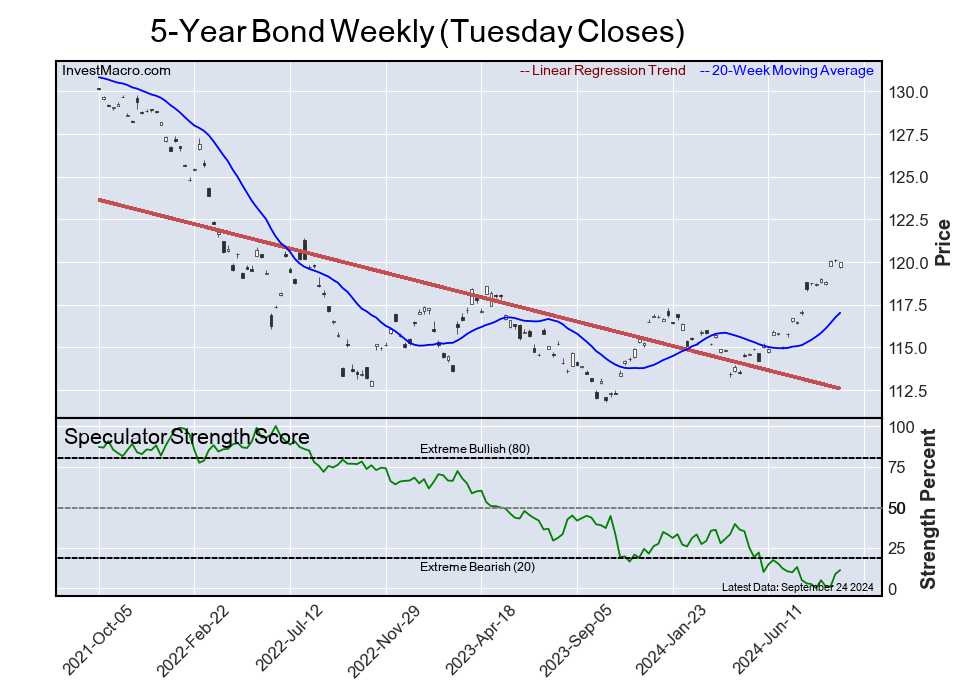
5-Year Bond


The 5-Year Bond speculator position comes in as the most bearish extreme standing this week. The 5-Year Bond speculator level is at a 0.0 percent score of its 3-year range.

The six-week trend for the speculator strength score was -8.8 this week. The overall speculator position was -1,695,072 net contracts this week with a decline of -6,996 contracts in the speculator bets.


Cotton


The Cotton speculator position comes in next for the most bearish extreme standing on the week. The Cotton speculator level is at a 0.1 percent score of its 3-year range.

The six-week trend for the speculator strength score was -14.9 this week. The speculator position was -41,670 net contracts this week with an edge higher by 238 contracts in the weekly speculator bets.


Brazil Real


The Brazil Real speculator position comes in as third most bearish extreme standing of the week. The Brazil Real speculator level resides at a 1.0 percent score of its 3-year range.

The six-week trend for the speculator strength score was -12.1 this week. The overall speculator position was -53,842 net contracts this week with a rise of 1,041 contracts in the speculator bets.


10-Year Note


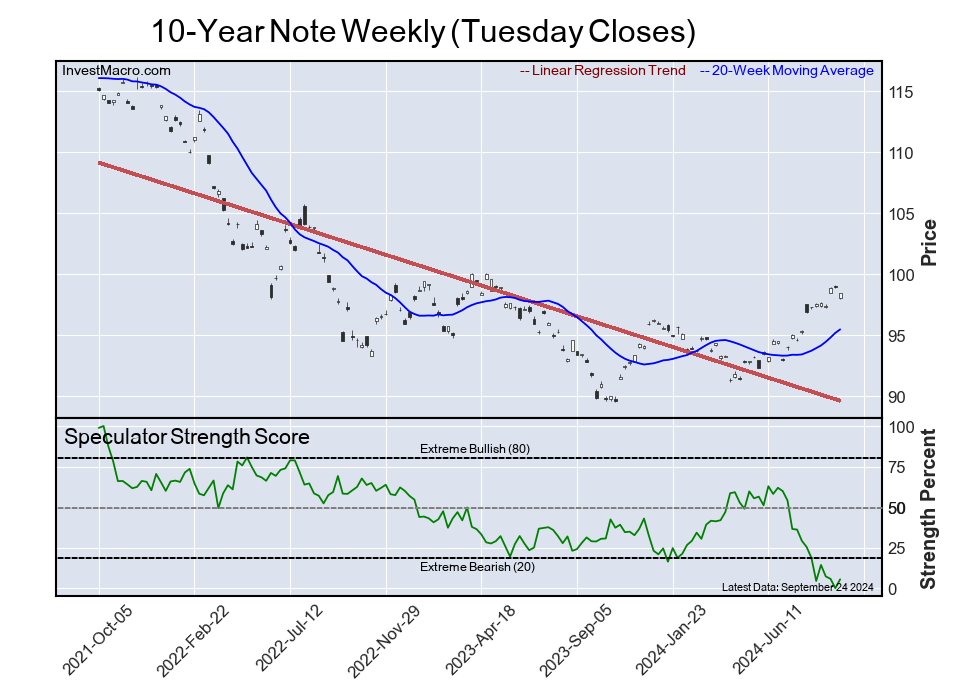
The 10-Year Note speculator position comes in as this week’s fourth most bearish extreme standing. The 10-Year Note speculator level is at a 2.7 percent score of its 3-year range.

The six-week trend for the speculator strength score was -48.1 this week. The speculator position was -860,243 net contracts this week with a drop by -84,035 contracts in the weekly speculator bets.


Gasoline


Finally, the Gasoline speculator position comes in as the fifth most bearish extreme standing for this week. The Gasoline speculator level is at a 4.8 percent score of its 3-year range.

The six-week trend for the speculator strength score was -34.2 this week. The speculator position was 15,028 net contracts this week with an increase by 3,441 contracts in the weekly speculator bets.


Article By InvestMacroReceive our weekly COT Newsletter

*COT Report: The COT data, released weekly to the public each Friday, is updated through the most recent Tuesday (data is 3 days old) and shows a quick view of how large speculators or non-commercials (for-profit traders) were positioned in the futures markets.

The CFTC categorizes trader positions according to commercial hedgers (traders who use futures contracts for hedging as part of the business), non-commercials (large traders who speculate to realize trading profits) and nonreportable traders (usually small traders/speculators) as well as their open interest (contracts open in the market at time of reporting). See CFTC criteria here.

International students will offer a big boost to the US economy this back-to-school season

By Barnet Sherman, Boston University 

Of the millions of young adults heading off to college this fall, many will be international students. If trends continue, about 1 million students from around the world will come to the U.S. to pursue higher education this year.

These young scholars make a big economic impact. Altogether, they pump more than US$40 billion into the U.S. economy and support over 368,000 jobs. That’s not just paying professors and buying textbooks – it includes everything from renting apartments to late-night DoorDash and Grubhub deliveries. And it’s near a record high.

In fact, higher education is the 10th-leading export of the United States, according to the U.S. Bureau of Economic Analysis – except the export is really an import, of students from around the world.

Think of it this way: If you went to Paris to see the Olympics this year, the Olympics was the export that brought you – the tourist, or, in economic terms, the import – to France. In the complex world of economic balance of trade accounting, international students are the tourists visiting U.S. campuses.

Only economists could think that studying and taking exams is somehow a vacation.

While China, India and South Korea send the most students to the U.S., young people come from around the globe to pursue degrees here. Last year, they represented some 221 nations and territories, including three students from the independent island nation of Tuvalu.

A boon to local economies

In any of the 50 largest American cities, you’ll find at least one college or university with international students on campus. For these communities, global learners offer a most welcome financial aid package.

Consider Boston. With its pantheon of venerable institutions – including Boston University, where I teach multinational finance and trade – the region boasts over 50 colleges and universities. Boston’s economic gains from the more than 60,000 international students at these schools are huge: some $2.7 billion.

Or look at Greater Philadelphia. The region’s higher education institutions rank fifth nationwide in attracting students from around the world. From the perennially top-drawing University of Pennsylvania — itself ranked in the top 25 for international students — or the more specialized Curtis Institute of Music, together they can expect to host nearly 17,000 international students in fall 2024.

Prestigious private schools are a draw, but hands down the biggest pull for international students are state universities and colleges. Of the nation’s top schools enrolling these students last year, 32 were state colleges and universities, attracting over 240,000 students in total.

In the top three of those public institutions alone — Arizona State University, the University of Illinois Urbana-Champaign and the University of California, Berkeley — international students contributed nearly $1.6 billion, supporting close to 16,900 jobs. Expand that to the top 10 — the University of California system takes four of those spots — and the numbers pop up to $4.5 billion and 47,900 jobs.

Bringing the world to Mankato

But it’s not just the geographically sprawling University of California and other large state systems. Mankato, Minnesota, hosts a Minnesota State University campus; in the 2022 academic year, some 1,700 international students called this small city, 80 miles from Minneapolis, their home away from home.

Those students brought an infusion of $44.9 million into that community, supporting around 190 jobs. There are dozens of similar campuses in cities and towns like Mankato across the country. It adds up quickly.

In addition to private and public universities, community colleges also attract thousands of international students. Although their international enrollment has fallen off in recent years, community colleges still attracted just shy of 53,600 international students in 2023, with China, Vietnam and Japan leading the list.

Generating some $1.5 billion and supporting 6,620 jobs, they have a major economic impact – particularly in Texas, California and Florida, where the majority of these students come to learn.

One thing’s for sure: Whether they’re attending small-town community colleges or Ivies in big cities, international students have a “high degree” of economic impact.The Conversation

About the Author:

Barnet Sherman, Professor, Multinational Finance and Trade, Boston University

This article is republished from The Conversation under a Creative Commons license. Read the original article.

Offshore wind farms connected by an underwater power grid for transmission could revolutionize how the East Coast gets its electricity

By Tyler Hansen, Dartmouth College; Abraham Silverman, Johns Hopkins University; Elizabeth J. Wilson, Dartmouth College, and Erin Baker, UMass Amherst 

Offshore winds have the potential to supply coastlines with massive, consistent flows of clean electricity. One study estimates wind farms just offshore could meet 11 times the projected global electricity demand in 2040.

In the U.S., the East Coast is an ideal location to capture this power, but there’s a problem: getting electricity from ocean wind farms to the cities and towns that need it.

While everyone wants reliable electricity in their homes and businesses, few support the construction of the transmission lines necessary to get it there. This has always been a problem, both in the U.S. and internationally, but it is becoming an even bigger challenge as countries speed toward net-zero carbon energy systems that will use more electricity.

The U.S. Department of Energy and 10 states in the Northeast States Collaborative on Interregional Transmission are working on a potentially transformative solution: plans for an offshore electric power grid.

Two illustrations show a line of wind farms, the first with each one individually connected to land and the second with all connected to a transmission backbone with only two connections to land.
How an offshore transmission backbone could reduce the number of transmission lines and land crossings.
Illustrations by Billy Roberts, NREL

At the core of this grid would be backbone transmission lines off the East Coast, from North Carolina to Maine, where dozens of offshore wind projects are already in the pipeline.

The plans envision it supporting at least 85 gigawatts of offshore wind power by 2050 – close to the U.S. goal of 110 GW of installed wind power by mid-century, enough to power 40 million homes and up from 0.2 GW today. The Northeast States Collaborative formalized their goals in July 2024 through a multistate memorandum of understanding.

Emerging research from the Department of Energy, the research company Brattle and other groups suggests that an offshore electric power grid could mitigate key challenges to building new transmission lines on land and reduce the costs of offshore wind power.

Cutting costs would be welcome news – offshore wind project costs rose as much as 50% from 2021 to 2023. While some of the underlying causes have subsided, such as inflation and global supply chain disruptions, interest rates remain high, and the industry is still trying to find its footing in the U.S.

What is an offshore electric power grid?

Today’s offshore wind projects use a point-to-point, or radial design, where each offshore wind farm is individually connected to the onshore grid.

This method works if a region has only a few projects, but it quickly becomes more expensive due to the cabling and other infrastructure. Its lines are also disruptive to communities and marine life. And it requires more costly onshore grid upgrades.

Coordinated offshore transmission can avoid many of those costs with what the Department of Energy calls “meshed” or “backbone” designs.

Rather than individual connections to land, many offshore wind farms would be connected to a shared transmission line, which would connect to the onshore grid through strategically placed “points of interconnection.” This way, electricity produced by an offshore wind farm would be transmitted to where it is most needed, up and down the East Coast.

A map shows lease areas, from South Carolina to Massachusetts.
Several areas along the Atlantic continental shelf have been leased for wind power development.
U.S. Department of the Interior, 2024

Even better, electricity generated onshore could also be transmitted through these shared lines to move energy to where it is needed. This could improve the resilience of power grids and reduce the need for new transmission lines over land, which have been notoriously difficult to gain approval for, especially on the East Coast.

Coordinated offshore transmission was part of early U.S. discussions on offshore wind planning and development. In the late 2000s when Google and partners first proposed the Atlantic Wind Connection, an offshore transmission project, the benefits in both offshore renewables and the entire energy system were intriguing. At the time, the U.S. had just one utility-scale offshore wind project in the pipeline, and it ultimately failed.

Today, the U.S. has 53 GW of offshore wind projects being planned or developed. As energy researchers, we believe coordinated offshore transmission is important for the industry to succeed at scale.

Offshore grid could save money, reduce impacts

By enabling power from offshore wind farms and onshore electricity generators to travel to more places, coordinated transmission can enhance grid reliability and enable electricity to get to where it is most needed. This reduces the need for more expensive and often more polluting power plants.

A 2024 report from the National Renewable Energy Lab found the benefits of a coordinated design are nearly three times higher than the costs when compared with a standard point-to-point design.

Studies from Europe, the U.K. and Brattle have pointed to additional benefits, including reducing planet-warming carbon emissions, cutting the number of beach crossings by a third and reducing the miles of transmission cables needed by 35% to 60%.

Three maps show how a backbone design connects systems all along the coast and requires fewer wind farm-to-land connections.
Three transmission designs show the difference between intraregional systems with several land connections and interregional and backbone designs. These three were investigated by the National Renewable Energy Lab in the Atlantic Offshore Wind Transmission Study.
Illustrations by Billy Roberts, NREL

In the U.S., offshore transmission lines would be almost entirely in federal waters, potentially avoiding many of the conflicts associated with onshore projects, though it would still face challenges.

Challenges and next steps

Building an offshore grid will require some important changes.

First is changing government incentives. The federal investment tax credit for offshore wind, which covers at least 30% of the upfront capital cost of a project, does not currently help pay for coordinated transmission designs.

Second, planning needs to take everyone’s concerns into account from the beginning. While the overall benefits of coordinated transmission designs outweigh overall costs, who receives the benefits and who bears the costs matters. For example, more expensive power generators could earn less, and some communities feel threatened by offshore development.

Third, greater coordination will be needed among everyone involved to dispatch power to and from the regional grids. The Federal Energy Regulatory Commission’s recent Order 1920, requiring power providers to plan for future needs, may serve as a blueprint, but it does not apply to interregional projects, such as an offshore transmission backbone connecting over a dozen states across three regions.

A pier with cranes and huge wind turbine blades, seen from the water
Several New England states are seeing economic growth from the offshore wind industry. Here, blades are prepared for shipping at a pier in New London, Conn.
Elizabeth J. Wilson, CC BY-ND

The U.S. reached an important milestone in March 2024 with the completion of South Fork Wind, the country’s first utility-scale wind farm, bringing U.S. offshore wind power capacity to nearly 200 megawatts. Eight more projects are under construction or approved for construction. Once built, they would bring installed capacity to over 13 gigawatts, roughly the same as three dozen coal-fired power plants.

An offshore transmission backbone could support offshore wind development and the East Coast’s energy needs for generations to come.

This article was updated July 31, 2024, to clarify that the states formalized the memorandum of understanding.The Conversation

About the Authors:

Tyler Hansen, Research Associate in Environmental Studies, Dartmouth College; Abraham Silverman, Research Scholar, Ralph O’Connor Sustainable Energy Institute, Johns Hopkins University; Elizabeth J. Wilson, Professor of Environmental Studies, Dartmouth College, and Erin Baker, Professor of Industrial Engineering Applied to Energy Policy, UMass Amherst

This article is republished from The Conversation under a Creative Commons license. Read the original article.

Week Ahead: NAS100 set for Jackson Hole shake up?

By ForexTime 

  • NAS100 ↑ 13% from August low
  • Friday speech by Fed Powell to impact Fed cut bets
  • Watch out for FOMC minutes mid-week
  • Index trading roughly 7% away from all-time high
  • Key levels – 18400, 19500, 20100

It’s that time of the year again with the annual Jackson Hole Economic Symposium around the corner…

But before we discuss the importance of this event, here is a breakdown of the data releases and events scheduled for the upcoming week:

Monday, 19th Aug

  • JP225: Japan core machine orders
  • US500: US Conference Board leading index
  • US Democrat National Convention

Tuesday, 20th Aug

  • CN50: China loan prime rates
  • CAD: Canada CPI
  • SEK: Swedish rate decision
  • EU50: Eurozone CPI
  • TWN: Taiwan export orders

Wednesday 21st Aug

  • JP225: Japan trade
  • ZAR: South Africa CPI
  • NAS100: US FOMC minutes

Thursday, 22nd Aug

  • EU50: Eurozone & Germany PMI, consumer confidence
  • TWN: Taiwan jobless rate
  • UK100: UK S&P global PMI
  • US500: US initial jobless claims, S&P Global PMI

Friday, 23rd Aug

  • CAD: Canada retail sales
  • JP225: Japan CPI
  • SG20: Singapore CPI
  • TWN: Taiwan industrial production
  • NAS100: Fed Chair Powell speech at Jackson Hole


What is the Jackson Hole Economic Symposium?

It’s an annual event organised by the Kansas City Fed in Jackson Hole, Wyoming. This year it will be held from August 22nd – August 24th. 

Attendees from central bankers, finance ministers and economists congregate to discuss pressing global economic issues.

Why is it such a big deal?

Anything discussed during the symposium could trigger market volatility, especially if it has to do with monetary policy.

A trip down memory lane…

  • In August 2022, Jerome Powell’s speech at the Jackson Hole symposium was firmly hawkish as he outlined plans to combat inflation. This triggered a selloff on the S&P500, resulting in a 4% decline for the week.
  • Last year, Powell maintained a hawkish tilt by stating that the Fed was prepared to raise rates further if needed – citing high inflation.

What to expect this year?

It’s been a wild week for US markets with recent data soothing recession fears.

Still, Fed Chair Powell is expected to signal that a September rate cut is in the bag. But with the August jobs and inflation report published before the Fed’s September meeting, the size of the cut may remain a mystery.

Traders have currently fully priced in a 25-basis point Fed cut in September, with the probability of a 50-basis point cut at 33%.

NAS100 under the spotlight

There are a handful of assets that could rocked by Powell’s speech, but FXTM’s NAS100 has caught our attention due to its sensitivity to US interest rates.

NAS100 - W1

Note: FXTM’s NAS100 tracks the underlying benchmark Nasdaq 100 index.

It has been somewhat of a rollercoaster month for the index thanks to shifting monetary policy expectations and risk appetite.

Despite the flat month-to-date gains, prices have rallied 13% from Augusts low of 17247. Bulls seem to be back in action with the index knocking on the 19500 resistances as of writing.

  • FXTM’s NAS100 index could push higher if Powell strikes a dovish tone and signals that US rates will be cut in September.
  • Should Powell sound less dovish than expected and provide no fresh insight into the Feds thinking, this could weigh on the NAS100.

Keep eye on the FOMC minutes

Before Powell’s big speech on Friday, the FOMC minutes mid-week may provide some insight into the Feds thinking for the rest of 2024. Should the minutes come across as dovish, this could provide support to the NAS100.

Technical forces

Prices are turning bullish on the daily charts with the NAS100 challenging the 19500-resistance level. The candlesticks are firmly above the 100 and 200-day SMA but the Relative Strength Indicator (RSI) is slowly approaching overbought territory.

  • A solid weekly close above 19500 may encourage an incline toward 20100 and the all-time high at 20796.
  • Should 19500 prove to be reliable resistance, this could trigger a decline to 18400, the 200-day SMA and 17247.

nas100 -d1


Forex-Time-LogoArticle by ForexTime
ForexTime Ltd (FXTM) is an award winning international online forex broker regulated by CySEC 185/12 www.forextime.com

AI supercharges data center energy use – straining the grid and slowing sustainability efforts

By Ayse Coskun, Boston University 

The artificial intelligence boom has had such a profound effect on big tech companies that their energy consumption, and with it their carbon emissions, have surged.

The spectacular success of large language models such as ChatGPT has helped fuel this growth in energy demand. At 2.9 watt-hours per ChatGPT request, AI queries require about 10 times the electricity of traditional Google queries, according to the Electric Power Research Institute, a nonprofit research firm. Emerging AI capabilities such as audio and video generation are likely to add to this energy demand.

The energy needs of AI are shifting the calculus of energy companies. They’re now exploring previously untenable options, such as restarting a nuclear reactor at the Three Mile Island power plant, site of the infamous disaster in 1979, that has been dormant since 2019.

Data centers have had continuous growth for decades, but the magnitude of growth in the still-young era of large language models has been exceptional. AI requires a lot more computational and data storage resources than the pre-AI rate of data center growth could provide.

AI and the grid

Thanks to AI, the electrical grid – in many places already near its capacity or prone to stability challenges – is experiencing more pressure than before. There is also a substantial lag between computing growth and grid growth. Data centers take one to two years to build, while adding new power to the grid requires over four years.

As a recent report from the Electric Power Research Institute lays out, just 15 states contain 80% of the data centers in the U.S.. Some states – such as Virginia, home to Data Center Alley – astonishingly have over 25% of their electricity consumed by data centers. There are similar trends of clustered data center growth in other parts of the world. For example, Ireland has become a data center nation.

AI is having a big impact on the electrical grid and, potentially, the climate.

Along with the need to add more power generation to sustain this growth, nearly all countries have decarbonization goals. This means they are striving to integrate more renewable energy sources into the grid. Renewables such as wind and solar are intermittent: The wind doesn’t always blow and the sun doesn’t always shine. The dearth of cheap, green and scalable energy storage means the grid faces an even bigger problem matching supply with demand.

Additional challenges to data center growth include increasing use of water cooling for efficiency, which strains limited fresh water sources. As a result, some communities are pushing back against new data center investments.

Better tech

There are several ways the industry is addressing this energy crisis. First, computing hardware has gotten substantially more energy efficient over the years in terms of the operations executed per watt consumed. Data centers’ power use efficiency, a metric that shows the ratio of power consumed for computing versus for cooling and other infrastructure, has been reduced to 1.5 on average, and even to an impressive 1.2 in advanced facilities. New data centers have more efficient cooling by using water cooling and external cool air when it’s available.

Unfortunately, efficiency alone is not going to solve the sustainability problem. In fact, Jevons paradox points to how efficiency may result in an increase of energy consumption in the longer run. In addition, hardware efficiency gains have slowed down substantially, as the industry has hit the limits of chip technology scaling.

To continue improving efficiency, researchers are designing specialized hardware such as accelerators, new integration technologies such as 3D chips, and new chip cooling techniques.

Similarly, researchers are increasingly studying and developing data center cooling technologies. The Electric Power Research Institute report endorses new cooling methods, such as air-assisted liquid cooling and immersion cooling. While liquid cooling has already made its way into data centers, only a few new data centers have implemented the still-in-development immersion cooling.

Flexible future

A new way of building AI data centers is flexible computing, where the key idea is to compute more when electricity is cheaper, more available and greener, and less when it’s more expensive, scarce and polluting.

Data center operators can convert their facilities to be a flexible load on the grid. Academia and industry have provided early examples of data center demand response, where data centers regulate their power depending on power grid needs. For example, they can schedule certain computing tasks for off-peak hours.

Implementing broader and larger scale flexibility in power consumption requires innovation in hardware, software and grid-data center coordination. Especially for AI, there is much room to develop new strategies to tune data centers’ computational loads and therefore energy consumption. For example, data centers can scale back accuracy to reduce workloads when training AI models.

Realizing this vision requires better modeling and forecasting. Data centers can try to better understand and predict their loads and conditions. It’s also important to predict the grid load and growth.

The Electric Power Research Institute’s load forecasting initiative involves activities to help with grid planning and operations. Comprehensive monitoring and intelligent analytics – possibly relying on AI – for both data centers and the grid are essential for accurate forecasting.

On the edge

The U.S. is at a critical juncture with the explosive growth of AI. It is immensely difficult to integrate hundreds of megawatts of electricity demand into already strained grids. It might be time to rethink how the industry builds data centers.

One possibility is to sustainably build more edge data centers – smaller, widely distributed facilities – to bring computing to local communities. Edge data centers can also reliably add computing power to dense, urban regions without further stressing the grid. While these smaller centers currently make up 10% of data centers in the U.S., analysts project the market for smaller-scale edge data centers to grow by over 20% in the next five years.

Along with converting data centers into flexible and controllable loads, innovating in the edge data center space may make AI’s energy demands much more sustainable.

This article has been updated to correct an editing error about the date Three Mile Island’s Unit 1 nuclear reactor was shut down.The Conversation

About the Author:

Ayse Coskun, Professor of Electrical and Computer Engineering, Boston University

This article is republished from The Conversation under a Creative Commons license. Read the original article.

Copper Is in a Full Bear Market

Source: Michael Ballanger (8/14/24)

Even though copper prices bottomed on Thursday, Michael Ballanger of GGM Advisory Inc. still thinks Freeport-McMoRan Inc. (FCX:NYSE) is a Buy. 

Freeport-McMoRan Inc. (FCX:NYSE)

Copper prices bottomed on Thursday, August 8, right before the Sunday-Monday crash in the Nikkei and subsequent policy reversal by BoJ Deputy Governor Uchida, so any rallies from here, given the 25% pullback off the May 20 top at $5.199/lb., are going to be seen as bear market rallies.

Nevertheless, you can make a lot of money if you time these rallies properly, with the ideal strategy being ownership of the top copper producer in the world, which is Freeport-McMoRan Inc. (FCX:NYSE).

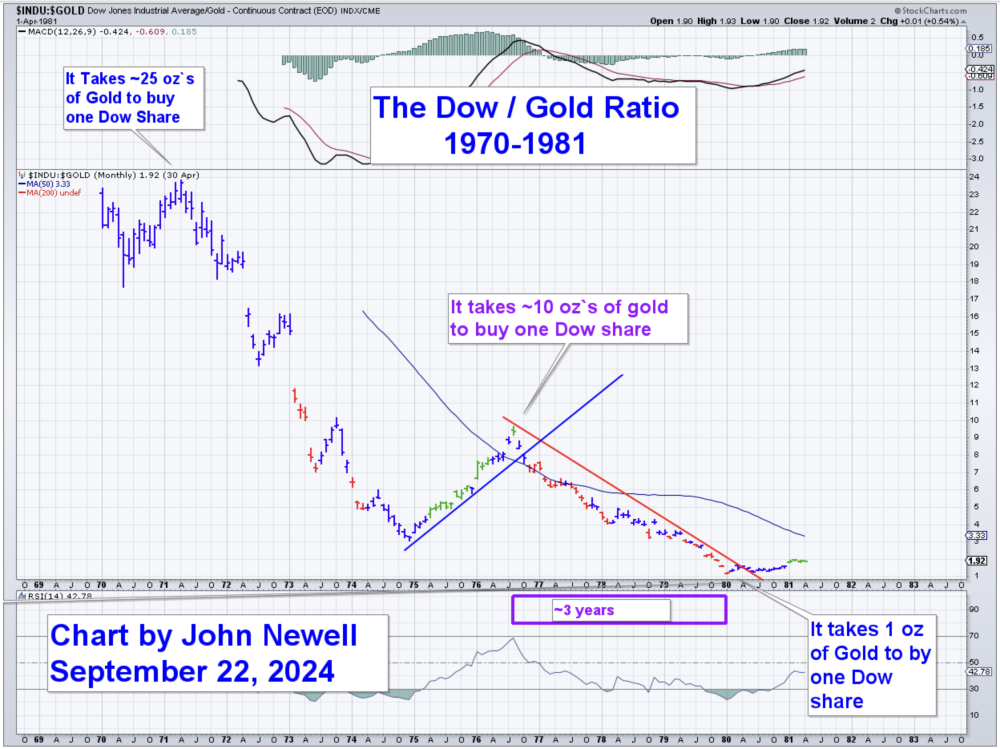
Copper is now in a full-on bear market rally that could possibly tack on another $0.40/lb. from the current $4.03/lb. level at which it now stands, but what is critical is the MACD and MFI indicators where “buy signals” have just been triggered. MFI is coming off a deeply oversold condition, so the rebound looks to be fairly strong.

FCX is coming out of an oversold RSI reading (sub 30) that usually signals an impending turn, and both MACD and the MFI will show “buy signals” by tomorrow’s opening. First stop for FCX is the 200-dma at $43.62 followed by the 50-dma at $47.27 and 100-dma at $48.70.

As for the call options, although the November $ 40’s are more money, the breakeven for these is $45.70 for FCX, while the breakeven for the November $45 calls is $$47.36. There is certainly better leverage in the 45’s if we see a new high above $55.235, but that assumes that copper and FCX move into “bull market resumes” mode, which is entirely possible, but I prefer the more conservative “bear market rally” strategy and a retest of the 50-dma and 100-dma levels that will take the $40’s to between $7.27 and $8.70.

The other possible course of action is to go farther out along the time axis and buy the March $45’s for $4.30. That would give copper price four additional months to recover the momentum that carried it to all-time highs in May.

Also, since FCX is also a significant gold producer through ownership of the Grasberg Mine in Indonesia, it is noteworthy that gold has closed for a couple of days now above $2,500. If gold is about to embark on the next leg to $2,750-$2,800, this provides another impetus for adding to (or initiating) this trade. Ione way or another, FCX is just about to trigger a MACD crossover and “buy signal,” and that should take it up and through the 200-dma at $43.62 very quickly.

In the GGMS 2024 Trading Account

  • Add 50 contracts FCX November $40 at $4.70

New ACB for this position is now $4.15. New cash on hand in that account is US$272,227 or 27.1%. First target is 200-dma at $43.62 for the stock and $7.00 for the calls. I will reassess once those levels are achieved.

I remain a bull on copper for a short-term trade and a long-term bull on gold.


Important Disclosures:

  1. Michael Ballanger: I, or members of my immediate household or family, own securities of: Freeport-McMoRan Inc. I determined which companies would be included in this article based on my research and understanding of the sector.
  2. Statements and opinions expressed are the opinions of the author and not of Streetwise Reports, Street Smart, or their officers. The author is wholly responsible for the accuracy of the statements. Streetwise Reports was not paid by the author to publish or syndicate this article. Streetwise Reports requires contributing authors to disclose any shareholdings in, or economic relationships with, companies that they write about. Any disclosures from the author can be found  below. Streetwise Reports relies upon the authors to accurately provide this information and Streetwise Reports has no means of verifying its accuracy.
  3.  This article does not constitute investment advice and is not a solicitation for any investment. Streetwise Reports does not render general or specific investment advice and the information on Streetwise Reports should not be considered a recommendation to buy or sell any security. Each reader is encouraged to consult with his or her personal financial adviser and perform their own comprehensive investment research. By opening this page, each reader accepts and agrees to Streetwise Reports’ terms of use and full legal disclaimer. Streetwise Reports does not endorse or recommend the business, products, services or securities of any company.

For additional disclosures, please click here.

Michael Ballanger Disclosures

This letter makes no guarantee or warranty on the accuracy or completeness of the data provided. Nothing contained herein is intended or shall be deemed to be investment advice, implied or otherwise. This letter represents my views and replicates trades that I am making but nothing more than that. Always consult your registered advisor to assist you with your investments. I accept no liability for any loss arising from the use of the data contained on this letter. Options and junior mining stocks contain a high level of risk that may result in the loss of part or all invested capital and therefore are suitable for experienced and professional investors and traders only. One should be familiar with the risks involved in junior mining and options trading and we recommend consulting a financial adviser if you feel you do not understand the risks involved.