Archive for Opinions – Page 40

Currency Speculators push Canadian Dollar, British Pound & Yen bets higher for multiple weeks

By InvestMacro

Here are the latest charts and statistics for the Commitment of Traders (COT) data published by the Commodities Futures Trading Commission (CFTC).

The latest COT data is updated through Tuesday September 3rd and shows a quick view of how large market participants (for-profit speculators and commercial traders) were positioned in the futures markets. All currency positions are in direct relation to the US dollar where, for example, a bet for the euro is a bet that the euro will rise versus the dollar while a bet against the euro will be a bet that the euro will decline versus the dollar.

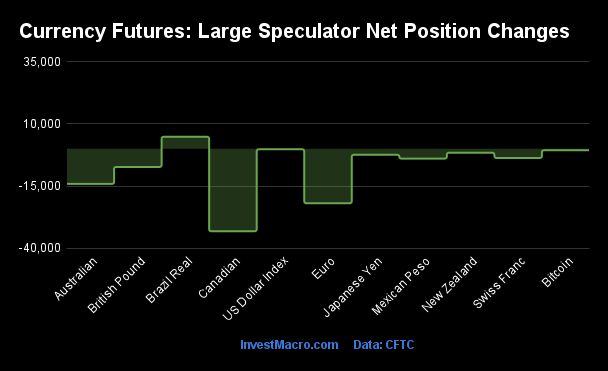
Weekly Speculator Changes led by CAD, GBP & JPY

The COT currency market speculator bets were overall higher this week as ten out of the eleven currency markets we cover had higher positioning while the other one markets had lower speculator contracts.

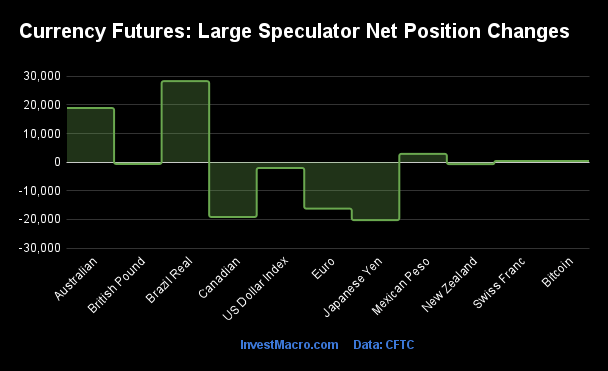
Leading the gains for the currency markets was the Canadian Dollar (41,458 contracts) with the British Pound (18,147 contracts), the Japanese Yen (15,248 contracts), the Australian Dollar (11,295 contracts), the New Zealand Dollar (8,078 contracts), the EuroFX (7,180 contracts), the Swiss Franc (2,730 contracts), the Brazilian Real (2,152 contracts), the US Dollar Index (516 contracts) and with Bitcoin (274 contracts) also having a positive week.

The only currency seeing a decline in speculator bets was the Mexican Peso with a small reduction by -241 contracts on the week.

Speculators push Canadian Dollar, British pound & Yen bets higher for multiple weeks

Highlighting this week’s currency data roundup is the continued gains for the Canadian dollar, British pound and the Japanese yen.

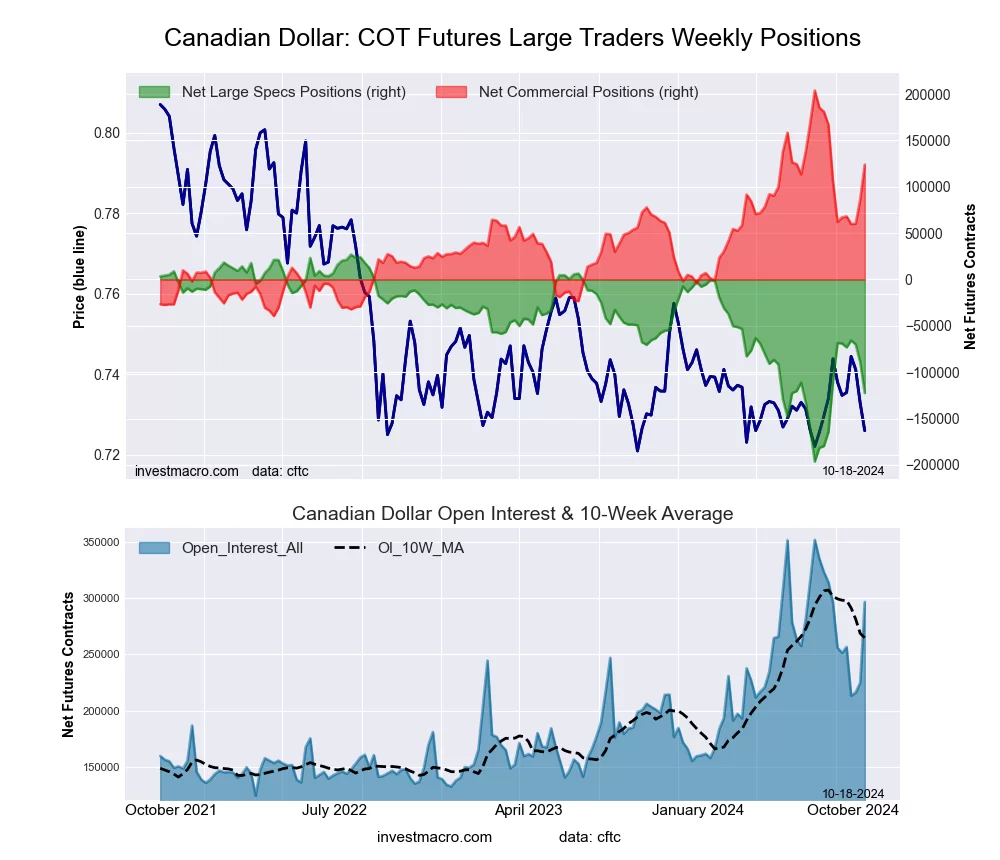
The Canadian dollar speculative position continued to improve this week and rose for a fifth consecutive week. The total gain over the past 5-weeks is now +127,719 contracts after the speculative position had fallen to an all-time low on July 30th at a total of -196,263 contracts. The current CAD positioning remains bearish for a 57th consecutive week but the speculator bets this week sit at a total of -68,544 contracts which is the least bearish level since April 30th. The Canadian dollar exchange rate versus the US dollar dipped this week following four straight weeks of gains that has taken the CADUSD over its 200-day moving average.

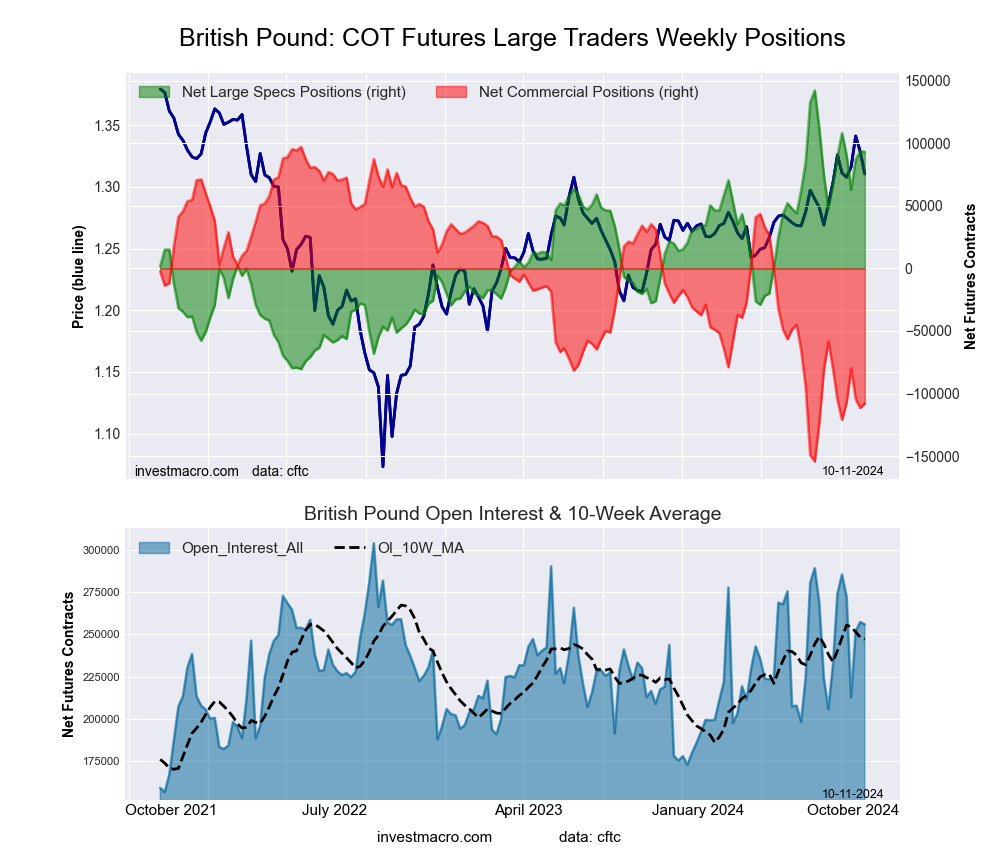
The British pound sterling speculator contracts rose strongly again this week (+18,147 contracts) and increased for a third straight week. The overall bullish position standing is back over the +100,000 net contract level after falling below this level in the previous four weeks. The GBP speculator bets recently rose to an all-time most bullish level on record on July 23rd with a total of +142,183 contracts. The top four most bullish levels on record have been in the past few months after eclipsing the previous high of +98,366 contracts that took place way back in July of 2007. The pound sterling exchange rate against the US dollar has been on the uptrend with increases in three out of the past four weeks. Last week, the GBPUSD rose to the best level since March of 2022 above the 1.3280 threshold.

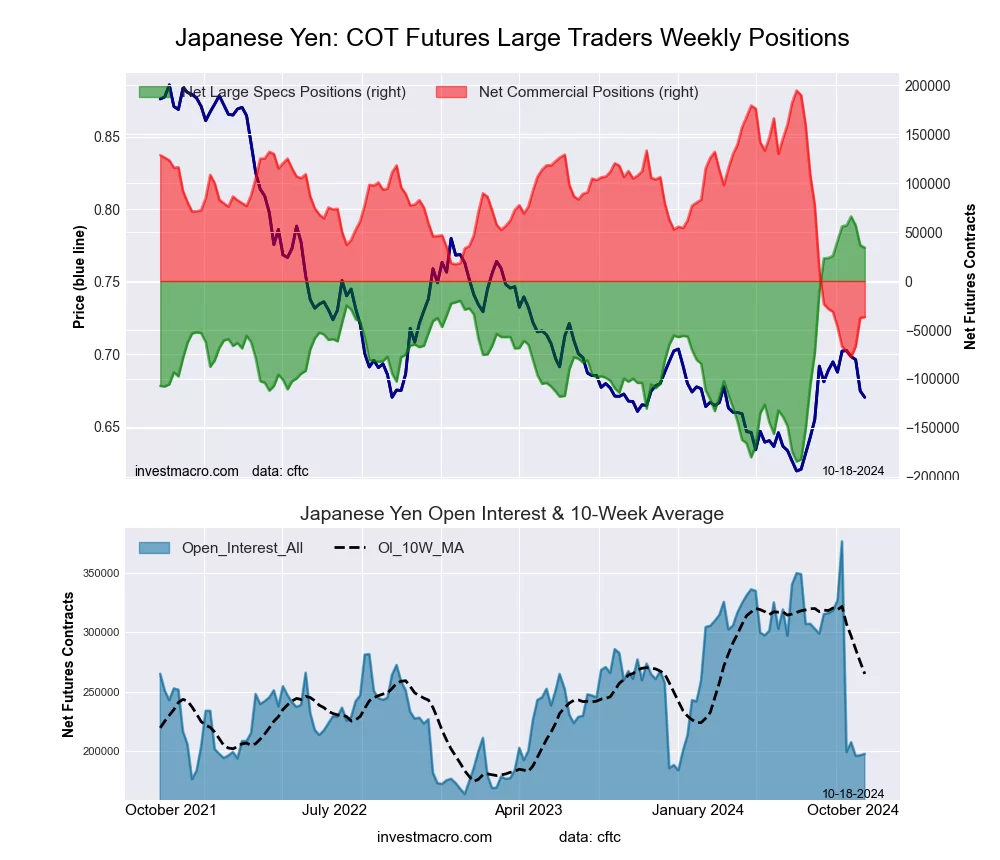
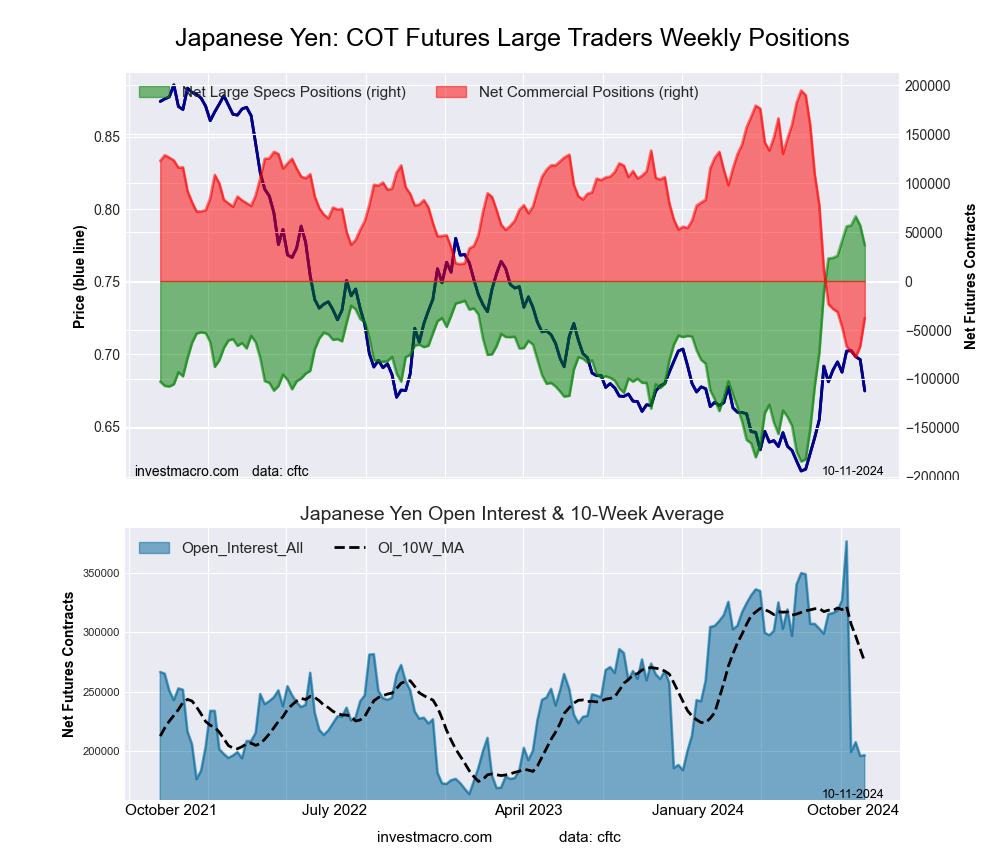
The Japanese yen speculator bets also continued to gain this week and have now advanced for nine straight weeks. The speculative positioning for the yen had fallen to the second most bearish level on July 2nd at a total of -184,223 contracts but since then has seen a sharp turnaround. Over the last nine weeks, a total of +225,339 net contracts have come off that bearish mark and flipped the overall positioning into a bullish level at this week’s standing of +41,116 contracts – the best level since early 2021. The yen exchange rate has risen for six out of the past nine weeks versus the US dollar and is up by over 12 percent in that time-frame.


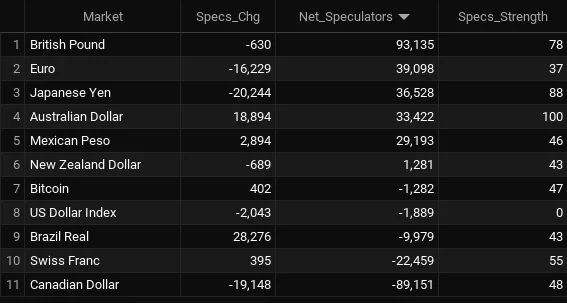
Currencies Net Speculators Leaderboard
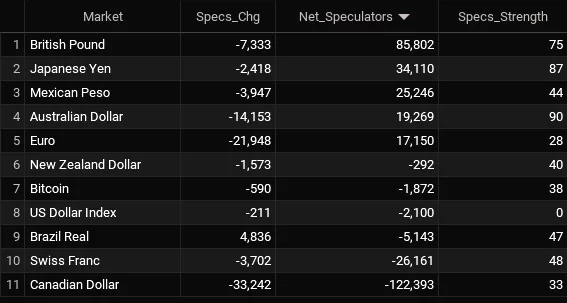
Legend: Weekly Speculators Change | Speculators Current Net Position | Speculators Strength Score compared to last 3-Years (0-100 range)


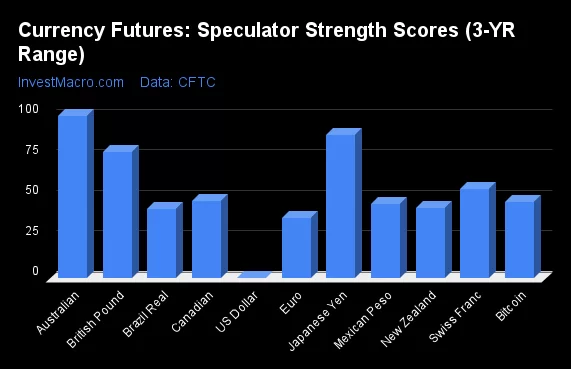
Strength Scores led by Japanese Yen & British Pound

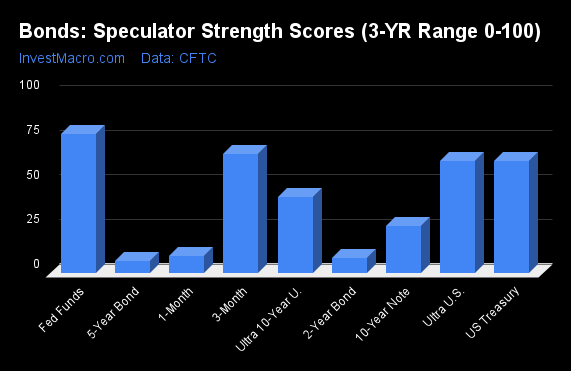
COT Strength Scores (a normalized measure of Speculator positions over a 3-Year range, from 0 to 100 where above 80 is Extreme-Bullish and below 20 is Extreme-Bearish) showed that the Japanese Yen (100 percent) and the British Pound (85 percent) lead the currency markets this week. The Australian Dollar (84 percent), Bitcoin (68 percent) and the EuroFX (63 percent) come in as the next highest in the weekly strength scores.

On the downside, the Brazilian Real (4 percent) comes in at the lowest strength levels currently and is in Extreme-Bearish territory (below 20 percent). The next lowest strength scores are the New Zealand Dollar (40 percent), the US Dollar Index (45 percent) and the Mexican Peso (46 percent).

Strength Statistics:
US Dollar Index (45.5 percent) vs US Dollar Index previous week (44.4 percent)
EuroFX (62.9 percent) vs EuroFX previous week (59.9 percent)
British Pound Sterling (84.7 percent) vs British Pound Sterling previous week (76.5 percent)
Japanese Yen (100.0 percent) vs Japanese Yen previous week (93.2 percent)
Swiss Franc (56.5 percent) vs Swiss Franc previous week (51.0 percent)
Canadian Dollar (57.2 percent) vs Canadian Dollar previous week (38.7 percent)
Australian Dollar (84.0 percent) vs Australian Dollar previous week (74.5 percent)
New Zealand Dollar (40.4 percent) vs New Zealand Dollar previous week (24.9 percent)
Mexican Peso (46.4 percent) vs Mexican Peso previous week (46.5 percent)
Brazilian Real (3.9 percent) vs Brazilian Real previous week (1.8 percent)
Bitcoin (68.0 percent) vs Bitcoin previous week (63.9 percent)


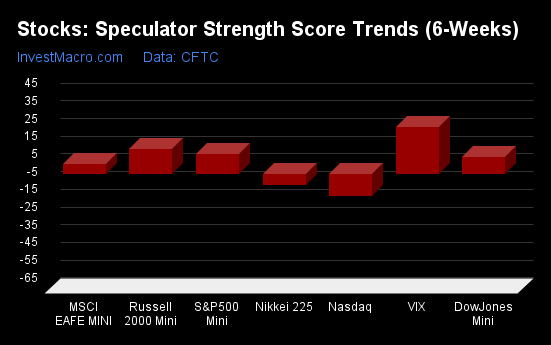
Japanese Yen & Canadian Dollar top the 6-Week Strength Trends
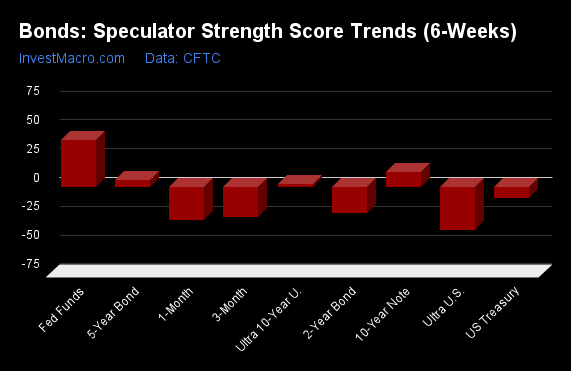
COT Strength Score Trends (or move index, calculates the 6-week changes in strength scores) showed that the Japanese Yen (66 percent) and the Canadian Dollar (42 percent) lead the past six weeks trends for the currencies. The Swiss Franc (41 percent), the EuroFX (27 percent) and Bitcoin (12 percent) are the next highest positive movers in the latest trends data.

The Mexican Peso (-19 percent) leads the downside trend scores currently with the British Pound (-15 percent), the New Zealand Dollar (-9 percent) and the Brazilian Real (-8 percent) following next with lower trend scores.

Strength Trend Statistics:
US Dollar Index (2.6 percent) vs US Dollar Index previous week (0.8 percent)
EuroFX (27.3 percent) vs EuroFX previous week (29.0 percent)
British Pound Sterling (-15.3 percent) vs British Pound Sterling previous week (-19.3 percent)
Japanese Yen (65.8 percent) vs Japanese Yen previous week (78.5 percent)
Swiss Franc (41.2 percent) vs Swiss Franc previous week (51.0 percent)
Canadian Dollar (41.7 percent) vs Canadian Dollar previous week (10.1 percent)
Australian Dollar (0.8 percent) vs Australian Dollar previous week (-25.5 percent)
New Zealand Dollar (-9.1 percent) vs New Zealand Dollar previous week (-40.1 percent)
Mexican Peso (-19.1 percent) vs Mexican Peso previous week (-15.2 percent)
Brazilian Real (-8.4 percent) vs Brazilian Real previous week (-8.0 percent)
Bitcoin (11.6 percent) vs Bitcoin previous week (6.2 percent)


Individual COT Forex Markets:

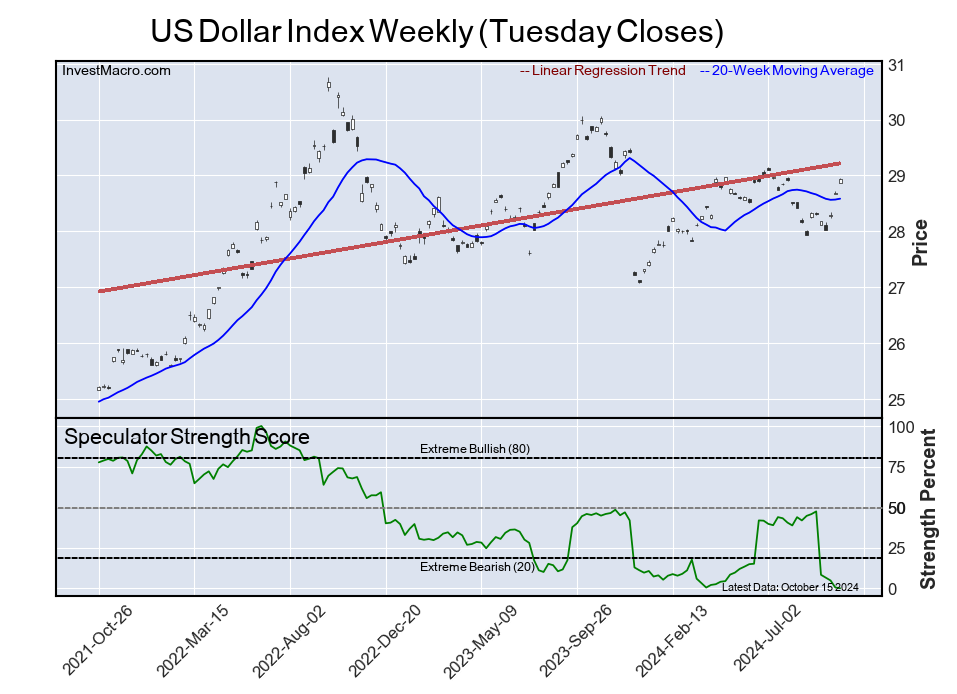
US Dollar Index Futures:
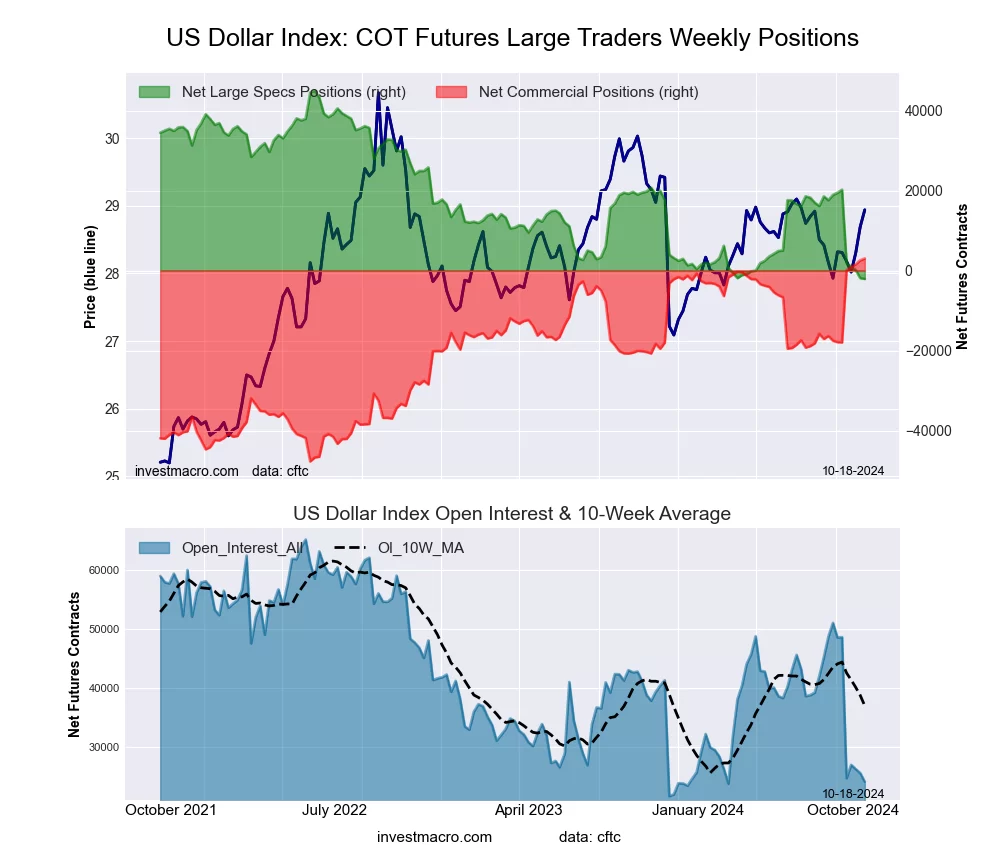
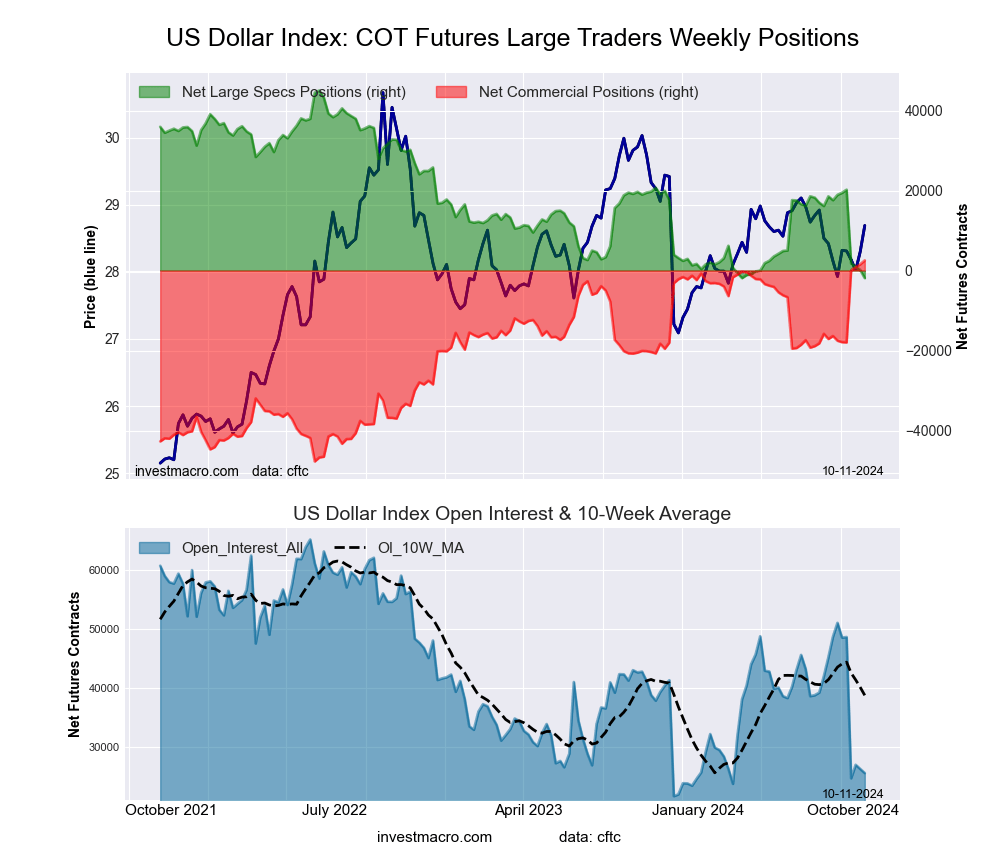
US Dollar Index Forex Futures COT ChartThe US Dollar Index large speculator standing this week came in at a net position of 19,429 contracts in the data reported through Tuesday. This was a weekly advance of 516 contracts from the previous week which had a total of 18,913 net contracts.

This week’s current strength score (the trader positioning range over the past three years, measured from 0 to 100) shows the speculators are currently Bearish with a score of 45.5 percent. The commercials are Bullish with a score of 62.9 percent and the small traders (not shown in chart) are Bearish-Extreme with a score of 0.0 percent.

Price Trend-Following Model: Strong Downtrend

Our weekly trend-following model classifies the current market price position as: Strong Downtrend. The current action for the model is considered to be: Hold – Maintain Short Position.

US DOLLAR INDEX StatisticsSPECULATORSCOMMERCIALSSMALL TRADERS
– Percent of Open Interest Longs:71.520.54.6
– Percent of Open Interest Shorts:31.557.37.7
– Net Position:19,429-17,906-1,523
– Gross Longs:34,7259,9332,233
– Gross Shorts:15,29627,8393,756
– Long to Short Ratio:2.3 to 10.4 to 10.6 to 1
NET POSITION TREND:
– Strength Index Score (3 Year Range Pct):45.562.90.0
– Strength Index Reading (3 Year Range):BearishBullishBearish-Extreme
NET POSITION MOVEMENT INDEX:
– 6-Week Change in Strength Index:2.62.1-24.2


Euro Currency Futures:

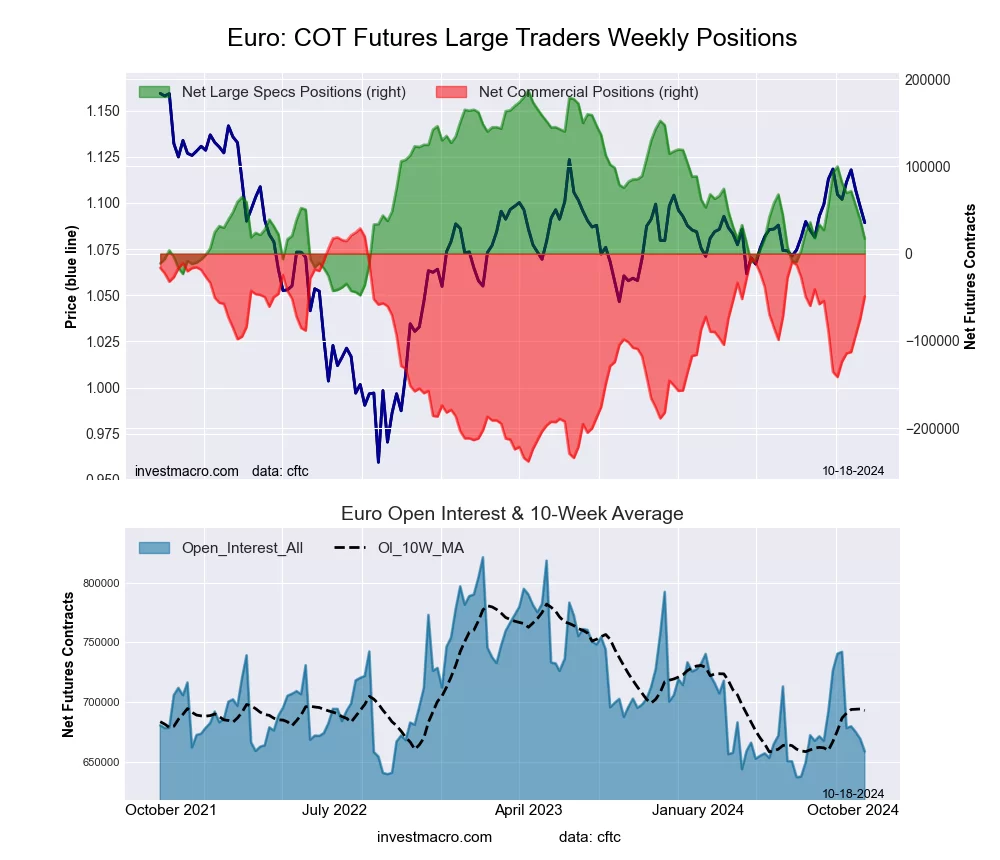
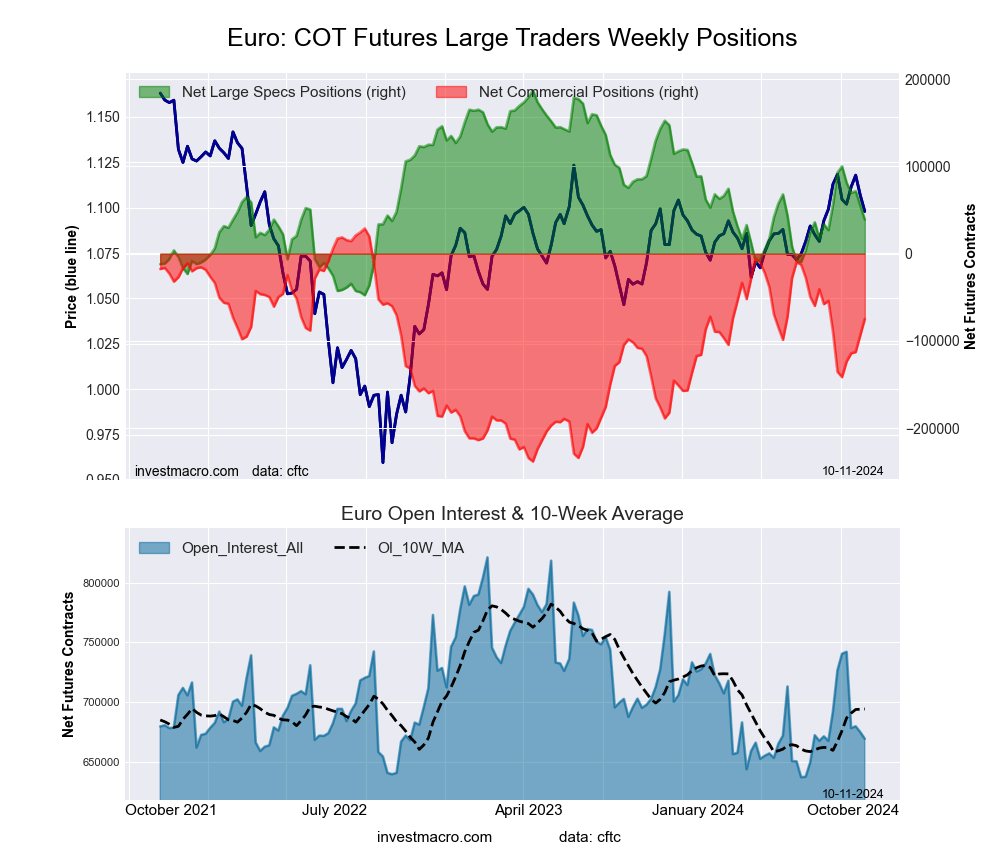
Euro Currency Futures COT ChartThe Euro Currency large speculator standing this week came in at a net position of 100,018 contracts in the data reported through Tuesday. This was a weekly rise of 7,180 contracts from the previous week which had a total of 92,838 net contracts.

This week’s current strength score (the trader positioning range over the past three years, measured from 0 to 100) shows the speculators are currently Bullish with a score of 62.9 percent. The commercials are Bearish with a score of 36.2 percent and the small traders (not shown in chart) are Bullish with a score of 64.7 percent.

Price Trend-Following Model: Strong Uptrend

Our weekly trend-following model classifies the current market price position as: Strong Uptrend. The current action for the model is considered to be: Hold – Maintain Long Position.

EURO Currency StatisticsSPECULATORSCOMMERCIALSSMALL TRADERS
– Percent of Open Interest Longs:29.254.411.5
– Percent of Open Interest Shorts:15.773.55.9
– Net Position:100,018-141,54841,530
– Gross Longs:215,969402,89985,362
– Gross Shorts:115,951544,44743,832
– Long to Short Ratio:1.9 to 10.7 to 11.9 to 1
NET POSITION TREND:
– Strength Index Score (3 Year Range Pct):62.936.264.7
– Strength Index Reading (3 Year Range):BullishBearishBullish
NET POSITION MOVEMENT INDEX:
– 6-Week Change in Strength Index:27.3-30.640.0


British Pound Sterling Futures:

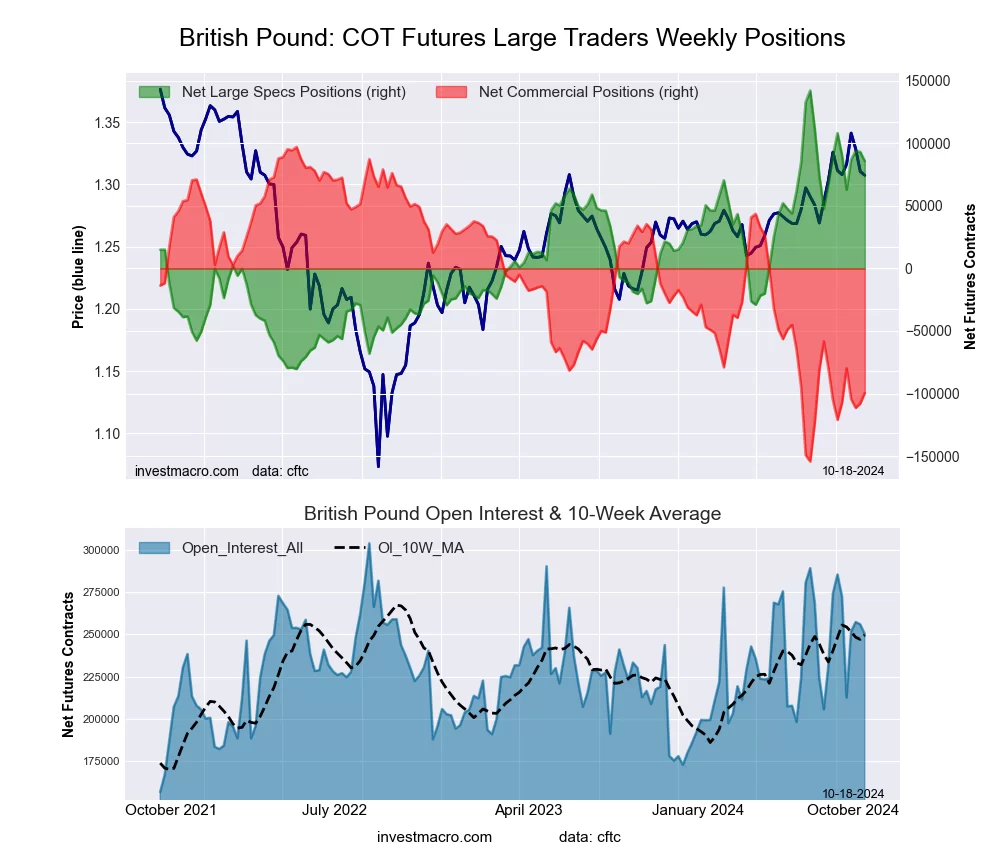
British Pound Sterling Futures COT ChartThe British Pound Sterling large speculator standing this week came in at a net position of 108,078 contracts in the data reported through Tuesday. This was a weekly rise of 18,147 contracts from the previous week which had a total of 89,931 net contracts.

This week’s current strength score (the trader positioning range over the past three years, measured from 0 to 100) shows the speculators are currently Bullish-Extreme with a score of 84.7 percent. The commercials are Bearish-Extreme with a score of 13.3 percent and the small traders (not shown in chart) are Bullish-Extreme with a score of 89.3 percent.

Price Trend-Following Model: Strong Uptrend

Our weekly trend-following model classifies the current market price position as: Strong Uptrend. The current action for the model is considered to be: Hold – Maintain Long Position.

BRITISH POUND StatisticsSPECULATORSCOMMERCIALSSMALL TRADERS
– Percent of Open Interest Longs:56.324.513.9
– Percent of Open Interest Shorts:18.566.99.4
– Net Position:108,078-120,95512,877
– Gross Longs:160,77369,97339,617
– Gross Shorts:52,695190,92826,740
– Long to Short Ratio:3.1 to 10.4 to 11.5 to 1
NET POSITION TREND:
– Strength Index Score (3 Year Range Pct):84.713.389.3
– Strength Index Reading (3 Year Range):Bullish-ExtremeBearish-ExtremeBullish-Extreme
NET POSITION MOVEMENT INDEX:
– 6-Week Change in Strength Index:-15.313.31.7


Japanese Yen Futures:

Japanese Yen Forex Futures COT ChartThe Japanese Yen large speculator standing this week came in at a net position of 41,116 contracts in the data reported through Tuesday. This was a weekly gain of 15,248 contracts from the previous week which had a total of 25,868 net contracts.

This week’s current strength score (the trader positioning range over the past three years, measured from 0 to 100) shows the speculators are currently Bullish-Extreme with a score of 100.0 percent. The commercials are Bearish-Extreme with a score of 0.0 percent and the small traders (not shown in chart) are Bullish-Extreme with a score of 100.0 percent.

Price Trend-Following Model: Strong Uptrend

Our weekly trend-following model classifies the current market price position as: Strong Uptrend. The current action for the model is considered to be: Hold – Maintain Long Position.

JAPANESE YEN StatisticsSPECULATORSCOMMERCIALSSMALL TRADERS
– Percent of Open Interest Longs:28.157.911.7
– Percent of Open Interest Shorts:15.572.29.9
– Net Position:41,116-46,7655,649
– Gross Longs:91,791189,29138,134
– Gross Shorts:50,675236,05632,485
– Long to Short Ratio:1.8 to 10.8 to 11.2 to 1
NET POSITION TREND:
– Strength Index Score (3 Year Range Pct):100.00.0100.0
– Strength Index Reading (3 Year Range):Bullish-ExtremeBearish-ExtremeBullish-Extreme
NET POSITION MOVEMENT INDEX:
– 6-Week Change in Strength Index:65.8-64.522.9


Swiss Franc Futures:

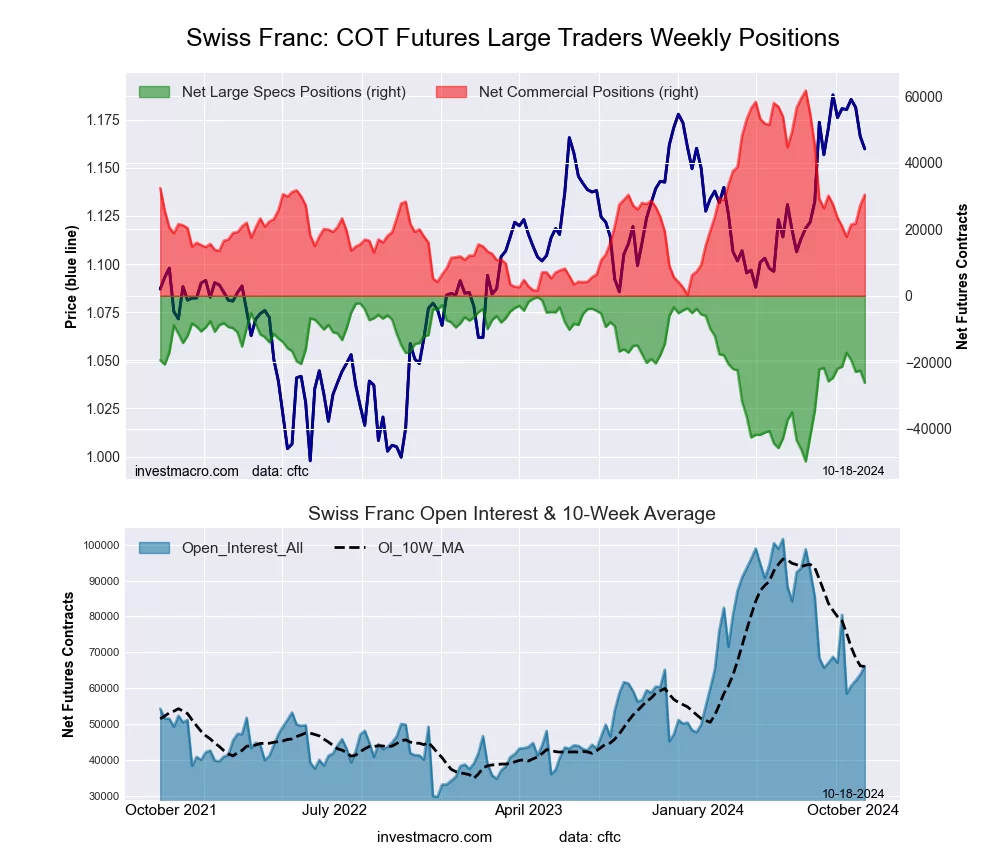
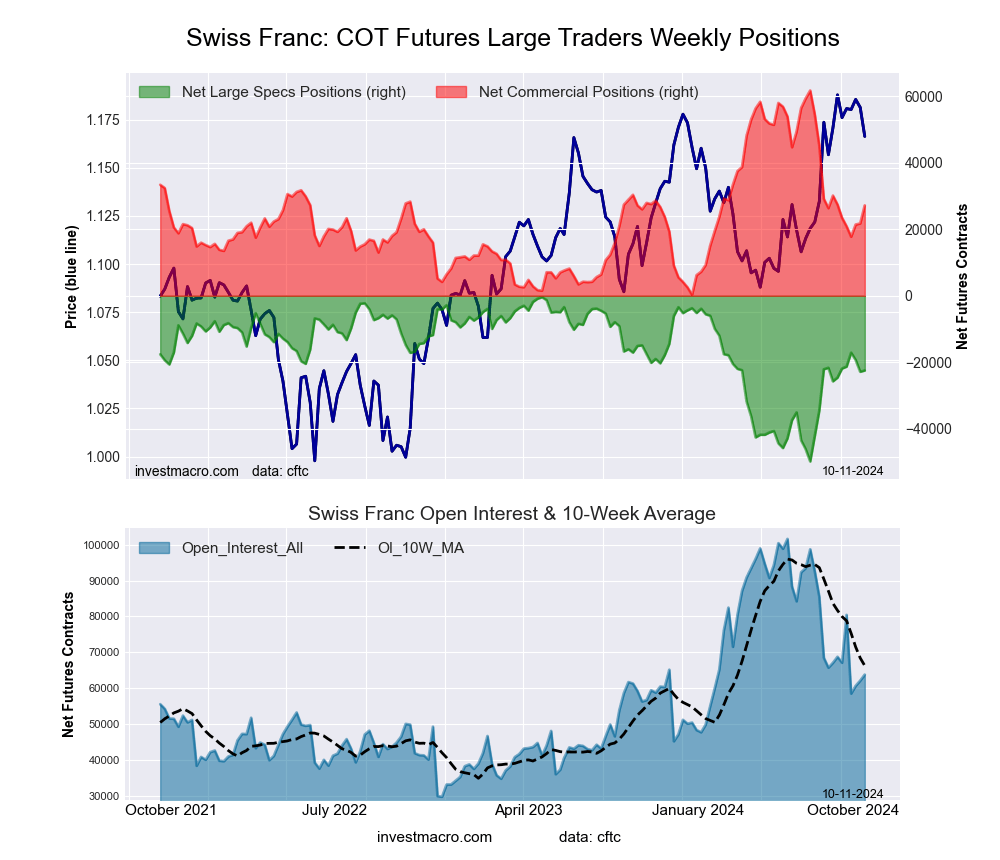
Swiss Franc Forex Futures COT ChartThe Swiss Franc large speculator standing this week came in at a net position of -21,882 contracts in the data reported through Tuesday. This was a weekly advance of 2,730 contracts from the previous week which had a total of -24,612 net contracts.

This week’s current strength score (the trader positioning range over the past three years, measured from 0 to 100) shows the speculators are currently Bullish with a score of 56.5 percent. The commercials are Bearish with a score of 37.7 percent and the small traders (not shown in chart) are Bullish with a score of 70.2 percent.

Price Trend-Following Model: Strong Uptrend

Our weekly trend-following model classifies the current market price position as: Strong Uptrend. The current action for the model is considered to be: Hold – Maintain Long Position.

SWISS FRANC StatisticsSPECULATORSCOMMERCIALSSMALL TRADERS
– Percent of Open Interest Longs:13.162.920.9
– Percent of Open Interest Shorts:45.728.023.3
– Net Position:-21,88223,439-1,557
– Gross Longs:8,82242,23614,057
– Gross Shorts:30,70418,79715,614
– Long to Short Ratio:0.3 to 12.2 to 10.9 to 1
NET POSITION TREND:
– Strength Index Score (3 Year Range Pct):56.537.770.2
– Strength Index Reading (3 Year Range):BullishBearishBullish
NET POSITION MOVEMENT INDEX:
– 6-Week Change in Strength Index:41.2-50.749.0


Canadian Dollar Futures:

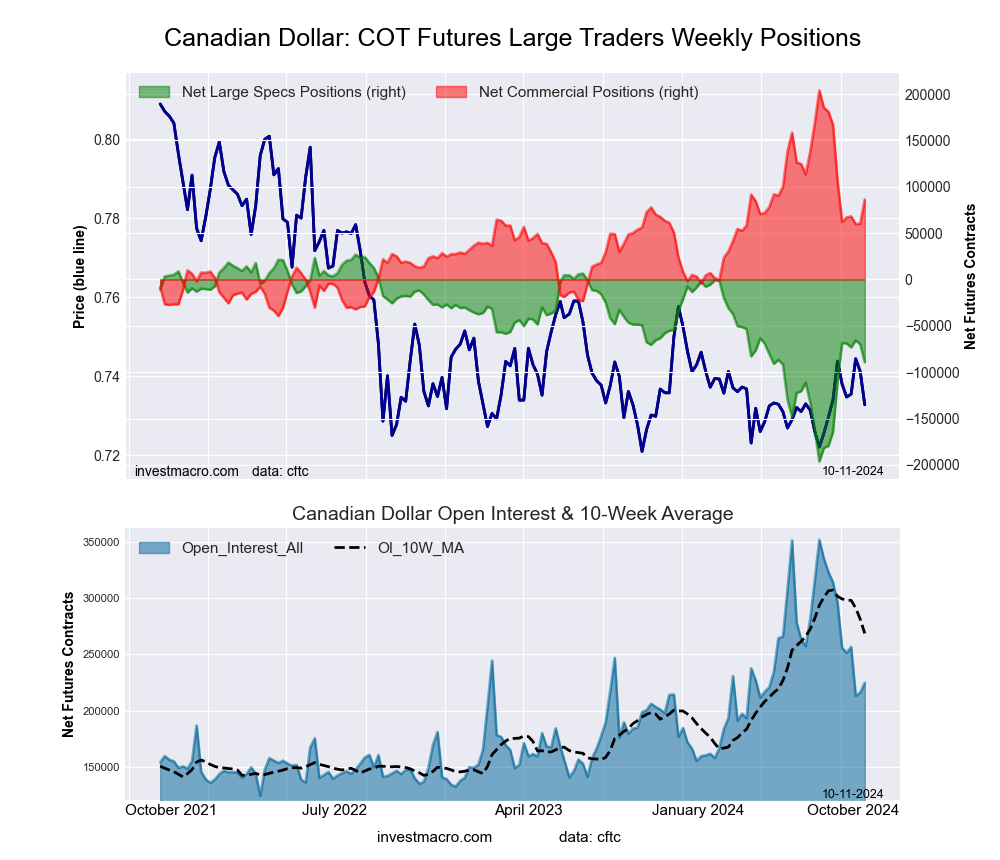
Canadian Dollar Forex Futures COT ChartThe Canadian Dollar large speculator standing this week came in at a net position of -68,544 contracts in the data reported through Tuesday. This was a weekly rise of 41,458 contracts from the previous week which had a total of -110,002 net contracts.

This week’s current strength score (the trader positioning range over the past three years, measured from 0 to 100) shows the speculators are currently Bullish with a score of 57.2 percent. The commercials are Bearish with a score of 41.7 percent and the small traders (not shown in chart) are Bullish with a score of 50.0 percent.

Price Trend-Following Model: Strong Uptrend

Our weekly trend-following model classifies the current market price position as: Strong Uptrend. The current action for the model is considered to be: Hold – Maintain Long Position.

CANADIAN DOLLAR StatisticsSPECULATORSCOMMERCIALSSMALL TRADERS
– Percent of Open Interest Longs:12.369.713.2
– Percent of Open Interest Shorts:39.145.510.6
– Net Position:-68,54462,0136,531
– Gross Longs:31,460178,46933,726
– Gross Shorts:100,004116,45627,195
– Long to Short Ratio:0.3 to 11.5 to 11.2 to 1
NET POSITION TREND:
– Strength Index Score (3 Year Range Pct):57.241.750.0
– Strength Index Reading (3 Year Range):BullishBearishBullish
NET POSITION MOVEMENT INDEX:
– 6-Week Change in Strength Index:41.7-43.940.0


Australian Dollar Futures:

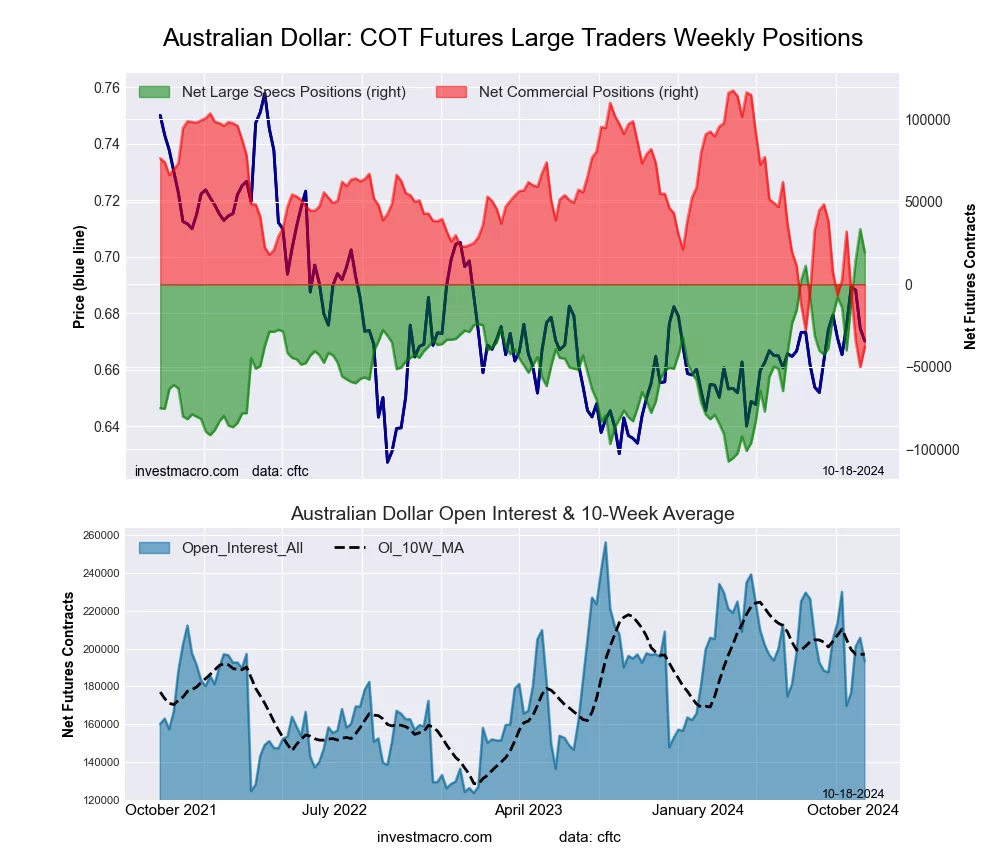
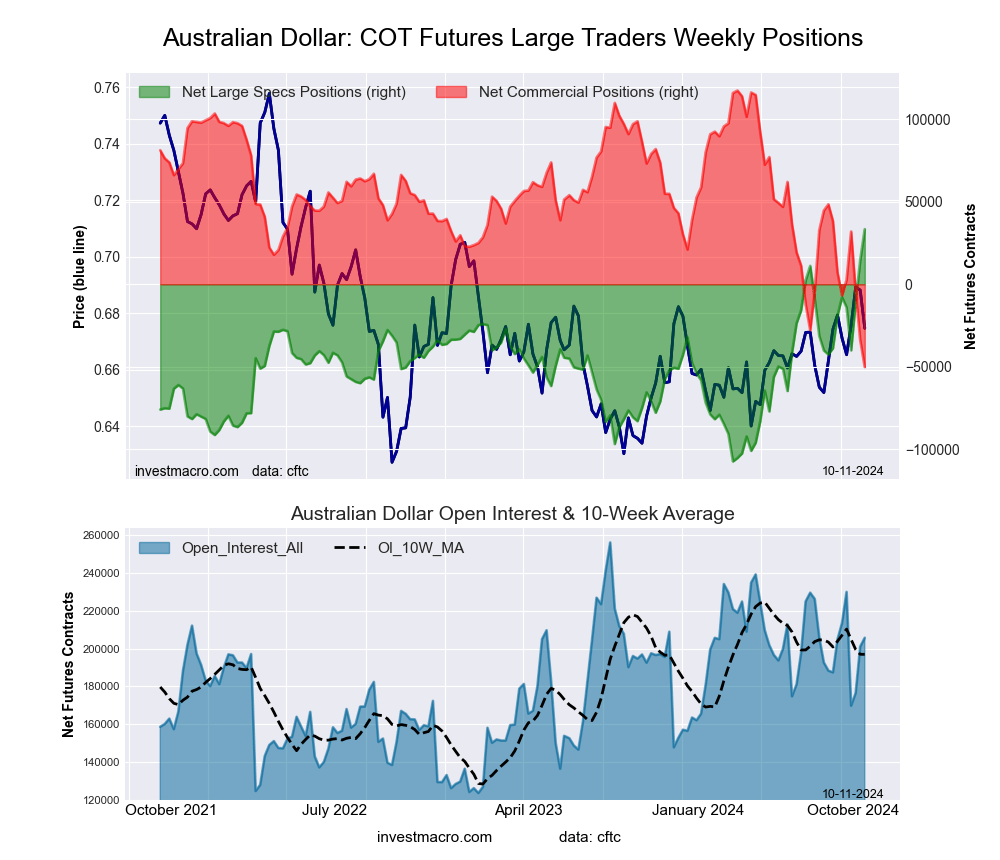
Australian Dollar Forex Futures COT ChartThe Australian Dollar large speculator standing this week came in at a net position of -7,864 contracts in the data reported through Tuesday. This was a weekly boost of 11,295 contracts from the previous week which had a total of -19,159 net contracts.

This week’s current strength score (the trader positioning range over the past three years, measured from 0 to 100) shows the speculators are currently Bullish-Extreme with a score of 84.0 percent. The commercials are Bearish-Extreme with a score of 14.5 percent and the small traders (not shown in chart) are Bullish-Extreme with a score of 94.2 percent.

Price Trend-Following Model: Uptrend

Our weekly trend-following model classifies the current market price position as: Uptrend. The current action for the model is considered to be: Hold – Maintain Long Position.

AUSTRALIAN DOLLAR StatisticsSPECULATORSCOMMERCIALSSMALL TRADERS
– Percent of Open Interest Longs:40.840.914.9
– Percent of Open Interest Shorts:44.544.18.0
– Net Position:-7,864-6,81214,676
– Gross Longs:87,11887,25431,865
– Gross Shorts:94,98294,06617,189
– Long to Short Ratio:0.9 to 10.9 to 11.9 to 1
NET POSITION TREND:
– Strength Index Score (3 Year Range Pct):84.014.594.2
– Strength Index Reading (3 Year Range):Bullish-ExtremeBearish-ExtremeBullish-Extreme
NET POSITION MOVEMENT INDEX:
– 6-Week Change in Strength Index:0.8-1.95.0


New Zealand Dollar Futures:

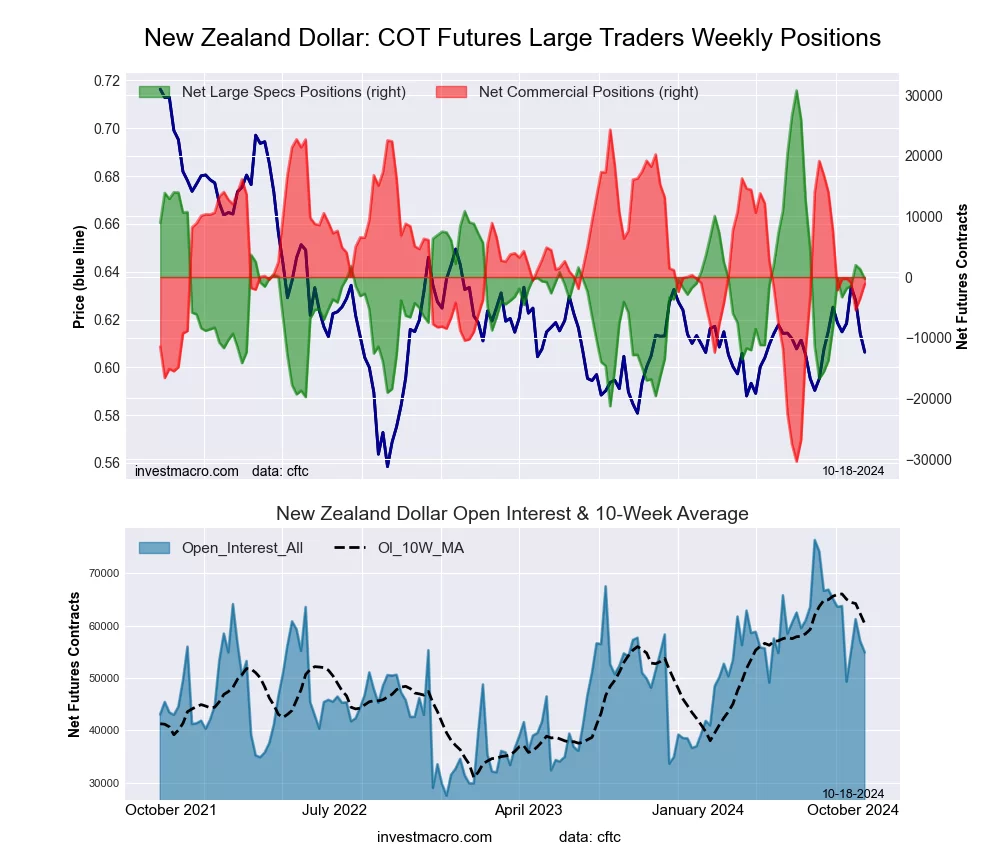
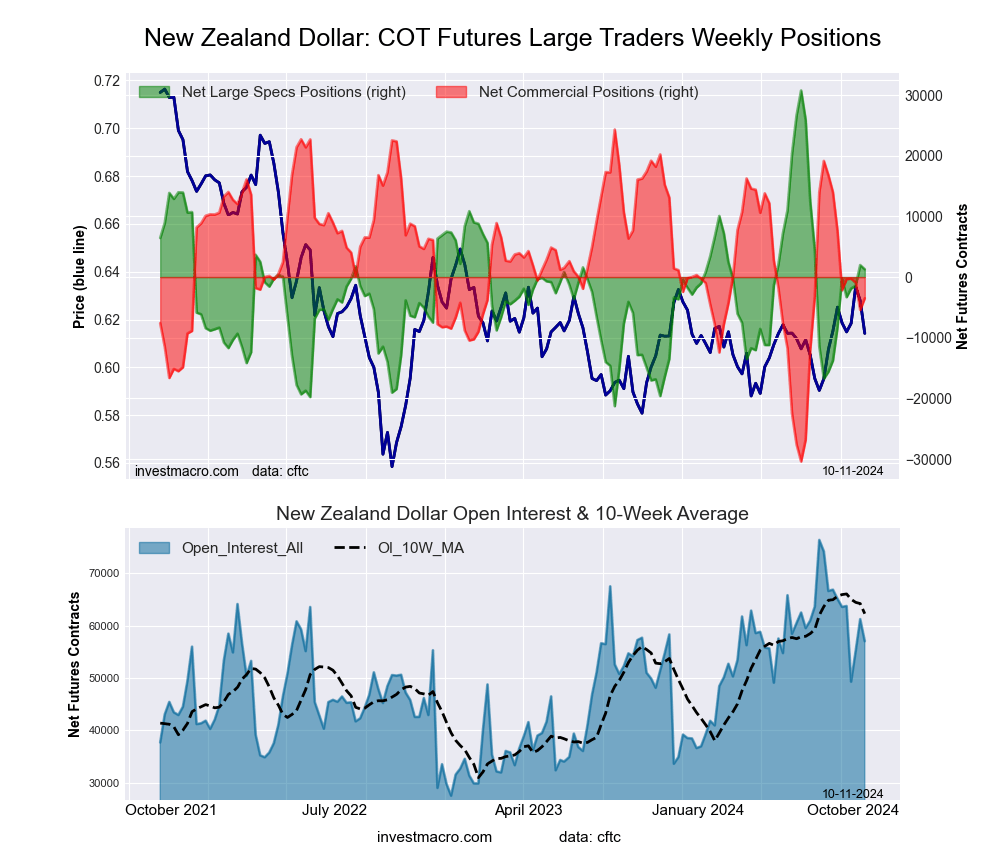
New Zealand Dollar Forex Futures COT ChartThe New Zealand Dollar large speculator standing this week came in at a net position of -238 contracts in the data reported through Tuesday. This was a weekly gain of 8,078 contracts from the previous week which had a total of -8,316 net contracts.

This week’s current strength score (the trader positioning range over the past three years, measured from 0 to 100) shows the speculators are currently Bearish with a score of 40.4 percent. The commercials are Bullish with a score of 51.6 percent and the small traders (not shown in chart) are Bullish-Extreme with a score of 91.8 percent.

Price Trend-Following Model: Strong Uptrend

Our weekly trend-following model classifies the current market price position as: Strong Uptrend. The current action for the model is considered to be: Hold – Maintain Long Position.

NEW ZEALAND DOLLAR StatisticsSPECULATORSCOMMERCIALSSMALL TRADERS
– Percent of Open Interest Longs:39.747.89.6
– Percent of Open Interest Shorts:40.151.25.9
– Net Position:-238-2,1562,394
– Gross Longs:25,23530,3796,120
– Gross Shorts:25,47332,5353,726
– Long to Short Ratio:1.0 to 10.9 to 11.6 to 1
NET POSITION TREND:
– Strength Index Score (3 Year Range Pct):40.451.691.8
– Strength Index Reading (3 Year Range):BearishBullishBullish-Extreme
NET POSITION MOVEMENT INDEX:
– 6-Week Change in Strength Index:-9.12.150.4


Mexican Peso Futures:

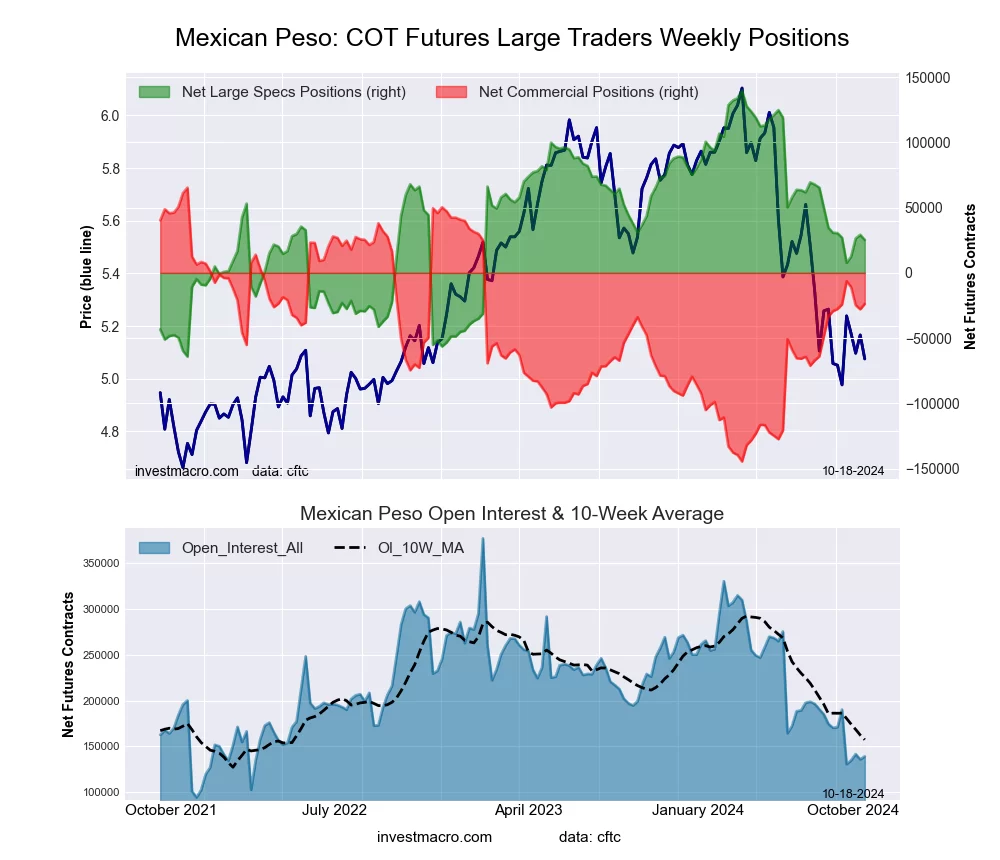
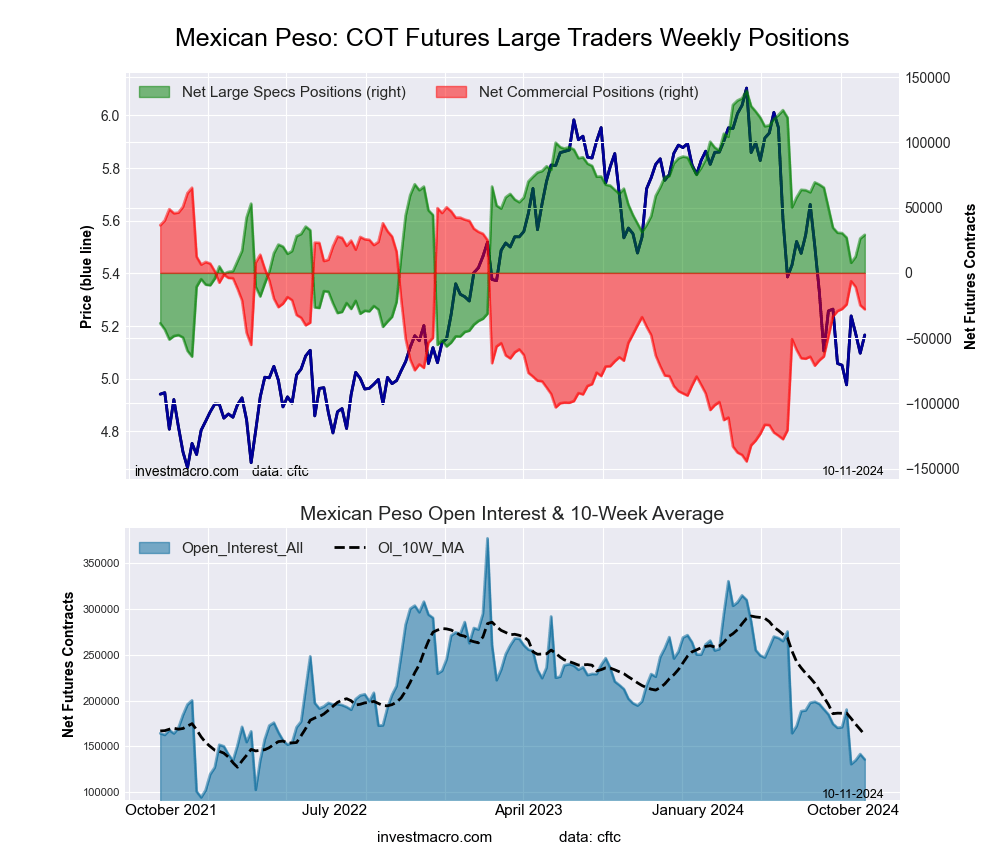
Mexican Peso Futures COT ChartThe Mexican Peso large speculator standing this week came in at a net position of 30,479 contracts in the data reported through Tuesday. This was a weekly decrease of -241 contracts from the previous week which had a total of 30,720 net contracts.

This week’s current strength score (the trader positioning range over the past three years, measured from 0 to 100) shows the speculators are currently Bearish with a score of 46.4 percent. The commercials are Bullish with a score of 55.7 percent and the small traders (not shown in chart) are Bearish-Extreme with a score of 0.0 percent.

Price Trend-Following Model: Strong Downtrend

Our weekly trend-following model classifies the current market price position as: Strong Downtrend. The current action for the model is considered to be: Hold – Maintain Short Position.

MEXICAN PESO StatisticsSPECULATORSCOMMERCIALSSMALL TRADERS
– Percent of Open Interest Longs:36.957.52.0
– Percent of Open Interest Shorts:19.173.73.7
– Net Position:30,479-27,678-2,801
– Gross Longs:63,10398,2783,503
– Gross Shorts:32,624125,9566,304
– Long to Short Ratio:1.9 to 10.8 to 10.6 to 1
NET POSITION TREND:
– Strength Index Score (3 Year Range Pct):46.455.70.0
– Strength Index Reading (3 Year Range):BearishBullishBearish-Extreme
NET POSITION MOVEMENT INDEX:
– 6-Week Change in Strength Index:-19.120.7-27.3


Brazilian Real Futures:

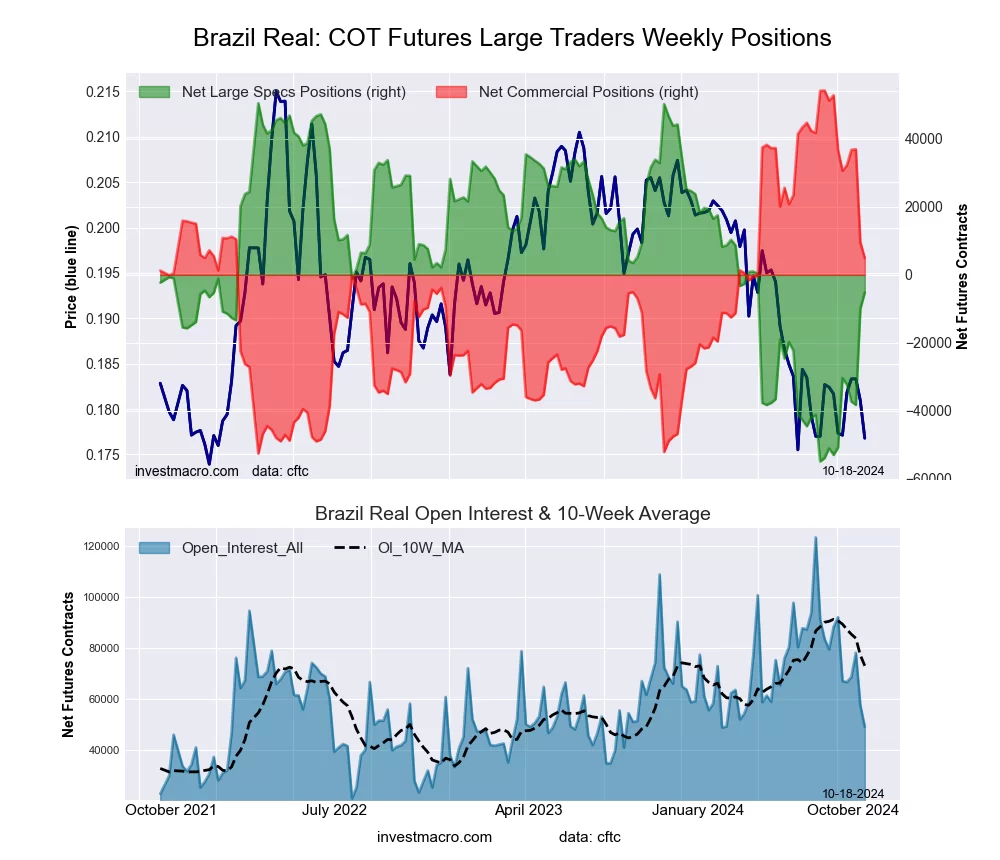
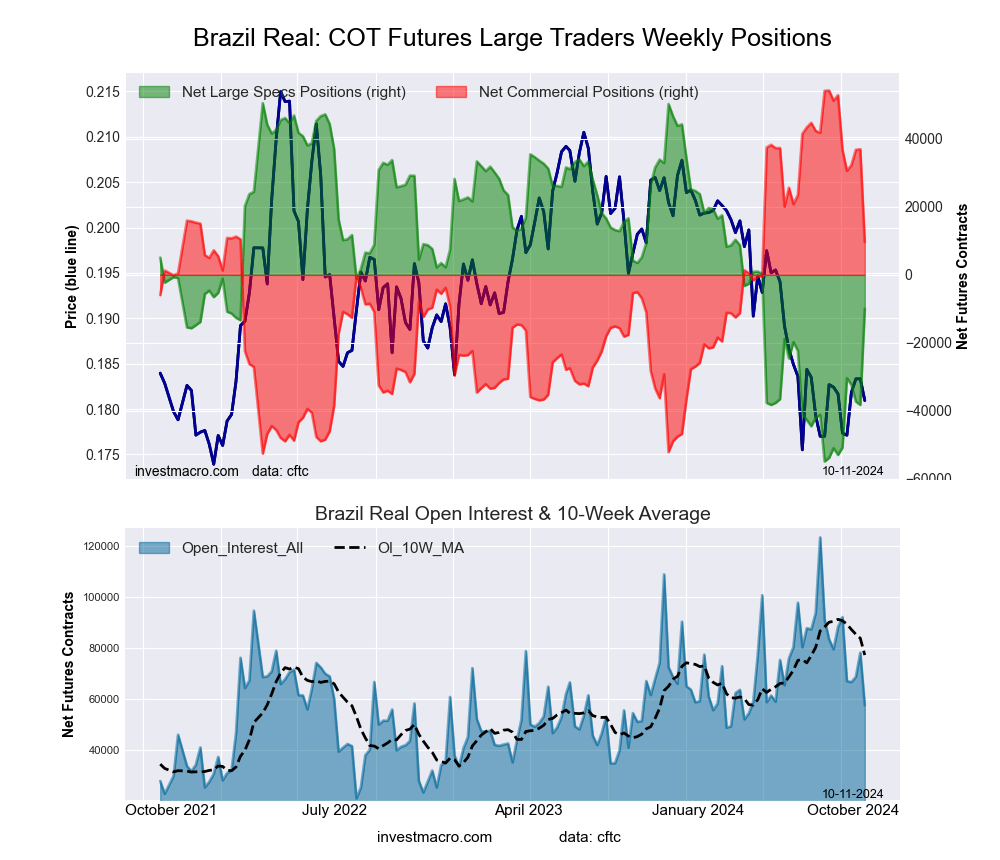
Brazil Real Futures COT ChartThe Brazilian Real large speculator standing this week came in at a net position of -50,811 contracts in the data reported through Tuesday. This was a weekly gain of 2,152 contracts from the previous week which had a total of -52,963 net contracts.

This week’s current strength score (the trader positioning range over the past three years, measured from 0 to 100) shows the speculators are currently Bearish-Extreme with a score of 3.9 percent. The commercials are Bullish-Extreme with a score of 83.7 percent and the small traders (not shown in chart) are Bullish-Extreme with a score of 100.0 percent.

Price Trend-Following Model: Downtrend

Our weekly trend-following model classifies the current market price position as: Downtrend. The current action for the model is considered to be: Hold – Maintain Short Position.

BRAZIL REAL StatisticsSPECULATORSCOMMERCIALSSMALL TRADERS
– Percent of Open Interest Longs:13.260.918.2
– Percent of Open Interest Shorts:68.420.93.0
– Net Position:-50,81136,77814,033
– Gross Longs:12,17956,03816,766
– Gross Shorts:62,99019,2602,733
– Long to Short Ratio:0.2 to 12.9 to 16.1 to 1
NET POSITION TREND:
– Strength Index Score (3 Year Range Pct):3.983.7100.0
– Strength Index Reading (3 Year Range):Bearish-ExtremeBullish-ExtremeBullish-Extreme
NET POSITION MOVEMENT INDEX:
– 6-Week Change in Strength Index:-8.4-5.281.1


Bitcoin Futures:

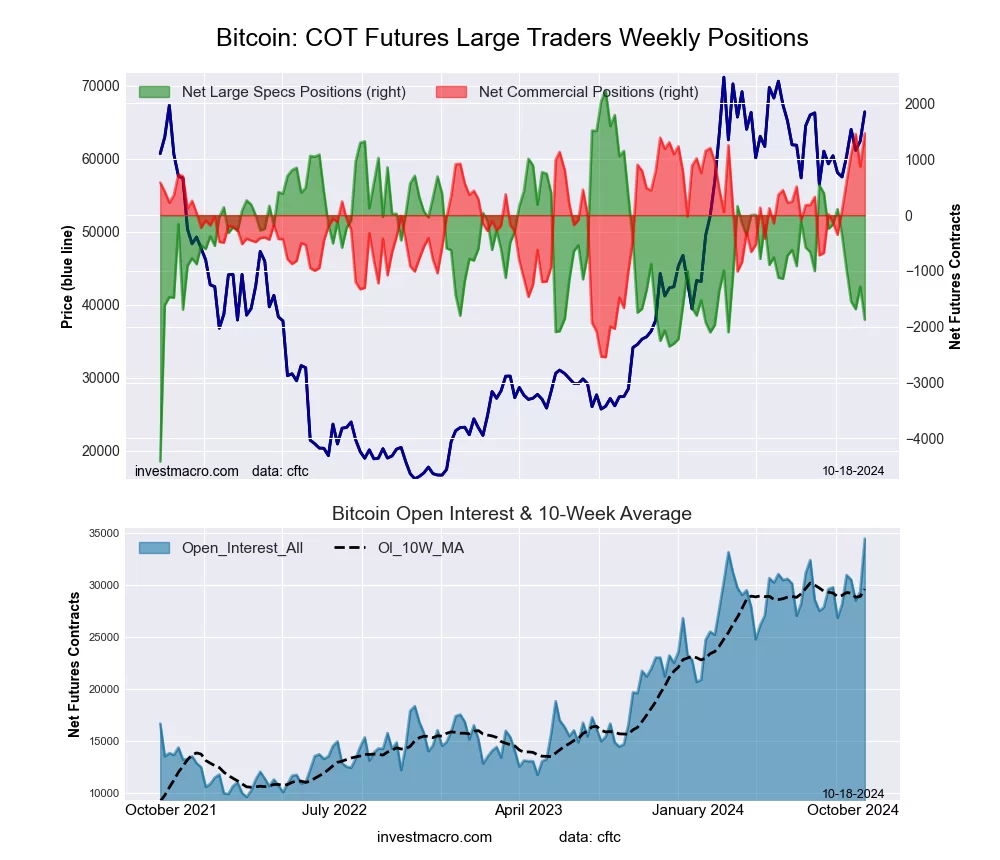
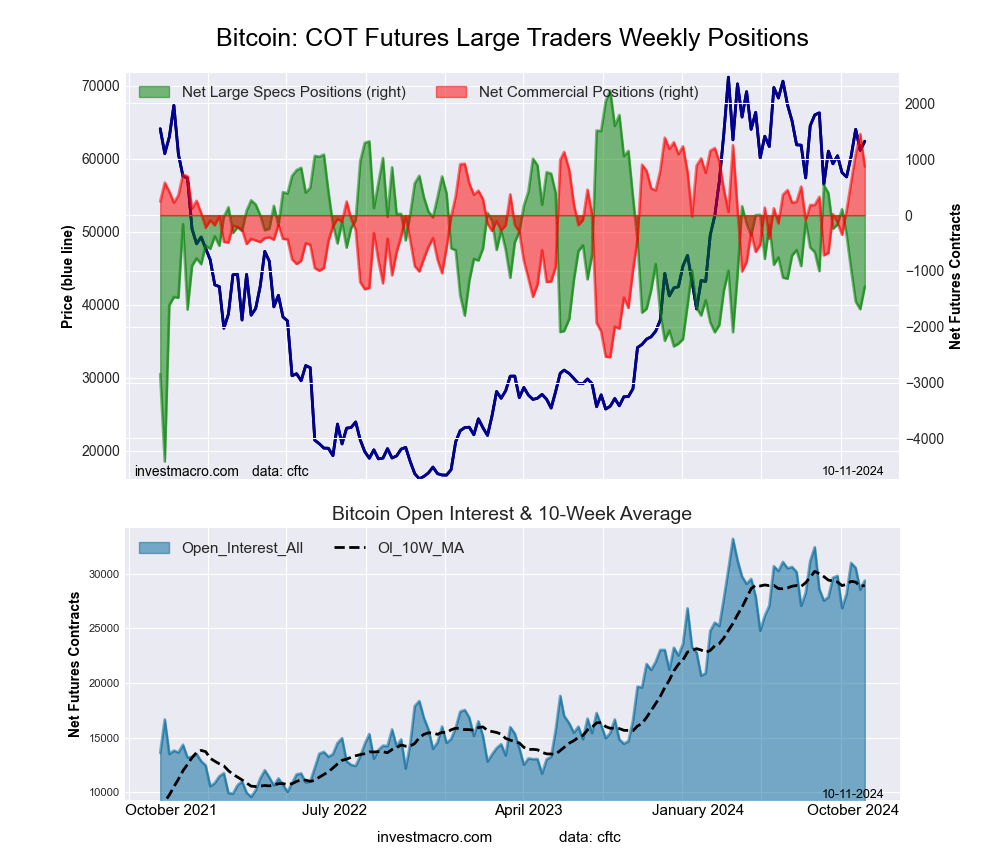
Bitcoin Crypto Futures COT ChartThe Bitcoin large speculator standing this week came in at a net position of 108 contracts in the data reported through Tuesday. This was a weekly increase of 274 contracts from the previous week which had a total of -166 net contracts.

This week’s current strength score (the trader positioning range over the past three years, measured from 0 to 100) shows the speculators are currently Bullish with a score of 68.0 percent. The commercials are Bullish with a score of 55.8 percent and the small traders (not shown in chart) are Bearish-Extreme with a score of 18.5 percent.

Price Trend-Following Model: Strong Downtrend

Our weekly trend-following model classifies the current market price position as: Strong Downtrend. The current action for the model is considered to be: Hold – Maintain Short Position.

BITCOIN StatisticsSPECULATORSCOMMERCIALSSMALL TRADERS
– Percent of Open Interest Longs:86.93.74.0
– Percent of Open Interest Shorts:86.55.03.1
– Net Position:108-351243
– Gross Longs:23,3499981,067
– Gross Shorts:23,2411,349824
– Long to Short Ratio:1.0 to 10.7 to 11.3 to 1
NET POSITION TREND:
– Strength Index Score (3 Year Range Pct):68.055.818.5
– Strength Index Reading (3 Year Range):BullishBullishBearish-Extreme
NET POSITION MOVEMENT INDEX:
– 6-Week Change in Strength Index:11.6-13.6-5.4


Article By InvestMacroReceive our weekly COT Newsletter

*COT Report: The COT data, released weekly to the public each Friday, is updated through the most recent Tuesday (data is 3 days old) and shows a quick view of how large speculators or non-commercials (for-profit traders) were positioned in the futures markets.

The CFTC categorizes trader positions according to commercial hedgers (traders who use futures contracts for hedging as part of the business), non-commercials (large traders who speculate to realize trading profits) and nonreportable traders (usually small traders/speculators) as well as their open interest (contracts open in the market at time of reporting). See CFTC criteria here.

Speculator Extremes: Ultra T-Bonds, Yen, 5-Year & Cotton lead Bullish & Bearish Positions

By InvestMacro

The latest update for the weekly Commitment of Traders (COT) report was released by the Commodity Futures Trading Commission (CFTC) on Friday for data ending on September 3rd.

This weekly Extreme Positions report highlights the Most Bullish and Most Bearish Positions for the speculator category. Extreme positioning in these markets can foreshadow strong moves in the underlying market.

To signify an extreme position, we use the Strength Index (also known as the COT Index) of each instrument, a common method of measuring COT data. The Strength Index is simply a comparison of current trader positions against the range of positions over the previous 3 years. We use over 80 percent as extremely bullish and under 20 percent as extremely bearish. (Compare Strength Index scores across all markets in the data table or cot leaders table)


Here Are This Week’s Most Bullish Speculator Positions:

Ultra U.S. Treasury Bonds


The Ultra U.S. Treasury Bonds speculator position comes in as the most bullish extreme standing this week. The Ultra U.S. Treasury Bonds speculator level is currently at a 100.0 percent score of its 3-year range.

The six-week trend for the percent strength score totaled 79.1 this week. The overall net speculator position was a total of -240,202 net contracts this week with a jump of 29,496 contract in the weekly speculator bets.


Speculators or Non-Commercials Notes:

Speculators, classified as non-commercial traders by the CFTC, are made up of large commodity funds, hedge funds and other significant for-profit participants. The Specs are generally regarded as trend-followers in their behavior towards price action – net speculator bets and prices tend to go in the same directions. These traders often look to buy when prices are rising and sell when prices are falling. To illustrate this point, many times speculator contracts can be found at their most extremes (bullish or bearish) when prices are also close to their highest or lowest levels.

These extreme levels can be dangerous for the large speculators as the trade is most crowded, there is less trading ammunition still sitting on the sidelines to push the trend further and prices have moved a significant distance. When the trend becomes exhausted, some speculators take profits while others look to also exit positions when prices fail to continue in the same direction. This process usually plays out over many months to years and can ultimately create a reverse effect where prices start to fall and speculators start a process of selling when prices are falling.


Japanese Yen


The Japanese Yen speculator position comes next in the extreme standings this week. The Japanese Yen speculator level is now at a 100.0 percent score of its 3-year range.

The six-week trend for the percent strength score was 65.8 this week. The speculator position registered 41,116 net contracts this week with a weekly boost of 15,248 contracts in speculator bets.


Gold


The Gold speculator position comes in third this week in the extreme standings. The Gold speculator level resides at a 97.2 percent score of its 3-year range.

The six-week trend for the speculator strength score came in at 6.0 this week. The overall speculator position was 287,558 net contracts this week with a shortfall of -6,887 contracts in the weekly speculator bets.


3-Month Secured Overnight Financing Rate


The 3-Month Secured Overnight Financing Rate speculator position comes up number four in the extreme standings this week. The 3-Month Secured Overnight Financing Rate speculator level is at a 92.9 percent score of its 3-year range.

The six-week trend for the speculator strength score totaled a change of 25.9 this week. The overall speculator position was 631,571 net contracts this week with a rise of 80,807 contracts in the speculator bets.


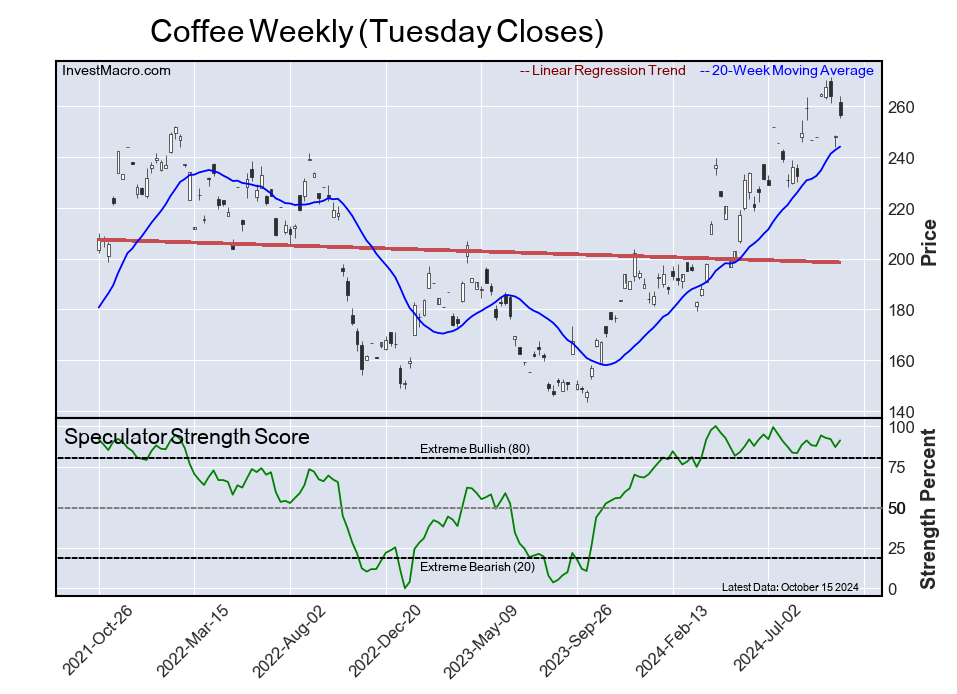
Coffee


The Coffee speculator position rounds out the top five in this week’s bullish extreme standings. The Coffee speculator level sits at a 88.2 percent score of its 3-year range. The six-week trend for the speculator strength score was -2.5 this week.

The speculator position was 63,921 net contracts this week with a reduction of -2,986 contracts in the weekly speculator bets.


This Week’s Most Bearish Speculator Positions:

5-Year Bond


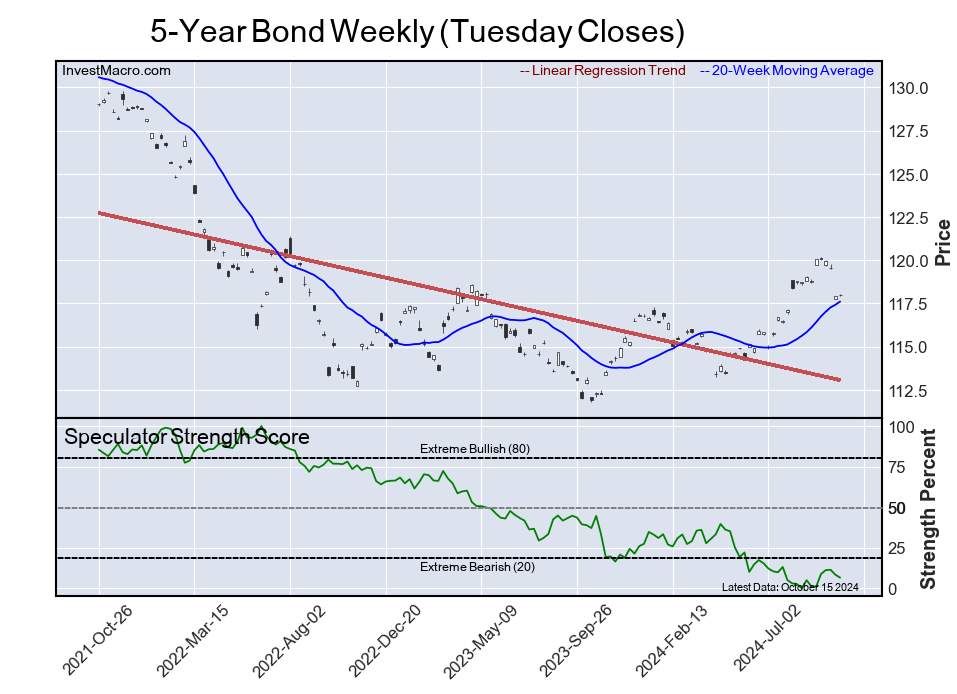
The 5-Year Bond speculator position comes in as the most bearish extreme standing this week. The 5-Year Bond speculator level is at a 1.1 percent score of its 3-year range.

The six-week trend for the speculator strength score was -11.4 this week. The overall speculator position was -1,718,696 net contracts this week with a decline of -62,439 contracts in the speculator bets.


Cotton


The Cotton speculator position comes in next for the most bearish extreme standing on the week. The Cotton speculator level is at a 2.8 percent score of its 3-year range.

The six-week trend for the speculator strength score was -2.4 this week. The speculator position was -38,154 net contracts this week with a dip of -1,079 contracts in the weekly speculator bets.


10-Year Note


The 10-Year Note speculator position comes in as third most bearish extreme standing of the week. The 10-Year Note speculator level resides at a 2.9 percent score of its 3-year range.

The six-week trend for the speculator strength score was -29.6 this week. The overall speculator position was -1,002,827 net contracts this week with a drop of -88,390 contracts in the speculator bets.


Brazil Real


The Brazil Real speculator position comes in as this week’s fourth most bearish extreme standing. The Brazil Real speculator level is at a 3.9 percent score of its 3-year range.

The six-week trend for the speculator strength score was -8.4 this week. The speculator position was -50,811 net contracts this week with an increase by 2,152 contracts in the weekly speculator bets.


Soybeans


Finally, the Soybeans speculator position comes in as the fifth most bearish extreme standing for this week. The Soybeans speculator level is at a 8.3 percent score of its 3-year range.

The six-week trend for the speculator strength score was -5.6 this week. The speculator position was -162,025 net contracts this week with a gain of 22,241 contracts in the weekly speculator bets.


Article By InvestMacroReceive our weekly COT Newsletter

*COT Report: The COT data, released weekly to the public each Friday, is updated through the most recent Tuesday (data is 3 days old) and shows a quick view of how large speculators or non-commercials (for-profit traders) were positioned in the futures markets.

The CFTC categorizes trader positions according to commercial hedgers (traders who use futures contracts for hedging as part of the business), non-commercials (large traders who speculate to realize trading profits) and nonreportable traders (usually small traders/speculators) as well as their open interest (contracts open in the market at time of reporting). See CFTC criteria here.

Utilities rely on dirty ‘peaker’ plants when power demand surges, but there are alternatives

By Akshaya Jha, Carnegie Mellon University 

The U.S. is nearing the end of one of its hottest summers on record. Across the nation, heat waves have driven peak electricity demand on some days to levels far exceeding seasonal averages.

Grid operators rely on so-called “peaker” plants to ensure they will have enough supply to meet these demand surges. Peaker units can start up quickly and at relatively low cost, but they typically burn more fuel per unit of electricity produced than other types of fossil fuel units.

Because they are less efficient than other plants, peakers typically run only during high-demand periods. Historically, peakers have run for less than 10% of the year, often for just a few hours at a stretch.

Nonetheless, their higher emissions per unit of electricity produced raise environmental and health concerns. As of 2021, there were 999 peaker plants across the U.S., in all 50 states. About 70% of these plants burned natural gas, and the rest were powered by oil and coal.

To reduce air pollution and combat climate change, the U.S. is shifting away from fossil fuels and increasing its use of renewable energy sources such as wind and solar power. Ironically, though, as climate change generates more frequent and intense heat waves, many electricity systems are increasingly relying on peaker plants to balance fluctuations in renewable power generation. Proposals to build new peakers or extend the lives of old ones have stirred controversy in states including Wisconsin, Massachusetts, Texas and New York.

My research focuses on the economic and environmental costs and benefits of producing electricity. Here’s how the clean energy transition is changing the role of peaker plants and some other options for keeping the lights on during peak demand periods.

South Bronx residents call on New York state to shut down local peaker plants in 2022. These plants are disproportionately located in low-income and minority neighborhoods.

Balancing the power supply

For system operators, one key characteristic of a power plant is whether it can produce power on demand. Many renewable resources, including wind, solar and certain types of hydropower, are known as nondispatchable resources because they are governed by nature, producing energy when conditions allow. The cost of generating electricity with them is low, so they are typically used to their maximum capacity.

Power plants that run on fossil fuels or nuclear power are known as dispatchable resources because they can produce power whenever it’s needed. They have higher operating costs than renewables, however, mainly because gas, coal, nuclear and oil plants must buy fuel in order to operate.

Some of these plants – historically, those that run on coal or nuclear fuel – are called baseload plants. They generate power relatively cheaply but take time to start up and ramp up to full power. Intermediate units produce power at a higher cost for each additional megawatt-hour produced, but they can cycle up and down more quickly than baseload plants. Peakers have the highest costs per megawatt-hour, but they can adjust their output very quickly.

Historically, baseload units operated year-round, with intermediate units adjusting output to meet short-term demand fluctuations. Peaker plants were used only during rare peak demand periods.

But as power suppliers add more wind and solar energy to the grid, they are using dispatchable fossil fuel units more frequently to balance changes in renewable generation – for example, to run air conditioners when the sun goes down but temperatures are still high. This favors units that can quickly change production levels, even if they are less fuel-efficient. The result is a growing role for peaker plants.

Kearny Generating Station, a former coal-fired baseload power plant, now a gas-fired peaker, on the Hackensack River in New Jersey.
Jim Henderson/Wikipedia, CC BY

Environmental justice flash points

Electricity production from fossil fuels in the U.S. has decreased with large-scale investment in wind and solar generation. But fossil fuel-burning power plants still produce about 60% of U.S. electricity – and those plants emit pollutants that contribute to climate change and degrade local air quality.

Exposure to sulfur dioxide, nitrogen dioxide, particulate matter and ozone is linked to respiratory and cardiovascular illnesses and premature death. While overall air pollution has decreased in the U.S. in recent decades, low-income and minority neighborhoods still suffer disproportionately from poor air quality.

One 2022 report estimates that 32 million Americans live within 3 miles of a peaker plant. In 2024, the U.S. Government Accountability Office reported that historically disadvantaged racial or ethnic communities were statistically more likely to be located closer than average to peakers.

Other ways to meet peak demand

How else can electricity supply and demand be balanced? One option is using batteries to store electricity when wind or solar output is high, then discharging it when demand exceeds supply from conventional resources.

Although battery investment costs currently are high, they are projected to decrease significantly in the coming decades. In 2023, the U.S. had a total of about 15 gigawatts of battery storage capacity – equivalent to 15 large nuclear power plants – and that figure could double in 2024.

Another alternative is expanding transmission systems, which make it possible to draw on electricity from lower-cost units in distant areas instead of relying on nearby peaker plants. Building new transmission lines, however, comes with significant regulatory, permitting and land use challenges.

A third option is demand response programs, in which electricity consumers pay higher prices during higher demand periods. This could help reduce peaks and valleys in demand across the day, benefiting more efficient but less flexible baseload units designed to run around the clock.

Most consumers, however, don’t currently pay prices that reflect short-term changes in wholesale electricity costs. Moreover, it’s uncertain whether residential customers would alter their consumption based on short-horizon price fluctuations. Technologies such as smart thermostats and energy management apps could help by taking the burden off consumers to manually adjust their electricity use in response to price fluctuations.

Finally, power plant owners can invest in technologies to reduce emissions from fossil fuel units. Peakers typically lack pollution control technologies because they aren’t used very often. Retrofitting older plants to make them more efficient could also help, since they would produce fewer emissions for each unit of electricity.

These investments are costly, so policymakers have to weigh the health benefits of reduced air pollution against the investment costs for power plant owners.

Increasing investment in wind and solar energy is reducing local air pollution from electricity production. But it’s also shifting production away from thermally efficient baseload units that can’t respond quickly to shifts in demand or renewables output. I believe it is increasingly important to explore policies that create incentives for investing in alternatives such as battery storage and transmission infrastructure, as well as in power plant upgrades to reduce pollution exposure.The Conversation

About the Author:

Akshaya Jha, Associate Professor of Economics and Public Policy, Carnegie Mellon University

This article is republished from The Conversation under a Creative Commons license. Read the original article.

India’s new mega-dam will roil lives downstream with wild swings in water flow every day

By Parag Jyoti Saikia, University of North Carolina at Chapel Hill 

“Hey Rupam, open the door. Take this fish,” a woman yelled from outside. I was sitting in the kitchen at my friend Rupam’s house in rural northeast India. It was the heart of monsoon season, and rain had been falling since morning. The woman must have been shouting because the noise of the rain on the tin roof muted everything else.

The aunty who lived next door stood outside with a large bowl of Boriala fish. Her husband had gone fishing on the Subansiri River, which flows next to the village, and he had fished all evening. “My husband cannot stay indoors in this weather,” she said in Assamese, the local language. “You can catch a lot of fish during this time.”

The monsoon season has long brought a bounty of fish from May to September for people living downstream.

The Subansiri Lower Hydroelectric Project, under construction, will be one of India’s largest hydropower dams.
Nayan J. Nath, CC BY

However, this is likely to change once the Subansiri Lower Hydroelectric Project, one of the largest hydropower dams in India, is completed upstream. Expected to be fully operational in 2026, the dam will change the natural flow of the river.

For most of the day, the dam will hold back water, letting only a small amount through, roughly equivalent to the region’s dry season. But for about four hours each night, it will release water to generate power, sending a raging river downstream almost like during monsoon season.
The dam will not only block the movement of fish, but also change the way people living downstream experience the river’s flows.

A man stands in a low river with a fishing net in his hand.
A fisher collects his net on a winter evening in the Subansiri. The river is calm and shallow in many places at that time of year, and people can walk across parts of the river.
Parag Saikia

In a 2010 report on the likely impact of the Subansiri Lower Hydroelectric Project on downstream populations, experts from three premier institutes of Assam — the central state of northeast India — identified several concerns for downstream communities, including flood and erosion risk, earthquake risk, the loss of water flow for fishing and groundwater recharge, and the survival of species including river dolphins.

Now, a decade later, as the dam is nearing completion, the central question remains: What will happen to people like Rupam’s neighbor, whose lives and livelihoods depend on the river?

In 2023, I lived in a village next to the Subansiri River. My dissertation research brought me there to study how this hydroelectric dam, under construction since 2005, is affecting communities downstream.

‘Small displacement’ by ‘benign’ dams

Northeast India has been the focus of hydropower dam construction since the beginning of this century. In order to secure the country’s energy future, Central Electricity Authority of India in 2001 identified the Brahmaputra River basin as having the highest hydropower potential – 63,328 megawatts. It proposed constructing a whopping 168 hydropower dams in the region.
This earned the region the nickname “India’s Future Powerhouse.” The Subansiri Lower Hydroelectric Project was the first project.
A view of a wide river with a small hand-made boat on the shore.
The Subansiri River in 2020.
Manisha Kakati, CC BY

The government sees the mega-hydro dam initiative as a win-win. It expects the dams to increase India’s energy security while also developing large infrastructure networks in one of India’s contentious borderland regions.

About 80% of the power for “India’s Future Powerhouse” is proposed to be generated in Arunachal Pradesh, the largest state of northeast India. China has repeatedly challenged India’s sovereignty over Arunachal since the latter’s independence in 1947.

Building dams in Arunachal Pradesh has another advantage: very low population density. It has about 17 people per square kilometer, and over 80% of Arunachal’s total territory is forest. That helped the government of India to argue that “there is relatively ‘small displacement’ by submergence as compared to that in other parts of the country and therefore these projects are benign.”

However, these projects are in no way benign to the people who live downstream.

The disruption to lives downstream

The flood plains of the Subansiri are home to people belonging to indigenous communities and lower castes of Hindu caste hierarchy. Mising – the largest indigenous community in the downstream region – call the river “Awanori,” which means “mother river.”

As part of my long-term ethnographic fieldwork, I observed how a range of livelihoods in the downstream region – fishing, agriculture, livestock grazing, recovering driftwood and transporting people by boat in remote areas – are all dependent on the 79-mile Subansiri River. I interviewed people who live there and attended community events to understand how the river plays a big role in everyday life.

People walk under banners and streamers at a celebration
The Golden Jubilee celebration of Takam Mising Porin Kebang, or All Mising Student Union, in 2023. A banner in Assamese reads: ‘We are a riverine civilization. Save the River, Save the Community. No Big Dam.’ The student union led protests over the dam’s downstream impacts.
Parag Saikia

Their reliance on the river has been based on natural, uncontrolled flows. Once the dam is completed, the river flows will be controlled by the National Hydroelectric Power Corporation.

Once in operation, the dam will block most of the river’s flow for 20 hours of the day, and then release that water – about 2,560 cubic meters per second – to power turbines that can meet peak electricity demand between 6 p.m. and 10 p.m. every night. During the 20 nonpeak hours, the dam would release less than a tenth as much water.

What happens when the river flow changes?

When the dam was first proposed, there was no plan to release water during the nonpeak 20 hours. Activists argued that cutting the water’s flow would have made it impossible for any aquatic animal to survive downstream.

In 2017, the nonpeak-hour flow proposal was increased to a range of 225 to 250 cubic meters per second. That year, the National Green Tribunal, which resolves civil cases related to the environment, asked the National Hydroelectric Power Corporation to ensure a minimum level of water for the survival of Gangetic dolphin, India’s national aquatic animal. This judgment helped pave the way for restarting the construction after an eight-year delay. However, the tribunal did not address how people living downstream would be affected by the changes.

A landslide that temporarily blocked the dam’s spillway in 2023 during construction gave downstream communities a preview of extreme swings in water flows.

The calculation of minimum flow only for the survival of one aquatic mammal leaves out numerous ways the flows of the Subansiri matter to people and other animals.

The dam itself threatens the downstream existence of many fish varieties, including the golden mahseer. It will also alter the flow and sediment supply in the river, and the abrupt and powerful flow for four hours each night will have greater scouring capacity and risks eroding the riverbed and banks.

Traditionally, from October to April, the dry riverbed and sandbar islands have been used to grow early-maturing ahu rice and mustard before the monsoon flood waters arrive. People also graze their livestock in the islands and in the fields after crops are harvested.

Once the dam begins flooding the river for four hours a night, however, the riverbed and sand-bar islands will be largely unusable.

Fields cover a river bank during the dry season.
Dried stems of mustard lie on the ground after they have been harvested in a riverbank field downstream of the dam.
Parag Saikia

The rainy season when the river floods is the most productive time for fishing and collecting driftwood. However the dam will obstruct the movement of fish and trap wood behind the dam. So, even though there will be flood waters every day in the river, fishermen and wood collectors may not benefit from it.

For people like Rupam’s neighbor, the Subansiri River they know will change. They will have to navigate the river more cautiously, and every evening there will be monsoon-season water levels.

Will they be able to catch enough fish to share with their neighbors? Only time will tell.The Conversation

About the Author:

Parag Jyoti Saikia, Ph.D. Candidate in Socio-Cultural Anthropology, University of North Carolina at Chapel Hill

This article is republished from The Conversation under a Creative Commons license. Read the original article.

Oil and gas communities are a blind spot in America’s climate and economic policies

By Noah Kaufman, Columbia University 

On a recent visit to Rangely, a small town in northwest Colorado, my colleagues and I met with the administrators of a highly regarded community college to discuss the town’s economy. Leaving the scenic campus, we saw families driving into the mountains in off-road vehicles, a favorite activity for this outdoors-loving community. With a median household income above US$70,000 and a low cost of living, Rangely does not have the signs of a town in economic distress.

But an existential risk looms over Rangely. The town is here because of an oil boom during World War II. Today, the oil and gas industry contributes over half of the county’s economic output.

Rangely is not unique in the United States, which is the world’s largest producer of oil and natural gas. There are towns across the country that depend on the oil and gas industry for well-paying jobs and public revenues that fund their schools and other critical services.

A heavy dependence on any single industry is risky, and the oil industry is prone to booms and busts. But the economies of oil- and gas-dependent towns face a unique threat from global efforts to address the risks of climate change, which is fueled by the burning of oil and natural gas. Any serious strategy to halt global warming involves policies that will, over time, sharply reduce demand for all fossil fuels.

Early signs of this transformation can be seen in last year’s international agreement to “transition away from fossil fuels” and in the spread of electric vehicles that are starting to displace gasoline- and diesel-powered cars, trucks and buses.

As an economist who worked at the White House during the Obama administration and early Biden administration, I contributed to detailed strategies to reduce greenhouse gas emissions and to support communities in economic distress. But we did not have a plan to prepare oil and gas towns like Rangely for future economic challenges.

Why oil and gas towns are overlooked

Congress has prioritized support for small towns in recent legislation. However, oil- and gas-dependent towns were largely absent from these strategies for three primary reasons.

First is a perceived lack of urgency. The attention to a “just transition” as the nation moves away from fossil fuels has been disproportionately directed to coal-dependent communities. U.S. coal production has declined for 15 years, and a continued transition away from coal appears imminent and inevitable.

In contrast, U.S. production of oil and natural gas continues to grow. To be sure, some oil and gas communities are already struggling. But the widespread economic risks of a shift away from oil and gas may feel more like a problem for future decades.

Second, politicians downplay risks to oil and gas communities.

Most Republicans are not planning for a future decline in oil and gas production at all, and that includes many local politicians in oil and gas-dependent communities. For their part, most Democratic politicians prefer to focus on how climate action can be an engine of future economic growth. President Joe Biden likes to say, “When I think about climate change, I think jobs.”

He is not wrong to highlight the economic opportunities of climate solutions. But clean energy jobs rarely offer one-for-one replacements for the high-paying jobs in the oil and gas industries and the public revenues those industries bring local communities.

Third, economists’ policy toolbox is poorly suited to the challenges facing oil and gas communities.

Proposals to support local economic development commonly suggest targeting persistently distressed local economies with measures such as wage subsidies that have the potential to rapidly put more people to work.

A different prescription is needed for oil and gas communities, which are not generally struggling today. Over the 15-year period prior to the pandemic, the U.S. counties with oil and gas production experienced average annual GDP growth of 2.4% per year, compared with 1.9% nationwide.

Most oil and gas communities do not need economic stimulus policies that provide immediate relief. What they need are holistic economic development strategies that can cultivate new industries – building on their existing strengths – that will enable them to prosper into the future.

Solutions to help oil and gas towns prepare

Harvard economist Ricardo Hausmann compares the challenge of developing new economic capabilities to the game of Scrabble, where each additional letter enables the creation of more words. He cites the Finish economy as an example: It evolved from harvesting lumber to making tools that cut wood to producing automated cutting machines. From there, it evolved to sophisticated automated machines, including those used by global corporations such as telecommunications giant Nokia.

Such economic evolutions must be tailored to the characteristics of individual places. But the initial step is to recognize the problem and invest in solutions.

The Southern Ute Indian Tribe is doing this in southwest Colorado. It devotes oil and gas revenues to a Permanent Fund, which promotes fiscal sustainability by ensuring the tribe’s assets are aligned with its long-term financial goals, and a Growth Fund that diversifies the tribe’s revenue sources by investing in a range of businesses.

At the national level, a recent National Academies panel proposed the creation of a federally chartered corporation to help communities facing acute economic threats, including a future decline in oil and gas. This corporation could provide funding for displaced workers, critical public infrastructure and programs that ensure access to economic opportunities.

Colorado’s state Office of Just Transition has started to serve this role. Currently, it focuses only on the transition away from coal, with the goals of helping communities develop new economic opportunities and helping workers transition to new jobs. But its mission could be expanded in the future. In fact, Rangely is already receiving some support due to coal closures nearby.

No one-size-fits-all solution

Small, rural towns like Rangely illustrate how oil- and gas-reliant regions will need unique strategies tailored to the strengths and limitations of individual places. No off-the-shelf playbook exists.

Our group of researchers who visited Rangely are part of the Resilient Energy Economies initiative, which was created by universities, research institutes and philanthropic organizations to ensure that policymakers have the information they need to help fossil fuel-dependent communities successfully navigate the energy transition.

The best time to build a more resilient economy is before a crisis arrives. Anyone familiar with the Bible – or Broadway – knows the story of Joseph, whose dreams foresaw seven years of abundance for Egypt followed by seven years of famine. The pharaoh acted on Joseph’s vision, using the boom to prepare for the bust.

The United States is experiencing abundant oil and gas production today. Policymakers know risks are coming. But so far, the country is failing to prepare communities for harder days to come.The Conversation

About the Author:

Noah Kaufman, Senior Research Scholar in Climate Economics, Columbia University

This article is republished from The Conversation under a Creative Commons license. Read the original article.

The leading alternative to GDP is languishing over a technical disagreement – with grave potential consequences

By Eoin McLaughlin, University College Cork; Cristián Ducoing, Lund University, and Nicholas Hanley, University of Glasgow 

Many commentators believe that the world should move away from measuring economic success in terms of GDP growth. Yes, growth has brought prosperity and untold riches, but it has had significant negative side effects for the planet, including climate change, pollution and species extinction. None of these are captured in GDP data.

A whole “beyond GDP” movement has emerged over the last several decades, arguing that we should adopt a new way of measuring the wealth of nations. There is an ongoing debate about the best alternative, and many indicators have supporters, such as gross national happiness and the genuine progress indicator.

Yet one stands out as having by far the most buy-in from major international institutions. Known as “inclusive wealth”, it expands what we mean by wealth to include things like the natural environment and the abilities of the population. But it comes with a major problem. There’s no agreement around how it should be measured, so different institutions publish very different figures. In our view, this is a major obstacle to its mass adoption.

Inclusive wealth

Inclusive wealth ascribes a value to the assets a nation has produced that generate well-being, and measures how they are changing over time. These assets are:

  • Human capital: the knowledge and skills of the population.
  • Produced capital: goods and services produced by human endeavour.
  • Natural capital: the sum of all nature-based assets from which humans derive well-being, both now and in the future.
  • Social capital: the social networks that exist within a society.

There is strong theoretical support for the idea that this approach is a good way of measuring the sustainability of economic development. The key point is that when inclusive wealth per capita is going up, the future wellbeing of the population will go up, which is a necessary condition for sustainable development.

Foundational texts in support of inclusive wealth include Cambridge economist Partha Dasgupta’s 2001 book, Human Well-Being and the Environment, and his Harvard counterpart Martin Weitzman’s 2003 book, Income, Wealth and the Maximum Principle.

Dasgupta carried out a review for the UK government in 2021 into the economics of biodiversity, which similarly advocates for measuring national inclusive wealth instead of national income. There have also been recent calls by academics in this field to use inclusive wealth to help with the global biodiversity framework, a UN-led drive to be “living in harmony with nature” by 2050.

Inclusive wealth is measured by both the World Bank and UN Environment Programme (Unep). The World Bank has been measuring it since the late 1990s, and first published global estimates in a 2006 report called Where is the wealth of nations : measuring capital for the 21st century. It has since published three major updates to this report, including a major revision to the methodology, with another on the way. As for Unep, it began measuring inclusive wealth in 2012.

But there are still some kinks that need ironing out before this indicator can be of any practical use. In a new paper in Ecological Economics, we compare the approaches of the World Bank and Unep and find a big divergence in their calculations.

This may explain why inclusive wealth has yet to be adopted in any serious way by any major economies (all we’ve seen so far is some mentions in policy documents, like this one from New Zealand, and a recent decision by the Biden-Harris administration to start tracking the value of US natural resources at federal level using natural-capital accounting).

The discrepancies relate mainly to natural capital. Both Unep and the World Bank include similar if not identical data from the same components: non-renewables such as fossil fuels and minerals, and renewable elements such as fisheries and forest resources. The problem is that the institutions’ research teams value them differently.

The World Bank approach comes up with a present value for expected future earnings by discounting from what they will eventually be worth. In contrast, Unep uses fixed accounting prices, referred to as “shadow prices”, which are based on market prices today.

This leads to different conclusions about the trajectory of our natural capital, and thus, by implication, of the sustainability of current development paths. This is then exacerbated by another discrepancy around how the institutions measure changes in human capital.

Country differences

In our paper, we highlight the case of Qatar. According to Unep, it is one of the worst performers in terms of the change in inclusive wealth per capita, and so is judged unsustainable. Yet according to World Bank estimates, Qatar’s inclusive wealth per capita is growing positively.

Which is it? If development is unsustainable, some remedial action will be necessary, but if it is sustainable, no problem. How is the Qatari government to decide how to proceed?

We find similar conflicting signals for many other countries. According to the World Bank data, 20 countries’ inclusive wealth per capita is in decline (in other words, unsustainable), while the Unep data has 45 countries in decline. There is also little crossover in terms of these two lists.

As many as 34 of the countries that the World Bank says have growing inclusive wealth per capita are in decline according to Unep.

We agree strongly with the basic proposition that measuring inclusive wealth is key to ensuring the world develops sustainably. But there needs to be a more consistent approach for this signal to achieve enough credibility to be widely adopted. In our experience, the World Bank is much more transparent than Unep about the data in its calculations. Without full Unep transparency, it’s difficult to get to the root of the discrepancy.

Having said that, both broad approaches have merits, so it’s more a question of everyone committing to a single approach than arguing that one is better than the other. Unless this measurement problem can be resolved, it’s difficult to see countries taking inclusive wealth seriously. That could have serious consequences in the battle to make economic development sustainable.The Conversation

About the Authors:

Eoin McLaughlin, Professor in Economics, University College Cork; Cristián Ducoing, Senior lecturer at Sustainability transformations over time and space, Lund University, and Nicholas Hanley, Chair in Environmental and One Health Economics, University of Glasgow

This article is republished from The Conversation under a Creative Commons license. Read the original article.

Currency Speculators sharply boost Canadian Dollar and Euro bets

By InvestMacro

Here are the latest charts and statistics for the Commitment of Traders (COT) data published by the Commodities Futures Trading Commission (CFTC).

The latest COT data is updated through Tuesday August 27th and shows a quick view of how large market participants (for-profit speculators and commercial traders) were positioned in the futures markets. All currency positions are in direct relation to the US dollar where, for example, a bet for the euro is a bet that the euro will rise versus the dollar while a bet against the euro will be a bet that the euro will decline versus the dollar.

Weekly Speculator Changes led by Canadian Dollar & Euro

The COT currency market speculator bets were decidedly higher this week as nine out of the eleven currency markets we cover had higher positioning while two markets had lower speculator contracts.

Leading the gains for the currency markets was the Canadian Dollar (54,408 contracts) with the EuroFX (36,821 contracts), the British Pound (22,420 contracts), the Australian Dollar (19,726 contracts), the New Zealand Dollar (5,453 contracts), the Japanese Yen (2,283 contracts), the Swiss Franc (1,102 contracts), the US Dollar Index (1,322 contracts) and Bitcoin (77 contracts) also showing positive weeks.

The only currencies seeing declines in speculator bets were the Mexican Peso (-3,926 contracts) and the Brazilian Real (-2,008 contracts) also registering lower bets on the week.

Speculators boost Canadian Dollar and Euro bets

Highlighting the COT currency’s data this week is the sharp paring of the bearish bets in the Canadian dollar and the pushing higher of the Euro position to the best level in over seven months. Both currencies are potentially benefiting from the speculator’s views the US dollar will weaken with the US Federal Reserve starting on an interest rate cutting cycle.

Large speculative Canadian dollar positions rose this week by the highest weekly amount on record with a huge jump by +54,408 contracts. This week’s record gain surpasses the previous record weekly increase of +36,590 contracts that took place on March 25th of 2014.

This was the fourth straight weekly increase in speculator bets and brings the current speculator standing to a total of -110,002 contracts. The speculator sentiment has now been in a continuous bearish position for fifty-six straight weeks and recently hit the most bearish level on record at a total of -196,263 contracts on July 30th. Since then, the position rebound has been strong and swift – taking a total of 86,251 net contracts off that bearish record level.

The CAD exchange rate has been on the rise as well with the CAD gaining for the past four consecutive weeks against the US dollar. Currently, the CAD is testing a multi-year down-trending line that started in May/June of 2021 versus the USD and is on pace for over a 2 percent gain over the month of August.

Meanwhile, the Euro bets got a boost by +36,821 contracts this week following last week’s +29,034 contract gain. Euro bets have risen in six out of the past eight weeks for a total eight-week increase of +102,357 contracts. The current speculator positioning is now at a total of +92,838 contracts – the most bullish position since January 16th and only nine weeks after the last bearish position (July 2nd).

The Euro exchange versus the US dollar had risen for three out of the past four weeks before declining this week by over 1 percent. The currency closed at 1.1059 on Friday and is currently trading right as it’s 200-week moving average. The Euro is on pace to increase by just under 2 percent in the month of August.


Currencies Net Speculators Leaderboard

Legend: Weekly Speculators Change | Speculators Current Net Position | Speculators Strength Score compared to last 3-Years (0-100 range)


Strength Scores led by Japanese Yen & British Pound

COT Strength Scores (a normalized measure of Speculator positions over a 3-Year range, from 0 to 100 where above 80 is Extreme-Bullish and below 20 is Extreme-Bearish) showed that the Japanese Yen (100 percent) led the currency markets this week. The British Pound (77 percent), the Australian Dollar (74 percent), Bitcoin (64 percent) and the EuroFX (60 percent) came in as the next highest in the weekly strength scores.

On the downside, the Brazilian Real (2 percent) comes in at the lowest strength levels currently and is in Extreme-Bearish territory (below 20 percent). The next lowest strength scores are the New Zealand Dollar (25 percent) and the US Dollar Index (44 percent).

Strength Statistics:
US Dollar Index (44.4 percent) vs US Dollar Index previous week (41.5 percent)
EuroFX (59.9 percent) vs EuroFX previous week (44.2 percent)
British Pound Sterling (76.5 percent) vs British Pound Sterling previous week (66.4 percent)
Japanese Yen (100.0 percent) vs Japanese Yen previous week (98.9 percent)
Swiss Franc (50.3 percent) vs Swiss Franc previous week (48.1 percent)
Canadian Dollar (38.7 percent) vs Canadian Dollar previous week (14.3 percent)
Australian Dollar (74.5 percent) vs Australian Dollar previous week (57.9 percent)
New Zealand Dollar (24.9 percent) vs New Zealand Dollar previous week (14.4 percent)
Mexican Peso (46.5 percent) vs Mexican Peso previous week (48.5 percent)
Brazilian Real (1.8 percent) vs Brazilian Real previous week (3.7 percent)
Bitcoin (63.9 percent) vs Bitcoin previous week (62.7 percent)


Japanese Yen & Swiss Franc top the 6-Week Strength Trends

COT Strength Score Trends (or move index, calculates the 6-week changes in strength scores) showed that the Japanese Yen (84 percent) and the Swiss Franc (50 percent) lead the past six weeks trends for the currencies. The EuroFX (29 percent), the Canadian Dollar (10 percent) and Bitcoin (6 percent) are the next highest positive movers in the latest trends data.

The New Zealand Dollar (-40 percent) leads the downside trend scores currently with the Australian Dollar (-26 percent), British Pound (-19 percent) and the Mexican Peso (-15 percent) following next with lower trend scores.

Strength Trend Statistics:
US Dollar Index (0.8 percent) vs US Dollar Index previous week (2.9 percent)
EuroFX (29.0 percent) vs EuroFX previous week (22.3 percent)
British Pound Sterling (-19.3 percent) vs British Pound Sterling previous week (-7.7 percent)
Japanese Yen (84.2 percent) vs Japanese Yen previous week (97.9 percent)
Swiss Franc (50.3 percent) vs Swiss Franc previous week (40.7 percent)
Canadian Dollar (10.1 percent) vs Canadian Dollar previous week (-23.8 percent)
Australian Dollar (-25.5 percent) vs Australian Dollar previous week (-34.8 percent)
New Zealand Dollar (-40.1 percent) vs New Zealand Dollar previous week (-76.3 percent)
Mexican Peso (-15.2 percent) vs Mexican Peso previous week (-14.1 percent)
Brazilian Real (-8.0 percent) vs Brazilian Real previous week (-7.8 percent)
Bitcoin (6.2 percent) vs Bitcoin previous week (-1.9 percent)


Individual COT Forex Markets:

US Dollar Index Futures:

US Dollar Index Forex Futures COT ChartThe US Dollar Index large speculator standing this week was a net position of 18,913 contracts in the data reported through Tuesday. This was a weekly increase of 1,322 contracts from the previous week which had a total of 17,591 net contracts.

This week’s current strength score (the trader positioning range over the past three years, measured from 0 to 100) shows the speculators are currently Bearish with a score of 44.4 percent. The commercials are Bullish with a score of 63.6 percent and the small traders (not shown in chart) are Bearish-Extreme with a score of 0.6 percent.

Price Trend-Following Model: Strong Downtrend

Our weekly trend-following model classifies the current market price position as: Strong Downtrend. The current action for the model is considered to be: Hold – Maintain Short Position.

US DOLLAR INDEX StatisticsSPECULATORSCOMMERCIALSSMALL TRADERS
– Percent of Open Interest Longs:73.219.34.3
– Percent of Open Interest Shorts:36.253.77.0
– Net Position:18,913-17,555-1,358
– Gross Longs:37,3779,8462,191
– Gross Shorts:18,46427,4013,549
– Long to Short Ratio:2.0 to 10.4 to 10.6 to 1
NET POSITION TREND:
– Strength Index Score (3 Year Range Pct):44.463.60.6
– Strength Index Reading (3 Year Range):BearishBullishBearish-Extreme
NET POSITION MOVEMENT INDEX:
– 6-Week Change in Strength Index:0.83.6-23.1


Euro Currency Futures:

Euro Currency Futures COT ChartThe Euro Currency large speculator standing this week was a net position of 92,838 contracts in the data reported through Tuesday. This was a weekly increase of 36,821 contracts from the previous week which had a total of 56,017 net contracts.

This week’s current strength score (the trader positioning range over the past three years, measured from 0 to 100) shows the speculators are currently Bullish with a score of 59.9 percent. The commercials are Bearish with a score of 38.5 percent and the small traders (not shown in chart) are Bullish with a score of 67.3 percent.

Price Trend-Following Model: Strong Uptrend

Our weekly trend-following model classifies the current market price position as: Strong Uptrend. The current action for the model is considered to be: Hold – Maintain Long Position.

EURO Currency StatisticsSPECULATORSCOMMERCIALSSMALL TRADERS
– Percent of Open Interest Longs:30.153.412.2
– Percent of Open Interest Shorts:17.372.16.3
– Net Position:92,838-135,52242,684
– Gross Longs:218,381388,22688,749
– Gross Shorts:125,543523,74846,065
– Long to Short Ratio:1.7 to 10.7 to 11.9 to 1
NET POSITION TREND:
– Strength Index Score (3 Year Range Pct):59.938.567.3
– Strength Index Reading (3 Year Range):BullishBearishBullish
NET POSITION MOVEMENT INDEX:
– 6-Week Change in Strength Index:29.0-32.240.8


British Pound Sterling Futures:

British Pound Sterling Futures COT ChartThe British Pound Sterling large speculator standing this week was a net position of 89,931 contracts in the data reported through Tuesday. This was a weekly boost of 22,420 contracts from the previous week which had a total of 67,511 net contracts.

This week’s current strength score (the trader positioning range over the past three years, measured from 0 to 100) shows the speculators are currently Bullish with a score of 76.5 percent. The commercials are Bearish-Extreme with a score of 19.5 percent and the small traders (not shown in chart) are Bullish-Extreme with a score of 94.4 percent.

Price Trend-Following Model: Strong Uptrend

Our weekly trend-following model classifies the current market price position as: Strong Uptrend. The current action for the model is considered to be: Hold – Maintain Long Position.

BRITISH POUND StatisticsSPECULATORSCOMMERCIALSSMALL TRADERS
– Percent of Open Interest Longs:55.523.715.2
– Percent of Open Interest Shorts:22.762.19.6
– Net Position:89,931-105,24515,314
– Gross Longs:152,16365,04241,570
– Gross Shorts:62,232170,28726,256
– Long to Short Ratio:2.4 to 10.4 to 11.6 to 1
NET POSITION TREND:
– Strength Index Score (3 Year Range Pct):76.519.594.4
– Strength Index Reading (3 Year Range):BullishBearish-ExtremeBullish-Extreme
NET POSITION MOVEMENT INDEX:
– 6-Week Change in Strength Index:-19.317.5-1.9


Japanese Yen Futures:

Japanese Yen Forex Futures COT ChartThe Japanese Yen large speculator standing this week was a net position of 25,868 contracts in the data reported through Tuesday. This was a weekly advance of 2,283 contracts from the previous week which had a total of 23,585 net contracts.

This week’s current strength score (the trader positioning range over the past three years, measured from 0 to 100) shows the speculators are currently Bullish-Extreme with a score of 100.0 percent. The commercials are Bearish-Extreme with a score of 0.0 percent and the small traders (not shown in chart) are Bullish-Extreme with a score of 100.0 percent.

Price Trend-Following Model: Strong Uptrend

Our weekly trend-following model classifies the current market price position as: Strong Uptrend. The current action for the model is considered to be: Hold – Maintain Long Position.

JAPANESE YEN StatisticsSPECULATORSCOMMERCIALSSMALL TRADERS
– Percent of Open Interest Longs:26.559.712.2
– Percent of Open Interest Shorts:18.469.610.5
– Net Position:25,868-31,4505,582
– Gross Longs:84,305190,14138,943
– Gross Shorts:58,437221,59133,361
– Long to Short Ratio:1.4 to 10.9 to 11.2 to 1
NET POSITION TREND:
– Strength Index Score (3 Year Range Pct):100.00.0100.0
– Strength Index Reading (3 Year Range):Bullish-ExtremeBearish-ExtremeBullish-Extreme
NET POSITION MOVEMENT INDEX:
– 6-Week Change in Strength Index:84.2-84.342.6


Swiss Franc Futures:

Swiss Franc Forex Futures COT ChartThe Swiss Franc large speculator standing this week was a net position of -24,612 contracts in the data reported through Tuesday. This was a weekly rise of 1,102 contracts from the previous week which had a total of -25,714 net contracts.

This week’s current strength score (the trader positioning range over the past three years, measured from 0 to 100) shows the speculators are currently Bullish with a score of 50.3 percent. The commercials are Bearish with a score of 44.3 percent and the small traders (not shown in chart) are Bullish with a score of 64.3 percent.

Price Trend-Following Model: Strong Uptrend

Our weekly trend-following model classifies the current market price position as: Strong Uptrend. The current action for the model is considered to be: Hold – Maintain Long Position.

SWISS FRANC StatisticsSPECULATORSCOMMERCIALSSMALL TRADERS
– Percent of Open Interest Longs:14.465.718.1
– Percent of Open Interest Shorts:50.125.822.2
– Net Position:-24,61227,446-2,834
– Gross Longs:9,87345,16912,417
– Gross Shorts:34,48517,72315,251
– Long to Short Ratio:0.3 to 12.5 to 10.8 to 1
NET POSITION TREND:
– Strength Index Score (3 Year Range Pct):50.344.364.3
– Strength Index Reading (3 Year Range):BullishBearishBullish
NET POSITION MOVEMENT INDEX:
– 6-Week Change in Strength Index:50.3-55.741.1


Canadian Dollar Futures:

Canadian Dollar Forex Futures COT ChartThe Canadian Dollar large speculator standing this week was a net position of -110,002 contracts in the data reported through Tuesday. This was a weekly increase of 54,408 contracts from the previous week which had a total of -164,410 net contracts.

This week’s current strength score (the trader positioning range over the past three years, measured from 0 to 100) shows the speculators are currently Bearish with a score of 38.7 percent. The commercials are Bullish with a score of 59.8 percent and the small traders (not shown in chart) are Bearish with a score of 42.2 percent.

Price Trend-Following Model: Strong Uptrend

Our weekly trend-following model classifies the current market price position as: Strong Uptrend. The current action for the model is considered to be: New Buy – Long Position.

CANADIAN DOLLAR StatisticsSPECULATORSCOMMERCIALSSMALL TRADERS
– Percent of Open Interest Longs:6.577.310.8
– Percent of Open Interest Shorts:43.741.49.5
– Net Position:-110,002106,1443,858
– Gross Longs:19,325228,77132,042
– Gross Shorts:129,327122,62728,184
– Long to Short Ratio:0.1 to 11.9 to 11.1 to 1
NET POSITION TREND:
– Strength Index Score (3 Year Range Pct):38.759.842.2
– Strength Index Reading (3 Year Range):BearishBullishBearish
NET POSITION MOVEMENT INDEX:
– 6-Week Change in Strength Index:10.1-12.926.4


Australian Dollar Futures:

Australian Dollar Forex Futures COT ChartThe Australian Dollar large speculator standing this week was a net position of -19,159 contracts in the data reported through Tuesday. This was a weekly lift of 19,726 contracts from the previous week which had a total of -38,885 net contracts.

This week’s current strength score (the trader positioning range over the past three years, measured from 0 to 100) shows the speculators are currently Bullish with a score of 74.5 percent. The commercials are Bearish with a score of 24.1 percent and the small traders (not shown in chart) are Bullish-Extreme with a score of 86.7 percent.

Price Trend-Following Model: Strong Uptrend

Our weekly trend-following model classifies the current market price position as: Strong Uptrend. The current action for the model is considered to be: Hold – Maintain Long Position.

AUSTRALIAN DOLLAR StatisticsSPECULATORSCOMMERCIALSSMALL TRADERS
– Percent of Open Interest Longs:39.842.815.4
– Percent of Open Interest Shorts:49.139.39.5
– Net Position:-19,1597,22211,937
– Gross Longs:81,48687,62931,461
– Gross Shorts:100,64580,40719,524
– Long to Short Ratio:0.8 to 11.1 to 11.6 to 1
NET POSITION TREND:
– Strength Index Score (3 Year Range Pct):74.524.186.7
– Strength Index Reading (3 Year Range):BullishBearishBullish-Extreme
NET POSITION MOVEMENT INDEX:
– 6-Week Change in Strength Index:-25.524.1-13.3


New Zealand Dollar Futures:

New Zealand Dollar Forex Futures COT ChartThe New Zealand Dollar large speculator standing this week was a net position of -8,316 contracts in the data reported through Tuesday. This was a weekly boost of 5,453 contracts from the previous week which had a total of -13,769 net contracts.

This week’s current strength score (the trader positioning range over the past three years, measured from 0 to 100) shows the speculators are currently Bearish with a score of 24.9 percent. The commercials are Bullish with a score of 69.6 percent and the small traders (not shown in chart) are Bullish with a score of 67.6 percent.

Price Trend-Following Model: Strong Uptrend

Our weekly trend-following model classifies the current market price position as: Strong Uptrend. The current action for the model is considered to be: Hold – Maintain Long Position.

NEW ZEALAND DOLLAR StatisticsSPECULATORSCOMMERCIALSSMALL TRADERS
– Percent of Open Interest Longs:31.758.37.6
– Percent of Open Interest Shorts:44.546.56.6
– Net Position:-8,3167,659657
– Gross Longs:20,64837,9324,943
– Gross Shorts:28,96430,2734,286
– Long to Short Ratio:0.7 to 11.3 to 11.2 to 1
NET POSITION TREND:
– Strength Index Score (3 Year Range Pct):24.969.667.6
– Strength Index Reading (3 Year Range):BearishBullishBullish
NET POSITION MOVEMENT INDEX:
– 6-Week Change in Strength Index:-40.136.115.5


Mexican Peso Futures:

Mexican Peso Futures COT ChartThe Mexican Peso large speculator standing this week was a net position of 30,720 contracts in the data reported through Tuesday. This was a weekly reduction of -3,926 contracts from the previous week which had a total of 34,646 net contracts.

This week’s current strength score (the trader positioning range over the past three years, measured from 0 to 100) shows the speculators are currently Bearish with a score of 46.5 percent. The commercials are Bullish with a score of 54.9 percent and the small traders (not shown in chart) are Bearish-Extreme with a score of 2.2 percent.

Price Trend-Following Model: Strong Downtrend

Our weekly trend-following model classifies the current market price position as: Strong Downtrend. The current action for the model is considered to be: Hold – Maintain Short Position.

MEXICAN PESO StatisticsSPECULATORSCOMMERCIALSSMALL TRADERS
– Percent of Open Interest Longs:39.254.52.5
– Percent of Open Interest Shorts:21.171.73.4
– Net Position:30,720-29,312-1,408
– Gross Longs:66,66992,7934,303
– Gross Shorts:35,949122,1055,711
– Long to Short Ratio:1.9 to 10.8 to 10.8 to 1
NET POSITION TREND:
– Strength Index Score (3 Year Range Pct):46.554.92.2
– Strength Index Reading (3 Year Range):BearishBullishBearish-Extreme
NET POSITION MOVEMENT INDEX:
– 6-Week Change in Strength Index:-15.216.6-24.8


Brazilian Real Futures:

Brazil Real Futures COT ChartThe Brazilian Real large speculator standing this week was a net position of -52,963 contracts in the data reported through Tuesday. This was a weekly decline of -2,008 contracts from the previous week which had a total of -50,955 net contracts.

This week’s current strength score (the trader positioning range over the past three years, measured from 0 to 100) shows the speculators are currently Bearish-Extreme with a score of 1.8 percent. The commercials are Bullish-Extreme with a score of 98.7 percent and the small traders (not shown in chart) are Bearish with a score of 35.6 percent.

Price Trend-Following Model: Downtrend

Our weekly trend-following model classifies the current market price position as: Downtrend. The current action for the model is considered to be: Hold – Maintain Short Position.

BRAZIL REAL StatisticsSPECULATORSCOMMERCIALSSMALL TRADERS
– Percent of Open Interest Longs:14.876.73.2
– Percent of Open Interest Shorts:74.816.83.1
– Net Position:-52,96352,841122
– Gross Longs:13,03467,6732,832
– Gross Shorts:65,99714,8322,710
– Long to Short Ratio:0.2 to 14.6 to 11.0 to 1
NET POSITION TREND:
– Strength Index Score (3 Year Range Pct):1.898.735.6
– Strength Index Reading (3 Year Range):Bearish-ExtremeBullish-ExtremeBearish
NET POSITION MOVEMENT INDEX:
– 6-Week Change in Strength Index:-8.07.62.9


Bitcoin Futures:

Bitcoin Crypto Futures COT ChartThe Bitcoin large speculator standing this week was a net position of -166 contracts in the data reported through Tuesday. This was a weekly increase of 77 contracts from the previous week which had a total of -243 net contracts.

This week’s current strength score (the trader positioning range over the past three years, measured from 0 to 100) shows the speculators are currently Bullish with a score of 63.9 percent. The commercials are Bullish with a score of 61.3 percent and the small traders (not shown in chart) are Bearish-Extreme with a score of 19.7 percent.

Price Trend-Following Model: Strong Downtrend

Our weekly trend-following model classifies the current market price position as: Strong Downtrend. The current action for the model is considered to be: Hold – Maintain Short Position.

BITCOIN StatisticsSPECULATORSCOMMERCIALSSMALL TRADERS
– Percent of Open Interest Longs:84.23.64.4
– Percent of Open Interest Shorts:84.84.13.4
– Net Position:-166-132298
– Gross Longs:25,1051,0831,308
– Gross Shorts:25,2711,2151,010
– Long to Short Ratio:1.0 to 10.9 to 11.3 to 1
NET POSITION TREND:
– Strength Index Score (3 Year Range Pct):63.961.319.7
– Strength Index Reading (3 Year Range):BullishBullishBearish-Extreme
NET POSITION MOVEMENT INDEX:
– 6-Week Change in Strength Index:6.2-8.0-2.3


Article By InvestMacroReceive our weekly COT Newsletter

*COT Report: The COT data, released weekly to the public each Friday, is updated through the most recent Tuesday (data is 3 days old) and shows a quick view of how large speculators or non-commercials (for-profit traders) were positioned in the futures markets.

The CFTC categorizes trader positions according to commercial hedgers (traders who use futures contracts for hedging as part of the business), non-commercials (large traders who speculate to realize trading profits) and nonreportable traders (usually small traders/speculators) as well as their open interest (contracts open in the market at time of reporting). See CFTC criteria here.

COT Speculator Extremes: Yen, Gold & Brazil Real lead Bullish & Bearish Positions

By InvestMacro

The latest update for the weekly Commitment of Traders (COT) report was released by the Commodity Futures Trading Commission (CFTC) on Friday for data ending on August 27th.

This weekly Extreme Positions report highlights the Most Bullish and Most Bearish Positions for the speculator category. Extreme positioning in these markets can foreshadow strong moves in the underlying market.

To signify an extreme position, we use the Strength Index (also known as the COT Index) of each instrument, a common method of measuring COT data. The Strength Index is simply a comparison of current trader positions against the range of positions over the previous 3 years. We use over 80 percent as extremely bullish and under 20 percent as extremely bearish. (Compare Strength Index scores across all markets in the data table or cot leaders table)


Here Are This Week’s Most Bullish Speculator Positions:

Japanese Yen


The Japanese Yen speculator position comes in as the most bullish extreme standing this week. The Japanese Yen speculator level is currently at a 100.0 percent score of its 3-year range.

The six-week trend for the percent strength score totaled 84.2 this week. The overall net speculator position was a total of 25,868 net contracts this week with a gain of 2,283 contract in the weekly speculator bets.


Speculators or Non-Commercials Notes:

Speculators, classified as non-commercial traders by the CFTC, are made up of large commodity funds, hedge funds and other significant for-profit participants. The Specs are generally regarded as trend-followers in their behavior towards price action – net speculator bets and prices tend to go in the same directions. These traders often look to buy when prices are rising and sell when prices are falling. To illustrate this point, many times speculator contracts can be found at their most extremes (bullish or bearish) when prices are also close to their highest or lowest levels.

These extreme levels can be dangerous for the large speculators as the trade is most crowded, there is less trading ammunition still sitting on the sidelines to push the trend further and prices have moved a significant distance. When the trend becomes exhausted, some speculators take profits while others look to also exit positions when prices fail to continue in the same direction. This process usually plays out over many months to years and can ultimately create a reverse effect where prices start to fall and speculators start a process of selling when prices are falling.


Gold


The Gold speculator position comes next in the extreme standings this week. The Gold speculator level is now at a 100.0 percent score of its 3-year range.

The six-week trend for the percent strength score was 3.9 this week. The speculator position registered 294,445 net contracts this week with a weekly rise of 3,192 contracts in speculator bets.


Ultra U.S. Treasury Bonds


The Ultra U.S. Treasury Bonds speculator position comes in third this week in the extreme standings. The Ultra U.S. Treasury Bonds speculator level resides at a 98.2 percent score of its 3-year range.

The six-week trend for the speculator strength score came in at 78.7 this week. The overall speculator position was -269,698 net contracts this week with a boost of 55,916 contracts in the weekly speculator bets.


Coffee


The Coffee speculator position comes up number four in the extreme standings this week. The Coffee speculator level is at a 91.1 percent score of its 3-year range.

The six-week trend for the speculator strength score totaled a change of -4.0 this week. The overall speculator position was 66,907 net contracts this week with an increase by 2,749 contracts in the speculator bets.


3-Month Secured Overnight Financing Rate


The 3-Month Secured Overnight Financing Rate speculator position rounds out the top five in this week’s bullish extreme standings. The 3-Month Secured Overnight Financing Rate speculator level sits at a 88.7 percent score of its 3-year range. The six-week trend for the speculator strength score was 34.8 this week.

The speculator position was 550,764 net contracts this week with a jump of 168,911 contracts in the weekly speculator bets.


This Week’s Most Bearish Speculator Positions:

Brazil Real


The Brazil Real speculator position comes in as the most bearish extreme standing this week. The Brazil Real speculator level is at a 1.8 percent score of its 3-year range.

The six-week trend for the speculator strength score was -8.0 this week. The overall speculator position was -52,963 net contracts this week with a decline of -2,008 contracts in the speculator bets.


Soybeans


The Soybeans speculator position comes in next for the most bearish extreme standing on the week. The Soybeans speculator level is at a 3.1 percent score of its 3-year range.

The six-week trend for the speculator strength score was -5.4 this week. The speculator position was -184,266 net contracts this week with a reduction by -5,373 contracts in the weekly speculator bets.


Cotton


The Cotton speculator position comes in as third most bearish extreme standing of the week. The Cotton speculator level resides at a 3.5 percent score of its 3-year range.

The six-week trend f

or the speculator strength score was -6.4 this week. The overall speculator position was -37,075 net contracts this week with a change of 5,753 contracts in the speculator bets.


5-Year Bond


The 5-Year Bond speculator position comes in as this week’s fourth most bearish extreme standing. The 5-Year Bond speculator level is at a 4.7 percent score of its 3-year range.

The six-week trend for the speculator strength score was -4.7 this week. The speculator position was -1,656,257 net contracts this week with an improvement by 80,553 contracts in the weekly speculator bets.


10-Year Note


Finally, the 10-Year Note speculator position comes in as the fifth most bearish extreme standing for this week. The 10-Year Note speculator level is at a 10.1 percent score of its 3-year range.

The six-week trend for the speculator strength score was -22.7 this week. The speculator position was -914,437 net contracts this week with a change of 123,675 contracts in the weekly speculator bets.


Article By InvestMacroReceive our weekly COT Newsletter

*COT Report: The COT data, released weekly to the public each Friday, is updated through the most recent Tuesday (data is 3 days old) and shows a quick view of how large speculators or non-commercials (for-profit traders) were positioned in the futures markets.

The CFTC categorizes trader positions according to commercial hedgers (traders who use futures contracts for hedging as part of the business), non-commercials (large traders who speculate to realize trading profits) and nonreportable traders (usually small traders/speculators) as well as their open interest (contracts open in the market at time of reporting). See CFTC criteria here.

What is mental imagery? Brain researchers explain the pictures in your mind and why they’re useful

By Lynne Gauthier, UMass Lowell and Jiabin Shen, UMass Lowell 

Curious Kids is a series for children of all ages. If you have a question you’d like an expert to answer, send it to [email protected].


Why are some people able to visualize scenarios in their minds, with colors and details, and some people are not? – Luiza, age 14, Goiânia, Brazil


Imagine you are in a soccer match, and it’s tied. Each team will begin taking penalty kicks. The crowd is roaring, and whether or not your team wins the game depends on your ability to hit the shot. As you imagine this scene, are you able to picture the scenario with colors and details?

Scientists are hard at work trying to understand why some people can visualize these kinds of scenarios more easily than others can. Even the same person can be better or worse at picturing things in their mind at different times.

As neuroscientists in the fields of physical therapy and psychology, we think about the ways people use mental imagery. Here is what researchers do know so far.

The brain and mental imagery

Mental imagery is the ability to visualize things and scenarios in your mind, without actual physical input.

For example, when you think about your best friends, you may automatically picture their faces in your head without actually seeing them in front of you. When you daydream about an upcoming vacation, you may see yourself on the sunny beach.

People who dream about taking a penalty kick could visualize themselves like they are watching a video of it in their mind. They may even experience the smell of the turf or hear the sounds that fans would make.

Scientists believe your primary visual cortex, located in the back of your brain, is involved in internal visualization. This is the same part of the brain that processes visual information from the eyes and that lets you see the world around you.

An image of a brain. The primary and secondary visual cortices in the back of the brain are highlighted.
The visual cortex influences both visual and mental imagery.
Coxer via Wikimedia Commons

Another brain region, located in the very front of the brain, also contributes to mental imagery. This structure, called the prefrontal cortex, is in charge of executive functions – a group of high-level mental skills that allow you to concentrate, plan, organize and reason.

A diagram of the human brain with the prefrontal cortex highlighted at the front.
The prefrontal cortex controls executive functions.
The National Institute of Mental Health via Wikimedia Commons

Scientists have found such skills to be, at least to some extent, related to one’s mental imagery ability. If someone is good at holding and manipulating large amounts of information in mind, this person can play with things like numbers or images in their mind on the go.

Experiencing and remembering

Most of the same brain areas are active both while you’re actually experiencing an event and also when you’re visualizing it from a memory in your head. For example, when you behold the beauty of the Grand Canyon, your brain creates a memory of the image. But that memory is not simply stored in a single place in the brain. It’s created when thousands of brain cells across different parts of the brain fire together. Later, when a sound, smell or image triggers the memory, this network of brain cells fires together again, and you may picture the Grand Canyon in your head as clearly as if it were in front of you.

Benefits of mental imagery

The ability to mentally visualize can be helpful.

Notice the look of concentration on a gymnast’s face before competition. The athlete is likely visualizing themselves executing a perfect rings routine in their mind. This visualization activates the same brain regions as when they physically perform on the rings, building their confidence and priming their brain for better success.

Athletes can use visualization to help them acquire skills more quickly and with less wear and tear on their bodies. Engineers and mechanics can use visualization to help them fix or design things.

Mental visualization can also help people relearn how to move their bodies after a brain injury. However, with additional practice, those who do not use visualization will eventually catch up.

Nature-nurture interactions

All is not lost if you have difficulty visualizing. It is possible that the ability to visualize in your mind is a combined effect of both how your individual brain works and your life experiences.

For example, taxi drivers in London need to navigate very complicated streets and, scientists found, experience changes to their brain structures over the course of their careers. In particular, they develop larger hippocampuses, a brain structure related to memory. Scientists believe that the training the taxi drivers went through – having to visualize a map of complex streets across London in daily driving – made them better at mental imagery via changes in their hippocampus.

And watching someone else do a physical action activates the same brain areas as creating your own internal mental imagery. If you want to be able to do something, watching a video of someone else doing it can be just as helpful as visualizing yourself doing it in your head. So even if you struggle with mental visualization, there are still ways to reap its benefits.


Hello, curious kids! Do you have a question you’d like an expert to answer? Ask an adult to send your question to [email protected]. Please tell us your name, age and the city where you live.

And since curiosity has no age limit – adults, let us know what you’re wondering, too. We won’t be able to answer every question, but we will do our best.The Conversation

About the Authors:

Lynne Gauthier, Associate Professor of Physical Therapy and Kinesiology, UMass Lowell and Jiabin Shen, Assistant Professor of Psychology, UMass Lowell

This article is republished from The Conversation under a Creative Commons license. Read the original article.

China’s Naval Expansion: Why Defense Stocks Like NOC & LMT Are Poised for Growth

By The Ino.com Team

In the first half of 2024, China’s shipbuilding industry secured nearly 75% of new global orders, demonstrating the nation’s expanding manufacturing power. Ship completions surged by 18.4% year-over-year to 25.02 million deadweight tons (dwt), which represents 55% of the global total during this period. Moreover, the industry’s order backlogs increased by 38.6% to 171.55 million dwt. China’s dominance is no fluke, the country leads in 14 out of 18 major ship types for new orders.

But what’s driving this rapid ascent? It’s a mix of cutting-edge technology, surging global demand, and the unmatched efficiency of Chinese shipyards. By adopting advanced construction techniques and digital tools, China has managed to build ships faster and better, which has translated into booming profits. In fact, the industry’s profits for the first five months of 2024 came in at 16 billion yuan ($2.24 billion), up 187.5% year-over-year.

China’s defense industry is rapidly advancing, producing increasingly larger and more capable warships at an impressive pace. For instance, the construction of the Yulan-class landing helicopter assault (LHA) ship, also known as the Type 076, at the Changxing Island Shipbuilding Base. This vessel is set to be a game-changer, poised to become the largest amphibious assault ship in the world.

Satellite images from July 4 show the vessel’s flight deck spans over 13,500 square meters, which is nearly the size of three American football fields. That’s significantly larger than the U.S. America-class LHAs and Japan’s Izumo-class carriers and much bigger than its Chinese predecessor, the Type 075.

The Type 076 isn’t just about size; it’s about capability. With room for dozens of aircraft, drones, and amphibious landing craft, plus accommodations for over 1,000 marines, this ship is set to revolutionize the People’s Liberation Army’s (PLA) power projection. Its expansive flight deck and roomy internal hangar will offer enhanced capacity and flexibility, making it a formidable addition to China’s naval arsenal.

Images also reveal that the drydock where the new 076 class is being constructed opened only in October as part of a new port expansion. This rapid production is giving Beijing a significant edge, with the potential to outpace its rivals like the United States.

Since 2019, China has launched four Type 075 vessels, with two now combat-ready and four more on order. Although the U.S. Navy leads in total warship tonnage, China has surpassed the U.S. in the number of warships over 1,000 tons, and in combat logistics and support vessels.

The real worry for U.S. officials is China’s shipbuilding capacity. According to U.S. Naval Intelligence, China’s shipbuilding capacity is now 632 times greater than the U.S., supported by a vast network of efficient shipyards.

In the past decade, China has launched 23 destroyers and eight guided-missile cruisers, while the U.S. has launched only 11 destroyers and none of the cruisers. This booming production capability, backed by a robust civilian shipbuilding industry, is raising serious concerns in Washington.

As nations respond to China’s expanding naval prowess, there is likely to be increased demand for advanced defense technologies and military solutions. This heightened demand could drive growth in defense stocks, reflecting the broader trends in global military strategy and procurement.

Therefore, investors and defense analysts are turning their attention to how companies like Lockheed Martin Corporation (LMT) and Northrop Grumman Corporation (NOC) are positioned to capitalize on these developments. With that in mind, let’s dig deeper into the fundamental strength of the featured stocks in detail.

Lockheed Martin Corporation (LMT)

Security and aerospace company LMT focuses on research, design, development, manufacture, integration, and sustainment of advanced technology systems, products, and services. It operates through four segments: Aeronautics; Missiles and Fire Control; Rotary and Mission Systems; and Space.

LMT’s net sales increased 8.6% year-over-year to $18.12 billion in the fiscal 2024 second quarter (ended June 30). Its consolidated operating profit grew marginally from the year-ago value to $2.04 billion, while its non-GAAP net earnings amounted to $1.64 billion in the same period. Also, the company’s EPS came in at $6.65, up 3.3% year-over-year.

While analysts predict a slight 4.6% drop in EPS for the year ending December 2024, its revenue is expected to grow by 5.5% year-over-year to $71.25 billion. For fiscal 2025, forecasts suggest revenue and EPS will hit $74.16 billion and $28.01, respectively.

Regarding rewarding shareholders, Lockheed Martin offers a stable dividend with a four-year average yield of 2.66% and a payout ratio of 44.3%. LMT’s current annual dividend of $12.60 translates to a 2.26% yield at the prevailing share price. Moreover, the company has increased its dividend payouts at a CAGR of 6.9% over the past three years.

In terms of price performance, the stock has gained nearly 30% over the past six months. As defense budgets rise globally, driven by geopolitical tensions, Lockheed Martin is well-positioned to benefit and deliver stable returns to your portfolio.

Northrop Grumman Corporation (NOC)

NOC operates as a global aerospace and defense technology company through four segments: Aeronautics Systems; Defense Systems; Mission Systems; and Space Systems. The company leads in satellite manufacturing and space technology, contributing to missions like NASA’s Artemis program.

Recently, the company declared a quarterly dividend of $2.06 per share on the common stock, in consistent with its 10% increase announced on May 14. This dividend is payable to its shareholders on September 18, 2024. With a forward annual dividend of $8.24 per share and a yield of 1.62%, Northrop not only rewards shareholders but also boasts 21 years of consecutive dividend growth.

Financially, NOC is on a solid footing. In the second quarter (ended June 30, 2024), its total sales increased 6.7% year-over-year to $10.22 billion, while its total operating income rose 12.7% from the year-ago value to $1.09 billion. Net earnings for the quarter came in at $940 million and $6.36 per share, reflecting an increase of 15.8% and 19.1% from the same period last year, respectively. Also, its free cash flow improved by 79.7% from the prior-year quarter to $1.10 billion.

Street expects NOC’s revenue to increase 5.2% year-over-year in the current year (ending December 2024) to $41.34 billion, while its EPS is expected to grow by 8.2% from the prior year to $25.20 in the same period. For the fiscal year 2025, its revenue and EPS are expected to reach $42.92 billion and $27.69, registering an increase of 3.8% and 9.8%, respectively.

Moreover, NOC’s shares have gained more than 16% over the past month and nearly 9% year-to-date, making it a compelling option in a rapidly evolving defense landscape.

By Ino.com – See our Trader Blog, INO TV Free & Market Analysis Alerts

Source: China’s Naval Expansion: Why Defense Stocks Like NOC & LMT Are Poised for Growth