Archive for Opinions – Page 39

Week Ahead: Can RUS2000 reach highest since 2021?

By ForexTime 

  • RUS2000: FXTM’s best-performing US stock index so far this week/month
  • RUS2000 forecasted to have the most potential upside over the next 12 months
  • Fed speakers, US data next week could help RUS2000 move closer to 2021 all-time high
  • Markets predict 89% chance Fed will cut rates by further 75-basis points by end-2024
  • Return of US recession fears could send RUS2000 plummeting


The RUS2000 index has been outshining its US peers of late.

This US stock index tracks the smallest 2000 publicly listed companies operating in the world’s largest economy i.e. companies that are more reflective of true US economic conditions.

Of late, the RUS2000 has been rejoicing the most, relative to FXTM’s other US stock indexes, over the Fed’s jumbo-sized 50 basis point rate cut!

That rate cut on September 18th, 2024 was the first US rate cut in 4 years.

With the Fed coming to the US economy’s aid with its rate cuts, the RUS2000 has outperformed other US stock indexes, both on a week-to-date (wtd) and month-to-date (mtd) basis:

  • RUS2000: up 3.2% wtd / 1.6% mtd
  • US400: up 3% wtd / 1.1% mtd
  • NAS100: up 1.7% wtd / 1.35% mtd
  • US500: up 1.56% wtd / 1.16% mtd
  • US30: up 1.53% wtd / 1.1% mtd


But RUS2000 still missing out on record-high club, for now

To be clear, the RUS200 has yet to join the record-high party which already features the likes of US500, US30, US400, and even gold of late.

At the time of writing, the RUS2000 remains about 8.5% below its all-time high, using intraday prices, of 2458.85 registered on November 8th, 2021.

Wall Street experts predict it will eventually set a new record high, but perhaps only by this time next year.


Wall Street most bullish on RUS2000 12-month outlook

Here are the forecasted potential gains for these US stock indexes over the next 12 months:

  • RUS2000: 19.4%
  • NAS100: 11.7%
  • US400: 9.9%
  • US500: 9.1%
  • US30: 5.4%

However, such gains are predicated on the notion that the Fed can indeed fend off a US recession.

And much of that will depend on the incoming US economic data, and whether the Fed can overcome their differing views and lower interest rates fast enough to avoid such a scenario.

Otherwise, a US recession is bound to send the RUS2000 plummeting, given the economically-sensitive nature of the stocks within this index.


What to look out for in the coming week?

The incoming scheduled speeches by Fed officials, fresh out of their September FOMC meeting, could provide further cause for RUS2000 bulls (those hoping prices will go higher) to rejoice even more:


Monday, September 23

  • NZD: New Zealand August trade balance
  • SG20 index: Singapore August CPI
  • TWN index: Taiwan August unemployment
  • EU50 index: Eurozone September PMIs
  • GBP: UK September PMIs
  • USD index: US September PMIs
  • RUS2000 index: Speeches by Chicago Fed President Austan Goolsbee, Atlanta Fed President Raphael Bostic, Minneapolis Fed President Neel Kashkari


Tuesday, September 24

  • JP225 index: Japan September PMIs
  • AUD: RBA rate decision
  • TWN index: Taiwan August export orders
  • GER40 index: Germany September business climate
  • Brent/Crude: OPEC releases annual World Oil Outlook
  • US400 index: US September consumer confidence


Wednesday, September 25

  • CNH: China medium-term lending facility rate
  • AU200 index: Australia August CPI
  • SEK: Riksbank policy rate decision
  • TWN index: Taiwan August industrial production


Thursday, September 26

  • JPY: BoJ meeting minutes
  • SG20 index: Singapore August industrial production
  • CHF: SNB policy rate decision
  • US500 index: US weekly initial jobless claims; US 2Q GDP (final)
  • USD index: Speeches by Fed Chair Jerome Powell (pre-recorded), New York Fed President John Williams, Treasury Secretary Janet Yellen


Friday, September 27

  • JPY: Tokyo September CPI; LDP internal elections
  • CN50 index: China August industrial profits
  • EUR: Eurozone September economic confidence; Germany September unemployment
  • US400 index: US August PCE, personal income and spending
  • RUS2000 index: Speeches by Boston Fed President Susan Collins, Fed Governor Adriana Kugler


Sure, the coming week also features key US economic data such as the US purchasing managers index (PMIs), consumer confidence, weekly jobless claims, final estimate of 2Q GDP, personal income and spending, as well as the Fed’s preferred inflation gauge – the personal consumption expenditures (PCE).

All of these quantitative data certainly hold the potential to move US stock markets, including the RUS2000 index.

However, markets may instead be more attentive to the forward-looking statements out of Fed officials in the days ahead.


Why are the Fed speakers so important?

These scheduled speeches come just days after the Fed’s jumbo rate cut on September 18th.

Note that this latest US rates decision also featured its first dissenting vote from any FOMC member since 2022.

Fed Governor Michelle Bowman voted in favour of a run-of-the-mill 25 basis point cut at the just-concluded September meeting.

A closer look at the FOMC’s famous “dot plot” also suggests that policymakers at the world’s most powerful central bank are at odds regarding the size and timing of future rate cuts:

Fed dot plot

  • 10 of 19 officials prefer another 50-bps in rate cuts by end-2024
  • 7 of the 19 voted for only one sole 25-bps rate cut by year-end
  • 2 of the remaining officials voted for no more rate cuts this year.


FOMC “dot plot” at odds with market forecasts

Not only are there differing views amongst FOMC members themselves, those views are also at odds with the market’s current forecasts.

At the time of writing, markets are forecasting a 89% chance that the Fed will lower its benchmark rates by another 75-basis points by Christmas.

Hence, the incoming Fed speak** will be stacked up against the latest Fed dot plot, and also current market forecasts.

**in bold in our coming week’s list of highlighted events (see above).

Notable shifts to existing market forecasts over incoming Fed rate cuts, either by way of signals from the Fed speak or US economic data, are bound to move prices across various asset classes in the week ahead.

In short, if you think the Fed watch is over, think again.


POTENTIAL SCENARIOS:

  • If the incoming Fed speak and US economic data assures markets that the Fed can proceed with the forecasted 75 basis points in rate cuts by end-2024, that could help RUS2000 punch its way past 2300 and closer to its November 2021 record high.
  • If the incoming Fed speak and US economic data pushes back on market forecasts for 75 basis points in Fed rate cuts by end-2024, that could drag the RUS2000 stock index back to its 21-day and 50-day simple moving averages (SMA) around 2170 for support.

Russell2000 index yet to join recent record-high club


Forex-Time-LogoArticle by ForexTime

ForexTime Ltd (FXTM) is an award winning international online forex broker regulated by CySEC 185/12 www.forextime.com

Tiny robots and AI algorithms could help to craft material solutions for cleaner environments

By Mahshid Ahmadi, University of Tennessee 

Many human activities release pollutants into the air, water and soil. These harmful chemicals threaten the health of both people and the ecosystem. According to the World Health Organization, air pollution causes an estimated 4.2 million deaths annually.

Scientists are looking into solutions, and one potential avenue is a class of materials called photocatalysts. When triggered by light, these materials undergo chemical reactions that initial studies have shown can break down common toxic pollutants.

I am a materials science and engineering researcher at the University of Tennessee. With the help of robots and artificial intelligence, my colleagues and I are making and testing new photocatalysts with the goal of mitigating air pollution.

Breaking down pollutants

The photocatalysts work by generating charged carriers in the presence of light. These charged carriers are tiny particles that can move around and cause chemical reactions. When they come into contact with water and oxygen in the environment, they produce substances called reactive oxygen species. These highly active reactive oxygen species can bond to parts of the pollutants and then either decompose the pollutants or turn them into harmless – or even useful – products.

A cube-shaped metal machine with a chamber filled with bright light, and a plate of tubes shown going under the light.
To facilitate the photocatalytic reaction, researchers in the Ahmadi lab put plates of perovskite nanocrystals and pollutants under bright light to see whether the reaction breaks down the pollutants.
Astita Dubey

But some materials used in the photocatalytic process have limitations. For example, they can’t start the reaction unless the light has enough energy – infrared rays with lower energy light, or visible light, won’t trigger the reaction.

Another problem is that the charged particles involved in the reaction can recombine too quickly, which means they join back together before finishing the job. In these cases, the pollutants either do not decompose completely or the process takes a long time to accomplish.

Additionally, the surface of these photocatalysts can sometimes change during or after the photocatalytic reaction, which affects how they work and how efficient they are.

To overcome these limitations, scientists on my team are trying to develop new photocatalytic materials that work efficiently to break down pollutants. We also focus on making sure these materials are nontoxic so that our pollution-cleaning materials aren’t causing further pollution.

A plate of tiny tubes, with some colored dark blue, others light blue, and others transparent.
This plate from the Ahmadi lab is used while testing how perovskite nanocrystals and light break down pollutants, like the blue dye shown. The light blue color indicates partial degradation, while transparent water signifies complete degradation.
Astita Dubey

Teeny tiny crystals

Scientists on my team use automated experimentation and artificial intelligence to figure out which photocatalytic materials could be the best candidates to quickly break down pollutants. We’re making and testing materials called hybrid perovskites, which are tiny crystals – they’re about a 10th the thickness of a strand of hair.

These nanocrystals are made of a blend of organic (carbon-based) and inorganic (non-carbon-based) components.

They have a few unique qualities, like their excellent light-absorbing properties, which come from how they’re structured at the atomic level. They’re tiny, but mighty. Optically, they’re amazing too – they interact with light in fascinating ways to generate a large number of tiny charge carriers and trigger photocatalytic reactions.

These materials efficiently transport electrical charges, which allows them to transport light energy and drive the chemical reactions. They’re also used to make solar panels more efficient and in LED lights, which create the vibrant displays you see on TV screens.

There are thousands of potential types of hybrid nanocrystals. So, my team wanted to figure out how to make and test as many as we can quickly, to see which are the best candidates for cleaning up toxic pollutants.

Bringing in robots

Instead of making and testing samples by hand – which takes weeks or months – we’re using smart robots, which can produce and test at least 100 different materials within an hour. These small liquid-handling robots can precisely move, mix and transfer tiny amounts of liquid from one place to another. They’re controlled by a computer that guides their acceleration and accuracy.

A researcher in a white lab coat smiling at the camera next to a fume hood, with plates of small tubes inside it.
The Opentrons pipetting robot helps Astita Dubey, a visiting scientist working with the Ahmadi lab, synthesize materials and treat them with organic pollutants to test whether they can break down the pollutants.
Jordan Marshall

We also use machine learning to guide this process. Machine learning algorithms can analyze test data quickly and then learn from that data for the next set of experiments executed by the robots. These machine learning algorithms can quickly identify patterns and insights in collected data that would normally take much longer for a human eye to catch.

Our approach aims to simplify and better understand complex photocatalytic systems, helping to create new strategies and materials. By using automated experimentation guided by machine learning, we can now make these systems easier to analyze and interpret, overcoming challenges that were difficult with traditional methods.The Conversation

About the Author:

Mahshid Ahmadi, Assistant Professor of Materials Science and Engineering, University of Tennessee

This article is republished from The Conversation under a Creative Commons license. Read the original article.

Fed slashes rates by a half-point – what that means for the economy and the presidential election

By Michael Walden, North Carolina State University 

In a widely anticipated move, the Federal Reserve announced on Sept. 18, 2024, that it was cutting its benchmark interest rate by half a percentage point to a range of 4.75% to 5% – the first time the cost of borrowing has been lowered in four years.

The move marks an important pivot point, signaling that central bankers believe they have finally won their battle against inflation. It is also significant in timing, coming just months before the U.S. heads to the polls in a tight election that could turn on how Americans feel the economy is going.

The Conversation U.S. spoke with Mike Walden, distinguished professor emeritus at North Carolina State University, about what the rate cut means for the U.S. economy – and possibly the presidential campaign.

What does the Fed rate cut suggest about the state of the economy?

The Federal Reserve has two mandates: to pin inflation to around its target of 2% and to keep unemployment low. And the central bank balances that twin mandate when looking at whether to raise or lower base rates, or keep them the same.

For some time now, policymakers have concentrated on trying to get inflation under control through a series of interest rate hikes that took the Fed’s benchmark or base rate from a range of 0% to 0.25% in early 2022 to 5.25% to 5.5% in September 2024.

I believe what motivated them to drop the rate by a half-point now – rather than the quarter-point that some were expecting – is the labor market. The labor market is not exactly shaky – unemployment is currently at 4.2% – but it isn’t as robust as it was.

The latest job numbers were a little below expectations. And some economists are saying that there is a recession ahead. Indeed, there are some that are saying the U.S. is already in a recession.

So my guess is the majority of the Fed’s rate-setting board were convinced more by the latest unemployment data than inflation. In terms of the dual mandate, the Fed clearly feels it’s got the inflation fight in the bag, so it has turned to its second concern of keeping unemployment low.

So is this the soft landing the Fed was hoping for?

I would say so, yes. We are now in a soft landing – and I forecast the U.S. economy to slow but avoid a recession.

If I am right, then that is an achievement of Fed policy. A soft landing is very unusual – I can think of only one other occasion when it has occurred since the end of World War II. That was in mid-1995. And the story goes that then-Fed chair Alan Greenspan, during his daily soak in a tub for a bad back, became worried about the prospect of significantly higher prices. He proceeded to convince the Fed board to raise rates, which it did – a move that headed off a potential recession.

What impact will the rate cut have?

The first thing to note is that this will not mean we are returning back to 2019 prices – that would take wage cuts and deflation. This will merely slow inflation, or the rate at which prices rise.

But it will have an impact. In the first hour after the decision was made, stock markets jumped on the news – so investors were clearly happy – though the major indices ended the day lower.

Investment markets tend to anticipate any expected change, so we have already seen some lowering of mortgage rates – which have been trending down in the run-up to the Fed decision. Credit card interest rates have been trending down, too.

So the markets were clearly expecting a Fed rate cut. But we should see further drops in mortgage rates because the Fed has hinted at more interest rate cuts to come.

Is there a danger that some observers will see this as a political move?

I’m sure a lot of people will read this as Fed Chair Jay Powell helping the Democrats by cutting rates before the election.

But this is an economic-driven decision. There is no evidence that this has anything to do with the election.

What does history tell us about rate cuts and elections?

I think most serious observers know that the Fed is independent and makes decisions based purely on what is best for the economy. In fact, over the past 50 years, you will only find one period when eyebrows were raised. That was during the Nixon administration.

Under Fed Chair Arthur Burns, the central bank was accused of pumping money in the the system and cutting rates to make things look prosperous in advance of the 1972 election. But it later all blew up when the U.S. headed into a period of double-digit inflation.

Aside from that, you will be hard-pressed to find real evidence of interference. In fact, since then, presidential candidates from both parties have complained about the Fed.

Nonetheless, could the rate cut play into the election campaign?

In terms of how Americans feel about the economy? Not really. I don’t think mortgage rates will drop much more. And although the news is encouraging for borrowers, there is another side of rate cuts: They are negative for some types of investors. Money market investors, for example, will not look upon the Fed move so fondly.

But that doesn’t mean the two presidential tickets won’t try to turn the news to their benefit.

Democrats will happily take any credit for getting inflation back down on their watch and will point out how it will help Americans with home loans – avoiding the fact that they don’t actually have any role in the rate decisions themselves.

Meanwhile, Republicans might well say: “Hey, the Fed dropped rates because the economy is worse than we thought. And a half-point cut means they are desperate, the economy is horrible and we are heading for recession because of the Biden administrations’s policies.”The Conversation

About the Author:

Michael Walden, Professor and Extension Economist, North Carolina State University

This article is republished from The Conversation under a Creative Commons license. Read the original article.

America’s dairy farms are disappearing, down 95% since the 1970s − milk price rules are one reason why

By Elizabeth Eckelkamp, University of Tennessee 

Milton Orr looked across the rolling hills in northeast Tennessee. “I remember when we had over 1,000 dairy farms in this county. Now we have less than 40,” Orr, an agriculture adviser for Greene County, Tennessee, told me with a tinge of sadness.

That was six years ago. Today, only 14 dairy farms remain in Greene County, and there are only 125 dairy farms in all of Tennessee. Across the country, the dairy industry is seeing the same trend: In 1970, over 648,000 U.S. dairy farms milked cattle. By 2022, only 24,470 dairy farms were in operation.

While the number of dairy farms has fallen, the average herd size – the number of cows per farm – has been rising. Today, more than 60% of all milk production occurs on farms with more than 2,500 cows.

A chart shows number of farms falling since 1970s and cows per farm rising in an inverse fashion.
Dairy farm numbers have fallen over the past few decades, but larger farms have kept the overall number of cows fairly steady.
USDA

This massive consolidation in dairy farming has an impact on rural communities. It also makes it more difficult for consumers to know where their food comes from and how it’s produced.

As a dairy specialist at the University of Tennessee, I’m constantly asked: Why are dairies going out of business? Well, like our friends’ Facebook relationship status, it’s complicated.

The problem with pricing

The biggest complication is how dairy farmers are paid for the products they produce.

In 1937, the Federal Milk Marketing Orders, or FMMO, were established under the Agricultural Marketing Agreement Act. The purpose of these orders was to set a monthly, uniform minimum price for milk based on its end use and to ensure that farmers were paid accurately and in a timely manner.

Farmers were paid based on how the milk they harvested was used, and that’s still how it works today.

Does it become bottled milk? That’s Class 1 price. Yogurt? Class 2 price. Cheddar cheese? Class 3 price. Butter or powdered dry milk? Class 4. Traditionally, Class 1 receives the highest price.

There are 11 FMMOs that divide up the country. The Florida, Southeast and Appalachian FMMOs focus heavily on Class 1, or bottled, milk. The other FMMOs, such as Upper Midwest and Pacific Northwest, have more manufactured products such as cheese and butter.

For the past several decades, farmers have generally received the minimum price. Improvements in milk quality, milk production, transportation, refrigeration and processing all led to greater quantities of milk, greater shelf life and greater access to products across the U.S. Growing supply reduced competition among processing plants and reduced overall prices.

Along with these improvements in production came increased costs of production, such as cattle feed, farm labor, veterinary care, fuel and equipment costs.

Researchers at the University of Tennessee in 2022 compared the price received for milk across regions against the primary costs of production: feed and labor. The results show why farms are struggling.

From 2005 to 2020, milk sales income per 100 pounds of milk produced ranged from $11.54 to $29.80, with an average price of $18.57. For that same period, the total costs to produce 100 pounds of milk ranged from $11.27 to $43.88, with an average cost of $25.80.

On average, that meant a single cow that produced 24,000 pounds of milk brought in about $4,457. Yet, it cost $6,192 to produce that milk, meaning a loss for the dairy farmer.

More efficient farms are able to reduce their costs of production by improving cow health, reproductive performance and feed-to-milk conversion ratios. Larger farms or groups of farmers – cooperatives such as Dairy Farmers of America – may also be able to take advantage of forward contracting on grain and future milk prices. Investments in precision technologies such as robotic milking systems, rotary parlors and wearable health and reproductive technologies can help reduce labor costs across farms.

Regardless of size, surviving in the dairy industry takes passion, dedication and careful business management.

Some regions have had greater losses than others, which largely ties back to how farmers are paid, meaning the classes of milk, and the rising costs of production in their area. There are some insurance and hedging programs that can help farmers offset high costs of production or unexpected drops in price. If farmers take advantage of them, data shows they can functions as a safety net, but they don’t fix the underlying problem of costs exceeding income.

Passing the torch to future farmers

Why do some dairy farmers still persist, despite low milk prices and high costs of production?

For many farmers, the answer is because it is a family business and a part of their heritage. Ninety-seven percent of U.S. dairy farms are family owned and operated.

Some have grown large to survive. For many others, transitioning to the next generation is a major hurdle.

The average age of all farmers in the 2022 Census of Agriculture was 58.1. Only 9% were considered “young farmers,” age 34 or younger. These trends are also reflected in the dairy world. Yet, only 53% of all producers said they were actively engaged in estate or succession planning, meaning they had at least identified a successor.

How to help family dairy farms thrive

In theory, buying more dairy would drive up the market value of those products and influence the price producers receive for their milk. Society has actually done that. Dairy consumption has never been higher. But the way people consume dairy has changed.

Americans eat a lot, and I mean a lot, of cheese. We also consume a good amount of ice cream, yogurt and butter, but not as much milk as we used to.

Does this mean the U.S. should change the way milk is priced? Maybe.

The FMMO is currently undergoing reform, which may help stem the tide of dairy farmers exiting. The reform focuses on being more reflective of modern cows’ ability to produce greater fat and protein amounts; updating the cost support processors receive for cheese, butter, nonfat dry milk and dried whey; and updating the way Class 1 is valued, among other changes. In theory, these changes would put milk pricing in line with the cost of production across the country.

The U.S. Department of Agriculture is also providing support for four Dairy Business Innovation Initiatives to help dairy farmers find ways to keep their operations going for future generations through grants, research support and technical assistance.

Another way to boost local dairies is to buy directly from a farmer. Value-added or farmstead dairy operations that make and sell milk and products such as cheese straight to customers have been growing. These operations come with financial risks for the farmer, however. Being responsible for milking, processing and marketing your milk takes the already big job of milk production and adds two more jobs on top of it. And customers have to be financially able to pay a higher price for the product and be willing to travel to get it.The Conversation

About the Author:

Elizabeth Eckelkamp, Associate Professor of Animal Science and Dairy Extension Specialist, University of Tennessee

This article is republished from The Conversation under a Creative Commons license. Read the original article.


Taiwan Semiconductor’s 10% Dip: Is It Time to Buy?

By The Ino.com Team

With a $897.58 billion market cap, Taiwan Semiconductor Manufacturing Company Limited (TSM) plays a crucial role in the global semiconductor ecosystem by leading in the production of advanced chips used across several industries, including consumer electronics, automotive, telecom, and artificial intelligence (AI).

As one of the world’s largest independent semiconductor foundries, TSM’s expertise in advanced process technologies, such as 3nm and 5nm nodes, has made it a critical supplier for major tech companies, such as NVIDIA Corporation (NVDA), Advanced Micro Devices, Inc. (AMD), and Apple Inc. (AAPL).

Recently, the stock has dipped by around 10% from its all-time highs, making many investors wonder whether this pullback offers a prime buying opportunity. Let’s assess whether long-term investors should capitalize on TSMC’s discounted price.

TSMC’s Technological Leadership

Taiwan-based TSMC’s role in advancing manufacturing chip technology has solidified its position as a critical player in the high-tech ecosystem, particularly in industries such as AI, 5G, automotive, and data centers. One of the company’s greatest strengths is its leadership in advanced node technology.

As a global chip leader, TSM provides the most advanced and comprehensive portfolio of dedicated foundry process technologies, including A16, 2nm, 3nm, 5nm, 7nm, and more. The company’s 3nm process is the industry’s leading semiconductor technology, providing the best power, performance, and area (PPA) and represents a full node advance from the 5nm generation.

TSMC continuously expands its 3nm technology portfolio to cater to diverse customer needs. Last year, the chip giant added new members to its industry-leading 3nm technology family, including the N3X process, designed specifically for high-performance computing (HPC) applications, and N3AE, facilitating an early start for automotive applications on the most advanced silicon technology.

Moreover, TSMC’s 2nm technology employing nanosheet transistors continues to make significant progress in terms of yield and device performance and is expected to commence production in 2025.

Earlier this year, at its 2024 North America Technology Symposium, TSMC introduced its latest semiconductor process, advanced packaging, and 3D IC technologies, showcasing its silicon leadership in driving the next generation of AI innovations.

With TSMC’s cutting-edge N3E technology now in production and N2 slated for production in the second half of 2025, the company unveiled A16, the next technology in its roadmap. A16, set for production in 2026, integrates TSMC’s Super Power Rail architecture with nanosheet transistors. It enhances logic density and performance by allocating front-side routing resources to signals, making it well-suited for HPC products.

Also, the chip company introduced its System-on-Wafer (TSMC-SoW™) technology, a groundbreaking solution designed to deliver exceptional performance to the wafer level in addressing the future AI needs of hyperscaler data centers.

TSMC Surpasses Second-Quarter Earnings Expectations Amid AI Chip Boom

TSMC’s revenue and earnings beat analyst expectations in the second quarter of 2024 as demand for advanced chips used in AI applications continues to surge. In the quarter that ended June 30, 2024, the company’s net revenue rose 40.1% year-over-year to $20.82 billion. That surpassed analysts’ revenue estimate of $20.09 billion.

CEO C.C. Wei, in an earnings call, said business during the quarter was supported by robust demand for its industry-leading 3nm and 5nm technologies. TSMC’s shipments of 3-nanometer accounted for 15% of total wafer revenue, 5-nanometer constituted 35%, and 7-nanometer made up 17%. Advanced technologies, defined as 7-nanometer and more advanced technologies, accounted for 67% of total wafer revenue.

TSMC’s non-GAAP income from operations rose 41.9% year-over-year to $8.86 billion. Its net income and earnings per ADR were $7.66 billion and $1.48, increases of 36.3% year-over-year, respectively. Its earnings per ADR compared to the consensus estimate of $1.42.

“Moving into third quarter 2024, we expect our business to be supported by strong smartphone and AI-related demand for our leading-edge process technologies,” said Wendell Huang, Chief Financial Officer of TSMC.

Based on the company’s current business outlook, TSMC’s management expects revenue between $22.40 billion and $23.20 billion for the third quarter of 2024. The company’s gross profit margin is projected to be between 53.5% and 55.5%, and its operating profit margin is anticipated to be between 42.5% and 44.5%.

Why TSMC’s Stock Dip May Be a Buying Opportunity

TSMC’s leadership in advanced chip manufacturing, coupled with the growing demand for advanced chips across AI, 5G, and high-performance computing sectors, positions the company for long-term growth. Management has projected third-quarter revenue to be $22.40-$23.20 billion, compared to $17.30 billion reported in the previous year’s quarter.

Meanwhile, analysts appear highly bullish about the company’s earnings growth. Street expects TSMC’s revenue and EPS for the current quarter (ending September 2024) to grow 38.8% and 37.9% year-over-year to $23.44 billion and $1.78, respectively.

For long-term investors, TSMC’s recent 10% decline may present an opportunity to buy into a company at the forefront of technological innovation. While short-term market fluctuations and geopolitical concerns may persist, the company’s technological leadership and strong growth outlook make it a compelling choice for those looking to benefit from the continued evolution of AI and semiconductor technology.

Bottom Line

TSMC’s recent stock dip presents a potential buying opportunity for long-term investors seeking exposure to a global leader in semiconductor innovation. With its industry-leading 3nm and 5nm process technologies, TSMC is well-positioned to capitalize on the growing demand for advanced chips, particularly in AI, 5G, and high-performance computing (HPC) industries.

While geopolitical risks and market volatility may pose challenges in the near term, TSMC’s strong earnings outlook and continuous innovation in semiconductor manufacturing suggest that this dip could be a strategic entry point.

By Ino.com – See our Trader Blog, INO TV Free & Market Analysis Alerts

Source: Taiwan Semiconductor’s 10% Dip: Is It Time to Buy?
https://www.ino.com/blog/2024/09/taiwan-semiconductors-10-dip-is-it-time-to-buy//?a_aid=CD3344&a_bid=e69e6702

Forex Speculators push Japanese Yen bets higher for record 10-week gain

By InvestMacro

Here are the latest charts and statistics for the Commitment of Traders (COT) data published by the Commodities Futures Trading Commission (CFTC).

The latest COT data is updated through Tuesday September 10th and shows a quick view of how large market participants (for-profit speculators and commercial traders) were positioned in the futures markets. All currency positions are in direct relation to the US dollar where, for example, a bet for the euro is a bet that the euro will rise versus the dollar while a bet against the euro will be a bet that the euro will decline versus the dollar.

Weekly Speculator Changes led by Brazilian Real & Japanese Yen

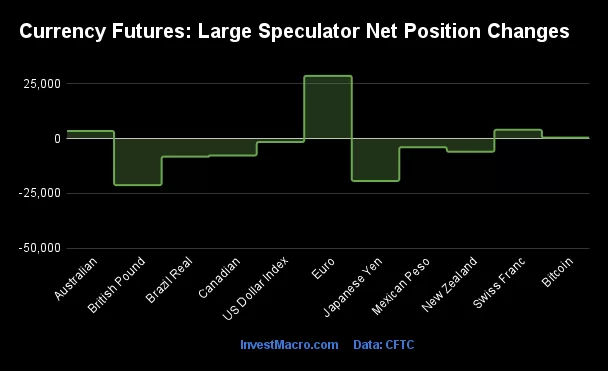
The COT currency market speculator bets were overall lower this week as four out of the eleven currency markets we cover had higher positioning while the other seven markets had lower speculator contracts.

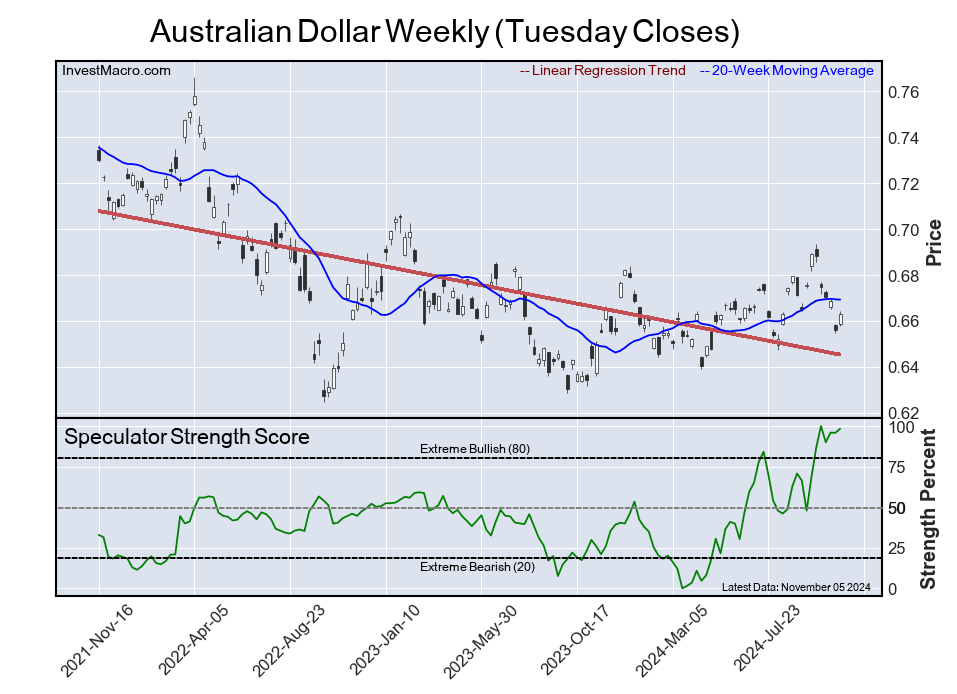
Leading the gains for the currency markets was the Brazilian Real (20,447 contracts) with the Japanese Yen (14,654 contracts), the US Dollar Index (781 contracts) and the Swiss Franc (578 contracts) also showing positive weeks.

The currencies seeing declines in speculator bets on the week were the EuroFX (-18,585 contracts), the British Pound (-17,790 contracts), the Australian Dollar (-6,178 contracts), the Mexican Peso (-3,453 contracts), the New Zealand Dollar (-3,077 contracts), Bitcoin (-461 contracts) and with the Canadian Dollar (-409 contracts) also registering lower bets on the week.

Forex Speculators push Japanese Yen bets higher for record 10-week gain

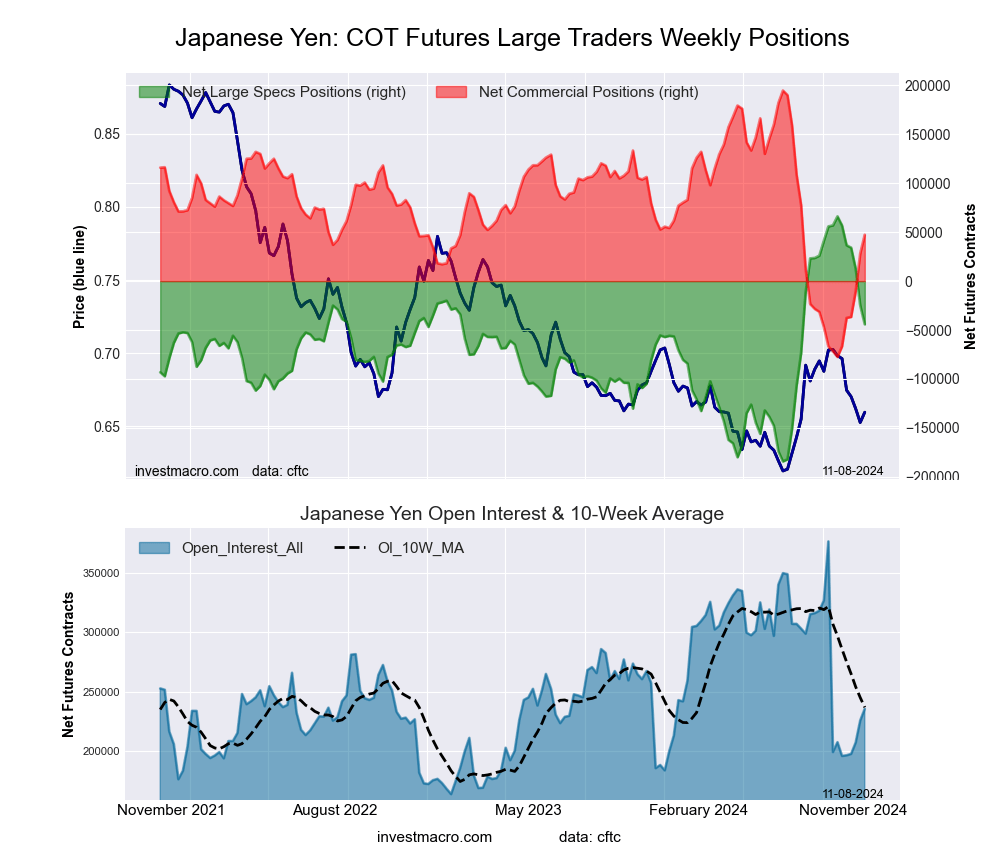
Highlighting the COT currency’s data this week is the boost in bullish bets for the Japanese yen speculators. Japanese yen bets have continued their remarkable turnaround over the past couple of months with this week marking a tenth consecutive weekly gain.

This week’s increase in the speculator positioning was the second straight weekly rise by over +14,000 contracts and brings the total increase in speculator bets over the past ten weeks to a total of +239,993 contracts — the highest 10-week cumulative change on record. The yen speculator standing has now gone from a total of -184,223 contracts on July 2nd to a total standing this week at +55,770 contracts. This week’s standing also marks the most bullish level since October 4th of 2016.

The yen sentiment has been boosted by the Bank of Japan (BOJ) who is changing their interest rate policy from negative rates previously to a cautious increase of rates beginning with their recent July hike. According to Reuters, analysts are expecting the BOJ to increase their rates again by the end of the year.

The yen exchange rate versus the US dollar has benefited from a change in BOJ policy and has improved by approximately 15 percent from the low-point reached in July, according to this week’s closing prices. The yen rose this week by over 1 percent for a second consecutive weekly gain.


Currencies Net Speculators Leaderboard
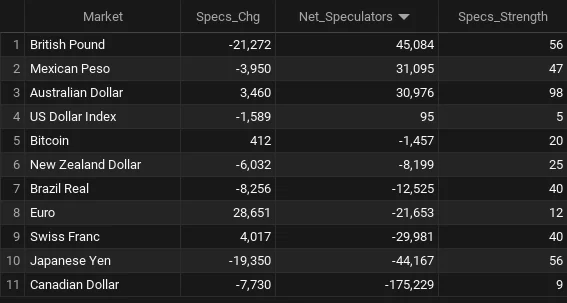
Legend: Weekly Speculators Change | Speculators Current Net Position | Speculators Strength Score compared to last 3-Years (0-100 range)


Strength Scores led by Japanese Yen & Australian Dollar

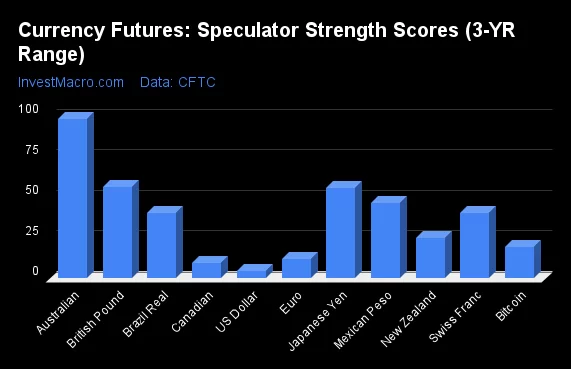
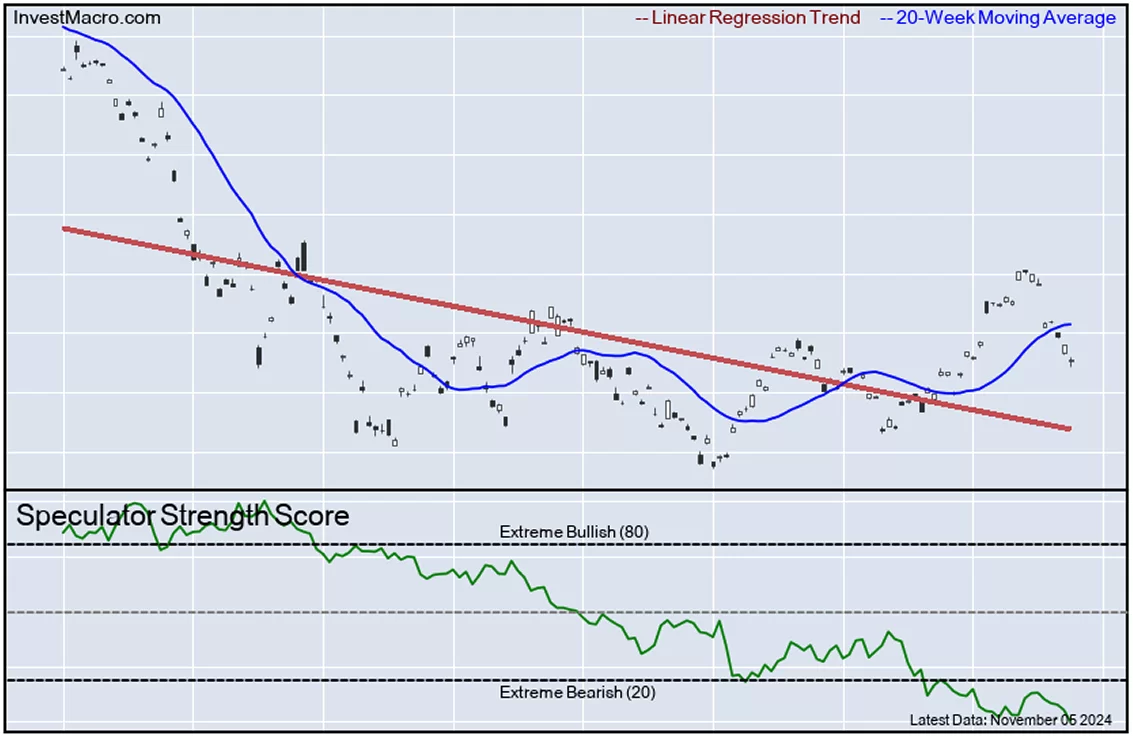
COT Strength Scores (a normalized measure of Speculator positions over a 3-Year range, from 0 to 100 where above 80 is Extreme-Bullish and below 20 is Extreme-Bearish) showed that the Japanese Yen (100 percent) and the Australian Dollar (79 percent) lead the currency markets this week. The British Pound (77 percent), Bitcoin (61 percent) and the Swiss Franc (58 percent) come in as the next highest in the weekly strength scores.

On the downside, the Brazilian Real (23 percent) and the New Zealand Dollar (35 percent) come in at the lowest strength levels currently. The next lowest strength score is the Mexican Peso (45 percent).

Strength Statistics:
US Dollar Index (47.1 percent) vs US Dollar Index previous week (45.5 percent)
EuroFX (55.0 percent) vs EuroFX previous week (62.9 percent)
British Pound Sterling (76.7 percent) vs British Pound Sterling previous week (84.7 percent)
Japanese Yen (100.0 percent) vs Japanese Yen previous week (93.9 percent)
Swiss Franc (57.7 percent) vs Swiss Franc previous week (56.5 percent)
Canadian Dollar (57.1 percent) vs Canadian Dollar previous week (57.2 percent)
Australian Dollar (78.8 percent) vs Australian Dollar previous week (84.0 percent)
New Zealand Dollar (34.5 percent) vs New Zealand Dollar previous week (40.4 percent)
Mexican Peso (44.7 percent) vs Mexican Peso previous week (46.4 percent)
Brazilian Real (23.3 percent) vs Brazilian Real previous week (3.9 percent)
Bitcoin (61.1 percent) vs Bitcoin previous week (68.0 percent)


Canadian Dollar & Japanese Yen top the 6-Week Strength Trends

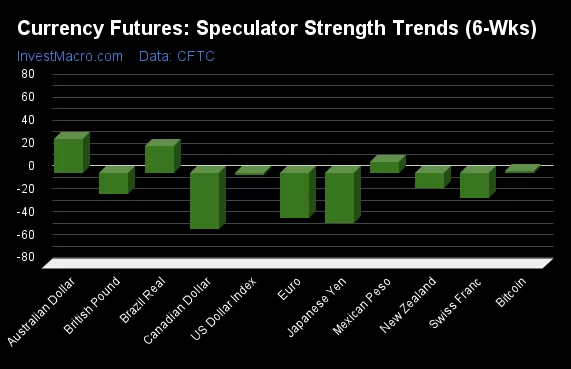
COT Strength Score Trends (or move index, calculates the 6-week changes in strength scores) showed that the Canadian Dollar (57 percent) and the Japanese Yen (54 percent) lead the past six weeks trends for the currencies. The EuroFX (27 percent), the Swiss Franc (27 percent) and the New Zealand Dollar (16 percent) are the next highest positive movers in the latest trends data.

The Mexican Peso (-20 percent) leads the downside trend scores currently with the British Pound (-10 percent) following next with lower trend scores.

Strength Trend Statistics:
US Dollar Index (6.9 percent) vs US Dollar Index previous week (2.6 percent)
EuroFX (27.1 percent) vs EuroFX previous week (27.3 percent)
British Pound Sterling (-9.5 percent) vs British Pound Sterling previous week (-15.3 percent)
Japanese Yen (53.8 percent) vs Japanese Yen previous week (61.8 percent)
Swiss Franc (26.8 percent) vs Swiss Franc previous week (41.2 percent)
Canadian Dollar (57.1 percent) vs Canadian Dollar previous week (41.7 percent)
Australian Dollar (14.6 percent) vs Australian Dollar previous week (0.8 percent)
New Zealand Dollar (15.6 percent) vs New Zealand Dollar previous week (-9.1 percent)
Mexican Peso (-19.9 percent) vs Mexican Peso previous week (-19.1 percent)
Brazilian Real (10.2 percent) vs Brazilian Real previous week (-8.4 percent)
Bitcoin (9.8 percent) vs Bitcoin previous week (11.6 percent)


Individual COT Forex Markets:

US Dollar Index Futures:
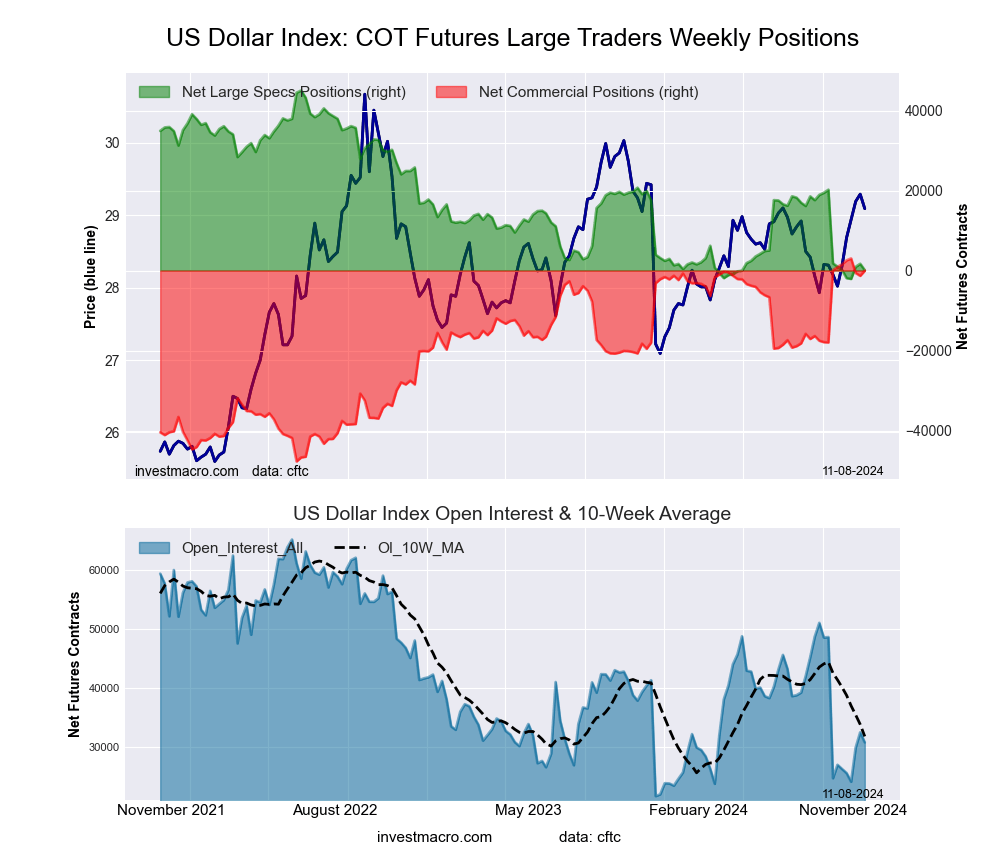
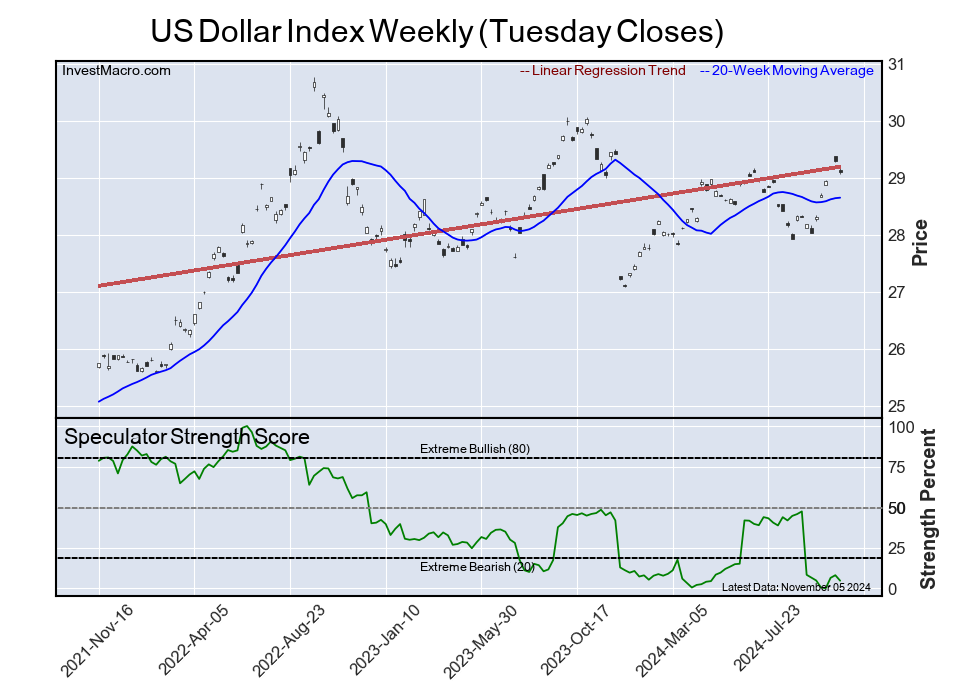
US Dollar Index Forex Futures COT ChartThe US Dollar Index large speculator standing this week came in at a net position of 20,210 contracts in the data reported through Tuesday. This was a weekly advance of 781 contracts from the previous week which had a total of 19,429 net contracts.

This week’s current strength score (the trader positioning range over the past three years, measured from 0 to 100) shows the speculators are currently Bearish with a score of 47.1 percent. The commercials are Bullish with a score of 62.7 percent and the small traders (not shown in chart) are Bearish-Extreme with a score of 0.0 percent.

Price Trend-Following Model: Strong Downtrend

Our weekly trend-following model classifies the current market price position as: Strong Downtrend. The current action for the model is considered to be: Hold – Maintain Short Position.

US DOLLAR INDEX StatisticsSPECULATORSCOMMERCIALSSMALL TRADERS
– Percent of Open Interest Longs:66.024.63.9
– Percent of Open Interest Shorts:24.561.58.5
– Net Position:20,210-17,979-2,231
– Gross Longs:32,11611,9491,916
– Gross Shorts:11,90629,9284,147
– Long to Short Ratio:2.7 to 10.4 to 10.5 to 1
NET POSITION TREND:
– Strength Index Score (3 Year Range Pct):47.162.70.0
– Strength Index Reading (3 Year Range):BearishBullishBearish-Extreme
NET POSITION MOVEMENT INDEX:
– 6-Week Change in Strength Index:6.90.5-35.3


Euro Currency Futures:

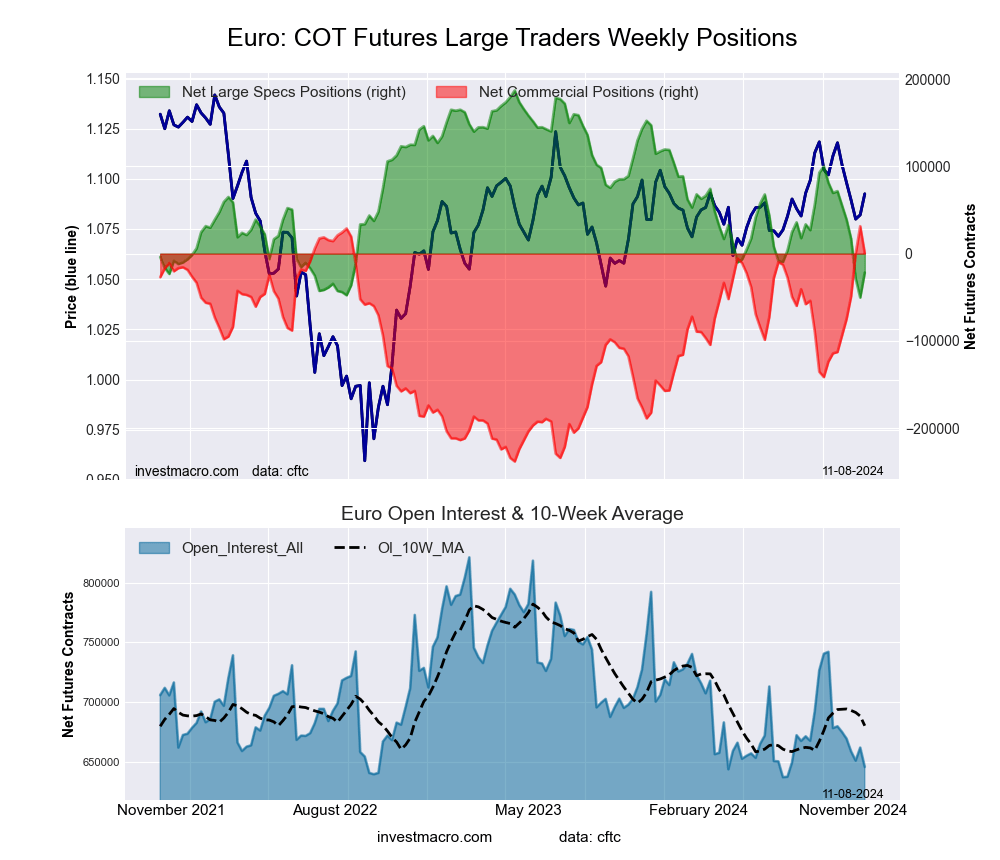
Euro Currency Futures COT ChartThe Euro Currency large speculator standing this week came in at a net position of 81,433 contracts in the data reported through Tuesday. This was a weekly decrease of -18,585 contracts from the previous week which had a total of 100,018 net contracts.

This week’s current strength score (the trader positioning range over the past three years, measured from 0 to 100) shows the speculators are currently Bullish with a score of 55.0 percent. The commercials are Bearish with a score of 42.9 percent and the small traders (not shown in chart) are Bullish with a score of 66.6 percent.

Price Trend-Following Model: Uptrend

Our weekly trend-following model classifies the current market price position as: Uptrend. The current action for the model is considered to be: Hold – Maintain Long Position.

EURO Currency StatisticsSPECULATORSCOMMERCIALSSMALL TRADERS
– Percent of Open Interest Longs:26.055.412.5
– Percent of Open Interest Shorts:15.072.16.8
– Net Position:81,433-123,80742,374
– Gross Longs:192,821411,08292,555
– Gross Shorts:111,388534,88950,181
– Long to Short Ratio:1.7 to 10.8 to 11.8 to 1
NET POSITION TREND:
– Strength Index Score (3 Year Range Pct):55.042.966.6
– Strength Index Reading (3 Year Range):BullishBearishBullish
NET POSITION MOVEMENT INDEX:
– 6-Week Change in Strength Index:27.1-31.144.1


British Pound Sterling Futures:

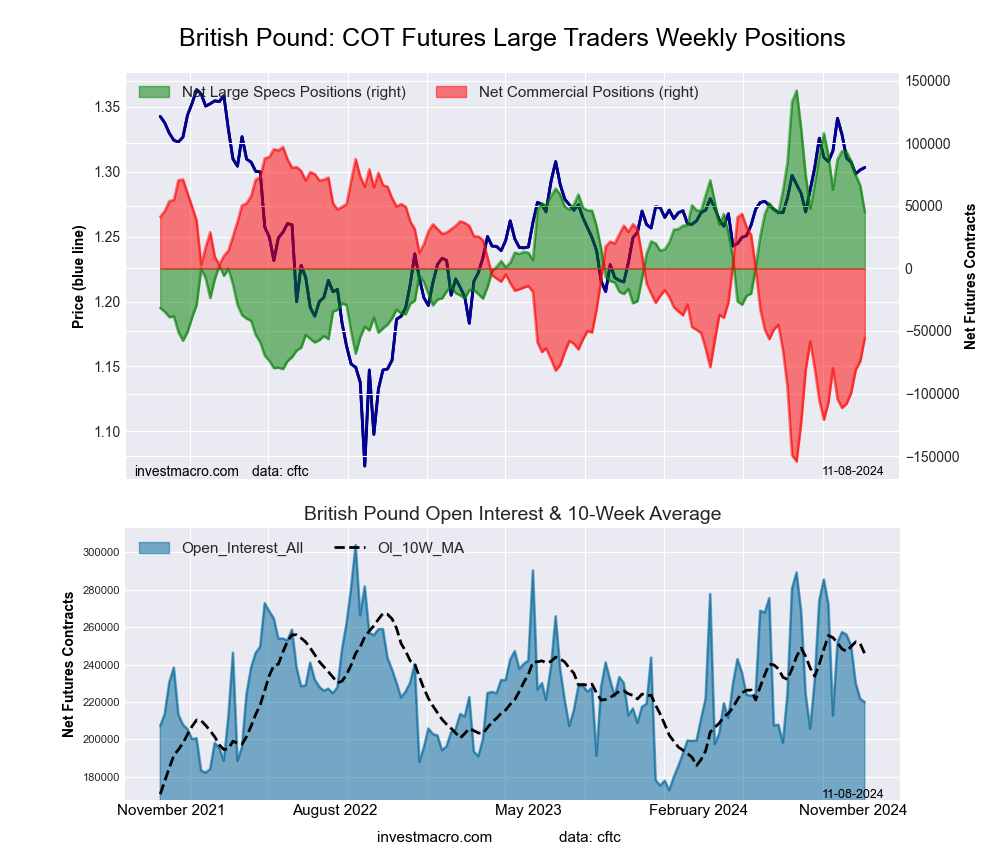
British Pound Sterling Futures COT ChartThe British Pound Sterling large speculator standing this week came in at a net position of 90,288 contracts in the data reported through Tuesday. This was a weekly decrease of -17,790 contracts from the previous week which had a total of 108,078 net contracts.

This week’s current strength score (the trader positioning range over the past three years, measured from 0 to 100) shows the speculators are currently Bullish with a score of 76.7 percent. The commercials are Bearish-Extreme with a score of 18.7 percent and the small traders (not shown in chart) are Bullish-Extreme with a score of 97.9 percent.

Price Trend-Following Model: Strong Uptrend

Our weekly trend-following model classifies the current market price position as: Strong Uptrend. The current action for the model is considered to be: Hold – Maintain Long Position.

BRITISH POUND StatisticsSPECULATORSCOMMERCIALSSMALL TRADERS
– Percent of Open Interest Longs:52.225.715.5
– Percent of Open Interest Shorts:19.065.19.3
– Net Position:90,288-107,27816,990
– Gross Longs:142,07269,94442,246
– Gross Shorts:51,784177,22225,256
– Long to Short Ratio:2.7 to 10.4 to 11.7 to 1
NET POSITION TREND:
– Strength Index Score (3 Year Range Pct):76.718.797.9
– Strength Index Reading (3 Year Range):BullishBearish-ExtremeBullish-Extreme
NET POSITION MOVEMENT INDEX:
– 6-Week Change in Strength Index:-9.56.311.1


Japanese Yen Futures:

Japanese Yen Forex Futures COT ChartThe Japanese Yen large speculator standing this week came in at a net position of 55,770 contracts in the data reported through Tuesday. This was a weekly gain of 14,654 contracts from the previous week which had a total of 41,116 net contracts.

This week’s current strength score (the trader positioning range over the past three years, measured from 0 to 100) shows the speculators are currently Bullish-Extreme with a score of 100.0 percent. The commercials are Bearish-Extreme with a score of 0.0 percent and the small traders (not shown in chart) are Bullish-Extreme with a score of 100.0 percent.

Price Trend-Following Model: Strong Uptrend

Our weekly trend-following model classifies the current market price position as: Strong Uptrend. The current action for the model is considered to be: Hold – Maintain Long Position.

JAPANESE YEN StatisticsSPECULATORSCOMMERCIALSSMALL TRADERS
– Percent of Open Interest Longs:26.359.411.3
– Percent of Open Interest Shorts:11.577.18.4
– Net Position:55,770-66,71910,949
– Gross Longs:98,894223,69842,728
– Gross Shorts:43,124290,41731,779
– Long to Short Ratio:2.3 to 10.8 to 11.3 to 1
NET POSITION TREND:
– Strength Index Score (3 Year Range Pct):100.00.0100.0
– Strength Index Reading (3 Year Range):Bullish-ExtremeBearish-ExtremeBullish-Extreme
NET POSITION MOVEMENT INDEX:
– 6-Week Change in Strength Index:53.8-55.240.4


Swiss Franc Futures:

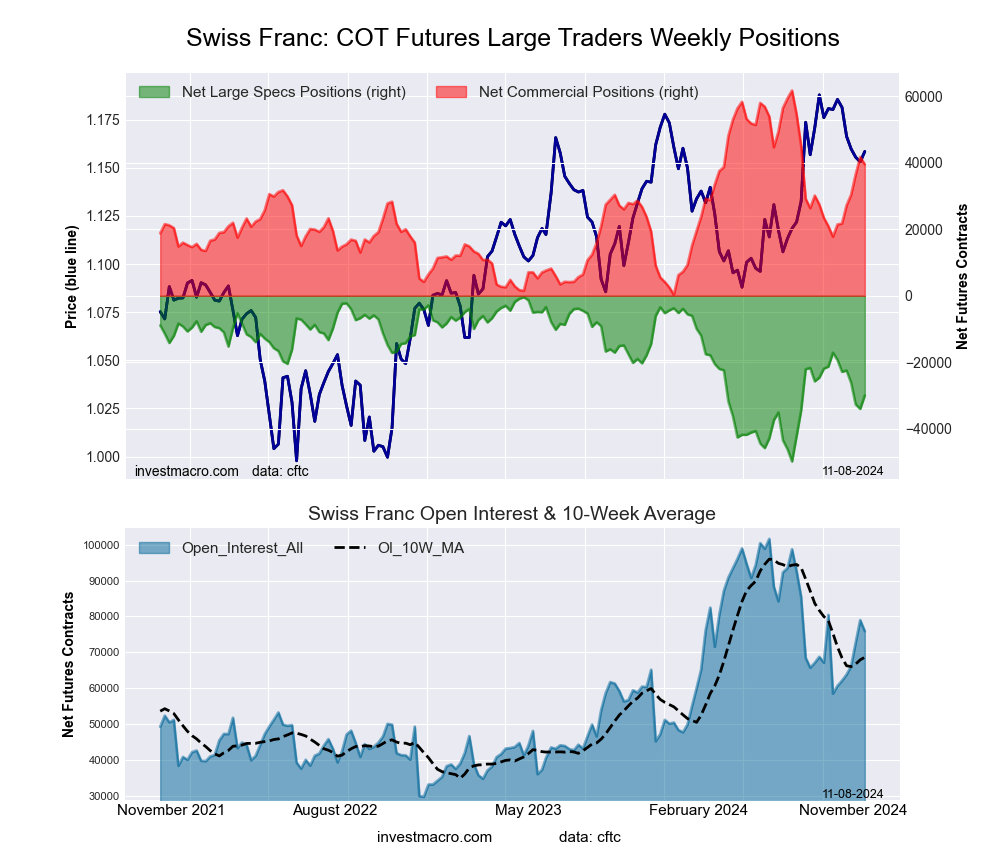
Swiss Franc Forex Futures COT ChartThe Swiss Franc large speculator standing this week came in at a net position of -21,304 contracts in the data reported through Tuesday. This was a weekly advance of 578 contracts from the previous week which had a total of -21,882 net contracts.

This week’s current strength score (the trader positioning range over the past three years, measured from 0 to 100) shows the speculators are currently Bullish with a score of 57.7 percent. The commercials are Bearish with a score of 33.6 percent and the small traders (not shown in chart) are Bullish with a score of 79.1 percent.

Price Trend-Following Model: Strong Uptrend

Our weekly trend-following model classifies the current market price position as: Strong Uptrend. The current action for the model is considered to be: Hold – Maintain Long Position.

SWISS FRANC StatisticsSPECULATORSCOMMERCIALSSMALL TRADERS
– Percent of Open Interest Longs:10.066.719.5
– Percent of Open Interest Shorts:36.540.719.0
– Net Position:-21,30420,885419
– Gross Longs:8,08253,64215,706
– Gross Shorts:29,38632,75715,287
– Long to Short Ratio:0.3 to 11.6 to 11.0 to 1
NET POSITION TREND:
– Strength Index Score (3 Year Range Pct):57.733.679.1
– Strength Index Reading (3 Year Range):BullishBearishBullish
NET POSITION MOVEMENT INDEX:
– 6-Week Change in Strength Index:26.8-39.550.2


Canadian Dollar Futures:

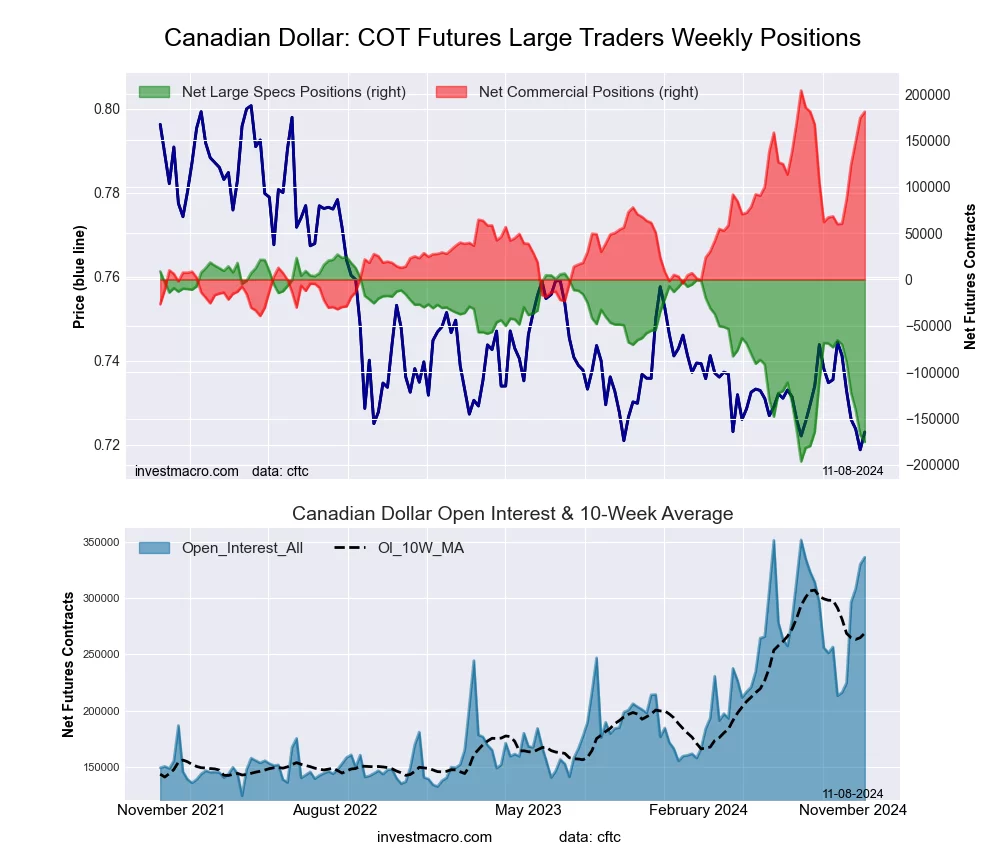
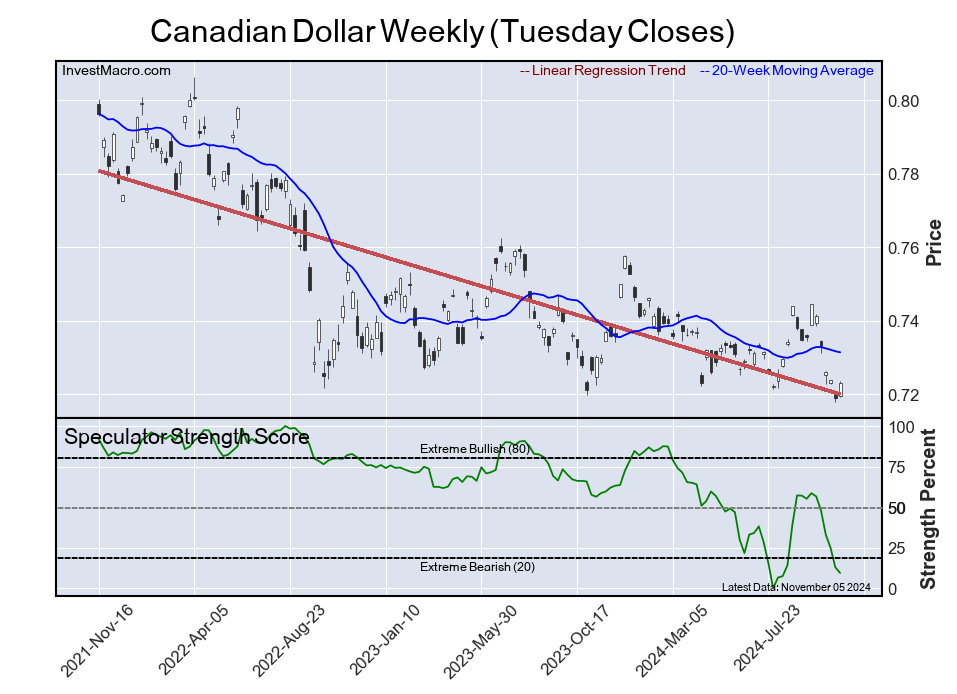
Canadian Dollar Forex Futures COT ChartThe Canadian Dollar large speculator standing this week came in at a net position of -68,953 contracts in the data reported through Tuesday. This was a weekly decline of -409 contracts from the previous week which had a total of -68,544 net contracts.

This week’s current strength score (the trader positioning range over the past three years, measured from 0 to 100) shows the speculators are currently Bullish with a score of 57.1 percent. The commercials are Bearish with a score of 43.7 percent and the small traders (not shown in chart) are Bearish with a score of 36.8 percent.

Price Trend-Following Model: Strong Uptrend

Our weekly trend-following model classifies the current market price position as: Strong Uptrend. The current action for the model is considered to be: Hold – Maintain Long Position.

CANADIAN DOLLAR StatisticsSPECULATORSCOMMERCIALSSMALL TRADERS
– Percent of Open Interest Longs:9.570.412.3
– Percent of Open Interest Shorts:36.943.711.5
– Net Position:-68,95366,9182,035
– Gross Longs:23,773176,81430,986
– Gross Shorts:92,726109,89628,951
– Long to Short Ratio:0.3 to 11.6 to 11.1 to 1
NET POSITION TREND:
– Strength Index Score (3 Year Range Pct):57.143.736.8
– Strength Index Reading (3 Year Range):BullishBearishBearish
NET POSITION MOVEMENT INDEX:
– 6-Week Change in Strength Index:57.1-56.328.2


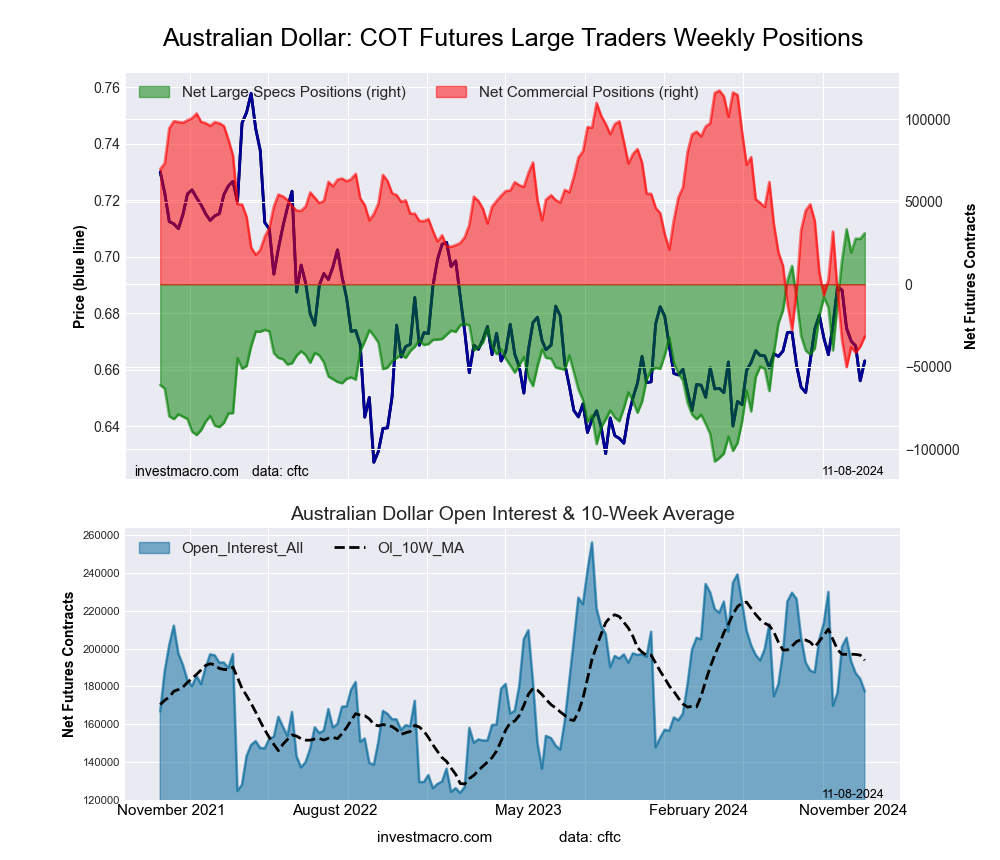
Australian Dollar Futures:

Australian Dollar Forex Futures COT ChartThe Australian Dollar large speculator standing this week came in at a net position of -14,042 contracts in the data reported through Tuesday. This was a weekly fall of -6,178 contracts from the previous week which had a total of -7,864 net contracts.

This week’s current strength score (the trader positioning range over the past three years, measured from 0 to 100) shows the speculators are currently Bullish with a score of 78.8 percent. The commercials are Bearish with a score of 21.0 percent and the small traders (not shown in chart) are Bullish-Extreme with a score of 85.3 percent.

Price Trend-Following Model: Uptrend

Our weekly trend-following model classifies the current market price position as: Uptrend. The current action for the model is considered to be: Hold – Maintain Long Position.

AUSTRALIAN DOLLAR StatisticsSPECULATORSCOMMERCIALSSMALL TRADERS
– Percent of Open Interest Longs:32.349.713.1
– Percent of Open Interest Shorts:38.448.68.1
– Net Position:-14,0422,62011,422
– Gross Longs:74,259114,42630,094
– Gross Shorts:88,301111,80618,672
– Long to Short Ratio:0.8 to 11.0 to 11.6 to 1
NET POSITION TREND:
– Strength Index Score (3 Year Range Pct):78.821.085.3
– Strength Index Reading (3 Year Range):BullishBearishBullish-Extreme
NET POSITION MOVEMENT INDEX:
– 6-Week Change in Strength Index:14.6-20.835.5


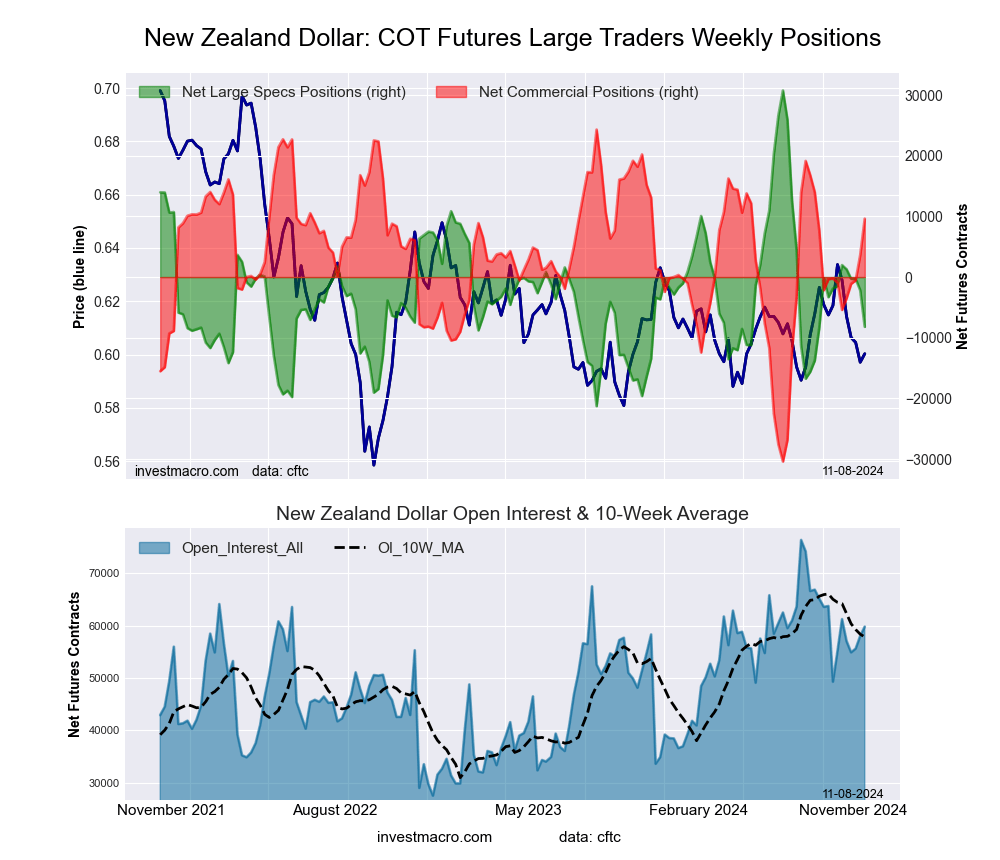
New Zealand Dollar Futures:

New Zealand Dollar Forex Futures COT ChartThe New Zealand Dollar large speculator standing this week came in at a net position of -3,315 contracts in the data reported through Tuesday. This was a weekly fall of -3,077 contracts from the previous week which had a total of -238 net contracts.

This week’s current strength score (the trader positioning range over the past three years, measured from 0 to 100) shows the speculators are currently Bearish with a score of 34.5 percent. The commercials are Bullish with a score of 54.9 percent and the small traders (not shown in chart) are Bullish-Extreme with a score of 100.0 percent.

Price Trend-Following Model: Uptrend

Our weekly trend-following model classifies the current market price position as: Uptrend. The current action for the model is considered to be: Hold – Maintain Long Position.

NEW ZEALAND DOLLAR StatisticsSPECULATORSCOMMERCIALSSMALL TRADERS
– Percent of Open Interest Longs:33.649.510.9
– Percent of Open Interest Shorts:38.850.05.1
– Net Position:-3,315-3473,662
– Gross Longs:21,39431,5116,929
– Gross Shorts:24,70931,8583,267
– Long to Short Ratio:0.9 to 11.0 to 12.1 to 1
NET POSITION TREND:
– Strength Index Score (3 Year Range Pct):34.554.9100.0
– Strength Index Reading (3 Year Range):BearishBullishBullish-Extreme
NET POSITION MOVEMENT INDEX:
– 6-Week Change in Strength Index:15.6-26.279.1


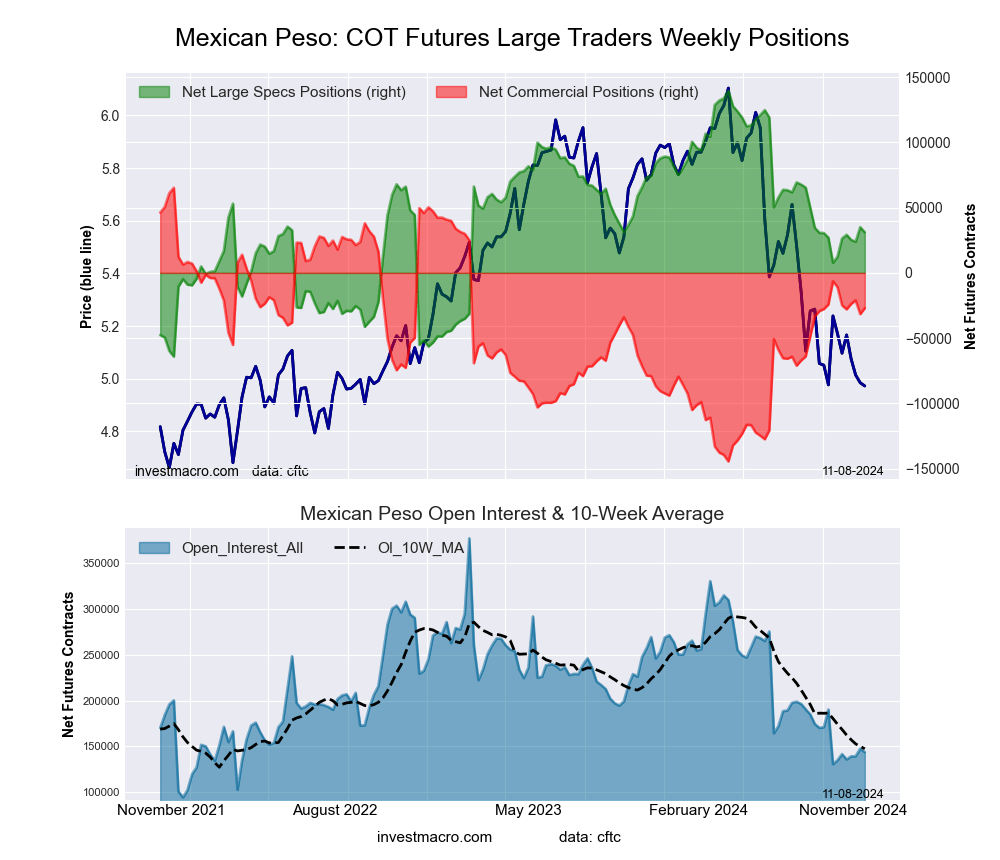
Mexican Peso Futures:

Mexican Peso Futures COT ChartThe Mexican Peso large speculator standing this week came in at a net position of 27,026 contracts in the data reported through Tuesday. This was a weekly fall of -3,453 contracts from the previous week which had a total of 30,479 net contracts.

This week’s current strength score (the trader positioning range over the past three years, measured from 0 to 100) shows the speculators are currently Bearish with a score of 44.7 percent. The commercials are Bullish with a score of 57.3 percent and the small traders (not shown in chart) are Bearish-Extreme with a score of 0.0 percent.

Price Trend-Following Model: Downtrend

Our weekly trend-following model classifies the current market price position as: Downtrend. The current action for the model is considered to be: Hold – Maintain Short Position.

MEXICAN PESO StatisticsSPECULATORSCOMMERCIALSSMALL TRADERS
– Percent of Open Interest Longs:32.958.22.0
– Percent of Open Interest Shorts:18.770.93.5
– Net Position:27,026-24,212-2,814
– Gross Longs:62,614110,6663,879
– Gross Shorts:35,588134,8786,693
– Long to Short Ratio:1.8 to 10.8 to 10.6 to 1
NET POSITION TREND:
– Strength Index Score (3 Year Range Pct):44.757.30.0
– Strength Index Reading (3 Year Range):BearishBullishBearish-Extreme
NET POSITION MOVEMENT INDEX:
– 6-Week Change in Strength Index:-19.920.4-13.2


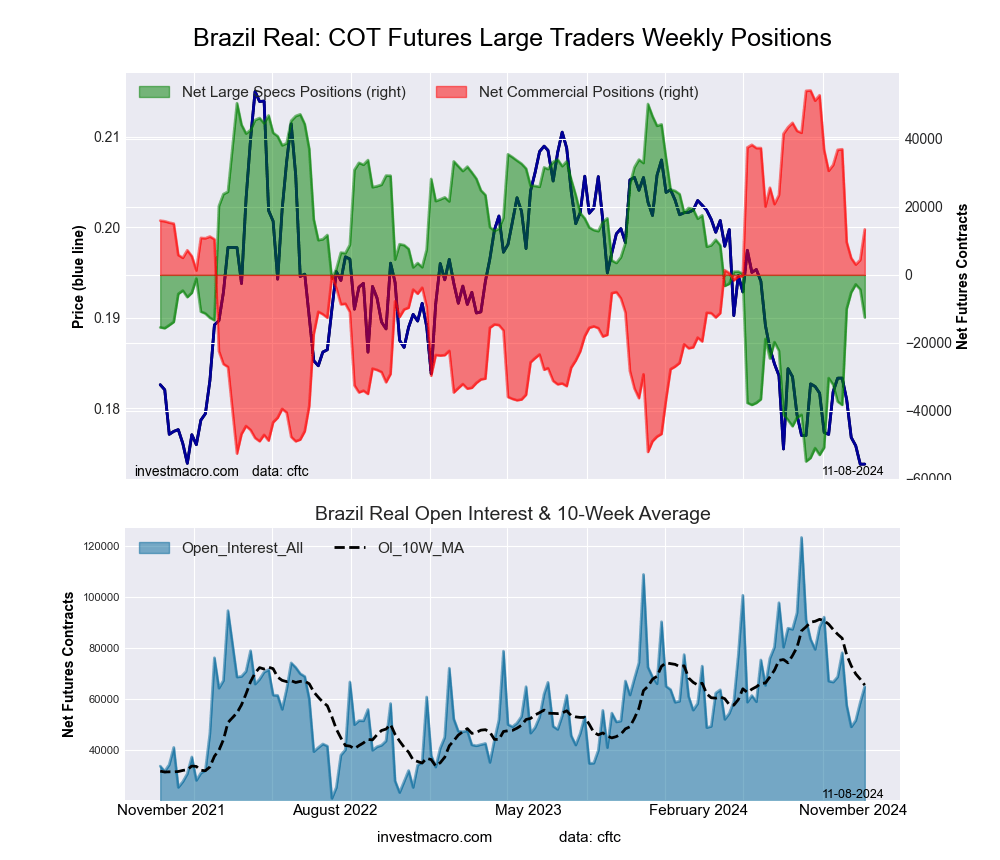
Brazilian Real Futures:

Brazil Real Futures COT ChartThe Brazilian Real large speculator standing this week came in at a net position of -30,364 contracts in the data reported through Tuesday. This was a weekly rise of 20,447 contracts from the previous week which had a total of -50,811 net contracts.

This week’s current strength score (the trader positioning range over the past three years, measured from 0 to 100) shows the speculators are currently Bearish with a score of 23.3 percent. The commercials are Bullish with a score of 77.9 percent and the small traders (not shown in chart) are Bearish-Extreme with a score of 19.5 percent.

Price Trend-Following Model: Downtrend

Our weekly trend-following model classifies the current market price position as: Downtrend. The current action for the model is considered to be: Hold – Maintain Short Position.

BRAZIL REAL StatisticsSPECULATORSCOMMERCIALSSMALL TRADERS
– Percent of Open Interest Longs:27.068.63.9
– Percent of Open Interest Shorts:72.323.04.3
– Net Position:-30,36430,599-235
– Gross Longs:18,11546,0112,631
– Gross Shorts:48,47915,4122,866
– Long to Short Ratio:0.4 to 13.0 to 10.9 to 1
NET POSITION TREND:
– Strength Index Score (3 Year Range Pct):23.377.919.5
– Strength Index Reading (3 Year Range):BearishBullishBearish-Extreme
NET POSITION MOVEMENT INDEX:
– 6-Week Change in Strength Index:10.2-10.52.2


Bitcoin Futures:

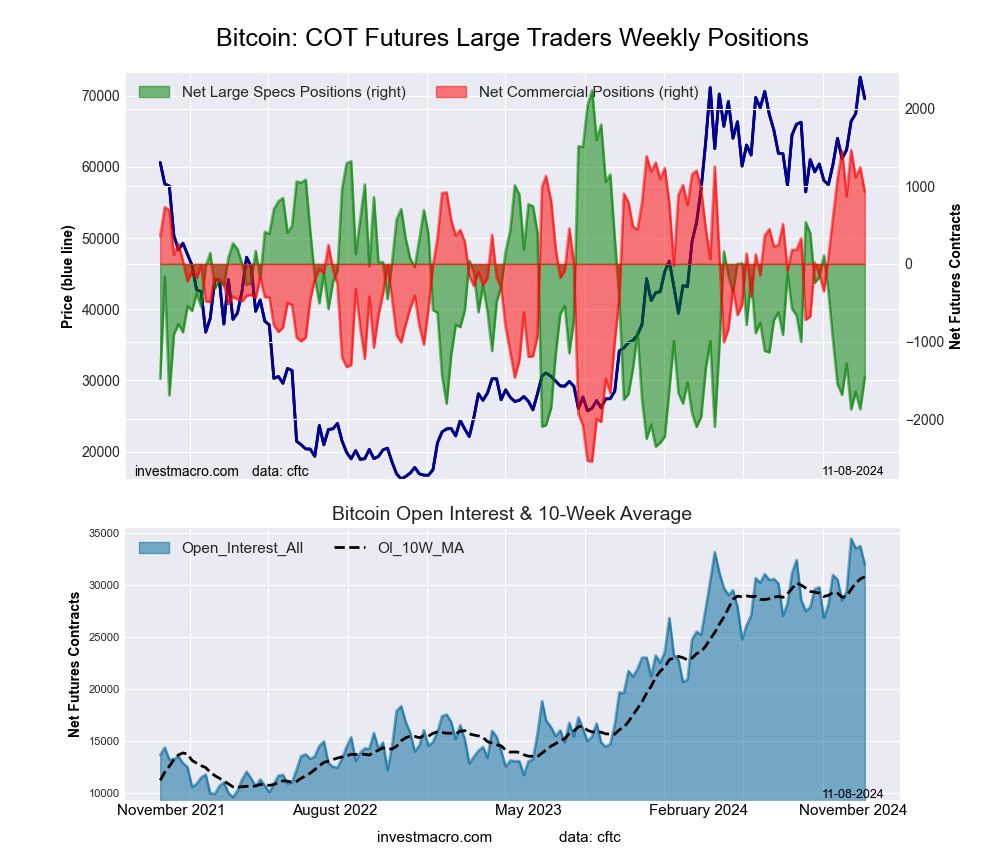
Bitcoin Crypto Futures COT ChartThe Bitcoin large speculator standing this week came in at a net position of -353 contracts in the data reported through Tuesday. This was a weekly decline of -461 contracts from the previous week which had a total of 108 net contracts.

This week’s current strength score (the trader positioning range over the past three years, measured from 0 to 100) shows the speculators are currently Bullish with a score of 61.1 percent. The commercials are Bullish with a score of 66.9 percent and the small traders (not shown in chart) are Bearish-Extreme with a score of 19.0 percent.

Price Trend-Following Model: Downtrend

Our weekly trend-following model classifies the current market price position as: Downtrend. The current action for the model is considered to be: Hold – Maintain Short Position.

BITCOIN StatisticsSPECULATORSCOMMERCIALSSMALL TRADERS
– Percent of Open Interest Longs:81.63.94.4
– Percent of Open Interest Shorts:82.83.63.4
– Net Position:-35385268
– Gross Longs:22,9691,0971,225
– Gross Shorts:23,3221,012957
– Long to Short Ratio:1.0 to 11.1 to 11.3 to 1
NET POSITION TREND:
– Strength Index Score (3 Year Range Pct):61.166.919.0
– Strength Index Reading (3 Year Range):BullishBullishBearish-Extreme
NET POSITION MOVEMENT INDEX:
– 6-Week Change in Strength Index:9.8-6.2-9.3


Article By InvestMacroReceive our weekly COT Newsletter

*COT Report: The COT data, released weekly to the public each Friday, is updated through the most recent Tuesday (data is 3 days old) and shows a quick view of how large speculators or non-commercials (for-profit traders) were positioned in the futures markets.

The CFTC categorizes trader positions according to commercial hedgers (traders who use futures contracts for hedging as part of the business), non-commercials (large traders who speculate to realize trading profits) and nonreportable traders (usually small traders/speculators) as well as their open interest (contracts open in the market at time of reporting). See CFTC criteria here.

Speculator Extremes: Yen, VIX, Cotton & WTI Crude Oil top Bullish & Bearish Positions

By InvestMacro 

The latest update for the weekly Commitment of Traders (COT) report was released by the Commodity Futures Trading Commission (CFTC) on Friday for data ending on September 10th.

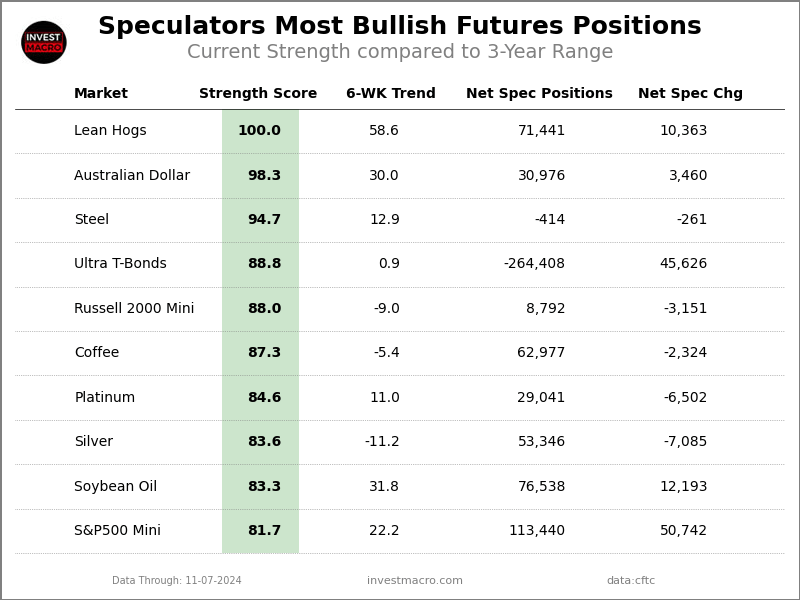
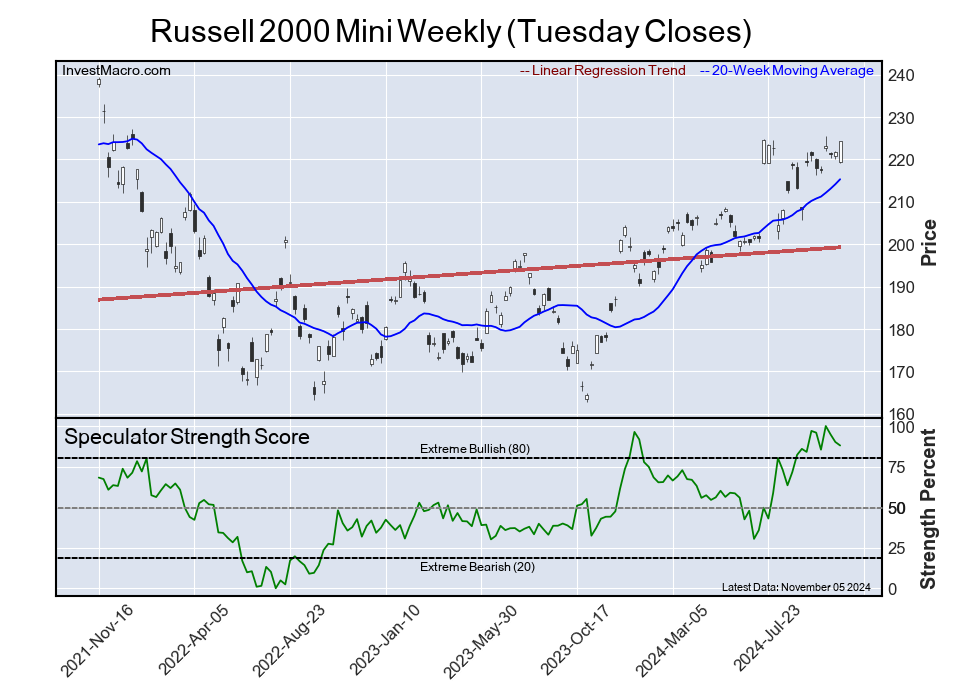
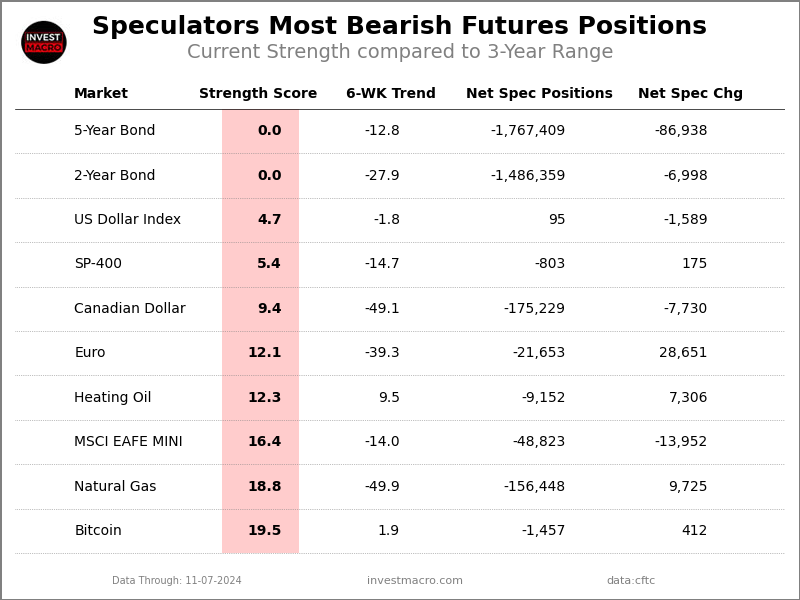
This weekly Extreme Positions report highlights the Most Bullish and Most Bearish Positions for the speculator category. Extreme positioning in these markets can foreshadow strong moves in the underlying market.

To signify an extreme position, we use the Strength Index (also known as the COT Index) of each instrument, a common method of measuring COT data. The Strength Index is simply a comparison of current trader positions against the range of positions over the previous 3 years. We use over 80 percent as extremely bullish and under 20 percent as extremely bearish. (Compare Strength Index scores across all markets in the data table or cot leaders table)


Here Are This Week’s Most Bullish Speculator Positions:

Japanese Yen


The Japanese Yen speculator position comes in as the most bullish extreme standing this week. The Japanese Yen speculator level is currently at a maximum 100.0 percent score of its 3-year range.

The six-week trend for the percent strength score totaled 53.8 this week. The overall net speculator position was a total of 55,770 net contracts this week with a jump by 14,654 contract in the weekly speculator bets.


Speculators or Non-Commercials Notes:

Speculators, classified as non-commercial traders by the CFTC, are made up of large commodity funds, hedge funds and other significant for-profit participants. The Specs are generally regarded as trend-followers in their behavior towards price action – net speculator bets and prices tend to go in the same directions. These traders often look to buy when prices are rising and sell when prices are falling. To illustrate this point, many times speculator contracts can be found at their most extremes (bullish or bearish) when prices are also close to their highest or lowest levels.

These extreme levels can be dangerous for the large speculators as the trade is most crowded, there is less trading ammunition still sitting on the sidelines to push the trend further and prices have moved a significant distance. When the trend becomes exhausted, some speculators take profits while others look to also exit positions when prices fail to continue in the same direction. This process usually plays out over many months to years and can ultimately create a reverse effect where prices start to fall and speculators start a process of selling when prices are falling.


VIX


The VIX speculator position comes next in the extreme standings this week. The VIX speculator level is now at a 98.8 percent score of its 3-year range.

The six-week trend for the percent strength score was 37.4 this week. The speculator position registered -15,111 net contracts this week with a weekly rise of 10,778 contracts in speculator bets.


3-Month Secured Overnight Financing Rate


The 3-Month Secured Overnight Financing Rate speculator position comes in third this week in the extreme standings. The 3-Month Secured Overnight Financing Rate speculator level resides at a 98.7 percent score of its 3-year range.

The six-week trend for the speculator strength score came in at 29.2 this week. The overall speculator position was 744,227 net contracts this week with a huge boost of 112,656 contracts in the weekly speculator bets.


Gold


The Gold speculator position comes up number four in the extreme standings this week. The Gold speculator level is at a 95.1 percent score of its 3-year range.

The six-week trend for the speculator strength score totaled a change of 14.8 this week. The overall speculator position was 282,501 net contracts this week with a dip of -5,057 contracts in the speculator bets.


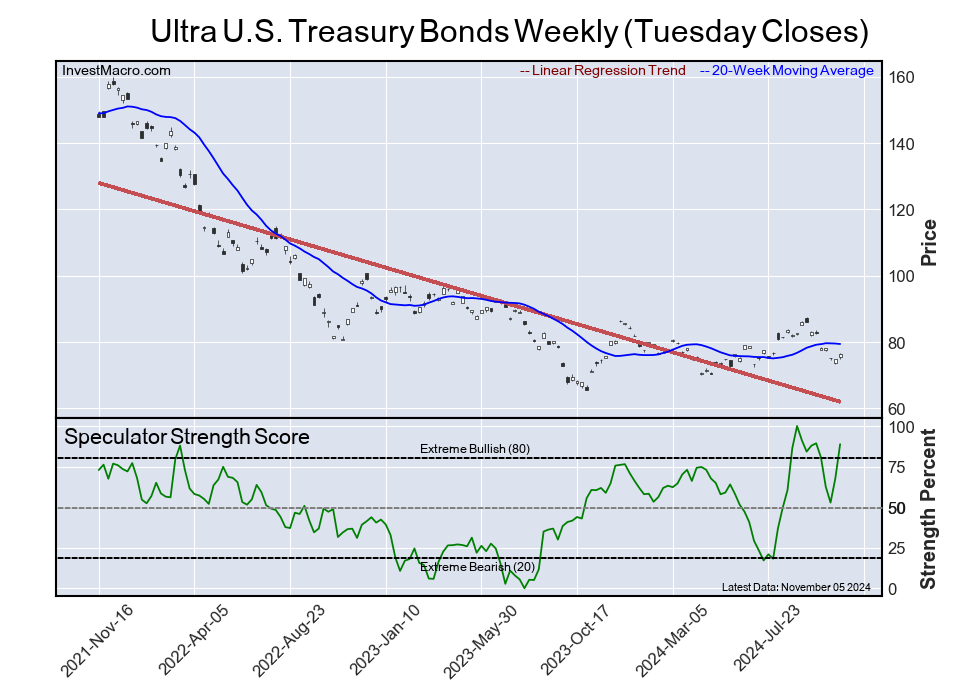
Ultra U.S. Treasury Bonds


The Ultra U.S. Treasury Bonds speculator position rounds out the top five in this week’s bullish extreme standings. The Ultra U.S. Treasury Bonds speculator level sits at a 91.2 percent score of its 3-year range. The six-week trend for the speculator strength score was 73.0 this week.

The speculator position was -259,158 net contracts this week with a decline of -18,956 contracts in the weekly speculator bets.


This Week’s Most Bearish Speculator Positions:

Cotton


The Cotton speculator position comes in as the most bearish extreme standing this week. The Cotton speculator level is at the lowest possible value of a 0.0 percent score of its 3-year range.

The six-week trend for the speculator strength score was -5.2 this week. The overall speculator position was -46,111 net contracts this week with a drop of -7,957 contracts in the speculator bets.


WTI Crude Oil


The WTI Crude Oil speculator position comes in next for the most bearish extreme standing on the week. The WTI Crude Oil speculator level is at a just 0.6 percent score of its 3-year range.

The six-week trend for the speculator strength score was -36.2 this week. The speculator position totaled 140,014 net contracts this week with a slide of -37,021 contracts in the weekly speculator bets.


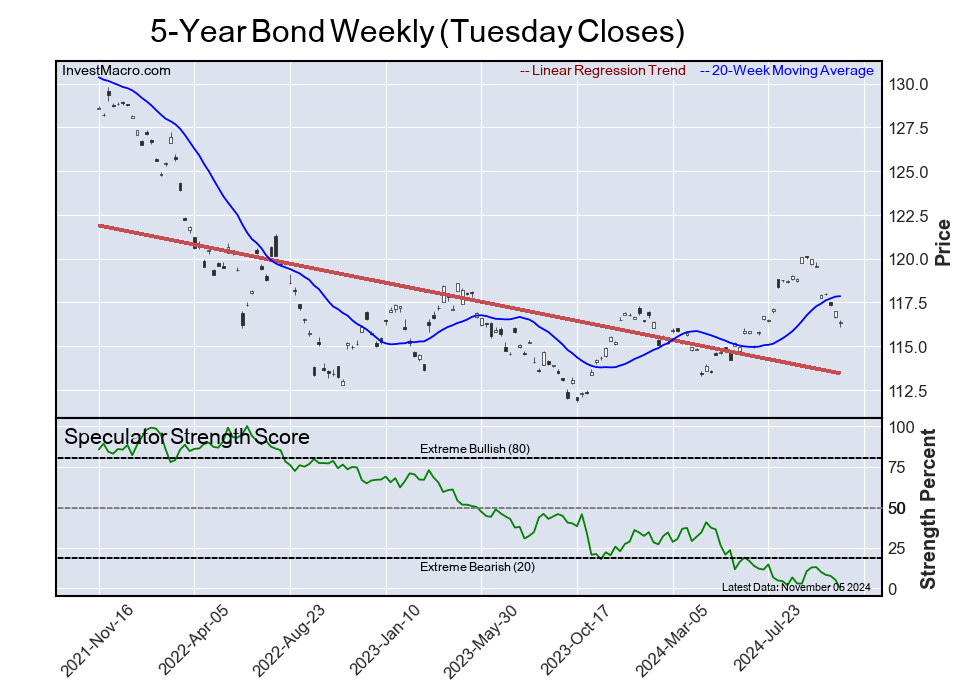
5-Year Bond


The 5-Year Bond speculator position comes in as third most bearish extreme standing of the week. The 5-Year Bond speculator level resides at a 1.0 percent score of its 3-year range.

The six-week trend for the speculator strength score was -3.9 this week. The overall speculator position was -1,719,996 net contracts this week with a small dip by -1,300 contracts in the speculator bets.


10-Year Note


The 10-Year Note speculator position comes in as this week’s fourth most bearish extreme standing. The 10-Year Note speculator level is at a 1.3 percent score of its 3-year range.

The six-week trend for the speculator strength score was -24.1 this week. The speculator position was -1,022,105 net contracts this week with a fall by -19,278 contracts in the weekly speculator bets.


Gasoline


Finally, the Gasoline speculator position comes in as the fifth most bearish extreme standing for this week. The Gasoline speculator level is at a 5.6 percent score of its 3-year range.

The six-week trend for the speculator strength score was -10.3 this week. The speculator position was 15,637 net contracts this week with a decrease by -4,221 contracts in the weekly speculator bets.


Article By InvestMacroReceive our weekly COT Newsletter

*COT Report: The COT data, released weekly to the public each Friday, is updated through the most recent Tuesday (data is 3 days old) and shows a quick view of how large speculators or non-commercials (for-profit traders) were positioned in the futures markets.

The CFTC categorizes trader positions according to commercial hedgers (traders who use futures contracts for hedging as part of the business), non-commercials (large traders who speculate to realize trading profits) and nonreportable traders (usually small traders/speculators) as well as their open interest (contracts open in the market at time of reporting). See CFTC criteria here.

Week Ahead: Central banks take centre stage

By ForexTime

  • Will Fed decision push US500 to fresh records?
  • UK100 waits on BoE for next move
  • JP225 could be rocked by BoJ meeting
  • Watch out for other central bank meetings

If you thought the past few days were eventful, check out what’s in store for the week ahead!

A string of major central bank decisions may present fresh trading opportunities across financial markets:

Saturday, 14th Sept

  • CN50: China property prices, retail sales, industrial production

Monday, 16th Sept  

  • CAD: Canada existing home sales
  • USDInd: US empire manufacturing

Tuesday, 17th Sept  

  • CAD: Canada CPI
  • GER40: Germany ZEW survey expectations
  • JP225: Japan tertiary index
  • SG20: Singapore trade
  • US500: US industrial production, retail sales

Wednesday 18th Sept

  • EU50: Eurozone CPI
  • JP225: Japan machinery orders, trade
  • ZAR: South Africa retail sales, CPI
  • UK100: UK CPI
  • US500: FOMC rate decision

Thursday, 19th Sept

  • AU200: Australia unemployment
  • NZD: New Zealand GDP
  • UK100: BoE rate decision
  • ZAR: SARB rate decision
  • TWN: Taiwan rate decision
  • USDInd: US Conf. Board leading index, initial jobless claims

Friday, 20th Sept

  • CN50: China loan prime rates
  • CAD: Canada retail sales
  • EU50: Eurozone consumer confidence
  • JP225: BoJ rate decision, CPI

We have our eyes on 3 indices that could be rocked by 3 central bank announcements:


    1) US500 set for fresh all-time highs?

FXTM’s US500 which tracks the S&P500 staged a strong rebound this week, rising 4% as data reinforced bets around lower US interest rates.

Although the Federal Reserve is expected to cut interest rates at September’s meeting, markets remain divided on the size.

Traders have fully priced in a 25-basis point cut with the odds of a 50-basis point cut around 45%.

The press conference and economic projections – especially ones for interest rates known as the dot plot may offer fresh insight into future moves.

Golden nugget: Over the past 12 months, the Fed decision has triggered upside moves of as much as 1.7% or declines of 1.2% in a 6-hour window post-release.

Looking at the technical picture, the US500 is trading just over 1% away from it’s all-time high at 5678. Prices are trading above the 50, 100 and 200-day SMA while the MACD is above zero.

  • Key levels can be found at 5600 and the 50-day SMA.

SP500


    2) UK100 to experience breakout?

After bouncing within a weekly range, the UK100 which tracks the FTSE100 index could experience a breakout.

This may be sparked by the incoming UK inflation data and BoE rate decision in the week ahead.

Markets expected the BoE to leave interest rates unchanged at 5% in September, so it’s all about the policy statement and how many MPC members voted to cut rates. This major risk could rock the British Pound, influencing the UK100.

Note: When the pound strengthens, it results in lower revenues for FTSE100 companies that attain their revenues from overseas – dragging the UK100 lower as a result. The same is true vice versa.

Golden nugget: Over the past year, the BoE decision has triggered upside moves of as much as 0.9% or declines of 0.8% in a 6-hour window post-release.

Talking technicals, it’s worth noting that the UK100 is trading roughly 3% away from its all-time high.

Weekly support can be found at 8130 and resistance at 8450.

  • A decline below 8130 may signal a selloff toward 8000.
  • While a breakout above 8450 could see the UK100 challenge fresh all-time highs.

UK100


    3) JP225 waits on BoJ decision

The JP225 could be injected with fresh volatility due to the BoJ meeting on Friday.

Note: The JP225 tracks the Nikkie 225 index and tens to weaken when the Yen strengthens, vice versa.

The BoJ is expected to leave interest rates unchanged at 0.25% in September with traders only seeing a 33% probability of another rate hike by the end of 2024.

Still, much attention will be directed toward the tone of the meeting and whether any clues are offered on future moves.

Rising inflationary pressures in Japan support the argument around higher rates. However, concerns over the US economy and possibly unwinding of the carry trades could keep hawks at bay. Whatever the outcome of the meeting, it is likely to influence the JP225.

Golden nugget: Over the past 12 months, the BoJ decision has triggered upside moves of as much as 2% or declines of 1.5% in a 6-hour window post-release.

Looking at the charts, resistance can be found at the 200-day SMA at 37700 and support at 3500. A breakout may be on the horizon.

JP225


Forex-Time-LogoArticle by ForexTime

ForexTime Ltd (FXTM) is an award winning international online forex broker regulated by CySEC 185/12 www.forextime.com

Oil and gas communities are a blind spot in America’s climate and economic policies

By Noah Kaufman, Columbia University 

On a recent visit to Rangely, a small town in northwest Colorado, my colleagues and I met with the administrators of a highly regarded community college to discuss the town’s economy. Leaving the scenic campus, we saw families driving into the mountains in off-road vehicles, a favorite activity for this outdoors-loving community. With a median household income above US$70,000 and a low cost of living, Rangely does not have the signs of a town in economic distress.

But an existential risk looms over Rangely. The town is here because of an oil boom during World War II. Today, the oil and gas industry contributes over half of the county’s economic output.

Rangely is not unique in the United States, which is the world’s largest producer of oil and natural gas. There are towns across the country that depend on the oil and gas industry for well-paying jobs and public revenues that fund their schools and other critical services.

A heavy dependence on any single industry is risky, and the oil industry is prone to booms and busts. But the economies of oil- and gas-dependent towns face a unique threat from global efforts to address the risks of climate change, which is fueled by the burning of oil and natural gas. Any serious strategy to halt global warming involves policies that will, over time, sharply reduce demand for all fossil fuels.

Early signs of this transformation can be seen in last year’s international agreement to “transition away from fossil fuels” and in the spread of electric vehicles that are starting to displace gasoline- and diesel-powered cars, trucks and buses.

As an economist who worked at the White House during the Obama administration and early Biden administration, I contributed to detailed strategies to reduce greenhouse gas emissions and to support communities in economic distress. But we did not have a plan to prepare oil and gas towns like Rangely for future economic challenges.

Why oil and gas towns are overlooked

Congress has prioritized support for small towns in recent legislation. However, oil- and gas-dependent towns were largely absent from these strategies for three primary reasons.

First is a perceived lack of urgency. The attention to a “just transition” as the nation moves away from fossil fuels has been disproportionately directed to coal-dependent communities. U.S. coal production has declined for 15 years, and a continued transition away from coal appears imminent and inevitable.

In contrast, U.S. production of oil and natural gas continues to grow. To be sure, some oil and gas communities are already struggling. But the widespread economic risks of a shift away from oil and gas may feel more like a problem for future decades.

Second, politicians downplay risks to oil and gas communities.

Most Republicans are not planning for a future decline in oil and gas production at all, and that includes many local politicians in oil and gas-dependent communities. For their part, most Democratic politicians prefer to focus on how climate action can be an engine of future economic growth. President Joe Biden likes to say, “When I think about climate change, I think jobs.”

He is not wrong to highlight the economic opportunities of climate solutions. But clean energy jobs rarely offer one-for-one replacements for the high-paying jobs in the oil and gas industries and the public revenues those industries bring local communities.

Third, economists’ policy toolbox is poorly suited to the challenges facing oil and gas communities.

Proposals to support local economic development commonly suggest targeting persistently distressed local economies with measures such as wage subsidies that have the potential to rapidly put more people to work.

A different prescription is needed for oil and gas communities, which are not generally struggling today. Over the 15-year period prior to the pandemic, the U.S. counties with oil and gas production experienced average annual GDP growth of 2.4% per year, compared with 1.9% nationwide.

Most oil and gas communities do not need economic stimulus policies that provide immediate relief. What they need are holistic economic development strategies that can cultivate new industries – building on their existing strengths – that will enable them to prosper into the future.

Solutions to help oil and gas towns prepare

Harvard economist Ricardo Hausmann compares the challenge of developing new economic capabilities to the game of Scrabble, where each additional letter enables the creation of more words. He cites the Finish economy as an example: It evolved from harvesting lumber to making tools that cut wood to producing automated cutting machines. From there, it evolved to sophisticated automated machines, including those used by global corporations such as telecommunications giant Nokia.

Such economic evolutions must be tailored to the characteristics of individual places. But the initial step is to recognize the problem and invest in solutions.

The Southern Ute Indian Tribe is doing this in southwest Colorado. It devotes oil and gas revenues to a Permanent Fund, which promotes fiscal sustainability by ensuring the tribe’s assets are aligned with its long-term financial goals, and a Growth Fund that diversifies the tribe’s revenue sources by investing in a range of businesses.

At the national level, a recent National Academies panel proposed the creation of a federally chartered corporation to help communities facing acute economic threats, including a future decline in oil and gas. This corporation could provide funding for displaced workers, critical public infrastructure and programs that ensure access to economic opportunities.

Colorado’s state Office of Just Transition has started to serve this role. Currently, it focuses only on the transition away from coal, with the goals of helping communities develop new economic opportunities and helping workers transition to new jobs. But its mission could be expanded in the future. In fact, Rangely is already receiving some support due to coal closures nearby.

No one-size-fits-all solution

Small, rural towns like Rangely illustrate how oil- and gas-reliant regions will need unique strategies tailored to the strengths and limitations of individual places. No off-the-shelf playbook exists.

Our group of researchers who visited Rangely are part of the Resilient Energy Economies initiative, which was created by universities, research institutes and philanthropic organizations to ensure that policymakers have the information they need to help fossil fuel-dependent communities successfully navigate the energy transition.

The best time to build a more resilient economy is before a crisis arrives. Anyone familiar with the Bible – or Broadway – knows the story of Joseph, whose dreams foresaw seven years of abundance for Egypt followed by seven years of famine. The pharaoh acted on Joseph’s vision, using the boom to prepare for the bust.

The United States is experiencing abundant oil and gas production today. Policymakers know risks are coming. But so far, the country is failing to prepare communities for harder days to come.The Conversation

About the Author:

Noah Kaufman, Senior Research Scholar in Climate Economics, Columbia University

This article is republished from The Conversation under a Creative Commons license. Read the original article.

All targets reached: Gold, USDInd, US500 index

By ForexTime 

  • Friday’s NFP report: mixed data sparked initial market confusion
  • Jobless rate edged lower, but hiring also slowed in August
  • Odds for 50-bps Sept Fed rate cut now down to 26% from 40%
  • Now, US500 and US dollar indexes up; gold still lower, as predicted
  • All highlighted post-NFP target prices reached!


The US500, USDInd, and Gold have fulfilled our forecasts from Friday!

During this past US nonfarm payrolls (NFP) release, which typically happens on the first Friday of every month, we held a webinar titled:

Profit from Payrolls? How to Trade the NFP

During this exclusive webinar on September 6th, we shared an overview of:

  • What is the NFP?
  • What is the NFP so important?
  • Potential trading strategies


Perhaps more importantly for traders, during the webinar …

We also shared some price targets for the US500 index (which tracks the S&P 500), the USDInd (US Dollar index), and XAUUSD (gold).


What were the target prices?

These price targets were oversimplified as an easy-to-track measure, solely looking at the incoming US unemployment rate:

  • If the August unemployment rate came in at 4.2%, which in turn eases US recession fears:

    – US500 index to rise to its 21-day simple moving average (SMA)

    – USDInd to rise to its 21-day SMA

    – XAUUSD to move down to its 21-day SMA


  • If the August unemployment rate came in at 4.3%, matching July’s number which was also the highest jobless rate since 2021:

    – US500 index to fall to its 100-day SMA

    – USDInd to fall to around 100.5

    – XAUUSD to soar to $2530 (or higher to new record high)

NOTE: Lines in bold above = target prices reached. See more below.

FXTM Webinar - 6 September 2024 - Profit from Payrolls - How to trade NFP


What were the August NFP numbers?

At 12:30PM GMT on Friday, September 6th, during our live webinar, investors and traders worldwide received these official numbers:

  • US unemployment rate: fell to 4.2% in August from 4.3% in July 2024.
  • August headline NFP number: 142,000 new jobs added; lower than the forecasted 165,000.
  • July’s headline NFP number: revised lower to 89,000 compared to the 114,000 previously reported on August 2nd, 2024.


How did markets react at first?

As a knee-jerk reaction immediately after the NFP data was released:

  • USDInd fell to within 10 pips (100.595) of our 100.5 downside target
  • US500 climbed by as much as 54 index points to print at 5528.9
  • Gold jumped up to as high as $2529.10, flirting with our $2530 (or higher) upside target


The above price action came as Fed funds futures markets also saw wild swings, before paring those bets for a jumbo-sized 50-basis point Fed rate cut on September 18th:

  • Before Sept 6th NFP release: 40% chance
  • Soon after NFP release: 50% chance
  • At time of writing on Monday, September 9th: 26% chance


All highlighted price levels have been reached!

Once markets had more time to digest the data, they reached our forecasted prices:

1) USDInd reversed losses and has now reached its 21-day SMA target, as forecasted!

USDInd DXY dollar index

2) US500 index fell all the way down to its 100-day SMA.

This US stock index duly found support at that widely-followed technical indicator (100-day SMA) before bouncing higher today (Monday, September 9th).

US500 index S&P 500 reaches forecasted price
To be clear, the US500 went in the “other” direction. We had initially anticipated the US500 to rise if shown the lower 4.2% unemployment rate.

Instead, stock markets preferred to focus on the hiring slowdown (lower-than-expected headline August NFP number, and the downward revision to the headline July NFP number), instead of the lower unemployment rate. Refer to numbers stated earlier in this article.

However, the fact that the US500’s declines last Friday was halted almost perfectly at its 100-day SMA proved true our expectations that this technical indicator would act as a critical support level.


3) Gold erased its initial spike higher to fall down to its 21-day SMA, as expected.

XAUUSD spot gold price hits target


After all, the latest US jobs report wasn’t all that bad.

The jobless rate ticked back down in August, while the creation of new jobs was still evident in the world’s largest economy.

This past Friday’s data release offered little that screams an imminent recession, nor the jarring need for a jumbo-sized 50-bps rate cut by the Fed this month.


Hence, once markets could hang on to a more sensible narrative:

  • Odds for a 50-bps Fed rate cut has been duly lowered to 26%
  • The US dollar index (USDInd) has recovered higher to its 21-day SMA
  • Spot gold (XAUUSD) is kept lower around its 21-day SMA
  • The S&P 500 (US500) is now staging a modest rebound off its 100-day SMA support

… all as we had forecasted prior to the September 6th release of the US nonfarm payrolls report.


Forex-Time-LogoArticle by ForexTime

ForexTime Ltd (FXTM) is an award winning international online forex broker regulated by CySEC 185/12 www.forextime.com