Archive for Opinions – Page 38

Do people trust AI on financial decisions? We found it really depends on who they are

By Gertjan Verdickt, University of Auckland, Waipapa Taumata Rau 

When it comes to investing and planning your financial future, are you more willing to trust a person or a computer?

This isn’t a hypothetical question any more.

Big banks and investment firms are using artificial intelligence (AI) to help make financial predictions and give advice to clients.

Morgan Stanley uses AI to mitigate the potential biases of its financial analysts when it comes to stock market predictions. And one of the world’s biggest investment banks, Goldman Sachs, recently announced it was trialling the use of AI to help write computer code, though the bank declined to say which division it was being used in. Other companies are using AI to predict which stocks might go up or down.

But do people actually trust these AI advisers with their money?

Our new research examines this question. We found it really depends on who you are and your prior knowledge of AI and how it works.

Despite the growing sophistication of artificial intelligence, investors prefer human expertise when it comes to stock market predictions, according to a new study.

Trust differences

To examine the question of trust when it comes to using AI for investment, we asked 3,600 people in the United States to imagine they were getting advice about the stock market.

In these imagined scenarios, some people got advice from human experts. Others got advice from AI. And some got advice from humans working together with AI.

In general, people were less likely to follow advice if they knew AI was involved in making it. They seemed to trust the human experts more.

But the distrust of AI wasn’t universal. Some groups of people were more open to AI advice than others.

For example, women were more likely to trust AI advice than men (by 7.5%). People who knew more about AI were more willing to listen to the advice it provided (by 10.1%). And politics mattered – people who supported the Democratic Party were more open to AI advice than others (by 7.3%).

We also found people were more likely to trust simpler AI methods.

When we told our research participants the AI was using something called “ordinary least squares” (a basic mathematics technique in which a straight line is used to estimate the relationship between two variables), they were more likely to trust it than when we said it was using “deep learning” (a more complex AI method).

This might be because people tend to trust things they understand. Much like how a person might trust a simple calculator more than a complex scientific instrument they have never seen before.

Trust in the future of finance

As AI becomes more common in the financial world, companies will need to find ways to improve levels of trust.

This might involve teaching people more about how the AI systems work, being clear about when and how AI is being used, and finding the right balance between human experts and AI.

Furthermore, we need to tailor how AI advice is presented to different groups of people and show how well AI performs over time compared to human experts.

The future of finance might involve a lot more AI, but only if people learn to trust it. It’s a bit like learning to trust self-driving cars. The technology might be great, but if people don’t feel comfortable using it, it won’t catch on.

Our research shows that building this trust isn’t just about making better AI. It’s about understanding how people think and feel about AI. It’s about bridging the gap between what AI can do and what people believe it can do.

As we move forward, we’ll need to keep studying how people react to AI in finance. We’ll need to find ways to make AI not just a powerful tool, but a trusted advisor that people feel comfortable relying on for important financial decisions.

The world of finance is changing fast, and AI is a big part of that change. But in the end, it’s still people who decide where to put their money. Understanding how to build trust between humans and AI will be key to shaping the future of finance.The Conversation

About the Author:

Gertjan Verdickt, Lecturer, Business School, University of Auckland, Waipapa Taumata Rau

This article is republished from The Conversation under a Creative Commons license. Read the original article.


Currency Speculators continue to reduce US Dollar Index, Canadian Dollar bets

By InvestMacro

Here are the latest charts and statistics for the Commitment of Traders (COT) data published by the Commodities Futures Trading Commission (CFTC).

The latest COT data is updated through Tuesday October 15th and shows a quick view of how large market participants (for-profit speculators and commercial traders) were positioned in the futures markets. All currency positions are in direct relation to the US dollar where, for example, a bet for the euro is a bet that the euro will rise versus the dollar while a bet against the euro will be a bet that the euro will decline versus the dollar.

Weekly Speculator Changes led by Brazilian Real & British Pound

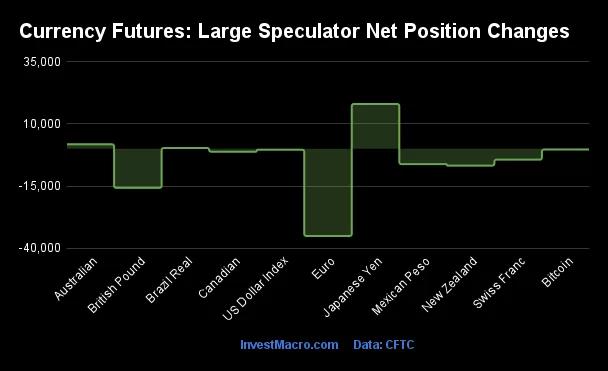
The COT currency market speculator bets were decidedly lower this week as just one out of the eleven currency markets we cover had higher positioning while the other ten markets had lower speculator contracts.

Leading the gains was the Brazilian Real (4,836 contracts) which came through as the only currency having a positive week this week.

The currencies seeing declines in speculator bets on the week were the Canadian Dollar (-33,242 contracts), the EuroFX (-21,948 contracts), the Australian Dollar (-14,153 contracts), the British Pound (-7,333 contracts), the Mexican Peso (-3,947 contracts), the Swiss Franc (-3,702 contracts), the Japanese Yen (-2,418 contracts), the New Zealand Dollar (-1,573 contracts), Bitcoin (-590 contracts) and with the US Dollar Index (-211 contracts) also registering lower bets on the week.

Speculators continue to reduce US Dollar Index, Canadian Dollar bets

This week’s COT currency’s data saw speculators continue to drop their US Dollar Index bets as well as their wagers for the Canadian Dollar.

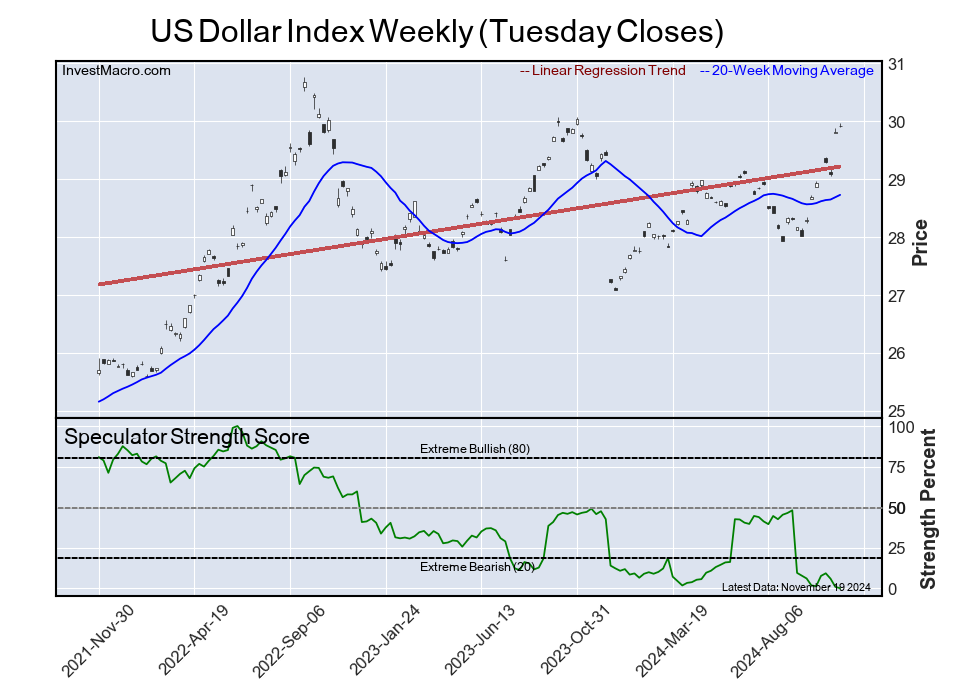
The USD Index speculative position has fallen for five consecutive weeks and by a total of -22,310 contracts over the last five weeks. This weakness has now dropped the current USD Index speculator position (at -2,100 contracts) to the most bearish level since June 15th of 2021, a span of 174 weeks. This can also be seen in the speculator strength index score for the USD Index which is at 0 percent or in other words, the weakest speculator level of the past three years.

The average speculator contract position over 2024 has dipped to a weekly average of +6,528 contracts through Tuesday. This follows the weekly average of +12,782 contracts over the course of 2023. The 2022 year was a very strong Dollar environment and the USD Index speculator contracts averaged a total of +33,606 contracts per week over the course of that year.

Despite the erosion of the large speculator sentiment, the US Dollar Index (DX) price has increased for three straight weeks and closed the week around 103.30. Previously at the end of September, the price had fallen to the 100.00 level where it found support and bounced rather strongly. Since that strong support, the USD has sailed through the 102.50-103.00 level and the next overhead resistance for the USD coming up is the 104.50-105.00 levels.

The Canadian dollar saw the largest decrease in speculator bets for all the currencies this week. The weaker sentiment coincides with declining oil prices as well as with the expectation the Bank of Canada will be potentially reducing their interest rate by 50 basis points in the coming week. This week’s speculator standing for the CAD is the 10th most bearish level on record at a total of -122,393 net contracts. The all-time record low of -196,263 contracts took place not to long ago on July 30th of 2024.

The CAD exchange rate against the USD has fallen for three straight weeks and is starting to reach the lowest levels of the past few years. Currently, the CAD price (CADUSD or CAD futures) is trading at 0.7254 with a major support level residing close below at 0.7200. This level has provided support three times since 2022 and most recently was tested and rejected in August.


Currencies Net Speculators Leaderboard
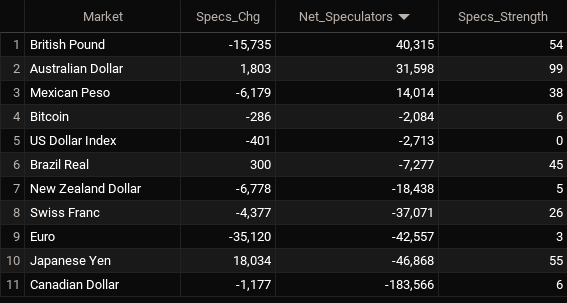
Legend: Weekly Speculators Change | Speculators Current Net Position | Speculators Strength Score compared to last 3-Years (0-100 range)


Strength Scores led by Australian Dollar & Japanese Yen
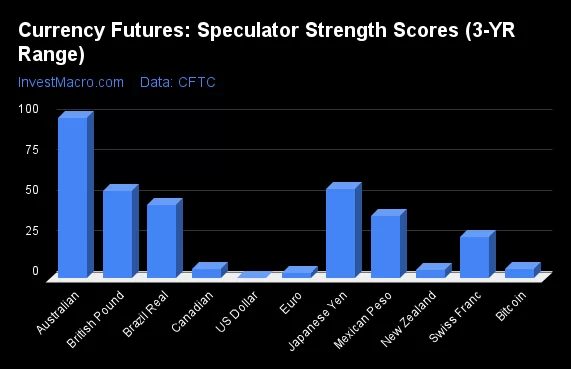
COT Strength Scores (a normalized measure of Speculator positions over a 3-Year range, from 0 to 100 where above 80 is Extreme-Bullish and below 20 is Extreme-Bearish) showed that the Australian Dollar (90 percent) and the Japanese Yen (87 percent) lead the currency markets this week. The British Pound (75 percent) comes in as the next highest in the weekly strength scores.

On the downside, the US Dollar Index (0 percent) comes in at the lowest strength levels currently and is in Extreme-Bearish territory (below 20 percent). The next lowest strength scores are the EuroFX (28 percent), the Canadian Dollar (33 percent) and the Bitcoin (38 percent).

3-Year Strength Statistics:
US Dollar Index (0.0 percent) vs US Dollar Index previous week (0.4 percent)
EuroFX (27.6 percent) vs EuroFX previous week (37.0 percent)
British Pound Sterling (74.7 percent) vs British Pound Sterling previous week (78.0 percent)
Japanese Yen (87.3 percent) vs Japanese Yen previous week (88.2 percent)
Swiss Franc (47.9 percent) vs Swiss Franc previous week (55.4 percent)
Canadian Dollar (33.1 percent) vs Canadian Dollar previous week (48.0 percent)
Australian Dollar (90.0 percent) vs Australian Dollar previous week (100.0 percent)
New Zealand Dollar (40.3 percent) vs New Zealand Dollar previous week (43.4 percent)
Mexican Peso (43.8 percent) vs Mexican Peso previous week (45.8 percent)
Brazilian Real (47.2 percent) vs Brazilian Real previous week (42.6 percent)
Bitcoin (38.2 percent) vs Bitcoin previous week (47.1 percent)


Brazilian Real & Australian Dollar top the 6-Week Strength Trends

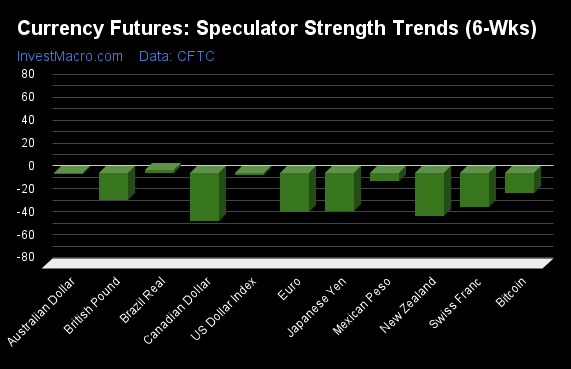
COT Strength Score Trends (or move index, calculates the 6-week changes in strength scores) showed that the Brazilian Real (43 percent) and the Australian Dollar (19 percent) lead the past six weeks trends for the currencies.

The US Dollar Index (-46 percent) leads the downside trend scores currently with the EuroFX (-35 percent), Bitcoin (-30 percent) and the Canadian Dollar (-24 percent) following next with lower trend scores.

3-Year Strength Trends:
US Dollar Index (-45.7 percent) vs US Dollar Index previous week (-44.2 percent)
EuroFX (-35.3 percent) vs EuroFX previous week (-22.9 percent)
British Pound Sterling (-10.0 percent) vs British Pound Sterling previous week (1.4 percent)
Japanese Yen (-2.8 percent) vs Japanese Yen previous week (4.3 percent)
Swiss Franc (-8.7 percent) vs Swiss Franc previous week (4.4 percent)
Canadian Dollar (-24.1 percent) vs Canadian Dollar previous week (9.3 percent)
Australian Dollar (19.2 percent) vs Australian Dollar previous week (37.3 percent)
New Zealand Dollar (-0.1 percent) vs New Zealand Dollar previous week (18.5 percent)
Mexican Peso (-2.6 percent) vs Mexican Peso previous week (-0.7 percent)
Brazilian Real (43.3 percent) vs Brazilian Real previous week (40.8 percent)
Bitcoin (-29.8 percent) vs Bitcoin previous week (-16.8 percent)


Individual COT Forex Markets:

US Dollar Index Futures:
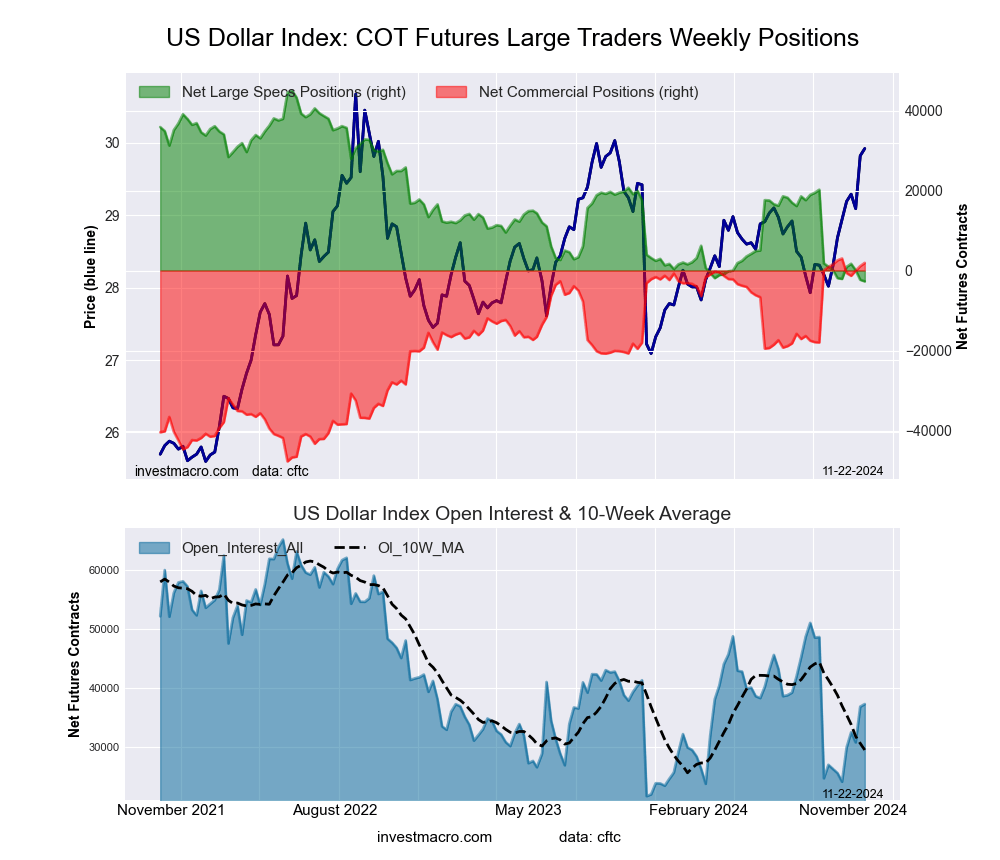
US Dollar Index Forex Futures COT ChartThe US Dollar Index large speculator standing this week recorded a net position of -2,100 contracts in the data reported through Tuesday. This was a weekly lowering of -211 contracts from the previous week which had a total of -1,889 net contracts.

This week’s current strength score (the trader positioning range over the past three years, measured from 0 to 100) shows the speculators are currently Bearish-Extreme with a score of 0.0 percent. The commercials are Bullish-Extreme with a score of 100.0 percent and the small traders (not shown in chart) are Bearish-Extreme with a score of 13.6 percent.

Price Trend-Following Model: Weak Downtrend

Our weekly trend-following model classifies the current market price position as: Weak Downtrend.

US DOLLAR INDEX StatisticsSPECULATORSCOMMERCIALSSMALL TRADERS
– Percent of Open Interest Longs:63.519.111.6
– Percent of Open Interest Shorts:72.26.615.3
– Net Position:-2,1003,011-911
– Gross Longs:15,3524,6072,792
– Gross Shorts:17,4521,5963,703
– Long to Short Ratio:0.9 to 12.9 to 10.8 to 1
NET POSITION TREND:
– Strength Index Score (3 Year Range Pct):0.0100.013.6
– Strength Index Reading (3 Year Range):Bearish-ExtremeBullish-ExtremeBearish-Extreme
NET POSITION MOVEMENT INDEX:
– 6-Week Change in Strength Index:-45.741.26.3


Euro Currency Futures:

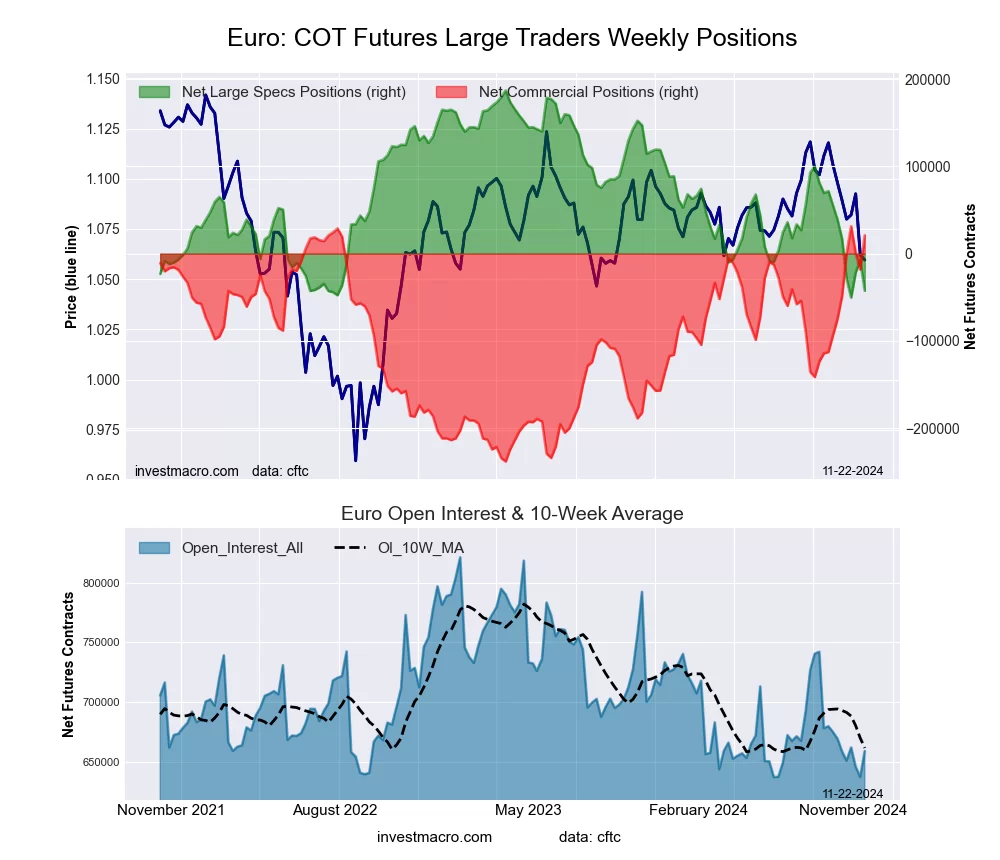
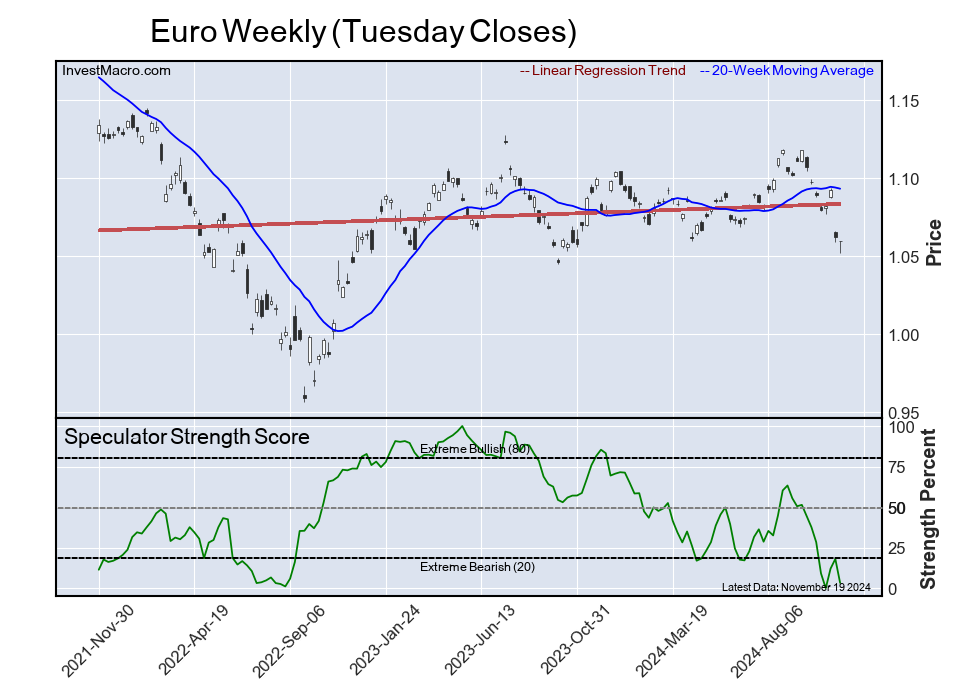
Euro Currency Futures COT ChartThe Euro Currency large speculator standing this week recorded a net position of 17,150 contracts in the data reported through Tuesday. This was a weekly decline of -21,948 contracts from the previous week which had a total of 39,098 net contracts.

This week’s current strength score (the trader positioning range over the past three years, measured from 0 to 100) shows the speculators are currently Bearish with a score of 27.6 percent. The commercials are Bullish with a score of 70.9 percent and the small traders (not shown in chart) are Bearish with a score of 42.5 percent.

Price Trend-Following Model: Weak Uptrend

Our weekly trend-following model classifies the current market price position as: Weak Uptrend.

EURO Currency StatisticsSPECULATORSCOMMERCIALSSMALL TRADERS
– Percent of Open Interest Longs:25.758.112.5
– Percent of Open Interest Shorts:23.165.67.6
– Net Position:17,150-48,97531,825
– Gross Longs:169,319382,89982,051
– Gross Shorts:152,169431,87450,226
– Long to Short Ratio:1.1 to 10.9 to 11.6 to 1
NET POSITION TREND:
– Strength Index Score (3 Year Range Pct):27.670.942.5
– Strength Index Reading (3 Year Range):BearishBullishBearish
NET POSITION MOVEMENT INDEX:
– 6-Week Change in Strength Index:-35.334.6-22.1


British Pound Sterling Futures:

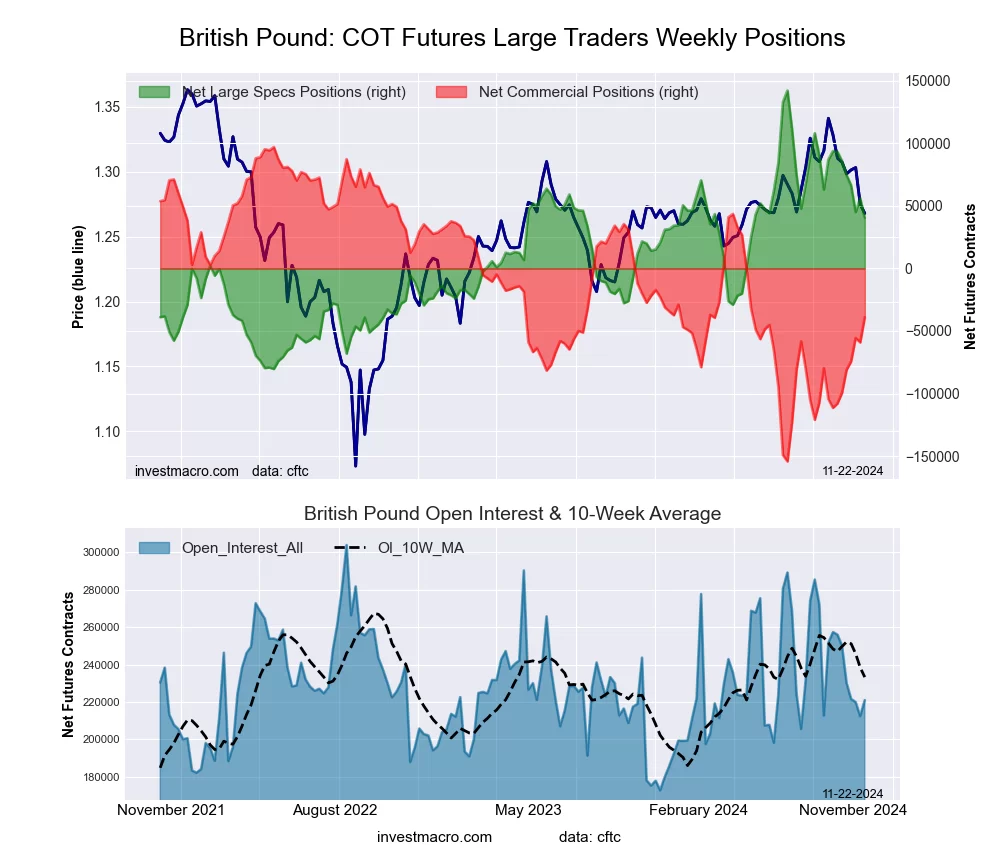
British Pound Sterling Futures COT ChartThe British Pound Sterling large speculator standing this week recorded a net position of 85,802 contracts in the data reported through Tuesday. This was a weekly reduction of -7,333 contracts from the previous week which had a total of 93,135 net contracts.

This week’s current strength score (the trader positioning range over the past three years, measured from 0 to 100) shows the speculators are currently Bullish with a score of 74.7 percent. The commercials are Bearish with a score of 21.8 percent and the small traders (not shown in chart) are Bullish-Extreme with a score of 90.9 percent.

Price Trend-Following Model: Uptrend

Our weekly trend-following model classifies the current market price position as: Uptrend.

BRITISH POUND StatisticsSPECULATORSCOMMERCIALSSMALL TRADERS
– Percent of Open Interest Longs:60.722.015.1
– Percent of Open Interest Shorts:26.461.79.6
– Net Position:85,802-99,44813,646
– Gross Longs:151,92354,93637,756
– Gross Shorts:66,121154,38424,110
– Long to Short Ratio:2.3 to 10.4 to 11.6 to 1
NET POSITION TREND:
– Strength Index Score (3 Year Range Pct):74.721.890.9
– Strength Index Reading (3 Year Range):BullishBearishBullish-Extreme
NET POSITION MOVEMENT INDEX:
– 6-Week Change in Strength Index:-10.08.61.6


Japanese Yen Futures:

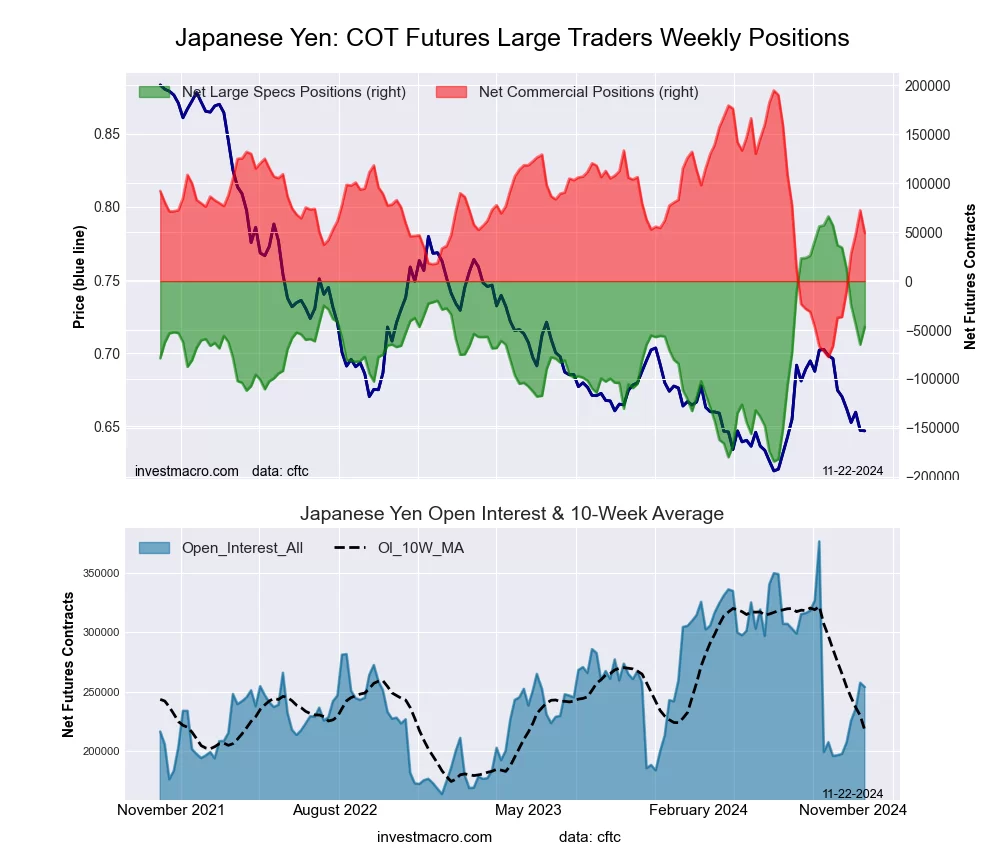
Japanese Yen Forex Futures COT ChartThe Japanese Yen large speculator standing this week recorded a net position of 34,110 contracts in the data reported through Tuesday. This was a weekly reduction of -2,418 contracts from the previous week which had a total of 36,528 net contracts.

This week’s current strength score (the trader positioning range over the past three years, measured from 0 to 100) shows the speculators are currently Bullish-Extreme with a score of 87.3 percent. The commercials are Bearish-Extreme with a score of 15.0 percent and the small traders (not shown in chart) are Bullish with a score of 69.8 percent.

Price Trend-Following Model: Weak Uptrend

Our weekly trend-following model classifies the current market price position as: Weak Uptrend.

JAPANESE YEN StatisticsSPECULATORSCOMMERCIALSSMALL TRADERS
– Percent of Open Interest Longs:43.834.719.1
– Percent of Open Interest Shorts:26.653.217.8
– Net Position:34,110-36,6392,529
– Gross Longs:86,68568,69737,699
– Gross Shorts:52,575105,33635,170
– Long to Short Ratio:1.6 to 10.7 to 11.1 to 1
NET POSITION TREND:
– Strength Index Score (3 Year Range Pct):87.315.069.8
– Strength Index Reading (3 Year Range):Bullish-ExtremeBearish-ExtremeBullish
NET POSITION MOVEMENT INDEX:
– 6-Week Change in Strength Index:-2.83.7-7.6


Swiss Franc Futures:

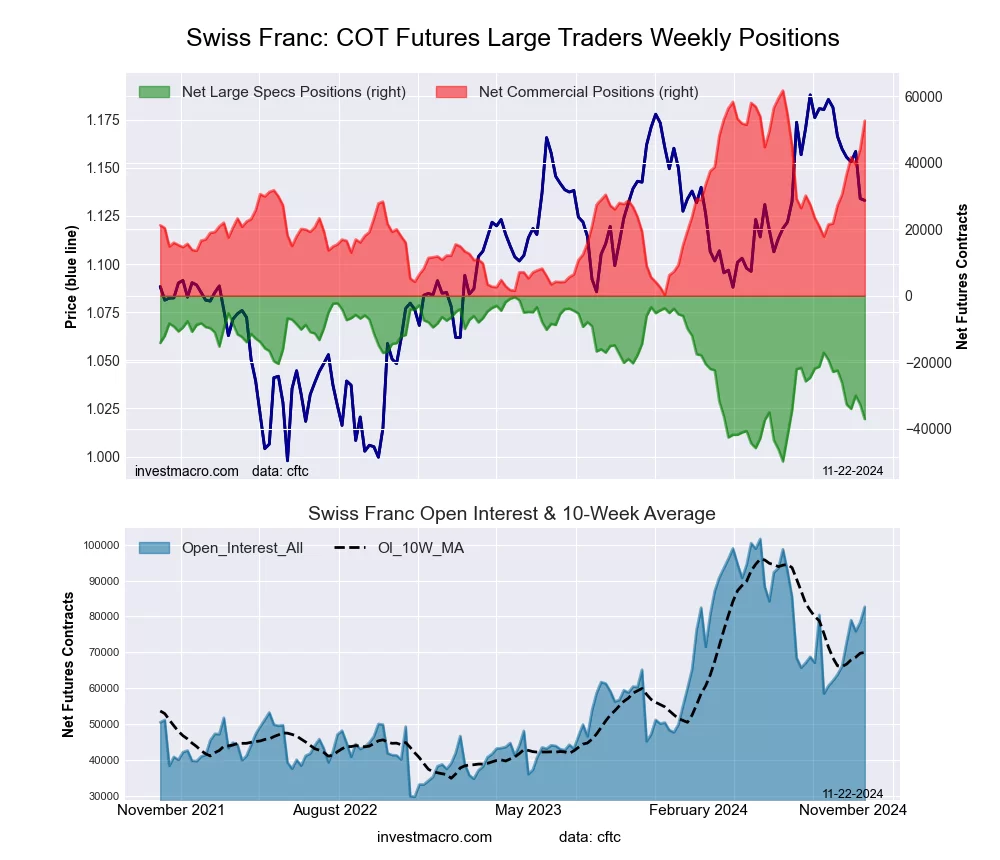
Swiss Franc Forex Futures COT ChartThe Swiss Franc large speculator standing this week recorded a net position of -26,161 contracts in the data reported through Tuesday. This was a weekly decrease of -3,702 contracts from the previous week which had a total of -22,459 net contracts.

This week’s current strength score (the trader positioning range over the past three years, measured from 0 to 100) shows the speculators are currently Bearish with a score of 47.9 percent. The commercials are Bearish with a score of 49.0 percent and the small traders (not shown in chart) are Bullish with a score of 57.6 percent.

Price Trend-Following Model: Weak Uptrend

Our weekly trend-following model classifies the current market price position as: Weak Uptrend.

SWISS FRANC StatisticsSPECULATORSCOMMERCIALSSMALL TRADERS
– Percent of Open Interest Longs:10.373.015.9
– Percent of Open Interest Shorts:49.927.122.2
– Net Position:-26,16130,369-4,208
– Gross Longs:6,83448,27510,505
– Gross Shorts:32,99517,90614,713
– Long to Short Ratio:0.2 to 12.7 to 10.7 to 1
NET POSITION TREND:
– Strength Index Score (3 Year Range Pct):47.949.057.6
– Strength Index Reading (3 Year Range):BearishBearishBullish
NET POSITION MOVEMENT INDEX:
– 6-Week Change in Strength Index:-8.711.3-12.2


Canadian Dollar Futures:

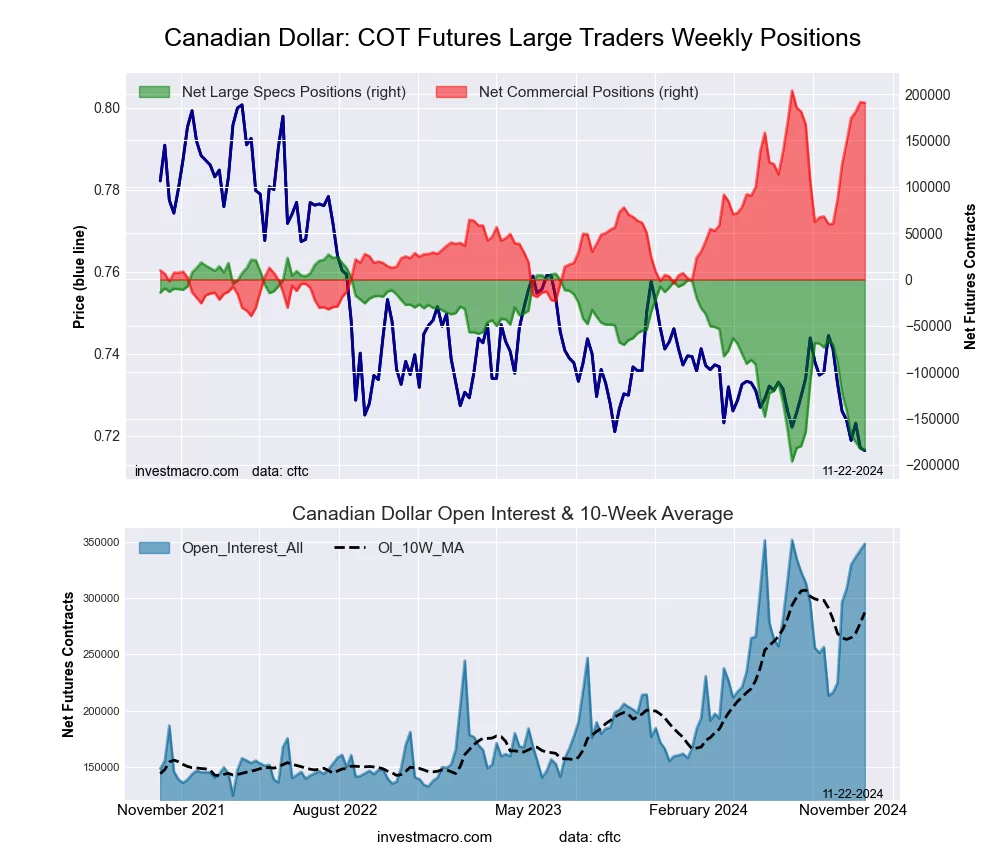
Canadian Dollar Forex Futures COT ChartThe Canadian Dollar large speculator standing this week recorded a net position of -122,393 contracts in the data reported through Tuesday. This was a weekly reduction of -33,242 contracts from the previous week which had a total of -89,151 net contracts.

This week’s current strength score (the trader positioning range over the past three years, measured from 0 to 100) shows the speculators are currently Bearish with a score of 33.1 percent. The commercials are Bullish with a score of 67.1 percent and the small traders (not shown in chart) are Bearish with a score of 26.3 percent.

Price Trend-Following Model: Weak Uptrend

Our weekly trend-following model classifies the current market price position as: Weak Uptrend.

CANADIAN DOLLAR StatisticsSPECULATORSCOMMERCIALSSMALL TRADERS
– Percent of Open Interest Longs:12.476.49.8
– Percent of Open Interest Shorts:53.734.610.3
– Net Position:-122,393123,906-1,513
– Gross Longs:36,718226,42529,024
– Gross Shorts:159,111102,51930,537
– Long to Short Ratio:0.2 to 12.2 to 11.0 to 1
NET POSITION TREND:
– Strength Index Score (3 Year Range Pct):33.167.126.3
– Strength Index Reading (3 Year Range):BearishBullishBearish
NET POSITION MOVEMENT INDEX:
– 6-Week Change in Strength Index:-24.125.5-23.7


Australian Dollar Futures:

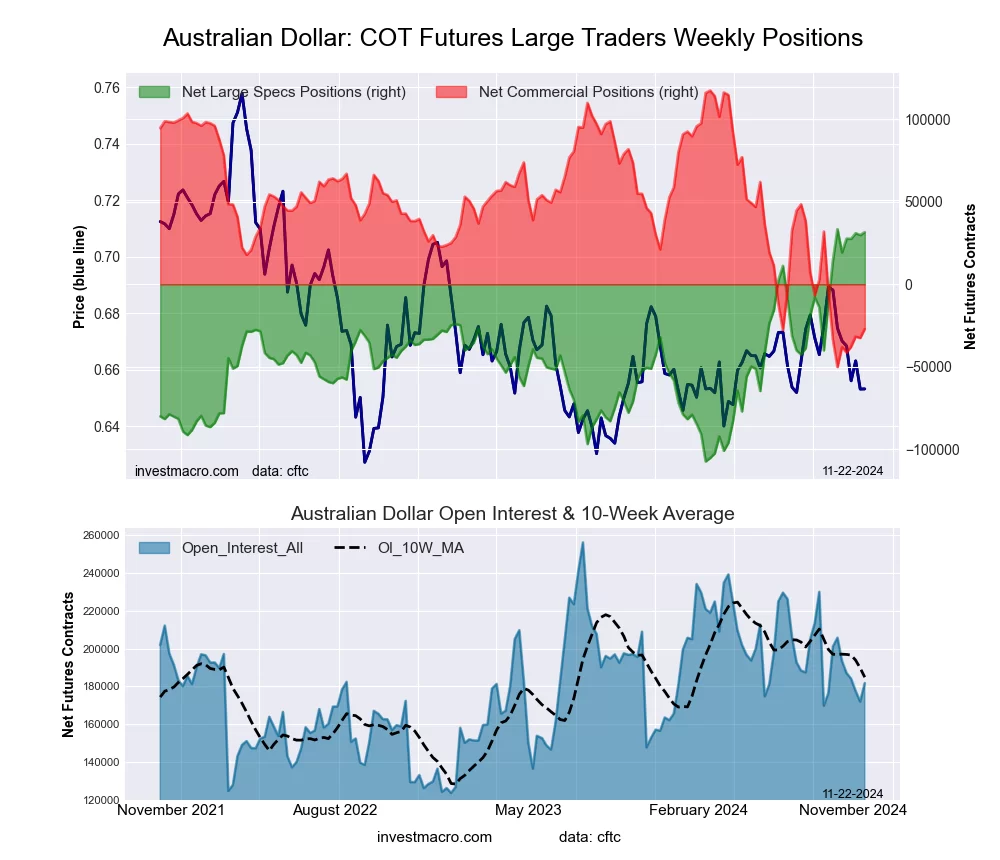
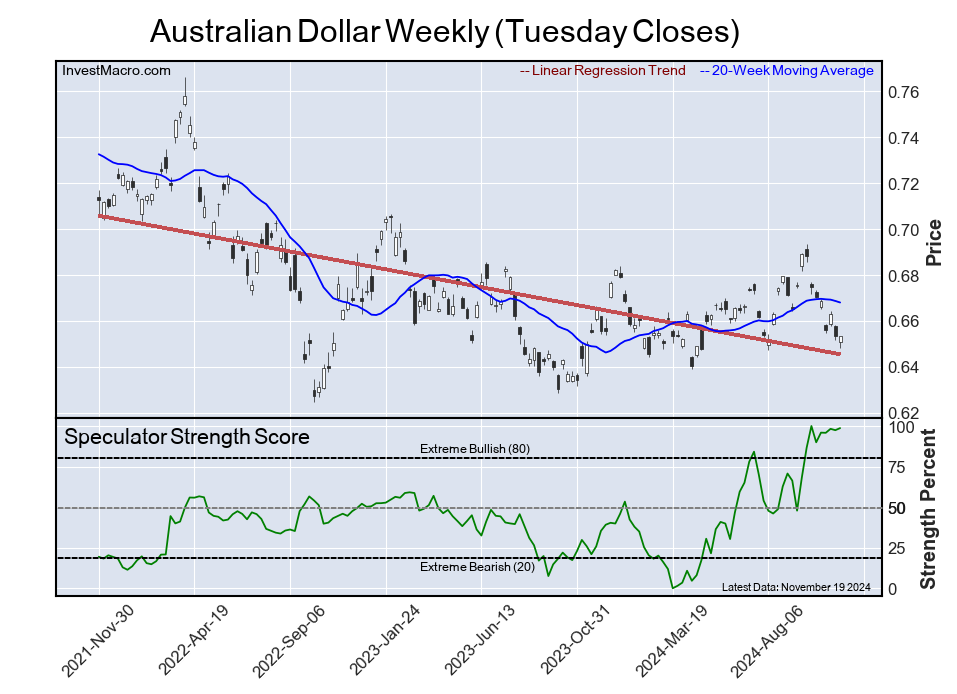
Australian Dollar Forex Futures COT ChartThe Australian Dollar large speculator standing this week recorded a net position of 19,269 contracts in the data reported through Tuesday. This was a weekly decrease of -14,153 contracts from the previous week which had a total of 33,422 net contracts.

This week’s current strength score (the trader positioning range over the past three years, measured from 0 to 100) shows the speculators are currently Bullish-Extreme with a score of 90.0 percent. The commercials are Bearish-Extreme with a score of 7.3 percent and the small traders (not shown in chart) are Bullish-Extreme with a score of 98.7 percent.

Price Trend-Following Model: Weak Uptrend

Our weekly trend-following model classifies the current market price position as: Weak Uptrend.

AUSTRALIAN DOLLAR StatisticsSPECULATORSCOMMERCIALSSMALL TRADERS
– Percent of Open Interest Longs:51.229.218.1
– Percent of Open Interest Shorts:41.348.98.4
– Net Position:19,269-38,07818,809
– Gross Longs:99,05156,41234,998
– Gross Shorts:79,78294,49016,189
– Long to Short Ratio:1.2 to 10.6 to 12.2 to 1
NET POSITION TREND:
– Strength Index Score (3 Year Range Pct):90.07.398.7
– Strength Index Reading (3 Year Range):Bullish-ExtremeBearish-ExtremeBullish-Extreme
NET POSITION MOVEMENT INDEX:
– 6-Week Change in Strength Index:19.2-18.610.6


New Zealand Dollar Futures:

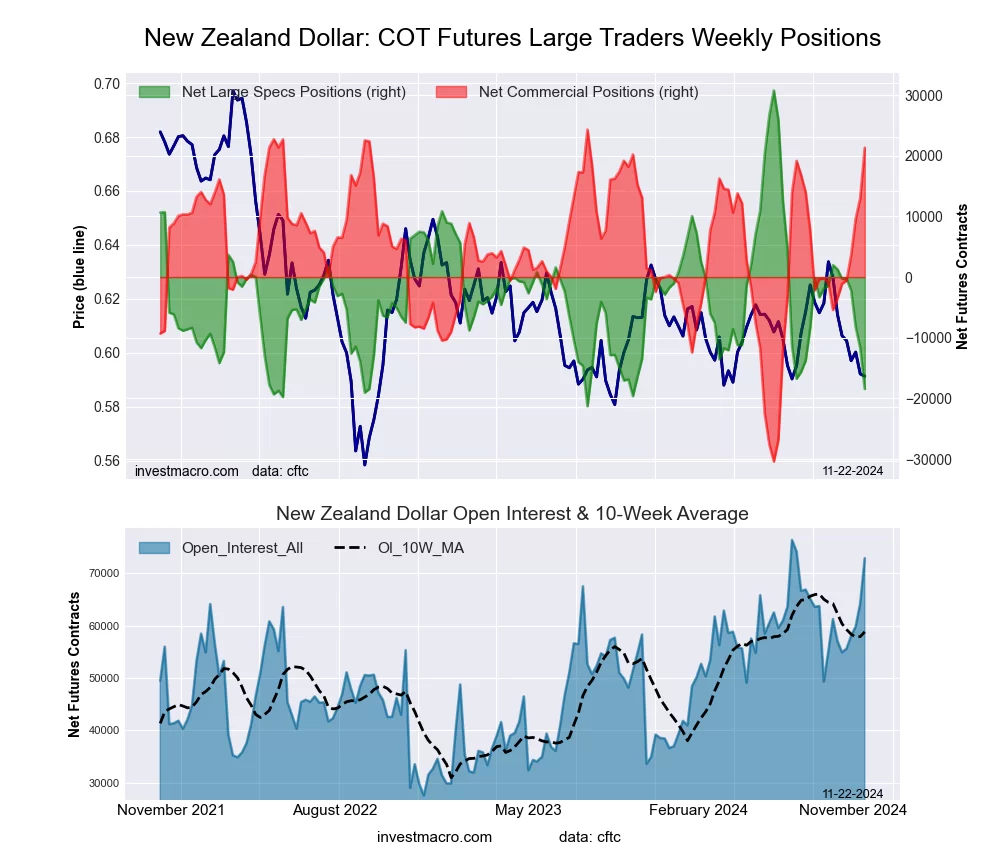
New Zealand Dollar Forex Futures COT ChartThe New Zealand Dollar large speculator standing this week recorded a net position of -292 contracts in the data reported through Tuesday. This was a weekly fall of -1,573 contracts from the previous week which had a total of 1,281 net contracts.

This week’s current strength score (the trader positioning range over the past three years, measured from 0 to 100) shows the speculators are currently Bearish with a score of 40.3 percent. The commercials are Bullish with a score of 53.5 percent and the small traders (not shown in chart) are Bullish with a score of 71.4 percent.

Price Trend-Following Model: Weak Uptrend

Our weekly trend-following model classifies the current market price position as: Weak Uptrend.

NEW ZEALAND DOLLAR StatisticsSPECULATORSCOMMERCIALSSMALL TRADERS
– Percent of Open Interest Longs:45.745.18.5
– Percent of Open Interest Shorts:46.247.15.9
– Net Position:-292-1,1221,414
– Gross Longs:25,07924,7484,646
– Gross Shorts:25,37125,8703,232
– Long to Short Ratio:1.0 to 11.0 to 11.4 to 1
NET POSITION TREND:
– Strength Index Score (3 Year Range Pct):40.353.571.4
– Strength Index Reading (3 Year Range):BearishBullishBullish
NET POSITION MOVEMENT INDEX:
– 6-Week Change in Strength Index:-0.11.9-12.5


Mexican Peso Futures:

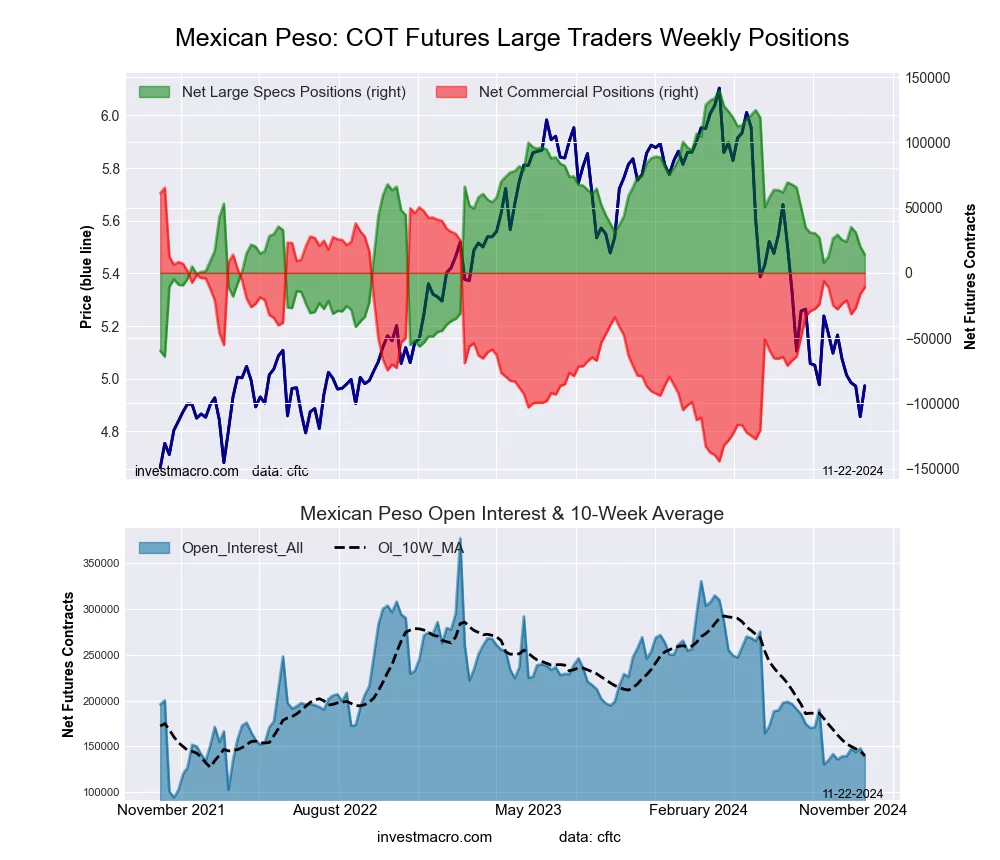
Mexican Peso Futures COT ChartThe Mexican Peso large speculator standing this week recorded a net position of 25,246 contracts in the data reported through Tuesday. This was a weekly lowering of -3,947 contracts from the previous week which had a total of 29,193 net contracts.

This week’s current strength score (the trader positioning range over the past three years, measured from 0 to 100) shows the speculators are currently Bearish with a score of 43.8 percent. The commercials are Bullish with a score of 57.6 percent and the small traders (not shown in chart) are Bearish-Extreme with a score of 7.8 percent.

Price Trend-Following Model: Downtrend

Our weekly trend-following model classifies the current market price position as: Downtrend.

MEXICAN PESO StatisticsSPECULATORSCOMMERCIALSSMALL TRADERS
– Percent of Open Interest Longs:43.750.63.0
– Percent of Open Interest Shorts:25.567.64.1
– Net Position:25,246-23,735-1,511
– Gross Longs:60,75970,3824,237
– Gross Shorts:35,51394,1175,748
– Long to Short Ratio:1.7 to 10.7 to 10.7 to 1
NET POSITION TREND:
– Strength Index Score (3 Year Range Pct):43.857.67.8
– Strength Index Reading (3 Year Range):BearishBullishBearish-Extreme
NET POSITION MOVEMENT INDEX:
– 6-Week Change in Strength Index:-2.61.97.7


Brazilian Real Futures:

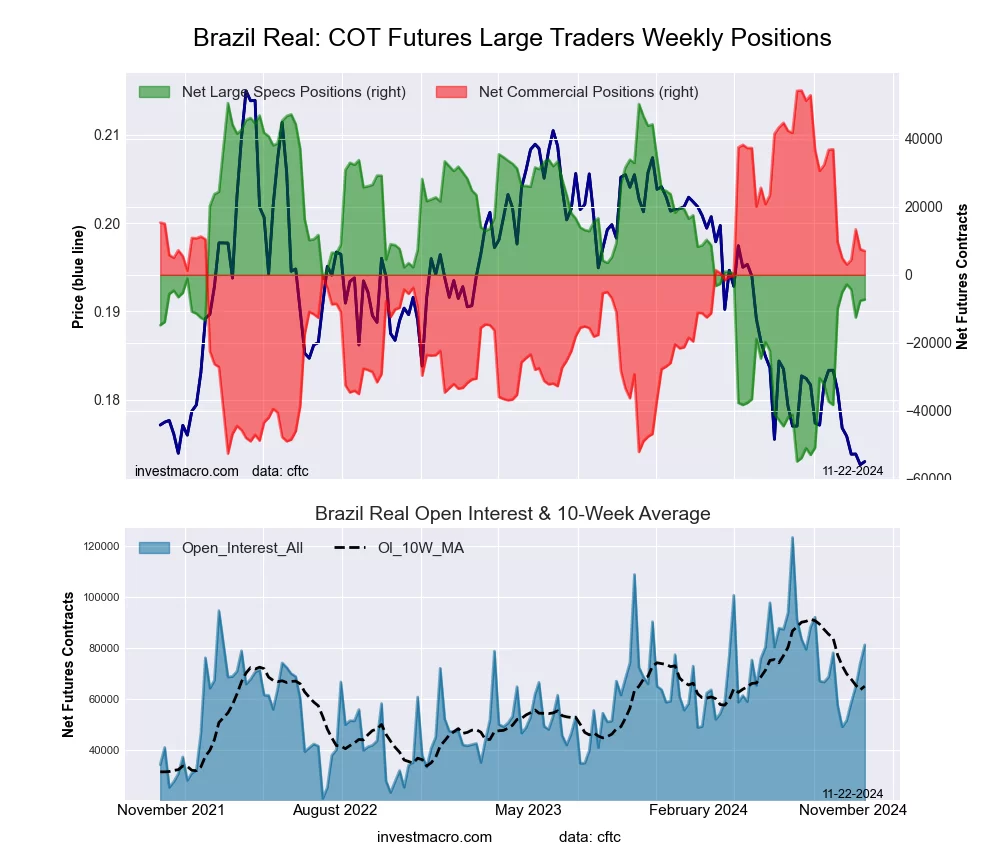
Brazil Real Futures COT ChartThe Brazilian Real large speculator standing this week recorded a net position of -5,143 contracts in the data reported through Tuesday. This was a weekly advance of 4,836 contracts from the previous week which had a total of -9,979 net contracts.

This week’s current strength score (the trader positioning range over the past three years, measured from 0 to 100) shows the speculators are currently Bearish with a score of 47.2 percent. The commercials are Bullish with a score of 53.9 percent and the small traders (not shown in chart) are Bearish with a score of 21.9 percent.

Price Trend-Following Model: Strong Downtrend

Our weekly trend-following model classifies the current market price position as: Strong Downtrend.

BRAZIL REAL StatisticsSPECULATORSCOMMERCIALSSMALL TRADERS
– Percent of Open Interest Longs:38.153.15.4
– Percent of Open Interest Shorts:48.543.05.0
– Net Position:-5,1434,952191
– Gross Longs:18,70326,1052,645
– Gross Shorts:23,84621,1532,454
– Long to Short Ratio:0.8 to 11.2 to 11.1 to 1
NET POSITION TREND:
– Strength Index Score (3 Year Range Pct):47.253.921.9
– Strength Index Reading (3 Year Range):BearishBullishBearish
NET POSITION MOVEMENT INDEX:
– 6-Week Change in Strength Index:43.3-29.8-78.1


Bitcoin Futures:

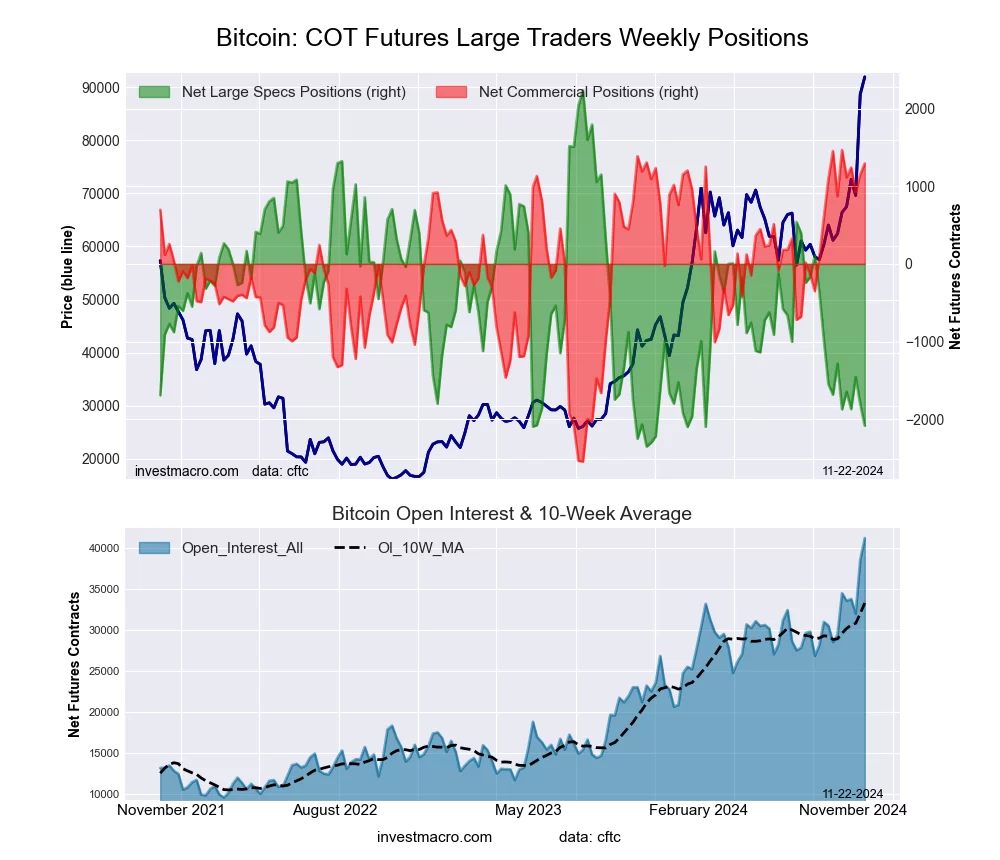
Bitcoin Crypto Futures COT ChartThe Bitcoin large speculator standing this week recorded a net position of -1,872 contracts in the data reported through Tuesday. This was a weekly fall of -590 contracts from the previous week which had a total of -1,282 net contracts.

This week’s current strength score (the trader positioning range over the past three years, measured from 0 to 100) shows the speculators are currently Bearish with a score of 38.2 percent. The commercials are Bullish-Extreme with a score of 100.0 percent and the small traders (not shown in chart) are Bearish with a score of 22.2 percent.

Price Trend-Following Model: Weak Downtrend

Our weekly trend-following model classifies the current market price position as: Weak Downtrend.

BITCOIN StatisticsSPECULATORSCOMMERCIALSSMALL TRADERS
– Percent of Open Interest Longs:77.66.84.1
– Percent of Open Interest Shorts:83.02.52.9
– Net Position:-1,8721,466406
– Gross Longs:26,7582,3321,405
– Gross Shorts:28,630866999
– Long to Short Ratio:0.9 to 12.7 to 11.4 to 1
NET POSITION TREND:
– Strength Index Score (3 Year Range Pct):38.2100.022.2
– Strength Index Reading (3 Year Range):BearishBullish-ExtremeBearish
NET POSITION MOVEMENT INDEX:
– 6-Week Change in Strength Index:-29.845.33.7


Article By InvestMacroReceive our weekly COT Newsletter

*COT Report: The COT data, released weekly to the public each Friday, is updated through the most recent Tuesday (data is 3 days old) and shows a quick view of how large speculators or non-commercials (for-profit traders) were positioned in the futures markets.

The CFTC categorizes trader positions according to commercial hedgers (traders who use futures contracts for hedging as part of the business), non-commercials (large traders who speculate to realize trading profits) and nonreportable traders (usually small traders/speculators) as well as their open interest (contracts open in the market at time of reporting). See CFTC criteria here.
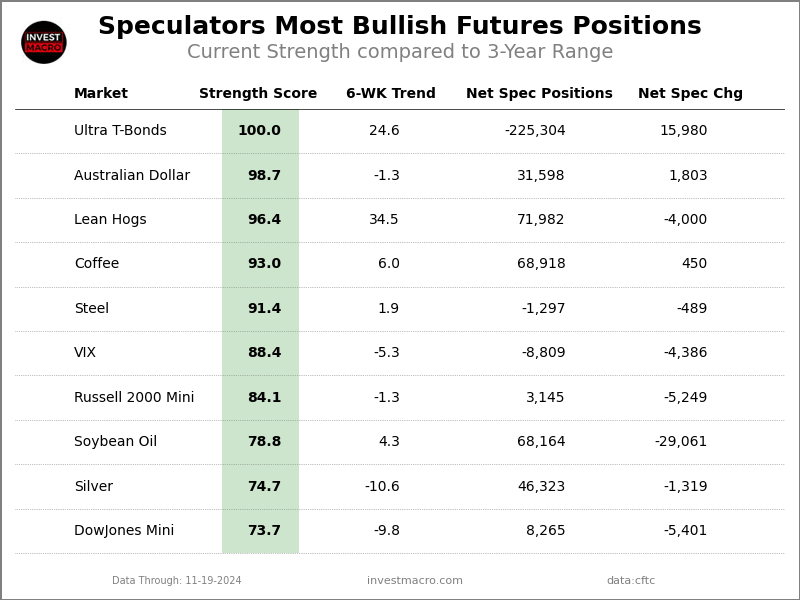
Speculator Extremes: Russell2000, VIX, USD Index & 5-Year Bonds lead Bullish & Bearish Positions

By InvestMacro 

The latest update for the weekly Commitment of Traders (COT) report was released by the Commodity Futures Trading Commission (CFTC) on Friday for data ending on October 15th.

This weekly Extreme Positions report highlights the Most Bullish and Most Bearish Positions for the speculator category. Extreme positioning in these markets can foreshadow strong moves in the underlying market.

To signify an extreme position, we use the Strength Index (also known as the COT Index) of each instrument, a common method of measuring COT data. The Strength Index is simply a comparison of current trader positions against the range of positions over the previous 3 years. We use over 80 percent as extremely bullish and under 20 percent as extremely bearish. (Compare Strength Index scores across all markets in the data table or cot leaders table)


Here Are This Week’s Most Bullish Speculator Positions:

Russell 2000 Mini


The Russell 2000 Mini speculator position comes in as the most bullish extreme standing this week. The Russell 2000 Mini speculator level is currently at a 100.0 percent score of its 3-year range.

The six-week trend for the percent strength score totaled 17.8 this week. The overall net speculator position was a total of 26,337 net contracts this week with a jump by 21,330 contract in the weekly speculator bets.


Speculators or Non-Commercials Notes:

Speculators, classified as non-commercial traders by the CFTC, are made up of large commodity funds, hedge funds and other significant for-profit participants. The Specs are generally regarded as trend-followers in their behavior towards price action – net speculator bets and prices tend to go in the same directions. These traders often look to buy when prices are rising and sell when prices are falling. To illustrate this point, many times speculator contracts can be found at their most extremes (bullish or bearish) when prices are also close to their highest or lowest levels.

These extreme levels can be dangerous for the large speculators as the trade is most crowded, there is less trading ammunition still sitting on the sidelines to push the trend further and prices have moved a significant distance. When the trend becomes exhausted, some speculators take profits while others look to also exit positions when prices fail to continue in the same direction. This process usually plays out over many months to years and can ultimately create a reverse effect where prices start to fall and speculators start a process of selling when prices are falling.


VIX


The VIX speculator position comes next in the extreme standings this week. The VIX speculator level is now at a 100.0 percent score of its 3-year range.

The six-week trend for the percent strength score was 24.6 this week. The speculator position registered 322 net contracts this week with a weekly boost by 3,330 contracts in speculator bets.


Platinum


The Platinum speculator position comes in third this week in the extreme standings. The Platinum speculator level resides at a 93.8 percent score of its 3-year range.

The six-week trend for the speculator strength score came in at 72.1 this week. The overall speculator position was 28,387 net contracts this week with a change of 4,730 contracts in the weekly speculator bets.


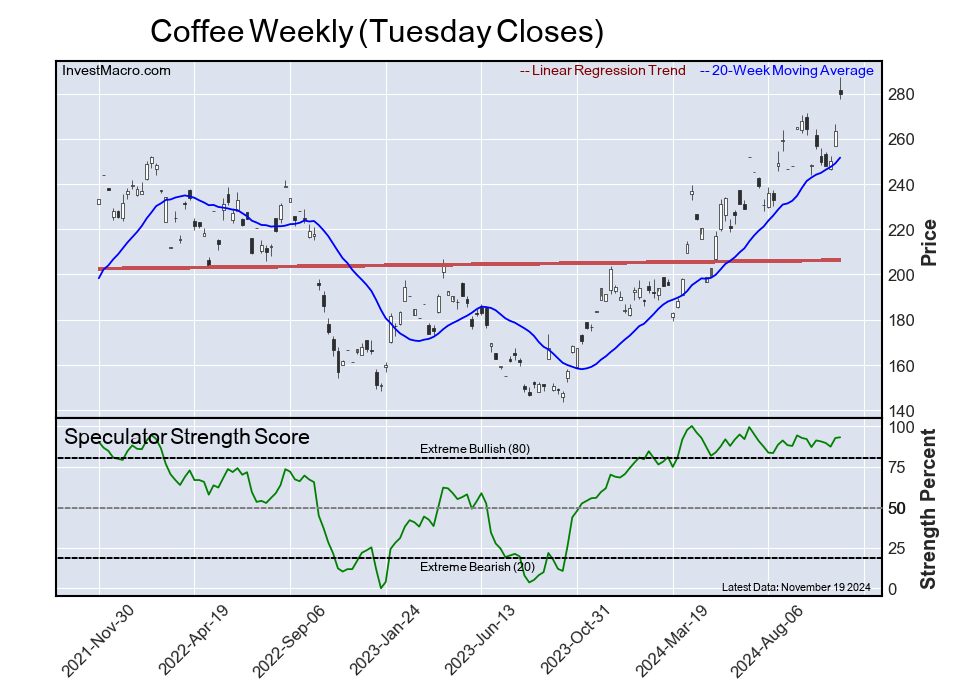
Coffee


The Coffee speculator position comes up number four in the extreme standings this week. The Coffee speculator level is at a 91.1 percent score of its 3-year range.

The six-week trend for the speculator strength score totaled a change of 2.9 this week. The overall speculator position was 66,950 net contracts this week with a rise of 4,235 contracts in the speculator bets.


Australian Dollar


The Australian Dollar speculator position rounds out the top five in this week’s bullish extreme standings. The Australian Dollar speculator level sits at a 90.0 percent score of its 3-year range. The six-week trend for the speculator strength score was 19.2 this week.

The speculator position was 19,269 net contracts this week with a decrease of -14,153 contracts in the weekly speculator bets.


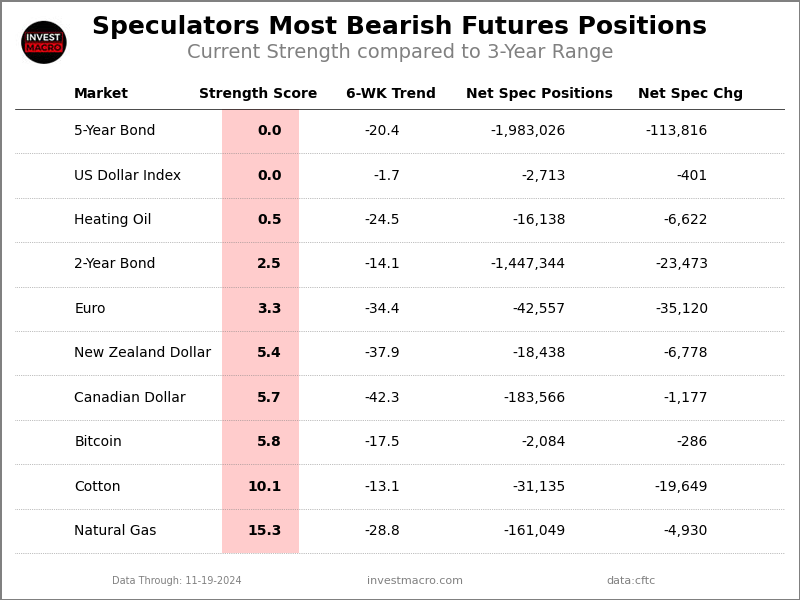
This Week’s Most Bearish Speculator Positions:

US Dollar Index


The US Dollar Index speculator position comes in as the most bearish extreme standing this week. The US Dollar Index speculator level is at a 0.0 percent score of its 3-year range.

The six-week trend for the speculator strength score was -45.7 this week. The overall speculator position was -2,100 net contracts this week with a small reduction by -211 contracts in the speculator bets.


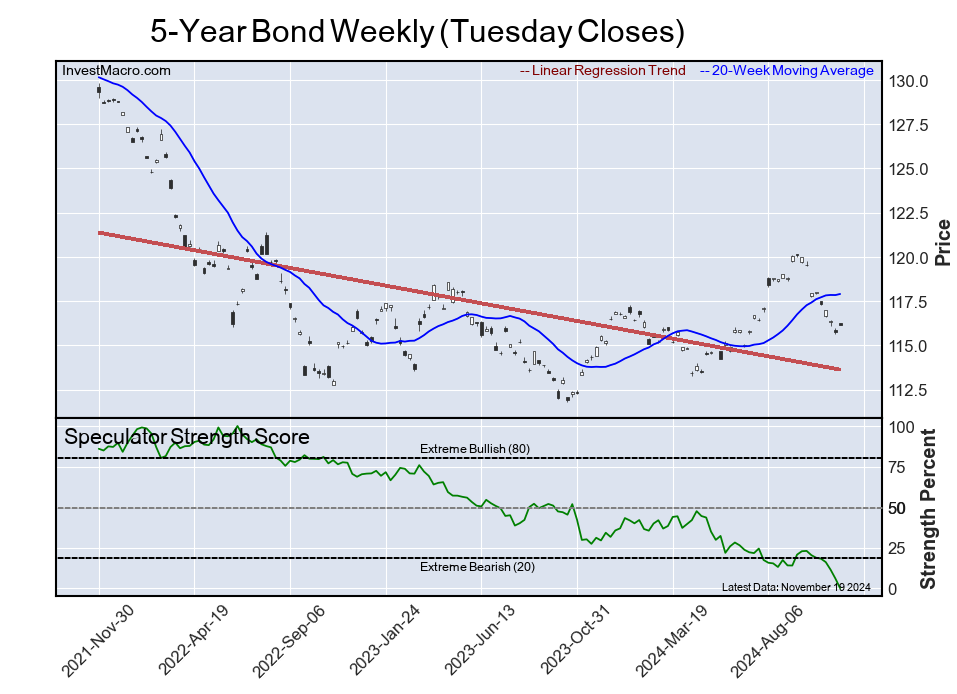
5-Year Bond


The 5-Year Bond speculator position comes in next for the most bearish extreme standing on the week. The 5-Year Bond speculator level is at a 6.5 percent score of its 3-year range.

The six-week trend for the speculator strength score was 5.4 this week. The speculator position was -1,630,024 net contracts this week with a decrease by -29,699 contracts in the weekly speculator bets.


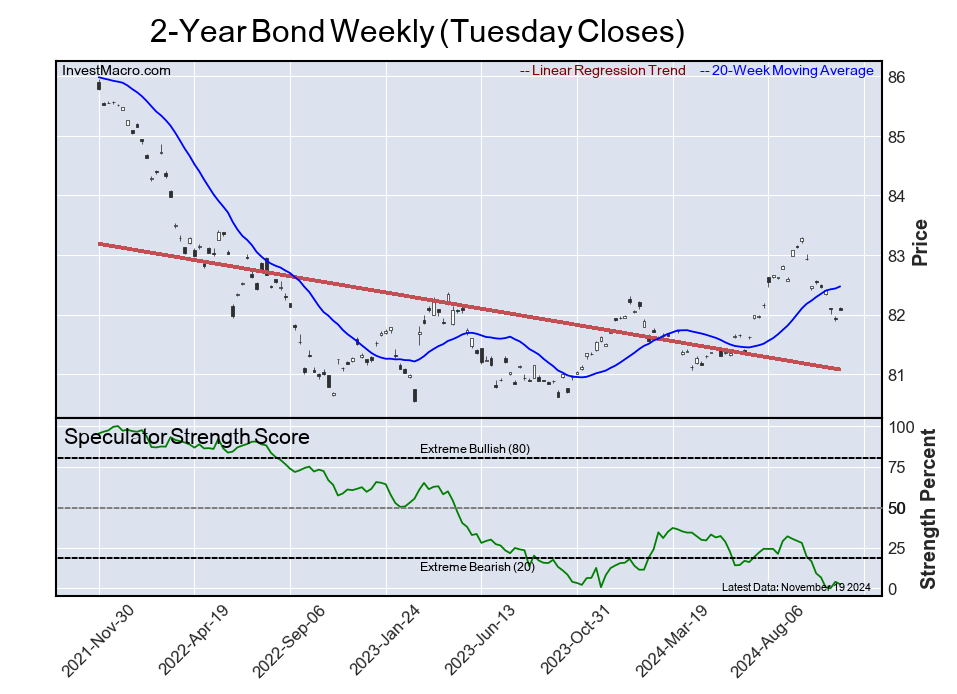
2-Year Bond


The 2-Year Bond speculator position comes in as third most bearish extreme standing of the week. The 2-Year Bond speculator level resides at a 8.6 percent score of its 3-year range.

The six-week trend for the speculator strength score was -23.0 this week. The overall speculator position was -1,342,260 net contracts this week with a decline of -117,224 contracts in the speculator bets.


1-Month Secured Overnight Financing Rate


The 1-Month Secured Overnight Financing Rate speculator position comes in as this week’s fourth most bearish extreme standing. The 1-Month Secured Overnight Financing Rate speculator level is at a 9.6 percent score of its 3-year range.

The six-week trend for the speculator strength score was -29.2 this week. The speculator position was -215,156 net contracts this week with a gain of 7,304 contracts in the weekly speculator bets.


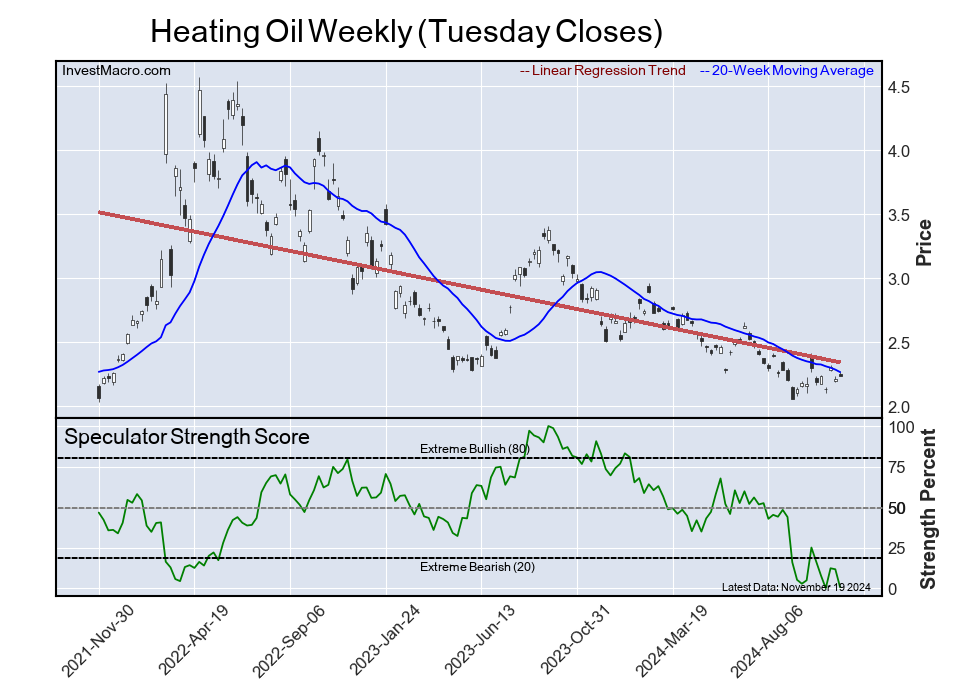
Heating Oil


Finally, the Heating Oil speculator position comes in as the fifth most bearish extreme standing for this week. The Heating Oil speculator level is at a 14.0 percent score of its 3-year range.

The six-week trend for the speculator strength score was -28.3 this week. The speculator position was -6,710 net contracts this week with a drop of -5,144 contracts in the weekly speculator bets.


Article By InvestMacroReceive our weekly COT Newsletter

*COT Report: The COT data, released weekly to the public each Friday, is updated through the most recent Tuesday (data is 3 days old) and shows a quick view of how large speculators or non-commercials (for-profit traders) were positioned in the futures markets.

The CFTC categorizes trader positions according to commercial hedgers (traders who use futures contracts for hedging as part of the business), non-commercials (large traders who speculate to realize trading profits) and nonreportable traders (usually small traders/speculators) as well as their open interest (contracts open in the market at time of reporting). See CFTC criteria here.
AUD/USD Rises Following Strong Australian Employment Data

By RoboForex Analytical Department 

AUD/USD rebounded on Thursday after three consecutive days of declines. This was supported by robust employment data from Australia, which bolstered the hawkish outlook on the Reserve Bank of Australia’s (RBA) monetary policy.

Key Employment Data Highlights:

  • Job creation: the Australian economy added 64.1k jobs in September, significantly surpassing the expected 25.0k. This marked improvement suggests strong economic momentum
  • Unemployment rate: the rate held steady at 4.1%, aligning with expectations and underscoring the labour market’s resilience
  • Labour force participation: the participation rate rose to a record 67.2% in September from 67.1% in August, beating the forecast of 67.1%. This increase reflects a growing workforce, which could sustain consumer spending and economic activity

These indicators of labour market strength make it less likely that the RBA will opt for rate cuts in the near term. Additionally, RBA Deputy Governor Sarah Hunter emphasised the central bank’s commitment to controlling inflation, which continues to be a concern amid sustained price increases. Analysts now suggest that the RBA is unlikely to cut rates until at least the first half of the next year, considering the tight labour market conditions.

Technical analysis of AUD/USD

The AUD/USD pair is extending its downward movement towards a target of 0.6645. After testing the resistance at 0.6700 from below, it continues its decline. Once the 0.6645 level is reached, a new consolidation range is expected to form above this level. A breakout above this range could initiate a corrective phase towards 0.6790. This bearish trend is supported by the MACD indicator, which remains below zero and points downwards, indicating sustained downward momentum.

On the hourly chart, AUD/USD has completed a downward wave to 0.6660, followed by a corrective rise to 0.6700. The pair is expected to continue its decline to the 0.6645 level. After this target is met, a potential reversal could push the price towards 0.6710. The Stochastic oscillator supports this outlook, with its signal line below 50 and heading towards 20, suggesting that there may be further downside before any significant recovery.


Disclaimer

Any forecasts contained herein are based on the author’s particular opinion. This analysis may not be treated as trading advice. RoboForex bears no responsibility for trading results based on trading recommendations and reviews contained herein.

Netflix earnings preview: Set for fresh all-time highs?

By ForexTime 

  • Netflix ↑ 45% year-to-date
  • Shares could move 7.6% % ↑ or ↓ post-earnings
  • Subscription numbers & live sports offering in focus
  • Technical levels – $735 & $700

Netflix is probably one of the first providers you think about regarding TV streaming services.

And it remains the biggest player in this space, boasting almost 280 million subscribers worldwide!

The company shares have been edging higher, hitting a fresh all-time high at $734.92 last Friday.

Despite the recent selloff, Netflix stocks are still up 45% year-to-date.

Prices could push higher or lower depending on how investors react to the latest earnings report.

  • When will earnings be published?

Netflix will report its earnings for the third quarter after US markets close on Thursday 17th October.

  • Market expectations:

The company is expected to post earnings per share of $5.12 compared to $3.73 a year ago.

Quarterly revenues are seen rising $9.8 billion from $8.5 billion in the prior year – equating to a 15.3% increase.

  • Why is this important?

As the biggest streaming service in the world, Netflix’s results could provide key insights into consumer spending habits and the health of the streaming industry.

  • Key metrics…

When publishing its earnings for Q2 back in July, Netflix reported just under 278 million subscribers.

So, it will be interesting to see what impacts the crackdown on password sharing have on this number.

According to analyst expectations, the streaming giant is expected to report around 286 million active subscribers for Q3 – further solidifying its grip on the throne.

Investors will be looking for more information on live sports offerings, especially when considering how the NFL will see its first games on Netflix on Christmas Day.

  • Potential challenges

In such a competitive industry filled with the likes of Amazon Prime, Disney+, Hulu and Apple TV among others, investors will be keen to see how Netflix fared.

Consumers are spoilt for choice for quality streaming services, and this has the potential to impact the company’s overall results.

  • How will Netflix react to earnings?

Markets are forecasting a 7.6% move, either Up or Down, for Netflix stocks on Thursday post earnings.

  • What does this mean for prices?

A 7.6% move up from $704.56 (current price) will take Netflix shares to a fresh all-time high at $758.

While a 7.6% move down will send prices back toward $651.

  • Technical picture

Although prices have been trending higher on the daily charts, a range can be identified with support at $700 and resistance at $734.92. The incoming earnings report could push the scales of power in favour of bulls or bears.

  • A solid set of earnings could push prices back above the all-time high at $734.92 with $750 acting as a point of interest.
  • If the earnings disappoint, prices could slip below $700 – opening a path back toward the 100-day SMA at $670 and $650.

netflix


Forex-Time-LogoArticle by ForexTime

ForexTime Ltd (FXTM) is an award winning international online forex broker regulated by CySEC 185/12 www.forextime.com

US Dollar Index Speculator bets fall for 4th straight week to 6-month low

By InvestMacro

Here are the latest charts and statistics for the Commitment of Traders (COT) data published by the Commodities Futures Trading Commission (CFTC).

The latest COT data is updated through Tuesday October 8th and shows a quick view of how large market participants (for-profit speculators and commercial traders) were positioned in the futures markets. All currency positions are in direct relation to the US dollar where, for example, a bet for the euro is a bet that the euro will rise versus the dollar while a bet against the euro will be a bet that the euro will decline versus the dollar.

Weekly Speculator Changes led by Brazilian Real & Australian Dollar

The COT currency market speculator bets were slightly lower overall this week as five out of the eleven currency markets we cover had higher positioning while the other six markets had lower speculator contracts.

Leading the gains for the currency markets was the Brazilian Real (28,276 contracts) with the Australian Dollar (18,894 contracts), the Mexican Peso (2,894 contracts), Bitcoin (402 contracts) and the Swiss Franc (395 contracts) also showing positive weeks.

The currencies seeing declines in speculator bets on the week were the Japanese Yen (-20,244 contracts), the Canadian Dollar (-19,148 contracts), the EuroFX (-16,229 contracts), the US Dollar Index (-2,043 contracts), the New Zealand Dollar (-689 contracts) and the British Pound (-630 contracts) also registering lower bets on the week.

US Dollar Index Speculator bets fall for 4th straight week to 6-month low

Highlighting the COT currency’s data this week is the decrease in the speculator’s positioning in the US Dollar Index. The large speculative US Dollar Index positions declined for a fourth straight week and have now dipped by a total of -22,099 net contracts over this 4-week period. This recent weakness has pushed the US Dollar Index speculator net position into an overall bearish position at a total of -1,889 contracts. The current speculator standing now resides at the lowest level since April 2nd, a span of 27 weeks.

The Dollar Index sentiment has been feeling the pressure over the past few months with US inflation steadily coming down since the highs of 2022 and with the government interest rates already in a cutting cycle. The US Federal Reserve reduced the benchmark interest rate by 50 basis points at the last central bank meeting and brought the current rate down to a range of 4.75-5.00 percent.

There was an expectation of another jumbo rate cut coming up but a recent strong jobs report combined with a recent sticky inflation report puts a higher probability now for a smaller rate cut or even the possibility of a Fed hold. The CME Fedwatch tool shows at the current time, there is a 89.5 percent probability outlook that the Fed will cut the rate by another 25 basis points at the November 7th meeting while there is also 10.5 percent probability outlook that the Fed will hold the rate steady next month.

Despite the recent sentiment deficit, the US Dollar Index price has had a strong couple of weeks after falling to and rebounding off the 100.15 level on September 27th. Including September 30th, the Dollar Index has risen in nine out of the past ten days and closed this week right below 103.00 at a close of 102.91. We will see if this strength in the USD continues and whether the Dollar Index can get over the 103.00 support/resistance barrier or perhaps, head back lower toward 100.


Currencies Net Speculators Leaderboard

Legend: Weekly Speculators Change | Speculators Current Net Position | Speculators Strength Score compared to last 3-Years (0-100 range)


Strength Scores led by Australian Dollar & Japanese Yen

COT Strength Scores (a normalized measure of Speculator positions over a 3-Year range, from 0 to 100 where above 80 is Extreme-Bullish and below 20 is Extreme-Bearish) showed that the Australian Dollar (100 percent) and the Japanese Yen (88 percent) lead the currency markets this week. The British Pound (78 percent) and the Swiss Franc (55 percent) come in as the next highest in the weekly strength scores.

On the downside, the US Dollar Index (0 percent) comes in at the lowest strength levels currently and is in Extreme-Bearish territory (below 20 percent). The next lowest strength scores are the EuroFX (37 percent), the Brazilian Real (43 percent) and the New Zealand Dollar (43 percent).

3-Year Strength Statistics:
US Dollar Index (0.0 percent) vs US Dollar Index previous week (4.4 percent)
EuroFX (37.0 percent) vs EuroFX previous week (43.9 percent)
British Pound Sterling (78.0 percent) vs British Pound Sterling previous week (78.2 percent)
Japanese Yen (88.2 percent) vs Japanese Yen previous week (96.3 percent)
Swiss Franc (55.4 percent) vs Swiss Franc previous week (54.6 percent)
Canadian Dollar (48.0 percent) vs Canadian Dollar previous week (56.6 percent)
Australian Dollar (100.0 percent) vs Australian Dollar previous week (86.6 percent)
New Zealand Dollar (43.4 percent) vs New Zealand Dollar previous week (44.7 percent)
Mexican Peso (45.8 percent) vs Mexican Peso previous week (44.4 percent)
Brazilian Real (42.6 percent) vs Brazilian Real previous week (15.8 percent)
Bitcoin (47.1 percent) vs Bitcoin previous week (41.1 percent)


Brazilian Real & Australian Dollar top the 6-Week Strength Trends

COT Strength Score Trends (or move index, calculates the 6-week changes in strength scores) showed that the Brazilian Real (41 percent) and the Australian Dollar (37 percent) lead the past six weeks trends for the currencies. The New Zealand Dollar (18 percent), the Canadian Dollar (9 percent) and the Japanese Yen (4 percent) are the next highest positive movers in the 3-Year trends data.

The US Dollar Index (-44 percent) leads the downside trend scores currently with the EuroFX (-23 percent), Bitcoin (-17 percent) and the Mexican Peso (-1 percent) following next with lower trend scores.

3-Year Strength Trends:
US Dollar Index (-44.3 percent) vs US Dollar Index previous week (-37.2 percent)
EuroFX (-22.9 percent) vs EuroFX previous week (-0.3 percent)
British Pound Sterling (1.4 percent) vs British Pound Sterling previous week (11.8 percent)
Japanese Yen (4.3 percent) vs Japanese Yen previous week (13.3 percent)
Swiss Franc (4.4 percent) vs Swiss Franc previous week (5.8 percent)
Canadian Dollar (9.3 percent) vs Canadian Dollar previous week (42.3 percent)
Australian Dollar (37.3 percent) vs Australian Dollar previous week (37.9 percent)
New Zealand Dollar (18.5 percent) vs New Zealand Dollar previous week (30.3 percent)
Mexican Peso (-0.7 percent) vs Mexican Peso previous week (-4.1 percent)
Brazilian Real (40.8 percent) vs Brazilian Real previous week (12.1 percent)
Bitcoin (-16.8 percent) vs Bitcoin previous week (-21.7 percent)


Individual COT Forex Markets:

US Dollar Index Futures:

US Dollar Index Forex Futures COT ChartThe US Dollar Index large speculator standing this week equaled a net position of -1,889 contracts in the data reported through Tuesday. This was a weekly decrease of -2,043 contracts from the previous week which had a total of 154 net contracts.

This week’s current strength score (the trader positioning range over the past three years, measured from 0 to 100) shows the speculators are currently Bearish-Extreme with a score of 0.0 percent. The commercials are Bullish-Extreme with a score of 100.0 percent and the small traders (not shown in chart) are Bearish-Extreme with a score of 16.2 percent.

Price Trend-Following Model: Weak Downtrend

Our weekly trend-following model classifies the current market price position as: Weak Downtrend.

US DOLLAR INDEX StatisticsSPECULATORSCOMMERCIALSSMALL TRADERS
– Percent of Open Interest Longs:58.623.511.2
– Percent of Open Interest Shorts:65.913.613.7
– Net Position:-1,8892,542-653
– Gross Longs:15,0166,0162,869
– Gross Shorts:16,9053,4743,522
– Long to Short Ratio:0.9 to 11.7 to 10.8 to 1
NET POSITION TREND:
– Strength Index Score (3 Year Range Pct):0.0100.016.2
– Strength Index Reading (3 Year Range):Bearish-ExtremeBullish-ExtremeBearish-Extreme
NET POSITION MOVEMENT INDEX:
– 6-Week Change in Strength Index:-44.340.07.3


Euro Currency Futures:

Euro Currency Futures COT ChartThe Euro Currency large speculator standing this week equaled a net position of 39,098 contracts in the data reported through Tuesday. This was a weekly decrease of -16,229 contracts from the previous week which had a total of 55,327 net contracts.

This week’s current strength score (the trader positioning range over the past three years, measured from 0 to 100) shows the speculators are currently Bearish with a score of 37.0 percent. The commercials are Bullish with a score of 61.2 percent and the small traders (not shown in chart) are Bullish with a score of 51.6 percent.

Price Trend-Following Model: Weak Uptrend

Our weekly trend-following model classifies the current market price position as: Weak Uptrend.

EURO Currency StatisticsSPECULATORSCOMMERCIALSSMALL TRADERS
– Percent of Open Interest Longs:26.057.512.6
– Percent of Open Interest Shorts:20.168.77.2
– Net Position:39,098-74,89535,797
– Gross Longs:173,866384,95484,183
– Gross Shorts:134,768459,84948,386
– Long to Short Ratio:1.3 to 10.8 to 11.7 to 1
NET POSITION TREND:
– Strength Index Score (3 Year Range Pct):37.061.251.6
– Strength Index Reading (3 Year Range):BearishBullishBullish
NET POSITION MOVEMENT INDEX:
– 6-Week Change in Strength Index:-22.922.7-15.7


British Pound Sterling Futures:

British Pound Sterling Futures COT ChartThe British Pound Sterling large speculator standing this week equaled a net position of 93,135 contracts in the data reported through Tuesday. This was a weekly lowering of -630 contracts from the previous week which had a total of 93,765 net contracts.

This week’s current strength score (the trader positioning range over the past three years, measured from 0 to 100) shows the speculators are currently Bullish with a score of 78.0 percent. The commercials are Bearish-Extreme with a score of 18.4 percent and the small traders (not shown in chart) are Bullish-Extreme with a score of 93.4 percent.

Price Trend-Following Model: Uptrend

Our weekly trend-following model classifies the current market price position as: Uptrend.

BRITISH POUND StatisticsSPECULATORSCOMMERCIALSSMALL TRADERS
– Percent of Open Interest Longs:61.621.214.9
– Percent of Open Interest Shorts:25.263.49.1
– Net Position:93,135-108,00814,873
– Gross Longs:157,66654,32938,166
– Gross Shorts:64,531162,33723,293
– Long to Short Ratio:2.4 to 10.3 to 11.6 to 1
NET POSITION TREND:
– Strength Index Score (3 Year Range Pct):78.018.493.4
– Strength Index Reading (3 Year Range):BullishBearish-ExtremeBullish-Extreme
NET POSITION MOVEMENT INDEX:
– 6-Week Change in Strength Index:1.4-1.1-0.9


Japanese Yen Futures:

Japanese Yen Forex Futures COT ChartThe Japanese Yen large speculator standing this week equaled a net position of 36,528 contracts in the data reported through Tuesday. This was a weekly lowering of -20,244 contracts from the previous week which had a total of 56,772 net contracts.

This week’s current strength score (the trader positioning range over the past three years, measured from 0 to 100) shows the speculators are currently Bullish-Extreme with a score of 88.2 percent. The commercials are Bearish-Extreme with a score of 14.6 percent and the small traders (not shown in chart) are Bullish with a score of 66.4 percent.

Price Trend-Following Model: Uptrend

Our weekly trend-following model classifies the current market price position as: Uptrend.

JAPANESE YEN StatisticsSPECULATORSCOMMERCIALSSMALL TRADERS
– Percent of Open Interest Longs:42.537.418.2
– Percent of Open Interest Shorts:24.056.617.6
– Net Position:36,528-37,6591,131
– Gross Longs:83,67973,62635,746
– Gross Shorts:47,151111,28534,615
– Long to Short Ratio:1.8 to 10.7 to 11.0 to 1
NET POSITION TREND:
– Strength Index Score (3 Year Range Pct):88.214.666.4
– Strength Index Reading (3 Year Range):Bullish-ExtremeBearish-ExtremeBullish
NET POSITION MOVEMENT INDEX:
– 6-Week Change in Strength Index:4.3-2.3-10.8


Swiss Franc Futures:

Swiss Franc Forex Futures COT ChartThe Swiss Franc large speculator standing this week equaled a net position of -22,459 contracts in the data reported through Tuesday. This was a weekly lift of 395 contracts from the previous week which had a total of -22,854 net contracts.

This week’s current strength score (the trader positioning range over the past three years, measured from 0 to 100) shows the speculators are currently Bullish with a score of 55.4 percent. The commercials are Bearish with a score of 43.8 percent and the small traders (not shown in chart) are Bullish with a score of 55.4 percent.

Price Trend-Following Model: Uptrend

Our weekly trend-following model classifies the current market price position as: Uptrend.

SWISS FRANC StatisticsSPECULATORSCOMMERCIALSSMALL TRADERS
– Percent of Open Interest Longs:11.969.717.4
– Percent of Open Interest Shorts:47.127.124.8
– Net Position:-22,45927,158-4,699
– Gross Longs:7,61944,47311,109
– Gross Shorts:30,07817,31515,808
– Long to Short Ratio:0.3 to 12.6 to 10.7 to 1
NET POSITION TREND:
– Strength Index Score (3 Year Range Pct):55.443.855.4
– Strength Index Reading (3 Year Range):BullishBearishBullish
NET POSITION MOVEMENT INDEX:
– 6-Week Change in Strength Index:4.4-0.5-8.6


Canadian Dollar Futures:

Canadian Dollar Forex Futures COT ChartThe Canadian Dollar large speculator standing this week equaled a net position of -89,151 contracts in the data reported through Tuesday. This was a weekly lowering of -19,148 contracts from the previous week which had a total of -70,003 net contracts.

This week’s current strength score (the trader positioning range over the past three years, measured from 0 to 100) shows the speculators are currently Bearish with a score of 48.0 percent. The commercials are Bullish with a score of 51.6 percent and the small traders (not shown in chart) are Bearish with a score of 39.4 percent.

Price Trend-Following Model: Weak Uptrend

Our weekly trend-following model classifies the current market price position as: Weak Uptrend.

CANADIAN DOLLAR StatisticsSPECULATORSCOMMERCIALSSMALL TRADERS
– Percent of Open Interest Longs:9.675.213.5
– Percent of Open Interest Shorts:49.336.812.2
– Net Position:-89,15186,2302,921
– Gross Longs:21,643168,98330,344
– Gross Shorts:110,79482,75327,423
– Long to Short Ratio:0.2 to 12.0 to 11.1 to 1
NET POSITION TREND:
– Strength Index Score (3 Year Range Pct):48.051.639.4
– Strength Index Reading (3 Year Range):BearishBullishBearish
NET POSITION MOVEMENT INDEX:
– 6-Week Change in Strength Index:9.3-8.2-2.8


Australian Dollar Futures:

Australian Dollar Forex Futures COT ChartThe Australian Dollar large speculator standing this week equaled a net position of 33,422 contracts in the data reported through Tuesday. This was a weekly boost of 18,894 contracts from the previous week which had a total of 14,528 net contracts.

This week’s current strength score (the trader positioning range over the past three years, measured from 0 to 100) shows the speculators are currently Bullish-Extreme with a score of 100.0 percent. The commercials are Bearish-Extreme with a score of 0.0 percent and the small traders (not shown in chart) are Bullish-Extreme with a score of 93.6 percent.

Price Trend-Following Model: Uptrend

Our weekly trend-following model classifies the current market price position as: Uptrend.

AUSTRALIAN DOLLAR StatisticsSPECULATORSCOMMERCIALSSMALL TRADERS
– Percent of Open Interest Longs:54.228.715.9
– Percent of Open Interest Shorts:38.053.17.7
– Net Position:33,422-50,25316,831
– Gross Longs:111,56159,05732,659
– Gross Shorts:78,139109,31015,828
– Long to Short Ratio:1.4 to 10.5 to 12.1 to 1
NET POSITION TREND:
– Strength Index Score (3 Year Range Pct):100.00.093.6
– Strength Index Reading (3 Year Range):Bullish-ExtremeBearish-ExtremeBullish-Extreme
NET POSITION MOVEMENT INDEX:
– 6-Week Change in Strength Index:37.3-34.312.6


New Zealand Dollar Futures:

New Zealand Dollar Forex Futures COT ChartThe New Zealand Dollar large speculator standing this week equaled a net position of 1,281 contracts in the data reported through Tuesday. This was a weekly decline of -689 contracts from the previous week which had a total of 1,970 net contracts.

This week’s current strength score (the trader positioning range over the past three years, measured from 0 to 100) shows the speculators are currently Bearish with a score of 43.4 percent. The commercials are Bearish with a score of 49.2 percent and the small traders (not shown in chart) are Bullish-Extreme with a score of 81.7 percent.

Price Trend-Following Model: Weak Uptrend

Our weekly trend-following model classifies the current market price position as: Weak Uptrend.

NEW ZEALAND DOLLAR StatisticsSPECULATORSCOMMERCIALSSMALL TRADERS
– Percent of Open Interest Longs:46.144.09.5
– Percent of Open Interest Shorts:43.850.15.6
– Net Position:1,281-3,5032,222
– Gross Longs:26,28725,0885,417
– Gross Shorts:25,00628,5913,195
– Long to Short Ratio:1.1 to 10.9 to 11.7 to 1
NET POSITION TREND:
– Strength Index Score (3 Year Range Pct):43.449.281.7
– Strength Index Reading (3 Year Range):BearishBearishBullish-Extreme
NET POSITION MOVEMENT INDEX:
– 6-Week Change in Strength Index:18.5-20.419.9


Mexican Peso Futures:

Mexican Peso Futures COT ChartThe Mexican Peso large speculator standing this week equaled a net position of 29,193 contracts in the data reported through Tuesday. This was a weekly advance of 2,894 contracts from the previous week which had a total of 26,299 net contracts.

This week’s current strength score (the trader positioning range over the past three years, measured from 0 to 100) shows the speculators are currently Bearish with a score of 45.8 percent. The commercials are Bullish with a score of 55.6 percent and the small traders (not shown in chart) are Bearish-Extreme with a score of 9.1 percent.

Price Trend-Following Model: Downtrend

Our weekly trend-following model classifies the current market price position as: Downtrend.

MEXICAN PESO StatisticsSPECULATORSCOMMERCIALSSMALL TRADERS
– Percent of Open Interest Longs:40.753.83.2
– Percent of Open Interest Shorts:19.274.34.2
– Net Position:29,193-27,901-1,292
– Gross Longs:55,32773,0354,374
– Gross Shorts:26,134100,9365,666
– Long to Short Ratio:2.1 to 10.7 to 10.8 to 1
NET POSITION TREND:
– Strength Index Score (3 Year Range Pct):45.855.69.1
– Strength Index Reading (3 Year Range):BearishBullishBearish-Extreme
NET POSITION MOVEMENT INDEX:
– 6-Week Change in Strength Index:-0.70.70.7


Brazilian Real Futures:

Brazil Real Futures COT ChartThe Brazilian Real large speculator standing this week equaled a net position of -9,979 contracts in the data reported through Tuesday. This was a weekly boost of 28,276 contracts from the previous week which had a total of -38,255 net contracts.

This week’s current strength score (the trader positioning range over the past three years, measured from 0 to 100) shows the speculators are currently Bearish with a score of 42.6 percent. The commercials are Bullish with a score of 58.3 percent and the small traders (not shown in chart) are Bearish with a score of 22.8 percent.

Price Trend-Following Model: Strong Downtrend

Our weekly trend-following model classifies the current market price position as: Strong Downtrend.

BRAZIL REAL StatisticsSPECULATORSCOMMERCIALSSMALL TRADERS
– Percent of Open Interest Longs:43.750.04.5
– Percent of Open Interest Shorts:61.133.33.9
– Net Position:-9,9799,637342
– Gross Longs:25,20128,8042,598
– Gross Shorts:35,18019,1672,256
– Long to Short Ratio:0.7 to 11.5 to 11.2 to 1
NET POSITION TREND:
– Strength Index Score (3 Year Range Pct):42.658.322.8
– Strength Index Reading (3 Year Range):BearishBullishBearish
NET POSITION MOVEMENT INDEX:
– 6-Week Change in Strength Index:40.8-40.51.2


Bitcoin Futures:

Bitcoin Crypto Futures COT ChartThe Bitcoin large speculator standing this week equaled a net position of -1,282 contracts in the data reported through Tuesday. This was a weekly gain of 402 contracts from the previous week which had a total of -1,684 net contracts.

This week’s current strength score (the trader positioning range over the past three years, measured from 0 to 100) shows the speculators are currently Bearish with a score of 47.1 percent. The commercials are Bullish-Extreme with a score of 85.5 percent and the small traders (not shown in chart) are Bearish with a score of 22.3 percent.

Price Trend-Following Model: Weak Downtrend

Our weekly trend-following model classifies the current market price position as: Weak Downtrend.

BITCOIN StatisticsSPECULATORSCOMMERCIALSSMALL TRADERS
– Percent of Open Interest Longs:82.56.24.3
– Percent of Open Interest Shorts:86.83.32.9
– Net Position:-1,282872410
– Gross Longs:24,2331,8271,250
– Gross Shorts:25,515955840
– Long to Short Ratio:0.9 to 11.9 to 11.5 to 1
NET POSITION TREND:
– Strength Index Score (3 Year Range Pct):47.185.522.3
– Strength Index Reading (3 Year Range):BearishBullish-ExtremeBearish
NET POSITION MOVEMENT INDEX:
– 6-Week Change in Strength Index:-16.825.12.5


Article By InvestMacroReceive our weekly COT Newsletter

*COT Report: The COT data, released weekly to the public each Friday, is updated through the most recent Tuesday (data is 3 days old) and shows a quick view of how large speculators or non-commercials (for-profit traders) were positioned in the futures markets.

The CFTC categorizes trader positions according to commercial hedgers (traders who use futures contracts for hedging as part of the business), non-commercials (large traders who speculate to realize trading profits) and nonreportable traders (usually small traders/speculators) as well as their open interest (contracts open in the market at time of reporting). See CFTC criteria here.
Speculator Extremes: Australian Dollar & VIX lead weekly Bullish Positions

By InvestMacro

The latest update for the weekly Commitment of Traders (COT) report was released by the Commodity Futures Trading Commission (CFTC) on Friday for data ending on October 8th.

This weekly Extreme Positions report highlights the Most Bullish and Most Bearish Positions for the speculator category. Extreme positioning in these markets can foreshadow strong moves in the underlying market.

To signify an extreme position, we use the Strength Index (also known as the COT Index) of each instrument, a common method of measuring COT data. The Strength Index is simply a comparison of current trader positions against the range of positions over the previous 3 years. We use over 80 percent as extremely bullish and under 20 percent as extremely bearish. (Compare Strength Index scores across all markets in the data table or cot leaders table)


Here Are This Week’s Most Bullish Speculator Positions:

Australian Dollar


The Australian Dollar speculator position comes in as the most bullish extreme standing this week. The Australian Dollar speculator level is currently at a 100.0 percent maximum score of its 3-year range.

The six-week trend for the percent strength score totaled 37.3 this week. The overall net speculator position was a total of 33,422 net contracts this week with a boost of 18,894 contract in the weekly speculator bets.


Speculators or Non-Commercials Notes:

Speculators, classified as non-commercial traders by the CFTC, are made up of large commodity funds, hedge funds and other significant for-profit participants. The Specs are generally regarded as trend-followers in their behavior towards price action – net speculator bets and prices tend to go in the same directions. These traders often look to buy when prices are rising and sell when prices are falling. To illustrate this point, many times speculator contracts can be found at their most extremes (bullish or bearish) when prices are also close to their highest or lowest levels.

These extreme levels can be dangerous for the large speculators as the trade is most crowded, there is less trading ammunition still sitting on the sidelines to push the trend further and prices have moved a significant distance. When the trend becomes exhausted, some speculators take profits while others look to also exit positions when prices fail to continue in the same direction. This process usually plays out over many months to years and can ultimately create a reverse effect where prices start to fall and speculators start a process of selling when prices are falling.


VIX


The VIX speculator position comes next in the extreme standings this week. The VIX speculator level is also at a 100.0 percent score of its 3-year range.

The six-week trend for the percent strength score was 26.6 this week. The speculator position registered -3,008 net contracts this week with a weekly gain of 12,869 contracts in speculator bets.


Silver


The Silver speculator position comes in third this week in the extreme standings. The Silver speculator level resides at a 90.0 percent score of its 3-year range.

The six-week trend for the speculator strength score came in at 3.4 this week. The overall speculator position was 54,715 net contracts this week with a decline by -2,209 contracts in the weekly speculator bets.


Fed Funds


The Fed Funds speculator position comes up number four in the extreme standings this week. The Fed Funds speculator level is at a 90.0 percent score of its 3-year range.

The six-week trend for the speculator strength score totaled a change of 69.8 this week. The overall speculator position was 191,471 net contracts this week despite a drop of -54,222 contracts in the speculator bets.


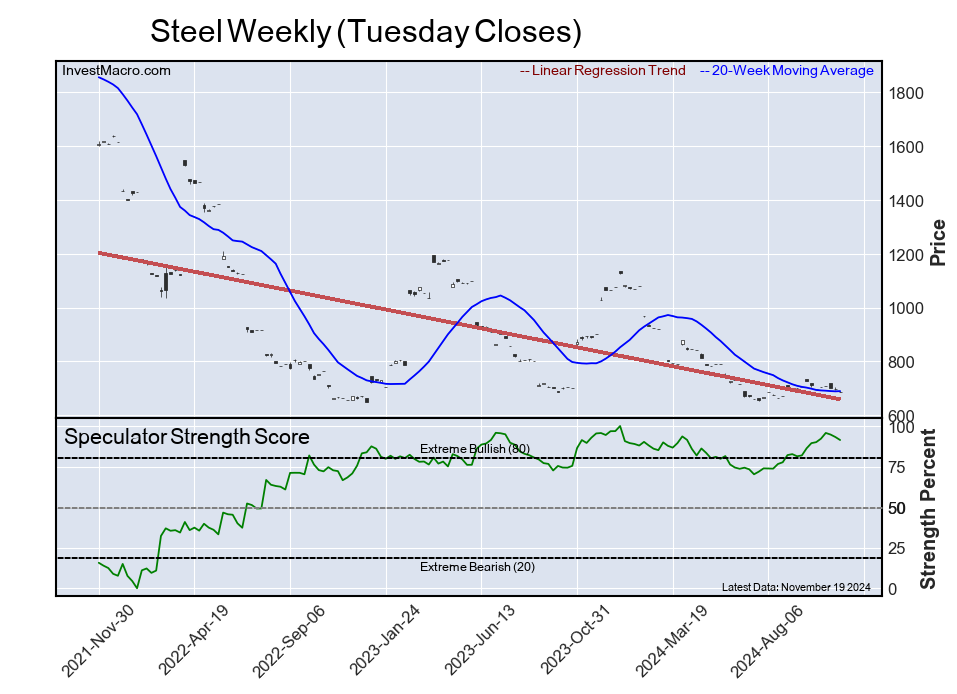
Steel


The Steel speculator position rounds out the top five in this week’s bullish extreme standings. The Steel speculator level sits at a 89.4 percent score of its 3-year range. The six-week trend for the speculator strength score was 11.8 this week.

The speculator position was -1,801 net contracts this week following an increase by 830 contracts in the weekly speculator bets.


This Week’s Most Bearish Speculator Positions:

US Dollar Index


The US Dollar Index speculator position comes in as the most bearish extreme standing this week. The US Dollar Index speculator level is at a 0.0 percent score of its 3-year range.

The six-week trend for the speculator strength score was -44.3 this week. The overall speculator position was -1,889 net contracts this week and had a change of -2,043 contracts in the speculator bets.


1-Month Secured Overnight Financing Rate


The 1-Month Secured Overnight Financing Rate speculator position comes in next for the most bearish extreme standing on the week. The 1-Month Secured Overnight Financing Rate speculator level is at a 7.7 percent score of its 3-year range.

The six-week trend for the speculator strength score was -47.6 this week. The speculator position was -222,460 net contracts this week with a decline of -27,938 contracts in the weekly speculator bets.


5-Year Bond


The 5-Year Bond speculator position comes in as third most bearish extreme standing of the week. The 5-Year Bond speculator level resides at a 8.4 percent score of its 3-year range.

The six-week trend for the speculator strength score was 3.4 this week. The overall speculator position was -1,600,325 net contracts this week with a drop of -49,535 contracts in the speculator bets.


E-mini SP MidCap400

The E-mini SP MidCap400 speculator position comes in as this week’s fourth most bearish extreme standing. The E-mini SP MidCap400 speculator level is at just a 12.6 percent score of its 3-year range.

The six-week trend for the speculator strength score was -4.4 this week. The speculator position was 98 net contracts this week following a change of -898 contracts in the weekly speculator bets.


2-Year Bond


Finally, the 2-Year Bond speculator position comes in as the fifth most bearish extreme standing for this week. The 2-Year Bond speculator level is at a 16.0 percent score of its 3-year range.

The six-week trend for the speculator strength score was -12.5 this week. The speculator position was -1,225,036 net contracts this week with a decrease by -46,817 contracts in the weekly speculator bets.


Article By InvestMacroReceive our weekly COT Newsletter

*COT Report: The COT data, released weekly to the public each Friday, is updated through the most recent Tuesday (data is 3 days old) and shows a quick view of how large speculators or non-commercials (for-profit traders) were positioned in the futures markets.

The CFTC categorizes trader positions according to commercial hedgers (traders who use futures contracts for hedging as part of the business), non-commercials (large traders who speculate to realize trading profits) and nonreportable traders (usually small traders/speculators) as well as their open interest (contracts open in the market at time of reporting). See CFTC criteria here.
Week Ahead: Will TSMC rejoin the trillion-dollar club?

By ForexTime 

  • US listed TSMC shares ↑ almost 80% YTD
  • Less than 4% away from all-time high created in July
  • Forward guidance for Q4 in focus
  • FXTM’s TWN index could see fresh volatility
  • Technical levels for TSMC – $192.65, $183.00 and $177.00

Another slew of key data releases and corporate earnings could rock markets in the week ahead:

Saturday, 12th October

  • CN50: China’s Ministry of Finance holds briefing

Sunday, 13th October

  • CN50: China PPI, CPI

Monday, 14th October

  • CN50: China trade
  • US500: Fed Governor Christopher Waller speech

Tuesday, 15th October

  • CAD: Canada CPI, existing home sales
  • EU50: Eurozone industrial production, Germany ZEW survey
  • JP225: Japan industrial production
  • UK100: UK jobless claims, unemployment
  • US500: Goldman Sachs, Bank of America, Citigroup earnings

Wednesday, 16th October

  • NZD: New Zealand CPI
  • ZAR: South Africa retail sales
  • UK100: UK CPI
  • NETH25: ASML earnings
  • US500: Morgan Stanley earnings

Thursday, 17th October

  • AU200: Australia unemployment
  • EU50: Eurozone CPI, ECB rate decision
  • JP225: Japan tertiary index, trade
  • SG20: Singapore trade
  • NAS100: US retail sales, jobless claims, industrial production, Netflix earnings
  • TWN: Taiwan Semiconductor Manufacturing Company (TSMC) earnings

Friday, 18th October  

  • CN50: China GDP, retail sales, industrial production, home prices
  • JP225: Japan CPI
  • UK100: UK retail sales

The spotlight shines on the world’s largest contract chipmaker with a market cap of almost $1 trillion.

US-listed shares of Taiwan Semiconductor Manufacturing Company (TSMC) are up almost 80% year-to-date, logging only one negative month in 2024.

Note: TSMC shares can be traded on the Taiwan Stock Exchange (TWSE) and New York Stock Exchange (NYSE).

Back in July, TSMC shares hit an all-time high at $192.65 after strong Q2 revenues – giving the company a trillion-dollar valuation momentarily before stocks later tumbled.

Still, prices have rebounded since August with a recent report revealing that TSMC’s September sales jumped 39.6% year-on-year.

bloomberg TSMC

This welcome development along with a positive earnings release could push the company’s stock higher.

  • When will earnings be published?

TSMC reports its third-quarter earnings on Thursday 17th October before US markets open.

  • Market expectations

The chipmaker is expected to post earnings of $1.78 per share with Q3 revenues seen rising to $23.28 billion from $17.28 in the prior year.

  • What to watch out for

Back in July, TSMC forecasted third quarter revenue in a range of between $22.4 billion to $23.2 billion.

But the chipmaker has already beaten these forecasts with consolidated sales in Q3 (July – September) hitting $23.6 billion, thanks to AI demand from major clients like Nvidia and Apple.

So much focus will be on the company’s earnings and forward guidance for Q4 which could serve as a key gauge for AI demand.

  • What does this mean for FXTM’s TWN index.

FXTM’s TWN index tracks the underlying FTSE Taiwan RIC Capped Index.

And TSMC makes up just under 20% of the index weighting, meaning that the upcoming earnings could result in heightened volatility.

The index is up almost 3% this month, bringing year-to-date gains to roughly 22%. Prices have been trending higher in recent weeks with the all-time high 7% away at 2046.8.

Key levels of interest can be found at 1930 and 1825.

TWN

  • Technical picture

TSMC shares are trending higher on the weekly charts with prices trading above the 21, 50 and 100-week SMA. However, the Relative Strength Index (RSI) is near 70 – signaling that prices may be overbought.

TSM

On the daily charts, the trend is bullish with prices are trading less than 4% away from its all-time high created in July at $192.65.

  • A decline below $183.00 may see prices test the 21-day SMA at $177.0 and $170.0.
  • Should $183.0 prove to be reliable support, this may open a path back to the all-time high at $192.65 and beyond.

TSMS1


Forex-Time-LogoArticle by ForexTime

ForexTime Ltd (FXTM) is an award winning international online forex broker regulated by CySEC 185/12 www.forextime.com

How a subfield of physics led to breakthroughs in AI – and from there to this year’s Nobel Prize

By Veera Sundararaghavan, University of Michigan 

John J. Hopfield and Geoffrey E. Hinton received the Nobel Prize in physics on Oct. 8, 2024, for their research on machine learning algorithms and neural networks that help computers learn. Their work has been fundamental in developing neural network theories that underpin generative artificial intelligence.

A neural network is a computational model consisting of layers of interconnected neurons. Like the neurons in your brain, these neurons process and send along a piece of information. Each neural layer receives a piece of data, processes it and passes the result to the next layer. By the end of the sequence, the network has processed and refined the data into something more useful.

While it might seem surprising that Hopfield and Hinton received the physics prize for their contributions to neural networks, used in computer science, their work is deeply rooted in the principles of physics, particularly a subfield called statistical mechanics.

As a computational materials scientist, I was excited to see this area of research recognized with the prize. Hopfield and Hinton’s work has allowed my colleagues and me to study a process called generative learning for materials sciences, a method that is behind many popular technologies like ChatGPT.

What is statistical mechanics?

Statistical mechanics is a branch of physics that uses statistical methods to explain the behavior of systems made up of a large number of particles.

Instead of focusing on individual particles, researchers using statistical mechanics look at the collective behavior of many particles. Seeing how they all act together helps researchers understand the system’s large-scale macroscopic properties like temperature, pressure and magnetization.

For example, physicist Ernst Ising developed a statistical mechanics model for magnetism in the 1920s. Ising imagined magnetism as the collective behavior of atomic spins interacting with their neighbors.

In Ising’s model, there are higher and lower energy states for the system, and the material is more likely to exist in the lowest energy state.

One key idea in statistical mechanics is the Boltzmann distribution, which quantifies how likely a given state is. This distribution describes the probability of a system being in a particular state – like solid, liquid or gas – based on its energy and temperature.

Ising exactly predicted the phase transition of a magnet using the Boltzmann distribution. He figured out the temperature at which the material changed from being magnetic to nonmagnetic.

Phase changes happen at predictable temperatures. Ice melts to water at a specific temperature because the Boltzmann distribution predicts that when it gets warm, the water molecules are more likely to take on a disordered – or liquid – state.

Statistical mechanics tells researchers about the properties of a larger system, and how individual objects in that system act collectively.

In materials, atoms arrange themselves into specific crystal structures that use the lowest amount of energy. When it’s cold, water molecules freeze into ice crystals with low energy states.

Similarly, in biology, proteins fold into low energy shapes, which allow them to function as specific antibodies – like a lock and key – targeting a virus.

Neural networks and statistical mechanics

Fundamentally, all neural networks work on a similar principle – to minimize energy. Neural networks use this principle to solve computing problems.

For example, imagine an image made up of pixels where you only can see a part of the picture. Some pixels are visible, while the rest are hidden. To determine what the image is, you consider all possible ways the hidden pixels could fit together with the visible pieces. From there, you would choose from among what statistical mechanics would say are the most likely states out of all the possible options.

A diagram showing statistical mechanics on the left, with a graph showing three atomic structures, with the one at the lowest energy labeled the most stable. On the right is labeled neural networks, showing two photos of trees, one only half visible.
In statistical mechanics, researchers try to find the most stable physical structure of a material. Neural networks use the same principle to solve complex computing problems.
Veera Sundararaghavan

Hopfield and Hinton developed a theory for neural networks based on the idea of statistical mechanics. Just like Ising before them, who modeled the collective interaction of atomic spins to solve the photo problem with a neural network, Hopfield and Hinton imagined collective interactions of pixels. They represented these pixels as neurons.

Just as in statistical physics, the energy of an image refers to how likely a particular configuration of pixels is. A Hopfield network would solve this problem by finding the lowest energy arrangements of hidden pixels.

However, unlike in statistical mechanics – where the energy is determined by known atomic interactions – neural networks learn these energies from data.

Hinton popularized the development of a technique called backpropagation. This technique helps the model figure out the interaction energies between these neurons, and this algorithm underpins much of modern AI learning.

The Boltzmann machine

Building upon Hopfield’s work, Hinton imagined another neural network, called the Boltzmann machine. It consists of visible neurons, which we can observe, and hidden neurons, which help the network learn complex patterns.

In a Boltzmann machine, you can determine the probability that the picture looks a certain way. To figure out this probability, you can sum up all the possible states the hidden pixels could be in. This gives you the total probability of the visible pixels being in a specific arrangement.

My group has worked on implementing Boltzmann machines in quantum computers for generative learning.

In generative learning, the network learns to generate new data samples that resemble the data the researchers fed the network to train it. For example, it might generate new images of handwritten numbers after being trained on similar images. The network can generate these by sampling from the learned probability distribution.

Generative learning underpins modern AI – it’s what allows the generation of AI art, videos and text.

Hopfield and Hinton have significantly influenced AI research by leveraging tools from statistical physics. Their work draws parallels between how nature determines the physical states of a material and how neural networks predict the likelihood of solutions to complex computer science problems.The Conversation

About the Author:

Veera Sundararaghavan, Professor of Aerospace Engineering, University of Michigan

This article is republished from The Conversation under a Creative Commons license. Read the original article.

Bitcoin: Wedged between 50 and 200-day SMA

By ForexTime 

  • Bitcoin ↓ 2.6% in October
  • HBO doc identifies Peter Todd as Bitcoin creator
  • Over past year Fed minutes triggered moves of ↑ 2.2% & ↓ 1%
  • Over past year US CPI triggered moves of ↑ 1.8% & ↓ 2.9%
  • Technical levels: $63,500 & $61,000

Bitcoin has found itself trapped within a range on the daily charts.

The world’s largest cryptocurrency could be waiting for a fresh fundamental spark to trigger significant price swings.

Bitcoin

Despite the growing anticipation, Bitcoin offered a muted response after HBO’s documentary pointed to Canadian Bitcoin developer Peter Todd as Satoshi Nakamoto. However, Todd immediately denied these claims on social media.

This was initially a big deal due to the mystery surrounding Satoshi Nakamoto who is estimated to hold 1.1 million Bitcoins worth $66 billion. If Satoshi’s identity was truly unmasked, it could have various implications for Bitcoin which has skyrocketed over the years and gained mainstream acceptance.

With our attention back to key data, here are 3 things to keep an eye on this week:


    1) Fed speeches + FOMC meeting minutes

Last Friday’s strong jobs report boosted confidence in the US economy and erased hopes around a 50bp Fed cut in November.

It will be interesting to see what Fed officials think about the latest developments and the potential impacts it could have on future rate cuts. Regarding the FOMC minutes, investors will be looking for fresh insight into the outlook for labour markets or future policy moves.

Given how cryptocurrencies have shown sensitivity to interest rates, the incoming event may spark price swings.

Golden nugget: Over the past year, the FOMC minutes have triggered upside moves of as much as 2.2% or declines of 1% in a 6-hour window post-release.


    2) US September CPI report

As highlighted in our week ahead report, the incoming inflation data may impact bets around how deep the Fed cuts rates in Q4.

Signs of cooling price pressures may boost expectations around lower interest rates, supporting Bitcoin as a result. The same is true vice versa.

Golden nugget: Over the past year, the US CPI report has triggered upside moves of as much as 1.8% or declines of 2.9% in a 6-hour window post-release.

  • A hotter-than-expected CPI report could drag Bitcoin prices lower as the dollar strengthens and rate cut bets cool.
  • A soft inflation report may support the argument around lower US interest rates, boosting Bitcoin prices


    3) Technical forces

Bitcoin remains trapped within a range on the daily charts with support around $61,000 and resistance at $63,500 where the 200-day SMA resides. 

  • A solid breakout and daily close above $63,500 could encourage a move toward $65,000 $66,000.
  • A break below the 100-day SMA at $61,000 could see prices test $60,000. Sustained weakness below here may encourage bears to attack $57,600.

Bitcoin23


Forex-Time-LogoArticle by ForexTime

ForexTime Ltd (FXTM) is an award winning international online forex broker regulated by CySEC 185/12 www.forextime.com