Archive for Forex and Currency News – Page 55

EUR/USD Faces Downward Pressure Amid Rising Geopolitical Tensions

By RoboForex Analytical Department

The principal currency pair, EUR/USD, is experiencing a decline as the week commences, predominantly driven by heightened risk aversion in the market. As of Monday morning, the currency pair’s quotations are closely aligned with the 1.0552 mark.

A major contributor to the current sentiment is the escalating conflict between Arabian and Israeli forces. This geopolitical uncertainty has prompted investors to adopt a cautious stance, aiming to sidestep potential complications arising from the conflict.

Economic statistics unveiled in the US on Friday presented a mixed picture. The nation’s unemployment rate steadfastly remained at 3.8%. Contrarily, non-farm payrolls demonstrated a robust uptick, registering an increase of 336,000, substantially surpassing the anticipated 171,000. The average hourly earnings metric retained its prior growth trajectory, with a month-on-month rise of 0.2%.

The employment sector’s performance seemingly provides the US Federal Reserve with sufficient justification to proceed with interest rate hikes. However, consumer spending appears to be decelerating. Contrary to projections of an 11.7 billion USD increase, the US consumer lending volume dwindled by 15.6 billion USD.

EUR/USD technical analysis

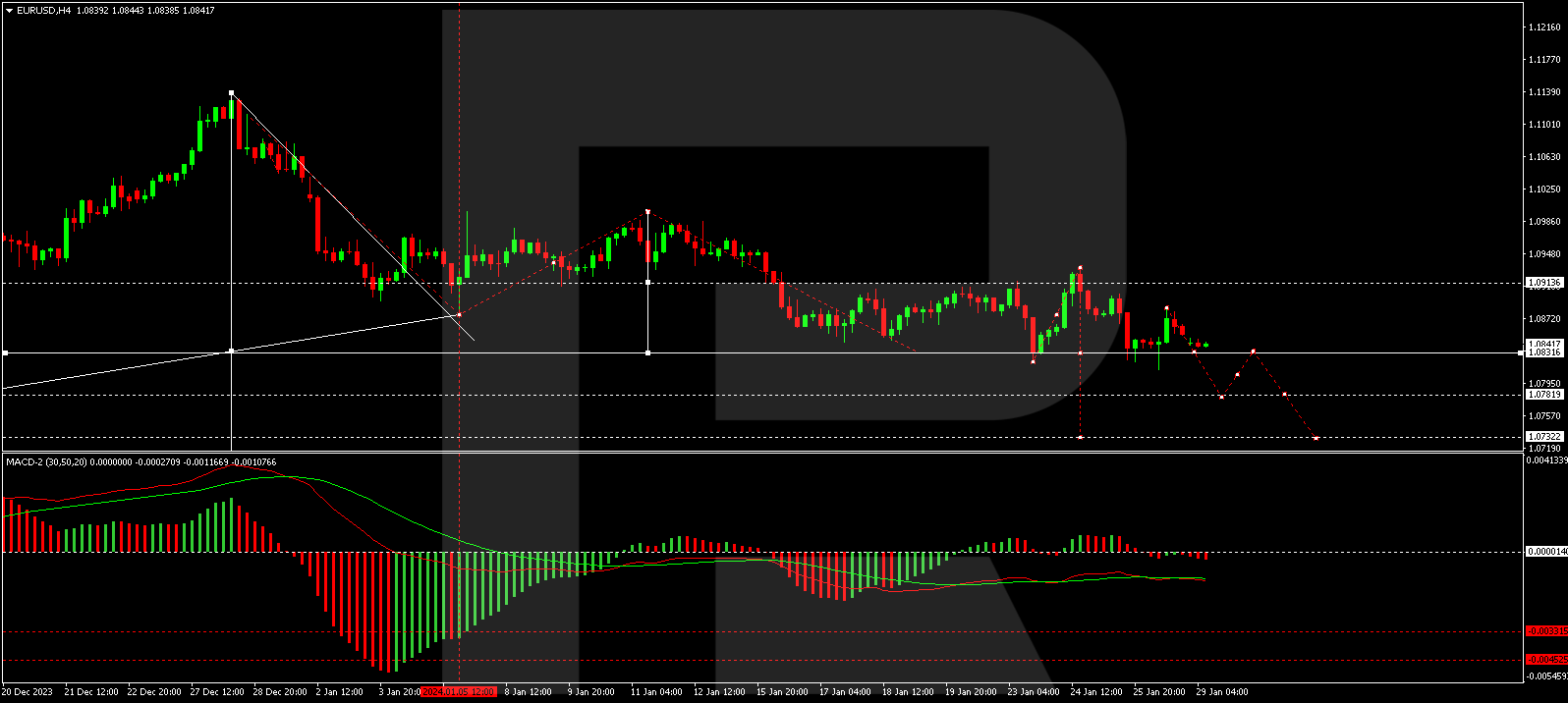
On the H4 timeframe of the EUR/USD currency pair, the market achieved the local target of the bearish wave at the 1.0450 juncture. As of the present moment, a corrective wave culminating at 1.0599 has been realized. The currency pair is now poised for a dip to the 1.0520 level, with indications suggesting the formation of a consolidation range around this point. A breach of this range to the upside could potentially propel the currency pair to the 1.0700 mark. Once this level is attained, a subsequent bearish wave targeting 1.0140 may ensue. The Moving Average Convergence Divergence (MACD) offers technical corroboration for this outlook, with its signal line entrenched below the zero mark, exhibiting a sharp upward trajectory, and poised for fresh peaks.

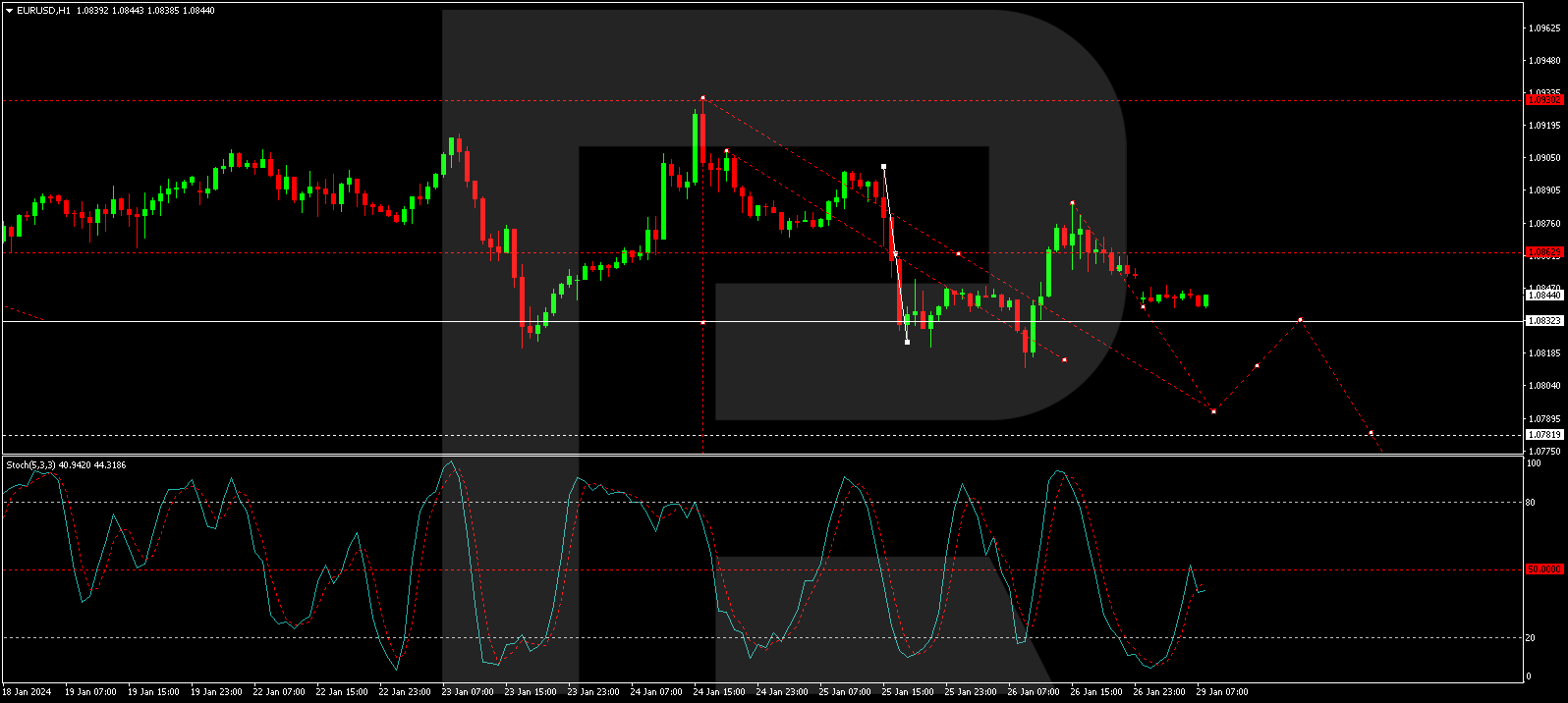
On the H1 timeframe for EUR/USD, an ascent towards 1.0599 has been charted. The market is currently undergoing a correctional phase targeting the 1.0520 mark. Upon completion of this correction, the potential for a bullish wave reaching 1.0700 emerges. This scenario gains validation from the Stochastic oscillator, which currently trades below the zero level but anticipates a climb to the 50-mark. A successful breach of this level could potentially drive the oscillator to the 80-mark.

Conclusion

Amid heightened geopolitical tensions, the EUR/USD pair exhibits bearish tendencies, albeit with potential recovery. While economic statistics from the US paint a varied picture, technical indicators suggest potential upside movements post corrections. Investors and traders should remain vigilant, weighing both the geopolitical landscape and economic indicators when formulating their strategies.

Disclaimer

Any forecasts contained herein are based on the author’s particular opinion. This analysis may not be treated as trading advice. RoboForex bears no responsibility for trading results based on trading recommendations and reviews contained herein.

Currency Speculators continue to pare Euro Bullish Bets to 49-Week Low

By InvestMacro

Here are the latest charts and statistics for the Commitment of Traders (COT) data published by the Commodities Futures Trading Commission (CFTC).

The latest COT data is updated through Tuesday October 3rd and shows a quick view of how large market participants (for-profit speculators and commercial traders) were positioned in the futures markets. All currency positions are in direct relation to the US dollar where, for example, a bet for the euro is a bet that the euro will rise versus the dollar while a bet against the euro will be a bet that the euro will decline versus the dollar.

Weekly Speculator Changes led by New Zealand Dollar & Australian Dollar

The COT currency market speculator bets were lower this week as five out of the eleven currency markets we cover had higher positioning while the other six markets had lower speculator contracts.

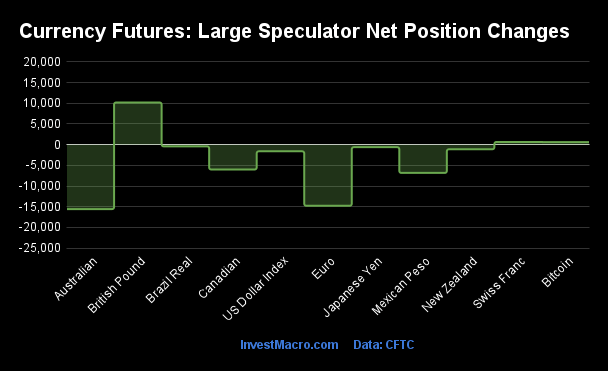
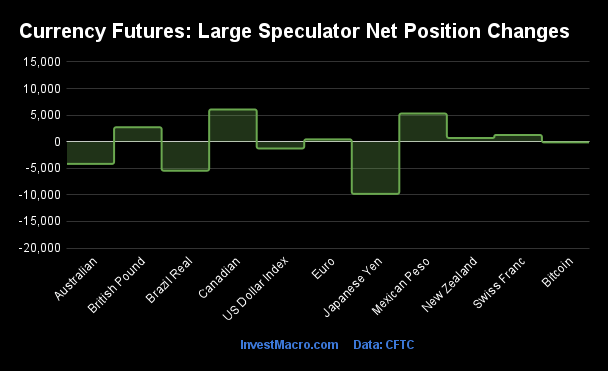
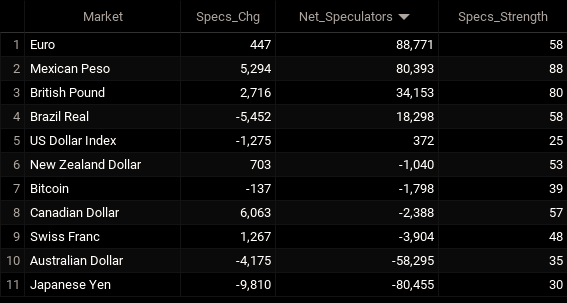
Leading the gains for the currency markets was the New Zealand Dollar (7,531 contracts) with the Australian Dollar (4,828 contracts), Mexican Peso (3,881 contracts), US Dollar Index (2,057 contracts) and the Brazilian Real (1,079 contracts) also showing positive weeks.

The currencies seeing declines in speculator bets on the week were the British Pound (-22,349 contracts) with the EuroFX (-19,456 contracts), the Swiss Franc (-7,627 contracts), the Canadian Dollar (-7,455 contracts), the Japanese Yen (-4,476 contracts) and Bitcoin (-738 contracts) also registering lower bets on the week.

Spotlight: Large Currency Traders continue to pare Euro Bullish Bets to 49-Week Low

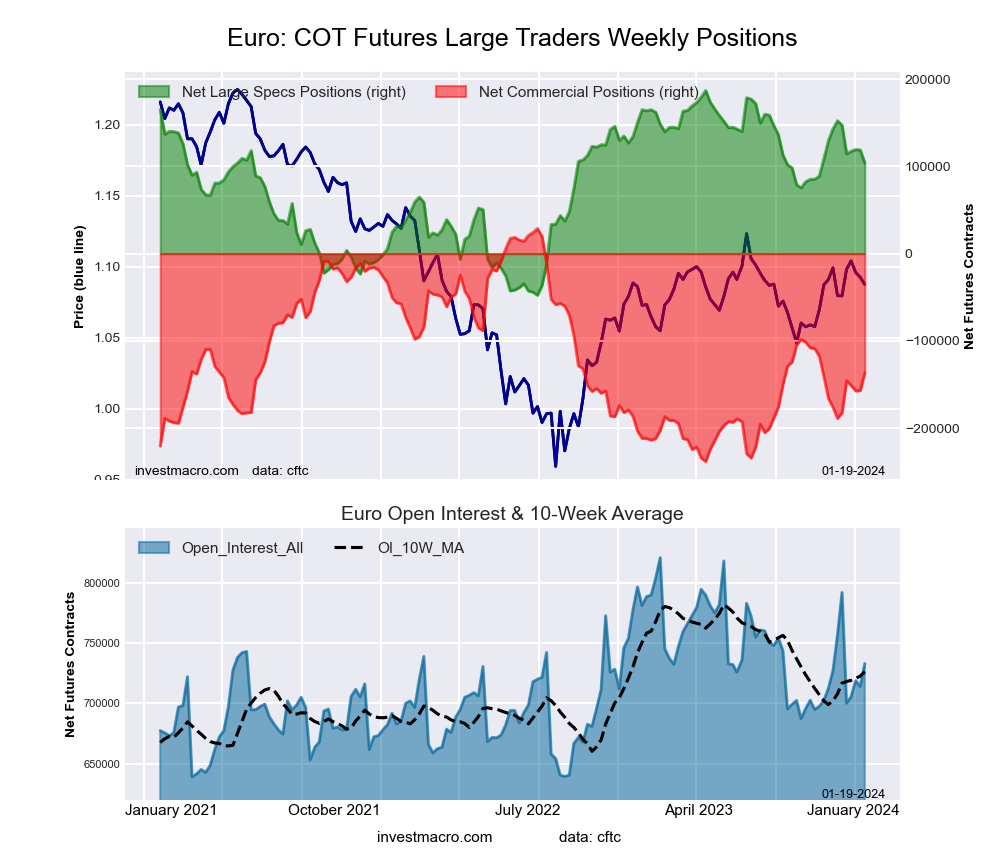
Highlighting the COT currency’s data this week is the continued weakness in the Euro Currency speculator positioning. Large speculative Euro positions fell sharply this week by over -19,000 contracts and dropped for a seventh consecutive week. Euro weekly positions have now declined in ten out of the past eleven weeks with a total decline of -99,889 contracts over these past eleven weeks.

This rapid cooling of the speculator bets has now taken the net position from a total of +178,832 contracts on July 18th to a total of +78,943 contracts through Tuesday. This brings the current level to the lowest standing in the past 49-weeks, dating back to October 25th of 2022.

Helping put a dampener on the Euro speculative position has been the likely end of the European Central Bank’s (ECB) rate hiking activity. The ECB recently raised their interest rate in September for a 10th straight meeting to 4 percent. However, the market expectation is that the rate hiking campaign is over for now which combined with subdued growth in the Eurozone puts a limited expectation for strength in the currency.

The Euro currency (EURUSD) spot price (vesus the US Dollar), however, did manage to eke out a small gain this week after falling for eleven straight weeks and touching the lowest level of the year under 1.0500. The EURUSD rebounded off the psychological level of 1.0500 this week and saw gains on Wednesday, Thursday and Friday to close the week right near the 1.0625 exchange rate.


Data Snapshot of Forex Market Traders | Columns Legend
Oct-03-2023OIOI-IndexSpec-NetSpec-IndexCom-NetCOM-IndexSmalls-NetSmalls-Index
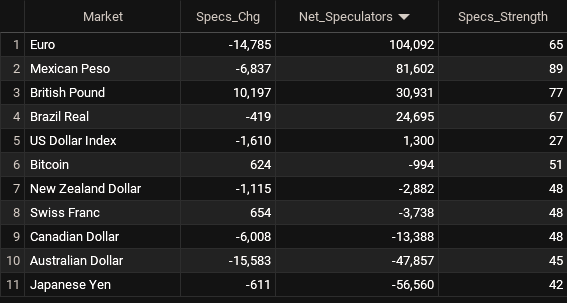
USD Index42,3404118,81556-20,166441,35122
EUR702,4333978,94354-104,7525025,80920
GBP241,04562-6,6805117,54556-10,86537
JPY282,68298-113,9882117,86993-3,88146
CHF58,673100-16,7421127,36889-10,62623
CAD189,44353-40,1511738,581821,57026
AUD207,78264-81,9871497,26690-15,27915
NZD52,29162-7,6503510,71769-3,06713
MXN212,5394264,51479-67,248212,73429
RUB20,93047,54331-7,15069-39324
BRL41,0332716,63757-17,643431,00644
Bitcoin14,447651,05682-1,475041922


Strength Scores led by Bitcoin & Mexican Peso

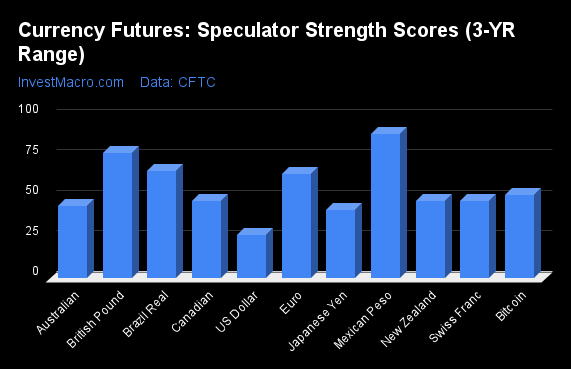
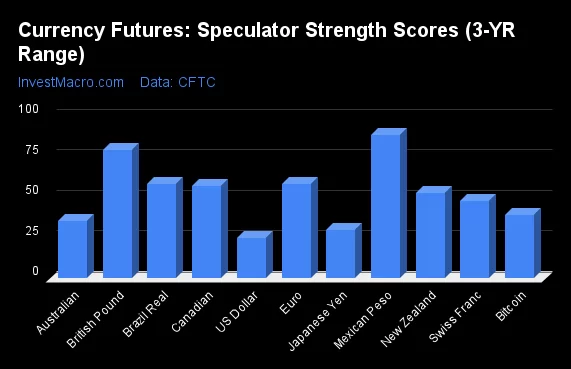
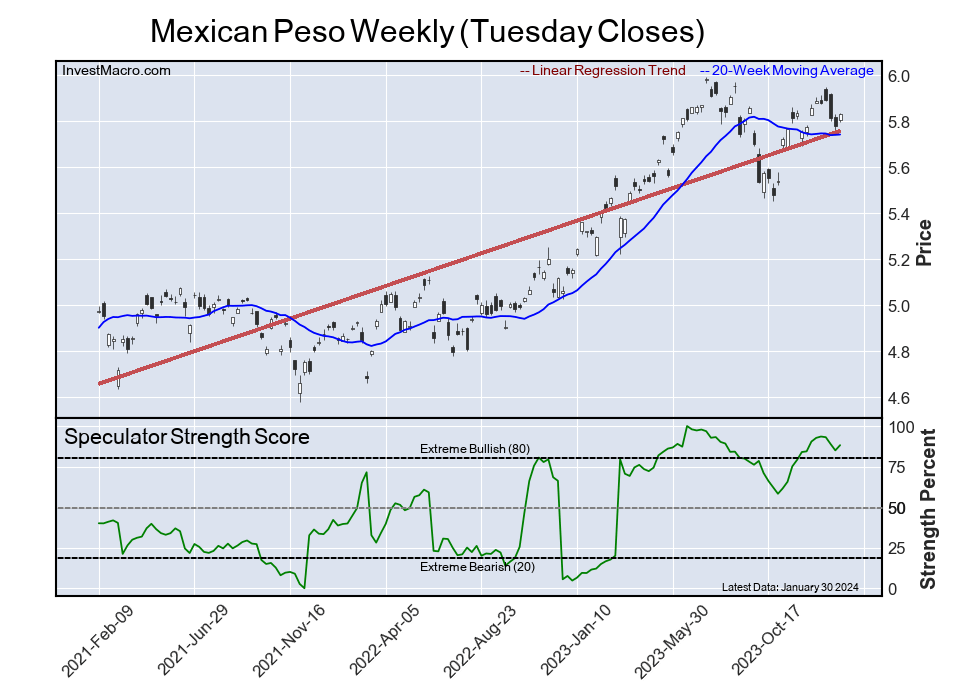
COT Strength Scores (a normalized measure of Speculator positions over a 3-Year range, from 0 to 100 where above 80 is Extreme-Bullish and below 20 is Extreme-Bearish) showed that the Bitcoin (82 percent) and the Mexican Peso (79 percent) currently lead the currency markets this week. The Brazilian Real (57 percent), the US Dollar Index (56 percent) and the EuroFX (54 percent) come in as the next highest in the weekly strength scores.

On the downside, the Japanese Yen (2 percent), the Swiss Franc (11 percent), the Australian Dollar (14 percent) and the Canadian Dollar (17 percent) come in at the lowest strength levels and are in Extreme-Bearish territory (below 20 percent).

Strength Statistics:
US Dollar Index (56.3 percent) vs US Dollar Index previous week (52.9 percent)
EuroFX (53.9 percent) vs EuroFX previous week (62.2 percent)
British Pound Sterling (51.1 percent) vs British Pound Sterling previous week (66.6 percent)
Japanese Yen (2.3 percent) vs Japanese Yen previous week (5.0 percent)
Swiss Franc (10.7 percent) vs Swiss Franc previous week (31.6 percent)
Canadian Dollar (17.1 percent) vs Canadian Dollar previous week (24.1 percent)
Australian Dollar (13.7 percent) vs Australian Dollar previous week (9.3 percent)
New Zealand Dollar (35.5 percent) vs New Zealand Dollar previous week (15.9 percent)
Mexican Peso (78.5 percent) vs Mexican Peso previous week (76.1 percent)
Brazilian Real (57.0 percent) vs Brazilian Real previous week (55.6 percent)
Bitcoin (82.3 percent) vs Bitcoin previous week (93.4 percent)


US Dollar Index & Brazilian Real top the 6-Week Strength Trends

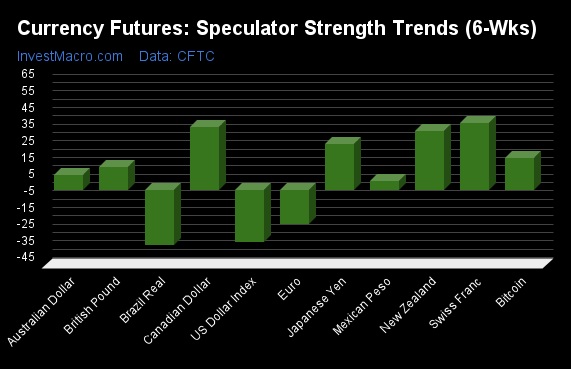
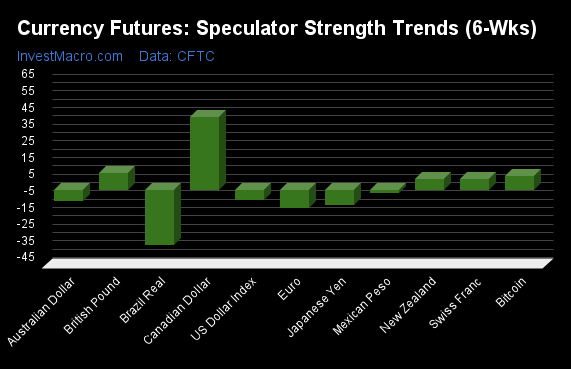
COT Strength Score Trends (or move index, calculates the 6-week changes in strength scores) showed that the US Dollar Index (24 percent) leads the past six weeks trends for the currencies and is the only currency with a positive 6-week trend.

The British Pound (-46 percent) leads the downside trend scores with the Swiss Franc (-35 percent), EuroFX (-34 percent) and the Canadian Dollar (-26 percent) following.

Strength Trend Statistics:
US Dollar Index (23.7 percent) vs US Dollar Index previous week (19.6 percent)
EuroFX (-34.0 percent) vs EuroFX previous week (-26.2 percent)
British Pound Sterling (-45.7 percent) vs British Pound Sterling previous week (-24.5 percent)
Japanese Yen (-11.1 percent) vs Japanese Yen previous week (-17.0 percent)
Swiss Franc (-35.3 percent) vs Swiss Franc previous week (-14.0 percent)
Canadian Dollar (-26.2 percent) vs Canadian Dollar previous week (-19.8 percent)
Australian Dollar (-16.7 percent) vs Australian Dollar previous week (-30.6 percent)
New Zealand Dollar (-3.0 percent) vs New Zealand Dollar previous week (-33.2 percent)
Mexican Peso (-5.6 percent) vs Mexican Peso previous week (-13.1 percent)
Brazilian Real (-2.0 percent) vs Brazilian Real previous week (-10.1 percent)
Bitcoin (-6.9 percent) vs Bitcoin previous week (37.7 percent)


Individual COT Forex Markets:

US Dollar Index Futures:
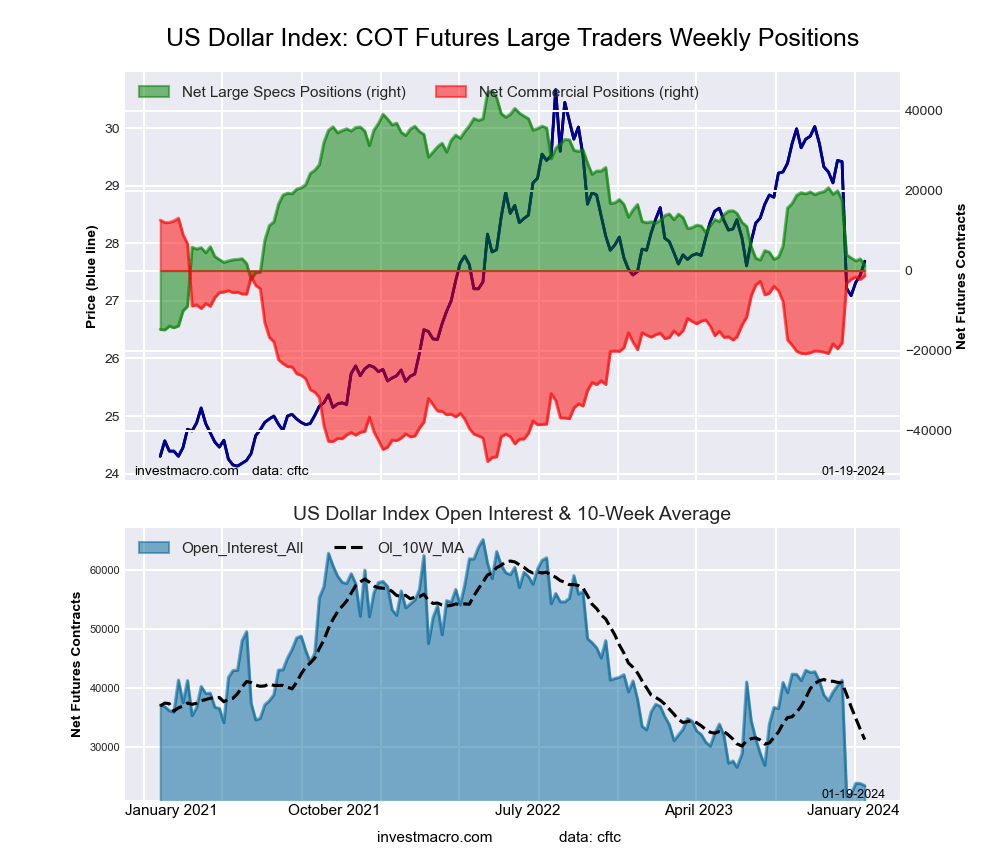
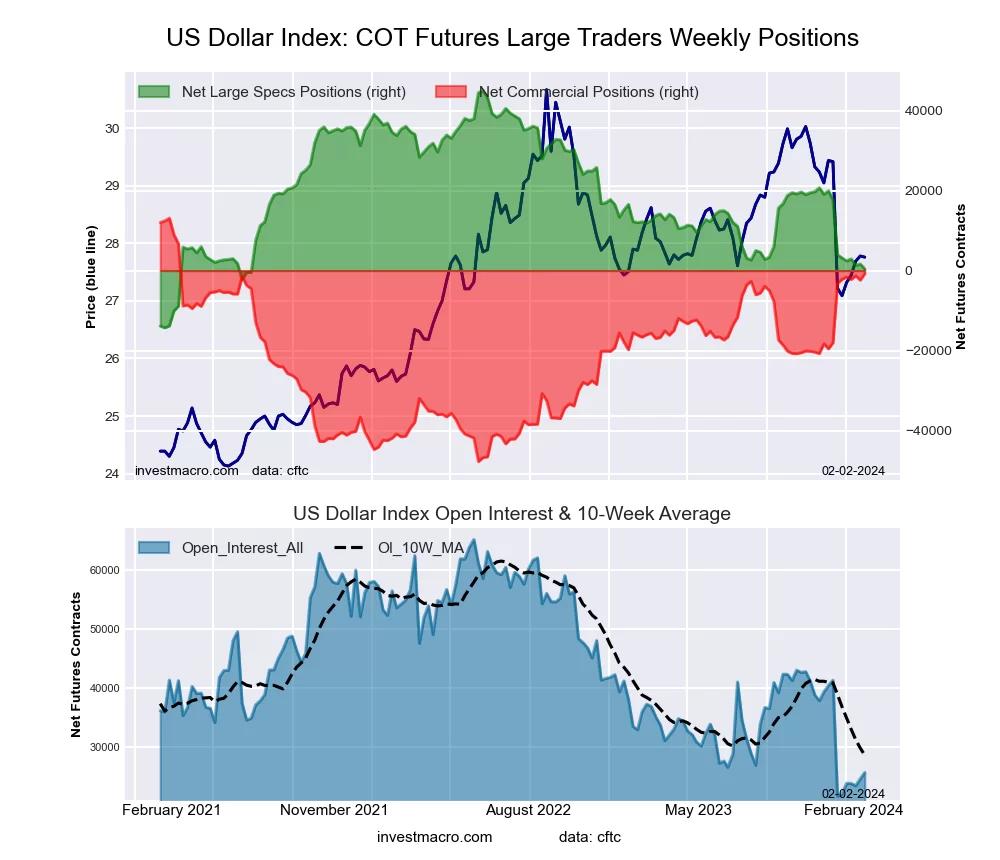
US Dollar Index Forex Futures COT ChartThe US Dollar Index large speculator standing this week recorded a net position of 18,815 contracts in the data reported through Tuesday. This was a weekly advance of 2,057 contracts from the previous week which had a total of 16,758 net contracts.

This week’s current strength score (the trader positioning range over the past three years, measured from 0 to 100) shows the speculators are currently Bullish with a score of 56.3 percent. The commercials are Bearish with a score of 43.7 percent and the small traders (not shown in chart) are Bearish with a score of 22.0 percent.

Price Trend-Following Model: Strong Uptrend

Our weekly trend-following model classifies the current market price position as: Strong Uptrend. The current action for the model is considered to be: Hold – Maintain Long Position.

US DOLLAR INDEX StatisticsSPECULATORSCOMMERCIALSSMALL TRADERS
– Percent of Open Interest Longs:66.319.610.7
– Percent of Open Interest Shorts:21.867.37.5
– Net Position:18,815-20,1661,351
– Gross Longs:28,0578,3134,530
– Gross Shorts:9,24228,4793,179
– Long to Short Ratio:3.0 to 10.3 to 11.4 to 1
NET POSITION TREND:
– Strength Index Score (3 Year Range Pct):56.343.722.0
– Strength Index Reading (3 Year Range):BullishBearishBearish
NET POSITION MOVEMENT INDEX:
– 6-Week Change in Strength Index:23.7-23.14.0


Euro Currency Futures:

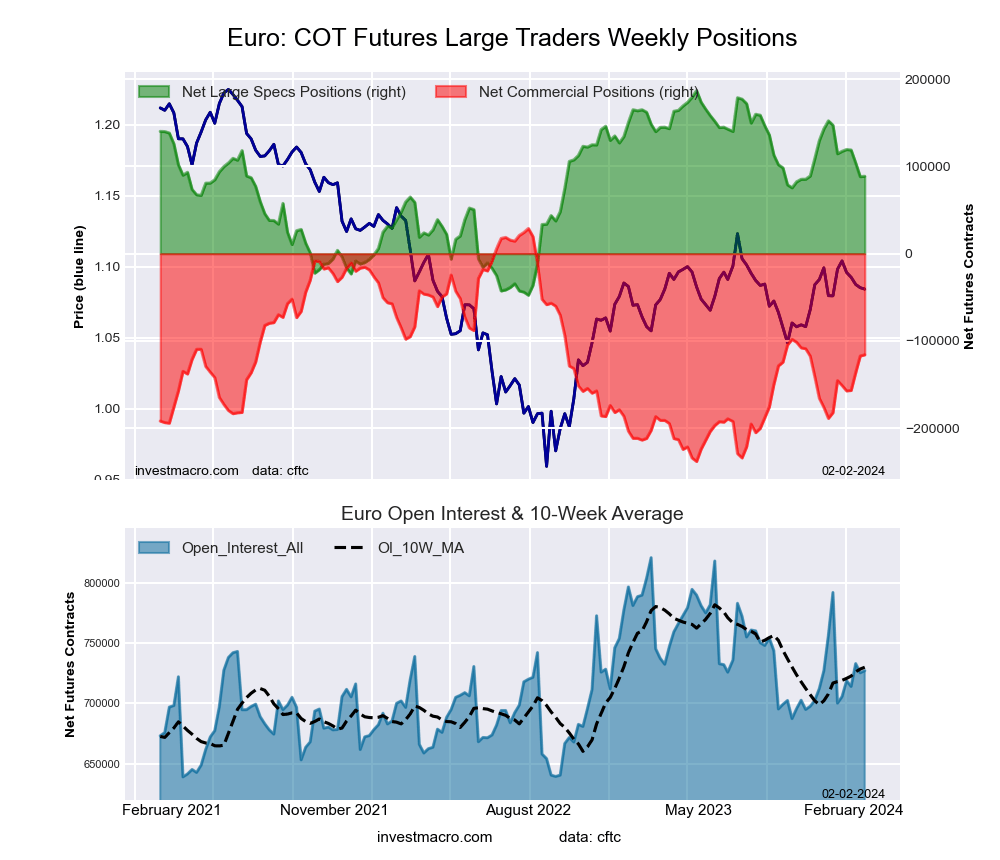
Euro Currency Futures COT ChartThe Euro Currency large speculator standing this week recorded a net position of 78,943 contracts in the data reported through Tuesday. This was a weekly fall of -19,456 contracts from the previous week which had a total of 98,399 net contracts.

This week’s current strength score (the trader positioning range over the past three years, measured from 0 to 100) shows the speculators are currently Bullish with a score of 53.9 percent. The commercials are Bearish with a score of 50.0 percent and the small traders (not shown in chart) are Bearish with a score of 20.2 percent.

Price Trend-Following Model: Strong Downtrend

Our weekly trend-following model classifies the current market price position as: Strong Downtrend. The current action for the model is considered to be: Hold – Maintain Short Position.

EURO Currency StatisticsSPECULATORSCOMMERCIALSSMALL TRADERS
– Percent of Open Interest Longs:30.155.311.7
– Percent of Open Interest Shorts:18.970.28.1
– Net Position:78,943-104,75225,809
– Gross Longs:211,783388,47382,432
– Gross Shorts:132,840493,22556,623
– Long to Short Ratio:1.6 to 10.8 to 11.5 to 1
NET POSITION TREND:
– Strength Index Score (3 Year Range Pct):53.950.020.2
– Strength Index Reading (3 Year Range):BullishBearishBearish
NET POSITION MOVEMENT INDEX:
– 6-Week Change in Strength Index:-34.035.8-25.2


British Pound Sterling Futures:

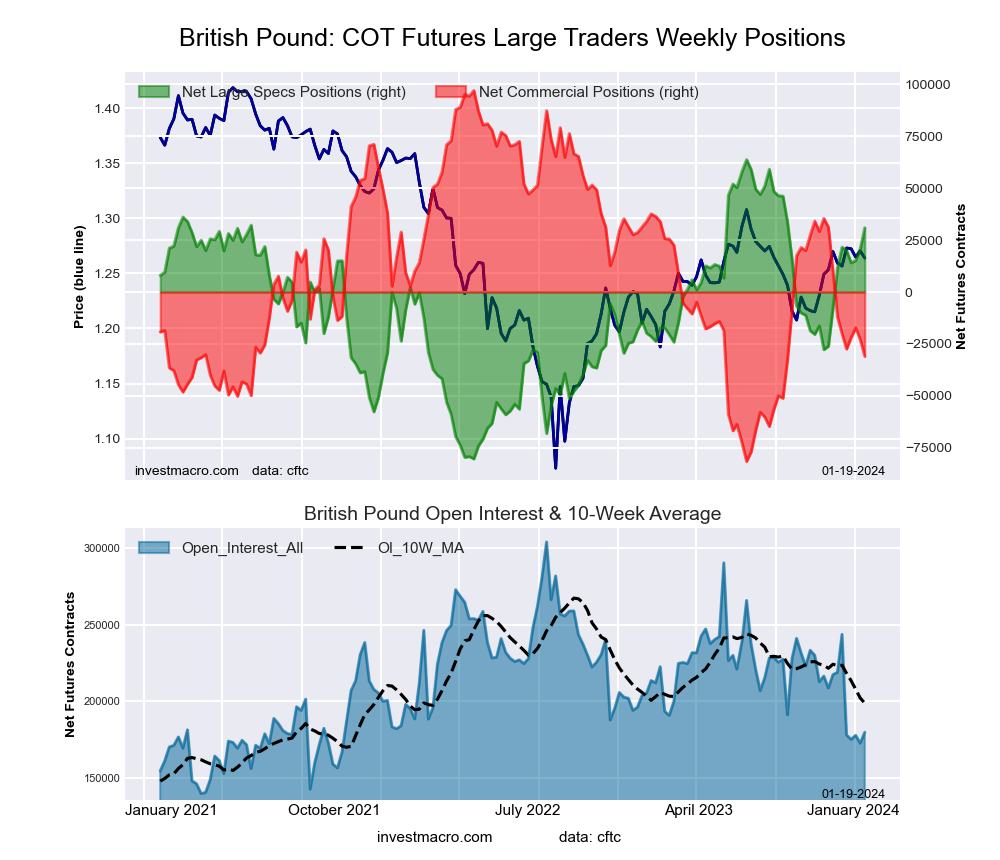
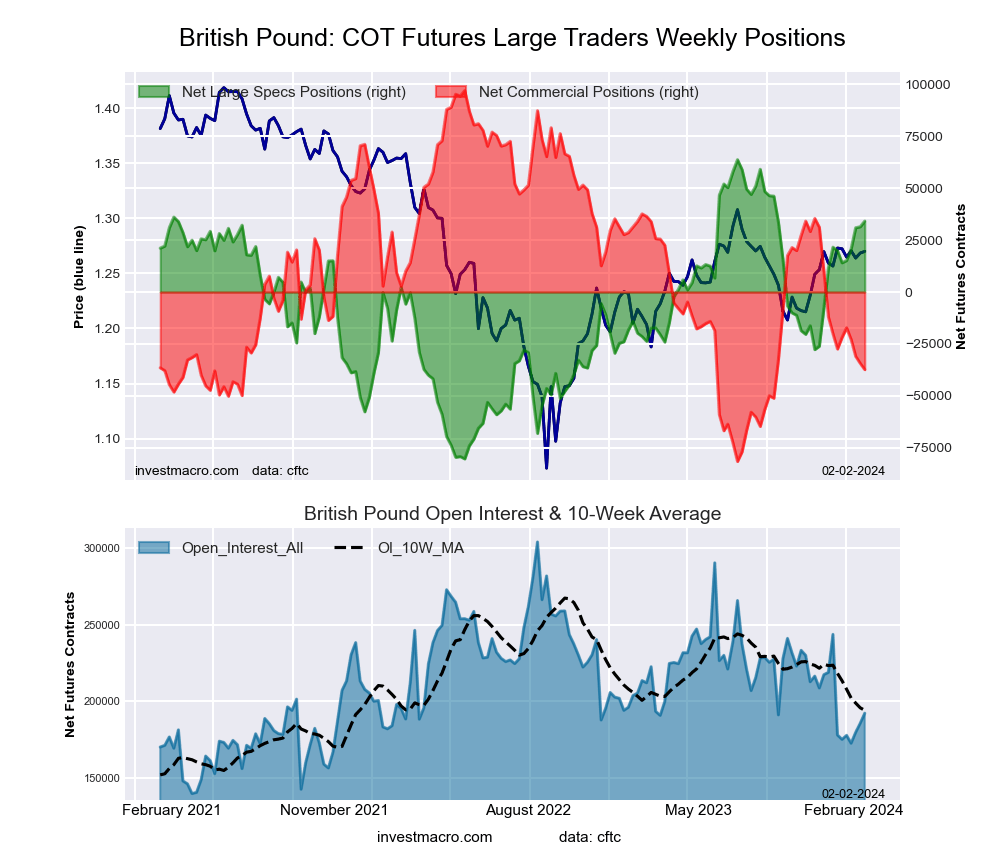
British Pound Sterling Futures COT ChartThe British Pound Sterling large speculator standing this week recorded a net position of -6,680 contracts in the data reported through Tuesday. This was a weekly reduction of -22,349 contracts from the previous week which had a total of 15,669 net contracts.

This week’s current strength score (the trader positioning range over the past three years, measured from 0 to 100) shows the speculators are currently Bullish with a score of 51.1 percent. The commercials are Bullish with a score of 55.5 percent and the small traders (not shown in chart) are Bearish with a score of 36.7 percent.

Price Trend-Following Model: Strong Downtrend

Our weekly trend-following model classifies the current market price position as: Strong Downtrend. The current action for the model is considered to be: Hold – Maintain Short Position.

BRITISH POUND StatisticsSPECULATORSCOMMERCIALSSMALL TRADERS
– Percent of Open Interest Longs:30.756.310.2
– Percent of Open Interest Shorts:33.449.014.7
– Net Position:-6,68017,545-10,865
– Gross Longs:73,911135,63724,678
– Gross Shorts:80,591118,09235,543
– Long to Short Ratio:0.9 to 11.1 to 10.7 to 1
NET POSITION TREND:
– Strength Index Score (3 Year Range Pct):51.155.536.7
– Strength Index Reading (3 Year Range):BullishBullishBearish
NET POSITION MOVEMENT INDEX:
– 6-Week Change in Strength Index:-45.746.1-32.3


Japanese Yen Futures:

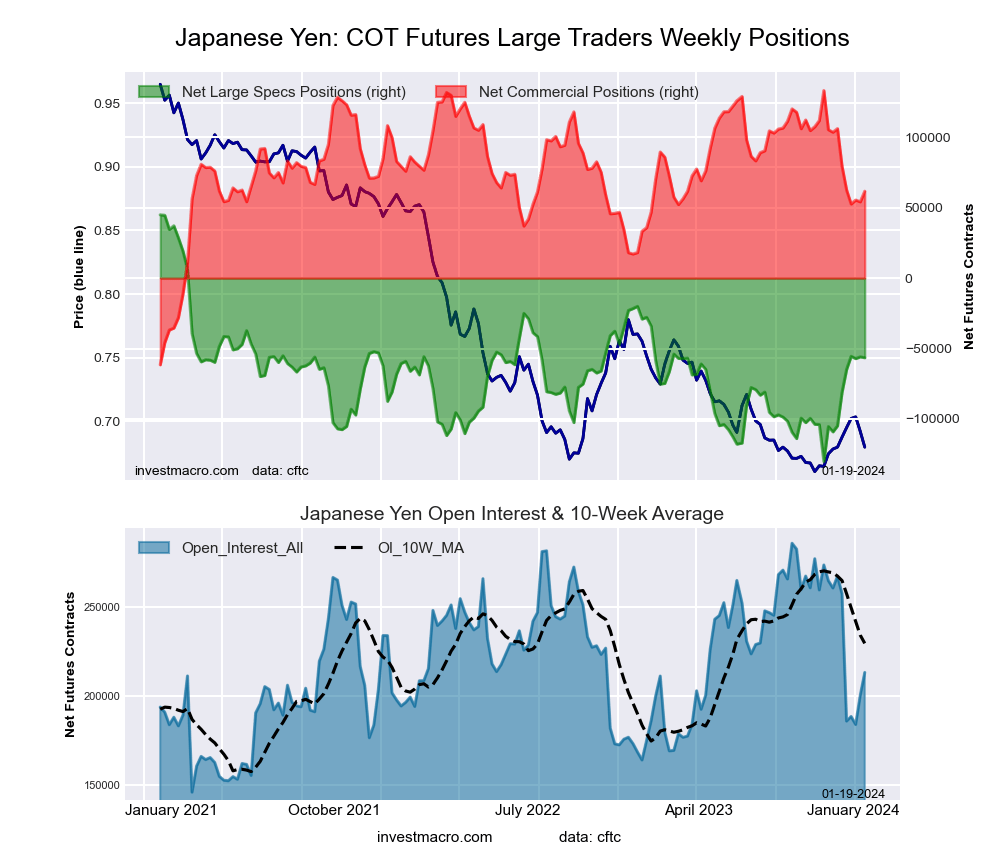
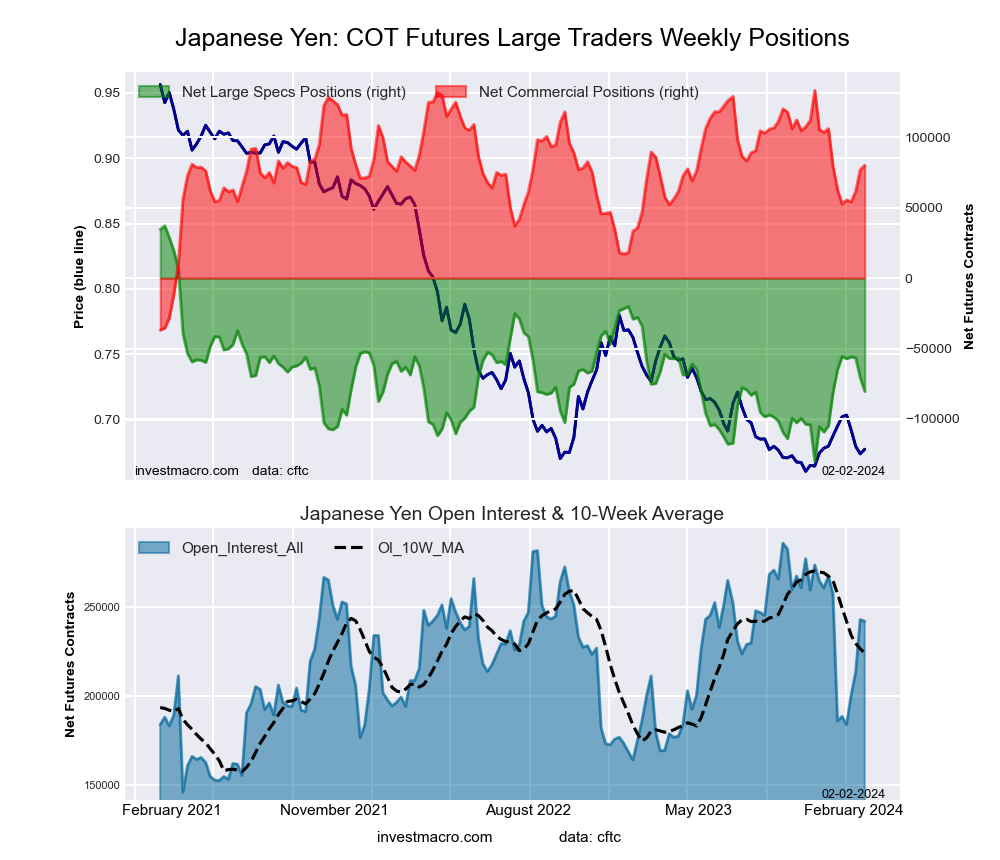
Japanese Yen Forex Futures COT ChartThe Japanese Yen large speculator standing this week recorded a net position of -113,988 contracts in the data reported through Tuesday. This was a weekly fall of -4,476 contracts from the previous week which had a total of -109,512 net contracts.

This week’s current strength score (the trader positioning range over the past three years, measured from 0 to 100) shows the speculators are currently Bearish-Extreme with a score of 2.3 percent. The commercials are Bullish-Extreme with a score of 93.2 percent and the small traders (not shown in chart) are Bearish with a score of 45.6 percent.

Price Trend-Following Model: Strong Downtrend

Our weekly trend-following model classifies the current market price position as: Strong Downtrend. The current action for the model is considered to be: Hold – Maintain Short Position.

JAPANESE YEN StatisticsSPECULATORSCOMMERCIALSSMALL TRADERS
– Percent of Open Interest Longs:16.868.713.4
– Percent of Open Interest Shorts:57.127.014.7
– Net Position:-113,988117,869-3,881
– Gross Longs:47,544194,19337,744
– Gross Shorts:161,53276,32441,625
– Long to Short Ratio:0.3 to 12.5 to 10.9 to 1
NET POSITION TREND:
– Strength Index Score (3 Year Range Pct):2.393.245.6
– Strength Index Reading (3 Year Range):Bearish-ExtremeBullish-ExtremeBearish
NET POSITION MOVEMENT INDEX:
– 6-Week Change in Strength Index:-11.16.511.0


Swiss Franc Futures:

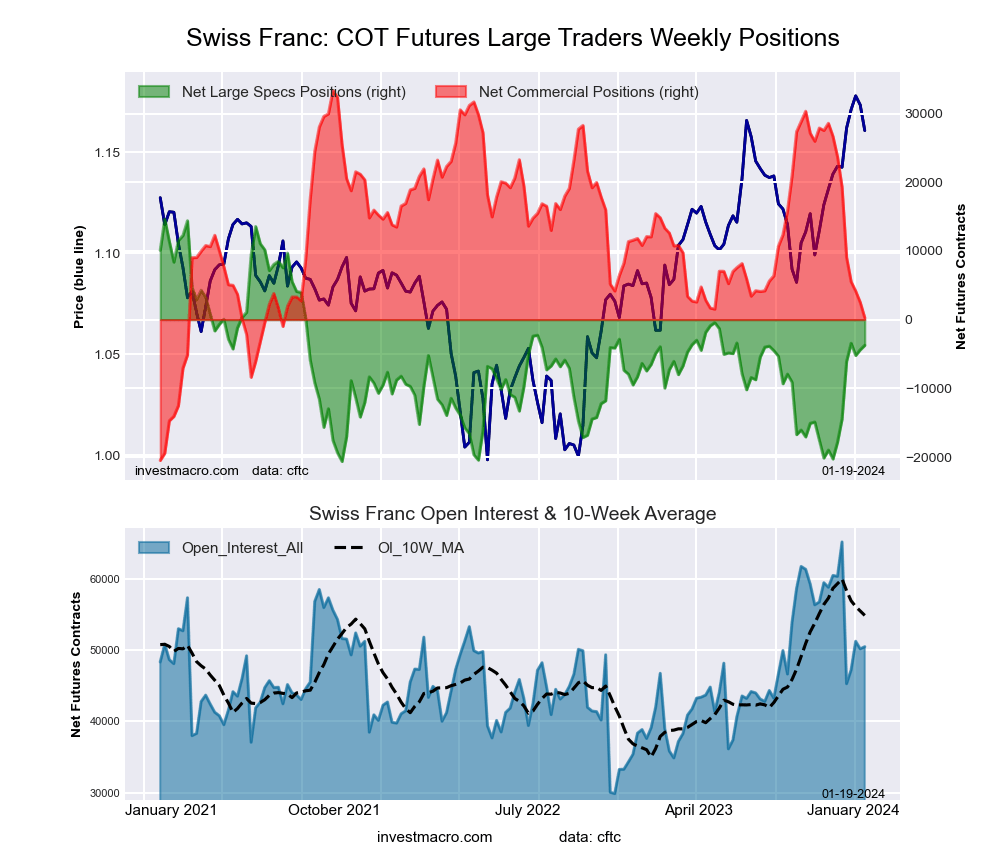
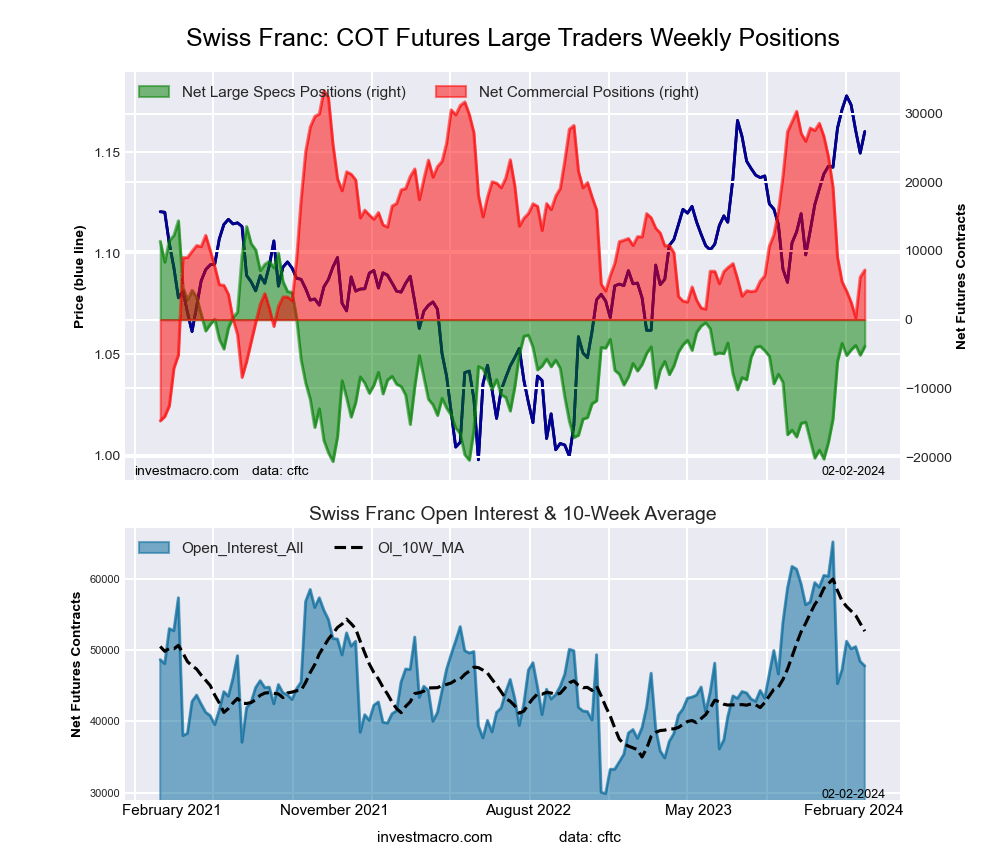
Swiss Franc Forex Futures COT ChartThe Swiss Franc large speculator standing this week recorded a net position of -16,742 contracts in the data reported through Tuesday. This was a weekly fall of -7,627 contracts from the previous week which had a total of -9,115 net contracts.

This week’s current strength score (the trader positioning range over the past three years, measured from 0 to 100) shows the speculators are currently Bearish-Extreme with a score of 10.7 percent. The commercials are Bullish-Extreme with a score of 89.1 percent and the small traders (not shown in chart) are Bearish with a score of 22.9 percent.

Price Trend-Following Model: Strong Downtrend

Our weekly trend-following model classifies the current market price position as: Strong Downtrend. The current action for the model is considered to be: New Sell – Short Position.

SWISS FRANC StatisticsSPECULATORSCOMMERCIALSSMALL TRADERS
– Percent of Open Interest Longs:19.065.615.4
– Percent of Open Interest Shorts:47.518.933.5
– Net Position:-16,74227,368-10,626
– Gross Longs:11,14338,4689,030
– Gross Shorts:27,88511,10019,656
– Long to Short Ratio:0.4 to 13.5 to 10.5 to 1
NET POSITION TREND:
– Strength Index Score (3 Year Range Pct):10.789.122.9
– Strength Index Reading (3 Year Range):Bearish-ExtremeBullish-ExtremeBearish
NET POSITION MOVEMENT INDEX:
– 6-Week Change in Strength Index:-35.339.4-32.0


Canadian Dollar Futures:

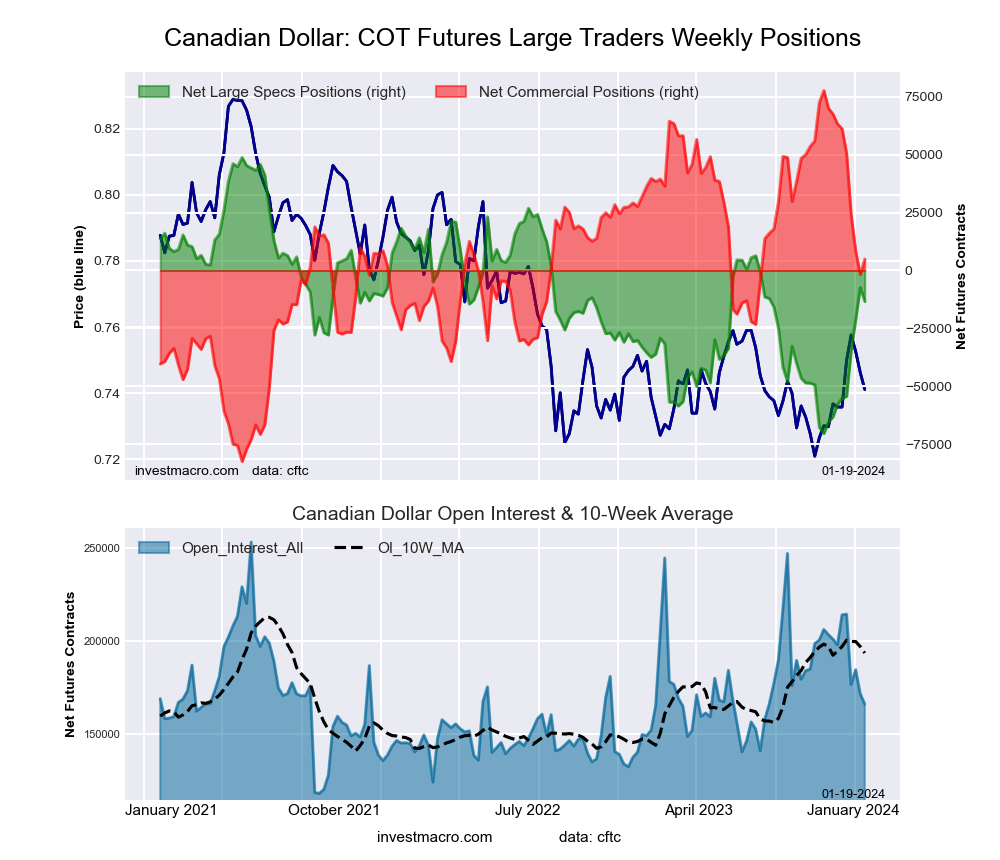
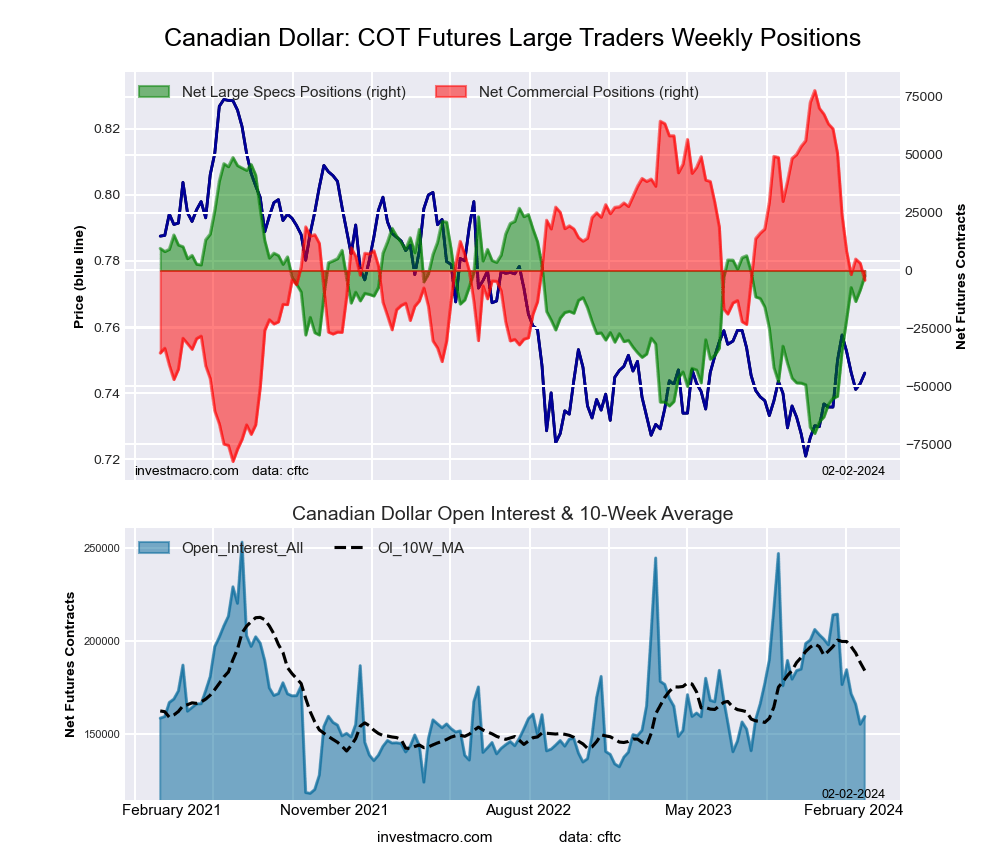
Canadian Dollar Forex Futures COT ChartThe Canadian Dollar large speculator standing this week recorded a net position of -40,151 contracts in the data reported through Tuesday. This was a weekly decline of -7,455 contracts from the previous week which had a total of -32,696 net contracts.

This week’s current strength score (the trader positioning range over the past three years, measured from 0 to 100) shows the speculators are currently Bearish-Extreme with a score of 17.1 percent. The commercials are Bullish-Extreme with a score of 82.4 percent and the small traders (not shown in chart) are Bearish with a score of 26.3 percent.

Price Trend-Following Model: Strong Downtrend

Our weekly trend-following model classifies the current market price position as: Strong Downtrend. The current action for the model is considered to be: Hold – Maintain Short Position.

CANADIAN DOLLAR StatisticsSPECULATORSCOMMERCIALSSMALL TRADERS
– Percent of Open Interest Longs:11.467.319.5
– Percent of Open Interest Shorts:32.646.918.6
– Net Position:-40,15138,5811,570
– Gross Longs:21,674127,50236,889
– Gross Shorts:61,82588,92135,319
– Long to Short Ratio:0.4 to 11.4 to 11.0 to 1
NET POSITION TREND:
– Strength Index Score (3 Year Range Pct):17.182.426.3
– Strength Index Reading (3 Year Range):Bearish-ExtremeBullish-ExtremeBearish
NET POSITION MOVEMENT INDEX:
– 6-Week Change in Strength Index:-26.215.312.5


Australian Dollar Futures:

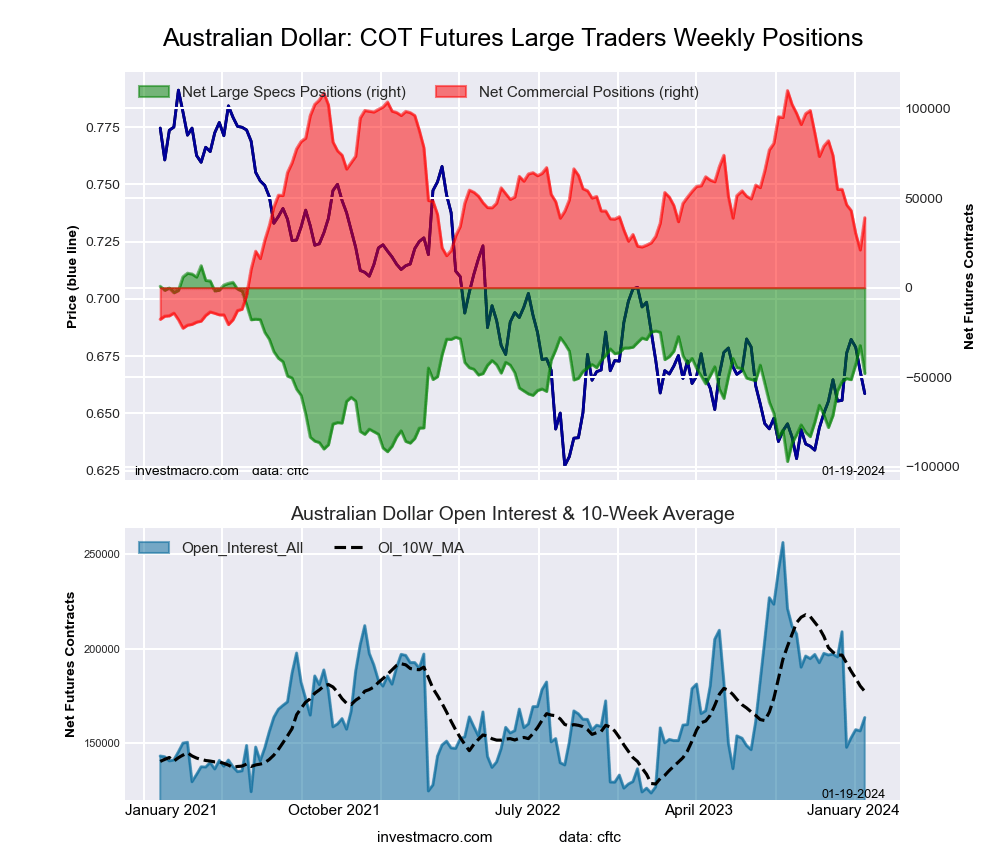
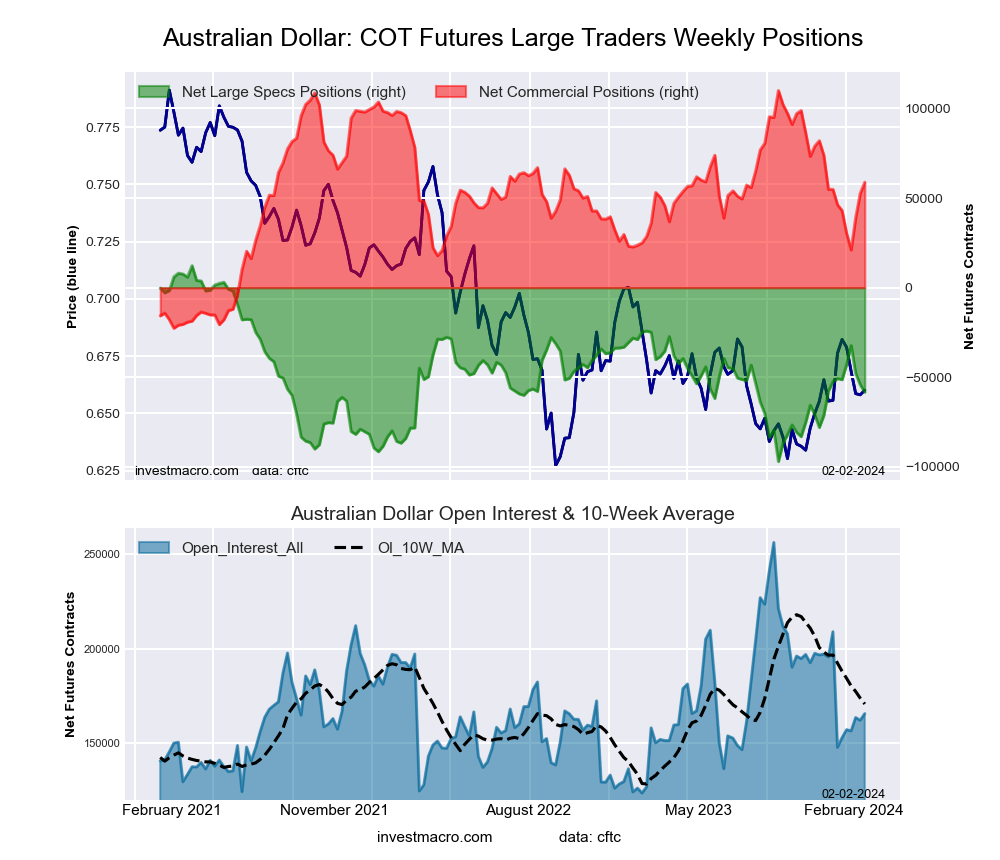
Australian Dollar Forex Futures COT ChartThe Australian Dollar large speculator standing this week recorded a net position of -81,987 contracts in the data reported through Tuesday. This was a weekly lift of 4,828 contracts from the previous week which had a total of -86,815 net contracts.

This week’s current strength score (the trader positioning range over the past three years, measured from 0 to 100) shows the speculators are currently Bearish-Extreme with a score of 13.7 percent. The commercials are Bullish-Extreme with a score of 90.4 percent and the small traders (not shown in chart) are Bearish-Extreme with a score of 15.2 percent.

Price Trend-Following Model: Strong Downtrend

Our weekly trend-following model classifies the current market price position as: Strong Downtrend. The current action for the model is considered to be: Hold – Maintain Short Position.

AUSTRALIAN DOLLAR StatisticsSPECULATORSCOMMERCIALSSMALL TRADERS
– Percent of Open Interest Longs:19.068.610.0
– Percent of Open Interest Shorts:58.521.817.3
– Net Position:-81,98797,266-15,279
– Gross Longs:39,465142,57220,690
– Gross Shorts:121,45245,30635,969
– Long to Short Ratio:0.3 to 13.1 to 10.6 to 1
NET POSITION TREND:
– Strength Index Score (3 Year Range Pct):13.790.415.2
– Strength Index Reading (3 Year Range):Bearish-ExtremeBullish-ExtremeBearish-Extreme
NET POSITION MOVEMENT INDEX:
– 6-Week Change in Strength Index:-16.715.4-5.3


New Zealand Dollar Futures:

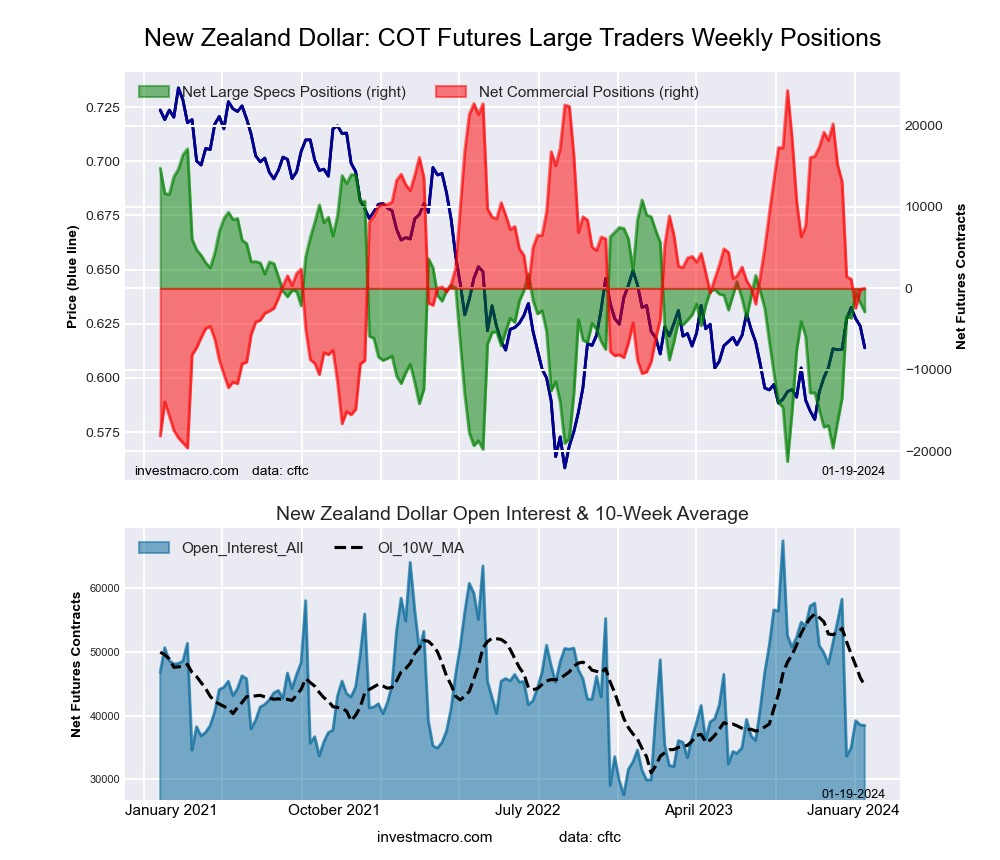
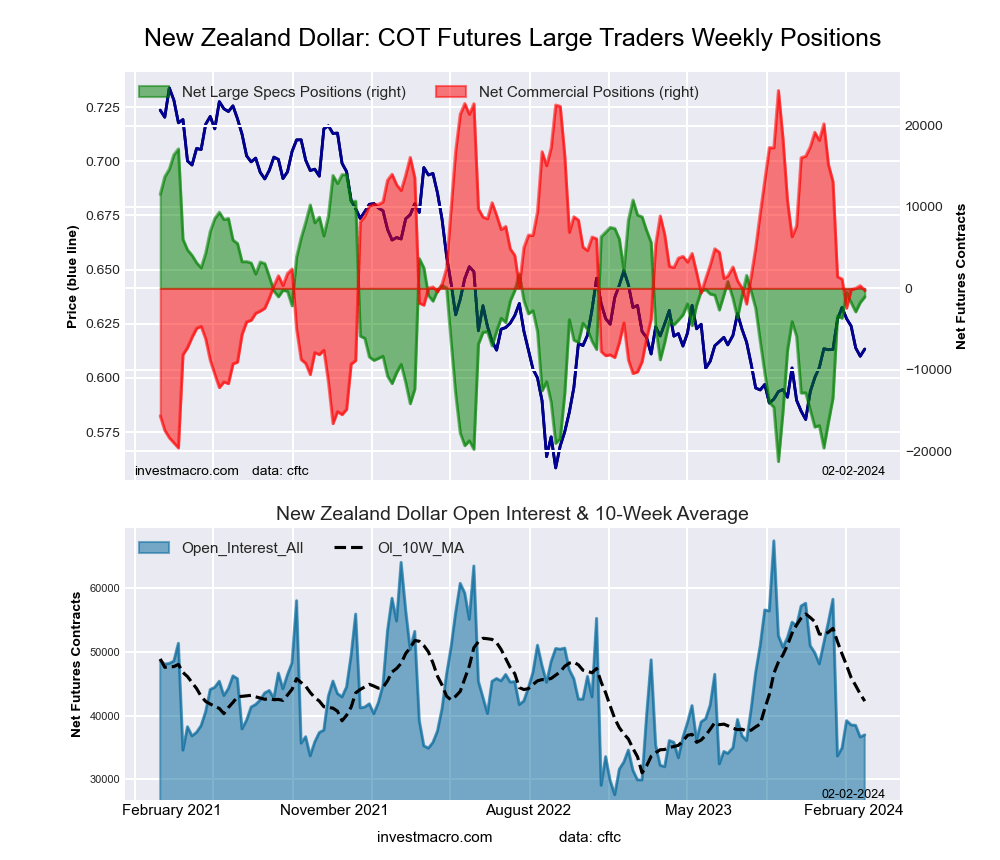
New Zealand Dollar Forex Futures COT ChartThe New Zealand Dollar large speculator standing this week recorded a net position of -7,650 contracts in the data reported through Tuesday. This was a weekly increase of 7,531 contracts from the previous week which had a total of -15,181 net contracts.

This week’s current strength score (the trader positioning range over the past three years, measured from 0 to 100) shows the speculators are currently Bearish with a score of 35.5 percent. The commercials are Bullish with a score of 69.1 percent and the small traders (not shown in chart) are Bearish-Extreme with a score of 13.5 percent.

Price Trend-Following Model: Downtrend

Our weekly trend-following model classifies the current market price position as: Downtrend. The current action for the model is considered to be: Hold – Maintain Short Position.

NEW ZEALAND DOLLAR StatisticsSPECULATORSCOMMERCIALSSMALL TRADERS
– Percent of Open Interest Longs:30.464.44.8
– Percent of Open Interest Shorts:45.043.910.6
– Net Position:-7,65010,717-3,067
– Gross Longs:15,89533,6512,497
– Gross Shorts:23,54522,9345,564
– Long to Short Ratio:0.7 to 11.5 to 10.4 to 1
NET POSITION TREND:
– Strength Index Score (3 Year Range Pct):35.569.113.5
– Strength Index Reading (3 Year Range):BearishBullishBearish-Extreme
NET POSITION MOVEMENT INDEX:
– 6-Week Change in Strength Index:-3.03.4-4.3


Mexican Peso Futures:

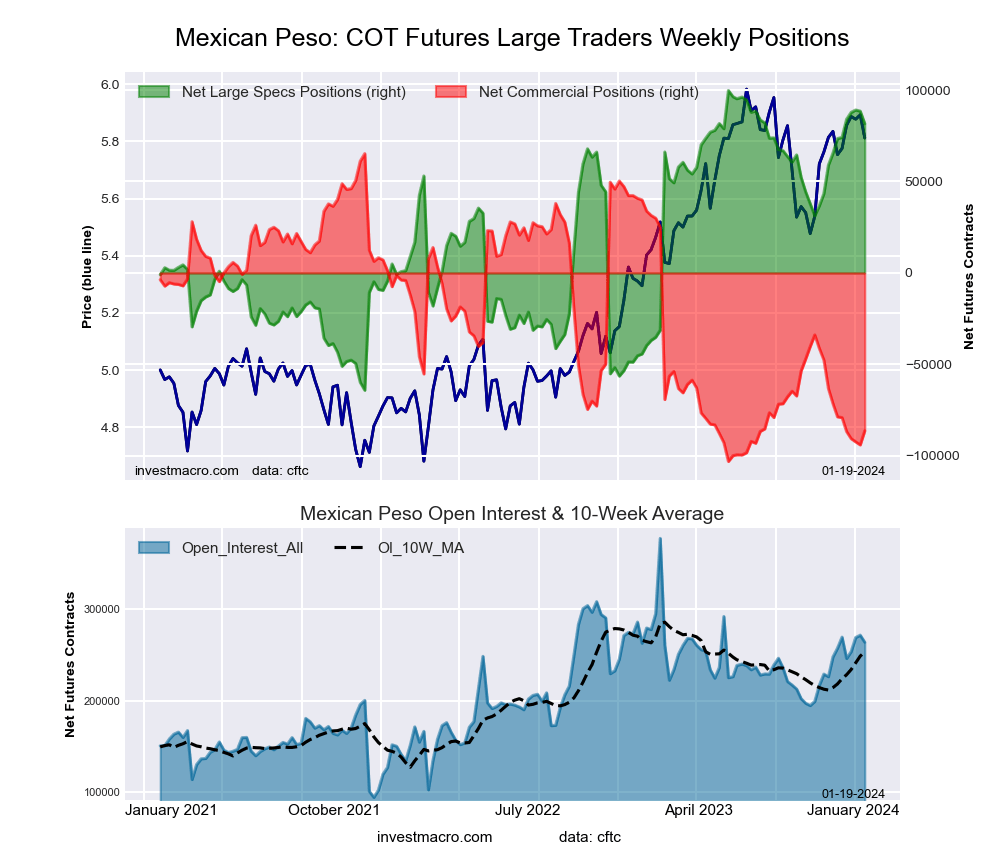
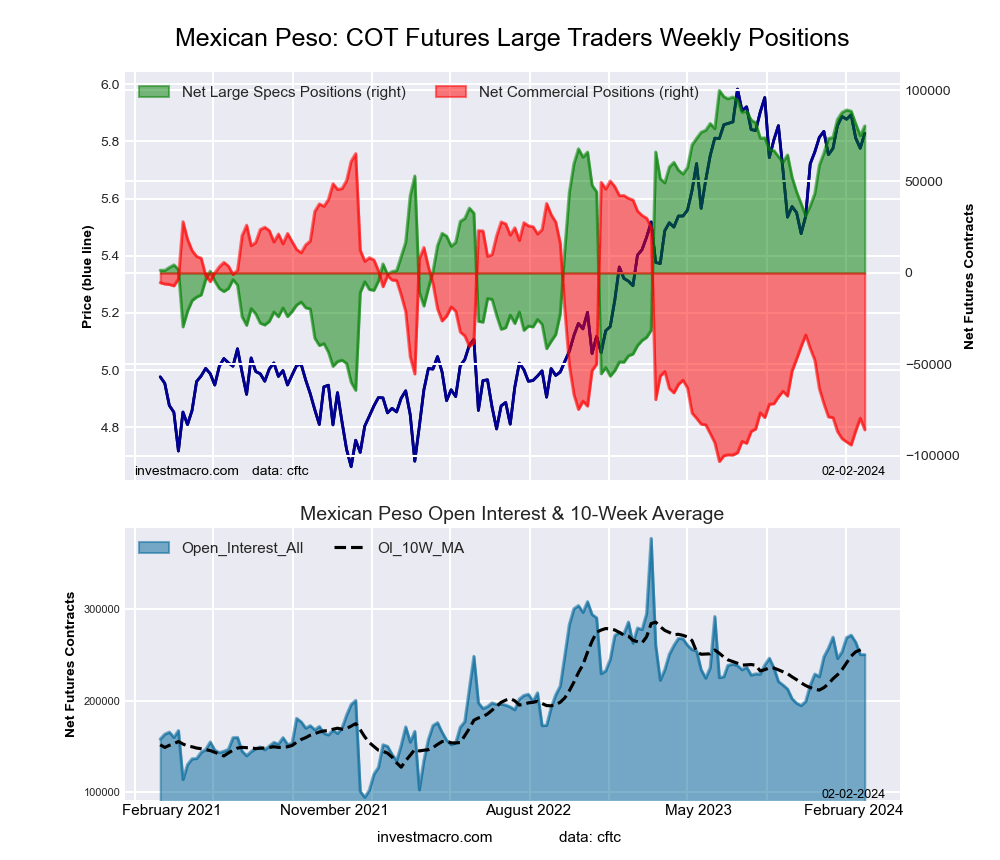
Mexican Peso Futures COT ChartThe Mexican Peso large speculator standing this week recorded a net position of 64,514 contracts in the data reported through Tuesday. This was a weekly advance of 3,881 contracts from the previous week which had a total of 60,633 net contracts.

This week’s current strength score (the trader positioning range over the past three years, measured from 0 to 100) shows the speculators are currently Bullish with a score of 78.5 percent. The commercials are Bearish with a score of 21.3 percent and the small traders (not shown in chart) are Bearish with a score of 28.6 percent.

Price Trend-Following Model: Strong Downtrend

Our weekly trend-following model classifies the current market price position as: Strong Downtrend. The current action for the model is considered to be: New Sell – Short Position.

MEXICAN PESO StatisticsSPECULATORSCOMMERCIALSSMALL TRADERS
– Percent of Open Interest Longs:42.753.72.8
– Percent of Open Interest Shorts:12.485.41.5
– Net Position:64,514-67,2482,734
– Gross Longs:90,848114,1855,986
– Gross Shorts:26,334181,4333,252
– Long to Short Ratio:3.4 to 10.6 to 11.8 to 1
NET POSITION TREND:
– Strength Index Score (3 Year Range Pct):78.521.328.6
– Strength Index Reading (3 Year Range):BullishBearishBearish
NET POSITION MOVEMENT INDEX:
– 6-Week Change in Strength Index:-5.65.4-0.2


Brazilian Real Futures:

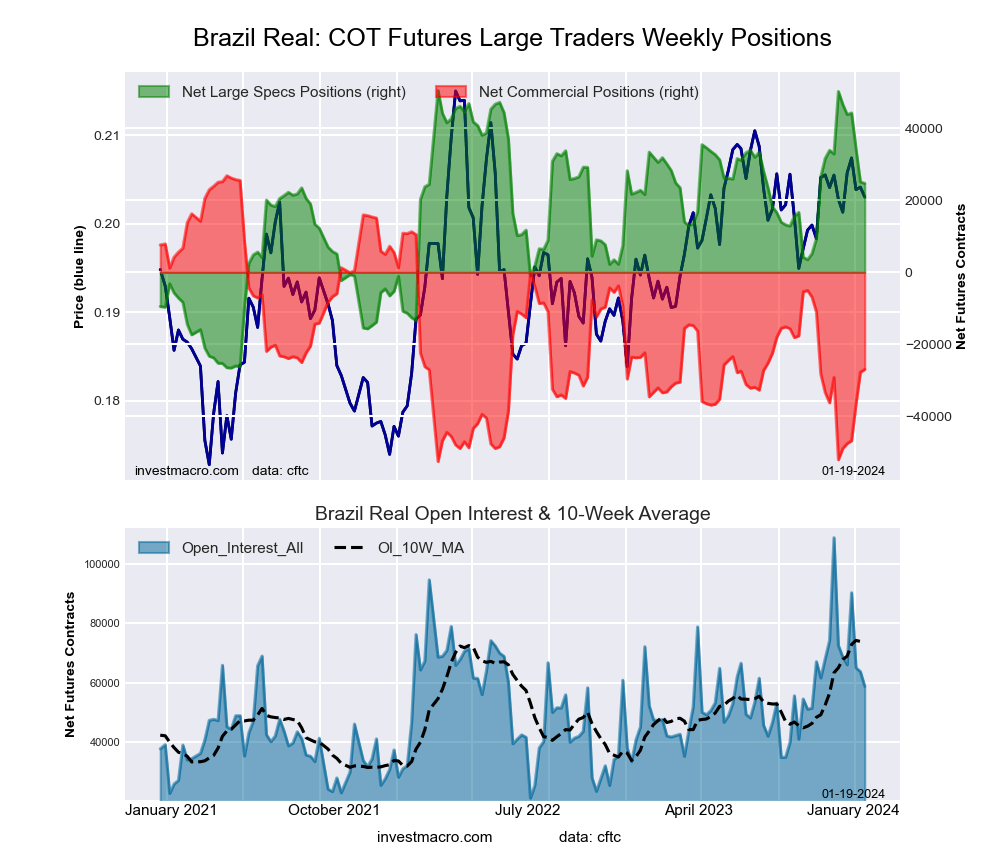
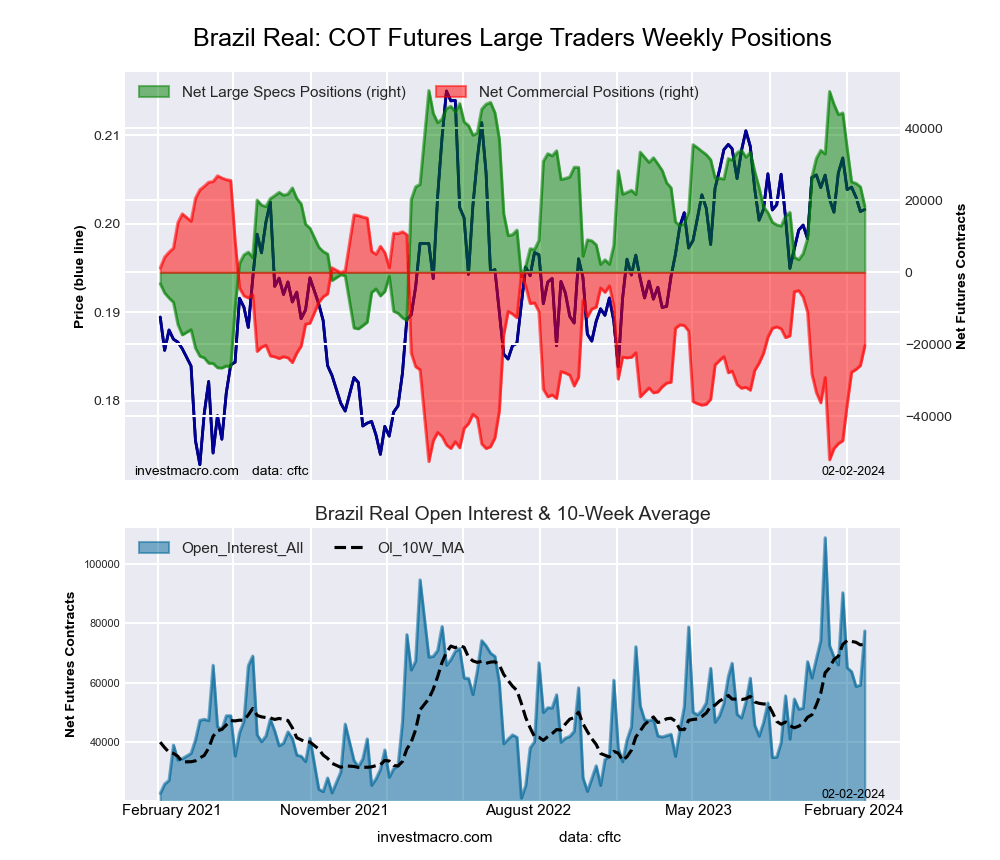
Brazil Real Futures COT ChartThe Brazilian Real large speculator standing this week recorded a net position of 16,637 contracts in the data reported through Tuesday. This was a weekly boost of 1,079 contracts from the previous week which had a total of 15,558 net contracts.

This week’s current strength score (the trader positioning range over the past three years, measured from 0 to 100) shows the speculators are currently Bullish with a score of 57.0 percent. The commercials are Bearish with a score of 43.0 percent and the small traders (not shown in chart) are Bearish with a score of 43.8 percent.

Price Trend-Following Model: Strong Downtrend

Our weekly trend-following model classifies the current market price position as: Strong Downtrend. The current action for the model is considered to be: Hold – Maintain Short Position.

BRAZIL REAL StatisticsSPECULATORSCOMMERCIALSSMALL TRADERS
– Percent of Open Interest Longs:61.031.97.0
– Percent of Open Interest Shorts:20.574.94.6
– Net Position:16,637-17,6431,006
– Gross Longs:25,02913,0862,888
– Gross Shorts:8,39230,7291,882
– Long to Short Ratio:3.0 to 10.4 to 11.5 to 1
NET POSITION TREND:
– Strength Index Score (3 Year Range Pct):57.043.043.8
– Strength Index Reading (3 Year Range):BullishBearishBearish
NET POSITION MOVEMENT INDEX:
– 6-Week Change in Strength Index:-2.06.0-31.0


Bitcoin Futures:

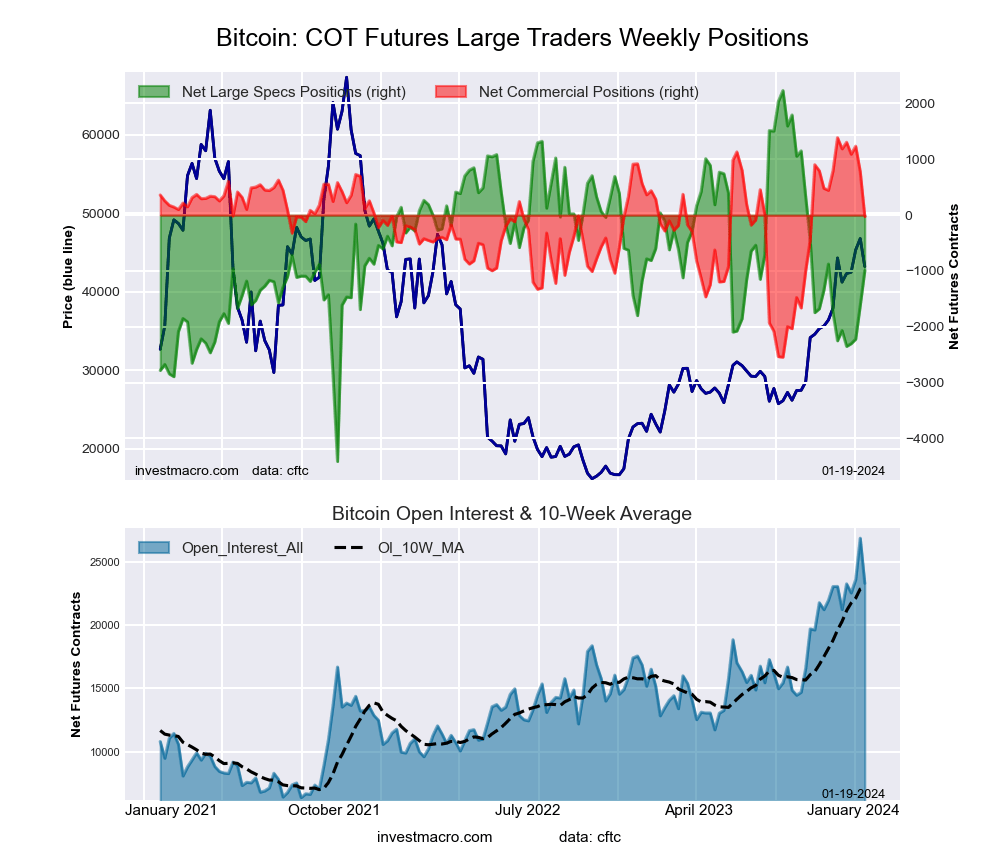
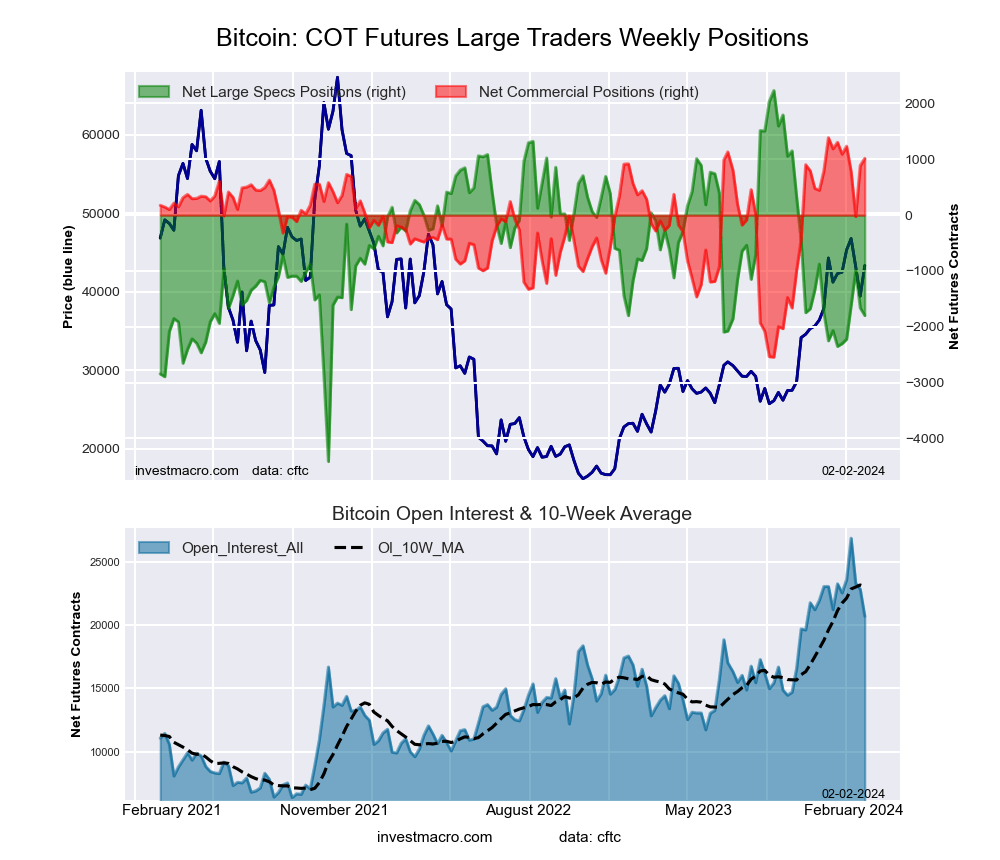
Bitcoin Crypto Futures COT ChartThe Bitcoin large speculator standing this week recorded a net position of 1,056 contracts in the data reported through Tuesday. This was a weekly reduction of -738 contracts from the previous week which had a total of 1,794 net contracts.

This week’s current strength score (the trader positioning range over the past three years, measured from 0 to 100) shows the speculators are currently Bullish-Extreme with a score of 82.3 percent. The commercials are Bearish with a score of 29.1 percent and the small traders (not shown in chart) are Bearish with a score of 22.5 percent.

Price Trend-Following Model: Weak Downtrend

Our weekly trend-following model classifies the current market price position as: Weak Downtrend. The current action for the model is considered to be: Hold – Maintain Short Position.

BITCOIN StatisticsSPECULATORSCOMMERCIALSSMALL TRADERS
– Percent of Open Interest Longs:82.81.18.3
– Percent of Open Interest Shorts:75.511.35.4
– Net Position:1,056-1,475419
– Gross Longs:11,9641611,195
– Gross Shorts:10,9081,636776
– Long to Short Ratio:1.1 to 10.1 to 11.5 to 1
NET POSITION TREND:
– Strength Index Score (3 Year Range Pct):82.329.122.5
– Strength Index Reading (3 Year Range):Bullish-ExtremeBearishBearish
NET POSITION MOVEMENT INDEX:
– 6-Week Change in Strength Index:-6.912.40.1


Article By InvestMacroReceive our weekly COT Newsletter

*COT Report: The COT data, released weekly to the public each Friday, is updated through the most recent Tuesday (data is 3 days old) and shows a quick view of how large speculators or non-commercials (for-profit traders) were positioned in the futures markets.

The CFTC categorizes trader positions according to commercial hedgers (traders who use futures contracts for hedging as part of the business), non-commercials (large traders who speculate to realize trading profits) and nonreportable traders (usually small traders/speculators) as well as their open interest (contracts open in the market at time of reporting). See CFTC criteria here.

Speculator Extremes: VIX, Heating Oil, Dow-Mini & 2-Year lead COT Bullish & Bearish Positions

By InvestMacro 

The latest update for the weekly Commitment of Traders (COT) report was released by the Commodity Futures Trading Commission (CFTC) on Friday for data ending on October 3rd.

This weekly Extreme Positions report highlights the Most Bullish and Most Bearish Positions for the speculator category. Extreme positioning in these markets can foreshadow strong moves in the underlying market.

To signify an extreme position, we use the Strength Index (also known as the COT Index) of each instrument, a common method of measuring COT data. The Strength Index is simply a comparison of current trader positions against the range of positions over the previous 3 years. We use over 80 percent as extremely bullish and under 20 percent as extremely bearish. (Compare Strength Index scores across all markets in the data table or cot leaders table)


Here Are This Week’s Most Bullish Speculator Positions:

VIX


The VIX speculator position comes in as the most bullish extreme standing this week. The VIX speculator level is currently at a 94.0 percent score of its 3-year range.

The six-week trend for the percent strength score totaled -4.7 this week. The overall net speculator position was a total of -34,193 net contracts this week with a change of 18,642 contract in the weekly speculator bets.


Speculators or Non-Commercials Notes:

Speculators, classified as non-commercial traders by the CFTC, are made up of large commodity funds, hedge funds and other significant for-profit participants. The Specs are generally regarded as trend-followers in their behavior towards price action – net speculator bets and prices tend to go in the same directions. These traders often look to buy when prices are rising and sell when prices are falling. To illustrate this point, many times speculator contracts can be found at their most extremes (bullish or bearish) when prices are also close to their highest or lowest levels.

These extreme levels can be dangerous for the large speculators as the trade is most crowded, there is less trading ammunition still sitting on the sidelines to push the trend further and prices have moved a significant distance. When the trend becomes exhausted, some speculators take profits while others look to also exit positions when prices fail to continue in the same direction. This process usually plays out over many months to years and can ultimately create a reverse effect where prices start to fall and speculators start a process of selling when prices are falling.


Heating Oil


The Heating Oil speculator position comes next in the extreme standings this week. The Heating Oil speculator level is now at a 93.0 percent score of its 3-year range.

The six-week trend for the percent strength score was -3.9 this week. The speculator position registered 38,946 net contracts this week with a weekly change of -3,181 contracts in speculator bets.


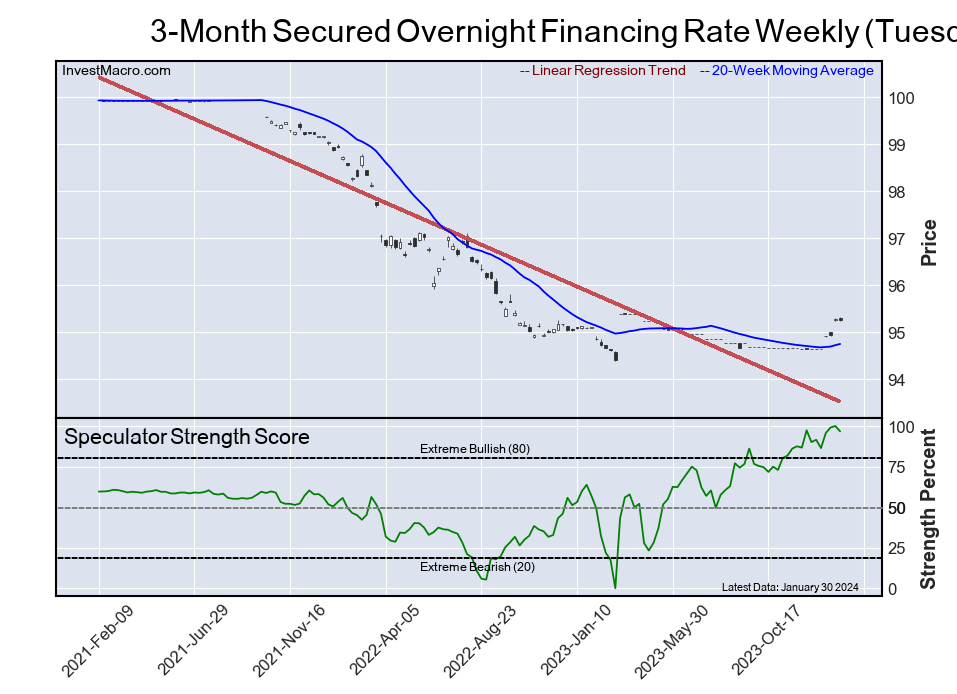
3-Month Secured Overnight Financing Rate


The 3-Month Secured Overnight Financing Rate speculator position comes in third this week in the extreme standings. The 3-Month Secured Overnight Financing Rate speculator level resides at a 87.6 percent score of its 3-year range.

The six-week trend for the speculator strength score came in at 14.4 this week. The overall speculator position was 292,306 net contracts this week with a change of -24,840 contracts in the weekly speculator bets.


Bloomberg Commodity Index


The Bloomberg Commodity Index speculator position comes up number four in the extreme standings this week. The Bloomberg Commodity Index speculator level is at a 86.2 percent score of its 3-year range.

The six-week trend for the speculator strength score totaled a change of 5.7 this week. The overall speculator position was -5,136 net contracts this week with a change of 1 contracts in the speculator bets.


Bitcoin


The Bitcoin speculator position rounds out the top five in this week’s bullish extreme standings. The Bitcoin speculator level sits at a 82.3 percent score of its 3-year range. The six-week trend for the speculator strength score was -6.9 this week.

The speculator position was 1,056 net contracts this week with a change of -738 contracts in the weekly speculator bets.


This Week’s Most Bearish Speculator Positions:

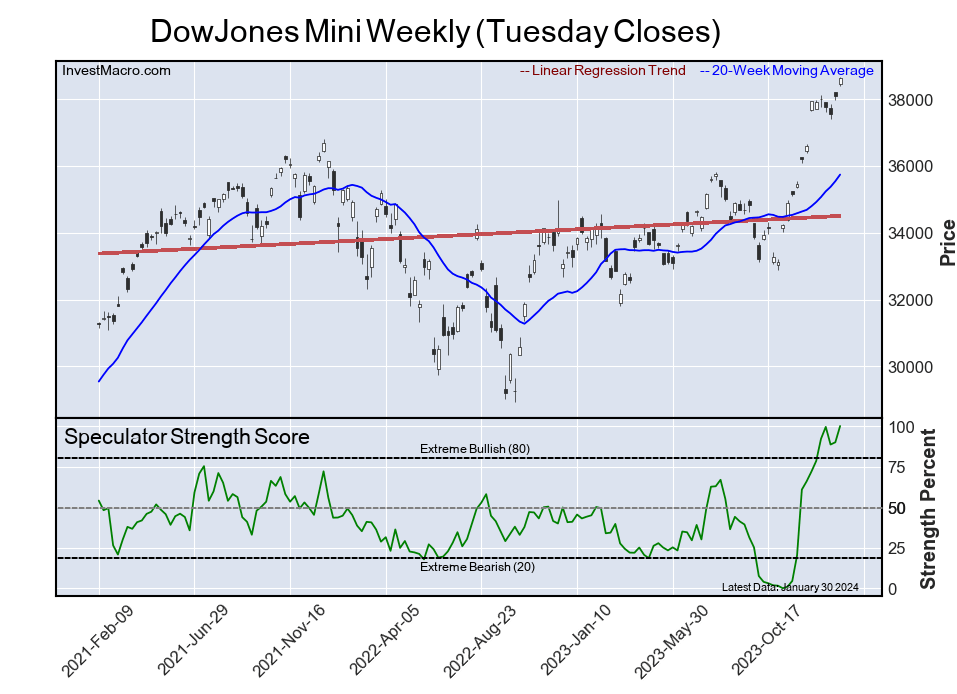
DowJones Mini


The DowJones Mini speculator position comes in as the most bearish extreme standing this week. The DowJones Mini speculator level is at a 0.0 percent score of its 3-year range.

The six-week trend for the speculator strength score was -42.6 this week. The overall speculator position was -32,447 net contracts this week with a change of -10,829 contracts in the speculator bets.


2-Year Bond


The 2-Year Bond speculator position comes in next for the most bearish extreme standing on the week. The 2-Year Bond speculator level is at a 0.0 percent score of its 3-year range.

The six-week trend for the speculator strength score was -0.5 this week. The speculator position was -1,278,301 net contracts this week with a change of -68,001 contracts in the weekly speculator bets.


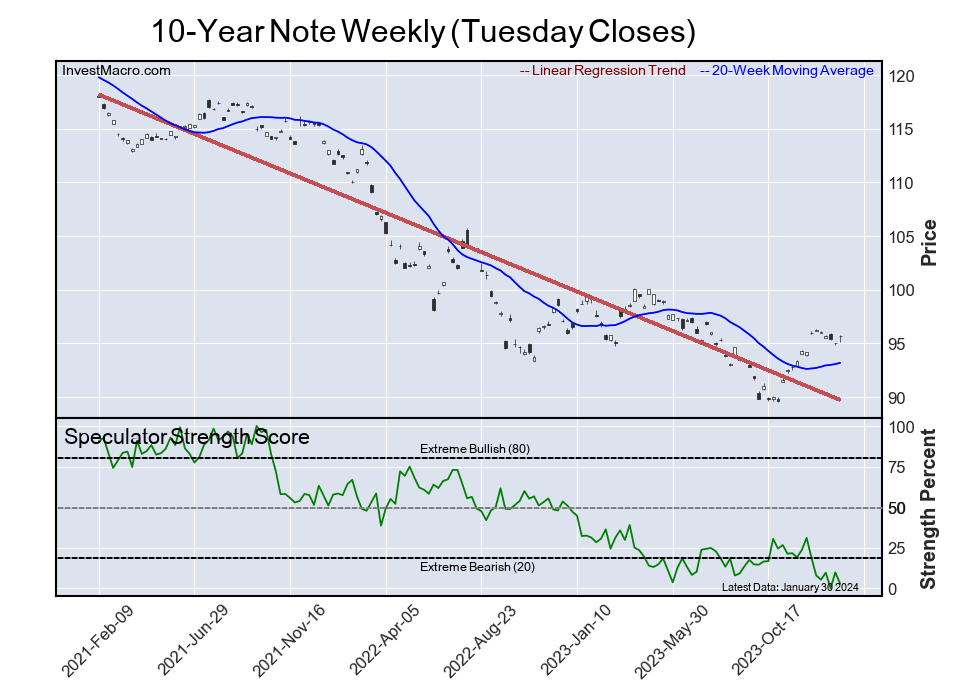
Ultra 10-Year U.S. T-Note


The Ultra 10-Year U.S. T-Note speculator position comes in as third most bearish extreme standing of the week. The Ultra 10-Year U.S. T-Note speculator level resides at a 0.0 percent score of its 3-year range.

The six-week trend for the speculator strength score was -17.8 this week. The overall speculator position was -244,907 net contracts this week with a change of -46,781 contracts in the speculator bets.


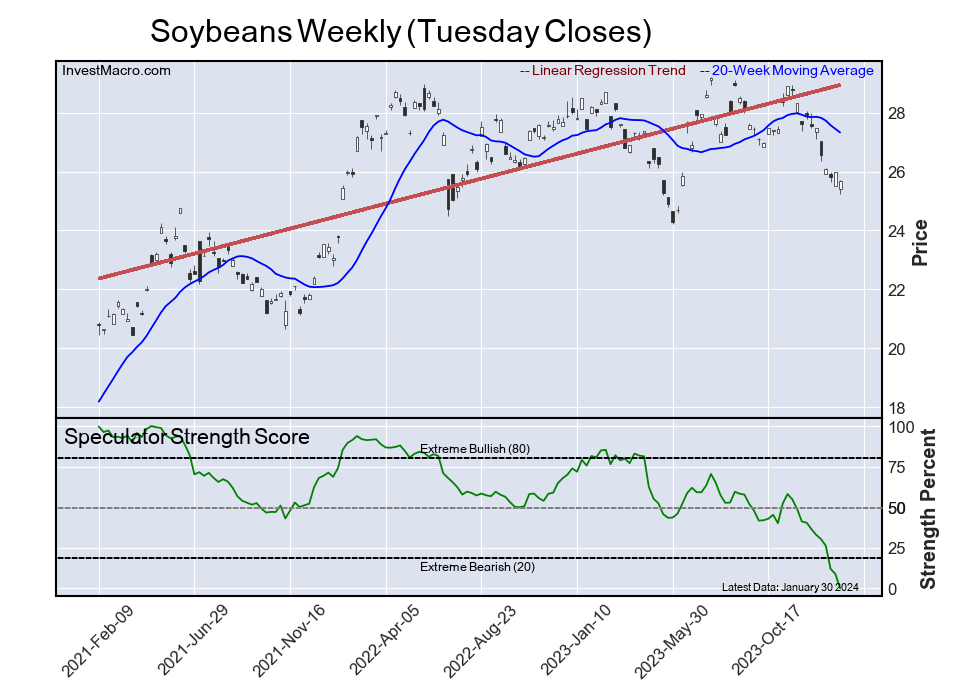
Soybeans


The Soybeans speculator position comes in as this week’s fourth most bearish extreme standing. The Soybeans speculator level is at a 0.0 percent score of its 3-year range.

The six-week trend for the speculator strength score was -16.8 this week. The speculator position was 22,503 net contracts this week with a change of -23,985 contracts in the weekly speculator bets.


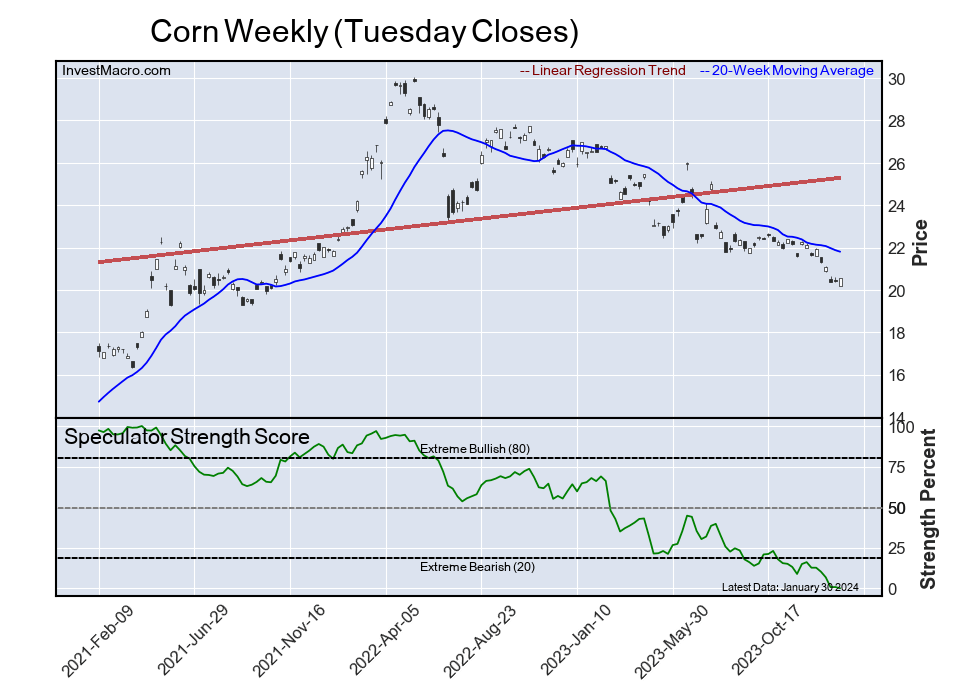
Corn


Finally, the Corn speculator position comes in as the fifth most bearish extreme standing for this week. The Corn speculator level is at a 1.7 percent score of its 3-year range.

The six-week trend for the speculator strength score was -8.4 this week. The speculator position was -107,544 net contracts this week with a change of 10,996 contracts in the weekly speculator bets.


Article By InvestMacroReceive our weekly COT Newsletter

*COT Report: The COT data, released weekly to the public each Friday, is updated through the most recent Tuesday (data is 3 days old) and shows a quick view of how large speculators or non-commercials (for-profit traders) were positioned in the futures markets.

The CFTC categorizes trader positions according to commercial hedgers (traders who use futures contracts for hedging as part of the business), non-commercials (large traders who speculate to realize trading profits) and nonreportable traders (usually small traders/speculators) as well as their open interest (contracts open in the market at time of reporting). See CFTC criteria here.
USDInd: Can dollar bulls sustain momentum?

By ForexTime

  • USDInd textbook uptrend approaches weekly resistance
  • 4 potential targets, if uptrend persists
  • Warning: Bearish divergence spotted
  • Bullish scenario is invalid if prices go below 105.672
  • Upcoming US jobs data may dictate USDInd’s next moves

The bulls in the USD Index on the D1 chart have been riding high.

The underlying US dollar index has climbed by 3.2% so far in 2023, with this textbook uptrend evident since mid-July as it posted consecutive higher tops and higher bottoms.

Although the bears are currently busy with a correction wave within that uptrend, the bulls seem to be gathering in numbers already.

Will they be able to sustain their momentum and start a new impulse wave?


Let us use the fractal nature of the market structure and look at the H4 chart to see what the market is saying.

The H4 chart reveals more details, with the most glaring being the bearish divergence between USDInd’s price chart and the MACD (Moving Average Convergence Divergence) Oscillator.

  • Looking at prices, note the higher top at ”a” followed by another higher top at “b”.
  • Meanwhile on the MACD, note that the ‘d’ top is lower than the top at “c”.

This suggests that a warning light might be flashing.

However, with the price being above the 50 Linear Weighted Moving Average, along with Momentum as well as the MACD Oscillator that are still in bullish territory, the uptrend may well prevail on the H4 timeframe.

Attaching a modified Fibonacci tool to a trigger level at 107.371 and dragging it to a stop loss just below a last proper swing at 105.672, four possible targets can be established:

  • Potential Target 1: 108.051
  • Potential Target 2: 108.390
  • Potential Target 3: 109.070
  • Potential Target 4: 109.919

However, take note, if the price at 105.672 is broken, this upward-looking scenario is no longer relevant.


From a fundamental perspective …

The incoming US jobs data could also influence this US Dollar index’s price movements going into the weekend:

  • Thursday, October 5th:
    US weekly initial jobless claims (forecast: 210k; higher than prior week’s 204k)
  • Friday, October 6th:
    US September nonfarm payrolls report (forecast: 170k; lower than August’s 187k)
    US September unemployment rate (forecast: 3.7%; lower than August’s 3.8%)
    US September average hourly earnings (forecast: rose 0.3% between August till September; higher than August’s 0.2% month-on-month)


Potential Scenarios

  • The USDInd may resume its uptrend if shown stronger-than-expected US jobs data, that allows the Fed to trigger another rate hike by end-2023 and keep benchmark US rates higher for longer.
  • However, the USDInd may pare recent gains if shown weaker-than-expected US jobs data, that prevents the Fed from another rate hike by end-2023 while perhaps paving the way for an eventual rate cut in the second half of 2024.

Forex-Time-LogoArticle by ForexTime

ForexTime Ltd (FXTM) is an award winning international online forex broker regulated by CySEC 185/12 www.forextime.com

Ichimoku Cloud Analysis 04.10.2023 (GBPUSD, USDCHF, BRENT)

By RoboForex.com

GBPUSD, “Great Britain Pound vs US Dollar”

GBPUSD is correcting within a Triangle pattern. The instrument is going below the Ichimoku Cloud, which suggests a downtrend. A test of the Kijun-Sen line at 1.2080 is expected, followed by a decline to 1.1965. An additional signal confirming the decline will be a rebound from the upper boundary of the descending channel. The scenario can be cancelled by a breakout of the upper boundary of the Cloud with the price securing above 1.2175, which will mean further growth to 1.2265. Meanwhile, the decline could be confirmed by a breakout of the lower boundary of the Triangle pattern with the price securing under 1.2040.

GBPUSD
Risk Warning: the result of previous trading operations do not guarantee the same results in the future

USDCHF, “US Dollar vs Swiss Franc”

USDCHF is testing the resistance level. The instrument is going above the Ichimoku Cloud, which suggests an uptrend. A test of the upper boundary of the bullish channel at 0.9195 is expected, followed by a rise to 0.9285. An additional signal confirming the rise will be a rebound from the lower boundary of the bullish channel. The scenario can be cancelled by a breakout of the lower boundary of the Cloud with the price securing under 0.9125, which will mean a further decline to 0.9035.

USDCHF
Risk Warning: the result of previous trading operations do not guarantee the same results in the future

BRENT

Brent is declining within a bearish channel. The instrument is going below the Ichimoku Cloud, which suggests a downtrend. A test of the lower boundary of the Cloud at 90.95 is expected, followed by a decline to 87.95. An additional signal confirming the decline will be a rebound from the upper boundary of the bearish channel. The scenario can be cancelled by a breakout of the upper boundary of the Cloud with the price securing above 92.25, which will mean further growth to 94.65. Meanwhile, the decline could be confirmed by a breakout of the lower boundary of the bullish channel with the price securing under 89.65.

BRENT

Article By RoboForex.com

Attention!
Forecasts presented in this section only reflect the author s private opinion and should not be considered as guidance for trading. RoboForex LP bears no responsibility for trading results based on trading recommendations described in these analytical reviews.

Explainer: What happened with USDJPY?

By ForexTime 

  • Strong US JOLTS data pushes USDJPY beyond 150.00
  • Currency pair later experiences aggressive selloff
  • Weak yen supporting speculation of government intervention
  • However, market still guessing what triggered spike in yen
  • USDJPY remains bullish with 150 key level of interest

Investors were in a frenzy on Tuesday after the USDJPY collapsed almost 300 pips in a matter of minutes.

This bombshell development ignited expectations that Japan’s government may have intervened to support the currency. However, the radio silence from Japanese officials left market watchers scratching their heads, guessing whether this was the case or not.

With the USDJPY clawing back most of its losses and cautiously moving back in the direction of 150.00, most are looking for answers and questioning what to expect next.

Here, we’ll explain what happened with the USDJPY, why it’s a big deal, and how it could impact your trading.

What exactly happened?

On Tuesday, the USDJPY pushed above 150.00 after US job openings (JOLTS) unexpectedly increased in August, raising questions around more rate hikes from the Fed. After peaking at 150.16 for the first time since October 2022, prices collapsed nearly 2% to 147.33!

The context

Last week, we discussed how the USDJPY was a ticking timebomb because it was trading at levels weaker than last year when Japan intervened. There was already chatter around 150 acting as a key level that could trigger government action.

Why did it happen?

The yen has depreciated roughly 12% against the dollar year-to-date. This puts pressure on Japan’s economy by making imports for many essentials more expensive, prolonging inflation which is above the Bank of Japan’s (BoJ) 2% target.

After USDJPY pushed beyond the 150 threshold, the aggressive selloff led to most speculating that Japan’s government intervened by purchasing large amounts of yen and selling dollars. This argument was supported by the fact that Yen was the sole G10 gainer vs USD yesterday.

Other possible triggers?

Markets are still guessing what exactly triggered the spike in the yen on Tuesday.

Other than possible government intervention, there is talk about a rate check by the BoJ or simply jittery markets in response to the USDJPY touching 150.00.

What is a rate check?

Rate checks are usually seen as a strong warning of potential currency intervention. This is when central bank officials call dealers and ask for buying and selling rates for the yen. The BoJ is said to have done this 8 days before intervening back in September 2022.

What could happen next?

Well, the good news is that investors will know whether Japan intervened and, if so, how much it spent at the end of this month when the Ministry of Finance releases monthly intervention data.

In the meantime, yen volatility is likely to remain a major theme – especially if prices push back towards the psychological 150.00 point.

Will the USDJPY keep pushing higher?

Focusing on the fundamental outlook, the threat of intervention around the 150.0 level could keep USDJPY bulls meek. Especially after the aggressive selloff witnessed in the previous session.

However, expectations around US interest rates staying higher for longer while the BoJ maintains its ultra-loose monetary policy could keep the USDJPY buoyed. This standoff between conflicting forces could place the currency pair on a rollercoaster ride.

Technical outlook

The USDJPY remains firmly bullish on the daily charts despite the aggressive selloff on Tuesday. Bulls remain in a position of power above the 147.50 level. A strong daily close above 150.00 could open a path towards 151.94. Should prices slip below 147.50, a decline towards 146.70 and 144.90 could be on the cards.


Forex-Time-LogoArticle by ForexTime

ForexTime Ltd (FXTM) is an award winning international online forex broker regulated by CySEC 185/12 www.forextime.com

Trade Of The Week: AUDNZD enters breakout mode

By ForexTime

  • AUDNZD has kicked of Q4 breaching 1.0720 support
  • Antipodean central bank decisions could move AUDNZD further
  • Neither RBA nor RBNZ expected to raise interest rates
  • However, fresh insight on future policy moves could spark volatility
  • Relative Strength Index (RSI) flirting near oversold territory

A central bank mashup featuring the Reserve Bank of Australia (RBA) and Reserve Bank of New Zealand (RBNZ) could trigger a significant move in the AUDNZD this week.

Since late June 2023, the currency pair has been trapped within a wide range on the daily charts with support around 1.0720 and resistance at 1.0920. However, the breakdown below key support this morning could be an early indication that a significant move may be on the horizon.

Neither the RBA nor the RBNZ are expected to raise interest rates this week. However, any fresh clues on future monetary policy moves could inject both the aussie and kiwi with fresh volatility.

But before we unpack how these antipodean central bank decisions could influence the AUDNZD, it is worth keeping in mind that the aussie has weakened against most G10 currencies year-to-date.

A similar theme was seen in the New Zealand dollar which depreciated across the G10 space.

Taking a brief look at the technical picture, prices remain trapped within a range on the weekly charts with key support at 1.0580 and resistance at 1.1050.

Here are 3 reasons why we could see some action on the AUDNZD this week:

  1. RBA rate decision on Tuesday 3rd October

The RBA’s first meeting under new Governor Michele Bullock is widely expected to conclude with interest rates left unchanged at 4.1%.

However, traders are still pricing in a 52 % probability of a 25-basis point hike by the end of 2023. Given how economic data since September has been mixed, investors will be paying very close attention to what the new RBA governor has to say.

  • Any hints from Bullock around the central bank keeping rates on hold could weaken the Aussie, pulling the AUDNZD lower as a result.
  • Should Bullock strike a hawkish note and signal another hike down the line, the Aussie may receive a boost – pushing the AUDNZD higher.
  1. RBNZ rate decision on Wednesday 4th October

Markets expect the RBNZ to keep its benchmark rate unchanged at 5.5% this week.

Although economic growth has surprised to the upside, confidence has been hit by rising oil prices. The threat of rising inflationary pressures may force the central bank to maintain a hawkish stance with traders currently pricing in a 58% of a 25-basis point rate hike by the end of 2023.

  • The kiwi could receive a boost if the RBNZ strikes a hawkish note and hints at one more hike in 2023 – dragging the AUDNZD lower as the NZD strengthens.
  • Any sense of caution or whiff of doves during the policy meeting is likely to weaken the NZD, pushing the AUDNZD higher as a result.
  1. Technical forces: breakout

After swinging within a wide range since late June, the AUDNZD experienced a breakdown this morning as prices cut below the 1.0720 support.

Prices are trading below the 50, 100, and 200 day SMA but the Relative Strength Index (RSI) is flirting near oversold territory.

  • Sustained weakness below 1.0720 may open a path towards 1.0580 and 1.0470.
  • Should 1.0720 prove to be reliable support, this could trigger a rebound towards  the 200-day SMA at 1.0820 before re-testing resistance a 1.0920.


Forex-Time-LogoArticle by ForexTime

ForexTime Ltd (FXTM) is an award winning international online forex broker regulated by CySEC 185/12 www.forextime.com

The Euro/Dollar exchange rate remains near its lowest levels

By RoboForex Analytical Department

The main currency pair starts the week and the month by consolidating around the 1.0569 mark.

The US Federal Reserve’s intention to potentially raise interest rates once again in 2023 is strengthening the position of the USD. The 10-year treasury bonds yield in the US remains at long-term highs regardless of a minor correction.

This week, statistics will be abundant in both the US and the eurozone. Employment sector reports for September in the US are expected to show stabilisation without any notable catalysts.

The eurozone will report on retail sales in August, the PPI, and business activity in the services sector. All these reports will provide insight into the state of the economic system. It is not certain whether there will be any catalyst among the European statistics to support the EUR, although this possibility exists.

Technical analysis of EUR/USD currency pair:

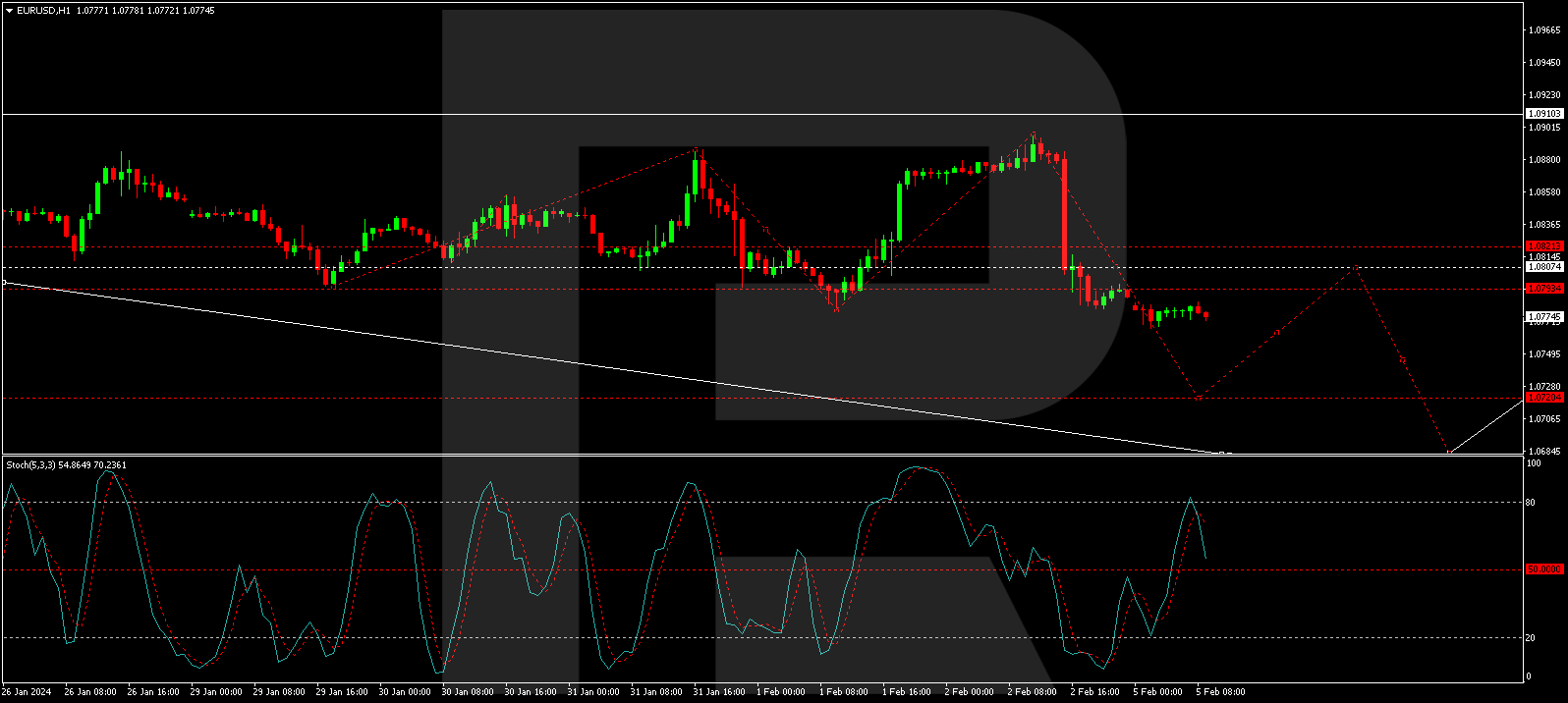
On the EURUSD H4 chart, a consolidation range has formed around 1.0700, reaching the local target of a declining wave at 1.0500 upon escaping the range downwards. Today the market has corrected to 1.0615. A new link of correction to 1.0620 is not excluded, followed by a decline to 1.0440. After reaching this level, a correction to 1.0700 could follow (with a test from below). Next, a decline to 1.0140 is expected. Technically, this scenario is confirmed by the MACD, whose signal line is below zero. The indicator is expected to set new lows.

On the EURUSD H1 chart, a movement in a declining wave to 1.0440 is forming. By now, the market has completed a consolidation range of around 1.0586, reaching the local target of a declining wave at 1.0500 with an escape from the range downwards. A link of correction to 1.0615 has formed today. A new price hike to 1.0620 is not excluded. Next, a new declining movement to 1.0440 is expected, followed by a rise to 1.0700. Technically, this scenario is confirmed by the Stochastic oscillator, whose signal line has rebounded from the 80 mark and is currently pointing sharply downwards. The line might eventually fall to the 20 mark.

Disclaimer

Any predictions contained herein are based on the author’s particular opinion. This analysis shall not be treated as trading advice. RoboForex shall not be held liable for the results of the trades arising from relying upon trading recommendations and reviews contained herein.

Speculators boost US Dollar Index bullish bets for 4th straight week to 38-week high

By InvestMacro

Here are the latest charts and statistics for the Commitment of Traders (COT) data published by the Commodities Futures Trading Commission (CFTC).

The latest COT data is updated through Tuesday September 26th and shows a quick view of how large market participants (for-profit speculators and commercial traders) were positioned in the futures markets. All currency positions are in direct relation to the US dollar where, for example, a bet for the euro is a bet that the euro will rise versus the dollar while a bet against the euro will be a bet that the euro will decline versus the dollar.

Weekly Speculator Changes led by New Zealand Dollar & Brazilian Real

The COT currency market speculator bets were higher this week as six out of the eleven currency markets we cover had higher positioning while the other five markets had lower speculator contracts.

Leading the gains for the currency markets was the Canadian Dollar (15,331 contracts) with the Australian Dollar (10,131 contracts), the New Zealand Dollar (6,091 contracts), the Brazilian Real (2,705 contracts), the US Dollar Index (1,124 contracts) and Bitcoin (197 contracts) also showing positive weeks.

The currencies seeing declines in speculator bets on the week were the British Pound (-18,014 contracts), the Japanese Yen (-7,893 contracts), the EuroFX (-3,582 contracts), the Swiss Franc (-1,180 contracts) and the Mexican Peso (-3,017 contracts) also registering lower bets on the week.

US Dollar Index Bullish Bets rise for 4th straight week to 38-week high

Highlighting the COT currency’s data this week is the rise of the speculator’s positioning in the US Dollar Index.

The large speculative US Dollar Index positions rose for a fourth straight week this week with the speculator position gaining by a total of +13,935 contracts over this last four-week span.

This renewed bullishness has brought the US Dollar Index speculator net position (currently at a total of +16,758 contracts) to a new 38-week high, dating back to January 3rd of this year when the speculator’s net position was at a total of +17,761 contracts.

The average weekly speculator position over 2023 has been a modest +11,409 contracts thus far. This follows a strong 2022 where the weekly average speculator position was +33,606 contracts.

The US Dollar Index price also soared over the course of 2022 and hit multi-decade highs with a top at 114.75 price level before retreating into the end of 2022. The Dollar Index has had an topsy-turvy 2023 with an early peak over 105 but then a lower valley that saw a decline to under the 100.00 price level in July. Since then, the Dollar Index has been on a strong run and is currently on a streak of gains for eleven consecutive weeks and closed this week back above the 105.00 level.


Data Snapshot of Forex Market Traders | Columns Legend
Sep-26-2023OIOI-IndexSpec-NetSpec-IndexCom-NetCOM-IndexSmalls-NetSmalls-Index
USD Index42,3734116,75853-18,636461,87829
EUR699,2713798,39962-124,4074326,00820
GBP227,8435415,66967-8,68741-6,98244
JPY285,974100-109,5125120,22794-10,71532
CHF53,90084-9,1153220,91477-11,79919
CAD175,84845-32,6962429,819762,87729
AUD211,88267-86,8159102,25094-15,43515
NZD50,75758-15,1811618,42187-3,24011
MXN216,9064360,63376-64,635234,00237
RUB20,93047,54331-7,15069-39324
BRL55,5884715,55856-18,138422,58058
Bitcoin14,844681,79493-2,033023918


Strength Scores led by Bitcoin & Mexican Peso

COT Strength Scores (a normalized measure of Speculator positions over a 3-Year range, from 0 to 100 where above 80 is Extreme-Bullish and below 20 is Extreme-Bearish) showed that Bitcoin (93 percent) and the Mexican Peso (76 percent) led the currency markets this week. The British Pound (67 percent), EuroFX (62 percent) and the Brazilian Real (56 percent) came in as the next highest in the weekly strength scores.

On the downside, the Japanese Yen (5 percent), the Australian Dollar (9 percent) and the New Zealand Dollar (16 percent) were at the lowest strength levels currently and are in Extreme-Bearish territory (below 20 percent).

Strength Statistics:
US Dollar Index (52.9 percent) vs US Dollar Index previous week (51.0 percent)
EuroFX (62.2 percent) vs EuroFX previous week (63.7 percent)
British Pound Sterling (66.6 percent) vs British Pound Sterling previous week (79.1 percent)
Japanese Yen (5.0 percent) vs Japanese Yen previous week (9.7 percent)
Swiss Franc (31.6 percent) vs Swiss Franc previous week (34.8 percent)
Canadian Dollar (24.1 percent) vs Canadian Dollar previous week (9.8 percent)
Australian Dollar (9.3 percent) vs Australian Dollar previous week (0.0 percent)
New Zealand Dollar (15.9 percent) vs New Zealand Dollar previous week (0.0 percent)
Mexican Peso (76.1 percent) vs Mexican Peso previous week (78.0 percent)
Brazilian Real (55.6 percent) vs Brazilian Real previous week (52.1 percent)
Bitcoin (93.4 percent) vs Bitcoin previous week (90.4 percent)


Bitcoin & US Dollar Index top the 6-Week Strength Trends

COT Strength Score Trends (or move index, calculates the 6-week changes in strength scores) showed that the Bitcoin (38 percent) and the US Dollar Index (20 percent) lead the past six weeks trends for the currencies and were the only currencies in positive trends.

The New Zealand Dollar (-33 percent) leads the downside trend scores currently with the Australian Dollar (-31 percent), EuroFX (-26 percent) and the British Pound (-25 percent) following next with lower trend scores.

Strength Trend Statistics:
US Dollar Index (19.6 percent) vs US Dollar Index previous week (21.7 percent)
EuroFX (-26.2 percent) vs EuroFX previous week (-20.4 percent)
British Pound Sterling (-24.5 percent) vs British Pound Sterling previous week (-9.3 percent)
Japanese Yen (-17.0 percent) vs Japanese Yen previous week (-10.9 percent)
Swiss Franc (-14.0 percent) vs Swiss Franc previous week (-6.8 percent)
Canadian Dollar (-19.8 percent) vs Canadian Dollar previous week (-44.2 percent)
Australian Dollar (-30.6 percent) vs Australian Dollar previous week (-49.2 percent)
New Zealand Dollar (-33.2 percent) vs New Zealand Dollar previous week (-54.4 percent)
Mexican Peso (-13.1 percent) vs Mexican Peso previous week (-12.2 percent)
Brazilian Real (-10.1 percent) vs Brazilian Real previous week (-19.3 percent)
Bitcoin (37.7 percent) vs Bitcoin previous week (41.3 percent)


Individual COT Forex Markets:

US Dollar Index Futures:

US Dollar Index Forex Futures COT ChartThe US Dollar Index large speculator standing this week resulted in a net position of 16,758 contracts in the data reported through Tuesday. This was a weekly increase of 1,124 contracts from the previous week which had a total of 15,634 net contracts.

This week’s current strength score (the trader positioning range over the past three years, measured from 0 to 100) shows the speculators are currently Bullish with a score of 52.9 percent. The commercials are Bearish with a score of 46.2 percent and the small traders (not shown in chart) are Bearish with a score of 28.5 percent.

Price Trend-Following Model: Strong Uptrend

Our weekly trend-following model classifies the current market price position as: Strong Uptrend. The current action for the model is considered to be: Hold – Maintain Long Position.

US DOLLAR INDEX StatisticsSPECULATORSCOMMERCIALSSMALL TRADERS
– Percent of Open Interest Longs:62.822.511.5
– Percent of Open Interest Shorts:23.266.57.1
– Net Position:16,758-18,6361,878
– Gross Longs:26,6069,5454,877
– Gross Shorts:9,84828,1812,999
– Long to Short Ratio:2.7 to 10.3 to 11.6 to 1
NET POSITION TREND:
– Strength Index Score (3 Year Range Pct):52.946.228.5
– Strength Index Reading (3 Year Range):BullishBearishBearish
NET POSITION MOVEMENT INDEX:
– 6-Week Change in Strength Index:19.6-20.010.2


Euro Currency Futures:

Euro Currency Futures COT ChartThe Euro Currency large speculator standing this week resulted in a net position of 98,399 contracts in the data reported through Tuesday. This was a weekly reduction of -3,582 contracts from the previous week which had a total of 101,981 net contracts.

This week’s current strength score (the trader positioning range over the past three years, measured from 0 to 100) shows the speculators are currently Bullish with a score of 62.2 percent. The commercials are Bearish with a score of 42.6 percent and the small traders (not shown in chart) are Bearish with a score of 20.5 percent.

Price Trend-Following Model: Strong Downtrend

Our weekly trend-following model classifies the current market price position as: Strong Downtrend. The current action for the model is considered to be: Hold – Maintain Short Position.

EURO Currency StatisticsSPECULATORSCOMMERCIALSSMALL TRADERS
– Percent of Open Interest Longs:30.255.311.8
– Percent of Open Interest Shorts:16.273.18.0
– Net Position:98,399-124,40726,008
– Gross Longs:211,516387,03082,167
– Gross Shorts:113,117511,43756,159
– Long to Short Ratio:1.9 to 10.8 to 11.5 to 1
NET POSITION TREND:
– Strength Index Score (3 Year Range Pct):62.242.620.5
– Strength Index Reading (3 Year Range):BullishBearishBearish
NET POSITION MOVEMENT INDEX:
– 6-Week Change in Strength Index:-26.230.3-31.0


British Pound Sterling Futures:

British Pound Sterling Futures COT ChartThe British Pound Sterling large speculator standing this week resulted in a net position of 15,669 contracts in the data reported through Tuesday. This was a weekly lowering of -18,014 contracts from the previous week which had a total of 33,683 net contracts.

This week’s current strength score (the trader positioning range over the past three years, measured from 0 to 100) shows the speculators are currently Bullish with a score of 66.6 percent. The commercials are Bearish with a score of 40.8 percent and the small traders (not shown in chart) are Bearish with a score of 44.3 percent.

Price Trend-Following Model: Strong Downtrend

Our weekly trend-following model classifies the current market price position as: Strong Downtrend. The current action for the model is considered to be: Hold – Maintain Short Position.

BRITISH POUND StatisticsSPECULATORSCOMMERCIALSSMALL TRADERS
– Percent of Open Interest Longs:37.248.011.6
– Percent of Open Interest Shorts:30.351.814.6
– Net Position:15,669-8,687-6,982
– Gross Longs:84,750109,26426,381
– Gross Shorts:69,081117,95133,363
– Long to Short Ratio:1.2 to 10.9 to 10.8 to 1
NET POSITION TREND:
– Strength Index Score (3 Year Range Pct):66.640.844.3
– Strength Index Reading (3 Year Range):BullishBearishBearish
NET POSITION MOVEMENT INDEX:
– 6-Week Change in Strength Index:-24.528.8-31.7


Japanese Yen Futures:

Japanese Yen Forex Futures COT ChartThe Japanese Yen large speculator standing this week resulted in a net position of -109,512 contracts in the data reported through Tuesday. This was a weekly decrease of -7,893 contracts from the previous week which had a total of -101,619 net contracts.

This week’s current strength score (the trader positioning range over the past three years, measured from 0 to 100) shows the speculators are currently Bearish-Extreme with a score of 5.0 percent. The commercials are Bullish-Extreme with a score of 94.3 percent and the small traders (not shown in chart) are Bearish with a score of 31.7 percent.

Price Trend-Following Model: Strong Downtrend

Our weekly trend-following model classifies the current market price position as: Strong Downtrend. The current action for the model is considered to be: Hold – Maintain Short Position.

JAPANESE YEN StatisticsSPECULATORSCOMMERCIALSSMALL TRADERS
– Percent of Open Interest Longs:16.169.912.3
– Percent of Open Interest Shorts:54.427.916.0
– Net Position:-109,512120,227-10,715
– Gross Longs:46,169200,01535,139
– Gross Shorts:155,68179,78845,854
– Long to Short Ratio:0.3 to 12.5 to 10.8 to 1
NET POSITION TREND:
– Strength Index Score (3 Year Range Pct):5.094.331.7
– Strength Index Reading (3 Year Range):Bearish-ExtremeBullish-ExtremeBearish
NET POSITION MOVEMENT INDEX:
– 6-Week Change in Strength Index:-17.014.5-2.4


Swiss Franc Futures:

Swiss Franc Forex Futures COT ChartThe Swiss Franc large speculator standing this week resulted in a net position of -9,115 contracts in the data reported through Tuesday. This was a weekly decline of -1,180 contracts from the previous week which had a total of -7,935 net contracts.

This week’s current strength score (the trader positioning range over the past three years, measured from 0 to 100) shows the speculators are currently Bearish with a score of 31.6 percent. The commercials are Bullish with a score of 77.4 percent and the small traders (not shown in chart) are Bearish-Extreme with a score of 18.7 percent.

Price Trend-Following Model: Weak Uptrend

Our weekly trend-following model classifies the current market price position as: Weak Uptrend. The current action for the model is considered to be: Hold – Maintain Long Position.

SWISS FRANC StatisticsSPECULATORSCOMMERCIALSSMALL TRADERS
– Percent of Open Interest Longs:23.059.317.7
– Percent of Open Interest Shorts:39.920.539.6
– Net Position:-9,11520,914-11,799
– Gross Longs:12,37731,9689,542
– Gross Shorts:21,49211,05421,341
– Long to Short Ratio:0.6 to 12.9 to 10.4 to 1
NET POSITION TREND:
– Strength Index Score (3 Year Range Pct):31.677.418.7
– Strength Index Reading (3 Year Range):BearishBullishBearish-Extreme
NET POSITION MOVEMENT INDEX:
– 6-Week Change in Strength Index:-14.030.3-41.8


Canadian Dollar Futures:

Canadian Dollar Forex Futures COT ChartThe Canadian Dollar large speculator standing this week resulted in a net position of -32,696 contracts in the data reported through Tuesday. This was a weekly increase of 15,331 contracts from the previous week which had a total of -48,027 net contracts.

This week’s current strength score (the trader positioning range over the past three years, measured from 0 to 100) shows the speculators are currently Bearish with a score of 24.1 percent. The commercials are Bullish with a score of 76.4 percent and the small traders (not shown in chart) are Bearish with a score of 29.2 percent.

Price Trend-Following Model: Strong Downtrend

Our weekly trend-following model classifies the current market price position as: Strong Downtrend. The current action for the model is considered to be: Hold – Maintain Short Position.

CANADIAN DOLLAR StatisticsSPECULATORSCOMMERCIALSSMALL TRADERS
– Percent of Open Interest Longs:9.768.719.2
– Percent of Open Interest Shorts:28.351.717.6
– Net Position:-32,69629,8192,877
– Gross Longs:17,006120,75833,799
– Gross Shorts:49,70290,93930,922
– Long to Short Ratio:0.3 to 11.3 to 11.1 to 1
NET POSITION TREND:
– Strength Index Score (3 Year Range Pct):24.176.429.2
– Strength Index Reading (3 Year Range):BearishBullishBearish
NET POSITION MOVEMENT INDEX:
– 6-Week Change in Strength Index:-19.810.911.6


Australian Dollar Futures:

Australian Dollar Forex Futures COT ChartThe Australian Dollar large speculator standing this week resulted in a net position of -86,815 contracts in the data reported through Tuesday. This was a weekly increase of 10,131 contracts from the previous week which had a total of -96,946 net contracts.

This week’s current strength score (the trader positioning range over the past three years, measured from 0 to 100) shows the speculators are currently Bearish-Extreme with a score of 9.3 percent. The commercials are Bullish-Extreme with a score of 94.1 percent and the small traders (not shown in chart) are Bearish-Extreme with a score of 14.8 percent.

Price Trend-Following Model: Strong Downtrend

Our weekly trend-following model classifies the current market price position as: Strong Downtrend. The current action for the model is considered to be: Hold – Maintain Short Position.

AUSTRALIAN DOLLAR StatisticsSPECULATORSCOMMERCIALSSMALL TRADERS
– Percent of Open Interest Longs:17.071.39.7
– Percent of Open Interest Shorts:58.023.017.0
– Net Position:-86,815102,250-15,435
– Gross Longs:36,104151,04120,512
– Gross Shorts:122,91948,79135,947
– Long to Short Ratio:0.3 to 13.1 to 10.6 to 1
NET POSITION TREND:
– Strength Index Score (3 Year Range Pct):9.394.114.8
– Strength Index Reading (3 Year Range):Bearish-ExtremeBullish-ExtremeBearish-Extreme
NET POSITION MOVEMENT INDEX:
– 6-Week Change in Strength Index:-30.627.9-8.7


New Zealand Dollar Futures:

New Zealand Dollar Forex Futures COT ChartThe New Zealand Dollar large speculator standing this week resulted in a net position of -15,181 contracts in the data reported through Tuesday. This was a weekly increase of 6,091 contracts from the previous week which had a total of -21,272 net contracts.

This week’s current strength score (the trader positioning range over the past three years, measured from 0 to 100) shows the speculators are currently Bearish-Extreme with a score of 15.9 percent. The commercials are Bullish-Extreme with a score of 86.6 percent and the small traders (not shown in chart) are Bearish-Extreme with a score of 11.4 percent.

Price Trend-Following Model: Downtrend

Our weekly trend-following model classifies the current market price position as: Downtrend. The current action for the model is considered to be: Hold – Maintain Short Position.

NEW ZEALAND DOLLAR StatisticsSPECULATORSCOMMERCIALSSMALL TRADERS
– Percent of Open Interest Longs:20.972.64.6
– Percent of Open Interest Shorts:50.936.311.0
– Net Position:-15,18118,421-3,240
– Gross Longs:10,63236,8672,340
– Gross Shorts:25,81318,4465,580
– Long to Short Ratio:0.4 to 12.0 to 10.4 to 1
NET POSITION TREND:
– Strength Index Score (3 Year Range Pct):15.986.611.4
– Strength Index Reading (3 Year Range):Bearish-ExtremeBullish-ExtremeBearish-Extreme
NET POSITION MOVEMENT INDEX:
– 6-Week Change in Strength Index:-33.230.6-8.4


Mexican Peso Futures:

Mexican Peso Futures COT ChartThe Mexican Peso large speculator standing this week resulted in a net position of 60,633 contracts in the data reported through Tuesday. This was a weekly lowering of -3,017 contracts from the previous week which had a total of 63,650 net contracts.

This week’s current strength score (the trader positioning range over the past three years, measured from 0 to 100) shows the speculators are currently Bullish with a score of 76.1 percent. The commercials are Bearish with a score of 22.8 percent and the small traders (not shown in chart) are Bearish with a score of 36.7 percent.

Price Trend-Following Model: Weak Uptrend

Our weekly trend-following model classifies the current market price position as: Weak Uptrend. The current action for the model is considered to be: Hold – Maintain Long Position.

MEXICAN PESO StatisticsSPECULATORSCOMMERCIALSSMALL TRADERS
– Percent of Open Interest Longs:42.853.33.0
– Percent of Open Interest Shorts:14.883.11.2
– Net Position:60,633-64,6354,002
– Gross Longs:92,732115,6166,587
– Gross Shorts:32,099180,2512,585
– Long to Short Ratio:2.9 to 10.6 to 12.5 to 1
NET POSITION TREND:
– Strength Index Score (3 Year Range Pct):76.122.836.7
– Strength Index Reading (3 Year Range):BullishBearishBearish
NET POSITION MOVEMENT INDEX:
– 6-Week Change in Strength Index:-13.112.25.1


Brazilian Real Futures:

Brazil Real Futures COT ChartThe Brazilian Real large speculator standing this week resulted in a net position of 15,558 contracts in the data reported through Tuesday. This was a weekly advance of 2,705 contracts from the previous week which had a total of 12,853 net contracts.

This week’s current strength score (the trader positioning range over the past three years, measured from 0 to 100) shows the speculators are currently Bullish with a score of 55.6 percent. The commercials are Bearish with a score of 42.3 percent and the small traders (not shown in chart) are Bullish with a score of 58.5 percent.

Price Trend-Following Model: Strong Downtrend

Our weekly trend-following model classifies the current market price position as: Strong Downtrend. The current action for the model is considered to be: New Sell – Short Position.

BRAZIL REAL StatisticsSPECULATORSCOMMERCIALSSMALL TRADERS
– Percent of Open Interest Longs:52.737.37.6
– Percent of Open Interest Shorts:24.770.03.0
– Net Position:15,558-18,1382,580
– Gross Longs:29,29820,7464,229
– Gross Shorts:13,74038,8841,649
– Long to Short Ratio:2.1 to 10.5 to 12.6 to 1
NET POSITION TREND:
– Strength Index Score (3 Year Range Pct):55.642.358.5
– Strength Index Reading (3 Year Range):BullishBearishBullish
NET POSITION MOVEMENT INDEX:
– 6-Week Change in Strength Index:-10.18.77.8


Bitcoin Futures:

Bitcoin Crypto Futures COT ChartThe Bitcoin large speculator standing this week resulted in a net position of 1,794 contracts in the data reported through Tuesday. This was a weekly lift of 197 contracts from the previous week which had a total of 1,597 net contracts.

This week’s current strength score (the trader positioning range over the past three years, measured from 0 to 100) shows the speculators are currently Bullish-Extreme with a score of 93.4 percent. The commercials are Bearish-Extreme with a score of 13.9 percent and the small traders (not shown in chart) are Bearish-Extreme with a score of 18.4 percent.

Price Trend-Following Model: Strong Downtrend

Our weekly trend-following model classifies the current market price position as: Strong Downtrend. The current action for the model is considered to be: Hold – Maintain Short Position.

BITCOIN StatisticsSPECULATORSCOMMERCIALSSMALL TRADERS
– Percent of Open Interest Longs:73.61.08.1
– Percent of Open Interest Shorts:61.514.76.5
– Net Position:1,794-2,033239
– Gross Longs:10,9301421,200
– Gross Shorts:9,1362,175961
– Long to Short Ratio:1.2 to 10.1 to 11.2 to 1
NET POSITION TREND:
– Strength Index Score (3 Year Range Pct):93.413.918.4
– Strength Index Reading (3 Year Range):Bullish-ExtremeBearish-ExtremeBearish-Extreme
NET POSITION MOVEMENT INDEX:
– 6-Week Change in Strength Index:37.7-55.7-10.4


Article By InvestMacroReceive our weekly COT Newsletter

See our Weekly Trend Model Readings and Actions for each COT Futures Market and Category. All information contained in this data are for general informational purposes only and do not constitute investment advice.

*COT Report: The COT data, released weekly to the public each Friday, is updated through the most recent Tuesday (data is 3 days old) and shows a quick view of how large speculators or non-commercials (for-profit traders) were positioned in the futures markets.

The CFTC categorizes trader positions according to commercial hedgers (traders who use futures contracts for hedging as part of the business), non-commercials (large traders who speculate to realize trading profits) and nonreportable traders (usually small traders/speculators) as well as their open interest (contracts open in the market at time of reporting). See CFTC criteria here.

Speculator Extremes: Heating Oil, Bitcoin, Corn & Bonds lead Bullish & Bearish Positions

By InvestMacro

The latest update for the weekly Commitment of Traders (COT) report was released by the Commodity Futures Trading Commission (CFTC) on Friday for data ending on September 26th.

This weekly Extreme Positions report highlights the Most Bullish and Most Bearish Positions for the speculator category. Extreme positioning in these markets can foreshadow strong moves in the underlying market.

To signify an extreme position, we use the Strength Index (also known as the COT Index) of each instrument, a common method of measuring COT data. The Strength Index is simply a comparison of current trader positions against the range of positions over the previous 3 years. We use over 80 percent as extremely bullish and under 20 percent as extremely bearish. (Compare Strength Index scores across all markets in the data table or cot leaders table)


Here Are This Week’s Most Bullish Speculator Positions:

Heating Oil


The Heating Oil speculator position comes in as the most bullish extreme standing this week. The Heating Oil speculator level is currently at a 98.6 percent score of its 3-year range.

The six-week trend for the percent strength score totaled 18.4 this week. The overall net speculator position was a total of 42,127 net contracts this week with a change of -774 contract in the weekly speculator bets.


Speculators or Non-Commercials Notes:

Speculators, classified as non-commercial traders by the CFTC, are made up of large commodity funds, hedge funds and other significant for-profit participants. The Specs are generally regarded as trend-followers in their behavior towards price action – net speculator bets and prices tend to go in the same directions. These traders often look to buy when prices are rising and sell when prices are falling. To illustrate this point, many times speculator contracts can be found at their most extremes (bullish or bearish) when prices are also close to their highest or lowest levels.

These extreme levels can be dangerous for the large speculators as the trade is most crowded, there is less trading ammunition still sitting on the sidelines to push the trend further and prices have moved a significant distance. When the trend becomes exhausted, some speculators take profits while others look to also exit positions when prices fail to continue in the same direction. This process usually plays out over many months to years and can ultimately create a reverse effect where prices start to fall and speculators start a process of selling when prices are falling.


Bitcoin


The Bitcoin speculator position comes next in the extreme standings this week. The Bitcoin speculator level is now at a 93.4 percent score of its 3-year range.

The six-week trend for the percent strength score was 37.7 this week. The speculator position registered 1,794 net contracts this week with a weekly change of 197 contracts in speculator bets.


Cocoa Futures


The Cocoa Futures speculator position comes in third this week in the extreme standings. The Cocoa Futures speculator level resides at a 90.1 percent score of its 3-year range.

The six-week trend for the speculator strength score came in at 1.4 this week. The overall speculator position was 78,538 net contracts this week with a change of -9,724 contracts in the weekly speculator bets.


3-Month Secured Overnight Financing Rate


The 3-Month Secured Overnight Financing Rate speculator position comes up number four in the extreme standings this week. The 3-Month Secured Overnight Financing Rate speculator level is at a 89.1 percent score of its 3-year range.

The six-week trend for the speculator strength score totaled a change of 18.8 this week. The overall speculator position was 317,146 net contracts this week with a change of -182,231 contracts in the speculator bets.


Bloomberg Commodity Index


The Bloomberg Commodity Index speculator position rounds out the top five in this week’s bullish extreme standings. The Bloomberg Commodity Index speculator level sits at a 86.2 percent score of its 3-year range. The six-week trend for the speculator strength score was 5.7 this week.

The speculator position was -5,137 net contracts this week with a change of 1,280 contracts in the weekly speculator bets.


This Week’s Most Bearish Speculator Positions:

Corn


The Corn speculator position comes in as the most bearish extreme standing this week. The Corn speculator level is at a 0.0 percent score of its 3-year range.

The six-week trend for the speculator strength score was -13.7 this week. The overall speculator position was -118,540 net contracts this week with a change of -17,307 contracts in the speculator bets.


Ultra 10-Year U.S. T-Note


The Ultra 10-Year U.S. T-Note speculator position comes in next for the most bearish extreme standing on the week. The Ultra 10-Year U.S. T-Note speculator level is at a 4.1 percent score of its 3-year range.

The six-week trend for the speculator strength score was -12.3 this week. The speculator position was -198,126 net contracts this week with a change of -61,389 contracts in the weekly speculator bets.


2-Year Bond


The 2-Year Bond speculator position comes in as third most bearish extreme standing of the week. The 2-Year Bond speculator level resides at a 4.5 percent score of its 3-year range.

The six-week trend for the speculator strength score was -6.8 this week. The overall speculator position was -1,210,300 net contracts this week with a change of 31,163 contracts in the speculator bets.


Palladium


The Palladium speculator position comes in as this week’s fourth most bearish extreme standing. The Palladium speculator level is at a 4.9 percent score of its 3-year range.

The six-week trend for the speculator strength score was -6.0 this week. The speculator position was -10,302 net contracts this week with a change of -72 contracts in the weekly speculator bets.


Japanese Yen


Finally, the Japanese Yen speculator position comes in as the fifth most bearish extreme standing for this week. The Japanese Yen speculator level is at a 5.0 percent score of its 3-year range.

The six-week trend for the speculator strength score was -17.0 this week. The speculator position was -109,512 net contracts this week with a change of -7,893 contracts in the weekly speculator bets.


Article By InvestMacroReceive our weekly COT Newsletter

*COT Report: The COT data, released weekly to the public each Friday, is updated through the most recent Tuesday (data is 3 days old) and shows a quick view of how large speculators or non-commercials (for-profit traders) were positioned in the futures markets.

The CFTC categorizes trader positions according to commercial hedgers (traders who use futures contracts for hedging as part of the business), non-commercials (large traders who speculate to realize trading profits) and nonreportable traders (usually small traders/speculators) as well as their open interest (contracts open in the market at time of reporting). See CFTC criteria here.