Archive for Forex and Currency News – Page 53

Trade Of The Week: GBPUSD on cusp of major breakout?

By ForexTime 

  • High-risk events could move GBPUSD
  • Fed/BoE combo + NFP in focus
  • GBPUSD bound within symmetrical triangle
  • Key levels of interest at 1.2800 & 1.2600
  • Who will win tug of war?

After swinging within a 200-pip range since mid-December, the GBPUSD could be on the verge of a big move.

This may be triggered by a selection of high-risk events featuring central bank decisions and key economic data. In addition, the symmetrical triangle pattern on the daily charts has the potential to intensify the direction of any breakout/down opportunity.

In the G10 space, Sterling has held its ground against the dollar year-to-date thanks to the BoE’s relatively hawkish tone amid stubborn inflation.

Nevertheless, the GBP and USD remain trapped in a fierce tug of war with a fresh catalyst needed to shift the scales of power in one direction.

Here are 3 factors that could trigger a breakout in the GBPUSD:

  1. BoE rate decision

On Thursday 1st February, the Bank of England (BoE) will meet for the first time this year to decide on interest rates. This will be accompanied by the minutes of the meeting, the quarterly Monetary Policy Report (MPR), and MPC press conference.

Markets widely expect the BoE to leave interest rates unchanged at 5.25% for a fourth straight meeting. Although there has been evidence of disinflation, hawks remain in the building with the central bank not expected to kick off its easing cycle until Summer.

Traders are currently pricing in a 60% probability of a 25-basis point cut by May 2024, with a cut by June 2024 fully priced in. 

  • If the BoE sounds hawkish and pushes back on rate-cut bets, this could boost GBPUSD.
  • A dovish-sounding BoE that hints at potential cuts down the road could weaken GBPUSD.
  1. Fed rate decision + NFP

Over the United States, the Federal Reserve meeting and US jobs data could rock the dollar.

The Fed is expected to leave interest rates unchanged this week but the odd of a March rate cut has now moved to roughly 50% according to Fed Fund futures. Regarding the NFP report, the US economy is expected to have created 180,000 jobs in December compared to 216,000 in the previous month. Ultimately, this combo of heavy-hitting events could translate to increased volatility for the USD – influencing the GBPUSD as a result. 

  • Should the Fed meeting and jobs data support the dollar, this may pull the GBPUSD lower. 
  • A dovish-sounding Fed and soft data is dollar bearish, providing support for GBPUSD.
  1. Technical forces

The GBPUSD has entered standby mode with prices bound within a symmetrical triangle pattern.

Bulls and bears remain entangled in a fierce battle despite prices trading above the 50, 100, and 200-day SMA. Major resistance can be found at 1.2800 and support at 1.2600. 

  • A decisive breakout above 1.2760 may open the doors towards 1.2800 and levels not seen since July 2023 at 1.2850. 
  • Should prices drop below the 50-day SMA at 1.2666, bears may be inspired to attack 1.2600 and the 200-day SMA at 1.2557. 


Forex-Time-LogoArticle by ForexTime

ForexTime Ltd (FXTM) is an award winning international online forex broker regulated by CySEC 185/12 www.forextime.com

Currency Speculators drop their US Dollar Index bets to 133-week low

By InvestMacro

Here are the latest charts and statistics for the Commitment of Traders (COT) data published by the Commodities Futures Trading Commission (CFTC).

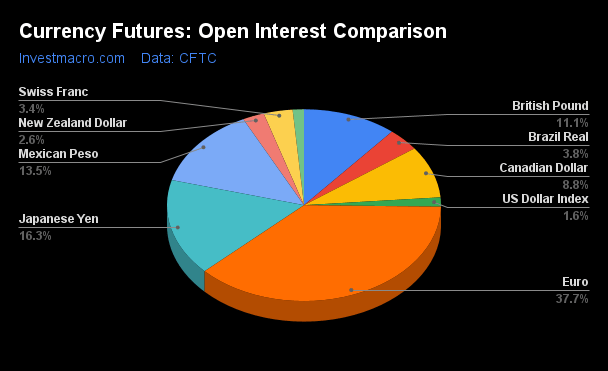
The latest COT data is updated through Tuesday January 16th and shows a quick view of how large market participants (for-profit speculators and commercial traders) were positioned in the futures markets. All currency positions are in direct relation to the US dollar where, for example, a bet for the euro is a bet that the euro will rise versus the dollar while a bet against the euro will be a bet that the euro will decline versus the dollar.

Weekly Speculator Changes led by British Pound Sterling & Swiss Franc

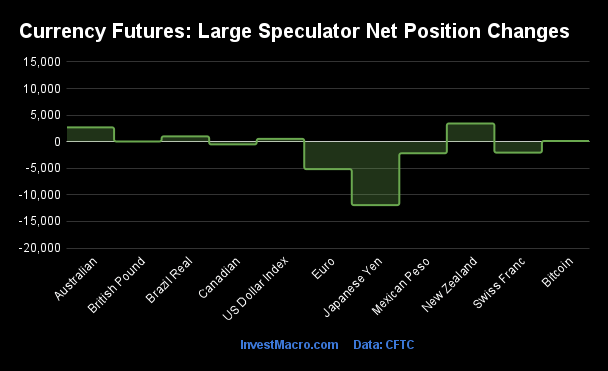
The COT currency market speculator bets were lower this week as three out of the eleven currency markets we cover had higher positioning while the other eight markets had lower speculator contracts.

Leading the gains for the currency markets was the British Pound (10,197 contracts) with the Swiss Franc (654 contracts) and Bitcoin (624 contracts) also recording positive weeks.

The currencies seeing declines in speculator bets on the week were the Australian Dollar (-15,583 contracts), the Euro (-14,785 contracts), the Mexican Peso (-6,837 contracts), the Canadian Dollar (-6,008 contracts), the US Dollar Index (-1,610 contracts), the New Zealand Dollar (-1,115 contracts), the Japanese Yen (-611 contracts) and with the Brazilian Real (-419 contracts) also seeing lower bets on the week.

Speculators drop their US Dollar Index bets to 133-week low

Highlighting the COT currency’s data this week is the continued decline of the speculator’s positioning in the US Dollar Index. The large speculative US Dollar Index positions fell this week for a fifth time out of the past six weeks. The speculator position has now seen an overall decrease by a total of -18,644 net contracts over this last six-week span.

This recent weakness has brought the US Dollar Index speculator net position (currently at a total of +1,300 contracts) to a 133-week low, dating back to June 29th of 2021 when the net position saw it’s last bearish reading at -448 contracts.

The Dollar Index is starting off 2024 on much weaker footing than the previous two years as expectations of peak interest rates in the US have weighed on the currency’s outlook. The Dollar Index’s speculator positioning started 2023 with a total of +17,761 contracts in the first week of trading and the average weekly speculator position over the whole of 2023 was +12,782 contracts. The first week of 2022 started even stronger with a net position of +39,078 contracts in the first week and the weekly average speculator position over the course of 2022 was +33,606 contracts.

The US Dollar Index price, despite the recent setback in speculator bets, has risen for two out of the past three weeks with an approximate gain by 1 percent this week. Since October, the USD Index has been on a downtrend and declined from an October high of 107.05 to the most recent low at 100.32 in late December. The USD Index price has come off that 100.00 support level and has now climbed back to the 103.07 level to close out this week.


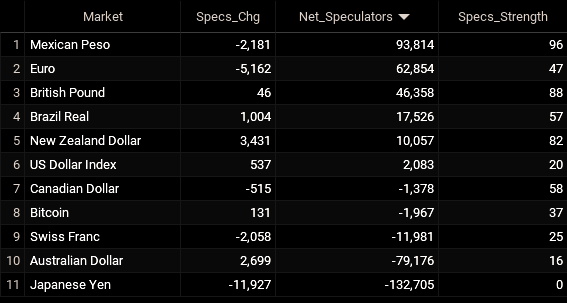
Major Currencies – Speculators Leaderboard


Legend: Weekly Speculators Change | Speculators Current Net Position | Speculators Strength Score compared to last 3-Years (0-100 range)


Strength Scores led by Mexican Peso & British Pound
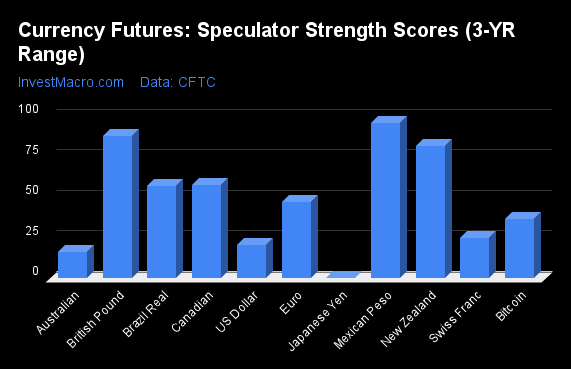
COT Strength Scores (a normalized measure of Speculator positions over a 3-Year range, from 0 to 100 where above 80 is Extreme-Bullish and below 20 is Extreme-Bearish) showed that the Mexican Peso (89 percent) and the British Pound (77 percent) lead the currency markets this week. The Brazilian Real (67 percent), EuroFX (65 percent) and Bitcoin (51 percent) come in as the next highest in the weekly strength scores.

On the downside, the US Dollar Index (27 percent) and the Japanese Yen (42 percent) come in at the lowest strength levels currently.

Strength Statistics:
US Dollar Index (27.0 percent) vs US Dollar Index previous week (29.6 percent)
EuroFX (64.6 percent) vs EuroFX previous week (70.9 percent)
British Pound Sterling (77.2 percent) vs British Pound Sterling previous week (70.2 percent)
Japanese Yen (42.1 percent) vs Japanese Yen previous week (42.4 percent)
Swiss Franc (47.9 percent) vs Swiss Franc previous week (46.1 percent)
Canadian Dollar (47.8 percent) vs Canadian Dollar previous week (52.9 percent)
Australian Dollar (44.9 percent) vs Australian Dollar previous week (59.2 percent)
New Zealand Dollar (47.9 percent) vs New Zealand Dollar previous week (50.8 percent)
Mexican Peso (88.9 percent) vs Mexican Peso previous week (93.1 percent)
Brazilian Real (66.5 percent) vs Brazilian Real previous week (67.1 percent)
Bitcoin (51.4 percent) vs Bitcoin previous week (42.1 percent)


Swiss Franc & Canadian Dollar top the 6-Week Strength Trends

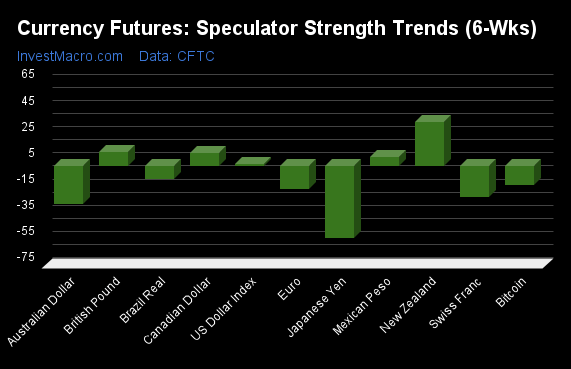
COT Strength Score Trends (or move index, calculates the 6-week changes in strength scores) showed that the Swiss Franc (40 percent) and the Canadian Dollar (37 percent) lead the past six weeks trends for the currencies. The New Zealand Dollar (35 percent), the Japanese Yen (28 percent) and Bitcoin (19 percent) are the next highest positive movers in the latest trends data.

The Brazilian Real (-33 percent) leads the downside trend scores currently with the US Dollar Index (-31 percent) and the EuroFX (-21 percent) following next with lower trend scores.

Strength Trend Statistics:
US Dollar Index (-31.2 percent) vs US Dollar Index previous week (-27.0 percent)
EuroFX (-20.6 percent) vs EuroFX previous week (-10.3 percent)
British Pound Sterling (13.4 percent) vs British Pound Sterling previous week (19.9 percent)
Japanese Yen (27.6 percent) vs Japanese Yen previous week (30.4 percent)
Swiss Franc (40.0 percent) vs Swiss Franc previous week (45.0 percent)
Canadian Dollar (37.3 percent) vs Canadian Dollar previous week (46.9 percent)
Australian Dollar (9.0 percent) vs Australian Dollar previous week (35.7 percent)
New Zealand Dollar (35.3 percent) vs New Zealand Dollar previous week (46.5 percent)
Mexican Peso (5.0 percent) vs Mexican Peso previous week (14.0 percent)
Brazilian Real (-33.1 percent) vs Brazilian Real previous week (-10.1 percent)
Bitcoin (18.9 percent) vs Bitcoin previous week (1.9 percent)


Individual COT Forex Markets:

US Dollar Index Futures:
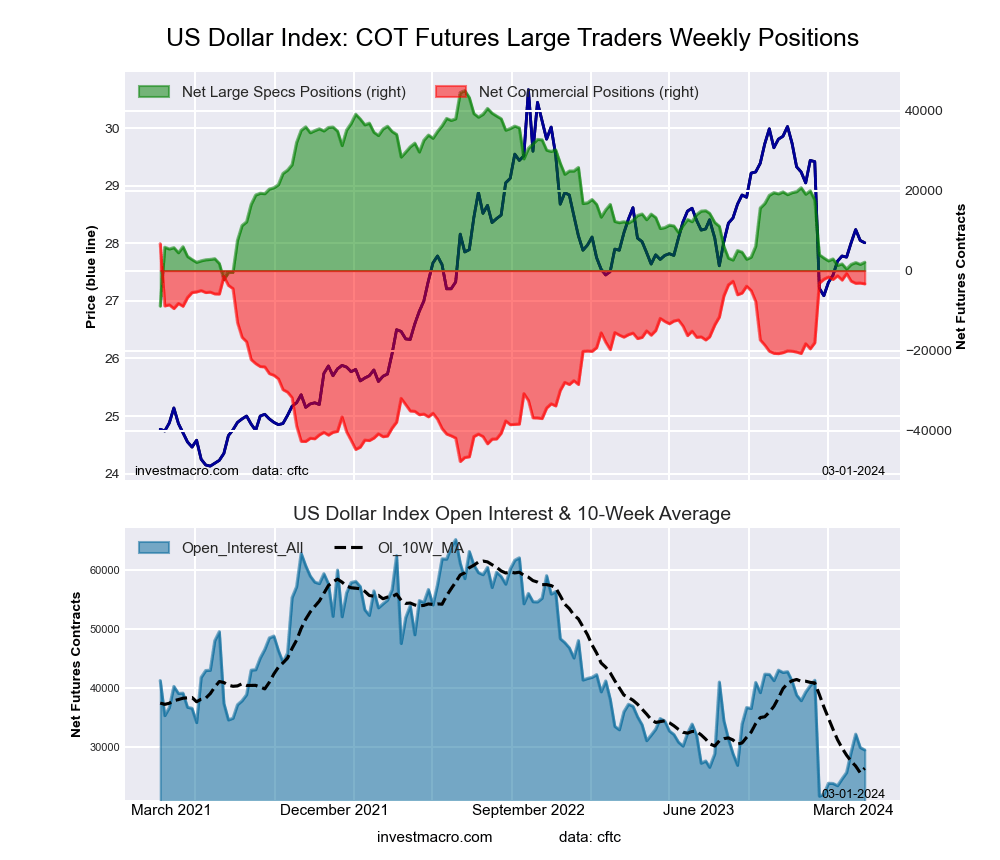
US Dollar Index Forex Futures COT ChartThe US Dollar Index large speculator standing this week came in at a net position of 1,300 contracts in the data reported through Tuesday. This was a weekly lowering of -1,610 contracts from the previous week which had a total of 2,910 net contracts.

This week’s current strength score (the trader positioning range over the past three years, measured from 0 to 100) shows the speculators are currently Bearish with a score of 27.0 percent. The commercials are Bullish with a score of 76.3 percent and the small traders (not shown in chart) are Bearish-Extreme with a score of 11.1 percent.

Price Trend-Following Model: Strong Downtrend

Our weekly trend-following model classifies the current market price position as: Strong Downtrend. The current action for the model is considered to be: Hold – Maintain Short Position.

US DOLLAR INDEX StatisticsSPECULATORSCOMMERCIALSSMALL TRADERS
– Percent of Open Interest Longs:64.216.711.8
– Percent of Open Interest Shorts:58.622.211.9
– Net Position:1,300-1,292-8
– Gross Longs:15,0773,9182,781
– Gross Shorts:13,7775,2102,789
– Long to Short Ratio:1.1 to 10.8 to 11.0 to 1
NET POSITION TREND:
– Strength Index Score (3 Year Range Pct):27.076.311.1
– Strength Index Reading (3 Year Range):BearishBullishBearish-Extreme
NET POSITION MOVEMENT INDEX:
– 6-Week Change in Strength Index:-31.230.04.4


Euro Currency Futures:

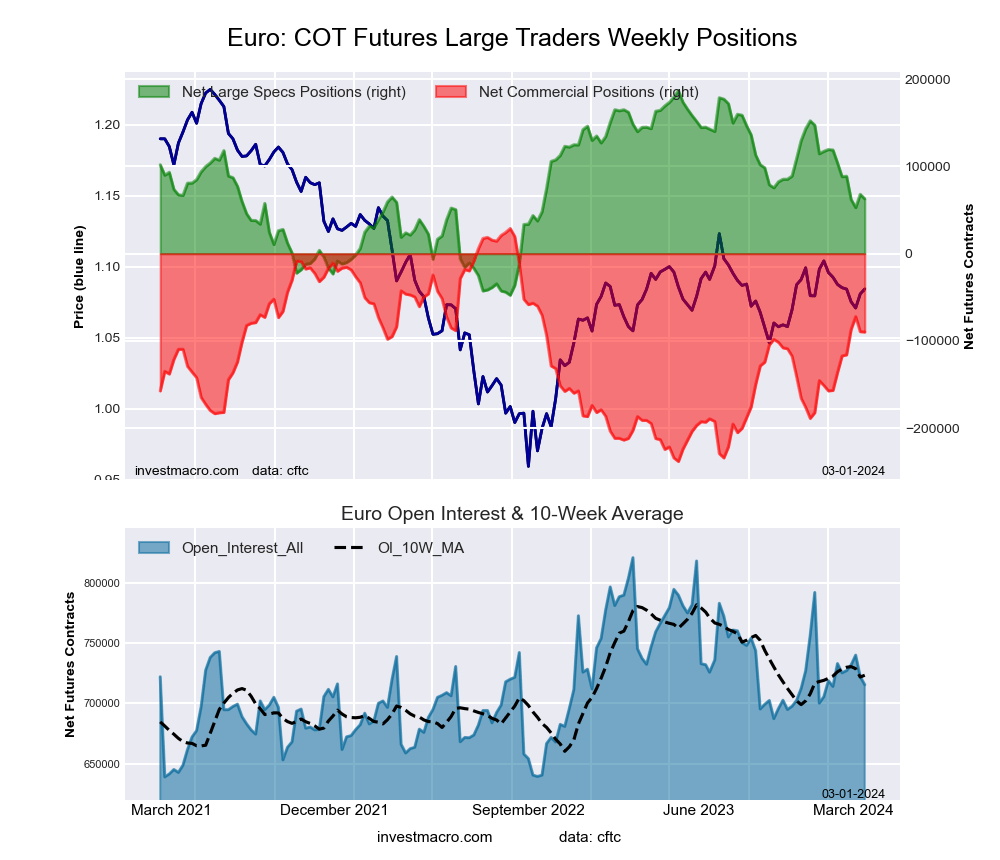
Euro Currency Futures COT ChartThe Euro Currency large speculator standing this week came in at a net position of 104,092 contracts in the data reported through Tuesday. This was a weekly lowering of -14,785 contracts from the previous week which had a total of 118,877 net contracts.

This week’s current strength score (the trader positioning range over the past three years, measured from 0 to 100) shows the speculators are currently Bullish with a score of 64.6 percent. The commercials are Bearish with a score of 38.1 percent and the small traders (not shown in chart) are Bearish with a score of 30.7 percent.

Price Trend-Following Model: Uptrend

Our weekly trend-following model classifies the current market price position as: Uptrend. The current action for the model is considered to be: Hold – Maintain Long Position.

EURO Currency StatisticsSPECULATORSCOMMERCIALSSMALL TRADERS
– Percent of Open Interest Longs:27.959.111.1
– Percent of Open Interest Shorts:13.777.86.6
– Net Position:104,092-136,51332,421
– Gross Longs:204,294433,57781,115
– Gross Shorts:100,202570,09048,694
– Long to Short Ratio:2.0 to 10.8 to 11.7 to 1
NET POSITION TREND:
– Strength Index Score (3 Year Range Pct):64.638.130.7
– Strength Index Reading (3 Year Range):BullishBearishBearish
NET POSITION MOVEMENT INDEX:
– 6-Week Change in Strength Index:-20.619.6-6.6


British Pound Sterling Futures:

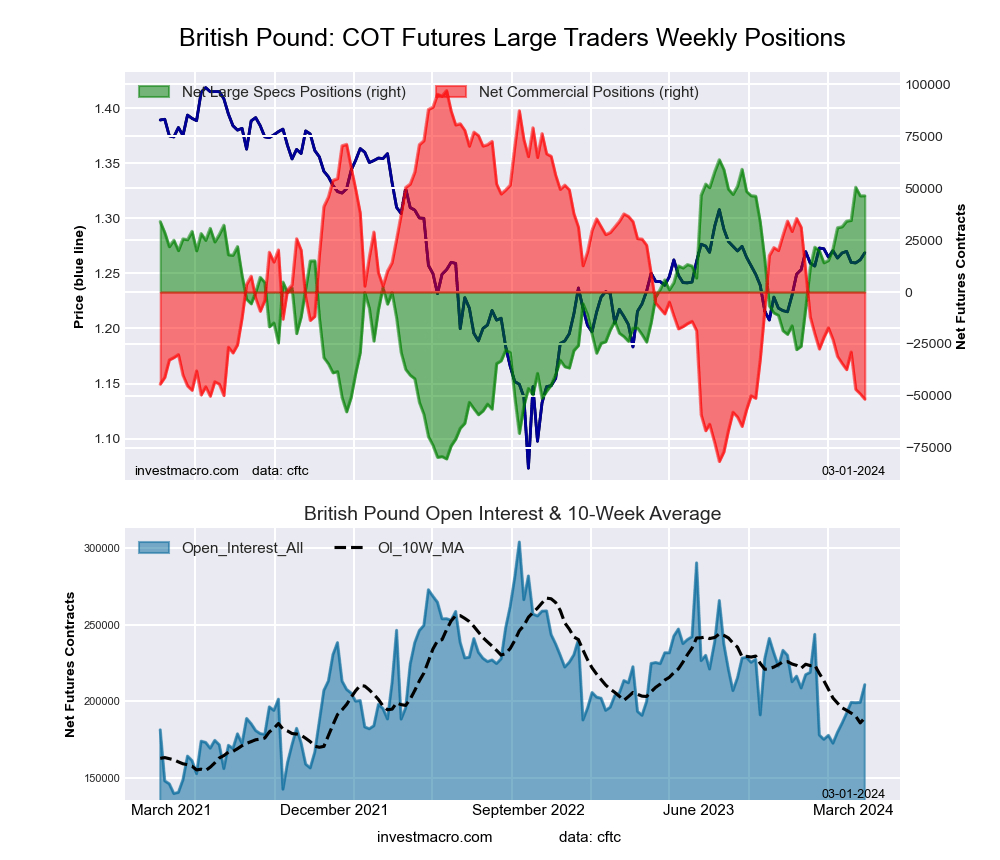
British Pound Sterling Futures COT ChartThe British Pound Sterling large speculator standing this week came in at a net position of 30,931 contracts in the data reported through Tuesday. This was a weekly rise of 10,197 contracts from the previous week which had a total of 20,734 net contracts.

This week’s current strength score (the trader positioning range over the past three years, measured from 0 to 100) shows the speculators are currently Bullish with a score of 77.2 percent. The commercials are Bearish with a score of 28.3 percent and the small traders (not shown in chart) are Bullish with a score of 58.1 percent.

Price Trend-Following Model: Uptrend

Our weekly trend-following model classifies the current market price position as: Uptrend. The current action for the model is considered to be: Hold – Maintain Long Position.

BRITISH POUND StatisticsSPECULATORSCOMMERCIALSSMALL TRADERS
– Percent of Open Interest Longs:36.841.416.5
– Percent of Open Interest Shorts:19.658.616.4
– Net Position:30,931-30,98049
– Gross Longs:66,23074,43829,608
– Gross Shorts:35,299105,41829,559
– Long to Short Ratio:1.9 to 10.7 to 11.0 to 1
NET POSITION TREND:
– Strength Index Score (3 Year Range Pct):77.228.358.1
– Strength Index Reading (3 Year Range):BullishBearishBullish
NET POSITION MOVEMENT INDEX:
– 6-Week Change in Strength Index:13.4-10.6-0.5


Japanese Yen Futures:

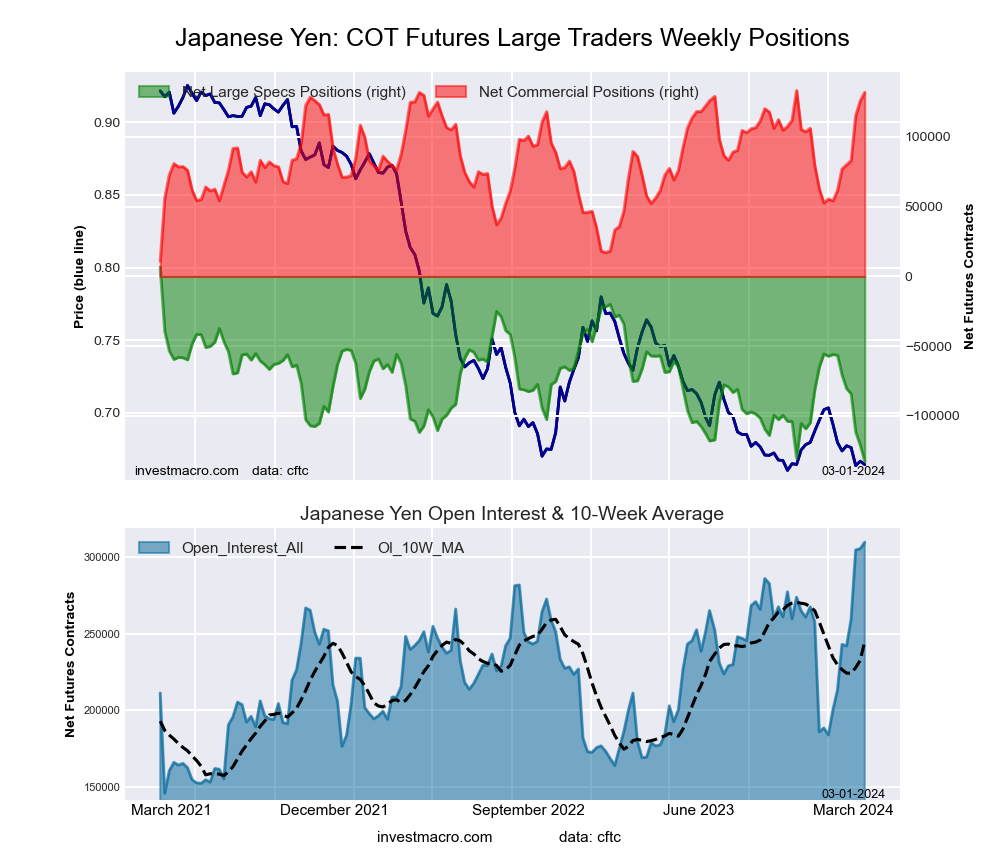
Japanese Yen Forex Futures COT ChartThe Japanese Yen large speculator standing this week came in at a net position of -56,560 contracts in the data reported through Tuesday. This was a weekly lowering of -611 contracts from the previous week which had a total of -55,949 net contracts.

This week’s current strength score (the trader positioning range over the past three years, measured from 0 to 100) shows the speculators are currently Bearish with a score of 42.1 percent. The commercials are Bullish with a score of 63.3 percent and the small traders (not shown in chart) are Bearish with a score of 49.3 percent.

Price Trend-Following Model: Weak Uptrend

Our weekly trend-following model classifies the current market price position as: Weak Uptrend. The current action for the model is considered to be: Hold – Maintain Long Position.

JAPANESE YEN StatisticsSPECULATORSCOMMERCIALSSMALL TRADERS
– Percent of Open Interest Longs:20.758.618.0
– Percent of Open Interest Shorts:47.229.720.4
– Net Position:-56,56061,724-5,164
– Gross Longs:44,180125,04838,443
– Gross Shorts:100,74063,32443,607
– Long to Short Ratio:0.4 to 12.0 to 10.9 to 1
NET POSITION TREND:
– Strength Index Score (3 Year Range Pct):42.163.349.3
– Strength Index Reading (3 Year Range):BearishBullishBearish
NET POSITION MOVEMENT INDEX:
– 6-Week Change in Strength Index:27.6-22.8-9.1


Swiss Franc Futures:

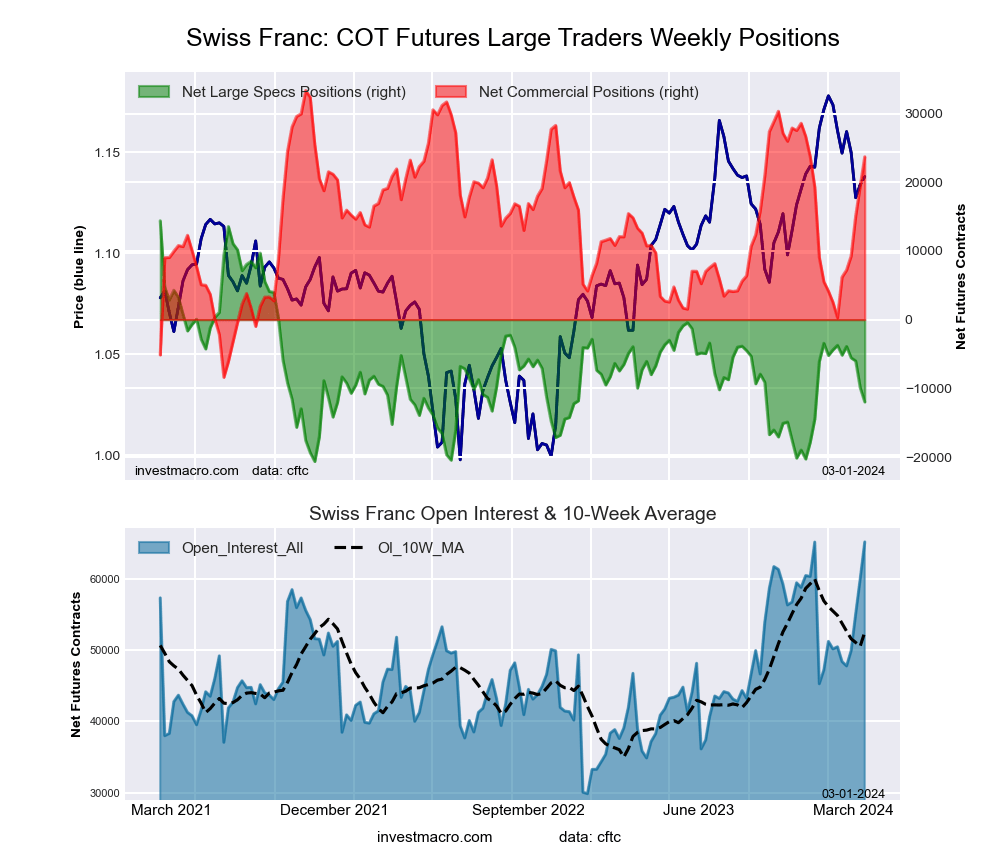
Swiss Franc Forex Futures COT ChartThe Swiss Franc large speculator standing this week came in at a net position of -3,738 contracts in the data reported through Tuesday. This was a weekly lift of 654 contracts from the previous week which had a total of -4,392 net contracts.

This week’s current strength score (the trader positioning range over the past three years, measured from 0 to 100) shows the speculators are currently Bearish with a score of 47.9 percent. The commercials are Bearish with a score of 38.6 percent and the small traders (not shown in chart) are Bullish with a score of 74.6 percent.

Price Trend-Following Model: Uptrend

Our weekly trend-following model classifies the current market price position as: Uptrend. The current action for the model is considered to be: Hold – Maintain Long Position.

SWISS FRANC StatisticsSPECULATORSCOMMERCIALSSMALL TRADERS
– Percent of Open Interest Longs:21.144.533.9
– Percent of Open Interest Shorts:28.543.927.0
– Net Position:-3,7382733,465
– Gross Longs:10,62722,45017,114
– Gross Shorts:14,36522,17713,649
– Long to Short Ratio:0.7 to 11.0 to 11.3 to 1
NET POSITION TREND:
– Strength Index Score (3 Year Range Pct):47.938.674.6
– Strength Index Reading (3 Year Range):BearishBearishBullish
NET POSITION MOVEMENT INDEX:
– 6-Week Change in Strength Index:40.0-43.534.0


Canadian Dollar Futures:

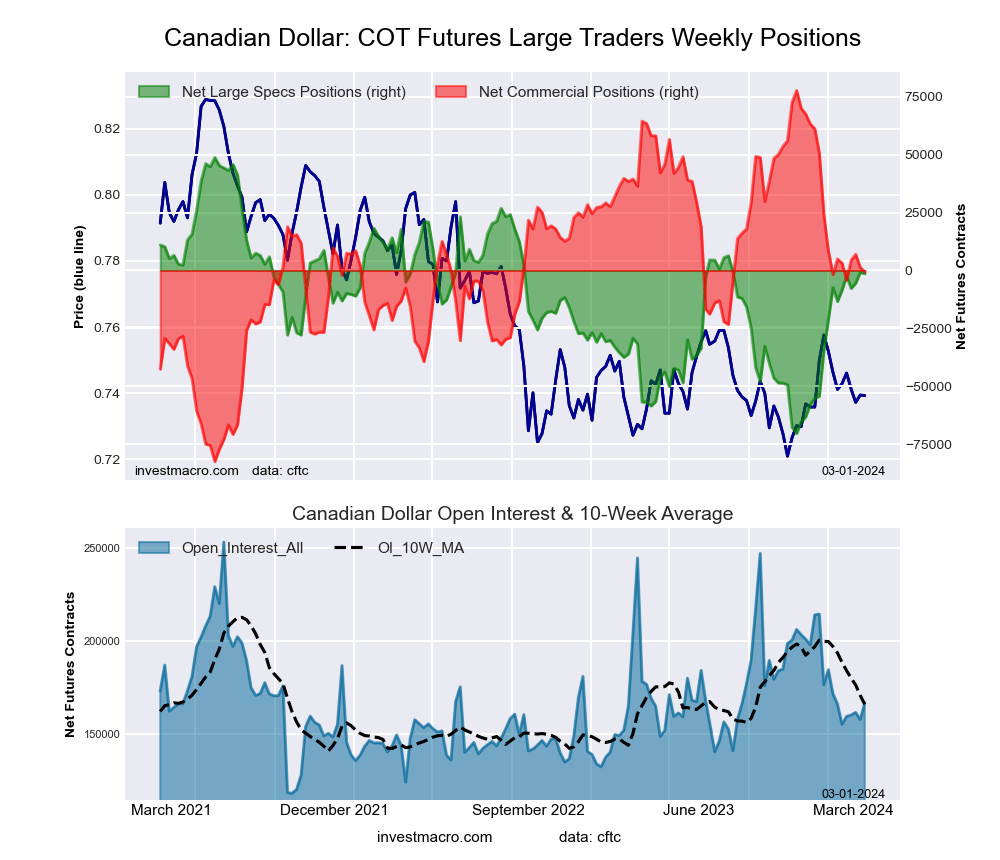
Canadian Dollar Forex Futures COT ChartThe Canadian Dollar large speculator standing this week came in at a net position of -13,388 contracts in the data reported through Tuesday. This was a weekly lowering of -6,008 contracts from the previous week which had a total of -7,380 net contracts.

This week’s current strength score (the trader positioning range over the past three years, measured from 0 to 100) shows the speculators are currently Bearish with a score of 47.8 percent. The commercials are Bullish with a score of 54.6 percent and the small traders (not shown in chart) are Bearish with a score of 41.6 percent.

Price Trend-Following Model: Uptrend

Our weekly trend-following model classifies the current market price position as: Uptrend. The current action for the model is considered to be: Hold – Maintain Long Position.

CANADIAN DOLLAR StatisticsSPECULATORSCOMMERCIALSSMALL TRADERS
– Percent of Open Interest Longs:23.355.319.8
– Percent of Open Interest Shorts:31.452.314.7
– Net Position:-13,3884,9288,460
– Gross Longs:38,73891,78332,870
– Gross Shorts:52,12686,85524,410
– Long to Short Ratio:0.7 to 11.1 to 11.3 to 1
NET POSITION TREND:
– Strength Index Score (3 Year Range Pct):47.854.641.6
– Strength Index Reading (3 Year Range):BearishBullishBearish
NET POSITION MOVEMENT INDEX:
– 6-Week Change in Strength Index:37.3-36.430.9


Australian Dollar Futures:

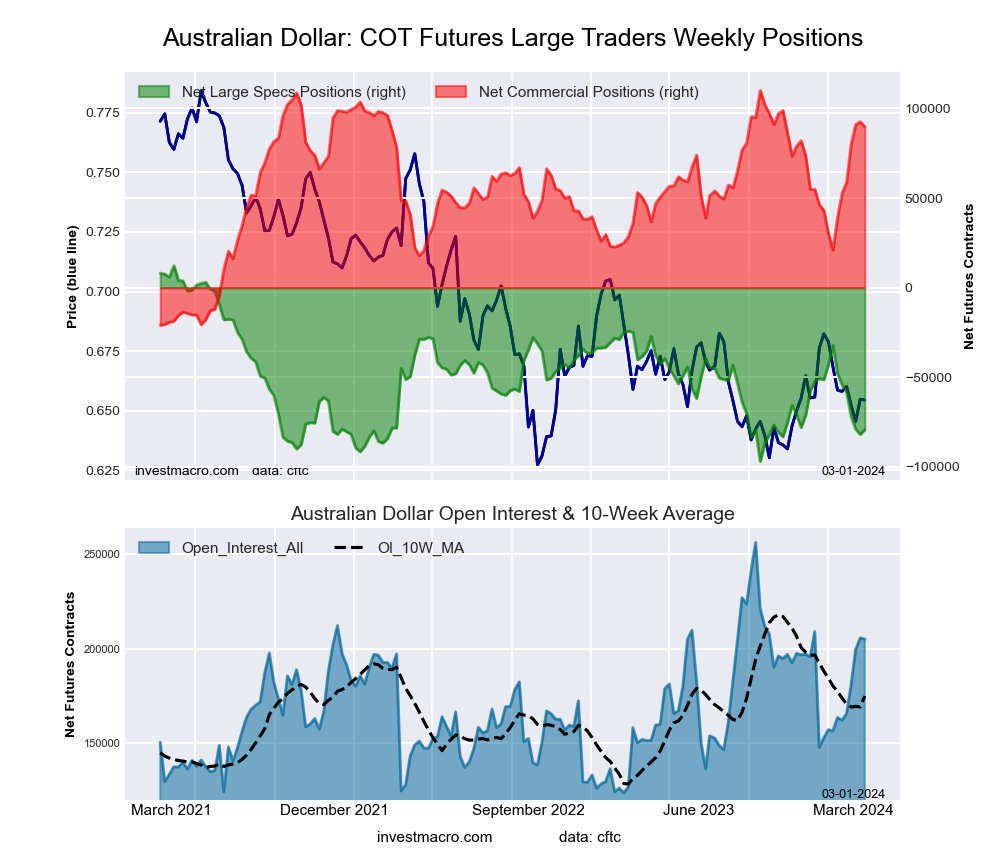
Australian Dollar Forex Futures COT ChartThe Australian Dollar large speculator standing this week came in at a net position of -47,857 contracts in the data reported through Tuesday. This was a weekly decline of -15,583 contracts from the previous week which had a total of -32,274 net contracts.

This week’s current strength score (the trader positioning range over the past three years, measured from 0 to 100) shows the speculators are currently Bearish with a score of 44.9 percent. The commercials are Bearish with a score of 46.5 percent and the small traders (not shown in chart) are Bullish with a score of 73.9 percent.

Price Trend-Following Model: Uptrend

Our weekly trend-following model classifies the current market price position as: Uptrend. The current action for the model is considered to be: Hold – Maintain Long Position.

AUSTRALIAN DOLLAR StatisticsSPECULATORSCOMMERCIALSSMALL TRADERS
– Percent of Open Interest Longs:28.051.316.5
– Percent of Open Interest Shorts:57.327.511.1
– Net Position:-47,85739,0448,813
– Gross Longs:45,81283,91126,937
– Gross Shorts:93,66944,86718,124
– Long to Short Ratio:0.5 to 11.9 to 11.5 to 1
NET POSITION TREND:
– Strength Index Score (3 Year Range Pct):44.946.573.9
– Strength Index Reading (3 Year Range):BearishBearishBullish
NET POSITION MOVEMENT INDEX:
– 6-Week Change in Strength Index:9.0-12.014.7


New Zealand Dollar Futures:

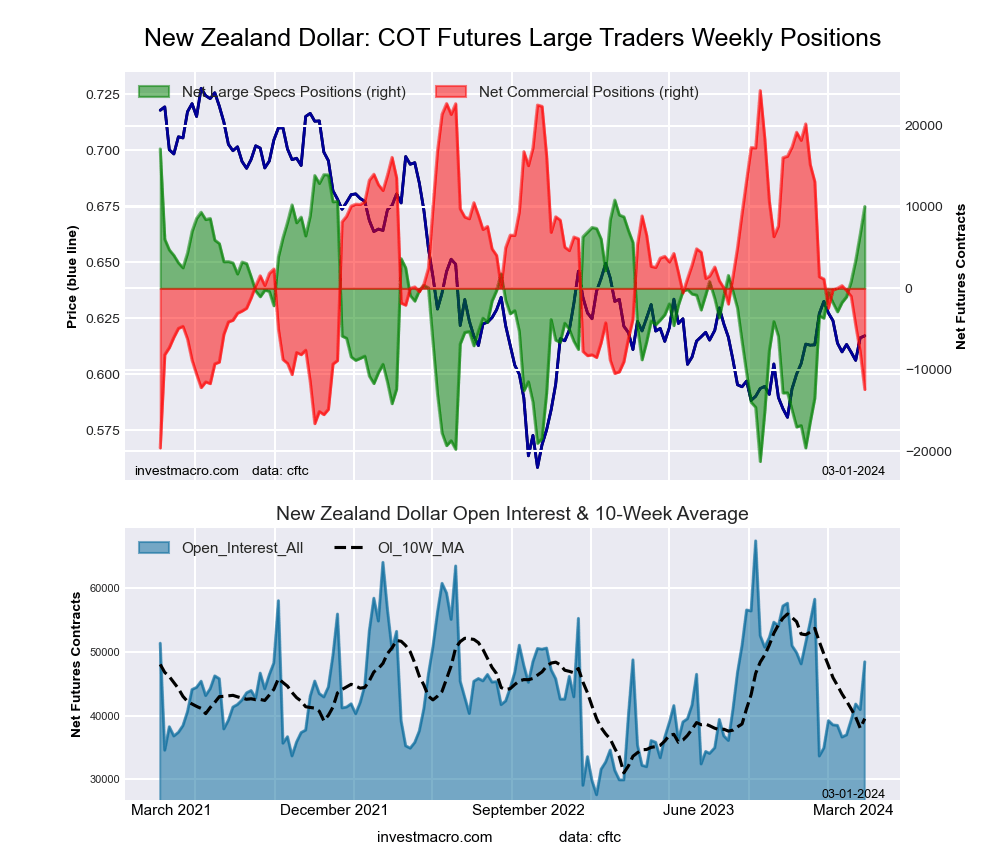
New Zealand Dollar Forex Futures COT ChartThe New Zealand Dollar large speculator standing this week came in at a net position of -2,882 contracts in the data reported through Tuesday. This was a weekly fall of -1,115 contracts from the previous week which had a total of -1,767 net contracts.

This week’s current strength score (the trader positioning range over the past three years, measured from 0 to 100) shows the speculators are currently Bearish with a score of 47.9 percent. The commercials are Bearish with a score of 44.7 percent and the small traders (not shown in chart) are Bullish-Extreme with a score of 85.1 percent.

Price Trend-Following Model: Uptrend

Our weekly trend-following model classifies the current market price position as: Uptrend. The current action for the model is considered to be: Hold – Maintain Long Position.

NEW ZEALAND DOLLAR StatisticsSPECULATORSCOMMERCIALSSMALL TRADERS
– Percent of Open Interest Longs:37.942.115.8
– Percent of Open Interest Shorts:45.442.18.3
– Net Position:-2,882-12,883
– Gross Longs:14,59216,2036,094
– Gross Shorts:17,47416,2043,211
– Long to Short Ratio:0.8 to 11.0 to 11.9 to 1
NET POSITION TREND:
– Strength Index Score (3 Year Range Pct):47.944.785.1
– Strength Index Reading (3 Year Range):BearishBearishBullish-Extreme
NET POSITION MOVEMENT INDEX:
– 6-Week Change in Strength Index:35.3-34.719.8


Mexican Peso Futures:

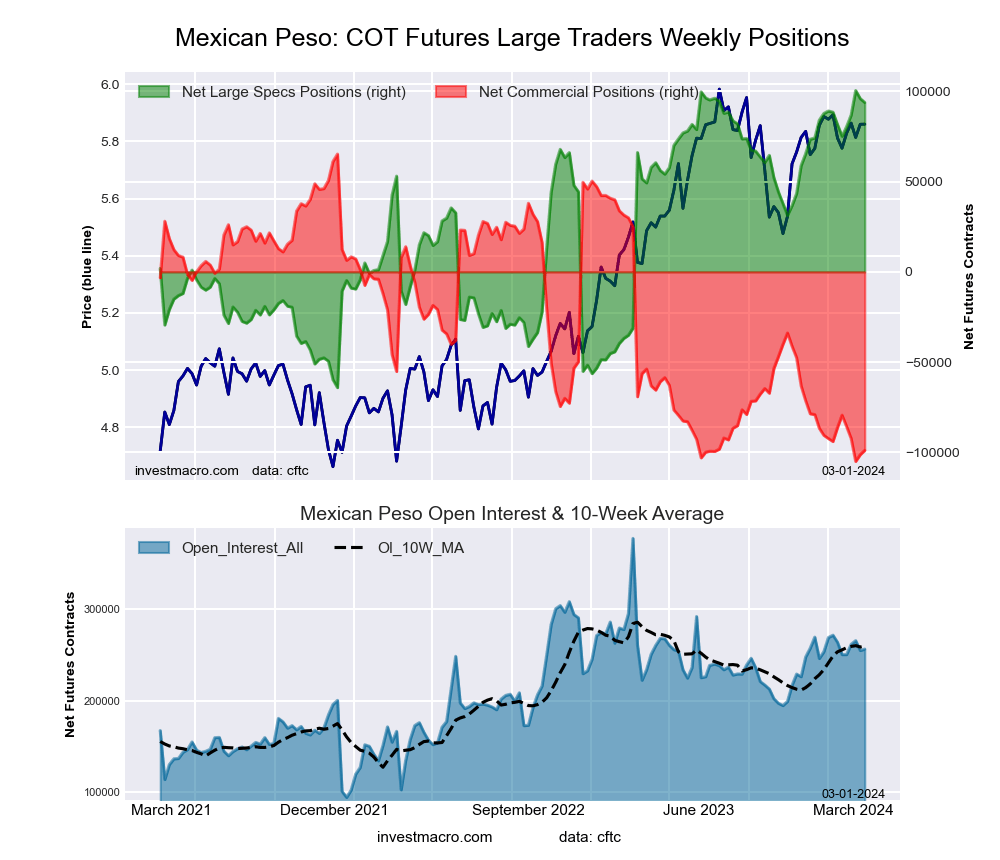
Mexican Peso Futures COT ChartThe Mexican Peso large speculator standing this week came in at a net position of 81,602 contracts in the data reported through Tuesday. This was a weekly decrease of -6,837 contracts from the previous week which had a total of 88,439 net contracts.

This week’s current strength score (the trader positioning range over the past three years, measured from 0 to 100) shows the speculators are currently Bullish-Extreme with a score of 88.9 percent. The commercials are Bearish-Extreme with a score of 10.0 percent and the small traders (not shown in chart) are Bearish with a score of 41.0 percent.

Price Trend-Following Model: Uptrend

Our weekly trend-following model classifies the current market price position as: Uptrend. The current action for the model is considered to be: Hold – Maintain Long Position.

MEXICAN PESO StatisticsSPECULATORSCOMMERCIALSSMALL TRADERS
– Percent of Open Interest Longs:50.743.72.9
– Percent of Open Interest Shorts:19.876.41.1
– Net Position:81,602-86,2714,669
– Gross Longs:133,691115,0507,623
– Gross Shorts:52,089201,3212,954
– Long to Short Ratio:2.6 to 10.6 to 12.6 to 1
NET POSITION TREND:
– Strength Index Score (3 Year Range Pct):88.910.041.0
– Strength Index Reading (3 Year Range):Bullish-ExtremeBearish-ExtremeBearish
NET POSITION MOVEMENT INDEX:
– 6-Week Change in Strength Index:5.0-4.5-3.3


Brazilian Real Futures:

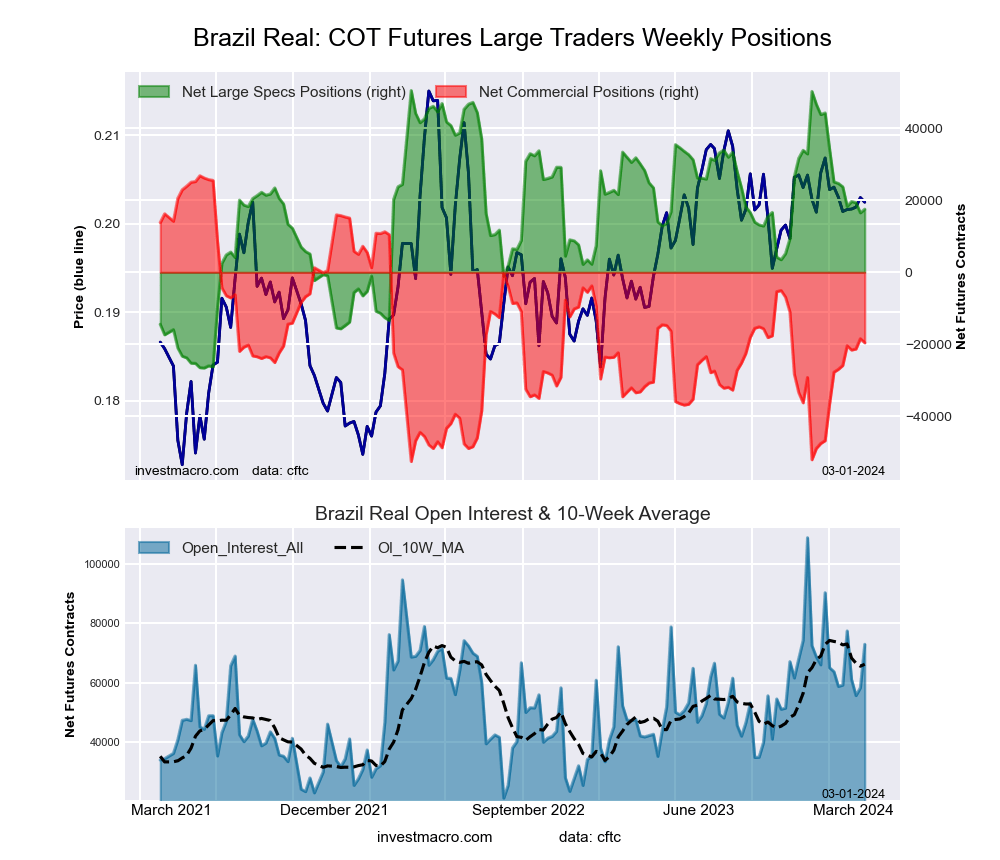
Brazil Real Futures COT ChartThe Brazilian Real large speculator standing this week came in at a net position of 24,695 contracts in the data reported through Tuesday. This was a weekly lowering of -419 contracts from the previous week which had a total of 25,114 net contracts.

This week’s current strength score (the trader positioning range over the past three years, measured from 0 to 100) shows the speculators are currently Bullish with a score of 66.5 percent. The commercials are Bearish with a score of 32.2 percent and the small traders (not shown in chart) are Bullish with a score of 55.7 percent.

Price Trend-Following Model: Uptrend

Our weekly trend-following model classifies the current market price position as: Uptrend. The current action for the model is considered to be: Hold – Maintain Long Position.

BRAZIL REAL StatisticsSPECULATORSCOMMERCIALSSMALL TRADERS
– Percent of Open Interest Longs:67.124.96.3
– Percent of Open Interest Shorts:25.170.82.5
– Net Position:24,695-26,9772,282
– Gross Longs:39,44114,6223,731
– Gross Shorts:14,74641,5991,449
– Long to Short Ratio:2.7 to 10.4 to 12.6 to 1
NET POSITION TREND:
– Strength Index Score (3 Year Range Pct):66.532.255.7
– Strength Index Reading (3 Year Range):BullishBearishBullish
NET POSITION MOVEMENT INDEX:
– 6-Week Change in Strength Index:-33.131.64.1


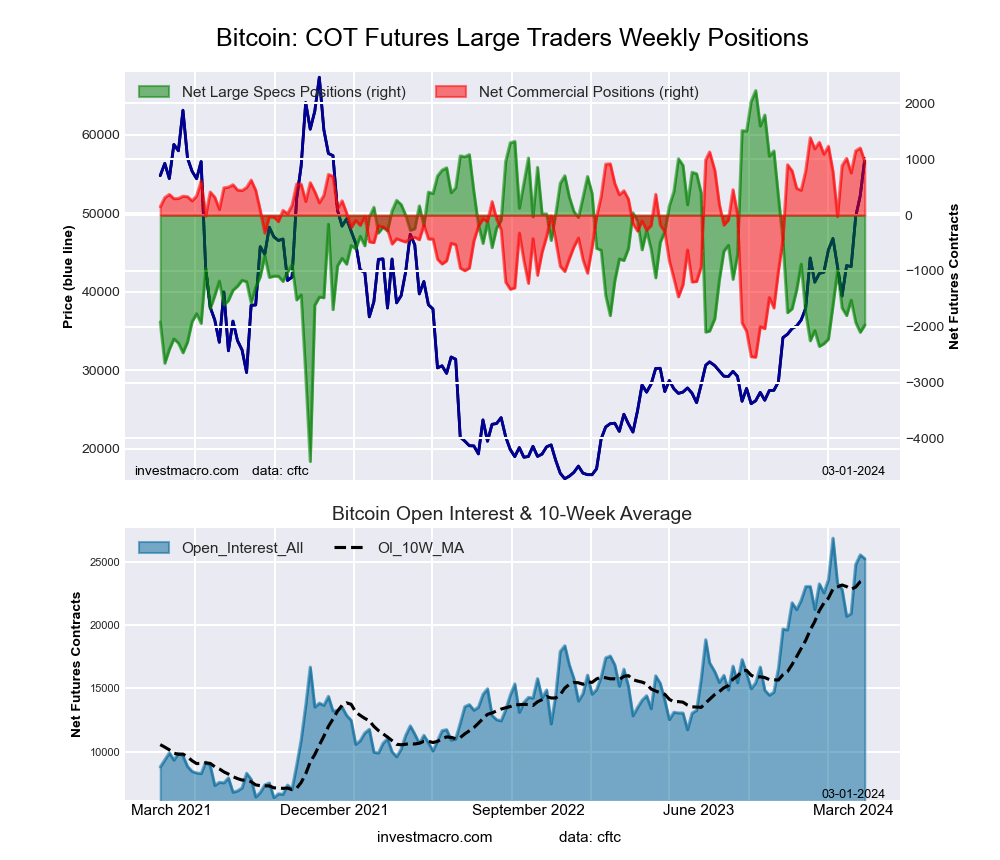
Bitcoin Futures:

Bitcoin Crypto Futures COT ChartThe Bitcoin large speculator standing this week came in at a net position of -994 contracts in the data reported through Tuesday. This was a weekly advance of 624 contracts from the previous week which had a total of -1,618 net contracts.

This week’s current strength score (the trader positioning range over the past three years, measured from 0 to 100) shows the speculators are currently Bullish with a score of 51.4 percent. The commercials are Bullish with a score of 64.1 percent and the small traders (not shown in chart) are Bearish with a score of 36.1 percent.

Price Trend-Following Model: Uptrend

Our weekly trend-following model classifies the current market price position as: Uptrend. The current action for the model is considered to be: Hold – Maintain Long Position.

BITCOIN StatisticsSPECULATORSCOMMERCIALSSMALL TRADERS
– Percent of Open Interest Longs:75.55.87.5
– Percent of Open Interest Shorts:79.86.03.1
– Net Position:-994-251,019
– Gross Longs:17,5771,3611,747
– Gross Shorts:18,5711,386728
– Long to Short Ratio:0.9 to 11.0 to 12.4 to 1
NET POSITION TREND:
– Strength Index Score (3 Year Range Pct):51.464.136.1
– Strength Index Reading (3 Year Range):BullishBullishBearish
NET POSITION MOVEMENT INDEX:
– 6-Week Change in Strength Index:18.9-35.93.5


Article By InvestMacroReceive our weekly COT Newsletter

*COT Report: The COT data, released weekly to the public each Friday, is updated through the most recent Tuesday (data is 3 days old) and shows a quick view of how large speculators or non-commercials (for-profit traders) were positioned in the futures markets.

The CFTC categorizes trader positions according to commercial hedgers (traders who use futures contracts for hedging as part of the business), non-commercials (large traders who speculate to realize trading profits) and nonreportable traders (usually small traders/speculators) as well as their open interest (contracts open in the market at time of reporting). See CFTC criteria here.

Week Ahead: USDJPY set to extend uptrend?

By ForexTime 

  • Yen down against G10 majors YTD
  • Watch out for BoJ policy meeting
  • Big US data likely to rock USD
  • USDJPY bullish but RSI signals overbought
  • Key level of interest at 148.50

Monetary policy will take centre stage in the week ahead as major central banks kick off their first meetings of 2024.

Also watch out for top-tier economic data and corporate earnings announcements from the largest companies in the world:

Monday, 22nd January

  • CNH: China loan prime rates
  • USD: US Conference Board leading index

Tuesday, 23rd January

  • EUR: Eurozone consumer confidence
  • JPY: BoJ rate decision
  • NQ100_m: Netflix earnings

Wednesday, 24th January

  • CAD: BoC rate decision
  • EUR: Eurozone/Germany S&P Global PMI
  • GBP: UK S&P Global/CIPS Manufacturing PMI
  • USD: S&P Global Services & Manufacturing PMI
  • S&P500_m: Tesla earnings

Thursday, 25th January

  • EUR: ECB rate decision, Germany IFO business climate
  • USD: Q4 GDP, initial jobless claims

Friday, 26th January

  • JPY: Japan Tokyo CPI, BoJ meeting minutes
  • USD: US December PCE report

Our focus falls on the Japanese Yen which has been on a back foot since December as bets fizzed out around a hawkish pivot by the Bank of Japan (BoJ) from negative rates. This supported the USDJPY with the upside fuelled by stronger than expected US data which dampened expectations around the Fed cutting rates in March.

The widening interest rate differentials between the US and Japan over the recent weeks has propelled the USDJPY. Prices are testing resistance around 148.50 as of writing.

Here are 3 factors that may move the USDJPY next week.

  1. BOJ policy meeting

The BoJ is widely expected to keep its yield-curve control and short-term interest rates unchanged at -0.1%.

Slowing inflation coupled with the devastating earthquake Japan experienced in early January have most likely reduced pressure on the BoJ to raise interest rates anytime soon. Nevertheless, much attention will be directed to the policy statement and updated quarterly outlook for fresh clues on rate hike timings.

As of writing, traders are currently pricing in an 83% probability of the BoJ hiking rates by June 2024.

Looking beyond the rate decision, the incoming Japan Tokyo CPI report on Friday may impact the Yen and rate hike expectations.

  • The Yen may extend losses if the BoJ maintains a dovish stance and offers zero clues on future rate hikes.
  • Any clues offered on future hikes in the policy statement or updated quarterly outlook could support the Yen. 
  1. Big US data

A week packed with top-tier US data is likely to shape expectations around the Fed’s next move.

The potential market shakers will be the final quarter GDP figures and December PCE report. Markets expect the US economy to have expanded 1.9% in Q4, down from the 4.9% in the prior quarter. Regarding the Fed’s preferred inflation gauge – the Core Personal Consumption Expenditure, it is forecast to rise 0.2% month-over-month compared to 0.1% in November. However, the year-over-year is expected to cool 3% vs 3.2% in the prior month.

  • Should overall US economic data disappoint, and inflation numbers print below forecasts, this may weaken the dollar – pulling the USDJPY lower as a result.
  • A set of strong economic reports and hotter-than-expected PCE report have the potential to boost the USD – pushing the USDJPY higher.
  1. Technical forces

The USDJPY is respecting an ascending channel on the daily timeframe with prices trading above the 50, 100 and 200-day SMA. However, the Relative Strength Index (RSI) is approaching 70, indicating that prices are overbought. In addition, key resistance levels can be found at 148.50 and the psychological 150.00 level.

  • A strong breakout and daily close above 148.50 may open the doors towards 150.00 – a level not seen since mid-November 2023 and beyond.
  • Should prices fail to conquer 148.50, this could trigger a decline back towards the 50-day SMA at 146.15 and 200-day SMA at 143.90.


Forex-Time-LogoArticle by ForexTime

ForexTime Ltd (FXTM) is an award winning international online forex broker regulated by CySEC 185/12 www.forextime.com

Curious Kids: how much money is there in the world?

By Renaud Foucart, Lancaster University 

How much money is there in the world? – Tsubamé, aged ten, London

If we want to add up how much money there is in the world, a good place to start would be counting all the notes and coins out there – in people’s wallets and money boxes and in cash machines.

Let’s start with pounds. There is about £84 billion (or 84,000,000,000) of British money out there in coins and notes. There’s also US$2,236 billion in US money, €1,578 billion in the money of the European Union and ¥9,616 billion in Chinese money – plus money in many other currencies.

As money is not the same in every country, summing up all the coins and notes in the world means that you need to measure how much a US dollar, an Indian rupee, or a Chinese yuan is worth in Great British pounds. If this is done with the latest available data, then added up, you will find a total of £6,113 billion.


Curious Kids is a series by The Conversation that gives children the chance to have their questions about the world answered by experts. If you have a question you’d like an expert to answer, send it to [email protected] and make sure you include the asker’s first name, age and town or city. We won’t be able to answer every question, but we’ll do our very best.


This amount could change very quickly and is probably already outdated at the moment you read this article.

This is partly because countries print more money all the time. But it’s also because the exchange rate – how much a British pound, say, is worth in another currency, like US dollars – is not always the same. Today, £1 is worth around US$1.30 – one dollar and 30 cents in US money. Ten years ago, it was much more: one dollar and 70 cents.

How many US dollars you get for a pound depends on how much people want to use British money. That’s why when some people decide to create their own money, such as cryptocurrencies like bitcoin, they spend so much time trying to convince others to use it.

But counting coins and notes does not tell us everything about how much money there is in the world. For instance, people have money in their bank accounts that do not correspond to any specific coin. In the UK, around 96% of money exists only in electronic form. When you include that, the total is not £84 billion but £2,223 billion. If you add up again the figures available for the entire world – money in coins and notes, plus electronic money in bank accounts – you get roughly £46,557 billion.

Wealth – but not money

What’s more, many things that are worth a lot are not money itself. Very rich people keep only a little part of their fortune in cash. They prefer to also own things like businesses that are likely to make them even richer.

Perhaps a better way to count how much money there is in the world is to look at the value of the things we buy and sell. That is a tricky thing to do, because you don’t want to double count anything. If farmers sell the milk of their cows to a cheese maker, who then sells cheese to a shop, which sells it to people, all the value – the milk, the cheese and the people selling it, is contained in what you pay at the shop: the final sale.

When you sum up all these final sales, you will find that last year, in the entire world, there was around £79,437 billion worth of value created.

But there are also a lot of things that have value and are not exchanged. If you own a bag of diamonds and keep it in your bedroom, you are rich. But this is not money. And you are not exchanging it either. So it does not count in any of the numbers I have given you so far.

And sometimes, things that have value cannot easily be turned into money. Imagine that you own a beautiful forest, with a nice clean river to swim in during the summer, and some very rare birds and old trees. And underneath that forest, there is a lot of oil.

By owning this forest, you are very wealthy. Like the diamonds in your bedroom, owning the land and the forest and the oil makes you rich. But once you decide to turn your wealth into a lot of money, you will need to destroy the forest: cut down the trees for wood to sell, and drill into the earth to get the oil out.

People might have enjoyed spending time with friends walking in the forest, or paddling in the rivers. This has value, and it is lost when the forest is gone. And the wealth you held by owning the forest is gone too.

If we want the money we use to still be worth something in the future, we sometimes need to restrain from destroying what we own to get cash today.The Conversation

About the Author:

Renaud Foucart, Senior Lecturer in Economics, Lancaster University Management School, Lancaster University

This article is republished from The Conversation under a Creative Commons license. Read the original article.

Your Bourse surpassed the monthly trading volume of $1 Trillion in December 2023.

In December 2023, Your Bourse, a trade execution technology provider, reported a new record in monthly trading volume – $1.08 trillion. A strong company performance led to a significant increase in both clients and their trading volume via the Your Bourse platform.

Your Bourse experienced a year of dynamic expansion and notable accomplishments in 2023. By providing its exceptional Matching Engine, Bridge Solutions, liquidity aggregation, and FIX server for liquidity distribution, the company showed unprecedented trading volume results.

The average daily trading volume (ADV) was at the $35 billion level in the last month of the year.

The month’s peak daily trading volume was recorded on December 29th, reaching a turnover of $165 billion.

TOP-5 trading instruments with the highest share were XAUUSD, EURUSD, US30, NAS100, and GBPUSD.

Out of the total, trading in the Gold instrument XAUUSD represented 23 percent, amounting to $250 billion of the total trading volume. This marked the peak of activity for this instrument in 2023.

In December, EURUSD turnover was in second place and accounted for 15% ($163 billion) of the total volume.

The US30 index, or the DJ30 derivative contract, came in third with a 6% share ($65 billion) of the monthly volume.

Matching Engine, the flagship Your Bourse’s solution, delivers order execution with ultra-low latency: just two microseconds order processing time and handling an impressive 500,000 orders per second on a single CPU). The Matching Engine is asset class agnostic, ensuring flexibility and broad applicability for various trading instruments providing trading institutions with unprecedented reliability and security. In December, there was a 7% increase in the number of Matching Engine installations.

The access to a broad spectrum of liquidity providers via Your Bourse platform makes brokers’ performance more sustainable and profitable.

There are more than 100 liquidity providers connected to the Your Bourse infrastructure.

About Your Bourse

Your Bourse offers software solutions for the retail and institutional MT4/MT5 brokers. Including: MT5 gateway & MT4 bridge, multi-asset liquidity aggregation, risk management, client profiling, real-time and historical reporting, MT4/MT5 hosting in all Equinix data centers with 99.999% SLA, plugins for MT4 & MT5 and FIX API connections for the B2B clients.

Currency Speculators push British Pound bets to highest since September

By InvestMacro

Here are the latest charts and statistics for the Commitment of Traders (COT) data published by the Commodities Futures Trading Commission (CFTC).

The latest COT data is updated through Tuesday January 9th and shows a quick view of how large market participants (for-profit speculators and commercial traders) were positioned in the futures markets. All currency positions are in direct relation to the US dollar where, for example, a bet for the euro is a bet that the euro will rise versus the dollar while a bet against the euro will be a bet that the euro will decline versus the dollar.

Weekly Speculator Changes led by Swiss Franc & Bitcoin

The COT currency market speculator bets were higher this week as seven out of the eleven currency markets we cover had higher positioning while the other four markets had lower speculator contracts.

Leading the gains for the currency markets was the Canadian Dollar (13,751 contracts) with the Australian Dollar (10,619 contracts), the British Pound (5,529 contracts), the Japanese Yen (1,246 contracts), the Swiss Franc (823 contracts), Bitcoin (603 contracts) and the US Dollar Index (487 contracts) also showing positive weeks.

The currencies seeing declines in speculator bets on the week were the Brazilian Real (-9,193 contracts), the New Zealand Dollar (-1,221 contracts), the EuroFX (-599 contracts) and the Mexican Peso (-659 contracts) also having lower bets.

Currency Speculators continue to raise their British Pound bets to highest since September

Highlighting the COT currency’s data is the recent gains in the speculator positioning for the British Pound Sterling. The Pound Sterling speculative positioning increased this week for a second straight week and for the seventh time over the past ten weeks.

The GBP speculator position has now been in an overall bullish position for the past six weeks following a run of nine weeks in bearish territory from the beginning of October to the end of November.

This renewed bullishness has brought the net speculator standing (currently at +20,734 contracts) to the highest level in the past sixteen weeks, dating back to September 19th.

The British Pound Sterling’s exchange rate with the US Dollar has been on the move higher as well after finding a major support level at 1.2100 for a period of weeks in October and November. Since then, the GBPUSD currency pair has trended up with gains in seven out of the past nine weeks to a close this week at the 1.2753 threshold and just below the 200-week moving average at 1.2844.


Major Currencies – Speculators Leaderboard


Legend: Weekly Speculators Change | Speculators Current Net Position | Speculators Strength Score compared to last 3-Years (0-100 range)


Strength Scores led by Mexican Peso & EuroFX

COT Strength Scores (a normalized measure of Speculator positions over a 3-Year range, from 0 to 100 where above 80 is Extreme-Bullish and below 20 is Extreme-Bearish) showed that the Mexican Peso (93 percent) and the EuroFX (71 percent) lead the currency markets this week. The British Pound (70 percent), Brazilian Real (67 percent) and the Australian Dollar (59 percent) come in as the next highest in the weekly strength scores.

On the downside, the US Dollar Index (30 percent) and the Japanese Yen (41 percent) come in at the lowest strength levels currently. The next lowest strength scores are the Bitcoin (42 percent) and the Swiss Franc (46 percent).

Strength Statistics:
US Dollar Index (29.6 percent) vs US Dollar Index previous week (28.8 percent)
EuroFX (70.9 percent) vs EuroFX previous week (71.2 percent)
British Pound Sterling (70.2 percent) vs British Pound Sterling previous week (66.3 percent)
Japanese Yen (41.2 percent) vs Japanese Yen previous week (40.5 percent)
Swiss Franc (46.1 percent) vs Swiss Franc previous week (43.7 percent)
Canadian Dollar (52.9 percent) vs Canadian Dollar previous week (41.3 percent)
Australian Dollar (59.2 percent) vs Australian Dollar previous week (49.5 percent)
New Zealand Dollar (50.8 percent) vs New Zealand Dollar previous week (54.0 percent)
Mexican Peso (93.1 percent) vs Mexican Peso previous week (93.5 percent)
Brazilian Real (67.1 percent) vs Brazilian Real previous week (79.0 percent)
Bitcoin (42.1 percent) vs Bitcoin previous week (33.0 percent)


Canadian Dollar & New Zealand Dollar top the 6-Week Strength Trends

COT Strength Score Trends (or move index, calculates the 6-week changes in strength scores) showed that the Canadian Dollar (47 percent) and the New Zealand Dollar (46 percent) lead the past six weeks trends for the currencies. The Swiss Franc (45 percent), the Australian Dollar (36 percent) and the Japanese Yen (30 percent) are the next highest positive movers in the latest trends data.

The US Dollar Index (-27 percent) leads the downside trend scores currently with the EuroFX (-10 percent) and the Brazilian Real (-10 percent) following next with lower trend scores.

Strength Trend Statistics:
US Dollar Index (-27.0 percent) vs US Dollar Index previous week (-30.5 percent)
EuroFX (-10.3 percent) vs EuroFX previous week (-4.3 percent)
British Pound Sterling (19.9 percent) vs British Pound Sterling previous week (28.7 percent)
Japanese Yen (29.6 percent) vs Japanese Yen previous week (26.8 percent)
Swiss Franc (45.0 percent) vs Swiss Franc previous week (39.0 percent)
Canadian Dollar (46.9 percent) vs Canadian Dollar previous week (37.2 percent)
Australian Dollar (35.7 percent) vs Australian Dollar previous week (32.1 percent)
New Zealand Dollar (46.5 percent) vs New Zealand Dollar previous week (42.5 percent)
Mexican Peso (14.0 percent) vs Mexican Peso previous week (18.4 percent)
Brazilian Real (-10.1 percent) vs Brazilian Real previous week (0.6 percent)
Bitcoin (1.9 percent) vs Bitcoin previous week (-20.2 percent)


Individual COT Forex Markets:

US Dollar Index Futures:

US Dollar Index Forex Futures COT ChartThe US Dollar Index large speculator standing this week equaled a net position of 2,910 contracts in the data reported through Tuesday. This was a weekly gain of 487 contracts from the previous week which had a total of 2,423 net contracts.

This week’s current strength score (the trader positioning range over the past three years, measured from 0 to 100) shows the speculators are currently Bearish with a score of 29.6 percent. The commercials are Bullish with a score of 74.8 percent and the small traders (not shown in chart) are Bearish-Extreme with a score of 3.0 percent.

Price Trend-Following Model: Strong Downtrend

Our weekly trend-following model classifies the current market price position as: Strong Downtrend. The current action for the model is considered to be: Hold – Maintain Short Position.

US DOLLAR INDEX StatisticsSPECULATORSCOMMERCIALSSMALL TRADERS
– Percent of Open Interest Longs:67.215.110.3
– Percent of Open Interest Shorts:55.024.313.2
– Net Position:2,910-2,210-700
– Gross Longs:16,0413,5982,450
– Gross Shorts:13,1315,8083,150
– Long to Short Ratio:1.2 to 10.6 to 10.8 to 1
NET POSITION TREND:
– Strength Index Score (3 Year Range Pct):29.674.83.0
– Strength Index Reading (3 Year Range):BearishBullishBearish-Extreme
NET POSITION MOVEMENT INDEX:
– 6-Week Change in Strength Index:-27.026.41.1


Euro Currency Futures:

Euro Currency Futures COT ChartThe Euro Currency large speculator standing this week equaled a net position of 118,877 contracts in the data reported through Tuesday. This was a weekly decrease of -599 contracts from the previous week which had a total of 119,476 net contracts.

This week’s current strength score (the trader positioning range over the past three years, measured from 0 to 100) shows the speculators are currently Bullish with a score of 70.9 percent. The commercials are Bearish with a score of 30.5 percent and the small traders (not shown in chart) are Bearish with a score of 39.6 percent.

Price Trend-Following Model: Strong Uptrend

Our weekly trend-following model classifies the current market price position as: Strong Uptrend. The current action for the model is considered to be: Hold – Maintain Long Position.

EURO Currency StatisticsSPECULATORSCOMMERCIALSSMALL TRADERS
– Percent of Open Interest Longs:29.257.411.5
– Percent of Open Interest Shorts:12.579.46.2
– Net Position:118,877-156,88738,010
– Gross Longs:208,473409,73882,429
– Gross Shorts:89,596566,62544,419
– Long to Short Ratio:2.3 to 10.7 to 11.9 to 1
NET POSITION TREND:
– Strength Index Score (3 Year Range Pct):70.930.539.6
– Strength Index Reading (3 Year Range):BullishBearishBearish
NET POSITION MOVEMENT INDEX:
– 6-Week Change in Strength Index:-10.37.37.8


British Pound Sterling Futures:

British Pound Sterling Futures COT ChartThe British Pound Sterling large speculator standing this week equaled a net position of 20,734 contracts in the data reported through Tuesday. This was a weekly boost of 5,529 contracts from the previous week which had a total of 15,205 net contracts.

This week’s current strength score (the trader positioning range over the past three years, measured from 0 to 100) shows the speculators are currently Bullish with a score of 70.2 percent. The commercials are Bearish with a score of 32.9 percent and the small traders (not shown in chart) are Bullish with a score of 62.2 percent.

Price Trend-Following Model: Strong Uptrend

Our weekly trend-following model classifies the current market price position as: Strong Uptrend. The current action for the model is considered to be: Hold – Maintain Long Position.

BRITISH POUND StatisticsSPECULATORSCOMMERCIALSSMALL TRADERS
– Percent of Open Interest Longs:35.244.016.2
– Percent of Open Interest Shorts:23.157.315.0
– Net Position:20,734-22,8752,141
– Gross Longs:60,68475,97227,973
– Gross Shorts:39,95098,84725,832
– Long to Short Ratio:1.5 to 10.8 to 11.1 to 1
NET POSITION TREND:
– Strength Index Score (3 Year Range Pct):70.232.962.2
– Strength Index Reading (3 Year Range):BullishBearishBullish
NET POSITION MOVEMENT INDEX:
– 6-Week Change in Strength Index:19.9-18.48.5


Japanese Yen Futures:

Japanese Yen Forex Futures COT ChartThe Japanese Yen large speculator standing this week equaled a net position of -55,949 contracts in the data reported through Tuesday. This was a weekly boost of 1,246 contracts from the previous week which had a total of -57,195 net contracts.

This week’s current strength score (the trader positioning range over the past three years, measured from 0 to 100) shows the speculators are currently Bearish with a score of 41.2 percent. The commercials are Bullish with a score of 60.1 percent and the small traders (not shown in chart) are Bullish with a score of 65.5 percent.

Price Trend-Following Model: Uptrend

Our weekly trend-following model classifies the current market price position as: Uptrend. The current action for the model is considered to be: Hold – Maintain Long Position.

JAPANESE YEN StatisticsSPECULATORSCOMMERCIALSSMALL TRADERS
– Percent of Open Interest Longs:20.756.920.4
– Percent of Open Interest Shorts:48.629.819.6
– Net Position:-55,94954,1911,758
– Gross Longs:41,364113,87640,937
– Gross Shorts:97,31359,68539,179
– Long to Short Ratio:0.4 to 11.9 to 11.0 to 1
NET POSITION TREND:
– Strength Index Score (3 Year Range Pct):41.260.165.5
– Strength Index Reading (3 Year Range):BearishBullishBullish
NET POSITION MOVEMENT INDEX:
– 6-Week Change in Strength Index:29.6-25.0-8.8


Swiss Franc Futures:

Swiss Franc Forex Futures COT ChartThe Swiss Franc large speculator standing this week equaled a net position of -4,392 contracts in the data reported through Tuesday. This was a weekly gain of 823 contracts from the previous week which had a total of -5,215 net contracts.

This week’s current strength score (the trader positioning range over the past three years, measured from 0 to 100) shows the speculators are currently Bearish with a score of 46.1 percent. The commercials are Bearish with a score of 42.8 percent and the small traders (not shown in chart) are Bullish with a score of 68.8 percent.

Price Trend-Following Model: Strong Uptrend

Our weekly trend-following model classifies the current market price position as: Strong Uptrend. The current action for the model is considered to be: Hold – Maintain Long Position.

SWISS FRANC StatisticsSPECULATORSCOMMERCIALSSMALL TRADERS
– Percent of Open Interest Longs:22.046.131.5
– Percent of Open Interest Shorts:30.841.127.8
– Net Position:-4,3922,5241,868
– Gross Longs:11,04423,14015,792
– Gross Shorts:15,43620,61613,924
– Long to Short Ratio:0.7 to 11.1 to 11.1 to 1
NET POSITION TREND:
– Strength Index Score (3 Year Range Pct):46.142.868.8
– Strength Index Reading (3 Year Range):BearishBearishBullish
NET POSITION MOVEMENT INDEX:
– 6-Week Change in Strength Index:45.0-44.930.2


Canadian Dollar Futures:

Canadian Dollar Forex Futures COT ChartThe Canadian Dollar large speculator standing this week equaled a net position of -7,380 contracts in the data reported through Tuesday. This was a weekly boost of 13,751 contracts from the previous week which had a total of -21,131 net contracts.

This week’s current strength score (the trader positioning range over the past three years, measured from 0 to 100) shows the speculators are currently Bullish with a score of 52.9 percent. The commercials are Bullish with a score of 50.4 percent and the small traders (not shown in chart) are Bearish with a score of 43.2 percent.

Price Trend-Following Model: Strong Uptrend

Our weekly trend-following model classifies the current market price position as: Strong Uptrend. The current action for the model is considered to be: Hold – Maintain Long Position.

CANADIAN DOLLAR StatisticsSPECULATORSCOMMERCIALSSMALL TRADERS
– Percent of Open Interest Longs:24.654.719.4
– Percent of Open Interest Shorts:29.055.714.1
– Net Position:-7,380-1,7879,167
– Gross Longs:42,28693,84233,353
– Gross Shorts:49,66695,62924,186
– Long to Short Ratio:0.9 to 11.0 to 11.4 to 1
NET POSITION TREND:
– Strength Index Score (3 Year Range Pct):52.950.443.2
– Strength Index Reading (3 Year Range):BullishBullishBearish
NET POSITION MOVEMENT INDEX:
– 6-Week Change in Strength Index:46.9-43.329.9


Australian Dollar Futures:

Australian Dollar Forex Futures COT ChartThe Australian Dollar large speculator standing this week equaled a net position of -32,274 contracts in the data reported through Tuesday. This was a weekly boost of 10,619 contracts from the previous week which had a total of -42,893 net contracts.

This week’s current strength score (the trader positioning range over the past three years, measured from 0 to 100) shows the speculators are currently Bullish with a score of 59.2 percent. The commercials are Bearish with a score of 32.9 percent and the small traders (not shown in chart) are Bullish with a score of 79.8 percent.

Price Trend-Following Model: Uptrend

Our weekly trend-following model classifies the current market price position as: Uptrend. The current action for the model is considered to be: Hold – Maintain Long Position.

AUSTRALIAN DOLLAR StatisticsSPECULATORSCOMMERCIALSSMALL TRADERS
– Percent of Open Interest Longs:30.349.518.0
– Percent of Open Interest Shorts:50.936.010.9
– Net Position:-32,27421,07011,204
– Gross Longs:47,32677,37428,218
– Gross Shorts:79,60056,30417,014
– Long to Short Ratio:0.6 to 11.4 to 11.7 to 1
NET POSITION TREND:
– Strength Index Score (3 Year Range Pct):59.232.979.8
– Strength Index Reading (3 Year Range):BullishBearishBullish
NET POSITION MOVEMENT INDEX:
– 6-Week Change in Strength Index:35.7-39.833.6


New Zealand Dollar Futures:

New Zealand Dollar Forex Futures COT ChartThe New Zealand Dollar large speculator standing this week equaled a net position of -1,767 contracts in the data reported through Tuesday. This was a weekly reduction of -1,221 contracts from the previous week which had a total of -546 net contracts.

This week’s current strength score (the trader positioning range over the past three years, measured from 0 to 100) shows the speculators are currently Bullish with a score of 50.8 percent. The commercials are Bearish with a score of 44.3 percent and the small traders (not shown in chart) are Bullish with a score of 74.1 percent.

Price Trend-Following Model: Uptrend

Our weekly trend-following model classifies the current market price position as: Uptrend. The current action for the model is considered to be: Hold – Maintain Long Position.

NEW ZEALAND DOLLAR StatisticsSPECULATORSCOMMERCIALSSMALL TRADERS
– Percent of Open Interest Longs:42.141.013.4
– Percent of Open Interest Shorts:46.741.58.3
– Net Position:-1,767-2021,969
– Gross Longs:16,22115,7915,164
– Gross Shorts:17,98815,9933,195
– Long to Short Ratio:0.9 to 11.0 to 11.6 to 1
NET POSITION TREND:
– Strength Index Score (3 Year Range Pct):50.844.374.1
– Strength Index Reading (3 Year Range):BullishBearishBullish
NET POSITION MOVEMENT INDEX:
– 6-Week Change in Strength Index:46.5-46.430.8


Mexican Peso Futures:

Mexican Peso Futures COT ChartThe Mexican Peso large speculator standing this week equaled a net position of 88,439 contracts in the data reported through Tuesday. This was a weekly decrease of -659 contracts from the previous week which had a total of 89,098 net contracts.

This week’s current strength score (the trader positioning range over the past three years, measured from 0 to 100) shows the speculators are currently Bullish-Extreme with a score of 93.1 percent. The commercials are Bearish-Extreme with a score of 5.4 percent and the small traders (not shown in chart) are Bearish with a score of 46.7 percent.

Price Trend-Following Model: Strong Uptrend

Our weekly trend-following model classifies the current market price position as: Strong Uptrend. The current action for the model is considered to be: Hold – Maintain Long Position.

MEXICAN PESO StatisticsSPECULATORSCOMMERCIALSSMALL TRADERS
– Percent of Open Interest Longs:52.942.73.0
– Percent of Open Interest Shorts:20.377.41.0
– Net Position:88,439-94,0065,567
– Gross Longs:143,436115,9408,184
– Gross Shorts:54,997209,9462,617
– Long to Short Ratio:2.6 to 10.6 to 13.1 to 1
NET POSITION TREND:
– Strength Index Score (3 Year Range Pct):93.15.446.7
– Strength Index Reading (3 Year Range):Bullish-ExtremeBearish-ExtremeBearish
NET POSITION MOVEMENT INDEX:
– 6-Week Change in Strength Index:14.0-13.4-2.5


Brazilian Real Futures:

Brazil Real Futures COT ChartThe Brazilian Real large speculator standing this week equaled a net position of 25,114 contracts in the data reported through Tuesday. This was a weekly lowering of -9,193 contracts from the previous week which had a total of 34,307 net contracts.

This week’s current strength score (the trader positioning range over the past three years, measured from 0 to 100) shows the speculators are currently Bullish with a score of 67.1 percent. The commercials are Bearish with a score of 31.3 percent and the small traders (not shown in chart) are Bullish with a score of 59.0 percent.

Price Trend-Following Model: Strong Uptrend

Our weekly trend-following model classifies the current market price position as: Strong Uptrend. The current action for the model is considered to be: Hold – Maintain Long Position.

BRAZIL REAL StatisticsSPECULATORSCOMMERCIALSSMALL TRADERS
– Percent of Open Interest Longs:69.224.36.1
– Percent of Open Interest Shorts:29.867.92.0
– Net Position:25,114-27,7562,642
– Gross Longs:44,10015,4783,888
– Gross Shorts:18,98643,2341,246
– Long to Short Ratio:2.3 to 10.4 to 13.1 to 1
NET POSITION TREND:
– Strength Index Score (3 Year Range Pct):67.131.359.0
– Strength Index Reading (3 Year Range):BullishBearishBullish
NET POSITION MOVEMENT INDEX:
– 6-Week Change in Strength Index:-10.11.958.6


Bitcoin Futures:

Bitcoin Crypto Futures COT ChartThe Bitcoin large speculator standing this week equaled a net position of -1,618 contracts in the data reported through Tuesday. This was a weekly increase of 603 contracts from the previous week which had a total of -2,221 net contracts.

This week’s current strength score (the trader positioning range over the past three years, measured from 0 to 100) shows the speculators are currently Bearish with a score of 42.1 percent. The commercials are Bullish-Extreme with a score of 84.5 percent and the small traders (not shown in chart) are Bearish with a score of 32.0 percent.

Price Trend-Following Model: Uptrend

Our weekly trend-following model classifies the current market price position as: Uptrend. The current action for the model is considered to be: Hold – Maintain Long Position.

BITCOIN StatisticsSPECULATORSCOMMERCIALSSMALL TRADERS
– Percent of Open Interest Longs:76.96.25.8
– Percent of Open Interest Shorts:83.03.32.7
– Net Position:-1,618779839
– Gross Longs:20,6541,6541,561
– Gross Shorts:22,272875722
– Long to Short Ratio:0.9 to 11.9 to 12.2 to 1
NET POSITION TREND:
– Strength Index Score (3 Year Range Pct):42.184.532.0
– Strength Index Reading (3 Year Range):BearishBullish-ExtremeBearish
NET POSITION MOVEMENT INDEX:
– 6-Week Change in Strength Index:1.9-0.3-2.6


Article By InvestMacroReceive our weekly COT Newsletter

*COT Report: The COT data, released weekly to the public each Friday, is updated through the most recent Tuesday (data is 3 days old) and shows a quick view of how large speculators or non-commercials (for-profit traders) were positioned in the futures markets.

The CFTC categorizes trader positions according to commercial hedgers (traders who use futures contracts for hedging as part of the business), non-commercials (large traders who speculate to realize trading profits) and nonreportable traders (usually small traders/speculators) as well as their open interest (contracts open in the market at time of reporting). See CFTC criteria here.
Week Ahead: EURUSD on brink of major breakout?

By ForexTime 

  • EURUSD braces for heavy event week
  • Keep eye on top-tier EU + US data
  • Speeches from central bank officials also in focus
  • Major breakout could be on horizon
  • First points of interest at 1.10 and 1.09

The EURUSD could be pumped with fresh life next week due to key economic data, speeches from central bank officials and threat of a partial US government shutdown.

Monday, 15th January

  • CNH: China medium-term lending facility rate
  • CAD: Canada existing home sales
  • EUR: Eurozone industrial production, Germany 2023 GDP report
  • World Economic Forum in Davos
  • US markets closed – Martin Luther King Jr. holiday

Tuesday, 16th January

  • EUR: Germany CPI, ZEW survey expectations
  • GBP: UK jobless claims, unemployment
  • CAD: Canada CPI, housing starts
  • USD: US Empire Manufacturing, Fed Governor Christopher Waller speech
  • WSt30_m: Goldman Sachs earnings

Wednesday, 17th January

  • CNH: China GDP, retail sales and industrial production
  • EUR: Eurozone CPI, ECB President Christine Lagarde speech – Davos
  • GBP: UK CPI
  • USD: US retail sales, industrial production, Fed Beige book, New York Fed President John Williams speech

Thursday, 18th January

  • AUD: Australia unemployment
  • NZD: New Zealand food prices
  • EUR: ECB minutes, ECB President Christine Lagarde speech – Davos
  • JPY: Japan core machine orders, industrial production
  • USD: US housing starts, initial jobless claims, Atlanta Fed President Raphael Bostic speech

Friday, 19th January

  • CAD: Canada retail sales
  • JPY: Japan CPI, tertiary index
  • EUR: ECB President Christine Lagarde speech – Davos
  • USD: University of Michigan consumer sentiment, San Francisco Fed President Mary Daly speech
  • Deadline for avoiding partial US government shutdown

It has felt like the same old story for the EURUSD since the start of the new year with prices swinging within a range on the daily charts.

Given the exceptional list of major risk events over the coming week, a significant move could be around the corner…

Here are 4 factors to keep an eye on:

  1. EU data dump + ECB President speech

It’s a week packed with crucial European economic reports that may influence expectations around when the European Central Bank (ECB) will cut interest rates this year.

Data from Germany, Europe’s largest economy will be under the spotlight with much focus on the 2023 growth figures, CPI and ZEW survey expectations.  This will be complemented by the ECB meeting minutes for December’s meeting which will be scrutinized for fresh clues on the ECB’s next move. But the main course will be Christine Lagarde’s remarks during the World Economic Forum.

Traders are currently pricing in a 40% probability of a 25-basis point ECB rate cut by March 2024, with a move fully priced in for April.

  • The euro may weaken if overall economic data disappoints and Lagarde strikes a dovish tone in Davos – sending the EURUSD lower as a result.
  • Should overall economic data beat forecasts and Lagarde pushes back against rate cut bets, the euro could rise – elevating the EURUSD.
  1. Key US data + Fed speeches

A barrage of top-tier US economic data has the potential to rock the dollar, impacting the EURUSD as a result.

Investors will be paying close attention to the latest retail sales figures, manufacturing data and consumer sentiment to gauge the health of the US economy. Speeches from a host of Fed officials will be added to the mix, coupled with the beige book which could impact speculation around when US rates will be cut this year.

The latest hotter than expected US inflation report has slightly dented expectations around when the Fed will cut rates, but traders still see a 76% probability of a cut in March.

  • Stronger-than-expected data and hawkish remarks by Fed officials may boost the dollar as rate cut bets decline. This may pull the EURUSD lower.
  • Should overall US economic data disappoint, and Fed officials sound dovish, the dollar may weaken – pushing the EURUSD higher.
  1. Possible partial government shutdown

The United States is facing a partial government shutdown deadline set to expire on January 19th.

Sentiment towards the US economy could take a hit, especially if a full shutdown happens beyond the February 2nd deadline. Given how this development is likely to influence the USD, its impact will most likely be seen on the EURUSD.

  1. Technical forces

The EURUSD is respecting a bullish channel on the daily timeframe with a “golden cross” technical pattern in play. However, prices remain trapped within a 100-pip range with minor support at 1.1000 and resistance at 1.0900.

  • A strong breakout and daily close above 1.1000 could trigger a move towards the monthly resistance around 1.1100 and 1.1230 – a level not seen since mid-July 2023.
  • Should prices slip back below 1.0900, this could open a path back toward the 200-day SMA at 1.0840 and 1.0756.


Forex-Time-LogoArticle by ForexTime

ForexTime Ltd (FXTM) is an award winning international online forex broker regulated by CySEC 185/12 www.forextime.com

USDJPY: Bulls eye potential 250-pip move

By ForexTime 

  • USDJPY bounces off neckline of double bottom
  • Upside presents a potential 250-pip move
  • US inflation data on Thursday in focus
  • Support at 200-EMA & resistance at 50-EMA

USDJPY bounced off the neckline of a daily double-bottom pattern after data showed inflation in Tokyo cooled for a second month in December.

Consumer prices slowed to 2.4% in December from 2.6% in the previous month. The core which excludes fresh food and energy prices cooled to 3.5% – its fourth consecutive month of decline. This data is likely to encourage the BoJ to retain its negative rates this month.

According to Thomas Bulkowski, in his book “Encyclopaedia of Chart Patterns”, this kind of double bottom pattern, (Adam and Adam) has

·       A 16% breakeven failure rate.

·       A 73% chance of meeting its target.

Worthy of note is the neckline crosses across a confluence of significant support levels which include.

· 143.674: The 200-day Exponential Moving Average (EMA)

· 143.170: The 61.8 golden Fibonacci ratio (with Fibonacci retracement levels drawn from December 19th’s high to December 28th’s low).

At the time of writing USDJPY is bouncing off the 200-day EMA

The next key fundamental driver that may influence the currency pair will be the US Consumer Price Inflation data (CPI) due on Thursday. Headline inflation is expected to have ticked higher in December, while the annual core inflation is seen cooling to 3.8%. More signs of cooling inflationary pressures may stimulate Fed cut bets, weakening the USD as a result. USDJPY may remain range-bound as it waits for an injection of fresh volatility.

Redirecting our attention back to the technical…

If the neckline is not broken, USDJPY may rally for about 280 pips and contend with the following key resistance levels ahead.

· 144.853: A significant level close to the 100 Fibonacci retracement

· 145.477; its 50-day EMA.

However, if the Yen’s strength continues after the latest inflation data from Japan, we may see the confluence of key support levels give way.

The following levels may provide a temporary pause as it aims for new lows below the December 28th low of 140.29.

· 142.618: the 50.0 Fibonacci level

· 142.066 the 38.2 Fibonacci level

· 141.383: the 23.6 Fibonacci level


Forex-Time-LogoArticle by ForexTime

ForexTime Ltd (FXTM) is an award winning international online forex broker regulated by CySEC 185/12 www.forextime.com

RoboMarkets Pro Clinches Prestigious Award for Best Professional Trading Conditions in Europe

RoboMarkets Pro, a brand of RoboMarkets Deutschland GmbH, has been honoured with the prestigious “Best Professional Trading Conditions (Europe)” award at the Professional Trader Awards 2023.

This accolade underscores the company’s unwavering commitment to delivering exceptional service and innovative solutions to its clients in the trading industry.

RoboMarkets Pro offers several key benefits for professional clients, including:

  • Diverse Trading Instruments: access to over 12,000 instruments, including stocks, indices, ETFs, and currencies.
  • Advanced Trading Platforms: utilisation of cutting-edge platforms such as R StocksTrader and MetaTrader 4/5.
  • Effective Market Analysis Tools: access to comprehensive market analysis and strategy automation tools.
  • High Execution Speeds and Tight Spreads: achieving execution as fast as 0.1 seconds and spreads starting from 0 points.
  • Higher Leverage Options: offering leverage up to 1:300.

The Professional Trader Awards, now in their fifth year and organised by Holiston Media, have become the gold standard for recognising excellence in the trading industry. These awards highlight the efforts of brokers who provide an ‘exclusive’ level of service, particularly for professional traders.

The rigorous selection process involves an initial nomination by the brokers themselves, followed by a voting phase where over 11,500 votes are cast by traders through their professional accounts. With more than 200 nominee companies across 17 categories, this year’s awards were the most competitive to date.

RoboMarkets Pro stands tall among its peers, having demonstrated exceptional capabilities in tailoring trading conditions for professional traders in Europe. This award is a testament to the company’s dedication to excellence and its pivotal role in shaping the future of trading.

About RoboMarkets Pro

RoboMarkets Pro is the brand name of RoboMarkets Deutschland GmbH. RoboMarkets Deutschland GmbH is a German broker that’s supervised by the German Federal Financial Supervisory Authority under number 154068 and offers financial services to residents of EU/EEA countries.

Find more detailed information about the Company’s products and activities on its website www.robomarkets.de.


Ichimoku Cloud Analysis 29.12.2023 (EURUSD, XAUUSD, NZDUSD)

By RoboForex.com

EURUSD, “Euro vs US Dollar”

EURUSD is testing the signal lines of the indicator. The instrument is going above the Ichimoku Cloud, which suggests an uptrend. A test of the Kijun-Sen line at 1.1040 is expected, followed by a rise to 1.1235. An additional signal confirming the rise will be a rebound from the lower boundary of the bullish channel. The scenario can be cancelled by a breakout of the lower boundary of the Cloud with the price finding a foothold under 1.0845, which will mean a further decline to 1.0755.

EURUSD
Risk Warning: the result of previous trading operations do not guarantee the same results in the future

XAUUSD, “Gold vs US Dollar”

Gold is rising after a bearish correction. The instrument is going above the Ichimoku Cloud, which suggests an uptrend. A test of the Kijun-Sen line at 2060 is expected, followed by a rise to 2130. An additional signal confirming the rise will be a rebound from the lower boundary of the bullish channel. The scenario can be cancelled by a breakout of the lower boundary of the Cloud with the price finding a foothold under 2015, which will mean a further decline to 1975.

XAUUSD
Risk Warning: the result of previous trading operations do not guarantee the same results in the future

NZDUSD, “New Zealand Dollar vs US Dollar”

NZDUSD is moving within a bullish channel. The instrument is going above the Ichimoku Cloud, which suggests an uptrend. A test of the Kijun-Sen line at 0.6315 is expected, followed by a rise to 0.6460. An additional signal confirming the rise will be a rebound from the lower boundary of the bullish channel. The scenario can be cancelled by a breakout of the lower boundary of the Cloud with the price finding a foothold under 0.6165, which will mean a further decline to 0.6155.

NZDUSD

Article By RoboForex.com

Attention!
Forecasts presented in this section only reflect the author s private opinion and should not be considered as guidance for trading. RoboForex LP bears no responsibility for trading results based on trading recommendations described in these analytical reviews.