Archive for Financial News – Page 227

Murrey Math Lines 28.02.2023 (AUDUSD, NZDUSD)

By RoboForex.com

AUDUSD, “Australian Dollar vs US Dollar”

On H4, the quotes are under the 200-day Moving Average, which indicates prevalence of a downtrend. The RSI has bounced off the resistance line. A downward breakaway of 2/8 (0.6713) should be expected, followed by falling to the support level of 1/8 (0.6652). The scenario can be cancelled by rising above the resistance level of 3/8 (0.6774), which might entail growth to 4/8 (0.6835).

AUDUSD_H4
Risk Warning: the result of previous trading operations do not guarantee the same results in the future

On M15, a breakaway of the lower border of VoltyChannel will be an extra signal of further falling of the price.

AUDUSD_M15
Risk Warning: the result of previous trading operations do not guarantee the same results in the future

NZDUSD, “New Zealand Dollar vs US Dollar”

On H4, the quotes are under the 200-day Moving Average, which indicates prevalence of a downtrend. The RSI is nearing the oversold area. As a result, a test of 0/8 (0.6103) should be expected, followed by a bounce off it and growth of the resistance level to 2/8 (0.6225). The scenario can be cancelled by a downward breakaway of 0/8 (0.6103). In this case, the pair may go on falling and reach the support level of -1/8 (0.6042).

NZDUSD_H4
Risk Warning: the result of previous trading operations do not guarantee the same results in the future

On M15, after the price tests 0/8 (0.6103) on H4, a breakaway of the upper border of VoltyChannel will be an additional signal confirming the growth.

NZDUSD_M15

Article By RoboForex.com

Attention!
Forecasts presented in this section only reflect the author’s private opinion and should not be considered as guidance for trading. RoboForex LP bears no responsibility for trading results based on trading recommendations described in these analytical reviews.

Risk Sentiment Wavers On Fed Fears

By ForexTime

Asian shares were a mixed bag on Tuesday as fears over rising U.S. interest rates hit overall sentiment in the region. European futures are pointing to a positive open this morning, tracking the modest gains on Wall Street overnight. However, a sense of caution continues to linger across financial markets as concerns over further interest rate hikes cap risk appetite. In the FX space, the dollar stabilised during earlier trade appreciating against every single G10 currency. Gold remains shaky, vulnerable, and heading for its worst month since mid-2021 thanks to a hawkish Fed. After sliding roughly 1% in the previous session, oil prices have inched up today amid hopes of a strong economic rebound in China brightening the demand outlook.

Overnight, Australian retail sales rebounded in January, growing 1.9% which beat market expectations of a 1.5% rise. The data suggests that households are still spending despite rising interest rates and soaring inflation. Such a development could place more pressure on the RBA to remain hawkish, fuelling fears around the growth outlook. It is worth keeping in mind that concerns remain elevated over strong price pressures and slowing economic growth in the face of rising interest rates. The aussie has weakened against every G10 currency this month, shedding over 5% against the dollar. Prices in AUDUSD are under pressure with a breakdown below 0.6700 opening the doors to lower levels.

Dollar dominates in February

It has been a positive month for the dollar, halting a run of four straight months of declines.

Incredibly positive jobs data, sticky inflation figures, and hawkish comments from Fed officials have injected the dollar with renewed confidence. As market expectations intensified over US rates remaining higher for longer, this boosted buying sentiment towards the dollar. The peak, terminal rate for Fed funds is now near 5.40%, up from around 4.90% in January.  The key question is whether the positive momentum will roll over into the new month when we get fresh rate decisions from all the major central banks, including the FOMC meeting on March 22. Given how the dollar remains highly data dependent, there could be more volatility in the coming weeks.

Looking at the technical picture, the Dollar Index (DXY) remains bullish on the daily charts as there have been a series of higher highs and higher lows, giving us a bullish price channel. Should 104.30 prove to be reliable support, prices could test the next key level of interest at 105.50.

Commodity spotlight – Gold

It has been a rough month for gold with the precious metal losing over 6% of its value, as at the time of writing. This would be its worst month since mid-2021.

Gold has stood little chance against an appreciating dollar and rising Treasury yields as expectations have intensified over the Fed keeping rates higher for longer. With Fed hawks currently in a position of power, this could signal further downside for gold in the short to medium term.

Looking at the precious metal from a technical view, the bearish engulfing candlestick pattern on the monthly timeframe could signal a decline below $1800. It is worth keeping in mind that the 200-day Simple Moving Average can be found just below this psychological support level at $1776.


Forex-Time-LogoArticle by ForexTime

ForexTime Ltd (FXTM) is an award winning international online forex broker regulated by CySEC 185/12 www.forextime.com

Britain and the EU are on the verge of a Brexit deal on Northern Ireland. The New BoJ gov knows when to tighten monetary policy

By JustMarkets

The latest economic data showed that durable goods orders fell by 4.5%, more than the expected 3.7%. This data has somewhat lessened the nervousness about the impending interest rate hike. As the stock market closed on Monday, the Dow Jones Index (US30) increased by 0.22%, while the S&P 500 Index (US500) added 0.31%. The NASDAQ Technology Index (US100) gained 0.63%.

The January euphoria based on expectations that major economies will avoid recession this year has given way to something close to realism about the prospects for interest rates to rise more and stay high longer than many had previously expected. Economists at Barclays (BARC) and NatWest believe the Fed may increase the pace of interest rate hikes in March by 0.5%. At the same time, Morgan Stanley (MS) said it expects a slower pace of hikes of 25 basis points at each of the next three meetings. Fed funds futures show that traders expect rates to peak at 5.4% by September.

Tesla (TSLA) led growth in the consumer products segment yesterday. Analysts expect the company to unveil a master plan and a new long-term growth strategy, particularly its 3rd generation automotive platform.

Pharmaceutical company Pfizer (PFE) is in preliminary talks to acquire cancer drugmaker Seagen (SGEN).

Stock markets in Europe were mostly up on Monday. German DAX (DE30) gained 1.13%, French CAC 40 (FR40) added 1.51%, Spanish IBEX 35 (ES35) gained 1.23%, and British FTSE 100 (UK100) closed up by 0.72% yesterday.

Britain and the EU are on the verge of a Brexit deal on Northern Ireland. Key politicians in Northern Ireland have set the bar high for a deal. Parts of the new UK government remain permeated by the Brexit controversy that has paralyzed British politics after the country’s vote to leave the EU in 2016. As part of its withdrawal agreement, Britain signed an agreement with Brussels known as the Northern Ireland Protocol to avoid imposing politically contentious checks along the 500-kilometer (310-mile) land border with EU member Ireland. But the protocol effectively created a border for some goods moving from Britain because it left Northern Ireland in the EU’s single market for goods.

Russia has suspended oil shipments to Poland through the “Druzhba” pipeline, Polish oil refiner PKN Orlen said Saturday. Earlier this month, Russia announced plans to cut oil exports from its western ports by 25% in March compared with last month, exceeding a previously discussed production cut of 5%. Nevertheless, most analysts believe the European Union’s ban on Russian oil imports by sea and international price caps will have only a marginal effect on overall global supplies.

Asian markets were mostly down yesterday. Japan’s Nikkei 225 (JP225) decreased by 0.11% for the day, China’s FTSE China A50 (CHA50) was down by 0.12%, Hong Kong’s Hang Seng (HK50) fell by 0.33%, India’s NIFTY 50 (IND50) lost 0.41%, and Australia’s S&P/ASX 200 (AU200) was down by 1.12%.

According to a Bloomberg survey, about 70% of economists forecast a tightening by the Central Bank of Japan by July, with 26% expecting such a move at Ueda’s first meeting in April and June, respectively. Some have warned of the risk that the bank could change its yield curve control program in March before Kuroda leaves office to give Ueda more time. Incoming Bank of Japan (BOJ) Governor Kazuo Ueda said Monday that he had ideas about how the central bank could abandon its massive stimulus but that the shift to tighter policy would only happen when the country’s trend inflation picks up significantly.

S&P 500 (F) (US500) 3,982.24 +12.20 (+0.31%)

Dow Jones (US30)32,889.09 +72.17 (+0.22%)

DAX (DE40) 15,381.43 +171.69 (+1.13%)

FTSE 100 (UK100) 7,935.11 +56.45 (+0.72%)

USD Index 104.65 -0.56 (+0.63%)

Important events for today:
  • – Japan Retail Sales (m/m) at 01:50 (GMT+2);
  • – Japan Industrial Production (m/m) at 01:50 (GMT+2);
  • – Australia Retail Sales (m/m) at 02:30 (GMT+2);
  • – Japan BOJ Gov-Designate Ueda Speaks at 06:10 (GMT+2);
  • – Switzerland KOF Leading Indicators (m/m) at 10:00 (GMT+2);
  • – Switzerland GDP (q/q) at 10:00 (GMT+2);
  • – Indian GDP (q/q) at 14:00 (GMT+2);
  • – Canada GDP (q/q) at 15:30 (GMT+2);
  • – US Richmond Manufacturing Index (m/m) at 17:00 (GMT+2);
  • – US CB Consumer Confidence (m/m) at 17:00 (GMT+2).

By JustMarkets


This article reflects a personal opinion and should not be interpreted as an investment advice, and/or offer, and/or a persistent request for carrying out financial transactions, and/or a guarantee, and/or a forecast of future events.

Will Northern Ireland protocol boost business investment in UK?

By George Prior

The deal on the Northern Ireland protocol today will help “significantly revive” business investment into the UK from global investors, says the CEO and founder of one of the world’s largest independent financial advisory, asset management and fintech organizations.

The bullish observation from deVere Group chief executive Nigel Green comes as Prime Minister Rishi Sunak unveiled a Brexit deal with the EU on Monday that aims to overhaul Northern Ireland’s post-Brexit trading arrangements, brings a bitter dispute between the two sides to an end, restores devolved government in Belfast, and eases concerns from the US about the Northern Ireland situation.

The deVere CEO says: “Since the 2016 Brexit referendum, and the intense political wranglings it has caused, business investment into the UK from global investors has faltered.

“The possibility of an all-out trade war between the UK and the EU, plus the multifaceted political fallout, has triggered major uncertainty – which investors avoided due to the risks involved. Companies are never going to heavily invest where there are high levels of uncertainty.

“This deal will help unleash business investment that has been held back by global investors.”

Brexit has been the direct cause of £29bn in business investment being lost and fuelled the slowdown in productivity, according to a Bank of England interest rate setter.

Jonathan Haskel noted the lack of business investment growth since the Brexit referendum was equivalent to 1.3% of UK gross domestic product (GDP).

“The deal announced on Monday settles the dispute that has been raging since 2021 when the UK left the EU single market and customs union through changes to the workings of the Northern Ireland protocol, which was part of the Brexit agreement signed by Boris Johnson back in 2019,” says Nigel Green.

“We expect this new development will help significantly revive business investment into the UK from global investors.”

The deVere Group CEO also notes that the British pound is likely to be given a much-needed bounce now a political agreement between the UK and the EU on the Northern Ireland protocol has been reached.

“We expect the pound will enjoy a bounce amid hopes for improved trading relations between the UK and the EU, which bolsters investor sentiment on Britain’s economic outlook.”

Since Brexit, the pound has been out of favour with FX traders, with the UK currency falling nearly 18% against a basket of currencies since the referendum.

It has also been dragged down in recent months by fears over slowing economic growth and multi-decades high inflation.

“We could now be heading past peak pound pessimism.”

The deVere Group CEO concludes: “Investors need certainty to invest. This deal on the Northern Ireland protocol helps bring that back.”

About:

deVere Group is one of the world’s largest independent advisors of specialist global financial solutions to international, local mass affluent, and high-net-worth clients.  It has a network of more than 70 offices across the world, over 80,000 clients and $12bn under advisement.

Japanese Candlesticks Analysis 27.02.2023 (XAUUSD, NZDUSD, GBPUSD)

By RoboForex.com

XAUUSD, “Gold vs US Dollar”

At the support level, Gold has formed an Inverted Hammer reversal pattern. The instrument may now go by the signal in an ascending wave. The goal of the correction might be 1825.00. Upon testing the resistance level, the price might bounce off it and continue the downtrend. However, the quotes may fall to 1790.50 without any correction.

GOLD
Risk Warning: the result of previous trading operations do not guarantee the same results in the future

NZDUSD, “New Zealand Dollar vs US Dollar”

On H4, at the resistance level, the pair has formed a Harami reversal pattern. The instrument may now go by the signal in a descending wave. The goal of the decline might be 0.6100. Upon breaking away the support level, the quotes might continue the downtrend. However, the price may pull back to 0.6185 before falling.

NZDUSD
Risk Warning: the result of previous trading operations do not guarantee the same results in the future

GBPUSD, “Great Britain Pound vs US Dollar”

On H4, at the support level the pair has formed a Hammer reversal pattern. The instrument may now go by the signal in an ascending wave. The goal of the pull back can be the resistance level of 1.2000. However, the price may pull back to 1.1865 and continue the downtrend without any correction.

GBPUSD

Article By RoboForex.com

Attention!
Forecasts presented in this section only reflect the author’s private opinion and should not be considered as guidance for trading. RoboForex LP bears no responsibility for trading results based on trading recommendations described in these analytical reviews.

The Analytical Overview of the Main Currency Pairs on 2023.02.27

By JustMarkets

The EUR/USD currency pair

Technical indicators of the currency pair:
  • Prev Open: 1.0591
  • Prev Close: 1.0544
  • % chg. over the last day: -0.44 %

The US Personal Consumption Expenditures Price Index, the Fed’s preferred measure of inflation, rose by +0.6% month-over-month in January, higher than the +0.4% expected. Friday’s PCE data showed that the fight against inflation is not over and that the final interest rate looks set to reach 5.39-5.5% in the summer of 2023. This suggests three additional 25 basis point hikes. A higher peak in borrowing costs supports Treasury bond yields, which in turn drives the dollar index higher. This fundamental picture puts downward pressure on EUR/USD quotes, and the current trend may continue at least until mid-spring.

Trading recommendations
  • Support levels: 1.0544
  • Resistance levels: 1.0626, 1.0704, 1.0804, 1.0906, 1.0926, 1.0967, 1.1017, 1.1077

The trend on the EUR/USD currency pair on the hour time frame is bearish. At the moment, the price is trading below the moving averages but reached the daily support level. The MACD indicator is in the negative zone, but the divergence is still observed on many time frames. In the coming days, traders should expect a corrective upward movement. Under such market conditions, buy trades are best considered from the support level of 1.0544, subject to confirmation on intraday time frames. Sell positions can be considered from the resistance level of 1.0626, but it is better with confirmation in the form of a reverse initiative on the lower time frames or a false breakout.

Alternative scenario: if the price breaks down through the resistance level of 1.0704 and fixes above it, the uptrend will likely resume.

EUR/USD
News feed for 2023.02.27:
  • – US Durable Goods Orders (m/m) at 15:30 (GMT+2);
  • – US Pending Home Sales (m/m) at 17:00 (GMT+2).

The GBP/USD currency pair

Technical indicators of the currency pair:
  • Prev Open: 1.2011
  • Prev Close: 1.1939
  • % chg. over the last day: -0.60 %

For the British pound, the Brexit deal between the UK and Northern Ireland will be the focus this week. Rishi Sunak is very close to an agreement between the countries and if it is agreed by both sides, it should be positive for the pound. But traders should understand that this will only be a short-term strengthening as headwinds persist, even though British consumers have become more optimistic about current finances and the outlook for the economy.

Trading recommendations
  • Support levels: 1.1929, 1.1875
  • Resistance levels: 1.2041, 1.2147, 1.2200, 1.2267, 1.2311, 1.2416

From the technical point of view, the trend on the GBP/USD currency pair on the hour time frame is bearish. At the moment the price is trading below the moving averages. The MACD indicator is in the negative zone, and sellers’ pressure is still present. Under such market conditions, buy trades are better to look for on intraday time frames from the support level of 1.1929 or 1.1875 if the price fails even lower. Sell trades are best sought from the resistance level of 1.2041, but better with confirmation in the form of an initiative on the lower time frames.

Alternative scenario: if the price breaks out through the 1.2200 resistance level and fixes above it, the uptrend will likely resume.

GBP/USD
There is no news feed for today.

The USD/JPY currency pair

Technical indicators of the currency pair:
  • Prev Open: 134.68
  • Prev Close: 136.48
  • % chg. over the last day: +1.33 %

Expectations for a more hawkish Bank of Japan stance are disappearing. Incoming Bank of Japan Governor Kazuo Ueda cooled down rumors of an earlier end to super-soft monetary policy, helping USD/JPY to strengthen. Ueda’s remarks on Friday left the door open for an adjustment in yield curve control (YCC) in the future, but he said the central bank should maintain an ultra-easy policy to support the economy. On Saturday, current BoJ head Haruhiko Kuroda also indicated that the central bank will continue with its stimulative policy and that high inflation is due to imports. Thus, the Japanese Yen is again under pressure from the dollar index.

Trading recommendations
  • Support levels: 135.04, 133.47, 132.95, 131.43, 129.68, 129.98, 129.19
  • Resistance levels: 136.49, 137.48

From the technical point of view, the medium-term trend on the currency pair USD/JPY is bullish. At the moment the price is trading above the moving averages, but the daily resistance level is not letting the price move further. The MACD indicator is in the positive zone, but signs of divergence are still observed on several time frames. Under such market conditions, buy trades are best sought from the support level of 135.04, but only with confirmation on the lower time frames. Sell deals can be sought from 136.49, but with additional confirmation in the form of a reverse initiative.

Alternative scenario: if the price fixes below the 132.95 support level, the downtrend will be resumed with a high probability.

USD/JPY
There is no news feed for today.

The USD/CAD currency pair

Technical indicators of the currency pair:
  • Prev Open: 1.3540
  • Prev Close: 1.3606
  • % chg. over the last day: +0.49 %

Volatility in the currency market surged last week as US Treasury bond yields soared on expectations that the Federal Reserve would be forced to continue actively tightening monetary policy to tame high inflationary pressures. The move strengthened the US dollar against most of its peers while putting pressure on commodities. The Canadian dollar is a commodity currency, so the drop in oil prices on the back of a rising dollar shows growth in the USD/CAD quotes. But over the next 2 weeks, oil quotes may see growth as analysts expect a recovery in demand from China, which is the largest oil importer.

Trading recommendations
  • Support levels: 1.3595, 1.3555, 1.3469, 1.3390, 1.3347, 1.3295, 1.3212
  • Resistance levels: 1.3555, 1.3538, 1.3595

From the point of view of technical analysis, the trend on the USD/CAD currency pair is bullish. At the moment, the price is above the moving averages. Indicator MACD has become positive, the pressure of buyers remains. Under such market conditions, it is worth looking for purchases with the expectation of continued growth. Buy orders may be considered from the support level of 1.3595 or 1.3555, but with additional confirmation on the lower time frames. Sell deals can be searched from the resistance level of 1.3700, but only with confirmation and short targets.

Alternative scenario: if the price breaks down and consolidates below the support level of 1.3469, the downtrend will likely resume.

USD/CAD
There is no news feed for today.

By JustMarkets


This article reflects a personal opinion and should not be interpreted as an investment advice, and/or offer, and/or a persistent request for carrying out financial transactions, and/or a guarantee, and/or a forecast of future events.

In the US, there is an increase in price pressure. The Fed will continue to raise rates until the summer

By JustMarkets

The January PCE data released Friday, one of the Fed’s favorite inflation indicators, showed an unexpected increase in price pressures. The PCE index rose by 0.6% in the last month, and the annual rate was 5.4%. This is negative data, indicating that inflationary pressures remain high. Thus, Fed policymakers have no choice but to maintain an aggressive stance longer. At the close of the stock market on Friday, the Dow Jones Index (US30) decreased by 1.02 (-2.55% for the week), and the S&P 500 (US500) fell by 1.05% (-2.63% for the week). The NASDAQ Technology Index (US100) was down by 1.69% on Friday (-3.25% for the week).

Cleveland Fed President Loretta Mester said that the latest inflation report is consistent with the fact that policymakers need to “do a little more” to make sure inflation is down. Her Boston colleague, Susan Collins, said the Central Bank needs to keep raising rates to get them to a restrictive level, and the Fed may have to hold them at that level for an “extended” period.

Strong labor market data combined with persistently elevated price pressures have increased expectations for the Fed’s interest rate cap, raising it to 5.39%, which suggests three additional 25 basis point hikes during the spring and summer. The higher peak in borrowing costs is supporting Treasury yields, which in turn is driving the dollar index higher and stock indices lower. And the current dynamics are unlikely to change anytime soon.

The Bank of Canada predicts that inflation in the country will fall to about 3% by mid-2023 and fall back to the 2% target in 2024. Most private sector economists also forecast similar numbers. But the forecasts come with a major caveat: Canada must be protected from unexpected global events that could cause a new rise in inflation.

Equity markets in Europe were mostly down on Friday. German DAX (DE30) shed by 1.72% (-2.03% for the week), French CAC 40 (FR40) lost 1.78% (-2.36% for the week), Spanish IBEX 35 (ES35) was down by 0.11% (-1.40% for the week), British FTSE 100 (UK100) fell by 0.37% (-1.57% for the week).

On March 16, the ECB will almost certainly raise the interest rate by 0.5%. And it is already in the price. But what is important is how the ECB will behave at the next meetings. Analysts believe that another likely decline in the overall level of inflation in the euro area caused by energy is unlikely to reassure ECB policymakers, as core price pressures are still elevated. Deutsche Bank analysts are now forecasting the ECB rate to peak at 3.75% in June. Bank of France Governor François Villeroy de Galhau tried to refute such expectations. Still, his German colleague Joachim Nagel said Friday he did not rule out further “significant” rate hikes after March.

The United Kingdom marked the anniversary of Russia’s invasion of Ukraine with new sanctions against Russia. A ban on Russian iron and steel products followed the ban on oil exports. The British government also said it would target aircraft parts, radio equipment, and electronic components. This could severely damage Russian airlines, which mostly have European and American planes. The US would also impose a 200 percent duty on all imports of Russian-made aluminum, which could affect global supply chains. Treasury Secretary Janet Yellen warned China and other countries against providing material support to Russia, saying any such action would amount to sanctions evasion and would “prove very serious consequences.”

Gold prices were under pressure last week due to the prospect of higher interest rates and a stronger US dollar. Gold and silver are inversely correlated to government bond yields. In periods of rising interest rates, government bond yields are rising, putting downward pressure on precious metals. For the resumption of a trend for gold and silver, it is necessary that government bond yields at least stop rising and, at the most, start to fall. And for that, the US Federal Reserve should stop tightening its policy. Considering the time lag, the bullish trend in gold will return when the market is dominated by the sentiment that the US Federal Reserve is about to “press pause.” And that won’t happen until late spring or early summer.

Asian markets mostly declined last week. Japan’s Nikkei 225 (JP225) decreased by 0.11% for the week, China’s FTSE China A50 (CHA50) lost 1.16%, Hong Kong’s Hang Seng (HK50) fell by 3.25%, India’s NIFTY 50 (IND50) was down by 2.61%, and Australia’s S&P/ASX 200 (AU200) was negative by 0.54% for the week.

Australian Prime Minister Anthony Albanese called on the country’s major banks to raise deposit rates for depositors amid fears that higher interest rates are being passed on entirely to borrowers. The country’s competition watchdog began investigating the issue this month, saying that the deposit interest rate hikes were “smaller and less consistent” than the mortgage interest rate hikes. This means that ordinary people in Australia are caught on two fronts. This has also led to criticism of RBA Governor Philip Lowe, whose term expires in September, and there is a high chance Lowe will not be re-elected.

In the commodities market, futures on natural gas (+13.71%), gasoline (+7.24%), orange juice (+6.36%), lumber (+4.82%), and cotton (+4.36%) showed the biggest gains last week. Futures on wheat (-7.31%), palladium (-6.4%), silver (-4.49%), corn (-4.17%), and copper (-3.7%) showed the biggest drop.

S&P 500 (F) (US500) 3,970.04 −42.28 (−1.05%)

Dow Jones (US30)32,816.92 −336.99 (−1.02%)

DAX (DE40) 15,209.74 −265.95 (−1.72%)

FTSE 100 (UK100) 7,878.66 −29.06 (−0.37%)

USD Index 105.26 +0.66 (+0.63%)

Important events for today:
  • – US Durable Goods Orders (m/m) at 15:30 (GMT+2);
  • – US Pending Home Sales (m/m) at 17:00 (GMT+2).

By JustMarkets


This article reflects a personal opinion and should not be interpreted as an investment advice, and/or offer, and/or a persistent request for carrying out financial transactions, and/or a guarantee, and/or a forecast of future events.

COT Soft Commodities: January 31st data shows Speculator Bets led by Sugar & Soybeans

By InvestMacro

Here are the latest charts and statistics for the Commitment of Traders (COT) data published by the Commodities Futures Trading Commission (CFTC).

The latest COT data is updated through Tuesday January 31st and shows a quick view of how large traders (for-profit speculators and commercial entities) were positioned in the futures markets.

*** This data is almost a month old because the CFTC up-to-date data has been delayed due to a cybersecurity event that happened in early February to ION Cleared Derivatives (a subsidiary of ION Markets). This hack of ION has created a problem for the large trader positions to be reported and reconciled. The CFTC states that they will be back-filling the data over the next couple weeks and will get the data back up to date.

Weekly Speculator Changes led by Sugar & Soybeans

The COT soft commodities markets speculator bets were higher for the week as eight out of the eleven softs markets we cover had higher positioning while the other three markets had lower speculator contracts.

Leading the gains for the softs markets was Sugar (61,988 contracts), Soybeans (23,176 contracts), Coffee (20,847 contracts), Corn (19,443 contracts), Live Cattle (10,995 contracts), Wheat (8,260 contracts), Soybean Meal (8,045 contracts) and Cocoa (218 contracts) also showing positive weeks.

The markets with the declines in speculator bets were Lean Hogs (-6,760 contracts) with Soybean Oil (-7,879 contracts) and Cotton (-928 contracts) also registering lower bets on the week.


Data Snapshot of Commodity Market Traders | Columns Legend
Jan-31-2023OIOI-IndexSpec-NetSpec-IndexCom-NetCOM-IndexSmalls-NetSmalls-Index
WTI Crude1,726,37829243,82010-266,6228922,80237
Gold471,64216160,28136-180,5206320,23931
Silver138,2631427,31644-40,4345713,11837
Copper224,8246117,21550-24,414487,19967
Palladium11,24534-4,27104,632100-36120
Platinum69,1214016,13733-22,213656,07649
Natural Gas1,146,70938-169,21424134,0137635,20163
Brent156,92916-43,4072639,572703,83561
Heating Oil265,4442221,74774-45,4282323,68180
Soybeans689,80625178,39867-137,15346-41,2451
Corn1,298,16414296,81268-225,62240-71,1902
Coffee221,89429-1,88125-926752,80739
Sugar995,39155247,07279-292,4481945,37664
Wheat350,87129-40,060741,56490-1,504100


Strength Scores led by Soybean Meal & Sugar

COT Strength Scores (a normalized measure of Speculator positions over a 3-Year range, from 0 to 100 where above 80 is Extreme-Bullish and below 20 is Extreme-Bearish) showed that Soybean Meal (96 percent) and Sugar (79 percent) led the softs markets for the week. Live Cattle (76 percent), Corn (68 percent) and Soybeans (67 percent) came in as the next highest in the weekly strength scores.

On the downside, Lean Hogs (0 percent) and Wheat (7 percent) come in at the lowest strength levels currently and were in Extreme-Bearish territory (below 20 percent). The next lowest strength scores were the Cotton (20 percent) and the Soybean Oil (24 percent).

Strength Statistics:
Corn (67.9 percent) vs Corn previous week (65.5 percent)
Sugar (78.9 percent) vs Sugar previous week (57.6 percent)
Coffee (25.5 percent) vs Coffee previous week (4.1 percent)
Soybeans (66.8 percent) vs Soybeans previous week (59.4 percent)
Soybean Oil (24.5 percent) vs Soybean Oil previous week (29.9 percent)
Soybean Meal (96.0 percent) vs Soybean Meal previous week (92.3 percent)
Live Cattle (76.2 percent) vs Live Cattle previous week (62.4 percent)
Lean Hogs (0.0 percent) vs Lean Hogs previous week (7.6 percent)
Cotton (20.2 percent) vs Cotton previous week (20.9 percent)
Cocoa (41.7 percent) vs Cocoa previous week (41.5 percent)
Wheat (7.5 percent) vs Wheat previous week (0.0 percent)


Live Cattle & Soybeans top the 6-Week Strength Trends

COT Strength Score Trends (or move index, calculates the 6-week changes in strength scores) showed that Live Cattle (26 percent) and Soybeans (17 percent) led the six weeks trends for soft commodities. Corn (12 percent), Soybean Meal (8 percent) and Cocoa (7 percent) were the next highest positive movers in the latest trends data.

Lean Hogs (-42 percent) led the downside trend scores with Soybean Oil (-23 percent), Wheat (-3 percent) and Cotton (0 percent) following next with lower trend scores.

Strength Trend Statistics:
Corn (12.4 percent) vs Corn previous week (8.3 percent)
Sugar (4.8 percent) vs Sugar previous week (-2.7 percent)
Coffee (2.5 percent) vs Coffee previous week (-13.6 percent)
Soybeans (17.2 percent) vs Soybeans previous week (13.5 percent)
Soybean Oil (-23.0 percent) vs Soybean Oil previous week (-11.3 percent)
Soybean Meal (8.2 percent) vs Soybean Meal previous week (7.5 percent)
Live Cattle (26.0 percent) vs Live Cattle previous week (9.3 percent)
Lean Hogs (-41.9 percent) vs Lean Hogs previous week (-34.2 percent)
Cotton (0.4 percent) vs Cotton previous week (2.6 percent)
Cocoa (7.3 percent) vs Cocoa previous week (1.6 percent)
Wheat (-2.8 percent) vs Wheat previous week (-7.6 percent)


Individual Soft Commodities Markets:

CORN Futures:

CORN Futures COT ChartThe CORN large speculator standing for the week was a net position of 296,812 contracts in the data reported through January 31st. This was a weekly boost of 19,443 contracts from the previous week which had a total of 277,369 net contracts.

This week’s current strength score (the trader positioning range over the past three years, measured from 0 to 100) shows the speculators are currently Bullish with a score of 67.9 percent. The commercials are Bearish with a score of 39.8 percent and the small traders (not shown in chart) are Bearish-Extreme with a score of 2.5 percent.

CORN Futures StatisticsSPECULATORSCOMMERCIALSSMALL TRADERS
– Percent of Open Interest Longs:31.442.08.9
– Percent of Open Interest Shorts:8.559.414.4
– Net Position:296,812-225,622-71,190
– Gross Longs:407,766545,068115,712
– Gross Shorts:110,954770,690186,902
– Long to Short Ratio:3.7 to 10.7 to 10.6 to 1
NET POSITION TREND:
– Strength Index Score (3 Year Range Pct):67.939.82.5
– Strength Index Reading (3 Year Range):BullishBearishBearish-Extreme
NET POSITION MOVEMENT INDEX:
– 6-Week Change in Strength Index:12.4-9.5-20.3


SUGAR Futures:

SUGAR Futures COT ChartThe SUGAR large speculator standing for the week was a net position of 247,072 contracts in the data reported. This was a weekly increase of 61,988 contracts from the previous week which had a total of 185,084 net contracts.

This week’s current strength score (the trader positioning range over the past three years, measured from 0 to 100) shows the speculators are currently Bullish with a score of 78.9 percent. The commercials are Bearish-Extreme with a score of 19.3 percent and the small traders (not shown in chart) are Bullish with a score of 64.0 percent.

SUGAR Futures StatisticsSPECULATORSCOMMERCIALSSMALL TRADERS
– Percent of Open Interest Longs:33.539.210.3
– Percent of Open Interest Shorts:8.768.55.7
– Net Position:247,072-292,44845,376
– Gross Longs:333,718389,834102,320
– Gross Shorts:86,646682,28256,944
– Long to Short Ratio:3.9 to 10.6 to 11.8 to 1
NET POSITION TREND:
– Strength Index Score (3 Year Range Pct):78.919.364.0
– Strength Index Reading (3 Year Range):BullishBearish-ExtremeBullish
NET POSITION MOVEMENT INDEX:
– 6-Week Change in Strength Index:4.8-2.7-5.6


COFFEE Futures:

COFFEE Futures COT ChartThe COFFEE large speculator standing for the week was a net position of -1,881 contracts in the data reported. This was a weekly increase of 20,847 contracts from the previous week which had a total of -22,728 net contracts.

This week’s current strength score (the trader positioning range over the past three years, measured from 0 to 100) shows the speculators are currently Bearish with a score of 25.5 percent. The commercials are Bullish with a score of 75.0 percent and the small traders (not shown in chart) are Bearish with a score of 38.5 percent.

COFFEE Futures StatisticsSPECULATORSCOMMERCIALSSMALL TRADERS
– Percent of Open Interest Longs:20.746.24.8
– Percent of Open Interest Shorts:21.546.63.5
– Net Position:-1,881-9262,807
– Gross Longs:45,937102,56510,630
– Gross Shorts:47,818103,4917,823
– Long to Short Ratio:1.0 to 11.0 to 11.4 to 1
NET POSITION TREND:
– Strength Index Score (3 Year Range Pct):25.575.038.5
– Strength Index Reading (3 Year Range):BearishBullishBearish
NET POSITION MOVEMENT INDEX:
– 6-Week Change in Strength Index:2.5-4.731.8


SOYBEANS Futures:

SOYBEANS Futures COT ChartThe SOYBEANS large speculator standing for the week was a net position of 178,398 contracts in the data reported. This was a weekly advance of 23,176 contracts from the previous week which had a total of 155,222 net contracts.

This week’s current strength score (the trader positioning range over the past three years, measured from 0 to 100) shows the speculators are currently Bullish with a score of 66.8 percent. The commercials are Bearish with a score of 46.3 percent and the small traders (not shown in chart) are Bearish-Extreme with a score of 1.3 percent.

SOYBEANS Futures StatisticsSPECULATORSCOMMERCIALSSMALL TRADERS
– Percent of Open Interest Longs:32.346.86.6
– Percent of Open Interest Shorts:6.466.712.6
– Net Position:178,398-137,153-41,245
– Gross Longs:222,823323,16645,644
– Gross Shorts:44,425460,31986,889
– Long to Short Ratio:5.0 to 10.7 to 10.5 to 1
NET POSITION TREND:
– Strength Index Score (3 Year Range Pct):66.846.31.3
– Strength Index Reading (3 Year Range):BullishBearishBearish-Extreme
NET POSITION MOVEMENT INDEX:
– 6-Week Change in Strength Index:17.2-14.8-14.0


SOYBEAN OIL Futures:

SOYBEAN OIL Futures COT ChartThe SOYBEAN OIL large speculator standing for the week was a net position of 31,371 contracts in the data reported. This was a weekly lowering of -7,879 contracts from the previous week which had a total of 39,250 net contracts.

This week’s current strength score (the trader positioning range over the past three years, measured from 0 to 100) shows the speculators are currently Bearish with a score of 24.5 percent. The commercials are Bullish with a score of 77.0 percent and the small traders (not shown in chart) are Bearish with a score of 33.7 percent.

SOYBEAN OIL Futures StatisticsSPECULATORSCOMMERCIALSSMALL TRADERS
– Percent of Open Interest Longs:18.252.58.3
– Percent of Open Interest Shorts:10.861.27.0
– Net Position:31,371-36,7975,426
– Gross Longs:77,553223,98635,438
– Gross Shorts:46,182260,78330,012
– Long to Short Ratio:1.7 to 10.9 to 11.2 to 1
NET POSITION TREND:
– Strength Index Score (3 Year Range Pct):24.577.033.7
– Strength Index Reading (3 Year Range):BearishBullishBearish
NET POSITION MOVEMENT INDEX:
– 6-Week Change in Strength Index:-23.024.7-22.0


SOYBEAN MEAL Futures:

SOYBEAN MEAL Futures COT ChartThe SOYBEAN MEAL large speculator standing for the week was a net position of 157,830 contracts in the data reported. This was a weekly advance of 8,045 contracts from the previous week which had a total of 149,785 net contracts.

This week’s current strength score (the trader positioning range over the past three years, measured from 0 to 100) shows the speculators are currently Bullish-Extreme with a score of 96.0 percent. The commercials are Bearish-Extreme with a score of 5.7 percent and the small traders (not shown in chart) are Bearish-Extreme with a score of 15.5 percent.

SOYBEAN MEAL Futures StatisticsSPECULATORSCOMMERCIALSSMALL TRADERS
– Percent of Open Interest Longs:41.033.111.1
– Percent of Open Interest Shorts:4.073.97.3
– Net Position:157,830-173,74115,911
– Gross Longs:174,746141,04547,162
– Gross Shorts:16,916314,78631,251
– Long to Short Ratio:10.3 to 10.4 to 11.5 to 1
NET POSITION TREND:
– Strength Index Score (3 Year Range Pct):96.05.715.5
– Strength Index Reading (3 Year Range):Bullish-ExtremeBearish-ExtremeBearish-Extreme
NET POSITION MOVEMENT INDEX:
– 6-Week Change in Strength Index:8.2-5.3-31.9


LIVE CATTLE Futures:

LIVE CATTLE Futures COT ChartThe LIVE CATTLE large speculator standing for the week was a net position of 77,223 contracts in the data reported. This was a weekly boost of 10,995 contracts from the previous week which had a total of 66,228 net contracts.

This week’s current strength score (the trader positioning range over the past three years, measured from 0 to 100) shows the speculators are currently Bullish with a score of 76.2 percent. The commercials are Bearish-Extreme with a score of 13.4 percent and the small traders (not shown in chart) are Bullish with a score of 65.6 percent.

LIVE CATTLE Futures StatisticsSPECULATORSCOMMERCIALSSMALL TRADERS
– Percent of Open Interest Longs:40.528.211.0
– Percent of Open Interest Shorts:15.951.512.4
– Net Position:77,223-72,958-4,265
– Gross Longs:126,87488,27434,568
– Gross Shorts:49,651161,23238,833
– Long to Short Ratio:2.6 to 10.5 to 10.9 to 1
NET POSITION TREND:
– Strength Index Score (3 Year Range Pct):76.213.465.6
– Strength Index Reading (3 Year Range):BullishBearish-ExtremeBullish
NET POSITION MOVEMENT INDEX:
– 6-Week Change in Strength Index:26.0-27.2-5.2


LEAN HOGS Futures:

LEAN HOGS Futures COT ChartThe LEAN HOGS large speculator standing for the week was a net position of -3,594 contracts in the data reported. This was a weekly lowering of -6,760 contracts from the previous week which had a total of 3,166 net contracts.

This week’s current strength score (the trader positioning range over the past three years, measured from 0 to 100) shows the speculators are currently Bearish-Extreme with a score of 0.0 percent. The commercials are Bullish-Extreme with a score of 100.0 percent and the small traders (not shown in chart) are Bullish-Extreme with a score of 100.0 percent.

LEAN HOGS Futures StatisticsSPECULATORSCOMMERCIALSSMALL TRADERS
– Percent of Open Interest Longs:31.236.611.9
– Percent of Open Interest Shorts:32.935.011.8
– Net Position:-3,5943,412182
– Gross Longs:67,14978,66825,530
– Gross Shorts:70,74375,25625,348
– Long to Short Ratio:0.9 to 11.0 to 11.0 to 1
NET POSITION TREND:
– Strength Index Score (3 Year Range Pct):0.0100.0100.0
– Strength Index Reading (3 Year Range):Bearish-ExtremeBullish-ExtremeBullish-Extreme
NET POSITION MOVEMENT INDEX:
– 6-Week Change in Strength Index:-41.931.660.1


COTTON Futures:

COTTON Futures COT ChartThe COTTON large speculator standing for the week was a net position of 16,905 contracts in the data reported. This was a weekly decline of -928 contracts from the previous week which had a total of 17,833 net contracts.

This week’s current strength score (the trader positioning range over the past three years, measured from 0 to 100) shows the speculators are currently Bearish with a score of 20.2 percent. The commercials are Bullish with a score of 78.7 percent and the small traders (not shown in chart) are Bearish with a score of 33.5 percent.

COTTON Futures StatisticsSPECULATORSCOMMERCIALSSMALL TRADERS
– Percent of Open Interest Longs:29.247.67.1
– Percent of Open Interest Shorts:21.257.35.4
– Net Position:16,905-20,4883,583
– Gross Longs:61,398100,10814,890
– Gross Shorts:44,493120,59611,307
– Long to Short Ratio:1.4 to 10.8 to 11.3 to 1
NET POSITION TREND:
– Strength Index Score (3 Year Range Pct):20.278.733.5
– Strength Index Reading (3 Year Range):BearishBullishBearish
NET POSITION MOVEMENT INDEX:
– 6-Week Change in Strength Index:0.4-1.27.0


COCOA Futures:

COCOA Futures COT ChartThe COCOA large speculator standing for the week was a net position of 25,159 contracts in the data reported. This was a weekly rise of 218 contracts from the previous week which had a total of 24,941 net contracts.

This week’s current strength score (the trader positioning range over the past three years, measured from 0 to 100) shows the speculators are currently Bearish with a score of 41.7 percent. The commercials are Bullish with a score of 59.9 percent and the small traders (not shown in chart) are Bearish with a score of 23.1 percent.

COCOA Futures StatisticsSPECULATORSCOMMERCIALSSMALL TRADERS
– Percent of Open Interest Longs:31.047.44.1
– Percent of Open Interest Shorts:22.756.63.2
– Net Position:25,159-27,8182,659
– Gross Longs:93,440142,79312,252
– Gross Shorts:68,281170,6119,593
– Long to Short Ratio:1.4 to 10.8 to 11.3 to 1
NET POSITION TREND:
– Strength Index Score (3 Year Range Pct):41.759.923.1
– Strength Index Reading (3 Year Range):BearishBullishBearish
NET POSITION MOVEMENT INDEX:
– 6-Week Change in Strength Index:7.3-5.9-14.2


WHEAT Futures:

WHEAT Futures COT ChartThe WHEAT large speculator standing for the week was a net position of -40,060 contracts in the data reported. This was a weekly lift of 8,260 contracts from the previous week which had a total of -48,320 net contracts.

This week’s current strength score (the trader positioning range over the past three years, measured from 0 to 100) shows the speculators are currently Bearish-Extreme with a score of 7.5 percent. The commercials are Bullish-Extreme with a score of 90.4 percent and the small traders (not shown in chart) are Bullish-Extreme with a score of 100.0 percent.

WHEAT Futures StatisticsSPECULATORSCOMMERCIALSSMALL TRADERS
– Percent of Open Interest Longs:25.638.310.2
– Percent of Open Interest Shorts:37.126.410.7
– Net Position:-40,06041,564-1,504
– Gross Longs:89,996134,23635,913
– Gross Shorts:130,05692,67237,417
– Long to Short Ratio:0.7 to 11.4 to 11.0 to 1
NET POSITION TREND:
– Strength Index Score (3 Year Range Pct):7.590.4100.0
– Strength Index Reading (3 Year Range):Bearish-ExtremeBullish-ExtremeBullish-Extreme
NET POSITION MOVEMENT INDEX:
– 6-Week Change in Strength Index:-2.80.513.2


Article By InvestMacroReceive our weekly COT Newsletter

*COT Report: The COT data, released weekly to the public each Friday, is updated through the most recent Tuesday (data is 3 days old) and shows a quick view of how large speculators or non-commercials (for-profit traders) were positioned in the futures markets.

The CFTC categorizes trader positions according to commercial hedgers (traders who use futures contracts for hedging as part of the business), non-commercials (large traders who speculate to realize trading profits) and nonreportable traders (usually small traders/speculators) as well as their open interest (contracts open in the market at time of reporting). See CFTC criteria here.

COT Stocks: January 31st data shows Nasdaq-Mini and Russell-Mini led Speculator bets

By InvestMacro

Here are the latest charts and statistics for the Commitment of Traders (COT) data published by the Commodities Futures Trading Commission (CFTC).

The latest COT data is updated through Tuesday January 31st and shows a quick view of how large traders (for-profit speculators and commercial entities) were positioned in the futures markets.

*** This data is almost a month old because the CFTC up-to-date data has been delayed due to a cybersecurity event that happened in early February to ION Cleared Derivatives (a subsidiary of ION Markets). This hack of ION has created a problem for the large trader positions to be reported and reconciled. The CFTC states that they will be back-filling the data over the next couple weeks and will get the data back up to date.

Weekly Speculator Changes led by Nasdaq-Mini

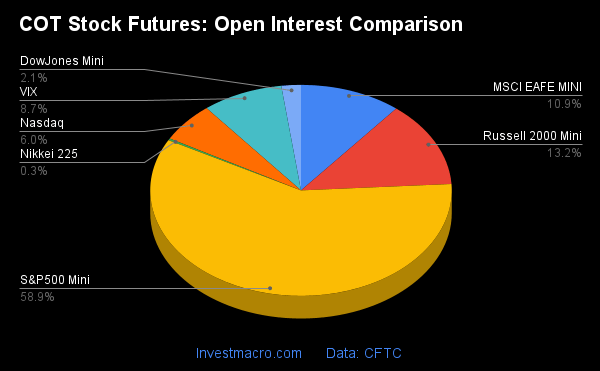
The COT stock markets speculator bets were mixed as four out of the eight stock markets we cover had higher positioning while the other four markets had lower speculator contracts.

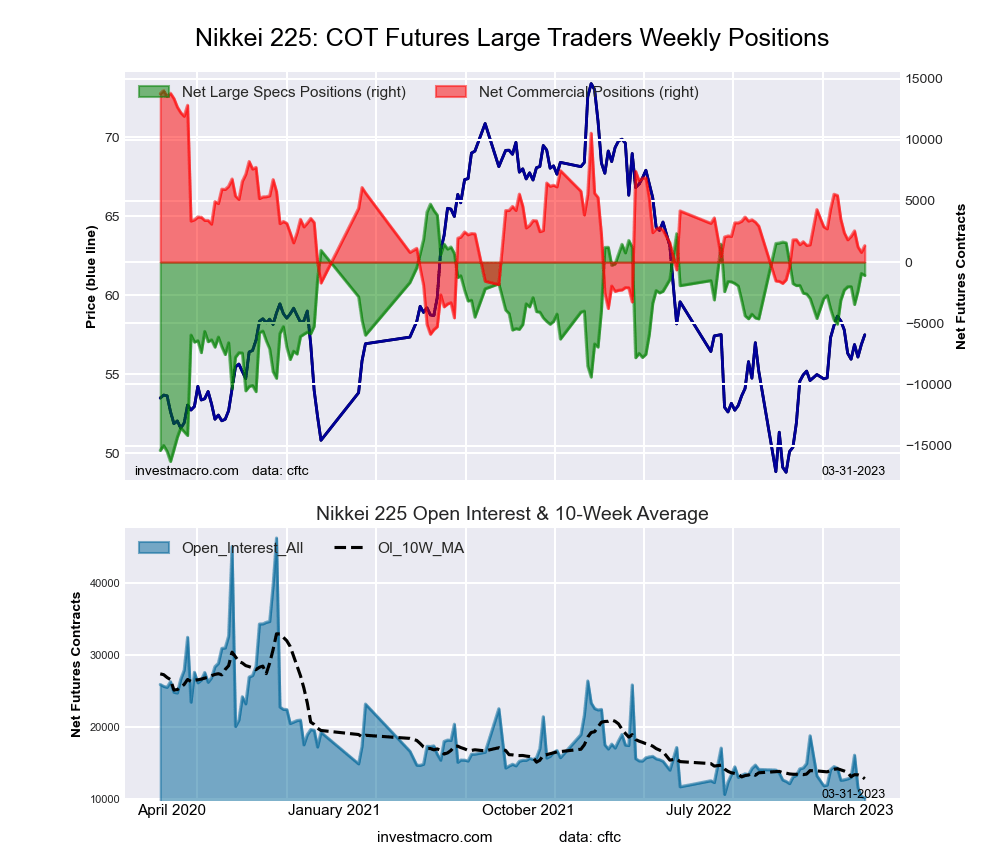
Leading the gains for the stock markets was the Nasdaq-Mini (9,403 contracts) with the Russell-Mini (4,377 contracts), Nikkei 225 Yen (2,632 contracts) and DowJones-Mini (538 contracts) also showing positive weeks.

The markets with the declines in speculator bets for the week were the S&P500-Mini (-13,266 contracts) and VIX (-13,769 contracts) with the MSCI EAFE-Mini (-638 contracts) and the Nikkei 225 (-360 contracts) also registering lower bets on the week.


Data Snapshot of Stock Market Traders | Columns Legend
Jan-31-2023OIOI-IndexSpec-NetSpec-IndexCom-NetCOM-IndexSmalls-NetSmalls-Index
S&P500-Mini2,061,4194-222,25715234,78682-12,52924
Nikkei 22514,33010-5,072535,45257-38024
Nasdaq-Mini278,44959-15,8586632,05346-16,19521
DowJones-Mini80,38643-9,4283312,07771-2,64927
VIX310,47542-66,9186669,70732-2,78978
Nikkei 225 Yen36,496139,11262-4,2010-4,91170


Strength Scores led by Nasdaq-Mini & VIX

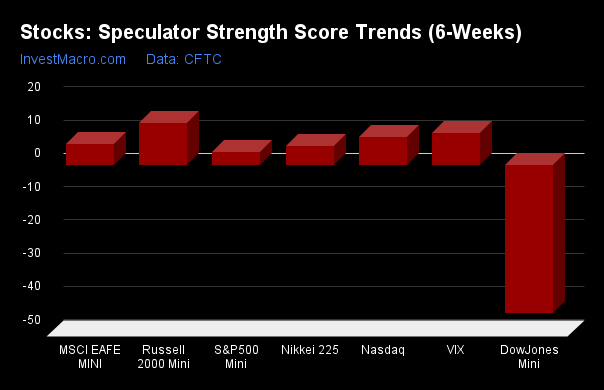
COT Strength Scores (a normalized measure of Speculator positions over a 3-Year range, from 0 to 100 where above 80 is Extreme-Bullish and below 20 is Extreme-Bearish) showed that the Nasdaq-Mini (66 percent) and the VIX (66 percent) led the stock markets. The Nikkei 225 Yen (62 percent) and Nikkei 225 (53 percent) come in as the next highest in the weekly strength scores.

On the downside, the MSCI EAFE-Mini (2 percent) and the S&P500-Mini (15 percent) come in at the lowest strength level currently and were in Extreme-Bearish territory (below 20 percent).

Strength Statistics:
VIX (66.5 percent) vs VIX previous week (76.0 percent)
S&P500-Mini (15.0 percent) vs S&P500-Mini previous week (17.5 percent)
DowJones-Mini (33.4 percent) vs DowJones-Mini previous week (32.4 percent)
Nasdaq-Mini (66.2 percent) vs Nasdaq-Mini previous week (60.9 percent)
Russell2000-Mini (33.9 percent) vs Russell2000-Mini previous week (31.3 percent)
Nikkei USD (53.4 percent) vs Nikkei USD previous week (55.1 percent)
EAFE-Mini (1.6 percent) vs EAFE-Mini previous week (2.4 percent)


VIX led the 6-Week Strength Trends

COT Strength Score Trends (or move index, calculates the 6-week changes in strength scores) showed that just about all the markets had lower trend scores. The VIX was the only market with a score above 0 at a 0.2 percent trend score. The EAFE-Mini (-36.5 percent) had the lowest or most negative score that week followed by the S&P500-Mini (-11.6 percent).

Strength Trend Statistics:
VIX (0.2 percent) vs VIX previous week (20.6 percent)
S&P500-Mini (-11.6 percent) vs S&P500-Mini previous week (3.9 percent)
DowJones-Mini (-5.2 percent) vs DowJones-Mini previous week (4.4 percent)
Nasdaq-Mini (-11.4 percent) vs Nasdaq-Mini previous week (-24.8 percent)
Russell2000-Mini (-2.4 percent) vs Russell2000-Mini previous week (-2.2 percent)
Nikkei USD (-10.0 percent) vs Nikkei USD previous week (-10.0 percent)
EAFE-Mini (-36.5 percent) vs EAFE-Mini previous week (-23.7 percent)


Individual Stock Market Charts:

VIX Volatility Futures:

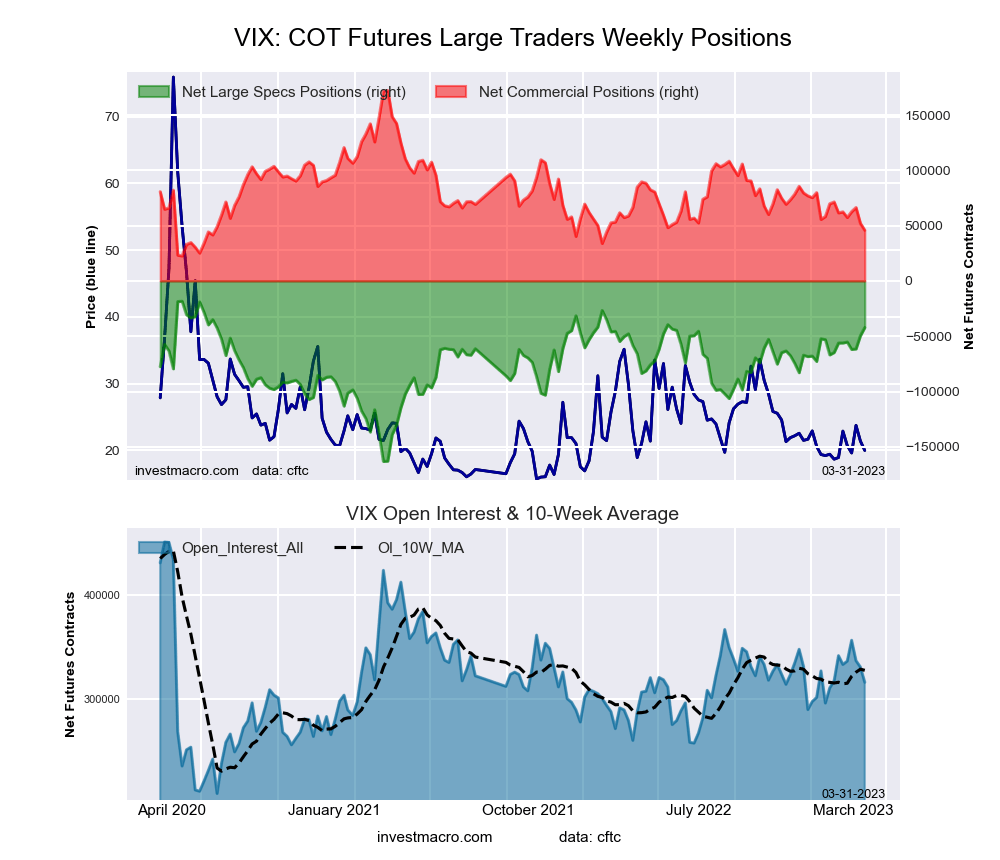
VIX Volatility Futures COT ChartThe VIX Volatility large speculator standing for the week totaled a net position of -66,918 contracts in the data reported through January 31st. This was a weekly lowering of -13,769 contracts from the previous week which had a total of -53,149 net contracts.

This week’s current strength score (the trader positioning range over the past three years, measured from 0 to 100) shows the speculators are currently Bullish with a score of 66.5 percent. The commercials are Bearish with a score of 31.5 percent and the small traders (not shown in chart) are Bullish with a score of 77.7 percent.

VIX Volatility Futures StatisticsSPECULATORSCOMMERCIALSSMALL TRADERS
– Percent of Open Interest Longs:17.057.77.9
– Percent of Open Interest Shorts:38.635.28.8
– Net Position:-66,91869,707-2,789
– Gross Longs:52,935178,99824,430
– Gross Shorts:119,853109,29127,219
– Long to Short Ratio:0.4 to 11.6 to 10.9 to 1
NET POSITION TREND:
– Strength Index Score (3 Year Range Pct):66.531.577.7
– Strength Index Reading (3 Year Range):BullishBearishBullish
NET POSITION MOVEMENT INDEX:
– 6-Week Change in Strength Index:0.2-6.546.0


S&P500 Mini Futures:

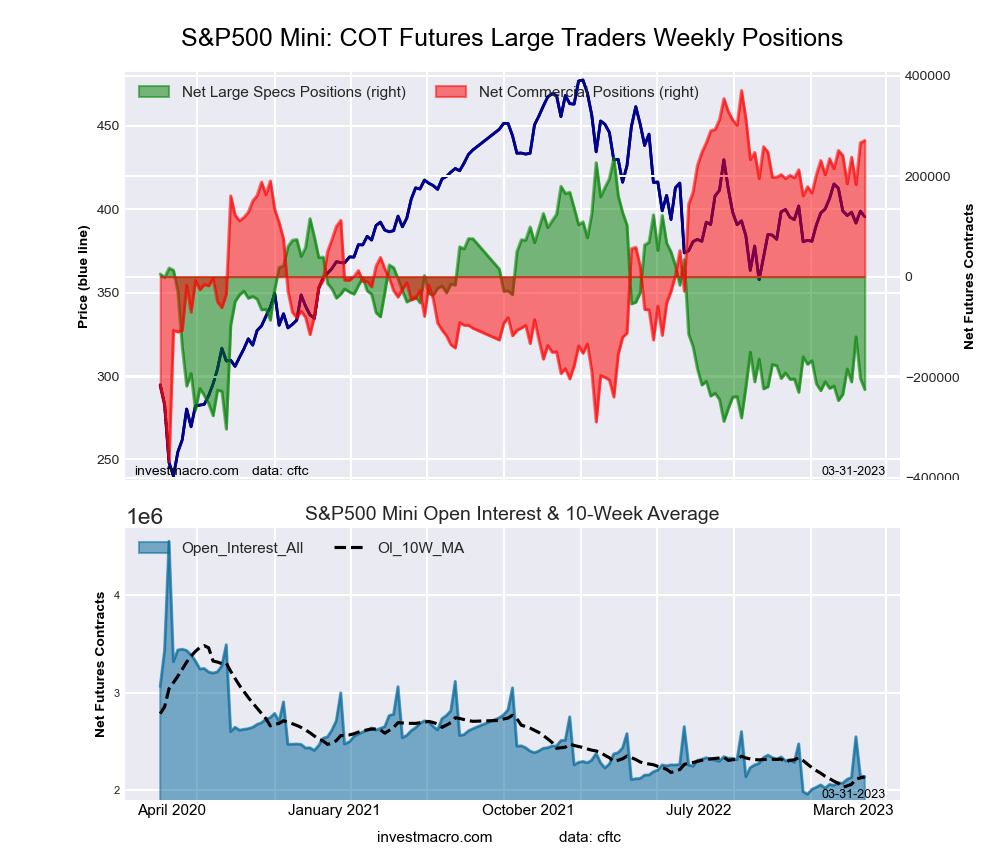
SP500 Mini Futures COT ChartThe S&P500 Mini large speculator standing for the week totaled a net position of -222,257 contracts in the data reported through January 31st. This was a weekly fall of -13,266 contracts from the previous week which had a total of -208,991 net contracts.

This week’s current strength score (the trader positioning range over the past three years, measured from 0 to 100) shows the speculators are currently Bearish-Extreme with a score of 15.0 percent. The commercials are Bullish-Extreme with a score of 81.6 percent and the small traders (not shown in chart) are Bearish with a score of 23.7 percent.

S&P500 Mini Futures StatisticsSPECULATORSCOMMERCIALSSMALL TRADERS
– Percent of Open Interest Longs:12.373.711.9
– Percent of Open Interest Shorts:23.162.312.5
– Net Position:-222,257234,786-12,529
– Gross Longs:253,4391,519,069245,628
– Gross Shorts:475,6961,284,283258,157
– Long to Short Ratio:0.5 to 11.2 to 11.0 to 1
NET POSITION TREND:
– Strength Index Score (3 Year Range Pct):15.081.623.7
– Strength Index Reading (3 Year Range):Bearish-ExtremeBullish-ExtremeBearish
NET POSITION MOVEMENT INDEX:
– 6-Week Change in Strength Index:-11.610.0-2.4


Dow Jones Mini Futures:

Dow Jones Mini Futures COT ChartThe Dow Jones Mini large speculator standing for the week totaled a net position of -9,428 contracts in the data reported through January 31st. This was a weekly advance of 538 contracts from the previous week which had a total of -9,966 net contracts.

This week’s current strength score (the trader positioning range over the past three years, measured from 0 to 100) shows the speculators are currently Bearish with a score of 33.4 percent. The commercials are Bullish with a score of 71.1 percent and the small traders (not shown in chart) are Bearish with a score of 27.2 percent.

Dow Jones Mini Futures StatisticsSPECULATORSCOMMERCIALSSMALL TRADERS
– Percent of Open Interest Longs:26.552.116.9
– Percent of Open Interest Shorts:38.337.120.1
– Net Position:-9,42812,077-2,649
– Gross Longs:21,33941,87413,546
– Gross Shorts:30,76729,79716,195
– Long to Short Ratio:0.7 to 11.4 to 10.8 to 1
NET POSITION TREND:
– Strength Index Score (3 Year Range Pct):33.471.127.2
– Strength Index Reading (3 Year Range):BearishBullishBearish
NET POSITION MOVEMENT INDEX:
– 6-Week Change in Strength Index:-5.22.76.6


Nasdaq Mini Futures:

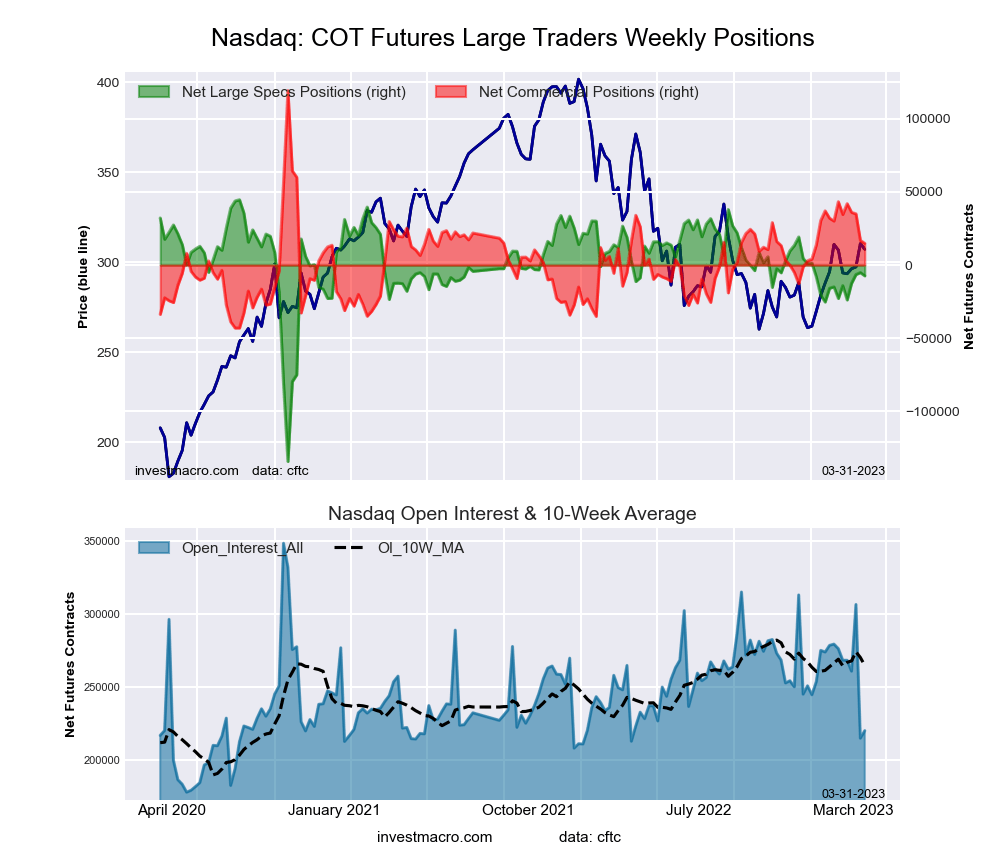
Nasdaq Mini Futures COT ChartThe Nasdaq Mini large speculator standing for the week totaled a net position of -15,858 contracts in the data reported through January 31st. This was a weekly boost of 9,403 contracts from the previous week which had a total of -25,261 net contracts.

This week’s current strength score (the trader positioning range over the past three years, measured from 0 to 100) shows the speculators are currently Bullish with a score of 66.2 percent. The commercials are Bearish with a score of 46.2 percent and the small traders (not shown in chart) are Bearish with a score of 21.3 percent.

Nasdaq Mini Futures StatisticsSPECULATORSCOMMERCIALSSMALL TRADERS
– Percent of Open Interest Longs:21.365.811.1
– Percent of Open Interest Shorts:27.054.216.9
– Net Position:-15,85832,053-16,195
– Gross Longs:59,439183,09830,935
– Gross Shorts:75,297151,04547,130
– Long to Short Ratio:0.8 to 11.2 to 10.7 to 1
NET POSITION TREND:
– Strength Index Score (3 Year Range Pct):66.246.221.3
– Strength Index Reading (3 Year Range):BullishBearishBearish
NET POSITION MOVEMENT INDEX:
– 6-Week Change in Strength Index:-11.420.5-24.8


Russell 2000 Mini Futures:

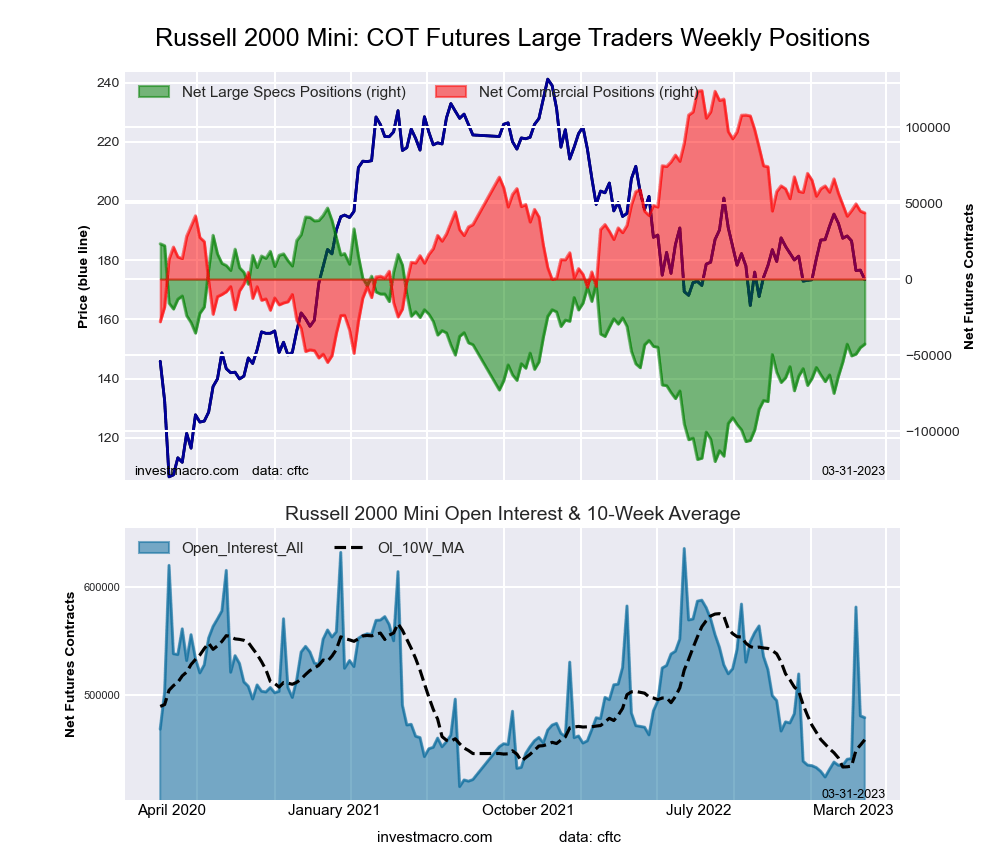
Russell 2000 Mini Futures COT ChartThe Russell 2000 Mini large speculator standing for the week totaled a net position of -63,024 contracts in the data reported through January 31st. This was a weekly gain of 4,377 contracts from the previous week which had a total of -67,401 net contracts.

This week’s current strength score (the trader positioning range over the past three years, measured from 0 to 100) shows the speculators are currently Bearish with a score of 33.9 percent. The commercials are Bullish with a score of 62.7 percent and the small traders (not shown in chart) are Bearish with a score of 44.8 percent.

Russell 2000 Mini Futures StatisticsSPECULATORSCOMMERCIALSSMALL TRADERS
– Percent of Open Interest Longs:9.982.75.9
– Percent of Open Interest Shorts:24.569.44.6
– Net Position:-63,02457,1435,881
– Gross Longs:42,702356,14325,493
– Gross Shorts:105,726299,00019,612
– Long to Short Ratio:0.4 to 11.2 to 11.3 to 1
NET POSITION TREND:
– Strength Index Score (3 Year Range Pct):33.962.744.8
– Strength Index Reading (3 Year Range):BearishBullishBearish
NET POSITION MOVEMENT INDEX:
– 6-Week Change in Strength Index:-2.40.112.4


Nikkei Stock Average (USD) Futures:

Nikkei Stock Average (USD) Futures COT ChartThe Nikkei Stock Average (USD) large speculator standing for the week totaled a net position of -5,072 contracts in the data reported through January 31st. This was a weekly fall of -360 contracts from the previous week which had a total of -4,712 net contracts.

This week’s current strength score (the trader positioning range over the past three years, measured from 0 to 100) shows the speculators are currently Bullish with a score of 53.4 percent. The commercials are Bullish with a score of 57.0 percent and the small traders (not shown in chart) are Bearish with a score of 23.6 percent.

Nikkei Stock Average Futures StatisticsSPECULATORSCOMMERCIALSSMALL TRADERS
– Percent of Open Interest Longs:15.865.918.3
– Percent of Open Interest Shorts:51.227.820.9
– Net Position:-5,0725,452-380
– Gross Longs:2,2699,4402,621
– Gross Shorts:7,3413,9883,001
– Long to Short Ratio:0.3 to 12.4 to 10.9 to 1
NET POSITION TREND:
– Strength Index Score (3 Year Range Pct):53.457.023.6
– Strength Index Reading (3 Year Range):BullishBullishBearish
NET POSITION MOVEMENT INDEX:
– 6-Week Change in Strength Index:-10.020.2-24.2


MSCI EAFE Mini Futures:

MSCI EAFE Mini Futures COT ChartThe MSCI EAFE Mini large speculator standing for the week totaled a net position of -34,840 contracts in the data reported. This was a weekly lowering of -638 contracts from the previous week which had a total of -34,202 net contracts.

This week’s current strength score (the trader positioning range over the past three years, measured from 0 to 100) shows the speculators are currently Bearish-Extreme with a score of 1.6 percent. The commercials are Bullish-Extreme with a score of 84.1 percent and the small traders (not shown in chart) are Bullish-Extreme with a score of 100.0 percent.

MSCI EAFE Mini Futures StatisticsSPECULATORSCOMMERCIALSSMALL TRADERS
– Percent of Open Interest Longs:6.587.55.1
– Percent of Open Interest Shorts:15.882.01.3
– Net Position:-34,84020,73414,106
– Gross Longs:24,465327,87118,967
– Gross Shorts:59,305307,1374,861
– Long to Short Ratio:0.4 to 11.1 to 13.9 to 1
NET POSITION TREND:
– Strength Index Score (3 Year Range Pct):1.684.1100.0
– Strength Index Reading (3 Year Range):Bearish-ExtremeBullish-ExtremeBullish-Extreme
NET POSITION MOVEMENT INDEX:
– 6-Week Change in Strength Index:-36.527.938.4


Article By InvestMacroReceive our weekly COT Newsletter

*COT Report: The COT data, released weekly to the public each Friday, is updated through the most recent Tuesday (data is 3 days old) and shows a quick view of how large speculators or non-commercials (for-profit traders) were positioned in the futures markets.

The CFTC categorizes trader positions according to commercial hedgers (traders who use futures contracts for hedging as part of the business), non-commercials (large traders who speculate to realize trading profits) and nonreportable traders (usually small traders/speculators) as well as their open interest (contracts open in the market at time of reporting). See CFTC criteria here.

Week Ahead: 3 reasons why EURUSD may see a rebound

By ForexTime

As we close out the month and head into the first days of March, here are the scheduled economic data releases and events that could move markets over the coming week:


Monday, February 27

  • EUR: Eurozone February economic confidence; ECB Chief Economist Philip Lane speech
  • GBP: Bank of England Deputy Governor Ben Broadbent speech

Tuesday, February 28

  • JPY: Japan January industrial production, retail sales
  • AUD: Australia January retail sales
  • CAD: Canada December GDP
  • USD: US February consumer confidence; Chicago Fed President Austan Goolsbee speech

Wednesday, March 1

  • AUD: Australia 4Q GDP
  • CNH: China February PMIs
  • EUR: Eurozone February manufacturing PMI (final)
  • GBP: UK February manufacturing PMI (final); BOE Governor Andrew Bailey speech
  • USD: US February ISM manufacturing

Thursday, March 2

  • EUR: Eurozone February CPI, ECB minutes, January unemployment
  • GBP: BOE Chief Economist Huw Pill speech
  • USD: US weekly jobless claims

Friday, March 3

  • JPY: Japan January unemployment; February Tokyo CPI
  • CNH: China February services PMI
  • EUR: Eurozone January PPI, February services PMI (final)


With month-to-date declines of 2.4%, EURUSD is set to bring the curtains down on a winning run of four consecutive monthly gains (October – January).

Following February’s flop, here are three reasons why Euro bulls will be eager to start off March on the front foot:

  1. Still-elevated Eurozone inflation could strengthen EUR

Recall that central banks around the world have been aggressively raising their respective interest rates to try and cool down inflation.

Since July 2022, the European Central Bank (ECB) has lifted its benchmark rates by a cumulative 300 basis points.

Yet the Eurozone’s January inflation number (as measured by the CPI – consumer price index) came in at 8.6%, which is more than four times the ECB’s 2% target.

The Eurozone’s core CPI (inflation figure that excludes more volatile items such as energy, food, alcohol, and tobacco) still printed at a record high of 5.3% in January!

In other words, the ECB is likely to keep hiking its benchmark rates higher and longer, in order to drag inflation meaningfully lower towards 2%.

And the prospects of higher interest rates tends to translate into currency strength.

Hence, if we are presented with fresh evidence on March 2nd of stubborn Eurozone inflation (say, a number that isn’t noticeably lower than January’s 8.6%), that could help the euro unwind its near-1% of year-to-date declines against the resurgent US dollar.

READ MORE: (September 2022) Why FX markets react to central banks?


  1. Bloomberg model: EURUSD slightly likelier to touch 1.070 than 1.050

From current levels of 1.060 flat at the time of writing, Bloomberg’s FX forecast model points to a 40% chance that we’ll see the world’s most popular FX pair touch 1.070.

Compare that with the slightly lower 36% chance of EURUSD touching 1.05 over the next one-week period.

While both price levels are accorded less-than-even odds, it remains to be seen whether the CPI print or other fundamental factors could trigger such a massive move.


  1. EURUSD may see technical rebound if “oversold” levels reached

This FX pair’s 14-day relative strength index has been careening closer towards the 30 mark, which is the threshold that denotes oversold conditions.

Note how in previous episodes, once the RSI drops below the 30 line, EURUSD then duly bounces back up.

Of course, that means that EURUSD has to fall further in order for its RSI to actually hit the 30 threshold at least, before it can even get a chance of seeing a technical rebound.

And that EURUSD decline may even happen later today (Friday, February 24t ), if the US PCE deflator (the Federal Reserve’s preferred metric for measuring inflation) comes in higher than the market forecasts for a 5% year-on-year advance.

Such an event (higher-than-expected US PCE deflator) later today should translate into more US Dollar strength (i.e. lower EURUSD), and could just pave the way for EURUSD’s technical rebound next week.

Key levels for EURUSD in the week ahead:

SUPPORT

  • 1.050 region: psychologically-important area
  • 1.04832: January 2023 cycle low
  • 1.040 region: psychologically-important line


RESISTANCE

  • 50-day simple moving average (SMA)
  • 1.07365: mid-December cycle high
  • 1.08045: mid-February high


At the time of writing, Bloomberg’s FX model forecasts a 74% chance that EURUSD will trade within the 1.0476 – 1.0729 range, using current levels as a base, over the next one week.


Forex-Time-LogoArticle by ForexTime

ForexTime Ltd (FXTM) is an award winning international online forex broker regulated by CySEC 185/12 www.forextime.com