Archive for Financial News – Page 185

COT Soft Commodities Charts: Corn, Soybeans & Coffee lead Speculator Bets lower

By InvestMacro

Here are the latest charts and statistics for the Commitment of Traders (COT) reports data published by the Commodities Futures Trading Commission (CFTC).

The latest COT data is updated through Tuesday August 15th and shows a quick view of how large traders (for-profit speculators and commercial entities) were positioned in the futures markets.

Weekly Speculator Bets led lower by Corn, Soybeans & Coffee

The COT soft commodities markets speculator bets were lower this week as just one out of the eleven softs markets we cover had higher positioning while the other ten markets had lower speculator contracts.

Leading the gains for the softs markets was Soybean Oil with a small gain of just 316 contracts for the week.

All the other markets with the declines in speculator bets this week were Corn (-52,693 contracts) with Coffee (-18,522 contracts), Soybeans (-18,130 contracts), Soybean Meal (-17,204 contracts), Wheat (-9,081 contracts), Sugar (-7,790 contracts), Lean Hogs (-5,324 contracts)Cocoa (-2,377 contracts), Live Cattle (-631 contracts) and Cotton (-426 contracts) also seeing lower bets on the week.


Data Snapshot of Commodity Market Traders | Columns Legend
Aug-15-2023OIOI-IndexSpec-NetSpec-IndexCom-NetCOM-IndexSmalls-NetSmalls-Index
WTI Crude1,702,76627242,10826-270,1017627,99335
Gold433,6115121,13630-141,9306920,79432
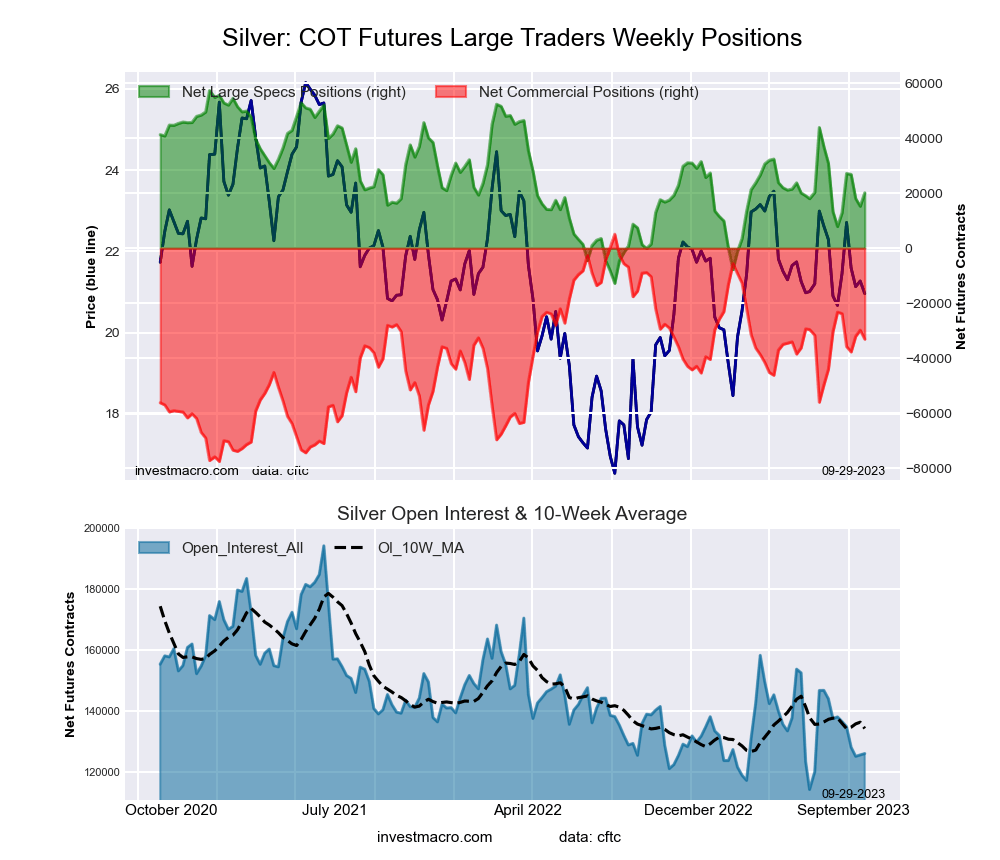
Silver138,215307,86129-23,2646615,40352
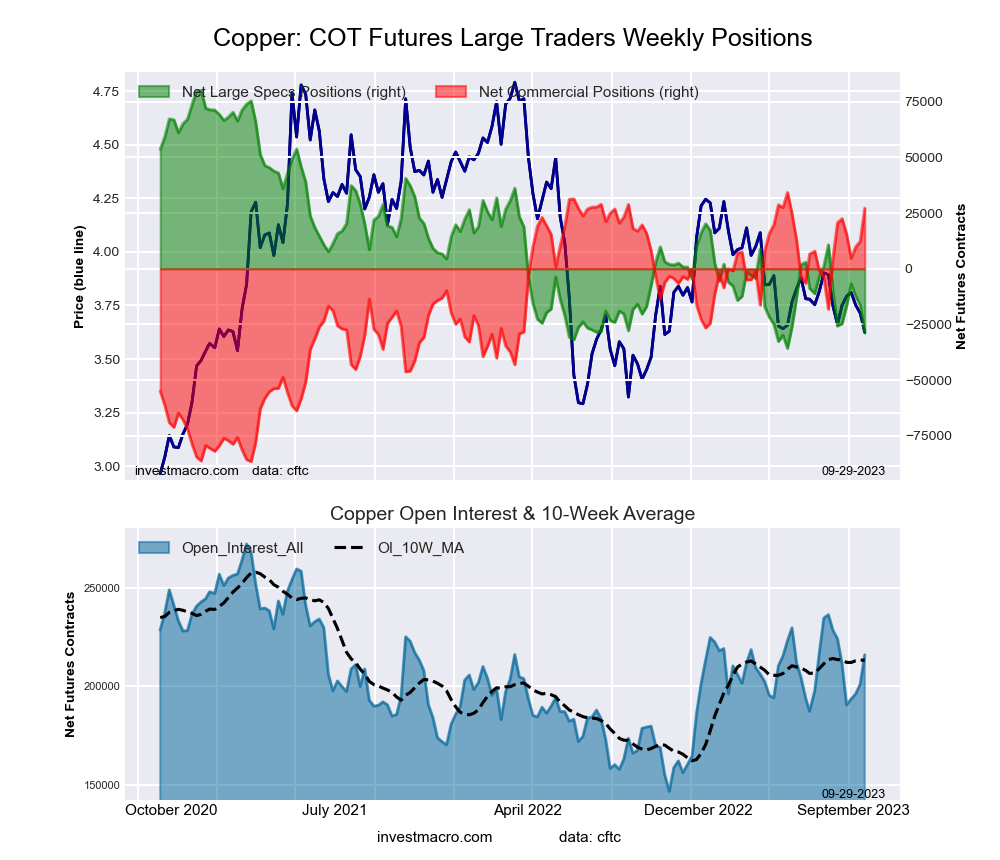
Copper224,21562-25,698920,665895,03350
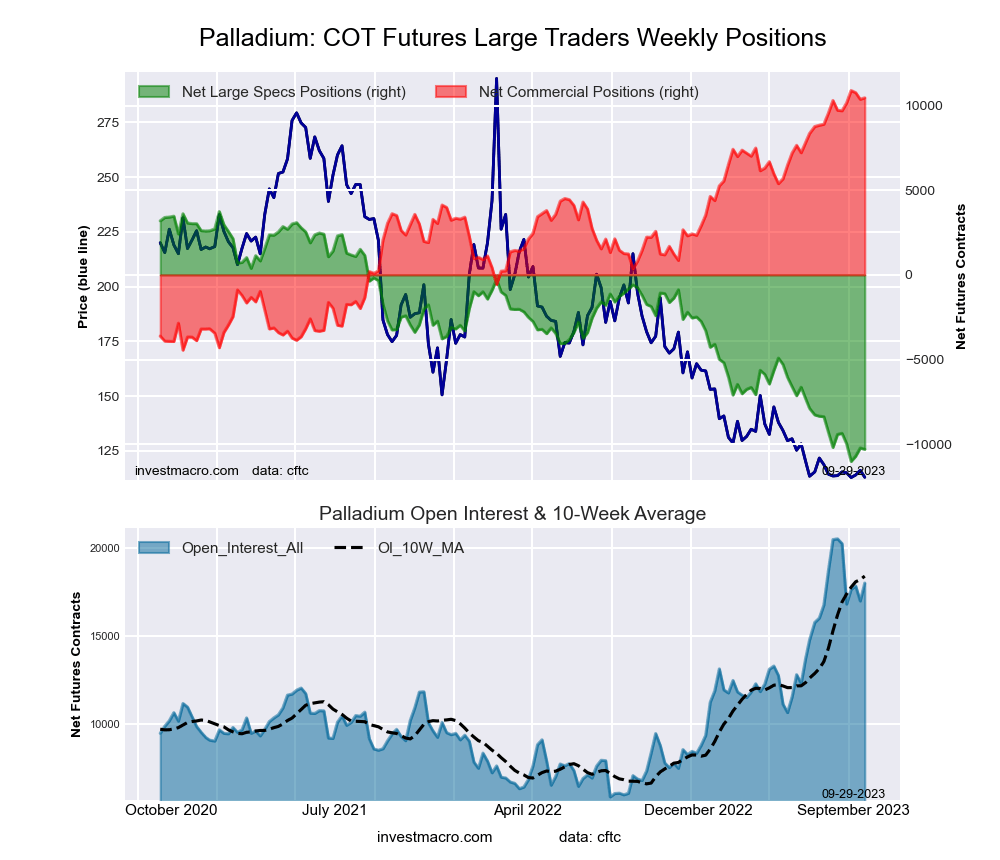
Palladium20,511100-9,42369,72296-29924
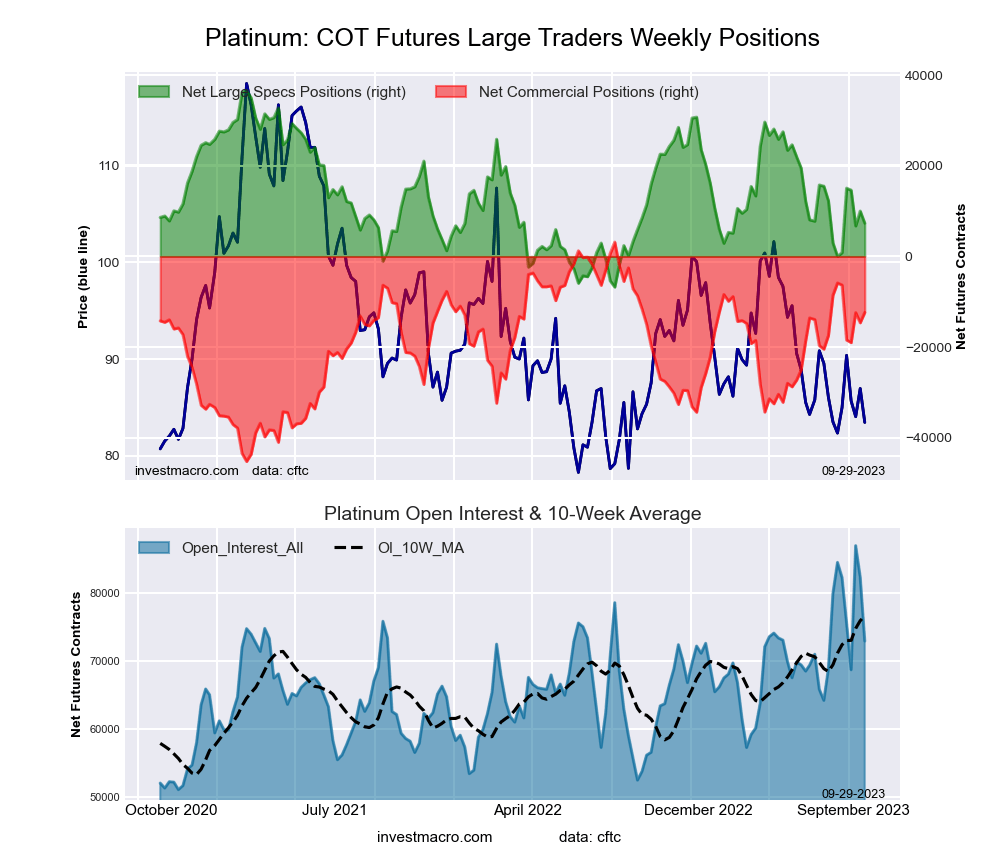
Platinum84,557100116-5,866815,86547
Natural Gas1,168,18143-95,1833466,7556628,42848
Brent129,1847-43,2002741,206761,99436
Heating Oil332,7124931,67786-58,1811426,50490
Soybeans638,7851465,33315-43,64982-21,68449
Corn1,287,01913-26,966673,17493-46,20851
Coffee180,11838,49536-8,05268-4437
Sugar929,30655191,43359-228,4934037,06051
Wheat374,83951-31,8754433,91356-2,03865


Strength Scores led by Cocoa & Live Cattle

COT Strength Scores (a normalized measure of Speculator positions over a 3-Year range, from 0 to 100 where above 80 is Extreme-Bullish and below 20 is Extreme-Bearish) showed that Cocoa (97 percent) and Live Cattle (77 percent) lead the softs markets this week. Sugar (59 percent), Soybean Meal (51 percent) and Soybean Oil (47 percent) come in as the next highest in the weekly strength scores.

On the downside, Corn (6 percent) and Soybeans (15 percent) come in at the lowest strength levels currently and are in Extreme-Bearish territory (below 20 percent). The next lowest strength scores are the Lean Hogs (21 percent) and the Coffee (36 percent).

Strength Statistics:
Corn (5.8 percent) vs Corn previous week (14.4 percent)
Sugar (58.6 percent) vs Sugar previous week (61.3 percent)
Coffee (36.1 percent) vs Coffee previous week (61.8 percent)
Soybeans (14.8 percent) vs Soybeans previous week (22.0 percent)
Soybean Oil (47.2 percent) vs Soybean Oil previous week (47.0 percent)
Soybean Meal (51.4 percent) vs Soybean Meal previous week (61.0 percent)
Live Cattle (76.7 percent) vs Live Cattle previous week (77.4 percent)
Lean Hogs (20.9 percent) vs Lean Hogs previous week (25.3 percent)
Cotton (39.4 percent) vs Cotton previous week (39.7 percent)
Cocoa (97.3 percent) vs Cocoa previous week (100.0 percent)
Wheat (44.1 percent) vs Wheat previous week (50.6 percent)


Cotton & Wheat top the 6-Week Strength Trends

COT Strength Score Trends (or move index, calculates the 6-week changes in strength scores) showed that Cotton (28 percent) and Wheat (10 percent) lead the past six weeks trends for soft commodities. Soybean Oil (5 percent), Cocoa (5 percent) and Lean Hogs (2 percent) are the next highest positive movers in the latest trends data.

Coffee (-23 percent) leads the downside trend scores currently with Live Cattle (-16 percent), Corn (-12 percent) and Soybeans (-10 percent) following next with lower trend scores.

Strength Trend Statistics:
Corn (-12.0 percent) vs Corn previous week (-14.4 percent)
Sugar (-2.8 percent) vs Sugar previous week (-7.4 percent)
Coffee (-23.1 percent) vs Coffee previous week (-0.0 percent)
Soybeans (-10.1 percent) vs Soybeans previous week (-7.2 percent)
Soybean Oil (5.4 percent) vs Soybean Oil previous week (9.9 percent)
Soybean Meal (-3.5 percent) vs Soybean Meal previous week (4.3 percent)
Live Cattle (-15.9 percent) vs Live Cattle previous week (-12.7 percent)
Lean Hogs (1.6 percent) vs Lean Hogs previous week (9.2 percent)
Cotton (27.5 percent) vs Cotton previous week (32.2 percent)
Cocoa (5.1 percent) vs Cocoa previous week (8.9 percent)
Wheat (9.7 percent) vs Wheat previous week (17.3 percent)


Individual Soft Commodities Markets:

CORN Futures:

CORN Futures COT ChartThe CORN large speculator standing this week was a net position of -26,966 contracts in the data reported through Tuesday. This was a weekly lowering of -52,693 contracts from the previous week which had a total of 25,727 net contracts.

This week’s current strength score (the trader positioning range over the past three years, measured from 0 to 100) shows the speculators are currently Bearish-Extreme with a score of 5.8 percent. The commercials are Bullish-Extreme with a score of 93.1 percent and the small traders (not shown in chart) are Bullish with a score of 51.3 percent.

Price Trend-Following Model: Strong Downtrend

Our weekly trend-following model classifies the current market price position as: Strong Downtrend. The current action for the model is considered to be: Hold – Maintain Short Position.

CORN Futures StatisticsSPECULATORSCOMMERCIALSSMALL TRADERS
– Percent of Open Interest Longs:21.649.610.1
– Percent of Open Interest Shorts:23.743.913.7
– Net Position:-26,96673,174-46,208
– Gross Longs:277,537637,897129,791
– Gross Shorts:304,503564,723175,999
– Long to Short Ratio:0.9 to 11.1 to 10.7 to 1
NET POSITION TREND:
– Strength Index Score (3 Year Range Pct):5.893.151.3
– Strength Index Reading (3 Year Range):Bearish-ExtremeBullish-ExtremeBullish
NET POSITION MOVEMENT INDEX:
– 6-Week Change in Strength Index:-12.011.71.1


SUGAR Futures:

SUGAR Futures COT ChartThe SUGAR large speculator standing this week was a net position of 191,433 contracts in the data reported through Tuesday. This was a weekly decrease of -7,790 contracts from the previous week which had a total of 199,223 net contracts.

This week’s current strength score (the trader positioning range over the past three years, measured from 0 to 100) shows the speculators are currently Bullish with a score of 58.6 percent. The commercials are Bearish with a score of 39.8 percent and the small traders (not shown in chart) are Bullish with a score of 50.7 percent.

Price Trend-Following Model: Uptrend

Our weekly trend-following model classifies the current market price position as: Uptrend. The current action for the model is considered to be: Hold – Maintain Long Position.

SUGAR Futures StatisticsSPECULATORSCOMMERCIALSSMALL TRADERS
– Percent of Open Interest Longs:29.546.29.2
– Percent of Open Interest Shorts:8.970.85.2
– Net Position:191,433-228,49337,060
– Gross Longs:274,489429,31785,080
– Gross Shorts:83,056657,81048,020
– Long to Short Ratio:3.3 to 10.7 to 11.8 to 1
NET POSITION TREND:
– Strength Index Score (3 Year Range Pct):58.639.850.7
– Strength Index Reading (3 Year Range):BullishBearishBullish
NET POSITION MOVEMENT INDEX:
– 6-Week Change in Strength Index:-2.80.48.8


COFFEE Futures:

COFFEE Futures COT ChartThe COFFEE large speculator standing this week was a net position of 8,495 contracts in the data reported through Tuesday. This was a weekly decrease of -18,522 contracts from the previous week which had a total of 33,494 net contracts.

This week’s current strength score (the trader positioning range over the past three years, measured from 0 to 100) shows the speculators are currently Bearish with a score of 36.1 percent. The commercials are Bullish with a score of 67.9 percent and the small traders (not shown in chart) are Bearish-Extreme with a score of 7.3 percent.

Price Trend-Following Model: Uptrend

Our weekly trend-following model classifies the current market price position as: Uptrend. The current action for the model is considered to be: Hold – Maintain Long Position.

COFFEE Futures StatisticsSPECULATORSCOMMERCIALSSMALL TRADERS
– Percent of Open Interest Longs:23.447.03.7
– Percent of Open Interest Shorts:18.751.43.9
– Net Position:8,495-8,052-443
– Gross Longs:42,19084,6066,662
– Gross Shorts:33,69592,6587,105
– Long to Short Ratio:1.3 to 10.9 to 10.9 to 1
NET POSITION TREND:
– Strength Index Score (3 Year Range Pct):36.167.97.3
– Strength Index Reading (3 Year Range):BearishBullishBearish-Extreme
NET POSITION MOVEMENT INDEX:
– 6-Week Change in Strength Index:-23.124.0-19.8


SOYBEANS Futures:

SOYBEANS Futures COT ChartThe SOYBEANS large speculator standing this week was a net position of 65,333 contracts in the data reported through Tuesday. This was a weekly fall of -18,130 contracts from the previous week which had a total of 83,463 net contracts.

This week’s current strength score (the trader positioning range over the past three years, measured from 0 to 100) shows the speculators are currently Bearish-Extreme with a score of 14.8 percent. The commercials are Bullish-Extreme with a score of 81.7 percent and the small traders (not shown in chart) are Bearish with a score of 49.2 percent.

Price Trend-Following Model: Strong Uptrend

Our weekly trend-following model classifies the current market price position as: Strong Uptrend. The current action for the model is considered to be: Hold – Maintain Long Position.

SOYBEANS Futures StatisticsSPECULATORSCOMMERCIALSSMALL TRADERS
– Percent of Open Interest Longs:21.654.66.7
– Percent of Open Interest Shorts:11.461.410.1
– Net Position:65,333-43,649-21,684
– Gross Longs:138,099348,48143,056
– Gross Shorts:72,766392,13064,740
– Long to Short Ratio:1.9 to 10.9 to 10.7 to 1
NET POSITION TREND:
– Strength Index Score (3 Year Range Pct):14.881.749.2
– Strength Index Reading (3 Year Range):Bearish-ExtremeBullish-ExtremeBearish
NET POSITION MOVEMENT INDEX:
– 6-Week Change in Strength Index:-10.19.8-6.1


SOYBEAN OIL Futures:

SOYBEAN OIL Futures COT ChartThe SOYBEAN OIL large speculator standing this week was a net position of 50,152 contracts in the data reported through Tuesday. This was a weekly lift of 316 contracts from the previous week which had a total of 49,836 net contracts.

This week’s current strength score (the trader positioning range over the past three years, measured from 0 to 100) shows the speculators are currently Bearish with a score of 47.2 percent. The commercials are Bullish with a score of 51.1 percent and the small traders (not shown in chart) are Bullish with a score of 53.2 percent.

Price Trend-Following Model: Uptrend

Our weekly trend-following model classifies the current market price position as: Uptrend. The current action for the model is considered to be: Hold – Maintain Long Position.

SOYBEAN OIL Futures StatisticsSPECULATORSCOMMERCIALSSMALL TRADERS
– Percent of Open Interest Longs:20.252.27.1
– Percent of Open Interest Shorts:9.864.84.9
– Net Position:50,152-60,78610,634
– Gross Longs:97,149251,10934,124
– Gross Shorts:46,997311,89523,490
– Long to Short Ratio:2.1 to 10.8 to 11.5 to 1
NET POSITION TREND:
– Strength Index Score (3 Year Range Pct):47.251.153.2
– Strength Index Reading (3 Year Range):BearishBullishBullish
NET POSITION MOVEMENT INDEX:
– 6-Week Change in Strength Index:5.4-6.612.7


SOYBEAN MEAL Futures:

SOYBEAN MEAL Futures COT ChartThe SOYBEAN MEAL large speculator standing this week was a net position of 89,760 contracts in the data reported through Tuesday. This was a weekly fall of -17,204 contracts from the previous week which had a total of 106,964 net contracts.

This week’s current strength score (the trader positioning range over the past three years, measured from 0 to 100) shows the speculators are currently Bullish with a score of 51.4 percent. The commercials are Bearish with a score of 49.4 percent and the small traders (not shown in chart) are Bearish with a score of 37.9 percent.

Price Trend-Following Model: Strong Downtrend

Our weekly trend-following model classifies the current market price position as: Strong Downtrend. The current action for the model is considered to be: Hold – Maintain Short Position.

SOYBEAN MEAL Futures StatisticsSPECULATORSCOMMERCIALSSMALL TRADERS
– Percent of Open Interest Longs:23.340.19.3
– Percent of Open Interest Shorts:5.062.15.5
– Net Position:89,760-108,12218,362
– Gross Longs:114,387197,15645,518
– Gross Shorts:24,627305,27827,156
– Long to Short Ratio:4.6 to 10.6 to 11.7 to 1
NET POSITION TREND:
– Strength Index Score (3 Year Range Pct):51.449.437.9
– Strength Index Reading (3 Year Range):BullishBearishBearish
NET POSITION MOVEMENT INDEX:
– 6-Week Change in Strength Index:-3.50.523.9


LIVE CATTLE Futures:

LIVE CATTLE Futures COT ChartThe LIVE CATTLE large speculator standing this week was a net position of 90,669 contracts in the data reported through Tuesday. This was a weekly reduction of -631 contracts from the previous week which had a total of 91,300 net contracts.

This week’s current strength score (the trader positioning range over the past three years, measured from 0 to 100) shows the speculators are currently Bullish with a score of 76.7 percent. The commercials are Bearish with a score of 26.9 percent and the small traders (not shown in chart) are Bearish with a score of 21.2 percent.

Price Trend-Following Model: Uptrend

Our weekly trend-following model classifies the current market price position as: Uptrend. The current action for the model is considered to be: Hold – Maintain Long Position.

LIVE CATTLE Futures StatisticsSPECULATORSCOMMERCIALSSMALL TRADERS
– Percent of Open Interest Longs:44.328.99.0
– Percent of Open Interest Shorts:14.854.413.0
– Net Position:90,669-78,404-12,265
– Gross Longs:136,25489,06827,615
– Gross Shorts:45,585167,47239,880
– Long to Short Ratio:3.0 to 10.5 to 10.7 to 1
NET POSITION TREND:
– Strength Index Score (3 Year Range Pct):76.726.921.2
– Strength Index Reading (3 Year Range):BullishBearishBearish
NET POSITION MOVEMENT INDEX:
– 6-Week Change in Strength Index:-15.916.66.4


LEAN HOGS Futures:

LEAN HOGS Futures COT ChartThe LEAN HOGS large speculator standing this week was a net position of -10,674 contracts in the data reported through Tuesday. This was a weekly decline of -5,324 contracts from the previous week which had a total of -5,350 net contracts.

This week’s current strength score (the trader positioning range over the past three years, measured from 0 to 100) shows the speculators are currently Bearish with a score of 20.9 percent. The commercials are Bullish-Extreme with a score of 83.1 percent and the small traders (not shown in chart) are Bullish with a score of 67.3 percent.

Price Trend-Following Model: Weak Uptrend

Our weekly trend-following model classifies the current market price position as: Weak Uptrend. The current action for the model is considered to be: Hold – Maintain Long Position.

LEAN HOGS Futures StatisticsSPECULATORSCOMMERCIALSSMALL TRADERS
– Percent of Open Interest Longs:31.239.58.9
– Percent of Open Interest Shorts:36.232.910.5
– Net Position:-10,67414,260-3,586
– Gross Longs:66,87484,65518,971
– Gross Shorts:77,54870,39522,557
– Long to Short Ratio:0.9 to 11.2 to 10.8 to 1
NET POSITION TREND:
– Strength Index Score (3 Year Range Pct):20.983.167.3
– Strength Index Reading (3 Year Range):BearishBullish-ExtremeBullish
NET POSITION MOVEMENT INDEX:
– 6-Week Change in Strength Index:1.6-0.5-5.9


COTTON Futures:

COTTON Futures COT ChartThe COTTON large speculator standing this week was a net position of 40,718 contracts in the data reported through Tuesday. This was a weekly decrease of -426 contracts from the previous week which had a total of 41,144 net contracts.

This week’s current strength score (the trader positioning range over the past three years, measured from 0 to 100) shows the speculators are currently Bearish with a score of 39.4 percent. The commercials are Bullish with a score of 56.1 percent and the small traders (not shown in chart) are Bullish with a score of 75.6 percent.

Price Trend-Following Model: Uptrend

Our weekly trend-following model classifies the current market price position as: Uptrend. The current action for the model is considered to be: Hold – Maintain Long Position.

COTTON Futures StatisticsSPECULATORSCOMMERCIALSSMALL TRADERS
– Percent of Open Interest Longs:36.543.07.9
– Percent of Open Interest Shorts:17.167.13.2
– Net Position:40,718-50,5469,828
– Gross Longs:76,62990,26316,647
– Gross Shorts:35,911140,8096,819
– Long to Short Ratio:2.1 to 10.6 to 12.4 to 1
NET POSITION TREND:
– Strength Index Score (3 Year Range Pct):39.456.175.6
– Strength Index Reading (3 Year Range):BearishBullishBullish
NET POSITION MOVEMENT INDEX:
– 6-Week Change in Strength Index:27.5-30.955.1


COCOA Futures:

COCOA Futures COT ChartThe COCOA large speculator standing this week was a net position of 77,125 contracts in the data reported through Tuesday. This was a weekly lowering of -2,377 contracts from the previous week which had a total of 79,502 net contracts.

This week’s current strength score (the trader positioning range over the past three years, measured from 0 to 100) shows the speculators are currently Bullish-Extreme with a score of 97.3 percent. The commercials are Bearish-Extreme with a score of 1.7 percent and the small traders (not shown in chart) are Bearish with a score of 32.3 percent.

Price Trend-Following Model: Uptrend

Our weekly trend-following model classifies the current market price position as: Uptrend. The current action for the model is considered to be: Hold – Maintain Long Position.

COCOA Futures StatisticsSPECULATORSCOMMERCIALSSMALL TRADERS
– Percent of Open Interest Longs:46.628.43.8
– Percent of Open Interest Shorts:18.457.82.5
– Net Position:77,125-80,6983,573
– Gross Longs:127,72477,86410,505
– Gross Shorts:50,599158,5626,932
– Long to Short Ratio:2.5 to 10.5 to 11.5 to 1
NET POSITION TREND:
– Strength Index Score (3 Year Range Pct):97.31.732.3
– Strength Index Reading (3 Year Range):Bullish-ExtremeBearish-ExtremeBearish
NET POSITION MOVEMENT INDEX:
– 6-Week Change in Strength Index:5.1-5.75.6


WHEAT Futures:

WHEAT Futures COT ChartThe WHEAT large speculator standing this week was a net position of -31,875 contracts in the data reported through Tuesday. This was a weekly decline of -9,081 contracts from the previous week which had a total of -22,794 net contracts.

This week’s current strength score (the trader positioning range over the past three years, measured from 0 to 100) shows the speculators are currently Bearish with a score of 44.1 percent. The commercials are Bullish with a score of 56.0 percent and the small traders (not shown in chart) are Bullish with a score of 65.2 percent.

Price Trend-Following Model: Strong Downtrend

Our weekly trend-following model classifies the current market price position as: Strong Downtrend. The current action for the model is considered to be: Hold – Maintain Short Position.

WHEAT Futures StatisticsSPECULATORSCOMMERCIALSSMALL TRADERS
– Percent of Open Interest Longs:29.436.79.4
– Percent of Open Interest Shorts:37.927.610.0
– Net Position:-31,87533,913-2,038
– Gross Longs:110,356137,51535,301
– Gross Shorts:142,231103,60237,339
– Long to Short Ratio:0.8 to 11.3 to 10.9 to 1
NET POSITION TREND:
– Strength Index Score (3 Year Range Pct):44.156.065.2
– Strength Index Reading (3 Year Range):BearishBullishBullish
NET POSITION MOVEMENT INDEX:
– 6-Week Change in Strength Index:9.7-13.712.5


Article By InvestMacroReceive our weekly COT Newsletter

*COT Report: The COT data, released weekly to the public each Friday, is updated through the most recent Tuesday (data is 3 days old) and shows a quick view of how large speculators or non-commercials (for-profit traders) were positioned in the futures markets.

The CFTC categorizes trader positions according to commercial hedgers (traders who use futures contracts for hedging as part of the business), non-commercials (large traders who speculate to realize trading profits) and nonreportable traders (usually small traders/speculators) as well as their open interest (contracts open in the market at time of reporting). See CFTC criteria here.

COT Stock Market Charts: Weekly Speculator Bets led by S&P500-Mini & the VIX

By InvestMacro

Here are the latest charts and statistics for the Commitment of Traders (COT) data published by the Commodities Futures Trading Commission (CFTC).

The latest COT data is updated through Tuesday August 15th and shows a quick view of how large traders (for-profit speculators and commercial entities) were positioned in the futures markets.

Weekly Speculator Changes led by S&P500-Mini & VIX

The COT stock markets speculator bets were lower this week as three out of the seven stock markets we cover had higher positioning while the other four markets had lower speculator contracts.

Leading the gains for the stock markets was S&P500-Mini (41,162 contracts) with the VIX (18,419 contracts) and the Nasdaq-Mini (16,048 contracts) also showing positive weeks.

The markets with the declines in speculator bets this week were the DowJones-Mini (-7,252 contracts) with the Russell-Mini (-6,768 contracts), the Nikkei 225 (-34 contracts) and MSCI EAFE-Mini (-587 contracts) also registering lower bets on the week.


Data Snapshot of Stock Market Traders | Columns Legend
Aug-15-2023OIOI-IndexSpec-NetSpec-IndexCom-NetCOM-IndexSmalls-NetSmalls-Index
S&P500-Mini2,220,08422-118,4084796,1475322,26152
Nikkei 22516,97419-70065-596321,29645
Nasdaq-Mini267,495425,16980-4,71620-45353
DowJones-Mini104,21671-3,221652,8794034246
VIX395,24070-25,98510031,6130-5,62867
Nikkei 225 Yen51,699395,8605214,72951-20,58940


Strength Scores led by VIX & Nasdaq-Mini

COT Strength Scores (a normalized measure of Speculator positions over a 3-Year range, from 0 to 100 where above 80 is Extreme-Bullish and below 20 is Extreme-Bearish) showed that the VIX (100 percent) and the Nasdaq-Mini (80 percent) lead the stock markets this week. The Nikkei 225 (65 percent) and DowJones-Mini (65 percent) come in as the next highest in the weekly strength scores.

On the downside, the MSCI EAFE-Mini (16 percent) comes in at the lowest strength level currently and is in Extreme-Bearish territory (below 20 percent). The next lowest strength score is the Russell-Mini (29 percent).

Strength Statistics:
VIX (100.0 percent) vs VIX previous week (86.6 percent)
S&P500-Mini (47.1 percent) vs S&P500-Mini previous week (40.9 percent)
DowJones-Mini (64.8 percent) vs DowJones-Mini previous week (85.3 percent)
Nasdaq-Mini (80.2 percent) vs Nasdaq-Mini previous week (70.9 percent)
Russell2000-Mini (29.2 percent) vs Russell2000-Mini previous week (33.3 percent)
Nikkei USD (64.5 percent) vs Nikkei USD previous week (64.7 percent)
EAFE-Mini (15.5 percent) vs EAFE-Mini previous week (16.3 percent)


Nikkei 225 & DowJones-Mini top the 6-Week Strength Trends

COT Strength Score Trends (or move index, calculates the 6-week changes in strength scores) showed that the Nikkei 225 (36 percent) leads the past six weeks trends for the stock markets. The DowJones-Mini (28 percent), the VIX (21 percent) and the S&P500-Mini (13 percent) are the next highest positive movers in the latest trends data.

The MSCI EAFE-Mini (-14 percent) leads the downside trend scores currently.

Strength Trend Statistics:
VIX (21.1 percent) vs VIX previous week (14.8 percent)
S&P500-Mini (13.2 percent) vs S&P500-Mini previous week (7.3 percent)
DowJones-Mini (27.9 percent) vs DowJones-Mini previous week (65.0 percent)
Nasdaq-Mini (-0.2 percent) vs Nasdaq-Mini previous week (-16.2 percent)
Russell2000-Mini (-2.3 percent) vs Russell2000-Mini previous week (-0.5 percent)
Nikkei USD (35.8 percent) vs Nikkei USD previous week (36.4 percent)
EAFE-Mini (-14.4 percent) vs EAFE-Mini previous week (-8.5 percent)


Individual Stock Market Charts:

VIX Volatility Futures:

VIX Volatility Futures COT ChartThe VIX Volatility large speculator standing this week totaled a net position of -25,985 contracts in the data reported through Tuesday. This was a weekly rise of 18,419 contracts from the previous week which had a total of -44,404 net contracts.

This week’s current strength score (the trader positioning range over the past three years, measured from 0 to 100) shows the speculators are currently Bullish-Extreme with a score of 100.0 percent. The commercials are Bearish-Extreme with a score of 0.0 percent and the small traders (not shown in chart) are Bullish with a score of 67.2 percent.

Price Trend-Following Model: Weak Downtrend

Our weekly trend-following model classifies the current market price position as: Weak Downtrend. The current action for the model is considered to be: Hold – Maintain Short Position.

VIX Volatility Futures StatisticsSPECULATORSCOMMERCIALSSMALL TRADERS
– Percent of Open Interest Longs:25.942.25.7
– Percent of Open Interest Shorts:32.434.27.1
– Net Position:-25,98531,613-5,628
– Gross Longs:102,229166,94122,357
– Gross Shorts:128,214135,32827,985
– Long to Short Ratio:0.8 to 11.2 to 10.8 to 1
NET POSITION TREND:
– Strength Index Score (3 Year Range Pct):100.00.067.2
– Strength Index Reading (3 Year Range):Bullish-ExtremeBearish-ExtremeBullish
NET POSITION MOVEMENT INDEX:
– 6-Week Change in Strength Index:21.1-18.8-12.8


S&P500 Mini Futures:

SP500 Mini Futures COT ChartThe S&P500 Mini large speculator standing this week totaled a net position of -118,408 contracts in the data reported through Tuesday. This was a weekly rise of 41,162 contracts from the previous week which had a total of -159,570 net contracts.

This week’s current strength score (the trader positioning range over the past three years, measured from 0 to 100) shows the speculators are currently Bearish with a score of 47.1 percent. The commercials are Bullish with a score of 53.2 percent and the small traders (not shown in chart) are Bullish with a score of 52.0 percent.

Price Trend-Following Model: Uptrend

Our weekly trend-following model classifies the current market price position as: Uptrend. The current action for the model is considered to be: Hold – Maintain Long Position.

S&P500 Mini Futures StatisticsSPECULATORSCOMMERCIALSSMALL TRADERS
– Percent of Open Interest Longs:11.773.611.9
– Percent of Open Interest Shorts:17.069.310.9
– Net Position:-118,40896,14722,261
– Gross Longs:258,9241,634,627263,621
– Gross Shorts:377,3321,538,480241,360
– Long to Short Ratio:0.7 to 11.1 to 11.1 to 1
NET POSITION TREND:
– Strength Index Score (3 Year Range Pct):47.153.252.0
– Strength Index Reading (3 Year Range):BearishBullishBullish
NET POSITION MOVEMENT INDEX:
– 6-Week Change in Strength Index:13.2-15.17.3


Dow Jones Mini Futures:

Dow Jones Mini Futures COT ChartThe Dow Jones Mini large speculator standing this week totaled a net position of -3,221 contracts in the data reported through Tuesday. This was a weekly decline of -7,252 contracts from the previous week which had a total of 4,031 net contracts.

This week’s current strength score (the trader positioning range over the past three years, measured from 0 to 100) shows the speculators are currently Bullish with a score of 64.8 percent. The commercials are Bearish with a score of 39.7 percent and the small traders (not shown in chart) are Bearish with a score of 45.6 percent.

Price Trend-Following Model: Uptrend

Our weekly trend-following model classifies the current market price position as: Uptrend. The current action for the model is considered to be: Hold – Maintain Long Position.

Dow Jones Mini Futures StatisticsSPECULATORSCOMMERCIALSSMALL TRADERS
– Percent of Open Interest Longs:31.051.713.8
– Percent of Open Interest Shorts:34.049.013.5
– Net Position:-3,2212,879342
– Gross Longs:32,25753,90914,419
– Gross Shorts:35,47851,03014,077
– Long to Short Ratio:0.9 to 11.1 to 11.0 to 1
NET POSITION TREND:
– Strength Index Score (3 Year Range Pct):64.839.745.6
– Strength Index Reading (3 Year Range):BullishBearishBearish
NET POSITION MOVEMENT INDEX:
– 6-Week Change in Strength Index:27.9-23.07.3


Nasdaq Mini Futures:

Nasdaq Mini Futures COT ChartThe Nasdaq Mini large speculator standing this week totaled a net position of 5,169 contracts in the data reported through Tuesday. This was a weekly rise of 16,048 contracts from the previous week which had a total of -10,879 net contracts.

This week’s current strength score (the trader positioning range over the past three years, measured from 0 to 100) shows the speculators are currently Bullish-Extreme with a score of 80.2 percent. The commercials are Bearish-Extreme with a score of 19.6 percent and the small traders (not shown in chart) are Bullish with a score of 52.5 percent.

Price Trend-Following Model: Uptrend

Our weekly trend-following model classifies the current market price position as: Uptrend. The current action for the model is considered to be: Hold – Maintain Long Position.

Nasdaq Mini Futures StatisticsSPECULATORSCOMMERCIALSSMALL TRADERS
– Percent of Open Interest Longs:26.056.715.2
– Percent of Open Interest Shorts:24.058.415.4
– Net Position:5,169-4,716-453
– Gross Longs:69,459151,54940,682
– Gross Shorts:64,290156,26541,135
– Long to Short Ratio:1.1 to 11.0 to 11.0 to 1
NET POSITION TREND:
– Strength Index Score (3 Year Range Pct):80.219.652.5
– Strength Index Reading (3 Year Range):Bullish-ExtremeBearish-ExtremeBullish
NET POSITION MOVEMENT INDEX:
– 6-Week Change in Strength Index:-0.2-0.52.1


Russell 2000 Mini Futures:

Russell 2000 Mini Futures COT ChartThe Russell 2000 Mini large speculator standing this week totaled a net position of -71,279 contracts in the data reported through Tuesday. This was a weekly fall of -6,768 contracts from the previous week which had a total of -64,511 net contracts.

This week’s current strength score (the trader positioning range over the past three years, measured from 0 to 100) shows the speculators are currently Bearish with a score of 29.2 percent. The commercials are Bullish with a score of 68.6 percent and the small traders (not shown in chart) are Bearish with a score of 37.3 percent.

Price Trend-Following Model: Uptrend

Our weekly trend-following model classifies the current market price position as: Uptrend. The current action for the model is considered to be: Hold – Maintain Long Position.

Russell 2000 Mini Futures StatisticsSPECULATORSCOMMERCIALSSMALL TRADERS
– Percent of Open Interest Longs:9.283.94.9
– Percent of Open Interest Shorts:22.871.04.3
– Net Position:-71,27967,8273,452
– Gross Longs:48,652441,97626,060
– Gross Shorts:119,931374,14922,608
– Long to Short Ratio:0.4 to 11.2 to 11.2 to 1
NET POSITION TREND:
– Strength Index Score (3 Year Range Pct):29.268.637.3
– Strength Index Reading (3 Year Range):BearishBullishBearish
NET POSITION MOVEMENT INDEX:
– 6-Week Change in Strength Index:-2.32.2-0.6


Nikkei Stock Average (USD) Futures:

Nikkei Stock Average (USD) Futures COT ChartThe Nikkei Stock Average (USD) large speculator standing this week totaled a net position of -700 contracts in the data reported through Tuesday. This was a weekly decrease of -34 contracts from the previous week which had a total of -666 net contracts.

This week’s current strength score (the trader positioning range over the past three years, measured from 0 to 100) shows the speculators are currently Bullish with a score of 64.5 percent. The commercials are Bearish with a score of 32.3 percent and the small traders (not shown in chart) are Bearish with a score of 44.6 percent.

Price Trend-Following Model: Weak Uptrend

Our weekly trend-following model classifies the current market price position as: Weak Uptrend. The current action for the model is considered to be: Hold – Maintain Long Position.

Nikkei Stock Average Futures StatisticsSPECULATORSCOMMERCIALSSMALL TRADERS
– Percent of Open Interest Longs:13.261.825.0
– Percent of Open Interest Shorts:17.365.317.4
– Net Position:-700-5961,296
– Gross Longs:2,24210,4894,243
– Gross Shorts:2,94211,0852,947
– Long to Short Ratio:0.8 to 10.9 to 11.4 to 1
NET POSITION TREND:
– Strength Index Score (3 Year Range Pct):64.532.344.6
– Strength Index Reading (3 Year Range):BullishBearishBearish
NET POSITION MOVEMENT INDEX:
– 6-Week Change in Strength Index:35.8-32.0-2.7


MSCI EAFE Mini Futures:

MSCI EAFE Mini Futures COT ChartThe MSCI EAFE Mini large speculator standing this week totaled a net position of -23,496 contracts in the data reported through Tuesday. This was a weekly fall of -587 contracts from the previous week which had a total of -22,909 net contracts.

This week’s current strength score (the trader positioning range over the past three years, measured from 0 to 100) shows the speculators are currently Bearish-Extreme with a score of 15.5 percent. The commercials are Bullish with a score of 79.4 percent and the small traders (not shown in chart) are Bullish with a score of 50.2 percent.

Price Trend-Following Model: Strong Downtrend

Our weekly trend-following model classifies the current market price position as: Strong Downtrend. The current action for the model is considered to be: New Sell – Short Position.

MSCI EAFE Mini Futures StatisticsSPECULATORSCOMMERCIALSSMALL TRADERS
– Percent of Open Interest Longs:7.489.12.9
– Percent of Open Interest Shorts:13.284.91.2
– Net Position:-23,49616,8386,658
– Gross Longs:29,476356,11711,619
– Gross Shorts:52,972339,2794,961
– Long to Short Ratio:0.6 to 11.0 to 12.3 to 1
NET POSITION TREND:
– Strength Index Score (3 Year Range Pct):15.579.450.2
– Strength Index Reading (3 Year Range):Bearish-ExtremeBullishBullish
NET POSITION MOVEMENT INDEX:
– 6-Week Change in Strength Index:-14.48.623.3


Article By InvestMacroReceive our weekly COT Newsletter

*COT Report: The COT data, released weekly to the public each Friday, is updated through the most recent Tuesday (data is 3 days old) and shows a quick view of how large speculators or non-commercials (for-profit traders) were positioned in the futures markets.

The CFTC categorizes trader positions according to commercial hedgers (traders who use futures contracts for hedging as part of the business), non-commercials (large traders who speculate to realize trading profits) and nonreportable traders (usually small traders/speculators) as well as their open interest (contracts open in the market at time of reporting). See CFTC criteria here.

A resilient US labor market proved to be a headwind for stock indices. Norges Bank continued to increase interest rates

By JustMarkets

At yesterday’s stock market close, the Dow Jones Index (US30) decreased by 0.84%, while the S&P500 Index (US500) lost 0.77%. The NASDAQ Technology Index (US100) closed at negative 1.17% on Thursday. Rising US bond yields pressured stocks after 10-year Treasuries rose to their highest in nearly ten months. A strong labor market coupled with hawkish FOMC minutes gives the Federal Reserve more room to keep rates higher.

US weekly initial jobless claims fell by 9,000 to 239,000, showing a stronger labor market than expected at 240,000. The August FRB Philadelphia Business Outlook Survey rose by 25.5 to a 16-month high of 12.0, stronger than expectations of 10.4.

Equity markets in Europe traded lower yesterday. Germany’s DAX (DE40) fell by 0.71%, France’s CAC 40 (FR40) fell by 0.94% on Thursday, Spain’s IBEX 35 (ES35) declined by 0.78%, and the UK’s FTSE 100 (UK100) closed at negative at 0.65%.

Due to lower energy prices, the EU trade balance showed a €2 billion deficit in the first quarter of 2023 after a €150 billion deficit in the third quarter of 2022 and a €78 billion deficit in the fourth quarter of 2022.

Norway’s Сentral Bank raised its key interest rate by 0.25% to combat high inflation. Norges Bank raised the rate to 4%, the highest level since 2008. The bank said in a report that inflation, which reached 5.4% in July, has eased but remains high and markedly above the 2% target. The head of Norges Bank said the future trajectory of the discount rate will depend on economic developments and added that the rate is likely to be raised again next month.

Oil rose slightly yesterday, supported by an EIA report on Wednesday that showed US crude inventories fell to an 8-month low. Oil was also backed by better-than-expected US economic data on Thursday, which showed the economy’s strength supporting energy demand. A negative factor for oil prices is progress in Iran-US relations, which could lead to increased oil exports from Iran. An agreement on Iran’s nuclear program could prompt the US and its allies to lift sanctions on Iranian oil exports, increasing global oil supplies.

Natural gas prices are still down due to high inventories caused by weak heating demand during an abnormally mild winter. Last winter’s warm temperatures increased natural gas inventories in Europe and the United States. As of August 15, natural gas storage in Europe was 90% full, well above the 5-year seasonal average of 76% for this time of year. Natural gas inventories in the United States as of August 11 are 10.8% above the 5-year seasonal average.

Asian markets were mostly down yesterday. Japan’s Nikkei 225 (JP225) decreased by 0.44% yesterday, China’s FTSE China A50 (CHA50) added 0.30%, Hong Kong’s Hang Seng (HK50) was little changed on the day, and Australia’s S&P/ASX 200 (AU200) was negative 0.68% on Thursday. Signals of new stimulus measures from China helped local stocks post gains.

Japan faced a trade deficit last month as exports fell for the first time in more than two years due to slowing growth overseas. Japan’s trade deficit totaled 78.7 billion yen ($539 million), the first trade deficit for the world’s third-largest economy in two months.

S&P 500 (F)(US500) 4,370.36 −33.97 (−0.77%)

Dow Jones (US30) 34,474.83 −290.91 (−0.84%)

DAX (DE40)  15,676.90 −112.55 (−0.71%)

FTSE 100 (UK100) 7,310.21 −46.67 (−0.63%)

USD Index  103.43 +0.00 (+0.00%)

Important events for today:
  • – Japan National Consumer Price Index (m/m) at 02:30 (GMT+3);
  • – UK Retail Sales (m/m) at 09:00 (GMT+3);
  • – Eurozone Consumer Price Index (m/m) at 12:00 (GMT+3).

By JustMarkets


This article reflects a personal opinion and should not be interpreted as an investment advice, and/or offer, and/or a persistent request for carrying out financial transactions, and/or a guarantee, and/or a forecast of future events.

US stock indices under pressure from hawkish FOMC minutes. Eurozone countries are slipping into recession.

By JustMarkets

At yesterday’s stock market close, the Dow Jones (US30) index decreased by 0.52%, while the S&P 500 (US500) index lost 0.76%. The NASDAQ Technology Index (US100) closed negative 1.15% on Wednesday. The S&P 500 (US500) fell to a 5-week low, the Dow Jones (US30) fell to a 4-week low, and the Nasdaq 100 (US100) fell to a one-and-a-half-month low. Stock indices came under pressure as government bond yields jumped sharply after hawkish FOMC minutes.

According to the FOMC minutes of the US Federal Reserve’s July 25-26 meeting released Wednesday last month, most Fed officials still viewed high inflation as a persistent threat that could warrant further interest rate hikes. At the same time, officials saw some tentative signs that inflationary pressures may be easing. Most investors and economists believe the July rate hike was the last. Earlier this week, Goldman Sachs economists predicted the Fed would begin cutting rates by the middle of next year.

Other economic data showed that US housing starts rose by 3.9% m/m to 1.452 million in July, beating expectations of 1.450 million. However, July building permits, an indicator of future construction, rose just by 0.1% m/m to 1.442 million, weaker than expectations of 1.463 million. US manufacturing production unexpectedly rose by 0.5% m/m in July, beating expectations. Rising economic data, along with hawkish FOMC reports, supported the US index yesterday.

Equity markets in Europe traded flat yesterday. German DAX (DE40) rose by 0.14%, French CAC 40 (FR40) fell by 0.10% on Wednesday, Spanish IBEX 35 (ES35) added 0.05%, British FTSE 100 (UK100) closed negative 0.44%.

The Eurozone GDP report showed a slight increase from the previous quarter. Over the past three months, the Eurozone economy grew by 0.3%. On an annualized basis, GDP fell from 1.1% to 0.6%. Dutch GDP contracted by 0.3% in the second quarter of 2023. This marked the second consecutive quarterly contraction for the economy, meaning that the Netherlands is in a “technical recession.” Eurozone countries are gradually slipping into recession one by one.

The UK inflation report reinforced economists’ view that the Bank of England will continue to raise rates at its upcoming meetings. Although the consumer price index fell from 7.9% to 6.8% year-on-year, inflation remains the highest among the major developed economies, and the slowdown in inflation is again more modest than expected. Meanwhile, core inflation (which excludes energy and food prices) remained at 6.9% y/y in June, only slightly better than May’s record 7.1% y/y.

The dollar strengthening on Wednesday and the S&P 500 falling to a 5-week low put pressure on energy prices. In addition, oil is under pressure due to concerns about China’s economic growth after JPMorgan Chase and Barclays lowered their forecasts for China’s growth in 2023. Crude oil prices fell on Wednesday despite the EIA’s weekly crude inventories falling more than expected.

Asian markets were mostly down yesterday. Japan’s Nikkei 225 (JP225) decreased by 0.46% yesterday, China’s FTSE China A50 (CHA50) fell by 0.29%, Hong Kong’s Hang Seng (HK50) was down by 1.26% for the day, and Australia’s S&P/ASX 200 (AU200) was in negative 1.50% for Wednesday.

China’s economic problems continue to weigh on global markets. Yesterday, the Chinese yuan fell to its lowest in 9.5 months, and Chinese indices closed lower after China’s July home sales fell for the second month, the biggest drop in 7 months. In addition, liquidity concerns in China’s shadow banking system intensified after Zhongrong International Trust missed payments on dozens of its investment products. JPMorgan Chase cut China’s 2023 GDP forecast to 4.8% from an estimate of 6.4% in May. Barclays cut China’s 2023 GDP forecast to 4.5% from a previous estimate of 4.9%.

S&P 500 (F)(US500) 4,404.33 −33.53 (−0.76%)

Dow Jones (US30) 34,765.74 −180.65  (−0.52%)

DAX (DE40)  15,789.45 +22.17 (+0.14%)

FTSE 100 (UK100) 7,356.88 −32.76 (−0.44%)

USD Index  103.48 +0.27 (+0.26%)

Important events for today:
  • – New Zealand Producer Price Index (q/q) at 01:45 (GMT+3);
  • – Japan Trade Balance (m/m) at 02:50 (GMT+3);
  • – Australia Unemployment Rate (m/m) at 04:30 (GMT+3);
  • – Norwegian Norges Interest Rate Decision at 11:00 (GMT+3);
  • – Eurozone Trade Balance (m/m) at 12:00 (GMT+3);
  • – US Initial Jobless Claims (w/w) at 15:30 (GMT+3);
  • – US Philadelphia Fed Manufacturing Index (m/m) at 15:30 (GMT+3);
  • – US Natural Gas Storage (w/w) at 17:30 (GMT+3)

By JustMarkets


This article reflects a personal opinion and should not be interpreted as an investment advice, and/or offer, and/or a persistent request for carrying out financial transactions, and/or a guarantee, and/or a forecast of future events.

Crude hovers above critical support

By ForexTime

  • Crude oil tumbles towards key $79 support
  • Prices still remain above moving averages
  • ADX indicator signals weak bearish move
  • Bears could attack 50 EMA if $79 support breached
  • A rebound from $79 could re-open doors to $83

Crude oil prices broke through the $83 resistance level which held for 184 trading days to close at $84.25 on 9th August 2023, and since then have declined back towards the $79 support level at the time of writing.

This decline is in no little way thanks to negative economic data out of China, the world’s largest exporter of goods, and with key levels in sight it may continue further.

Sitting above the important $79 price, a level not broken since the 25th of July, bears will be looking for a close below for Crude prices to extend their decline albeit with the moving averages in sight.

Crude is above its moving averages signaling a bullish trend, but with prices’ reversion to the mean, we see the moving averages contract, signaling a drop in momentum but much more, a pending impulse move in waiting.

A break below the psychologically important price level of $79 could see prices test the 50-day EMA, a potentially strong support area given, the cluster of moving averages.

With a failure to break the $79 price level bulls may be emboldened to return and push price back to test the $83 resistance handle while seeking highs above $84.91, reached at the false break.

A move to the upside could see the emergence of a golden cross- this is when 50-day EMA crosses over the 200-day EMA to the upside-, signaling a strong uptrend.

Further clarity may be gotten from the ADX – an indicator that shows us trend strength.

At the time of writing, we see the ADX continue its decline toward the 20-point threshold.

This decline started after the ADX peaked on the 1st of August as Crude prices approached the psychologically important $83 price level, signaling a weak bullish run nearing its possible end. This ADX decline has continued, following Crude price declines from the $84.91 highs of 10th August 2023, signaling a tame bearish move for the past 5 trading days.

Both bulls and bears will be looking for an upward sloping ADX with the DI+ and DI- respectively, locked in step, for a confirmation of their bias.


Forex-Time-LogoArticle by ForexTime

ForexTime Ltd (FXTM) is an award winning international online forex broker regulated by CySEC 185/12 www.forextime.com

The cryptocurrency market digest (BTC, BCOIN, HBAR). Overview for 16.08.2023

By RoboForex.com

The BTC exchange rate dropped to 29,190 USD on Wednesday. The risks of the price testing the local low near 28,585 USD are still relevant.

Critical support levels remain at 28,600 USD and 28,350 USD, with resistance at the 30,300 USD mark. The stability of the flagship cryptocurrency is crucial for a few more weeks before a favourable seasonal driver comes into effect.

The cryptocurrency market capitalisation decreased to 1.160 trillion USD. The BTC share increased to 49.0%, while the share of ETH stands at 18.9%.

First Bitcoin ETF launched in the EU

The first Bitcoin ETF was officially launched in the EU this week. Jacobi Asset Management announced the listing of the product. Although initially planned for 2022, the launch was postponed due to the FTX exchange crash. The fund is listed under the ticker BCOIN.

HBAR token gains 25% in value

The price of the HBAR token surged by a quarter over a week. These dynamics allowed the coin to secure the second position in the efficiency rating of cryptocurrency assets. However, not for long.

Shiba Inu team announces significant events

The developers of the Shiba Inu project utilised their social media networks to tease the cryptocurrency community about upcoming major events. Some users speculate that this might refer to the upcoming launch of the Shibarium network.

Article By RoboForex.com

Attention!
Forecasts presented in this section only reflect the author s private opinion and should not be considered as guidance for trading. RoboForex LP bears no responsibility for trading results based on trading recommendations described in these analytical reviews.

The RBNZ kept the interest rate at 5.5%. Hedge funds sell Chinese stocks

By JustMarkets

At yesterday’s stock market close, the Dow Jones Index (US30) decreased by 1.02%, while the S&P 500 Index (US500) lost 1.16%. The NASDAQ Technology Index (US100) closed negative 1.14% on Tuesday.

Stronger-than-expected consumer spending increased the likelihood that the Federal Reserve may resume raising rates this year. Retail sales rose by 0.7% last month (the most significant increase since the beginning of the year), above expectations of 0.4%. According to the CME FedWatch Tool, bets on a Fed rate hike in November rose to 34% from 26%. But economists predict retail sales will weaken for the rest of the year as falling credit availability will weigh on economic activity and the labor market.

Fitch Ratings said yesterday that the agency might be forced to downgrade a number of US banks, including JPMorgan (JPM), if the banking sector deteriorates further. Another downgrade of the US banking industry to A+ from AA+ would force the agency to revise its ratings on each of the more than seventy US banks.

Equity markets in Europe traded lower yesterday. Germany’s DAX (DE40) was down 0.86%, France’s CAC 40 (FR40) fell by 1.10% on Tuesday, Spain’s IBEX 35 (ES35) lost 0.93%, and the UK’s FTSE 100 (UK100) closed negative 1.57%.

According to the ZEW report, German investor sentiment unexpectedly improved in August but is still in negative territory. The ZEW economic sentiment index rose to negative 12.3 points from 14.7 points in July. The slight increase in the reading indicates that investors expect Germany to improve by the end of the year.

Wage growth in the UK was slightly higher than expected, and this should only solidify the September interest rate hike by the Bank of England. But overall, the labor market showed signs of cooling as jobless claims rose sharply and the unemployment rate climbed from 4.0% to 4.2%. As for today’s CPI figures, there is some potential for a positive surprise on services inflation, but ultimately September’s 0.25% rate hike is considered a decided choice. Crude oil prices fell nearly 2% on Tuesday as deteriorating economic data from China, the largest oil importer, partially offset market enthusiasm for Saudi Arabia’s production cuts.

Asian markets were predominantly up yesterday. Japan’s Nikkei 225 (JP225) rose by 0.56% yesterday, China’s FTSE China A50 (CHA50) gained 0.19%, Hong Kong’s Hang Seng (HK50) fell by 1.03% on the day, and Australia’s S&P/ASX 200 (AU200) was positive 0.38% on Tuesday. On Wednesday, most Asian stocks began to decline amid fresh signs of deteriorating economic conditions in China, coupled with renewed concerns over the hawkish policies of the US Federal Reserve, which undermined appetite for risky assets. The Goldman Sachs report showed that hedge funds have begun aggressively selling Chinese stocks amid heightened concerns about the country’s real estate sector and weak economic data. Goldman Sachs estimates that hedge funds sold 70% of what they bought in the first five days after China’s July 24 Party meeting in hopes of stimulating the economy.

The Central Bank of New Zealand (RBNZ) expectedly kept rates unchanged at 5.5% and said interest rates should remain high or rise further due to the country’s challenging inflation outlook. The Central Bank acknowledged that some aspects of the New Zealand economy are currently slowing due to higher rates. The RBNZ expects consumer inflation to remain stable in the coming months as the country still struggles with the effects of this year’s two devastating cyclones. Weakness in the Chinese economy, which is New Zealand’s leading trading partner, is also putting negative pressure on the economy, especially as export prices fall.

Japan spent over 9 trillion yen ($62 billion) intervening in foreign exchange markets last year to stem the yen’s fall, buying the yen in September and October – first at around 145 and then at 32-year lows just below 152. Currently, the yen has already surpassed the 145 yen per dollar mark.

S&P 500 (F)(US500) 4,437.86 −51.86 (−1.16%)

Dow Jones (US30) 34,946.39 −361.24 (−1.02%)

DAX (DE40)   15,767.28 −136.97 (−0.86%)

FTSE 100 (UK100) 7,389.64 −117.51 (−1.57%)

USD Index  103.22 +0.03 (+0.03%)

Important events for today:
  • – New Zealand RBNZ Interest Rate Decision (m/m) at 05:00 (GMT+3);
  • – New Zealand RBNZ Monetary Policy Statement (m/m) at 05:00 (GMT+3);
  • – New Zealand RBNZ Press Conference at 06:00 (GMT+3);
  • – UK Consumer Price Index (m/m) at 09:00 (GMT+3);
  • – UK Producer Price Index (m/m) at 09:00 (GMT+3);
  • – Eurozone GDP (q/q) at 12:00 (GMT+3);
  • – Eurozone Industrial Production (m/m) at 12:00 (GMT+3);
  • – US Building Permits (m/m) at 15:30 (GMT+3);
  • – US Industrial Production (m/m) at 16:15 (GMT+3).
  • – US Crude Oil Reserves (w/w) at 17:30 (GMT+3);
  • – US FOMC Meeting Minutes (m/m) at 21:00 (GMT+3).

By JustMarkets


This article reflects a personal opinion and should not be interpreted as an investment advice, and/or offer, and/or a persistent request for carrying out financial transactions, and/or a guarantee, and/or a forecast of future events.

The RBA and RBNZ are likely to maintain interest rates at their next meetings. China’s economic data disappoints again

By JustMarkets

At yesterday’s stock market close, the Dow Jones Index (US30) increased by 0.07%, while the S&P 500 Index (US500) added 0.58%. The NASDAQ Technology Index (US100) closed positive 1.05% on Monday. US indices closed higher on Monday as bank weakness was offset by renewed demand for technology amid a surge in Nvidia (NVDA) shares and ahead of a slew of economic data releases.

On Tuesday, the US will release retail sales data for July, which is expected to show a pickup in demand early in the third quarter after a smaller-than-expected increase in June. Other data likely indicates that the manufacturing sector is still struggling, with the Empire State manufacturing index expected to fall into negative territory, while the Federal Reserve Bank of Philadelphia’s manufacturing index is also expected to remain negative.

The Federal Reserve Bank of New York’s Microeconomic Data Center released its July 2023 Survey of Consumer Expectations yesterday, which showed that inflation expectations have declined in the short, medium, and long term. Expectations for year-ahead price increases for food, health care, and rent fell to the lowest level in early 2021. Labour market expectations have strengthened, and households’ perceptions of their current financial situation and expectations for the future have improved. These are signs that the Fed will succeed in giving the economy a “soft” landing.

Equity markets in Europe traded yesterday without single dynamics. German DAX (DE40) rose by 0.46%, French CAC 40 (FR40) increased by 0.12% on Monday, Spanish IBEX 35 (ES35) fell by 0.05%, and British FTSE 100 (UK100) closed negative by 0.23%.

Economists believe the European Central Bank (ECB) will pause its rate hike campaign in September, but a further increase by the end of the year is still expected. The ECB rate has been raised nine times in a row since July 2022. But ECB President Christine Lagarde has begun to pave the way for the pause. Faced with a slowdown in activity, especially in the bloc’s number one economy, Germany, Lagarde also said the incoming data would be critical to future decisions.

Asian markets were mostly down yesterday. Japan’s Nikkei 225 (JP225) decreased by 1.27% yesterday, China’s FTSE China A50 (CHA50) lost 1.40%, Hong Kong’s Hang Seng (HK50) fell by 1.58% for the day, and Australia’s S&P/ASX 200 (AU200) was negative 0.86% on Monday. On Tuesday, Asian markets were once again pressured by another set of weak economic data from China. Data on Tuesday showed that China’s industrial production and retail sales growth slowed in July, adding to fears of a fragile post-pandemic recovery in the world’s second-largest economy. Less than an hour before the data was released, China unexpectedly cut key interest rates for the second time in three months, which analysts said opened the door for a potential cut in China’s benchmark lending rate (LPR) next week.

Japan’s second-quarter GDP beat forecasts due to higher exports. Japan’s 6.0% annualized growth rate led to a quarterly gain of 1.5%, well above the average estimate of 0.8%. The key GDP data provides some relief to policymakers seeking to balance economic growth with inflation.

In Australia, wage growth was unchanged in the June quarter, while the pace of annual wage increases slowed unexpectedly. This, and the release of dovish minutes from the central bank’s July meeting, has strengthened bets that the Reserve Bank of Australia (RBA) will keep rates unchanged at the next meeting.

Analysts believe the Central Bank of New Zealand (RBNZ) will leave interest rates unchanged at 5.5% for the second consecutive meeting on Wednesday, indicating the need for policy to remain restrictive for some time. After raising rates for 12 consecutive meetings, the RBNZ left rates unchanged in July, saying the weaker economy was beginning to ease price pressures. Since then, indicators have pointed to a further loss of economic momentum. Most economists believe the OCR has peaked in this cycle and that the next step will be a rate cut, possibly in the first half of next year. However, ANZ Bank New Zealand and Westpac Banking Corporation expect another quarter percentage point increase will be needed before the end of 2023.

S&P 500 (F)(US500) 4,489.72 +25.67 (+0.58%)

Dow Jones (US30) 35,307.63 +26.23 (+0.074%)

DAX (DE40)  15,904.25 +72.08 (+0.46%)

FTSE 100 (UK100) 7,507.15  −17.01 (−0.23%)

USD Index  103.17 +0.33 (+0.32%)

Important events for today:
  • – Japan GDP (q/q) at 02:50 (GMT+3);
  • – Australia RBA Meeting Minutes at 04:30 (GMT+3);
  • – Australia Wage Price Index (q/q) at 04:30 (GMT+3);
  • – China Industrial Production (m/m) at 05:00 (GMT+3);
  • – China Unemployment Rate (m/m) at 05:00 (GMT+3);
  • – China Retail Sales (m/m) at 05:00 (GMT+3);
  • – Japan Industrial Production (m/m) at 07:30 (GMT+3);
  • – UK Average Earnings Index (m/m) at 09:00 (GMT+3);
  • – UK Claimant Count Change (m/m) at 09:00 (GMT+3);
  • – UK Unemployment Rate (m/m) at 09:00 (GMT+3);
  • – Switzerland Producer Price Index (m/m) at 09:30 (GMT+3);
  • – German ZEW Economic Sentiment (m/m) at 12:00 (GMT+3);
  • – Eurozone ZEW Economic Sentiment (m/m) at 12:00 (GMT+3);
  • – US Retail Sales (m/m) at 15:30 (GMT+3);
  • – US NY Empire State Manufacturing Index (m/m) at 15:30 (GMT+3);
  • – Canada Consumer Price Index (m/m) at 15:30 (GMT+3);
  • – US FOMC member Kashkari Speaks at 18:00 (GMT+3).

By JustMarkets


This article reflects a personal opinion and should not be interpreted as an investment advice, and/or offer, and/or a persistent request for carrying out financial transactions, and/or a guarantee, and/or a forecast of future events.

China surprises with rate cut, US retail sales in focus

By ForexTime

China’s central bank hijacked the headlines on Tuesday morning after unexpectedly reducing a key rate by the most since 2020 to shore up its weak economy. However, Asian markets displayed a mixed reaction with sentiment whacked by a barrage of disappointing China data published after the rate decision.

European futures are pointing to a positive open ahead of the German August ZEW survey. In the currency space, the yuan slipped to its weakest level since November while the British Pound received a boost after reports showed wages grew at a record pace in the second quarter of 2023.

Looking at commodities, gold is wobbling above the $1900 support level while oil prices remain vulnerable as China growth fears hit the demand outlook.

USD and retail sales in focus

As we move deeper into the second half of 2023, dollar weakness could become a major theme if the Fed signals that it has truly concluded its rate hiking cycle.

Despite US inflation edging up in July after 12 straight months of decline, the core figures were encouraging and signal that the Fed’s aggressive hikes are starting to tame the inflation beast. Should price pressures continue to ease and US economic data show signs of weakness, this may eliminate the odds of another hike, especially when factoring in the Fed’s current data dependence stance.

All eyes will be on the US retail sales figures later today which could add another piece to the puzzle that determines whether the Fed hikes one more time in 2023 or not. On Wednesday, the Fed minutes might also offer key clues on the central bank’s next policy move. Traders are currently pricing in only an 11% probability of a 25-basis point hike at September’s FOMC meeting, with this rising to 40% by November, according to Fed funds futures. The dollar is likely to weaken if the data is softer or the minutes strike a dovish tone. Any hint from the hawks or signals of more hikes down the road could boost the dollar.

Talking technical, the US Dollar Index is lingering below the 200-day Simple Moving Average on the daily charts. If bulls are unable to conquer this resistance, prices may slip back below 103.00. Should the current upside momentum hold, the next key level of interest can be found at 104.00.


Forex-Time-LogoArticle by ForexTime

ForexTime Ltd (FXTM) is an award winning international online forex broker regulated by CySEC 185/12 www.forextime.com

EURUSD is stuck awaiting the FED’s actions

By RoboForex Analytical Department

This Monday, 14 August, the major currency pair is hovering near 1.0940.

The market is focused on the future actions of the Federal Reserve System. Last weekend, major US investment houses made their forecasts on the prospects of the interest rate. The Federal Reserve is expected to start bringing the rate down by June 2024, making quarterly decreases from then on. It means that inflation is forecast to reach the target mark of 2% by that moment.

It is a curious position that coincides with the actual state of affairs.

This week, the Fed will publish the minutes of its latest meeting. In them, as usual, market participants will be looking for hints and indications of the reasons and facts on which the regulator will base its September interest rate decisions.

Technical analysis of EUR/USD currency pair:

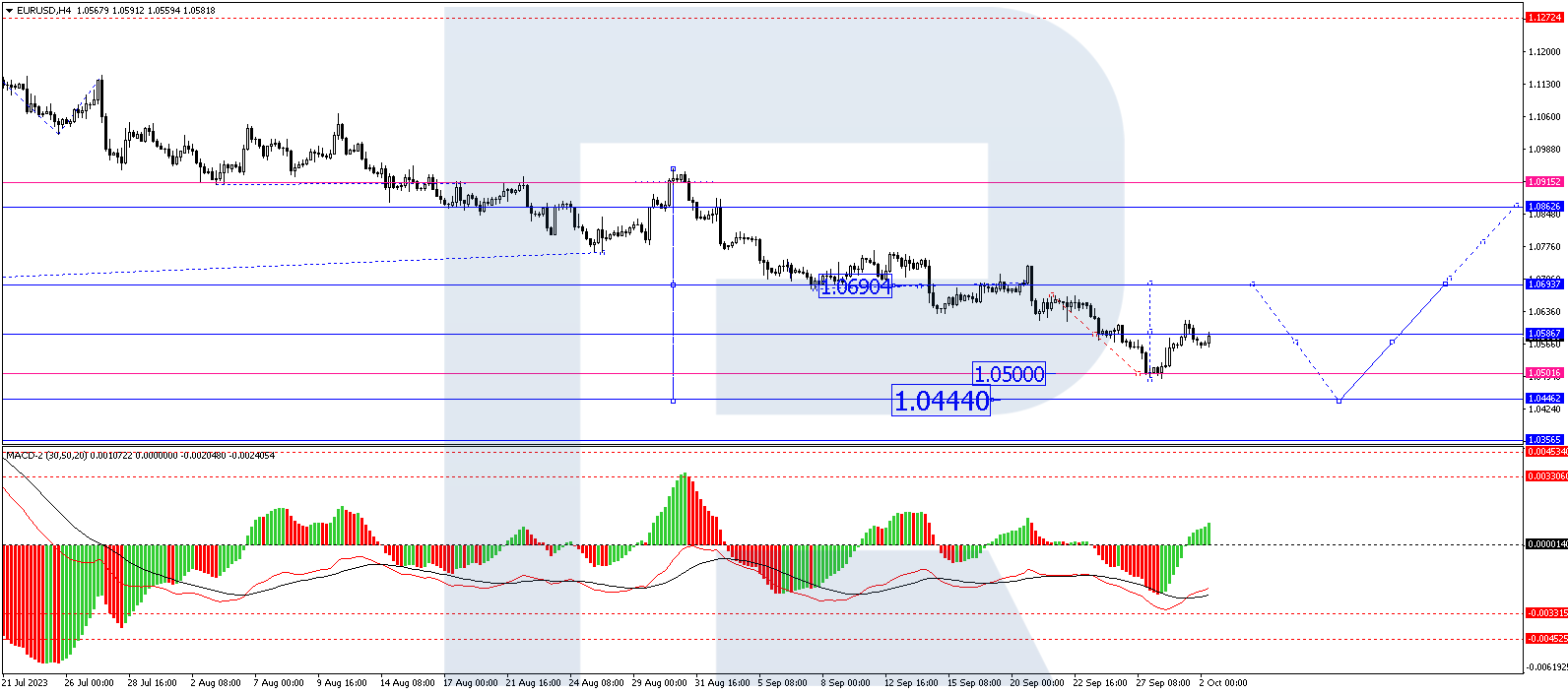
On the H4 chart, EURUSD performed a corrective wave to the 1.1064 level, where a new decline started. Today, the market reached 1.0940. At the moment, a consolidation range is forming around this mark. The price is expected to break downwards, heading for 1.0880, after which it might rise to 1.0940 (testing this level from below). Next, a decline to 1.0820 could follow. It is the first target. Technically, the MACD, whose signal line is below zero, could confirm such a scenario. The indicator is expected to go on declining to new lows.

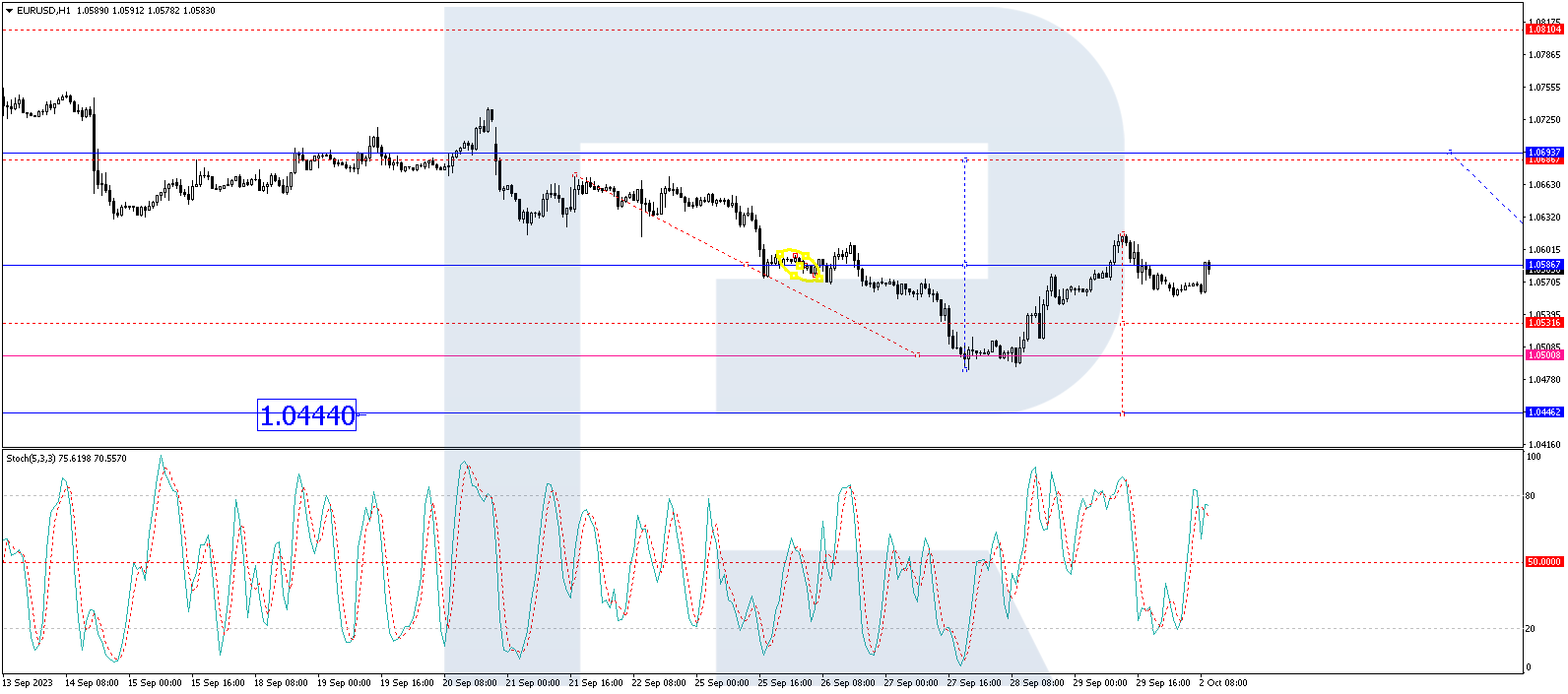
On the H1 chart, EURUSD is forming a consolidation range around 1.0940. Escaping it upwards, the price could start a correction link to 1.0966 and drop to 1.0880 later. It is a local target. Technically, this scenario is confirmed by the Stochastic oscillator, whose signal line has broken the 20 mark upwards and continues growing to 50. The line is expected to rebound from this mark and fall to 20.

Disclaimer

Any predictions contained herein are based on the author’s particular opinion. This analysis shall not be treated as trading advice. RoboForex shall not be held liable for the results of the trades arising from relying upon trading recommendations and reviews contained herein.