Archive for Financial News – Page 184

The cryptocurrency market digest (BTC, MATIC). Overview for 23.08.2023

By RoboForex.com

The BTC exchange rate looks weak on Wednesday, hovering around 26,015 USD.

The cryptocurrency sector has suffered noticeably after the crash triggered by the Bitcoin Magazine publication. The BTC decline also pulled down key altcoins. Currently, the sector is still impacted by the bearish seasonal factor, and its transition to a bullish trend in early September could be delayed.

An important support for the BTC is the 25,150 USD mark, with the next one at 23,350 USD. There are still no buyers on the platform.

The cryptocurrency market capitalisation remains around 1.05 trillion USD. The share of BTC has dropped to 48.4%, while the share of ETH decreased to 18.8%.

NFTs from the Bored Ape Yacht Club collection sold at a loss

A trader who bought NTF tokens from the Bored Ape Yacht Club collection 11 months ago sold them with a loss of 80%. The NFTs were bought for 777 ETH, representing the most expensive NFT token in this collection. The sale transaction took place on the X2Y2 platform, and the amount totalled 153 ETH.

MATIC in the risk zone

The value of the Polygon project’s MATIC token has fallen to its lowest level since July 2022. Due to the pressure from US regulators and the increasing interest in the L2 networks like Base and Optimism, the demand for Polygon’s services declined. This simultaneously affected the MATIC price dynamics.

Article By RoboForex.com

Attention!
Forecasts presented in this section only reflect the author s private opinion and should not be considered as guidance for trading. RoboForex LP bears no responsibility for trading results based on trading recommendations described in these analytical reviews.

Canada is on the verge of a housing bubble. US indices are under renewed pressure ahead of the Jackson Hole Symposium

By JustMarkets

As of Tuesday’s stock market close, the Dow Jones (US30) index decreased by 0.51%, while the S&P500 (US500) index lost 0.28%. The NASDAQ Technology Index (US100) closed positive 0.06% yesterday. Yesterday’s US economic news was mixed for stocks after July’s existing home sales fell more than expected to a 6-month low. Still, the August manufacturing report from the FRB Richmond unexpectedly rose to a 7-month high. The 3-day symposium of the US central bank in Jackson Hole starts as early as tomorrow, where the main focus of investors is directed towards the speeches of US Fed chief Jerome Powell on Friday. Markets rate the odds of a 25bp rate hike at the September 20th FOMC meeting at 16% and a 25bp hike at the First of November FOMC meeting at 49%.

According to economists, Canada is likely sitting on the biggest housing bubble of all time. Canadians’ level of debt relative to their income puts many in a precarious position if mortgage rates continue to rise, which is likely. The worst thing for a housing bubble is when a credit bubble forms underneath it, as it did in the United States in 2008.

Equity markets in Europe traded higher yesterday. Germany’s DAX (DE40) increased by 0.66%, France’s CAC 40 (FR 40) gained 0.59% on Tuesday, Spain’s IBEX 35 (ES35) added 0.59%, and the UK’s FTSE 100 (UK100) closed up 0.18%. French retail sales in July fell by 2.1% y/y, marking the fourteenth consecutive decline in sales. Today, the Eurozone is expected to publish data on business activity in the manufacturing and services sectors. Analysts expect negative data, which will put additional pressure on the ECB.

Oil prices are falling for the second day in a row, with the price of oil in the US stopping below the critical support of $80 per barrel amid concerns about the economic slowdown in China and the possibility of further rate hikes by the Federal Reserve. The excitement over Saudi Arabia and Russia cutting oil production has receded into the background but is helping the price not to fall too deeply.

Asian markets were mostly up yesterday. Japan’s Nikkei 225 (JP225) added 0.92% for the day, China’s FTSE China A50 (CHA50) increased by 0.68%, Hong Kong’s Hang Seng (HK50) gained 0.95% on Tuesday, and Australia’s S&P/ASX 200 (AU200) ended the day positive 0.09%. Concerns about China persisted after the People’s Bank disappointed markets with a smaller-than-expected cut in interest rates this week. Additional stimulus measures promised by the government earlier were not announced, which also had a negative impact on Chinese equities.

In New Zealand, total retail sales in June declined by 1% from March. This is the third consecutive quarterly decline, following a 1.6% decline in March and 1.1% in December. Seasonally adjusted retail sales totaled 25 bln. The decline in retail sales indicates that consumers are spending less money in stores and saving more. This usually occurs in recessionary and pre-recessionary scenarios.

In Japan, the business activity level in the manufacturing sector rose from 49.6 to 49.7. The service sector increased from 53.8 to 54.3. Core inflation, which the Bank of Japan monitors, rewrote the highs and amounted to a modest by global standards, but still a record for Japan at 3.3%. According to analysts, the Bank of Japan still controls the situation. Still, when you print yen with one hand and keep the rates around zero, and with the other hand, you try to prevent devaluation – sooner or later, significant problems may arise.
S&P 500 (F)(US500) 4,387.55 −12.22 (−0.28%)

Dow Jones (US30) 34,288.83 −174.86 (−0.51%)

DAX (DE40)  15,705.62 +102.34 (+0.66%)

FTSE 100 (UK100) 7,270.76 +12.94 (+0.18%)

USD Index  103.59 +0.29 (+0.28%)

Important events for today:
  • – New Zealand Retail Sales (q/q) at 01:45 (GMT+3);
  • – Australia Manufacturing PMI (m/m) at 02:00 (GMT+3);
  • – Australia Services PMI (m/m) at 02:00 (GMT+3);
  • – Japan Manufacturing PMI (m/m) at 03:30 (GMT+3);
  • – Japan Services PMI (m/m) at 03:30 (GMT+3);
  • – Singapore Consumer Price Index (m/m) at 08:00 (GMT+3);
  • – German Manufacturing PMI (m/m) at 10:30 (GMT+3);
  • – German Services PMI (m/m) at 10:30 (GMT+3);
  • – Eurozone Manufacturing PMI (m/m) at 11:00 (GMT+3);
  • – Eurozone Services PMI (m/m) at 11:00 (GMT+3);
  • – UK Manufacturing PMI (m/m) at 11:30 (GMT+3);
  • – UK Services PMI (m/m) at 11:30 (GMT+3);
  • – Canada Retail Sales (m/m) at 15:30 (GMT+3);
  • – US Manufacturing PMI (m/m) at 16:45 (GMT+3);
  • – US Services PMI (m/m) at 16:45 (GMT+3);
  • – US New Home Sales (m/m) at 17:00 (GMT+3);
  • – US Crude Oil Reserves (w/w) at 17:30 (GMT+3).
By JustMarkets


This article reflects a personal opinion and should not be interpreted as an investment advice, and/or offer, and/or a persistent request for carrying out financial transactions, and/or a guarantee, and/or a forecast of future events.

GBPUSD drops after poor UK PMIs

By ForexTime 

  • GBPUSD sinks after UK PMIs came in below expectations
  • Bank of England rate hikes are taking toll on UK economy
  • Bloomberg model: GBPUSD likely to trade between 1.2545 – 1.2828 into next week
  • Friday’s speech by Fed Chair Powell may herald more volatility for GBPUSD

The Pound is the worst-performing G10 currency against the dollar today.

The UK’s preliminary PMIs (purchasing manager index) for August showed contracting conditions across both manufacturing and services in the private sector.

With the respective PMIs registering readings below the 50 threshold that differentiates contraction (PMI below 50) and expansion (PMI above 50) …

It’s clear that the Bank of England’s aggressive rate hikes are taking a toll on the UK economy.

Today’s PMI numbers have also prompted markets to dial down bets for a further 75-basis points in rate hikes out of the Bank of England which had been fully priced in prior to today’s PMI releases.

At the time of writing, markets are only pricing in a 54% chance that the BOE can raise its benchmark rate by a further 75bps between now and Q1 2024.

Such soured sentiment surrounding the UK economy and the BOE’s future policy moves has clearly weighed on GBPUSD, forcing cable to unwind some of its recent gains.


GBP still among best G10 performers YTD

Though for proper context, Sterling continues to compete with the Swiss Franc for the title of best-performing G10 currency against the US dollar on a year-to-date basis.

The CHF and GBP can still boast of a 5% climb respectively against the greenback so far in 2023.


From a technical perspective:

GBPUSD bulls have been thwarted by the 21-day simple moving average (SMA) of late. The 38.2% Fibonacci level from this FX pair’s June 2021 – September 2022 plummet is also further exerting resistance.

To the downside, the 1.26200 region has been offering support for GBPUSD (nicknamed “cable”) since end-June, with the 100-day SMA also potentially offering further support nearby.

Bloomberg’s FX model forecasts a 74% chance that GBPUSD will trade within the 1.2545 – 1.2828 range over the next one week.


Astute traders would be aware that this time period also includes Fed Chair Jerome Powell’s highly-anticipated speech at the Jackson Hole symposium this Friday, as well as the UK’s August consumer confidence data.

Of those two events, Chair Powell’s comments harbours the much greater potential to sway the US dollar, and by extension, GBPUSD as well as the rest of the FX world before the weekend.


Forex-Time-LogoArticle by ForexTime

ForexTime Ltd (FXTM) is an award winning international online forex broker regulated by CySEC 185/12 www.forextime.com

Social media algorithms warp how people learn from each other, research shows

By William Brady, Northwestern University 

People’s daily interactions with online algorithms affect how they learn from others, with negative consequences including social misperceptions, conflict and the spread of misinformation, my colleagues and I have found.

People are increasingly interacting with others in social media environments where algorithms control the flow of social information they see. Algorithms determine in part which messages, which people and which ideas social media users see.

On social media platforms, algorithms are mainly designed to amplify information that sustains engagement, meaning they keep people clicking on content and coming back to the platforms. I’m a social psychologist, and my colleagues and I have found evidence suggesting that a side effect of this design is that algorithms amplify information people are strongly biased to learn from. We call this information “PRIME,” for prestigious, in-group, moral and emotional information.

In our evolutionary past, biases to learn from PRIME information were very advantageous: Learning from prestigious individuals is efficient because these people are successful and their behavior can be copied. Paying attention to people who violate moral norms is important because sanctioning them helps the community maintain cooperation.

But what happens when PRIME information becomes amplified by algorithms and some people exploit algorithm amplification to promote themselves? Prestige becomes a poor signal of success because people can fake prestige on social media. Newsfeeds become oversaturated with negative and moral information so that there is conflict rather than cooperation.

The interaction of human psychology and algorithm amplification leads to dysfunction because social learning supports cooperation and problem-solving, but social media algorithms are designed to increase engagement. We call this mismatch functional misalignment.

Why it matters

One of the key outcomes of functional misalignment in algorithm-mediated social learning is that people start to form incorrect perceptions of their social world. For example, recent research suggests that when algorithms selectively amplify more extreme political views, people begin to think that their political in-group and out-group are more sharply divided than they really are. Such “false polarization” might be an important source of greater political conflict.

Social media algorithms amplify extreme political views.

Functional misalignment can also lead to greater spread of misinformation. A recent study suggests that people who are spreading political misinformation leverage moral and emotional information – for example, posts that provoke moral outrage – in order to get people to share it more. When algorithms amplify moral and emotional information, misinformation gets included in the amplification.

What other research is being done

In general, research on this topic is in its infancy, but there are new studies emerging that examine key components of algorithm-mediated social learning. Some studies have demonstrated that social media algorithms clearly amplify PRIME information.

Whether this amplification leads to offline polarization is hotly contested at the moment. A recent experiment found evidence that Meta’s newsfeed increases polarization, but another experiment that involved a collaboration with Meta found no evidence of polarization increasing due to exposure to their algorithmic Facebook newsfeed.

More research is needed to fully understand the outcomes that emerge when humans and algorithms interact in feedback loops of social learning. Social media companies have most of the needed data, and I believe that they should give academic researchers access to it while also balancing ethical concerns such as privacy.

What’s next

A key question is what can be done to make algorithms foster accurate human social learning rather than exploit social learning biases. My research team is working on new algorithm designs that increase engagement while also penalizing PRIME information. We argue that this might maintain user activity that social media platforms seek, but also make people’s social perceptions more accurate.

About the Author:

The Research Brief is a short take on interesting academic work.The Conversation

William Brady, Assistant Professor of Management and Organizations, Northwestern University

This article is republished from The Conversation under a Creative Commons license. Read the original article.

Warren Buffett is investing in real estate. The New Zealand dollar has fallen for ten days in a row

By JustMarkets

As of Monday’s stock market close, the Dow Jones Index (US30) increased by 0.19%, while the S&P500 Index (US500) added 0.69%. The NASDAQ Technology Index (US100) closed positive by 1.56% yesterday. But analysts still believe that the dollar is poised for further gains, especially as government bond yields rose following positive US economic data. Markets expect the Fed to have to keep rates “higher for longer” in response to robust US data.

Technology stocks rose thanks to a more than 6% rise in NVIDIA Corporation (NVDA) ahead of the chipmaker’s quarterly results due on Wednesday. Nvidia is riding a wave of optimism about artificial intelligence. Shares of Tesla Inc (TSLA) rose more than 6% as investors bought into the electric car maker’s recent stock slump amid a new positive outlook from Wall Street for TSLA. Baird listed Tesla as a “best idea,” noting several favorable factors, including the launch of Cybertruck, wider adoption of self-driving software, and continued growth in the energy business, that could overshadow concerns about margin erosion from recent price declines.

Warren Buffett’s Berkshire Hathaway fund invested in housing, putting $814 million into the shares of 3 homebuilders: Lennar, NVR, and DR Horton. A small bet in the context of Berkshire’s roughly $350 billion equity portfolio, but it speaks to Buffett’s optimism about the housing market in the US, despite its unaffordability today when mortgage rates are near multi-year highs.

Equity markets in Europe traded flat yesterday. Germany’s DAX (DE40) increased by 0.19%, France’s CAC 40 (FR40) added 0.47% on Monday, Spain’s IBEX 35 (ES35) decreased by 0.05%, and the UK’s FTSE 100 (UK100) closed down 0.06%. In its monthly report, Germany’s Bundesbank said, “The German economy remains in a phase of weakness. Output will likely remain largely unchanged in the third quarter of 2023.” In Germany, the PPI (which displays the inflation rate between factories and plants and is a leading indicator of consumer inflation) fell by 6.0% annually, the sharpest drop in 13 years. The main reason for the year-over-year decline in producer prices was lower energy prices, as well as lower prices for intermediate goods.

Crude oil and gasoline prices stopped rising on Monday and closed moderately lower. Economic malaise in China, the world’s second-largest crude oil consumer, threatens to curb its energy demand and has a bearish effect on prices. On the other hand, oil’s fall is limited by a shortage of global crude oil inventories.

Asian markets were predominantly down yesterday. Japan’s Nikkei 225 (JP225) added 0.37% for the day, China’s FTSE China A50 (CHA50) fell by 1.36%, Hong Kong’s Hang Seng (HK50) lost 1.82% on Monday, and Australia’s S&P/ASX 200 (AU200) ended the day negative by 0.46%.

On Monday, the Nikkei stock index rally reduced demand for the Japanese yen as a safe haven. In addition, the yen is under pressure as data from Bloomberg shows that the Bank of Japan is buying Japanese bonds at a record pace this year as it tries to keep long-term bond yields low as part of its yield curve control program. An update from JP Morgan shows analysts’ interest in the 150 yen per dollar mark as a level that could trigger currency intervention.

The New Zealand dollar is on the verge of the longest losing streak in its history. On Monday, the currency fell for the 10th consecutive day. Such a drop has yet to occur seen since March 2020. If the NZD declines further today, it will be the longest drop in the currency’s history.

S&P 500 (F)(US500) 4,399.77 +30.06 (+0.69%)

Dow Jones (US30) 15,603.28 +29.02 (+0.19%)

DAX (DE40)  15,603.28 +29.02 (+0.19%)

FTSE 100 (UK100) 7,257.82 −4.61 (−0.063%)

USD Index  103.35 −0.03 (−0.03%)

Important events for today:
  • – US Existing Home Sales (m/m) at 17:00 (GMT+3);
  • – US FOMC Member Bowman Speaks at 21:30 (GMT+3).

By JustMarkets


This article reflects a personal opinion and should not be interpreted as an investment advice, and/or offer, and/or a persistent request for carrying out financial transactions, and/or a guarantee, and/or a forecast of future events.

US stocks, gold extend recovery

By ForexTime

  • SPX500_m returns above 4,400
  • Big Tech rebound helps S&P 500 pare biggest weekly drop since March
  • Gold resurfaces above $1900 after hitting 5-month low
  • Higher Treasury yields should be headwind for stocks, gold
  • Look out for Nvidia earnings, Powell’s speech this week


US stock futures are building on Monday’s gains, after a strong rebound in technology stocks.

The SPX500_m has broken past the psychologically-important 4,400 mark, making an about-turn after halting a four-day drop.

This rebound comes after global stocks had their biggest weekly drop since March last week.

The “magnificent seven” of megacap tech stocks – Alphabet, Amazon, Apple Meta, Microsoft, Nvidia and Tesla – lost more than $900 billion in value over three consecutive weeks of falls. That was their worst run of combined market cap decline this year.

But yesterday saw Tesla jump over 7% while Nvidia rose 8.5% ahead of its results after the closing bell on Wednesday which will be a key focus.


Oversold gold finds a bid

Gold dipped $1885 to post a five-month low yesterday which came after four straight weeks of losses, something not seen since February.

Rampant Treasury yields are not a good sign for bullion as it is a non-interest-bearing asset.

Indeed, the 10-year “real” yield has hit 2% for the first time since March 2009. However, prices have been oversold on momentum indicators and buyers have stepped in recently as we are now seeing a third day of gains this morning.

The yellow metal still currently trades below the 200-day simple moving average (SMA), though has resurfaced above the psychologically-important $1900 level for the time being.


We also note that hedge funds cut their gold longs to a six-month low in the week to August 15 while ETF holdings have seen 12 straight weeks of outflows.


Of course, investors and traders will be wondering whether or not this rebound has legs.

Markets have half an eye on Fed Chair Powell’s speech on Friday at Jackson Hole while trying to navigate surging borrowing costs.

Higher rates for longer should be a headwind for stocks and also gold, potentially exerting an ultimate cap on how high these assets can climb.

But for now, markets are putting such thoughts aside, with US stocks and gold attempting to enter the tail-end of August on a less dour note.


Forex-Time-LogoArticle by ForexTime

ForexTime Ltd (FXTM) is an award winning international online forex broker regulated by CySEC 185/12 www.forextime.com

China has cut its benchmark interest rate. Oil may come under pressure in the coming weeks

By JustMarkets

At Friday’s close, the Dow Jones (US30) index increased by 0.07% (-2.19% for the week), while the S&P 500 (US500) index was down by 0.02% (-1.98% for the week). The NASDAQ Technology Index (US100) closed Friday by negative 0.20% (-2.27% for the week). August is a seasonally weak month for stock indices, and this time is no exception. This is partly due to the vacation period in the banking sector. Partly it is because the latest economic data in the US showed that the economy is not in danger of recession in the near future. As a result, rising government bond yields have lifted the dollar index, causing stock indices to decline.

The Jackson Hole Symposium is scheduled to begin on Thursday of this week. Various academics, bank chiefs, and central bank governors gather to discuss monetary policy and financial markets. The policymakers will give their interviews at the end of the conference. These interviews could cause significant volatility as they could foreshadow future monetary policy dynamics. In particular, investors will be waiting for Fed Chairman Jerome Powell to speak to clarify the economic outlook and the future trajectory of interest rates.

Equity markets in Europe were mostly down on Friday. Germany’s DAX (DE40) decreased by 0.65% (-1.54% for the week), France’s CAC 40 (FR40) fell by 0.38% (-2.22% for the week) on Friday, Spain’s IBEX 35 (ES35) fell by 0.19% (-1.73% for the week), and the UK’s FTSE 100 (UK100) closed on negative 0.65% (-3.48% for the week). This week, a slew of manufacturing and service sector business activity data will be released on Wednesday. This data could provide insight into whether the European Central Bank will raise interest rates again in September and whether the Bank of England will decide to raise rates more aggressively at its next meeting.

On Friday, crude oil prices broke a seven-week winning streak. Investors are now focused on the distinct possibility of lower energy demand rather than the certainty of supply cuts. Over the past few weeks, increasingly contradictory economic news has come out of China, crowned by the release of alarming consumer price data indicating that the country is in complete deflation. Problems at some significant real estate construction companies further underscore the slowdown in China’s economic recovery. Over the weekend, another major real estate developer Country Garden found itself in the grip of a debt crisis. China is the world’s largest energy importer, and any sign of economic stagnation will always be bad news for oil bulls.

Asian markets were also down last week. Japan’s Nikkei 225 (JP225) fell by 3.10% for the week, China’s FTSE China A50 (CHA50) lost 0.88%, Hong Kong’s Hang Seng (HK50) ended the week down by 3.99%, and Australia’s S&P/ASX 200 (AU200) ended the week on negative 2.62%.

On Monday, the People’s Bank of China (PBoC) lowered the benchmark one-year lending rate (LPR) to 3.45% from 3.55% previously (3.40% expected). Meanwhile, China’s Central Bank kept the five-year interest rate unchanged at 4.20%. The rate cut is being implemented to support economic development, which is a positive for Chinese stocks. It is also a positive factor for countries with close trade cooperation with China, Singapore, New Zealand, and Australia.

S&P 500 (F)(US500) 4,369.71 −0.65 (−0.02%)

Dow Jones (US30) 34,500.66 +25.83 (+0.075%)

DAX (DE40)  15,574.26 −102.64 (−0.65%)

FTSE 100 (UK100) 7,262.43 −47.78 (−0.65%)

USD Index  102.85 +0.33 (+0.32%)

Important events for today:
  • – New Zealand Trade Balance (q/q) at 01:45 (GMT+3);
  • – China PBoC Loan Prime Rate at 04:15 (GMT+3);
  • – German Producer Price Index (m/m) at 09:00 (GMT+3).

By JustMarkets


This article reflects a personal opinion and should not be interpreted as an investment advice, and/or offer, and/or a persistent request for carrying out financial transactions, and/or a guarantee, and/or a forecast of future events.

The crude oil finds stability amidst price recovery

By RoboForex Analytical Department

The commodity market has stabilised as the new week begins. The price of a barrel of Brent is hovering around 85.40 USD.

The price recovery is observed for the third consecutive day. Market expectations are tied to China: there are reasons to believe that the Chinese authorities will implement additional measures in their stimulus-driven economic policy.

Meanwhile, market players continue to exercise caution. The Federal Reserve System recently announced its readiness to continue tightening its monetary policy to combat inflation. At the same time, the economic outlook for China remains uncertain.

Technical analysis of Spot Brent Crude Oil:

On the H4 Brent chart, the price has rebounded from the support level and is now developing an ascending wave to 88.50. This is a local target. After the price reaches it, a link of declining correction to 85.75 might follow (with a test from above). Next thing, a rise to 94.50 could be expected. Technically, this scenario is confirmed by the MACD, whose signal line has left the histogram area and is aimed strictly upwards.

On the H1 Brent chart, a structure of an impulse to rise to 85.30 has formed. Today a narrow consolidation range is expected to develop below it. An escape from the range upwards might facilitate the development of a wave to 86.66, from where the trend could continue to 88.50. Technically, this scenario is confirmed by the Stochastic oscillator with the signal line under 80, ready to renew the highs.

Disclaimer

Any predictions contained herein are based on the author’s particular opinion. This analysis shall not be treated as trading advice. RoboForex shall not be held liable for the results of the trades arising from relying upon trading recommendations and reviews contained herein.

Trade of the Week: SPX500_m demands proof out of Nvidia, Jackson Hole

By ForexTime

  • S&P 500 on course to end 5-month winning streak
  • Nvidia’s forecasted 10% post-earnings move may jolt SPX500_m
  • Friday speech by Chair Powell to shape Fed rate hike bets
  • Last Friday’s (August 18th) “doji” points to market indecision ahead of such a pivotal week
  • Listed below: potential scenarios, support and resistance levels

It’s been an angsty August so far for the S&P 500.

This benchmark index, which is widely used to measure the overall performance of the US stock market, has fallen by about 4.8% so far this month.

The S&P 500 also appears headed for its worst monthly performance since December 2022 (down 5.9%), while its previous monthly drop was back in February 2023 (down 2.6%).


This week, the SPX500_m (which tracks the underlying S&P 500) is at the mercy of two of the largest market themes of 2023 coming head-to-head:


1) AI-mania: just hype? or real earnings booster?

Investors hope that artificial intelligence would supercharge corporate earnings for decades to come, even as the technology promises to change our everyday lives.

And few have benefited from such expectations more than Nvidia.

This chipmaker’s stocks still boast of a 196.3% year-to-date climb, being the best-performing stock on the S&P 500 so far this year, despite having dropped 8.8% from its all-time high set on July 18th.

This chipmaker still has a market cap of over US$ 1 trillion (that’s $1,000,000,000,000), making it the 4th largest stock on the benchmark S&P 500 index.

Nvidia is due to release its latest quarterly results after US markets close on Wednesday, August 23rd.

Markets are currently predicting that this stock could move by 10.2%, either up or down, on Thursday – the day after Nvidia’s earnings release.

Of course, whether this stock climb higher or drops lower depends on the reaction to Nvidia’s financial results last quarter, as well as its forward guidance for future earnings.

Broadly speaking, if Nvidia can convince markets that the AI-hype is truly translating into a meaningful earnings boost, that could help the SPX500_m pare recent losses.


2) US interest rates – higher for longer?

The annual Jackson Hole Economic Symposium, organized by the Kansas City Fed, is set to happen between August 24th – 26th, bringing together the world’s top central bankers, policymakers, and economists.

The highlight is, of course, the speech by Fed Chair Jerome Powell, on Friday, August 25th.

After all, Chair Powell leads the world’s most influential central bank – the US Federal Reserve.


Since 2022, markets have been obsessing over how high the Fed would send US interest rates.

My article this time last year (dated 22 August 2022), in previewing last year’s Jackson Hole symposium, carried these words:

And here’s the biggest question on everyone’s minds: how much higher will the Fed hike US interest rates?

12 months later, yet the same question remains in play.

There’s also an added layer to that question posed in August 2023:

How long will the Fed maintain its benchmark rates at its peak, before considering a rate cut?”


Here are the market’s current expectations surrounding US interest rates:

  • merely an 11% chance that the Fed would trigger another 25-basis point HIKE at its September FOMC meeting
  • one-in-three chance (38% odds) that there would be one more 25-bps HIKE by the Fed between now and end-2023
  • one-in-three chance (35% odds) that there would be a 25-bps CUT by March 2024
  • 87% chance of a Fed rate CUT by May 2024


How did markets react to Powell’s speech at 2022’s Jackson Hole event?

As a reminder, Chair Powell’s speech back on 26 August 2022 triggered a 3.4% drop in the S&P 500 on the day.

The benchmark stock index went on to fall by a further 11.85% after the previous symposium concluded, reaching its trough in October, before going on to stage an AI-fuelled rally since (albeit with a pullback so far in August 2023).

It was clear then that traders and investors willingly took to heart Powell’s tough messaging back then about “unusually large” Fed rate hikes.

Although the days of 75-bps Fed rate hikes are now relegated to the past, markets remain primed to react to Powell’s policy signals this week.


As for Chair Powell’s speech ahead of this coming weekend, here are some potential scenarios that may affect the SPX500_m:

  1. If Chair Powell delivers a higher-for-longer message, i.e. US interest rates could go even higher and stay at that peak for longer than what markets currently expect, that could drag the SPX500_m even lower.After all, tech stocks generally do not like the thought of higher US interest rates.

    And the biggest components of the S&P 500 are Big Tech names such as Apple, Microsoft, Amazon, Alphabet, and of course, Nvidia.

  2. On the other hand, if Chair Powell surprises markets and suggests that the Fed has raised its benchmark rates high enough to finally subdue multi-decade high inflation in the US, that could be cause for rejoicing among SPX500_m bulls.


From a technical perspective …

The doji candlestick formed last Friday, August 18th, points to indecision among traders, especially leading into such a week that promises stern test for the US stock market.

This doji could herald a period of price consolidation, or perhaps even the formation of a new trend.


Keeping in mind the looming fundamental catalysts as well was technical setups …

Here are some key levels to look out for on the SPX500_m daily chart:

POTENTIAL SUPPORT

  • 4335:  intraday low on August 18th/late-June lows
  • 100-day SMA and key Fibonacci level
  • 4301 – 4260: early-June range


POTENTIAL RESISTANCE

  • 4400: psychologically-important mark/Fib retracement
  • 4452 – 4463: June cycle highs
  • 50-day simple moving average (SMA)


Forex-Time-LogoArticle by ForexTime

ForexTime Ltd (FXTM) is an award winning international online forex broker regulated by CySEC 185/12 www.forextime.com

Bonds Charts: Speculator Bets led by SOFR 3-Months & 5-Year Bonds

By InvestMacro

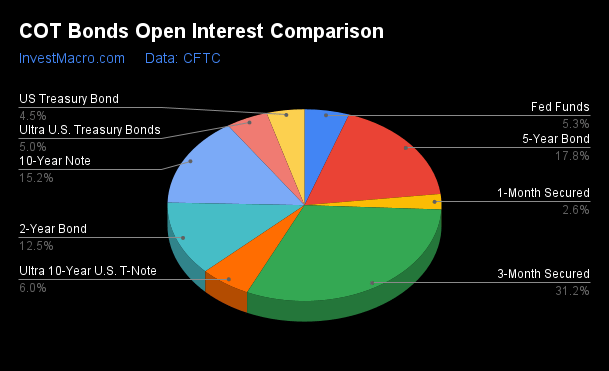
Here are the latest charts and statistics for the Commitment of Traders (COT) reports data published by the Commodities Futures Trading Commission (CFTC).

The latest COT data is updated through Tuesday August 15th and shows a quick view of how large traders (for-profit speculators and commercial hedgers) were positioned in the futures markets.

Weekly Speculator Bets led by SOFR 3-Months & 5-Year Bonds

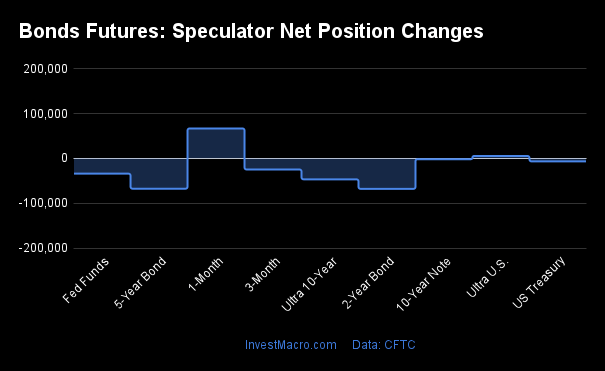
The COT bond market speculator bets were mixed this week as four out of the eight bond markets we cover had higher positioning while the other four markets had lower speculator contracts.

Leading the gains for the bond markets was the SOFR 3-Months (58,656 contracts) with the 5-Year Bonds (39,012 contracts), US Treasury Bonds (22,821 contracts) and the Ultra 10-Year Bonds (12,562 contracts) also showing positive weeks.

The bond markets with declines in speculator bets for the week were the Fed Funds (-50,877 contracts) with the 10-Year Bonds (-55,202 contracts), the 2-Year Bonds (-8,266 contracts) and the Ultra Treasury Bonds (-409 contracts) also registering lower bets on the week.


Data Snapshot of Bond Market Traders | Columns Legend
Aug-15-2023OIOI-IndexSpec-NetSpec-IndexCom-NetCOM-IndexSmalls-NetSmalls-Index
SOFR-3-Months10,263,811984,5438110,84519-15,38879
FedFunds1,532,02549-244,21814257,37987-13,16165
2-Year3,820,729100-1,117,3922991,94195125,451100
Long T-Bond1,370,326100-176,73427137,7036039,03177
10-Year4,857,42298-746,92810718,3049628,62480
5-Year5,768,718100-1,191,29551,110,1959281,100100


Strength Scores led by SOFR 3-Months & US Treasury Bonds

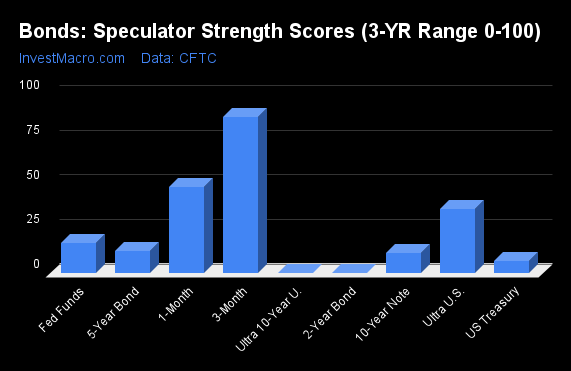
COT Strength Scores (a normalized measure of Speculator positions over a 3-Year range, from 0 to 100 where above 80 is Extreme-Bullish and below 20 is Extreme-Bearish) showed that the SOFR 3-Months (81 percent) leads the bond markets this week. The US Treasury Bonds (27 percent) comes in as the next highest in the weekly strength scores.

On the downside, the 2-Year Bonds (2 percent), the Ultra Treasury Bonds (4 percent), the 5-Year Bonds (5 percent), the 10-Year Bonds (10 percent), Fed Funds (14.0 percent) and the Ultra 10-Year Bonds (16 percent) come in at the lowest strength level currently and are in Extreme-Bearish territory (below 20 percent).

Strength Statistics:
vs Fed Funds previous week (23.3 percent)
2-Year Bond (2.3 percent) vs 2-Year Bond previous week (3.0 percent)
5-Year Bond (4.9 percent) vs 5-Year Bond previous week (2.0 percent)
10-Year Bond (10.0 percent) vs 10-Year Bond previous week (15.4 percent)
Ultra 10-Year Bond (16.4 percent) vs Ultra 10-Year Bond previous week (13.9 percent)
US Treasury Bond (27.1 percent) vs US Treasury Bond previous week (19.7 percent)
Ultra US Treasury Bond (4.4 percent) vs Ultra US Treasury Bond previous week (4.6 percent)
SOFR 3-Months (80.7 percent) vs SOFR 3-Months previous week (76.7 percent)


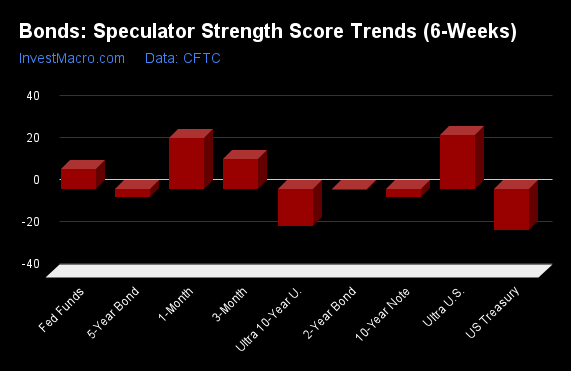
10-Year Bonds & Ultra Treasury Bonds top the 6-Week Strength Trends

COT Strength Score Trends (or move index, calculates the 6-week changes in strength scores) showed that the 10-Year Bonds (3 percent) and the Ultra Treasury Bonds (2 percent) lead the past six weeks trends for bonds.

The Fed Funds (-25 percent) and the SOFR 3-Months (-16 percent) leads the downside trend scores currently with the 5-Year Bonds (-12 percent) and the US Treasury Bonds (-12 percent) following next with lower trend scores.

Strength Trend Statistics:
Fed Funds (-25.1 percent) vs Fed Funds previous week (-19.0 percent)
2-Year Bond (-4.8 percent) vs 2-Year Bond previous week (-7.7 percent)
5-Year Bond (-11.9 percent) vs 5-Year Bond previous week (-17.1 percent)
10-Year Bond (3.3 percent) vs 10-Year Bond previous week (10.6 percent)
Ultra 10-Year Bond (0.5 percent) vs Ultra 10-Year Bond previous week (-3.8 percent)
US Treasury Bond (-12.0 percent) vs US Treasury Bond previous week (-27.4 percent)
Ultra US Treasury Bond (2.1 percent) vs Ultra US Treasury Bond previous week (-8.6 percent)
SOFR 3-Months (-16.2 percent) vs SOFR 3-Months previous week (-23.3 percent)


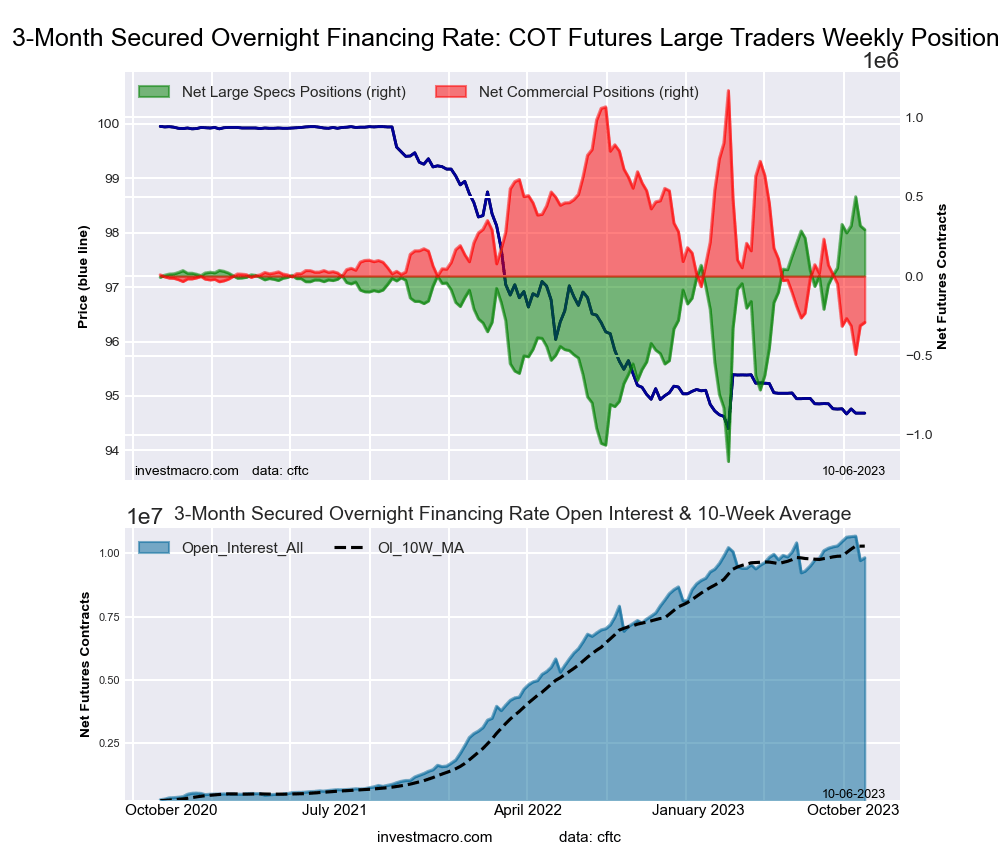
Secured Overnight Financing Rate (3-Month) Futures:

SOFR 3-Months Bonds Futures COT ChartThe Secured Overnight Financing Rate (3-Month) large speculator standing this week came in at a net position of 4,543 contracts in the data reported through Tuesday. This was a weekly lift of 58,656 contracts from the previous week which had a total of -54,113 net contracts.

This week’s current strength score (the trader positioning range over the past three years, measured from 0 to 100) shows the speculators are currently Bullish-Extreme with a score of 80.7 percent. The commercials are Bearish-Extreme with a score of 19.2 percent and the small traders (not shown in chart) are Bullish with a score of 79.4 percent.

Price Trend-Following Model: Weak Uptrend

Our weekly trend-following model classifies the current market price position as: Weak Uptrend. The current action for the model is considered to be: Hold – Maintain Long Position.

SOFR 3-Months StatisticsSPECULATORSCOMMERCIALSSMALL TRADERS
– Percent of Open Interest Longs:16.759.80.3
– Percent of Open Interest Shorts:16.759.70.4
– Net Position:4,54310,845-15,388
– Gross Longs:1,716,3926,136,20626,291
– Gross Shorts:1,711,8496,125,36141,679
– Long to Short Ratio:1.0 to 11.0 to 10.6 to 1
NET POSITION TREND:
– Strength Index Score (3 Year Range Pct):80.719.279.4
– Strength Index Reading (3 Year Range):Bullish-ExtremeBearish-ExtremeBullish
NET POSITION MOVEMENT INDEX:
– 6-Week Change in Strength Index:-16.217.1-4.9


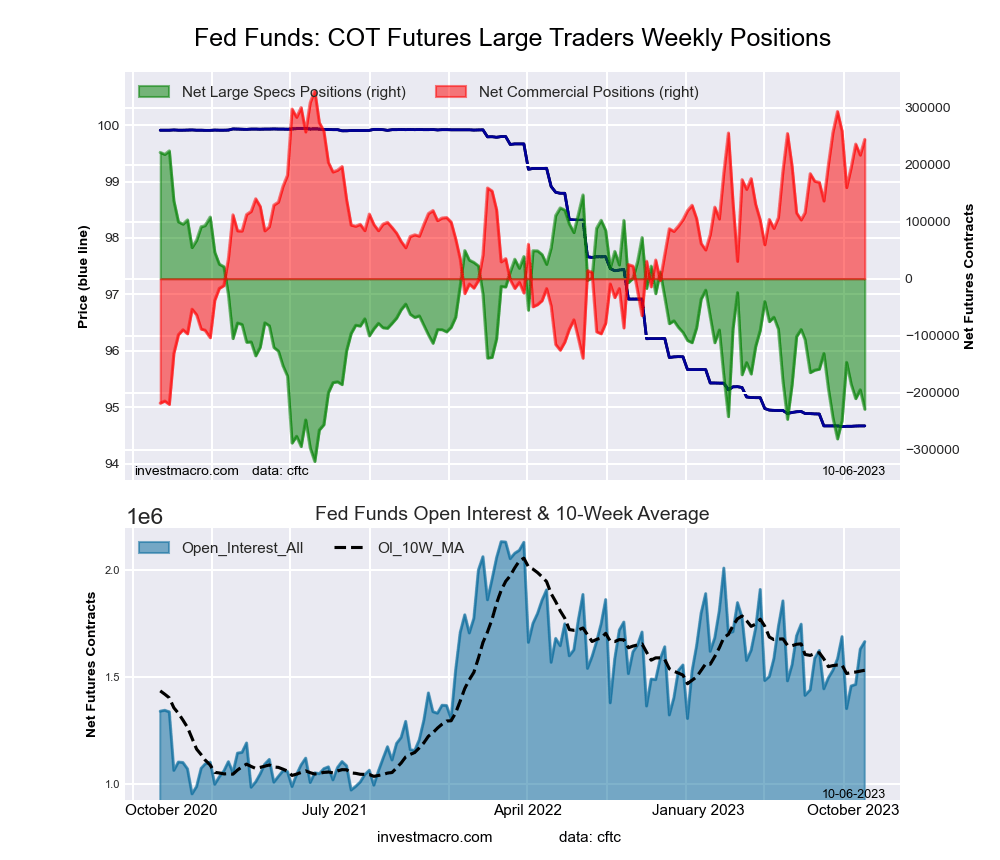
30-Day Federal Funds Futures:

Federal Funds 30-Day Bonds Futures COT ChartThe 30-Day Federal Funds large speculator standing this week came in at a net position of -244,218 contracts in the data reported through Tuesday. This was a weekly decline of -50,877 contracts from the previous week which had a total of -193,341 net contracts.

This week’s current strength score (the trader positioning range over the past three years, measured from 0 to 100) shows the speculators are currently Bearish-Extreme with a score of 14.0 percent. The commercials are Bullish-Extreme with a score of 86.8 percent and the small traders (not shown in chart) are Bullish with a score of 65.2 percent.

Price Trend-Following Model: Downtrend

Our weekly trend-following model classifies the current market price position as: Downtrend. The current action for the model is considered to be: Hold – Maintain Short Position.

30-Day Federal Funds StatisticsSPECULATORSCOMMERCIALSSMALL TRADERS
– Percent of Open Interest Longs:2.378.32.0
– Percent of Open Interest Shorts:18.361.52.9
– Net Position:-244,218257,379-13,161
– Gross Longs:35,9301,200,17631,331
– Gross Shorts:280,148942,79744,492
– Long to Short Ratio:0.1 to 11.3 to 10.7 to 1
NET POSITION TREND:
– Strength Index Score (3 Year Range Pct):14.086.865.2
– Strength Index Reading (3 Year Range):Bearish-ExtremeBullish-ExtremeBullish
NET POSITION MOVEMENT INDEX:
– 6-Week Change in Strength Index:-25.125.5-7.8


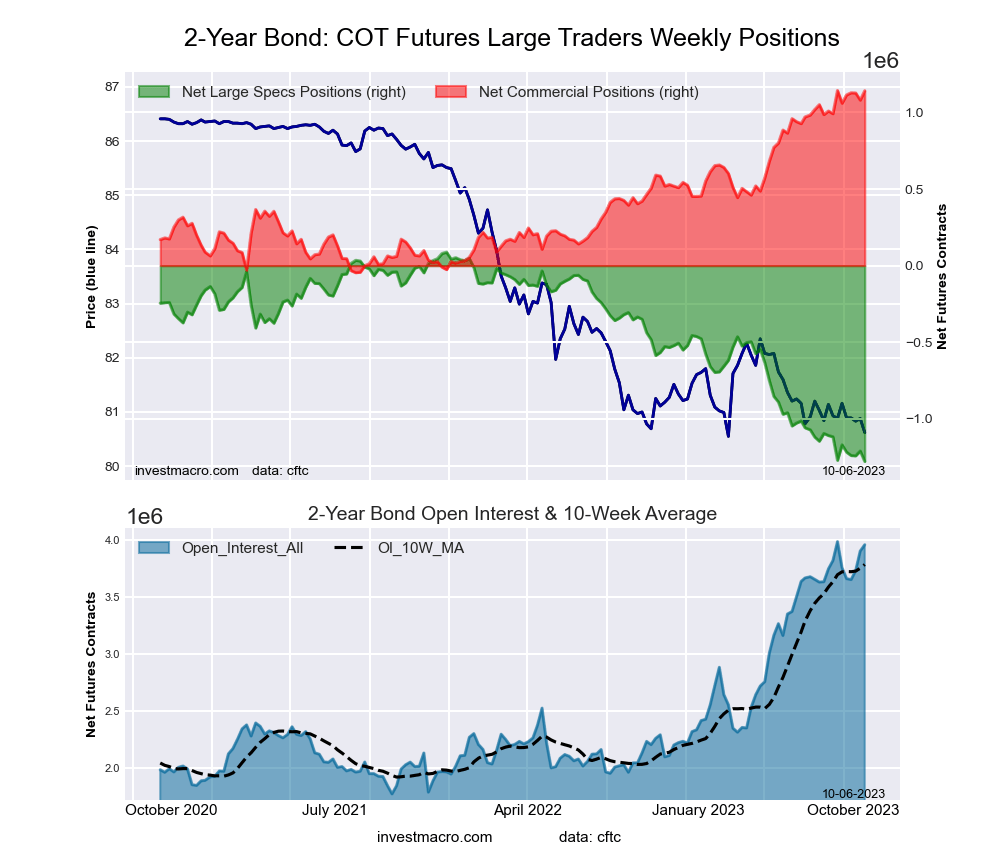
2-Year Treasury Note Futures:

2-Year Treasury Bonds Futures COT ChartThe 2-Year Treasury Note large speculator standing this week came in at a net position of -1,117,392 contracts in the data reported through Tuesday. This was a weekly lowering of -8,266 contracts from the previous week which had a total of -1,109,126 net contracts.

This week’s current strength score (the trader positioning range over the past three years, measured from 0 to 100) shows the speculators are currently Bearish-Extreme with a score of 2.3 percent. The commercials are Bullish-Extreme with a score of 94.6 percent and the small traders (not shown in chart) are Bullish-Extreme with a score of 100.0 percent.

Price Trend-Following Model: Downtrend

Our weekly trend-following model classifies the current market price position as: Downtrend. The current action for the model is considered to be: Hold – Maintain Short Position.

2-Year Treasury Note StatisticsSPECULATORSCOMMERCIALSSMALL TRADERS
– Percent of Open Interest Longs:10.081.37.4
– Percent of Open Interest Shorts:39.255.34.1
– Net Position:-1,117,392991,941125,451
– Gross Longs:380,2653,105,026282,436
– Gross Shorts:1,497,6572,113,085156,985
– Long to Short Ratio:0.3 to 11.5 to 11.8 to 1
NET POSITION TREND:
– Strength Index Score (3 Year Range Pct):2.394.6100.0
– Strength Index Reading (3 Year Range):Bearish-ExtremeBullish-ExtremeBullish-Extreme
NET POSITION MOVEMENT INDEX:
– 6-Week Change in Strength Index:-4.81.915.5


5-Year Treasury Note Futures:

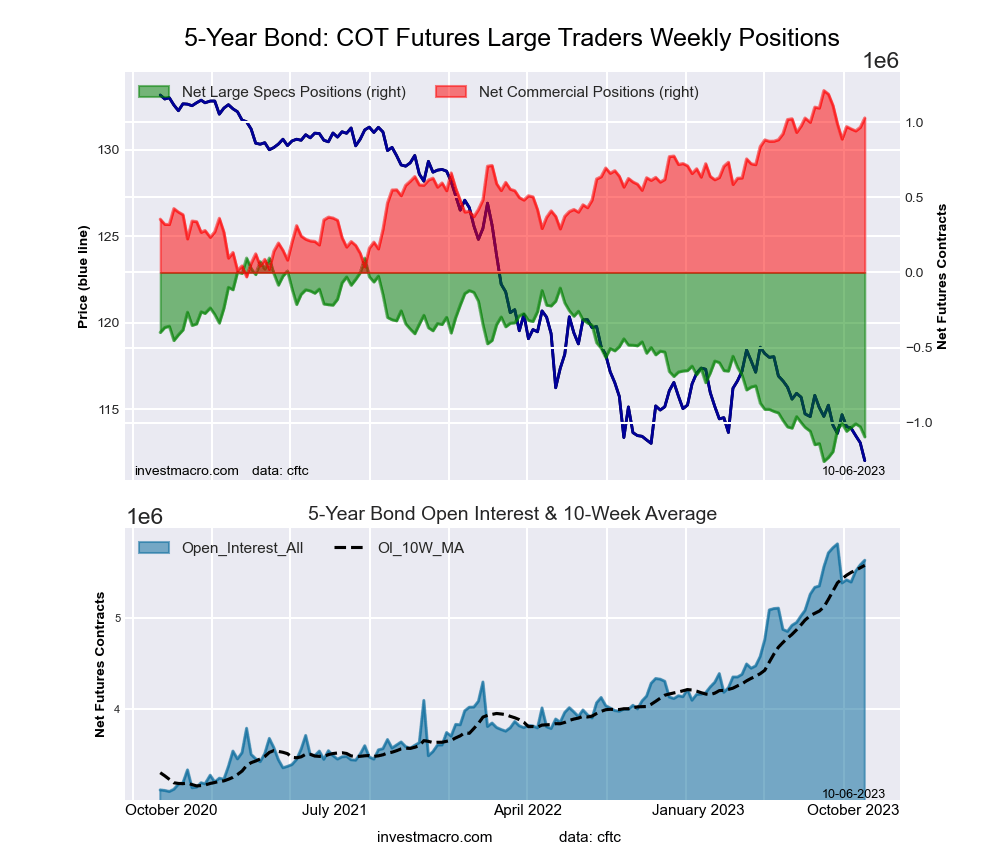
5-Year Treasury Bonds Futures COT ChartThe 5-Year Treasury Note large speculator standing this week came in at a net position of -1,191,295 contracts in the data reported through Tuesday. This was a weekly increase of 39,012 contracts from the previous week which had a total of -1,230,307 net contracts.

This week’s current strength score (the trader positioning range over the past three years, measured from 0 to 100) shows the speculators are currently Bearish-Extreme with a score of 4.9 percent. The commercials are Bullish-Extreme with a score of 92.0 percent and the small traders (not shown in chart) are Bullish-Extreme with a score of 100.0 percent.

Price Trend-Following Model: Strong Downtrend

Our weekly trend-following model classifies the current market price position as: Strong Downtrend. The current action for the model is considered to be: Hold – Maintain Short Position.

5-Year Treasury Note StatisticsSPECULATORSCOMMERCIALSSMALL TRADERS
– Percent of Open Interest Longs:7.983.37.1
– Percent of Open Interest Shorts:28.564.05.7
– Net Position:-1,191,2951,110,19581,100
– Gross Longs:453,0254,804,142411,812
– Gross Shorts:1,644,3203,693,947330,712
– Long to Short Ratio:0.3 to 11.3 to 11.2 to 1
NET POSITION TREND:
– Strength Index Score (3 Year Range Pct):4.992.0100.0
– Strength Index Reading (3 Year Range):Bearish-ExtremeBullish-ExtremeBullish-Extreme
NET POSITION MOVEMENT INDEX:
– 6-Week Change in Strength Index:-11.96.720.7


10-Year Treasury Note Futures:

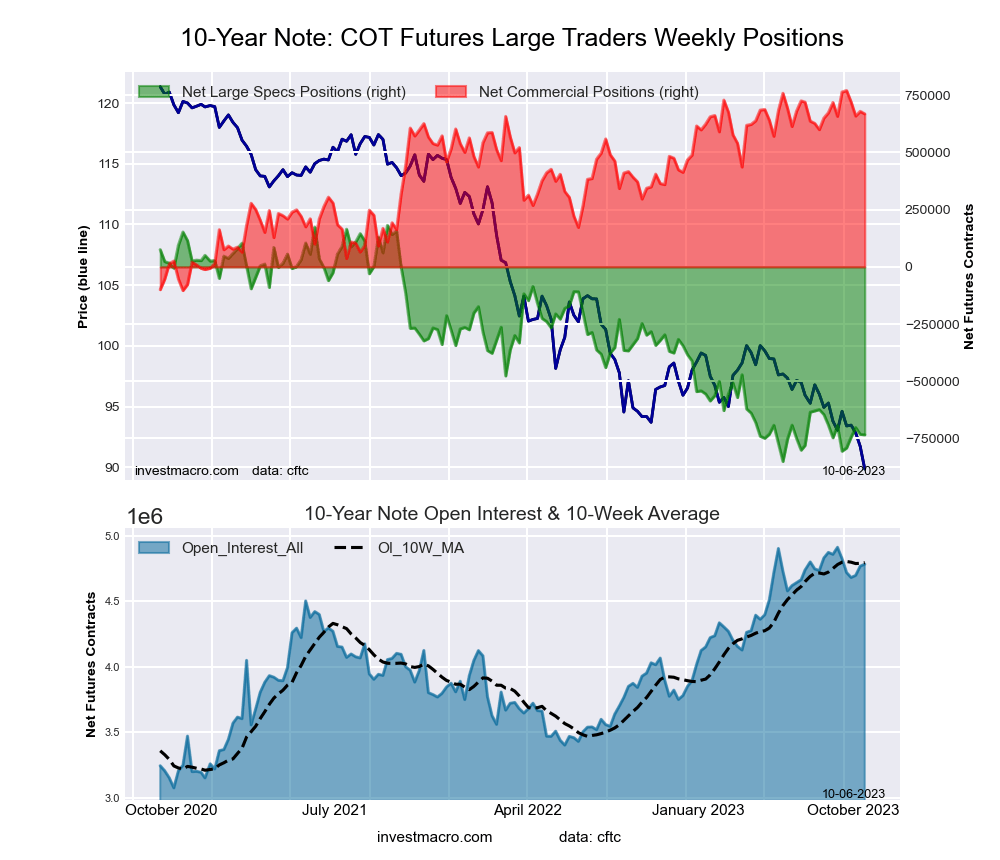
10-Year Treasury Notes Bonds Futures COT ChartThe 10-Year Treasury Note large speculator standing this week came in at a net position of -746,928 contracts in the data reported through Tuesday. This was a weekly decrease of -55,202 contracts from the previous week which had a total of -691,726 net contracts.

This week’s current strength score (the trader positioning range over the past three years, measured from 0 to 100) shows the speculators are currently Bearish-Extreme with a score of 10.0 percent. The commercials are Bullish-Extreme with a score of 95.7 percent and the small traders (not shown in chart) are Bullish with a score of 79.7 percent.

Price Trend-Following Model: Strong Downtrend

Our weekly trend-following model classifies the current market price position as: Strong Downtrend. The current action for the model is considered to be: Hold – Maintain Short Position.

10-Year Treasury Note StatisticsSPECULATORSCOMMERCIALSSMALL TRADERS
– Percent of Open Interest Longs:10.278.78.9
– Percent of Open Interest Shorts:25.663.98.3
– Net Position:-746,928718,30428,624
– Gross Longs:495,2103,822,746430,877
– Gross Shorts:1,242,1383,104,442402,253
– Long to Short Ratio:0.4 to 11.2 to 11.1 to 1
NET POSITION TREND:
– Strength Index Score (3 Year Range Pct):10.095.779.7
– Strength Index Reading (3 Year Range):Bearish-ExtremeBullish-ExtremeBullish
NET POSITION MOVEMENT INDEX:
– 6-Week Change in Strength Index:3.3-0.2-7.0


Ultra 10-Year Notes Futures:

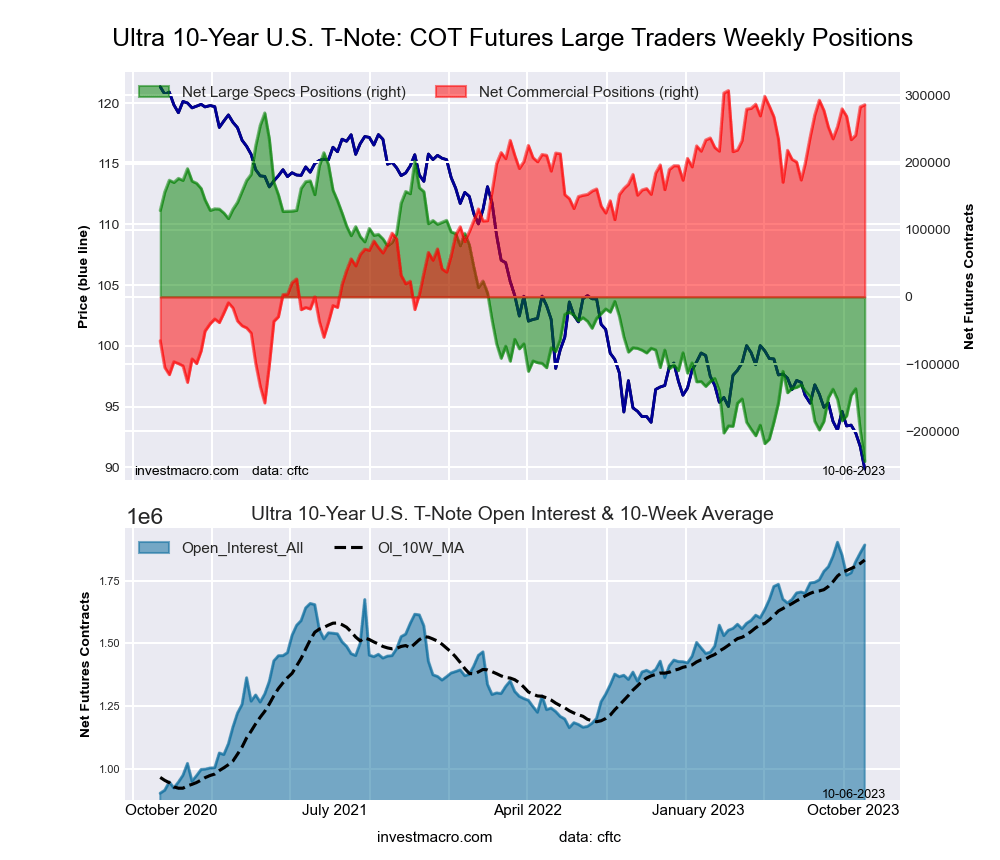
Ultra 10-Year Treasury Notes Bonds Futures COT ChartThe Ultra 10-Year Notes large speculator standing this week came in at a net position of -137,389 contracts in the data reported through Tuesday. This was a weekly boost of 12,562 contracts from the previous week which had a total of -149,951 net contracts.

This week’s current strength score (the trader positioning range over the past three years, measured from 0 to 100) shows the speculators are currently Bearish-Extreme with a score of 16.4 percent. The commercials are Bullish-Extreme with a score of 84.5 percent and the small traders (not shown in chart) are Bullish with a score of 55.9 percent.

Price Trend-Following Model: Downtrend

Our weekly trend-following model classifies the current market price position as: Weak Uptrend. The current action for the model is considered to be: Hold – Maintain Short Position.

Ultra 10-Year Notes StatisticsSPECULATORSCOMMERCIALSSMALL TRADERS
– Percent of Open Interest Longs:12.576.79.1
– Percent of Open Interest Shorts:19.963.914.4
– Net Position:-137,389235,155-97,766
– Gross Longs:230,1631,416,246168,833
– Gross Shorts:367,5521,181,091266,599
– Long to Short Ratio:0.6 to 11.2 to 10.6 to 1
NET POSITION TREND:
– Strength Index Score (3 Year Range Pct):16.484.555.9
– Strength Index Reading (3 Year Range):Bearish-ExtremeBullish-ExtremeBullish
NET POSITION MOVEMENT INDEX:
– 6-Week Change in Strength Index:0.58.1-24.0


US Treasury Bonds Futures:

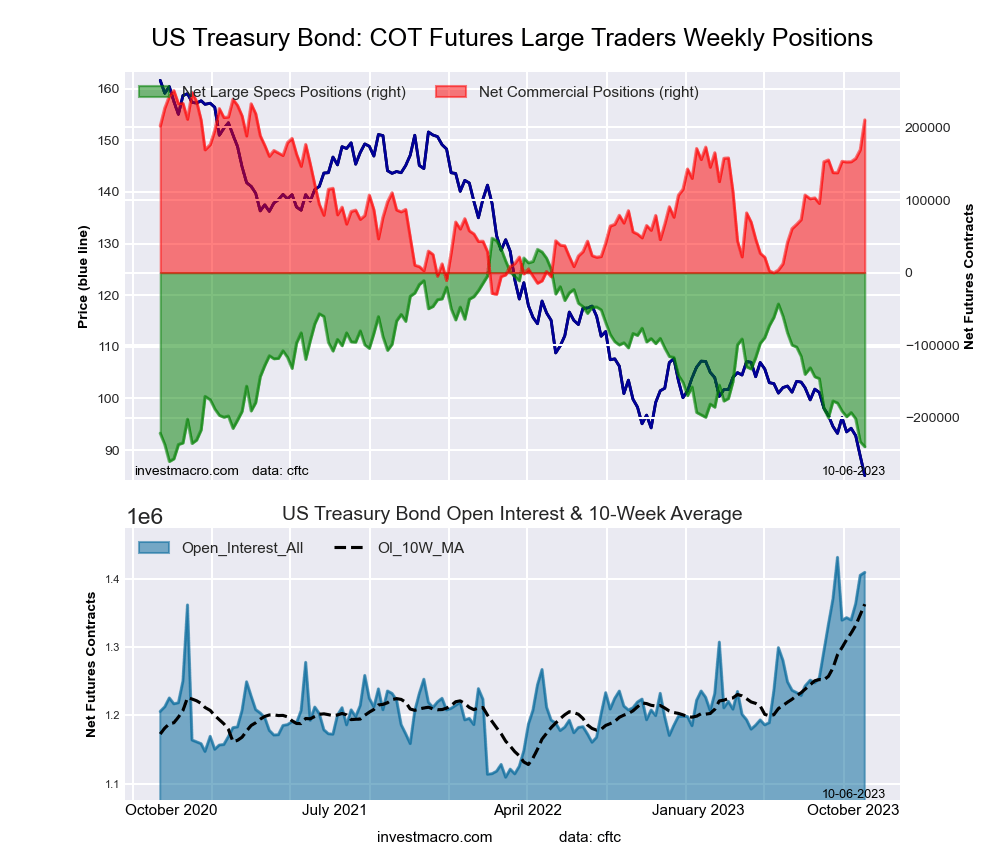
US Year Treasury Notes Long Bonds Futures COT ChartThe US Treasury Bonds large speculator standing this week came in at a net position of -176,734 contracts in the data reported through Tuesday. This was a weekly lift of 22,821 contracts from the previous week which had a total of -199,555 net contracts.

This week’s current strength score (the trader positioning range over the past three years, measured from 0 to 100) shows the speculators are currently Bearish with a score of 27.1 percent. The commercials are Bullish with a score of 59.7 percent and the small traders (not shown in chart) are Bullish with a score of 76.8 percent.

Price Trend-Following Model: Strong Downtrend

Our weekly trend-following model classifies the current market price position as: Strong Downtrend. The current action for the model is considered to be: Hold – Maintain Short Position.

US Treasury Bonds StatisticsSPECULATORSCOMMERCIALSSMALL TRADERS
– Percent of Open Interest Longs:6.975.914.3
– Percent of Open Interest Shorts:19.865.911.4
– Net Position:-176,734137,70339,031
– Gross Longs:94,3371,040,666195,617
– Gross Shorts:271,071902,963156,586
– Long to Short Ratio:0.3 to 11.2 to 11.2 to 1
NET POSITION TREND:
– Strength Index Score (3 Year Range Pct):27.159.776.8
– Strength Index Reading (3 Year Range):BearishBullishBullish
NET POSITION MOVEMENT INDEX:
– 6-Week Change in Strength Index:-12.011.04.3


Ultra US Treasury Bonds Futures:

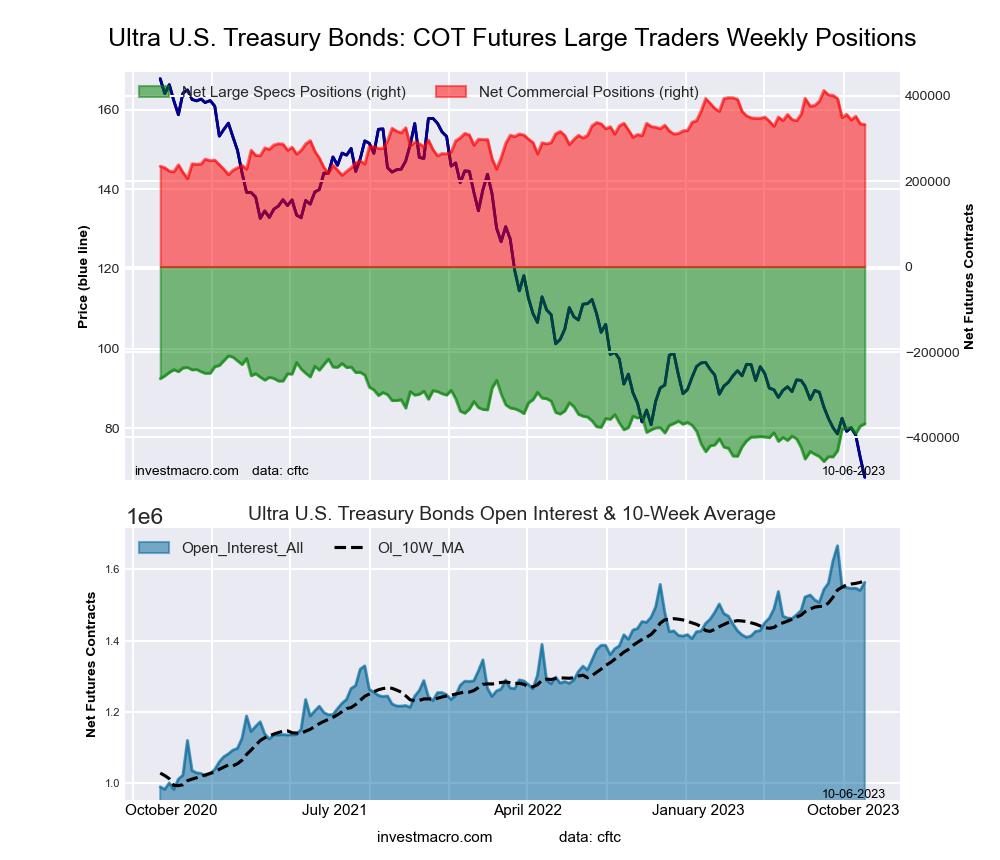
Ultra US Year Treasury Notes Long Bonds Futures COT ChartThe Ultra US Treasury Bonds large speculator standing this week came in at a net position of -445,497 contracts in the data reported through Tuesday. This was a weekly decline of -409 contracts from the previous week which had a total of -445,088 net contracts.

This week’s current strength score (the trader positioning range over the past three years, measured from 0 to 100) shows the speculators are currently Bearish-Extreme with a score of 4.4 percent. The commercials are Bullish-Extreme with a score of 94.5 percent and the small traders (not shown in chart) are Bullish with a score of 79.0 percent.

Price Trend-Following Model: Strong Downtrend

Our weekly trend-following model classifies the current market price position as: Strong Downtrend. The current action for the model is considered to be: Hold – Maintain Short Position.

Ultra US Treasury Bonds StatisticsSPECULATORSCOMMERCIALSSMALL TRADERS
– Percent of Open Interest Longs:5.579.911.0
– Percent of Open Interest Shorts:33.055.28.2
– Net Position:-445,497401,24344,254
– Gross Longs:89,2271,296,276177,740
– Gross Shorts:534,724895,033133,486
– Long to Short Ratio:0.2 to 11.4 to 11.3 to 1
NET POSITION TREND:
– Strength Index Score (3 Year Range Pct):4.494.579.0
– Strength Index Reading (3 Year Range):Bearish-ExtremeBullish-ExtremeBullish
NET POSITION MOVEMENT INDEX:
– 6-Week Change in Strength Index:2.13.3-11.3


Article By InvestMacroReceive our weekly COT Newsletter

*COT Report: The COT data, released weekly to the public each Friday, is updated through the most recent Tuesday (data is 3 days old) and shows a quick view of how large speculators or non-commercials (for-profit traders) were positioned in the futures markets.

The CFTC categorizes trader positions according to commercial hedgers (traders who use futures contracts for hedging as part of the business), non-commercials (large traders who speculate to realize trading profits) and nonreportable traders (usually small traders/speculators) as well as their open interest (contracts open in the market at time of reporting). See CFTC criteria here.