Archive for Financial News – Page 183

EUR/USD Consolidates Around 1.0810 as Powell’s Speech Influences Market Sentiment

By RoboForex Analytical Department

The EUR/USD currency pair is entering the final week of August in a phase of consolidation around the 1.0810 level. This follows a speech by Jerome Powell, the Chair of the Federal Reserve, during the recent Jackson Hole Symposium in the US. Powell highlighted the Fed’s commitment to raising interest rates continuously to maintain elevated levels of inflation, while also considering the effectiveness of measures already in place.

As a result, the Federal Reserve plans to make necessary interest rate adjustments and maintain a stringent monetary policy until it successfully manages price control.

With a relatively quiet macroeconomic calendar at the beginning of the week, the market is relying on existing factors to determine direction.

Technical Analysis of the EUR/USD Currency Pair

On the H4 chart, EUR/USD has completed a decline to 1.0765, followed by a corrective structure forming up to 1.0816. Once this correction is complete, there is potential for the decline to continue to 1.0740, a local target. The scenario is supported by the MACD indicator, as its signal line is below zero and pointed downwards.

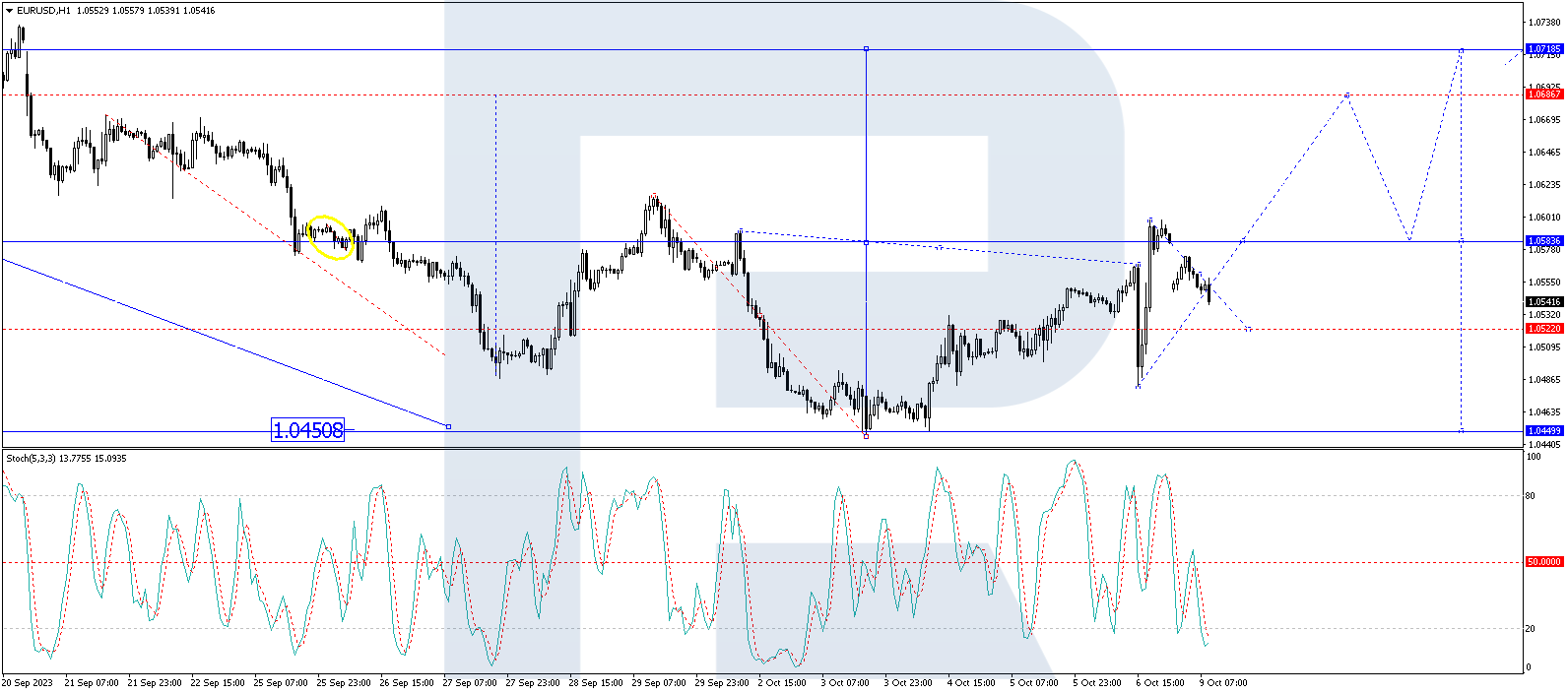
On the H1 chart, EUR/USD has undergone a correction to 1.0816, possibly leading to the formation of a consolidation range below that level. If the price breaks out of this range in a downward direction, a new wave of decline to 1.0740 could be formed. This scenario is backed by the Stochastic oscillator, as its signal line is currently above 80, indicating a potential drop to 50. A break of this level could open the door to a decline towards 20.

Disclaimer

Any forecasts contained herein are based on the author’s particular opinion. This analysis may not be treated as trading advice. RoboForex bears no responsibility for trading results based on trading recommendations and reviews contained herein.

Fed chief hints at another rate hike. Oil may come under pressure in the coming weeks

By JustMarkets

At Friday’s close, the Dow Jones Index (US30) increased by 0.73% (-0.53% for the week), while the S&P 500 Index (US500) added 0.67% (+0.58% for the week). The NASDAQ Technology Index (US100) closed positive by 0.94% (+1.82% for the week) on Friday. Fed Chairman Jerome Powell said on Friday that policymakers are prepared to raise interest rates further if necessary but also signaled that they may keep rates at current levels in September if economic data support it.

Key talking points from US Federal Reserve Chairman Jerome Powell’s speech at the conclusion of a conference in Jackson Hole:

  • We are attentive to signs that the economy may not be cooling as expected;
  • Evidence of sustained above-trend growth could jeopardize further progress in inflation and warrant further monetary tightening;
  • Evidence that labor market tightness is no longer easing could also warrant a monetary policy response.

According to analysts, despite the hawkish tones in Jerome Powell’s speech, the Fed is happy with current trends, and if they continue, they won’t change anything. But if the US Central Bank sees that these economic trends are fading or suddenly beginning to change, it will increase the likelihood of another rate hike because the Fed will be very sensitive to the data, and this sensitivity will be one-sided – in the direction of tightening.

Equity markets in Europe were mostly rising on Friday. German DAX (DE40) rose by 0.07% (week’s total +0.37%), French CAC 40 (FR40) rose by 0.38% (week’s total +0.90%), Spanish IBEX 35 (ES35) jumped by 0.15% (week’s total +0.76%), British FTSE 100 (UK100) closed up by 0.07% (week’s total +1.05%). Germany’s August business climate fell by 1.7 to a 10-month low of 85.7, below expectations of 86.8. ECB President Lagarde said at a symposium in Jackson Hole that the ECB “will set interest rates at a fairly restrictive level for as long as necessary to bring inflation back to the medium-term target of 2% in a timely manner.” For his part, Nagel of the ECB’s Governing Council said that with inflation still standing around 5%, “it is too early to think about a pause” in interest rate hikes. European inflation data will be released this week. Core inflation in Germany, as well as across the Eurozone, is expected to fall slightly, raising the possibility that the ECB may hit the pause button in September.

Oil was supported on Friday after Marathon Petroleum shut down its Garyville refinery in Louisiana, the third-largest refinery in the United States with a refining capacity of 596,000 BPD, due to a fire. In addition, Friday’s weekly report from Baker Hughes was upbeat for oil as the report showed that active oil rigs in the US fell to their lowest level in a year and a half. But analysts believe that against the backdrop of September, which is considered a seasonally weak month, there is a high probability of oil price declines in the coming weeks. Moreover, open interest is sharply declining, suggesting that oil bulls are taking profits after the rally.

Asian markets were also mostly up last week. Japan’s Nikkei 225 (JP225) increased by 0.23% for the week, China’s FTSE China A50 (CHA50) gained 0.04%, Hong Kong’s Hang Seng (HK50) ended the week up by 0.89%, and Australia’s S&P/ASX 200 (AU200) ended the week negative by 0.46%.

In Australia, seasonally adjusted retail sales for July rose by 0.5% month-over-month versus an expected 0.3%. Despite the increase, Australian Treasurer Jim Chalmers said he expects growth in the Australian economy to weaken significantly due to interest rate hikes by the Reserve Bank of Australia (RBA) and a slowdown in China.

A meeting between Bank of Canada Governor Kazuo Ueda and Japan’s Prime Minister last week sparked new rumors of monetary policy normalization. Traders are also wary of government intervention against the yen after it hit a nine-month low last week. The weak yen, which has helped Japanese stocks outperform global peers this year, is now pressuring the market, raising expectations that the Bank of Japan will be forced to move toward monetary tightening.

S&P 500 (F)(US500) 4,405.71 +29.40 (+0.67%)

Dow Jones (US30) 34,346.90 +247.48 (+0.73%)

DAX (DE40)  15,631.82 +10.33 (+0.07%)

FTSE 100 (UK100) 7,338.58 +4.95 (+0.07%)

USD Index  104.19 +0.21 (+0.20%)

Important events for today:
  • – Australia Retail Sales (m/m) at 04:30 (GMT+3).

By JustMarkets


This article reflects a personal opinion and should not be interpreted as an investment advice, and/or offer, and/or a persistent request for carrying out financial transactions, and/or a guarantee, and/or a forecast of future events.

Lithuania should seize the foreign direct investment advantage

By George Prior

Lithuania needs to harness “the enormous power” of international investment to boost its economic opportunities in an increasingly globalised world, says serial global investor Nigel Green.

The European Union-based international entrepreneur, investor, and government advisor stresses that foreign direct investment (FDI) is a lifeline for economic growth and development.

He says: “Countries worldwide compete to attract foreign direct investment due to its ability to bring capital, technology, expertise, market access and large-scale job and wealth-building opportunities to a nation.

“All over the world, history proves that foreign direct investment ignites long-term, sustainable economic growth.”

As a long-term investor in and advocator of Lithuania, Nigel Green says that Lithuania should now “harness the power of foreign direct investment (FDI) and allow it to become a cornerstone of national economic development.”

He says: “I’m a huge believer in the potential of Lithuania and I think the time is right for Lithuania to seize the FDI advantage.

“By properly pushing the FDI programme, there will be a surge of capital into Lithuania, catalysing economic activity and driving growth.

“This influx of funds can be channelled into critical sectors such as infrastructure, technology, and manufacturing, creating jobs and improving the standard of living for the Lithuanian people.”

Nigel Green continues: “As I have seen around the world, foreign investors typically introduce different technologies, best practices, and management expertise.

“This transfer of knowledge enhances local innovation capacity and accelerates Lithuania’s progress toward becoming a knowledge-based, top-tier economy.”

Foreign direct investment would also help diversify Lithuania’s industrial landscape, reducing overreliance on specific sectors and fostering resilience against economic fluctuations.

“The establishment of new industries and sectors enhances economic stability and paves the way for a more balanced economy,” he notes.

“In addition, by going big on foreign direct investment, Lithuania gains more access to international markets through the establishment of export-oriented industries. These industries create products for global consumption, generating foreign exchange earnings and contributing to the country’s export revenue.”

Infrastructure development, from transportation networks to energy systems, would also receive a boost. Improved infrastructure not only attracts investors but also contributes to the overall development of the country for the long-term.

Additionally, as foreign investors seek local talent, Lithuania’s workforce is then exposed to global business practices, higher salaries, and skill enhancement, all of which creates a more competitive labour force.

Nigel Green concludes: “As Lithuania continues to assert itself on the global stage, the strategic use of foreign direct investment should take on greater significance.

“The transformative impact of a comprehensive FDI agenda on Lithuania’s economy, from innovation to job creation, would be undeniable.

“With the right approach, Lithuania can position itself as a beacon of opportunity, attracting investments from around the world that empower its people, enhance its economic resilience, and pave the way for a brighter and prosperous future.”

About:

deVere Group is one of the world’s largest independent advisors of specialist global financial solutions to international, local mass affluent, and high-net-worth clients.  It has a network of offices across the world, over 80,000 clients and $12bn under advisement.

Tech Solutions Firm Has YOY Growth for 7th Quarter in a Row

Source: Chris Thompson  (8/24/23)

In Q2/23 the company began to realize synergies from its recent acquisition, which boosted revenue and cash flow, noted an eResearch report.

Data Communications Management Corp.’s (DCM:TSX; DCMDF:OTCQX) Q2/23 financial results were notable for a 75% year-over-year (YOY) increase in revenue, attributed to its acquisition of Moore Canada Corp. (MCC), reported Chris Thompson, eResearch’s director of equity research, in an August 17 update note.

“The combined businesses achieved growth through expanded revenue with existing clients, successful acquisition of new clients, and ongoing efforts to mitigate the impact of raw material cost increases by passing them on to the customers,” Thompson wrote.

Attractive 114% Return

The Canadian marketing and business communication solutions provider offers investors a significant potential return of 114%, noted Thompson. It is trading now at about CA$3.22 per share, whereas eResearch’s target price on it is CA$6.90 per share.

Data Communications Management is a Buy.

Growth Record Maintained

Thompson reviewed Data Communications Management’s financial results from Q2/23, the company’s seventh consecutive quarter of year-over-year growth.

Revenue was a beat, coming in CA$119 million (CA$119M) versus eResearch’s CA$113.2M forecast. Also, Q2/23 revenue was 74.7% higher than Q2/22’s of CA$68.1M.

“Data Communications Management reported that it believes it can still achieve its targeted organic annual revenue growth rate of 5%,” wrote Thompson.

Gross profit in Q2/23 was CA$32M, up 56.7% YOY. Gross margin in Q2/23, however, was 26.9%, down 3.1% YOY but consistent with eResearch’s 27% estimate.

The tech solutions firm aims to achieve gross margins of greater than 30% in the upcoming quarters. Following the closing of the MCC acquisition in late April, Data Communications Management began initiatives to reach this target through synergies and greater efficiencies in organization, operations, procurement, and revenue, Thompson noted.

Adjusted EBITDA in Q2/23 was CA$13.8M, up 45.8% YOY from CA$9.5M and partly due to the MCC acquisition.

As far as costs, Q2/23 sales, general and administrative expenses were CA$23M, up from CA$18.8M in Q1/23 and up from CA$13.8M in Q2/22. Data Communications Management aims to achieve savings from synergies in the CA$25−30M range over the next 18−24 months and has already realized CA$4.2M in this regard.

Overall, for Q2/23, Data Communications Management reported a CA$2.9M net loss, whereas last year, at this time, it had achieved a net profit of CA$3.8M. Similarly, Q2/23 earnings per share was (CA$0.06) compared to a CA$0.09 gain in Q2/22.

Review of Balance Sheet

In May of Q2/23, the company generated CA$26.1M of gross proceeds from a private placement of common shares offering, reported Thompson.

The following month, it yielded CA$24.1M of gross proceeds from the sale and leaseback of its warehouse in Oshawa, Ontario.

At Q2/23’s end, Data Communications Management had CA$21M in cash and CA$112.7M in debt after having paid it down by CA$60.4M.


Important Disclosures:

  1. Data Communications Management Corp. is a billboard sponsor of Streetwise Reports and pays SWR a monthly sponsorship fee between US$4,000 and US$5,000.
  2. Doresa Banning wrote this article for Streetwise Reports LLC and provides services to Streetwise Reports as an independent contractor.
  3. The article does not constitute investment advice. Each reader is encouraged to consult with his or her individual financial professional and any action a reader takes as a result of information presented here is his or her own responsibility. By opening this page, each reader accepts and agrees to Streetwise Reports’ terms of use and full legal disclaimer. This article is not a solicitation for investment. Streetwise Reports does not render general or specific investment advice and the information on Streetwise Reports should not be considered a recommendation to buy or sell any security. Streetwise Reports does not endorse or recommend the business, products, services or securities of any company mentioned on Streetwise Reports.

For additional disclosures, please click here.

Disclosures for eResearch, Data Communications Management Corp., August 17, 2023

eResearch Intellectual Property: No representations, express or implied, are made by eResearch as to the accuracy, completeness, or correctness of the comments made in this report. This report is not an offer to sell or a solicitation to buy any security of the Company. Neither eResearch nor any person employed by eResearch accepts any liability whatsoever for any direct or indirect loss resulting from any use of this report or the information it contains. This report may not be reproduced, distributed, or published without the express permission of eResearch.

ANALYST ACCREDITATION eResearch Analyst on this Report: Chris Thompson CFA, MBA, P.Eng. Analyst Affirmation: I, Chris Thompson, hereby state that, at the time of issuance of this research report, I do not own common shares, share options, or share warrants of DATA Communications Management Corp. (TSX: DCM).

eRESEARCH DISCLOSURE STATEMENT eResearch is engaged solely in the provision of equity research to the investment community. eResearch provides published research and analysis to its Subscribers on its website (www.eresearch.com), and to the general investing public through its extensive electronic distribution network and newswire agencies. eResearch makes all reasonable efforts to distribute research material simultaneously to all of its Subscribers. eResearch does not manage money or trade with the general public, provides full disclosure of all fee arrangements, and adheres to the strict application of its Best Practices Guidelines. eResearch accepts fees from the companies it researches (the “Covered Companies”) and from financial institutions or other third parties. The purpose of this policy is to defray the cost of researching small and medium-capitalization stocks which otherwise receive little or no research coverage. DATA Communications Management Corp. paid eResearch a fee to have it conduct research and publish reports on the Company for one year.

To ensure complete independence and editorial control over its research, eResearch follows certain business practices and compliance procedures. For instance, fees from Covered Companies are due and payable before the research starts. Management of the Covered Companies is sent copies, in draft form without a Recommendation or a Target Price, of the Initiating Report and the Update Report before publication to ensure our facts are correct, that we have not misrepresented anything, and have not included any non-public, confidential information. At no time is management entitled to comment on issues of judgment, including Analyst opinions, viewpoints, or recommendations. All research reports must be approved, before publication, by eResearch’s Director of Research, who is a Chartered Financial Analyst (CFA). All Analysts are required to sign a contract with eResearch before engagement and agree to adhere at all times to the CFA Institute Code of Ethics and Standards of Professional Conduct. eResearch Analysts are compensated on a per-report, per-company basis and not based on his/her recommendations. Analysts are not allowed to accept any fees or other considerations from the companies they cover for eResearch. Officers, analysts, and directors of eResearch are allowed to trade in shares, warrants, convertible securities, or options of any of the Covered Companies only under strict, specified conditions, which restrict trading 30 days before and after a Research Report is published.

AI Security Firm With ‘Almost Unlimited Upside’ Per Technical Analyst

Source: Streetwise Reports  (8/24/23)

VSBLTY Groupe Technologies Corp. is a major player in the growing “Store as a Medium” advertising market. However, its latest deployment in Mexico showcases how the company’s core tech is equally applicable for top-tier intelligent zero-contact access control.

Recently, Canada-based retail technology and marketing company VSBLTY Groupe Technologies Corp. (VSBY:CSE; VSBGF:OTC; 5VS:FSE) announced it had signed a non-binding letter of intent to acquire Shelf Nine, a leader in retail media networks, providing brands and retailers specifically targeted digital media advertising and other customer communications content delivered at the point of purchase.

The definitive agreement is expected to be finalized over the next 30 days. 

In light of this news, CEO and Co-founder Jay Hutton said, “This acquisition is synergistic with VSBLTY’s vision of the retail advertising segment . . . Shelf Nine’s integration with our computer vision analytics technology is a win-win for both companies. Operating as a wholly owned subsidiary of VSBLTY, Shelf Nine and VSBLTY have the opportunity to further leverage each company’s core competencies and further penetrate the retail media market, estimated to be worth US$160 billion by 2027. In addition to both companies benefiting from recurring SaaS fees, they also generate added revenue from content development and media sales”

VSBLTY  is generally known for the variety of smart applications it offers to drive brand engagement and put marketing insights in motion.

At its core, the company, which is headquartered in Philadelphia, is engaged in Proactive Digital Display, which transforms retail and public spaces as well as place-based media networks using software-as-a-service (SaaS)-based audience measurement and machine learning.

This work allows retailers and brand builders to identify customer habits and even individual customers, thereby providing uniquely tailored multimedia experiences from end-to-end along the buying journey in brick-and-mortar locations with greater fidelity than one would experience online.

By utilizing facial recognition, age, and gender, VSBLTY’s proprietary technology can effectively enhance retail brand engagement and measurement through customized ads on in-store digital displays at the point of purchase in real-time. This technology has proven to increase brand sales by over 25%.

VSBLTY’s main products include DataCaptor, VisionCaptor, VSBLTY Vector and VSBLTY Metrics. DataCaptor leverages camera and sensor technology through AI tools, enabling real-time analytics and anonymous audience data. VisionCaptor Content Management System provides a variety of capabilities for bringing proximity-aware, interactive brand messaging to life on any digital screen.

These two key technologies are deployed together to create custom brand experiences for users who follow them throughout connected retail experiences.

However, fewer people are aware of VSBLTY Vector, the company’s security-focused software, which provides facial recognition and weapon detection.

The Catalyst: Access Control Rollout for Major Mexican Customer

On April 8, VSBLTY announced that a major Mexican customer had successfully deployed the firm’s VSBLTY Vector solution across a network of 40 CCTV cameras to automate access control at the customer’s two-story headquarters facility, replacing security cards and allowing the free flow of employees while rapidly detecting and alerting security forces of any unauthorized or potentially bad actors.

According to Insider Intlegence’s Retail Media Ad Spending Forecast H1 2023, “We expect advertisers to pour more than US$45 billion into retail media ad spending in 2023.” The report projects that spending to expand to some US$ 106 billion by 2027.

As the announcement explains, “Previously, traditional access control systems have been key cards, key fobs, or digital passwords, but each has its own security limitations.”

“Employees now enter their workplace without physical checkpoints while CCTV cameras and AI-backed software verify their status. If the system identifies an unauthorized person, building security is notified immediately.”

“To ensure a safe workplace, this program provides a continuous search for unknown persons based upon an enrollment database of employees and other authorized personnel. Each day, approved visitors to the building are automatically logged and entered into the firm’s system.”

“The software is also not only capable of identifying a stranger (whose image is not in the records) attempting to enter an authorized area but can identify a terminated or previously problematic employee whose image is in the system. This advanced program can also offer additional security, including weapons detection and suspicious behavior to trigger alerts.”

As for other catalysts, Hutton told Streetwise there are a couple of catalysts to look out for next quarter.

  1. VSBLTY will be entering into a new market as an extension of the current relationship with ABInBev.
  2. There is traction in Saudi with VSBLTY’s joint venture in the region to launch the first large-scale retail media network.
  3. VSBLTY will continue tractions with partners in religious institutions and schools with the VSBLTY security AI solutions.

Why This Sector? Expanding the Value of AI

Using AI to recognize, quantify, and collate unknown users, such as the random collection of shoppers who visit a brick-and-mortar retailer in a given day, is already a valuable market segment.

According to Insider Intlegence’s Retail Media Ad Spending Forecast H1 2023, “We expect advertisers to pour more than US$45 billion into retail media ad spending in 2023.” The report projects that spending will expand to some US$ 106 billion by 2027.

With automated advertising solutions designed to target specific demographics in active retail spaces, VSBLTY is positioning itself to capture a significant share of that rapidly expanding market. However, by repurposing its core AI tech for security work, it is also gaining access to a huge secondary market no other retail advertising networks are addressing.

According to a report from Future Market Insights, “The global building access control security market is expected to secure a market value worth US$ 11.89 billion in 2023. During the forecast period from 2023 to 2033, the market is likely to display a CAGR of 14% while garnering a value worth US$ 44.2 billion. The increasing demand for smart buildings and infrastructure will be driving the demand for the building access control security market in the future.”

The report goes on to specify that zero-touch access control solutions, such as those offered by VSBLTY, are in particular demand in a post-pandemic market. By deploying its core technology across these disparate fields, VSBLTY has positioned itself to grow in a multi-faceted manner as these markets for novel AI technology mature.

Why This Company? Multiple Markets for AI Automation

As the company is situated at this valuable intersection between retail advertising and access control, it’s easy enough to market as making customers’ existing video cameras “smarter” by providing real-time monitoring and alerting. This ability to install using legacy technology is a powerful selling point for clients who have existing and expensive relationships with traditional security hardware vendors.

“Employees forgetting passwords, losing keycards and fobs can be both an administrative nightmare and a financial burden for corporations,” explains VSBLTY Co-founder & CEO Jay Hutton. “This deployment of our AI-based Vector product for access control and building security alleviates many issues inherent in traditional access control systems.”

“We anticipate the success of our advanced security system in Mexico will lead to many other installations worldwide,” he concludes.

Why Now? ‘Almost Unlimited Upside’

On August 1, Technical Analyst Clive Maund published a detailed analysis of VSBLTY quite optimistically titled “This Tech Co. Has Almost Unlimited Upside.”

In it, he explained that “Whilst it is generally unwise to go against the prevailing trend when it is still in force, there are exceptions when the volume pattern strongly indicates that reversal is imminent, which is the case with VSBLTY, and the case for buying Visibility is stronger still because the price of the stock is so close to zero that there is almost no downside — as with an option you can only lose your stake, whereas the upside is relatively unlimited.”

On August 1, Technical Analyst Clive Maund published a detailed analysis of VSBLTY quite optimistically titled “This Tech Co. Has Almost Unlimited Upside.”

“On the 26-month chart, we can see the horrendous bear market in Visibility that has taken it from a peak at almost CA$2.00 in November 2021 to bottom at a miserly 5 cents a couple of weeks ago.

The reason that we are interested in it here, apart from the fact that it can’t drop much more because it is almost worthless, is the appearance of persistent strong upside volume last month and especially this month that has driven the Accumulation line steeply higher,” Maund explained.

“This is viewed as evidence of determined Accumulation by a person or persons or an entity who consider(s) the company to be grossly undervalued here and might be the prelude to a takeover.”

“VSBLTY is obviously a speculative play here that is only suited to more experienced investors and traders who understand the risk inherent in this setup. Could the flurry of buying interest last month and this be simply a ‘flash in the pan’ that leads to nothing and the downtrend continue? Well, it could, but that is considered unlikely.”

Retail: 93.24%
Strategic Investors: 3.3%
Management & Insiders: 3.21%
Institutions: 0.25%
93.2%
3.3%
3.2%
*Share Structure as of 8/16/2023


“Instead, we recognize that you could lose your stake buying here if it continues even lower and maybe the company goes bust, but at the same time, if it does recover, you could make many times your investment, and since the technicals indicate that the chance of this happening is better than 50:50 it is considered to be a worthwhile calculated risk.”

Ownership and Share Structure

According to Reuters, 3.21% of VSBLTY’s stock is held by management and insiders. Director Thomas Hayes has 1.10%, with 3.67 million shares. Co-founder, CEO, President, and Founder Jay Hutton has 0.52%, with 1.74 million, and CTO Gary Gibson has 0.40%, with 1.34 million.

3.30% is with strategic investor Actus Interactive Holdings Inc., with 10.97 million shares.

0.25% is with institutional investors. Palos Management Inc. is the largest institutional shareholder at 0.21%, with 0.70 million shares.

The rest is with retail investors.

As of June 28, 2022, VSBLTY had a market cap of CA$82 million, with 209,753,999 basic shares outstanding, 47,256,115 warrants, and 14,440,834 options, for a fully diluted base of 271,450,948.


Important Disclosures:

  1. As of the date of this article, officers and/or employees of Streetwise Reports LLC (including members of their household) own securities of VSBLTY Groupe Technologies Corp.
  2. Owen Ferguson wrote this article for Streetwise Reports LLC and provides services to Streetwise Reports as an independent contractor.
  3. The article does not constitute investment advice. Each reader is encouraged to consult with his or her individual financial professional and any action a reader takes as a result of information presented here is his or her own responsibility. By opening this page, each reader accepts and agrees to Streetwise Reports’ terms of use and full legal disclaimer. This article is not a solicitation for investment. Streetwise Reports does not render general or specific investment advice and the information on Streetwise Reports should not be considered a recommendation to buy or sell any security. Streetwise Reports does not endorse or recommend the business, products, services or securities of any company mentioned on Streetwise Reports.

For additional disclosures, please click here.
Week Ahead: Can EURUSD’s uptrend stay intact?

By ForexTime

Firstly, please note that this Week Ahead preview is being written before Fed Chair Jerome Powell’s highly-anticipated speech out of the Jackson Hole Economic symposium due later today (Friday, August 25th).

Still, the astute trader and investor will already be casting a glance at what’s in store post-Jackson Hole.

The monthly US jobs report, typically released on the first Friday of every month, is set to hog the limelight next week.

This tier-1 data out of the world’s largest economy will arrive at the tail end of a week that also features these other major economic data releases and events:

Monday, August 28

  • AUD: Australia July retail sales
  • USD: US August manufacturing activity
  • UK markets closed

Tuesday, August 29

  • JPY: Japan July unemployment
  • USD: US August consumer confidence

Wednesday, August 30

  • AUD: Australia July CPI
  • EUR: Germany August CPI; Eurozone August economic confidence
  • USD: US 2Q GDP (2nd estimate)

Thursday, August 31

  • JPY: Japan July retail sales, industrial production
  • CNH: China August manufacturing, non-manufacturing PMIs
  • EUR: Eurozone August CPI; July unemployment rate; ECB meeting minutes
  • USD: US weekly initial jobless claims; July PCE deflator, personal income and spending

Friday, September 1

  • CNH: China Caixin August manufacturing PMI
  • EUR: Eurozone August manufacturing PMI (final)
  • GBP: UK August manufacturing PMI (final)
  • CAD: Canada 2Q GDP
  • USD: US August nonfarm payrolls
  • USD: US August ISM manufacturing


EURUSD traders will be keen to find out how the official prints for the following data releases will match up with current market forecasts as stated below:

1) Wednesday, Aug 30: Germany August consumer price index (CPI)

  • Year-on-year CPI (August 2023 vs. August 2022): 6%
  • Month-on-month CPI (August 2023 vs. July 2023): 0.2%

If so, both prints would mark a slight easing from July’s CPI figures.

Note that Germany is the largest economy in the Eurozone, and its CPI prints tend to front-run the broader Eurozone’s CPI release.


2) Thursday, Aug 31: Eurozone August CPI

  • Year-on-year CPI: 5%
  • Month-on-month CPI (August 2023 vs. July 2023): 0.3%
  • Year-on-year core CPI (excluding food and energy prices): 5.3%

While such numbers would mark a moderating in inflation, 5% CPI is still noticeably higher than the European Central Bank’s (ECB) 2% target, which could warrant more rate hikes.


3) Thursday, Aug 31: Eurozone July unemployment rate (forecast = 6.4%)

If so, this would match the unemployment rate in June.


Still, ECB policymakers will only be too aware of the deteriorating economy.

The Eurozone’s manufacturing and services sectors each posted sub-50 PMI readings this past Wednesday (August 23rd).

When the PMI number is below 50, that means the sector is experiencing contracting conditions.

Such concerning figures prompted markets to pare down their expectations for another 25-basis point hike by the ECB before 2023 is over.

Those odds have been slashed from 78% this time last week, now down to a 57%.

Hence, the ECB meeting minutes due to be released on August 31 may already be dated, seeing as that July meeting was held prior to releases of the above-listed economic data.


Then, on the USD side of the equation …

Markets will want to know if the US labour market remains resilient, as evidenced by the highly-anticipated US jobs report, despite the Fed’s aggressive rate hikes since 2022.


4) Friday, Sept 1: US August jobs report

  • Change in nonfarm payrolls: +168,000

If so, that would be the fewest number of new jobs added in a month since December 2019.

  • Unemployment rate: 3.5%

If so, this would match July’s unemployment rate.

  • Average hourly earnings: 4.3% year-on-year and 0.3% month-on-month

If so, that would be a slick tick down of 10 basis points respectively from July’s figures.


Markets currently place a 55% chance that the Fed will trigger a 25-basis point hike in November, after pausing at its September policy meeting.

Of course, Chair Powell’s commentary out of Jackson Hole could significantly alter that perception.

Still, with the Fed already pledging to remain “data dependent”, a set of better-than-expected jobs data on September 1st could embolden the FOMC hawks (voting officials at the Federal Reserve who want to hike US rates further), and boost the US dollar along the way.


POTENTIAL SCENARIOS:

Ultimately, markets are set to reward the currency of the economy that can better handle another rate hike from its central bank.

  • EURUSD could move higher if the Eurozone’s CPI comes in higher than expected, while the US jobs market appears to be waning.

  • EURUSD could move lower on the stronger US dollar if the Eurozone’s CPI comes in lower than expected, and/or a higher-than-expected unemployment rate, along with a US jobs market that’s still resilient.


From a technical perspective …

To be fair, EURUSD is still adhering to a uptrend, maintaining a series of higher highs and higher lows so far this year.

However, EURUSD is now caught up in its 3rd “correction” wave on the daily timeframe so far this year.

Each wave has marked a decline of over 4%, with the latest declines commencing from its July 18th intraday peak extending past 4.4% at the time of writing.

And there are other bearish signs in play currently for EURUSD:

  • now trading below the widely-watched 200-day simple moving average (SMA) for the first time since end-November 2022.
  • 21-day SMA has crossed below its longer-term 100-day counterpart.


Currently, Bloomberg’s FX model points to a 73% chance that EURUSD will trade within the 1.0661 – 1.0920 range over the next one week

(forecast is prior to Fed Chair Powell’s Jackson Hole speech)


Here are some key levels to look out for:

POTENTIAL SUPPORT

  • 1.0766: lower trendline of uptrend/mid-March peaks
  • 1.068 region: resistance turn support zone since December
  • 1.0661 – 1.06352: lower bound of Bloomberg model forecasted range / end-May cycle low


POTENTIAL RESISTANCE

  • 200-day SMA
  • 1.08353/37: lows in end-June/early July
  • 1.0920: upper bound of Bloomberg model forecasted range, also with 100-day and 21-day SMAs lurking nearby


Brace for technical rebound?

The 14-day relative strength index (RSI) for the world’s most-traded FX pair is now flirting with the 30 mark, which denotes oversold levels.

Note that the bottom of the prior 2 “correction” waves have also coincided with such levels for the RSI.

Of course, fundamental factors surrounding the ECB vs. Fed’s next policy moves would greatly dictate whether EURUSD’s uptrend will be upended as we head into September.

Still, a technical rebound may be on the cards over the near term to perhaps offer some relief for euro bulls.


Forex-Time-LogoArticle by ForexTime

ForexTime Ltd (FXTM) is an award winning international online forex broker regulated by CySEC 185/12 www.forextime.com

The US stock market is under a sell-off on hawkish comments from FOMC representatives. Japan is seeing a decline in inflation

By JustMarkets

As of Thursday’s stock market close, the Dow Jones Index (US30) decreased by 1.08%, while the S&P500 Index (US500) lost 1.36%. The NASDAQ Technology Index (US100) closed yesterday negative at 1.87%. Stocks were under a sell-off on Thursday, sending the Dow Jones Industrials Index to a 6-week low. The sell-off in technology stocks had a negative impact on the overall market. In addition, stronger-than-expected US economic news and hawkish comments from the Fed pushed bond yields higher and triggered the liquidation of long positions in equities ahead of Friday’s speech by Fed Chair Powell.

On Thursday, the Fed’s hawkish comments were bullish for the dollar index and bearish for stock indices. FRB Boston President Collins said it will take time for inflation to reach the Fed’s 2% target, and “we may need to raise rates further, and we may hold rates at restrictive levels for some time.” Former St. Louis Fed President Bullard said a pickup in economic activity this summer could delay the Fed’s plans to end its campaign to raise interest rates, “This acceleration could put upward pressure on inflation, stop the disinflation we’re seeing, and instead delay the Fed’s plans to change policy.” Philadelphia Fed President Harker believes policymakers have likely undertaken sufficient tightening and that the Fed has “probably done enough” and believes interest rates will be steady through the year’s end.

Today, markets await Fed Chairman Powell’s comments at the annual symposium of the world’s central banks in Jackson Hole, Wyoming. With inflation down from 40-year highs but still well above the Fed’s 2% target, Powell’s speech will be scrutinized for when the Fed might end its rate hike campaign. ECB President Lagarde will also speak at the event.

Equity markets in Europe traded flat yesterday. Germany’s DAX (DE40) decreased by 0.68%, France’s CAC 40 (FR40) lost 0.44% on Thursday, Spain’s IBEX 35 (ES35) added 0.10%, and the UK’s FTSE 100 (UK100) closed positive at 0.18%.

ECB Governing Council representative Centeno said yesterday that the ECB “should be cautious in deciding on additional rate hikes, as downside risks to the economy that were identified in June have materialized.”

The GkK report showed that UK consumer confidence rebounded in August as inflation showed signs of cooling and strong wage growth supported household finances. The figures starkly contrast the sharp fall in retail sales in July, with industry research suggesting the decline is likely to continue.

Crude oil and gasoline prices closed modestly higher on Thursday. Stronger-than-expected economic news from the US on Thursday signaled a strengthening economy favorable for energy demand and crude oil prices. Signs of tight supply also supported oil after the EIA’s weekly crude inventories data fell more than expected to a 7-month low on Wednesday. But a stronger dollar on Thursday limited gains in energy prices.

Natural gas prices rose moderately on Thursday after weekly natural gas inventories released by the EIA increased by 18 Bcf (billion cubic feet), below expectations of 31 Bcf. The rise in natural gas prices was capped by a forecast that cooler temperatures will arrive in the lower 48 US states next week, reducing demand for natural gas from power suppliers to run air conditioners.

Asian markets were mostly up yesterday. Japan’s Nikkei 225 (JP225) added 0.87% for the day, China’s FTSE China A50 (CHA50) rose by 1.15%, Hong Kong’s Hang Seng (HK50) ended Thursday up 2.05%, and Australia’s S&P/ASX 200 (AU200) ended the day positive at 0.47%.

Core inflation in Japan’s capital slowed in August for the second consecutive month (3.0%→2.8%) but remained well above the Сentral Bank’s 2% target. Analysts expect inflation to continue slowing in the coming months, reflecting the recent decline in commodity prices and the base effect of last year’s price surge.

S&P 500 (F)(US500) 4,376.31 −59.70 (−1.35%)

Dow Jones (US30) 34,099.42 −373.56 (−1.08%)

DAX (DE40)  15,621.49 −106.92 (−0.68%)

FTSE 100 (UK100) 7,333.63 +13.10 (+0.18%)

USD Index  104.00 +0.58 (+0.56%)

Important events for today:
  • – Japan Tokyo Core CPI (m/m) at 02:30 (GMT+3);
  • – German GDP (q/q) at 09:00 (GMT+3);
  • – German Ifo Business Climate (m/m) at 11:00 (GMT+3);
  • – Jackson Hole Symposium at 15:00 (GMT+3);
  • – US FOMC Member Harker Speaks at 16:00 (GMT+3);
  • – US Michigan Consumer Sentiment (m/m) at 17:00 (GMT+3);
  • – US Fed Chair Powell Speaks at 17:05 (GMT+3);
  • – Eurozone ECB President Lagarde Speaks at 22:00 (GMT+3).

By JustMarkets


This article reflects a personal opinion and should not be interpreted as an investment advice, and/or offer, and/or a persistent request for carrying out financial transactions, and/or a guarantee, and/or a forecast of future events.

Stocks: Keep This in Mind About Seasonal Tendencies

“In 1987 and 2000, the month of August presented a great chance to sell stocks”

By Elliott Wave International

Many investors know that some time periods of the year tend to be more bullish for stocks, like the holiday season. Other times tend to be more bearish, like September and October.

However, seasonal tendencies are just that and don’t mean the stock market will follow the expected script every year.

That said, an investor doesn’t want to dismiss seasonal tendencies, especially when technical factors, such as Elliott wave analysis, align with those tendencies.

Presently, we are entering a seasonally bearish time period, especially when you consider milestone years. Here’s a quote from our Aug. 14 U.S. Short Term Update, a thrice weekly Elliott Wave International publication which offers near-term analysis of key U.S. financial markets:

In 1987 and 2000, the month of August presented a great chance to sell stocks. In 1929, the final high came just a few days into the next month, on September 3. At the 2007 stock market peak, several stock indexes topped a few weeks before August, in mid-July, such as the Dow Jones Composite, the Value Line Composite and the small-cap sector.

Looping back to the statement that one should combine one’s knowledge of seasonal tendencies with Elliott wave analysis, let’s pick out one of those milestone years — 2000 — and see what the Elliott wave pattern for the Dow Industrials looked like at the start of September in that year.

This chart and commentary are from the September 2000 issue of the Elliott Wave Financial Forecast, which published July 28, 2000 (The Elliott Wave Financial Forecast provides big-picture analysis and forecasts for major U.S. financial markets):

DowJonesIndustrials

Our confidence in the short-term picture is very high, which indicates a down September-October for the blue-chip averages.

The Dow rallied less than 1% into the middle of the next week, then plunged 15% into mid-October.]

Of course, not every milestone stock market year is an exact replica of the previous one.

But, as implied, it’s important to keep an eye on the stock market’s Elliott wave pattern in conjunction with any other indicator.

Frost & Prechter’s book, Elliott Wave Principle: Key to Market Behavior, discusses the value of the Elliott wave model:

The primary value of the Wave Principle is that it provides a context for market analysis. This context provides both a basis for disciplined thinking and a perspective on the market’s general position and outlook. At times, its accuracy in identifying, and even anticipating, changes in direction is almost unbelievable.

You can have free access to the online version of Elliott Wave Principle: Key to Market Behavior by becoming a member of Club EWI, the world’s largest Elliott wave educational community. Club EWI is free to join and allows you complimentary access to a wealth of Elliott wave resources on investing and trading.

Just follow this link to get started: Elliott Wave Principle: Key to Market Behavior – get free and unlimited access..

This article was syndicated by Elliott Wave International and was originally published under the headline Stocks: Keep This in Mind About Seasonal Tendencies. EWI is the world’s largest market forecasting firm. Its staff of full-time analysts led by Chartered Market Technician Robert Prechter provides 24-hour-a-day market analysis to institutional and private investors around the world.

China seeks rapid BRICS expansion. The US central bank’s economic symposium will begin today

By JustMarkets

At Wednesday’s stock market close, the Dow Jones (US30) index increased by 0.54%, while the S&P500 (US500) index added 1.10%. The NASDAQ Technology Index (US100) closed positive by 1.59% yesterday. Stocks were boosted by weaker-than-expected economic news from the US and Europe on business activity, reinforcing speculation that the Fed and ECB may hold off on raising interest rates.

Shares of major technology companies rose ahead of Nvidia’s quarterly results. On Wednesday, NVIDIA Corporation (NVDA) reported better-than-expected second-quarter results and an encouraging outlook as the race to adopt artificial intelligence continues to drive demand for its chips. The stock price rose more than 9% in after-hours trading.

The US Central Bank’s annual symposium will begin today in Jackson Hole in the United States. Once a year, FOMC officials gather for a summer symposium in Jackson Hole, Wyoming, to exchange views on monetary policy and economic trends. While the event is mainly academic in nature, it has been used by Fed leaders over the years to signal future monetary policy plans. Investors will focus on whether the Fed chief believes further policy tightening will be needed to reduce inflation or whether sufficient progress has been made to keep rates unchanged.

According to Statistics Canada’s preliminary estimate released on Wednesday, retail sales rose just 0.4% last month. With goods consumption and the broader economy showing some signs of slowing, policymakers may have an opportunity to retake a wait-and-see stance and keep the overnight rate at 5% at their next meeting on September 6.

Equity markets in Europe traded higher yesterday. German DAX (DE40) rose by 0.15%, French CAC 40 (FR40) gained 0.08% on Wednesday, Spanish IBEX 35 (ES35) added 0.05%, British FTSE 100 (UK100) closed positive 0.68%. Eurozone business activity data disappointed investors. Despite an uptick in the manufacturing sector (42.7→43.7), the service sector fell back into contractionary territory (50.9→48.3). The manufacturing sector has been contracting, with new orders and backlogs declining. While goods sector inflation is falling due to lower costs and weak demand, services sector inflation is still high due to higher labor costs despite weaker demand. The hawks on the ECB board will be inclined to push for another rate hike as wage pressures push up services inflation.

Asian markets were mostly up yesterday. Japan’s Nikkei 225 (JP225) added 0.48% for the day, China’s FTSE China A50 (CHA50) decreased by 1.14%, Hong Kong’s Hang Seng (HK50) was up 0.31% on Wednesday, and Australia’s S&P/ASX 200 (AU200) was positive 0.38% on the day.

BRICS leaders agreed at a summit to expand membership. China is keen on expanding BRICS amid growing competition with the US, but the group’s other major power, India, does not share this interest. South African officials say several countries have submitted formal applications to join BRICS, which accounts for 40% of the world’s population and a quarter of the global economy. They include Saudi Arabia, UAE, Egypt, Argentina, and Iran. On his second overseas trip this year, Chinese President Xi Jinping said the bloc’s expansion would “pool our strength and our wisdom to make global governance more just and equitable.” The summit underscored differences with the West over the war in Ukraine and the support Russia is receiving from its BRICS partners at a time of global isolation. South Africa, China, and India did not condemn Russia’s invasion, while Brazil refused to join Western countries in sending weapons to Ukraine or imposing sanctions on Moscow.

S&P 500 (F)(US500) 4,436.01 +48.46 (+1.10%)

Dow Jones (US30) 34,472.98 +184.15 (+0.54%)

DAX (DE40)  15,728.41 +22.79 (+0.15%)

FTSE 100 (UK100) 7,320.53 +49.77 (+0.68%)

USD Index  103.59 +0.29 (+0.28%)

Important events for today:
  • – Jackson Hole Symposium at 15:00 (GMT+3);
  • – US Core Durable Goods Orders (m/m) at 15:30 (GMT+3);
  • – US Initial Jobless Claims (w/w) at 15:30 (GMT+3);
  • – US Natural Gas Storage (w/w) at 17:30 (GMT+3);
  • – US FOMC Member Harker Speaks at 19:00 (GMT+3).

By JustMarkets


This article reflects a personal opinion and should not be interpreted as an investment advice, and/or offer, and/or a persistent request for carrying out financial transactions, and/or a guarantee, and/or a forecast of future events.

Can “golden cross” save Brent bulls?

By ForexTime

  • Brent’s 50-day SMA could soon cross above 200-day counterpart
  • However, other forces may negate bullish “golden cross” signal
  • Oil weighed down by risk of higher Venezuela/Iran supplies
  • Oil dropped on technical pullback, deteriorating China economy
  • Brent may yet return into sub-$80/bbl levels, while $88 offers strong resistance


Brent’s 50-day simple moving average (SMA) is currently teasing its 200-day counterpart.

Prices of the global oil benchmark are climbing at the time of writing as Brent tries to halt three straight days of declines.

Traders typically see a bullish signal (a sign that prices will go higher) when the 50-day SMA crosses above the 200-day SMA to form a “golden cross”.

The last time Brent formed a “golden cross” on the daily charts was back in late-September 2020.

After that previous episode, Brent went on to soar by more than 200%, going on to peak just above $130/bbl following Russia’s invasion of Ukraine.


However, there are other forces at play that may offset a bullish signal from a “golden cross”.


Here are 4 reasons why oil prices have been falling of late:

1) US-Venezuela talks

The US is discussing with Venezuela about possibly lifting sanctions on the latter’s oil exports temporarily.

Keep in mind that Venezuela boasts of the largest crude oil reserves in the world (though its refining capabilities are limited).

Should these sanctions be lifted, it risks sending out more crude oil into the world.

NOTE: Greater supply tends to translate into lower prices, all else equal.

The Biden administration is dangling this carrot so that Venezuela would hold fair elections in 2024, while lower prices at the pump would also placate the US voter base.


2) Iran’s exports surge

Iranian oil, which is sanctioned, has been making its way into China at the highest level in about a decade!

When China, as the world’s largest crude importer, is taking in such shipments, it lessens the need for China to buy oil from other producers, prompting depressed global oil prices.


3) China’s waning recovery

Much has already been made about China’s stuttering economy, as wary consumers have heaped more pressure on China’s property sector, which in turn risk financial instability.

Oil markets are concerned about the sluggish demand levels in the world’s second largest economy, and also the world’s largest crude importer, which has led to falling oil prices.

NOTE: Lower demand tends to lead to lower prices, all else equal.


4) Technical pullback

Brent bulls could do no better than the $88/bbl handle earlier this month, which makes sense given that that price region has capped Brent since last November.

That peak also saw Brent’s 14-day relative strength index (RSI) – another widely used technical indicator – breaking into “overbought” territory.

That technical event signalled that Brent was indeed ripe for a pullback, and it duly did (see chart above).


Brent looks past positive catalysts

The above factors even prompted oil markets to shrug off signs that oil inventories worldwide are around a 6-year low.

Also, the Energy Information Administration (EIA) this week reported a larger-than-expected 6.1 million barrel drawdown in US inventories to reach its lowest levels since December!


Where to next for Brent?

From a fundamental perspective, of course it boils down to the supply-demand equation.


Further declines in Brent prices may prompt Saudi Arabia and Russia to further crimp their oil shipments.

Such supply cuts may then shore up Brent price and help them stay close to the $88.00 resistance zone.


However, Brent may languish back in sub-$80/bbl levels if the Chinese economy continues to produce worrying signs, coupled with the risk of more oil supplies out of Venezuela and Iran to offset Saudi/Russia’s lowered shipments.

If further declines aren’t thwarted at the 50-day and 200-day SMAs, then the 100-day SMA may then be called for support just below the psychologically-important $80/bbl mark over the near term.


Forex-Time-LogoArticle by ForexTime

ForexTime Ltd (FXTM) is an award winning international online forex broker regulated by CySEC 185/12 www.forextime.com