Archive for Financial News – Page 180

ECB could push EU into long recession with rate rise on Thursday

By George Prior

The European Central Bank would risk plunging the European Union into a long recession if it decides to raise interest rates at its pivotal meeting on Thursday, following the growth downgrades of the bloc by the European Commission.

This is the stark warning from Nigel Green, CEO and founder of deVere Group, one of the world’s largest independent financial advisory, asset management and fintech organizations, after the Commission, the executive arm of the EU, said on Monday that the economy will expand by just 0.8% this year and 1.4% in 2024.

The figures represent a downgrade from predictions by Brussels in May of 1% growth in 2023 and 1.7% next year.

The Commission also said that Germany is set for an extended recession in 2023 – it’s the only major European economy to witness an economic contraction this year.

Nigel Green comments: “It’s reported that the ECB’s decision on whether to raise interest rates or not on Thursday is on a knife-edge. This is because the central bank is having to deal with stalling growth and persistently high inflation.

“But we urge the ECB to refrain from raising interest rates considering the economic context and potential consequences.”

He continues: “The 0.4% contraction in Germany’s economy, coupled with the European Commission’s downward revision of growth expectations, suggests that the trajectory might be less stable than anticipated.

“In such a precarious environment, raising interest rates would further hinder economic growth and job creation.

“The largest economy in Europe is already struggling. Higher borrowing costs for businesses and consumers will further stifle investment and consumption, which are essential drivers of economic recovery. With Germany’s economy facing headwinds, it is crucial to maintain affordable-as-possible financing options to support businesses and individuals alike.

“Due to its size and influence, should the economic situation in Germany get worse due to further rate rises, there’s a real risk that the wider EU could be plunged into a long recession.”

The deVere CEO goes on to add: “The time lag for monetary policies is incredibly lengthy. It takes around 18 months for the full effect of rate hikes to make their way into the economy – and that’s where we are – and so financial conditions will get squeezed even harder in the near term.”

The ECB must also consider the economic divergence within the Eurozone. Raising interest rates could exacerbate disparities and potentially lead to further divergence among Eurozone countries.

It is crucial for the ECB to communicate its intentions clearly, notes the deVere CEO, to the markets and the public. Raising interest rates without adequate explanation could lead to market volatility and confusion, which are detrimental to economic stability.

He concludes: “Despite the risks of steering the wider EU into a recession with another rate rise, we expect that the ECB will argue it is still too soon to pause in its battle against inflation and, therefore, will go for one final hike on Thursday.”

About:

deVere Group is one of the world’s largest independent advisors of specialist global financial solutions to international, local mass affluent, and high-net-worth clients.  It has a network of offices across the world, over 80,000 clients and $12bn under advisement.

EUR/USD Braces for Pivotal Week Ahead: An In-Depth Look

By RoboForex Analytical Department

The EUR/USD currency pair kicked off the week on a vibrant note, trading around 1.0720. The days ahead promise a series of impactful events that could influence the pair’s trajectory.

In the U.S., critical inflation data for August is set to be released this week. Year-over-year Consumer Price Index (CPI) figures are expected to have increased to 3.6%, up from 3.2% the prior month. On the eve of the Federal Reserve’s upcoming meeting, this uptick could bring mixed sentiments. In contrast, core inflation is projected to decline to 4.3% year-over-year from the previous 4.7%.

Across the Atlantic, the European Central Bank (ECB) is scheduled to convene on Thursday to determine interest rate policy. Given the precarious state of the Eurozone’s economy, the consensus expectation is that the ECB will opt to maintain its current interest rate of 3.75% per annum. Any statements or actions from the ECB are expected to significantly influence the euro’s value.

Technical Analysis of the EUR/USD Currency Pair

On the 4-hour chart, EUR/USD recently completed a downward wave at 1.0686. In the short term, the market could experience a corrective rally towards 1.0755. Upon reaching this level, a fresh downward structure targeting 1.0680 may ensue. Subsequently, a bullish wave could set its sights on 1.0911. The Moving Average Convergence Divergence (MACD) indicator lends technical support to this scenario; its signal line is currently below zero but appears to be gearing up for an upward move.

On the 1-hour chart, a consolidation zone has taken shape around 1.0720. The market at one point extended this range upward and could potentially trend towards 1.0755. Once this price level is attained, a downward movement towards 1.0680 may commence. This viewpoint gains technical validation from the Stochastic oscillator, whose signal line has recently recoiled from the 80 mark and is now oriented downward, possibly heading towards the 20 level.

In summary, the EUR/USD pair faces a week rich in potential catalysts, with key data releases and policy meetings in both the U.S. and Eurozone. Both short-term and medium-term technical analyses suggest a mixed outlook, with opportunities for both upward corrections and renewed declines. Keep a close eye on economic indicators and central bank actions as they could drastically alter the landscape.

Disclaimer

Any forecasts contained herein are based on the author’s particular opinion. This analysis may not be treated as trading advice. RoboForex bears no responsibility for trading results based on trading recommendations and reviews contained herein.


Will iPhone 15 event help Apple recover $200bn lost last week?

By George Prior

Apple’s iPhone 15 event on Tuesday will boost stock prices for shareholders but it will not be enough to recover its stock market valuation which fell by more than 6%, or almost $200bn (£160bn), in two days last week.

This is the prediction from Nigel Green, CEO and founder of deVere Group, one of the world’s largest independent financial advisory, asset management and fintech organizations, who goes on to say that investors will see a dip in the stock price as a buying opportunity.

Stock prices fell after reports that Chinese government workers have been banned from using iPhones.

He comments: “Apple’s new iPhone showcase on Tuesday, dubbed ‘Wonderlust’ is expected to unveil new hardware, including the iPhone 15 and Apple Watch models.

“Apple’s iPhone events typically generate significant buzz and anticipation, leading to a surge in sales. This in turn will boost stock prices for shareholders in the short-term.

“However, we don’t expect it to be enough to recover its full stock market valuation which fell by more than 6%, or almost $200bn in two days last week.”

The deVere Group CEO continues: “This is not because of the issue of Beijing reportedly banning government workers using iPhones.  The impact of this move has been greatly exaggerated.

“The drop in stock prices comes at the same time as the release of an important rival phone in China, the Huawei Mate 60.

“It also comes at a time when Apple has had three consecutive quarters of declining sales due to the macroeconomic climate in the market with major headwinds for consumption across the board.

“These should be the main reasons stock prices fell last week, not the knee-jerk reaction to a ban that affects only around 500,000 government employees’ phones.

“And as these real reasons remain in the short term, we believe it will be a struggle for Apple to make up the stock market valuation with Tuesday’s event.”

But, says Nigel Green, the dip in stock price “will be used by savvy investors as a buying opportunity.”

He notes: “The robust fundamentals of the biggest company remain unchanged. It has huge amounts of capital and expertise, dominates the market, and is amazingly adaptable – which is critical.

“This is evidenced by Apple CEO Tim Cook, despite being the head of a major US company, has managed – so far at least – being viewed by Beijing as almost ‘independent’ from the US, which many other major brands haven’t been able to pull off.

“For me personally, Apple remains a ‘buy’.”

He concludes: “We don’t expect the iPhone 15 event on Tuesday to rock the world for Apple shareholders, but global investors will not be ruling the company out – if anything they’ll be using the volatility as an opportunity.”

About:

deVere Group is one of the world’s largest independent advisors of specialist global financial solutions to international, local mass affluent, and high-net-worth clients.  It has a network of offices across the world, over 80,000 clients and $12bn under advisement.

Analysts forecast a significant euro rise by the year’s end. Inflation in China returned to positive dynamics

By JustMarkets

At the close of the stock market on Friday, the Dow Jones Index (US30) increased by 0.22% (-0.86% for the week), while the S&P 500 Index (US500) added 0.14% (-1.61% for the week). The NASDAQ Technology Index (US100) closed positive by 0.09% on Friday (-2.61% for the week). Strengthening crude oil prices on Friday boosted energy stocks and the broader market. Stocks also received support as the likelihood grew regarding a pause in Fed rate hikes amid comments from Dallas FRB Governor Lorie Logan, who stated the following: “Another pass at raising interest rates may be appropriate at the FOMC meeting later this month.” Markets rate the odds of a 25 bps rate hike at the September 20 FOMC meeting at 7% and a 25 bps rate hike at the November 1 FOMC meeting at 48%.

Friday’s US economic news was negative for equities after consumer credit rose by $10.399 billion in July, weaker than expectations of $16.000 billion. On Friday, Canadian labor market data was released. In July, the number of employed in the Canadian economy increased by 39.9k, which was above expectations of 18.9k. The unemployment rate remained at 5.5%. A more detailed report showed that overall, Canada’s labor market remains resilient, but imbalances in certain sectors are widening, which could lead to problems in the future.

A draft document prepared by G-20 leaders meeting this weekend in India warned that “cascading crises” pose challenges to long-term economic growth and called for coordinated macroeconomic policies to support the global economy. In addition, global economic growth is uneven and below the long-term average as uncertainty about the economic outlook remains high, and the balance of risks tilts to the downside.

Equity markets in Europe were mostly up on Friday. Germany’s DAX (DE40) increased by 0.14% (-1.03% for the week), France’s CAC 40 (FR40) gained 0.62% (-1.25% for the week), Spain’s IBEX 35 (ES35) added 0.61% (-1.27% for the week), and the UK’s FTSE 100 (UK100) closed up by 0.49% (+0.18% for the week).

Berenberg currency analysts believe that the leveling of interest rates in the US and Europe, as well as the declining attractiveness of the US dollar as a safe haven, point to the possibility of a revival of the euro in the coming periods. Excess US government debt combined with potential refinancing difficulties could put downward pressure on dollar strength and give confidence to the euro. By the end of 2023, analysts forecast a significant strengthening of the euro against the dollar to 1.1200.

Asian markets were predominantly up last week. Japan’s Nikkei 225 (JP225) decreased by 0.58% for the week, China’s FTSE China A50 (CHA50) fell by 2.77%, Hong Kong’s Hang Seng (HK50) ended the week down by 2.10%, and Australia’s S&P/ASX 200 (AU200) ended the week negative by 1.67%.

HSBC currency strategists revised downward their forecasts for the Australian (AUD) and New Zealand (NZD) dollars against the US dollar (USD). Firstly, they assume that AUD and NZD will experience a weakening trend before stabilizing in the second quarter of 2024, with AUD/USD and NZD/USD rates reaching 0.62 and 0.55, respectively, by the end of the first half of 2024.

Bank of Japan Governor Kazuo Ueda said over the weekend that the central bank may end its negative interest rate policy when the 2% inflation target is reached, indicating a possible interest rate hike. Ueda said the central bank may have enough data by the end of the year to determine whether it can end negative rates. Currently, the BoJ is targeting short-term interest rates at 0.1% as part of its negative rate policy. In addition, 10-year government bond yields are at zero as part of efforts to revitalize the economy and sustainably meet targets.

Consumer prices in China returned to positive momentum in August, while the decline in factory prices slowed. According to the National Bureau of Statistics, the Consumer Price Index (CPI) rose by 0.1% year-on-year in August, slower than the median estimate of a 0.2% increase. The CPI declined by 0.3% in July. Core inflation, which excludes food and fuel prices, was unchanged at 0.8% in August. The Producer Price Index (PPI) fell by 3.0% from a year earlier, which was in line with expectations, after falling by 4.4% in July. According to analysts, overall, rate inflation still points to weak demand and requires more active policy support from the government.

S&P 500 (F)(US500) 4,457.49 +6.35 (+0.14%)

Dow Jones (US30) 34,576.59 +75.86 (+0.22%)

DAX (DE40)  15,740.30 +21.64 (+0.14%)

FTSE 100 (UK100) 7,478.19 +36.47 (+0.49%)

USD Index  105.07 +0.01 (+0.01%)

By JustMarkets


This article reflects a personal opinion and should not be interpreted as an investment advice, and/or offer, and/or a persistent request for carrying out financial transactions, and/or a guarantee, and/or a forecast of future events.

Trade Of The Week: Gold Outlook Hinges On US CPI Data

By ForexTime

Gold prices caught our attention on Monday morning after briefly punching above $1930 as the dollar retreated.

Over the last few weeks, the precious metal has been influenced by conflicting forces and this continues to be reflected in the choppy price action. The potent cocktail of themes ranging from Fed hike expectations, global growth concerns, and dollar volatility among others have trapped prices within a wide range.

Bulls and bears remain engaged in a fierce tug of war with a fresh fundamental spark needed to shift the scales of power in one direction. Regarding the technical outlook, gold is still respecting a bearish channel on the weekly charts. However, strong support can be found at $1915 – a level where the 200-day SMA resides. 

This could be an intense week for gold and here are 3 reasons why:

  1. US August CPI report 

The August US Consumer Price Index (CPI) report published on Wednesday, September 13 will act as a critical piece of information that determines whether the Fed will keep rates higher for longer.

Given gold’s zero-yielding nature, this pending report has the potential to trigger explosive levels of volatility.

Market expectations for US August CPI:

  • CPI year-on-year (August 2023 vs. August 2022) to rise 3.6% from 3.2% in the prior month.
  • Core CPI year-on-year to rise 4.3% from 4.7% seen in July.
  • CPI month-on-month (August 2023 vs. August 2023) to rise 0.6% from 0.2% in the prior month.
  • Core CPI month-on-month to remain unchanged at 0.2% from 0.2% seen in July.

Headline inflation is expected to jump thanks to higher energy costs, but all eyes will be on the core CPI figures which are forecast to remain unchanged month-on-month. Ultimately, further signs of cooling inflationary pressures may feed the argument around the Fed concluding its hiking cycle.

It is worth noting that traders are currently pricing in a 7% probability of a 25-basis point hike this month, with this jumping to 44% by November, according to Fed funds futures.

  • Gold prices could shine if the inflation numbers print below market forecast, as signs of slowing inflation strengthen the argument around the Fed already finished with hikes in 2023.
  • Should the inflation figures print above market forecasts, gold prices are likely to depreciate as expectations rise around the Fed having headroom to hike one time this year.
  1. US data dump 

After the main course, which is the US CPI report, investors will be dished out more key US economic reports in the second half of the trading week to complete the meal.

All eyes will be on the US retail sales, PPI, initial jobless claims, industrial production, and University of Michigan consumer sentiment which could provide insight into the health of the US economy. When factoring the Fed’s emphasis on data-dependence when it comes to monetary policy decisions, this data dump could trigger dollar volatility – ultimately impacting gold prices.

  • Should the overall US economic data print below market expectations, this may weaken the dollar – pushing gold prices higher.
  • If overall US economic data prints above expectations, the dollar could receive a boost – dragging gold prices lower.
  1. Technical forces 

Despite rebounding from the 200-day SMA, gold prices remain trapped within a range on the daily charts with support at $1915 and resistance at $1931 where the 50-day SMA resides.

Gold could be in the process of a technical rebound or pullback with both technical and fundamental forces determining where prices conclude the week.

  • A solid daily breakout and close above $1931 could signal a move higher with the next key level of interest found at $1953.
  • Should prices slip back under the $1915 support, this may invite bears to attack $1900 and $1885, respectively.


Forex-Time-LogoArticle by ForexTime

ForexTime Ltd (FXTM) is an award winning international online forex broker regulated by CySEC 185/12 www.forextime.com

Interest Rates: From 0% to Above 5% — to …?

“The lines in the chart will turn up, and no policy will stop it”

By Elliott Wave International

As you’re probably aware, many people who want to borrow to make a major purchase like a house or a car are bemoaning higher interest rates.

It wasn’t so long ago that 3-month T-bill rates were around zero, and at least one prominent figure at the Federal Reserve said rates needed to stay super low for a good while.

Indeed, let’s go back to this June 18, 2021 headline (CNBC):

Fed’s Kashkari opposed to rate hikes at least through 2023

Well, as Elliott Wave International has said time and again, the market determines the trend of bond yields (and interest rates), not the Fed. The Fed merely follows the bond market.

Nearly a month after that Fed official called for a continuation of very low rates, the July 13, 2021 Elliott Wave Theorist offered its own perspective via this chart and commentary (The Elliott Wave Theorist is a monthly publication which provides insights into major financial and social trends):

Rates at Zero, but Not for Long

[The chart] shows that U.S. Treasury bill rates have edged closer and closer to zero …. Nonexistent T-bill yields are due to one thing: historically elevated social mood. … When optimism and complacency finally melt like popsicles in the sun, the lines in [the chart] will turn up, and no policy will stop it.

Fast forward to the just-published August 2023 Elliott Wave Theorist, which provides an update on that July 2021 call with this chart:

As you can see, since our forecast, the 3-month T-bill rates have climbed from around zero to north of 5%. The black arrow points to the juncture at which the July 2021 Theorist made that noteworthy forecast. Mind you, Elliott Wave International was almost alone in making such a call.

Is the rise in interest rates over?

Well, at least one observer says “no.” This Aug. 18 Fox Business caption captures the view of a contributor to a news and opinion website:

[Financial and economics editor]: Interest rates will go higher than Americans think

This is in stark contrast to a recent Reuters poll of economists, the majority of whom say that interest rates have plateaued.

Who’s right?

You may want to check out a chart of bond yields and its Elliott wave structure.

If you’re unfamiliar with Elliott wave analysis, read Frost & Prechter’s Wall Street classic, Elliott Wave Principle: Key to Market Behavior. Here’s a quote from the book:

Without Elliott, there appear to be an infinite number of possibilities for market action. What the Wave Principle provides is a means of first limiting the possibilities and then ordering the relative probabilities of possible future market paths. Elliott’s highly specific rules reduce the number of valid alternatives to a minimum.

If you’d like to find out about “Elliott’s highly specific rules,” you can do so by reading the online version of Elliott Wave Principle: Key to Market Behavior for free.

That’s right — Elliott Wave International has made this definitive text on Elliott wave analysis available to Club EWI members for free. A Club EWI membership is also free and members enjoy free access to a wealth of Elliott wave educational resources.

Join the approximately 500,000 Club EWI members who are already gaining insights into trading and investing from an Elliott wave perspective by following this link: Elliott Wave Principle: Key to Market Behavior(get free access now).

This article was syndicated by Elliott Wave International and was originally published under the headline Interest Rates: From 0% to Above 5% — to …?. EWI is the world’s largest market forecasting firm. Its staff of full-time analysts led by Chartered Market Technician Robert Prechter provides 24-hour-a-day market analysis to institutional and private investors around the world.

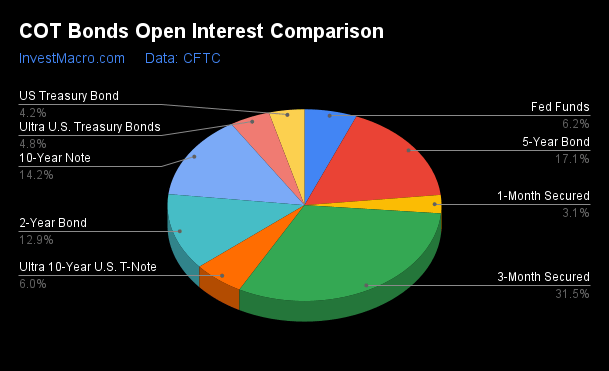
COT Bonds Charts: Speculator Changes led by Fed Funds & 10-Year Bonds

By InvestMacro

Here are the latest charts and statistics for the Commitment of Traders (COT) reports data published by the Commodities Futures Trading Commission (CFTC).

The latest COT data is updated through Tuesday September 5th and shows a quick view of how large traders (for-profit speculators and commercial hedgers) were positioned in the futures markets.

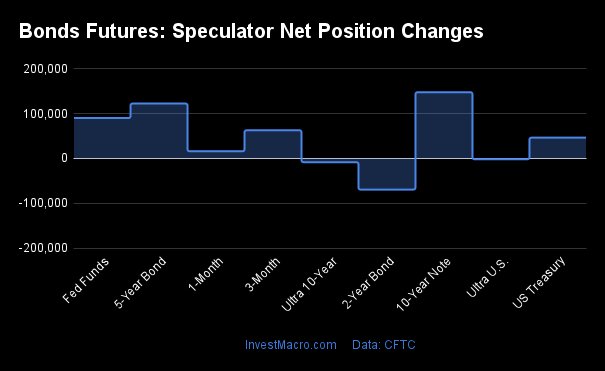
Weekly Speculator Changes led by Fed Funds & 10-Year Bonds

The COT bond market speculator bets were mixed this week as four out of the eight bond markets we cover had higher positioning while the other four markets had lower speculator contracts.

Leading the gains for the bond markets was the Fed Funds (102,419 contracts) with the 10-Year Bonds (14,018 contracts), the Ultra 10-Year Bonds (7,444 contracts) and the Ultra Treasury Bonds (2,598 contracts) also showing positive weeks.

The bond markets with declines in speculator bets for the week were the US Treasury Bonds (-7,692 contracts), the 5-Year Bonds (-51,645 contracts), the SOFR 3-Months (-53,150 contracts) and the 2-Year Bonds (-48,034 contracts) also registering lower bets on the week.


Data Snapshot of Bond Market Traders | Columns Legend
Sep-05-2023OIOI-IndexSpec-NetSpec-IndexCom-NetCOM-IndexSmalls-NetSmalls-Index
SOFR-3-Months10,646,087100272,07296-267,0653-5,00785
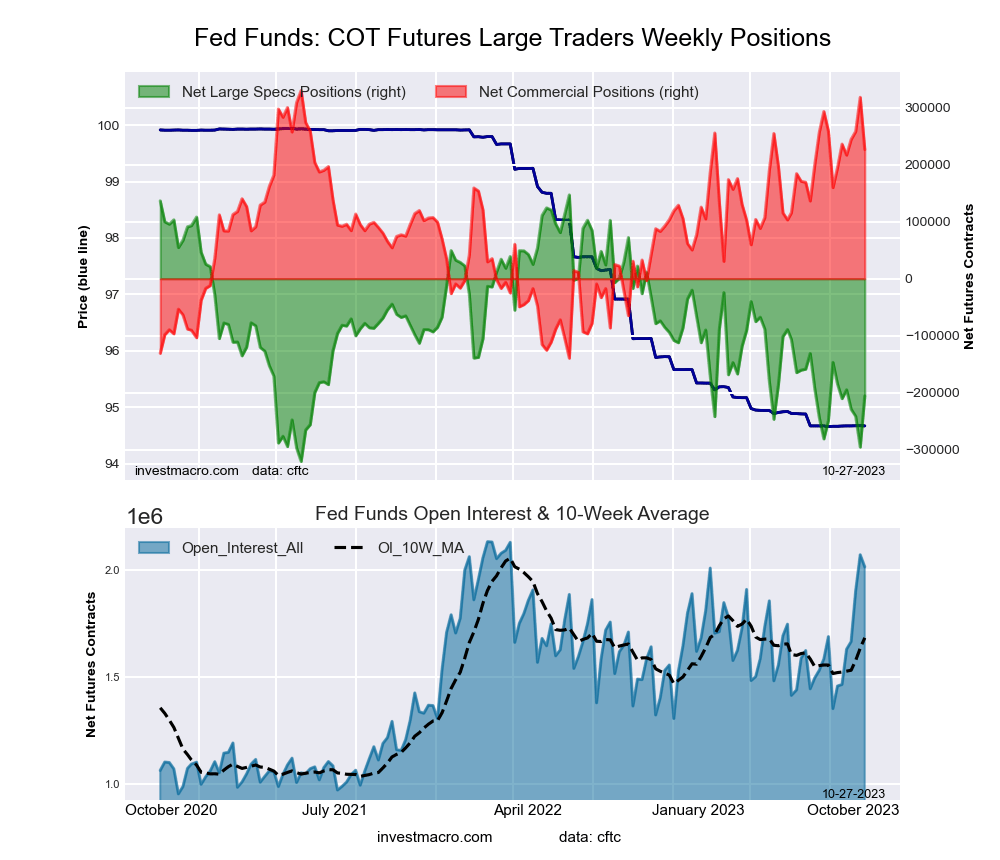
FedFunds1,352,67234-146,89032160,10069-13,21065
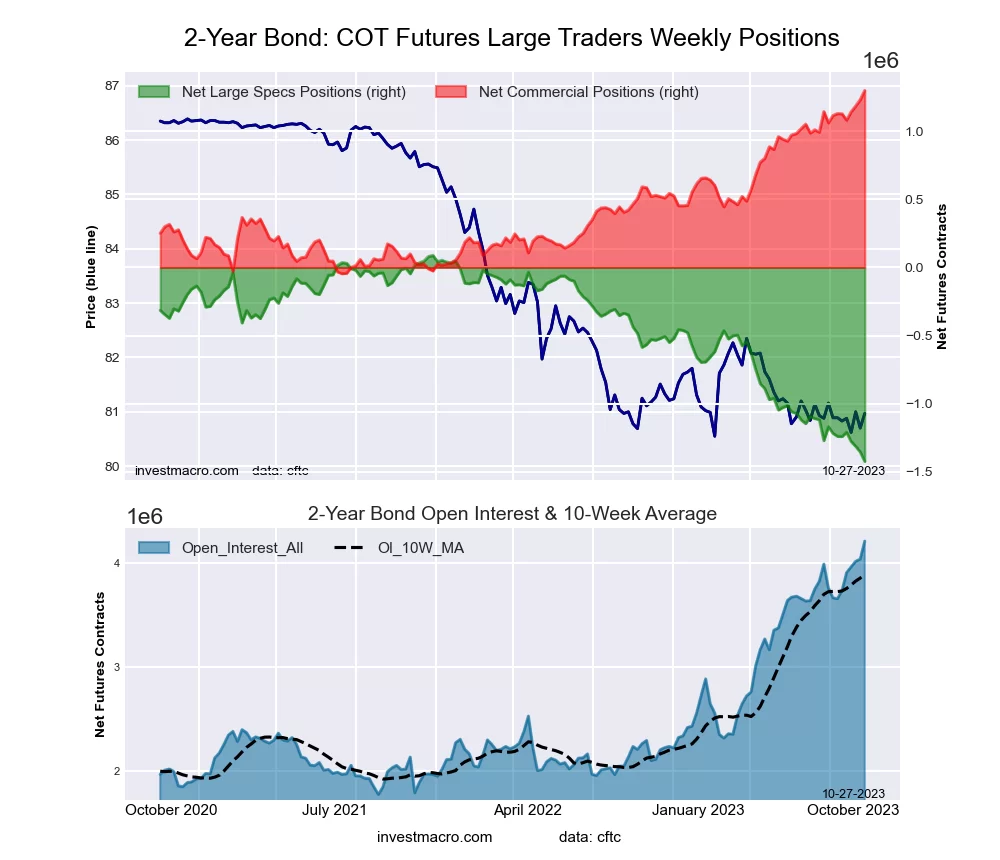
2-Year3,661,94185-1,217,89041,114,53298103,35890
Long T-Bond1,343,05773-198,29220152,4176545,87582
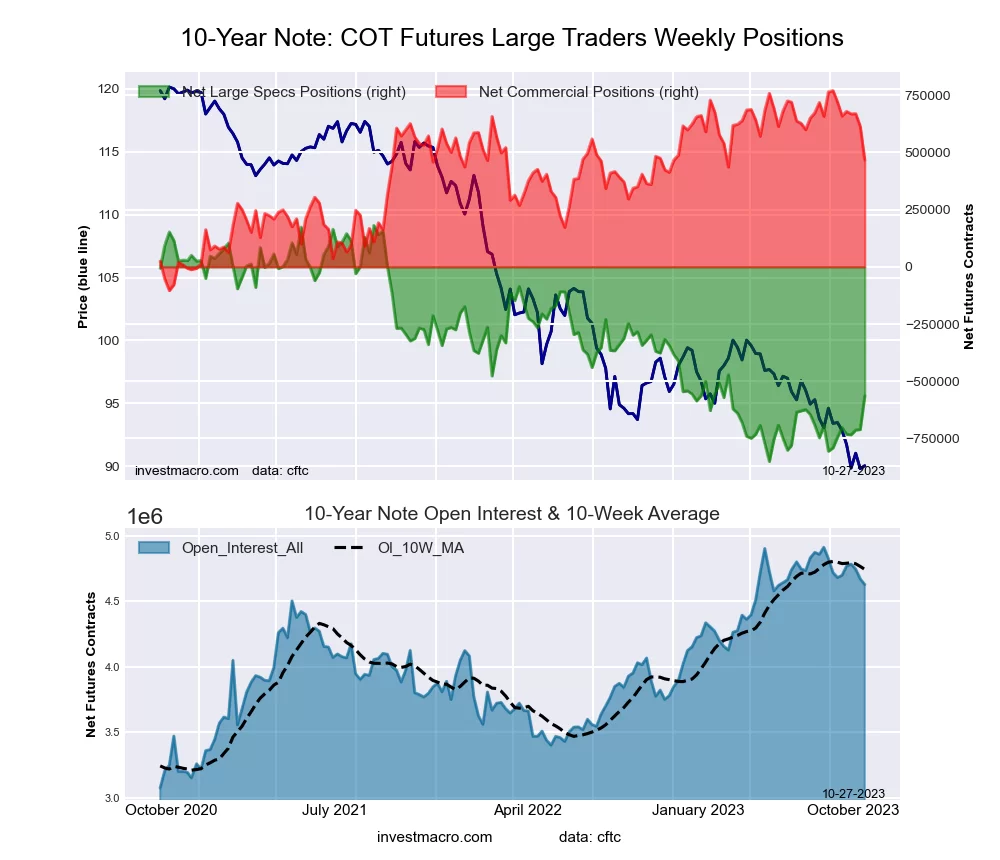
10-Year4,718,78290-791,5356770,68510020,85078
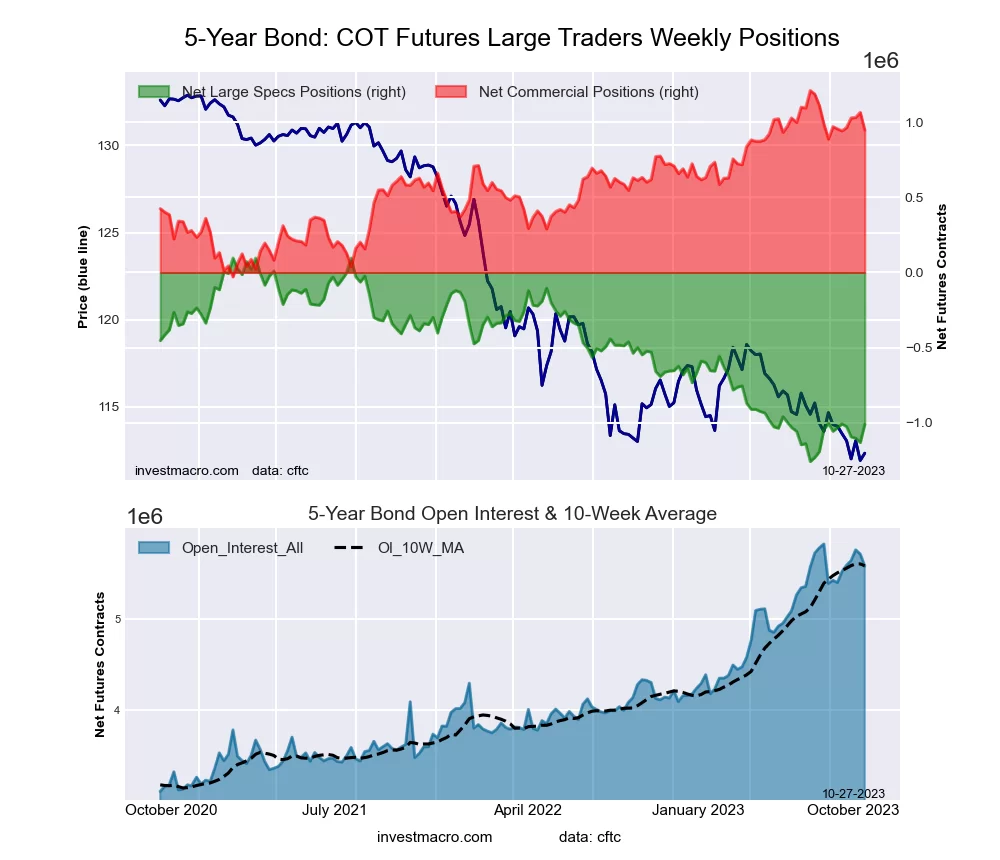
5-Year5,415,83285-1,056,26815969,4138186,85593


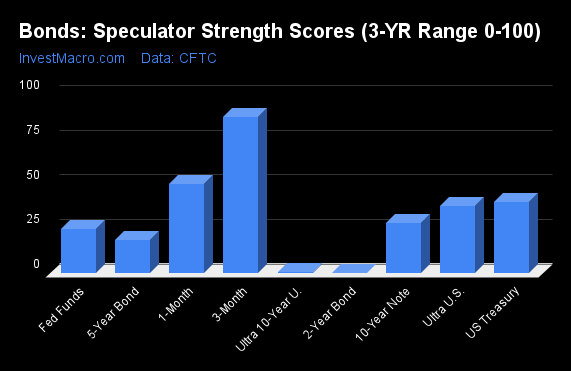
Strength Scores led by SOFR 3-Months & Fed Funds

COT Strength Scores (a normalized measure of Speculator positions over a 3-Year range, from 0 to 100 where above 80 is Extreme-Bullish and below 20 is Extreme-Bearish) showed that the SOFR 3-Months (96 percent) and the Fed Funds (32 percent) lead the bond markets this week. The Ultra Treasury Bonds (32 percent) comes in as the next highest in the weekly strength scores.

On the downside, the 2-Year Bonds (4 percent) and the 10-Year Bonds (6 percent) come in at the lowest strength level currently and are in Extreme-Bearish territory (below 20 percent). The next lowest strength scores were the Ultra 10-Year Bonds (8 percent) and the 5-Year Bonds (15 percent).

Strength Statistics:
Fed Funds (31.9 percent) vs Fed Funds previous week (13.1 percent)
2-Year Bond (3.9 percent) vs 2-Year Bond previous week (7.4 percent)
5-Year Bond (14.8 percent) vs 5-Year Bond previous week (18.7 percent)
10-Year Bond (5.7 percent) vs 10-Year Bond previous week (4.3 percent)
Ultra 10-Year Bond (8.4 percent) vs Ultra 10-Year Bond previous week (6.9 percent)
US Treasury Bond (20.1 percent) vs US Treasury Bond previous week (22.6 percent)
Ultra US Treasury Bond (31.6 percent) vs Ultra US Treasury Bond previous week (30.5 percent)
SOFR 3-Months (96.4 percent) vs SOFR 3-Months previous week (100.0 percent)


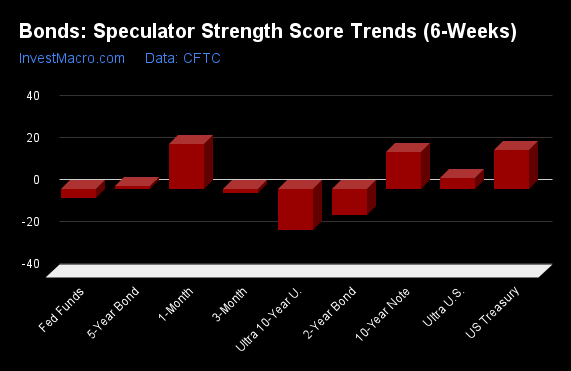
Ultra Treasury Bonds & SOFR 3-Months top the 6-Week Strength Trends

COT Strength Score Trends (or move index, calculates the 6-week changes in strength scores) showed that the Ultra Treasury Bonds (27 percent) and the SOFR 3-Months (18 percent) lead the past six weeks trends for bonds. The 5-Year Bonds (6 percent) and the  are the next highest positive movers in the latest trends data.

The US Treasury Bonds (-17 percent) and the 10-Year Bonds (-16 percent) lead the downside trend scores currently with the 2-Year Bonds (-5 percent) and the Fed Funds (2 percent) following next with lower trend scores.

Strength Trend Statistics:
Fed Funds (2.2 percent) vs Fed Funds previous week (-16.3 percent)
2-Year Bond (-5.3 percent) vs 2-Year Bond previous week (-3.7 percent)
5-Year Bond (6.0 percent) vs 5-Year Bond previous week (10.4 percent)
10-Year Bond (-16.3 percent) vs 10-Year Bond previous week (-17.1 percent)
Ultra 10-Year Bond (4.3 percent) vs Ultra 10-Year Bond previous week (0.1 percent)
US Treasury Bond (-17.1 percent) vs US Treasury Bond previous week (-15.4 percent)
Ultra US Treasury Bond (26.8 percent) vs Ultra US Treasury Bond previous week (23.6 percent)
SOFR 3-Months (18.2 percent) vs SOFR 3-Months previous week (26.1 percent)


Secured Overnight Financing Rate (3-Month) Futures:
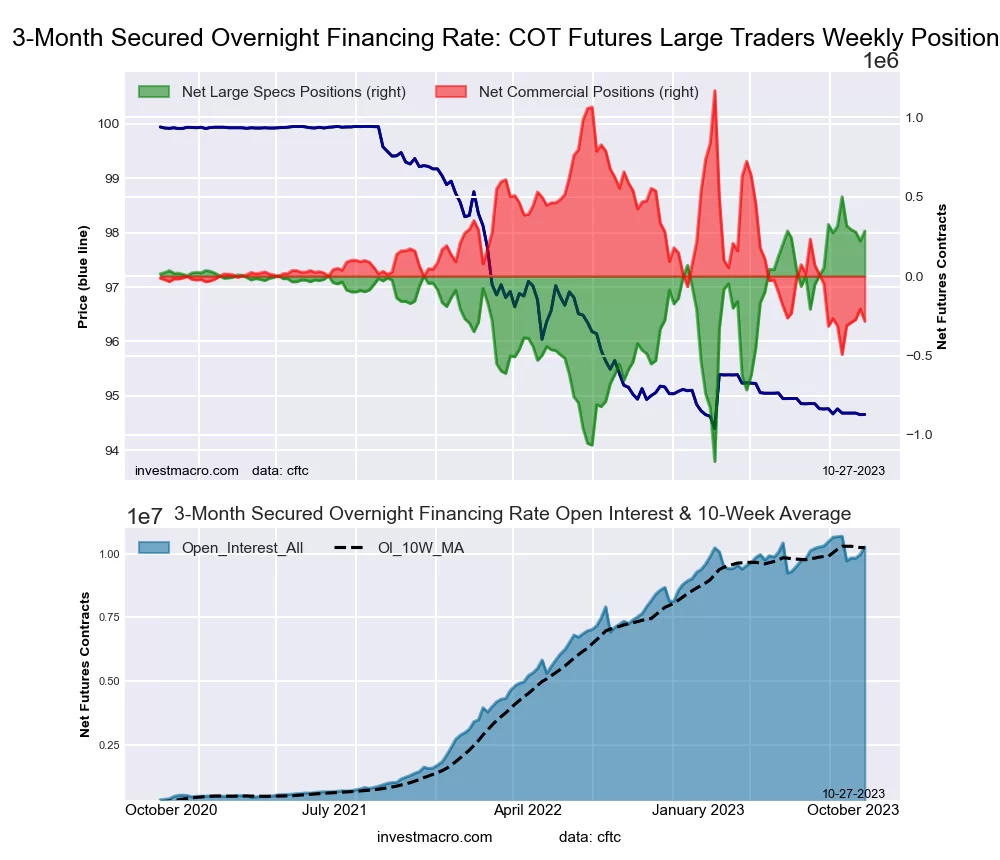
SOFR 3-Months Bonds Futures COT ChartThe Secured Overnight Financing Rate (3-Month) large speculator standing this week recorded a net position of 272,072 contracts in the data reported through Tuesday. This was a weekly reduction of -53,150 contracts from the previous week which had a total of 325,222 net contracts.

This week’s current strength score (the trader positioning range over the past three years, measured from 0 to 100) shows the speculators are currently Bullish-Extreme with a score of 96.4 percent. The commercials are Bearish-Extreme with a score of 3.3 percent and the small traders (not shown in chart) are Bullish-Extreme with a score of 85.1 percent.

Price Trend-Following Model: Weak Uptrend

Our weekly trend-following model classifies the current market price position as: Weak Uptrend. The current action for the model is considered to be: Hold – Maintain Long Position.

SOFR 3-Months StatisticsSPECULATORSCOMMERCIALSSMALL TRADERS
– Percent of Open Interest Longs:17.758.20.3
– Percent of Open Interest Shorts:15.160.70.3
– Net Position:272,072-267,065-5,007
– Gross Longs:1,882,3916,190,89728,482
– Gross Shorts:1,610,3196,457,96233,489
– Long to Short Ratio:1.2 to 11.0 to 10.9 to 1
NET POSITION TREND:
– Strength Index Score (3 Year Range Pct):96.43.385.1
– Strength Index Reading (3 Year Range):Bullish-ExtremeBearish-ExtremeBullish-Extreme
NET POSITION MOVEMENT INDEX:
– 6-Week Change in Strength Index:18.2-19.16.2


30-Day Federal Funds Futures:

Federal Funds 30-Day Bonds Futures COT ChartThe 30-Day Federal Funds large speculator standing this week recorded a net position of -146,890 contracts in the data reported through Tuesday. This was a weekly rise of 102,419 contracts from the previous week which had a total of -249,309 net contracts.

This week’s current strength score (the trader positioning range over the past three years, measured from 0 to 100) shows the speculators are currently Bearish with a score of 31.9 percent. The commercials are Bullish with a score of 69.1 percent and the small traders (not shown in chart) are Bullish with a score of 65.1 percent.

Price Trend-Following Model: Downtrend

Our weekly trend-following model classifies the current market price position as: Downtrend. The current action for the model is considered to be: Hold – Maintain Short Position.

30-Day Federal Funds StatisticsSPECULATORSCOMMERCIALSSMALL TRADERS
– Percent of Open Interest Longs:7.172.52.2
– Percent of Open Interest Shorts:18.060.63.2
– Net Position:-146,890160,100-13,210
– Gross Longs:96,359980,02229,657
– Gross Shorts:243,249819,92242,867
– Long to Short Ratio:0.4 to 11.2 to 10.7 to 1
NET POSITION TREND:
– Strength Index Score (3 Year Range Pct):31.969.165.1
– Strength Index Reading (3 Year Range):BearishBullishBullish
NET POSITION MOVEMENT INDEX:
– 6-Week Change in Strength Index:2.2-1.7-5.2


2-Year Treasury Note Futures:

2-Year Treasury Bonds Futures COT ChartThe 2-Year Treasury Note large speculator standing this week recorded a net position of -1,217,890 contracts in the data reported through Tuesday. This was a weekly fall of -48,034 contracts from the previous week which had a total of -1,169,856 net contracts.

This week’s current strength score (the trader positioning range over the past three years, measured from 0 to 100) shows the speculators are currently Bearish-Extreme with a score of 3.9 percent. The commercials are Bullish-Extreme with a score of 97.6 percent and the small traders (not shown in chart) are Bullish-Extreme with a score of 90.0 percent.

Price Trend-Following Model: Downtrend

Our weekly trend-following model classifies the current market price position as: Downtrend. The current action for the model is considered to be: Hold – Maintain Short Position.

2-Year Treasury Note StatisticsSPECULATORSCOMMERCIALSSMALL TRADERS
– Percent of Open Interest Longs:9.382.37.0
– Percent of Open Interest Shorts:42.651.84.2
– Net Position:-1,217,8901,114,532103,358
– Gross Longs:341,1983,013,032255,487
– Gross Shorts:1,559,0881,898,500152,129
– Long to Short Ratio:0.2 to 11.6 to 11.7 to 1
NET POSITION TREND:
– Strength Index Score (3 Year Range Pct):3.997.690.0
– Strength Index Reading (3 Year Range):Bearish-ExtremeBullish-ExtremeBullish-Extreme
NET POSITION MOVEMENT INDEX:
– 6-Week Change in Strength Index:-5.35.33.4


5-Year Treasury Note Futures:

5-Year Treasury Bonds Futures COT ChartThe 5-Year Treasury Note large speculator standing this week recorded a net position of -1,056,268 contracts in the data reported through Tuesday. This was a weekly decline of -51,645 contracts from the previous week which had a total of -1,004,623 net contracts.

This week’s current strength score (the trader positioning range over the past three years, measured from 0 to 100) shows the speculators are currently Bearish-Extreme with a score of 14.8 percent. The commercials are Bullish-Extreme with a score of 80.6 percent and the small traders (not shown in chart) are Bullish-Extreme with a score of 92.5 percent.

Price Trend-Following Model: Downtrend

Our weekly trend-following model classifies the current market price position as: Downtrend. The current action for the model is considered to be: Hold – Maintain Short Position.

5-Year Treasury Note StatisticsSPECULATORSCOMMERCIALSSMALL TRADERS
– Percent of Open Interest Longs:7.883.67.7
– Percent of Open Interest Shorts:27.365.76.1
– Net Position:-1,056,268969,41386,855
– Gross Longs:424,1574,525,006414,910
– Gross Shorts:1,480,4253,555,593328,055
– Long to Short Ratio:0.3 to 11.3 to 11.3 to 1
NET POSITION TREND:
– Strength Index Score (3 Year Range Pct):14.880.692.5
– Strength Index Reading (3 Year Range):Bearish-ExtremeBullish-ExtremeBullish-Extreme
NET POSITION MOVEMENT INDEX:
– 6-Week Change in Strength Index:6.0-10.010.2


10-Year Treasury Note Futures:

10-Year Treasury Notes Bonds Futures COT ChartThe 10-Year Treasury Note large speculator standing this week recorded a net position of -791,535 contracts in the data reported through Tuesday. This was a weekly increase of 14,018 contracts from the previous week which had a total of -805,553 net contracts.

This week’s current strength score (the trader positioning range over the past three years, measured from 0 to 100) shows the speculators are currently Bearish-Extreme with a score of 5.7 percent. The commercials are Bullish-Extreme with a score of 100.0 percent and the small traders (not shown in chart) are Bullish with a score of 78.1 percent.

Price Trend-Following Model: Downtrend

Our weekly trend-following model classifies the current market price position as: Downtrend. The current action for the model is considered to be: Hold – Maintain Short Position.

10-Year Treasury Note StatisticsSPECULATORSCOMMERCIALSSMALL TRADERS
– Percent of Open Interest Longs:9.679.28.8
– Percent of Open Interest Shorts:26.462.98.4
– Net Position:-791,535770,68520,850
– Gross Longs:454,8803,738,091416,866
– Gross Shorts:1,246,4152,967,406396,016
– Long to Short Ratio:0.4 to 11.3 to 11.1 to 1
NET POSITION TREND:
– Strength Index Score (3 Year Range Pct):5.7100.078.1
– Strength Index Reading (3 Year Range):Bearish-ExtremeBullish-ExtremeBullish
NET POSITION MOVEMENT INDEX:
– 6-Week Change in Strength Index:-16.317.9-0.7


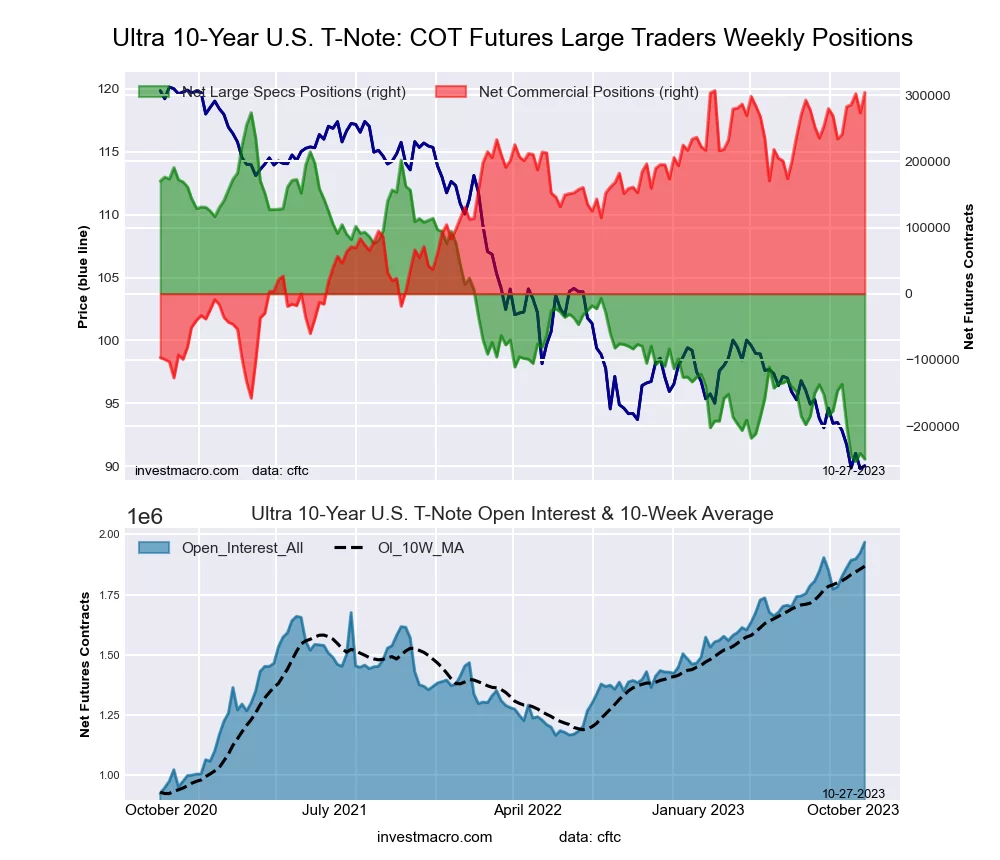
Ultra 10-Year Notes Futures:

Ultra 10-Year Treasury Notes Bonds Futures COT ChartThe Ultra 10-Year Notes large speculator standing this week recorded a net position of -177,048 contracts in the data reported through Tuesday. This was a weekly rise of 7,444 contracts from the previous week which had a total of -184,492 net contracts.

This week’s current strength score (the trader positioning range over the past three years, measured from 0 to 100) shows the speculators are currently Bearish-Extreme with a score of 8.4 percent. The commercials are Bullish-Extreme with a score of 91.8 percent and the small traders (not shown in chart) are Bullish with a score of 59.5 percent.

Price Trend-Following Model: Weak Uptrend

Our weekly trend-following model classifies the current market price position as: Weak Uptrend. The current action for the model is considered to be: Hold – Maintain Long Position.

Ultra 10-Year Notes StatisticsSPECULATORSCOMMERCIALSSMALL TRADERS
– Percent of Open Interest Longs:11.676.810.1
– Percent of Open Interest Shorts:21.661.615.3
– Net Position:-177,048268,877-91,829
– Gross Longs:206,1291,360,518179,479
– Gross Shorts:383,1771,091,641271,308
– Long to Short Ratio:0.5 to 11.2 to 10.7 to 1
NET POSITION TREND:
– Strength Index Score (3 Year Range Pct):8.491.859.5
– Strength Index Reading (3 Year Range):Bearish-ExtremeBullish-ExtremeBullish
NET POSITION MOVEMENT INDEX:
– 6-Week Change in Strength Index:4.3-5.11.6


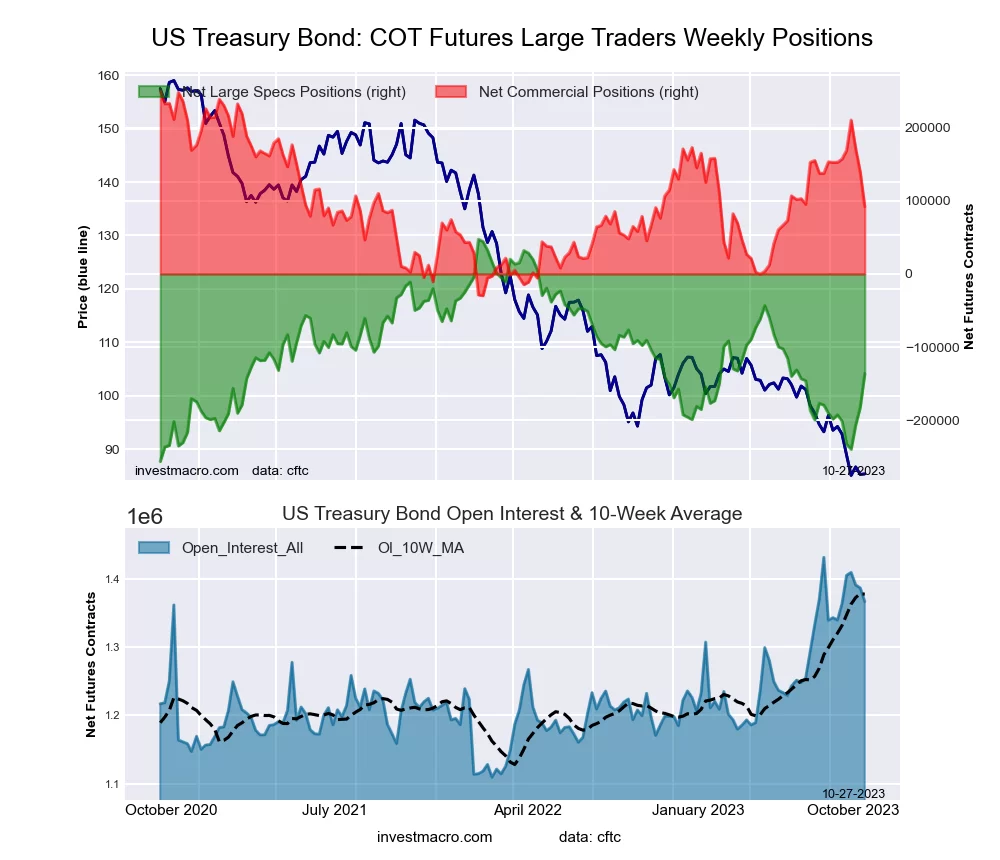
US Treasury Bonds Futures:

US Year Treasury Notes Long Bonds Futures COT ChartThe US Treasury Bonds large speculator standing this week recorded a net position of -198,292 contracts in the data reported through Tuesday. This was a weekly lowering of -7,692 contracts from the previous week which had a total of -190,600 net contracts.

This week’s current strength score (the trader positioning range over the past three years, measured from 0 to 100) shows the speculators are currently Bearish with a score of 20.1 percent. The commercials are Bullish with a score of 65.0 percent and the small traders (not shown in chart) are Bullish-Extreme with a score of 81.8 percent.

Price Trend-Following Model: Strong Downtrend

Our weekly trend-following model classifies the current market price position as: Strong Downtrend. The current action for the model is considered to be: Hold – Maintain Short Position.

US Treasury Bonds StatisticsSPECULATORSCOMMERCIALSSMALL TRADERS
– Percent of Open Interest Longs:6.278.514.3
– Percent of Open Interest Shorts:21.067.110.9
– Net Position:-198,292152,41745,875
– Gross Longs:83,1531,053,899191,920
– Gross Shorts:281,445901,482146,045
– Long to Short Ratio:0.3 to 11.2 to 11.3 to 1
NET POSITION TREND:
– Strength Index Score (3 Year Range Pct):20.165.081.8
– Strength Index Reading (3 Year Range):BearishBullishBullish-Extreme
NET POSITION MOVEMENT INDEX:
– 6-Week Change in Strength Index:-17.120.4-3.5


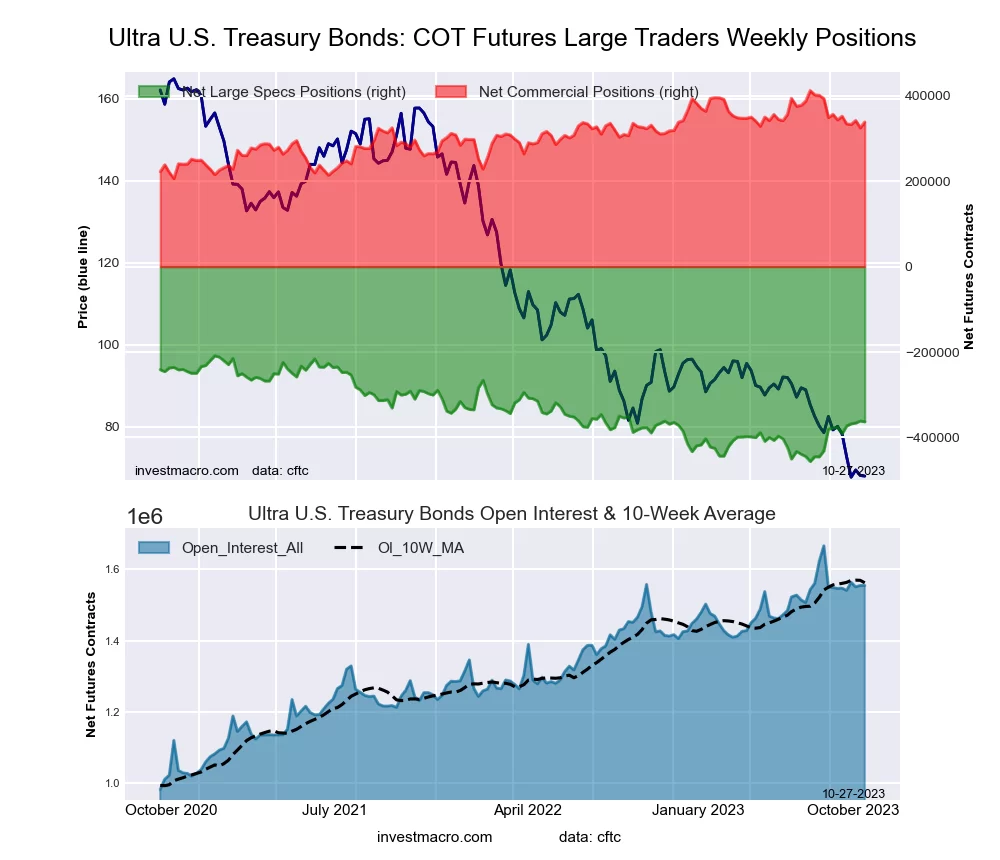
Ultra US Treasury Bonds Futures:

Ultra US Year Treasury Notes Long Bonds Futures COT ChartThe Ultra US Treasury Bonds large speculator standing this week recorded a net position of -378,271 contracts in the data reported through Tuesday. This was a weekly boost of 2,598 contracts from the previous week which had a total of -380,869 net contracts.

This week’s current strength score (the trader positioning range over the past three years, measured from 0 to 100) shows the speculators are currently Bearish with a score of 31.6 percent. The commercials are Bullish with a score of 72.9 percent and the small traders (not shown in chart) are Bullish with a score of 57.4 percent.

Price Trend-Following Model: Strong Downtrend

Our weekly trend-following model classifies the current market price position as: Strong Downtrend. The current action for the model is considered to be: Hold – Maintain Short Position.

Ultra US Treasury Bonds StatisticsSPECULATORSCOMMERCIALSSMALL TRADERS
– Percent of Open Interest Longs:5.682.611.1
– Percent of Open Interest Shorts:30.059.69.7
– Net Position:-378,271356,79221,479
– Gross Longs:86,2221,279,191171,723
– Gross Shorts:464,493922,399150,244
– Long to Short Ratio:0.2 to 11.4 to 11.1 to 1
NET POSITION TREND:
– Strength Index Score (3 Year Range Pct):31.672.957.4
– Strength Index Reading (3 Year Range):BearishBullishBullish
NET POSITION MOVEMENT INDEX:
– 6-Week Change in Strength Index:26.8-14.9-33.6


Article By InvestMacroReceive our weekly COT Newsletter

*COT Report: The COT data, released weekly to the public each Friday, is updated through the most recent Tuesday (data is 3 days old) and shows a quick view of how large speculators or non-commercials (for-profit traders) were positioned in the futures markets.

The CFTC categorizes trader positions according to commercial hedgers (traders who use futures contracts for hedging as part of the business), non-commercials (large traders who speculate to realize trading profits) and nonreportable traders (usually small traders/speculators) as well as their open interest (contracts open in the market at time of reporting). See CFTC criteria here.

COT Metals Charts: Weekly Speculator Bets led by Copper & Gold

By InvestMacro

Here are the latest charts and statistics for the Commitment of Traders (COT) data published by the Commodities Futures Trading Commission (CFTC).

The latest COT data is updated through Tuesday September 5th and shows a quick view of how large traders (for-profit speculators and commercial entities) were positioned in the futures markets.

Weekly Speculator Changes led by Copper & Gold

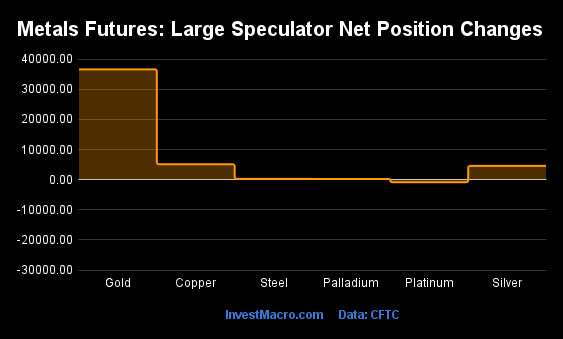
The COT metals markets speculator bets were lower this week as two out of the six metals markets we cover had higher positioning while the other four markets had lower speculator contracts.

Leading the gains for the metals was with Gold (14,734 contracts) and Copper (9,846 contracts) also showing positive weeks.

The markets with declines in speculator bets for the week were Palladium (-1,045 contracts) with Platinum (-436 contracts), Silver (-329 contracts) and Steel (-320 contracts) also registering lower bets on the week.


Data Snapshot of Commodity Market Traders | Columns Legend
Sep-05-2023OIOI-IndexSpec-NetSpec-IndexCom-NetCOM-IndexSmalls-NetSmalls-Index
Gold438,6728138,00638-158,2396320,23331
Silver128,2791726,80456-37,7084810,90427
Copper193,59737-6,770254,659752,11132
Palladium17,64480-11,021010,88810013350
Platinum68,7215314,60249-19,001544,39927


Strength Scores led by Steel & Silver

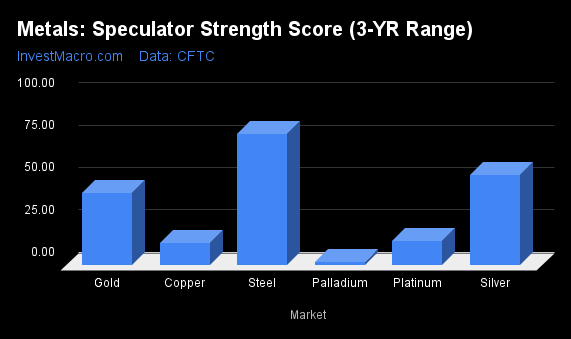
COT Strength Scores (a normalized measure of Speculator positions over a 3-Year range, from 0 to 100 where above 80 is Extreme-Bullish and below 20 is Extreme-Bearish) showed that Steel (61 percent) and Silver (56 percent) lead the metals markets this week.

On the downside, Palladium (0 percent) comes in at the lowest strength level currently and is in Extreme-Bearish territory (below 20 percent). The next lowest strength score was Copper (25 percent).

Strength Statistics:
Gold (37.8 percent) vs Gold previous week (31.3 percent)
Silver (56.5 percent) vs Silver previous week (57.0 percent)
Copper (25.0 percent) vs Copper previous week (16.5 percent)
Platinum (49.3 percent) vs Platinum previous week (50.3 percent)
Palladium (0.0 percent) vs Palladium previous week (7.1 percent)
Steel (61.2 percent) vs Palladium previous week (62.2 percent)

Platinum & Copper top the 6-Week Strength Trends

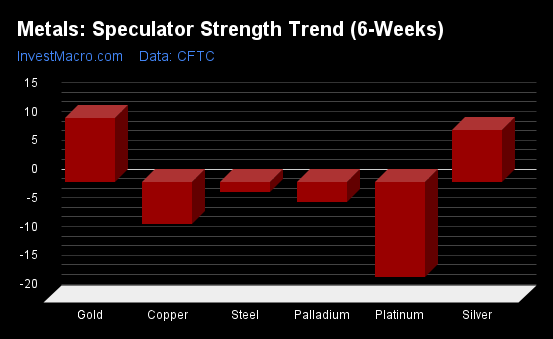
COT Strength Score Trends (or move index, calculates the 6-week changes in strength scores) showed that Platinum (-2 percent) and Copper (-7 percent) lead the past six weeks trends for metals with the least negative scores.

Palladium (-18 percent), Gold (-16 percent) and Silver (-14 percent) leads the downside trend scores currently.

Move Statistics:
Gold (-15.7 percent) vs Gold previous week (-30.8 percent)
Silver (-14.4 percent) vs Silver previous week (-23.9 percent)
Copper (-6.9 percent) vs Copper previous week (-11.3 percent)
Platinum (-2.0 percent) vs Platinum previous week (-1.6 percent)
Palladium (-17.9 percent) vs Palladium previous week (-11.0 percent)
Steel (-8.0 percent) vs Steel previous week (-11.0 percent)


Individual Markets:

Gold Comex Futures:

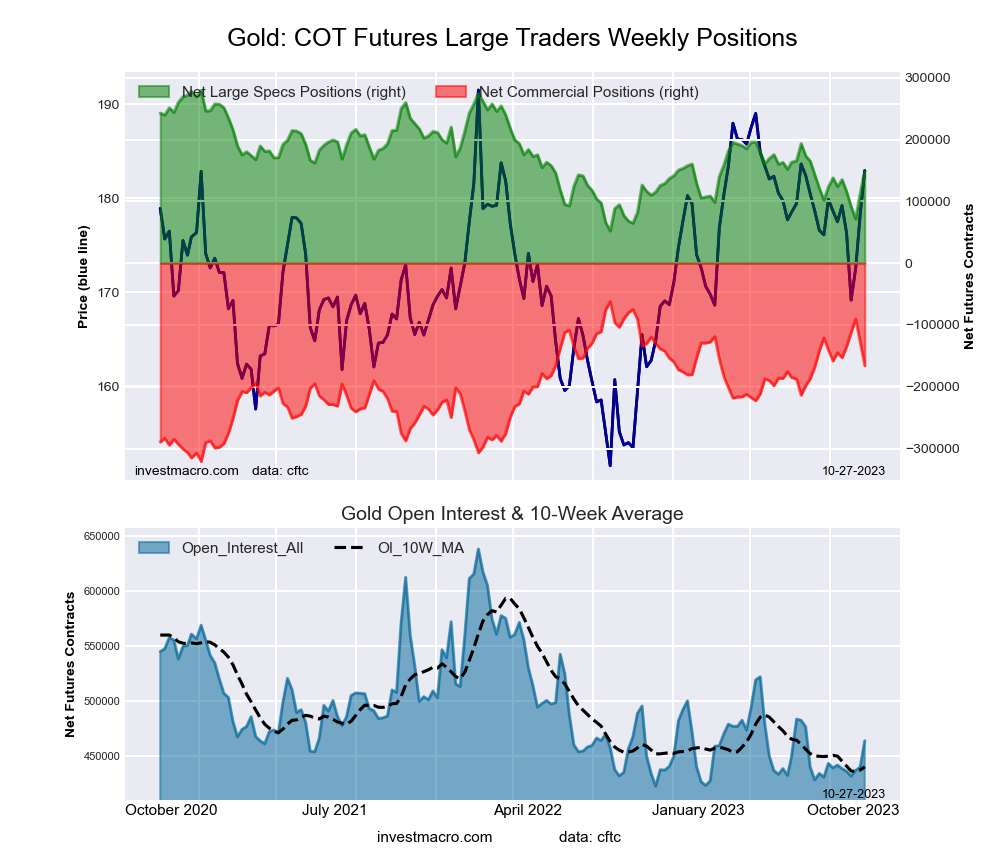
Gold Futures COT ChartThe Gold Comex Futures large speculator standing this week totaled a net position of 138,006 contracts in the data reported through Tuesday. This was a weekly increase of 14,734 contracts from the previous week which had a total of 123,272 net contracts.

This week’s current strength score (the trader positioning range over the past three years, measured from 0 to 100) shows the speculators are currently Bearish with a score of 37.8 percent. The commercials are Bullish with a score of 62.9 percent and the small traders (not shown in chart) are Bearish with a score of 30.6 percent.

Price Trend-Following Model: Downtrend

Our weekly trend-following model classifies the current market price position as: Downtrend. The current action for the model is considered to be: Hold – Maintain Short Position.

Gold Futures StatisticsSPECULATORSCOMMERCIALSSMALL TRADERS
– Percent of Open Interest Longs:53.825.410.5
– Percent of Open Interest Shorts:22.361.55.9
– Net Position:138,006-158,23920,233
– Gross Longs:235,802111,45645,966
– Gross Shorts:97,796269,69525,733
– Long to Short Ratio:2.4 to 10.4 to 11.8 to 1
NET POSITION TREND:
– Strength Index Score (3 Year Range Pct):37.862.930.6
– Strength Index Reading (3 Year Range):BearishBullishBearish
NET POSITION MOVEMENT INDEX:
– 6-Week Change in Strength Index:-15.715.4-10.9


Silver Comex Futures:

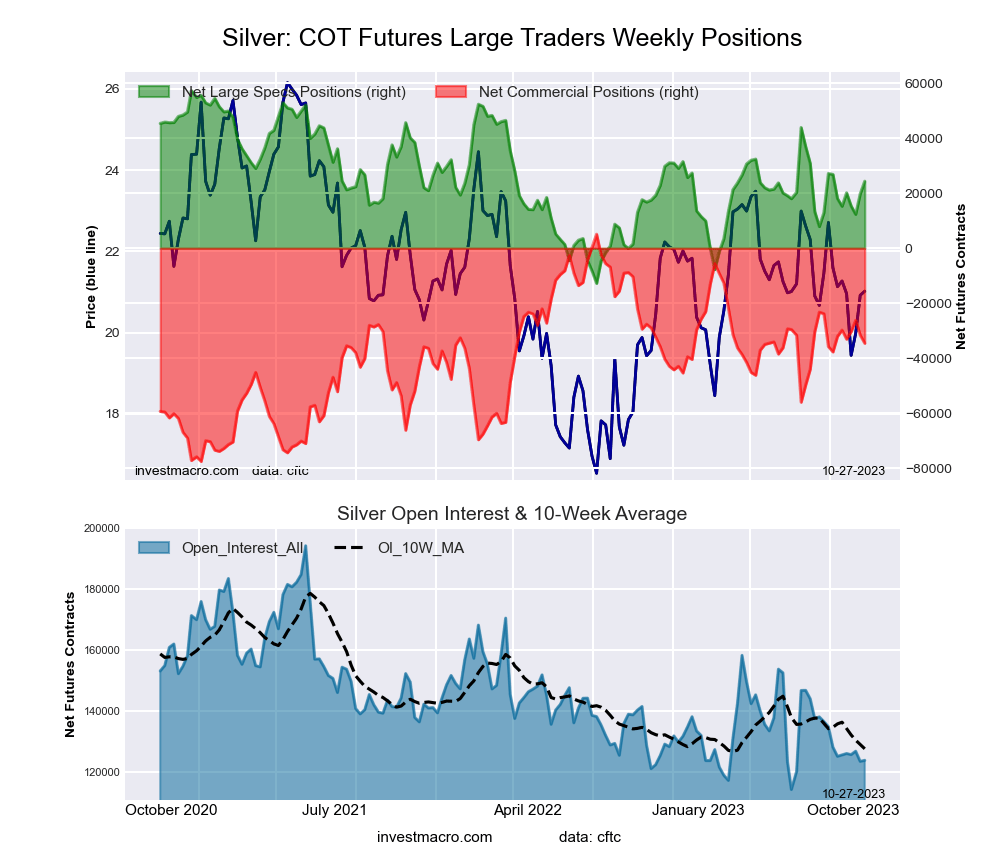
Silver Futures COT ChartThe Silver Comex Futures large speculator standing this week totaled a net position of 26,804 contracts in the data reported through Tuesday. This was a weekly decline of -329 contracts from the previous week which had a total of 27,133 net contracts.

This week’s current strength score (the trader positioning range over the past three years, measured from 0 to 100) shows the speculators are currently Bullish with a score of 56.5 percent. The commercials are Bearish with a score of 48.2 percent and the small traders (not shown in chart) are Bearish with a score of 26.9 percent.

Price Trend-Following Model: Strong Downtrend

Our weekly trend-following model classifies the current market price position as: Strong Downtrend. The current action for the model is considered to be: Hold – Maintain Short Position.

Silver Futures StatisticsSPECULATORSCOMMERCIALSSMALL TRADERS
– Percent of Open Interest Longs:44.931.218.6
– Percent of Open Interest Shorts:24.060.610.1
– Net Position:26,804-37,70810,904
– Gross Longs:57,55840,05223,814
– Gross Shorts:30,75477,76012,910
– Long to Short Ratio:1.9 to 10.5 to 11.8 to 1
NET POSITION TREND:
– Strength Index Score (3 Year Range Pct):56.548.226.9
– Strength Index Reading (3 Year Range):BullishBearishBearish
NET POSITION MOVEMENT INDEX:
– 6-Week Change in Strength Index:-14.414.5-10.6


Copper Grade #1 Futures:

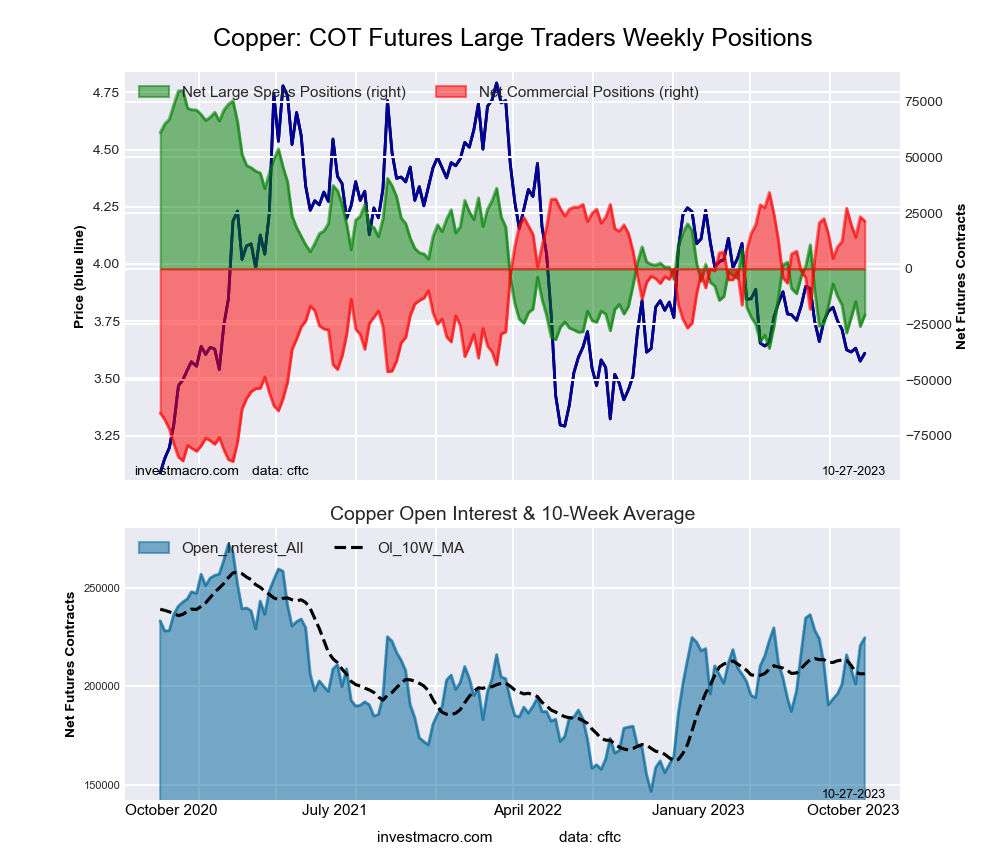
Copper Futures COT ChartThe Copper Grade #1 Futures large speculator standing this week totaled a net position of -6,770 contracts in the data reported through Tuesday. This was a weekly advance of 9,846 contracts from the previous week which had a total of -16,616 net contracts.

This week’s current strength score (the trader positioning range over the past three years, measured from 0 to 100) shows the speculators are currently Bearish with a score of 25.0 percent. The commercials are Bullish with a score of 75.5 percent and the small traders (not shown in chart) are Bearish with a score of 31.8 percent.

Price Trend-Following Model: Strong Downtrend

Our weekly trend-following model classifies the current market price position as: Strong Downtrend. The current action for the model is considered to be: Hold – Maintain Short Position.

Copper Futures StatisticsSPECULATORSCOMMERCIALSSMALL TRADERS
– Percent of Open Interest Longs:34.740.77.7
– Percent of Open Interest Shorts:38.238.36.6
– Net Position:-6,7704,6592,111
– Gross Longs:67,11878,86714,880
– Gross Shorts:73,88874,20812,769
– Long to Short Ratio:0.9 to 11.1 to 11.2 to 1
NET POSITION TREND:
– Strength Index Score (3 Year Range Pct):25.075.531.8
– Strength Index Reading (3 Year Range):BearishBullishBearish
NET POSITION MOVEMENT INDEX:
– 6-Week Change in Strength Index:-6.97.1-4.0


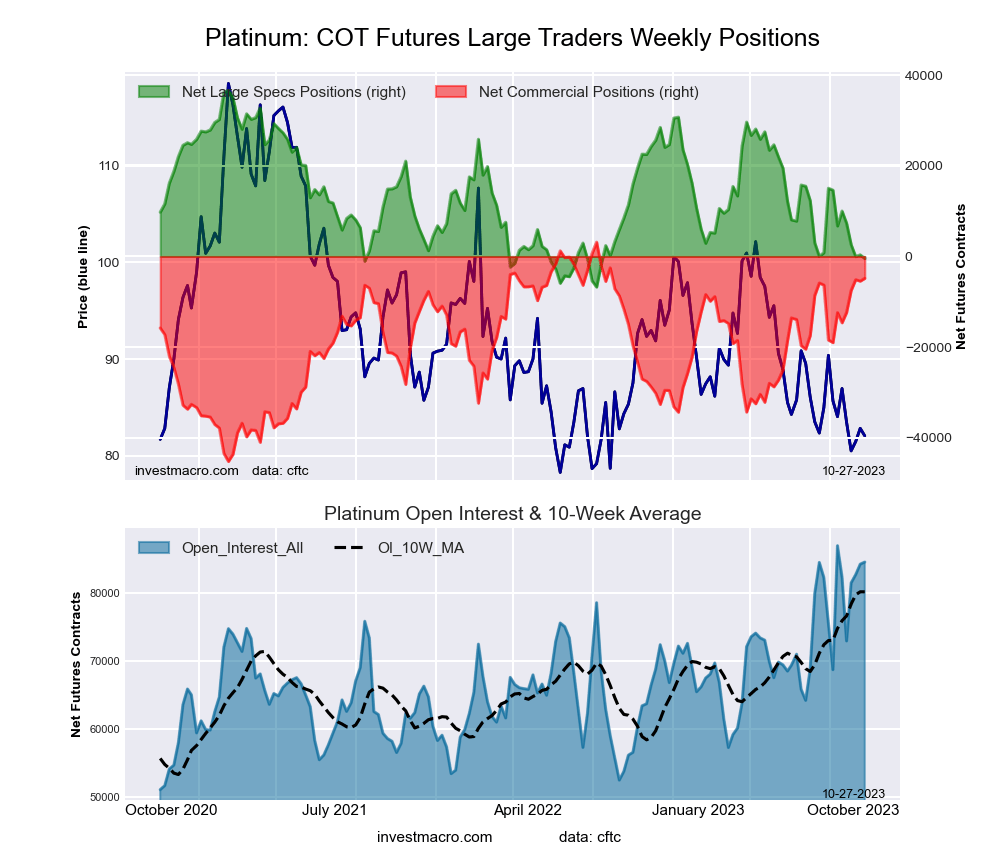
Platinum Futures:

Platinum Futures COT ChartThe Platinum Futures large speculator standing this week totaled a net position of 14,602 contracts in the data reported through Tuesday. This was a weekly decline of -436 contracts from the previous week which had a total of 15,038 net contracts.

This week’s current strength score (the trader positioning range over the past three years, measured from 0 to 100) shows the speculators are currently Bearish with a score of 49.3 percent. The commercials are Bullish with a score of 54.2 percent and the small traders (not shown in chart) are Bearish with a score of 27.1 percent.

Price Trend-Following Model: Downtrend

Our weekly trend-following model classifies the current market price position as: Downtrend. The current action for the model is considered to be: Hold – Maintain Short Position.

Platinum Futures StatisticsSPECULATORSCOMMERCIALSSMALL TRADERS
– Percent of Open Interest Longs:53.825.011.2
– Percent of Open Interest Shorts:32.652.74.8
– Net Position:14,602-19,0014,399
– Gross Longs:36,99117,2127,704
– Gross Shorts:22,38936,2133,305
– Long to Short Ratio:1.7 to 10.5 to 12.3 to 1
NET POSITION TREND:
– Strength Index Score (3 Year Range Pct):49.354.227.1
– Strength Index Reading (3 Year Range):BearishBullishBearish
NET POSITION MOVEMENT INDEX:
– 6-Week Change in Strength Index:-2.03.0-7.4


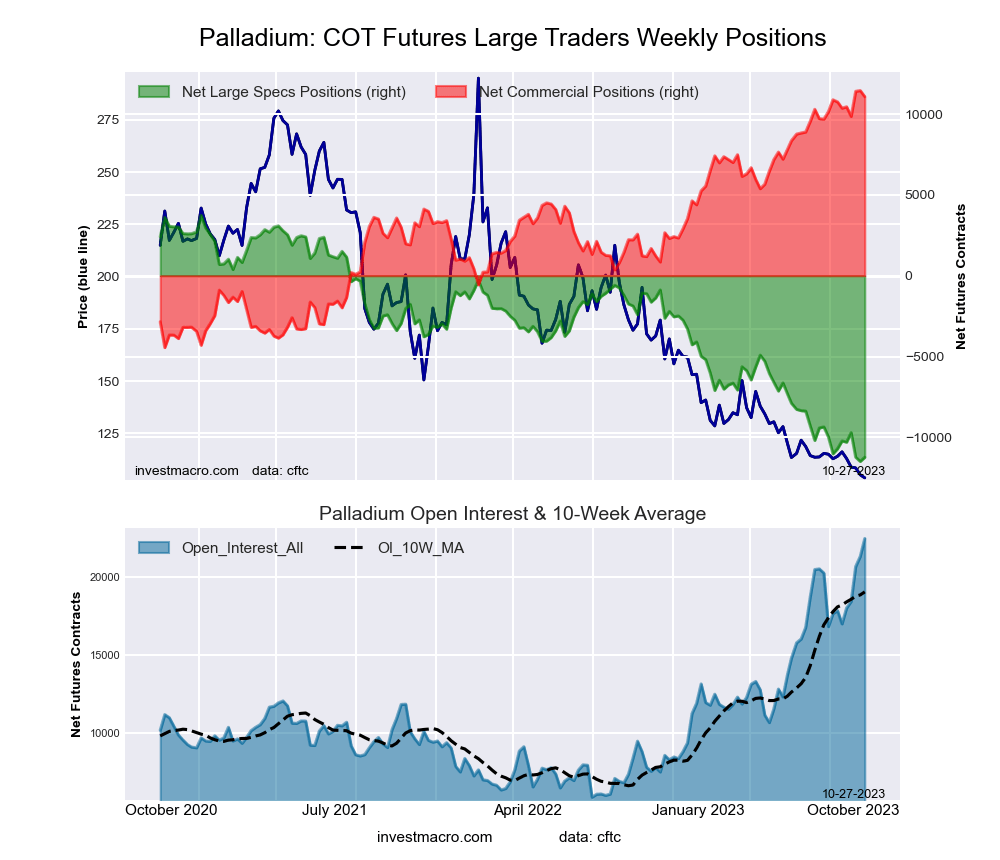
Palladium Futures:

Palladium Futures COT ChartThe Palladium Futures large speculator standing this week totaled a net position of -11,021 contracts in the data reported through Tuesday. This was a weekly reduction of -1,045 contracts from the previous week which had a total of -9,976 net contracts.

This week’s current strength score (the trader positioning range over the past three years, measured from 0 to 100) shows the speculators are currently Bearish-Extreme with a score of 0.0 percent. The commercials are Bullish-Extreme with a score of 100.0 percent and the small traders (not shown in chart) are Bearish with a score of 49.7 percent.

Price Trend-Following Model: Downtrend

Our weekly trend-following model classifies the current market price position as: Downtrend. The current action for the model is considered to be: Hold – Maintain Short Position.

Palladium Futures StatisticsSPECULATORSCOMMERCIALSSMALL TRADERS
– Percent of Open Interest Longs:22.764.09.9
– Percent of Open Interest Shorts:85.22.39.1
– Net Position:-11,02110,888133
– Gross Longs:4,00811,2961,746
– Gross Shorts:15,0294081,613
– Long to Short Ratio:0.3 to 127.7 to 11.1 to 1
NET POSITION TREND:
– Strength Index Score (3 Year Range Pct):0.0100.049.7
– Strength Index Reading (3 Year Range):Bearish-ExtremeBullish-ExtremeBearish
NET POSITION MOVEMENT INDEX:
– 6-Week Change in Strength Index:-17.913.039.4


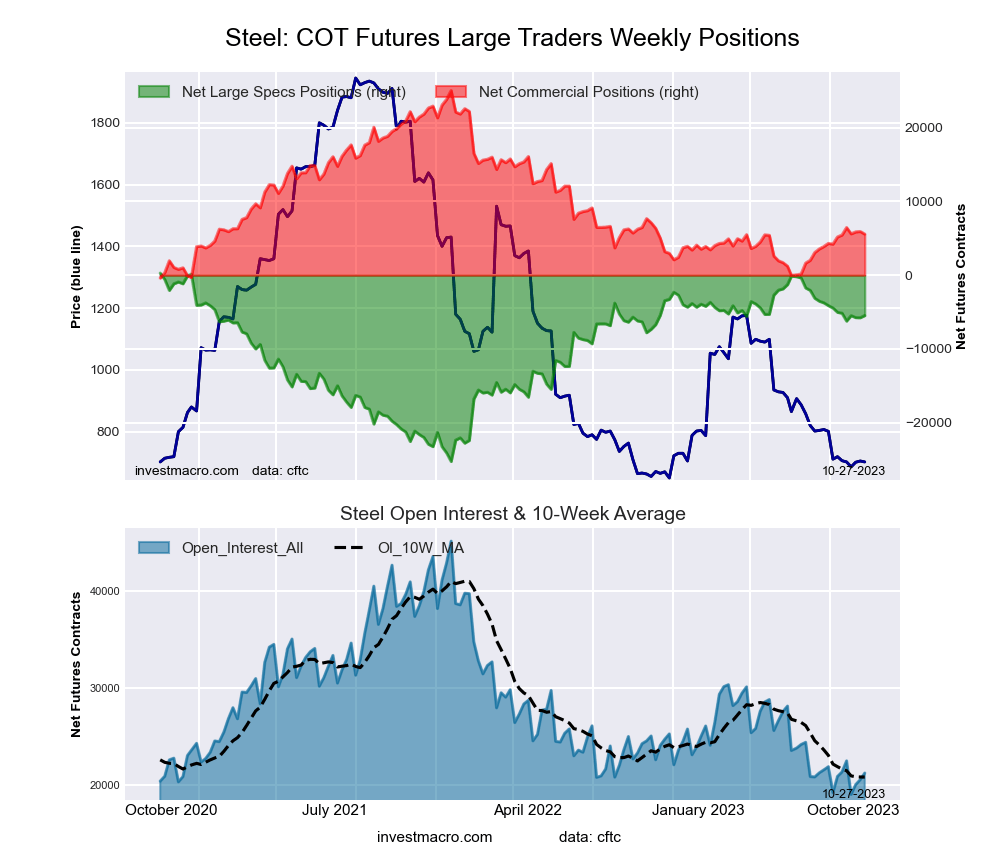
Steel Futures Futures:

Steel Futures COT ChartThe Steel Futures large speculator standing this week totaled a net position of -4,442 contracts in the data reported through Tuesday. This was a weekly reduction of -320 contracts from the previous week which had a total of -4,122 net contracts.

This week’s current strength score (the trader positioning range over the past three years, measured from 0 to 100) shows the speculators are currently Bullish with a score of 61.2 percent. The commercials are Bearish with a score of 38.3 percent and the small traders (not shown in chart) are Bullish with a score of 50.9 percent.

Price Trend-Following Model: Downtrend

Our weekly trend-following model classifies the current market price position as: Downtrend. The current action for the model is considered to be: Hold – Maintain Short Position.

Steel Futures StatisticsSPECULATORSCOMMERCIALSSMALL TRADERS
– Percent of Open Interest Longs:5.587.63.1
– Percent of Open Interest Shorts:28.665.71.9
– Net Position:-4,4424,220222
– Gross Longs:1,05816,848587
– Gross Shorts:5,50012,628365
– Long to Short Ratio:0.2 to 11.3 to 11.6 to 1
NET POSITION TREND:
– Strength Index Score (3 Year Range Pct):61.238.350.9
– Strength Index Reading (3 Year Range):BullishBearishBullish
NET POSITION MOVEMENT INDEX:
– 6-Week Change in Strength Index:-8.07.617.0


Article By InvestMacroReceive our weekly COT Newsletter

*COT Report: The COT data, released weekly to the public each Friday, is updated through the most recent Tuesday (data is 3 days old) and shows a quick view of how large speculators or non-commercials (for-profit traders) were positioned in the futures markets.

The CFTC categorizes trader positions according to commercial hedgers (traders who use futures contracts for hedging as part of the business), non-commercials (large traders who speculate to realize trading profits) and nonreportable traders (usually small traders/speculators) as well as their open interest (contracts open in the market at time of reporting). See CFTC criteria here.

Stock Market Charts: Weekly Speculator Changes led lower by MSCI EAFE-Mini

By InvestMacro

Here are the latest charts and statistics for the Commitment of Traders (COT) data published by the Commodities Futures Trading Commission (CFTC).

The latest COT data is updated through Tuesday September 5th and shows a quick view of how large traders (for-profit speculators and commercial entities) were positioned in the futures markets.

Weekly Speculator Changes led by Nikkei 225

The COT stock markets speculator bets were lower this week as one out of the seven stock markets we cover had higher positioning while the other six markets had lower speculator contracts.

Leading the gains for the stock markets was the Nikkei 225 with a small gain of 591 contracts.

The markets with the declines in speculator bets this week were MSCI EAFE-Mini (-11,282 contracts) with the VIX (-8,940 contracts), the Russell-Mini (-4,833 contracts), the Nasdaq-Mini (-2,612 contracts), the S&P500-Mini (-2,105 contracts) and the DowJones-Mini (-1,724 contracts) also registering lower bets on the week.


Data Snapshot of Stock Market Traders | Columns Legend
Sep-05-2023OIOI-IndexSpec-NetSpec-IndexCom-NetCOM-IndexSmalls-NetSmalls-Index
S&P500-Mini2,259,16026-144,21143123,5675720,64446
Nikkei 22524,68440-14268-1,199291,34145
Nasdaq-Mini274,7014713,55085-5,69619-7,85439
DowJones-Mini93,93353-11,7244110,223551,50151
VIX402,06173-42,7268844,2659-1,53988
Nikkei 225 Yen66,338665,8605214,72351-20,58340


Strength Scores led by VIX & Nasdaq-Mini

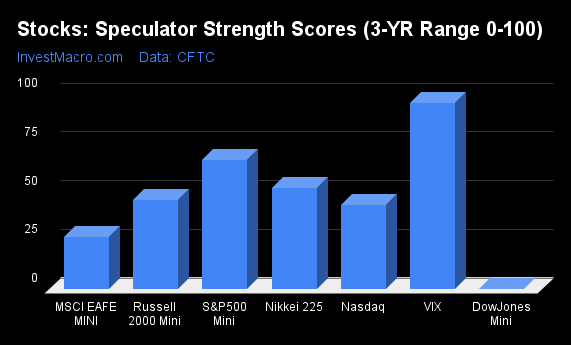
COT Strength Scores (a normalized measure of Speculator positions over a 3-Year range, from 0 to 100 where above 80 is Extreme-Bullish and below 20 is Extreme-Bearish) showed that the VIX (88 percent) and the Nasdaq-Mini (85 percent) lead the stock markets this week. The Nikkei 225 (68 percent) comes in as the next highest in the weekly strength scores.

On the downside, the MSCI EAFE-Mini (0 percent) comes in at the lowest strength level currently and is in Extreme-Bearish territory (below 20 percent). The next lowest strength score is the Russell-Mini (29 percent).

Strength Statistics:
VIX (87.8 percent) vs VIX previous week (94.3 percent)
S&P500-Mini (43.2 percent) vs S&P500-Mini previous week (43.6 percent)
DowJones-Mini (40.7 percent) vs DowJones-Mini previous week (45.6 percent)
Nasdaq-Mini (85.0 percent) vs Nasdaq-Mini previous week (86.5 percent)
Russell2000-Mini (28.9 percent) vs Russell2000-Mini previous week (31.8 percent)
Nikkei USD (68.2 percent) vs Nikkei USD previous week (64.3 percent)
EAFE-Mini (0.0 percent) vs EAFE-Mini previous week (13.5 percent)


Nikkei 225 & Nasdaq-Mini top the 6-Week Strength Trends

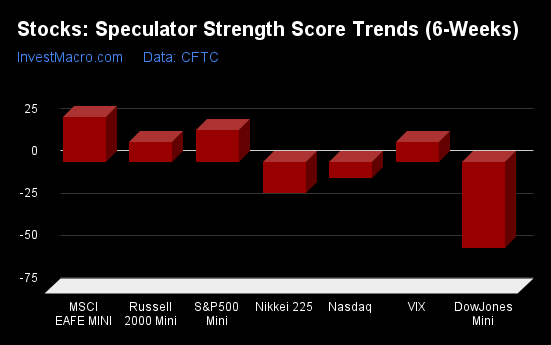
COT Strength Score Trends (or move index, calculates the 6-week changes in strength scores) showed that the Nikkei 225 (16 percent) leads the past six weeks trends for the stock markets. The Nasdaq-Mini (14 percent) and the S&P500-Mini (13 percent) are the next highest positive movers in the latest trends data.

The DowJones-Mini (-37 percent) leads the downside trend scores currently with the EAFE-Mini (-8.5 percent) coming in as the next market with lower trend scores.

Strength Trend Statistics:
VIX (-0.4 percent) vs VIX previous week (4.7 percent)
S&P500-Mini (13.2 percent) vs S&P500-Mini previous week (18.1 percent)
DowJones-Mini (-37.2 percent) vs DowJones-Mini previous week (-8.1 percent)
Nasdaq-Mini (13.9 percent) vs Nasdaq-Mini previous week (8.6 percent)
Russell2000-Mini (-1.8 percent) vs Russell2000-Mini previous week (-0.7 percent)
Nikkei USD (16.0 percent) vs Nikkei USD previous week (13.9 percent)
EAFE-Mini (-8.5 percent) vs EAFE-Mini previous week (-7.1 percent)


Individual Stock Market Charts:

VIX Volatility Futures:

VIX Volatility Futures COT ChartThe VIX Volatility large speculator standing this week recorded a net position of -42,726 contracts in the data reported through Tuesday. This was a weekly decrease of -8,940 contracts from the previous week which had a total of -33,786 net contracts.

This week’s current strength score (the trader positioning range over the past three years, measured from 0 to 100) shows the speculators are currently Bullish-Extreme with a score of 87.8 percent. The commercials are Bearish-Extreme with a score of 9.1 percent and the small traders (not shown in chart) are Bullish-Extreme with a score of 88.0 percent.

Price Trend-Following Model: Downtrend

Our weekly trend-following model classifies the current market price position as: Downtrend. The current action for the model is considered to be: Hold – Maintain Short Position.

VIX Volatility Futures StatisticsSPECULATORSCOMMERCIALSSMALL TRADERS
– Percent of Open Interest Longs:25.345.86.6
– Percent of Open Interest Shorts:36.034.87.0
– Net Position:-42,72644,265-1,539
– Gross Longs:101,854184,11226,430
– Gross Shorts:144,580139,84727,969
– Long to Short Ratio:0.7 to 11.3 to 10.9 to 1
NET POSITION TREND:
– Strength Index Score (3 Year Range Pct):87.89.188.0
– Strength Index Reading (3 Year Range):Bullish-ExtremeBearish-ExtremeBullish-Extreme
NET POSITION MOVEMENT INDEX:
– 6-Week Change in Strength Index:-0.4-1.513.7


S&P500 Mini Futures:

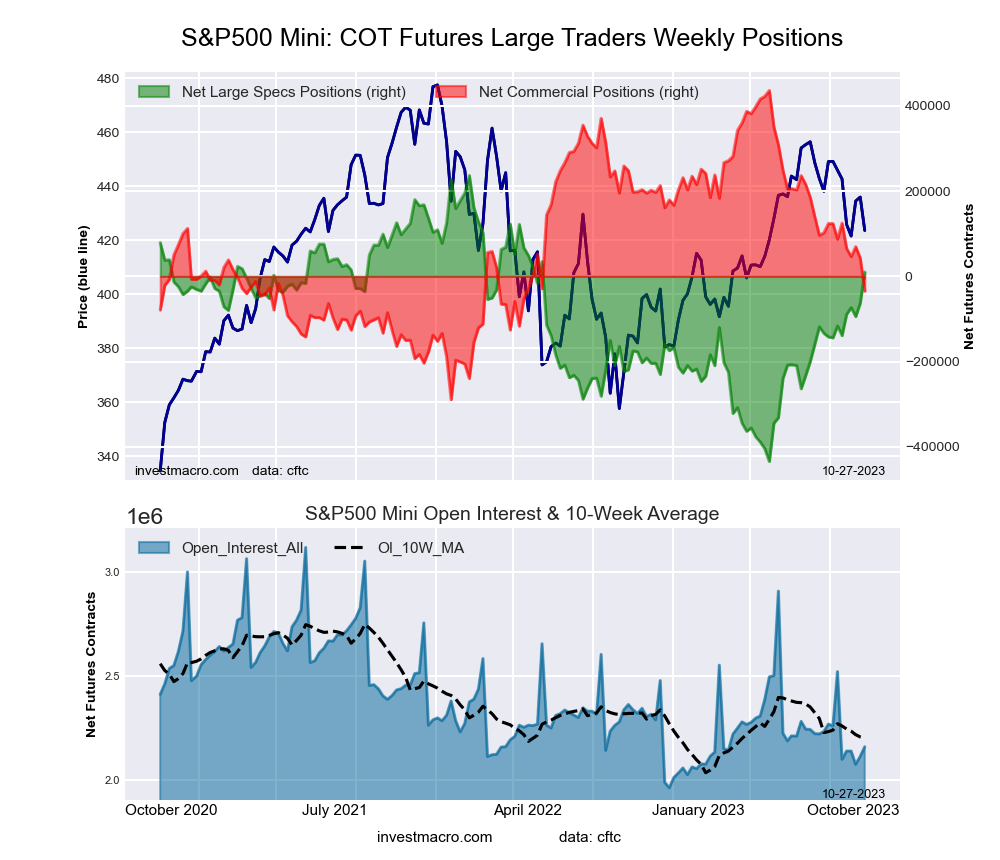
SP500 Mini Futures COT ChartThe S&P500 Mini large speculator standing this week recorded a net position of -144,211 contracts in the data reported through Tuesday. This was a weekly decrease of -2,105 contracts from the previous week which had a total of -142,106 net contracts.

This week’s current strength score (the trader positioning range over the past three years, measured from 0 to 100) shows the speculators are currently Bearish with a score of 43.2 percent. The commercials are Bullish with a score of 56.9 percent and the small traders (not shown in chart) are Bearish with a score of 45.8 percent.

Price Trend-Following Model: Uptrend

Our weekly trend-following model classifies the current market price position as: Uptrend. The current action for the model is considered to be: Hold – Maintain Long Position.

S&P500 Mini Futures StatisticsSPECULATORSCOMMERCIALSSMALL TRADERS
– Percent of Open Interest Longs:10.975.011.4
– Percent of Open Interest Shorts:17.269.510.5
– Net Position:-144,211123,56720,644
– Gross Longs:245,3781,693,540256,870
– Gross Shorts:389,5891,569,973236,226
– Long to Short Ratio:0.6 to 11.1 to 11.1 to 1
NET POSITION TREND:
– Strength Index Score (3 Year Range Pct):43.256.945.8
– Strength Index Reading (3 Year Range):BearishBullishBearish
NET POSITION MOVEMENT INDEX:
– 6-Week Change in Strength Index:13.2-12.71.4


Dow Jones Mini Futures:

Dow Jones Mini Futures COT ChartThe Dow Jones Mini large speculator standing this week recorded a net position of -11,724 contracts in the data reported through Tuesday. This was a weekly decrease of -1,724 contracts from the previous week which had a total of -10,000 net contracts.

This week’s current strength score (the trader positioning range over the past three years, measured from 0 to 100) shows the speculators are currently Bearish with a score of 40.7 percent. The commercials are Bullish with a score of 54.6 percent and the small traders (not shown in chart) are Bullish with a score of 51.2 percent.

Price Trend-Following Model: Uptrend

Our weekly trend-following model classifies the current market price position as: Uptrend. The current action for the model is considered to be: Hold – Maintain Long Position.

Dow Jones Mini Futures StatisticsSPECULATORSCOMMERCIALSSMALL TRADERS
– Percent of Open Interest Longs:23.757.315.5
– Percent of Open Interest Shorts:36.246.513.9
– Net Position:-11,72410,2231,501
– Gross Longs:22,24553,86514,590
– Gross Shorts:33,96943,64213,089
– Long to Short Ratio:0.7 to 11.2 to 11.1 to 1
NET POSITION TREND:
– Strength Index Score (3 Year Range Pct):40.754.651.2
– Strength Index Reading (3 Year Range):BearishBullishBullish
NET POSITION MOVEMENT INDEX:
– 6-Week Change in Strength Index:-37.220.315.4


Nasdaq Mini Futures:

Nasdaq Mini Futures COT ChartThe Nasdaq Mini large speculator standing this week recorded a net position of 13,550 contracts in the data reported through Tuesday. This was a weekly decline of -2,612 contracts from the previous week which had a total of 16,162 net contracts.

This week’s current strength score (the trader positioning range over the past three years, measured from 0 to 100) shows the speculators are currently Bullish-Extreme with a score of 85.0 percent. The commercials are Bearish-Extreme with a score of 19.0 percent and the small traders (not shown in chart) are Bearish with a score of 38.7 percent.

Price Trend-Following Model: Uptrend

Our weekly trend-following model classifies the current market price position as: Uptrend. The current action for the model is considered to be: Hold – Maintain Long Position.

Nasdaq Mini Futures StatisticsSPECULATORSCOMMERCIALSSMALL TRADERS
– Percent of Open Interest Longs:27.056.213.8
– Percent of Open Interest Shorts:22.058.316.7
– Net Position:13,550-5,696-7,854
– Gross Longs:74,040154,34638,035
– Gross Shorts:60,490160,04245,889
– Long to Short Ratio:1.2 to 11.0 to 10.8 to 1
NET POSITION TREND:
– Strength Index Score (3 Year Range Pct):85.019.038.7
– Strength Index Reading (3 Year Range):Bullish-ExtremeBearish-ExtremeBearish
NET POSITION MOVEMENT INDEX:
– 6-Week Change in Strength Index:13.9-8.6-20.3


Russell 2000 Mini Futures:

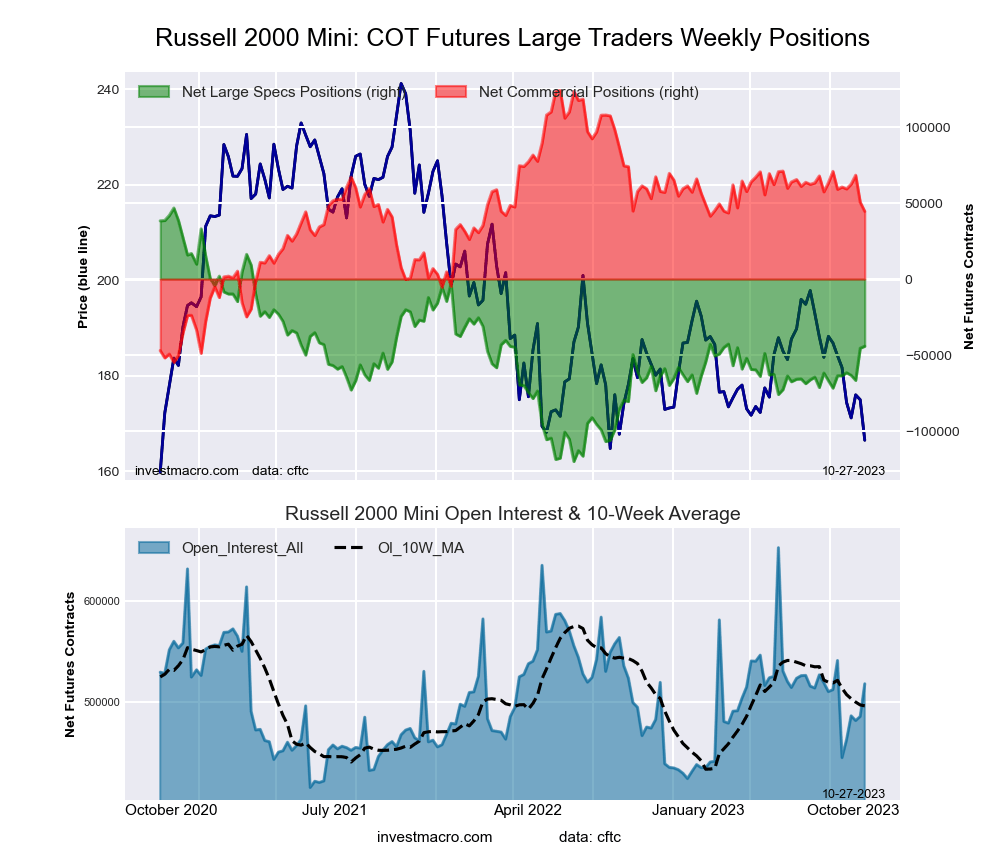
Russell 2000 Mini Futures COT ChartThe Russell 2000 Mini large speculator standing this week recorded a net position of -71,711 contracts in the data reported through Tuesday. This was a weekly lowering of -4,833 contracts from the previous week which had a total of -66,878 net contracts.

This week’s current strength score (the trader positioning range over the past three years, measured from 0 to 100) shows the speculators are currently Bearish with a score of 28.9 percent. The commercials are Bullish with a score of 70.2 percent and the small traders (not shown in chart) are Bearish with a score of 29.4 percent.

Price Trend-Following Model: Weak Uptrend

Our weekly trend-following model classifies the current market price position as: Weak Uptrend. The current action for the model is considered to be: Hold – Maintain Long Position.

Russell 2000 Mini Futures StatisticsSPECULATORSCOMMERCIALSSMALL TRADERS
– Percent of Open Interest Longs:9.983.35.2
– Percent of Open Interest Shorts:23.969.55.1
– Net Position:-71,71170,806905
– Gross Longs:50,897426,55426,844
– Gross Shorts:122,608355,74825,939
– Long to Short Ratio:0.4 to 11.2 to 11.0 to 1
NET POSITION TREND:
– Strength Index Score (3 Year Range Pct):28.970.229.4
– Strength Index Reading (3 Year Range):BearishBullishBearish
NET POSITION MOVEMENT INDEX:
– 6-Week Change in Strength Index:-1.84.0-13.1


Nikkei Stock Average (USD) Futures:

Nikkei Stock Average (USD) Futures COT ChartThe Nikkei Stock Average (USD) large speculator standing this week recorded a net position of -142 contracts in the data reported through Tuesday. This was a weekly lift of 591 contracts from the previous week which had a total of -733 net contracts.

This week’s current strength score (the trader positioning range over the past three years, measured from 0 to 100) shows the speculators are currently Bullish with a score of 68.2 percent. The commercials are Bearish with a score of 28.6 percent and the small traders (not shown in chart) are Bearish with a score of 45.2 percent.

Price Trend-Following Model: Strong Uptrend

Our weekly trend-following model classifies the current market price position as: Strong Uptrend. The current action for the model is considered to be: Hold – Maintain Long Position.

Nikkei Stock Average Futures StatisticsSPECULATORSCOMMERCIALSSMALL TRADERS
– Percent of Open Interest Longs:16.362.918.0
– Percent of Open Interest Shorts:16.867.812.6
– Net Position:-142-1,1991,341
– Gross Longs:4,01515,5374,453
– Gross Shorts:4,15716,7363,112
– Long to Short Ratio:1.0 to 10.9 to 11.4 to 1
NET POSITION TREND:
– Strength Index Score (3 Year Range Pct):68.228.645.2
– Strength Index Reading (3 Year Range):BullishBearishBearish
NET POSITION MOVEMENT INDEX:
– 6-Week Change in Strength Index:16.0-18.36.8


MSCI EAFE Mini Futures:

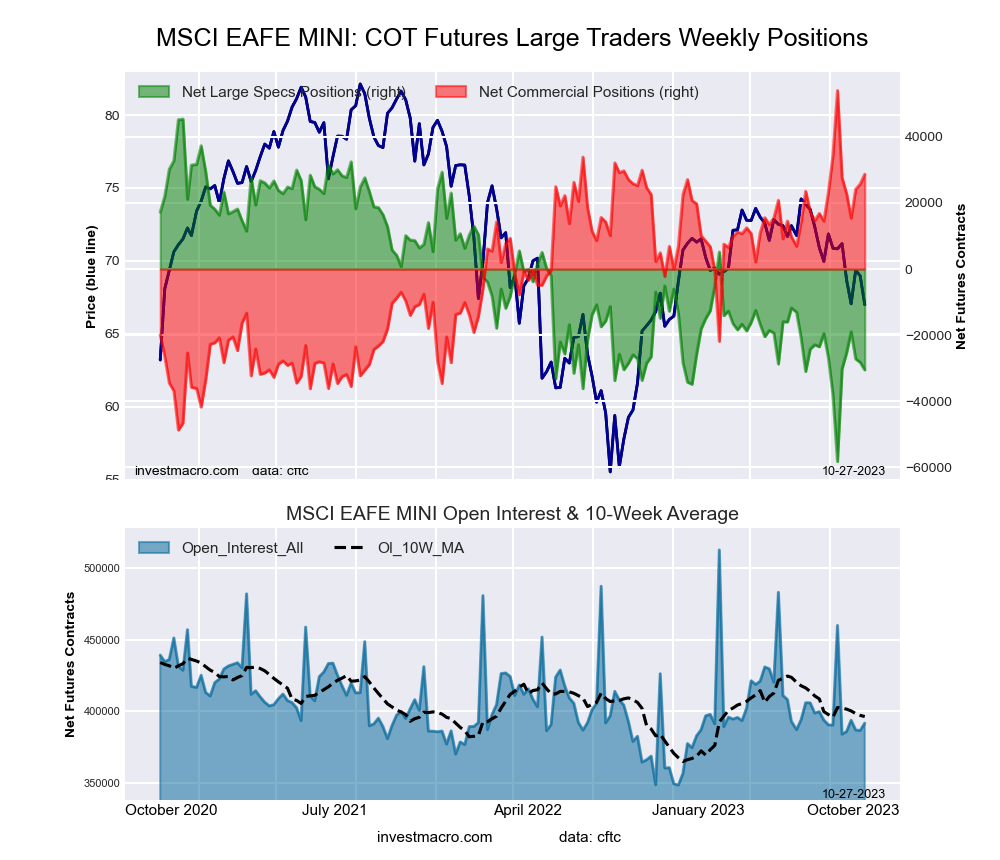
MSCI EAFE Mini Futures COT ChartThe MSCI EAFE Mini large speculator standing this week recorded a net position of -38,079 contracts in the data reported through Tuesday. This was a weekly decrease of -11,282 contracts from the previous week which had a total of -26,797 net contracts.

This week’s current strength score (the trader positioning range over the past three years, measured from 0 to 100) shows the speculators are currently Bearish-Extreme with a score of 0.0 percent. The commercials are Bullish-Extreme with a score of 100.0 percent and the small traders (not shown in chart) are Bearish with a score of 35.7 percent.

Price Trend-Following Model: Strong Downtrend

Our weekly trend-following model classifies the current market price position as: Strong Downtrend. The current action for the model is considered to be: Hold – Maintain Short Position.

MSCI EAFE Mini Futures StatisticsSPECULATORSCOMMERCIALSSMALL TRADERS
– Percent of Open Interest Longs:6.190.72.5
– Percent of Open Interest Shorts:15.981.91.5
– Net Position:-38,07934,3463,733
– Gross Longs:23,910354,1379,687
– Gross Shorts:61,989319,7915,954
– Long to Short Ratio:0.4 to 11.1 to 11.6 to 1
NET POSITION TREND:
– Strength Index Score (3 Year Range Pct):0.0100.035.7
– Strength Index Reading (3 Year Range):Bearish-ExtremeBullish-ExtremeBearish
NET POSITION MOVEMENT INDEX:
– 6-Week Change in Strength Index:-8.513.0-18.4


Article By InvestMacroReceive our weekly COT Newsletter

*COT Report: The COT data, released weekly to the public each Friday, is updated through the most recent Tuesday (data is 3 days old) and shows a quick view of how large speculators or non-commercials (for-profit traders) were positioned in the futures markets.

The CFTC categorizes trader positions according to commercial hedgers (traders who use futures contracts for hedging as part of the business), non-commercials (large traders who speculate to realize trading profits) and nonreportable traders (usually small traders/speculators) as well as their open interest (contracts open in the market at time of reporting). See CFTC criteria here.

Soft Commodities Charts: Speculator bets led by Sugar & Cotton

By InvestMacro

Here are the latest charts and statistics for the Commitment of Traders (COT) reports data published by the Commodities Futures Trading Commission (CFTC).

The latest COT data is updated through Tuesday September 5th and shows a quick view of how large traders (for-profit speculators and commercial entities) were positioned in the futures markets.

Weekly Speculator Changes led by Sugar & Cotton

The COT soft commodities markets speculator bets were lower this week as five out of the eleven softs markets we cover had higher positioning while the other six markets had lower speculator contracts.

Leading the gains for the softs markets was Sugar (26,991 contracts) with Cotton (11,560 contracts), Wheat (3,847 contracts), Cocoa (2,999 contracts) and Lean Hogs (1,659 contracts) also showing positive weeks.

The markets with the declines in speculator bets this week were Coffee (-18,522 contracts) with Corn (-9,819 contracts), Soybean Meal (-6,481 contracts), Soybeans (-4,833 contracts), Soybean Oil (-619 contracts) and Live Cattle (-976 contracts) also registering lower bets on the week.


Data Snapshot of Commodity Market Traders | Columns Legend
Sep-05-2023OIOI-IndexSpec-NetSpec-IndexCom-NetCOM-IndexSmalls-NetSmalls-Index
WTI Crude1,703,13027299,32240-308,997679,6750
Gold438,6728138,00638-158,2396320,23331
Silver128,2791726,80456-37,7084810,90427
Copper193,59737-6,770254,659752,11132
Palladium17,64480-11,021010,88810013350
Platinum68,7215314,60249-19,001544,39927
Natural Gas1,169,72543-118,2792590,7167627,56345
Brent129,4177-44,6822444,2268345615
Heating Oil319,4914438,73796-67,126028,38997
Soybeans716,2003187,32923-68,84373-18,48660
Corn1,229,7005-45,632379,96594-34,33384
Coffee180,11838,49536-8,05268-4437
Sugar966,99263235,42174-289,8052154,38473
Wheat376,77053-46,4103444,160642,25078


Strength Scores led by Cocoa & Sugar

COT Strength Scores (a normalized measure of Speculator positions over a 3-Year range, from 0 to 100 where above 80 is Extreme-Bullish and below 20 is Extreme-Bearish) showed that Cocoa (100 percent) and Sugar (74 percent) lead the softs markets this week. Live Cattle (72 percent), Soybean Meal (53 percent) and Soybean Oil (51 percent) come in as the next highest in the weekly strength scores.

On the downside, Corn (3 percent) and Soybeans (23 percent) come in at the lowest strength levels currently and are in Extreme-Bearish territory (below 20 percent). The next lowest strength scores are the Lean Hogs (25 percent) and the Wheat (34 percent).

Strength Statistics:
Corn (2.7 percent) vs Corn previous week (4.3 percent)
Sugar (74.1 percent) vs Sugar previous week (64.6 percent)
Coffee (36.1 percent) vs Coffee previous week (61.8 percent)
Soybeans (23.5 percent) vs Soybeans previous week (25.4 percent)
Soybean Oil (50.6 percent) vs Soybean Oil previous week (50.9 percent)
Soybean Meal (53.1 percent) vs Soybean Meal previous week (56.7 percent)
Live Cattle (72.2 percent) vs Live Cattle previous week (73.3 percent)
Lean Hogs (24.6 percent) vs Lean Hogs previous week (23.3 percent)
Cotton (51.2 percent) vs Cotton previous week (42.5 percent)
Cocoa (100.0 percent) vs Cocoa previous week (96.9 percent)
Wheat (33.8 percent) vs Wheat previous week (31.1 percent)


Cotton & Cocoa top the 6-Week Strength Trends

COT Strength Score Trends (or move index, calculates the 6-week changes in strength scores) showed that Cotton (14 percent) and Cocoa (9 percent) lead the past six weeks trends for soft commodities. Sugar (6 percent), Soybean Oil (1 percent) and Lean Hogs (-3 percent) are the next highest positive movers in the latest trends data.

Coffee (-23 percent) leads the downside trend scores currently with Corn (-19 percent), Soybeans (-19 percent) and Wheat (-18 percent) following next with lower trend scores.

Strength Trend Statistics:
Corn (-19.0 percent) vs Corn previous week (-9.1 percent)
Sugar (5.5 percent) vs Sugar previous week (4.3 percent)
Coffee (-23.1 percent) vs Coffee previous week (-0.0 percent)
Soybeans (-18.7 percent) vs Soybeans previous week (-5.9 percent)
Soybean Oil (1.1 percent) vs Soybean Oil previous week (8.7 percent)
Soybean Meal (-7.6 percent) vs Soybean Meal previous week (1.1 percent)
Live Cattle (-9.5 percent) vs Live Cattle previous week (-18.7 percent)
Lean Hogs (-2.6 percent) vs Lean Hogs previous week (-3.1 percent)
Cotton (13.9 percent) vs Cotton previous week (19.8 percent)
Cocoa (8.7 percent) vs Cocoa previous week (7.0 percent)
Wheat (-18.4 percent) vs Wheat previous week (-8.2 percent)


Individual Soft Commodities Markets:

CORN Futures:

CORN Futures COT ChartThe CORN large speculator standing this week reached a net position of -45,632 contracts in the data reported through Tuesday. This was a weekly fall of -9,819 contracts from the previous week which had a total of -35,813 net contracts.

This week’s current strength score (the trader positioning range over the past three years, measured from 0 to 100) shows the speculators are currently Bearish-Extreme with a score of 2.7 percent. The commercials are Bullish-Extreme with a score of 94.2 percent and the small traders (not shown in chart) are Bullish-Extreme with a score of 83.6 percent.

Price Trend-Following Model: Strong Downtrend

Our weekly trend-following model classifies the current market price position as: Strong Downtrend. The current action for the model is considered to be: Hold – Maintain Short Position.

CORN Futures StatisticsSPECULATORSCOMMERCIALSSMALL TRADERS
– Percent of Open Interest Longs:22.648.910.2
– Percent of Open Interest Shorts:26.342.413.0
– Net Position:-45,63279,965-34,333
– Gross Longs:278,322601,098125,742
– Gross Shorts:323,954521,133160,075
– Long to Short Ratio:0.9 to 11.2 to 10.8 to 1
NET POSITION TREND:
– Strength Index Score (3 Year Range Pct):2.794.283.6
– Strength Index Reading (3 Year Range):Bearish-ExtremeBullish-ExtremeBullish-Extreme
NET POSITION MOVEMENT INDEX:
– 6-Week Change in Strength Index:-19.014.052.2


SUGAR Futures:

SUGAR Futures COT ChartThe SUGAR large speculator standing this week reached a net position of 235,421 contracts in the data reported through Tuesday. This was a weekly gain of 26,991 contracts from the previous week which had a total of 208,430 net contracts.

This week’s current strength score (the trader positioning range over the past three years, measured from 0 to 100) shows the speculators are currently Bullish with a score of 74.1 percent. The commercials are Bearish with a score of 21.2 percent and the small traders (not shown in chart) are Bullish with a score of 73.5 percent.

Price Trend-Following Model: Strong Uptrend

Our weekly trend-following model classifies the current market price position as: Strong Uptrend. The current action for the model is considered to be: Hold – Maintain Long Position.

SUGAR Futures StatisticsSPECULATORSCOMMERCIALSSMALL TRADERS
– Percent of Open Interest Longs:32.842.910.2
– Percent of Open Interest Shorts:8.572.94.6
– Net Position:235,421-289,80554,384
– Gross Longs:317,572415,11998,808
– Gross Shorts:82,151704,92444,424
– Long to Short Ratio:3.9 to 10.6 to 12.2 to 1
NET POSITION TREND:
– Strength Index Score (3 Year Range Pct):74.121.273.5
– Strength Index Reading (3 Year Range):BullishBearishBullish
NET POSITION MOVEMENT INDEX:
– 6-Week Change in Strength Index:5.5-11.730.0


COFFEE Futures:

COFFEE Futures COT ChartThe COFFEE large speculator standing this week reached a net position of 8,495 contracts in the data reported through Tuesday. This was a weekly reduction of -18,522 contracts from the previous week which had a total of 33,494 net contracts.

This week’s current strength score (the trader positioning range over the past three years, measured from 0 to 100) shows the speculators are currently Bearish with a score of 36.1 percent. The commercials are Bullish with a score of 67.9 percent and the small traders (not shown in chart) are Bearish-Extreme with a score of 7.3 percent.

Price Trend-Following Model: Uptrend

Our weekly trend-following model classifies the current market price position as: Uptrend. The current action for the model is considered to be: Hold – Maintain Long Position.

COFFEE Futures StatisticsSPECULATORSCOMMERCIALSSMALL TRADERS
– Percent of Open Interest Longs:23.447.03.7
– Percent of Open Interest Shorts:18.751.43.9
– Net Position:8,495-8,052-443
– Gross Longs:42,19084,6066,662
– Gross Shorts:33,69592,6587,105
– Long to Short Ratio:1.3 to 10.9 to 10.9 to 1
NET POSITION TREND:
– Strength Index Score (3 Year Range Pct):36.167.97.3
– Strength Index Reading (3 Year Range):BearishBullishBearish-Extreme
NET POSITION MOVEMENT INDEX:
– 6-Week Change in Strength Index:-23.124.0-19.8


SOYBEANS Futures:

SOYBEANS Futures COT ChartThe SOYBEANS large speculator standing this week reached a net position of 87,329 contracts in the data reported through Tuesday. This was a weekly decrease of -4,833 contracts from the previous week which had a total of 92,162 net contracts.

This week’s current strength score (the trader positioning range over the past three years, measured from 0 to 100) shows the speculators are currently Bearish with a score of 23.5 percent. The commercials are Bullish with a score of 73.0 percent and the small traders (not shown in chart) are Bullish with a score of 59.5 percent.

Price Trend-Following Model: Uptrend

Our weekly trend-following model classifies the current market price position as: Uptrend. The current action for the model is considered to be: Hold – Maintain Long Position.

SOYBEANS Futures StatisticsSPECULATORSCOMMERCIALSSMALL TRADERS
– Percent of Open Interest Longs:22.551.46.8
– Percent of Open Interest Shorts:10.461.09.4
– Net Position:87,329-68,843-18,486
– Gross Longs:161,468368,02448,992
– Gross Shorts:74,139436,86767,478
– Long to Short Ratio:2.2 to 10.8 to 10.7 to 1
NET POSITION TREND:
– Strength Index Score (3 Year Range Pct):23.573.059.5
– Strength Index Reading (3 Year Range):BearishBullishBullish
NET POSITION MOVEMENT INDEX:
– 6-Week Change in Strength Index:-18.716.6-0.9


SOYBEAN OIL Futures:

SOYBEAN OIL Futures COT ChartThe SOYBEAN OIL large speculator standing this week reached a net position of 55,935 contracts in the data reported through Tuesday. This was a weekly decrease of -619 contracts from the previous week which had a total of 56,554 net contracts.

This week’s current strength score (the trader positioning range over the past three years, measured from 0 to 100) shows the speculators are currently Bullish with a score of 50.6 percent. The commercials are Bearish with a score of 48.2 percent and the small traders (not shown in chart) are Bullish with a score of 52.9 percent.

Price Trend-Following Model: Uptrend

Our weekly trend-following model classifies the current market price position as: Uptrend. The current action for the model is considered to be: Hold – Maintain Long Position.

SOYBEAN OIL Futures StatisticsSPECULATORSCOMMERCIALSSMALL TRADERS
– Percent of Open Interest Longs:23.350.67.5
– Percent of Open Interest Shorts:11.065.25.2
– Net Position:55,935-66,48310,548
– Gross Longs:105,904229,77534,049
– Gross Shorts:49,969296,25823,501
– Long to Short Ratio:2.1 to 10.8 to 11.4 to 1
NET POSITION TREND:
– Strength Index Score (3 Year Range Pct):50.648.252.9
– Strength Index Reading (3 Year Range):BullishBearishBullish
NET POSITION MOVEMENT INDEX:
– 6-Week Change in Strength Index:1.1-0.1-6.1


SOYBEAN MEAL Futures:

SOYBEAN MEAL Futures COT ChartThe SOYBEAN MEAL large speculator standing this week reached a net position of 92,750 contracts in the data reported through Tuesday. This was a weekly fall of -6,481 contracts from the previous week which had a total of 99,231 net contracts.

This week’s current strength score (the trader positioning range over the past three years, measured from 0 to 100) shows the speculators are currently Bullish with a score of 53.1 percent. The commercials are Bearish with a score of 47.1 percent and the small traders (not shown in chart) are Bearish with a score of 42.7 percent.

Price Trend-Following Model: Weak Uptrend

Our weekly trend-following model classifies the current market price position as: Weak Uptrend. The current action for the model is considered to be: New Buy – Long Position.

SOYBEAN MEAL Futures StatisticsSPECULATORSCOMMERCIALSSMALL TRADERS
– Percent of Open Interest Longs:24.139.19.9
– Percent of Open Interest Shorts:3.863.85.6
– Net Position:92,750-112,19019,440
– Gross Longs:109,916178,23044,988
– Gross Shorts:17,166290,42025,548
– Long to Short Ratio:6.4 to 10.6 to 11.8 to 1
NET POSITION TREND:
– Strength Index Score (3 Year Range Pct):53.147.142.7
– Strength Index Reading (3 Year Range):BullishBearishBearish
NET POSITION MOVEMENT INDEX:
– 6-Week Change in Strength Index:-7.69.1-11.4


LIVE CATTLE Futures:

LIVE CATTLE Futures COT ChartThe LIVE CATTLE large speculator standing this week reached a net position of 86,489 contracts in the data reported through Tuesday. This was a weekly lowering of -976 contracts from the previous week which had a total of 87,465 net contracts.

This week’s current strength score (the trader positioning range over the past three years, measured from 0 to 100) shows the speculators are currently Bullish with a score of 72.2 percent. The commercials are Bearish with a score of 29.5 percent and the small traders (not shown in chart) are Bearish with a score of 32.7 percent.

Price Trend-Following Model: Uptrend

Our weekly trend-following model classifies the current market price position as: Uptrend. The current action for the model is considered to be: Hold – Maintain Long Position.

LIVE CATTLE Futures StatisticsSPECULATORSCOMMERCIALSSMALL TRADERS
– Percent of Open Interest Longs:42.628.59.1
– Percent of Open Interest Shorts:15.252.712.3
– Net Position:86,489-76,291-10,198
– Gross Longs:134,20589,58528,644
– Gross Shorts:47,716165,87638,842
– Long to Short Ratio:2.8 to 10.5 to 10.7 to 1
NET POSITION TREND:
– Strength Index Score (3 Year Range Pct):72.229.532.7
– Strength Index Reading (3 Year Range):BullishBearishBearish
NET POSITION MOVEMENT INDEX:
– 6-Week Change in Strength Index:-9.57.116.6


LEAN HOGS Futures:

LEAN HOGS Futures COT ChartThe LEAN HOGS large speculator standing this week reached a net position of -6,132 contracts in the data reported through Tuesday. This was a weekly boost of 1,659 contracts from the previous week which had a total of -7,791 net contracts.

This week’s current strength score (the trader positioning range over the past three years, measured from 0 to 100) shows the speculators are currently Bearish with a score of 24.6 percent. The commercials are Bullish with a score of 79.0 percent and the small traders (not shown in chart) are Bullish with a score of 67.5 percent.

Price Trend-Following Model: Weak Uptrend

Our weekly trend-following model classifies the current market price position as: Weak Uptrend. The current action for the model is considered to be: Hold – Maintain Long Position.

LEAN HOGS Futures StatisticsSPECULATORSCOMMERCIALSSMALL TRADERS
– Percent of Open Interest Longs:31.339.49.4
– Percent of Open Interest Shorts:34.434.711.1
– Net Position:-6,1329,659-3,527
– Gross Longs:63,71680,13319,036
– Gross Shorts:69,84870,47422,563
– Long to Short Ratio:0.9 to 11.1 to 10.8 to 1
NET POSITION TREND:
– Strength Index Score (3 Year Range Pct):24.679.067.5
– Strength Index Reading (3 Year Range):BearishBullishBullish
NET POSITION MOVEMENT INDEX:
– 6-Week Change in Strength Index:-2.67.3-22.8


COTTON Futures:

COTTON Futures COT ChartThe COTTON large speculator standing this week reached a net position of 56,410 contracts in the data reported through Tuesday. This was a weekly advance of 11,560 contracts from the previous week which had a total of 44,850 net contracts.

This week’s current strength score (the trader positioning range over the past three years, measured from 0 to 100) shows the speculators are currently Bullish with a score of 51.2 percent. The commercials are Bearish with a score of 45.1 percent and the small traders (not shown in chart) are Bullish with a score of 78.9 percent.

Price Trend-Following Model: Uptrend

Our weekly trend-following model classifies the current market price position as: Uptrend. The current action for the model is considered to be: Hold – Maintain Long Position.

COTTON Futures StatisticsSPECULATORSCOMMERCIALSSMALL TRADERS
– Percent of Open Interest Longs:39.841.28.0
– Percent of Open Interest Shorts:15.270.43.5
– Net Position:56,410-66,78610,376
– Gross Longs:91,09394,30418,327
– Gross Shorts:34,683161,0907,951
– Long to Short Ratio:2.6 to 10.6 to 12.3 to 1
NET POSITION TREND:
– Strength Index Score (3 Year Range Pct):51.245.178.9
– Strength Index Reading (3 Year Range):BullishBearishBullish
NET POSITION MOVEMENT INDEX:
– 6-Week Change in Strength Index:13.9-13.710.4


COCOA Futures:

COCOA Futures COT ChartThe COCOA large speculator standing this week reached a net position of 86,220 contracts in the data reported through Tuesday. This was a weekly advance of 2,999 contracts from the previous week which had a total of 83,221 net contracts.

This week’s current strength score (the trader positioning range over the past three years, measured from 0 to 100) shows the speculators are currently Bullish-Extreme with a score of 100.0 percent. The commercials are Bearish-Extreme with a score of 0.0 percent and the small traders (not shown in chart) are Bearish with a score of 36.5 percent.

Price Trend-Following Model: Strong Uptrend

Our weekly trend-following model classifies the current market price position as: Strong Uptrend. The current action for the model is considered to be: Hold – Maintain Long Position.

COCOA Futures StatisticsSPECULATORSCOMMERCIALSSMALL TRADERS
– Percent of Open Interest Longs:47.525.94.5
– Percent of Open Interest Shorts:17.757.03.2
– Net Position:86,220-90,2123,992
– Gross Longs:137,72075,13613,139
– Gross Shorts:51,500165,3489,147
– Long to Short Ratio:2.7 to 10.5 to 11.4 to 1
NET POSITION TREND:
– Strength Index Score (3 Year Range Pct):100.00.036.5
– Strength Index Reading (3 Year Range):Bullish-ExtremeBearish-ExtremeBearish
NET POSITION MOVEMENT INDEX:
– 6-Week Change in Strength Index:8.7-9.15.5


WHEAT Futures:

WHEAT Futures COT ChartThe WHEAT large speculator standing this week reached a net position of -46,410 contracts in the data reported through Tuesday. This was a weekly rise of 3,847 contracts from the previous week which had a total of -50,257 net contracts.

This week’s current strength score (the trader positioning range over the past three years, measured from 0 to 100) shows the speculators are currently Bearish with a score of 33.8 percent. The commercials are Bullish with a score of 64.2 percent and the small traders (not shown in chart) are Bullish with a score of 78.3 percent.

Price Trend-Following Model: Strong Downtrend

Our weekly trend-following model classifies the current market price position as: Strong Downtrend. The current action for the model is considered to be: Hold – Maintain Short Position.

WHEAT Futures StatisticsSPECULATORSCOMMERCIALSSMALL TRADERS
– Percent of Open Interest Longs:29.234.79.9
– Percent of Open Interest Shorts:41.522.99.3
– Net Position:-46,41044,1602,250
– Gross Longs:109,981130,57837,412
– Gross Shorts:156,39186,41835,162
– Long to Short Ratio:0.7 to 11.5 to 11.1 to 1
NET POSITION TREND:
– Strength Index Score (3 Year Range Pct):33.864.278.3
– Strength Index Reading (3 Year Range):BearishBullishBullish
NET POSITION MOVEMENT INDEX:
– 6-Week Change in Strength Index:-18.413.435.4


Article By InvestMacroReceive our weekly COT Newsletter

*COT Report: The COT data, released weekly to the public each Friday, is updated through the most recent Tuesday (data is 3 days old) and shows a quick view of how large speculators or non-commercials (for-profit traders) were positioned in the futures markets.

The CFTC categorizes trader positions according to commercial hedgers (traders who use futures contracts for hedging as part of the business), non-commercials (large traders who speculate to realize trading profits) and nonreportable traders (usually small traders/speculators) as well as their open interest (contracts open in the market at time of reporting). See CFTC criteria here.