Archive for Financial News – Page 161

The ECB could cut rates as early as April 2024. Today, the focus is on the US labor market data

By JustMarkets

At yesterday’s stock market close, the Dow Jones Index (US30) was up by 0.17%, while the S&P 500 Index (US500) added 0.80%. The NASDAQ Technology Index (US100) closed positive by 1.37% on Thursday.

A positive for stocks yesterday was Alphabet (GOOG) shares rising more than 5% after Google released Gemini, “the largest and most capable artificial intelligence model” the company has ever developed. Additionally, Advanced Micro Devices (AMD) shares are up more than 5% after the company unveiled its new accelerator chip MI300, saying the processor will be able to run artificial intelligence programs faster than competing products.

US weekly initial jobless claims rose by 1k to 220k, matching expectations. Today, the US will release its monthly nonfarm labor market report. The unemployment rate is expected to be 3.9%, and Nonfarm Payrolls are expected to increase by 180k in November compared to 150k in October. A strong (better than expected) report could undermine bets that the Fed will start easing its restrictive monetary policy sooner than expected, which would serve as a headwind for a rally in equities and bring back confidence in the dollar, at least temporarily. On the other hand, a weak Nonfarm report (worse than expected) will increase investor fears that the labor market and economy are cooling. If the data comes out in line with expectations, it is unlikely to do much to shake market expectations for several Fed rate cuts next year, which will only add to market volatility.

Equity markets in Europe were mostly down yesterday. Germany’s DAX (DE40) decreased by 0.16%, France’s CAC 40 (FR40) fell by 0.10%, Spain’s IBEX 35 (ES35) lost 1.09%, and the UK’s FTSE 100 (UK100) closed negative 0.02%. Recent economic data from Germany has heightened fears that the industrial sector will continue to have a negative impact on the Eurozone’s largest economy. Germany’s industrial sector is struggling: industrial production in Germany unexpectedly fell in October, a day after industrial orders in the country’s largest Eurozone economy also unexpectedly fell in the same month.

On Thursday, the euro fell to its lowest level against the Swiss franc in nearly nine years as markets bet on an imminent interest rate cut by the European Central Bank (ECB). Currently, the difference between short rates in the Eurozone and Switzerland is around 225 basis points, but markets expect this to narrow to 150 in the next 12 months. This makes the euro less attractive than the Swiss franc. Analysts at Goldman Sachs believe the ECB will cut interest rates by 25 basis points (bps) at each meeting starting next April. Economists at the brokerage forecast that the ECB’s deposit rate will reach 2.25% by early 2025. BNP Paribas also expects the ECB to make its first interest rate cut in April 2024 and to “gradually reduce rates” over the year, citing weak economic activity and weakening inflation. BNP chief economist Luigi Speranza believes the ECB’s prime rate will be 3.25% by the end of 2024, down from 4% currently.

Crude oil and gasoline prices on Thursday continued Wednesday’s sharp decline. Crude oil fell to a five-month low. Concerns about a global crude oil supply glut continue to weigh on oil prices. In addition, doubts about whether the OPEC+ agreement to cut crude oil production will be honored are weighing on prices.

High inventories caused by carryover balances from the mild winter of 2022/23 and weak heating demand have depressed natural gas prices. As of December 3, natural gas storage in Europe was 94% full, above the 5-year seasonal average of 84% for this time of year.

Asian markets were mostly down yesterday. Japan’s Nikkei 225 (JP225) fell by 1.76%, China’s FTSE China A50 (CHA50) was down by 0.16%, Hong Kong’s Hang Seng (HK50) ended the day down by 0.71%, and Australia’s ASX 200 (AU200) ended Thursday negative 0.07%.

The Nikkei 225 (JP225) fell sharply on Thursday, while the yen rose sharply to hit a 4-month high against the dollar. The yen saw a massive short-covering in the yen on Thursday as comments by Bank of Japan (BoJ) Governor Ueda in the Japanese parliament reinforced speculation that the BoJ would soon exit ultra-easy monetary policy. On Wednesday, Deputy Governor Ryozo Himino discussed the potential impact of an exit from ultra-loose monetary policy on the economy. Their joint comments “fueled the fire.” Japanese five-year bond yields witnessed the most aggressive sell-off in a decade. However, Ueda remained of the view that policy would remain loose in the near term, citing the need to stimulate economic growth. This view was bolstered by Japan’s revised third-quarter gross domestic product data, which showed a bigger decline in economic growth than initially expected.

India’s central bank (RBI) left its key lending rate unchanged at 6.5% on Friday as growth in the world’s fastest-growing economy remains robust and the inflation outlook uncertain. The central bank also raised its economic growth forecast to 7% from 6.5% after stronger-than-expected growth in July-September. RBI forecasts consumer inflation at 5.4% in 2023-24.

S&P 500 (US500) 4,585.59 +36.25 (+0.80%)

Dow Jones (US30) 36,117.38 +62.95 (+0.17%)

DAX (DE40)  16,628.99 −27.45 (−0.16%)

FTSE 100 (UK100) 7,513.72 −1.66 (−0.022%)

USD Index  103.64 −0.51 (−0.49%)

News feed for 2023.12.08:
  • – Japan GDP (q/q) at 01:50 (GMT+2);
  • – German Final Consumer Price Index (m/m) at 09:00 (GMT+2);
  • – US Nonfarm Payrolls (m/m) at 15:30 (GMT+2);
  • – US Unemployment Rate (m/m) at 15:30 (GMT+2);
  • – US Michigan Consumer Sentiment (m/m) at 17:00 (GMT+2).

By JustMarkets


This article reflects a personal opinion and should not be interpreted as an investment advice, and/or offer, and/or a persistent request for carrying out financial transactions, and/or a guarantee, and/or a forecast of future events.

Oil quotations remain under pressure. The US labor market is cooling in the US

By JustMarkets

At yesterday’s stock market close, the Dow Jones Index (US30) was down by 0.22%, while the S&P 500 Index (US500) decreased by 0.06%. The NASDAQ Technology Index (US100) closed positive 0.31% on Tuesday. A decline in bond yields on Tuesday supported technology stocks and the Nasdaq 100. Bond yields fell after the October JOLTS job openings report fell more than expected to a 2-year low, a sign that the labor market is cooling and dovish for Fed policy.

Economic news from the US on Tuesday was mixed. On the bullish side, the ISM Services Business Activity Index for November rose by 0.9 to 52.7, beating expectations of 52.3. In contrast, the October JOLTS Job Openings Index fell by 617,000 to a 2-year low of 8.733 million, indicating a weaker labor market than expectations of 9.300 million.

Procter & Gamble (PG) fell more than 3% and topped the Dow Jones Industrials’ list of losers after it said it expects $2.0 billion to $2.5 billion in restructuring costs for its operations in some corporate markets due to “challenging macroeconomic and financial conditions.” Nvidia (NVDA) stock price rose more than 2% and led the Nasdaq 100 higher after the company said it plans to partner with Japanese research organizations, companies, and startups to build artificial intelligence factories in Japan.

Equity markets in Europe were mostly up yesterday. Germany’s DAX (DE40) rose by 0.78%, France’s CAC 40 (FR40) gained 0.74% on Tuesday, Spain’s IBEX 35 (ES35) jumped by 0.59%, and the UK’s FTSE 100 (UK100) closed negative 0.31%. Economic news for European indices contributed to the gains. The S&P Eurozone Composite PMI for November was revised upward by 0.5 to 47.6 from the previously reported 47.1. The Eurozone Producer Price Index for October rose by 0.2% m/m to 9.4% y/y, matching expectations of 0.2% m/m and 9.5% y/y.

The ECB’s monthly inflation expectations survey showed that expectations for 1-year inflation in October were unchanged from September at 4.0%, above expectations of 3.8%. 3-year inflation expectations were 2.5%, unchanged from September and in line with expectations. ECB Executive Board spokesperson Schnabel said yesterday that another ECB interest rate hike is rather unlikely.

The build-up in US crude oil exports is putting pressure on oil prices. In addition, the rise in the dollar index to a one-week high on Tuesday was a negative factor for oil. In addition, Saudi Arabia’s actions to cut official oil selling prices for Asian buyers for January delivery is a negative factor for oil. Russian Deputy Prime Minister Novak said OPEC+ may take additional measures if last week’s production cuts fail to balance the oil market.

Asian markets were mostly down yesterday. Japan’s Nikkei 225 (JP225) decreased by 1.37%, China’s FTSE China A50 (CHA50) lost 2.55% yesterday, Hong Kong’s Hang Seng (HK50) fell by 1.91% on the day, and Australia’s ASX 200 (AU200) was negative 0.89% on Tuesday.

China’s Shanghai Composite index fell to a 5-week low as Moody’s Investors Service cut its outlook on China’s sovereign debt from stable to negative, weighing on global growth prospects. According to the median forecast of 28 economists surveyed, China’s exports are expected to decline 1.1% in November from a year earlier, following a 6.4% drop in October and continuing a downward trend for the fourth consecutive month.

Australia’s real gross domestic product (GDP) rose by 0.2% in the July-September quarter from the previous quarter, marking the eighth consecutive quarter of growth, albeit the slowest in a year. Australia’s economy barely grew in the third quarter as exports contracted and households suffering from soaring mortgage payments were reluctant to spend, suggesting higher rates are curbing demand.

Ryozo Himino, deputy governor of the Bank of Japan (BoJ), said the central bank should determine the timing and appropriate structure of the exit from ultra-loose monetary policy while closely monitoring developments in wages and prices. He also noted that Japan is making progress in exiting the protracted period when wage and price growth remained stagnant.

S&P 500 (US500) 4,567.18 −2.60 (−0.06%)

Dow Jones (US30) 36,124.56 −79.88 (−0.22%)

DAX (DE40)  16,533.11 +128.35 (+0.78%)

FTSE 100 (UK100) 7,489.84 −23.12 (−0.31%)

USD Index  103.96 +0.25 (+0.24%)

News feed for 2023.12.06:
  • – Australia GDP (q/q) at 02:30 (GMT+2);
  • – UK Construction PMI (m/m) at 11:30 (GMT+2);
  • – UK FPC Meeting Minutes at 12:30 (GMT+2);
  • – UK BoE Financial Stability Report at 12:30 (GMT+2);
  • – UK BoE Gov Bailey Speaks at 13:00 (GMT+2);
  • – US ADP Nonfarm Employment Change (m/m) at 15:15 (GMT+2);
  • – US Trade Balance (m/m) at 15:30 (GMT+2);
  • – Canada Trade Balance (m/m) at 15:30 (GMT+2);
  • – Canada BoC Interest Rate Decision at 17:00 (GMT+2);
  • – Canada BoC Rate Statement at 17:00 (GMT+2);
  • – Canada Ivey PMI (m/m) at 17:00 (GMT+2);
  • – US Crude Oil Reserves (w/w) at 17:30 (GMT+2).

By JustMarkets


This article reflects a personal opinion and should not be interpreted as an investment advice, and/or offer, and/or a persistent request for carrying out financial transactions, and/or a guarantee, and/or a forecast of future events.

ECB likely to start rate cutting in Q1: deVere CEO

By George Prior 

The European Central Bank is likely to cut interest rates next year, which could have far-reaching consequences for investors worldwide, predicts the CEO of one of the world’s largest independent financial advisory asset management and fintech organizations.

Nigel Green of deVere Group’s comments come as ECB Board member, Isabel Schnabel, who has previously been one of the most hawkish of the Board, told Reuters on Tuesday that given a “remarkable” fall in inflation, the central bank can now take rate hikes off the table.

Euro zone inflation fell to 2.4% last month, down from above 10% a year earlier.

He comments: “When the hawks turn dovish, and as inflation falls to within touching distance, it is reasonable to assume that the ECB will start to cut rates.

“We now expect this to begin in the first quarter of 2024.”

If the ECB decides to cut interest rates, European investors are likely to experience both challenges and opportunities.

“On the one hand, lower interest rates can boost economic growth, leading to increased corporate profits and potentially higher stock prices.

“However, on the downside, savers and bond investors could face diminished returns. The repercussions of ECB interest rate cuts extend beyond Europe, influencing global bond markets.

“As the ECB lowers rates, it can be expected to trigger a broader trend of falling yields in bond markets worldwide.

“Fixed-income investors across the globe, seeking higher returns, may shift their attention to riskier assets.”

Another channel through which the ECB’s policy decisions affect global investors is currency markets. A rate cut by the ECB is likely to lead to a depreciation of the euro against other major currencies.

This can impact international investors holding euro-denominated assets, either positively or negatively, depending on their exposure and hedging strategies. For instance, European exporters may benefit from a weaker euro as it makes their goods more competitive in global markets.

Equity markets around the world are, of course, closely interconnected, and changes in one major economy can have ripple effects globally.

“A rate cut by the ECB could be expected to inject liquidity into financial markets, leading to a surge in equity prices. International investors could find opportunities for capital appreciation, especially in sectors that are sensitive to interest rates, such as real estate and utilities.”

Nigel Green concludes: “We now expect that the ECB could be among the first of the major central banks to start cutting interest rates in the first quarter of 2024.

“Investors across the globe will be closely monitoring developments and potentially adjusting their strategies to adapt to the evolving economic landscape.”

About:

deVere Group is one of the world’s largest independent advisors of specialist global financial solutions to international, local mass affluent, and high-net-worth clients.  It has a network of more than 70 offices across the world, over 80,000 clients and $12bn under advisement.

Rising government bond yields put pressure on indices. The RBA kept the rate on hold but left a hawkish bias

By JustMarkets

As of Friday’s stock market close, the Dow Jones Index (US30) decreased by 0.11%, and the S&P 500 Index (US500) was down by 0.54%. The NASDAQ Technology Index (US100) closed negative 0.84% on Monday, hitting a 3-week low. Yesterday’s rise in bond yields pressured technology stocks and lowered the broad market. Bond yields are rising on concerns that markets may be overly optimistic about the Fed’s chances of cutting interest rates by the second quarter of 2024. Markets forecast a 68% probability of a 25 bps rate cut at the March 19-20, 2024, FOMC meeting and a fully discounted (137% probability) probability of a 25 bps rate cut at the April 30-May 1, 2024, FOMC meeting.

This week, markets await JOLTS openings, ADP national employment, and US monthly payrolls reports to gauge the strength of the US labor market and whether additional monetary tightening is appropriate. US factory orders in October fell by 3.6% m/m, weaker than expectations of 3.0% m/m and the biggest decline in 3 years. This indicates weak demand for industrial metals, which put additional pressure on silver.

Nvidia (NVDA) shares fell more than 3% yesterday on signs of insider selling after Washington Service data showed that Nvidia executives sold $180 million worth of stock last month.

Equity markets in Europe traded flat yesterday. Germany’s DAX (DE40) rose by 0.04%, France’s CAC 40 (FR40) fell by 0.18% on Monday, Spain’s IBEX 35 (ES35) jumped by 0.37%, and the UK’s FTSE 100 (UK100) closed negative 0.22%.

ECB Governing Council representative Centeno warned yesterday that the labor market implications of excessive monetary tightening could be swift when the economy turns around. His counterpart, ECB Vice President Guindos, indicated that the ECB cannot yet say that inflation is under control as the ECB sees large wage growth in some parts of the Eurozone, which could lead to additional price pressures. Eurozone Investor Confidence Index for December from Sentix rose by 1.8 to minus 16.8, which was weaker than expectations of minus 15.6. German trade balance data was weaker than expected, with October exports unexpectedly falling by 0.2% m/m, which was weaker than expectations of 1.1% m/m. Imports also fell by 1.2% m/m, weaker than expectations of 0.8% m/m.

Swaps tied to ECB meeting dates estimate a 73% probability that the ECB will cut the benchmark rate by 25 bps at the March 7 meeting and more than estimated (+150%) that rate cut by 25 bps at the April 11 ECB meeting.

The dollar index rally to 1-week highs on Monday was bearish for energy prices. Crude oil was also pressured by the negative impact of last Thursday’s events, when OPEC+ said it would cut oil production levels by 1.0 mln bpd, but did not provide details on how the cut would be implemented. Oil prices were supported by concerns that attacks on oil tankers in the Middle East could disrupt crude supplies. The US Central Command said there were four missile and drone attacks on three separate commercial vessels operating in international waters in the Red Sea on Sunday. Iranian-backed Houthis rebels claimed responsibility for the attacks.

Asian markets were mostly down yesterday. Japan’s Nikkei 225 (JP225) decreased by 0.60%, China’s FTSE China A50 (CHA50) was down by 0.70% yesterday, Hong Kong’s Hang Seng (HK50) lost 1.09% on the day, and Australia’s ASX 200 (AU200) was positive 0.73% on Monday.

Australia’s Central Bank left interest rates unchanged at 4.35% on Tuesday as expected, giving itself more time to assess the economy and decide whether to tighten further next year. RBA chief Bullock maintained the same policy tightening bias, saying the need for further rate hikes will depend on data and a changing risk assessment. Markets expect an early rate cut by the US Federal Reserve and the European Central Bank in 2024, with a drop of more than 100 basis points, while the RBA may just cut the rate by 15 basis points late next year. That would stabilize the Australian currency against the dollar and euro next year.

Core inflation in Japan’s capital slowed in November, confirming the central bank’s view that cost pressures in the world’s third-largest economy will gradually ease. The core consumer price index (CPI), which excludes food prices but includes fuel costs, came in at 2.3% y/y in Tokyo, down from 2.7% y/y in October. Bank of Japan Governor Kazuo Ueda emphasized the need to maintain ultra-loose policy until inflation driven by recent cost increases is replaced by demand-driven price increases backed by strong wage increases. Revised real gross domestic product (GDP) data on Friday is expected to show that Asia’s second-largest economy contracted by 2.0% in the third quarter, which would be negative for the Japanese currency.

S&P 500 (US500) 4,569.78 −24.85 (−0.54%)

Dow Jones (US30) 36,204.44 −41.06 (−0.11%)

DAX (DE40)  16,404.76 +7.24 (+0.044%)

FTSE 100 (UK100) 7,512.96 −16.39 (−0.22%)

USD Index  103.63 +0.36 (+0.35%)

News feed for 2023.12.05:
  • – Japan Tokyo Core CPI (m/m) at 01:30 (GMT+2);
  • – China Caixin Services PMI (m/m) at 04:45 (GMT+2);
  • – Australia RBA Interest Rate Decision at 05:30 (GMT+2);
  • – Australia RBA Rate Statement at 05:30 (GMT+2);
  • – German Services PMI (m/m) at 10:55 (GMT+2);
  • – Eurozone Services PMI (m/m) at 11:00 (GMT+2);
  • – Eurozone Producer Price Index (m/m) at 11:00 (GMT+2);
  • – UK Services PMI (m/m) at 11:30 (GMT+2);
  • – US ISM Services PMI (m/m) at 17:00 (GMT+2);
  • – US JOLTS Job Openings (m/m) at 17:00 (GMT+2).

By JustMarkets


This article reflects a personal opinion and should not be interpreted as an investment advice, and/or offer, and/or a persistent request for carrying out financial transactions, and/or a guarantee, and/or a forecast of future events.

USDJPY bears eye weekly support

By ForexTime 

  • USDJPY under pressure on D1/H4 timeframe
  • Weekly support next key point of interest
  • 4 potential targets identified on the H4 chart

The USDJPY could be on the cusp of creating a new impulse wave in the current downtrend.

Bulls tried to reach the weekly resistance level yesterday but were unable to shake the bearish resolve. Prices seem to be picking up negative momentum and might be heading south to a weekly support level at 144.758.

Looking at the structure of the market on a lower time frame for better timing, the H4 chart proves to give valuable insight. The potential bearish momentum is confirmed by the price being below the 50 Linear Weighted Moving Average with both the Momentum Oscillator and the Moving Average Convergence Divergence (MACD) in bearish terrain.

The weekly resistance level might be re-tested but if it holds and the price reaches the 146.226 level, a short opportunity will be triggered.

Attaching a modified Fibonacci tool to the trigger level just below the last lower bottom at 146.226 and dragging it to just above the last lower top at 147.452, four possible targets can be established:

  • The first potential target is at 145.736 (Target 1). This target will mainly be for risk management.

  • The second price target is likely at 145.490 (Target 2) and now the risk of the overall position should be almost none.

  • The third price target is possible at 145.000 (Target 3), just before the weekly support level.

  • The fourth and last price target is feasible at 144.387 (Target 4) if the bears manage to break through the next weekly support level.

If the price at 147.452 is broken, this scenario is no longer applicable.


Forex-Time-LogoArticle by ForexTime
ForexTime Ltd (FXTM) is an award winning international online forex broker regulated by CySEC 185/12 www.forextime.com

Brent “does not believe” OPEC+

By RoboForex Analytical Department

Brent oil prices fell to 78.30 USD per barrel on Monday.

Despite OPEC+ decisions at the November meeting, oil prices are falling. The issue is that the actual parameters of OPEC+ quotas turned out to be lower than investors expected. This does not cancel out the Cartel’s powerful support on prices. However, the market cannot cope with emotional reactions.

Escalating tensions in the Middle East observed last weekend may bolster the oil quotes. The factor of a strong US dollar is working oppositely. While the USD is rising, commodity assets appear less attractive to buyers.

Brent technical analysis

On the H4 Brent chart, there was a rebound from the 84.81 level. The market has fallen to 80.10 and is forming a consolidation range around this level today. A decline to 78.10 is expected, followed by a rise to 80.00 (a test from below). Subsequently, the price could continue its downward trajectory to 76.50. A growth wave might start after the price reaches this level, targeting 85.80. This is the first target for the growth wave. Technically, this scenario is confirmed by the MACD, with its signal line breaking the zero mark, aimed strictly downwards.

On the H1 Brent chart, a consolidation range has expanded downwards to 78.10. Today, a rise to 80.10 is expected, followed by a drop to 76.50, potentially continuing to 75.40. Technically, this scenario is confirmed by the Stochastic oscillator, with its signal line below 20 and poised to rise to the 50 mark.

Disclaimer

Any forecasts contained herein are based on the author’s particular opinion. This analysis may not be treated as trading advice. RoboForex bears no responsibility for trading results based on trading recommendations and reviews contained herein.

Bitcoin price jump fueled by scandal crackdowns and central bank expectations

By George Prior

Bitcoin topping $40,000 is because – not despite – the recent scandals are clearing out the bad actors from the market, says the CEO of one of the world’s largest independent financial advisory, asset management and fintech organizations.

deVere Group’s CEO Nigel Green is speaking out as the world’s biggest cryptocurrency hit as high as $41,700 on Monday, its highest since April 2022.

Last month, Changpeng Zhao, better known as CZ, the founder of Binance, the largest cryptocurrency exchange in the world, pleaded guilty to money laundering violations and agreed to pay a $50 million fine and step down from his role as the company’s chief executive.

The company itself also pleaded guilty and agreed to pay $4.3 billion in fines and restitution to the government, according to federal authorities.

Nigel Green comments: “The CZ/Binance scandal and the FTX collapse which resulted in a month-long trial which convicted the FTX founder Sam Bankman-Fried of seven counts of fraud and conspiracy, triggered some short-term volatility, but the crypto market has continued to remain bullish.

“In fact, Bitcoin is up by over 150% so far this year.

“It appears that law enforcement and regulatory authorities worldwide are cracking down on executives and companies of digital currencies. This greater regulatory scrutiny is seemingly appealing to investors who are piling into the likes of Bitcoin.

“It would also be attractive to institutional investors who bring with them huge amounts of capital.”

Microstrategy, the software developer and the largest corporate holder of Bitcoin boosted its holdings recently, buying some 16,130 BTC, worth around $610 million at current prices.

BlackRock, the $9trillion asset manager, alongside WisdomTree, Invesco Galaxy, Wise Origin, VanEck, Bitwise and Valkyrie Digital Assets, have published Bitcoin ETF applications waiting to be approved by the US Securities and Exchange Commission, the SEC.

“We believe that Bitcoin ETFs are an imminent inevitability, and this would help drive crypto prices and mass adoption,” says the deVere CEO.

“Should SEC approval happen, it would be a landmark moment for Bitcoin.  The approval by the financial regulator of the world’s largest economy of this spot ETF would show that Bitcoin is, without any question, part of the global mainstream financial system.”

Spot ETFs invest directly in underlying assets, typically stocks or bonds, at the current market price (spot price). They aim to replicate the performance of a specific index or asset class by holding a portfolio of the actual securities that make up the index.

“In addition, expectations the Federal Reserve and other major central banks are done hiking interest rates are fuelling Bitcoin prices,” he adds.

Also in the mind of investors is next year’s Bitcoin halving event. One of the key features of Bitcoin’s monetary policy is its limited supply. The total number of Bitcoins that can ever exist is capped at 21 million coins.

Its issuance is also predictable. Through a process called mining, new Bitcoins are created and added to the circulating supply.

However, the rate of issuance is programmed to decrease over time. Initially, miners were rewarded with 50 Bitcoins for each block they successfully mined. This reward is halved approximately every four years in an event known as the ‘halving.’

“The next halving is expected in April 2024.  The lead-up has typically been the most profitable time for crypto investors.”

Nigel Green concludes: “Scandal-triggered crackdowns, expected central bank plans, and next year’s halving event are fueling Bitcoin prices. We expect this trend to continue for the rest of this year and into 2024.”

About:

deVere Group is one of the world’s largest independent advisors of specialist global financial solutions to international, local mass affluent, and high-net-worth clients.  It has a network of more than 70 offices across the world, over 80,000 clients and $12bn under advisement.

BoC has peaked on interest rates. ECB may cut the rate as early as spring 2024

By JustMarkets

At Friday’s close, the Dow Jones Index (US30) was up by 0.82% (+2.46% for the week), while the S&P 500 Index (US500) was up by 0.59% (+0.87% for the week). The NASDAQ Technology Index (US100) closed positively by 0.55% (+0.46% for the week) on Friday. Stocks were boosted by the latest economic data, as well as dovish comments from US Fed chief Jerome Powell.

The ISM Manufacturing Index for November was unchanged at 46.7, which was weaker than expectations of a rise to 47.8 and was the 13th consecutive month of contraction in manufacturing activity. Dovish comments from the Fed on Friday put pressure on the dollar. Fed Chair Powell signaled that the Fed will leave interest rates unchanged at the December 12-13 FOMC meeting.

Canada added 24,900 jobs in November, 15,000 more than analysts had forecast, with the unemployment rate rising to 5.8% from 5.7%. Bank of Canada Governor Tiff Macklem said in a recent speech that “interest rates can now be quite restrictive” as excess demand has disappeared and weak growth is expected to persist, leading most to conclude that the central bank has peaked on rates this cycle and the BoC is expected to leave rates unchanged this Wednesday. That said, polls suggest the Bank of Canada will start cutting interest rates in the second quarter of next year as inflation slows and the economy grows. Economists believe the underlying cost of borrowing will fall by at least one percentage point by the end of 2024.

Equity markets in Europe were mostly up on Friday. Germany’s DAX (DE40) rose by 1.12% (+2.44% for the week), France’s CAC 40 (FR40) gained 0.48% (+0.73% for the week), Spain’s IBEX 35 (ES35) jumped by 0.82% (+2.15% for the week), and the UK’s FTSE 100 (UK100) closed positively by 1.01% (+0.55% for the week).

The European Central Bank (ECB) should not cause “unnecessary damage” to the economy and financial stability by keeping interest rates high, new Bank of Italy Governor Fabio Panetta said on Thursday. Panetta, a spokesman for the ECB’s governing council, added that the round of monetary tightening, which saw a streak of 10 consecutive rate hikes through September, has yet to have its full impact and will continue to dampen demand going forward. In his first major speech since taking the helm of Italy’s central bank, Panetta warned that the eurozone economy would remain weak in the final three months of this year and that risks to the economy were tilted to the downside. Market swaps tied to ECB meeting dates estimate an 81% probability that the ECB will cut the benchmark rate by 25 bps at its March 7 meeting and more than estimated (+183%) the probability of a 25 bps rate cut at the ECB’s April 11 meeting.

On Friday, crude oil prices were pressured by Thursday’s negative impact when OPEC+ said it would cut oil production levels by 1.0 million bpd, but did not provide details on how the cut would be implemented. The market is disappointed that additional OPEC oil production cuts will be announced by each country individually, suggesting that the cuts can only be voluntary. The rift between Angola and other OPEC+ members persists and is bearish, signaling increasing infighting between members of the organization.

Asian markets were mostly down last week. Japan’s Nikkei 225 (JP225) was down by 0.83% for the week, China’s FTSE China A50 (CHA50) decreased by 2.53% for the 5 trading days, Hong Kong’s Hang Seng (HK50) lost 4.79% for the week, and Australia’s ASX 200 (AU200) was positive 0.46% for the week.

An interest rate survey conducted from November 29 to December 1 showed that 28 out of 30 economists, including representatives from Australia’s four largest banks, expect the Central Bank of Australia (RBA) to leave the official money rate unchanged on December 5.

Bank Indonesia (BI) will keep the benchmark rate at the current level until 2024 unless there are any major changes in global dynamics, Bank Governor Perry Warjiyo said on Wednesday, signaling the central bank has completed its rate hike cycle. Warjiyo said the benchmark 7-day rate at 6% should be enough to keep domestic inflation within the target range of 1.5% to 3.5% in 2024 and 2025. The bank’s inflation target range for this year is between 2% and 4%. BI has raised interest rates by a total of 250 basis points between August 2022 and October, with the latest rate hike in response to a sharp fall in the rupee amid capital outflows associated with US monetary tightening.

S&P 500 (US500) 4,594.63 +26.83 (+0.59%)

Dow Jones (US30) 36,245.50 +294.61 (+0.82%)

DAX (DE40) 16,397.52 +182.09 (+1.12%)

FTSE 100(UK100) 7,529.35 +75.60 (+1.01%)

USD Index 103.19 −0.30 (−0.29%)

News feed for 2023.12.04:
  • – German Trade Balance (m/m) at 09:00 (GMT+2);
  • – Switzerland Consumer Price Index (m/m) at 09:30 (GMT+2);
  • – Eurozone ECB President Lagarde Speaks at 16:00 (GMT+2);
  • – US Factory Orders (m/m) at 17:00 (GMT+2).

By JustMarkets


This article reflects a personal opinion and should not be interpreted as an investment advice, and/or offer, and/or a persistent request for carrying out financial transactions, and/or a guarantee, and/or a forecast of future events.

Trade of the Week: Gold hits all-time high before rocket ship falters

By ForexTime 

  • Gold hits all-time high above $2130
  • Precious metal boosted by Fed cut bets
  • Key US data including NFP could trigger volatility
  • Prices firmly bullish but RSI signals overbought
  • Key levels of interest at $2100, $2070 and $2035

Gold kicked off Monday shooting for the stars, soaring more than 3% to create a fresh all-time high above $2130 before surrendering most of those gains.

Everyone wanted a piece of the precious metal last Friday after dovish comments from Jerome Powell hit the dollar along with Treasury yields. Investor appetite for gold seems to have intensified over the weekend with bulls stepping into higher gear as rate-cut bets intensified.

Despite the sharp pullback in prices, gold prices remain fundamentally bullish due to geopolitical risk and growing expectations for a US rate cut in 2024. Indeed, the precious metal is up roughly 15% since the October low and still trading a distance away from the psychological $2000 level.

Taking a quick look at the technicals, prices remain on an uptrend but this could be threatened if the current daily candle stick forms a shooting star pattern.

Note: A shooting star is a bearish candlestick that signals a potential reversal. It can be identified with a long wick and small-bodied candlestick.

This could be another wild week for gold as the focus falls on key US economic reports that may influence expectations around what the Fed will do beyond 2023. 

Here are some events that may rock gold over the next few days:

  1. US data + November jobs report

It is a data-heavy week for the US economy with all eyes will be on the latest non-farm payrolls report on Friday. 

As far as markets are concerned, the Federal Reserve’s hiking campaign is over with the next move being a rate cut in 2024. Dovish comments by Powell last Friday simply reinforced these expectations with traders now pricing in a 67% probability of a 25-basis point cut by March 2024.

The real market moving this week will most likely be November’s jobs report. Markets expect the US economy to have created 200,000 jobs last month while unemployment is expected to remain unchanged at 3.9%.

  • Should overall economic data disappoint along with the NFP report, this could support gold prices as rate-cut bets grow.
  • Strong-than-expected economic data including the jobs report may weaken gold, especially if the dollar stabilizes as traders push back rate-cut bets.
  1. Geopolitical tensions 

The end of the truce deal between Israel and Hamas could fuel risk aversion and investors’ concerns. 

A truce deal between both sides that began on November 24th ended last Friday after negotiations reached a deadlock. The temporary truce initially sparked hopes for a long-term peace deal that could reduce geopolitical risks. However, with the conflict between Israel and Hamas resuming this could send investors rushing towards safe-haven destinations like gold.

  • More signs of escalating tensions in the Middle East may sap risk sentiment, keeping gold prices buoyed as a result.
  • Any signs of easing tensions could boost market sentiment, dragging gold prices lower.
  1. Technical forces

After gaining aggressively during early trading on Monday, prices came crashing down, giving back most of the gains.

Gold remains bullish on the daily charts as there have been consistently higher highs and higher lows while prices are trading above the 50, 100, and 200-day SMA. However, the Relative Strength Index (RSI) is above 70, indicating that prices are heavily overbought. In addition, the current daily candle stick could be a threat to bulls if it closes as a shooting star pattern.

  • Prices could rebound back towards $2070 and $2100 regions if $2035 proves to be a reliable support.
  • A decline back below $2035 may trigger a selloff towards $2010 and $2000, respectively. 


Forex-Time-LogoArticle by ForexTime
ForexTime Ltd (FXTM) is an award winning international online forex broker regulated by CySEC 185/12 www.forextime.com
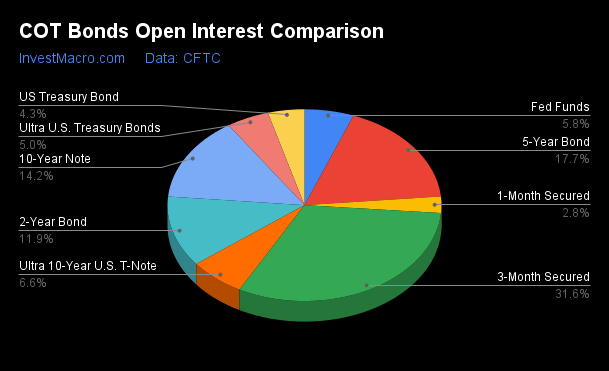
COT Bonds Charts: Speculators boosted their 2-Year and 5-Year Bonds bets

By InvestMacro

Here are the latest charts and statistics for the Commitment of Traders (COT) reports data published by the Commodities Futures Trading Commission (CFTC).

The latest COT data is updated through Tuesday November 28th and shows a quick view of how large traders (for-profit speculators and commercial hedgers) were positioned in the futures markets.

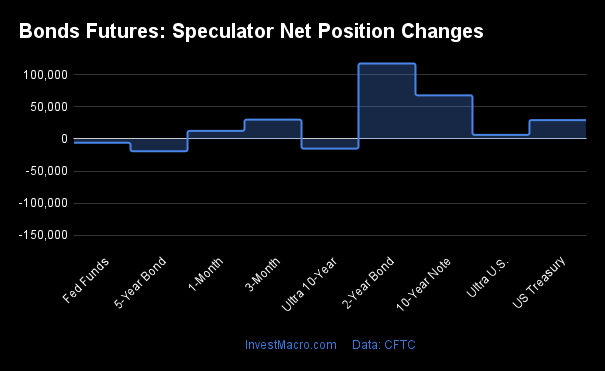
Weekly Speculator Changes led by 2-Year Bonds & 5-Year Bonds

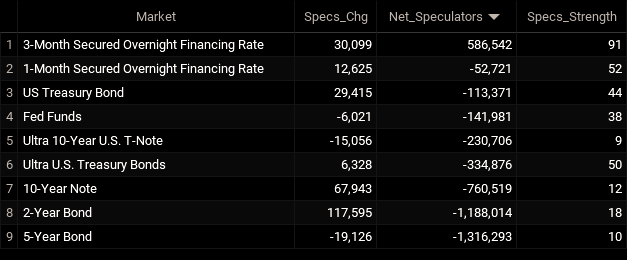
The COT bond market speculator bets were lower this week as three out of the eight bond markets we cover had higher positioning while the other five markets saw lower speculator contracts.

Leading the gains for the bond markets was the 2-Year Bonds (96,571 contracts) with the 5-Year Bonds (70,133 contracts) and the SOFR 3-Months (27,337 contracts) also having positive weeks.

The bond markets with declines for the week were the Fed Funds (-54,208 contracts), the 10-Year Bonds (-27,196 contracts), the Ultra 10-Year Bonds (-23,489 contracts), the Ultra Treasury Bonds (-6,522 contracts) and the US Treasury Bonds (-2,193 contracts).


Data Snapshot of Bond Market Traders | Columns Legend
Nov-28-2023OIOI-IndexSpec-NetSpec-IndexCom-NetCOM-IndexSmalls-NetSmalls-Index
SOFR-3-Months10,837,439100527,237100-525,3060-1,93187
FedFunds1,917,67782-203,49025220,16777-16,67758
2-Year4,080,41595-1,288,831111,141,44087147,391100
Long T-Bond1,308,13562-102,1764851,5733050,60385
10-Year4,775,11390-685,35416632,9248252,43085
5-Year6,081,13097-1,398,50041,250,88194147,61999


Strength Scores led by SOFR 3-Months & Ultra Treasury Bonds

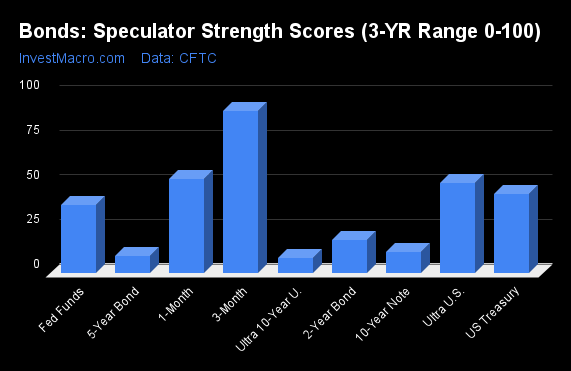
COT Strength Scores (a normalized measure of Speculator positions over a 3-Year range, from 0 to 100 where above 80 is Extreme-Bullish and below 20 is Extreme-Bearish) showed that the SOFR 3-Months (100 percent) leads the bond markets this week. The Ultra Treasury Bonds (51 percent) and the US Treasury Bonds (48 percent) come in as the next highest in the weekly strength scores.

On the downside, the Ultra 10-Year Bonds (1 percent), the 5-Year Bonds (4 percent), the 2-Year Bonds (11 percent) and the 10-Year Bonds (16 percent) come in at the lowest strength levels currently and are in Extreme-Bearish territory (below 20 percent).

Strength Statistics:
Fed Funds (25.1 percent) vs Fed Funds previous week (36.7 percent)
2-Year Bond (10.7 percent) vs 2-Year Bond previous week (4.4 percent)
5-Year Bond (4.5 percent) vs 5-Year Bond previous week (0.0 percent)
10-Year Bond (16.0 percent) vs 10-Year Bond previous week (18.6 percent)
Ultra 10-Year Bond (1.4 percent) vs Ultra 10-Year Bond previous week (5.8 percent)
US Treasury Bond (47.9 percent) vs US Treasury Bond previous week (48.7 percent)
Ultra US Treasury Bond (51.4 percent) vs Ultra US Treasury Bond previous week (54.0 percent)
SOFR 3-Months (100.0 percent) vs SOFR 3-Months previous week (98.4 percent)


US Treasury Bonds & Fed Funds top the 6-Week Strength Trends

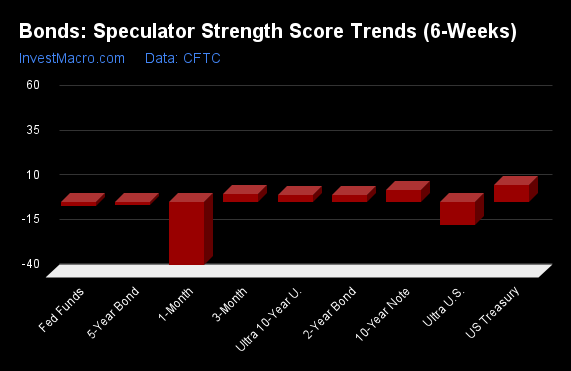
COT Strength Score Trends (or move index, calculates the 6-week changes in strength scores) showed that the US Treasury Bonds (28 percent) and the Fed Funds (20 percent) lead the past six weeks trends for bonds. The SOFR 3-Months (18 percent) and the are the next highest positive movers in the latest trends data.

The 5-Year Bonds (-17 percent) and the Ultra 10-Year Bonds (-3 percent) leads the downside trend scores currently.

Strength Trend Statistics:
Fed Funds (19.7 percent) vs Fed Funds previous week (19.7 percent)
2-Year Bond (4.3 percent) vs 2-Year Bond previous week (-4.7 percent)
5-Year Bond (-17.1 percent) vs 5-Year Bond previous week (-23.4 percent)
10-Year Bond (2.5 percent) vs 10-Year Bond previous week (5.3 percent)
Ultra 10-Year Bond (-3.1 percent) vs Ultra 10-Year Bond previous week (3.6 percent)
US Treasury Bond (28.0 percent) vs US Treasury Bond previous week (37.1 percent)
Ultra US Treasury Bond (13.0 percent) vs Ultra US Treasury Bond previous week (17.6 percent)
SOFR 3-Months (18.1 percent) vs SOFR 3-Months previous week (13.1 percent)


Secured Overnight Financing Rate (3-Month) Futures:

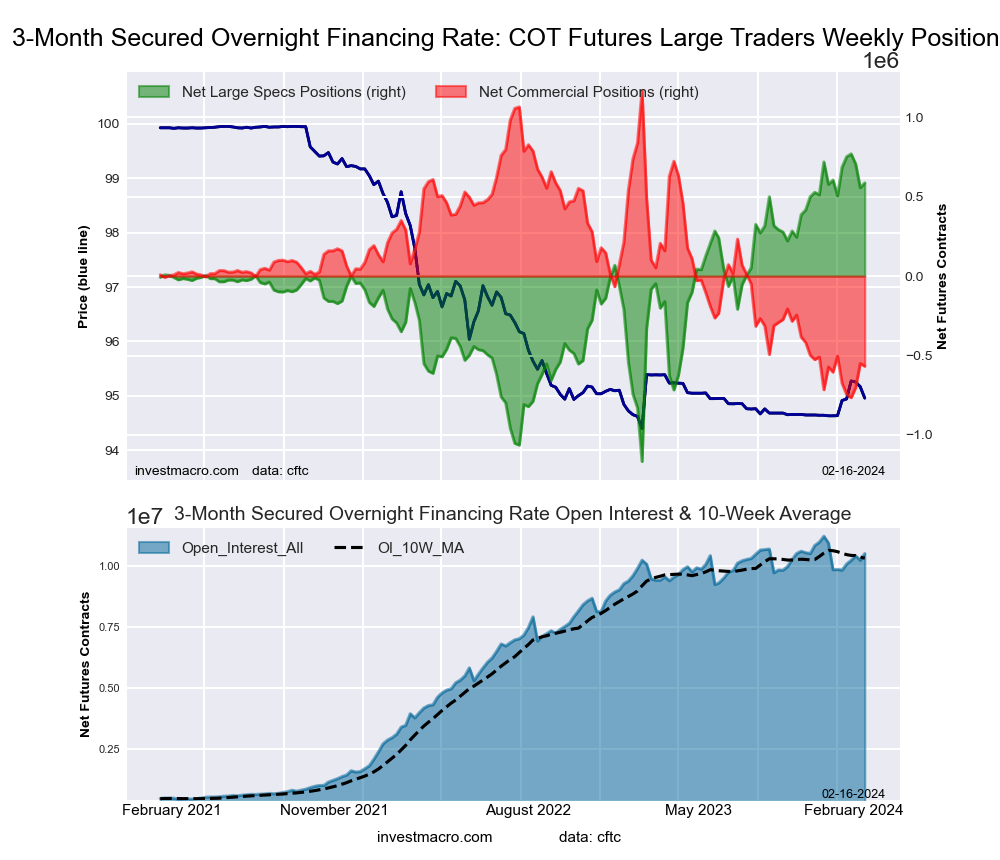
SOFR 3-Months Bonds Futures COT ChartThe Secured Overnight Financing Rate (3-Month) large speculator standing this week came in at a net position of 527,237 contracts in the data reported through Tuesday. This was a weekly lift of 27,337 contracts from the previous week which had a total of 499,900 net contracts.

This week’s current strength score (the trader positioning range over the past three years, measured from 0 to 100) shows the speculators are currently Bullish-Extreme with a score of 100.0 percent. The commercials are Bearish-Extreme with a score of 0.0 percent and the small traders (not shown in chart) are Bullish-Extreme with a score of 86.8 percent.

Price Trend-Following Model: Weak Uptrend

Our weekly trend-following model classifies the current market price position as: Weak Uptrend. The current action for the model is considered to be: Hold – Maintain Long Position.

SOFR 3-Months StatisticsSPECULATORSCOMMERCIALSSMALL TRADERS
– Percent of Open Interest Longs:20.553.90.3
– Percent of Open Interest Shorts:15.658.80.3
– Net Position:527,237-525,306-1,931
– Gross Longs:2,221,1155,844,32731,767
– Gross Shorts:1,693,8786,369,63333,698
– Long to Short Ratio:1.3 to 10.9 to 10.9 to 1
NET POSITION TREND:
– Strength Index Score (3 Year Range Pct):100.00.086.8
– Strength Index Reading (3 Year Range):Bullish-ExtremeBearish-ExtremeBullish-Extreme
NET POSITION MOVEMENT INDEX:
– 6-Week Change in Strength Index:18.1-18.87.1


30-Day Federal Funds Futures:

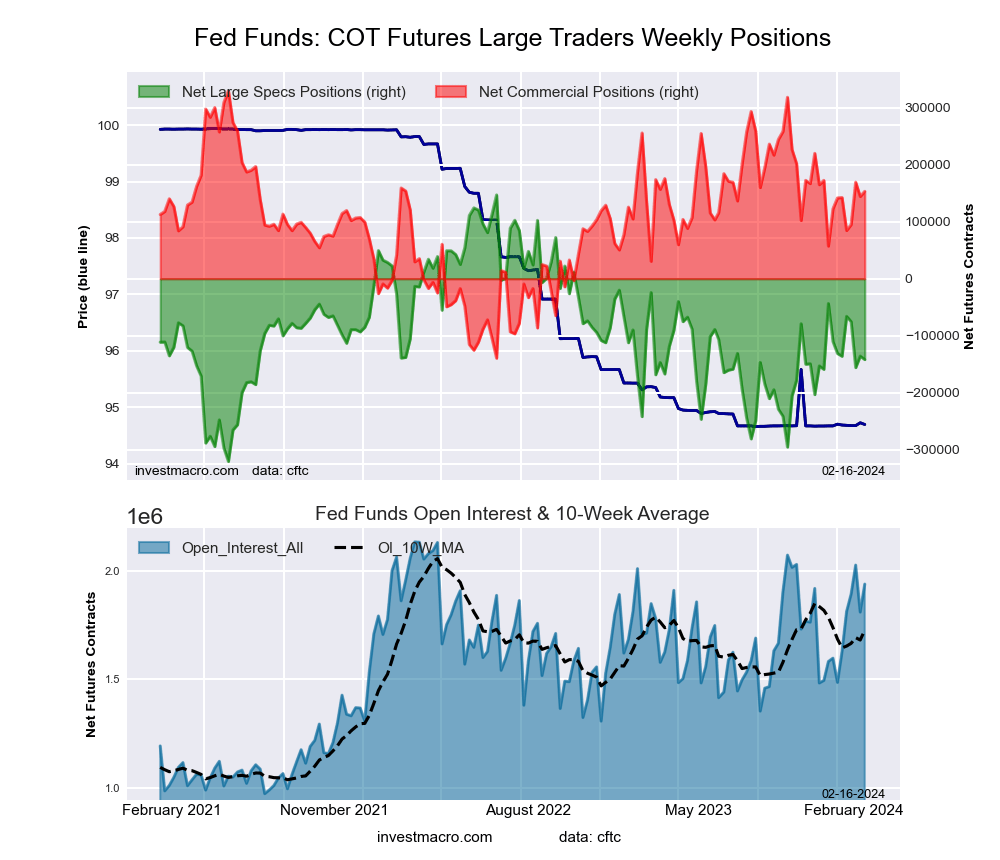
Federal Funds 30-Day Bonds Futures COT ChartThe 30-Day Federal Funds large speculator standing this week came in at a net position of -203,490 contracts in the data reported through Tuesday. This was a weekly decrease of -54,208 contracts from the previous week which had a total of -149,282 net contracts.

This week’s current strength score (the trader positioning range over the past three years, measured from 0 to 100) shows the speculators are currently Bearish with a score of 25.1 percent. The commercials are Bullish with a score of 76.5 percent and the small traders (not shown in chart) are Bullish with a score of 58.3 percent.

Price Trend-Following Model: Downtrend

Our weekly trend-following model classifies the current market price position as: Downtrend. The current action for the model is considered to be: Hold – Maintain Short Position.

30-Day Federal Funds StatisticsSPECULATORSCOMMERCIALSSMALL TRADERS
– Percent of Open Interest Longs:7.676.61.6
– Percent of Open Interest Shorts:18.365.12.4
– Net Position:-203,490220,167-16,677
– Gross Longs:146,6211,468,99130,251
– Gross Shorts:350,1111,248,82446,928
– Long to Short Ratio:0.4 to 11.2 to 10.6 to 1
NET POSITION TREND:
– Strength Index Score (3 Year Range Pct):25.176.558.3
– Strength Index Reading (3 Year Range):BearishBullishBullish
NET POSITION MOVEMENT INDEX:
– 6-Week Change in Strength Index:19.7-20.912.3


2-Year Treasury Note Futures:

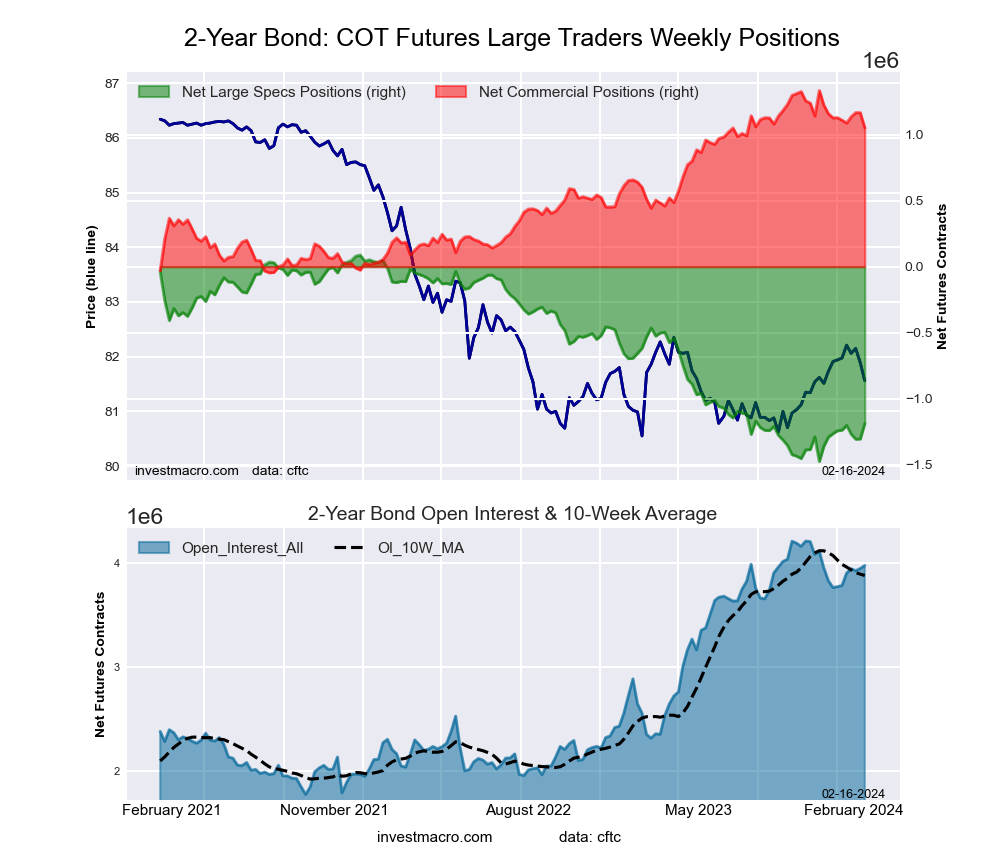
2-Year Treasury Bonds Futures COT ChartThe 2-Year Treasury Note large speculator standing this week came in at a net position of -1,288,831 contracts in the data reported through Tuesday. This was a weekly gain of 96,571 contracts from the previous week which had a total of -1,385,402 net contracts.

This week’s current strength score (the trader positioning range over the past three years, measured from 0 to 100) shows the speculators are currently Bearish-Extreme with a score of 10.7 percent. The commercials are Bullish-Extreme with a score of 86.5 percent and the small traders (not shown in chart) are Bullish-Extreme with a score of 100.0 percent.

Price Trend-Following Model: Strong Uptrend

Our weekly trend-following model classifies the current market price position as: Strong Uptrend. The current action for the model is considered to be: Hold – Maintain Long Position.

2-Year Treasury Note StatisticsSPECULATORSCOMMERCIALSSMALL TRADERS
– Percent of Open Interest Longs:10.680.96.9
– Percent of Open Interest Shorts:42.253.03.2
– Net Position:-1,288,8311,141,440147,391
– Gross Longs:432,1343,303,026279,784
– Gross Shorts:1,720,9652,161,586132,393
– Long to Short Ratio:0.3 to 11.5 to 12.1 to 1
NET POSITION TREND:
– Strength Index Score (3 Year Range Pct):10.786.5100.0
– Strength Index Reading (3 Year Range):Bearish-ExtremeBullish-ExtremeBullish-Extreme
NET POSITION MOVEMENT INDEX:
– 6-Week Change in Strength Index:4.3-6.58.7


5-Year Treasury Note Futures:

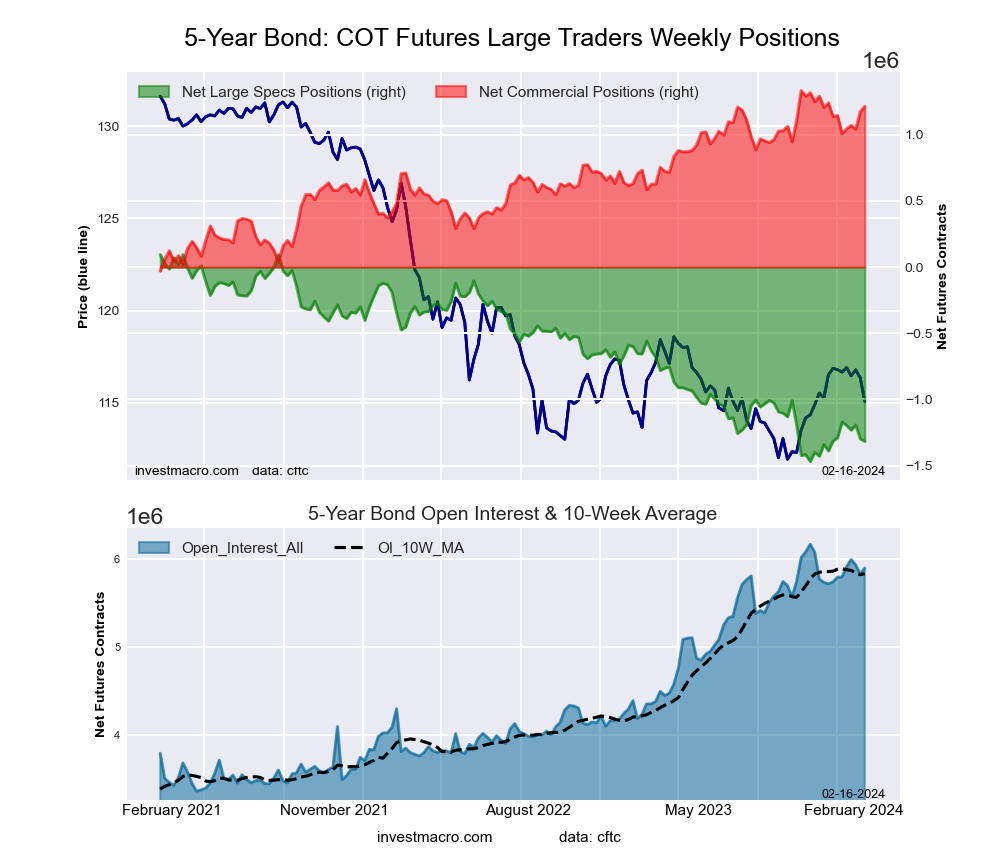
5-Year Treasury Bonds Futures COT ChartThe 5-Year Treasury Note large speculator standing this week came in at a net position of -1,398,500 contracts in the data reported through Tuesday. This was a weekly lift of 70,133 contracts from the previous week which had a total of -1,468,633 net contracts.

This week’s current strength score (the trader positioning range over the past three years, measured from 0 to 100) shows the speculators are currently Bearish-Extreme with a score of 4.5 percent. The commercials are Bullish-Extreme with a score of 93.9 percent and the small traders (not shown in chart) are Bullish-Extreme with a score of 99.2 percent.

Price Trend-Following Model: Weak Downtrend (Possible Trend Change)

Our weekly trend-following model classifies the current market price position as: Weak Downtrend. The current action for the model is considered to be: Hold – Maintain Short Position.

5-Year Treasury Note StatisticsSPECULATORSCOMMERCIALSSMALL TRADERS
– Percent of Open Interest Longs:7.582.17.3
– Percent of Open Interest Shorts:30.561.64.9
– Net Position:-1,398,5001,250,881147,619
– Gross Longs:458,9794,994,986446,125
– Gross Shorts:1,857,4793,744,105298,506
– Long to Short Ratio:0.2 to 11.3 to 11.5 to 1
NET POSITION TREND:
– Strength Index Score (3 Year Range Pct):4.593.999.2
– Strength Index Reading (3 Year Range):Bearish-ExtremeBullish-ExtremeBullish-Extreme
NET POSITION MOVEMENT INDEX:
– 6-Week Change in Strength Index:-17.113.718.2


10-Year Treasury Note Futures:

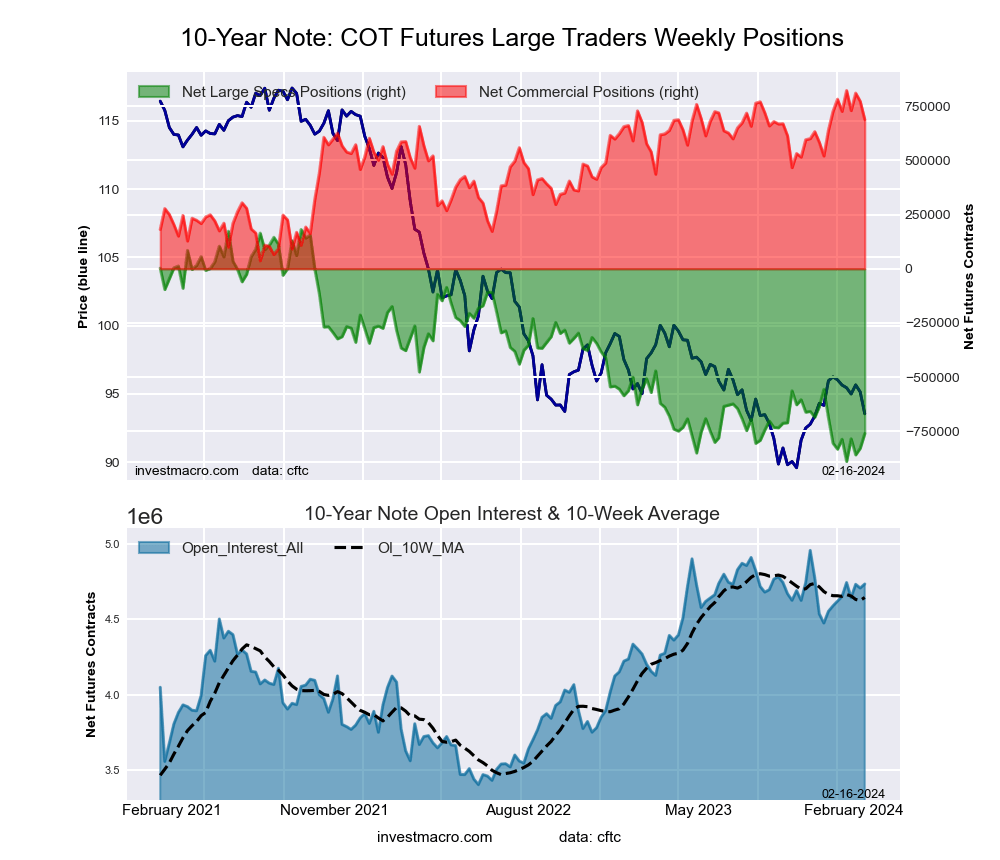
10-Year Treasury Notes Bonds Futures COT ChartThe 10-Year Treasury Note large speculator standing this week came in at a net position of -685,354 contracts in the data reported through Tuesday. This was a weekly decline of -27,196 contracts from the previous week which had a total of -658,158 net contracts.

This week’s current strength score (the trader positioning range over the past three years, measured from 0 to 100) shows the speculators are currently Bearish-Extreme with a score of 16.0 percent. The commercials are Bullish-Extreme with a score of 82.4 percent and the small traders (not shown in chart) are Bullish-Extreme with a score of 84.9 percent.

Price Trend-Following Model: Weak Downtrend (Possible Trend Change)

Our weekly trend-following model classifies the current market price position as: Weak Downtrend. The current action for the model is considered to be: Hold – Maintain Short Position.

10-Year Treasury Note StatisticsSPECULATORSCOMMERCIALSSMALL TRADERS
– Percent of Open Interest Longs:10.777.59.0
– Percent of Open Interest Shorts:25.164.27.9
– Net Position:-685,354632,92452,430
– Gross Longs:510,9933,700,892431,609
– Gross Shorts:1,196,3473,067,968379,179
– Long to Short Ratio:0.4 to 11.2 to 11.1 to 1
NET POSITION TREND:
– Strength Index Score (3 Year Range Pct):16.082.484.9
– Strength Index Reading (3 Year Range):Bearish-ExtremeBullish-ExtremeBullish-Extreme
NET POSITION MOVEMENT INDEX:
– 6-Week Change in Strength Index:2.52.4-9.6


Ultra 10-Year Notes Futures:

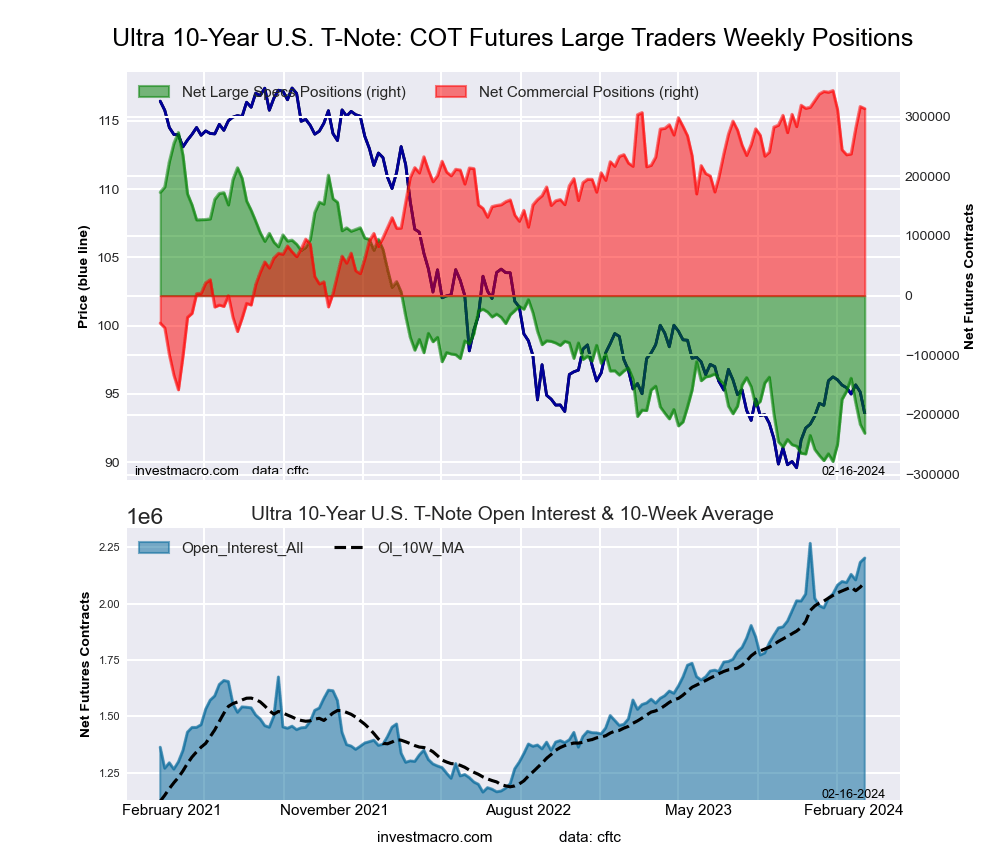
Ultra 10-Year Treasury Notes Bonds Futures COT ChartThe Ultra 10-Year Notes large speculator standing this week came in at a net position of -257,895 contracts in the data reported through Tuesday. This was a weekly decline of -23,489 contracts from the previous week which had a total of -234,406 net contracts.

This week’s current strength score (the trader positioning range over the past three years, measured from 0 to 100) shows the speculators are currently Bearish-Extreme with a score of 1.4 percent. The commercials are Bullish-Extreme with a score of 100.0 percent and the small traders (not shown in chart) are Bullish with a score of 72.9 percent.

Price Trend-Following Model: Weak Uptrend (Possible Trend Change)

Our weekly trend-following model classifies the current market price position as: Weak Uptrend. The current action for the model is considered to be: Hold – Maintain Long Position.

Ultra 10-Year Notes StatisticsSPECULATORSCOMMERCIALSSMALL TRADERS
– Percent of Open Interest Longs:9.978.410.2
– Percent of Open Interest Shorts:22.662.313.6
– Net Position:-257,895327,143-69,248
– Gross Longs:200,1481,587,632206,483
– Gross Shorts:458,0431,260,489275,731
– Long to Short Ratio:0.4 to 11.3 to 10.7 to 1
NET POSITION TREND:
– Strength Index Score (3 Year Range Pct):1.4100.072.9
– Strength Index Reading (3 Year Range):Bearish-ExtremeBullish-ExtremeBullish
NET POSITION MOVEMENT INDEX:
– 6-Week Change in Strength Index:-3.111.1-22.0


US Treasury Bonds Futures:

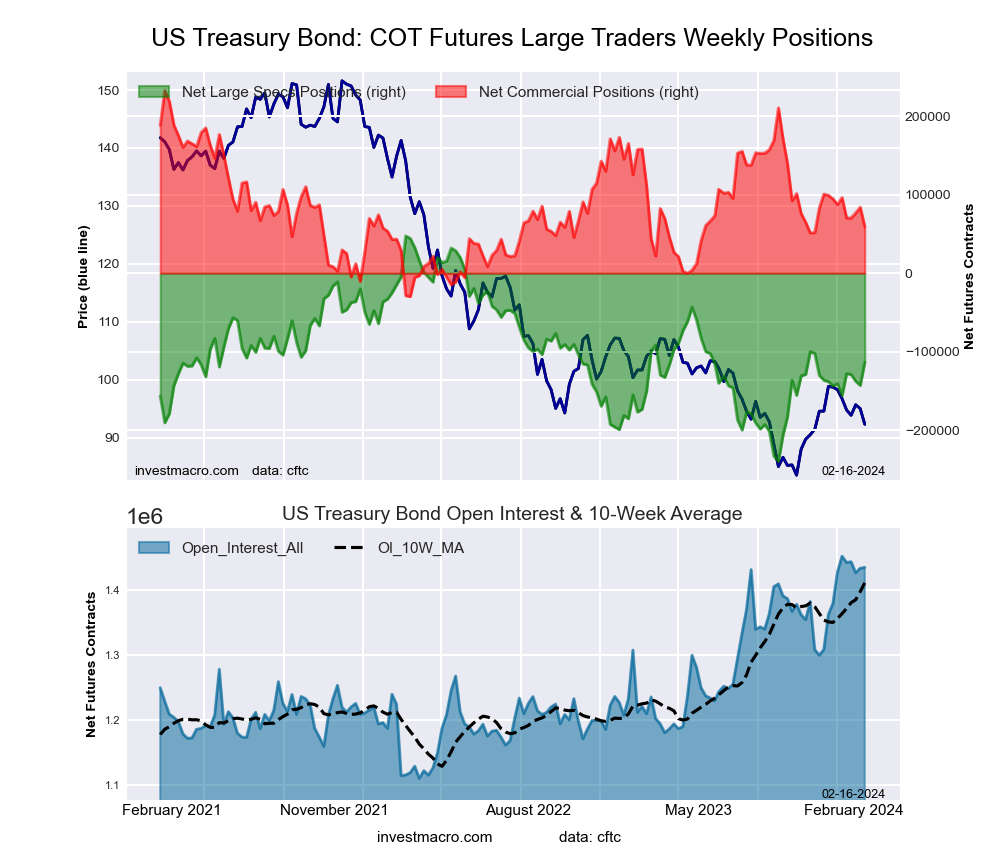
US Year Treasury Notes Long Bonds Futures COT ChartThe US Treasury Bonds large speculator standing this week came in at a net position of -102,176 contracts in the data reported through Tuesday. This was a weekly reduction of -2,193 contracts from the previous week which had a total of -99,983 net contracts.

This week’s current strength score (the trader positioning range over the past three years, measured from 0 to 100) shows the speculators are currently Bearish with a score of 47.9 percent. The commercials are Bearish with a score of 30.3 percent and the small traders (not shown in chart) are Bullish-Extreme with a score of 85.3 percent.

Price Trend-Following Model: Downtrend

Our weekly trend-following model classifies the current market price position as: Downtrend. The current action for the model is considered to be: Hold – Maintain Short Position.

US Treasury Bonds StatisticsSPECULATORSCOMMERCIALSSMALL TRADERS
– Percent of Open Interest Longs:8.275.016.1
– Percent of Open Interest Shorts:16.171.012.2
– Net Position:-102,17651,57350,603
– Gross Longs:107,866980,494210,065
– Gross Shorts:210,042928,921159,462
– Long to Short Ratio:0.5 to 11.1 to 11.3 to 1
NET POSITION TREND:
– Strength Index Score (3 Year Range Pct):47.930.385.3
– Strength Index Reading (3 Year Range):BearishBearishBullish-Extreme
NET POSITION MOVEMENT INDEX:
– 6-Week Change in Strength Index:28.0-32.75.5


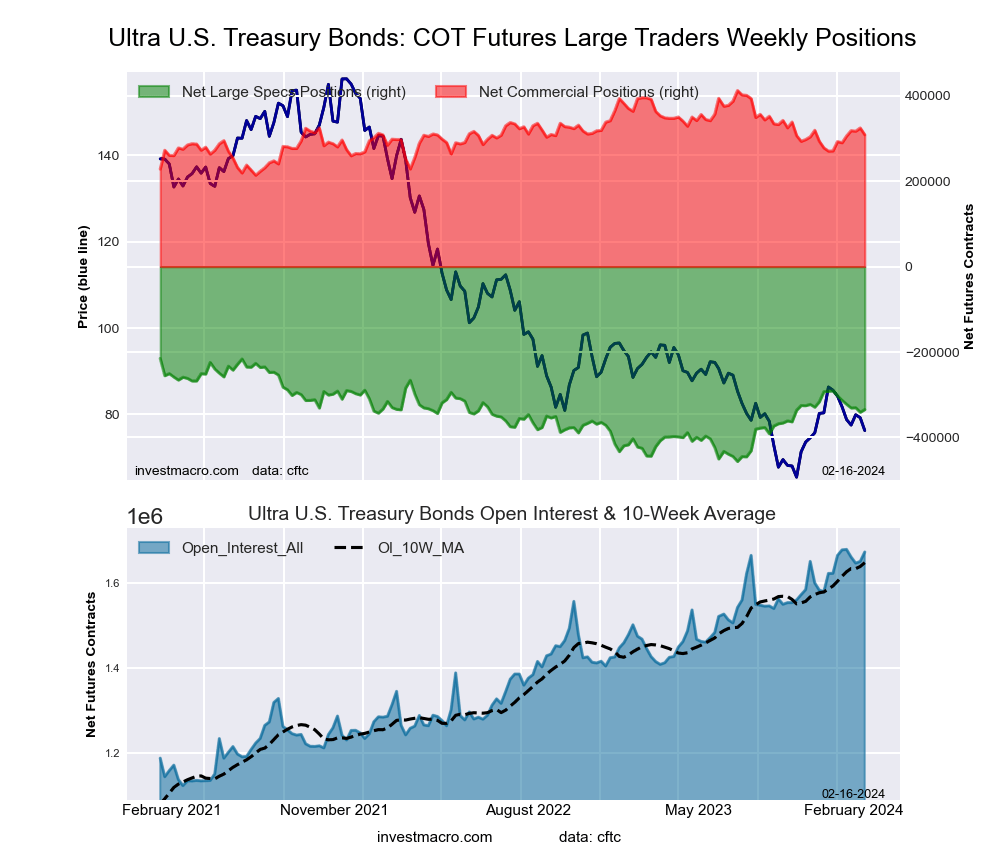
Ultra US Treasury Bonds Futures:

Ultra US Year Treasury Notes Long Bonds Futures COT ChartThe Ultra US Treasury Bonds large speculator standing this week came in at a net position of -329,265 contracts in the data reported through Tuesday. This was a weekly lowering of -6,522 contracts from the previous week which had a total of -322,743 net contracts.

This week’s current strength score (the trader positioning range over the past three years, measured from 0 to 100) shows the speculators are currently Bullish with a score of 51.4 percent. The commercials are Bullish with a score of 53.0 percent and the small traders (not shown in chart) are Bearish with a score of 46.4 percent.

Price Trend-Following Model: Downtrend

Our weekly trend-following model classifies the current market price position as: Downtrend. The current action for the model is considered to be: Hold – Maintain Short Position.

Ultra US Treasury Bonds StatisticsSPECULATORSCOMMERCIALSSMALL TRADERS
– Percent of Open Interest Longs:6.081.511.0
– Percent of Open Interest Shorts:26.561.510.4
– Net Position:-329,265319,4419,824
– Gross Longs:95,4301,304,297176,634
– Gross Shorts:424,695984,856166,810
– Long to Short Ratio:0.2 to 11.3 to 11.1 to 1
NET POSITION TREND:
– Strength Index Score (3 Year Range Pct):51.453.046.4
– Strength Index Reading (3 Year Range):BullishBullishBearish
NET POSITION MOVEMENT INDEX:
– 6-Week Change in Strength Index:13.0-2.9-25.0


Article By InvestMacroReceive our weekly COT Newsletter

*COT Report: The COT data, released weekly to the public each Friday, is updated through the most recent Tuesday (data is 3 days old) and shows a quick view of how large speculators or non-commercials (for-profit traders) were positioned in the futures markets.

The CFTC categorizes trader positions according to commercial hedgers (traders who use futures contracts for hedging as part of the business), non-commercials (large traders who speculate to realize trading profits) and nonreportable traders (usually small traders/speculators) as well as their open interest (contracts open in the market at time of reporting). See CFTC criteria here.