Archive for Financial News – Page 144

Crude: Capped below weekly resistance?

By ForexTime 

  • Crude up almost 2% this week
  • Watch out for EIA report & Fed decision
  • Weekly resistance at $83.64
  • Possible bearish scenario on H4
  • Key levels of interest at $81.25

Our focus falls on US crude oil which is currently hovering around levels not seen in over four months!

The global commodity is up almost 2% this week thanks to geopolitical tensions, Iraq’s pledge to cut crude exports, and the American Petroleum Institute (API) reporting a fall in US crude stockpiles.

Watch this space because more volatility could be on the cards due to the incoming Energy Information Administration (EIA) report and highly anticipated Fed rate decision. 

While the central bank is widely expected to leave rates unchanged, all eyes will be on the dot projection and Powell’s press conference for clues on rate cut timings.

  • Oil prices could extend gains if the central bank strikes a dovish tone and signals that three rate cuts are still on the cards in 2024.
  • However, if the Fed sounds more hawkish than expected, signaling that US rates will remain higher for longer – oil bears may enter the scene as the dollar appreciates.

Looking at the technical picture, crude oil is currently busy with a strong impulse wave that exploded out of a previous slow and steady uptrend.

The price almost reached a weekly resistance level. This might create a short opportunity on the lower time frames.

On the 4-hour chart, an extended uptrend can be seen with a correction wave in progress. The price is close to the weekly resistance level and the manual trendline has been broken. The longer price cycle Moving Average Convergence Divergence (MACD) Oscillators is still bullish, but the signal line has been broken and this might hint at a possible overbought scenario. A market that is in an overbought state may well slow down and then a possible reversal can be on the books.

This will need to be confirmed by a lower top and then a lower bottom.

If this does happen, a possible scenario can be seen in the chart below.

When the price reaches the $81.25 level, a possible short scenario will become feasible.

Attaching a modified Fibonacci tool to the trigger level at $81.25 and dragging it above the weekly resistance level at $83.80, four conservative targets can be established:

  • First target at $80.22

  • Second target at $79.71

  • Third price target at $78.69

  • Fourth and last price target at $77.41

If the price breaks past $83.80, this opportunity is no longer valid.


Forex-Time-LogoArticle by ForexTime

ForexTime Ltd (FXTM) is an award winning international online forex broker regulated by CySEC 185/12 www.forextime.com

The Bank of Japan is finally out of negative rate territory. The RBA left the rate unchanged but removed the hawkish bias

By JustMarkets

The Dow Jones Index (US30) was up 0.20% at Monday’s stock market close. The S&P 500 Index (US500) added 0.63%. The NASDAQ Technology Index (US100) closed positive 0.82%. Tesla (TSLA) stock price rose more than 6% and led the S&P 500 and Nasdaq 100 stocks higher after the company announced on website X that it would raise the price of all US Model Y vehicles by $1,000 on April 1. Alphabet (GOOGL) stock is up more than 4% after it was reported that Apple is in talks to embed Google’s Gemini artificial intelligence search engine into the iPhone.

Canada’s inflation report will be released today. No changes in the figures are expected, so the Canadian dollar will likely be affected by volatility. However, any deviations from the consensus forecast could trigger a strong rally. Remember that when inflation rises, the domestic currency tends to strengthen on expectations of a more hawkish central bank stance.

Equity markets in Europe were mostly down on Monday. Germany’s DAX (DE40) was down 0.02%, France’s CAC 40 (FR40) fell by 0.20% yesterday, Spain’s IBEX 35 (ES35) decreased by 0.01% and the UK’s FTSE 100 (UK100) closed negative 0.06%.

ECB Governing Council spokesman de Kos said yesterday that the ECB has achieved its goal of bringing inflation to 2%, which is compatible with an interest rate cut in the near term. Swaps put the odds of a 25 bps ECB rate cut at 7% at the next meeting on April 11 and 80% at the June 6 meeting.

Silver gained support yesterday on the back of global economic news on Monday. This news showed that February industrial production in China rose more than expected and that the March NAHB housing market index in the US unexpectedly rose, which is favorable for industrial metals demand.

Asian markets were up yesterday. Japan’s Nikkei 225 (JP225) ended the day up 2.67%, China’s FTSE China A50 (CHA50) added 0.57%, Hong Kong’s Hang Seng (HK50) jumped by 0.97% on the day, and Australia’s ASX 200 (AU200) was positive 0.07%. Chinese stocks rose on Monday as data showed that retail sales, industrial production, and fixed asset investment in China rose more than expected in the year’s first two months. Traders now await tomorrow’s People’s Bank of China’s (PBoC) decision on one-year and five-year loans. No changes are expected, but volatility on Asian indices could rise markedly.

The Bank of Japan (BoJ) raised interest rates to 0% from 0.1% for the first time since 2007, ending eight years of negative rates amid rising wages and high inflation. The central bank also abandoned its policy of controlling the yield curve, no longer targeting 10-year bond yields. In addition, the board agreed to stop buying ETFs and J-REITs and to gradually reduce its purchases of commercial paper and corporate bonds, with plans to stop buying bonds completely in about a year.

The Reserve Bank of Australia (RBA) left rates unchanged at 4.35%, as expected, but retracted its previous warning that further rate hikes were not ruled out. This indicates confidence that inflation will continue to fall and raises bets that the RBA may start cutting rates later this year. Markets are pricing in the first rate cut in August, predicting 40 basis points of overall easing this year.

S&P 500 (US500) 5,149.42 +32.33 (+0.63%)

Dow Jones (US30) 38,790.43 +75.66 (+0.20%)

DAX (DE40) 17,932.68 −3.97 (−0.02%)

FTSE 100 (UK100) 7,722.55 −4.87 (−0.06%)

USD Index 103.58 +0.15 (+0.15%)

Important events today:
  • – Japan BoJ Interest Rate Decision at 04:30 (GMT+2);
  • – Japan BoJ Monetary Policy Statement at 04:30 (GMT+2);
  • – Australia RBA Interest Rate Decision at 05:30 (GMT+2);
  • – Australia RBA Rate Statement at 05:30 (GMT+2);
  • – German ZEW Economic Sentiment (m/m) at 12:00 (GMT+2);
  • – Eurozone ZEW Economic Sentiment (m/m) at 12:00 (GMT+2);
  • – US Building Permits (m/m) at 14:30 (GMT+2);
  • – Canada Consumer Price Index (m/m) at 14:30 (GMT+2).

By JustMarkets


This article reflects a personal opinion and should not be interpreted as an investment advice, and/or offer, and/or a persistent request for carrying out financial transactions, and/or a guarantee, and/or a forecast of future events.

SG20 index: more dividends, less volatility

By ForexTime

  • FXTM launches brand new SG20 stock index
  • SG20 has highest dividend yield of all FXTM stock indices
  • SG20: most stable Asian stock index within FXTM universe
  • SG20 has strong positive correlation with spot gold
  • Wall Street forecasts that this stock index could rise by another 14%


FXTM’s new SG20 index may be enticing for range traders who enjoy consistent cash payouts.


What is a stock index?

Imagine a stock index being a basket of many different stocks.

The index measures the overall performance of those stocks inside that “basket”.


What does the SG20 stock index track?

FXTMs SG20 stock index tracks the performance of the MSCI Singapore Index.

Note that this MSCI Singapore index is not the same as the benchmark Straits Times index, which is maintained by the FTSE.

This MSCI Singapore index aims to capture the overall performance of 22 different large- and mid-cap stocks in Singapore.

Together, those 22 stocks make up about 85% of the entire Singaporean stock market.


3 key things to know about the SG20 index:


1) Singaporean banks are the largest members of this index

Singapore is a city-state that is also known for its status as a “safe haven”, especially for the Asian region.

As a result, its financial sector tends to attract outsized fund inflows, benefitting its banks.

No surprise then that DBS Group, OBCB Bank, and UOB, combine to make up nearly half (48.17%) of the entire SG20 index.


2) Least volatile Asian stock index within FXTM universe

Of the 6 different Asian stock indices, the SG20 index has the lowest 30-day volatility figure, as of today (Tuesday, March 19th).

  • SDG20: 10.9
  • TWN: 13.2
  • JP225: 15.8
  • CN50: 17.1
  • HK50: 23.6
  • CHINAH: 27.5


Here are more data points to showcase the SG20 index’s relative stability:

  • SG20 index is faring better than Singapore’s benchmark Straits Times index

The SG20 index is up 1.25% so far in 2024.

Compare that to Singapore’s benchmark stock index (FTSE Straits Times index), which has dropped by by more than 2% so far in 2024.

While the performance of Singaporean stocks are in stark contrast to the many stock indices around the world that have printed fresh record highs this year …

SG20 index appears to putting in a relatively steady shift so far this year.
 

  • SG20 index has a strong correlation with gold

To buffer the notion of Singapore as a “safe haven”, this SG20 index tends to mirror the performance of another famed “safe haven” asset: gold.

Over any given 5-day period from the past 20 years, both XAUUSD (gold) and this SG20 index have moved in the same direction 51% of the time (positive correlation.

NOTE: According to Bloomberg data, gold and SG20 have a positive correlation of 0.51, over a rolling 5-day period from the past 20 years. A number of 0.5 or higher indicates a strong correlation.


3) SG20 has highest dividend yield of all FXTM Stock Indices

Over the past 12 months, this SG20 index has paid out a dividend yield of 4.7% (based on current prices).

That’s significantly higher than the dividend yields currently offered by other popular stock indices (based on current prices):

  • UK100: 4%
  • EU50: 2.9%
  • JP225: 1.6%
  • US500: 1.4%
  • NAS100: 0.8%


But wait, there’s more!

Over the next 12 months, Wall Street analysts forecast that members of the SG20 index will pay out EVEN MORE dividends.

This is expected to bring the forward 12-month yield up to 4.9%.


What is a “dividend yield”?

Dividend yield is a % number representing how much money an investor gets for buying and holding an asset.

The higher the yield, the more dividends the investor receives, as a ratio of what was originally invested.

Dividends are cash rewards that are given by companies (in this case, companies that are included in the SG20 index) to its shareholders.

Hence, holders of assets linked to the SG20 index, such as Exchange-Traded Funds (ETF) or even Contracts for Differences (CFD), often are entitled to similar dividends as well.


Where’s SG20 headed next?

Over the next 12 months, Wall Street analysts predict this SG20 index could return to the 330 mark.

From current prices, this implies about 14% in potential gains.

For proper context, a number around 330 would only restore the SG20 index to levels not seen since 2022.

That would still pale in comparison to the SG20 index’s all-time intraday high of 481.23 posted 10th October 2007, before the Global Financial Crisis.


SG20 bulls (those hoping that prices will rise) will be hoping that the Asian “safe haven” economy can continue registering steady growth, benefitting the city-state’s financial sector along the way.

If such an outlook proves true, then …

Traders and investors may yet enjoy more gains amid less-volatile prices, while collecting healthy dividends along the way.


Forex-Time-LogoArticle by ForexTime

ForexTime Ltd (FXTM) is an award winning international online forex broker regulated by CySEC 185/12 www.forextime.com

Brent Oil Prices Continue to Surge, Reaching New Peaks

By RoboForex Analytical Department

Brent crude oil continues its rally, reaching peak values since early November 2023, with prices around USD 87.00 per barrel. Investor concerns over commodity supply, particularly due to tensions in several oil-producing countries, significantly influence quotes by incorporating potential supply disruptions.

Iraq has announced a reduction in crude oil exports to 3.300 million barrels per day soon to compensate for OPEC+ quota implementations. This reduction marks the second consecutive month of export decreases, including in Saudi Arabia, where exports dropped to 6.297 million barrels per day from the previous 6.308 million.

Despite these cuts, global demand for energy remains high. Recent statistics from China have shown a confident retail sales and industrial production sector and a stable outlook for oil demand this year.

It is important to note that a five-session rally of the US dollar could act as a headwind for the oil market. The American currency is at a two-week high against its major counterparts, making commodity purchases more expensive for investors holding other currencies.

Market projections concerning demand for aviation fuel during the summer season are not very confident at this time. There is a risk this could affect the global upward trend in oil. Due to increased summer travel activity, world prices for aviation fuel in Q3 2024 are expected to be 5-6% higher than previous forecasts, reaching around USD 111.00 per barrel. However, the number of flights remains low due to the global economic situation, which could pressure the market and the cost of aviation fuel.

Brent Technical Analysis

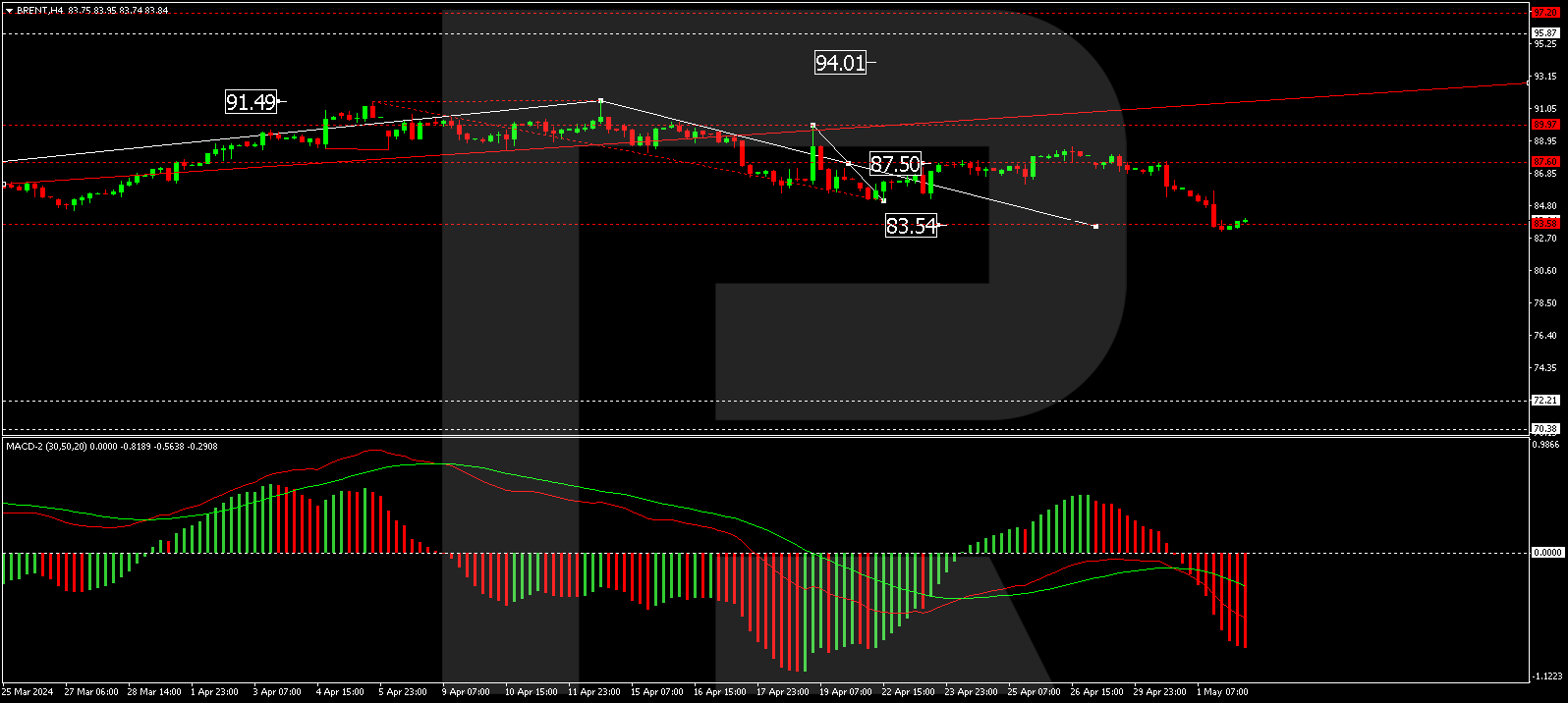
The H4 Brent chart has formed a consolidation range around 84.33, with the market breaking upward to 86.60. A decrease to 85.70 could occur today, followed by a new growth structure towards 87.87, a local target. A correction back to 84.33 might follow, then an increase to 88.48 as the first target. The MACD indicator supports this scenario, with its signal line above zero and poised to reach new highs.

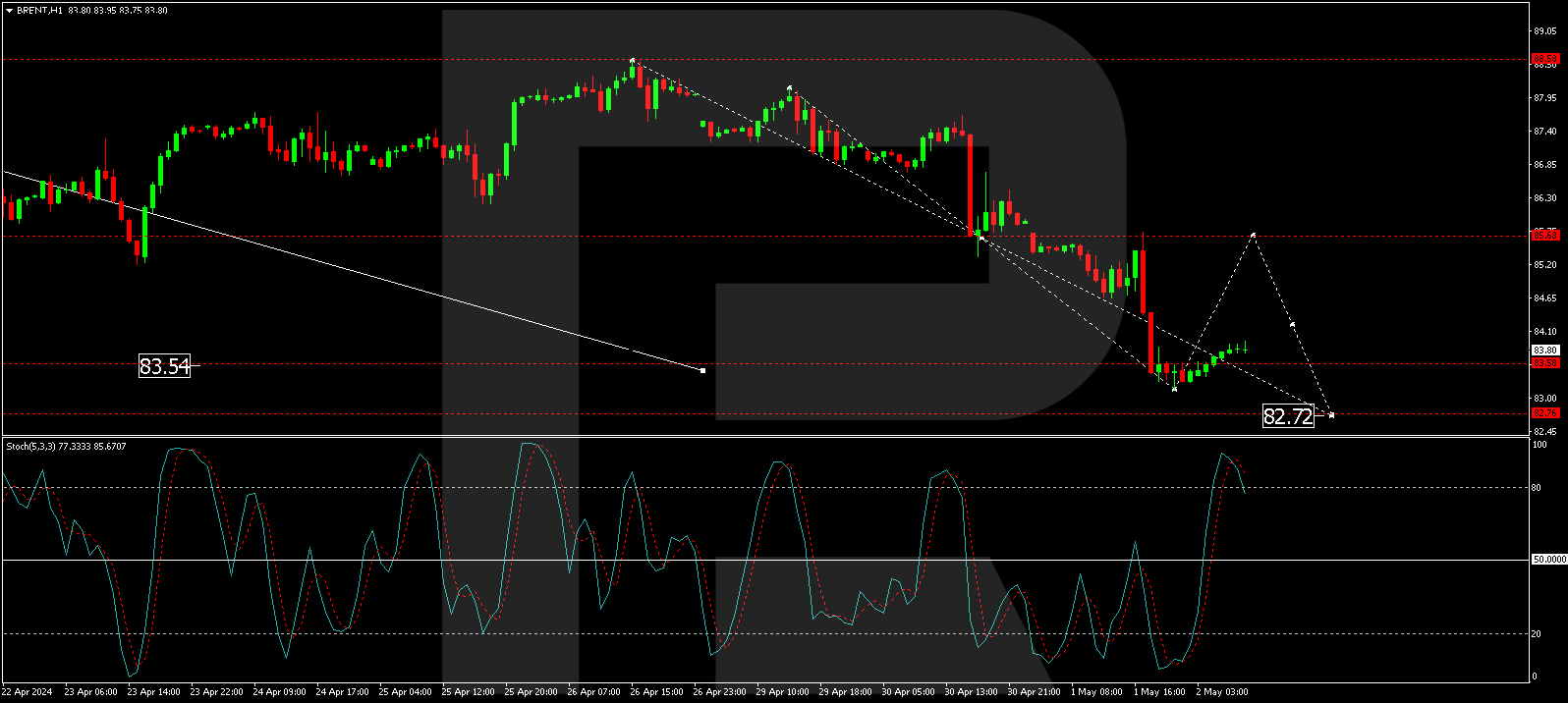
On the H1 Brent chart, a growth wave structure towards 88.00 is forming. This is a local target, following which a correction to 84.40 (testing from above) is considered, with expectations for the continuation of the growth wave to 88.50. This scenario is technically supported by the Stochastic oscillator, whose signal line is below 20, indicating the start of a rise towards 50 with the potential to continue to 80.


Disclaimer

Any forecasts contained herein are based on the author’s particular opinion. This analysis may not be treated as trading advice. RoboForex bears no responsibility for trading results based on trading recommendations and reviews contained herein.

Trade Of The Week: EURCHF to challenge major resistance?

By ForexTime 

  • EURCHF bullish on D1/W1 charts
  • Big week for minor currency
  • Watch out for EU data + SNB decision
  • Key level of interest at 0.9640
  • Bloomberg model: 76% chance EURCHF – (0.95270 – 0.97098)

Our focus falls on the EURCHF which could be rocked by the EU data dump and Swiss National Bank (SNB) rate decision this week.

The minor currency pair remains bullish on the daily/weekly timeframe with prices approaching a key resistance level at 0.9700.

Note: The last time the EURCHF secured a weekly close above 0.9700 was back in July 2023.

With volatility likely to remain the name of the game for the EURCHF, a major breakout could be on the horizon.

Here are 3 factors to keep an eye on:

  1. SNB rate decision 

The SNB is widely expected to keep interest rates unchanged at 1.75% on Thursday. So, investors will direct their attention towards the policy statement, news conference, and CPI projections for clues on the central bank’s next move.

Given how economic growth held steady and 0.3% in Q4 and inflation edged down to 1.2% in February, the SNB is expected to move ahead with its first rate cut at the next policy meeting in June.

Traders are currently pricing in a 25% probability of a 25-basis point SNB cut in March with a cut fully priced in by June 2024.

  • The CHF could weaken if the SNB strikes a dovish note and signals that the next move will be a rate cut. Such an outcome may push the EURCHF higher.
  • Should the SNB sound more hawkish than expected and offer no fresh clues on rate cuts, this may support the Swiss Franc, dragging the EURCHF lower as a result.


  1. Key EU data 

This is a week packed with top-tier economic data from Europe which could impact bets around when the ECB will start cutting interest rates in 2024. 

On Monday, the Eurozone inflation in February was confirmed at 2.6% year-on-year, down from the 2.8% seen in January. While this was the lowest rate in three months, it’s still above the ECB’s target of 2%. It will be wise to keep a close eye on the Eurozone consumer confidence and PMIs along with top data on Germany, the largest economy in Europe.

Traders are currently pricing in an 80% probability of a 25-basis point ECB cut by June with a cut fully priced by July 2024. 

  • Should overall data from Europe support expectations around the ECB cutting interest rates by Summer, this is likely to weaken the euro – sending the EURCHF lower.
  • A positive set of economic reports that push back rate cut bets may support the EUR, sending the EURCHF towards the 0.9700 resistance.


  1. Technical forces

The EURCHF is respecting a bullish channel on the daily timeframe and trading above the 50, 100 and 200-day SMA.

  • A solid breakout and daily close above 0.9640 may open a path towards 0.9700 – a level not seen since July 2023.
  • Should prices slip below 0.9590, this could trigger a selloff towards the 200-day SMA at 0.9558 and 0.9530.

Bloomberg’s FX model points to a 76% chance that EURCHF will trade within the 0.95270 – 0.97098 range over the next week.


Forex-Time-LogoArticle by ForexTime

ForexTime Ltd (FXTM) is an award winning international online forex broker regulated by CySEC 185/12 www.forextime.com

US stock indices are under quarterly expiration pressure. The focus of attention this week is on central bank meetings

By JustMarkets

As of Friday’s stock market close, the Dow Jones Index (US30) decreased by 0.49% (for the week +0.12%). The S&P 500 Index (US500) lost 0.65% (for the week +0.10%). The NASDAQ Technology Index (US100) closed negative 0.96% (for the week -0.49%). Last week, the real estate, health care, and technology sectors were the biggest laggards, while energy, communication services, and commodities outperformed the market. The moves came as stronger-than-expected US inflation data raised concerns that the central bank may further delay interest rate cuts. The Fed had initially planned to start cutting rates in March, but that deadline was then pushed back to June and could now be pushed back even further. The rate is expected to remain at 5.5%, but the real factor could be the conference call after the meeting. If Powell begins to back away from cutting rates this summer, it could put further pressure on the indices.

Friday saw a huge quarterly derivatives expiration in the US market, accounting for $5.1 trillion in index and equity options. Since the consensus has been bullish in equities recently, market makers now have huge hedging long positions open in equities and indices. Once the derivatives expire, market makers will get rid of this hedge and thus put pressure on the stock market. Statistically, corrections in bull markets have often occurred in periods of quarterly expirations. Perhaps now it will help the indices to let off a little steam.

The Nvidia GTC developer conference, which begins today, will be closely watched in anticipation of announcements related to artificial intelligence. Investors will undoubtedly want to hear announcements that keep the company’s stock skyrocketing. CEO Jensen Huang will deliver the keynote address and possibly offer attendees a first look at its newest products, including the next-generation B100 GPU for artificial intelligence and high-performance computing applications. Nvidia’s stock gains over the past year have increased its market value by $1 trillion, putting it at the top of the S&P 500 Index.

In addition to the Fed meeting, internationally, investors’ attention this week will be focused on interest rate decisions from Japan, the UK, Australia, Brazil, Turkey, Switzerland, and Norway. In addition, inflation data from Canada, the UK, South Africa, and Japan will be the focus.

Equity markets in Europe were mostly down on Friday. Germany’s DAX (DE40) was down 0.03% (for the week +1.39%), France’s CAC 40 (FR40) added 0.04% (for the week +2.24%) on Friday, Spain’s IBEX 35 (ES35) was up 1.02% (for the week +3.09%), and the UK’s FTSE 100 (UK100) closed negative 0.20% (for the week +0.88%).

Oil prices rose nearly 4% last week as the International Energy Agency released an optimistic demand outlook and predicted a small deficit this year. WTI crude prices rose above $81 a barrel on Monday, extending last week’s gains, as heightened geopolitical risks raise supply concerns. Ukraine has stepped up drone strikes on Russian refineries over the past week, shutting down about 7% of Russian refining capacity in the first quarter. Israeli Prime Minister Benjamin Netanyahu also said he would press ahead with plans to push into the Rafah enclave in the Gaza Strip, complicating the chances of a peace deal.

Silver prices climbed above the $25 an ounce mark on Friday and were up more than 4% for the week, driven by safe-haven demand as investors sought refuge from increased military and inflation risks. The latest US consumer price index and producer price index data came in stronger than expected. At the same time, geopolitical tensions on the global stage intensified after Russia moved its tactical nuclear weapons closer to NATO.

US natural gas prices fell below $1.7 per Mmbbl on Friday, marking a more than 6% decline for the week. This was driven by forecasts of mild weather that would reduce the demand for gas for heating. Despite the larger-than-expected withdrawals, the latest EIA data shows gas in storage is still 37.1 percent above average for this time of year.

Asian markets traded flat yesterday. Japan’s Nikkei 225 (JP225) was down 1.34% for the week, China’s FTSE China A50 (CHA50) was up 2.04% for the 5 trading days, Hong Kong’s Hang Seng (HK50) was up 1.86% for the week, and Australia’s ASX 200 (AU200) was negative 1.88%. Asian equity markets mostly rose on Monday as investors were cheered by better-than-expected Chinese retail sales and industrial production figures for the first two months of this year. However, China’s urban unemployment rate stood at 5.3% in January-February 2024, up from 5.1% in December. This is the highest rate since July last year.

The all-important Bank of Japan meeting will be held as early as tomorrow. Signs that employers are planning significant wage increases seem to have inclined the central bank to finally abandon the massive monetary easing that has been applied for years to stimulate growth in the country. The last time the rate was raised was 17 years ago. The current meeting has a 56% chance of a +10bp BoJ rate hike.

S&P 500 (US500) 5,117.09 −33.39 (−0.65%)

Dow Jones (US30) 38,714.77 −190.89 (−0.49%)

DAX (DE40) 17,936.65 −5.39 (−0.03%)

FTSE 100 (UK100) 7,727.42 −15.73 (−0.20%)

USD Index 103.45 +0.02 (+0.01%)

Important events today:
  • – China Industrial Production (m/m) at 04:00 (GMT+2);
  • – China Retail Sales (m/m) at 04:00 (GMT+2);
  • – China Unemployment Rate (m/m) at 04:00 (GMT+2);
  • – Eurozone Consumer Price Index (m/m) at 12:00 (GMT+2);
  • – Eurozone Trade Balance (m/m) at 12:00 (GMT+2).

By JustMarkets


This article reflects a personal opinion and should not be interpreted as an investment advice, and/or offer, and/or a persistent request for carrying out financial transactions, and/or a guarantee, and/or a forecast of future events.

AUD/USD Stabilizes Amid Chinese Economic Data and US Inflation Concerns

By RoboForex Analytical Department

The Australian dollar has momentarily halted its downward trajectory against the US dollar, stabilizing around the 0.6565 mark. With a lack of significant domestic data from Australia, the AUD’s movements are largely influenced by the performance of the Chinese yuan and economic developments from China. Recently, the offshore yuan weakened to its lowest in a week at 7.2 against the US dollar, following a series of macroeconomic updates from China.

China’s industrial output showed an impressive year-on-year increase of 7.0%, exceeding both the anticipated 6.5% growth and the previous rate of 4.6%. Capital investment also outperformed expectations, registering a 4.2% year-on-year rise compared to the forecasted 3.2%. Retail sales growth in February was reported at 5.5% year-on-year, albeit a slowdown from January’s 7.4% increase. Additionally, the January employment report indicated a slight uptick in unemployment, rising to 5.3% from the prior 5.1%.

Despite these positive indicators from China, the yuan’s valuation remains pressured by robust US inflation data, which complicates the Federal Reserve’s pathway to easing monetary policy. The prevailing market expectation now leans towards a potential 25 basis point rate cut by the Fed in June, with around a 60% probability of this outcome, a shift from earlier predictions of a spring rate cut.

Given Australia’s close economic and trade ties with China, these statistics from China are particularly significant for the AUD’s performance.

Technical analysis of AUD/USD

The H4 chart analysis of AUD/USD indicates a consolidation phase around the 0.6570 level, with expectations of a downward breakout leading to the continuation of the decline towards the local target of 0.6506. After reaching this target, a potential corrective movement to 0.6570 (testing from below), followed by a further drop to 0.6477, is anticipated. The MACD indicator, with its signal line pointing downwards, supports this bearish scenario.

On the H1 chart, the AUD/USD pair has concluded its declining wave structure at 0.6570, with a consolidation phase currently observed around this mark. A downward breakout from this consolidation is expected today, aiming for the 0.6506 level. Upon achieving this target, the onset of a corrective phase to 0.6570 (testing from below) may be considered. The Stochastic oscillator, currently above 80 and poised to descend to 20, corroborates the likelihood of this continuation in the bearish trend.

Disclaimer

Any forecasts contained herein are based on the author’s particular opinion. This analysis may not be treated as trading advice. RoboForex bears no responsibility for trading results based on trading recommendations and reviews contained herein.

Week Ahead: 5 stock indices to watch

By ForexTime 

  • RUS2000 braced for Fed
  • AU200 waits on RBA
  • JP225 breakout on horizon?
  • CN50 respects bullish channel
  • UK100 set for big move?

A wave of key central bank decisions may present fresh trading opportunities in the week ahead!

Watch out for the Federal Reserve (Fed), Bank of Japan (BoJ) and Bank of England (BoE) among other heavyweights:

Monday, 18th March  

  • CN50: China industrial production, retail sales, fixed assets
  • EUR: Eurozone CPI
  • JPY: Japan machinery orders

Tuesday, 19th March

  • AU200: RBA rate decision
  • JP225: BOJ rate decision
  • CAD: Canada CPI
  • EUR: Germany ZEW survey expectations

Wednesday, 20th March

  • CN50: China loan prime rates
  • EUR: Eurozone consumer confidence
  • GBP: UK CPI
  • RUS2000: Fed rate decision

Thursday, 21st March

  • AUD: Australia unemployment
  • JPY: Japan trade, Jibun Bank manufacturing PMI
  • UK100: BoE rate decision
  • CHF: SNB rate decision
  • EUR: Eurozone S&P Global PMI’s, Germany manufacturing PMI
  • USD: US conference Board leading index, initial jobless claims

Friday, 22nd March  

  • JPY: Japan CPI
  • NZD: New Zealand trade
  • CAD: Canada retail sales
  • EUR: Germany IFO business climate
  • USD: Atlanta Fed President Raphael Bostic speech

Our focus falls on 5 indices which could be rocked by 5 central bank announcements:

    1) RUS2000 braced for Fed

The RUS2000 which tracks the underlying Russell 2000 Index could see heightened levels of volatility due to the Fed rate decision.

This index is composed of smaller stocks that are more volatile compared to those in large-cap indexes.

In fact, since the start of H2 2023 the RUS2000 has shown the most sensitivity on Fed rate decision day when compared to the S&P500, Nasdaq 100, S&P400, and even Dow Jones!

Markets widely expect the Fed to leave rates unchanged in March, so much focus will be on the updated dot plot and Powell’s press conference for clues on rate cut timings.

Looking at technical prices are under pressure on the H4 charts with support found at 2015 and resistance around 2090.

    2) AU200 waits on RBA

Despite Friday’s rebound, the AU200 which tracks the underlying ASX 200 Index is en route to ending this week on a negative note.

Nevertheless, the index could be supported by the upcoming RBA meeting in the week ahead.

The central bank is expected to leave rates unchanged at 4.35% so it’s all about the policy statement for insight into the RBA’s next move. Ultimately, any hint around rate cuts down the road may keep the index buoyed.

Traders are currently pricing in a 64% probability of a 25 basis point RBA cut by June 2024.

Looking at the charts, a technical rebound could be brewing with a breakout above 7765 bringing bulls back into the game, opening a path back towards the all-time high.

    3) JP225 breakout on horizon?

Things could get wild for the JP225 as expectations mount around the BoJ ending its negative rates.

Note: The JP225 tracks the Nikkie 225 index and tends to weaken when the Yen strengthens, vice versa.

Markets are currently pricing in almost a 60% probability that the BoJ will scrap its negative rates next week, with the probability of a hike in April jumping to 70%.

Should the central bank make a move next week or confirm that rates will be hiked in April, this may trigger a potential breakout on the JP225. Focusing on the charts, support can be found at 38300 and resistance at 39250.


    4) CN50 respects bullish channel

It is a big week for the CN50 due to key economic indicators from China and the loan prime rate decision from Chinese banks which is announced by the PBoC. The CN50 tracks the benchmark FTSE China A50 Index and has gained over 14% since the low back in January 2024.

Note: China’s central bank left its key policy rates unchanged today.

The index is likely to be influenced not only by fundamental forces but technical factors. Prices are bullish with further upside on the cards beyond 12240.


    5) UK100 set for big move?

After swinging within a range on the weekly charts, the UK100 which tracks the underlying FTSE100 index could be preparing for a breakout.

This may be triggered by the incoming UK inflation data and BoE rate decision in the week ahead.

Markets widely expect the BoE to leave interest rates unchanged at 5.25% for the fifth straight meeting, so all attention will be on the policy statement and how many MPC members voted to cut rates. Given how this event is likely to impact the pound, it may be reflected in the UK100.

Note: When the pound appreciates, it results in lower revenues for FTSE100 companies that acquire sales from overseas, pulling the UK100 lower as a result. The same is true vice versa.

Regarding the charts, a solid weekly close above 7740 could open a path back towards 7930. Should this level prove to be reliable resistance, prices may slip back towards 7575.


Forex-Time-LogoArticle by ForexTime

ForexTime Ltd (FXTM) is an award winning international online forex broker regulated by CySEC 185/12 www.forextime.com

COT Metals Charts: Speculator Bets led by Silver & Platinum

By InvestMacro

Here are the latest charts and statistics for the Commitment of Traders (COT) data published by the Commodities Futures Trading Commission (CFTC).

The latest COT data is updated through Tuesday March 12th and shows a quick view of how large traders (for-profit speculators and commercial entities) were positioned in the futures markets.

Weekly Speculator Changes led by Silver & Platinum

The COT metals markets speculator bets were higher this week as five out of the six metals markets we cover had higher positioning while the other one markets had lower speculator contracts.

Leading the gains for the metals was Silver (12,663 contracts) with Platinum (11,783 contracts), Copper (10,754 contracts), Gold (10,309 contracts) and Palladium (2,016 contracts) also showing positive weeks.

The only metals market with declines in speculator bets was Steel with a reduction by -560 contracts on the week.


Metals Net Speculators Leaderboard

Legend: Weekly Speculators Change | Speculators Current Net Position | Speculators Strength Score compared to last 3-Years (0-100 range)


Strength Scores led by Steel & Silver

COT Strength Scores (a normalized measure of Speculator positions over a 3-Year range, from 0 to 100 where above 80 is Extreme-Bullish and below 20 is Extreme-Bearish) showed that Steel (88 percent) and Silver (82 percent) lead the metals markets this week. Gold (67 percent) comes in as the next highest in the weekly strength scores.

On the downside, Palladium (18 percent) comes in at the lowest strength level currently and is in Extreme-Bearish territory (below 20 percent).

Strength Statistics:
Gold (67.3 percent) vs Gold previous week (62.6 percent)
Silver (81.9 percent) vs Silver previous week (62.6 percent)
Copper (46.0 percent) vs Copper previous week (33.9 percent)
Platinum (35.9 percent) vs Platinum previous week (6.0 percent)
Palladium (17.7 percent) vs Palladium previous week (5.5 percent)
Steel (87.8 percent) vs Palladium previous week (89.9 percent)


Silver & Gold top the 6-Week Strength Trends

COT Strength Score Trends (or move index, calculates the 6-week changes in strength scores) showed that Silver (30 percent), Gold (24 percent) and Copper (16 percent) lead the past six weeks trends for metals.

Platinum (-10 percent) leads the downside trend scores currently with Steel (-0.2 percent) as the next market with lower trend scores.

Move Statistics:
Gold (24.2 percent) vs Gold previous week (9.8 percent)
Silver (29.8 percent) vs Silver previous week (16.1 percent)
Copper (15.7 percent) vs Copper previous week (27.5 percent)
Platinum (-10.5 percent) vs Platinum previous week (-32.2 percent)
Palladium (0.7 percent) vs Palladium previous week (-5.9 percent)
Steel (-0.2 percent) vs Steel previous week (1.0 percent)


Individual Markets:

Gold Comex Futures:

Gold Futures COT ChartThe Gold Comex Futures large speculator standing this week equaled a net position of 201,602 contracts in the data reported through Tuesday. This was a weekly lift of 10,309 contracts from the previous week which had a total of 191,293 net contracts.

This week’s current strength score (the trader positioning range over the past three years, measured from 0 to 100) shows the speculators are currently Bullish with a score of 67.3 percent. The commercials are Bearish with a score of 36.2 percent and the small traders (not shown in chart) are Bearish with a score of 27.7 percent.

Price Trend-Following Model: Strong Uptrend

Our weekly trend-following model classifies the current market price position as: Strong Uptrend. The current action for the model is considered to be: Hold – Maintain Long Position.

Gold Futures StatisticsSPECULATORSCOMMERCIALSSMALL TRADERS
– Percent of Open Interest Longs:54.925.19.3
– Percent of Open Interest Shorts:15.867.46.1
– Net Position:201,602-218,27316,671
– Gross Longs:283,062129,43247,992
– Gross Shorts:81,460347,70531,321
– Long to Short Ratio:3.5 to 10.4 to 11.5 to 1
NET POSITION TREND:
– Strength Index Score (3 Year Range Pct):67.336.227.7
– Strength Index Reading (3 Year Range):BullishBearishBearish
NET POSITION MOVEMENT INDEX:
– 6-Week Change in Strength Index:24.2-19.5-19.4


Silver Comex Futures:

Silver Futures COT ChartThe Silver Comex Futures large speculator standing this week equaled a net position of 40,978 contracts in the data reported through Tuesday. This was a weekly gain of 12,663 contracts from the previous week which had a total of 28,315 net contracts.

This week’s current strength score (the trader positioning range over the past three years, measured from 0 to 100) shows the speculators are currently Bullish-Extreme with a score of 81.9 percent. The commercials are Bearish with a score of 24.2 percent and the small traders (not shown in chart) are Bearish with a score of 45.1 percent.

Price Trend-Following Model: Strong Uptrend

Our weekly trend-following model classifies the current market price position as: Strong Uptrend. The current action for the model is considered to be: New Buy – Long Position.

Silver Futures StatisticsSPECULATORSCOMMERCIALSSMALL TRADERS
– Percent of Open Interest Longs:46.428.419.3
– Percent of Open Interest Shorts:18.166.59.5
– Net Position:40,978-55,13014,152
– Gross Longs:67,09440,99727,826
– Gross Shorts:26,11696,12713,674
– Long to Short Ratio:2.6 to 10.4 to 12.0 to 1
NET POSITION TREND:
– Strength Index Score (3 Year Range Pct):81.924.245.1
– Strength Index Reading (3 Year Range):Bullish-ExtremeBearishBearish
NET POSITION MOVEMENT INDEX:
– 6-Week Change in Strength Index:29.8-21.8-12.3


Copper Grade #1 Futures:

Copper Futures COT ChartThe Copper Grade #1 Futures large speculator standing this week equaled a net position of 5,427 contracts in the data reported through Tuesday. This was a weekly increase of 10,754 contracts from the previous week which had a total of -5,327 net contracts.

This week’s current strength score (the trader positioning range over the past three years, measured from 0 to 100) shows the speculators are currently Bearish with a score of 46.0 percent. The commercials are Bullish with a score of 57.4 percent and the small traders (not shown in chart) are Bearish with a score of 31.2 percent.

Price Trend-Following Model: Strong Uptrend

Our weekly trend-following model classifies the current market price position as: Strong Uptrend. The current action for the model is considered to be: Hold – Maintain Long Position.

Copper Futures StatisticsSPECULATORSCOMMERCIALSSMALL TRADERS
– Percent of Open Interest Longs:39.831.67.8
– Percent of Open Interest Shorts:37.435.06.8
– Net Position:5,427-7,4452,018
– Gross Longs:87,43969,37817,050
– Gross Shorts:82,01276,82315,032
– Long to Short Ratio:1.1 to 10.9 to 11.1 to 1
NET POSITION TREND:
– Strength Index Score (3 Year Range Pct):46.057.431.2
– Strength Index Reading (3 Year Range):BearishBullishBearish
NET POSITION MOVEMENT INDEX:
– 6-Week Change in Strength Index:15.7-15.04.4


Platinum Futures:

Platinum Futures COT ChartThe Platinum Futures large speculator standing this week equaled a net position of 7,419 contracts in the data reported through Tuesday. This was a weekly increase of 11,783 contracts from the previous week which had a total of -4,364 net contracts.

This week’s current strength score (the trader positioning range over the past three years, measured from 0 to 100) shows the speculators are currently Bearish with a score of 35.9 percent. The commercials are Bullish with a score of 63.3 percent and the small traders (not shown in chart) are Bearish with a score of 43.3 percent.

Price Trend-Following Model: Weak Downtrend

Our weekly trend-following model classifies the current market price position as: Weak Downtrend. The current action for the model is considered to be: Hold – Maintain Short Position.

Platinum Futures StatisticsSPECULATORSCOMMERCIALSSMALL TRADERS
– Percent of Open Interest Longs:51.923.610.8
– Percent of Open Interest Shorts:43.338.74.2
– Net Position:7,419-13,0415,622
– Gross Longs:44,71620,2869,273
– Gross Shorts:37,29733,3273,651
– Long to Short Ratio:1.2 to 10.6 to 12.5 to 1
NET POSITION TREND:
– Strength Index Score (3 Year Range Pct):35.963.343.3
– Strength Index Reading (3 Year Range):BearishBullishBearish
NET POSITION MOVEMENT INDEX:
– 6-Week Change in Strength Index:-10.59.11.3


Palladium Futures:

Palladium Futures COT ChartThe Palladium Futures large speculator standing this week equaled a net position of -10,581 contracts in the data reported through Tuesday. This was a weekly rise of 2,016 contracts from the previous week which had a total of -12,597 net contracts.

This week’s current strength score (the trader positioning range over the past three years, measured from 0 to 100) shows the speculators are currently Bearish-Extreme with a score of 17.7 percent. The commercials are Bullish-Extreme with a score of 86.4 percent and the small traders (not shown in chart) are Bearish with a score of 32.0 percent.

Price Trend-Following Model: Weak Downtrend

Our weekly trend-following model classifies the current market price position as: Weak Downtrend. The current action for the model is considered to be: Hold – Maintain Short Position.

Palladium Futures StatisticsSPECULATORSCOMMERCIALSSMALL TRADERS
– Percent of Open Interest Longs:23.362.77.1
– Percent of Open Interest Shorts:76.28.98.0
– Net Position:-10,58110,743-162
– Gross Longs:4,64512,5171,427
– Gross Shorts:15,2261,7741,589
– Long to Short Ratio:0.3 to 17.1 to 10.9 to 1
NET POSITION TREND:
– Strength Index Score (3 Year Range Pct):17.786.432.0
– Strength Index Reading (3 Year Range):Bearish-ExtremeBullish-ExtremeBearish
NET POSITION MOVEMENT INDEX:
– 6-Week Change in Strength Index:0.72.6-33.7


Steel Futures Futures:

Steel Futures COT ChartThe Steel Futures large speculator standing this week equaled a net position of -2,237 contracts in the data reported through Tuesday. This was a weekly decrease of -560 contracts from the previous week which had a total of -1,677 net contracts.

This week’s current strength score (the trader positioning range over the past three years, measured from 0 to 100) shows the speculators are currently Bullish-Extreme with a score of 87.8 percent. The commercials are Bearish-Extreme with a score of 12.9 percent and the small traders (not shown in chart) are Bearish with a score of 40.3 percent.

Price Trend-Following Model: Strong Downtrend

Our weekly trend-following model classifies the current market price position as: Strong Downtrend. The current action for the model is considered to be: New Sell – Short Position.

Steel Futures StatisticsSPECULATORSCOMMERCIALSSMALL TRADERS
– Percent of Open Interest Longs:9.284.71.2
– Percent of Open Interest Shorts:18.875.40.9
– Net Position:-2,2372,16572
– Gross Longs:2,15319,748290
– Gross Shorts:4,39017,583218
– Long to Short Ratio:0.5 to 11.1 to 11.3 to 1
NET POSITION TREND:
– Strength Index Score (3 Year Range Pct):87.812.940.3
– Strength Index Reading (3 Year Range):Bullish-ExtremeBearish-ExtremeBearish
NET POSITION MOVEMENT INDEX:
– 6-Week Change in Strength Index:-0.20.7-14.6


Article By InvestMacroReceive our weekly COT Newsletter

*COT Report: The COT data, released weekly to the public each Friday, is updated through the most recent Tuesday (data is 3 days old) and shows a quick view of how large speculators or non-commercials (for-profit traders) were positioned in the futures markets.

The CFTC categorizes trader positions according to commercial hedgers (traders who use futures contracts for hedging as part of the business), non-commercials (large traders who speculate to realize trading profits) and nonreportable traders (usually small traders/speculators) as well as their open interest (contracts open in the market at time of reporting). See CFTC criteria here.

COT Bonds Charts: Speculator Bets led by SOFR 3-Months & 10-Year Bonds

By InvestMacro

Here are the latest charts and statistics for the Commitment of Traders (COT) reports data published by the Commodities Futures Trading Commission (CFTC).

The latest COT data is updated through Tuesday March 12th and shows a quick view of how large traders (for-profit speculators and commercial hedgers) were positioned in the futures markets.

Weekly Speculator Changes led by SOFR 3-Months & 10-Year Bonds

The COT bond market speculator bets were higher this week as seven out of the eight bond markets we cover had higher positioning while only one market had lower speculator contracts.

Leading the gains for the bond markets was the SOFR 3-Months (313,749 contracts) with the 10-Year Bonds (109,712 contracts), the 2-Year Bonds (61,465 contracts), the Ultra 10-Year Bonds (51,988 contracts), the 5-Year Bonds (29,753 contracts), the Ultra Treasury Bonds (4,866 contracts) and the US Treasury Bonds (3,503 contracts) also showing positive weeks.

The only bond market with a decline in speculator bets was the Fed Funds with a decrease of -10,180 contracts for the week.


Bonds Net Speculators Leaderboard

Legend: Weekly Speculators Change | Speculators Current Net Position | Speculators Strength Score compared to last 3-Years (0-100 range)


Strength Scores led by SOFR 3-Months & US Treasury Bonds

COT Strength Scores (a normalized measure of Speculator positions over a 3-Year range, from 0 to 100 where above 80 is Extreme-Bullish and below 20 is Extreme-Bearish) showed that the SOFR 3-Months (82 percent) and the US Treasury Bonds (64 percent) lead the bond markets this week. The Ultra Treasury Bonds (58 percent) comes in as the next highest in the weekly strength scores.

On the downside, the 5-Year Bonds (13 percent) comes in at the lowest strength level currently and is the only market in Extreme-Bearish territory (below 20 percent). The next lowest strength scores were the Ultra 10-Year Bonds (26 percent), the 10-Year Bonds (27 percent) and the Fed Funds (27 percent).

Strength Statistics:
Fed Funds (26.7 percent) vs Fed Funds previous week (28.9 percent)
2-Year Bond (34.4 percent) vs 2-Year Bond previous week (30.5 percent)
5-Year Bond (13.2 percent) vs 5-Year Bond previous week (11.3 percent)
10-Year Bond (26.7 percent) vs 10-Year Bond previous week (16.5 percent)
Ultra 10-Year Bond (26.2 percent) vs Ultra 10-Year Bond previous week (16.7 percent)
US Treasury Bond (64.5 percent) vs US Treasury Bond previous week (63.3 percent)
Ultra US Treasury Bond (58.1 percent) vs Ultra US Treasury Bond previous week (56.1 percent)
SOFR 3-Months (82.3 percent) vs SOFR 3-Months previous week (66.1 percent)


US Treasury Bonds & 2-Year Bonds top the 6-Week Strength Trends

COT Strength Score Trends (or move index, calculates the 6-week changes in strength scores) showed that the US Treasury Bonds (29 percent), the 2-Year Bonds (24 percent) and the 10-Year Bonds (24 percent) lead the past six weeks trends for bonds.

The SOFR 3-Months (-14 percent), the Fed Funds (-9 percent) and the 5-Year Bonds (-4 percent) lead the downside trend scores currently.

Strength Trend Statistics:
Fed Funds (-8.5 percent) vs Fed Funds previous week (-23.5 percent)
2-Year Bond (23.6 percent) vs 2-Year Bond previous week (17.2 percent)
5-Year Bond (-4.4 percent) vs 5-Year Bond previous week (-3.9 percent)
10-Year Bond (23.9 percent) vs 10-Year Bond previous week (6.7 percent)
Ultra 10-Year Bond (8.2 percent) vs Ultra 10-Year Bond previous week (-8.5 percent)
US Treasury Bond (28.9 percent) vs US Treasury Bond previous week (24.7 percent)
Ultra US Treasury Bond (5.7 percent) vs Ultra US Treasury Bond previous week (3.9 percent)
SOFR 3-Months (-14.4 percent) vs SOFR 3-Months previous week (-33.9 percent)


Secured Overnight Financing Rate (3-Month) Futures:

SOFR 3-Months Bonds Futures COT ChartThe Secured Overnight Financing Rate (3-Month) large speculator standing this week was a net position of 427,279 contracts in the data reported through Tuesday. This was a weekly gain of 313,749 contracts from the previous week which had a total of 113,530 net contracts.

This week’s current strength score (the trader positioning range over the past three years, measured from 0 to 100) shows the speculators are currently Bullish-Extreme with a score of 82.3 percent. The commercials are Bearish-Extreme with a score of 17.8 percent and the small traders (not shown in chart) are Bullish-Extreme with a score of 84.4 percent.

Price Trend-Following Model: Weak Uptrend

Our weekly trend-following model classifies the current market price position as: Weak Uptrend. The current action for the model is considered to be: Hold – Maintain Long Position.

SOFR 3-Months StatisticsSPECULATORSCOMMERCIALSSMALL TRADERS
– Percent of Open Interest Longs:17.654.90.3
– Percent of Open Interest Shorts:13.758.80.3
– Net Position:427,279-420,998-6,281
– Gross Longs:1,915,0305,967,03228,910
– Gross Shorts:1,487,7516,388,03035,191
– Long to Short Ratio:1.3 to 10.9 to 10.8 to 1
NET POSITION TREND:
– Strength Index Score (3 Year Range Pct):82.317.884.4
– Strength Index Reading (3 Year Range):Bullish-ExtremeBearish-ExtremeBullish-Extreme
NET POSITION MOVEMENT INDEX:
– 6-Week Change in Strength Index:-14.414.5-1.3


30-Day Federal Funds Futures:

Federal Funds 30-Day Bonds Futures COT ChartThe 30-Day Federal Funds large speculator standing this week was a net position of -195,750 contracts in the data reported through Tuesday. This was a weekly decrease of -10,180 contracts from the previous week which had a total of -185,570 net contracts.

This week’s current strength score (the trader positioning range over the past three years, measured from 0 to 100) shows the speculators are currently Bearish with a score of 26.7 percent. The commercials are Bullish with a score of 71.0 percent and the small traders (not shown in chart) are Bullish-Extreme with a score of 93.9 percent.

Price Trend-Following Model: Downtrend

Our weekly trend-following model classifies the current market price position as: Downtrend. The current action for the model is considered to be: Hold – Maintain Short Position.

30-Day Federal Funds StatisticsSPECULATORSCOMMERCIALSSMALL TRADERS
– Percent of Open Interest Longs:7.275.82.1
– Percent of Open Interest Shorts:18.165.02.0
– Net Position:-195,750194,2811,469
– Gross Longs:130,0331,361,05737,516
– Gross Shorts:325,7831,166,77636,047
– Long to Short Ratio:0.4 to 11.2 to 11.0 to 1
NET POSITION TREND:
– Strength Index Score (3 Year Range Pct):26.771.093.9
– Strength Index Reading (3 Year Range):BearishBullishBullish-Extreme
NET POSITION MOVEMENT INDEX:
– 6-Week Change in Strength Index:-8.55.329.3


2-Year Treasury Note Futures:

2-Year Treasury Bonds Futures COT ChartThe 2-Year Treasury Note large speculator standing this week was a net position of -938,056 contracts in the data reported through Tuesday. This was a weekly advance of 61,465 contracts from the previous week which had a total of -999,521 net contracts.

This week’s current strength score (the trader positioning range over the past three years, measured from 0 to 100) shows the speculators are currently Bearish with a score of 34.4 percent. The commercials are Bullish with a score of 62.6 percent and the small traders (not shown in chart) are Bullish-Extreme with a score of 89.5 percent.

Price Trend-Following Model: Weak Uptrend

Our weekly trend-following model classifies the current market price position as: Weak Uptrend. The current action for the model is considered to be: Hold – Maintain Long Position.

2-Year Treasury Note StatisticsSPECULATORSCOMMERCIALSSMALL TRADERS
– Percent of Open Interest Longs:11.780.06.9
– Percent of Open Interest Shorts:37.557.53.6
– Net Position:-938,056818,498119,558
– Gross Longs:426,0892,908,549251,836
– Gross Shorts:1,364,1452,090,051132,278
– Long to Short Ratio:0.3 to 11.4 to 11.9 to 1
NET POSITION TREND:
– Strength Index Score (3 Year Range Pct):34.462.689.5
– Strength Index Reading (3 Year Range):BearishBullishBullish-Extreme
NET POSITION MOVEMENT INDEX:
– 6-Week Change in Strength Index:23.6-25.3-7.6


5-Year Treasury Note Futures:

5-Year Treasury Bonds Futures COT ChartThe 5-Year Treasury Note large speculator standing this week was a net position of -1,262,134 contracts in the data reported through Tuesday. This was a weekly boost of 29,753 contracts from the previous week which had a total of -1,291,887 net contracts.

This week’s current strength score (the trader positioning range over the past three years, measured from 0 to 100) shows the speculators are currently Bearish-Extreme with a score of 13.2 percent. The commercials are Bullish-Extreme with a score of 85.9 percent and the small traders (not shown in chart) are Bullish-Extreme with a score of 86.8 percent.

Price Trend-Following Model: Weak Uptrend

Our weekly trend-following model classifies the current market price position as: Weak Uptrend. The current action for the model is considered to be: Hold – Maintain Long Position.

5-Year Treasury Note StatisticsSPECULATORSCOMMERCIALSSMALL TRADERS
– Percent of Open Interest Longs:6.185.26.9
– Percent of Open Interest Shorts:27.665.65.0
– Net Position:-1,262,1341,149,142112,992
– Gross Longs:355,6744,992,128404,802
– Gross Shorts:1,617,8083,842,986291,810
– Long to Short Ratio:0.2 to 11.3 to 11.4 to 1
NET POSITION TREND:
– Strength Index Score (3 Year Range Pct):13.285.986.8
– Strength Index Reading (3 Year Range):Bearish-ExtremeBullish-ExtremeBullish-Extreme
NET POSITION MOVEMENT INDEX:
– 6-Week Change in Strength Index:-4.48.2-8.1


10-Year Treasury Note Futures:

10-Year Treasury Notes Bonds Futures COT ChartThe 10-Year Treasury Note large speculator standing this week was a net position of -603,546 contracts in the data reported through Tuesday. This was a weekly rise of 109,712 contracts from the previous week which had a total of -713,258 net contracts.

This week’s current strength score (the trader positioning range over the past three years, measured from 0 to 100) shows the speculators are currently Bearish with a score of 26.7 percent. The commercials are Bullish with a score of 66.7 percent and the small traders (not shown in chart) are Bullish-Extreme with a score of 82.7 percent.

Price Trend-Following Model: Weak Uptrend

Our weekly trend-following model classifies the current market price position as: Weak Uptrend. The current action for the model is considered to be: Hold – Maintain Long Position.

10-Year Treasury Note StatisticsSPECULATORSCOMMERCIALSSMALL TRADERS
– Percent of Open Interest Longs:10.878.69.2
– Percent of Open Interest Shorts:25.065.48.2
– Net Position:-603,546561,17942,367
– Gross Longs:457,8393,342,267390,056
– Gross Shorts:1,061,3852,781,088347,689
– Long to Short Ratio:0.4 to 11.2 to 11.1 to 1
NET POSITION TREND:
– Strength Index Score (3 Year Range Pct):26.766.782.7
– Strength Index Reading (3 Year Range):BearishBullishBullish-Extreme
NET POSITION MOVEMENT INDEX:
– 6-Week Change in Strength Index:23.9-31.8-1.3


Ultra 10-Year Notes Futures:

Ultra 10-Year Treasury Notes Bonds Futures COT ChartThe Ultra 10-Year Notes large speculator standing this week was a net position of -133,670 contracts in the data reported through Tuesday. This was a weekly advance of 51,988 contracts from the previous week which had a total of -185,658 net contracts.

This week’s current strength score (the trader positioning range over the past three years, measured from 0 to 100) shows the speculators are currently Bearish with a score of 26.2 percent. The commercials are Bullish with a score of 72.5 percent and the small traders (not shown in chart) are Bullish with a score of 71.0 percent.

Price Trend-Following Model: Weak Uptrend

Our weekly trend-following model classifies the current market price position as: Weak Uptrend. The current action for the model is considered to be: Hold – Maintain Long Position.

Ultra 10-Year Notes StatisticsSPECULATORSCOMMERCIALSSMALL TRADERS
– Percent of Open Interest Longs:14.373.910.0
– Percent of Open Interest Shorts:20.863.813.6
– Net Position:-133,670206,104-72,434
– Gross Longs:291,0661,505,286204,645
– Gross Shorts:424,7361,299,182277,079
– Long to Short Ratio:0.7 to 11.2 to 10.7 to 1
NET POSITION TREND:
– Strength Index Score (3 Year Range Pct):26.272.571.0
– Strength Index Reading (3 Year Range):BearishBullishBullish
NET POSITION MOVEMENT INDEX:
– 6-Week Change in Strength Index:8.2-14.817.0


US Treasury Bonds Futures:

US Year Treasury Notes Long Bonds Futures COT ChartThe US Treasury Bonds large speculator standing this week was a net position of -54,533 contracts in the data reported through Tuesday. This was a weekly lift of 3,503 contracts from the previous week which had a total of -58,036 net contracts.

This week’s current strength score (the trader positioning range over the past three years, measured from 0 to 100) shows the speculators are currently Bullish with a score of 64.5 percent. The commercials are Bearish-Extreme with a score of 13.2 percent and the small traders (not shown in chart) are Bullish-Extreme with a score of 89.1 percent.

Price Trend-Following Model: Weak Uptrend

Our weekly trend-following model classifies the current market price position as: Weak Uptrend. The current action for the model is considered to be: Hold – Maintain Long Position.

US Treasury Bonds StatisticsSPECULATORSCOMMERCIALSSMALL TRADERS
– Percent of Open Interest Longs:15.469.713.1
– Percent of Open Interest Shorts:19.169.89.4
– Net Position:-54,533-1,31755,850
– Gross Longs:231,1151,043,932196,307
– Gross Shorts:285,6481,045,249140,457
– Long to Short Ratio:0.8 to 11.0 to 11.4 to 1
NET POSITION TREND:
– Strength Index Score (3 Year Range Pct):64.513.289.1
– Strength Index Reading (3 Year Range):BullishBearish-ExtremeBullish-Extreme
NET POSITION MOVEMENT INDEX:
– 6-Week Change in Strength Index:28.9-32.0-3.7


Ultra US Treasury Bonds Futures:

Ultra US Year Treasury Notes Long Bonds Futures COT ChartThe Ultra US Treasury Bonds large speculator standing this week was a net position of -316,870 contracts in the data reported through Tuesday. This was a weekly lift of 4,866 contracts from the previous week which had a total of -321,736 net contracts.

This week’s current strength score (the trader positioning range over the past three years, measured from 0 to 100) shows the speculators are currently Bullish with a score of 58.1 percent. The commercials are Bearish with a score of 44.8 percent and the small traders (not shown in chart) are Bullish with a score of 50.2 percent.

Price Trend-Following Model: Weak Uptrend

Our weekly trend-following model classifies the current market price position as: Weak Uptrend. The current action for the model is considered to be: Hold – Maintain Long Position.

Ultra US Treasury Bonds StatisticsSPECULATORSCOMMERCIALSSMALL TRADERS
– Percent of Open Interest Longs:8.680.110.8
– Percent of Open Interest Shorts:28.561.010.0
– Net Position:-316,870303,11113,759
– Gross Longs:136,0591,271,662172,255
– Gross Shorts:452,929968,551158,496
– Long to Short Ratio:0.3 to 11.3 to 11.1 to 1
NET POSITION TREND:
– Strength Index Score (3 Year Range Pct):58.144.850.2
– Strength Index Reading (3 Year Range):BullishBearishBullish
NET POSITION MOVEMENT INDEX:
– 6-Week Change in Strength Index:5.7-7.20.6


Article By InvestMacroReceive our weekly COT Newsletter

*COT Report: The COT data, released weekly to the public each Friday, is updated through the most recent Tuesday (data is 3 days old) and shows a quick view of how large speculators or non-commercials (for-profit traders) were positioned in the futures markets.

The CFTC categorizes trader positions according to commercial hedgers (traders who use futures contracts for hedging as part of the business), non-commercials (large traders who speculate to realize trading profits) and nonreportable traders (usually small traders/speculators) as well as their open interest (contracts open in the market at time of reporting). See CFTC criteria here.