Soft Commodities Speculators drop Wheat bets to lowest in 192-weeks

By InvestMacro

Here are the latest charts and statistics for the Commitment of Traders (COT) reports data published by the Commodities Futures Trading Commission (CFTC).

The latest COT data is updated through Tuesday January 17th and shows a quick view of how large traders (for-profit speculators and commercial entities) were positioned in the futures markets.

Weekly Speculator Changes led by Corn & Soybeans
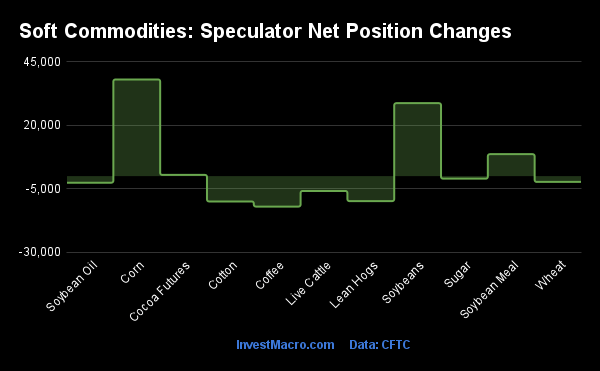
The COT soft commodities markets speculator bets were lower this week as four out of the eleven softs markets we cover had higher positioning while the other seven markets had lower speculator contracts.

Leading the gains for the softs markets was Corn (38,078 contracts) with Soybeans (28,737 contracts), Soybean Meal (8,640 contracts) and Cocoa (477 contracts) also showing positive weeks.

The markets with the declines in speculator bets this week were Coffee (-12,006 contracts), Lean Hogs (-9,862 contracts), Cotton (-9,991 contracts), Sugar (-1,015 contracts), Wheat (-2,298 contracts), Soybean Oil (-2,604 contracts) and Live Cattle (-5,851 contracts) also registering lower bets on the week.

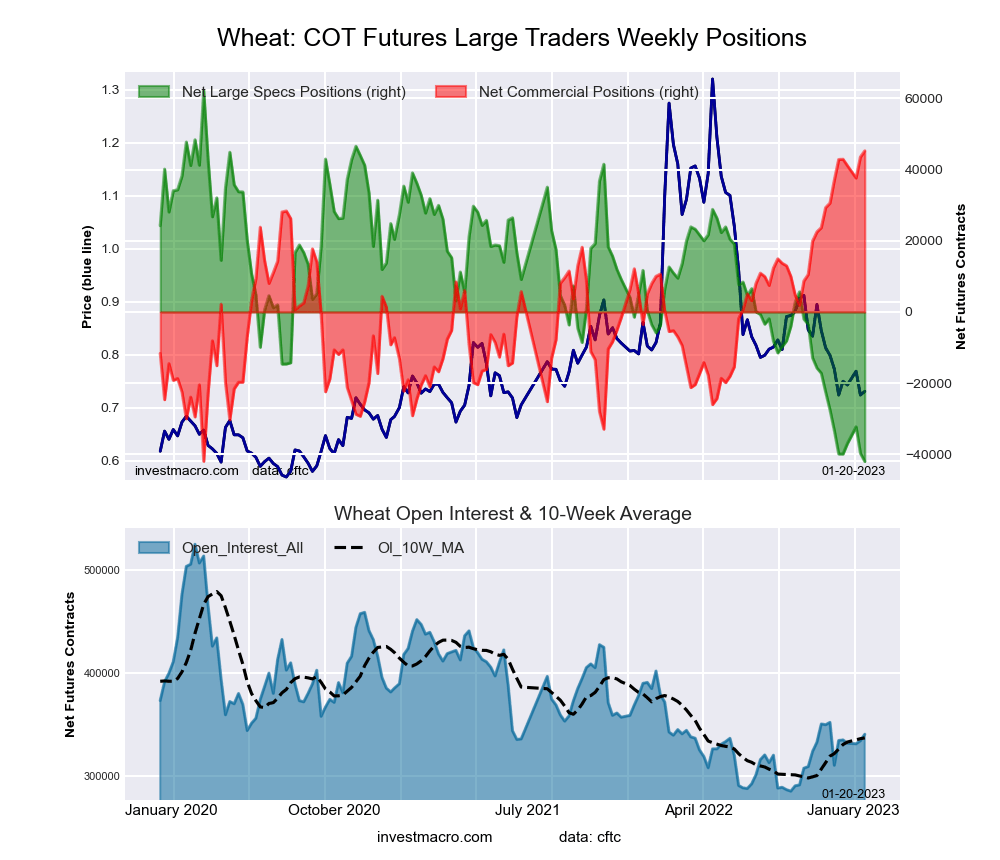
Highlighting the COT soft commodities data this week is the continued declines in the Wheat speculator positioning. The large speculator bets for Wheat fell this week for a second consecutive week and for the twelfth time in the past fifteen weeks. Speculators bets have now pushed the overall net position standing for Wheat (currently at -42,014 contracts) to the most bearish level in the past 192 weeks, dating back to May 14th of 2019.

Wheat prices have been under pressure as well with prices trading at near the lowest levels since 2021. Helping to keep Wheat sentiment and prices down have been better than expected plantings and supply of Wheat in the USA and globally.


Data Snapshot of Commodity Market Traders | Columns Legend
Jan-17-2023OIOI-IndexSpec-NetSpec-IndexCom-NetCOM-IndexSmalls-NetSmalls-Index
WTI Crude1,613,46619239,2189-255,5999216,38126
Gold491,81822153,24034-175,9136522,67337
Silver131,862931,46849-45,3675213,89940
Copper201,4554216,23849-22,695496,45763
Palladium8,79916-2,751122,90286-15133
Platinum71,1444123,54441-28,913595,36940
Natural Gas1,082,45824-177,21925146,4187730,80153
Brent147,1729-25,9806223,414372,56644
Heating Oil269,9112418,50670-40,6122822,10675
Soybeans651,32817169,06564-130,79048-38,2756
Corn1,251,0338271,87365-213,79841-58,07511
Coffee224,82931-26,745024,2511002,49434
Sugar898,52637186,69858-233,1443646,44665
Wheat340,83023-42,014045,261100-3,24794


Strength Scores led by Soybean Meal & Live Cattle
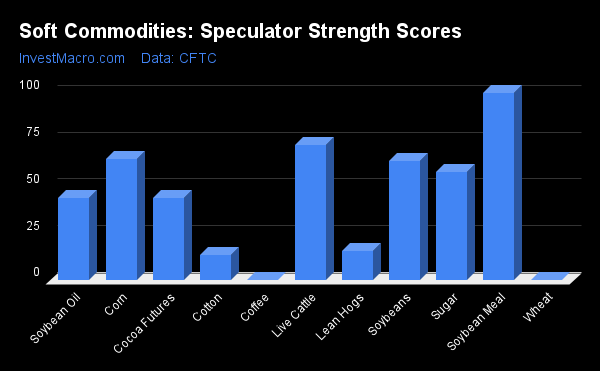
COT Strength Scores (a normalized measure of Speculator positions over a 3-Year range, from 0 to 100 where above 80 is Extreme-Bullish and below 20 is Extreme-Bearish) showed that Soybean Meal (100 percent) and Live Cattle (72 percent) lead the softs markets this week. Corn (65 percent), Soybeans (64 percent) and Sugar (58 percent) come in as the next highest in the weekly strength scores.

On the downside, Wheat (0 percent), Coffee (0 percent), Cotton (13 percent) and the Lean Hogs (16 percent) come in at the lowest strength levels currently and are all in Extreme-Bearish territory (below 20 percent).

Strength Statistics:
Corn (64.8 percent) vs Corn previous week (59.9 percent)
Sugar (58.1 percent) vs Sugar previous week (58.5 percent)
Coffee (0.0 percent) vs Coffee previous week (12.3 percent)
Soybeans (63.9 percent) vs Soybeans previous week (54.7 percent)
Soybean Oil (43.8 percent) vs Soybean Oil previous week (45.6 percent)
Soybean Meal (100.0 percent) vs Soybean Meal previous week (96.0 percent)
Live Cattle (72.3 percent) vs Live Cattle previous week (79.7 percent)
Lean Hogs (15.8 percent) vs Lean Hogs previous week (27.7 percent)
Cotton (13.3 percent) vs Cotton previous week (20.9 percent)
Cocoa (44.2 percent) vs Cocoa previous week (43.8 percent)
Wheat (0.0 percent) vs Wheat previous week (2.2 percent)


Soybeans & Live Cattle top the 6-Week Strength Trends
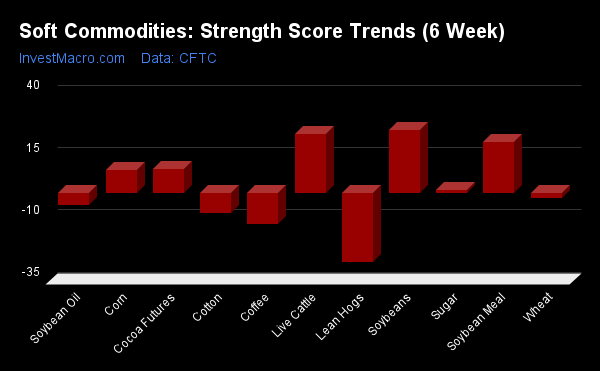
COT Strength Score Trends (or move index, calculates the 6-week changes in strength scores) showed that Soybeans (25 percent) and Live Cattle (24 percent) lead the past six weeks trends for soft commodities. Soybean Meal (20 percent), Cocoa (10 percent) and Corn (9 percent) are the next highest positive movers in the latest trends data.

Lean Hogs (-28 percent) leads the downside trend scores currently with Coffee (-12 percent), Cotton (-8 percent) and Soybean Oil (-5 percent) following next with lower trend scores.

Strength Trend Statistics:
Corn (9.4 percent) vs Corn previous week (-4.7 percent)
Sugar (1.2 percent) vs Sugar previous week (3.0 percent)
Coffee (-12.4 percent) vs Coffee previous week (-0.1 percent)
Soybeans (25.4 percent) vs Soybeans previous week (17.0 percent)
Soybean Oil (-4.7 percent) vs Soybean Oil previous week (-28.7 percent)
Soybean Meal (20.5 percent) vs Soybean Meal previous week (25.7 percent)
Live Cattle (23.7 percent) vs Live Cattle previous week (32.5 percent)
Lean Hogs (-27.8 percent) vs Lean Hogs previous week (-11.8 percent)
Cotton (-8.2 percent) vs Cotton previous week (1.0 percent)
Cocoa (9.6 percent) vs Cocoa previous week (17.3 percent)
Wheat (-2.0 percent) vs Wheat previous week (-6.2 percent)


Individual Soft Commodities Markets:

CORN Futures:
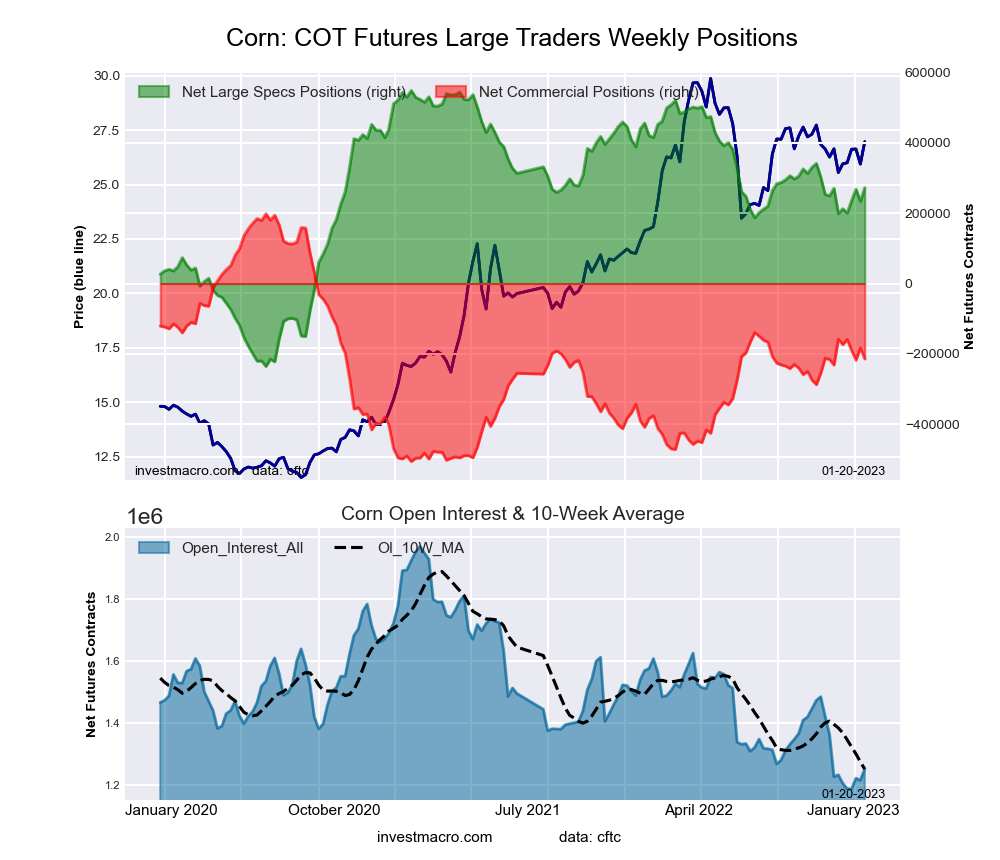
CORN Futures COT ChartThe CORN large speculator standing this week resulted in a net position of 271,873 contracts in the data reported through Tuesday. This was a weekly boost of 38,078 contracts from the previous week which had a total of 233,795 net contracts.

This week’s current strength score (the trader positioning range over the past three years, measured from 0 to 100) shows the speculators are currently Bullish with a score of 64.8 percent. The commercials are Bearish with a score of 41.5 percent and the small traders (not shown in chart) are Bearish-Extreme with a score of 11.4 percent.

CORN Futures StatisticsSPECULATORSCOMMERCIALSSMALL TRADERS
– Percent of Open Interest Longs:30.144.79.5
– Percent of Open Interest Shorts:8.461.714.1
– Net Position:271,873-213,798-58,075
– Gross Longs:376,732558,706118,719
– Gross Shorts:104,859772,504176,794
– Long to Short Ratio:3.6 to 10.7 to 10.7 to 1
NET POSITION TREND:
– Strength Index Score (3 Year Range Pct):64.841.511.4
– Strength Index Reading (3 Year Range):BullishBearishBearish-Extreme
NET POSITION MOVEMENT INDEX:
– 6-Week Change in Strength Index:9.4-8.0-11.7


SUGAR Futures:

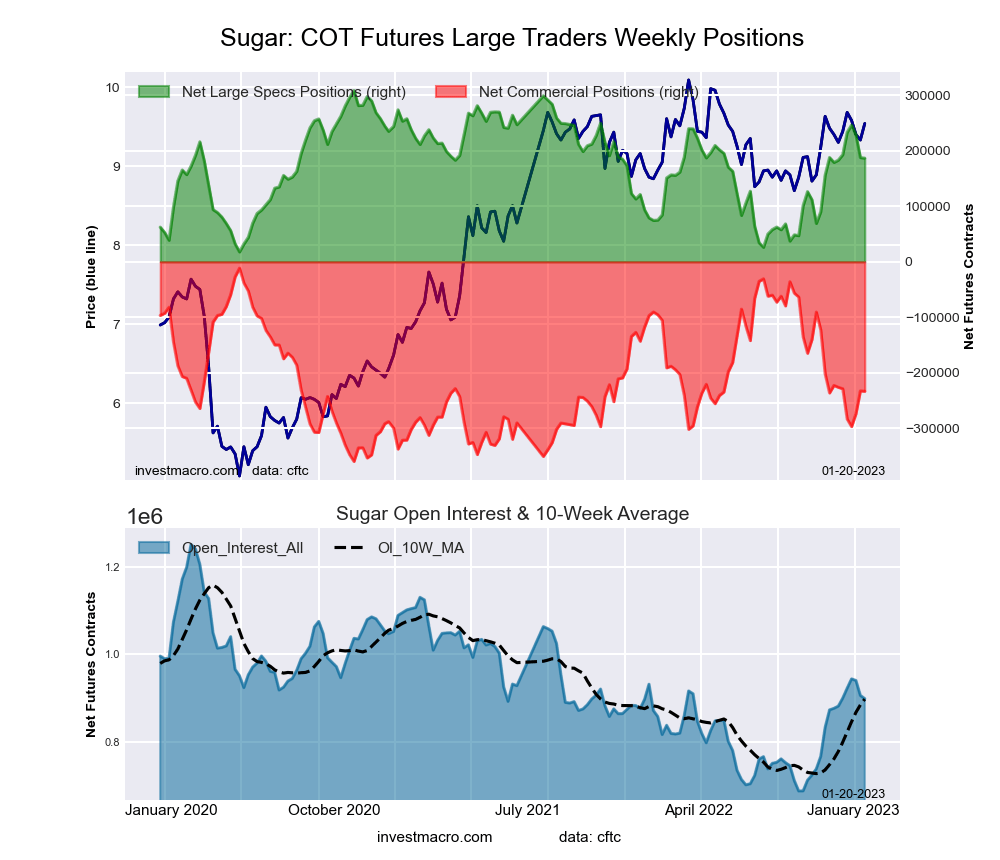
SUGAR Futures COT ChartThe SUGAR large speculator standing this week resulted in a net position of 186,698 contracts in the data reported through Tuesday. This was a weekly decrease of -1,015 contracts from the previous week which had a total of 187,713 net contracts.

This week’s current strength score (the trader positioning range over the past three years, measured from 0 to 100) shows the speculators are currently Bullish with a score of 58.1 percent. The commercials are Bearish with a score of 36.3 percent and the small traders (not shown in chart) are Bullish with a score of 65.3 percent.

SUGAR Futures StatisticsSPECULATORSCOMMERCIALSSMALL TRADERS
– Percent of Open Interest Longs:30.543.110.2
– Percent of Open Interest Shorts:9.769.05.0
– Net Position:186,698-233,14446,446
– Gross Longs:273,666387,18691,248
– Gross Shorts:86,968620,33044,802
– Long to Short Ratio:3.1 to 10.6 to 12.0 to 1
NET POSITION TREND:
– Strength Index Score (3 Year Range Pct):58.136.365.3
– Strength Index Reading (3 Year Range):BullishBearishBullish
NET POSITION MOVEMENT INDEX:
– 6-Week Change in Strength Index:1.2-2.04.3


COFFEE Futures:

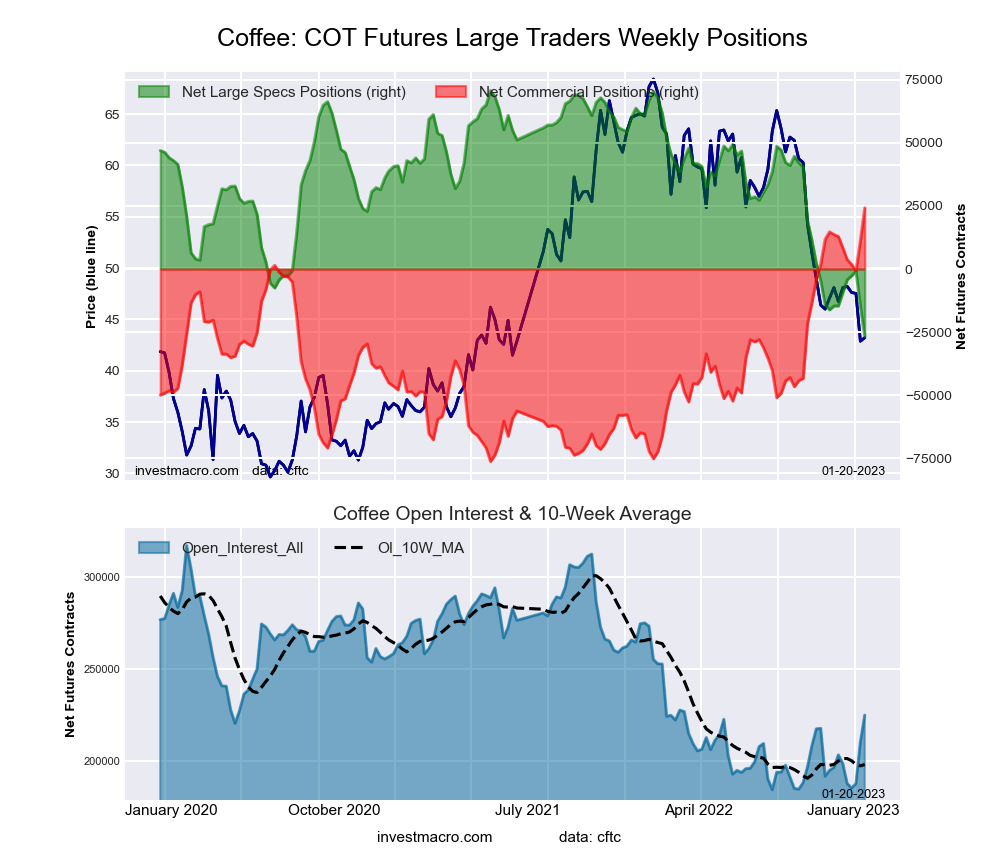
COFFEE Futures COT ChartThe COFFEE large speculator standing this week resulted in a net position of -26,745 contracts in the data reported through Tuesday. This was a weekly decrease of -12,006 contracts from the previous week which had a total of -14,739 net contracts.

This week’s current strength score (the trader positioning range over the past three years, measured from 0 to 100) shows the speculators are currently Bearish-Extreme with a score of 0.0 percent. The commercials are Bullish-Extreme with a score of 100.0 percent and the small traders (not shown in chart) are Bearish with a score of 34.1 percent.

COFFEE Futures StatisticsSPECULATORSCOMMERCIALSSMALL TRADERS
– Percent of Open Interest Longs:19.955.04.8
– Percent of Open Interest Shorts:31.844.23.7
– Net Position:-26,74524,2512,494
– Gross Longs:44,803123,56510,878
– Gross Shorts:71,54899,3148,384
– Long to Short Ratio:0.6 to 11.2 to 11.3 to 1
NET POSITION TREND:
– Strength Index Score (3 Year Range Pct):0.0100.034.1
– Strength Index Reading (3 Year Range):Bearish-ExtremeBullish-ExtremeBearish
NET POSITION MOVEMENT INDEX:
– 6-Week Change in Strength Index:-12.411.310.6


SOYBEANS Futures:

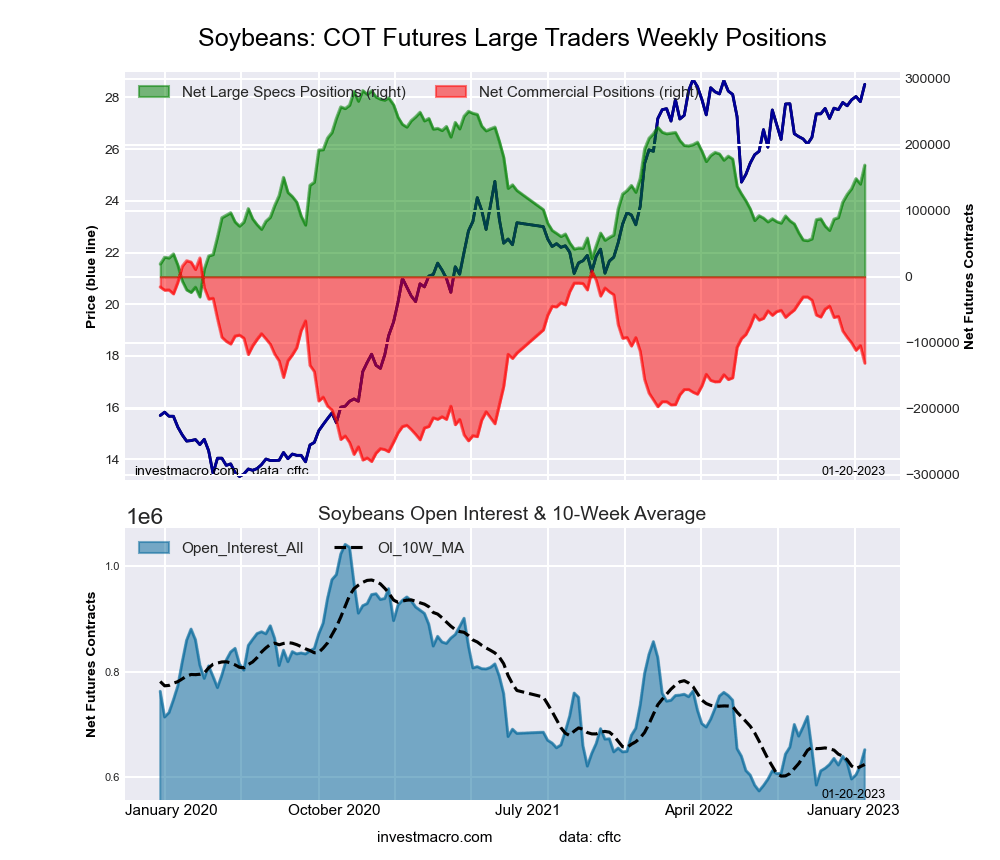
SOYBEANS Futures COT ChartThe SOYBEANS large speculator standing this week resulted in a net position of 169,065 contracts in the data reported through Tuesday. This was a weekly advance of 28,737 contracts from the previous week which had a total of 140,328 net contracts.

This week’s current strength score (the trader positioning range over the past three years, measured from 0 to 100) shows the speculators are currently Bullish with a score of 63.9 percent. The commercials are Bearish with a score of 48.3 percent and the small traders (not shown in chart) are Bearish-Extreme with a score of 6.3 percent.

SOYBEANS Futures StatisticsSPECULATORSCOMMERCIALSSMALL TRADERS
– Percent of Open Interest Longs:33.346.46.7
– Percent of Open Interest Shorts:7.366.412.5
– Net Position:169,065-130,790-38,275
– Gross Longs:216,831301,98543,462
– Gross Shorts:47,766432,77581,737
– Long to Short Ratio:4.5 to 10.7 to 10.5 to 1
NET POSITION TREND:
– Strength Index Score (3 Year Range Pct):63.948.36.3
– Strength Index Reading (3 Year Range):BullishBearishBearish-Extreme
NET POSITION MOVEMENT INDEX:
– 6-Week Change in Strength Index:25.4-23.0-14.4


SOYBEAN OIL Futures:

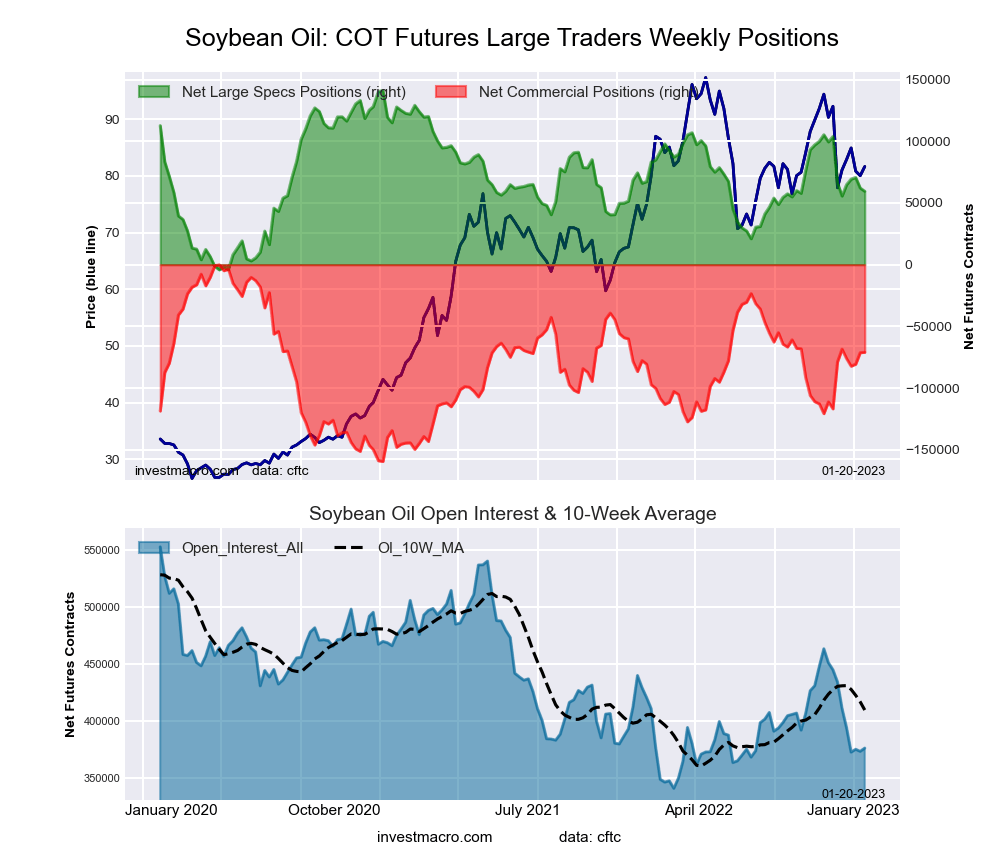
SOYBEAN OIL Futures COT ChartThe SOYBEAN OIL large speculator standing this week resulted in a net position of 59,495 contracts in the data reported through Tuesday. This was a weekly decrease of -2,604 contracts from the previous week which had a total of 62,099 net contracts.

This week’s current strength score (the trader positioning range over the past three years, measured from 0 to 100) shows the speculators are currently Bearish with a score of 43.8 percent. The commercials are Bullish with a score of 55.5 percent and the small traders (not shown in chart) are Bullish with a score of 56.7 percent.

SOYBEAN OIL Futures StatisticsSPECULATORSCOMMERCIALSSMALL TRADERS
– Percent of Open Interest Longs:23.849.99.4
– Percent of Open Interest Shorts:8.068.86.3
– Net Position:59,495-71,07711,582
– Gross Longs:89,394187,76235,188
– Gross Shorts:29,899258,83923,606
– Long to Short Ratio:3.0 to 10.7 to 11.5 to 1
NET POSITION TREND:
– Strength Index Score (3 Year Range Pct):43.855.556.7
– Strength Index Reading (3 Year Range):BearishBullishBullish
NET POSITION MOVEMENT INDEX:
– 6-Week Change in Strength Index:-4.74.9-3.6


SOYBEAN MEAL Futures:

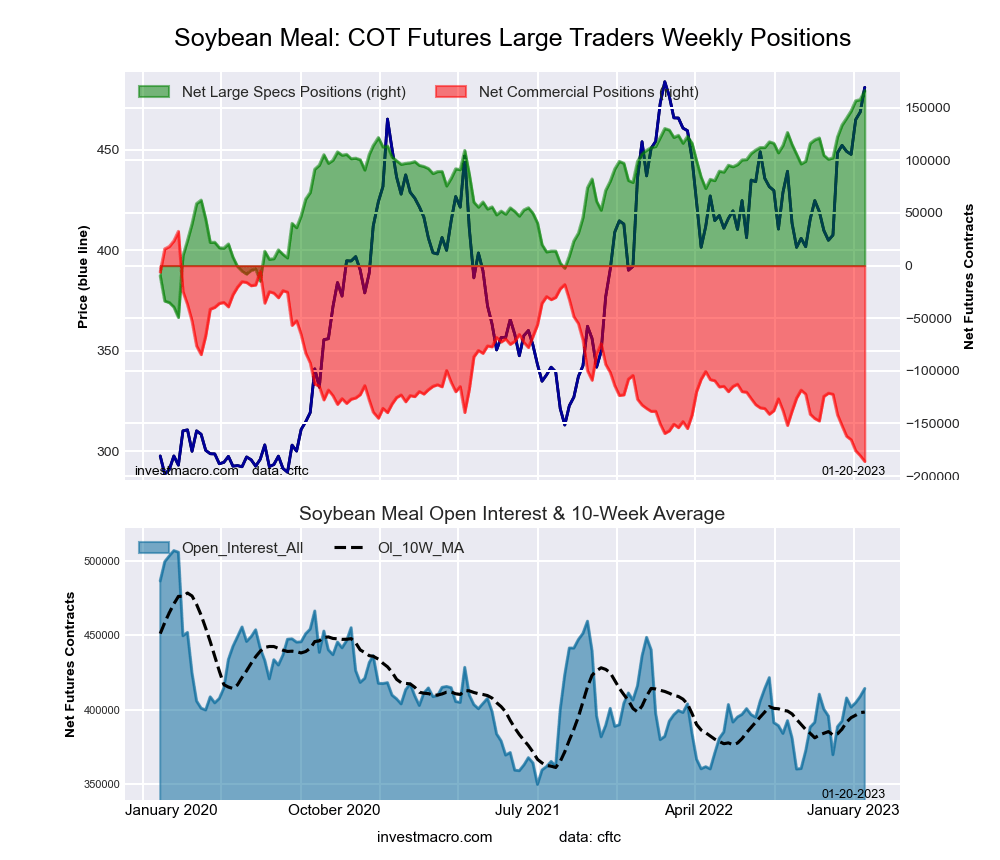
SOYBEAN MEAL Futures COT ChartThe SOYBEAN MEAL large speculator standing this week resulted in a net position of 166,350 contracts in the data reported through Tuesday. This was a weekly advance of 8,640 contracts from the previous week which had a total of 157,710 net contracts.

This week’s current strength score (the trader positioning range over the past three years, measured from 0 to 100) shows the speculators are currently Bullish-Extreme with a score of 100.0 percent. The commercials are Bearish-Extreme with a score of 0.0 percent and the small traders (not shown in chart) are Bearish with a score of 35.5 percent.

SOYBEAN MEAL Futures StatisticsSPECULATORSCOMMERCIALSSMALL TRADERS
– Percent of Open Interest Longs:43.730.111.5
– Percent of Open Interest Shorts:3.675.06.7
– Net Position:166,350-186,13319,783
– Gross Longs:181,071124,54947,680
– Gross Shorts:14,721310,68227,897
– Long to Short Ratio:12.3 to 10.4 to 11.7 to 1
NET POSITION TREND:
– Strength Index Score (3 Year Range Pct):100.00.035.5
– Strength Index Reading (3 Year Range):Bullish-ExtremeBearish-ExtremeBearish
NET POSITION MOVEMENT INDEX:
– 6-Week Change in Strength Index:20.5-20.31.0


LIVE CATTLE Futures:

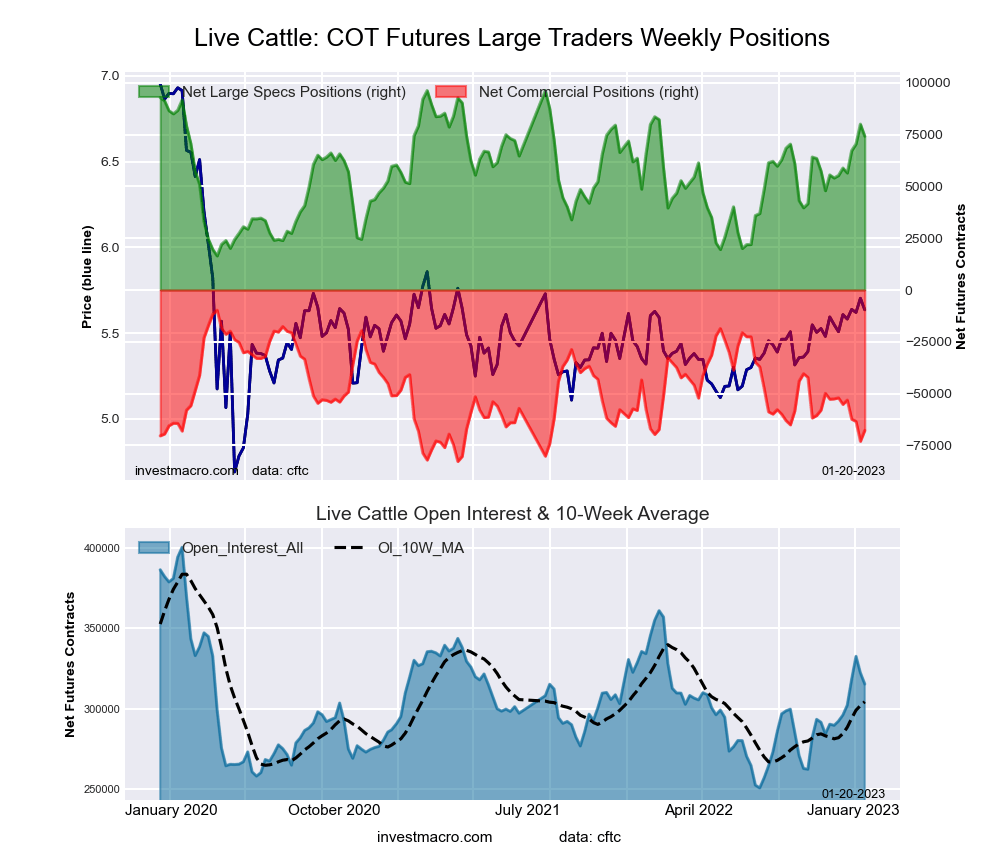
LIVE CATTLE Futures COT ChartThe LIVE CATTLE large speculator standing this week resulted in a net position of 74,143 contracts in the data reported through Tuesday. This was a weekly fall of -5,851 contracts from the previous week which had a total of 79,994 net contracts.

This week’s current strength score (the trader positioning range over the past three years, measured from 0 to 100) shows the speculators are currently Bullish with a score of 72.3 percent. The commercials are Bearish with a score of 20.5 percent and the small traders (not shown in chart) are Bullish with a score of 64.0 percent.

LIVE CATTLE Futures StatisticsSPECULATORSCOMMERCIALSSMALL TRADERS
– Percent of Open Interest Longs:40.230.110.4
– Percent of Open Interest Shorts:16.751.612.5
– Net Position:74,143-67,709-6,434
– Gross Longs:126,73795,03532,866
– Gross Shorts:52,594162,74439,300
– Long to Short Ratio:2.4 to 10.6 to 10.8 to 1
NET POSITION TREND:
– Strength Index Score (3 Year Range Pct):72.320.564.0
– Strength Index Reading (3 Year Range):BullishBearishBullish
NET POSITION MOVEMENT INDEX:
– 6-Week Change in Strength Index:23.7-21.5-13.8


LEAN HOGS Futures:

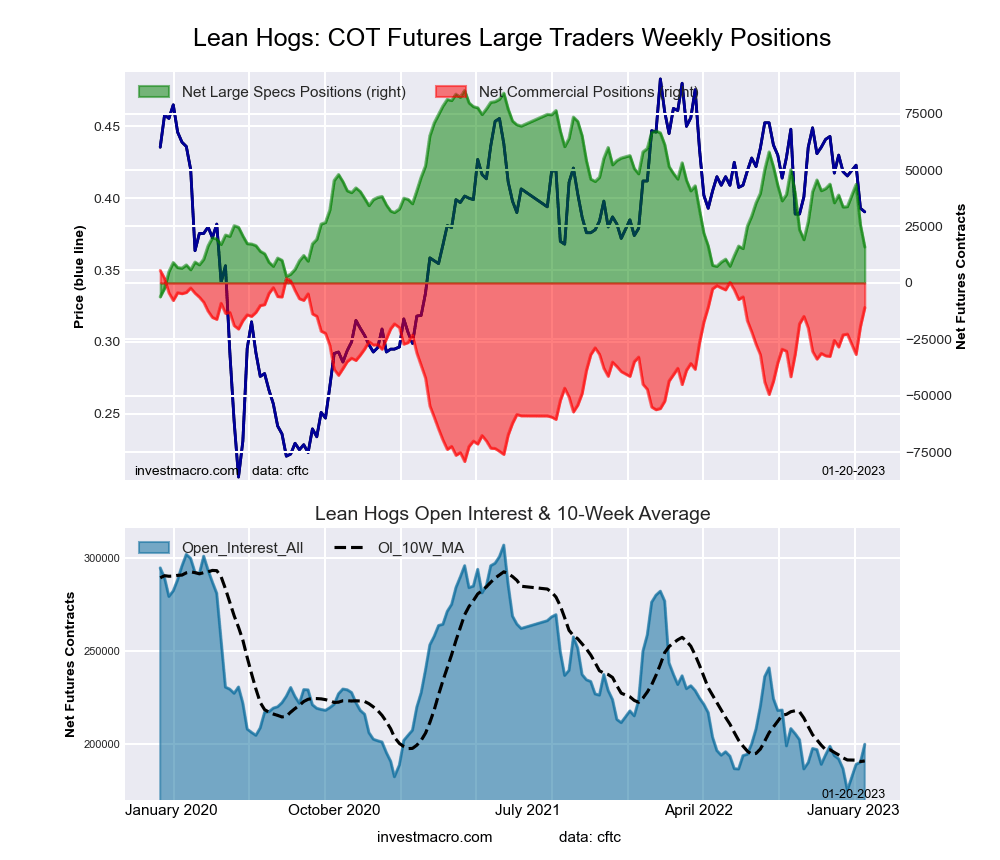
LEAN HOGS Futures COT ChartThe LEAN HOGS large speculator standing this week resulted in a net position of 15,907 contracts in the data reported through Tuesday. This was a weekly lowering of -9,862 contracts from the previous week which had a total of 25,769 net contracts.

This week’s current strength score (the trader positioning range over the past three years, measured from 0 to 100) shows the speculators are currently Bearish-Extreme with a score of 15.8 percent. The commercials are Bullish-Extreme with a score of 84.2 percent and the small traders (not shown in chart) are Bullish-Extreme with a score of 80.7 percent.

LEAN HOGS Futures StatisticsSPECULATORSCOMMERCIALSSMALL TRADERS
– Percent of Open Interest Longs:31.637.510.6
– Percent of Open Interest Shorts:23.643.013.1
– Net Position:15,907-10,939-4,968
– Gross Longs:63,07374,84221,157
– Gross Shorts:47,16685,78126,125
– Long to Short Ratio:1.3 to 10.9 to 10.8 to 1
NET POSITION TREND:
– Strength Index Score (3 Year Range Pct):15.884.280.7
– Strength Index Reading (3 Year Range):Bearish-ExtremeBullish-ExtremeBullish-Extreme
NET POSITION MOVEMENT INDEX:
– 6-Week Change in Strength Index:-27.821.632.8


COTTON Futures:

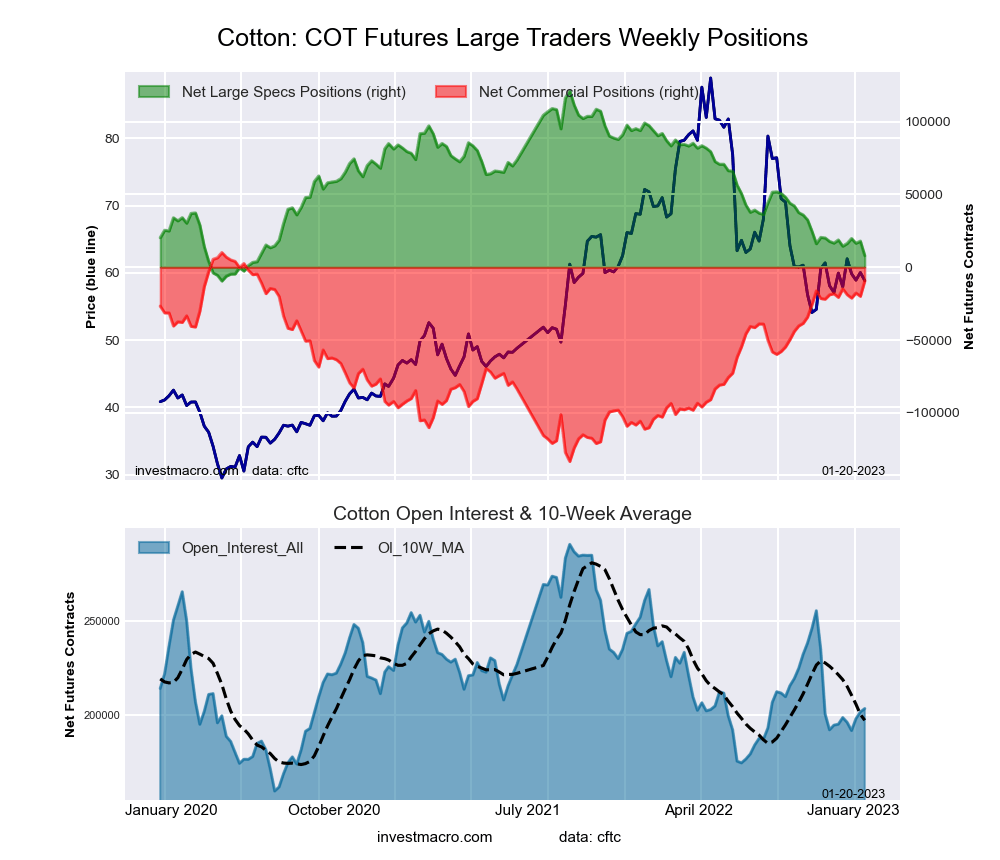
COTTON Futures COT ChartThe COTTON large speculator standing this week resulted in a net position of 7,953 contracts in the data reported through Tuesday. This was a weekly decline of -9,991 contracts from the previous week which had a total of 17,944 net contracts.

This week’s current strength score (the trader positioning range over the past three years, measured from 0 to 100) shows the speculators are currently Bearish-Extreme with a score of 13.3 percent. The commercials are Bullish-Extreme with a score of 86.4 percent and the small traders (not shown in chart) are Bearish-Extreme with a score of 19.5 percent.

COTTON Futures StatisticsSPECULATORSCOMMERCIALSSMALL TRADERS
– Percent of Open Interest Longs:27.950.76.3
– Percent of Open Interest Shorts:23.955.45.6
– Net Position:7,953-9,3821,429
– Gross Longs:56,634103,14612,734
– Gross Shorts:48,681112,52811,305
– Long to Short Ratio:1.2 to 10.9 to 11.1 to 1
NET POSITION TREND:
– Strength Index Score (3 Year Range Pct):13.386.419.5
– Strength Index Reading (3 Year Range):Bearish-ExtremeBullish-ExtremeBearish-Extreme
NET POSITION MOVEMENT INDEX:
– 6-Week Change in Strength Index:-8.27.9-3.3


COCOA Futures:

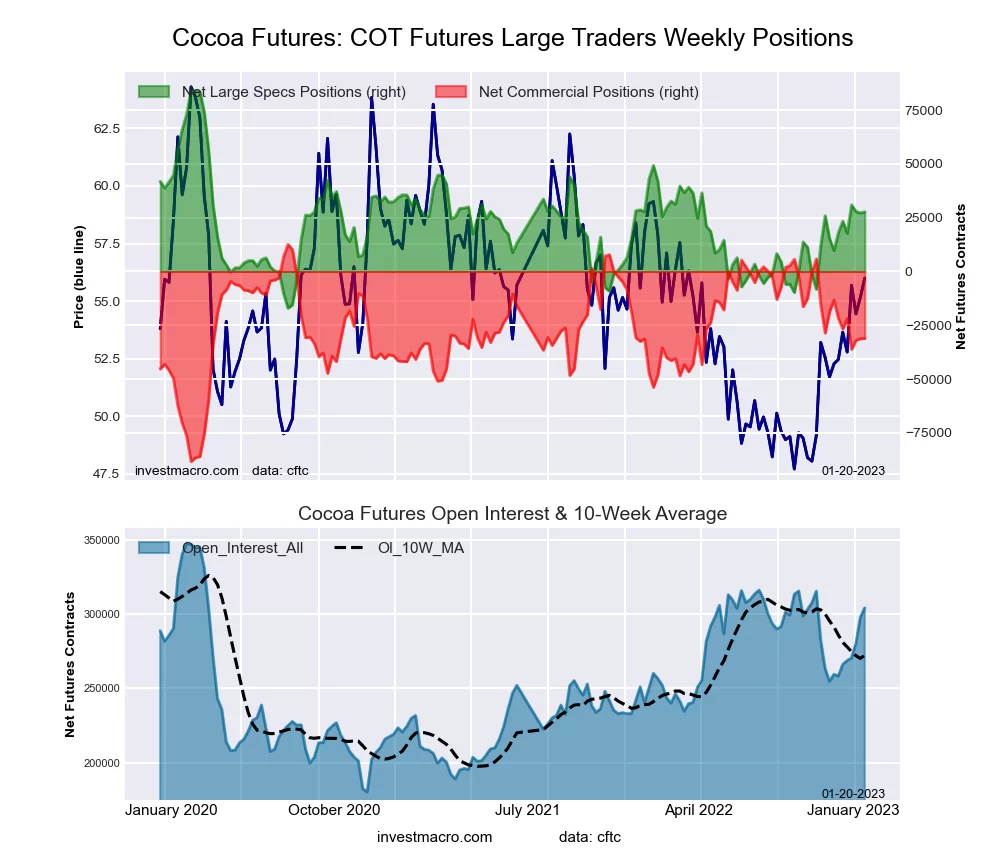
COCOA Futures COT ChartThe COCOA large speculator standing this week resulted in a net position of 27,698 contracts in the data reported through Tuesday. This was a weekly lift of 477 contracts from the previous week which had a total of 27,221 net contracts.

This week’s current strength score (the trader positioning range over the past three years, measured from 0 to 100) shows the speculators are currently Bearish with a score of 44.2 percent. The commercials are Bullish with a score of 56.6 percent and the small traders (not shown in chart) are Bearish with a score of 31.1 percent.

COCOA Futures StatisticsSPECULATORSCOMMERCIALSSMALL TRADERS
– Percent of Open Interest Longs:31.945.54.3
– Percent of Open Interest Shorts:22.855.83.1
– Net Position:27,698-31,1553,457
– Gross Longs:97,065138,39413,026
– Gross Shorts:69,367169,5499,569
– Long to Short Ratio:1.4 to 10.8 to 11.4 to 1
NET POSITION TREND:
– Strength Index Score (3 Year Range Pct):44.256.631.1
– Strength Index Reading (3 Year Range):BearishBullishBearish
NET POSITION MOVEMENT INDEX:
– 6-Week Change in Strength Index:9.6-9.4-2.9


WHEAT Futures:

WHEAT Futures COT ChartThe WHEAT large speculator standing this week resulted in a net position of -42,014 contracts in the data reported through Tuesday. This was a weekly lowering of -2,298 contracts from the previous week which had a total of -39,716 net contracts.

This week’s current strength score (the trader positioning range over the past three years, measured from 0 to 100) shows the speculators are currently Bearish-Extreme with a score of 0.0 percent. The commercials are Bullish-Extreme with a score of 100.0 percent and the small traders (not shown in chart) are Bullish-Extreme with a score of 93.6 percent.

WHEAT Futures StatisticsSPECULATORSCOMMERCIALSSMALL TRADERS
– Percent of Open Interest Longs:25.441.69.7
– Percent of Open Interest Shorts:37.728.410.6
– Net Position:-42,01445,261-3,247
– Gross Longs:86,569141,95632,942
– Gross Shorts:128,58396,69536,189
– Long to Short Ratio:0.7 to 11.5 to 10.9 to 1
NET POSITION TREND:
– Strength Index Score (3 Year Range Pct):0.0100.093.6
– Strength Index Reading (3 Year Range):Bearish-ExtremeBullish-ExtremeBullish-Extreme
NET POSITION MOVEMENT INDEX:
– 6-Week Change in Strength Index:-2.02.8-1.7


Article By InvestMacroReceive our weekly COT Newsletter

*COT Report: The COT data, released weekly to the public each Friday, is updated through the most recent Tuesday (data is 3 days old) and shows a quick view of how large speculators or non-commercials (for-profit traders) were positioned in the futures markets.

The CFTC categorizes trader positions according to commercial hedgers (traders who use futures contracts for hedging as part of the business), non-commercials (large traders who speculate to realize trading profits) and nonreportable traders (usually small traders/speculators) as well as their open interest (contracts open in the market at time of reporting). See CFTC criteria here.

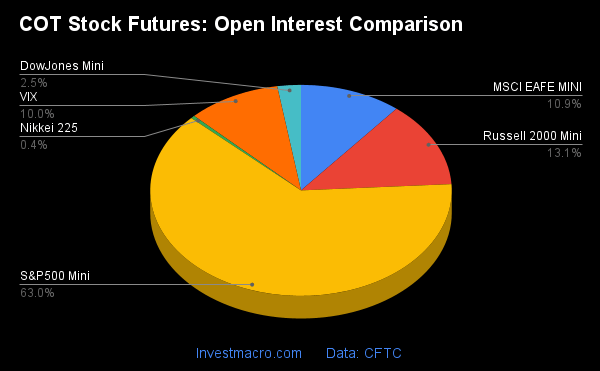
Stock Market Speculators cut back on their VIX bearish bets

By InvestMacro

Here are the latest charts and statistics for the Commitment of Traders (COT) data published by the Commodities Futures Trading Commission (CFTC).

The latest COT data is updated through Tuesday January 17th and shows a quick view of how large traders (for-profit speculators and commercial entities) were positioned in the futures markets.

Weekly Speculator Changes led by VIX

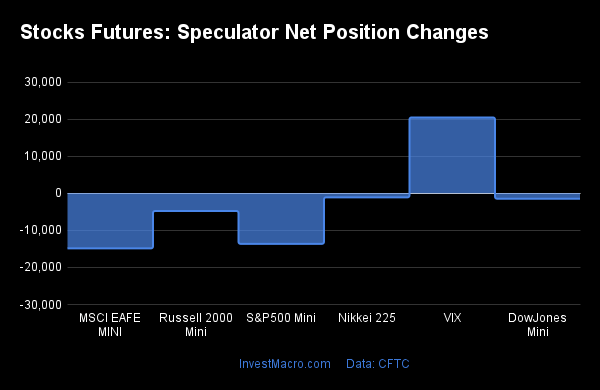
The COT stock markets speculator bets were lower this week as just one out of the six stock markets we cover had higher positioning while the other seven markets had lower speculator contracts.

The only market with gains for this week was the VIX with a rise of 20,452 contracts.

The markets with the declines in speculator bets this week were Nasdaq-Mini (-12,482 contracts) with the Russell-Mini (-4,787 contracts), MSCI EAFE-Mini (-14,869 contracts), S&P500-Mini (-13,644 contracts),  DowJones-Mini (-1,471 contracts) and the Nikkei 225 (-1,106 contracts) also registering lower bets on the week.


Data Snapshot of Stock Market Traders | Columns Legend
Jan-17-2023OIOI-IndexSpec-NetSpec-IndexCom-NetCOM-IndexSmalls-NetSmalls-Index
S&P500-Mini2,056,4724-226,81814231,16381-4,34525
Nikkei 22514,13810-3,825594,34051-51522
Nasdaq-Mini275,01557-20,6336430,54445-9,91133
DowJones-Mini82,66046-10,6132712,29074-1,67732
VIX326,90049-52,3557755,59522-3,24076
Nikkei 225 Yen37,043147,97159-2,2404-5,73168


Strength Scores led by VIX & Nasdaq-Mini

COT Strength Scores (a normalized measure of Speculator positions over a 3-Year range, from 0 to 100 where above 80 is Extreme-Bullish and below 20 is Extreme-Bearish) showed that the VIX (77 percent) and the Nasdaq-Mini (64 percent) lead the stock markets this week. The Nikkei 225 (59 percent) and Nikkei 225 Yen (59 percent) come in as the next highest in the weekly strength scores.

On the downside, the MSCI EAFE-Mini (9 percent) comes in at the lowest strength level currently and is in Extreme-Bearish territory (below 20 percent). The next lowest strength score is the S&P500-Mini (14 percent).

Strength Statistics:
VIX (76.5 percent) vs VIX previous week (62.4 percent)
S&P500-Mini (14.2 percent) vs S&P500-Mini previous week (16.7 percent)
DowJones-Mini (27.1 percent) vs DowJones-Mini previous week (29.3 percent)
Nasdaq-Mini (63.5 percent) vs Nasdaq-Mini previous week (70.5 percent)
Russell2000-Mini (32.0 percent) vs Russell2000-Mini previous week (34.7 percent)
Nikkei USD (59.3 percent) vs Nikkei USD previous week (64.6 percent)
EAFE-Mini (9.4 percent) vs EAFE-Mini previous week (27.2 percent)


VIX & Nikkei 225 Yen top the 6-Week Strength Trends

COT Strength Score Trends (or move index, calculates the 6-week changes in strength scores) showed that the VIX (15 percent) leads the past six weeks trends for the stock markets. The Nikkei 225 Yen (8 percent), the Russell-Mini (6 percent) and the DowJones-Mini (1 percent) are the next highest positive movers in the latest trends data.

The MSCI EAFE-Mini (-26 percent) leads the downside trend scores currently with the Nasdaq-Mini (-19 percent) coming in as the next market with lower trend scores.

Strength Trend Statistics:
VIX (15.3 percent) vs VIX previous week (-3.6 percent)
S&P500-Mini (-4.3 percent) vs S&P500-Mini previous week (-1.7 percent)
DowJones-Mini (1.5 percent) vs DowJones-Mini previous week (-4.5 percent)
Nasdaq-Mini (-19.1 percent) vs Nasdaq-Mini previous week (-10.0 percent)
Russell2000-Mini (5.9 percent) vs Russell2000-Mini previous week (-0.3 percent)
Nikkei USD (-6.1 percent) vs Nikkei USD previous week (-3.9 percent)
EAFE-Mini (-25.5 percent) vs EAFE-Mini previous week (15.7 percent)


Individual Stock Market Charts:

VIX Volatility Futures:

VIX Volatility Futures COT ChartThe VIX Volatility large speculator standing this week came in at a net position of -52,355 contracts in the data reported through Tuesday. This was a weekly boost of 20,452 contracts from the previous week which had a total of -72,807 net contracts.

This week’s current strength score (the trader positioning range over the past three years, measured from 0 to 100) shows the speculators are currently Bullish with a score of 76.5 percent. The commercials are Bearish with a score of 22.1 percent and the small traders (not shown in chart) are Bullish with a score of 75.6 percent.

VIX Volatility Futures StatisticsSPECULATORSCOMMERCIALSSMALL TRADERS
– Percent of Open Interest Longs:16.453.98.8
– Percent of Open Interest Shorts:32.436.99.8
– Net Position:-52,35555,595-3,240
– Gross Longs:53,609176,08128,892
– Gross Shorts:105,964120,48632,132
– Long to Short Ratio:0.5 to 11.5 to 10.9 to 1
NET POSITION TREND:
– Strength Index Score (3 Year Range Pct):76.522.175.6
– Strength Index Reading (3 Year Range):BullishBearishBullish
NET POSITION MOVEMENT INDEX:
– 6-Week Change in Strength Index:15.3-15.33.2


S&P500 Mini Futures:

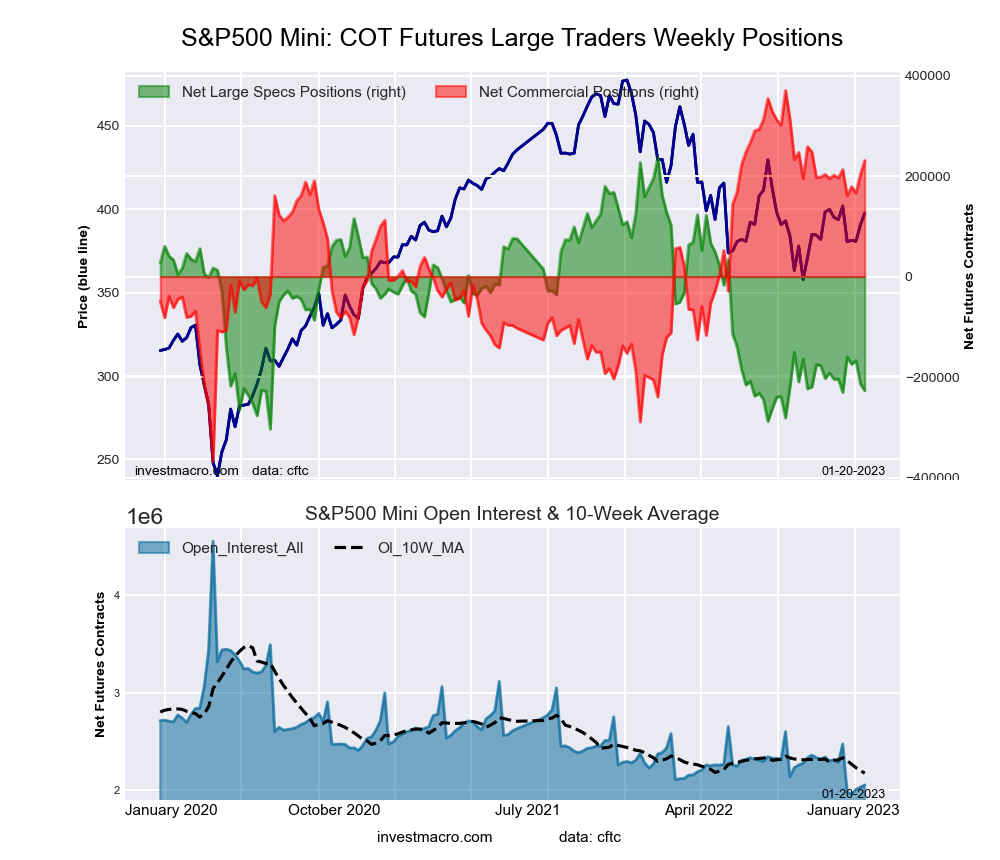
SP500 Mini Futures COT ChartThe S&P500 Mini large speculator standing this week came in at a net position of -226,818 contracts in the data reported through Tuesday. This was a weekly reduction of -13,644 contracts from the previous week which had a total of -213,174 net contracts.

This week’s current strength score (the trader positioning range over the past three years, measured from 0 to 100) shows the speculators are currently Bearish-Extreme with a score of 14.2 percent. The commercials are Bullish-Extreme with a score of 81.2 percent and the small traders (not shown in chart) are Bearish with a score of 25.5 percent.

S&P500 Mini Futures StatisticsSPECULATORSCOMMERCIALSSMALL TRADERS
– Percent of Open Interest Longs:12.773.811.4
– Percent of Open Interest Shorts:23.762.611.6
– Net Position:-226,818231,163-4,345
– Gross Longs:260,3371,518,121234,865
– Gross Shorts:487,1551,286,958239,210
– Long to Short Ratio:0.5 to 11.2 to 11.0 to 1
NET POSITION TREND:
– Strength Index Score (3 Year Range Pct):14.281.225.5
– Strength Index Reading (3 Year Range):Bearish-ExtremeBullish-ExtremeBearish
NET POSITION MOVEMENT INDEX:
– 6-Week Change in Strength Index:-4.34.7-2.4


Dow Jones Mini Futures:

Dow Jones Mini Futures COT ChartThe Dow Jones Mini large speculator standing this week came in at a net position of -10,613 contracts in the data reported through Tuesday. This was a weekly decline of -1,471 contracts from the previous week which had a total of -9,142 net contracts.

This week’s current strength score (the trader positioning range over the past three years, measured from 0 to 100) shows the speculators are currently Bearish with a score of 27.1 percent. The commercials are Bullish with a score of 73.9 percent and the small traders (not shown in chart) are Bearish with a score of 32.2 percent.

Dow Jones Mini Futures StatisticsSPECULATORSCOMMERCIALSSMALL TRADERS
– Percent of Open Interest Longs:31.348.316.5
– Percent of Open Interest Shorts:44.133.518.5
– Net Position:-10,61312,290-1,677
– Gross Longs:25,84739,94813,654
– Gross Shorts:36,46027,65815,331
– Long to Short Ratio:0.7 to 11.4 to 10.9 to 1
NET POSITION TREND:
– Strength Index Score (3 Year Range Pct):27.173.932.2
– Strength Index Reading (3 Year Range):BearishBullishBearish
NET POSITION MOVEMENT INDEX:
– 6-Week Change in Strength Index:1.5-9.729.9


Nasdaq Mini Futures:

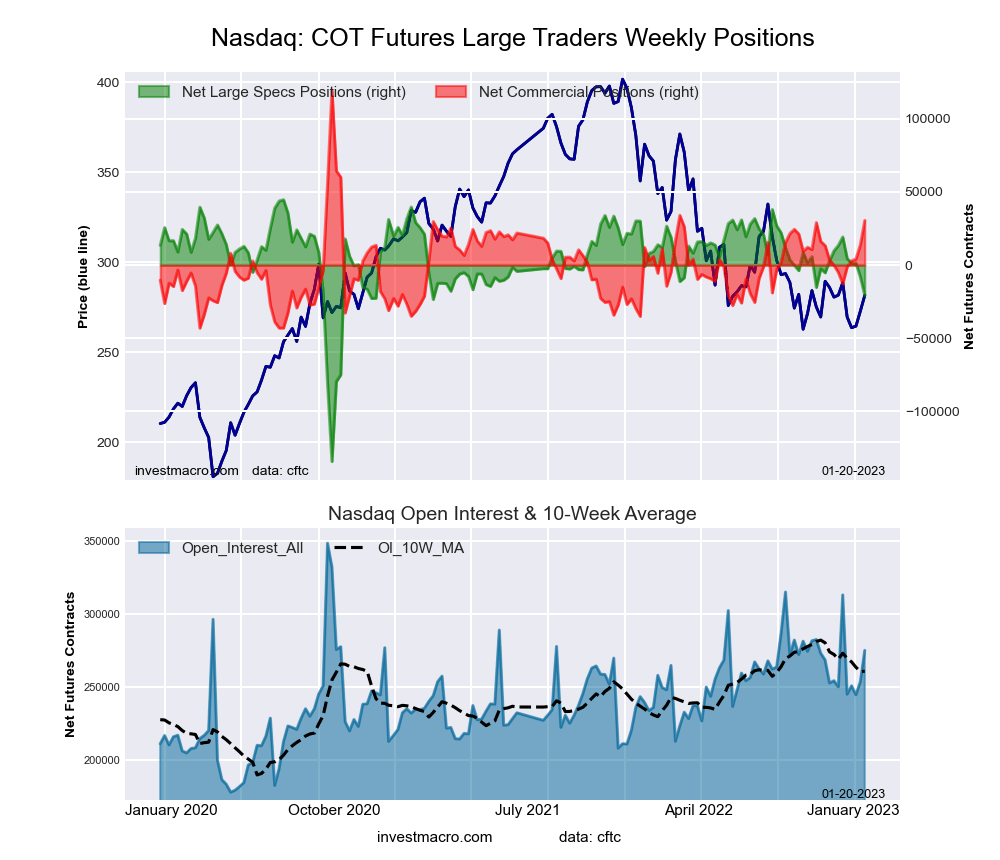
Nasdaq Mini Futures COT ChartThe Nasdaq Mini large speculator standing this week came in at a net position of -20,633 contracts in the data reported through Tuesday. This was a weekly lowering of -12,482 contracts from the previous week which had a total of -8,151 net contracts.

This week’s current strength score (the trader positioning range over the past three years, measured from 0 to 100) shows the speculators are currently Bullish with a score of 63.5 percent. The commercials are Bearish with a score of 45.3 percent and the small traders (not shown in chart) are Bearish with a score of 33.3 percent.

Nasdaq Mini Futures StatisticsSPECULATORSCOMMERCIALSSMALL TRADERS
– Percent of Open Interest Longs:22.462.911.9
– Percent of Open Interest Shorts:29.951.815.5
– Net Position:-20,63330,544-9,911
– Gross Longs:61,621172,92632,760
– Gross Shorts:82,254142,38242,671
– Long to Short Ratio:0.7 to 11.2 to 10.8 to 1
NET POSITION TREND:
– Strength Index Score (3 Year Range Pct):63.545.333.3
– Strength Index Reading (3 Year Range):BullishBearishBearish
NET POSITION MOVEMENT INDEX:
– 6-Week Change in Strength Index:-19.121.9-2.7


Russell 2000 Mini Futures:

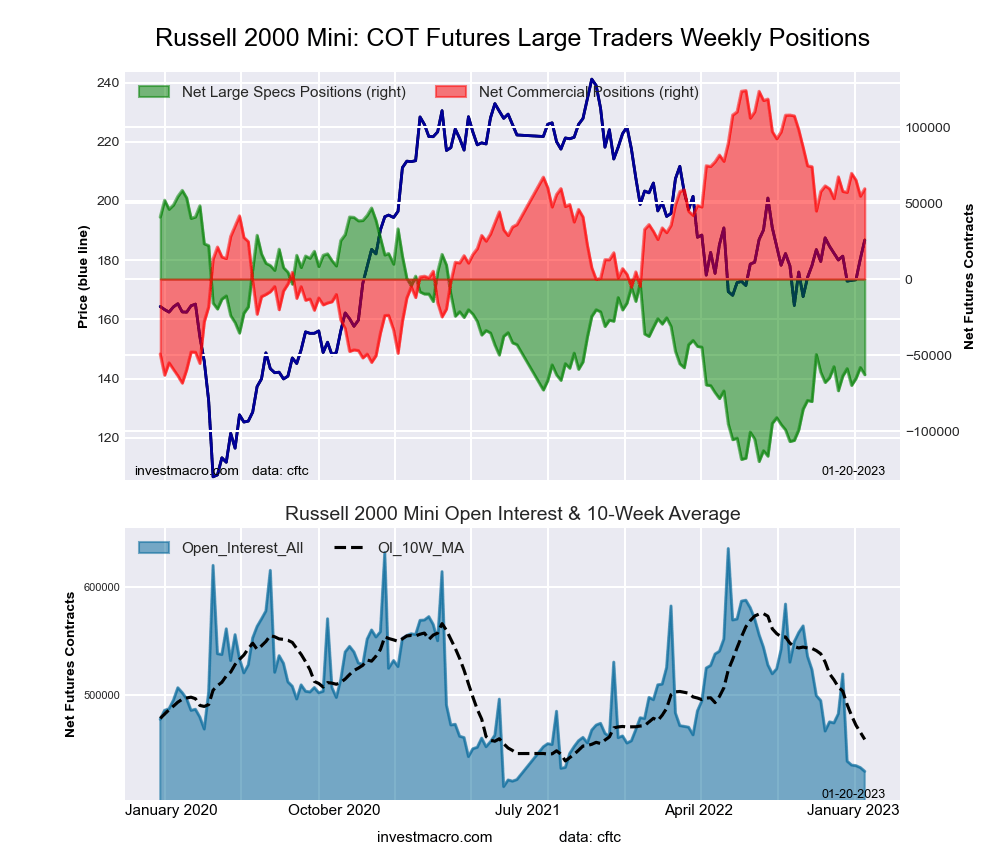
Russell 2000 Mini Futures COT ChartThe Russell 2000 Mini large speculator standing this week came in at a net position of -62,915 contracts in the data reported through Tuesday. This was a weekly fall of -4,787 contracts from the previous week which had a total of -58,128 net contracts.

This week’s current strength score (the trader positioning range over the past three years, measured from 0 to 100) shows the speculators are currently Bearish with a score of 32.0 percent. The commercials are Bullish with a score of 66.4 percent and the small traders (not shown in chart) are Bearish with a score of 37.4 percent.

Russell 2000 Mini Futures StatisticsSPECULATORSCOMMERCIALSSMALL TRADERS
– Percent of Open Interest Longs:10.482.75.7
– Percent of Open Interest Shorts:25.168.84.9
– Net Position:-62,91559,4233,492
– Gross Longs:44,629354,69824,352
– Gross Shorts:107,544295,27520,860
– Long to Short Ratio:0.4 to 11.2 to 11.2 to 1
NET POSITION TREND:
– Strength Index Score (3 Year Range Pct):32.066.437.4
– Strength Index Reading (3 Year Range):BearishBullishBearish
NET POSITION MOVEMENT INDEX:
– 6-Week Change in Strength Index:5.9-4.1-8.3


Nikkei Stock Average (USD) Futures:

Nikkei Stock Average (USD) Futures COT ChartThe Nikkei Stock Average (USD) large speculator standing this week came in at a net position of -3,825 contracts in the data reported through Tuesday. This was a weekly decrease of -1,106 contracts from the previous week which had a total of -2,719 net contracts.

This week’s current strength score (the trader positioning range over the past three years, measured from 0 to 100) shows the speculators are currently Bullish with a score of 59.3 percent. The commercials are Bullish with a score of 51.4 percent and the small traders (not shown in chart) are Bearish with a score of 21.9 percent.

Nikkei Stock Average Futures StatisticsSPECULATORSCOMMERCIALSSMALL TRADERS
– Percent of Open Interest Longs:18.161.220.6
– Percent of Open Interest Shorts:45.230.524.3
– Net Position:-3,8254,340-515
– Gross Longs:2,5608,6532,914
– Gross Shorts:6,3854,3133,429
– Long to Short Ratio:0.4 to 12.0 to 10.8 to 1
NET POSITION TREND:
– Strength Index Score (3 Year Range Pct):59.351.421.9
– Strength Index Reading (3 Year Range):BullishBullishBearish
NET POSITION MOVEMENT INDEX:
– 6-Week Change in Strength Index:-6.113.4-17.4


MSCI EAFE Mini Futures:

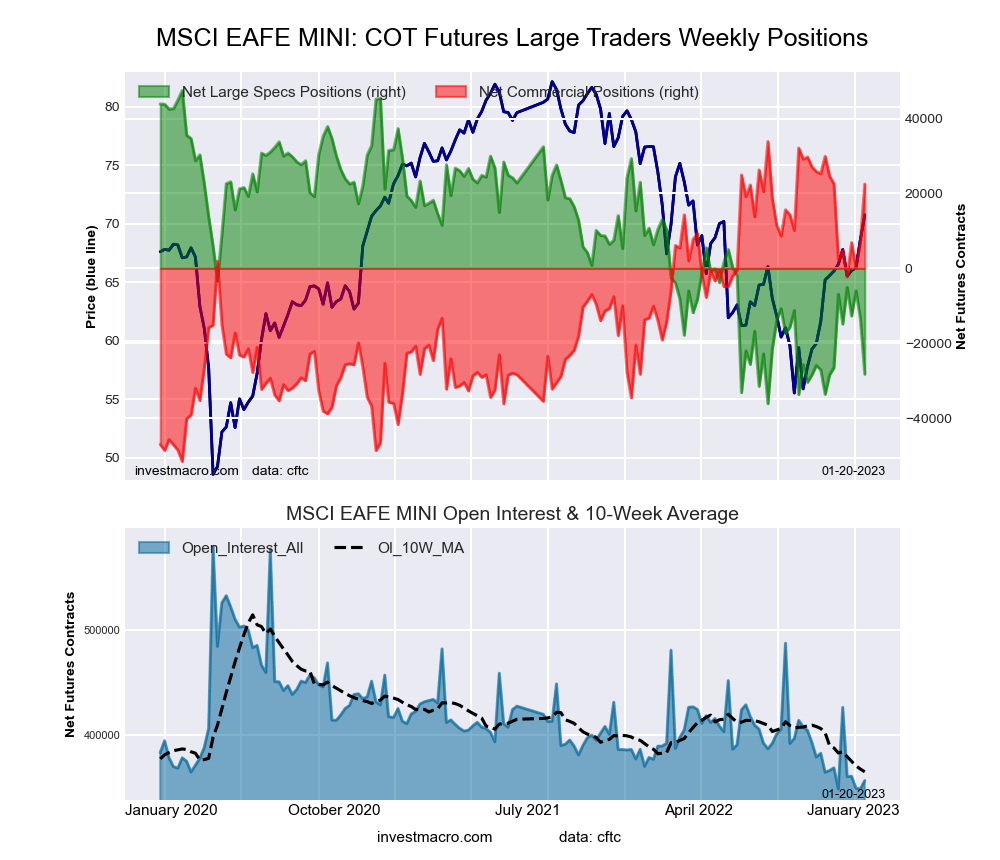
MSCI EAFE Mini Futures COT ChartThe MSCI EAFE Mini large speculator standing this week came in at a net position of -28,278 contracts in the data reported through Tuesday. This was a weekly decrease of -14,869 contracts from the previous week which had a total of -13,409 net contracts.

This week’s current strength score (the trader positioning range over the past three years, measured from 0 to 100) shows the speculators are currently Bearish-Extreme with a score of 9.4 percent. The commercials are Bullish-Extreme with a score of 86.7 percent and the small traders (not shown in chart) are Bullish with a score of 68.7 percent.

MSCI EAFE Mini Futures StatisticsSPECULATORSCOMMERCIALSSMALL TRADERS
– Percent of Open Interest Longs:5.291.13.2
– Percent of Open Interest Shorts:13.284.81.5
– Net Position:-28,27822,5165,762
– Gross Longs:18,717324,87211,276
– Gross Shorts:46,995302,3565,514
– Long to Short Ratio:0.4 to 11.1 to 12.0 to 1
NET POSITION TREND:
– Strength Index Score (3 Year Range Pct):9.486.768.7
– Strength Index Reading (3 Year Range):Bearish-ExtremeBullish-ExtremeBullish
NET POSITION MOVEMENT INDEX:
– 6-Week Change in Strength Index:-25.523.78.5


Article By InvestMacroReceive our weekly COT Newsletter

*COT Report: The COT data, released weekly to the public each Friday, is updated through the most recent Tuesday (data is 3 days old) and shows a quick view of how large speculators or non-commercials (for-profit traders) were positioned in the futures markets.

The CFTC categorizes trader positions according to commercial hedgers (traders who use futures contracts for hedging as part of the business), non-commercials (large traders who speculate to realize trading profits) and nonreportable traders (usually small traders/speculators) as well as their open interest (contracts open in the market at time of reporting). See CFTC criteria here.
Murrey Math Lines 20.01.2023 (Brent, S&P 500)

By RoboForex.com

Brent

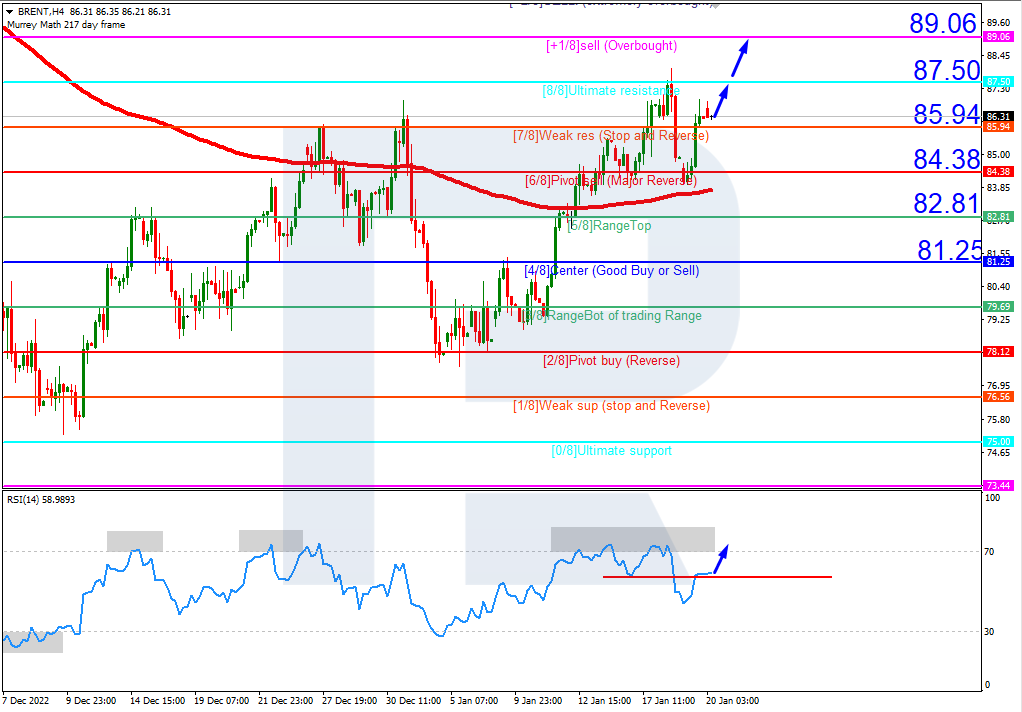
On H4, the quotes are above the 200-day Moving Average, implying an uptrend. The RSI has risen above the resistance line. A breakaway of 8/8 (87.50) upwards should be expected, followed by growth to the resistance line of +1/8 (89.06). The scenario can be cancelled by a downward breakaway of the support level at 6/8 (84.38), which might lead to a trend reversal and falling to 4/8 (81.25).

BrentH4
Risk Warning: the result of previous trading operations do not guarantee the same results in the future

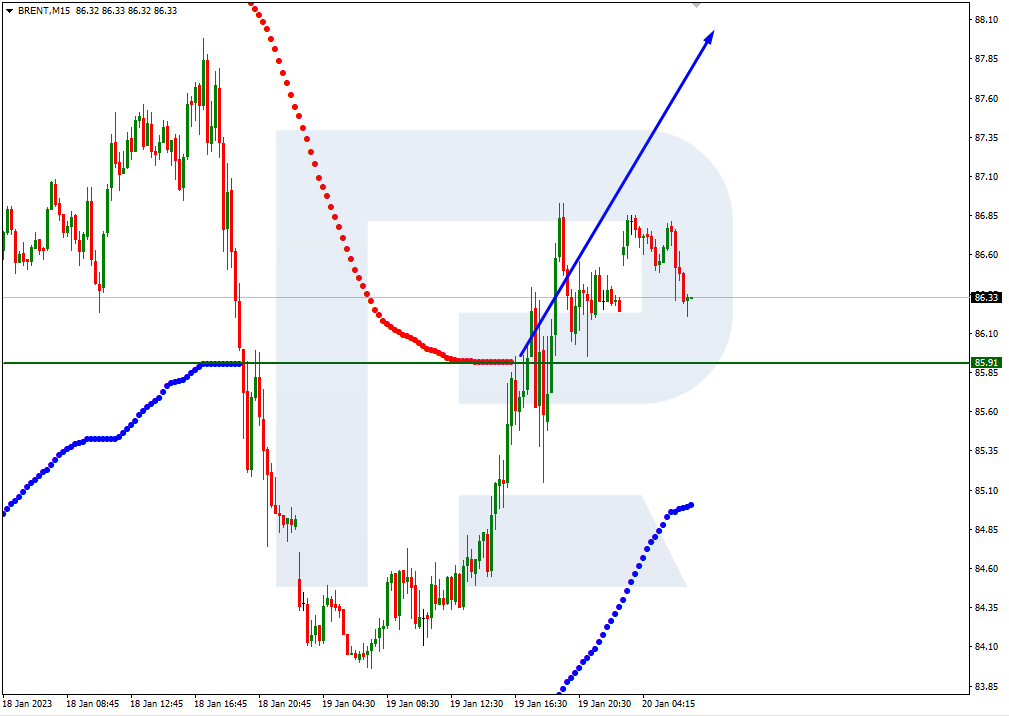
On M15, the upper line of VoltyChannel is broken away, which indicates an uptrend and increases the probability of further growth.

Brent_M15
Risk Warning: the result of previous trading operations do not guarantee the same results in the future

S&P 500

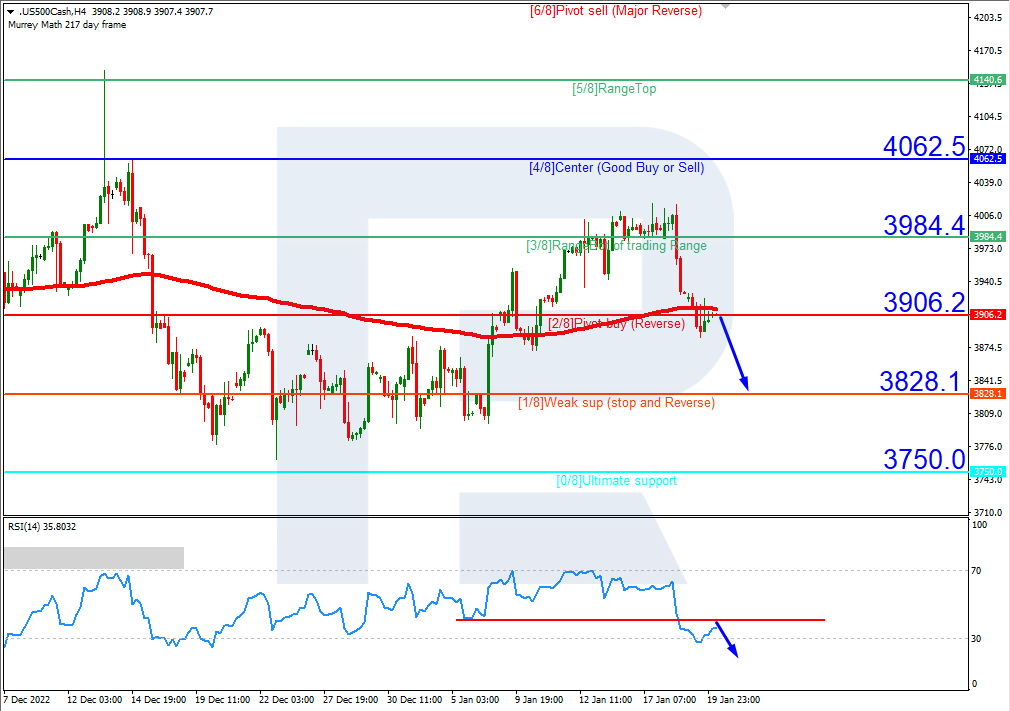
On H4, the S&P 500 index quotes has broken through the 200-day Moving Average and are now under it, which indicates probable development of a downtrend. The RSI is nearing the resistance level. As a result, a bounce off 2/8 (3906.2) should be expected, followed by falling to the support level of 1/8 (3828.1). The scenario can be cancelled by rising over 3/8 (3984.4). In this case, the quotes might rise to the resistance level of 4/8 (4062.5).

S&P500_H4
Risk Warning: the result of previous trading operations do not guarantee the same results in the future

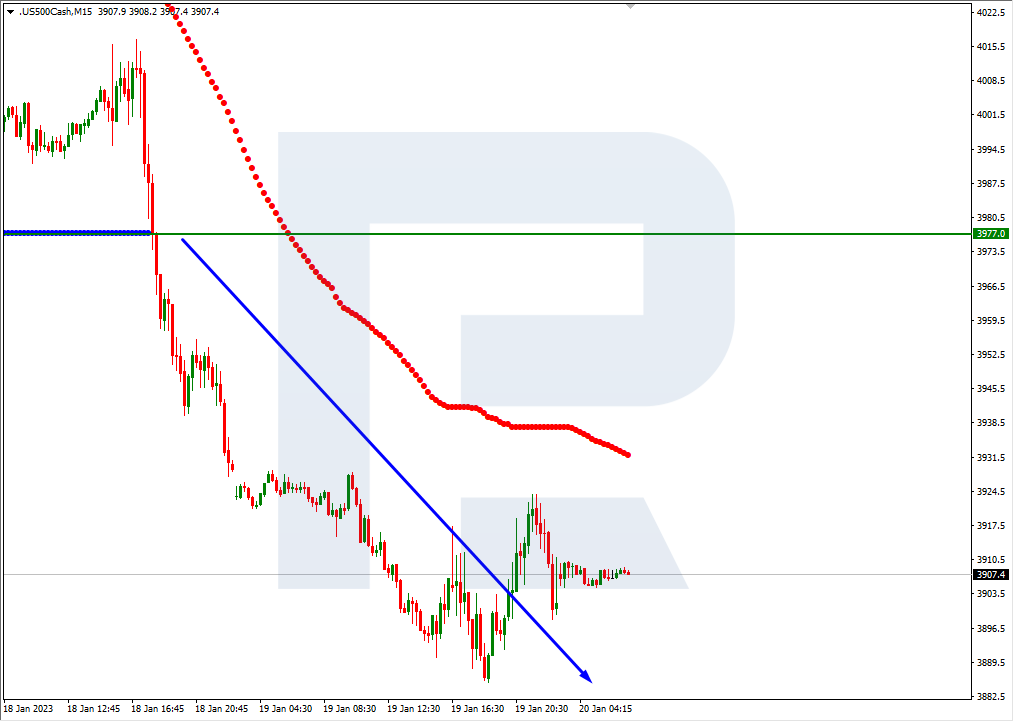
On M15, the lower line of VoltyChannel is broken, which increases the probability of further falling of the price.

S&P500_M15

Article By RoboForex.com

Attention!
Forecasts presented in this section only reflect the author’s private opinion and should not be considered as guidance for trading. RoboForex LP bears no responsibility for trading results based on trading recommendations described in these analytical reviews.

Japanese Candlesticks Analysis 20.01.2023 (XAUUSD, NZDUSD, GBPUSD)

By RoboForex.com

XAUUSD, “Gold vs US Dollar”

At the resistance level, gold has formed a Shooting Star reversal pattern. The pair is currently going by the pattern in a descending wave. The goal of the correction might be 1915.00. Upon testing the support level, the pair may bounce off it and continue the uptrend. However, the quotes may grow to 1945.00 without testing the support level.

XAUUSD
Risk Warning: the result of previous trading operations do not guarantee the same results in the future

NZDUSD, “New Zealand Dollar vs US Dollar”

On H4, at the support level, the pair has formed a Hammer reversal pattern. Currently, the pair is going by the signal in an ascending wave. The goal of the growth might be 0.6485. After this resistance level is broken away, the quotes might get a chance to continue the uptrend. However, the price may pull back to 0.6370 before growth.

NZDUSD
Risk Warning: the result of previous trading operations do not guarantee the same results in the future

GBPUSD, “Great Britain Pound vs US Dollar”

On H4, at the resistance level, the pair has formed a Harami reversal pattern. The pair may now go by the signal in a descending wave. The goal of the correction might be the support level of 1.2310. However, the price may grow to 1.2500 and continue the uptrend without any pullback to the support level.

GBPUSD

Article By RoboForex.com

Attention!
Forecasts presented in this section only reflect the author’s private opinion and should not be considered as guidance for trading. RoboForex LP bears no responsibility for trading results based on trading recommendations described in these analytical reviews.

The Analytical Overview of the Main Currency Pairs on 2023.01.20

By JustMarkets

The EUR/USD currency pair

Technical indicators of the currency pair:
  • Prev Open: 1.0789
  • Prev Close: 1.0830
  • % chg. over the last day: +0.38 %

The ECB is still determined to keep raising rates by 50 basis points in its next meetings. At the same time, there is a growing possibility that the ECB will cut its bond holdings faster. The ECB’s December monetary policy report showed that many policymakers were initially in favor of raising the ECB’s key interest rates by 75 basis points because inflation was expected to be too high. Given the latest Eurozone inflation data, analysts are leaning toward the ECB raising rates by 50 basis points in February and March and then another 25 basis points in May, after which Europe’s Central Bank will pause for a few months.

Trading recommendations
  • Support levels: 1.0780, 1.0710, 1.0650, 1.0597, 1.0535, 1.0497, 1.0480
  • Resistance levels: 1.0846, 1.0867

The trend on the EUR/USD currency pair on the hourly time frame is still bullish. The price is forming a price corridor and is trading at the level of the moving averages. The MACD indicator has become inactive, while signs of divergence persist. Under such market conditions, buy trades are best considered from the support level of 1.0780, with confirmation on intraday time frames in the form of a false breakout of the level. Sell deals can be considered from the resistance level of 1.0846, but better with confirmation in the form of a reverse initiative.

Alternative scenario: if the price breaks down through the support level of 1.0710 and fixes below it, the downtrend will likely resume.

EUR/USD
News feed for 2023.01.20:
  • – US FOMC Member Williams Speaks at 01:35 (GMT+2).
  • – Eurozone ECB President Lagarde Speaks at 12:00 (GMT+2);
  • – US FOMC Member Harker Speaks at 16:00 (GMT+2);
  • – US Existing Home Sales (m/m) at 17:00 (GMT+2);
  • – US FOMC Member Waller Speaks at 20:00 (GMT+2).

The GBP/USD currency pair

Technical indicators of the currency pair:
  • Prev Open: 1.2345
  • Prev Close: 1.2390
  • % chg. over the last day: +0.36 %

Demand for the dollar is generally declining as markets begin to price in the scenario that the Federal Reserve is at the end of its tightening cycle, while the British pound and the euro still have “room” as the central banks in England and the ECB plan to continue raising interest rates. The economic situation in the UK is worse than in the Eurozone. The strong labor market is a positive factor for the Bank of England in the tightening cycle. But high inflation has left manufacturing activity, the service sector, and the real estate market already on the verge of recession. Economists expect the Bank of England to raise its key interest rate from 3.5% to 4% at its meeting in February.

Trading recommendations
  • Support levels: 1.2296, 1.2220, 1.2145, 1.2080, 1.2000, 1.1928, 1.1875, 1.1684
  • Resistance levels: 1.2383, 1.2446, 1.2519

From the technical point of view, the trend on the GBP/USD currency pair on the hourly time frame is bullish. The price is trading above the levels of the moving averages. The MACD indicator is in the positive zone, but the presence of divergence and the daily resistance is still limiting the further growth of quotes. Under such market conditions, it is better to look for buy trades on intraday time frames from the support level of 1.2296, but with confirmation. Sell trades are best sought from the resistance level of 1.2383 but also better with confirmation on the lower time frames.

Alternative scenario: if the price breaks down through the 1.2080 support level and fixes above it, the downtrend will likely resume.

GBP/USD
News feed for 2023.01.20:
  • – UK Retail Sales (m/m) at 09:00 (GMT+2).

The USD/JPY currency pair

Technical indicators of the currency pair:
  • Prev Open: 128.88
  • Prev Close: 128.42
  • % chg. over the last day: -0.36 %

Japan’s nationwide core consumer price index rose from 3.7% to 4.0% in annual terms, a 41-year high. While well below the still exorbitant levels of inflation in the United States, the United Kingdom, and elsewhere, the figure is well above the Bank of Japan’s 2% inflation target. Rising inflation in Japan only adds to the likelihood that the central bank will reverse the policy to a tightening cycle in the spring.

Trading recommendations
  • Support levels: 128.16, 127.53, 126.19
  • Resistance levels: 130.05, 131.34, 132.37, 132.95, 133.23, 134.45, 135.88

From the technical point of view, the medium-term trend on the currency pair USD/JPY is still bearish. The price did not manage to consolidate above the priority level, but within the day, buying pressure will prevail. The MACD indicator is positive again. It is best to look for buy trades from the support level of 128.16, but only with confirmation on intraday time frames. Sell positions can be searched from the resistance level of 130.05, provided that there is a reverse reaction.

Alternative scenario: If the price fixes above the resistance level of 131.34, the uptrend will be renewed with a high probability.

USD/JPY
News feed for 2023.01.20:
  • – Japan National Core Consumer Price Index at 01:30 (GMT+2).

The USD/CAD currency pair

Technical indicators of the currency pair:
  • Prev Open: 1.3485
  • Prev Close: 1.3466
  • % chg. over the last day: -0.14 %

The Canadian dollar is a commodity currency and is highly correlated with instruments such as the dollar index and oil prices. Oil prices increased about 1% on Thursday despite rising inventories. The main trigger for the rise is optimism about China’s opening. Oil demand in China is up nearly 1 million BPD from the previous month. The International Energy Agency said that global oil demand might reach a record high in 2023 as China lifts blockages and restrictions. Considering the current supply levels in the market, it will put upward pressure on oil prices, which will strengthen the Canadian dollar.

Trading recommendations
  • Support levels: 1.3445, 1.3396, 1.3212
  • Resistance levels: 1.3513, 1.3561, 1.3594, 1.3632, 1.3700

From the point of view of technical analysis, the trend on the USD/CAD currency pair is close to changing to a bullish one. The MACD indicator has become positive and buying pressure prevails during the day. Under such market conditions, sell transactions can be considered from the resistance level of 1.3513, but with additional confirmation in the form of a false breakout, as the level has already been tested. Buy deals should be considered from the support level of 1.3445 or 1.3396, but only with short targets and confirmation.

Alternative scenario: if the price breaks out and consolidates above the resistance level of 1.3513, the uptrend will likely resume.

USD/CAD
News feed for 2023.01.20:
  • – Canada Retail Sales (m/m) at 15:30 (GMT+2).

By JustMarkets


This article reflects a personal opinion and should not be interpreted as an investment advice, and/or offer, and/or a persistent request for carrying out financial transactions, and/or a guarantee, and/or a forecast of future events.

Week Ahead: Hawkish Bank of Canada may drag USDCAD lower

By ForexTime

The Canadian Dollar has the smallest year-to-date gain out of all G10 currencies against the US dollar.

Only the Norwegian Krone, another oil-linked currency, has had it worse so far in 2023, with a 0.86% percent year-to-date decline versus the greenback at the time of writing.


CAD traders will be paying close attention to the Bank of Canada’s rate decision due in the coming week, alongside these major economic data releases and events:


Monday, January 23

  • JPY: Bank of Japan December meeting minutes
  • EUR: Eurozone January consumer confidence; ECB President Christine Lagarde speech

Tuesday, January 24

  • AUD: Australia January PMIs, December business confidence
  • EUR: Eurozone January PMIs
  • GBP: UK January PMIs
  • USD: US January PMIs
  • Microsoft earnings

Wednesday, January 25

  • NZD: New Zealand 4Q CPI
  • AUD: Australia 4Q CPI
  • JPY: Bank of Japan to announce amount of outright purchases of government securities
  • EUR: Germany January IFO business climate
  • CAD: Bank of Canada rate decision
  • S&P 500: Earnings from Tesla, NextEra Energy, IBM

Thursday, January 26

  • USD: US 4Q GDP; weekly initial jobless claims
  • S&P 500: Earnings from Intel, American Airlines, Southwest Airlines, Mastercard, Visa

Friday, January 27

  • NZD: New Zealand January business confidence
  • JPY: Japan Tokyo CPI
  • USD: US December PCE deflator, personal income and spending; January consumer sentiment


The Bank of Canada (BoC) is expected to hike its benchmark rate by another 25 basis points (bps), with markets allocating a 74% chance of such an event occurring this Wednesday.


Alternative scenarios:

  • If the BoC surprises with a larger-than-expected 50bps hike, that could send the Canadian dollar soaring, which would drag USDCAD lower.
  • If the BoC surprises by pressing pause on its rate hikes, given that Canada’s inflation has been easing lower, that could pull the loonie lower while boosting USDCAD.


USDCAD: Key levels

RESISTANCE

  • 1.35 area – where this pair’s 50-day and 100-day simple moving averages are currently converging alongside the 23.6% Fibonacci level from USDCAD’s runup between June 2021 – October 2022.
  • 1.36 area – upper boundary of the downward slope from October’s high
  • 1.37043 – mid-December high, though the path up to these levels could be choppy, given that it features varying price action throughout last month.

SUPPORT

  • 1.332 – previous cycle low
  • 1.322 – November low/38.2 Fibonacci level from USDCAD’s June 2021 – October 2022 runup
  • 1.320 psychologically-important region – 200-day SMA/early-September cycle highs


At the time of writing, markets are giving a slight edge for a downside move rather than an upside move for USDCAD.

Here are some forecasts for the next one-week period (from levels at the time of writing):

  • 39% chance that USDCAD may touch 1.332 previous cycle low for support
  • 35% chance that USDCAD will touch 1.360 resistance at upper boundary of downtrend


USDCAD: Fundamental analysis

Next week’s BoC hike is expected to be the final such move in its policy tightening cycle.

The central bank’s rate hikes have already sent its overnight lending rate soaring by a cumulative 4 percentage points throughout all of last year, with this policy tightening campaign also featuring that gargantuan 100 basis point hike last July.

Why was the BoC been hiking rates so aggressively?

Those aggressive hikes were done to quell a near 40-year high in inflation back in the summer of 2022. Canada’s recent bout of red-hot inflation peaked at 8.1% in June, which marked its highest print since January 1983!

However, since then, the consumer price index (CPI) has cooled down to 6.3% year-on-year for December 2022. On a month-on-month basis (comparing the Dec’22 figure with that of Nov’22), the CPI actually fell by 0.6% – its biggest drop since April 2020, at the onset of the pandemic.

BoC forecasted to pause after January hike

Although CPI still remains far above the central bank’s 2% target, moderating inflation may soon bring the curtains down on the Bank of Canada’s rate-hike campaign.

And such dovish expectations have dampened the Canadian dollar’s performance, as cited at the top of this article.

After all, markets are forward-looking in nature. That means today’s prices for USDCAD are reflecting market expectations for what the respective central banks may or may not do in the future.

Also focus on the USD side of the USDCAD equation

The US dollar is set to continue reacting to expectations surrounding the US Federal Reserve’s own rate decision due February 1st, exactly one week after the BoC’s rate decision.
As that keenly-awaited FOMC meeting looms closer, keep a close watch on:

  1. PCE Deflator – the Fed’s preferred inflation gauge – due Friday.

    If the December PCE deflator does not ease lower from November’s prints, pointing to stubborn inflation in the world’s largest economy, that could force the Fed to persist with a bigger rate hike than the mere 25bps liftoff currently priced in by the markets.

  2. Other key US economic data due in the coming week: US GDP, weekly initial jobless claims, and consumer income/spending/sentiment.

    Further signs of waning US economic growth momentum should weigh on the US Dollar, and drag USDCAD lower.


How do market expectations surrounding Fed vs. BoC impact USDCAD?

And as an oversimplified breakdown:

  • Fed to keep hiking rates while BoC slows down/pauses

    = stronger US dollar + weaker Canadian dollar

    = USDCAD to move higher

  • Bank of Canada to keep hiking rates while Fed slows down/pauses

    = stronger Canadian dollar + weaker US dollar

    = USDCAD to move lower


For added reference, here are two other markets that have a major bearing on USDCAD:

  1. The difference in yields between US and Canadian 2-year bonds
    (Rising US vs. Canada spreads = weaker CAD = rising USDCAD; and vice versa)
  2. Brent oil
    (Lower oil prices = weaker CAD = rising USDCAD; and vice versa)

Here’s a look back at how these markets have moved largely in tandem over the past 20 years:


Forex-Time-LogoArticle by ForexTime

ForexTime Ltd (FXTM) is an award winning international online forex broker regulated by CySEC 185/12 www.forextime.com

Quarterly results are still below expectations. Many important decisions on Ukraine will be made in Ramstein (Germany) today

By JustMarkets

The US stock indices continued their decline yesterday. Quarterly results fell short of estimates, with increasing negativity that the Federal Reserve will remain hawkish for a long time as the labor market shows little sign of easing. As the stock market closed yesterday, the Dow Jones Index (US30) decreased by 0.76%, and the S&P 500 Index (US500) fell by 0.76%. The NASDAQ Technology Index (US100) was down by 0.96% on Thursday.

About 190,000 people filed for unemployment claims in the US last week, well below economists’ forecast of 214,000. The strong labor market leaves the US Federal Reserve with room to raise rates further.

Fed spokeswoman Lael Brainard said Thursday that the Fed intends to stay the course on tightening monetary policy and will keep rates fairly restrictive for some time to ensure inflation returns to the Central Bank’s 2% target.

Netflix (NFLX) reported fourth-quarter results that fell short of net income expectations, but the number of new subscribers exceeded expectations. The company added 7.66 million subscribers, well above the 4.6 million expected. The company’s stock jumped by 7% after the report was released in the evening session.

Tesla (TSLA) decreased by 1% yesterday as investors worry that the electric carmaker’s quarterly results may not meet expectations amid slowing demand and production disruptions in China.

Norwegian Cruise Line (NCLH) shares are down more than 4%. The cruise company warned that it expects to report net losses for the quarter and a full year.

Stock markets in Europe were mostly down yesterday. Germany’s DAX (DE30) decreased by 1.72%, France’s CAC 40 (FR40) fell by 1.86%, Spain’s IBEX 35 Index (ES35) lost -1.60%, and the British FTSE 100 (UK100) closed down by 1.07%.

ECB head Christine Lagarde said yesterday that the labor market in Europe has never been as vibrant as it is now, and the economic outlook is much more positive. Given the latest Eurozone inflation data, analysts are leaning towards the ECB raising rates by 50 basis points in February and March and then by another 25 basis points in May, after which Europe’s central bank will take a pause for a few months.

Consumer sentiment in the UK has fallen to a nearly 50-year low. GfK research shows that fears about the economy and a sharp rise in the cost of living have added pressure to household finances. Energy bills and food prices have risen rapidly in recent months, eating away at households’ disposable income. Treasury Secretary Jeremy Hunt and Prime Minister Rishi Sunak cut a two-year household energy scheme that would have kept annual bills at £2,500.

The situation in Ukraine is heating up. According to foreign intelligence, Russia is preparing a new major offensive against Ukraine in the coming weeks. This is the reason the Western allies have become more active in providing weapons, including tanks. Today there will be an important meeting in Ramstein at the NATO base, where it will be decided how much and what weapons to give Ukraine to defend its territories. The front line has largely frozen over the past two months, and neither side has made much progress, despite heavy losses in positional fighting.

Oil prices rose about 1% on Thursday, even as inventories rose. The Energy Information Administration, or EIA, said in its weekly report that US crude inventories rose by 8.408 million barrels for the week. The main trigger for the rise is optimism about China’s opening. Oil demand in China is up nearly 1 million BPD from the previous month. The International Energy Agency said Wednesday that global oil demand could reach an all-time high in 2023 as China lifts blockages and restrictions.

Natural gas closed yesterday at June 2021 lows. A warm winter in Europe led to a sharp drop in gas consumption, which at current supply levels puts downward pressure on quotes. But the main weather forecast models, the Global Forecast System (GFS) and the European ECMWF model expect colder short-term temperature forecasts by the last week of January. This could cause a short-term rise in prices.

Asian markets traded yesterday without a single dynamic. Japan’s Nikkei 225 (JP225) decreased by 1.44% on Thursday, China’s FTSE China A50 (CHA50) added 0.15%, Hong Kong’s Hang Seng (HK50) ended the day down by 0.12%, India’s NIFTY 50 (IND50) fell by 0.32%, and Australia’s S&P/ASXv200v(AU200) ended the day up by 0.57%.

Japan’s nationwide core CPI rose from 3.7% to 4.0% year-over-year, a 41-year high. Rising inflation in Japan adds to the likelihood that the central bank will reverse the policy to tighten the cycle in the spring.

S&P 500 (F) (US500) 3,898.85 −30.01 (−0.76%)

Dow Jones (US30) 33,044.56 −252.40 (−0.76%)

DAX (DE40) 14,920.36 −261.44 (−1.72%)

FTSE 100 (UK100) 7,747.29 −83.41 (−1.07%)

USD Index 102.07 −0.29 (−0.29%)

Important events for today:
  • – Japan National Core Consumer Price Index at 01:30 (GMT+2);
  • – US FOMC Member Williams Speaks at 01:35 (GMT+2);
  • – UK Retail Sales (m/m) at 09:00 (GMT+2);
  • – World Economic Forum Annual Meetings at 10:00 (GMT+2);
  • – Switzerland SNB Chairman Jordan Speaks at 10:00 (GMT+2);
  • – Eurozone ECB President Lagarde Speaks at 12:00 (GMT+2);
  • – Canada Retail Sales (m/m) at 15:30 (GMT+2);
  • – US FOMC Member Harker Speaks at 16:00 (GMT+2);
  • – US Existing Home Sales (m/m) at 17:00 (GMT+2);
  • – US FOMC Member Waller Speaks at 20:00 (GMT+2).

By JustMarkets


This article reflects a personal opinion and should not be interpreted as an investment advice, and/or offer, and/or a persistent request for carrying out financial transactions, and/or a guarantee, and/or a forecast of future events.

China now publishes more high-quality science than any other nation – should the US be worried?

By Caroline Wagner, The Ohio State University 

By at least one measure, China now leads the world in producing high-quality science. My research shows that Chinese scholars now publish a larger fraction of the top 1% most cited scientific papers globally than scientists from any other country.

I am a policy expert and analyst who studies how governmental investment in science, technology and innovation improves social welfare. While a country’s scientific prowess is somewhat difficult to quantify, I’d argue that the amount of money spent on scientific research, the number of scholarly papers published and the quality of those papers are good stand-in measures.

China is not the only nation to drastically improve its science capacity in recent years, but China’s rise has been particularly dramatic. This has left U.S. policy experts and government officials worried about how China’s scientific supremacy will shift the global balance of power. China’s recent ascendancy results from years of governmental policy aiming to be tops in science and technology. The country has taken explicit steps to get where it is today, and the U.S. now has a choice to make about how to respond to a scientifically competitive China.

Growth across decades

In 1977, Chinese leader Deng Xiaoping introduced the Four Modernizations, one of which was strengthening China’s science sector and technological progress. As recently as 2000, the U.S. produced many times the number of scientific papers as China annually. However, over the past three decades or so, China has invested funds to grow domestic research capabilities, to send students and researchers abroad to study, and to encourage Chinese businesses to shift to manufacturing high-tech products.

Since 2000, China has sent an estimated 5.2 million students and scholars to study abroad. The majority of them studied science or engineering. Many of these students remained where they studied, but an increasing number return to China to work in well-resourced laboratories and high-tech companies.

Today, China is second only to the U.S. in how much it spends on science and technology. Chinese universities now produce the largest number of engineering Ph.D.s in the world, and the quality of Chinese universities has dramatically improved in recent years.

Producing more and better science

Thanks to all this investment and a growing, capable workforce, China’s scientific output – as measured by the number of total published papers – has increased steadily over the years. In 2017, Chinese scholars published more scientific papers than U.S. researchers for the first time.

Quantity does not necessarily mean quality though. For many years, researchers in the West wrote off Chinese research as low quality and often as simply imitating research from the U.S. and Europe. During the 2000s and 2010s, much of the work coming from China did not receive significant attention from the global scientific community.

But as China has continued to invest in science, I began to wonder whether the explosion in the quantity of research was accompanied by improving quality.

To quantify China’s scientific strength, my colleagues and I looked at citations. A citation is when an academic paper is referenced – or cited – by another paper. We considered that the more times a paper has been cited, the higher quality and more influential the work. Given that logic, the top 1% most cited papers should represent the upper echelon of high-quality science.

My colleagues and I counted how many papers published by a country were in the top 1% of science as measured by the number of citations in various disciplines. Going year by year from 2015 to 2019, we then compared different countries. We were surprised to find that in 2019, Chinese authors published a greater percentage of the most influential papers, with China claiming 8,422 articles in the top category, while the U.S had 7,959 and the European Union had 6,074. In just one recent example, we found that in 2022, Chinese researchers published three times as many papers on artificial intelligence as U.S. researchers; in the top 1% most cited AI research, Chinese papers outnumbered U.S. papers by a 2-to-1 ratio. Similar patterns can be seen with China leading in the top 1% most cited papers in nanoscience, chemistry and transportation.

Our research also found that Chinese research was surprisingly novel and creative – and not simply copying western researchers. To measure this, we looked at the mix of disciplines referenced in scientific papers. The more diverse and varied the referenced research was in a single paper, the more interdisciplinary and novel we considered the work. We found Chinese research to be as innovative as other top performing countries.

Taken together, these measures suggest that China is now no longer an imitator nor producer of only low-quality science. China is now a scientific power on par with the U.S. and Europe, both in quantity and in quality.

Fear or collaboration?

Scientific capability is intricately tied to both military and economic power. Because of this relationship, many in the U.S. – from politicians to policy experts – have expressed concern that China’s scientific rise is a threat to the U.S., and the government has taken steps to slow China’s growth. The recent Chips and Science Act of 2022 explicitly limits cooperation with China in some areas of research and manufacturing. In October 2022, the Biden administration put restrictions in place to limit China’s access to key technologies with military applications.

A number of scholars, including me, see these fears and policy responses as rooted in a nationalistic view that doesn’t wholly map onto the global endeavor of science.

Academic research in the modern world is in large part driven by the exchange of ideas and information. The results are published in publicly available journals that anyone can read. Science is also becoming ever more international and collaborative, with researchers around the world depending on each other to push their fields forward. Recent collaborative research on cancer, COVID-19 and agriculture are just a few of many examples. My own work has also shown that when researchers from China and the U.S. collaborate, they produce higher quality science than either one alone.

China has joined the ranks of top scientific and technological nations, and some of the concerns over shifts of power are reasonable in my view. But the U.S. can also benefit from China’s scientific rise. With many global issues facing the planet – like climate change, to name just one – there may be wisdom in looking at this new situation as not only a threat, but also an opportunity.The Conversation

About the Author:

Caroline Wagner, Milton & Roslyn Wolf Chair in International Affairs, The Ohio State University

This article is republished from The Conversation under a Creative Commons license. Read the original article.


Weak US economic data raises the possibility of a recession

By JustMarkets

The US Producer Price Index (PPI) fell more than expected in December. This data shows the rate of inflation between factories and plants. The lower PPI puts more pressure on the Fed to slow the pace of interest rate hikes. But despite the easing of inflationary pressures, the US indices declined yesterday. At the close of the stock market yesterday, the Dow Jones Index (US30) decreased by 1.81%, and the S&P 500 Index (US500) fell by 1.56%. The NASDAQ Technology Index (US100) lost 1.24% on Wednesday.

The latest economic data indicates that December was a tough month for consumers. This is evidenced by retail sales data, which decreased by 1.1% from the previous month. Early in the fourth quarter reporting season, major US banks increased their cash reserves in anticipation of more credit losses due to the tough economy. On the one hand, lower inflation is boosting stocks as potentially softer economic conditions create a more favorable trading environment for companies. On the other hand, amid weak retail sales, a sharp drop in industrial production, and news of new layoffs, fears that the US may already be in a recession are growing. This is the third consecutive month of declining industrial activity, with the decline in production looking widespread. The chief economist at RSM US believes that the current trajectory of the economy suggests a “soft recession” in 2023.

Fed spokesman Bullard thinks a 0.5% point rate hike at the next meeting is appropriate, even though inflationary pressures in the US are declining. Another Fed official, Barkin, is of the same opinion. But others are in favor of a 0.25% rate hike at the February 1 meeting. A 0.25% hike in February is considered the most likely (92%) scenario today.

Shares of Microsoft Corporation (MSFT) fell by 1.9% after the company reported cutting 10,000 jobs and receiving a $1.2 billion fine. Moderna, Inc. (MRNA) shares rose by 3.3% after the maker of the COVID-19 vaccine said it was successful in a trial of its experimental vaccine against RSV (contagious respiratory virus) in older adults.

Stock markets in Europe traded without a single trend. German DAX (DE30) decreased by 0.03%, French CAC 40 (FR40) gained 0.09%, Spanish IBEX 35 (ES35) added 0.40%, and British FTSE 100 (UK100) closed yesterday down by 0.26%.

The UK inflation rate fell from 10.7% to 10.5% year-on-year. Core inflation (excluding food and energy prices) remained at 6.3%. The underlying factor behind the decline in inflation is the December decline in energy prices. Money markets are highly confident in favor of a 50 basis point gain at the Bank of England’s February meeting.

Oil prices retreated from Wednesday’s highs amid a Chinese economic opening as US industrial, and retail trade data failed to meet economists’ expectations.

Asian markets were mostly up yesterday. Japan’s Nikkei 225 (JP225) gained 2.5% on Wednesday, China’s FTSE China A50 (CHA50) decreased by 0.36%, Hong Kong’s Hang Seng (HK50) ended the day up by 0.47%, India’s NIFTY 50 (IND50) increased by 0.62%, and Australia’s S&P/ASX 200 (AU200) ended the day up by 0.10%.

Columbia University academic Takatoshi Ito, who is considered a candidate for governor of the Bank of Japan, said Thursday that higher-than-expected inflation could eventually push Japan’s central bank to extend the range of benchmark bond yields this year. It’s a step toward normalizing monetary policy. Japan’s consumer inflation data will be released this Friday and is expected to be 4%.

Australian labor market data indicates that the labor market is starting to cool off. Over the past month, the employment rate fell by 14.6k jobs, with an expected 58.3k growth. If this trend continues, it will give the Reserve Bank less economic room to raise interest rates.

S&P 500 (F) (US500) 3,928.86 −62.11 (−1.56%)

Dow Jones (US30) 33,296.96 −613.89 (−1.81%)

DAX (DE40) 15,181.80 −5.27 (−0.035%)

FTSE 100 (UK100) 7,830.70 −20.33 (−0.26%)

USD Index 102.40 +0.01 (+0.01%)

Important events for today:
  • – Australia Unemployment Rate (m/m) at 02:30 (GMT+2);
  • – World Economic Forum Annual Meetings at 10:00 (GMT+2);
  • – Eurozone ECB President Lagarde Speaks at 12:30 (GMT+2);
  • – Eurozone ECB Monetary Policy Meeting Accounts at 14:30 (GMT+2);
  • – US Building Permits (m/m) at 15:30 (GMT+2);
  • – US Initial Jobless Claims (w/w) at 15:30 (GMT+2);
  • – US Philadelphia Fed Manufacturing Index (m/m) at 15:30 (GMT+2);
  • – US Natural Gas Storage (w/w) at 17:30 (GMT+2);
  • – US Crude Oil Reserves (w/w) at 18:00 (GMT+2);
  • – US FOMC Member Brainard Speaks at 20:15 (GMT+2).

By JustMarkets


This article reflects a personal opinion and should not be interpreted as an investment advice, and/or offer, and/or a persistent request for carrying out financial transactions, and/or a guarantee, and/or a forecast of future events.

Dollar tumbles after disappointing US data

By ForexTime

Concerns about an incoming economic slowdown have hit markets, while continued hawkish rhetoric by Fed speakers has added to negative risk sentiment.

  • Asian stocks have traded mixed with most major indices rangebound following the negative handover from Wall Street.
  • The dollar had a choppy session yesterday on the back of the BoJ meeting and softer data and is in the red to kick off this morning’s session.
  • Gold is trying to hold onto to recent highs and remains above $1900.

Weak US economic data spurred further speculation that inflation is peaking, and policymakers may be nearing the end of their hiking cycles.

US retail sales fell more than expected, industrial production declined and US PPI also slid more than forecast.

But while slowing inflation has been a positive for markets, worries about slowing economic growth have started to bite as well.

This did actually push the DXY to new cycle lows below 102 on more dovish Fed rate expectations, with the May lows also offering immediate support to the benchmark US dollar index, for now.

A further capitulation in dollar bulls could invite bears to push the DXY into sub-100 levels.


BoJ seen to bow to the inevitable

The yen has reversed nearly all its losses from yesterday’s spike higher in USD/JPY, even after the BoJ defied hawkish speculation yesterday that it would widen its yield curve control band further.

Policymakers are seen eventually changing or abandoning the YCC policy when Governor Kuroda steps down in April after he laid the groundwork in December with only the third change to the yield cap in seven years.

That window when he hands over the baton of the BoJ governing board may herald more extreme volatility in the yen.

USD/JPY has been at the forefront of the broad dollar decline since October.

Intervention helped near the highs just shy of 152. Easing US CPI prints, especially in November saw huge moves to the downside.

The upper part of the long-term descending channel, with its series of lower highs and lower lows, was nearly touched yesterday on the spike high after the BoJ meeting, only to be repelled by USDJPY’s 21-day simple moving average (SMA).

But the sharp about-turn looks strongly bearish with funds loading up on long yen positions in anticipation of more BoJ policy changes going forward.


Forex-Time-LogoArticle by ForexTime

ForexTime Ltd (FXTM) is an award winning international online forex broker regulated by CySEC 185/12 www.forextime.com