Stock indices continued to grow amid declining inflation pressure in the United States

By JustMarkets

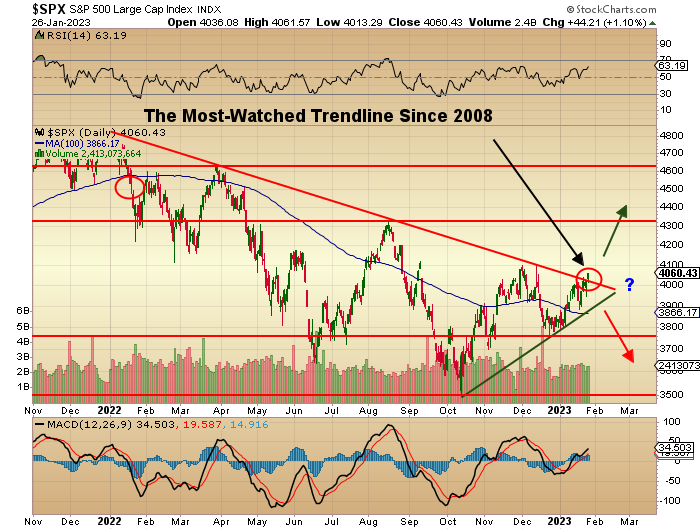
The US indices continued to rise amid declining inflationary pressures. By the trading day’s close, the Dow Jones index (US30) gained 0.64%, and S&P500 (US500) added 0.34%. The NASDAQ Technology Index (US100) increased by 0.64% on Thursday.

The US consumer price index fell from 7.1% to 6.5% (forecast 6.5%) on an annualized basis. Core inflation (which excludes food and energy prices) also slowed year over year from 6% to 5.7% (5.7% forecast). Lower inflationary pressures have increased bets that the Federal Reserve will move to smaller hikes. According to CME Group’s Fedwatch tool, investors now estimate a nearly 95% chance that the Central Bank will raise rates by 25 basis points on February 1. Philadelphia Fed President Patrick Harker supported a 0.25% hike next month, while St. Louis Fed President James Bullard prefers that the Fed maintain the pace of rate hikes.

Weekly initial US jobless claims came in at 205,000, below the expected 215,000. Many market participants are looking for signs of weakness in the labor market as another signal of slowing inflation.

Today is the start of the reporting season in the United States. As usual, the banking sector will report first. Analysts are predicting weak data, with the expectation that Q4 2022 earnings will be worse than Q3. But this does not apply to retailers, which may show good results at the end of the quarter due to Christmas sales.

Equity markets in Europe rose yesterday. Germany’s DAX (DE30) gained 0.74%, France’s CAC 40 (FR40) added 0.74%, Spain’s IBEX 35 index (ES35) jumped by 1.30%, Britain’s FTSE 100 (UK100) closed 0.89% on Thursday.

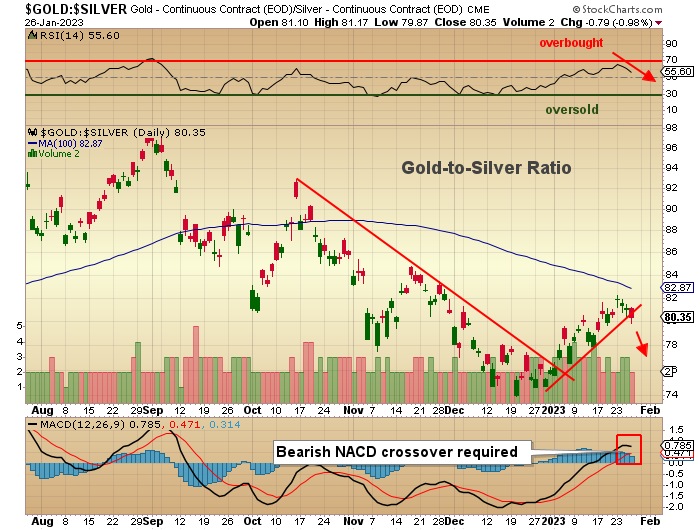
Gold prices hit an eight-week-high. A decline in US inflation increases the likelihood that the US Federal Reserve will move to a slower interest rate hike, which is positive for precious metals. Gold and silver are inversely correlated to the dollar Index and US government bond yields.

Lower inflationary pressures have returned investors’ appetite for risky assets, including oil. Crude oil futures rose for the fifth time in seven days, with WTI crude for February increased by 1.3% yesterday. London Brent crude oil for March delivery jumped by 1.7%. The fundamental picture is now pointing toward further growth in oil prices.

Asian markets were mostly on the rise yesterday. Japan’s Nikkei 225 (JP225) gained 0.01%, China A50 (CHA50) added 0.32%, Hong Kong’s Hang Seng (HK50) increased by 0.36%, India’s NIFTY 50 (IND50) fell by 0.21%, while Australia’s S&P/ASX 200 (AU200) was up 1.18% on the day.

The Japanese government’s Higher Economic Policy Commission invited eight economists, including inflation and monetary policy experts, to upcoming special meetings to discuss the country’s long-term policy. Analysts believe that these meetings are intended to discuss the strategy of the Bank of Japan’s exit from the soft monetary policy program and the development of a new agreement between the Bank of Japan and the government.

S&P 500 (F) (US500) 3,983.17 +13.56 (+0.34%)

Dow Jones (US30) 34,189.97 +216.96 (+0.64%)

DAX (DE40) 15,058.30 +110.39 (+0.74%)

FTSE 100 (UK100) 7,794.04 +69.06 (+0.89%)

USD Index 102.22 -0.97 (-0.94%)

Important events for today:
  • – China Trade Balance (m/m) at 05:00 (GMT+2);
  • – UK GDP (m/m) at 09:00 (GMT+2);
  • – UK Industrial Production (m/m) at 09:00 (GMT+2);
  • – UK Manufacturing Production (m/m) at 09:00 (GMT+2);
  • – French Consumer Price Index (m/m) at 09:45 (GMT+2);
  • – Spanish Consumer Price Index (m/m) at 10:00 (GMT+2);
  • – Eurozone Industrial Production (m/m) at 12:00 (GMT+2);
  • – US Michigan Consumer Sentiment (m/m) at 17:00 (GMT+2).

By JustMarkets


This article reflects a personal opinion and should not be interpreted as an investment advice, and/or offer, and/or a persistent request for carrying out financial transactions, and/or a guarantee, and/or a forecast of future events.

Global economy 2023: why there will still be plenty of pressure on food prices in the year ahead

By John Hammond, University of Reading and Yiorgos Gadanakis, University of Reading 

Welcome to this special report on the food industry, the fourth instalment in our series on where the global economy is heading in 2023. It follows recent articles on inflation, energy and the cost of living.


Shortly after Russia invaded Ukraine, the closely watched food price index of the UN Food and Agriculture Organization (FAO) reached its highest recorded level, stoking consumer prices across the world. In the UK, for example, the prices of many everyday items increased way ahead of inflation, with bread and eggs both up 18% in the year to December, and milk up 30%.

Such rises threatened food security, particularly in low and middle-income countries that rely heavily on Ukraine and Russia for grains and plant oils. That included many countries in Africa and Asia, which took 95% of Ukraine’s wheat exports in 2021 (roughly a tenth of the world supply).

Global food price inflation

Graph showing annual global food price inflation
Source: FAO.

This prompted much talk in the media about the potential for famine. Yet nearly a year after the invasion, the FAO food price index has returned to pre-invasion levels.

So why has pressure on prices reduced, and what are the prospects for the year ahead?

What happened in practice

You can’t look at food in isolation from COVID. Many people in the energy and food industries were either too ill to work or prevented from doing so because of pandemic restrictions, which squeezed supplies. When the world opened up and demand began to rise, food and energy prices went up too.

This made people particularly vulnerable to events in Ukraine. Once the war began, food-price inflation peaked because the markets were uncertain about whether production and exports would be hit, and how global supply chains would adapt.

Ukraine’s grain exports resumed after a UN deal was brokered in July to create a humanitarian corridor through the Black Sea. It also helped that the wheat harvest was larger than expected, even if large areas around the front line remain unharvested. Much of Ukraine’s corn has not been harvested either, for the additional reason that the drying process is energy intensive and farmers struggled to afford the raised prices. Overall, Ukraine’s grain exports were down in 2022 by about 30% year on year.

Russia is normally an even bigger exporter of wheat than Ukraine, supplying about 15% of world demand. It’s harder to see what has happened to these supplies because the Russians stopped providing data, but certainly Moscow’s policy of only dealing with “friendly” countries will have affected availability for many countries too.

Countries that rely heavily on Ukrainian/Russian grains have been forced to shop elsewhere. For example Yemen and Egypt have imported more grain from India and the EU, paying higher prices than usual.

Several additional pressures on farmers have further squeezed the global food supply. Fertiliser prices have rocketed in the past two years. Russia, an important global supplier, has been stockpiling for domestic use. Elsewhere, heightened energy prices have squeezed output. In the UK, the largest nitrogen-fertiliser facility suspended production during 2022. Average fertiliser prices for UK farmers are now 18% higher than the winter before the Ukraine invasion, and 66% higher than two years ago.

Extreme weather in summer 2022 was another problem, including heatwaves and drought in northern Europe, America and China, flooding in Pakistan and drought in Argentina. Irrigation has become more difficult in areas that depend on it, while in Europe drought conditions have reduced the supply of crops for animal feed and harvest of grass for silage. Meat and vegetable prices have both gone up as a result.

According to the UN’s World Food Programme, the overall effect of inflation, war and extreme weather has been that many people around the world have had their access to food restricted. The number of people facing severe food insecurity is up 20% since the war began.

The outlook

Wholesale gas and oil prices have at least declined from their 2022 highs, which will benefit the entire food supply chain. This is one reason why inflation eased slightly in the autumn in many countries.

Oil and gas prices

Chart showing oil and gas prices
Brent crude = blue, UK natural gas = orange.
Trading View

This will have taken some of the heat out of the global food price index. Cereals, meats and particularly vegetable oil prices all fell towards the end of the year, though sugar and dairy prices went in the opposite direction. Overall food price inflation remains historically high.

For the year ahead, the area of crops planted in Ukraine is estimated to be 17% down on 2022. Farmers in other countries are planting more wheat and maize to compensate, though the overall supply will still be pressured by higher farming costs and potentially more extreme weather.

Fertiliser prices will probably stay high as supplies remain restricted. Farmers in wealthier countries may keep applying normal quantities to their crops, like on previous periods of raised prices. But in poorer countries they may cut back, threatening yields and quality and exposing smallholder communities to greater food insecurity.

In sum, many staples will likely remain in tight supply in 2023, meaning price pressures continue. Retailers will be forced to either absorb the costs or pass them on to consumers. Governments will have to consider how to both support struggling consumers but also farmers to maximise what they produce.

At the international level, there needs to be an urgent fertiliser supply agreement to minimise disruptions, prioritising access for vulnerable communities in developing countries. Longer term, farming needs to reduce its dependency on fertilisers by developing agricultural practices that optimise the cycling of nutrients.

This includes more efficient use of manures and extracting nutrients from sewage, and using more legume crops in rotations to take advantage of the fact that they enhance nutrients in the soil. There also needs to be more precision farming techniques to target resources within fields to where they will be used most efficiently.

These practices are well adopted in western countries, but other parts of the world lag behind – particularly developing countries. Fertilisers will always be part of the farming system, but we’ll make food production more sustainable if we can get these things right.


This article is part of Global Economy 2023, our series about the challenges facing the world in the year ahead. You might also like our Global Economy Newsletter, which you can subscribe to here.The Conversation

John Hammond, Professor of Crop Science, University of Reading and Yiorgos Gadanakis, Associate Professor of Agricultural Business Management, University of Reading

This article is republished from The Conversation under a Creative Commons license. Read the original article.

China looms large as President Biden and Japan’s PM Kishida sit down to discuss defense shift, regional tensions

By Mary M. McCarthy, Drake University 

Japanese Prime Minister Fumio Kishida is set to sit down with President Joe Biden at the White House on Jan. 13, 2023.

The bilateral meeting in the U.S. is the final stop for Kishida in a five-day tour of allies that has also seen him visit France, Italy, the U.K. and Canada. It comes as Japan takes over the presidency of the G-7, with leaders of the seven largest economies due to meet in Hiroshima in May.

It also marks the first visit to the White House by a Japanese prime minister since the country revamped its defense priorities with the release of its National Security Strategy in December 2022. The new strategy supports a more robust and assertive security stance by Japan in the face of shifting geopolitical and domestic realities. The new defense plan forms the backdrop to the meeting with Biden.

As an expert on U.S.-Japan relations, I believe the National Security Strategy is the lens through which the meeting should be viewed, with a focus on four key items.

1. Underscoring the US-Japan alliance

The preeminent goal of the leaders’ meeting will be to emphasize the strength and importance of the U.S.-Japan alliance, both rhetorically and in substance.

The two governments will likely seek to display to both foreign and domestic audiences that Japan and the U.S. are in lockstep on foreign policy priorities. Both countries have framed “democracy” and “the rule of law” as common values underpinning the U.S.-Japan alliance, and there is no reason to believe that Biden or Kishida will deviate from that line, especially regarding their shared vision of a “free and open Indo-Pacific.”

Given the context of the meeting, such rhetoric can have substantive consequences and shed some light on how the alliance is being positioned within, and may evolve after, Japan’s latest shift in its defense strategy. Japan’s National Security Strategy is ambitious in its development of new strategic capabilities, including counterstrike measures, and represents unprecedented financial commitments from the Japanese government. Yet Japan can only achieve its new defense goals in close cooperation with the U.S. As a result, Japan will be looking for Biden’s fulsome show of support for both the bilateral alliance and Japan’s new defense strategy.

But the meeting isn’t all about satisfying Japanese concerns – framing the U.S.-Japan alliance as solid and stable supports Biden’s objective of reinvigorating relationships with U.S. allies and acts as a deterrence to any country seeking to disrupt the status quo in the Indo-Pacific region.

2. Addressing regional tensions

Over the past decade, the security environment in Asia has become more dangerous.

Since the Russian invasion of Ukraine in 2022, this is even more so the case. North Korea has become emboldened, knowing that Russia and China are unlikely to act against its provocations in the current geopolitical environment. It is telling that North Korea tested more missiles in 2022 than in any previous year.

Meanwhile, Chinese president Xi Jinping has reasserted his desire of reuniting Taiwan with the mainland during his tenure, holding large-scale military exercises around the island mere days before the U.S.-Japan meeting.

The U.S. views the steps being laid out in Japan’s new defense strategy to be important for regional security as a form of deterrence against aggression from China and North Korea and as a means for the U.S. and Japanese militaries to work together more seamlessly in the event of conflict in the region. The White House meeting provides an opportunity for Biden and Kishida to reiterate their common regional concerns and display a united resolve against any saber-rattling in the region.

3. Confronting Russian aggression

As both the current G-7 president and as a non-permanent member of the United Nations Security Council for 2023-24, Japan will have to confront the main geopolitical drama playing out on the global stage: the Russian war in Ukraine. The new National Security Strategy illustrates how the Japanese government’s view of Russia has shifted, from a potential strategic partner to a strategic threat. Japan has also voiced concerns that Russia could join forces with China in ways that undermine regional security.

These changes in the Japanese government’s perception of Russia bring it more in line with the U.S. position and will likely be reflected in the way in which the Russian invasion of Ukraine is addressed between the two leaders at the White House meeting.

4. Economic security

In 2021, Japan created a cabinet-level post of economic security minister, and the importance of insulating the economy from outside threats was reiterated in the National Security Strategy.

A priority is working toward securing supply chain resilience in the face of existing – or potential – disruptions from pandemics, climate change, military conflict or politically motivated actions, such as withholding needed goods or services by other governments.

Both the U.S. and Japan have emphasized that a crucial part of supply chain resilience is partnering with like-minded nations. As such, a plan for enhanced economic and technological cooperation is among the topics likely to be discussed by the two leaders.

… so how much of this is about China?

The U.S.-Japan bilateral summit is not all about China – conspicuously, China was not mentioned by name in either the White House announcement of the planned content of Friday’s meeting between Biden and Kishida or in the White House overview of the two leader’s last meeting in Cambodia in November 2022.

Yet, China looms large for the U.S. and Japan in each of these four areas, as both seek to enhance the two nations’ defense, diplomatic and economic ties – and will likely never be far from the surface of what is being discussed.The Conversation

About the Author:

Mary M. McCarthy, Professor of Political Science, Drake University

This article is republished from The Conversation under a Creative Commons license. Read the original article.

Counterdrone Products Co. Gets US$11M Order

Source: Daniel Laing   (1/11/23)

The defense manufacturer “got off to a flying start in the new year” with this new contract and an increase in its target price, noted a Bell Potter report.

DroneShield Ltd. (DRO:ASX; DRSHF:OTC) received a new order for US$11 million ($11M) worth of its counterdrone defense solutions, and consequently, Bell Potter raised its target price on the Australian firm to US$0.34 per share from US$0.32, reported analyst Daniel Laing in a Jan. 9 research note.

“Positively, this contract is from a completely different customer to the Dec. 22 order,  demonstrating significant demand for the company’s products from a variety of sources,” Laing wrote. The previous order also was for US$11M.

With these two contracts, Laing pointed out, DroneShield has about US$16.5M in contracted revenue for 2023. This amount equates to 62% of Bell Potter’s US$26.5M revenue estimate for the defense manufacturer in 2023.

Whereas Bell Potter did not change any of its 2023 estimates for DroneShield after this order, it did update each valuation used in calculating its price target. This resulted in the US$0.02, or 6.25%, bump up. This new target is US$0.34 per share; the current share price is about US$0.01225.

Bell Potter also maintained its Buy recommendation on DroneShield.

The investment and financial advisory firm made these adjustments, Laing explained, “to reflect improved confidence in the sales pipeline and significant derisking of our forecasts considering the contracted revenue for the calendar year 2023.”

Bell Potter also maintained its Buy recommendation on DroneShield.

In other recent news, which Laing relayed, DroneShield successfully deployed its DroneGun Tactical at the recent Brazilian presidential inauguration. It also finished the artificial intelligence-focused Defence Innovation Hub Project.


Disclosures:
1) Doresa Banning wrote this article for Streetwise Reports LLC and provides services to Streetwise Reports as an independent contractor. She or members of her household own securities of the following companies mentioned in the article: None. She or members of her household are paid by the following companies mentioned in this article: None.

2) The following companies mentioned in this article are billboard sponsors of Streetwise Reports: DroneShield Ltd. Click here for important disclosures about sponsor fees. The information provided above is for informational purposes only and is not a recommendation to buy or sell any security.

3) Statements and opinions expressed are the opinions of the author and not of Streetwise Reports or its officers. The author is wholly responsible for the validity of the statements. The author was not paid by Streetwise Reports for this article. Streetwise Reports was not paid by the author to publish or syndicate this article. Streetwise Reports requires contributing authors to disclose any shareholdings in, or economic relationships with, companies that they write about. Streetwise Reports relies upon the authors to accurately provide this information and Streetwise Reports has no means of verifying its accuracy.

4) This article does not constitute investment advice. Each reader is encouraged to consult with his or her individual financial professional and any action a reader takes as a result of information presented here is his or her own responsibility. By opening this page, each reader accepts and agrees to Streetwise Reports’ terms of use and full legal disclaimer. This article is not a solicitation for investment. Streetwise Reports does not render general or specific investment advice and the information on Streetwise Reports should not be considered a recommendation to buy or sell any security. Streetwise Reports does not endorse or recommend the business, products, services or securities of any company mentioned on Streetwise Reports.

5) From time to time, Streetwise Reports LLC and its directors, officers, employees or members of their families, as well as persons interviewed for articles and interviews on the site, may have a long or short position in securities mentioned. Directors, officers, employees or members of their immediate families are prohibited from making purchases and/or sales of those securities in the open market or otherwise from the time of the decision to publish an article until three business days after the publication of the article. The foregoing prohibition does not apply to articles that in substance only restate previously published company releases. As of the date of this article, officers and/or employees of Streetwise Reports LLC (including members of their household) own securities of DroneShield Ltd., a company mentioned in this article.

Disclosures For Bell Potter, DroneShield Ltd., January 9, 2023

The Authoring Research Analyst is responsible for the content of this Research Report, and, certifies that with respect to each security that the Analyst covered in this Report (1) all the views expressed accurately reflect the Analyst’s personal views about those securities and were prepared in an independent manner and (2) no part of the Analyst’s compensation was, is or will be, directly or indirectly, related to specific recommendations or views expressed by that Research Analyst in the Research Report.

Disclaimers: This Research Report is a private communication to Clients and is not intended for public circulation or for the use of any third party, without the prior written approval of Bell Potter Securities Limited. The Research Report is for informational purposes only and is not intended as an offer or solicitation for the purpose of sale of a security.

Any decision to purchase securities mentioned in the Report must take into account existing public information on such security or any registered prospectus. This is general investment advice only and does not constitute personal advice to any person. Because this Research Report has been prepared without consideration of any specific client’s financial situation, particular needs and investment objectives (‘relevant personal circumstances’), a Bell Potter Securities Limited Broker (or the financial services licensee, or the representative of such licensee, who has provided you with this report by arrangement with Bell Potter Securities Limited) should be made aware of your relevant personal circumstances and consulted before any investment decision is made on the basis of this Research Report.

While this Research Report is based on information from sources which are considered reliable, Bell Potter Securities Limited has not verified independently the information contained in this document and Bell Potter Securities Limited and its directors, employees and consultants do not represent, warrant or guarantee expressly or impliedly, that the information contained in this Research Report is complete or accurate.

Nor does Bell Potter Securities Limited accept any responsibility for updating any advice, views, opinions or recommendations contained in this Research Report or for correcting any error or omission which may have become apparent after the Research Report has been issued. Bell Potter Securities Research Department has received assistance from the Company referred to in this Research Report including but not limited to discussions with management of the Company. Bell Potter Securities Policy prohibits Research Analysts sending draft Recommendations, Valuations and Price Targets to subject companies. However, it should be presumed that the Author of the Research Report has had discussions with the subject Company to ensure factual accuracy prior to publication.

All opinions, projections and estimates constitute the judgement of the Author as of the Date of the Research Report and these, plus any other information contained in the Research Report, are subject to change without notice. Prices and availability of financial instruments also are subject to change without notice.

Notwithstanding other departments within Bell Potter Securities Limited advising the subject Company, information obtained in such role is not used in the preparation of the Research Report. Although Bell Potter Research does not set a predetermined frequency for publication, if the Research Report is a fundamental equity research report it is the intention of Bell Potter Research to provide research coverage of the covered issuers, including in response to news affecting the issuer.

For non-fundamental Research Reports, Bell Potter Research may not provide regular updates to the views, recommendations and facts included in the reports. Notwithstanding that Bell Potter maintains coverage on, makes recommendations concerning or discusses issuers, Bell Potter Research may be periodically restricted from referencing certain Issuers due to legal or policy reasons. Where the component of a published trade idea is subject to a restriction, the trade idea will be removed from any list of open trade ideas included in the Research Report. Upon lifting of the restriction, the trade idea will either be re-instated in the open trade ideas list if the Analyst continues to support it or it will be officially closed.

Bell Potter Research may provide different research products and services to different classes of clients (for example based upon longterm or short term investment horizons) that may lead to differing conclusions or recommendations that could impact the price of a security contrary to the recommendations in the alternative Research Report, provided each is consistent with the rating system for each respective Research Report.

Except in so far as liability under any statute cannot be excluded, Bell Potter Securities Limited and its directors, employees and consultants do not accept any liability (whether arising in contract, in tort or negligence or otherwise) for any error or omission in the document or for any resulting loss or damage (whether direct, indirect, consequential or otherwise) suffered by the recipient of the document or any other person.

In the USA and the UK this Research Report is only for institutional investors. It is not for release, publication or distribution in whole or in part in the two specified countries. In Hong Kong this Research Report is being distributed by Bell Potter Securities (HK) Limited which is licensed and regulated by the Securities and Futures Commission, Hong Kong. In the United States this Research Report is being distributed by Bell Potter Securities (US) LLC which is a registered broker-dealer and member of FINRA. Any person receiving this Research Report from Bell Potter Securities (US) LLC and wishing to transact in any security described herein should do so with Bell Potter Securities (US) LLC.

A Stock in Accord With the Zeitgeist

Source: Clive Maund  (1/11/23)

Technical analyst Clive Maund reviews the 13-year, 3-year, and 1-year chart for Beam Global to tell you why he believes you should add this company on your radar.

Whilst we fully understand that the electric vehicle movement is a ploy, a con trick to eliminate private motoring altogether for the masses by first of all phasing out gasoline-powered cars in their favor and then making electric vehicles impossibly expensive to run or simply immobilizing them all together, which can be done remotely via the internet using the “climate emergency” as the excuse or by the much cruder means of rolling blackouts and massive electricity price hikes, that does not mean that there is not plenty of money to be made by those companies that play along with it, and one such company is Beam Global (BEEM:NASDAQ), and with a name like this, it is sure to meet with the approval of the Globalists.

In fact, when you look at the company’s website, you might be inclined to think it was started by some members of the World Economic Forum.

On the long-term 13-year chart, which includes the entire history of the stock, we can see that, after a deceptive false start early in 2018 when it looked like it had broken out but then slumped back deep into the Pan base pattern, it really did break out in 2020 and spiked dramatically, but soon reversed into a vicious 2-year long bear market that saw it lose all of the earlier gains.

Zooming in via the 3-year plus chart, we can see that it effectively hit bottom a year ago last January even though it made a marginal new low in October, and what has happened is that the October low made a Double Bottom with the January low.

The duration of this base pattern has allowed time for downside momentum to drop out completely and for the moving averages to drop down close to the price and swing into bullish alignment, and for the first time since early 2020, the 50-day has just risen up through the 200-day, a so-called Golden Cross that very often marks the start of a new bull market.

Zooming in again using a 1-year chart, we can see the Double Bottom base pattern in detail and how the price broke strongly above its moving averages in November, a move that looks like a preliminary breakout, preliminary because it hasn’t yet sustained a breakout above the resistance marking the upper boundary of the base pattern, which is at about US$19 – US$20, but with the averages crossing it looks like the next upleg will succeed in accomplishing this.

The December reaction back to the vicinity of its moving averages is therefore viewed as presenting a good opportunity to buy it ahead of the next upleg and here we should take note that, because of what it is doing, it has a certain amount of insulation from the vagaries of the broad stock market.

A big positive is that there are only 10 million shares outstanding, and of these, only 3 million approx. are in the float.

Beam Global’s website.

Beam Global closed for trading at US$16.86 at 3.03 pm EST on 5th January 5, 2023.

Note that the color green has been used for the charts in recognition of the company’s “green credentials.”


CliveMaund.com Disclosures:
The above represents the opinion and analysis of Mr. Maund, based on data available to him, at the time of writing. Mr. Maund’s opinions are his own, and are not a recommendation or an offer to buy or sell securities. Mr. Maund is an independent analyst who receives no compensation of any kind from any groups, individuals or corporations mentioned in his reports. As trading and investing in any financial markets may involve serious risk of loss, Mr. Maund recommends that you consult with a qualified investment advisor, one licensed by appropriate regulatory agencies in your legal jurisdiction and do your own due diligence and research when making any kind of a transaction with financial ramifications. Although a qualified and experienced stock market analyst, Clive Maund is not a Registered Securities Advisor. Therefore Mr. Maund’s opinions on the market and stocks can only be construed as a solicitation to buy and sell securities when they are subject to the prior approval and endorsement of a Registered Securities Advisor operating in accordance with the appropriate regulations in your area of jurisdiction.

Disclosures:

1) Clive Maund: I, or members of my immediate household or family, own shares of the following companies mentioned in this article: None. I personally am, or members of my immediate household or family are, paid by the following companies mentioned in this article: None. My company has a financial relationship with the following companies mentioned in this article: None. CliveMaund.com disclosures below. I determined which companies would be included in this article based on my research and understanding of the sector.

2) The following companies mentioned in the article are sponsors of Streetwise Reports: None. Click here for important disclosures about sponsor fees. The information provided above is for informational purposes only and is not a recommendation to buy or sell any security.

3) Statements and opinions expressed are the opinions of the author and not of Streetwise Reports or its officers. The author is wholly responsible for the validity of the statements. The author was not paid by Streetwise Reports for this article. Streetwise Reports was not paid by the author to publish or syndicate this article. The information provided above is for informational purposes only and is not a recommendation to buy or sell any security. Streetwise Reports requires contributing authors to disclose any shareholdings in, or economic relationships with, companies that they write about. Streetwise Reports relies upon the authors to accurately provide this information and Streetwise Reports has no means of verifying its accuracy.

4) This article does not constitute investment advice. Each reader is encouraged to consult with his or her individual financial professional and any action a reader takes as a result of information presented here is his or her own responsibility. By opening this page, each reader accepts and agrees to Streetwise Reports’ terms of use and full legal disclaimer. This article is not a solicitation for investment. Streetwise Reports does not render general or specific investment advice and the information on Streetwise Reports should not be considered a recommendation to buy or sell any security. Streetwise Reports does not endorse or recommend the business, products, services or securities of any company mentioned on Streetwise Reports.

5) From time to time, Streetwise Reports LLC and its directors, officers, employees or members of their families, as well as persons interviewed for articles and interviews on the site, may have a long or short position in securities mentioned. Directors, officers, employees or members of their immediate families are prohibited from making purchases and/or sales of those securities in the open market or otherwise from the time of the decision to publish an article until three business days after the publication of the article. The foregoing prohibition does not apply to articles that in substance only restate previously published company releases.

Charts provided by the author.

Murrey Math Lines 12.01.2023 (USDCHF, XAUUSD)

By RoboForex.com

USDCHF, “US Dollar vs Swiss Franc”

On H4, the quotes are under the 200-day Moving Average, indicating prevalence of a downtrend. The RSI is approaching the resistance level. A test of 1/8 (0.9338) is expected here, followed by a bounce off it and falling to the support level of -1/8 (0.9216). The scenario can be cancelled by a breakaway of 1/8 (0.9338) upwards, which might lead to a trend reversal and growth of the pair to the resistance level of 2/8 (0.9399).

USDCHFH4
Risk Warning: the result of previous trading operations do not guarantee the same results in the future

On M15, an additional signal confirming the decline will be a breakaway of the lower border of VoltyChannel.

USDCHF_M15
Risk Warning: the result of previous trading operations do not guarantee the same results in the future

XAUUSD, “Gold vs US Dollar”

On H4, Gold quotes are in the overbought area. The RSI is nearing the descending trendline that acts as a resistance level. Hence, a downward breakaway of 8/8 (1875.50) should be expected, followed by falling to the support level of 6/8 (1843.75). The scenario can be cancelled by rising over the resistance level of +1/8 (1890.62). This might provoke further growth of the quotes to +2/8 (1906.25).

USDCAD_H4
Risk Warning: the result of previous trading operations do not guarantee the same results in the future

On M15, a breakaway of the lower border of VoltyChannel will increase the probability of further falling.

USDCAD_M15

Article By RoboForex.com

Attention!
Forecasts presented in this section only reflect the author’s private opinion and should not be considered as guidance for trading. RoboForex LP bears no responsibility for trading results based on trading recommendations described in these analytical reviews.

The Analytical Overview of the Main Currency Pairs on 2023.01.12

By JustMarkets

The EUR/USD currency pair

Technical indicators of the currency pair:
  • Prev Open: 1.0729
  • Prev Close: 1.0755
  • % chg. over the last day: +0.24 %

Important inflation data will be released in the US today. Economists expect the consumer price index to fall from 7.1% to 6.5% year-over-year in December. If the actual data match the forecast, the dollar index could fall even more. But if the data is worse than expected, especially for core inflation, which excludes food and energy prices, the situation could be reversed. In this case, the dollar index would likely show impulse up, while the euro would collapse.

Trading recommendations
  • Support levels: 1.0650, 1.0597, 1.0535, 1.0497, 1.0480, 1.0361, 1.0332, 1.0284
  • Resistance levels: 1.0799, 1.0844

The trend on the EUR/USD currency pair on the hourly time frame is still bullish. The price is trading above the moving averages and forming a narrow price balance. Volatility on the eve of the news has declined sharply. The MACD indicator is in the positive zone, but there are signs of divergence, which means that price growth is limited, and a correction should be expected to find good entry points. Under such market conditions, buy trades are better to consider from the support level of 1.0650 or 1.0597 with confirmation on intraday time frames. Sell deals can be considered from the daily resistance level of 1.0799, but better with a confirmation in the form of a reverse initiative or a false breakout.

Alternative scenario: if the price breaks down through the support level of 1.0535 and fixes below it, the downtrend will likely resume.

EUR/USD
News feed for 2023.01.12:
  • – US Initial Jobless Claims (w/w) at 15:30 (GMT+2);
  • – US Consumer Price Index (m/m) at 15:30 (GMT+2).

The GBP/USD currency pair

Technical indicators of the currency pair:
  • Prev Open: 1.2147
  • Prev Close: 1.2147
  • % chg. over the last day: 0.00 %

The situation on the GBP/USD currency pair remains the same. Economists are betting on the fall of GBP/USD quotes ahead of important US inflation data and UK GDP data on Friday. The economic outlook for the United Kingdom remains gloomy. In this case, the Bank of England has almost no options. Interest rates need to rise further to lower inflation. But an increase in rates will have a negative impact on the economy, which will cause GDP to fall even further. Finding a middle ground in such a situation is extremely difficult.

Trading recommendations
  • Support levels: 1.2080, 1.2000, 1.1928, 1.1875, 1.1684, 1.1476, 1.1418
  • Resistance levels: 1.2193, 1.2308, 1.2431, 1.2519

From the technical point of view, the trend on the GBP/USD currency pair on the hourly time frame is bullish. The price is trading in a narrow range above the moving averages. The MACD indicator is positive again, there is some buying pressure inside the day, but volatility has decreased ahead of the inflation data. In such market conditions, it is better to look for buy trades on intraday time frames from the support at 1.2080 or 1.1999, but with confirmation. Sell trades are best looked for from the resistance level of 1.2193 or the stronger level of 1.2238, but also better with confirmation in the form of a false breakout or a change in the structure on the lower time frames.

Alternative scenario: if the price breaks down through the 1.1875 support level and fixes above it, the downtrend will likely resume.

GBP/USD
News feed for 2023.01.12:
  • – US Consumer Price Index (m/m) at 15:30 (GMT+2).

The USD/JPY currency pair

Technical indicators of the currency pair:
  • Prev Open: 132.09
  • Prev Close: 132.48
  • % chg. over the last day: +0.29 %

Former Bank of Japan (BoJ) policy council representative Sayuri Shirai called for a review of the bank’s policy over the past 10 years in light of the changing inflationary picture, which could cause prices to remain high for longer than expected, leading to negative consequences for the economy. The current term of Bank of Japan Governor Haruhiko Kuroda comes to an end in April, and Shirai is widely seen as a candidate for deputy governor. Traders need to understand that any even insignificant shifts of the Bank of Japan in the direction of changing the monetary policy can lead to a significant movement of the Japanese yen.

Trading recommendations
  • Support levels: 131.12, 130.58, 129.65
  • Resistance levels: 132.37, 133.23, 134.45, 135.88, 137.03, 138.00, 139.09

From the technical point of view, the medium-term trend on the currency pair USD/JPY is bullish. Now the price is trading below the levels of the moving averages, while the MACD indicator is negative again, but there are the first signs of divergence. The corrective wave is coming to an end. It is best to look for buy trades from the support levels of 131.12 or 130.58, but only with intraday confirmation. Sell deals can be searched for from the resistance level of 132.37 or 133.23 on the condition of a reverse reaction or false breakout.

Alternative scenario: If the price fixes below the support level of 130.58, the downtrend will likely resume.

USD/JPY
News feed for 2023.01.12:
  • – US Consumer Price Index (m/m) at 15:30 (GMT+2).

The USD/CAD currency pair

Technical indicators of the currency pair:
  • Prev Open: 1.3424
  • Prev Close: 1.3423
  • % chg. over the last day: 0.00 %

A 3% rise in oil prices did not help the Canadian currency to strengthen significantly on Wednesday. Investors are taking no chances ahead of US inflation data, which will be crucial to the short-term direction of the USD/CAD. USD/CAD quotes are trading in a tight corridor for now. A decline in inflation in the US against the background of oil price growth may provoke the strengthening of the Canadian currency (decrease of USD/CAD).

Trading recommendations
  • Support levels: 1.3362, 1.3212
  • Resistance levels: 1.3492, 1.3513, 1.3561, 1.3594, 1.3632, 1.3700

From the point of view of technical analysis, the trend on the USD/CAD currency pair is bearish. The price is trading in a narrow trading range at the level of moving averages in front of the resistance level of 1.3492. The MACD indicator has become inactive. Under such market conditions, it is best to wait for the price to exit the narrow range. Buy trades should be considered after the breakout of 1.3439, but only with short targets and confirmation. Sell deals are better to look for on intraday time frames from the resistance level of 1.3492 or 1.3513, but with a confirmation in the form of a reverse initiative on the lower time frames.

Alternative scenario: if the price breaks out and consolidates above the resistance level of 1.3632, the uptrend will likely resume.

USD/CAD
News feed for 2023.01.12:
  • – US Consumer Price Index (m/m) at 15:30 (GMT+2).

By JustMarkets


This article reflects a personal opinion and should not be interpreted as an investment advice, and/or offer, and/or a persistent request for carrying out financial transactions, and/or a guarantee, and/or a forecast of future events.

Themes for 2023: Sovereign Debt; Silver; Navigating the Post-bubble Train Wreck

Source: Michael Ballanger  (1/11/23)

 Michael Ballanger of GGM Advisory Inc. reviews the current state of U.S debt, the value of the dollar, the resource sector, and more to tell you where he believes the market is heading in 2023. 

As I sat down in mid-December to write the GGMA 2023 Forecast Issue, I was mindful of the one I published in January 2020, where I laid out my conviction that due to rising debt levels around the globe — and this was PRE-COVID — governments would eventually be forced to reprice the collateral backing their skyrocketing sovereign debt (said collateral being gold, of course) sharply higher as a means of shoring up equity.

I surmised that at 10% coverage, the U.S. would need to reprice gold to ~ US$15,700 per ounce because if they wished to achieve a 1:1 ratio of national debt to their 8,311 metric tonnes of gold (allegedly on the books), they would need gold at over US$157,000 per ounce. Again, that was pre-Covid.

Since the beginning of the Great Bull Market, there has been a direct correlation between stock prices and the Federal Reserve Board’s balance sheet.

Of all the gold forecasters and podcasters and self-professed gurus, there was nobody mentioning it as a final solution to the debt bomb that is about to go off in 2023.

The closest is Luke Gromen, a brilliant macro analyst from the U.S. Midwest that believes that a gold-for-oil payment system is soon to be implemented by the major oil producers and consumers to avoid the penalties that result from massive U.S. dollar debasement that can only get worse in 2023 as economic conditions weaken and tax receipts begin to shrink.

It is no coincidence that those countries that are net oil importers are the same ones adding aggressively to gold holdings led by Germany, China, and Japan, the second, sixth, and eighth largest holders of gold in the world.

U.S. Debt

Also, in the GGMA 2000 Forecast Issue was the following paragraph:

“As we look out to the next decade — the “Roaring Twenties” of the 21st Century — I try to identify wherein lies the greatest risk to not only global growth but also global STABILITY. The four-letter answer is the same one I used all throughout 2019 — DEBT. Now, unsubordinated debt is risky, but uncollateralized debt is a nightmare, and all around the world, governments have issued some US$17 trillion of negative-yielding debt (as of August 31), and while that figure will be soon revised downward, all of this debt is riding atop the crest of a fiat wave that is about to break upon a rigid reef of reality.

The only point of debate is “when” because there is no basis whatsoever for the question of “if”. Debt to GDP levels around the world are soaring with little sign of abatement, and since the only collateral behind that debt is the “full faith and confidence of government” (to tax its citizens and repay the debt), I submit that investors around the world are going to demand security before they shell out hard-earned savings, and if you step past tax receipts, you go to “Crown Land” (Canada) or Federal Lands (U.S.), but since that still evokes incendiary responses from the electorate, the only other collateral left is sovereign holdings of one other form of collateral, and that collateral is none other than gold.

I wrote that paragraph prior to the global economic shutdown that was triggered by a virus that was purported to be the second coming of the bubonic plague, which wiped out an estimated sixty million people (up to 60%) of the European population in the 1400s.

The response to the threat was a simultaneous cessation of global trade accompanied by an airdrop of over US$6 trillion in the U.S. alone in the form of cheques to literally anyone with a pulse and to any business alleged to have workers. The total U.S. national debt is estimated to be in excess of US$32 trillion, so the debt bomb referred to in 2020 has grown by over 20% in less than three years.

Furthermore, it is now at the breaking point with debt serviceability, a major obstacle to the U.S. dollar reserve status and hegemony.

So, how does this affect investment strategy for the year 2023? Well, over the forty-five years that I have waged war against those hideous demons that dominate the capital markets, I have learned through many painful judgemental failures that the greatest danger lies within.

When you are manning a trading terminal, there are only two buttons that count. The first one is a “BUY” button, usually green on the old Quotron terminals, and the second one is a “SELL” button, often sporting a reddish hue. There is no “HOLD” button, and do not attempt to locate the “CANCEL” button because in the trading pits, as in warfare, there is only “ATTACK” or “RETREAT,” although General Patton knew not the meaning of the latter and regaled in the former.

Whenever I am in the “set-up” mode for a big trade, such as the GDX:US in mid-March 2020 (16th to be exact, the exact low for the crash), by the time I sit down at the terminal, I have already processed all of the relevant information pertinent to the trade. Now, when I was a younger man filled with all of the audacity of youth, I would visualize the item I was going to buy with the profits from this “CAN’T MISS” trade, and whether it was a new car or a condo in Florida, there was never the slightest consideration of the likelihood of loss.

This may have stemmed from growing up with aspirations of making the NHL in a sport where hesitancy and uncertainty could result in more than simply losing a game. I saw more than a few promising young men run out of the league due to those character flaws but in the world of trading and investing, they are absolutely invaluable. However, as I was to learn very early in my trading career, successful trading carries none of the prerequisites demanded for success on the hockey rink.

There is a terrific book I read last year that was written in 1989 by Jack D. Schwager, where he interviews a number of famous traders from prior decades. When asked what was the singular most important attribute of a great trader, the recurring theme amongst all of the subjects in the book was the ability to manage risk. Essential to managing risk was the tendency to utilize doubt as a tool in tempering drawdowns, and the two behaviors integral to the process included hesitancy and self-examination (also described as uncertainty).

Since the beginning of the Great Bull Market, which began in 1982 with the Dow Jones Industrials at 785 (and national debt at US$900 billion), there has been a direct correlation between stock prices and the Federal Reserve Board’s balance sheet (debt). Also ingrained in this correlation are tax receipts which are generated by stock market profits, and the financial services industry, which has largely replaced manufacturing as the primary driver for the U.S. economy. Now that the era of globalization has been replaced by a return to “on-shoring,” wide profit margins once enjoyed by multinationals due to cheap labor in Asia and Latin America are going to be no more.

The S&P 500 has posted its third losing year in the past ten, but with the best three being +29.16% (2013), +28.88% (2019), and +26.89% (2021), those up years dwarf the three worst years, which were this year -15.66% (2022), -6.24% (2018), and -0.73% (2015). What gives me pause is that this was the first year in a decade that Federal Reserve monetary policy shifted into full tightening mode.

While its dual mandate is well advertised as “price stability” and “maximum full employment,” a third and somewhat covert mandate is beginning to find its way into the current narrative, and that third mandate is “ensuring that the government is adequately funded.” In being allowed to magically create credit in order to keep the U.S. government afloat, it needs no adherence to General Accepted Accounting Principles or “GAAP” guidelines in order to be compliant.

Given that the Saudis have opted in favor of the yuan over dollars as payment-in-kind for their oil, I see a seismic in-process shift now in place as the dollar gets replaced by non-dollar currency reserves, which would include gold.

If U.S. government budgets were constrained by balanced budget controls, it would be insolvent in the blink of an eye. This, I believe, is where the demise of the petrodollar — as in elimination thereof — will put increasing pressure on the “full, faith, and credit” assumptions of sovereign debt levels around the globe, but with the greatest impact those countries that are either “overweight debt” or “short energy.”

While the U.S. is certainly not energy-challenged, it is the world’s largest debtor nation where the purchasing power of its treasury bonds may appear superior to those issued by energy-starved Europe, Japan, and China, 2023 will be the year that the OPEC members decide to accept payment methods for oil and gas in denominations other than U.S. dollars. It could be an SDR or gold or a combination of both, but if this series of events leads to a confrontation concerning the most credit-worthy and default-protected currency in circulation, I see the ultimate measuring stick being central bank gold holdings. If that is the case, then would an OPEC member rather take U.S. dollars or Russian rubles?

Given that the Saudis have opted in favor of the yuan over dollars as payment-in-kind for their oil, I see a seismic in-process shift now in place as the dollar gets replaced by non-dollar currency reserves, which would include gold. Europe is already paying for Russian oil and gas in rubles, and Brazil appears to be aligning itself within the BRIC bloc of nations all hellbent on removing the shackled encumbrances of U.S. dollar servitude.

In the end, if this gold-for-oil movement is to play out, then it is the non-gold-owning treasuries around the world that will be effectively “short oil” by being “short gold” (meaning owning “no gold” such as Canada). That will set off a buying spree in gold as a means of hedging their energy costs which is effectively the same as arbitrarily re-pricing gold to fortify the value of central bank collateral and, given the American’s 8,311 metric tonnes of gold, this is actually a cloaked benefit to the U.S. dollar’s integrity.

One way or the other, gold seems destined for higher valuations versus North American currencies which will put a punctuative end to this two-and-a-quarter year-long bear market in gold miners and their junior brethren.

Here is a question: If you were an accountant with years of experience dealing with balance sheets and income statements, what would be your advice to the Canadian government today? Or the Eurozone? Or the Fed or U.S. Treasury?

If you were applying the rules of accounting to government management of sovereign finances, what on earth could you possibly say?

When I get a notice from a credit card company, I can either pay the bill or lose the card as well as my credit rating. I am not permitted by law to manufacture either cash or credit or “alternative currency” to satisfy a debt that requires the draining of savings. If stressed, we citizens are required to “get a second job” or “ask a relative,” but we do not have a “phantom sugar daddy” like the U.S. Fed or the ECB, or the BoJ to bail us out of near-term financial difficulties.

2023 is going to be the year that the world decided to abandon mindless obedience to U.S. dollar hegemony.

If we do not have sufficient savings to satisfy obligations taken on in the true honor of commerce, we all lose the privilege and, with it, lifestyle and community standing.

Indeed, what would be the correct words or actions when the tax department demands that one pay a bill now that the government has been able to “inflate away” tomorrow?

The new generations of those children of the elite that are now back living in the basement with the widescreen TV and unlimited Internet access (and Mom’s secret credit card that Dad doesn’t know about) are about to receive a very rude awakening when they step out onto Richmond Street to protest and someone their own age (as opposed to a Babyboomer) tells them to get the **** off the street because they have to get to work.

Markets hate this kind of uncertainty on a near-term basis, but they absolutely love it when the opposing factions from a different regimes finally unite under a common cause.

Volcker told Wall Street that they had “better get short” in late 1979, just as Jerome Powell told Wall Street the same thing late last year. Remember all the “we’ll call his bluff” podcasts from the YouTube crowd in the first six months of 2022? In 1980, the Wall Street crowd actually listened to Paul Volcker, but the retail clients were so few, and far between that they were mere echoes in the price-direction narrative.

Between 1966 and 1982, the Dow Jones Industrial Index vacillated between 785 and 1,024, and by the time we got through the Volcker anti-inflation assault, household ownership of stocks had fallen to under 5% of total equity ownership. The retail impact was not only negligible; it was irrelevant.

In the year 1980, the Japanese citizens had worked so incredibly hard since 1945 that, along with the immense power and impact of The Marshall Plan, Japanese industry along with German industry, had moved to the top of the manufacturing “food chain.” The great diamond marketing company founded by DeBeers called the CSO (“Central Selling Organization”) had completed a marketing survey in Asia, which determined that the only country on the planet rejecting diamonds as a traditional engagement or wedding gift was Japan.

The CSO, located at 17 Charterhouse Street in London at the time, was assigned the task of implementing a marketing campaign with a view to attracting the Japanese to the idea that “Diamonds Are Forever.” In 1980, when the campaign began, no young Japanese males ever used diamonds as a symbol of their commitment; by 1990, ten years later, after a Hiroshima-style bombardment of Japanese media with the campaign, not only were young, newly-rich males buying 5-10 carat diamonds worth tens of thousands of U.S. dollars as engagement rings, the upwardly-mobile and now very-affluent female businesswomen were buying diamonds as investments!

The reason I can relate to this is that I was an early financier in the exploration campaign for Mountain Province Diamonds Inc. (MPVD:TSX), which asked me to help them navigate the world of corporate finance in mid-1995. The company was invited to meet with DeBeers in 1996, shortly after the AK-5037 diamond discovery, during which our stock, all acquired under US$0.50 through various private placements, soared to US$9.75 and enriched a great many of my friends and colleagues, none of whom thought that my US$30 target price was either realistic or achievable.

We all err on the side of unreasonable expectations from time to time, but the reason I mention Mountain Province is that nobody that was associated with the company during the early days is still there. The stock that we were selling in the US$6-9 range has a diamond mine (Gaucho Kwé), of which they own 49%, that earned US$34 million last year, yet the stock is currently quoted at a CA$0.50 bid. I have zero holdings, and every single risk-taker from the 1990s took their money and ran for their life. Lesson learned.

2023 is going to be the year that the world decided to abandon mindless obedience to U.S. dollar hegemony, and ironically, the trigger was in 2022 when the U.S. arbitrarily decided that a suitable “sanction” against Russia would be to confiscate approximately US$300 billion of its foreign exchange reserves held outside of Russia. Countries like Brazil, India, and Saudi Arabia were suddenly forced to take a hard look in the mirror relative to the degree of control they have over their assets. It was a sobering moment when they all collectively realized that with the flick of a computer key, their national property could be stolen with little or no adherence to the rules of international law.

 As this de-dollarization trend grows, the COMEX exchange that governs the “paper price” for gold and silver will take on a diminishing role

The BRIC nations have all aligned in a concerted effort to establish an international payments system independent of the SWIFT system, which is a U.S.-controlled mechanism for moving money around the world. The ramifications of defying American foreign policy demands can be felt by any nation using the American system, and while the Saudis have historically relied upon the West for security, recent events have accelerated their distancing from U.S. policy guidelines.

This is all fodder for a cannon aimed directly at the U.S. dollar’s international role as the world’s reserve currency. For gold and silver investors, it is particularly significant as more and more sovereigns opt for non-dollar settlements for crucial commodities like oil and iron ore — and precious metals. As this de-dollarization trend grows, the COMEX exchange that governs the “paper price” for gold and silver will take on a diminishing role such that the shares of north American mining companies begin to respond to the Shanghai gold quote rather than those posted by the COMEX or the London Metals Exchange.

Silver Short-Term Chart

The New Year 2023 brings with it a whole new set of challenges due largely to the uncertainty that remains physical silver closely followed by a basket of junior exploration and development companies that are awaiting the inevitable upturn in the Senior Gold Miners before heading higher themselves. It is well past the time for this group of companies to finally feel the love of the new generations of stock investors that have largely avoided the sector, and to their credit, I might add.

Old, grizzled veterans like me have wallowed in the nostalgia of those great discoveries of the 1980s and 1990s, like Hemlo and Eskay Creek, Ekati and Voisey’s Bay while the youngsters had huge wins in cannabis, crypto, and technology issues from just after the GFC in 2008 until 2022. The Fed-fuelled bull market that acted as a financial aphrodisiac for millions of Millennials and Gen-Exers created a psychological effect known as the “Buy-The-Dip” mentality that was more of a Pavlovian phenomenon born out of the Federal Reserve’s incessant habit of rescuing the stock market through monetary stimulus or well-scripted bullish narratives jawboned through financial media outlets every time there was a 5% correction.

The need to sustain the asymmetrical wealth effect through ever-rising stock prices as the policy was replaced in late 2021 by a newly-crafted focus upon price stability rather than maximum full employment, where galloping stock prices have a subliminal effect upon corporate planners in their hiring and firing habits and intentions.

Silver is a chameleon of sorts, taking on the visage of a monetary metal one moment, then transforming itself into an industrial metal the next and when one least expects it. This would explain the near 1:1 correlation between the price of copper and the price of silver during certain periods when economic conditions are tilted toward global growth or accelerating inflation. During the 1970s, when silver soared from US$1.50 to US$50, only in the latter part of the decade did copper catch a bid during the final spike in U.S. inflation, moving from US$0.60/lb. to US$1.50/lb. in twenty-four months.

Absent the competition from other investible distractions, I believe that fund flows will gravitate to the precious metals with greater attention to silver because of the belief that it is much closer to  “green” metals than gold or copper, largely because of its application in the EV and medical fields.

However, observe the chart to the left that lists the percentage conductivity of the various metals.

Silver has greater conductive properties than copper, and both silver, copper, cand gold are ranked well ahead of two more notable battery metals, namely, lead and nickel.

While the sexagenarian community of stock players sees little excitement in the climate-change attributes of gold and silver, the new generations of investors have been educated in a climate-friendly environment where policies related to curricula decisions are heavily tilted toward ecological activism.

This plays quite favorably in the junior exploration space as, in the past few years, I have seen an accelerated interest in battery metals and in copper as a proxy for the electrification movement.

Since youngsters go wild over anything that discourages or replaces the carbon footprint power source, valuations for lithium deposits have been staggeringly large relative to an equally-large deposit of lead or nickel.

Also leaping into the current investment consciousness has been lithium. A major component in the “lithium-ion battery,” lithium allows for the recharging and storing of electrical energy.

Since youngsters go wild over anything that discourages or replaces the carbon footprint power source, valuations for lithium deposits have been staggeringly large relative to an equally-large deposit of lead or nickel.

As enlightenment in the field spreads (and as the table above would prove), silver’s premier rank as an electrical conductor will eventually allow the chameleon to morph into a poster-child “green” metal, attracting millions upon millions of new, well-heeled investors to the party.

This development will allow for the absorption of a great deal of excess supply that is derived from base metals, where silver is mined and stored as a byproduct of copper, lead, and zinc extraction facilities.

Silver Long-Term Chart

Technically, over the shorter term, silver has reversed the downtrend from the peaks in 2021 and 2020 with two distinct breakouts at US$20.75 and US$22.00 and looks poised for a run to US$25.75-26.00. However, the longer-term chart shown above has major resistance at around US$27.50 to overcome before the big test of the February 2021 “Silver Squeeze” top at US$30.00, which will be formidable.

Silver will need to have a confluence of bullish tailwinds propelling it by the time it tests $30 because it is undoubtedly the most popular shorting candidate of all the metals by the bullion bank behemoths.

We all know painfully well the history of the paper market takedowns that have plagued silver investors for decades. It all began in the late 1970s when the Hunt Brothers from Texas attempted to corner the market through massive purchases of silver futures. The reality is that under exchange rules in place at the time, they actually did corner the market, but with the bullion banks in serious trouble from their short positions, they lobbied the government and the COMEX and got the rules changed such that no further silver could be purchased with the only new orders accepted being “SELL” orders.

As I pointed out in an earlier email alert, famous technical analyst Bob Farrell’s Rule #9 for Investing says: When all experts and forecasts agree, something else I going to happen.”

A few enormous increases in maintenance margin requirements added to the stress, and within weeks of “Silver Thursday,” the market crashed from US$47 to US$11, costing the Hunts about US$1.7 billion and forcing them into bankruptcy.

Since that time, silver has had a history of wild swings and headline-grabbing controversy, and while it has greatly enhanced the fortunes of traders that get it “right,” there are countless body bags piled on both shoulders of the Road to Riches. For those of us that have ridden the silver bull in more than a few earlier rodeos, it has always been the safest entry point when no one cares and volatility is muted, such as early last September when the Relative Strength Index dipped briefly under 30 with price at US$17.56/ounce. Hovering around the US$24.00 mark, silver has suddenly caught a bid, and if this continues into the New Year, an entirely new wave of newbie buying will take silver higher before you can spell the word “breakout.”

The chart shown here speaks volumes about the utility of gold as a safe haven asset. Even a modest portfolio allocation to physical gold would have mitigated the damage done by the 2022 bear market mauling.

As for the broad stock markets, I always wait for the results of the period of December 23rd to the end of the first five trading days of the New Year before launching the Forecast Issue. I am a staunch believer in the predictive power of the January Barometer, which includes the “early warning signal” of the first five days in combination with the results of the Santa Claus Rally.

First Five Days “Early Warning” Indicator

The last forty-seven up First five Days were followed by full-year gains thirty-nine times for an 83.0% accuracy ratio and a 14% average in all forty-seven years.

With the S&P 500 ahead 52.59 points (1.37%) at the end of the first five trading days of this year, it increases the likelihood that the lows seen in October at 3,491.58 were “THE” lows for the 2022 bear market. With the Santa Claus Rally actually eking out a modest gain of 0.03%, these two outcomes are simply indications that the more important January Barometer may register a positive outcome, and since it sports an 83.3% accuracy rating since 1952, I look for the mid-January reading in order to lock-and-load strategy for the year.

At the end of December, I read hundreds of pages of investment forecasts from dozens of market strategists, and if there is one theme that has been dominating the 2023 investment narrative, it is that the first half of the year is going to see new lows as the U.S. economy sinks into a severe recession brought about by a behind-the-curve Fed and rapidly-dwindling inflation rates.

I will summarize 2023 with this simple comment: what worked in the period 2009 to 2022 will not work in 2023 and beyond.

Every single newsletter has “something breaking” in H1/2023, forcing the Fed to change policy in order to maintain the integrity of the financial system resulting in a massive recovery in stocks and commodities (risk assets).

As I pointed out in an earlier email alert, famous technical analyst Bob Farrell’s Rule #9 for Investing says: When all experts and forecasts agree, something else I going to happen.”

I cannot overestimate this unanimity of opinion as to the outlook for 2023, and it is coming from people that I generally follow and whose advice has been remarkably consistent. The problem I have is that every one of these gurus has been calling for a Fed “pivot” through most of the latter half of 2022, and if there is one thing that I have learned after nearly five decades of following markets, it is this: never try to tell the market what it is going to do; let the market tell you what it wants to do.

I will summarize 2023 with this simple comment: what worked in the period 2009 to 2022 will not work in 2023 and beyond. Given that the reverse of that will turn out to be true, an overweight position in the junior gold and silver developers seems both timely and prudent.

Good luck in 2023.


Michael Ballanger Disclaimer:

This letter makes no guarantee or warranty on the accuracy or completeness of the data provided. Nothing contained herein is intended or shall be deemed to be investment advice, implied or otherwise. This letter represents my views and replicates trades that I am making but nothing more than that. Always consult your registered advisor to assist you with your investments. I accept no liability for any loss arising from the use of the data contained on this letter. Options and junior mining stocks contain a high level of risk that may result in the loss of part or all invested capital and therefore are suitable for experienced and professional investors and traders only. One should be familiar with the risks involved in junior mining and options trading and we recommend consulting a financial adviser if you feel you do not understand the risks involved.

Disclosures:

1) Michael J. Ballanger: I, or members of my immediate household or family, own securities of the following companies mentioned in this article: None.  I personally am, or members of my immediate household or family are, paid by the following companies mentioned in this article: My company, Bonaventure Explorations Ltd., has a consulting relationship with: None.

2) The following companies mentioned in this article are billboard sponsors of Streetwise Reports: None. Click here for important disclosures about sponsor fees. As of the date of this article, an affiliate of Streetwise Reports has a consulting relationship with: None. Please click here for more information.

3) Statements and opinions expressed are the opinions of the author and not of Streetwise Reports or its officers. The author is wholly responsible for the validity of the statements. The author was not paid by Streetwise Reports for this article. Streetwise Reports was not paid by the author to publish or syndicate this article. Streetwise Reports requires contributing authors to disclose any shareholdings in, or economic relationships with, companies that they write about. Streetwise Reports relies upon the authors to accurately provide this information and Streetwise Reports has no means of verifying its accuracy.

4) This article does not constitute investment advice. Each reader is encouraged to consult with his or her individual financial professional and any action a reader takes as a result of information presented here is his or her own responsibility. By opening this page, each reader accepts and agrees to Streetwise Reports’ terms of use and full legal disclaimer. This article is not a solicitation for investment. Streetwise Reports does not render general or specific investment advice and the information on Streetwise Reports should not be considered a recommendation to buy or sell any security. Streetwise Reports does not endorse or recommend the business, products, services or securities of any company mentioned on Streetwise Reports.

5) From time to time, Streetwise Reports LLC and its directors, officers, employees or members of their families, as well as persons interviewed for articles and interviews on the site, may have a long or short position in securities mentioned. Directors, officers, employees or members of their immediate families are prohibited from making purchases and/or sales of those securities in the open market or otherwise from the time of the decision to publish an article until three business days after the publication of the article. The foregoing prohibition does not apply to articles that in substance only restate previously published company releases.

Stock indices rise on expectations of lower US inflation

By JustMarkets

The US indices rose yesterday as investors bet that today’s US consumer price data will show a further slowdown in inflation. At the close of the stock market yesterday, the Dow Jones index (US30) increased by 0.80%, and the S&P500 index (US500) added 1.28%. The technology index NASDAQ (US100) gained 1.76% on Wednesday.

Important inflation data will be released in the US today. Economists expect the Consumer Price Index to decline from 7.1% to 6.5% year-over-year in December. The December consumer price index reading will determine the pace at which the US Federal Reserve will continue to raise rates. Expectations of further signs of easing inflationary pressures will support a less hawkish Fed stance (0.25% hike at the next meeting). Conversely, if the data disappoints, especially in core inflation, then the US Fed may leave a high rate of growth in interest rates (increase by 0.50% at the next meeting).

Federal Reserve Bank of Boston President Susan Collins said yesterday that she is leaning toward supporting a 0.25% interest rate hike at the central bank’s next meeting on February 1st. According to Collins, moving to a smaller step away from a more aggressive rate hike would give officials more time to see how their actions affect the economy.

Stock markets in Europe rose yesterday. Germany’s DAX (DE30) gained 1.17%, France’s CAC 40 (FR 40) jumped by 0.80%, Spain’s IBEX 35 (ES35) added 0.15%, and the British FTSE 100 (UK100) closed by 0.40% on Wednesday.

ECB spokesman De Kos said yesterday that the ECB would continue to raise interest rates at future meetings at a steady pace. This coincides with comments from other ECB officials. Analysts are currently forecasting 2 consecutive 0.5% hikes at the next ECB meetings. This is a green flag for the European currency, as the euro will benefit from a higher risk appetite on the back of the Chinese opening outlook and the Federal Reserve’s aggressive policy slowdown.

Oil jumped by 3% yesterday despite a large increase in US crude oil inventories. That’s because oil traders are betting on easing rate hikes due to lower inflation. Meanwhile, analysts at Goldman Sachs are predicting an oil price in 2023 above $100 a barrel. According to experts, a barrel of Brent oil could reach $110 by the third quarter if China and other Asian economies are fully open from the constraints associated with the coronavirus.

Asian markets were mostly up yesterday. Japan’s Nikkei 225 (JP225) gained 1.03%, China’s FTSE China A50 (CHA50) added 0.07%, Hong Kong’s Hang Seng (HK50) ended the day up 0.49%, India’s NIFTY 50 (IND50) decreased by 0.10%, and Australia’s S&P/ASX 200 (AU200) ended the day up 0.90%.

China has begun lifting its ban on Australian coal imports. This move is the first concrete step taken to improve relations between the countries. The fact that the decision is coming from China suggests that the country is looking for ways to mend relations with Western countries, relations with which have soured amid increased competition between the US and China. The resumption of coal imports from China boosts Australia’s main commodity sector. Before the unofficial ban, China was one of the largest markets for Australian coal.

China’s Consumer Price Index increased from 1.6% to 1.8% year-over-year. Consumer inflation, which reflects prices between factories and plants, decreased by 0.7% in December. The improved inflation data indicates that the removal of COVID-19 restrictions is indeed having a positive effect on China’s economy and may signal a larger economic recovery later this year. Business activity indicators also indicate a slight improvement in conditions, although the overall activity is still below average. But markets are concerned that rising infections could hinder a more significant near-term economic recovery.

S&P 500 (F) (US500) 3,969.61 +50.36 (+1.28%)

Dow Jones (US30) 33,973.01 +268.91 (+0.80%)

DAX (DE40) 14,947.91 +173.31 (+1.17%)

FTSE 100 (UK100) 7,724.98 +30.49 (+0.40%)

USD Index 103.25 +0.01 (+0.01%)

Important events for today:
  • – China Consumer Price Index (m/m) at 03:30 (GMT+2);
  • – China Producer Price Index (m/m) at 03:30 (GMT+2);
  • – US Initial Jobless Claims (w/w) at 15:30 (GMT+2);
  • – US Consumer Price Index (m/m) at 15:30 (GMT+2);
  • – US Natural Gas Storage (w/w) at 17:30 (GMT+2).

By JustMarkets


This article reflects a personal opinion and should not be interpreted as an investment advice, and/or offer, and/or a persistent request for carrying out financial transactions, and/or a guarantee, and/or a forecast of future events.

Global economy 2023: what happens next with industrial action

By Stéphanie Matteudi-Lecocq, Université de Lille; Jim Stanford, University of Sydney; Marick Masters, Wayne State University; Nabiyla Risfa Izzati, Universitas Gadjah Mada ; Phil Tomlinson, University of Bath, and Rubén Garrido-Yserte, Universidad de Alcalá 

This is the fifth instalment in our series on where the global economy is heading in 2023. It follows recent articles on inflation, energy, food and the cost of living.


Canada: assertive unions getting results

Jim Stanford, Economist and Director, Centre for Future Work, Australia Institute

Canada’s trade union movement is among the more resilient in the OECD, the club of developed countries. This is related to laws that prevent “free riding”, which is where workers can benefit from collective agreements without being union members.

Union density in Canada has been around 30% of workers since the turn of the century, although membership in the private sector is barely half that and slowly falling. In contrast, unionisation is high in public services (over 75%) and growing.

This relatively stability has left Canadian workers better prepared to confront the impact of inflation on their wages. Unions made higher wage demands than in recent decades, and more frequently went on strike (continuing a trend from 2021).

From January to October 2022, there were
145 strikes, and the final year tally will likely exceed the 161 in 2021 – itself a marked increase. A total of 1.9 million person-days of work were lost in strikes up to October (the highest in 15 years). Unlike in recent years, the majority were in the private sector.

A spring wave of strikes in construction in Ontario (Canada’s most populous province) symbolised the increased militancy. At peak, over 40,000 workers downed tools for higher wages, including carpenters, dry-wallers and engineers. Tentative agreements reached by officials were sometimes rejected by members, prolonging the strikes.

A second historic flash point came later in the year when Ontario’s right-wing government invoked a rarely used constitutional clause to override the right to strike for 55,000 education support workers. After unions in the public and private sector threatened a province-wide general strike, the government backed down.

Meanwhile, employer lockouts have virtually disappeared. This tactic, in which employers suspend operations until workers agree to terms being offered, had only been used eight times by October, compared to 60 per year a decade ago.

Annual wage growth increased modestly to an average of 5% by late in the year. That still lagged the 6.8% inflation, but closed the gap from 2021.

It remains to be seen whether this union pressure can be sustained in the face of rapid interest rate increases, a likely recession in 2023, and continued government suppression of union rights in some provinces.

United Kingdom: an olive branch for the health service?

Phil Tomlinson, Professor of Industrial Strategy, University of Bath

The UK’s latest winter of discontent is extending into 2023 as the country endures its largest wave of strikes in over 30 years. Most are in the public sector, where pay offers are well below inflation and significantly lag private companies.

The sense of grievance is high following the austerity and real-terms pay cuts of the 2010s. Strikes – estimated to have cost the UK economy £1.7 billion in 2022 – are being co-ordinated across different unions, adding to the public inconvenience.

The UK government has steadfastly refused to yield, however. It has hidden behind independent recommendations by public-sector pay review bodies, despite not always following them. They have also claimed that inflation matching public sector pay rises would cost each UK household an extra £1,000 a year, though this figure has been debunked.

The Treasury also echoes Bank of England concerns about setting off a wage-price spiral. Yet this is unlikely, given the current inflation is largely down to supply shocks (from COVID and the war in Ukraine), while average wage growth is well below inflation.

There is an economic case for a generous deal, especially in the National Health Service (NHS): with over 133,000 unfilled vacancies, better wages might help improve staff retention and recruitment. Of course, funding this in a recession involves tough choices.

Higher taxes would be politically difficult with the tax burden at a 70-year high. Higher government borrowing could aggravate inflation if accommodated by the Bank of England increasing the money supply through more quantitative easing.

Public opinion appears largely sympathetic to the strikes, especially in the NHS. But if the government relents in one sector, it sets a precedent for others, with potentially wider economic consequences.

For the NHS, it may instead bring forward public sector pay review body negotiations for 2023 to allow for an improved deal – possibly alongside a one-off hardship payment. Elsewhere it will probably hold firm and hope the trade unions lose their resolve.

Australia and New Zealand: strikes remain rare despite inflation

Jim Stanford, Economist and Director, Centre for Future Work, Australia Institute

Strikes in Australia have become very rare in recent decades, thanks to restrictive labour laws passed since the 1990s. Despite historically low unemployment and wages lagging far behind inflation, these laws continue to short-circuit most industrial action.

In 2022, union density fell to 12.5% of employees, an all-time low. As recently as 1990, union density was over 50% of workers. Union members can legally strike only after negotiations, ballots and specific plans for action have been publicly divulged (thus fully revealing union strategy to the employer). Even when there are strikes, they tend to be short.

A total of 182 industrial disputes occurred in the year to September. (The statistics don’t distinguish between strikes and employer lockouts, which have become common in Australia.) This is similar to the pre-COVID years, following a drop in 2020, and only a fraction of 1970s and 1980s industrial action.

The only visible increase in strike action in 2022 was a series of one-day protest strikes organised by teachers and health care workers in New South Wales, the country’s most populous state. Having put up with a decade of austere wage caps by the conservative state government, they decided they had had enough as inflation picked up.

Most other workers have been passive despite Australia experiencing among the slowest wage growth of any major industrial country. Nominal wages grew just 2% per year over the decade to 2021. That rose to 3.1% by late 2022, but it’s still less than half the 7.3% inflation rate.

Australia’s newly elected Labor government did pass a series of important labour law reforms at the end of 2022, aimed at strengthening collective bargaining and wage growth. That might herald incremental improvement in workers’ bargaining power in the years ahead.

The industrial relations outlook in New Zealand is somewhat more hospitable for workers and their unions. Union density increased in 2021, to 17% of employees (from 14% in 2020). Average ordinary hourly earnings grew an impressive 7.4% in the latest 12-month period – helped by a 6% boost in the minimum wage by New Zealand’s Labour government.

Industrial action remains rare – perhaps in part because workers are successfully lifting wages via other means. No official strike data is available for 2022, but in 2021, just 20 work stoppages occurred, down sharply from an average of 140 per year in the previous three years.

Indonesia: anger against labour law reforms

Nabiyla Risfa Izzati, Lecturer of Labour Law, Universitas Gadjah Mada

A few weeks ago, the government replaced its controversial “omnibus law” with new emergency regulation. This was in response to the Indonesian constitutional court finding it unconstitutional in 2021.

Passed in late 2020, the omnibus law embodies President Joko Widodo’s ambition to attract foreign investors by slashing red tape at the cost of employees’ rights. It made it easier for businesses to lay off employees without prior notice.

It also lowered statutory severance pay and extended the maximum length of temporary contracts, while ignoring worker safety. In 2022, its new formula to determine the minimum wage also resulted in the lowest annual increase ever. The law attracted much criticism from workers, activists and civil society organisations.

The new emergency regulation is arguably even more problematic. The majority of its provision simply copies the omnibus law. Several changes and additional provisions are confusing and overlap with previous regulations, as well as leaving many loopholes that could be exploited in future.

Yet despite complaints from workers and trade unions that the new rules were passed suddenly and without consultation, strike action is out of the question. Strikes are not popular because they can only be organised with permission from the company in question. If labourers hold informal strikes, employers also entitled to get rid of them.

Public protests are the obvious alternative, though pandemic rules restricting mobility and mass gatherings have made these difficult. Nevetheless, thousands or perhaps even millions of workers staged protests in their respective cities in the second half of 2022.

The workers wanted the omnibus law revoked, and for the government to not use the minimum wage formulations stipulated in the law. The demonstrations got more intense as the government raised subsidised fuel prices in September, which boosted already high inflation due to rising food prices.

The government has since issued a separate regulation to determine the 2023 minimum wage, so the demands were successful, although both workers and employers are furious that the minimum wage rules have changed again under the emergency regulation.

Clearly the protesters did not see the rest of the rules in the omnibus law removed. Some workers have been protesting on social media. This might not induce the government to change the law, but a few viral tweets have pushed several businesses to change abusive practices.

The controversy is likely to continue in 2023 and into the election year of 2024, especially amid possible massive layoffs in the midst of a global recession.

United States: worker protest showing signs of life

Marick Masters, Professor of Business and Adjunct Professor of Political Science, Wayne State University

US workers organised and took to the picket line in increased numbers in 2022 to demand better pay and working conditions, leading to optimism among labour leaders and advocates that they’re witnessing a turnaround in labour’s sagging fortunes.

Teachers, journalists and baristas were among tens of thousands of workers who went on strike. And it took an act of Congress to prevent 115,000 railroad employees from walking out as well.

In total, there have been at least 20 major work stoppages involving upwards of 1,000 workers each in 2022, up from 16 in 2021, plus hundreds more that were smaller.

Workers at Starbucks, Amazon, Apple and dozens of other companies also filed over 2,000 petitions to form unions during the year – the most since 2015. Workers won 76% of the 1,363 elections that were held.

Historically, however, these figures are tepid. The number of major work stoppages has been plunging for decades, from nearly 200 as recently as 1980.

As of 2021, union membership was at about the lowest level on record, at 10.3%. In the 1950s, over one in three workers belonged to a union.

The deck is still heavily stacked against unions, with unsupportive labour laws and very few employers showing real receptivity to having a unionised workforce. Unions are limited in how much they can change public policy. Reforming labour law through legislation has remained elusive, and the results of the 2022 midterms are not likely to make it easier.

Nonetheless, public support for labour is at its highest since 1965, with 71% saying they approve of unions, according to a Gallup poll in August. And workers themselves are increasingly showing an interest in joining them.

In 2017, 48% of workers polled said they would vote for union representation, up from 32% in 1995, the last time the question was asked.

Future success may depend on unions’ ability to tap into their growing popularity and emulate the recent wins in establishing union representation at Starbucks and Amazon, as well as the successful “Fight for $15” campaign, which since 2012 has helped pass US$15 minimum wage laws in a dozen states and Washington DC.

The odds may be steep, but the seeds of opportunity are there if labour can exploit them.

This is an excerpt from an article published on January 5 2023.

France: militant unions risk going too far

Stéphanie Matteudi-Lecocq, Chercheuse au LEREDS, Directrice practice Chez Alixio, Université de Lille

France in 2022 saw new industrial protests, from blockades of oil refineries, to unprecedented strikes at EDF’s nuclear power plants, to rail workers staying at home on public holidays.

TotalEnergies announced “super profits” in the second quarter of 2022 and increased CEO Patrick Pouyanné’s salary by 52% to €5,944,129. In September the militant CGT union demanded a 10% salary increase for workers and called for a strike at the group’s refineries.

Five of Total’s refineries went on strike, joined by two owned by ExxonMobil subsidiary Esso. Esso was already talking to its unions about a pay deal, but Total had only planned to open negotiations in November.

The strikes in the refineries threatened to bring France to a standstill, and the CGT used its power over this key resource to demand that discussions begin more quickly with Total (in the end, the company negotiated earlier and pay deals were done, ending the strikes by early November).

The strike at EDF’s nuclear power stations similarly gave the company’s workers the balance of power because it made it impossible for France to build up energy reserves (since fossil fuels had to be burned to make up for the lack of nuclear power). In the end, the company signed deals with the unions in October.

Unions may have succeeded in both cases, but they are arguably endangered by these kinds of practices. Too many trades union leaders remain stuck in their old militant ways.

There’s a fragile balance between negotiation and protest, and such ransom tactics might damage unions’ public image, making dialogue more difficult in future. In 50 years, the rate of unionisation in France has already halved from over 20% to around 10%.

It’s telling that two of the major strikes at the end of 2022, first by train workers and then by general practitioners, were initiated by groups independent from the unions. They both started spontaneously through social media and the unions found out very late.

In 2023 the unions have an opportunity to improve their influence if they manage to prevent the government from passing its unpopular bill on pensions, which seeks to raise the full pensionable retirement age from 62 to 64 or 65.

The unions have already announced their strong opposition to the bill. With major demonstrations due to take place after the full bill is presented today, January 10, it will be interesting to see their tactics.

This is based on an excerpt from an article published in October 2022.

Spain: unequal support measures could cause trouble

Rubén Garrido-Yserte, Director del Instituto Universitario de Análisis Económico y Social, Universidad de Alcalá

Global inflation is triggering a global economic slowdown and interest rates raised to levels not seen since before 2008. Interest rates will continue to rise in 2023, especially affecting economies as indebted as Spain.

It will undermine both families’ disposable income and the profitability of companies (especially small ones), while making public debt repayments more expensive. Meanwhile, inflation is expected to cause a sustained increase in the cost of the shopping basket in the medium term.

Government measures have partially mitigated this loss of purchasing power so far. Spain capped power prices, subsidised fuel and made public transport free for urbanites and commuters.

There were agreements with banks to refinance mortgages for the most vulnerable families. Plus there have been increases in pensions and public salaries and there are plans to raise the minimum wage.

However, many of these measures must necessarily be temporary. The danger is that they come to be seen as rights that should not be renounced. They also distort the economy and create problems with fairness by excluding or insufficiently supporting some groups. Private salaries will not rise enough to cover inflation, for instance.

The government’s measures have been such that there has been very little industrial action in response to the cost of living crisis. The danger is that they create a scenario where today’s calm may be the harbinger of a social storm tomorrow.


This article is part of Global Economy 2023, our series about the challenges facing the world in the year ahead. You might also like our Global Economy Newsletter, which you can subscribe to here.The Conversation

Stéphanie Matteudi-Lecocq, Enseignante. Chercheuse au LEREDS, Directrice practice Chez Alixio, Université de Lille; Jim Stanford, Economist and Director, Centre for Future Work, Australia Institute; Honorary Professor of Political Economy, University of Sydney; Marick Masters, Professor of Business and Adjunct Professor of Political Science, Wayne State University; Nabiyla Risfa Izzati, Lecturer of Labour Law, Universitas Gadjah Mada ; Phil Tomlinson, Professor of Industrial Strategy, Deputy Director Centre for Governance, Regulation and Industrial Strategy (CGR&IS), University of Bath, and Rubén Garrido-Yserte, Director del Instituto Universitario de Análisis Económico y Social, Universidad de Alcalá

This article is republished from The Conversation under a Creative Commons license. Read the original article.