Why the Fed raised interest rates by the smallest amount since it began its epic inflation fight

By William Chittenden, Texas State University 

The Federal Reserve’s policy-setting committee lifted interest rates on Feb. 1, 2023, by a quarter of a percentage point to a range of 4.5% to 4.75%. The increase, the smallest since the Fed began an aggressive campaign of rate hikes in March 2022, came amid signs the fastest pace of inflation in decades is cooling. But the Fed also indicated more rate hikes are coming.

So why is the Fed slowing the size of rate increases now, and what does it mean for consumers? We asked finance scholar William Chittenden from Texas State University to explain what’s going on and what comes next.

Why did the Fed raise rates by only a quarter point?

The Fed is trying to figure out whether last year’s rate hikes have slowed the economy enough to get inflation near its target of about 2%.

By raising what’s known as the Fed funds rate, the U.S. central bank makes borrowing more expensive, which means buying large-ticket items, like cars and homes, is more costly. This should lead to fewer people buying cars, which will likely result in lower car prices.

In 2022, the Fed lifted rates eight times by a total of 4.25 percentage points, which helped prompt inflation to drop to an annual pace of 6.5% in December from 9.1% at its peak in June.

To understand why it’s so hard for the Fed to figure out if its rate hikes worked, think of the economy as a fully loaded oil tanker out in the ocean. Naturally, it’s chugging along as fast it can to reach a specific destination, but it takes a long time from the captain “stepping on the brakes” to when the ship actually stops moving forward.

Similarly, the Fed is raising rates to slow the economy – sort of like stepping on the brakes – and bring inflation down to 2%, but there’s often a long delay between the hikes and their impact on the economy.

But if the Fed eases off the brakes too early, inflation could remain high. If it presses on them too hard, unemployment will likely shoot up and the economy will slide into a recession. By increasing interest rates only a quarter-point, the Fed is signaling that it believes the economy has begun to slow down and is on a path to 2% inflation.

Does this mean borrowing costs will start coming down?

The Fed funds rate acts as a base rate for shorter-term interest rates, such as for car loans and credit cards. As it goes up, short-term borrowing rates increase by about the same amount.

The financial markets are predicting about an 80% chance the Fed’s benchmark lending rate will top out around 5% this summer – which means they’re expecting rates to go just a little bit higher.

Rates on shorter-term borrowing are unlikely to come down, but if markets are right, they probably won’t increase much more.

However, for long-term borrowing costs, as on a 30-year mortgage, rates are already coming down and are likely to fall some more – good news for homebuyers.

How about inflation – can consumers expect prices to start falling?

Overall, yes, inflation is already starting to come down – and prices on some items are even falling.

For example, used-car prices, which soared earlier in the COVID-19 pandemic, have dropped in recent months, while prices of dozens of other items, such as flour, clothes and gasoline, have eased.

However, some costs continue to increase. Egg prices soared after the supply was disrupted because of avian flu, which killed off nearly 53 million egg-laying hens. Unfortunately, increasing interest rates will not bring back those birds or help decrease the cost of eggs.

In addition, nothing the Fed does will affect the war in Ukraine, which has led to higher world wheat and energy prices.

The point being, the Fed can’t really address certain types of inflation.

Does all this mean the U.S. will avoid recession?

That’s the trillion-dollar question.

Fed officials have at times sounded hopeful that they can bring down inflation without crashing the economy – a so-called soft landing. During his press conference after the latest announcement Feb. 1, 2023, Fed Chair Jerome Powell was more cautious, saying it’s too soon to declare victory. But he noted: “We can now say for the first time that the disinflationary process has started.”

Economic forecasters have been less confident that the U.S. will avoid a recession. On average, economists surveyed this past month by The Wall Street Journal forecast a 61% probability of a recession in 2023. In addition, key economic indicators point to a recession, while the yield curve – a bond market metric that has been successful at predicting recessions – currently puts the odds at about 47%.

In my view, this all adds up to: Nobody really knows. My best advice to consumers out there is to prepare financially for a recession, but let’s not give up hope that the Fed can slow the economy without crashing it.The Conversation

About the Author:

William Chittenden, Associate Professor of Finance, Texas State University

This article is republished from The Conversation under a Creative Commons license. Read the original article.


 

RoboMarkets Is Supporting the European Karate Championships 2023 and the Cyprus National Karate Team

February 2, 2023
Limassol, Cyprus

European licensed broker RoboMarkets is an official sponsor of the Cyprus National Karate Team and the European Karate Championships 2023 that will be held in Larnaca, Cyprus from 3 to 5 February.

RoboMarkets is an official sponsor of the European Karate Championships 2023. This is the third time that the event is hosted in Cyprus, where it was previously held in 2001 and 2016. Last year, 1,000 athletes participated in the championship from 47 countries. This year, even more participants are expected to join from 52 countries in the three age groups (Cadet, Junior & U21).

RoboMarkets also sponsors the National Karate Team of Cyprus, which will also be fighting for the status of the best of the best at the European Karate Championships 2023. The Company supports sports players who continuously go forward by improving their skills, and reaching their goals. During these days hundreds of young athletes from all over Europe will be coming to Cyprus to participate in one of the most important events for youngsters.

Earlier in 2022, RoboMarkets announced the beginning of its cooperation with the Cyprus Karate Federation.

About RoboMarkets

RoboMarkets is an investment company with the CySEC license No. 191/13. RoboMarkets offers investment services in many European countries by providing traders, who work on financial market, with access to its proprietary trading platforms. More detailed information about the Company’s products and activities can be found on the official website at www.robomarkets.com.

“Risk Warning: CFDs are complex instruments and come with a high risk of losing money rapidly due to leverage. 69.88% of retail investor accounts lose money when trading CFDs with this provider. You should consider whether you understand how CFDs work and whether you can afford to take the high risk of losing your money.”


Tech stocks are back: rotation to growth to provide strong returns

By George Prior

The tech titans Meta (Facebook), Apple, Alphabet (Google) and Amazon are all reporting their quarterly earnings this week, after a brutal 2022 for the tech sector.

Investors around the world are scrutinising these market-moving big tech earnings reports for not only profit and revenue information, but also guidance as to the companies’ trajectories.

Despite the likely mixed set of reports, the CEO and founder of one of the world’s largest independent financial advisory, asset management and fintech organizations, is predicting that they will “herald the start of The Great Rotation back into growth stocks.”

Nigel Green of deVere Group says: “Facebook’s parent company Meta has exceeded estimates for revenue in its fourth-quarter earnings report, with the stock soaring in extended trading on the results.

“For Apple, a considerable number of factors suggest the company’s first year-on-year revenue may have declined since early 2019.

“Alphabet, the parent company of Google is expected to report a third consecutive quarter of declining earnings.

“While Amazon’s earnings are expected at $0.15 per share, which would be an 89% decrease from the same quarter in 2021.”

But the deVere CEO says tech stocks are becoming more appealing again for investors.

“As market conditions shifted in 2022, investors dumped growth stocks, like tech, in favour of value stocks which were deemed more suitable to the challenging environment,” he observes.

“But what is happening now, we believe, is the beginning of a rebound.

“These big tech reports herald the start of The Great Rotation back to growth stocks for two key reasons.

“First, valuations of tech and other growth stocks are currently low, having been hit by the previous rotation into value stocks. Investors are now eyeing these super attractive entry points to top-up their portfolios as the trend is reversing.

“And second, inflation has seemingly peaked and interest rates are set to stabilize, which takes away a major obstacle for tech stocks.”

As The Great Rotation gets underway, Nigel Green says that investors must act judiciously.

“Investors should avoid the ‘buy everything’ approach, as there will be big winners and losers. They must concentrate on high quality, profitable companies which can consistently maintain or steadily grow margin.”

Ahead of earnings season, the deVere chief executive told the media that investors shouldn’t bet against big tech in the longer term.

He noted the tech heavyweights – which got carried away during the pandemic era amid soaring revenues and profits and which are now being forced to regroup – still have piles of cash and remain enormously profitable.

In addition, these companies maintain considerable user bases, world-class research and development, plus some of the smartest talent on the planet.

Nigel Green concludes: “Tech stocks are back. Rotation into the right growth stocks will provide strong returns.”

About:

deVere Group is one of the world’s largest independent advisors of specialist global financial solutions to international, local mass affluent, and high-net-worth clients.  It has a network of more than 70 offices across the world, over 80,000 clients and $12bn under advisement

Murrey Math Lines 02.02.2023 (USDCHF, XAUUSD)

By RoboForex.com

USDCHF, “US Dollar vs Swiss Franc”

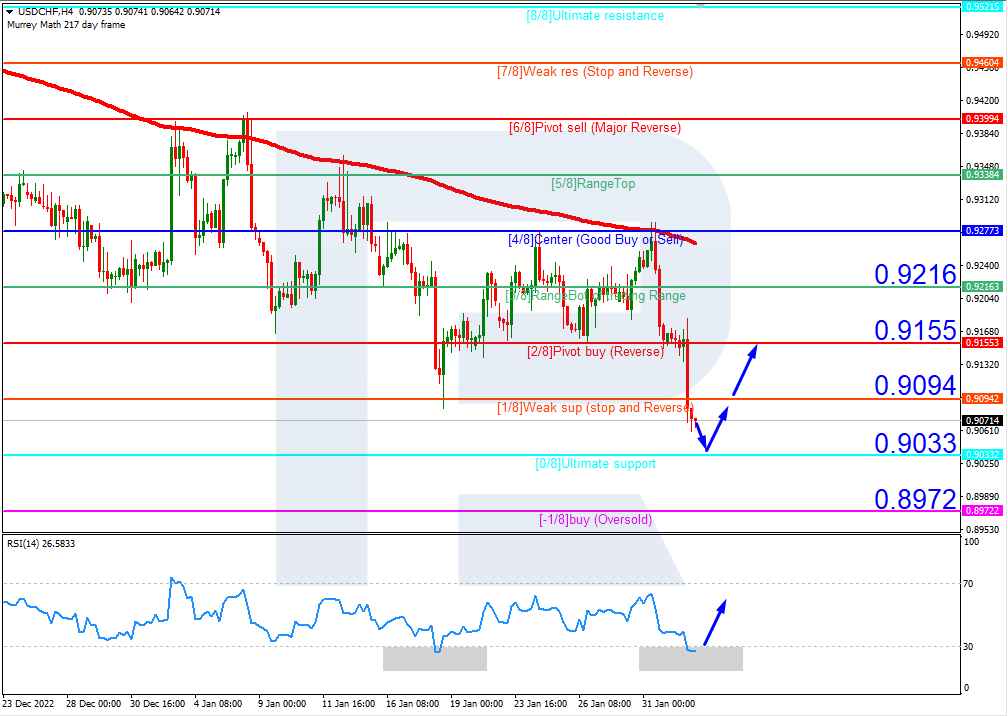
On H4, the quotes are nearing the oversold area, while the RSI has already got to its own. As a result, a test of 0/8 (0.9033) is expected, followed by a bounce off it and growth to the resistance level of 2/8 (0.9155). The scenario can be cancelled by a downward breakaway of the support level of 0/8 (0.9033). In this case, the pair may keep falling, and the quotes might drop to -1/8 (0.8972).

USDCHF_H4
Risk Warning: the result of previous trading operations do not guarantee the same results in the future

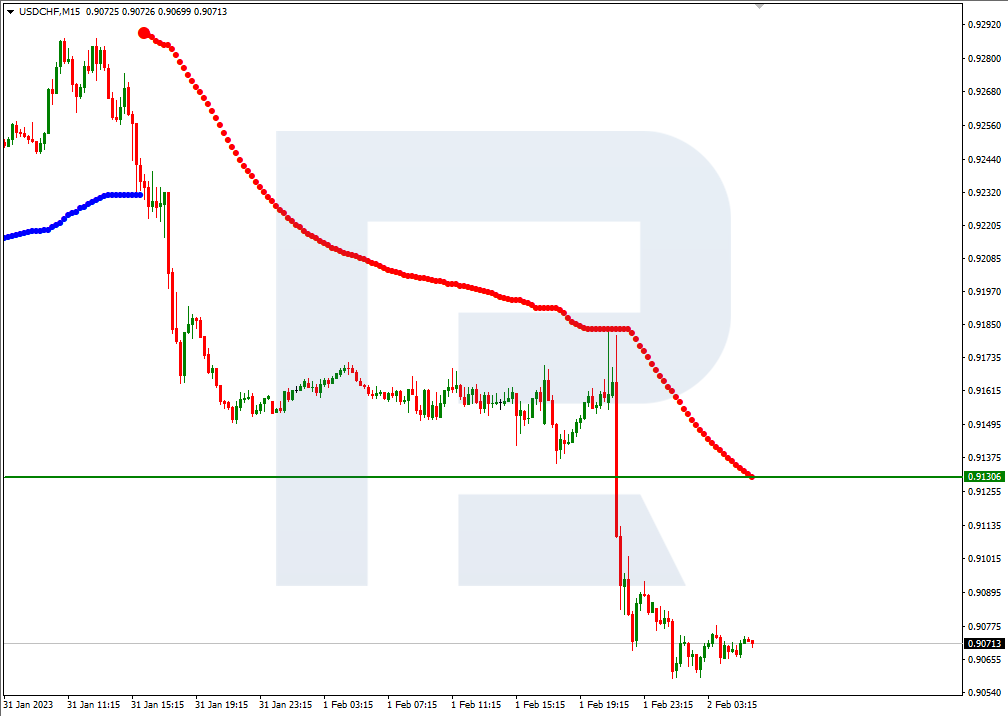
On M15, the upper line of VoltyChannel is too far away from the current price, so growth of the quotes can only be marked by a bounce off 0/8 (0.9033) on H4.

USDCHF_M15
Risk Warning: the result of previous trading operations do not guarantee the same results in the future

XAUUSD, “Gold vs US Dollar”

On H4, the quotes are above the 200-day Moving Average, which indicates prevalence of an uptrend. The RSI has broken through the resistance line. So, the quotes are expected to rise above 7/8 (1968.75) and grow as far as the resistance level of 8/8 (2000.00). The scenario can be cancelled by a downward breakaway of the support level of 6/8 (1937.50). This might bring the quotes down to 4/8 (1875.50).

XAUUSD_H4
Risk Warning: the result of previous trading operations do not guarantee the same results in the future

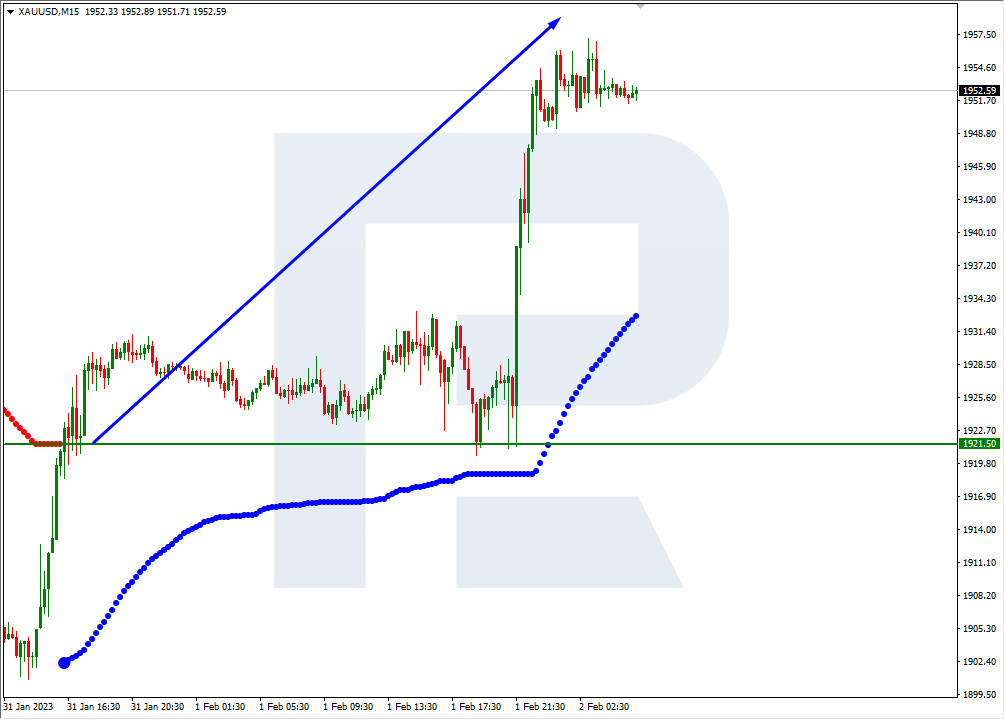
On M15, the upper line of VoltyChannel is broken away, which means an uptrend and high probability of further growth of the quotes.

XAUUSD_M15

Article By RoboForex.com

Attention!
Forecasts presented in this section only reflect the author’s private opinion and should not be considered as guidance for trading. RoboForex LP bears no responsibility for trading results based on trading recommendations described in these analytical reviews.

The Analytical Overview of the Main Currency Pairs on 2023.02.02

By JustMarkets

The EUR/USD currency pair

Technical indicators of the currency pair:
  • Prev Open: 1.0861
  • Prev Close: 1.0989
  • % chg. over the last day: +1.17 %

The euro area’s overall inflation rate fell sharply in January from 9.2% to 8.5% year-on-year, while the core indicator was unchanged from the previous month at 5.2%. Earlier data showed that the Eurozone Manufacturing PMI Index reached a five-month high of 48.8, up from 47.8 the previous month. Although the manufacturing sector remains in contraction territory (below 50), the data indicate that the worst of the recession is over. Today traders will focus on the ECB monetary policy meeting, where a 0.5% rate hike is expected.

Trading recommendations
  • Support levels: 1.0967, 1.0923, 1.0875, 1.0834, 1.0801, 1.0781, 1.0710, 1.0650, 1.0597
  • Resistance levels: 1.1017, 1.1077

The trend on the EUR/USD currency pair on the hourly time frame is still bullish. The Euro is getting stronger on the background of the decreasing interest rate differential between the US Federal Reserve and the ECB. The MACD indicator is overbought, and the price has deviated strongly from the moving averages. Under such market conditions, buy trades are best considered after correcting to the nearest support levels. The first such level is 1.0969, but confirmation in the form of a false breakdown is necessary. Sell deals can be considered from the resistance level of 1.1017, but better with a confirmation in the form of a reverse initiative.

Alternative scenario: if the price breaks down through the support level of 1.0834 and fixes below it, the downtrend will likely resume.

EUR/USD
News feed for 2023.02.02:
  • – Eurozone ECB Monetary Policy Statement at 15:15 (GMT+2);
  • – Eurozone ECB Interest Rate Decision at 15:15 (GMT+2);
  • – US Initial Jobless Claims (w/w) at 15:30 (GMT+2);
  • – Eurozone ECB Press Conference at 15:45 (GMT+2);
  • – Eurozone ECB President Lagarde Speaks at 17:15 (GMT+2).

The GBP/USD currency pair

Technical indicators of the currency pair:
  • Prev Open: 1.2316
  • Prev Close: 1.2372
  • % chg. over the last day: +0.45 %

The UK Manufacturing PMI rose from 46.7 to 47. Annual home price growth slowed to 1.1% from 2.8% in December, with prices now 3.2% below their August peak. These are encouraging signs that the real estate market is recovering. But there are new problems on the horizon: strikes. Yesterday, Britain faced one of the biggest strikes in a decade. Teachers, machinists, civil servants, and bus drivers did not go to work. People are demanding higher wages amid record rises in the cost of living. The Bank of England will hold its monetary policy meeting today, where a 0.5% rate hike is also expected.

Trading recommendations
  • Support levels: 1.2343, 1.2311, 1.2263, 1.2220, 1.2080, 1.2000, 1.1928
  • Resistance levels: 1.2416, 1.2446, 1.2519

From the technical point of view, the trend on the GBP/USD currency pair on the hourly time frame is bullish. The price is trading above the moving averages again. The MACD indicator is in the positive zone, and buyers’ pressure is prevailing again. Under such market conditions, it is better to look for buy deals on intraday time frames from the support level of  1.2343, but with confirmation in the form of initiative on the lower time frames. Sell trades are better to look for from the resistance level of 1.2416, but it is also better with a confirmation in the form of a reverse initiative or a false breakout because the level has been tested before.

Alternative scenario: if the price breaks down through the 1.2311 support level and fixes above it, the downtrend will likely resume.

GBP/USD
News feed for 2023.02.02:
  • – UK BoE Inflation Report at 14:00 (GMT+2);
  • – UK BoE Interest Rate Decision at 14:00 (GMT+2);
  • – UK BoE Monetary Policy Statement at 14:00 (GMT+2).

The USD/JPY currency pair

Technical indicators of the currency pair:
  • Prev Open: 130.08
  • Prev Close: 128.95
  • % chg. over the last day: -0.87 %

Fed officials have largely abandoned their hawkish views. But Jerome Powell denied cutting rates later in the year and indicated that the central bank would continue on its path of “fighting inflation.” The dollar index reacted to this news by falling because, despite further rate hikes, the Fed is nearing the end of its tightening cycle. And given the fact that the Bank of Japan is likely to start the process of monetary policy normalization this year, the USD/JPY outlook looks towards the downside, as the Japanese yen will start to strengthen on the background of the policy change.

Trading recommendations
  • Support levels: 128.16, 127.53, 126.19
  • Resistance levels: 129.05, 130.58, 131.10, 130.61, 131.58, 132.37, 132.95, 133.23

From the technical point of view, the medium-term trend on the currency pair USD/JPY is bearish. The price is trading below the moving averages. The MACD indicator has become negative, there is seller’s pressure inside the day, but the price has reached the support level. Buy trades are best sought from the level of 128.16, but only with confirmation on the lower time frames. Sell deals can be searched from the resistance level of 129.05, provided that there is a reverse reaction.

Alternative scenario: If the price fixes above the resistance level of 131.58, the uptrend will be renewed with a high probability.

USD/JPY
There is no news feed for today.

The USD/CAD currency pair

Technical indicators of the currency pair:
  • Prev Open: 1.3303
  • Prev Close: 1.3289
  • % chg. over the last day: -0.10 %

The Canadian dollar is a commodity currency and is dependent on instruments such as the dollar index and oil. The US dollar declined yesterday as the US Fed’s tightening slowed, while oil prices also fell more than 3% as oil inventories rose and the OPEC+ countries decided to leave production levels unchanged in the expectation that Chinese demand will pick up. The Canadian reacted to this news with volatility. At the moment, the midterm picture is toward the further decrease of the USD/CAD quotes.

Trading recommendations
  • Support levels: 1.3281, 1.3212
  • Resistance levels: 1.3326, 1.3379, 1.3428, 1.3445, 1.3496, 1.3520, 1.3554, 1.3595

From the point of view of technical analysis, the trend on the USD/CAD currency pair is bearish. The price is trading below the moving averages. The MACD indicator is in the negative zone, there is seller’s pressure inside the day, but there are signs of divergence. Now the price has reached the support level. Under such market conditions, buy trades can be considered from the 1.3281 support level, but with additional confirmation in the form of impulse initiative on the lower time frames. Sell deals should be considered from the resistance level of 1.3326, subject to a reverse reaction.

Alternative scenario: if the price breaks out and consolidates above the resistance level of 1.3428, the uptrend will likely resume.

USD/CAD
There is no news feed for today.

By JustMarkets


This article reflects a personal opinion and should not be interpreted as an investment advice, and/or offer, and/or a persistent request for carrying out financial transactions, and/or a guarantee, and/or a forecast of future events.

The US Federal Reserve reduced the rate hike to a 0.25% step. ECB and Bank of England to raise rates by 0.5% today

By JustMarkets

The US stock markets rose yesterday amid a slowdown in the rate hike. At the close of the stock market on Wednesday, the Dow Jones Index (US30) gained 0.02%, and the S&P 500 Index (US500) added 1.05%. The NASDAQ Technology Index (US100) jumped by 2.00% yesterday.

The Federal Reserve raised its interest rate by 0.25% on Wednesday but indicated that it expects more hikes in the future. The Fed is planning two more 0.25% rate hikes in March and May, but analysts doubt the Fed needs to go that high, especially since inflation is slowing and there are early warning signs in the labor market. But investors were generally encouraged by Powell’s answers to questions during his press conference about easing financial conditions, such as the rebound in stocks and falling bond yields in recent months. That pushed stock indices higher.

Meta Platforms stock jumped by 17% thanks to fourth-quarter revenue outperformance. Revenue was $32.17 billion, better than the consensus forecast of $31.53 billion. Facebook reached the milestone of 2 billion daily active users. Major tech companies like Alphabet (GOOGL), Apple (AAPL), and Amazon.com (AMZN) report today. Volatility in the stock market will be high, especially during the reporting period.

Equity markets in Europe traded flat yesterday. German DAX (DE30) gained 0.35%, French CAC 40 (FR40) decreased by 0.08%, Spanish IBEX 35 (ES35) added 0.74%, British FTSE 100 (UK100) closed on Wednesday down by 0.14%.

The ECB and the Bank of England will hold their monetary policy meetings today. In both cases, an interest rate hike of 0.5% is expected. This may give confidence to the euro and the British pound amid a narrowing interest rate differential with the US Fed. With the British economy already projected to fall into recession in 2023, Governor Andrew Bailey and his colleagues should assess how much of a delayed negative impact a further series of rate hikes will have. Public employee strikes have heightened the sense of despair in the economy.

Gold reached the $1,950 mark as the dollar fell because the US Federal Reserve nears the end of its tightening cycle. Gold has an inverse correlation to the dollar index and government bond yields.

The US crude oil inventories hit a 20-month-high. With OPEC+ countries deciding to leave production levels unchanged in the expectation that Chinese demand will pick up, oil prices fell more than 3% yesterday. But the long-term outlook for oil remains bullish.

Asian markets were mostly up yesterday. Japan’s Nikkei 225 (JP225) gained 0.07%, China’s FTSE China A50 (CHA50) jumped by 0.66%, Hong Kong’s Hang Seng (HK50) ended the day up by 1.05%, India’s NIFTY 50 (IND50) decreased by 0.26%, and Australia’s S&P/ASX 200 (AU200) ended the day up by 0.33%.

Bank of Japan spokesman Wakatabe said yesterday that the Bank of Japan’s resolve to continue monetary policy easing has not changed. But investors should understand that the Bank of Japan is likely to start the process of monetary policy normalization this year after the change of BoJ governor. Although some analysts believe that Japan’s central bank is unlikely to tighten monetary policy until deflation is defeated and the Ministry of Finance stops relying on ultra-low yields to control the cost of government debt. And that could take a much longer time.

S&P 500 (F) (US500) 4,119.21 +42.61 (+1.05%)

Dow Jones (US30) 34,092.96 +6.92 (+0.020%)

DAX (DE40) 15,180.74 +52.47 (+0.35%)

FTSE 100 (UK100) 7,771.70 −13.17 (−0.14%)

USD Index 102.06 −0.22 (−0.21%)

Important events for today:
  • – UK BoE Inflation Report at 14:00 (GMT+2);
  • – UK BoE Interest Rate Decision at 14:00 (GMT+2);
  • – UK BoE Monetary Policy Statement at 14:00 (GMT+2);
  • – Eurozone ECB Monetary Policy Statement at 15:15 (GMT+2);
  • – Eurozone ECB Interest Rate Decision at 15:15 (GMT+2);
  • – US Initial Jobless Claims (w/w) at 15:30 (GMT+2);
  • – Eurozone ECB Press Conference at 15:45 (GMT+2);
  • – Eurozone ECB President Lagarde Speaks at 17:15 (GMT+2);
  • – US Natural Gas Storage (w/w) at 17:30 (GMT+2).

By JustMarkets


This article reflects a personal opinion and should not be interpreted as an investment advice, and/or offer, and/or a persistent request for carrying out financial transactions, and/or a guarantee, and/or a forecast of future events.

US is spending record amounts servicing its national debt – interest rate hikes add billions to the cost

By Gerald P. Dwyer, Clemson University 

Consumers and businesses aren’t the only ones feeling the pain of higher borrowing costs because of Federal Reserve rate hikes. Uncle Sam is too.

The U.S. government spent a record US$213 billion on interest payments on its debt in the fourth quarter, up $63 billion from a year earlier. Indeed, a jump of almost $30 billion on the previous quarter represents the biggest quarterly jump on record. That comes as the Fed lifted interest rates a whopping 4.25 percentage points from March through December.

As an economist, I am concerned that the effect of higher interest payments on the government’s budget is being ignored. Higher interest payments mean the federal government will either have to lower spending, raise taxes or issue more debt to service its obligations. And financing interest payments by issuing more debt could be a particularly poor choice – sooner or later, the bill will come due.

The national debt – the amount the federal government borrows to balance the budget – increases when spending is greater than revenue and accumulates over time. As a general rule, it increases over time because of increases in spending, revenue and the deficit. Inflation tends to increase government spending, as well as revenue and deficits. As a result, the dollar value of government debt increases in times of inflation. Debt also tends to grow as the economy gets bigger – although this is not inevitable as policymakers could choose to balance the government’s budget.

In this way, total government debt has climbed over the years – by the end of 2022 it was 10 times larger than it was in 1990. It currently stands at over $31 trillion dollars and represents more than 120% of the nation’s gross domestic product. GDP is the total annual amount of goods and services produced by a country and often is used to judge whether debt is high or low.

Since 1990, government debt has more than doubled relative to the size of the economy – indicating that servicing debt could be quite a bit more of an issue than it once was.

A decade of record-low borrowing costs

But how concerning are these numbers? After all, it is not as if the government debt has to be paid off every year.

Government borrowing has some similarities to a person paying for an expensive item with a credit card, with the actual amount due to be paid off over an extended period. Just as with purchases on credit, interest is applied – and can add to the overall outlay. The federal government is different from consumers, though – it need not pay off its debt for the foreseeable future.

In terms of interest payments, the U.S. has been fortunate in recent years. Historically low interest rates since the 2008 financial crisis have held down interest payments. And just as low interest rates encourage would-be homeowners, for example, to take out a larger mortgage, they have also made it much more attractive for the federal government to borrow money to pay for whatever Congress and the administration want to finance.

But then came 2022. Soaring inflation – which reached levels not seen in 40 years – meant an end to the days of near-zero interest rates. To restrain inflation, the Fed raised rates seven times in 2022, taking the base rate from near zero to a range of 4.25% to 4.5% at the end of 2022. It is expected that the Fed will raise rates by a further 0.25 percentage point at its next monetary policy meeting starting Jan. 31. Projections made by Federal Board members indicate that, with future increases, rates will average 5% or more in 2023.

Not all government debt, however, carries these current higher interest rates. Just as with typical U.S. mortgages, much of the government debt bears the interest rate applied when it was taken on. The difference is, unlike homeowners, the government does not pay off its debt. Instead it rolls over old debt into new debt – and when it does so it takes on whatever the interest rate is when the debt is rolled over. And when this happens and interest rates have risen, the cost of servicing the overall debt goes up.

There may be trouble ahead

The federal government’s interest expense has only begun to reflect the higher interest rates. The average rate the U.S. paid in 2022 was just over 2%, which is up from the 1.61% average in 2021 but still lower than it’s been over much of the past decade. But even so, the effect is being felt. Since the Fed began hiking rates, the U.S. government’s exposure to debt interest has climbed sharply.

It may all sound a little worrying, especially amid talk of a recession – it is as if the interest on your credit card or mortgage suddenly jumped at a time when you were facing a possible cut in wages.

But there are some reassuring economic projections as well. Inflation declined substantially in the second half of 2022 and appears likely to be under control. And there is good reason to think that interest rates of 4% – or even less – are in the U.S.‘s future, as well as in the Federal Reserve projections. Whether there will be a “soft landing” in the economy – that is, a slowdown that avoids a recession – is not so obvious. While it is not inevitable, many indicators point to a recession in 2023.

Either way, the days of borrowing trillions of dollars at near-zero interest rates to finance extravagant spending are over for the foreseeable future.The Conversation

About the Author:

Gerald P. Dwyer, Professor Emeritus of Economics and BB&T Scholar, Clemson University

This article is republished from The Conversation under a Creative Commons license. Read the original article.

Fed’s hawkish tones and rate rises will become less relevant

By George Prior

Investors are set to largely shrug off hawkish tones and rate rises from the Federal Reserve moving forward, predicts the CEO of one of the world’s largest independent financial advisory, asset management and fintech organizations.

The prediction from Nigel Green of deVere Group, comes as the U.S. central bank’s policy-setting Federal Open Market Committee (FOMC) raised rates by 25 basis points at the conclusion of its two-day meeting, bringing its benchmark to a target range of 4.5% to 4.75%.

The deVere Group CEO observes: “The markets expected a 25bps rise, which is another step downward for the Fed, which increased rates by 50 basis points in December, following four 75 basis-point hikes in 2022.

“The Fed went strong on flagging worries about financial conditions becoming too loose, and that whilst progress on taming inflation has been made, officials remain concerned.

“The central bank delivered hawkish tones about rates having to remain higher for longer and reiterated the Fed’s commitment to cooling inflation.”

However, says Nigel Green, “There’s set to be some fluctuation, but moving forward markets are going to largely shrug off the Fed’s hawkish tones and rate rises.”

He continues: “Markets typically look to the future, not at the present, and will see that inflation has peaked, and the growing signs of a ‘soft landing’ for the U.S. economy as it appears that the central bank is reducing inflation without creating significant unemployment.

“There’s a sense that things are actually better than the Fed is admitting to, in order to stop over-exuberance of the markets.

“The Fed’s rhetoric doesn’t appear to be changing, despite the data, and the markets are aware of this.”

As the U.S. central bank steps down from the aggressive tightening agenda, markets are increasingly “going to overlook the Fed’s rate increases; they’re becoming less relevant.”

Nigel Green affirms: “Savvy investors know that now – in a year in which there will be big winners and big losers – it’s about being invested in the right companies, those which can consistently maintain or steadily grow margin, as well as diversification across sectors, asset classes and regions.

“A good fund manager will be critical in identifying these winners and losers as the economic cycle moves on.”

About the Author:

deVere Group is one of the world’s largest independent advisors of specialist global financial solutions to international, local mass affluent, and high-net-worth clients.  It has a network of more than 70 offices across the world, over 80,000 clients and $12bn under advisement.


UK regulation plans show crypto is mainstream, digital is future of finance

By George Prior

The UK’S plans to “robustly” regulate the cryptocurrency industry must be championed and highlight that “digital is the future of finance”, says the CEO of one of the world’s largest independent financial advisory, asset management and fintech organizations.

The comments from Nigel Green of deVere Group comes as the UK government plans to bring the cryptocurrency sector under the umbrella of mainstream financial services regulation.

The Treasury said late on Tuesday it would unveil a series of proposals to “regulate a broad suite of cryptoasset activities, consistent with its approach to traditional finance.”

It will also temporarily backtrack on a previous vow to align the regulation of crypto promotions with the regulations applied to stocks, shares and insurance products.

The deVere Group CEO notes: “The UK’s decision to regulate crypto must be championed as digital currencies, including Bitcoin, are set to play an ever greater role in the domestic and international financial system, and they should be held to the same standards as the rest of the system.

“The news that digital currencies are being brought into the regulatory tent in one of the world’s largest economies and most highly-regulated markets shows that crypto is now mainstream. It has come of age.

“A strong regulatory framework will help protect investors, tackle criminality, and reduce the potential possibility of disrupting financial stability.”

He continues: “It also offers a potential long-term economic boost to the UK as digital is the inevitable future of finance.

“This move will help further position Britain as a global hub for crypto, and fintech more generally.

“It will help attract the businesses of tomorrow – and the jobs they create – in the UK, as effective regulation gives them the confidence they need to think and invest long-term.

“We also expect this development comes as the government has expressed interest in launching its own ‘Britcoin’, or central bank-backed digital currency (CBDC).”

This news will further strengthen the case for cryptocurrencies and is likely to have a positive impact on prices of the major digital tokens, says Nigel Green.

“The move to regulate illustrates that retail and institutional investors are increasingly aware of the inherent characteristics of cryptocurrencies like Bitcoin which has the core values of being digital, global, borderless, decentralized and tamper-proof.”

According to the results of a study by deVere Group, 82% of high net worth clients, with between £1m and £5m of investable assets, sought advice on cryptocurrencies.

“Wealthy investors, a typically conservative cohort, also understand that digital currencies are the future of money, and they don’t want to be left in the past.”

The deVere CEO believes that this momentum of interest is set to build further as the bear market, or so-called ‘crypto winter’, of 2022 is thawing.

“Bitcoin is on track for its best January since 2013 based on hopes that inflation has peaked, monetary policies become more favourable, and the various crypto-sector crises including high-profile bankruptcies are now in the rear-view mirror,” he says.

“The world’s largest cryptocurrency is up over 40% since the turn of the year and this will not go unnoticed by investors and others who want to build wealth for the future.”

He concludes:  “Regulation will further shore up the crypto sector and further instil trust and confidence for investors. This will have a beneficial impact on the price trajectory long-term.”

About:

deVere Group is one of the world’s largest independent advisors of specialist global financial solutions to international, local mass affluent, and high-net-worth clients.  It has a network of more than 70 offices across the world, over 80,000 clients and $12bn under advisement.

Murrey Math Lines 01.02.2023 (USDJPY, USDCAD)

By RoboForex.com

USDJPY, “US Dollar vs Japanese Yen”

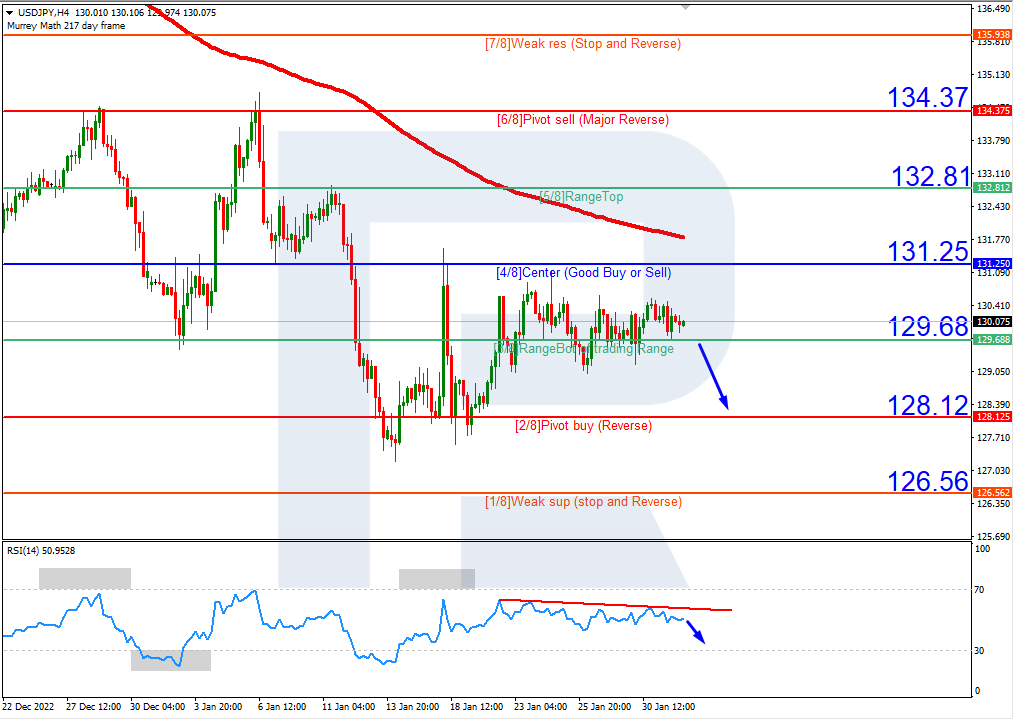
On H4, the quotes are under the 200-day Moving Average, which indicates prevalence of a downtrend. The RSI has bounced off the resistance line. As a result, 3/8 (129.68) is expected to be broken away, after which the quotes should fall to the support level of 2/8 (128.12). The scenario can be cancelled by rising over the resistance level of 4/8 (131.25), which might lead to a trend reversal and growth to 5/8 (132.81).

AUDUSD_H4
Risk Warning: the result of previous trading operations do not guarantee the same results in the future

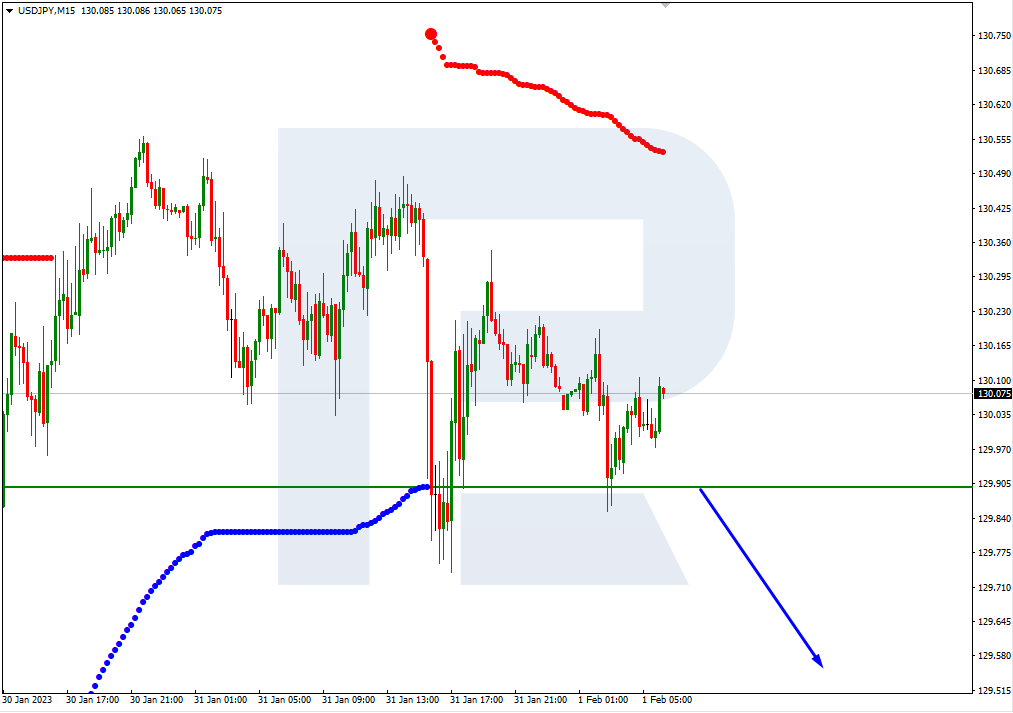
On M15, a new breakaway of the lower border of VoltyChannel will increase the probability of further decline of the price.

AUDUSD_M15
Risk Warning: the result of previous trading operations do not guarantee the same results in the future

USDCAD, “US Dollar vs Canadian Dollar”

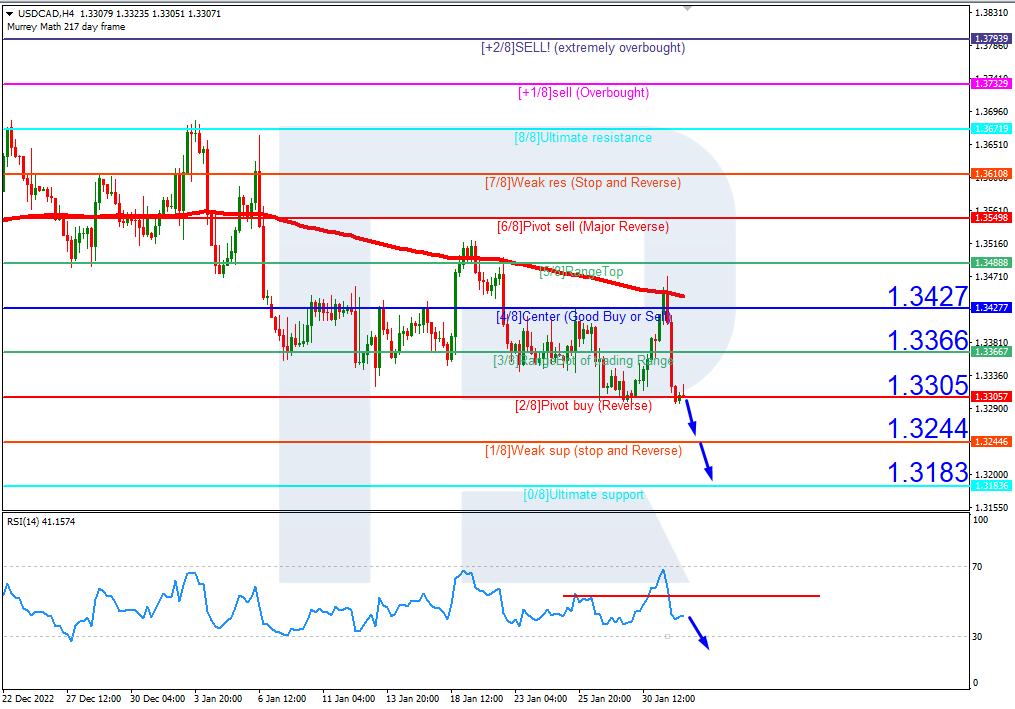
On H4, the quotes are under the 200-day Moving Average, which indicates prevalence of a downtrend. The RSI has bounced off the support line. As a result, we should expect a downward breakaway of 2/8 (1.3305) and further falling to the support level of 0/8 (1.3183). The scenario can be cancelled by rising above 3/8 (1.3366), after which the pair may rise to 4/8 (1.3427).

USDCAD_H4
Risk Warning: the result of previous trading operations do not guarantee the same results in the future

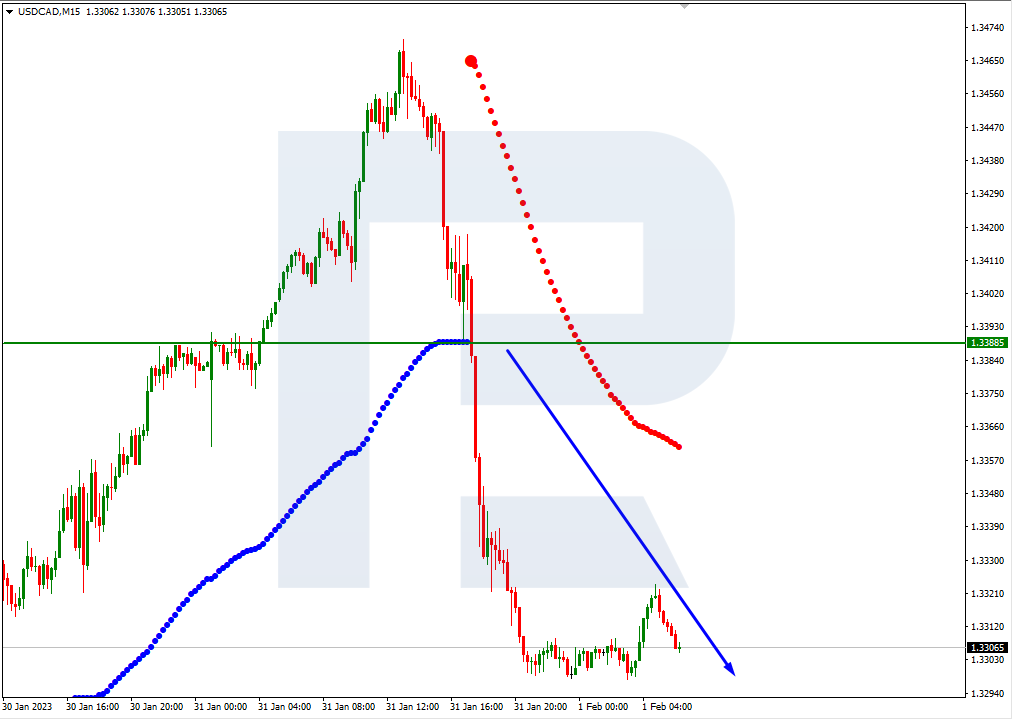
On M15, the lower line of VoltyChannel is broken away. This indicates presence of a downtrend and a high probability of further falling of the price.

USDCAD_M15

Article By RoboForex.com

Attention!
Forecasts presented in this section only reflect the author’s private opinion and should not be considered as guidance for trading. RoboForex LP bears no responsibility for trading results based on trading recommendations described in these analytical reviews.