Week Ahead: USDJPY timebomb flirts near “danger zone”

By ForexTime 

  • JPY ↓ over 1% versus USD year-to-date
  • Japan last intervened in July 2024, spending $36.8 billion
  • US PCE + Japan CPI + BoJ = fresh volatility?
  • Over past year BoJ triggered moves of ↑ 0.8% & ↓ 0.2%
  • Technical levels: 162, 160 and 158

Global FX markets could roar back to life if the yen descends deeper into intervention “danger zones”.

USDJPY is trading near an 18-month high around 158.50, a region that forced Japan to intervene back in July 2024.

To be clear, the government jumped into action after USDJPY almost hit 162.00, which is less than 2% away from current prices.

With chatter around intervention getting louder by the day, this could translate to heightened levels of volatility.

Beyond this key theme, the coming week also features scheduled events that could influence USDJPY:

Monday, 19th January

  • US markets closed for Martin Luther King, Jr. Day
  • Annual World Economic Forum in Davos
  • CNY: China GDP Growth Rate (Q4); Industrial Production (Dec); Retail Sales (Dec)
  • CAD: Canada Inflation Rate (Dec)

Tuesday, 20th January

  • EUR: Germany PPI (Dec); Germany ZEW Economic Sentiment Index (Jan); Eurozone ZEW Economic Sentiment Index Jan)
  • GBP: UK Unemployment Rate (Nov); Average Earnings
  • USD: US ADP Employment Weekly Change
  • WTI: API Crude Oil Stock Change (w/e Jan 16)
  • US500: Netflix earnings

Wednesday, 21st January

  • Trump’s speech at the World Economic Forum
  • GBP: UK Inflation Rate (Dec)
  • USD: Pending Home Sales (Dec)
  • JPY: Japan Balance of Trade (Dec); Exports (Dec)

Thursday, 22nd January

  • AUD: Australia Employment Data (Dec); S&P Global Manufacturing and Services PMIs (Jan)
  • NZD: New Zealand Inflation Rate (Q4 2025)
  • EUR: ECB Monetary Policy Accounts; Eurozone Consumer confidence (Jan)
  • USD: US PCE Index (Oct, Nov); Personal Income and Spending (Oct, Nov)
  • JPY: Japan Inflation Rate (Dec)
  • WTI: US EIA Crude Oil Stocks Change (w/e Jan 16)

Friday, 23rd January

  • GBP: UK Retail Sales (Dec); S&P Global Manufacturing and Services PMIs (Jan); Gfk Consumer Confidence (Jan)
  • JPY: BoJ Interest Rate Decision
  • EUR: Germany HCOB manufacturing PMI (Jan); Eurozone HCOB Composite, Manufacturing and Services PMIs (Jan)
  • CAD: Retail Sales (Dec)
  • USD: US S&P Global Composite, Manufacturing and Services PMIs (Jan)

The lowdown:

  • The Japanese Yen is weakening due to election-related fiscal fears and political risk, while a stronger dollar is exacerbating the situation.
  • A weak Yen is bad news for Japan because it boosts import costs, erodes purchasing power, and increases the cost of living.
  • The country’s finance minister has warned speculators that Japan will act to defend its currency, while BoJ officials are paying more attention to its impact on inflation.
  • Zooming out, expectations around a potential intervention may rattle FX markets and impact risk-sensitive currencies in addition to equities.

USDJPY set for a pivotal week?

Key events out of either side of the Pacific may rock the USDJPY:

1) US October/November PCE report

The incoming PCE figures are likely to shape interest rate expectations, especially the core PCE which is the Fed’s preferred inflation gauge.

On Thursday 22nd of January, both the October and November releases of the PCE reports will be published.

Traders are currently pricing in a 40% chance of a Fed cut by April with the odds jumping to 85% by June 2026.

  • Signs of still sticky inflation may have Fed cut expectations, pushing the USDJPY higher as the dollar strengthens.
  • A weaker-than-expected PCE report may pull the USDJPY lower as the USD weakens on rising Fed cut bets.

2) Japan CPI + BoJ rate decision

Japan’s December CPI report published on Thursday may influence BoJ monetary policy expectations beyond January.

Inflation is forecast to have risen 2.2% year-on-year, down from 2.9% in November due to the base effects from the jump in fresh food prices and new fuel subsidies last year.

Regarding the BoJ, it is expected to hold rates steady at 0.75% but any clues offered on future rates may rock the yen.

Traders are currently pricing in a 25% chance of a BoJ hike by March with the odds jumping to 57% by April 2026.

  • The Yen may rally if the BoJ strikes a hawkish note and signals a rate hike over the coming months. This may drag the USDJPY away from intervention danger zones.
  • A cautious-sounding BoJ may weaken the yen, pushing the USDJPY deeper into intervention zones.

3) Technical forces

The USDJPY is firmly bullish on the daily timeframe with prices trading above the 50, 100 and 200-day SMA.

  •  A solid move above 159.00 may encourage an incline toward 159.50 and 160.20.
  • Weakness below 158.20 could see prices slip toward 157.50 and 156.90.

Bloomberg’s FX model forecasts a 78.2% chance that USDJPY will trade within the 156.93 – 160.19 range, using current levels as a base, over the next one-week period.


Forex-Time-LogoArticle by ForexTime


ForexTime Ltd (FXTM) is an award winning international online forex broker regulated by CySEC 185/12 www.forextime.com

Oil tumbles 5%. Tech rally pushes US stocks higher

By JustMarkets 

The US stocks rose firmly on Thursday, driven by a sharp improvement in sentiment within the technology sector and a generally positive flow of macroeconomic data. At the close of Thursday, the Dow Jones Index (US30) gained 0.60%. The S&P 500 (US500) rose by 0.26%. The technology-heavy Nasdaq (US100) finished higher by 0.26%. The key market driver was the earnings report from Taiwan Semiconductor Manufacturing Company (TSMC), which bolstered investor confidence in the long-term AI-related investment cycle. The company reported a 35% increase in fourth-quarter profit and provided a more optimistic revenue prognosis than expected. This triggered a broad rally in semiconductor stocks and related equipment manufacturers, restoring risk appetite across the entire tech sector.

In geopolitics, the tone became less strained following a softening of US President Donald Trump’s rhetoric regarding Iran. However, uncertainty persists due to his statements regarding Greenland.

The Canadian dollar (CAD) weakened to 1.39 against the US dollar, remaining in a tight range near early December lows, as a strengthening US dollar and falling oil prices outweighed relatively stable domestic factors. The easing of President Trump’s rhetoric on Iran led to a reduction in the geopolitical premium in oil, putting pressure on commodity prices and weakening CAD support from trade conditions. Domestically, pressure on the currency persists due to a sluggish labor market: the unemployment rate remains around 6.8%, anchoring the Bank of Canada’s neutral stance and limiting the potential for policy tightening to support the currency.

The Mexican peso (MXN) strengthened to 17.65 per US dollar, its highest level since July 2024, thanks to a renewed influx of capital through carry-trade operations, driven by Mexico’s persistently high real interest rates. Banxico slowed its rate-cutting cycle, holding the benchmark rate at 7% and signaling the need for caution amid persistent core inflation. This maintains one of the widest real yield differentials in emerging markets, supporting capital inflows into peso-denominated fixed-income assets.

European equity markets traded without a unified trend on Thursday. The German DAX (DE40) rose by 0.26%, the French CAC 40 (FR40) closed down 0.21%, the Spanish IBEX 35 (ES35) fell by 0.30%, and the British FTSE 100 (UK100) finished up 0.54%. Investors reacted positively to a combination of encouraging macroeconomic data and corporate news while accounting for the geopolitical backdrop. The market was supported by fresh data indicating that the German economy returned to moderate growth in 2025, expanding by 0.2% after two years of decline. Additional momentum came from the technology sector amid renewed AI optimism following TSMC’s record results, which improved sentiment in the high-tech and industrial segments.

WTI crude oil prices collapsed nearly 5% on Thursday to $59 per barrel, marking the sharpest one-day drop since October as geopolitical risks surrounding Iran receded. The primary trigger was US President Donald Trump’s statement that he had received assurances from the Iranian side regarding the cessation of protester killings. This dampened expectations of immediate US military intervention and sharply reduced fears of disruptions to Iranian production and strategic supply routes. Additionally, Trump noted his belief that Venezuela should remain in OPEC, which markets interpreted as a signal to maintain the status quo on supply rather than pursue sharp cuts.

Asian markets traded without a unified trend yesterday. The Japanese Nikkei 225 (JP225) fell by 0.42%, the Chinese FTSE China A50 (CHA50) dropped 0.51%, Hong Kong’s Hang Seng (HK50) shed 0.28%, while the Australian ASX 200 (AU200) posted a positive result of 0.47%.

The New Zealand dollar (NZD) strengthened to the 0.575 level on Friday and is heading for a weekly gain following a series of positive signals from the real sector. The BusinessNZ Performance of Manufacturing Index (PMI) rose for the sixth consecutive month in December, accelerating to its highest levels in four years. The market has ramped up expectations for policy tightening later this year: the probability of a rate hike in September is estimated at approximately 57%, with such a move almost fully priced in by October. Meanwhile, the Reserve Bank of New Zealand’s (RBNZ) February meeting is still perceived as a non-event, with the rate expected to remain at 2.25%.

The Malaysian economy’s growth, according to preliminary estimates, accelerated to 5.7% year-on-year in Q4 2025, compared to 5.2% in the previous quarter, marking the fastest pace since Q2 2024. The key driver was a recovery in the industrial sector. On a quarterly basis, GDP increased by 3.0% following an upwardly revised 5.4% jump in Q3 – the highest since late 2021. For the full year 2025, the economy grew by 4.9%, slowing only slightly from 5.1% the previous year.

S&P 500 (US500) 6,944.49 +17.89 (+0.26%)

Dow Jones (US30) 49,442.26 +292.63 (+0.60%)

DAX (DE40) 25,352.39 +66.15 (+0.26%)

FTSE 100 (UK100) 10,238.94 +54.59 (+0.54%)

USD Index 99.38 +0.25% (+0.25%)

News feed for: 2026.01.16

  • US Industrial Production (m/m) at 16:15 (GMT+2). – USD (MED)

By JustMarkets


This article reflects a personal opinion and should not be interpreted as an investment advice, and/or offer, and/or a persistent request for carrying out financial transactions, and/or a guarantee, and/or a forecast of future events.

GBP/USD Stable: Sentiment Shifts in Favour of Sterling

By RoboForex Analytical Department

The GBP/USD pair held around 1.3430 USD on Thursday, with the pound strengthening yesterday following better-than-expected UK economic growth data. These figures may shape market expectations for Bank of England policy in the coming months.

Since the start of January, sterling has made limited headway against the US dollar but has strengthened notably against the euro. Dollar sentiment remains cautious due to geopolitical tensions involving Iran and Greenland, as well as renewed comments from President Donald Trump questioning the Federal Reserve’s independence.

Investor sentiment toward the pound has turned more constructive at the start of 2026. According to the US Commodity Futures Trading Commission (CFTC), traders reduced bearish bets on the pound at the fastest pace in five months during the first week of January. The net long dollar position against sterling fell sharply to 2.577 billion USD, down from 6.586 billion USD at the end of December—marking the steepest weekly decline since September 2019.

Inflation in the UK eased faster than expected toward the end of 2025, and markets are currently pricing in two BoE rate cuts this year. However, analysts view this as overly optimistic: persistently weak growth and subdued inflation could ultimately weigh on the currency. Upcoming soft employment and inflation data for December will be key to reassessing the likelihood of a rate cut as early as February, though markets currently assign low odds to such a move.

Next week brings key releases, including consumer prices and labour market data, followed by GDP figures on Thursday. A Reuters poll suggests the UK economy contracted by 0.2% in the three months to November, with annual growth estimated at around 1.1%.

Technical Analysis: GBP/USD

H4 Chart:

On the H4 chart, GBP/USD is forming a broad consolidation range around 1.3455 USD. The range is expected to extend toward 1.3395 USD, followed by a corrective bounce to 1.3415 USD. Once complete, the downtrend may resume toward 1.3290 USD, with further potential to 1.3220 USD. The MACD indicator supports this bearish near-term outlook, with its signal line below zero and pointing firmly downward.

H1 Chart:

On the H1 chart, the pair has established a tight consolidation range around 1.3440 USD. A downward move toward 1.3395 USD is in progress, and a break below this level would open the door to further declines toward 1.3290 USD. The Stochastic oscillator aligns with this view, as its signal line is below 20 and trending lower, indicating sustained selling momentum.

Conclusion

Despite improving sentiment and a sharp reduction in speculative short positions, the pound remains vulnerable to downside risks from domestic data and shifting BoE expectations. Technically, the pair retains a near-term bearish bias, with key support levels at 1.3395 USD and 1.3290 USD. A break below these levels could accelerate declines, while any sustained recovery would likely require stronger-than-expected UK data in the coming week.


Disclaimer:

Any forecasts contained herein are based on the author’s particular opinion. This analysis may not be treated as trading advice. RoboForex bears no responsibility for trading results based on trading recommendations and reviews contained herein.

Natural Gas prices plunge over 10%. Profit-taking observed in precious metals.

By JustMarkets

At the close of Wednesday, the Dow Jones Index (US30) declined by -0.09%. The S&P 500 (US500) shed -0.53%. The technology-heavy Nasdaq (US100) closed lower by -1.00%. The US stock markets continued their decline on Wednesday, retreating from recent record highs amid mixed corporate reports, conflicting macro data, and rising geopolitical tensions. The technology sector faced the most significant pressure: semiconductor stocks faced a sell-off following reports of restrictions from China, which notably soured overall market sentiment. Macroeconomic statistics failed to pivot the market: moderate inflation and stable consumption only confirmed expectations that the Fed’s current policy will remain unchanged, failing to offset the impact of corporate and political factors. Wells Fargo shares fell by -3.9% after the company missed profit and revenue forecasts. Bank of America shares declined -3.6% despite beating expectations, while Citigroup dropped -0.3% after posting stronger-than-expected earnings and revenue figures. JPMorgan shares fell -0.3%, extending a -4.1% slide from the previous session following disappointing quarterly results.

European equity markets traded without a unified trend on Wednesday. The German DAX (DE40) fell -0.53%, the French CAC 40 (FR40) closed down -0.19%, the Spanish IBEX 35 (ES35) rose by +0.05%, and the British FTSE 100 (UK100) finished Wednesday up +0.46%.

On Thursday, silver prices (XAG) dropped sharply by approximately -6%, falling below $88 per ounce and retreating from recently reached all-time highs. Pressure on prices emerged after US President Donald Trump delayed the introduction of new import duties on critical minerals, reducing short-term geopolitical and trade risks. An additional factor in the decline was the weakened appeal of precious metals as safe-haven assets. Demand waned following Trump’s statements that he had received assurances regarding the cessation of executions of protesters in Iran, which eased fears of potential US military intervention and regional escalation.

WTI crude oil prices declined by approximately -3% on Thursday to around $60 per barrel, snapping a five-session winning streak. The correction was triggered by easing geopolitical tensions following comments from US President Donald Trump, which lowered expectations of an imminent military strike on Iran. Additional pressure came from EIA data showing a rise in US crude oil and gasoline inventories last week, although distillate stocks decreased. Together, these factors intensified profit-taking and accelerated the reversal of quotes after a prolonged rally.

US natural gas prices (XNG) plunged by -10%, approaching their lowest levels since October 17, due to a reduction in gas flows to LNG export facilities. Gas deliveries to LNG plants on Wednesday dropped to a two-month low of 17.4 billion cubic feet per day (bcfd) due to reduced supplies to Cheniere Energy’s Corpus Christi plant and the Freeport LNG plant.

Asian markets mostly rose yesterday. The Japanese Nikkei 225 (JP225) gained +1.48%, the Chinese FTSE China A50 (CHA50) fell by -1.04%, Hong Kong’s Hang Seng (HK50) climbed +0.56%, and the Australian ASX 200 (AU200) posted a positive result of +0.14% yesterday. On Wednesday, PRC regulators raised minimum margin requirements for stock transactions from 80% to 100%, effectively restricting leverage and highlighting Beijing’s commitment to curbing excessive speculation and systemic risks in capital markets.

On Thursday, the Australian dollar (AUD) traded virtually unchanged near $0.668, holding close to a two-week low. Australian consumer inflation expectations remained at a high level of 4.6% in January, virtually unchanged from December, indicating persistent concerns over rising prices. Nevertheless, markets remain skeptical of imminent policy tightening: the probability of a Reserve Bank of Australia rate hike in February is estimated at approximately 27%, while it rises to about 76% by May.

S&P 500 (US500) 6,926.60 −37.14 (−0.53%)

Dow Jones (US30) 49,149.63 −42.36 (−0.09%)

DAX (DE40) 25,286.24 −134.42 (−0.53%)

FTSE 100 10,184.35 +47.00 (+0.46%)

USD Index 99.10 (−0.04%)

News feed for: 2026.01.15

  • Japan Producer Price Index (m/m) at 01:50 (GMT+2); – JPY (MED)
  • UK GDP (m/m) at 09:00 (GMT+2); – GBP (HIGH)
  • UK Industrial Production (m/m) at 09:00 (GMT+2); – GBP (MED)
  • UK Trade Balance (m/m) at 09:00 (GMT+2); – GBP (MED)
  • Eurozone Industrial Production (m/m) at 12:00 (GMT+2); – EUR (LOW)
  • Eurozone Trade Balance (m/m) at 12:00 (GMT+2); – EUR (MED)
  • US Initial Jobless Claims (w/w) at 15:30 (GMT+2); – USD (MED)
  • US Natural Gas Storage (w/w) at 17:30 (GMT+2). – XNG (HIGH)

By JustMarkets


This article reflects a personal opinion and should not be interpreted as an investment advice, and/or offer, and/or a persistent request for carrying out financial transactions, and/or a guarantee, and/or a forecast of future events.

Markets gripped by geopolitics, uncertainty & Trump

By ForexTime 

  • Risk-heavy week leaves investors on edge
  • Yen is the worst-performing G10 currency week-to-date
  • US Supreme Court scheduled to rule on Trump’s tariffs
  • Gold & Silver rally to fresh all-time highs
  • Bitcoin hits highest level in two-months above $96,000

It’s been a tense week defined by geopolitics, concerns over the Fed’s independence, and anticipation ahead of a US Supreme Court ruling on Trump’s tariffs.

This messy mashup of high-risk events has created a smog of uncertainty, with investors adopting a defensive approach toward risk.

Nevertheless, European shares clawed back some losses this morning after a modest dip in the previous session, but US equity futures are pointing to a shaky open.

Geopolitical flashpoints across the globe, concerning Iran and Ukraine, have dominated headlines, boosting the appetite for safe-haven assets. On top of this, Trump recently threatened 25% tariffs on countries trading with Iran, and as expected, China has threatened to retaliate.

On the trade front, the US Supreme Court is scheduled to rule on the legality of Trump’s tariffs. Prediction markets are giving the administration only a 30% chance of prevailing.

(Source Polymarkets)

Equity markets may experience a relief rally if the court strikes down the tariffs, but gains may be capped by trade policy uncertainty.

In the FX space, the Yen is the worst-performing G10 currency this week amid rising political uncertainty in Japan. The USDJPY is slowly approaching the danger zone, with speculation growing over a potential intervention. With the Fed expected to cut rates twice in 2026 and the BoJ seen hiking twice, this divergence in monetary policy could signal a selloff down the road.

Looking at earnings, JPMorgan’s fourth-quarter results topped consensus on most measures. However, investment-banking fees dropped by 5%, missing the bank’s own guidance. In result, JPMorgan shares tanked over 4% – taking 2026 gains to negative 3.5%. This rocky start to earnings dragged the us equities lower, with the Dow Jones ending almost 1% lower.

Commodities have been a bright spot this week, with both gold and silver hitting fresh all-time highs. Silver has gained over 25% since the start of 2026, adding to the whopping 148% rally seen last year. Gold is lagging, rising 7% this month thanks to heightened geopolitical risk, fears over the Fed’s independence, and bets around lower US rates.

With silver hitting $91.55 this morning, could $100 be on the cards by the end of the month? Prices are trading less than 10% away from this level as of writing.

Oil prices slipped on Wednesday after seeing their biggest four-day rally in more than six months. The negative developments in Iran and possible intervention by the United States have fuelled concerns over supply disruptions impacting around 3.3 million bpd of the country’s output. While oil benchmarks are pushing higher, concerns over ongoing oversupply may limit upside gains.

In the crypto space, Bitcoin jumped to a two-month high as prices punched above $96,000. The “OG” crypto drew strength from the latest US inflation report, which rose less than expected, while concerns over the Fed’s independence offered further support. Bitcoin is up over 8% year-to-date, with the next bullish level of interest at $100,000.

Trump


Forex-Time-LogoArticle by ForexTime


ForexTime Ltd (FXTM) is an award winning international online forex broker regulated by CySEC 185/12 www.forextime.com

The Bull Market Is Ending

Source: Adrian Day (1/13/26)

Global Analyst Adrian Day looks at the U.S. stock market and “the great rotation” underway.

The Great Rotation in equities is underway, with the U.S. large-cap tech sector losing its dominance as other sectors, markets, and asset classes take over.

And dominance it is: Nvidia Corp. (NVDA:NASDAQ) alone has a larger valuation than the entire markets of Canada or the U.K. That alone might make one scratch one’s head. The U.S. market had a good year: up 17% (for the S&P) is hardly shabby. But this was barely half of the international markets (per MSCI World ex-US Index) while specific long-ignored asset classes came to the fore: copper equities rose 82% while gold and silver jumped 155% (per iShares Copper Miners ETF and VanEck Gold miners ETF).

There Are Many Signs of a Top

Signs of a top in U.S. stocks abound. The most obvious sign is extreme valuation. By most measures, the market is more expensive today than it was in 2022, 2008, 2000, and even 1929.

There are many illustrations we could provide of this, price to earnings, price to sales, price to book, the Schiller CAPE ratio, and more. This is a fact, not conjecture.

Of course, markets can stay overvalued for long periods, as indeed has this one, but there are signs that the “end is nigh.” Market concentration is a record (the gap between the index and an equal-weighted index, for example, has never been great).

Market speculation is extreme, with margins up over 40% in the last year, record foreign and retail participation, and new speculative vehicles (such as 3x ETFs and one-day options) created to feed the appetite. Simply the length of this bull market (see graph) should give pause. Investor David Snyder has a list of 27 “boxes to check for near the end of the secular bull market,” and he says that now all 27 are checked.

The Market Leaders Are Now Rolling Over

That alone should give pause. Market action is also signaling something is up, with the S&P index only barely etching out a new high in the last two months, while leader Nvidia is down meaningfully over this period. One by one, in September, October, and November, the Magnificent Seven have been topping Microsoft Corp. (MSFT:NASDAQ), Apple Inc. (AAPL:NASDAQ), and Amazon.com Inc. (AMZN:NASDAQ). Yes, the Great Rotation is underway. There is an old saying that a market bottom may be an event, but a top is a process. We are experiencing that process unfolding now.

Foreign Markets Taking the Lead From the US

The most obvious beneficiaries have been, and will likely continue to be, both international markets and commodity stocks. Even after that huge outperformance, international equities are still the cheapest they have been relative to the U.S. for 50 years. We expect this outperformance to continue for a few years, as it usually does when foreign markets outperform by a wide margin.

Relative leadership moves in a long cycle: this period of U.S. dominance has lasted nearly 15 years — the U.S. bull market has been going on longer, of course, 17 years now, almost a record — while the previous period of international dominance lasted seven years.

It would be highly unusual for foreign markets to outperform the U.S. by only one year. To return to long-term values relative to the U.S., international markets would have to triple (assuming the U.S. stays flat). And foreign equities are getting help from economic fundamentals, and many foreign economies are growing faster than the U.S., while a decline in the dollar leads many U.S. investors to look abroad.

Commodity Stocks Were 2025’s Top Performers

As for commodity equities, despite the huge rallies last year, they remain close to 100-year lows relative to the stock market. So there is plenty of scope for a return to more average relative valuations. The traditional factors that can lead to higher resource prices — including significant underinvestment over a period — are certainly in place. So too is the likelihood of higher inflation and a lower dollar. Resource cycles tend to be long, so, again, we should not expect the copper and gold outperformance to be a one-off.

But there is now something else. For the AI sector to be successful — and meet current goals — natural gas, uranium, copper, and silver must all go up significantly. The commodities are the gold miners’ picks and shovels for the AI sector. Planned AI capex for this year and next is $2 trillion, with 850 data centers slated to be built in the U.S. over the next five years. Even if projections are cut in half, there will still be a massive pick-up in demand for these commodities, and the inability of production to keep up will mean higher prices.

Other Parts of the Market Have Lagged and Are Undervalued

Other sectors of the market remain at extreme levels of relative undervaluation: value is at its cheapest relative to growth in more than 50 years. Value stocks would need to compound at 20% per year more than growth stocks for five years to return to their long-term relative valuations. Small caps are also undervalued relative to large caps.

So as the leaders of the long U.S. bull market roll over, the emphasis should be on value and small-cap stocks, on sectors that have lagged, but most of all on international markets and commodity stocks.

Do You Want To Be Shocked?

We referred to the potential end of the secular bull market.

Most would consider that this got underway in early 2009, after the Great Financial Crisis. But if one takes a longer-term view, one could argue that the bull market started far earlier, and we have seen a growing “financialization” of the economy for nearly 40 years.

One analyst who looks at markets through a very long telescope is Robert Prechter of the Elliott Wave Theorist.

He has produced a stunning graphic showing how stock market valuations in this period have become progressively more extreme, but significantly well above the 60-year period before.

When he showed an earlier version of what he calls the “Pluto chart” in his presentation at the New Orleans conference, it was met with audible gasps.

Writes Mr.. Prechter, from EWI’s Elliott Wave Theorist, November 14, 2025, “at the end of last month, investors were paying 7.85 times the book value of S&P 400 Industrial companies, and they were content with a measly 1.16% annual dividend yield from companies in the S&P 500 Composite Index. T-bills pay more than triple that amount. Clearly, there is no income reason to buy stocks; the only reason to buy them is a belief that other investors will bid prices even higher than they already are. [This chart] is a snapshot of today’s unprecedented degree of financial optimism.”

Call It What You Like, This Is Bullish for Gold

When the Federal Reserve launched its new Treasury buying program last month, Chairman Jerome Powell and others went out of their way to emphasize that this was not QE. Well, QE or not, something dramatic occurred at the end of the year, as the Fed started purchasing Treasuries at a frantic pace, $160 billion in “reverse repos” during the month, most of it in the last few days of the year, with an unprecedented $100 billion plus on the last day of the year.

This is a multiple of the Fed’s target for $40 billion a month in its “Reserve Management Purchases” program announced after its last meeting.

To be sure, the reverse repo purchases are a separate program. But both represent the Federal Reserve purchasing Treasuries and adding liquidity. The press dutifully reported that this was to “steady the markets over year-end.”

Was it perhaps connected with the then-pending Venezuela operation?

There is speculation that it could be tied to a major bank unable to meet margin calls on a large short silver position.

QE or note QE, such massive liquidity injections are wildly bullish for gold, even more so than lower interest rates, and the market’s action since the Fed announcement bears that out.

TOP BUYS this week include Metalla Royalty & Streaming Ltd. (MTA:TSX.V; MTA:NYSE American) Midland Exploration Inc. (MD:TSX.V), Lara Exploration Ltd. (LRA:TSX.V), and Kingsmen Creatives Ltd. (KMEN:SI).


Important Disclosures:

  1. As of the date of this article, officers and/or employees of Streetwise Reports LLC (including members of their household) own securities of Metalla Royalty & Streaming Ltd., Midland Exploration Inc., Apple Inc., and Lara Exploration Ltd.
  2. Adrian Day: I, or members of my immediate household or family, own securities of: Metalla Royalty & Streaming Ltd., Midland Exploration Inc., Lara Exploration Ltd., and Kingsmen Creatives Ltd. My company has a financial relationship with: None. My company has purchased stocks mentioned in this article for my management clients: Metalla Royalty & Streaming Ltd., Midland Exploration Inc., Lara Exploration Ltd., and Kingsmen Creatives Ltd. . I determined which companies would be included in this article based on my research and understanding of the sector.
  3. Statements and opinions expressed are the opinions of the author and not of Streetwise Reports, Street Smart, or their officers. The author is wholly responsible for the accuracy of the statements. Streetwise Reports was not paid by the author to publish or syndicate this article. Streetwise Reports requires contributing authors to disclose any shareholdings in, or economic relationships with, companies that they write about. Any disclosures from the author can be found  below. Streetwise Reports relies upon the authors to accurately provide this information and Streetwise Reports has no means of verifying its accuracy.
  4.  This article does not constitute investment advice and is not a solicitation for any investment. Streetwise Reports does not render general or specific investment advice and the information on Streetwise Reports should not be considered a recommendation to buy or sell any security. Each reader is encouraged to consult with his or her personal financial adviser and perform their own comprehensive investment research. By opening this page, each reader accepts and agrees to Streetwise Reports’ terms of use and full legal disclaimer. Streetwise Reports does not endorse or recommend the business, products, services or securities of any company.

For additional disclosures, please click here.

Adrian Day Disclosures

Adrian Day’s Global Analyst is distributed for $990 per year by Investment Consultants International, Ltd., P.O. Box 6644, Annapolis, MD 21401. (410) 224-8885. www.AdrianDayGlobalAnalyst.com. Publisher: Adrian Day. Owner: Investment Consultants International, Ltd. Staff may have positions in securities discussed herein. Adrian Day is also President of Global Strategic Management (GSM), a registered investment advisor, and a separate company from this service. In his capacity as GSM president, Adrian Day may be buying or selling for clients securities recommended herein concurrently, before or after recommendations herein, and may be acting for clients in a manner contrary to recommendations herein. This is not a solicitation for GSM. Views herein are the editor’s opinion and not fact. All information is believed to be correct, but its accuracy cannot be guaranteed. The owner and editor are not responsible for errors and omissions. © 2023. Adrian Day’s Global Analyst. Information and advice herein are intended purely for the subscriber’s own account. Under no circumstances may any part of a Global Analyst e-mail be copied or distributed without prior written permission of the editor. Given the nature of this service, we will pursue any violations aggressively.

Gold Sets New Highs, With Further Gains Ahead

By RoboForex Analytical Department

Gold prices rose above 4,622 USD per ounce on Wednesday, challenging previous record levels. The rally is underpinned by growing expectations of US interest rate cuts this year and heightened demand for defensive assets.

December data pointed to a moderation in core US inflation, confirming a gradual easing of price pressures and clarifying the economic picture following earlier disruptions.

In this environment, interest rate futures reflect a divergence in expectations: investors are pricing in two to three rate cuts from the Federal Reserve in 2025, exceeding the median forecast from policymakers themselves, which signals only one reduction.

Safe-haven demand has also been reinforced by concerns over the Fed’s independence following the launch of a criminal investigation related to Chair Jerome Powell’s congressional testimony in June.

Geopolitical tensions remain elevated, with markets closely monitoring the risk of US involvement in political instability in Iran amid recurring warnings of potential military action.

Technical Analysis: XAU/USD

H4 Chart:

On the H4 chart, XAU/USD is consolidating around 4,623 USD. An upward expansion of this range towards 4,770 USD is anticipated, likely to be followed by a corrective pullback towards 4,620 USD. A break below this level would open the door to a deeper correction towards 4,520 USD.

The MACD indicator supports the bullish outlook, with its signal line turning upward and pressing towards new highs, indicating sustained upward momentum.

H1 Chart:

On the H1 chart, the market has formed a consolidation range around 4,629 USD and is now building the next leg higher, targeting at least 4,770 USD. This structure reinforces the broader uptrend.

The Stochastic oscillator aligns with this view, as its signal line is positioned at 80 and continues to point upward, signalling strong near-term bullish momentum.

Conclusion

Gold continues to draw strength from shifting rate expectations, political uncertainty, and persistent geopolitical risks. While the near-term technical structure suggests potential for further gains towards 4,770 USD, traders should remain mindful of overextended conditions and the likelihood of a corrective pullback thereafter. A sustained move above current levels would reinforce the longer-term bullish narrative, while a break below 4,620 USD could signal a deeper retracement before the next leg higher.


Disclaimer:

Any forecasts contained herein are based on the author’s particular opinion. This analysis may not be treated as trading advice. RoboForex bears no responsibility for trading results based on trading recommendations and reviews contained herein.

EUR/USD Awaiting US Inflation Data for Direction

By RoboForex Analytical Department

The EUR/USD pair stabilised around 1.1658 on Tuesday, following a period of volatility over the preceding two sessions.

Market focus remains firmly on the forthcoming US inflation data, which is expected to provide crucial clarity on the future path of Federal Reserve policy. Currently, the market is pricing in two rate cuts this year, with the first anticipated in June. However, any upside surprise in inflation could significantly temper expectations for policy easing.

Supporting a more dovish outlook was last week’s disappointing Non-Farm Payrolls (NFP) report for December, which revealed weaker-than-expected job growth.

Investors are also monitoring developments in the US Supreme Court, which is expected to rule on the legality of President Donald Trump’s tariff policy as early as Wednesday.

Earlier this week, the US dollar faced additional headwinds following reports that Fed Chair Jerome Powell could face scrutiny over his congressional testimony related to a building renovation project. This has raised concerns, albeit limited, regarding the perceived independence of the Federal Reserve.

Technical Analysis: EUR/USD

H4 Chart:

On the H4 chart, the pair is forming a corrective retracement within the context of the second downward impulse. The immediate corrective target stands at 1.1700. Once this correction concludes, we anticipate the resumption of the downtrend, with the next bearish target at 1.1555. This scenario is supported by the MACD indicator, whose signal line is below zero and pointing decisively downward, reinforcing the ongoing bearish momentum and potential for further downside.

H1 Chart:

On the H1 chart, the market has completed a decline to 1.1655 and is now forming an upward corrective impulse towards 1.1700. Upon reaching this level, we expect a renewed wave of selling pressure to emerge. The Stochastic oscillator aligns with this view, as its signal line is currently below 20 but is turning upward towards 80, indicating room for a short-term rebound before the next potential decline.

Conclusion

The EUR/USD pair is in a holding pattern ahead of key US inflation data, which will likely dictate the near-term direction of the pair. While the technical structure remains bearish, a corrective bounce towards 1.1700 appears likely before sellers potentially regain control. A stronger-than-expected inflation print could reinforce the dollar’s strength and accelerate the move towards 1.1555.


Disclaimer:

Any forecasts contained herein are based on the author’s particular opinion. This analysis may not be treated as trading advice. RoboForex bears no responsibility for trading results based on trading recommendations and reviews contained herein.

Trump announces 25% tariffs on countries trading with Iran

By JustMarkets 

The US stock indices managed to recover from an early-morning sell-off on Monday, ending the session higher and setting new records. By the end of Monday, the Dow Jones Index (US30) rose by 0.17%, the S&P 500 (US500) gained 0.16%, and the Nasdaq Technology Index (US100) closed up 0.08%. Initial pressure on the market was linked to reports of a criminal investigation launched against Fed Chair Jerome Powell, which heightened concerns regarding political pressure on the regulator. The banking sector was most notably affected, with shares of major players declining amid discussions of an initiative to cap credit card interest rates. Nevertheless, overall investor sentiment remained positive due to expectations of strong Q4 corporate earnings, primarily from major banks, and hopes for relatively soft inflation data, which supported risk appetite.

On Monday evening, Trump announced the imposition of 25% tariffs on countries trading with Iran, following repeated warnings of potential military action amid mass protests in the country.

The Mexican peso strengthened to 17.91 per dollar, reaching its highest level since July 2024, driven by a combination of external and internal factors. Support for the peso was provided by the Bank of Mexico’s balanced stance. Following the December rate cut, the regulator emphasized that future decisions depend on macroeconomic data, noting that underlying inflationary pressures persist and require caution. The absence of signals regarding rapid policy easing helped stabilize market expectations and maintain the appeal of the Mexican currency.

European equity markets mostly rose on Monday. The German DAX (DE40) climbed 0.57%, the French CAC 40 (FR40) closed down 0.04%, the Spanish IBEX 35 (ES35) rose by 0.14%, and the British FTSE 100 (UK100) finished the day up 0.16%. Large companies in the industrial and financial services sectors continued their positive momentum: Siemens, Airbus, and Deutsche Bank gained between 1% and 4%. Technology stocks also largely rose, despite ongoing skepticism regarding the fundamental profitability of artificial intelligence amid rising capital expenditures.

The Swiss franc (CHF) is holding near highs seen in the early 2010s due to increased demand for safe-haven currencies. The franc was supported by escalating geopolitical tensions, including harsh mutual warnings between the US and Iran, as well as growing uncertainty surrounding international security following discussions of a potential increase in NATO’s military presence in Greenland. On the domestic front, Switzerland’s macroeconomic situation remains stable: recent inflation data reinforced expectations that the SNB will keep rates at zero in the near term, which did not prevent the franc from maintaining its status as one of the key defensive assets.

WTI crude oil prices recovered intraday losses on Monday to close higher. Prices were supported by escalating tensions in Iran, where large-scale protests increased the risk of disruptions in oil production and exports, despite government claims of a stabilizing situation. Potential strikes and threats to energy infrastructure maintain high market volatility. Supply concerns partially offset expectations of increased production in Venezuela following political changes and preparations for the resumption of exports.

US natural gas prices (XNG) rose by more than 5%, climbing above $3.35 per MMBtu and recovering from a drop to multi-week lows. The recovery was triggered by updated weather prognoses indicating the approach of colder temperatures. Market balance factors also provided support. Gas exports remain near record levels, while domestic production edged down from its December peak. An additional positive signal was a deeper-than-seasonal-norm reduction in inventories, which strengthened investor confidence in the improving fundamental market picture.

Asian markets traded higher yesterday. The Japanese Nikkei 225 (JP225) rose by 1.61%, the Chinese FTSE China A50 (CHA50) gained 0.11%, Hong Kong’s Hang Seng (HK50) climbed 1.44%, and the Australian ASX 200 (AU200) posted a positive result of 0.48%.

In Australia, the Westpac–Melbourne Institute Consumer Sentiment Index fell by 1.7% month-on-month in January 2026 to a three-month low of 92.9 points, amid persistent concerns over interest rate hikes. Commodity-related stocks led the gains, as prices surged due to tensions surrounding Iran and concerns over the Federal Reserve’s independence.

S&P 500 (US500) 6,977.27 +10.99 (+0.16%)

Dow Jones (US30) 49,590.20 +86.13 (+0.17%)

DAX (DE40) 25,405.34 +143.70 (+0.57%)

FTSE 100 (UK100) 10,140.70 +16.10 (+0.16%)

USD Index 98.90 -0.24% (-0.24%)

News feed for: 2026.01.13

  • Australia Westpac Consumer Confidence (m/m) at 01:30 (GMT+2); – AUD (MED)
  • US Consumer Price Index (m/m) at 15:30 (GMT+2); – USD, XAU (HIGH)
  • US Home Sales (m/m) at 17:00 (GMT+2). – USD (MED)

By JustMarkets


This article reflects a personal opinion and should not be interpreted as an investment advice, and/or offer, and/or a persistent request for carrying out financial transactions, and/or a guarantee, and/or a forecast of future events.

USD/JPY Stalls Near One-Year High

By RoboForex Analytical Department

The USD/JPY pair paused on Monday after a sharp rally to around 157.95, with the yen holding near its lowest levels of the year. Trading activity was subdued as Japanese markets were closed for a public holiday.

Political uncertainty increased after Prime Minister Sanae Takaichi, a key coalition partner, raised the possibility of early elections on 8 or 15 February, adding another layer of caution to the market.

The yen also faced pressure from recent mixed macroeconomic data, which have clouded the outlook for the Bank of Japan’s future rate-hike trajectory.

Last week, BoJ Governor Kazuo Ueda reiterated that the central bank would continue to raise interest rates if economic momentum and inflation align with forecasts, while also emphasising a flexible approach to policy adjustments.

Over the coming week, traders will focus on a series of key Japanese economic indicators, including current account figures, machine tool orders, manufacturing PMI, and business sentiment data. Any surprises could prompt a shift in the yen’s direction.

Technical Analysis: USD/JPY

H4 Chart:

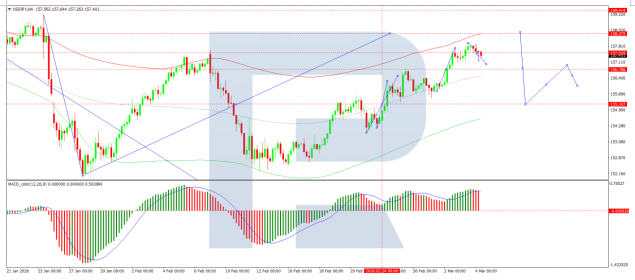
On the H4 chart, the pair has completed a local advance to 157.77 and is likely to enter a period of consolidation around this level. A break below this range could trigger a corrective move towards 156.60. Conversely, an upward break would open the potential for the rally to extend towards 159.33. This outlook is supported by the MACD indicator, with its signal line positioned above zero and pointing firmly upward, indicating ongoing bullish momentum.

H1 Chart:

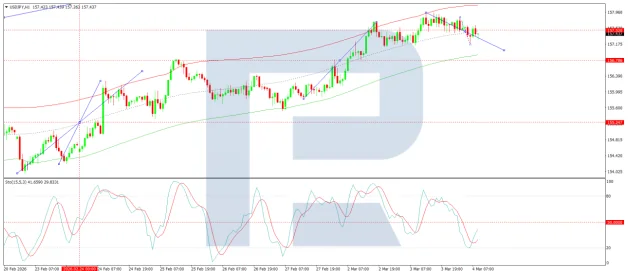
On the H1 chart, the market is forming a consolidation range centred around 157.77, with interim boundaries at 158.18 to the upside and 157.50 to the downside. A downward exit from this range could see a decline towards 156.60, while an upward resolution would signal potential for a further move towards 159.33. The Stochastic oscillator aligns with this view, as its signal line is above 50 and rising towards 80, suggesting continued near-term upward momentum.

Conclusion

USD/JPY has entered a period of consolidation near annual highs, with direction likely to be determined by upcoming Japanese data and political developments. While the broader technical bias remains bullish, a break below 157.50 could signal the start of a short-term correction.


Disclaimer:

Any forecasts contained herein are based on the author’s particular opinion. This analysis may not be treated as trading advice. RoboForex bears no responsibility for trading results based on trading recommendations and reviews contained herein.