From diagnosing brain disorders to cognitive enhancement, 100 years of EEG have transformed neuroscience

By Erika Nyhus, Bowdoin College 

Electroencephalography, or EEG, was invented 100 years ago. In the years since the invention of this device to monitor brain electricity, it has had an incredible impact on how scientists study the human brain.

Since its first use, the EEG has shaped researchers’ understanding of cognition, from perception to memory. It has also been important for diagnosing and guiding treatment of multiple brain disorders, including epilepsy.

I am a cognitive neuroscientist who uses EEG to study how people remember events from their past. The EEG’s 100-year anniversary is an opportunity to reflect on this discovery’s significance in neuroscience and medicine.

Discovery of EEG

On July 6, 1924, psychiatrist Hans Berger performed the first EEG recording on a human, a 17-year-old boy undergoing neurosurgery. At the time, Berger and other researchers were performing electrical recordings on the brains of animals.

What set Berger apart was his obsession with finding the physical basis of what he called psychic energy, or mental effort, in people. Through a series of experiments spanning his early career, Berger measured brain volume and temperature to study changes in mental processes such as intellectual work, attention and desire.

He then turned to recording electrical activity. Though he recorded the first traces of EEG in the human brain in 1924, he did not publish the results until 1929. Those five intervening years were a tortuous phase of self-doubt about the source of the EEG signal in the brain and refining the experimental setup. Berger recorded hundreds of EEGs on multiple subjects, including his own children, with both experimental successes and setbacks.

This is among the first EEG readings published in Hans Berger's study. The top trace is the EGG while the bottom is a reference trace of 10 Hz.
Two EEG traces, the top more irregular in rhythm than the bottom.
Hans Berger/Über das Elektrenkephalogramm des Menchen. Archives für Psychiatrie. 1929; 87:527-70 via Wikimedia Commons

Finally convinced of his results, he published a series of papers in the journal Archiv für Psychiatrie and had hopes of winning a Nobel Prize. Unfortunately, the research community doubted his results, and years passed before anyone else started using EEG in their own research.

Berger was eventually nominated for a Nobel Prize in 1940. But Nobels were not awarded that year in any category due to World War II and Germany’s occupation of Norway.

Neural oscillations

When many neurons are active at the same time, they produce an electrical signal strong enough to spread instantaneously through the conductive tissue of the brain, skull and scalp. EEG electrodes placed on the head can record these electrical signals.

Since the discovery of EEG, researchers have shown that neural activity oscillates at specific frequencies. In his initial EEG recordings in 1924, Berger noted the predominance of oscillatory activity that cycled eight to 12 times per second, or 8 to 12 hertz, named alpha oscillations. Since the discovery of alpha rhythms, there have been many attempts to understand how and why neurons oscillate.

Neural oscillations are thought to be important for effective communication between specialized brain regions. For example, theta oscillations that cycle at 4 to 8 hertz are important for communication between brain regions involved in memory encoding and retrieval in animals and humans.

Researchers then examined whether they could alter neural oscillations and therefore affect how neurons talk to each other. Studies have shown that many behavioral and noninvasive methods can alter neural oscillations and lead to changes in cognitive performance. Engaging in specific mental activities can induce neural oscillations in the frequencies those mental activities use. For example, my team’s research found that mindfulness meditation can increase theta frequency oscillations and improve memory retrieval.

Noninvasive brain stimulation methods can target frequencies of interest. For example, my team’s ongoing research found that brain stimulation at theta frequency can lead to improved memory retrieval.

EEG has also led to major discoveries about how the brain processes information in many other cognitive domains, including how people perceive the world around them, how they focus their attention, how they communicate through language and how they process emotions.

Diagnosing and treating brain disorders

EEG is commonly used today to diagnose sleep disorders and epilepsy and to guide brain disorder treatments.

Scientists are using EEG to see whether memory can be improved with noninvasive brain stimulation. Although the research is still in its infancy, there have been some promising results. For example, one study found that noninvasive brain stimulation at gamma frequency – 25 hertz – improved memory and neurotransmitter transmission in Alzheimer’s disease.

A new type of noninvasive brain stimulation called temporal interference uses two high frequencies to cause neural activity equal to the difference between the stimulation frequencies. The high frequencies can better penetrate the brain and reach the targeted area. Researchers recently tested this method in people using 2,000 hertz and 2,005 hertz to send 5 hertz theta frequency at a key brain region for memory, the hippocampus. This led to improvements in remembering the name associated with a face.

Although these results are promising, more research is needed to understand the exact role neural oscillations play in cognition and whether altering them can lead to long-lasting cognitive enhancement.

The future of EEG

The 100-year anniversary of the EEG provides an opportunity to consider what it has taught us about brain function and what this technique can do in the future.

In a survey commissioned by the journal Nature Human Behaviour, over 500 researchers who use EEG in their work were asked to make predictions on the future of the technique. What will be possible in the next 100 years of EEG?

Some researchers, including myself, predict that we’ll use EEG to diagnose and create targeted treatments for brain disorders. Others anticipate that an affordable, wearable EEG will be widely used to enhance cognitive function at home or will be seamlessly integrated into virtual reality applications. The possibilities are vast.The Conversation

About the Author:

Erika Nyhus, Associate Professor of Psychology and Neuroscience, Bowdoin College

This article is republished from The Conversation under a Creative Commons license. Read the original article.


Cultural differences impede trade for most countries – but not China

By Bedassa Tadesse, University of Minnesota Duluth 

It’s a widely accepted notion among economists that cultural differences can pose a significant barrier to trade. The larger the cultural gap between two countries – judging by differences in language, customs, values and business norms – the more challenging and costly trade relations become. This is a recurring theme in research.

But there’s one big exception to the rule: China.

As an applied economist with a keen interest in how culture influences trade, I’ve conducted several studies of the dynamic. In one such effort, two colleagues and I meticulously analyzed China’s trade relationships with nearly 90 countries over 16 years.

Our research uncovered a distinctive pattern: Unlike many other nations, cultural differences rarely influence the scale of China’s trade activities.

Bridging cultural gaps: Strategies and successes

Countries have various tools to minimize the effects of cultural differences on their trade. Cultural exchange programs, bilateral trade agreements and international trade shows have shown remarkable success in fostering mutual understanding, easing trade negotiations and overcoming cultural barriers.

However, these options are available to all countries. What makes China unique?

I suspect that China’s national trading strategy, involving state-backed export industries and substantial global infrastructure investment, is a big part of the answer.

By aligning itself with the economic development needs of its trading partners, China has been able to minimize the negative effects of cultural differences on its trade. It’s a strategy that has proved to be remarkably effective.

A closer examination of China’s trade ventures in Africa, the Middle East and Latin America — all regions with significant cultural differences from China — paints a vivid picture of this observation.

Despite its cultural differences with nations on the African continent, each with its own unique traditions, languages and customs, China has built a multibillion-dollar trade network in the region that spans industries from mining to telecom. China’s engagement in Africa is facilitated by a combination of local infrastructure investment, affordable technology provision and favorable loan terms. These partnerships are more about creating symbiotic relationships and less about efficiency. This facilitates market access and helps China to overcome cultural barriers.

In the Middle East, too, China has made significant inroads by aligning itself with the region’s development goals, such as those outlined in Saudi Arabia’s Vision 2030 and the United Arab Emirates’ Centennial 2071. China’s Belt and Road Initiative complements these long-term development plans, offering the capital investment and construction expertise needed to bring ambitious infrastructure projects to life.

China’s presence in Latin America has also grown substantially over the past decade. Despite the geographical and cultural distance, China has become one of the top trade partners for countries such as Brazil, Chile and Peru. This relationship is built on reciprocity: Latin American countries supply raw materials and agricultural products in exchange for Chinese investment in the infrastructure and manufacturing sectors.

Again, this is a strategy that hinges on pragmatic economic interactions focused on mutual benefits and development goals.

The need for strategic adaptability

Some might argue that trading with China is an obvious choice due to its size and influence. The economic incentives include access to China’s population of over 1.4 billion and its significant role in global value chains, especially in electronics, textiles and machinery. As China’s influence in global markets grows, U.S. companies also face competitive pressures to maintain their market positions.

However, China’s trade practices, frequently entangled with governmental intervention, potentially undermine market efficiency — an established economic objective — in numerous ways.

In international trade, market efficiency refers to the extent to which prices in the global market reflect all available information, allowing resources to be allocated optimally across countries.

China has been known to require foreign companies to transfer technology to local firms as a condition for market access. This practice may distort market efficiency by forcing companies to share proprietary technology rather than compete on a level playing field.

Intellectual property theft and insufficient protection of intellectual property rights in China have also been major concerns for Western companies. The lack of robust intellectual property enforcement can lead to inefficiencies, as it discourages innovation and investment by foreign firms who fear their inventions and technologies may be copied without adequate legal recourse.

Western companies also face various market-access barriers in China, such as joint venture requirements, limits on foreign ownership and regulatory hurdles. These barriers can prevent the efficient allocation of resources and limit competition and innovation, resulting in a less efficient market overall.

Despite these concerns, Western firms continue to do business with China.

China’s adeptness in transcending cultural barriers, combined with Western firms’ continued engagement, pose a significant challenge for Western economies, notably the United States’. The challenge is heightened as the U.S. maintains a focus on traditional efficiency approaches in forging trade relationships across diverse regions such as Africa, Latin America and the Middle East.

Since traditional market efficiency approaches might not always suffice, Western economies may need to reconsider their strategies.The Conversation

About the Author:

Bedassa Tadesse, Professor of Economics, University of Minnesota Duluth

This article is republished from The Conversation under a Creative Commons license. Read the original article.


RBA maintains a hawkish bias. Japanese authorities are ready to conduct another intervention

By JustMarkets

At Monday’s close, the Dow Jones (US30) Index added 0.13%, while the S&P 500 (US500) Index gained 0.27%. The NASDAQ Technology Index (US100) closed positive 0.83%. Strengthening large-cap tech stocks boosted the broad market on Monday. However, concerns that the economy is losing momentum could limit the potential for further stock gains.

The ISM US Manufacturing Index for June unexpectedly fell by 0.2 to a four-month low of 48.5, weaker than expectations for a rise to 49.1. The ISM Goods and Services Price Sub-Index for June fell by 4.9 to a 6-month low of 52.1, weaker than expectations of 55.9.

Tesla (TSLA) shares rose more than 6% and led gains in the S&P 500 and Nasdaq 100 after Wells Fargo listed it as a tactical idea for the third quarter.

Equity markets in Europe were mostly up yesterday. Germany’s DAX (DE40) rose by 0.30%, France’s CAC 40 (FR40) closed higher by 1.09%, Spain’s IBEX 35 (ES35) Index added 1.04%, and the UK’s FTSE 100 (UK100) closed positive 0.03%. The S&P Eurozone Manufacturing PMI for June was revised upward by 0.2 to 45.8 from the previously reported 45.6. The German Consumer Price Index for June (EU harmonized) declined to 2.5% y/y from 2.8% y/y in May, which was in line with expectations. ECB President Lagarde said that the ECB does not yet have sufficient evidence that inflationary threats have passed, reinforcing expectations that the ECB will postpone further interest rate cuts. Today, the Eurozone will release Eurozone inflation data for June and unemployment data for May.

WTI crude oil futures rose to around $83.5 a barrel on Tuesday, hitting a two-month-high, driven by prospects for higher demand during the summer travel season. Prognoses from the American Automobile Association showed vacation travel up 5.2% year-over-year, with auto travel alone expected to rise 4.8% from a year ago. In addition, bets on a rate cut by the US Federal Reserve are providinxg support for oil prices after a recent slowdown in US inflation sparked optimism that a rate cut is imminent.

Asian markets traded mixed yesterday. Japan’s Nikkei 225 (JP225) was up 0.12%, China’s FTSE China A50 (CHA50) added 0.34%, Hong Kong’s Hang Seng (HK50) was not trading, and Australia’s ASX 200 (AU200) was negative 0.22%.

The offshore yuan depreciated to 7.30 per dollar, remaining at its lowest level in seven months, while weak guidance from the People’s Bank of China (PBoC) pressured investor sentiment. The Bank of China set the average rate at 7.1291 per dollar, the lowest since November 21, signaling a willingness to weaken the yuan further. The yuan’s depreciation is also supported by a stronger US dollar, driven by a sharp rise in US bond yields and speculation about Donald Trump’s possible return to the presidency.

The Japanese yen fell to 161.5 per dollar, sliding to new 38-year lows due to a sharp interest rate differential between Japan and the US. A lack of urgency from the Bank of Japan to normalize monetary policy is weighing on the currency. However, there is growing speculation that the BOJ may raise rates at its next meeting in late July. A weak yen raises the cost of imports, which adds to inflationary pressures and negatively affects household consumption. Meanwhile, Finance Minister Shun’ichi Suzuki reiterated on Tuesday that the government remains vigilant in monitoring exchange rate movements.

Minutes from the Reserve Bank of Australia’s (RBA) June meeting showed that policymakers emphasized the need to remain vigilant against upside risks to inflation, adding that a significant rise in prices could necessitate a significant rate hike. Nevertheless, the board sees an opportunity to bring inflation to the target level while maintaining stability in the economy and labor market. Markets are currently pricing in a one-in-three chance of a rate hike as early as August while ruling out the possibility of an RBA rate cut this year.

S&P 500 (US500) 5,475.09 +14.61 (+0.27%)

Dow Jones (US30) 39,169.52 +50.66 (+0.13%)

DAX (DE40) 18,290.66 +55.21 (+0.30%)

FTSE 100 (UK100) 8,166.76 +2.64 (+0.032%)

USD Index 105.82 −0.04 (−0.04%)

Important events today:
  • – Australia RBA Meeting Minutes at 04:30 (GMT+3);
  • – Eurozone Consumer Price Index (m/m) at 12:00 (GMT+3);
  • – Eurozone Unemployment Rate (m/m) at 12:00 (GMT+3);
  • – Canada Manufacturing PMI (m/m) at 16:30 (GMT+3);
  • – Eurozone ECB President Lagarde Speaks at 16:30 (GMT+3);
  • – US Fed Chair Powell Speaks at 16:30 (GMT+3);
  • – US JOLTS Job Openings (m/m) at 17:00 (GMT+3).

By JustMarkets


This article reflects a personal opinion and should not be interpreted as an investment advice, and/or offer, and/or a persistent request for carrying out financial transactions, and/or a guarantee, and/or a forecast of future events.

Bitcoin: Set for potential price swings?

By ForexTime 

  • Bitcoin could be rocked by Fed minutes & NFP
  • Watch out for Mt. Gox developments
  • Over past year NFP triggered moves of ↑ 2.3% & ↓ 1.9%
  • Bearish channel breached but resistance at $63500

Thanks to the incoming US jobs report and developments concerning the failed Mt. Gox exchange, this could be a wild week for Bitcoin!

Despite prices rebounding from sub-$60k, sentiment remains fragile with a major liquidation event and uncertainty over US interest rates keeping bears in the game.

Looking at the technical picture, Bitcoin remains in a range on the weekly charts with potential resistance forming around $63500.

With all the above said, here are 4 things that could rock Bitcoin this week:

    1) FOMC minutes

The Fed minutes on Wednesday will be an appetizer before the main course on Friday.

Investors will be seeking insight into why Fed officials lowered their expectations for 2024 rate cuts despite growth and unemployment projections unchanged.

  • Bitcoin may slip if the minutes sound more hawkish than expected.
  • Should the minutes strike a dovish note, Bitcoin prices may edge higher.

Golden nugget: Over the past year, the Fed minutes have triggered upside moves of as much as 1.6% or declines of 1.3% in a 6-hour window post-release.


    2) Bankrupt Tokyo-based exchange Mt. Gox

From early July 2024, collapsed Tokyo-based bitcoin exchange, Mt. Gox is expected to start paying back users roughly $9 billion worth of stolen tokens.

Imagine losing 1 bitcoin worth roughly $500 back in 2014 and then receiving that same Bitcoin today worth around $60,000. What would you do?

There are expectations around the receivers of the stolen tokens cashing out, potentially triggering steep losses on Bitcoin.


    3) US jobs report

The incoming US jobs report is likely to influence bets around when the Fed cuts rates in H2.

Markets expect the US economy to have created 200k jobs in June, compared with the blockbuster 272k in the previous month while the unemployment rate is expected to remain unchanged at 4%.

It is worth keeping in mind that cryptocurrencies have shown sensitivity to interest rates due to their risky nature.

  • A soft jobs report may push Bitcoin prices higher.
  • If the jobs data exceeds market forecasts, this could drag Bitcoin prices lower.

Golden nugget: Over the past year, the US jobs report has triggered upside moves of as much as 2.3% or declines of 1.9% in a 6-hour window post-release.


    4) Technical forces

Prices have breached the daily bearish channel, but resistance can be found at $63500.

  • Sustained weakness below $63500 may encourage a decline back towards $59000.
  • A solid daily close above $63500 could open a path towards the 100-day SMA and 50-day SMA.


Forex-Time-LogoArticle by ForexTime

ForexTime Ltd (FXTM) is an award winning international online forex broker regulated by CySEC 185/12 www.forextime.com

EUR/USD Struggles to Maintain Gains Amid Mixed Economic Signals

By RoboForex Analytical Department

The EUR/USD pair experienced a noticeable uptick yesterday, but failed to sustain its peak, settling at 1.0732 today. Early gains were buoyed by the initial outcomes from France’s parliamentary elections, which did not reflect the worst-case scenario, sparking a temporary surge in risk appetite and bolstering the euro.

However, last evening’s economic indicators from the U.S. painted a mixed picture, dampening the initial enthusiasm. The ISM Manufacturing Index for June dipped to 48.5 from 48.7, falling short of expectations and remaining below the pivotal 50-point mark that delineates expansion from contraction. Conversely, Markit’s Manufacturing PMI indicated a slight improvement, rising to 51.6 from 51.3.

Additionally, a report showed a 0.1% month-on-month decline in U.S. construction spending for May, a reversal from the previous increase of 0.3% and weaker than anticipated, suggesting a potential slowdown in the construction sector and broader economic support.

Market participants are now turning their attention to an upcoming speech by Jerome Powell, Chair of the Federal Reserve, for further clues on the direction of U.S. monetary policy.

Technical analysis of EUR/USD

The EUR/USD pair completed a correction to 1.0774 but is now forming a declining wave towards 1.0675. Should this level be reached, a minor correction to 1.0714 may occur before a potential further drop to 1.0630, and potentially extending down to 1.0573. The MACD indicator underlines this bearish outlook with its signal line positioned below zero and histograms trending downwards.

On the hourly chart, the pair is currently crafting a declining structure with an initial target at 1.0675. Following this, a correction towards 1.0714 is plausible, before a continuation of the downtrend to 1.0640. The Stochastic oscillator corroborates this view, with its signal line approaching the 20 level, indicating a potential for further declines before a rebound towards 50 might occur.

Market outlook

Investors will continue to assess the blend of economic data and central bank signals, particularly from the Fed, to gauge the potential trajectory of interest rates and their impact on currency valuations. Today’s speech by Jerome Powell could be particularly pivotal in setting market expectations moving forward.

Disclaimer

Any forecasts contained herein are based on the author’s particular opinion. This analysis may not be treated as trading advice. RoboForex bears no responsibility for trading results based on trading recommendations and reviews contained herein.

FRA40: Jumps on French election relief

By ForexTime 

  • FRA40 ↑ as much as 3% on Monday
  • Parties have till Tuesday evening to apply for second round
  • Second round of election on July 7th
  • Key level of interest – 7470 and 7700

FXTM’s FRA40 initially rebounded on Monday morning as investors welcomed the preliminary results of French parliamentary elections.

Although Marine Le Pen’s National Party dominated the first round, it was not enough for an outright majority in the second round scheduled for July 7th. The prospect of a hung parliament may be a market-friendly outcome despite the uncertainty it presents. Such a scenario could block Le Pen’s big spending plans that would have disregarded European Union fiscal rules and hit investor sentiment.

Note: A hung parliament is when no single political party wins a majority.

It is worth noting that all those who got votes of at least 12.5% are eligible to participate in the second round.

First round election results:

  • National Rally (far-right): 33.1%
  • New Popular Front (left-wing): 28%
  • Renaissance and allies (centrist): 20.8%
  • Republicans: 10.2%

Despite the initial positivity, European markets could remain tense ahead of the deadline on Tuesday evening for candidates to confirm whether or not they’re running.

Depending on how this plays out, it may shape expectations over what to expect in the second round of elections on Sunday 7th July.

Looking at the technical picture, we identified key levels on the FRA40 in our week published last Friday.

Prices jumped as much as 3% on Monday morning, punching above the 7700-resistance level before giving back gains. More volatility may be on the cards on Tuesday depending on how markets react to the candidates participating in round 2 of the elections.

Still, key support can be found at 7470 and resistance at 7700.


Forex-Time-LogoArticle by ForexTime

ForexTime Ltd (FXTM) is an award winning international online forex broker regulated by CySEC 185/12 www.forextime.com

The Japanese yen faces further depreciation amid rate differentials

By RoboForex Analytical Department

The USD/JPY pair continues to escalate, currently positioned at 160.88, nearing the 37-year peak of 161.27 achieved last Friday.

Early today, the yen temporarily strengthened following Japan’s Q2 Tankan survey results, which indicated a slight improvement in industrial sentiment to 13 points from 11. However, the services sector displayed mixed results, maintaining 27 points against predictions of an increase, with future expectations slightly downgraded.

Despite these data points, the predominant driver of the yen’s weakness remains the significant interest rate differential between the Bank of Japan (BoJ) and the US Federal Reserve.

The BoJ has no immediate plans to adjust interest rates but might alter its government bond purchases, hinting at potential monetary tightening. However, market sentiment remains sceptical about such changes, contributing to the yen’s downward pressure.

USD/JPY technical analysis

The USD/JPY is creating a consolidation range just below the 161.26 level. A brief surge to 161.33, considered a local peak within this upward trend, is possible. After this level, a corrective movement to 158.66 might initiate, potentially followed by another upward wave aiming for 163.30. This forecast is supported by the MACD indicator, with its signal line positioned above zero but pointing downwards, suggesting upcoming corrections.

The pair completed an upward movement to 161.26, followed by a correction to 160.26. Currently, it has surged to 160.88, forming a consolidation range. Breaking above this range could lead to a rise towards 161.30. Conversely, a downward break might lead to a correction to at least 160.11 before another potential rise to 161.30. The Stochastic oscillator indicates that the signal line, currently above 50, is poised to drop to 20, reflecting potential short-term declines before further gains.

Market outlook

As investors navigate these fluctuations, the broader focus remains on global central bank policies, particularly any shifts by the BoJ or the Fed that could influence the USD/JPY trajectory. The upcoming economic releases and central bank updates will be crucial in shaping market dynamics and the yen’s valuation against the dollar.


Disclaimer

Any forecasts contained herein are based on the author’s particular opinion. This analysis may not be treated as trading advice. RoboForex bears no responsibility for trading results based on trading recommendations and reviews contained herein.

Currency Speculator raised their bets for Canadian & Australian Dollars

By InvestMacro

Here are the latest charts and statistics for the Commitment of Traders (COT) data published by the Commodities Futures Trading Commission (CFTC).

The latest COT data is updated through Tuesday June 25th and shows a quick view of how large market participants (for-profit speculators and commercial traders) were positioned in the futures markets. All currency positions are in direct relation to the US dollar where, for example, a bet for the euro is a bet that the euro will rise versus the dollar while a bet against the euro will be a bet that the euro will decline versus the dollar.

Weekly Speculator Bets led by Canadian & Australian Dollars

The COT currency market speculator bets were higher this week as six out of the eleven currency markets we cover had higher positioning while the other five markets had lower speculator contracts.

Leading the gains for the currency markets was the Canadian Dollar (25,519 contracts) with the Australian Dollar (17,980 contracts), the Mexican Peso (7,552 contracts), the New Zealand Dollar (6,313 contracts), the Swiss Franc (2,333 contracts) and with Bitcoin (99 contracts) also showing positive weeks.

The currencies seeing declines in speculator bets on the week were the Japanese Yen (-26,147 contracts), the EuroFX (-16,382 contracts), the British Pound (-3,573 contracts), the Brazilian Real (-2,563 contracts) and with the US Dollar Index (-73 contracts) also registering lower bets on the week.

COT Currency Roundup:

The Canadian dollar speculative position jumped by over +25,000 contracts this week but this was following three straight weeks of declines that had brought the overall position to an all-time record low level. The CAD position has fallen for 13 out of the past 17 weeks and dropped to a record bearish level on June 18th at a total of -147,931 contracts. This week’s speculator position settled at a total of -122,412 contracts. Helping keep the pressure on the Canadian dollar (also called the loonie) recently was the Bank of Canada’s decision to lower their interest rate on June 5th to 4.75 percent from the previous 5 percent. With inflation subsiding in the Canadian economy, there is speculation that interest rates will come down as well and in turn, dampen the perceived attractiveness of the loonie versus other major currencies.

The Japanese yen speculator contracts continued to drop this week and have fallen for three straight weeks. The yen speculative positioning has also declined in 13 out of the last 20 weeks as the overall bearish position has now been above -100,000 contracts for twenty consecutive weeks. The US Dollar/Japanese yen exchange rate continues to see Dollar strength (vs the yen) as the USDJPY currency pair touched above the 161.00 level this week – marking the highest level for the USD since the late-1980s.

The euro currency contracts flipped back into negative territory this week and are in a small bearish position for the first time since April 30th. The euro speculator bets have declined for three straight weeks and are standing at a total of -8,431 contracts this week. The euro exchange rate versus the US Dollar (EURUSD currency pair) has had a very subdued year so far with a fluctuation between approximately 1.0650 and 1.1000 since the beginning of January. This week the EURUSD closed at 1.0752.

The Australian dollar speculator position sharply rose for a second straight week this week with a gain of +17,980 contracts following last week’s +23,129 contract rise. The Aussie spec position has seen a marked improvement since hitting an all-time low on March 19th at -107,538 contracts with this week’s standing coming in at -23,676 contracts. This is the least bearish level since June 29th of 2021, almost exactly three years ago.

The large speculative US Dollar Index positions dipped very slightly this week by just -73 contracts. However, the Dollar Index speculative position has been on quite a run with gains in the previous eleven straight weeks. This improved sentiment brought the spec position from out of bearish territory to the highest level since December of 2023 above +17,000 contracts and near where the speculator position currently sits at +17,522 contracts. The Dollar Index price has also been on the upswing with gains in four straight weeks and closed out this week at the 105.50 level.

Finally, the large speculative New Zealand Dollar currency positions gained this week by over +6,000 net contracts. The NZD net positions have now increased for six consecutive weeks – adding a total of +37,842 contracts to the net position in that time. This improvement has taken the NZD spec contracts to the most bullish level in the past three hundred and twenty-three weeks, dating back to April 17th of 2018.


Currencies Net Speculators Leaderboard

Legend: Weekly Speculators Change | Speculators Current Net Position | Speculators Strength Score compared to last 3-Years (0-100 range)


Strength Scores led by Australian & New Zealand Dollars

COT Strength Scores (a normalized measure of Speculator positions over a 3-Year range, from 0 to 100 where above 80 is Extreme-Bullish and below 20 is Extreme-Bearish) showed that the Australian Dollar (100 percent) and the New Zealand Dollar (100 percent) lead the currency markets this week. The British Pound (82 percent), the Mexican Peso (60 percent) and Bitcoin (57 percent) come in as the next highest in the weekly strength scores.

On the downside, the Japanese Yen (4 percent), the Canadian Dollar (14 percent), the EuroFX (17 percent), the Brazilian Real (18 percent) and the Swiss Franc (19 percent) come in at the lowest strength levels currently and are in Extreme-Bearish territory (below 20 percent).

Strength Statistics:
US Dollar Index (41.4 percent) vs US Dollar Index previous week (41.6 percent)
EuroFX (16.7 percent) vs EuroFX previous week (23.7 percent)
British Pound Sterling (82.5 percent) vs British Pound Sterling previous week (84.9 percent)
Japanese Yen (3.8 percent) vs Japanese Yen previous week (20.1 percent)
Swiss Franc (19.1 percent) vs Swiss Franc previous week (15.0 percent)
Canadian Dollar (13.5 percent) vs Canadian Dollar previous week (0.0 percent)
Australian Dollar (100.0 percent) vs Australian Dollar previous week (78.6 percent)
New Zealand Dollar (100.0 percent) vs New Zealand Dollar previous week (86.8 percent)
Mexican Peso (59.8 percent) vs Mexican Peso previous week (56.1 percent)
Brazilian Real (18.0 percent) vs Brazilian Real previous week (20.8 percent)
Bitcoin (57.0 percent) vs Bitcoin previous week (55.5 percent)


New Zealand Dollar & Australian Dollar top the 6-Week Strength Trends

COT Strength Score Trends (or move index, calculates the 6-week changes in strength scores) showed that the New Zealand Dollar (79 percent) and the Australian Dollar (64 percent) lead the past six weeks trends for the currencies. The British Pound (43 percent), the US Dollar Index (32 percent) and the Brazilian Real (18 percent) are the next highest positive movers in the latest trends data.

The Japanese Yen (-30 percent) leads the downside trend scores currently with the Mexican Peso (-27 percent), Canadian Dollar (-22 percent) and the EuroFX (-11 percent) following next with lower trend scores.

Strength Trend Statistics:
US Dollar Index (32.2 percent) vs US Dollar Index previous week (33.6 percent)
EuroFX (-10.9 percent) vs EuroFX previous week (1.4 percent)
British Pound Sterling (42.5 percent) vs British Pound Sterling previous week (46.0 percent)
Japanese Yen (-29.9 percent) vs Japanese Yen previous week (-8.0 percent)
Swiss Franc (10.8 percent) vs Swiss Franc previous week (7.9 percent)
Canadian Dollar (-22.3 percent) vs Canadian Dollar previous week (-41.6 percent)
Australian Dollar (63.8 percent) vs Australian Dollar previous week (27.3 percent)
New Zealand Dollar (79.0 percent) vs New Zealand Dollar previous week (65.8 percent)
Mexican Peso (-27.1 percent) vs Mexican Peso previous week (-30.4 percent)
Brazilian Real (18.0 percent) vs Brazilian Real previous week (20.2 percent)
Bitcoin (-6.7 percent) vs Bitcoin previous week (0.9 percent)


Individual COT Forex Markets:

US Dollar Index Futures:

US Dollar Index Forex Futures COT ChartThe US Dollar Index large speculator standing this week resulted in a net position of 17,522 contracts in the data reported through Tuesday. This was a weekly lowering of -73 contracts from the previous week which had a total of 17,595 net contracts.

This week’s current strength score (the trader positioning range over the past three years, measured from 0 to 100) shows the speculators are currently Bearish with a score of 41.4 percent. The commercials are Bullish with a score of 59.8 percent and the small traders (not shown in chart) are Bearish with a score of 32.6 percent.

Price Trend-Following Model: Strong Uptrend

Our weekly trend-following model classifies the current market price position as: Strong Uptrend. The current action for the model is considered to be: Hold – Maintain Long Position.

US DOLLAR INDEX StatisticsSPECULATORSCOMMERCIALSSMALL TRADERS
– Percent of Open Interest Longs:74.014.68.9
– Percent of Open Interest Shorts:33.459.54.6
– Net Position:17,522-19,3651,843
– Gross Longs:31,9476,3043,848
– Gross Shorts:14,42525,6692,005
– Long to Short Ratio:2.2 to 10.2 to 11.9 to 1
NET POSITION TREND:
– Strength Index Score (3 Year Range Pct):41.459.832.6
– Strength Index Reading (3 Year Range):BearishBullishBearish
NET POSITION MOVEMENT INDEX:
– 6-Week Change in Strength Index:32.2-32.85.7


Euro Currency Futures:

Euro Currency Futures COT ChartThe Euro Currency large speculator standing this week resulted in a net position of -8,431 contracts in the data reported through Tuesday. This was a weekly fall of -16,382 contracts from the previous week which had a total of 7,951 net contracts.

This week’s current strength score (the trader positioning range over the past three years, measured from 0 to 100) shows the speculators are currently Bearish-Extreme with a score of 16.7 percent. The commercials are Bullish-Extreme with a score of 85.5 percent and the small traders (not shown in chart) are Bearish-Extreme with a score of 11.5 percent.

Price Trend-Following Model: Strong Downtrend

Our weekly trend-following model classifies the current market price position as: Strong Downtrend. The current action for the model is considered to be: Hold – Maintain Short Position.

EURO Currency StatisticsSPECULATORSCOMMERCIALSSMALL TRADERS
– Percent of Open Interest Longs:25.760.111.0
– Percent of Open Interest Shorts:27.061.68.2
– Net Position:-8,431-9,76718,198
– Gross Longs:167,370390,83771,392
– Gross Shorts:175,801400,60453,194
– Long to Short Ratio:1.0 to 11.0 to 11.3 to 1
NET POSITION TREND:
– Strength Index Score (3 Year Range Pct):16.785.511.5
– Strength Index Reading (3 Year Range):Bearish-ExtremeBullish-ExtremeBearish-Extreme
NET POSITION MOVEMENT INDEX:
– 6-Week Change in Strength Index:-10.910.7-6.7


British Pound Sterling Futures:

British Pound Sterling Futures COT ChartThe British Pound Sterling large speculator standing this week resulted in a net position of 44,048 contracts in the data reported through Tuesday. This was a weekly fall of -3,573 contracts from the previous week which had a total of 47,621 net contracts.

This week’s current strength score (the trader positioning range over the past three years, measured from 0 to 100) shows the speculators are currently Bullish-Extreme with a score of 82.5 percent. The commercials are Bearish with a score of 20.5 percent and the small traders (not shown in chart) are Bullish with a score of 64.2 percent.

Price Trend-Following Model: Strong Uptrend

Our weekly trend-following model classifies the current market price position as: Strong Uptrend. The current action for the model is considered to be: Hold – Maintain Long Position.

BRITISH POUND StatisticsSPECULATORSCOMMERCIALSSMALL TRADERS
– Percent of Open Interest Longs:49.433.513.6
– Percent of Open Interest Shorts:28.255.113.1
– Net Position:44,048-45,026978
– Gross Longs:102,54769,49728,209
– Gross Shorts:58,499114,52327,231
– Long to Short Ratio:1.8 to 10.6 to 11.0 to 1
NET POSITION TREND:
– Strength Index Score (3 Year Range Pct):82.520.564.2
– Strength Index Reading (3 Year Range):Bullish-ExtremeBearishBullish
NET POSITION MOVEMENT INDEX:
– 6-Week Change in Strength Index:42.5-40.216.2


Japanese Yen Futures:

Japanese Yen Forex Futures COT ChartThe Japanese Yen large speculator standing this week resulted in a net position of -173,900 contracts in the data reported through Tuesday. This was a weekly decline of -26,147 contracts from the previous week which had a total of -147,753 net contracts.

This week’s current strength score (the trader positioning range over the past three years, measured from 0 to 100) shows the speculators are currently Bearish-Extreme with a score of 3.8 percent. The commercials are Bullish-Extreme with a score of 100.0 percent and the small traders (not shown in chart) are Bullish with a score of 57.6 percent.

Price Trend-Following Model: Strong Downtrend

Our weekly trend-following model classifies the current market price position as: Strong Downtrend. The current action for the model is considered to be: Hold – Maintain Short Position.

JAPANESE YEN StatisticsSPECULATORSCOMMERCIALSSMALL TRADERS
– Percent of Open Interest Longs:10.276.211.1
– Percent of Open Interest Shorts:61.322.813.5
– Net Position:-173,900181,858-7,958
– Gross Longs:34,576259,29237,891
– Gross Shorts:208,47677,43445,849
– Long to Short Ratio:0.2 to 13.3 to 10.8 to 1
NET POSITION TREND:
– Strength Index Score (3 Year Range Pct):3.8100.057.6
– Strength Index Reading (3 Year Range):Bearish-ExtremeBullish-ExtremeBullish
NET POSITION MOVEMENT INDEX:
– 6-Week Change in Strength Index:-29.929.5-2.7


Swiss Franc Futures:

Swiss Franc Forex Futures COT ChartThe Swiss Franc large speculator standing this week resulted in a net position of -35,057 contracts in the data reported through Tuesday. This was a weekly advance of 2,333 contracts from the previous week which had a total of -37,390 net contracts.

This week’s current strength score (the trader positioning range over the past three years, measured from 0 to 100) shows the speculators are currently Bearish-Extreme with a score of 19.1 percent. The commercials are Bullish-Extreme with a score of 84.9 percent and the small traders (not shown in chart) are Bearish-Extreme with a score of 12.3 percent.

Price Trend-Following Model: Downtrend

Our weekly trend-following model classifies the current market price position as: Downtrend. The current action for the model is considered to be: Hold – Maintain Short Position.

SWISS FRANC StatisticsSPECULATORSCOMMERCIALSSMALL TRADERS
– Percent of Open Interest Longs:7.780.711.0
– Percent of Open Interest Shorts:49.422.127.9
– Net Position:-35,05749,331-14,274
– Gross Longs:6,50667,9699,253
– Gross Shorts:41,56318,63823,527
– Long to Short Ratio:0.2 to 13.6 to 10.4 to 1
NET POSITION TREND:
– Strength Index Score (3 Year Range Pct):19.184.912.3
– Strength Index Reading (3 Year Range):Bearish-ExtremeBullish-ExtremeBearish-Extreme
NET POSITION MOVEMENT INDEX:
– 6-Week Change in Strength Index:10.8-4.1-16.4


Canadian Dollar Futures:

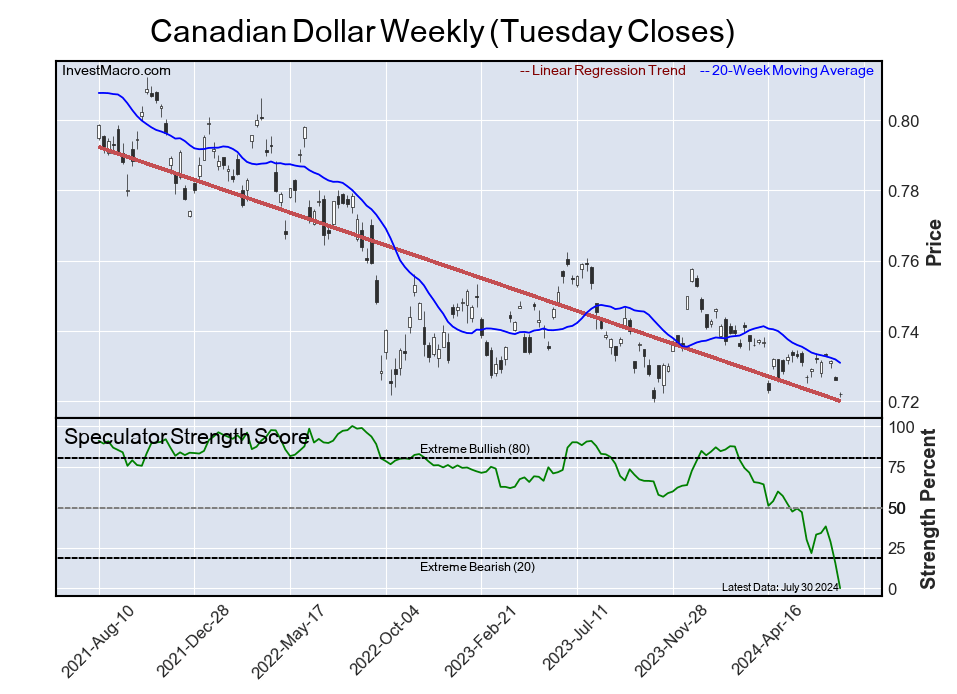
Canadian Dollar Forex Futures COT ChartThe Canadian Dollar large speculator standing this week resulted in a net position of -122,412 contracts in the data reported through Tuesday. This was a weekly boost of 25,519 contracts from the previous week which had a total of -147,931 net contracts.

This week’s current strength score (the trader positioning range over the past three years, measured from 0 to 100) shows the speculators are currently Bearish-Extreme with a score of 13.5 percent. The commercials are Bullish-Extreme with a score of 85.8 percent and the small traders (not shown in chart) are Bearish-Extreme with a score of 18.2 percent.

Price Trend-Following Model: Downtrend

Our weekly trend-following model classifies the current market price position as: Downtrend. The current action for the model is considered to be: Hold – Maintain Short Position.

CANADIAN DOLLAR StatisticsSPECULATORSCOMMERCIALSSMALL TRADERS
– Percent of Open Interest Longs:10.076.910.4
– Percent of Open Interest Shorts:53.931.511.8
– Net Position:-122,412126,330-3,918
– Gross Longs:27,790214,10729,063
– Gross Shorts:150,20287,77732,981
– Long to Short Ratio:0.2 to 12.4 to 10.9 to 1
NET POSITION TREND:
– Strength Index Score (3 Year Range Pct):13.585.818.2
– Strength Index Reading (3 Year Range):Bearish-ExtremeBullish-ExtremeBearish-Extreme
NET POSITION MOVEMENT INDEX:
– 6-Week Change in Strength Index:-22.321.4-16.7


Australian Dollar Futures:

Australian Dollar Forex Futures COT ChartThe Australian Dollar large speculator standing this week resulted in a net position of -23,676 contracts in the data reported through Tuesday. This was a weekly advance of 17,980 contracts from the previous week which had a total of -41,656 net contracts.

This week’s current strength score (the trader positioning range over the past three years, measured from 0 to 100) shows the speculators are currently Bullish-Extreme with a score of 100.0 percent. The commercials are Bearish-Extreme with a score of 1.5 percent and the small traders (not shown in chart) are Bullish with a score of 70.4 percent.

Price Trend-Following Model: Strong Uptrend

Our weekly trend-following model classifies the current market price position as: Strong Uptrend. The current action for the model is considered to be: Hold – Maintain Long Position.

AUSTRALIAN DOLLAR StatisticsSPECULATORSCOMMERCIALSSMALL TRADERS
– Percent of Open Interest Longs:35.745.615.1
– Percent of Open Interest Shorts:48.834.912.7
– Net Position:-23,67619,3434,333
– Gross Longs:64,62082,54927,370
– Gross Shorts:88,29663,20623,037
– Long to Short Ratio:0.7 to 11.3 to 11.2 to 1
NET POSITION TREND:
– Strength Index Score (3 Year Range Pct):100.01.570.4
– Strength Index Reading (3 Year Range):Bullish-ExtremeBearish-ExtremeBullish
NET POSITION MOVEMENT INDEX:
– 6-Week Change in Strength Index:63.8-58.011.7


New Zealand Dollar Futures:

New Zealand Dollar Forex Futures COT ChartThe New Zealand Dollar large speculator standing this week resulted in a net position of 26,642 contracts in the data reported through Tuesday. This was a weekly advance of 6,313 contracts from the previous week which had a total of 20,329 net contracts.

This week’s current strength score (the trader positioning range over the past three years, measured from 0 to 100) shows the speculators are currently Bullish-Extreme with a score of 100.0 percent. The commercials are Bearish-Extreme with a score of 0.0 percent and the small traders (not shown in chart) are Bullish with a score of 71.3 percent.

Price Trend-Following Model: Weak Downtrend

Our weekly trend-following model classifies the current market price position as: Weak Downtrend. The current action for the model is considered to be: Hold – Maintain Short Position.

NEW ZEALAND DOLLAR StatisticsSPECULATORSCOMMERCIALSSMALL TRADERS
– Percent of Open Interest Longs:72.317.87.5
– Percent of Open Interest Shorts:28.263.46.0
– Net Position:26,642-27,567925
– Gross Longs:43,71110,7794,540
– Gross Shorts:17,06938,3463,615
– Long to Short Ratio:2.6 to 10.3 to 11.3 to 1
NET POSITION TREND:
– Strength Index Score (3 Year Range Pct):100.00.071.3
– Strength Index Reading (3 Year Range):Bullish-ExtremeBearish-ExtremeBullish
NET POSITION MOVEMENT INDEX:
– 6-Week Change in Strength Index:79.0-76.626.3


Mexican Peso Futures:

Mexican Peso Futures COT ChartThe Mexican Peso large speculator standing this week resulted in a net position of 57,806 contracts in the data reported through Tuesday. This was a weekly lift of 7,552 contracts from the previous week which had a total of 50,254 net contracts.

This week’s current strength score (the trader positioning range over the past three years, measured from 0 to 100) shows the speculators are currently Bullish with a score of 59.8 percent. The commercials are Bearish with a score of 40.8 percent and the small traders (not shown in chart) are Bearish-Extreme with a score of 18.6 percent.

Price Trend-Following Model: Strong Downtrend

Our weekly trend-following model classifies the current market price position as: Strong Downtrend. The current action for the model is considered to be: Hold – Maintain Short Position.

MEXICAN PESO StatisticsSPECULATORSCOMMERCIALSSMALL TRADERS
– Percent of Open Interest Longs:49.047.42.9
– Percent of Open Interest Shorts:15.481.72.2
– Net Position:57,806-58,9631,157
– Gross Longs:84,31481,6675,020
– Gross Shorts:26,508140,6303,863
– Long to Short Ratio:3.2 to 10.6 to 11.3 to 1
NET POSITION TREND:
– Strength Index Score (3 Year Range Pct):59.840.818.6
– Strength Index Reading (3 Year Range):BullishBearishBearish-Extreme
NET POSITION MOVEMENT INDEX:
– 6-Week Change in Strength Index:-27.127.5-15.8


Brazilian Real Futures:

Brazil Real Futures COT ChartThe Brazilian Real large speculator standing this week resulted in a net position of -22,320 contracts in the data reported through Tuesday. This was a weekly reduction of -2,563 contracts from the previous week which had a total of -19,757 net contracts.

This week’s current strength score (the trader positioning range over the past three years, measured from 0 to 100) shows the speculators are currently Bearish-Extreme with a score of 18.0 percent. The commercials are Bullish-Extreme with a score of 83.7 percent and the small traders (not shown in chart) are Bearish with a score of 23.7 percent.

Price Trend-Following Model: Strong Downtrend

Our weekly trend-following model classifies the current market price position as: Strong Downtrend. The current action for the model is considered to be: Hold – Maintain Short Position.

BRAZIL REAL StatisticsSPECULATORSCOMMERCIALSSMALL TRADERS
– Percent of Open Interest Longs:38.556.32.2
– Percent of Open Interest Shorts:61.432.23.3
– Net Position:-22,32023,477-1,157
– Gross Longs:37,62254,9452,107
– Gross Shorts:59,94231,4683,264
– Long to Short Ratio:0.6 to 11.7 to 10.6 to 1
NET POSITION TREND:
– Strength Index Score (3 Year Range Pct):18.083.723.7
– Strength Index Reading (3 Year Range):Bearish-ExtremeBullish-ExtremeBearish
NET POSITION MOVEMENT INDEX:
– 6-Week Change in Strength Index:18.0-16.3-10.9


Bitcoin Futures:

Bitcoin Crypto Futures COT ChartThe Bitcoin large speculator standing this week resulted in a net position of -624 contracts in the data reported through Tuesday. This was a weekly increase of 99 contracts from the previous week which had a total of -723 net contracts.

This week’s current strength score (the trader positioning range over the past three years, measured from 0 to 100) shows the speculators are currently Bullish with a score of 57.0 percent. The commercials are Bullish with a score of 70.8 percent and the small traders (not shown in chart) are Bearish with a score of 21.6 percent.

Price Trend-Following Model: Weak Uptrend

Our weekly trend-following model classifies the current market price position as: Weak Uptrend. The current action for the model is considered to be: Hold – Maintain Long Position.

BITCOIN StatisticsSPECULATORSCOMMERCIALSSMALL TRADERS
– Percent of Open Interest Longs:73.33.75.0
– Percent of Open Interest Shorts:75.32.93.7
– Net Position:-624241383
– Gross Longs:22,1031,1211,499
– Gross Shorts:22,7278801,116
– Long to Short Ratio:1.0 to 11.3 to 11.3 to 1
NET POSITION TREND:
– Strength Index Score (3 Year Range Pct):57.070.821.6
– Strength Index Reading (3 Year Range):BullishBullishBearish
NET POSITION MOVEMENT INDEX:
– 6-Week Change in Strength Index:-6.716.8-4.9


Article By InvestMacroReceive our weekly COT Newsletter

*COT Report: The COT data, released weekly to the public each Friday, is updated through the most recent Tuesday (data is 3 days old) and shows a quick view of how large speculators or non-commercials (for-profit traders) were positioned in the futures markets.

The CFTC categorizes trader positions according to commercial hedgers (traders who use futures contracts for hedging as part of the business), non-commercials (large traders who speculate to realize trading profits) and nonreportable traders (usually small traders/speculators) as well as their open interest (contracts open in the market at time of reporting). See CFTC criteria here.

COT Metals Charts: Speculator bets led by Platinum & Silver

By InvestMacro

Here are the latest charts and statistics for the Commitment of Traders (COT) data published by the Commodities Futures Trading Commission (CFTC).

The latest COT data is updated through Tuesday June 25th and shows a quick view of how large traders (for-profit speculators and commercial entities) were positioned in the futures markets.

Weekly Speculator Changes led by Platinum & Silver

The COT metals markets speculator bets were overall higher this week as four out of the six metals markets we cover had higher positioning while the other two markets had lower speculator contracts.

Leading the gains for the metals was Platinum (4,739 contracts) with Silver (4,077 contracts), Gold (3,145 contracts) and Palladium (650 contracts) also showing positive weeks.

The markets with declines in speculator bets for the week were Copper (-2,495 contracts) with Steel (-201 contracts) also registering lower bets on the week.


Metals Net Speculators Leaderboard

Legend: Weekly Speculators Change | Speculators Current Net Position | Speculators Strength Score compared to last 3-Years (0-100 range)


Strength Scores led by Silver & Gold

COT Strength Scores (a normalized measure of Speculator positions over a 3-Year range, from 0 to 100 where above 80 is Extreme-Bullish and below 20 is Extreme-Bearish) showed that Silver (95 percent) and Gold (87 percent) lead the metals markets this week. Copper (80 percent), Steel (74 percent) and Platinum (73 percent) come in as the next highest in the weekly strength scores.

On the downside, Palladium (6 percent) comes in at the lowest strength level currently and is in Extreme-Bearish territory (below 20 percent).

Strength Statistics:
Gold (87.3 percent) vs Gold previous week (85.9 percent)
Silver (94.9 percent) vs Silver previous week (89.3 percent)
Copper (79.9 percent) vs Copper previous week (82.2 percent)
Platinum (73.0 percent) vs Platinum previous week (60.4 percent)
Palladium (6.2 percent) vs Palladium previous week (2.2 percent)
Steel (73.6 percent) vs Palladium previous week (74.4 percent)


Gold & Silver top the 6-Week Strength Trends

COT Strength Score Trends (or move index, calculates the 6-week changes in strength scores) showed that Gold (19 percent) leads the past six weeks trends for metals and is currently the only market with a positive trend score.

Palladium (-12 percent), Copper (-11 percent) and Platinum (-10 percent) lead the downside trend scores currently.

Move Statistics:
Gold (18.8 percent) vs Gold previous week (19.6 percent)
Silver (-4.8 percent) vs Silver previous week (-2.4 percent)
Copper (-10.9 percent) vs Copper previous week (-9.3 percent)
Platinum (-10.3 percent) vs Platinum previous week (5.9 percent)
Palladium (-12.3 percent) vs Palladium previous week (-15.1 percent)
Steel (-6.5 percent) vs Steel previous week (-9.0 percent)


Individual Markets:

Gold Comex Futures:

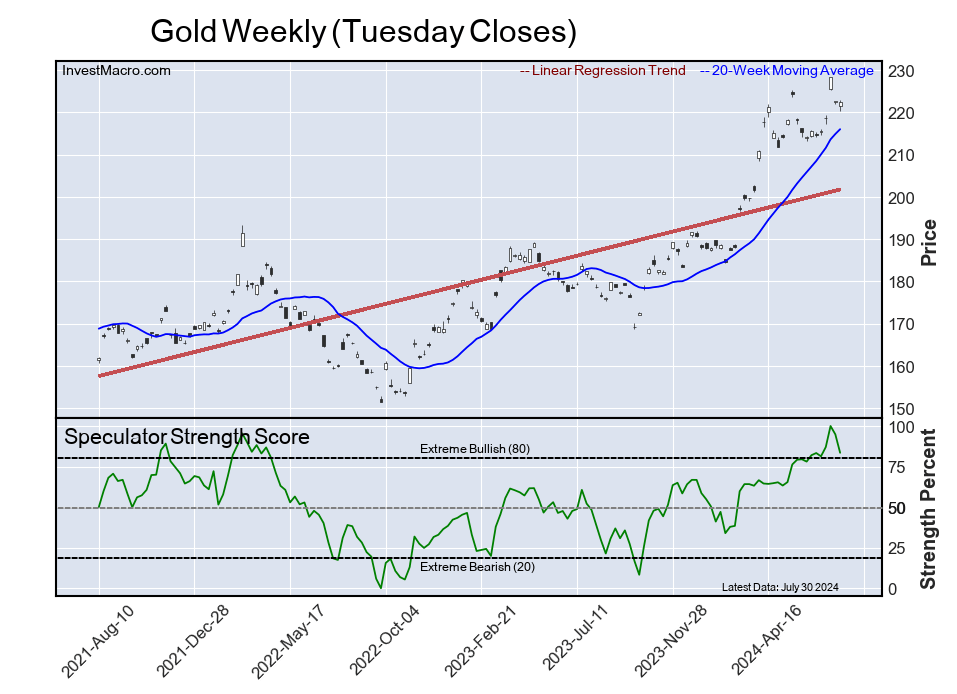
Gold Futures COT ChartThe Gold Comex Futures large speculator standing this week was a net position of 246,229 contracts in the data reported through Tuesday. This was a weekly advance of 3,145 contracts from the previous week which had a total of 243,084 net contracts.

This week’s current strength score (the trader positioning range over the past three years, measured from 0 to 100) shows the speculators are currently Bullish-Extreme with a score of 87.3 percent. The commercials are Bearish-Extreme with a score of 14.5 percent and the small traders (not shown in chart) are Bullish with a score of 62.1 percent.

Price Trend-Following Model: Uptrend

Our weekly trend-following model classifies the current market price position as: Uptrend. The current action for the model is considered to be: Hold – Maintain Long Position.

Gold Futures StatisticsSPECULATORSCOMMERCIALSSMALL TRADERS
– Percent of Open Interest Longs:63.019.110.7
– Percent of Open Interest Shorts:8.579.25.1
– Net Position:246,229-271,48825,259
– Gross Longs:284,88586,55148,436
– Gross Shorts:38,656358,03923,177
– Long to Short Ratio:7.4 to 10.2 to 12.1 to 1
NET POSITION TREND:
– Strength Index Score (3 Year Range Pct):87.314.562.1
– Strength Index Reading (3 Year Range):Bullish-ExtremeBearish-ExtremeBullish
NET POSITION MOVEMENT INDEX:
– 6-Week Change in Strength Index:18.8-16.1-8.5


Silver Comex Futures:

Silver Futures COT ChartThe Silver Comex Futures large speculator standing this week was a net position of 55,978 contracts in the data reported through Tuesday. This was a weekly boost of 4,077 contracts from the previous week which had a total of 51,901 net contracts.

This week’s current strength score (the trader positioning range over the past three years, measured from 0 to 100) shows the speculators are currently Bullish-Extreme with a score of 94.9 percent. The commercials are Bearish-Extreme with a score of 2.7 percent and the small traders (not shown in chart) are Bullish-Extreme with a score of 90.5 percent.

Price Trend-Following Model: Uptrend

Our weekly trend-following model classifies the current market price position as: Uptrend. The current action for the model is considered to be: Hold – Maintain Long Position.

Silver Futures StatisticsSPECULATORSCOMMERCIALSSMALL TRADERS
– Percent of Open Interest Longs:48.923.721.4
– Percent of Open Interest Shorts:15.372.16.6
– Net Position:55,978-80,71824,740
– Gross Longs:81,36639,37535,689
– Gross Shorts:25,388120,09310,949
– Long to Short Ratio:3.2 to 10.3 to 13.3 to 1
NET POSITION TREND:
– Strength Index Score (3 Year Range Pct):94.92.790.5
– Strength Index Reading (3 Year Range):Bullish-ExtremeBearish-ExtremeBullish-Extreme
NET POSITION MOVEMENT INDEX:
– 6-Week Change in Strength Index:-4.80.813.5


Copper Grade #1 Futures:

Copper Futures COT ChartThe Copper Grade #1 Futures large speculator standing this week was a net position of 50,126 contracts in the data reported through Tuesday. This was a weekly reduction of -2,495 contracts from the previous week which had a total of 52,621 net contracts.

This week’s current strength score (the trader positioning range over the past three years, measured from 0 to 100) shows the speculators are currently Bullish with a score of 79.9 percent. The commercials are Bearish-Extreme with a score of 16.6 percent and the small traders (not shown in chart) are Bullish-Extreme with a score of 92.4 percent.

Price Trend-Following Model: Weak Uptrend

Our weekly trend-following model classifies the current market price position as: Weak Uptrend. The current action for the model is considered to be: Hold – Maintain Long Position.

Copper Futures StatisticsSPECULATORSCOMMERCIALSSMALL TRADERS
– Percent of Open Interest Longs:52.724.19.2
– Percent of Open Interest Shorts:33.148.54.4
– Net Position:50,126-62,46512,339
– Gross Longs:134,79861,57523,624
– Gross Shorts:84,672124,04011,285
– Long to Short Ratio:1.6 to 10.5 to 12.1 to 1
NET POSITION TREND:
– Strength Index Score (3 Year Range Pct):79.916.692.4
– Strength Index Reading (3 Year Range):BullishBearish-ExtremeBullish-Extreme
NET POSITION MOVEMENT INDEX:
– 6-Week Change in Strength Index:-10.96.227.0


Platinum Futures:

Platinum Futures COT ChartThe Platinum Futures large speculator standing this week was a net position of 20,603 contracts in the data reported through Tuesday. This was a weekly increase of 4,739 contracts from the previous week which had a total of 15,864 net contracts.

This week’s current strength score (the trader positioning range over the past three years, measured from 0 to 100) shows the speculators are currently Bullish with a score of 73.0 percent. The commercials are Bearish-Extreme with a score of 18.7 percent and the small traders (not shown in chart) are Bullish with a score of 73.9 percent.

Price Trend-Following Model: Uptrend

Our weekly trend-following model classifies the current market price position as: Uptrend. The current action for the model is considered to be: Hold – Maintain Long Position.

Platinum Futures StatisticsSPECULATORSCOMMERCIALSSMALL TRADERS
– Percent of Open Interest Longs:56.223.112.7
– Percent of Open Interest Shorts:29.458.74.0
– Net Position:20,603-27,3526,749
– Gross Longs:43,19617,7239,788
– Gross Shorts:22,59345,0753,039
– Long to Short Ratio:1.9 to 10.4 to 13.2 to 1
NET POSITION TREND:
– Strength Index Score (3 Year Range Pct):73.018.773.9
– Strength Index Reading (3 Year Range):BullishBearish-ExtremeBullish
NET POSITION MOVEMENT INDEX:
– 6-Week Change in Strength Index:-10.32.250.6


Palladium Futures:

Palladium Futures COT ChartThe Palladium Futures large speculator standing this week was a net position of -12,906 contracts in the data reported through Tuesday. This was a weekly increase of 650 contracts from the previous week which had a total of -13,556 net contracts.

This week’s current strength score (the trader positioning range over the past three years, measured from 0 to 100) shows the speculators are currently Bearish-Extreme with a score of 6.2 percent. The commercials are Bullish-Extreme with a score of 92.0 percent and the small traders (not shown in chart) are Bullish-Extreme with a score of 87.9 percent.

Price Trend-Following Model: Downtrend

Our weekly trend-following model classifies the current market price position as: Downtrend. The current action for the model is considered to be: Hold – Maintain Short Position.

Palladium Futures StatisticsSPECULATORSCOMMERCIALSSMALL TRADERS
– Percent of Open Interest Longs:30.553.98.0
– Percent of Open Interest Shorts:78.39.05.1
– Net Position:-12,90612,138768
– Gross Longs:8,22414,5582,158
– Gross Shorts:21,1302,4201,390
– Long to Short Ratio:0.4 to 16.0 to 11.6 to 1
NET POSITION TREND:
– Strength Index Score (3 Year Range Pct):6.292.087.9
– Strength Index Reading (3 Year Range):Bearish-ExtremeBullish-ExtremeBullish-Extreme
NET POSITION MOVEMENT INDEX:
– 6-Week Change in Strength Index:-12.311.38.7


Steel Futures Futures:

Steel Futures COT ChartThe Steel Futures large speculator standing this week was a net position of -5,944 contracts in the data reported through Tuesday. This was a weekly lowering of -201 contracts from the previous week which had a total of -5,743 net contracts.

This week’s current strength score (the trader positioning range over the past three years, measured from 0 to 100) shows the speculators are currently Bullish with a score of 73.6 percent. The commercials are Bearish with a score of 27.4 percent and the small traders (not shown in chart) are Bearish with a score of 28.1 percent.

Price Trend-Following Model: Strong Downtrend

Our weekly trend-following model classifies the current market price position as: Strong Downtrend. The current action for the model is considered to be: Hold – Maintain Short Position.

Steel Futures StatisticsSPECULATORSCOMMERCIALSSMALL TRADERS
– Percent of Open Interest Longs:10.879.60.7
– Percent of Open Interest Shorts:32.657.70.9
– Net Position:-5,9445,983-39
– Gross Longs:2,93221,676200
– Gross Shorts:8,87615,693239
– Long to Short Ratio:0.3 to 11.4 to 10.8 to 1
NET POSITION TREND:
– Strength Index Score (3 Year Range Pct):73.627.428.1
– Strength Index Reading (3 Year Range):BullishBearishBearish
NET POSITION MOVEMENT INDEX:
– 6-Week Change in Strength Index:-6.57.2-21.4


Article By InvestMacroReceive our weekly COT Newsletter

*COT Report: The COT data, released weekly to the public each Friday, is updated through the most recent Tuesday (data is 3 days old) and shows a quick view of how large speculators or non-commercials (for-profit traders) were positioned in the futures markets.

The CFTC categorizes trader positions according to commercial hedgers (traders who use futures contracts for hedging as part of the business), non-commercials (large traders who speculate to realize trading profits) and nonreportable traders (usually small traders/speculators) as well as their open interest (contracts open in the market at time of reporting). See CFTC criteria here.
COT Bonds Charts: Speculator bets led by 10-Year Bonds & Fed Funds

By InvestMacro

Here are the latest charts and statistics for the Commitment of Traders (COT) reports data published by the Commodities Futures Trading Commission (CFTC).

The latest COT data is updated through Tuesday June 25th and shows a quick view of how large traders (for-profit speculators and commercial hedgers) were positioned in the futures markets.

Weekly Speculator Changes led by 10-Year Bonds & Fed Funds

The COT bond market speculator bets were mixed this week as four out of the eight bond markets we cover had higher positioning while the other four markets had lower speculator contracts.

Leading the gains for the bond markets was the 10-Year Bonds (47,762 contracts) with the Fed Funds (10,305 contracts), the Ultra 10-Year Bonds (5,441 contracts) and the 2-Year Bonds (2,132 contracts) also recording positive weeks.

The bond markets with declines in speculator bets for the week were the 5-Year Bonds (-32,797 contracts), the US Treasury Bonds (-17,661 contracts), the Ultra Treasury Bonds (-14,105 contracts) and with the SOFR 3-Months (-2,447 contracts) also registering lower bets on the week.


Bonds Net Speculators Leaderboard

Legend: Weekly Speculators Change | Speculators Current Net Position | Speculators Strength Score compared to last 3-Years (0-100 range)


Strength Scores led by US Treasury Bonds & 10-Year Bonds

COT Strength Scores (a normalized measure of Speculator positions over a 3-Year range, from 0 to 100 where above 80 is Extreme-Bullish and below 20 is Extreme-Bearish) showed that the US Treasury Bonds (66 percent) and the 10-Year Bonds (53 percent) lead the bond markets this week. The SOFR 3-Months (50 percent) comes in as the next highest in the weekly strength scores.

On the downside, the 5-Year Bonds (5 percent) and the 2-Year Bonds (14 percent) come in at the lowest strength level currently and are in Extreme-Bearish territory (below 20 percent). The next lowest strength scores were the Ultra 10-Year Bonds (26 percent) and the Fed Funds (35 percent).

Strength Statistics:
Fed Funds (35.1 percent) vs Fed Funds previous week (32.8 percent)
2-Year Bond (13.7 percent) vs 2-Year Bond previous week (13.6 percent)
5-Year Bond (5.2 percent) vs 5-Year Bond previous week (7.2 percent)
10-Year Bond (53.2 percent) vs 10-Year Bond previous week (48.7 percent)
Ultra 10-Year Bond (25.9 percent) vs Ultra 10-Year Bond previous week (24.8 percent)
US Treasury Bond (65.7 percent) vs US Treasury Bond previous week (71.9 percent)
Ultra US Treasury Bond (38.3 percent) vs Ultra US Treasury Bond previous week (44.5 percent)
SOFR 3-Months (50.2 percent) vs SOFR 3-Months previous week (50.3 percent)


Ultra 10-Year Bonds & SOFR 3-Months top the 6-Week Strength Trends

COT Strength Score Trends (or move index, calculates the 6-week changes in strength scores) showed that the Ultra 10-Year Bonds (26 percent) and the SOFR 3-Months (11 percent) lead the past six weeks trends for bonds. The 10-Year Bonds (3 percent) is the next highest positive mover in the latest trends data.

The Fed Funds (-53 percent) leads the downside trend scores currently with the US Treasury Bonds (-19 percent), the 2-Year Bonds (-19 percent) and the Ultra Treasury Bonds (-16 percent) following next with lower trend scores.

Strength Trend Statistics:
Fed Funds (-53.3 percent) vs Fed Funds previous week (-64.9 percent)
2-Year Bond (-19.0 percent) vs 2-Year Bond previous week (-15.4 percent)
5-Year Bond (-9.6 percent) vs 5-Year Bond previous week (-17.4 percent)
10-Year Bond (2.6 percent) vs 10-Year Bond previous week (10.6 percent)
Ultra 10-Year Bond (25.6 percent) vs Ultra 10-Year Bond previous week (11.5 percent)
US Treasury Bond (-19.3 percent) vs US Treasury Bond previous week (-3.0 percent)
Ultra US Treasury Bond (-16.2 percent) vs Ultra US Treasury Bond previous week (-16.6 percent)
SOFR 3-Months (10.8 percent) vs SOFR 3-Months previous week (7.6 percent)


Secured Overnight Financing Rate (3-Month) Futures:

SOFR 3-Months Bonds Futures COT ChartThe Secured Overnight Financing Rate (3-Month) large speculator standing this week came in at a net position of -195,837 contracts in the data reported through Tuesday. This was a weekly fall of -2,447 contracts from the previous week which had a total of -193,390 net contracts.

This week’s current strength score (the trader positioning range over the past three years, measured from 0 to 100) shows the speculators are currently Bullish with a score of 50.2 percent. The commercials are Bearish with a score of 49.9 percent and the small traders (not shown in chart) are Bullish-Extreme with a score of 86.3 percent.

Price Trend-Following Model: Weak Uptrend

Our weekly trend-following model classifies the current market price position as: Weak Uptrend. The current action for the model is considered to be: Hold – Maintain Long Position.

SOFR 3-Months StatisticsSPECULATORSCOMMERCIALSSMALL TRADERS
– Percent of Open Interest Longs:15.059.10.2
– Percent of Open Interest Shorts:17.157.00.3
– Net Position:-195,837198,662-2,825
– Gross Longs:1,417,1675,579,16522,337
– Gross Shorts:1,613,0045,380,50325,162
– Long to Short Ratio:0.9 to 11.0 to 10.9 to 1
NET POSITION TREND:
– Strength Index Score (3 Year Range Pct):50.249.986.3
– Strength Index Reading (3 Year Range):BullishBearishBullish-Extreme
NET POSITION MOVEMENT INDEX:
– 6-Week Change in Strength Index:10.8-10.80.5


30-Day Federal Funds Futures:

Federal Funds 30-Day Bonds Futures COT ChartThe 30-Day Federal Funds large speculator standing this week came in at a net position of -140,133 contracts in the data reported through Tuesday. This was a weekly gain of 10,305 contracts from the previous week which had a total of -150,438 net contracts.

This week’s current strength score (the trader positioning range over the past three years, measured from 0 to 100) shows the speculators are currently Bearish with a score of 35.1 percent. The commercials are Bullish with a score of 59.9 percent and the small traders (not shown in chart) are Bullish-Extreme with a score of 100.0 percent.

Price Trend-Following Model: Downtrend

Our weekly trend-following model classifies the current market price position as: Downtrend. The current action for the model is considered to be: Hold – Maintain Short Position.

30-Day Federal Funds StatisticsSPECULATORSCOMMERCIALSSMALL TRADERS
– Percent of Open Interest Longs:9.070.12.6
– Percent of Open Interest Shorts:17.362.02.3
– Net Position:-140,133134,9275,206
– Gross Longs:150,6561,177,83943,053
– Gross Shorts:290,7891,042,91237,847
– Long to Short Ratio:0.5 to 11.1 to 11.1 to 1
NET POSITION TREND:
– Strength Index Score (3 Year Range Pct):35.159.9100.0
– Strength Index Reading (3 Year Range):BearishBullishBullish-Extreme
NET POSITION MOVEMENT INDEX:
– 6-Week Change in Strength Index:-53.348.030.9


2-Year Treasury Note Futures:

2-Year Treasury Bonds Futures COT ChartThe 2-Year Treasury Note large speculator standing this week came in at a net position of -1,261,457 contracts in the data reported through Tuesday. This was a weekly advance of 2,132 contracts from the previous week which had a total of -1,263,589 net contracts.

This week’s current strength score (the trader positioning range over the past three years, measured from 0 to 100) shows the speculators are currently Bearish-Extreme with a score of 13.7 percent. The commercials are Bullish-Extreme with a score of 83.7 percent and the small traders (not shown in chart) are Bullish-Extreme with a score of 99.5 percent.

Price Trend-Following Model: Weak Downtrend

Our weekly trend-following model classifies the current market price position as: Weak Downtrend. The current action for the model is considered to be: Hold – Maintain Short Position.

2-Year Treasury Note StatisticsSPECULATORSCOMMERCIALSSMALL TRADERS
– Percent of Open Interest Longs:14.577.96.6
– Percent of Open Interest Shorts:44.951.22.9
– Net Position:-1,261,4571,109,570151,887
– Gross Longs:603,4693,236,642272,091
– Gross Shorts:1,864,9262,127,072120,204
– Long to Short Ratio:0.3 to 11.5 to 12.3 to 1
NET POSITION TREND:
– Strength Index Score (3 Year Range Pct):13.783.799.5
– Strength Index Reading (3 Year Range):Bearish-ExtremeBullish-ExtremeBullish-Extreme
NET POSITION MOVEMENT INDEX:
– 6-Week Change in Strength Index:-19.020.17.2


5-Year Treasury Note Futures:

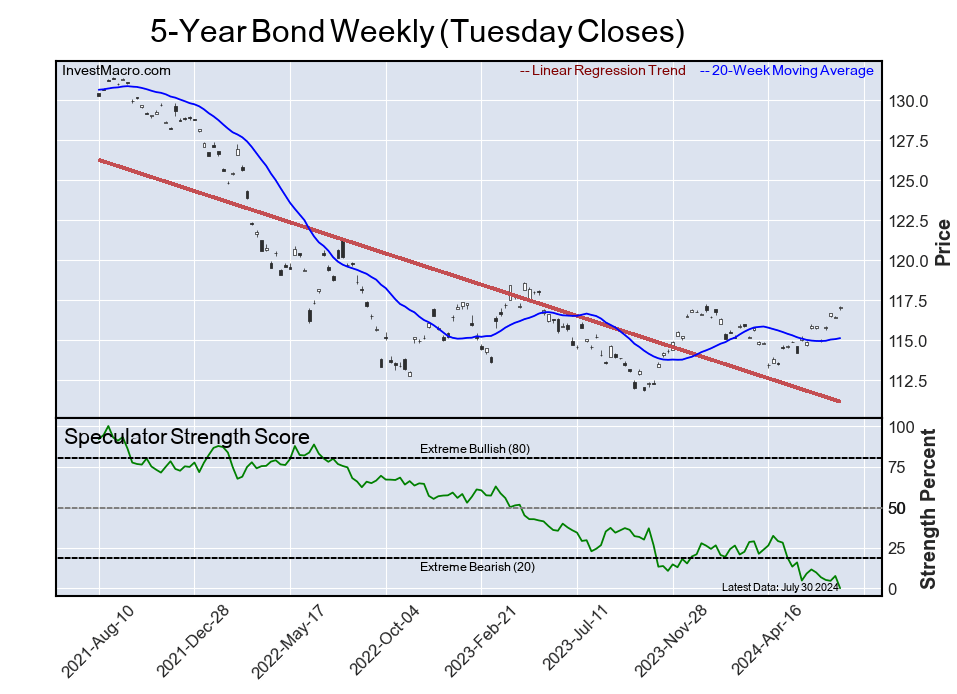
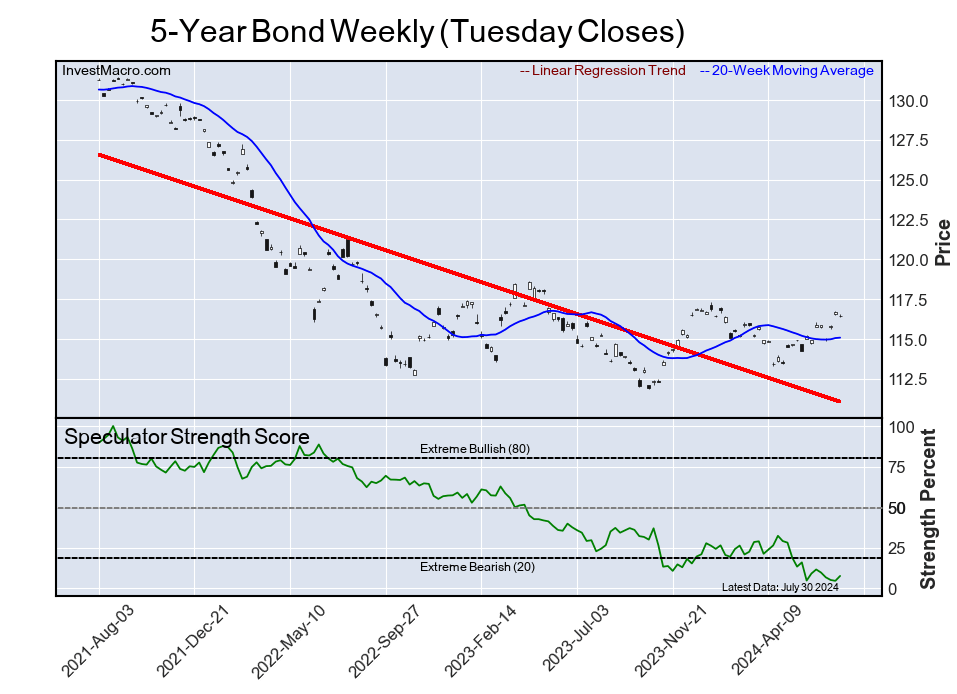
5-Year Treasury Bonds Futures COT ChartThe 5-Year Treasury Note large speculator standing this week came in at a net position of -1,486,197 contracts in the data reported through Tuesday. This was a weekly lowering of -32,797 contracts from the previous week which had a total of -1,453,400 net contracts.

This week’s current strength score (the trader positioning range over the past three years, measured from 0 to 100) shows the speculators are currently Bearish-Extreme with a score of 5.2 percent. The commercials are Bullish-Extreme with a score of 90.9 percent and the small traders (not shown in chart) are Bullish-Extreme with a score of 99.6 percent.

Price Trend-Following Model: Weak Downtrend

Our weekly trend-following model classifies the current market price position as: Weak Downtrend. The current action for the model is considered to be: Hold – Maintain Short Position.

5-Year Treasury Note StatisticsSPECULATORSCOMMERCIALSSMALL TRADERS
– Percent of Open Interest Longs:6.984.67.4
– Percent of Open Interest Shorts:30.963.44.6
– Net Position:-1,486,1971,312,975173,222
– Gross Longs:428,3615,246,055458,883
– Gross Shorts:1,914,5583,933,080285,661
– Long to Short Ratio:0.2 to 11.3 to 11.6 to 1
NET POSITION TREND:
– Strength Index Score (3 Year Range Pct):5.290.999.6
– Strength Index Reading (3 Year Range):Bearish-ExtremeBullish-ExtremeBullish-Extreme
NET POSITION MOVEMENT INDEX:
– 6-Week Change in Strength Index:-9.65.019.0


10-Year Treasury Note Futures:

10-Year Treasury Notes Bonds Futures COT ChartThe 10-Year Treasury Note large speculator standing this week came in at a net position of -319,844 contracts in the data reported through Tuesday. This was a weekly rise of 47,762 contracts from the previous week which had a total of -367,606 net contracts.

This week’s current strength score (the trader positioning range over the past three years, measured from 0 to 100) shows the speculators are currently Bullish with a score of 53.2 percent. The commercials are Bearish with a score of 30.8 percent and the small traders (not shown in chart) are Bullish-Extreme with a score of 82.4 percent.

Price Trend-Following Model: Weak Downtrend

Our weekly trend-following model classifies the current market price position as: Weak Downtrend. The current action for the model is considered to be: Hold – Maintain Short Position.

10-Year Treasury Note StatisticsSPECULATORSCOMMERCIALSSMALL TRADERS
– Percent of Open Interest Longs:10.078.29.6
– Percent of Open Interest Shorts:17.471.78.7
– Net Position:-319,844279,16240,682
– Gross Longs:432,6273,385,365416,843
– Gross Shorts:752,4713,106,203376,161
– Long to Short Ratio:0.6 to 11.1 to 11.1 to 1
NET POSITION TREND:
– Strength Index Score (3 Year Range Pct):53.230.882.4
– Strength Index Reading (3 Year Range):BullishBearishBullish-Extreme
NET POSITION MOVEMENT INDEX:
– 6-Week Change in Strength Index:2.6-9.29.7


Ultra 10-Year Notes Futures:

Ultra 10-Year Treasury Notes Bonds Futures COT ChartThe Ultra 10-Year Notes large speculator standing this week came in at a net position of -153,702 contracts in the data reported through Tuesday. This was a weekly boost of 5,441 contracts from the previous week which had a total of -159,143 net contracts.

This week’s current strength score (the trader positioning range over the past three years, measured from 0 to 100) shows the speculators are currently Bearish with a score of 25.9 percent. The commercials are Bullish with a score of 63.8 percent and the small traders (not shown in chart) are Bullish with a score of 76.9 percent.

Price Trend-Following Model: Weak Uptrend

Our weekly trend-following model classifies the current market price position as: Weak Uptrend. The current action for the model is considered to be: Hold – Maintain Long Position.

Ultra 10-Year Notes StatisticsSPECULATORSCOMMERCIALSSMALL TRADERS
– Percent of Open Interest Longs:12.276.89.7
– Percent of Open Interest Shorts:19.766.312.8
– Net Position:-153,702216,236-62,534
– Gross Longs:251,2701,577,581200,003
– Gross Shorts:404,9721,361,345262,537
– Long to Short Ratio:0.6 to 11.2 to 10.8 to 1
NET POSITION TREND:
– Strength Index Score (3 Year Range Pct):25.963.876.9
– Strength Index Reading (3 Year Range):BearishBullishBullish
NET POSITION MOVEMENT INDEX:
– 6-Week Change in Strength Index:25.6-36.05.8


US Treasury Bonds Futures:

US Year Treasury Notes Long Bonds Futures COT ChartThe US Treasury Bonds large speculator standing this week came in at a net position of -50,998 contracts in the data reported through Tuesday. This was a weekly reduction of -17,661 contracts from the previous week which had a total of -33,337 net contracts.

This week’s current strength score (the trader positioning range over the past three years, measured from 0 to 100) shows the speculators are currently Bullish with a score of 65.7 percent. The commercials are Bearish-Extreme with a score of 19.5 percent and the small traders (not shown in chart) are Bullish-Extreme with a score of 100.0 percent.

Price Trend-Following Model: Downtrend

Our weekly trend-following model classifies the current market price position as: Downtrend. The current action for the model is considered to be: Hold – Maintain Short Position.

US Treasury Bonds StatisticsSPECULATORSCOMMERCIALSSMALL TRADERS
– Percent of Open Interest Longs:17.269.113.0
– Percent of Open Interest Shorts:20.370.48.5
– Net Position:-50,998-22,46673,464
– Gross Longs:282,8981,136,639213,802
– Gross Shorts:333,8961,159,105140,338
– Long to Short Ratio:0.8 to 11.0 to 11.5 to 1
NET POSITION TREND:
– Strength Index Score (3 Year Range Pct):65.719.5100.0
– Strength Index Reading (3 Year Range):BullishBearish-ExtremeBullish-Extreme
NET POSITION MOVEMENT INDEX:
– 6-Week Change in Strength Index:-19.38.230.8


Ultra US Treasury Bonds Futures:

Ultra US Year Treasury Notes Long Bonds Futures COT ChartThe Ultra US Treasury Bonds large speculator standing this week came in at a net position of -368,340 contracts in the data reported through Tuesday. This was a weekly lowering of -14,105 contracts from the previous week which had a total of -354,235 net contracts.

This week’s current strength score (the trader positioning range over the past three years, measured from 0 to 100) shows the speculators are currently Bearish with a score of 38.3 percent. The commercials are Bullish with a score of 67.3 percent and the small traders (not shown in chart) are Bearish with a score of 40.3 percent.

Price Trend-Following Model: Weak Downtrend

Our weekly trend-following model classifies the current market price position as: Weak Downtrend. The current action for the model is considered to be: Hold – Maintain Short Position.

Ultra US Treasury Bonds StatisticsSPECULATORSCOMMERCIALSSMALL TRADERS
– Percent of Open Interest Longs:8.479.810.8
– Percent of Open Interest Shorts:30.259.29.6
– Net Position:-368,340347,83020,510
– Gross Longs:141,8291,347,454181,733
– Gross Shorts:510,169999,624161,223
– Long to Short Ratio:0.3 to 11.3 to 11.1 to 1
NET POSITION TREND:
– Strength Index Score (3 Year Range Pct):38.367.340.3
– Strength Index Reading (3 Year Range):BearishBullishBearish
NET POSITION MOVEMENT INDEX:
– 6-Week Change in Strength Index:-16.214.311.4


Article By InvestMacroReceive our weekly COT Newsletter

*COT Report: The COT data, released weekly to the public each Friday, is updated through the most recent Tuesday (data is 3 days old) and shows a quick view of how large speculators or non-commercials (for-profit traders) were positioned in the futures markets.

The CFTC categorizes trader positions according to commercial hedgers (traders who use futures contracts for hedging as part of the business), non-commercials (large traders who speculate to realize trading profits) and nonreportable traders (usually small traders/speculators) as well as their open interest (contracts open in the market at time of reporting). See CFTC criteria here.