Archive for Stock Market News – Page 47

Stock Market Speculator bets lower this week led by Dow Jones Mini & Nasdaq Mini

By InvestMacro

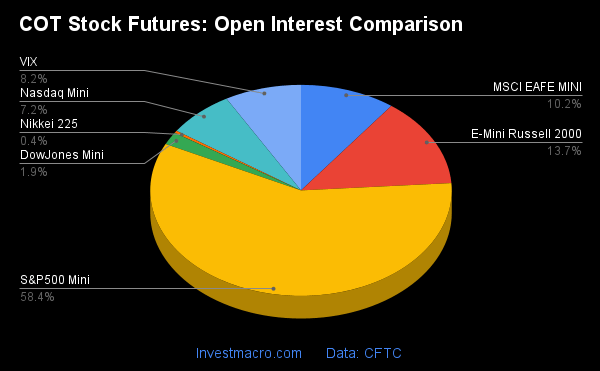
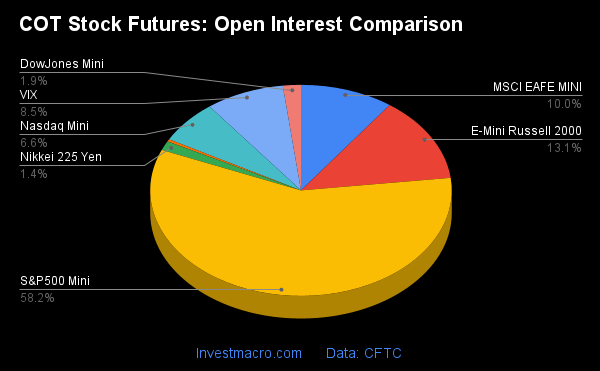
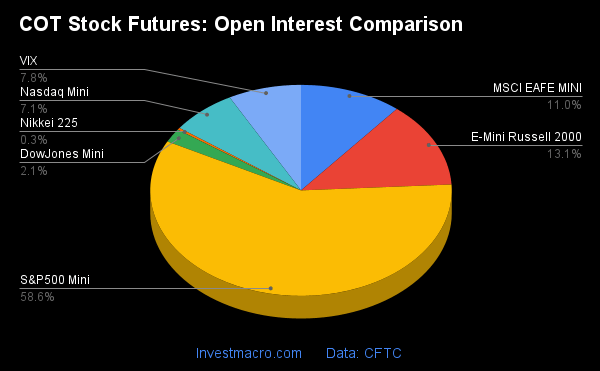
COT Stock Futures Open Interest Comparison

The latest charts and statistics for the Commitment of Traders (COT) data published by the Commodities Futures Trading Commission (CFTC) showed that stock market speculators added bearish bets on the week. The latest COT data for Week 36 is updated through Tuesday September 6th and shows a quick view of how large traders (for-profit speculators and commercial entities) were positioned in the futures markets.

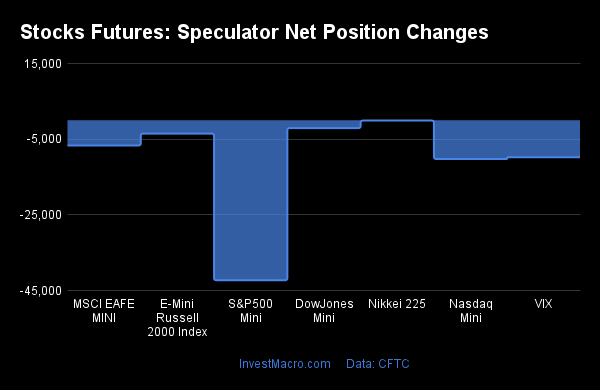
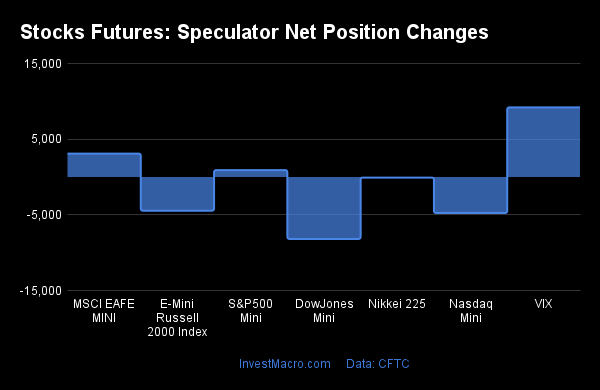
Weekly Speculator Changes led lower by Dow Jones Mini (-8,188 contracts) & Nasdaq Mini (-4,761 contracts)

Stock Market Speculator bets lower this week led by Dow Jones Mini & Nasdaq Mini

The COT stock market speculator bets were overall lower this week as three out of the seven stock markets we cover had higher positioning this week while the other four markets had lower contracts.

Leading the gains for stock markets was the VIX (9,201 contracts) with the MSCI EAFE Mini (3,096 contracts) and the S&P500 Mini (912 contracts) also showing positive weeks.

The stock markets leading the declines in speculator bets this week were the Dow Jones Industrial Average Mini (-8,188 contracts) and the Nasdaq Mini (-4,761 contracts) with the Russell 2000 Mini (-4,456 contracts) and the Nikkei 225 USD (-78 contracts) also registering lower bets on the week.


Data Snapshot of Stock Market Traders | Columns Legend
Sep-06-2022OIOI-IndexSpec-NetSpec-IndexCom-NetCOM-IndexSmalls-NetSmalls-Index
S&P500-Mini2,314,2908-238,72012301,28293-62,56213
Nikkei 22514,15110-4,641552,949441,69250
Nasdaq-Mini286,7546422,046871,86928-23,9150
DowJones-Mini76,72637-9,6082510,38673-77834
VIX326,47635-88,7346595,21135-6,47760
Nikkei 225 Yen77,78169-2,6222632,959100-30,33712


Nasdaq-Mini & VIX lead the Strength Scores

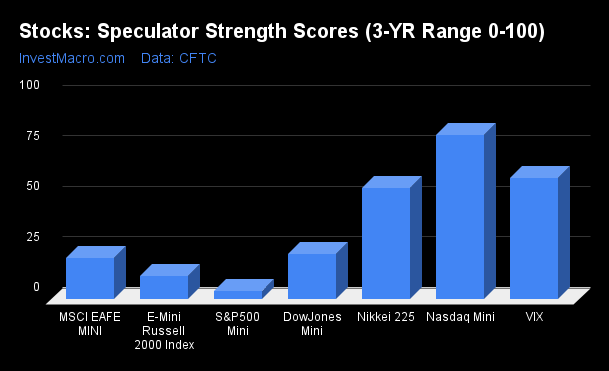
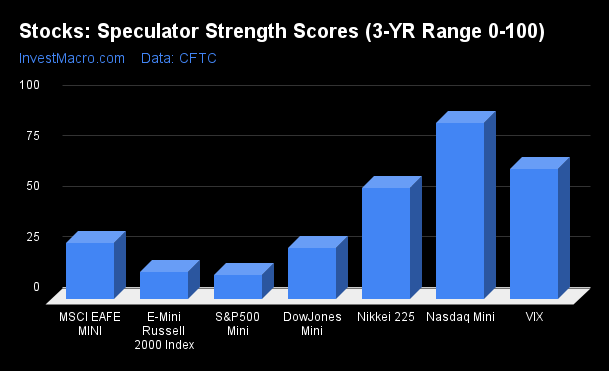
Strength Scores (a normalized measure of Speculator positions over a 3-Year range, from 0 to 100 where above 80 is extreme bullish and below 20 is extreme bearish) showed that the Nasdaq-Mini (87.3 percent) remains the strength leader in stocks and continues to be in a bullish extreme position (above 80 percent). The VIX (64.8 percent) comes in as the next highest stocks market in strength scores.

On the downside, the S&P500-Mini (12.0 percent) comes in at the lowest strength level currently and is followed by the Russell 2000-Mini (13.7 percent). Both of these markets are below 20 percent and currently in a bearish extreme level.

Stock Market Speculator bets lower this week led by Dow Jones Mini & Nasdaq Mini

Strength Statistics:
VIX (64.8 percent) vs VIX previous week (60.2 percent)
S&P500-Mini (12.0 percent) vs S&P500-Mini previous week (11.8 percent)
DowJones-Mini (25.5 percent) vs DowJones-Mini previous week (36.4 percent)
Nasdaq-Mini (87.3 percent) vs Nasdaq-Mini previous week (90.0 percent)
Russell2000-Mini (13.7 percent) vs Russell2000-Mini previous week (16.2 percent)
Nikkei USD (55.4 percent) vs Nikkei USD previous week (55.8 percent)
EAFE-Mini (27.8 percent) vs EAFE-Mini previous week (24.4 percent)

DowJones-Mini leads Strength Trends

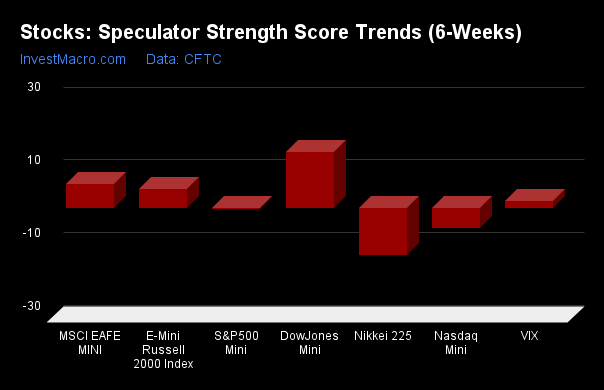
Strength Score Trends (or move index, calculates the 6-week changes in strength scores) showed that the DowJones-Mini (15.4 percent) leads the past six weeks trends for stocks this week. The EAFE-Mini (6.6 percent), the Russell 2000-Mini (5.4 percent) and the VIX (1.9 percent) fill out the other positive movers in the latest trends data.

The Nikkei USD (-12.8 percent) leads the downside trend scores currently while the next market with lower trend scores were the Nasdaq-Mini (-5.5 percent) followed by the S&P500-Mini (-0.2 percent).

Stock Market Speculator bets lower this week led by Dow Jones Mini & Nasdaq Mini

Strength Trend Statistics:
VIX (1.9 percent) vs VIX previous week (-14.0 percent)
S&P500-Mini (-0.2 percent) vs S&P500-Mini previous week (-5.8 percent)
DowJones-Mini (15.4 percent) vs DowJones-Mini previous week (19.2 percent)
Nasdaq-Mini (-5.5 percent) vs Nasdaq-Mini previous week (-0.7 percent)
Russell2000-Mini (5.4 percent) vs Russell2000-Mini previous week (5.4 percent)
Nikkei USD (-12.8 percent) vs Nikkei USD previous week (-13.4 percent)
EAFE-Mini (6.6 percent) vs EAFE-Mini previous week (13.0 percent)


Individual Markets:

VIX Volatility Futures:
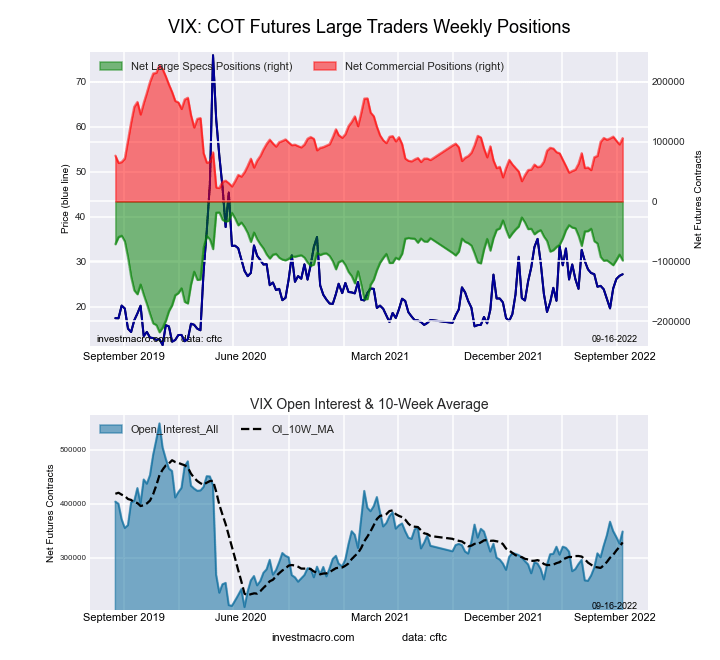
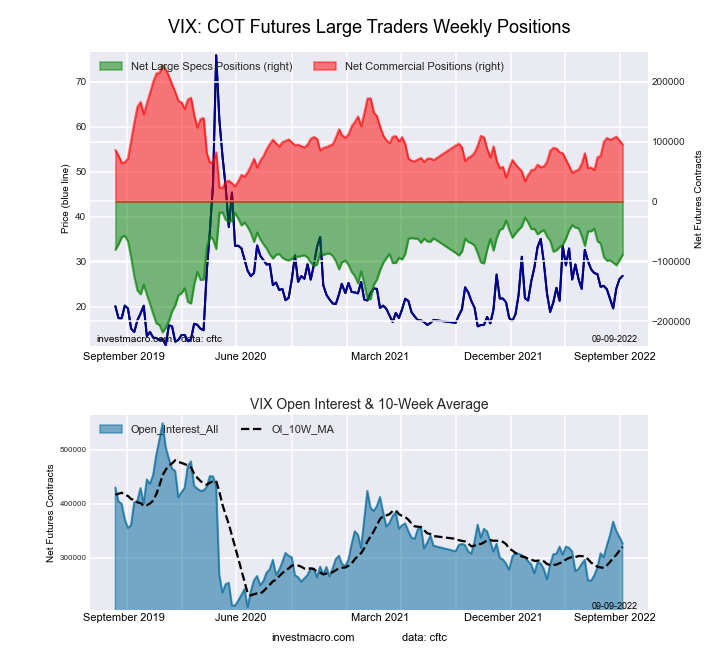
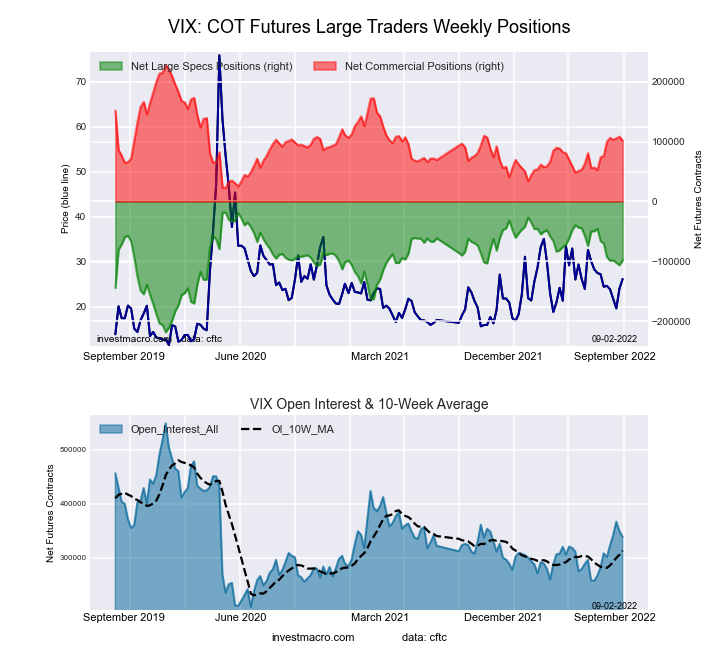
VIX Volatility Futures COT ChartThe VIX Volatility large speculator standing this week totaled a net position of -88,734 contracts in the data reported through Tuesday. This was a weekly boost of 9,201 contracts from the previous week which had a total of -97,935 net contracts.

This week’s current strength score (the trader positioning range over the past three years, measured from 0 to 100) shows the speculators are currently Bullish with a score of 64.8 percent. The commercials are Bearish with a score of 35.5 percent and the small traders (not shown in chart) are Bullish with a score of 59.9 percent.

VIX Volatility Futures StatisticsSPECULATORSCOMMERCIALSSMALL TRADERS
– Percent of Open Interest Longs:13.259.67.2
– Percent of Open Interest Shorts:40.430.59.2
– Net Position:-88,73495,211-6,477
– Gross Longs:43,204194,65223,450
– Gross Shorts:131,93899,44129,927
– Long to Short Ratio:0.3 to 12.0 to 10.8 to 1
NET POSITION TREND:
– Strength Index Score (3 Year Range Pct):64.835.559.9
– Strength Index Reading (3 Year Range):BullishBearishBullish
NET POSITION MOVEMENT INDEX:
– 6-Week Change in Strength Index:1.9-2.12.3


S&P500 Mini Futures:

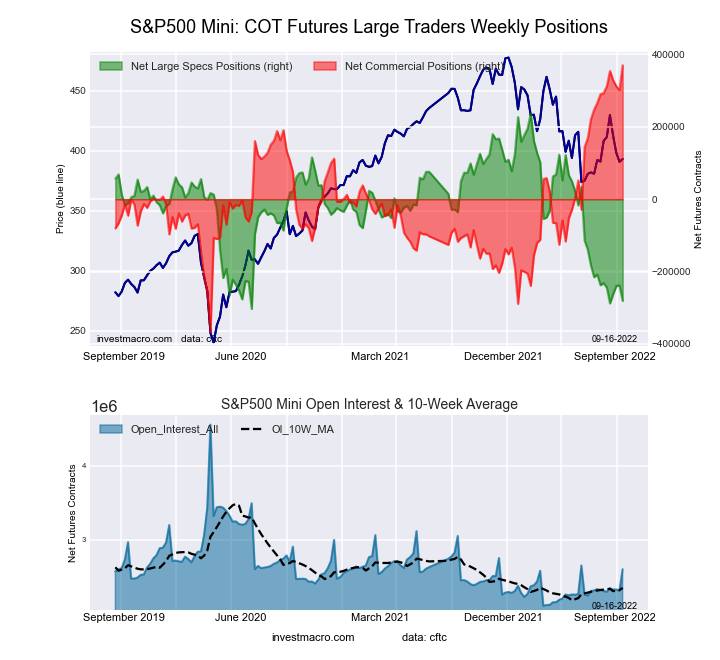
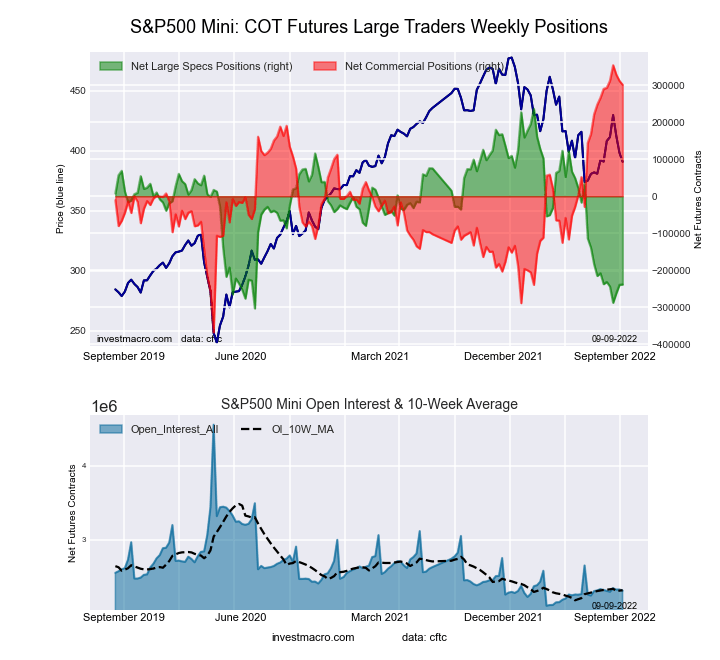
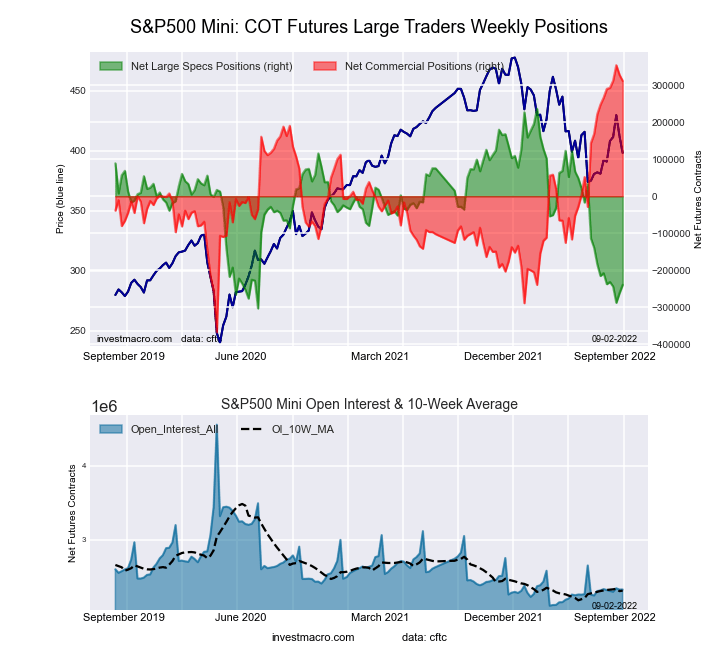
SP500 Mini Futures COT ChartThe S&P500 Mini large speculator standing this week totaled a net position of -238,720 contracts in the data reported through Tuesday. This was a weekly boost of 912 contracts from the previous week which had a total of -239,632 net contracts.

This week’s current strength score (the trader positioning range over the past three years, measured from 0 to 100) shows the speculators are currently Bearish-Extreme with a score of 12.0 percent. The commercials are Bullish-Extreme with a score of 92.7 percent and the small traders (not shown in chart) are Bearish-Extreme with a score of 13.2 percent.

S&P500 Mini Futures StatisticsSPECULATORSCOMMERCIALSSMALL TRADERS
– Percent of Open Interest Longs:9.877.39.8
– Percent of Open Interest Shorts:20.164.312.5
– Net Position:-238,720301,282-62,562
– Gross Longs:226,3741,789,211227,788
– Gross Shorts:465,0941,487,929290,350
– Long to Short Ratio:0.5 to 11.2 to 10.8 to 1
NET POSITION TREND:
– Strength Index Score (3 Year Range Pct):12.092.713.2
– Strength Index Reading (3 Year Range):Bearish-ExtremeBullish-ExtremeBearish-Extreme
NET POSITION MOVEMENT INDEX:
– 6-Week Change in Strength Index:-0.21.5-2.1


Dow Jones Mini Futures:

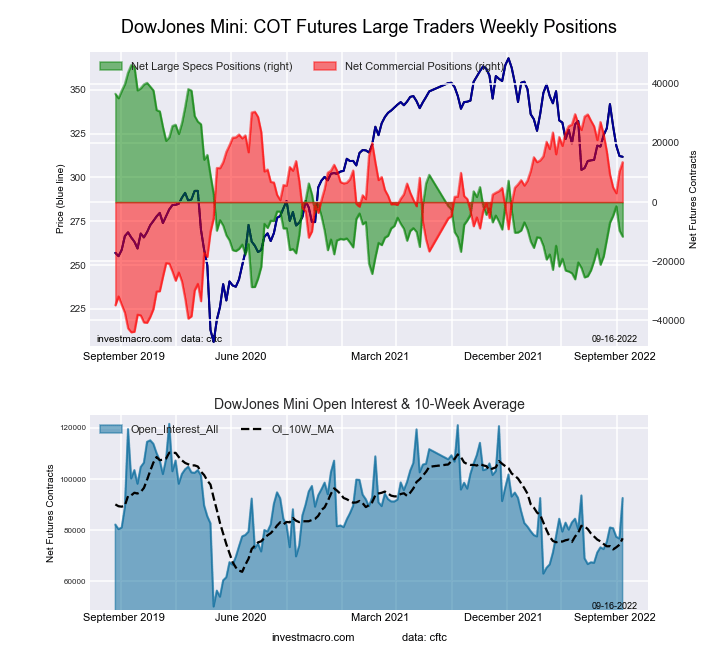
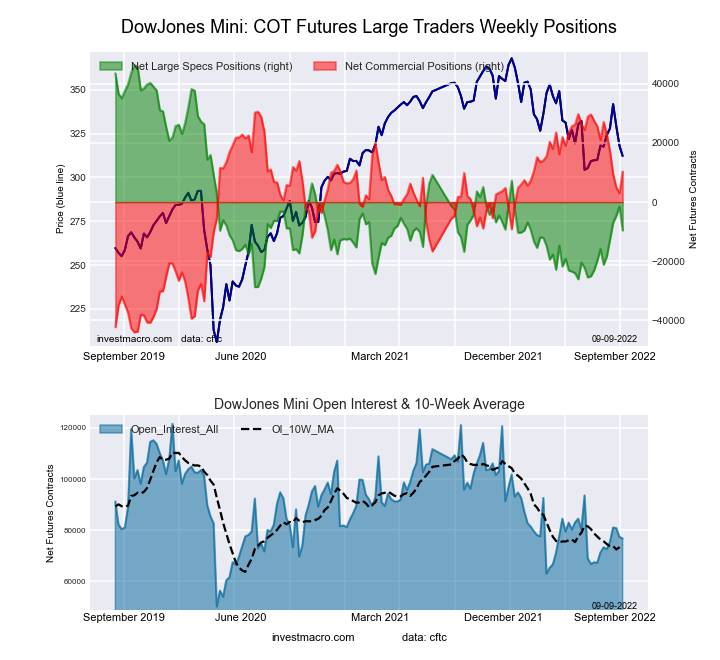
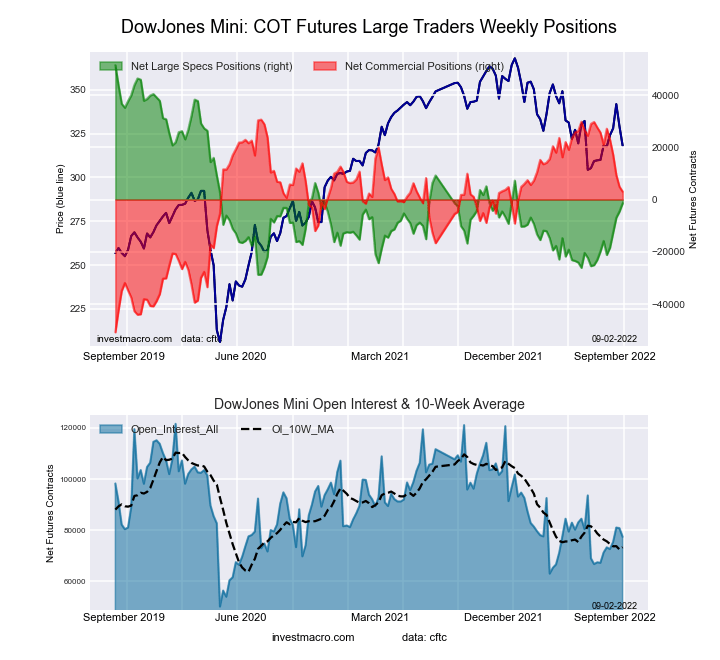
Dow Jones Mini Futures COT ChartThe Dow Jones Mini large speculator standing this week totaled a net position of -9,608 contracts in the data reported through Tuesday. This was a weekly lowering of -8,188 contracts from the previous week which had a total of -1,420 net contracts.

This week’s current strength score (the trader positioning range over the past three years, measured from 0 to 100) shows the speculators are currently Bearish with a score of 25.5 percent. The commercials are Bullish with a score of 72.9 percent and the small traders (not shown in chart) are Bearish with a score of 34.3 percent.

Dow Jones Mini Futures StatisticsSPECULATORSCOMMERCIALSSMALL TRADERS
– Percent of Open Interest Longs:30.352.915.6
– Percent of Open Interest Shorts:42.839.416.7
– Net Position:-9,60810,386-778
– Gross Longs:23,23040,61312,001
– Gross Shorts:32,83830,22712,779
– Long to Short Ratio:0.7 to 11.3 to 10.9 to 1
NET POSITION TREND:
– Strength Index Score (3 Year Range Pct):25.572.934.3
– Strength Index Reading (3 Year Range):BearishBullishBearish
NET POSITION MOVEMENT INDEX:
– 6-Week Change in Strength Index:15.4-22.427.5


Nasdaq Mini Futures:

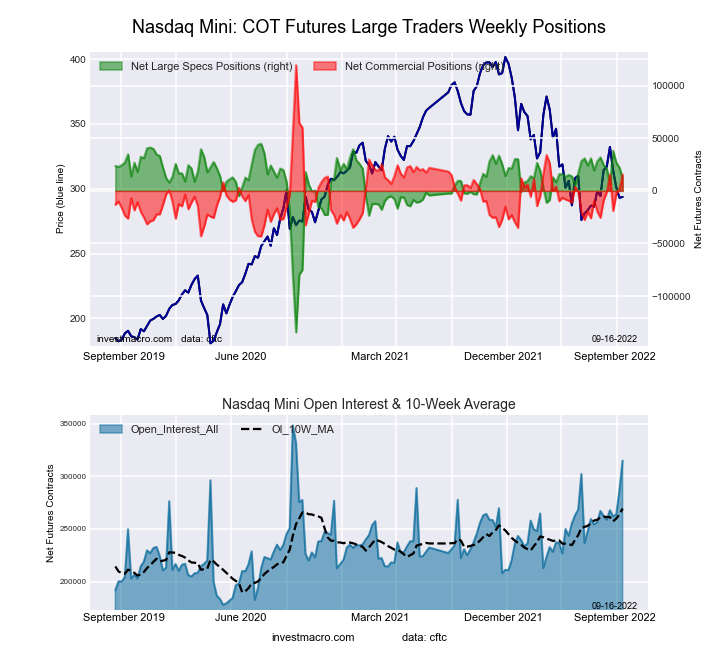
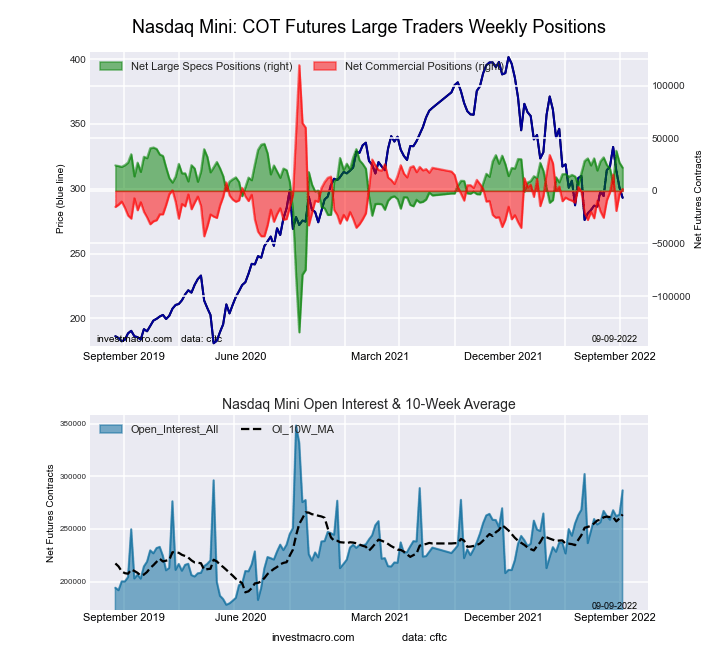
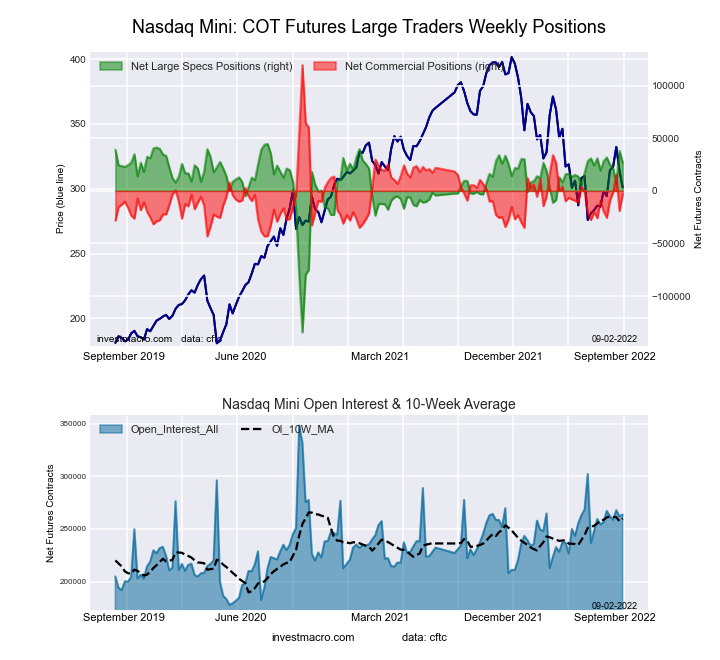
Nasdaq Mini Futures COT ChartThe Nasdaq Mini large speculator standing this week totaled a net position of 22,046 contracts in the data reported through Tuesday. This was a weekly lowering of -4,761 contracts from the previous week which had a total of 26,807 net contracts.

This week’s current strength score (the trader positioning range over the past three years, measured from 0 to 100) shows the speculators are currently Bullish-Extreme with a score of 87.3 percent. The commercials are Bearish with a score of 27.7 percent and the small traders (not shown in chart) are Bearish-Extreme with a score of 0.1 percent.

Nasdaq Mini Futures StatisticsSPECULATORSCOMMERCIALSSMALL TRADERS
– Percent of Open Interest Longs:29.855.912.4
– Percent of Open Interest Shorts:22.155.220.8
– Net Position:22,0461,869-23,915
– Gross Longs:85,430160,21635,685
– Gross Shorts:63,384158,34759,600
– Long to Short Ratio:1.3 to 11.0 to 10.6 to 1
NET POSITION TREND:
– Strength Index Score (3 Year Range Pct):87.327.70.1
– Strength Index Reading (3 Year Range):Bullish-ExtremeBearishBearish-Extreme
NET POSITION MOVEMENT INDEX:
– 6-Week Change in Strength Index:-5.516.8-35.9


Russell 2000 Mini Futures:

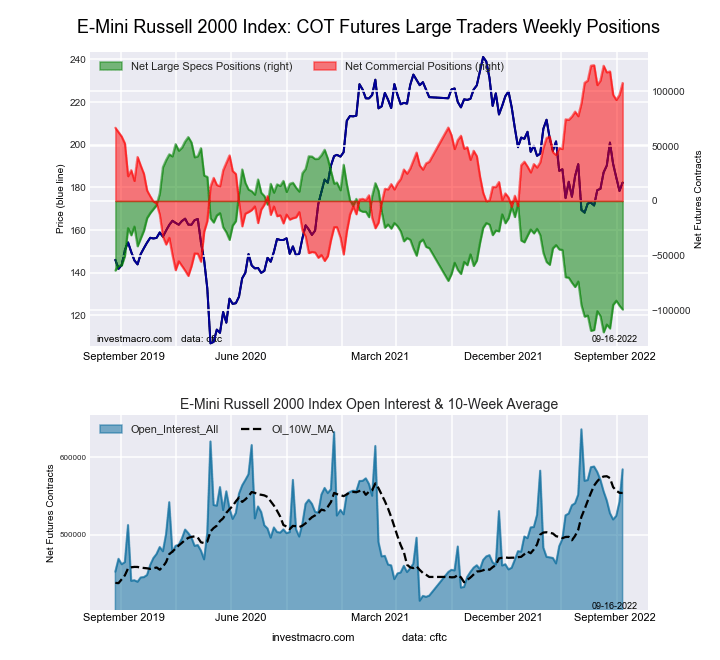
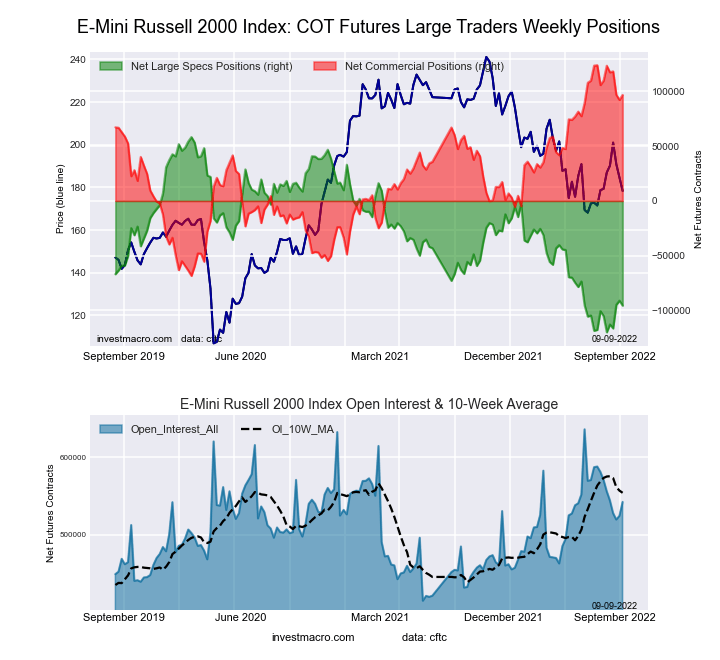
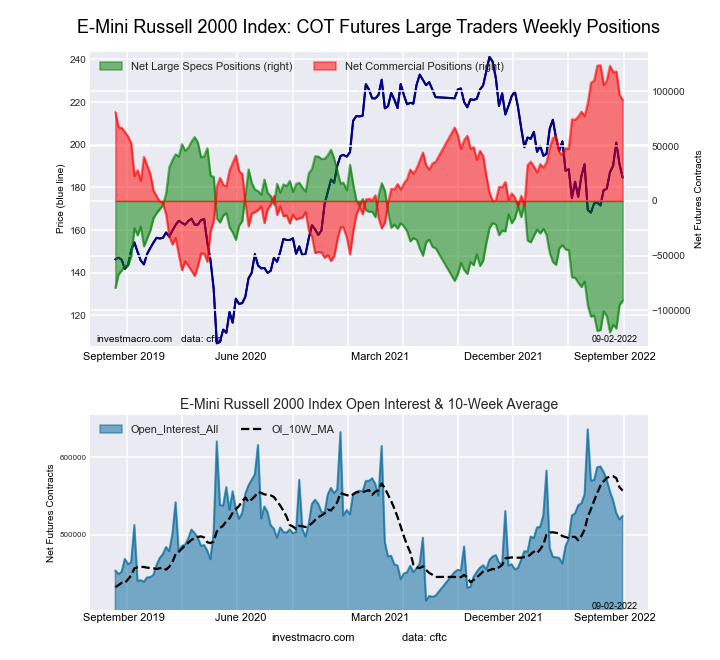
Russell 2000 Mini Futures COT ChartThe Russell 2000 Mini large speculator standing this week totaled a net position of -95,605 contracts in the data reported through Tuesday. This was a weekly reduction of -4,456 contracts from the previous week which had a total of -91,149 net contracts.

This week’s current strength score (the trader positioning range over the past three years, measured from 0 to 100) shows the speculators are currently Bearish-Extreme with a score of 13.7 percent. The commercials are Bullish-Extreme with a score of 85.9 percent and the small traders (not shown in chart) are Bearish with a score of 23.7 percent.

Russell 2000 Mini Futures StatisticsSPECULATORSCOMMERCIALSSMALL TRADERS
– Percent of Open Interest Longs:8.386.04.2
– Percent of Open Interest Shorts:25.968.24.4
– Net Position:-95,60596,814-1,209
– Gross Longs:44,891466,37822,920
– Gross Shorts:140,496369,56424,129
– Long to Short Ratio:0.3 to 11.3 to 10.9 to 1
NET POSITION TREND:
– Strength Index Score (3 Year Range Pct):13.785.923.7
– Strength Index Reading (3 Year Range):Bearish-ExtremeBullish-ExtremeBearish
NET POSITION MOVEMENT INDEX:
– 6-Week Change in Strength Index:5.4-6.911.0


Nikkei Stock Average (USD) Futures:

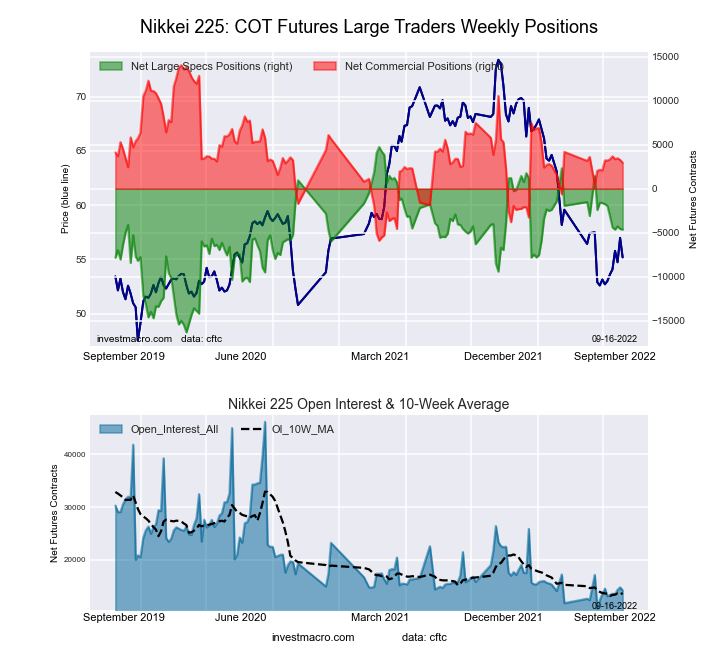
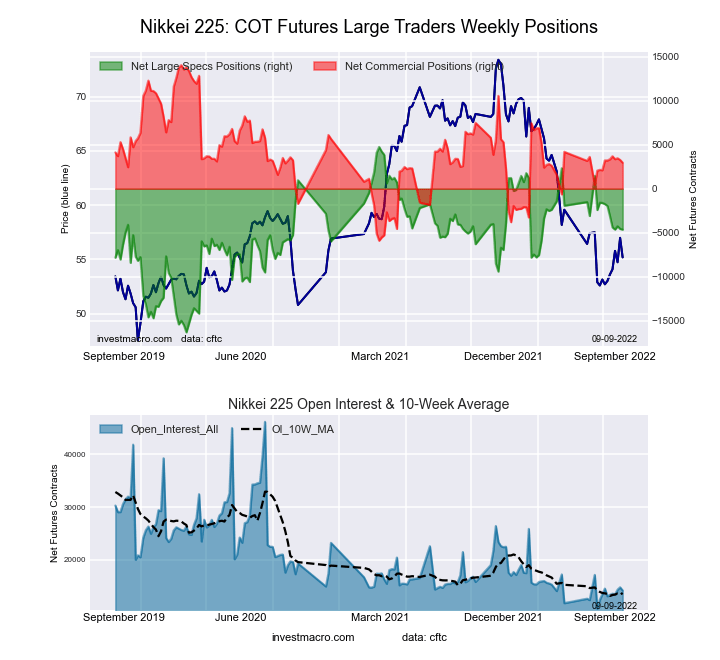
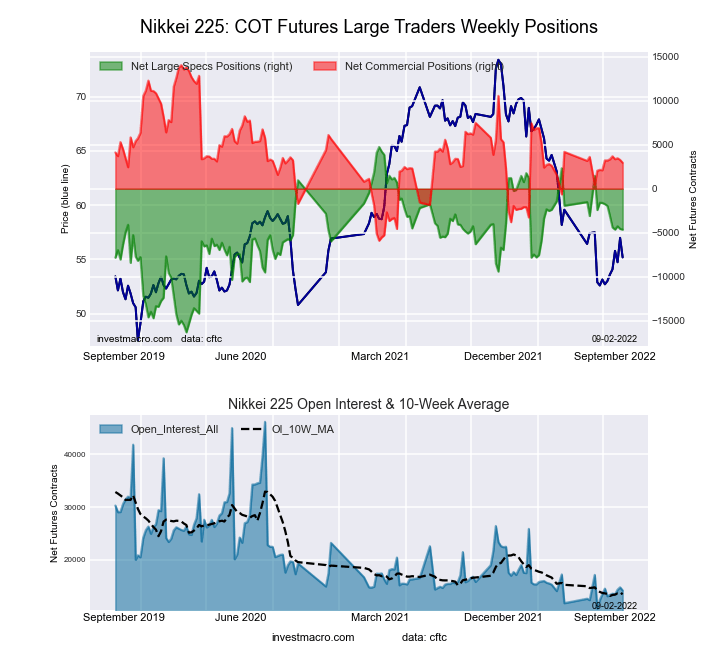
Nikkei Stock Average (USD) Futures COT ChartThe Nikkei Stock Average (USD) large speculator standing this week totaled a net position of -4,641 contracts in the data reported through Tuesday. This was a weekly reduction of -78 contracts from the previous week which had a total of -4,563 net contracts.

This week’s current strength score (the trader positioning range over the past three years, measured from 0 to 100) shows the speculators are currently Bullish with a score of 55.4 percent. The commercials are Bearish with a score of 44.4 percent and the small traders (not shown in chart) are Bearish with a score of 49.6 percent.

Nikkei Stock Average Futures StatisticsSPECULATORSCOMMERCIALSSMALL TRADERS
– Percent of Open Interest Longs:12.253.334.2
– Percent of Open Interest Shorts:45.032.522.3
– Net Position:-4,6412,9491,692
– Gross Longs:1,7297,5484,844
– Gross Shorts:6,3704,5993,152
– Long to Short Ratio:0.3 to 11.6 to 11.5 to 1
NET POSITION TREND:
– Strength Index Score (3 Year Range Pct):55.444.449.6
– Strength Index Reading (3 Year Range):BullishBearishBearish
NET POSITION MOVEMENT INDEX:
– 6-Week Change in Strength Index:-12.8-1.337.0


MSCI EAFE Mini Futures:

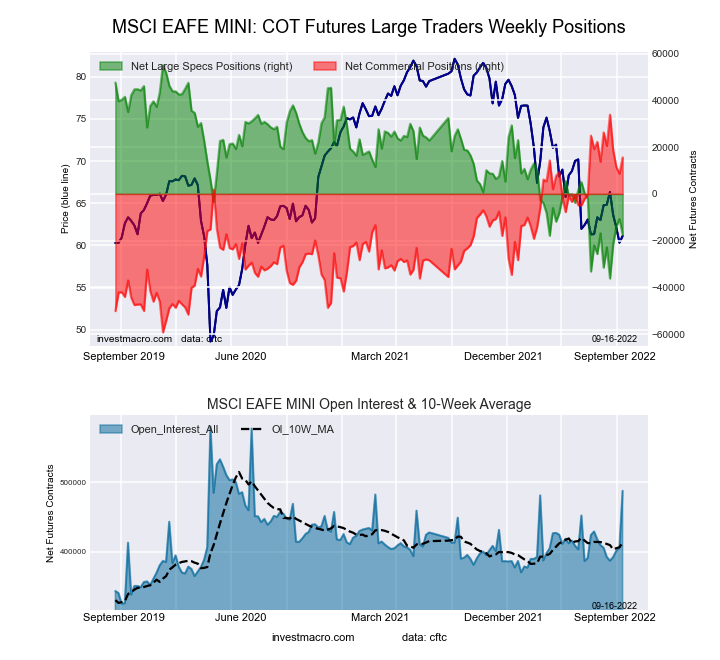
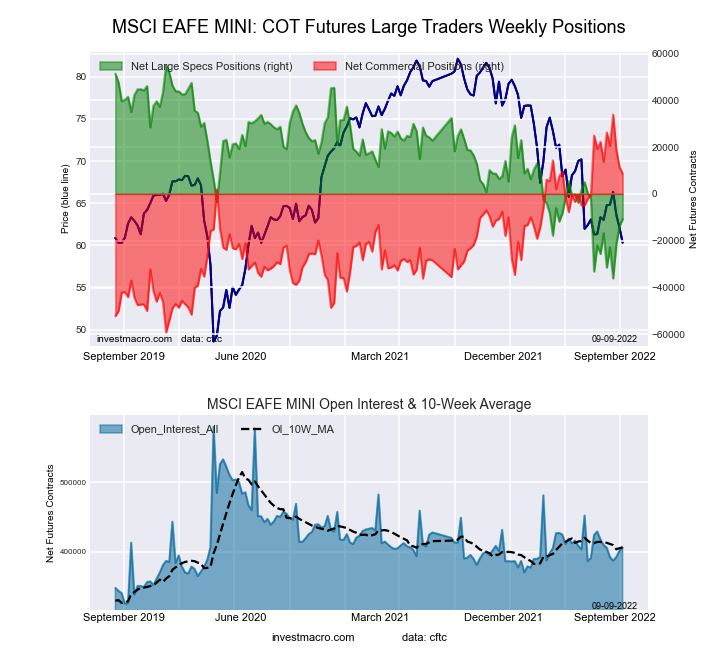
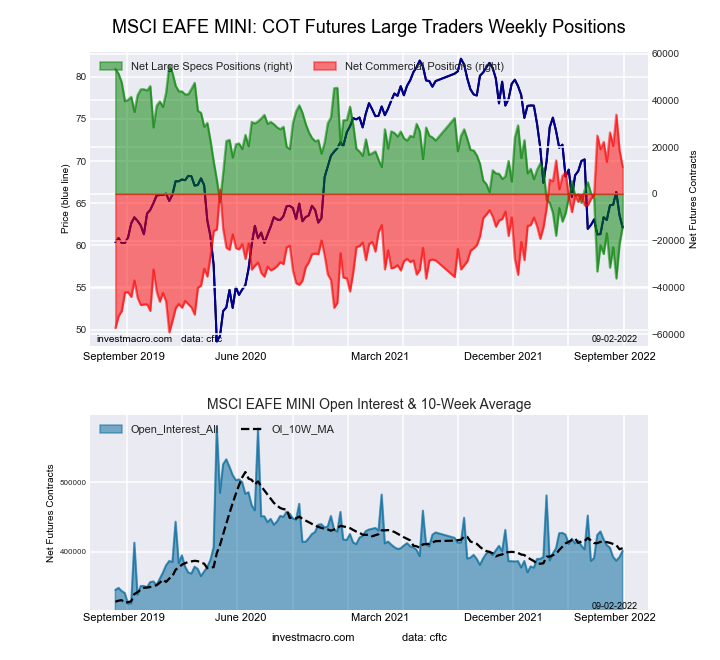
MSCI EAFE Mini Futures COT ChartThe MSCI EAFE Mini large speculator standing this week totaled a net position of -10,768 contracts in the data reported through Tuesday. This was a weekly lift of 3,096 contracts from the previous week which had a total of -13,864 net contracts.

This week’s current strength score (the trader positioning range over the past three years, measured from 0 to 100) shows the speculators are currently Bearish with a score of 27.8 percent. The commercials are Bullish with a score of 72.9 percent and the small traders (not shown in chart) are Bearish with a score of 37.5 percent.

MSCI EAFE Mini Futures StatisticsSPECULATORSCOMMERCIALSSMALL TRADERS
– Percent of Open Interest Longs:5.791.42.1
– Percent of Open Interest Shorts:8.489.31.6
– Net Position:-10,7688,6432,125
– Gross Longs:23,221370,7988,690
– Gross Shorts:33,989362,1556,565
– Long to Short Ratio:0.7 to 11.0 to 11.3 to 1
NET POSITION TREND:
– Strength Index Score (3 Year Range Pct):27.872.937.5
– Strength Index Reading (3 Year Range):BearishBullishBearish
NET POSITION MOVEMENT INDEX:
– 6-Week Change in Strength Index:6.6-5.5-8.1


Article By InvestMacroReceive our weekly COT Newsletter by Email

*COT Reports: The COT data, released weekly to the public each Friday, is updated through the most recent Tuesday (data is 3 days old) and shows a quick view of how large speculators or non-commercials (for-profit traders) were positioned in the futures markets.

The CFTC categorizes trader positions according to commercial hedgers (traders who use futures contracts for hedging as part of the business), non-commercials (large traders who speculate to realize trading profits) and nonreportable traders (usually small traders/speculators) as well as their open interest (contracts open in the market at time of reporting). See CFTC criteria here.

Was It Really the Fed That Sent Stock Prices Tumbling?

“Stocks have the strong potential to continue lower as prices trace out…”

By Elliott Wave International

Elliott Wave International has mentioned time and again that the mainstream financial media nearly always mentions a news development as the reason for a given day’s stock market action.

More than that, we’ve provided example after example of how these so-called explanations usually don’t hold water.

For example, on August 26, when the Dow Industrials closed lower by just over 1,000 points, a headline said (Marketwatch):

Dow closes down 1000 points, Nasdaq falls 3.9% after Powell warns of pain to households in inflation battle

That “warning” was given by Fed Chairman Powell in Jackson Hole, Wyoming when he basically said that the central bank will continue with its aggressive rate hikes.

However, this stance by the Fed is nothing new, and indeed, the stock market staged a significant rally since mid-June. All the while, the Fed had been hawkish.

Here’s a Forbes headline from July 27:

Dow Jumps 400 Points After Fed Hikes Rates By 75 Basis Points

There have been other similar headlines during the stock market’s two-month rally.

So, how can Fed rate hikes be bullish one day but bearish at another time?

Our decades-long observations here at Elliott Wave International is that news does not drive stock prices in the first place — contrary to popular belief.

The stock market is driven by investor psychology, which is reflected in the repetitive patterns of the Elliott wave model.

Indeed, before the 643-point drop in the Dow on August 22, and the 1008-point plunge on August 26, the August 19 U.S. Short Term Update (a thrice weekly Elliott Wave International publication which provides near-term forecasts for major U.S. financial markets) said:

As the week wore on, selling strength became more intense. On Wednesday, August 17, the NYSE advance/decline ratio was negative by 4.30-to-1. Today’s closing a/d ratio was negative by 6.32-to-1. The same with Big Board up and down volume. Down volume as a percentage of up and down volume was 81.4% on Wednesday and today it was 86%. Stocks have the strong potential to continue lower as prices trace out declining impulse patterns at various degrees of trend. [emphasis added]

In other words, patterns of the Elliott wave model were strongly suggesting further decline — regardless of what the Fed chairman said or didn’t say.

If you’d like to learn about the Elliott wave model, an excellent book on the subject is Elliott Wave Principle: Key to Market Behavior, by Frost & Prechter. Here’s a quote from this Wall Street classic:

All waves may be categorized by relative size, or degree. The degree of a wave is determined by its size and position relative to component, adjacent and encompassing waves. [Ralph N.] Elliott named nine degrees of waves, from the smallest discernible on an hourly chart to the largest wave he could assume existed from the data then available. He chose the following terms for these degrees, from largest to smallest: Grand Supercycle, Supercycle, Cycle, Primary, Intermediate, Minor, Minute, Minuette, Subminuette. Cycle waves subdivide into Primary waves that subdivide into Intermediate waves that in turn subdivide into Minor waves, and so on. The specific terminology is not critical to the identification of degrees, although out of habit, today’s practitioners have become comfortable with Elliott’s nomenclature.

You can learn more about the Wave Principle by reading the entire online version of the book for free!

The only requirement for free access is a Club EWI membership — which is also free.

Club EWI is the world’s largest Elliott wave educational community and members enjoy complimentary access to a wealth of Elliott wave resources on investing and trading — without any obligations.

Get started by following this link: Elliott Wave Principle: Key to Market Behavior — get free and instant access now.

This article was syndicated by Elliott Wave International and was originally published under the headline Was It Really the Fed That Sent Stock Prices Tumbling?. EWI is the world’s largest market forecasting firm. Its staff of full-time analysts led by Chartered Market Technician Robert Prechter provides 24-hour-a-day market analysis to institutional and private investors around the world.

Chart Spotlight: Dollar General (DG)

By Ino.com

Investors may want to keep an eye on discount retailers, like Dollar General (DG).

For one, the latest pullback may be a great buy opportunity.

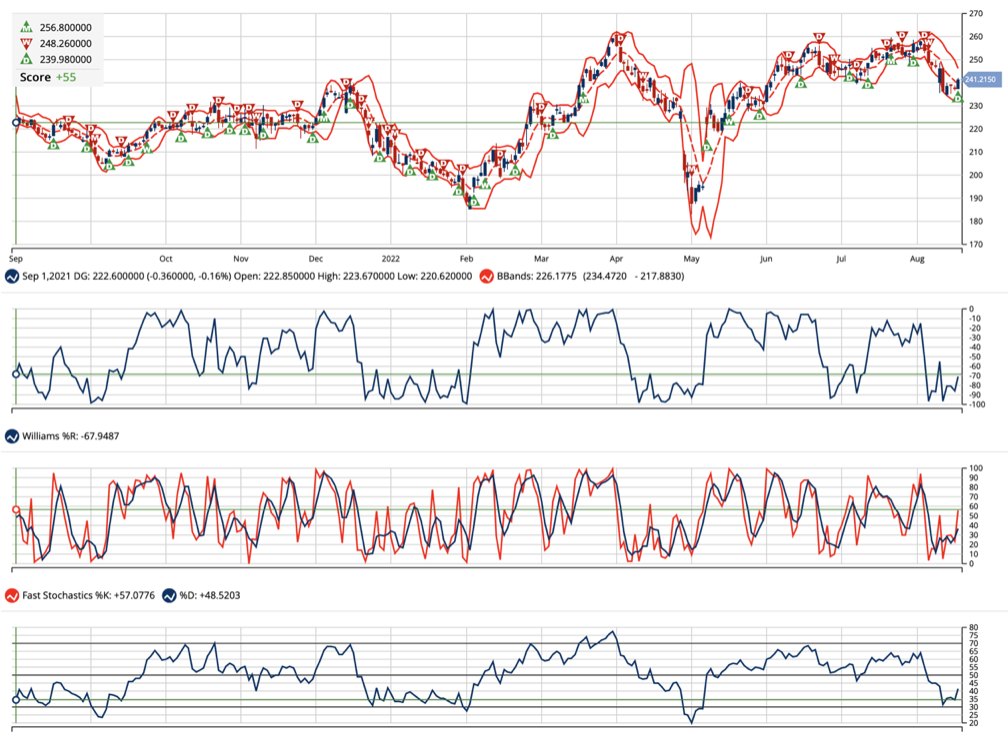
If you take a look at this chart, you’ll notice that Williams’ %R, Fast Stochastics, and RSI are all starting to pivot well off oversold conditions. With patience, I’d like to see the Dollar General stock retest $260 resistance, near-term from $241.65 support.

Unlock $2,600 in Investing Resources – Learn More >>

DG Chart With Trade Triangles

Source: MarketClub
 

Two, while other major retailers take a hit with inflation, Dollar General is rising because of inflation. In fact, we can see that with the company’s recent earnings report.

Not only did Dollar General report second quarter EPS of $2.98, which was better than the expected $2.94 a share, sales were up to $9.4 billion, same-store sales were up 4.6% as compared to expectations for 3.9%. The company even increased its same-store sales forecast to a range of 4% to 4.5% for the fiscal year, from a prior call for 3% to 3.5%.

Three, wealthier people are now shopping at dollar stores because of inflation.

According to Business Insider, Todd Vasos, CEO of Dollar General, said on a call with analysts that the store saw a rise in higher-income households shopping there, “which we believe reflects more consumers choosing Dollar General as they seek value.”

Plus, we have to realize consumers are “trying to make ends meet, and when you have limited funds in your wallet, the dollar stores provide the ability to do that,” added Joseph Feldman, a senior analyst at Telsey Advisory Group, as quoted by The New York Times.

In addition, analysts seem to like the DG stock, as well.

Guggenheim analyst John Heinbockel reiterated a buy on the stock. Piper Sandler raised its price target on DG to $273 from $265. Raymond James raised its target price to $285 from $160. Morgan Stanley raised its target to $270 from $250. Deutsche Bank says Dollar General is one of the few stable retailers.

Plus, Dollar General will also pay a dividend shortly.

On August 23, 2022, the Company’s Board of Directors declared a quarterly cash dividend of $0.55 per share on the Company’s common stock, payable on or before October 18, 2022 to shareholders of record on October 4, 2022.

All things considered, investors may want to use recent DG weakness as an opportunity.

Ian Cooper
INO.com Contributor

The above analysis of Dollar General (DG) was provided by financial writer Ian Cooper. Ian Cooper is not a Registered Investment Advisor or Financial Planner. This writing is for informational purposes only. It does not constitute an offer to sell, a solicitation to buy, or a recommendation regarding any securities transaction. The information contained in this writing should not be construed as financial or investment advice on any subject matter. Ian Cooper expressly disclaims all liability in respect to actions taken based on any or all of the information on this writing.

By Ino.com – See our Trader Blog, INO TV Free & Market Analysis Alerts

Source: Chart Spotlight: Dollar General (DG)

Stock Market Speculator bets gain led by S&P500 Mini, VIX & EAFE Mini

By InvestMacro | COT | Data Tables | COT Leaders | Downloads | COT Newsletter

COT Stock Futures Open Interest Comparison

Here are the latest charts and statistics for the Commitment of Traders (COT) data published by the Commodities Futures Trading Commission (CFTC).

The latest COT data is updated through Tuesday August 30th (COT Week 35) and shows a quick view of how large traders (for-profit speculators and commercial entities) were positioned in the futures markets.

S&P500 Mini, VIX & EAFE Mini lead the Weekly Speculator Changes

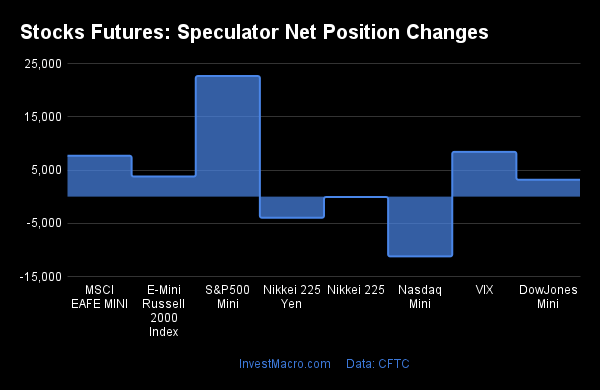
COT stock market speculator bets were mostly higher this week as five out of the seven stock markets we cover had higher positioning this week while the other two markets had lower contracts.

Leading the gains for stock markets was S&P500 Mini (22,644 contracts) with the VIX (8,410 contracts), MSCI EAFE Mini (7,680 contracts), Russell 2000 Mini (3,774 contracts) and the Dow Jones Industrial Average Mini (3,174 contracts) also showing a positive weeks.

The stock markets leading the declines in speculator bets this week was the Nasdaq Mini (-11,226 contracts) with Nikkei 225 USD (-78 contracts), also registering lower bets on the week.

Stocks Futures Speculator Net Position Changes


Data Snapshot of Stock Market Traders | Columns Legend
Aug-30-2022OIOI-IndexSpec-NetSpec-IndexCom-NetCOM-IndexSmalls-NetSmalls-Index
S&P500-Mini2,329,9539-239,63212311,81594-72,18311
Nikkei 22514,15110-4,641552,949441,69250
Nasdaq-Mini263,6415026,80790-2,85025-23,9570
DowJones-Mini77,43038-1,420363,02763-1,60730
VIX338,59038-97,93560101,48539-3,55074
Nikkei 225 Yen56,93339-3193319,46278-19,14335


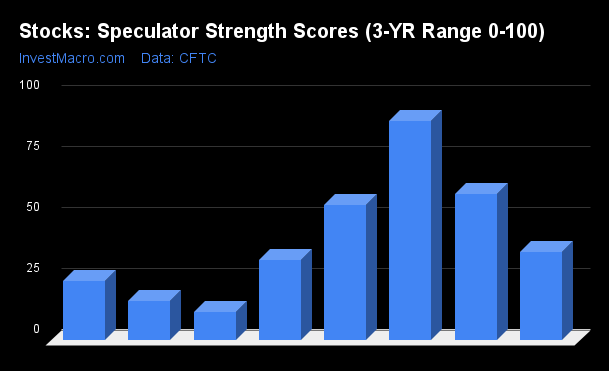
Nasdaq-Mini leads the Strength Scores

Strength Scores (a normalized measure of Speculator positions over a 3-Year range, from 0 to 100 where above 80 is extreme bullish and below 20 is extreme bearish) showed that the Nasdaq-Mini (90.0 percent) leads the stocks markets this week. The Nasdaq-Mini strength score is down from last week’s 96.3 percent but remains in a bullish extreme position (above 80 percent). The VIX (60.2 percent) comes in as the next highest stock market in strength scores.

On the downside, the S&P500-Mini (11.8 percent) comes in at the lowest strength level currently and is followed by the Russell2000-Mini (16.2 percent) with both markets residing in a bearish extreme level currently (below 20 percent).


Strength Statistics:
VIX (60.2 percent) vs VIX previous week (56.0 percent)
S&P500-Mini (11.8 percent) vs S&P500-Mini previous week (7.6 percent)
DowJones-Mini (36.4 percent) vs DowJones-Mini previous week (32.2 percent)
Nasdaq-Mini (90.0 percent) vs Nasdaq-Mini previous week (96.3 percent)
Russell2000-Mini (16.2 percent) vs Russell2000-Mini previous week (14.0 percent)
Nikkei USD (55.4 percent) vs Nikkei USD previous week (55.8 percent)
EAFE-Mini (24.4 percent) vs EAFE-Mini previous week (16.0 percent)

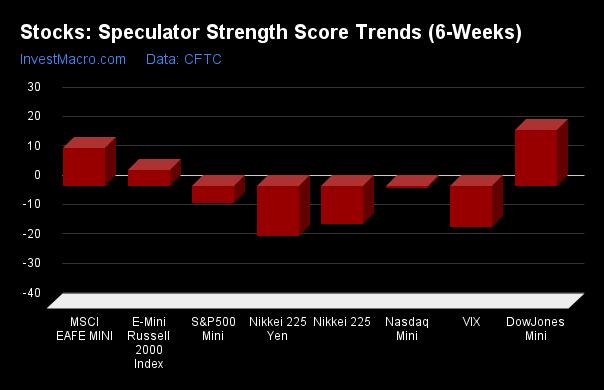
Dow Jones-Mini leads the 6-Week Strength Trends

Strength Score Trends (or move index, calculates the 6-week changes in strength scores) showed that the DowJones-Mini (19.2 percent) leads the past six weeks trends for stocks this week. The EAFE-Mini (13.0 percent) and the Russell 2000-Mini (5.4 percent) fill out the other positive movers in the latest trends data.

The VIX (-14.0 percent) leads the downside trend scores currently while the next market with lower trend scores were the Nikkei USD (-12.8 percent) followed by the S&P500-Mini (-5.8 percent).


——————–
Strength Trend Statistics:
VIX (-14.0 percent) vs VIX previous week (-20.0 percent)
S&P500-Mini (-5.8 percent) vs S&P500-Mini previous week (-8.7 percent)
DowJones-Mini (19.2 percent) vs DowJones-Mini previous week (20.3 percent)
Nasdaq-Mini (-0.7 percent) vs Nasdaq-Mini previous week (10.4 percent)
Russell2000-Mini (5.4 percent) vs Russell2000-Mini previous week (12.8 percent)
Nikkei USD (-12.8 percent) vs Nikkei USD previous week (-13.4 percent)
EAFE-Mini (13.0 percent) vs EAFE-Mini previous week (0.5 percent)


Individual Markets:

VIX Volatility Futures:

VIX Volatility Futures COT ChartThe VIX Volatility large speculator standing this week recorded a net position of -97,935 contracts in the data reported through Tuesday. This was a weekly gain of 8,410 contracts from the previous week which had a total of -106,345 net contracts.

This week’s current strength score (the trader positioning range over the past three years, measured from 0 to 100) shows the speculators are currently Bullish with a score of 60.2 percent. The commercials are Bearish with a score of 38.5 percent and the small traders (not shown in chart) are Bullish with a score of 74.1 percent.

VIX Volatility Futures StatisticsSPECULATORSCOMMERCIALSSMALL TRADERS
– Percent of Open Interest Longs:13.859.67.4
– Percent of Open Interest Shorts:42.729.68.4
– Net Position:-97,935101,485-3,550
– Gross Longs:46,792201,68124,889
– Gross Shorts:144,727100,19628,439
– Long to Short Ratio:0.3 to 12.0 to 10.9 to 1
NET POSITION TREND:
– Strength Index Score (3 Year Range Pct):60.238.574.1
– Strength Index Reading (3 Year Range):BullishBearishBullish
NET POSITION MOVEMENT INDEX:
– 6-Week Change in Strength Index:-14.012.412.7


S&P500 Mini Futures:

SP500 Mini Futures COT ChartThe S&P500 Mini large speculator standing this week recorded a net position of -239,632 contracts in the data reported through Tuesday. This was a weekly lift of 22,644 contracts from the previous week which had a total of -262,276 net contracts.

This week’s current strength score (the trader positioning range over the past three years, measured from 0 to 100) shows the speculators are currently Bearish-Extreme with a score of 11.8 percent. The commercials are Bullish-Extreme with a score of 94.1 percent and the small traders (not shown in chart) are Bearish-Extreme with a score of 11.2 percent.

S&P500 Mini Futures StatisticsSPECULATORSCOMMERCIALSSMALL TRADERS
– Percent of Open Interest Longs:10.377.39.7
– Percent of Open Interest Shorts:20.663.912.8
– Net Position:-239,632311,815-72,183
– Gross Longs:240,6531,800,768224,954
– Gross Shorts:480,2851,488,953297,137
– Long to Short Ratio:0.5 to 11.2 to 10.8 to 1
NET POSITION TREND:
– Strength Index Score (3 Year Range Pct):11.894.111.2
– Strength Index Reading (3 Year Range):Bearish-ExtremeBullish-ExtremeBearish-Extreme
NET POSITION MOVEMENT INDEX:
– 6-Week Change in Strength Index:-5.86.3-2.9


Dow Jones Mini Futures:

Dow Jones Mini Futures COT ChartThe Dow Jones Mini large speculator standing this week recorded a net position of -1,420 contracts in the data reported through Tuesday. This was a weekly gain of 3,174 contracts from the previous week which had a total of -4,594 net contracts.

This week’s current strength score (the trader positioning range over the past three years, measured from 0 to 100) shows the speculators are currently Bearish with a score of 36.4 percent. The commercials are Bullish with a score of 63.1 percent and the small traders (not shown in chart) are Bearish with a score of 29.9 percent.

Dow Jones Mini Futures StatisticsSPECULATORSCOMMERCIALSSMALL TRADERS
– Percent of Open Interest Longs:34.549.115.0
– Percent of Open Interest Shorts:36.345.217.1
– Net Position:-1,4203,027-1,607
– Gross Longs:26,72438,00511,643
– Gross Shorts:28,14434,97813,250
– Long to Short Ratio:0.9 to 11.1 to 10.9 to 1
NET POSITION TREND:
– Strength Index Score (3 Year Range Pct):36.463.129.9
– Strength Index Reading (3 Year Range):BearishBullishBearish
NET POSITION MOVEMENT INDEX:
– 6-Week Change in Strength Index:19.2-24.118.9


Nasdaq Mini Futures:

Nasdaq Mini Futures COT ChartThe Nasdaq Mini large speculator standing this week recorded a net position of 26,807 contracts in the data reported through Tuesday. This was a weekly decrease of -11,226 contracts from the previous week which had a total of 38,033 net contracts.

This week’s current strength score (the trader positioning range over the past three years, measured from 0 to 100) shows the speculators are currently Bullish-Extreme with a score of 90.0 percent. The commercials are Bearish with a score of 24.8 percent and the small traders (not shown in chart) are Bearish-Extreme with a score of 0.0 percent.

Nasdaq Mini Futures StatisticsSPECULATORSCOMMERCIALSSMALL TRADERS
– Percent of Open Interest Longs:29.456.312.2
– Percent of Open Interest Shorts:19.257.421.2
– Net Position:26,807-2,850-23,957
– Gross Longs:77,379148,38532,035
– Gross Shorts:50,572151,23555,992
– Long to Short Ratio:1.5 to 11.0 to 10.6 to 1
NET POSITION TREND:
– Strength Index Score (3 Year Range Pct):90.024.80.0
– Strength Index Reading (3 Year Range):Bullish-ExtremeBearishBearish-Extreme
NET POSITION MOVEMENT INDEX:
– 6-Week Change in Strength Index:-0.710.3-31.5


Russell 2000 Mini Futures:

Russell 2000 Mini Futures COT ChartThe Russell 2000 Mini large speculator standing this week recorded a net position of -91,149 contracts in the data reported through Tuesday. This was a weekly boost of 3,774 contracts from the previous week which had a total of -94,923 net contracts.

This week’s current strength score (the trader positioning range over the past three years, measured from 0 to 100) shows the speculators are currently Bearish-Extreme with a score of 16.2 percent. The commercials are Bullish-Extreme with a score of 83.5 percent and the small traders (not shown in chart) are Bearish with a score of 23.9 percent.

Russell 2000 Mini Futures StatisticsSPECULATORSCOMMERCIALSSMALL TRADERS
– Percent of Open Interest Longs:7.586.84.2
– Percent of Open Interest Shorts:24.969.24.4
– Net Position:-91,14992,282-1,133
– Gross Longs:39,315455,29622,023
– Gross Shorts:130,464363,01423,156
– Long to Short Ratio:0.3 to 11.3 to 11.0 to 1
NET POSITION TREND:
– Strength Index Score (3 Year Range Pct):16.283.523.9
– Strength Index Reading (3 Year Range):Bearish-ExtremeBullish-ExtremeBearish
NET POSITION MOVEMENT INDEX:
– 6-Week Change in Strength Index:5.4-7.112.4


Nikkei Stock Average (USD) Futures:

Nikkei Stock Average (USD) Futures COT ChartThe Nikkei Stock Average (USD) large speculator standing this week recorded a net position of -4,641 contracts in the data reported through Tuesday. This was a weekly reduction of -78 contracts from the previous week which had a total of -4,563 net contracts.

This week’s current strength score (the trader positioning range over the past three years, measured from 0 to 100) shows the speculators are currently Bullish with a score of 55.4 percent. The commercials are Bearish with a score of 44.4 percent and the small traders (not shown in chart) are Bearish with a score of 49.6 percent.

Nikkei Stock Average Futures StatisticsSPECULATORSCOMMERCIALSSMALL TRADERS
– Percent of Open Interest Longs:12.253.334.2
– Percent of Open Interest Shorts:45.032.522.3
– Net Position:-4,6412,9491,692
– Gross Longs:1,7297,5484,844
– Gross Shorts:6,3704,5993,152
– Long to Short Ratio:0.3 to 11.6 to 11.5 to 1
NET POSITION TREND:
– Strength Index Score (3 Year Range Pct):55.444.449.6
– Strength Index Reading (3 Year Range):BullishBearishBearish
NET POSITION MOVEMENT INDEX:
– 6-Week Change in Strength Index:-12.8-1.337.0


MSCI EAFE Mini Futures:

MSCI EAFE Mini Futures COT ChartThe MSCI EAFE Mini large speculator standing this week recorded a net position of -13,864 contracts in the data reported through Tuesday. This was a weekly gain of 7,680 contracts from the previous week which had a total of -21,544 net contracts.

This week’s current strength score (the trader positioning range over the past three years, measured from 0 to 100) shows the speculators are currently Bearish with a score of 24.4 percent. The commercials are Bullish with a score of 75.9 percent and the small traders (not shown in chart) are Bearish with a score of 40.0 percent.

MSCI EAFE Mini Futures StatisticsSPECULATORSCOMMERCIALSSMALL TRADERS
– Percent of Open Interest Longs:5.991.52.1
– Percent of Open Interest Shorts:9.488.61.5
– Net Position:-13,86411,4452,419
– Gross Longs:23,657366,9258,362
– Gross Shorts:37,521355,4805,943
– Long to Short Ratio:0.6 to 11.0 to 11.4 to 1
NET POSITION TREND:
– Strength Index Score (3 Year Range Pct):24.475.940.0
– Strength Index Reading (3 Year Range):BearishBullishBearish
NET POSITION MOVEMENT INDEX:
– 6-Week Change in Strength Index:13.0-11.6-8.8


Article By InvestMacroReceive our weekly COT Reports by Email

*COT Report: The COT data, released weekly to the public each Friday, is updated through the most recent Tuesday (data is 3 days old) and shows a quick view of how large speculators or non-commercials (for-profit traders) were positioned in the futures markets.

The CFTC categorizes trader positions according to commercial hedgers (traders who use futures contracts for hedging as part of the business), non-commercials (large traders who speculate to realize trading profits) and nonreportable traders (usually small traders/speculators) as well as their open interest (contracts open in the market at time of reporting). See CFTC criteria here.
S&P 500 Bracing For More Pain Ahead Of NFP?

By ForexTime 

Global equity bulls lingered in the vicinity on Tuesday as market sentiment stabilized following the Fed induced sell-off last Friday. Stocks in Europe flashed green while US futures rallied thanks to the risk-on mood. Although investors seem to be digesting the Fed’s vow to tame soaring inflation, a sense of caution continues to linger in the air ahead of another busy week for financial markets.

Last Friday, the S&P 500 was beaten black and blue by a firmly hawkish Jerome Powell. After stating that the Fed had no plans for a dovish pivot and warning that economic growth may be hit by higher rates, the S&P 500 tumbled like a house of cards. According to Bloomberg, traders are pricing in a 73% probability of a 75-basis point rate hike in September. It is worth keeping in mind that higher interest rates impact company earnings and the prices of the stock.

This could be another wild week for the S&P 500 as investors brace for the US jobs report on Friday. Markets expect the US economy to have created 300k jobs in August while the unemployment rate is projected to remain unchanged at 3.5%. A report that surpasses expectations could reinforce aggressive rate hike bets – inviting S&P 500 bears back into the picture. In the meantime, the index remains under pressure on the daily charts, struggling to nurse the deep wounds inflicted by last Friday’s selloff.

Taking a look at the technical picture, prices remain under pressure on the monthly timeframe. There have been consistently lower lows and lower highs while the candlesticks are trading within a monthly bearish channel. Resistance can be found at 4300 while support resides at 3650. Given how bears remain in the driving seat, the next stop may be at 3650.

Things are looking slightly more colourful on the weekly charts. Prices are trading below the 50- and 100-week Simple Moving Average and still within a weekly bearish channel. However, support can be found at 3650 and the 200-week Simple Moving Average. After the beating last week, the S&P 500 may limp lower with 3650 acting as a key point of interest on the W1 timeframe.

There is more clarity and clues on the daily charts on the S&P 500 next potential move. After cutting through the 4121 level like a hot knife through butter, prices need to break away from the clutches of the 50- and 100-day Simple Moving Average. Below this point, we have 3945 support, followed by 3810 and 3700, respectively.  Should bulls fight back, prices could rebound back towards 4121, 4200, and the 200-day Simple Moving Average at 4290.


Forex-Time-LogoArticle by ForexTime

ForexTime Ltd (FXTM) is an award winning international online forex broker regulated by CySEC 185/12 www.forextime.com


Why You Should Expect a Pickup in Stock-Market Volatility

“Traders are convinced the market volatility will remain subdued”

By Elliott Wave International

When things get quiet in a horror movie, that’s when you need to really brace yourself. The monster or the killer will soon be on the scene.

That’s a close enough analogy to what can happen in the stock market. Just when investors get comfortable with a stretch of low volatility — wham! — volatility picks up in a major way.

Back on Nov. 27, 2019, our U.S. Short Term Update, a thrice weekly Elliott Wave International publication which provides near-term forecasts for major U.S. financial markets, showed a chart titled “Calm Before the Craziness,” and said:

The CBOE volatility Index (VIX) closed below 12.00 for the third straight session… In fact, investors are so complacent that, paradoxically, it signals a coming pick up in volatility.

About three months later, our Feb. 24, 2020 U.S. Short Term Update noted:

The VIX surged 69% intraday and is now up 130% since the November 26 low. The VIX should eventually move even higher as stocks prices work lower.

As you may recall, a hair-raising stock market decline that had started in mid-February continued to plummet into March 23 of that year.

What does this have to do with today?

This chart and commentary from our August 15, 2022 U.S. Short Term Update provides the answer:

VolatilityPickup

We have inverted the scale to align the VIX with prices. The DSI Indicator (trade-futures.com) has declined to 15, the lowest reading since March 29 (DSI of 13), which coincided with [an Elliott wave high]. The VIX itself declined to 19.12 on August 12 and traders are convinced the market volatility will remain subdued. As shown by the vertical dashed lines, the prior two times that traders were equally confident that volatility will remain muted occurred at or near prior market highs.

Indeed, an August Yahoo Finance headline reflects an example of this confidence:

10 reasons to be bullish on stocks right now, according to [a strategist at the largest U.S. bank]

That strategist may turn out to be correct.

On the other hand, volatility has already picked up since our August 15 analysis published. Of course, during periods of high volatility, there’s the potential for big moves on the up- as well as downside.

Now it’s time to learn what the Elliott wave pattern of the stock market is suggesting.

If you’re new to Elliott wave analysis or need a refresher, you may want to read Elliott Wave Principle: Key to Market Behavior by Frost & Prechter. Here’s a quote from the book:

It is a thrilling experience to pinpoint a turn, and the Wave Principle is the only approach that can occasionally provide the opportunity to do so.

The ability to identify such junctures is remarkable enough, but the Wave Principle is the only method of analysis that also provides guidelines for forecasting.

You can read the entirety of this Wall Street classic for free once you become a member of Club EWI, the world’s largest Elliott wave educational community (about 500,000 worldwide members).

You can join Club EWI for free and members enjoy complimentary access to a wealth of Elliott wave resources on financial markets, investing and trading without any obligations.

Just follow this link to get started right away: Elliott Wave Principle: Key to Market Behavior – get instant access – free.

This article was syndicated by Elliott Wave International and was originally published under the headline Why You Should Expect a Pickup in Stock-Market Volatility. EWI is the world’s largest market forecasting firm. Its staff of full-time analysts led by Chartered Market Technician Robert Prechter provides 24-hour-a-day market analysis to institutional and private investors around the world.

Investment Products from RoboForex are Named the Best in the Global Market

RoboForex announces receiving the “Best Investment Products – Global” accolade at the Global Brands Awards 2022. In the past, Global Brands Awards have rewarded RoboForex for the best investment products on three occasions – in 2019, 2020, and 2021.

Global Brands Awards was established to honour companies, which demonstrate outstanding results in different business areas. The organising committee gives awards to the most successful representatives in the spheres of finance, education, tourism, lifestyle, technology, and the car industry.

Robert Stephenson, Chief Business Officer at RoboForex, commented: “We’re very proud of receiving this award for some years now. For us, it’s a criterion of success of the direction the Company chose, and a motivation to excel ourselves next year and compete for a win again. We’d like to express our profound gratitude to organisers and the jury panel, who gave such a high appraisal of our investment products.”

About Global Brands Awards

Global Brands Awards rewards the best companies that have an obvious advantage over competitors due to providing their clients with high quality services. The event is organised by Global Brands Magazine, one of the leading online medias, that publishes the latest news, reviews, opinions, and polls about leading global brands in various market segments.

About RoboForex

RoboForex is a company which delivers brokerage services. The company provides traders who work on financial markets with access to its proprietary trading platforms. RoboForex Ltd has the brokerage licence FSC 000138/333. More detailed information about the Company’s products and activities can be found on the official website at roboforex.com.

What’s “Jackson Hole” and why it matters for the Nasdaq 100?

By ForexTime

Organised by the Kansas City Fed, this year’s Jackson Hole Economic Policy Symposium will kick off today (August 25th) through August 27th.

This annual event is held in Jackson Hole, Wyoming (hence, the name widely used by market participants to refer to such a pivotal event),which features some of the top officials from major central banks (e.g. US Federal Reserve, European Central Bank, Bank of England, etc.), as they discuss pressing issues that face the global economy.

And there’s no issue more pressing now than the red-hot inflation around the world, which has forced central bankers worldwide into aggressively raising their respective interest rates.


Why “Jackson Hole” matters?

What’s said (or sometimes, not said) by these central bankers, especially the Fed Chair, has the potential to move markets.

For example, at the 2021 symposium, Fed Chair Jerome Powell stuck with his “transitory” view on inflation and adopted a relatively “dovish” tone. In other words, he and most of his colleagues at the US central bank thought then that consumer prices won’t keep soaring for long, and didn’t expect to trigger its first hike until 2023.

After last year’s symposium concluded (and on the back of Powell’s dovish and transitory stance), US stocks continued marching higher and notched fresh record highs.

The Nasdaq 100 went on to post an all-time peak above 16,500 back in November.


12 months on, and we’re in an entirely different world.

US inflation is at its highest since the 1980s, and the Fed has hiked by 125 basis points since March, and counting.

The Nasdaq 100 has since plummeted to sub-13,000 levels, and the tech-heavy index is still more than 20% lower so far this year despite its recent summer rally. The drop in stock markets have been predicated on the Fed’s aggressive battle against inflation.


What to look out for tomorrow?

The spotlight will shine greatest on Fed Chair Powell’s speech, scheduled for 2:00 PM GMT tomorrow (Friday, August 26th).

And here’s the biggest question on everyone’s minds: how much higher will the Fed hike US interest rates?

  • Markets are forecasting a 69% chance that the Fed will press ahead with yet another 75 basis point hike at its September meeting. Those 69% odds are a far cry from the 26% chance priced in at the start of August, hence the drop by as much as 6.3% since mid-August for the Nasdaq 100.
  • Also, markets expect the Fed Funds Rate to peak out at 3.75% by March 2023, from the current 2.50%. That implies a 75bps hike in September, followed by another 50bps hike, before the Fed then has to start lowering its benchmark rates to start cushioning US economic growth.

With the above narrative in mind, should any of Powell’s comments force markets to rejig such expectations, be it for the size of the September hike or the peak for this ongoing rate hike cycle, that could prompt major moves across a multitude of asset classes.


why focus on the Nasdaq 100?

Notice how the tech-heavy Nasdaq 100 is sensitive to where US interest rates go.

The Nasdaq 100 began diving since the latter parts of 2021, as market began to increasingly expect that the Fed will be forced into hiking interest rates sooner than policymakers had expected.

And sure enough, the Fed triggered its first hike in March 2022, with the Nasdaq 100 falling into a bear market (20% drop from its recent peak) thereafter.


Potential scenarios:

  1. The Nasdaq 100 may be coerced into unwinding more of its summer gains should Powell pave the way for a September 75bps hike and force markets to move their forecasted rate hike cycle peak higher than 3.75%.

    Key support levels:

  • 12,605 (100-day simple moving average)
  • 12,395 (23.6% Fibonacci retracement level from its November through June descent)


  1. However, the Nasdaq 100 may be emboldened to extend its summer rally if Powell in his Friday speech pays greater heed to the cracks that are starting to show in the US economy.

    After all, US GDP has already met the criteria for a “technical recession”, while the August services PMI showed a larger-than-expected contraction. Such a cautious tone may result in less-hawkish-than-feared commentary tomorrow, potentially translating into gains for riskier assets, including tech stocks.

    Key resistance levels:

  • 13,231 – 13,405 (38.2% Fib level and early-August cycle peak)
  • Around 13,500 (resistance from upper downtrend line from ATH and early-May peaks)
  • 13,730 (mid-August peak)
  • 13,900 (200-day SMA and 50% Fib line)


Judging by how the Nasdaq 100 is attempting to claw its way back above the psychologically-important 13,000 line at the time of writing, it appears that fears over the most-hawkish scenario have been overdone.

Equity bulls will be hoping that Powell will strike a tone that’s less-hawkish-than-feared, which could result in more relief for the Nasdaq 100 and other riskier assets.

Still, it remains to be seen (or rather, heard) what Powell’s policy clues will be, if any.

And any newfound resolution after such heightened uncertainty may lead to a massive move for the Nasdaq 100 in the aftermath.


Forex-Time-LogoArticle by ForexTime

ForexTime Ltd (FXTM) is an award winning international online forex broker regulated by CySEC 185/12 www.forextime.com

Chart Spotlight: Canadian Solar (CSIQ)

By Ino.com

Over the last few weeks, I highlighted a few opportunities with Chart Spotlight.

  • On July 13, for example, I highlighted Generac Holdings (GNRC), as it traded around $212. It’s now up to $265.50.
  • On July 26, I highlighted Albemarle (ALB), as it traded at $224. It’s now up to $280.15.
  • On August 3, I highlighted Marathon Digital Holdings (MARA), as it traded around $13. It’s now up to $15.26, and could still move higher with Bitcoin.
  • On August 5, I spoke about Tellurian (TELL), as it traded at $3.15. It’s now at $4.35.

With the help of the screeners at MarketClub, that’s not bad at all.

Today, I’m taking a look at solar stocks, like Canadian Solar (CSIQ), which MarketClub is rating with a strong +100. Not only is this an indication of a strong long-term trend, it’s also telling us the intermediate and short-term trend is up for CSIQ, as well.

In fact according to the Chart Analysis Score, at a +100, CSIQ is in a strong uptrend that is likely to continue. With short-term, intermediate, and long-term bullish momentum, CSIQ continues to climb. MarketClub’s most recent green monthly Trade Triangle occurred on August 5 at $38.18.

CSIQ Chart With Trade Triangles

Source: MarketClub


Why is Canadian Solar running like this?

There are a few reasons.

For one, solar stocks are riding the momentum behind the $370 billion clean energy bill.

According to U.S. Senator Joe Manchin’s site, “The Inflation Reduction Act of 2022 invests in the technologies needed for all fuel types – from hydrogen, nuclear, renewables, fossil fuels and energy storage – to be produced and used in the cleanest way possible. It is truly all of the above, which means this bill does not arbitrarily shut off our abundant fossil fuels. It invests heavily in technologies to help us reduce our domestic methane and carbon emissions and also helps decarbonize around the world as we displace dirtier products.”

Two, that bill includes a 10-year extension on a 30% tax credit for solar projects. It was supposed to expire by next year.

Plus, according to DLA Piper, “For facilities beginning construction before January 1, 2025, the bill will extend the ITC for up to 30 percent of the cost of installed equipment for ten years and will then step down to 26 percent in 2033 and 22 percent in 2034. For projects beginning construction after 2019 that are placed in service before January 1, 2022, the ITC would be set at 26 percent.”

Three, solar stocks, like Canadian Solar (CSIQ) are producing solid earnings and guidance.

For its second quarter, the company saw sales growth of 62% to $2.31 billion. That was higher than expectations for $2.23 billion. EPS of $1.07 was also higher than expectations for 33 cents. Then, the company hiked its 2022 sales forecast to $7.5 billion to $8 billion, which is higher than the initial forecast for a range of $7 billion to $7.5 billion.

Ian Cooper
INO.com Contributor

The above analysis of Canadian Solar (CSIQ) was provided by financial writer Ian Cooper. Ian Cooper is not a Registered Investment Advisor or Financial Planner. This writing is for informational purposes only. It does not constitute an offer to sell, a solicitation to buy, or a recommendation regarding any securities transaction. The information contained in this writing should not be construed as financial or investment advice on any subject matter. Ian Cooper expressly disclaims all liability in respect to actions taken based on any or all of the information on this writing.

By Ino.com – See our Trader Blog, INO TV Free & Market Analysis Alerts

Source: Chart Spotlight: Canadian Solar (CSIQ)

Dow Jones Stock Mini Speculator bets improve for 3rd week to 27-week high

By InvestMacro | COT | Data Tables | COT Leaders | Downloads | COT Newsletter

Here are the latest charts and statistics for the Commitment of Traders (COT) data published by the Commodities Futures Trading Commission (CFTC).

The latest COT data for Week 33 is updated through Tuesday August 16th and shows a quick view of how large traders (for-profit speculators and commercial entities) were positioned in the futures markets.

Weekly Speculator Changes: COT Week 33 – Dow Jones Stock gains

COT stock market speculator bets were overall lower this week as just one out of the seven stock markets we cover had higher positioning this week while the other six markets had lower contracts.

Recording the only positive gains for stock markets this week was the Dow Jones Industrial Average Mini with a total gain of 5,745 contracts.

The stock markets leading the declines in speculator bets this week were the S&P500 Mini (-43,723 contracts) with the Nasdaq Mini (-14,229 contracts), the MSCI EAFE Mini (-13,310 contracts), the VIX (-3,974 contracts), the Russell 2000 Mini (-3,598 contracts) and the Nikkei 225 USD (-303 contracts) also seeing lower bets on the week.


The Dow Jones Stock Index Mini, one of the most widely-watched stock market indices and made up of 30 large publicly-traded companies, rose this week for a third straight week. Speculator bets for the Dow have also now gained in seven out of the past eight weeks for a total gain of +18,508 contracts in that period. Overall, the speculator bets have been in bearish territory since January 4th but the recent improvement has brought the current spec position (-6,965 contracts) to the least bearish level since February 15th, a span of 27 weeks. The Dow Jones Stock Mini futures hit a four-month high this week above 34,000 but ended the week with a small loss.


Data Snapshot of Stock Market Traders | Columns Legend
Aug-16-2022OIOI-IndexSpec-NetSpec-IndexCom-NetCOM-IndexSmalls-NetSmalls-Index
S&P500-Mini2,346,22410-287,9843354,217100-66,23312
Nikkei 22514,75111-4,563563,271461,29245
Nasdaq-Mini267,796536,8467915,52236-22,3682
DowJones-Mini81,03743-6,965299,36672-2,40126
VIX366,82346-102,16958105,26940-3,10076
Nikkei 225 Yen58,199415,9685219,49678-25,46422


Strength Scores

Strength Scores (a normalized measure of Speculator positions over a 3-Year range, from 0 to 100 where above 80 is extreme bullish and below 20 is extreme bearish) showed that the Nasdaq-Mini (78.9 percent) leads the stocks currently and is in a bullish extreme position (above 80 percent). On the downside, the EAFE-Mini (0.0 percent), the Russell2000-Mini (2.0 percent) and the S&P500-Mini (2.8 percent) come in at the lowest strength level currently and are all in bearish extreme levels for speculators (below 20 percent).


Strength Statistics:
VIX (58.1 percent) vs VIX previous week (60.1 percent)
S&P500-Mini (2.8 percent) vs S&P500-Mini previous week (10.9 percent)
DowJones-Mini (29.0 percent) vs DowJones-Mini previous week (21.4 percent)
Nasdaq-Mini (78.9 percent) vs Nasdaq-Mini previous week (86.8 percent)
Russell2000-Mini (2.0 percent) vs Russell2000-Mini previous week (4.0 percent)
Nikkei USD (55.8 percent) vs Nikkei USD previous week (57.2 percent)
EAFE-Mini (0.0 percent) vs EAFE-Mini previous week (14.6 percent)

Strength Trends

Strength Score Trends (or move index, calculates the 6-week changes in strength scores) showed that the DowJones-Mini (21.5 percent) leads the past six weeks trends for stocks currently. The Dow Jones trend has gained from a 16.5 percent trend score last week. The Russell2000-Mini (1.2 percent) is the only other positive mover in the latest trends data and is up from a -4.6 percent score last week. The VIX (-28.3 percent) leads the downside trend scores currently while the next market with lower trend scores were the S&P500-Mini (-19.3 percent) followed by the Nasdaq-Mini (-13.4 percent) and the Nikkei USD (-13.4 percent).


Strength Trend Statistics:
VIX (-28.3 percent) vs VIX previous week (-24.3 percent)
S&P500-Mini (-19.3 percent) vs S&P500-Mini previous week (-19.5 percent)
DowJones-Mini (21.5 percent) vs DowJones-Mini previous week (16.5 percent)
Nasdaq-Mini (-13.4 percent) vs Nasdaq-Mini previous week (-1.7 percent)
Russell2000-Mini (1.2 percent) vs Russell2000-Mini previous week (-4.6 percent)
Nikkei USD (-13.4 percent) vs Nikkei USD previous week (-12.6 percent)
EAFE-Mini (-3.3 percent) vs EAFE-Mini previous week (-22.9 percent)


Individual Markets:

VIX Volatility Futures:

VIX Volatility Futures COT ChartThe VIX Volatility large speculator standing this week equaled a net position of -102,169 contracts in the data reported through Tuesday. This was a weekly fall of -3,974 contracts from the previous week which had a total of -98,195 net contracts.

This week’s current strength score (the trader positioning range over the past three years, measured from 0 to 100) shows the speculators are currently Bullish with a score of 58.1 percent. The commercials are Bearish with a score of 40.4 percent and the small traders (not shown in chart) are Bullish with a score of 76.2 percent.

VIX Volatility Futures StatisticsSPECULATORSCOMMERCIALSSMALL TRADERS
– Percent of Open Interest Longs:13.259.56.6
– Percent of Open Interest Shorts:41.130.87.5
– Net Position:-102,169105,269-3,100
– Gross Longs:48,445218,26324,376
– Gross Shorts:150,614112,99427,476
– Long to Short Ratio:0.3 to 11.9 to 10.9 to 1
NET POSITION TREND:
– Strength Index Score (3 Year Range Pct):58.140.476.2
– Strength Index Reading (3 Year Range):BullishBearishBullish
NET POSITION MOVEMENT INDEX:
– 6-Week Change in Strength Index:-28.325.818.4


S&P500 Mini Futures:

SP500 Mini Futures COT ChartThe S&P500 Mini large speculator standing this week equaled a net position of -287,984 contracts in the data reported through Tuesday. This was a weekly fall of -43,723 contracts from the previous week which had a total of -244,261 net contracts.

This week’s current strength score (the trader positioning range over the past three years, measured from 0 to 100) shows the speculators are currently Bearish-Extreme with a score of 2.8 percent. The commercials are Bullish-Extreme with a score of 100.0 percent and the small traders (not shown in chart) are Bearish-Extreme with a score of 12.5 percent.

S&P500 Mini Futures StatisticsSPECULATORSCOMMERCIALSSMALL TRADERS
– Percent of Open Interest Longs:9.777.89.7
– Percent of Open Interest Shorts:22.062.712.5
– Net Position:-287,984354,217-66,233
– Gross Longs:227,3701,826,100227,544
– Gross Shorts:515,3541,471,883293,777
– Long to Short Ratio:0.4 to 11.2 to 10.8 to 1
NET POSITION TREND:
– Strength Index Score (3 Year Range Pct):2.8100.012.5
– Strength Index Reading (3 Year Range):Bearish-ExtremeBullish-ExtremeBearish-Extreme
NET POSITION MOVEMENT INDEX:
– 6-Week Change in Strength Index:-19.318.4-5.9


Dow Jones Stock Mini Futures:

Dow Jones Stock Mini Futures COT ChartThe Dow Jones Mini large speculator standing this week equaled a net position of -6,965 contracts in the data reported through Tuesday. This was a weekly rise of 5,745 contracts from the previous week which had a total of -12,710 net contracts.

This week’s current strength score (the trader positioning range over the past three years, measured from 0 to 100) shows the speculators are currently Bearish with a score of 29.0 percent. The commercials are Bullish with a score of 71.6 percent and the small traders (not shown in chart) are Bearish with a score of 25.6 percent.

Dow Jones Mini Futures StatisticsSPECULATORSCOMMERCIALSSMALL TRADERS
– Percent of Open Interest Longs:28.654.016.4
– Percent of Open Interest Shorts:37.242.519.4
– Net Position:-6,9659,366-2,401
– Gross Longs:23,21543,79513,286
– Gross Shorts:30,18034,42915,687
– Long to Short Ratio:0.8 to 11.3 to 10.8 to 1
NET POSITION TREND:
– Strength Index Score (3 Year Range Pct):29.071.625.6
– Strength Index Reading (3 Year Range):BearishBullishBearish
NET POSITION MOVEMENT INDEX:
– 6-Week Change in Strength Index:21.5-24.411.1


Nasdaq Mini Futures:

Nasdaq Mini Futures COT ChartThe Nasdaq Mini large speculator standing this week equaled a net position of 6,846 contracts in the data reported through Tuesday. This was a weekly decline of -14,229 contracts from the previous week which had a total of 21,075 net contracts.

This week’s current strength score (the trader positioning range over the past three years, measured from 0 to 100) shows the speculators are currently Bullish with a score of 78.9 percent. The commercials are Bearish with a score of 36.1 percent and the small traders (not shown in chart) are Bearish-Extreme with a score of 2.4 percent.

Nasdaq Mini Futures StatisticsSPECULATORSCOMMERCIALSSMALL TRADERS
– Percent of Open Interest Longs:29.357.611.3
– Percent of Open Interest Shorts:26.751.819.6
– Net Position:6,84615,522-22,368
– Gross Longs:78,401154,31530,163
– Gross Shorts:71,555138,79352,531
– Long to Short Ratio:1.1 to 11.1 to 10.6 to 1
NET POSITION TREND:
– Strength Index Score (3 Year Range Pct):78.936.12.4
– Strength Index Reading (3 Year Range):BullishBearishBearish-Extreme
NET POSITION MOVEMENT INDEX:
– 6-Week Change in Strength Index:-13.425.5-35.8


Russell 2000 Mini Futures:

Russell 2000 Mini Futures COT ChartThe Russell 2000 Mini large speculator standing this week equaled a net position of -116,465 contracts in the data reported through Tuesday. This was a weekly fall of -3,598 contracts from the previous week which had a total of -112,867 net contracts.

This week’s current strength score (the trader positioning range over the past three years, measured from 0 to 100) shows the speculators are currently Bearish-Extreme with a score of 2.0 percent. The commercials are Bullish-Extreme with a score of 97.1 percent and the small traders (not shown in chart) are Bearish with a score of 21.6 percent.

Russell 2000 Mini Futures StatisticsSPECULATORSCOMMERCIALSSMALL TRADERS
– Percent of Open Interest Longs:6.188.54.3
– Percent of Open Interest Shorts:28.166.04.6
– Net Position:-116,465118,367-1,902
– Gross Longs:32,034466,87422,592
– Gross Shorts:148,499348,50724,494
– Long to Short Ratio:0.2 to 11.3 to 10.9 to 1
NET POSITION TREND:
– Strength Index Score (3 Year Range Pct):2.097.121.6
– Strength Index Reading (3 Year Range):Bearish-ExtremeBullish-ExtremeBearish
NET POSITION MOVEMENT INDEX:
– 6-Week Change in Strength Index:1.2-2.79.3


Nikkei Stock Average (USD) Futures:

Nikkei Stock Average (USD) Futures COT ChartThe Nikkei Stock Average (USD) large speculator standing this week equaled a net position of -4,563 contracts in the data reported through Tuesday. This was a weekly decline of -303 contracts from the previous week which had a total of -4,260 net contracts.

This week’s current strength score (the trader positioning range over the past three years, measured from 0 to 100) shows the speculators are currently Bullish with a score of 55.8 percent. The commercials are Bearish with a score of 46.0 percent and the small traders (not shown in chart) are Bearish with a score of 44.6 percent.

Nikkei Stock Average Futures StatisticsSPECULATORSCOMMERCIALSSMALL TRADERS
– Percent of Open Interest Longs:15.453.930.4
– Percent of Open Interest Shorts:46.431.721.7
– Net Position:-4,5633,2711,292
– Gross Longs:2,2787,9484,489
– Gross Shorts:6,8414,6773,197
– Long to Short Ratio:0.3 to 11.7 to 11.4 to 1
NET POSITION TREND:
– Strength Index Score (3 Year Range Pct):55.846.044.6
– Strength Index Reading (3 Year Range):BullishBearishBearish
NET POSITION MOVEMENT INDEX:
– 6-Week Change in Strength Index:-13.40.334.6


MSCI EAFE Mini Futures:

MSCI EAFE Mini Futures COT ChartThe MSCI EAFE Mini large speculator standing this week equaled a net position of -36,158 contracts in the data reported through Tuesday. This was a weekly lowering of -13,310 contracts from the previous week which had a total of -22,848 net contracts.

This week’s current strength score (the trader positioning range over the past three years, measured from 0 to 100) shows the speculators are currently Bearish-Extreme with a score of 0.0 percent. The commercials are Bullish-Extreme with a score of 100.0 percent and the small traders (not shown in chart) are Bearish with a score of 38.9 percent.

MSCI EAFE Mini Futures StatisticsSPECULATORSCOMMERCIALSSMALL TRADERS
– Percent of Open Interest Longs:4.992.42.2
– Percent of Open Interest Shorts:14.383.71.6
– Net Position:-36,15833,8652,293
– Gross Longs:19,133357,5418,342
– Gross Shorts:55,291323,6766,049
– Long to Short Ratio:0.3 to 11.1 to 11.4 to 1
NET POSITION TREND:
– Strength Index Score (3 Year Range Pct):0.0100.038.9
– Strength Index Reading (3 Year Range):Bearish-ExtremeBullish-ExtremeBearish
NET POSITION MOVEMENT INDEX:
– 6-Week Change in Strength Index:-3.39.6-52.3


Article By InvestMacroReceive our weekly COT Reports by Email

*COT Report: The COT data, released weekly to the public each Friday, is updated through the most recent Tuesday (data is 3 days old) and shows a quick view of how large speculators or non-commercials (for-profit traders) were positioned in the futures markets.

The CFTC categorizes trader positions according to commercial hedgers (traders who use futures contracts for hedging as part of the business), non-commercials (large traders who speculate to realize trading profits) and nonreportable traders (usually small traders/speculators) as well as their open interest (contracts open in the market at time of reporting).See CFTC criteria here.