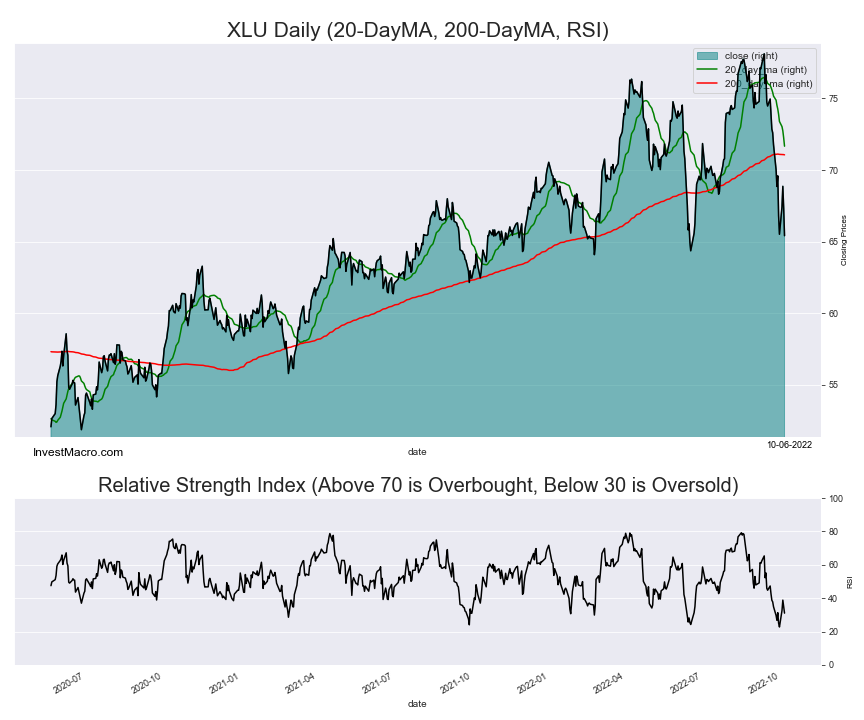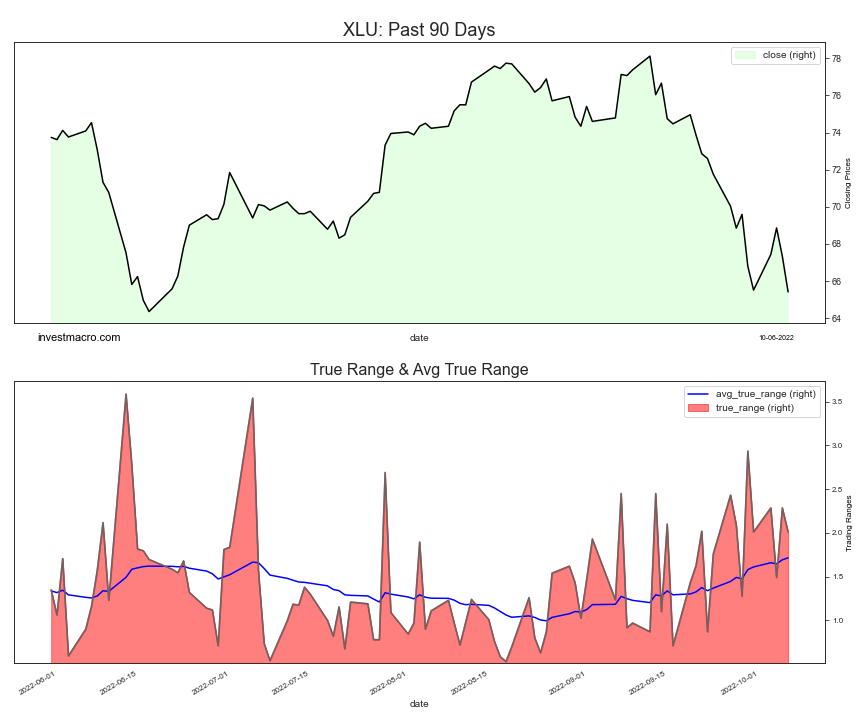
Archive for Stock Market News – Page 46

AGNC Stock today fell by -2.18 percent, RSI Oversold – October 06 2022

By InvestMacro.com | #stocks #AGNC #REIT #mortgage

AGNC Investment Corp. End of Day Update: October 06 2022

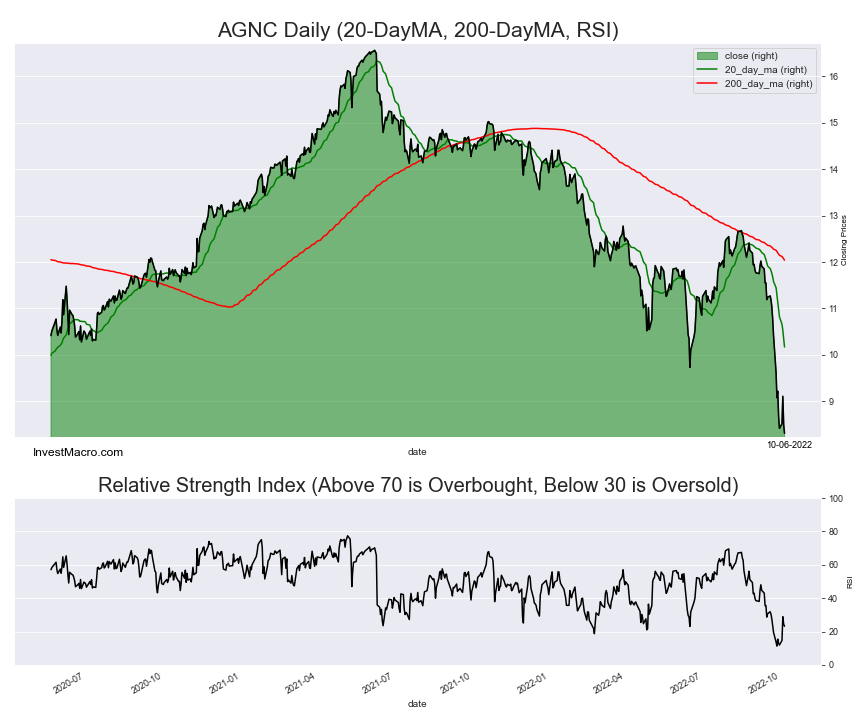
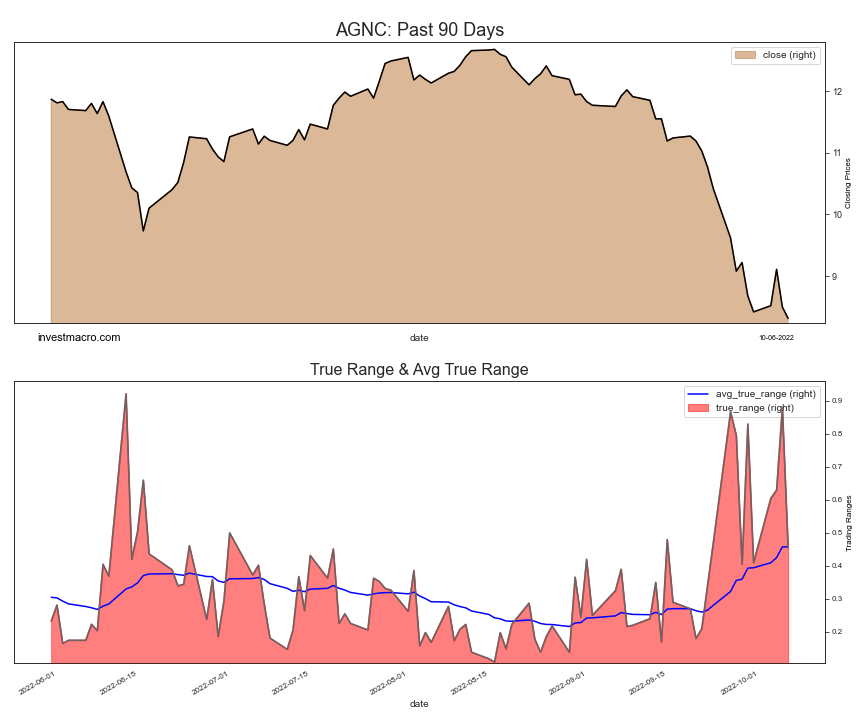
The AGNC Investment Corp. (AGNC) stock finished the day with a slide of -2.18 percent, closing the day around the 8.315 price level, according to unofficial data at the New York close.

AGNC, a Real Estate Investment Trust (REIT) that specializes in mortgage-backed securities, opened the day trading at 8.49 with the high of the day being 8.555 and the low of the day at 8.1.

AGNC, like most REITs, has been on a downtrend due to higher interest rates and trades well below its 20-day and 200-day moving averages. Today’s drop marked the lowest trading level since the pandemic low in March of 2020.

The AGNC RSI level is Bearish-Oversold

The Relative Strength Index, an indicator that can indicate overbought (above 70) and oversold levels (below 30), shows that the current RSI score is at 23.2 for a Bearish-Oversold reading on the daily time-frame.

AGNC Price Trends

The AGNC is now down by -22.79 percent over the past 10 days while seeing a fall by -32.28 over the past 30 days. The 90-day change is -29.82 while the 180-day return and the 365-day return are -40.35 and -46.38, respectively.


By investmacro.com

NIO Stock fell today by -7.00 percent – October 06 2022

By InvestMacro.com | #stocks #NIO #technologystocks

NIO Inc. End of Day Update: October 06 2022

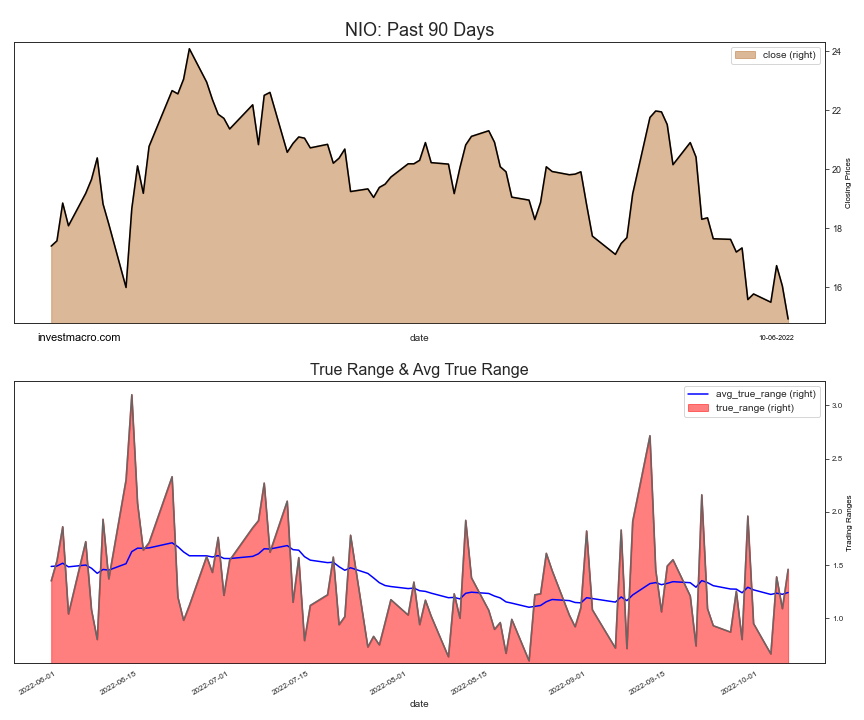
The NIO Inc. (NIO) stock finished the day with a fall of -7.00 percent and closed the day around the 14.918 price level, according to unofficial data at the New York close.

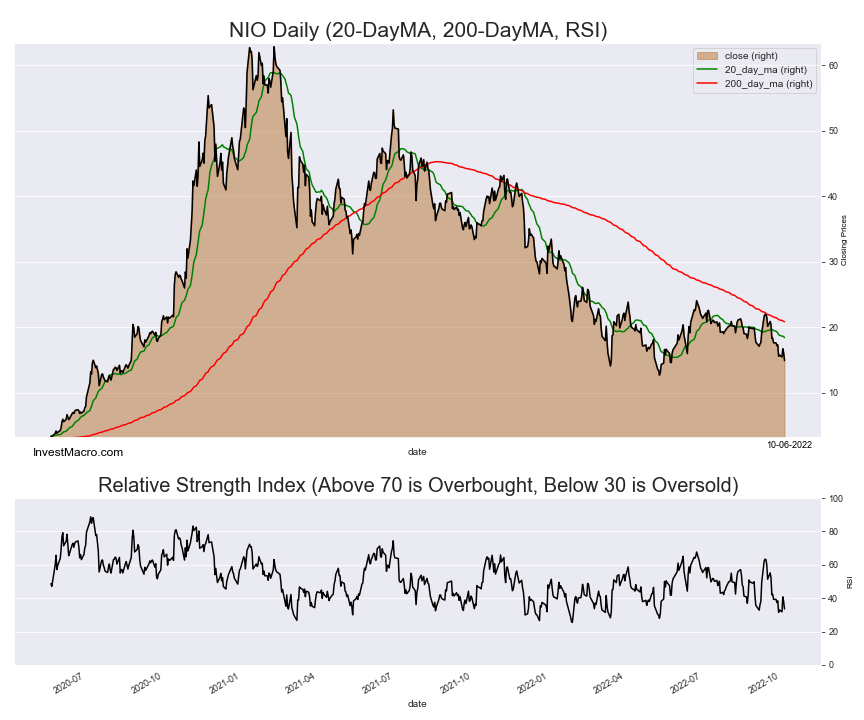
NIO, a Chinese electric car company based out of Shanghai, opened the day trading at 16.0 with the high of the day being 16.24 and the low of the day at 14.78. The stock is trading below both its 200-day moving average and its 20-day moving average currently.

NIO Stock fell today by -7.00 percent - October 06 2022

The NIO RSI level is Bearish

The Relative Strength Index, an indicator that can indicate overbought (above 70) and oversold levels (below 30), shows that the current RSI score is at 33.6 for a Bearish reading on the daily time-frame.

The NIO RSI level is Bearish

NIO Price Trends

NIO is now down by -18.70 percent over the past 10 days while seeing a decline of -20.94 over the past 30 days. The 90-day change is -9.97 while the 180-day return and the 365-day return are -47.89 and -63.80, respectively.

By InvestMacro.com

MSCI EAFE ETF dropped by -1.06 percent – October 05 2022

By InvestMacro.com | #stocks #EAFE

EAFE ETF End of Day Update: October 5th 2022

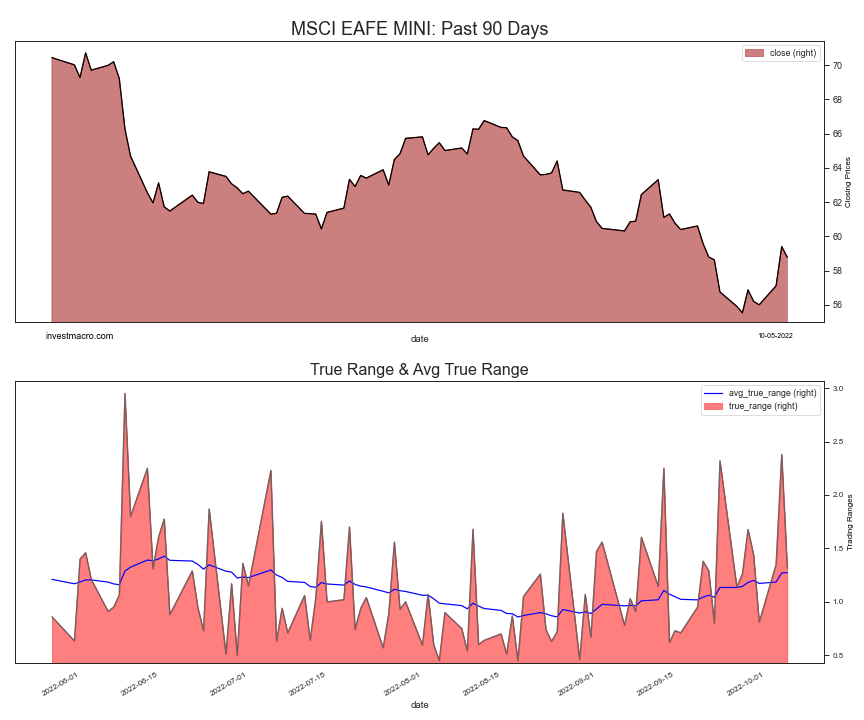
The EAFE EFA ETF finished the day with a decline of -1.06 percent and closed the day around the 58.78 price level, according to unofficial data at the New York close. The EAFE opened the market today at 58.42 with the high of the day being 59.105 and the low of the day bottoming at 58.095.

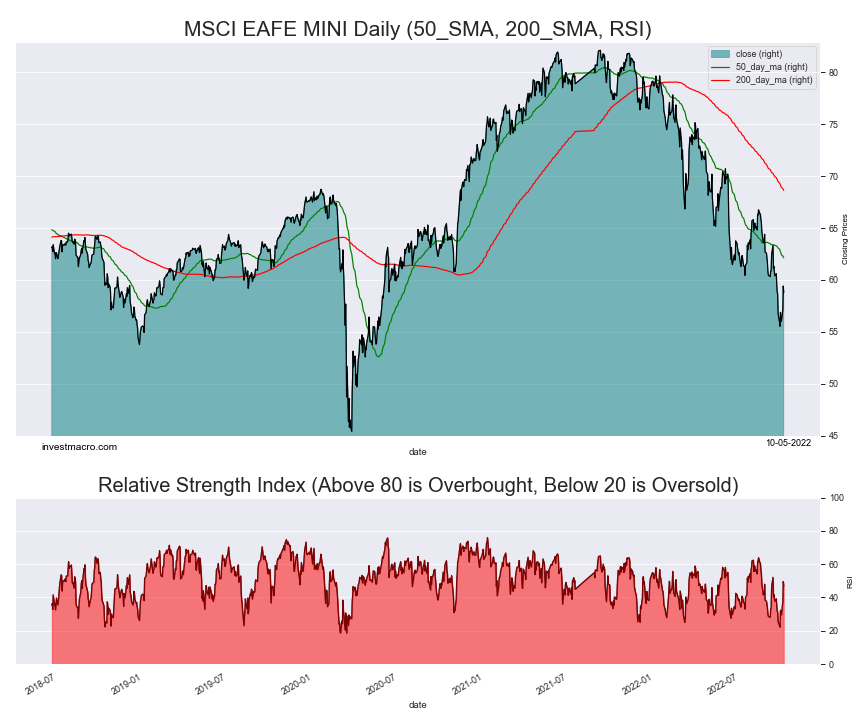
The EAFE is currently below both the 50-day simple moving average and the 200-day sma. The 50-sma crossed over the 200-sma in early 2022, signaling a potential downtrend that materialized shortly after and continues today.

MSCI EAFE ETF dropped by -1.06 percent - October 05 2022

The EAFE RSI level is Bearish:

The Relative Strength Index, an indicator that can indicate overbought (above 80) and oversold levels (below 20), shows that the current RSI score is at 46.8 for a Bearish reading on the daily time-frame.

EAFE Trends:

The EAFE has fallen by -0.03 percent over the past 10 days while seeing a fall of -7.61 over the past 30 days. The 90-day change is -15.53 while the 180-day return and the 365-day return are -24.49 and -23.58, respectively.

By InvestMacro.com

Speculators sharply raised their SP500-Mini bets for 2nd week to least bearish level since June

By InvestMacro

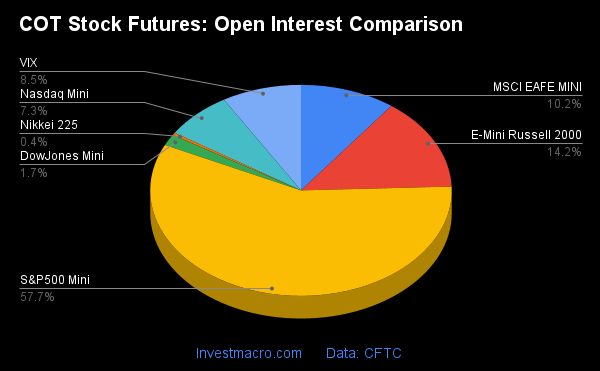
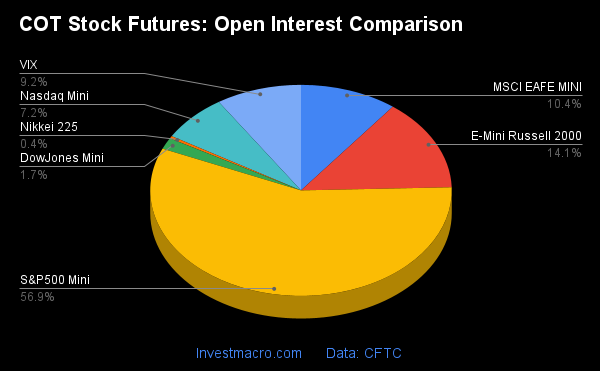
COT Stock Futures Open Interest Comparison

Here are the latest charts and statistics for the Commitment of Traders (COT) data published by the Commodities Futures Trading Commission (CFTC).

The latest COT data is updated through Tuesday September 27th and shows a quick view of how large traders (for-profit speculators and commercial entities) were positioned in the futures markets.

Weekly Speculator Changes led by S&P500 Mini and Nikkei 225

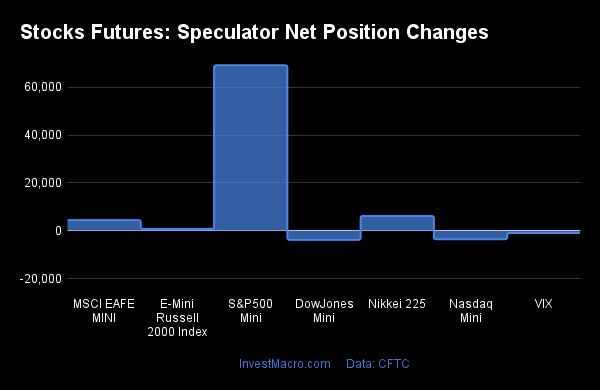
Stocks Futures Speculator Net Position Changes

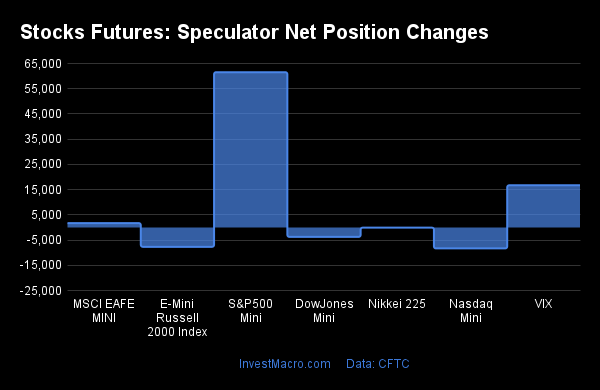
The COT stock market speculator bets were slightly higher this week as four out of the seven stock markets we cover had higher positioning on the week while the other three markets had lower contracts.

Leading the gains for stock markets was the S&P500 Mini (69,250 contracts) with the Nikkei 225 USD (6,161 contracts), MSCI EAFE Mini (4,434 contracts) and the Russell 2000 Mini (777 contracts) also showing positive weeks.

The stock markets leading the declines in speculator bets this week were the Dow Jones Industrial Average Mini (-3,796 contracts), Nasdaq Mini (-3,533 contracts) and the VIX (-926 contracts).

Highlighting the COT Stocks data this week is another week of big moves in the SP500-Mini speculator contracts. The SP500-Mini speculator bets rebounded sharply for a second straight week and gained by more than +60,000 contracts for the second consecutive week. The past 2-week rise in speculator bets now totals +130,803 contracts. The SP500-Mini speculator position is now below the -200,000 contracts for the first time since July 5th and at the least bearish level since June 28th. Despite the positive speculator sentiment last week, the SP500 index sold off sharply to end the week and closed at its lowest level since November of 2020.


Data Snapshot of Stock Market Traders | Columns Legend
Sep-27-2022OIOI-IndexSpec-NetSpec-IndexCom-NetCOM-IndexSmalls-NetSmalls-Index
S&P500-Mini2,233,8785-150,20128232,96781-82,7669
Nikkei 22514,070101,52085-1,541222129
Nasdaq-Mini282,05461-487524,47342-24,4256
DowJones-Mini67,05524-19,2301420,42886-1,19832
VIX331,04236-82,7246890,37833-7,65454
Nikkei 225 Yen43,11519-6503214,38367-13,73347


Strength Scores

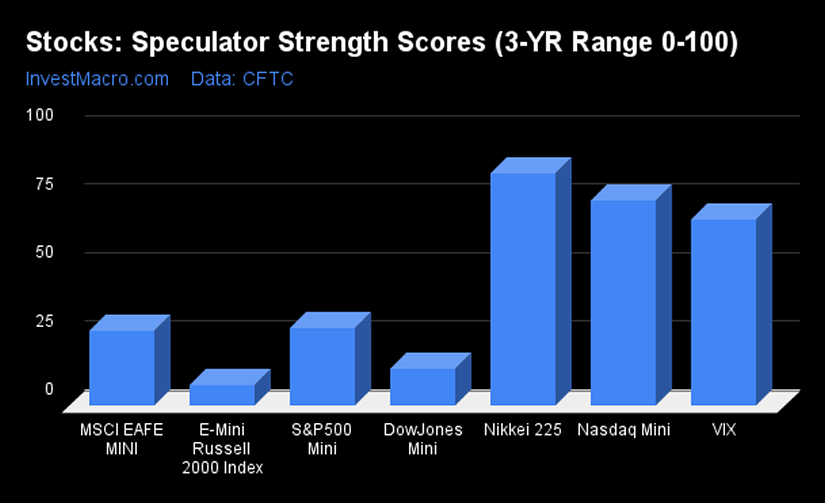
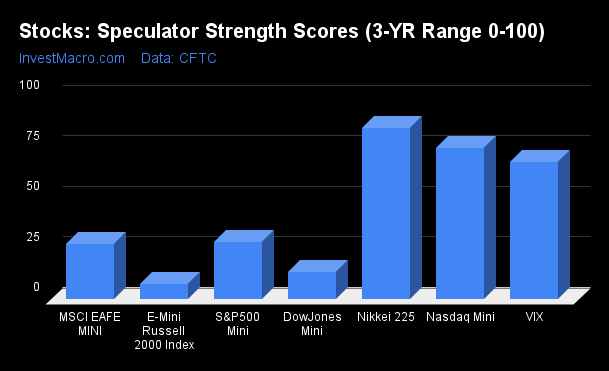
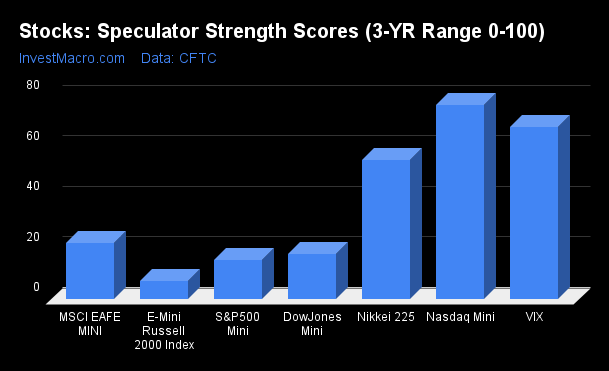
Strength Scores (a normalized measure of Speculator positions over a 3-Year range, from 0 to 100 where above 80 is extreme bullish and below 20 is extreme bearish) showed that the Nikkei USD (84.7 percent) leads the stock markets and is in a bullish extreme position (above 80 percent). The Nasdaq-Mini (75.0 percent) and the VIX (67.8 percent) come in as the next highest stock markets in strength scores.

On the downside, the Russell 2000-Mini (7.8 percent) comes in at the lowest strength level currently and is followed by the DowJones-Mini (13.8 percent) with both being in bearish extreme levels (below 20 percent).

Strength Statistics:
VIX (67.8 percent) vs VIX previous week (68.3 percent)
S&P500-Mini (28.4 percent) vs S&P500-Mini previous week (15.5 percent)
DowJones-Mini (13.8 percent) vs DowJones-Mini previous week (19.3 percent)
Nasdaq-Mini (75.0 percent) vs Nasdaq-Mini previous week (77.0 percent)
Russell2000-Mini (7.8 percent) vs Russell2000-Mini previous week (7.4 percent)
Nikkei USD (84.7 percent) vs Nikkei USD previous week (55.4 percent)
EAFE-Mini (27.3 percent) vs EAFE-Mini previous week (22.4 percent)

Strength Trends

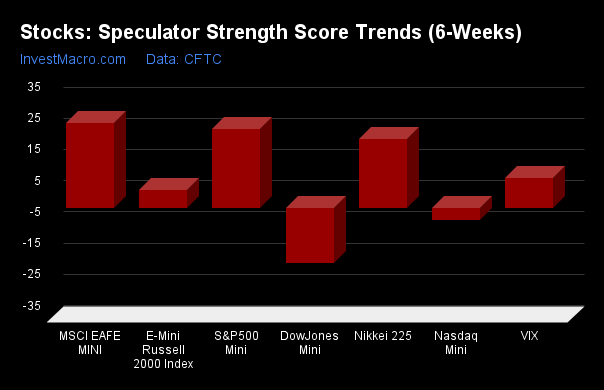
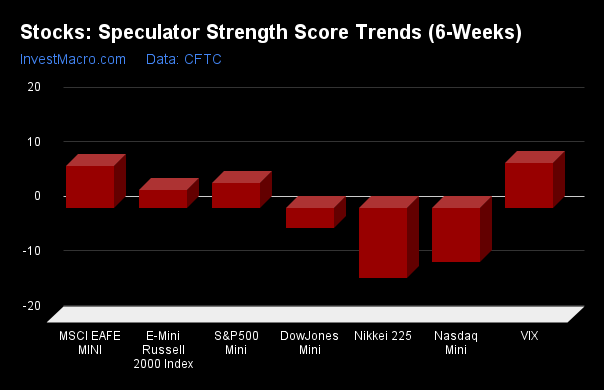
Strength Score Trends (or move index, calculates the 6-week changes in strength scores) showed that the EAFE-Mini (27.3 percent) and the S&P500-Mini (25.5 percent) lead the past six weeks trends for stocks. The Nikkei USD (22.1 percent), the VIX (9.7 percent) and the Russell 2000-Mini (5.8 percent) round out the other positive movers in the latest trends data.

The DowJones-Mini (-17.7 percent) leads the downside trend scores currently while the next market with lower trend scores was the Nasdaq-Mini (-3.9 percent).


Strength Trend Statistics:
VIX (9.7 percent) vs VIX previous week (8.2 percent)
S&P500-Mini (25.5 percent) vs S&P500-Mini previous week (4.6 percent)
DowJones-Mini (-17.7 percent) vs DowJones-Mini previous week (-3.9 percent)
Nasdaq-Mini (-3.9 percent) vs Nasdaq-Mini previous week (-9.8 percent)
Russell2000-Mini (5.8 percent) vs Russell2000-Mini previous week (3.4 percent)
Nikkei USD (22.1 percent) vs Nikkei USD previous week (-12.8 percent)
EAFE-Mini (27.3 percent) vs EAFE-Mini previous week (7.8 percent)


Individual Markets:

VIX Volatility Futures:

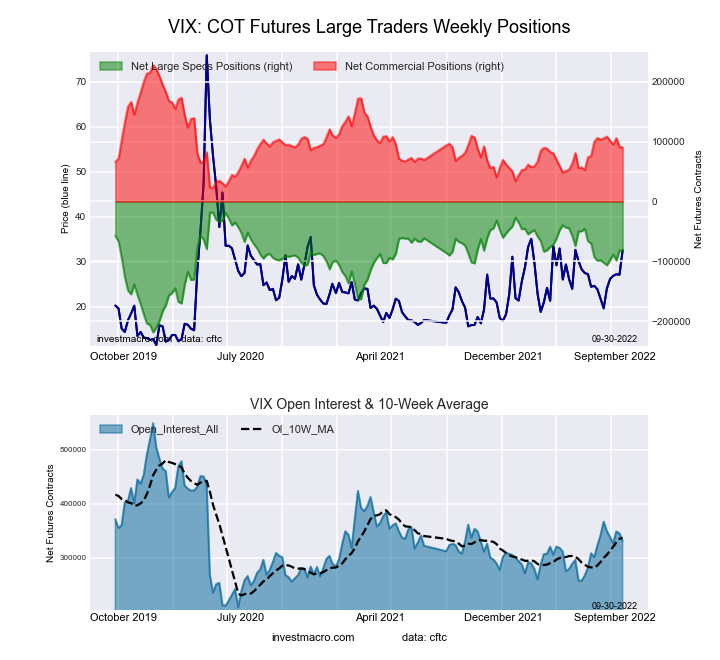
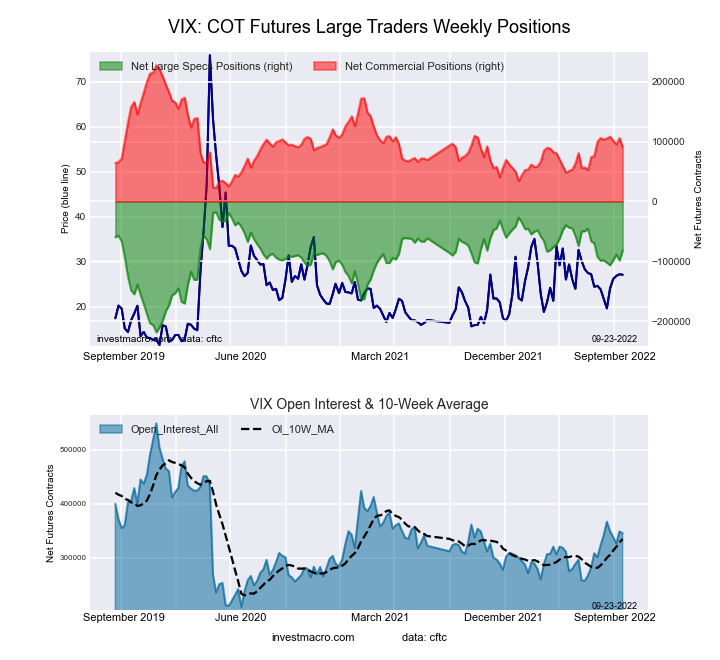
VIX Volatility Futures COT ChartThe VIX Volatility large speculator standing this week recorded a net position of -82,724 contracts in the data reported through Tuesday. This was a weekly fall of -926 contracts from the previous week which had a total of -81,798 net contracts.

This week’s current strength score (the trader positioning range over the past three years, measured from 0 to 100) shows the speculators are currently Bullish with a score of 67.8 percent. The commercials are Bearish with a score of 33.1 percent and the small traders (not shown in chart) are Bullish with a score of 54.2 percent.

VIX Volatility Futures StatisticsSPECULATORSCOMMERCIALSSMALL TRADERS
– Percent of Open Interest Longs:17.855.07.2
– Percent of Open Interest Shorts:42.827.79.6
– Net Position:-82,72490,378-7,654
– Gross Longs:58,980182,09723,991
– Gross Shorts:141,70491,71931,645
– Long to Short Ratio:0.4 to 12.0 to 10.8 to 1
NET POSITION TREND:
– Strength Index Score (3 Year Range Pct):67.833.154.2
– Strength Index Reading (3 Year Range):BullishBearishBullish
NET POSITION MOVEMENT INDEX:
– 6-Week Change in Strength Index:9.7-7.3-22.0


S&P500 Mini Futures:

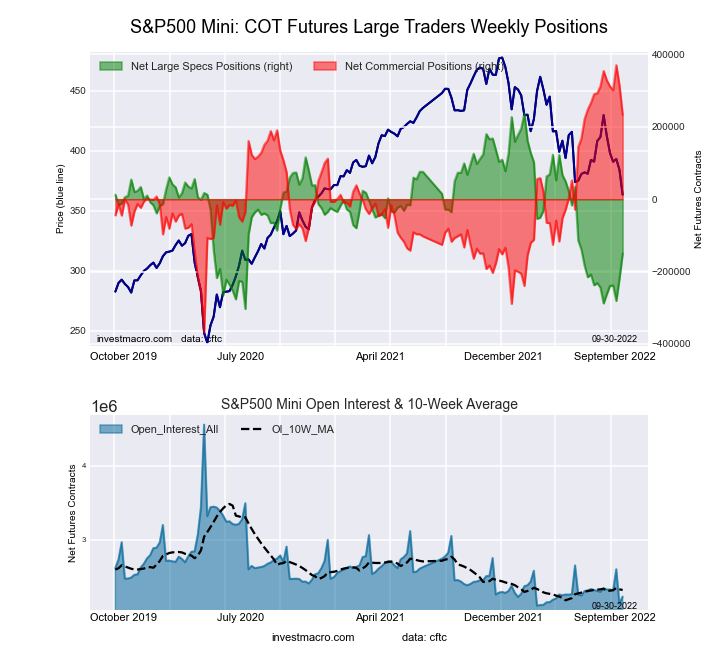
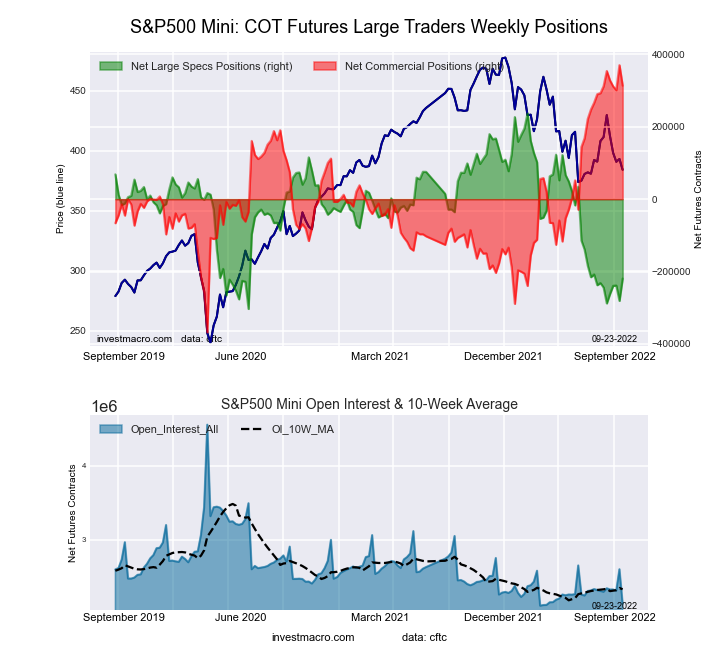
SP500 Mini Futures COT ChartThe S&P500 Mini large speculator standing this week recorded a net position of -150,201 contracts in the data reported through Tuesday. This was a weekly boost of 69,250 contracts from the previous week which had a total of -219,451 net contracts.

This week’s current strength score (the trader positioning range over the past three years, measured from 0 to 100) shows the speculators are currently Bearish with a score of 28.4 percent. The commercials are Bullish-Extreme with a score of 81.4 percent and the small traders (not shown in chart) are Bearish-Extreme with a score of 9.0 percent.

S&P500 Mini Futures StatisticsSPECULATORSCOMMERCIALSSMALL TRADERS
– Percent of Open Interest Longs:11.876.98.4
– Percent of Open Interest Shorts:18.566.512.1
– Net Position:-150,201232,967-82,766
– Gross Longs:262,7971,717,571186,623
– Gross Shorts:412,9981,484,604269,389
– Long to Short Ratio:0.6 to 11.2 to 10.7 to 1
NET POSITION TREND:
– Strength Index Score (3 Year Range Pct):28.481.49.0
– Strength Index Reading (3 Year Range):BearishBullish-ExtremeBearish-Extreme
NET POSITION MOVEMENT INDEX:
– 6-Week Change in Strength Index:25.5-16.4-3.5


Dow Jones Mini Futures:

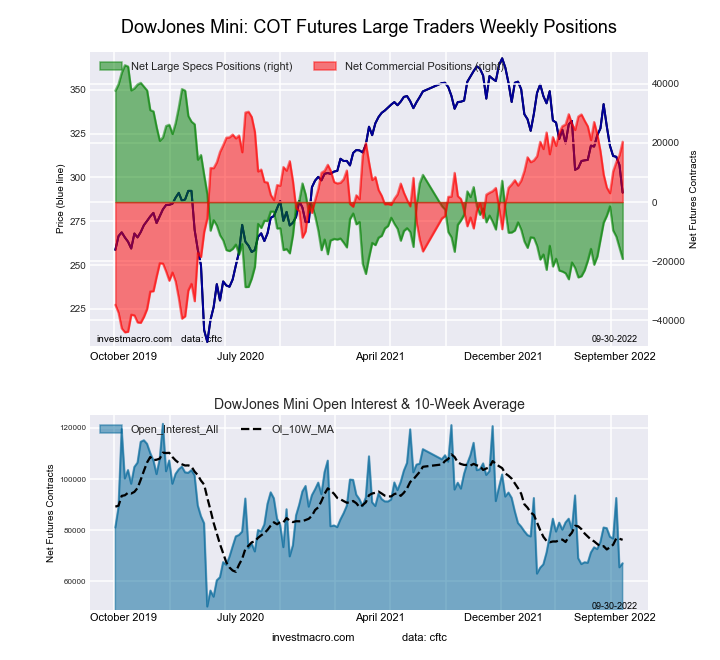
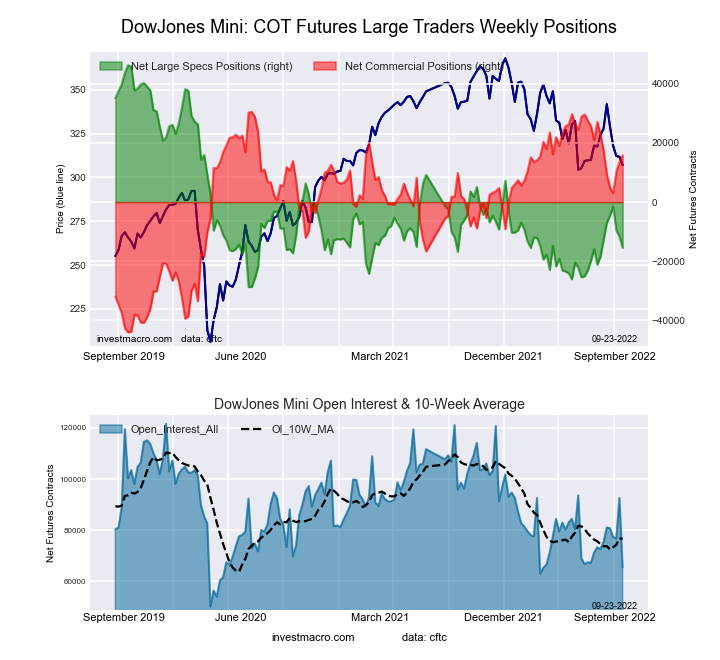
Dow Jones Mini Futures COT ChartThe Dow Jones Mini large speculator standing this week recorded a net position of -19,230 contracts in the data reported through Tuesday. This was a weekly decline of -3,796 contracts from the previous week which had a total of -15,434 net contracts.

This week’s current strength score (the trader positioning range over the past three years, measured from 0 to 100) shows the speculators are currently Bearish-Extreme with a score of 13.8 percent. The commercials are Bullish-Extreme with a score of 85.8 percent and the small traders (not shown in chart) are Bearish with a score of 32.1 percent.

Dow Jones Mini Futures StatisticsSPECULATORSCOMMERCIALSSMALL TRADERS
– Percent of Open Interest Longs:21.360.617.3
– Percent of Open Interest Shorts:50.030.119.1
– Net Position:-19,23020,428-1,198
– Gross Longs:14,30940,63211,590
– Gross Shorts:33,53920,20412,788
– Long to Short Ratio:0.4 to 12.0 to 10.9 to 1
NET POSITION TREND:
– Strength Index Score (3 Year Range Pct):13.885.832.1
– Strength Index Reading (3 Year Range):Bearish-ExtremeBullish-ExtremeBearish
NET POSITION MOVEMENT INDEX:
– 6-Week Change in Strength Index:-17.715.56.4


Nasdaq Mini Futures:

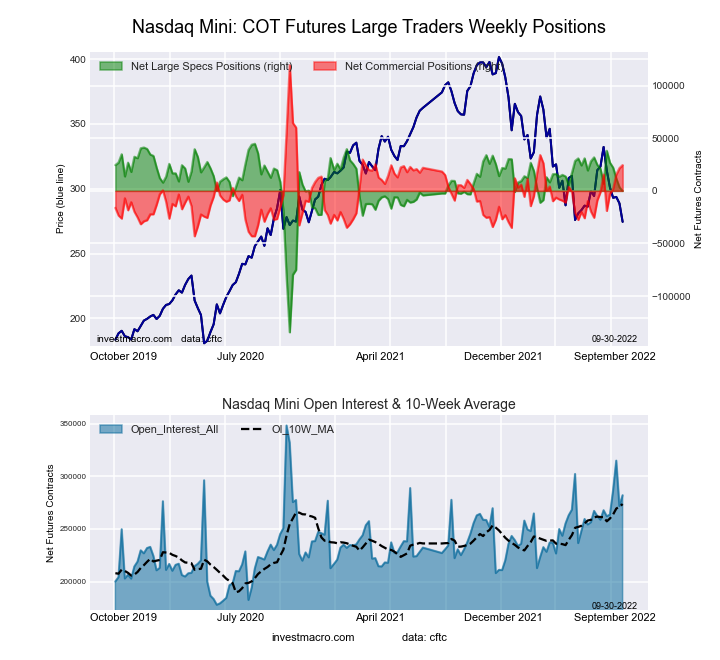
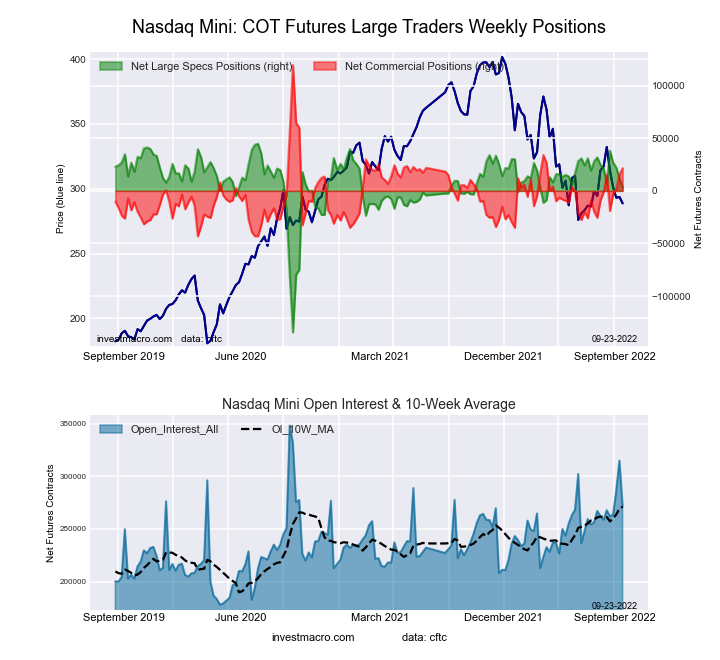
Nasdaq Mini Futures COT ChartThe Nasdaq Mini large speculator standing this week recorded a net position of -48 contracts in the data reported through Tuesday. This was a weekly fall of -3,533 contracts from the previous week which had a total of 3,485 net contracts.

This week’s current strength score (the trader positioning range over the past three years, measured from 0 to 100) shows the speculators are currently Bullish with a score of 75.0 percent. The commercials are Bearish with a score of 41.6 percent and the small traders (not shown in chart) are Bearish-Extreme with a score of 5.6 percent.

Nasdaq Mini Futures StatisticsSPECULATORSCOMMERCIALSSMALL TRADERS
– Percent of Open Interest Longs:26.560.411.6
– Percent of Open Interest Shorts:26.551.720.3
– Net Position:-4824,473-24,425
– Gross Longs:74,731170,35232,818
– Gross Shorts:74,779145,87957,243
– Long to Short Ratio:1.0 to 11.2 to 10.6 to 1
NET POSITION TREND:
– Strength Index Score (3 Year Range Pct):75.041.65.6
– Strength Index Reading (3 Year Range):BullishBearishBearish-Extreme
NET POSITION MOVEMENT INDEX:
– 6-Week Change in Strength Index:-3.95.5-3.9


Russell 2000 Mini Futures:

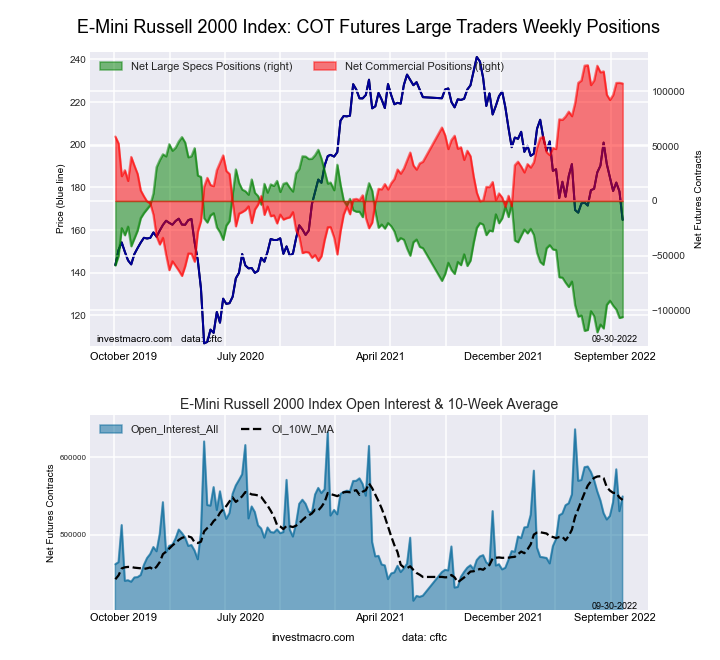
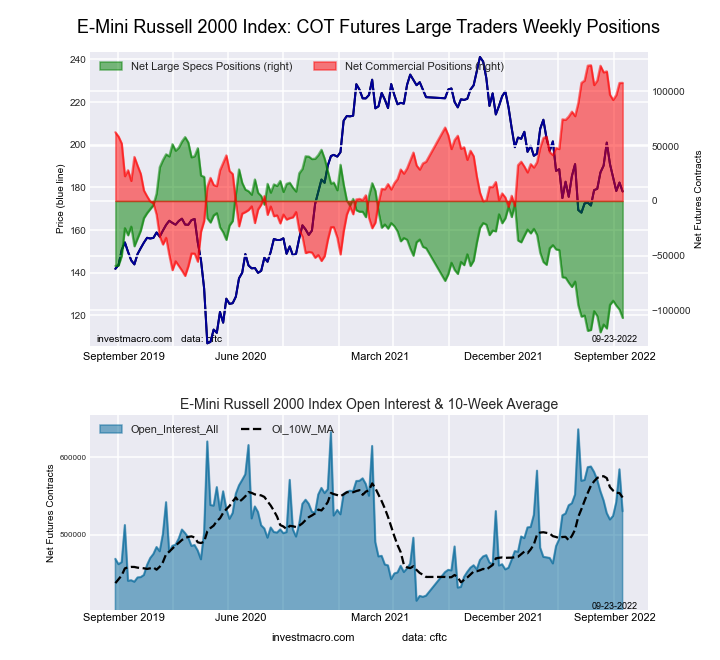
Russell 2000 Mini Futures COT ChartThe Russell 2000 Mini large speculator standing this week recorded a net position of -106,061 contracts in the data reported through Tuesday. This was a weekly advance of 777 contracts from the previous week which had a total of -106,838 net contracts.

This week’s current strength score (the trader positioning range over the past three years, measured from 0 to 100) shows the speculators are currently Bearish-Extreme with a score of 7.8 percent. The commercials are Bullish-Extreme with a score of 91.3 percent and the small traders (not shown in chart) are Bearish with a score of 23.5 percent.

Russell 2000 Mini Futures StatisticsSPECULATORSCOMMERCIALSSMALL TRADERS
– Percent of Open Interest Longs:7.987.33.8
– Percent of Open Interest Shorts:27.267.84.0
– Net Position:-106,061107,336-1,275
– Gross Longs:43,291479,62220,778
– Gross Shorts:149,352372,28622,053
– Long to Short Ratio:0.3 to 11.3 to 10.9 to 1
NET POSITION TREND:
– Strength Index Score (3 Year Range Pct):7.891.323.5
– Strength Index Reading (3 Year Range):Bearish-ExtremeBullish-ExtremeBearish
NET POSITION MOVEMENT INDEX:
– 6-Week Change in Strength Index:5.8-5.71.9


Nikkei Stock Average (USD) Futures:

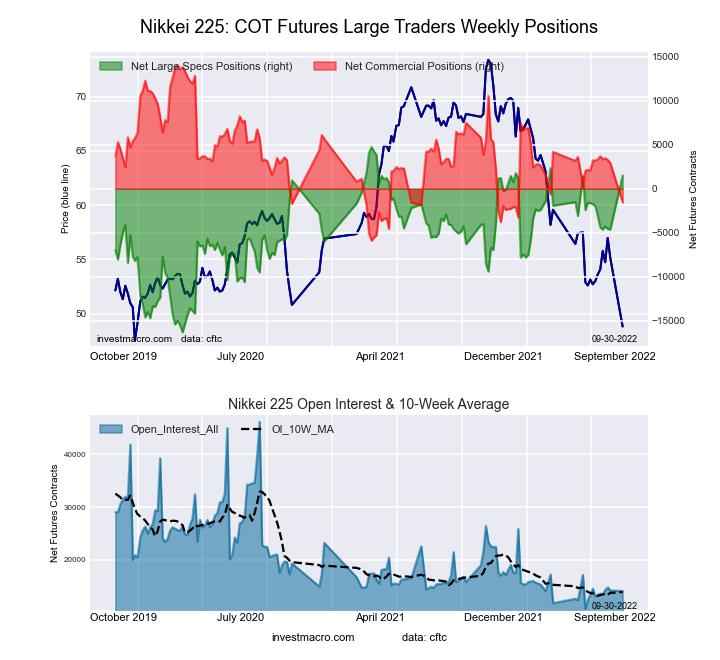
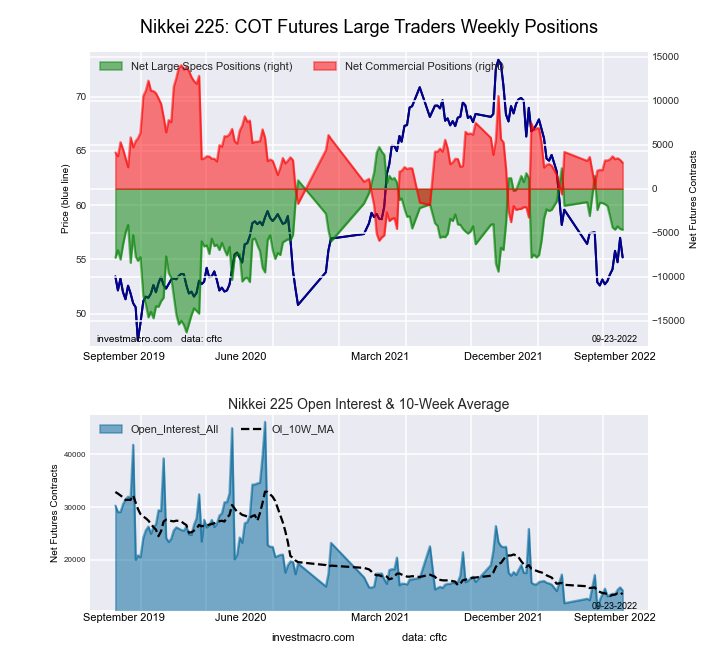
Nikkei Stock Average (USD) Futures COT ChartThe Nikkei Stock Average (USD) large speculator standing this week recorded a net position of 1,520 contracts in the data reported through Tuesday. This was a weekly gain of 6,161 contracts from the previous week which had a total of -4,641 net contracts.

This week’s current strength score (the trader positioning range over the past three years, measured from 0 to 100) shows the speculators are currently Bullish-Extreme with a score of 84.7 percent. The commercials are Bearish with a score of 21.9 percent and the small traders (not shown in chart) are Bearish with a score of 28.6 percent.

Nikkei Stock Average Futures StatisticsSPECULATORSCOMMERCIALSSMALL TRADERS
– Percent of Open Interest Longs:34.546.718.6
– Percent of Open Interest Shorts:23.757.618.4
– Net Position:1,520-1,54121
– Gross Longs:4,8606,5692,611
– Gross Shorts:3,3408,1102,590
– Long to Short Ratio:1.5 to 10.8 to 11.0 to 1
NET POSITION TREND:
– Strength Index Score (3 Year Range Pct):84.721.928.6
– Strength Index Reading (3 Year Range):Bullish-ExtremeBearishBearish
NET POSITION MOVEMENT INDEX:
– 6-Week Change in Strength Index:22.1-24.53.0


MSCI EAFE Mini Futures:

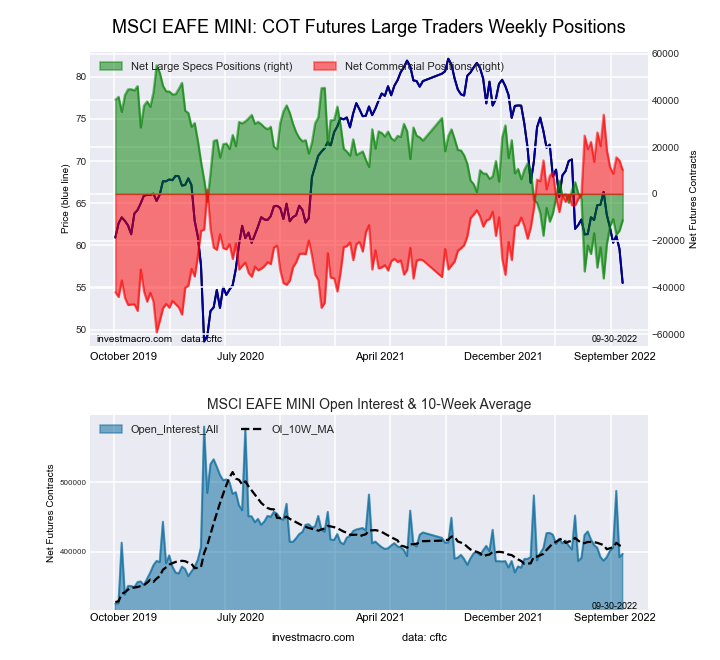
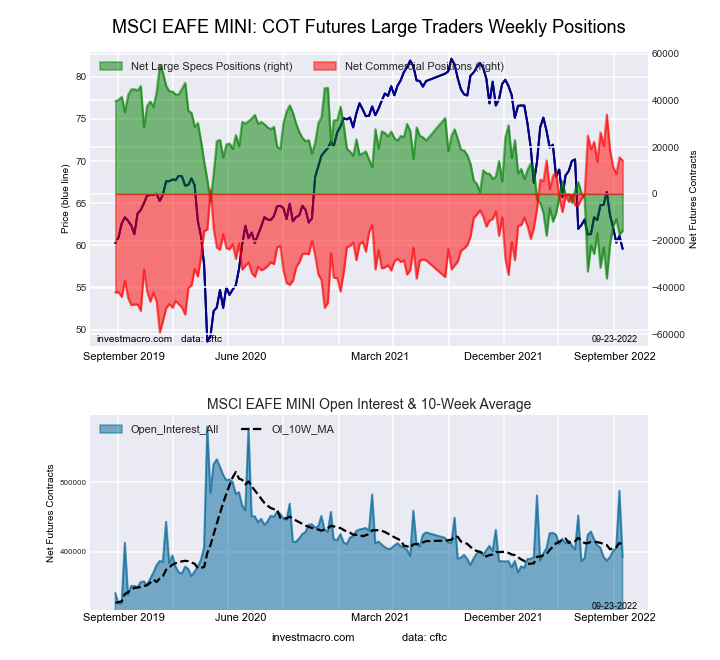
MSCI EAFE Mini Futures COT ChartThe MSCI EAFE Mini large speculator standing this week recorded a net position of -11,275 contracts in the data reported through Tuesday. This was a weekly lift of 4,434 contracts from the previous week which had a total of -15,709 net contracts.

This week’s current strength score (the trader positioning range over the past three years, measured from 0 to 100) shows the speculators are currently Bearish with a score of 27.3 percent. The commercials are Bullish with a score of 74.5 percent and the small traders (not shown in chart) are Bearish with a score of 29.0 percent.

MSCI EAFE Mini Futures StatisticsSPECULATORSCOMMERCIALSSMALL TRADERS
– Percent of Open Interest Longs:5.092.22.1
– Percent of Open Interest Shorts:7.989.61.8
– Net Position:-11,27510,1181,157
– Gross Longs:19,991365,7418,306
– Gross Shorts:31,266355,6237,149
– Long to Short Ratio:0.6 to 11.0 to 11.2 to 1
NET POSITION TREND:
– Strength Index Score (3 Year Range Pct):27.374.529.0
– Strength Index Reading (3 Year Range):BearishBullishBearish
NET POSITION MOVEMENT INDEX:
– 6-Week Change in Strength Index:27.3-25.5-10.0


Article By InvestMacroReceive our weekly COT Newsletter

*COT Report: The COT data, released weekly to the public each Friday, is updated through the most recent Tuesday (data is 3 days old) and shows a quick view of how large speculators or non-commercials (for-profit traders) were positioned in the futures markets.

The CFTC categorizes trader positions according to commercial hedgers (traders who use futures contracts for hedging as part of the business), non-commercials (large traders who speculate to realize trading profits) and nonreportable traders (usually small traders/speculators) as well as their open interest (contracts open in the market at time of reporting). See CFTC criteria here.

Stock indices are showing signs of life. But economic indicators are still looking downward

By JustForex

The US and European stock markets rebounded slightly on Wednesday after the Bank of England said it would intervene in the bond market to curb the devastating rise in borrowing costs. Investors were alarmed last week, particularly by a sharp rise in bond yields. Central Banks sought to raise interest rates to rein in red-hot inflation before it sent the global economy into recession. As the stock market closed yesterday, the Dow Jones Index (US30) added 1.88%, and the S&P 500 Index (US500) increased by 1.97%. Technology index NASDAQ (US100) gained 2.39% on the day.

FOMC spokesman Bostick said yesterday that the baseline interest rate hike was 75 basis points at the November meeting and 50 basis points in December.

According to the US National Association of Realtors, pending home sales declined for the third straight month in August. Compared to a year ago, pending transactions were down 24.2%. The Index is now down to 88.4. The 100 Index is in line with contract activity in 2001.

Equity markets in Europe were also mostly up yesterday. German DAX (DE30) gained 0.36%, French CAC 40 (FR40) added 0.19%, Spanish IBEX 35 (ES35) declined by 0.05%, British FTSE 100 (UK100) closed yesterday at plus 0.30%.

The Bank of England announced Wednesday that it would buy as many UK government bonds as necessary to stabilize debt markets and delay the start date of its bond sales. The central bank explained that if yields rise higher, it could lead to an unjustified tightening of funding conditions and reduce the flow of credit to the real economy. The Bank of England said in a statement that “the Bank of England’s Financial Policy Committee recognized the market risks, recommended an intervention, and proposed a plan to buy bonds urgently.” At the same time, the Bank of England will postpone the start of its quantitative tightening program (QT).

The UK housing market could face a perfect storm as mortgage rates rise and house prices fall. Rising borrowing costs and a likely slowdown in economic growth threaten to trigger a sell-off in the British housing market, with consequences for personal wealth and the economy as a whole. Mortgage deals for new customers now have rates around 5%-6%, a sharp increase from the norm of around 2%.

The International Monetary Fund (IMF) and rating agency Moody’s criticized Britain’s new economic strategy announced Friday, which caused British asset prices to collapse.

Oil prices rose on Wednesday as production cuts caused by Hurricane Yang outweighed downward pressure from a strengthening dollar. About 190,000 barrels a day of oil production in the Gulf of Mexico, or 11% of total production, was halted because of Hurricane Yang, according to US government data.

The US will oppose parts of Ukraine from becoming part of Russia, including through the United Nations, and will impose additional economic sanctions.

Asia’s major stock indices fell sharply on Wednesday. Japan’s Nikkei 225 (JP225) decreased by 1.50%, Hong Kong’s Hang Seng (HK50) ended the day down by 3.41%, and Australia’s S&P/ASX 200 (AU200) lost 0.53% yesterday.

The New Zealand dollar fell to its lowest level against the US dollar in more than two years. The currency has fallen nearly 3% over the past week as financial markets reacted to sharp rate hikes imposed by central banks to fight inflation.

The ANZ Business Confidence Index showed that inflation in New Zealand and higher interest rates negatively affect business sentiment. The RBNZ currently holds one of the highest interest rates among major economies and ranks second behind the Bank of Canada and the US Federal Reserve at 3.25%. Analysts expect another 25 basis point increase from the RBNZ, but it is also possible that New Zealand’s Central Bank is nearing the end of its hiking cycle.

S&P 500 (F) (US500) 3,719.04 +71.75 (+1.97%)

Dow Jones (US30) 29,683.74 +548.75 (+1.88%)

DAX (DE40) 12,183.28 +43.60 (+0.36%)

FTSE 100 (UK100) 7,005.39 +20.80 (+0.30%)

USD Index 112.72 -1.39 (-1.22%)

Important events for today:
  • – New Zealand ANZ Business Confidence (m/m) at 03:00 (GMT+3);
  • – Eurozone Spanish CPI (q/q) at 10:00 (GMT+3);
  • – Eurozone German CPI (q/q) at 15:00 (GMT+3);
  • – US GDP (q/q) at 15:30 (GMT+3);
  • – US Initial Jobless Claims (w/w) at 15:30 (GMT+3);
  • – Canada GDP (m/m) at 15:30 (GMT+3);
  • – New Zealand RBNZ Gov Orr Speaks at 16:00 (GMT+3);
  • – US FOMC Member Bullard Speaks at 16:30 (GMT+3);
  • – US Natural Gas Storage (w/w) at 17:30 (GMT+3);
  • – US FOMC Member Mester Speaks at 20:00 (GMT+3).

By JustForex


This article reflects a personal opinion and should not be interpreted as an investment advice, and/or offer, and/or a persistent request for carrying out financial transactions, and/or a guarantee, and/or a forecast of future events.

UPDATE: Is the worst really over for US stocks?

By ForexTime

Last month, we posed the question: “Is the worst over for US stocks?

Answer: apparently not.

A week after that August 10th article, the S&P 500 did climb higher, only to be resisted by its 200-day simple moving average.


The blue-chip stock index even closed above the 50% Fibonacci retracement level, which was the key criteria for suggesting that the worst is over for the 2022 rout in US stocks.

As cited in the August article, according to data by the CFRA and S&P Global, in 18 of the 19 ‘bear markets’ seen since World War II, the S&P 500 then went on to a fresh bull run after closing above its 50% Fib retracement line.

But as the saying goes across financial markets: “Past performance is no guarantee of future results.”

And that track record (stated above) now needs to be updated to “18 out of the past 20 bear markets …”.

Since that August article, the S&P 500 has unwound all of its summer gains, even printing intraday prices not seen since end-November 2020.

In essence, we have seen “worse” levels this week for the S&P 500 compared to those June lows.


Why did the S&P 500 erase its summer gains?

Recall the premise for the S&P 500’s summer rally, as stated in last month’s article:

“Arguably, the primary reason is that markets believe that the Fed has done the largest chunks of its rate hikes already.”

Additionally, the S&P 500’s summer gains was based on the idea of a “dovish pivot” by the Fed.

That’s to say that markets had expected the Fed to be less courageous about sending US interest rates higher, for fear of triggering an economic recession.

But now we know better.

Since then, we have seen the US inflation data stubbornly printing near its highest levels in around 40 years.

Hence, many Fed officials, including Fed Chair Jerome Powell himself, have since sent a strong message to the markets:

The US central bank is hell bent on taming multi-decade high inflation by sending US interest rates even higher, and is willing to tolerate economic pain along the way.


Markets duly paid heed and raised their forecasted peak for this ongoing Fed rate hike cycle by about 90 basis points!

  • Back in August, markets expected that US rates won’t go higher than 3.6% in March 2023.
  • Today, that forecasted peak is now expected to reach nearly 4.5% by March.


What do higher US interest rates mean for the US economy?

Essentially, the Fed wants to see some “demand destruction”.

Policymakers want to see less money in an economy chasing after scarce goods and services.

That should, in theory, discourage businesses from ramping up their selling prices, hopefully resulting in slower inflation.

However, more economic pain could also bring about a shrinking economy i.e. a recession.


What do higher US interest rates mean for US stocks?

More downside likely.

With the US unemployment rate forecasted by the Fed to rise to 4.4% by end-2023, significantly higher from the 3.7% figure from last month, more jobless Americans should translate into less demand/spending in the US economy, which should also mean less earnings for companies.

Lower earnings due to such “economic pain” should also lead to lower share prices, with such a narrative already dragging on the S&P 500.


Tech not spared

Also, higher interest rates mean its tougher for so-called “growth companies” to continue borrowing cheap loans to fund its expansion plans while forsaking profitability.

Hence, as higher interest rates chock some of the potential growth (and earnings potential) for these growth companies, that has led to lower stock valuations as well.

Keep in mind that, with many of these growth stocks concentrated in the tech sector, no surprise then that the tech-heavy Nasdaq 100 has a year-to-date decline of almost 30%, falling deeper than the S&P 500’s 22% year-to-date decline.

However, the Nasdaq 100 is still managing to not surpass its June lows … for now.

Also, note that tech-led declines would only exert more downward pressure on the S&P 500.

This is because IT stocks (think Apple, Microsoft, Nvidia, etc.) account for over a quarter (26.6%) of the S&P 500.

So, if you couple the S&P 500’s exposure to tech stocks with the weightage of consumer discretionary stocks (e.g. Amazon, Tesla, McDonald’s, etc. – which tend to take an earnings hit when customers have less disposable income during times of economic pain), then a US recession that’s triggered by higher US rates would only exert more downward pressure on the S&P 500.


NOTE: The S&P 500 index is widely used as the benchmark to gauge how overall US stocks are performing.


So where to next for the S&P 500?

Brace for the low-3000s.

In market fears surrounding a US recession continue ramping up, that may send the S&P 500 to as low as:

  • 3400: around the pre-pandemic peak set in Feb 2020
  • 3200: double-bottom from Sept/Oct 2020


Though for more immediate consideration, the S&P 500 is testing a crucial support level – its 200-week simple moving average.

This technical indicator has supported the S&P 500 in recent years, with such an episode last occurring at end-2018.


Athough the Fed was also busy raising interest rates back in 2018, those benchmark rates today have already surpassed those levels and are now standing at its highest since 2008 at 3.25%.

And US inflation is still around its highest levels since the early 1980s.

So if this 200-week SMA doesn’t hold, the S&P 500 is likely to then set course for the low-3000 region, dragged down by heightened  fears over a potential US recession and higher-for-longer US interest rates.


Forex-Time-LogoArticle by ForexTime

ForexTime Ltd (FXTM) is an award winning international online forex broker regulated by CySEC 185/12 www.forextime.com

Bear Market Rallies: Here’s a Key Insight

How investors get snookered into the belief of “a further market advance”

By Elliott Wave International

Nothing raises the hopes of the bullishly inclined like a rapid bear market rally. And there’s been several since the early January top in the Dow Industrials and S&P 500 index.

You may be interested in a key characteristic of most of these rallies.

The Sept. 12 U.S. Short Term Update, a thrice weekly Elliott Wave International publication which provides near-term analysis of major U.S. financial markets, explains with this chart and commentary:

Sometimes the upward push will end at or near top tick of the daily range. A quick glance at the countertrend rallies since the January peak in the S&P shows at least five instances of this happening, indicated by the red arrows on the chart. The final trade of these daily ranges was at or very near the high of the day, creating belief in a further market advance when in fact it was the top of the rally.

Keep in mind that “not every strong up day that closes at top tick marks the end of the rally but the end of the rally is often attended by strong up days that close at top tick.”

That said, here are just a couple of examples in recent months of the lingering optimism:

  • Why There’s a Chance the Stock Market Has Hit Bottom (Barron’s, July 19)
  • Top Investment Ideas for a Market That Might Have Hit Bottom (Bloomberg, Aug. 4)

In other words, memories of the prior bull market die hard, even several months after the S&P 500’s record high near the start of the year.

And, regarding those July and August headlines about a market bottom, that didn’t turn out to be the case. Here’s a Sept. 16 headline (CNBC):

FedEx plunge could spell bad days ahead for market as bellwether Dow Transports index hits new low

The question is: Will other indexes — like the S&P 500 and Dow Industrials — also plunge to new lows?

Now is the time to familiarize yourself with the U.S. stock market’s Elliott wave pattern.

If you’re new to Elliott wave analysis or need a refresher, do know that the definitive text on the topic is Frost & Prechter’s book, Elliott Wave Principle: Key to Market Behavior. Here’s a quote from this Wall Street classic:

Without Elliott, there appear to be an infinite number of possibilities for market action. What the Wave Principle provides is a means of first limiting the possibilities and then ordering the relative probabilities of possible future market paths. Elliott’s highly specific rules reduce the number of valid alternatives to a minimum. Among those, the best interpretation, sometimes called the “preferred count,” is the one that satisfies the largest number of guidelines.

If you’d like to read the entire online version of Elliott Wave Principle: Key to Market Behavior, you may do so for free after you join Club EWI, the world’s largest Elliott wave educational community (about 500,000 worldwide members and growing rapidly).

A Club EWI membership is free and allows you free access to a wealth of Elliott wave resources on financial markets, investing and trading without any obligation. Those resources include exclusive videos and articles from Elliott Wave International’s analysts.

Just follow the link, and you’ll be on your way to becoming a Club EWI member: Elliott Wave Principle: Key to Market Behaviorget instant and free access now.

This article was syndicated by Elliott Wave International and was originally published under the headline Bear Market Rallies: Here’s a Key Insight. EWI is the world’s largest market forecasting firm. Its staff of full-time analysts led by Chartered Market Technician Robert Prechter provides 24-hour-a-day market analysis to institutional and private investors around the world.

S&P500 Mini Futures led the Stock Market Speculator Bets before Fed Rate hike

By InvestMacro

Stock Market Open Interest

Here are the latest charts and statistics for the Commitment of Traders (COT) data published by the Commodities Futures Trading Commission (CFTC).

The latest COT data is updated through Tuesday September 20th and shows a quick view of how large traders (for-profit speculators and commercial entities) were positioned in the futures markets.

The COT data this week is from the day before the US Federal Reserve raised the benchmark interest rate 75 basis points to the 3 to 3.25 percent range. This data shows the trader positioning prior to the rate hike and considering the way the stock markets have gone since Wednesday, positions could have been reversed shortly after.

S&P500 Mini & VIX lead the Weekly Speculator Changes

Stocks Futures Speculator Net Position Changes

The COT stock market speculator bets were slightly lower through Tuesday as three out of the seven stock markets we cover had higher positioning this week while the other four markets had lower contracts.

Leading the gains for stock markets was the S&P500 Mini (61,553 contracts) with the VIX (16,728 contracts) and MSCI EAFE Mini (1,723 contracts) also showing positive weeks.

The stock markets with declines in speculator bets this week were the Nasdaq Mini (-8,321 contracts), Russell 2000 Mini (-7,686 contracts), Dow Jones Industrial Average Mini (-3,748 contracts) and the Nikkei 225 USD (-78 contracts) also registering lower bets on the week.

Highlighting the COT stocks data was the SP500 Mini speculator bets that jumped this week by over +60,000 contracts. This was the fourth week in the past five weeks that bets had improved for the SP-Mini. The positioning was likely heavily influenced by the Fed interest rate decision coming the day after (Wednesday) the data was collected. Digging into the data showed that the positive result for the SP500 Mini net positioning was due to a large number of traders reducing their gross short positions (by -75,190 contracts) on Tuesday. Speculators also reduced their gross long positions but by a much smaller number for the week (by -13,637 contracts). Overall, the SP500 Mini net position at -219,451 contracts remains extremely bearish and has been in a negative bearish position for the past fourteen straight weeks, dating back to June 21st.


Data Snapshot of Stock Market Traders | Columns Legend
Sep-20-2022OIOI-IndexSpec-NetSpec-IndexCom-NetCOM-IndexSmalls-NetSmalls-Index
S&P500-Mini2,141,0221-219,45116313,69892-94,2477
Nikkei 22514,15110-4,641552,949441,69250
Nasdaq-Mini271,815553,4857721,58240-25,0674
DowJones-Mini65,49021-15,4341815,84080-40636
VIX345,34140-81,7986890,84233-9,04448
Nikkei 225 Yen42,355181043418,61174-18,71536


Strength Scores

Strength Scores (a normalized measure of Speculator positions over a 3-Year range, from 0 to 100 where above 80 is extreme bullish and below 20 is extreme bearish) showed that the Nasdaq-Mini (77.0 percent) and the VIX (68.3 percent) lead the stock markets for the week. The Nikkei USD (55.4 percent) comes in as the next highest stocks market in strength scores.

On the downside, the Russell2000-Mini (7.4 percent), the S&P500-Mini (15.5 percent) and the DowJones-Mini (17.8 percent) come in at the lowest strength levels and are all in extreme bearish territory (below 20 percent).

Stock Strength Scores

Strength Statistics:
VIX (68.3 percent) vs VIX previous week (59.9 percent)
S&P500-Mini (15.5 percent) vs S&P500-Mini previous week (4.1 percent)
DowJones-Mini (17.8 percent) vs DowJones-Mini previous week (22.9 percent)
Nasdaq-Mini (77.0 percent) vs Nasdaq-Mini previous week (81.6 percent)
Russell2000-Mini (7.4 percent) vs Russell2000-Mini previous week (11.7 percent)
Nikkei USD (55.4 percent) vs Nikkei USD previous week (55.8 percent)
EAFE-Mini (22.4 percent) vs EAFE-Mini previous week (20.5 percent)

Strength Trends

Strength Score Trends (or move index, calculates the 6-week changes in strength scores) showed that the VIX (8.2 percent) and the EAFE-Mini (7.8 percent) lead the past six weeks trends for stocks this week. The S&P500-Mini (4.6 percent) and the Russell2000-Mini (3.4 percent) fill out the other positive movers in the latest trends data.

The Nikkei USD (-12.8 percent) leads the downside trend scores currently while the next market with lower trend scores were the Nasdaq-Mini (-9.8 percent) followed by the DowJones-Mini (-3.6 percent).

Stocks Strength Trends

Strength Trend Statistics:
VIX (8.2 percent) vs VIX previous week (0.2 percent)
S&P500-Mini (4.6 percent) vs S&P500-Mini previous week (-9.1 percent)
DowJones-Mini (-3.6 percent) vs DowJones-Mini previous week (9.0 percent)
Nasdaq-Mini (-9.8 percent) vs Nasdaq-Mini previous week (-7.2 percent)
Russell2000-Mini (3.4 percent) vs Russell2000-Mini previous week (11.7 percent)
Nikkei USD (-12.8 percent) vs Nikkei USD previous week (-13.4 percent)
EAFE-Mini (7.8 percent) vs EAFE-Mini previous week (15.4 percent)


Individual Markets:

VIX Volatility Futures:

VIX Volatility Futures COT ChartThe VIX Volatility large speculator standing this week recorded a net position of -81,798 contracts in the data reported through Tuesday. This was a weekly boost of 16,728 contracts from the previous week which had a total of -98,526 net contracts.

This week’s current strength score (the trader positioning range over the past three years, measured from 0 to 100) shows the speculators are currently Bullish with a score of 68.3 percent. The commercials are Bearish with a score of 33.3 percent and the small traders (not shown in chart) are Bearish with a score of 47.5 percent.

VIX Volatility Futures StatisticsSPECULATORSCOMMERCIALSSMALL TRADERS
– Percent of Open Interest Longs:13.056.66.3
– Percent of Open Interest Shorts:36.730.38.9
– Net Position:-81,79890,842-9,044
– Gross Longs:45,066195,41321,807
– Gross Shorts:126,864104,57130,851
– Long to Short Ratio:0.4 to 11.9 to 10.7 to 1
NET POSITION TREND:
– Strength Index Score (3 Year Range Pct):68.333.347.5
– Strength Index Reading (3 Year Range):BullishBearishBearish
NET POSITION MOVEMENT INDEX:
– 6-Week Change in Strength Index:8.2-6.0-20.0


S&P500 Mini Futures:

SP500 Mini Futures COT ChartThe S&P500 Mini large speculator standing this week recorded a net position of -219,451 contracts in the data reported through Tuesday. This was a weekly gain of 61,553 contracts from the previous week which had a total of -281,004 net contracts.

This week’s current strength score (the trader positioning range over the past three years, measured from 0 to 100) shows the speculators are currently Bearish-Extreme with a score of 15.5 percent. The commercials are Bullish-Extreme with a score of 92.3 percent and the small traders (not shown in chart) are Bearish-Extreme with a score of 6.6 percent.

S&P500 Mini Futures StatisticsSPECULATORSCOMMERCIALSSMALL TRADERS
– Percent of Open Interest Longs:10.378.68.6
– Percent of Open Interest Shorts:20.663.913.0
– Net Position:-219,451313,698-94,247
– Gross Longs:221,1581,681,942184,903
– Gross Shorts:440,6091,368,244279,150
– Long to Short Ratio:0.5 to 11.2 to 10.7 to 1
NET POSITION TREND:
– Strength Index Score (3 Year Range Pct):15.592.36.6
– Strength Index Reading (3 Year Range):Bearish-ExtremeBullish-ExtremeBearish-Extreme
NET POSITION MOVEMENT INDEX:
– 6-Week Change in Strength Index:4.60.2-5.5


Dow Jones Mini Futures:

Dow Jones Mini Futures COT ChartThe Dow Jones Mini large speculator standing this week recorded a net position of -15,434 contracts in the data reported through Tuesday. This was a weekly decline of -3,748 contracts from the previous week which had a total of -11,686 net contracts.

This week’s current strength score (the trader positioning range over the past three years, measured from 0 to 100) shows the speculators are currently Bearish-Extreme with a score of 17.8 percent. The commercials are Bullish-Extreme with a score of 80.2 percent and the small traders (not shown in chart) are Bearish with a score of 36.3 percent.

Dow Jones Mini Futures StatisticsSPECULATORSCOMMERCIALSSMALL TRADERS
– Percent of Open Interest Longs:23.458.417.8
– Percent of Open Interest Shorts:47.034.218.5
– Net Position:-15,43415,840-406
– Gross Longs:15,31638,24011,687
– Gross Shorts:30,75022,40012,093
– Long to Short Ratio:0.5 to 11.7 to 11.0 to 1
NET POSITION TREND:
– Strength Index Score (3 Year Range Pct):17.880.236.3
– Strength Index Reading (3 Year Range):Bearish-ExtremeBullish-ExtremeBearish
NET POSITION MOVEMENT INDEX:
– 6-Week Change in Strength Index:-3.6-1.821.7


Nasdaq Mini Futures:

Nasdaq Mini Futures COT ChartThe Nasdaq Mini large speculator standing this week recorded a net position of 3,485 contracts in the data reported through Tuesday. This was a weekly decrease of -8,321 contracts from the previous week which had a total of 11,806 net contracts.

This week’s current strength score (the trader positioning range over the past three years, measured from 0 to 100) shows the speculators are currently Bullish with a score of 77.0 percent. The commercials are Bearish with a score of 39.8 percent and the small traders (not shown in chart) are Bearish-Extreme with a score of 4.4 percent.

Nasdaq Mini Futures StatisticsSPECULATORSCOMMERCIALSSMALL TRADERS
– Percent of Open Interest Longs:27.160.910.5
– Percent of Open Interest Shorts:25.853.019.7
– Net Position:3,48521,582-25,067
– Gross Longs:73,741165,61928,531
– Gross Shorts:70,256144,03753,598
– Long to Short Ratio:1.0 to 11.1 to 10.5 to 1
NET POSITION TREND:
– Strength Index Score (3 Year Range Pct):77.039.84.4
– Strength Index Reading (3 Year Range):BullishBearishBearish-Extreme
NET POSITION MOVEMENT INDEX:
– 6-Week Change in Strength Index:-9.814.0-9.9


Russell 2000 Mini Futures:

Russell 2000 Mini Futures COT ChartThe Russell 2000 Mini large speculator standing this week recorded a net position of -106,838 contracts in the data reported through Tuesday. This was a weekly lowering of -7,686 contracts from the previous week which had a total of -99,152 net contracts.

This week’s current strength score (the trader positioning range over the past three years, measured from 0 to 100) shows the speculators are currently Bearish-Extreme with a score of 7.4 percent. The commercials are Bullish-Extreme with a score of 91.6 percent and the small traders (not shown in chart) are Bearish with a score of 24.2 percent.

Russell 2000 Mini Futures StatisticsSPECULATORSCOMMERCIALSSMALL TRADERS
– Percent of Open Interest Longs:6.188.74.1
– Percent of Open Interest Shorts:26.368.34.3
– Net Position:-106,838107,880-1,042
– Gross Longs:32,486470,31921,997
– Gross Shorts:139,324362,43923,039
– Long to Short Ratio:0.2 to 11.3 to 11.0 to 1
NET POSITION TREND:
– Strength Index Score (3 Year Range Pct):7.491.624.2
– Strength Index Reading (3 Year Range):Bearish-ExtremeBullish-ExtremeBearish
NET POSITION MOVEMENT INDEX:
– 6-Week Change in Strength Index:3.4-5.010.9


Nikkei Stock Average (USD) Futures:

Nikkei Stock Average (USD) Futures COT ChartThe Nikkei Stock Average (USD) large speculator standing this week recorded a net position of -4,641 contracts in the data reported through Tuesday. This was a weekly decline of -78 contracts from the previous week which had a total of -4,563 net contracts.

This week’s current strength score (the trader positioning range over the past three years, measured from 0 to 100) shows the speculators are currently Bullish with a score of 55.4 percent. The commercials are Bearish with a score of 44.4 percent and the small traders (not shown in chart) are Bearish with a score of 49.6 percent.

Nikkei Stock Average Futures StatisticsSPECULATORSCOMMERCIALSSMALL TRADERS
– Percent of Open Interest Longs:12.253.334.2
– Percent of Open Interest Shorts:45.032.522.3
– Net Position:-4,6412,9491,692
– Gross Longs:1,7297,5484,844
– Gross Shorts:6,3704,5993,152
– Long to Short Ratio:0.3 to 11.6 to 11.5 to 1
NET POSITION TREND:
– Strength Index Score (3 Year Range Pct):55.444.449.6
– Strength Index Reading (3 Year Range):BullishBearishBearish
NET POSITION MOVEMENT INDEX:
– 6-Week Change in Strength Index:-12.8-1.337.0


MSCI EAFE Mini Futures:

MSCI EAFE Mini Futures COT ChartThe MSCI EAFE Mini large speculator standing this week recorded a net position of -15,709 contracts in the data reported through Tuesday. This was a weekly lift of 1,723 contracts from the previous week which had a total of -17,432 net contracts.

This week’s current strength score (the trader positioning range over the past three years, measured from 0 to 100) shows the speculators are currently Bearish with a score of 22.4 percent. The commercials are Bullish with a score of 78.9 percent and the small traders (not shown in chart) are Bearish with a score of 31.5 percent.

MSCI EAFE Mini Futures StatisticsSPECULATORSCOMMERCIALSSMALL TRADERS
– Percent of Open Interest Longs:5.392.12.0
– Percent of Open Interest Shorts:9.388.51.7
– Net Position:-15,70914,2601,449
– Gross Longs:20,659360,9398,009
– Gross Shorts:36,368346,6796,560
– Long to Short Ratio:0.6 to 11.0 to 11.2 to 1
NET POSITION TREND:
– Strength Index Score (3 Year Range Pct):22.478.931.5
– Strength Index Reading (3 Year Range):BearishBullishBearish
NET POSITION MOVEMENT INDEX:
– 6-Week Change in Strength Index:7.8-6.7-7.9


Article By InvestMacroReceive our weekly COT Newsletter

*COT Report: The COT data, released weekly to the public each Friday, is updated through the most recent Tuesday (data is 3 days old) and shows a quick view of how large speculators or non-commercials (for-profit traders) were positioned in the futures markets.

The CFTC categorizes trader positions according to commercial hedgers (traders who use futures contracts for hedging as part of the business), non-commercials (large traders who speculate to realize trading profits) and nonreportable traders (usually small traders/speculators) as well as their open interest (contracts open in the market at time of reporting). See CFTC criteria here.

COT Stock Market Speculator bets sharply down led by S&P500 Mini & the Nasdaq Mini

By InvestMacro

Here are the latest charts and statistics for the Commitment of Traders (COT) data published by the Commodities Futures Trading Commission (CFTC).

The latest COT data is updated through Tuesday September 13th and shows a quick view of how large traders (for-profit speculators and commercial entities) were positioned in the futures markets.

Weekly Speculator Changes led lower by the S&P500 Mini & the Nasdaq Mini

The COT stock market speculator bets had a down week this week as all of the seven stock markets we cover had lower positioning.

The stock markets leading the declines in speculator bets this week were the S&P500 Mini (-42,284 contracts) with the Nasdaq Mini (-10,240 contracts), VIX (-9,792 contracts), MSCI EAFE Mini (-6,664 contracts), Russell 2000 Mini (-3,547 contracts), Dow Jones Industrial Average Mini (-2,078 contracts) and the Nikkei 225 USD (-78 contracts) also recording lower bets for the week.

Overall, the stock markets we cover all have current negative or bearish net positioning with the exception of the Nasdaq Mini.

Highlighting the weakness in sentiment is the S&P500 Mini which has hit its lowest speculative positioning (-281,004 contracts currently) in the past 117 weeks, dating back to June of 2020. The S&P500 Mini speculator positions have now been below the -200,000 contract threshold for ten straight weeks. The S&P Mini has been in a bearish level for thirteen consecutive weeks since turning bearish on June 21st.


Data Snapshot of Stock Market Traders | Columns Legend
Sep-13-2022OIOI-IndexSpec-NetSpec-IndexCom-NetCOM-IndexSmalls-NetSmalls-Index
S&P500-Mini2,603,04620-281,0044370,284100-89,2808
Nikkei 22514,15110-4,641552,949441,69250
Nasdaq-Mini314,9698011,8068215,54536-27,3510
DowJones-Mini92,57759-11,6862313,52277-1,83629
VIX348,67241-98,52660105,68041-7,15457
Nikkei 225 Yen46,260231,0333721,75480-22,78728


Nasdaq-Mini, VIX and Nikkei lead the Strength Scores

Strength Scores (a normalized measure of Speculator positions over a 3-Year range, from 0 to 100 where above 80 is extreme bullish and below 20 is extreme bearish) showed that the Nasdaq-Mini continues to leads the stocks with an 81.6 percent score. The Nasdaq strength score in bullish extreme positions (above 80 percent) but has been sliding over the past few weeks. The VIX (59.9 percent) and the Nikkei USD (55.4 percent) come in as the next highest stocks market in strength scores and their scores are above the 3-year midpoints (50 percent).

On the downside, the S&P500-Mini (4.1 percent) comes in at the lowest strength level followed by the Russell2000-Mini (11.7 percent) and both markets are in a bearish extreme position (below 20 percent).


Strength Statistics:
VIX (59.9 percent) vs VIX previous week (64.8 percent)
S&P500-Mini (4.1 percent) vs S&P500-Mini previous week (12.0 percent)
DowJones-Mini (22.7 percent) vs DowJones-Mini previous week (25.5 percent)
Nasdaq-Mini (81.6 percent) vs Nasdaq-Mini previous week (87.3 percent)
Russell2000-Mini (11.7 percent) vs Russell2000-Mini previous week (13.7 percent)
Nikkei USD (55.4 percent) vs Nikkei USD previous week (55.8 percent)
EAFE-Mini (20.5 percent) vs EAFE-Mini previous week (27.8 percent)

EAFE, Russell 2000 and Dow Jones lead the Strength Trends

Strength Score Trends (or move index, calculates the 6-week changes in strength scores) showed that the EAFE-Mini (15.4 percent) and the Russell2000-Mini (11.7 percent) lead the past six weeks trends for stocks this week. The DowJones-Mini (9.0 percent) and the VIX (0.2 percent) fill out the other positive movers in the latest trends data.

The Nikkei USD (-12.8 percent) leads the downside trend scores currently while the next market with lower trend scores were the S&P500-Mini (-9.1 percent) followed by the Nasdaq-Mini (-7.2 percent).


Strength Trend Statistics:
VIX (0.2 percent) vs VIX previous week (1.9 percent)
S&P500-Mini (-9.1 percent) vs S&P500-Mini previous week (-0.2 percent)
DowJones-Mini (9.0 percent) vs DowJones-Mini previous week (15.4 percent)
Nasdaq-Mini (-7.2 percent) vs Nasdaq-Mini previous week (-5.5 percent)
Russell2000-Mini (11.7 percent) vs Russell2000-Mini previous week (5.4 percent)
Nikkei USD (-12.8 percent) vs Nikkei USD previous week (-13.4 percent)
EAFE-Mini (15.4 percent) vs EAFE-Mini previous week (6.6 percent)


Individual Markets:

VIX Volatility Futures:

VIX Volatility Futures COT ChartThe VIX Volatility large speculator standing this week reached a net position of -98,526 contracts in the data reported through Tuesday. This was a weekly reduction of -9,792 contracts from the previous week which had a total of -88,734 net contracts.

This week’s current strength score (the trader positioning range over the past three years, measured from 0 to 100) shows the speculators are currently Bullish with a score of 59.9 percent. The commercials are Bearish with a score of 40.6 percent and the small traders (not shown in chart) are Bullish with a score of 56.7 percent.

VIX Volatility Futures StatisticsSPECULATORSCOMMERCIALSSMALL TRADERS
– Percent of Open Interest Longs:12.258.98.3
– Percent of Open Interest Shorts:40.428.610.3
– Net Position:-98,526105,680-7,154
– Gross Longs:42,480205,32528,804
– Gross Shorts:141,00699,64535,958
– Long to Short Ratio:0.3 to 12.1 to 10.8 to 1
NET POSITION TREND:
– Strength Index Score (3 Year Range Pct):59.940.656.7
– Strength Index Reading (3 Year Range):BullishBearishBullish
NET POSITION MOVEMENT INDEX:
– 6-Week Change in Strength Index:0.2-0.1-0.1


S&P500 Mini Futures:

SP500 Mini Futures COT ChartThe S&P500 Mini large speculator standing this week reached a net position of -281,004 contracts in the data reported through Tuesday. This was a weekly fall of -42,284 contracts from the previous week which had a total of -238,720 net contracts.

This week’s current strength score (the trader positioning range over the past three years, measured from 0 to 100) shows the speculators are currently Bearish-Extreme with a score of 4.1 percent. The commercials are Bullish-Extreme with a score of 100.0 percent and the small traders (not shown in chart) are Bearish-Extreme with a score of 7.6 percent.

S&P500 Mini Futures StatisticsSPECULATORSCOMMERCIALSSMALL TRADERS
– Percent of Open Interest Longs:9.076.310.9
– Percent of Open Interest Shorts:19.862.114.3
– Net Position:-281,004370,284-89,280
– Gross Longs:234,7951,986,386282,571
– Gross Shorts:515,7991,616,102371,851
– Long to Short Ratio:0.5 to 11.2 to 10.8 to 1
NET POSITION TREND:
– Strength Index Score (3 Year Range Pct):4.1100.07.6
– Strength Index Reading (3 Year Range):Bearish-ExtremeBullish-ExtremeBearish-Extreme
NET POSITION MOVEMENT INDEX:
– 6-Week Change in Strength Index:-9.110.5-5.9


Dow Jones Mini Futures:

Dow Jones Mini Futures COT ChartThe Dow Jones Mini large speculator standing this week reached a net position of -11,686 contracts in the data reported through Tuesday. This was a weekly decline of -2,078 contracts from the previous week which had a total of -9,608 net contracts.

This week’s current strength score (the trader positioning range over the past three years, measured from 0 to 100) shows the speculators are currently Bearish with a score of 22.7 percent. The commercials are Bullish with a score of 77.1 percent and the small traders (not shown in chart) are Bearish with a score of 28.6 percent.

Dow Jones Mini Futures StatisticsSPECULATORSCOMMERCIALSSMALL TRADERS
– Percent of Open Interest Longs:22.357.613.0
– Percent of Open Interest Shorts:34.943.015.0
– Net Position:-11,68613,522-1,836
– Gross Longs:20,66253,29812,067
– Gross Shorts:32,34839,77613,903
– Long to Short Ratio:0.6 to 11.3 to 10.9 to 1
NET POSITION TREND:
– Strength Index Score (3 Year Range Pct):22.777.128.6
– Strength Index Reading (3 Year Range):BearishBullishBearish
NET POSITION MOVEMENT INDEX:
– 6-Week Change in Strength Index:9.0-12.614.5


Nasdaq Mini Futures:

Nasdaq Mini Futures COT ChartThe Nasdaq Mini large speculator standing this week reached a net position of 11,806 contracts in the data reported through Tuesday. This was a weekly decrease of -10,240 contracts from the previous week which had a total of 22,046 net contracts.

This week’s current strength score (the trader positioning range over the past three years, measured from 0 to 100) shows the speculators are currently Bullish-Extreme with a score of 81.6 percent. The commercials are Bearish with a score of 36.1 percent and the small traders (not shown in chart) are Bearish-Extreme with a score of 0.0 percent.

Nasdaq Mini Futures StatisticsSPECULATORSCOMMERCIALSSMALL TRADERS
– Percent of Open Interest Longs:23.958.212.3
– Percent of Open Interest Shorts:20.253.321.0
– Net Position:11,80615,545-27,351
– Gross Longs:75,279183,44038,679
– Gross Shorts:63,473167,89566,030
– Long to Short Ratio:1.2 to 11.1 to 10.6 to 1
NET POSITION TREND:
– Strength Index Score (3 Year Range Pct):81.636.10.0
– Strength Index Reading (3 Year Range):Bullish-ExtremeBearishBearish-Extreme
NET POSITION MOVEMENT INDEX:
– 6-Week Change in Strength Index:-7.215.2-22.4


Russell 2000 Mini Futures:

Russell 2000 Mini Futures COT ChartThe Russell 2000 Mini large speculator standing this week reached a net position of -99,152 contracts in the data reported through Tuesday. This was a weekly lowering of -3,547 contracts from the previous week which had a total of -95,605 net contracts.

This week’s current strength score (the trader positioning range over the past three years, measured from 0 to 100) shows the speculators are currently Bearish-Extreme with a score of 11.7 percent. The commercials are Bullish-Extreme with a score of 91.6 percent and the small traders (not shown in chart) are Bearish-Extreme with a score of 1.1 percent.

Russell 2000 Mini Futures StatisticsSPECULATORSCOMMERCIALSSMALL TRADERS
– Percent of Open Interest Longs:6.486.34.5
– Percent of Open Interest Shorts:23.367.86.0
– Net Position:-99,152107,746-8,594
– Gross Longs:37,156504,08026,407
– Gross Shorts:136,308396,33435,001
– Long to Short Ratio:0.3 to 11.3 to 10.8 to 1
NET POSITION TREND:
– Strength Index Score (3 Year Range Pct):11.791.61.1
– Strength Index Reading (3 Year Range):Bearish-ExtremeBullish-ExtremeBearish-Extreme
NET POSITION MOVEMENT INDEX:
– 6-Week Change in Strength Index:11.7-8.2-15.5


Nikkei Stock Average (USD) Futures:

Nikkei Stock Average (USD) Futures COT ChartThe Nikkei Stock Average (USD) large speculator standing this week reached a net position of -4,641 contracts in the data reported through Tuesday. This was a weekly lowering of -78 contracts from the previous week which had a total of -4,563 net contracts.

This week’s current strength score (the trader positioning range over the past three years, measured from 0 to 100) shows the speculators are currently Bullish with a score of 55.4 percent. The commercials are Bearish with a score of 44.4 percent and the small traders (not shown in chart) are Bearish with a score of 49.6 percent.

Nikkei Stock Average Futures StatisticsSPECULATORSCOMMERCIALSSMALL TRADERS
– Percent of Open Interest Longs:12.253.334.2
– Percent of Open Interest Shorts:45.032.522.3
– Net Position:-4,6412,9491,692
– Gross Longs:1,7297,5484,844
– Gross Shorts:6,3704,5993,152
– Long to Short Ratio:0.3 to 11.6 to 11.5 to 1
NET POSITION TREND:
– Strength Index Score (3 Year Range Pct):55.444.449.6
– Strength Index Reading (3 Year Range):BullishBearishBearish
NET POSITION MOVEMENT INDEX:
– 6-Week Change in Strength Index:-12.8-1.337.0


MSCI EAFE Mini Futures:

MSCI EAFE Mini Futures COT ChartThe MSCI EAFE Mini large speculator standing this week reached a net position of -17,432 contracts in the data reported through Tuesday. This was a weekly decrease of -6,664 contracts from the previous week which had a total of -10,768 net contracts.

This week’s current strength score (the trader positioning range over the past three years, measured from 0 to 100) shows the speculators are currently Bearish with a score of 20.5 percent. The commercials are Bullish-Extreme with a score of 80.4 percent and the small traders (not shown in chart) are Bearish with a score of 34.7 percent.

MSCI EAFE Mini Futures StatisticsSPECULATORSCOMMERCIALSSMALL TRADERS
– Percent of Open Interest Longs:4.290.05.2
– Percent of Open Interest Shorts:7.886.84.8
– Net Position:-17,43215,6271,805
– Gross Longs:20,356438,60725,389
– Gross Shorts:37,788422,98023,584
– Long to Short Ratio:0.5 to 11.0 to 11.1 to 1
NET POSITION TREND:
– Strength Index Score (3 Year Range Pct):20.580.434.7
– Strength Index Reading (3 Year Range):BearishBullish-ExtremeBearish
NET POSITION MOVEMENT INDEX:
– 6-Week Change in Strength Index:15.4-11.4-30.2


Article By InvestMacroReceive our weekly COT Reports by Email

*COT Report: The COT data, released weekly to the public each Friday, is updated through the most recent Tuesday (data is 3 days old) and shows a quick view of how large speculators or non-commercials (for-profit traders) were positioned in the futures markets.

The CFTC categorizes trader positions according to commercial hedgers (traders who use futures contracts for hedging as part of the business), non-commercials (large traders who speculate to realize trading profits) and nonreportable traders (usually small traders/speculators) as well as their open interest (contracts open in the market at time of reporting). See CFTC criteria here.

Gold/Silver Ratio Shows S&P 500 Is On The Edge

By Ino.com

It’s time to update the S&P 500 index chart as it emerged inch-perfect since the last update in July.

SP500 Weekly Chart

Source: TradingView
 

To refresh your memory, I kept the main paths untouched and added new crucial highlights.

The idea of the upcoming breakout of the Falling Wedge pattern (blue converging trendlines) was posted right on time on the Blog as it played out instantly. Indeed, the Bullish Divergence of the RSI indicator with the price chart played out as planned supporting the breakup of the pattern’s resistance.

The majority of readers got it right choosing the red path as a primary scenario. The price action has been amazingly accurate in the 61.8% Fibonacci retracement area where the price failed to overcome the barrier and reversed to the downside from the minor top of $4,325 following the red zigzag.

I added the 52-week simple moving average (purple) to show you how strong the double resistance was at the $4,347-$4,349 level.

The next support is located in the valley in June at $3,637.

After the minor top has been established, we can make a calculated projection of the downside target. It is located at $3,143, where the current leg down would travel the same distance as the previous leg down.

This time, I also added the time target (orange) based on the earlier move, which took 23 bars to unfold. It falls on the end of January 2023. The Fed might take a break lifting the interest rate then. More often than not the time it takes second leg to emerge doesn’t match with the initial move. However, it is still good to have this benchmark.

The $4,325 mark has turned to be a resistance now as the index could still build a more complex structure to the upside reviving the green path.

Now let me reveal the reason behind the title of this post in the next chart.

Gold/Silver Ratio VS SP500

Source: TradingView
 

This is this comparison chart of the gold/silver ratio (red) and the S&P 500 index (blue). The idea is simple; the red line shows the risk-off mode when it moves up as safe-haven gold becomes more valuable than the industrial silver. The risk-on mode is active in the opposite direction and the S&P 500 index starts to grow.

There is a long period of unconventional monetary policy that interrupted the link when both gold/silver ratio and the index has been growing. However, we could still distinct several local areas where this opposite correlation works very well in spite of the large uptrend. Since 2020, this link is back to normal with visible crossovers and opposite extremes.

The S&P 500 index is clearly on the edge now as it has been very close to crossing the red line down lately.

We can see that the gold/silver ratio has a lot of room for further growth to retest the all-time high of 113 oz. It could be a 24% rise of the ratio.

The risk-off mode would reach its climax then putting a huge pressure on the stock market. The relevant drop of 24% in the S&P 500 could hit the $3,090 mark, which coincides with the downside target calculated in the first chart of the index above.

Intelligent trades!

Aibek Burabayev
INO.com Contributor

Disclosure: This contributor has no positions in any stocks mentioned in this article. This article is the opinion of the contributor themselves. The above is a matter of opinion provided for general information purposes only and is not intended as investment advice. This contributor is not receiving compensation (other than from INO.com) for their opinion.

By Ino.com – See our Trader Blog, INO TV Free & Market Analysis Alerts

Source: Gold/Silver Ratio Shows S&P 500 Is On The Edge