Archive for Stock Market News – Page 25

COT Stock Market Charts: Speculator Bets led by S&P500-Mini & MSCI EAFE-Mini

By InvestMacro

Here are the latest charts and statistics for the Commitment of Traders (COT) data published by the Commodities Futures Trading Commission (CFTC).

The latest COT data is updated through Tuesday September 26th and shows a quick view of how large traders (for-profit speculators and commercial entities) were positioned in the futures markets.

Weekly Speculator Changes led by S&P500-Mini & MSCI EAFE-Mini

The COT stock markets speculator bets were lower this week as three out of the seven stock markets we cover had higher positioning while the other four markets had lower speculator contracts.

Leading the gains for the stock markets was the S&P500-Mini (49,710 contracts) with the MSCI EAFE-Mini (4,923 contracts) and the Russell-Mini (1,959 contracts) also showing positive weeks.

The markets with the declines in speculator bets this week were the VIX (-24,019 contracts) with the DowJones-Mini (-3,849 contracts), the Nasdaq-Mini (-2,348 contracts) and the Nikkei 225 (-196 contracts) also registering lower bets on the week.


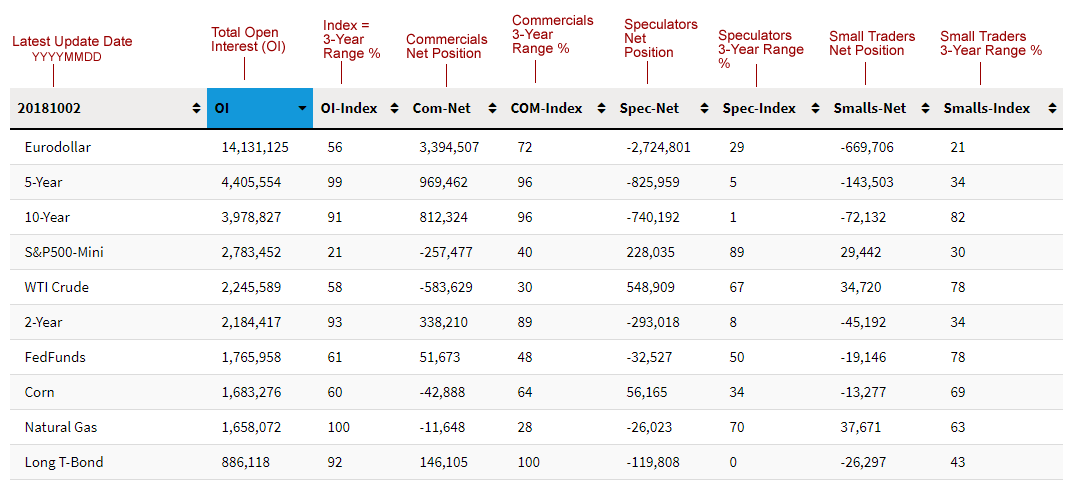
Data Snapshot of Stock Market Traders | Columns Legend
Sep-26-2023OIOI-IndexSpec-NetSpec-IndexCom-NetCOM-IndexSmalls-NetSmalls-Index
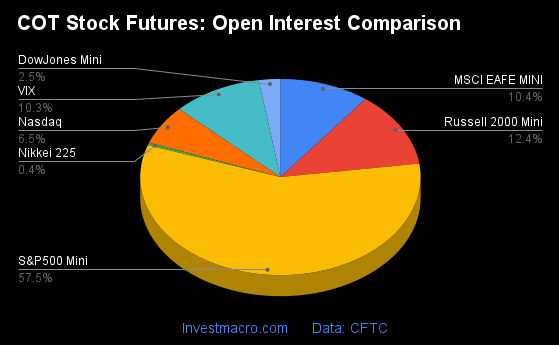
S&P500-Mini2,137,64815-89,2815165,6224923,65947
Nikkei 22515,48315-61062-1,200291,81051
Nasdaq-Mini241,0182984666-9923614666
DowJones-Mini92,55151-21,6181319,472732,14654
VIX384,93064-52,8358058,63119-5,79666
Nikkei 225 Yen53,6904210,779677,03230-17,81149


Strength Scores led by VIX & Nasdaq-Mini
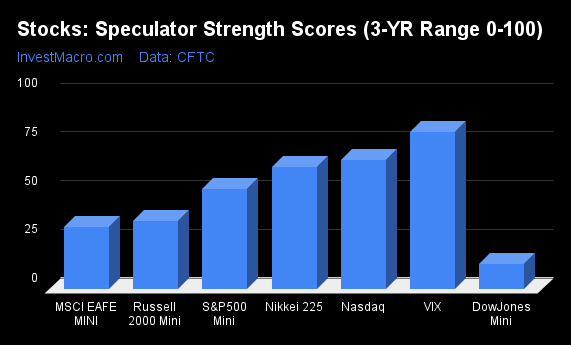
COT Strength Scores (a normalized measure of Speculator positions over a 3-Year range, from 0 to 100 where above 80 is Extreme-Bullish and below 20 is Extreme-Bearish) showed that the VIX (80 percent) currently leads the stock markets this week and is in Extreme-Bullish territory (above 80 percent). The Nasdaq-Mini (66 percent) and Nikkei 225 (62 percent) come in as the next highest in the weekly strength scores.

On the downside, the DowJones-Mini (13 percent) comes in at the lowest strength level currently and is in Extreme-Bearish territory (below 20 percent). The next lowest strength score is the MSCI EAFE-Mini (32 percent).

Strength Statistics:
VIX (80.4 percent) vs VIX previous week (97.9 percent)
S&P500-Mini (51.4 percent) vs S&P500-Mini previous week (44.0 percent)
DowJones-Mini (12.7 percent) vs DowJones-Mini previous week (23.6 percent)
Nasdaq-Mini (66.2 percent) vs Nasdaq-Mini previous week (68.2 percent)
Russell2000-Mini (35.0 percent) vs Russell2000-Mini previous week (33.8 percent)
Nikkei USD (62.4 percent) vs Nikkei USD previous week (63.8 percent)
EAFE-Mini (31.7 percent) vs EAFE-Mini previous week (27.0 percent)


Russell-Mini tops the 6-Week Strength Trends
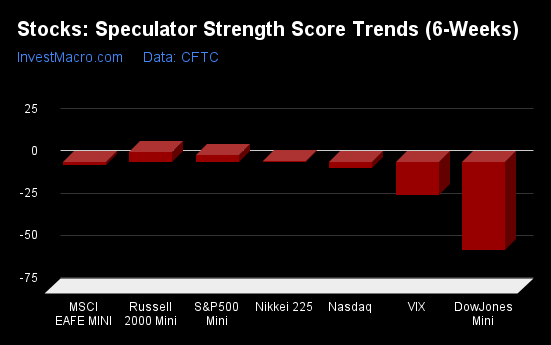
COT Strength Score Trends (or move index, calculates the 6-week changes in strength scores) showed that the Russell-Mini (6 percent) leads the past six weeks trends for the stock markets. The S&P500-Mini (4 percent) and the Nikkei 225 (1 percent) are the next highest positive movers in the latest trends data.

The DowJones-Mini (-52 percent) leads the downside trend scores currently with the VIX (-20 percent) coming in as the next market with lower trend scores.

Strength Trend Statistics:
VIX (-19.6 percent) vs VIX previous week (11.4 percent)
S&P500-Mini (4.3 percent) vs S&P500-Mini previous week (3.1 percent)
DowJones-Mini (-52.1 percent) vs DowJones-Mini previous week (-61.7 percent)
Nasdaq-Mini (-3.8 percent) vs Nasdaq-Mini previous week (12.3 percent)
Russell2000-Mini (5.8 percent) vs Russell2000-Mini previous week (0.6 percent)
Nikkei USD (0.6 percent) vs Nikkei USD previous week (1.8 percent)
EAFE-Mini (-1.8 percent) vs EAFE-Mini previous week (-7.1 percent)


Individual Stock Market Charts:

VIX Volatility Futures:
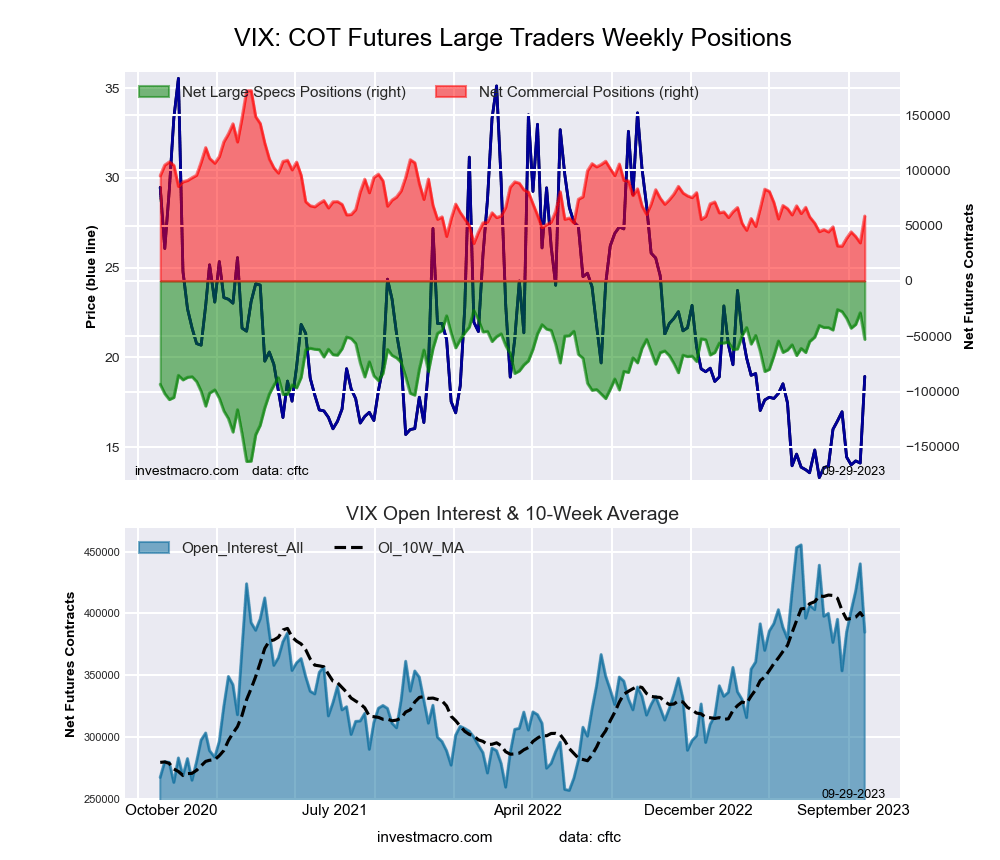
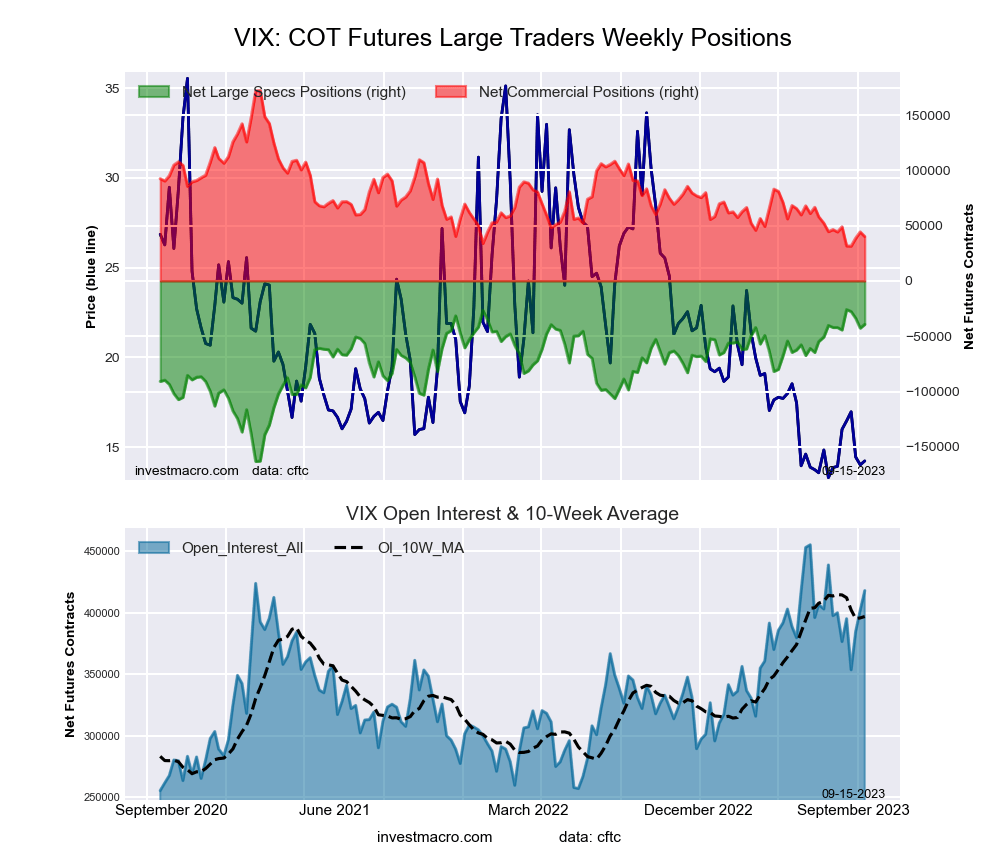
VIX Volatility Futures COT ChartThe VIX Volatility large speculator standing this week reached a net position of -52,835 contracts in the data reported through Tuesday. This was a weekly lowering of -24,019 contracts from the previous week which had a total of -28,816 net contracts.

This week’s current strength score (the trader positioning range over the past three years, measured from 0 to 100) shows the speculators are currently Bullish-Extreme with a score of 80.4 percent. The commercials are Bearish-Extreme with a score of 19.3 percent and the small traders (not shown in chart) are Bullish with a score of 66.4 percent.

Price Trend-Following Model: Strong Uptrend

Our weekly trend-following model classifies the current market price position as: Strong Uptrend. The current action for the model is considered to be: New Buy – Long Position.

VIX Volatility Futures StatisticsSPECULATORSCOMMERCIALSSMALL TRADERS
– Percent of Open Interest Longs:22.447.26.4
– Percent of Open Interest Shorts:36.232.07.9
– Net Position:-52,83558,631-5,796
– Gross Longs:86,408181,65124,727
– Gross Shorts:139,243123,02030,523
– Long to Short Ratio:0.6 to 11.5 to 10.8 to 1
NET POSITION TREND:
– Strength Index Score (3 Year Range Pct):80.419.366.4
– Strength Index Reading (3 Year Range):Bullish-ExtremeBearish-ExtremeBullish
NET POSITION MOVEMENT INDEX:
– 6-Week Change in Strength Index:-19.619.2-0.9


S&P500 Mini Futures:

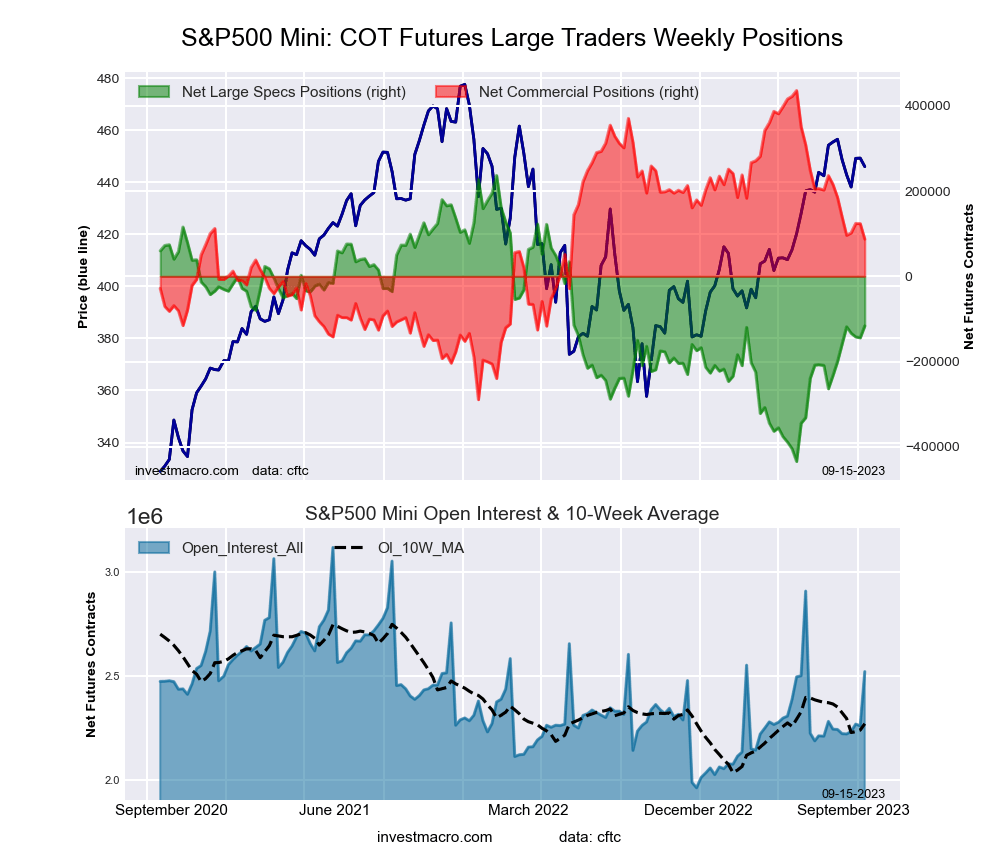
SP500 Mini Futures COT ChartThe S&P500 Mini large speculator standing this week reached a net position of -89,281 contracts in the data reported through Tuesday. This was a weekly lift of 49,710 contracts from the previous week which had a total of -138,991 net contracts.

This week’s current strength score (the trader positioning range over the past three years, measured from 0 to 100) shows the speculators are currently Bullish with a score of 51.4 percent. The commercials are Bearish with a score of 49.0 percent and the small traders (not shown in chart) are Bearish with a score of 46.6 percent.

Price Trend-Following Model: Weak Uptrend

Our weekly trend-following model classifies the current market price position as: Weak Uptrend. The current action for the model is considered to be: Hold – Maintain Long Position.

S&P500 Mini Futures StatisticsSPECULATORSCOMMERCIALSSMALL TRADERS
– Percent of Open Interest Longs:12.473.011.8
– Percent of Open Interest Shorts:16.669.910.7
– Net Position:-89,28165,62223,659
– Gross Longs:266,0951,560,014251,580
– Gross Shorts:355,3761,494,392227,921
– Long to Short Ratio:0.7 to 11.0 to 11.1 to 1
NET POSITION TREND:
– Strength Index Score (3 Year Range Pct):51.449.046.6
– Strength Index Reading (3 Year Range):BullishBearishBearish
NET POSITION MOVEMENT INDEX:
– 6-Week Change in Strength Index:4.3-4.20.6


Dow Jones Mini Futures:

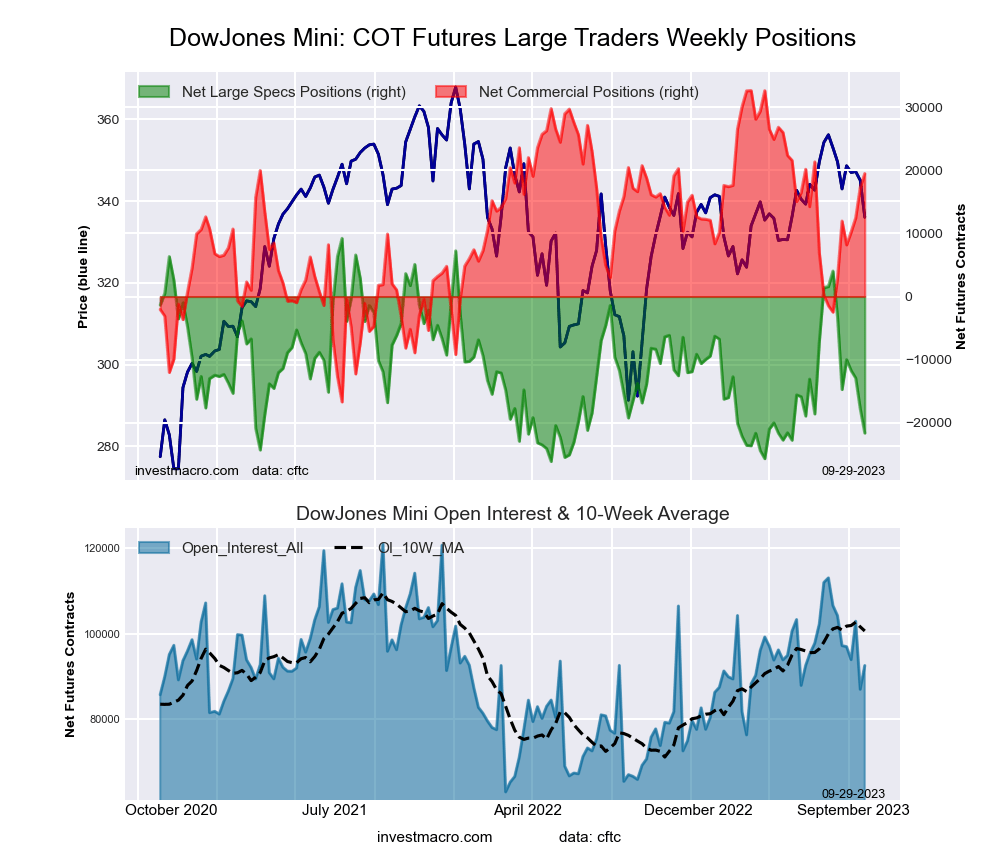
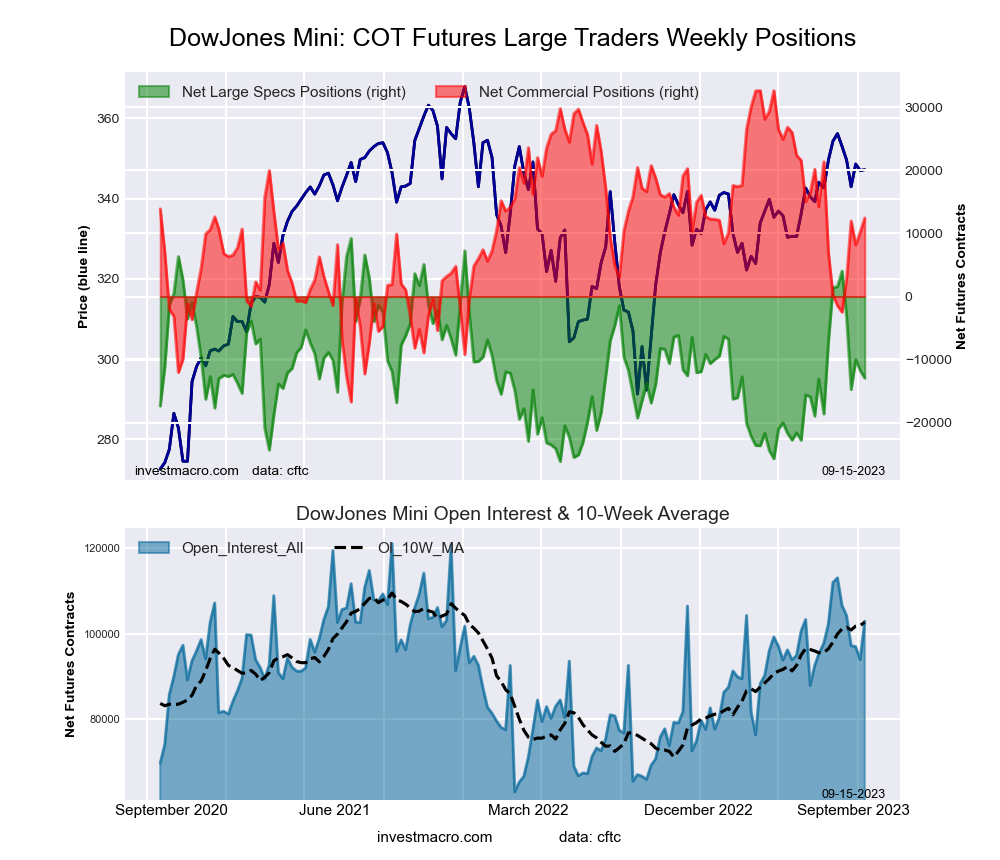
Dow Jones Mini Futures COT ChartThe Dow Jones Mini large speculator standing this week reached a net position of -21,618 contracts in the data reported through Tuesday. This was a weekly lowering of -3,849 contracts from the previous week which had a total of -17,769 net contracts.

This week’s current strength score (the trader positioning range over the past three years, measured from 0 to 100) shows the speculators are currently Bearish-Extreme with a score of 12.7 percent. The commercials are Bullish with a score of 73.3 percent and the small traders (not shown in chart) are Bullish with a score of 54.4 percent.

Price Trend-Following Model: Weak Uptrend

Our weekly trend-following model classifies the current market price position as: Weak Uptrend. The current action for the model is considered to be: Hold – Maintain Long Position.

Dow Jones Mini Futures StatisticsSPECULATORSCOMMERCIALSSMALL TRADERS
– Percent of Open Interest Longs:19.762.315.7
– Percent of Open Interest Shorts:43.141.313.4
– Net Position:-21,61819,4722,146
– Gross Longs:18,23757,68114,570
– Gross Shorts:39,85538,20912,424
– Long to Short Ratio:0.5 to 11.5 to 11.2 to 1
NET POSITION TREND:
– Strength Index Score (3 Year Range Pct):12.773.354.4
– Strength Index Reading (3 Year Range):Bearish-ExtremeBullishBullish
NET POSITION MOVEMENT INDEX:
– 6-Week Change in Strength Index:-52.133.78.8


Nasdaq Mini Futures:

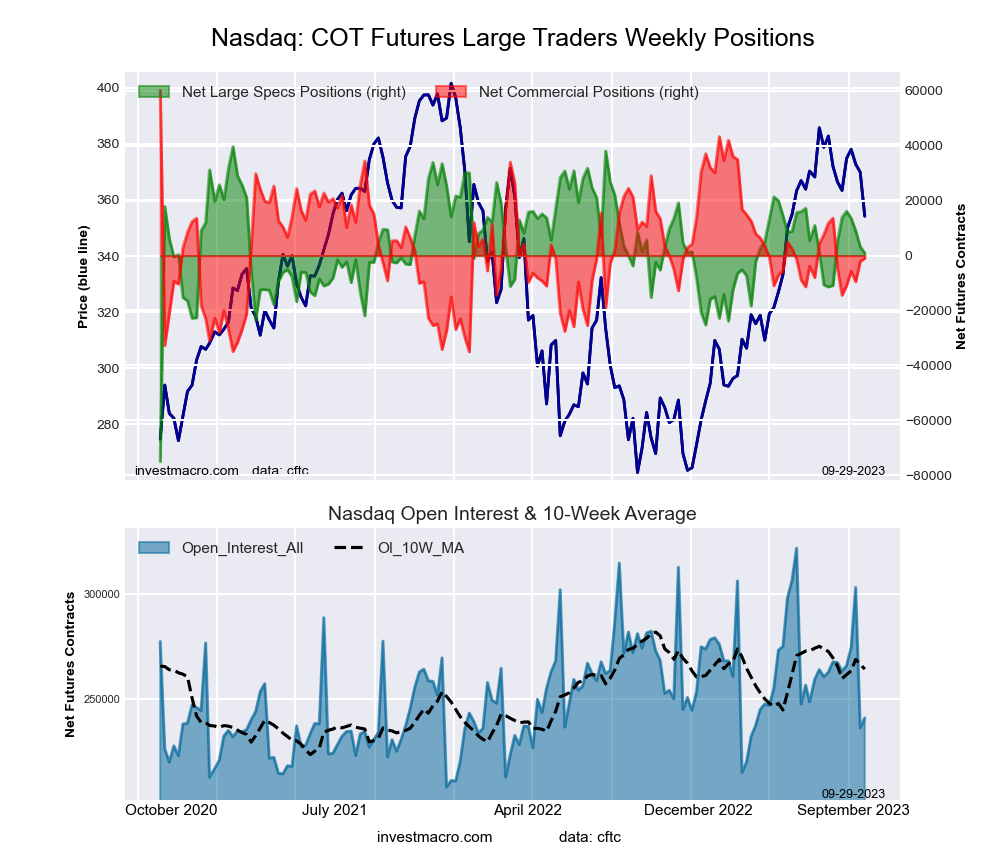
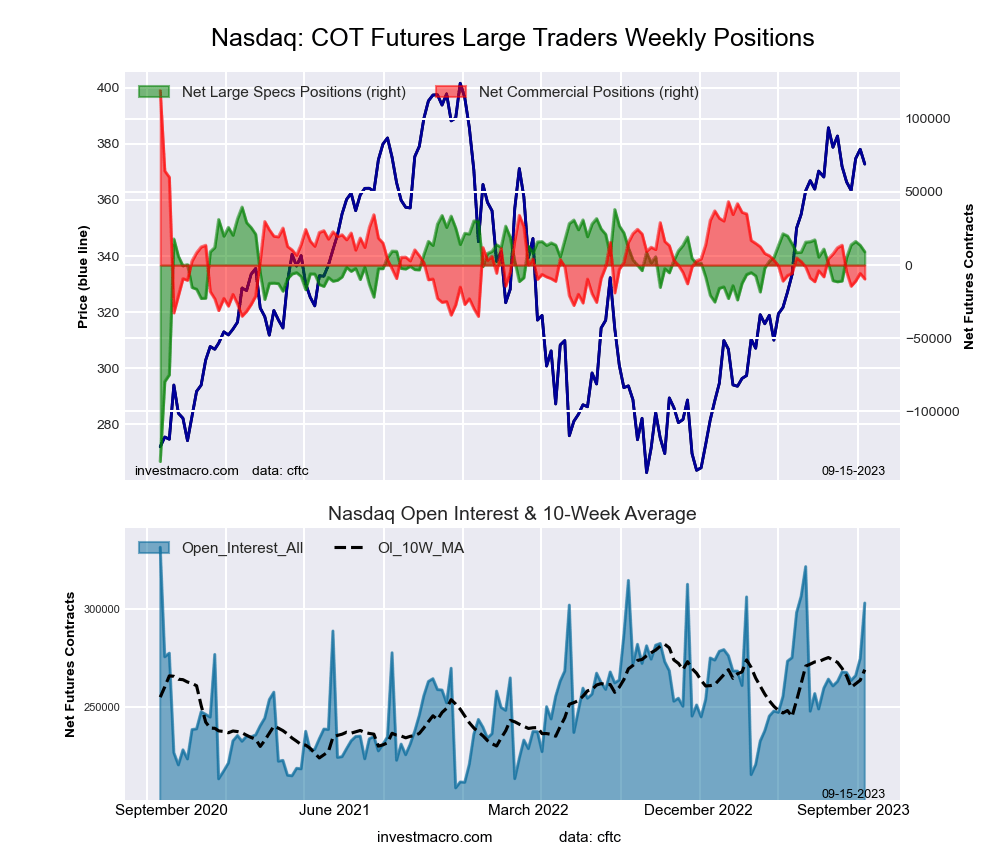
Nasdaq Mini Futures COT ChartThe Nasdaq Mini large speculator standing this week reached a net position of 846 contracts in the data reported through Tuesday. This was a weekly decline of -2,348 contracts from the previous week which had a total of 3,194 net contracts.

This week’s current strength score (the trader positioning range over the past three years, measured from 0 to 100) shows the speculators are currently Bullish with a score of 66.2 percent. The commercials are Bearish with a score of 35.8 percent and the small traders (not shown in chart) are Bullish with a score of 66.0 percent.

Price Trend-Following Model: Weak Uptrend

Our weekly trend-following model classifies the current market price position as: Weak Uptrend. The current action for the model is considered to be: Hold – Maintain Long Position.

Nasdaq Mini Futures StatisticsSPECULATORSCOMMERCIALSSMALL TRADERS
– Percent of Open Interest Longs:24.258.216.6
– Percent of Open Interest Shorts:23.858.616.5
– Net Position:846-992146
– Gross Longs:58,307140,15639,946
– Gross Shorts:57,461141,14839,800
– Long to Short Ratio:1.0 to 11.0 to 11.0 to 1
NET POSITION TREND:
– Strength Index Score (3 Year Range Pct):66.235.866.0
– Strength Index Reading (3 Year Range):BullishBearishBullish
NET POSITION MOVEMENT INDEX:
– 6-Week Change in Strength Index:-3.83.91.4


Russell 2000 Mini Futures:

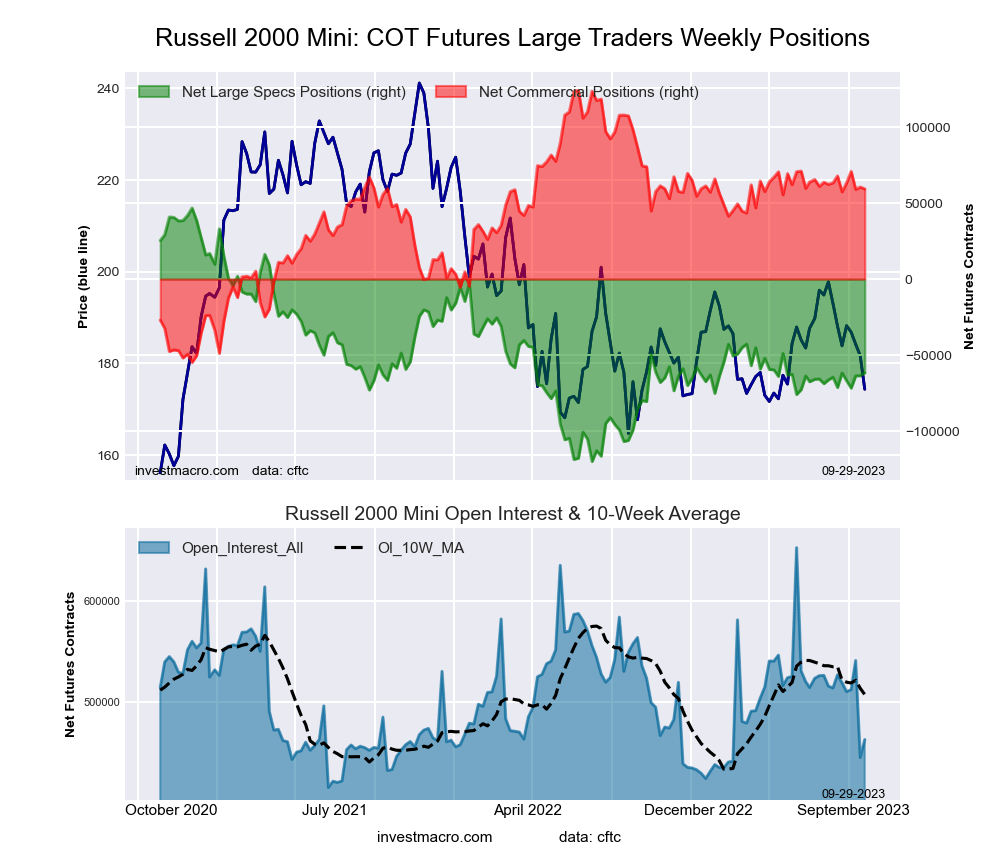
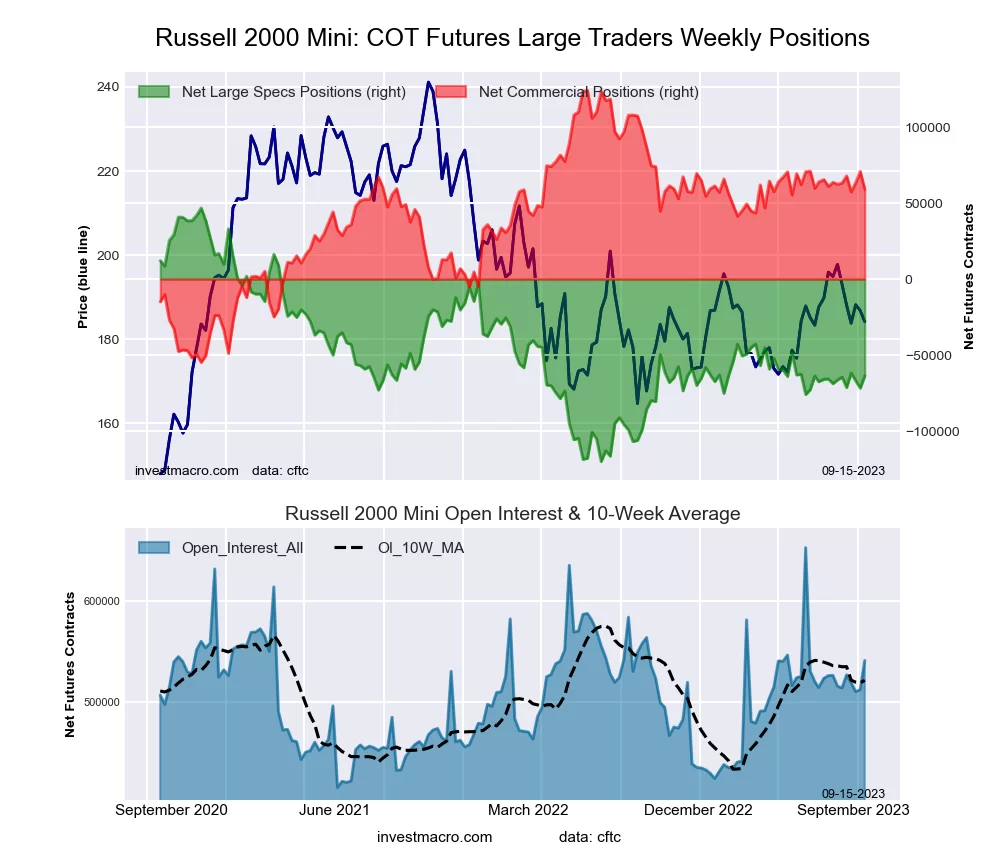
Russell 2000 Mini Futures COT ChartThe Russell 2000 Mini large speculator standing this week reached a net position of -61,602 contracts in the data reported through Tuesday. This was a weekly rise of 1,959 contracts from the previous week which had a total of -63,561 net contracts.

This week’s current strength score (the trader positioning range over the past three years, measured from 0 to 100) shows the speculators are currently Bearish with a score of 35.0 percent. The commercials are Bullish with a score of 63.8 percent and the small traders (not shown in chart) are Bearish with a score of 33.8 percent.

Price Trend-Following Model: Weak Uptrend

Our weekly trend-following model classifies the current market price position as: Weak Uptrend. The current action for the model is considered to be: Hold – Maintain Long Position.

Russell 2000 Mini Futures StatisticsSPECULATORSCOMMERCIALSSMALL TRADERS
– Percent of Open Interest Longs:7.785.25.4
– Percent of Open Interest Shorts:21.072.44.9
– Net Position:-61,60259,2762,326
– Gross Longs:35,566393,90724,965
– Gross Shorts:97,168334,63122,639
– Long to Short Ratio:0.4 to 11.2 to 11.1 to 1
NET POSITION TREND:
– Strength Index Score (3 Year Range Pct):35.063.833.8
– Strength Index Reading (3 Year Range):BearishBullishBearish
NET POSITION MOVEMENT INDEX:
– 6-Week Change in Strength Index:5.8-4.8-3.5


Nikkei Stock Average (USD) Futures:

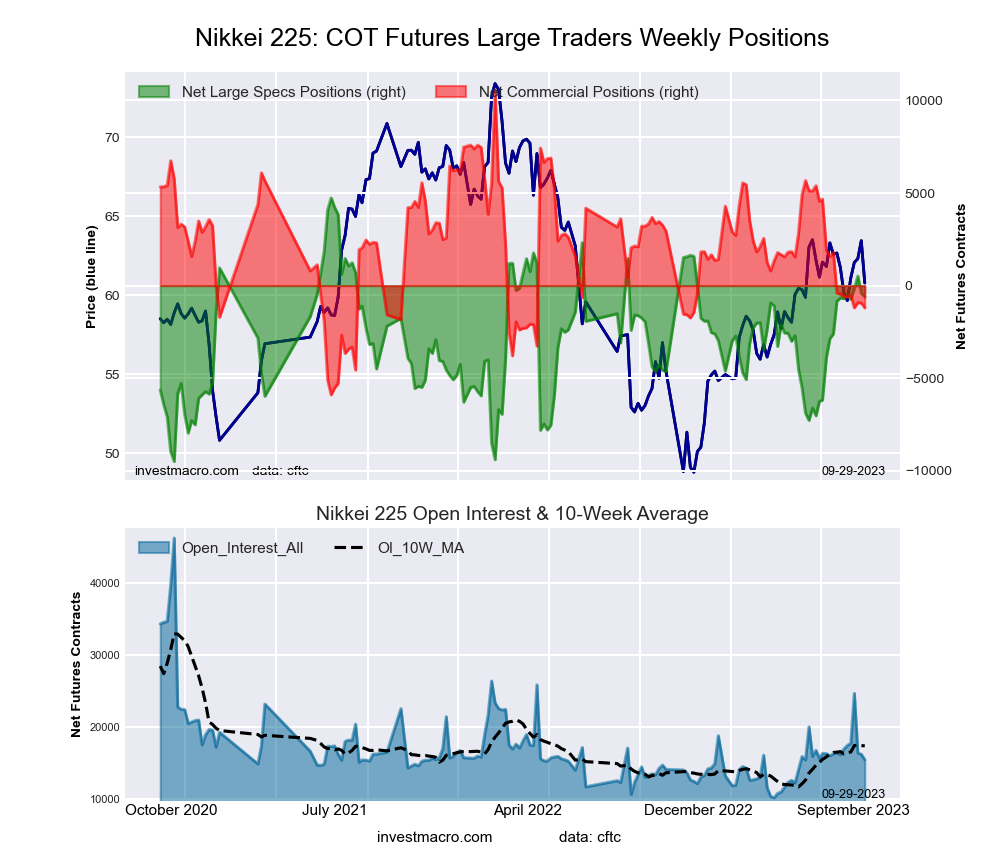
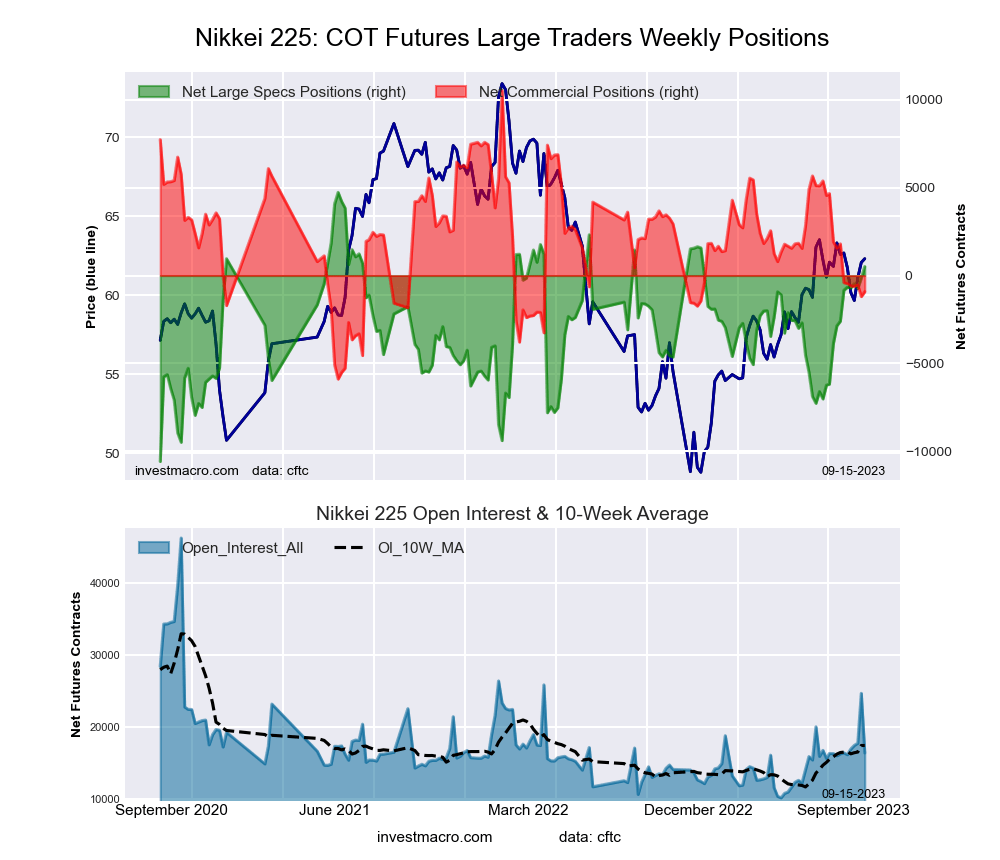
Nikkei Stock Average (USD) Futures COT ChartThe Nikkei Stock Average (USD) large speculator standing this week reached a net position of -610 contracts in the data reported through Tuesday. This was a weekly reduction of -196 contracts from the previous week which had a total of -414 net contracts.

This week’s current strength score (the trader positioning range over the past three years, measured from 0 to 100) shows the speculators are currently Bullish with a score of 62.4 percent. The commercials are Bearish with a score of 28.6 percent and the small traders (not shown in chart) are Bullish with a score of 51.1 percent.

Price Trend-Following Model: Weak Uptrend

Our weekly trend-following model classifies the current market price position as: Weak Uptrend. The current action for the model is considered to be: Hold – Maintain Long Position.

Nikkei Stock Average Futures StatisticsSPECULATORSCOMMERCIALSSMALL TRADERS
– Percent of Open Interest Longs:8.667.124.4
– Percent of Open Interest Shorts:12.574.812.7
– Net Position:-610-1,2001,810
– Gross Longs:1,32510,3853,773
– Gross Shorts:1,93511,5851,963
– Long to Short Ratio:0.7 to 10.9 to 11.9 to 1
NET POSITION TREND:
– Strength Index Score (3 Year Range Pct):62.428.651.1
– Strength Index Reading (3 Year Range):BullishBearishBullish
NET POSITION MOVEMENT INDEX:
– 6-Week Change in Strength Index:0.6-3.76.5


MSCI EAFE Mini Futures:

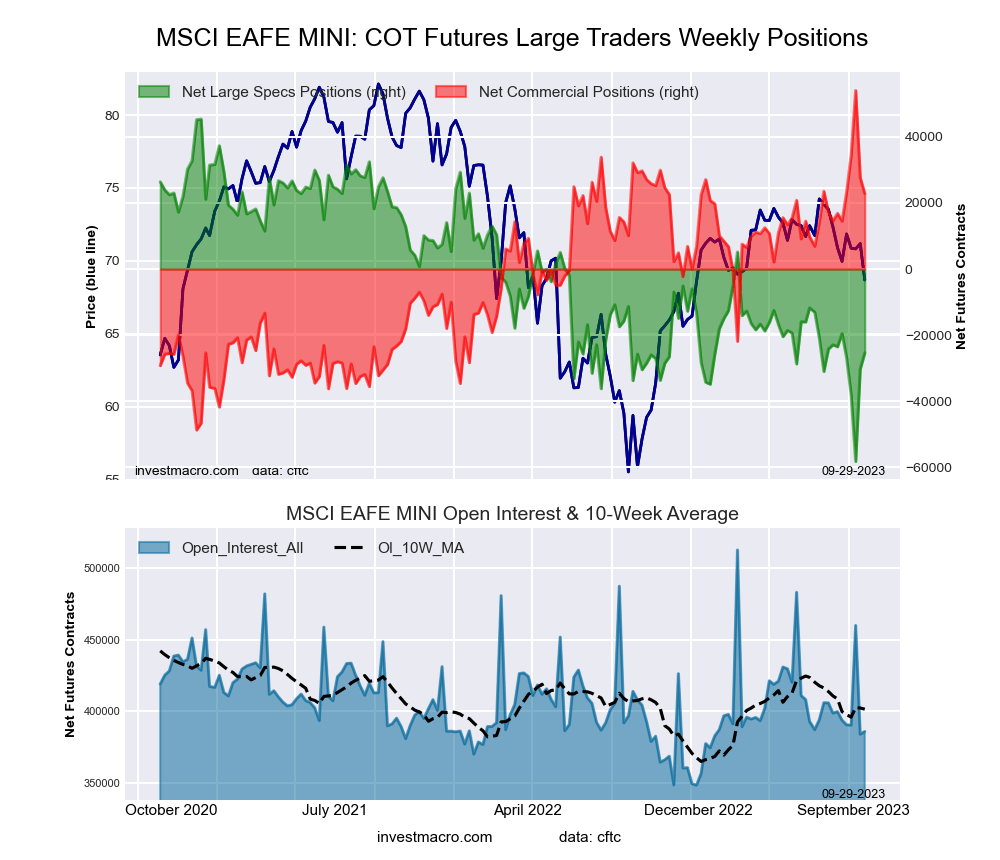
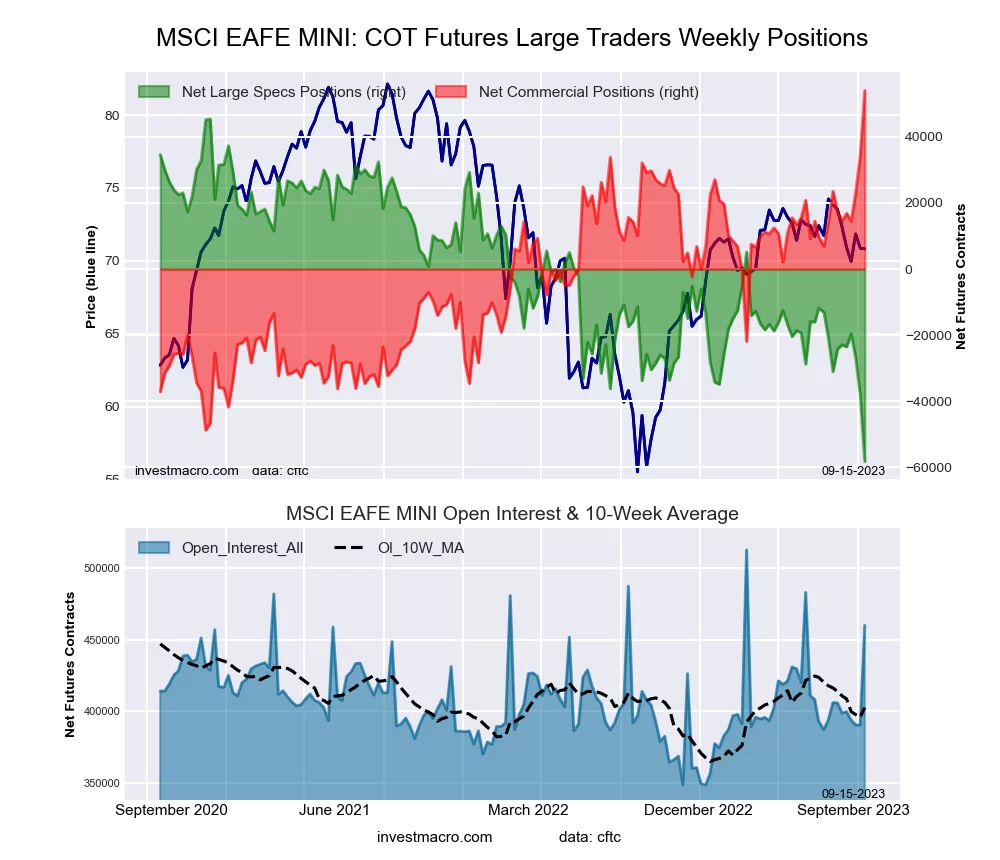
MSCI EAFE Mini Futures COT ChartThe MSCI EAFE Mini large speculator standing this week reached a net position of -25,328 contracts in the data reported through Tuesday. This was a weekly gain of 4,923 contracts from the previous week which had a total of -30,251 net contracts.

This week’s current strength score (the trader positioning range over the past three years, measured from 0 to 100) shows the speculators are currently Bearish with a score of 31.7 percent. The commercials are Bullish with a score of 69.6 percent and the small traders (not shown in chart) are Bearish with a score of 29.5 percent.

Price Trend-Following Model: Strong Downtrend

Our weekly trend-following model classifies the current market price position as: Strong Downtrend. The current action for the model is considered to be: Hold – Maintain Short Position.

MSCI EAFE Mini Futures StatisticsSPECULATORSCOMMERCIALSSMALL TRADERS
– Percent of Open Interest Longs:7.589.42.2
– Percent of Open Interest Shorts:14.183.51.6
– Net Position:-25,32822,8342,494
– Gross Longs:29,019344,9098,675
– Gross Shorts:54,347322,0756,181
– Long to Short Ratio:0.5 to 11.1 to 11.4 to 1
NET POSITION TREND:
– Strength Index Score (3 Year Range Pct):31.769.629.5
– Strength Index Reading (3 Year Range):BearishBullishBearish
NET POSITION MOVEMENT INDEX:
– 6-Week Change in Strength Index:-1.85.8-20.7


Article By InvestMacroReceive our weekly COT Newsletter

See our Weekly Trend Model Readings and Actions for each COT Futures Market and Category. All information contained in this data are for general informational purposes only and do not constitute investment advice.

*COT Report: The COT data, released weekly to the public each Friday, is updated through the most recent Tuesday (data is 3 days old) and shows a quick view of how large speculators or non-commercials (for-profit traders) were positioned in the futures markets.

The CFTC categorizes trader positions according to commercial hedgers (traders who use futures contracts for hedging as part of the business), non-commercials (large traders who speculate to realize trading profits) and nonreportable traders (usually small traders/speculators) as well as their open interest (contracts open in the market at time of reporting). See CFTC criteria here.


Union and execs need to shift gears fast once UAW strike is over – transition to EV manufacturing requires their teamwork

By Peter Berg, Michigan State University

The United Auto Workers union is ramping up its strike against General Motors and Stellantis – the global company that makes Chrysler, Jeep and Dodge vehicles – and getting closer to a deal with Ford.

About 5,600 UAW members at 38 General Motors and Stellantis distribution centers for auto parts in 20 states walked off the job on Sept. 22, 2023, after an announcement by UAW President Shawn Fain.

Workers at the only Ford plant affected by the strike since it began on Sept. 15 will remain off the job. The total number of UAW members involved in the strike stands at about 18,300.

Under Fain’s leadership, the union is taking an adversarial approach: It’s railing against what it describes as the “poverty wages” UAW members earn while denouncing the automakers’ CEOs as “greedy” and vowing to “wreck their economy.”

As a scholar of employment relations, I think this strike is too narrowly focused on making up for the wages and benefits autoworkers have lost in recent years. But another big objective is ensuring that autoworkers will have good jobs once most U.S.-made vehicles are electric-powered.

This dispute alone will not resolve this larger objective. Rather, I believe management and labor will need to swiftly move on following the strike and work together constructively to meet that goal.

UAW’s demands

The union is demanding an end to the concessions it made to the three companies during the financial crisis that began in 2007. Its members employed by Ford, GM and Stellantis have experienced a 19% decline in their wages, after accounting for inflation, since 2008.

The union also wants the automakers – sometimes called the Detroit Three – to abolish the tiered wage system, which pays new employees far less than more experienced workers, even for the same work. The UAW initially said it was seeking a wage increase of 40% over four years and the restoration of a cost-of-living allowance that would link wages to inflation.

In addition to these demands, the UAW wants defined-benefit pensions for all workers restored, company-paid health benefits for retirees reestablished and the right to strike over plant closures guaranteed. Other demands include more paid time off and seeing all temporary workers made permanent. It has also called for a 32-hour work week without a pay cut.

Precedents for working together

Although the strike has emphasized the goal of boosting future autoworker pay and benefits, I believe that workers and management can look to the past for ideas that might help them move forward.

GM’s Saturn partnership offers one potential model.

The company’s approach to its Saturn brand of compact vehicles, launched in 1985, was unique in many respects. Its governance structure was characterized by shared decision-making at different levels throughout the plant. The local union was a full partner in virtually all business decisions.

GM invested billions of dollars in this venture, through which it tried to compete with Japanese imports and transplants that were quickly eroding GM’s market share. Saturns were designed differently than other U.S. vehicles, but what made those vehicles special was the extent to which labor shared the responsibility for running Saturn’s main factory.

The Saturn partnership was hard to maintain, especially following the departure of Roger B. Smith, the General Motors CEO who had pushed hard for it. The company stopped making Saturns in 2009, but the former subsidiary’s overall approach of involving workers in decisions about their jobs and the manufacturing process remains as critical today as it was in its heyday.

I would encourage the auto industry to again invoke the spirit of the Saturn venture, which emphasized the collaboration and partnership of labor and management in the production of high-quality, world-class vehicles. Only this time, the vehicles will be EVs.

GM offers another model for positive union-management relations.

About 20 years ago, its Lansing-Grand River assembly plant in Michigan began to engage in a similar example of what I call joint responsibility unionism. Management and the local UAW union established a contractual commitment to work together to continually improve production by systematically solving problems and increasing productivity.

Management and the local UAW union established a contractual commitment to work together to continually improve production by systematically solving problems and increasing productivity.

The local union and management hold each other accountable for keeping costs down and quality high. The plant, which assembles Cadillacs and Chevy Camaros, continues this approach successfully today.

Shift the focus to the future

The UAW is pointing to the billions of dollars in profits auto companies are currently getting when it demands a bigger piece of the pie. The companies counter that rapidly increasing EV production is costly.

GM, Ford and Stellantis already plan to invest more than US$100 billion in electric vehicle manufacturing. As production shifts away from vehicles with internal combustion engines that burn gasoline or diesel fuel, the number of autoworkers needed to build them will decline. EVs have fewer parts.

Ford and Volkswagen, for example, have estimated that they’ll eventually need 30% less labor due to the EV transition.

Undergoing this transformation with labor and management at loggerheads can’t possibly benefit the UAW or the auto companies.

Instead, they’ll need to focus on finding solutions together that increase productivity, build a skilled workforce and efficiently convert plants that make conventional vehicles today to EV factories tomorrow. In so doing, the UAW is more likely to meet its goal of seeing those EV factories employ its members.The Conversation

About the Author:

Peter Berg, Professor of Employment Relations; Director of Human Resources and Labor Relations, Michigan State University

This article is republished from The Conversation under a Creative Commons license. Read the original article.

Mid-Week Technical Outlook: Indices

By ForexTime 

Some semblance of stability returned to global equity markets on Wednesday as rate hike fears cooled after a sharp selloff in the previous session.

European stocks edged higher in tight ranges while US futures are pointing to a mixed open amid the cautious market mood. In the currency arena, the dollar continues to dominate with the USD Index trading at levels not seen since November 2022. Looking at commodities, oil prices surged this morning while gold extended losses thanks to rising Treasury yields and a stronger dollar.

Our attention today falls on major indices which seem to be under the mercy of rate hike fears.

SPX500_m could test 200-day SMA

The bearish case for the SPX500_m was reinforced after prices secured a solid daily close below the 4332 levels.

There have been consistently lower lows and lower highs while the MACD trades below zero. Bears are clearly in a position of power with a breakdown below 4270, opening a path towards the 200-day SMA at 4210. For bulls to jump back into the game, a move back 4332 needs to be achieved.

NQ100_m breaks key daily support

The recent breakdown below the 14670 support level may signal further downside for the NQ100_m with 14250 acting as a key level of interest.

Technical forces favour bears, as there have been consistently lower lows and lower highs while prices are trading below the 50 and 100-day SMA. Should prices push back above 14670, this could trigger a rebound towards the 100-day SMA before the downside resumes.

STOX50_m wobbles above 4100

It is safe to say that STOX50_m bears remain in some position of power below the 4200 resistance level.

Prices are approaching another support at 4100, a level not seen since March 2022. A solid breakdown below this level could trigger a selloff towards 4060. Should 4100 prove to be reliable support, prices may push back towards 4200.

UK100_m trapped in wide range

It remains a choppy affair for the UK100_m which is currently trapped within a very wide range on the daily charts.

Resistance can be found at 7710 and support at 7250. Despite the choppiness, prices could be gearing up to decline given the recent break below the 200-day SMA. A strong daily close under 7605 may spark a selloff towards 7530 – where the 50-day SMA resides. If bulls can fight back, a bounce towards 7710 could be on the cards.


Forex-Time-LogoArticle by ForexTime

ForexTime Ltd (FXTM) is an award winning international online forex broker regulated by CySEC 185/12 www.forextime.com

Cycle of rate hikes is over – are your investments aligned?

By George Prior 

Investors need now to ensure their investment portfolios are ready for “a new era” as central banks become seemingly convinced that no further interest rate rises will be needed in this monetary cycle.

This assessment from Nigel Green of deVere Group, one of the world’s largest independent financial advisory, asset management and fintech organizations, comes as policymakers in the US, UK, Japan and Switzerland all decided to keep rates steady last week.

He comments: “We’re in a transition period ahead of a new monetary era as most of the world’s most influential central banks are now anticipated to cut interest rates in the next quarter of 2024, rather than raise them.

“This is because we’re heading into a stage of lower growth and lower inflation.”

With central banks, it appears, having reached a consensus that no further interest rate hikes are likely to be needed, investors must recalibrate their strategies.

Diversification remains a foundational strategy in managing investment risk. Investors should consider allocating their assets across various classes, including equities, fixed income, real estate, and alternatives.

Amid economic deceleration, it’s prudent to emphasize defensive stocks in your portfolio.

“These are companies that tend to exhibit resilience during downturns due to the essential nature of their products or services. Sectors like healthcare, utilities, and consumer staples often fall into this category. Companies in these sectors can continue to generate revenue even when consumer spending weakens,” says the deVere CEO.

“While economic growth may slow, technological advancements and innovation continue to shape the future. Investing in companies at the forefront of technology and innovation can be a smart move. This includes sectors like tech, biotech, and green energy, which may experience sustained growth as society seeks solutions to pressing global challenges.”

He goes on to add: “Also, consider investments with a fixed income component to match your risk tolerance and income needs.”

In addition, emerging markets, notes Nigel Green, can present attractive opportunities during periods of global economic slowdown. These markets often exhibit higher growth potential compared to mature economies. “However, they also come with higher volatility and risks, so thorough research and a long-term investment horizon are essential.”

Navigating the complexities of investing during economic slowdowns requires careful planning and expertise. Seeking advice from a financial advisor can provide you with a tailored investment strategy based on your unique financial goals, risk tolerance, and time horizon.

“The world is about to shift into a new era and your investments should be aligned accordingly if you’re serious about creating, growing and safeguarding your money,” says Nigel Green.

About:

deVere Group is one of the world’s largest independent advisors of specialist global financial solutions to international, local mass affluent, and high-net-worth clients.  It has a network of offices across the world, over 80,000 clients and $12bn under advisement.

COT Stock Market Charts: Weekly Speculator Bets led by S&P500-Mini & Russell-Mini 

By InvestMacro

Here are the latest charts and statistics for the Commitment of Traders (COT) data published by the Commodities Futures Trading Commission (CFTC).

The latest COT data is updated through Tuesday September 12th and shows a quick view of how large traders (for-profit speculators and commercial entities) were positioned in the futures markets.

Weekly Speculator Changes led by S&P500-Mini & Russell-Mini

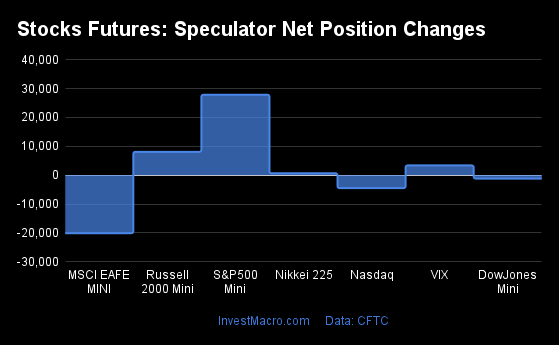
The COT stock markets speculator bets were higher this week as four out of the seven stock markets we cover had higher positioning while the other four markets had lower speculator contracts.

Leading the gains for the stock markets was the S&P500-Mini (27,878 contracts) with the Russell-Mini (8,096 contracts), the Nikkei 225 (656 contracts) and the VIX (3,384 contracts) also showing positive weeks.

The markets with the declines in speculator bets this week were the MSCI EAFE-Mini (-20,113 contracts) with the Nasdaq-Mini (-4,494 contracts) and the DowJones-Mini (-1,176 contracts) also registering lower bets on the week.


Data Snapshot of Stock Market Traders | Columns Legend
Sep-12-2023OIOI-IndexSpec-NetSpec-IndexCom-NetCOM-IndexSmalls-NetSmalls-Index
S&P500-Mini2,520,16448-116,3334787,0455229,28849
Nikkei 22516,4251751472-9183040433
Nasdaq-Mini303,321779,05682-9,5081745266
DowJones-Mini102,91069-12,9003712,4375946346
VIX418,07281-39,3429040,0996-75792
Nikkei 225 Yen46,463293,889466,64629-10,53573


Strength Scores led by VIX & Nasdaq-Mini

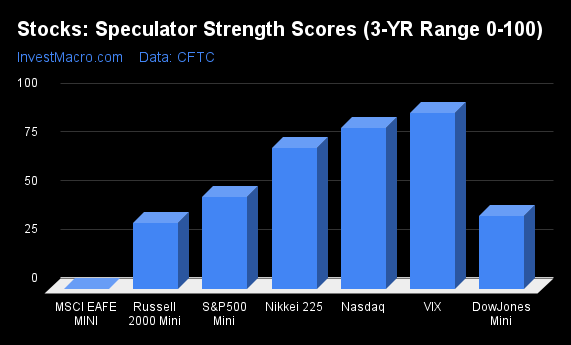
COT Strength Scores (a normalized measure of Speculator positions over a 3-Year range, from 0 to 100 where above 80 is Extreme-Bullish and below 20 is Extreme-Bearish) showed that the VIX (90 percent) and the Nasdaq-Mini (82 percent) lead the stock markets this week. The Nikkei 225 (72 percent) and S&P500-Mini (47 percent) come in as the next highest in the weekly strength scores.

On the downside, the MSCI EAFE-Mini (0 percent) comes in at the lowest strength level currently and is in Extreme-Bearish territory (below 20 percent). The next lowest strength score is the Russell-Mini (34 percent).

Strength Statistics:
VIX (90.3 percent) vs VIX previous week (87.8 percent)
S&P500-Mini (47.4 percent) vs S&P500-Mini previous week (43.2 percent)
DowJones-Mini (37.4 percent) vs DowJones-Mini previous week (40.7 percent)
Nasdaq-Mini (82.4 percent) vs Nasdaq-Mini previous week (85.0 percent)
Russell2000-Mini (33.8 percent) vs Russell2000-Mini previous week (28.9 percent)
Nikkei USD (72.4 percent) vs Nikkei USD previous week (68.2 percent)
EAFE-Mini (0.0 percent) vs EAFE-Mini previous week (19.4 percent)


S&P500-Mini & Nasdaq-Mini top the 6-Week Strength Trends

COT Strength Score Trends (or move index, calculates the 6-week changes in strength scores) showed that the S&P500-Mini (13 percent) leads the past six weeks trends for the stock markets. The Nasdaq-Mini (12 percent), the Nikkei 225 (9 percent) and the VIX (2 percent) are the next highest positive movers in the latest trends data.

The DowJones-Mini (-41 percent) leads the downside trend scores currently with the MSCI EAFE-Mini (-33 percent) coming in as the next market with lower trend scores.

Strength Trend Statistics:
VIX (2.1 percent) vs VIX previous week (-0.4 percent)
S&P500-Mini (12.5 percent) vs S&P500-Mini previous week (13.2 percent)
DowJones-Mini (-41.0 percent) vs DowJones-Mini previous week (-37.2 percent)
Nasdaq-Mini (11.8 percent) vs Nasdaq-Mini previous week (13.9 percent)
Russell2000-Mini (1.6 percent) vs Russell2000-Mini previous week (-1.8 percent)
Nikkei USD (8.9 percent) vs Nikkei USD previous week (16.0 percent)
EAFE-Mini (-32.8 percent) vs EAFE-Mini previous week (-6.9 percent)


Individual Stock Market Charts:

VIX Volatility Futures:

VIX Volatility Futures COT ChartThe VIX Volatility large speculator standing this week equaled a net position of -39,342 contracts in the data reported through Tuesday. This was a weekly boost of 3,384 contracts from the previous week which had a total of -42,726 net contracts.

This week’s current strength score (the trader positioning range over the past three years, measured from 0 to 100) shows the speculators are currently Bullish-Extreme with a score of 90.3 percent. The commercials are Bearish-Extreme with a score of 6.2 percent and the small traders (not shown in chart) are Bullish-Extreme with a score of 91.9 percent.

Price Trend-Following Model: Strong Downtrend

Our weekly trend-following model classifies the current market price position as: Strong Downtrend. The current action for the model is considered to be: Hold – Maintain Short Position.

VIX Volatility Futures StatisticsSPECULATORSCOMMERCIALSSMALL TRADERS
– Percent of Open Interest Longs:24.946.06.5
– Percent of Open Interest Shorts:34.336.46.7
– Net Position:-39,34240,099-757
– Gross Longs:104,179192,41927,224
– Gross Shorts:143,521152,32027,981
– Long to Short Ratio:0.7 to 11.3 to 11.0 to 1
NET POSITION TREND:
– Strength Index Score (3 Year Range Pct):90.36.291.9
– Strength Index Reading (3 Year Range):Bullish-ExtremeBearish-ExtremeBullish-Extreme
NET POSITION MOVEMENT INDEX:
– 6-Week Change in Strength Index:2.1-3.06.8


S&P500 Mini Futures:

SP500 Mini Futures COT ChartThe S&P500 Mini large speculator standing this week equaled a net position of -116,333 contracts in the data reported through Tuesday. This was a weekly increase of 27,878 contracts from the previous week which had a total of -144,211 net contracts.

This week’s current strength score (the trader positioning range over the past three years, measured from 0 to 100) shows the speculators are currently Bearish with a score of 47.4 percent. The commercials are Bullish with a score of 51.9 percent and the small traders (not shown in chart) are Bearish with a score of 48.9 percent.

Price Trend-Following Model: Uptrend

Our weekly trend-following model classifies the current market price position as: Uptrend. The current action for the model is considered to be: Hold – Maintain Long Position.

S&P500 Mini Futures StatisticsSPECULATORSCOMMERCIALSSMALL TRADERS
– Percent of Open Interest Longs:11.172.311.4
– Percent of Open Interest Shorts:15.768.810.2
– Net Position:-116,33387,04529,288
– Gross Longs:279,4711,821,412286,894
– Gross Shorts:395,8041,734,367257,606
– Long to Short Ratio:0.7 to 11.1 to 11.1 to 1
NET POSITION TREND:
– Strength Index Score (3 Year Range Pct):47.451.948.9
– Strength Index Reading (3 Year Range):BearishBullishBearish
NET POSITION MOVEMENT INDEX:
– 6-Week Change in Strength Index:12.5-13.65.8


Dow Jones Mini Futures:

Dow Jones Mini Futures COT ChartThe Dow Jones Mini large speculator standing this week equaled a net position of -12,900 contracts in the data reported through Tuesday. This was a weekly fall of -1,176 contracts from the previous week which had a total of -11,724 net contracts.

This week’s current strength score (the trader positioning range over the past three years, measured from 0 to 100) shows the speculators are currently Bearish with a score of 37.4 percent. The commercials are Bullish with a score of 59.1 percent and the small traders (not shown in chart) are Bearish with a score of 46.1 percent.

Price Trend-Following Model: Uptrend

Our weekly trend-following model classifies the current market price position as: Uptrend. The current action for the model is considered to be: Hold – Maintain Long Position.

Dow Jones Mini Futures StatisticsSPECULATORSCOMMERCIALSSMALL TRADERS
– Percent of Open Interest Longs:22.158.914.2
– Percent of Open Interest Shorts:34.746.813.7
– Net Position:-12,90012,437463
– Gross Longs:22,78860,63114,578
– Gross Shorts:35,68848,19414,115
– Long to Short Ratio:0.6 to 11.3 to 11.0 to 1
NET POSITION TREND:
– Strength Index Score (3 Year Range Pct):37.459.146.1
– Strength Index Reading (3 Year Range):BearishBullishBearish
NET POSITION MOVEMENT INDEX:
– 6-Week Change in Strength Index:-41.028.22.9


Nasdaq Mini Futures:

Nasdaq Mini Futures COT ChartThe Nasdaq Mini large speculator standing this week equaled a net position of 9,056 contracts in the data reported through Tuesday. This was a weekly decline of -4,494 contracts from the previous week which had a total of 13,550 net contracts.

This week’s current strength score (the trader positioning range over the past three years, measured from 0 to 100) shows the speculators are currently Bullish-Extreme with a score of 82.4 percent. The commercials are Bearish-Extreme with a score of 16.5 percent and the small traders (not shown in chart) are Bullish with a score of 66.2 percent.

Price Trend-Following Model: Uptrend

Our weekly trend-following model classifies the current market price position as: Uptrend. The current action for the model is considered to be: Hold – Maintain Long Position.

Nasdaq Mini Futures StatisticsSPECULATORSCOMMERCIALSSMALL TRADERS
– Percent of Open Interest Longs:22.656.614.8
– Percent of Open Interest Shorts:19.759.714.7
– Net Position:9,056-9,508452
– Gross Longs:68,674171,57044,891
– Gross Shorts:59,618181,07844,439
– Long to Short Ratio:1.2 to 10.9 to 11.0 to 1
NET POSITION TREND:
– Strength Index Score (3 Year Range Pct):82.416.566.2
– Strength Index Reading (3 Year Range):Bullish-ExtremeBearish-ExtremeBullish
NET POSITION MOVEMENT INDEX:
– 6-Week Change in Strength Index:11.8-13.82.1


Russell 2000 Mini Futures:

Russell 2000 Mini Futures COT ChartThe Russell 2000 Mini large speculator standing this week equaled a net position of -63,615 contracts in the data reported through Tuesday. This was a weekly rise of 8,096 contracts from the previous week which had a total of -71,711 net contracts.

This week’s current strength score (the trader positioning range over the past three years, measured from 0 to 100) shows the speculators are currently Bearish with a score of 33.8 percent. The commercials are Bullish with a score of 63.7 percent and the small traders (not shown in chart) are Bearish with a score of 40.7 percent.

Price Trend-Following Model: Uptrend

Our weekly trend-following model classifies the current market price position as: Uptrend. The current action for the model is considered to be: Hold – Maintain Long Position.

Russell 2000 Mini Futures StatisticsSPECULATORSCOMMERCIALSSMALL TRADERS
– Percent of Open Interest Longs:8.781.95.8
– Percent of Open Interest Shorts:20.571.04.9
– Net Position:-63,61559,0334,582
– Gross Longs:47,088443,19831,308
– Gross Shorts:110,703384,16526,726
– Long to Short Ratio:0.4 to 11.2 to 11.2 to 1
NET POSITION TREND:
– Strength Index Score (3 Year Range Pct):33.863.740.7
– Strength Index Reading (3 Year Range):BearishBullishBearish
NET POSITION MOVEMENT INDEX:
– 6-Week Change in Strength Index:1.6-1.81.8


Nikkei Stock Average (USD) Futures:

Nikkei Stock Average (USD) Futures COT ChartThe Nikkei Stock Average (USD) large speculator standing this week equaled a net position of 514 contracts in the data reported through Tuesday. This was a weekly rise of 656 contracts from the previous week which had a total of -142 net contracts.

This week’s current strength score (the trader positioning range over the past three years, measured from 0 to 100) shows the speculators are currently Bullish with a score of 72.4 percent. The commercials are Bearish with a score of 30.3 percent and the small traders (not shown in chart) are Bearish with a score of 33.4 percent.

Price Trend-Following Model: Strong Uptrend

Our weekly trend-following model classifies the current market price position as: Strong Uptrend. The current action for the model is considered to be: Hold – Maintain Long Position.

Nikkei Stock Average Futures StatisticsSPECULATORSCOMMERCIALSSMALL TRADERS
– Percent of Open Interest Longs:10.968.520.6
– Percent of Open Interest Shorts:7.874.118.1
– Net Position:514-918404
– Gross Longs:1,79311,2493,383
– Gross Shorts:1,27912,1672,979
– Long to Short Ratio:1.4 to 10.9 to 11.1 to 1
NET POSITION TREND:
– Strength Index Score (3 Year Range Pct):72.430.333.4
– Strength Index Reading (3 Year Range):BullishBearishBearish
NET POSITION MOVEMENT INDEX:
– 6-Week Change in Strength Index:8.9-3.1-10.6


MSCI EAFE Mini Futures:

MSCI EAFE Mini Futures COT ChartThe MSCI EAFE Mini large speculator standing this week equaled a net position of -58,192 contracts in the data reported through Tuesday. This was a weekly lowering of -20,113 contracts from the previous week which had a total of -38,079 net contracts.

This week’s current strength score (the trader positioning range over the past three years, measured from 0 to 100) shows the speculators are currently Bearish-Extreme with a score of 0.0 percent. The commercials are Bullish-Extreme with a score of 100.0 percent and the small traders (not shown in chart) are Bearish with a score of 37.9 percent.

Price Trend-Following Model: Downtrend

Our weekly trend-following model classifies the current market price position as: Downtrend. The current action for the model is considered to be: Hold – Maintain Short Position.

MSCI EAFE Mini Futures StatisticsSPECULATORSCOMMERCIALSSMALL TRADERS
– Percent of Open Interest Longs:4.990.32.8
– Percent of Open Interest Shorts:17.678.61.9
– Net Position:-58,19254,0084,184
– Gross Longs:22,550415,41212,927
– Gross Shorts:80,742361,4048,743
– Long to Short Ratio:0.3 to 11.1 to 11.5 to 1
NET POSITION TREND:
– Strength Index Score (3 Year Range Pct):0.0100.037.9
– Strength Index Reading (3 Year Range):Bearish-ExtremeBullish-ExtremeBearish
NET POSITION MOVEMENT INDEX:
– 6-Week Change in Strength Index:-32.835.7-13.4


Article By InvestMacroReceive our weekly COT Newsletter

*COT Report: The COT data, released weekly to the public each Friday, is updated through the most recent Tuesday (data is 3 days old) and shows a quick view of how large speculators or non-commercials (for-profit traders) were positioned in the futures markets.

The CFTC categorizes trader positions according to commercial hedgers (traders who use futures contracts for hedging as part of the business), non-commercials (large traders who speculate to realize trading profits) and nonreportable traders (usually small traders/speculators) as well as their open interest (contracts open in the market at time of reporting). See CFTC criteria here.

Will ECB decision inspire STOX50 bears?

By ForexTime 

ECB

  • STOX50 bears are testing a weekly support level
  • Momentum and MACD oscillators confirm bearish bias
  • Four potential targets identified.
  • Bearish scenario invalidated if 4281.7 level is broken
  • Will ECB decision trigger a breakout?

European shares crawled higher on Thursday, while the euro entered standby mode as investors braced for the European Central Bank (ECB) rate decision.

Our focus this morning falls on the STOX50 Index which could be influenced by this major risk event!

As discussed in our week ahead report last Friday, the ECB rate decision is expected to be a close call thanks to stubborn inflation and weakening growth. While markets seem to be betting against a hike this afternoon, ECB policymakers have warned that the decision was still up in the air.

  • The STOX50 may find itself under renewed selling pressure if the ECB raises interest by 25 basis points as growth fears weigh heavily on European shares.
  • Should the ECB pause on rate hikes in September, this could offer some relief to European stocks – lending some support to the STOX50.

Regarding the technical picture…

The STOX50 index entered a weekly resistance and support level arena on 2 August, that would prove to keep the bulls and the bears in tight hand combat as the market bounced between those levels.

Bears have been testing the weekly support level more intensely during the last week or two and might be getting ready for a breakthrough. If they can break through the weekly support level and cause the price to go lower than the last bottom, an early stage of a new trend will be in process.

For a more exact picture of the possibilities with a defined trigger, stop loss, and target scenario, the FXTM D1 signals chart shows the way.

Both the Momentum as well as the MACD oscillators confirm that the momentum in the STOX50 market has changed to the bearish side and so all that is needed for the bears is to break through the 4180.4 price level to trigger a short opportunity. The stop loss will be behind the last swing at 4281.7 with four very conservative targets that become possible.

Attaching a modified Fibonacci tool to the trigger level at 4180.4 and dragging it to the lower top at 4281.7, the following targets can be established:

•           The first target is possible at 4139.9 (Target 1)

•           The second price target is likely at 4119.6 (Target 2)

•           The third price target is probable at 4079.1 (Target 3)

•           The fourth price target might reach 4028.4 (Target 4)

If the price at 4281.7 is broken, this scenario is no longer applicable.


Forex-Time-LogoArticle by ForexTime

ForexTime Ltd (FXTM) is an award winning international online forex broker regulated by CySEC 185/12 www.forextime.com

“Bear Market Leader”? Here’s a Prime Candidate

This stock market sector has failed to recover since the Dow’s Q1 correction

By Elliott Wave International

As you may know, in every bull or bear market, some stocks or sector lead while others follow. So, the “leadership” in the stock market works both ways — in uptrends and down.

The rally in stocks since last November has been led by a relatively few big cap tech names, like Nvidia, Microsoft, Apple, Alphabet and Meta.

As you may also know, history shows that stocks which lead on the upside often lead on the downside after a market turn occurs. That’s why in our publications we’re keeping a close eye on the tech sector right now.

Another prime candidate as a bear market leader is the banking sector.

Indeed, the August Elliott Wave Theorist, a monthly publication which covers major financial and social trends, shows this chart and says:

Bankers are bullish on investments, but investors are not bullish on banks. Bank stocks turned weak during the Dow’s Q1 correction and have failed to recover with it since. While all the major stock market indexes rose into July-August, bank stocks stayed down on the year.

Besides sinking stock prices, banks are also grappling with an extraordinarily weak commercial real estate market.

As a June headline in The Financial Times noted:

US banks prepare for losses in rush for commercial property exit

As the article notes, some banks plan to sell off property loans at a discount even though borrowers have been making their payments on time. The reason for this is that banks fear more delinquencies in commercial real estate down the road.

U.S. banks hold about $2.9 trillion in commercial real estate loans, which prompted the Wall Street Journal to pose this question in July:

Is the Banking Crisis Over? We Are About to Find Out

As you might imagine, some banks are more vulnerable than others. And Elliott Wave International has emphasized time and again that it’s important for depositors to make sure they do business with only financially sound banks. Because even during a severe economic downturn, some banks will not only survive, but thrive.

As a 2022 Elliott Wave Theorist said:

The first edition of Conquer the Crash noted that depositors would become concerned about bank risks and move their money from weak banks to strong banks, making the weak banks weaker and the strong banks stronger. This is just what happened in 2008-2009.

The next financial crisis may be just around the corner.

Realize that major economic downturns generally follow severe downturns in the stock markets, so it’s important to keep an eye on the Elliott wave structure of the main stock indexes.

If you’re unfamiliar with Elliott wave analysis or simply need a reminder, read the definitive text on the subject, Elliott Wave Principle: Key to Market Behavior, by Frost & Prechter. Here’s a quote from this Wall Street classic:

The primary value of the Wave Principle is that it provides a context for market analysis. This context provides both a basis for disciplined thinking and a perspective on the market’s general position and outlook. At times, its accuracy in identifying, and even anticipating, changes in direction is almost unbelievable.

Know that the online version of this Wall Street classic is available to you free once you sign up for a Club EWI membership. Club EWI is the world’s largest Elliott wave educational community and membership is also free with zero obligations. Members enjoy complimentary access to a wealth of Elliott wave resources on financial markets, trading and investing.

Just follow this link to get started: Elliott Wave Principle: Key to Market Behaviorget free and unlimited access.

This article was syndicated by Elliott Wave International and was originally published under the headline “Bear Market Leader”? Here’s a Prime Candidate. EWI is the world’s largest market forecasting firm. Its staff of full-time analysts led by Chartered Market Technician Robert Prechter provides 24-hour-a-day market analysis to institutional and private investors around the world.

Will iPhone 15 event help Apple recover $200bn lost last week?

By George Prior

Apple’s iPhone 15 event on Tuesday will boost stock prices for shareholders but it will not be enough to recover its stock market valuation which fell by more than 6%, or almost $200bn (£160bn), in two days last week.

This is the prediction from Nigel Green, CEO and founder of deVere Group, one of the world’s largest independent financial advisory, asset management and fintech organizations, who goes on to say that investors will see a dip in the stock price as a buying opportunity.

Stock prices fell after reports that Chinese government workers have been banned from using iPhones.

He comments: “Apple’s new iPhone showcase on Tuesday, dubbed ‘Wonderlust’ is expected to unveil new hardware, including the iPhone 15 and Apple Watch models.

“Apple’s iPhone events typically generate significant buzz and anticipation, leading to a surge in sales. This in turn will boost stock prices for shareholders in the short-term.

“However, we don’t expect it to be enough to recover its full stock market valuation which fell by more than 6%, or almost $200bn in two days last week.”

The deVere Group CEO continues: “This is not because of the issue of Beijing reportedly banning government workers using iPhones.  The impact of this move has been greatly exaggerated.

“The drop in stock prices comes at the same time as the release of an important rival phone in China, the Huawei Mate 60.

“It also comes at a time when Apple has had three consecutive quarters of declining sales due to the macroeconomic climate in the market with major headwinds for consumption across the board.

“These should be the main reasons stock prices fell last week, not the knee-jerk reaction to a ban that affects only around 500,000 government employees’ phones.

“And as these real reasons remain in the short term, we believe it will be a struggle for Apple to make up the stock market valuation with Tuesday’s event.”

But, says Nigel Green, the dip in stock price “will be used by savvy investors as a buying opportunity.”

He notes: “The robust fundamentals of the biggest company remain unchanged. It has huge amounts of capital and expertise, dominates the market, and is amazingly adaptable – which is critical.

“This is evidenced by Apple CEO Tim Cook, despite being the head of a major US company, has managed – so far at least – being viewed by Beijing as almost ‘independent’ from the US, which many other major brands haven’t been able to pull off.

“For me personally, Apple remains a ‘buy’.”

He concludes: “We don’t expect the iPhone 15 event on Tuesday to rock the world for Apple shareholders, but global investors will not be ruling the company out – if anything they’ll be using the volatility as an opportunity.”

About:

deVere Group is one of the world’s largest independent advisors of specialist global financial solutions to international, local mass affluent, and high-net-worth clients.  It has a network of offices across the world, over 80,000 clients and $12bn under advisement.

Stock Market Charts: Weekly Speculator Changes led lower by MSCI EAFE-Mini

By InvestMacro

Here are the latest charts and statistics for the Commitment of Traders (COT) data published by the Commodities Futures Trading Commission (CFTC).

The latest COT data is updated through Tuesday September 5th and shows a quick view of how large traders (for-profit speculators and commercial entities) were positioned in the futures markets.

Weekly Speculator Changes led by Nikkei 225

The COT stock markets speculator bets were lower this week as one out of the seven stock markets we cover had higher positioning while the other six markets had lower speculator contracts.

Leading the gains for the stock markets was the Nikkei 225 with a small gain of 591 contracts.

The markets with the declines in speculator bets this week were MSCI EAFE-Mini (-11,282 contracts) with the VIX (-8,940 contracts), the Russell-Mini (-4,833 contracts), the Nasdaq-Mini (-2,612 contracts), the S&P500-Mini (-2,105 contracts) and the DowJones-Mini (-1,724 contracts) also registering lower bets on the week.


Data Snapshot of Stock Market Traders | Columns Legend
Sep-05-2023OIOI-IndexSpec-NetSpec-IndexCom-NetCOM-IndexSmalls-NetSmalls-Index
S&P500-Mini2,259,16026-144,21143123,5675720,64446
Nikkei 22524,68440-14268-1,199291,34145
Nasdaq-Mini274,7014713,55085-5,69619-7,85439
DowJones-Mini93,93353-11,7244110,223551,50151
VIX402,06173-42,7268844,2659-1,53988
Nikkei 225 Yen66,338665,8605214,72351-20,58340


Strength Scores led by VIX & Nasdaq-Mini

COT Strength Scores (a normalized measure of Speculator positions over a 3-Year range, from 0 to 100 where above 80 is Extreme-Bullish and below 20 is Extreme-Bearish) showed that the VIX (88 percent) and the Nasdaq-Mini (85 percent) lead the stock markets this week. The Nikkei 225 (68 percent) comes in as the next highest in the weekly strength scores.

On the downside, the MSCI EAFE-Mini (0 percent) comes in at the lowest strength level currently and is in Extreme-Bearish territory (below 20 percent). The next lowest strength score is the Russell-Mini (29 percent).

Strength Statistics:
VIX (87.8 percent) vs VIX previous week (94.3 percent)
S&P500-Mini (43.2 percent) vs S&P500-Mini previous week (43.6 percent)
DowJones-Mini (40.7 percent) vs DowJones-Mini previous week (45.6 percent)
Nasdaq-Mini (85.0 percent) vs Nasdaq-Mini previous week (86.5 percent)
Russell2000-Mini (28.9 percent) vs Russell2000-Mini previous week (31.8 percent)
Nikkei USD (68.2 percent) vs Nikkei USD previous week (64.3 percent)
EAFE-Mini (0.0 percent) vs EAFE-Mini previous week (13.5 percent)


Nikkei 225 & Nasdaq-Mini top the 6-Week Strength Trends

COT Strength Score Trends (or move index, calculates the 6-week changes in strength scores) showed that the Nikkei 225 (16 percent) leads the past six weeks trends for the stock markets. The Nasdaq-Mini (14 percent) and the S&P500-Mini (13 percent) are the next highest positive movers in the latest trends data.

The DowJones-Mini (-37 percent) leads the downside trend scores currently with the EAFE-Mini (-8.5 percent) coming in as the next market with lower trend scores.

Strength Trend Statistics:
VIX (-0.4 percent) vs VIX previous week (4.7 percent)
S&P500-Mini (13.2 percent) vs S&P500-Mini previous week (18.1 percent)
DowJones-Mini (-37.2 percent) vs DowJones-Mini previous week (-8.1 percent)
Nasdaq-Mini (13.9 percent) vs Nasdaq-Mini previous week (8.6 percent)
Russell2000-Mini (-1.8 percent) vs Russell2000-Mini previous week (-0.7 percent)
Nikkei USD (16.0 percent) vs Nikkei USD previous week (13.9 percent)
EAFE-Mini (-8.5 percent) vs EAFE-Mini previous week (-7.1 percent)


Individual Stock Market Charts:

VIX Volatility Futures:

VIX Volatility Futures COT ChartThe VIX Volatility large speculator standing this week recorded a net position of -42,726 contracts in the data reported through Tuesday. This was a weekly decrease of -8,940 contracts from the previous week which had a total of -33,786 net contracts.

This week’s current strength score (the trader positioning range over the past three years, measured from 0 to 100) shows the speculators are currently Bullish-Extreme with a score of 87.8 percent. The commercials are Bearish-Extreme with a score of 9.1 percent and the small traders (not shown in chart) are Bullish-Extreme with a score of 88.0 percent.

Price Trend-Following Model: Downtrend

Our weekly trend-following model classifies the current market price position as: Downtrend. The current action for the model is considered to be: Hold – Maintain Short Position.

VIX Volatility Futures StatisticsSPECULATORSCOMMERCIALSSMALL TRADERS
– Percent of Open Interest Longs:25.345.86.6
– Percent of Open Interest Shorts:36.034.87.0
– Net Position:-42,72644,265-1,539
– Gross Longs:101,854184,11226,430
– Gross Shorts:144,580139,84727,969
– Long to Short Ratio:0.7 to 11.3 to 10.9 to 1
NET POSITION TREND:
– Strength Index Score (3 Year Range Pct):87.89.188.0
– Strength Index Reading (3 Year Range):Bullish-ExtremeBearish-ExtremeBullish-Extreme
NET POSITION MOVEMENT INDEX:
– 6-Week Change in Strength Index:-0.4-1.513.7


S&P500 Mini Futures:

SP500 Mini Futures COT ChartThe S&P500 Mini large speculator standing this week recorded a net position of -144,211 contracts in the data reported through Tuesday. This was a weekly decrease of -2,105 contracts from the previous week which had a total of -142,106 net contracts.

This week’s current strength score (the trader positioning range over the past three years, measured from 0 to 100) shows the speculators are currently Bearish with a score of 43.2 percent. The commercials are Bullish with a score of 56.9 percent and the small traders (not shown in chart) are Bearish with a score of 45.8 percent.

Price Trend-Following Model: Uptrend

Our weekly trend-following model classifies the current market price position as: Uptrend. The current action for the model is considered to be: Hold – Maintain Long Position.

S&P500 Mini Futures StatisticsSPECULATORSCOMMERCIALSSMALL TRADERS
– Percent of Open Interest Longs:10.975.011.4
– Percent of Open Interest Shorts:17.269.510.5
– Net Position:-144,211123,56720,644
– Gross Longs:245,3781,693,540256,870
– Gross Shorts:389,5891,569,973236,226
– Long to Short Ratio:0.6 to 11.1 to 11.1 to 1
NET POSITION TREND:
– Strength Index Score (3 Year Range Pct):43.256.945.8
– Strength Index Reading (3 Year Range):BearishBullishBearish
NET POSITION MOVEMENT INDEX:
– 6-Week Change in Strength Index:13.2-12.71.4


Dow Jones Mini Futures:

Dow Jones Mini Futures COT ChartThe Dow Jones Mini large speculator standing this week recorded a net position of -11,724 contracts in the data reported through Tuesday. This was a weekly decrease of -1,724 contracts from the previous week which had a total of -10,000 net contracts.

This week’s current strength score (the trader positioning range over the past three years, measured from 0 to 100) shows the speculators are currently Bearish with a score of 40.7 percent. The commercials are Bullish with a score of 54.6 percent and the small traders (not shown in chart) are Bullish with a score of 51.2 percent.

Price Trend-Following Model: Uptrend

Our weekly trend-following model classifies the current market price position as: Uptrend. The current action for the model is considered to be: Hold – Maintain Long Position.

Dow Jones Mini Futures StatisticsSPECULATORSCOMMERCIALSSMALL TRADERS
– Percent of Open Interest Longs:23.757.315.5
– Percent of Open Interest Shorts:36.246.513.9
– Net Position:-11,72410,2231,501
– Gross Longs:22,24553,86514,590
– Gross Shorts:33,96943,64213,089
– Long to Short Ratio:0.7 to 11.2 to 11.1 to 1
NET POSITION TREND:
– Strength Index Score (3 Year Range Pct):40.754.651.2
– Strength Index Reading (3 Year Range):BearishBullishBullish
NET POSITION MOVEMENT INDEX:
– 6-Week Change in Strength Index:-37.220.315.4


Nasdaq Mini Futures:

Nasdaq Mini Futures COT ChartThe Nasdaq Mini large speculator standing this week recorded a net position of 13,550 contracts in the data reported through Tuesday. This was a weekly decline of -2,612 contracts from the previous week which had a total of 16,162 net contracts.

This week’s current strength score (the trader positioning range over the past three years, measured from 0 to 100) shows the speculators are currently Bullish-Extreme with a score of 85.0 percent. The commercials are Bearish-Extreme with a score of 19.0 percent and the small traders (not shown in chart) are Bearish with a score of 38.7 percent.

Price Trend-Following Model: Uptrend

Our weekly trend-following model classifies the current market price position as: Uptrend. The current action for the model is considered to be: Hold – Maintain Long Position.

Nasdaq Mini Futures StatisticsSPECULATORSCOMMERCIALSSMALL TRADERS
– Percent of Open Interest Longs:27.056.213.8
– Percent of Open Interest Shorts:22.058.316.7
– Net Position:13,550-5,696-7,854
– Gross Longs:74,040154,34638,035
– Gross Shorts:60,490160,04245,889
– Long to Short Ratio:1.2 to 11.0 to 10.8 to 1
NET POSITION TREND:
– Strength Index Score (3 Year Range Pct):85.019.038.7
– Strength Index Reading (3 Year Range):Bullish-ExtremeBearish-ExtremeBearish
NET POSITION MOVEMENT INDEX:
– 6-Week Change in Strength Index:13.9-8.6-20.3


Russell 2000 Mini Futures:

Russell 2000 Mini Futures COT ChartThe Russell 2000 Mini large speculator standing this week recorded a net position of -71,711 contracts in the data reported through Tuesday. This was a weekly lowering of -4,833 contracts from the previous week which had a total of -66,878 net contracts.

This week’s current strength score (the trader positioning range over the past three years, measured from 0 to 100) shows the speculators are currently Bearish with a score of 28.9 percent. The commercials are Bullish with a score of 70.2 percent and the small traders (not shown in chart) are Bearish with a score of 29.4 percent.

Price Trend-Following Model: Weak Uptrend

Our weekly trend-following model classifies the current market price position as: Weak Uptrend. The current action for the model is considered to be: Hold – Maintain Long Position.

Russell 2000 Mini Futures StatisticsSPECULATORSCOMMERCIALSSMALL TRADERS
– Percent of Open Interest Longs:9.983.35.2
– Percent of Open Interest Shorts:23.969.55.1
– Net Position:-71,71170,806905
– Gross Longs:50,897426,55426,844
– Gross Shorts:122,608355,74825,939
– Long to Short Ratio:0.4 to 11.2 to 11.0 to 1
NET POSITION TREND:
– Strength Index Score (3 Year Range Pct):28.970.229.4
– Strength Index Reading (3 Year Range):BearishBullishBearish
NET POSITION MOVEMENT INDEX:
– 6-Week Change in Strength Index:-1.84.0-13.1


Nikkei Stock Average (USD) Futures:

Nikkei Stock Average (USD) Futures COT ChartThe Nikkei Stock Average (USD) large speculator standing this week recorded a net position of -142 contracts in the data reported through Tuesday. This was a weekly lift of 591 contracts from the previous week which had a total of -733 net contracts.

This week’s current strength score (the trader positioning range over the past three years, measured from 0 to 100) shows the speculators are currently Bullish with a score of 68.2 percent. The commercials are Bearish with a score of 28.6 percent and the small traders (not shown in chart) are Bearish with a score of 45.2 percent.

Price Trend-Following Model: Strong Uptrend

Our weekly trend-following model classifies the current market price position as: Strong Uptrend. The current action for the model is considered to be: Hold – Maintain Long Position.

Nikkei Stock Average Futures StatisticsSPECULATORSCOMMERCIALSSMALL TRADERS
– Percent of Open Interest Longs:16.362.918.0
– Percent of Open Interest Shorts:16.867.812.6
– Net Position:-142-1,1991,341
– Gross Longs:4,01515,5374,453
– Gross Shorts:4,15716,7363,112
– Long to Short Ratio:1.0 to 10.9 to 11.4 to 1
NET POSITION TREND:
– Strength Index Score (3 Year Range Pct):68.228.645.2
– Strength Index Reading (3 Year Range):BullishBearishBearish
NET POSITION MOVEMENT INDEX:
– 6-Week Change in Strength Index:16.0-18.36.8


MSCI EAFE Mini Futures:

MSCI EAFE Mini Futures COT ChartThe MSCI EAFE Mini large speculator standing this week recorded a net position of -38,079 contracts in the data reported through Tuesday. This was a weekly decrease of -11,282 contracts from the previous week which had a total of -26,797 net contracts.

This week’s current strength score (the trader positioning range over the past three years, measured from 0 to 100) shows the speculators are currently Bearish-Extreme with a score of 0.0 percent. The commercials are Bullish-Extreme with a score of 100.0 percent and the small traders (not shown in chart) are Bearish with a score of 35.7 percent.

Price Trend-Following Model: Strong Downtrend

Our weekly trend-following model classifies the current market price position as: Strong Downtrend. The current action for the model is considered to be: Hold – Maintain Short Position.

MSCI EAFE Mini Futures StatisticsSPECULATORSCOMMERCIALSSMALL TRADERS
– Percent of Open Interest Longs:6.190.72.5
– Percent of Open Interest Shorts:15.981.91.5
– Net Position:-38,07934,3463,733
– Gross Longs:23,910354,1379,687
– Gross Shorts:61,989319,7915,954
– Long to Short Ratio:0.4 to 11.1 to 11.6 to 1
NET POSITION TREND:
– Strength Index Score (3 Year Range Pct):0.0100.035.7
– Strength Index Reading (3 Year Range):Bearish-ExtremeBullish-ExtremeBearish
NET POSITION MOVEMENT INDEX:
– 6-Week Change in Strength Index:-8.513.0-18.4


Article By InvestMacroReceive our weekly COT Newsletter

*COT Report: The COT data, released weekly to the public each Friday, is updated through the most recent Tuesday (data is 3 days old) and shows a quick view of how large speculators or non-commercials (for-profit traders) were positioned in the futures markets.

The CFTC categorizes trader positions according to commercial hedgers (traders who use futures contracts for hedging as part of the business), non-commercials (large traders who speculate to realize trading profits) and nonreportable traders (usually small traders/speculators) as well as their open interest (contracts open in the market at time of reporting). See CFTC criteria here.

FTC Settles Suit, Potentially Averting Further Hurdles

Source: McAlinden Research  (9/6/23)

 McAlinden Research Partners McAlinden Research shares a deep dive into a market driver with alpha-generating potential.

Last week, the U.S. Federal Trade Commission (FTC) suspended its legal challenge to Amgen Inc. (AMGN:NASDAQ)’s proposed acquisition of Horizon Therapeutics Plc (HZNP:NASDAQ), 2022’s largest deal announcement in the biopharma space. The FTC and Amgen-Horizon then agreed to settle on Friday, clearing the way for the $27.8 billion purchase to close sometime in the fourth quarter.

The FTC notes that, as part of the settlement, attorneys general from six states — California, Illinois, Minnesota, New York, Washington, and Wisconsin — will also dismiss a related federal court preliminary injunction action.

There was significant doubt cast upon the FTC’s case not long after the commission originally filed its suit in May, given its employment of a novel theory that Amgen could eventually bundle its drugs with those it is acquiring from Horizon in negotiations with insurers — therefore entrenching Horizon products’ premiere placement in the market and choking out potential competitors that might be cheaper or more effective. Horizon currently sells two marketed products, Tepezza (teprotumumab) for thyroid eye disease and Krystexxa (pegloticase), a chronic refractory gout treatment.

Since Amgen was quick to agree that they would not bundle their products with Horizon’s, a settlement was the natural conclusion. Further conditions of the agreement between the FTC and the two firms stipulate Amgen will not introduce discount or rebate schemes on their own products that would influence the sale or positioning of Horizon’s drugs.

The FTC, which has become more aggressive toward mega-mergers across multiple industries, presented the Amgen-Horizon settlement as a win, but it seems more likely that an ongoing wave of M&A activity among pharmaceutical and biotechnology firms will be bolstered by the sudden conclusion of the suit.

GlobalData’s Deals Database, cited by Pharmaceutical Technology, notes that there were 479 pharma M&A deals announced in Q2 2023, increasing by 18% QoQ in Q2 and 151% YoY. The total value of these deals was $51 billion, decreasing by -30% in Q2, compared with the previous quarter’s total of $72.5 billion. Still, Q2’s pharma industry M&A deal value rose by 77% YoY.

Though fewer deals were signed in the first quarter than in the second, the size of Q1’s deal value was boosted by Pfizer Inc.’s announcement that they would be acquiring massive biotech firm Seagen Inc. in biopharma’s largest deal in almost four years’ time. Pfizer’s offer of $229 per share in cash, a 33% premium on Seagen’s share price at the close preceding the deal becoming public, pushed the total value of the deal to $43 billion.

As MRP has previously noted, Pfizer executives have been among a consortium of biopharma heads that have voiced their desire to increase dealmaking with outside companies. Pfizer has set a goal of adding $25 billion in revenue by 2030 from business development moves, including acquisitions. Those could help the company offset an estimated drop of roughly $17 billion in sales from upcoming patent expirations. Bloomberg notes that Pfizer thinks that sales of Seagen’s four FDA-approved oncology products will exceed $10 billion, about $2 billion more than analysts’ estimates.

The smooth closure of the Pfizer-Seagen tie-up is still beholden to regulators at the FTC, but the recent news on the Amgen-Horizon deal is likely to invigorate confidence among investors that this deal will ultimately receive approval as well.

As of July, the FTC requested more information from Pfizer and Seagan in their review of the deal. Fierce Pharma writes that second requests from the FTC occur in roughly 25% of M&A deals, citing MEDACorp data. The regulator challenges such a transaction 5% — 10% of the time.

Charts


Important Disclosures:

  1. Statements and opinions expressed are the opinions of the author and not of Streetwise Reports or its officers. The author is wholly responsible for the validity of the statements. The author was not paid by Streetwise Reports for this article. Streetwise Reports was not paid by the author to publish or syndicate this article. Streetwise Reports requires contributing authors to disclose any shareholdings in, or economic relationships with, companies that they write about. Streetwise Reports relies upon the authors to accurately provide this information and Streetwise Reports has no means of verifying its accuracy.
  2. This article does not constitute investment advice. Each reader is encouraged to consult with his or her individual financial professional and any action a reader takes as a result of information presented here is his or her own responsibility. By opening this page, each reader accepts and agrees to Streetwise Reports’ terms of use and full legal disclaimer. This article is not a solicitation for investment. Streetwise Reports does not render general or specific investment advice and the information on Streetwise Reports should not be considered a recommendation to buy or sell any security. Streetwise Reports does not endorse or recommend the business, products, services or securities of any company mentioned on Streetwise Reports.
  3. This article does not constitute medical advice. Officers, employees and contributors to Streetwise Reports are not licensed medical professionals. Readers should always contact their healthcare professionals for medical advice.

For additional disclosures, please click here.

McAlinden Research Partners Disclosures
This report has been prepared solely for informational purposes and is not an offer to buy/sell/endorse or a solicitation of an offer to buy/sell/endorse Interests or any other security or instrument or to participate in any trading or investment strategy. No representation or warranty (express or implied) is made or can be given with respect to the sequence, accuracy, completeness, or timeliness of the information in this Report. Unless otherwise noted, all information is sourced from public data.
McAlinden Research Partners is a division of Catalpa Capital Advisors, LLC (CCA), a Registered Investment Advisor. References to specific securities, asset classes and financial markets discussed herein are for illustrative purposes only and should not be interpreted as recommendations to purchase or sell such securities. CCA, MRP, employees and direct affiliates of the firm may or may not own any of the securities mentioned in the report at the time of publication.