Archive for Opinions – Page 9

Currency Speculators bets improving for GBP, MXN and going bearish for JPY

By InvestMacro

Speculators OI FX Futures COT Chart

Here are the latest charts and statistics for the Commitment of Traders (COT) data published by the Commodities Futures Trading Commission (CFTC).

The latest COT data is updated through Tuesday January 13th and shows a quick view of how large market participants (for-profit speculators and commercial traders) were positioned in the futures markets. All currency positions are in direct relation to the US dollar where, for example, a bet for the euro is a bet that the euro will rise versus the dollar while a bet against the euro will be a bet that the euro will decline versus the dollar.

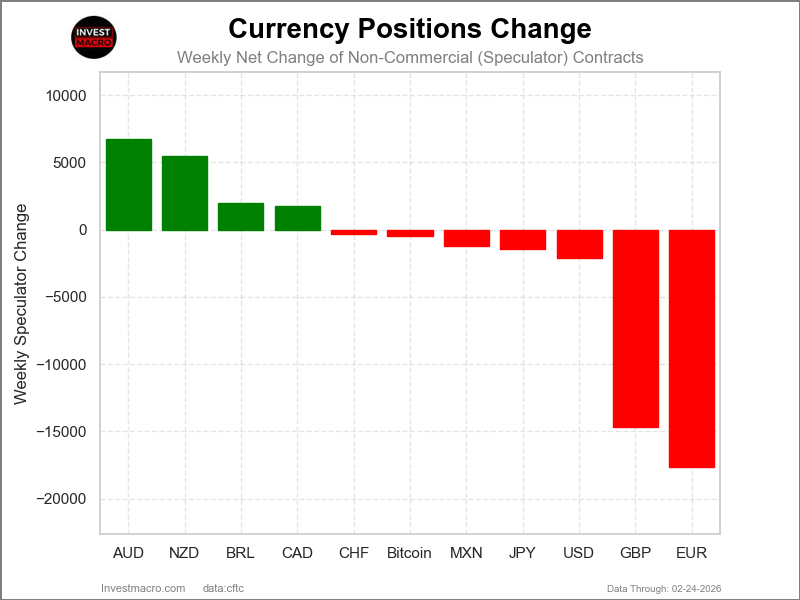
Weekly Speculator Changes led by British Pound

Speculators Nets FX Futures COT Chart
The COT currency market speculator bets were overall lower this week as five out of the eleven currency markets we cover had higher positioning and the other six markets had lower speculator contracts.

Leading the gains for the currency markets was the British Pound (5,268 contracts) with Bitcoin (803 contracts), the Brazilian Real (257 contracts), the Australian Dollar (114 contracts), the US Dollar Index (101 contracts) and  also showing positive weeks.

The currencies seeing declines in speculator bets on the week were the Japanese Yen (-53,979 contracts), the EuroFX (-30,156 contracts), the New Zealand Dollar (-5,488 contracts), the Mexican Peso (-5,743 contracts), the Swiss Franc (-3,126 contracts) and with the Canadian Dollar (-1,665 contracts) also recording lower bets on the week.

Speculators bets improving for GBP, MXN and going bearish for JPY

Highlighting the latest currency data is the British pound sterling seeing improved sentiment, the Mexican peso with net contracts above +100,000 positions and the Japanese yen which is shedding speculator contracts.

The British pound sterling which saw its speculator bets rise for a seventh straight week in the latest updated data. Over the last seven weeks, there have been +67,951 contracts added to the GBP speculator standing. This has taken the GBP positioning from a highly bearish -93,221 contracts to this week’s -25,270 contracts, which is the least bearish level of the last 11 weeks. The British pound sterling positioning has been consistently on the bearish side, dating back to July of 2025—a span of 25 weeks. The British pound exchange rate against the US Dollar has fluctuated since that time and is actually down by about 300 pips from the July 2025 high.

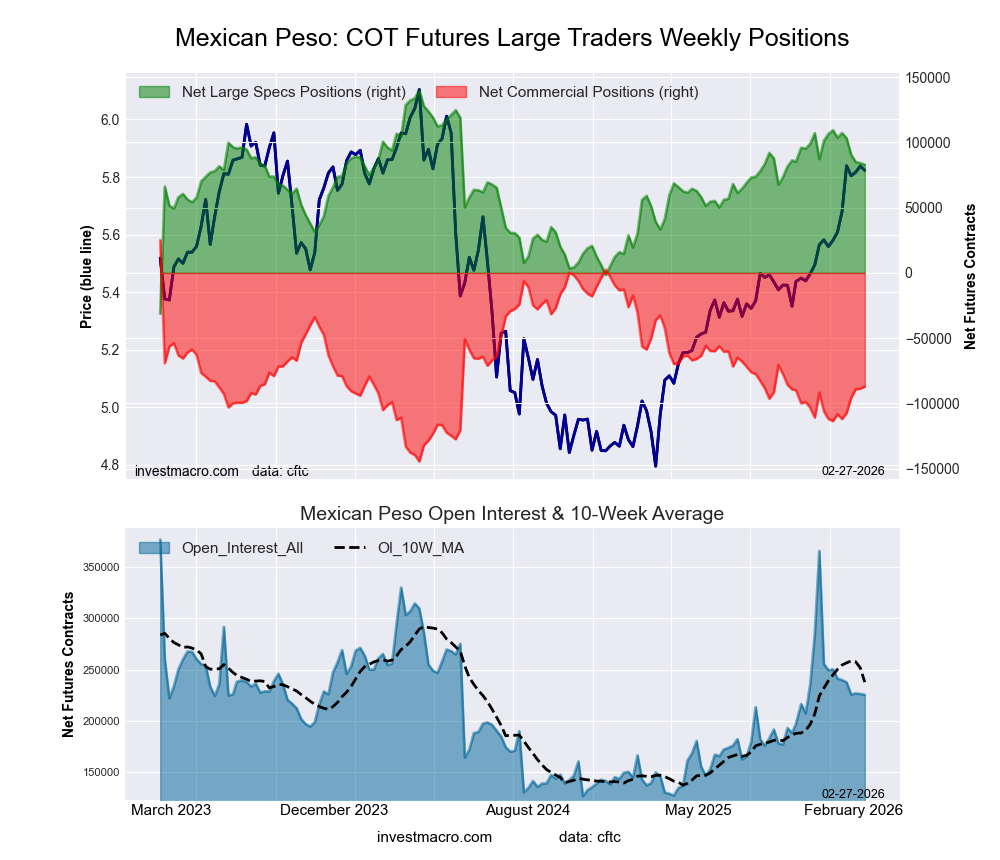
The Mexican peso futures speculator bets dipped this week for the first time in four weeks. However, the peso position is strongly bullish at the current moment, with the overall net position above the 100,000 contract level for a fourth straight week and for the fifth time out of the last six weeks. These are currently the highest and most bullish levels for the peso since June of 2024. In the currency market trading, the peso has been on a steady uptrend since bottoming in February 2025. Since hitting that bottom, the peso is up by roughly 20% against the US dollar and is up by over 2% to start 2026.

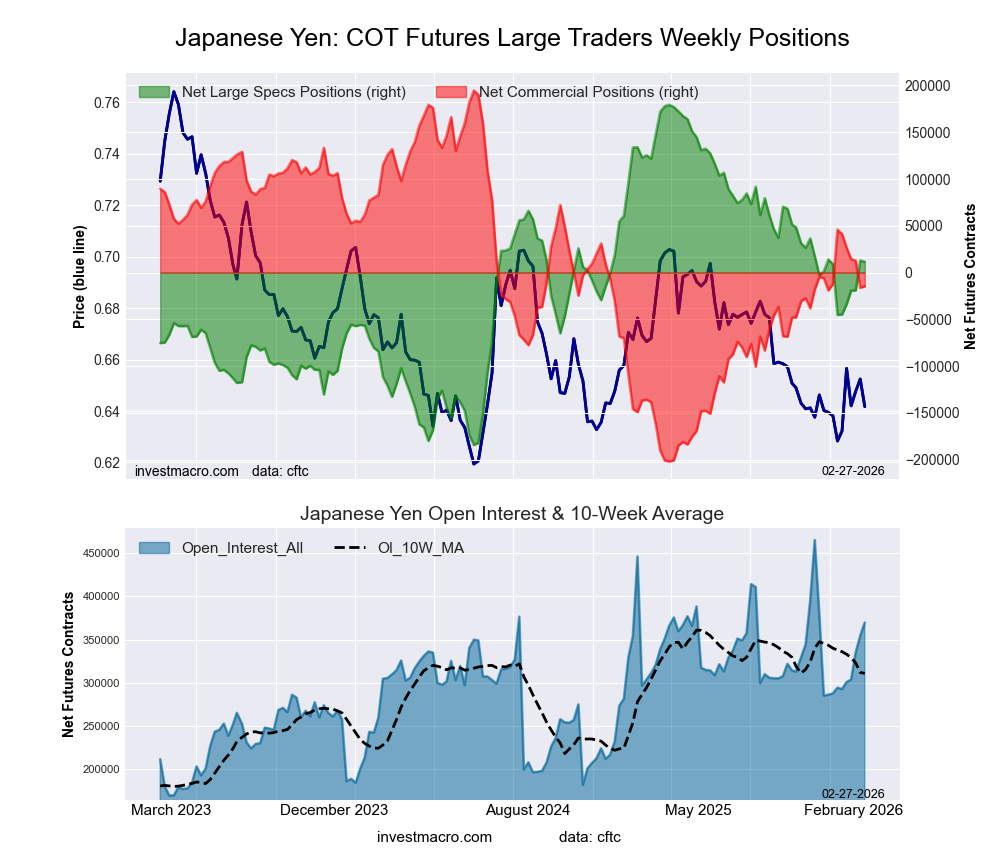
On the other end of the spectrum, the Japanese yen has seen its net speculator position fall into a bearish net standing this week at -45,164 contracts. This was because of a huge decline on the week of over -53,000 contracts. The sentiment for the Japanese yen has shifted sharply, as the yen bullish position was above +100,000 contracts consistently for 21 weeks last year from March all the way to July. Since then, there has been a steady decline week to week and month to month that has culminated in a negative bearish position for the yen. The yen futures price has also been on a stark downtrend and is touching the lowest levels since 2024. Despite recent interest rates in Japan rising (which is usually a boost for the home currency), the yen has been going the opposite way. Giving caution to the yen bulls is the outlook for the new prime minister possibly being implementing a dovish policy and hindering the Bank of Japan plans to hike the interest rate further.

The Euro speculative position saw a large reduction in bullish bets this week. The change in this week’s speculative position looks like a cool off from a very high position, as the euro speculative contracts have now been over +100,000 for seven straight weeks and above the +100,000 net contract level in 27 out of the last 31 weeks. Last week marked the highest level (+162,812 net contracts) for Euro speculative positions since August of 2023. The Euro currency price seems to be in consolidation mode between the 1.1900 level on the top side and the 1.1500 level on the lower support. Currently in the month of January, the Euro is down by -1.3% but recently hit its highest level since 2021 in November at the high of 1.1979.

Bitcoin leads 5-Day Price Performance Changes

Currency market price changes this week were led by Bitcoin, which rose by almost 6%. The Mexican Peso was next with a 1.95% change over the past five days. The US Dollar Index was higher by 0.37%, and the New Zealand Dollar was higher by 0.35%.

On the downside, the Canadian Dollar was virtually unchanged with a 0.02% decline, followed by the Australian Dollar with a 0.07% decrease. Next up, the Japanese Yen was lower by 0.12%, and the British Pound, as well as the Brazilian Real, were both down by 0.20%. The Swiss Franc fell by 0.29%, followed by the Euro, which fell a similar 0.30% over the past five days.

The biggest movers over the past 90 days have been the Mexican Peso, which is up by approximately 5%. The Brazilian Real is up by almost 2% over that same period, while on the downside, the Japanese Yen has fallen sharply by -6.90% in the past 90 days. The New Zealand Dollar is down by -3.69% in the past 90 days.


Currencies Data:

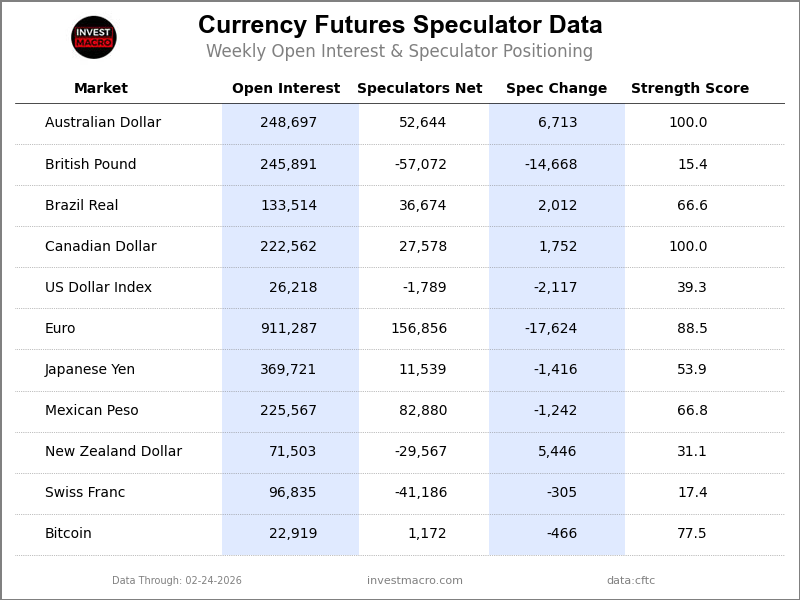
Speculators FX Futures COT Data Table
Legend: Open Interest | Speculators Current Net Position | Weekly Specs Change | Specs Strength Score compared to last 3-Years (0-100 range)


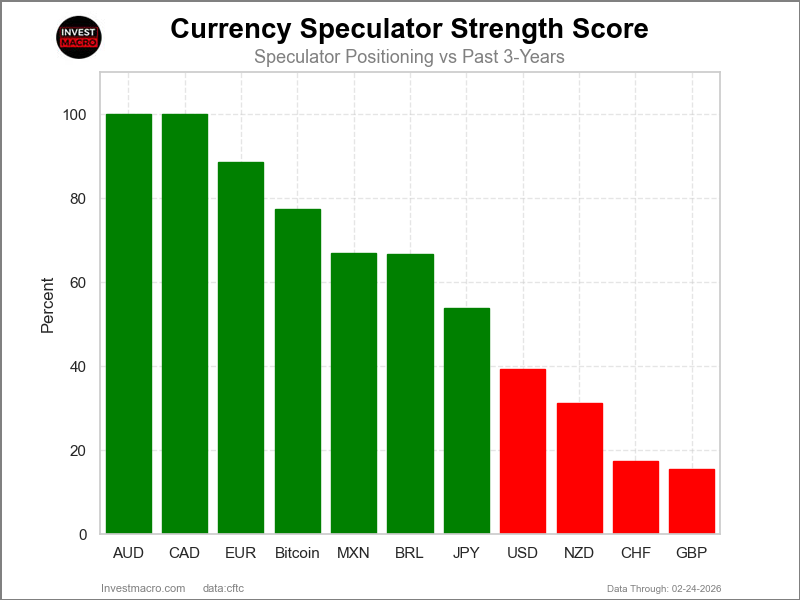
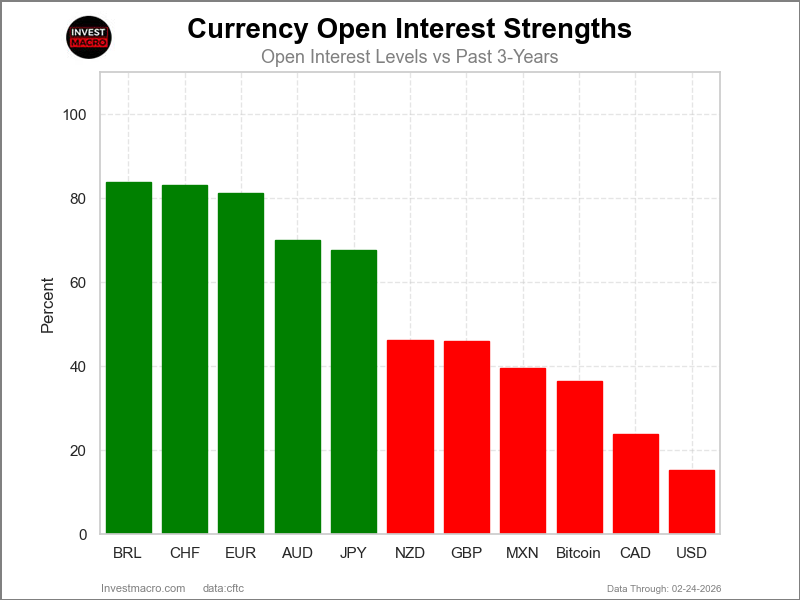
Strength Scores led by Mexican Peso & EuroFX

Speculators Strength Scores FX Futures COT Chart
COT Strength Scores (a normalized measure of Speculator positions over a 3-Year range, from 0 to 100 where above 80 is Extreme-Bullish and below 20 is Extreme-Bearish) showed that the Mexican Peso (81 percent) and the EuroFX (79 percent) lead the currency markets this week. The Canadian Dollar (76 percent), the Australian Dollar (63 percent) and Bitcoin (54 percent) come in as the next highest in the weekly strength scores.

On the downside, the New Zealand Dollar (9 percent) and the Swiss Franc (13 percent) come in at the lowest strength levels currently and are in Extreme-Bearish territory (below 20 percent). The next lowest strength scores are the British Pound (29 percent) and the US Dollar Index (34 percent).

3-Year Strength Statistics:
US Dollar Index (34.1 percent) vs US Dollar Index previous week (33.8 percent)
EuroFX (79.3 percent) vs EuroFX previous week (90.8 percent)
British Pound Sterling (28.9 percent) vs British Pound Sterling previous week (26.6 percent)
Japanese Yen (38.3 percent) vs Japanese Yen previous week (53.1 percent)
Swiss Franc (13.0 percent) vs Swiss Franc previous week (19.3 percent)
Canadian Dollar (76.0 percent) vs Canadian Dollar previous week (76.8 percent)
Australian Dollar (62.9 percent) vs Australian Dollar previous week (62.8 percent)
New Zealand Dollar (9.1 percent) vs New Zealand Dollar previous week (15.3 percent)
Mexican Peso (80.8 percent) vs Mexican Peso previous week (83.9 percent)
Brazilian Real (52.9 percent) vs Brazilian Real previous week (52.7 percent)
Bitcoin (54.2 percent) vs Bitcoin previous week (37.1 percent)


Canadian Dollar & Australian Dollar top the 6-Week Strength Trends
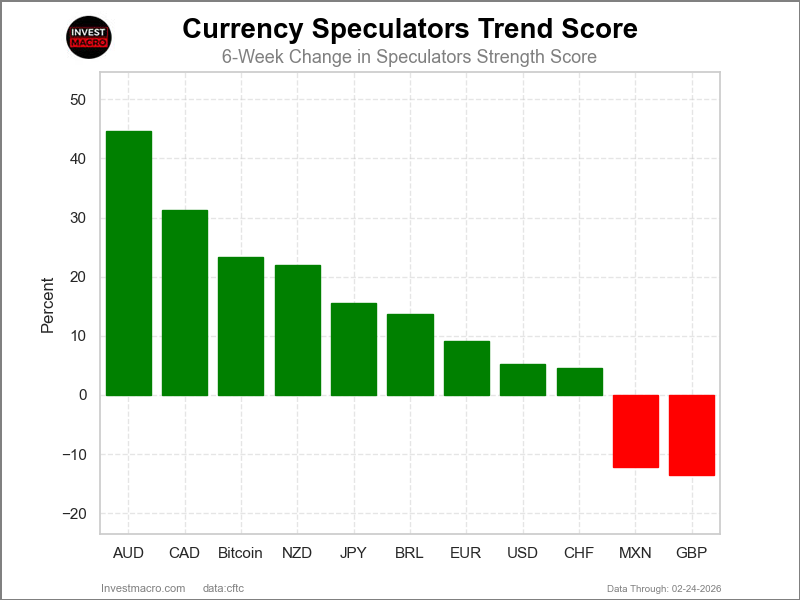
Speculators Trends FX Futures COT Chart
COT Strength Score Trends (or move index, calculates the 6-week changes in strength scores) showed that the Canadian Dollar (53 percent) and the Australian Dollar (46 percent) lead the past six weeks trends for the currencies. The US Dollar Index (34 percent), the British Pound (23 percent) and the EuroFX (9 percent) are the next highest positive movers in the 3-Year trends data.

The Brazilian Real (-31 percent) leads the downside trend scores currently with the Japanese Yen (-22 percent), the Swiss Franc (-15 percent) and Bitcoin (-11 percent) following next with lower trend scores.

3-Year Strength Trends:
US Dollar Index (33.7 percent) vs US Dollar Index previous week (33.8 percent)
EuroFX (9.2 percent) vs EuroFX previous week (26.2 percent)
British Pound Sterling (23.3 percent) vs British Pound Sterling previous week (26.6 percent)
Japanese Yen (-22.4 percent) vs Japanese Yen previous week (-4.9 percent)
Swiss Franc (-15.4 percent) vs Swiss Franc previous week (-9.9 percent)
Canadian Dollar (53.2 percent) vs Canadian Dollar previous week (54.2 percent)
Australian Dollar (45.8 percent) vs Australian Dollar previous week (46.3 percent)
New Zealand Dollar (4.9 percent) vs New Zealand Dollar previous week (9.9 percent)
Mexican Peso (2.5 percent) vs Mexican Peso previous week (7.5 percent)
Brazilian Real (-31.3 percent) vs Brazilian Real previous week (-28.5 percent)
Bitcoin (-10.6 percent) vs Bitcoin previous week (-13.8 percent)


Individual COT Forex Markets:

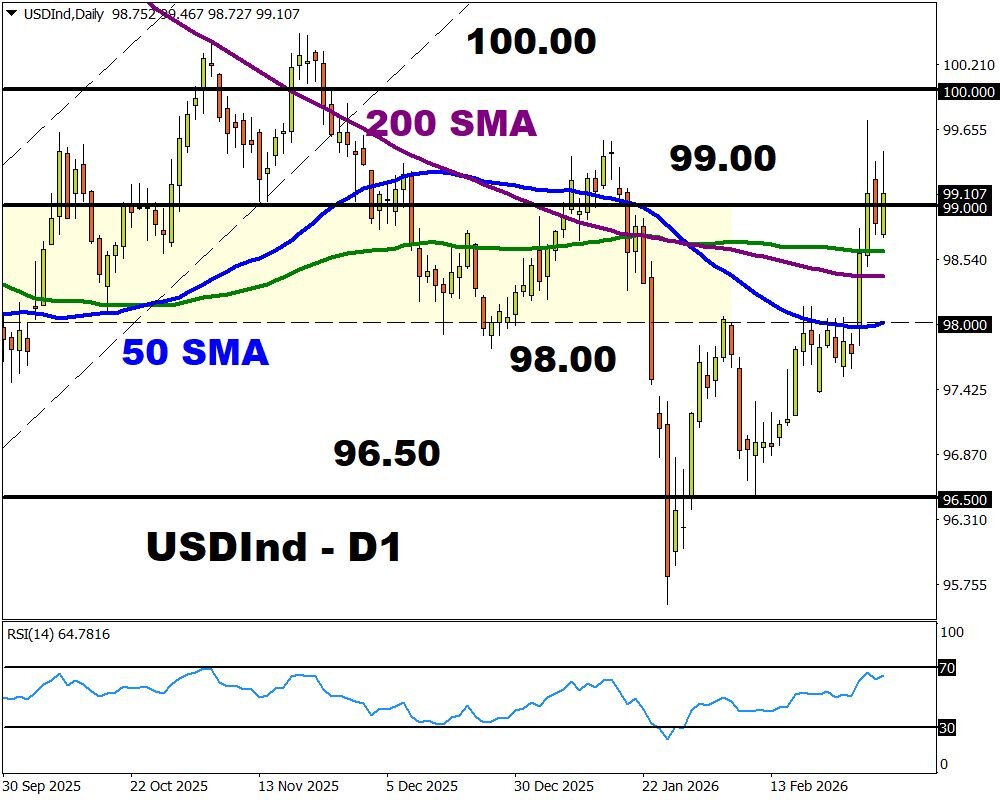
US Dollar Index Futures:
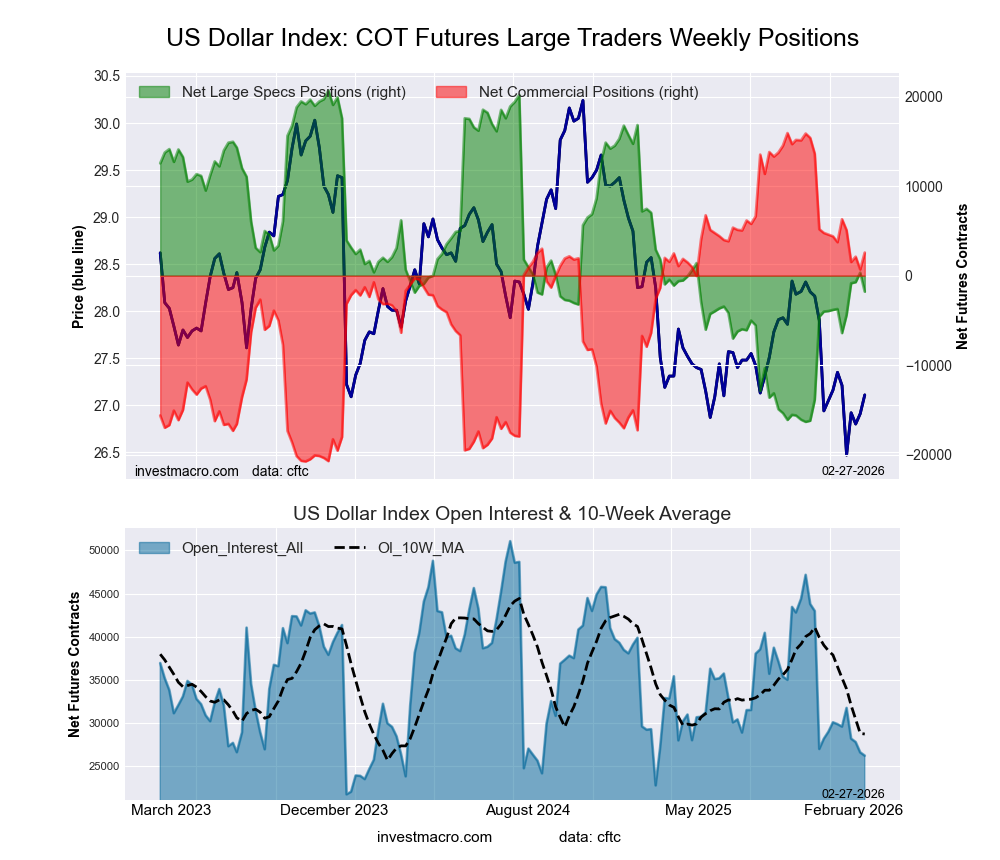
US Dollar Index Forex Futures COT ChartThe US Dollar Index large speculator standing this week recorded a net position of -3,730 contracts in the data reported through Tuesday. This was a weekly advance of 101 contracts from the previous week which had a total of -3,831 net contracts.

This week’s current strength score (the trader positioning range over the past three years, measured from 0 to 100) shows the speculators are currently Bearish with a score of 34.1 percent. The commercials are Bullish with a score of 66.8 percent and the small traders (not shown in chart) are Bearish with a score of 33.3 percent.

Price Trend-Following Model: Weak Uptrend

Our weekly trend-following model classifies the current market price position as: Weak Uptrend.

US DOLLAR INDEX StatisticsSPECULATORSCOMMERCIALSSMALL TRADERS
– Percent of Open Interest Longs:60.024.09.9
– Percent of Open Interest Shorts:72.511.49.9
– Net Position:-3,7303,739-9
– Gross Longs:17,9297,1582,952
– Gross Shorts:21,6593,4192,961
– Long to Short Ratio:0.8 to 12.1 to 11.0 to 1
NET POSITION TREND:
– Strength Index Score (3 Year Range Pct):34.166.833.3
– Strength Index Reading (3 Year Range):BearishBullishBearish
NET POSITION MOVEMENT INDEX:
– 6-Week Change in Strength Index:33.7-31.8-12.3


Euro Currency Futures:

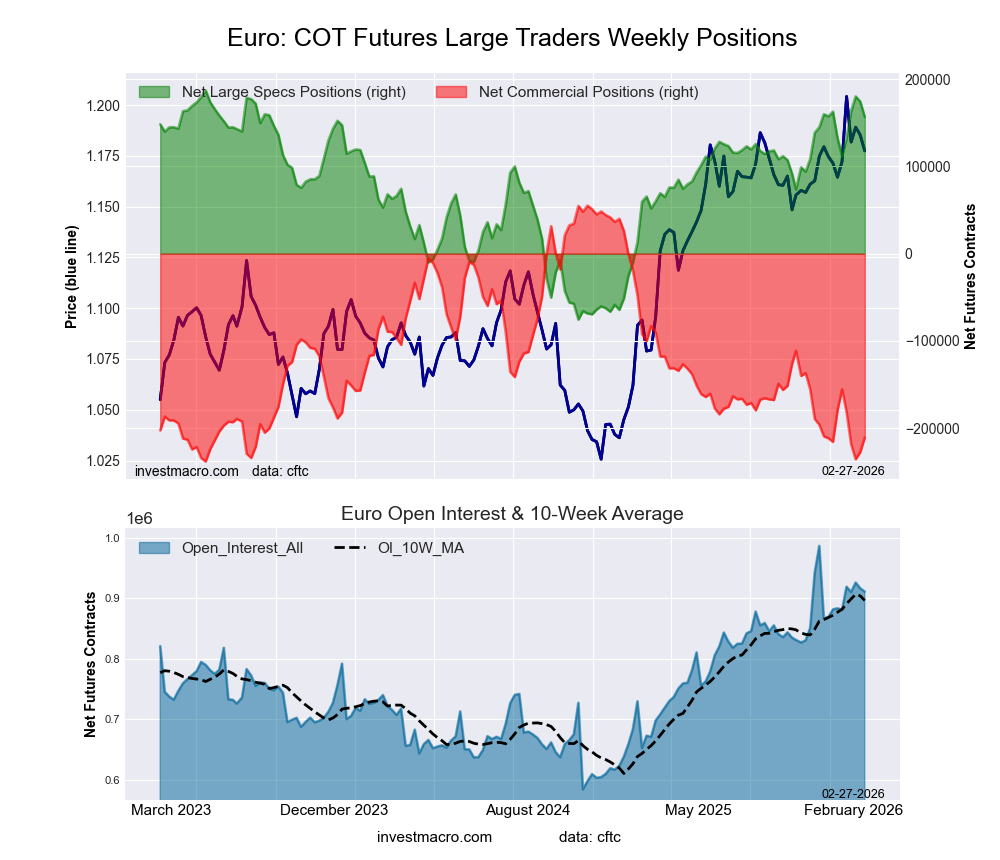
Euro Currency Futures COT ChartThe Euro Currency large speculator standing this week recorded a net position of 132,656 contracts in the data reported through Tuesday. This was a weekly lowering of -30,156 contracts from the previous week which had a total of 162,812 net contracts.

This week’s current strength score (the trader positioning range over the past three years, measured from 0 to 100) shows the speculators are currently Bullish with a score of 79.3 percent. The commercials are Bearish-Extreme with a score of 20.0 percent and the small traders (not shown in chart) are Bullish with a score of 73.9 percent.

Price Trend-Following Model: Downtrend

Our weekly trend-following model classifies the current market price position as: Downtrend.

EURO Currency StatisticsSPECULATORSCOMMERCIALSSMALL TRADERS
– Percent of Open Interest Longs:32.155.210.4
– Percent of Open Interest Shorts:17.175.55.0
– Net Position:132,656-179,76747,111
– Gross Longs:283,592487,59591,580
– Gross Shorts:150,936667,36244,469
– Long to Short Ratio:1.9 to 10.7 to 12.1 to 1
NET POSITION TREND:
– Strength Index Score (3 Year Range Pct):79.320.073.9
– Strength Index Reading (3 Year Range):BullishBearish-ExtremeBullish
NET POSITION MOVEMENT INDEX:
– 6-Week Change in Strength Index:9.2-8.2-0.4


British Pound Sterling Futures:

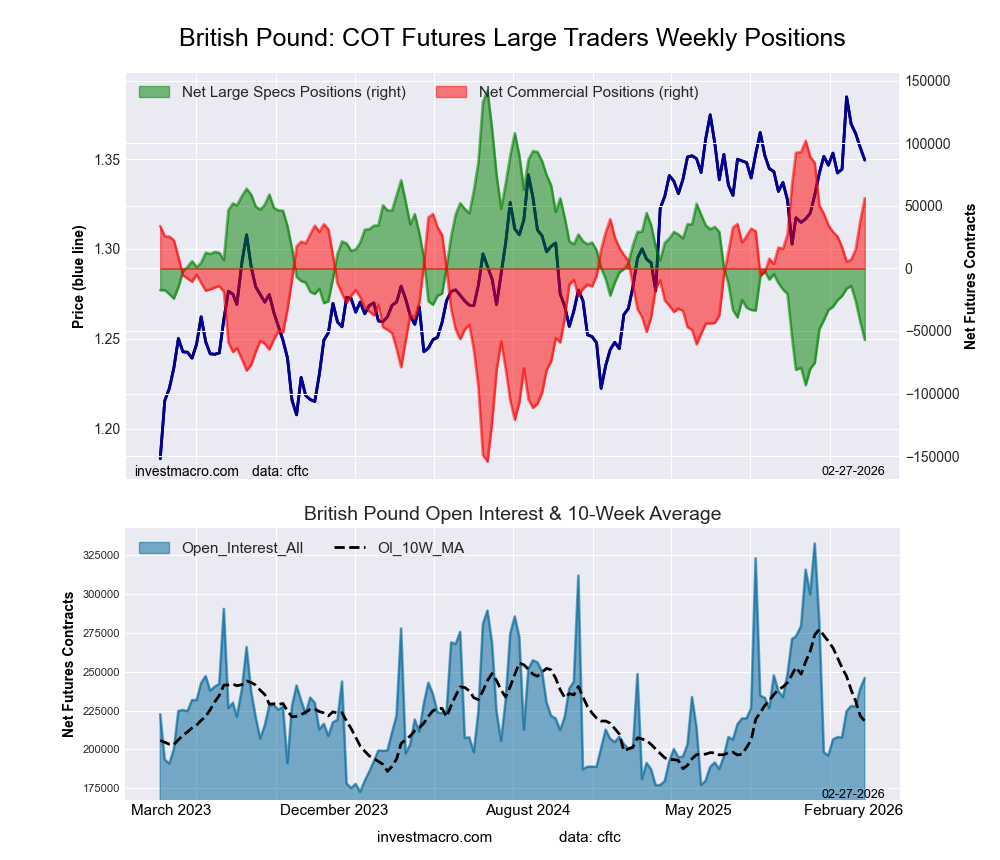
British Pound Sterling Futures COT ChartThe British Pound Sterling large speculator standing this week recorded a net position of -25,270 contracts in the data reported through Tuesday. This was a weekly lift of 5,268 contracts from the previous week which had a total of -30,538 net contracts.

This week’s current strength score (the trader positioning range over the past three years, measured from 0 to 100) shows the speculators are currently Bearish with a score of 28.9 percent. The commercials are Bullish with a score of 70.2 percent and the small traders (not shown in chart) are Bullish with a score of 52.6 percent.

Price Trend-Following Model: Weak Downtrend

Our weekly trend-following model classifies the current market price position as: Weak Downtrend.

BRITISH POUND StatisticsSPECULATORSCOMMERCIALSSMALL TRADERS
– Percent of Open Interest Longs:38.046.813.9
– Percent of Open Interest Shorts:50.234.514.0
– Net Position:-25,27025,504-234
– Gross Longs:79,00397,24328,832
– Gross Shorts:104,27371,73929,066
– Long to Short Ratio:0.8 to 11.4 to 11.0 to 1
NET POSITION TREND:
– Strength Index Score (3 Year Range Pct):28.970.252.6
– Strength Index Reading (3 Year Range):BearishBullishBullish
NET POSITION MOVEMENT INDEX:
– 6-Week Change in Strength Index:23.3-24.922.9


Japanese Yen Futures:

Japanese Yen Forex Futures COT ChartThe Japanese Yen large speculator standing this week recorded a net position of -45,164 contracts in the data reported through Tuesday. This was a weekly decline of -53,979 contracts from the previous week which had a total of 8,815 net contracts.

This week’s current strength score (the trader positioning range over the past three years, measured from 0 to 100) shows the speculators are currently Bearish with a score of 38.3 percent. The commercials are Bullish with a score of 62.5 percent and the small traders (not shown in chart) are Bearish with a score of 35.2 percent.

Price Trend-Following Model: Downtrend

Our weekly trend-following model classifies the current market price position as: Downtrend.

JAPANESE YEN StatisticsSPECULATORSCOMMERCIALSSMALL TRADERS
– Percent of Open Interest Longs:38.038.815.1
– Percent of Open Interest Shorts:53.323.315.3
– Net Position:-45,16445,819-655
– Gross Longs:111,743114,30344,360
– Gross Shorts:156,90768,48445,015
– Long to Short Ratio:0.7 to 11.7 to 11.0 to 1
NET POSITION TREND:
– Strength Index Score (3 Year Range Pct):38.362.535.2
– Strength Index Reading (3 Year Range):BearishBullishBearish
NET POSITION MOVEMENT INDEX:
– 6-Week Change in Strength Index:-22.421.2-6.1


Swiss Franc Futures:

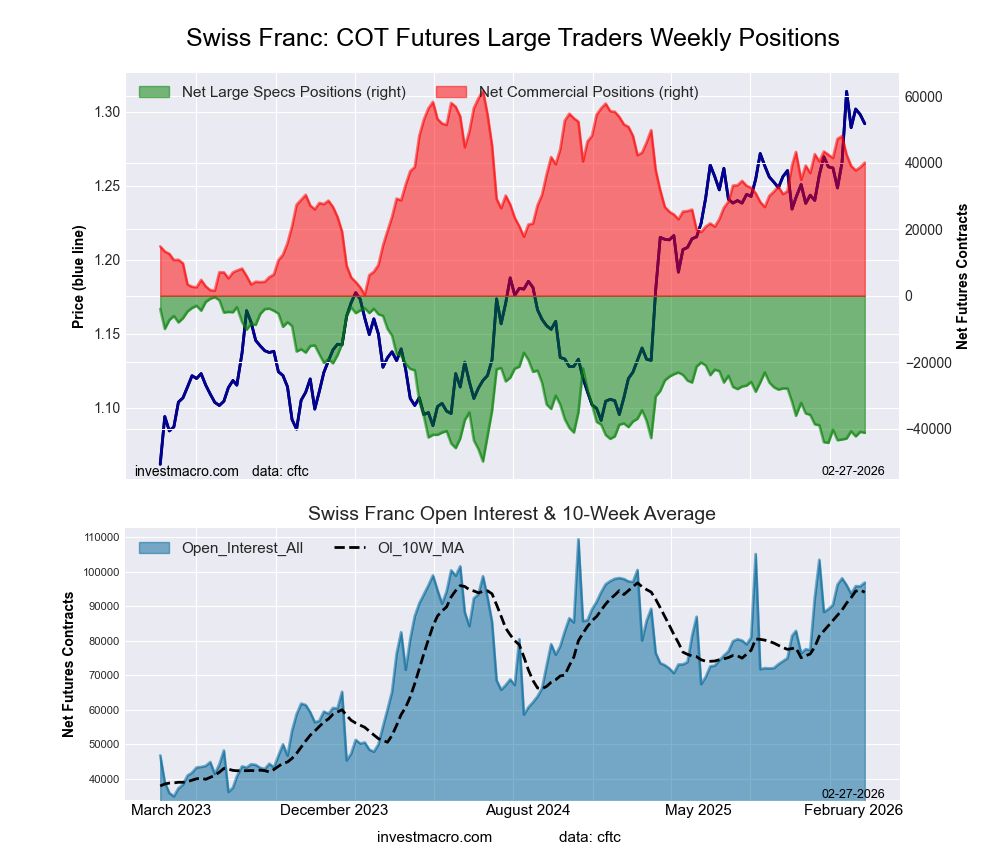
Swiss Franc Forex Futures COT ChartThe Swiss Franc large speculator standing this week recorded a net position of -43,392 contracts in the data reported through Tuesday. This was a weekly decrease of -3,126 contracts from the previous week which had a total of -40,266 net contracts.

This week’s current strength score (the trader positioning range over the past three years, measured from 0 to 100) shows the speculators are currently Bearish-Extreme with a score of 13.0 percent. The commercials are Bullish with a score of 76.4 percent and the small traders (not shown in chart) are Bullish with a score of 62.8 percent.

Price Trend-Following Model: Weak Uptrend

Our weekly trend-following model classifies the current market price position as: Weak Uptrend.

SWISS FRANC StatisticsSPECULATORSCOMMERCIALSSMALL TRADERS
– Percent of Open Interest Longs:13.971.514.5
– Percent of Open Interest Shorts:59.022.518.4
– Net Position:-43,39247,163-3,771
– Gross Longs:13,39568,77813,977
– Gross Shorts:56,78721,61517,748
– Long to Short Ratio:0.2 to 13.2 to 10.8 to 1
NET POSITION TREND:
– Strength Index Score (3 Year Range Pct):13.076.462.8
– Strength Index Reading (3 Year Range):Bearish-ExtremeBullishBullish
NET POSITION MOVEMENT INDEX:
– 6-Week Change in Strength Index:-15.416.8-11.5


Canadian Dollar Futures:

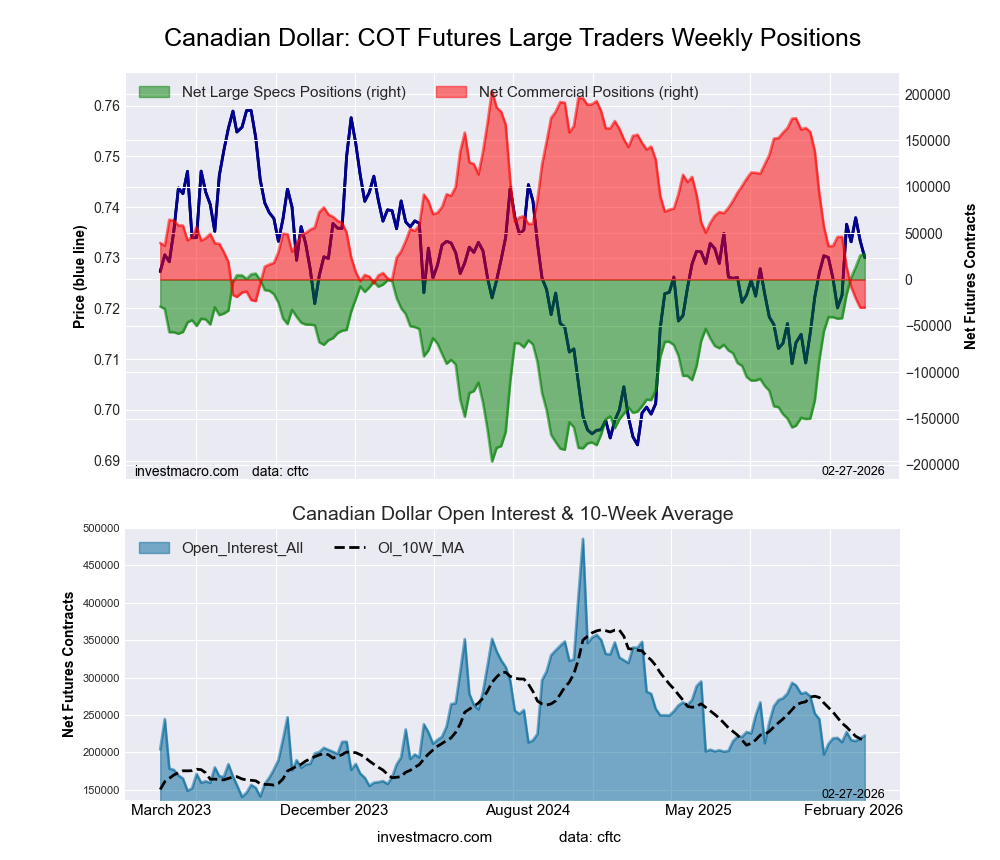
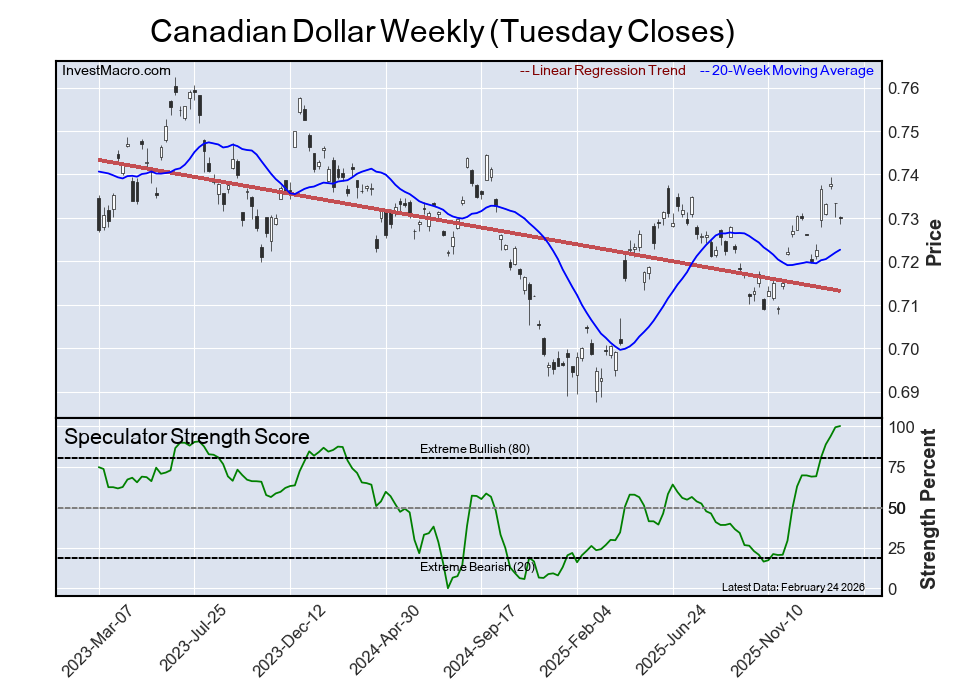
Canadian Dollar Forex Futures COT ChartThe Canadian Dollar large speculator standing this week recorded a net position of -42,250 contracts in the data reported through Tuesday. This was a weekly decline of -1,665 contracts from the previous week which had a total of -40,585 net contracts.

This week’s current strength score (the trader positioning range over the past three years, measured from 0 to 100) shows the speculators are currently Bullish with a score of 76.0 percent. The commercials are Bearish with a score of 30.4 percent and the small traders (not shown in chart) are Bearish with a score of 35.4 percent.

Price Trend-Following Model: Weak Uptrend

Our weekly trend-following model classifies the current market price position as: Weak Uptrend.

CANADIAN DOLLAR StatisticsSPECULATORSCOMMERCIALSSMALL TRADERS
– Percent of Open Interest Longs:28.655.712.8
– Percent of Open Interest Shorts:47.934.814.4
– Net Position:-42,25045,815-3,565
– Gross Longs:62,705122,09628,109
– Gross Shorts:104,95576,28131,674
– Long to Short Ratio:0.6 to 11.6 to 10.9 to 1
NET POSITION TREND:
– Strength Index Score (3 Year Range Pct):76.030.435.4
– Strength Index Reading (3 Year Range):BullishBearishBearish
NET POSITION MOVEMENT INDEX:
– 6-Week Change in Strength Index:53.2-49.915.5


Australian Dollar Futures:

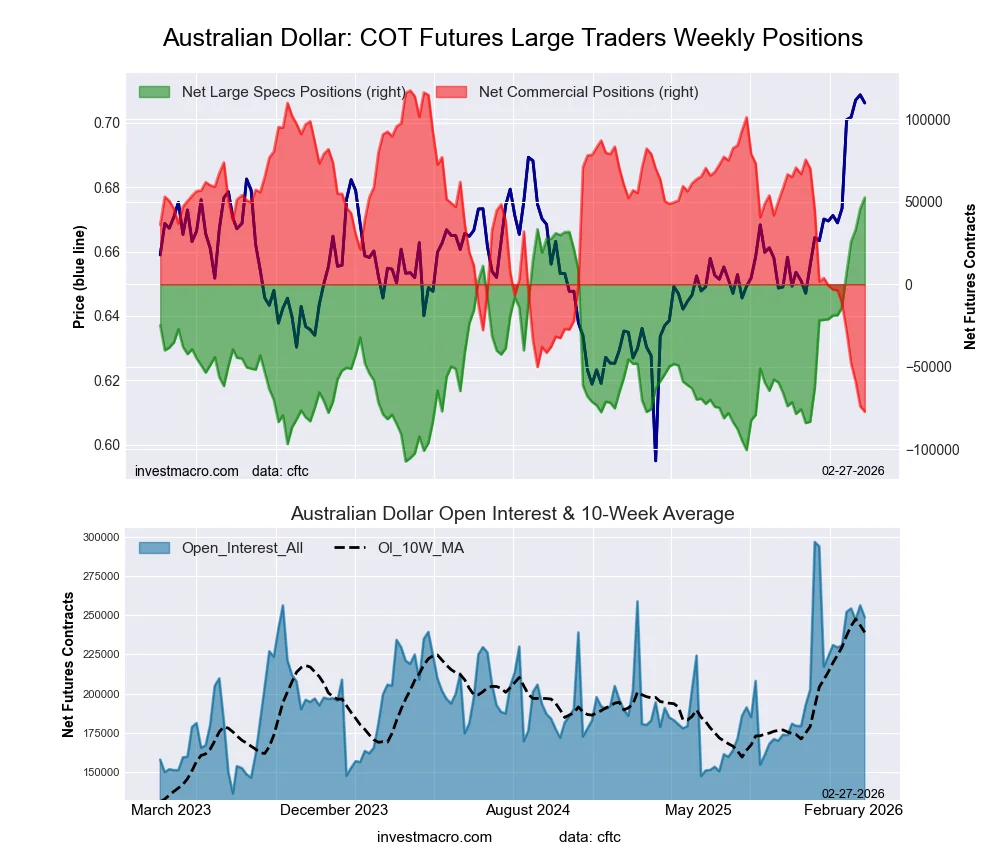
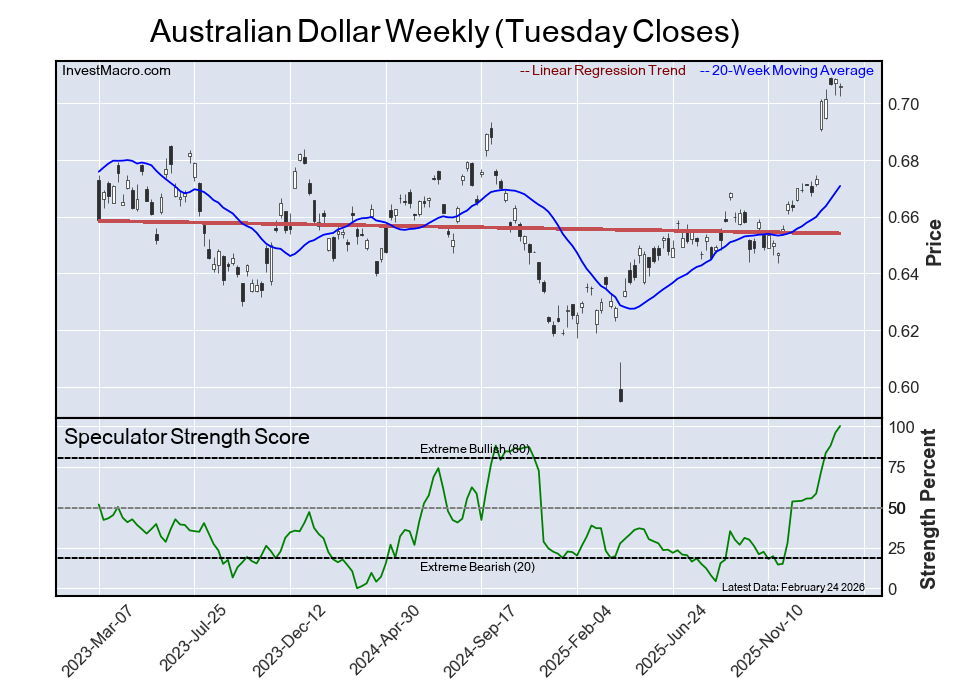
Australian Dollar Forex Futures COT ChartThe Australian Dollar large speculator standing this week recorded a net position of -18,846 contracts in the data reported through Tuesday. This was a weekly advance of 114 contracts from the previous week which had a total of -18,960 net contracts.

This week’s current strength score (the trader positioning range over the past three years, measured from 0 to 100) shows the speculators are currently Bullish with a score of 62.9 percent. The commercials are Bearish with a score of 27.8 percent and the small traders (not shown in chart) are Bullish-Extreme with a score of 100.0 percent.

Price Trend-Following Model: Strong Uptrend

Our weekly trend-following model classifies the current market price position as: Strong Uptrend.

AUSTRALIAN DOLLAR StatisticsSPECULATORSCOMMERCIALSSMALL TRADERS
– Percent of Open Interest Longs:36.645.017.3
– Percent of Open Interest Shorts:44.846.67.6
– Net Position:-18,846-3,61022,456
– Gross Longs:83,955103,29539,790
– Gross Shorts:102,801106,90517,334
– Long to Short Ratio:0.8 to 11.0 to 12.3 to 1
NET POSITION TREND:
– Strength Index Score (3 Year Range Pct):62.927.8100.0
– Strength Index Reading (3 Year Range):BullishBearishBullish-Extreme
NET POSITION MOVEMENT INDEX:
– 6-Week Change in Strength Index:45.8-44.022.7


New Zealand Dollar Futures:

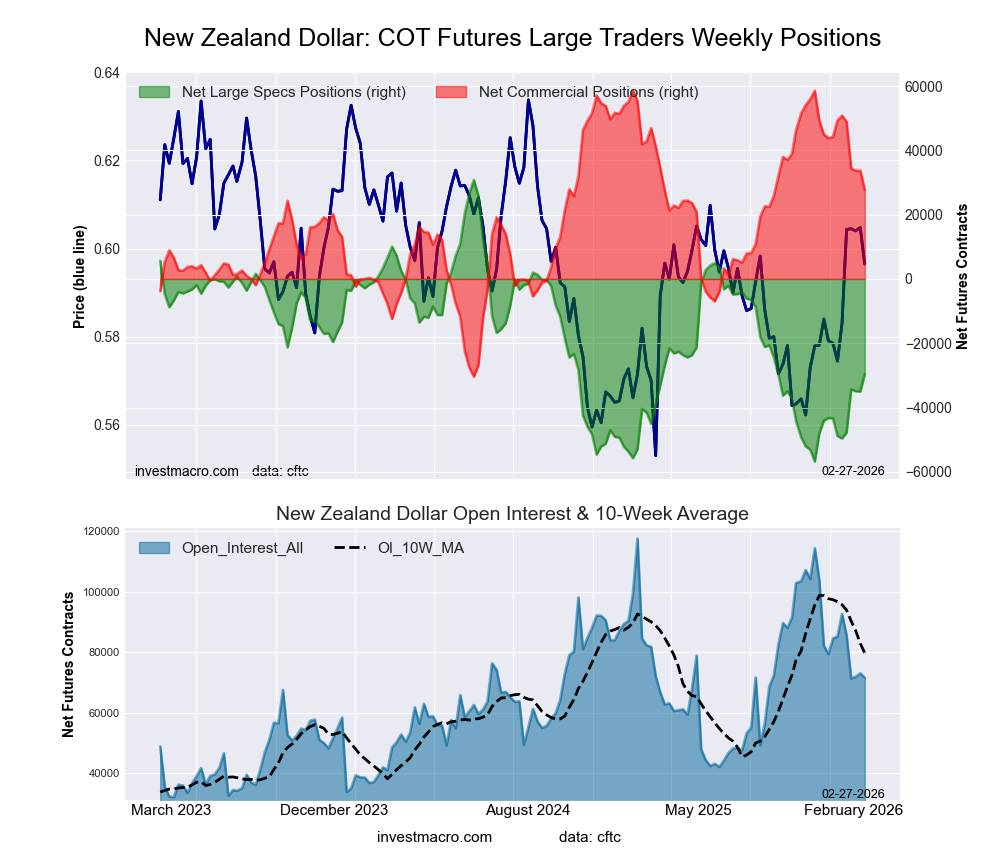
New Zealand Dollar Forex Futures COT ChartThe New Zealand Dollar large speculator standing this week recorded a net position of -48,851 contracts in the data reported through Tuesday. This was a weekly reduction of -5,488 contracts from the previous week which had a total of -43,363 net contracts.

This week’s current strength score (the trader positioning range over the past three years, measured from 0 to 100) shows the speculators are currently Bearish-Extreme with a score of 9.1 percent. The commercials are Bullish-Extreme with a score of 89.6 percent and the small traders (not shown in chart) are Bearish with a score of 45.7 percent.

Price Trend-Following Model: Downtrend

Our weekly trend-following model classifies the current market price position as: Downtrend.

NEW ZEALAND DOLLAR StatisticsSPECULATORSCOMMERCIALSSMALL TRADERS
– Percent of Open Interest Longs:11.381.84.7
– Percent of Open Interest Shorts:68.623.85.3
– Net Position:-48,85149,362-511
– Gross Longs:9,61369,6624,002
– Gross Shorts:58,46420,3004,513
– Long to Short Ratio:0.2 to 13.4 to 10.9 to 1
NET POSITION TREND:
– Strength Index Score (3 Year Range Pct):9.189.645.7
– Strength Index Reading (3 Year Range):Bearish-ExtremeBullish-ExtremeBearish
NET POSITION MOVEMENT INDEX:
– 6-Week Change in Strength Index:4.9-7.429.9


Mexican Peso Futures:

Mexican Peso Futures COT ChartThe Mexican Peso large speculator standing this week recorded a net position of 103,558 contracts in the data reported through Tuesday. This was a weekly lowering of -5,743 contracts from the previous week which had a total of 109,301 net contracts.

This week’s current strength score (the trader positioning range over the past three years, measured from 0 to 100) shows the speculators are currently Bullish-Extreme with a score of 80.8 percent. The commercials are Bearish-Extreme with a score of 19.4 percent and the small traders (not shown in chart) are Bearish with a score of 48.4 percent.

Price Trend-Following Model: Strong Uptrend

Our weekly trend-following model classifies the current market price position as: Strong Uptrend.

MEXICAN PESO StatisticsSPECULATORSCOMMERCIALSSMALL TRADERS
– Percent of Open Interest Longs:63.733.13.0
– Percent of Open Interest Shorts:20.877.91.1
– Net Position:103,558-108,1804,622
– Gross Longs:153,67079,9407,287
– Gross Shorts:50,112188,1202,665
– Long to Short Ratio:3.1 to 10.4 to 12.7 to 1
NET POSITION TREND:
– Strength Index Score (3 Year Range Pct):80.819.448.4
– Strength Index Reading (3 Year Range):Bullish-ExtremeBearish-ExtremeBearish
NET POSITION MOVEMENT INDEX:
– 6-Week Change in Strength Index:2.5-2.61.2


Brazilian Real Futures:

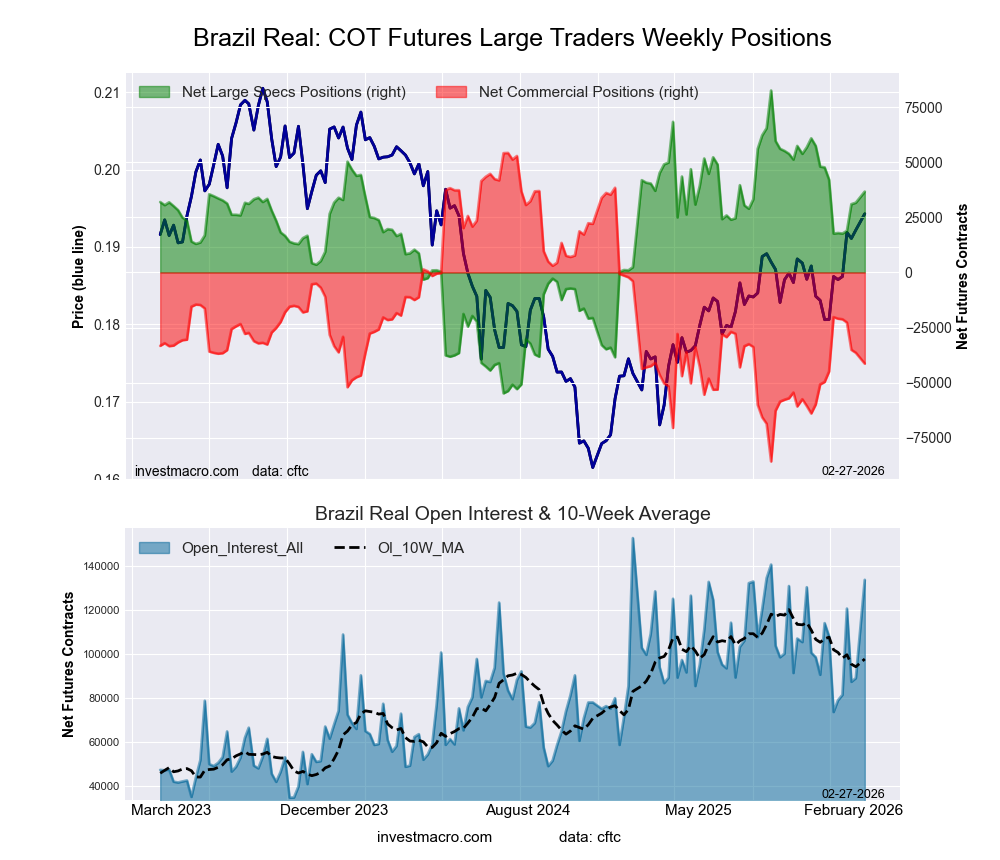
Brazil Real Futures COT ChartThe Brazilian Real large speculator standing this week recorded a net position of 17,874 contracts in the data reported through Tuesday. This was a weekly boost of 257 contracts from the previous week which had a total of 17,617 net contracts.

This week’s current strength score (the trader positioning range over the past three years, measured from 0 to 100) shows the speculators are currently Bullish with a score of 52.9 percent. The commercials are Bearish with a score of 46.3 percent and the small traders (not shown in chart) are Bearish with a score of 38.5 percent.

Price Trend-Following Model: Weak Downtrend

Our weekly trend-following model classifies the current market price position as: Weak Downtrend.

BRAZIL REAL StatisticsSPECULATORSCOMMERCIALSSMALL TRADERS
– Percent of Open Interest Longs:66.327.55.1
– Percent of Open Interest Shorts:43.754.11.1
– Net Position:17,874-21,0033,129
– Gross Longs:52,40021,7534,017
– Gross Shorts:34,52642,756888
– Long to Short Ratio:1.5 to 10.5 to 14.5 to 1
NET POSITION TREND:
– Strength Index Score (3 Year Range Pct):52.946.338.5
– Strength Index Reading (3 Year Range):BullishBearishBearish
NET POSITION MOVEMENT INDEX:
– 6-Week Change in Strength Index:-31.330.7-0.2


Bitcoin Futures:

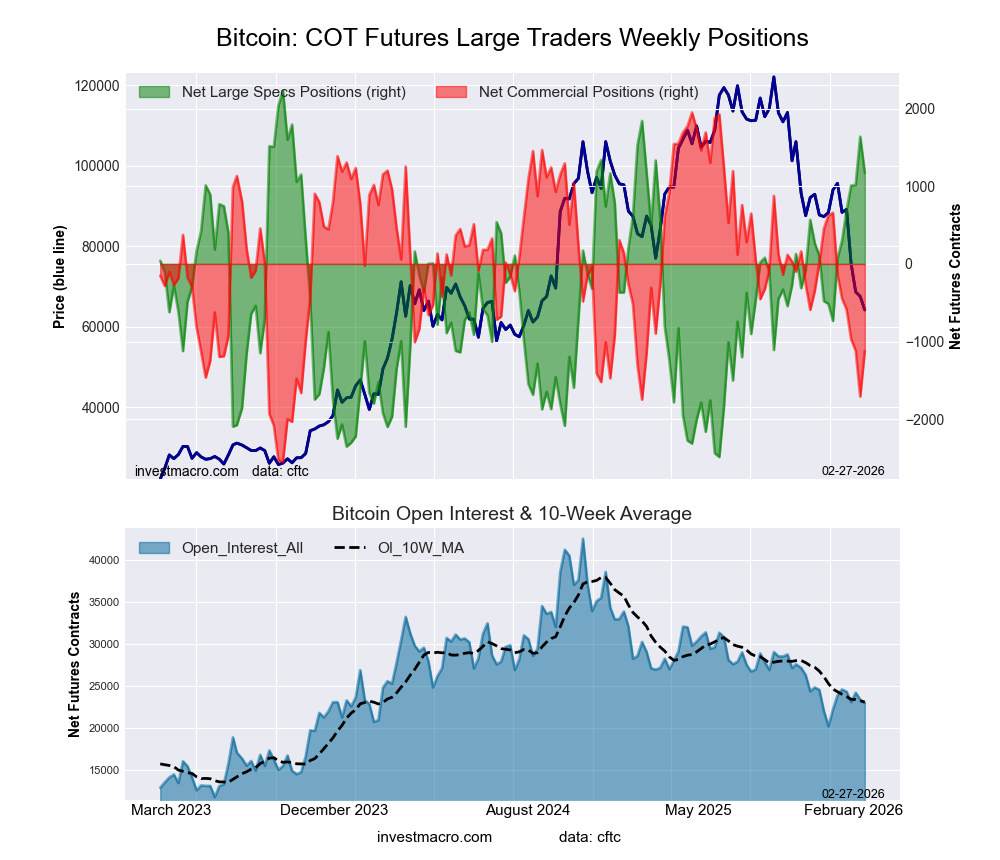
Bitcoin Crypto Futures COT ChartThe Bitcoin large speculator standing this week recorded a net position of 69 contracts in the data reported through Tuesday. This was a weekly increase of 803 contracts from the previous week which had a total of -734 net contracts.

This week’s current strength score (the trader positioning range over the past three years, measured from 0 to 100) shows the speculators are currently Bullish with a score of 54.2 percent. The commercials are Bullish with a score of 53.6 percent and the small traders (not shown in chart) are Bearish with a score of 40.7 percent.

Price Trend-Following Model: Downtrend

Our weekly trend-following model classifies the current market price position as: Downtrend.

BITCOIN StatisticsSPECULATORSCOMMERCIALSSMALL TRADERS
– Percent of Open Interest Longs:80.25.35.0
– Percent of Open Interest Shorts:79.95.84.8
– Net Position:69-13465
– Gross Longs:19,1181,2571,204
– Gross Shorts:19,0491,3911,139
– Long to Short Ratio:1.0 to 10.9 to 11.1 to 1
NET POSITION TREND:
– Strength Index Score (3 Year Range Pct):54.253.640.7
– Strength Index Reading (3 Year Range):BullishBullishBearish
NET POSITION MOVEMENT INDEX:
– 6-Week Change in Strength Index:-10.610.22.1


Article By InvestMacroReceive our weekly COT Newsletter

*COT Report: The COT data, released weekly to the public each Friday, is updated through the most recent Tuesday (data is 3 days old) and shows a quick view of how large speculators or non-commercials (for-profit traders) were positioned in the futures markets.

The CFTC categorizes trader positions according to commercial hedgers (traders who use futures contracts for hedging as part of the business), non-commercials (large traders who speculate to realize trading profits) and nonreportable traders (usually small traders/speculators) as well as their open interest (contracts open in the market at time of reporting). See CFTC criteria here.

Speculator Extremes: Steel, Palladium & EAFE MINI lead weekly Bullish Positions

By InvestMacro

The latest update for the weekly Commitment of Traders (COT) report was released by the Commodity Futures Trading Commission (CFTC) on Friday for data ending on January 13th.

This weekly Extreme Positions report highlights the Most Bullish and Most Bearish Positions for the speculator category. Extreme positioning in these markets can foreshadow strong moves in the underlying market.

To signify an extreme position, we use the Strength Index (also known as the COT Index) of each instrument, a common method of measuring COT data. The Strength Index is simply a comparison of current trader positions against the range of positions over the previous 3 years. We use over 80 percent as extremely bullish and under 20 percent as extremely bearish. (Compare Strength Index scores across all markets in the data table or cot leaders table)


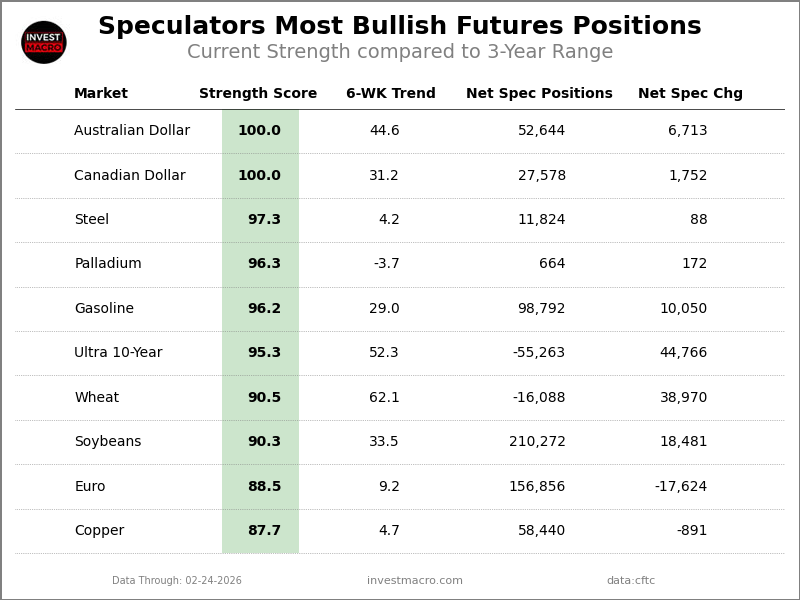
Extreme Bullish Speculator Table


Here Are This Week’s Most Bullish Speculator Positions:

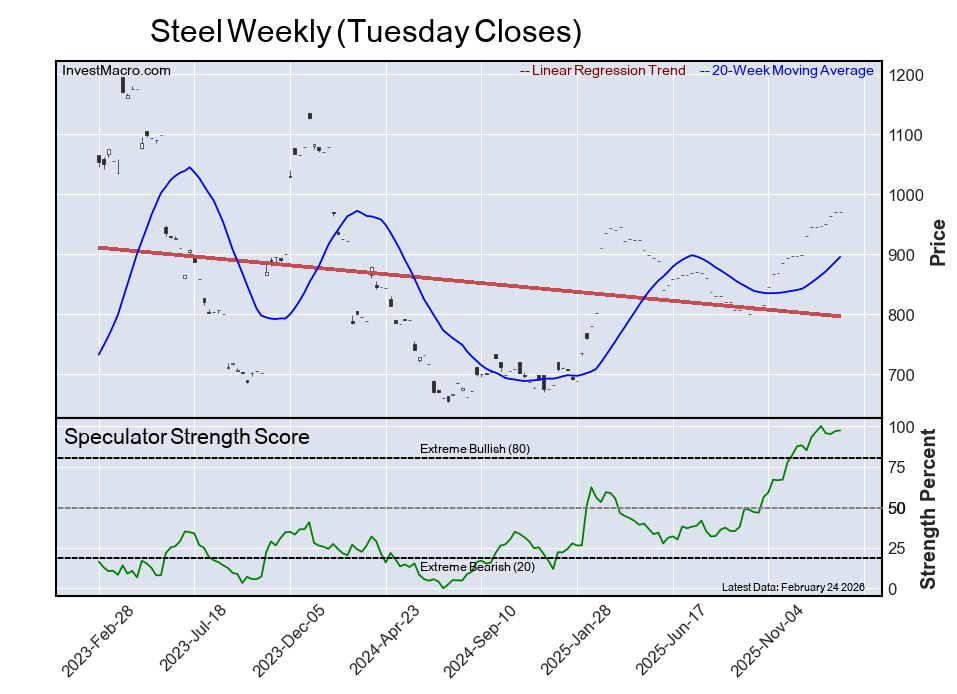
Steel

Extreme Bullish Leader
The Steel speculator position comes in tied as the most bullish extreme standing this week. The Steel speculator level is currently at a 100 percent score of its 3-year range.

The six-week trend change for the strength score totaled a gain of 28 percentage points this week. The overall net speculator position was a total of 11,022 net contracts this week with an increase of 1,545 contract in the weekly speculator bets.


Speculators or Non-Commercials Notes:

Speculators, classified as non-commercial traders by the CFTC, are made up of large commodity funds, hedge funds and other significant for-profit participants. The Specs are generally regarded as trend-followers in their behavior towards price action – net speculator bets and prices tend to go in the same directions. These traders often look to buy when prices are rising and sell when prices are falling. To illustrate this point, many times speculator contracts can be found at their most extremes (bullish or bearish) when prices are also close to their highest or lowest levels.

These extreme levels can be dangerous for the large speculators as the trade is most crowded, there is less trading ammunition still sitting on the sidelines to push the trend further and prices have moved a significant distance. When the trend becomes exhausted, some speculators take profits while others look to also exit positions when prices fail to continue in the same direction. This process usually plays out over many months to years and can ultimately create a reverse effect where prices start to fall and speculators start a process of selling when prices are falling.


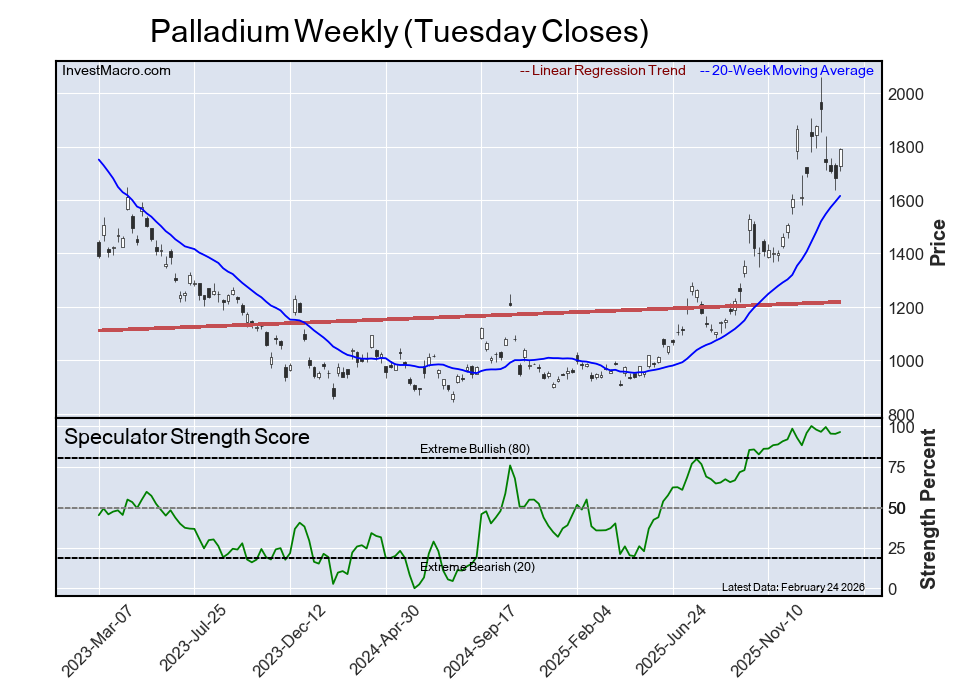
Palladium

Extreme Bullish Leader
The Palladium speculator position comes in next tied at the top of the extreme standings with the Palladium speculator level at a 100 percent score of its 3-year range.

The six-week trend for the strength score was a gain 9 percentage points this week. The speculator position registered 1,225 net contracts this week with a small increase by 646 contracts in this week’s speculator bets.


MSCI EAFE MINI

Extreme Bullish Leader
The MSCI EAFE MINI speculator position comes in also tied this week in the extreme standings with a current 100 percent score of its 3-year range.

The six-week trend for the speculator strength score came in at a jump by 22 percentage points this week. The overall speculator position was 29,353 net contracts this week with a boost of 17,870 contracts in the weekly speculator bets.


US Treasury Bond

Extreme Bullish Leader
The US Treasury Bond speculator position comes up number four in the extreme standings this week with the Long T-Bond speculator level at an 88 percent score of its 3-year range.

The six-week trend for the speculator strength score totaled a rise of 15 percentage points this week. The overall speculator position was 13,835 net contracts this week with an increase by 20,667 contracts in the speculator bets.


Russell 2000 Mini

Extreme Bullish Leader
The Russell 2000 Mini speculator position rounds out the top five in this week’s bullish extreme standings. The Russell-Mini speculator level sits at an 88 percent score of its 3-year range with a six-week change in the strength score by a strong 33 percentage points.

The overall speculator position was a total of 11,437 net contracts this week with a jump by 13,540 contracts in the weekly speculator bets.


The Most Bearish Speculator Positions of the Week:

Extreme Bearish Speculator Table


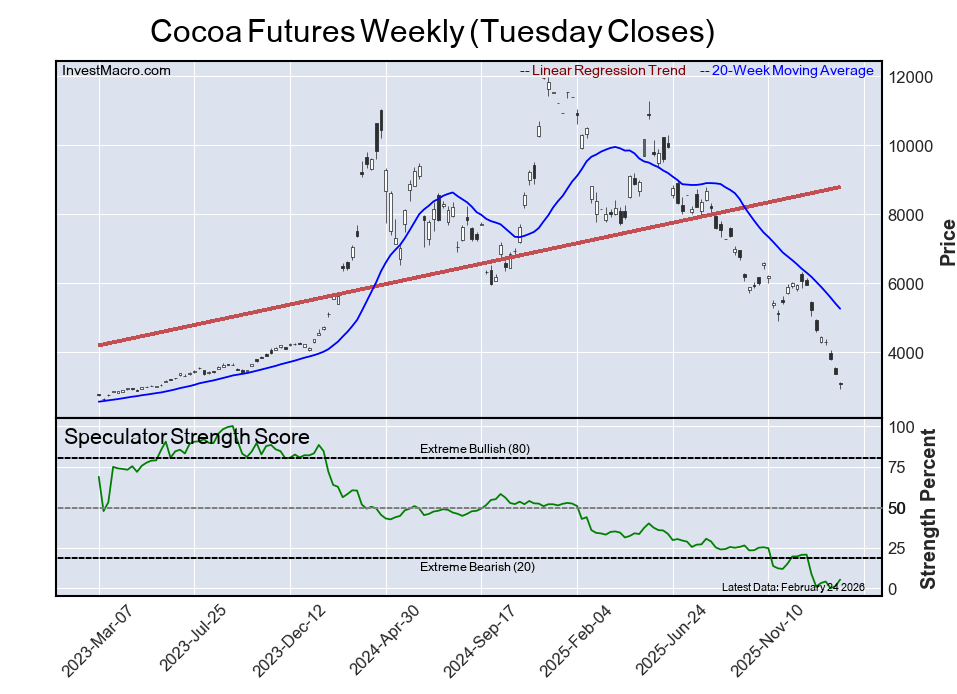
Cocoa Futures

Extreme Bearish Leader
The Cocoa Futures speculator position comes in as the most bearish extreme standing this week. The Cocoa speculator level is current at a 0 percent score of its 3-year range.

The six-week trend for the strength score was a drop by -3 percentage points this week. The overall speculator position was -9,496 net contracts this week with a decline by -12,726 contracts in the speculator bets.


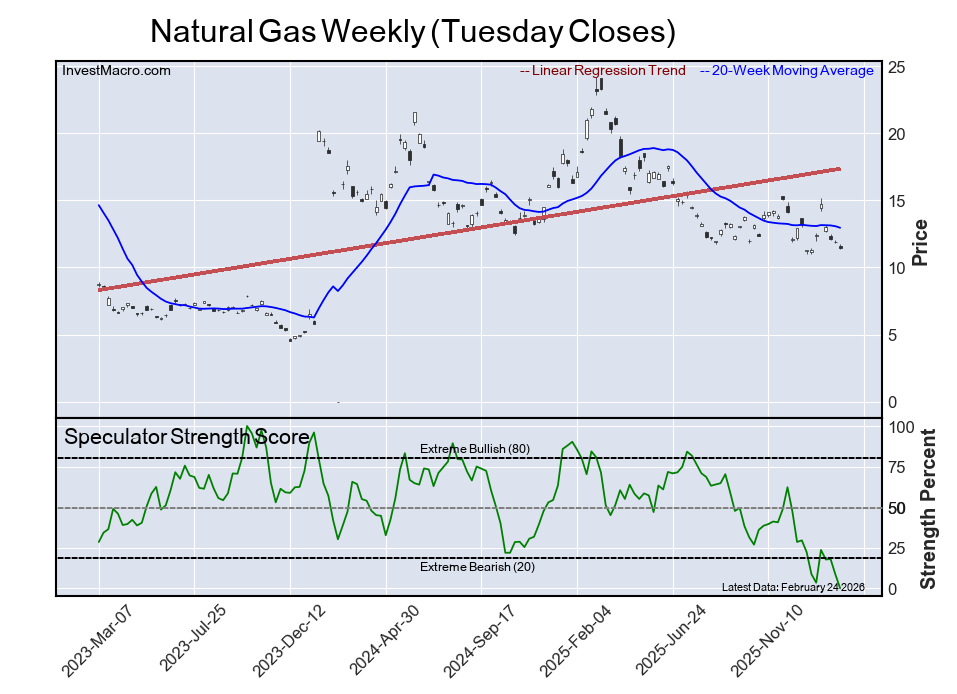
Natural Gas

Extreme Bearish Leader
The Natural Gas speculator position comes in tied for the most bearish extreme standing on the week with the Natural Gas speculator level is also at a 0 percent score of its 3-year range.

The six-week trend for the speculator strength score was a drop by -44 percentage points this week while the speculator position was -185,601 net contracts this week with a decrease of -20,042 contracts.


WTI Crude Oil

Extreme Bearish Leader
The WTI Crude Oil speculator position comes in as third most bearish extreme standing of the week as the WTI Crude speculator level resides at a 6 percent score of its 3-year range.

The six-week trend for the speculator strength score was an edge higher by 2 percentage points this week. The overall speculator position was 58,128 net contracts this week with a change of 776 contracts in the speculator bets.


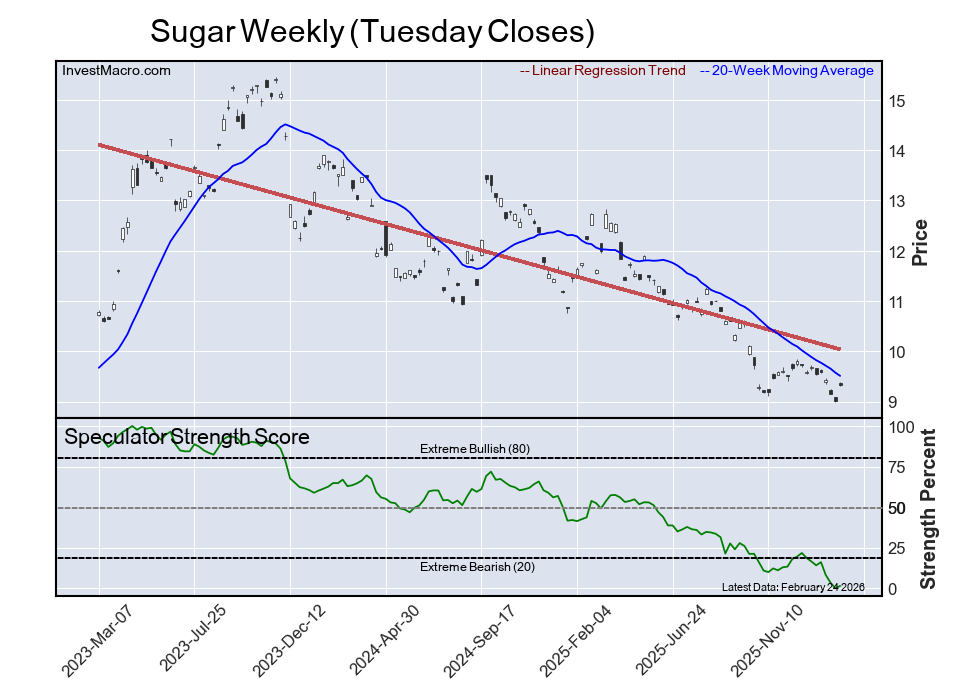
Sugar

Extreme Bearish Leader
The Sugar speculator position comes in as this week’s fourth most bearish extreme standing with the Sugar speculator level at a 7 percent score of its 3-year range.

The six-week trend for the strength score was a rise by 4 percentage points this week while the speculator position totaled -165,711 net contracts this week with a fall of -11,613 contracts in the weekly speculator bets.


New Zealand Dollar

Extreme Bearish Leader
Next, the New Zealand Dollar speculator position comes in as the fifth most bearish extreme standing for this week. The NZD speculator level is currently at a 9 percent score of its 3-year range.

The six-week trend for the speculator strength score was an increase by 5 percentage points this week and the speculator position was -48,851 net contracts this week with a decline of -5,488 contracts in the weekly speculator bets.


Article By InvestMacroReceive our weekly COT Newsletter

*COT Report: The COT data, released weekly to the public each Friday, is updated through the most recent Tuesday (data is 3 days old) and shows a quick view of how large speculators or non-commercials (for-profit traders) were positioned in the futures markets.

The CFTC categorizes trader positions according to commercial hedgers (traders who use futures contracts for hedging as part of the business), non-commercials (large traders who speculate to realize trading profits) and nonreportable traders (usually small traders/speculators) as well as their open interest (contracts open in the market at time of reporting). See CFTC criteria here.
Week Ahead: USDJPY timebomb flirts near “danger zone”

By ForexTime 

  • JPY ↓ over 1% versus USD year-to-date
  • Japan last intervened in July 2024, spending $36.8 billion
  • US PCE + Japan CPI + BoJ = fresh volatility?
  • Over past year BoJ triggered moves of ↑ 0.8% & ↓ 0.2%
  • Technical levels: 162, 160 and 158

Global FX markets could roar back to life if the yen descends deeper into intervention “danger zones”.

USDJPY is trading near an 18-month high around 158.50, a region that forced Japan to intervene back in July 2024.

To be clear, the government jumped into action after USDJPY almost hit 162.00, which is less than 2% away from current prices.

With chatter around intervention getting louder by the day, this could translate to heightened levels of volatility.

Beyond this key theme, the coming week also features scheduled events that could influence USDJPY:

Monday, 19th January

  • US markets closed for Martin Luther King, Jr. Day
  • Annual World Economic Forum in Davos
  • CNY: China GDP Growth Rate (Q4); Industrial Production (Dec); Retail Sales (Dec)
  • CAD: Canada Inflation Rate (Dec)

Tuesday, 20th January

  • EUR: Germany PPI (Dec); Germany ZEW Economic Sentiment Index (Jan); Eurozone ZEW Economic Sentiment Index Jan)
  • GBP: UK Unemployment Rate (Nov); Average Earnings
  • USD: US ADP Employment Weekly Change
  • WTI: API Crude Oil Stock Change (w/e Jan 16)
  • US500: Netflix earnings

Wednesday, 21st January

  • Trump’s speech at the World Economic Forum
  • GBP: UK Inflation Rate (Dec)
  • USD: Pending Home Sales (Dec)
  • JPY: Japan Balance of Trade (Dec); Exports (Dec)

Thursday, 22nd January

  • AUD: Australia Employment Data (Dec); S&P Global Manufacturing and Services PMIs (Jan)
  • NZD: New Zealand Inflation Rate (Q4 2025)
  • EUR: ECB Monetary Policy Accounts; Eurozone Consumer confidence (Jan)
  • USD: US PCE Index (Oct, Nov); Personal Income and Spending (Oct, Nov)
  • JPY: Japan Inflation Rate (Dec)
  • WTI: US EIA Crude Oil Stocks Change (w/e Jan 16)

Friday, 23rd January

  • GBP: UK Retail Sales (Dec); S&P Global Manufacturing and Services PMIs (Jan); Gfk Consumer Confidence (Jan)
  • JPY: BoJ Interest Rate Decision
  • EUR: Germany HCOB manufacturing PMI (Jan); Eurozone HCOB Composite, Manufacturing and Services PMIs (Jan)
  • CAD: Retail Sales (Dec)
  • USD: US S&P Global Composite, Manufacturing and Services PMIs (Jan)

The lowdown:

  • The Japanese Yen is weakening due to election-related fiscal fears and political risk, while a stronger dollar is exacerbating the situation.
  • A weak Yen is bad news for Japan because it boosts import costs, erodes purchasing power, and increases the cost of living.
  • The country’s finance minister has warned speculators that Japan will act to defend its currency, while BoJ officials are paying more attention to its impact on inflation.
  • Zooming out, expectations around a potential intervention may rattle FX markets and impact risk-sensitive currencies in addition to equities.

USDJPY set for a pivotal week?

Key events out of either side of the Pacific may rock the USDJPY:

1) US October/November PCE report

The incoming PCE figures are likely to shape interest rate expectations, especially the core PCE which is the Fed’s preferred inflation gauge.

On Thursday 22nd of January, both the October and November releases of the PCE reports will be published.

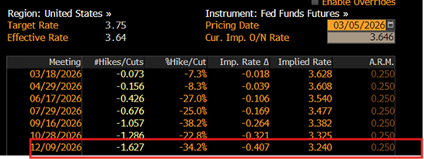
Traders are currently pricing in a 40% chance of a Fed cut by April with the odds jumping to 85% by June 2026.

  • Signs of still sticky inflation may have Fed cut expectations, pushing the USDJPY higher as the dollar strengthens.
  • A weaker-than-expected PCE report may pull the USDJPY lower as the USD weakens on rising Fed cut bets.

2) Japan CPI + BoJ rate decision

Japan’s December CPI report published on Thursday may influence BoJ monetary policy expectations beyond January.

Inflation is forecast to have risen 2.2% year-on-year, down from 2.9% in November due to the base effects from the jump in fresh food prices and new fuel subsidies last year.

Regarding the BoJ, it is expected to hold rates steady at 0.75% but any clues offered on future rates may rock the yen.

Traders are currently pricing in a 25% chance of a BoJ hike by March with the odds jumping to 57% by April 2026.

  • The Yen may rally if the BoJ strikes a hawkish note and signals a rate hike over the coming months. This may drag the USDJPY away from intervention danger zones.
  • A cautious-sounding BoJ may weaken the yen, pushing the USDJPY deeper into intervention zones.

3) Technical forces

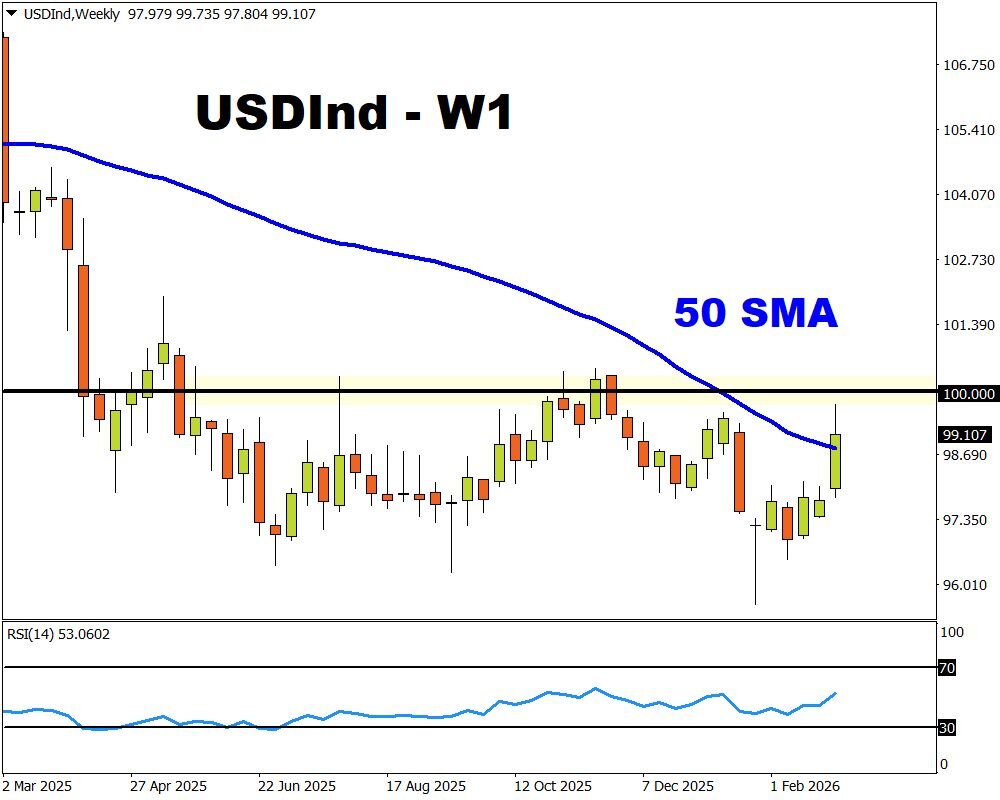
The USDJPY is firmly bullish on the daily timeframe with prices trading above the 50, 100 and 200-day SMA.

  •  A solid move above 159.00 may encourage an incline toward 159.50 and 160.20.
  • Weakness below 158.20 could see prices slip toward 157.50 and 156.90.

Bloomberg’s FX model forecasts a 78.2% chance that USDJPY will trade within the 156.93 – 160.19 range, using current levels as a base, over the next one-week period.


Forex-Time-LogoArticle by ForexTime
 

ForexTime Ltd (FXTM) is an award winning international online forex broker regulated by CySEC 185/12 www.forextime.com

The Bull Market Is Ending

Source: Adrian Day (1/13/26)

Global Analyst Adrian Day looks at the U.S. stock market and “the great rotation” underway.

The Great Rotation in equities is underway, with the U.S. large-cap tech sector losing its dominance as other sectors, markets, and asset classes take over.

And dominance it is: Nvidia Corp. (NVDA:NASDAQ) alone has a larger valuation than the entire markets of Canada or the U.K. That alone might make one scratch one’s head. The U.S. market had a good year: up 17% (for the S&P) is hardly shabby. But this was barely half of the international markets (per MSCI World ex-US Index) while specific long-ignored asset classes came to the fore: copper equities rose 82% while gold and silver jumped 155% (per iShares Copper Miners ETF and VanEck Gold miners ETF).

There Are Many Signs of a Top

Signs of a top in U.S. stocks abound. The most obvious sign is extreme valuation. By most measures, the market is more expensive today than it was in 2022, 2008, 2000, and even 1929.

There are many illustrations we could provide of this, price to earnings, price to sales, price to book, the Schiller CAPE ratio, and more. This is a fact, not conjecture.

Of course, markets can stay overvalued for long periods, as indeed has this one, but there are signs that the “end is nigh.” Market concentration is a record (the gap between the index and an equal-weighted index, for example, has never been great).

Market speculation is extreme, with margins up over 40% in the last year, record foreign and retail participation, and new speculative vehicles (such as 3x ETFs and one-day options) created to feed the appetite. Simply the length of this bull market (see graph) should give pause. Investor David Snyder has a list of 27 “boxes to check for near the end of the secular bull market,” and he says that now all 27 are checked.

The Market Leaders Are Now Rolling Over

That alone should give pause. Market action is also signaling something is up, with the S&P index only barely etching out a new high in the last two months, while leader Nvidia is down meaningfully over this period. One by one, in September, October, and November, the Magnificent Seven have been topping Microsoft Corp. (MSFT:NASDAQ), Apple Inc. (AAPL:NASDAQ), and Amazon.com Inc. (AMZN:NASDAQ). Yes, the Great Rotation is underway. There is an old saying that a market bottom may be an event, but a top is a process. We are experiencing that process unfolding now.

Foreign Markets Taking the Lead From the US

The most obvious beneficiaries have been, and will likely continue to be, both international markets and commodity stocks. Even after that huge outperformance, international equities are still the cheapest they have been relative to the U.S. for 50 years. We expect this outperformance to continue for a few years, as it usually does when foreign markets outperform by a wide margin.

Relative leadership moves in a long cycle: this period of U.S. dominance has lasted nearly 15 years — the U.S. bull market has been going on longer, of course, 17 years now, almost a record — while the previous period of international dominance lasted seven years.

It would be highly unusual for foreign markets to outperform the U.S. by only one year. To return to long-term values relative to the U.S., international markets would have to triple (assuming the U.S. stays flat). And foreign equities are getting help from economic fundamentals, and many foreign economies are growing faster than the U.S., while a decline in the dollar leads many U.S. investors to look abroad.

Commodity Stocks Were 2025’s Top Performers

As for commodity equities, despite the huge rallies last year, they remain close to 100-year lows relative to the stock market. So there is plenty of scope for a return to more average relative valuations. The traditional factors that can lead to higher resource prices — including significant underinvestment over a period — are certainly in place. So too is the likelihood of higher inflation and a lower dollar. Resource cycles tend to be long, so, again, we should not expect the copper and gold outperformance to be a one-off.

But there is now something else. For the AI sector to be successful — and meet current goals — natural gas, uranium, copper, and silver must all go up significantly. The commodities are the gold miners’ picks and shovels for the AI sector. Planned AI capex for this year and next is $2 trillion, with 850 data centers slated to be built in the U.S. over the next five years. Even if projections are cut in half, there will still be a massive pick-up in demand for these commodities, and the inability of production to keep up will mean higher prices.

Other Parts of the Market Have Lagged and Are Undervalued

Other sectors of the market remain at extreme levels of relative undervaluation: value is at its cheapest relative to growth in more than 50 years. Value stocks would need to compound at 20% per year more than growth stocks for five years to return to their long-term relative valuations. Small caps are also undervalued relative to large caps.

So as the leaders of the long U.S. bull market roll over, the emphasis should be on value and small-cap stocks, on sectors that have lagged, but most of all on international markets and commodity stocks.

Do You Want To Be Shocked?

We referred to the potential end of the secular bull market.

Most would consider that this got underway in early 2009, after the Great Financial Crisis. But if one takes a longer-term view, one could argue that the bull market started far earlier, and we have seen a growing “financialization” of the economy for nearly 40 years.

One analyst who looks at markets through a very long telescope is Robert Prechter of the Elliott Wave Theorist.

He has produced a stunning graphic showing how stock market valuations in this period have become progressively more extreme, but significantly well above the 60-year period before.

When he showed an earlier version of what he calls the “Pluto chart” in his presentation at the New Orleans conference, it was met with audible gasps.

Writes Mr.. Prechter, from EWI’s Elliott Wave Theorist, November 14, 2025, “at the end of last month, investors were paying 7.85 times the book value of S&P 400 Industrial companies, and they were content with a measly 1.16% annual dividend yield from companies in the S&P 500 Composite Index. T-bills pay more than triple that amount. Clearly, there is no income reason to buy stocks; the only reason to buy them is a belief that other investors will bid prices even higher than they already are. [This chart] is a snapshot of today’s unprecedented degree of financial optimism.”

Call It What You Like, This Is Bullish for Gold

When the Federal Reserve launched its new Treasury buying program last month, Chairman Jerome Powell and others went out of their way to emphasize that this was not QE. Well, QE or not, something dramatic occurred at the end of the year, as the Fed started purchasing Treasuries at a frantic pace, $160 billion in “reverse repos” during the month, most of it in the last few days of the year, with an unprecedented $100 billion plus on the last day of the year.

This is a multiple of the Fed’s target for $40 billion a month in its “Reserve Management Purchases” program announced after its last meeting.

To be sure, the reverse repo purchases are a separate program. But both represent the Federal Reserve purchasing Treasuries and adding liquidity. The press dutifully reported that this was to “steady the markets over year-end.”

Was it perhaps connected with the then-pending Venezuela operation?

There is speculation that it could be tied to a major bank unable to meet margin calls on a large short silver position.

QE or note QE, such massive liquidity injections are wildly bullish for gold, even more so than lower interest rates, and the market’s action since the Fed announcement bears that out.

TOP BUYS this week include Metalla Royalty & Streaming Ltd. (MTA:TSX.V; MTA:NYSE American) Midland Exploration Inc. (MD:TSX.V), Lara Exploration Ltd. (LRA:TSX.V), and Kingsmen Creatives Ltd. (KMEN:SI).


Important Disclosures:

  1. As of the date of this article, officers and/or employees of Streetwise Reports LLC (including members of their household) own securities of Metalla Royalty & Streaming Ltd., Midland Exploration Inc., Apple Inc., and Lara Exploration Ltd.
  2. Adrian Day: I, or members of my immediate household or family, own securities of: Metalla Royalty & Streaming Ltd., Midland Exploration Inc., Lara Exploration Ltd., and Kingsmen Creatives Ltd. My company has a financial relationship with: None. My company has purchased stocks mentioned in this article for my management clients: Metalla Royalty & Streaming Ltd., Midland Exploration Inc., Lara Exploration Ltd., and Kingsmen Creatives Ltd. . I determined which companies would be included in this article based on my research and understanding of the sector.
  3. Statements and opinions expressed are the opinions of the author and not of Streetwise Reports, Street Smart, or their officers. The author is wholly responsible for the accuracy of the statements. Streetwise Reports was not paid by the author to publish or syndicate this article. Streetwise Reports requires contributing authors to disclose any shareholdings in, or economic relationships with, companies that they write about. Any disclosures from the author can be found  below. Streetwise Reports relies upon the authors to accurately provide this information and Streetwise Reports has no means of verifying its accuracy.
  4.  This article does not constitute investment advice and is not a solicitation for any investment. Streetwise Reports does not render general or specific investment advice and the information on Streetwise Reports should not be considered a recommendation to buy or sell any security. Each reader is encouraged to consult with his or her personal financial adviser and perform their own comprehensive investment research. By opening this page, each reader accepts and agrees to Streetwise Reports’ terms of use and full legal disclaimer. Streetwise Reports does not endorse or recommend the business, products, services or securities of any company.

For additional disclosures, please click here.

Adrian Day Disclosures

Adrian Day’s Global Analyst is distributed for $990 per year by Investment Consultants International, Ltd., P.O. Box 6644, Annapolis, MD 21401. (410) 224-8885. www.AdrianDayGlobalAnalyst.com. Publisher: Adrian Day. Owner: Investment Consultants International, Ltd. Staff may have positions in securities discussed herein. Adrian Day is also President of Global Strategic Management (GSM), a registered investment advisor, and a separate company from this service. In his capacity as GSM president, Adrian Day may be buying or selling for clients securities recommended herein concurrently, before or after recommendations herein, and may be acting for clients in a manner contrary to recommendations herein. This is not a solicitation for GSM. Views herein are the editor’s opinion and not fact. All information is believed to be correct, but its accuracy cannot be guaranteed. The owner and editor are not responsible for errors and omissions. © 2023. Adrian Day’s Global Analyst. Information and advice herein are intended purely for the subscriber’s own account. Under no circumstances may any part of a Global Analyst e-mail be copied or distributed without prior written permission of the editor. Given the nature of this service, we will pursue any violations aggressively.

The CDNX as a Long-Cycle Signal, Not a Trading Index

Source: John Newell (1/6/26) 

John Newell of John Newell & Associates shares his thoughts on the CNDX and a few stocks he believes are worth looking into.

The TSX Venture Exchange (CDNX) is often dismissed as volatile or purely speculative. It functions as a long-cycle barometer of risk appetite and capital availability, particularly in sectors where discovery and development drive value creation.

Historically, the CDNX has:

  • Traded at a premium to gold during expansionary cycles
  • Re-rated sharply following prolonged periods of capital starvation
  • Delivered its strongest performance after senior indices and underlying commodities had already moved

The long-term charts I’ve been maintaining show that the CDNX has spent more than a decade forming a broad base following the 2011–2012 breakdown. That base now appears to be resolving.

Key observations from the long-term structure include:

  • The CDNX has already cleared its first major resistance zones near 775 and 1,025
  • The current structure supports intermediate targets in the 1,325–1,480 range
  • Longer-term measured moves project toward 3,500+ if the full cycle plays out

Importantly, these targets are not derived from short-term momentum indicators. They are based on time, symmetry, and historical valuation resets that have defined prior CDNX cycles.

The Valuation Disconnect: Metals vs. Miners

Gold trading above $4,000, Silver above $70.00, and improving base metal prices should, in theory, have already pulled junior equities meaningfully higher. They have not, and that disconnect is the opportunity.

This gap exists because:

  • Capital exited the sector for more than a decade
  • Research coverage collapsed
  • Liquidity concentrated in mega-cap growth and passive vehicles
  • Junior companies diluted heavily simply to survive

The result is a sector with real assets, improving fundamentals, and compressed equity valuations. From a charting perspective, this is exactly the environment where long bases form and where subsequent moves tend to be disproportionate once capital returns.

Why ‘Overbought’ Is the Wrong Lens

A common objection at this stage is that parts of the market appear overbought. On short-term indicators, that is often true. On long-term ones, it is largely irrelevant.

Every major small-cap and resource bull market has followed the same pattern:

  • Early strength feels uncomfortable
  • Pullbacks shake out weak hands (that’s why they call it a Bull Market, it bucks off the weak hands, and most riders can’t hold on more than 8 seconds!)
  • Primary trends continue regardless

The CDNX charts show that prior secular advances did not begin from ideal sentiment or perfect technical conditions. They began when capital rotated reluctantly, and valuations were still depressed. From that standpoint, the current move is better described as a reawakening, not excess.

Why Junior Mining and Critical Minerals Matter

Small-cap equities do not move as a homogeneous group. Leadership matters.

Junior mining and critical minerals occupy a unique position because they:

  • Sit at the front end of the supply curve
  • Benefit disproportionately from rising commodity prices
  • Offer nonlinear returns through discovery and re-rating
  • Remain outside the focus of most large institutions

Many of the companies I chart today once traded at multiples of their current valuations during prior cycles, often with less advanced assets than they hold now. The charts reflect that history.

What This Means for Portfolio Strategy

From my perspective, the CDNX is not signaling the end of a move, but the beginning of a regime change.

For firms focused on identifying under-followed opportunities before they are widely recognized, this is precisely the environment where disciplined technical work adds value:

  • Identifying long bases before breakouts
  • Distinguishing false moves from structural shifts
  • Prioritizing asymmetry over momentum
  • Staying aligned with long-term trends through volatility

This is where technical analysis complements fundamental work, particularly in sectors where narrative tends to arrive after price.

Applying the Framework at the Company Level

I’ve been applying this same long-base, valuation-reset framework to individual junior companies that were once far more highly valued, then spent years repairing balance sheets, advancing assets, and rebuilding investor confidence.

Recent examples include Lux Metals Corp., Silver North Resources Ltd., and Triumph Gold Corp.

Each operates in established mining districts with tangible assets yet continues to trade at market capitalizations that reflect the prior cycle rather than the current commodity backdrop. In all three cases, the charts show multi-year bases evolving into higher lows, improving volume, and early-stage breakouts that closely mirror the broader CDNX structure. These are not momentum trades. They are examples of how patient capital can position ahead of a re-rating as fundamentals, technicals, and sector capital flows begin to align.

Lux Metals Corp.

As shown in the accompanying chart, Lux Metals Corp (LXM:TSXV; BBBMF:OTCMKTS) illustrates the type of junior that often responds early as the TSX Venture Index begins to turn higher.

After several years of base-building, the shares have broken above long-standing resistance and are now working through a classic point-of-recognition phase, supported by rising volume and improving trend structure.

Fundamentally, Lux has consolidated a large, high-grade gold project in Quebec’s James Bay region, located on the same geological architecture that hosts the Éléonore Mine. With more than 52,000 metres of historical drilling and strong infrastructure, the company combines a credible asset base with a chart that reflects early-stage re-rating potential.

Silver North Resources Ltd.

Another example is Silver North Resources Ltd. (SNAG:TSX.V; TARSF:OTCQB).

After several years of consolidation, the stock has recently transitioned into a technical breakout phase, coinciding with steady exploration progress at its 100%-owned Haldane Silver Project in the Keno Hill District of Yukon.

With a tight share structure, multiple discovery-driven catalysts, and a chart that has shifted decisively from resistance to momentum, Silver North reflects the type of underfollowed junior that often responds early as risk capital begins flowing back into the CDNX.

Triumph Gold Corp.

A third example is Triumph Gold Corp. (TIG:TSX.V; TIGCF:OTCMKTS), which embodies the early-stage upside still available on the TSX Venture Exchange.

After several years consolidating its share structure and advancing the technical understanding of its 100%-owned Freegold Mountain Project in Yukon, Triumph is now breaking out — both technically and fundamentally.

With more than two million gold-equivalent ounces in current resources and exposure to copper, silver, and tungsten, the company is emerging at a time when the broader CDNX is only beginning to rotate back into exploration stories with scale, infrastructure, and optionality. Updated technical charts suggest a multi-year base has been completed, positioning Triumph with a structural tailwind as investor appetite returns.

Closing Thought

The strongest small-cap cycles do not begin when participation is broad or conviction is high. They begin when capital quietly returns to areas that have been ignored long enough to reset expectations.

The CDNX charts suggest we are at that point now.

Junior mining and critical minerals are not late. They are still catching up, and historically, that is when the most durable returns are generated.

I look forward to discussing how this framework can be applied systematically across under-recognized small-cap opportunities.

For reference, my original CDNX article can be found here.

My previous article on Lux Metals can be found here.

My previous article on Silver North can be found here, and my previous article on Triumph Gold can be found here.


Important Disclosures:

  1. Silver North Resources Ltd. is a billboard sponsor of Streetwise Reports and pays SWR a monthly sponsorship fee between US$3,000 and US$6,000.
  2. As of the date of this article, officers, contractors, shareholders, and/or employees of Streetwise Reports LLC (including members of their household) own securities of  Silver North Resources Ltd.
  3. John Newell: I, or members of my immediate household or family, own securities of: Triumph Gold and LUX Metals. My company has a financial relationship with: None. My company has purchased stocks mentioned in this article for my management clients: None. I determined which companies would be included in this article based on my research and understanding of the sector.
  4. Statements and opinions expressed are the opinions of the author and not of Streetwise Reports, Street Smart, or their officers. The author is wholly responsible for the accuracy of the statements. Streetwise Reports was not paid by the author to publish or syndicate this article. Streetwise Reports requires contributing authors to disclose any shareholdings in, or economic relationships with, companies that they write about. Any disclosures from the author can be found  below. Streetwise Reports relies upon the authors to accurately provide this information and Streetwise Reports has no means of verifying its accuracy.
  5.  This article does not constitute investment advice and is not a solicitation for any investment. Streetwise Reports does not render general or specific investment advice and the information on Streetwise Reports should not be considered a recommendation to buy or sell any security. Each reader is encouraged to consult with his or her personal financial adviser and perform their own comprehensive investment research. By opening this page, each reader accepts and agrees to Streetwise Reports’ terms of use and full legal disclaimer. Streetwise Reports does not endorse or recommend the business, products, services or securities of any company.

For additional disclosures, please click here.

John Newell Disclaimer

As always it is important to note that investing in precious metals like silver carries risks, and market conditions can change violently with shock and awe tactics, that we have seen over the past 20 years. Before making any investment decisions, it’s advisable consult with a financial advisor if needed. Also the practice of conducting thorough research and to consider your investment goals and risk tolerance.

Google’s proposed data center in orbit will face issues with space debris in an already crowded orbit

By Mojtaba Akhavan-Tafti, University of Michigan 

The rapid expansion of artificial intelligence and cloud services has led to a massive demand for computing power. The surge has strained data infrastructure, which requires lots of electricity to operate. A single, medium-sized data center here on Earth can consume enough electricity to power about 16,500 homes, with even larger facilities using as much as a small city.

Over the past few years, tech leaders have increasingly advocated for space-based AI infrastructure as a way to address the power requirements of data centers.

In space, sunshine – which solar panels can convert into electricity – is abundant and reliable. On Nov. 4, 2025, Google unveiled Project Suncatcher, a bold proposal to launch an 81-satellite constellation into low Earth orbit. It plans to use the constellation to harvest sunlight to power the next generation of AI data centers in space. So, instead of beaming power back to Earth, the constellation would beam data back to Earth.

For example, if you asked a chatbot how to bake sourdough bread, instead of firing up a data center in Virginia to craft a response, your query would be beamed up to the constellation in space, processed by chips running purely on solar energy, and the recipe sent back down to your device. Doing so would mean leaving the substantial heat generated behind in the cold vacuum of space.

As a technology entrepreneur, I applaud Google’s ambitious plan. But as a space scientist, I predict that the company will soon have to reckon with a growing problem: space debris.

The mathematics of disaster

Space debris – the collection of defunct human-made objects in Earth’s orbit – is already affecting space agencies, companies and astronauts. This debris includes large pieces, such as spent rocket stages and dead satellites, as well as tiny flecks of paint and other fragments from discontinued satellites.

Space debris travels at hypersonic speeds of approximately 17,500 miles per hour (28,000 km/h) in low Earth orbit. At this speed, colliding with a piece of debris the size of a blueberry would feel like being hit by a falling anvil.

Satellite breakups and anti-satellite tests have created an alarming amount of debris, a crisis now exacerbated by the rapid expansion of commercial constellations such as SpaceX’s Starlink. The Starlink network has more than 7,500 satellites, which provide global high-speed internet.

The U.S. Space Force actively tracks over 40,000 objects larger than a softball using ground-based radar and optical telescopes. However, this number represents less than 1% of the lethal objects in orbit. The majority are too small for these telescopes to reliably identify and track.

In November 2025, three Chinese astronauts aboard the Tiangong space station were forced to delay their return to Earth because their capsule had been struck by a piece of space debris. Back in 2018, a similar incident on the International Space Station challenged relations between the United States and Russia, as Russian media speculated that a NASA astronaut may have deliberately sabotaged the station.

The orbital shell Google’s project targets – a Sun-synchronous orbit approximately 400 miles (650 kilometers) above Earth – is a prime location for uninterrupted solar energy. At this orbit, the spacecraft’s solar arrays will always be in direct sunshine, where they can generate electricity to power the onboard AI payload. But for this reason, Sun-synchronous orbit is also the single most congested highway in low Earth orbit, and objects in this orbit are the most likely to collide with other satellites or debris.

As new objects arrive and existing objects break apart, low Earth orbit could approach Kessler syndrome. In this theory, once the number of objects in low Earth orbit exceeds a critical threshold, collisions between objects generate a cascade of new debris. Eventually, this cascade of collisions could render certain orbits entirely unusable.

Implications for Project Suncatcher

Project Suncatcher proposes a cluster of satellites carrying large solar panels. They would fly with a radius of just one kilometer, each node spaced less than 200 meters apart. To put that in perspective, imagine a racetrack roughly the size of the Daytona International Speedway, where 81 cars race at 17,500 miles per hour – while separated by gaps about the distance you need to safely brake on the highway.

This ultradense formation is necessary for the satellites to transmit data to each other. The constellation splits complex AI workloads across all its 81 units, enabling them to “think” and process data simultaneously as a single, massive, distributed brain. Google is partnering with a space company to launch two prototype satellites by early 2027 to validate the hardware.

But in the vacuum of space, flying in formation is a constant battle against physics. While the atmosphere in low Earth orbit is incredibly thin, it is not empty. Sparse air particles create orbital drag on satellites – this force pushes against the spacecraft, slowing it down and forcing it to drop in altitude. Satellites with large surface areas have more issues with drag, as they can act like a sail catching the wind.

To add to this complexity, streams of particles and magnetic fields from the Sun – known as space weather – can cause the density of air particles in low Earth orbit to fluctuate in unpredictable ways. These fluctuations directly affect orbital drag.

When satellites are spaced less than 200 meters apart, the margin for error evaporates. A single impact could not only destroy one satellite but send it blasting into its neighbors, triggering a cascade that could wipe out the entire cluster and randomly scatter millions of new pieces of debris into an orbit that is already a minefield.

The importance of active avoidance

To prevent crashes and cascades, satellite companies could adopt a leave no trace standard, which means designing satellites that do not fragment, release debris or endanger their neighbors, and that can be safely removed from orbit. For a constellation as dense and intricate as Suncatcher, meeting this standard might require equipping the satellites with “reflexes” that autonomously detect and dance through a debris field. Suncatcher’s current design doesn’t include these active avoidance capabilities.

In the first six months of 2025 alone, SpaceX’s Starlink constellation performed a staggering 144,404 collision-avoidance maneuvers to dodge debris and other spacecraft. Similarly, Suncatcher would likely encounter debris larger than a grain of sand every five seconds.

Today’s object-tracking infrastructure is generally limited to debris larger than a softball, leaving millions of smaller debris pieces effectively invisible to satellite operators. Future constellations will need an onboard detection system that can actively spot these smaller threats and maneuver the satellite autonomously in real time.

Equipping Suncatcher with active collision avoidance capabilities would be an engineering feat. Because of the tight spacing, the constellation would need to respond as a single entity. Satellites would need to reposition in concert, similar to a synchronized flock of birds. Each satellite would need to react to the slightest shift of its neighbor.

Detecting space debris in orbit can help prevent collisions.

Paying rent for the orbit

Technological solutions, however, can go only so far. In September 2022, the Federal Communications Commission created a rule requiring satellite operators to remove their spacecraft from orbit within five years of the mission’s completion. This typically involves a controlled de-orbit maneuver. Operators must now reserve enough fuel to fire the thrusters at the end of the mission to lower the satellite’s altitude, until atmospheric drag takes over and the spacecraft burns up in the atmosphere.

However, the rule does not address the debris already in space, nor any future debris, from accidents or mishaps. To tackle these issues, some policymakers have proposed a use-tax for space debris removal.

A use-tax or orbital-use fee would charge satellite operators a levy based on the orbital stress their constellation imposes, much like larger or heavier vehicles paying greater fees to use public roads. These funds would finance active debris removal missions, which capture and remove the most dangerous pieces of junk.

Avoiding collisions is a temporary technical fix, not a long-term solution to the space debris problem. As some companies look to space as a new home for data centers, and others continue to send satellite constellations into orbit, new policies and active debris removal programs can help keep low Earth orbit open for business.The Conversation

About the Author:

Mojtaba Akhavan-Tafti, Associate Research Scientist, University of Michigan

This article is republished from The Conversation under a Creative Commons license. Read the original article.


Why 2026 could see the end of the Farm Bill era of American agriculture policy

By Christopher Neubert, Arizona State University and Kathleen Merrigan, Arizona State University 

With Congress back in session, legislators will take up a set of issues they haven’t comprehensively addressed since 2018 – the year the last farm bill passed.

Farm bills are massive pieces of legislation that address a diverse constellation of topics, including agricultural commodities, conservation, trade, nutrition, rural development, energy, forestry and more. Because of their complexity, farm bills are difficult to negotiate in any political environment. And as the topics have expanded since the first iteration in 1933, Congress has generally agreed to take the whole thing up once every five years or so.

However, the most recent farm bill’s provisions expired in 2023. They have been renewed one year at a time ever since, but without the comprehensive overhaul that used to accompany farm bills.

As former federal employees handling agriculture policy who now study that topic, it’s unclear to us whether a comprehensive, five-year farm bill can be passed in 2026, or ever again.

The July 2025 enactment of the so-called “One Big Beautiful Bill Act,” the Trump administration’s budget priorities in the tax and spending bill, revised funding levels for many programs that were historically handled in the farm bill. For instance, that law included a 20% cut in funding to the Supplemental Nutrition Assistance Program, known as SNAP, which helps low-income families buy food. And it doubled support for the largest farm subsidy programs.

Those changes and current divisions in Congress mean the nation’s food and agriculture policy may remain stuck in limbo for yet another year.

Cuts to SNAP used for farm subsidies

For decades, political conventional wisdom has held that sweeping federal farm bills are able to pass only because farmers seeking subsidies and anti-hunger advocates wanting increased SNAP dollars recognize the mutual advantage in working together. That’s how to build a broad, bipartisan consensus strong enough to garner the 60 votes in the U.S. Senate to avoid a filibuster and actually pass a bill.

But the One Big Beautiful Bill Act tax and spending law did not create a compromise between those competing interests. It slashed SNAP spending by US$186 billion over the next decade. At the same time, it boosted price support for farmers who grow key crops like corn, soybeans and wheat by $60 billion, in addition to a $10 billion economic relief package passed at the end of 2024 to address high costs of seeds, fertilizer and other farming supplies.

Supporters of anti-hunger programs are furious that these funds for farmers are being paid for by cutting SNAP benefits to families.

In addition, about one-third of the SNAP cuts came by shifting the program’s cost to state budgets. States have always carried some of the costs to administer SNAP, but they have never before been required to fund billions of dollars in benefits. Many states will be unable to cover these increased costs and will be forced to either reduce benefits or opt out of SNAP altogether, dramatically cutting the help available to hungry Americans.

Groups that support SNAP are unlikely to help pass any bill relating to food or farm policy that does not substantially reverse the cuts to SNAP.

And farmers who receive money under the two largest farm subsidy programs are not even required to grow the specific crops those programs are meant to support. Rather, they must simply own farmland that was designated in 1996 as having grown that crop in the early 1980s.

Farmers have repeatedly said they would prefer federal farm policies that support markets and create conditions for stable, fair commodity prices. And evidence shows that spending more money on farm subsidies does little to actually improve underlying economic conditions affecting the costs of farming or the prices of what is grown.

And yet, in early December 2025, the Department of Agriculture released an additional $12 billion to help offset losses farmers experienced when Trump’s tariffs reduced agricultural exports. In mid-December, the National Farmers Union said that money still wasn’t enough to cover losses from consistently low commodity prices and high seed and fertilizer costs.

A regular five-year farm bill may be out of reach

The success of any bill depends on political will in Congress and outside pressure coming together to deliver the required number of votes.

Some leaders in Congress remain optimistic about the prospects of a farm bill passing in 2026, but major legislation is rare with midterm elections looming, so meaningful progress appears unlikely. It seems to us more likely that the ongoing stalemate will continue indefinitely.

In September 2025, Politico reported that instead of a complete five-year farm bill, the House and Senate committees on agriculture might take up a series of smaller bills to extend existing programs whose authorizations are expiring. Doing so would be an effective declaration that a permanent five-year farm bill is on indefinite hold.

Prospects for sustainable farm policy

By using financial incentives cleverly, Congress has shifted farming practices over time in ways that lawmakers determined were in the public’s interest.

The 2022 Inflation Reduction Act, for instance, allocated $20 billion over four years to encourage farmers to reduce or offset carbon emissions, which the Agriculture Department calls “climate-smart agriculture.” Those funds, along with a separate Department of Agriculture initiative with similar aims, were well received by American farmers. Farmers applied for far more money than was actually available.

The One Big Beautiful Bill Act tax and spending law cut those funds and repurposed them for traditional Agriculture Department programs for farmers who want to implement conservation practices on their land.

But unexpectedly, the Trump administration’s “Make America Healthy Again,” or MAHA, agenda contains some ideas that climate-smart advocates have previously advanced. These include scathing indictments of the effects of conventional agriculture on Americans’ health, including concerns over pesticide use and the so-far-undefined category of “ultra-processed foods.”

The MAHA agenda could be an opportunity for organic farmers to secure a boost in federal funding. In December, the Agriculture Department committed $700 million toward “regenerative” practices, but that’s a trifling amount compared with the billions commodity farmers received in 2025.

And the administration’s allies who support conventional agriculture have already expressed concerns that MAHA efforts might reduce the nation’s agricultural productivity. The administration may end up caught between the MAHA movement and Big Ag.

Overall, in this new political environment, we believe advocates for changes in agriculture and food aid will likely need to rethink how to advance their agendas without the promise of a farm bill coming anytime soon.The Conversation

About the Author: 

Christopher Neubert, Deputy Director, Swette Center for Sustainable Food Systems, Arizona State University and Kathleen Merrigan, Executive Director, Swette Center for Sustainable Food Systems, Arizona State University

This article is republished from The Conversation under a Creative Commons license. Read the original article.

The battle over a global energy transition is on between petro-states and electro-states – here’s what to watch for in 2026

By Jennifer Morgan, Tufts University 

Two years ago, countries around the world set a goal of “transitioning away from fossil fuels in energy systems in a just, orderly and equitable manner.” The plan included tripling renewable energy capacity and doubling energy efficiency gains by 2030 – important steps for slowing climate change since the energy sector makes up about 75% of the global carbon dioxide emissions that are heating up the planet.

The world is making progress: More than 90% of new power capacity added in 2024 came from renewable energy sources, and 2025 saw similar growth.

However, fossil fuel production is also still expanding. And the United States, the world’s leading producer of both oil and natural gas, is now aggressively pressuring countries to keep buying and burning fossil fuels.

The energy transition was not meant to be a main topic when world leaders and negotiators met at the 2025 United Nations climate summit, COP30, in November in Belém, Brazil. But it took center stage from the start to the very end, bringing attention to the real-world geopolitical energy debate underway and the stakes at hand.

Brazilian President Luiz Inácio Lula da Silva began the conference by calling for the creation of a formal road map, essentially a strategic process in which countries could participate to “overcome dependence on fossil fuels.” It would take the global decision to transition away from fossil fuels from words to action.

More than 80 countries said they supported the idea, ranging from vulnerable small island nations like Vanuatu that are losing land and lives from sea level rise and more intense storms, to countries like Kenya that see business opportunities in clean energy, to Australia, a large fossil-fuel-producing country.

Opposition, led by the Arab Group’s oil- and gas-producing countries, kept any mention of a “road map” energy transition plan out of the final agreement from the climate conference, but supporters are pushing ahead.

I was in Belém for COP30, and I follow developments closely as former special climate envoy and head of delegation for Germany and senior fellow at the Fletcher School at Tufts University. The fight over whether there should even be a road map shows how much countries that depend on fossil fuels are working to slow down the transition, and how others are positioning themselves to benefit from the growth of renewables. And it is a key area to watch in 2026.

The battle between electro-states and petro-states

Brazilian diplomat and COP30 President André Aranha Corrêa do Lago has committed to lead an effort in 2026 to create two road maps: one on halting and reversing deforestation and another on transitioning away from fossil fuels in energy systems in a just, orderly and equitable manner.

What those road maps will look like is still unclear. They are likely to be centered on a process for countries to discuss and debate how to reverse deforestation and phase out fossil fuels.

Over the coming months, Corrêa plans to convene high-level meetings among global leaders, including fossil fuel producers and consumers, international organizations, industries, workers, scholars and advocacy groups.

For the road map to both be accepted and be useful, the process will need to address the global market issues of supply and demand, as well as equity. For example, in some fossil fuel-producing countries, oil, gas or coal revenues are the main source of income. What can the road ahead look like for those countries that will need to diversify their economies?

Nigeria is an interesting case study for weighing that question.

Oil exports consistently provide the bulk of Nigeria’s revenue, accounting for around 80% to over 90% of total government revenue and foreign exchange earnings. At the same time, roughly 39% of Nigeria’s population has no access to electricity, which is the highest proportion of people without electricity of any nation. And Nigeria possesses abundant renewable energy resources across the country, which are largely untapped: solar, hydro, geothermal and wind, providing new opportunities.

What a road map might look like

In Belém, representatives talked about creating a road map that would be science-based and aligned with the Paris climate agreement, and would include various pathways to achieve a just transition for fossil-fuel-dependent regions.

Some inspiration for helping fossil-fuel-producing countries transition to cleaner energy could come from Brazil and Norway.

In Brazil, Lula asked his ministries to prepare guidelines for developing a road map for gradually reducing Brazil’s dependency on fossil fuels and find a way to financially support the changes.

His decree specifically mentions creating an energy transition fund, which could be supported by government revenues from oil and gas exploration. While Brazil supports moving away from fossil fuels, it is also still a large oil producer and recently approved new exploratory drilling near the mouth of the Amazon River.

Norway, a major oil and gas producer, is establishing a formal transition commission to study and plan its economy’s shift away from fossil fuels, particularly focusing on how the workforce and the natural resources of Norway can be used more effectively to create new and different jobs.

Both countries are just getting started, but their work could help point the way for other countries and inform a global road map process.

The European Union has implemented a series of policies and laws aimed at reducing fossil fuel demand. It has a target for 42.5% of its energy to come from renewable sources by 2030. And its EU Emissions Trading System, which steadily reduces the emissions that companies can emit, will soon be expanded to cover housing and transportation. The Emissions Trading System already includes power generation, energy-intensive industry and civil aviation.

Fossil fuel and renewable energy growth ahead

In the U.S., the Trump administration has made clear through its policymaking and diplomacy that it is pursuing the opposite approach: to keep fossil fuels as the main energy source for decades to come.

The International Energy Agency still expects to see renewable energy grow faster than any other major energy source in all scenarios going forward, as renewable energy’s lower costs make it an attractive option in many countries. Globally, the agency expects investment in renewable energy in 2025 to be twice that of fossil fuels.

At the same time, however, fossil fuel investments are also rising with fast-growing energy demand.

The IEA’s World Energy Outlook described a surge in new funding for liquefied natural gas, or LNG, projects in 2025. It now expects a 50% increase in global LNG supply by 2030, about half of that from the U.S. However, the World Energy Outlook notes that “questions still linger about where all the new LNG will go” once it’s produced.

What to watch for

The Belém road map dialogue and how it balances countries’ needs will reflect on the world’s ability to handle climate change.

Corrêa plans to report on its progress at the next annual U.N. climate conference, COP31, in late 2026. The conference will be hosted by Turkey, but Australia, which supported the call for a road map, will be leading the negotiations.

With more time to discuss and prepare, COP31 may just bring a transition away from fossil fuels back into the global negotiations.The Conversation

About the Author:

Jennifer Morgan, Senior Fellow, Center for International Environment and Resource Policy and Climate Policy Lab, Tufts University

This article is republished from The Conversation under a Creative Commons license. Read the original article.

Can the US ‘run’ Venezuela? Military force can topple a dictator, but it cannot create political authority or legitimacy

By Monica Duffy Toft, Tufts University 

An image circulated over media the weekend of Jan. 3 and 4 was meant to convey dominance: Venezuela’s president, Nicolás Maduro, blindfolded and handcuffed aboard a U.S. naval vessel. Shortly after the operation that seized Maduro and his wife, Cilia Flores, President Donald Trump announced that the United States would now “run” Venezuela until a “safe, proper and judicious transition” could be arranged.

The Trump administration’s move is not an aberration; it reflects a broader trend in U.S. foreign policy I described here some six years ago as “America the Bully.”

Washington increasingly relies on coercion – military, economic and political – not only to deter adversaries but to compel compliance from weaker nations. This may deliver short-term obedience, but it is counterproductive as a strategy for building durable power, which depends on legitimacy and capacity. When coercion is applied to governance, it can harden resistance, narrow diplomatic options and transform local political failures into contests of national pride.

There is no dispute that Maduro’s dictatorship led to Venezuela’s catastrophic collapse. Under his rule, Venezuela’s economy imploded, democratic institutions were hollowed out, criminal networks fused with the state, and millions fled the country – many for the United States.

But removing a leader – even a brutal and incompetent one – is not the same as advancing a legitimate political order.

A man wearing sweatpants and a sweatshirt, in handcuffs and blindfolded.
An image of Venezuelan President Nicolás Maduro after his capture, posted by President Donald Trump and reposted by the White House.
White House X.com account

Force doesn’t equal legitimacy

By declaring its intent to govern Venezuela, the United States is creating a governance trap of its own making – one in which external force is mistakenly treated as a substitute for domestic legitimacy.

I write as a scholar of international security, civil wars and U.S. foreign policy, and as author of “Dying by the Sword,” which examines why states repeatedly reach for military solutions, and why such interventions rarely produce durable peace.

The core finding of that research is straightforward: Force can topple rulers, but it cannot generate political authority.

When violence and what I have described elsewhere as “kinetic diplomacy” become a substitute for full spectrum action – which includes diplomacy, economics and what the late political scientist Joseph Nye called “soft power” – it tends to deepen instability rather than resolve it.

More force, less statecraft

The Venezuela episode reflects this broader shift in how the United States uses its power. My co-author Sidita Kushi and I document this by analyzing detailed data from the new Military Intervention Project. We show that since the end of the Cold War, the United States has sharply increased the frequency of military interventions while systematically underinvesting in diplomacy and other tools of statecraft.

One striking feature of the trends we uncover is that if Americans tended to justify excessive military intervention during the Cold War between 1945–1989 due to the perception that the Soviet Union was an existential threat, what we would expect is far fewer military interventions following the Soviet Union’s 1991 collapse. That has not happened.

Even more striking, the mission profile has changed. Interventions that once aimed at short-term stabilization now routinely expand into prolonged governance and security management, as they did in both Iraq after 2003 and Afghanistan after 2001.

This pattern is reinforced by institutional imbalance. In 2026, for every single dollar the United States invests in the diplomatic “scalpel” of the State Department to prevent conflict, it allocates US$28 to the military “hammer” of the Department of Defense, effectively ensuring that force becomes a first rather than last resort.

“Kinetic diplomacy” – in the Venezuela case, regime change by force – becomes the default not because it is more effective, but because it is the only tool of statecraft immediately available. On Jan. 4, Trump told the Atlantic magazine that if Delcy Rodríguez, the acting leader of Venezuela, “doesn’t do what’s right, she is going to pay a very big price, probably bigger than Maduro.”

Lessons from Afghanistan, Iraq and Libya

The consequences of this imbalance are visible across the past quarter-century.

In Afghanistan, the U.S.-led attempt to engineer authority built on external force alone proved brittle by its very nature. The U.S. had invaded Afghanistan in 2001 to topple the Taliban regime, deemed responsible for the 9/11 terrorist attacks. But the subsequent two decades of foreign-backed state-building collapsed almost instantly once U.S. forces withdrew in 2021. No amount of reconstruction spending could compensate for the absence of a political order rooted in domestic consent.

Following the invasion by the U.S. and surrender of Iraq’s armed forces in 2003, both the U.S. Department of State and the Department of Defense proposed plans for Iraq’s transition to a stable democratic nation. President George W. Bush gave the nod to the Defense Department’s plan.

That plan, unlike the State Department’s, ignored key cultural, social and historical conditions. Instead, it proposed an approach that assumed a credible threat to use coercion, supplemented by private contractors, would prove sufficient to lead to a rapid and effective transition to a democratic Iraq. The United States became responsible not only for security, but also for electricity, water, jobs and political reconciliation – tasks no foreign power can perform without becoming, as the United States did, an object of resistance.

Libya demonstrated a different failure mode. There, intervention by a U.S.-backed NATO force in 2011 and removal of dictator Moammar Gadhafi and his regime were not followed by governance at all. The result was civil war, fragmentation, militia rule and a prolonged struggle over sovereignty and economic development that continues today.

The common thread across all three cases is hubris: the belief that American management – either limited or oppressive – could replace political legitimacy.

Venezuela’s infrastructure is already in ruins. If the United States assumes responsibility for governance, it will be blamed for every blackout, every food shortage and every bureaucratic failure. The liberator will quickly become the occupier.

Costs of ‘running’ a country

Taking on governance in Venezuela would also carry broader strategic costs, even if those costs are not the primary reason the strategy would fail.

A military attack followed by foreign administration is a combination that undermines the principles of sovereignty and nonintervention that underpin the international order the United States claims to support. It complicates alliance diplomacy by forcing partners to reconcile U.S. actions with the very rules they are trying to defend elsewhere.

The United States has historically been strongest when it anchored an open sphere built on collaboration with allies, shared rules and voluntary alignment. Launching a military operation and then assuming responsibility for governance shifts Washington toward a closed, coercive model of power – one that relies on force to establish authority and is prohibitively costly to sustain over time.

These signals are read not only in Berlin, London and Paris. They are watched closely in Taipei, Tokyo and Seoul — and just as carefully in Beijing and Moscow.

When the United States attacks a sovereign state and then claims the right to administer it, it weakens its ability to contest rival arguments that force alone, rather than legitimacy, determines political authority.

Beijing needs only to point to U.S. behavior to argue that great powers rule as they please where they can – an argument that can justify the takeover of Taiwan. Moscow, likewise, can cite such precedent to justify the use of force in its near abroad and not just in Ukraine.

This matters in practice, not theory. The more the United States normalizes unilateral governance, the easier it becomes for rivals to dismiss American appeals to sovereignty as selective and self-serving, and the more difficult it becomes for allies to justify their ties to the U.S.

That erosion of credibility does not produce dramatic rupture, but it steadily narrows the space for cooperation over time and the advancement of U.S. interests and capabilities.

Force is fast. Legitimacy is slow. But legitimacy is the only currency that buys durable peace and stability – both of which remain enduring U.S. interests.

If Washington governs by force in Venezuela, it will repeat the failures of Afghanistan, Iraq and Libya: Power can topple regimes, but it cannot create political authority. Outside rule invites resistance, not stability.The Conversation

About the Author:

Monica Duffy Toft, Professor of International Politics and Director of the Center for Strategic Studies, The Fletcher School, Tufts University

This article is republished from The Conversation under a Creative Commons license. Read the original article.

Gold surges as Trump invades Venezuela

By ForexTime 

  • Gold ↑ 2% on mounting geopolitical tensions
  • US invades Venezuela and captures it’s president
  • Ongoing Ukraine talks and US data could add to gold volatility
  • Gold forecasted to move ↑ 0.8% or ↓ 1.2% post NFP
  • Technical levels – $4400, $4500 and ATH at $4550

Markets head into the first full trading week of the year with a bang.

Over the weekend, the US carried out large-scale strikes against Venezuela, capturing its president and flying him out of the country.

President Nicolás Maduro will stand trial on criminal charges in the United States.

This heightened geopolitical risk could spark a wave of risk aversion, prompting investors to seek safe-haven destinations.

In the equity space the reaction has been muted so far, but oil prices could see volatility considering how Trump stated that the US plans to take over Venezuela’s oil.

One of the biggest movers so far has been gold, which gapped higher from Friday’s close as investors reacted to the weekend turmoil.

Prices are currently up over 2%.

A graph of candlesticks and numbers  AI-generated content may be incorrect.

Interestingly, gold fell as much as 6% last week, dipping below $4300 before staging this strong rebound.

A wave of profit-taking triggered the selloff after hitting fresh all-time highs ($4549.92) and a stabilizing dollar.

WHAT COULD MOVE XAUUSD THIS WEEK?

Geopolitics and key US data may shape the outlook for the precious metal.

Beyond the developments in Venezuela, the ongoing Ukraine peace talks will be in focus.

According to Ukrainian President Volodymyr Zelensky, the peace agreement to end the war with Russia is “90% ready”.

However, recent drone strikes in Russia have rekindled tensions between the two nations despite diplomats expressing optimism over peace talks.

On the data front, it’s all about the US NFP report on Friday.

Friday 9th January

US December NFP report – (13:30 PM GMT)

XAUUSD is forecasted to move 0.8% up or 1.2% down in a 6-hour window after the US initial jobless claims.

Note: Traders are pricing in a 51% probability that the Fed cuts rates by March 2026.

A screen shot of a computer  AI-generated content may be incorrect.


POTENTIAL SCENARIOS:

BULLISH – A solid daily close above $4400 may trigger an incline toward $4500 and $4541.79 the upper bound of Bloomberg FX model.

BEARISH – Weakness below $4400 could see prices decline toward $4320 and $4269.41 the lower bound of Bloomberg’s FX model.

A graph with numbers and lines  AI-generated content may be incorrect.

A screen shot of a graph  AI-generated content may be incorrect.


Forex-Time-LogoArticle by ForexTime
 

ForexTime Ltd (FXTM) is an award winning international online forex broker regulated by CySEC 185/12 www.forextime.com