Archive for Opinions – Page 46

AI Data Centers, EVs to Lead New Surge in Energy Demand

Source: Streetwise Reports (7/9/24)

With Electric Vehicles (EVs) and a swarm of new products requiring more power, experts agree that a surge in demand is coming, and soon. Here are several companies that can get you exposure to this important and growing resource.

With Electric Vehicles (EVs) and a swarm of new products requiring more power, experts agree that a surge in demand is coming, and soon.

But the nation’s largest utility companies are warning the surge could be unlike anything seen since the widespread adoption of heat pumps and air conditioners pushed demand sky-high in the 20th Century, according to a June 30 piece by Spencer Kimball for CNBC.

This time the engine of growth will come from power-hungry artificial intelligence data centers, EVs, and the expansion of computer chip manufacturing, he wrote.

“In absolute terms, the growth in electricity demand from these two segments, EVs and data centers, is equivalent to the total electricity demand of a country such as Turkey, that the U.S. has to take on,” said Rystad Energy analyst Surya Hendry in a June release on the issue. “This growth is a race against time to expand power generation without overwhelming electricity systems to the point of stress. If you envision cleaner roads and sustainable AI for the future, renewable energy is the key to meeting this demand and providing the scalability needed for U.S. power systems to endure.”

The tech giants — Amazon, Alphabet’s Google, Microsoft, and Meta — are looking for more power as they bring data centers online that can require as much as a gigawatt of electricity, Petter Skantze, vice president of infrastructure development at NextEra Energy Resources, told CNBC.

“To put that in context, a gigawatt is equivalent to the capacity of nuclear reactor,” the CNBC report noted.

Skantze’s parent company is NextEra Energy, the largest power company in the S&P utilities sector by market capitalization.

“This is a different urgency coming,” Skantze told the Reuters Global Energy Transition conference in New York recently, according to CNBC. “They need this load to drive the next iteration of growth. They’re showing up now at the utility and they’re banging on the door and they’re saying I need to put this resource on the grid.”

The Spark: AI Data Centers, EVs Demand Power

Rystad Energy’s research predicted that data centers and EVs alone will add 290 terrawatt hours (TWh) of new demand by 2030.

“Overall, the combined expansion of traditional and AI data centers, along with chip foundries, will increase demand cumulatively by 177 TWh from 2023 to 2030, reaching a total of 307 TWh,” noted Rystad, an independent research and energy intelligence company. “Despite data centers currently representing a relatively modest portion of total electricity demand in the U.S., this marks a more than two-fold increase compared to 2023 levels, which stood at 130 TWh, highlighting the efforts of the U.S. to position itself as a global data center hub.”

Rystad said the reliance on coal in the U.S. has diminished. This is expected to continue while overall power generation is expected to rise.

“The power mix will increasingly be defined by renewable energy growth and declining coal generation, supported by the Inflation Reduction Act and lowering costs for solar and wind generation technologies,” analysts wrote. “Most states are embracing renewable energy and natural gas in comparison to coal plants, in an effort to become greener and achieve climate goals. Overall, natural gas will continue to dominate much of the US power mix for the next decade, but renewable energy will play an increasingly important role.”

Solar PV capacity is expected to increase by 237 gigawatts (GW) between 2023 and 2030, while wind capacity is projected to grow by 78 GW, Rystad said. The strong growth from these two sources should be sufficient to meet the rising power demand brought by data centers and EVs in the US, while continuing to displace coal in the generation mix.

Southern Co., the second-largest utility in the U.S. by market cap, headquartered in Atlanta, said supplying the demand needed all of America’s future needs is a matter of economic and national security.

Chief Executive Officer Chris Womack told CNBC’s Kimball that nuclear power also has “got to be a big part of this mix.”

“Energy security brings national security, also brings about and supports economic security,” Womack said. “We’ve got to balance and meet the needs of sustainability. But — to ensure that we can continue to have a growing, a thriving economy — we got to get the energy piece right.”

There are some companies that investors can look at to get exposure to this revolution, including one that focuses on renewable sources, another that has created a sustainable battery that could help store all of this energy, and uranium explorers looking to supply future nuclear reactors.

Revolve Renewable Power Corp.

Revolve Renewable Power Corp. (TSXV:REVV; OTCQB:REVVF) was formed 12 years ago to capitalize on the growing global demand for renewable power. It develops utility-scale wind, solar, and battery storage projects in the US, Canada, and Mexico. Its second division, Revolve Renewable Business Solutions, installs and operates sub-20MW “behind the meter” distributed generation (or “DG”) assets.

Management & Insiders: 60%
Retail: 40%
60.0%
40.0%
*Share Structure as of 2/1/2024


Its portfolio includes 11 Megawatts (net) of operating assets under long-term power purchase agreements across Canada and Mexico covering wind, solar, battery storage, and hydro generation; a 3 Megawatt (MW) CHP project and a 450 Kilowatt peak (kWp) rooftop solar project that are both under construction and expected to be operational later this year; and a diverse portfolio of utility-scale development projects across the U.S., Canada, and Mexico that have a combined capacity of over 3,000 MWs, as well as a 140 MW+ distributed generation portfolio that is under development.

Revolve has developed and sold over 1,550MW of projects so far. Going forward, Revolve said it is targeting 5,000 MW of utility-scale projects under development and is rapidly growing its portfolio of revenue-generating DG assets in parallel.

The company reported renewable energy generation of 3,877,342 kWh for the three-month period and 4,822,522 kWh for the nine-month period ending March 31, 2024.

During that quarter, Revolve completed the acquisition of WindRiver, a Canadian-based renewable energy operator and developer, enhancing its portfolio with additional hydro and wind projects.

About 60% of the company is owned by insiders and management, Revolve said.

Top shareholders include Joseph O’Farrell with 13.21%, Roger Norwich with 12.15%, the CEO and Director Stephen Dalton with 6.01%, President and Director Omar Bojoquez with 4.82%, and Jonathan Clare with 1.84%, according to Reuters and the company.

The rest is retail.

Revolve has a market cap of CA$22.06 million with 63.04 million shares outstanding and 38.08 million free-floating. It trades in a 52-week range of CA$0.50 and CA$0.20.

BioLargo Inc.

BioLargo Inc. (BLGO:OTCQB) plans to revolutionize the way energy is stored during the transition. It recently announced it has manufactured “liquid sodium” prototype battery cells that are long-lasting and safer than lithium-ion batteries.

Streetwise Ownership Overview*

BioLargo Inc. (BLGO:OTCQB)

Retail: 85%
Insiders & Management: 15%
85%
15%
*Share Structure as of 2/20/2024

BioLargo’s Cellinity™ battery cells have no runaway fires or risk of explosion, don’t decrease in performance over thousands of uses, and store more energy per unit of weight than lithium batteries, the company noted.

The company also said the battery is not self-discharging and does not have outgassing or parasitic load for cooling, and all of the materials in it can be sourced in North America without the need for rare earth elements.

The batteries have a unique chemistry involving molten salt electrolytes that “imparts substantial benefits over lithium-ion chemistry,” the company noted in a release.

“The world needs a reliable, safe, and eco-friendly alternative to lithium batteries, and we believe our Cellinity battery will meet these needs,” BioLargo President and Chief Executive Officer Dennis P. Calvert said.

BioLargo is made up of several subsidiaries that work in different sectors, a “family of products,” including ONM Environmental, BioLargo Engineering, BioLargo Water, BioLargo Energy Technologies, Clyra Medical Technologies, and the new BioLargo Equipment Solutions & Technologies Inc. (BEST) subsidiary.

Technical Analyst Clive Maund said on July 2 BioLargo’s stock “looks better than ever” as a “range of factors strongly suggest that it will now embark on another upleg.”

“Amongst the bullish factors to observe here is the increase in upside volume in recent weeks, with the Accumulation line showing remarkable strength and advancing to new highs, indicating that the stock has continued to be accumulated even as it has corrected back in a downtrend from its February peak,” Maund wrote.

About 14.6% of BioLargo is owned by insiders and management, according to Yahoo Finance. They include Chief Science Officer Kenneth Code with 8.44%, CEO Calvert with 3.32%, and Director Jack Strommen with 1.64%, Reuters reported.

About 0.04% is held by the institution First American Trust, Reuters said.

The rest, about 85%, is retail.

Its market cap is US$80.15 million, with about 296.84 million shares outstanding and about 254.71 million free-floating. It trades in a 52-week range of US$0.45 and US$0.15.

Skyharbour Resources Ltd.

Skyharbour Resources Ltd. (SYH:TSX.V; SYHBF:OTCQX; SC1P:FSE) has an extensive portfolio of uranium exploration projects in Canada’s Athabasca Basin, with 29 projects, 10 of which are drill-ready, covering over 587,000 hectares of mineral claims.

Institutions: 55%
Retail: 40%
Management and Insiders: 5%
55.0%
40.0%
5.0%
*Share Structure as of 4/4/2024


On Tuesday, the company announced initial results from more than 3,000 meters of drilling from Phase One of its 2024 winter drilling program at the Russell Lake Uranium Project in the central core of the Eastern Athabasca Basin. Second phase results from more than 2,800 meters of drilling are still pending.

The best intercept of uranium mineralization historically on the property was discovered in hole RSL24-02 during Phase One, which returned a 2.5-meter-wide intercept of 0.721% U3O8 at a relatively shallow depth of 338.1 meters, including 2.99% U3O8 over 0.5 meters at 339.6 meters just above the unconformity in the sandstone, the company said.

This high-grade intercept is a new discovery at the recently identified Fork Target, Skyharbour noted in a release.

“The discovery of multi-percent, high-grade, sandstone-hosted uranium mineralization at a new target is a major breakthrough in the discovery process at Russell — something that hasn’t been seen before at the project with the potential to quickly grow with more drilling,” President and Chief Executive Officer Jordan Trimble said.

In addition to exploring for high-grade uranium deposits, Skyharbour utilizes a prospect generator strategy by bringing in partner companies to advance its secondary assets.

Partner companies include Azincourt Energy Corp. (AAZ:TSX.V; AZURF:OTC), Thunderbird Resources Ltd. (THB:ASX) (formerly Valor Resources Ltd.), Basin Uranium Corp. (NCLR:CSE; BURCF:OTC; 6NP0:FRA), and Medaro Mining Corp. (MEDA:CNX). More recently, two earn-in option agreements have been signed with Tisdale Clean Energy Corp. to option the South Falcon East project, as well as North Shore Uranium Ltd. to option the Falcon project.

Jeff Clark, who just took over Gwen Preston’s The Maven Letter, which has now been christened Paydirt Prospector, said both the management team and the company’s projects themselves are impressive.

“Skyharbour is fully funded, sitting on CA$7M in cash,” he said in a June 26 Streetwise Reports article.

Management, insiders, and close business associates own approximately 5% of the company. According to Reuters, the CEO Trimble owns 1.54%, and Director David Cates owns 0.70%.

Institutional, corporate, and strategic investors own approximately 55% of the company. Denison Mines owns 6.3%, Rio Tinto owns 2.0%, Extract Advisors LLC owns 9%, Alps Advisors Inc. owns 9.91%, Mirae Asset Global Investments (U.S.A) L.L.C. owns 6.29%, Sprott Asset Management L.P. owns 1.5%, and Incrementum AG owns 1.18%, Reuters reported.

There are 182.53 million shares outstanding with 177.73 million free float traded shares, while the company has a market cap of CA$66.62 million and trades in a 52-week range of CA$0.33 and CA$0.64.

Tisdale Clean Energy Corp.

One of Skyharbour’s partner companies is British Columbia-based Tisdale Clean Energy Corp. (TCEC:CSE; TCEFF:OTCQB; T1KC:SE), which is advancing the South Falcon East uranium project just outside the southeast part of Saskatchewan’s Athabasca Basin, as part of an earn-in agreement with Skyharbour.

Retail: 79.46%
Strategic Investors: 15.5%
Management and Insiders: 5.04%
79.5%
15.5%
5.0%
*Share Structure as of 6/20/2024


Nearby, big uranium companies are operating, including Cameco Corp. (CCO:TSX; CCJ:NYSE), Denison Mines Corp. (DML:TSX; DNN:NYSE.MKT), NexGen Energy Ltd. (NXE:TSX; NXE:NYSE.MKT), and Rio Tinto Plc (RIO:NYSE; RIO:ASX; RIO:LSE; RTPPF:OTCPK), Technical Analyst Clive Maund highlighted on June 11.*

“They would not be there without good reason, so the chances of [Tisdale] making a significant discovery are high,” wrote Maund.

The 12,234-hectare South Falcon East property encompasses the near-surface Fraser Lakes Zone B deposit. It has a historical Inferred resource of about 7 million pounds of U3O8 at 0.03% and 5.3 million pounds of thorium dioxide at 0.023% within 10,354,926 tons using a U3O8 cutoff grade of 0.01%.

Maund recommended the stock as a Strong Buy for all time horizons. In his report, he explained that though the stock has been declining in price since last spring, it is showing signs, on its one-and-two-year charts, that it is “set to reverse to the upside soon.”

Tisdale provided a breakdown of the company’s ownership and share structure, where CEO Alex Klenman owns 5.04% of the company with 1,591,300 shares.

Planet Ventures Inc. owns approximately 12% of the company, with 3.88 million shares, while Skyharbour Resources owns approximately 3.5%, with 1.11 million.

Tisdale has 31.54 million outstanding shares and 26.6 million free-float traded shares.

Over the past 52 weeks, the company has traded between CA$0.08 and CA$0.40 per share and has a market cap of CA$3.15 million.

North Shore Uranium Ltd.

Another uranium option is another Skyharbour partner, North Shore Uranium Ltd. (NSU:TSX), which is preparing for a follow-up drill program at Falcon and, later, a maiden drill campaign at West Bear, which are both uranium projects in the Athabasca Basin.

Streetwise Ownership Overview*

North Shore Uranium Ltd. (NSU:TSX)

Retail: 55%
Management & Insiders: 45%
55%
45%
*Share Structure as of 5/16/2024


“We think we’ve just scratched the surface at Falcon,” President and Chief Executive Officer Brooke Clements said in an interview on RCTV. “More work is clearly warranted on the discoveries we made this winter. We have a lot of untested, high-priority targets that we want to evaluate.”

Both projects, about 90 kilometers (90 km) apart, are at the basin’s eastern margin, an area with much less past exploration than the expanse to the west. Both projects have historical exploration data, now in the hands of North Shore, which complemented it with airborne gravity surveys over each property in 2022. Both projects boast established uranium potential.

Clements said for the 55,000-hectare Falcon project, North Shore completed its maiden drill program earlier this year. It selected the drill targets after analyzing various historical data sets and the results of airborne geophysical surveys done in 2006, 2007, and 2022, said Clements.

Red Cloud Securities Analyst David Talbot described the drill results in a March research report. “In our view, the structures and alteration typical of basement-hosted uranium mineralization [were] identified by this initial drill program,” he wrote. “We see the results as a positive first step.”

Before the next drill program, said Clements, North Shore is analyzing its extensive geophysical and geological database along with data from the drill program and plans to go into the field to investigate some of the priority targets. North Shore also intends to drill the West Bear property in the future.

Among the reasons investors should consider North Shore, Clements said, are its ownership by insiders and founding investors, tight share structure, and attractive valuation.

Insiders and founding investors who are not insiders own approximately 45% of the issued and outstanding shares. Clements himself owns 3.43% or 1.26 million shares, Director Doris Meyer has 2.11% or 0.78 million shares, and Director James Arthur holds 1.45% or 0.53 million shares.

Most of the rest is with retail, as the institutional holdings are minor.

North Shore has 36.81 million outstanding shares.

The company has a market cap of CA$3.31 million at the recent price of CA$0.09 per share. It has traded in the past 52 weeks between CA$0.08 and CA$0.30 per share.


Important Disclosures:

  1. BioLargo Inc., Revolve Renewable Power Corp., Skyharbour Resources Ltd., and Tisdale Clean Energy Corp. are billboard sponsors of Streetwise Reports and pay SWR a monthly sponsorship fee between US$4,000 and US$5,000. In addition, North Shore Uranium Ltd. and Tisdale Clean Energy Corp. have a consulting relationship with an affiliate of Streetwise Reports, and pay a monthly consulting fee between US$8,000 and US$20,000.
  2. As of the date of this article, officers and/or employees of Streetwise Reports LLC (including members of their household) own securities of Azincourt Energy Corp., BioLargo Inc., North Shore Uranium Ltd., Revolve Renewable Power Corp., Cameco Corp., and Tisdale Clean Energy Corp.
  3. Steve Sobek wrote this article for Streetwise Reports LLC and provides services to Streetwise Reports as an employee.
  4. This article does not constitute investment advice and is not a solicitation for any investment. Streetwise Reports does not render general or specific investment advice and the information on Streetwise Reports should not be considered a recommendation to buy or sell any security. Each reader is encouraged to consult with his or her personal financial adviser and perform their own comprehensive investment research. By opening this page, each reader accepts and agrees to Streetwise Reports’ terms of use and full legal disclaimer. Streetwise Reports does not endorse or recommend the business, products, services or securities of any company.

For additional disclosures, please click here.

* Disclosure for the quote from the Clive Maund article published on June 11, 2024

  1. For the quoted article (published on June 6, 2024), Tisdale Clean Energy Corp. paid Street Smart, an affiliate of Streetwise Reports, US$1,500 in addition to the monthly consulting fee.
  2. Author Certification and Compensation: [Clive Maund of clivemaund.com] is being compensated as an independent contractor by Street Smart, an affiliate of Streetwise Reports, for writing the article quoted. Maund received his UK Technical Analysts’ Diploma in 1989.  The recommendations and opinions expressed in the article accurately reflect the personal, independent, and objective views of the author regarding any and all of the designated securities discussed. No part of the compensation received by the author was, is, or will be directly or indirectly related to the specific recommendations or views expressed

Clivemaund.com Disclosures

The quoted article represents the opinion and analysis of Mr. Maund, based on data available to him, at the time of writing. Mr. Maund’s opinions are his own, and are not a recommendation or an offer to buy or sell securities. As trading and investing in any financial markets may involve serious risk of loss, Mr. Maund recommends that you consult with a qualified investment advisor, one licensed by appropriate regulatory agencies in your legal jurisdiction and do your own due diligence and research when making any kind of a transaction with financial ramifications. Although a qualified and experienced stock market analyst, Clive Maund is not a Registered Securities Advisor. Therefore Mr. Maund’s opinions on the market and stocks cannot be  only be construed as a recommendation or solicitation to buy and sell securities.

Week Ahead: US500 set for major pullback?

By ForexTime 

  • US500 gains 15% in first half of 2024
  • April only negative trading month this year
  • US CPI, Powell Testimony & Big bank earnings in focus
  • Bullish but RSI overbought on multiple timeframes
  • Technical levels – 5600, 5500 & 5460

The UK general election is done and dusted with Labour securing a landslide victory as widely expected.

But the political risks don’t end there…

Just across the English Channel, France will hold the second and final round of its legislative elections this Sunday. And if the far-right National Rally wins an absolute majority, that shocker could see the FRA40 plunging to its year-to-date low.

Speaking of indices, FXTM’s US500 continues to dazzle markets with record highs!

And could see more volatility this afternoon thanks to the US jobs report (Friday 5th July). But even as anticipation mounts, investors are bracing for more action in the week ahead:

Sunday, 7th July

  • FRA40: Second round of French legislative elections

Monday, 8th July

  • JP225: Japan current account

Tuesday, 9th July

  • AU200: Australia consumer confidence
  • CNH: China aggregate financing, money supply, new yuan loans
  • TWN: Taiwan trade
  • US500: Fed Chair Jerome Powell testimony

Wednesday, 10th July

  • CN50: China PPI, CPI
  • JP225: Japan PPI
  • NZD: RBNZ rate decision
  • US500: Fed Chair Jerome Powell testimony, Fed speech

Thursday,11th July

  • GER40: Germany CPI
  • JP225: Japan core machine orders
  • NZD: New Zealand food prices
  • ZAR: South Africa manufacturing production
  • UK100: UK industrial production
  • US500: US June CPI report, Fed speech

Friday, 12th July

  • SG20: Singapore GDP
  • CN50: China trade
  • JP225: Japan industrial production
  • USDInd: US University of Michigan consumer sentiment, PPI
  • US500: JPMorgan, Citigroup, Wells Fargo earnings

All eyes will be on the incoming US inflation data, Powell’s testimony and earnings announcements by big US banks which could move the US500.

With the Relative Strength Index (RSI) signalling that prices are heavily overbought, could a technical pullback be on the horizon?

Note: A pullback is a temporary pause or decline in an asset’s overall bullish trend.


These 3 factors may influence the US500 outlook in the week ahead:

    1) US June CPI report

The incoming US Consumer Price Index (CPI) is likely to impact bets around when the Fed will start cutting interest rates in H2.

Markets are forecasting: 

  • CPI year-on-year (June 2024 vs. June 2023) to cool 3.1% from 3.3% in the prior month.
  • Core CPI year-on-year to remain unchanged at 3.4%.
  • CPI month-on-month (June 2024 vs May 2024) to rise 0.1% from 0% in the prior month.
  • Core CPI month-on-month to remain unchanged at 0.2%.

Expectations around lower US interest rates have been one of the driving forces behind the US500 rally in 2024. This is because the index has a handful of tech stocks that remain sensitive to US rates. Digging deeper, tech accounts for 33% of the US500 value!

  • The US500 could dip if the inflation numbers print above market forecasts.
  • Should the CPI report show more evidence of disinflation, the US500 may receive a boost.

Note: Before the key US inflation data on Thursday, the US500 may be influenced by Fed Chair Jerome Powell’s congressional testimony earlier in the week. Should he strike a dovish tone, US equity bulls are likely to receive a boost, and vice versa.


    2) Big bank earnings

It’s that time of the year again…

Second quarter earnings season kicks off on Friday 12th July, led by the biggest US banks.

Heavyweights such as JPMorgan, Wells Fargo and Citigroup and will be under the spotlight. Investors will closely comb over their earnings for fresh insight into the health of US banks which can be used to gauge the health of the US economy.

When factoring in how financial stocks make up over 12% of the US500, the incoming bank earnings could spark some volatility.

  • US500 may push higher if bank earnings beat estimates.
  • Should earnings disappoint, US500 bears could return to the scene.


    3) Technical forces

The US500 is firmly bullish on the weekly and daily timeframe. However, the Relative Strength Index (RSI) is above 70 – indicating that prices are heavily overbought.

Note: US500 tracks the underlying S&P 500 index

After recently hitting record highs, the index is trading around unchartered territories.

  • Should 5500 prove to be reliable support, bulls could challenge 5600.
  • A decline below 5500 may open a path toward 5460 and 5400.


Forex-Time-LogoArticle by ForexTime

ForexTime Ltd (FXTM) is an award winning international online forex broker regulated by CySEC 185/12 www.forextime.com

From diagnosing brain disorders to cognitive enhancement, 100 years of EEG have transformed neuroscience

By Erika Nyhus, Bowdoin College 

Electroencephalography, or EEG, was invented 100 years ago. In the years since the invention of this device to monitor brain electricity, it has had an incredible impact on how scientists study the human brain.

Since its first use, the EEG has shaped researchers’ understanding of cognition, from perception to memory. It has also been important for diagnosing and guiding treatment of multiple brain disorders, including epilepsy.

I am a cognitive neuroscientist who uses EEG to study how people remember events from their past. The EEG’s 100-year anniversary is an opportunity to reflect on this discovery’s significance in neuroscience and medicine.

Discovery of EEG

On July 6, 1924, psychiatrist Hans Berger performed the first EEG recording on a human, a 17-year-old boy undergoing neurosurgery. At the time, Berger and other researchers were performing electrical recordings on the brains of animals.

What set Berger apart was his obsession with finding the physical basis of what he called psychic energy, or mental effort, in people. Through a series of experiments spanning his early career, Berger measured brain volume and temperature to study changes in mental processes such as intellectual work, attention and desire.

He then turned to recording electrical activity. Though he recorded the first traces of EEG in the human brain in 1924, he did not publish the results until 1929. Those five intervening years were a tortuous phase of self-doubt about the source of the EEG signal in the brain and refining the experimental setup. Berger recorded hundreds of EEGs on multiple subjects, including his own children, with both experimental successes and setbacks.

This is among the first EEG readings published in Hans Berger's study. The top trace is the EGG while the bottom is a reference trace of 10 Hz.
Two EEG traces, the top more irregular in rhythm than the bottom.
Hans Berger/Über das Elektrenkephalogramm des Menchen. Archives für Psychiatrie. 1929; 87:527-70 via Wikimedia Commons

Finally convinced of his results, he published a series of papers in the journal Archiv für Psychiatrie and had hopes of winning a Nobel Prize. Unfortunately, the research community doubted his results, and years passed before anyone else started using EEG in their own research.

Berger was eventually nominated for a Nobel Prize in 1940. But Nobels were not awarded that year in any category due to World War II and Germany’s occupation of Norway.

Neural oscillations

When many neurons are active at the same time, they produce an electrical signal strong enough to spread instantaneously through the conductive tissue of the brain, skull and scalp. EEG electrodes placed on the head can record these electrical signals.

Since the discovery of EEG, researchers have shown that neural activity oscillates at specific frequencies. In his initial EEG recordings in 1924, Berger noted the predominance of oscillatory activity that cycled eight to 12 times per second, or 8 to 12 hertz, named alpha oscillations. Since the discovery of alpha rhythms, there have been many attempts to understand how and why neurons oscillate.

Neural oscillations are thought to be important for effective communication between specialized brain regions. For example, theta oscillations that cycle at 4 to 8 hertz are important for communication between brain regions involved in memory encoding and retrieval in animals and humans.

Researchers then examined whether they could alter neural oscillations and therefore affect how neurons talk to each other. Studies have shown that many behavioral and noninvasive methods can alter neural oscillations and lead to changes in cognitive performance. Engaging in specific mental activities can induce neural oscillations in the frequencies those mental activities use. For example, my team’s research found that mindfulness meditation can increase theta frequency oscillations and improve memory retrieval.

Noninvasive brain stimulation methods can target frequencies of interest. For example, my team’s ongoing research found that brain stimulation at theta frequency can lead to improved memory retrieval.

EEG has also led to major discoveries about how the brain processes information in many other cognitive domains, including how people perceive the world around them, how they focus their attention, how they communicate through language and how they process emotions.

Diagnosing and treating brain disorders

EEG is commonly used today to diagnose sleep disorders and epilepsy and to guide brain disorder treatments.

Scientists are using EEG to see whether memory can be improved with noninvasive brain stimulation. Although the research is still in its infancy, there have been some promising results. For example, one study found that noninvasive brain stimulation at gamma frequency – 25 hertz – improved memory and neurotransmitter transmission in Alzheimer’s disease.

A new type of noninvasive brain stimulation called temporal interference uses two high frequencies to cause neural activity equal to the difference between the stimulation frequencies. The high frequencies can better penetrate the brain and reach the targeted area. Researchers recently tested this method in people using 2,000 hertz and 2,005 hertz to send 5 hertz theta frequency at a key brain region for memory, the hippocampus. This led to improvements in remembering the name associated with a face.

Although these results are promising, more research is needed to understand the exact role neural oscillations play in cognition and whether altering them can lead to long-lasting cognitive enhancement.

The future of EEG

The 100-year anniversary of the EEG provides an opportunity to consider what it has taught us about brain function and what this technique can do in the future.

In a survey commissioned by the journal Nature Human Behaviour, over 500 researchers who use EEG in their work were asked to make predictions on the future of the technique. What will be possible in the next 100 years of EEG?

Some researchers, including myself, predict that we’ll use EEG to diagnose and create targeted treatments for brain disorders. Others anticipate that an affordable, wearable EEG will be widely used to enhance cognitive function at home or will be seamlessly integrated into virtual reality applications. The possibilities are vast.The Conversation

About the Author:

Erika Nyhus, Associate Professor of Psychology and Neuroscience, Bowdoin College

This article is republished from The Conversation under a Creative Commons license. Read the original article.


Cultural differences impede trade for most countries – but not China

By Bedassa Tadesse, University of Minnesota Duluth 

It’s a widely accepted notion among economists that cultural differences can pose a significant barrier to trade. The larger the cultural gap between two countries – judging by differences in language, customs, values and business norms – the more challenging and costly trade relations become. This is a recurring theme in research.

But there’s one big exception to the rule: China.

As an applied economist with a keen interest in how culture influences trade, I’ve conducted several studies of the dynamic. In one such effort, two colleagues and I meticulously analyzed China’s trade relationships with nearly 90 countries over 16 years.

Our research uncovered a distinctive pattern: Unlike many other nations, cultural differences rarely influence the scale of China’s trade activities.

Bridging cultural gaps: Strategies and successes

Countries have various tools to minimize the effects of cultural differences on their trade. Cultural exchange programs, bilateral trade agreements and international trade shows have shown remarkable success in fostering mutual understanding, easing trade negotiations and overcoming cultural barriers.

However, these options are available to all countries. What makes China unique?

I suspect that China’s national trading strategy, involving state-backed export industries and substantial global infrastructure investment, is a big part of the answer.

By aligning itself with the economic development needs of its trading partners, China has been able to minimize the negative effects of cultural differences on its trade. It’s a strategy that has proved to be remarkably effective.

A closer examination of China’s trade ventures in Africa, the Middle East and Latin America — all regions with significant cultural differences from China — paints a vivid picture of this observation.

Despite its cultural differences with nations on the African continent, each with its own unique traditions, languages and customs, China has built a multibillion-dollar trade network in the region that spans industries from mining to telecom. China’s engagement in Africa is facilitated by a combination of local infrastructure investment, affordable technology provision and favorable loan terms. These partnerships are more about creating symbiotic relationships and less about efficiency. This facilitates market access and helps China to overcome cultural barriers.

In the Middle East, too, China has made significant inroads by aligning itself with the region’s development goals, such as those outlined in Saudi Arabia’s Vision 2030 and the United Arab Emirates’ Centennial 2071. China’s Belt and Road Initiative complements these long-term development plans, offering the capital investment and construction expertise needed to bring ambitious infrastructure projects to life.

China’s presence in Latin America has also grown substantially over the past decade. Despite the geographical and cultural distance, China has become one of the top trade partners for countries such as Brazil, Chile and Peru. This relationship is built on reciprocity: Latin American countries supply raw materials and agricultural products in exchange for Chinese investment in the infrastructure and manufacturing sectors.

Again, this is a strategy that hinges on pragmatic economic interactions focused on mutual benefits and development goals.

The need for strategic adaptability

Some might argue that trading with China is an obvious choice due to its size and influence. The economic incentives include access to China’s population of over 1.4 billion and its significant role in global value chains, especially in electronics, textiles and machinery. As China’s influence in global markets grows, U.S. companies also face competitive pressures to maintain their market positions.

However, China’s trade practices, frequently entangled with governmental intervention, potentially undermine market efficiency — an established economic objective — in numerous ways.

In international trade, market efficiency refers to the extent to which prices in the global market reflect all available information, allowing resources to be allocated optimally across countries.

China has been known to require foreign companies to transfer technology to local firms as a condition for market access. This practice may distort market efficiency by forcing companies to share proprietary technology rather than compete on a level playing field.

Intellectual property theft and insufficient protection of intellectual property rights in China have also been major concerns for Western companies. The lack of robust intellectual property enforcement can lead to inefficiencies, as it discourages innovation and investment by foreign firms who fear their inventions and technologies may be copied without adequate legal recourse.

Western companies also face various market-access barriers in China, such as joint venture requirements, limits on foreign ownership and regulatory hurdles. These barriers can prevent the efficient allocation of resources and limit competition and innovation, resulting in a less efficient market overall.

Despite these concerns, Western firms continue to do business with China.

China’s adeptness in transcending cultural barriers, combined with Western firms’ continued engagement, pose a significant challenge for Western economies, notably the United States’. The challenge is heightened as the U.S. maintains a focus on traditional efficiency approaches in forging trade relationships across diverse regions such as Africa, Latin America and the Middle East.

Since traditional market efficiency approaches might not always suffice, Western economies may need to reconsider their strategies.The Conversation

About the Author:

Bedassa Tadesse, Professor of Economics, University of Minnesota Duluth

This article is republished from The Conversation under a Creative Commons license. Read the original article.


Currency Speculator raised their bets for Canadian & Australian Dollars

By InvestMacro

Here are the latest charts and statistics for the Commitment of Traders (COT) data published by the Commodities Futures Trading Commission (CFTC).

The latest COT data is updated through Tuesday June 25th and shows a quick view of how large market participants (for-profit speculators and commercial traders) were positioned in the futures markets. All currency positions are in direct relation to the US dollar where, for example, a bet for the euro is a bet that the euro will rise versus the dollar while a bet against the euro will be a bet that the euro will decline versus the dollar.

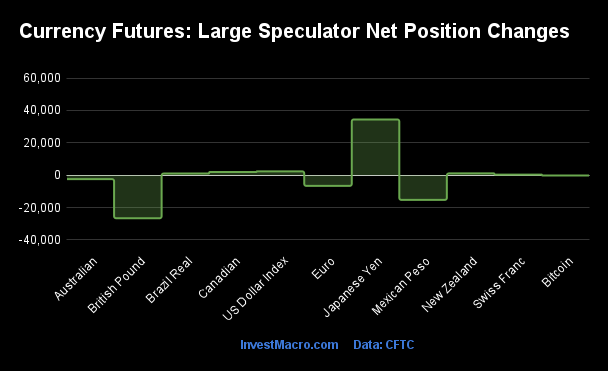
Weekly Speculator Bets led by Canadian & Australian Dollars

The COT currency market speculator bets were higher this week as six out of the eleven currency markets we cover had higher positioning while the other five markets had lower speculator contracts.

Leading the gains for the currency markets was the Canadian Dollar (25,519 contracts) with the Australian Dollar (17,980 contracts), the Mexican Peso (7,552 contracts), the New Zealand Dollar (6,313 contracts), the Swiss Franc (2,333 contracts) and with Bitcoin (99 contracts) also showing positive weeks.

The currencies seeing declines in speculator bets on the week were the Japanese Yen (-26,147 contracts), the EuroFX (-16,382 contracts), the British Pound (-3,573 contracts), the Brazilian Real (-2,563 contracts) and with the US Dollar Index (-73 contracts) also registering lower bets on the week.

COT Currency Roundup:

The Canadian dollar speculative position jumped by over +25,000 contracts this week but this was following three straight weeks of declines that had brought the overall position to an all-time record low level. The CAD position has fallen for 13 out of the past 17 weeks and dropped to a record bearish level on June 18th at a total of -147,931 contracts. This week’s speculator position settled at a total of -122,412 contracts. Helping keep the pressure on the Canadian dollar (also called the loonie) recently was the Bank of Canada’s decision to lower their interest rate on June 5th to 4.75 percent from the previous 5 percent. With inflation subsiding in the Canadian economy, there is speculation that interest rates will come down as well and in turn, dampen the perceived attractiveness of the loonie versus other major currencies.

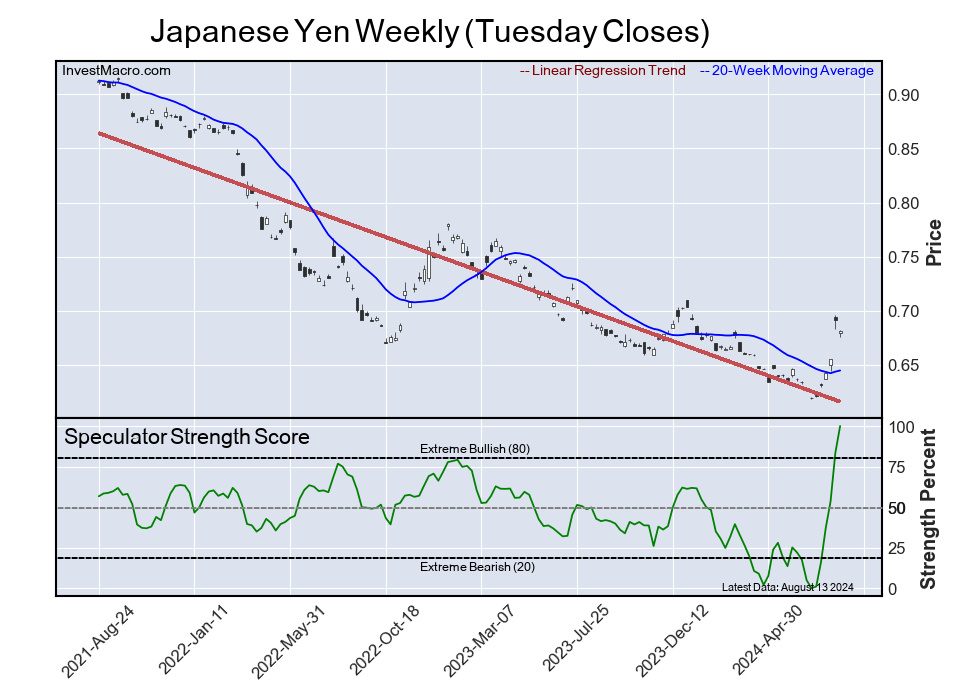
The Japanese yen speculator contracts continued to drop this week and have fallen for three straight weeks. The yen speculative positioning has also declined in 13 out of the last 20 weeks as the overall bearish position has now been above -100,000 contracts for twenty consecutive weeks. The US Dollar/Japanese yen exchange rate continues to see Dollar strength (vs the yen) as the USDJPY currency pair touched above the 161.00 level this week – marking the highest level for the USD since the late-1980s.

The euro currency contracts flipped back into negative territory this week and are in a small bearish position for the first time since April 30th. The euro speculator bets have declined for three straight weeks and are standing at a total of -8,431 contracts this week. The euro exchange rate versus the US Dollar (EURUSD currency pair) has had a very subdued year so far with a fluctuation between approximately 1.0650 and 1.1000 since the beginning of January. This week the EURUSD closed at 1.0752.

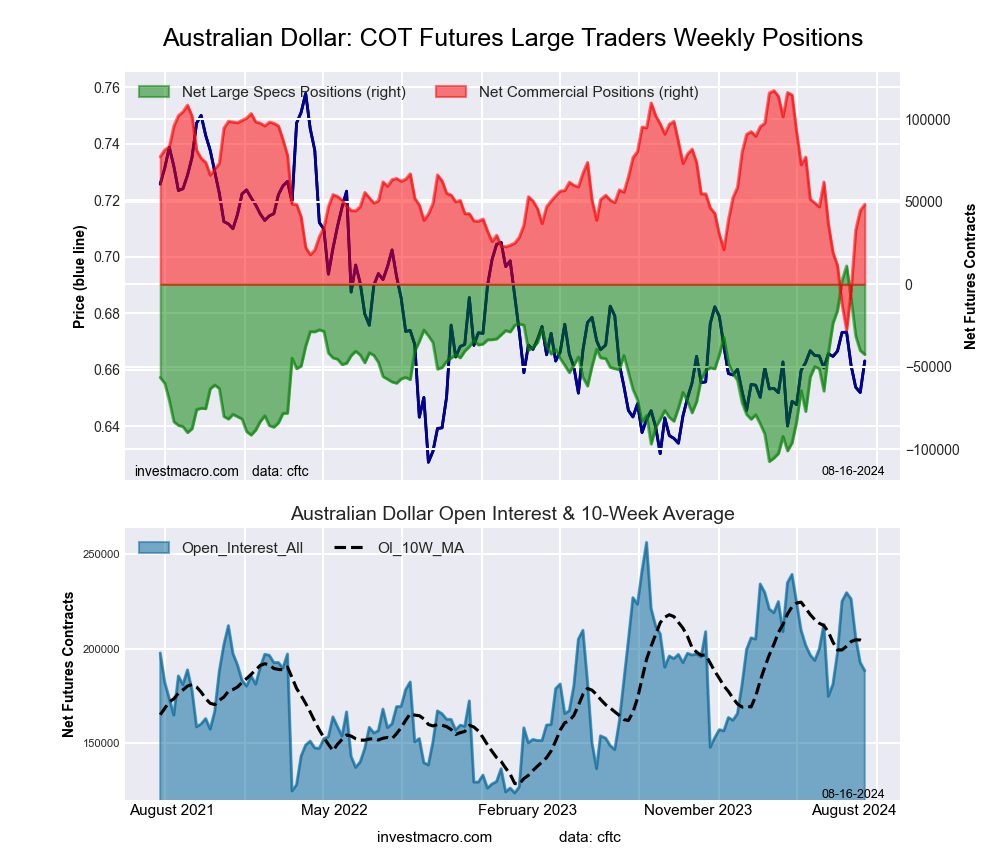
The Australian dollar speculator position sharply rose for a second straight week this week with a gain of +17,980 contracts following last week’s +23,129 contract rise. The Aussie spec position has seen a marked improvement since hitting an all-time low on March 19th at -107,538 contracts with this week’s standing coming in at -23,676 contracts. This is the least bearish level since June 29th of 2021, almost exactly three years ago.

The large speculative US Dollar Index positions dipped very slightly this week by just -73 contracts. However, the Dollar Index speculative position has been on quite a run with gains in the previous eleven straight weeks. This improved sentiment brought the spec position from out of bearish territory to the highest level since December of 2023 above +17,000 contracts and near where the speculator position currently sits at +17,522 contracts. The Dollar Index price has also been on the upswing with gains in four straight weeks and closed out this week at the 105.50 level.

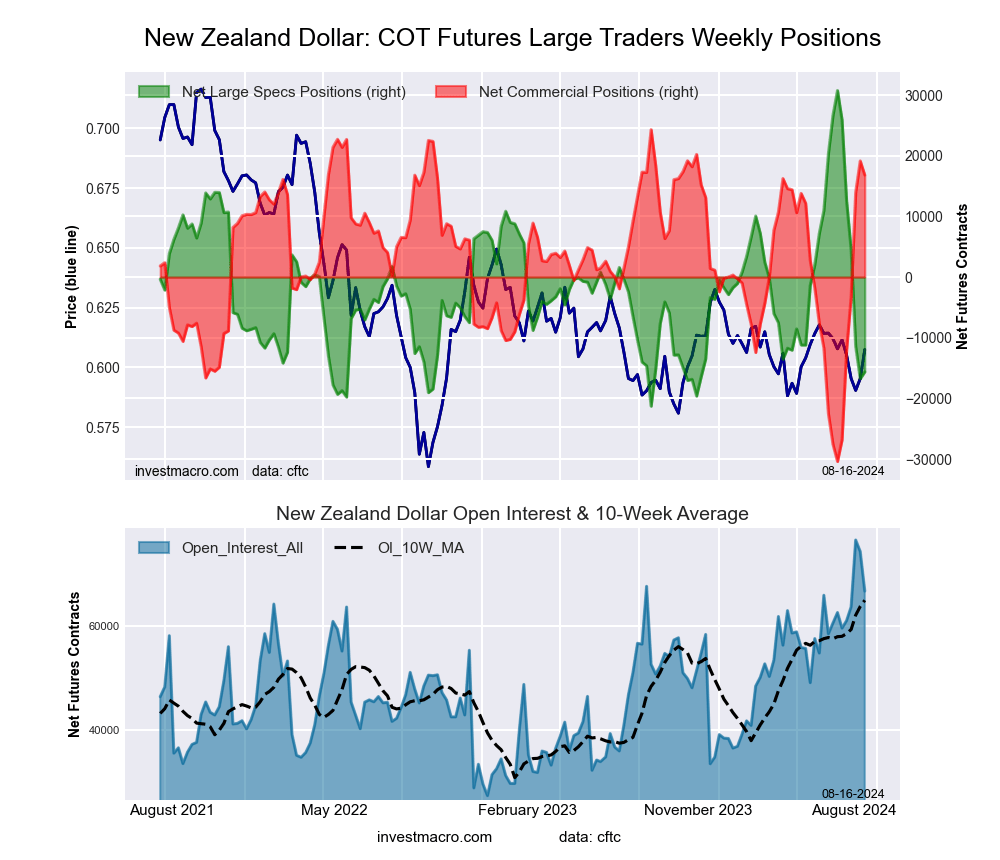
Finally, the large speculative New Zealand Dollar currency positions gained this week by over +6,000 net contracts. The NZD net positions have now increased for six consecutive weeks – adding a total of +37,842 contracts to the net position in that time. This improvement has taken the NZD spec contracts to the most bullish level in the past three hundred and twenty-three weeks, dating back to April 17th of 2018.


Currencies Net Speculators Leaderboard
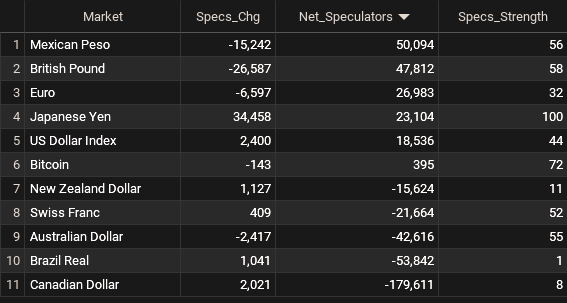
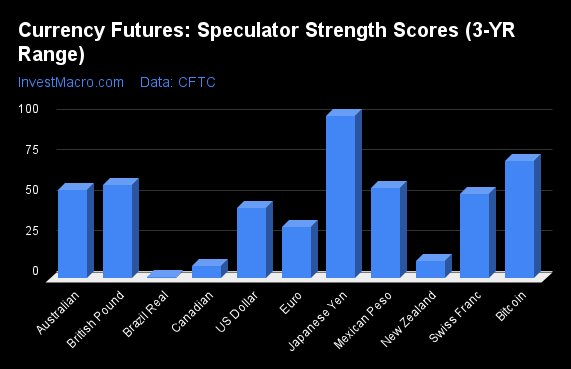
Legend: Weekly Speculators Change | Speculators Current Net Position | Speculators Strength Score compared to last 3-Years (0-100 range)


Strength Scores led by Australian & New Zealand Dollars

COT Strength Scores (a normalized measure of Speculator positions over a 3-Year range, from 0 to 100 where above 80 is Extreme-Bullish and below 20 is Extreme-Bearish) showed that the Australian Dollar (100 percent) and the New Zealand Dollar (100 percent) lead the currency markets this week. The British Pound (82 percent), the Mexican Peso (60 percent) and Bitcoin (57 percent) come in as the next highest in the weekly strength scores.

On the downside, the Japanese Yen (4 percent), the Canadian Dollar (14 percent), the EuroFX (17 percent), the Brazilian Real (18 percent) and the Swiss Franc (19 percent) come in at the lowest strength levels currently and are in Extreme-Bearish territory (below 20 percent).

Strength Statistics:
US Dollar Index (41.4 percent) vs US Dollar Index previous week (41.6 percent)
EuroFX (16.7 percent) vs EuroFX previous week (23.7 percent)
British Pound Sterling (82.5 percent) vs British Pound Sterling previous week (84.9 percent)
Japanese Yen (3.8 percent) vs Japanese Yen previous week (20.1 percent)
Swiss Franc (19.1 percent) vs Swiss Franc previous week (15.0 percent)
Canadian Dollar (13.5 percent) vs Canadian Dollar previous week (0.0 percent)
Australian Dollar (100.0 percent) vs Australian Dollar previous week (78.6 percent)
New Zealand Dollar (100.0 percent) vs New Zealand Dollar previous week (86.8 percent)
Mexican Peso (59.8 percent) vs Mexican Peso previous week (56.1 percent)
Brazilian Real (18.0 percent) vs Brazilian Real previous week (20.8 percent)
Bitcoin (57.0 percent) vs Bitcoin previous week (55.5 percent)


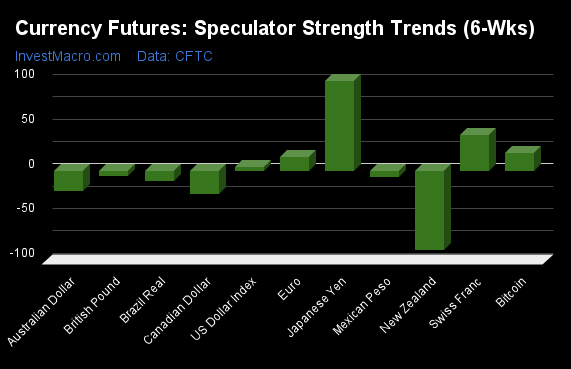
New Zealand Dollar & Australian Dollar top the 6-Week Strength Trends

COT Strength Score Trends (or move index, calculates the 6-week changes in strength scores) showed that the New Zealand Dollar (79 percent) and the Australian Dollar (64 percent) lead the past six weeks trends for the currencies. The British Pound (43 percent), the US Dollar Index (32 percent) and the Brazilian Real (18 percent) are the next highest positive movers in the latest trends data.

The Japanese Yen (-30 percent) leads the downside trend scores currently with the Mexican Peso (-27 percent), Canadian Dollar (-22 percent) and the EuroFX (-11 percent) following next with lower trend scores.

Strength Trend Statistics:
US Dollar Index (32.2 percent) vs US Dollar Index previous week (33.6 percent)
EuroFX (-10.9 percent) vs EuroFX previous week (1.4 percent)
British Pound Sterling (42.5 percent) vs British Pound Sterling previous week (46.0 percent)
Japanese Yen (-29.9 percent) vs Japanese Yen previous week (-8.0 percent)
Swiss Franc (10.8 percent) vs Swiss Franc previous week (7.9 percent)
Canadian Dollar (-22.3 percent) vs Canadian Dollar previous week (-41.6 percent)
Australian Dollar (63.8 percent) vs Australian Dollar previous week (27.3 percent)
New Zealand Dollar (79.0 percent) vs New Zealand Dollar previous week (65.8 percent)
Mexican Peso (-27.1 percent) vs Mexican Peso previous week (-30.4 percent)
Brazilian Real (18.0 percent) vs Brazilian Real previous week (20.2 percent)
Bitcoin (-6.7 percent) vs Bitcoin previous week (0.9 percent)


Individual COT Forex Markets:

US Dollar Index Futures:
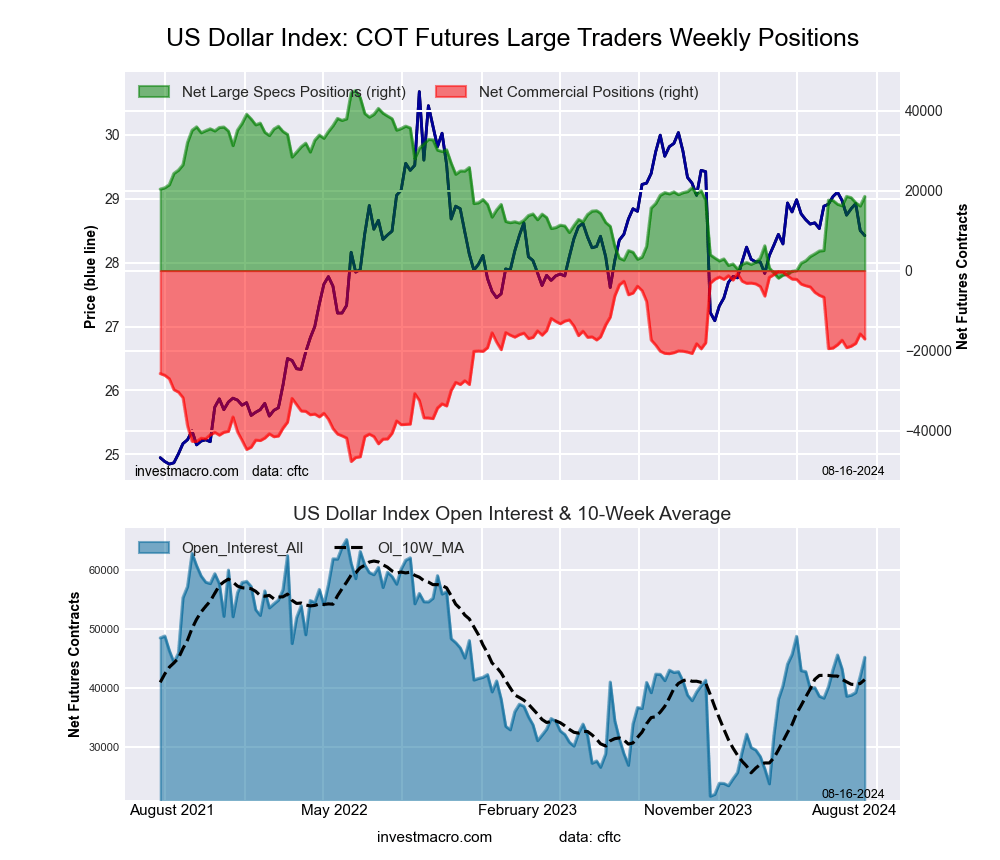
US Dollar Index Forex Futures COT ChartThe US Dollar Index large speculator standing this week resulted in a net position of 17,522 contracts in the data reported through Tuesday. This was a weekly lowering of -73 contracts from the previous week which had a total of 17,595 net contracts.

This week’s current strength score (the trader positioning range over the past three years, measured from 0 to 100) shows the speculators are currently Bearish with a score of 41.4 percent. The commercials are Bullish with a score of 59.8 percent and the small traders (not shown in chart) are Bearish with a score of 32.6 percent.

Price Trend-Following Model: Strong Uptrend

Our weekly trend-following model classifies the current market price position as: Strong Uptrend. The current action for the model is considered to be: Hold – Maintain Long Position.

US DOLLAR INDEX StatisticsSPECULATORSCOMMERCIALSSMALL TRADERS
– Percent of Open Interest Longs:74.014.68.9
– Percent of Open Interest Shorts:33.459.54.6
– Net Position:17,522-19,3651,843
– Gross Longs:31,9476,3043,848
– Gross Shorts:14,42525,6692,005
– Long to Short Ratio:2.2 to 10.2 to 11.9 to 1
NET POSITION TREND:
– Strength Index Score (3 Year Range Pct):41.459.832.6
– Strength Index Reading (3 Year Range):BearishBullishBearish
NET POSITION MOVEMENT INDEX:
– 6-Week Change in Strength Index:32.2-32.85.7


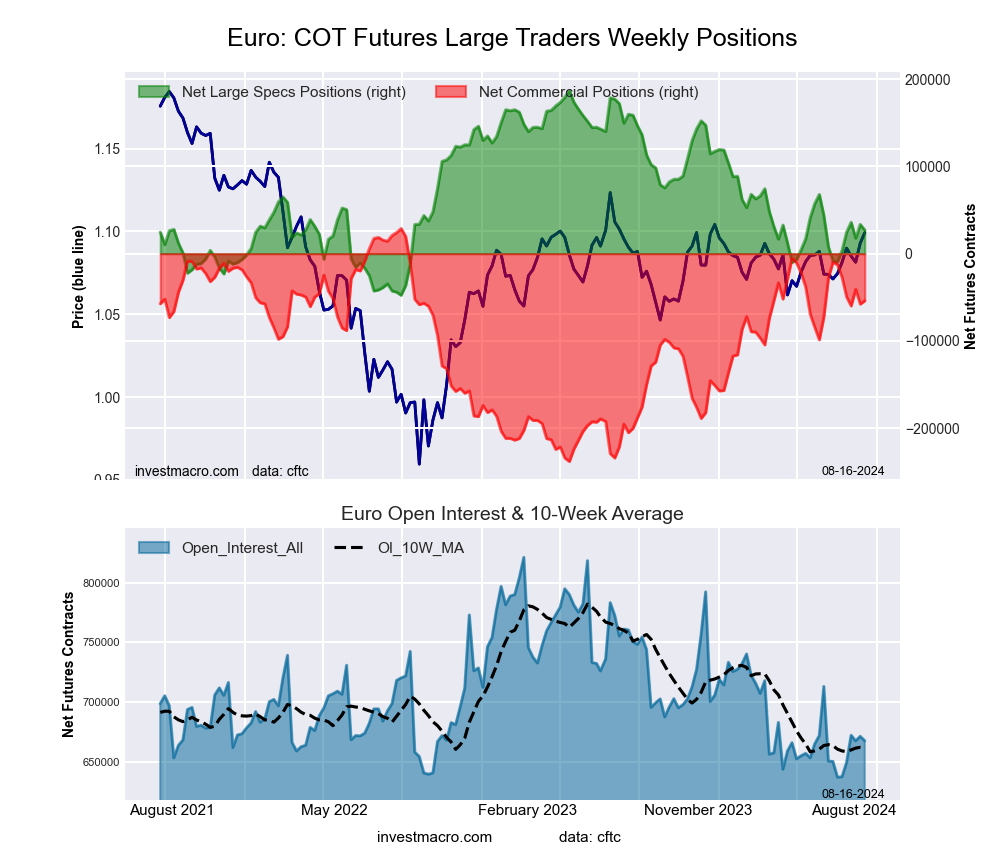
Euro Currency Futures:

Euro Currency Futures COT ChartThe Euro Currency large speculator standing this week resulted in a net position of -8,431 contracts in the data reported through Tuesday. This was a weekly fall of -16,382 contracts from the previous week which had a total of 7,951 net contracts.

This week’s current strength score (the trader positioning range over the past three years, measured from 0 to 100) shows the speculators are currently Bearish-Extreme with a score of 16.7 percent. The commercials are Bullish-Extreme with a score of 85.5 percent and the small traders (not shown in chart) are Bearish-Extreme with a score of 11.5 percent.

Price Trend-Following Model: Strong Downtrend

Our weekly trend-following model classifies the current market price position as: Strong Downtrend. The current action for the model is considered to be: Hold – Maintain Short Position.

EURO Currency StatisticsSPECULATORSCOMMERCIALSSMALL TRADERS
– Percent of Open Interest Longs:25.760.111.0
– Percent of Open Interest Shorts:27.061.68.2
– Net Position:-8,431-9,76718,198
– Gross Longs:167,370390,83771,392
– Gross Shorts:175,801400,60453,194
– Long to Short Ratio:1.0 to 11.0 to 11.3 to 1
NET POSITION TREND:
– Strength Index Score (3 Year Range Pct):16.785.511.5
– Strength Index Reading (3 Year Range):Bearish-ExtremeBullish-ExtremeBearish-Extreme
NET POSITION MOVEMENT INDEX:
– 6-Week Change in Strength Index:-10.910.7-6.7


British Pound Sterling Futures:

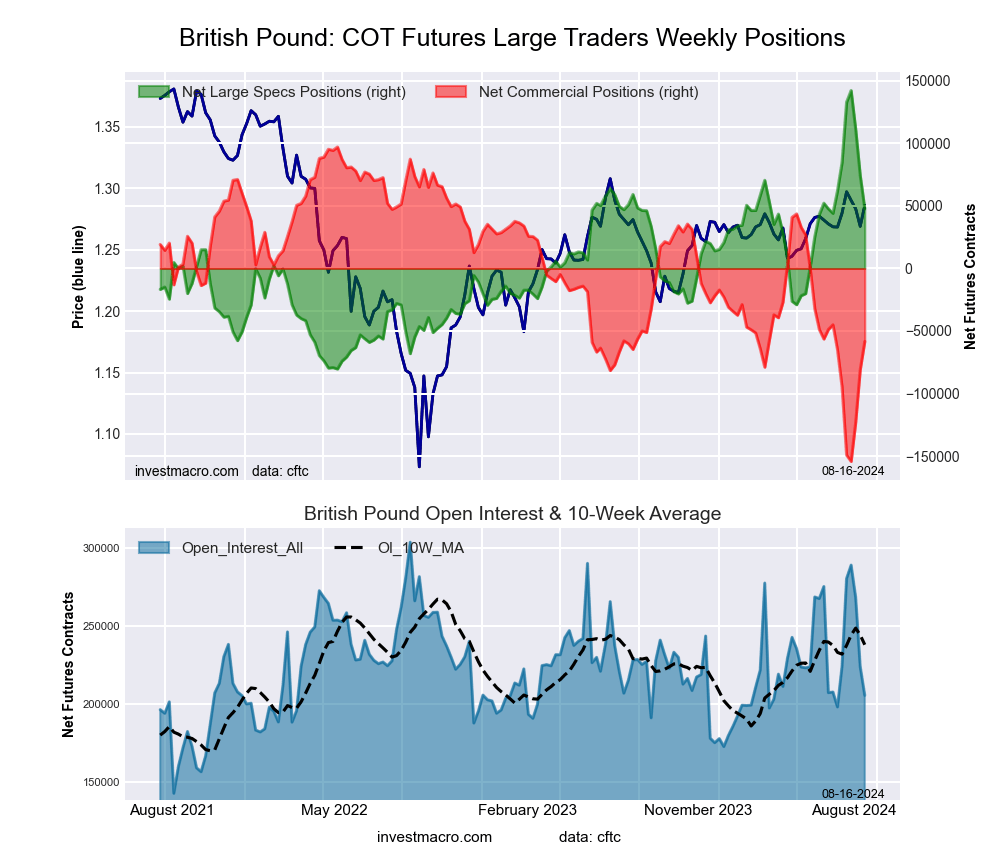
British Pound Sterling Futures COT ChartThe British Pound Sterling large speculator standing this week resulted in a net position of 44,048 contracts in the data reported through Tuesday. This was a weekly fall of -3,573 contracts from the previous week which had a total of 47,621 net contracts.

This week’s current strength score (the trader positioning range over the past three years, measured from 0 to 100) shows the speculators are currently Bullish-Extreme with a score of 82.5 percent. The commercials are Bearish with a score of 20.5 percent and the small traders (not shown in chart) are Bullish with a score of 64.2 percent.

Price Trend-Following Model: Strong Uptrend

Our weekly trend-following model classifies the current market price position as: Strong Uptrend. The current action for the model is considered to be: Hold – Maintain Long Position.

BRITISH POUND StatisticsSPECULATORSCOMMERCIALSSMALL TRADERS
– Percent of Open Interest Longs:49.433.513.6
– Percent of Open Interest Shorts:28.255.113.1
– Net Position:44,048-45,026978
– Gross Longs:102,54769,49728,209
– Gross Shorts:58,499114,52327,231
– Long to Short Ratio:1.8 to 10.6 to 11.0 to 1
NET POSITION TREND:
– Strength Index Score (3 Year Range Pct):82.520.564.2
– Strength Index Reading (3 Year Range):Bullish-ExtremeBearishBullish
NET POSITION MOVEMENT INDEX:
– 6-Week Change in Strength Index:42.5-40.216.2


Japanese Yen Futures:

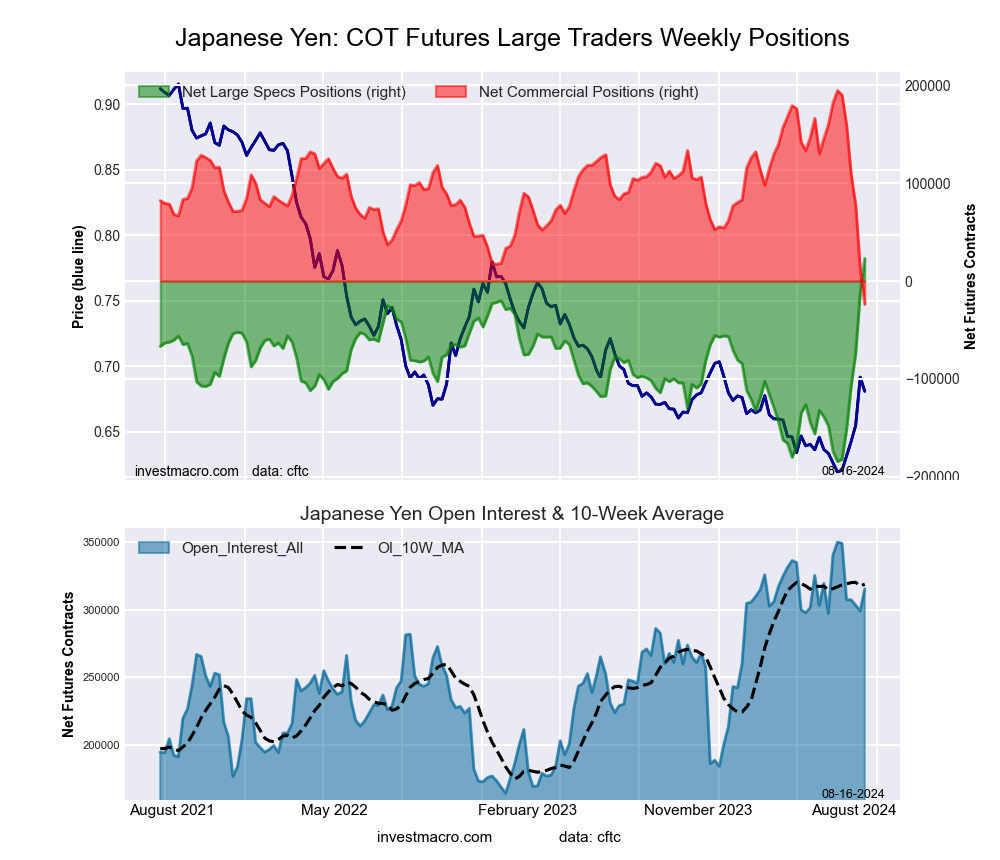
Japanese Yen Forex Futures COT ChartThe Japanese Yen large speculator standing this week resulted in a net position of -173,900 contracts in the data reported through Tuesday. This was a weekly decline of -26,147 contracts from the previous week which had a total of -147,753 net contracts.

This week’s current strength score (the trader positioning range over the past three years, measured from 0 to 100) shows the speculators are currently Bearish-Extreme with a score of 3.8 percent. The commercials are Bullish-Extreme with a score of 100.0 percent and the small traders (not shown in chart) are Bullish with a score of 57.6 percent.

Price Trend-Following Model: Strong Downtrend

Our weekly trend-following model classifies the current market price position as: Strong Downtrend. The current action for the model is considered to be: Hold – Maintain Short Position.

JAPANESE YEN StatisticsSPECULATORSCOMMERCIALSSMALL TRADERS
– Percent of Open Interest Longs:10.276.211.1
– Percent of Open Interest Shorts:61.322.813.5
– Net Position:-173,900181,858-7,958
– Gross Longs:34,576259,29237,891
– Gross Shorts:208,47677,43445,849
– Long to Short Ratio:0.2 to 13.3 to 10.8 to 1
NET POSITION TREND:
– Strength Index Score (3 Year Range Pct):3.8100.057.6
– Strength Index Reading (3 Year Range):Bearish-ExtremeBullish-ExtremeBullish
NET POSITION MOVEMENT INDEX:
– 6-Week Change in Strength Index:-29.929.5-2.7


Swiss Franc Futures:

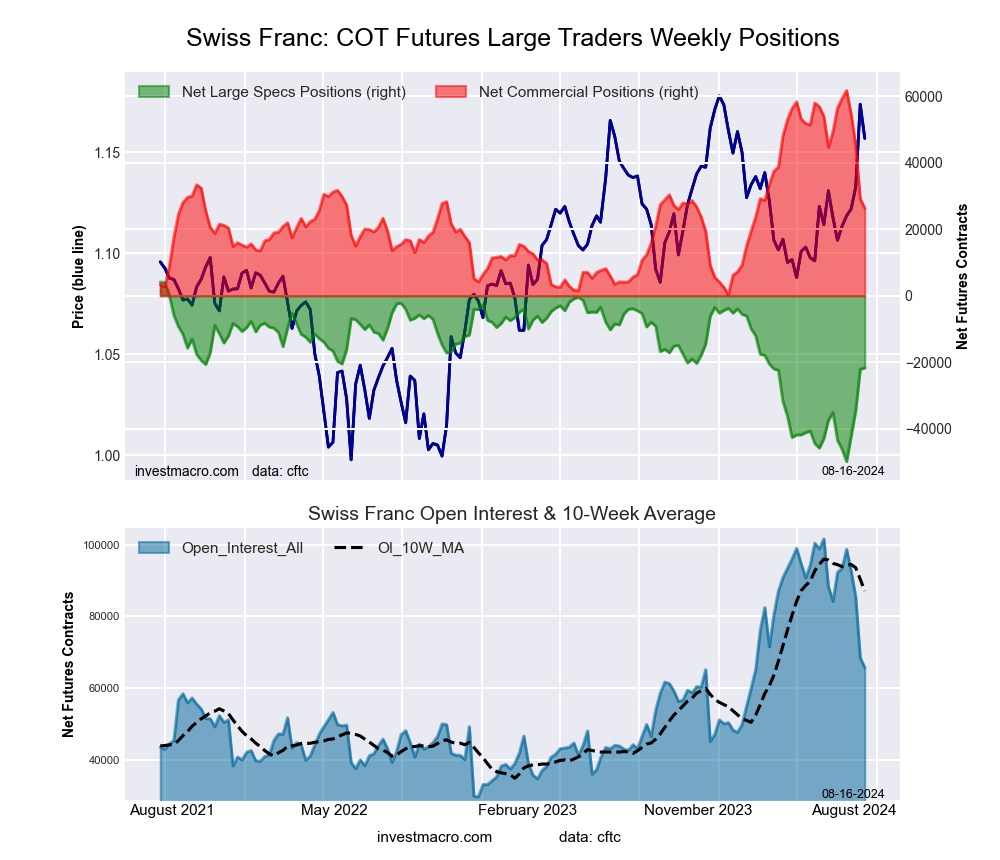
Swiss Franc Forex Futures COT ChartThe Swiss Franc large speculator standing this week resulted in a net position of -35,057 contracts in the data reported through Tuesday. This was a weekly advance of 2,333 contracts from the previous week which had a total of -37,390 net contracts.

This week’s current strength score (the trader positioning range over the past three years, measured from 0 to 100) shows the speculators are currently Bearish-Extreme with a score of 19.1 percent. The commercials are Bullish-Extreme with a score of 84.9 percent and the small traders (not shown in chart) are Bearish-Extreme with a score of 12.3 percent.

Price Trend-Following Model: Downtrend

Our weekly trend-following model classifies the current market price position as: Downtrend. The current action for the model is considered to be: Hold – Maintain Short Position.

SWISS FRANC StatisticsSPECULATORSCOMMERCIALSSMALL TRADERS
– Percent of Open Interest Longs:7.780.711.0
– Percent of Open Interest Shorts:49.422.127.9
– Net Position:-35,05749,331-14,274
– Gross Longs:6,50667,9699,253
– Gross Shorts:41,56318,63823,527
– Long to Short Ratio:0.2 to 13.6 to 10.4 to 1
NET POSITION TREND:
– Strength Index Score (3 Year Range Pct):19.184.912.3
– Strength Index Reading (3 Year Range):Bearish-ExtremeBullish-ExtremeBearish-Extreme
NET POSITION MOVEMENT INDEX:
– 6-Week Change in Strength Index:10.8-4.1-16.4


Canadian Dollar Futures:

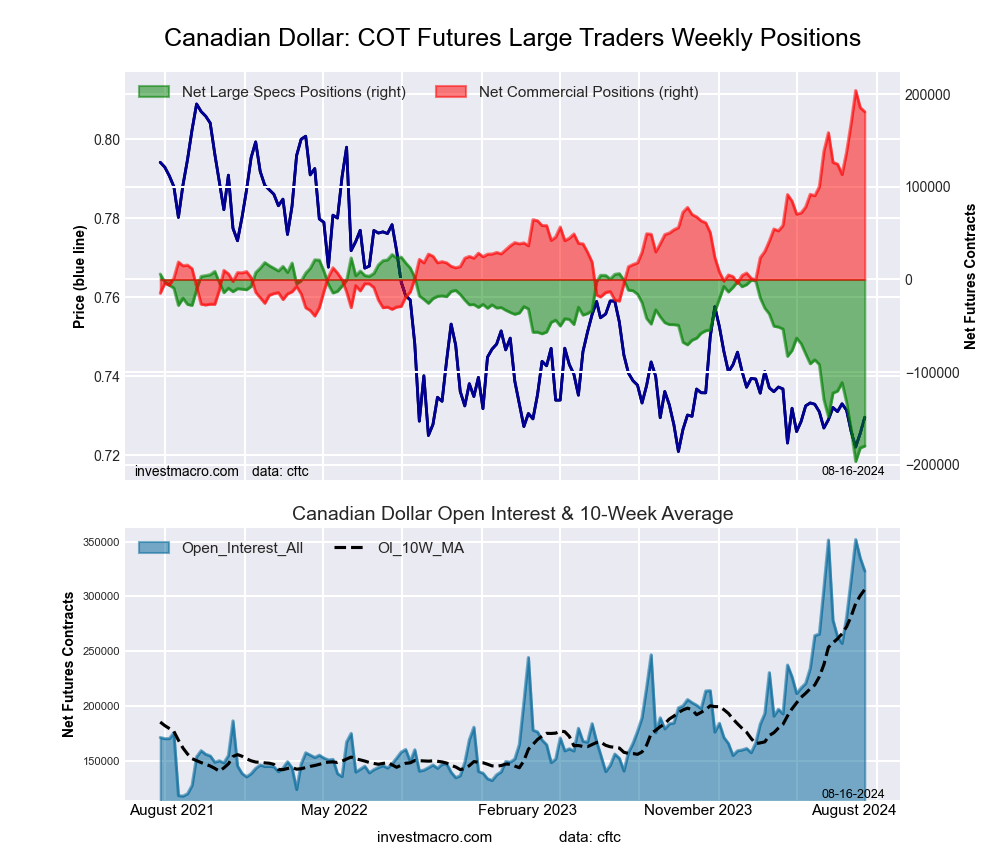
Canadian Dollar Forex Futures COT ChartThe Canadian Dollar large speculator standing this week resulted in a net position of -122,412 contracts in the data reported through Tuesday. This was a weekly boost of 25,519 contracts from the previous week which had a total of -147,931 net contracts.

This week’s current strength score (the trader positioning range over the past three years, measured from 0 to 100) shows the speculators are currently Bearish-Extreme with a score of 13.5 percent. The commercials are Bullish-Extreme with a score of 85.8 percent and the small traders (not shown in chart) are Bearish-Extreme with a score of 18.2 percent.

Price Trend-Following Model: Downtrend

Our weekly trend-following model classifies the current market price position as: Downtrend. The current action for the model is considered to be: Hold – Maintain Short Position.

CANADIAN DOLLAR StatisticsSPECULATORSCOMMERCIALSSMALL TRADERS
– Percent of Open Interest Longs:10.076.910.4
– Percent of Open Interest Shorts:53.931.511.8
– Net Position:-122,412126,330-3,918
– Gross Longs:27,790214,10729,063
– Gross Shorts:150,20287,77732,981
– Long to Short Ratio:0.2 to 12.4 to 10.9 to 1
NET POSITION TREND:
– Strength Index Score (3 Year Range Pct):13.585.818.2
– Strength Index Reading (3 Year Range):Bearish-ExtremeBullish-ExtremeBearish-Extreme
NET POSITION MOVEMENT INDEX:
– 6-Week Change in Strength Index:-22.321.4-16.7


Australian Dollar Futures:

Australian Dollar Forex Futures COT ChartThe Australian Dollar large speculator standing this week resulted in a net position of -23,676 contracts in the data reported through Tuesday. This was a weekly advance of 17,980 contracts from the previous week which had a total of -41,656 net contracts.

This week’s current strength score (the trader positioning range over the past three years, measured from 0 to 100) shows the speculators are currently Bullish-Extreme with a score of 100.0 percent. The commercials are Bearish-Extreme with a score of 1.5 percent and the small traders (not shown in chart) are Bullish with a score of 70.4 percent.

Price Trend-Following Model: Strong Uptrend

Our weekly trend-following model classifies the current market price position as: Strong Uptrend. The current action for the model is considered to be: Hold – Maintain Long Position.

AUSTRALIAN DOLLAR StatisticsSPECULATORSCOMMERCIALSSMALL TRADERS
– Percent of Open Interest Longs:35.745.615.1
– Percent of Open Interest Shorts:48.834.912.7
– Net Position:-23,67619,3434,333
– Gross Longs:64,62082,54927,370
– Gross Shorts:88,29663,20623,037
– Long to Short Ratio:0.7 to 11.3 to 11.2 to 1
NET POSITION TREND:
– Strength Index Score (3 Year Range Pct):100.01.570.4
– Strength Index Reading (3 Year Range):Bullish-ExtremeBearish-ExtremeBullish
NET POSITION MOVEMENT INDEX:
– 6-Week Change in Strength Index:63.8-58.011.7


New Zealand Dollar Futures:

New Zealand Dollar Forex Futures COT ChartThe New Zealand Dollar large speculator standing this week resulted in a net position of 26,642 contracts in the data reported through Tuesday. This was a weekly advance of 6,313 contracts from the previous week which had a total of 20,329 net contracts.

This week’s current strength score (the trader positioning range over the past three years, measured from 0 to 100) shows the speculators are currently Bullish-Extreme with a score of 100.0 percent. The commercials are Bearish-Extreme with a score of 0.0 percent and the small traders (not shown in chart) are Bullish with a score of 71.3 percent.

Price Trend-Following Model: Weak Downtrend

Our weekly trend-following model classifies the current market price position as: Weak Downtrend. The current action for the model is considered to be: Hold – Maintain Short Position.

NEW ZEALAND DOLLAR StatisticsSPECULATORSCOMMERCIALSSMALL TRADERS
– Percent of Open Interest Longs:72.317.87.5
– Percent of Open Interest Shorts:28.263.46.0
– Net Position:26,642-27,567925
– Gross Longs:43,71110,7794,540
– Gross Shorts:17,06938,3463,615
– Long to Short Ratio:2.6 to 10.3 to 11.3 to 1
NET POSITION TREND:
– Strength Index Score (3 Year Range Pct):100.00.071.3
– Strength Index Reading (3 Year Range):Bullish-ExtremeBearish-ExtremeBullish
NET POSITION MOVEMENT INDEX:
– 6-Week Change in Strength Index:79.0-76.626.3


Mexican Peso Futures:

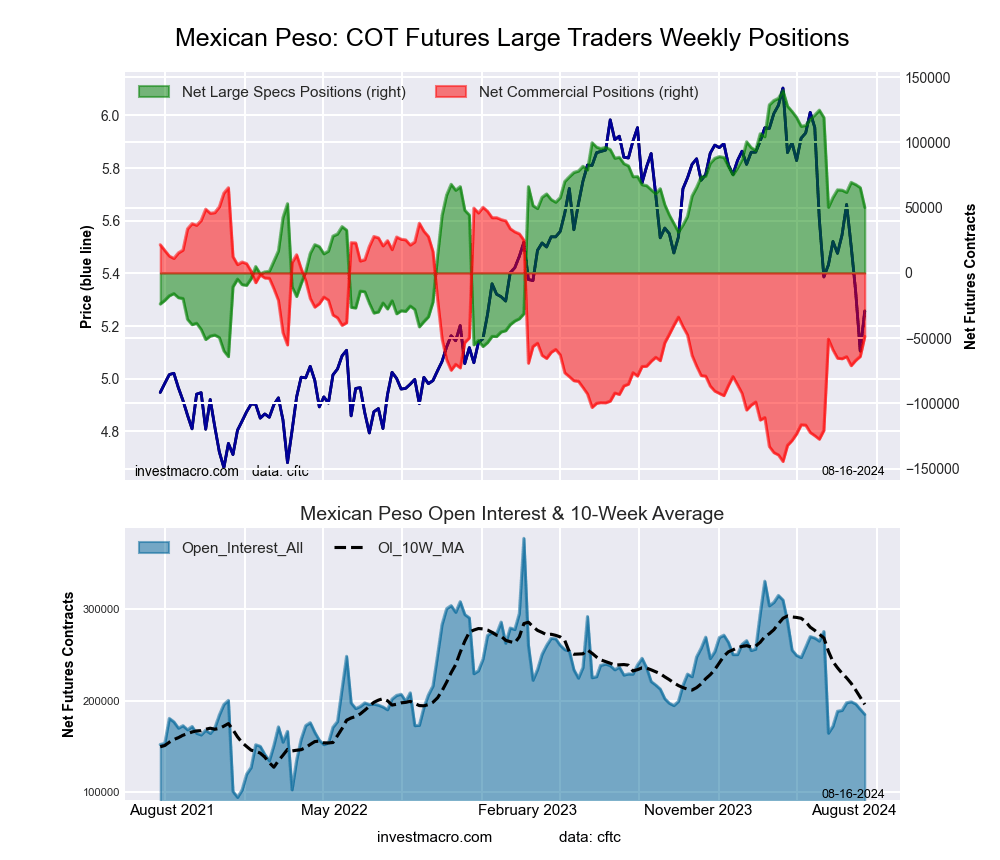
Mexican Peso Futures COT ChartThe Mexican Peso large speculator standing this week resulted in a net position of 57,806 contracts in the data reported through Tuesday. This was a weekly lift of 7,552 contracts from the previous week which had a total of 50,254 net contracts.

This week’s current strength score (the trader positioning range over the past three years, measured from 0 to 100) shows the speculators are currently Bullish with a score of 59.8 percent. The commercials are Bearish with a score of 40.8 percent and the small traders (not shown in chart) are Bearish-Extreme with a score of 18.6 percent.

Price Trend-Following Model: Strong Downtrend

Our weekly trend-following model classifies the current market price position as: Strong Downtrend. The current action for the model is considered to be: Hold – Maintain Short Position.

MEXICAN PESO StatisticsSPECULATORSCOMMERCIALSSMALL TRADERS
– Percent of Open Interest Longs:49.047.42.9
– Percent of Open Interest Shorts:15.481.72.2
– Net Position:57,806-58,9631,157
– Gross Longs:84,31481,6675,020
– Gross Shorts:26,508140,6303,863
– Long to Short Ratio:3.2 to 10.6 to 11.3 to 1
NET POSITION TREND:
– Strength Index Score (3 Year Range Pct):59.840.818.6
– Strength Index Reading (3 Year Range):BullishBearishBearish-Extreme
NET POSITION MOVEMENT INDEX:
– 6-Week Change in Strength Index:-27.127.5-15.8


Brazilian Real Futures:

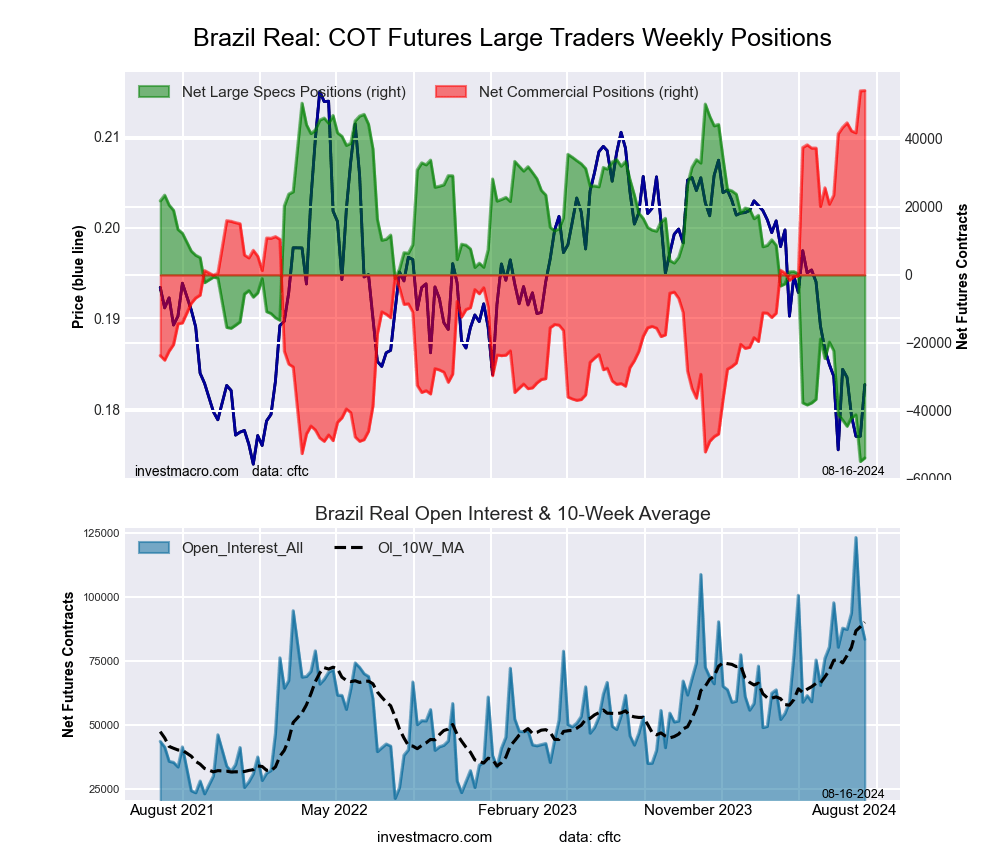
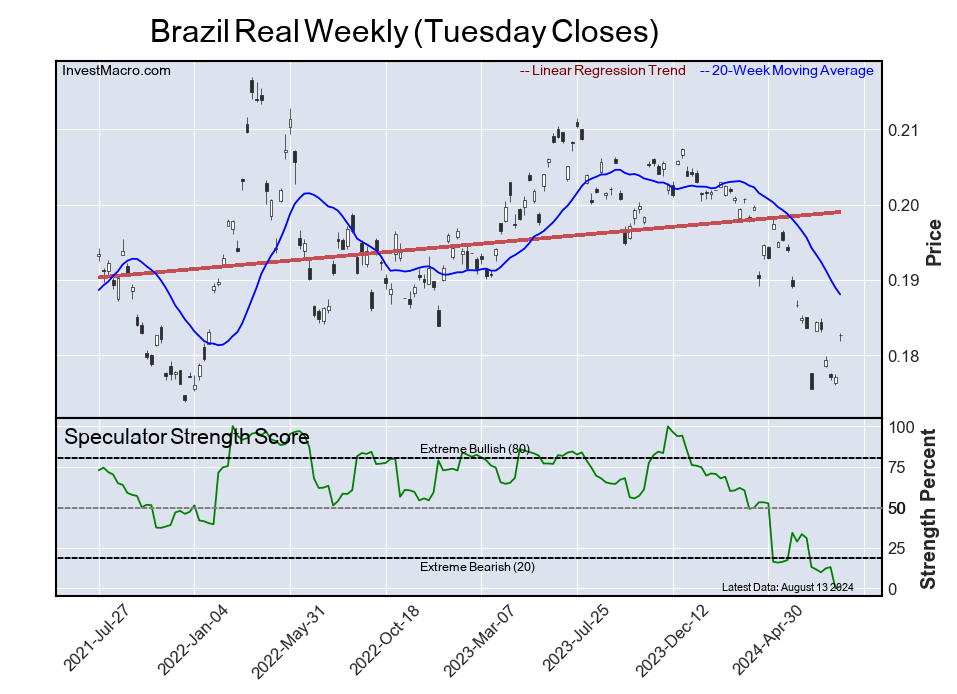
Brazil Real Futures COT ChartThe Brazilian Real large speculator standing this week resulted in a net position of -22,320 contracts in the data reported through Tuesday. This was a weekly reduction of -2,563 contracts from the previous week which had a total of -19,757 net contracts.

This week’s current strength score (the trader positioning range over the past three years, measured from 0 to 100) shows the speculators are currently Bearish-Extreme with a score of 18.0 percent. The commercials are Bullish-Extreme with a score of 83.7 percent and the small traders (not shown in chart) are Bearish with a score of 23.7 percent.

Price Trend-Following Model: Strong Downtrend

Our weekly trend-following model classifies the current market price position as: Strong Downtrend. The current action for the model is considered to be: Hold – Maintain Short Position.

BRAZIL REAL StatisticsSPECULATORSCOMMERCIALSSMALL TRADERS
– Percent of Open Interest Longs:38.556.32.2
– Percent of Open Interest Shorts:61.432.23.3
– Net Position:-22,32023,477-1,157
– Gross Longs:37,62254,9452,107
– Gross Shorts:59,94231,4683,264
– Long to Short Ratio:0.6 to 11.7 to 10.6 to 1
NET POSITION TREND:
– Strength Index Score (3 Year Range Pct):18.083.723.7
– Strength Index Reading (3 Year Range):Bearish-ExtremeBullish-ExtremeBearish
NET POSITION MOVEMENT INDEX:
– 6-Week Change in Strength Index:18.0-16.3-10.9


Bitcoin Futures:

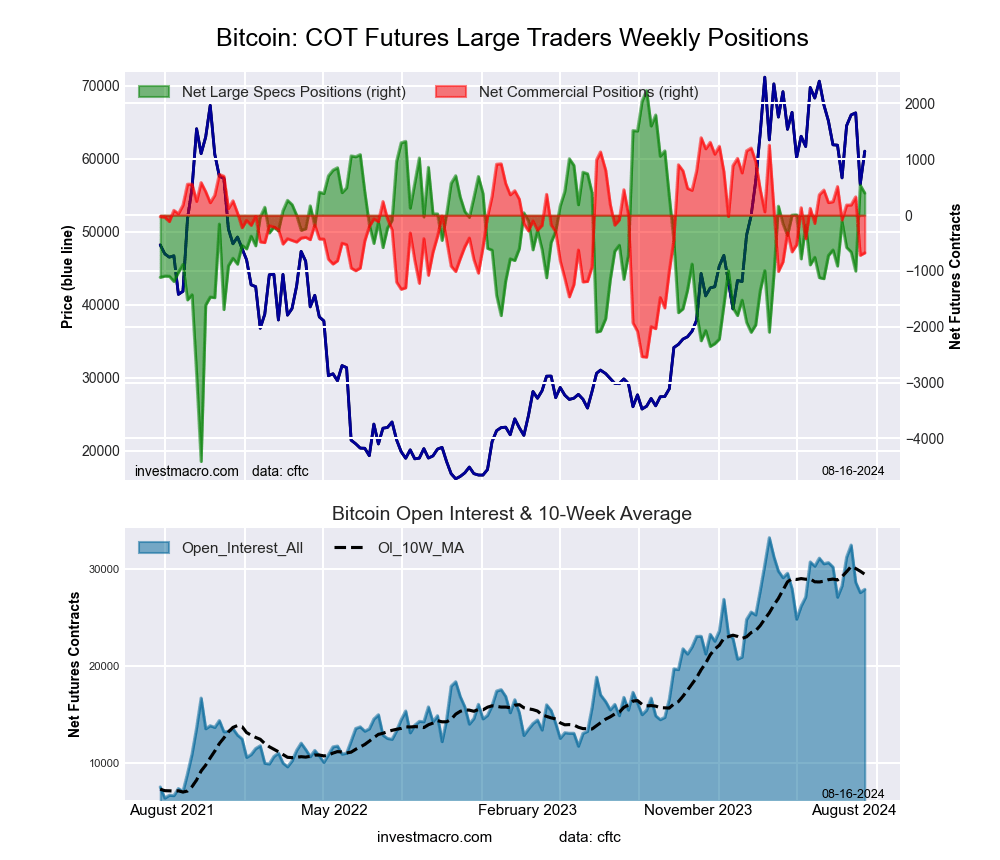
Bitcoin Crypto Futures COT ChartThe Bitcoin large speculator standing this week resulted in a net position of -624 contracts in the data reported through Tuesday. This was a weekly increase of 99 contracts from the previous week which had a total of -723 net contracts.

This week’s current strength score (the trader positioning range over the past three years, measured from 0 to 100) shows the speculators are currently Bullish with a score of 57.0 percent. The commercials are Bullish with a score of 70.8 percent and the small traders (not shown in chart) are Bearish with a score of 21.6 percent.

Price Trend-Following Model: Weak Uptrend

Our weekly trend-following model classifies the current market price position as: Weak Uptrend. The current action for the model is considered to be: Hold – Maintain Long Position.

BITCOIN StatisticsSPECULATORSCOMMERCIALSSMALL TRADERS
– Percent of Open Interest Longs:73.33.75.0
– Percent of Open Interest Shorts:75.32.93.7
– Net Position:-624241383
– Gross Longs:22,1031,1211,499
– Gross Shorts:22,7278801,116
– Long to Short Ratio:1.0 to 11.3 to 11.3 to 1
NET POSITION TREND:
– Strength Index Score (3 Year Range Pct):57.070.821.6
– Strength Index Reading (3 Year Range):BullishBullishBearish
NET POSITION MOVEMENT INDEX:
– 6-Week Change in Strength Index:-6.716.8-4.9


Article By InvestMacroReceive our weekly COT Newsletter

*COT Report: The COT data, released weekly to the public each Friday, is updated through the most recent Tuesday (data is 3 days old) and shows a quick view of how large speculators or non-commercials (for-profit traders) were positioned in the futures markets.

The CFTC categorizes trader positions according to commercial hedgers (traders who use futures contracts for hedging as part of the business), non-commercials (large traders who speculate to realize trading profits) and nonreportable traders (usually small traders/speculators) as well as their open interest (contracts open in the market at time of reporting). See CFTC criteria here.

Speculator Extremes: Australian Dollar, Soybean Oil lead weekly Positions

By InvestMacro

The latest update for the weekly Commitment of Traders (COT) report was released by the Commodity Futures Trading Commission (CFTC) on Friday for data ending on June 25th.

This weekly Extreme Positions report highlights the Most Bullish and Most Bearish Positions for the speculator category. Extreme positioning in these markets can foreshadow strong moves in the underlying market.

To signify an extreme position, we use the Strength Index (also known as the COT Index) of each instrument, a common method of measuring COT data. The Strength Index is simply a comparison of current trader positions against the range of positions over the previous 3 years. We use over 80 percent as extremely bullish and under 20 percent as extremely bearish. (Compare Strength Index scores across all markets in the data table or cot leaders table)


Speculators or Non-Commercials Notes:

Speculators, classified as non-commercial traders by the CFTC, are made up of large commodity funds, hedge funds and other significant for-profit participants. The Specs are generally regarded as trend-followers in their behavior towards price action – net speculator bets and prices tend to go in the same directions. These traders often look to buy when prices are rising and sell when prices are falling. To illustrate this point, many times speculator contracts can be found at their most extremes (bullish or bearish) when prices are also close to their highest or lowest levels.

These extreme levels can be dangerous for the large speculators as the trade is most crowded, there is less trading ammunition still sitting on the sidelines to push the trend further and prices have moved a significant distance. When the trend becomes exhausted, some speculators take profits while others look to also exit positions when prices fail to continue in the same direction. This process usually plays out over many months to years and can ultimately create a reverse effect where prices start to fall and speculators start a process of selling when prices are falling.


Here Are This Week’s Most Bullish Speculator Positions:

Australian Dollar


The Australian Dollar speculator position comes in as the most bullish extreme standing this week. The Australian Dollar speculator level is currently at a 100.0 percent score of its 3-year range.

The six-week trend for the percent strength score totaled 63.8 this week. The overall net speculator position was a total of -23,676 net contracts this week with a jump of 17,980 contract in the weekly speculator bets.


New Zealand Dollar


The New Zealand Dollar speculator position comes next in the extreme standings this week. The New Zealand Dollar speculator level is now at a 100.0 percent score of its 3-year range.

The six-week trend for the percent strength score was 79.0 this week. The speculator position registered 26,642 net contracts this week with a weekly boost of 6,313 contracts in speculator bets.


Silver


The Silver speculator position comes in third this week in the extreme standings. The Silver speculator level resides at a 94.9 percent score of its 3-year range.

The six-week trend for the speculator strength score came in at -4.8 this week. The overall speculator position was 55,978 net contracts this week with a gain of 4,077 contracts in the weekly speculator bets.


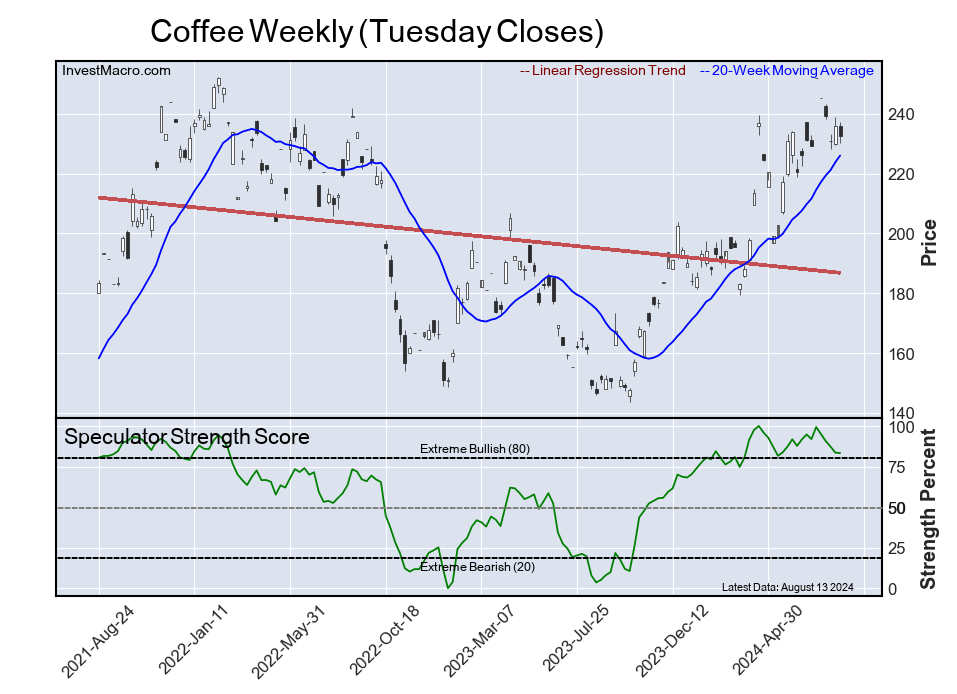
Coffee


The Coffee speculator position comes up number four in the extreme standings this week. The Coffee speculator level is at a 94.8 percent score of its 3-year range.

The six-week trend for the speculator strength score totaled a change of 13.1 this week. The overall speculator position was 70,712 net contracts this week with a rise of 3,163 contracts in the speculator bets.


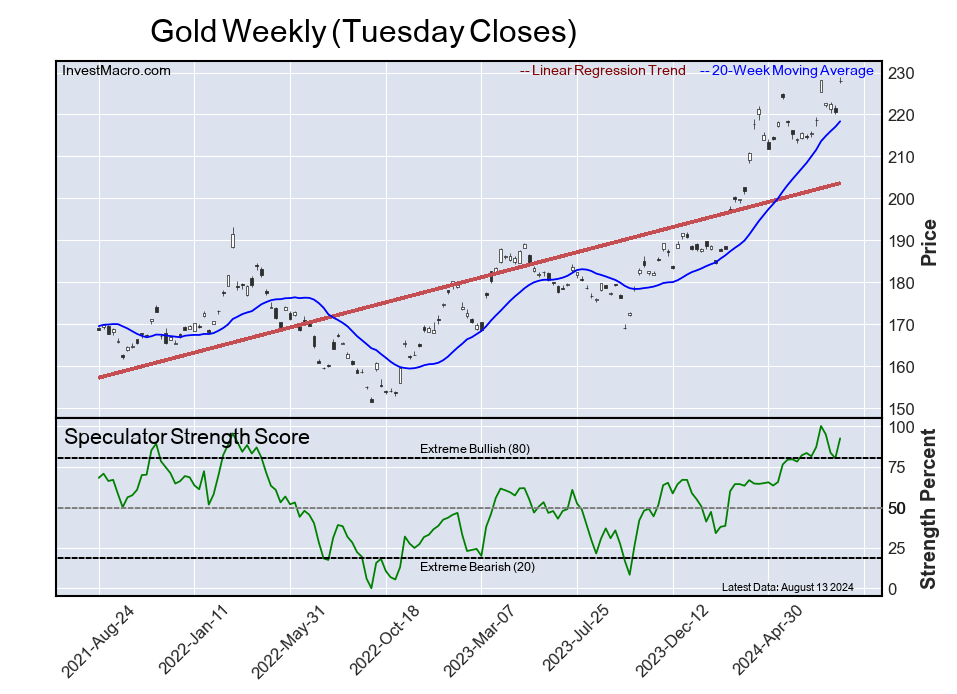
Gold


The Gold speculator position rounds out the top five in this week’s bullish extreme standings. The Gold speculator level sits at a 87.3 percent score of its 3-year range. The six-week trend for the speculator strength score was 18.8 this week.

The speculator position was 246,229 net contracts this week with an increase by 3,145 contracts in the weekly speculator bets.


This Week’s Most Bearish Speculator Positions:

Soybean Oil


The Soybean Oil speculator position comes in as the most bearish extreme standing this week. The Soybean Oil speculator level is at a 0.0 percent score of its 3-year range.

The six-week trend for the speculator strength score was -13.8 this week. The overall speculator position was -75,739 net contracts this week with a drop of -28,553 contracts in the speculator bets.


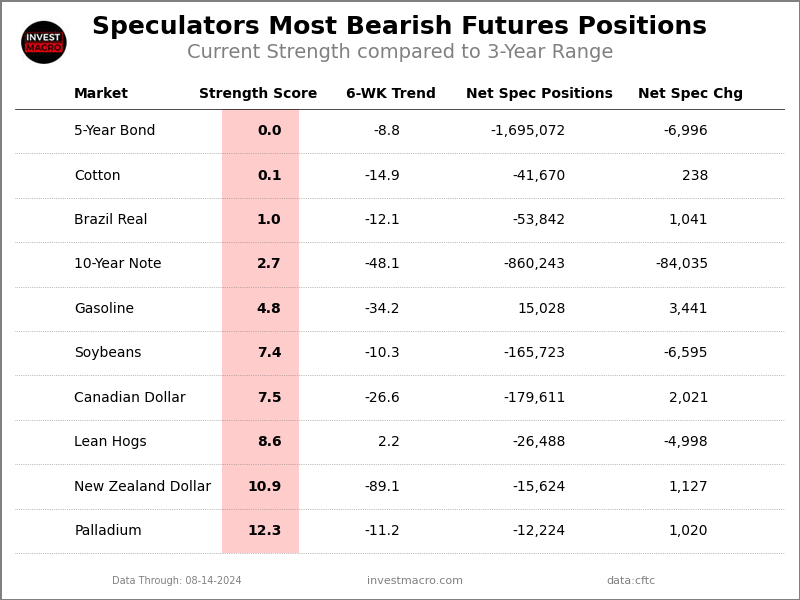
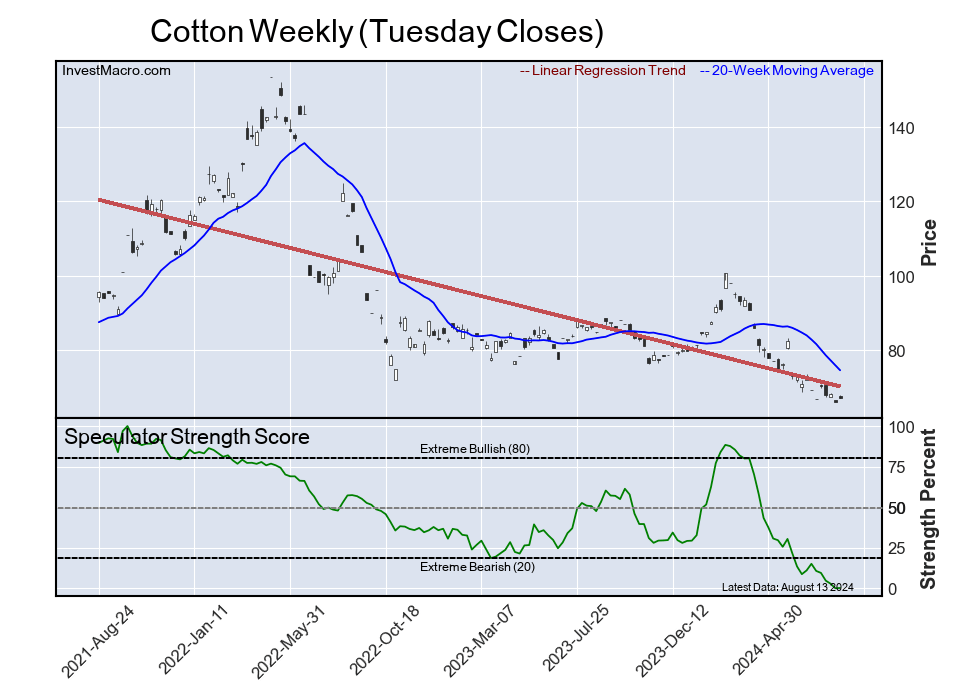
Cotton


The Cotton speculator position comes in next for the most bearish extreme standing on the week. The Cotton speculator level is at a 2.5 percent score of its 3-year range.

The six-week trend for the speculator strength score was -20.4 this week. The speculator position was -23,975 net contracts this week with a rise of 3,789 contracts in the weekly speculator bets.


Japanese Yen


The Japanese Yen speculator position comes in as third most bearish extreme standing of the week. The Japanese Yen speculator level resides at a 3.8 percent score of its 3-year range.

The six-week trend for the speculator strength score was -29.9 this week. The overall speculator position was -173,900 net contracts this week with a large drop by -26,147 contracts in the speculator bets.


5-Year Bond


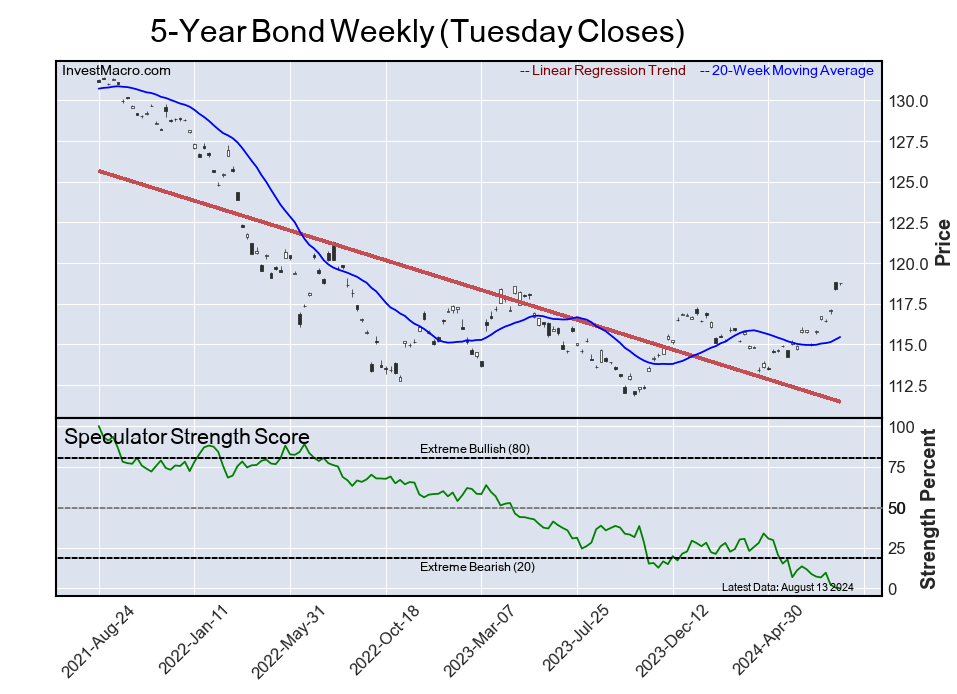
The 5-Year Bond speculator position comes in as this week’s fourth most bearish extreme standing. The 5-Year Bond speculator level is at a 5.2 percent score of its 3-year range.

The six-week trend for the speculator strength score was -9.6 this week. The speculator position was -1,486,197 net contracts this week with a decline of -32,797 contracts in the weekly speculator bets.


Palladium


Finally, the Palladium speculator position comes in as the fifth most bearish extreme standing for this week. The Palladium speculator level is at a 6.2 percent score of its 3-year range.

The six-week trend for the speculator strength score was -12.3 this week. The speculator position was -12,906 net contracts this week with an edge higher by 650 contracts in the weekly speculator bets.


Article By InvestMacroReceive our weekly COT Newsletter

*COT Report: The COT data, released weekly to the public each Friday, is updated through the most recent Tuesday (data is 3 days old) and shows a quick view of how large speculators or non-commercials (for-profit traders) were positioned in the futures markets.

The CFTC categorizes trader positions according to commercial hedgers (traders who use futures contracts for hedging as part of the business), non-commercials (large traders who speculate to realize trading profits) and nonreportable traders (usually small traders/speculators) as well as their open interest (contracts open in the market at time of reporting). See CFTC criteria here.

Mid-Year Review: Monster Movers & Shakers

By ForexTime 

  • Bitcoin ↑ almost 45% in H1
  • Gold ↑ 12% year-to-date, but are bulls tired?
  • US500 party to roll on or hit final hour?

The first half of 2024 has been remarkable for global financial markets.

Shifting monetary policy expectations, geopolitical tensions, elections across the globe and the A.I mania set the tone.

At the start of the year, we picked 3 assets that could see big moves.

Here’s how they have performed so far:


    1) Bitcoin set to boom or bust?

  • What we discussed in the 2024 outlook

We were bullish on the “OG” crypto and suggested how the “hype could go into overdrive due to the approval of Bitcoin ETFs by January and halving event in April”.


  • How things played out in H1

Bitcoin rallied as much as 74% in the first quarter of 2024, hitting an all-time high at $73,850.

The approval of Bitcoin ETFs along with expectations of lower US interest rates sent prices skyrocketing. However, gains were capped in Q2 due to escalating geopolitical tensions and uncertainty over monetary policy despite the halving in April.

As the first half of 2024 concludes, Bitcoin is under pressure thanks to cooling demand for Bitcoin ETFs and developments concerning the failed Mt. Gox exchange.


  • What could happen over the next 6 months

Other than US interest rates, the next major risk event for Bitcoin could be the US presidential elections.

And Biden’s opposition, Trump the catalyst. His pro stance towards cryptocurrencies may boost sentiment towards Bitcoin should he triumph.

To be clear, determining what influence Trump will have on the SEC is uncertain – but the idea of a pro-crypto US president may translate to fresh upside gains across the crypto space.


  • Technical outlook

Our technical section initially pointed out $50,000 as a key level of interest with a bullish breakout opening a path toward $69,000 and $100,000.

Before

Prices remain trapped within a weekly range with support at $60,000 and resistance at $71,000.

  • Sustained weakness below may open a path back towards $50,000 and potentially lower.
  • Should $60,000 prove reliable support, prices may rebound towards $71,000 and the all-time high at $73,850.

After 


    2) Gold bulls running on fumes?

We examined how gold could deliver glittering returns this year due to lower interest rates, a weaker dollar, and geopolitical risks.


  • How things played out in H1

Despite the slow start to the year, gold prices surged almost 10% in March amid growing bets around lower interest rates. The precious metal was propelled higher by escalating geopolitical tensions and central bank buying, with prices hitting an all-time high at $2450 in May.

But bulls have struggled to keep up the momentum in recent weeks thanks to cooling rate cut bets and the PBoC’s decision to end its 18-month of gold buying.  Still, prices are up roughly 12% year-to-date.


  • What could happen over the next 6 months…

While US election uncertainty could translate to increased volatility for gold, it’s all about what actions the Fed takes in the second half of 2024.

At the start of the year, the central bank was expected to cut rates by as much as 150 basis points. However, due to sticky inflation and stronger-than-expected data – traders are only expecting one rate 25 bp cut by November with 75% probability of a second cut by December.

Given how gold pays no interest, the prospect of higher for longer rates could be an invitation for bears to pounce.


  • Technical outlook

Our technical section flagged $2000 as a reliable support that may open doors to fresh all-time highs.

Before

Gold is under pressure on the weekly charts with key support at $2290.

  • A solid break below this point could spark a selloff towards $2235 and $2147.
  • Should $2290 prove to be reliable support, prices may rebound toward $2350, $2425 and $2450.

After 


    3) US500 bull party approaching final hour?

  • What we discussed in the 2024 outlook

After gaining almost 25% in 2023, we were firmly bullish on the US500 and anticipated volatility due to the US presidential elections in November.


  • How things played out in H1

The Index was initially supported by Fed cut bets with solid corporate earnings and the A.I hype turbocharging upside gains. Nvidia, the poster child of the AI boom was able to satisfy investors lofty expectations by posting solid earnings in February and May.

Although the US500 is up 15% year-to-date and remains in an uptrend, the Relative Strength Index (RSI) is screaming that prices are heavily overbought.


  • What could happen over the next 6 months…

After repeatedly hitting record highs, the question is whether bulls can maintain their hunger for gains?

A combination of U.S election jitters and cooling expectations around Fed rate cuts could limit upside gains. It is worth noting that earnings season is around the corner with the bar set high for Nvidia and other tech giants to deliver blockbuster results.

Regarding the US elections, whatever the outcome it could inject fresh levels of volatility into the US500.


  • Technical outlook

Back in January, we highlighted how “a strong close above 4820 could open the doors towards fresh the all-time highs

Before

The US500 continues to respect a bullish channel but the RSI signals that a technical “throwback” could be around the corner.

  • A solid weekly close above 5500 could pave the way to fresh all-time highs.
  • Should 5500 prove to be a tough nut to crack, this may trigger a decline back toward 5300 and possibly lower.

After 


Forex-Time-LogoArticle by ForexTime

ForexTime Ltd (FXTM) is an award winning international online forex broker regulated by CySEC 185/12 www.forextime.com

Is It Time To Unload Nvidia?

Source: Streetwise Reports (6/26/24)

Some financial experts say yes, others no. Read on to learn the rationale behind the conclusions and stance of several.

The movement of Nvidia Corp.’s (NVDA:NASDAQ) stock during June, rising to its all-time high and then plunging, has investors debating now whether to jump into it, bolster their existing position, or abandon it altogether. Whereas financial analysts and other experts generally agree the information technology (IT) stock has been overbought since early June, they differ, some radically, in their current recommendations on it.

“Nvidia has likely become one of the most overheated stocks we’ve witnessed in a quarter century,” Eric Fry of Fry’s Investment Report said in an InvestorPlace interview.

On June 18, Nvidia ousted Microsoft Corp. (MSFT:NASDAQ) from its spot as the world’s most valuable company, and last week, Nvidia’s stock peaked at US$140.76 per share. Since, it dropped to third place, therein suffering a loss of about US$500 billion ($500B) in value, Seeking Alpha reported on June 25. However, NVDA maintains about a 140% year-to-date gain and thus is the second-best performer in the Standard & Poor’s (S&P) 500 Index.

Is it OK To Buy?

None of the factors behind the stock’s recent descent into its current correction constitutes a sound reason to “turn gloomy on Nvidia,” Garfield Reynolds, Bloomberg’s Markets Live Asia team leader, wrote in a June 24 article. The five causes were expiring options, insider sales, the stock’s technically overbought state, investor reassessment of the stock after it dethroned Apple Inc. (AAPL:NASDAQ) and Microsoft, and a long squeeze.

“The bull case for the artificial intelligence (AI) darling along with the broader tech sector remains strong over the short to medium term, at the very least,” he wrote.

It would take a major event, such as a broad economic slump or a big earnings miss, to keep Nvidia down for long, asserted Reynolds.

Certainly, numerous analysts recommend Nvidia as a Buy. According to TipRanks, of the 41 analysts who rated the stock at some point in the last three months, 38 have it Buy, three Hold, and none Sell. Zacks Investment Research, for instance, has a Strong Buy rating on it.

“Even with those concerns about overconcentration lingering,” he added, “the selloff would need to extend significantly further to change the narrative away from the consensus call that the AI revolution will keep going and that Nvidia stands to benefit hugely as a result.”

As such, Reynolds expects new buyers of the stock on future price dips, he wrote.

Certainly, numerous analysts recommend Nvidia as a Buy. According to TipRanks, of the 41 analysts who rated the stock at some point in the last three months, 38 have it Buy, three Hold, and none Sell. Zacks Investment Research, for instance, has a Strong Buy rating on it.

In a June 22 article, The Motley Fool’s Edward Shelton suggested that investors should consider three points when deciding what to do regarding Nvidia.

One, Nvidia stock being overbought does not preclude it from climbing further. Case in point, he said, is the stock’s last pullback, in March, of 20%, after which the price soared to its highest point ever.

Two, NVDA is not in a bubble, despite what analysts say, because the fundamentals support its valuation.

Three, the company’s earnings per share (EPS) guidance for 2025 of US$3.61 could be conservative. Should earnings turn out to be higher (some analysts predict US$5), the stock would look cheap.

Ballanger Says Think Twice Before Buying

According to Michael Ballanger, editor & publisher of GGM Advisory Inc., investors should take seriously Nvidia’s recent shift into a correction. The stock is coming down from its peak “with a full bearish moving average convergence/divergence (MACD) rollover and ‘sell signal’ now complete,” he described in a June 24 email alert.

A sector rotation out of tech stocks and into more conservative Dow Jones Industrial Average blue chip stocks is underway, he noted, but the whiplashing of this a long-time market leader into a correction could be a harbinger of what is to come.

“If ‘AI’ starts to correct,” Ballanger warned, “the entire market is going with it, including the Dow and the S&P 500.”

Newsletter Writers Say Do Not Buy Now

Chris Johnson, Money Morning qualitative specialist, implied that it might be better to wait to Buy Nvidia as there is a good chance the stock will present a short-term opportunity to do so on a future pullback.

“If ‘AI’ starts to correct,” Michael Ballanger of GGM Advisory Inc. warned, “the entire market is going with it, including the Dow and the S&P 500.”

These opportunities often arise with heavily traded stocks after they experience persisting overbought conditions and the pullbacks that typically follow.

“Investors looking for a deeper correction in the stock should consider the US$100 price target as an ideal price for longer-term support for Nvidia shares,” he noted in a June 24 article. (At close today, the tech company was at US$126 per share.)

Kimberley Koenig with Investor’s Business Daily flat out advised against buying Nvidia right now. Instead, she recommended on June 25, “Wait for selling to subside and another base to form or follow-on buy point to present itself to buy the AI chip stock.”

One Expert Says Sell It All Today

The advice of Technical Analyst Clive Maund, based on his interpretations of the stock’s 10-year and two-year charts, is to sell Nvidia.

“The main takeaways for us are that Nvidia should be ‘avoided like the plague’ simply because it has gone up so much and is massively overbought,” he wrote in a June 23 report. “Anyone holding should, of course, take profits soon.”

He explained that on the charts, the MACD indicator shows the stock has become “insanely overbought.” However, he noted, “Recent volume does not look terminal as it has not (yet) risen to become climactic, and the accumulation line remains strong.” These indicators suggest that rather than immediately plunging, the stock may form a large top pattern over some months, during which time it could even creep higher.

Eric Fry of Fry’s Investment Report suggested investors follow the lead of the country’s billionaires and unload not just Nvidia stock but also the other tech giants’ stock now because, he said, an entire tech market crash is coming.

“There’s an undeniable tension gripping the markets right now, and if your gut is telling you that something monumental is lurking just over the horizon, trust me, your instincts are dead on,” he said.

Fry likened Nvidia stock today to Cisco stock in the 1990s. Though Cisco then had nearly twice the earnings power of Nvidia today, he said, when the dot-com bubble burst, it dropped about 87% from its peak.

Yes, there is room for growth in the AI market, and yes, Nvidia could be an AI star over the long term, said Fry. However, world-changing stocks go through their own boom and bust periods.

“I do want people to be aware of the cyclical risks involved here, at these crazy valuations,” he added.

Fry forecasted a future “tidal wave of selling to engulf the tech titans of Wall Street — Nvidia, Apple, Microsoft, Google, Meta and more” — in what he’s calling The 2024 Tech Reset. Billionaires, including Jeff Bezos, Warren Buffet, Elon Musk, and Mark Zuckerberg, have already started selling tech stocks, even their own company’s stock. They are moving their money into next-gen stocks, which Fry defined as “stocks of businesses that are essential for the growth and prosperity of society as a whole.”

This massive selloff Fry predicted will cause tech stocks to plummet from their record highs and will, in the process, drag down thousands of other stocks, he warned. It will “erase years of investors’ gains, in the blink of an eye.”

Sector to Hit $29 Trillion by 2030

Currently IT is facing some challenges, and in the short term “the demand environment remains uncertain as enterprises add more scrutiny to the budgeting process and reduce discretionary IT spending,” CIBC wrote in a June 20 report. The current environment has dampened the expectation held since last year that demand would start improving in H2/24.

The report asserted that the initial “gen AI boom” is in the rear-view mirror, and what is happening now is a “period of resetting expectations.” Despite most companies knowing they need AI strategies, they are still deciding on what these will be, the analysts said.

The long-term outlook for IT is brighter. Growth for the IT market is forecasted up to 2030, at a 15% compound annual growth rate, according to Exactitude Consultancy, a market research and consulting services firm. By 2030, the market is projected to increase to US$28.99 trillion ($28.99T) in value from US$10.9T in 2023.

Streetwise Ownership Overview*

Nvidia Corp. (NVDA:NASDAQ)

Institutions: 67.7%
Retail: 28.02%
Management & Insiders: 4.23%
Strategic Investors: 0.05%
67.7%
28.0%
4.2%
*Share Structure as of 6/26/2024


Accelerated advancement in AI, cloud computing, the Internet of Things and cybersecurity is the primary growth driver, noted Exactitude.

Ownership and Share Structure

According to Reuters, 4.23% of the company is held by management and insiders.

0.05% is with strategic investors. Milestone Resources Group Ltd. has 0.02%, with 4.39 million, and Banco Santander SA has 0.01%, with 2.10 million.

67.70% is held by institutions. The VanGuard Group Inc. has 8.63%, with 2,122.88 million shares. BlackRock Institutional Trust Company N.A. has 4.82%, with 1,186.45 million. Fidelity Management & Research Company LLC. has 4.51%, with 1,109.18 million.

The rest is with retail investors.

Nvidia has 24.6 billion (24.6B) shares outstanding and 23.5B free float traded shares.

The company’s market cap is US$3.1 trillion. Its stock has traded between US$39.23 and US$140.76 per share over the past 52 weeks.


Important Disclosures:

  1. Doresa Banning wrote this article for Streetwise Reports LLC and provides services to Streetwise Reports as an independent contractor.
  2.  This article does not constitute investment advice and is not a solicitation for any investment. Streetwise Reports does not render general or specific investment advice and the information on Streetwise Reports should not be considered a recommendation to buy or sell any security. Each reader is encouraged to consult with his or her personal financial adviser and perform their own comprehensive investment research. By opening this page, each reader accepts and agrees to Streetwise Reports’ terms of use and full legal disclaimer. Streetwise Reports does not endorse or recommend the business, products, services or securities of any company.

For additional disclosures, please click here.

Young investors: Here’s some tips for getting into the market

By Sorin Rizeanu, University of Victoria 

You’ve likely heard of Minecraft. It’s a simple game where you slowly place blocks and craft items from containers to castles and entire cities. You’ve probably also heard of the first-person shooter Call of Duty (COD), where players navigate fast-paced war zones.

Like gaming, investing is all about how you approach it. You can build slow but safe, like in Minecraft, or you can go fast and risk more, like in COD.

If you’re a young person who has just gotten your first paycheck or saved a tidy sum from your first job, you might be thinking about how to invest your money.

However, the stock market can be a daunting place. Fortunes are built and lost in days. You can take the fast approach and risk it all on getting the big win. Or, with the proper temperament, you can build a significant source of additional income one block at a time. But where to start? And how does it all work?

Investing 101

You’ve probably heard of investment apps like Robinhood or Wealthsimple, or ones like Coinbase that allow you to invest in crypto currencies.

Investing is pretty much what you make of it. It can be like Minecraft, slowly placing blocks to develop a long-term diversified set of assets through investment funds, like exchange traded funds (ETFs) or mutual funds.

Most investment funds hold portfolios of stocks, bonds and other investments. ETFs trade on exchanges just like stocks, and most passively track an index, with little or no active management by fund managers. Mutual funds are more actively managed and they generally have higher fees than ETFs.

If you’re more of a risk-taker, investing can also be fast-paced like COD: shooting with options, penny stocks, crypto and other speculative tools.

Similar to gaming, you are only one participant in a much bigger world. There are days when you will lose and days when you win. Strategies that work in some situations but not in other situations. Expert players and novices.

If you’re completely new to things, try out an investing simulation. Some trading platforms allow you to use a version of their app or website where you can make simulated investments. Some of them are free or cost around $10-$15, like TradingView and eToro. MarketWatch even lets you create an investing game that you can invite your friends to participate in.

Next, you’ll need an investment account. Most big banks offer self-managed investment accounts. If you want to save a bit, check out discount brokers that charge lower or no commission (but read the fine print and know what other fees they might charge you).

Be sure to check out any tax-free investing accounts available in your country, like the TFSA in Canada or Roth IRA in the United States. These are a valuable way to grow your net worth without paying additional tax.

What kind of investing should I get into?

Take a lesson from Bob, the world’s worst market timer. He starts investing at 22, and every time he does, the market crashes. You’d guess he loses all his money, right? Not really, over his working life Bob invests $184,000, but ends up with a total of $1.1 million at retirement.

How? Bob put his money into an S&P 500 index fund and kept it to retirement, through good or bad.

The moral of the story is that you don’t have to be lucky or very savvy. Most important is to have a diverse portfolio and stay in the market. Don’t sell or buy in a panic, keep contributing. Buy diversified funds, rather than individual stocks, at least in the beginning. Then, as you learn, you can pick stocks and even invest part of your portfolio in riskier assets.

You still have decades to slowly get your millions.

Some strategies that have proven their worth

The value investing strategy, made famous by financial analyst Benjamin Graham and championed by the likes of American investor Warren Buffett, is summarized by with the motto: “This too will pass.”

Basically, pick a good company, in a moment when it’s undervalued for some reason: bad news, lost contract, temporary mismanagement etc. Buffett has likened good companies to castles with a deep moat around them – that is they have a competitive edge durable in time, an unique product, customer loyalty or pricing power. Think Apple, American Express or Coca Cola.

The growth investing strategy, championed by fund manager Cathie Wood, tries to identify companies whose earnings will grow very fast (but could crash equally fast). Companies like Tesla, Coinbase, UiPath, Roku etc. AI has given a huge boost to this strategy recently, but in long term, it’s hard to tell if it’s better than the value strategy.

A different approach, favoured by investors that prefer a more stable stream of income, is the dividend strategy. Dividends are the money distributed to shareholders from company’s profits.
Historically, dividend stocks have outperformed the S&P 500, and with less volatility. Think about it: you get a return on investment from stock price growth as well as dividends that you can reinvest.

In sum, pick a strategy that fits you and get to work. You can pick stocks, or you can pick diversified funds. As investor Peter Lynch insisted, “know what you own, and know why you own it.” Invest in stocks or funds whose business model you understand. Love cars? Study different manufacturers, see what different companies are working on, what customers like this year, and figure out who’s making money before quarterly statements are pointing out the winners and losers.

What should I be careful about?

Many new investors buy on the hype. Imagine there’s some good news coming up about Tesla. You wake up, and while having your coffee, you see the news and buy the stock.

But think. Investors following TSLA already know what the article is about. By the time you’ve read the news, people with deep pockets on Wall Street are already placing their bets. By the time you buy the stock, the market will have already integrated that news and now the price will probably go down.

Same with the long-term hype: when your cab driver is giving stock or crypto advice it’s time to get out of the market.

Another pitfall is the quick money, speculation, dopamine addiction. Subreddits like r/wallstreetbets provide many great examples of this. If you turn your life into a casino, you will win some times, but in the end the house always wins. A bet here and there can be fun though.

As a young person, you have an advantage: time. As you get older you will understand the long-term trends and market drivers — economy, geo-politics, innovation and so forth. As you progress in your career, you will understand more about your industry and this too may turn into profits. Over the years, eight per cent per year, with compounding, goes very far.

Finally, as ethical people, we need to walk the talk. We can’t pretend to want to save the Earth if our money is going to heavy polluters. Beware of pretenders — many are just deceptively mimicking behaviours to get high environmental, social and governance scores.

Research well your investment and its entire supply chain. Think about what goes into making the product, the people behind it and what impact it has on our world. Are you morally comfortable giving your money to certain companies?

Put in the time and don’t rush in, some investments are for life.The Conversation

About the Author:

Sorin Rizeanu, Assistant Professor, Gustavson School of Business, University of Victoria

This article is republished from The Conversation under a Creative Commons license. Read the original article.


Chevron vs. NextEra Energy: Which Dividend Stock is the Better Buy?

By The Ino.com Team

Despite the industry challenges, Chevron Corporation (CVX) and NextEra Energy, Inc. (NEE) are both gaining significant traction and rewarding shareholders with reliable dividends. But if you had to choose between them, which would be the better buy?

Chevron’s Dividend Strength Over 37 Years

Chevron is one of the largest integrated energy majors globally, with operations spanning oil production, transportation, and processing. This strategic spread helps cushion the inherent volatility in oil and gas markets, ensuring stability and sustained growth.

Recently, oil prices dipped after hitting seven-week highs. Brent crude futures slipped to $85.27 a barrel, while U.S. West Texas Intermediate crude dropped to $81.47 per barrel. Despite the cyclical nature of the oil sector, Chevron’s solid operational and financial performance continues to shine through.

In its latest earnings release, the company reported a double-digit increase in worldwide production and returned $6 billion in cash to shareholders. CVX beat first-quarter earnings estimates, with an adjusted EPS of $2.93, surpassing analysts’ expectations of $2.87. U.S. production surged to 1.57 million barrels of oil and gas per day, a 35% increase from a year ago, thanks to strong output from the Permian and Denver-Julesburg basins.

What truly sets Chevron apart is its financial muscle. The company’s debt-to-equity ratio is a mere 0.12, the lowest among its peers. This low leverage gives CVX the flexibility to support its operations and sustain its dividends even during downturns, providing a significant competitive advantage.

In the first quarter of 2024, Chevron’s return on capital employed exceeded 12%, reflecting efficient management and strategic investments. The company increased its quarterly dividend by 8% sequentially to $1.63 per share and repurchased nearly $3 billion worth of its shares.

With 36 consecutive years of dividend growth and a forward dividend yield of 4.16%, Chevron offers investors a compelling mix of income and growth potential. CVX has a four-year average yield of 4.35%, and its dividend payouts have grown at a CAGR of 6.4% over the past three years.

Moreover, the company aims to grow its annual free cash flow (FCF) by nearly 10% through 2027, even if Brent crude prices fall to $60 per barrel. With Brent crude currently around $83 per barrel, Chevron has ample room for growth. CVX’s strategy focuses on improving ROCE by investing in high-return areas like the Permian Basin, expected to drive substantial cash flow growth.

Increasing cash flow and robust dividend growth make CVX an attractive long-term investment. The company’s ability to navigate market fluctuations and maintain financial stability positions it as a top choice for investors seeking security and growth in the energy sector. Shares of CVX have gained over 4% over the past six months and nearly 5% year-to-date.

How Is NEE Positioned to Reward Shareholders?

NextEra Energy is a dual force in the energy sector, uniquely positioned with substantial operations in regulated utilities and renewable energy. As one of the largest regulated utility companies in the U.S., NEE enjoys stable earnings through its main subsidiary, Florida Power & Light (FPL).

FPL’s recent expansion efforts, including the addition of 1,640 megawatts of new solar capacity, underscore its commitment to clean energy and meeting the growing electricity demands. In the first quarter that ended March 31, 2024, FPL reported a net income of $1.17 billion or $0.57 per share, reflecting an increase of 9.5% and 7.5% year-over-year, respectively.

Simultaneously, NextEra Energy Resources, the company’s renewable energy arm, continues to advance in sustainable energy production. The segment had a record quarter, adding approximately 2,765 megawatts of new renewables and storage projects to its backlog. Its adjusted earnings for the quarter were $828 million and $0.40 per share, up from $732 million and $0.36 per share in the first quarter of 2023.

Financially, NEE’s performance remains robust. During the quarter, the company’s adjusted earnings amounted to $1.87 billion or $0.91 per share, reflecting an increase of 11.6% and 8.3%, respectively. Its adjusted EBITDA was $462 million, and $164 million cash was available for distribution. Moreover, its revenue and EPS have grown at respective CAGRs of 16.6% and 20.2 over the past three years.

Looking forward, NEE sees significant growth potential in the U.S. renewables and storage market, expecting it to triple over the next seven years from 140 gigawatts to around 375-450 gigawatts. With an existing 74-gigawatt operating fleet, split between FPL and Energy Resources, the company aims to expand to over 100 gigawatts by 2026, further strengthening its operational scale and creating additional value for its stakeholders.

On June 17, NEE paid its shareholders a quarterly dividend of $0.52 per share. With 28 consecutive years of dividend growth and a forward dividend yield of 2.84%, NEE offers an attractive proposition for income-oriented investors seeking exposure to the clean energy sector. Also, it has a four-year average dividend yield of 2.23% and has grown its dividend payouts at a CAGR of 10.2% over the past three years.

All said, NEE stands at the forefront of the energy transition, leveraging its dual strengths in regulated utilities and renewable energy to drive sustainable growth and value creation. The stock has gained over 21% over the past six months and over 19% year-to-date.

Should You Buy Chevron or NextEra Energy?

Analysts are bullish on these dividend-paying giants, each presenting significant upside potential. So, how do these two stack up?

Mizuho gave Chevron a Buy rating and raised the price target from $200 to $205, implying a substantial 23.59% upside from the current price of $156.64. This sentiment is echoed by other prominent analysts, with HSBC and Scotiabank setting price targets of $178 and $195, respectively. This results in an average price target of $186.95, suggesting a potential 16% upside.

On the other hand, NextEra Energy has also caught the eye of analysts. BMO Capital recently maintained an Overperform rating on the stock and raised the price target from $78 to $79, suggesting an 8.3% upside from the current price of $72.46.

In terms of dividend yield as a rough measure of value, CVX’s 4.2% yield is far more attractive compared to NEE’s modest 2.8%. While both stocks historically offered higher yields during oil downturns, NextEra Energy’s current yield is comparatively lower. This positions CVX as a stronger income play and suggests it may be the more attractive stock between the two.


By Ino.com – See our Trader Blog, INO TV Free & Market Analysis Alerts

Source: Chevron vs. NextEra Energy: Which Dividend Stock is the Better Buy?