Archive for Opinions – Page 125

Cross-pollination among neuroscience, psychology and AI research yields a foundational understanding of thinking

By Paul S. Rosenbloom, University of Southern California; Christian Lebiere, Carnegie Mellon University, and John E. Laird, University of Michigan 

Progress in artificial intelligence has enabled the creation of AIs that perform tasks previously thought only possible for humans, such as translating languages, driving cars, playing board games at world-champion level and extracting the structure of proteins. However, each of these AIs has been designed and exhaustively trained for a single task and has the ability to learn only what’s needed for that specific task.

Recent AIs that produce fluent text, including in conversation with humans, and generate impressive and unique art can give the false impression of a mind at work. But even these are specialized systems that carry out narrowly defined tasks and require massive amounts of training.

It still remains a daunting challenge to combine multiple AIs into one that can learn and perform many different tasks, much less pursue the full breadth of tasks performed by humans or leverage the range of experiences available to humans that reduce the amount of data otherwise required to learn how to perform these tasks. The best current AIs in this respect, such as AlphaZero and Gato, can handle a variety of tasks that fit a single mold, like game-playing. Artificial general intelligence (AGI) that is capable of a breadth of tasks remains elusive.

Ultimately, AGIs need to be able to interact effectively with each other and people in various physical environments and social contexts, integrate the wide varieties of skill and knowledge needed to do so, and learn flexibly and efficiently from these interactions.

Building AGIs comes down to building artificial minds, albeit greatly simplified compared to human minds. And to build an artificial mind, you need to start with a model of cognition.

a robot with a single arm grasps one of five colored blocks on a small table
This robot, powered by an AI called Rosie, learned how to solve this puzzle from a human who communicated to the robot using natural language.
James Kirk, CC BY-ND

From human to Artificial General Intelligence

Humans have an almost unbounded set of skills and knowledge, and quickly learn new information without needing to be re-engineered to do so. It is conceivable that an AGI can be built using an approach that is fundamentally different from human intelligence. However, as three longtime researchers in AI and cognitive science, our approach is to draw inspiration and insights from the structure of the human mind. We are working toward AGI by trying to better understand the human mind, and better understand the human mind by working toward AGI.

From research in neuroscience, cognitive science and psychology, we know that the human brain is neither a huge homogeneous set of neurons nor a massive set of task-specific programs that each solves a single problem. Instead, it is a set of regions with different properties that support the basic cognitive capabilities that together form the human mind.

These capabilities include perception and action; short-term memory for what is relevant in the current situation; long-term memories for skills, experience and knowledge; reasoning and decision making; emotion and motivation; and learning new skills and knowledge from the full range of what a person perceives and experiences.

Instead of focusing on specific capabilities in isolation, AI pioneer Allen Newell in 1990 suggested developing Unified Theories of Cognition that integrate all aspects of human thought. Researchers have been able to build software programs called cognitive architectures that embody such theories, making it possible to test and refine them.

Cognitive architectures are grounded in multiple scientific fields with distinct perspectives. Neuroscience focuses on the organization of the human brain, cognitive psychology on human behavior in controlled experiments, and artificial intelligence on useful capabilities.

The Common Model of Cognition

We have been involved in the development of three cognitive architectures: ACT-R, Soar and Sigma. Other researchers have also been busy on alternative approaches. One paper identified nearly 50 active cognitive architectures. This proliferation of architectures is partly a direct reflection of the multiple perspectives involved, and partly an exploration of a wide array of potential solutions. Yet, whatever the cause, it raises awkward questions both scientifically and with respect to finding a coherent path to AGI.

Fortunately, this proliferation has brought the field to a major inflection point. The three of us have identified a striking convergence among architectures, reflecting a combination of neural, behavioral and computational studies. In response, we initiated a communitywide effort to capture this convergence in a manner akin to the Standard Model of Particle Physics that emerged in the second half of the 20th century.

a graphic showing a human head and brain on the left, a robot head with circuits on the right, and a chart with five colored blocks and arrows connecting the blocks
This basic model of cognition both explains human thinking and provides a blueprint for true artificial intelligence.
Andrea Stocco, CC BY-ND

This Common Model of Cognition divides humanlike thought into multiple modules, with a short-term memory module at the center of the model. The other modules – perception, action, skills and knowledge – interact through it.

Learning, rather than occurring intentionally, happens automatically as a side effect of processing. In other words, you don’t decide what is stored in long-term memory. Instead, the architecture determines what is learned based on whatever you do think about. This can yield learning of new facts you are exposed to or new skills that you attempt. It can also yield refinements to existing facts and skills.

The modules themselves operate in parallel; for example, allowing you to remember something while listening and looking around your environment. Each module’s computations are massively parallel, meaning many small computational steps happening at the same time. For example, in retrieving a relevant fact from a vast trove of prior experiences, the long-term memory module can determine the relevance of all known facts simultaneously, in a single step.

Guiding the way to Artificial General Intelligence

The Common Model is based on the current consensus in research in cognitive architectures and has the potential to guide research on both natural and artificial general intelligence. When used to model communication patterns in the brain, the Common Model yields more accurate results than leading models from neuroscience. This extends its ability to model humans – the one system proven capable of general intelligence – beyond cognitive considerations to include the organization of the brain itself.

We are starting to see efforts to relate existing cognitive architectures to the Common Model and to use it as a baseline for new work – for example, an interactive AI designed to coach people toward better health behavior. One of us was involved in developing an AI based on Soar, dubbed Rosie, that learns new tasks via instructions in English from human teachers. It learns 60 different puzzles and games and can transfer what it learns from one game to another. It also learns to control a mobile robot for tasks such as fetching and delivering packages and patrolling buildings.

Rosie is just one example of how to build an AI that approaches AGI via a cognitive architecture that is well characterized by the Common Model. In this case, the AI automatically learns new skills and knowledge during general reasoning that combines natural language instruction from humans and a minimal amount of experience – in other words, an AI that functions more like a human mind than today’s AIs, which learn via brute computing force and massive amounts of data.

From a broader AGI perspective, we look to the Common Model both as a guide in developing such architectures and AIs, and as a means for integrating the insights derived from those attempts into a consensus that ultimately leads to AGI.The Conversation

About the Author:

Paul S. Rosenbloom, Professor Emeritus of Computer Science, University of Southern California; Christian Lebiere, Research Psychologist, Carnegie Mellon University, and John E. Laird, John L. Tishman Professor of Engineering, University of Michigan

This article is republished from The Conversation under a Creative Commons license. Read the original article.


Dispirited homebuyers show why Fed’s unprecedented fight against inflation is beginning to succeed

By Mark Flannery, University of Florida 

I’ve studied finance and financial markets since the 1970s, and I have never seen the Federal Reserve’s monetary policy get such prominent news coverage as it has this past year.

And with good reason. What the Fed does has profound implications for companies, consumers and the U.S. economy, especially now as the U.S. central bank tries to tame the fastest jump in consumer prices in decades. In short, the Fed is jacking up interest rates in hopes that doing so slows the economy enough to bring down inflation.

The housing market is the sector most substantially influenced by interest rate changes, and as such, it’s a key indicator of whether the Fed’s plans are succeeding. To see why, I need only consider the experience of my son – or the many other Americans hunting for a new home at a time of rising interest rates.

What the Fed is doing

First, a little background.

The Federal Reserve is raising interest rates at the fastest pace in its 108-year history as part of its inflation battle. Today’s big policy steps are needed in part because the Fed and many others took awhile to understand what was causing the rise in inflation.

In fall 2021, while the pace of inflation was accelerating past 4% – double the Fed’s targeted rate – the prevailing view at the central bank and elsewhere was that it reflected temporary disruptions following two years of COVID-19-related slowdowns. The assumption was that inflation would abate automatically as supply chains worked themselves out.

Unfortunately, that assumption proved wrong because it did not recognize how much government COVID-19 relief spending had stimulated what economists call “aggregate demand” – in other words, the total demand for goods and services produced in an economy. Put another way, consumer spending spurred by government aid created strong demand across the economy.

And so consumer prices continued to accelerate. Russia’s war in Ukraine made the problem worse, especially by driving up global food and energy prices. As of June 2022, inflation was surging at 9.1%, the fastest pace since 1981.

While the Fed can’t do much about the war or other supply-chain issues, it can address domestic aggregate demand. That’s where higher interest rates come in.

Higher borrowing costs choke off consumer demand for homes, cars and other goods and services that typically require a loan, while companies pare back their investments in factories and hiring, which should ease overall inflation.

The Fed began its most recent tightening policy in March 2022 with a 0.25 percentage point increase in its target interest rate, which acts as a benchmark for other borrowing costs in the U.S. and around the world. Since then, the central bank has raised its target rate twice more – by 0.5 percentage point in May and 0.75 percentage point in June.

On July 27, the Fed is expected to raise the rate by another 0.75 percentage point, though some observers have predicted an unprecedented 1 point increase after the June consumer prices report showed inflation was still accelerating.

Why the housing market matters

The trick to reducing inflation is to choke off enough aggregate demand to tame inflation without driving the economy into recession. One of the main ways to see whether this is happening is to look at housing, which has always been particularly sensitive to rate changes and constitutes more than one-quarter of total U.S. wealth.

Because buying a house or apartment is such a large expenditure, nearly all purchasers must borrow a pretty big share of the purchase price. And just as record-low mortgages borrowing costs in 2021 helped fuel a housing market boom by lowering the cost of servicing that debt, higher rates increase the cost, discouraging housing purchases.

The average rate on a 30-year mortgage hit 5.81% in June, the highest level since 2008 and up from less than 3% throughout most of 2021. The rate currently stands at 5.54%. On a $200,000 mortgage, a 5.54% rate translates into over $400 in extra interest costs every month compared with 3%.

Confronted with such an increase, some house hunters – like my son – have stepped back and reconsidered whether now is the right time to buy.

Housing starting to stall

In other words, higher mortgage rates lead individuals to invest less in housing. And the effect of falling demand doesn’t stop with the house. When people buy a new house, they also tend to purchase new furniture, lawn equipment, televisions and so on. And buying a used home often requires hiring contractors and others to remodel the kitchen or build a new closet in the kids’ room.

So if people are buying fewer homes, they also are purchasing less furniture, electronics and lawnmowers and have less need for electricians and plumbers.

The drop in demand for all these goods and services should take a meaningful bite out of inflation. While it’s still too early to say if this part of the Fed plan is working, we can already see the effects of rising mortgage rates in recent housing data.

In recent months, fewer new houses are being built, fewer existing homes are being sold and homebuyers are walking away from signed deals at the highest rate since the start of the COVID-19 pandemic.

At the same time, consumers and investors are beginning to anticipate less inflationary pressure in the next year or so.

What it means for homebuyers

So as the Fed prepares to hike benchmark rates again, what does all this mean for U.S. consumers, and especially my son and other people looking for a new home?

For one thing, don’t expect long-term interest rates, including for mortgages, to rise much, and certainly not by the same amount of the Fed’s interest rate hike.

Investors tend to factor expected Fed policy changes into its market rates. So unless there is a surprise from the Fed, like a full 1-point hike, long-term rates are unlikely to change much. And they may even begin to fall soon, either because inflation is subdued or the U.S. slips into recession.

And while it would be nice to know how tighter monetary policy – that is, higher interest rates – will affect today’s stratospheric house prices, this is hard to predict. The withdrawal of some buyers from the market should depress house prices by reducing demand, but sellers may also simply decide to delay selling rather than accept a lower price.

The challenge for would-be homebuyers like my son and his family is to find a seller who cannot hold their house off the market and to offer a lower price than the house would have attracted a few months ago to offset its higher financing cost. The more that happens, the more the Fed will know its rate hikes are working.The Conversation

About the Author:

Mark Flannery, Professor of Finance, University of Florida

This article is republished from The Conversation under a Creative Commons license. Read the original article.


Is the world retracting from globalisation, setting it up for a fifth wave?

By Elsabe Loots, University of Pretoria 

– Over the past 25 years there has been lots of research and debate about the concept, the history and state of globalisation, its various dimensions and benefits.

The World Economic Forum has set out the case that the world has experienced four waves of globalisation. In a 2019 publication it summarised them as follows.

The first wave is seen as the period since the late 19th century, boosted by the industrial revolution associated with the improvements in transportation and communication, and ended in 1914. The second wave commenced after WW2 in 1945 and ended in 1989. The third commenced with the fall of the Berlin Wall in 1989 and the disbanding of the former Soviet Union in 1991, and ended with the global financial crises in 2008.

The fourth wave kicked off in 2010 with the recovery of the impact of the global financial crises, the rising of the digital economy, artificial intelligence and, among others, the increasing role of China as a global powerhouse.

More recent debates on the topic focus on whether the world is now experiencing a retraction from the fourth wave and whether it is ready for the take-off of the fifth wave.

The similarities between the retraction period of the first wave and the current global dynamics a century later are startling. But do these similarities mean that a retraction from globalisation is evident? Is there sufficient evidence of de-globalisation or rather “slowbalisation”?

Parallels

The drawn-out retreat from globalisation during the 30-year period – 1914 to 1945 – was characterised by the geopolitical and economic impact of WWI and WWII. Other factors were the 1918-1920 Spanish Flu pandemic ; the Stock Market Crash of 1929 followed by the Great Depression of the 1930s; and the rise of the Communist Bloc under Stalin in the 1940s.

This period was further typified by protectionist sentiments, increases in tariffs and other trade barriers and a general retraction in international trade.

Looking at the current global context, the parallels are remarkable. The world is still fighting the COVID pandemic that had devastating effects on the world economy, global supply chains and people’s lives and well-being.

For its part, the Russia-Ukraine war has caused major global uncertainties and food shortages. It has also led to increases in gas and fuel prices, further disruptions in global value chains and political polarisation.

The increase in the price of various consumer goods and in energy have put pressure on the general price level. World inflation is aggressively on the rise for the first time in 40 years. Monetary authorities worldwide are trying to fight inflation.

Global governance institutions like the World Trade Organisation and the UN, which functioned well in the post-WWII period, now have less influence while the Russian-Ukraine war has split the world politically into three groups. They are the Russian invasion supporters, the neutral countries and those opposing, a group dominated by the US, EU and the UK. This split is contributing to complex geopolitical challenges, which are slowly leading to changes in trade partnerships and regionalism.

Europe is already looking for new suppliers for oil and gas and early indications of the potential expansion of the Chinese influence in Asia are evident.

A less connected world

De-globalisation is seen as

a movement towards a less connected world, characterised by powerful nation states, local solutions and border controls rather than global institutions, treaties, and free movement.

There’s now talk of slowbalisation. The term was first used by trendwatcher and futurologist Adjiedji Bakas in 2015 to describe the phenomenon as the

continued integration of the global economy via trade, financial and other flows, albeit at a significant slower pace.

The data on economic globalisation paint an interesting picture. They show that, even before the COVID pandemic hit the world in 2020, a deceleration in the intensity of globalisation is evident. The data which represent broad measures of globalisation, includes:

  • World exports of goods and services. As a percentage of world GDP, these reached an all-time high of 31% in 2008 at the end of the third globalisation wave. Exports fell as a percentage of global GDP and only recovered to that level during the early stages of the fourth wave in 2011. Exports then slowly started to regress to 28% of global GDP in 2019 and further to a low of 26% during the first Covid-19 year in 2020.
  • The volume of foreign direct investment inflows. These reached a peak of US$2 trillion in 2016 before trending lower, reaching US$1.48 trillion in 2019. Although the 2020 foreign direct investment inflows of US$963 billion are a staggering 20% below the 2009 financial crises level, they recovered to US$1.58 billion in 2021.
  • Foreign direct investment as percentage of GDP started to increase from a mere 1% in 1989 to a peak of 5,3% in 2007. After a retraction following the global financial crises, it peaked again in 2015 and 2016 at around 3,5%. It then declined to 1,7% in 2019 and 1,4% in 2020.
  • Multinational enterprises have been the major vehicle for economic globalisation over time. The number of them indicates the willingness of companies to invest outside their home countries. In 2008 the UN Conference on Trade and Development reported approximately 82 000. The number declined to 60 000 in 2017.
  • Data on world private capital flows (including foreign direct investment, portfolio equity flows, remittances and private sector borrowing) are not readily available. However, Organisation for Economic Co-operation and Development data show that private capital flows for reporting countries reached an all-time high of US$414 billion in 2014, followed by a declining trend to US$229 billion in 2019 and a negative outflow of US$8 billion in 2020.

These declining trends are further substantiated by the evidence of deeper fragmentation in economic relations caused by Brexit and the problematic US/China relations, in particular during the Trump era.

What next?

The question now is whether the latest data is:

  • indicative of either a retraction from globalisation similar to that experienced after the first wave a century ago;
  • or it is merely a process of de-globalisation;
  • or slowbalisation in anticipation of the world economy’s recovery from the impact of Covid-19 pandemic and the war in Ukraine?

The similarities between the first wave of globalisation and the existing global events are certainly significant, although embedded in a total different world order.

The current dynamics shaping the world such as the advancement of technology, the digital era and the speed with which technology and information is spread, will certainly influence the intensity of the retraction of the already embedded dependence on globalisation.

Nation states realise that blindly entering into contracts and agreements with companies in other countries, may be problematic and that trade and investment partners need to be chosen carefully. The events over the past three years have certainly shown that economies around the world are deeply integrated and, despite examples of protectionism and threats of more inward-looking policies, it will not be possible to retract in totality.

What may occur is fragmentation where supply chains becoming more regionalised. Nobel prize winning economist Joseph Stiglitz refers to the move to “friend shoring” of production, a phrase coined by US Treasury Secretary Janet Yellen.

It is becoming obvious that the process of globalisation certainly shows characteristics of both de-globalisation and slowbalisation. It’s also clear that the global external shocks require a total rethink, repurpose and reform of the process of globalisation. This will most probably lead the world into the fifth wave of globalisation.The Conversation

About the Author:

Elsabe Loots, Professor of Economics and former Dean of the Faculty of Economic and Management Sciences, University of Pretoria

This article is republished from The Conversation under a Creative Commons license. Read the original article.


Trade Of The Week: Can Fed Satisfy Dollar Bulls?

By ForexTime 

The phrase “what goes up must eventually come down” springs to mind when looking at the dollar’s performance over the last few days.

We have seen the king of currency space loosen some grip on the FX throne thanks to a combination of profit-taking and reduced bets over how aggressive the Fed will be when raising rates this month. Appetite for the world’s most liquid currency has also been dampened by the improving market mood and recent fall in Treasury yields.

To be fair, the mighty dollar still has a domineering presence and this can be reflected in the month-to-date gains against most G10 currencies. However, the fuel could be running low for dollar bulls with a fresh fundamental spark needed to not only fill up the tank but keep the engines running at maximum speed.

Taking a brief look at the equally weighted dollar index, prices are under pressure on the H4 charts with bears eyeing the 1.1700 support.

After ruling over the FX arena since the start of 2022, are dollar bulls throwing in the towel or just taking a short break? It may be too early to answer this question due to the various fundamental forces at play. However, the dollar’s reaction to the Fed meeting on Wednesday and economic data this week could offer some fresh insight.

The low down…

The dollar got no love last week thanks to the risk-on mood and easing in longer-term inflation expectations.

In mid-July, there was a lot of chatter around the Federal Reserve potentially raising benchmark interest rates by a whopping 100 basis points to tame inflation. The drop in consumer inflation expectations for July trimmed expectations around the Fed making such a move. According to Bloomberg, the probability of a 100-basis point rate hike this month stands at 10%, as of writing.

This development could add more flavour and spice to the upcoming Federal Reserve meeting. The dollar’s weakness to the reduced bets of aggressive hikes continues to highlight how the currency remains highly sensitive to rate hike expectations.

The week ahead… 

It’s all about the Federal Reserve meeting on Wednesday.

The central bank is widely to raise interest rates by 75 basis points for a second straight meeting but the main focus will be directed toward Fed Chair Jerome Powell’s post-meeting conference. Given how markets remain highly reactive to anything relating to inflation, interest rates, and growth – Powell’s every word will be closely scrutinized. To prevent any unnecessary fireworks, he is expected to pledge the Fed’s resolve to vanquish inflation while putting growth into consideration.

Interestingly, the U.S economy is holding steady so far and the latest employment numbers look encouraging despite recession fears. However, the inflation picture remains gloomy with consumer prices (CPI), jumping 9.1% in June from a year earlier. On the bright side, the Federal Reserve’s preferred gauge of inflation declined to 4.7% in May.

Possible outcomes to Fed meeting 

  • Fed hikes rates by 75-basis point. This decision may not be enough for dollar bulls since it has already been priced in. Such a move needs to be complemented by a firmly hawkish Powell which fuels speculation around more aggressive hikes down the road.
  • Fed surprises markets with a 50-basis point hike. A smaller than expected hike is likely to trigger a sharp dollar selloff. If Powell adopts a cautious stance, this will add insult to injury – weakening the dollar further.
  • Fed fires 100 basis point bazooka. This could send the dollar surging higher in the short term but gains may be surrendered by renewed fears of a US recession.

On the data front, it will be wise to keep an eye out on the latest consumer confidence report for July, US Q2 GDP, weekly jobless claims, and the PCE core deflator among other key economic reports.

Time for USD bears to dominate the scene?

Earlier we spoke about “What goes up must eventually come down”.

Well, this looks like the case with the equally-weighted USD Index on the weekly. After punching above 1.2150 back in mid-July, prices have been on a slippery decline. The weekly bullish trend is under threat with a strong breakdown below the 1.1700 higher low bringing bears into the game.

On the daily charts, prices are trading within a wide range with support at 1.1700 and resistance at 1.1950. There is still some hope for bulls given how the candlesticks are above the 50, 100, and 200-day Simple Moving Average. However, a daily close below 1.1700 could inspire a decline towards 1.1630 and 1.1450, respectively.


Forex-Time-LogoArticle by ForexTime

ForexTime Ltd (FXTM) is an award winning international online forex broker regulated by CySEC 185/12 www.forextime.com


Euro Currency bets continue to decline while US Dollar Index Speculator positions bounced back

By InvestMacro | COT | Data Tables | COT Leaders | Downloads | COT Newsletter
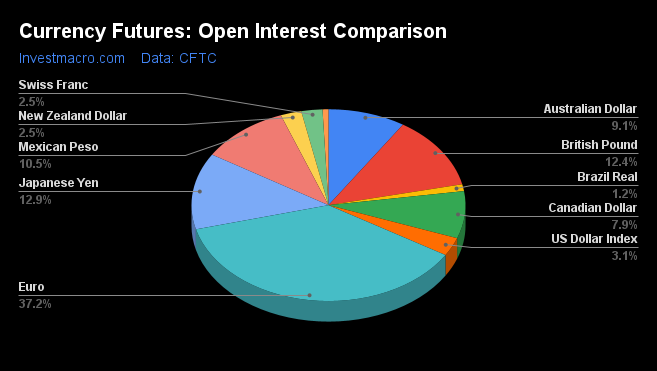
Here are the latest charts and statistics for the Commitment of Traders (COT) data published by the Commodities Futures Trading Commission (CFTC).

The latest COT data is updated through Tuesday July 19th and shows a quick view of how large traders (for-profit speculators and commercial entities) were positioned in the futures markets. All currency positions are in direct relation to the US dollar where, for example, a bet for the euro is a bet that the euro will rise versus the dollar while a bet against the euro will be a bet that the euro will decline versus the dollar.

Weekly Speculator Changes

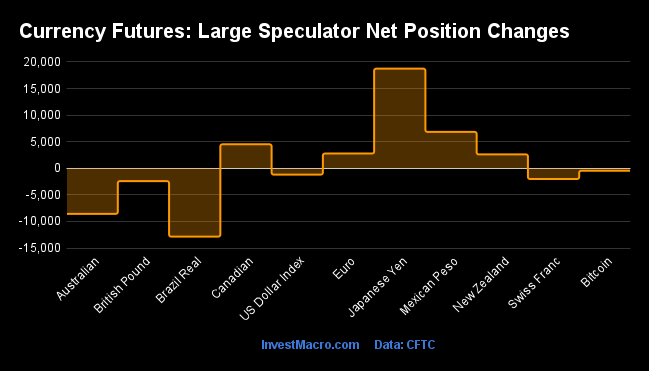
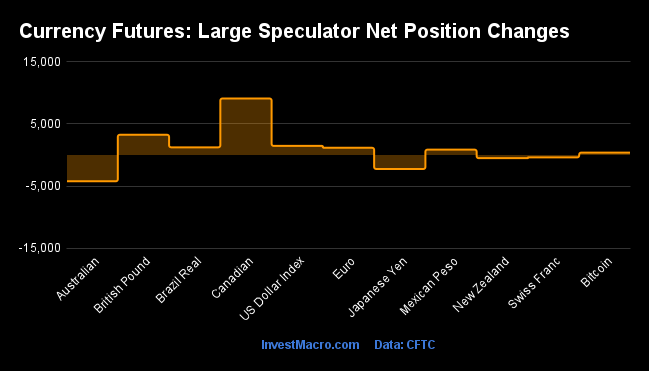
COT currency market speculator bets were mostly higher this week as six out of the eleven currency markets we cover had higher positioning while the other five markets had lower speculator contracts.

Leading the gains for the currency markets was the Canadian dollar (3,162 contracts) and the British pound sterling (1,839 contracts) while the New Zealand dollar (1,612 contracts), the Japanese yen (773 contracts), the US Dollar Index (715 contracts) and the Brazilian real (270 contracts) also had higher speculator bets for the week.

The currencies leading the declines in speculator bets this week were the Euro (-17,501 contracts) and Mexican peso (-7,522 contracts) with the Swiss franc (-2,188 contracts), the Australian dollar (-1,548 contracts) and Bitcoin (-335 contracts) also registering lower bets on the week.


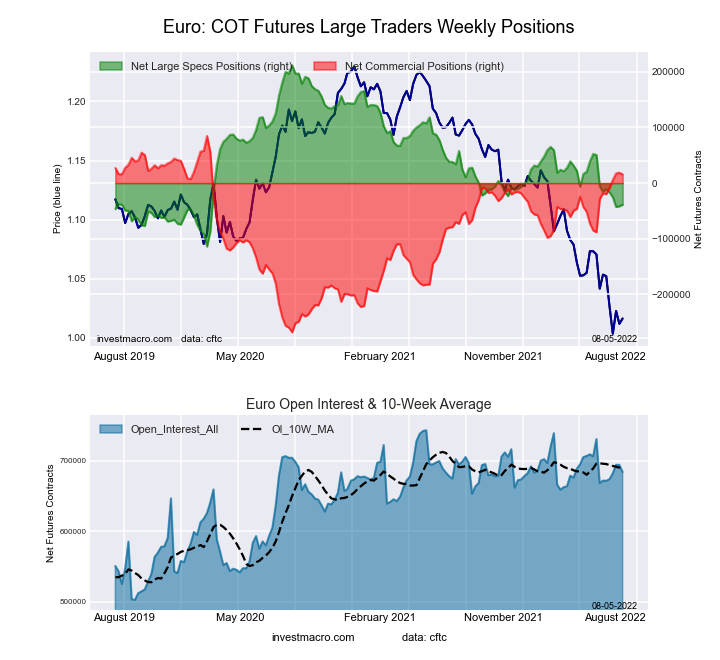
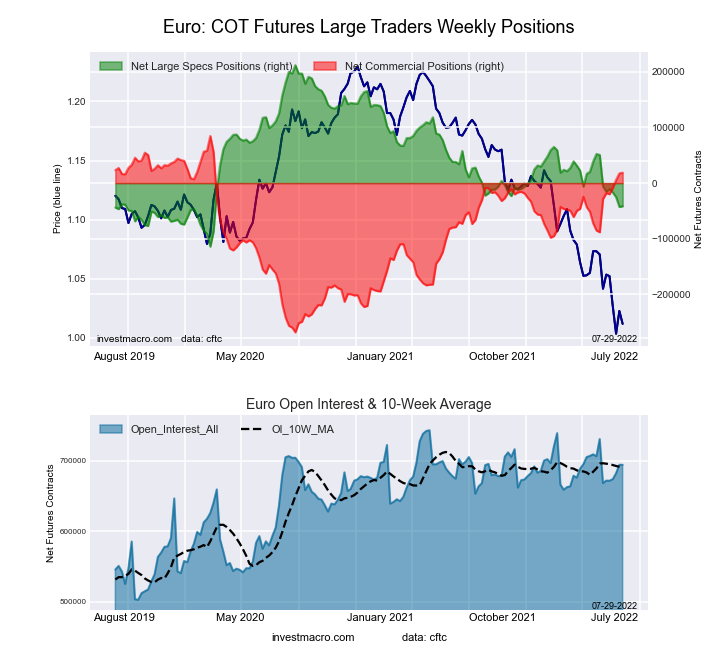
Highlighting the currencies data is the Euro’s continued decline in speculator bets. The Euro’s speculator positioning declined for the third straight week and for the sixth time in the past seven weeks which has taken off a total of -95,017 contracts from the speculator standing in that seven-week period. This decline has quickly taken the Euro speculator contracts from +52,272 contracts on May 31st to a total of -42,745 contracts this week. The EURUSD’s spot price this week had a modest bounce-back following a three-week decline and a dip below parity with the US Dollar last week. The EURUSD currency pair closed the week near the 1.0215 spot exchange rate after gaining by approximately 1.25 percent for the week.

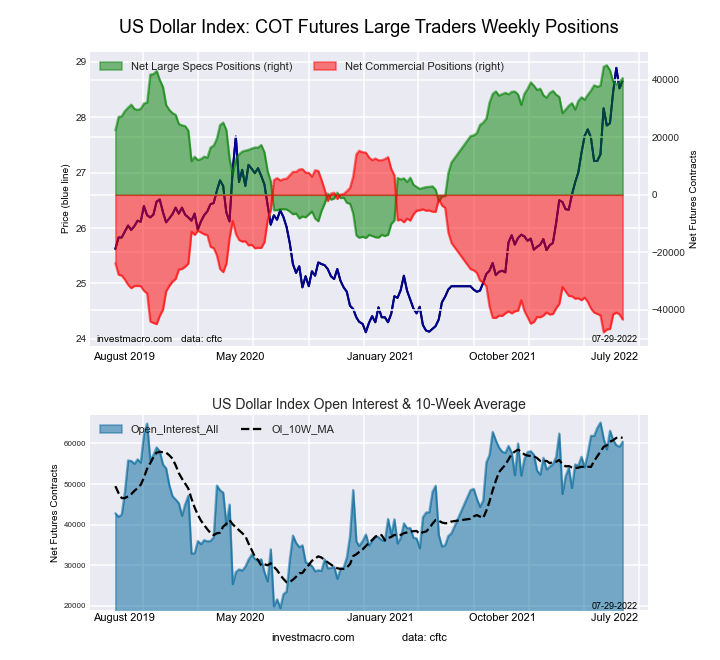
The US Dollar Index speculator bets, meanwhile, rose this week for the first time in the past four weeks and remain near the top of their speculative range. Dollar speculators had taken a total of -6,656 contracts off the bullish position in the previous three weeks and pulled the net bullish position below +40,000 contracts for the first time since June 28th before this week’s small rebound. Speculators have been uber-bullish recently on the dollar and the past four months has seen a strong surge to the upside. Since April, the US Dollar Index price has been higher in twelve out of fifteen weeks and culminated with the highest DXY price in approximately twenty years above 109.00. The dollar strength has been punishing the other major currencies as the Euro and Yen have hit multi-decade lows (versus the USD) with the US Federal Reserve sharply raising interest rates to combat inflation. The Dollar Index spot price cooled off this week by approximately 1.30 percent and closed around the 106.50 exchange rate.


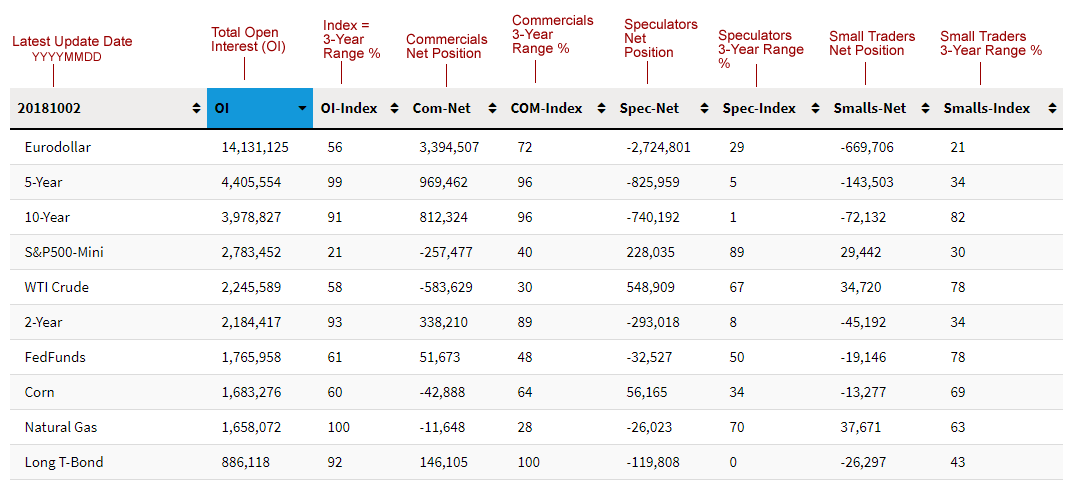
Data Snapshot of Forex Market Traders | Columns Legend
Jul-19-2022OIOI-IndexSpec-NetSpec-IndexCom-NetCOM-IndexSmalls-NetSmalls-Index
USD Index59,2148739,06990-41,500102,43143
EUR694,10680-42,7452217,4308125,31516
GBP228,05156-57,2503370,29971-13,04929
JPY229,44975-59,2253273,08271-13,85725
CHF41,85525-10,9122919,20574-8,29329
CAD142,216256,66747-8,746612,07934
AUD155,24649-43,1484549,27656-6,12837
NZD45,46735-3,671657,22742-3,55611
MXN196,12347-30,7601427,890842,87055
RUB20,93047,54331-7,15069-39324
BRL42,4523010,47561-11,580401,10578
Bitcoin14,51284-50671-66057226


Strength Scores

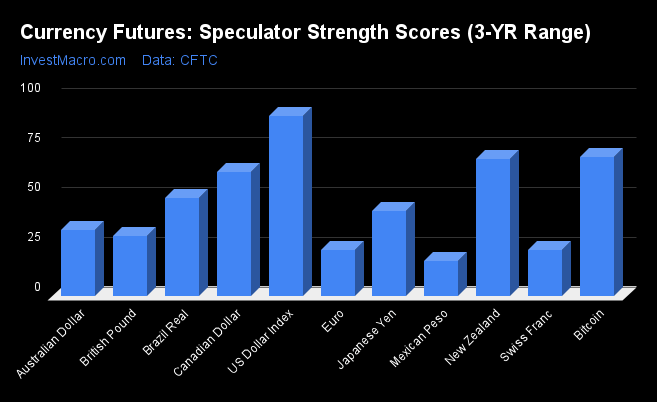
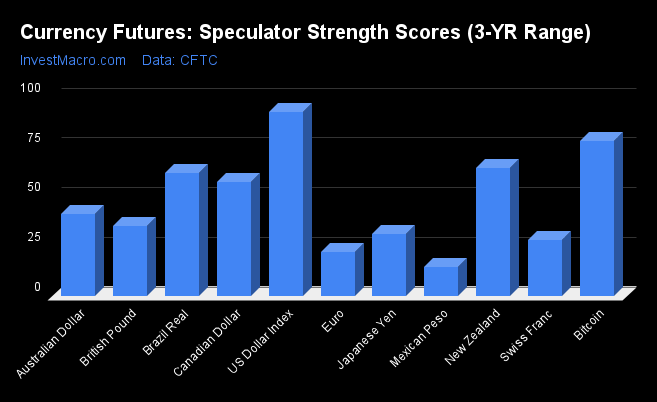
Strength Scores (a normalized measure of Speculator positions over a 3-Year range, from 0 to 100 where above 80 is extreme bullish and below 20 is extreme bearish) show that the US Dollar Index (90.1 percent) leads the currency markets once again and remains in a bullish extreme position. Bitcoin (71.1 percent), the New Zealand Dollar (65.1 percent) and the Brazilian Real (60.7 percent) come in as the next highest in strength scores – also for a second straight week. On the downside, the Mexican Peso (14.2 percent) remains the currency with the lowest strength level currently and is followed by the EuroFX (21.9 percent) which is quickly getting more bearish by the week.


Strength Statistics:
US Dollar Index (90.1 percent) vs US Dollar Index previous week (88.9 percent)
EuroFX (21.9 percent) vs EuroFX previous week (27.3 percent)
British Pound Sterling (32.8 percent) vs British Pound Sterling previous week (31.4 percent)
Japanese Yen (32.4 percent) vs Japanese Yen previous week (31.9 percent)
Swiss Franc (28.8 percent) vs Swiss Franc previous week (34.4 percent)
Canadian Dollar (46.8 percent) vs Canadian Dollar previous week (43.3 percent)
Australian Dollar (44.8 percent) vs Australian Dollar previous week (46.3 percent)
New Zealand Dollar (65.1 percent) vs New Zealand Dollar previous week (62.4 percent)
Mexican Peso (14.2 percent) vs Mexican Peso previous week (17.4 percent)
Brazil Real (60.7 percent) vs Brazil Real previous week (60.4 percent)
Russian Ruble (31.2 percent) vs Russian Ruble previous week (31.9 percent)
Bitcoin (71.1 percent) vs Bitcoin previous week (77.2 percent)

Strength Trends

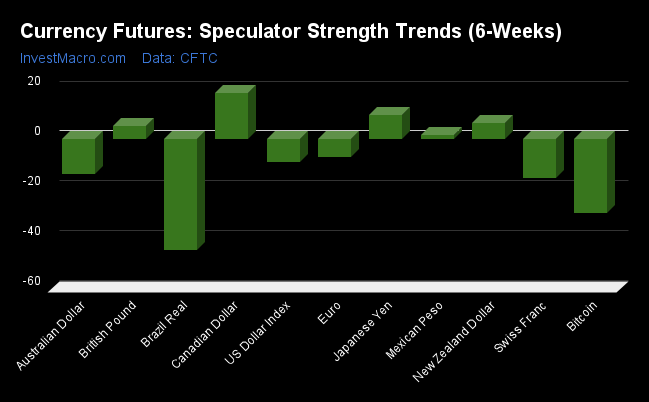
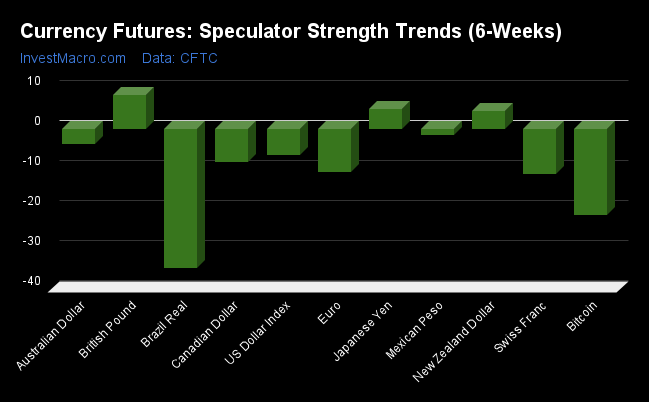
Strength Score Trends (or move index, calculates the 6-week changes in strength scores) show that the New Zealand Dollar (27.0 percent) leads the past six weeks trends for the currency markets this week. The Japanese Yen (20.0 percent) and the Swiss Franc (13.2 percent) fill out the top movers in the trends data. The Brazilian Real (-35.6 percent) leads the downside trend scores currently while the next markets with lower trend scores were the EuroFX (-28.6 percent) followed by the Mexican Peso (-27.1 percent).


Strength Trend Statistics:
US Dollar Index (1.9 percent) vs US Dollar Index previous week (1.4 percent)
EuroFX (-28.6 percent) vs EuroFX previous week (-23.8 percent)
British Pound Sterling (9.8 percent) vs British Pound Sterling previous week (10.8 percent)
Japanese Yen (20.0 percent) vs Japanese Yen previous week (21.2 percent)
Swiss Franc (13.2 percent) vs Swiss Franc previous week (29.7 percent)
Canadian Dollar (8.7 percent) vs Canadian Dollar previous week (11.8 percent)
Australian Dollar (4.4 percent) vs Australian Dollar previous week (6.6 percent)
New Zealand Dollar (27.0 percent) vs New Zealand Dollar previous week (22.6 percent)
Mexican Peso (-27.1 percent) vs Mexican Peso previous week (-25.0 percent)
Brazil Real (-35.6 percent) vs Brazil Real previous week (-34.5 percent)
Russian Ruble (-15.6 percent) vs Russian Ruble previous week (9.1 percent)
Bitcoin (-18.1 percent) vs Bitcoin previous week (-10.4 percent)


Individual Market Charts:

US Dollar Index Futures:

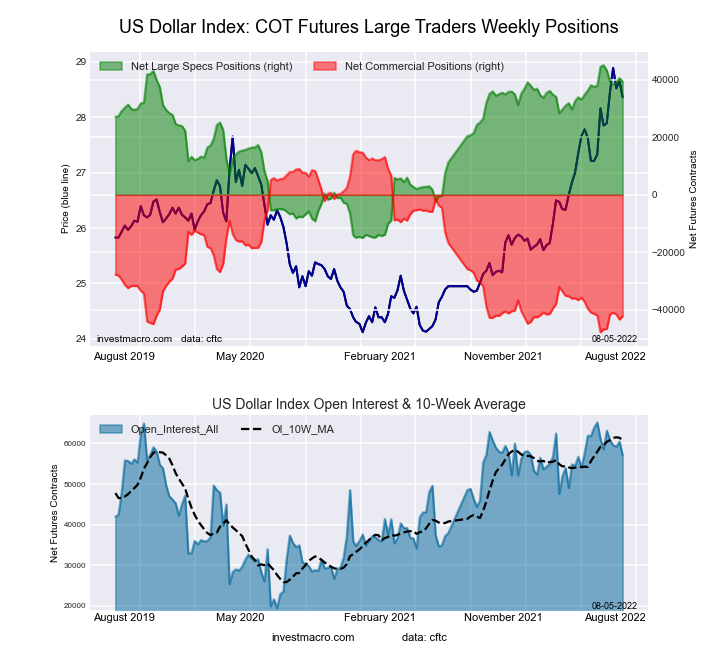
US Dollar Index Forex Futures COT ChartThe US Dollar Index large speculator standing this week rose to a net position of 39,069 contracts in the data reported through Tuesday. This was a weekly advance by 715 contracts from the previous week which had a total of 38,354 net contracts.

This week’s current strength score (the trader positioning range over the past three years, measured from 0 to 100) shows the speculators are currently Bullish-Extreme with a score of 90.1 percent. The commercials are Bearish-Extreme with a score of 9.9 percent and the small traders (not shown in chart) are Bearish with a score of 43.1 percent.

US DOLLAR INDEX StatisticsSPECULATORSCOMMERCIALSSMALL TRADERS
– Percent of Open Interest Longs:84.84.98.6
– Percent of Open Interest Shorts:18.974.94.5
– Net Position:39,069-41,5002,431
– Gross Longs:50,2342,8735,069
– Gross Shorts:11,16544,3732,638
– Long to Short Ratio:4.5 to 10.1 to 11.9 to 1
NET POSITION TREND:
– Strength Index Score (3 Year Range Pct):90.19.943.1
– Strength Index Reading (3 Year Range):Bullish-ExtremeBearish-ExtremeBearish
NET POSITION MOVEMENT INDEX:
– 6-Week Change in Strength Index:1.90.6-16.3


Euro Currency Futures:

Euro Currency Futures COT ChartThe Euro Currency large speculator standing this week was a net position of -42,745 contracts in the data reported through Tuesday. This was a sharp weekly drop of -17,501 contracts from the previous week which had a total of -25,244 net contracts.

The current strength score (the trader positioning range over the past three years, measured from 0 to 100) shows the speculators are currently Bearish with a score of 21.9 percent. The commercials are Bullish-Extreme with a score of 81.0 percent and the small traders (not shown in chart) are Bearish-Extreme with a score of 16.3 percent.

EURO Currency StatisticsSPECULATORSCOMMERCIALSSMALL TRADERS
– Percent of Open Interest Longs:28.257.311.9
– Percent of Open Interest Shorts:34.454.88.3
– Net Position:-42,74517,43025,315
– Gross Longs:195,875397,99182,676
– Gross Shorts:238,620380,56157,361
– Long to Short Ratio:0.8 to 11.0 to 11.4 to 1
NET POSITION TREND:
– Strength Index Score (3 Year Range Pct):21.981.016.3
– Strength Index Reading (3 Year Range):BearishBullish-ExtremeBearish-Extreme
NET POSITION MOVEMENT INDEX:
– 6-Week Change in Strength Index:-28.630.0-20.4


British Pound Sterling Futures:

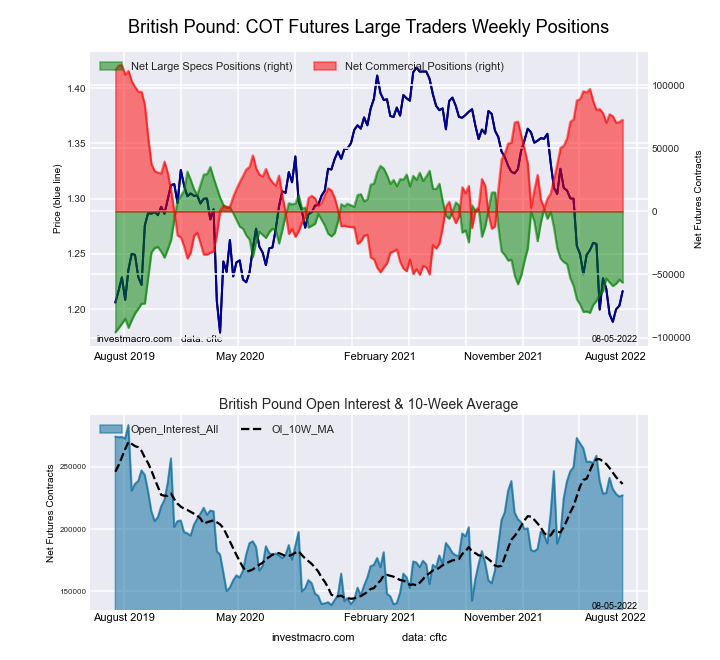
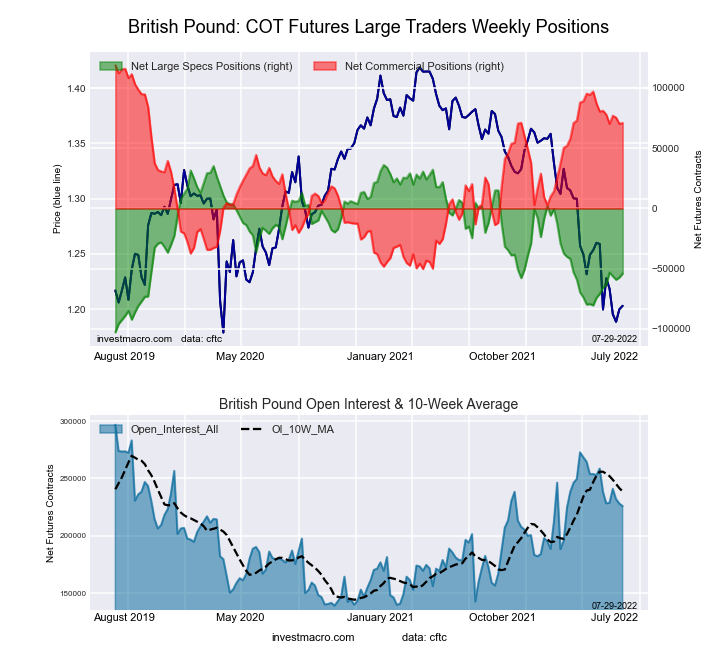
British Pound Sterling Futures COT ChartThe British Pound Sterling large speculator standing this week totaled a net position of -57,250 contracts in the data reported through Tuesday. This was a weekly gain of 1,839 contracts from last  week’s total of -59,089 net contracts.

This week’s current strength score (the trader positioning range over the past three years, measured from 0 to 100) shows the speculators are currently Bearish with a score of 32.8 percent. The commercials are Bullish with a score of 71.3 percent and the small traders (not shown in chart) are Bearish with a score of 28.6 percent.

BRITISH POUND StatisticsSPECULATORSCOMMERCIALSSMALL TRADERS
– Percent of Open Interest Longs:14.074.68.7
– Percent of Open Interest Shorts:39.143.714.4
– Net Position:-57,25070,299-13,049
– Gross Longs:31,943170,05319,882
– Gross Shorts:89,19399,75432,931
– Long to Short Ratio:0.4 to 11.7 to 10.6 to 1
NET POSITION TREND:
– Strength Index Score (3 Year Range Pct):32.871.328.6
– Strength Index Reading (3 Year Range):BearishBullishBearish
NET POSITION MOVEMENT INDEX:
– 6-Week Change in Strength Index:9.8-6.0-7.0


Japanese Yen Futures:

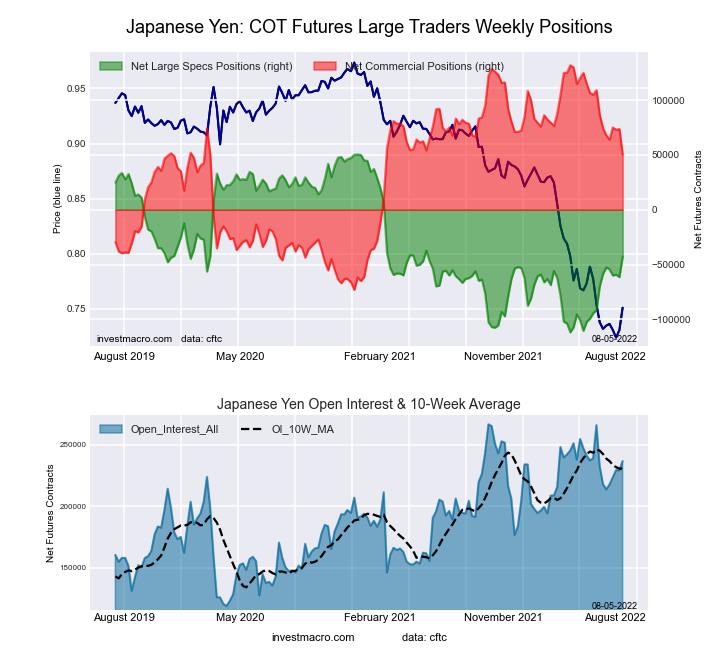
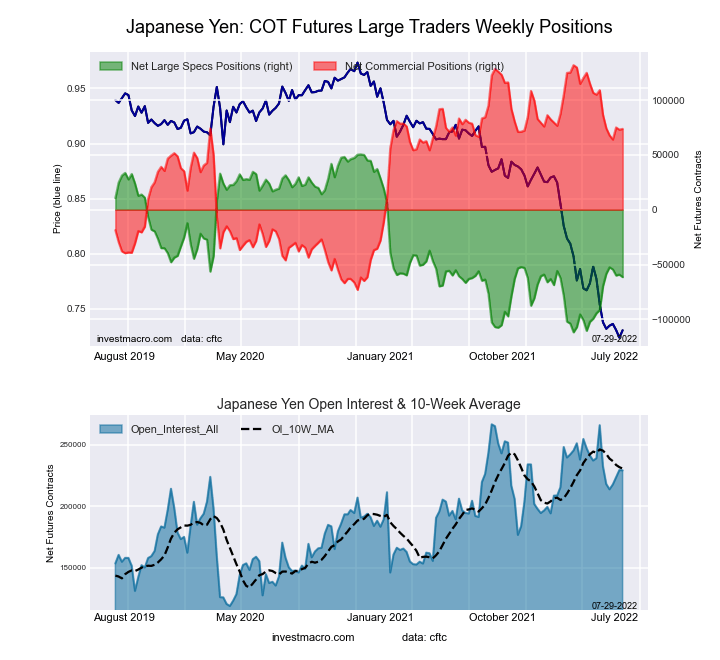
Japanese Yen Forex Futures COT ChartThe Japanese Yen large speculator standing this week was a net position of -59,225 contracts in the data reported through Tuesday. This was a weekly rise of 773 contracts from the previous week which had a total of -59,998 net contracts.

The current strength score (the trader positioning range over the past three years, measured from 0 to 100) shows the speculators are currently Bearish with a score of 32.4 percent. The commercials are Bullish with a score of 71.3 percent and the small traders (not shown in chart) are Bearish with a score of 25.3 percent.

JAPANESE YEN StatisticsSPECULATORSCOMMERCIALSSMALL TRADERS
– Percent of Open Interest Longs:18.769.010.7
– Percent of Open Interest Shorts:44.537.216.7
– Net Position:-59,22573,082-13,857
– Gross Longs:42,880158,42724,496
– Gross Shorts:102,10585,34538,353
– Long to Short Ratio:0.4 to 11.9 to 10.6 to 1
NET POSITION TREND:
– Strength Index Score (3 Year Range Pct):32.471.325.3
– Strength Index Reading (3 Year Range):BearishBullishBearish
NET POSITION MOVEMENT INDEX:
– 6-Week Change in Strength Index:20.0-17.67.3


Swiss Franc Futures:

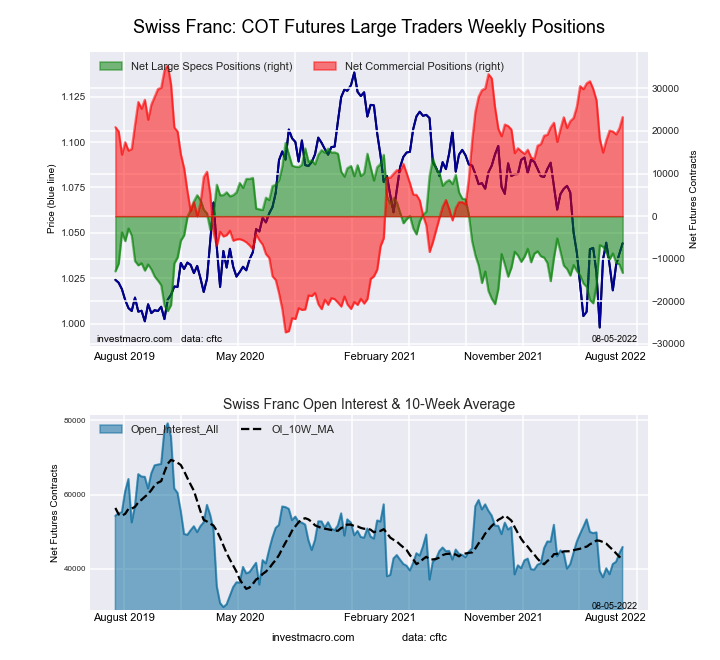
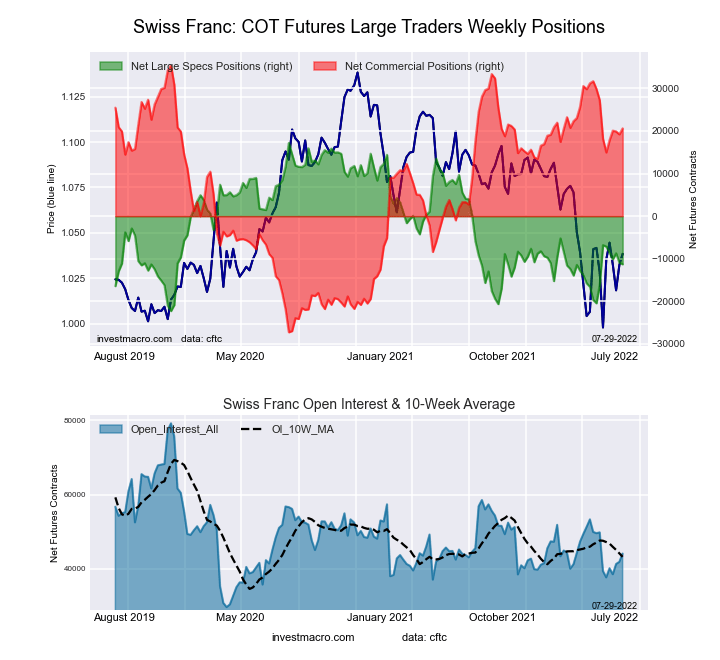
The Swiss Franc large speculator standing this week totaled a net position of -10,912 contracts in the data reported through Tuesday. This was a weekly decline of -2,188 contracts from the previous week which had a total of -8,724 net contracts.

This week’s current strength score (the trader positioning range over the past three years, measured from 0 to 100) shows the speculators are currently Bearish with a score of 28.8 percent. The commercials are Bullish with a score of 74.1 percent and the small traders (not shown in chart) are Bearish with a score of 29.5 percent.

SWISS FRANC StatisticsSPECULATORSCOMMERCIALSSMALL TRADERS
– Percent of Open Interest Longs:16.659.723.5
– Percent of Open Interest Shorts:42.713.943.3
– Net Position:-10,91219,205-8,293
– Gross Longs:6,94825,0089,819
– Gross Shorts:17,8605,80318,112
– Long to Short Ratio:0.4 to 14.3 to 10.5 to 1
NET POSITION TREND:
– Strength Index Score (3 Year Range Pct):28.874.129.5
– Strength Index Reading (3 Year Range):BearishBullishBearish
NET POSITION MOVEMENT INDEX:
– 6-Week Change in Strength Index:13.2-12.89.5


Canadian Dollar Futures:

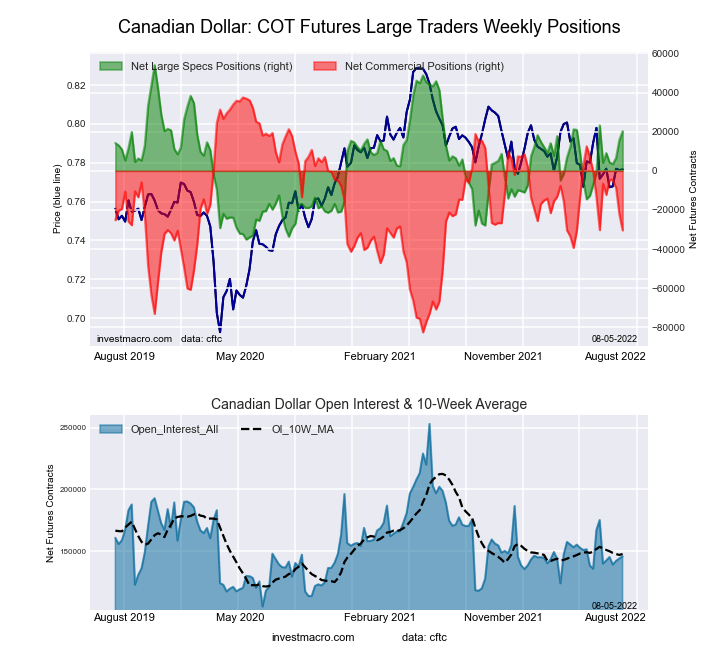
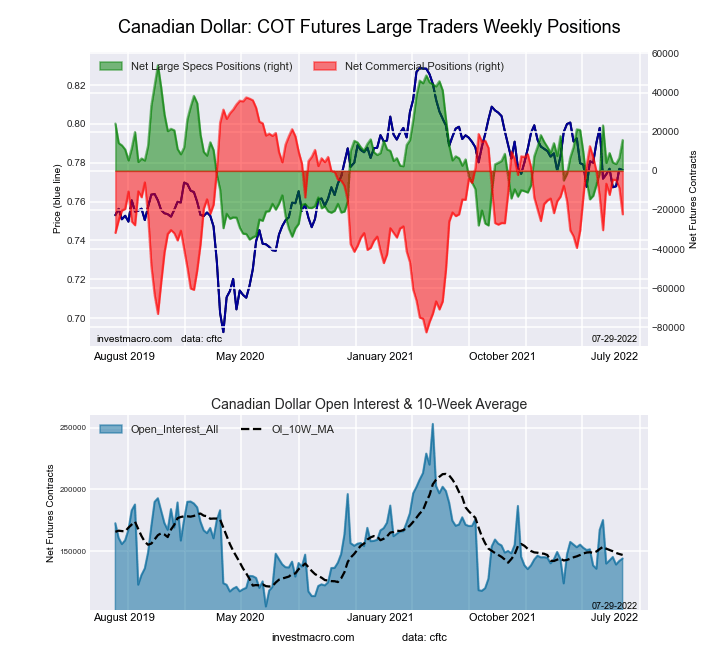
Canadian Dollar Forex Futures COT ChartThe Canadian Dollar large speculator standing this week was a net position of 6,667 contracts in the data reported through Tuesday. This was a weekly gain of 3,162 contracts from the previous week which had a total of 3,505 net contracts.

This week’s current strength score (the trader positioning range over the past three years, measured from 0 to 100) shows the speculators are currently Bearish with a score of 46.8 percent. The commercials are Bullish with a score of 61.4 percent and the small traders (not shown in chart) are Bearish with a score of 34.3 percent.

CANADIAN DOLLAR StatisticsSPECULATORSCOMMERCIALSSMALL TRADERS
– Percent of Open Interest Longs:29.647.122.1
– Percent of Open Interest Shorts:24.953.320.6
– Net Position:6,667-8,7462,079
– Gross Longs:42,04067,03831,391
– Gross Shorts:35,37375,78429,312
– Long to Short Ratio:1.2 to 10.9 to 11.1 to 1
NET POSITION TREND:
– Strength Index Score (3 Year Range Pct):46.861.434.3
– Strength Index Reading (3 Year Range):BearishBullishBearish
NET POSITION MOVEMENT INDEX:
– 6-Week Change in Strength Index:8.73.9-24.9


Australian Dollar Futures:

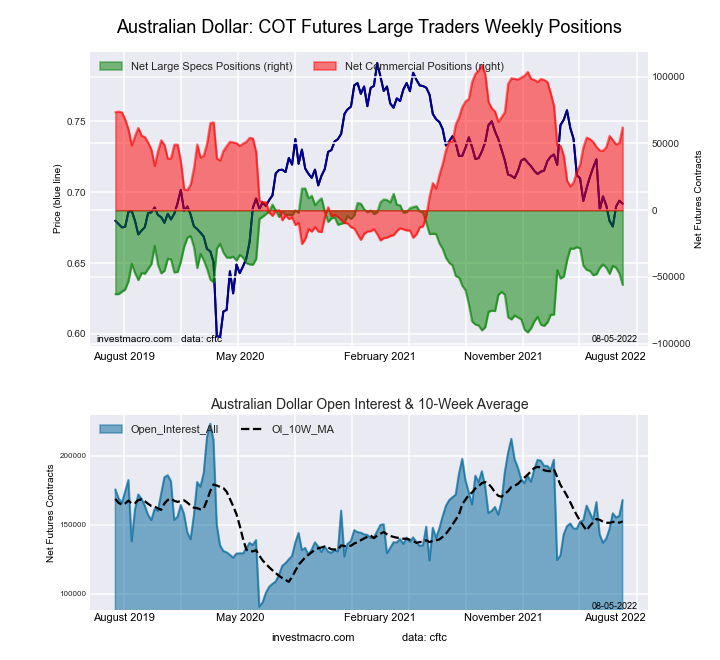
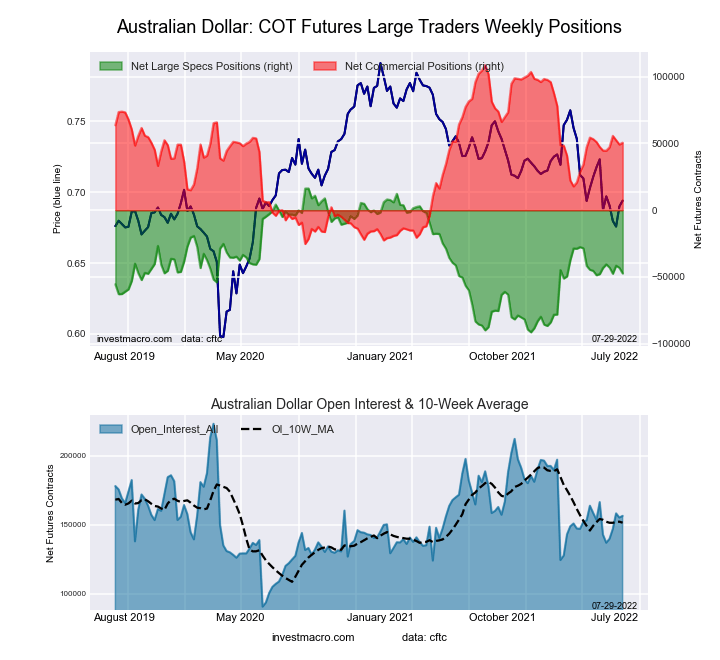
Australian Dollar Forex Futures COT ChartThe Australian Dollar large speculator standing this week was a net position of -43,148 contracts in the data reported through Tuesday. This was a weekly lowering of -1,548 contracts from the previous week which had a total of -41,600 net contracts.

This week’s current strength score (the trader positioning range over the past three years, measured from 0 to 100) shows the speculators are currently Bearish with a score of 44.8 percent. The commercials are Bullish with a score of 55.6 percent and the small traders (not shown in chart) are Bearish with a score of 37.5 percent.

AUSTRALIAN DOLLAR StatisticsSPECULATORSCOMMERCIALSSMALL TRADERS
– Percent of Open Interest Longs:19.766.011.2
– Percent of Open Interest Shorts:47.534.315.2
– Net Position:-43,14849,276-6,128
– Gross Longs:30,578102,51817,420
– Gross Shorts:73,72653,24223,548
– Long to Short Ratio:0.4 to 11.9 to 10.7 to 1
NET POSITION TREND:
– Strength Index Score (3 Year Range Pct):44.855.637.5
– Strength Index Reading (3 Year Range):BearishBullishBearish
NET POSITION MOVEMENT INDEX:
– 6-Week Change in Strength Index:4.41.4-16.1


New Zealand Dollar Futures:

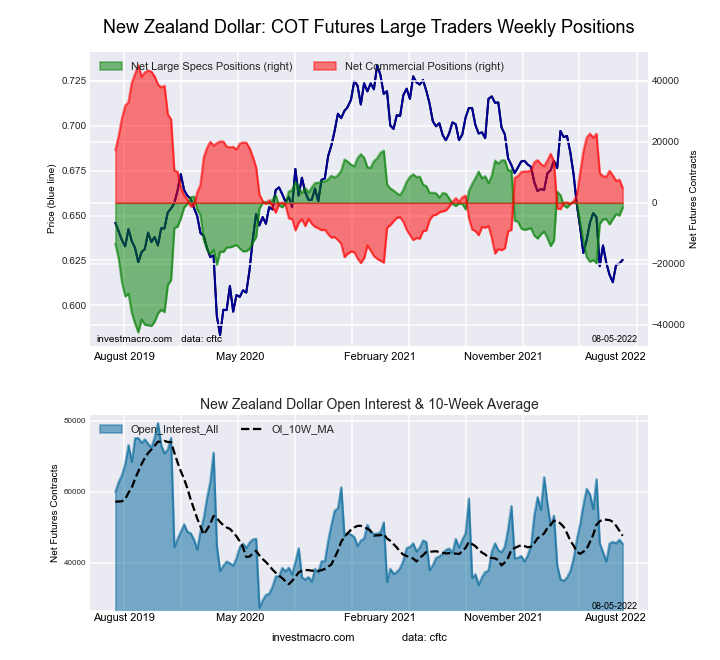
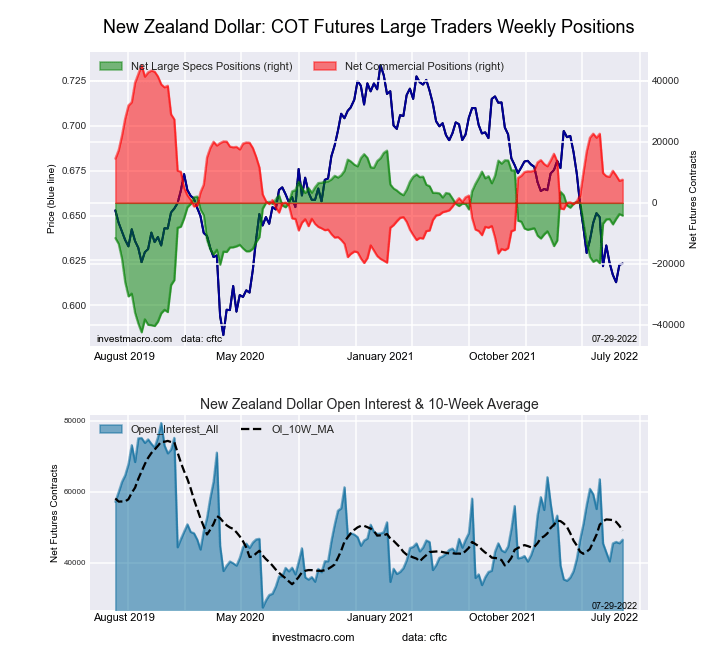
New Zealand Dollar Forex Futures COT ChartThe New Zealand Dollar large speculator standing this week was a net position of -3,671 contracts in the data reported through Tuesday. This was a weekly increase of 1,612 contracts from the previous week which had a total of -5,283 net contracts.

This week’s current strength score (the trader positioning range over the past three years, measured from 0 to 100) shows the speculators are currently Bullish with a score of 65.1 percent. The commercials are Bearish with a score of 41.5 percent and the small traders (not shown in chart) are Bearish-Extreme with a score of 10.8 percent.

NEW ZEALAND DOLLAR StatisticsSPECULATORSCOMMERCIALSSMALL TRADERS
– Percent of Open Interest Longs:34.759.25.4
– Percent of Open Interest Shorts:42.843.313.2
– Net Position:-3,6717,227-3,556
– Gross Longs:15,79126,9052,444
– Gross Shorts:19,46219,6786,000
– Long to Short Ratio:0.8 to 11.4 to 10.4 to 1
NET POSITION TREND:
– Strength Index Score (3 Year Range Pct):65.141.510.8
– Strength Index Reading (3 Year Range):BullishBearishBearish-Extreme
NET POSITION MOVEMENT INDEX:
– 6-Week Change in Strength Index:27.0-23.8-7.4


Mexican Peso Futures:

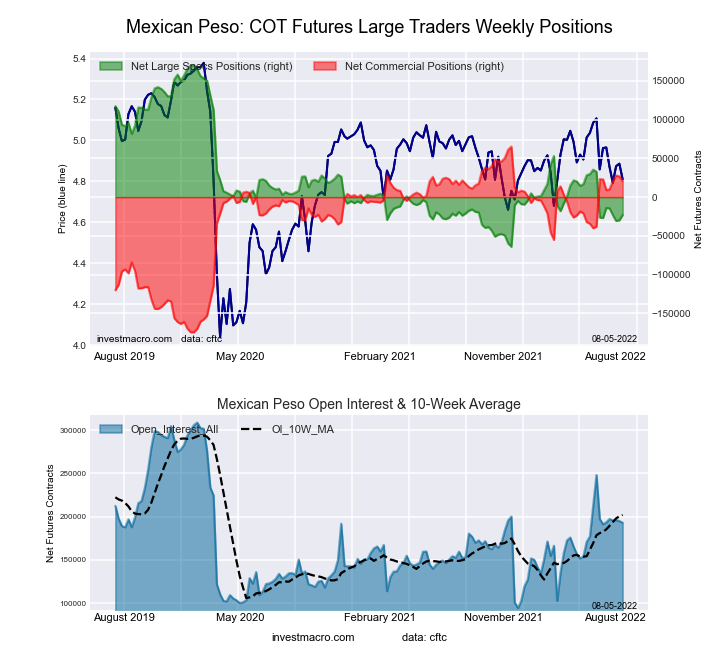
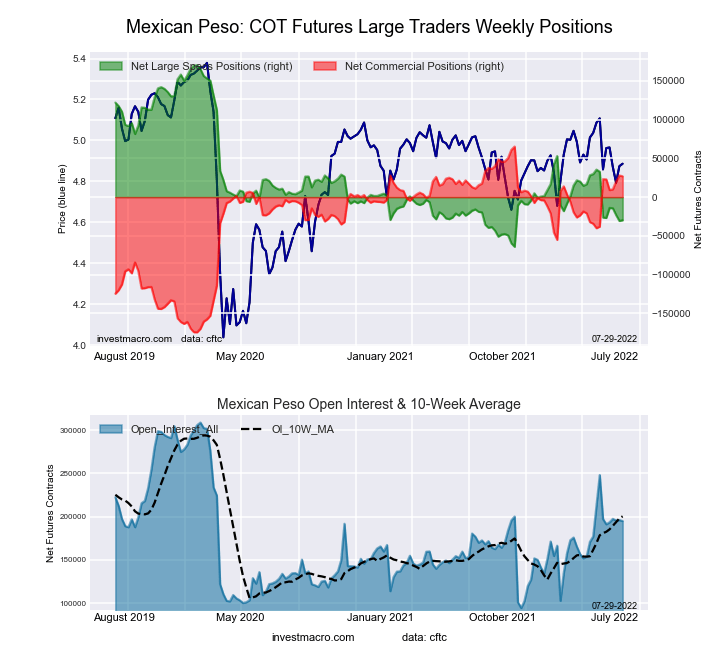
Mexican Peso Futures COT ChartThe Mexican Peso large speculator standing this week was a net position of -30,760 contracts in the data reported through Tuesday. This was a weekly decrease of -7,522 contracts from the previous week which had a total of -23,238 net contracts.

The current strength score (the trader positioning range over the past three years, measured from 0 to 100) shows the speculators are currently Bearish-Extreme with a score of 14.2 percent. The commercials are Bullish-Extreme with a score of 84.4 percent and the small traders (not shown in chart) are Bullish with a score of 55.2 percent.

MEXICAN PESO StatisticsSPECULATORSCOMMERCIALSSMALL TRADERS
– Percent of Open Interest Longs:50.046.63.0
– Percent of Open Interest Shorts:65.632.41.6
– Net Position:-30,76027,8902,870
– Gross Longs:97,96591,4585,972
– Gross Shorts:128,72563,5683,102
– Long to Short Ratio:0.8 to 11.4 to 11.9 to 1
NET POSITION TREND:
– Strength Index Score (3 Year Range Pct):14.284.455.2
– Strength Index Reading (3 Year Range):Bearish-ExtremeBullish-ExtremeBullish
NET POSITION MOVEMENT INDEX:
– 6-Week Change in Strength Index:-27.127.5-10.7


Brazilian Real Futures:

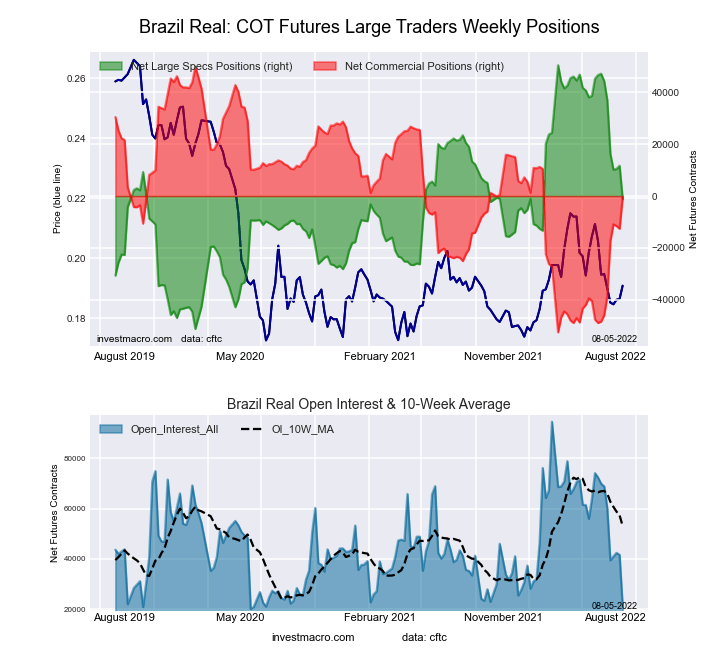
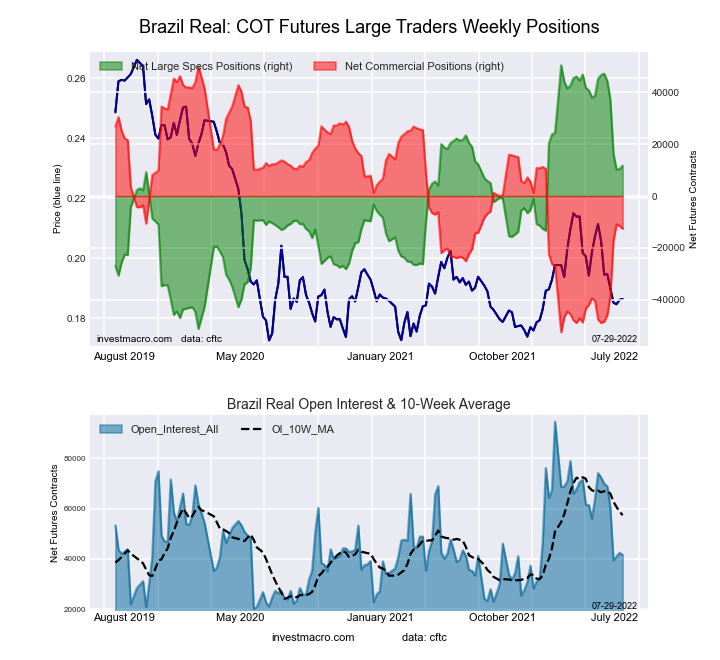
Brazil Real Futures COT ChartThe Brazilian Real large speculator standing this week reached a net position of 10,475 contracts in the data reported through Tuesday. This was a weekly advance of 270 contracts from the previous week which had a total of 10,205 net contracts.

The current strength score (the trader positioning range over the past three years, measured from 0 to 100) shows the speculators are currently Bullish with a score of 60.7 percent. The commercials are Bearish with a score of 40.0 percent and the small traders (not shown in chart) are Bullish with a score of 77.7 percent.

BRAZIL REAL StatisticsSPECULATORSCOMMERCIALSSMALL TRADERS
– Percent of Open Interest Longs:48.543.77.3
– Percent of Open Interest Shorts:23.971.04.7
– Net Position:10,475-11,5801,105
– Gross Longs:20,60018,5693,092
– Gross Shorts:10,12530,1491,987
– Long to Short Ratio:2.0 to 10.6 to 11.6 to 1
NET POSITION TREND:
– Strength Index Score (3 Year Range Pct):60.740.077.7
– Strength Index Reading (3 Year Range):BullishBearishBullish
NET POSITION MOVEMENT INDEX:
– 6-Week Change in Strength Index:-35.636.5-13.4


Bitcoin Futures:

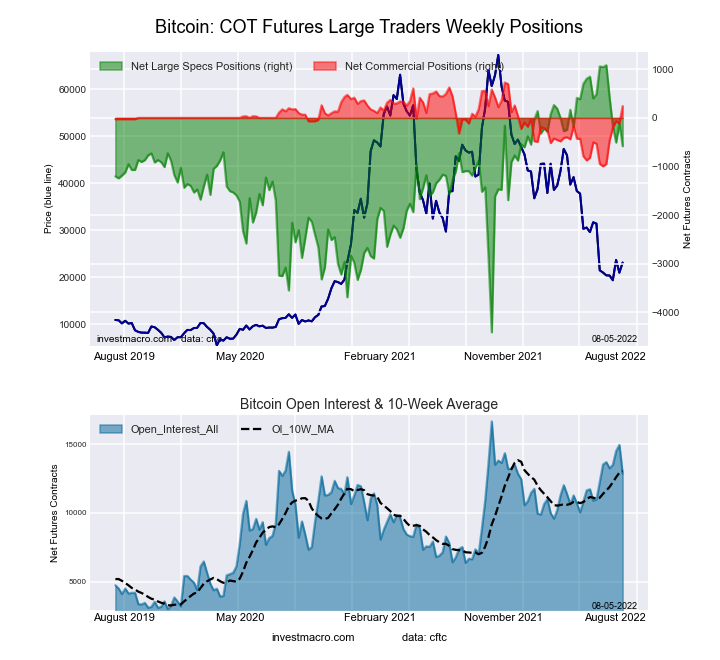
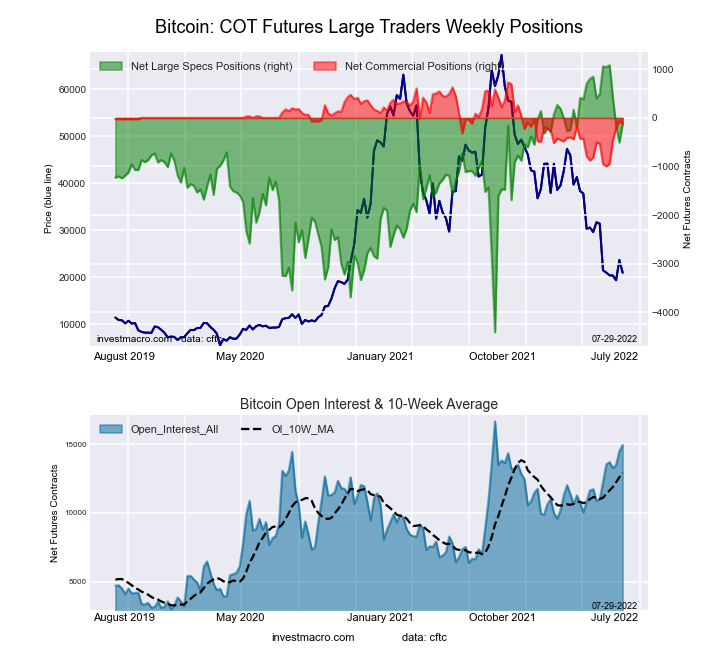
Bitcoin Crypto Futures COT ChartThe Bitcoin large speculator standing this week was a net position of -506 contracts in the data reported through Tuesday. This was a weekly decline of -335 contracts from the previous week which had a total of -171 net contracts.

The current strength score (the trader positioning range over the past three years, measured from 0 to 100) shows the speculators are currently Bullish with a score of 71.1 percent. The commercials are Bullish with a score of 53.9 percent and the small traders (not shown in chart) are Bearish with a score of 25.9 percent.

BITCOIN StatisticsSPECULATORSCOMMERCIALSSMALL TRADERS
– Percent of Open Interest Longs:75.23.59.4
– Percent of Open Interest Shorts:78.74.05.4
– Net Position:-506-66572
– Gross Longs:10,9095141,360
– Gross Shorts:11,415580788
– Long to Short Ratio:1.0 to 10.9 to 11.7 to 1
NET POSITION TREND:
– Strength Index Score (3 Year Range Pct):71.153.925.9
– Strength Index Reading (3 Year Range):BullishBullishBearish
NET POSITION MOVEMENT INDEX:
– 6-Week Change in Strength Index:-18.126.912.1


Article By InvestMacroReceive our weekly COT Reports by Email

*COT Report: The COT data, released weekly to the public each Friday, is updated through the most recent Tuesday (data is 3 days old) and shows a quick view of how large speculators or non-commercials (for-profit traders) were positioned in the futures markets.

The CFTC categorizes trader positions according to commercial hedgers (traders who use futures contracts for hedging as part of the business), non-commercials (large traders who speculate to realize trading profits) and nonreportable traders (usually small traders/speculators) as well as their open interest (contracts open in the market at time of reporting).See CFTC criteria here.


COT Week 29 Charts: Precious Metals Speculator bets continue weakness led by Gold & Silver

By InvestMacro | COT | Data Tables | COT Leaders | Downloads | COT Newsletter

Here are the latest charts and statistics for the Commitment of Traders (COT) data published by the Commodities Futures Trading Commission (CFTC).

The latest COT data is updated through Tuesday July 19th and shows a quick view of how large traders (for-profit speculators and commercial entities) were positioned in the futures markets.

Weekly Speculator Changes

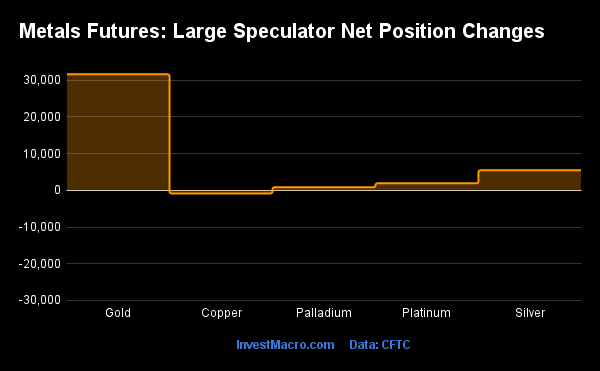
COT precious metals speculator bets were lower this week as two out of the five metals markets we cover had higher positioning this week while the other three markets had lower speculator contracts.

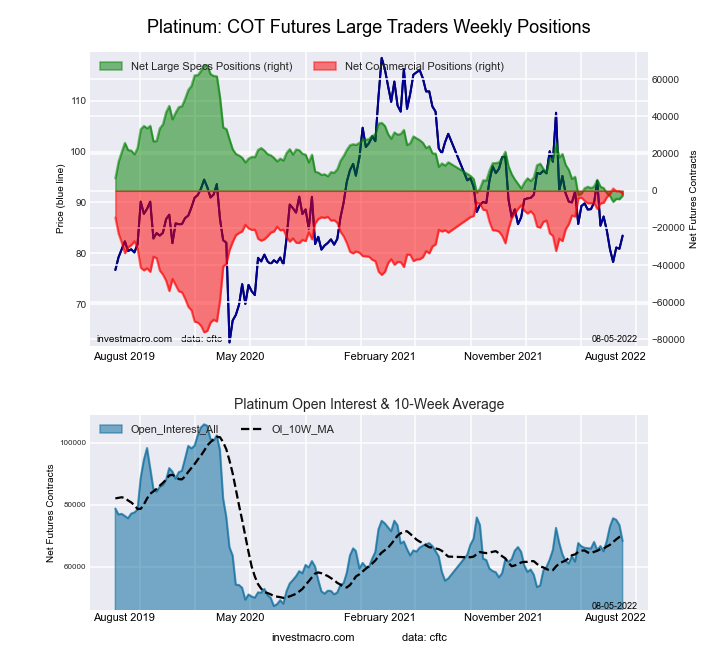
Leading the gains for the precious metals markets was Copper (2,459 contracts) with Platinum (1,629 contracts) also showing a positive week.

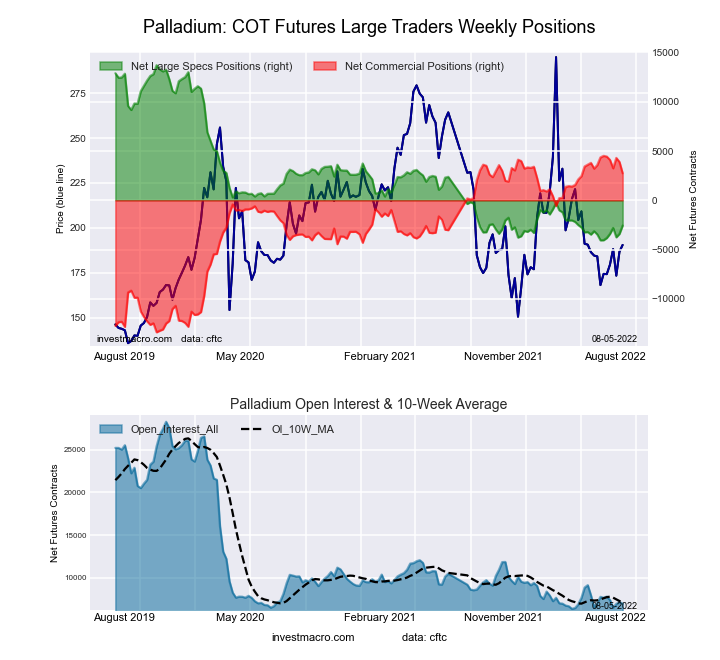
The metals markets leading the declines in speculator bets this week were Gold (-23,166 contracts) and XX with Silver (-1,844 contracts) and Palladium (-949 contracts) also registering lower bets on the week.

Highlighting the metals data this week is the continued decline in speculator bets for Gold. Positioning has been down for four straight weeks and in five out of the past six weeks, taking a total of -80,313 contracts off the bullish position in the past six weeks. This weakness has dropped the Gold bullish position to below the +100,000 net contract level for the first time since May 28th of 2019, a span of 164 weeks. Gold prices, meanwhile, have shaved off about $300 from the highs in March but have recently found support near the $1,700 price-point.

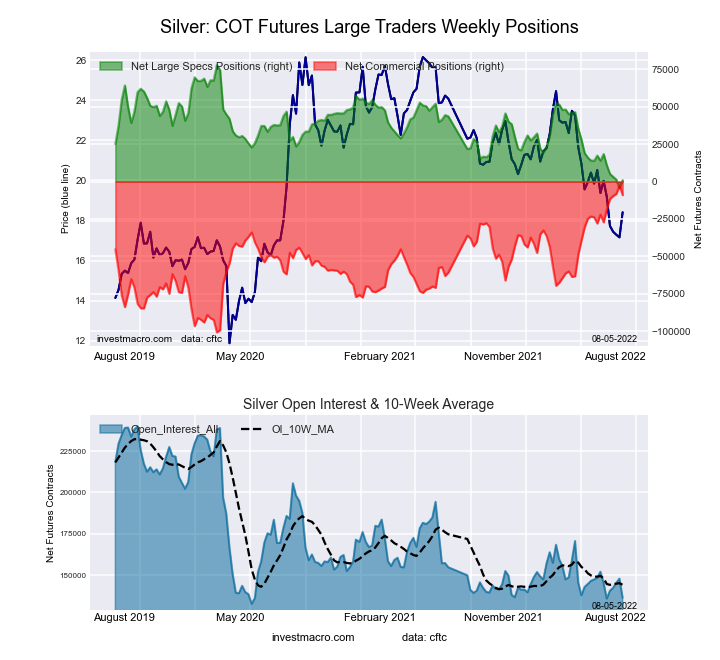
Silver positions have been falling in a similar fashion and have now declined for the past four straight weeks. Positioning has also been lower in eleven out of the past thirteen weeks with a total drop of -45,069 contracts over that time-frame. The current speculator standing is at just +1,360 contracts and is dangerously close to going negative for the first time since June of 2019. Silver spot prices in the past two weeks have dipped to the lowest levels since July of 2020 right near the major price level of $18.


Data Snapshot of Commodity Market Traders | Columns Legend
Jul-19-2022OIOI-IndexSpec-NetSpec-IndexCom-NetCOM-IndexSmalls-NetSmalls-Index
WTI Crude1,577,6160271,0911-293,68910022,59847
Gold524,7862194,9550-112,26210017,3070
Silver145,247121,3600-8,2131006,8532
Copper174,5928-23,8362523,745769126
Palladium6,9153-3,75124,30299-55112
Platinum75,06947-4,2822-273984,55526
Natural Gas953,3250-120,3234286,6995833,62460
Brent177,88922-41,3024240,8436145915
Heating Oil267,576229,24356-23,8004614,55749
Soybeans602,9870102,59345-74,42761-28,16623
Corn1,308,4580209,94057-165,61148-44,32918
Coffee196,041327,97963-28,02644470
Sugar703,6140127,16263-141,8424114,68026
Wheat292,70026,522283,17364-9,69560


Strength Scores

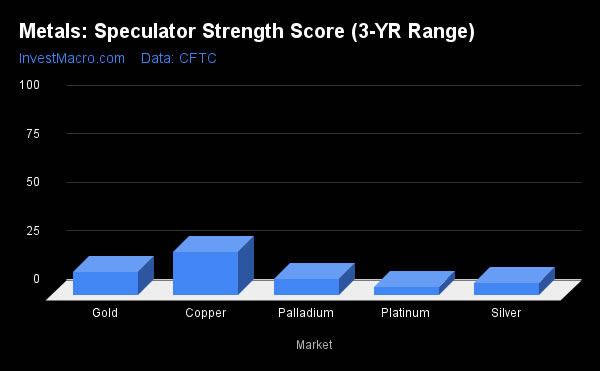
Strength scores (a measure of the 3-Year range of Speculator positions, from 0 to 100 where above 80 is extreme bullish and below 20 is extreme bearish) show that Copper (25.2 percent) leads the metals again this week but is itself in a very weak position (just above the 20 percent extreme bearish level). All the other metals markets are in extreme bearish levels as has been the case for multiple weeks. Platinum (2.2 percent), Palladium (1.7 percent), Gold (0.0 percent) and Silver (0.0 percent) round out the rest of the strength scores.

Strength Statistics:
Gold (0.0 percent) vs Gold previous week (9.0 percent)
Silver (0.0 percent) vs Silver previous week (2.4 percent)
Copper (25.2 percent) vs Copper previous week (23.4 percent)
Platinum (2.2 percent) vs Platinum previous week (0.0 percent)
Palladium (1.7 percent) vs Palladium previous week (7.1 percent)

Strength Trends

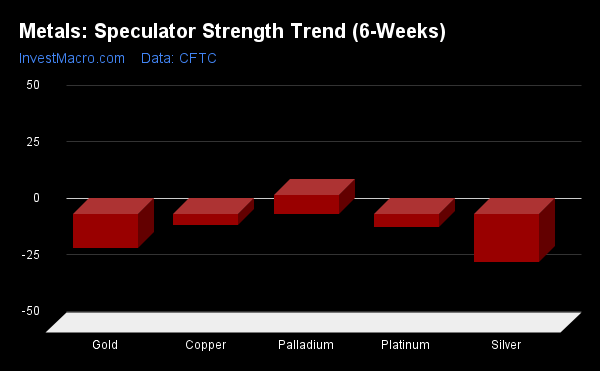
Strength Score Trends (or move index, calculates the 6-week changes in strength scores) illustrate how weak the metals category has been as all the metals have negative strength trends over the past six weeks. Gold (-31.0 percent) leads the downside trend scores currently while the next markets with lower trend scores were Silver (-21.0 percent) followed by Copper (-14.5 percent), Platinum (-13.9 percent) and Palladium (-1.6 percent).

Move Statistics:
Gold (-31.0 percent) vs Gold previous week (-21.1 percent)
Silver (-21.0 percent) vs Silver previous week (-14.1 percent)
Copper (-14.5 percent) vs Copper previous week (-6.0 percent)
Platinum (-13.9 percent) vs Platinum previous week (-11.3 percent)
Palladium (-1.6 percent) vs Palladium previous week (1.9 percent)


Individual Markets:

Gold Comex Futures:

Gold Futures COT ChartThe Gold Comex Futures large speculator standing this week equaled a net position of 94,955 contracts in the data reported through Tuesday. This was a weekly lowering of -23,166 contracts from the previous week which had a total of 118,121 net contracts.

This week’s current strength score (the trader positioning range over the past three years, measured from 0 to 100) shows the speculators are currently Bearish-Extreme with a score of 0.0 percent. The commercials are Bullish-Extreme with a score of 100.0 percent and the small traders (not shown in chart) are Bearish-Extreme with a score of 0.0 percent.

Gold Futures StatisticsSPECULATORSCOMMERCIALSSMALL TRADERS
– Percent of Open Interest Longs:45.929.08.2
– Percent of Open Interest Shorts:27.850.45.0
– Net Position:94,955-112,26217,307
– Gross Longs:241,004152,10343,294
– Gross Shorts:146,049264,36525,987
– Long to Short Ratio:1.7 to 10.6 to 11.7 to 1
NET POSITION TREND:
– Strength Index Score (3 Year Range Pct):0.0100.00.0
– Strength Index Reading (3 Year Range):Bearish-ExtremeBullish-ExtremeBearish-Extreme
NET POSITION MOVEMENT INDEX:
– 6-Week Change in Strength Index:-31.032.1-24.0


Silver Comex Futures:

Silver Futures COT ChartThe Silver Comex Futures large speculator standing this week equaled a net position of 1,360 contracts in the data reported through Tuesday. This was a weekly reduction of -1,844 contracts from the previous week which had a total of 3,204 net contracts.

This week’s current strength score (the trader positioning range over the past three years, measured from 0 to 100) shows the speculators are currently Bearish-Extreme with a score of 0.0 percent. The commercials are Bullish-Extreme with a score of 100.0 percent and the small traders (not shown in chart) are Bearish-Extreme with a score of 2.2 percent.

Silver Futures StatisticsSPECULATORSCOMMERCIALSSMALL TRADERS
– Percent of Open Interest Longs:38.740.214.8
– Percent of Open Interest Shorts:37.745.910.1
– Net Position:1,360-8,2136,853
– Gross Longs:56,18758,43021,517
– Gross Shorts:54,82766,64314,664
– Long to Short Ratio:1.0 to 10.9 to 11.5 to 1
NET POSITION TREND:
– Strength Index Score (3 Year Range Pct):0.0100.02.2
– Strength Index Reading (3 Year Range):Bearish-ExtremeBullish-ExtremeBearish-Extreme
NET POSITION MOVEMENT INDEX:
– 6-Week Change in Strength Index:-21.021.4-18.1


Copper Grade #1 Futures:

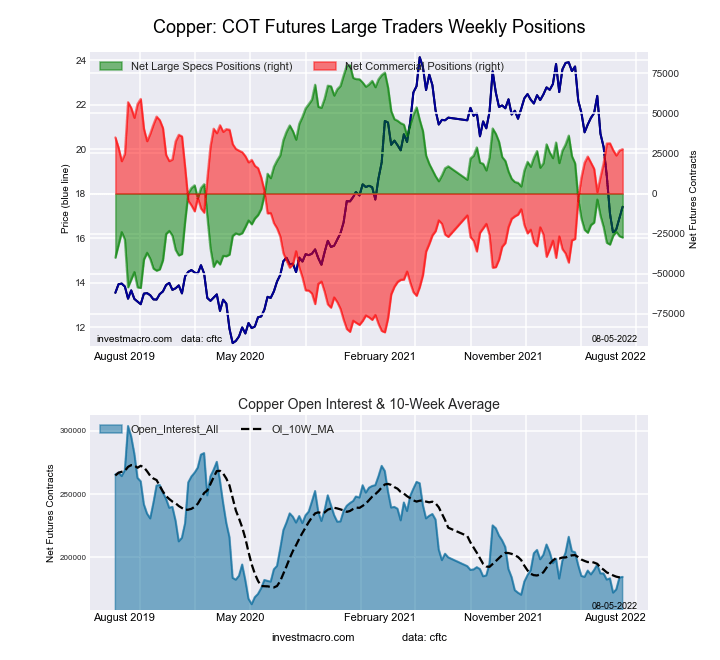
Copper Futures COT ChartThe Copper Grade #1 Futures large speculator standing this week equaled a net position of -23,836 contracts in the data reported through Tuesday. This was a weekly lift of 2,459 contracts from the previous week which had a total of -26,295 net contracts.

This week’s current strength score (the trader positioning range over the past three years, measured from 0 to 100) shows the speculators are currently Bearish with a score of 25.2 percent. The commercials are Bullish with a score of 75.8 percent and the small traders (not shown in chart) are Bearish with a score of 25.8 percent.

Copper Futures StatisticsSPECULATORSCOMMERCIALSSMALL TRADERS
– Percent of Open Interest Longs:29.849.58.4
– Percent of Open Interest Shorts:43.435.98.3
– Net Position:-23,83623,74591
– Gross Longs:52,00086,50514,616
– Gross Shorts:75,83662,76014,525
– Long to Short Ratio:0.7 to 11.4 to 11.0 to 1
NET POSITION TREND:
– Strength Index Score (3 Year Range Pct):25.275.825.8
– Strength Index Reading (3 Year Range):BearishBullishBearish
NET POSITION MOVEMENT INDEX:
– 6-Week Change in Strength Index:-14.515.7-15.9


Platinum Futures:

The Platinum Futures large speculator standing this week equaled a net position of -4,282 contracts in the data reported through Tuesday. This was a weekly advance of 1,629 contracts from the previous week which had a total of -5,911 net contracts.

This week’s current strength score (the trader positioning range over the past three years, measured from 0 to 100) shows the speculators are currently Bearish-Extreme with a score of 2.2 percent. The commercials are Bullish-Extreme with a score of 98.1 percent and the small traders (not shown in chart) are Bearish with a score of 25.5 percent.

Platinum Futures StatisticsSPECULATORSCOMMERCIALSSMALL TRADERS
– Percent of Open Interest Longs:43.937.711.0
– Percent of Open Interest Shorts:49.638.14.9
– Net Position:-4,282-2734,555
– Gross Longs:32,96028,3388,241
– Gross Shorts:37,24228,6113,686
– Long to Short Ratio:0.9 to 11.0 to 12.2 to 1
NET POSITION TREND:
– Strength Index Score (3 Year Range Pct):2.298.125.5
– Strength Index Reading (3 Year Range):Bearish-ExtremeBullish-ExtremeBearish
NET POSITION MOVEMENT INDEX:
– 6-Week Change in Strength Index:-13.912.210.4


Palladium Futures:

Palladium Futures COT ChartThe Palladium Futures large speculator standing this week equaled a net position of -3,751 contracts in the data reported through Tuesday. This was a weekly lowering of -949 contracts from the previous week which had a total of -2,802 net contracts.

This week’s current strength score (the trader positioning range over the past three years, measured from 0 to 100) shows the speculators are currently Bearish-Extreme with a score of 1.7 percent. The commercials are Bullish-Extreme with a score of 98.8 percent and the small traders (not shown in chart) are Bearish-Extreme with a score of 12.0 percent.

Palladium Futures StatisticsSPECULATORSCOMMERCIALSSMALL TRADERS
– Percent of Open Interest Longs:9.876.512.7
– Percent of Open Interest Shorts:64.014.320.6
– Net Position:-3,7514,302-551
– Gross Longs:6765,288875
– Gross Shorts:4,4279861,426
– Long to Short Ratio:0.2 to 15.4 to 10.6 to 1
NET POSITION TREND:
– Strength Index Score (3 Year Range Pct):1.798.812.0
– Strength Index Reading (3 Year Range):Bearish-ExtremeBullish-ExtremeBearish-Extreme
NET POSITION MOVEMENT INDEX:
– 6-Week Change in Strength Index:-1.64.0-24.9


Article By InvestMacroReceive our weekly COT Reports by Email

*COT Report: The COT data, released weekly to the public each Friday, is updated through the most recent Tuesday (data is 3 days old) and shows a quick view of how large speculators or non-commercials (for-profit traders) were positioned in the futures markets.

The CFTC categorizes trader positions according to commercial hedgers (traders who use futures contracts for hedging as part of the business), non-commercials (large traders who speculate to realize trading profits) and nonreportable traders (usually small traders/speculators) as well as their open interest (contracts open in the market at time of reporting).See CFTC criteria here.

Chart Spotlight: Albemarle Corp. (ALB)

By Ino.com

– Governments all over the world are pushing for a greener future.

The U.S. wants to cut emissions by up to 52%. Europe says it’ll cut emission by up to 55%. China says it will stop releasing CO2 in the next 40 years.

To help, leaders want millions of zero-emission electric vehicles on the roads as of yesterday.

The International Energy Agency (IEA) estimates we could see 135 million EVs in the next 10 years. Analysts at Ernst & Young say EV sales could outpace combustion engines in Europe, China, and the U.S. in the next 12 years.

There’s just one problem.

Every electric vehicle requires 22 pounds of lithium – the main ingredient in rechargeable batteries and energy storage devices.

Unfortunately, we don’t have enough supply to meet demand.

In fact, according to Investing News, “With sales of electric vehicles expected to continue to surge in key markets, demand for lithium is forecast to grow exponentially, and if there’s one thing producers agree on is that more supply is needed. Figures as to how much output will be required vary slightly, but the speed at which the industry has to scale up to reach those levels is unprecedented.”

That being said, I expect to see higher highs for lithium prices, and for related stocks, like Albemarle Corp. (ALB), the industry’s 800-pound gorilla.

Fundamentally, ALB is undervalued, trading with a PEG ratio of just 0.50. With lithium demand only rising, I don’t expect for ALB to remain undervalued for long.

Plus, the company recently raised its guidance twice. In May, for example, the company raised its forecast for the full-year, noting it expects for 2022 sales to come in between $5.8 billion and $6.2 billion. Adjusted EBITDA is now expected to come in between $2.2 billion and $2.5 billion, with adjusted EPS of between $9.25 and $12.25.

ALB stock is also technically oversold. In fact, if we pull up a one-year chart, we can see the stock just caught double bottom support dating back to April. We can also see the stock is oversold at its lower Bollinger Band, with over-extensions on Williams’ %R, Fast Stochastics, and RSI.

ALB Chart with Trade Triangles

Source: MarketClub
 

From a current price of $198.65, I’d like to see Albemarle Corp. (ALB) refill its bearish gap around $230 a share initially. Longer-term, I’d like to see it closer to $250.

Ian Cooper
INO.com Contributor

Disclosure: This contributor did not hold a position in any investment mentioned above at the time this blog post was published. This article is the opinion of the contributor themselves. The above is a matter of opinion provided for general information purposes only and is not intended as investment advice. This contributor is not receiving compensation (other than from INO.com) for their opinion.

By Ino.com – See our Trader Blog, INO TV Free & Market Analysis Alerts

Source: Chart Spotlight: Albemarle Corp. (ALB)

From in-crowds to power couples, network science uncovers the hidden structure of community dynamics

By Mayank Kejriwal, University of Southern California 

– The world is a networked place, literally and figuratively. The field of network science is used today to understand phenomena as diverse as the spread of misinformation, West African trade and protein-protein interactions in cells.

Network science has uncovered several universal properties of complex social networks, which in turn has made it possible to learn details of particular networks. For example, the network consisting of the international financial corruption scheme uncovered by the Panama Papers investigation has an unusual lack of connections among its parts.

But understanding the hidden structures of key elements of social networks, such as subgroups, has remained elusive. My colleagues and I have found two complex patterns in these networks that can help researchers better understand the hierarchies and dynamics of these elements. We found a way to detect powerful “inner circles” in large organizations simply by studying networks that map emails being sent among employees.

We demonstrated the utility of our methods by applying them to the famous Enron network. Enron was an energy trading company that perpetrated fraud on a massive scale. Our study further showed that the method can potentially be used to detect people who wield enormous soft power in an organization regardless of their official title or position. This could be useful for historical, sociological and economic research, as well as government, legal and media investigations.

From pencil and paper to artificial intelligence

Sociologists have been constructing and studying smaller social networks in careful field experiments for at least 80 years, well before the advent of the internet and online social networks. The concept is so simple that it can be drawn on paper: Entities of interest – people, businesses, countries – are nodes represented as points, and relationships between pairs of nodes are links represented as lines drawn between the points.

Two sets of dots with lines connecting some of the dots
An abstract network, at left, shows lines between points representing relationships. The network on the right shows a small fragment of a real-world network of West African traders, based on data from Oliver J. Walther. https://doi.org/10.1080/00220388.2015.1010152.
Mayank Kejriwal, CC BY-ND

Using network science to study human societies and other complex systems took on new meaning in the late 1990s when researchers discovered some universal properties of networks. Some of these universal properties have since entered mainstream pop culture. One concept is the Six Degrees of Kevin Bacon, based on the famous empirical finding that any two people on Earth are six or fewer links apart. Similarly, versions of statements such as “the rich get richer” and “winner takes all” have also been replicated in some networks.

These global properties, meaning ones applying to the entire network, seemingly emerge from the myopic and local actions of independent nodes. When I connect with someone on LinkedIn, I am certainly not thinking of the global consequences of my connection on the LinkedIn network. Yet my actions, along with those of many others, eventually lead to predictable, rather than random, outcomes about how the network will evolve.

My colleagues and I have used network science to study human trafficking in the U.K., the structure of noise in artificial intelligence systems’ outputs, and financial corruption in the Panama Papers.

Groups have their own structure

Along with studying emergent properties like the Six Degrees of Kevin Bacon, researchers have also used network science to focus on problems such as community detection. Stated simply, can a set of rules, otherwise known as an algorithm, automatically discover groups or communities within a collection of people?

Today there are hundreds, if not thousands, of community detection algorithms, some relying on advanced AI methods. They are used for many purposes, including finding communities of interest and uncovering malicious groups on social media. Such algorithms encode intuitive assumptions, such as the expectation that nodes belonging to the same group are more densely connected to one another than nodes belonging to different groups.

Although an exciting line of work, community detection does not study the internal structure of communities. Should communities be thought of only as collections of nodes in networks? And what about communities that are small but particularly influential, such as inner circles and in-crowds?

Two hypothetical structures for influential groups

In a manner of speaking, you likely already have some inkling of the structure of very small groups in social networks. The truth of the adage that “a friend of my friend is also my friend” can be tested statistically in friendship networks by counting the number of triangles in the network and determining whether this number is higher than chance alone could explain. And indeed, many social network studies have been used to verify the claim.

Unfortunately, the concept starts breaking down when extended to groups with more than three members. Although motifs have been well studied in both algorithmic computer science and biology, they have not been reliably linked to influential groups in real communication networks.

six sets of four dots each with different configurations of lines connecting the dots
Six examples of motifs with four nodes.
Mayank Kejriwal, CC BY-ND

Building on this tradition, my doctoral student Ke Shen and I found and presented two structures that seem elaborate but turn out to be quite common in real networks.

The first structure extends the triangle, not by adding more nodes, but by directly adding triangles. Specifically, there is a central triangle that is flanked by other peripheral triangles. Importantly, the third person in any peripheral triangle must not be linked to the third person on the central triangle, thereby excluding them from the true inner circle of influence.

The second structure is similar but assumes that there is no central triangle, and the inner circle is just a pair of nodes. A real-life example might be two co-founders of a startup like Sergey Brin and Larry Page of Google, or a power couple with joint interests, common in global politics, like Bill and Hillary Clinton.

Understanding influential groups in an infamous network

We tested our hypothesis on the Enron email network, which is well studied in network science, with nodes representing email addresses and links representing communication among those addresses. Despite being elaborate, not only were our proposed structures present in the network in greater numbers than chance alone would predict, but a qualitative analysis showed that there is merit to the claim that they represent influential groups.

Two diagrams of overlapping sets of triangles labeled with names of people
Examples of the two structures found in the Enron network. More such structures are present in the network and cannot be explained by chance alone.
Mayank Kejriwal, CC BY-ND

The main characters in the Enron saga are well documented by now. Intriguingly, some of these characters do not seem to have had much official influence but may have wielded significant soft power. An example is Sherri Reinartz-Sera, who was the longtime administrative assistant of Jeffrey K. Skilling, the former chief executive of Enron. Unlike Skilling, Sera was only mentioned in a New York Times article following investigative reporting that took place during the course of the scandal. However, our algorithm discovered an influential group with Sera occupying a central position.

Dissecting power dynamics

Society has intricate structures at the levels of individuals, friendships and communities. In-crowds are not just ragtag groups of characters talking to one another, or a single ringleader calling all the shots. Many in-crowds, or influential groups, have a sophisticated structure.

While much still remains to be discovered about such groups and their influence, network science can help uncover their complexity.The Conversation

About the Author:

Mayank Kejriwal, Research Assistant Professor of Industrial & Systems Engineering, University of Southern California

This article is republished from The Conversation under a Creative Commons license. Read the original article.

S&P 500 Bullish Divergence

By Ino.com

– Last September, I called the S&P 500 index to lose 30% according to the projection based on a comparative analysis.

The index price was at $4,459 that time. The deepest valley since then was established at $3,637 last month. 18% of the index value evaporated since the idea had been posted and 25% from the top of this January ($4,819).

The majority of you voted for 10%-20% retracement and this was the closest call so far as we cannot be sure whether it is over or not.

To remind you, I had put together two ETFs and the S&P 500 index (black). I chose Vanguard Value Index Fund ETF (VTV) (red) and Vanguard Growth Index Fund ETF (VUG) (blue). Let us check the updated comparison chart below.

SP500 VTV VUG Comparison Chart

Source: TradingView
 

The bearish alert appeared to me when the value stocks (VTV, red) stopped contributing to the rise of the broad index. Moreover, the gap between the latter and the growth stocks (VUG, blue) has widened tremendously.

The retracement targets for VUG and the S&P 500 were based on the corresponding level of underlying / less performing instrument: for VUG it was the S&P 500 and for the S&P 500 – VTV.

It is amazing how accurately the VUG target at $217 was hit last month as the ETF dropped even lower in the valley of $213. The concept played out precisely as the VUG bounced off the broad index, blue bars approached but did not overlap black bars.

The S&P 500 index almost closed the gap with the VTV last month, however the VTV itself also dropped and hence wasn’t caught up. The retracement target has been set at $3,200 last September and the lowest level has been seen since then was $3,637 last month.

Let us look at the S&P 500 chart below to see what could happen next.

SP500 Weekly Chart

Source: TradingView
 

The price has shaped a familiar model of the Falling Wedge (purple) within the current retracement. The amplitude of fluctuations decreases as the price approached the apex of the pattern.

The RSI indicator has already built the invisible Bullish Divergence as it can be seen only through its readings: 30.2 vs. 30.5, which means higher valley versus the lower bottom in the price chart.

This combination of narrowing trendlines and bullish diverging indicator could result in the possible breakup anytime soon. Would it be a reversal or a dead cat bounce?

I added two paths on the chart. The red zigzag shows how the Falling Wedge would play out in the first place. The target (purple flat line) is located at the widest part of the pattern added to the breakup point. It coincides with the 61.8% Fibonacci retracement level at $4,367. It could be a double resistance.

The following drop should complete the complex correction down to $3,185. This target was calculated by subtracting the size of the Falling Wedge from the target of that pattern. And again, this area corresponds amazingly with the 61.8% Fibonacci retracement level and the first chart target based on a comparison with VTV.

The green path implies the sideways consolidation that should keep within the existing range of $3,637-$4,819.

Intelligent trades!

Aibek Burabayev
INO.com Contributor

Disclosure: This contributor has no positions in any stocks mentioned in this article. This article is the opinion of the contributor themselves. The above is a matter of opinion provided for general information purposes only and is not intended as investment advice. This contributor is not receiving compensation (other than from INO.com) for their opinion.

By Ino.com – See our Trader Blog, INO TV Free & Market Analysis Alerts

Source: S&P 500 Bullish Divergence

Mid-Week Technical Outlook: G10 Currencies Smile As Dollar Weakens

By ForexTime 

The past few days have been rough for the dollar.

It has weakened against every single G10 currency this week as investors cut bets on how aggressive the Federal Reserve may be when raising interest rates in July. The upbeat market mood has also dulled appetite for the safe-haven currency as market players eye stock markets and riskier currencies.

We have seen the Dollar Index (DXY) dip below the 106.50 level, essentially signalling the end of the bullish trend on the daily charts. If the downside momentum holds, prices could test 105.50 and lower which drags the dollar back into a range with the next key support at 103.30.

A similar scene can be observed on the equally weighted dollar index with prices approaching the 50-day Simple Moving Average. The trend is turning bearish with the next key support found at 1.1700. A solid breakdown below this level may trigger a decline towards 1.1630.

Can EURUSD keep above 1.0200?

After dipping below parity last week, euro bulls have fought back to drive prices out of the danger zone.

The currency pair has jumped over 150 pips since Monday with prices trading around 1.0230 as of writing. Given how a daily close above 1.0200 has been secured, the next key level of interest can be found at 1.0350 and 1.0480. Should 1.0200 prove to be unreliable support, a decline back towards 1.0130 and 1.0000 could be on the table.

Time for GBPUSD to resume downtrend?

Pound bears could re-enter the scene if 1.2060 proves to be a reliable resistance level. There have been consistently lower lows and lower highs while the MACD trades below zero. A decline back towards 1.1900 could open the doors towards 1.1760 and 1.1650, respectively. If prices can break above 1.2060, the next key level of interest can be found at 1.2350.

AUDUSD set to push higher?

The solid breakout and daily close above 0.6850 places Aussie bulls in a position of power. Although the MACD trades below zero, prices have punched above the lower high – marking an end to the bearish trend on the daily timeframe. Previous resistance at 0.6850 could transform into support, that encourages an incline towards the 50-day Simple Moving Average at 0.6970 and 0.7050, respectively.

USDJPY hovers around multi-decade highs

Prices remain firmly bullish on the daily charts. A technical throwback towards 136.000 could trigger an incline back towards 139.380. Alternatively, a strong daily close above 139.380 may open the doors towards 140.00 and higher. Should the 136.000 give way, the USDJPY could test 134.00.

NZDUSD gearing for a rebound?

Things are looking interesting for the NZDUSD. After punching above 0.6220 this morning, the next key level of interest can be found at the 50-day Simple Moving Average. Beyond this level will be key resistance at 0.6375. Should 0.6220 prove to be reliable resistance, a decline back towards 0.6100 could be on the cards.

USDCAD gearing for a major breakdown?

A picture says 1000 words. Soo much is going on with the USDCAD but one thing is striking. Prices wobbling above the 1.2860 support level which is above the 50, 100, and 200-day Simple Moving Averages. A solid breakdown below this point could encourage a selloff towards 1.2650.  Should 1.2860 prove to be reliable support, prices could rebound back towards 1.3050.

USDCHF wobbles above 0.9650

A weaker dollar has dragged the USDCHF below the 50-day Simple Moving Average. Prices remain choppy but bears could gain ground if a daily close below 0.9650 is achieved. Under this level, the next key level of interest can be found at 0.9500. Should 0.9650 prove to be reliable support, the USDCHF could experience a rebound back towards 0.9850.


Forex-Time-LogoArticle by ForexTime
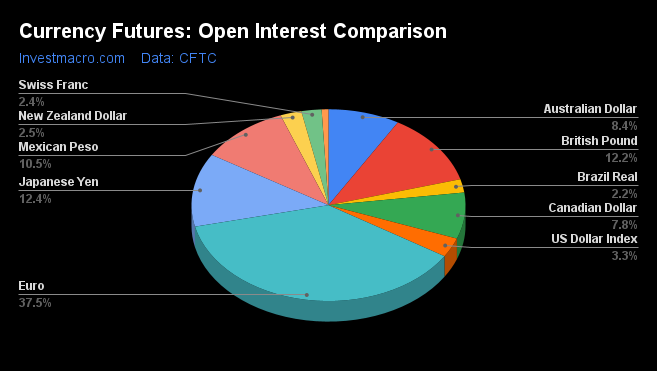
ForexTime Ltd (FXTM) is an award winning international online forex broker regulated by CySEC 185/12 www.forextime.com