Archive for Opinions – Page 124

France reenters medical marijuana industry after more than a half-century hiatus – a cannabis historian explains

By David A. Guba, Jr., Bard Early College Baltimore 

– Early in 2022, the French legislature greenlighted the cultivation of cannabis inside French territory to supply the nation’s ongoing pilot program in medical marijuana. The clinical trials were launched in March 2021 with cannabis supplied from abroad and have been overseen by the country’s food and drug office, the Agence Nationale de Sécurité du Médicament, or the National Agency for the Safety of Medicines and Health Products.

This two-year pilot program consists of 3,000 patients in France using medical cannabis, something that’s been prohibited since 1953.

While the agency has praised the pilot program for its groundbreaking efforts to produce “the first French data on the efficiency and safety” of cannabis for medical therapies to treat cancers, nerve damage and epilepsy, the trial is not the nation’s first foray into the medical cannabis industry. Far from it.

‘A drug not to be neglected’

I am a historian of cannabis and colonialism in modern France. My research has found that in the middle 19th century, Paris functioned as the epicenter of an international movement to medicalize hashish, a THC-rich intoxicant made from the pressed resin of cannabis plants.

Many pharmacists and physicians then working in France believed hashish was a dangerous and exotic intoxicant from the “Orient” – the Arab Muslim world – that could be tamed by pharmaceutical science and rendered safe and useful against the era’s most frightening diseases.

Starting in the late 1830s, some of those same pharmacists and physicians began preparing and selling hashish-infused edibles, lozenges and later tinctures – hashish-infused alcohol – and even “medicinal cigarettes” for asthma in pharmacies across the country.

Throughout the 1840s and 1850s, dozens of French pharmacists staked their careers on hashish, publishing dissertations, monographs and peer-reviewed articles on its medicinal and scientific benefits.

Hôtel de Lauzun, the meeting place for the Club des Hachichins in Paris.
Louis Édouard Fournier

French epidemiologist Louis-Rémy Aubert-Roche published a treatise in 1840 in which he argued that hashish, administered as a small edible called “dawamesk” taken with coffee, successfully cured plague in seven of 11 patients he treated in the hospitals of Alexandria and Cairo during the epidemic of 1834-35. Aubert-Roche was an anti-contagionist in the era before the germ theory – the idea that microbes can lead to disease – became scientific dogma. He, like most physicians then, believed the plague to be an untransmittable disease of the central nervous system spread to humans via “miasma,” or bad air, in unhygienic and poorly ventilated areas.

Aubert-Roche thus believed, mistaking symptom relief and luck for a cure, that hashish intoxication excited the central nervous system and counteracted the effects of the plague. “The plague,” he wrote, “is a disease of the nerves. Hashish, a substance that acts upon the nervous system, has given me the best results. I thus believe it is a drug not to be neglected.”

Reefer madness

Physician Jacques-Joseph Moreau de Tours, organizer of the infamous Club des Hachichins in Paris during the 1840s, likewise heralded dawamesk as a homeopathic wonder drug for treating mental illness. Moreau believed insanity was caused by lesions on the brain, and he also believed that hashish counteracted the effects.

Moreau reported in his 1845 work, “Du Hachisch et l’aliénation mentale” (“On Hashish and Mental Illness”), that between 1840 and 1843, he cured seven patients suffering from mental illness at Hôpital Bicêtre in central Paris with hashish. Moreau wasn’t totally off-base; today cannabis-based medicines are prescribed for depression, anxiety, post-traumatic stress disorder and bipolar disorders.

Despite the small sample size, doctors from the U.S., the U.K., Germany and Italy published favorable reviews of Moreau’s work with hashish during the late 1840s and across the 1850s. One praised it as a “discovery of much importance for the civilized world.”

Tincture wars

Though physicians in France and abroad touted dawamesk as a miracle cure, they also complained about the inability to standardize doses due to the variation in the potency of different cannabis plants. They also wrote about the challenges posed by the common adulteration of dawamesk, which was exported from North Africa and often laced with other psychoactive plant extracts.

In the early 1830s, several physicians and pharmacists in the British Empire attempted to solve these problems by dissolving hashish in alcohol to produce a tincture. By the middle of the decade, French practitioners followed suit. They developed and marketed their own hashish tinctures for French patients. One pharmacist in Paris, Edmond de Courtive, branded his concoction “Hachischine” after the infamous Muslim assassins often associated with hashish in French culture.

The popularity of hashish tincture grew rapidly in France during the late 1840s, peaking in 1848. That was when pharmacist Joseph-Bernard Gastinel and the aforementioned De Courtive engaged in a legal battle over the patent – then known as the “right to priority” – for a tincture manufactured though a particular distillation method. “L’Affaire Gastinel,” as the press termed it, or The Gastinel Affair, caused an uproar in French medical circles and occupied the pages of journals and newspapers in Paris for much of that fall.

To defend his patent, Gastinel sent two colleagues to argue his case to the Academy of Medicine in October 1848. One, a physician called Willemin, claimed that not only did Gastinel devise the tincture distillation method in question but that his tincture provided a cure for cholera, also thought to be a disease of the nerves.

Though Willemin was unable to convince the Academy of Gastinel’s right to priority, he did convince doctors in Paris to adopt hashish tincture as a treatment against cholera.

Physicians in Paris didn’t have to wait long to test Willemin’s theory. A cholera epidemic erupted in the city’s outskirts just months later. But when hashish tincture failed to cure the nearly 7,000 Parisians killed by the “blue death,” doctors increasingly lost faith in the wonder drug.

In the following decades, hashish tincture fell into disrepute as the medical theories of anti-contagionism that underpinned the drug’s use against the plague and cholera gave way to the germ theory and thus a new understanding of epidemic diseases and their treatment. During the same period, physicians in French Algeria increasingly pointed to hashish use as a key cause of insanity and criminality among indigenous Muslims, a diagnosis they termed “folie haschischique,” or hashish-induced psychosis. Heralded as a wonder drug only decades before, by the end of 19th century the drug was rebranded as an “Oriental poison”.

Lessons for today

Hemp field near Toulouse.
Olybrius, CC BY-SA

In my view, these earlier efforts to medicalize hashish in 19th-century France offer doctors, public health officials and policymakers of today several important insights as they work to return cannabis-based medications to the French market.

First, they must aim to dissociate cannabis intoxicants and medicines from colonial notions of “Oriental” otherness and Muslim violence that ironically underpinned both the rise and fall of hashish as medicine in France during the 19th century. As scholar Dorothy Roberts astutely argued in her 2015 TED Talk, “race medicine is bad medicine, poor science and a false interpretation of humanity.”

As I see it, doctors and patients should also temper their expectations of the benefits of medicinal cannabis and not overpromise and then deliver lackluster results, as happened with hashish tincture during the cholera outbreak of 1848-49.

And they should be mindful that medical knowledge unfolds historically and that staking the new career of cannabis as medicine on contested theories could hitch the drug’s success to the wrong horse, as happened with hashish after the obsolescence of anti-contagionism in the 1860s.

But if France were to engage its colonial past, reform its prohibitionist policies and continue to open up legal room for medical and recreational cannabis, I believe perhaps it could again become a global leader in this new medical marijuana movement.

This is an updated version of a piece that was published on Sept. 24, 2019.The Conversation

About the Author:

David A. Guba, Jr., Assistant Professor of History, Bard Early College Baltimore

This article is republished from The Conversation under a Creative Commons license. Read the original article.

Mid-week Technical Outlook: Calm Before Potential US Inflation Storm?

By ForexTime 

– An uneasy calm settled over financial markets on Wednesday as investors anxiously awaited the latest US inflation data set to be released in the afternoon.

Inflation is expected to rise 8.8% year-on-year in June compared with 8.6% in May. If expectations match reality, this would mark the fastest increase in consumer prices since the 8.9% figure in December 1981. Given how markets remain highly sensitive and reactive to anything regarding inflation, the pending report could spark fireworks across the board.

Before the report is published this afternoon at 1:30 pm BST, there are a couple of hidden jewels and gems in the FX markets to keep a close eye on.

Are dollar bulls unstoppable?

The Dollar Index (DXY) is heavily bullish on the daily charts. Prices remain in a healthy uptrend and are trading comfortably above the 50, 100, and 200-day Simple Moving Average. A strong move above 108.50 could trigger an incline to levels not seen since June 2002 at 110.00. If prices slip back below the 107.60 regions, this could trigger a technical throwback towards 106.70 and 105.50, respectively.

EURUSD hits parity…what next?

The EURUSD dream parity dream became a reality yesterday as the currency pair kissed 1.000 for the first time in 20 years. This tough psychological support may be a tough nut for bears to crack in the short term. Prices may experience a technical bounce back to 1.0200 before the selloff resumes. Should bears remain relentless and conquer this level, the EURUSD could extend the decline towards 0.9900.

GBPUSD wobbles around 1.1900

A massive selloff could be on the horizon for the GBPUSD with 1.1900 acting as a key level of interest. The trend is heavily bearish but bears need some fresh inspiration to drag the currency pair lower. A stronger dollar could trigger such a selloff, opening a path towards 1.1650. Should 1.1900 prove to be reliable support, this could trap prices back within a 160 pip range.

AUDUSD eyes 0.6700

The path of least resistance for the AUDUSD points south. There have been consistently lower lows and lower highs. Bears seem to be taking a break, resulting in prices pushing back towards 0.8800. Such a development could re-invite bears into the picture with 0.6700 acting as the first checkpoint.

USDJPY hovers around 24 years high

USDJPY bulls remain on a quest to push prices to fresh multi-decade highs

Prices are firmly bullish on the weekly charts and have already broken above the 136.70 resistance level. The breakout and daily close above 136.70 could inspire a move higher towards 138.50 and 142.00. Should bulls run out of steam, prices could decline back towards 134.00.

GBPJPY in choppy uptrend

Things still look quite choppy on the weekly timeframe. After failing to break above 167.50, bears seem to be on the prowl and ready to attack given the opportunity. Prices remain in a very wide range with a breakout needed to determine the GBPJPY medium to longer-term technical outlook. A strong breakdown and daily close under the 158.00 higher low may inspire a selloff towards 151.00. If bulls are able to push above 167.50, this could signal a move towards 170.00.

USDCAD ready to break resistance?

After bouncing within a range over the past few weeks, the USDCAD could be gearing up for a major breakout.  Technically, prices are trading above the 50, 100, and 200- day Simple Moving Average while the MACD trades to the upside. A strong move above 1.3050 could signal an incline towards levels not seen since November 2020 at 1.3200.  Should 1.3050 prove to be reliable resistance, prices could decline back towards 1.2930 and 1.2860, respectively.


Forex-Time-LogoArticle by ForexTime

ForexTime Ltd (FXTM) is an award winning international online forex broker regulated by CySEC 185/12 www.forextime.com

Trade Of The Week: More Pain Ahead For Gold?

By ForexTime 

– The past few weeks have been rough for gold.

After securing a solid weekly close below the $1825 level back in late June, bears have been on a tear with various fundamental forces fuelling the downside momentum. The precious metal is down almost 4% this month with prices trading at levels not seen since September 2021!

Last Friday’s blowout US jobs numbers compounded gold’s woes as expectations solidified over a 75-basis point rate hike at the Fed’s July meeting. The US economy added 372,000 jobs in June, an indicator of resilience in the labour force despite signs of slowing economic growth while the Unemployment rate held steady at 3.6%.

With the dollar hitting new multi-decade highs and Treasury yields rebounding amid expectations of more aggressive rate hikes by the Fed, gold could find itself depressed and unloved.

The week ahead could be volatile for gold thanks to key economic data and risk events. Looking at the technical picture, bears are clearly in a position of power on the H4 and daily timeframe with prices shaking above $1735 as of writing. With the fundamentals weighing heavily on the precious metal, bulls could find it difficult to fight back in the short to medium term.

Before we cover what to expect from gold in the week ahead, it is worth keeping in mind that the precious metal took a real beating last week, cutting through multiple levels of support like a hot knife through butter. Gold is down roughly 5% year-to-date and approaching key support at $1700.

Given how the 10-year Treasury yield is back on the rise amid aggressive rate hike bets, gold may struggle to shine. The precious metal offers no yield, making it less attractive for investors to own in an environment of rising Treasury yields.

All eyes on US Inflation data

The biggest risk event for gold this week will be the pending US CPI report.

Wednesday sees the release of the US inflation report with investors watching anxiously to see if prices are rising again or perhaps that we are finally peaking. According to a poll by Bloomberg, inflation is expected to rise 8.8% year-on-year in June compared with 8.6% in May. If expectations meet reality, this would mark the fastest increase in consumer prices since the 8.9% figure back in December 1981! Such a development will reinforce market bets of more aggressive Fed rate hikes – ultimately smothering investor appetite for gold as the dollar and treasury yields rise.

Other than the US inflation report, gold could be influenced by ongoing geopolitical risks and recession fears. However, the precious metal remains highly sensitive and reactive to the dollar and Treasury yields.

Gold ETFs favour bears

According to an automated report from Bloomberg, gold ETFs cut 98,220 troy ounces of gold from their holdings last Friday, bringing this year’s net purchase to 5.26 million ounces. This was the eighth straight day of declines and the longest losing streak since May 18.

The outflows could be based on the strong US jobs report which reinforced bets over the Fed raising rates aggressively. A gold ETF provides investors exposure to gold without owning it physically. In this instance, outflows from ETFs are seen as bearish for the underlying asset.

Is Gold in trouble?

Gold remains under pressure on the daily, weekly, and monthly charts with prices approaching critical support at $1700. Over the past few weeks, the precious metal has been battered by a stronger dollar, rising treasury yields, and Fed rate hike bets. Prices are heavily bearish with a strong breakdown below $1700 potentially opening doors to levels not seen since April 2020.

On the daily charts, key levels of interest can be found at $1724, $1680, and $1660.

Zooming out to the weekly, it’s all about $1770, $1700, and $1680.

Focusing on the monthly charts, prices remain in a wide range with support around $1700 and resistance at $2000. It may be wise to keep a close eye on how the $1700 support level fares.


Forex-Time-LogoArticle by ForexTime

ForexTime Ltd (FXTM) is an award winning international online forex broker regulated by CySEC 185/12 www.forextime.com

Currency Speculators drop Euro bets further into bearish territory as EURUSD nears parity

By InvestMacro | COT | Data Tables | COT Leaders | Downloads | COT Newsletter
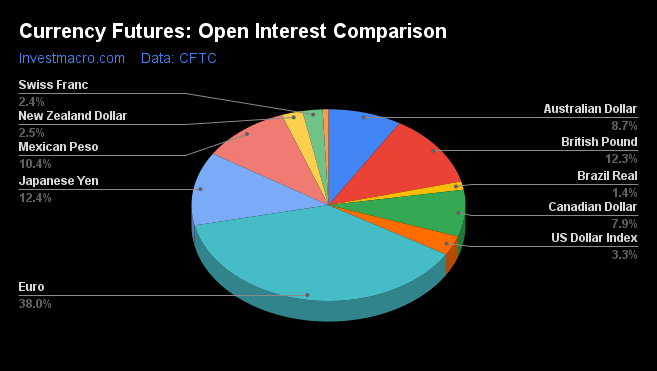
forex currency futures open interest percents

Here are the latest charts and statistics for the Commitment of Traders (COT) data published by the Commodities Futures Trading Commission (CFTC).

The latest COT data is updated through Tuesday July 5th and shows a quick view of how large traders (for-profit speculators and commercial entities) were positioned in the futures markets. All currency positions are in direct relation to the US dollar where, for example, a bet for the euro is a bet that the euro will rise versus the dollar while a bet against the euro will be a bet that the euro will decline versus the dollar.

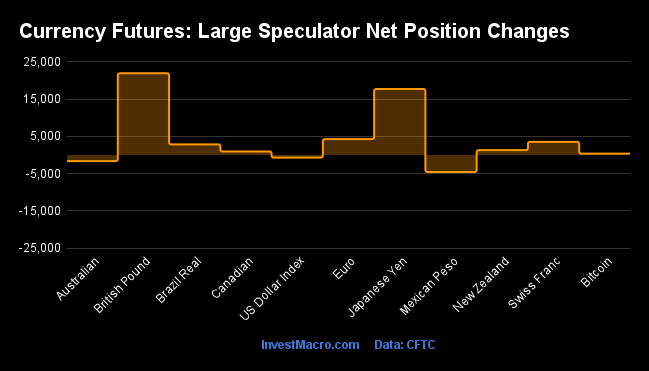
Currency market speculator bets were lower this week as all of the eleven currency markets we cover had lower positioning on the week.

Leading the declines in speculator bets this week were the Brazil real (-20,695 contracts) and the Euro (-6,256 contracts) while the Canadian dollar (-4,804 contracts), Australian dollar (-4,641 contracts), US Dollar Index (-3,978 contracts), British pound sterling (-3,090 contracts), Japanese yen (-1,875 contracts), New Zealand dollar (-1,745 contracts), Swiss franc (-1,544 contracts), Bitcoin (-665 contracts) and the Mexican peso (-438 contracts) all saw lower speculator bets for the week.

Highlighting the currency futures data this week was the Euro speculator position that fell deeper into bearish territory and dropped for the fourth time in the past five weeks. The speculator position has now decreased by a whopping -69,124 contracts in just the past five weeks and has brought the overall standing to the lowest level since November 30th of 2021, a span of 31 weeks. The Euro price has been strongly on the defensive against the dollar as the EURUSD currency pair this week hit the lowest level since December 0f 2002. The EURUSD fell to a low under the 1.0200 exchange rate on Friday and sets up what seems to be an inevitable test of parity which would also be the first time that has happened since December of 2002.

More COT currency notes:

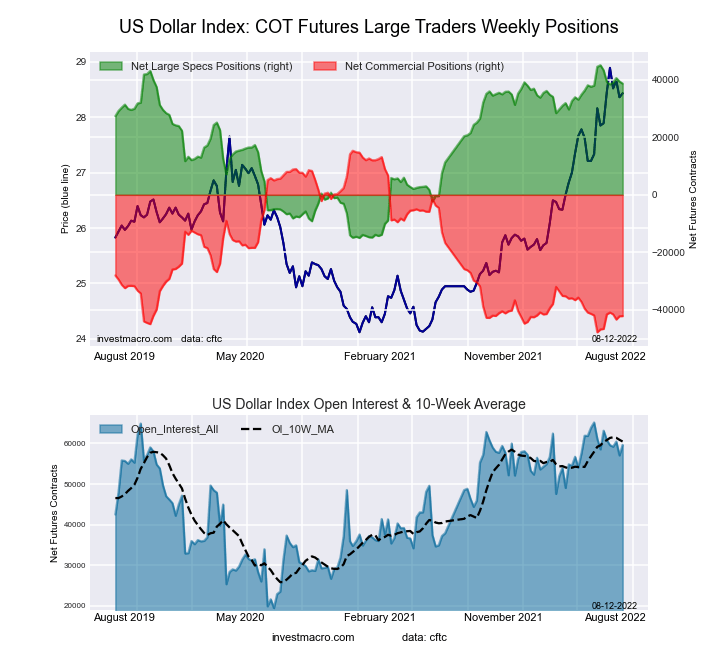
US Dollar Index bets fell for a second straight week and dipped below +40,000 contracts for the first time in four weeks. Despite the 2-week decline, the Dollar Index speculator position remains extremely bullish which has seen increases in speculator bets in ten out of the past fifteen weeks. Overall, the Dollar Index positioning has been in bullish territory for fifty-three straight weeks after turning from bearish to bullish on July 6th of 2021. The Dollar Index price this week continued to climb (up 5 out of 6 weeks) and hit the highest level since October of 2002 at above the 107.75 level.

Japanese yen speculator bets fell for the first time in the past eight weeks this week. Yen bets remain bearish but have improved strongly over the past few months going from a total of -110,454 contracts on May 10th to a total of -54,445 contracts this week. Despite, the speculator sentiment improvement, the USDJPY currency pair has remained near the top of its range (and close to 20-year highs) at around the 136.00 exchange rate.

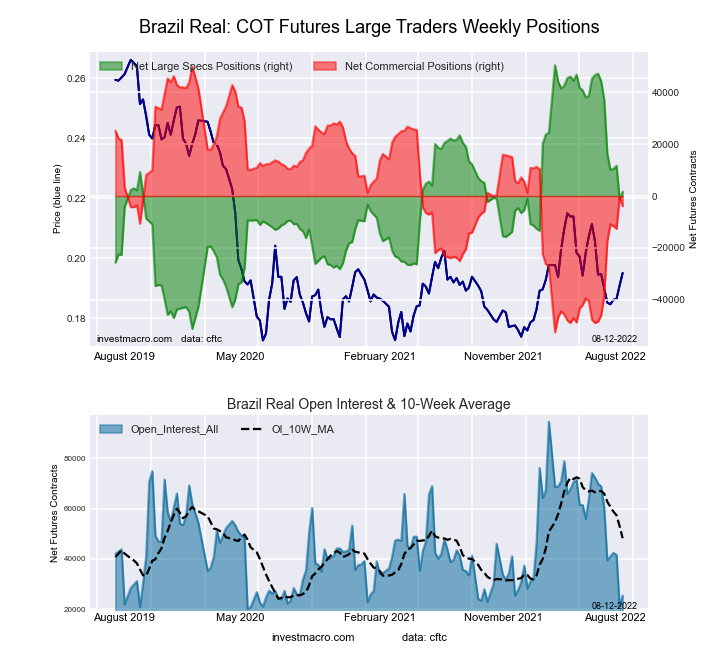
Brazilian real speculator bets dropped sharply this week by over -20,000 contracts and fell for the third straight week. These declines have brought the BRL position down to the lowest level in the past twenty-two weeks at just +16,333 contracts. The Brazil real price has been on the defensive in the past month as the BRLUSD currency pair fell to a five month low this week near the 0.1850 exchange rate and dropped under its 200-day moving average for the first time since January.


currency forex futures speculator strength sentiment scores

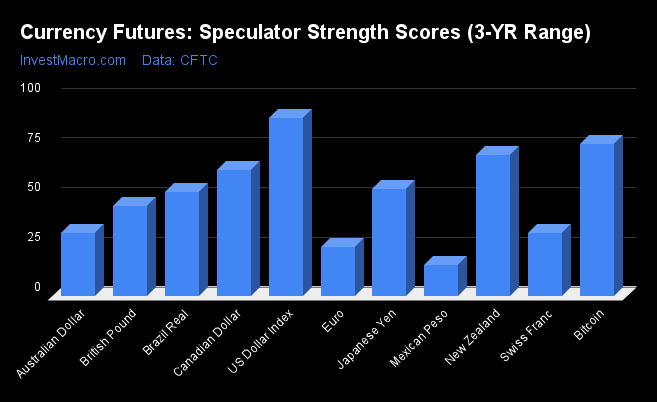
Strength scores (a measure of the 3-Year range of Speculator positions, from 0 to 100 where above 80 is extreme bullish and below 20 is extreme bearish) show that the US Dollar Index (90.4 percent) and Bitcoin (87.9 percent) lead the currencies at the top of their respective ranges and are both in bullish extreme positions. The Brazilian real (66.4 percent) comes in as the next highest currency in strength scores but took a large tumble this week to fall out of a bullish extreme level. On the downside, the Mexican peso at 21.2 percent continues to be at the lowest strength level currently and is followed by the Euro at 29.8 percent and the Swiss franc at 30.8 percent.

currency forex futures speculator strength sentiment trends over 6 weeks

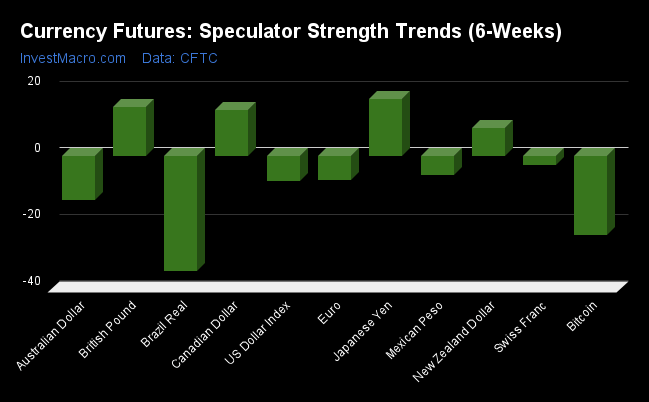
Strength score trends (or move index, that calculate 6-week changes in strength scores) shows that the Japanese yen (27.7 percent) leads the past six weeks trends once again this week. The Swiss franc (24.2 percent), New Zealand dollar (20.6 percent) and the Canadian dollar (19.1 percent) round out the top movers in the latest data. The Brazilian real (-22.0 percent) saw a huge decrease in speculator positions this week and leads the downside trend scores currently. The next currencies will lower trend scores were the Mexican peso at -18.9 percent followed by the Euro at -17.1 percent.


Data Snapshot of Forex Market Traders | Columns Legend
Jul-05-2022OIOI-IndexSpec-NetSpec-IndexCom-NetCOM-IndexSmalls-NetSmalls-Index
USD Index60,8579139,25190-41,510102,25941
EUR673,77271-16,85230-8,6367425,48817
GBP240,92665-56,2083477,00975-20,80113
JPY217,67267-54,4453564,06367-9,61834
CHF38,50418-10,1353120,07575-9,94024
CAD145,372274,29344-4,5336524031
AUD146,95042-47,6214155,70860-8,08733
NZD45,40335-7,0565910,52147-3,46512
MXN197,46348-14,4182110,096774,32261
RUB20,93047,54331-7,15069-39324
BRL39,4702616,33366-17,398341,06577
Bitcoin13,2587542088-46204214


US Dollar Index Futures:

US Dollar Index Forex Futures COT ChartThe US Dollar Index large speculator standing this week resulted in a net position of 39,251 contracts in the data reported through Tuesday. This was a weekly decline of -3,978 contracts from the previous week which had a total of 43,229 net contracts.

This week’s current strength score (the trader positioning range over the past three years, measured from 0 to 100) shows the speculators are currently Bullish-Extreme with a score of 90.4 percent. The commercials are Bearish-Extreme with a score of 9.9 percent and the small traders (not shown in chart) are Bearish with a score of 41.2 percent.

US DOLLAR INDEX StatisticsSPECULATORSCOMMERCIALSSMALL TRADERS
– Percent of Open Interest Longs:87.03.38.2
– Percent of Open Interest Shorts:22.571.54.5
– Net Position:39,251-41,5102,259
– Gross Longs:52,9272,0234,993
– Gross Shorts:13,67643,5332,734
– Long to Short Ratio:3.9 to 10.0 to 11.8 to 1
NET POSITION TREND:
– Strength Index Score (3 Year Range Pct):90.49.941.2
– Strength Index Reading (3 Year Range):Bullish-ExtremeBearish-ExtremeBearish
NET POSITION MOVEMENT INDEX:
– 6-Week Change in Strength Index:2.0-1.0-6.3


Euro Currency Futures:

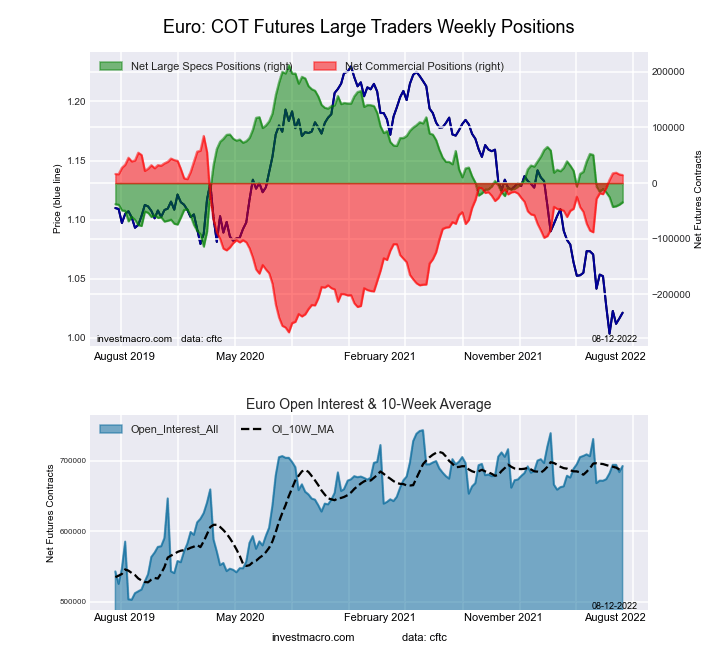
Euro Currency Futures COT ChartThe Euro Currency large speculator standing this week resulted in a net position of -16,852 contracts in the data reported through Tuesday. This was a weekly decline of -6,256 contracts from the previous week which had a total of -10,596 net contracts.

This week’s current strength score (the trader positioning range over the past three years, measured from 0 to 100) shows the speculators are currently Bearish with a score of 29.8 percent. The commercials are Bullish with a score of 73.6 percent and the small traders (not shown in chart) are Bearish-Extreme with a score of 16.6 percent.

EURO Currency StatisticsSPECULATORSCOMMERCIALSSMALL TRADERS
– Percent of Open Interest Longs:29.356.112.2
– Percent of Open Interest Shorts:31.857.38.5
– Net Position:-16,852-8,63625,488
– Gross Longs:197,138377,65482,525
– Gross Shorts:213,990386,29057,037
– Long to Short Ratio:0.9 to 11.0 to 11.4 to 1
NET POSITION TREND:
– Strength Index Score (3 Year Range Pct):29.873.616.6
– Strength Index Reading (3 Year Range):BearishBullishBearish-Extreme
NET POSITION MOVEMENT INDEX:
– 6-Week Change in Strength Index:-17.118.1-13.5


British Pound Sterling Futures:

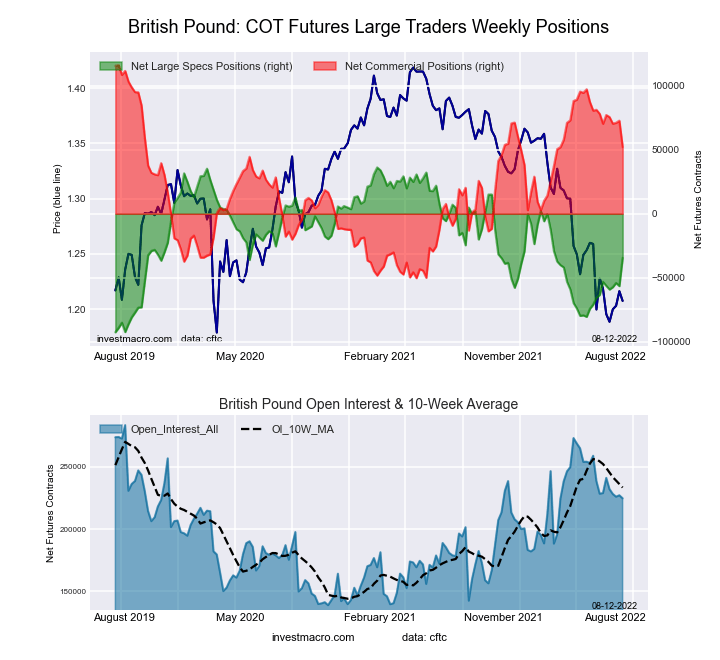
British Pound Sterling Futures COT ChartThe British Pound Sterling large speculator standing this week resulted in a net position of -56,208 contracts in the data reported through Tuesday. This was a weekly fall of -3,090 contracts from the previous week which had a total of -53,118 net contracts.

This week’s current strength score (the trader positioning range over the past three years, measured from 0 to 100) shows the speculators are currently Bearish with a score of 33.5 percent. The commercials are Bullish with a score of 75.2 percent and the small traders (not shown in chart) are Bearish-Extreme with a score of 12.5 percent.

BRITISH POUND StatisticsSPECULATORSCOMMERCIALSSMALL TRADERS
– Percent of Open Interest Longs:16.474.27.3
– Percent of Open Interest Shorts:39.842.216.0
– Net Position:-56,20877,009-20,801
– Gross Longs:39,618178,74517,693
– Gross Shorts:95,826101,73638,494
– Long to Short Ratio:0.4 to 11.8 to 10.5 to 1
NET POSITION TREND:
– Strength Index Score (3 Year Range Pct):33.575.212.5
– Strength Index Reading (3 Year Range):BearishBullishBearish-Extreme
NET POSITION MOVEMENT INDEX:
– 6-Week Change in Strength Index:17.4-11.8-8.6


Japanese Yen Futures:

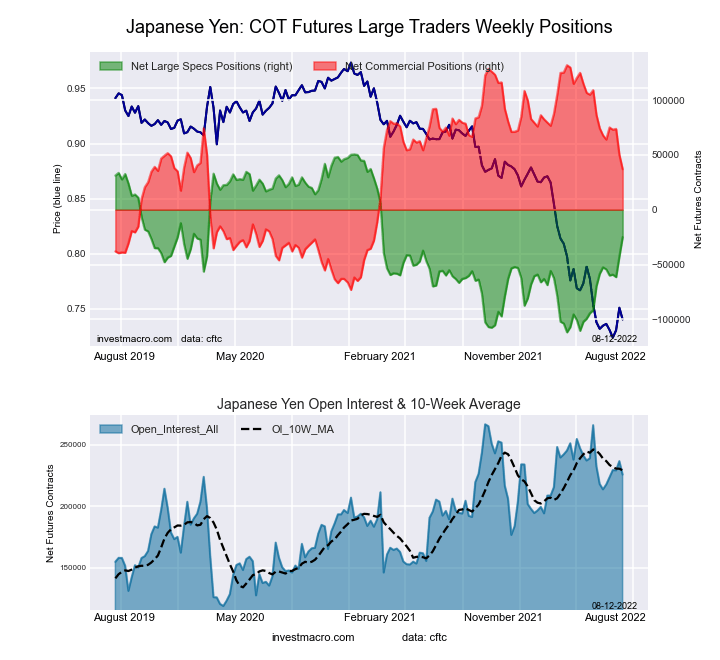
The Japanese Yen large speculator standing this week resulted in a net position of -54,445 contracts in the data reported through Tuesday. This was a weekly reduction of -1,875 contracts from the previous week which had a total of -52,570 net contracts.

This week’s current strength score (the trader positioning range over the past three years, measured from 0 to 100) shows the speculators are currently Bearish with a score of 35.3 percent. The commercials are Bullish with a score of 66.9 percent and the small traders (not shown in chart) are Bearish with a score of 33.9 percent.

JAPANESE YEN StatisticsSPECULATORSCOMMERCIALSSMALL TRADERS
– Percent of Open Interest Longs:17.868.811.7
– Percent of Open Interest Shorts:42.839.316.1
– Net Position:-54,44564,063-9,618
– Gross Longs:38,660149,70225,452
– Gross Shorts:93,10585,63935,070
– Long to Short Ratio:0.4 to 11.7 to 10.7 to 1
NET POSITION TREND:
– Strength Index Score (3 Year Range Pct):35.366.933.9
– Strength Index Reading (3 Year Range):BearishBullishBearish
NET POSITION MOVEMENT INDEX:
– 6-Week Change in Strength Index:27.7-20.8-4.8


Swiss Franc Futures:

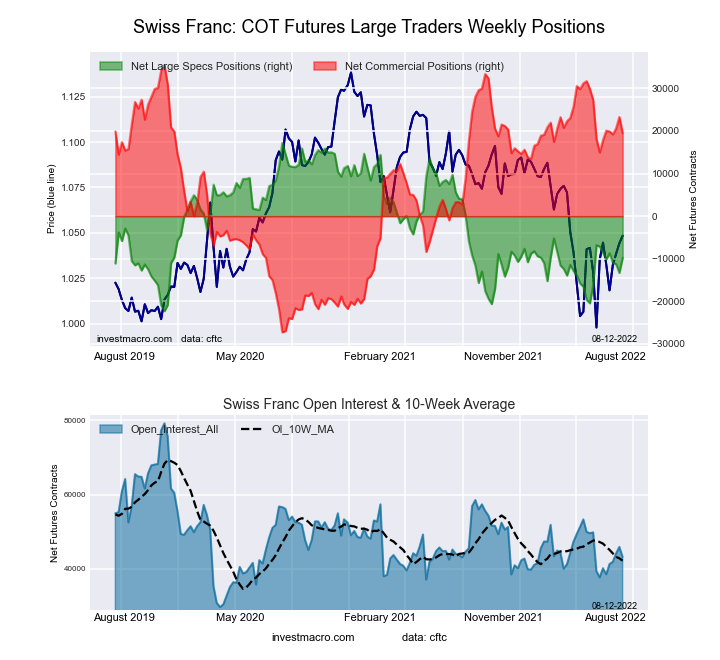
Swiss Franc Forex Futures COT ChartThe Swiss Franc large speculator standing this week resulted in a net position of -10,135 contracts in the data reported through Tuesday. This was a weekly reduction of -1,544 contracts from the previous week which had a total of -8,591 net contracts.

This week’s current strength score (the trader positioning range over the past three years, measured from 0 to 100) shows the speculators are currently Bearish with a score of 30.8 percent. The commercials are Bullish with a score of 75.5 percent and the small traders (not shown in chart) are Bearish with a score of 23.9 percent.

SWISS FRANC StatisticsSPECULATORSCOMMERCIALSSMALL TRADERS
– Percent of Open Interest Longs:8.469.222.3
– Percent of Open Interest Shorts:34.717.148.2
– Net Position:-10,13520,075-9,940
– Gross Longs:3,21826,6648,602
– Gross Shorts:13,3536,58918,542
– Long to Short Ratio:0.2 to 14.0 to 10.5 to 1
NET POSITION TREND:
– Strength Index Score (3 Year Range Pct):30.875.523.9
– Strength Index Reading (3 Year Range):BearishBullishBearish
NET POSITION MOVEMENT INDEX:
– 6-Week Change in Strength Index:24.2-18.57.0


Canadian Dollar Futures:

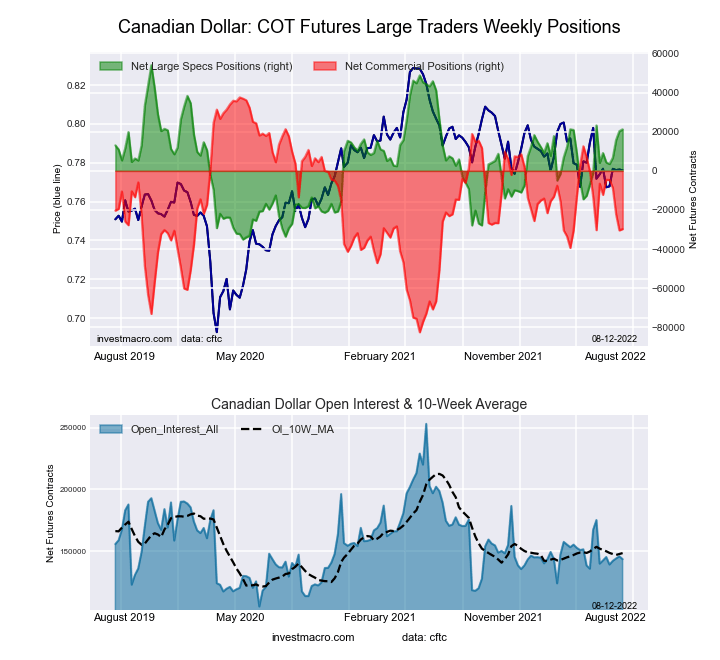
Canadian Dollar Forex Futures COT ChartThe Canadian Dollar large speculator standing this week resulted in a net position of 4,293 contracts in the data reported through Tuesday. This was a weekly lowering of -4,804 contracts from the previous week which had a total of 9,097 net contracts.

This week’s current strength score (the trader positioning range over the past three years, measured from 0 to 100) shows the speculators are currently Bearish with a score of 44.2 percent. The commercials are Bullish with a score of 65.0 percent and the small traders (not shown in chart) are Bearish with a score of 30.6 percent.

CANADIAN DOLLAR StatisticsSPECULATORSCOMMERCIALSSMALL TRADERS
– Percent of Open Interest Longs:31.246.721.0
– Percent of Open Interest Shorts:28.349.820.8
– Net Position:4,293-4,533240
– Gross Longs:45,36567,82930,460
– Gross Shorts:41,07272,36230,220
– Long to Short Ratio:1.1 to 10.9 to 11.0 to 1
NET POSITION TREND:
– Strength Index Score (3 Year Range Pct):44.265.030.6
– Strength Index Reading (3 Year Range):BearishBullishBearish
NET POSITION MOVEMENT INDEX:
– 6-Week Change in Strength Index:19.1-9.6-11.1


Australian Dollar Futures:

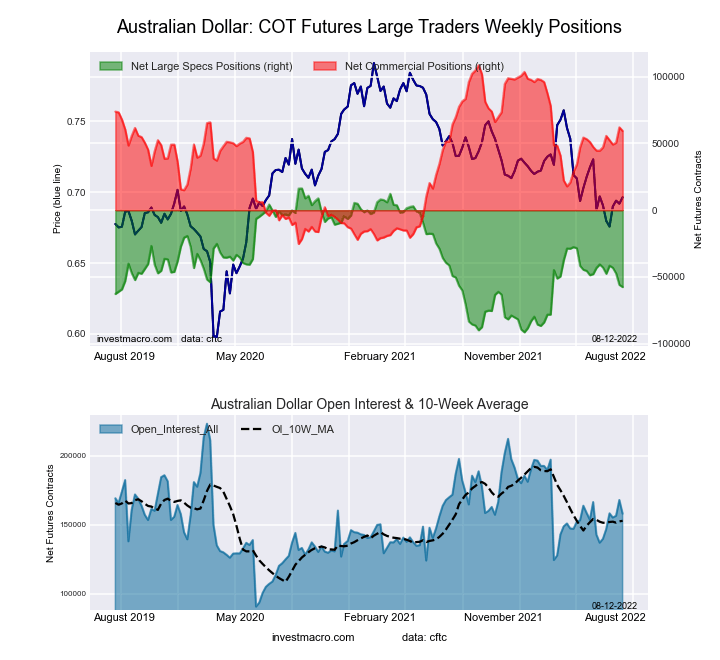
Australian Dollar Forex Futures COT ChartThe Australian Dollar large speculator standing this week resulted in a net position of -47,621 contracts in the data reported through Tuesday. This was a weekly decrease of -4,641 contracts from the previous week which had a total of -42,980 net contracts.

This week’s current strength score (the trader positioning range over the past three years, measured from 0 to 100) shows the speculators are currently Bearish with a score of 40.7 percent. The commercials are Bullish with a score of 60.4 percent and the small traders (not shown in chart) are Bearish with a score of 32.7 percent.

AUSTRALIAN DOLLAR StatisticsSPECULATORSCOMMERCIALSSMALL TRADERS
– Percent of Open Interest Longs:18.864.812.6
– Percent of Open Interest Shorts:51.226.918.1
– Net Position:-47,62155,708-8,087
– Gross Longs:27,62295,25218,508
– Gross Shorts:75,24339,54426,595
– Long to Short Ratio:0.4 to 12.4 to 10.7 to 1
NET POSITION TREND:
– Strength Index Score (3 Year Range Pct):40.760.432.7
– Strength Index Reading (3 Year Range):BearishBullishBearish
NET POSITION MOVEMENT INDEX:
– 6-Week Change in Strength Index:-2.01.8-0.6


New Zealand Dollar Futures:

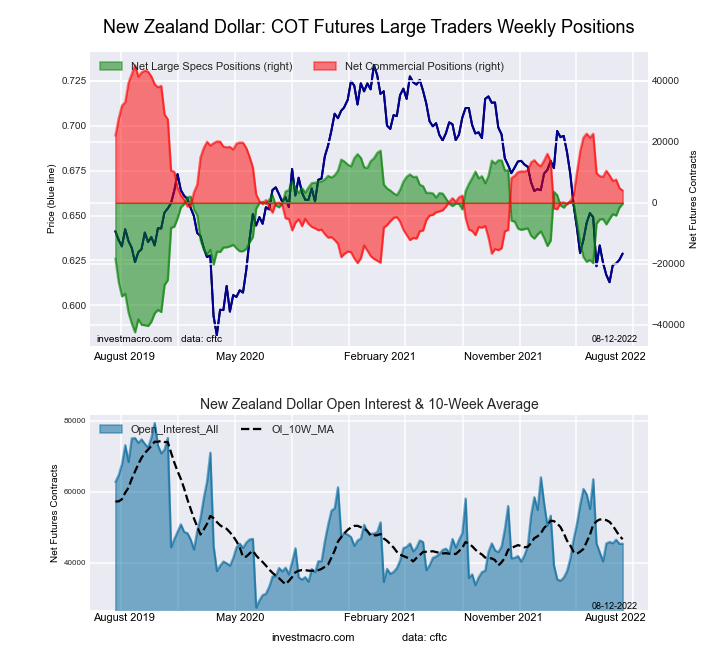
New Zealand Dollar Forex Futures COT ChartThe New Zealand Dollar large speculator standing this week resulted in a net position of -7,056 contracts in the data reported through Tuesday. This was a weekly decline of -1,745 contracts from the previous week which had a total of -5,311 net contracts.

This week’s current strength score (the trader positioning range over the past three years, measured from 0 to 100) shows the speculators are currently Bullish with a score of 59.4 percent. The commercials are Bearish with a score of 46.6 percent and the small traders (not shown in chart) are Bearish-Extreme with a score of 11.8 percent.

NEW ZEALAND DOLLAR StatisticsSPECULATORSCOMMERCIALSSMALL TRADERS
– Percent of Open Interest Longs:30.063.95.9
– Percent of Open Interest Shorts:45.640.813.6
– Net Position:-7,05610,521-3,465
– Gross Longs:13,63429,0292,689
– Gross Shorts:20,69018,5086,154
– Long to Short Ratio:0.7 to 11.6 to 10.4 to 1
NET POSITION TREND:
– Strength Index Score (3 Year Range Pct):59.446.611.8
– Strength Index Reading (3 Year Range):BullishBearishBearish-Extreme
NET POSITION MOVEMENT INDEX:
– 6-Week Change in Strength Index:20.6-18.8-1.0


Mexican Peso Futures:

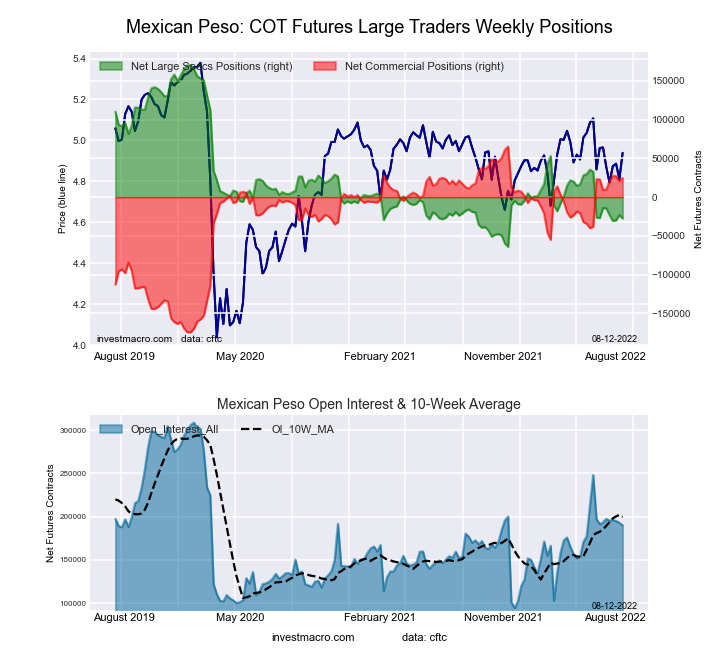
The Mexican Peso large speculator standing this week resulted in a net position of -14,418 contracts in the data reported through Tuesday. This was a weekly reduction of -438 contracts from the previous week which had a total of -13,980 net contracts.

This week’s current strength score (the trader positioning range over the past three years, measured from 0 to 100) shows the speculators are currently Bearish with a score of 21.2 percent. The commercials are Bullish with a score of 77.0 percent and the small traders (not shown in chart) are Bullish with a score of 61.3 percent.

MEXICAN PESO StatisticsSPECULATORSCOMMERCIALSSMALL TRADERS
– Percent of Open Interest Longs:54.341.63.5
– Percent of Open Interest Shorts:61.636.51.3
– Net Position:-14,41810,0964,322
– Gross Longs:107,14182,1066,947
– Gross Shorts:121,55972,0102,625
– Long to Short Ratio:0.9 to 11.1 to 12.6 to 1
NET POSITION TREND:
– Strength Index Score (3 Year Range Pct):21.277.061.3
– Strength Index Reading (3 Year Range):BearishBullishBullish
NET POSITION MOVEMENT INDEX:
– 6-Week Change in Strength Index:-18.918.5-1.0


Brazilian Real Futures:

Brazil Real Futures COT ChartThe Brazilian Real large speculator standing this week resulted in a net position of 16,333 contracts in the data reported through Tuesday. This was a weekly reduction of -20,695 contracts from the previous week which had a total of 37,028 net contracts.

This week’s current strength score (the trader positioning range over the past three years, measured from 0 to 100) shows the speculators are currently Bullish with a score of 66.4 percent. The commercials are Bearish with a score of 34.3 percent and the small traders (not shown in chart) are Bullish with a score of 77.2 percent.

BRAZIL REAL StatisticsSPECULATORSCOMMERCIALSSMALL TRADERS
– Percent of Open Interest Longs:61.529.87.8
– Percent of Open Interest Shorts:20.173.95.1
– Net Position:16,333-17,3981,065
– Gross Longs:24,26111,7763,089
– Gross Shorts:7,92829,1742,024
– Long to Short Ratio:3.1 to 10.4 to 11.5 to 1
NET POSITION TREND:
– Strength Index Score (3 Year Range Pct):66.434.377.2
– Strength Index Reading (3 Year Range):BullishBearishBullish
NET POSITION MOVEMENT INDEX:
– 6-Week Change in Strength Index:-22.022.5-8.5


Bitcoin Futures:

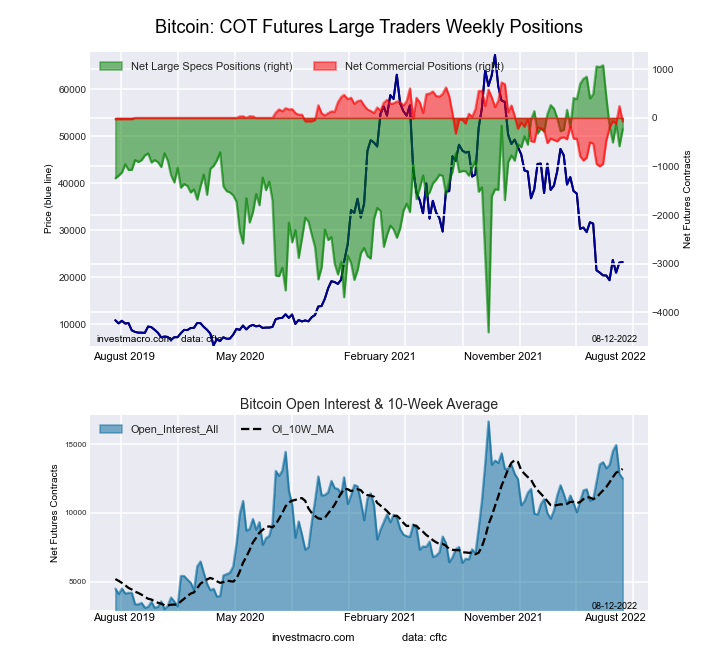
Bitcoin Crypto Futures COT ChartThe Bitcoin large speculator standing this week resulted in a net position of 420 contracts in the data reported through Tuesday. This was a weekly lowering of -665 contracts from the previous week which had a total of 1,085 net contracts.

This week’s current strength score (the trader positioning range over the past three years, measured from 0 to 100) shows the speculators are currently Bullish-Extreme with a score of 87.9 percent. The commercials are Bearish with a score of 30.9 percent and the small traders (not shown in chart) are Bearish-Extreme with a score of 13.9 percent.

BITCOIN StatisticsSPECULATORSCOMMERCIALSSMALL TRADERS
– Percent of Open Interest Longs:80.31.28.0
– Percent of Open Interest Shorts:77.14.77.7
– Net Position:420-46242
– Gross Longs:10,6421581,058
– Gross Shorts:10,2226201,016
– Long to Short Ratio:1.0 to 10.3 to 11.0 to 1
NET POSITION TREND:
– Strength Index Score (3 Year Range Pct):87.930.913.9
– Strength Index Reading (3 Year Range):Bullish-ExtremeBearishBearish-Extreme
NET POSITION MOVEMENT INDEX:
– 6-Week Change in Strength Index:-7.820.61.7


Article By InvestMacroReceive our weekly COT Reports by Email

*COT Report: The COT data, released weekly to the public each Friday, is updated through the most recent Tuesday (data is 3 days old) and shows a quick view of how large speculators or non-commercials (for-profit traders) were positioned in the futures markets.

The CFTC categorizes trader positions according to commercial hedgers (traders who use futures contracts for hedging as part of the business), non-commercials (large traders who speculate to realize trading profits) and nonreportable traders (usually small traders/speculators) as well as their open interest (contracts open in the market at time of reporting).See CFTC criteria here.


Precious Metals Speculator bets for Gold, Copper & Silver hit multi-year lows

By InvestMacro | COT | Data Tables | COT Leaders | Downloads | COT Newsletter

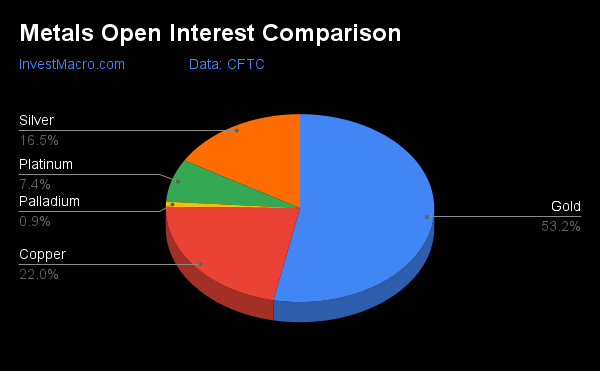
precious metals open interest futures levels & percents

Here are the latest charts and statistics for the Commitment of Traders (COT) data published by the Commodities Futures Trading Commission (CFTC).

The latest COT data is updated through Tuesday July 5th and shows a quick view of how large traders (for-profit speculators and commercial entities) were positioned in the futures markets.

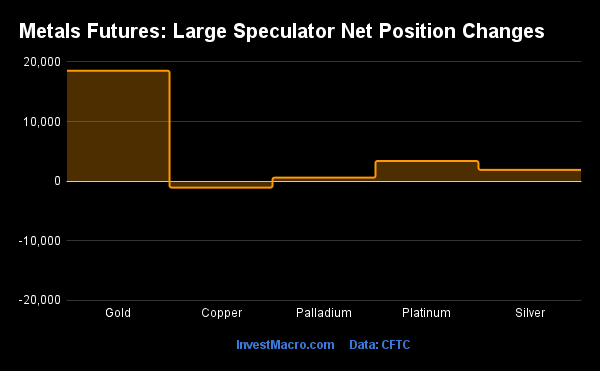
COT Metals market speculator bets were overall lower this week as just one out of the six metals markets we cover had higher positioning this week while the other five markets had lower contracts. The only precious metals market to have higher speculator bets this week was Palladium with a rise of just 415 contracts. Meanwhile, leading the declines in speculator bets this week were Gold (-12,033 contracts) and Silver (-5,752 contracts) with Platinum (-1,428 contracts) and Copper (-1,100 contracts) also having lower bets for the week.

Highlights of the Metals data:

  • Gold speculators bets have dropped for the past two straight weeks and for nine out of the past twelve weeks. These declines have taken a total of -108,627 contracts off the Gold bullish position in past twelve weeks
  • Current Gold speculator position has fallen to lowest level since May 28th of 2019, a span of 162 weeks
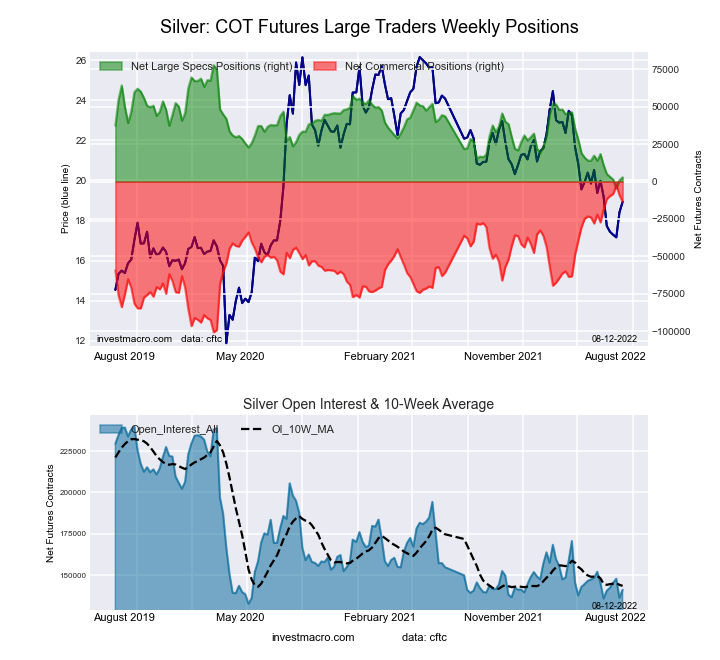
  • Silver bets have dropped in nine out of the past eleven weeks (for a total decrease of -41,290 contracts)
  • Silver speculator positions have now fallen to the lowest level in 160 weeks, dating back to June 11th of 2019
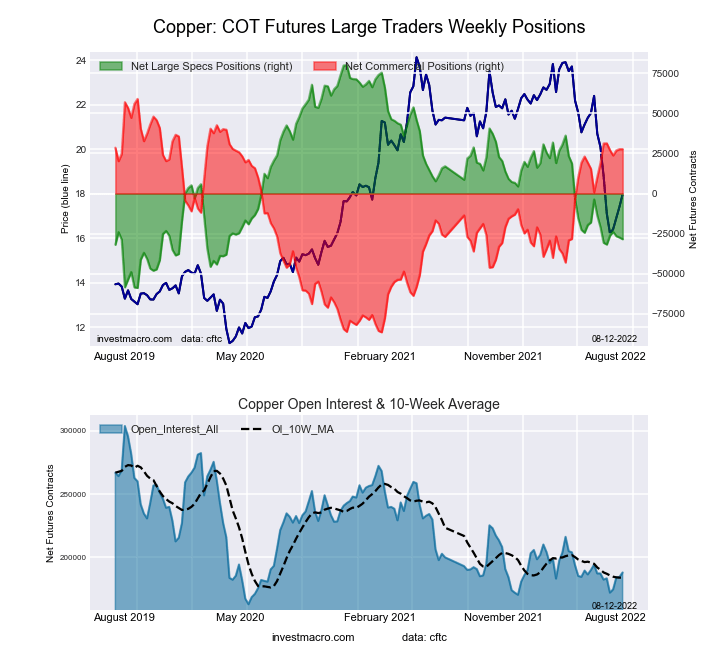
  • Copper speculator positions are in bearish territory for an 11th straight week and speculator bets have fallen by a total of -67,938 contracts since April 5th
  • Copper speculator bets have decreased to the lowest level (currently at -31,796 contracts) in the past 120 weeks, dating back to March 17th of 2020

precious metals futures speculators sentiment

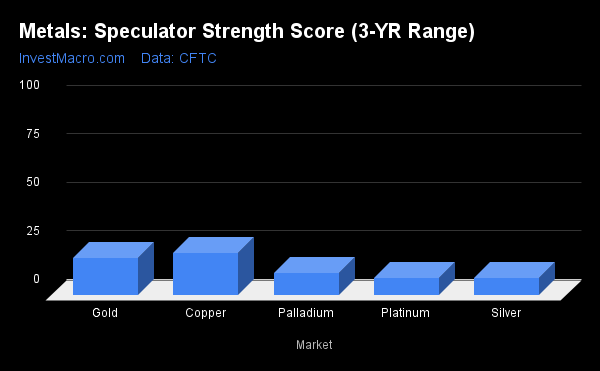
Strength scores (measuring the 3-Year range of Speculator positions, from 0 to 100 where above 80 is extreme bullish and below 20 is extreme bearish) show that the speculator sentiment for all of the precious metals is near or at the bottom of each of their 3-year ranges. The highest strength score currently is for Copper (19.5 percent) which is in an extreme bearish level for the past three years (under 20 percent). All the other markets also are in extreme bearish levels as well with Gold, Silver and Platinum residing at 3-year lows of 0 percent each.

precious metals speculators futures trends

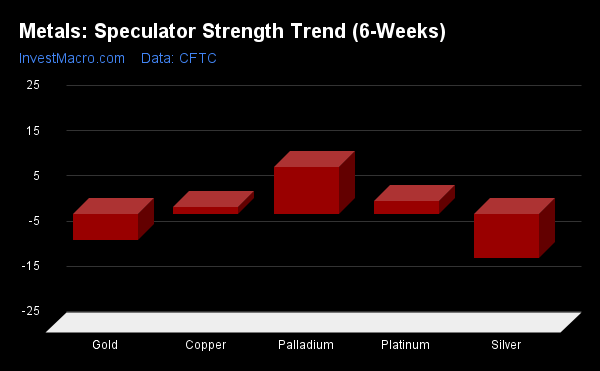
Strength score trends (or move index, that calculate 6-week changes in strength scores) shows that Gold (-18.3 percent), Silver (-12.3 percent) and Copper (-8.8 percent) are leading the scores to the downside over the past six weeks followed by Platinum (-6.0 percent). Palladium (0.3 percent) is the only precious metals with a positive score although it is barely positive.


Data Snapshot of Commodity Market Traders | Columns Legend
Jul-05-2022OIOI-IndexSpec-NetSpec-IndexCom-NetCOM-IndexSmalls-NetSmalls-Index
WTI Crude1,637,8620280,5230-304,21710023,69448
Gold498,21013145,6600-165,58510019,9250
Silver140,46375,1390-11,6221006,4830
Copper183,33115-31,7961931,3408145628
Palladium7,3735-3,41044,10498-6944
Platinum72,89544-2,7340-1,6701004,40423
Natural Gas977,5070-130,5193991,9506038,56971
Brent166,71113-38,5144737,309551,20526
Heating Oil264,269216,48652-22,7754716,28955
Soybeans638,6757125,49152-93,63856-31,85317
Corn1,331,0350260,70563-207,44142-53,26412
Coffee193,731146,78779-49,139252,35214
Sugar713,245083,51254-85,255521,74310
Wheat288,75408,3843062361-9,00764


Gold Comex Futures:

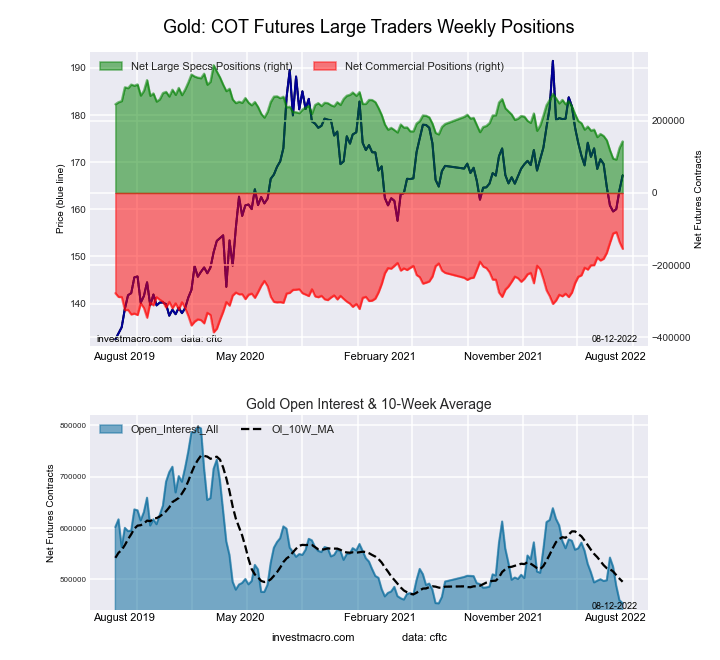
Gold Futures COT ChartThe Gold Comex Futures large speculator standing this week totaled a net position of 145,660 contracts in the data reported through Tuesday. This was a weekly decline of -12,033 contracts from the previous week which had a total of 157,693 net contracts.

This week’s current strength score (the trader positioning range over the past three years, measured from 0 to 100) shows the speculators are currently Bearish-Extreme with a score of 0.0 percent. The commercials are Bullish-Extreme with a score of 100.0 percent and the small traders (not shown in chart) are Bearish-Extreme with a score of 0.5 percent.

Gold Futures StatisticsSPECULATORSCOMMERCIALSSMALL TRADERS
– Percent of Open Interest Longs:53.823.78.8
– Percent of Open Interest Shorts:24.557.04.8
– Net Position:145,660-165,58519,925
– Gross Longs:267,806118,28943,933
– Gross Shorts:122,146283,87424,008
– Long to Short Ratio:2.2 to 10.4 to 11.8 to 1
NET POSITION TREND:
– Strength Index Score (3 Year Range Pct):0.0100.00.5
– Strength Index Reading (3 Year Range):Bearish-ExtremeBullish-ExtremeBearish-Extreme
NET POSITION MOVEMENT INDEX:
– 6-Week Change in Strength Index:-18.321.1-29.3


Silver Comex Futures:

Silver Futures COT ChartThe Silver Comex Futures large speculator standing this week totaled a net position of 5,139 contracts in the data reported through Tuesday. This was a weekly reduction of -5,752 contracts from the previous week which had a total of 10,891 net contracts.

This week’s current strength score (the trader positioning range over the past three years, measured from 0 to 100) shows the speculators are currently Bearish-Extreme with a score of 0.0 percent. The commercials are Bullish-Extreme with a score of 100.0 percent and the small traders (not shown in chart) are Bearish-Extreme with a score of 0.0 percent.

Silver Futures StatisticsSPECULATORSCOMMERCIALSSMALL TRADERS
– Percent of Open Interest Longs:39.040.016.0
– Percent of Open Interest Shorts:35.448.211.4
– Net Position:5,139-11,6226,483
– Gross Longs:54,84156,13722,495
– Gross Shorts:49,70267,75916,012
– Long to Short Ratio:1.1 to 10.8 to 11.4 to 1
NET POSITION TREND:
– Strength Index Score (3 Year Range Pct):0.0100.00.0
– Strength Index Reading (3 Year Range):Bearish-ExtremeBullish-ExtremeBearish-Extreme
NET POSITION MOVEMENT INDEX:
– 6-Week Change in Strength Index:-12.313.1-13.2


Copper Grade #1 Futures:

Copper Futures COT ChartThe Copper Grade #1 Futures large speculator standing this week totaled a net position of -31,796 contracts in the data reported through Tuesday. This was a weekly reduction of -1,100 contracts from the previous week which had a total of -30,696 net contracts.

This week’s current strength score (the trader positioning range over the past three years, measured from 0 to 100) shows the speculators are currently Bearish-Extreme with a score of 19.5 percent. The commercials are Bullish-Extreme with a score of 81.0 percent and the small traders (not shown in chart) are Bearish with a score of 27.9 percent.

Copper Futures StatisticsSPECULATORSCOMMERCIALSSMALL TRADERS
– Percent of Open Interest Longs:29.551.78.5
– Percent of Open Interest Shorts:46.834.68.2
– Net Position:-31,79631,340456
– Gross Longs:54,07394,74915,516
– Gross Shorts:85,86963,40915,060
– Long to Short Ratio:0.6 to 11.5 to 11.0 to 1
NET POSITION TREND:
– Strength Index Score (3 Year Range Pct):19.581.027.9
– Strength Index Reading (3 Year Range):Bearish-ExtremeBullish-ExtremeBearish
NET POSITION MOVEMENT INDEX:
– 6-Week Change in Strength Index:-8.88.30.6


Platinum Futures:

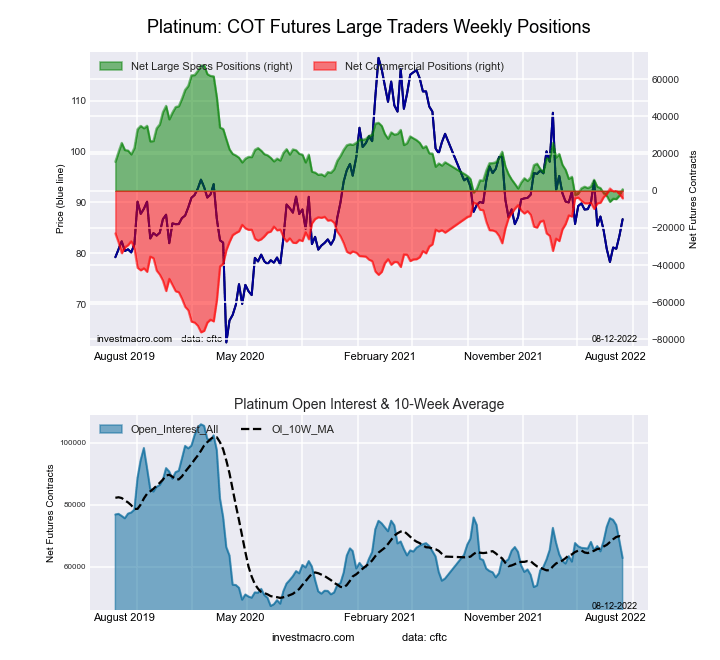
Platinum Futures COT ChartThe Platinum Futures large speculator standing this week totaled a net position of -2,734 contracts in the data reported through Tuesday. This was a weekly reduction of -1,428 contracts from the previous week which had a total of -1,306 net contracts.

This week’s current strength score (the trader positioning range over the past three years, measured from 0 to 100) shows the speculators are currently Bearish-Extreme with a score of 0.0 percent. The commercials are Bullish-Extreme with a score of 100.0 percent and the small traders (not shown in chart) are Bearish with a score of 23.4 percent.

Platinum Futures StatisticsSPECULATORSCOMMERCIALSSMALL TRADERS
– Percent of Open Interest Longs:43.838.611.9
– Percent of Open Interest Shorts:47.540.95.9
– Net Position:-2,734-1,6704,404
– Gross Longs:31,92028,1558,693
– Gross Shorts:34,65429,8254,289
– Long to Short Ratio:0.9 to 10.9 to 12.0 to 1
NET POSITION TREND:
– Strength Index Score (3 Year Range Pct):0.0100.023.4
– Strength Index Reading (3 Year Range):Bearish-ExtremeBullish-ExtremeBearish
NET POSITION MOVEMENT INDEX:
– 6-Week Change in Strength Index:-6.06.7-11.1


Palladium Futures:

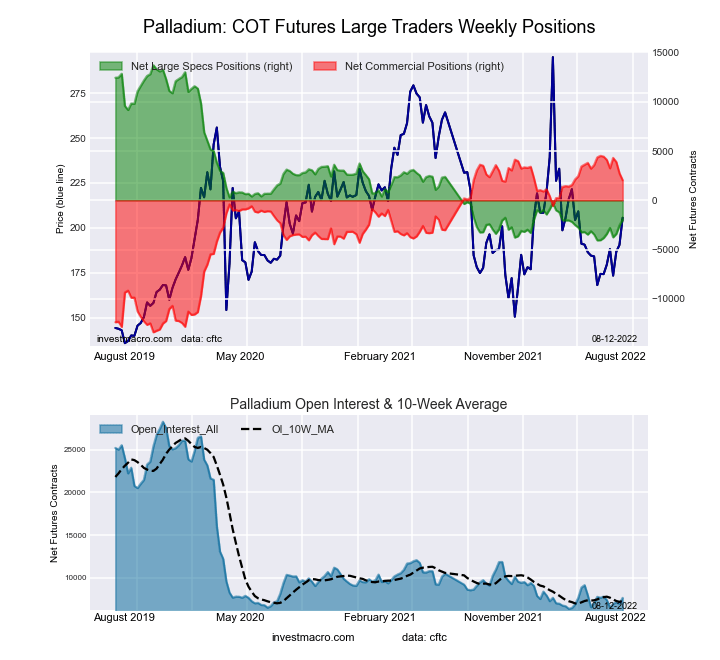
Palladium Futures COT ChartThe Palladium Futures large speculator standing this week totaled a net position of -3,410 contracts in the data reported through Tuesday. This was a weekly gain of 415 contracts from the previous week which had a total of -3,825 net contracts.

This week’s current strength score (the trader positioning range over the past three years, measured from 0 to 100) shows the speculators are currently Bearish-Extreme with a score of 3.6 percent. The commercials are Bullish-Extreme with a score of 97.7 percent and the small traders (not shown in chart) are Bearish-Extreme with a score of 3.7 percent.

Palladium Futures StatisticsSPECULATORSCOMMERCIALSSMALL TRADERS
– Percent of Open Interest Longs:15.473.111.2
– Percent of Open Interest Shorts:61.617.420.6
– Net Position:-3,4104,104-694
– Gross Longs:1,1325,389825
– Gross Shorts:4,5421,2851,519
– Long to Short Ratio:0.2 to 14.2 to 10.5 to 1
NET POSITION TREND:
– Strength Index Score (3 Year Range Pct):3.697.73.7
– Strength Index Reading (3 Year Range):Bearish-ExtremeBullish-ExtremeBearish-Extreme
NET POSITION MOVEMENT INDEX:
– 6-Week Change in Strength Index:0.31.7-21.2


Article By InvestMacroReceive our weekly COT Reports by Email

*COT Report: The COT data, released weekly to the public each Friday, is updated through the most recent Tuesday (data is 3 days old) and shows a quick view of how large speculators or non-commercials (for-profit traders) were positioned in the futures markets.

The CFTC categorizes trader positions according to commercial hedgers (traders who use futures contracts for hedging as part of the business), non-commercials (large traders who speculate to realize trading profits) and nonreportable traders (usually small traders/speculators) as well as their open interest (contracts open in the market at time of reporting).See CFTC criteria here.
Copper Fears Recession

By Ino.com

– The copper futures hit an all-time high this spring. This is not a surprise to many readers who suspected it would – see the poll from late August.

The price has topped at $5.04, missing the preset target area between $5.36-$5.41. After that, copper futures collapsed below the valley of the last summer ($3.96) in the area of $3.60.

See the latest stats for the copper market in the table below.

World Refined Copper Usage and Supply Trends

Source: The International Copper Study Group (ICSG)
 

According to the table above, the world refined copper production has increased to 8.44 million metric tons in the first four months this year, compared to 8.16 million metric tons for the same period last year.

At the same time, the world usage or demand has grown up either to 8.35 million metric tons in January-April this year from 8.17 million metric tons last year.

As a result, this year the copper balance turned into a surplus of 95 thousand metric tons compared to a deficit of 3 thousand metric tons last year. Moreover, if we take the last line of the table that shows the refined balance of the market adjusted for the Chinese bonded stock change is in even bigger oversupply of 213 thousand metric tons.

As we can see, the market fundamentals could have undermined the uptrend in the copper price in the first place. The following speed up of the futures collapse was fueled by the hawkish Fed, Chinese lockdowns and a new scaring mantra that has been circulating recently in the media about upcoming recession.

One could call it a self-fulfilling prophecy as last Friday the Atlanta Fed posted a second quarterly decline of a real GDP in a row on its GDPNow tracker. The second quarter reading is minus 2.1%, the first quarter reading was minus 1.6%. Technically speaking, this could mean that the forecasted recession is already here.

The auxiliary economic data from the graphs below also confirms the economic headwinds for the copper market.

US PMI vs Copper

Source: tradingeconomics.com
 

United States ISM Purchasing Managers Index (PMI) (blue) fell to 53 in June of 2022 from 56.1 in May, demonstrating the slowest growth in factory activity since June of 2020, and below market forecasts of 54.9.

The robust uptrend of copper futures (black) in 2020 was in an accord with U.S. PMI until the start of 2021 where the factory activity has peaked and then started to collapse. The copper price firstly continued further up on the market inertia and then dropped huge to finally catch up with the current fundamentals.

China Industrial Production vs Copper

Source: tradingeconomics.com
 

The similar situation has been seen in the chart above of Chinese industrial production (blue). The “World’s factory” performance has also peaked last year, ahead of the top in copper futures (black).

We could see here that the metal has more room to the downside into the $3 area to reach the corresponding level of Chinese data. It is worth to note that the industrial production in China has grown up by 0.7% recently after a relaxation in COVID-19 curbs in some major Chinese cities.

US Consumer Sentiment vs Copper

Source: tradingeconomics.com
 

To complete the picture, we should look at the chart above that shows the U.S. consumer confidence (blue) as a main indicator of the initial demand.

The situation is even more depressed here as we can see no progress since the pandemic outbreak. The indicator just made a small rebound within the consolidation in 2020 and then continued to the downside to hit the record low of 50.0 in June 2022.

Let’s look at the updated chart of copper futures below.

Copper Futures Monthly

Source: TradingView
 

The copper futures price goes well with the plan posted almost a year ago. It didn’t advance too much to the upside to fit with the extended consolidation pattern. We entered the red leg 2 down.

The latter could unfold either like the first straight leg down with a panic selling amid financial crisis of 2008 or it could build a zigzag with a corrective phase in the middle of the drop. More often than not, two legs are not alike.

Two possible downward targets could be set. The closest one is computed using the distance of the first red leg down subtracted from the new all-time high; it is aimed at $2.02. This area coincides with the valley of 2016 and 2020.

The next target is an old one as it Is located at the minimum of the first red leg down at $1.25.

The RSI sank below the so-called “waterline” beneath the crucial 50 level. If it closes this month there than the bearish trend is confirmed.

Intelligent trades!

Aibek Burabayev
INO.com Contributor

Disclosure: This contributor has no positions in any stocks mentioned in this article. This article is the opinion of the contributor themselves. The above is a matter of opinion provided for general information purposes only and is not intended as investment advice. This contributor is not receiving compensation (other than from INO.com) for their opinion.

By Ino.com – See our Trader Blog, INO TV Free & Market Analysis Alerts

Source: Copper Fears Recession

Boris Johnson’s departure will boost pound: deVere CEO

By George Prior 

– The pound will “finally stabilise” after a brief period of volatility when UK Prime Minister Boris Johnson leaves office, affirms the CEO and founder of one of the world’s largest independent financial advisory, asset management and fintech organisations.

The analysis from Nigel Green of deVere Group comes as Boris Johnson is desperately clinging to power after a slew of resignations from his government. The UK currency is currently trading around the weakest level since early 2020.

He says: “Johnson has made it clear in Parliament that he had no intention of stepping down, but it increasingly looks like the decision is no longer his after an unprecedented avalanche of resignations from his own ministers.

“This is the beginning of the end for Johnson’s administration, and it is a question if ‘when’ not ‘if’.”

He continues: “When Johnson does leave Number 10, we’re confident it will ultimately give the pound a boost.

“Sterling has been one of this year’s worst-performing major currencies, down more than 10% against the dollar, amid concerns about a severe economic slowdown, red-hot inflation and, yes, the swirling political chaos, primarily centred around the Prime Minister.”

In the media on Wednesday, the deVere CEO was quoted as saying that when names are put into the ring to become the next leader, and policy agendas of the frontrunners are known, “the pound can be expected to become highly volatile – just as it did during the Brexit negotiations.

“The issues laid bare by Johnson’s possible successors that will impact the pound would include the UK’s relationship with the EU and single market access, fiscal stimulus and the Northern Ireland protocol, amongst others.”

However, Nigel Green says following this bout of turbulence triggered by uncertainty, “we can expect the pound to finally stabilise.”

He notes: “A strong and stable leadership is likely to get the pound back on track to a large extent.

“Currencies typically like strong, unifying leaders. The current politics around Boris Johnson is toxic; it’s a distraction and makes an already weak pound weaker.

“Clearly there are other contributing issues to the weakness, but make no mistake, Johnson’s shenanigans are a major factor.”

In addition, the deVere Group CEO goes on to say, the European economy’s possible looming recession is “going to hit the euro, which is likely to lift the pound.”

He concludes: “The Boris issue has dragged on the pound for a year or so – this weight could be lifted if he is replaced by a more stable and sensible leader.”

About:

deVere Group is one of the world’s largest independent advisors of specialist global financial solutions to international, local mass affluent, and high-net-worth clients.  It has a network of more than 70 offices across the world, over 80,000 clients and $12bn under advisement.


Mid-Week Technical Outlook: FX Trends To Watch Out For In July

By ForexTime 

– Some semblance of calm returned to markets on Wednesday following the painful selloff in the previous session.

European stocks rebounded despite the cautious mood while US futures wobbled amid fears of a global recession. In the currency markets, the mighty dollar flexed its safe-haven muscles ahead of the Federal Reserve minutes while the euro extended losses against G10 currencies. Looking at commodities, gold remained depressed and unloved below $1765 thanks to an appreciating dollar. Brent found itself under renewed pressure, approaching the $100 psychological level.

As the new trading month of July gets underway, this could present fresh opportunities across FX markets. Today, we will be using multiple timeframe analysis (MFTA). This is a method of analysing long-term, medium-term, and short-term timeframes to achieve an accurate entry or exit when trading the markets.

GBPUSD bears switch into higher gear…

After bouncing within a very wide range since mid-2016, the GBPUSD could be gearing up for a steep selloff below the 1.2040 support level.

Prices remain heavily bearish on the monthly timeframe as there have been consistently lower lows and lower highs. The candlesticks are trading below the 50, 100, and 200-month Simple Moving Averages. A strong monthly close below 1.2040 may pave the way towards 1.1500.

On the weekly charts, we see a similar picture with bears firmly in the driving seat. Should the GBPUSD conclude the week under 1.2100, this may trigger a steeper selloff towards 1.1800 and 1.1500, respectively.

Zooming into the daily, we see consistently lower lows and lower highs. The recent breakdown below 1.1950 is an encouraging signal for bears and opens the doors to further downside with 1.1650 acting as the first point of interest.

Should 1.1950 prove to be reliable support, the currency pair may experience a rebound towards 1.2200 and 1.2350, respectively.

EURUSD parity around the corner…?

We will keep this one quick since we have already covered the EURUSD this week.

The currency pair is roughly 200 pips away from parity as of writing. With bears in full steam and the trend heavily bearish, parity could be around the corner in a matter of days to weeks. Talking technicals, a strong weekly close below 1.0200 could encourage a selloff towards 1.0000. Should 1.0200 prove to be reliable support, a move back towards 1.0400 could be on the cards.

AUDUSD remains in a downtrend

A picture can say 1000 words. Much is being said on the AUDUSD weekly timeframe as prices find resistance around 0.6850. Sustained weakness below this level could encourage a decline towards 0.6650.

NZDUSD textbook breakdown opportunity

If you are looking for a clean bearish trend, then check out the NZDUSD on the weekly timeframe. There have been consistently lower lows and lower highs while the MACD trades below zero. A strong weekly close below 0.6200 could result in a selloff towards 0.6000. If 0.6200 proves to be a tough nut to crack, a rebound back towards 0.6400 could occur.

GBPJPY bull run over?

Things are heating up for the GBPJPY on the weekly charts. After failing to break above 167.50, bears seem to be back in town and ready to switch up the pressure. This is looking like a bearish week for the currency pair with 158.00 acting as the first key level of interest. A strong breakdown and daily close under the 158.00 higher low may inspire a selloff towards 151.00.

BONUS: GOLD

It’s been a painful week for gold thus far with the precious metal trading at levels not seen since December 2021. The balance of power seems to be shifting in favour of bears and this continues to be reflected in price action. $1745 remains the first level of interest, followed by $1700. For bulls to jump back into the game, a rebound back towards $1800 needs to happen – which could be a steep hill to climb.


Forex-Time-LogoArticle by ForexTime

ForexTime Ltd (FXTM) is an award winning international online forex broker regulated by CySEC 185/12 www.forextime.com

Misguided geopolitics is derailing decades of globalization

By Dan Steinbock

– Over the past decade, global economic prospects have been penalized by the fall of world trade, investment and migration, coupled with the unwarranted suffering of over 100 million globally displaced. It’s a prologue to an untenable future.

The postwar wave of globalization benefited mainly the advanced economies. It was only after 1980 that some large developing countries, particularly China, broke into world markets for manufactured goods and services, while also attracting foreign capital. This era of globalization eclipsed with the global recession in 2008.

As the G20 cooperation subsequently dimmed, so did global growth prospects, too.

Between November 2008 and 2016, global imbalances steadily worsened as a result of increasing trade discrimination. It was only in 2017 that there were some signs of trade recovery.

Yet, that historical opportunity was missed with the U.S. trade wars, followed by waves of COVID19 pandemic, the consequent global depression and nascent Cold Wars.

Global economic integration is often measured by world trade, investment and migration, although technology and finance could be added to the list.

The net effect of the past decade? Plunging trade and investment, slowing migration and explosion of global displacement.

Falling world trade

In particular, the fleeting gains of the U.S.-Sino trade truce were derailed by the global pandemic that caused both services and goods trade to contract by 30 percent in mid-2020. Subsequent gains have been penalized by new waves of pandemic variants and the worsening international economic landscape.

Last year, the World Trade Organization (WTO) anticipated global merchandise trade volume to grow by 10.8 percent, followed by a 4.7 percent rise in 2022. But these projections were unlikely to materialize even before the Ukrainian crisis.

Progress since the plunge of 2008 has been largely reversed. Trade as percentage of world GDP has fallen back to the level where it was over 15 years ago. Geopolitics derailed the potential for global recovery well before the pandemic, due to protectionism and new Cold Wars, compounded by the Russia sanctions.

Plunging world investment

Before the 2008 global crisis, world investment soared to almost $2 trillion. But the hoped-for rebound proved a pipe-dream, due to the tariff wars and the pandemic. High-income economies play a critical role in world inward investment flows. Yet, even before the Ukrainian crisis, world investment had plunged to a level which was first reached already in the late 1990s.

In 2020, global flows of FDI fell by one third to $1 trillion. That’s below the low of the 2008 crisis, and half of world investment in 2007.  Decades of progress have been reversed in just few years.

Globalization undermined

Sources: Difference Group and a. Trade as average of exports and imports; and as % of GDP (World Bank/OECD; b. FDI Inward Flows in $ billions (UNCTADSTAT). c. UN/IOM, d. UNCHR

In the process, the poorest economies have been hurt the most. And that pain is only about to begin.

Slower migration

Over the last two decades, the number of international migrants has climbed to 281 million people. Yet, global migration has been slowing since 2008, particularly in advanced economies. Due to the pandemic, the stock of international migrants has increased only by 2 million; a fourth less than expected by mid-2020.

Let’s put these figures in historical context.

Between 1870 and 1914, some 10 percent of the world population migrated in search for a better life. While the absolute number of international migrants has over tripled in the past half a century, their relative share stayed below 2 percent until 2010 and is today 3.6 percent of world population; a third of what it was a century ago.

Explosion of global displacement

And as migration flows decelerate or are being blocked, the number of globally displaced has exploded, compounded by the post-9/11 wars and external interventions since the Arab Spring, which the West initially saw as the prelude to “democratization” in the Middle East, a bit like the devastated Ukraine today.

As a net effect, the number of forcibly displaced has more than doubled in the past decade. The Ukraine crisis alone is projected to internally displace up to 6.7 million people and 4 million displaced abroad.

Despite COVID-19 mobility restrictions, the total figure exceeded 92 million at the year-end of 2021 and has recently soared over 100 million.

In other words, the number of the globally displaced is soon over twice as high as it was after two world wars, the Holocaust, and Hiroshima and Nagasaki in 1945.

If that’s the outcome of “peacetime conditions,” one shudders with horror the effect of wartime conditions in the early 21st century.

A prelude to darker futures?

In the past half a decade, the costs of missed opportunities amount to trillions of dollars. Given continuing policy mistakes, worse looms ahead.

Growth scenarios that still seemed likely in early 2022 will not materialize because they were projected in fall 2021, when

  • a truce subdued the U.S.-Sino trade war;
  • Ukraine’s proxy conflict had not yet erupted;
  • Sanctions targeting the world’s 11thlargest economy, the largest natural gas producer and third-largest oil producer, had not yet been launched.
  • And the Federal Reserve had not initiated its aggressive rate hikes and quantitative tightening, which will cause lost years in the West and lost decades in the Global South.

As long as current policies remain in place in the West, sanctions will undermine U.S. growth, destabilize the Russian economy, penalize the fragile Euro area and slow Chinese growth – all of which will have an adverse impact on economic prospects in South and Southeast Asia.

The Global South will pay much of the bill; in economic costs and human lives.

The longer the unwarranted stagnation will prevail, the greater the likelihood that current Cold Wars will turn into Hot Wars, at the cost of future generations, even our planet.

That’s something that none of us may want. But it is the net effect of shortsighted policies in the prosperous West.

About the Author:

Dr. Dan Steinbock is an internationally recognized strategist of the multipolar world and the founder of Difference Group. He has served at the India, China and America Institute (US), Shanghai Institutes for International Studies (China) and the EU Center (Singapore). For more, see https://www.differencegroup.net 

Versions of this commentary have been published by multiple major dailies around the world. It is based on a report recently published by the Austrian National Bank (OeNB) and the Austrian Federal Economic Chamber (WKÖ). See also https://www.differencegroup.net


Trade Of The Week: Volatile Week For Dollar As Focus Shifts To NFP?

By ForexTime 

The mighty dollar reigned supreme during the first half of 2022, asserting its dominance over all G10 currencies.

Greenback bulls drew ample inspiration from risk aversion as geopolitical risks and recession fears sent investors sprinting towards safe-haven destinations. Appetite towards the currency was also stimulated by expectations for aggressive Fed rate hikes in the face of soaring inflation with rising Treasury yields fuelling upside gains.

As buying sentiment improved throughout H1, this propelled the Dollar Index (DXY) to levels not seen in 20 years.

There was also some action on the equally- weighted USD Index which hit a 2022 high of 1.1954 in June.

Given how bulls dominated the scene in H1, the momentum could roll over into the second half of 2022 if the fundamentals forces remain intact. Taking a quick look at the technicals, both the Dollar Index and Equally-weighted USD index remain firmly bullish on multiple timeframes with the path of least resistance north. When considering how the week ahead is jam-packed with key US economic reports and speeches from numerous Fed officials, it may be wise to fasten your seatbelts for potential USD volatility.

The low down…

Last week, Federal Reserve Chair reiterated that the US economy was “well positioned to withstand tighter monetary policy” during a panel discussion at the ECB forum. However, he cautioned about the Fed’s ability to achieve a “soft landing”. This has fed into the US recession fears as the central bank wages war against soaring inflation.

Annual inflation rate in the United States unexpectedly accelerated to 8.6% in May, the highest since December 1981 as energy prices jumped the most since September 2005. This red-hot figure poured cold water on hopes of inflation peaking and fuelled speculation of aggressive interest rate hikes from the Fed.

Interestingly, the latest core Personal Consumption Expenditure (PCE) painted a different picture as inflation showed some signs of cooling off in May. This was a significant development, especially when considering how the core PCE is the Fed’s preferred inflation metric. The PCE Price Index rose 6.3% year-over-year which was slightly below market forecast while the core PCE dropped to 4.7%, down from April’s 4.9%. This better-than-expected data may revive hopes around price pressures peaking, cooling bets around aggressive hikes. Nevertheless, traders are still pricing in around a 75% chance of a 75-basis point rate hike at the Fed meeting this month.

The week ahead…

US markets will be closed on Monday for Independence Day.

Nevertheless, the holiday-shortened week promises to be eventful due to key economic reports and risk events. All eyes will be on the FOMC minutes on Wednesday which could provide fresh insight into policy paths ahead of the key US jobs report on Friday. At its June meeting, the Fed raised interest rates by 75 basis points, its biggest rate increase since 1994. The minutes should provide more insight into the internal discussions over the decision.

Before the NFP report on Friday, investors will be served side dishes in the form of the US ADP employment change and initial jobless claims. This will be topped off with speeches from Fed officials.

The main course on Friday could satisfy or dissatisfy investors depending on the print. Markets expect the US economy to have added 250,000 jobs in June, while the unemployment rate is seen holding at 3.6%. Should the headline NFP meet or exceed market forecasts with the unemployment rate holding steady or falling, this could soothe US recession fears. Alternatively, a lower-than-expected headline NFP figure coupled with a higher-than-3.6% unemployment rate could fuel fears around the US economy bound for a recession down the road.

Dollar breakout on the horizon?

It looks like the equally-weighted USD Index could be gearing to push higher with 1.1950 acting as a key level of interest.

Prices remain bullish on the weekly and daily timeframe. Beyond 1.1950, the next key point can be found at 1.2070. A solid breakout above 1.2070 could open the doors towards 1.2300.

Should 1.1950 prove to be reliable resistance, a decline back towards 1.1700, 1.1640, and 1.1400 could be on the cards.


Forex-Time-LogoArticle by ForexTime

ForexTime Ltd (FXTM) is an award winning international online forex broker regulated by CySEC 185/12 www.forextime.com