Archive for Metals – Page 6

COT Metals Charts: Speculator Changes led by Copper & Platinum

By InvestMacro

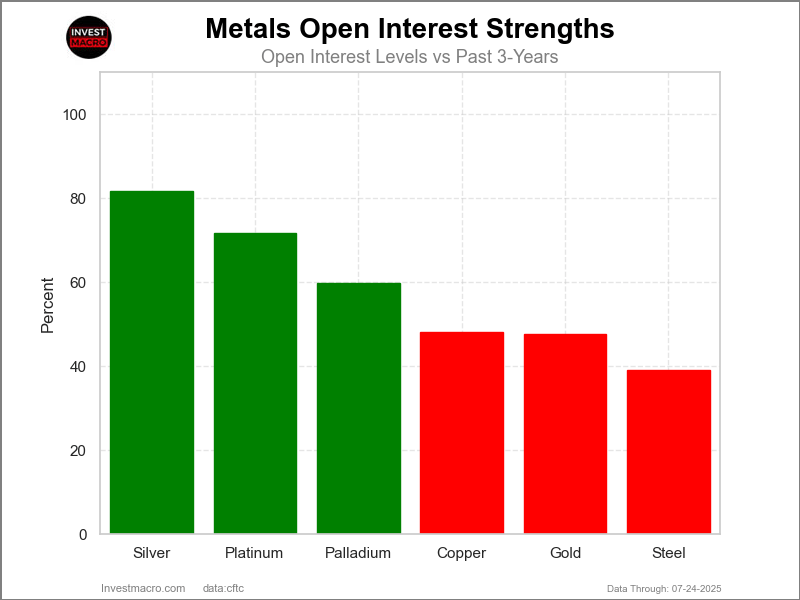
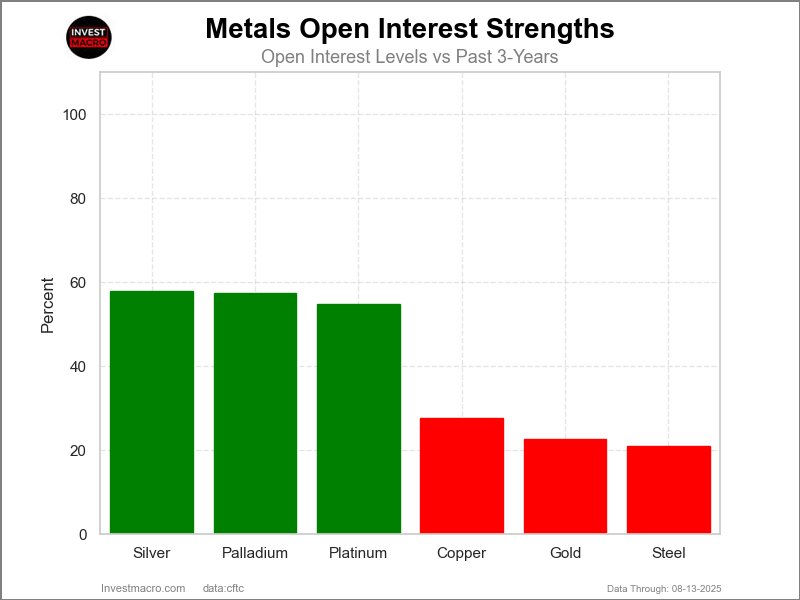
Metals Open Interest COT Chart
Here are the latest charts and statistics for the Commitment of Traders (COT) data published by the Commodities Futures Trading Commission (CFTC).

The latest COT data is updated through Tuesday August 12th and shows a quick view of how large traders (for-profit speculators and commercial entities) were positioned in the futures markets.

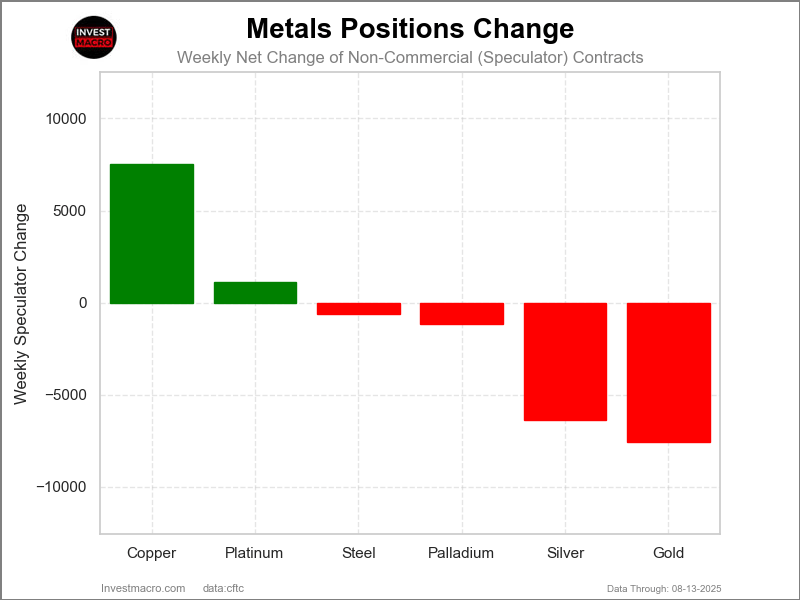
Weekly Speculator Changes led by Copper & Platinum
Metals Net Positions COT Chart
The COT metals markets speculator bets were overall lower this week as just two out of the six metals markets we cover had higher positioning while the other four markets had lower speculator contracts.

Leading the gains for the metals was Copper (7,525 contracts) with Platinum (1,126 contracts) also showing a positive week.

The markets with declines in speculator bets for the week were Gold (-7,565 contracts), Silver (-6,390 contracts), Palladium (-1,161 contracts) and with Steel (-626 contracts) also seeing lower bets on the week.

Weekly Metals Performance

The metals markets on the week were mostly lower as 4 out of the 6 markets saw declining prices. Platinum led the week with a 0.58% increase, while Copper rose by 0.54%. Palladium was lower by -0.5%, Silver was down by -1.09% and Gold was down by -1.80%. Steel was the biggest loser on the week with a -3.33% decrease.

In the longer term, over the last 90 days, all these markets are higher, with Copper seeing just a 4.65% rise and is the smallest gainer over 90 days. Palladium, Silver, and Steel are all up by over 20% in the last 90 days, while Gold is up by 12.32%. Platinum is the biggest mover over the last 90 days with a gain of 42.67%.


Metals Data:
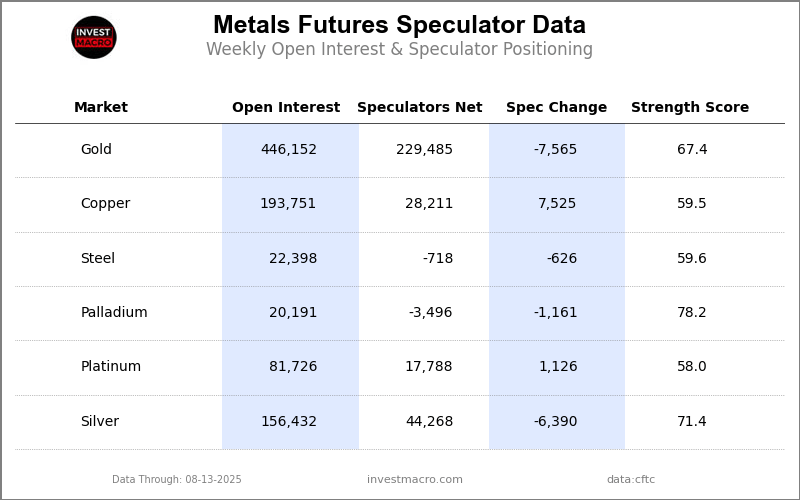
Metals Table COT Chart
Legend: Weekly Speculators Change | Speculators Current Net Position | Speculators Strength Score compared to last 3-Years (0-100 range)


Strength Scores led by Palladium & Silver
Metals Strength Scores COT Chart
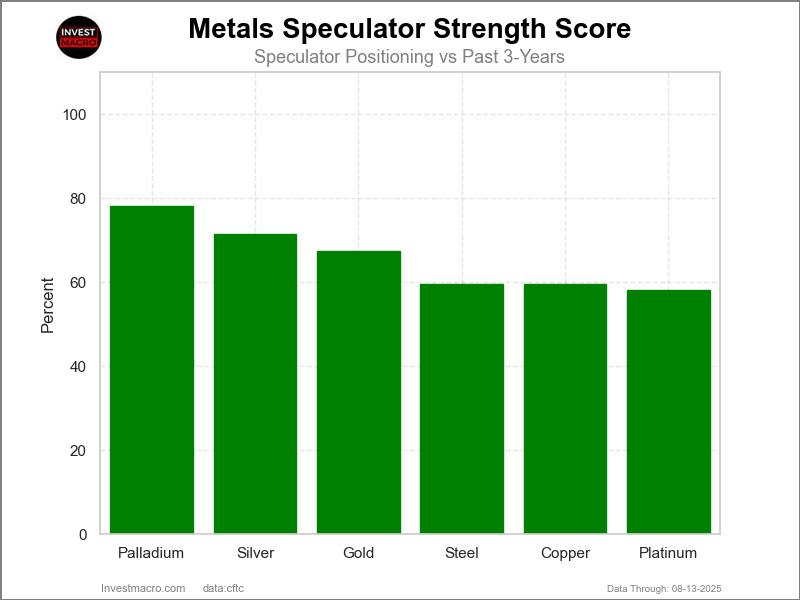
COT Strength Scores (a normalized measure of Speculator positions over a 3-Year range, from 0 to 100 where above 80 is Extreme-Bullish and below 20 is Extreme-Bearish) showed that Palladium (78 percent) and Silver (71 percent) lead the metals markets this week. Gold (67 percent) comes in as the next highest in the weekly strength scores.

Strength Statistics:
Gold (67.4 percent) vs Gold previous week (70.2 percent)
Silver (71.4 percent) vs Silver previous week (79.3 percent)
Copper (59.5 percent) vs Copper previous week (52.5 percent)
Platinum (58.0 percent) vs Platinum previous week (55.4 percent)
Palladium (78.2 percent) vs Palladium previous week (86.9 percent)
Steel (59.6 percent) vs Palladium previous week (64.0 percent)


Gold & Palladium top the 6-Week Strength Trends
Metals Trends COT Chart
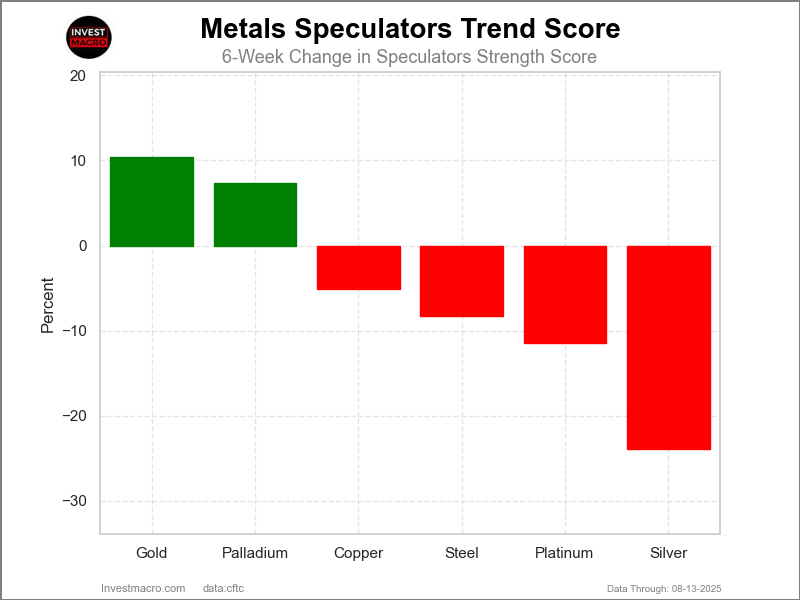
COT Strength Score Trends (or move index, calculates the 6-week changes in strength scores) showed that Gold (10 percent) and Palladium (7 percent) lead the past six weeks trends for metals.

Silver (-24 percent) leads the downside trend scores currently with Platinum (-11 percent) as the next market with lower trend scores.

Move Statistics:
Gold (10.4 percent) vs Gold previous week (16.0 percent)
Silver (-23.9 percent) vs Silver previous week (-15.4 percent)
Copper (-5.1 percent) vs Copper previous week (-8.1 percent)
Platinum (-11.5 percent) vs Platinum previous week (-20.2 percent)
Palladium (7.4 percent) vs Palladium previous week (16.3 percent)
Steel (-8.3 percent) vs Steel previous week (6.8 percent)


Individual Markets:

Gold Comex Futures:
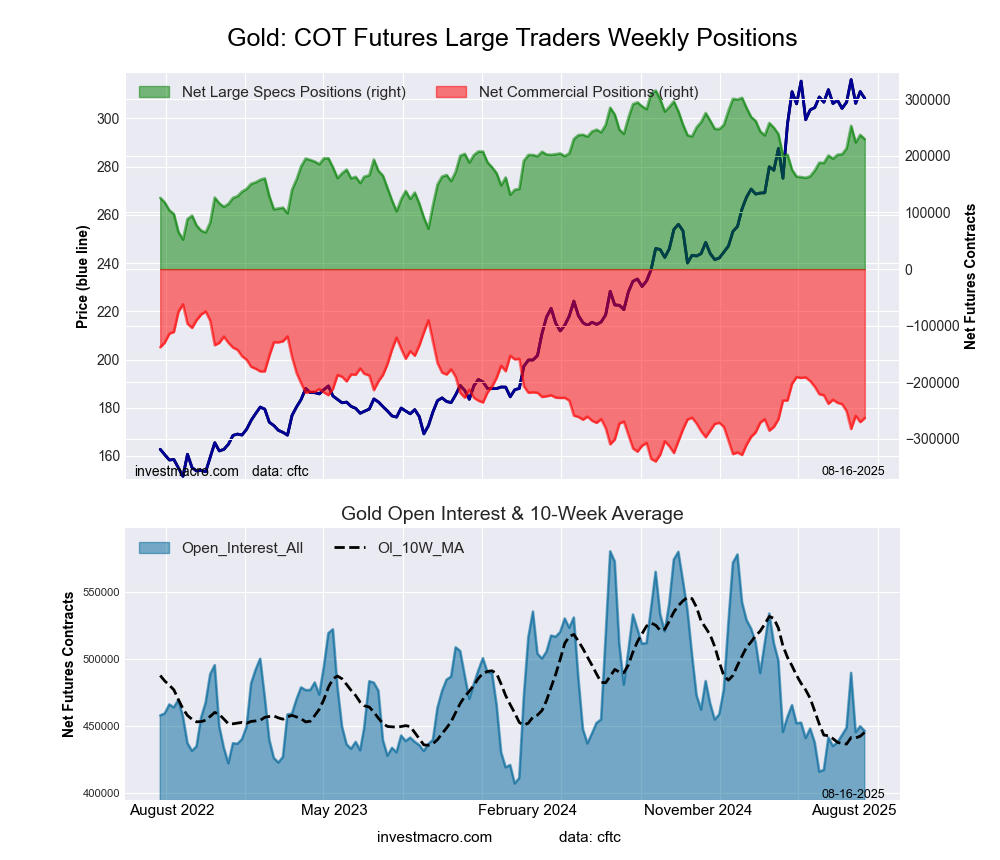
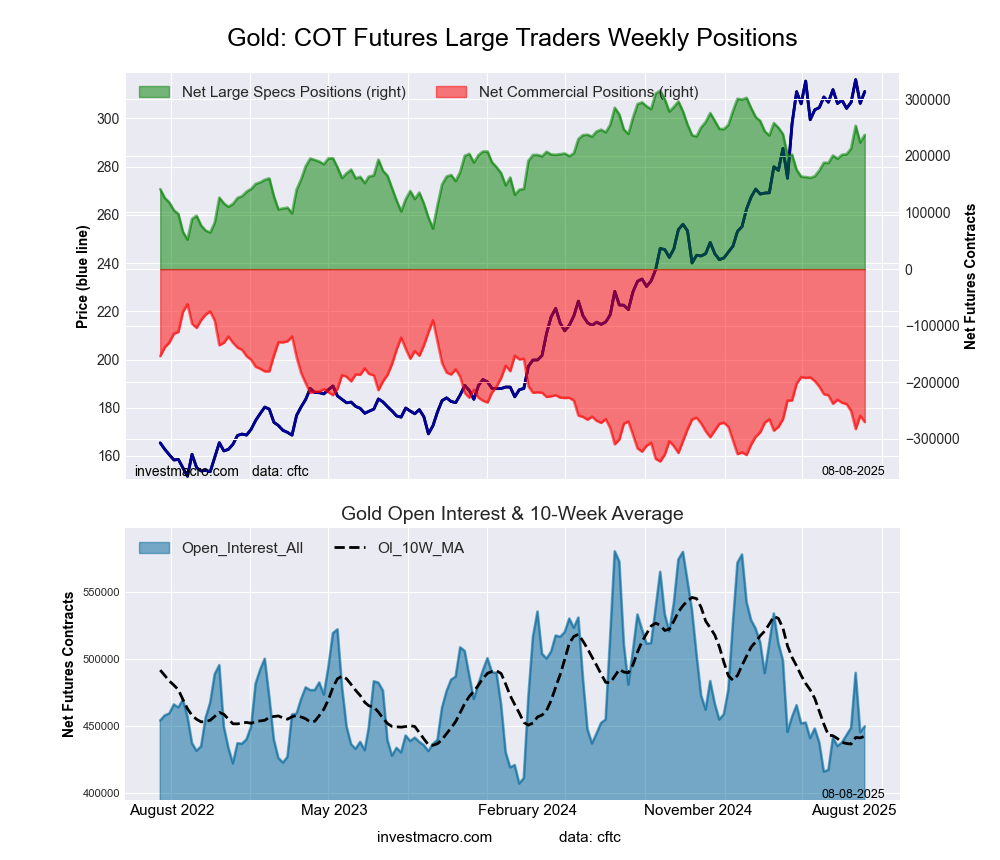
Gold Futures COT ChartThe Gold Comex Futures large speculator standing this week was a net position of 229,485 contracts in the data reported through Tuesday. This was a weekly decline of -7,565 contracts from the previous week which had a total of 237,050 net contracts.

This week’s current strength score (the trader positioning range over the past three years, measured from 0 to 100) shows the speculators are currently Bullish with a score of 67.4 percent. The commercials are Bearish with a score of 27.6 percent and the small traders (not shown in chart) are Bullish-Extreme with a score of 86.5 percent.

Price Trend-Following Model: Uptrend

Our weekly trend-following model classifies the current market price position as: Uptrend.

Gold Futures StatisticsSPECULATORSCOMMERCIALSSMALL TRADERS
– Percent of Open Interest Longs:64.614.212.0
– Percent of Open Interest Shorts:13.173.24.5
– Net Position:229,485-263,06533,580
– Gross Longs:288,11563,42753,656
– Gross Shorts:58,630326,49220,076
– Long to Short Ratio:4.9 to 10.2 to 12.7 to 1
NET POSITION TREND:
– Strength Index Score (3 Year Range Pct):67.427.686.5
– Strength Index Reading (3 Year Range):BullishBearishBullish-Extreme
NET POSITION MOVEMENT INDEX:
– 6-Week Change in Strength Index:10.4-9.7-1.7


Silver Comex Futures:

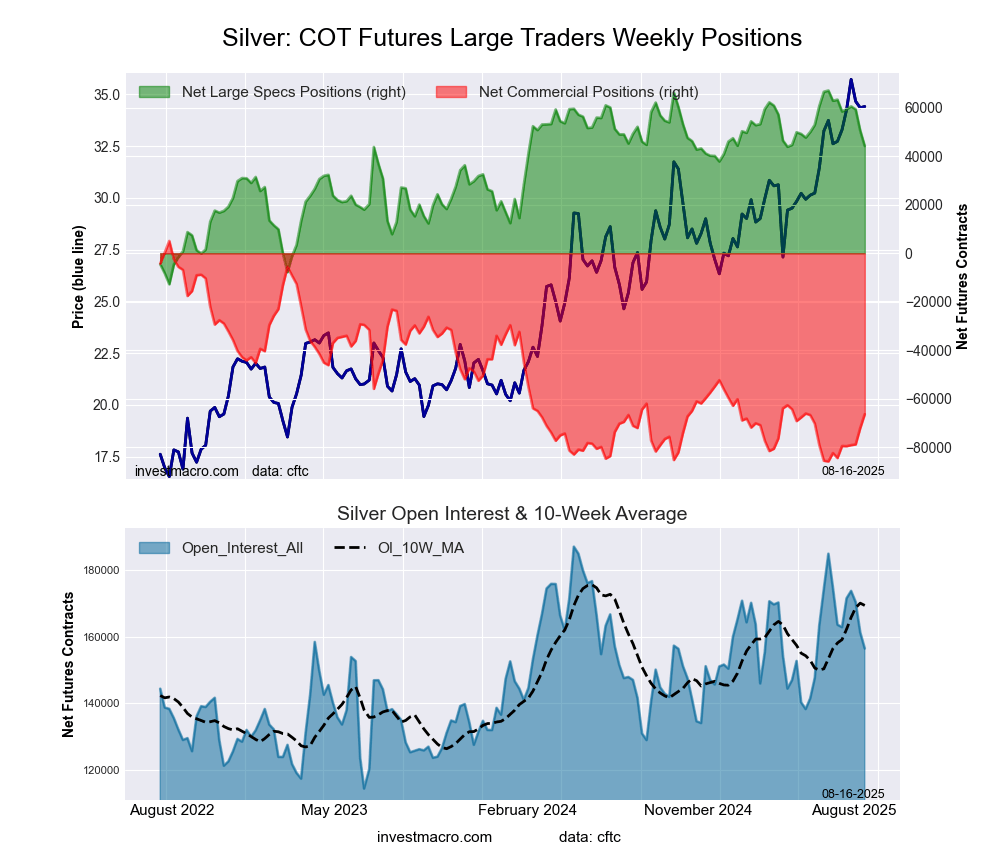
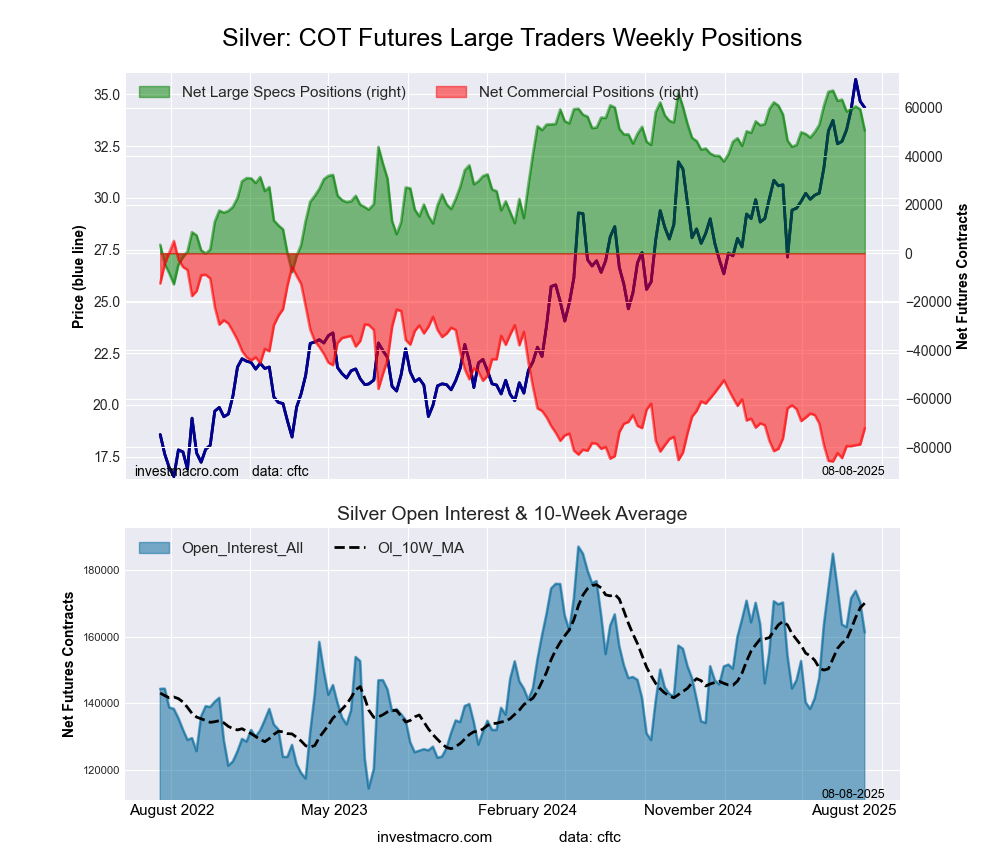
Silver Futures COT ChartThe Silver Comex Futures large speculator standing this week was a net position of 44,268 contracts in the data reported through Tuesday. This was a weekly decrease of -6,390 contracts from the previous week which had a total of 50,658 net contracts.

This week’s current strength score (the trader positioning range over the past three years, measured from 0 to 100) shows the speculators are currently Bullish with a score of 71.4 percent. The commercials are Bearish with a score of 21.5 percent and the small traders (not shown in chart) are Bullish with a score of 77.9 percent.

Price Trend-Following Model: Uptrend

Our weekly trend-following model classifies the current market price position as: Uptrend.

Silver Futures StatisticsSPECULATORSCOMMERCIALSSMALL TRADERS
– Percent of Open Interest Longs:42.426.420.9
– Percent of Open Interest Shorts:14.168.96.7
– Net Position:44,268-66,42122,153
– Gross Longs:66,25241,33132,647
– Gross Shorts:21,984107,75210,494
– Long to Short Ratio:3.0 to 10.4 to 13.1 to 1
NET POSITION TREND:
– Strength Index Score (3 Year Range Pct):71.421.577.9
– Strength Index Reading (3 Year Range):BullishBearishBullish
NET POSITION MOVEMENT INDEX:
– 6-Week Change in Strength Index:-23.919.94.9


Copper Grade #1 Futures:

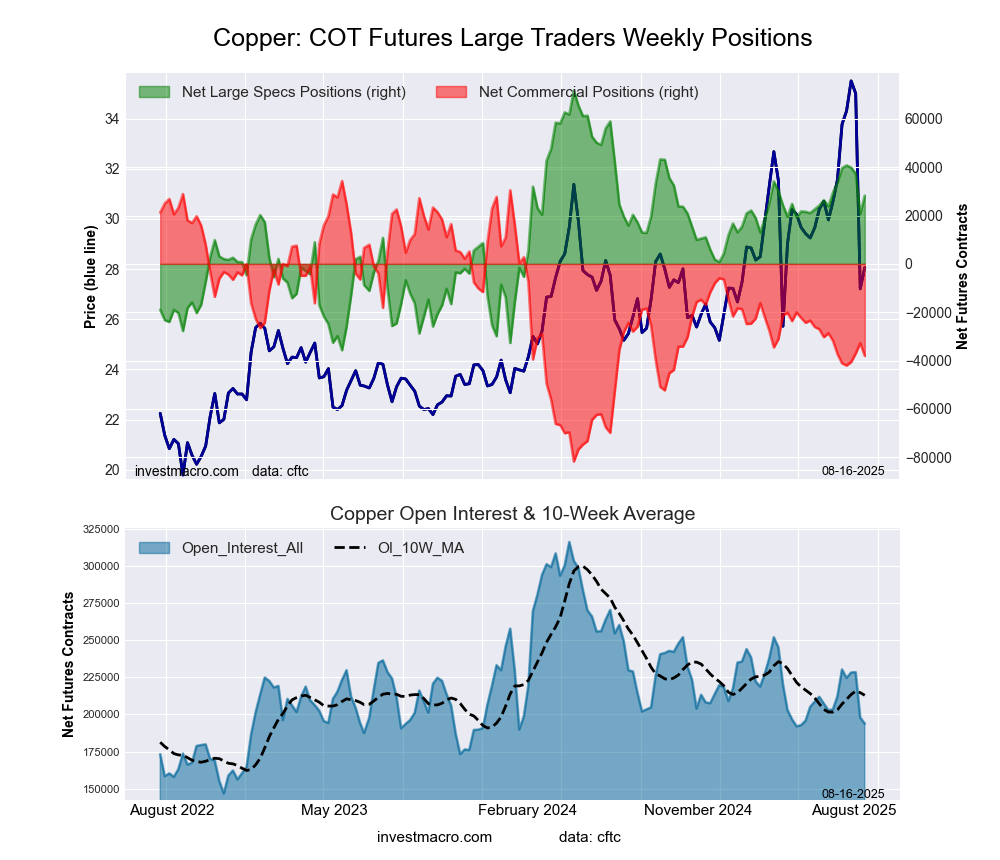
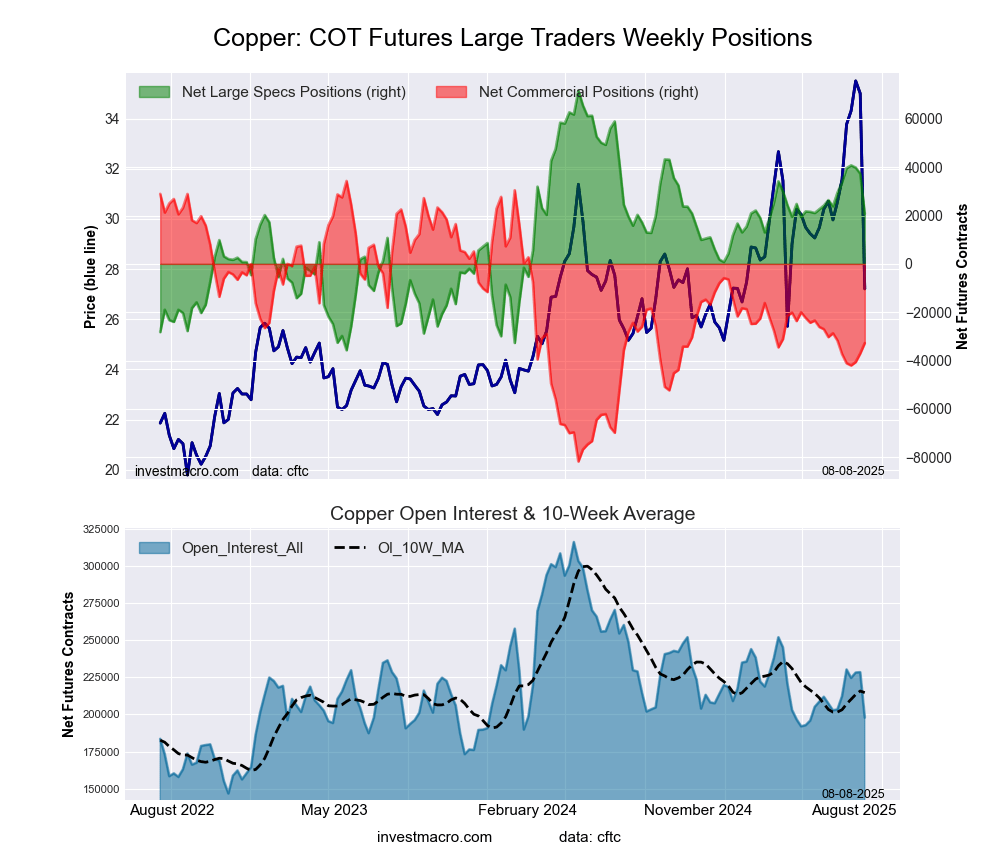
Copper Futures COT ChartThe Copper Grade #1 Futures large speculator standing this week was a net position of 28,211 contracts in the data reported through Tuesday. This was a weekly advance of 7,525 contracts from the previous week which had a total of 20,686 net contracts.

This week’s current strength score (the trader positioning range over the past three years, measured from 0 to 100) shows the speculators are currently Bullish with a score of 59.5 percent. The commercials are Bearish with a score of 37.7 percent and the small traders (not shown in chart) are Bullish with a score of 77.2 percent.

Price Trend-Following Model: Weak Uptrend

Our weekly trend-following model classifies the current market price position as: Weak Uptrend.

Copper Futures StatisticsSPECULATORSCOMMERCIALSSMALL TRADERS
– Percent of Open Interest Longs:30.333.09.8
– Percent of Open Interest Shorts:15.852.64.7
– Net Position:28,211-38,0339,822
– Gross Longs:58,80263,85519,016
– Gross Shorts:30,591101,8889,194
– Long to Short Ratio:1.9 to 10.6 to 12.1 to 1
NET POSITION TREND:
– Strength Index Score (3 Year Range Pct):59.537.777.2
– Strength Index Reading (3 Year Range):BullishBearishBullish
NET POSITION MOVEMENT INDEX:
– 6-Week Change in Strength Index:-5.1-0.637.7


Platinum Futures:

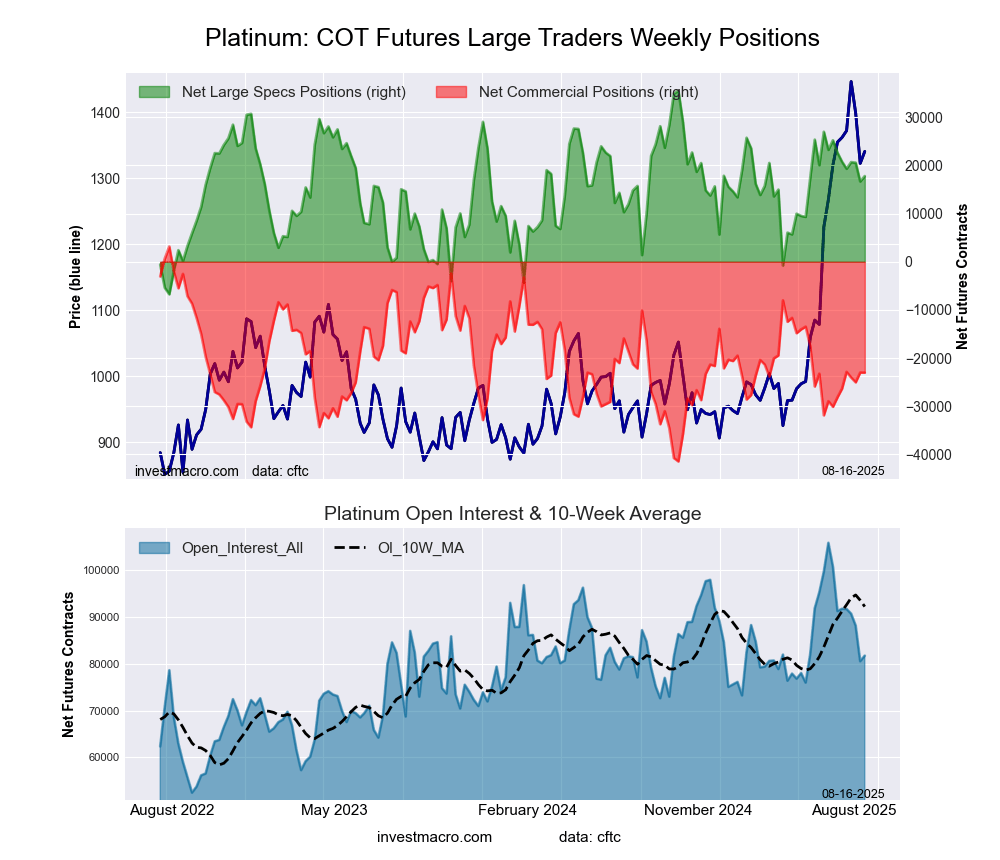
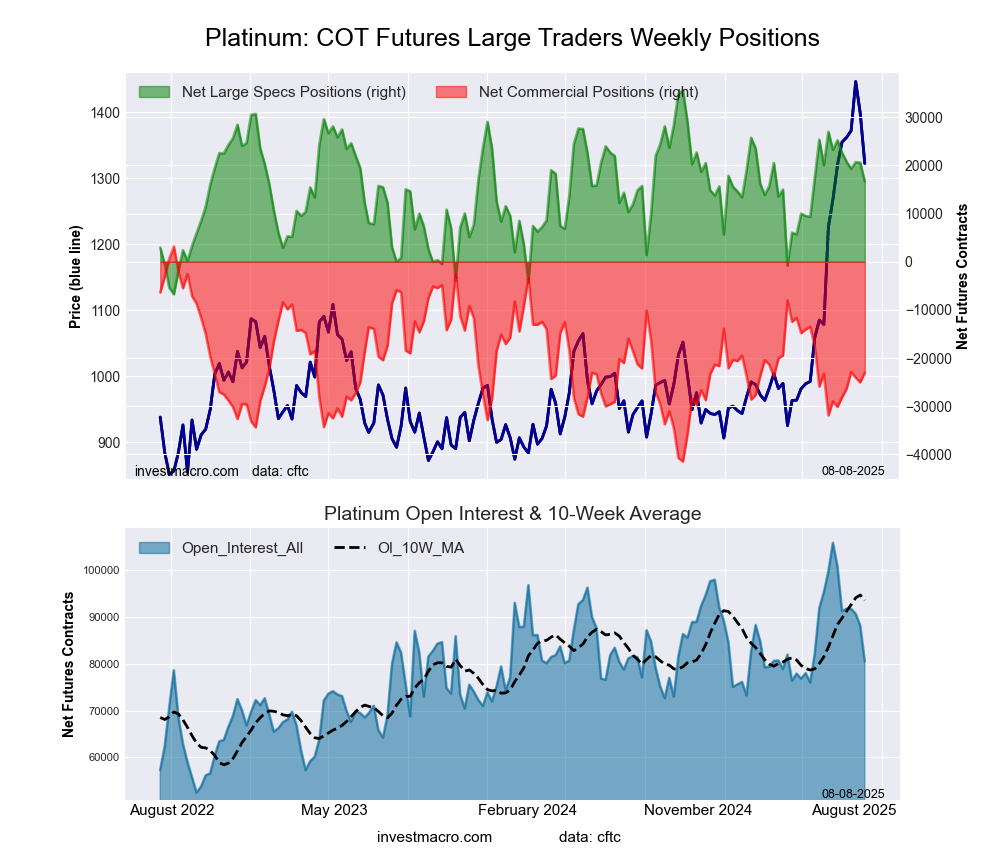
Platinum Futures COT ChartThe Platinum Futures large speculator standing this week was a net position of 17,788 contracts in the data reported through Tuesday. This was a weekly rise of 1,126 contracts from the previous week which had a total of 16,662 net contracts.

This week’s current strength score (the trader positioning range over the past three years, measured from 0 to 100) shows the speculators are currently Bullish with a score of 58.0 percent. The commercials are Bearish with a score of 41.3 percent and the small traders (not shown in chart) are Bullish with a score of 58.8 percent.

Price Trend-Following Model: Uptrend

Our weekly trend-following model classifies the current market price position as: Uptrend.

Platinum Futures StatisticsSPECULATORSCOMMERCIALSSMALL TRADERS
– Percent of Open Interest Longs:58.119.111.8
– Percent of Open Interest Shorts:36.347.25.4
– Net Position:17,788-23,0155,227
– Gross Longs:47,45815,5719,606
– Gross Shorts:29,67038,5864,379
– Long to Short Ratio:1.6 to 10.4 to 12.2 to 1
NET POSITION TREND:
– Strength Index Score (3 Year Range Pct):58.041.358.8
– Strength Index Reading (3 Year Range):BullishBearishBullish
NET POSITION MOVEMENT INDEX:
– 6-Week Change in Strength Index:-11.511.5-3.1


Palladium Futures:

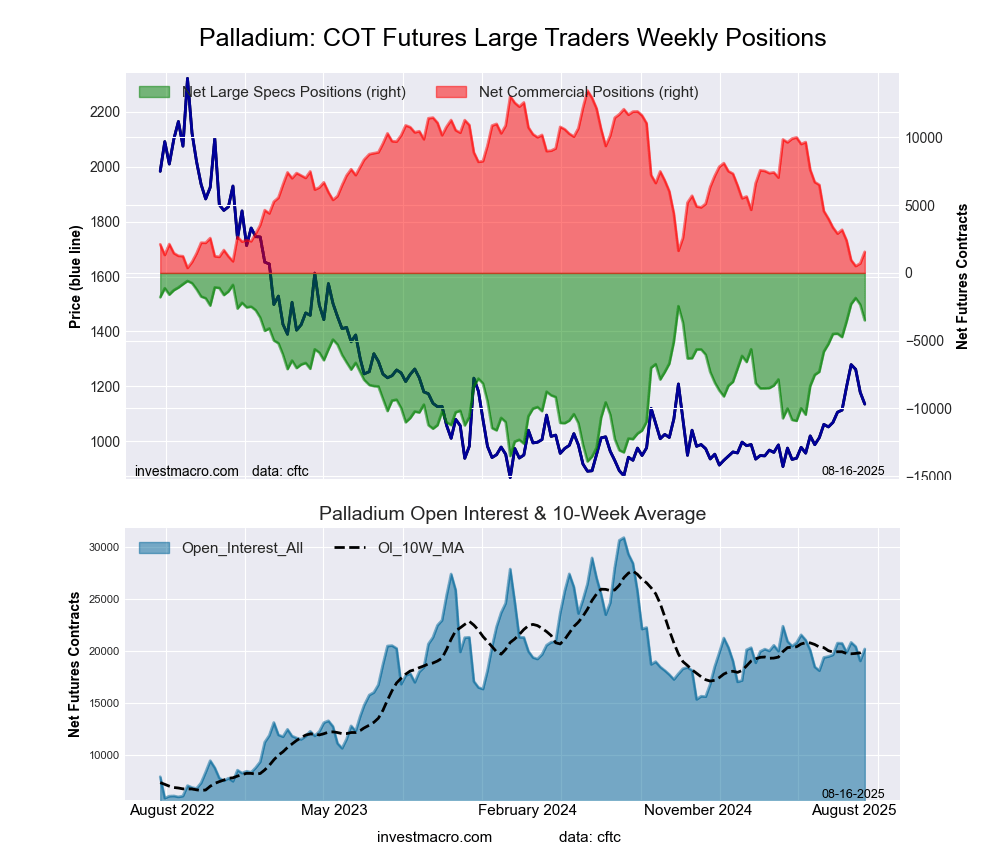
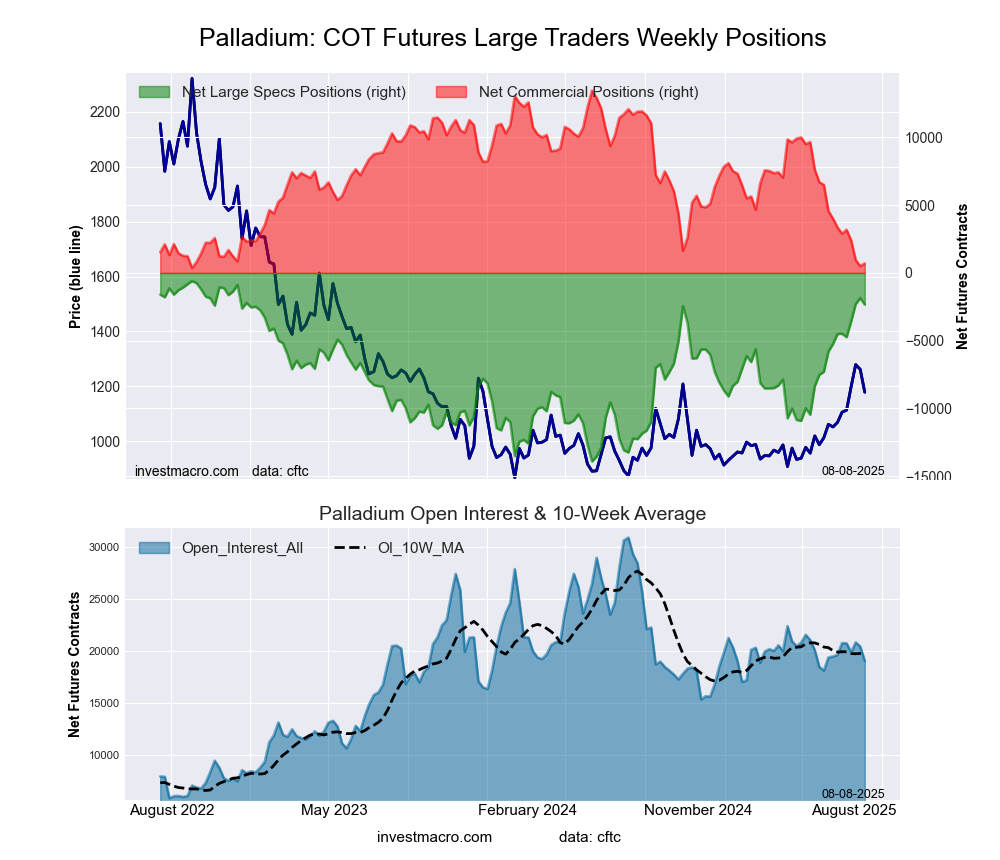
Palladium Futures COT ChartThe Palladium Futures large speculator standing this week was a net position of -3,496 contracts in the data reported through Tuesday. This was a weekly fall of -1,161 contracts from the previous week which had a total of -2,335 net contracts.

This week’s current strength score (the trader positioning range over the past three years, measured from 0 to 100) shows the speculators are currently Bullish with a score of 78.2 percent. The commercials are Bearish-Extreme with a score of 9.1 percent and the small traders (not shown in chart) are Bullish-Extreme with a score of 100.0 percent.

Price Trend-Following Model: Uptrend

Our weekly trend-following model classifies the current market price position as: Uptrend.

Palladium Futures StatisticsSPECULATORSCOMMERCIALSSMALL TRADERS
– Percent of Open Interest Longs:39.634.115.1
– Percent of Open Interest Shorts:57.026.45.5
– Net Position:-3,4961,5581,938
– Gross Longs:8,0056,8913,049
– Gross Shorts:11,5015,3331,111
– Long to Short Ratio:0.7 to 11.3 to 12.7 to 1
NET POSITION TREND:
– Strength Index Score (3 Year Range Pct):78.29.1100.0
– Strength Index Reading (3 Year Range):BullishBearish-ExtremeBullish-Extreme
NET POSITION MOVEMENT INDEX:
– 6-Week Change in Strength Index:7.4-10.214.0


Steel Futures Futures:

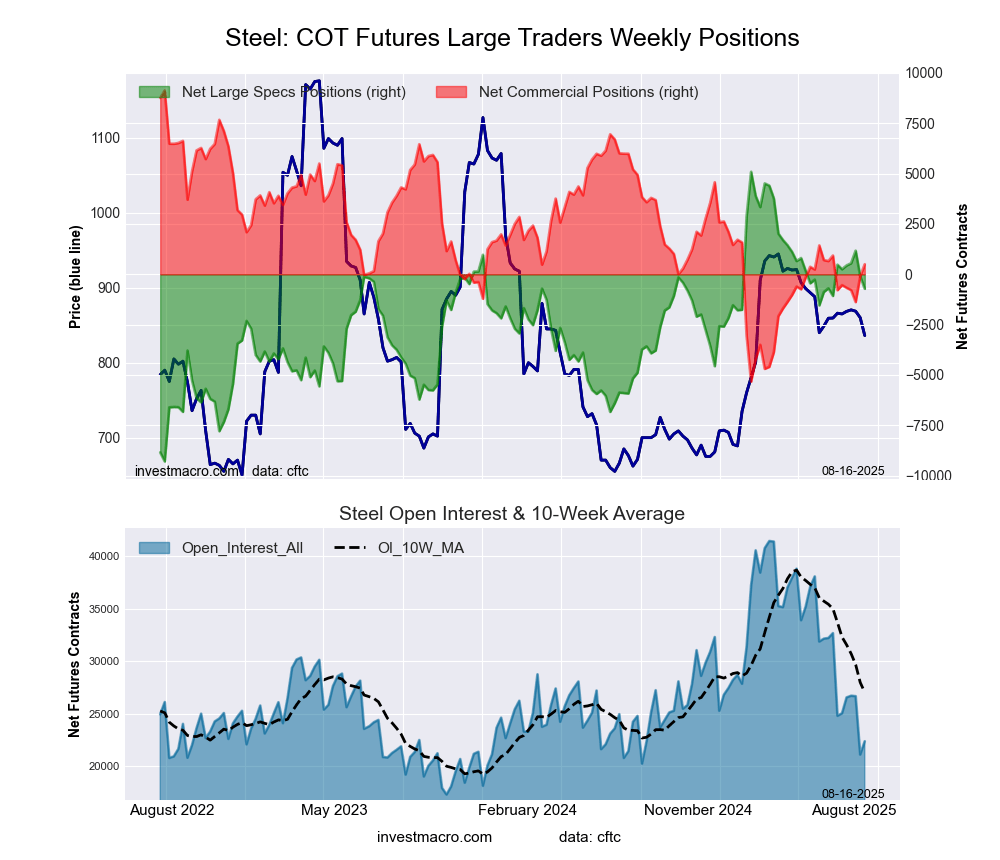
Steel Futures COT ChartThe Steel Futures large speculator standing this week was a net position of -718 contracts in the data reported through Tuesday. This was a weekly fall of -626 contracts from the previous week which had a total of -92 net contracts.

This week’s current strength score (the trader positioning range over the past three years, measured from 0 to 100) shows the speculators are currently Bullish with a score of 59.6 percent. The commercials are Bearish with a score of 40.3 percent and the small traders (not shown in chart) are Bullish with a score of 63.6 percent.

Price Trend-Following Model: Strong Downtrend

Our weekly trend-following model classifies the current market price position as: Strong Downtrend.

Steel Futures StatisticsSPECULATORSCOMMERCIALSSMALL TRADERS
– Percent of Open Interest Longs:18.077.32.0
– Percent of Open Interest Shorts:21.275.01.0
– Net Position:-718501217
– Gross Longs:4,02317,306444
– Gross Shorts:4,74116,805227
– Long to Short Ratio:0.8 to 11.0 to 12.0 to 1
NET POSITION TREND:
– Strength Index Score (3 Year Range Pct):59.640.363.6
– Strength Index Reading (3 Year Range):BullishBearishBullish
NET POSITION MOVEMENT INDEX:
– 6-Week Change in Strength Index:-8.38.9-11.8


Article By InvestMacroReceive our weekly COT Newsletter

*COT Report: The COT data, released weekly to the public each Friday, is updated through the most recent Tuesday (data is 3 days old) and shows a quick view of how large speculators or non-commercials (for-profit traders) were positioned in the futures markets.

The CFTC categorizes trader positions according to commercial hedgers (traders who use futures contracts for hedging as part of the business), non-commercials (large traders who speculate to realize trading profits) and nonreportable traders (usually small traders/speculators) as well as their open interest (contracts open in the market at time of reporting). See CFTC criteria here.


Supply Disruption Creates Opportunity for Lithium Co. as Prices Rally

Source: Streetwise Reports (8/15/25)

While the timing of the lithium market rebalancing remains under debate, demand growth fundamentals are undisputed. Atlas Lithium Corp. (ATLX:NASDAQ), which,, according to analyst Heiko Ihle, is poised for near-term production, might be in the right position to capture value in the next lithium bull cycle.

The prices of lithium and lithium equities rallied early this week on unexpected news that Chinese regulators shuttered operations at the Jianxiawo lepidolite (a lithium-bearing mineral) mine due to owner noncompliance with permitting requirements.

“The current situation underscores lithium’s emergence as a truly strategic commodity in the global transition to electrification, where supply disruptions can trigger immediate and substantial market reactions across multiple industries and continents,” wrote Mark Reichman, Noble Capital Markets research analyst, in an August 11 research report.

After the news, on Monday alone, the lithium spot price rose nearly 4%, and lithium producers saw their share price increase between about 9% and 20%, reported Reichman. Spot lithium was US$10,850 per metric ton at the close of trading on Tuesday, Aug. 12, up 8.5% from US$10,008 at the end of last week.

The impact, if any, the Jianxiawo shutdown will have on the global lithium oversupply is hard to quantify, given the unknowns surrounding the duration of the closure. According to Benchmark in an Aug. 12 article, lithium prices’ gain this week primarily was due to sentiment and reflects the speculative nature of lithium trading in the Asian country.

MST Financial attributed the price movement to supply concerns amid speculation that Jianxiawo could be closed for much longer than the three months its owner, Contemporary Amperex Technology Co. Ltd. (CATL:ASX), announced, as long as a year, reported Stockhead on Aug. 11. CATL is China’s largest lithium battery producer. Dr. Cam Perks, Benchmark lithium product director, told Stockhead the mine is too important to the local economy, providing 30% of supply to the area’s lithium refineries, to remain closed for a significant time period.

“The fundamentals are really still very strong, and these are anchored in some very powerful, megatrends that we see developing within the global economy: the urgent drive for climate change mitigation, the once in a generational shift in the global energy system and also the rise of energy intensive technologies such as artificial intelligence,”

Jianxiawo’s annual production of lithium carbonate equivalent, about 46,000 metric tons, is equal to about 3% of the global output forecasted for this year, Australian government data show, reported Reuters on Aug. 11.

Thus, Reichman noted, “For investors, the situation presents both opportunities and uncertainties. While the immediate supply shock has benefited lithium stockholders, the underlying fundamentals of oversupply that had previously pressured prices remain largely unchanged.”

This oversupply has persisted throughout the past 18–24 months, according to an Aug. 11 Discovery Alert article. It resulted from a large amount of capacity and production expansion during the 2011-2022 bull market. New technological advances in lithium mining bolstered output at existing operations. The oversupply conditions are still in play; global lithium production capacity is estimated to still exceed demand throughout 2025 by about 100,000–150,000 tons.

“One mine suspension alone is unlikely to rebalance the market,” the Discovery Alert article read. “The market will likely require multiple quarters of coordinated production restraint before a sustainable uptrend can develop.”

In contrast, Barry Dawes, executive chairman of Martin Place Securities, wrote in an Aug. 11 note that the needed adjustment to reduce inventory levels has happened, the lithium market has bottomed, and more than half of lithium production costs are higher than the current lithium price. Underlying demand growth is strong, and with that, prices are poised to move higher. In other words, a new lithium bull market is underway.

“Lithium has been the most hated sector in the market for some time,” wrote Dawes. “The wheel turns.”

Investing News Network (INN) wrote in a July 21 article that long-term fundamentals “promise sustained demand growth into the next decade.” Now, with digitalization (data centers) and renewable energy integration (battery energy storage systems) requiring lithium in addition to electric vehicles (EVs), demand for the metal has picked up, remains strong, and is expected to rise.

According to a BloombergNEF report in June, global EV sales are predicted to reach 22 million (22M) in 2025, up 25% from last year due to lithium-ion batteries being less expensive and greater availability of more affordable EV models.

Total global demand for lithium carbonate equivalent, reported Statista, could reach about 2,500,000 metric tons by 2030, up from 292,000 metric tons in 2020.

“The fundamentals are really still very strong, and these are anchored in some very powerful, megatrends that we see developing within the global economy: the urgent drive for climate change mitigation, the once in a generational shift in the global energy system and also the rise of energy intensive technologies such as artificial intelligence,” Paul Lusty, head of battery raw materials research at Fastmarkets, said about lithium at a July conference, INN reported.

A more favorable lithium market, including higher prices of the metal, could benefit companies in the lithium mining space. Here’s a look at one U.S.-based lithium developer:

Atlas Lithium

Atlas Lithium Corp. (ATLX:NASDAQ) is advancing its fully permitted Neves Lithium Project in Brazil. On August 4, 2025, the Company released its Definitive Feasibility Study (DFS), a nearly 500-page comprehensive technical report that establishes the foundation for the project’s anticipated strong financial returns. The study projects an 11-month payback period, a 145% internal rate of return, and a net present value exceeding $539 million. Additional details are available in the Company’s DFS filing with the SEC.

“With Atlas’ low-cost operations nearing first production, we believe that the company is well-positioned to generate strong long-term returns and provide valuable geopolitical diversification compared to other major lithium players, justifying its continued position as one of our Top Picks for 2025,” wrote Heiko Ihle, analyst at H.C. Wainwright & Co., in a July 14 research report.

Earlier this month, Atlas released a definitive feasibility study of Neves, Streetwise Reports reported. Study highlights were strong economics and a low capex. At an SC5.5 price of US$1,700 per ton (US$1,700/ton) and at a break-even SC5.5 price of US$735/ton, the project would yield a net present value of about US$540 million (US$540M) and an internal rate of return of 145%. Remaining capex to be paid is US$57.6M.

“The limited capex remaining, coupled with Neves’ status as a shovel-ready project, place Atlas in pole position to become the next lithium producer in Brazil’s lithium valley over the next year,” wrote Jake Sekelsky, analyst with Alliance Global Partners, in an Aug. 5 research report.

Streetwise Ownership Overview*

Atlas Lithium Corp. (ATLX:NASDAQ)

Retail: 52%
Insiders & Management: 27%
Strategic Investors: 11%
Institutional: 10%
52%
27%
11%
10%
*Share Structure as of 8/14/2025


Sekelsky expects Atlas to keep moving forward at Neves despite lithium market headwinds because of the project’s low cost structure and limited capex needed to take it to production. That said, the analyst expects lithium prices to start moving up as 2026 approaches, coinciding with Atlas’ project development ramp-up. Sekelsky also pointed out the expansion potential upside as Atlas could, down the line, increase plant capacity to 300,000 tons per year of SC5.5 from 150,000. Sekelsky has a Buy rating and a target price on Atlas, implying a potential return for investors of 235%.

H.C. Wainwright Analyst Ihle also rates Atlas Buy, and his target on the lithium developer suggests a possible 201% uplift, according to his report. In it, the analyst highlighted how close Atlas is to producing battery-grade spodumene concentrate and how it already secured agreements tied to future production, with Chengxin and Yahua, two major lithium companies, and Mitsui & Co. Ltd., a general trading company. Also, noted Ihle, subsidiary Atlas Critical Minerals, with about 54,000 hectares of property prospective for total rare earth oxides, titanium, graphite, and, potentially, uranium, strengthens Atlas Lithium’s position in Brazil’s critical minerals sector.

“This project complements the firm’s Neves project, as we expect the near-term cash flow to support Atlas’ long-term strategy of becoming a leading player in [the] global energy transition,” wrote Ihle.

Ownership and Share Structure

According to Atlas Lithium, its management and insiders own about 27% of the company’s shares. Strategic partners, including Mitsui & Co., hold another roughly 11%. Institutional investors own about 10%. The rest, about 52%, is in retail.

Refinitiv reports that Atlas has 19.58M outstanding shares and 11.43M free float traded shares. Its market cap is US$117.3M. Its 52-week range is US$3.54–12.48 per share.


Important Disclosures:

  1. Atlas Lithium Corp. is a billboard sponsor of Streetwise Reports and pays SWR a monthly sponsorship fee between US$4,000 and US$5,000
  2. As of the date of this article, officers and/or employees of Streetwise Reports LLC (including members of their household) own securities of Atlas Lithium Corp.
  3. Doresa Banning wrote this article for Streetwise Reports LLC and provides services to Streetwise Reports as an independent contractor.
  4.  This article does not constitute investment advice and is not a solicitation for any investment. Streetwise Reports does not render general or specific investment advice and the information on Streetwise Reports should not be considered a recommendation to buy or sell any security. Each reader is encouraged to consult with his or her personal financial adviser and perform their own comprehensive investment research. By opening this page, each reader accepts and agrees to Streetwise Reports’ terms of use and full legal disclaimer. Streetwise Reports does not endorse or recommend the business, products, services or securities of any company.

For additional disclosures, please click here.

A Big Fall Is Coming

Source: Barry Dawes (8/12/25) 

Barry Dawes of Martin Place Securities shares his thoughts on the gold sector and one stock he is looking to buy back into.

Gold has not shown any strength here.

These are not bullish market actions.

Weakness is already showing with gold, down US$22 at the time of this article.

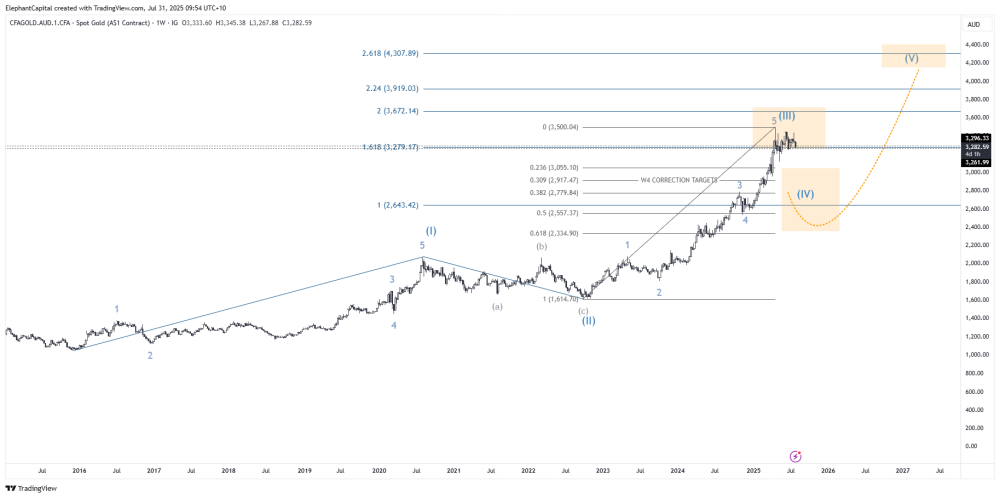
A big fall is coming.

An interesting EW view from @ElephantCapita2

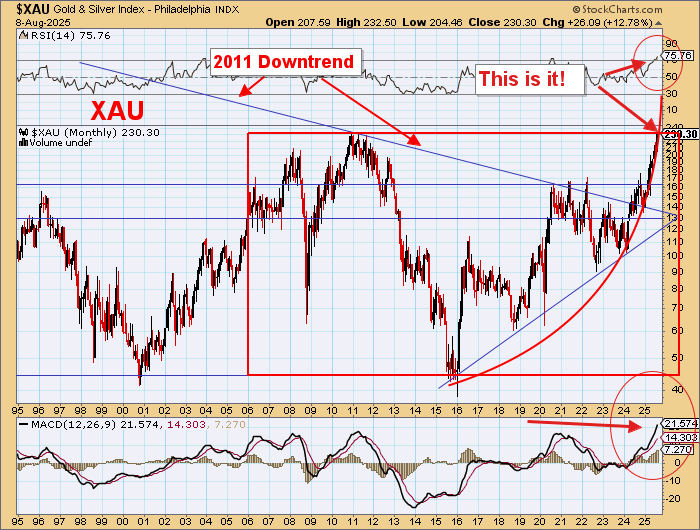
Wave 4 correction coming.

Would give 160 on XAU, then new highs coming.

Wait for re-entry to our best big gold stocks.

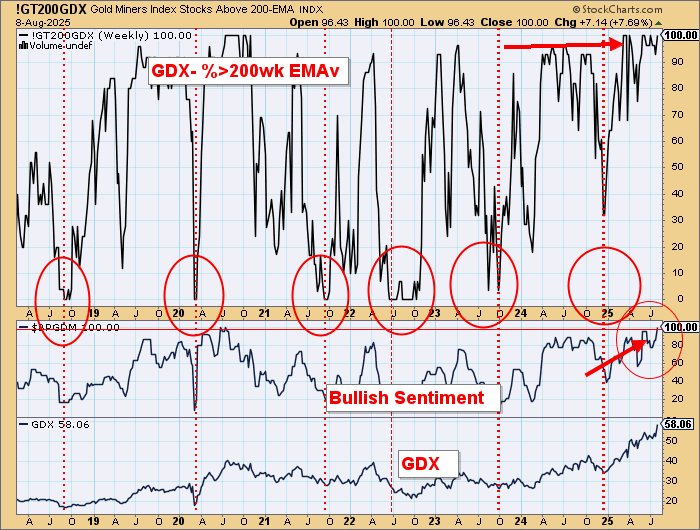
North American Gold Stocks

This is one for the history books.

100% ratings here!

Too much enthusiasm here:

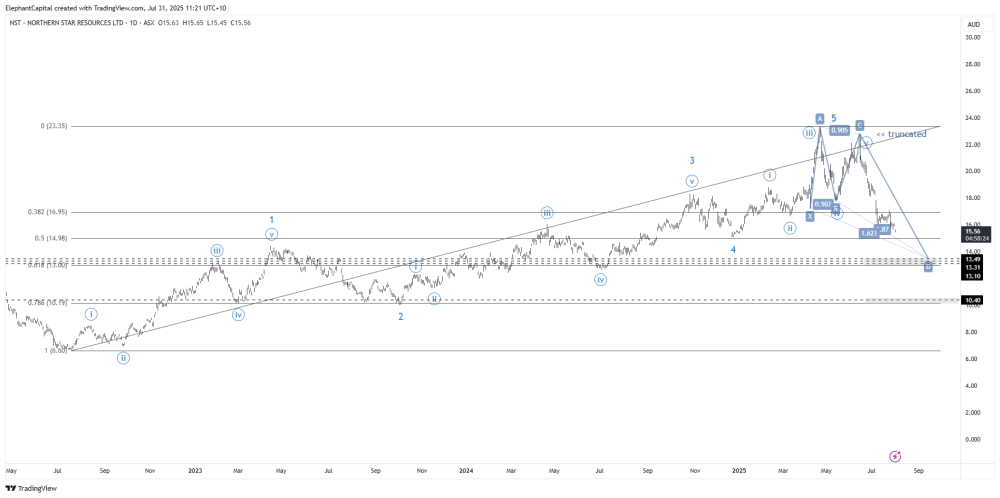
Here likely to pull back to at least 10. Up 70$ in 2025, and up 120% in 18 months.

Look to buy back into Northern Star Resources Ltd. (NST:ASX) below AU$13 sometime in September or October.

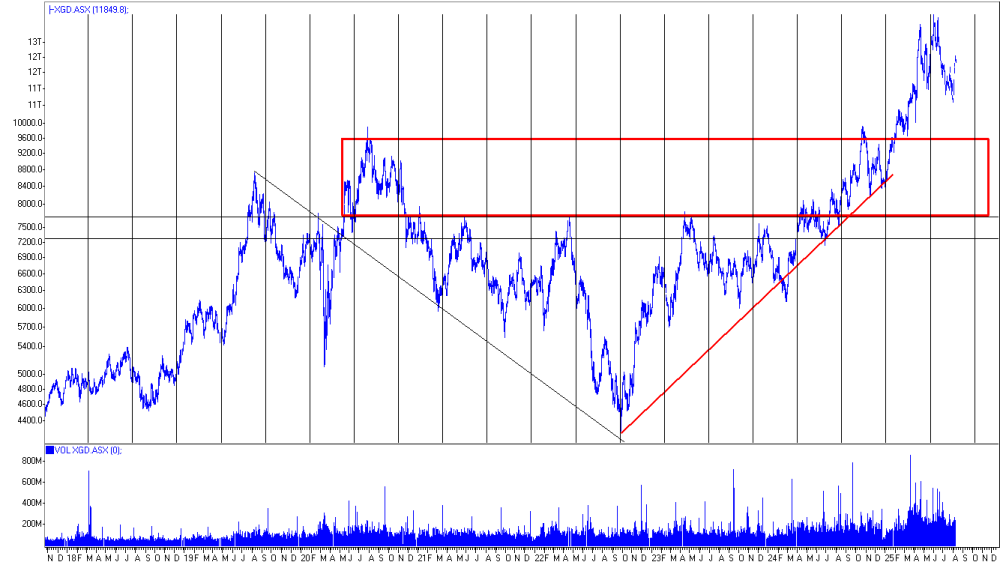
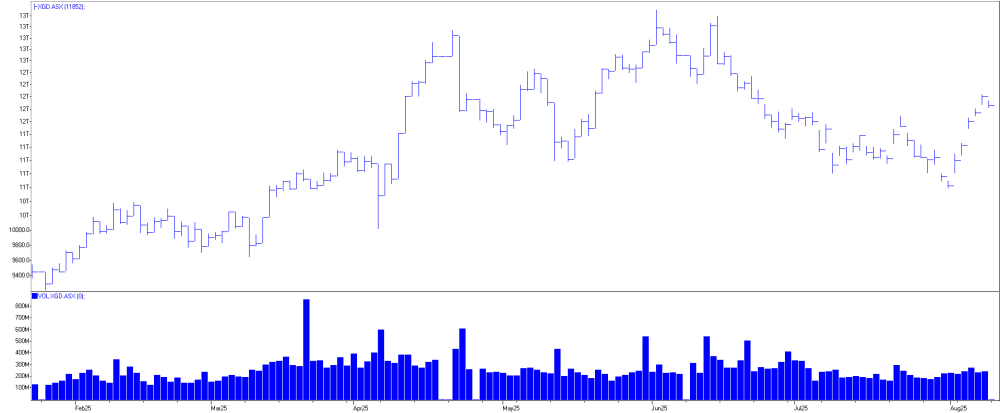
ASX Gold Sector

ASX gold index is back to 10,000.

There are too many gaps in the ASX gold index.

Head the markets!


Important Disclosures:

  1. Barry Dawes: I, or members of my immediate household or family, own securities of: None. My company has a financial relationship with: None. My company has purchased stocks mentioned in this article for my management clients: None. I determined which companies would be included in this article based on my research and understanding of the sector.
  2. Statements and opinions expressed are the opinions of the author and not of Streetwise Reports, Street Smart, or their officers. The author is wholly responsible for the accuracy of the statements. Streetwise Reports was not paid by the author to publish or syndicate this article. Streetwise Reports requires contributing authors to disclose any shareholdings in, or economic relationships with, companies that they write about. Any disclosures from the author can be found  below. Streetwise Reports relies upon the authors to accurately provide this information and Streetwise Reports has no means of verifying its accuracy.
  3.  This article does not constitute investment advice and is not a solicitation for any investment. Streetwise Reports does not render general or specific investment advice and the information on Streetwise Reports should not be considered a recommendation to buy or sell any security. Each reader is encouraged to consult with his or her personal financial adviser and perform their own comprehensive investment research. By opening this page, each reader accepts and agrees to Streetwise Reports’ terms of use and full legal disclaimer. Streetwise Reports does not endorse or recommend the business, products, services or securities of any company.

For additional disclosures, please click here.

Gold Weakens Amid Improved Risk Appetite

By RoboForex Analytical Department

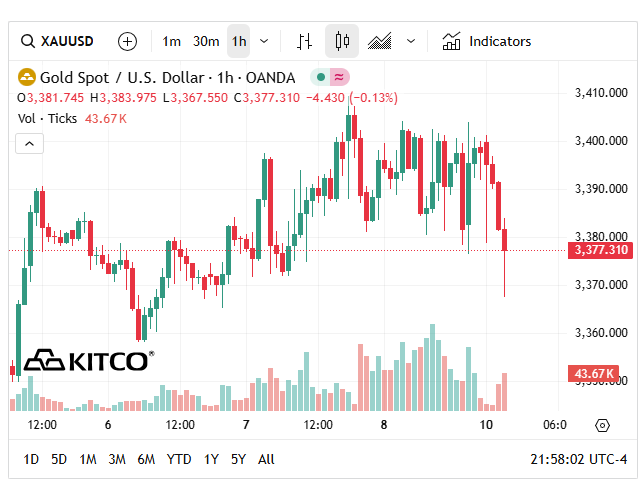
Gold opened the week lower, slipping below 3,380 USD per troy ounce on Monday, as easing geopolitical tensions reduced demand for the metal as a safe-haven asset.

On Friday, US President Donald Trump announced plans to meet Russian President Vladimir Putin in Alaska on 15 August to negotiate a ceasefire. A successful outcome could diminish the likelihood of further US sanctions against Moscow.

Despite the decline, prices found some support from lingering trade risks and growing expectations of a Fed rate cut by year-end. Last Thursday, higher US tariffs on imports from several countries came into effect, prompting the affected trade partners to seek urgent concessions.

This week, investors will focus on key US economic data, including CPI and PPI inflation figures and retail sales, to gauge the Fed’s next policy moves.

Adding to market uncertainty, the White House’s stance on gold bullion tariffs remains unclear. Last week, the US government confirmed that gold imports are subject to duties, while upcoming inflation data could influence the Fed’s rate decision.

Technical Analysis: XAU/USD

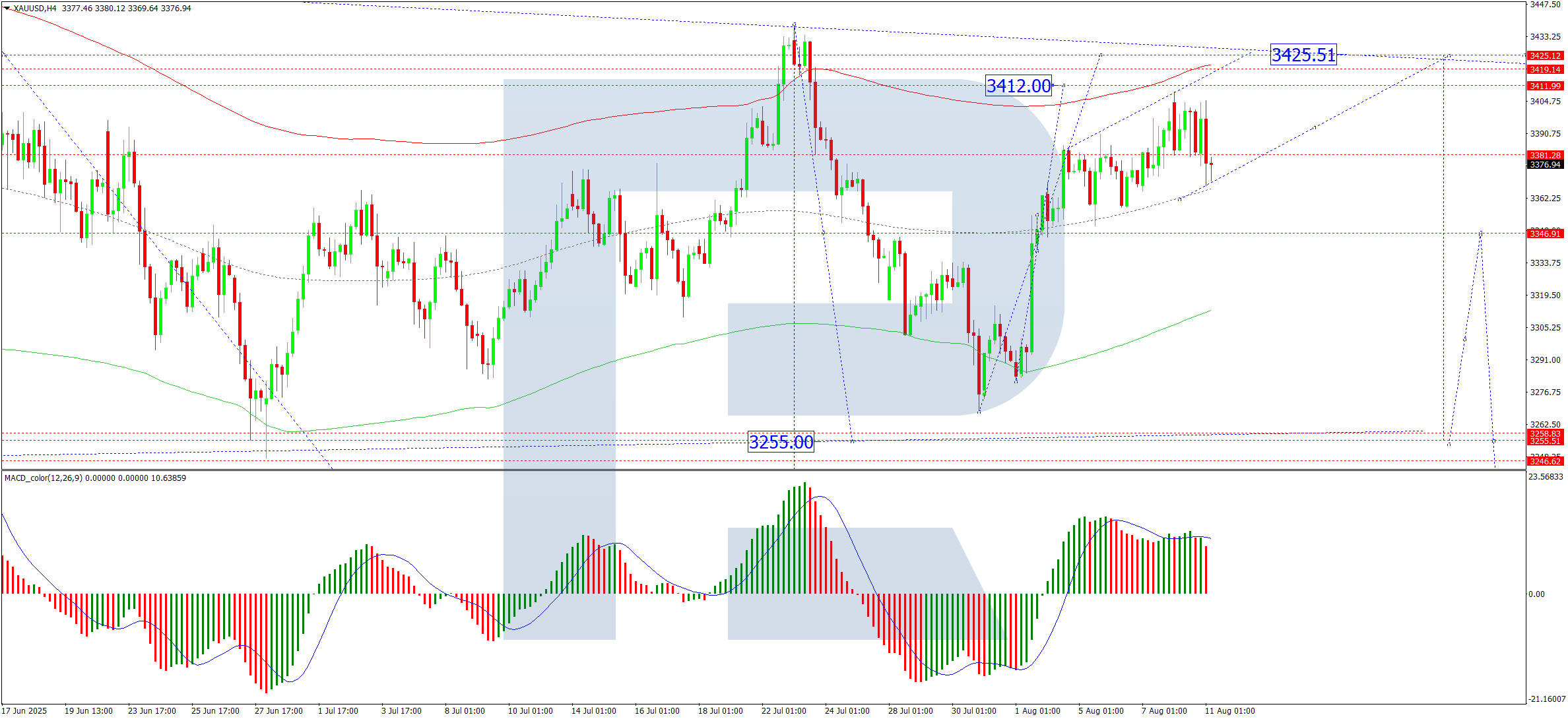
H4 Chart:

The XAU/USD pair is consolidating broadly around 3,383 USD, with recent swings extending between 3,408 USD (upper bound) and 3,367 USD (lower bound). Today, we anticipate a rise towards 3,420 USD, potentially stretching to 3,425 USD, followed by a fresh downward wave targeting 3,345 USD. A break below this level could extend losses to 3,255 USD. This outlook is supported by the MACD indicator, where the signal line remains above zero and points firmly upward.

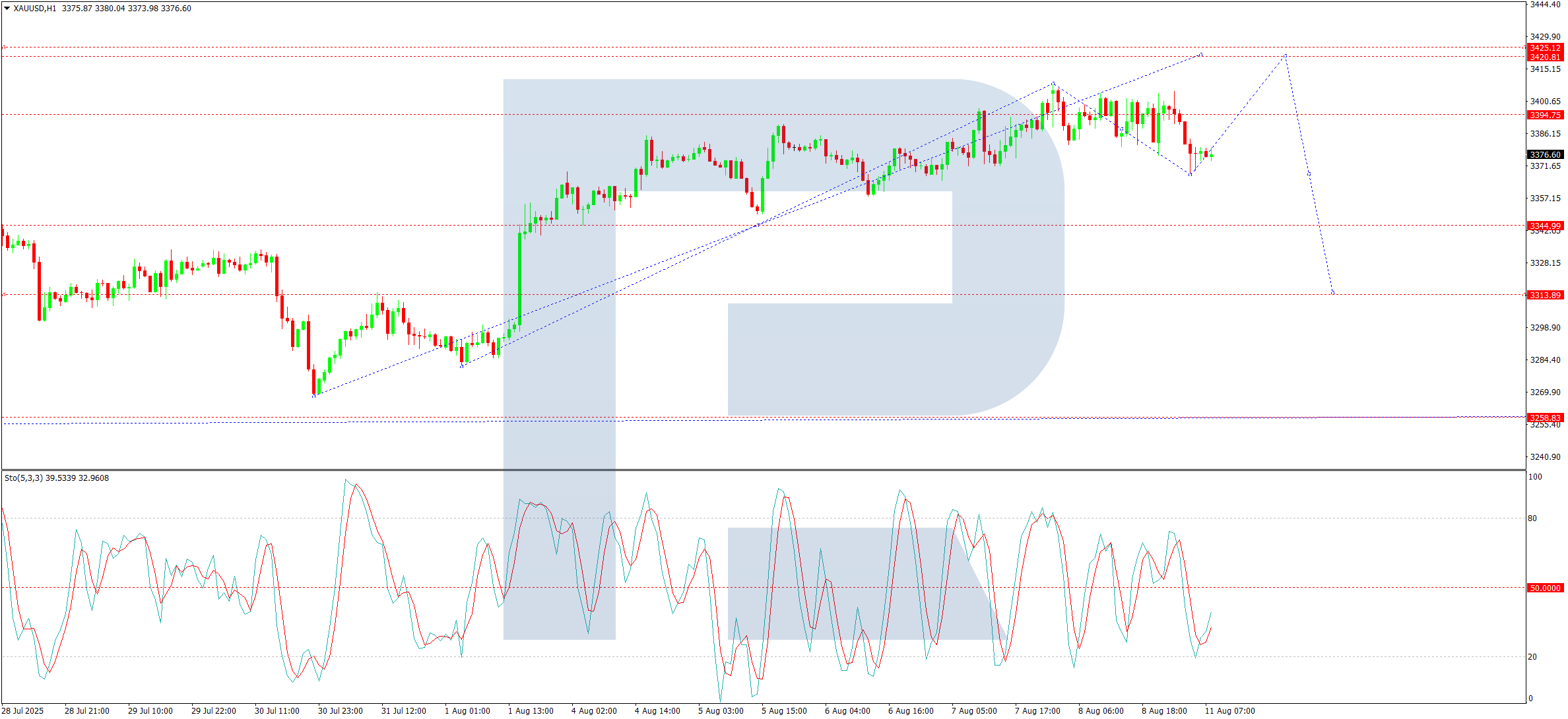
H1 Chart:

The pair has completed an upward structure to 3,408 USD, with a subsequent correction to 3,368 USD. Today, we expect a rebound towards 3,393 USD, effectively marking the consolidation range. An upside breakout could propel prices towards 3,420 USD, while a downside breakout may trigger a decline to 3,313 USD. The Stochastic oscillator corroborates this view, with its signal line below 50 and trending downward towards 20.

Conclusion

Gold remains under pressure amid reduced safe-haven demand, although trade tensions and Fed rate cut expectations provide some support. Technically, the metal faces key resistance near 3,420 USD, with a bearish reversal likely upon failure to sustain momentum.


Disclaimer

Any forecasts contained herein are based on the author’s particular opinion. This analysis may not be treated as trading advice. RoboForex bears no responsibility for trading results based on trading recommendations and reviews contained herein.

COT Metals Charts: Gold Speculator Bets up higher for 5th time in 6 weeks

By InvestMacro

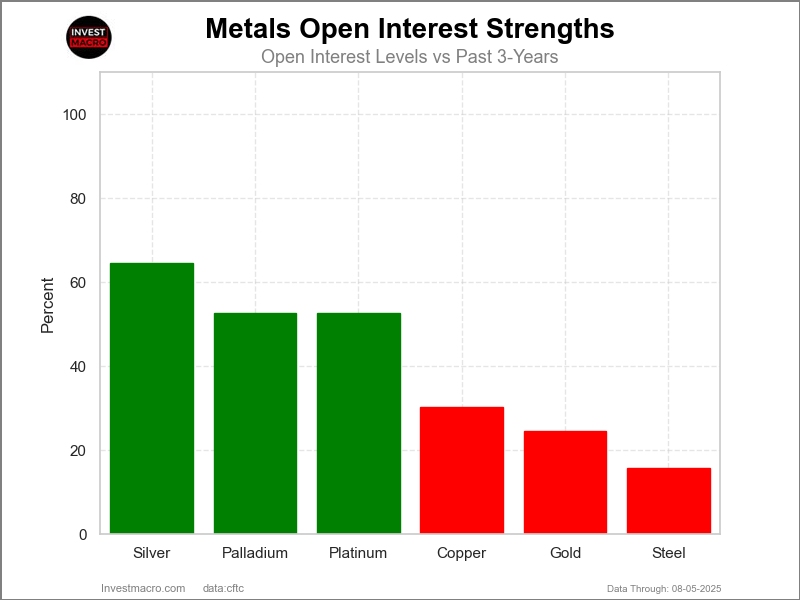
Metals Open Interest COT Chart
Here are the latest charts and statistics for the Commitment of Traders (COT) data published by the Commodities Futures Trading Commission (CFTC).

The latest COT data is updated through Tuesday August 5th and shows a quick view of how large traders (for-profit speculators and commercial entities) were positioned in the futures markets.

Weekly Speculator Changes led by Gold

Metals Net Positions COT Chart
The COT metals markets speculator bets were decisively lower this week as just one out of the six metals markets we cover had higher positioning while the other five markets had lower speculator contracts.

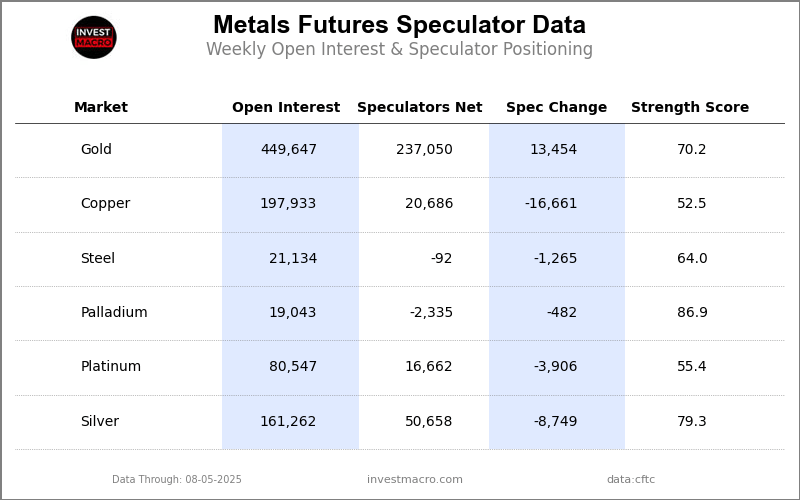
Leading the gains for the metals was Gold with a rise of 13,454 contracts on the week.

The markets with declines in speculator bets for the week were Copper (-16,661 contracts), Silver (-8,749 contracts), Platinum (-3,906 contracts), Steel (-1,265 contracts) and with Palladium (-482 contracts) also having lower bets on the week.

Gold Speculator Bets rose for 5th time in 6 weeks

Gold speculator bets rose this week for the fifth time out of the last six weeks, and for the ninth time out of the last 12 weeks. The gold speculator bets have now been over +200,000 contracts in these last six weeks after a cool off in bets from April to June that saw just one week over +200,000 speculator positions.

The gold price was up 1.25% this week, while being up only two percent over the last 30 days and higher by just under nine percent over the last 90 days.

Elsewhere, silver was the highest mover on the week with a gain of almost 4%. Platinum followed with a gain over 2%. Platinum has been up by over 40% in the last 90 days. Copper came in at just below 1% for gains this week, while Steel fell 0.70% and Palladium took a big hit by almost 7% on the week, even though Palladium is up 20% in the last 90 days.


Metals Data:

Metals Table COT Chart
Legend: Weekly Speculators Change | Speculators Current Net Position | Speculators Strength Score compared to last 3-Years (0-100 range)


Strength Scores led by Palladium & Silver

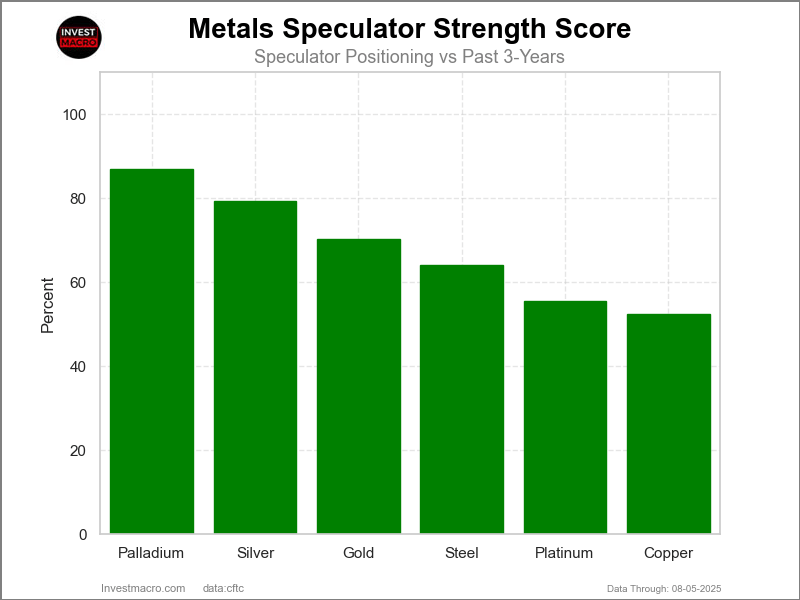
Metals Strength Scores COT Chart
COT Strength Scores (a normalized measure of Speculator positions over a 3-Year range, from 0 to 100 where above 80 is Extreme-Bullish and below 20 is Extreme-Bearish) showed that Palladium (87 percent) and Silver (79 percent) lead the metals markets this week. Gold (70 percent) comes in as the next highest in the weekly strength scores.

Strength Statistics:
Gold (70.2 percent) vs Gold previous week (65.1 percent)
Silver (79.3 percent) vs Silver previous week (90.3 percent)
Copper (52.5 percent) vs Copper previous week (68.0 percent)
Platinum (55.4 percent) vs Platinum previous week (64.6 percent)
Palladium (86.9 percent) vs Palladium previous week (90.6 percent)
Steel (64.0 percent) vs Palladium previous week (72.8 percent)


Gold & Palladium top the 6-Week Strength Trends

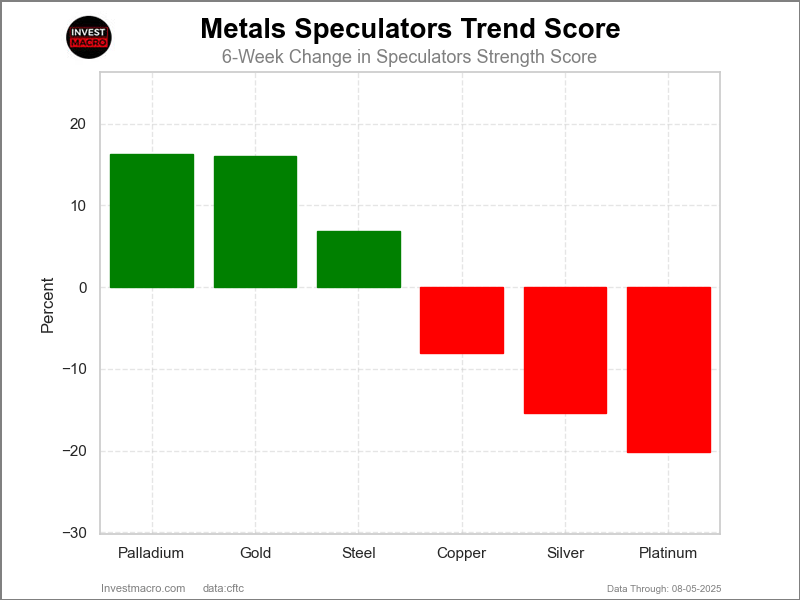
Metals Trends COT Chart
COT Strength Score Trends (or move index, calculates the 6-week changes in strength scores) showed that Gold (16 percent) and Palladium (16 percent) lead the past six weeks trends for metals. Steel (7 percent) is the next highest positive mover in the latest trends data.

Platinum (-20 percent) and Silver (-15 percent) lead the downside trend scores currently with Copper (-8 percent) as the next market with lower trend scores.

Move Statistics:
Gold (16.0 percent) vs Gold previous week (8.7 percent)
Silver (-15.4 percent) vs Silver previous week (-9.7 percent)
Copper (-8.1 percent) vs Copper previous week (12.6 percent)
Platinum (-20.2 percent) vs Platinum previous week (-6.3 percent)
Palladium (16.3 percent) vs Palladium previous week (25.5 percent)
Steel (6.8 percent) vs Steel previous week (13.0 percent)


Individual Markets:

Gold Comex Futures:

Gold Futures COT ChartThe Gold Comex Futures large speculator standing this week recorded a net position of 237,050 contracts in the data reported through Tuesday. This was a weekly boost of 13,454 contracts from the previous week which had a total of 223,596 net contracts.

This week’s current strength score (the trader positioning range over the past three years, measured from 0 to 100) shows the speculators are currently Bullish with a score of 70.2 percent. The commercials are Bearish with a score of 25.1 percent and the small traders (not shown in chart) are Bullish-Extreme with a score of 84.8 percent.

Price Trend-Following Model: Uptrend

Our weekly trend-following model classifies the current market price position as: Uptrend.

Gold Futures StatisticsSPECULATORSCOMMERCIALSSMALL TRADERS
– Percent of Open Interest Longs:65.016.511.7
– Percent of Open Interest Shorts:12.376.64.3
– Net Position:237,050-270,14633,096
– Gross Longs:292,19474,07552,597
– Gross Shorts:55,144344,22119,501
– Long to Short Ratio:5.3 to 10.2 to 12.7 to 1
NET POSITION TREND:
– Strength Index Score (3 Year Range Pct):70.225.184.8
– Strength Index Reading (3 Year Range):BullishBearishBullish-Extreme
NET POSITION MOVEMENT INDEX:
– 6-Week Change in Strength Index:16.0-14.3-8.3


Silver Comex Futures:

Silver Futures COT ChartThe Silver Comex Futures large speculator standing this week recorded a net position of 50,658 contracts in the data reported through Tuesday. This was a weekly decrease of -8,749 contracts from the previous week which had a total of 59,407 net contracts.

This week’s current strength score (the trader positioning range over the past three years, measured from 0 to 100) shows the speculators are currently Bullish with a score of 79.3 percent. The commercials are Bearish-Extreme with a score of 15.1 percent and the small traders (not shown in chart) are Bullish with a score of 75.1 percent.

Price Trend-Following Model: Strong Uptrend

Our weekly trend-following model classifies the current market price position as: Strong Uptrend.

Silver Futures StatisticsSPECULATORSCOMMERCIALSSMALL TRADERS
– Percent of Open Interest Longs:44.223.219.2
– Percent of Open Interest Shorts:12.867.95.9
– Net Position:50,658-72,22821,570
– Gross Longs:71,23437,34731,007
– Gross Shorts:20,576109,5759,437
– Long to Short Ratio:3.5 to 10.3 to 13.3 to 1
NET POSITION TREND:
– Strength Index Score (3 Year Range Pct):79.315.175.1
– Strength Index Reading (3 Year Range):BullishBearish-ExtremeBullish
NET POSITION MOVEMENT INDEX:
– 6-Week Change in Strength Index:-15.411.39.9


Copper Grade #1 Futures:

Copper Futures COT ChartThe Copper Grade #1 Futures large speculator standing this week recorded a net position of 20,686 contracts in the data reported through Tuesday. This was a weekly reduction of -16,661 contracts from the previous week which had a total of 37,347 net contracts.

This week’s current strength score (the trader positioning range over the past three years, measured from 0 to 100) shows the speculators are currently Bullish with a score of 52.5 percent. The commercials are Bearish with a score of 42.2 percent and the small traders (not shown in chart) are Bullish-Extreme with a score of 90.8 percent.

Price Trend-Following Model: Weak Uptrend

Our weekly trend-following model classifies the current market price position as: Weak Uptrend.

Copper Futures StatisticsSPECULATORSCOMMERCIALSSMALL TRADERS
– Percent of Open Interest Longs:27.833.310.2
– Percent of Open Interest Shorts:17.349.84.1
– Net Position:20,686-32,76212,076
– Gross Longs:54,92965,90320,148
– Gross Shorts:34,24398,6658,072
– Long to Short Ratio:1.6 to 10.7 to 12.5 to 1
NET POSITION TREND:
– Strength Index Score (3 Year Range Pct):52.542.290.8
– Strength Index Reading (3 Year Range):BullishBearishBullish-Extreme
NET POSITION MOVEMENT INDEX:
– 6-Week Change in Strength Index:-8.1-0.959.3


Platinum Futures:

Platinum Futures COT ChartThe Platinum Futures large speculator standing this week recorded a net position of 16,662 contracts in the data reported through Tuesday. This was a weekly reduction of -3,906 contracts from the previous week which had a total of 20,568 net contracts.

This week’s current strength score (the trader positioning range over the past three years, measured from 0 to 100) shows the speculators are currently Bullish with a score of 55.4 percent. The commercials are Bearish with a score of 41.4 percent and the small traders (not shown in chart) are Bullish with a score of 71.6 percent.

Price Trend-Following Model: Uptrend

Our weekly trend-following model classifies the current market price position as: Uptrend.

Platinum Futures StatisticsSPECULATORSCOMMERCIALSSMALL TRADERS
– Percent of Open Interest Longs:57.219.112.8
– Percent of Open Interest Shorts:36.547.74.9
– Net Position:16,662-22,9996,337
– Gross Longs:46,06715,41410,274
– Gross Shorts:29,40538,4133,937
– Long to Short Ratio:1.6 to 10.4 to 12.6 to 1
NET POSITION TREND:
– Strength Index Score (3 Year Range Pct):55.441.471.6
– Strength Index Reading (3 Year Range):BullishBearishBullish
NET POSITION MOVEMENT INDEX:
– 6-Week Change in Strength Index:-20.215.916.5


Palladium Futures:

Palladium Futures COT ChartThe Palladium Futures large speculator standing this week recorded a net position of -2,335 contracts in the data reported through Tuesday. This was a weekly decrease of -482 contracts from the previous week which had a total of -1,853 net contracts.

This week’s current strength score (the trader positioning range over the past three years, measured from 0 to 100) shows the speculators are currently Bullish-Extreme with a score of 86.9 percent. The commercials are Bearish-Extreme with a score of 2.6 percent and the small traders (not shown in chart) are Bullish-Extreme with a score of 100.0 percent.

Price Trend-Following Model: Uptrend

Our weekly trend-following model classifies the current market price position as: Uptrend.

Palladium Futures StatisticsSPECULATORSCOMMERCIALSSMALL TRADERS
– Percent of Open Interest Longs:42.334.115.0
– Percent of Open Interest Shorts:54.530.56.4
– Net Position:-2,3357011,634
– Gross Longs:8,0486,5022,850
– Gross Shorts:10,3835,8011,216
– Long to Short Ratio:0.8 to 11.1 to 12.3 to 1
NET POSITION TREND:
– Strength Index Score (3 Year Range Pct):86.92.6100.0
– Strength Index Reading (3 Year Range):Bullish-ExtremeBearish-ExtremeBullish-Extreme
NET POSITION MOVEMENT INDEX:
– 6-Week Change in Strength Index:16.3-20.321.8


Steel Futures Futures:

Steel Futures COT ChartThe Steel Futures large speculator standing this week recorded a net position of -92 contracts in the data reported through Tuesday. This was a weekly reduction of -1,265 contracts from the previous week which had a total of 1,173 net contracts.

This week’s current strength score (the trader positioning range over the past three years, measured from 0 to 100) shows the speculators are currently Bullish with a score of 64.0 percent. The commercials are Bearish with a score of 36.2 percent and the small traders (not shown in chart) are Bullish with a score of 60.7 percent.

Price Trend-Following Model: Downtrend

Our weekly trend-following model classifies the current market price position as: Downtrend.

Steel Futures StatisticsSPECULATORSCOMMERCIALSSMALL TRADERS
– Percent of Open Interest Longs:19.173.81.8
– Percent of Open Interest Shorts:19.574.30.9
– Net Position:-92-101193
– Gross Longs:4,03915,607387
– Gross Shorts:4,13115,708194
– Long to Short Ratio:1.0 to 11.0 to 12.0 to 1
NET POSITION TREND:
– Strength Index Score (3 Year Range Pct):64.036.260.7
– Strength Index Reading (3 Year Range):BullishBearishBullish
NET POSITION MOVEMENT INDEX:
– 6-Week Change in Strength Index:6.8-7.16.3


Article By InvestMacroReceive our weekly COT Newsletter

*COT Report: The COT data, released weekly to the public each Friday, is updated through the most recent Tuesday (data is 3 days old) and shows a quick view of how large speculators or non-commercials (for-profit traders) were positioned in the futures markets.

The CFTC categorizes trader positions according to commercial hedgers (traders who use futures contracts for hedging as part of the business), non-commercials (large traders who speculate to realize trading profits) and nonreportable traders (usually small traders/speculators) as well as their open interest (contracts open in the market at time of reporting). See CFTC criteria here.
Gold Holds Near Two-Week High

By RoboForex Analytical Department

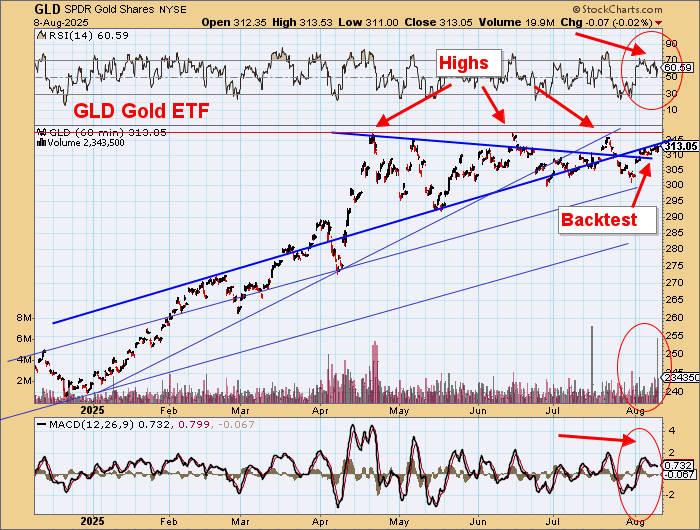
On Wednesday, the price of gold dipped to 3,375 USD per troy ounce but remained close to a two-week high, retaining most of its recent gains.

The market remains buoyed by demand for defensive assets amid expectations of a more dovish Federal Reserve policy.

The previous day saw the release of US ISM data, which showed the services sector business activity index for July falling to 50.1 points – below forecasts. The figures indicated sluggish growth, slowing employment, and mounting price pressures. Earlier data also pointed to a weakening labour market and declining consumer spending.

These developments have bolstered expectations that the Fed may cut interest rates as early as September, with markets now pricing in a 90% probability of such a move.

Further support for gold comes from new trade tariffs announced by US President Donald Trump, alongside investor concerns over the Federal Reserve’s independence following the resignation of Board of Governors member Lisa Kugler. Her departure paves the way for Trump to appoint a more accommodative successor.

Technical Analysis: XAU/USD

H4 Chart:

The XAU/USD pair is forming a broad consolidation range around 3,346 USD on the H4 chart. The market has corrected to 3,390 USD. Today, we assess the likelihood of a new downward wave developing towards 3,333 USD. A break below this level could extend the decline to a minimum of 3,255 USD. This scenario is technically supported by the MACD indicator, where the signal line remains above zero near recent highs but shows signs of an impending downturn.

H1 Chart:

On the H1 chart, the market has completed a corrective structure to 3,390 USD. A consolidation range is now forming below this level, with a downward breakout likely to extend the decline towards 3,320 USD. A breach of this support could signal further downside momentum, potentially targeting 3,200 USD. The Stochastic oscillator corroborates this outlook, with its signal line below 50 and trending sharply downward towards 20.

Conclusion

Gold remains resilient near recent highs, supported by macroeconomic uncertainties and shifting Federal Reserve expectations. However, technical indicators suggest potential near-term downside, with key support levels at 3,333 USD (H4) and 3,320 USD (H1) in focus.


Disclaimer

Any forecasts contained herein are based on the author’s particular opinion. This analysis may not be treated as trading advice. RoboForex bears no responsibility for trading results based on trading recommendations and reviews contained herein.

What’s Next For Gold?

Source: Adrian Day (7/29/25)

Global Analyst Adrian Day reviews initial results from Altius Minerals Corp. (ALS:TSX) and takes a look at gold and gold stocks.

Altius Minerals Corp. (ALS:TSX) reported royalty revenue lower than both the previous and the year-ago quarter, as well as below estimates. Attributable revenue fell CA$2.3 million from CA$15 million in the first quarter, largely due to weak iron ore royalties, which accounted for CA$1.7 million of the decline.

Base metals revenue also fell due mostly to the timing of deliveries; potash was also down due to maintenance downtime. Given the temporary nature of these issues and higher prices, we expect both segments to recovery this quarter. These three areas were also down relative to the year-ago quarter, with iron ore revenue falling from a particularly strong $4.1 million to $1.1million.

Overall, revenue fell from over $20 million in the year-ago quarter to $12.7 million last quarter. Renewable energy saw high revenue as projects ramp up. The near-term focus continues to be the disposition of Altius’ 1.5% royalty on Anglo’s Arthur Deposit, with a pro forma value, based on the sale of Orogen’s similar 1% royalty, of CA$515 million, or just over 40% of Altius’ market cap.

Altius remains a Buy based on its NAV and potential gains from the sale of its Arthur royalty (or more).

TOP PICKS this week, in addition to above, include Nestle SA (NESN:VX; NSRGY:OTC), Franco-Nevada Corp. (FNV:TSX; FNV:NYSE), Royal Gold Inc. (RGLD:NASDAQ), and Fox River Resources Corp. (FOX:CSE).

THE U.S. DOLLAR After falling 11% in the first half, the worst first-half since 1973, the dollar is oversold; we should not expect another imminent sharp decline; markets don’t move in straight lines. However, a recovery may be slow and modest rather than any V-shaped rebound. Tariffs and other policies are making foreign investors reduce exposure to U.S. assets. When a foreigner buys, for example, U.S. stocks, bonds, or real estate, he must first convert his currency into dollars, boosting the dollar. A reduced appetite for U.S. assets, therefore, reduces demand for dollars. We are not forecasting a dollar collapse any time soon — other major currencies hardly represent fiscal rectitude — but at the margin, appetite for the Euro, British pound, yen, and commodity currencies (including the Canadian dollar, already up this year from 0.69 cents to 73) will increase, along with an increased demand for gold.

Gold Buying Trends and Stock Valuations

Central bank buying picked up in May, as gross sales declined meaningfully, the latest month for which data is available; though above multi-year levels, buying remains below the levels of 2023 and 2024. The People’s Bank of China added for the seventh straight month, after a pause last fall. Meanwhile, Chinese non-official buying, including inflows to China gold ETFs, has dwindled to almost nothingness, after surging earlier in the year. Global ETF inflows have picked up, however, the remain soft in the U.S. There were some inflows in the first three weeks of June, but then buying fell off again, with the largest ETF, GLD, seeing over $900 million in net outflows since June 24th. Commodity traders continue to be positive, but have reduced their positions all year (to little more than half of the February peak).

A record 95% of central banks expect global gold reserves to increase over the next 12 months, while none expects a decrease, this according to a survey from the World Gold Council. Over 40% of respondents expected their own reserves to increase, and none a decrease. After another strong quarter of central bank buying, gold is now the second-largest reserve asset, surpassing the Euro.

Main Drivers of Gold Remain Intact

For now, the major driver of gold buying revolves around possible changes in the global monetary regime, most notably central bank diversification in the face of dollar weaponization. Nothing that has happened this year diminishes that drive. Given this, it makes sense that U.S. demand has been weak, since concerns about monetary regime changes are more muted. But a major and long-lasting change in that regime, with the U.S. dollar losing its status as the sole reserve currency, along with less willingness to hold dollars internationally, most assuredly will have a significant impact on the U.S. economy and investor sentiment (cf. Britain in the 1950s to 1970s, when the pound fell from being worth five dollars to par, before Margaret Thatcher rescued the country).

There have been other factors supporting gold, of course, as diverse as the Trump-Powell tiff and the Middle East. But we have yet to see the macroeconomic environment, the things that traditionally drive gold, turn in gold’s favor. The U.S. has been characterized by a strong economy, low and falling inflation, high interest rates (and positive real rates), and, until this year, a relatively strong dollar. This is precisely the opposite of the environment conducive to gold. All of this is changing, if slowly, and as the narrative shifts, U.S. interest in gold will increase.

Gold Stock Sentiment Remains Weak

Add to the economic environment the fact that the S&P continues to go up month after month (as does the so-called Magnificent 7, despite some individual names stumbling), means that investors do not see the need to buy gold stocks. After a minor flurry into gold miner ETFs in late May early June, the flows reversed, with the GDX seeing $570 million of outflows in the past month, over $3.4 billion for the year to date. The dichotomy between prices and flows has never been greater.

Generalist interest is even weaker. Almost 80% of investment advisors have been zero and 1% exposure to gold in accounts they manage (and I bet for most of them, it’s close to zero than to 1%). Non-gold mutual funds have virtually no exposure. A total of 322 of the largest funds holds just 35 gold stocks. Only three funds own GLD among their top 20 positions, four own Newmont, and one owns Barrick.

Crowded Trade? Anything But

Staggeringly and unbelievably, global fund managers think that gold is the “most crowded” trade, according to a survey from Bank of America, with 58% of managers choosing gold against 22% saying the Magnificent 7, and only 1% saying the U.S. two-year Treasury. The number selecting gold (in May, the latest month) was up on April, despite the flat gold price since then. This is a reflection of managers who missed the bull move, in my view.

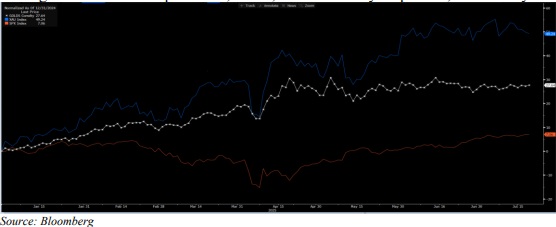
S&P investors, of course, are already lagging, with not only gold stocks but gold itself beating the S&P over the past four-, three-, two- and one-year periods, as well as year to Source: Bloomberg Date, and increasingly handsomely so (with the XAU up over 50% this year against less than 8% for the S&P, including dividends). In the graph are gold (white), the XAU (blue) and the S&P (red) year to date.

Gold Stocks Remain Undervalued, as Value Increases

Oscar Wilde berated those who know the price of everything but the value of nothing. Certainly, the 50% plus increase in the XAU indices this year has led many to instinctively think that the gold stocks are expensive. But the stocks are still extremely undervalued.

As the price of gold moves up, from the low $1,600s less than three years ago, to today $3,350, the value of the gold in the ground moves up; the price-to-NAV has therefore not increased over that period. As the price of gold has moved up far more rapidly than the cost of mining, the margins have expanded and with it corporate cash flows increased; thus the price-to-cash flow multiples have declined.

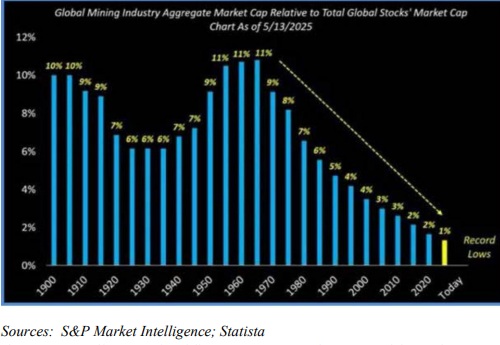
So we see the gold-standard of mining companies, Agnico Eagle Mines Ltd. (AEM:TSX; AEM:NYSE), trading in its lowest quartile of price-to-cash flow metric in 40 years; while Barrick Mining Corp. (ABX:TSX; B:NYSE), the #2 gold producer, is trading in the lowest decile of price-to-NAV in its history. Normally, when the price of the commodity goes up, we expect to see multiple expansion not contraction. Commodity prices are trading at 100-year lows relative to U.S. stocks. The same is true of mining stocks generally,

Sources: S&P Market Intelligence; Statista not only gold stocks; they are trading at significant 100-year lows, and less than 10% of their late-1960 relative valuation peaks.


Important Disclosures:

  1. As of the date of this article, officers and/or employees of Streetwise Reports LLC (including members of their household) own securities of Altius Minerals Corp., Franco-Nevada Corp., Fox Riv Res Corp., Agnico Eagle Mines Limited, and Barrick Mng Corp.
  2. Adrian Day: I, or members of my immediate household or family, own securities of: All. My company has a financial relationship with: None.  My company has purchased stocks mentioned in this article for my management clients: All.  I determined which companies would be included in this article based on my research and understanding of the sector.
  3. Statements and opinions expressed are the opinions of the author and not of Streetwise Reports, Street Smart, or their officers. The author is wholly responsible for the accuracy of the statements. Streetwise Reports was not paid by the author to publish or syndicate this article. Streetwise Reports requires contributing authors to disclose any shareholdings in, or economic relationships with, companies that they write about. Any disclosures from the author can be found  below. Streetwise Reports relies upon the authors to accurately provide this information and Streetwise Reports has no means of verifying its accuracy.
  4.  This article does not constitute investment advice and is not a solicitation for any investment. Streetwise Reports does not render general or specific investment advice and the information on Streetwise Reports should not be considered a recommendation to buy or sell any security. Each reader is encouraged to consult with his or her personal financial adviser and perform their own comprehensive investment research. By opening this page, each reader accepts and agrees to Streetwise Reports’ terms of use and full legal disclaimer. Streetwise Reports does not endorse or recommend the business, products, services or securities of any company.

For additional disclosures, please click here.

Adrian Day Disclosures

Adrian Day’s Global Analyst is distributed for $990 per year by Investment Consultants International, Ltd., P.O. Box 6644, Annapolis, MD 21401. (410) 224-8885. www.AdrianDayGlobalAnalyst.com. Publisher: Adrian Day. Owner: Investment Consultants International, Ltd. Staff may have positions in securities discussed herein. Adrian Day is also President of Global Strategic Management (GSM), a registered investment advisor, and a separate company from this service. In his capacity as GSM president, Adrian Day may be buying or selling for clients securities recommended herein concurrently, before or after recommendations herein, and may be acting for clients in a manner contrary to recommendations herein. This is not a solicitation for GSM. Views herein are the editor’s opinion and not fact. All information is believed to be correct, but its accuracy cannot be guaranteed. The owner and editor are not responsible for errors and omissions. © 2023. Adrian Day’s Global Analyst. Information and advice herein are intended purely for the subscriber’s own account. Under no circumstances may any part of a Global Analyst e-mail be copied or distributed without prior written permission of the editor. Given the nature of this service, we will pursue any violations aggressively.

Gold Declines as EU Strikes Trade Deal

By RoboForex Analytical Department

Gold held steady at $3,330 per troy ounce on Monday following three consecutive days of declines. The metal faced downward pressure after news emerged of a trade agreement between the US and the EU, dampening investor interest in safe-haven assets.

On Sunday, the US and EU reached a broad trade deal, which includes a 15% tariff on most European goods, alongside commitments to invest hundreds of billions of dollars in American industry. This agreement mirrors last week’s US–Japan trade pact in structure.

Traders are now bracing for a busy week of economic events, with the Federal Reserve meeting at the centre of attention. While interest rates are expected to remain unchanged, markets will scrutinise any signals about a potential rate cut in September.

Key US labour market data will also be in focus, including JOLTS reports, ADP employment figures, and the crucial nonfarm payrolls release. Equally significant will be the PCE price index – the Fed’s preferred inflation gauge – which will indicate whether price pressures are intensifying amid new tariffs.

Technical Analysis: XAU/USD

H4 Chart:

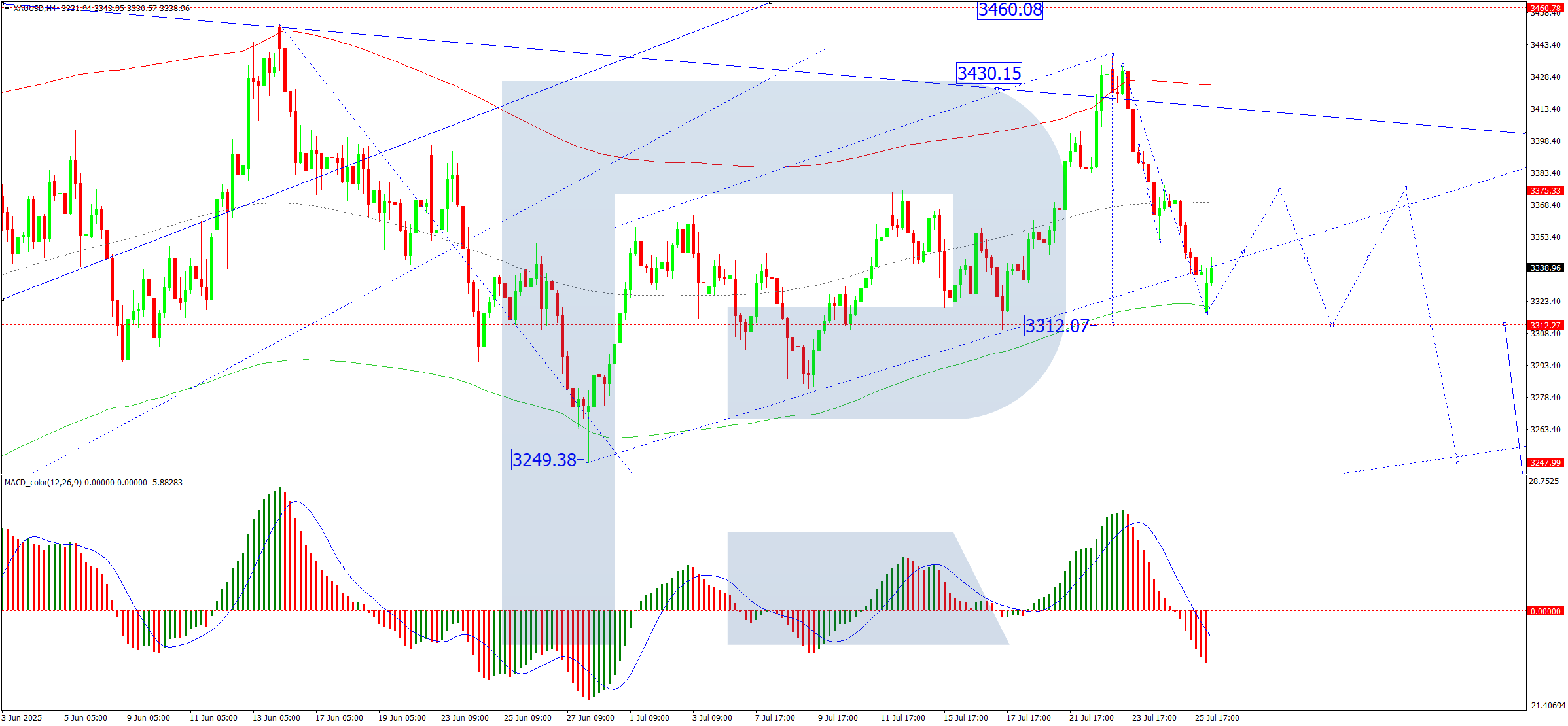
The H4 chart shows XAU/USD forming a broad consolidation range around 3,375. After breaking downward today, the market reached its local downside target at 3,318. Following this, we anticipate a possible upward correction towards 3,375 (testing from below), before a renewed decline towards 3,312. This scenario is supported by the MACD indicator, with its signal line below zero and pointing sharply downward.

H1 Chart:

On the H1 chart, the market has achieved its local decline target at 3,318. Currently, an upward impulse is forming towards 3,349. A consolidation range near 3,346 may develop, with an upside breakout potentially extending gains to 3,375. Thereafter, a new downward wave towards 3,312 could emerge. The Stochastic oscillator aligns with this outlook, as its signal line is above 50 and rising sharply towards 80.

Conclusion

Gold remains under pressure amid shifting global trade dynamics, with technical indicators suggesting further volatility ahead. Traders should monitor key US data releases and signals from the Fed for directional cues.


Disclaimer

Any forecasts contained herein are based on the author’s particular opinion. This analysis may not be treated as trading advice. RoboForex bears no responsibility for trading results based on trading recommendations and reviews contained herein.

COT Metals Charts: Gold Speculator Bets rise to highest since March

By InvestMacro

Metals Open Interest COT Chart
Here are the latest charts and statistics for the Commitment of Traders (COT) data published by the Commodities Futures Trading Commission (CFTC).

The latest COT data is updated through Tuesday July 22nd and shows a quick view of how large traders (for-profit speculators and commercial entities) were positioned in the futures markets.

Weekly Speculator Changes led by Gold & Steel

Metals Net Positions COT Chart
The COT metals markets speculator bets were decisively higher this week as five out of the six metals markets we cover had higher positioning while the other one markets had lower speculator contracts.

Leading the gains for the metals was Gold (39,923 contracts) with Platinum (1,373 contracts), Palladium (1,281 contracts), Silver (1,172 contracts) and Steel (112 contracts) also seeing positive weeks.

The only market with a decline in speculator bets for the week was Copper with a dip by -902 contracts.

Gold Speculator Bets rise to highest since March

The gold speculator position rose this week for a fourth consecutive week and for the eighth time in the past ten weeks. This week’s boost by +39,923 contracts marked the highest one-week gain in over a year and brings the 10-week advance by speculator bets to over +91,000 contracts.

This boost in speculator bets for gold puts the current speculator net position, currently at +253,038 contracts, at the highest level in the past 18 weeks, dating back to March 18th.

Major metals prices this week were mixed

– Copper rose by over 3% for the week.
– Steel went higher by over 1.3%.
– Silver also saw just a small gain.
– Gold was down by -0.32%.
– Palladium and Platinum fell by almost -2% over the past week.


Metals Data:

Metals Table COT Chart
Legend: Weekly Speculators Change | Speculators Current Net Position | Speculators Strength Score compared to last 3-Years (0-100 range)


Strength Scores led by Silver & Palladium

Metals Strength Scores COT Chart
COT Strength Scores (a normalized measure of Speculator positions over a 3-Year range, from 0 to 100 where above 80 is Extreme-Bullish and below 20 is Extreme-Bearish) showed that Silver (92 percent) and Palladium (87 percent) lead the metals markets this week. Gold (76 percent) comes in as the next highest in the weekly strength scores.

Strength Statistics:
Gold (76.3 percent) vs Gold previous week (61.2 percent)
Silver (91.8 percent) vs Silver previous week (90.3 percent)
Copper (70.3 percent) vs Copper previous week (71.2 percent)
Platinum (64.8 percent) vs Platinum previous week (61.6 percent)
Palladium (87.2 percent) vs Palladium previous week (77.6 percent)
Steel (68.4 percent) vs Palladium previous week (67.7 percent)


Palladium & Gold top the 6-Week Strength Trends

Metals Trends COT Chart
COT Strength Score Trends (or move index, calculates the 6-week changes in strength scores) showed that Palladium (26 percent) and Gold (25 percent) lead the past six weeks trends for metals. Copper (13 percent) is the next highest positive mover in the latest trends data.

Platinum (-15 percent) leads the downside trend scores currently with Silver (-8 percent) as the next market with lower trend scores.

Move Statistics:
Gold (24.9 percent) vs Gold previous week (9.6 percent)
Silver (-7.5 percent) vs Silver previous week (-1.7 percent)
Copper (12.5 percent) vs Copper previous week (15.5 percent)
Platinum (-14.9 percent) vs Platinum previous week (-1.8 percent)
Palladium (26.3 percent) vs Palladium previous week (27.9 percent)
Steel (9.9 percent) vs Steel previous week (13.8 percent)


Individual Markets:

Gold Comex Futures:

Gold Futures COT ChartThe Gold Comex Futures large speculator standing this week totaled a net position of 253,038 contracts in the data reported through Tuesday. This was a weekly advance of 39,923 contracts from the previous week which had a total of 213,115 net contracts.

This week’s current strength score (the trader positioning range over the past three years, measured from 0 to 100) shows the speculators are currently Bullish with a score of 76.3 percent. The commercials are Bearish with a score of 20.7 percent and the small traders (not shown in chart) are Bullish with a score of 72.0 percent.

Price Trend-Following Model: Uptrend

Our weekly trend-following model classifies the current market price position as: Uptrend.

Gold Futures StatisticsSPECULATORSCOMMERCIALSSMALL TRADERS
– Percent of Open Interest Longs:63.715.711.0
– Percent of Open Interest Shorts:12.073.45.1
– Net Position:253,038-282,33729,299
– Gross Longs:311,94976,72654,052
– Gross Shorts:58,911359,06324,753
– Long to Short Ratio:5.3 to 10.2 to 12.2 to 1
NET POSITION TREND:
– Strength Index Score (3 Year Range Pct):76.320.772.0
– Strength Index Reading (3 Year Range):BullishBearishBullish
NET POSITION MOVEMENT INDEX:
– 6-Week Change in Strength Index:24.9-21.5-20.1


Silver Comex Futures:

Silver Futures COT ChartThe Silver Comex Futures large speculator standing this week totaled a net position of 60,620 contracts in the data reported through Tuesday. This was a weekly rise of 1,172 contracts from the previous week which had a total of 59,448 net contracts.

This week’s current strength score (the trader positioning range over the past three years, measured from 0 to 100) shows the speculators are currently Bullish-Extreme with a score of 91.8 percent. The commercials are Bearish-Extreme with a score of 7.4 percent and the small traders (not shown in chart) are Bullish with a score of 60.7 percent.

Price Trend-Following Model: Strong Uptrend

Our weekly trend-following model classifies the current market price position as: Strong Uptrend.

Silver Futures StatisticsSPECULATORSCOMMERCIALSSMALL TRADERS
– Percent of Open Interest Longs:49.321.218.4
– Percent of Open Interest Shorts:14.466.87.7
– Net Position:60,620-79,22718,607
– Gross Longs:85,67836,80331,942
– Gross Shorts:25,058116,03013,335
– Long to Short Ratio:3.4 to 10.3 to 12.4 to 1
NET POSITION TREND:
– Strength Index Score (3 Year Range Pct):91.87.460.7
– Strength Index Reading (3 Year Range):Bullish-ExtremeBearish-ExtremeBullish
NET POSITION MOVEMENT INDEX:
– 6-Week Change in Strength Index:-7.57.1-2.0


Copper Grade #1 Futures:

Copper Futures COT ChartThe Copper Grade #1 Futures large speculator standing this week totaled a net position of 39,822 contracts in the data reported through Tuesday. This was a weekly decline of -902 contracts from the previous week which had a total of 40,724 net contracts.

This week’s current strength score (the trader positioning range over the past three years, measured from 0 to 100) shows the speculators are currently Bullish with a score of 70.3 percent. The commercials are Bearish with a score of 35.4 percent and the small traders (not shown in chart) are Bearish with a score of 22.5 percent.

Price Trend-Following Model: Strong Uptrend

Our weekly trend-following model classifies the current market price position as: Strong Uptrend.

Copper Futures StatisticsSPECULATORSCOMMERCIALSSMALL TRADERS
– Percent of Open Interest Longs:34.029.06.9
– Percent of Open Interest Shorts:16.646.86.6
– Net Position:39,822-40,614792
– Gross Longs:77,63766,21515,779
– Gross Shorts:37,815106,82914,987
– Long to Short Ratio:2.1 to 10.6 to 11.1 to 1
NET POSITION TREND:
– Strength Index Score (3 Year Range Pct):70.335.422.5
– Strength Index Reading (3 Year Range):BullishBearishBearish
NET POSITION MOVEMENT INDEX:
– 6-Week Change in Strength Index:12.5-8.9-19.0


Platinum Futures:

Platinum Futures COT ChartThe Platinum Futures large speculator standing this week totaled a net position of 20,675 contracts in the data reported through Tuesday. This was a weekly rise of 1,373 contracts from the previous week which had a total of 19,302 net contracts.

This week’s current strength score (the trader positioning range over the past three years, measured from 0 to 100) shows the speculators are currently Bullish with a score of 64.8 percent. The commercials are Bearish with a score of 39.1 percent and the small traders (not shown in chart) are Bearish with a score of 37.2 percent.

Price Trend-Following Model: Strong Uptrend

Our weekly trend-following model classifies the current market price position as: Strong Uptrend.

Platinum Futures StatisticsSPECULATORSCOMMERCIALSSMALL TRADERS
– Percent of Open Interest Longs:60.819.611.1
– Percent of Open Interest Shorts:38.046.17.4
– Net Position:20,675-24,0253,350
– Gross Longs:55,18017,77310,028
– Gross Shorts:34,50541,7986,678
– Long to Short Ratio:1.6 to 10.4 to 11.5 to 1
NET POSITION TREND:
– Strength Index Score (3 Year Range Pct):64.839.137.2
– Strength Index Reading (3 Year Range):BullishBearishBearish
NET POSITION MOVEMENT INDEX:
– 6-Week Change in Strength Index:-14.917.6-17.9


Palladium Futures:

Palladium Futures COT ChartThe Palladium Futures large speculator standing this week totaled a net position of -2,300 contracts in the data reported through Tuesday. This was a weekly boost of 1,281 contracts from the previous week which had a total of -3,581 net contracts.

This week’s current strength score (the trader positioning range over the past three years, measured from 0 to 100) shows the speculators are currently Bullish-Extreme with a score of 87.2 percent. The commercials are Bearish-Extreme with a score of 4.5 percent and the small traders (not shown in chart) are Bullish-Extreme with a score of 89.1 percent.

Price Trend-Following Model: Strong Uptrend

Our weekly trend-following model classifies the current market price position as: Strong Uptrend.

Palladium Futures StatisticsSPECULATORSCOMMERCIALSSMALL TRADERS
– Percent of Open Interest Longs:43.235.315.2
– Percent of Open Interest Shorts:54.230.78.7
– Net Position:-2,3009521,348
– Gross Longs:8,9917,3413,155
– Gross Shorts:11,2916,3891,807
– Long to Short Ratio:0.8 to 11.1 to 11.7 to 1
NET POSITION TREND:
– Strength Index Score (3 Year Range Pct):87.24.589.1
– Strength Index Reading (3 Year Range):Bullish-ExtremeBearish-ExtremeBullish-Extreme
NET POSITION MOVEMENT INDEX:
– 6-Week Change in Strength Index:26.3-27.65.1


Steel Futures Futures:

Steel Futures COT ChartThe Steel Futures large speculator standing this week totaled a net position of 550 contracts in the data reported through Tuesday. This was a weekly lift of 112 contracts from the previous week which had a total of 438 net contracts.

This week’s current strength score (the trader positioning range over the past three years, measured from 0 to 100) shows the speculators are currently Bullish with a score of 68.4 percent. The commercials are Bearish with a score of 31.4 percent and the small traders (not shown in chart) are Bullish with a score of 66.3 percent.

Price Trend-Following Model: Downtrend

Our weekly trend-following model classifies the current market price position as: Downtrend.

Steel Futures StatisticsSPECULATORSCOMMERCIALSSMALL TRADERS
– Percent of Open Interest Longs:24.769.11.7
– Percent of Open Interest Shorts:22.772.10.8
– Net Position:550-788238
– Gross Longs:6,61418,476459
– Gross Shorts:6,06419,264221
– Long to Short Ratio:1.1 to 11.0 to 12.1 to 1
NET POSITION TREND:
– Strength Index Score (3 Year Range Pct):68.431.466.3
– Strength Index Reading (3 Year Range):BullishBearishBullish
NET POSITION MOVEMENT INDEX:
– 6-Week Change in Strength Index:9.9-10.38.3


Article By InvestMacroReceive our weekly COT Newsletter

*COT Report: The COT data, released weekly to the public each Friday, is updated through the most recent Tuesday (data is 3 days old) and shows a quick view of how large speculators or non-commercials (for-profit traders) were positioned in the futures markets.

The CFTC categorizes trader positions according to commercial hedgers (traders who use futures contracts for hedging as part of the business), non-commercials (large traders who speculate to realize trading profits) and nonreportable traders (usually small traders/speculators) as well as their open interest (contracts open in the market at time of reporting). See CFTC criteria here.
Mining Stock ETFs & Miners

Source: Stewart Thomson (7/23/25)

Newsletter writer Stewart Thomson addresses the question: Should investors own mining stock ETFs and some exciting individual miners?

As governments around the world race to implement fresh stagflationary tariff taxes, more spending, and debt, central banks and sovereign wealth funds are moving away from fiat currencies and government bonds.

They are moving into gold.

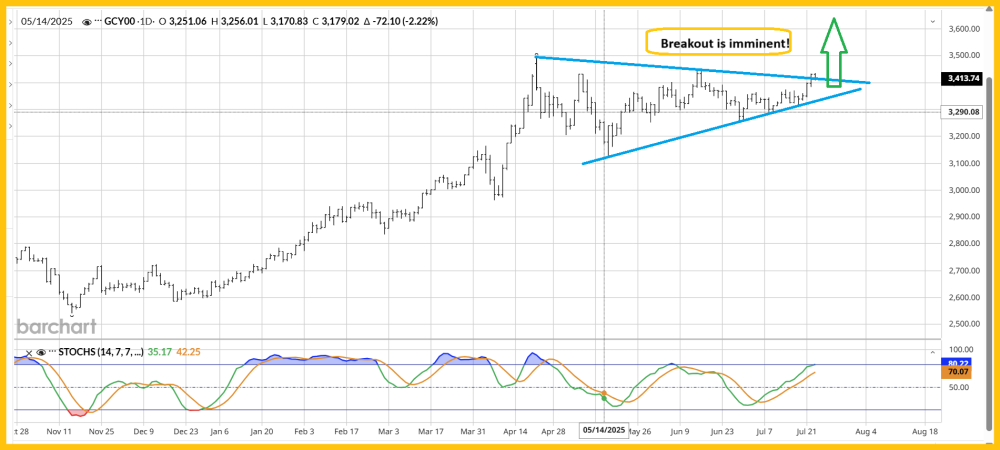
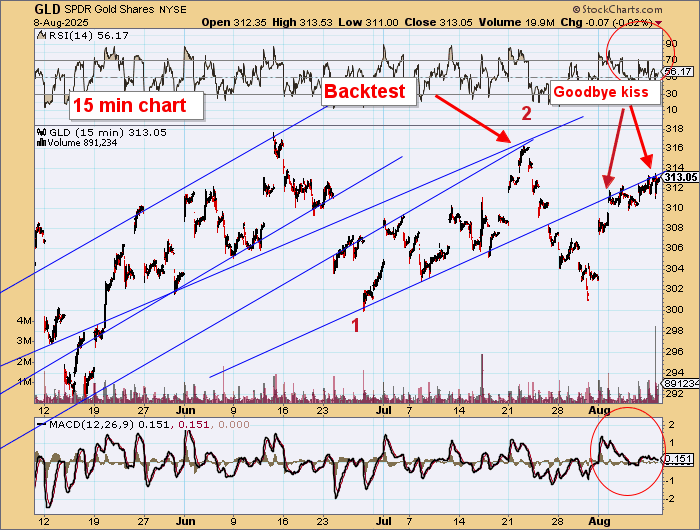
Here’s a look at the daily chart:

A symmetrical triangle pattern breakout appears imminent, and the target of this pattern is about $3800.

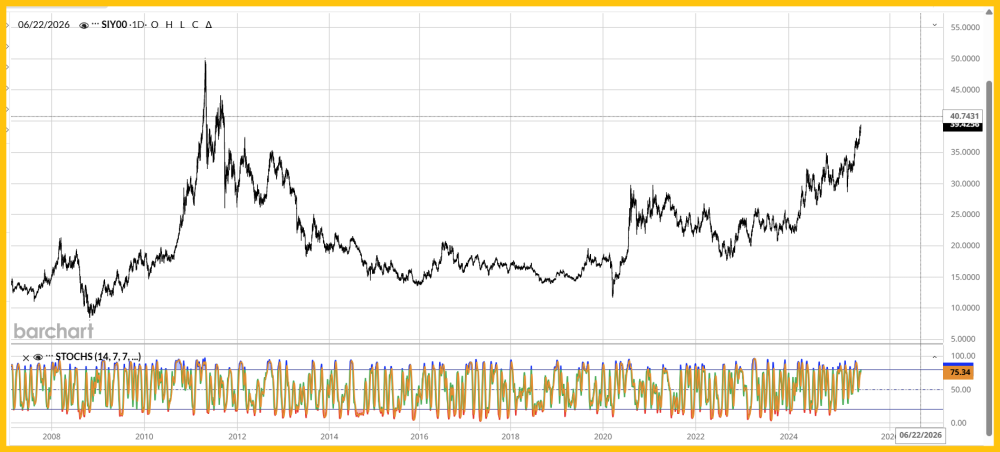
Silver tends to lag gold when deflation is in play and lead it when the big theme is inflation. In recent months, silver has taken the lead baton from gold, and I’ve suggested it could continue to lead until the year 2026 or even 2027.

Here’s a look at the chart:

Silver is making a beeline to the $44 zone, and even some mainstream money managers are taking notice.

In this environment, gold and silver stocks have begun to surge, but they are still so undervalued that senior miners could rise hundreds of percent before they hit “fair value.”

Junior miners could rise thousands of percent, and in some cases tens of thousands of percent. The current state of undervaluation of miners versus metal is truly surreal.

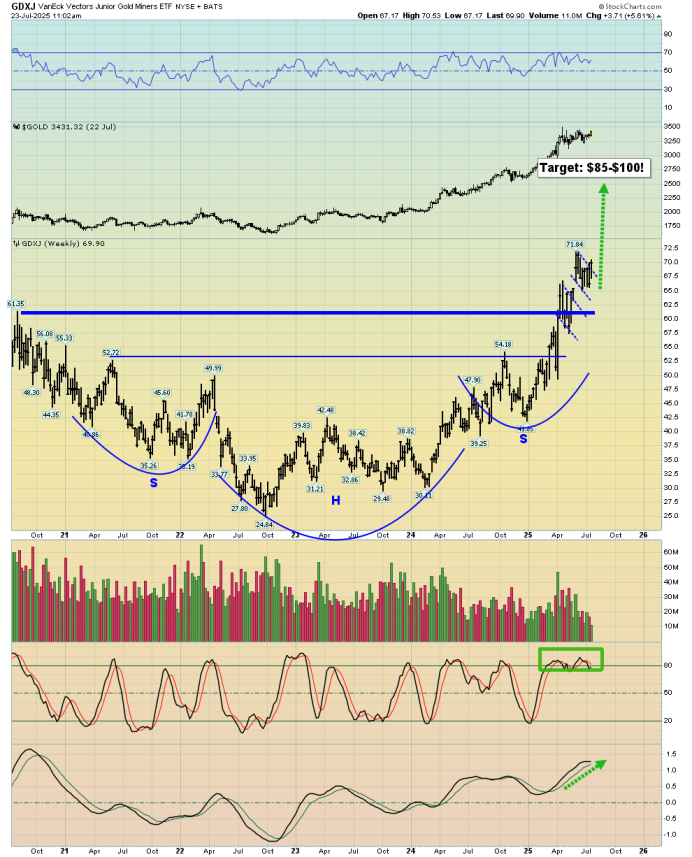
Here’s a look at the weekly GDXJ ETF chart:

There are numerous bull flags on the chart, and a fresh upside breakout is occurring from one of those flags now.

Silver stocks? They look even better!

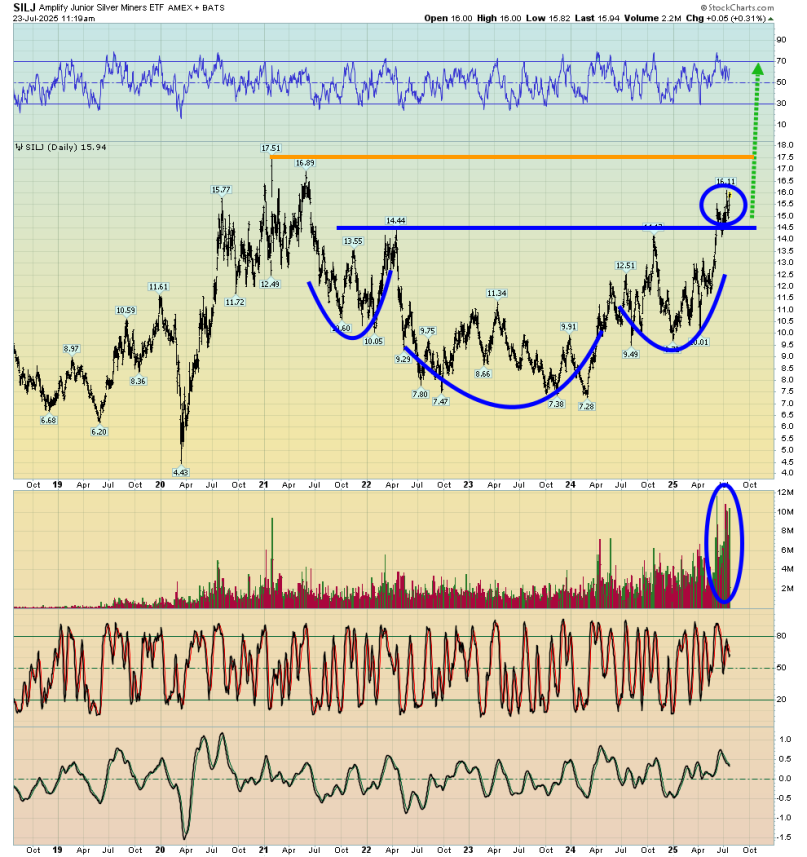
Here’s a look at the SILJ chart:

Note the gargantuan volume that has accompanied the inverse H&S pattern breakout. It’s almost surreal!

I’ve talked about a “seasonal inversion,” where instead of swooning from July to October, the miners stage a mighty surge higher.

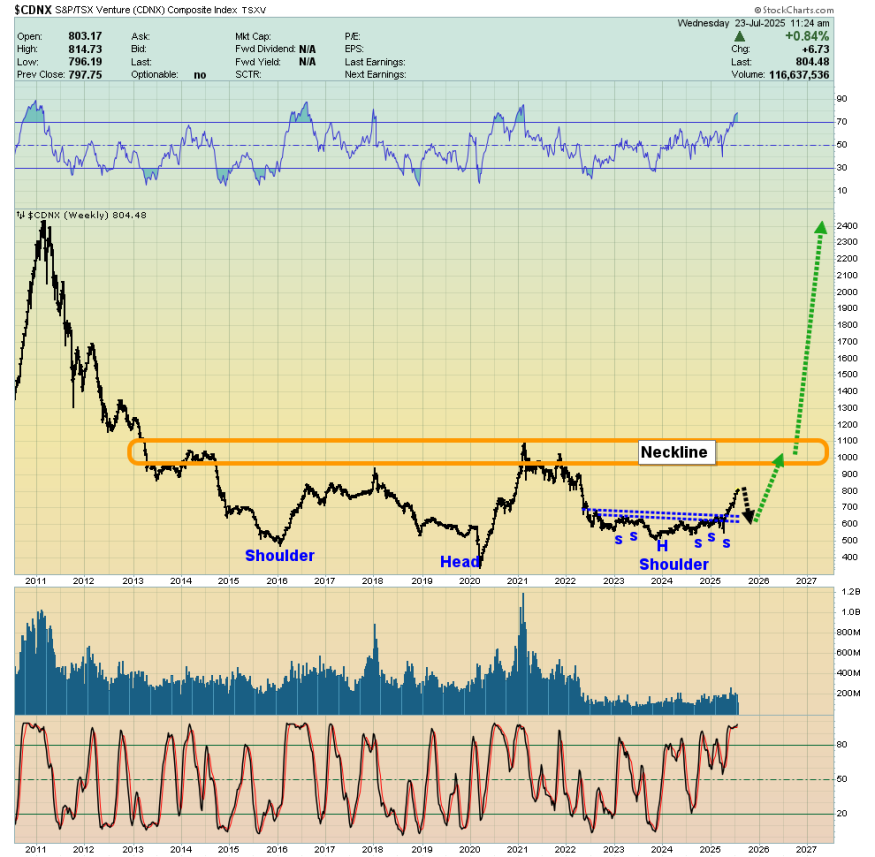
Well, that surge appears to be getting underway now, and the biggest price action of all appears to be occurring in junior miners that are in the CDNX

Here’s a look at the weekly CDNX chart:

A short-term pullback would be a “gift” for investors, but it may not occur.

Charts that are as bullish as this one tend to feature only very short pullbacks that don’t last long.

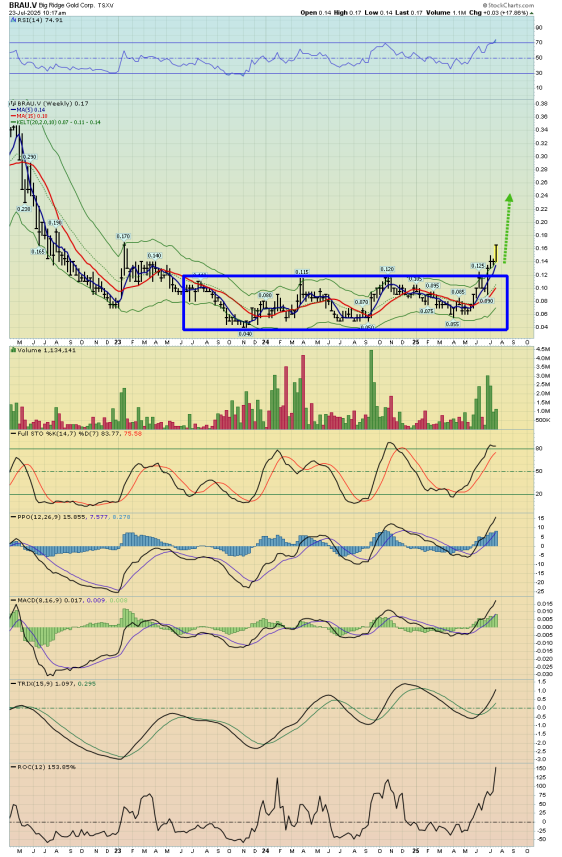
There are several individual miners that look very good this week. One of them is Big Ridge Gold Corp. (BRAU:TSXV; ALVLF:OTCQB).

They are reinvigorating a past producing property in Newfoundland.

What’s interesting is that gold was stuck in a rough $300-$500 range during the previous operation.

So, a lot of additional gold could be there . . .  gold that wasn’t worth mining at the time.

Here’s the Big Ridge chart:

I have a $2 target price for this stock, and if it’s hit, the CDNX may only be in the 1000 area at that point, which is the neckline zone of its massive H&S base pattern.

The bottom junior mining stocks line: What looks like a high price or “overbought” situation needs to be taken in the context of a very large 40-year inflation cycle that is only in year 5 of the cycle. Arguably, the junior miners offer the greatest value in the modern history of markets, and the word that best sums it all up could be: Enjoy!

Special Offer for Streetwise Readers: Please send me an Email to [email protected] and I’ll send you my free “Copper, Gold, & Rare Earths Too!” report. I highlight key junior resource stocks that are trading under $1/share and ready to soar! Key buy and sell tactics are included in this report. I write my junior resource stocks newsletter 2-3 times a week, and at just $199/12mths it’s an investor favorite. I’m doing a special pricing this week of $169 for 14mths.  Click this link or send me an email if you want the offer and I’ll get you onboard. Thank-you.


Important Disclosures:

  1. Stewart Thomson: I, or members of my immediate household or family, own securities of: None. My company has a financial relationship with: None. My company has purchased stocks mentioned in this article for my management clients: None. I determined which companies would be included in this article based on my research and understanding of the sector.
  2. Statements and opinions expressed are the opinions of the author and not of Streetwise Reports, Street Smart, or their officers. The author is wholly responsible for the accuracy of the statements. Streetwise Reports was not paid by the author to publish or syndicate this article. Streetwise Reports requires contributing authors to disclose any shareholdings in, or economic relationships with, companies that they write about. Any disclosures from the author can be found  below. Streetwise Reports relies upon the authors to accurately provide this information and Streetwise Reports has no means of verifying its accuracy.
  3.  This article does not constitute investment advice and is not a solicitation for any investment. Streetwise Reports does not render general or specific investment advice and the information on Streetwise Reports should not be considered a recommendation to buy or sell any security. Each reader is encouraged to consult with his or her personal financial adviser and perform their own comprehensive investment research. By opening this page, each reader accepts and agrees to Streetwise Reports’ terms of use and full legal disclaimer. Streetwise Reports does not endorse or recommend the business, products, services or securities of any company.

For additional disclosures, please click here.
Stewart Thomson Disclosures

Stewart Thomson is no longer an investment advisor. The information provided by Stewart and Graceland Updates is for general information purposes only. Before taking any action on any investment, it is imperative that you consult with multiple properly licensed, experienced and qualified investment advisors and get numerous opinions before taking any action. Your minimum risk on any investment in the world is: 100% loss of all your money. You may be taking or preparing to take leveraged positions in investments and not know it, exposing yourself to unlimited risks. This is highly concerning if you are an investor in any derivatives products. There is an approx $700 trillion OTC Derivatives Iceberg with a tiny portion written off officially. The bottom line:

Are You Prepared?