Archive for Forex and Currency News – Page 64

The Coming BRICS Currency Diversification

By Dan Steinbock

The pressure toward the diversification of world currency reserves is longstanding. It intensified after 2008, but has escalated since 2022. It is a prime topic in the next BRICS Summit that’s likely to further intensify the trend.

In 2016, US Treasury Secretary Jack Lew cautioned that “the more we condition the use of the dollar and our financial system on adherence to US foreign policy, the more the risk of migration to other currencies and other financial systems in the medium-term grows.”

Both the Trump and Biden administrations have ignored Lew’s warning. One consequence has been the Global South’s rising interest in the BRICS, which will have its next, highly-anticipated summit in South Africa in late August.

A key topic in Johannesburg will be the BRICS quest to develop alternative payment systems to US dollar.

Risks of dollar monopoly   

In May – oddly, amid the US banking crisis – economist Paul Krugman attributed the “de-dollarization” brouhaha to crypto-cultists and Putin’s sympathizers, as if the trend was nothing but a misguided anti-patriotic melee.

However, as Krugman noted, much of world trade remains invoiced and settled in U.S. dollars; many banks based outside the United States nonetheless offer dollar-denominated deposits; many non-U.S. corporations borrow in dollars; central banks hold a large share of their reserves in dollar assets; and so on. The assumption was that, a bit like diamond, US dollar is forever. In reality, no dominant reserve currency has had an indefinite life-span.

What Krugman failed to understand is that it is precisely the current coercive monopoly of the US dollar – the world’s disproportionate dependency on US dollar in trade invoicing and settlement, and the dollar reliance by non-US corporate and financial giants, and dollar’s high share in central banks’ reserves – that increasingly worries not just the Global South, but an increasing number of major economies in the West.

When the dollar is weaponized by the US foreign policy in the name of international community but without the broad support of international consensus, it puts trade invoicing and settlement, foreign corporates, financials and central bank reserves at risk.

True, recently US Secretary of Treasury Janet Yellen said there’s still no alternative to the dollar-based monetary system. Then again, not so long ago, she also warned about a catastrophic scenario if Washington failed to agree on a (still another) new debt limit. Similarly, the British, too, touted the blessings of their sterling pound until 1914. But that primacy ended with the overstretch of the UK economy after 1945.

The early 21st century has its unique characteristics, but it won’t be that different.

Advantages of diversification

How is the BRICS contributing to diversification? Thanks to its organizational flexibility, the bloc makes possible unilateral, bilateral and multilateral measures. Analytically, these range from gradual reforms to more unilateral individual measures. These, in turn, are driven by the original BRICS founder economies (Brazil, Russia, India and China), the new aspiring members and the coalition partners who share its vision and are considering membership as well.

Some 22 countries have formally applied to join the group, while an equal number of states “have been informally asking about becoming BRICS members,” according to Anil Sooklal, South Africa’s ambassador-at-large responsible for ties with Asia and the BRICS. Reportedly, countries looking to join the bloc include Argentina, Iran, Saudi Arabia, and the United Arab Emirates.

Indeed, the rising number of populous and large emerging economies make possible the kind of “network effects” and “positive spillovers” that will be critical to launch the new critical infrastructure for the proposed alternative global financial system.

However, what the BRICS offer is not simple de-dollarization. The goal is not to eliminate the dollar, which is typically the depiction by the critics and political adversaries of the BRICS, particularly in the West. At the eve of the Ukraine conflict, Atlantic Council characterized Russia and China as “partners in de-dollarization.” That, in turn, was portrayed as “an alternative to the US-dominated SWIFT” [the currently dominant payment system]. Touted widely in the West, the cooperation of Russia and China is understood as a de jure alliance, and de-dollarization as a ploy for dollar substitution.

The realities are a bit less scandalous and more nuanced. The BRICS have little to do with rogue states seeking covertly to subvert international order. Rather, like asset managers who seek to maintain appropriate diversification in their portfolios, the BRICS’ strategic objective is diversify and recalibrate rather than simple de-dollarization.

From Keynes’s Bancor to the BRICS’ currency diversification

The skeptics say that the dollar has been buried many times before. Why should it die this time? But who says it would have to die. The more, the merrier. Most BRICS economies still rely significantly on the US dollar, whereas those that have been sanctioned by the US and/or its allies have significantly reduced their dollar reserves, often opting for gold instead.

What the major BRIC economies seek for is a more diversified global currency regime. The present path is untenable. If it is not remedied gradually and over time, it will change through a major world crisis, disruptively. The BRICS goal is not to replace the dollar. Rather, it is to diversify the monetary system so that it would better reflect today’s world economy.

In historical view, it’s far from a new idea. John Maynard Keynes made a similar argument for the proposed supra-national currency bancor (the name was inspired by the French banque, “bank gold”) in Bretton Woods in 1944. But the idea was torpedoed by the U.S. negotiators, who wanted to replace the UK pound with the dollar as the world’s major reserve currency. However, Keynes cautioned that the dollar primacy would result in great uncertainty and volatility following the reconstruction and recovery of Western Europe and other major economies.

That’s what ensued in 1971, when President Nixon ended unilaterally the convertibility of the dollar to gold. Though introduced as a temporary measure, it made U.S. dollar a permanently floating fiat money. As gold no longer offered a yardstick for value, the perception of value replaced value itself. The consequent price shock reverberated across the world. With the twin oil crises, it was followed by the quadrupling of oil prices, then runaway inflation and stagflation, and eventually record-high US interest rates and massive rearmament drives.

Rise of complementary institutions

In geopolitics, the U.S. has continued to lean on major Western economies and Japan, but in international economy it refused to renounce the exorbitant privilege. As a net consequence, the dollar monopoly contributed to asset bubbles in the 1980s, early ‘90s, early 2000s and finally in 2008. Amid the Great Recession, China’s central bank governor Zhou Xiaochuan revived the idea and urged major Western economies to “reform the international monetary system.”

Great pledges were made in Brussels, Washington and Tokyo, but nothing much happened. Hence, the efforts at complementary development institutions and critical infrastructure, including the BRICS New Development Bank (NBD), the Asian Infrastructure Investment Bank (AIIB), the Bridge and Road Initiative (BRICS), and the quest for new currency arrangements.

The BRICS do not want to subvert the world order. Rather, they seek to foster one vis-à-vis diversification. Nonetheless, global currency arrangements must not just the interests of Americans who account for 4.1 percent of the world population. It must also reflect the aspirations of the multipolar world economy in which global growth prospects are driven by the large emerging economies.

About the Author:

Dr. Dan Steinbock is an internationally recognized strategist of the multipolar world and the founder of Difference Group. He has served at India, China and America Institute (US), Shanghai Institutes for International Studies (China) and the EU Center (Singapore). For more, see https://www.differencegroup.net/


The original commentary was released by China-US Focus on Aug. 4, 2023. See also Dr Steinbock’s interview by Berliner Zeitung “Wollen die Brics den Dollar ersetzen? Das sagt ein Wirtschaftsexperte dazu” on July 27, 2023. Berliner Zeitung is one of the leading German dailies.

Euro Attempts a Reversal to the Upside

By RoboForex Analytical Department

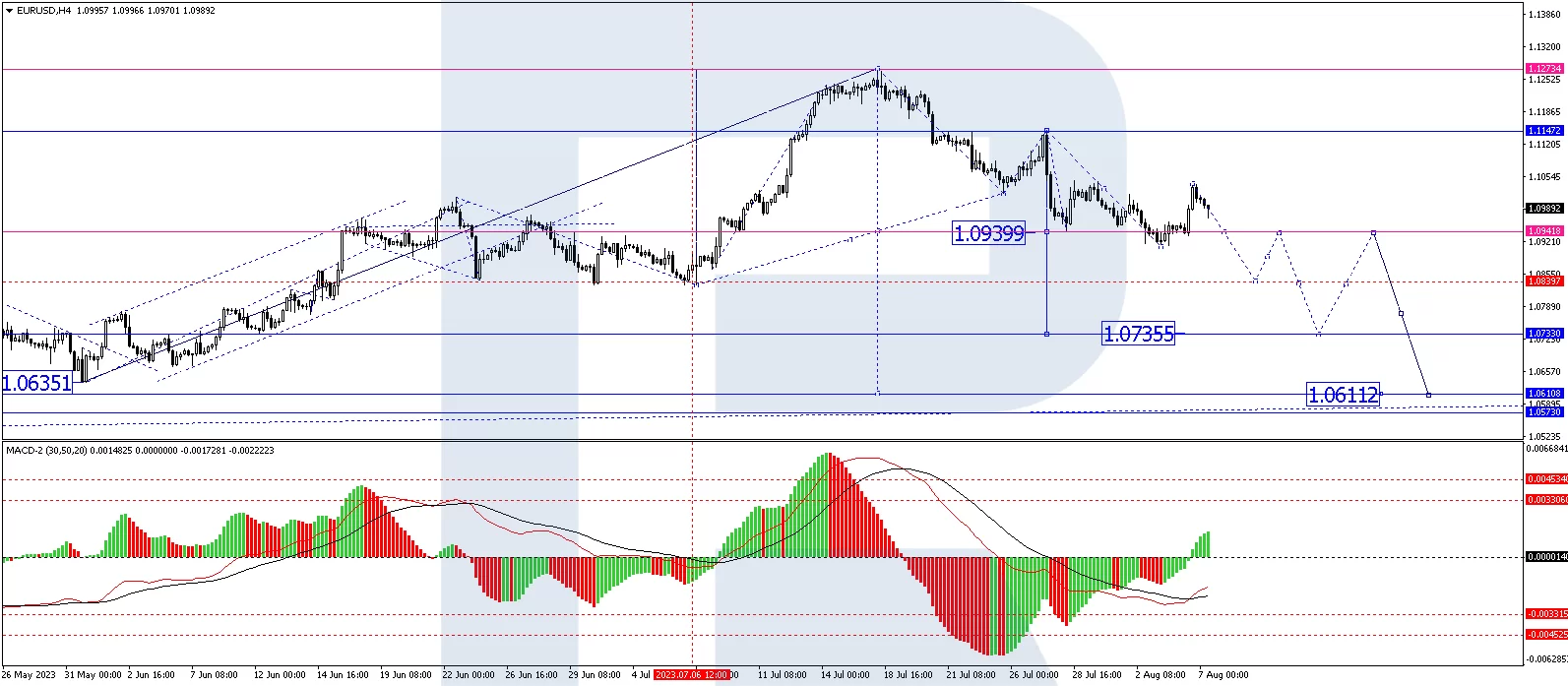
The Euro has halted its three-week decline, finding local support at 1.0900.

Despite the European Central Bank’s (ECB) latest interest rate hike to 4.25% on 27 July, the Euro is weakening against the US Dollar. Over the past three weeks, the EURUSD pair has retreated from its highs near 1.1300 to around 1.0900.

On Friday, US employment market data was released, slightly falling short of expert predictions: the Nonfarm Payrolls (NFP) indicator registered a figure of 187 thousand compared to the market’s projected 200 thousand. Consequently, the Dollar weakened against the Euro, causing the EURUSD pair to recover from its lows around 1.0900 to surpass 1.1000.

The key driver for heightened market volatility this week will be the forthcoming US Consumer Price Index (CPI) data, due for release on Thursday. Should the data surpass forecasts, the Euro’s decline may continue; conversely, weaker data could give the Euro reason to rise.

Technical analysis for the EUR/USD currency pair

On the H4 chart, EUR/USD completed a corrective wave to the 1.1040 level and started to develop another wave of decline. The 1.0941 level could be reached. A downward breakout of this level will open the potential for a wave of decline to 1.0840. Once the price hits this level, a link of growth to 1.0940 (a test from below) is expected, followed by a decline to 1.0735. This is a local target. Technically, the MACD indicator confirms this scenario with its signal line below the zero mark. The price is expected to return to it and continue falling to new lows.

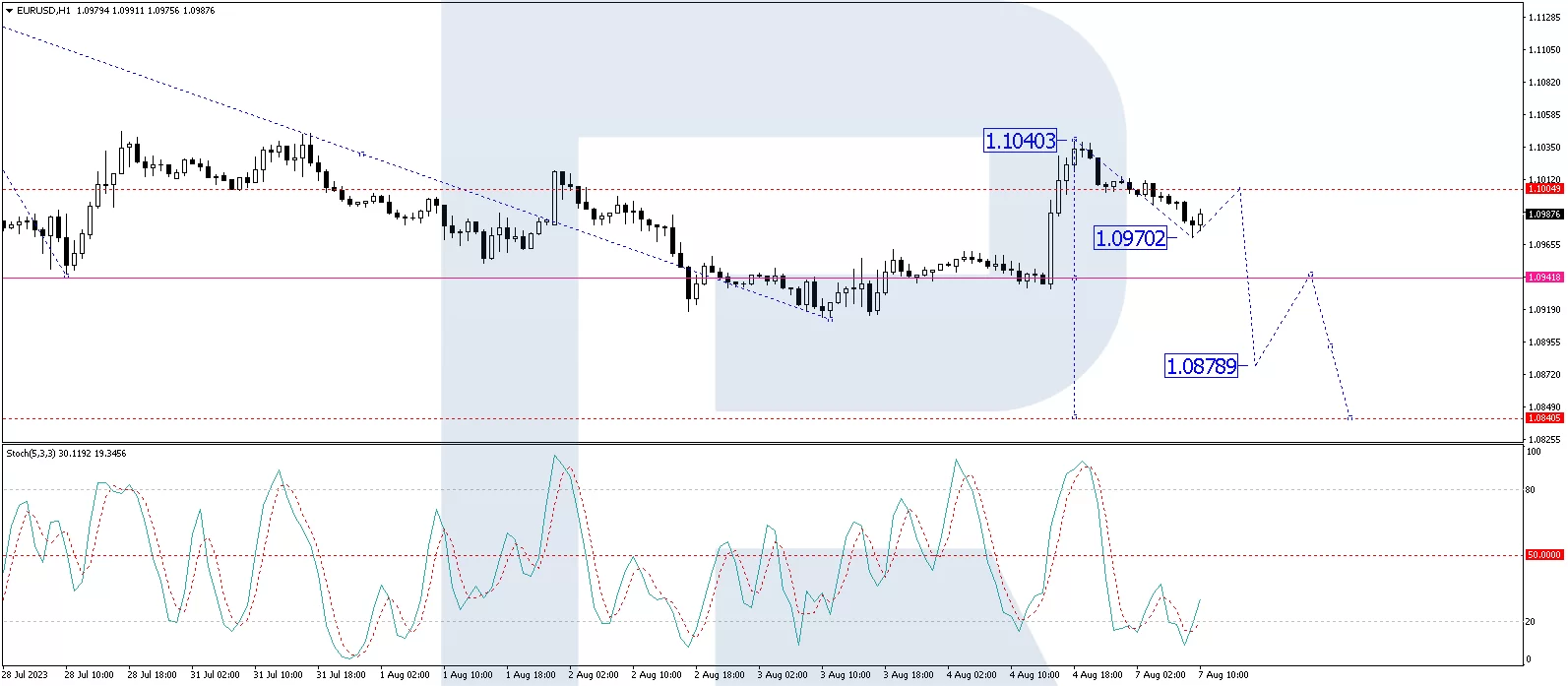
On the H1 chart, EUR/USD has completed an impulse of decline to the 1.1005 level. A consolidation range has formed around it today, and with a downward breakout, the price has declined to 1.0970. A link of correction to 1.1005 (a test from below) could form, followed by another wave of decline to 1.0940. A downward breakout of this level will open the potential for a wave of decline to 1.0878. Technically, the Stochastic oscillator also supports this outlook, with its signal line having broken the 20 mark upwards and continuing to rise to 50.

Disclaimer

Any forecasts contained herein are based on the author’s particular opinion. This analysis may not be treated as trading advice. RoboForex bears no responsibility for trading results based on trading recommendations and reviews contained herein.

Trade of the Week: USDCHF to see 55% more volatility?

By ForexTime 

Here are some Swiss Franc facts that may surprise you:

  1. CHF is best-performing G10 currency vs. USD so far this year
  2. SNB uses Swiss Franc to help achieve inflation target
  3. Swiss Franc is a safe haven currency
  4. USDCHF sees 55% larger-than-average moves on US CPI days so far in 2023
  5. Blomberg FX model: USDCHF to trade within 0.8645 – 0.8865 this week


1) CHF is the best-performing G10 currency so far in 2023

USDCHF has a year-to-date decline of more than 5% at the time of writing (stronger CHF + weaker USD = lower USDCHF).

The Swiss Franc (CHF) has overtaken the British Pound for the current title, after battling it out for most of July, with the former also boasting of an advance against all of its G10 peers for the year-to-date period:


2) The Swiss National Bank (SNB) has been allowing CHF to strengthen

This central bank uses the CHF exchange rate as a major tool for controlling inflation.

A stronger CHF means cheaper imports, and also more receipts from its exports, hence Switzerland’s consistent trade surplus.

Fun fact: Switzerland’s watch exports have grown by double-digits year-on-year (>10%) in 4 out of the first six months of 2023.

After over a decade of limiting the Swiss Franc’s strength, the SNB finally signalled in November 2022 that it’s ready to sell foreign currencies and let the CHF strengthen.

NOTE: The SNB exchanges foreign currencies back into Swiss Francs, which in turn drives up the value of the latter.

Furthermore, the SNB has maintained its willingness to keep hiking rates.

Such hawkish rhetoric comes despite inflation already falling within the central bank’s 0% – 2% CPI target range (Switzerland’s July CPI = 1.6%).

However, the SNB appears concerned that inflation may make a comeback later this year, hence expectations for another rate hike.

At the time of writing, overnight index swaps are pointing to a 60% chance that the SNB could hike by a further 25-basis points before 2023 ends.

NOTE: SNB only makes a rate decision once every quarter. Its next rate decision is due on September 21st.

Recall that, a currency tends to strengthen as markets continue to expect interest rates in that country to climb higher.

Hence, such expectations have aided the Swiss Franc to reach its strongest level against the US dollar in about 8 years.

Back in mid-July 2023, USDCHF dipped below 0.8600 for the first time since the SNB lifted the Swiss Franc’s cap against the euro back in 2015 which saw CHF skyrocketing (and USDCHF plummeting).


3) Swiss Franc is a safe haven currency

A safe haven is an asset that investors buy up with hopes of preserving their wealth in times of heightened fear and great uncertainty.

Consider how the Swiss Franc gained by 2.86% versus the US dollar for the month of March 2023, amid the banking turmoil in the United States as well as Switzerland.

Currently, with markets fearing a recession, that has also helped drive up the value of the safe haven Swiss Franc.


4) USDCHF sees 55% bigger one-day move on day of US inflation data release

So far in 2023, USDCHF tends to move by about 56 pips (between its highest to its lowest intraday price) on average within a single trading day.

However, that average intraday move soars up to 87 pips on the days that the US consumer price index (CPI) is released.

That’s a 55% increase in volatility!

Hence, brace for heightened volatility when the US CPI due is released this Thursday, August 10th! ​​


Currently, economists are forecasting the following numbers for the upcoming US CPI report:

  • CPI month-on-month (July 2023 vs. June 2023) = 0.2%
  • Core CPI (excluding more volatile food and energy prices) month-on-month = 0.2%
  • CPI year-on-year (July 2023 vs. July 2022) = 3.3% (a slight uptick from June’s 3% year-on-year increase)
  • Core CPI year-on-year = 4.8% (matching June’s core CPI y/y number of 4.8%)


Potential scenarios:

  • A set of CPI numbers that show US inflation is moderating further, which in turn allows the Fed to back away from a September rate hike, may drag USDCHF lower on the weaker US follar.
  • Higher-than-expected CPI readings, which stoke fears of a resurgence in inflation that forces the Fed into yet another rate hike next month, may translate into a stronger US dollar and a higher USDCHF.


BONUS FACTS:

  • At the lower-than-expected US CPI release on July 12th, USDCHF registered an intraday move of 139 pips!
  • That was its biggest one-day DROP in % terms so far in 2023, and also its 3rd largest single-day move (both up and down) in percentage terms of the year so far.

In other words, if recent history is to be a guide, brace for a volatile USDCHF on US CPI release day.


5) USDCHF likeliest to trade within 0.8645 – 0.8865 this week.

According to Bloomberg’s FX model, there’s a 72% chance that USDCHF trades within the above-mentioned range over the next one-week period.

Here are some further key levels of interest for the immediate term:


POTENTIAL SUPPORT:

  • 21-day simple moving average
  • 0.864 – 0.866 region = lower bound of Bloomberg FX model forecast / area for choppy July price action
  • 0.8600 = psychologically-important level


POTENTIAL RESISTANCE:

  • 0.8800 = psychologically-important number
  • 0.8820 = early-May low
  • 0.886 region = upper limit of Bloomberg FX model forecast / 50-day simple moving average / upper bound of USDCHF downtrend since November 2022
  • 0.89014 = June 2023 low

Forex-Time-LogoArticle by ForexTime

ForexTime Ltd (FXTM) is an award winning international online forex broker regulated by CySEC 185/12 www.forextime.com

New US credit rating downgrade further fuels fears of long-term dollar decline

By George Prior 

The surprise US credit rating downgrade will trigger short-term volatility for the dollar – but more importantly, will speed-up the long-term decline of the US and global reserve currency, warns the CEO of one of the world’s largest independent financial advisory and asset management companies.

The warning from Nigel Green of deVere Group comes as rating agency Fitch downgraded the US government’s top credit rating on Tuesday to AA+ from AAA.

Fitch cited fiscal deterioration over the next three years and repeated down-the-wire debt ceiling negotiations that puts at risk the government’s ability to pay its bills.

The deVere CEO says: “Many US analysts are predicting that this surprise downgrade of the world’s largest economy’s credit rating will only trigger short term volatility for the dollar – and the US and global reserve currency wobbled on the news, as should have been expected.

“However, as this is the second major rating agency (after Standard & Poor’s) to strip the US of its triple-A rating, there are serious, legitimate questions to be asked about the long-term trajectory of the dollar.”

He continues: “No one can predict the future, but history unequivocally teaches us that nothing lasts forever. Global reserve currencies have come and gone before.  It will happen again.

“Indeed, I believe that we are witnessing in real-time the world beginning to shift away from a dollar-dominated financial system.

“Among other reasons, this is because astronomic levels of debt, and the enormous amount of desperate money printing to monetise these debts, have caused the considerable drop in the long-term value of the currency.”

Earlier this year, Nigel Green was one of the first voices to flag the threat to the US dollar’s dominance as Russia and Saudi Arabia eye the Chinese yuan for oil trades.

He said one of the most significant, but under-reported, outcomes of a three-day summit between Russia’s Vladimir Putin and China’s Xi Jinping was that Putin said Russia is now in favour of using the Chinese yuan for oil settlements.

Separately, two deals, announced a week earlier, will see Saudi Arabia’s Aramco supplying two Chinese companies with a combined 690,000 barrels a day of crude oil, bolstering its rank as China’s top provider of the commodity. It was reported that Saudi Arabia was also in talks with Beijing to settle with the yuan instead of the dollar.

“It appears US rivals, led by China, are forming a new major economic bloc. If Saudi Arabia – home to massive oil reserves, which are estimated to be the largest in the world – does move to the yuan, that would lead to an enormous shift in the global economic system.

“Oil is one of the most important and widely traded commodities in the world, and it has traditionally been priced and traded in US dollars. This has given the US dollar a dominant role in global financial markets, as countries that want to purchase oil must first acquire US dollars in order to do so.

“If oil trading were to shift away from the US dollar, it would dramatically reduce the demand for US dollars, which would lead to a decrease in the value of the US currency.”

This could have a number of ripple effects throughout the global economy, including hugely increased inflation in the United States and potentially destabilising effects on financial markets.

Investors should begin to consider hedging against a declining dollar. Diversification across different currencies, investing in non-US assets, using derivatives, and investing in commodities and real estate are all considered effective ways to hedge against potential USD volatility.

The deVere CEO concludes: “While the latest report from Fitch will have a minimal impact, two major credit downgrades, industrial-scale money printing to monetise astronomic debts, and rivals like China and their allies looking to take the financial crown from the US, can be expected to speed-up the long-term decline of the dollar.”

About:

deVere Group is one of the world’s largest independent advisors of specialist global financial solutions to international, local mass affluent, and high-net-worth clients.  It has a network of more than 70 offices across the world, over 80,000 clients and $12bn under advisement.

Japanese Yen Depreciated After the Bank of Japan Meeting Outcome

By RoboForex Analytical Department

The USD/JPY pair surpassed its local daily high of 141.95 on Monday and is currently trading near 143.00.

USD/JPY experienced increased volatility at the end of last week: it initially fell by about 2% on the Nikkei news report that the Bank of Japan (BOJ) might announce the beginning of normalising its “soft” monetary policy but then returned to the area of daily highs after the Bank of Japan announced the meeting outcome.

The BOJ kept the interest rate at -0.1% and did not raise the upper bound of yield on 10-year Japanese government bonds. In its issued statement, it noted that this limit is not a “dogma” but merely a reference serving as a guide to action.

As a result, the expectations of the Bank of Japan winding down its “soft” monetary policy due to rapidly rising inflation have not been confirmed yet. According to Bloomberg surveys, many economists and analysts expect the Bank of Japan to begin normalising monetary policy no earlier than October.

Technical analysis of the USD/JPY currency pair

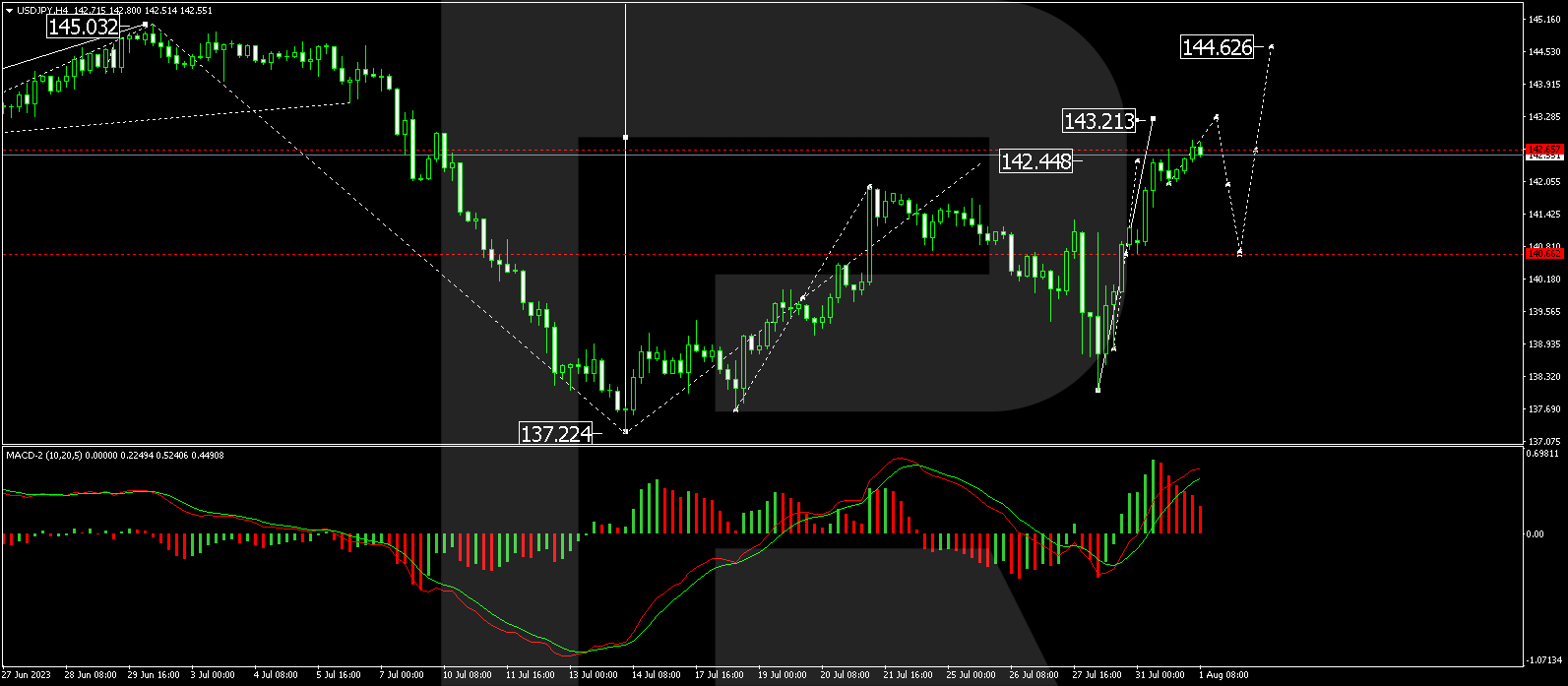
On the H4 chart of USD/JPY, the calculated target for the fifth upward wave has been reached at 142.44. Today, the market is forming a consolidation range around this level. An expansion to 143.21 is not ruled out. Next, we will consider a decline to the level of 140.66, followed by a rise to 144.62. Technically, this scenario is confirmed by the MACD oscillator. Its signal line is trading above the zero mark and has exited the histogram zone. We expect the indicator to begin decreasing towards the zero level.

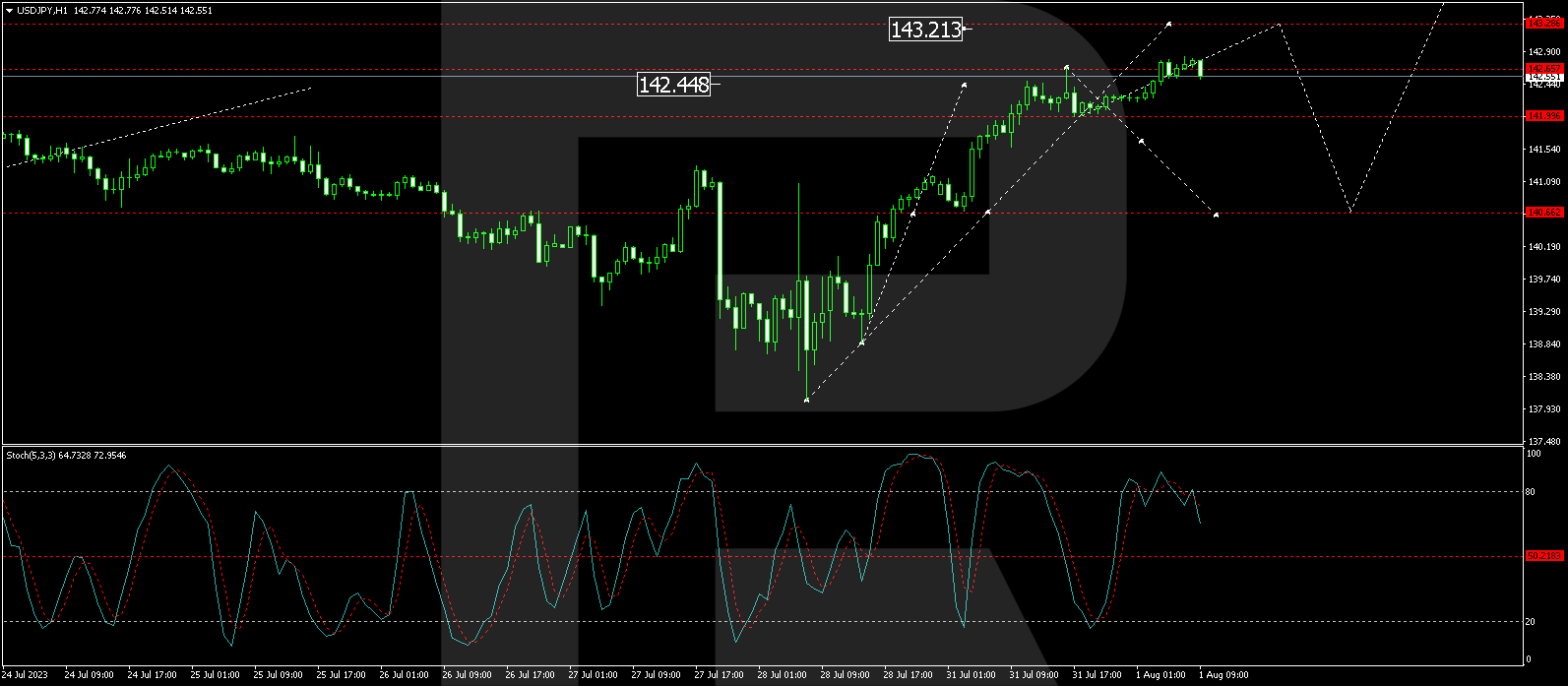
On the H1 chart of USD/JPY, a consolidation range has formed around the level of 140.66. After breaking above this range, the local target at 142.44 was achieved. Currently, the market is forming a consolidation range around this level. A potential upward move to the level of 143.23 is not excluded if there is a breakout above this range. In case of a downward breakout, we will assess the probability of a correction to 140.66, followed by a rise to 143.28. Technically, this scenario is supported by the Stochastic oscillator, with its signal line above the 80 mark, preparing to decline towards the 50 mark. After this anticipated decline, we expect another upward movement towards the 80 mark.

Disclaimer

Any forecasts contained herein are based on the author’s particular opinion. This analysis may not be treated as trading advice. RoboForex bears no responsibility for trading results based on trading recommendations and reviews contained herein.

Trade Of The Week: GBPUSD Twitchy Ahead Of BoE

By ForexTime 

Sterling could kick off the new trading month with a bang as focus falls on the Bank of England rate decision.

After posting a mixed performance across the G10 space in July and gaining roughly 1% versus the dollar, could volatility return in August?

Over the past few weeks, buying sentiment toward the currency has been influenced by conflicting forces – placing bulls and bears in a fierce tug of war. Pound bulls continue to draw strength from rising expectations over the BoE keeping rates higher for longer in the face of sticky inflation. But bears remain supported by growing recession fears as UK economic data disappoints. Regarding the technical picture, the GBPUSD has found itself back within a wide range with support at 1.2800 and resistance at 1.3000.

The GBPUSD could be gearing up for a major move this week and here are 3 reasons why:

1) BoE Rate Decision

The Bank of England (BoE) monetary policy decision will be on Thursday 3rd August.

This will be accompanied by the minutes of the meeting and the quarterly Monetary Policy Report (MPR), making it a Super Thursday combo.

Markets widely expected the BoE to raise interest rates by 25 basis points. This would be the fourteenth straight rate hike, taking the key rate to 5.25% – its highest level since 2008. Despite UK consumer price inflation dropping to 7.9% in June, it remains well above the BoE’s target. This is likely to fuel expectations around more rate hikes despite disappointing economic data fuelling recession fears.

Investors will be paying very close attention to the minutes, quarterly MPR, and BoE Governor Andrew Bailey’s press conference for fresh clues on the BoE’s next policy move.

  • If the BoE delivers a 25 basis point hike and signals further rate hikes in the face of still sticky inflation, this could support the GBPUSD.
  • If the BoE surprises markets by delivering a 50 basis points hike, this could inject Pound bulls with enough confidence to break out of its current range.
  • A scenario where the BoE delivers a dovish hike, expressing concern over the UK economy could send the Pound falling.

2) US Jobs report

All eyes will be on the US July nonfarm payrolls (NFP) on Friday which could offer critical insight into the Fed’s next move – especially when factoring in the central bank’s recent shift to data dependence.

The US economy is forecast to have added 190,000 new jobs to the labour markets in July while the unemployment rate is expected to remain unchanged at 3.6%. Given how the US report will act as one of the key pieces that determine whether the Fed raises rates one final time in 2023 or not, this could translate to increased dollar volatility.

  • A stronger-than-expected US jobs report may fuel speculation around the Federal Reserve raising interest rates one final time in 2023. Should this result in a stronger dollar, this could drag the GBPUSD lower.
  • A weaker-than-expected US jobs report could support the argument that the Federal Reserve ended its hiking cycle in July. If this sees the dollar weaken, the GBPUSD may push higher.

3) Technical forces 

The GBPUSD remains in a bullish channel on the weekly timeframe. However, prices are trading around a significant pivotal point at 1.2850 just below the 200-week SMA. If bulls can keep above this level, and leverage this support to push beyond 1.3000, the next key resistance can be found around 1.3200. However, a breakdown below 1.2850 may see a decline towards the 100-week SMA at 1.2600.

On the daily charts, support can be found at 1.2800 and resistance at 1.3000. A solid breakout above 1.3000 may open the doors towards 1.3140 and 1.3200, respectively. Should prices slide below 1.2800, bears may target 1.2600.


Forex-Time-LogoArticle by ForexTime

ForexTime Ltd (FXTM) is an award winning international online forex broker regulated by CySEC 185/12 www.forextime.com

US Dollar Speculators reduce their bullish bets to 2-Year low

By InvestMacro

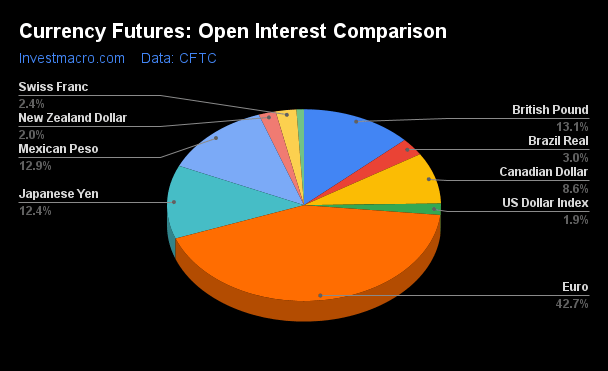
Here are the latest charts and statistics for the Commitment of Traders (COT) data published by the Commodities Futures Trading Commission (CFTC).

The latest COT data is updated through Tuesday July 25th and shows a quick view of how large market participants (for-profit speculators and commercial traders) were positioned in the futures markets. All currency positions are in direct relation to the US dollar where, for example, a bet for the euro is a bet that the euro will rise versus the dollar while a bet against the euro will be a bet that the euro will decline versus the dollar.

Weekly Speculator Changes led by Japanese Yen & Canadian Dollar
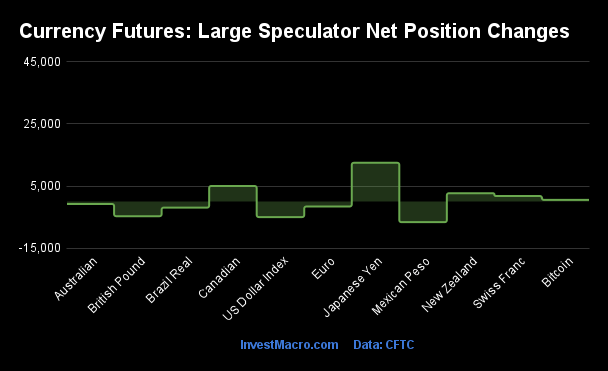
The COT currency market speculator bets were lower this week as five out of the eleven currency markets we cover had higher positioning while the other six markets had lower speculator contracts.

Leading the gains for the currency markets was the Japanese Yen (12,487 contracts) with the Canadian Dollar (5,009 contracts), New Zealand Dollar (2,677 contracts), Swiss Franc (1,780 contracts) and Bitcoin (516 contracts) also showing positive weeks.

The currencies seeing declines in speculator bets on the week were the Mexican Peso (-6,651 contracts) with the US Dollar Index (-5,013 contracts), the British Pound (-4,734 contracts), EuroFX (-1,602 contracts), the Brazilian Real (-1,962 contracts) and the Australian Dollar (-800 contracts)also registering lower bets on the week.

US Dollar Index Bullish Bets fall to 2-Year Low

Highlighting the COT currency’s data this week is the decline of the speculator’s positioning in the US Dollar Index. The large speculative US Dollar Index positions decreased for a fourth consecutive week this week and the speculators have now subtracted a total of -8,914 net contracts from the overall position in just the last four weeks.

This week’s reduction by -5,013 contracts marked the largest one-week shortfall since December 20th of 2022 (which recorded a decline by -9,021 contracts). This bearishness has dropped the US Dollar Index speculator net position (currently at +6,054 contracts) to its lowest level of the past 108 weeks, dating back to June 29th of 2021.

Overall, the US Dollar speculator position has been weakening since hitting a cycle high on June 21st of 2022 with a total of +45,010 contracts. Since then, the steady and slow erosion of bullish bets has brought the net position to under the +10,000 contract level for just the second time in the past two years. This latest data is through Tuesday and before the US Federal Reserve’s latest rate increase by 25 basis points that took place on Wednesday. Speculators and market watchers are eyeing the end of the Fed’s interest rate hiking campaign as inflation has been falling across most measures in the US economy.

The US Dollar Index futures price closed higher this week for a second straight week and ended the week right around the 101.40 level. The USD Index had ascended to a multi-decade high of 114.74 in September 2022 and has been on the downtrend since with a current decline (from top to latest price) of approximately 12 percent. The USD Index price fell to a 14-month low on July 18th at 99.22 before staging a comeback over the past two weeks and making it back over the 100 level.


Data Snapshot of Forex Market Traders | Columns Legend
Jul-25-2023OIOI-IndexSpec-NetSpec-IndexCom-NetCOM-IndexSmalls-NetSmalls-Index
USD Index34,514206,05435-6,3396628520
EUR772,40875177,23087-234,2691157,03970
GBP237,3406058,99597-76,984317,98993
JPY223,76057-77,7522486,55578-8,80336
CHF44,18050-8,431323,421515,01074
CAD156,395315,53060-22,0964116,56660
AUD146,42328-51,2013749,561561,64056
NZD36,82025-94951324791761
MXN233,5494987,84193-92,05874,21738
RUB20,93047,54331-7,15069-39324
BRL53,4434431,97176-31,95725-1444
Bitcoin16,01777-64566-178082332


Strength Scores led by British Pound & Mexican Peso
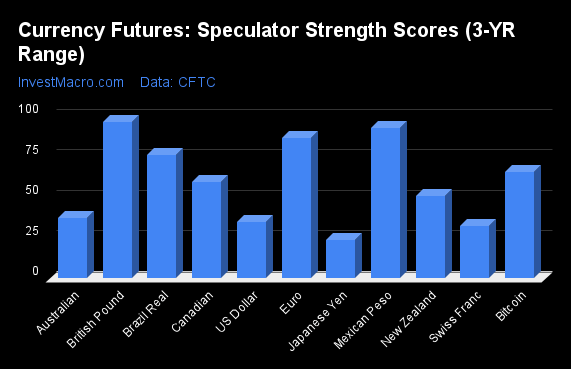
COT Strength Scores (a normalized measure of Speculator positions over a 3-Year range, from 0 to 100 where above 80 is Extreme-Bullish and below 20 is Extreme-Bearish) showed that the British Pound (97 percent) and the Mexican Peso (93 percent) lead the currency markets this week. The EuroFX (87 percent), Brazilian Real (76 percent) and the Bitcoin (66 percent) come in as the next highest in the weekly strength scores.

On the downside, the Japanese Yen (24 percent) and the Swiss Franc (32 percent) come in at the lowest strength levels currently. The next lowest strength scores are the US Dollar Index (35 percent) and the Australian Dollar (37 percent).

Strength Statistics:
US Dollar Index (35.0 percent) vs US Dollar Index previous week (43.4 percent)
EuroFX (86.7 percent) vs EuroFX previous week (87.3 percent)
British Pound Sterling (96.7 percent) vs British Pound Sterling previous week (100.0 percent)
Japanese Yen (23.8 percent) vs Japanese Yen previous week (16.4 percent)
Swiss Franc (32.3 percent) vs Swiss Franc previous week (27.6 percent)
Canadian Dollar (59.7 percent) vs Canadian Dollar previous week (55.0 percent)
Australian Dollar (37.4 percent) vs Australian Dollar previous week (38.1 percent)
New Zealand Dollar (51.0 percent) vs New Zealand Dollar previous week (43.8 percent)
Mexican Peso (92.8 percent) vs Mexican Peso previous week (96.8 percent)
Brazilian Real (76.4 percent) vs Brazilian Real previous week (78.9 percent)
Bitcoin (65.7 percent) vs Bitcoin previous week (56.7 percent)


Canadian Dollar & British Pound top the 6-Week Strength Trends
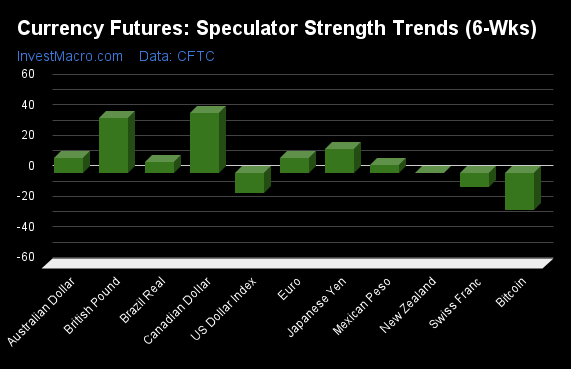
COT Strength Score Trends (or move index, calculates the 6-week changes in strength scores) showed that the Canadian Dollar (39 percent) and the British Pound (36 percent) lead the past six weeks trends for the currencies. The Japanese Yen (16 percent), the EuroFX (10 percent) and the Australian Dollar (10 percent) are the next highest positive movers in the latest trends data.

The Bitcoin (-24 percent) leads the downside trend scores currently with the US Dollar Index (-13 percent), Swiss Franc (-9 percent) and the New Zealand Dollar (0 percent) following next with lower trend scores.

Strength Trend Statistics:
US Dollar Index (-13.2 percent) vs US Dollar Index previous week (-1.9 percent)
EuroFX (9.8 percent) vs EuroFX previous week (7.9 percent)
British Pound Sterling (36.3 percent) vs British Pound Sterling previous week (35.6 percent)
Japanese Yen (15.6 percent) vs Japanese Yen previous week (8.7 percent)
Swiss Franc (-9.0 percent) vs Swiss Franc previous week (-23.5 percent)
Canadian Dollar (39.3 percent) vs Canadian Dollar previous week (36.2 percent)
Australian Dollar (9.8 percent) vs Australian Dollar previous week (5.6 percent)
New Zealand Dollar (-0.3 percent) vs New Zealand Dollar previous week (-7.9 percent)
Mexican Peso (5.5 percent) vs Mexican Peso previous week (7.8 percent)
Brazilian Real (7.4 percent) vs Brazilian Real previous week (9.9 percent)
Bitcoin (-24.2 percent) vs Bitcoin previous week (-33.7 percent)


Individual COT Forex Markets:

US Dollar Index Futures:
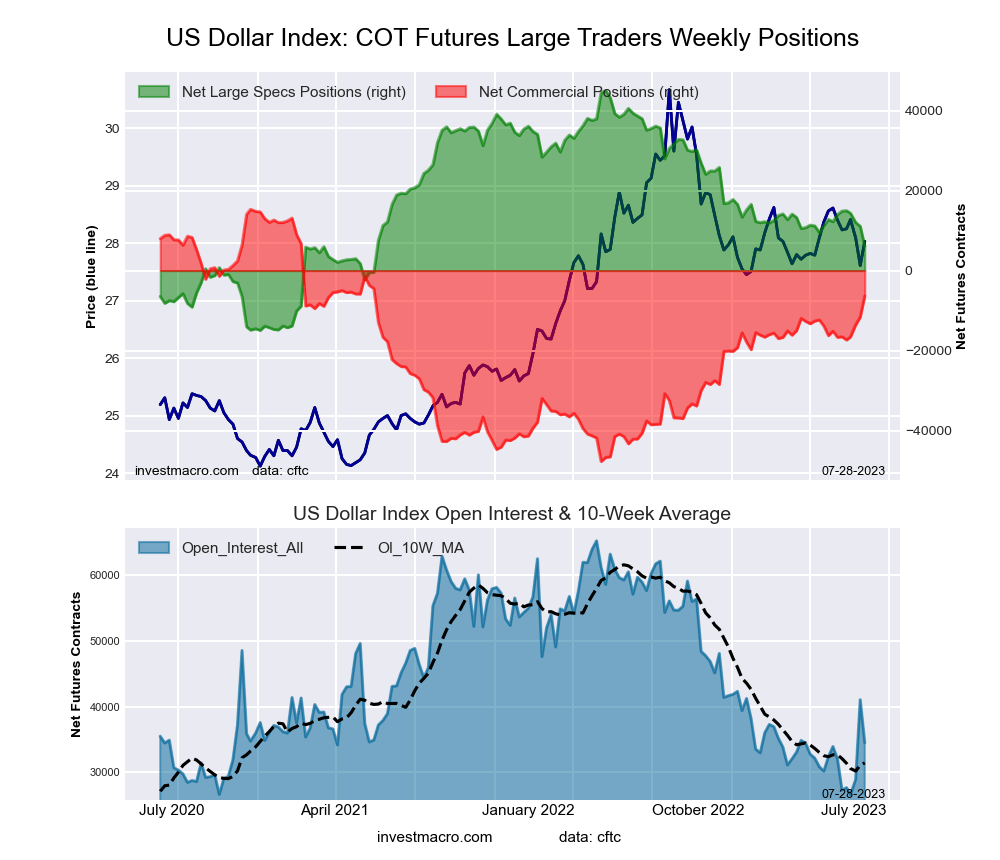
US Dollar Index Forex Futures COT ChartThe US Dollar Index large speculator standing this week totaled a net position of 6,054 contracts in the data reported through Tuesday. This was a weekly decrease of -5,013 contracts from the previous week which had a total of 11,067 net contracts.

This week’s current strength score (the trader positioning range over the past three years, measured from 0 to 100) shows the speculators are currently Bearish with a score of 35.0 percent. The commercials are Bullish with a score of 65.7 percent and the small traders (not shown in chart) are Bearish-Extreme with a score of 19.6 percent.

Price Trend-Following Model: Weak Uptrend

Our weekly trend-following model classifies the current market price position as: Weak Uptrend. The current action for the model is considered to be: Hold – Maintain Long Position.

US DOLLAR INDEX StatisticsSPECULATORSCOMMERCIALSSMALL TRADERS
– Percent of Open Interest Longs:61.622.610.8
– Percent of Open Interest Shorts:44.141.010.0
– Net Position:6,054-6,339285
– Gross Longs:21,2587,7963,735
– Gross Shorts:15,20414,1353,450
– Long to Short Ratio:1.4 to 10.6 to 11.1 to 1
NET POSITION TREND:
– Strength Index Score (3 Year Range Pct):35.065.719.6
– Strength Index Reading (3 Year Range):BearishBullishBearish-Extreme
NET POSITION MOVEMENT INDEX:
– 6-Week Change in Strength Index:-13.216.4-26.3


Euro Currency Futures:

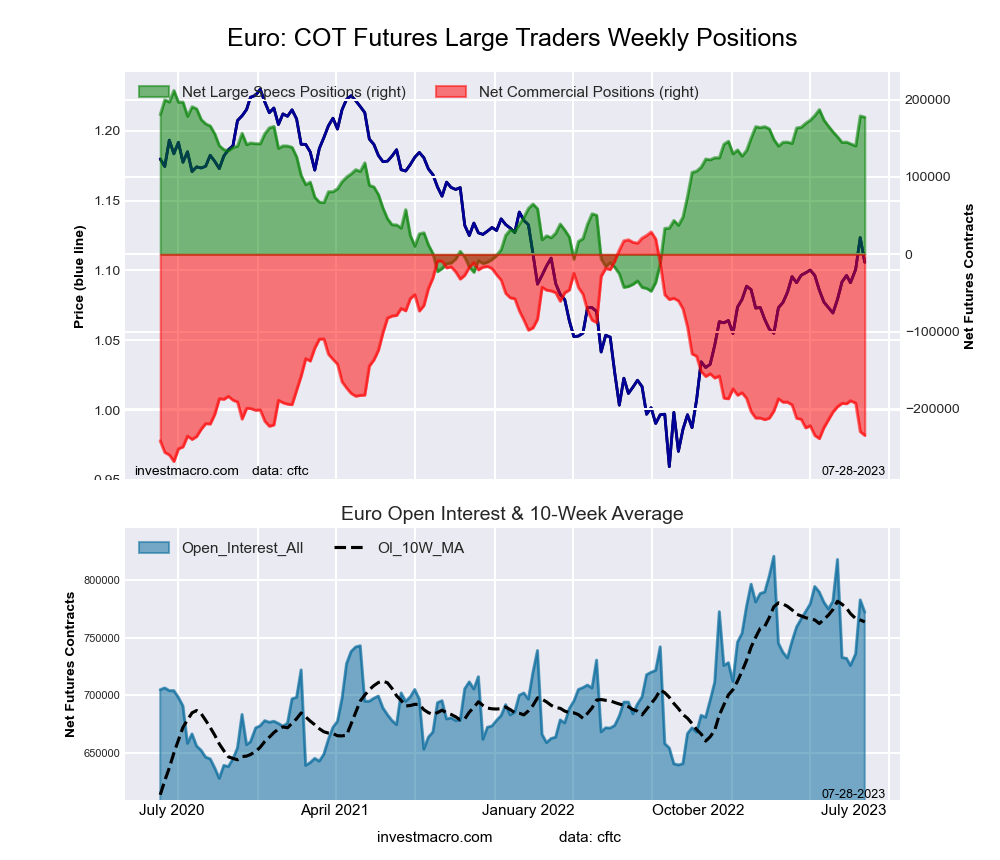
Euro Currency Futures COT ChartThe Euro Currency large speculator standing this week totaled a net position of 177,230 contracts in the data reported through Tuesday. This was a weekly lowering of -1,602 contracts from the previous week which had a total of 178,832 net contracts.

This week’s current strength score (the trader positioning range over the past three years, measured from 0 to 100) shows the speculators are currently Bullish-Extreme with a score of 86.7 percent. The commercials are Bearish-Extreme with a score of 11.4 percent and the small traders (not shown in chart) are Bullish with a score of 70.0 percent.

Price Trend-Following Model: Uptrend

Our weekly trend-following model classifies the current market price position as: Uptrend. The current action for the model is considered to be: Hold – Maintain Long Position.

EURO Currency StatisticsSPECULATORSCOMMERCIALSSMALL TRADERS
– Percent of Open Interest Longs:32.552.112.6
– Percent of Open Interest Shorts:9.582.55.2
– Net Position:177,230-234,26957,039
– Gross Longs:250,647402,62697,545
– Gross Shorts:73,417636,89540,506
– Long to Short Ratio:3.4 to 10.6 to 12.4 to 1
NET POSITION TREND:
– Strength Index Score (3 Year Range Pct):86.711.470.0
– Strength Index Reading (3 Year Range):Bullish-ExtremeBearish-ExtremeBullish
NET POSITION MOVEMENT INDEX:
– 6-Week Change in Strength Index:9.8-12.518.8


British Pound Sterling Futures:

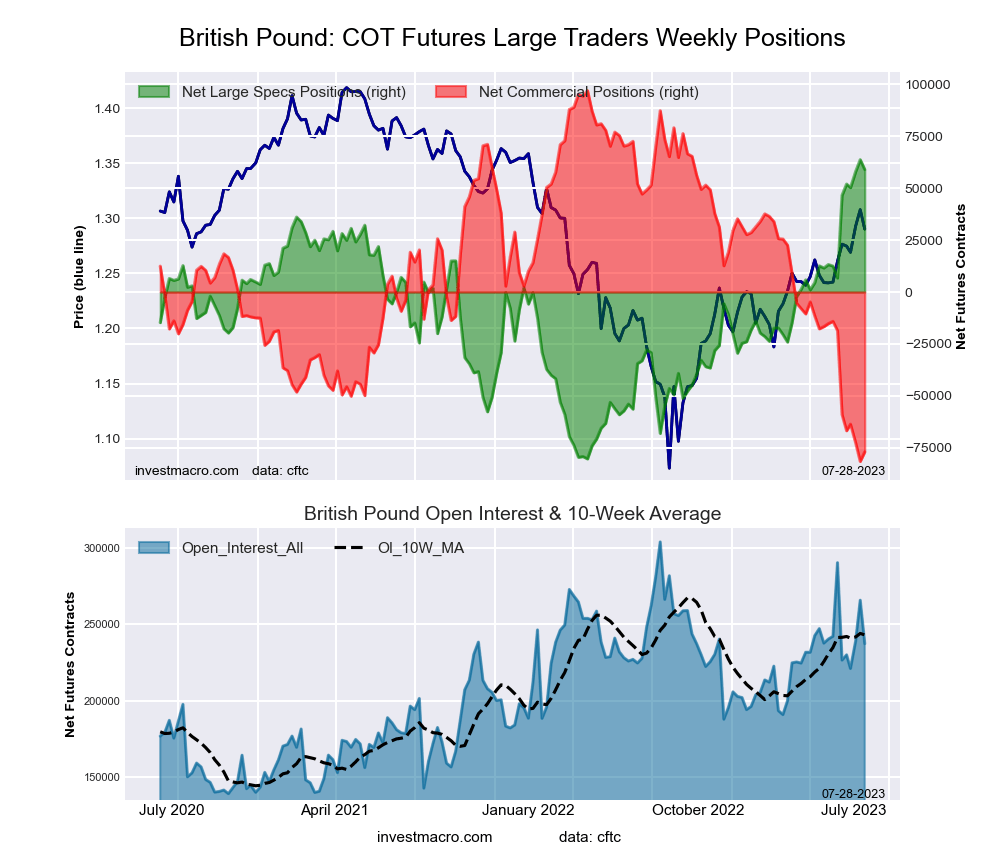
British Pound Sterling Futures COT ChartThe British Pound Sterling large speculator standing this week totaled a net position of 58,995 contracts in the data reported through Tuesday. This was a weekly decrease of -4,734 contracts from the previous week which had a total of 63,729 net contracts.

This week’s current strength score (the trader positioning range over the past three years, measured from 0 to 100) shows the speculators are currently Bullish-Extreme with a score of 96.7 percent. The commercials are Bearish-Extreme with a score of 2.6 percent and the small traders (not shown in chart) are Bullish-Extreme with a score of 93.3 percent.

Price Trend-Following Model: Uptrend

Our weekly trend-following model classifies the current market price position as: Uptrend. The current action for the model is considered to be: Hold – Maintain Long Position.

BRITISH POUND StatisticsSPECULATORSCOMMERCIALSSMALL TRADERS
– Percent of Open Interest Longs:44.531.917.6
– Percent of Open Interest Shorts:19.664.310.0
– Net Position:58,995-76,98417,989
– Gross Longs:105,49875,73741,762
– Gross Shorts:46,503152,72123,773
– Long to Short Ratio:2.3 to 10.5 to 11.8 to 1
NET POSITION TREND:
– Strength Index Score (3 Year Range Pct):96.72.693.3
– Strength Index Reading (3 Year Range):Bullish-ExtremeBearish-ExtremeBullish-Extreme
NET POSITION MOVEMENT INDEX:
– 6-Week Change in Strength Index:36.3-32.712.0


Japanese Yen Futures:

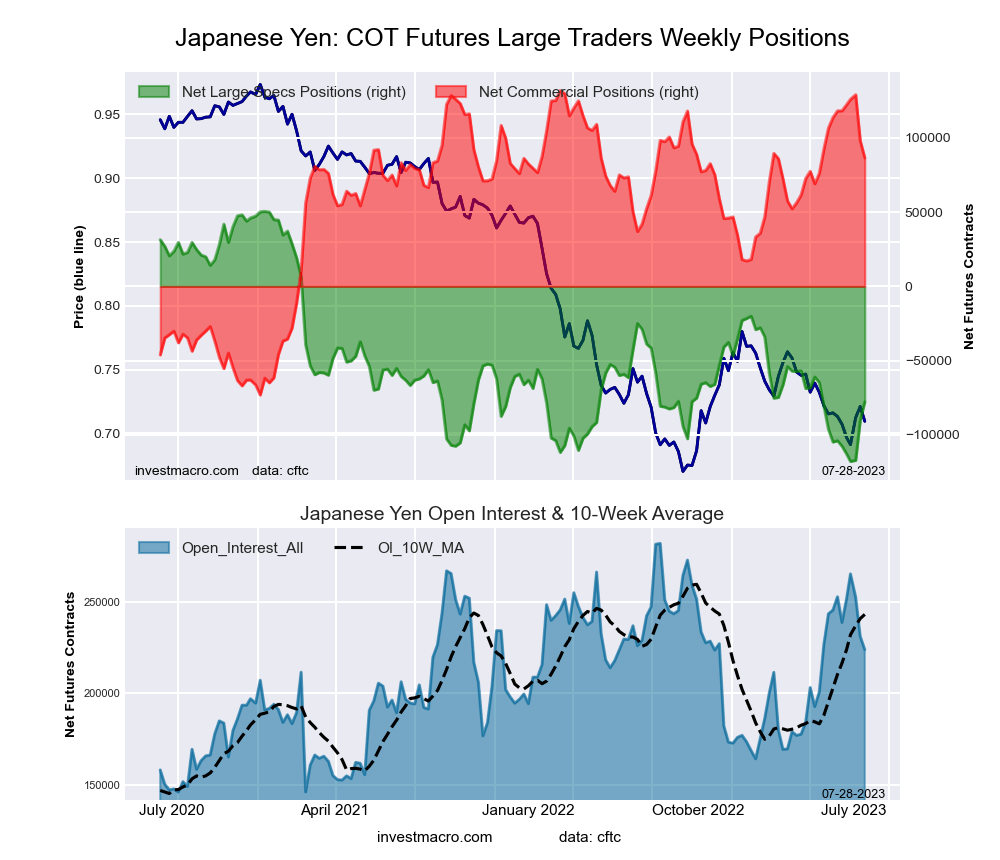
Japanese Yen Forex Futures COT ChartThe Japanese Yen large speculator standing this week totaled a net position of -77,752 contracts in the data reported through Tuesday. This was a weekly increase of 12,487 contracts from the previous week which had a total of -90,239 net contracts.

This week’s current strength score (the trader positioning range over the past three years, measured from 0 to 100) shows the speculators are currently Bearish with a score of 23.8 percent. The commercials are Bullish with a score of 77.9 percent and the small traders (not shown in chart) are Bearish with a score of 35.6 percent.

Price Trend-Following Model: Downtrend

Our weekly trend-following model classifies the current market price position as: Downtrend. The current action for the model is considered to be: Hold – Maintain Short Position.

JAPANESE YEN StatisticsSPECULATORSCOMMERCIALSSMALL TRADERS
– Percent of Open Interest Longs:13.672.013.4
– Percent of Open Interest Shorts:48.333.317.4
– Net Position:-77,75286,555-8,803
– Gross Longs:30,358161,16630,040
– Gross Shorts:108,11074,61138,843
– Long to Short Ratio:0.3 to 12.2 to 10.8 to 1
NET POSITION TREND:
– Strength Index Score (3 Year Range Pct):23.877.935.6
– Strength Index Reading (3 Year Range):BearishBullishBearish
NET POSITION MOVEMENT INDEX:
– 6-Week Change in Strength Index:15.6-15.411.0


Swiss Franc Futures:

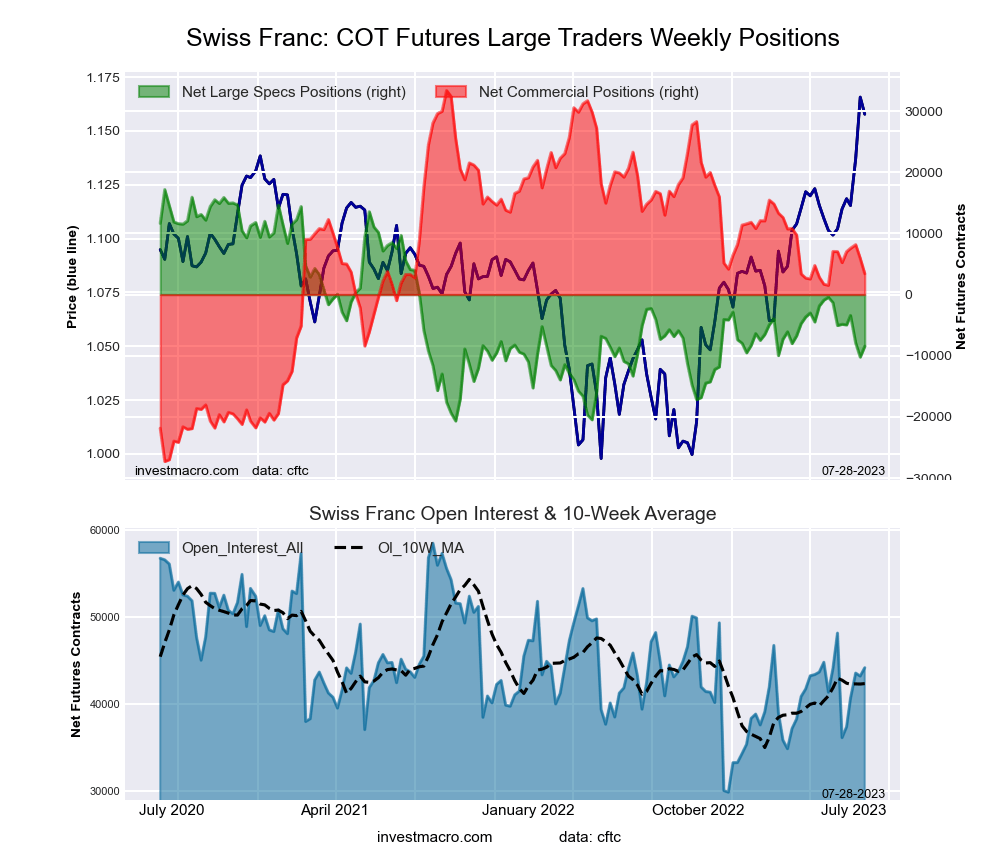
Swiss Franc Forex Futures COT ChartThe Swiss Franc large speculator standing this week totaled a net position of -8,431 contracts in the data reported through Tuesday. This was a weekly gain of 1,780 contracts from the previous week which had a total of -10,211 net contracts.

This week’s current strength score (the trader positioning range over the past three years, measured from 0 to 100) shows the speculators are currently Bearish with a score of 32.3 percent. The commercials are Bullish with a score of 50.6 percent and the small traders (not shown in chart) are Bullish with a score of 74.5 percent.

Price Trend-Following Model: Strong Uptrend

Our weekly trend-following model classifies the current market price position as: Strong Uptrend. The current action for the model is considered to be: Hold – Maintain Long Position.

SWISS FRANC StatisticsSPECULATORSCOMMERCIALSSMALL TRADERS
– Percent of Open Interest Longs:17.738.043.1
– Percent of Open Interest Shorts:36.730.331.8
– Net Position:-8,4313,4215,010
– Gross Longs:7,80416,78719,044
– Gross Shorts:16,23513,36614,034
– Long to Short Ratio:0.5 to 11.3 to 11.4 to 1
NET POSITION TREND:
– Strength Index Score (3 Year Range Pct):32.350.674.5
– Strength Index Reading (3 Year Range):BearishBullishBullish
NET POSITION MOVEMENT INDEX:
– 6-Week Change in Strength Index:-9.0-6.023.7


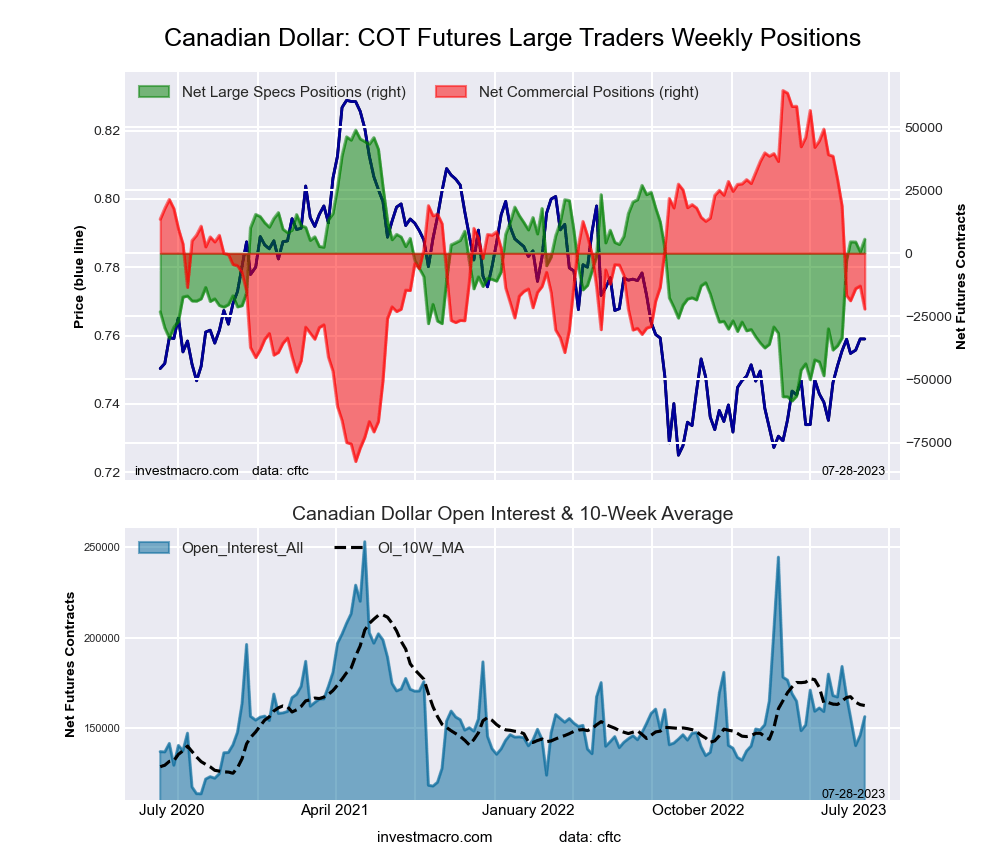
Canadian Dollar Futures:

Canadian Dollar Forex Futures COT ChartThe Canadian Dollar large speculator standing this week totaled a net position of 5,530 contracts in the data reported through Tuesday. This was a weekly rise of 5,009 contracts from the previous week which had a total of 521 net contracts.

This week’s current strength score (the trader positioning range over the past three years, measured from 0 to 100) shows the speculators are currently Bullish with a score of 59.7 percent. The commercials are Bearish with a score of 41.1 percent and the small traders (not shown in chart) are Bullish with a score of 59.6 percent.

Price Trend-Following Model: Uptrend

Our weekly trend-following model classifies the current market price position as: Uptrend. The current action for the model is considered to be: Hold – Maintain Long Position.

CANADIAN DOLLAR StatisticsSPECULATORSCOMMERCIALSSMALL TRADERS
– Percent of Open Interest Longs:27.347.025.2
– Percent of Open Interest Shorts:23.861.114.6
– Net Position:5,530-22,09616,566
– Gross Longs:42,75973,53939,413
– Gross Shorts:37,22995,63522,847
– Long to Short Ratio:1.1 to 10.8 to 11.7 to 1
NET POSITION TREND:
– Strength Index Score (3 Year Range Pct):59.741.159.6
– Strength Index Reading (3 Year Range):BullishBearishBullish
NET POSITION MOVEMENT INDEX:
– 6-Week Change in Strength Index:39.3-35.020.6


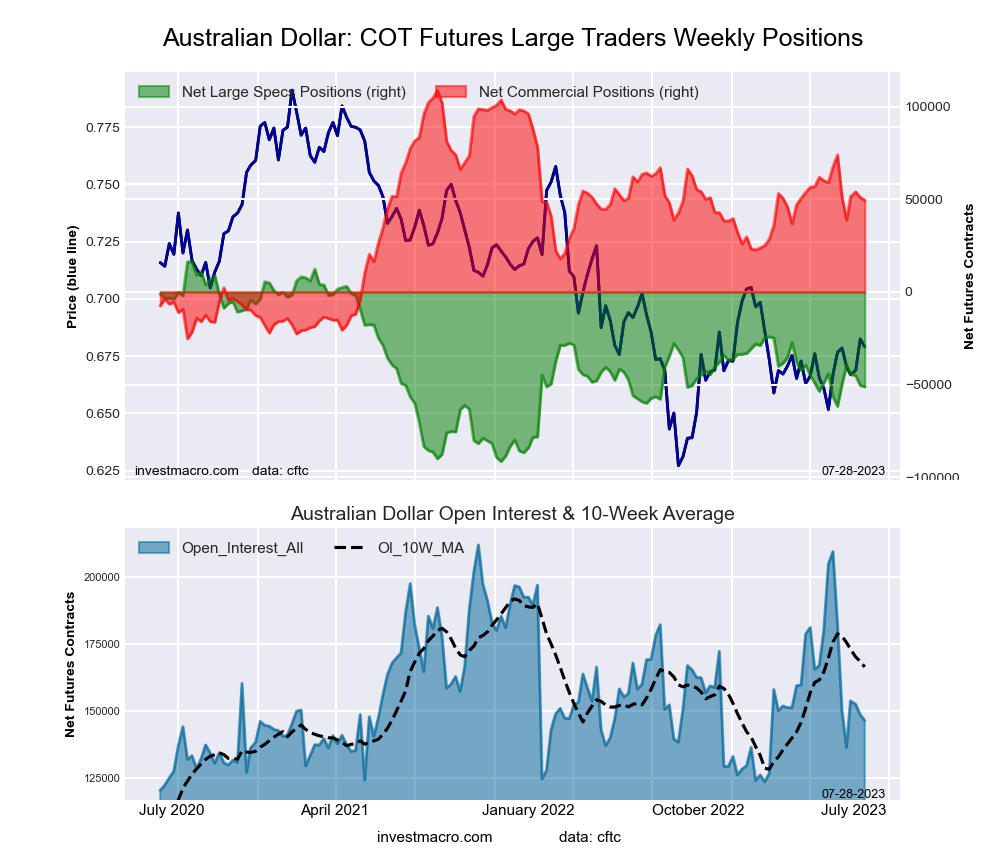
Australian Dollar Futures:

Australian Dollar Forex Futures COT ChartThe Australian Dollar large speculator standing this week totaled a net position of -51,201 contracts in the data reported through Tuesday. This was a weekly reduction of -800 contracts from the previous week which had a total of -50,401 net contracts.

This week’s current strength score (the trader positioning range over the past three years, measured from 0 to 100) shows the speculators are currently Bearish with a score of 37.4 percent. The commercials are Bullish with a score of 55.9 percent and the small traders (not shown in chart) are Bullish with a score of 56.4 percent.

Price Trend-Following Model: Uptrend

Our weekly trend-following model classifies the current market price position as: Uptrend. The current action for the model is considered to be: Hold – Maintain Long Position.

AUSTRALIAN DOLLAR StatisticsSPECULATORSCOMMERCIALSSMALL TRADERS
– Percent of Open Interest Longs:26.754.816.2
– Percent of Open Interest Shorts:61.721.015.1
– Net Position:-51,20149,5611,640
– Gross Longs:39,10880,23723,735
– Gross Shorts:90,30930,67622,095
– Long to Short Ratio:0.4 to 12.6 to 11.1 to 1
NET POSITION TREND:
– Strength Index Score (3 Year Range Pct):37.455.956.4
– Strength Index Reading (3 Year Range):BearishBullishBullish
NET POSITION MOVEMENT INDEX:
– 6-Week Change in Strength Index:9.8-18.233.7


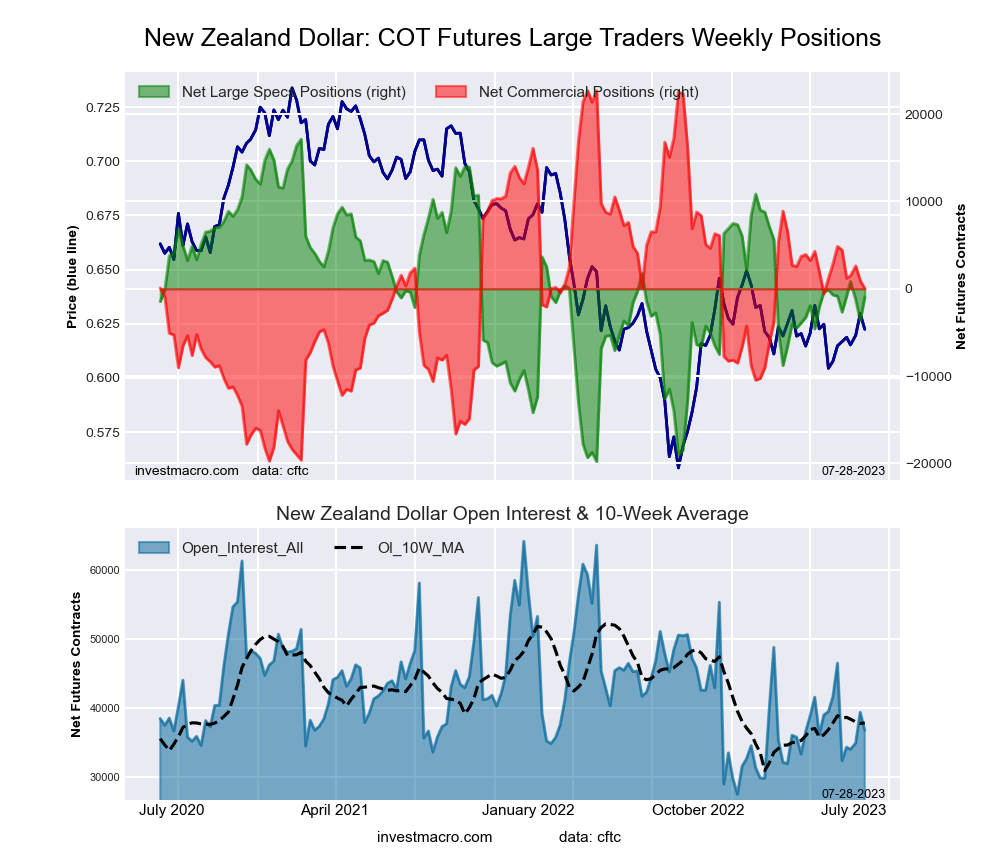
New Zealand Dollar Futures:

New Zealand Dollar Forex Futures COT ChartThe New Zealand Dollar large speculator standing this week totaled a net position of -949 contracts in the data reported through Tuesday. This was a weekly boost of 2,677 contracts from the previous week which had a total of -3,626 net contracts.

This week’s current strength score (the trader positioning range over the past three years, measured from 0 to 100) shows the speculators are currently Bullish with a score of 51.0 percent. The commercials are Bearish with a score of 46.6 percent and the small traders (not shown in chart) are Bullish with a score of 60.9 percent.

Price Trend-Following Model: Downtrend

Our weekly trend-following model classifies the current market price position as: Downtrend. The current action for the model is considered to be: Hold – Maintain Short Position.

NEW ZEALAND DOLLAR StatisticsSPECULATORSCOMMERCIALSSMALL TRADERS
– Percent of Open Interest Longs:35.153.411.1
– Percent of Open Interest Shorts:37.753.38.6
– Net Position:-94932917
– Gross Longs:12,93319,6644,080
– Gross Shorts:13,88219,6323,163
– Long to Short Ratio:0.9 to 11.0 to 11.3 to 1
NET POSITION TREND:
– Strength Index Score (3 Year Range Pct):51.046.660.9
– Strength Index Reading (3 Year Range):BullishBearishBullish
NET POSITION MOVEMENT INDEX:
– 6-Week Change in Strength Index:-0.3-11.458.8


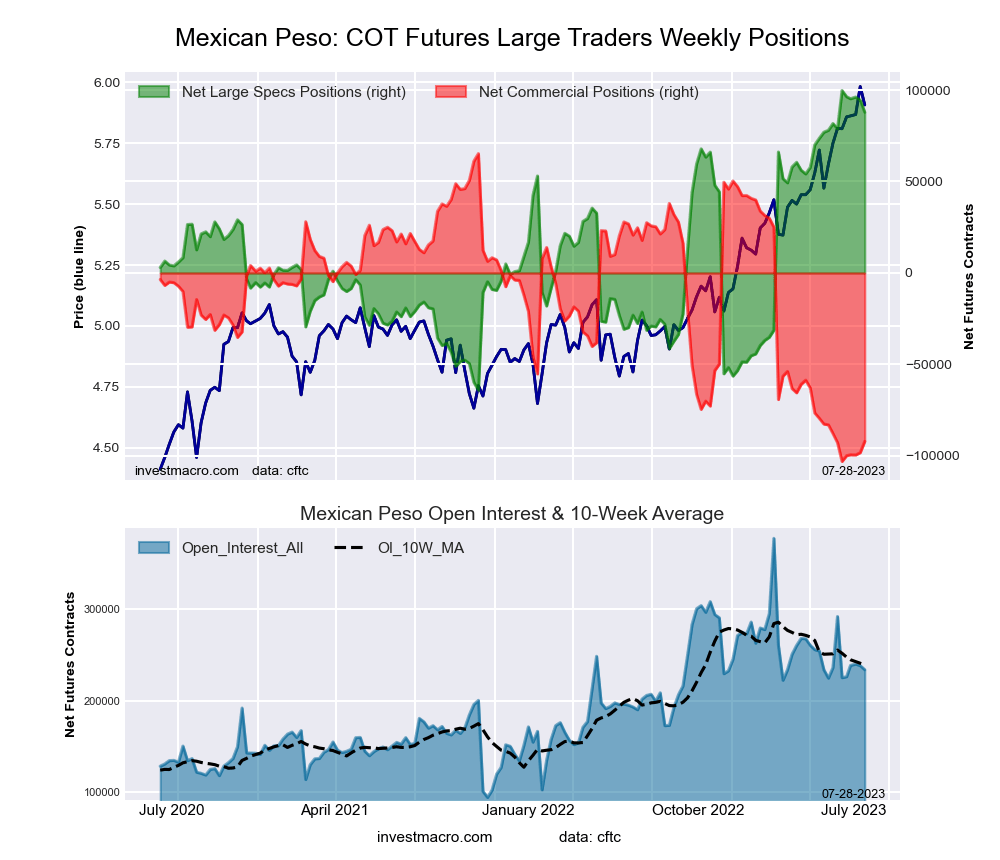
Mexican Peso Futures:

Mexican Peso Futures COT ChartThe Mexican Peso large speculator standing this week totaled a net position of 87,841 contracts in the data reported through Tuesday. This was a weekly decrease of -6,651 contracts from the previous week which had a total of 94,492 net contracts.

This week’s current strength score (the trader positioning range over the past three years, measured from 0 to 100) shows the speculators are currently Bullish-Extreme with a score of 92.8 percent. The commercials are Bearish-Extreme with a score of 6.5 percent and the small traders (not shown in chart) are Bearish with a score of 38.1 percent.

Price Trend-Following Model: Uptrend

Our weekly trend-following model classifies the current market price position as: Uptrend. The current action for the model is considered to be: Hold – Maintain Long Position.

MEXICAN PESO StatisticsSPECULATORSCOMMERCIALSSMALL TRADERS
– Percent of Open Interest Longs:50.445.43.7
– Percent of Open Interest Shorts:12.884.81.9
– Net Position:87,841-92,0584,217
– Gross Longs:117,732106,0618,608
– Gross Shorts:29,891198,1194,391
– Long to Short Ratio:3.9 to 10.5 to 12.0 to 1
NET POSITION TREND:
– Strength Index Score (3 Year Range Pct):92.86.538.1
– Strength Index Reading (3 Year Range):Bullish-ExtremeBearish-ExtremeBearish
NET POSITION MOVEMENT INDEX:
– 6-Week Change in Strength Index:5.50.4-61.9


Brazilian Real Futures:

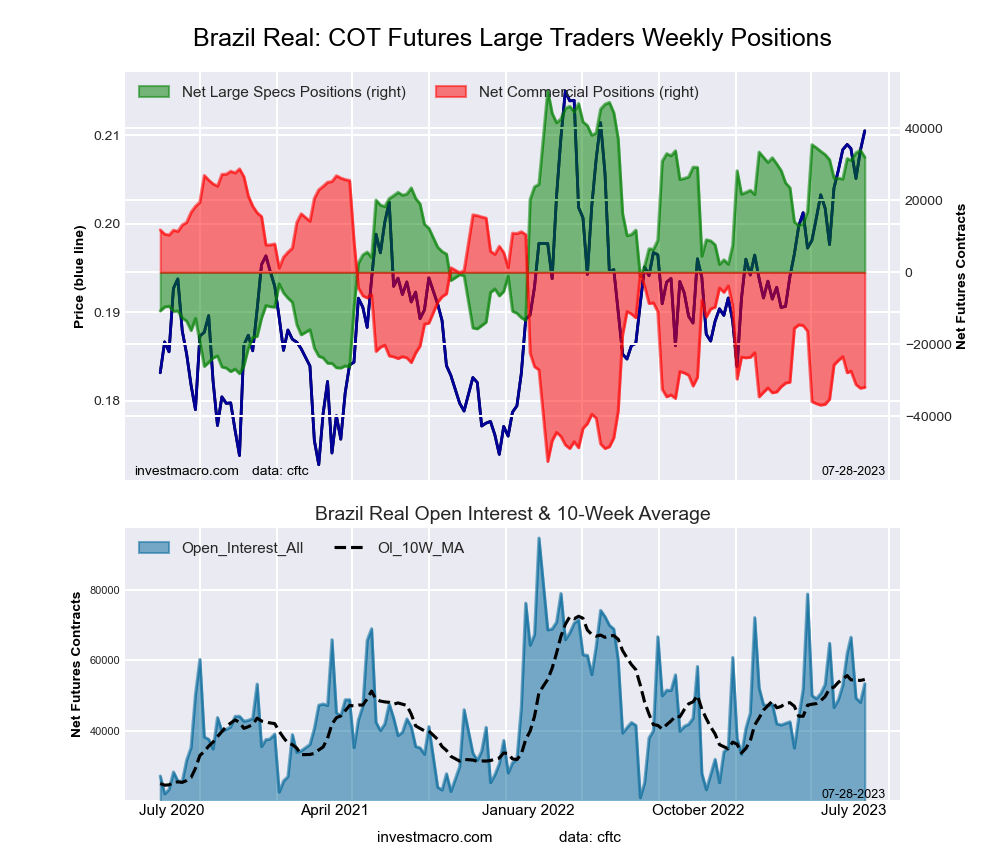
Brazil Real Futures COT ChartThe Brazilian Real large speculator standing this week totaled a net position of 31,971 contracts in the data reported through Tuesday. This was a weekly reduction of -1,962 contracts from the previous week which had a total of 33,933 net contracts.

This week’s current strength score (the trader positioning range over the past three years, measured from 0 to 100) shows the speculators are currently Bullish with a score of 76.4 percent. The commercials are Bearish with a score of 25.3 percent and the small traders (not shown in chart) are Bearish with a score of 43.9 percent.

Price Trend-Following Model: Strong Uptrend

Our weekly trend-following model classifies the current market price position as: Strong Uptrend. The current action for the model is considered to be: Hold – Maintain Long Position.

BRAZIL REAL StatisticsSPECULATORSCOMMERCIALSSMALL TRADERS
– Percent of Open Interest Longs:68.020.79.5
– Percent of Open Interest Shorts:8.280.59.5
– Net Position:31,971-31,957-14
– Gross Longs:36,34511,0735,084
– Gross Shorts:4,37443,0305,098
– Long to Short Ratio:8.3 to 10.3 to 11.0 to 1
NET POSITION TREND:
– Strength Index Score (3 Year Range Pct):76.425.343.9
– Strength Index Reading (3 Year Range):BullishBearishBearish
NET POSITION MOVEMENT INDEX:
– 6-Week Change in Strength Index:7.4-9.213.2


Bitcoin Futures:

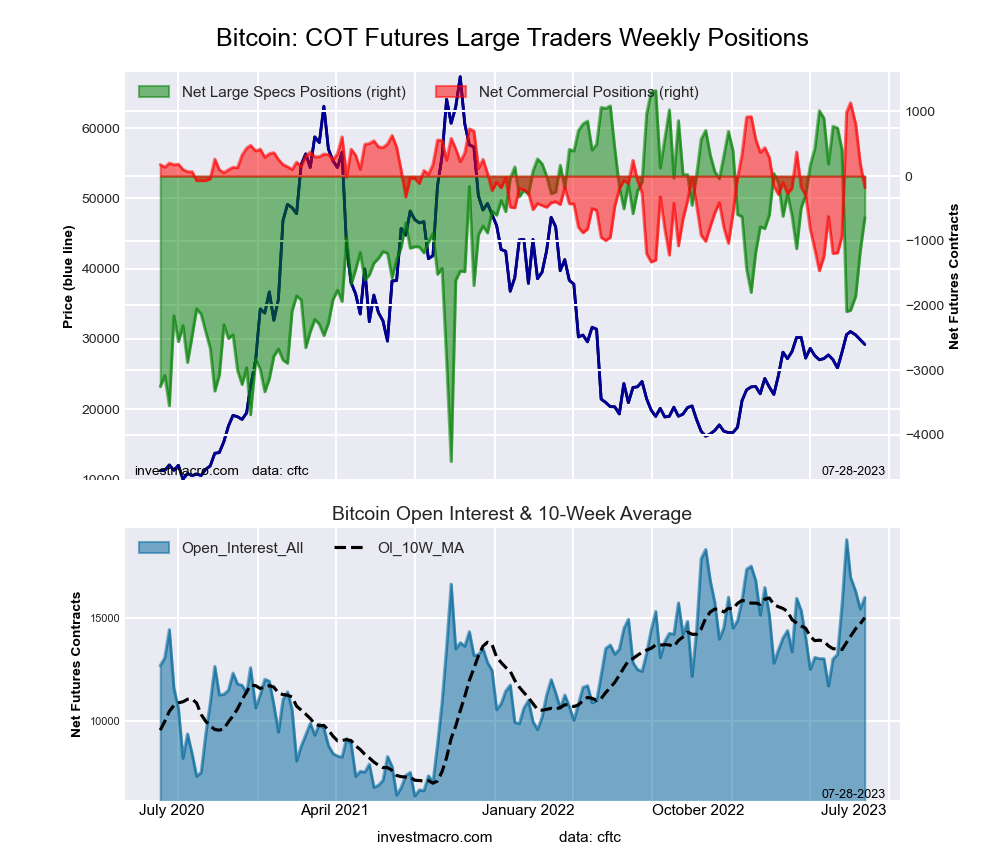
Bitcoin Crypto Futures COT ChartThe Bitcoin large speculator standing this week totaled a net position of -645 contracts in the data reported through Tuesday. This was a weekly rise of 516 contracts from the previous week which had a total of -1,161 net contracts.

This week’s current strength score (the trader positioning range over the past three years, measured from 0 to 100) shows the speculators are currently Bullish with a score of 65.7 percent. The commercials are Bearish with a score of 49.5 percent and the small traders (not shown in chart) are Bearish with a score of 31.7 percent.

Price Trend-Following Model: Uptrend

Our weekly trend-following model classifies the current market price position as: Uptrend. The current action for the model is considered to be: Hold – Maintain Long Position.

BITCOIN StatisticsSPECULATORSCOMMERCIALSSMALL TRADERS
– Percent of Open Interest Longs:74.62.69.4
– Percent of Open Interest Shorts:78.63.74.2
– Net Position:-645-178823
– Gross Longs:11,9414221,503
– Gross Shorts:12,586600680
– Long to Short Ratio:0.9 to 10.7 to 12.2 to 1
NET POSITION TREND:
– Strength Index Score (3 Year Range Pct):65.749.531.7
– Strength Index Reading (3 Year Range):BullishBearishBearish
NET POSITION MOVEMENT INDEX:
– 6-Week Change in Strength Index:-24.238.98.6


Article By InvestMacroReceive our weekly COT Newsletter

*COT Report: The COT data, released weekly to the public each Friday, is updated through the most recent Tuesday (data is 3 days old) and shows a quick view of how large speculators or non-commercials (for-profit traders) were positioned in the futures markets.

The CFTC categorizes trader positions according to commercial hedgers (traders who use futures contracts for hedging as part of the business), non-commercials (large traders who speculate to realize trading profits) and nonreportable traders (usually small traders/speculators) as well as their open interest (contracts open in the market at time of reporting). See CFTC criteria here.


Japanese Candlesticks Analysis 27.07.2023 (XAUUSD, NZDUSD, GBPUSD)

By RoboForex.com

XAUUSD, “Gold vs US Dollar”

Gold has formed a Shooting Star reversal pattern near the resistance level. Currently, the instrument could go by the reversal signal in a descending wave. The correction target might be 1965.50. Upon testing the support, the price might rebound and continue the uptrend. However, the quotes could rise to 1990.00 without a correction.

GOLD
Risk Warning: the result of previous trading operations do not guarantee the same results in the future

NZDUSD, “New Zealand Dollar vs US Dollar”

NZDUSD has formed a Hammer reversal pattern on H4. Currently, the instrument is going by the reversal signal in an ascending wave. The growth target might be 0.6300. Upon breaking the resistance, the quotes might have a chance to continue the uptrend. However, a correction to 0.6190 might develop and an uptrend might follow the pullback.

NZDUSD
Risk Warning: the result of previous trading operations do not guarantee the same results in the future

GBPUSD, “Great Britain Pound vs US Dollar”

GBPUSD has formed a Hammer reversal pattern near the support level on H4. Currently, the instrument is going by the reversal signal in an ascending wave. The growth target might be 1.3055. However, the price might correct to 1.2895 and continue the uptrend following the pullback.

GBPUSD
Risk Warning: the result of previous trading operations do not guarantee the same results in the future

Article By RoboForex.com

Attention!
Forecasts presented in this section only reflect the author’s private opinion and should not be considered as guidance for trading. RoboForex LP bears no responsibility for trading results based on trading recommendations described in these analytical reviews.

AUD remains highly volatile. Overview for 26.07.2023

By RoboForex.com

The Australian dollar, paired with the US dollar, is once again facing pressure. The current AUDUSD quote is 0.6759.

The Aussie’s volatility is drawing attention. On one hand, a strong US dollar exerts pressure on the AUD. On the other hand, China is sending quite positive signals.

Today’s statistics revealed that inflation in Australia for the second quarter declined to 5.4% year-over-year. On a quarterly basis, the indicator rose by 0.8% following a 1.4% increase from January to March this year. The easing of inflationary pressure is a positive signal. The Reserve Bank of Australia is likely to acknowledge this at its next meeting and keep the interest rate unchanged. The Australian dollar is reacting precisely to this development.

China’s readiness to stimulate its economy is favourable for Australia. As Australia’s primary trading and economic partner, all positive news coming from China is also encouraging for the AUD.

Article By RoboForex.com

Attention!
Forecasts presented in this section only reflect the author’s private opinion and should not be considered as guidance for trading. RoboForex LP bears no responsibility for trading results based on trading recommendations described in these analytical reviews.

Mid-Week Technical Outlook: Calm Before Fed Storm?

By ForexTime 

  • USD shaky ahead of Fed
  • USDJPY pressured below 141
  • SPX500_m preparing to breakout?
  • NQ100_m still in uptrend
  • Gold climbs beyond $1970

An air of tension settled over financial markets on Wednesday as investors braced for the pivotal Federal Reserve rate decision.

Global equities struggled for direction amid the growing caution, with European shares and US futures mixed as investors turned to the sidelines. Although the Fed is widely expected to raise interest rates by 25 basis points today, the key question is whether this will be the hike that concludes its aggressive campaign against inflation. Whatever the outcome of today’s policy meeting, it has the potential to rock financial markets.

Here are some technical setups to keep an eye on ahead of the Fed decision:

Dollar shaky and vulnerable 

The dollar has weakened against all G10 currencies this morning, with prices testing the 101.10 level. As discussed throughout the week, the pending Fed decision is likely to heavily influence the dollar’s short to medium-term outlook. A strong breakdown below 101.10 may open the doors towards 100.72 and 100.00. Should prices push back above 101.50, the next key level of interest can be found at 102.35.

EURUSD rebound or breakdown?

After rebounding from the 1.1032 region yesterday, the euro has extended gains this morning with bulls eyeing 1.1090. A solid breakout above this point may re-open a path back towards 1.12750. Should prices slip back below 1.1032, bears may target 1.0950.

GBPUSD to resume uptrend?

Wednesday’s strong bullish daily candle could be early signs of GBPUSD bulls returning to the scene. Indeed, prices remain in a bullish trend with the MACD trading to the upside. A move towards 1.3000 could be on the cards if 1.2810 proves to be reliable support. Alternatively, a break below this point may trigger a selloff toward the 50-day Simple Moving Average.

USDJPY pressured below 141.00

USDJPY bears seem to be slowly creeping back into the scene, especially after prices broke through the 141.00 level. Dollar weakness could drag the currency pair towards 138.80 and 138.00, respectively. If prices can push back above 141.00, bulls could challenge 141.90 once again.

SPX500_m breakout alert?

Expect the SPX500_m to be rocked by earnings releases from the largest companies in the world. The index remains bullish on the daily charts with resistance found at 4580. A strong breakout and daily close above this point could trigger a move toward 4640. Sustained weakness below 4580 could see prices test 4500 and 4463.

NQ100_m still in uptrend 

Our trade of the week remains in an uptrend on the daily charts. A strong move above 15700 could inspire a move towards 15947. Should prices slip back under 15300, the selloff may take the index towards 14965.

Gold gearing to push higher?

After kicking off the week on a rocky note, gold bulls seem to have their footing with prices trading above the sticky $1960 level. Should this rebound build momentum, this could take the precious metal towards $1985 and $2000. On the other hand, a decline back below $1955 may see prices test $1940 and $1932.


Forex-Time-LogoArticle by ForexTime

ForexTime Ltd (FXTM) is an award winning international online forex broker regulated by CySEC 185/12 www.forextime.com