Archive for Forex and Currency News – Page 60

British Pound Speculator bets jump to 15-year high as GBP closes above 1.30

By InvestMacro

Here are the latest charts and statistics for the Commitment of Traders (COT) data published by the Commodities Futures Trading Commission (CFTC).

The latest COT data is updated through Tuesday July 11th and shows a quick view of how large market participants (for-profit speculators and commercial traders) were positioned in the futures markets. All currency positions are in direct relation to the US dollar where, for example, a bet for the euro is a bet that the euro will rise versus the dollar while a bet against the euro will be a bet that the euro will decline versus the dollar.

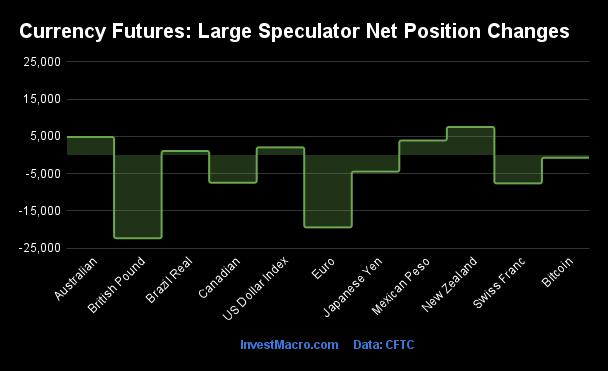
Weekly Speculator Changes led by British Pound & Brazilian Real

The COT currency market speculator bets were lower this week as five out of the eleven currency markets we cover had higher positioning while the other six markets had lower speculator contracts.

Leading the gains for the currency markets was the British Pound (7,798 contracts) with the Brazilian Real (2,094 contracts), Mexican Peso (926 contracts), Japanese Yen (738 contracts) and Bitcoin (221 contracts) also showing positive weeks.

The currencies seeing declines in speculator bets on the week were the Swiss Franc (-4,503 contracts), the US Dollar Index (-2,306 contracts), EuroFX (-2,675 contracts), the New Zealand Dollar (-2,081 contracts), the Australian Dollar (-502 contracts) and the Canadian Dollar (-83 contracts)also registering lower bets on the week.

British Pound Speculator bets jump to 15-year high as GBP closes above 1.30

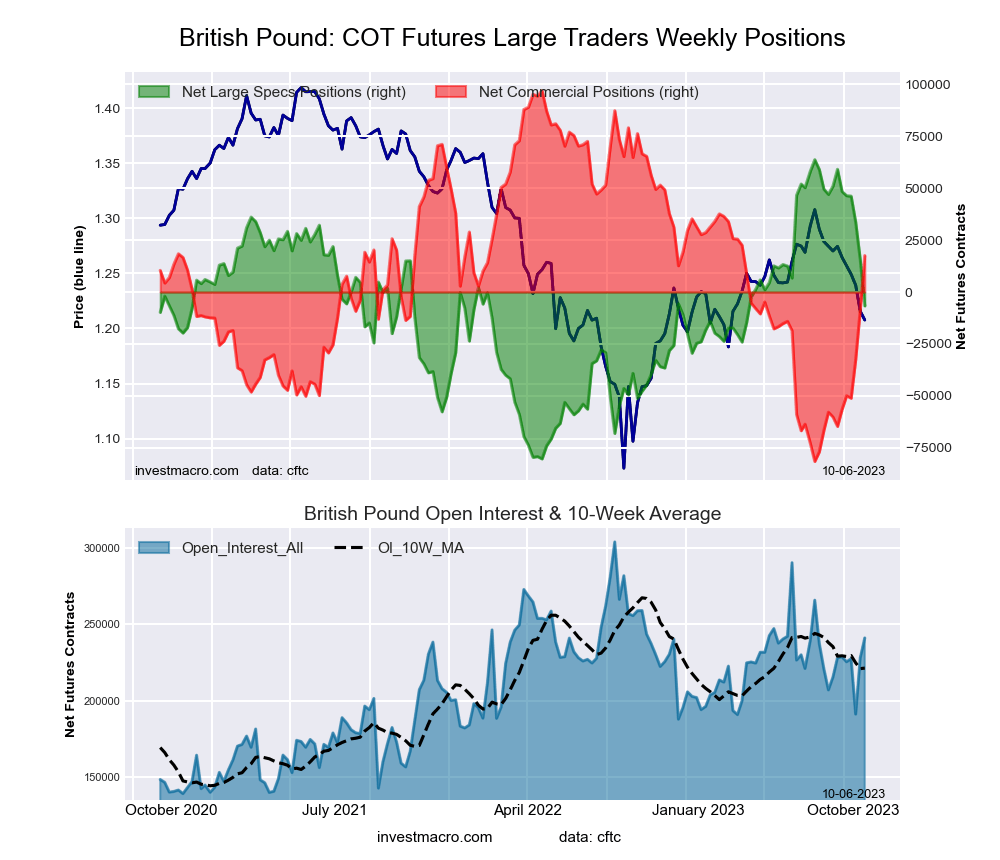
Highlighting the COT currency’s data this week is the bullish strength in the speculator’s positioning of the British Pound Sterling. Large speculative Pound positions rose this week by almost +8,000 contracts and have now increased their bullish positions in three out of the past four weeks.

The overall gain for the past four weeks now totals +51,328 contracts. This has pushed the overall net position, which currently sits at +58,063 contracts, to the highest speculator bullish standing since November 6th of 2007, an over 15-year high.

The Pound’s positioning has been helped out by the Bank of England’s most recent interest rate increase in June that was by 50 basis points and brought the bank rate to 5 percent – its highest sitting in the past 15 years as well. Traders are forecasting more rate hikes out of the UK due to high inflation while other countries, like the US, are likely nearing the end of a rate-rising cycle.

The Pound Sterling exchange rate against the US Dollar has been streaking higher this year and this week closed above the 1.3000 exchange rate for the first time since April of 2022. The GBPUSD currency pair had touched a low near 1.0360 as recently as September and has been on a strong uptrend since then. The GBPUSD has now risen by approximately 25 percent since that September bottom.


Data Snapshot of Forex Market Traders | Columns Legend
Jul-11-2023OIOI-IndexSpec-NetSpec-IndexCom-NetCOM-IndexSmalls-NetSmalls-Index
USD Index28,925612,01145-13,577541,56634
EUR736,05656140,16272-192,4622552,30062
GBP239,1256158,063100-72,701014,63887
JPY252,34979-117,1820129,07799-11,89529
CHF43,56348-7,907348,16558-25857
CAD140,395194,44459-14,026479,58244
AUD152,49542-45,0844354,03559-8,95131
NZD34,94720-1,251502,61953-1,36834
MXN239,7385196,16698-99,49323,32732
RUB20,93047,54331-7,15069-39324
BRL49,3633833,19878-31,19326-2,00528
Bitcoin16,30280-1,8554580401,05137


Strength Scores led by British Pound & Mexican Peso

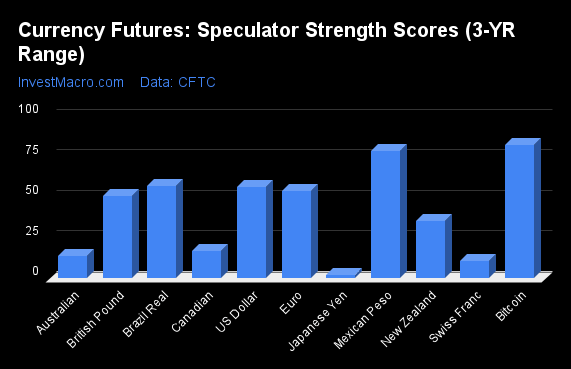
COT Strength Scores (a normalized measure of Speculator positions over a 3-Year range, from 0 to 100 where above 80 is Extreme-Bullish and below 20 is Extreme-Bearish) showed that the British Pound (100 percent) and the Mexican Peso (98 percent) lead the currency markets this week. The Brazilian Real (78 percent), EuroFX (72 percent) and the Canadian Dollar (59 percent) come in as the next highest in the weekly strength scores.

On the downside, the Japanese Yen (0 percent) and the Swiss Franc (34 percent) come in at the lowest strength levels currently and are in Extreme-Bearish territory (below 20 percent). The next lowest strength scores are the Australian Dollar (43 percent) and the Bitcoin (45 percent).

Strength Statistics:
US Dollar Index (45.0 percent) vs US Dollar Index previous week (48.8 percent)
EuroFX (72.4 percent) vs EuroFX previous week (73.4 percent)
British Pound Sterling (100.0 percent) vs British Pound Sterling previous week (94.4 percent)
Japanese Yen (0.4 percent) vs Japanese Yen previous week (0.0 percent)
Swiss Franc (33.7 percent) vs Swiss Franc previous week (45.6 percent)
Canadian Dollar (58.7 percent) vs Canadian Dollar previous week (58.8 percent)
Australian Dollar (43.0 percent) vs Australian Dollar previous week (43.5 percent)
New Zealand Dollar (50.2 percent) vs New Zealand Dollar previous week (55.8 percent)
Mexican Peso (97.8 percent) vs Mexican Peso previous week (97.3 percent)
Brazilian Real (78.0 percent) vs Brazilian Real previous week (75.3 percent)
Bitcoin (44.6 percent) vs Bitcoin previous week (40.7 percent)


British Pound & Canadian Dollar top the 6-Week Strength Trends

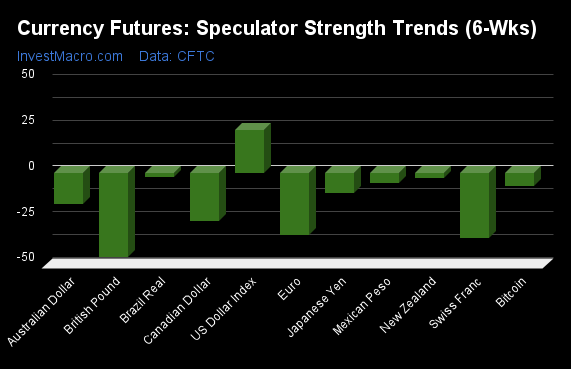
COT Strength Score Trends (or move index, calculates the 6-week changes in strength scores) showed that the British Pound (32 percent) and the Canadian Dollar (32 percent) lead the past six weeks trends for the currencies. The Mexican Peso (11 percent), the Brazilian Real (2 percent) and the US Dollar Index (-1 percent) are the next highest positive movers in the latest trends data.

The Bitcoin (-36 percent) leads the downside trend scores currently with the Swiss Franc (-20 percent), Japanese Yen (-12 percent) and the EuroFX (-10 percent) following next with lower trend scores.

Strength Trend Statistics:
US Dollar Index (-1.3 percent) vs US Dollar Index previous week (5.1 percent)
EuroFX (-9.9 percent) vs EuroFX previous week (-11.9 percent)
British Pound Sterling (32.4 percent) vs British Pound Sterling previous week (27.9 percent)
Japanese Yen (-12.5 percent) vs Japanese Yen previous week (-22.1 percent)
Swiss Franc (-19.8 percent) vs Swiss Franc previous week (-6.6 percent)
Canadian Dollar (32.0 percent) vs Canadian Dollar previous week (49.5 percent)
Australian Dollar (-0.9 percent) vs Australian Dollar previous week (4.2 percent)
New Zealand Dollar (-3.0 percent) vs New Zealand Dollar previous week (3.2 percent)
Mexican Peso (11.1 percent) vs Mexican Peso previous week (11.2 percent)
Brazilian Real (2.4 percent) vs Brazilian Real previous week (-2.0 percent)
Bitcoin (-35.6 percent) vs Bitcoin previous week (-51.8 percent)


Individual COT Forex Markets:

US Dollar Index Futures:
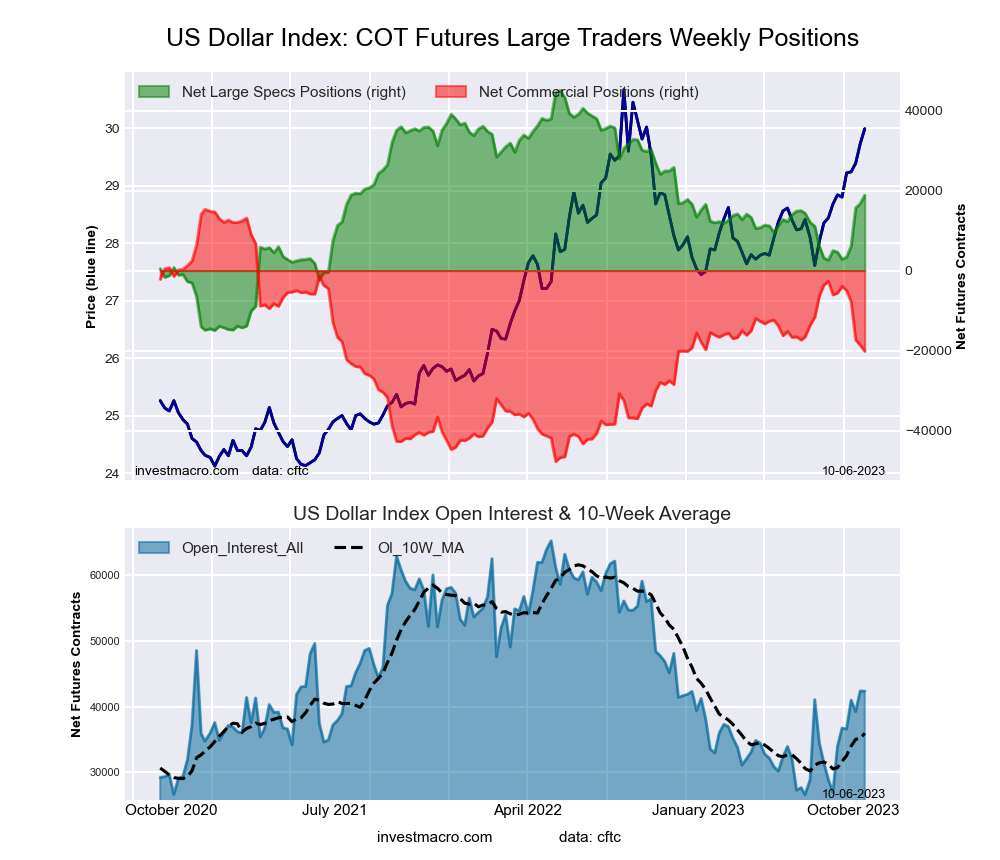
US Dollar Index Forex Futures COT ChartThe US Dollar Index large speculator standing this week equaled a net position of 12,011 contracts in the data reported through Tuesday. This was a weekly decline of -2,306 contracts from the previous week which had a total of 14,317 net contracts.

This week’s current strength score (the trader positioning range over the past three years, measured from 0 to 100) shows the speculators are currently Bearish with a score of 45.0 percent. The commercials are Bullish with a score of 54.2 percent and the small traders (not shown in chart) are Bearish with a score of 33.6 percent.

Price Trend-Following Model: Weak Uptrend

Our weekly trend-following model classifies the current market price position as: Weak Uptrend. The current action for the model is considered to be: Hold – Maintain Long Position.

US DOLLAR INDEX StatisticsSPECULATORSCOMMERCIALSSMALL TRADERS
– Percent of Open Interest Longs:71.78.814.9
– Percent of Open Interest Shorts:30.255.79.5
– Net Position:12,011-13,5771,566
– Gross Longs:20,7412,5364,316
– Gross Shorts:8,73016,1132,750
– Long to Short Ratio:2.4 to 10.2 to 11.6 to 1
NET POSITION TREND:
– Strength Index Score (3 Year Range Pct):45.054.233.6
– Strength Index Reading (3 Year Range):BearishBullishBearish
NET POSITION MOVEMENT INDEX:
– 6-Week Change in Strength Index:-1.34.3-21.1


Euro Currency Futures:

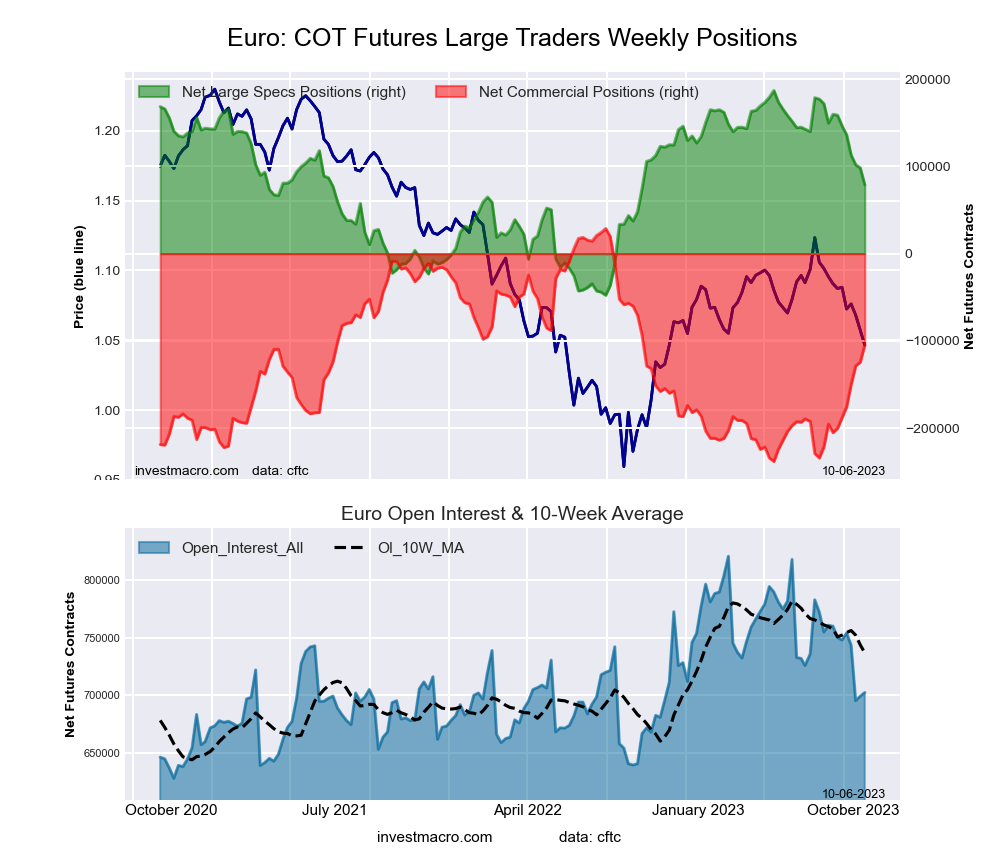
Euro Currency Futures COT ChartThe Euro Currency large speculator standing this week equaled a net position of 140,162 contracts in the data reported through Tuesday. This was a weekly decline of -2,675 contracts from the previous week which had a total of 142,837 net contracts.

This week’s current strength score (the trader positioning range over the past three years, measured from 0 to 100) shows the speculators are currently Bullish with a score of 72.4 percent. The commercials are Bearish with a score of 25.4 percent and the small traders (not shown in chart) are Bullish with a score of 62.4 percent.

Price Trend-Following Model: Strong Uptrend

Our weekly trend-following model classifies the current market price position as: Strong Uptrend. The current action for the model is considered to be: Hold – Maintain Long Position.

EURO Currency StatisticsSPECULATORSCOMMERCIALSSMALL TRADERS
– Percent of Open Interest Longs:30.554.813.0
– Percent of Open Interest Shorts:11.481.05.9
– Net Position:140,162-192,46252,300
– Gross Longs:224,351403,46095,768
– Gross Shorts:84,189595,92243,468
– Long to Short Ratio:2.7 to 10.7 to 12.2 to 1
NET POSITION TREND:
– Strength Index Score (3 Year Range Pct):72.425.462.4
– Strength Index Reading (3 Year Range):BullishBearishBullish
NET POSITION MOVEMENT INDEX:
– 6-Week Change in Strength Index:-9.97.36.4


British Pound Sterling Futures:

British Pound Sterling Futures COT ChartThe British Pound Sterling large speculator standing this week equaled a net position of 58,063 contracts in the data reported through Tuesday. This was a weekly boost of 7,798 contracts from the previous week which had a total of 50,265 net contracts.

This week’s current strength score (the trader positioning range over the past three years, measured from 0 to 100) shows the speculators are currently Bullish-Extreme with a score of 100.0 percent. The commercials are Bearish-Extreme with a score of 0.0 percent and the small traders (not shown in chart) are Bullish-Extreme with a score of 86.7 percent.

Price Trend-Following Model: Strong Uptrend

Our weekly trend-following model classifies the current market price position as: Strong Uptrend. The current action for the model is considered to be: Hold – Maintain Long Position.

BRITISH POUND StatisticsSPECULATORSCOMMERCIALSSMALL TRADERS
– Percent of Open Interest Longs:46.730.616.7
– Percent of Open Interest Shorts:22.461.010.5
– Net Position:58,063-72,70114,638
– Gross Longs:111,66773,15039,825
– Gross Shorts:53,604145,85125,187
– Long to Short Ratio:2.1 to 10.5 to 11.6 to 1
NET POSITION TREND:
– Strength Index Score (3 Year Range Pct):100.00.086.7
– Strength Index Reading (3 Year Range):Bullish-ExtremeBearish-ExtremeBullish-Extreme
NET POSITION MOVEMENT INDEX:
– 6-Week Change in Strength Index:32.4-33.924.8


Japanese Yen Futures:

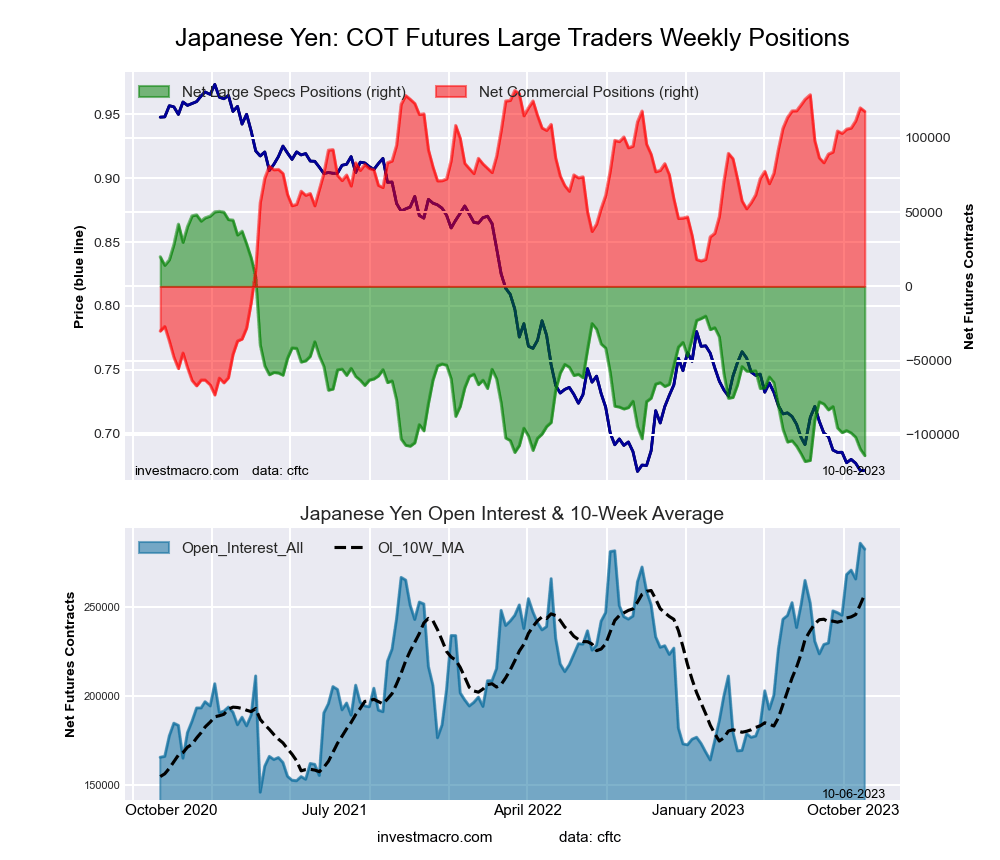
The Japanese Yen large speculator standing this week equaled a net position of -117,182 contracts in the data reported through Tuesday. This was a weekly rise of 738 contracts from the previous week which had a total of -117,920 net contracts.

This week’s current strength score (the trader positioning range over the past three years, measured from 0 to 100) shows the speculators are currently Bearish-Extreme with a score of 0.4 percent. The commercials are Bullish-Extreme with a score of 98.6 percent and the small traders (not shown in chart) are Bearish with a score of 29.3 percent.

Price Trend-Following Model: Downtrend

Our weekly trend-following model classifies the current market price position as: Downtrend. The current action for the model is considered to be: Hold – Maintain Short Position.

JAPANESE YEN StatisticsSPECULATORSCOMMERCIALSSMALL TRADERS
– Percent of Open Interest Longs:11.875.411.6
– Percent of Open Interest Shorts:58.324.216.3
– Net Position:-117,182129,077-11,895
– Gross Longs:29,838190,18929,288
– Gross Shorts:147,02061,11241,183
– Long to Short Ratio:0.2 to 13.1 to 10.7 to 1
NET POSITION TREND:
– Strength Index Score (3 Year Range Pct):0.498.629.3
– Strength Index Reading (3 Year Range):Bearish-ExtremeBullish-ExtremeBearish
NET POSITION MOVEMENT INDEX:
– 6-Week Change in Strength Index:-12.511.0-3.2


Swiss Franc Futures:

Swiss Franc Forex Futures COT ChartThe Swiss Franc large speculator standing this week equaled a net position of -7,907 contracts in the data reported through Tuesday. This was a weekly decrease of -4,503 contracts from the previous week which had a total of -3,404 net contracts.

This week’s current strength score (the trader positioning range over the past three years, measured from 0 to 100) shows the speculators are currently Bearish with a score of 33.7 percent. The commercials are Bullish with a score of 58.5 percent and the small traders (not shown in chart) are Bullish with a score of 56.7 percent.

Price Trend-Following Model: Strong Uptrend

Our weekly trend-following model classifies the current market price position as: Strong Uptrend. The current action for the model is considered to be: Hold – Maintain Long Position.

SWISS FRANC StatisticsSPECULATORSCOMMERCIALSSMALL TRADERS
– Percent of Open Interest Longs:17.047.335.4
– Percent of Open Interest Shorts:35.228.636.0
– Net Position:-7,9078,165-258
– Gross Longs:7,41720,60415,411
– Gross Shorts:15,32412,43915,669
– Long to Short Ratio:0.5 to 11.7 to 11.0 to 1
NET POSITION TREND:
– Strength Index Score (3 Year Range Pct):33.758.556.7
– Strength Index Reading (3 Year Range):BearishBullishBullish
NET POSITION MOVEMENT INDEX:
– 6-Week Change in Strength Index:-19.810.92.8


Canadian Dollar Futures:

Canadian Dollar Forex Futures COT ChartThe Canadian Dollar large speculator standing this week equaled a net position of 4,444 contracts in the data reported through Tuesday. This was a weekly fall of -83 contracts from the previous week which had a total of 4,527 net contracts.

This week’s current strength score (the trader positioning range over the past three years, measured from 0 to 100) shows the speculators are currently Bullish with a score of 58.7 percent. The commercials are Bearish with a score of 46.6 percent and the small traders (not shown in chart) are Bearish with a score of 44.1 percent.

Price Trend-Following Model: Strong Uptrend

Our weekly trend-following model classifies the current market price position as: Strong Uptrend. The current action for the model is considered to be: Hold – Maintain Long Position.

CANADIAN DOLLAR StatisticsSPECULATORSCOMMERCIALSSMALL TRADERS
– Percent of Open Interest Longs:25.049.123.4
– Percent of Open Interest Shorts:21.859.116.6
– Net Position:4,444-14,0269,582
– Gross Longs:35,07268,93532,865
– Gross Shorts:30,62882,96123,283
– Long to Short Ratio:1.1 to 10.8 to 11.4 to 1
NET POSITION TREND:
– Strength Index Score (3 Year Range Pct):58.746.644.1
– Strength Index Reading (3 Year Range):BullishBearishBearish
NET POSITION MOVEMENT INDEX:
– 6-Week Change in Strength Index:32.0-36.141.5


Australian Dollar Futures:

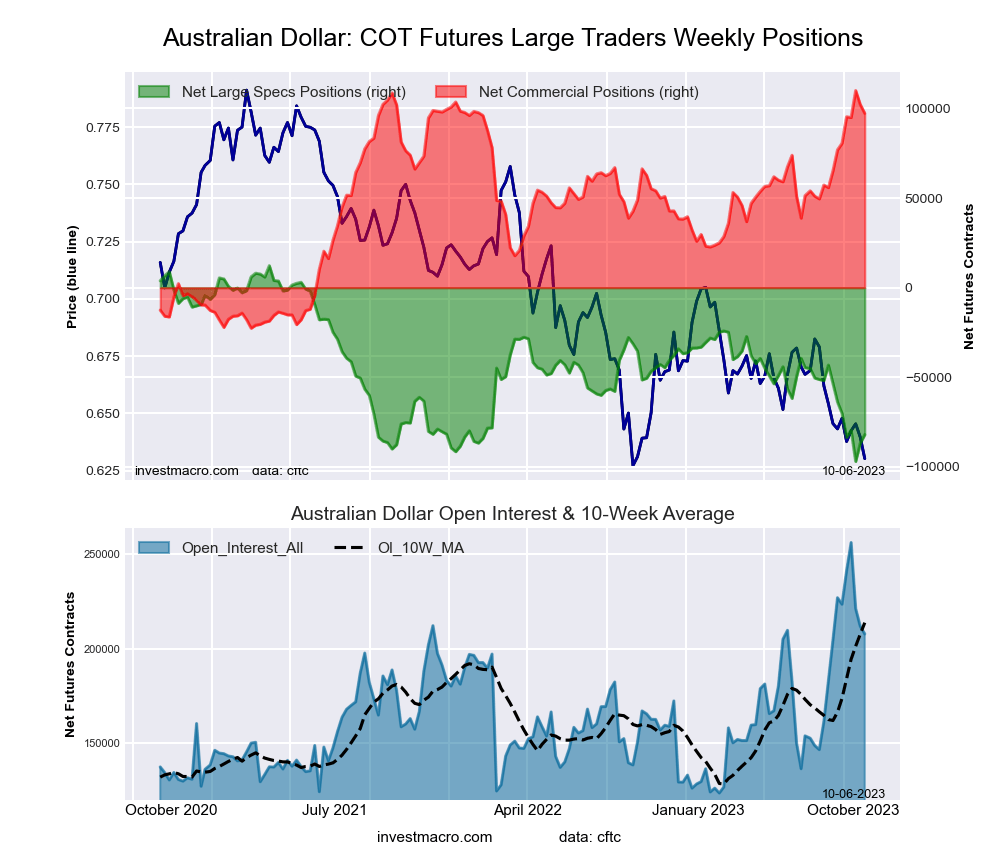
Australian Dollar Forex Futures COT ChartThe Australian Dollar large speculator standing this week equaled a net position of -45,084 contracts in the data reported through Tuesday. This was a weekly decline of -502 contracts from the previous week which had a total of -44,582 net contracts.

This week’s current strength score (the trader positioning range over the past three years, measured from 0 to 100) shows the speculators are currently Bearish with a score of 43.0 percent. The commercials are Bullish with a score of 59.2 percent and the small traders (not shown in chart) are Bearish with a score of 30.6 percent.

Price Trend-Following Model: Strong Uptrend

Our weekly trend-following model classifies the current market price position as: Strong Uptrend. The current action for the model is considered to be: New Buy – Long Position.

AUSTRALIAN DOLLAR StatisticsSPECULATORSCOMMERCIALSSMALL TRADERS
– Percent of Open Interest Longs:28.657.410.7
– Percent of Open Interest Shorts:58.221.916.6
– Net Position:-45,08454,035-8,951
– Gross Longs:43,66187,45816,392
– Gross Shorts:88,74533,42325,343
– Long to Short Ratio:0.5 to 12.6 to 10.6 to 1
NET POSITION TREND:
– Strength Index Score (3 Year Range Pct):43.059.230.6
– Strength Index Reading (3 Year Range):BearishBullishBearish
NET POSITION MOVEMENT INDEX:
– 6-Week Change in Strength Index:-0.9-3.814.7


New Zealand Dollar Futures:

New Zealand Dollar Forex Futures COT ChartThe New Zealand Dollar large speculator standing this week equaled a net position of -1,251 contracts in the data reported through Tuesday. This was a weekly lowering of -2,081 contracts from the previous week which had a total of 830 net contracts.

This week’s current strength score (the trader positioning range over the past three years, measured from 0 to 100) shows the speculators are currently Bullish with a score of 50.2 percent. The commercials are Bullish with a score of 52.7 percent and the small traders (not shown in chart) are Bearish with a score of 33.7 percent.

Price Trend-Following Model: Weak Downtrend

Our weekly trend-following model classifies the current market price position as: Weak Downtrend. The current action for the model is considered to be: Hold – Maintain Short Position.

NEW ZEALAND DOLLAR StatisticsSPECULATORSCOMMERCIALSSMALL TRADERS
– Percent of Open Interest Longs:38.053.47.6
– Percent of Open Interest Shorts:41.645.911.5
– Net Position:-1,2512,619-1,368
– Gross Longs:13,29718,6662,656
– Gross Shorts:14,54816,0474,024
– Long to Short Ratio:0.9 to 11.2 to 10.7 to 1
NET POSITION TREND:
– Strength Index Score (3 Year Range Pct):50.252.733.7
– Strength Index Reading (3 Year Range):BullishBullishBearish
NET POSITION MOVEMENT INDEX:
– 6-Week Change in Strength Index:-3.03.4-3.6


Mexican Peso Futures:

The Mexican Peso large speculator standing this week equaled a net position of 96,166 contracts in the data reported through Tuesday. This was a weekly gain of 926 contracts from the previous week which had a total of 95,240 net contracts.

This week’s current strength score (the trader positioning range over the past three years, measured from 0 to 100) shows the speculators are currently Bullish-Extreme with a score of 97.8 percent. The commercials are Bearish-Extreme with a score of 2.1 percent and the small traders (not shown in chart) are Bearish with a score of 32.4 percent.

Price Trend-Following Model: Strong Uptrend

Our weekly trend-following model classifies the current market price position as: Strong Uptrend. The current action for the model is considered to be: Hold – Maintain Long Position.

MEXICAN PESO StatisticsSPECULATORSCOMMERCIALSSMALL TRADERS
– Percent of Open Interest Longs:51.344.83.5
– Percent of Open Interest Shorts:11.286.32.1
– Net Position:96,166-99,4933,327
– Gross Longs:122,996107,4918,414
– Gross Shorts:26,830206,9845,087
– Long to Short Ratio:4.6 to 10.5 to 11.7 to 1
NET POSITION TREND:
– Strength Index Score (3 Year Range Pct):97.82.132.4
– Strength Index Reading (3 Year Range):Bullish-ExtremeBearish-ExtremeBearish
NET POSITION MOVEMENT INDEX:
– 6-Week Change in Strength Index:11.1-9.8-10.8


Brazilian Real Futures:

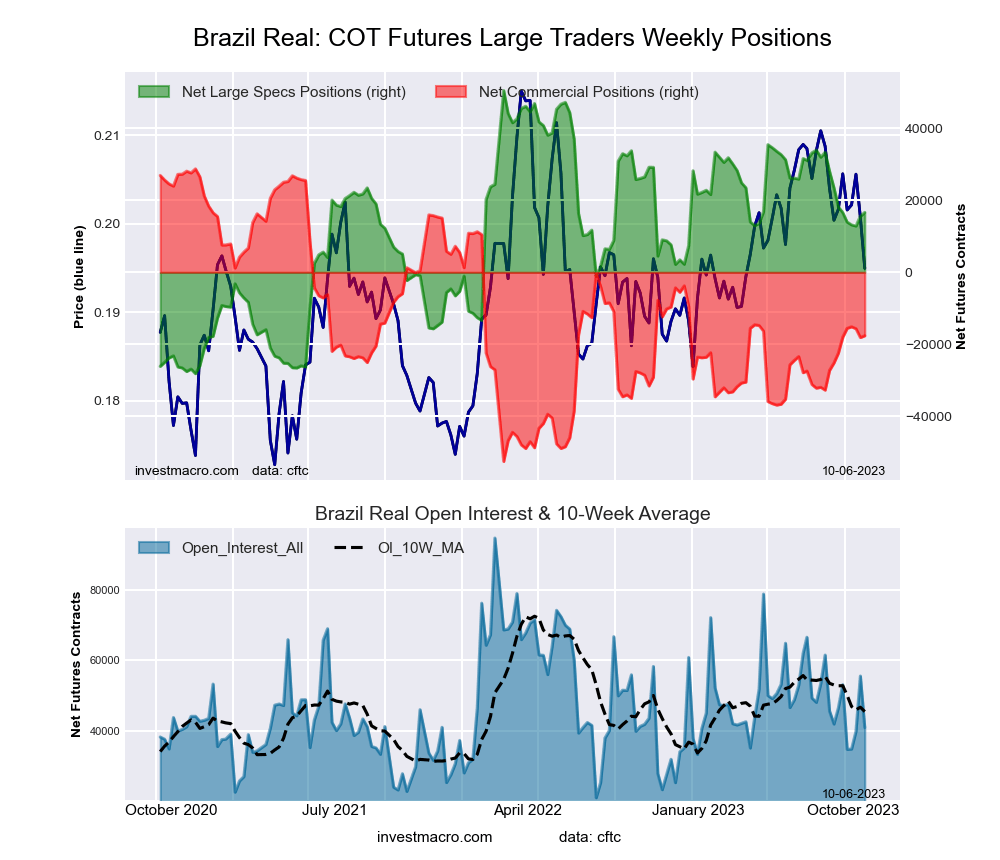
Brazil Real Futures COT ChartThe Brazilian Real large speculator standing this week equaled a net position of 33,198 contracts in the data reported through Tuesday. This was a weekly gain of 2,094 contracts from the previous week which had a total of 31,104 net contracts.

This week’s current strength score (the trader positioning range over the past three years, measured from 0 to 100) shows the speculators are currently Bullish with a score of 78.0 percent. The commercials are Bearish with a score of 26.3 percent and the small traders (not shown in chart) are Bearish with a score of 28.0 percent.

Price Trend-Following Model: Uptrend

Our weekly trend-following model classifies the current market price position as: Uptrend. The current action for the model is considered to be: Hold – Maintain Long Position.

BRAZIL REAL StatisticsSPECULATORSCOMMERCIALSSMALL TRADERS
– Percent of Open Interest Longs:74.016.38.5
– Percent of Open Interest Shorts:6.879.512.6
– Net Position:33,198-31,193-2,005
– Gross Longs:36,5418,0704,213
– Gross Shorts:3,34339,2636,218
– Long to Short Ratio:10.9 to 10.2 to 10.7 to 1
NET POSITION TREND:
– Strength Index Score (3 Year Range Pct):78.026.328.0
– Strength Index Reading (3 Year Range):BullishBearishBearish
NET POSITION MOVEMENT INDEX:
– 6-Week Change in Strength Index:2.45.0-47.7


Bitcoin Futures:

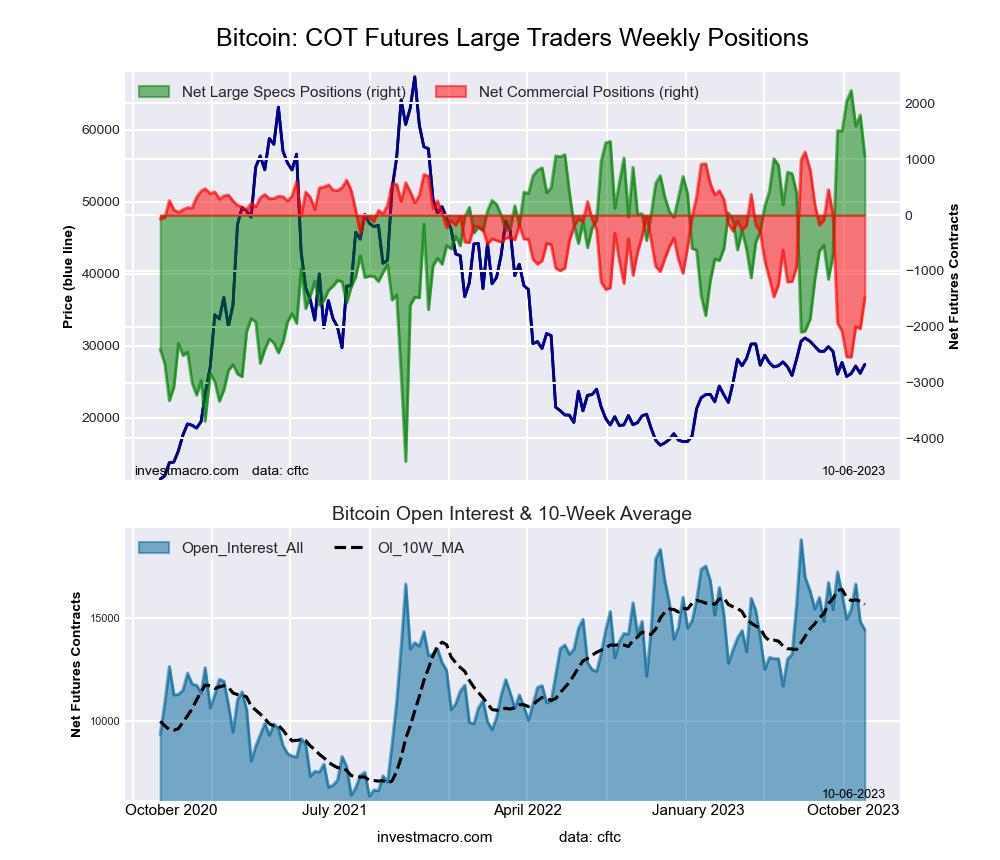
Bitcoin Crypto Futures COT ChartThe Bitcoin large speculator standing this week equaled a net position of -1,855 contracts in the data reported through Tuesday. This was a weekly advance of 221 contracts from the previous week which had a total of -2,076 net contracts.

This week’s current strength score (the trader positioning range over the past three years, measured from 0 to 100) shows the speculators are currently Bearish with a score of 44.6 percent. The commercials are Bullish-Extreme with a score of 87.4 percent and the small traders (not shown in chart) are Bearish with a score of 36.8 percent.

Price Trend-Following Model: Strong Uptrend

Our weekly trend-following model classifies the current market price position as: Strong Uptrend. The current action for the model is considered to be: Hold – Maintain Long Position.

BITCOIN StatisticsSPECULATORSCOMMERCIALSSMALL TRADERS
– Percent of Open Interest Longs:75.68.29.4
– Percent of Open Interest Shorts:87.03.33.0
– Net Position:-1,8558041,051
– Gross Longs:12,3221,3431,535
– Gross Shorts:14,177539484
– Long to Short Ratio:0.9 to 12.5 to 13.2 to 1
NET POSITION TREND:
– Strength Index Score (3 Year Range Pct):44.687.436.8
– Strength Index Reading (3 Year Range):BearishBullish-ExtremeBearish
NET POSITION MOVEMENT INDEX:
– 6-Week Change in Strength Index:-35.655.014.0


Article By InvestMacroReceive our weekly COT Newsletter

*COT Report: The COT data, released weekly to the public each Friday, is updated through the most recent Tuesday (data is 3 days old) and shows a quick view of how large speculators or non-commercials (for-profit traders) were positioned in the futures markets.

The CFTC categorizes trader positions according to commercial hedgers (traders who use futures contracts for hedging as part of the business), non-commercials (large traders who speculate to realize trading profits) and nonreportable traders (usually small traders/speculators) as well as their open interest (contracts open in the market at time of reporting). See CFTC criteria here.

All information and opinions on this website are for general informational purposes only and do not constitute investment advice.


COT Speculator Extremes: British Pound, Palladium lead Bullish & Bearish Positions

By InvestMacro

The latest update for the weekly Commitment of Traders (COT) report was released by the Commodity Futures Trading Commission (CFTC) on Friday for data ending on July 11th.

This weekly Extreme Positions report highlights the Most Bullish and Most Bearish Positions for the speculator category. Extreme positioning in these markets can foreshadow strong moves in the underlying market.

To signify an extreme position, we use the Strength Index (also known as the COT Index) of each instrument, a common method of measuring COT data. The Strength Index is simply a comparison of current trader positions against the range of positions over the previous 3 years. We use over 80 percent as extremely bullish and under 20 percent as extremely bearish. (Compare Strength Index scores across all markets in the data table or cot leaders table).


Here Are This Week’s Most Bullish Speculator Positions:

British Pound


The British Pound speculator position comes in as the most bullish extreme standing this week. The British Pound speculator level is currently at a 100.0 percent score of its 3-year range.

The six-week trend for the percent strength score totaled 32.4 this week. The overall net speculator position was a total of 58,063 net contracts this week with a change of 7,798 contract in the weekly speculator bets.


Speculators or Non-Commercials Notes:

Speculators, classified as non-commercial traders by the CFTC, are made up of large commodity funds, hedge funds and other significant for-profit participants. The Specs are generally regarded as trend-followers in their behavior towards price action – net speculator bets and prices tend to go in the same directions. These traders often look to buy when prices are rising and sell when prices are falling. To illustrate this point, many times speculator contracts can be found at their most extremes (bullish or bearish) when prices are also close to their highest or lowest levels.

These extreme levels can be dangerous for the large speculators as the trade is most crowded, there is less trading ammunition still sitting on the sidelines to push the trend further and prices have moved a significant distance. When the trend becomes exhausted, some speculators take profits while others look to also exit positions when prices fail to continue in the same direction. This process usually plays out over many months to years and can ultimately create a reverse effect where prices start to fall and speculators start a process of selling when prices are falling.


Mexican Peso


The Mexican Peso speculator position comes next in the extreme standings this week. The Mexican Peso speculator level is now at a 97.8 percent score of its 3-year range.

The six-week trend for the percent strength score was 11.1 this week. The speculator position registered 96,166 net contracts this week with a weekly change of 926 contracts in speculator bets.


Live Cattle


The Live Cattle speculator position comes in third this week in the extreme standings. The Live Cattle speculator level resides at a 96.0 percent score of its 3-year range.

The six-week trend for the speculator strength score came in at 7.7 this week. The overall speculator position was 108,501 net contracts this week with a change of 3,058 contracts in the weekly speculator bets.


Cocoa Futures


The Cocoa Futures speculator position comes up number four in the extreme standings this week. The Cocoa Futures speculator level is at a 91.6 percent score of its 3-year range.

The six-week trend for the speculator strength score totaled a change of 4.9 this week. The overall speculator position was 70,115 net contracts this week with a change of -2,469 contracts in the speculator bets.


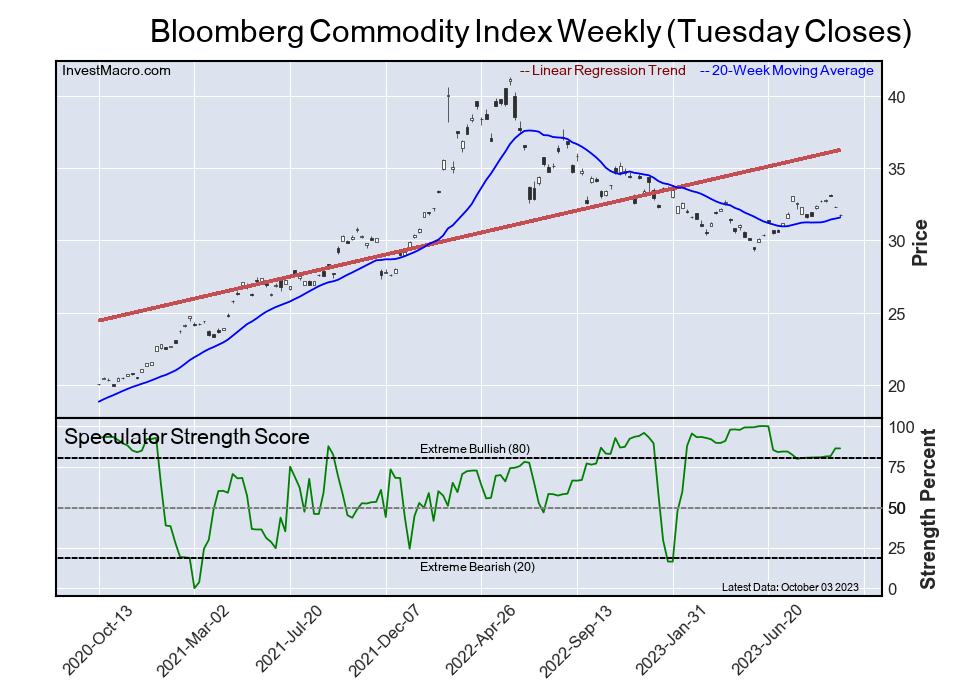
Bloomberg Commodity Index


The Bloomberg Commodity Index speculator position rounds out the top five in this week’s bullish extreme standings. The Bloomberg Commodity Index speculator level sits at a 84.3 percent score of its 3-year range. The six-week trend for the speculator strength score was -15.0 this week.

The speculator position was -5,651 net contracts this week with a change of 95 contracts in the weekly speculator bets.


This Week’s Most Bearish Speculator Positions:

Palladium


The Palladium speculator position comes in as the most bearish extreme standing this week. The Palladium speculator level is at a 0.0 percent score of its 3-year range.

The six-week trend for the speculator strength score was -18.5 this week. The overall speculator position was -8,272 net contracts this week with a change of -382 contracts in the speculator bets.


5-Year Bond


The 5-Year Bond speculator position comes in next for the most bearish extreme standing on the week. The 5-Year Bond speculator level is at a 0.0 percent score of its 3-year range.

The six-week trend for the speculator strength score was -6.3 this week. The speculator position was -1,056,084 net contracts this week with a change of -26,270 contracts in the weekly speculator bets.


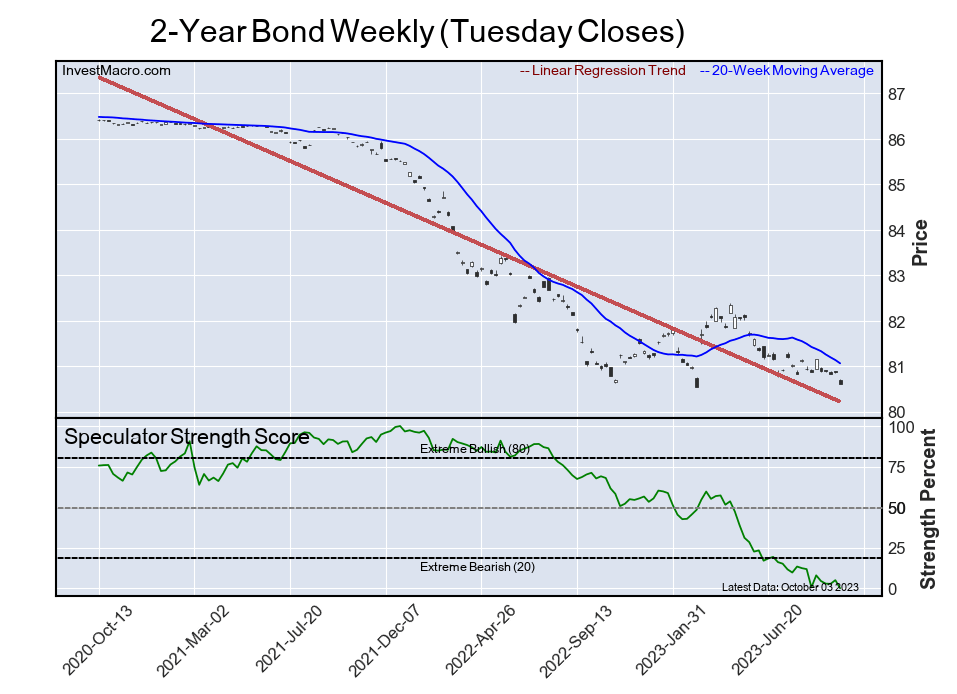
2-Year Bond


The 2-Year Bond speculator position comes in as third most bearish extreme standing of the week. The 2-Year Bond speculator level resides at a 0.0 percent score of its 3-year range.

The six-week trend for the speculator strength score was -8.8 this week. The overall speculator position was -1,071,700 net contracts this week with a change of -13,274 contracts in the speculator bets.


Japanese Yen


The Japanese Yen speculator position comes in as this week’s fourth most bearish extreme standing. The Japanese Yen speculator level is at a 0.4 percent score of its 3-year range.

The six-week trend for the speculator strength score was -12.5 this week. The speculator position was -117,182 net contracts this week with a change of 738 contracts in the weekly speculator bets.


1-Month Secured Overnight Financing Rate

Finally, the 1-Month Secured Overnight Financing Rate speculator position comes in as the fifth most bearish extreme standing for this week. The 1-Month Secured Overnight Financing Rate speculator level is at a 4.5 percent score of its 3-year range.

The six-week trend for the speculator strength score was -33.7 this week. The speculator position was -192,693 net contracts this week with a change of 13,807 contracts in the weekly speculator bets.


Article By InvestMacroReceive our weekly COT Newsletter

*COT Report: The COT data, released weekly to the public each Friday, is updated through the most recent Tuesday (data is 3 days old) and shows a quick view of how large speculators or non-commercials (for-profit traders) were positioned in the futures markets.

The CFTC categorizes trader positions according to commercial hedgers (traders who use futures contracts for hedging as part of the business), non-commercials (large traders who speculate to realize trading profits) and nonreportable traders (usually small traders/speculators) as well as their open interest (contracts open in the market at time of reporting). See CFTC criteria here.

Week Ahead: Can GBPUSD Bulls Maintain Hunger For Gains?

By ForexTime 

The explosive price action seen this week continues to highlight how global financial markets remain sensitive to key inflation data!

Currencies, commodities, and stocks were injected with fresh volatility mid-week after the softer-than-expected US inflation figures calmed fears around Fed rate hikes.

  • The US Dollar Index cut through the 100.70 support like a hot knife through butter and is currently on pace for its worst seek since November 2022.
  • Gold prices are trading back around the $1960 level, currently up roughly 1.6% this week.
  • Global stocks are set for their biggest weekly gain since November 2022, with the S&P500 hitting fresh 2023 highs.

Markets may be pumped with more volatility this afternoon due to earnings announcement by Wall Street banks.

And even before things settle down across the board, investors are already bracing for fresh action in the week ahead thanks to top-tier economic reports and key risk events…

Monday, July 17

  • CNH: China key policy rate decision, Q2 GDP, retail sales, industrial production
  • USD: US empire manufacturing

Tuesday, July 18

  • AUD: Reserve Bank of Australia July meeting minutes
  • CAD: CPI, housing starts
  • USD: US retail sales, industrial production
  • SPX500_m: Bank of America, Morgan Stanley earnings

Wednesday, July 19

  • EUR: June CPI (final)
  • GBP: UK June CPI
  • USD: US housing starts
  • SPX500_m: Goldman Sachs, IBM earnings
  • NQ100_m: Tesla, Netflix earnings

Thursday, July 20

  • CNH: China loan prime rates
  • AUD: Australia unemployment
  • EUR: Eurozone consumer confidence
  • USD: US initial jobless claims, existing home sales, University of Michigan Consumer Sentiment Index

Friday, July 21

  • CAD: Canada retail sales
  • JPY: Japan June CPI
  • GBP: UK Retail Sales, Gfk Consumer Confidence

Our focus falls on the GBPUSD which has resembled a speeding train gaining noticeable momentum on the technical charts!

After rallying to a fresh 2023 high at 1.3140 and rising more than 2% this week (as of writing), sterling bulls are certainly in the driving seat. Indeed, the GBPUSD has drawn strength from upbeat UK GDP data and a broadly weaker dollar.

The key question is whether bulls can maintain the appetite for further gains in the week ahead.

Here are 3 reasons why you should keep an eye on the GBPUSD:

  1. UK June Consumer Price Index (CPI)

On Wednesday, July 19th – the latest UK inflation report will be published.

All eyes will be on the incoming UK inflation report which could influence BoE hike expectations. This will be topped off with the latest retail sales figures and Gfk Consumer confidence report on Friday which could provide fresh insight into the health of the UK economy.

Markets are forecasting:

  • CPI year-on-year (June 2023 vs. June 2022) to cool 8.2% from 8.7% in the prior month.
  • Core CPI year-on-year to remain unchanged at 7.1% from 7.1% seen in May.
  • CPI month-on-month (June 2023 vs May 2023) to cool 0.4% from 0.7% in the prior month.

As of writing, traders are pricing in a 73% probability of a 50-basis point BoE hike in August as the central bank continues to battle sticky inflation.

  • Signs of still stubborn inflation may reinforce expectations around the BoE hiking rates by 50 basis points at its August meeting. This development could propel the GBPUSD beyond 1.3200.
  • Should June’s CPI report show signs of cooling inflationary pressures, this could fuel hopes around the BoE opting for a smaller 25 basis point hike in August. Speculation around the BoE slowing down the pace of rate increases may weaken the pound, dragging the GBPUSD back towards 1.3000.
  1. Dollar volatility

Fed hike expectations are likely to influence the US dollar in the week ahead. On top of this, investors will be dished out key US data which may provide fresh insight into the health of the largest economy in the world.

The US empire manufacturing will be under the spotlight on Monday, to key US retail sales and industrial production figures on Tuesday. Much attention will also be directed towards the US initial jobless claims and University of Michigan Consumer Sentiment Index on Thursday.

  • If US economic data disappoints, this could weaken the dollar as expectations mount over the Federal Reserve pausing rate hikes down the road. Dollar weakness is seen pushing the GBPUSD higher.
  • A strong set of economic releases may bolster the case for US rates remaining higher for longer. This is likely to strengthen the dollar, dragging the GBPUSD lower.
  1. Technical forces – bulls

The GBPUSD remains heavily bullish on the daily and weekly timeframe.

There have been consistently higher highs and higher lows in the weekly timeframe with prices slicing through the 200-week Simple Moving Average. Given how the currency pair remains in a healthy weekly bullish channel, the path of least resistance points north. A strong weekly close above 1.3200 may encourage an incline towards the next major resistance at 1.3700. While bulls are clearly in a position of power, the Relative Strength Index (RSI) has reached overbought levels. A technical throwback could be on the table before bull’s attack once again.

Zooming into the daily charts, the GBPUSD remains in a strong uptrend. After hitting a fresh 2023 high at 1.3140, the question is whether bulls have the appetite for more gains? A strong breakout above this point could encourage an incline towards 1.3200 and 1.3250. However, should prices slip back below 1.3000, this may trigger a further decline towards 1.2840.


Forex-Time-LogoArticle by ForexTime

ForexTime Ltd (FXTM) is an award winning international online forex broker regulated by CySEC 185/12 www.forextime.com

Mid-Week Technical Outlook: FX Majors & Indices

By ForexTime 

  • USD Index smashes into 101.50
  • EURUSD challenges fresh resistance
  • GBPUSD bulls switch into higher gear
  • SPX500_m approaches key resistance
  • NQ100_m ready to breakout?

The dollar extended losses while stocks nudged higher on Wednesday ahead of key US inflation data that could influence the Federal Reserve’s policy stance.

Attention will also be directed towards the pending Bank of Canada rate decision, speeches from numerous Fed officials, and big risk events including earning announcements by US banks on Friday.

In the meantime, here are some technical setups to keep an eye on this week:

USD Index smashes into 101.50

The dollar remains under pressure on the daily timeframe with prices trading marginally below 101.50 as of writing. Sustained weakness below this level may open a path toward 101.10 and 100.72, respectively. Should 101.50 prove to be reliable support, a rebound back toward 102.35 could be on the cards.

EURUSD tests fresh resistance

A weaker dollar has propelled the EURUSD to levels not seen since early May around 1.1032. Prices are firmly bullish on the daily charts with a breakout above 1.1032 opening a path towards 1.1090. Should bulls run out of steam, a decline back towards 10950 and 1.0900 may be on the table.

GBPUSD bulls back in town

The GBPUSD hit a fresh 2023 high this morning. Prices remain firmly bullish on the daily charts as there have been consistently higher highs and higher lows. A solid breakout and daily close above 1.3000 could open the doors towards 1.3110. Should 1.3000 prove to be strong resistance, prices may slip back towards 1.2840.

NZDUSD trapped within a range

It was a choppy affair for the NZDUSD after New Zealand’s central bank left interest rates unchanged for the first time in almost two years. The currency pair spiked towards 0.6240 before giving back gains. Prices remain trapped within a range with support around 0.6100 and resistance at 0.6240. A breakout above 0.6240 may see an incline towards 0.6310. Should prices slip back under 0.6100, we could see 0.6000.

USDJPY tumbles towards 138.80

A weaker dollar has sent the USDJPY tumbling toward the 138.80 support level. A breakdown below this point could see a further selloff towards 138.00 and the 200-day SMA around 137.10. Should prices rebound from 138.80, we could see 141.00 and higher.

SPX500_m approaches resistance

Prices remain bullish on the daily charts. A strong breakout above 4463 could inspire an incline towards 4500. Should bulls lack the strength to conquer 4463, prices may descend back within the range with 4332 acting as the next key level of interest.

NQ100_m breakout pending?

The NQ100_m could be gearing for a breakout on the daily charts if prices push beyond 15300. A solid close above this point may encourage an incline towards 15700. Any signs of weakness in the uptrend could see prices retest 14965 and 14670, respectively.


Forex-Time-LogoArticle by ForexTime

ForexTime Ltd (FXTM) is an award winning international online forex broker regulated by CySEC 185/12 www.forextime.com

EUR/USD Rises on Stats

By RoboForex Analytical Department

The market’s most traded currency pair rose to the level of 1.0960 by Monday.

EUR/USD strengthened due to the weakness of the US dollar. Investors were disappointed by the flow of statistical data from the US labour market for June.

To be specific, the number of non-farm payrolls increased by only 209 thousand against the May value of 306 thousand. In private business, the number of jobs increased by 149 thousand, while in the public sector, it rose by 60 thousand. The unemployment rate remained at 3.6%. Average wages increased by 4.4% y/y against the forecast of 4.2%.

Market participants were counting on strong employment data to help them understand the future actions of the US Federal Reserve.

Technical analysis of EUR/USD:

On the H4 chart, EUR/USD secured above the upper boundary of a descending correction channel after a failed test of the support level. The price is above the moving averages, which indicates growing pressure from the buyers. The correction is expected to end at 1.0935, after which the quotes might rise to the nearest resistance level at 1.1015. Technically, this scenario is confirmed by the MACD: its signal line has secured above the zero level, and the histogram has been growing for 14 periods. A negative scenario for buyers would be a break of the lower boundary of the medium-term ascending channel with the price consolidating under the level of 1.0835.

On the H1 chart, EUR/USD is correcting within a bullish flag pattern. The target of this move is 1.0955. The completion of the pattern is expected with a breakout of the upper boundary of the descending channel and the price securing above 1.0965. The moving averages also indicate the presence of an uptrend, with a crossover that occurred on 10 July 2023. Technically, the MACD does not confirm the scenario of EURUSD growth. Moreover, there is a risk of forming a bearish divergence after a steep increase to 1.0955. With such a scenario, there is potential for a decline by the divergence. However, if the bearish divergence is broken again, such behaviour should be interpreted as a weakness on the sellers’ part.

Disclaimer

Any forecasts contained herein are based on the author’s particular opinion. This analysis may not be treated as trading advice. RoboForex bears no responsibility for trading results based on trading recommendations and reviews contained herein.

Trade Of The Week: USDCAD Knocks On Major Support

By ForexTime 

  • CAD weakens against most G10 currencies month-to-date.
  • Big week for the USDCAD thanks to BoC rate decision and US inflation data.
  • Trader’s pricing in a 67% probability of a BoC hike on Wednesday.
  • US Inflation data could influence USDCAD this week.
  • USDCAD trapped within wide range but breakout could be pending.

The Canadian Dollar has weakened against most G10 currencies month-to-date despite ending June as one of the top performers versus the US Dollar.

Despite the choppy price action, the USDCAD could see heightened volatility this week as investors evaluate last Friday’s mixed US jobs report along with Canada’s strong jobs data. On top of this, the Bank of Canada’s rate decision and highly anticipated US inflation data on Wednesday could place the currency pair on a rollercoaster ride.

Taking a quick peek at the technical outlook, prices are back within a range on the weekly timeframe following the breach below 1.3250 back in early June.

The USDCAD could be gearing up for a significant move and here are 3 reasons why:

  1. Bank of Canada rate decision

On Wednesday, July 12th – the Bank of Canada (BoC) will announce its rate decision.

Last Friday’s robust jobs data from Canada boosted speculation around the BoC hiking interest rates in July. The country added 60,000 jobs in June which smashed expectations, but the unemployment rate rose to 5.4% – the highest since February 2022. Traders are currently pricing in a 67% probability of a 25-basis point hike on Wednesday with this fully priced in by September’s meeting.

  • Should the BoC move ahead with a rate hike in June or signal a rate hike in September, this could be the catalyst to trigger another major breakdown below 1.3250 on the USDCAD.
  • An unexpected scenario where the central bank adopts a dovish stance towards rates could weaken the CAD, triggering a rebound on the USDCAD.
  1. US June Consumer Price Index (CPI)

On Wednesday, July 12th – the latest US inflation report will be published.

All eyes will be on the incoming US inflation data which could influence Fed hike expectations. Headline inflation is expected to slow 3.1% in June 2023 vs June 2022, a noticeable decline from May’s 4% year-on-year. However, Core CPI year-on-year which strips out volatile energy and food prices is expected to cool 5% from the 5.3% seen in May which remains above the Fed’s 2% target.

  • Ultimately, signs of still stubborn inflation may boost the dollar as expectations mount around the Fed keeping interest rates higher for longer. A strong dollar may push the USDCAD back towards 1.3600 and higher.
  • Should June’s CPI report show signs of cooling inflation across the board, this could fuel hopes around the Fed pausing rate hikes beyond July’s policy meeting. If the dollar weakens on this prospect, the USDCAD may sink lower.
  1. Technical forces: Breakdown?

It has been the same old story for the USDCAD on the monthly timeframe.

Prices remain trapped within multiple layers of support and resistance. Major monthly support can be found at 1.3250 and monthly resistance at 1.3850. A breakout/down beyond these levels may open a path higher towards 1.4100 or lower towards 1.2970.

Focusing on the daily timeframe, prices are bouncing within a narrower range with resistance at 1.3650 and support at 1.3270. Despite the recent rebound, bears still seem to be in some position of power with prices trading below the 50, 100, and 200-day SMA. A selloff below 1.3270 could open the doors towards 1.3130 and 1.2970, respectively. Should prices push back above the 200-day SMA, bulls could challenge 1.3650 and 1.3850, respectively.


Forex-Time-LogoArticle by ForexTime

ForexTime Ltd (FXTM) is an award winning international online forex broker regulated by CySEC 185/12 www.forextime.com

Speculators push Canadian Dollar bets into bullish level for 1st time in 41 weeks

By InvestMacro

Here are the latest charts and statistics for the Commitment of Traders (COT) data published by the Commodities Futures Trading Commission (CFTC).

The latest COT data is updated through Monday July 3rd and shows a quick view of how large market participants (for-profit speculators and commercial traders) were positioned in the futures markets. All currency positions are in direct relation to the US dollar where, for example, a bet for the euro is a bet that the euro will rise versus the dollar while a bet against the euro will be a bet that the euro will decline versus the dollar.

Weekly Speculator Changes led by Canadian Dollar

The COT currency market speculator bets were lower this week as four out of the eleven currency markets we cover had higher positioning while the other seven markets had lower speculator contracts.

Leading the gains for the currency markets was the Canadian Dollar (7,374 contracts) with the New Zealand Dollar (1,661 contracts), Swiss Franc (1,542 contracts) and Bitcoin (18 contracts) also showing positive weeks.

The currencies seeing declines in speculator bets on the week were the Australian Dollar (-5,158 contracts) with the Japanese Yen (-5,050 contracts), Mexican Peso (-1,109 contracts), the British Pound (-1,729 contracts), the EuroFX (-2,191 contracts), the US Dollar Index (-651 contracts) and the Brazilian Real (-491 contracts) also registering lower bets on the week.

Speculators push Canadian Dollar bets into bullish level for 1st time in 41 weeks

Highlighting the COT currency’s data this week is the new bullish positioning in the Canadian dollar. Large speculative Canadian dollar positions rose this week for the fourth consecutive week and for the fifth time in the past six weeks.

Speculators have now added +42,856 net contracts to the overall position in just the last four weeks. This positive sentiment has pushed the CAD speculator net position (currently at +4,527 contracts) to the first bullish level of the past 41 weeks, dating back to September 9th of 2022.

The Canadian dollar’s futures price (versus the US dollar) has been in an uptrend since hitting a recent 2023-low in March of 2022 near 0.7223. The CAD front month futures price climbed back over the 200-day moving average in June and closed this week at the 0.7541 level. Helping the CAD go higher at the end of this week was the better than expected Canadian jobs report which could help propel the currency higher and continue on its current uptrend.


Data Snapshot of Forex Market Traders | Columns Legend
Jul-03-2023OIOI-IndexSpec-NetSpec-IndexCom-NetCOM-IndexSmalls-NetSmalls-Index
USD Index26,619714,31749-16,580492,26341
EUR725,92756142,83773-189,4592646,62253
GBP221,0215050,26599-63,664213,39984
JPY265,06689-117,9200126,01097-8,09037
CHF40,63938-3,404467,56557-4,16143
CAD156,284314,52759-18,8154314,28855
AUD153,74444-44,5824451,37457-6,79236
NZD34,05718830561,51150-2,34122
MXN238,2695195,24097-99,39924,15938
RUB20,93047,54331-7,15069-39324
BRL66,5476231,10475-27,44031-3,66415
Bitcoin17,00885-2,076411,132094434


Strength Scores led by British Pound & Mexican Peso

COT Strength Scores (a normalized measure of Speculator positions over a 3-Year range, from 0 to 100 where above 80 is Extreme-Bullish and below 20 is Extreme-Bearish) showed that the British Pound (99 percent) and the Mexican Peso (97 percent) lead the currency markets this week and are in Extreme-Bullish levels. The Brazilian Real (75 percent), EuroFX (73 percent) and the Canadian Dollar (59 percent) come in as the next highest in the weekly strength scores.

On the downside, the Japanese Yen (0 percent) comes in at the lowest strength levels currently and is in Extreme-Bearish territory (below 20 percent).

Strength Statistics:
US Dollar Index (48.8 percent) vs US Dollar Index previous week (49.9 percent)
EuroFX (73.4 percent) vs EuroFX previous week (74.3 percent)
British Pound Sterling (98.7 percent) vs British Pound Sterling previous week (100.0 percent)
Japanese Yen (0.0 percent) vs Japanese Yen previous week (3.0 percent)
Swiss Franc (45.6 percent) vs Swiss Franc previous week (41.5 percent)
Canadian Dollar (58.8 percent) vs Canadian Dollar previous week (51.9 percent)
Australian Dollar (43.5 percent) vs Australian Dollar previous week (48.3 percent)
New Zealand Dollar (55.8 percent) vs New Zealand Dollar previous week (51.3 percent)
Mexican Peso (97.3 percent) vs Mexican Peso previous week (97.9 percent)
Brazilian Real (75.3 percent) vs Brazilian Real previous week (76.0 percent)
Bitcoin (40.7 percent) vs Bitcoin previous week (40.4 percent)


Canadian Dollar & British Pound top the 6-Week Strength Trends

COT Strength Score Trends (or move index, calculates the 6-week changes in strength scores) showed that the Canadian Dollar (49 percent) and the British Pound (29 percent) lead the past six weeks trends for the currencies. The Mexican Peso (11 percent), the US Dollar Index (5 percent) and the Australian Dollar (4 percent) are the next highest positive movers in the latest trends data.

Bitcoin (-52 percent) leads the downside trend scores currently with the Japanese Yen (-22 percent), EuroFX (-12 percent) and the Swiss Franc (-7 percent) following next with lower trend scores.

Strength Trend Statistics:
US Dollar Index (5.1 percent) vs US Dollar Index previous week (9.1 percent)
EuroFX (-11.9 percent) vs EuroFX previous week (-16.2 percent)
British Pound Sterling (29.2 percent) vs British Pound Sterling previous week (29.8 percent)
Japanese Yen (-22.1 percent) vs Japanese Yen previous week (-28.5 percent)
Swiss Franc (-6.6 percent) vs Swiss Franc previous week (-8.2 percent)
Canadian Dollar (49.5 percent) vs Canadian Dollar previous week (37.4 percent)
Australian Dollar (4.2 percent) vs Australian Dollar previous week (13.1 percent)
New Zealand Dollar (3.2 percent) vs New Zealand Dollar previous week (3.4 percent)
Mexican Peso (11.2 percent) vs Mexican Peso previous week (13.9 percent)
Brazilian Real (-2.0 percent) vs Brazilian Real previous week (-2.6 percent)
Bitcoin (-51.8 percent) vs Bitcoin previous week (-54.2 percent)


Individual COT Forex Markets:

US Dollar Index Futures:

US Dollar Index Forex Futures COT ChartThe US Dollar Index large speculator standing this week reached a net position of 14,317 contracts in the data reported through Tuesday. This was a weekly reduction of -651 contracts from the previous week which had a total of 14,968 net contracts.

This week’s current strength score (the trader positioning range over the past three years, measured from 0 to 100) shows the speculators are currently Bearish with a score of 48.8 percent. The commercials are Bearish with a score of 49.4 percent and the small traders (not shown in chart) are Bearish with a score of 41.3 percent.

Price Trend-Following Model: Strong Uptrend

Our weekly trend-following model classifies the current market price position as: Strong Uptrend. The current action for the model is considered to be: Hold – Maintain Long Position.

US DOLLAR INDEX StatisticsSPECULATORSCOMMERCIALSSMALL TRADERS
– Percent of Open Interest Longs:76.12.216.8
– Percent of Open Interest Shorts:22.464.58.3
– Net Position:14,317-16,5802,263
– Gross Longs:20,2675844,462
– Gross Shorts:5,95017,1642,199
– Long to Short Ratio:3.4 to 10.0 to 12.0 to 1
NET POSITION TREND:
– Strength Index Score (3 Year Range Pct):48.849.441.3
– Strength Index Reading (3 Year Range):BearishBearishBearish
NET POSITION MOVEMENT INDEX:
– 6-Week Change in Strength Index:5.1-4.3-4.0


Euro Currency Futures:

Euro Currency Futures COT ChartThe Euro Currency large speculator standing this week reached a net position of 142,837 contracts in the data reported through Tuesday. This was a weekly fall of -2,191 contracts from the previous week which had a total of 145,028 net contracts.

This week’s current strength score (the trader positioning range over the past three years, measured from 0 to 100) shows the speculators are currently Bullish with a score of 73.4 percent. The commercials are Bearish with a score of 26.5 percent and the small traders (not shown in chart) are Bullish with a score of 53.4 percent.

Price Trend-Following Model: Strong Uptrend

Our weekly trend-following model classifies the current market price position as: Strong Uptrend. The current action for the model is considered to be: Hold – Maintain Long Position.

EURO Currency StatisticsSPECULATORSCOMMERCIALSSMALL TRADERS
– Percent of Open Interest Longs:30.555.312.5
– Percent of Open Interest Shorts:10.881.46.1
– Net Position:142,837-189,45946,622
– Gross Longs:221,272401,25690,921
– Gross Shorts:78,435590,71544,299
– Long to Short Ratio:2.8 to 10.7 to 12.1 to 1
NET POSITION TREND:
– Strength Index Score (3 Year Range Pct):73.426.553.4
– Strength Index Reading (3 Year Range):BullishBearishBullish
NET POSITION MOVEMENT INDEX:
– 6-Week Change in Strength Index:-11.911.7-6.1


British Pound Sterling Futures:

British Pound Sterling Futures COT ChartThe British Pound Sterling large speculator standing this week reached a net position of 50,265 contracts in the data reported through Tuesday. This was a weekly decrease of -1,729 contracts from the previous week which had a total of 51,994 net contracts.

This week’s current strength score (the trader positioning range over the past three years, measured from 0 to 100) shows the speculators are currently Bullish-Extreme with a score of 98.7 percent. The commercials are Bearish-Extreme with a score of 1.9 percent and the small traders (not shown in chart) are Bullish-Extreme with a score of 84.3 percent.

Price Trend-Following Model: Strong Uptrend

Our weekly trend-following model classifies the current market price position as: Strong Uptrend. The current action for the model is considered to be: Hold – Maintain Long Position.

BRITISH POUND StatisticsSPECULATORSCOMMERCIALSSMALL TRADERS
– Percent of Open Interest Longs:43.633.716.6
– Percent of Open Interest Shorts:20.962.510.5
– Net Position:50,265-63,66413,399
– Gross Longs:96,46174,44636,707
– Gross Shorts:46,196138,11023,308
– Long to Short Ratio:2.1 to 10.5 to 11.6 to 1
NET POSITION TREND:
– Strength Index Score (3 Year Range Pct):98.71.984.3
– Strength Index Reading (3 Year Range):Bullish-ExtremeBearish-ExtremeBullish-Extreme
NET POSITION MOVEMENT INDEX:
– 6-Week Change in Strength Index:29.2-28.716.3


Japanese Yen Futures:

Japanese Yen Forex Futures COT ChartThe Japanese Yen large speculator standing this week reached a net position of -117,920 contracts in the data reported through Tuesday. This was a weekly lowering of -5,050 contracts from the previous week which had a total of -112,870 net contracts.

This week’s current strength score (the trader positioning range over the past three years, measured from 0 to 100) shows the speculators are currently Bearish-Extreme with a score of 0.0 percent. The commercials are Bullish-Extreme with a score of 97.1 percent and the small traders (not shown in chart) are Bearish with a score of 37.0 percent.

Price Trend-Following Model: Strong Downtrend

Our weekly trend-following model classifies the current market price position as: Strong Downtrend. The current action for the model is considered to be: Hold – Maintain Short Position.

JAPANESE YEN StatisticsSPECULATORSCOMMERCIALSSMALL TRADERS
– Percent of Open Interest Longs:15.771.711.5
– Percent of Open Interest Shorts:60.224.214.5
– Net Position:-117,920126,010-8,090
– Gross Longs:41,713190,15730,449
– Gross Shorts:159,63364,14738,539
– Long to Short Ratio:0.3 to 13.0 to 10.8 to 1
NET POSITION TREND:
– Strength Index Score (3 Year Range Pct):0.097.137.0
– Strength Index Reading (3 Year Range):Bearish-ExtremeBullish-ExtremeBearish
NET POSITION MOVEMENT INDEX:
– 6-Week Change in Strength Index:-22.116.47.4


Swiss Franc Futures:

Swiss Franc Forex Futures COT ChartThe Swiss Franc large speculator standing this week reached a net position of -3,404 contracts in the data reported through Tuesday. This was a weekly boost of 1,542 contracts from the previous week which had a total of -4,946 net contracts.

This week’s current strength score (the trader positioning range over the past three years, measured from 0 to 100) shows the speculators are currently Bearish with a score of 45.6 percent. The commercials are Bullish with a score of 57.5 percent and the small traders (not shown in chart) are Bearish with a score of 43.4 percent.

Price Trend-Following Model: Uptrend

Our weekly trend-following model classifies the current market price position as: Uptrend. The current action for the model is considered to be: Hold – Maintain Long Position.

SWISS FRANC StatisticsSPECULATORSCOMMERCIALSSMALL TRADERS
– Percent of Open Interest Longs:26.245.927.5
– Percent of Open Interest Shorts:34.527.237.8
– Net Position:-3,4047,565-4,161
– Gross Longs:10,63418,63311,193
– Gross Shorts:14,03811,06815,354
– Long to Short Ratio:0.8 to 11.7 to 10.7 to 1
NET POSITION TREND:
– Strength Index Score (3 Year Range Pct):45.657.543.4
– Strength Index Reading (3 Year Range):BearishBullishBearish
NET POSITION MOVEMENT INDEX:
– 6-Week Change in Strength Index:-6.69.7-11.4


Canadian Dollar Futures:

Canadian Dollar Forex Futures COT ChartThe Canadian Dollar large speculator standing this week reached a net position of 4,527 contracts in the data reported through Tuesday. This was a weekly gain of 7,374 contracts from the previous week which had a total of -2,847 net contracts.

This week’s current strength score (the trader positioning range over the past three years, measured from 0 to 100) shows the speculators are currently Bullish with a score of 58.8 percent. The commercials are Bearish with a score of 43.3 percent and the small traders (not shown in chart) are Bullish with a score of 54.5 percent.

Price Trend-Following Model: Strong Uptrend

Our weekly trend-following model classifies the current market price position as: Strong Uptrend. The current action for the model is considered to be: Hold – Maintain Long Position.

CANADIAN DOLLAR StatisticsSPECULATORSCOMMERCIALSSMALL TRADERS
– Percent of Open Interest Longs:28.347.022.9
– Percent of Open Interest Shorts:25.459.013.7
– Net Position:4,527-18,81514,288
– Gross Longs:44,17873,43735,761
– Gross Shorts:39,65192,25221,473
– Long to Short Ratio:1.1 to 10.8 to 11.7 to 1
NET POSITION TREND:
– Strength Index Score (3 Year Range Pct):58.843.354.5
– Strength Index Reading (3 Year Range):BullishBearishBullish
NET POSITION MOVEMENT INDEX:
– 6-Week Change in Strength Index:49.5-46.233.1


Australian Dollar Futures:

Australian Dollar Forex Futures COT ChartThe Australian Dollar large speculator standing this week reached a net position of -44,582 contracts in the data reported through Tuesday. This was a weekly reduction of -5,158 contracts from the previous week which had a total of -39,424 net contracts.

This week’s current strength score (the trader positioning range over the past three years, measured from 0 to 100) shows the speculators are currently Bearish with a score of 43.5 percent. The commercials are Bullish with a score of 57.2 percent and the small traders (not shown in chart) are Bearish with a score of 35.9 percent.

Price Trend-Following Model: Weak Downtrend

Our weekly trend-following model classifies the current market price position as: Weak Downtrend. The current action for the model is considered to be: Hold – Maintain Short Position.

AUSTRALIAN DOLLAR StatisticsSPECULATORSCOMMERCIALSSMALL TRADERS
– Percent of Open Interest Longs:32.653.411.9
– Percent of Open Interest Shorts:61.620.016.3
– Net Position:-44,58251,374-6,792
– Gross Longs:50,17082,07618,331
– Gross Shorts:94,75230,70225,123
– Long to Short Ratio:0.5 to 12.7 to 10.7 to 1
NET POSITION TREND:
– Strength Index Score (3 Year Range Pct):43.557.235.9
– Strength Index Reading (3 Year Range):BearishBullishBearish
NET POSITION MOVEMENT INDEX:
– 6-Week Change in Strength Index:4.2-6.510.2


New Zealand Dollar Futures:

New Zealand Dollar Forex Futures COT ChartThe New Zealand Dollar large speculator standing this week reached a net position of 830 contracts in the data reported through Tuesday. This was a weekly gain of 1,661 contracts from the previous week which had a total of -831 net contracts.

This week’s current strength score (the trader positioning range over the past three years, measured from 0 to 100) shows the speculators are currently Bullish with a score of 55.8 percent. The commercials are Bullish with a score of 50.1 percent and the small traders (not shown in chart) are Bearish with a score of 22.1 percent.

Price Trend-Following Model: Weak Downtrend

Our weekly trend-following model classifies the current market price position as: Weak Downtrend. The current action for the model is considered to be: Hold – Maintain Short Position.

NEW ZEALAND DOLLAR StatisticsSPECULATORSCOMMERCIALSSMALL TRADERS
– Percent of Open Interest Longs:38.753.47.0
– Percent of Open Interest Shorts:36.248.913.9
– Net Position:8301,511-2,341
– Gross Longs:13,17018,1762,390
– Gross Shorts:12,34016,6654,731
– Long to Short Ratio:1.1 to 11.1 to 10.5 to 1
NET POSITION TREND:
– Strength Index Score (3 Year Range Pct):55.850.122.1
– Strength Index Reading (3 Year Range):BullishBullishBearish
NET POSITION MOVEMENT INDEX:
– 6-Week Change in Strength Index:3.24.9-38.8


Mexican Peso Futures:

Mexican Peso Futures COT ChartThe Mexican Peso large speculator standing this week reached a net position of 95,240 contracts in the data reported through Tuesday. This was a weekly reduction of -1,109 contracts from the previous week which had a total of 96,349 net contracts.

This week’s current strength score (the trader positioning range over the past three years, measured from 0 to 100) shows the speculators are currently Bullish-Extreme with a score of 97.3 percent. The commercials are Bearish-Extreme with a score of 2.2 percent and the small traders (not shown in chart) are Bearish with a score of 37.7 percent.

Price Trend-Following Model: Strong Uptrend

Our weekly trend-following model classifies the current market price position as: Strong Uptrend. The current action for the model is considered to be: Hold – Maintain Long Position.

MEXICAN PESO StatisticsSPECULATORSCOMMERCIALSSMALL TRADERS
– Percent of Open Interest Longs:52.044.13.6
– Percent of Open Interest Shorts:12.085.91.9
– Net Position:95,240-99,3994,159
– Gross Longs:123,919105,1728,685
– Gross Shorts:28,679204,5714,526
– Long to Short Ratio:4.3 to 10.5 to 11.9 to 1
NET POSITION TREND:
– Strength Index Score (3 Year Range Pct):97.32.237.7
– Strength Index Reading (3 Year Range):Bullish-ExtremeBearish-ExtremeBearish
NET POSITION MOVEMENT INDEX:
– 6-Week Change in Strength Index:11.2-10.0-9.7


Brazilian Real Futures:

Brazil Real Futures COT ChartThe Brazilian Real large speculator standing this week reached a net position of 31,104 contracts in the data reported through Tuesday. This was a weekly fall of -491 contracts from the previous week which had a total of 31,595 net contracts.

This week’s current strength score (the trader positioning range over the past three years, measured from 0 to 100) shows the speculators are currently Bullish with a score of 75.3 percent. The commercials are Bearish with a score of 30.9 percent and the small traders (not shown in chart) are Bearish-Extreme with a score of 14.8 percent.

Price Trend-Following Model: Uptrend

Our weekly trend-following model classifies the current market price position as: Uptrend. The current action for the model is considered to be: Hold – Maintain Long Position.

BRAZIL REAL StatisticsSPECULATORSCOMMERCIALSSMALL TRADERS
– Percent of Open Interest Longs:57.135.37.6
– Percent of Open Interest Shorts:10.476.513.1
– Net Position:31,104-27,440-3,664
– Gross Longs:38,01223,4615,070
– Gross Shorts:6,90850,9018,734
– Long to Short Ratio:5.5 to 10.5 to 10.6 to 1
NET POSITION TREND:
– Strength Index Score (3 Year Range Pct):75.330.914.8
– Strength Index Reading (3 Year Range):BullishBearishBearish-Extreme
NET POSITION MOVEMENT INDEX:
– 6-Week Change in Strength Index:-2.011.4-60.8


Bitcoin Futures:

Bitcoin Crypto Futures COT ChartThe Bitcoin large speculator standing this week reached a net position of -2,076 contracts in the data reported through Tuesday. This was a weekly boost of 18 contracts from the previous week which had a total of -2,094 net contracts.

This week’s current strength score (the trader positioning range over the past three years, measured from 0 to 100) shows the speculators are currently Bearish with a score of 40.7 percent. The commercials are Bullish-Extreme with a score of 100.0 percent and the small traders (not shown in chart) are Bearish with a score of 34.4 percent.

Price Trend-Following Model: Strong Uptrend

Our weekly trend-following model classifies the current market price position as: Strong Uptrend. The current action for the model is considered to be: Hold – Maintain Long Position.

BITCOIN StatisticsSPECULATORSCOMMERCIALSSMALL TRADERS
– Percent of Open Interest Longs:75.610.09.2
– Percent of Open Interest Shorts:87.83.33.7
– Net Position:-2,0761,132944
– Gross Longs:12,8541,6981,568
– Gross Shorts:14,930566624
– Long to Short Ratio:0.9 to 13.0 to 12.5 to 1
NET POSITION TREND:
– Strength Index Score (3 Year Range Pct):40.7100.034.4
– Strength Index Reading (3 Year Range):BearishBullish-ExtremeBearish
NET POSITION MOVEMENT INDEX:
– 6-Week Change in Strength Index:-51.891.613.5


Article By InvestMacroReceive our weekly COT Newsletter

*COT Report: The COT data, released weekly to the public each Friday, is updated through the most recent Tuesday (data is 3 days old) and shows a quick view of how large speculators or non-commercials (for-profit traders) were positioned in the futures markets.

The CFTC categorizes trader positions according to commercial hedgers (traders who use futures contracts for hedging as part of the business), non-commercials (large traders who speculate to realize trading profits) and nonreportable traders (usually small traders/speculators) as well as their open interest (contracts open in the market at time of reporting). See CFTC criteria here.
Technical Outlook: FX & Commodity Mashup

By ForexTime 

  • EURUSD remains a choppy affair
  • GBPUSD waits for fresh spark
  • Time for USDJPY to push higher?
  • USDCAD in breakout mode
  • Gold approaches resistance

The market mood was mixed on Tuesday as investors turned cautious ahead of another busy week for global financial markets. Despite US markets currently closed due to the Independence Day holiday, volatility could still be the name of the game thanks to top-tier economic reports and risk events.

Here are some technical setups to keep an eye on ahead of the Fed minutes tomorrow and the US NFP report released on Friday:

Dollar on standby

The dollar remains on standby with prices trading around 103.00 as of writing. Should bulls jump back into the driver’s seat, prices could challenge 103.50, 103.80, and 104.00. Alternatively, a decline below 103.00 may see bears attack 102.35 and 102.00, respectively.

EURUSD choppy affair…

The EURUSD remains within a messy range on the daily charts with support at 1.0850 and resistance at 1.1010. A solid breakdown below 1.0850 could see prices challenge 1.0760. Should prices break above 1.1010, an incline toward 1.0900 could be on the cards.

GBPUSD waits for fresh catalyst

Sterling remains trapped within a range with support at 1.2600 and resistance at 1.2730. A strong breakout above 1.2730 could open the doors toward 1.2850. Should prices sink below 1.2600, bears could challenge 1.2550 and 1.2420.

USDJPY remains bullish

Despite consolidating over the past few days, the USDJPY remains in a healthy uptrend on the daily charts. Further upside could be expected if a solid daily close above 145.50 is achieved. If bulls run out of steam, this could lead to a decline back towards 142.30.

AUDUSD capped below 0.6680?

The AUDUSD could sink lower if prices fail to push above the 0.6690 resistance. Earlier this morning, the Reserve Bank of Australia left its cash rate unchanged at 4.1% which caused prices to retreat. However, bulls seem to be lingering in the vicinity with the Aussie back around the 0.6690 level where the 100 and 200-day SMA resides. Sustained weakness below this point may trigger a selloff back towards 0.6630 and 0.6570. Should prices breakout and secure a daily close above this point, bulls may propel prices toward 0.6760.

USDCAD in breakout mode

The USDCAD be gearing up for a breakout this week as prices trade between support at 1.3140 and resistance at 1.3280. A breakout above 1.3280 could signal an incline toward 1.3400. Should prices slip back below 1.3140, the next key level of interest can be found at 1.3000.

WTI Crude rangebound

It feels like the same old story for WTI Crude with prices trading within a range on the daily charts. Support can be found at $67.00 and resistance at $74.40. Oil prices may react to the 8th OPEC International Seminar featuring OPEC+ ministers on Wednesday. A move below $67.00 could see prices hit $64.50. Alternatively, a breakout above $74.40 could open a path toward $76.80.

Gold approaches resistance

Gold prices have pushed higher, challenging the $1932 resistance level. A breakout above this point may see $1959. Should $1932 prove to be reliable resistance, prices may decline back toward $1900.


Forex-Time-LogoArticle by ForexTime

ForexTime Ltd (FXTM) is an award winning international online forex broker regulated by CySEC 185/12 www.forextime.com

Week Ahead: Can AUDUSD stay above 0.660?

By ForexTime 

  • AUDUSD set to post 1.8% climb in June – first monthly gain since January 2023
  • Bloomberg’s FX model forecasts trading range of 0.6524 – 0.6732 for AUDUSD in first week of July
  • AUDUSD’s presence above/below 0.660 next week could be dictated by China PMIs, RBA decision, FOMC minutes, and US jobs report.

AUDUSD is recovering slightly in recent sessions, despite having it tough so far in 2023.

The “Aussie” has a year-to-date decline of 2.8%, no thanks to the resilient US dollar as well as China’s faltering economic recovery.

Whether or not the “Aussie” can extend its recent recovery into the new month may well depend on the fundamental catalysts contained within the global economic calendar for the coming week:


Monday, July 3

  • AUD: Australia June inflation; manufacturing PMI (final)
  • CNH: China June Caixin manufacturing PMI
  • EUR: Eurozone June manufacturing PMI (final); Germany May trade balance
  • GBP: UK June manufacturing PMI (final)
  • USD: US June ISM manufacturing

Tuesday, July 4

  • AUD: Reserve Bank of Australia rate decision
  • EUR: Eurozone April retail sales; Germany April factory orders
  • US markets closed for Independence Day

Wednesday, July 5

  • AUD: Australia June services PMI (final)
  • CNH: China Caixin services and composite PMIs
  • EUR: Eurozone May PPI, services PMI (final)
  • GBP: UK June services PMI (final)
  • USD: FOMC minutes; speech by New York Fed President John Williams

Thursday, July 6

  • AUD: Australia May external trade
  • EUR: Eurozone May retail sales; Germany May factory orders
  • USD: US weekly initial jobless claims; speech by Dallas Fed President Lorie Logan

Friday, July 7

  • CNH: China June forex reserves
  • EUR: Speech by ECB President Christine Lagarde; Germany May industrial production
  • GBP: Speech by BOE policymaker Catherine Mann
  • USD: US June nonfarm payrolls
  • CAD: Canada June unemployment rate


In determining whether AUDUSD can keep its head above the crucial support 0.660 level next week …

Traders and investors will be casting their sights across 3 countries, namely China, the US, and Australia (of course).

Here are some key events to pay close attention to:


1) July 3rd: China June Caixin manufacturing PMI

Note that the Australian economy is very much reliant on China, being Australia’s largest trading partner.

Hence, when the Chinese Yuan strengthens, the Australian Dollar tends to follow suit.

(AUDUSD has a strong inverse correlation with USDCNY of -0.72 over a 5-day rolling period in the past 10 years)
  • AUDUSD may move higher should China’s Caixin manufacturing PMI come in above the 50 mark, which shows expanding conditions in China’s manufacturing sector.
  • AUDUSD may move lower should China’s Caixin manufacturing PMI come in below the 50 mark, which would show contracting conditions among factories in the world’s second largest economy.


2) July 4th: Reserve Bank of Australia (RBA) rate decision

The futures market predicts only a 1-in-3 chance that Australia’s central bank will hike by further 25-basis points.

On the other hand, the 27 economists surveyed by Bloomberg are split (13-14) on whether we will see a July RBA hike.

The economists in the “no July hike” camp would point to the latest Australian consumer price index (CPI – which measures headline inflation) of 5.6% for May.

That 5.6% number was below market forecasts for 6.1% and also lower than April’s 6.8% reading.

Should this coming Monday’s (July 3rd) inflation readings by the Melbourne Institute also show easing inflationary pressures, that may bolster the case for another RBA pause at next week’s meeting.

However, note that the RBA surprised markets with unexpected hikes at its past two policy meetings.

For the upcoming RBA decision:

  • AUDUSD may move higher if the RBA raises its Cash Rate Target to 4.35%
  • AUDUSD may move lower if the RBA leaves rates unchanged at 4.10%


3) July 5th: FOMC June meeting minutes

Recall how the Fed tried to warn markets at that mid-June FOMC meeting about two more incoming rate hikes this year.

Such warnings by Fed Chair Jerome Powell had little initial impact, as markets were willing to challenge the Fed’s forecasts.

However, the economic data since then suggests that the world’s largest economy remains resilient, likely paving the way for the Fed to raise its benchmark rates even higher so as to quell still-stubborn inflation.

  • AUDUSD may move higher if the June FOMC meeting minutes reveals a more dovish policy stance held by Fed officials who are adamant that US interest rates have moved high enough and are not willing to risk further economic damage.
  • AUDUSD may move lower if the June FOMC meeting minutes reveals a more hawkish policy stance held by Fed officials who are adamant about moving US interest rates even higher.


4) July 7th: US jobs report for June

Markets predict that 200,000 new jobs were added to the US economy in June.

If so, that 200k figure would be the lowest headline nonfarm payrolls (NFP) print since December 2019.

Yet, seasoned market watchers are only too aware that the NFP number has been notoriously hard to predict in recent months, frustrating many top economists.

After all, every single headline NFP number for each month of 2023 so far has exceeded market forecasts. Recall the recent blockbuster NFP print for May (released on June 2nd) which came in at a whopping 339k, far exceeding Wall Street’s forecast of 195k.

The June unemployment rate (also released on Friday, July 7th) is even expected to tick lower to 3.6% compared to May’s 3.7% jobless rate.

Still, with recession alarm bells ringing loudly in certain parts of global financial markets, investors are always looking further down the line and already asking when we will see the first negative NFP print (job losses) and a significantly higher unemployment rate.

  • AUDUSD may move higher on a weaker US Dollar if the June NFP report produces a lower-than-200k headline number, along with a higher unemployment rate.
    A weaker-than-expected US jobs report may allow the Fed to start thinking about pausing its rate hikes.
  • AUDUSD may move lower on a stronger US Dollar if the June NFP report, yet again, delivers another positive shocker that far exceeds the forecasted 200k print, while the unemployment rate moves lower.
    Another blockbuster US jobs report should force the Fed to hike twice more before 2023 ends.


Key levels

At the time of writing, Bloomberg’s FX model forecasts a 36.7% chance that AUDUSD might break below the 0.66 over the next one-week period.

The model also forecasts a trading range of 0.6524 – 0.6732 for AUDUSD through the first week of July.

Here are some key levels to watch within that forecasted trading range:

POTENTIAL SUPPORT

  • 0.6600: psychologically-important level
  • 0.65641 – 0.65738: March, May cycle lows
  • 0.6524: lower end of Bloomberg model forecasted range; key battleground for bulls and bears in late May/early June.


POTENTIAL RESISTANCE

  • 0.66627: June 23rd intraday low
  • 100-day SMA
  • 0.67255: 23.6% Fibonacci level from AUDUSD’s 1H23 peak-to-trough


Forex-Time-LogoArticle by ForexTime

ForexTime Ltd (FXTM) is an award winning international online forex broker regulated by CySEC 185/12 www.forextime.com

A BRICS currency is unlikely to dislodge dollar any time soon – but it signifies growing challenge to established economic order

By Mihaela Papa, Tufts University 

Could a new currency be set to challenge the dominance of the dollar? Perhaps, but that may not be the point.

In August 2023, South Africa will host the leaders of Brazil, Russia, India, China and South Africa – a group of nations known by the acronym BRICS. Among the items on the agenda is the creation of a new joint BRICS currency.

As a scholar who has studied the BRICS countries for over a decade, I can certainly see why talk of a BRICS currency is, well, gaining currency. The BRICS summit comes as countries across the world are confronting a changing geopolitical landscape that is challenging the traditional dominance of the West. And while the BRICS countries have been seeking to reduce their reliance on the dollar for over a decade, Western sanctions on Russia after its invasion of Ukraine have accelerated the process.

Meanwhile, rising interest rates and the recent debt-ceiling crisis in the U.S. have raised concerns among other countries about their dollar-denominated debt and the demise of the dollar should the world’s leading economy ever default.

That all said, a new BRICS currency faces major hurdles before becoming a reality. But what currency discussions do show is that the BRICS countries are seeking to discover and develop new ideas about how to shake up international affairs and effectively coordinate policies around these ideas.

De-dollarization momentum?

With 88% of international transactions conducted in U.S. dollars, and the dollar accounting for 58% of global foreign exchange reserves, the dollar’s global dominance is indisputable. Yet de-dollarization – or reducing an economy’s reliance on the U.S. dollar for international trade and finance – has been accelerating following the Russian invasion of Ukraine.

The BRICS countries have been pursuing a wide range of initiatives to decrease their dependence on the dollar. Over the past year, Russia, China and Brazil have turned to greater use of non-dollar currencies in their cross-border transactions. Iraq, Saudi Arabia and the United Arab Emirates are actively exploring dollar alternatives. And central banks have sought to shift more of their currency reserves away from the dollar and into gold.

All the BRICS nations have been critical of the dollar’s dominance for different reasons. Russian officials have been championing de-dollarization to ease the pain from sanctions. Because of sanctions, Russian banks have been unable to use SWIFT, the global messaging system that enables bank transactions. And the West froze Russia’s US$330 billion in reserves last year.

Meanwhile, the 2022 election in Brazil reinstated Luiz Inácio Lula da Silva as president. Lula is a longtime proponent of BRICS who previously sought to reduce Brazil’s dependence on and vulnerability to the dollar. He has reenergized the group’s commitment to de-dollarization and spoken about creating a new Euro-like currency.

The Chinese government has also clearly laid out its concerns with the dollar’s dominance, labeling it “the main source of instability and uncertainty in the world economy.” Beijing directly blamed the Fed’s interest rate hike for causing turmoil in the international financial market and substantial depreciation of other currencies. Together with other BRICS countries, China has also criticized the use of sanctions as a geopolitical weapon.

The appeal of de-dollarization and a possible BRICS currency would be to mitigate such problems. Experts in the U.S. are deeply divided on its prospects. U.S. Treasury Secretary Janet Yellen believes the dollar will remain dominant as most countries have no alternative. Yet a former White House economist sees a way that a BRICS currency could end dollar dominance.

Currency ambitions

Although talk of a BRICS currency has gained momentum, there is limited information on various models under consideration.

The most ambitious path would be something akin to the Euro, the single-currency adopted by 11 member states of the European Union in 1999. But negotiating a single currency would be difficult given the economic power asymmetries and complex political dynamics within BRICS. And for a new currency to work, BRICS would need to agree to an exchange rate mechanism, have efficient payment systems and a well-regulated, stable and liquid financial market. To achieve a global currency status, BRICS would need a strong track record of joint currency management to convince others that the new currency is reliable.

A BRICS version of the Euro is unlikely for now; none of the countries involved show any desire to discontinue its local currency. Rather, the goal appears to be to create an efficient integrated payment system for cross-border transactions as the first step and then introduce a new currency.

Building blocks for this already exist. In 2010, the BRICS Interbank Cooperation Mechanism was launched to facilitate cross-border payments between BRICS banks in local currencies. BRICS nations have been developing “BRICS pay” – a payment system for transactions among the BRICS without having to convert local currency into dollars. And there has been talk of a BRICS cryptocurrency and of strategically aligning the development of Central Bank Digital Currencies to promote currency interoperability and economic integration. Since many countries expressed an interest in joining BRICS, the group is likely to scale its de-dollarization agenda.

From BRICS vision to reality

To be sure, some of the group’s most ambitious past initiatives to set up major BRICS projects to parallel non-Western infrastructures have failed. Big ideas like developing a BRICS credit rating agency and creating a BRICS undersea cable never materialized.

And de-dollarization efforts have been struggling both at the multilateral and bilateral level. In 2014, when the BRICS countries launched the New Development Bank, its founding agreement outlined that its operations may provide financing in the local currency of the country in which the operation takes place. Yet, in 2023, the bank remains heavily dependent on the dollar for its survival. Local currency financing represents around 22% of the bank’s portfolio, although its new president hopes to increase that to 30% by 2026.

Similar challenges exist in bilateral de-dollarization pursuits. Russia and India have sought to develop a mechanism for trading in local currencies, which would enable Indian importers to pay for Russia’s cheap oil and coal in rupees. However, talks were suspended after Moscow cooled on the idea of rupee accumulation.

Despite the barriers to de-dollarization, the BRICS group’s determination to act should not be dismissed – the group has been known for defying expectations in the past.

Despite many differences among the five countries, the bloc managed to develop joint policies and survive major crises such as the 2020-21 China-India border clashes and the war in Ukraine. BRICS has deepened its cooperation, invested in new financial institutions and has been continuously broadening the range of policy issues it addresses.

It now has a huge network of interlinked mechanisms that connect governmental officials, businesses, academics, think tanks and other stakeholders across countries. Even if there is no movement on the joint currency front, there are multiple issues on which BRICS finance ministers as well as central bankers regularly coordinate – and the potential for developing new financial collaborations is particularly strong.

No doubt, talk of a new BRICS currency in itself is an important indicator of the desire of many nations to diversify away from the dollar. But I believe focusing on the BRICS currency risks missing the forest for the trees. A new global economic order will not emerge out of a new BRICS currency or de-dollarization happening overnight. But it can potentially emerge out of BRICS’ commitment to coordinating their policies and innovating – something this currency initiative represents.The Conversation

About the Author:

Mihaela Papa, Adjunct Assistant Professor of Sustainable Development and Global Governance, The Fletcher School, Tufts University

This article is republished from The Conversation under a Creative Commons license. Read the original article.