Archive for Forex and Currency News – Page 59

New US credit rating downgrade further fuels fears of long-term dollar decline

By George Prior 

The surprise US credit rating downgrade will trigger short-term volatility for the dollar – but more importantly, will speed-up the long-term decline of the US and global reserve currency, warns the CEO of one of the world’s largest independent financial advisory and asset management companies.

The warning from Nigel Green of deVere Group comes as rating agency Fitch downgraded the US government’s top credit rating on Tuesday to AA+ from AAA.

Fitch cited fiscal deterioration over the next three years and repeated down-the-wire debt ceiling negotiations that puts at risk the government’s ability to pay its bills.

The deVere CEO says: “Many US analysts are predicting that this surprise downgrade of the world’s largest economy’s credit rating will only trigger short term volatility for the dollar – and the US and global reserve currency wobbled on the news, as should have been expected.

“However, as this is the second major rating agency (after Standard & Poor’s) to strip the US of its triple-A rating, there are serious, legitimate questions to be asked about the long-term trajectory of the dollar.”

He continues: “No one can predict the future, but history unequivocally teaches us that nothing lasts forever. Global reserve currencies have come and gone before.  It will happen again.

“Indeed, I believe that we are witnessing in real-time the world beginning to shift away from a dollar-dominated financial system.

“Among other reasons, this is because astronomic levels of debt, and the enormous amount of desperate money printing to monetise these debts, have caused the considerable drop in the long-term value of the currency.”

Earlier this year, Nigel Green was one of the first voices to flag the threat to the US dollar’s dominance as Russia and Saudi Arabia eye the Chinese yuan for oil trades.

He said one of the most significant, but under-reported, outcomes of a three-day summit between Russia’s Vladimir Putin and China’s Xi Jinping was that Putin said Russia is now in favour of using the Chinese yuan for oil settlements.

Separately, two deals, announced a week earlier, will see Saudi Arabia’s Aramco supplying two Chinese companies with a combined 690,000 barrels a day of crude oil, bolstering its rank as China’s top provider of the commodity. It was reported that Saudi Arabia was also in talks with Beijing to settle with the yuan instead of the dollar.

“It appears US rivals, led by China, are forming a new major economic bloc. If Saudi Arabia – home to massive oil reserves, which are estimated to be the largest in the world – does move to the yuan, that would lead to an enormous shift in the global economic system.

“Oil is one of the most important and widely traded commodities in the world, and it has traditionally been priced and traded in US dollars. This has given the US dollar a dominant role in global financial markets, as countries that want to purchase oil must first acquire US dollars in order to do so.

“If oil trading were to shift away from the US dollar, it would dramatically reduce the demand for US dollars, which would lead to a decrease in the value of the US currency.”

This could have a number of ripple effects throughout the global economy, including hugely increased inflation in the United States and potentially destabilising effects on financial markets.

Investors should begin to consider hedging against a declining dollar. Diversification across different currencies, investing in non-US assets, using derivatives, and investing in commodities and real estate are all considered effective ways to hedge against potential USD volatility.

The deVere CEO concludes: “While the latest report from Fitch will have a minimal impact, two major credit downgrades, industrial-scale money printing to monetise astronomic debts, and rivals like China and their allies looking to take the financial crown from the US, can be expected to speed-up the long-term decline of the dollar.”

About:

deVere Group is one of the world’s largest independent advisors of specialist global financial solutions to international, local mass affluent, and high-net-worth clients.  It has a network of more than 70 offices across the world, over 80,000 clients and $12bn under advisement.

Japanese Yen Depreciated After the Bank of Japan Meeting Outcome

By RoboForex Analytical Department

The USD/JPY pair surpassed its local daily high of 141.95 on Monday and is currently trading near 143.00.

USD/JPY experienced increased volatility at the end of last week: it initially fell by about 2% on the Nikkei news report that the Bank of Japan (BOJ) might announce the beginning of normalising its “soft” monetary policy but then returned to the area of daily highs after the Bank of Japan announced the meeting outcome.

The BOJ kept the interest rate at -0.1% and did not raise the upper bound of yield on 10-year Japanese government bonds. In its issued statement, it noted that this limit is not a “dogma” but merely a reference serving as a guide to action.

As a result, the expectations of the Bank of Japan winding down its “soft” monetary policy due to rapidly rising inflation have not been confirmed yet. According to Bloomberg surveys, many economists and analysts expect the Bank of Japan to begin normalising monetary policy no earlier than October.

Technical analysis of the USD/JPY currency pair

On the H4 chart of USD/JPY, the calculated target for the fifth upward wave has been reached at 142.44. Today, the market is forming a consolidation range around this level. An expansion to 143.21 is not ruled out. Next, we will consider a decline to the level of 140.66, followed by a rise to 144.62. Technically, this scenario is confirmed by the MACD oscillator. Its signal line is trading above the zero mark and has exited the histogram zone. We expect the indicator to begin decreasing towards the zero level.

On the H1 chart of USD/JPY, a consolidation range has formed around the level of 140.66. After breaking above this range, the local target at 142.44 was achieved. Currently, the market is forming a consolidation range around this level. A potential upward move to the level of 143.23 is not excluded if there is a breakout above this range. In case of a downward breakout, we will assess the probability of a correction to 140.66, followed by a rise to 143.28. Technically, this scenario is supported by the Stochastic oscillator, with its signal line above the 80 mark, preparing to decline towards the 50 mark. After this anticipated decline, we expect another upward movement towards the 80 mark.

Disclaimer

Any forecasts contained herein are based on the author’s particular opinion. This analysis may not be treated as trading advice. RoboForex bears no responsibility for trading results based on trading recommendations and reviews contained herein.

Trade Of The Week: GBPUSD Twitchy Ahead Of BoE

By ForexTime 

Sterling could kick off the new trading month with a bang as focus falls on the Bank of England rate decision.

After posting a mixed performance across the G10 space in July and gaining roughly 1% versus the dollar, could volatility return in August?

Over the past few weeks, buying sentiment toward the currency has been influenced by conflicting forces – placing bulls and bears in a fierce tug of war. Pound bulls continue to draw strength from rising expectations over the BoE keeping rates higher for longer in the face of sticky inflation. But bears remain supported by growing recession fears as UK economic data disappoints. Regarding the technical picture, the GBPUSD has found itself back within a wide range with support at 1.2800 and resistance at 1.3000.

The GBPUSD could be gearing up for a major move this week and here are 3 reasons why:

1) BoE Rate Decision

The Bank of England (BoE) monetary policy decision will be on Thursday 3rd August.

This will be accompanied by the minutes of the meeting and the quarterly Monetary Policy Report (MPR), making it a Super Thursday combo.

Markets widely expected the BoE to raise interest rates by 25 basis points. This would be the fourteenth straight rate hike, taking the key rate to 5.25% – its highest level since 2008. Despite UK consumer price inflation dropping to 7.9% in June, it remains well above the BoE’s target. This is likely to fuel expectations around more rate hikes despite disappointing economic data fuelling recession fears.

Investors will be paying very close attention to the minutes, quarterly MPR, and BoE Governor Andrew Bailey’s press conference for fresh clues on the BoE’s next policy move.

  • If the BoE delivers a 25 basis point hike and signals further rate hikes in the face of still sticky inflation, this could support the GBPUSD.
  • If the BoE surprises markets by delivering a 50 basis points hike, this could inject Pound bulls with enough confidence to break out of its current range.
  • A scenario where the BoE delivers a dovish hike, expressing concern over the UK economy could send the Pound falling.

2) US Jobs report

All eyes will be on the US July nonfarm payrolls (NFP) on Friday which could offer critical insight into the Fed’s next move – especially when factoring in the central bank’s recent shift to data dependence.

The US economy is forecast to have added 190,000 new jobs to the labour markets in July while the unemployment rate is expected to remain unchanged at 3.6%. Given how the US report will act as one of the key pieces that determine whether the Fed raises rates one final time in 2023 or not, this could translate to increased dollar volatility.

  • A stronger-than-expected US jobs report may fuel speculation around the Federal Reserve raising interest rates one final time in 2023. Should this result in a stronger dollar, this could drag the GBPUSD lower.
  • A weaker-than-expected US jobs report could support the argument that the Federal Reserve ended its hiking cycle in July. If this sees the dollar weaken, the GBPUSD may push higher.

3) Technical forces 

The GBPUSD remains in a bullish channel on the weekly timeframe. However, prices are trading around a significant pivotal point at 1.2850 just below the 200-week SMA. If bulls can keep above this level, and leverage this support to push beyond 1.3000, the next key resistance can be found around 1.3200. However, a breakdown below 1.2850 may see a decline towards the 100-week SMA at 1.2600.

On the daily charts, support can be found at 1.2800 and resistance at 1.3000. A solid breakout above 1.3000 may open the doors towards 1.3140 and 1.3200, respectively. Should prices slide below 1.2800, bears may target 1.2600.


Forex-Time-LogoArticle by ForexTime

ForexTime Ltd (FXTM) is an award winning international online forex broker regulated by CySEC 185/12 www.forextime.com

US Dollar Speculators reduce their bullish bets to 2-Year low

By InvestMacro

Here are the latest charts and statistics for the Commitment of Traders (COT) data published by the Commodities Futures Trading Commission (CFTC).

The latest COT data is updated through Tuesday July 25th and shows a quick view of how large market participants (for-profit speculators and commercial traders) were positioned in the futures markets. All currency positions are in direct relation to the US dollar where, for example, a bet for the euro is a bet that the euro will rise versus the dollar while a bet against the euro will be a bet that the euro will decline versus the dollar.

Weekly Speculator Changes led by Japanese Yen & Canadian Dollar

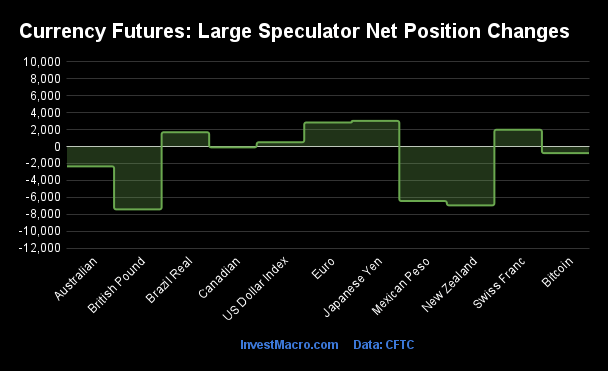
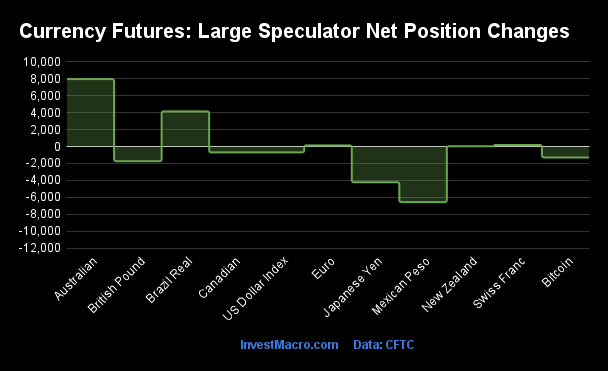
The COT currency market speculator bets were lower this week as five out of the eleven currency markets we cover had higher positioning while the other six markets had lower speculator contracts.

Leading the gains for the currency markets was the Japanese Yen (12,487 contracts) with the Canadian Dollar (5,009 contracts), New Zealand Dollar (2,677 contracts), Swiss Franc (1,780 contracts) and Bitcoin (516 contracts) also showing positive weeks.

The currencies seeing declines in speculator bets on the week were the Mexican Peso (-6,651 contracts) with the US Dollar Index (-5,013 contracts), the British Pound (-4,734 contracts), EuroFX (-1,602 contracts), the Brazilian Real (-1,962 contracts) and the Australian Dollar (-800 contracts)also registering lower bets on the week.

US Dollar Index Bullish Bets fall to 2-Year Low

Highlighting the COT currency’s data this week is the decline of the speculator’s positioning in the US Dollar Index. The large speculative US Dollar Index positions decreased for a fourth consecutive week this week and the speculators have now subtracted a total of -8,914 net contracts from the overall position in just the last four weeks.

This week’s reduction by -5,013 contracts marked the largest one-week shortfall since December 20th of 2022 (which recorded a decline by -9,021 contracts). This bearishness has dropped the US Dollar Index speculator net position (currently at +6,054 contracts) to its lowest level of the past 108 weeks, dating back to June 29th of 2021.

Overall, the US Dollar speculator position has been weakening since hitting a cycle high on June 21st of 2022 with a total of +45,010 contracts. Since then, the steady and slow erosion of bullish bets has brought the net position to under the +10,000 contract level for just the second time in the past two years. This latest data is through Tuesday and before the US Federal Reserve’s latest rate increase by 25 basis points that took place on Wednesday. Speculators and market watchers are eyeing the end of the Fed’s interest rate hiking campaign as inflation has been falling across most measures in the US economy.

The US Dollar Index futures price closed higher this week for a second straight week and ended the week right around the 101.40 level. The USD Index had ascended to a multi-decade high of 114.74 in September 2022 and has been on the downtrend since with a current decline (from top to latest price) of approximately 12 percent. The USD Index price fell to a 14-month low on July 18th at 99.22 before staging a comeback over the past two weeks and making it back over the 100 level.


Data Snapshot of Forex Market Traders | Columns Legend
Jul-25-2023OIOI-IndexSpec-NetSpec-IndexCom-NetCOM-IndexSmalls-NetSmalls-Index
USD Index34,514206,05435-6,3396628520
EUR772,40875177,23087-234,2691157,03970
GBP237,3406058,99597-76,984317,98993
JPY223,76057-77,7522486,55578-8,80336
CHF44,18050-8,431323,421515,01074
CAD156,395315,53060-22,0964116,56660
AUD146,42328-51,2013749,561561,64056
NZD36,82025-94951324791761
MXN233,5494987,84193-92,05874,21738
RUB20,93047,54331-7,15069-39324
BRL53,4434431,97176-31,95725-1444
Bitcoin16,01777-64566-178082332


Strength Scores led by British Pound & Mexican Peso

COT Strength Scores (a normalized measure of Speculator positions over a 3-Year range, from 0 to 100 where above 80 is Extreme-Bullish and below 20 is Extreme-Bearish) showed that the British Pound (97 percent) and the Mexican Peso (93 percent) lead the currency markets this week. The EuroFX (87 percent), Brazilian Real (76 percent) and the Bitcoin (66 percent) come in as the next highest in the weekly strength scores.

On the downside, the Japanese Yen (24 percent) and the Swiss Franc (32 percent) come in at the lowest strength levels currently. The next lowest strength scores are the US Dollar Index (35 percent) and the Australian Dollar (37 percent).

Strength Statistics:
US Dollar Index (35.0 percent) vs US Dollar Index previous week (43.4 percent)
EuroFX (86.7 percent) vs EuroFX previous week (87.3 percent)
British Pound Sterling (96.7 percent) vs British Pound Sterling previous week (100.0 percent)
Japanese Yen (23.8 percent) vs Japanese Yen previous week (16.4 percent)
Swiss Franc (32.3 percent) vs Swiss Franc previous week (27.6 percent)
Canadian Dollar (59.7 percent) vs Canadian Dollar previous week (55.0 percent)
Australian Dollar (37.4 percent) vs Australian Dollar previous week (38.1 percent)
New Zealand Dollar (51.0 percent) vs New Zealand Dollar previous week (43.8 percent)
Mexican Peso (92.8 percent) vs Mexican Peso previous week (96.8 percent)
Brazilian Real (76.4 percent) vs Brazilian Real previous week (78.9 percent)
Bitcoin (65.7 percent) vs Bitcoin previous week (56.7 percent)


Canadian Dollar & British Pound top the 6-Week Strength Trends

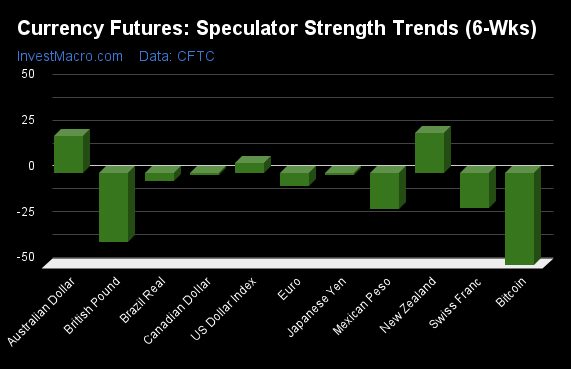
COT Strength Score Trends (or move index, calculates the 6-week changes in strength scores) showed that the Canadian Dollar (39 percent) and the British Pound (36 percent) lead the past six weeks trends for the currencies. The Japanese Yen (16 percent), the EuroFX (10 percent) and the Australian Dollar (10 percent) are the next highest positive movers in the latest trends data.

The Bitcoin (-24 percent) leads the downside trend scores currently with the US Dollar Index (-13 percent), Swiss Franc (-9 percent) and the New Zealand Dollar (0 percent) following next with lower trend scores.

Strength Trend Statistics:
US Dollar Index (-13.2 percent) vs US Dollar Index previous week (-1.9 percent)
EuroFX (9.8 percent) vs EuroFX previous week (7.9 percent)
British Pound Sterling (36.3 percent) vs British Pound Sterling previous week (35.6 percent)
Japanese Yen (15.6 percent) vs Japanese Yen previous week (8.7 percent)
Swiss Franc (-9.0 percent) vs Swiss Franc previous week (-23.5 percent)
Canadian Dollar (39.3 percent) vs Canadian Dollar previous week (36.2 percent)
Australian Dollar (9.8 percent) vs Australian Dollar previous week (5.6 percent)
New Zealand Dollar (-0.3 percent) vs New Zealand Dollar previous week (-7.9 percent)
Mexican Peso (5.5 percent) vs Mexican Peso previous week (7.8 percent)
Brazilian Real (7.4 percent) vs Brazilian Real previous week (9.9 percent)
Bitcoin (-24.2 percent) vs Bitcoin previous week (-33.7 percent)


Individual COT Forex Markets:

US Dollar Index Futures:
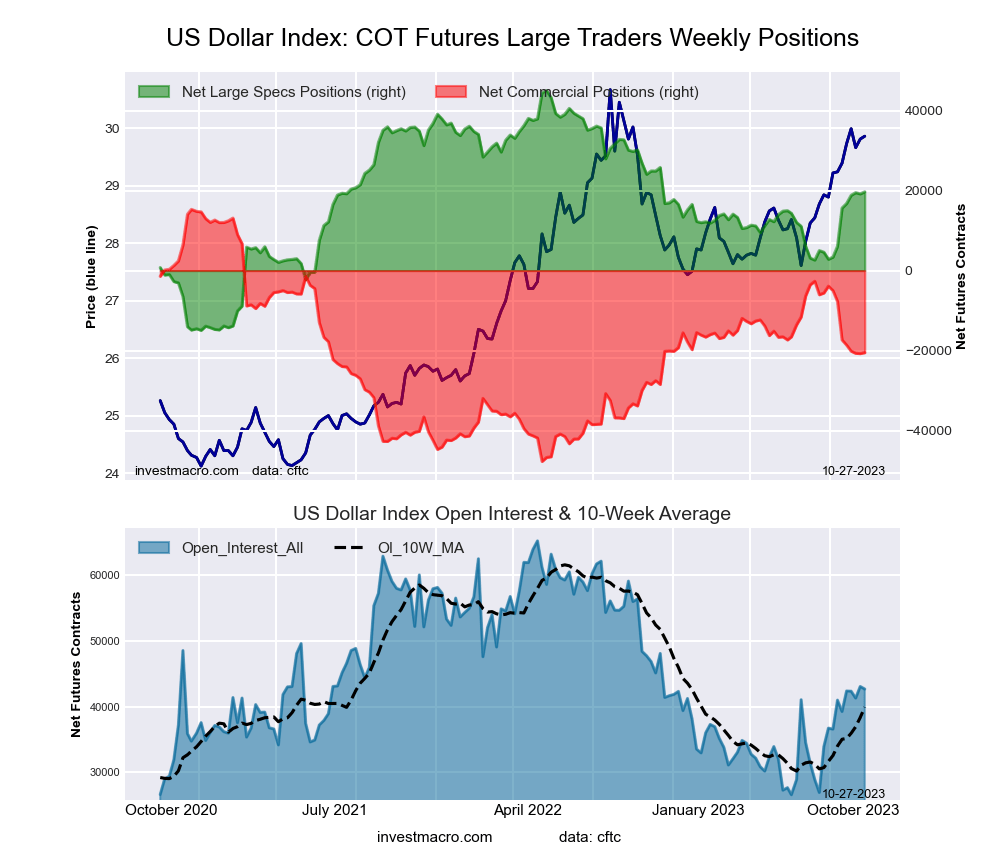
US Dollar Index Forex Futures COT ChartThe US Dollar Index large speculator standing this week totaled a net position of 6,054 contracts in the data reported through Tuesday. This was a weekly decrease of -5,013 contracts from the previous week which had a total of 11,067 net contracts.

This week’s current strength score (the trader positioning range over the past three years, measured from 0 to 100) shows the speculators are currently Bearish with a score of 35.0 percent. The commercials are Bullish with a score of 65.7 percent and the small traders (not shown in chart) are Bearish-Extreme with a score of 19.6 percent.

Price Trend-Following Model: Weak Uptrend

Our weekly trend-following model classifies the current market price position as: Weak Uptrend. The current action for the model is considered to be: Hold – Maintain Long Position.

US DOLLAR INDEX StatisticsSPECULATORSCOMMERCIALSSMALL TRADERS
– Percent of Open Interest Longs:61.622.610.8
– Percent of Open Interest Shorts:44.141.010.0
– Net Position:6,054-6,339285
– Gross Longs:21,2587,7963,735
– Gross Shorts:15,20414,1353,450
– Long to Short Ratio:1.4 to 10.6 to 11.1 to 1
NET POSITION TREND:
– Strength Index Score (3 Year Range Pct):35.065.719.6
– Strength Index Reading (3 Year Range):BearishBullishBearish-Extreme
NET POSITION MOVEMENT INDEX:
– 6-Week Change in Strength Index:-13.216.4-26.3


Euro Currency Futures:

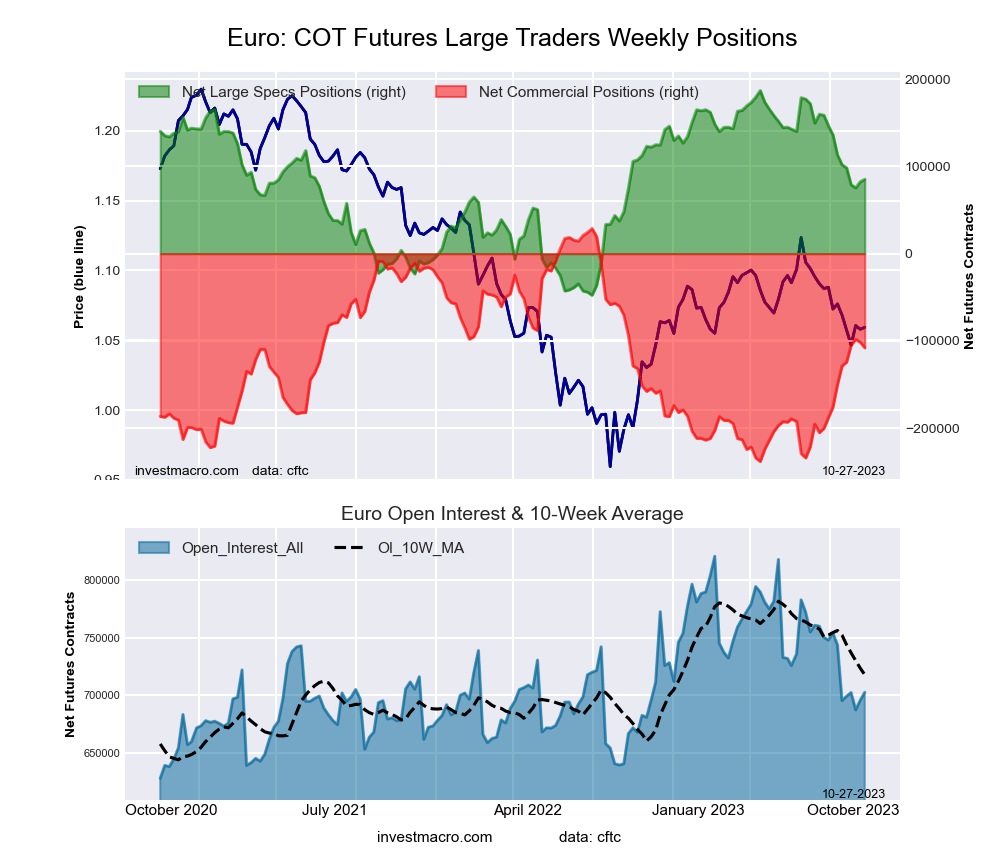
Euro Currency Futures COT ChartThe Euro Currency large speculator standing this week totaled a net position of 177,230 contracts in the data reported through Tuesday. This was a weekly lowering of -1,602 contracts from the previous week which had a total of 178,832 net contracts.

This week’s current strength score (the trader positioning range over the past three years, measured from 0 to 100) shows the speculators are currently Bullish-Extreme with a score of 86.7 percent. The commercials are Bearish-Extreme with a score of 11.4 percent and the small traders (not shown in chart) are Bullish with a score of 70.0 percent.

Price Trend-Following Model: Uptrend

Our weekly trend-following model classifies the current market price position as: Uptrend. The current action for the model is considered to be: Hold – Maintain Long Position.

EURO Currency StatisticsSPECULATORSCOMMERCIALSSMALL TRADERS
– Percent of Open Interest Longs:32.552.112.6
– Percent of Open Interest Shorts:9.582.55.2
– Net Position:177,230-234,26957,039
– Gross Longs:250,647402,62697,545
– Gross Shorts:73,417636,89540,506
– Long to Short Ratio:3.4 to 10.6 to 12.4 to 1
NET POSITION TREND:
– Strength Index Score (3 Year Range Pct):86.711.470.0
– Strength Index Reading (3 Year Range):Bullish-ExtremeBearish-ExtremeBullish
NET POSITION MOVEMENT INDEX:
– 6-Week Change in Strength Index:9.8-12.518.8


British Pound Sterling Futures:

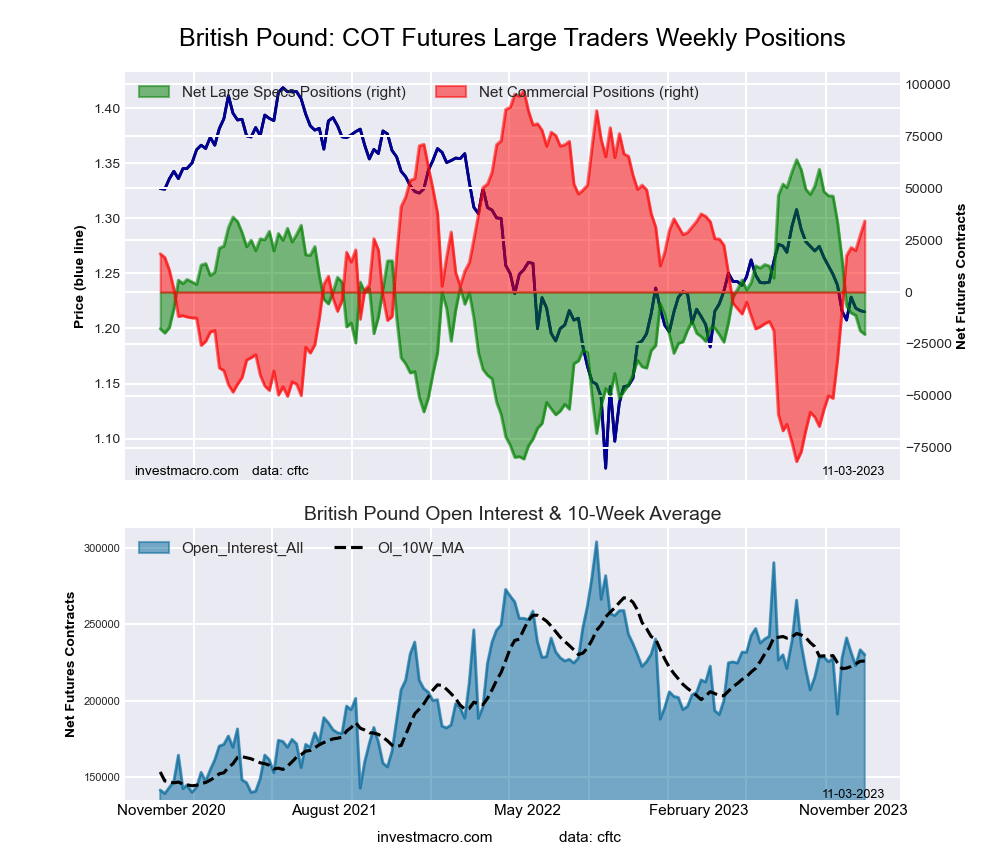
British Pound Sterling Futures COT ChartThe British Pound Sterling large speculator standing this week totaled a net position of 58,995 contracts in the data reported through Tuesday. This was a weekly decrease of -4,734 contracts from the previous week which had a total of 63,729 net contracts.

This week’s current strength score (the trader positioning range over the past three years, measured from 0 to 100) shows the speculators are currently Bullish-Extreme with a score of 96.7 percent. The commercials are Bearish-Extreme with a score of 2.6 percent and the small traders (not shown in chart) are Bullish-Extreme with a score of 93.3 percent.

Price Trend-Following Model: Uptrend

Our weekly trend-following model classifies the current market price position as: Uptrend. The current action for the model is considered to be: Hold – Maintain Long Position.

BRITISH POUND StatisticsSPECULATORSCOMMERCIALSSMALL TRADERS
– Percent of Open Interest Longs:44.531.917.6
– Percent of Open Interest Shorts:19.664.310.0
– Net Position:58,995-76,98417,989
– Gross Longs:105,49875,73741,762
– Gross Shorts:46,503152,72123,773
– Long to Short Ratio:2.3 to 10.5 to 11.8 to 1
NET POSITION TREND:
– Strength Index Score (3 Year Range Pct):96.72.693.3
– Strength Index Reading (3 Year Range):Bullish-ExtremeBearish-ExtremeBullish-Extreme
NET POSITION MOVEMENT INDEX:
– 6-Week Change in Strength Index:36.3-32.712.0


Japanese Yen Futures:

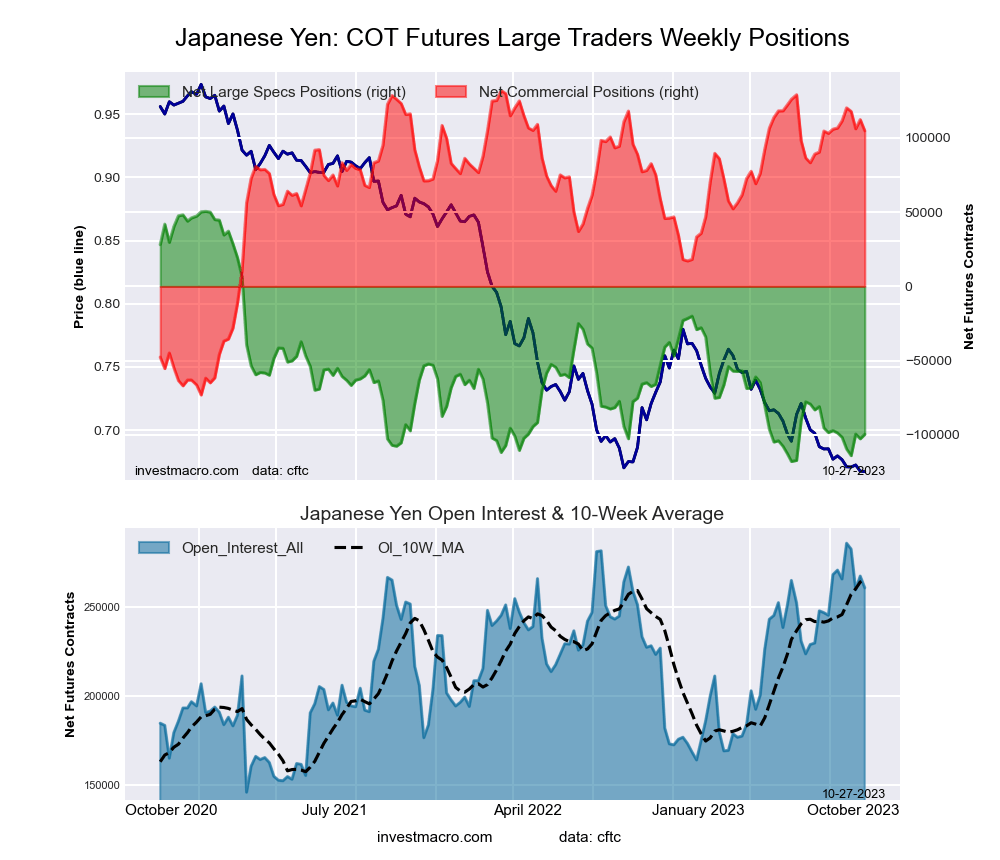
Japanese Yen Forex Futures COT ChartThe Japanese Yen large speculator standing this week totaled a net position of -77,752 contracts in the data reported through Tuesday. This was a weekly increase of 12,487 contracts from the previous week which had a total of -90,239 net contracts.

This week’s current strength score (the trader positioning range over the past three years, measured from 0 to 100) shows the speculators are currently Bearish with a score of 23.8 percent. The commercials are Bullish with a score of 77.9 percent and the small traders (not shown in chart) are Bearish with a score of 35.6 percent.

Price Trend-Following Model: Downtrend

Our weekly trend-following model classifies the current market price position as: Downtrend. The current action for the model is considered to be: Hold – Maintain Short Position.

JAPANESE YEN StatisticsSPECULATORSCOMMERCIALSSMALL TRADERS
– Percent of Open Interest Longs:13.672.013.4
– Percent of Open Interest Shorts:48.333.317.4
– Net Position:-77,75286,555-8,803
– Gross Longs:30,358161,16630,040
– Gross Shorts:108,11074,61138,843
– Long to Short Ratio:0.3 to 12.2 to 10.8 to 1
NET POSITION TREND:
– Strength Index Score (3 Year Range Pct):23.877.935.6
– Strength Index Reading (3 Year Range):BearishBullishBearish
NET POSITION MOVEMENT INDEX:
– 6-Week Change in Strength Index:15.6-15.411.0


Swiss Franc Futures:

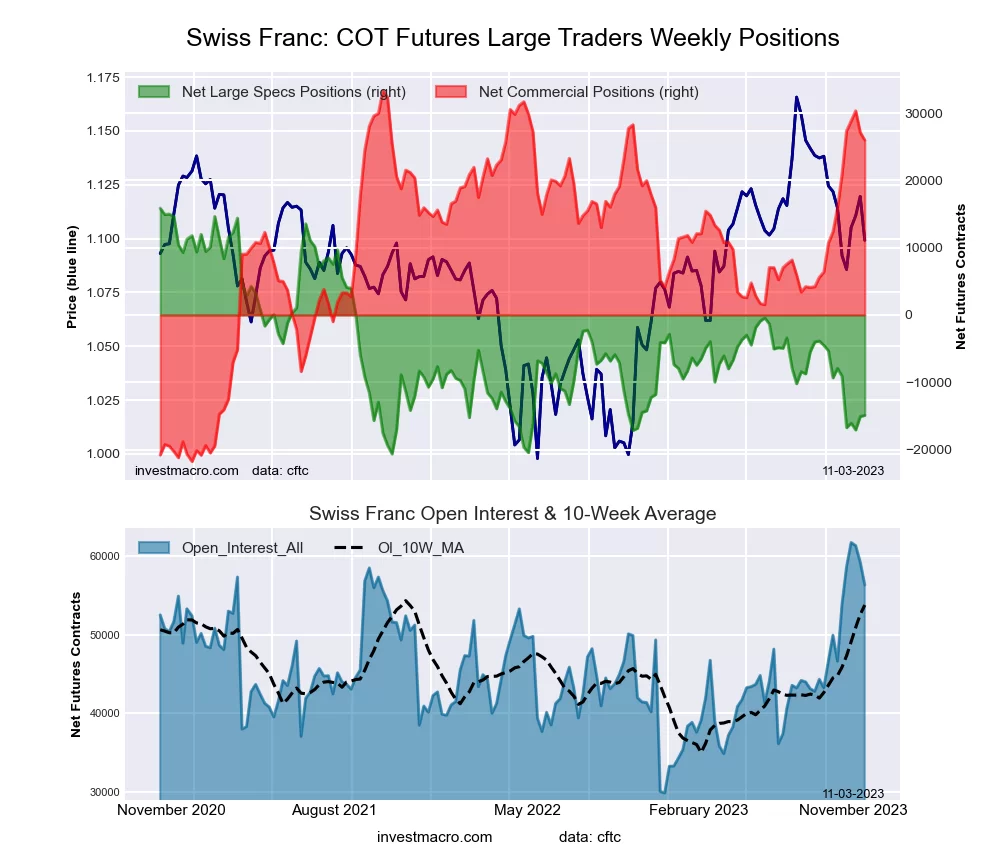
Swiss Franc Forex Futures COT ChartThe Swiss Franc large speculator standing this week totaled a net position of -8,431 contracts in the data reported through Tuesday. This was a weekly gain of 1,780 contracts from the previous week which had a total of -10,211 net contracts.

This week’s current strength score (the trader positioning range over the past three years, measured from 0 to 100) shows the speculators are currently Bearish with a score of 32.3 percent. The commercials are Bullish with a score of 50.6 percent and the small traders (not shown in chart) are Bullish with a score of 74.5 percent.

Price Trend-Following Model: Strong Uptrend

Our weekly trend-following model classifies the current market price position as: Strong Uptrend. The current action for the model is considered to be: Hold – Maintain Long Position.

SWISS FRANC StatisticsSPECULATORSCOMMERCIALSSMALL TRADERS
– Percent of Open Interest Longs:17.738.043.1
– Percent of Open Interest Shorts:36.730.331.8
– Net Position:-8,4313,4215,010
– Gross Longs:7,80416,78719,044
– Gross Shorts:16,23513,36614,034
– Long to Short Ratio:0.5 to 11.3 to 11.4 to 1
NET POSITION TREND:
– Strength Index Score (3 Year Range Pct):32.350.674.5
– Strength Index Reading (3 Year Range):BearishBullishBullish
NET POSITION MOVEMENT INDEX:
– 6-Week Change in Strength Index:-9.0-6.023.7


Canadian Dollar Futures:

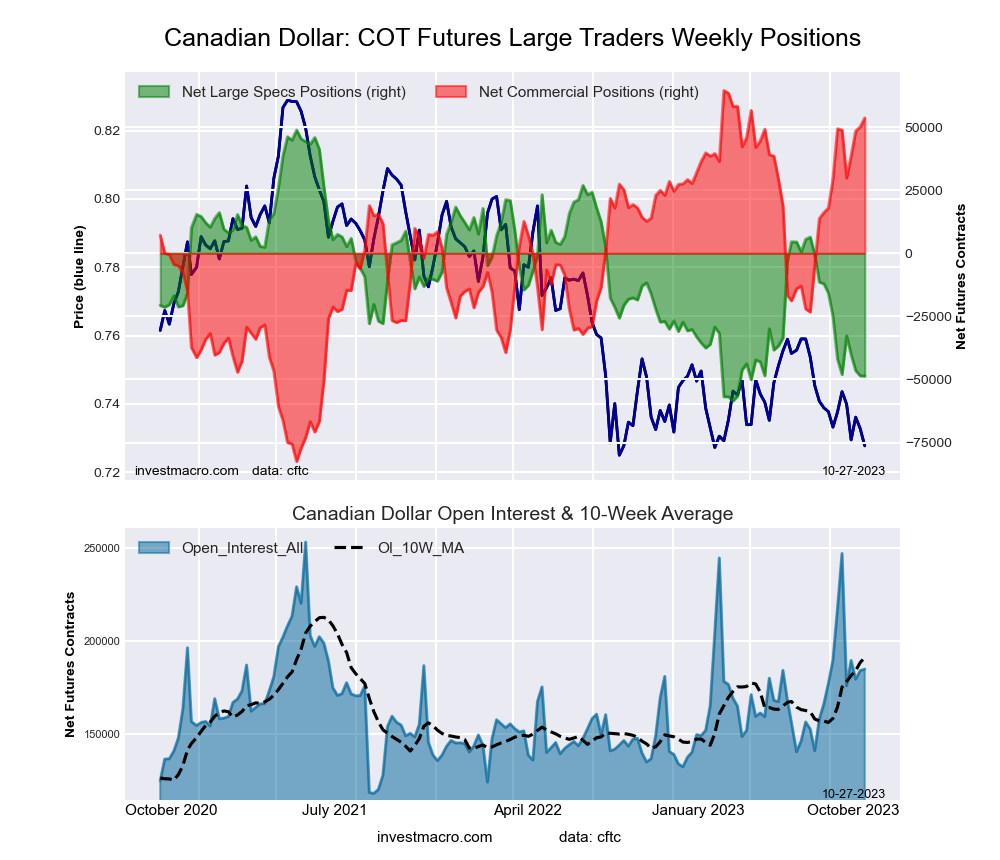
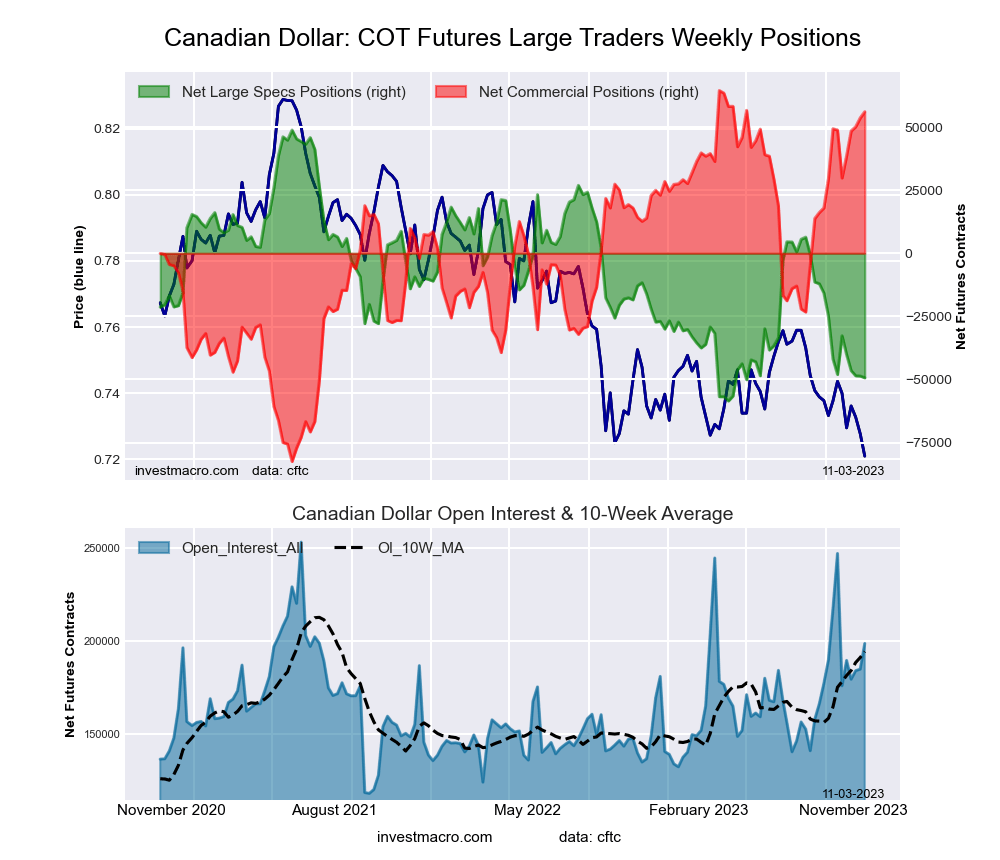
Canadian Dollar Forex Futures COT ChartThe Canadian Dollar large speculator standing this week totaled a net position of 5,530 contracts in the data reported through Tuesday. This was a weekly rise of 5,009 contracts from the previous week which had a total of 521 net contracts.

This week’s current strength score (the trader positioning range over the past three years, measured from 0 to 100) shows the speculators are currently Bullish with a score of 59.7 percent. The commercials are Bearish with a score of 41.1 percent and the small traders (not shown in chart) are Bullish with a score of 59.6 percent.

Price Trend-Following Model: Uptrend

Our weekly trend-following model classifies the current market price position as: Uptrend. The current action for the model is considered to be: Hold – Maintain Long Position.

CANADIAN DOLLAR StatisticsSPECULATORSCOMMERCIALSSMALL TRADERS
– Percent of Open Interest Longs:27.347.025.2
– Percent of Open Interest Shorts:23.861.114.6
– Net Position:5,530-22,09616,566
– Gross Longs:42,75973,53939,413
– Gross Shorts:37,22995,63522,847
– Long to Short Ratio:1.1 to 10.8 to 11.7 to 1
NET POSITION TREND:
– Strength Index Score (3 Year Range Pct):59.741.159.6
– Strength Index Reading (3 Year Range):BullishBearishBullish
NET POSITION MOVEMENT INDEX:
– 6-Week Change in Strength Index:39.3-35.020.6


Australian Dollar Futures:

Australian Dollar Forex Futures COT ChartThe Australian Dollar large speculator standing this week totaled a net position of -51,201 contracts in the data reported through Tuesday. This was a weekly reduction of -800 contracts from the previous week which had a total of -50,401 net contracts.

This week’s current strength score (the trader positioning range over the past three years, measured from 0 to 100) shows the speculators are currently Bearish with a score of 37.4 percent. The commercials are Bullish with a score of 55.9 percent and the small traders (not shown in chart) are Bullish with a score of 56.4 percent.

Price Trend-Following Model: Uptrend

Our weekly trend-following model classifies the current market price position as: Uptrend. The current action for the model is considered to be: Hold – Maintain Long Position.

AUSTRALIAN DOLLAR StatisticsSPECULATORSCOMMERCIALSSMALL TRADERS
– Percent of Open Interest Longs:26.754.816.2
– Percent of Open Interest Shorts:61.721.015.1
– Net Position:-51,20149,5611,640
– Gross Longs:39,10880,23723,735
– Gross Shorts:90,30930,67622,095
– Long to Short Ratio:0.4 to 12.6 to 11.1 to 1
NET POSITION TREND:
– Strength Index Score (3 Year Range Pct):37.455.956.4
– Strength Index Reading (3 Year Range):BearishBullishBullish
NET POSITION MOVEMENT INDEX:
– 6-Week Change in Strength Index:9.8-18.233.7


New Zealand Dollar Futures:

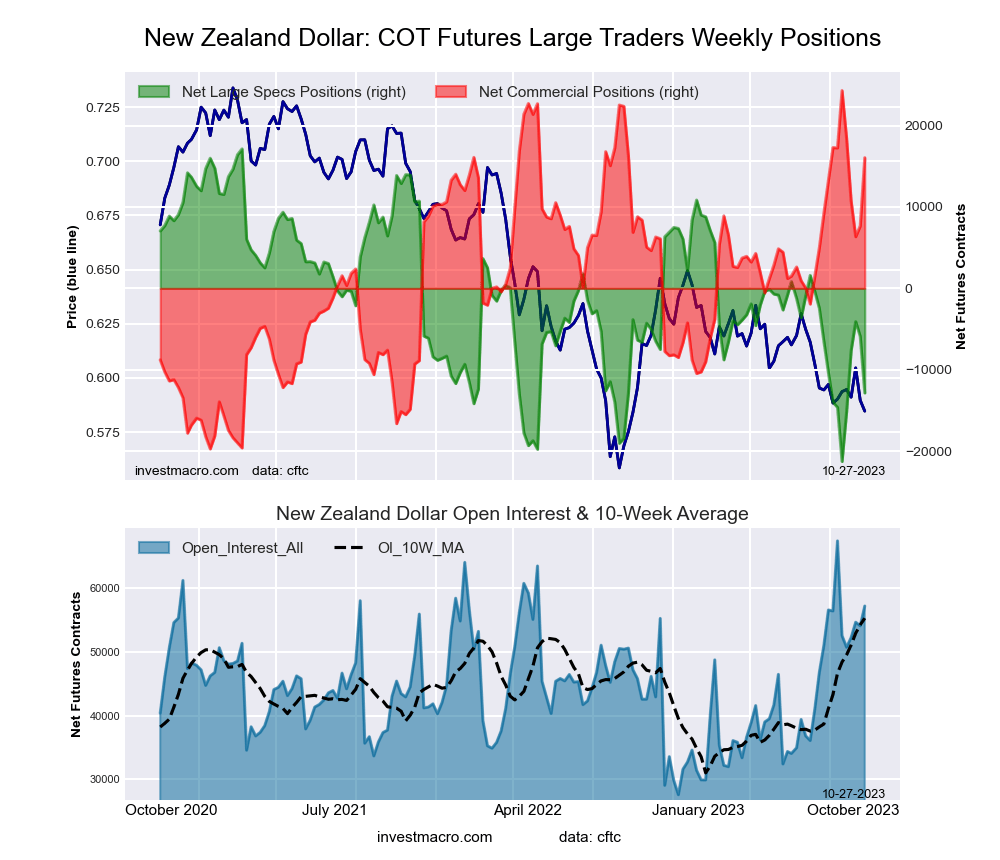
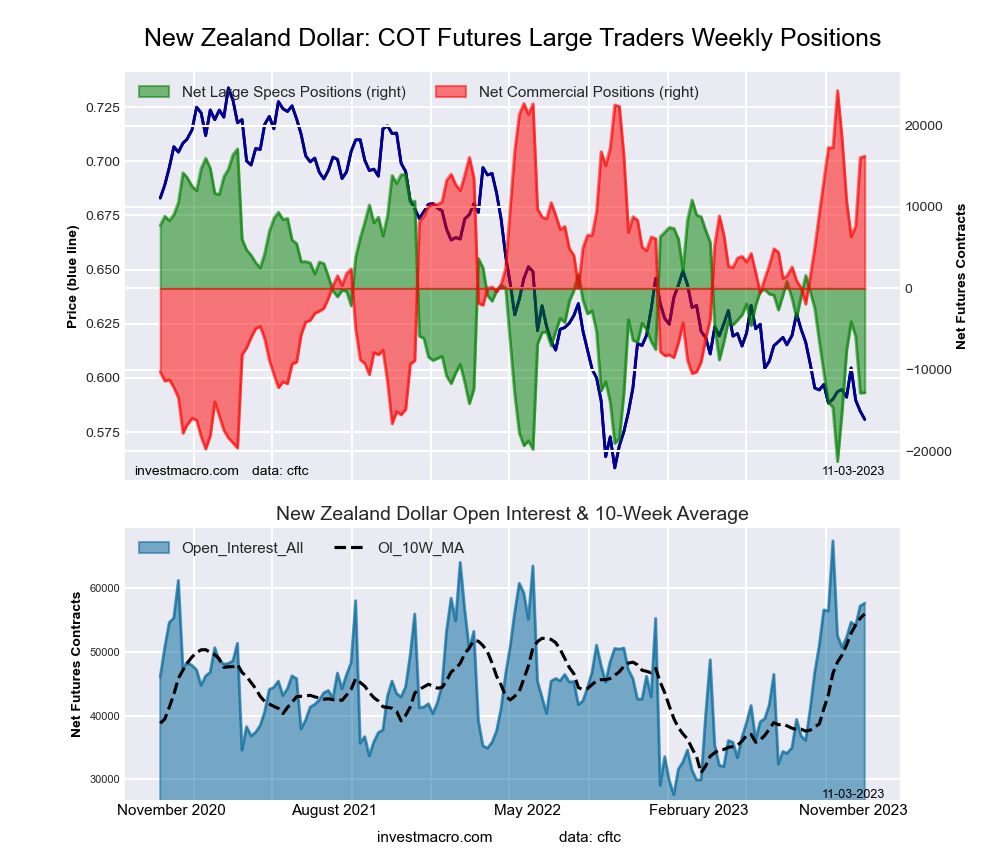
New Zealand Dollar Forex Futures COT ChartThe New Zealand Dollar large speculator standing this week totaled a net position of -949 contracts in the data reported through Tuesday. This was a weekly boost of 2,677 contracts from the previous week which had a total of -3,626 net contracts.

This week’s current strength score (the trader positioning range over the past three years, measured from 0 to 100) shows the speculators are currently Bullish with a score of 51.0 percent. The commercials are Bearish with a score of 46.6 percent and the small traders (not shown in chart) are Bullish with a score of 60.9 percent.

Price Trend-Following Model: Downtrend

Our weekly trend-following model classifies the current market price position as: Downtrend. The current action for the model is considered to be: Hold – Maintain Short Position.

NEW ZEALAND DOLLAR StatisticsSPECULATORSCOMMERCIALSSMALL TRADERS
– Percent of Open Interest Longs:35.153.411.1
– Percent of Open Interest Shorts:37.753.38.6
– Net Position:-94932917
– Gross Longs:12,93319,6644,080
– Gross Shorts:13,88219,6323,163
– Long to Short Ratio:0.9 to 11.0 to 11.3 to 1
NET POSITION TREND:
– Strength Index Score (3 Year Range Pct):51.046.660.9
– Strength Index Reading (3 Year Range):BullishBearishBullish
NET POSITION MOVEMENT INDEX:
– 6-Week Change in Strength Index:-0.3-11.458.8


Mexican Peso Futures:

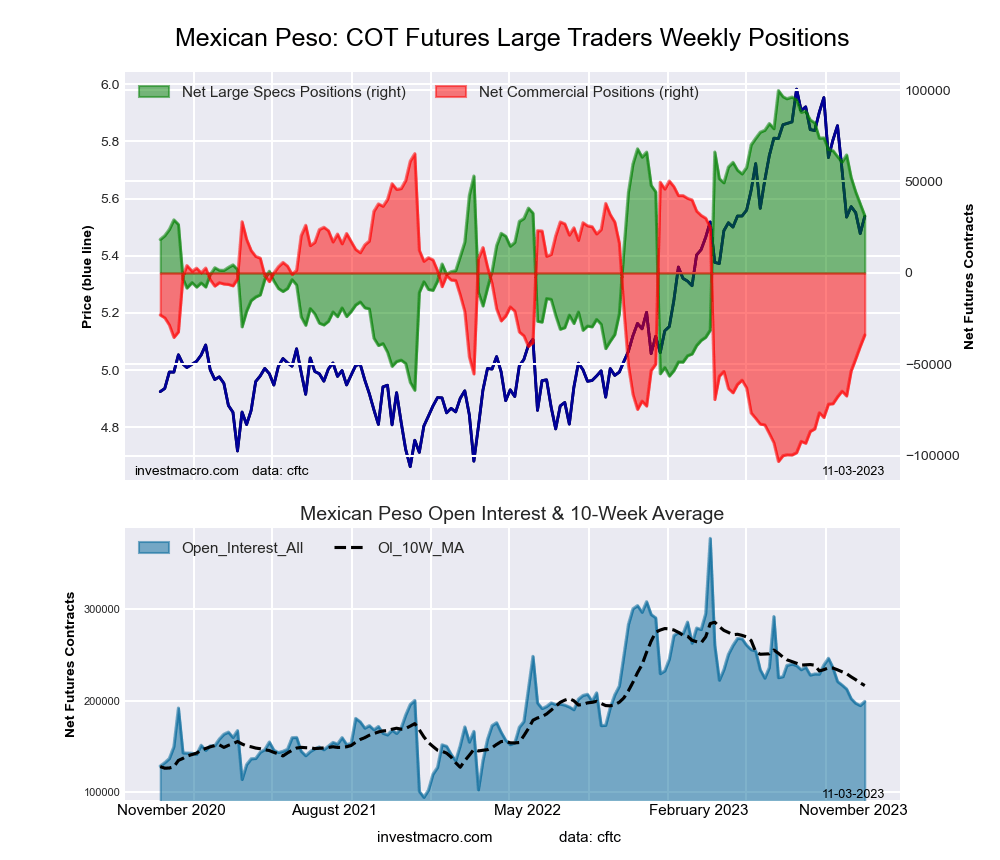
Mexican Peso Futures COT ChartThe Mexican Peso large speculator standing this week totaled a net position of 87,841 contracts in the data reported through Tuesday. This was a weekly decrease of -6,651 contracts from the previous week which had a total of 94,492 net contracts.

This week’s current strength score (the trader positioning range over the past three years, measured from 0 to 100) shows the speculators are currently Bullish-Extreme with a score of 92.8 percent. The commercials are Bearish-Extreme with a score of 6.5 percent and the small traders (not shown in chart) are Bearish with a score of 38.1 percent.

Price Trend-Following Model: Uptrend

Our weekly trend-following model classifies the current market price position as: Uptrend. The current action for the model is considered to be: Hold – Maintain Long Position.

MEXICAN PESO StatisticsSPECULATORSCOMMERCIALSSMALL TRADERS
– Percent of Open Interest Longs:50.445.43.7
– Percent of Open Interest Shorts:12.884.81.9
– Net Position:87,841-92,0584,217
– Gross Longs:117,732106,0618,608
– Gross Shorts:29,891198,1194,391
– Long to Short Ratio:3.9 to 10.5 to 12.0 to 1
NET POSITION TREND:
– Strength Index Score (3 Year Range Pct):92.86.538.1
– Strength Index Reading (3 Year Range):Bullish-ExtremeBearish-ExtremeBearish
NET POSITION MOVEMENT INDEX:
– 6-Week Change in Strength Index:5.50.4-61.9


Brazilian Real Futures:

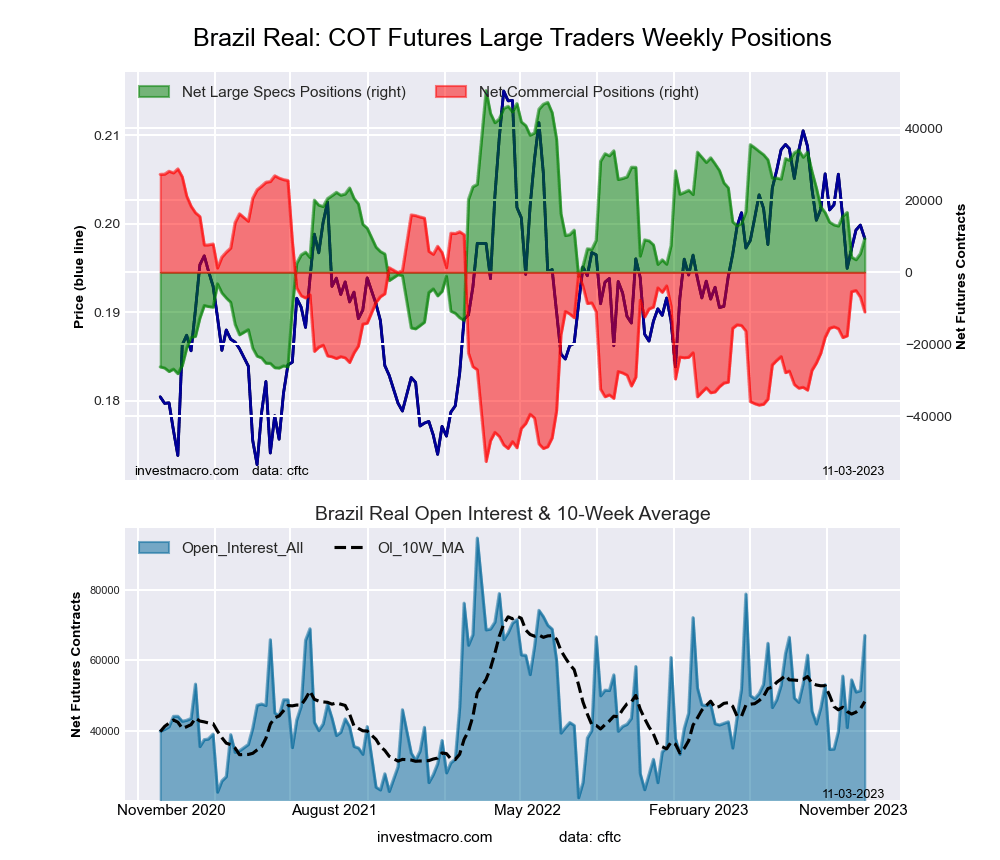
Brazil Real Futures COT ChartThe Brazilian Real large speculator standing this week totaled a net position of 31,971 contracts in the data reported through Tuesday. This was a weekly reduction of -1,962 contracts from the previous week which had a total of 33,933 net contracts.

This week’s current strength score (the trader positioning range over the past three years, measured from 0 to 100) shows the speculators are currently Bullish with a score of 76.4 percent. The commercials are Bearish with a score of 25.3 percent and the small traders (not shown in chart) are Bearish with a score of 43.9 percent.

Price Trend-Following Model: Strong Uptrend

Our weekly trend-following model classifies the current market price position as: Strong Uptrend. The current action for the model is considered to be: Hold – Maintain Long Position.

BRAZIL REAL StatisticsSPECULATORSCOMMERCIALSSMALL TRADERS
– Percent of Open Interest Longs:68.020.79.5
– Percent of Open Interest Shorts:8.280.59.5
– Net Position:31,971-31,957-14
– Gross Longs:36,34511,0735,084
– Gross Shorts:4,37443,0305,098
– Long to Short Ratio:8.3 to 10.3 to 11.0 to 1
NET POSITION TREND:
– Strength Index Score (3 Year Range Pct):76.425.343.9
– Strength Index Reading (3 Year Range):BullishBearishBearish
NET POSITION MOVEMENT INDEX:
– 6-Week Change in Strength Index:7.4-9.213.2


Bitcoin Futures:

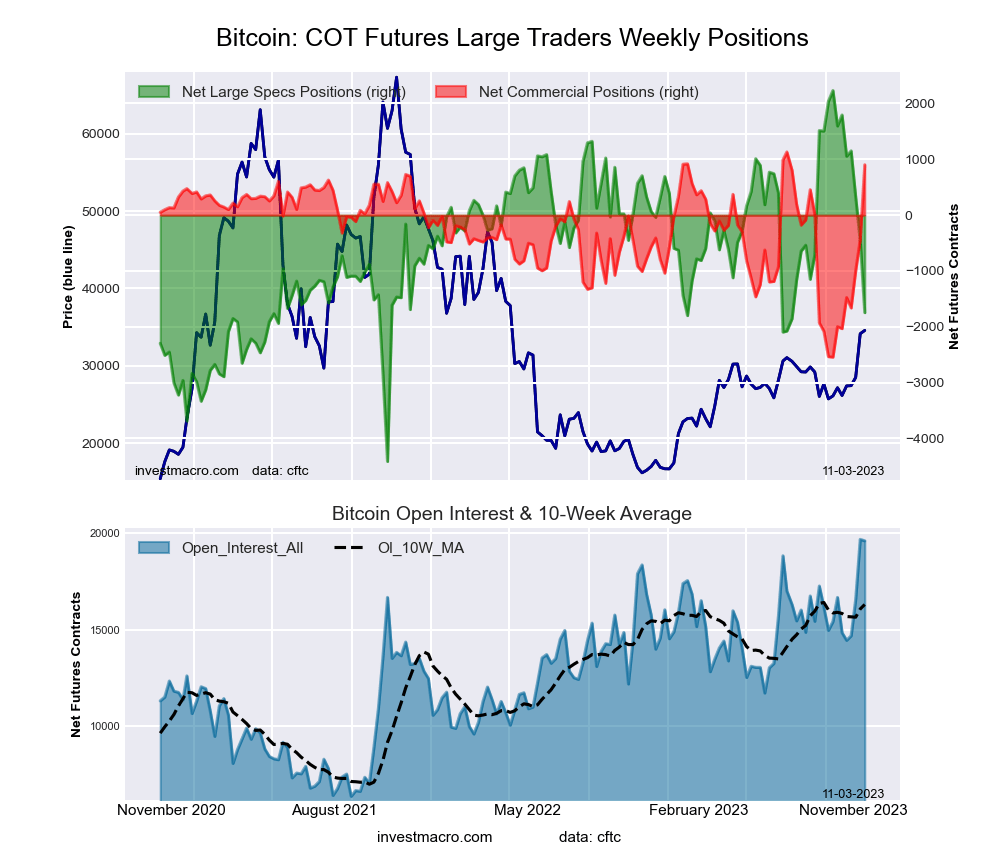
Bitcoin Crypto Futures COT ChartThe Bitcoin large speculator standing this week totaled a net position of -645 contracts in the data reported through Tuesday. This was a weekly rise of 516 contracts from the previous week which had a total of -1,161 net contracts.

This week’s current strength score (the trader positioning range over the past three years, measured from 0 to 100) shows the speculators are currently Bullish with a score of 65.7 percent. The commercials are Bearish with a score of 49.5 percent and the small traders (not shown in chart) are Bearish with a score of 31.7 percent.

Price Trend-Following Model: Uptrend

Our weekly trend-following model classifies the current market price position as: Uptrend. The current action for the model is considered to be: Hold – Maintain Long Position.

BITCOIN StatisticsSPECULATORSCOMMERCIALSSMALL TRADERS
– Percent of Open Interest Longs:74.62.69.4
– Percent of Open Interest Shorts:78.63.74.2
– Net Position:-645-178823
– Gross Longs:11,9414221,503
– Gross Shorts:12,586600680
– Long to Short Ratio:0.9 to 10.7 to 12.2 to 1
NET POSITION TREND:
– Strength Index Score (3 Year Range Pct):65.749.531.7
– Strength Index Reading (3 Year Range):BullishBearishBearish
NET POSITION MOVEMENT INDEX:
– 6-Week Change in Strength Index:-24.238.98.6


Article By InvestMacroReceive our weekly COT Newsletter

*COT Report: The COT data, released weekly to the public each Friday, is updated through the most recent Tuesday (data is 3 days old) and shows a quick view of how large speculators or non-commercials (for-profit traders) were positioned in the futures markets.

The CFTC categorizes trader positions according to commercial hedgers (traders who use futures contracts for hedging as part of the business), non-commercials (large traders who speculate to realize trading profits) and nonreportable traders (usually small traders/speculators) as well as their open interest (contracts open in the market at time of reporting). See CFTC criteria here.

Japanese Candlesticks Analysis 27.07.2023 (XAUUSD, NZDUSD, GBPUSD)

By RoboForex.com

XAUUSD, “Gold vs US Dollar”

Gold has formed a Shooting Star reversal pattern near the resistance level. Currently, the instrument could go by the reversal signal in a descending wave. The correction target might be 1965.50. Upon testing the support, the price might rebound and continue the uptrend. However, the quotes could rise to 1990.00 without a correction.

GOLD
Risk Warning: the result of previous trading operations do not guarantee the same results in the future

NZDUSD, “New Zealand Dollar vs US Dollar”

NZDUSD has formed a Hammer reversal pattern on H4. Currently, the instrument is going by the reversal signal in an ascending wave. The growth target might be 0.6300. Upon breaking the resistance, the quotes might have a chance to continue the uptrend. However, a correction to 0.6190 might develop and an uptrend might follow the pullback.

NZDUSD
Risk Warning: the result of previous trading operations do not guarantee the same results in the future

GBPUSD, “Great Britain Pound vs US Dollar”

GBPUSD has formed a Hammer reversal pattern near the support level on H4. Currently, the instrument is going by the reversal signal in an ascending wave. The growth target might be 1.3055. However, the price might correct to 1.2895 and continue the uptrend following the pullback.

GBPUSD
Risk Warning: the result of previous trading operations do not guarantee the same results in the future

Article By RoboForex.com

Attention!
Forecasts presented in this section only reflect the author’s private opinion and should not be considered as guidance for trading. RoboForex LP bears no responsibility for trading results based on trading recommendations described in these analytical reviews.

AUD remains highly volatile. Overview for 26.07.2023

By RoboForex.com

The Australian dollar, paired with the US dollar, is once again facing pressure. The current AUDUSD quote is 0.6759.

The Aussie’s volatility is drawing attention. On one hand, a strong US dollar exerts pressure on the AUD. On the other hand, China is sending quite positive signals.

Today’s statistics revealed that inflation in Australia for the second quarter declined to 5.4% year-over-year. On a quarterly basis, the indicator rose by 0.8% following a 1.4% increase from January to March this year. The easing of inflationary pressure is a positive signal. The Reserve Bank of Australia is likely to acknowledge this at its next meeting and keep the interest rate unchanged. The Australian dollar is reacting precisely to this development.

China’s readiness to stimulate its economy is favourable for Australia. As Australia’s primary trading and economic partner, all positive news coming from China is also encouraging for the AUD.

Article By RoboForex.com

Attention!
Forecasts presented in this section only reflect the author’s private opinion and should not be considered as guidance for trading. RoboForex LP bears no responsibility for trading results based on trading recommendations described in these analytical reviews.

Mid-Week Technical Outlook: Calm Before Fed Storm?

By ForexTime 

  • USD shaky ahead of Fed
  • USDJPY pressured below 141
  • SPX500_m preparing to breakout?
  • NQ100_m still in uptrend
  • Gold climbs beyond $1970

An air of tension settled over financial markets on Wednesday as investors braced for the pivotal Federal Reserve rate decision.

Global equities struggled for direction amid the growing caution, with European shares and US futures mixed as investors turned to the sidelines. Although the Fed is widely expected to raise interest rates by 25 basis points today, the key question is whether this will be the hike that concludes its aggressive campaign against inflation. Whatever the outcome of today’s policy meeting, it has the potential to rock financial markets.

Here are some technical setups to keep an eye on ahead of the Fed decision:

Dollar shaky and vulnerable 

The dollar has weakened against all G10 currencies this morning, with prices testing the 101.10 level. As discussed throughout the week, the pending Fed decision is likely to heavily influence the dollar’s short to medium-term outlook. A strong breakdown below 101.10 may open the doors towards 100.72 and 100.00. Should prices push back above 101.50, the next key level of interest can be found at 102.35.

EURUSD rebound or breakdown?

After rebounding from the 1.1032 region yesterday, the euro has extended gains this morning with bulls eyeing 1.1090. A solid breakout above this point may re-open a path back towards 1.12750. Should prices slip back below 1.1032, bears may target 1.0950.

GBPUSD to resume uptrend?

Wednesday’s strong bullish daily candle could be early signs of GBPUSD bulls returning to the scene. Indeed, prices remain in a bullish trend with the MACD trading to the upside. A move towards 1.3000 could be on the cards if 1.2810 proves to be reliable support. Alternatively, a break below this point may trigger a selloff toward the 50-day Simple Moving Average.

USDJPY pressured below 141.00

USDJPY bears seem to be slowly creeping back into the scene, especially after prices broke through the 141.00 level. Dollar weakness could drag the currency pair towards 138.80 and 138.00, respectively. If prices can push back above 141.00, bulls could challenge 141.90 once again.

SPX500_m breakout alert?

Expect the SPX500_m to be rocked by earnings releases from the largest companies in the world. The index remains bullish on the daily charts with resistance found at 4580. A strong breakout and daily close above this point could trigger a move toward 4640. Sustained weakness below 4580 could see prices test 4500 and 4463.

NQ100_m still in uptrend 

Our trade of the week remains in an uptrend on the daily charts. A strong move above 15700 could inspire a move towards 15947. Should prices slip back under 15300, the selloff may take the index towards 14965.

Gold gearing to push higher?

After kicking off the week on a rocky note, gold bulls seem to have their footing with prices trading above the sticky $1960 level. Should this rebound build momentum, this could take the precious metal towards $1985 and $2000. On the other hand, a decline back below $1955 may see prices test $1940 and $1932.


Forex-Time-LogoArticle by ForexTime

ForexTime Ltd (FXTM) is an award winning international online forex broker regulated by CySEC 185/12 www.forextime.com

Euro and Japanese Yen Speculator Bets Jump this week

By InvestMacro

Here are the latest charts and statistics for the Commitment of Traders (COT) data published by the Commodities Futures Trading Commission (CFTC).

The latest COT data is updated through Tuesday July 18th and shows a quick view of how large market participants (for-profit speculators and commercial traders) were positioned in the futures markets. All currency positions are in direct relation to the US dollar where, for example, a bet for the euro is a bet that the euro will rise versus the dollar while a bet against the euro will be a bet that the euro will decline versus the dollar.

Weekly Speculator Changes led by Euro & Japanese Yen

The COT currency market speculator bets were a bit lower this week as five out of the eleven currency markets we cover had higher positioning while the other six markets had lower speculator contracts.

Leading the gains for the currency markets was the EuroFX (38,670 contracts) with the Japanese Yen (26,943 contracts), the British Pound (5,666 contracts), the Brazilian Real (735 contracts) and Bitcoin (694 contracts) also showing positive weeks.

The currencies seeing declines in speculator bets on the week were the Australian Dollar (-5,317 contracts), the Canadian Dollar (-3,923 contracts), the New Zealand Dollar (-2,375 contracts), the Swiss Franc (-2,304 contracts), the Mexican Peso (-1,674 contracts) and the US Dollar Index (-944 contracts) also registering lower bets on the week.

Euro and Japanese Yen Speculator Bets Jump this week

Highlighting the COT currency’s data is the strength of this week’s moves in the speculator’s positioning of the Euro and Japanese Yen.

Large speculative Euro positions jumped this week by over +38,000 contracts and reversed a recent decline for the Euro positions in seven out of the previous eight weeks. This gain in bullish bets has pushed the overall net speculator position to the most bullish level of the past nine weeks at a total of +178,832 contracts.

The Euro currency’s strength has been on display over the past few months as the EURUSD exchange rate touched a one-year high this week at over the 1.1300 level. The EURUSD did close the week lower after hitting the one-year high but is now quite a ways off the 2022 low of 0.9508 that was touched in September.

The large speculative yen positions also surged this week by over +26,000 net contracts and gained for the second week in a row. The yen speculator positioning has been quite the opposite of the Euro as the Bank of Japan has maintained a policy of no interest rate increases which has prompted speculators to have large bearish positions in the yen. The speculator position on July 3rd marked the most bearish level since January of 2018 at a total of -117,920 contracts.

The yen positions in the past two weeks have improved though and this week’s gain brings the current bearish position (at -90,239 contracts) under the -100,000 contract threshold for the first time since May.

The yen’s exchange rate versus the US Dollar remains historically weak and in a downtrend in our trend model. The USDJPY exchange rate rose back over the 140.00 threshold this week (US Dollar strength/Japanese Yen weakness) after dipping below that level last week.

This upcoming week will be a potentially volatile week in currencies as the Bank of Japan and the US Federal Reserve will have central bank meetings and announce their respective policy outlooks.


Data Snapshot of Forex Market Traders | Columns Legend
Jul-18-2023OIOI-IndexSpec-NetSpec-IndexCom-NetCOM-IndexSmalls-NetSmalls-Index
USD Index41,0453711,06743-11,6175755023
EUR783,13280178,83287-229,3431350,51160
GBP265,7667763,729100-81,606017,87793
JPY230,93263-90,2391698,19584-7,95637
CHF43,21347-10,211285,927554,28472
CAD146,1712352155-12,9914712,47050
AUD148,59235-50,4013851,04557-64451
NZD39,40232-3,62644938492,68882
MXN238,0065194,49297-98,23933,74735
RUB20,93047,54331-7,15069-39324
BRL48,1463733,93379-32,19625-1,73730
Bitcoin15,45573-1,16157196096535


Strength Scores led by British Pound & Mexican Peso

COT Strength Scores (a normalized measure of Speculator positions over a 3-Year range, from 0 to 100 where above 80 is Extreme-Bullish and below 20 is Extreme-Bearish) showed that the British Pound (100 percent) and the Mexican Peso (97 percent) lead the currency markets this week. The EuroFX (87 percent), Brazilian Real (79 percent) and the Bitcoin (57 percent) come in as the next highest in the weekly strength scores.

On the downside, the Japanese Yen (16 percent) and the Swiss Franc (28 percent) come in at the lowest strength levels currently. The next lowest strength scores are the Australian Dollar (38 percent) and the US Dollar Index (43 percent).

Strength Statistics:
US Dollar Index (43.4 percent) vs US Dollar Index previous week (45.0 percent)
EuroFX (87.3 percent) vs EuroFX previous week (72.4 percent)
British Pound Sterling (100.0 percent) vs British Pound Sterling previous week (96.1 percent)
Japanese Yen (16.4 percent) vs Japanese Yen previous week (0.4 percent)
Swiss Franc (27.6 percent) vs Swiss Franc previous week (33.7 percent)
Canadian Dollar (55.0 percent) vs Canadian Dollar previous week (58.7 percent)
Australian Dollar (38.1 percent) vs Australian Dollar previous week (43.0 percent)
New Zealand Dollar (43.8 percent) vs New Zealand Dollar previous week (50.2 percent)
Mexican Peso (96.8 percent) vs Mexican Peso previous week (97.8 percent)
Brazilian Real (78.9 percent) vs Brazilian Real previous week (78.0 percent)
Bitcoin (56.7 percent) vs Bitcoin previous week (44.6 percent)


British Pound & Canadian Dollar top the 6-Week Strength Trends

COT Strength Score Trends (or move index, calculates the 6-week changes in strength scores) showed that the British Pound (36 percent) and the Canadian Dollar (36 percent) lead the past six weeks trends for the currencies. The Brazilian Real (10 percent), the Japanese Yen (9 percent) and the EuroFX (8 percent) are the next highest positive movers in the latest trends data.

Bitcoin (-34 percent) leads the downside trend scores currently with the Swiss Franc (-24 percent), New Zealand Dollar (-8 percent) and the US Dollar Index (-2 percent) following next with lower trend scores.

Strength Trend Statistics:
US Dollar Index (-1.9 percent) vs US Dollar Index previous week (-1.3 percent)
EuroFX (7.9 percent) vs EuroFX previous week (-9.9 percent)
British Pound Sterling (35.6 percent) vs British Pound Sterling previous week (31.1 percent)
Japanese Yen (8.7 percent) vs Japanese Yen previous week (-12.5 percent)
Swiss Franc (-23.5 percent) vs Swiss Franc previous week (-19.8 percent)
Canadian Dollar (36.2 percent) vs Canadian Dollar previous week (32.0 percent)
Australian Dollar (5.6 percent) vs Australian Dollar previous week (-0.9 percent)
New Zealand Dollar (-7.9 percent) vs New Zealand Dollar previous week (-3.0 percent)
Mexican Peso (7.8 percent) vs Mexican Peso previous week (11.1 percent)
Brazilian Real (9.9 percent) vs Brazilian Real previous week (2.4 percent)
Bitcoin (-33.7 percent) vs Bitcoin previous week (-35.6 percent)


Individual COT Forex Markets:

US Dollar Index Futures:

US Dollar Index Forex Futures COT ChartThe US Dollar Index large speculator standing this week came in at a net position of 11,067 contracts in the data reported through Tuesday. This was a weekly reduction of -944 contracts from the previous week which had a total of 12,011 net contracts.

This week’s current strength score (the trader positioning range over the past three years, measured from 0 to 100) shows the speculators are currently Bearish with a score of 43.4 percent. The commercials are Bullish with a score of 57.3 percent and the small traders (not shown in chart) are Bearish with a score of 22.5 percent.

Price Trend-Following Model: Weak Uptrend

Our weekly trend-following model classifies the current market price position as: Weak Uptrend. The current action for the model is considered to be: Hold – Maintain Long Position.

US DOLLAR INDEX StatisticsSPECULATORSCOMMERCIALSSMALL TRADERS
– Percent of Open Interest Longs:66.819.510.2
– Percent of Open Interest Shorts:39.847.88.9
– Net Position:11,067-11,617550
– Gross Longs:27,4107,9944,193
– Gross Shorts:16,34319,6113,643
– Long to Short Ratio:1.7 to 10.4 to 11.2 to 1
NET POSITION TREND:
– Strength Index Score (3 Year Range Pct):43.457.322.5
– Strength Index Reading (3 Year Range):BearishBullishBearish
NET POSITION MOVEMENT INDEX:
– 6-Week Change in Strength Index:-1.95.6-26.2


Euro Currency Futures:

Euro Currency Futures COT ChartThe Euro Currency large speculator standing this week came in at a net position of 178,832 contracts in the data reported through Tuesday. This was a weekly boost of 38,670 contracts from the previous week which had a total of 140,162 net contracts.

This week’s current strength score (the trader positioning range over the past three years, measured from 0 to 100) shows the speculators are currently Bullish-Extreme with a score of 87.3 percent. The commercials are Bearish-Extreme with a score of 13.0 percent and the small traders (not shown in chart) are Bullish with a score of 59.6 percent.

Price Trend-Following Model: Strong Uptrend

Our weekly trend-following model classifies the current market price position as: Strong Uptrend. The current action for the model is considered to be: Hold – Maintain Long Position.

EURO Currency StatisticsSPECULATORSCOMMERCIALSSMALL TRADERS
– Percent of Open Interest Longs:33.851.912.4
– Percent of Open Interest Shorts:10.981.25.9
– Net Position:178,832-229,34350,511
– Gross Longs:264,514406,32897,050
– Gross Shorts:85,682635,67146,539
– Long to Short Ratio:3.1 to 10.6 to 12.1 to 1
NET POSITION TREND:
– Strength Index Score (3 Year Range Pct):87.313.059.6
– Strength Index Reading (3 Year Range):Bullish-ExtremeBearish-ExtremeBullish
NET POSITION MOVEMENT INDEX:
– 6-Week Change in Strength Index:7.9-8.68.0


British Pound Sterling Futures:

British Pound Sterling Futures COT ChartThe British Pound Sterling large speculator standing this week came in at a net position of 63,729 contracts in the data reported through Tuesday. This was a weekly rise of 5,666 contracts from the previous week which had a total of 58,063 net contracts.

This week’s current strength score (the trader positioning range over the past three years, measured from 0 to 100) shows the speculators are currently Bullish-Extreme with a score of 100.0 percent. The commercials are Bearish-Extreme with a score of 0.0 percent and the small traders (not shown in chart) are Bullish-Extreme with a score of 93.1 percent.

Price Trend-Following Model: Uptrend

Our weekly trend-following model classifies the current market price position as: Uptrend. The current action for the model is considered to be: Hold – Maintain Long Position.

BRITISH POUND StatisticsSPECULATORSCOMMERCIALSSMALL TRADERS
– Percent of Open Interest Longs:50.928.715.0
– Percent of Open Interest Shorts:26.959.48.2
– Net Position:63,729-81,60617,877
– Gross Longs:135,26976,22939,762
– Gross Shorts:71,540157,83521,885
– Long to Short Ratio:1.9 to 10.5 to 11.8 to 1
NET POSITION TREND:
– Strength Index Score (3 Year Range Pct):100.00.093.1
– Strength Index Reading (3 Year Range):Bullish-ExtremeBearish-ExtremeBullish-Extreme
NET POSITION MOVEMENT INDEX:
– 6-Week Change in Strength Index:35.6-37.831.9


Japanese Yen Futures:

Japanese Yen Forex Futures COT ChartThe Japanese Yen large speculator standing this week came in at a net position of -90,239 contracts in the data reported through Tuesday. This was a weekly advance of 26,943 contracts from the previous week which had a total of -117,182 net contracts.

This week’s current strength score (the trader positioning range over the past three years, measured from 0 to 100) shows the speculators are currently Bearish-Extreme with a score of 16.4 percent. The commercials are Bullish-Extreme with a score of 83.6 percent and the small traders (not shown in chart) are Bearish with a score of 37.3 percent.

Price Trend-Following Model: Downtrend

Our weekly trend-following model classifies the current market price position as: Downtrend. The current action for the model is considered to be: Hold – Maintain Short Position.

JAPANESE YEN StatisticsSPECULATORSCOMMERCIALSSMALL TRADERS
– Percent of Open Interest Longs:12.973.812.2
– Percent of Open Interest Shorts:52.031.315.6
– Net Position:-90,23998,195-7,956
– Gross Longs:29,776170,49128,148
– Gross Shorts:120,01572,29636,104
– Long to Short Ratio:0.2 to 12.4 to 10.8 to 1
NET POSITION TREND:
– Strength Index Score (3 Year Range Pct):16.483.637.3
– Strength Index Reading (3 Year Range):Bearish-ExtremeBullish-ExtremeBearish
NET POSITION MOVEMENT INDEX:
– 6-Week Change in Strength Index:8.7-7.62.0


Swiss Franc Futures:

Swiss Franc Forex Futures COT ChartThe Swiss Franc large speculator standing this week came in at a net position of -10,211 contracts in the data reported through Tuesday. This was a weekly fall of -2,304 contracts from the previous week which had a total of -7,907 net contracts.

This week’s current strength score (the trader positioning range over the past three years, measured from 0 to 100) shows the speculators are currently Bearish with a score of 27.6 percent. The commercials are Bullish with a score of 54.8 percent and the small traders (not shown in chart) are Bullish with a score of 72.0 percent.

Price Trend-Following Model: Strong Uptrend

Our weekly trend-following model classifies the current market price position as: Strong Uptrend. The current action for the model is considered to be: Hold – Maintain Long Position.

SWISS FRANC StatisticsSPECULATORSCOMMERCIALSSMALL TRADERS
– Percent of Open Interest Longs:15.742.142.0
– Percent of Open Interest Shorts:39.328.432.1
– Net Position:-10,2115,9274,284
– Gross Longs:6,77218,18318,158
– Gross Shorts:16,98312,25613,874
– Long to Short Ratio:0.4 to 11.5 to 11.3 to 1
NET POSITION TREND:
– Strength Index Score (3 Year Range Pct):27.654.872.0
– Strength Index Reading (3 Year Range):BearishBullishBullish
NET POSITION MOVEMENT INDEX:
– 6-Week Change in Strength Index:-23.5-1.833.9


Canadian Dollar Futures:

Canadian Dollar Forex Futures COT ChartThe Canadian Dollar large speculator standing this week came in at a net position of 521 contracts in the data reported through Tuesday. This was a weekly decline of -3,923 contracts from the previous week which had a total of 4,444 net contracts.

This week’s current strength score (the trader positioning range over the past three years, measured from 0 to 100) shows the speculators are currently Bullish with a score of 55.0 percent. The commercials are Bearish with a score of 47.3 percent and the small traders (not shown in chart) are Bullish with a score of 50.5 percent.

Price Trend-Following Model: Uptrend

Our weekly trend-following model classifies the current market price position as: Uptrend. The current action for the model is considered to be: Hold – Maintain Long Position.

CANADIAN DOLLAR StatisticsSPECULATORSCOMMERCIALSSMALL TRADERS
– Percent of Open Interest Longs:23.250.524.6
– Percent of Open Interest Shorts:22.859.416.0
– Net Position:521-12,99112,470
– Gross Longs:33,87773,83335,907
– Gross Shorts:33,35686,82423,437
– Long to Short Ratio:1.0 to 10.9 to 11.5 to 1
NET POSITION TREND:
– Strength Index Score (3 Year Range Pct):55.047.350.5
– Strength Index Reading (3 Year Range):BullishBearishBullish
NET POSITION MOVEMENT INDEX:
– 6-Week Change in Strength Index:36.2-35.028.0


Australian Dollar Futures:

Australian Dollar Forex Futures COT ChartThe Australian Dollar large speculator standing this week came in at a net position of -50,401 contracts in the data reported through Tuesday. This was a weekly reduction of -5,317 contracts from the previous week which had a total of -45,084 net contracts.

This week’s current strength score (the trader positioning range over the past three years, measured from 0 to 100) shows the speculators are currently Bearish with a score of 38.1 percent. The commercials are Bullish with a score of 57.0 percent and the small traders (not shown in chart) are Bullish with a score of 50.9 percent.

Price Trend-Following Model: Strong Uptrend

Our weekly trend-following model classifies the current market price position as: Strong Uptrend. The current action for the model is considered to be: Hold – Maintain Long Position.

AUSTRALIAN DOLLAR StatisticsSPECULATORSCOMMERCIALSSMALL TRADERS
– Percent of Open Interest Longs:25.757.214.5
– Percent of Open Interest Shorts:59.722.814.9
– Net Position:-50,40151,045-644
– Gross Longs:38,25284,93721,539
– Gross Shorts:88,65333,89222,183
– Long to Short Ratio:0.4 to 12.5 to 11.0 to 1
NET POSITION TREND:
– Strength Index Score (3 Year Range Pct):38.157.050.9
– Strength Index Reading (3 Year Range):BearishBullishBullish
NET POSITION MOVEMENT INDEX:
– 6-Week Change in Strength Index:5.6-12.325.3


New Zealand Dollar Futures:

New Zealand Dollar Forex Futures COT ChartThe New Zealand Dollar large speculator standing this week came in at a net position of -3,626 contracts in the data reported through Tuesday. This was a weekly reduction of -2,375 contracts from the previous week which had a total of -1,251 net contracts.

This week’s current strength score (the trader positioning range over the past three years, measured from 0 to 100) shows the speculators are currently Bearish with a score of 43.8 percent. The commercials are Bearish with a score of 48.7 percent and the small traders (not shown in chart) are Bullish-Extreme with a score of 81.9 percent.

Price Trend-Following Model: Strong Downtrend

Our weekly trend-following model classifies the current market price position as: Strong Downtrend. The current action for the model is considered to be: Hold – Maintain Short Position.

NEW ZEALAND DOLLAR StatisticsSPECULATORSCOMMERCIALSSMALL TRADERS
– Percent of Open Interest Longs:33.552.413.0
– Percent of Open Interest Shorts:42.750.06.2
– Net Position:-3,6269382,688
– Gross Longs:13,19320,6545,117
– Gross Shorts:16,81919,7162,429
– Long to Short Ratio:0.8 to 11.0 to 12.1 to 1
NET POSITION TREND:
– Strength Index Score (3 Year Range Pct):43.848.781.9
– Strength Index Reading (3 Year Range):BearishBearishBullish-Extreme
NET POSITION MOVEMENT INDEX:
– 6-Week Change in Strength Index:-7.9-4.557.6


Mexican Peso Futures:

Mexican Peso Futures COT ChartThe Mexican Peso large speculator standing this week came in at a net position of 94,492 contracts in the data reported through Tuesday. This was a weekly lowering of -1,674 contracts from the previous week which had a total of 96,166 net contracts.

This week’s current strength score (the trader positioning range over the past three years, measured from 0 to 100) shows the speculators are currently Bullish-Extreme with a score of 96.8 percent. The commercials are Bearish-Extreme with a score of 2.9 percent and the small traders (not shown in chart) are Bearish with a score of 35.1 percent.

Price Trend-Following Model: Uptrend

Our weekly trend-following model classifies the current market price position as: Uptrend. The current action for the model is considered to be: Hold – Maintain Long Position.

MEXICAN PESO StatisticsSPECULATORSCOMMERCIALSSMALL TRADERS
– Percent of Open Interest Longs:51.644.03.6
– Percent of Open Interest Shorts:11.985.22.1
– Net Position:94,492-98,2393,747
– Gross Longs:122,811104,6178,638
– Gross Shorts:28,319202,8564,891
– Long to Short Ratio:4.3 to 10.5 to 11.8 to 1
NET POSITION TREND:
– Strength Index Score (3 Year Range Pct):96.82.935.1
– Strength Index Reading (3 Year Range):Bullish-ExtremeBearish-ExtremeBearish
NET POSITION MOVEMENT INDEX:
– 6-Week Change in Strength Index:7.8-6.2-15.1


Brazilian Real Futures:

Brazil Real Futures COT ChartThe Brazilian Real large speculator standing this week came in at a net position of 33,933 contracts in the data reported through Tuesday. This was a weekly lift of 735 contracts from the previous week which had a total of 33,198 net contracts.

This week’s current strength score (the trader positioning range over the past three years, measured from 0 to 100) shows the speculators are currently Bullish with a score of 78.9 percent. The commercials are Bearish with a score of 25.1 percent and the small traders (not shown in chart) are Bearish with a score of 30.2 percent.

Price Trend-Following Model: Uptrend

Our weekly trend-following model classifies the current market price position as: Uptrend. The current action for the model is considered to be: Hold – Maintain Long Position.

BRAZIL REAL StatisticsSPECULATORSCOMMERCIALSSMALL TRADERS
– Percent of Open Interest Longs:76.314.19.2
– Percent of Open Interest Shorts:5.881.012.8
– Net Position:33,933-32,196-1,737
– Gross Longs:36,7306,7934,429
– Gross Shorts:2,79738,9896,166
– Long to Short Ratio:13.1 to 10.2 to 10.7 to 1
NET POSITION TREND:
– Strength Index Score (3 Year Range Pct):78.925.130.2
– Strength Index Reading (3 Year Range):BullishBearishBearish
NET POSITION MOVEMENT INDEX:
– 6-Week Change in Strength Index:9.9-8.0-10.2


Bitcoin Futures:

Bitcoin Crypto Futures COT ChartThe Bitcoin large speculator standing this week came in at a net position of -1,161 contracts in the data reported through Tuesday. This was a weekly rise of 694 contracts from the previous week which had a total of -1,855 net contracts.

This week’s current strength score (the trader positioning range over the past three years, measured from 0 to 100) shows the speculators are currently Bullish with a score of 56.7 percent. The commercials are Bullish with a score of 63.9 percent and the small traders (not shown in chart) are Bearish with a score of 34.9 percent.

Price Trend-Following Model: Uptrend

Our weekly trend-following model classifies the current market price position as: Uptrend. The current action for the model is considered to be: Hold – Maintain Long Position.

BITCOIN StatisticsSPECULATORSCOMMERCIALSSMALL TRADERS
– Percent of Open Interest Longs:76.64.710.7
– Percent of Open Interest Shorts:84.23.44.5
– Net Position:-1,161196965
– Gross Longs:11,8467221,657
– Gross Shorts:13,007526692
– Long to Short Ratio:0.9 to 11.4 to 12.4 to 1
NET POSITION TREND:
– Strength Index Score (3 Year Range Pct):56.763.934.9
– Strength Index Reading (3 Year Range):BullishBullishBearish
NET POSITION MOVEMENT INDEX:
– 6-Week Change in Strength Index:-33.753.612.2


Article By InvestMacroReceive our weekly COT Newsletter

*COT Report: The COT data, released weekly to the public each Friday, is updated through the most recent Tuesday (data is 3 days old) and shows a quick view of how large speculators or non-commercials (for-profit traders) were positioned in the futures markets.

The CFTC categorizes trader positions according to commercial hedgers (traders who use futures contracts for hedging as part of the business), non-commercials (large traders who speculate to realize trading profits) and nonreportable traders (usually small traders/speculators) as well as their open interest (contracts open in the market at time of reporting). See CFTC criteria here.

Speculator Extremes: GBP, Cocoa, 2-Year & Palladium lead Bullish & Bearish Positions

By InvestMacro 

The latest update for the weekly Commitment of Traders (COT) report was released by the Commodity Futures Trading Commission (CFTC) on Friday for data ending on July 18th.

This weekly Extreme Positions report highlights the Most Bullish and Most Bearish Positions for the speculator category. Extreme positioning in these markets can foreshadow strong moves in the underlying market.

To signify an extreme position, we use the Strength Index (also known as the COT Index) of each instrument, a common method of measuring COT data. The Strength Index is simply a comparison of current trader positions against the range of positions over the previous 3 years. We use over 80 percent as extremely bullish and under 20 percent as extremely bearish. (Compare Strength Index scores across all markets in the data table or cot leaders table).


Here Are This Week’s Most Bullish Speculator Positions:

British Pound


The British Pound speculator position comes in as the most bullish extreme standing this week. The British Pound speculator level is currently at a 100.0 percent score of its 3-year range.

The six-week trend for the percent strength score totaled 35.6 this week. The overall net speculator position was a total of 63,729 net contracts this week with a change of 5,666 contract in the weekly speculator bets.


Cocoa Futures


The Cocoa Futures speculator position comes next in the extreme standings this week. The Cocoa Futures speculator level is now at a 98.3 percent score of its 3-year range.

The six-week trend for the percent strength score was 4.9 this week. The speculator position registered 76,488 net contracts this week with a weekly change of 6,373 contracts in speculator bets.


Speculators or Non-Commercials Notes:

Speculators, classified as non-commercial traders by the CFTC, are made up of large commodity funds, hedge funds and other significant for-profit participants. The Specs are generally regarded as trend-followers in their behavior towards price action – net speculator bets and prices tend to go in the same directions. These traders often look to buy when prices are rising and sell when prices are falling. To illustrate this point, many times speculator contracts can be found at their most extremes (bullish or bearish) when prices are also close to their highest or lowest levels.

These extreme levels can be dangerous for the large speculators as the trade is most crowded, there is less trading ammunition still sitting on the sidelines to push the trend further and prices have moved a significant distance. When the trend becomes exhausted, some speculators take profits while others look to also exit positions when prices fail to continue in the same direction. This process usually plays out over many months to years and can ultimately create a reverse effect where prices start to fall and speculators start a process of selling when prices are falling.


Mexican Peso


The Mexican Peso speculator position comes in third this week in the extreme standings. The Mexican Peso speculator level resides at a 96.8 percent score of its 3-year range.

The six-week trend for the speculator strength score came in at 7.8 this week. The overall speculator position was 94,492 net contracts this week with a change of -1,674 contracts in the weekly speculator bets.


Live Cattle


The Live Cattle speculator position comes up number four in the extreme standings this week. The Live Cattle speculator level is at a 92.0 percent score of its 3-year range.

The six-week trend for the speculator strength score totaled a change of -0.8 this week. The overall speculator position was 104,844 net contracts this week with a change of -3,657 contracts in the speculator bets.


VIX


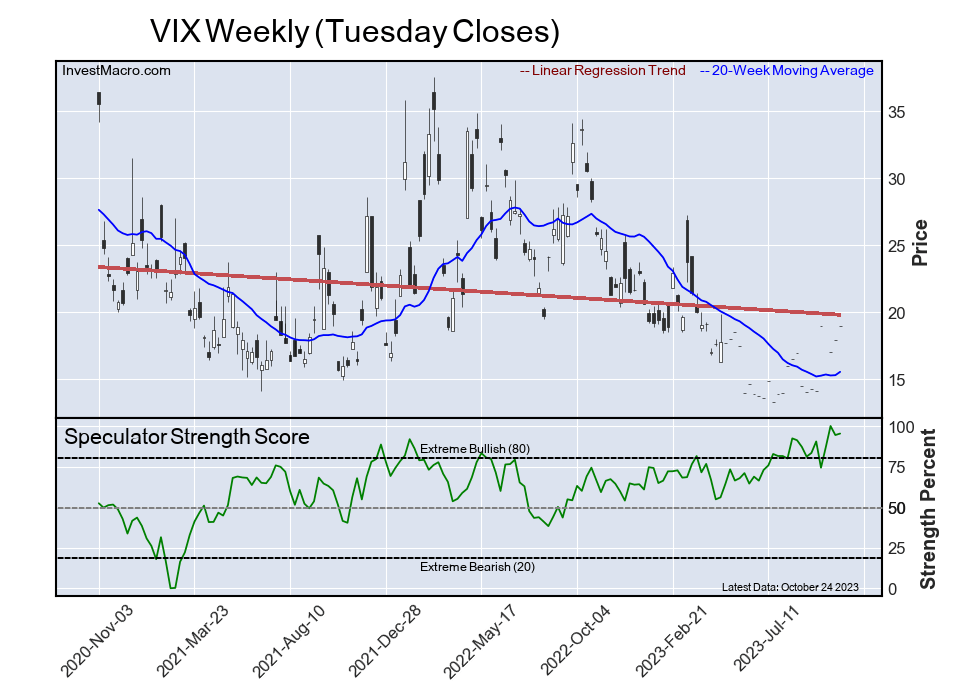
The VIX speculator position rounds out the top five in this week’s bullish extreme standings. The VIX speculator level sits at a 90.1 percent score of its 3-year range. The six-week trend for the speculator strength score was 12.8 this week.

The speculator position was -40,289 net contracts this week with a change of 10,444 contracts in the weekly speculator bets.


This Week’s Most Bearish Speculator Positions:

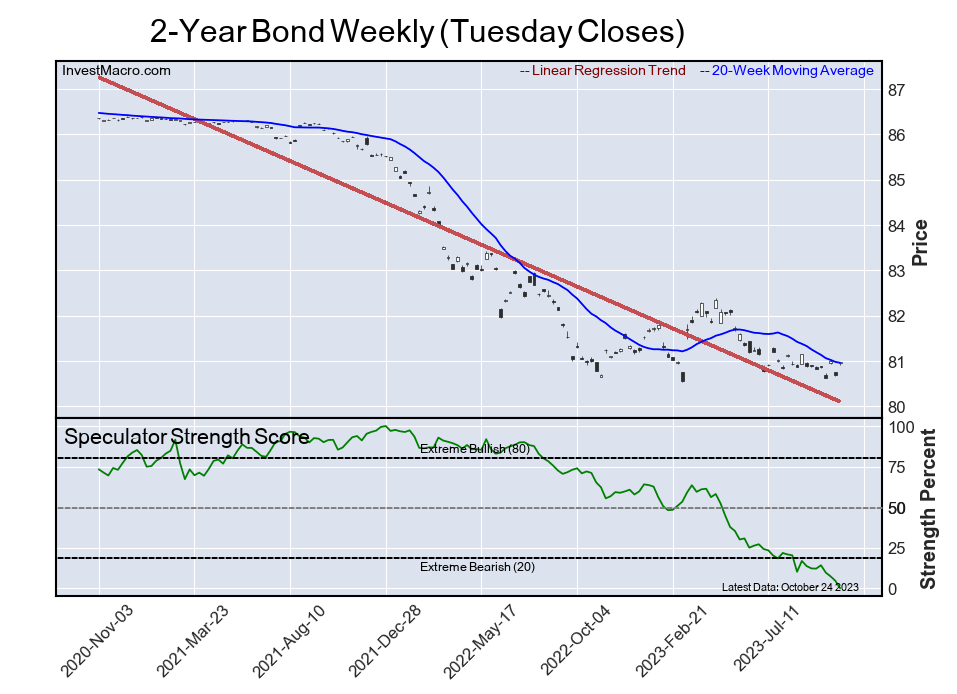
2-Year Bond


The 2-Year Bond speculator position comes in as the most bearish extreme standing this week. The 2-Year Bond speculator level is at a 0.0 percent score of its 3-year range.

The six-week trend for the speculator strength score was -13.2 this week. The overall speculator position was -1,119,380 net contracts this week with a change of -47,680 contracts in the speculator bets.


1-Month Secured Overnight Financing Rate

The 1-Month Secured Overnight Financing Rate speculator position comes in next for the most bearish extreme standing on the week. The 1-Month Secured Overnight Financing Rate speculator level is at a 0.0 percent score of its 3-year range.

The six-week trend for the speculator strength score was -56.1 this week. The speculator position was -237,629 net contracts this week with a change of -44,936 contracts in the weekly speculator bets.


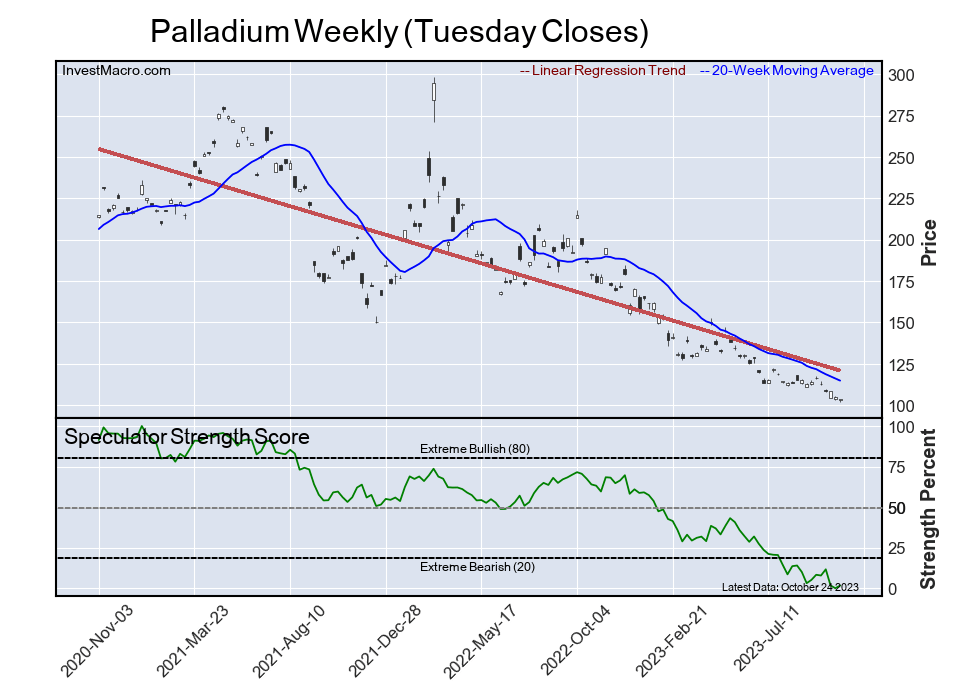
Palladium


The Palladium speculator position comes in as third most bearish extreme standing of the week. The Palladium speculator level resides at a 0.0 percent score of its 3-year range.

The six-week trend for the speculator strength score was -14.5 this week. The overall speculator position was -8,350 net contracts this week with a change of -78 contracts in the speculator bets.


5-Year Bond


The 5-Year Bond speculator position comes in as this week’s fourth most bearish extreme standing. The 5-Year Bond speculator level is at a 0.0 percent score of its 3-year range.

The six-week trend for the speculator strength score was -9.5 this week. The speculator position was -1,145,489 net contracts this week with a change of -89,405 contracts in the weekly speculator bets.


Ultra U.S. Treasury Bonds


Finally, the Ultra U.S. Treasury Bonds speculator position comes in as the fifth most bearish extreme standing for this week. The Ultra U.S. Treasury Bonds speculator level is at a 4.6 percent score of its 3-year range.

The six-week trend for the speculator strength score was -13.4 this week. The speculator position was -439,397 net contracts this week with a change of -6,485 contracts in the weekly speculator bets.


Article By InvestMacroReceive our weekly COT Newsletter

*COT Report: The COT data, released weekly to the public each Friday, is updated through the most recent Tuesday (data is 3 days old) and shows a quick view of how large speculators or non-commercials (for-profit traders) were positioned in the futures markets.

The CFTC categorizes trader positions according to commercial hedgers (traders who use futures contracts for hedging as part of the business), non-commercials (large traders who speculate to realize trading profits) and nonreportable traders (usually small traders/speculators) as well as their open interest (contracts open in the market at time of reporting). See CFTC criteria here.

Week Ahead: EURUSD set for another wild ride

By ForexTime 

Fasten your seatbelts because global financial markets could experience heightened volatility in the week ahead!

Investors will be bombarded with a long list of high-risk events ranging from pivotal central bank meetings, top-tier data from major economies and corporate earnings from the largest companies in the world.

But before we pinpoint what asset to watch out for amid the expected action, here are the scheduled economic data releases and events over the coming week:

Monday, July 24 

  • JPY: Japan Judo Bank Manufacturing PMI
  • EUR: Eurozone & Germany S&P Global PMIs
  • GBP: UK S&P Global/CIPS Manufacturing & Services PMI

Tuesday, July 25 

  • EUR: Germany IFO business climate
  • USD: US Conf. Board consumer confidence
  • NQ100_m: Microsoft Corp earnings

Wednesday, July 26 

  • AUD: Australia CPI
  • USD: FOMC rate decision, US new home sales
  • SPX500_m: Coca-Cola earnings

Thursday, July 27 

  • CNH: China industrial profits
  • EUR: ECB rate decision
  • USD: US Q2 GDP, durable goods, initial jobless claims
  • SPX500_m: McDonald’s Corp earnings

Friday, July 28 

  • AUD: Australia retail sales
  • EUR: Germany CPI, Eurozone economic confidence, consumer confidence
  • JPY: BoJ rate decision, Tokyo CPI
  • USD: US June PCE report, University of Michigan consumer sentiment

Indeed, the barrage of high-risk events could translate into fresh trading opportunities across financial markets. However, our attention will be directed to none other than the world’s most popular traded currency, which is set to be heavily influenced by the central bank combo and key reports.

But before we break down the factors that could see the EURUSD end July with a bang, it is worth keeping in mind that the currency seems to be under pressure on the H4 charts. After hitting a 17-month high at 1.1275, bulls seem to be running out of steam with bears greedily eyeing support at 1.1090. The events in the upcoming week could dictate whether prices rebound or sink lower.

Here are 4 reasons why you should not take your eyes off the EURUSD:

  1. Fed meeting 

Markets widely expect the Federal Reserve to raise interest rates by 25 basis points on Wednesday, taking the upper band of the Fed funds to 5.5%. The question is whether this will be the hike that ends the central bank’s aggressive hiking campaign. Given the mixed US economic data over the past few weeks, Fed Chair Jerome Powell’s remarks at the press conference are likely to be closely scrutinized by investors for fresh clues on future monetary policy.

  • Should the Fed signal more rate hikes down the road, this could inject dollar bulls with renewed inspiration – dragging the EURUSD lower.
  • If the Fed hints it’s done with raising rates, the dollar is likely to find itself under fresh selling pressure – resulting in the EURUSD pushing higher.

It is worth keeping in mind that traders are currently pricing in a 96% probability of a 25bps hike next week, with the probability of another 25 bps hike by November’s meeting only at 35%.

  1. ECB meeting 

The European Central Bank is expected to raise interest rates by 25 basis points on Thursday. Cooling inflationary pressures continue to support expectations around the central bank moving closer to ending its hiking cycle. Nevertheless, President Christine Lagarde is expected to reiterate that the ECB is unlikely to ease anytime soon with the decision in September depending on economic data.

  • The euro could push higher if the ECB strikes a hawkish note and signals more rate hikes beyond July’s policy meeting. This may trigger a rebound in the EURUSD.
  • A cautious-sounding ECB that signals a pause in hikes down the line could weaken the euro, pulling the EURUSD lower.
  1. Top-tier data dump 

Throughout the trading week, investors will be dished out a platter of key economic reports from the United States and Europe which could rock the EURUSD.

On Monday, all eyes will be on key PMI reports from the Eurozone and Germany. Tuesday see’s the Germany IFO business climate figures and US Conf. Board consumer confidence data. The dollar could be injected with more volatility on Thursday due to the second quarter of US GDP figures and the initial jobless claims report. On Friday, inflation data from the largest economy in Europe will be under the spotlight. This will be complemented by the latest Eurozone economic and consumer confidence figures. To wrap up the week, much focus will be directed towards the June PCE Core Deflator which is the Fed’s preferred measure of inflation and University of Michigan consumer sentiment.

  • Should the pending US/Eurozone print above markets expectations, this may support speculation around rates remaining higher for longer – lending support to respective currency.
  • If the incoming data from the US/Eurozone disappoint, this could reinforce speculation around the hiking cycle coming to an end – weakening the respective currency.
  1. Technical forces 

EURUSD has found itself under selling pressure after hitting a 17-month high at 1.1275. Indeed, the Relative Strength Index (RSI) was already at overbought levels with bears wasting no time to attack following the breakdown below 1.1200.

Despite the recent losses, the EURUSD remains in an uptrend on the daily charts with bulls maintaining some control above 1.1032. A technical throwback could be in the process which may see prices rebound back towards 17-month highs in the week ahead. Alternatively, a solid breakdown under 1.1032 may trigger a further selloff towards 1.0950 and 1.0850, respectively.

Zooming out into the weekly charts, prices remain in a bullish weekly channel. However, strong resistance can be found around the 200-week SMA. Should 1.1050 prove to be reliable support, this may provide a foundation for bulls to retest 1.1275 and beyond. Alternatively, a weekly close under 1.1050 may open a path back toward 1.0800.


Forex-Time-LogoArticle by ForexTime

ForexTime Ltd (FXTM) is an award winning international online forex broker regulated by CySEC 185/12 www.forextime.com