Archive for Forex and Currency News – Page 58

Week Ahead: Can EURUSD’s uptrend stay intact?

By ForexTime

Firstly, please note that this Week Ahead preview is being written before Fed Chair Jerome Powell’s highly-anticipated speech out of the Jackson Hole Economic symposium due later today (Friday, August 25th).

Still, the astute trader and investor will already be casting a glance at what’s in store post-Jackson Hole.

The monthly US jobs report, typically released on the first Friday of every month, is set to hog the limelight next week.

This tier-1 data out of the world’s largest economy will arrive at the tail end of a week that also features these other major economic data releases and events:

Monday, August 28

  • AUD: Australia July retail sales
  • USD: US August manufacturing activity
  • UK markets closed

Tuesday, August 29

  • JPY: Japan July unemployment
  • USD: US August consumer confidence

Wednesday, August 30

  • AUD: Australia July CPI
  • EUR: Germany August CPI; Eurozone August economic confidence
  • USD: US 2Q GDP (2nd estimate)

Thursday, August 31

  • JPY: Japan July retail sales, industrial production
  • CNH: China August manufacturing, non-manufacturing PMIs
  • EUR: Eurozone August CPI; July unemployment rate; ECB meeting minutes
  • USD: US weekly initial jobless claims; July PCE deflator, personal income and spending

Friday, September 1

  • CNH: China Caixin August manufacturing PMI
  • EUR: Eurozone August manufacturing PMI (final)
  • GBP: UK August manufacturing PMI (final)
  • CAD: Canada 2Q GDP
  • USD: US August nonfarm payrolls
  • USD: US August ISM manufacturing


EURUSD traders will be keen to find out how the official prints for the following data releases will match up with current market forecasts as stated below:

1) Wednesday, Aug 30: Germany August consumer price index (CPI)

  • Year-on-year CPI (August 2023 vs. August 2022): 6%
  • Month-on-month CPI (August 2023 vs. July 2023): 0.2%

If so, both prints would mark a slight easing from July’s CPI figures.

Note that Germany is the largest economy in the Eurozone, and its CPI prints tend to front-run the broader Eurozone’s CPI release.


2) Thursday, Aug 31: Eurozone August CPI

  • Year-on-year CPI: 5%
  • Month-on-month CPI (August 2023 vs. July 2023): 0.3%
  • Year-on-year core CPI (excluding food and energy prices): 5.3%

While such numbers would mark a moderating in inflation, 5% CPI is still noticeably higher than the European Central Bank’s (ECB) 2% target, which could warrant more rate hikes.


3) Thursday, Aug 31: Eurozone July unemployment rate (forecast = 6.4%)

If so, this would match the unemployment rate in June.


Still, ECB policymakers will only be too aware of the deteriorating economy.

The Eurozone’s manufacturing and services sectors each posted sub-50 PMI readings this past Wednesday (August 23rd).

When the PMI number is below 50, that means the sector is experiencing contracting conditions.

Such concerning figures prompted markets to pare down their expectations for another 25-basis point hike by the ECB before 2023 is over.

Those odds have been slashed from 78% this time last week, now down to a 57%.

Hence, the ECB meeting minutes due to be released on August 31 may already be dated, seeing as that July meeting was held prior to releases of the above-listed economic data.


Then, on the USD side of the equation …

Markets will want to know if the US labour market remains resilient, as evidenced by the highly-anticipated US jobs report, despite the Fed’s aggressive rate hikes since 2022.


4) Friday, Sept 1: US August jobs report

  • Change in nonfarm payrolls: +168,000

If so, that would be the fewest number of new jobs added in a month since December 2019.

  • Unemployment rate: 3.5%

If so, this would match July’s unemployment rate.

  • Average hourly earnings: 4.3% year-on-year and 0.3% month-on-month

If so, that would be a slick tick down of 10 basis points respectively from July’s figures.


Markets currently place a 55% chance that the Fed will trigger a 25-basis point hike in November, after pausing at its September policy meeting.

Of course, Chair Powell’s commentary out of Jackson Hole could significantly alter that perception.

Still, with the Fed already pledging to remain “data dependent”, a set of better-than-expected jobs data on September 1st could embolden the FOMC hawks (voting officials at the Federal Reserve who want to hike US rates further), and boost the US dollar along the way.


POTENTIAL SCENARIOS:

Ultimately, markets are set to reward the currency of the economy that can better handle another rate hike from its central bank.

  • EURUSD could move higher if the Eurozone’s CPI comes in higher than expected, while the US jobs market appears to be waning.

  • EURUSD could move lower on the stronger US dollar if the Eurozone’s CPI comes in lower than expected, and/or a higher-than-expected unemployment rate, along with a US jobs market that’s still resilient.


From a technical perspective …

To be fair, EURUSD is still adhering to a uptrend, maintaining a series of higher highs and higher lows so far this year.

However, EURUSD is now caught up in its 3rd “correction” wave on the daily timeframe so far this year.

Each wave has marked a decline of over 4%, with the latest declines commencing from its July 18th intraday peak extending past 4.4% at the time of writing.

And there are other bearish signs in play currently for EURUSD:

  • now trading below the widely-watched 200-day simple moving average (SMA) for the first time since end-November 2022.
  • 21-day SMA has crossed below its longer-term 100-day counterpart.


Currently, Bloomberg’s FX model points to a 73% chance that EURUSD will trade within the 1.0661 – 1.0920 range over the next one week

(forecast is prior to Fed Chair Powell’s Jackson Hole speech)


Here are some key levels to look out for:

POTENTIAL SUPPORT

  • 1.0766: lower trendline of uptrend/mid-March peaks
  • 1.068 region: resistance turn support zone since December
  • 1.0661 – 1.06352: lower bound of Bloomberg model forecasted range / end-May cycle low


POTENTIAL RESISTANCE

  • 200-day SMA
  • 1.08353/37: lows in end-June/early July
  • 1.0920: upper bound of Bloomberg model forecasted range, also with 100-day and 21-day SMAs lurking nearby


Brace for technical rebound?

The 14-day relative strength index (RSI) for the world’s most-traded FX pair is now flirting with the 30 mark, which denotes oversold levels.

Note that the bottom of the prior 2 “correction” waves have also coincided with such levels for the RSI.

Of course, fundamental factors surrounding the ECB vs. Fed’s next policy moves would greatly dictate whether EURUSD’s uptrend will be upended as we head into September.

Still, a technical rebound may be on the cards over the near term to perhaps offer some relief for euro bulls.


Forex-Time-LogoArticle by ForexTime

ForexTime Ltd (FXTM) is an award winning international online forex broker regulated by CySEC 185/12 www.forextime.com

GBPUSD drops after poor UK PMIs

By ForexTime 

  • GBPUSD sinks after UK PMIs came in below expectations
  • Bank of England rate hikes are taking toll on UK economy
  • Bloomberg model: GBPUSD likely to trade between 1.2545 – 1.2828 into next week
  • Friday’s speech by Fed Chair Powell may herald more volatility for GBPUSD

The Pound is the worst-performing G10 currency against the dollar today.

The UK’s preliminary PMIs (purchasing manager index) for August showed contracting conditions across both manufacturing and services in the private sector.

With the respective PMIs registering readings below the 50 threshold that differentiates contraction (PMI below 50) and expansion (PMI above 50) …

It’s clear that the Bank of England’s aggressive rate hikes are taking a toll on the UK economy.

Today’s PMI numbers have also prompted markets to dial down bets for a further 75-basis points in rate hikes out of the Bank of England which had been fully priced in prior to today’s PMI releases.

At the time of writing, markets are only pricing in a 54% chance that the BOE can raise its benchmark rate by a further 75bps between now and Q1 2024.

Such soured sentiment surrounding the UK economy and the BOE’s future policy moves has clearly weighed on GBPUSD, forcing cable to unwind some of its recent gains.


GBP still among best G10 performers YTD

Though for proper context, Sterling continues to compete with the Swiss Franc for the title of best-performing G10 currency against the US dollar on a year-to-date basis.

The CHF and GBP can still boast of a 5% climb respectively against the greenback so far in 2023.


From a technical perspective:

GBPUSD bulls have been thwarted by the 21-day simple moving average (SMA) of late. The 38.2% Fibonacci level from this FX pair’s June 2021 – September 2022 plummet is also further exerting resistance.

To the downside, the 1.26200 region has been offering support for GBPUSD (nicknamed “cable”) since end-June, with the 100-day SMA also potentially offering further support nearby.

Bloomberg’s FX model forecasts a 74% chance that GBPUSD will trade within the 1.2545 – 1.2828 range over the next one week.


Astute traders would be aware that this time period also includes Fed Chair Jerome Powell’s highly-anticipated speech at the Jackson Hole symposium this Friday, as well as the UK’s August consumer confidence data.

Of those two events, Chair Powell’s comments harbours the much greater potential to sway the US dollar, and by extension, GBPUSD as well as the rest of the FX world before the weekend.


Forex-Time-LogoArticle by ForexTime

ForexTime Ltd (FXTM) is an award winning international online forex broker regulated by CySEC 185/12 www.forextime.com

British Pound Sterling Speculator Bets rebound, near 16-Year Highs

By InvestMacro

Here are the latest charts and statistics for the Commitment of Traders (COT) data published by the Commodities Futures Trading Commission (CFTC).

The latest COT data is updated through Tuesday August 15th and shows a quick view of how large market participants (for-profit speculators and commercial traders) were positioned in the futures markets. All currency positions are in direct relation to the US dollar where, for example, a bet for the euro is a bet that the euro will rise versus the dollar while a bet against the euro will be a bet that the euro will decline versus the dollar.

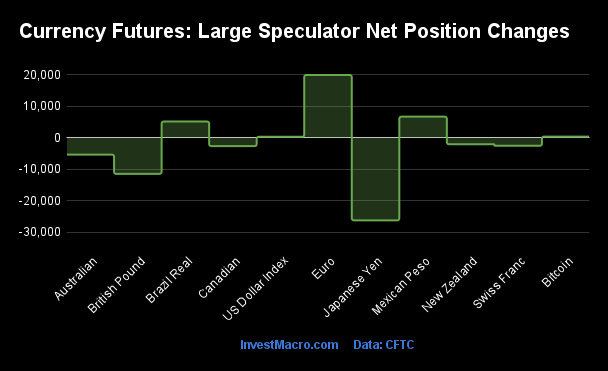
Weekly Speculator Changes led by EuroFX & British Pound

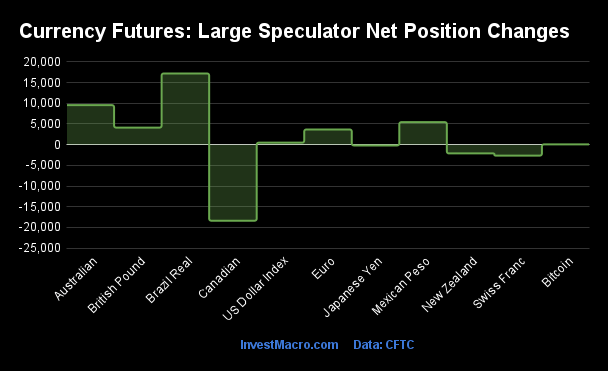
The COT currency market speculator bets were higher this week as six out of the eleven currency markets we cover had higher positioning while the other five markets had lower speculator contracts.

Leading the gains for the currency markets was the EuroFX (10,052 contracts) with the British Pound (3,968 contracts), US Dollar Index (2,367 contracts), Japanese Yen (2,219 contracts), the Swiss Franc (1,445 contracts) and Bitcoin (437 contracts) also recording positive weeks.

The currencies seeing declines in speculator bets on the week were the Canadian Dollar (-10,788 contracts) with the Australian Dollar (-10,205 contracts), the Brazilian Real (-4,564 contracts), New Zealand Dollar (-2,068 contracts) and the Mexican Peso (-1,628 contracts) also registering lower bets on the week.

British Pound Sterling Speculator Bets rebound this week

Highlighting the COT currency’s data is this week’s rebound and the overall strength in the speculator’s positioning of the British Pound Sterling. Large speculative Sterling positions rose this week by almost +4,000 contracts and turned around a three-week streak of declines.

The Sterling speculative level has been on the move higher recently and is at its strongest levels in years with the average contract level of the past ten weeks right around +50,000 contracts. On July 18th, the bullish bets for the Sterling (+63,729 contracts) ascended to the highest level since July 31st of 2007, a span of almost exactly sixteen years.

The Pound’s positioning has been helped out by continued high inflation in the United Kingdom which brings forecasts for higher interest rates. The UK consumer inflation numbers for July came in at 6.8 percent with a core inflation reading of 6.9 percent. The Bank of England has boosted the interest rate to combat inflation for fourteen consecutive meetings and brought the rate to 5.25 percent at it’s last meeting which is the highest since 2008. The BOE may need to further push the rate higher to bring inflation back down to reasonable levels which in turn can provide the UK currency with an interest rate differential advantage against other currencies.

The Pound Sterling exchange rate against the US Dollar has been in an uptrend over recent months with the exchange rate hitting over 1.3000 in July. Since that 2023 high, the Sterling has cooled off some but remains over the psychologically significant 1.2500 exchange rate.


Data Snapshot of Forex Market Traders | Columns Legend
Aug-15-2023OIOI-IndexSpec-NetSpec-IndexCom-NetCOM-IndexSmalls-NetSmalls-Index
USD Index26,95414,99133-6,048661,05723
EUR760,23369159,86380-205,2842145,42151
GBP215,3404650,98891-60,188129,20076
JPY247,95475-80,9612290,49780-9,53634
CHF42,79445-4,007464,20049-19357
CAD157,82732-11,4114413,76966-2,35818
AUD204,45891-53,3973565,25868-11,86124
NZD46,78153-2,436474,96958-2,53320
MXN228,9844882,02389-85,227113,20432
RUB20,93047,54331-7,15069-39324
BRL42,0312823,47566-25,216341,74158
Bitcoin15,43273-7126514069829


Strength Scores led by British Pound & Mexican Peso

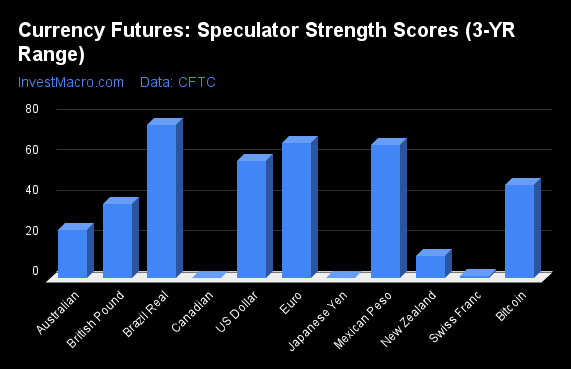
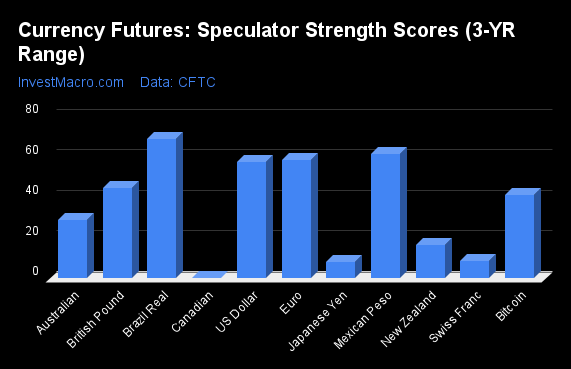
COT Strength Scores (a normalized measure of Speculator positions over a 3-Year range, from 0 to 100 where above 80 is Extreme-Bullish and below 20 is Extreme-Bearish) showed that the British Pound (91 percent), the Mexican Peso (89 percent) and the EuroFX (80 percent) lead the currency markets this week. The Brazilian Real (66 percent) and Bitcoin (65 percent) come in as the next highest in the weekly strength scores.

On the downside, the Japanese Yen (22 percent) and the US Dollar Index (33 percent) come in at the lowest strength levels currently. The next lowest strength scores are the Australian Dollar (35 percent) and the Canadian Dollar (44 percent).

Strength Statistics:
US Dollar Index (33.3 percent) vs US Dollar Index previous week (29.3 percent)
EuroFX (80.0 percent) vs EuroFX previous week (76.1 percent)
British Pound Sterling (91.2 percent) vs British Pound Sterling previous week (88.4 percent)
Japanese Yen (21.9 percent) vs Japanese Yen previous week (20.6 percent)
Swiss Franc (45.5 percent) vs Swiss Franc previous week (41.6 percent)
Canadian Dollar (43.9 percent) vs Canadian Dollar previous week (54.0 percent)
Australian Dollar (35.3 percent) vs Australian Dollar previous week (44.8 percent)
New Zealand Dollar (47.0 percent) vs New Zealand Dollar previous week (52.6 percent)
Mexican Peso (89.2 percent) vs Mexican Peso previous week (90.2 percent)
Brazilian Real (65.6 percent) vs Brazilian Real previous week (71.4 percent)
Bitcoin (64.5 percent) vs Bitcoin previous week (56.9 percent)


Bitcoin & Japanese Yen top the 6-Week Strength Trends

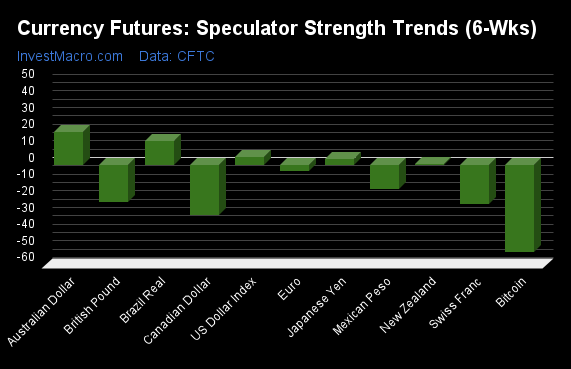
COT Strength Score Trends (or move index, calculates the 6-week changes in strength scores) showed that Bitcoin (24 percent) and the Japanese Yen (22 percent) lead the past six weeks trends for the currencies. The EuroFX (7 percent) and the British Pound (1 percent) are the next highest positive movers in the latest trends data.

The US Dollar Index (-16 percent) leads the downside trend scores currently with the Canadian Dollar (-15 percent), Brazilian Real (-10 percent) and the New Zealand Dollar (-9 percent) following next with lower trend scores.

Strength Trend Statistics:
US Dollar Index (-15.6 percent) vs US Dollar Index previous week (-20.6 percent)
EuroFX (6.6 percent) vs EuroFX previous week (1.8 percent)
British Pound Sterling (0.5 percent) vs British Pound Sterling previous week (-3.5 percent)
Japanese Yen (21.9 percent) vs Japanese Yen previous week (17.6 percent)
Swiss Franc (-1.6 percent) vs Swiss Franc previous week (-1.4 percent)
Canadian Dollar (-14.9 percent) vs Canadian Dollar previous week (2.1 percent)
Australian Dollar (-8.2 percent) vs Australian Dollar previous week (-3.5 percent)
New Zealand Dollar (-8.9 percent) vs New Zealand Dollar previous week (1.3 percent)
Mexican Peso (-8.1 percent) vs Mexican Peso previous week (-7.8 percent)
Brazilian Real (-9.7 percent) vs Brazilian Real previous week (-4.5 percent)
Bitcoin (23.8 percent) vs Bitcoin previous week (16.5 percent)


Individual COT Forex Markets:

US Dollar Index Futures:
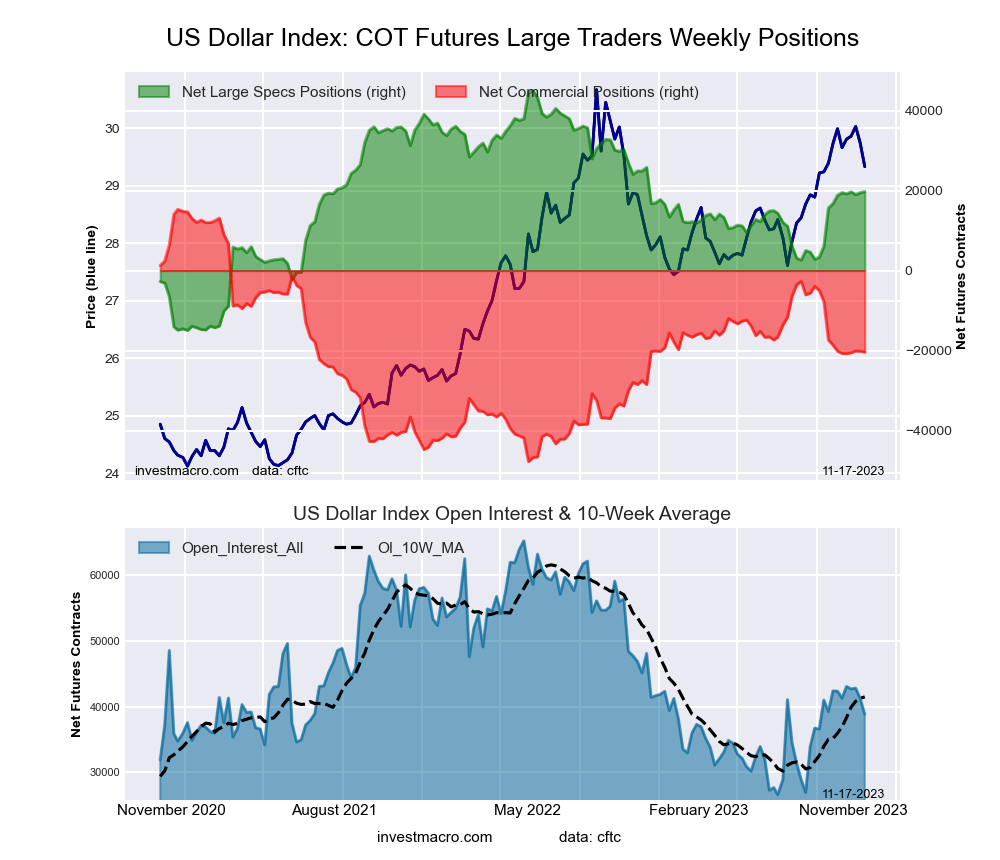
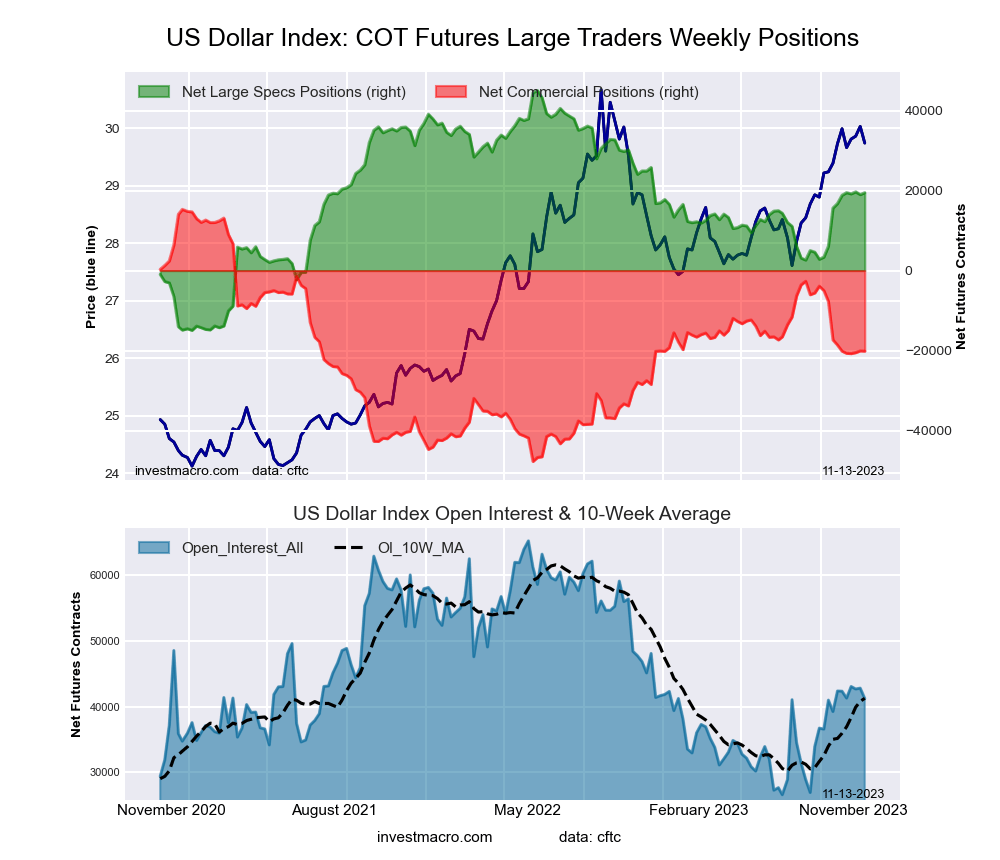
US Dollar Index Forex Futures COT ChartThe US Dollar Index large speculator standing this week totaled a net position of 4,991 contracts in the data reported through Tuesday. This was a weekly boost of 2,367 contracts from the previous week which had a total of 2,624 net contracts.

This week’s current strength score (the trader positioning range over the past three years, measured from 0 to 100) shows the speculators are currently Bearish with a score of 33.3 percent. The commercials are Bullish with a score of 66.1 percent and the small traders (not shown in chart) are Bearish with a score of 23.0 percent.

Price Trend-Following Model: Strong Uptrend

Our weekly trend-following model classifies the current market price position as: Strong Uptrend. The current action for the model is considered to be: Hold – Maintain Long Position.

US DOLLAR INDEX StatisticsSPECULATORSCOMMERCIALSSMALL TRADERS
– Percent of Open Interest Longs:72.85.816.3
– Percent of Open Interest Shorts:54.328.212.4
– Net Position:4,991-6,0481,057
– Gross Longs:19,6171,5564,404
– Gross Shorts:14,6267,6043,347
– Long to Short Ratio:1.3 to 10.2 to 11.3 to 1
NET POSITION TREND:
– Strength Index Score (3 Year Range Pct):33.366.123.0
– Strength Index Reading (3 Year Range):BearishBullishBearish
NET POSITION MOVEMENT INDEX:
– 6-Week Change in Strength Index:-15.616.7-14.1


Euro Currency Futures:

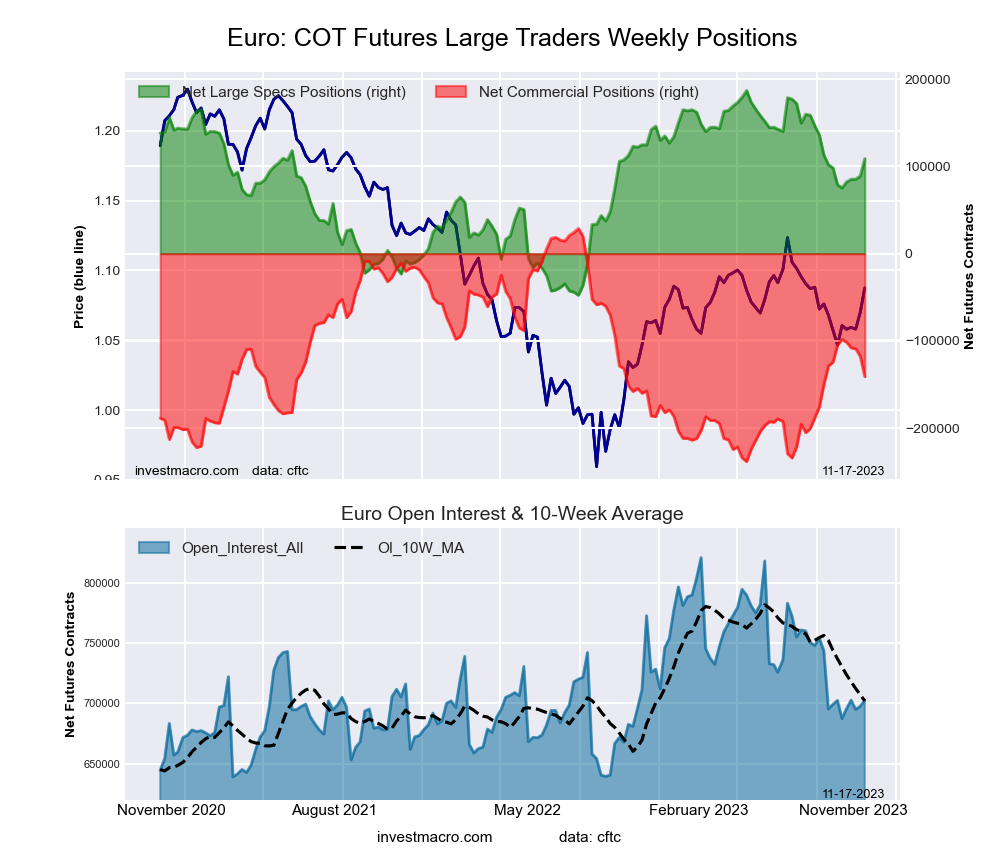
Euro Currency Futures COT ChartThe Euro Currency large speculator standing this week totaled a net position of 159,863 contracts in the data reported through Tuesday. This was a weekly lift of 10,052 contracts from the previous week which had a total of 149,811 net contracts.

This week’s current strength score (the trader positioning range over the past three years, measured from 0 to 100) shows the speculators are currently Bullish with a score of 80.0 percent. The commercials are Bearish with a score of 21.1 percent and the small traders (not shown in chart) are Bullish with a score of 51.4 percent.

Price Trend-Following Model: Weak Uptrend

Our weekly trend-following model classifies the current market price position as: Weak Uptrend. The current action for the model is considered to be: Hold – Maintain Long Position.

EURO Currency StatisticsSPECULATORSCOMMERCIALSSMALL TRADERS
– Percent of Open Interest Longs:30.655.412.0
– Percent of Open Interest Shorts:9.682.46.0
– Net Position:159,863-205,28445,421
– Gross Longs:232,466420,94290,895
– Gross Shorts:72,603626,22645,474
– Long to Short Ratio:3.2 to 10.7 to 12.0 to 1
NET POSITION TREND:
– Strength Index Score (3 Year Range Pct):80.021.151.4
– Strength Index Reading (3 Year Range):BullishBearishBullish
NET POSITION MOVEMENT INDEX:
– 6-Week Change in Strength Index:6.6-5.3-1.9


British Pound Sterling Futures:

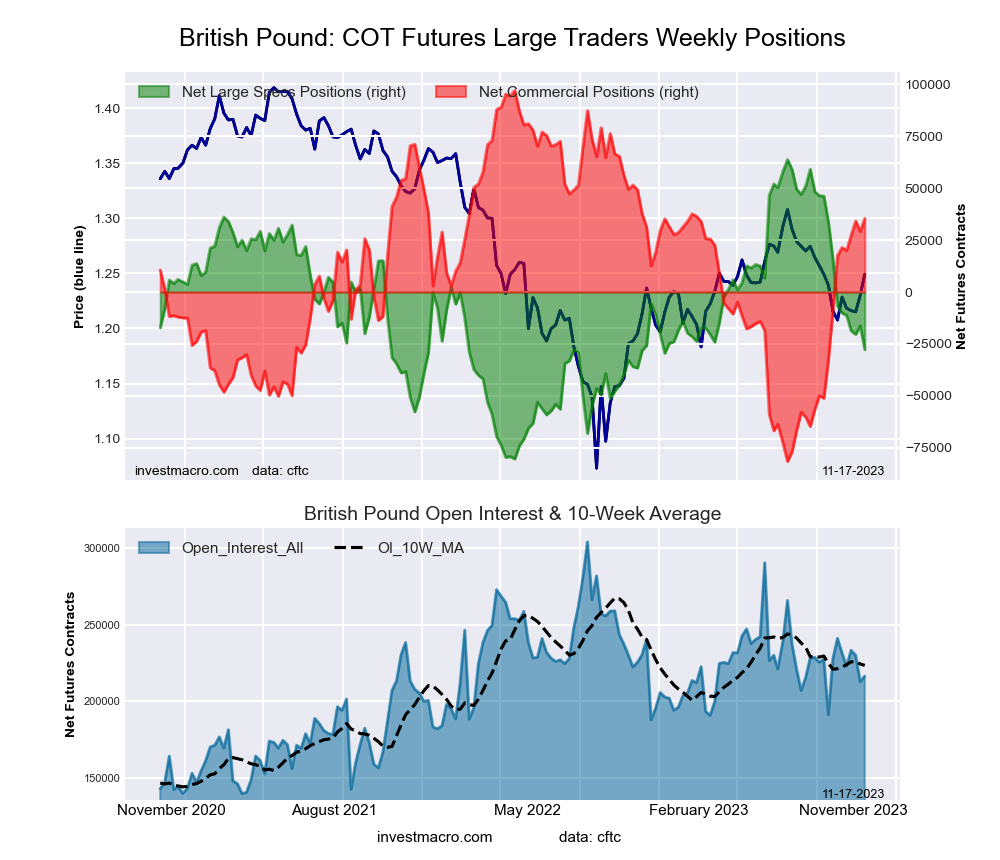
British Pound Sterling Futures COT ChartThe British Pound Sterling large speculator standing this week totaled a net position of 50,988 contracts in the data reported through Tuesday. This was a weekly advance of 3,968 contracts from the previous week which had a total of 47,020 net contracts.

This week’s current strength score (the trader positioning range over the past three years, measured from 0 to 100) shows the speculators are currently Bullish-Extreme with a score of 91.2 percent. The commercials are Bearish-Extreme with a score of 12.0 percent and the small traders (not shown in chart) are Bullish with a score of 76.1 percent.

Price Trend-Following Model: Uptrend

Our weekly trend-following model classifies the current market price position as: Uptrend. The current action for the model is considered to be: Hold – Maintain Long Position.

BRITISH POUND StatisticsSPECULATORSCOMMERCIALSSMALL TRADERS
– Percent of Open Interest Longs:42.036.016.1
– Percent of Open Interest Shorts:18.463.911.8
– Net Position:50,988-60,1889,200
– Gross Longs:90,54177,49634,690
– Gross Shorts:39,553137,68425,490
– Long to Short Ratio:2.3 to 10.6 to 11.4 to 1
NET POSITION TREND:
– Strength Index Score (3 Year Range Pct):91.212.076.1
– Strength Index Reading (3 Year Range):Bullish-ExtremeBearish-ExtremeBullish
NET POSITION MOVEMENT INDEX:
– 6-Week Change in Strength Index:0.51.9-8.2


Japanese Yen Futures:

Japanese Yen Forex Futures COT ChartThe Japanese Yen large speculator standing this week totaled a net position of -80,961 contracts in the data reported through Tuesday. This was a weekly boost of 2,219 contracts from the previous week which had a total of -83,180 net contracts.

This week’s current strength score (the trader positioning range over the past three years, measured from 0 to 100) shows the speculators are currently Bearish with a score of 21.9 percent. The commercials are Bullish with a score of 79.8 percent and the small traders (not shown in chart) are Bearish with a score of 34.1 percent.

Price Trend-Following Model: Downtrend

Our weekly trend-following model classifies the current market price position as: Downtrend. The current action for the model is considered to be: Hold – Maintain Short Position.

JAPANESE YEN StatisticsSPECULATORSCOMMERCIALSSMALL TRADERS
– Percent of Open Interest Longs:14.070.813.8
– Percent of Open Interest Shorts:46.734.317.6
– Net Position:-80,96190,497-9,536
– Gross Longs:34,789175,63634,192
– Gross Shorts:115,75085,13943,728
– Long to Short Ratio:0.3 to 12.1 to 10.8 to 1
NET POSITION TREND:
– Strength Index Score (3 Year Range Pct):21.979.834.1
– Strength Index Reading (3 Year Range):BearishBullishBearish
NET POSITION MOVEMENT INDEX:
– 6-Week Change in Strength Index:21.9-17.3-2.9


Swiss Franc Futures:

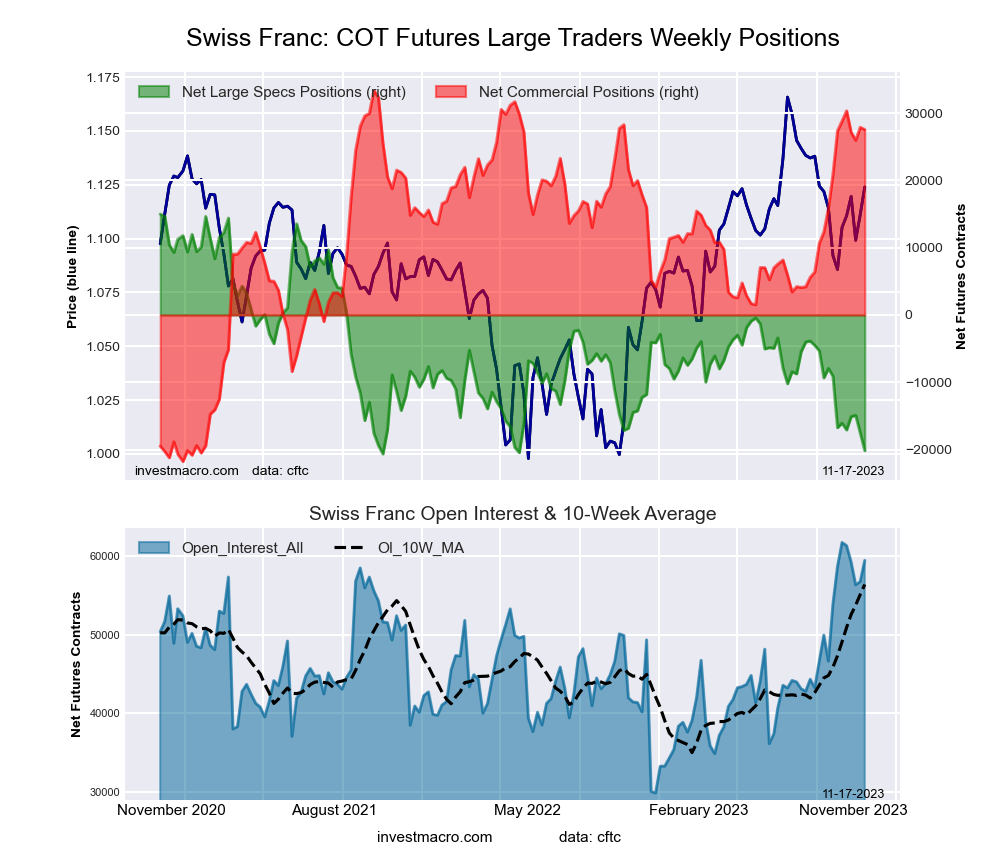
Swiss Franc Forex Futures COT ChartThe Swiss Franc large speculator standing this week totaled a net position of -4,007 contracts in the data reported through Tuesday. This was a weekly gain of 1,445 contracts from the previous week which had a total of -5,452 net contracts.

This week’s current strength score (the trader positioning range over the past three years, measured from 0 to 100) shows the speculators are currently Bearish with a score of 45.5 percent. The commercials are Bearish with a score of 49.3 percent and the small traders (not shown in chart) are Bullish with a score of 56.9 percent.

Price Trend-Following Model: Uptrend

Our weekly trend-following model classifies the current market price position as: Uptrend. The current action for the model is considered to be: Hold – Maintain Long Position.

SWISS FRANC StatisticsSPECULATORSCOMMERCIALSSMALL TRADERS
– Percent of Open Interest Longs:20.344.035.7
– Percent of Open Interest Shorts:29.734.136.1
– Net Position:-4,0074,200-193
– Gross Longs:8,69318,81215,262
– Gross Shorts:12,70014,61215,455
– Long to Short Ratio:0.7 to 11.3 to 11.0 to 1
NET POSITION TREND:
– Strength Index Score (3 Year Range Pct):45.549.356.9
– Strength Index Reading (3 Year Range):BearishBearishBullish
NET POSITION MOVEMENT INDEX:
– 6-Week Change in Strength Index:-1.6-5.913.4


Canadian Dollar Futures:

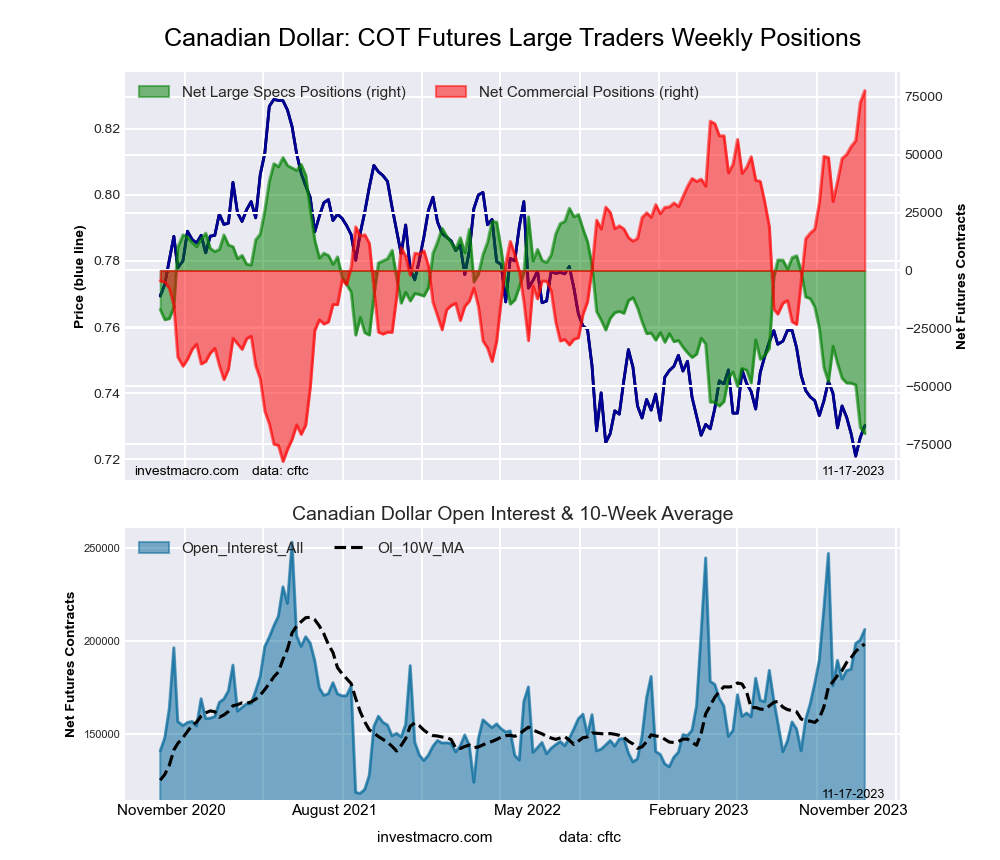
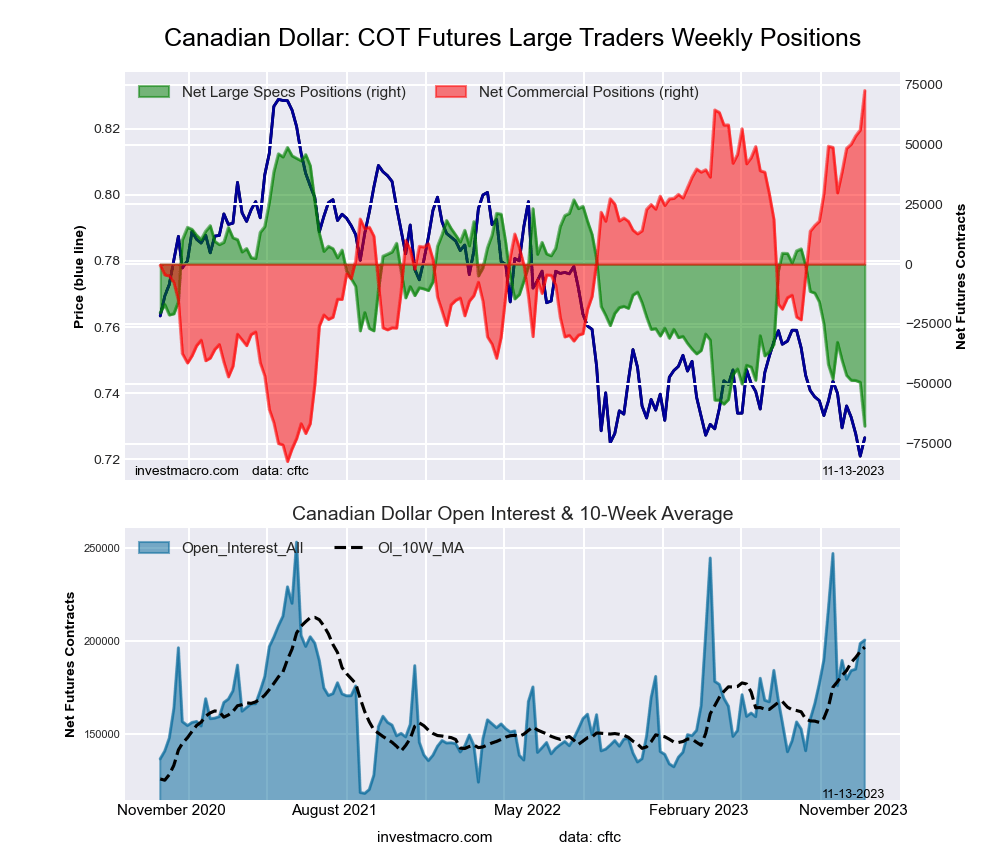
Canadian Dollar Forex Futures COT ChartThe Canadian Dollar large speculator standing this week totaled a net position of -11,411 contracts in the data reported through Tuesday. This was a weekly fall of -10,788 contracts from the previous week which had a total of -623 net contracts.

This week’s current strength score (the trader positioning range over the past three years, measured from 0 to 100) shows the speculators are currently Bearish with a score of 43.9 percent. The commercials are Bullish with a score of 65.5 percent and the small traders (not shown in chart) are Bearish-Extreme with a score of 17.6 percent.

Price Trend-Following Model: Weak Uptrend

Our weekly trend-following model classifies the current market price position as: Weak Uptrend. The current action for the model is considered to be: Hold – Maintain Long Position.

CANADIAN DOLLAR StatisticsSPECULATORSCOMMERCIALSSMALL TRADERS
– Percent of Open Interest Longs:23.554.319.3
– Percent of Open Interest Shorts:30.745.620.8
– Net Position:-11,41113,769-2,358
– Gross Longs:37,11285,77430,496
– Gross Shorts:48,52372,00532,854
– Long to Short Ratio:0.8 to 11.2 to 10.9 to 1
NET POSITION TREND:
– Strength Index Score (3 Year Range Pct):43.965.517.6
– Strength Index Reading (3 Year Range):BearishBullishBearish-Extreme
NET POSITION MOVEMENT INDEX:
– 6-Week Change in Strength Index:-14.922.2-37.0


Australian Dollar Futures:

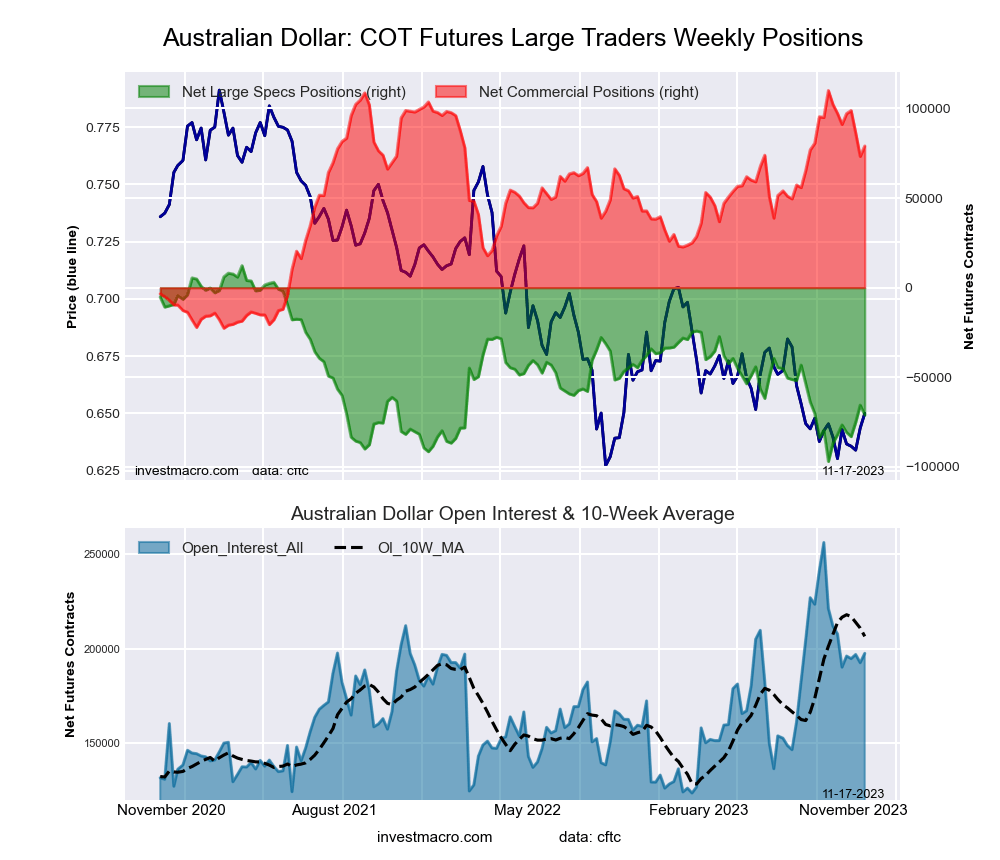
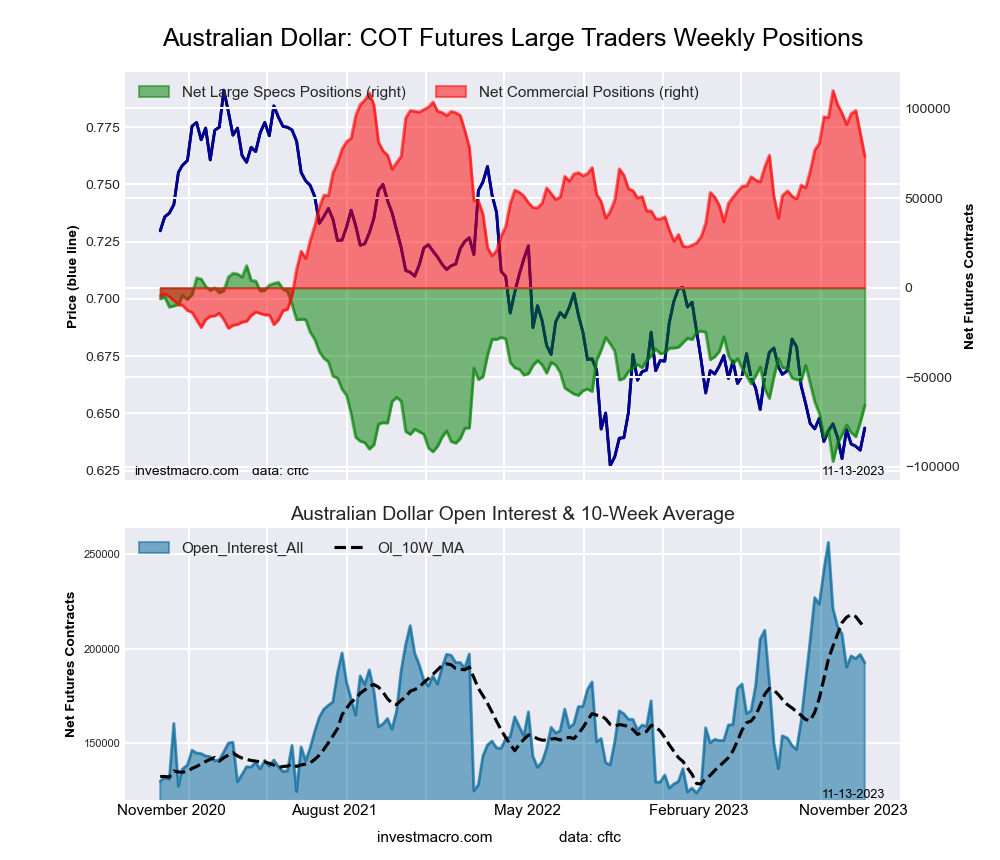
Australian Dollar Forex Futures COT ChartThe Australian Dollar large speculator standing this week totaled a net position of -53,397 contracts in the data reported through Tuesday. This was a weekly fall of -10,205 contracts from the previous week which had a total of -43,192 net contracts.

This week’s current strength score (the trader positioning range over the past three years, measured from 0 to 100) shows the speculators are currently Bearish with a score of 35.3 percent. The commercials are Bullish with a score of 67.6 percent and the small traders (not shown in chart) are Bearish with a score of 23.5 percent.

Price Trend-Following Model: Strong Downtrend

Our weekly trend-following model classifies the current market price position as: Strong Downtrend. The current action for the model is considered to be: Hold – Maintain Short Position.

AUSTRALIAN DOLLAR StatisticsSPECULATORSCOMMERCIALSSMALL TRADERS
– Percent of Open Interest Longs:33.653.410.0
– Percent of Open Interest Shorts:59.721.415.8
– Net Position:-53,39765,258-11,861
– Gross Longs:68,623109,11020,392
– Gross Shorts:122,02043,85232,253
– Long to Short Ratio:0.6 to 12.5 to 10.6 to 1
NET POSITION TREND:
– Strength Index Score (3 Year Range Pct):35.367.623.5
– Strength Index Reading (3 Year Range):BearishBullishBearish
NET POSITION MOVEMENT INDEX:
– 6-Week Change in Strength Index:-8.210.4-12.4


New Zealand Dollar Futures:

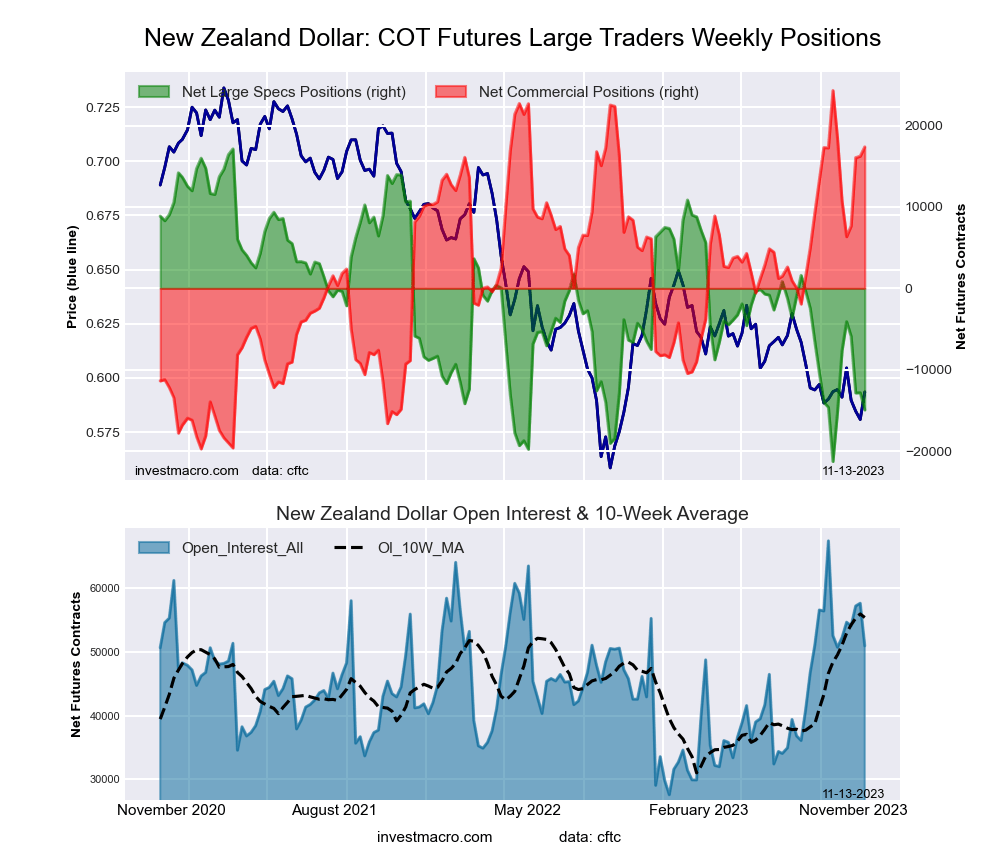
New Zealand Dollar Forex Futures COT ChartThe New Zealand Dollar large speculator standing this week totaled a net position of -2,436 contracts in the data reported through Tuesday. This was a weekly decline of -2,068 contracts from the previous week which had a total of -368 net contracts.

This week’s current strength score (the trader positioning range over the past three years, measured from 0 to 100) shows the speculators are currently Bearish with a score of 47.0 percent. The commercials are Bullish with a score of 58.2 percent and the small traders (not shown in chart) are Bearish-Extreme with a score of 19.9 percent.

Price Trend-Following Model: Strong Downtrend

Our weekly trend-following model classifies the current market price position as: Strong Downtrend. The current action for the model is considered to be: Hold – Maintain Short Position.

NEW ZEALAND DOLLAR StatisticsSPECULATORSCOMMERCIALSSMALL TRADERS
– Percent of Open Interest Longs:46.846.66.3
– Percent of Open Interest Shorts:52.036.011.7
– Net Position:-2,4364,969-2,533
– Gross Longs:21,91021,7952,942
– Gross Shorts:24,34616,8265,475
– Long to Short Ratio:0.9 to 11.3 to 10.5 to 1
NET POSITION TREND:
– Strength Index Score (3 Year Range Pct):47.058.219.9
– Strength Index Reading (3 Year Range):BearishBullishBearish-Extreme
NET POSITION MOVEMENT INDEX:
– 6-Week Change in Strength Index:-8.98.2-2.3


Mexican Peso Futures:

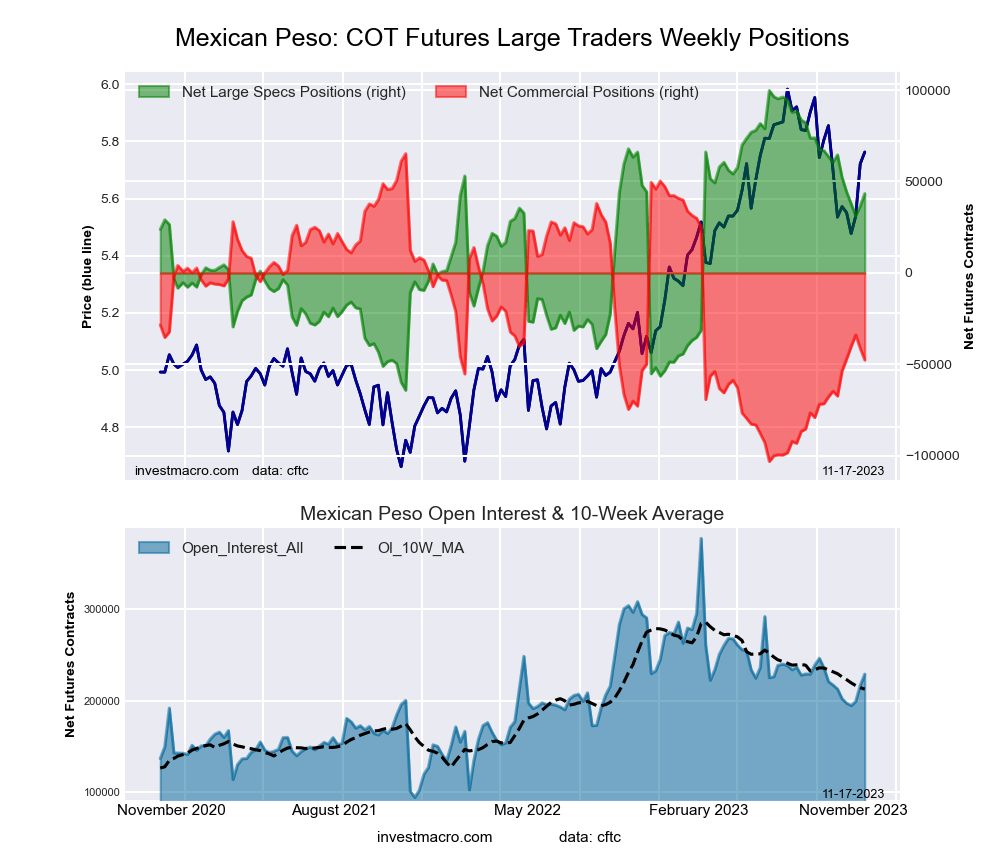
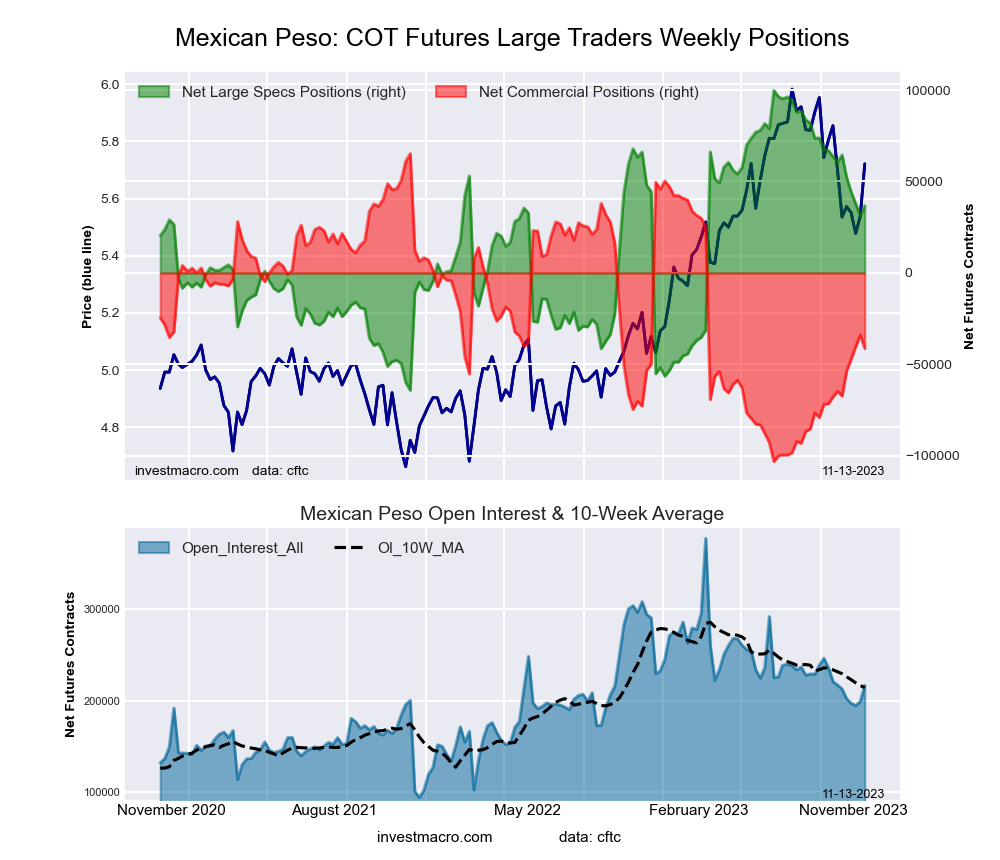
Mexican Peso Futures COT ChartThe Mexican Peso large speculator standing this week totaled a net position of 82,023 contracts in the data reported through Tuesday. This was a weekly decrease of -1,628 contracts from the previous week which had a total of 83,651 net contracts.

This week’s current strength score (the trader positioning range over the past three years, measured from 0 to 100) shows the speculators are currently Bullish-Extreme with a score of 89.2 percent. The commercials are Bearish-Extreme with a score of 10.6 percent and the small traders (not shown in chart) are Bearish with a score of 31.6 percent.

Price Trend-Following Model: Uptrend

Our weekly trend-following model classifies the current market price position as: Uptrend. The current action for the model is considered to be: Hold – Maintain Long Position.

MEXICAN PESO StatisticsSPECULATORSCOMMERCIALSSMALL TRADERS
– Percent of Open Interest Longs:47.847.43.6
– Percent of Open Interest Shorts:11.984.62.2
– Net Position:82,023-85,2273,204
– Gross Longs:109,340108,5968,197
– Gross Shorts:27,317193,8234,993
– Long to Short Ratio:4.0 to 10.6 to 11.6 to 1
NET POSITION TREND:
– Strength Index Score (3 Year Range Pct):89.210.631.6
– Strength Index Reading (3 Year Range):Bullish-ExtremeBearish-ExtremeBearish
NET POSITION MOVEMENT INDEX:
– 6-Week Change in Strength Index:-8.18.4-6.1


Brazilian Real Futures:

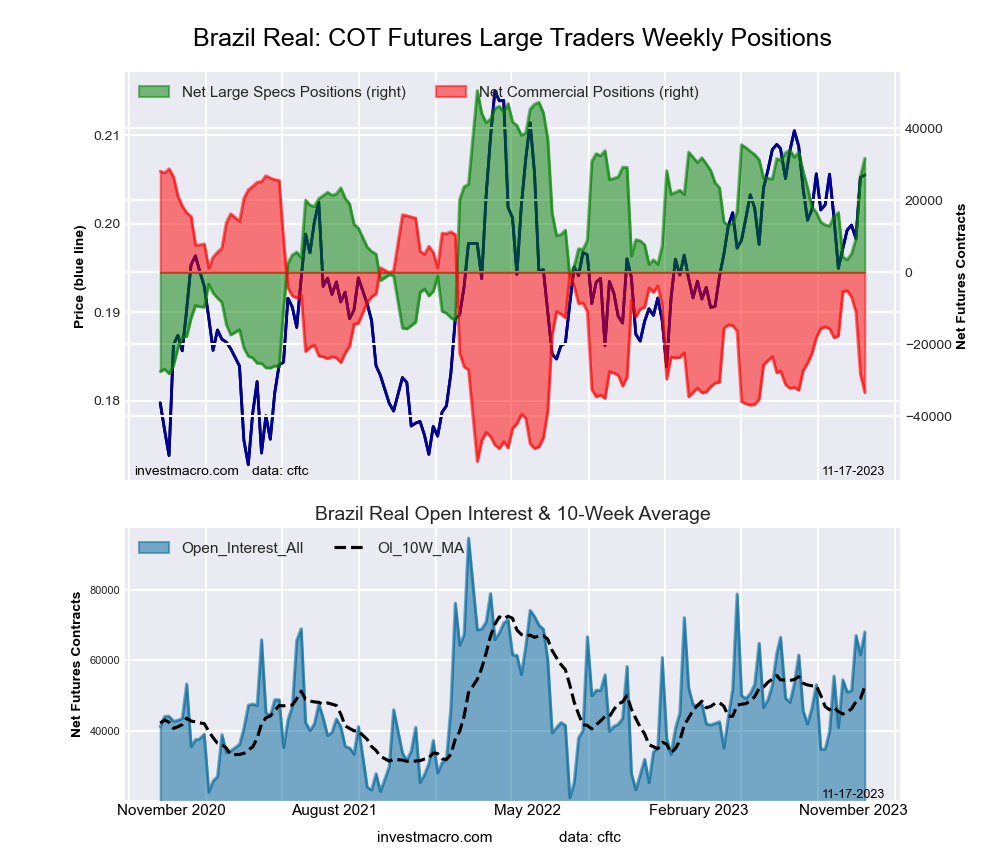
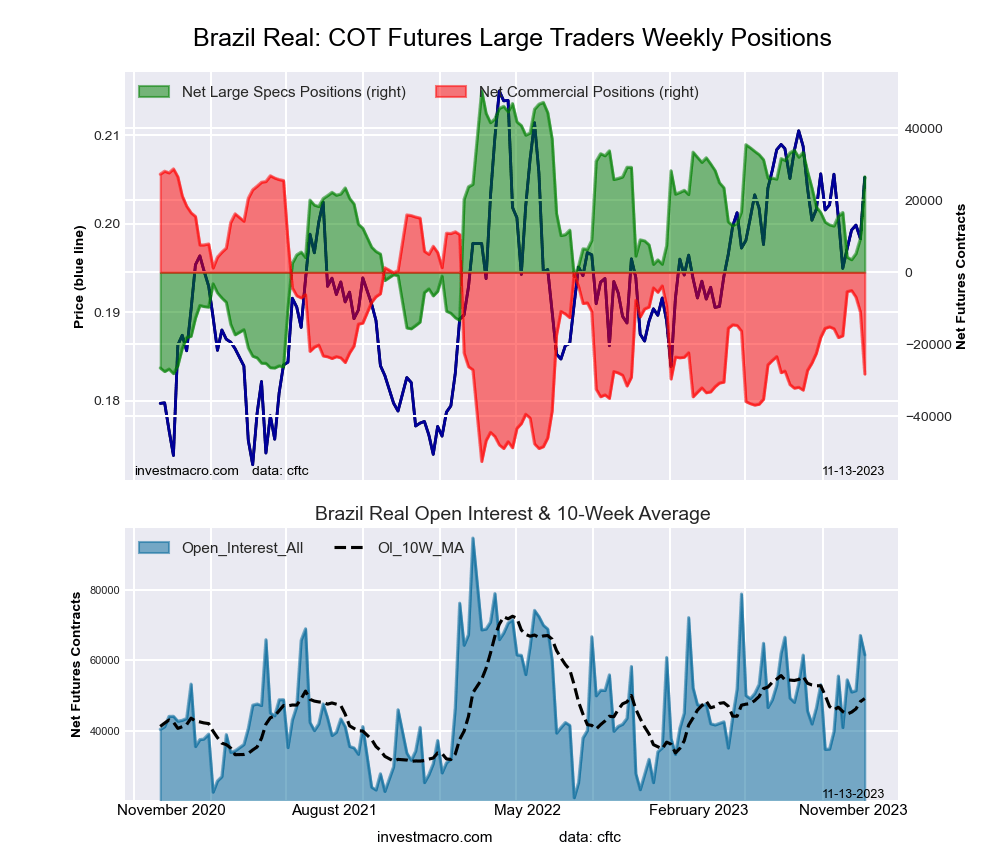
Brazil Real Futures COT ChartThe Brazilian Real large speculator standing this week totaled a net position of 23,475 contracts in the data reported through Tuesday. This was a weekly lowering of -4,564 contracts from the previous week which had a total of 28,039 net contracts.

This week’s current strength score (the trader positioning range over the past three years, measured from 0 to 100) shows the speculators are currently Bullish with a score of 65.6 percent. The commercials are Bearish with a score of 33.6 percent and the small traders (not shown in chart) are Bullish with a score of 57.8 percent.

Price Trend-Following Model: Weak Uptrend

Our weekly trend-following model classifies the current market price position as: Weak Uptrend. The current action for the model is considered to be: Hold – Maintain Long Position.

BRAZIL REAL StatisticsSPECULATORSCOMMERCIALSSMALL TRADERS
– Percent of Open Interest Longs:65.823.99.0
– Percent of Open Interest Shorts:10.083.94.8
– Net Position:23,475-25,2161,741
– Gross Longs:27,67610,0653,774
– Gross Shorts:4,20135,2812,033
– Long to Short Ratio:6.6 to 10.3 to 11.9 to 1
NET POSITION TREND:
– Strength Index Score (3 Year Range Pct):65.633.657.8
– Strength Index Reading (3 Year Range):BullishBearishBullish
NET POSITION MOVEMENT INDEX:
– 6-Week Change in Strength Index:-9.72.743.0


Bitcoin Futures:

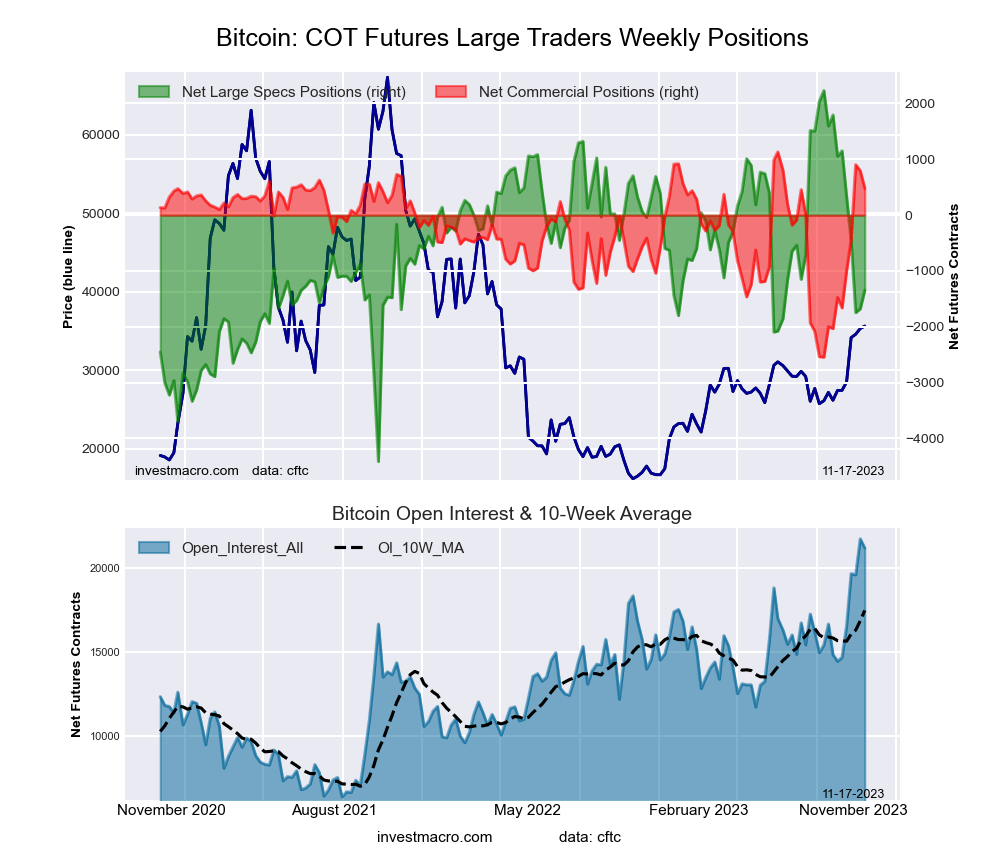
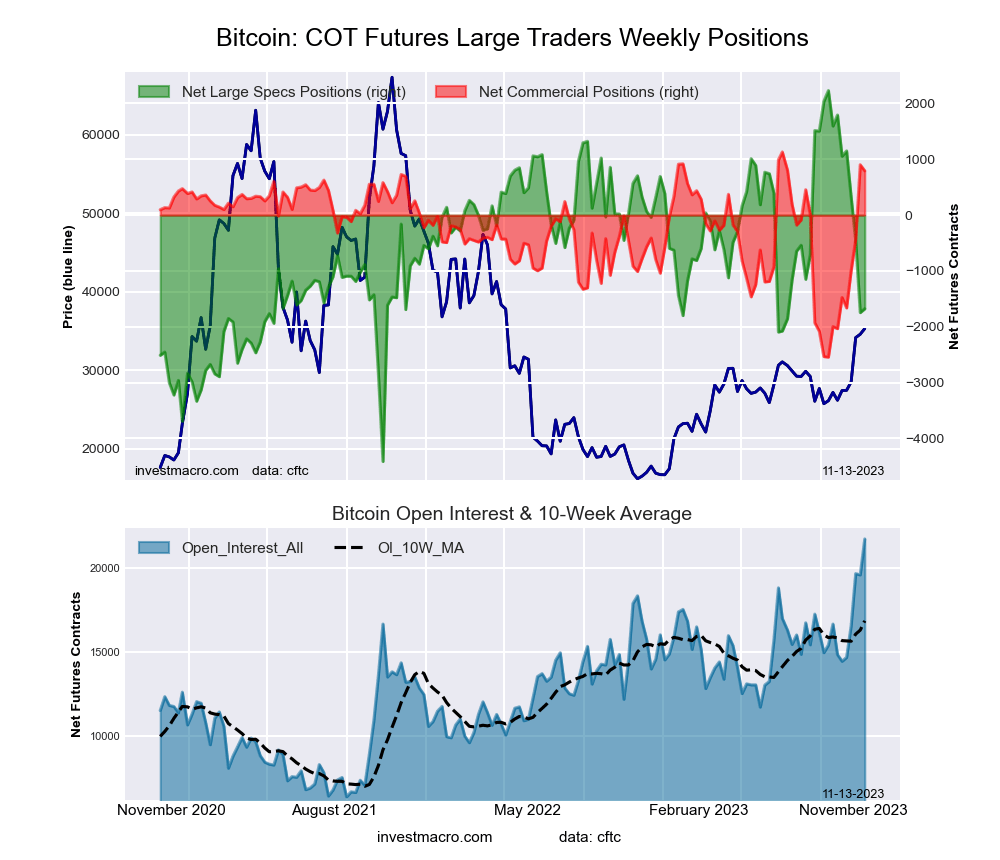
Bitcoin Crypto Futures COT ChartThe Bitcoin large speculator standing this week totaled a net position of -712 contracts in the data reported through Tuesday. This was a weekly increase of 437 contracts from the previous week which had a total of -1,149 net contracts.

This week’s current strength score (the trader positioning range over the past three years, measured from 0 to 100) shows the speculators are currently Bullish with a score of 64.5 percent. The commercials are Bullish with a score of 56.9 percent and the small traders (not shown in chart) are Bearish with a score of 28.8 percent.

Price Trend-Following Model: Weak Uptrend

Our weekly trend-following model classifies the current market price position as: Weak Uptrend. The current action for the model is considered to be: Hold – Maintain Long Position.

BITCOIN StatisticsSPECULATORSCOMMERCIALSSMALL TRADERS
– Percent of Open Interest Longs:77.63.98.4
– Percent of Open Interest Shorts:82.33.83.9
– Net Position:-71214698
– Gross Longs:11,9816021,299
– Gross Shorts:12,693588601
– Long to Short Ratio:0.9 to 11.0 to 12.2 to 1
NET POSITION TREND:
– Strength Index Score (3 Year Range Pct):64.556.928.8
– Strength Index Reading (3 Year Range):BullishBullishBearish
NET POSITION MOVEMENT INDEX:
– 6-Week Change in Strength Index:23.8-43.1-5.6


Article By InvestMacroReceive our weekly COT Newsletter

*COT Report: The COT data, released weekly to the public each Friday, is updated through the most recent Tuesday (data is 3 days old) and shows a quick view of how large speculators or non-commercials (for-profit traders) were positioned in the futures markets.

The CFTC categorizes trader positions according to commercial hedgers (traders who use futures contracts for hedging as part of the business), non-commercials (large traders who speculate to realize trading profits) and nonreportable traders (usually small traders/speculators) as well as their open interest (contracts open in the market at time of reporting). See CFTC criteria here.

EURUSD is stuck awaiting the FED’s actions

By RoboForex Analytical Department

This Monday, 14 August, the major currency pair is hovering near 1.0940.

The market is focused on the future actions of the Federal Reserve System. Last weekend, major US investment houses made their forecasts on the prospects of the interest rate. The Federal Reserve is expected to start bringing the rate down by June 2024, making quarterly decreases from then on. It means that inflation is forecast to reach the target mark of 2% by that moment.

It is a curious position that coincides with the actual state of affairs.

This week, the Fed will publish the minutes of its latest meeting. In them, as usual, market participants will be looking for hints and indications of the reasons and facts on which the regulator will base its September interest rate decisions.

Technical analysis of EUR/USD currency pair:

On the H4 chart, EURUSD performed a corrective wave to the 1.1064 level, where a new decline started. Today, the market reached 1.0940. At the moment, a consolidation range is forming around this mark. The price is expected to break downwards, heading for 1.0880, after which it might rise to 1.0940 (testing this level from below). Next, a decline to 1.0820 could follow. It is the first target. Technically, the MACD, whose signal line is below zero, could confirm such a scenario. The indicator is expected to go on declining to new lows.

On the H1 chart, EURUSD is forming a consolidation range around 1.0940. Escaping it upwards, the price could start a correction link to 1.0966 and drop to 1.0880 later. It is a local target. Technically, this scenario is confirmed by the Stochastic oscillator, whose signal line has broken the 20 mark upwards and continues growing to 50. The line is expected to rebound from this mark and fall to 20.

Disclaimer

Any predictions contained herein are based on the author’s particular opinion. This analysis shall not be treated as trading advice. RoboForex shall not be held liable for the results of the trades arising from relying upon trading recommendations and reviews contained herein.

Trade Of The Week: GBPUSD Major Breakout Imminent?

By ForexTime 

Fasten your seatbelts because this could be another rollercoaster week for the GBPUSD!

The mid-month UK data dump featuring wage growth and the latest inflation figures among other key reports could result in heightened volatility for Sterling. Across the Atlantic, it’s all about the Fed minutes that could offer clues on the central bank’s next monetary policy move.

With volatility likely to become the name of the game for the GBPUSD, a major breakout could be on the horizon.

Taking a quick peek at the technical picture, prices remain trapped within a range on the weekly charts with support at 1.2600 and resistance at 1.2850.

The lowdown…

The British Pound has appreciated against most G10 currencies since the start of August.

Sterling bulls continue to draw strength from growing bets around further BoE rate hikes, with the better-than-expected Q2 GDP data strengthening the rate hike argument.

Traders are currently pricing in an 87% probability of a 25-basis point hike in September’s policy meeting and a 50% chance of another hike by November.

This could be a big week for the GBPUSD and here are 4 reasons why:

     1. UK data dump

The incoming data could offer fresh insight into the health of the economy and influence expectations around the BoE’s next policy move.

  • Tuesday, August 15: UK June unemployment report

The unemployment rate is expected to remain unchanged at 4.0% in Q2 from Q1. Annual wage growth (excluding bonuses) is forecast to rise to 7.4%, from 7.3%.

  • Wednesday, August 15: UK July CPI

UK inflation is forecast to hit 6.7% year on year in July, down from 7.9% in June.

  • Friday, August 18: UK July retail sales

UK retail sales excluding auto-fuel are forecast to slump -2.2% year-on-year in July compared to -0.9% in the precious month.

Potential GBP scenarios:

  • The British Pound could appreciate if overall data prints better than expected and inflation figures exceed market forecasts – fuelling BoE hike bets.
  • Should overall data disappoint, and UK inflation print below forecasts, this could drag the Pound lower as BoE hike bets cool.

     2. Fed minutes

The Fed minutes of the July 25-25 policy meeting could offer key clues on the central bank’s next policy move.

  • Wednesday, August 16: FOMC meeting minutes

Taking a trip down memory lane, the Fed raised rates by 25 basis points last month and left the doors open to another hike in September. The minutes may help investors evaluate how keen the central bank is on another hike, despite traders only pricing in an 11% probability of such a move next month.

The dollar is likely to weaken if the minutes strike a dovish tone. Any hint of hawks or signal of more hikes down the road could boost the dollar.

     3. US economic data

When factoring in the Fed’s shift to data dependence, every US data point moving forward will act as a key piece in determining whether the Fed hikes rates one final time in 2023 or not.

  • Tuesday, August 15: US July retail sales
  • Wednesday, August 16: US July industrial production
  • Thursday, August 17: US weekly initial jobless claims

Potential USD scenarios:

  • A strong set of economic reports is likely to rekindle speculation around the Fed raising rates once again in 2023.
  • Should overall data disappoint, this may strengthen the argument around the Fed being done with rate hikes in 2023, weakening the dollar as a result.

     4. Technical forces

After swinging within a 200-pip range since the start of August, the GBPUSD could be gearing up for a major breakout.

  • A solid breakdown and daily close below 1.2600 could encourage a decline toward 1.2490 and 1.2380.
  • Should prices push back above 1.2800, this may open the doors towards 1.3000 – a level not since July 2023.


Forex-Time-LogoArticle by ForexTime

ForexTime Ltd (FXTM) is an award winning international online forex broker regulated by CySEC 185/12 www.forextime.com

US Dollar Index Speculator Bets drop for 6th straight week to new 2-year low

By InvestMacro

Here are the latest charts and statistics for the Commitment of Traders (COT) data published by the Commodities Futures Trading Commission (CFTC).

The latest COT data is updated through Tuesday August 8th and shows a quick view of how large market participants (for-profit speculators and commercial traders) were positioned in the futures markets. All currency positions are in direct relation to the US dollar where, for example, a bet for the euro is a bet that the euro will rise versus the dollar while a bet against the euro will be a bet that the euro will decline versus the dollar.

Weekly Speculator Changes led by Australian Dollar & Swiss Franc

The COT currency market speculator bets were lower this week as just two out of the eleven currency markets we cover had higher positioning while the other nine markets had lower speculator contracts.

Leading the gains for the currency markets was the Australian Dollar (8,600 contracts) with the Swiss Franc (3,295 contracts) also showing a positive week.

The currencies seeing declines in speculator bets on the week were the EuroFX (-22,251 contracts) with the Canadian Dollar (-6,988 contracts), the Brazilian Real (-5,312 contracts), the Mexican Peso (-4,897 contracts), the Japanese Yen (-3,964 contracts), the British Pound (-2,542 contracts), the New Zealand Dollar (-1,954 contracts), Bitcoin (-610 contracts) and the US Dollar Index (-491 contracts) also registering lower bets on the week.

US Dollar Index Bullish Bets drop for 6th straight week to new 2-year low

Highlighting the COT currency’s data this week is the continued decreasing nature of the speculator’s positioning in the US Dollar Index.

The large speculative US Dollar Index positions fell for a sixth straight week this week with the speculator position now declining by a total of -12,344 contracts over this last six-week span.

This bearishness has brought the US Dollar Index speculator net position (currently at just a total of +2,624 contracts) to a new 110-week low, dating back to June 29th of 2021 when the speculator’s net position was last in negative territory at a total of -448 contracts.

Despite the speculator’s pessimism in the US Dollar Index contracts, the futures price has been on the rise for a fourth consecutive week. The USD futures price advanced by approximately 1 percent this week with a Friday close right around the 102.70 level, it’s highest close level since June. The USD Index futures had fallen to a price of 99.22 on July 18th before rebounding and starting back on it’s current trend higher.


Data Snapshot of Forex Market Traders | Columns Legend
Aug-08-2023OIOI-IndexSpec-NetSpec-IndexCom-NetCOM-IndexSmalls-NetSmalls-Index
USD Index28,93062,62429-2,678715416
EUR760,96869149,81176-195,4502445,63952
GBP206,9544147,02088-57,8791310,85979
JPY229,84962-83,1802189,12179-5,94141
CHF43,12246-5,452424,092511,36062
CAD140,96020-62354-4,617535,24034
AUD182,84267-43,1924555,84561-12,65322
NZD40,98637-368531,45450-1,08637
MXN227,7454783,65190-86,640102,98930
RUB20,93047,54331-7,15069-39324
BRL45,7093328,03971-27,26931-77038
Bitcoin16,74383-1,14957456069329


Strength Scores led by Mexican Peso & British Pound

COT Strength Scores (a normalized measure of Speculator positions over a 3-Year range, from 0 to 100 where above 80 is Extreme-Bullish and below 20 is Extreme-Bearish) showed that the Mexican Peso (90 percent) and the British Pound (88 percent) lead the currency markets this week and are in Extreme-Bullish levels. The EuroFX (76 percent), Brazilian Real (71 percent) and the Bitcoin (57 percent) come in as the next highest in the weekly strength scores.

On the downside, the Japanese Yen (21 percent) and the US Dollar Index (29 percent) come in at the lowest strength levels currently. The next lowest strength scores are the Swiss Franc (42 percent) and the Australian Dollar (45 percent).

Strength Statistics:
US Dollar Index (29.3 percent) vs US Dollar Index previous week (30.1 percent)
EuroFX (76.1 percent) vs EuroFX previous week (84.7 percent)
British Pound Sterling (88.4 percent) vs British Pound Sterling previous week (90.2 percent)
Japanese Yen (20.6 percent) vs Japanese Yen previous week (23.0 percent)
Swiss Franc (41.6 percent) vs Swiss Franc previous week (32.5 percent)
Canadian Dollar (54.0 percent) vs Canadian Dollar previous week (60.5 percent)
Australian Dollar (44.8 percent) vs Australian Dollar previous week (36.8 percent)
New Zealand Dollar (52.6 percent) vs New Zealand Dollar previous week (57.9 percent)
Mexican Peso (90.2 percent) vs Mexican Peso previous week (93.2 percent)
Brazilian Real (71.4 percent) vs Brazilian Real previous week (78.2 percent)
Bitcoin (56.9 percent) vs Bitcoin previous week (67.5 percent)


Japanese Yen & Bitcoin top the 6-Week Strength Trends

COT Strength Score Trends (or move index, calculates the 6-week changes in strength scores) showed that the Japanese Yen (18 percent) and the Bitcoin (16 percent) lead the past six weeks trends for the currencies. The EuroFX (2 percent) and the Canadian Dollar (2 percent) are the next highest positive movers in the latest trends data.

The US Dollar Index (-21 percent) leads the downside trend scores currently with the Mexican Peso (-8 percent), Brazilian Real (-5 percent) and the Australian Dollar (-3 percent) following next with lower trend scores.

Strength Trend Statistics:
US Dollar Index (-20.6 percent) vs US Dollar Index previous week (-19.6 percent)
EuroFX (1.8 percent) vs EuroFX previous week (10.6 percent)
British Pound Sterling (-3.5 percent) vs British Pound Sterling previous week (2.0 percent)
Japanese Yen (17.6 percent) vs Japanese Yen previous week (16.9 percent)
Swiss Franc (-1.4 percent) vs Swiss Franc previous week (-10.7 percent)
Canadian Dollar (2.1 percent) vs Canadian Dollar previous week (37.2 percent)
Australian Dollar (-3.5 percent) vs Australian Dollar previous week (-2.0 percent)
New Zealand Dollar (1.3 percent) vs New Zealand Dollar previous week (11.5 percent)
Mexican Peso (-7.8 percent) vs Mexican Peso previous week (-6.8 percent)
Brazilian Real (-4.5 percent) vs Brazilian Real previous week (9.5 percent)
Bitcoin (16.5 percent) vs Bitcoin previous week (-16.3 percent)


Individual COT Forex Markets:

US Dollar Index Futures:

US Dollar Index Forex Futures COT ChartThe US Dollar Index large speculator standing this week recorded a net position of 2,624 contracts in the data reported through Tuesday. This was a weekly decrease of -491 contracts from the previous week which had a total of 3,115 net contracts.

This week’s current strength score (the trader positioning range over the past three years, measured from 0 to 100) shows the speculators are currently Bearish with a score of 29.3 percent. The commercials are Bullish with a score of 71.5 percent and the small traders (not shown in chart) are Bearish-Extreme with a score of 16.4 percent.

Price Trend-Following Model: New Uptrend

Our weekly trend-following model classifies the current market price position as: New Uptrend. The current action for the model is considered to be: Hold – Maintain Long Position.

US DOLLAR INDEX StatisticsSPECULATORSCOMMERCIALSSMALL TRADERS
– Percent of Open Interest Longs:59.622.111.3
– Percent of Open Interest Shorts:50.531.411.2
– Net Position:2,624-2,67854
– Gross Longs:17,2476,3953,283
– Gross Shorts:14,6239,0733,229
– Long to Short Ratio:1.2 to 10.7 to 11.0 to 1
NET POSITION TREND:
– Strength Index Score (3 Year Range Pct):29.371.516.4
– Strength Index Reading (3 Year Range):BearishBullishBearish-Extreme
NET POSITION MOVEMENT INDEX:
– 6-Week Change in Strength Index:-20.623.3-25.7


Euro Currency Futures:

Euro Currency Futures COT ChartThe Euro Currency large speculator standing this week recorded a net position of 149,811 contracts in the data reported through Tuesday. This was a weekly drop of -22,251 contracts from the previous week which had a total of 172,062 net contracts.

This week’s current strength score (the trader positioning range over the past three years, measured from 0 to 100) shows the speculators are currently Bullish with a score of 76.1 percent. The commercials are Bearish with a score of 24.4 percent and the small traders (not shown in chart) are Bullish with a score of 51.8 percent.

Price Trend-Following Model: Uptrend

Our weekly trend-following model classifies the current market price position as: Uptrend. The current action for the model is considered to be: Hold – Maintain Long Position.

EURO Currency StatisticsSPECULATORSCOMMERCIALSSMALL TRADERS
– Percent of Open Interest Longs:30.056.012.1
– Percent of Open Interest Shorts:10.381.66.1
– Net Position:149,811-195,45045,639
– Gross Longs:228,048425,87592,240
– Gross Shorts:78,237621,32546,601
– Long to Short Ratio:2.9 to 10.7 to 12.0 to 1
NET POSITION TREND:
– Strength Index Score (3 Year Range Pct):76.124.451.8
– Strength Index Reading (3 Year Range):BullishBearishBullish
NET POSITION MOVEMENT INDEX:
– 6-Week Change in Strength Index:1.8-0.7-4.1


British Pound Sterling Futures:

British Pound Sterling Futures COT ChartThe British Pound Sterling large speculator standing this week recorded a net position of 47,020 contracts in the data reported through Tuesday. This was a weekly lowering of -2,542 contracts from the previous week which had a total of 49,562 net contracts.

This week’s current strength score (the trader positioning range over the past three years, measured from 0 to 100) shows the speculators are currently Bullish-Extreme with a score of 88.4 percent. The commercials are Bearish-Extreme with a score of 13.3 percent and the small traders (not shown in chart) are Bullish with a score of 79.3 percent.

Price Trend-Following Model: Uptrend

Our weekly trend-following model classifies the current market price position as: Uptrend. The current action for the model is considered to be: Hold – Maintain Long Position.

BRITISH POUND StatisticsSPECULATORSCOMMERCIALSSMALL TRADERS
– Percent of Open Interest Longs:40.236.716.7
– Percent of Open Interest Shorts:17.564.711.4
– Net Position:47,020-57,87910,859
– Gross Longs:83,23975,99034,505
– Gross Shorts:36,219133,86923,646
– Long to Short Ratio:2.3 to 10.6 to 11.5 to 1
NET POSITION TREND:
– Strength Index Score (3 Year Range Pct):88.413.379.3
– Strength Index Reading (3 Year Range):Bullish-ExtremeBearish-ExtremeBullish
NET POSITION MOVEMENT INDEX:
– 6-Week Change in Strength Index:-3.55.0-7.7


Japanese Yen Futures:

Japanese Yen Forex Futures COT ChartThe Japanese Yen large speculator standing this week recorded a net position of -83,180 contracts in the data reported through Tuesday. This was a weekly decrease of -3,964 contracts from the previous week which had a total of -79,216 net contracts.

This week’s current strength score (the trader positioning range over the past three years, measured from 0 to 100) shows the speculators are currently Bearish with a score of 20.6 percent. The commercials are Bullish with a score of 79.1 percent and the small traders (not shown in chart) are Bearish with a score of 41.4 percent.

Price Trend-Following Model: Strong Downtrend

Our weekly trend-following model classifies the current market price position as: Strong Downtrend. The current action for the model is considered to be: Hold – Maintain Short Position.

JAPANESE YEN StatisticsSPECULATORSCOMMERCIALSSMALL TRADERS
– Percent of Open Interest Longs:10.173.814.5
– Percent of Open Interest Shorts:46.335.017.1
– Net Position:-83,18089,121-5,941
– Gross Longs:23,135169,52833,411
– Gross Shorts:106,31580,40739,352
– Long to Short Ratio:0.2 to 12.1 to 10.8 to 1
NET POSITION TREND:
– Strength Index Score (3 Year Range Pct):20.679.141.4
– Strength Index Reading (3 Year Range):BearishBullishBearish
NET POSITION MOVEMENT INDEX:
– 6-Week Change in Strength Index:17.6-16.27.2


Swiss Franc Futures:

Swiss Franc Forex Futures COT ChartThe Swiss Franc large speculator standing this week recorded a net position of -5,452 contracts in the data reported through Tuesday. This was a weekly increase of 3,295 contracts from the previous week which had a total of -8,747 net contracts.

This week’s current strength score (the trader positioning range over the past three years, measured from 0 to 100) shows the speculators are currently Bearish with a score of 41.6 percent. The commercials are Bullish with a score of 51.5 percent and the small traders (not shown in chart) are Bullish with a score of 62.1 percent.

Price Trend-Following Model: Uptrend

Our weekly trend-following model classifies the current market price position as: Uptrend. The current action for the model is considered to be: Hold – Maintain Long Position.

SWISS FRANC StatisticsSPECULATORSCOMMERCIALSSMALL TRADERS
– Percent of Open Interest Longs:19.744.035.4
– Percent of Open Interest Shorts:32.434.632.2
– Net Position:-5,4524,0921,360
– Gross Longs:8,50918,99115,265
– Gross Shorts:13,96114,89913,905
– Long to Short Ratio:0.6 to 11.3 to 11.1 to 1
NET POSITION TREND:
– Strength Index Score (3 Year Range Pct):41.651.562.1
– Strength Index Reading (3 Year Range):BearishBullishBullish
NET POSITION MOVEMENT INDEX:
– 6-Week Change in Strength Index:-1.4-4.811.6


Canadian Dollar Futures:

Canadian Dollar Forex Futures COT ChartThe Canadian Dollar large speculator standing this week recorded a net position of -623 contracts in the data reported through Tuesday. This was a weekly decline of -6,988 contracts from the previous week which had a total of 6,365 net contracts.

This week’s current strength score (the trader positioning range over the past three years, measured from 0 to 100) shows the speculators are currently Bullish with a score of 54.0 percent. The commercials are Bullish with a score of 53.0 percent and the small traders (not shown in chart) are Bearish with a score of 34.4 percent.

Price Trend-Following Model: Weak Uptrend

Our weekly trend-following model classifies the current market price position as: Weak Uptrend. The current action for the model is considered to be: Hold – Maintain Long Position.

CANADIAN DOLLAR StatisticsSPECULATORSCOMMERCIALSSMALL TRADERS
– Percent of Open Interest Longs:20.952.024.0
– Percent of Open Interest Shorts:21.455.320.2
– Net Position:-623-4,6175,240
– Gross Longs:29,48173,30133,774
– Gross Shorts:30,10477,91828,534
– Long to Short Ratio:1.0 to 10.9 to 11.2 to 1
NET POSITION TREND:
– Strength Index Score (3 Year Range Pct):54.053.034.4
– Strength Index Reading (3 Year Range):BullishBullishBearish
NET POSITION MOVEMENT INDEX:
– 6-Week Change in Strength Index:2.18.2-31.9


Australian Dollar Futures:

Australian Dollar Forex Futures COT ChartThe Australian Dollar large speculator standing this week recorded a net position of -43,192 contracts in the data reported through Tuesday. This was a weekly increase of 8,600 contracts from the previous week which had a total of -51,792 net contracts.

This week’s current strength score (the trader positioning range over the past three years, measured from 0 to 100) shows the speculators are currently Bearish with a score of 44.8 percent. The commercials are Bullish with a score of 60.5 percent and the small traders (not shown in chart) are Bearish with a score of 21.6 percent.

Price Trend-Following Model: Strong Downtrend

Our weekly trend-following model classifies the current market price position as: Strong Downtrend. The current action for the model is considered to be: New Sell – Short Position.

AUSTRALIAN DOLLAR StatisticsSPECULATORSCOMMERCIALSSMALL TRADERS
– Percent of Open Interest Longs:33.453.110.3
– Percent of Open Interest Shorts:57.022.517.3
– Net Position:-43,19255,845-12,653
– Gross Longs:61,09196,99918,900
– Gross Shorts:104,28341,15431,553
– Long to Short Ratio:0.6 to 12.4 to 10.6 to 1
NET POSITION TREND:
– Strength Index Score (3 Year Range Pct):44.860.521.6
– Strength Index Reading (3 Year Range):BearishBullishBearish
NET POSITION MOVEMENT INDEX:
– 6-Week Change in Strength Index:-3.512.7-32.3


New Zealand Dollar Futures:

New Zealand Dollar Forex Futures COT ChartThe New Zealand Dollar large speculator standing this week recorded a net position of -368 contracts in the data reported through Tuesday. This was a weekly reduction of -1,954 contracts from the previous week which had a total of 1,586 net contracts.

This week’s current strength score (the trader positioning range over the past three years, measured from 0 to 100) shows the speculators are currently Bullish with a score of 52.6 percent. The commercials are Bearish with a score of 49.9 percent and the small traders (not shown in chart) are Bearish with a score of 37.1 percent.

Price Trend-Following Model: Strong Downtrend

Our weekly trend-following model classifies the current market price position as: Strong Downtrend. The current action for the model is considered to be: Hold – Maintain Short Position.

NEW ZEALAND DOLLAR StatisticsSPECULATORSCOMMERCIALSSMALL TRADERS
– Percent of Open Interest Longs:45.846.08.1
– Percent of Open Interest Shorts:46.742.510.7
– Net Position:-3681,454-1,086
– Gross Longs:18,75818,8743,306
– Gross Shorts:19,12617,4204,392
– Long to Short Ratio:1.0 to 11.1 to 10.8 to 1
NET POSITION TREND:
– Strength Index Score (3 Year Range Pct):52.649.937.1
– Strength Index Reading (3 Year Range):BullishBearishBearish
NET POSITION MOVEMENT INDEX:
– 6-Week Change in Strength Index:1.30.6-8.3


Mexican Peso Futures:

Mexican Peso Futures COT ChartThe Mexican Peso large speculator standing this week recorded a net position of 83,651 contracts in the data reported through Tuesday. This was a weekly drop of -4,897 contracts from the previous week which had a total of 88,548 net contracts.

This week’s current strength score (the trader positioning range over the past three years, measured from 0 to 100) shows the speculators are currently Bullish-Extreme with a score of 90.2 percent. The commercials are Bearish-Extreme with a score of 9.7 percent and the small traders (not shown in chart) are Bearish with a score of 30.2 percent.

Price Trend-Following Model: Uptrend

Our weekly trend-following model classifies the current market price position as: Uptrend. The current action for the model is considered to be: Hold – Maintain Long Position.

MEXICAN PESO StatisticsSPECULATORSCOMMERCIALSSMALL TRADERS
– Percent of Open Interest Longs:48.347.93.2
– Percent of Open Interest Shorts:11.685.91.9
– Net Position:83,651-86,6402,989
– Gross Longs:110,008109,0287,344
– Gross Shorts:26,357195,6684,355
– Long to Short Ratio:4.2 to 10.6 to 11.7 to 1
NET POSITION TREND:
– Strength Index Score (3 Year Range Pct):90.29.730.2
– Strength Index Reading (3 Year Range):Bullish-ExtremeBearish-ExtremeBearish
NET POSITION MOVEMENT INDEX:
– 6-Week Change in Strength Index:-7.87.9-3.6


Brazilian Real Futures:

Brazil Real Futures COT ChartThe Brazilian Real large speculator standing this week recorded a net position of 28,039 contracts in the data reported through Tuesday. This was a weekly decrease of -5,312 contracts from the previous week which had a total of 33,351 net contracts.

This week’s current strength score (the trader positioning range over the past three years, measured from 0 to 100) shows the speculators are currently Bullish with a score of 71.4 percent. The commercials are Bearish with a score of 31.1 percent and the small traders (not shown in chart) are Bearish with a score of 37.9 percent.

Price Trend-Following Model: Uptrend

Our weekly trend-following model classifies the current market price position as: Uptrend. The current action for the model is considered to be: Hold – Maintain Long Position.

BRAZIL REAL StatisticsSPECULATORSCOMMERCIALSSMALL TRADERS
– Percent of Open Interest Longs:71.819.08.0
– Percent of Open Interest Shorts:10.478.79.7
– Net Position:28,039-27,269-770
– Gross Longs:32,8158,7063,663
– Gross Shorts:4,77635,9754,433
– Long to Short Ratio:6.9 to 10.2 to 10.8 to 1
NET POSITION TREND:
– Strength Index Score (3 Year Range Pct):71.431.137.9
– Strength Index Reading (3 Year Range):BullishBearishBearish
NET POSITION MOVEMENT INDEX:
– 6-Week Change in Strength Index:-4.50.823.3


Bitcoin Futures:

Bitcoin Crypto Futures COT ChartThe Bitcoin large speculator standing this week recorded a net position of -1,149 contracts in the data reported through Tuesday. This was a weekly decline by -610 contracts from the previous week which had a total of -539 net contracts.

This week’s current strength score (the trader positioning range over the past three years, measured from 0 to 100) shows the speculators are currently Bullish with a score of 56.9 percent. The commercials are Bullish with a score of 73.9 percent and the small traders (not shown in chart) are Bearish with a score of 28.7 percent.

Price Trend-Following Model: Strong Uptrend

Our weekly trend-following model classifies the current market price position as: Strong Uptrend. The current action for the model is considered to be: Hold – Maintain Long Position.

BITCOIN StatisticsSPECULATORSCOMMERCIALSSMALL TRADERS
– Percent of Open Interest Longs:77.66.57.5
– Percent of Open Interest Shorts:84.43.73.3
– Net Position:-1,149456693
– Gross Longs:12,9851,0821,250
– Gross Shorts:14,134626557
– Long to Short Ratio:0.9 to 11.7 to 12.2 to 1
NET POSITION TREND:
– Strength Index Score (3 Year Range Pct):56.973.928.7
– Strength Index Reading (3 Year Range):BullishBullishBearish
NET POSITION MOVEMENT INDEX:
– 6-Week Change in Strength Index:16.5-20.6-9.3


Article By InvestMacroReceive our weekly COT Newsletter

*COT Report: The COT data, released weekly to the public each Friday, is updated through the most recent Tuesday (data is 3 days old) and shows a quick view of how large speculators or non-commercials (for-profit traders) were positioned in the futures markets.

The CFTC categorizes trader positions according to commercial hedgers (traders who use futures contracts for hedging as part of the business), non-commercials (large traders who speculate to realize trading profits) and nonreportable traders (usually small traders/speculators) as well as their open interest (contracts open in the market at time of reporting). See CFTC criteria here.

Week Ahead: NZDUSD to set new 2023 low?

By ForexTime 

Earlier this week, we featured the best-performing G10 currency (Swiss Franc) against the US dollar so far in 2023 in our Trade of the Week, published on Mondays.

Time to switch gears and look at the other end of the spectrum …

The New Zealand dollar is the second worst-performing G10 currency against the US dollar so far this year, with NZDUSD having shed 5.2% during the period.

NOTE: The Japanese Yen still stands as the worst-performing G10 currency versus the US dollar so far in 2023, with USDJPY having climbed by over 10% year-to-date.


Traders will be monitoring the Reserve Bank of New Zealand’s (RBNZ) upcoming policy decision, nestled within a week that also features these major economic data releases and events:

* No tier-1 data scheduled out of major economies on Monday, August 14

Tuesday, August 15

  • JPY: Japan 2Q GDP
  • AUD: RBA meeting minutes
  • CNH: China July industrial production, retail sales, unemployment
  • EUR: Germany/Eurozone August ZEW survey
  • GBP: UK June unemployment
  • USD: US July retail sales; speech by Federal Reserve Bank of Minneapolis President Neel Kashkari
  • CAD: Canada July CPI


Wednesday, August 16

  • CNH: China July new home prices
  • NZD: RBNZ rate decision
  • EUR: Eurozone 2Q GDP and employment data; June industrial production
  • GBP: UK July CPI
  • USD: FOMC meeting minutes; US July industrial production


Thursday, August 17

  • JPY: Japan July external trade
  • AUD: Australia July unemployment
  • NOK: Central Bank of Norway rate decision
  • EUR: Eurozone June trade balance
  • USD: US weekly initial jobless claims


Friday, August 18

  • JPY: Japan July CPI
  • EUR: Eurozone July CPI (final)
  • GBP: UK July retail sales


What to expect from the RBNZ?

The RBNZ is expected to maintain its Official Cash Rate at 5.5%.

Markets are also predicting a greater-than-even chance (59% odds) that the RBNZ is already finished with its rate hikes.

This antipodean central bank has already tightened by 525 basis points since its first hike in October 2021, as the RBNZ got a head start on the Fed and other major central bankers.

After all, New Zealand is in a technical recession!

Its GDP fell for two consecutive quarters, contracting by 0.1% quarter-on-quarter in 1Q23, following the 0.7% decline in 4Q22.

That suggests that the RBNZ can’t keep raising its benchmark interest rate any further for fear of incurring further damage on the economy.

To buffer the fact, just today (Friday, August 11th), it was announced that New Zealand’s food prices fell by 0.5% in July compared to June 2023. This is its first decline since February 2022!

And that’s dragging the Kiwi dollar lower, being the sole G10 currency to be losing against the US dollar today (Friday, August 11th) as of the time of writing, with NZDUSD testing support around the psychologically-important 0.6000 mark.


In short, the NZD is set to be weighed down by the thought of no further RBNZ rate hikes along with the dour economic outlook.


Over to the US Dollar side of NZDUSD …

Next week, the world’s largest economy is set to unveil the following:

  • Tuesday, August 15: July retail sales data
  • Wednesday, August 16: minutes from the FOMC’s previous meeting in July.

The US dollar’s resilience may be buffered by a higher-than-0.4% retail sales print, showing that spending by US consumers remain robust, as well as more hawkish cues out of the FOMC meeting minutes.

The weekly jobless claims data, due out every Thursday, as well the Fed speak due over the coming week, may trigger more volatility for USD pairs as well.


Potential USD scenarios:

  • Overall, the US dollar should remain supported if the economic data points to yet another Fed rate hike later this year, with such a notion potentially dragging NZDUSD lower.
  • On the other hand, the US dollar may finally wilt at the thought that peak US interest rates are already at hand, especially on signs of waning US economic momentum, which may offer some relief to the Kiwi.


The Bloomberg FX model now forecasts a 71% chance that NZDUSD will trade within the 0.5913 – 0.6119 range through next week.


From a technical perspective …

Here are some key levels to look out for on the NZDUSD price charts:


POTENTIAL SUPPORT

  • 0.59850: year-to-date low
  • 0.59728: 23.6% Fibonacci level from NZDUSD’s February 2021 – October 2022 plummet
  • 0.5913: lower bound of Bloomberg model forecasted range


POTENTIAL RESISTANCE

  • 0.6050 – 0.6060: late-June/early-august cycle lows
  • 0.6119: upper bound of Bloomberg model forecasted range / resistance area for NZDUSD highs this week (August 7-11)


Brace for technical rebound!

NZDUSD’s 14-day relative strength index (RSI) is flirting with the 30 mark, which denotes oversold levels.

Further declines may then spur a technical rebound in the week ahead, as was the case on June 1st.


Forex-Time-LogoArticle by ForexTime
ForexTime Ltd (FXTM) is an award winning international online forex broker regulated by CySEC 185/12 www.forextime.com

The Coming BRICS Currency Diversification

By Dan Steinbock

The pressure toward the diversification of world currency reserves is longstanding. It intensified after 2008, but has escalated since 2022. It is a prime topic in the next BRICS Summit that’s likely to further intensify the trend.

In 2016, US Treasury Secretary Jack Lew cautioned that “the more we condition the use of the dollar and our financial system on adherence to US foreign policy, the more the risk of migration to other currencies and other financial systems in the medium-term grows.”

Both the Trump and Biden administrations have ignored Lew’s warning. One consequence has been the Global South’s rising interest in the BRICS, which will have its next, highly-anticipated summit in South Africa in late August.

A key topic in Johannesburg will be the BRICS quest to develop alternative payment systems to US dollar.

Risks of dollar monopoly   

In May – oddly, amid the US banking crisis – economist Paul Krugman attributed the “de-dollarization” brouhaha to crypto-cultists and Putin’s sympathizers, as if the trend was nothing but a misguided anti-patriotic melee.

However, as Krugman noted, much of world trade remains invoiced and settled in U.S. dollars; many banks based outside the United States nonetheless offer dollar-denominated deposits; many non-U.S. corporations borrow in dollars; central banks hold a large share of their reserves in dollar assets; and so on. The assumption was that, a bit like diamond, US dollar is forever. In reality, no dominant reserve currency has had an indefinite life-span.

What Krugman failed to understand is that it is precisely the current coercive monopoly of the US dollar – the world’s disproportionate dependency on US dollar in trade invoicing and settlement, and the dollar reliance by non-US corporate and financial giants, and dollar’s high share in central banks’ reserves – that increasingly worries not just the Global South, but an increasing number of major economies in the West.

When the dollar is weaponized by the US foreign policy in the name of international community but without the broad support of international consensus, it puts trade invoicing and settlement, foreign corporates, financials and central bank reserves at risk.

True, recently US Secretary of Treasury Janet Yellen said there’s still no alternative to the dollar-based monetary system. Then again, not so long ago, she also warned about a catastrophic scenario if Washington failed to agree on a (still another) new debt limit. Similarly, the British, too, touted the blessings of their sterling pound until 1914. But that primacy ended with the overstretch of the UK economy after 1945.

The early 21st century has its unique characteristics, but it won’t be that different.

Advantages of diversification

How is the BRICS contributing to diversification? Thanks to its organizational flexibility, the bloc makes possible unilateral, bilateral and multilateral measures. Analytically, these range from gradual reforms to more unilateral individual measures. These, in turn, are driven by the original BRICS founder economies (Brazil, Russia, India and China), the new aspiring members and the coalition partners who share its vision and are considering membership as well.

Some 22 countries have formally applied to join the group, while an equal number of states “have been informally asking about becoming BRICS members,” according to Anil Sooklal, South Africa’s ambassador-at-large responsible for ties with Asia and the BRICS. Reportedly, countries looking to join the bloc include Argentina, Iran, Saudi Arabia, and the United Arab Emirates.

Indeed, the rising number of populous and large emerging economies make possible the kind of “network effects” and “positive spillovers” that will be critical to launch the new critical infrastructure for the proposed alternative global financial system.

However, what the BRICS offer is not simple de-dollarization. The goal is not to eliminate the dollar, which is typically the depiction by the critics and political adversaries of the BRICS, particularly in the West. At the eve of the Ukraine conflict, Atlantic Council characterized Russia and China as “partners in de-dollarization.” That, in turn, was portrayed as “an alternative to the US-dominated SWIFT” [the currently dominant payment system]. Touted widely in the West, the cooperation of Russia and China is understood as a de jure alliance, and de-dollarization as a ploy for dollar substitution.

The realities are a bit less scandalous and more nuanced. The BRICS have little to do with rogue states seeking covertly to subvert international order. Rather, like asset managers who seek to maintain appropriate diversification in their portfolios, the BRICS’ strategic objective is diversify and recalibrate rather than simple de-dollarization.

From Keynes’s Bancor to the BRICS’ currency diversification

The skeptics say that the dollar has been buried many times before. Why should it die this time? But who says it would have to die. The more, the merrier. Most BRICS economies still rely significantly on the US dollar, whereas those that have been sanctioned by the US and/or its allies have significantly reduced their dollar reserves, often opting for gold instead.

What the major BRIC economies seek for is a more diversified global currency regime. The present path is untenable. If it is not remedied gradually and over time, it will change through a major world crisis, disruptively. The BRICS goal is not to replace the dollar. Rather, it is to diversify the monetary system so that it would better reflect today’s world economy.

In historical view, it’s far from a new idea. John Maynard Keynes made a similar argument for the proposed supra-national currency bancor (the name was inspired by the French banque, “bank gold”) in Bretton Woods in 1944. But the idea was torpedoed by the U.S. negotiators, who wanted to replace the UK pound with the dollar as the world’s major reserve currency. However, Keynes cautioned that the dollar primacy would result in great uncertainty and volatility following the reconstruction and recovery of Western Europe and other major economies.

That’s what ensued in 1971, when President Nixon ended unilaterally the convertibility of the dollar to gold. Though introduced as a temporary measure, it made U.S. dollar a permanently floating fiat money. As gold no longer offered a yardstick for value, the perception of value replaced value itself. The consequent price shock reverberated across the world. With the twin oil crises, it was followed by the quadrupling of oil prices, then runaway inflation and stagflation, and eventually record-high US interest rates and massive rearmament drives.

Rise of complementary institutions

In geopolitics, the U.S. has continued to lean on major Western economies and Japan, but in international economy it refused to renounce the exorbitant privilege. As a net consequence, the dollar monopoly contributed to asset bubbles in the 1980s, early ‘90s, early 2000s and finally in 2008. Amid the Great Recession, China’s central bank governor Zhou Xiaochuan revived the idea and urged major Western economies to “reform the international monetary system.”

Great pledges were made in Brussels, Washington and Tokyo, but nothing much happened. Hence, the efforts at complementary development institutions and critical infrastructure, including the BRICS New Development Bank (NBD), the Asian Infrastructure Investment Bank (AIIB), the Bridge and Road Initiative (BRICS), and the quest for new currency arrangements.

The BRICS do not want to subvert the world order. Rather, they seek to foster one vis-à-vis diversification. Nonetheless, global currency arrangements must not just the interests of Americans who account for 4.1 percent of the world population. It must also reflect the aspirations of the multipolar world economy in which global growth prospects are driven by the large emerging economies.

About the Author:

Dr. Dan Steinbock is an internationally recognized strategist of the multipolar world and the founder of Difference Group. He has served at India, China and America Institute (US), Shanghai Institutes for International Studies (China) and the EU Center (Singapore). For more, see https://www.differencegroup.net/


The original commentary was released by China-US Focus on Aug. 4, 2023. See also Dr Steinbock’s interview by Berliner Zeitung “Wollen die Brics den Dollar ersetzen? Das sagt ein Wirtschaftsexperte dazu” on July 27, 2023. Berliner Zeitung is one of the leading German dailies.

Euro Attempts a Reversal to the Upside

By RoboForex Analytical Department

The Euro has halted its three-week decline, finding local support at 1.0900.

Despite the European Central Bank’s (ECB) latest interest rate hike to 4.25% on 27 July, the Euro is weakening against the US Dollar. Over the past three weeks, the EURUSD pair has retreated from its highs near 1.1300 to around 1.0900.

On Friday, US employment market data was released, slightly falling short of expert predictions: the Nonfarm Payrolls (NFP) indicator registered a figure of 187 thousand compared to the market’s projected 200 thousand. Consequently, the Dollar weakened against the Euro, causing the EURUSD pair to recover from its lows around 1.0900 to surpass 1.1000.

The key driver for heightened market volatility this week will be the forthcoming US Consumer Price Index (CPI) data, due for release on Thursday. Should the data surpass forecasts, the Euro’s decline may continue; conversely, weaker data could give the Euro reason to rise.

Technical analysis for the EUR/USD currency pair

On the H4 chart, EUR/USD completed a corrective wave to the 1.1040 level and started to develop another wave of decline. The 1.0941 level could be reached. A downward breakout of this level will open the potential for a wave of decline to 1.0840. Once the price hits this level, a link of growth to 1.0940 (a test from below) is expected, followed by a decline to 1.0735. This is a local target. Technically, the MACD indicator confirms this scenario with its signal line below the zero mark. The price is expected to return to it and continue falling to new lows.

On the H1 chart, EUR/USD has completed an impulse of decline to the 1.1005 level. A consolidation range has formed around it today, and with a downward breakout, the price has declined to 1.0970. A link of correction to 1.1005 (a test from below) could form, followed by another wave of decline to 1.0940. A downward breakout of this level will open the potential for a wave of decline to 1.0878. Technically, the Stochastic oscillator also supports this outlook, with its signal line having broken the 20 mark upwards and continuing to rise to 50.

Disclaimer

Any forecasts contained herein are based on the author’s particular opinion. This analysis may not be treated as trading advice. RoboForex bears no responsibility for trading results based on trading recommendations and reviews contained herein.

Trade of the Week: USDCHF to see 55% more volatility?

By ForexTime 

Here are some Swiss Franc facts that may surprise you:

  1. CHF is best-performing G10 currency vs. USD so far this year
  2. SNB uses Swiss Franc to help achieve inflation target
  3. Swiss Franc is a safe haven currency
  4. USDCHF sees 55% larger-than-average moves on US CPI days so far in 2023
  5. Blomberg FX model: USDCHF to trade within 0.8645 – 0.8865 this week


1) CHF is the best-performing G10 currency so far in 2023

USDCHF has a year-to-date decline of more than 5% at the time of writing (stronger CHF + weaker USD = lower USDCHF).

The Swiss Franc (CHF) has overtaken the British Pound for the current title, after battling it out for most of July, with the former also boasting of an advance against all of its G10 peers for the year-to-date period:


2) The Swiss National Bank (SNB) has been allowing CHF to strengthen

This central bank uses the CHF exchange rate as a major tool for controlling inflation.

A stronger CHF means cheaper imports, and also more receipts from its exports, hence Switzerland’s consistent trade surplus.

Fun fact: Switzerland’s watch exports have grown by double-digits year-on-year (>10%) in 4 out of the first six months of 2023.

After over a decade of limiting the Swiss Franc’s strength, the SNB finally signalled in November 2022 that it’s ready to sell foreign currencies and let the CHF strengthen.

NOTE: The SNB exchanges foreign currencies back into Swiss Francs, which in turn drives up the value of the latter.

Furthermore, the SNB has maintained its willingness to keep hiking rates.

Such hawkish rhetoric comes despite inflation already falling within the central bank’s 0% – 2% CPI target range (Switzerland’s July CPI = 1.6%).

However, the SNB appears concerned that inflation may make a comeback later this year, hence expectations for another rate hike.

At the time of writing, overnight index swaps are pointing to a 60% chance that the SNB could hike by a further 25-basis points before 2023 ends.

NOTE: SNB only makes a rate decision once every quarter. Its next rate decision is due on September 21st.

Recall that, a currency tends to strengthen as markets continue to expect interest rates in that country to climb higher.

Hence, such expectations have aided the Swiss Franc to reach its strongest level against the US dollar in about 8 years.

Back in mid-July 2023, USDCHF dipped below 0.8600 for the first time since the SNB lifted the Swiss Franc’s cap against the euro back in 2015 which saw CHF skyrocketing (and USDCHF plummeting).


3) Swiss Franc is a safe haven currency

A safe haven is an asset that investors buy up with hopes of preserving their wealth in times of heightened fear and great uncertainty.

Consider how the Swiss Franc gained by 2.86% versus the US dollar for the month of March 2023, amid the banking turmoil in the United States as well as Switzerland.

Currently, with markets fearing a recession, that has also helped drive up the value of the safe haven Swiss Franc.


4) USDCHF sees 55% bigger one-day move on day of US inflation data release

So far in 2023, USDCHF tends to move by about 56 pips (between its highest to its lowest intraday price) on average within a single trading day.

However, that average intraday move soars up to 87 pips on the days that the US consumer price index (CPI) is released.

That’s a 55% increase in volatility!

Hence, brace for heightened volatility when the US CPI due is released this Thursday, August 10th! ​​


Currently, economists are forecasting the following numbers for the upcoming US CPI report:

  • CPI month-on-month (July 2023 vs. June 2023) = 0.2%
  • Core CPI (excluding more volatile food and energy prices) month-on-month = 0.2%
  • CPI year-on-year (July 2023 vs. July 2022) = 3.3% (a slight uptick from June’s 3% year-on-year increase)
  • Core CPI year-on-year = 4.8% (matching June’s core CPI y/y number of 4.8%)


Potential scenarios:

  • A set of CPI numbers that show US inflation is moderating further, which in turn allows the Fed to back away from a September rate hike, may drag USDCHF lower on the weaker US follar.
  • Higher-than-expected CPI readings, which stoke fears of a resurgence in inflation that forces the Fed into yet another rate hike next month, may translate into a stronger US dollar and a higher USDCHF.


BONUS FACTS:

  • At the lower-than-expected US CPI release on July 12th, USDCHF registered an intraday move of 139 pips!
  • That was its biggest one-day DROP in % terms so far in 2023, and also its 3rd largest single-day move (both up and down) in percentage terms of the year so far.

In other words, if recent history is to be a guide, brace for a volatile USDCHF on US CPI release day.


5) USDCHF likeliest to trade within 0.8645 – 0.8865 this week.

According to Bloomberg’s FX model, there’s a 72% chance that USDCHF trades within the above-mentioned range over the next one-week period.

Here are some further key levels of interest for the immediate term:


POTENTIAL SUPPORT:

  • 21-day simple moving average
  • 0.864 – 0.866 region = lower bound of Bloomberg FX model forecast / area for choppy July price action
  • 0.8600 = psychologically-important level


POTENTIAL RESISTANCE:

  • 0.8800 = psychologically-important number
  • 0.8820 = early-May low
  • 0.886 region = upper limit of Bloomberg FX model forecast / 50-day simple moving average / upper bound of USDCHF downtrend since November 2022
  • 0.89014 = June 2023 low

Forex-Time-LogoArticle by ForexTime
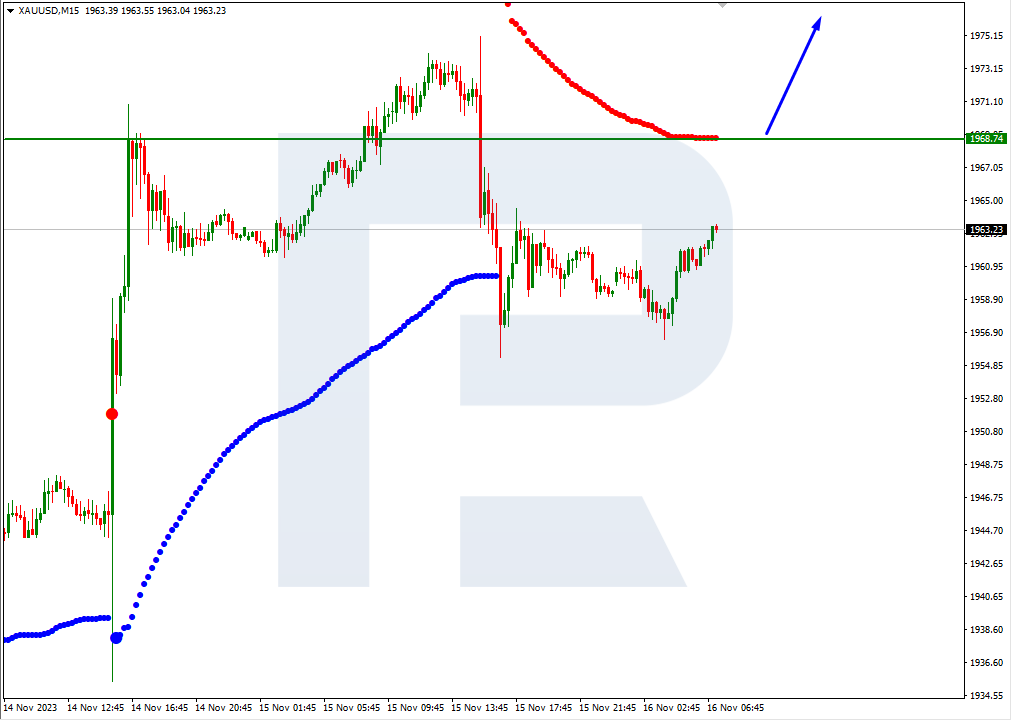
ForexTime Ltd (FXTM) is an award winning international online forex broker regulated by CySEC 185/12 www.forextime.com