Archive for Financial News – Page 63

COT Stock Market Charts: Speculator Bets led higher by VIX & Russell 2000

By InvestMacro

Speculators OI Stocks COT Chart

Here are the latest charts and statistics for the Commitment of Traders (COT) data published by the Commodities Futures Trading Commission (CFTC).

The latest COT data is updated through Tuesday April 29th and shows a quick view of how large traders (for-profit speculators and commercial entities) were positioned in the futures markets.

Weekly Speculator Changes led higher by VIX & Russell 2000

Speculators Nets Stocks COT Chart

The COT stock markets speculator bets were higher this week as five out of the seven stock markets we cover had higher positioning while the other two markets had lower speculator contracts.

Leading the gains for the stock markets was the VIX (9,985 contracts) with the Russell-Mini (6,313 contracts), the DowJones-Mini (4,662 contracts), the Nikkei 225 (2,025 contracts) and the MSCI EAFE-Mini (618 contracts) also showing positive weeks.

The markets with the declines in speculator bets this week were the Nasdaq-Mini (-6,817 contracts) and the S&P500-Mini (-2,731 contracts) also registering lower bets on the week.


Stock Market Data:

Speculators Table Stocks COT Chart

Legend: Weekly Speculators Change | Speculators Current Net Position | Speculators Strength Score compared to last 3-Years (0-100 range)


Strength Scores led by VIX & Nikkei 225

Speculators Strength Stocks COT Chart

COT Strength Scores (a normalized measure of Speculator positions over a 3-Year range, from 0 to 100 where above 80 is Extreme-Bullish and below 20 is Extreme-Bearish) showed that the VIX (98 percent) and the Nikkei 225 (96 percent) lead the stock markets this week. The Nasdaq-Mini (87 percent) and Russell-Mini (82 percent) come in as the next highest in the weekly strength scores.

On the downside, there are no markets at less than 50 percent of the past 3-year range.

Strength Statistics:
VIX (98.3 percent) vs VIX previous week (89.4 percent)
S&P500-Mini (63.9 percent) vs S&P500-Mini previous week (64.4 percent)
DowJones-Mini (69.3 percent) vs DowJones-Mini previous week (61.7 percent)
Nasdaq-Mini (87.0 percent) vs Nasdaq-Mini previous week (97.6 percent)
Russell2000-Mini (81.7 percent) vs Russell2000-Mini previous week (77.4 percent)
Nikkei USD (96.4 percent) vs Nikkei USD previous week (79.1 percent)
EAFE-Mini (74.8 percent) vs EAFE-Mini previous week (74.0 percent)


Nikkei 225 & Nasdaq-Mini top the 6-Week Strength Trends

Speculators Trend Stocks COT Chart

COT Strength Score Trends (or move index, calculates the 6-week changes in strength scores) showed that the Nikkei 225 (35 percent) leads the past six weeks trends for the stock markets. The Nasdaq-Mini (12 percent), the DowJones-Mini (7 percent) and the Russell-Mini (7 percent) are the next highest positive movers in the latest trends data.

The S&P500-Mini (-26 percent) leads the downside trend scores currently with the MSCI EAFE-Mini (-2 percent) coming in as the next market with lower trend scores.

Strength Trend Statistics:
VIX (-1.7 percent) vs VIX previous week (10.8 percent)
S&P500-Mini (-26.4 percent) vs S&P500-Mini previous week (-28.2 percent)
DowJones-Mini (7.0 percent) vs DowJones-Mini previous week (-1.9 percent)
Nasdaq-Mini (12.2 percent) vs Nasdaq-Mini previous week (23.2 percent)
Russell2000-Mini (6.7 percent) vs Russell2000-Mini previous week (-1.1 percent)
Nikkei USD (35.0 percent) vs Nikkei USD previous week (25.1 percent)
EAFE-Mini (-2.2 percent) vs EAFE-Mini previous week (-26.0 percent)


Individual Stock Market Charts:

VIX Volatility Futures:

VIX Volatility Futures COT ChartThe VIX Volatility large speculator standing this week recorded a net position of 4,240 contracts in the data reported through Tuesday. This was a weekly boost of 9,985 contracts from the previous week which had a total of -5,745 net contracts.

This week’s current strength score (the trader positioning range over the past three years, measured from 0 to 100) shows the speculators are currently Bullish-Extreme with a score of 98.3 percent. The commercials are Bearish-Extreme with a score of 1.3 percent and the small traders (not shown in chart) are Bullish-Extreme with a score of 86.2 percent.

Price Trend-Following Model: Uptrend

Our weekly trend-following model classifies the current market price position as: Uptrend.

VIX Volatility Futures StatisticsSPECULATORSCOMMERCIALSSMALL TRADERS
– Percent of Open Interest Longs:26.843.310.6
– Percent of Open Interest Shorts:25.346.19.3
– Net Position:4,240-7,8373,597
– Gross Longs:74,898120,74729,624
– Gross Shorts:70,658128,58426,027
– Long to Short Ratio:1.1 to 10.9 to 11.1 to 1
NET POSITION TREND:
– Strength Index Score (3 Year Range Pct):98.31.386.2
– Strength Index Reading (3 Year Range):Bullish-ExtremeBearish-ExtremeBullish-Extreme
NET POSITION MOVEMENT INDEX:
– 6-Week Change in Strength Index:-1.7-2.928.7


S&P500 Mini Futures:

SP500 Mini Futures COT ChartThe S&P500 Mini large speculator standing this week recorded a net position of -78,666 contracts in the data reported through Tuesday. This was a weekly reduction of -2,731 contracts from the previous week which had a total of -75,935 net contracts.

This week’s current strength score (the trader positioning range over the past three years, measured from 0 to 100) shows the speculators are currently Bullish with a score of 63.9 percent. The commercials are Bearish with a score of 40.5 percent and the small traders (not shown in chart) are Bullish with a score of 53.5 percent.

Price Trend-Following Model: Downtrend

Our weekly trend-following model classifies the current market price position as: Downtrend.

S&P500 Mini Futures StatisticsSPECULATORSCOMMERCIALSSMALL TRADERS
– Percent of Open Interest Longs:11.374.611.3
– Percent of Open Interest Shorts:14.972.99.4
– Net Position:-78,66637,75340,913
– Gross Longs:240,0961,592,776240,722
– Gross Shorts:318,7621,555,023199,809
– Long to Short Ratio:0.8 to 11.0 to 11.2 to 1
NET POSITION TREND:
– Strength Index Score (3 Year Range Pct):63.940.553.5
– Strength Index Reading (3 Year Range):BullishBearishBullish
NET POSITION MOVEMENT INDEX:
– 6-Week Change in Strength Index:-26.434.3-32.7


Dow Jones Mini Futures:

Dow Jones Mini Futures COT ChartThe Dow Jones Mini large speculator standing this week recorded a net position of 5,549 contracts in the data reported through Tuesday. This was a weekly boost of 4,662 contracts from the previous week which had a total of 887 net contracts.

This week’s current strength score (the trader positioning range over the past three years, measured from 0 to 100) shows the speculators are currently Bullish with a score of 69.3 percent. The commercials are Bearish with a score of 34.4 percent and the small traders (not shown in chart) are Bearish with a score of 36.4 percent.

Price Trend-Following Model: Downtrend

Our weekly trend-following model classifies the current market price position as: Downtrend.

Dow Jones Mini Futures StatisticsSPECULATORSCOMMERCIALSSMALL TRADERS
– Percent of Open Interest Longs:16.964.010.7
– Percent of Open Interest Shorts:9.867.414.4
– Net Position:5,549-2,637-2,912
– Gross Longs:13,20250,1368,381
– Gross Shorts:7,65352,77311,293
– Long to Short Ratio:1.7 to 11.0 to 10.7 to 1
NET POSITION TREND:
– Strength Index Score (3 Year Range Pct):69.334.436.4
– Strength Index Reading (3 Year Range):BullishBearishBearish
NET POSITION MOVEMENT INDEX:
– 6-Week Change in Strength Index:7.0-0.8-22.2


Nasdaq Mini Futures:

Nasdaq Mini Futures COT ChartThe Nasdaq Mini large speculator standing this week recorded a net position of 30,863 contracts in the data reported through Tuesday. This was a weekly fall of -6,817 contracts from the previous week which had a total of 37,680 net contracts.

This week’s current strength score (the trader positioning range over the past three years, measured from 0 to 100) shows the speculators are currently Bullish-Extreme with a score of 87.0 percent. The commercials are Bearish with a score of 28.5 percent and the small traders (not shown in chart) are Bearish with a score of 40.0 percent.

Price Trend-Following Model: Downtrend

Our weekly trend-following model classifies the current market price position as: Downtrend.

Nasdaq Mini Futures StatisticsSPECULATORSCOMMERCIALSSMALL TRADERS
– Percent of Open Interest Longs:31.253.813.1
– Percent of Open Interest Shorts:18.763.316.2
– Net Position:30,863-23,292-7,571
– Gross Longs:77,026132,87332,433
– Gross Shorts:46,163156,16540,004
– Long to Short Ratio:1.7 to 10.9 to 10.8 to 1
NET POSITION TREND:
– Strength Index Score (3 Year Range Pct):87.028.540.0
– Strength Index Reading (3 Year Range):Bullish-ExtremeBearishBearish
NET POSITION MOVEMENT INDEX:
– 6-Week Change in Strength Index:12.219.5-49.5


Russell 2000 Mini Futures:

Russell 2000 Mini Futures COT ChartThe Russell 2000 Mini large speculator standing this week recorded a net position of -406 contracts in the data reported through Tuesday. This was a weekly advance of 6,313 contracts from the previous week which had a total of -6,719 net contracts.

This week’s current strength score (the trader positioning range over the past three years, measured from 0 to 100) shows the speculators are currently Bullish-Extreme with a score of 81.7 percent. The commercials are Bearish with a score of 25.9 percent and the small traders (not shown in chart) are Bearish-Extreme with a score of 16.5 percent.

Price Trend-Following Model: Downtrend

Our weekly trend-following model classifies the current market price position as: Downtrend.

Russell 2000 Mini Futures StatisticsSPECULATORSCOMMERCIALSSMALL TRADERS
– Percent of Open Interest Longs:18.472.65.2
– Percent of Open Interest Shorts:18.571.95.8
– Net Position:-4063,154-2,748
– Gross Longs:84,850333,92823,884
– Gross Shorts:85,256330,77426,632
– Long to Short Ratio:1.0 to 11.0 to 10.9 to 1
NET POSITION TREND:
– Strength Index Score (3 Year Range Pct):81.725.916.5
– Strength Index Reading (3 Year Range):Bullish-ExtremeBearishBearish-Extreme
NET POSITION MOVEMENT INDEX:
– 6-Week Change in Strength Index:6.7-1.5-20.7


Nikkei Stock Average (USD) Futures:

The Nikkei Stock Average (USD) large speculator standing this week recorded a net position of 1,904 contracts in the data reported through Tuesday. This was a weekly lift of 2,025 contracts from the previous week which had a total of -121 net contracts.

This week’s current strength score (the trader positioning range over the past three years, measured from 0 to 100) shows the speculators are currently Bullish-Extreme with a score of 96.4 percent. The commercials are Bearish-Extreme with a score of 15.4 percent and the small traders (not shown in chart) are Bearish with a score of 37.1 percent.

Price Trend-Following Model: Downtrend

Our weekly trend-following model classifies the current market price position as: Downtrend.

Nikkei Stock Average Futures StatisticsSPECULATORSCOMMERCIALSSMALL TRADERS
– Percent of Open Interest Longs:20.360.519.2
– Percent of Open Interest Shorts:2.575.422.1
– Net Position:1,904-1,590-314
– Gross Longs:2,1696,4802,056
– Gross Shorts:2658,0702,370
– Long to Short Ratio:8.2 to 10.8 to 10.9 to 1
NET POSITION TREND:
– Strength Index Score (3 Year Range Pct):96.415.437.1
– Strength Index Reading (3 Year Range):Bullish-ExtremeBearish-ExtremeBearish
NET POSITION MOVEMENT INDEX:
– 6-Week Change in Strength Index:35.0-26.7-5.5


MSCI EAFE Mini Futures:

MSCI EAFE Mini Futures COT ChartThe MSCI EAFE Mini large speculator standing this week recorded a net position of -10,432 contracts in the data reported through Tuesday. This was a weekly increase of 618 contracts from the previous week which had a total of -11,050 net contracts.

This week’s current strength score (the trader positioning range over the past three years, measured from 0 to 100) shows the speculators are currently Bullish with a score of 74.8 percent. The commercials are Bearish with a score of 32.2 percent and the small traders (not shown in chart) are Bearish with a score of 44.3 percent.

Price Trend-Following Model: Strong Uptrend

Our weekly trend-following model classifies the current market price position as: Strong Uptrend.

MSCI EAFE Mini Futures StatisticsSPECULATORSCOMMERCIALSSMALL TRADERS
– Percent of Open Interest Longs:9.288.22.4
– Percent of Open Interest Shorts:11.487.11.2
– Net Position:-10,4324,9605,472
– Gross Longs:43,109414,03111,117
– Gross Shorts:53,541409,0715,645
– Long to Short Ratio:0.8 to 11.0 to 12.0 to 1
NET POSITION TREND:
– Strength Index Score (3 Year Range Pct):74.832.244.3
– Strength Index Reading (3 Year Range):BullishBearishBearish
NET POSITION MOVEMENT INDEX:
– 6-Week Change in Strength Index:-2.24.6-11.2


Article By InvestMacroReceive our weekly COT Newsletter

*COT Report: The COT data, released weekly to the public each Friday, is updated through the most recent Tuesday (data is 3 days old) and shows a quick view of how large speculators or non-commercials (for-profit traders) were positioned in the futures markets.

The CFTC categorizes trader positions according to commercial hedgers (traders who use futures contracts for hedging as part of the business), non-commercials (large traders who speculate to realize trading profits) and nonreportable traders (usually small traders/speculators) as well as their open interest (contracts open in the market at time of reporting). See CFTC criteria here.


Stock indices are rising amid the signing of trade agreements with the US. Natural gas prices rose to a 3-week high

By JustMarkets

Wall Street opened May on a strong note. The Dow Jones (US30) was up 0.21% on Thursday. The S&P 500 Index (US500) added 0.63%. The Nasdaq Technology Index (US100) increased by 1.10%. Strong earnings results from technology giants and optimism about global trade talks drove the rise. Microsoft shares jumped by 10% after the company predicted stronger-than-expected growth in its Azure cloud business, while Meta shares rose more than 6% on better-than-expected revenue. Meanwhile, General Motors shares rose by 1.5% after the company released new 2025 earnings expectations.

On trade, President Trump highlighted potential agreements with India, Japan, and South Korea, and expressed confidence in reaching a deal with China. Meanwhile, economic data showed that initial jobless claims hit a nine-week high and jobless claims hit their highest since 2021, while US manufacturing contracted again in April amid tariff disruptions.

The S&P Global Canada Manufacturing PMI fell to 45.3 in April 2025 from 46.3 in the previous month, marking the third consecutive deterioration in factory activity and the lowest reading since May 2020, driven by a sharp decline in output and new orders. Companies noted that tariffs and the unpredictable nature of US trade policy have weighed heavily on demand, with output and new work declining at a pace not seen since the COVID-19 pandemic, and new export orders falling sharply over the past five years.

Equity markets in Europe were mostly closed yesterday. Germany’s DAX (DE40), France’s CAC 40 (FR40), and Spain’s IBEX35 (ES35) indices were not trading. Britain’s FTSE 100 (UK100) closed positive 0.02%.

Oil fell more than 2% amid demand concerns and expectations of increased supply from OPEC+, with Saudi Arabia signaling that it may accept lower prices and demand an increase in production at the May 5 meeting. Despite the bearish sentiment, geopolitical risks remain: US lawmakers insist on imposing tough sanctions against Russia, as well as continued repression of Iranian and Venezuelan oil. On the demand side, weak economic data, including a contraction in US GDP and China’s worst manufacturing slowdown since 2023, had a negative impact.

In the week ended April 25, the US utilities added 107 billion cubic feet of gas to storage to 2.041 trillion cubic feet, in line with market expectations of 110 billion cubic feet and the sharpest increase in inventories in two years. Natural gas prices rose to a 3-week high of $3.4/MMBtu.

Asian markets were mostly up on Wednesday. Japan’s Nikkei 225 (JP225) gained 1.13% yesterday, China’s FTSE China A50 (CHA50) and Hong Kong’s Hang Seng (HK50) were not trading yesterday, while Australia’s ASX 200 (AU200) was positive 0.24%.

Australian retail sales rose by 0.3% in March, slightly below expectations of 0.4%. Combined with a decline in core inflation, the latest data has reinforced market expectations of a rate cut by the Reserve Bank of Australia soon. The RBA is widely expected to cut its money rate by 25 basis points to 3.85% in May, with markets expecting a further cut to 2.85% by the end of the year.

Indonesian consumer prices rose to 1.95% y/y in April 2025, accelerating from March’s 1.03% increase. This was the highest annual rate since August 2024, driven by higher spending during Eid al-Fitr celebrations. Despite the increase, inflation remained within the Central Bank’s target range of 1.5% to 3.5%. Core inflation, which excludes food prices, rose to a 22-month high of 2.50%.

S&P 500 (US500) 5,604.14 +35.08 (+0.63%)

Dow Jones (US30) 40,752.96 +83.60 (+0.21%)

DAX (DE40) 22,496.98 0 (0%)

FTSE 100 (UK100) 8,496.80 +1.95 (+0.023%)

USD Index 100.19 +0.73 (+0.73%)

News feed for: 2025.05.02

  • Japan Unemployment Rate (m/m) at 02:30 (GMT+3);
  • Australia Retail Sales (m/m) at 04:30 (GMT+3);
  • Switzerland Manufacturing PMI (m/m) at 10:30 (GMT+3);
  • Germany Manufacturing PMI (m/m) at 10:55 (GMT+3);
  • Eurozone Manufacturing PMI (m/m) at 11:00 (GMT+3);
  • Eurozone Consumer Price Index (m/m) at 12:00 (GMT+3);
  • Eurozone Unemployment Rate (m/m) at 12:00 (GMT+3);
  • US Nonfarm Payrolls (m/m) at 15:30 (GMT+3);
  • US Unemployment Rate (m/m) at 15:30 (GMT+3).

By JustMarkets


This article reflects a personal opinion and should not be interpreted as an investment advice, and/or offer, and/or a persistent request for carrying out financial transactions, and/or a guarantee, and/or a forecast of future events.

US GDP unexpectedly contracted. Oil prices fell by 18% over the month.

By JustMarkets

At the end of Wednesday, the Dow Jones Index (US30) rose by 0.35%. The S&P 500 Index (US500) was up 0.15%. The Nasdaq Technology Index (US100) added 0.13%. Investors brushed off recession fears despite data showing the economy contracted for the first quarterly contraction in three years. The US economy shrank by 0.3% in the first quarter, missing expectations as businesses rushed to import goods before Trump’s tariffs took effect. While consumer spending rose a stronger-than-expected 0.7% in March, low hiring and government spending cuts underscored growing economic pressures.

The Canadian dollar strengthened to 1.38 per dollar, its strongest level since October, after the Bank of Canada’s latest meeting minutes showed a marked pullback from its earlier dovish rhetoric. The minutes emphasized the need for caution, expressing concerns that further easing could jeopardize efforts to control inflation, thus lowering expectations of a rate cut soon. The longs were further boosted by preliminary data that Canada’s economy grew 0.2% in the first quarter, avoiding a technical recession and in sharp contrast to the US.

The Mexican peso is holding near 19.60 per US dollar, remaining at its highest level in six months, as investors digest the latest data on economic growth. The Mexican economy avoided a technical recession thanks to preliminary first-quarter GDP growth of 0.2%, beating expectations of stagnation and recovering from a 0.6% contraction in the previous quarter.

Equity markets in Europe were mostly up yesterday. Germany’s DAX (DE40) rose by 0.35%, France’s CAC 40 (FR40) closed 0.50% higher, Spain’s IBEX35 (ES35) Index fell by 0.59%, and the UK’s FTSE 100 (UK100) closed positive 0.37%. While the US economy unexpectedly contracted in the first quarter, Eurozone GDP growth came in above analysts’ expectations. The German economy emerged from a brief downturn, posting a 0.2% growth in Q1 after contracting 0.2% in the previous quarter, which matched expectations. Meanwhile, German inflation fell for the second consecutive month to 2.1% in April, the lowest since October 2024, but still slightly above the market prognoses of 2.0%.

WTI crude oil prices fell by 3.7% to $58.20 a barrel on Wednesday, posting their steepest monthly drop since the end of 2021, down 18% amid growing concerns about a global supply glut and weakening demand. Prices were pressured by Saudi Arabia’s signal to increase production and regain market share, while OPEC+ is reportedly considering additional production increases at its May 5 meeting, adding to fears of a renewed price war.

Asian markets were mostly up on Wednesday. Japan’s Nikkei 225 (JP225) rose by 0.57%, China’s FTSE China A50 (CHA50) was down 0.61%, Hong Kong’s Hang Seng (HK50) added 0.51%, and Australia’s ASX 200 (AU200) was positive 0.69%.

In New Zealand, markets are firmly expecting a 25bps rate cut at the Central Bank’s meeting later this month, with rates set to be at 2.75% by October. On the economic front, recent data showed that business confidence in New Zealand deteriorated in April due to concerns over US tariffs. For April, the kiwi dollar rose strongly by 4.6%.

The Australian dollar climbed above US$0.64 on Thursday, building on gains made in the previous session following the release of strong trade balance data. Australia reported a trade surplus of A$6.9 billion in March, up significantly from February’s A$2.85 billion. The currency was further supported by April data, which showed that manufacturing activity continued to grow, and new orders increased at the fastest pace in almost two and a half years, which is a positive sign for domestic demand.

S&P 500 (US500) 5,569.06 +8.23 (+0.15%)

Dow Jones (US30) 40,669.36 +141.74 (+0.35%)

DAX (DE40) 22,496.98 +71.15 (+0.32%)

FTSE 100 (UK100) 8,494.85 +31.39 (+0.37%)

USD Index 99.64 (+0.41%)

News feed for: 2025.05.01

  • Australia Manufacturing PMI (m/m) at 02:00 (GMT+3);
  • Japan Manufacturing PMI (m/m) at 03:30 (GMT+3);
  • Australia Trade Balance (m/m) at 04:30 (GMT+3);
  • Japan BoJ Interest Rate Decision at 06:00 (GMT+3);
  • Japan BoJ Monetary Policy Statement at 06:00 (GMT+3);
  • Switzerland Retail Sales (m/m) at 09:30 (GMT+3);
  • UK Manufacturing PMI (m/m) at 11:30 (GMT+3);
  • US Initial Jobless Claims (w/w) at 15:30 (GMT+3);
  • Canada Manufacturing PMI (m/m) at 16:30 (GMT+3);
  • US ISM Manufacturing PMI (m/m) at 17:00 (GMT+3);
  • US Natural Gas Storage (w/w) at 17:30 (GMT+3).

By JustMarkets


This article reflects a personal opinion and should not be interpreted as an investment advice, and/or offer, and/or a persistent request for carrying out financial transactions, and/or a guarantee, and/or a forecast of future events.

Inflation in Australia continues to decline. China’s PMI data disappointed investors

By JustMarkets 

The Dow Jones Index (US30) gained 0.75% on Tuesday. The S&P 500 Index (US500) increased by 0.58%. The Nasdaq Technology Index (US100) was up 0.61%. Stocks headed higher on Tuesday after weaker-than-expected reports on US job openings and consumer confidence crashed 10-year T-note yields to 3-week lows, raising the likelihood that the Federal Reserve will cut interest rates. Markets have moved to estimate a 100 bps Fed rate cut within a year, compared with the Central Bank’s 50 bps announcement last month.

A preliminary estimate saw the US trade deficit widen sharply to $162 billion in March 2025, a record high, exceeding the market consensus expectations of $146 billion, as tariffs threatened by the US government force domestic companies to increase imports.

The Canadian dollar hit 1.38 per dollar, trading near its highest level in six months, as G10 currencies continued to receive support from a flight from dollar assets and markets assessed the outlook for domestic economic policy under the newly elected Liberal Party government. Canada’s Liberal Party won its fourth consecutive election by a relatively small margin, which put little pressure on the CAD after expectations of a majority victory. Still, it made former Bank of England and BoE Governor Mark Carney the Prime Minister of a minority government. So far, the incumbent PM has refrained from prioritizing a trade deal with the US, emphasizing Canada’s influence and preferring to make deals with other countries. At the same time, the Bank of Canada noted that an uncertain US trade policy risks a recession in Canada if the US continues to impose an aggressive tariff package.

Equity markets in Europe traded without a single dynamic yesterday. German DAX (DE40) gained 0.69%, French CAC 40 (FR40) closed down 0.24%, Spanish IBEX35 (ES35) fell by 0.66%, and British FTSE 100 (UK100) closed higher 0.55%. Frankfurt’s DAX Index rose about 0.7% on Tuesday to 22,426, its highest level since early April and marking its sixth consecutive session of gains. The rise came as investors weighed a wave of corporate earnings and former President Trump’s proposal to cut tariffs on auto parts for US-made vehicles. Germany’s largest lender, Deutsche Bank, was also in the spotlight, rising 5% after posting better-than-expected first-quarter earnings.

WTI crude oil prices fell more than 2% to below $61 a barrel, a two-week low, and extended a 1.5% decline in the previous session as global trade tensions and weak US data worsened the demand outlook. Oil is on track for its sharpest monthly decline since 2021, falling 15% in April, as fears grow that President Trump’s escalating tariffs could push the global economy into recession. The US consumer confidence fell, adding to signs of economic strain.

Asian markets were mostly rising on Tuesday. Japan’s Nikkei 225 (JP225) was not trading yesterday, China’s FTSE China A50 (CHA50) was down 0.50%, Hong Kong’s Hang Seng (HK50) was up 0.16%, and Australia’s ASX 200 (AU200) was positive 0.92%. Hong Kong stocks fell 72 points in early trading on Wednesday, reversing the previous session’s modest gains, as investors reacted to China’s April PMI data. Official data showed factory activity contracted by the most in 16 months, amid growing concerns about the impact of rising US tariffs. In contrast, the private survey showed unexpected growth in manufacturing, albeit at the slowest pace since January. Meanwhile, growth in the services sector also weakened, with the reading falling short of expectations.

Headline inflation in Australia rose by 2.4% in the first quarter, in line with the previous quarter’s pace and slightly above market expectations of 2.3%. However, core inflation fell to 2.9% from 3.3%, reinforcing expectations of a rate cut soon. The Reserve Bank of Australia is widely expected to cut its monetary rate by 25 basis points to 3.85% in May, with markets’ pricing in further easing to 2.85% by year-end. The outlook is shaped by rising domestic economic uncertainty and heightened external risks, particularly the potential global impact of new US tariffs.

S&P 500 (US500) 5,560.83 +32.08 (+0.58%)

Dow Jones (US30) 40,527.62 +300.03 (+0.75%)

DAX (DE40) 22,425.83 +154.16 (+0.69%)

FTSE 100 (UK100) 8,463.46 +46.12 (+0.55%)

USD Index 99.19 +0.18 (+0.18%)

News feed for: 2025.04.30

  • Japan Industrial Production (m/m) at 02:50 (GMT+3);
  • Japan Retail Sales (m/m) at 02:50 (GMT+3);
  • Australia Consumer Price Index (m/m) at 04:30 (GMT+3);
  • China Manufacturing PMI (m/m) at 04:30 (GMT+3);
  • China Non-Manufacturing PMI (m/m) at 04:30 (GMT+3);
  • China Caixin Manufacturing PMI (m/m) at 04:45 (GMT+3);
  • German Retail Sales (m/m) at 09:00 (GMT+3);
  • Thailand BoT Interest Rate Decision at 10:00 (GMT+3);
  • Switzerland KOF Leading Indicators (m/m) at 10:30 (GMT+3);
  • German Unemployment Rate (m/m) at 10:55 (GMT+3);
  • German GDP (q/q) at 11:00 (GMT+3);
  • Eurozone GDP (q/q) at 12:00 (GMT+3);
  • German Consumer Price Index (m/m) at 15:00 (GMT+3);
  • Mexico GDP (q/q) at 15:00 (GMT+3);
  • US ADP Nonfarm Employment Change (m/m) at 15:15 (GMT+3);
  • Canada GDP (m/m) at 15:30 (GMT+3);
  • US GDP (q/q) at 15:30 (GMT+3);
  • US Chicago PMI (m/m) at 16:45 (GMT+3);
  • US PCE Price Index (m/m) at 17:00 (GMT+3);
  • US Crude Oil Reserves (w/w) at 17:30 (GMT+3).

By JustMarkets


This article reflects a personal opinion and should not be interpreted as an investment advice, and/or offer, and/or a persistent request for carrying out financial transactions, and/or a guarantee, and/or a forecast of future events.

Japanese Yen Edges Lower as Weak Data Dampens Confidence

By RoboForex Analytical Department 

The USD/JPY pair is rising cautiously for a second consecutive day, reaching 142.48, as a string of underwhelming economic figures from Japan weighs on market sentiment.

Key factors driving USD/JPY Movement

March’s economic data revealed a larger-than-expected contraction in industrial production, while retail sales growth also fell short of forecasts. Collectively, these indicators point to potential challenges for Japan’s economy.

Market focus now shifts to the upcoming Bank of Japan (BoJ) meeting, where the central bank is widely expected to hold interest rates steady at 0.5%.

The BoJ’s commentary will likely remain cautious as policymakers assess the potential fallout from new US tariffs on Japan’s export-reliant economy.

In a recent development, US Treasury Secretary Scott Bessent noted that the Trump administration has extensively discussed a potential trade agreement with Japan – a sign that bilateral tensions may be easing.

Technical analysis: USD/JPY

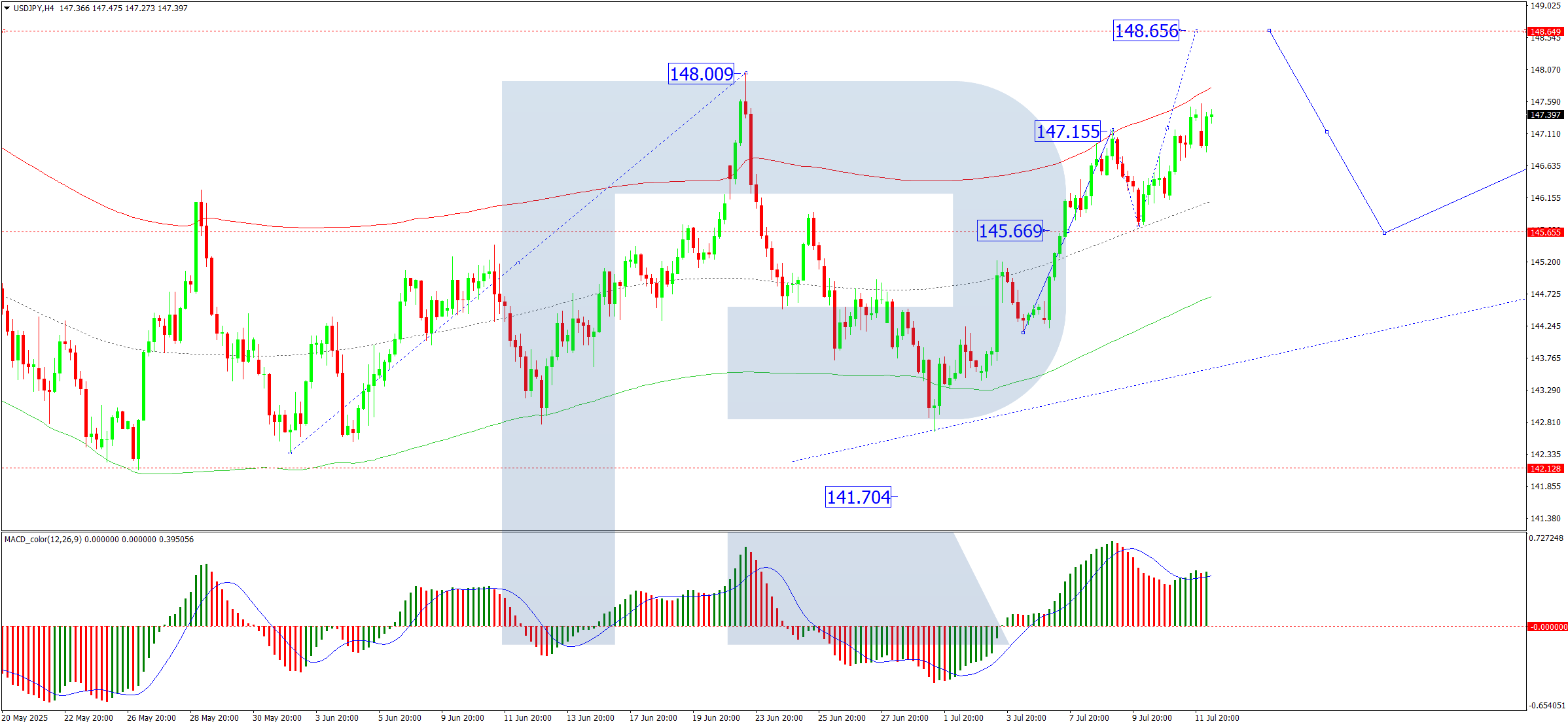
On the H4 chart, USDJPY has broken below the 142.75 level and continues to decline towards 141.56. This move is considered a correction within the broader upward trend. Once this correction ends, a new bullish wave towards 144.00 may begin. A breakout above 144.00 could pave the way for a further rise towards the local target of 146.40. Technically, this scenario is supported by the MACD indicator, as its signal line is below zero and sloping decisively downwards.

On the H1 chart, USDJPY is consolidating around the 142.30 level. A rise towards 142.75 is possible today, followed by a decline to 141.67, which marks a local target for the corrective move. Technically, this scenario is confirmed by the Stochastic oscillator, whose signal line is above 80 and preparing to reverse towards 20.

Conclusion

The yen remains under pressure amid a lacklustre economic performance while traders await fresh cues from the BoJ. While a technical rebound appears likely after the correction, the pair’s near-term trajectory will hinge on trade developments and US tariff policy.


Disclaimer

Any forecasts contained herein are based on the author’s particular opinion. This analysis may not be treated as trading advice. RoboForex bears no responsibility for trading results based on trading recommendations and reviews contained herein.

WTI oil prices continue to decline. The Canadian dollar weakened amid the federal elections

By JustMarkets

At the end of Monday, the Dow Jones Index (US30) rose by 0.28%. The S&P 500 Index (US500) gained 0.06%. The Nasdaq Technology Index (US100) was down 0.09%. Wall Street is gearing up for a busy week of important earnings releases and crucial economic data. Key GDP, inflation, and employment reports coming out this week are expected to provide new insights into the economic outlook. Investors are focused on upcoming quarterly results from Amazon, Apple, Meta Platforms and Microsoft, as well as signs of how President Trump’s sweeping tariffs affect the companies’ prospects. While earnings largely beat expectations, uncertainty surrounding the tariffs caused many companies to lower their second-quarter projections.

The Canadian dollar weakened to around $1.39, reversing gains from the previous session as investors awaited the final election results. Early expectations suggested that Canada’s ruling Liberal Party may retain power, although the final results remain uncertain, as the Liberals are still short of the 172 seats needed for a majority in the 343-seat House of Commons. Mark Carney’s bid for a stronger mandate to manage US tariffs faced opposition from stronger-than-expected Conservatives, raising the possibility of a minority government that may have to negotiate policy support.

The Mexican peso held below 19.6 per US dollar, near a six-month high of 19.51 on April 25, helped by the Bank of Mexico’s hawkish outlook. The country’s unemployment rate hit a record low of 2.2% in March, indicating a resilient labor market in the face of restrictive policies, and core inflation accelerated to 3.9% in mid-April — the highest level since September 2024 — confirming the Bank of Mexico’s decision to keep the benchmark rate at 11%. This large differential in real interest rates continues to attract carry-trade inflows.

Equity markets in Europe were mostly up on Monday. The German DAX (DE40) rose by 0.13%, the French CAC 40 (FR40) closed 0.50% higher, the Spanish IBEX35 (ES35) gained 0.75%, and the British FTSE 100 (UK100) closed positive 0.03%. Hopes for improved trade relations between the US and China also helped boost market sentiment. In Europe, traders were expecting corporate earnings: Porsche, Schneider Electric, and Deutsche Boerse are due to report.

WTI crude prices fell more than 2% to below $62 a barrel on Monday as concerns over rising tariffs threatened to reduce fuel consumption while supply rose. OPEC+ surprised markets by agreeing to raise output by about 411,000 barrels a day in May, reversing much of last year’s cuts, and US oil production is holding steady at a record 13.5 million barrels a day amid a rising rig count. Barrel discounts from Iran and Russia further boosted stocks in Asia, adding to the glut.

Asian markets were mostly rising on Monday. Japan’s Nikkei 225 (JP225) was up 0.38% yesterday, China’s FTSE China A50 (CHA50) was up 0.05%, Hong Kong’s Hang Seng (HK50) was down 0.04%, and Australia’s ASX 200 (AU200) was positive 0.36%. China reiterated that it is not involved in trade talks with the US, clarifying that Chinese President Xi Jinping has not spoken to President Donald Trump despite Trump’s statement in a recent Time interview. Domestically, expectations are rising that the Reserve Bank of Australia will make another 25 basis point rate cut in May amid growing economic uncertainty and worsening global trade concerns. Investors are now awaiting Australian inflation data due for release on Wednesday to gain further insight into the RBA’s future actions.

S&P 500 (US500) 5,528.75 +3.54 (+0.06%)

Dow Jones (US30) 40,227.59 +114.09 (+0.28%)

DAX (DE40) 22,271.67 +29.22 (+0.13%)

FTSE 100 (UK100) 8,417.34 +2.09 (+0.03%)

USD Index 98.93 -0.54 (-0.54%)

News feed for: 2025.04.29

  • German GfK Consumer Confidence (m/m) at 09:00 (GMT+3);
  • US JOLTs Job Openings (m/m) at 17:00 (GMT+3);
  • US CB Consumer Confidence (m/m) at 17:00 (GMT+3).

By JustMarkets


This article reflects a personal opinion and should not be interpreted as an investment advice, and/or offer, and/or a persistent request for carrying out financial transactions, and/or a guarantee, and/or a forecast of future events.

Trade tensions remain in focus. ECB aims at further rate cuts

By JustMarkets 

The Dow Jones Index (US30) gained 0.05% on Friday (+3.10% for the week). The S&P 500 Index (US500) gained 0.74% (for the week +5.59%). The Nasdaq Technology Index (US100) jumped 1.14% (for the week +7.82%). The US stocks closed higher on Friday, posting their fourth consecutive session of gains, helped by strength in large technology companies. Alphabet shares rose by 1.5% after beating earnings expectations, announcing its first-ever dividend, and revealing a $70 billion share repurchase plan. Tesla shares are up 9.8% after unveiling new rules for self-driving cars. Intel is down 7% due to weak expectations, and T-Mobile is down 11% due to low subscriber growth.

President Trump’s recent statements on tariffs have left trade tensions in the spotlight. Trump’s suggestion of 50% tariffs as a “total victory” added uncertainty, and Beijing disputed claims of ongoing negotiations, which offset optimism from China’s decision to exempt some US goods from tariffs.

The University of Michigan’s Consumer Sentiment Index showed inflation expectations for the year ahead jumped to 6.5%, the highest since 1981. However, the figure was slightly lower than the 6.7% in the preliminary release. Long-term inflation expectations rose to 4.4% from 4.1%.

Equity markets in Europe were mostly up on Friday. Germany’s DAX (DE40) rose by 0.81% (for the week +3.77%), France’s CAC 40 (FR40) closed 0.45% higher (for the week +3.07%), Spain’s IBEX 35 (ES35) gained 1.33% (for the week +3.35%), and the UK’s FTSE 100 (UK100) closed 0.09% higher (for the week +1.69%). This is the fourth consecutive session of gains, helped by strong corporate results across Europe and renewed hopes of easing trade tensions between the US and China. Reports that China may slap a 125% tariff on some US imports and President Trump’s more conciliatory tone toward Beijing eased fears of a potentially devastating global trade war.

European Central Bank (ECB) governors are becoming increasingly confident of cutting interest rates in June as inflation continues its downward march. Data from the Eurozone also showed that business activity growth slowed this month, and wage growth is expected to fall significantly. Crucially for inflation, the 20% tariffs tentatively imposed by Trump on European goods have been less harsh than the ECB had anticipated, and the risk of retaliatory measures from the European Union has so far been averted.

WTI crude oil prices rose nearly negative 0.4% to settle at $63/bbl on Friday, but posted a weekly loss of more than positive 1% amid lingering oversupply concerns and uncertainty over US-China trade talks. Market sentiment remained cautious as there were reports that the US and Russia are moving towards ending the conflict in Ukraine, although key terms have yet to be defined. Adding to geopolitical tensions was the fact that the US imposed new sanctions this week against a key Iranian figure involved in the transportation of oil and liquefied natural gas.

Silver prices (XAG/USD) slipped to as low as $33.30 an ounce on Friday, trimming gains made earlier in the week as signs of easing global trade tensions drove the dollar higher, putting pressure on dollar-denominated commodities.

Asian markets were mostly up last week. Japan’s Nikkei 225 (JP225) rose by 3.33%, China’s FTSE China A50 (CHA50) climbed 0.35%, Hong Kong’s Hang Seng (HK50) gained 4.34%, and Australia’s ASX 200 (AU200) posted a positive 2.66%.

China remains confident of achieving its 2025 economic growth target of around 5%. Despite the negative impact of US President Donald Trump’s tariffs, Chinese policymakers are optimistic that the US will soften its stance first, allowing Beijing to proceed with its planned stimulus measures. Central Bank deputy governor Zou Lan reiterated the continuation of moderately loose monetary policy, increased economic support and efforts to keep the yuan stable.

Singapore’s seasonally adjusted unemployment rate rose to 2.1% in Q1 2025, up from 1.9% in the previous three quarters, according to Express estimates. This is the highest unemployment rate in a year, driven by slowing economic activity and escalating global trade tensions. The worsening economic outlook is expected to affect companies’ hiring and wage expectations.

S&P 500 (US500) 5,525.21 +40.44 (+0.74%)

Dow Jones (US30) 40,113.50 +20.10 (+0.050%)

DAX (DE40) 22,242.45 +177.94 (+0.81%)

FTSE 100 (UK100) 8,415.25 +7.81 (+0.093%)

USD Index 99.59 +0.21 (+0.21%)

By JustMarkets


This article reflects a personal opinion and should not be interpreted as an investment advice, and/or offer, and/or a persistent request for carrying out financial transactions, and/or a guarantee, and/or a forecast of future events.

Gold Under Pressure as Market Hopes for US-China Trade Progress

By RoboForex Analytical Department 

The price of gold fell on Monday, dropping to 3,290 USD per troy ounce amid easing market tensions.

Key factors driving gold’s decline

The sell-off in the safe-haven asset was driven by reduced risk aversion, as trade tensions between the US and China showed signs of easing. This weakened gold’s appeal as a traditional hedge against uncertainty.

Earlier, US President Donald Trump hinted at a potential softening of his tough trade stance towards China, signalling the possibility of tariff negotiations. On Friday, China exempted certain US goods from its 25% tariffs, though Beijing stopped short of confirming any scheduled trade talks with Washington.

Additional downward pressure came from a strengthening US dollar, which made dollar-priced gold more expensive for foreign investors.

Upcoming US economic data in focus. This week, a raft of key US economic indicators will be released, including:

  • The first estimate of Q1 2025 GDP
  • Core PCE inflation data for March
  • April employment figures

These reports could provide fresh clues on the Federal Reserve’s next policy moves and the broader economic outlook.

Technical analysis: XAU/USD

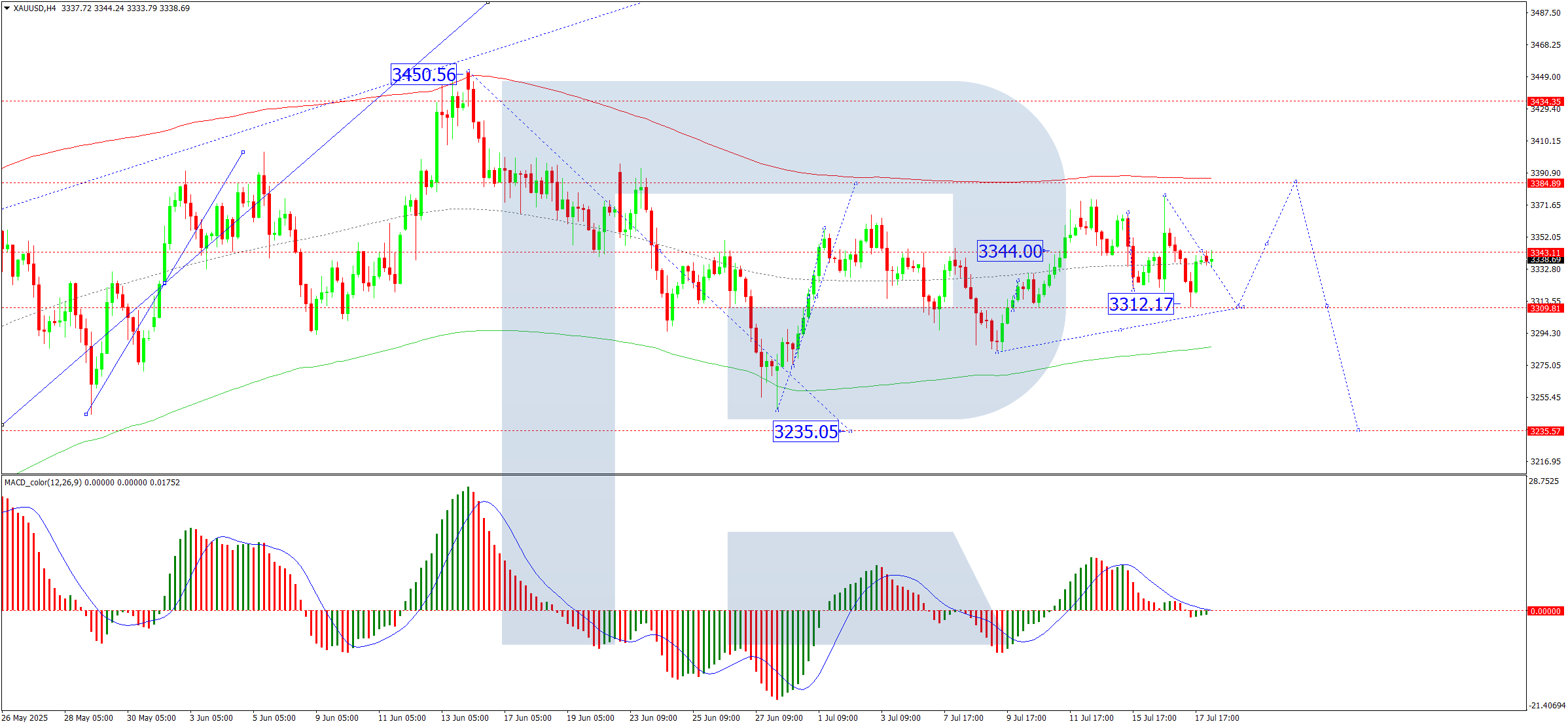
On the H4 chart, XAU/USD is forming the fifth structure in the first wave of decline to the 3,232 level. A move to this target level seems likely. Further, a correction to the level of 3,365 is possible. After completing this correction, a new wave of decline to the 3,100 level is probable. The target is local. Technically, this scenario is confirmed by the MACD indicator, with its signal line under the zero level and directed strictly downwards.

On the H1 chart, XAU/USD has formed a consolidation range around the level of 3,300, and with an exit down, a decline to 3,232 is probable. Today, the fifth wave of the decline to at least 3,232 seems highly likely. Technically, this scenario is confirmed by the Stochastic oscillator. Its signal line is under the 50 level and directed strictly downwards to the 20 level.

Conclusion

Gold remains vulnerable to further losses amid improving US-China trade sentiment and a stronger dollar. Traders will closely monitor upcoming US data for further directional cues.


Disclaimer

Any forecasts contained herein are based on the author’s particular opinion. This analysis may not be treated as trading advice. RoboForex bears no responsibility for trading results based on trading recommendations and reviews contained herein.

Currency Speculators drop US Dollar Index Bets into Bearish territory

By InvestMacro

Speculators OI FX Futures COT Chart

Here are the latest charts and statistics for the Commitment of Traders (COT) data published by the Commodities Futures Trading Commission (CFTC).

The latest COT data is updated through Tuesday April 22nd and shows a quick view of how large market participants (for-profit speculators and commercial traders) were positioned in the futures markets. All currency positions are in direct relation to the US dollar where, for example, a bet for the euro is a bet that the euro will rise versus the dollar while a bet against the euro will be a bet that the euro will decline versus the dollar.

Weekly Speculator Changes led by Canadian Dollar & British Pound

Speculators Nets FX Futures COT Chart

The COT currency market speculator bets were higher this week as eight out of the eleven currency markets we cover had higher positioning while the other three markets had lower speculator contracts.

Leading the gains for the currency markets was the Canadian Dollar (16,693 contracts) with the British Pound (13,981 contracts), the Mexican Peso (7,896 contracts), the New Zealand Dollar (6,183 contracts), the Japanese Yen (5,959 contracts), the Australian Dollar (4,266 contracts), the Swiss Franc (3,110 contracts) and the Brazilian Real (855 contracts) also showing positive weeks.

The currencies seeing declines in speculator bets on the week were the EuroFX (-4,252 contracts), the US Dollar Index (-2,802 contracts) and with Bitcoin (-1,392 contracts) also registering lower bets on the week.

Currency Speculators drop US Dollar Index Bets into Bearish territory

Highlighting the COT currency’s data this week is the continued decrease in sentiment for the US Dollar Index. Speculative positions for the USD Index declined this week by -2,802 contracts and have fallen in five out of the last six weeks. This amounts to a total decline of approximately -10,000 net contracts over the past six weeks.

The deterioration in sentiment has brought the Dollar Index into its first bearish position (currently at -974 net contracts) since December, a span of 19 weeks dating back to December 10th 2024.

The Dollar Index (DXY) price has been falling sharply as well and the DXY closed this week under the major 100.00 level for the first time since a very brief spell in July of 2023. The DXY has tested this level numerous times over the past few years but has bounced higher each time. The DXY price has experienced a sharp decrease since January with an approximate decline by 10% which is a significant move for a major currency in a short amount of time.
The current pricing for the DXY is oversold and could bring dip buyers into the market but continued bearish action would bring the 95 level into play which looks to be the next major historical support level. The next level lower would by the 92-93 area which has not been touched since 2021.

Currencies Data:

Speculators FX Futures COT Data Table

Legend: Open Interest | Speculators Current Net Position | Weekly Specs Change | Specs Strength Score compared to last 3-Years (0-100 range)


Strength Scores led by Japanese Yen & Brazilian Real

Speculators Strength Scores FX Futures COT Chart

COT Strength Scores (a normalized measure of Speculator positions over a 3-Year range, from 0 to 100 where above 80 is Extreme-Bullish and below 20 is Extreme-Bearish) showed that the Japanese Yen (100 percent) and the Brazilian Real (100 percent) are at extreme high levels and lead the currency markets this week. The Canadian Dollar (58 percent) and the EuroFX (54 percent) come in as the next highest in the weekly strength scores.

On the downside, the US Dollar Index (5 percent) comes in at the lowest strength levels currently and is in Extreme-Bearish territory (below 20 percent). The next lowest strength scores are the New Zealand Dollar (33 percent), Bitcoin (34 percent) and the Australian Dollar (38 percent).

3-Year Strength Statistics:
US Dollar Index (4.7 percent) vs US Dollar Index previous week (10.5 percent)
EuroFX (53.5 percent) vs EuroFX previous week (55.1 percent)
British Pound Sterling (45.3 percent) vs British Pound Sterling previous week (39.0 percent)
Japanese Yen (100.0 percent) vs Japanese Yen previous week (98.4 percent)
Swiss Franc (49.3 percent) vs Swiss Franc previous week (43.0 percent)
Canadian Dollar (57.9 percent) vs Canadian Dollar previous week (50.4 percent)
Australian Dollar (37.6 percent) vs Australian Dollar previous week (34.5 percent)
New Zealand Dollar (33.4 percent) vs New Zealand Dollar previous week (26.2 percent)
Mexican Peso (49.7 percent) vs Mexican Peso previous week (45.7 percent)
Brazilian Real (99.7 percent) vs Brazilian Real previous week (98.8 percent)
Bitcoin (33.7 percent) vs Bitcoin previous week (64.1 percent)


Canadian Dollar & New Zealand Dollar top the 6-Week Strength Trends

Speculators Trends FX Futures COT Chart

COT Strength Score Trends (or move index, calculates the 6-week changes in strength scores) showed that the Canadian Dollar (34 percent) and the New Zealand Dollar (30 percent) lead the past six weeks trends for the currencies. The Swiss Franc (23 percent), the EuroFX (20 percent) and the Japanese Yen (12 percent) are the next highest positive movers in the 3-Year trends data.

Bitcoin (-51 percent) leads the downside trend scores currently with the US Dollar Index (-37 percent), Australian Dollar (-5 percent) and the British Pound (-4 percent) following next with lower trend scores.

3-Year Strength Trends:
US Dollar Index (-36.9 percent) vs US Dollar Index previous week (-26.8 percent)
EuroFX (19.8 percent) vs EuroFX previous week (30.2 percent)
British Pound Sterling (-3.9 percent) vs British Pound Sterling previous week (-5.4 percent)
Japanese Yen (12.1 percent) vs Japanese Yen previous week (10.6 percent)
Swiss Franc (23.3 percent) vs Swiss Franc previous week (18.6 percent)
Canadian Dollar (33.7 percent) vs Canadian Dollar previous week (26.8 percent)
Australian Dollar (-4.5 percent) vs Australian Dollar previous week (-7.5 percent)
New Zealand Dollar (30.1 percent) vs New Zealand Dollar previous week (26.2 percent)
Mexican Peso (5.7 percent) vs Mexican Peso previous week (7.0 percent)
Brazilian Real (7.6 percent) vs Brazilian Real previous week (5.6 percent)
Bitcoin (-50.9 percent) vs Bitcoin previous week (-0.6 percent)


Individual COT Forex Markets:

US Dollar Index Futures:

US Dollar Index Forex Futures COT ChartThe US Dollar Index large speculator standing this week came in at a net position of -974 contracts in the data reported through Tuesday. This was a weekly lowering of -2,802 contracts from the previous week which had a total of 1,828 net contracts.

This week’s current strength score (the trader positioning range over the past three years, measured from 0 to 100) shows the speculators are currently Bearish-Extreme with a score of 4.7 percent. The commercials are Bullish-Extreme with a score of 98.0 percent and the small traders (not shown in chart) are Bearish-Extreme with a score of 16.6 percent.

Price Trend-Following Model: Strong Downtrend

Our weekly trend-following model classifies the current market price position as: Strong Downtrend.

US DOLLAR INDEX StatisticsSPECULATORSCOMMERCIALSSMALL TRADERS
– Percent of Open Interest Longs:56.928.29.0
– Percent of Open Interest Shorts:59.822.212.0
– Net Position:-9741,985-1,011
– Gross Longs:18,6969,2862,951
– Gross Shorts:19,6707,3013,962
– Long to Short Ratio:1.0 to 11.3 to 10.7 to 1
NET POSITION TREND:
– Strength Index Score (3 Year Range Pct):4.798.016.6
– Strength Index Reading (3 Year Range):Bearish-ExtremeBullish-ExtremeBearish-Extreme
NET POSITION MOVEMENT INDEX:
– 6-Week Change in Strength Index:-36.938.0-19.8


Euro Currency Futures:

Euro Currency Futures COT ChartThe Euro Currency large speculator standing this week came in at a net position of 65,028 contracts in the data reported through Tuesday. This was a weekly decline of -4,252 contracts from the previous week which had a total of 69,280 net contracts.

This week’s current strength score (the trader positioning range over the past three years, measured from 0 to 100) shows the speculators are currently Bullish with a score of 53.5 percent. The commercials are Bearish with a score of 41.0 percent and the small traders (not shown in chart) are Bullish-Extreme with a score of 90.8 percent.

Price Trend-Following Model: Strong Uptrend

Our weekly trend-following model classifies the current market price position as: Strong Uptrend.

EURO Currency StatisticsSPECULATORSCOMMERCIALSSMALL TRADERS
– Percent of Open Interest Longs:27.355.813.4
– Percent of Open Interest Shorts:18.272.26.0
– Net Position:65,028-117,94152,913
– Gross Longs:196,205401,25796,353
– Gross Shorts:131,177519,19843,440
– Long to Short Ratio:1.5 to 10.8 to 12.2 to 1
NET POSITION TREND:
– Strength Index Score (3 Year Range Pct):53.541.090.8
– Strength Index Reading (3 Year Range):BullishBearishBullish-Extreme
NET POSITION MOVEMENT INDEX:
– 6-Week Change in Strength Index:19.8-23.940.4


British Pound Sterling Futures:

British Pound Sterling Futures COT ChartThe British Pound Sterling large speculator standing this week came in at a net position of 20,490 contracts in the data reported through Tuesday. This was a weekly advance of 13,981 contracts from the previous week which had a total of 6,509 net contracts.

This week’s current strength score (the trader positioning range over the past three years, measured from 0 to 100) shows the speculators are currently Bearish with a score of 45.3 percent. The commercials are Bullish with a score of 51.3 percent and the small traders (not shown in chart) are Bullish with a score of 72.6 percent.

Price Trend-Following Model: Strong Uptrend

Our weekly trend-following model classifies the current market price position as: Strong Uptrend.

BRITISH POUND StatisticsSPECULATORSCOMMERCIALSSMALL TRADERS
– Percent of Open Interest Longs:52.430.316.3
– Percent of Open Interest Shorts:41.044.513.6
– Net Position:20,490-25,4394,949
– Gross Longs:94,02154,47729,322
– Gross Shorts:73,53179,91624,373
– Long to Short Ratio:1.3 to 10.7 to 11.2 to 1
NET POSITION TREND:
– Strength Index Score (3 Year Range Pct):45.351.372.6
– Strength Index Reading (3 Year Range):BearishBullishBullish
NET POSITION MOVEMENT INDEX:
– 6-Week Change in Strength Index:-3.92.83.7


Japanese Yen Futures:

Japanese Yen Forex Futures COT ChartThe Japanese Yen large speculator standing this week came in at a new all-time record high net position of 177,814 contracts in the data reported through Tuesday. This was a weekly gain of 5,959 contracts from the previous week which had a total of 171,855 net contracts.

This week’s current strength score (the trader positioning range over the past three years, measured from 0 to 100) shows the speculators are currently Bullish-Extreme with a score of 100.0 percent. The commercials are Bearish-Extreme with a score of 0.0 percent and the small traders (not shown in chart) are Bullish-Extreme with a score of 100.0 percent.

Price Trend-Following Model: Strong Uptrend

Our weekly trend-following model classifies the current market price position as: Strong Uptrend.

JAPANESE YEN StatisticsSPECULATORSCOMMERCIALSSMALL TRADERS
– Percent of Open Interest Longs:57.628.612.7
– Percent of Open Interest Shorts:7.085.86.1
– Net Position:177,814-200,92223,108
– Gross Longs:202,373100,29944,643
– Gross Shorts:24,559301,22121,535
– Long to Short Ratio:8.2 to 10.3 to 12.1 to 1
NET POSITION TREND:
– Strength Index Score (3 Year Range Pct):100.00.0100.0
– Strength Index Reading (3 Year Range):Bullish-ExtremeBearish-ExtremeBullish-Extreme
NET POSITION MOVEMENT INDEX:
– 6-Week Change in Strength Index:12.1-13.118.1


Swiss Franc Futures:

Swiss Franc Forex Futures COT ChartThe Swiss Franc large speculator standing this week came in at a net position of -25,474 contracts in the data reported through Tuesday. This was a weekly increase of 3,110 contracts from the previous week which had a total of -28,584 net contracts.

This week’s current strength score (the trader positioning range over the past three years, measured from 0 to 100) shows the speculators are currently Bearish with a score of 49.3 percent. The commercials are Bearish with a score of 43.1 percent and the small traders (not shown in chart) are Bullish with a score of 73.4 percent.

Price Trend-Following Model: Strong Uptrend

Our weekly trend-following model classifies the current market price position as: Strong Uptrend.

SWISS FRANC StatisticsSPECULATORSCOMMERCIALSSMALL TRADERS
– Percent of Open Interest Longs:7.374.418.1
– Percent of Open Interest Shorts:42.237.719.8
– Net Position:-25,47426,742-1,268
– Gross Longs:5,32254,22613,198
– Gross Shorts:30,79627,48414,466
– Long to Short Ratio:0.2 to 12.0 to 10.9 to 1
NET POSITION TREND:
– Strength Index Score (3 Year Range Pct):49.343.173.4
– Strength Index Reading (3 Year Range):BearishBearishBullish
NET POSITION MOVEMENT INDEX:
– 6-Week Change in Strength Index:23.3-25.217.0


Canadian Dollar Futures:

Canadian Dollar Forex Futures COT ChartThe Canadian Dollar large speculator standing this week came in at a net position of -67,167 contracts in the data reported through Tuesday. This was a weekly boost of 16,693 contracts from the previous week which had a total of -83,860 net contracts.

This week’s current strength score (the trader positioning range over the past three years, measured from 0 to 100) shows the speculators are currently Bullish with a score of 57.9 percent. The commercials are Bearish with a score of 44.6 percent and the small traders (not shown in chart) are Bearish with a score of 26.8 percent.

Price Trend-Following Model: Strong Uptrend

Our weekly trend-following model classifies the current market price position as: Strong Uptrend.

CANADIAN DOLLAR StatisticsSPECULATORSCOMMERCIALSSMALL TRADERS
– Percent of Open Interest Longs:7.482.29.5
– Percent of Open Interest Shorts:34.352.911.9
– Net Position:-67,16773,173-6,006
– Gross Longs:18,357205,32523,821
– Gross Shorts:85,524132,15229,827
– Long to Short Ratio:0.2 to 11.6 to 10.8 to 1
NET POSITION TREND:
– Strength Index Score (3 Year Range Pct):57.944.626.8
– Strength Index Reading (3 Year Range):BullishBearishBearish
NET POSITION MOVEMENT INDEX:
– 6-Week Change in Strength Index:33.7-35.222.1


Australian Dollar Futures:

Australian Dollar Forex Futures COT ChartThe Australian Dollar large speculator standing this week came in at a net position of -54,582 contracts in the data reported through Tuesday. This was a weekly gain of 4,266 contracts from the previous week which had a total of -58,848 net contracts.

This week’s current strength score (the trader positioning range over the past three years, measured from 0 to 100) shows the speculators are currently Bearish with a score of 37.6 percent. The commercials are Bullish with a score of 60.0 percent and the small traders (not shown in chart) are Bullish with a score of 60.0 percent.

Price Trend-Following Model: Strong Uptrend

Our weekly trend-following model classifies the current market price position as: Strong Uptrend.

AUSTRALIAN DOLLAR StatisticsSPECULATORSCOMMERCIALSSMALL TRADERS
– Percent of Open Interest Longs:14.265.812.7
– Percent of Open Interest Shorts:42.939.410.5
– Net Position:-54,58250,4304,152
– Gross Longs:27,175125,58324,156
– Gross Shorts:81,75775,15320,004
– Long to Short Ratio:0.3 to 11.7 to 11.2 to 1
NET POSITION TREND:
– Strength Index Score (3 Year Range Pct):37.660.060.0
– Strength Index Reading (3 Year Range):BearishBullishBullish
NET POSITION MOVEMENT INDEX:
– 6-Week Change in Strength Index:-4.5-3.029.8


New Zealand Dollar Futures:

New Zealand Dollar Forex Futures COT ChartThe New Zealand Dollar large speculator standing this week came in at a net position of -26,895 contracts in the data reported through Tuesday. This was a weekly increase of 6,183 contracts from the previous week which had a total of -33,078 net contracts.

This week’s current strength score (the trader positioning range over the past three years, measured from 0 to 100) shows the speculators are currently Bearish with a score of 33.4 percent. The commercials are Bullish with a score of 65.0 percent and the small traders (not shown in chart) are Bearish with a score of 46.4 percent.

Price Trend-Following Model: Strong Uptrend

Our weekly trend-following model classifies the current market price position as: Strong Uptrend.

NEW ZEALAND DOLLAR StatisticsSPECULATORSCOMMERCIALSSMALL TRADERS
– Percent of Open Interest Longs:15.877.16.3
– Percent of Open Interest Shorts:58.733.37.2
– Net Position:-26,89527,449-554
– Gross Longs:9,89748,3333,948
– Gross Shorts:36,79220,8844,502
– Long to Short Ratio:0.3 to 12.3 to 10.9 to 1
NET POSITION TREND:
– Strength Index Score (3 Year Range Pct):33.465.046.4
– Strength Index Reading (3 Year Range):BearishBullishBearish
NET POSITION MOVEMENT INDEX:
– 6-Week Change in Strength Index:30.1-31.323.4


Mexican Peso Futures:

Mexican Peso Futures COT ChartThe Mexican Peso large speculator standing this week came in at a net position of 41,165 contracts in the data reported through Tuesday. This was a weekly increase of 7,896 contracts from the previous week which had a total of 33,269 net contracts.

This week’s current strength score (the trader positioning range over the past three years, measured from 0 to 100) shows the speculators are currently Bearish with a score of 49.7 percent. The commercials are Bullish with a score of 52.4 percent and the small traders (not shown in chart) are Bearish with a score of 29.3 percent.

Price Trend-Following Model: Strong Uptrend

Our weekly trend-following model classifies the current market price position as: Strong Uptrend.

MEXICAN PESO StatisticsSPECULATORSCOMMERCIALSSMALL TRADERS
– Percent of Open Interest Longs:51.943.23.7
– Percent of Open Interest Shorts:20.375.72.8
– Net Position:41,165-42,3481,183
– Gross Longs:67,62456,3414,828
– Gross Shorts:26,45998,6893,645
– Long to Short Ratio:2.6 to 10.6 to 11.3 to 1
NET POSITION TREND:
– Strength Index Score (3 Year Range Pct):49.752.429.3
– Strength Index Reading (3 Year Range):BearishBullishBearish
NET POSITION MOVEMENT INDEX:
– 6-Week Change in Strength Index:5.7-6.25.4


Brazilian Real Futures:

Brazil Real Futures COT ChartThe Brazilian Real large speculator standing this week came in at a net position of 49,887 contracts in the data reported through Tuesday. This was a weekly gain of 855 contracts from the previous week which had a total of 49,032 net contracts.

This week’s current strength score (the trader positioning range over the past three years, measured from 0 to 100) shows the speculators are currently Bullish-Extreme with a score of 99.7 percent. The commercials are Bearish-Extreme with a score of 0.4 percent and the small traders (not shown in chart) are Bearish with a score of 31.0 percent.

Price Trend-Following Model: Strong Uptrend

Our weekly trend-following model classifies the current market price position as: Strong Uptrend.

BRAZIL REAL StatisticsSPECULATORSCOMMERCIALSSMALL TRADERS
– Percent of Open Interest Longs:71.223.54.2
– Percent of Open Interest Shorts:15.381.52.2
– Net Position:49,887-51,6821,795
– Gross Longs:63,53421,0103,743
– Gross Shorts:13,64772,6921,948
– Long to Short Ratio:4.7 to 10.3 to 11.9 to 1
NET POSITION TREND:
– Strength Index Score (3 Year Range Pct):99.70.431.0
– Strength Index Reading (3 Year Range):Bullish-ExtremeBearish-ExtremeBearish
NET POSITION MOVEMENT INDEX:
– 6-Week Change in Strength Index:7.6-7.4-0.7


Bitcoin Futures:

Bitcoin Crypto Futures COT ChartThe Bitcoin large speculator standing this week came in at a net position of -806 contracts in the data reported through Tuesday. This was a weekly fall of -1,392 contracts from the previous week which had a total of 586 net contracts.

This week’s current strength score (the trader positioning range over the past three years, measured from 0 to 100) shows the speculators are currently Bearish with a score of 33.7 percent. The commercials are Bullish with a score of 78.7 percent and the small traders (not shown in chart) are Bearish with a score of 38.2 percent.

Price Trend-Following Model: Weak Downtrend

Our weekly trend-following model classifies the current market price position as: Weak Downtrend.

BITCOIN StatisticsSPECULATORSCOMMERCIALSSMALL TRADERS
– Percent of Open Interest Longs:81.83.84.4
– Percent of Open Interest Shorts:84.61.73.8
– Net Position:-806612194
– Gross Longs:23,0581,0801,253
– Gross Shorts:23,8644681,059
– Long to Short Ratio:1.0 to 12.3 to 11.2 to 1
NET POSITION TREND:
– Strength Index Score (3 Year Range Pct):33.778.738.2
– Strength Index Reading (3 Year Range):BearishBullishBearish
NET POSITION MOVEMENT INDEX:
– 6-Week Change in Strength Index:-50.947.725.7


Article By InvestMacroReceive our weekly COT Newsletter

*COT Report: The COT data, released weekly to the public each Friday, is updated through the most recent Tuesday (data is 3 days old) and shows a quick view of how large speculators or non-commercials (for-profit traders) were positioned in the futures markets.

The CFTC categorizes trader positions according to commercial hedgers (traders who use futures contracts for hedging as part of the business), non-commercials (large traders who speculate to realize trading profits) and nonreportable traders (usually small traders/speculators) as well as their open interest (contracts open in the market at time of reporting). See CFTC criteria here.
Speculator Extremes: Yen, BRL, 5-Year & Dollar Index lead Bullish & Bearish Positions

By InvestMacro

The latest update for the weekly Commitment of Traders (COT) report was released by the Commodity Futures Trading Commission (CFTC) on Friday for data ending on April 22nd.

This weekly Extreme Positions report highlights the Most Bullish and Most Bearish Positions for the speculator category. Extreme positioning in these markets can foreshadow strong moves in the underlying market.

To signify an extreme position, we use the Strength Index (also known as the COT Index) of each instrument, a common method of measuring COT data. The Strength Index is simply a comparison of current trader positions against the range of positions over the previous 3 years. We use over 80 percent as extremely bullish and under 20 percent as extremely bearish. (Compare Strength Index scores across all markets in the data table or cot leaders table)


Extreme Bullish Speculator Table


Here Are This Week’s Most Bullish Speculator Positions:

Japanese Yen

The Japanese Yen speculator position, once again, comes in as the most bullish extreme standing this week. The Japanese Yen speculator level is currently at a 100.0 percent score of its 3-year range as the speculator net positioning continues to make new all-time highs for the 3rd week in a row.

The six-week trend for the percent strength score increased by 12.1 this week. The overall net speculator position was a total of 177,814 net contracts this week with a gain of 5,959 contract in the weekly speculator bets.


Speculators or Non-Commercials Notes:

Speculators, classified as non-commercial traders by the CFTC, are made up of large commodity funds, hedge funds and other significant for-profit participants. The Specs are generally regarded as trend-followers in their behavior towards price action – net speculator bets and prices tend to go in the same directions. These traders often look to buy when prices are rising and sell when prices are falling. To illustrate this point, many times speculator contracts can be found at their most extremes (bullish or bearish) when prices are also close to their highest or lowest levels.

These extreme levels can be dangerous for the large speculators as the trade is most crowded, there is less trading ammunition still sitting on the sidelines to push the trend further and prices have moved a significant distance. When the trend becomes exhausted, some speculators take profits while others look to also exit positions when prices fail to continue in the same direction. This process usually plays out over many months to years and can ultimately create a reverse effect where prices start to fall and speculators start a process of selling when prices are falling.


Brazil Real

The Brazil Real speculator position comes up next in the extreme standings this week. The Brazil Real speculator level is now at a 99.7 percent score compared to its 3-year range.

The six-week trend for the percent strength score totaled 7.6 this week. The speculator position registered 49,887 net contracts this week with a weekly rise of 855 contracts in speculator bets.


Nasdaq

The Nasdaq speculator position comes in third this week in the extreme standings. The Nasdaq speculator level resides at a 97.6 percent score of its 3-year range.

The six-week trend for the speculator strength score came in at 23.2 this week. The overall speculator position was 37,680 net contracts this week with an increase by 5,886 contracts in the weekly speculator bets.


Nikkei 225

The Nikkei 225 speculator position comes in at number four in the extreme standings this week as the Nikkei 225 speculator level is at a 96.4 percent score over its 3-year range.

The six-week trend for the speculator strength score totaled a change of 35.0 this week. The overall speculator position was 1,904 net contracts this week with a gain of 2,025 contracts in the speculator bets.


VIX

The VIX speculator position rounds out the top five in this week’s bullish extreme standings with the VIX speculator level at a 89.4 percent score of its 3-year range. The six-week trend for the speculator strength score totaled 10.8 this week.

The speculator position sits at -5,745 net contracts this week with a rise of 11,552 contracts in the weekly speculator bets.


Extreme Bearish Speculator Table


This Week’s Most Bearish Speculator Positions:

5-Year Bond

The 5-Year Bond speculator position comes in as the most bearish extreme standing this week as the 5-Year Bond speculator level is at a 0.0 percent score or the bottom of the 3-year range.

The six-week trend for the speculator strength score was -15.2 this week. The overall speculator position was -2,191,434 net contracts this week with a decrease of -129,859 contracts in the speculator bets.


US Dollar Index

The US Dollar Index speculator position comes in next for the most bearish extreme standing on the week as USD sentiment has been deteriorating. The US Dollar Index speculator level is at just a 4.7 percent score of its 3-year range.

The six-week trend for the speculator strength score was -36.9 this week. The speculator position was -974 net contracts this week with a reduction of -2,802 contracts in the weekly speculator bets.


Wheat

The Wheat speculator position comes in as third most bearish extreme standing of the week. The Wheat speculator level resides at a 6.7 percent score of its 3-year range.

The six-week trend for the speculator strength score was -12.1 this week. The overall speculator position was -93,969 net contracts this week with a decline of -5,643 contracts in the speculator bets.


E-mini SP MidCap400

The E-mini SP MidCap400 speculator position comes in as this week’s fourth most bearish standing with the MidCap400 speculator level at a 11.1 percent score of its 3-year range.

The six-week trend for the speculator strength score was -23.4 this week while the speculator position totaled -86 net contracts this week with a tiny change of 5 contracts in the weekly speculator bets.


2-Year Bond

Finally, the 2-Year Bond speculator position comes in as the fifth most bearish standing for this week. The 2-Year Bond speculator level is at a 13.0 percent score of its 3-year range.

The six-week trend for the speculator strength score was -5.2 this week and the speculator position was -1,297,995 net contracts this week with a drop of -43,222 contracts in the weekly speculator bets.


Article By InvestMacroReceive our weekly COT Newsletter

*COT Report: The COT data, released weekly to the public each Friday, is updated through the most recent Tuesday (data is 3 days old) and shows a quick view of how large speculators or non-commercials (for-profit traders) were positioned in the futures markets.

The CFTC categorizes trader positions according to commercial hedgers (traders who use futures contracts for hedging as part of the business), non-commercials (large traders who speculate to realize trading profits) and nonreportable traders (usually small traders/speculators) as well as their open interest (contracts open in the market at time of reporting). See CFTC criteria here.