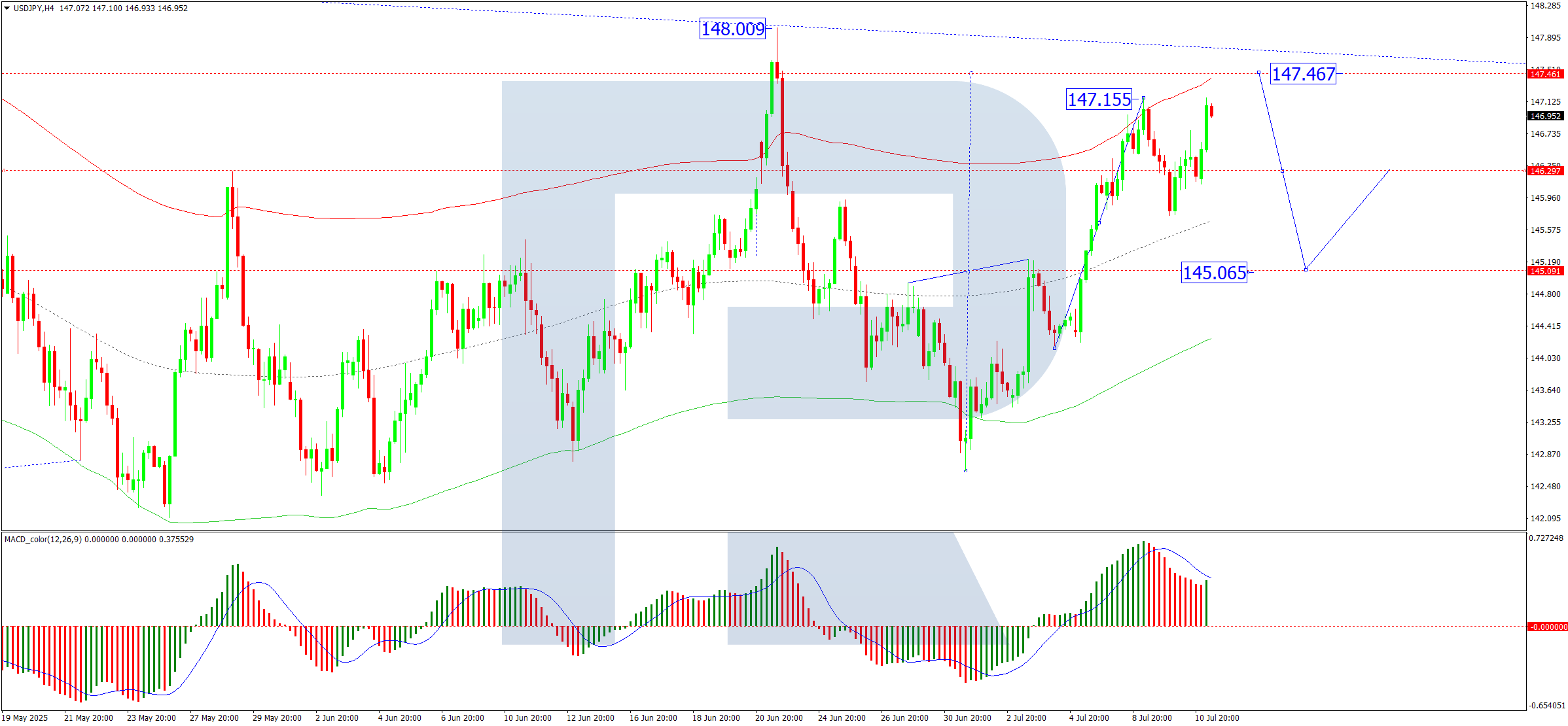
Japanese yen weakens as markets await US employment data

By RoboForex Analytical Department

The USD/JPY pair rose to 143.80 on  Friday, marking a second consecutive day of yen depreciation. The decline comes as traders adopt a wait-and-see stance ahead of a key report on US employment figures.

Market cautious ahead of NFP; political factors also in play

Investors are focused on the imminent US non-farm payrolls (NFP) report, which may influence expectations regarding the Federal Reserve’s next policy move. In the meantime, the market has turned cautious, favouring the US dollar.

Political developments have also contributed. US President Donald Trump and Chinese President Xi Jinping held a telephone conversation and agreed to continue trade negotiations. However, no concrete outcomes or details were disclosed, offering only limited clarity to the geopolitical picture.

Weak domestic data adds pressure on the yen

On the domestic front, Japan posted an unexpected decline in consumer spending for April. Household spending fell by 0.1% y/y, reversing the 1.4% growth in March and missing the 1.0% increase forecast. The drop highlights the impact of rising prices on domestic demand, adding to uncertainty over the pace of the Bank of Japan’s (BoJ) monetary tightening.

Nonetheless, BoJ Governor Kazuo Ueda reiterated that the central bank remains prepared to raise interest rates if the economic and inflation outlook warrants it. The BoJ continues to pursue a measured yet steady approach to policy normalisation.

Technical analysis of USD/JPY

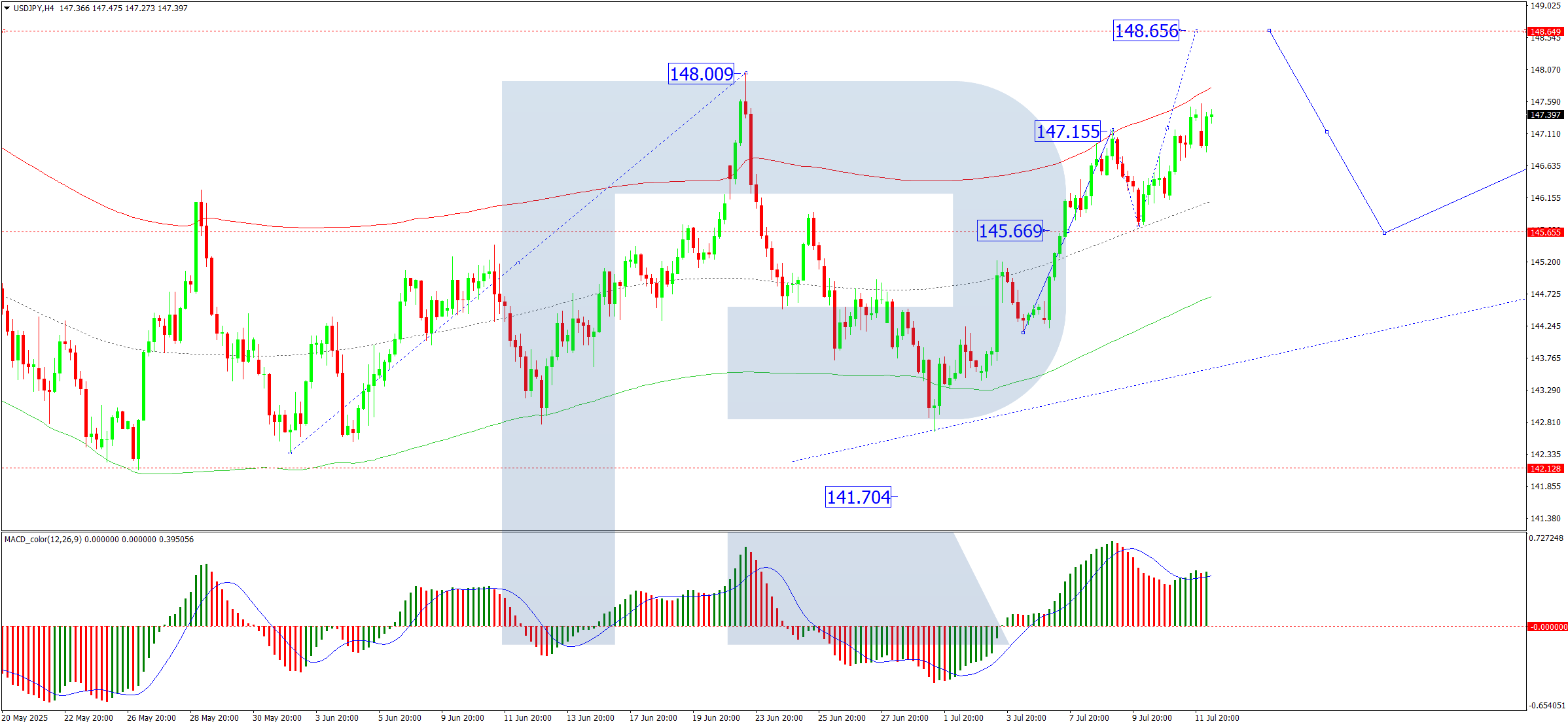
On the H4 chart, USD/JPY continues to consolidate around 143.33. The current move is heading towards 144.23. A downward breakout from this range would pave the way for a decline to 142.20, with a possible extension to 140.50. Conversely, an upward breakout could trigger a bullish move towards 146.25. The MACD indicator supports this scenario, with its signal line below zero and pointing sharply upwards, indicating growing bullish potential.

On the H1 chart, the market is forming a broad consolidation range around 143.33. The structure features a completed growth wave to 143.96, followed by a correction (test from above) to 143.33. The next likely move is an upward push to 144.23, expected to occur today. This may then be followed by a decline to 142.20 and potentially further to 140.50. The Stochastic oscillator supports this setup, with its signal line above 50 and trending towards 80, indicating strong short-term buying pressure.

Conclusion

The yen remains under pressure amid cautious market positioning ahead of US labour data and lingering trade-related uncertainty. Meanwhile, weak Japanese spending data raises questions over the timing of the next BoJ rate hike. Technically, 144.23 is the next key resistance, while 142.20 and 140.50 serve as potential support levels in the event of a reversal. The market’s direction will likely hinge on the outcome of the US NFP report.


Disclaimer

Any forecasts contained herein are based on the author’s particular opinion. This analysis may not be treated as trading advice. RoboForex bears no responsibility for trading results based on trading recommendations and reviews contained herein.

The Bank of Canada unexpectedly kept its rate at 2.75%. A private report on the US labor market points to weakness

By JustMarkets 

At the end of Wednesday, the Dow Jones Index (US30) fell by 0.22%. The S&P 500 Index (US500) rose by 0.01%. The Nasdaq (US100) Tech Index closed up 0.32%. Investors digested a sharp slowdown in private sector employment growth, as the ADP report showed only 37,000 new jobs in May, significantly below expectations and the lowest figure in two years. This data cast a shadow over the upcoming nonfarm payrolls report, raising concerns that trade policy uncertainty is putting pressure on the labor market. Activity in the services sector also declined in May, further heightening concerns about the broader economic outlook. Meanwhile, President Trump doubled tariffs on steel and aluminum imports to 50% and lashed out at Fed Chairman Powell, renewing pressure for interest rate cuts. Hopes for a resolution to trade relations between the US and China dimmed as Trump called Xi Jinping “extremely difficult to work with.”

The Bank of Canada unexpectedly left its base interest rate unchanged at 2.75% in its June 2025 decision (more than 60% of correspondents expected a 0.25% rate cut), which was the second rate hold after a 2.25% point cut in seven consecutive decisions. The Governing Council noted that the ongoing increase and decrease in various US tariffs, combined with the highly uncertain outcome of bilateral trade negotiations and tariff rates remaining significantly above early 2025 levels, create risks of slower growth and raise inflation expectations, which requires caution regarding the continuation of monetary policy easing. The Canadian dollar strengthened to $1.37 per US dollar, its highest level in nearly eight months.

European stock markets traded without a single trend yesterday. The German DAX (DE40) rose by 0.77%, the French CAC 40 (FR40) closed up 0.53%, the Spanish IBEX35 (ES35) lost 0.19%, and the British FTSE 100 (UK100) closed positive 0.16%. European stocks rose on Wednesday, thanks to new tax stimulus measures and progress in trade negotiations between the EU and the US. The German DAX Index rose to a new record high after the government approved a €46 billion tax relief package for the period 2025–2029, aimed at supporting businesses and reviving economic growth. In corporate news, Airbus shares soared more than 4% after reports that Chinese airlines are considering ordering up to 300 aircraft, with a potential deal likely to be concluded as early as next month during a planned visit by European leaders to Beijing.

Silver prices held steady at around $34.50 per ounce on Thursday, reaching their highest level in seven months, as a wave of disappointing economic data from the US put pressure on the dollar and increased demand for safe-haven assets.

WTI oil prices fell more than 1% to below $63 per barrel as Saudi Arabia said it may demand a significant increase in production, heightening concerns about oversupply in the global oil market. The kingdom is reportedly seeking for OPEC+ to increase production by at least 411,000 barrels per day in August and possibly September, seeking to capture market share during peak summer demand. This comes after an increase in production for July was announced over the weekend.

Asian markets were mostly up yesterday. Japan’s Nikkei 225 (JP225) rose by 0.80%, China’s FTSE China A50 (CHA50) added 0.11%, Hong Kong’s Hang Seng (HK50) increased by 0. 60%, and Australia’s ASX 200 (AU200) showed a positive result of 0.89%.

Nominal wages in Japan rose 2.3% year-on-year in April 2025, in line with the pace seen in March but below market expectations of 2.6% growth. Meanwhile, real wages, adjusted for inflation and a key indicator of consumer purchasing power, fell by 1.8%, marking the fourth consecutive month of decline. The weak real wage data underscores the ongoing problem of persistent inflation, which continues to outpace wage growth.

Australia’s trade surplus narrowed to 5.41 billion Australian dollars compared to a slightly revised figure of 6.89 billion Australian dollars in the previous month and below market expectations of 5.90 billion Australian dollars, as exports declined and imports rose. Exports fell 2.4% from the previous month to 44.08 billion Australian dollars. Meanwhile, imports rose by 1.1% to 38.66 billion Australian dollars, recovering from a revised 2.4% decline in the previous month.

S&P 500 (US500) 5,970.81 +0.44 (+0.0074%)

Dow Jones (US30) 42,427.74 −91.90 (−0.22%)

DAX (DE40) 24,276.48 +184.86 (+0.77%)

FTSE 100 (UK100) 8,801.29 +14.27 (+0.16%)

USD Index 98.81 −0.42 (−0.42%)

News feed for: 2025.06.05

  • Australia Trade Balance (m/m) at 04:30 (GMT+3);
  • Caixin China Services PMI (m/m) at 04:45 (GMT+3);
  • Switzerland Unemployment Rate (m/m) at 08:45 (GMT+3);
  • Eurozone ECB Interest Rate Decision at 15:15 (GMT+3);
  • Eurozone ECB Rate Statement at 15:15 (GMT+3);
  • US Trade Balance (m/m) at 15:30 (GMT+3);
  • Canada Trade Balance (m/m) at 15:30 (GMT+3);
  • US Initial Jobless Claims (w/w) at 15:30 (GMT+3);
  • Eurozone ECB Press Conference at 15:45 (GMT+3);
  • Canada Ivey PMI (m/m) at 17:00 (GMT+3);
  • US Natural Gas Storage (w/w) at 17:30 (GMT+3).

By JustMarkets


This article reflects a personal opinion and should not be interpreted as an investment advice, and/or offer, and/or a persistent request for carrying out financial transactions, and/or a guarantee, and/or a forecast of future events.

How your electric bill may be paying for big data centers’ energy use

By Ari Peskoe, Harvard University and Eliza Martin, Harvard University 

In the race to develop artificial intelligence, large technology companies such as Google and Meta are trying to secure massive amounts of electricity to power new data centers. Electric utilities see the prospect of earning large profits by providing electricity to these power-hungry facilities and are competing for their business by offering discounts not available to average consumers.

In our paper Extracting Profits from the Public, we explain how utilities are forcing regular ratepayers to pay for the discounts enjoyed by some of the nation’s largest companies and identify ways policymakers can limit the costs to the public.

Shifting costs

In much of the U.S., utilities are monopolists. Within their service territories, they are the only companies allowed to deliver electricity to consumers. To fund their operations, utilities split the costs of maintaining and expanding their systems among all ratepayers – homeowners, businesses, warehouses, factories and anyone else who uses electricity.

Historically, a utility expanded its system to meet growing demand for electricity from new factories, businesses and homes. To pay for its expansion − new power plants, new transmission lines and other equipment − the utility would propose to raise electricity rates by different amounts for various types of consumers.

Public utility commissions are state agencies charged with ensuring that the public gets a fair deal. These commissions monitor how much money the utility spends to provide electric service and how its costs are shared among various types of ratepayers, including residential, commercial and industrial consumers. Ultimately, the public utility commission is supposed to approve any rate increases based on its assessment of what’s fair to consumers.

Splitting the utility’s costs among all consumers made perfect sense when population growth and economic development across the economy stimulated the need for new infrastructure. But today, in many utility service territories, most of the projected growth in electricity demand is due to new data centers.

Here’s the problem for consumers: To meet data center demand, utilities are building new power plants and power lines that are needed only because of data center growth. If state regulators allow utilities to follow the standard approach of splitting the costs of new infrastructure among all consumers, the public will end up paying to supply data centers with all that power.

A big price tag

One particularly acute example is in Louisiana. A Meta data center under development in the northeastern corner of the state is projected to use, by our calculations, twice as much energy as the city of New Orleans.

Entergy, the regional monopoly utility, is proposing to build more than US$3 billion worth of new gas-fired power plants and delivery infrastructure to meet the data center’s energy demand. Rather than billing Meta directly for these costs, Entergy is proposing to include the costs in rates paid by all customers.

Entergy claims its contract with Meta will cover some portion of the $3 billion price tag and that will mitigate any increases in consumers’ bills. But Entergy has asked state regulators to keep key terms of the contract secret, and only a redacted version of its application is available online.

The public has no idea how much it might pay if the commission approves the contract. And if the Meta data center ends up using much less power than the company anticipates, the public does not know whether it would be on the hook to pay higher electricity rates for longer periods to guarantee Entergy a profit.

Secret agreements

Our research, reviewing nearly 50 public utility commission proceedings about data centers’ power needs across 10 states, uncovered dozens of secretive contracts between utilities and data centers. Unlike Louisiana, most states require utilities to submit to the public utility commission their one-off deals with data centers, but they allow utilities to conceal the pricing terms from the public.

In normal rate-review cases, numerous parties advocate for their interests in a public proceeding, including members of the public, industry groups and the utility itself. But as our paper finds, utility commission reviews of data center contracts are based on confidential utility filings that are inaccessible to the general public. Few, if any, outsiders participate, and as a result the commission often hears only the utility’s version of the deal.

Because the pricing terms are secret, it is impossible to know whether the deal that a utility is offering to a data center is too low to cover the utility’s costs of providing power to the data center, which would mean that the public is subsidizing the deal. History shows, however, that utilities have a long history of exploiting their monopolies to shift costs to the public, including through secret contracts.

Other public costs

Our paper also explores other ways that the public pays for data center energy costs. For instance, many high-voltage interstate transmission projects, which connect large power plants to local delivery systems, are developed through regional planning processes run by numerous utilities. These alliances have complex rules for splitting the costs of new transmission lines and equipment among their utility members.

Once a utility is charged its share, it spreads the costs of new transmission projects among its local ratepayers. Because some regions are building new transmission capacity to accommodate data centers, our analysis finds that the public has been forced to pay billions of dollars for data center growth.

Data center energy costs can also be shifted when data centers connect directly to existing power plants. Under what are called “co-location” deals, the power plant stops selling energy to the wider public and just sells to the data center. With less supply in the overall market, prices go up and the public faces higher bills as a result.

Many state legislatures are noticing these problems and working to figure out how to address them. Several recent bills would set new terms and conditions for future data center deals that could help protect the public from data center energy costs.The Conversation

About the Author:

Ari Peskoe, Lecturer on Law, Harvard University and Eliza Martin, Legal Fellow, Environmental and Energy Law Program, Harvard University

This article is republished from The Conversation under a Creative Commons license. Read the original article.


Gold poised for further gains as US economic outlook deteriorates

By RoboForex Analytical Department 

Gold prices held firm at 3,373 USD per troy ounce on Thursday, remaining near a four-week high. The metal’s strength is being fuelled by mounting concerns over the US economic slowdown, boosting demand for non-yielding safe-haven assets.

US data signals economic distress

The latest reports revealed a contraction in the US service sector for the first time in nearly a year – an alarming sign of broader weakness.

Additionally, the ADP employment report indicated a notable slowdown in private-sector hiring. In May, only 37,000 new jobs were added, far below the expected 111,000 and lower than April’s figure of 60,000.

These weak indicators have bolstered expectations that the Federal Reserve will cut interest rates at least twice this year. Such prospects typically favour gold, as the metal becomes more attractive in a low-rate environment.

Despite Donald Trump’s repeated calls for rate cuts, Fed officials remain cautious, especially in light of persistent trade risks and volatile global conditions.

Attention now shifts to the US non-farm payrolls report, due on Friday, which could provide further clarity on the Fed’s policy path.

Technical analysis of XAU/USD

On the H4 chart, gold is forming the fifth wave of growth, targeting 3,415 USD. The entire structure is viewed as a corrective phase following the previous decline. Once this wave is complete, a new downtrend towards 3,060 USD is anticipated. The MACD indicator supports this scenario, with its signal line above zero and pointing sharply upwards, indicating continued bullish momentum for now.

On the H1 chart, gold formed a consolidation range around 3,331 USD, then broke out upwards, reaching the local target of 3,391 USD. A correction to 3,333 USD has already played out. Currently, the market is developing the final leg of the fifth wave towards 3,417 USD, with a compact consolidation zone forming around 3,374 USD. If gold breaks upwards, the next resistance will be at 3,404 USD, followed by a pullback to 3,374 USD, and then further growth to the 3,417 USD target. The Stochastic oscillator confirms this scenario, with its signal line below 20 and moving sharply upwards towards 80, signalling the potential for near-term upward continuation.


Conclusion

Gold remains well-supported by deteriorating US economic data and expectations of monetary easing by the Fed. As long as concerns over employment, services activity, and trade uncertainty persist, gold’s upward momentum is likely to continue. Key technical levels include support at 3,333 USD and resistance at 3,404-3,417 USD, with broader downside risk emerging only after the current bullish wave concludes.


Disclaimer

Any forecasts contained herein are based on the author’s particular opinion. This analysis may not be treated as trading advice. RoboForex bears no responsibility for trading results based on trading recommendations and reviews contained herein.

The focus is on the BoC meeting. The OECD has lowered its expectations for global economic growth

By JustMarkets 

US stocks rose on Tuesday, thanks to higher tech prices and strong labor market data. At the end of Tuesday, the Dow Jones (US30) Index rose by 0.51%. The S&P 500 (US500) Index added 0.58%. The Nasdaq (US100) Tech Index closed up 0.79%. A stronger-than-expected JOLTS report showed that the number of job openings in April rose by 191,000 to 7.391 million, indicating a resilient labor market despite trade factors. However, the OECD lowered its US economic growth expectations for 2025 to 1.6% from 2.2%, citing political uncertainty and ongoing tariff tensions.

The OECD expects that global economic growth will slow this year, reaching 2.9% in 2025 and 2026, compared to 3.3% last year. The group attributes the downgrade to increased global uncertainty, mainly caused by changes in US trade policy under President Trump.

Today, the Bank of Canada will hold a meeting on monetary policy. Analysts at major financial institutions believe that the continuing softness of the labor market could pave the way for the Bank of Canada to make two additional rate cuts this year, despite recent inflationary pressures. In the context of ongoing trade tensions with the US, economists argue that two 25 basis point rate cuts could provide modest economic support without significantly increasing inflation risks. This implies a potential reduction in the policy rate from the current level of 2.75% to 2.25% by the end of the year. A rate cut, accompanied by a signal of a pause until the fall, could provide moderate support for the Canadian dollar. If the Bank of Canada decides at its meeting to keep the current rate at 2.75%, this is likely to be perceived as a hawkish stance.

European stock markets traded without a single trend yesterday. The German DAX (DE40) rose by 0.67%, the French CAC 40 (FR40) closed up 0.34%, and the Spanish IBEX35 (ES35) fell by 0.52%, and the British FTSE 100 (UK100) closed up 0.15%. The Frankfurt DAX Index added 0.7% and closed at a weekly high of 24,092 on Tuesday, recovering from yesterday’s losses and outperforming its regional competitors. Market sentiment improved as weaker-than-expected inflation data in the Eurozone reinforced expectations of a 25 basis point ECB rate cut later this week. However, the gains were tempered by renewed concerns about global growth after the OECD lowered its economic expectations and political uncertainty in the Netherlands intensified following the collapse of the ruling coalition.

WTI crude oil prices fell to $63 per barrel on Wednesday, extending losses from the previous session, as markets weighed OPEC+ plans to increase production against growing economic concerns over tariffs. On Tuesday, the OECD lowered its global growth expectations, citing growing pressure on the US economy due to escalating trade tensions. Further losses were limited by industrial data showing a larger-than-expected decline in US crude oil inventories: last week, inventories fell by 3.3 million barrels, much more than the expected decline of 0.9 million barrels.

Asian markets traded without a single trend yesterday. Japan’s Nikkei 225 (JP225) fell by 0.06%, China’s FTSE China A50 (CHA50) lost 0.43%, Hong Kong’s Hang Seng (HK50) rose by 1.53%, and Australia’s ASX 200 (AU200) showed a positive result of 0.63% on Tuesday. Shares in Hong Kong rose by 114 points to 23,626 around midday on Wednesday, marking the second consecutive session of gains amid a strengthening of mainly consumer and technology sectors. Hong Kong intends to issue infrastructure and “green” bonds in offshore yuan, Hong Kong dollars, euros, and US dollars as part of a government sustainable bond program.

Australia’s GDP in the first quarter was only 0.2%, significantly below expectations and previous quarters, which reinforced prognoses of further RBA rate cuts. The Reserve Bank of Australia, which has already cut rates twice this year and even considered a more significant cut in May, is expected to downgrade its economic expectations further, and markets now estimate the probability of another rate cut in July at 80%.

S&P 500 (US500) 5,970.37 +34.43 (+0.58%)

Dow Jones (US30) 42,519.64 +214.16 (+0.51%)

DAX (DE40) 24,091.62 +160.95 (+0.67%)

FTSE 100 (UK100) 8,787.02 +12.76 (+0.15%)

USD Index 99.25 −0.54 (−0.55%)

News feed for: 2025.06.04

  • Australia Services PMI (m/m) at 02:00 (GMT+3);
  • Japan Services PMI (m/m) at 03:30 (GMT+3);
  • Australia GDP (q/q) at 04:30 (GMT+3);
  • German Services PMI (m/m) at 10:55 (GMT+3);
  • Eurozone Services PMI (m/m) at 11:00 (GMT+3);
  • UK Services PMI (m/m) at 11:30 (GMT+3);
  • US ADP Nonfarm Employment Change (m/m) at 15:15 (GMT+3);
  • Canada BoC Interest Rate Decision at 16:45 (GMT+3);
  • Canada BoC Rate Statement at 16:45 (GMT+3);
  • US ISM Services PMI (m/m) at 17:00 (GMT+3);
  • Canada Press Conference at 17:30 (GMT+3);
  • US Crude Oil Reserves (w/w) at 17:30 (GMT+3).

By JustMarkets


This article reflects a personal opinion and should not be interpreted as an investment advice, and/or offer, and/or a persistent request for carrying out financial transactions, and/or a guarantee, and/or a forecast of future events.

Broadcom hits fresh all-time highs ahead of key earnings

By ForexTime 

  • Broadcom shares ↑ 85% from 2025 low, recently touching a fresh ATH 
  • Company to release fiscal Q2 earnings after US markets close Thursday 5th June
  • Beyond earnings, all eyes on hyperscalers collaboration and VMware 
  • Broadcom share price forecasted to move 6.5% up/down post earnings 
  • Wall Street analysts remain firmly bullish on stock

Broadcom is set to release its fiscal Q2 2025 earnings after US markets close on Thursday 5th June.

Shares of the chipmaker are up over 10% year-to-date, recently touching a fresh all-time high above $256. 

Zooming out, Broadcom shares have rebounded more than 85% from the 2025 low – fuelled by demand for AI.

Imagen
Broadcom


Broadcom fiscal Q2 earnings: What to look out for

Broadcom designs, develops and supplies various semiconductor devices with Nvidia, Qualcomm and TSMC among a handful of its biggest competitors.

Its core customers are the trillion-dollar titans – Apple, Microsoft, Meta, Amazon and Alphabet.

The chipmaker’s earnings release may reconfirm the strong demand for artificial intelligence following Nvidia’s blowout earnings last week.


Market expectations…

Wall Street expects the chipmaker to post strong earnings thanks to robust demand for AI.

Revenue: forecasted at $15 billion versus $12.5 billion a year ago

Earnings per share (EPS): forecasted at $1.56 versus $1.10 a year ago


Key challenges

  • Ongoing uncertainty around tariffs could disrupt supply chains and company profits.


  • Intense competition from Nvidia, which is now the most valuable company in the world.


Hyperscalers and VMware integration

  • Investors will be paying close attention to Broadcom’s AI-related revenues and collaboration with leading hyperscalers which could boost revenue streams.


  • On June 3rd, Broadcom announced that it is now shipping its new Tomahawk 6 switch series chips, delivering world’s first 102.4 terabits/sec of switching capacity in a single chip


  • VMware momentum is expected to roll over into Q2 with the segment expected to contribute roughly $4.3 billion in revenue.


How will Broadcom react to earnings

Markets currently predict that Broadcom’s stock could move 6.5% up or down when US markets reopen on Friday, 6th June.


BULLISH: Should Broadcom’s past quarterly results and forward guidance boost confidence in its business outlook, this could push prices higher.

Using Tuesday’s closing price of $256.75 as a reference point, a 6.5% climb would see this stock reach a fresh all-time high at $273.44.

BEARISH: Should Broadcom announce disappointing results, prices may tumble.

A 6.5% decline from $256.75 may drag prices to $240.1.

Over the next 12 months….

Wall Street analysts remain bullish on this stock.

46 “Buy” calls 

4 “Hold”

1 “Sells”


Forex-Time-LogoArticle by ForexTime

ForexTime Ltd (FXTM) is an award winning international online forex broker regulated by CySEC 185/12 www.forextime.com

GBP/USD holds near three-year high as pound shows resilience

By RoboForex Analytical Department 

The GBP/USD pair remains steady around 1.3515, maintaining its strength after reaching a three-year high on 26 May. The British pound has shown greater stability than other major currencies amid rising geopolitical and economic pressures.

Pound supported by global tensions and domestic optimism

Ongoing trade tensions between the US and China continue to weigh on market sentiment, indirectly supporting the pound. President Donald Trump’s decision to double tariffs on steel and aluminium triggered an intense backlash from China, which accused the US of breaching the recent trade deal and threatened to retaliate.

At the same time, optimism about the British economy is helping to sustain demand for the pound. The International Monetary Fund (IMF) upgraded the UK’s 2025 growth forecast to 1.2% from 1.1%. However, it also warned Chancellor Rachel Reeves of the need to exercise strict fiscal discipline ahead of her budget presentation on 11 June.

Inflation remains elevated, particularly in the food sector, where prices rose by 4.1% in May – the highest increase since February 2024. According to Kantar, this has prompted UK consumers to seek more discounts and shift towards cheaper brands.

Due to persistent inflation, the market is currently pricing in only a 40-basis-point rate cut from the Bank of England this year.

Technical analysis of GBP/USD

On the H4 chart, GBP/USD continues to develop the fifth wave of growth towards 1.3648. The market is consolidating near 1.3515 and is expected to break upwards towards 1.3616, with the wave potentially extending to 1.3648. If the market breaks downwards, a further correction to 1.3400 is possible before resuming growth. The MACD indicator confirms the bullish scenario, with its signal line above zero and pointing firmly upwards.

On the H1 chart, GBP/USD formed a consolidation range around 1.3515 and broke upwards, nearly hitting the local target of 1.3559. The market is now undergoing a correction, targeting 1.3489. Once this pullback is complete, the next growth wave may reach 1.3583. The Stochastic oscillator supports this view, with its signal line below 50 and heading sharply downwards towards 20, suggesting room for a short-term dip before renewed upward momentum.

Conclusion

GBP/USD remains firm near multi-year highs, supported by a mix of global trade tensions, domestic economic optimism, and elevated inflation. Technically, the outlook remains bullish, with key targets at 1.3583, 1.3616 and 1.3648. Support levels are at 1.3489 and 1.3400 in the event of a pullback. The pound’s relative stability continues to position it as one of the more resilient major currencies in the current environment.


Disclaimer

Any forecasts contained herein are based on the author’s particular opinion. This analysis may not be treated as trading advice. RoboForex bears no responsibility for trading results based on trading recommendations and reviews contained herein.

EUR/USD set to rise as sentiment turns against the US dollar

By RoboForex Analytical Department

The EUR/USD pair rose to 1.1418 before pausing, as bearish sentiment towards the US dollar intensified following the release of disappointing US macroeconomic data and escalating trade tensions.

The dollar is under pressure from weak data and trade uncertainty

The dollar came under renewed pressure after the release of weaker-than-expected US manufacturing activity data for May, which pointed to a deeper-than-anticipated slowdown. These figures indicate that economic risks remain elevated, particularly amid continued trade policy uncertainty under President Donald Trump.

Trump’s recent decision to raise steel import tariffs to 50% sparked fresh concerns and drew sharp criticism from major trading partners, further heightening investor unease.

Tensions with China have also escalated, with Beijing rejecting Trump’s accusations of violating the interim trade deal and vowing retaliatory measures to defend its interests.

Looking ahead, markets will closely monitor a series of US macroeconomic releases due on Tuesday, including job openings, durable goods orders, and factory orders – all of which will help assess the health of the US economy.

The eurozone is also set to publish preliminary inflation data for May, which may influence euro sentiment. However, for now, investors remain optimistic about EUR/USD. Barring any surprises, the pair appears well-supported.

Technical analysis of EUR/USD

On the H4 chart, EUR/USD is extending the fifth wave of growth towards 1.1485. The market has already met the local target at 1.1450, and a short-term correction to 1.1380 is expected next. Once this pullback concludes, a final push towards 1.1485 is likely, marking the end of the current growth wave. From there, a new downward phase may begin, with a target at 1.1210. The MACD indicator supports this scenario, with its signal line above zero and pointing sharply upwards, indicating continued bullish momentum.

On the H1 chart, EUR/USD formed a consolidation range around 1.1350, broke to the upside, and completed the growth structure, reaching a local target of 1.1450 within the fifth wave. A correction to 1.1380 is anticipated, followed by another growth wave towards 1.1485. The Stochastic oscillator confirms this outlook, with its signal line below 20 and preparing to rise towards 80, signalling a potential bullish continuation after the correction.

Conclusion

EUR/USD remains well-positioned for further gains amid mounting US economic concerns and renewed trade tensions. The pair has short-term support at 1.1380 and faces resistance at 1.1485. A reversal could occur once the current growth wave is exhausted, with 1.1210 as a longer-term downside target. For now, technical indicators and market sentiment continue to point to further upside, particularly if upcoming US data confirms a weakening economic outlook.


Disclaimer

Any forecasts contained herein are based on the author’s particular opinion. This analysis may not be treated as trading advice. RoboForex bears no responsibility for trading results based on trading recommendations and reviews contained herein.

Trade tensions between the US and China have escalated again. The silver price rose by 5%

By JustMarkets 

The US stocks rose on Monday, starting June with growth, despite heightened tensions in global trade. At the end of Monday, the Dow Jones Index (US30) rose by 0.08%. The S&P 500 Index (US500) added 0.41%. The Nasdaq Technology Index (US100) closed higher at 0.67%. Tensions between the US and China have risen again after Beijing responded to US accusations of violating the tariff truce by accusing Washington of doing so. Markets are watching for a possible conversation this week between President Trump and Chinese President Xi, which could be decisive in clarifying the trade situation.

The Mexican peso strengthened to 19.2 per US dollar, its highest level in eight months, largely reflecting the weakening of the US dollar amid renewed trade restrictions and dovish shifts in US monetary expectations. Domestically, moderate growth in unemployment to 2.5% in April and stable core inflation support the Bank of Mexico’s decision to keep rates unchanged, underscoring the peso’s resilience amid global headwinds.

The Canadian dollar strengthened above the 1.37 threshold against the US dollar, reaching its highest level in almost eight months, supported by strong domestic economic indicators and rising commodity prices. In the first quarter, Canada’s economy grew by 2.2% year-on-year, exceeding the consensus expectations of 1.7%, thanks to significant growth in exports and accumulation of inventories, as companies began active deliveries ahead of expected steel tariffs in the US, while retail sales also showed notable growth in the second month, indicating broad demand.

European stock markets traded without a single trend yesterday. The German DAX (DE40) fell by 0.28%, the French CAC 40 (FR 40) closed down 0.19%, and the Spanish IBEX35 (ES35) rose by 0.36%, and the British FTSE 100 (UK100) closed up 0.02%. Negotiations between Kyiv and Moscow ended without a ceasefire, with only an agreement on the exchange of prisoners. Investors have now shifted their attention to the upcoming ECB meeting, where another rate cut is expected.

WTI oil prices rose to around $62.9 per barrel on Tuesday, continuing their rise for the second session in a row, as ongoing geopolitical tensions heighten concerns about a reduction in global supply. On Monday, Russia and Ukraine held a second round of direct peace talks after a sharp escalation of hostilities the day before, but the discussions did not yield significant progress in resolving the conflict. Iran is ready to reject the US proposal to end the decades-long nuclear dispute, arguing that it does not serve Tehran’s interests and does not soften Washington’s position on uranium enrichment.

On Monday, silver prices rose more than 5% to $34.60 per ounce, reaching two-month highs, as escalating tensions in global trade increased demand for safe assets. Amid growing uncertainty surrounding global trade policy and its potential economic implications, investors have turned to precious metals as a hedge, causing silver prices to rise alongside gold prices.

Asian markets mostly fell yesterday. Japan’s Nikkei 225 (JP225) fell by 1. 30%, China’s FTSE China A50 (CHA50) lost 0.44%, Hong Kong’s Hang Seng (HK50) decreased by 0.57%, and Australia’s ASX 200 (AU200) posted a negative result of 0.24%.

The Australian dollar weakened to 0.647 US dollars on Tuesday, reversing the sharp rise of the previous session, after the Australian Central Bank said it had considered an excessive rate cut last month. During its May meeting, the Central Bank said that policymakers had considered a bold 50 basis point rate cut as “insurance” against growing global trade risks, but ultimately opted for a more cautious 25 basis point cut. Nevertheless, markets now estimate the probability of another rate cut at the next RBA meeting at around 70%, although many analysts expect the Central Bank to wait for second-quarter inflation data before taking further action.

On Tuesday, the New Zealand dollar fell to around US$0.60, cutting its gains by 1% from the previous session and retreating from its highest level since November last year, as the US dollar regained strength. Investors continued to weigh the risks associated with ongoing global trade tensions, with friction between China and the US intensifying after Beijing rejected Trump’s claim of trade rule violations and vowed to retaliate. Additional pressure on bears came from private data from China showing a sharp decline in factory activity in May, raising concerns about kiwi exports given China’s role as a key trading partner.

S&P 500 (US500) 5,935.94 +24.25 (+0.41%)

Dow Jones (US30) 42,305.48 +35.41 (+0.084%)

DAX (DE40) 23,930.67 −66.81 (−0.28%)

FTSE 100 (UK100) 8,774.26 +1.88 (+0.021%)

USD Index 98.71 −0.62 (−0.62%)

News feed for: 2025.06.03

  • Australia Monetary Policy Meeting Minutes at 04:30 (GMT+3);
  • Caixin China Manufacturing PMI (m/m) at 04:45 (GMT+3);
  • Switzerland Consumer Price Index (m/m) at 09:30 (GMT+3);
  • Eurozone Consumer Price Index (m/m) at 12:00 (GMT+3);
  • Eurozone Unemployment Rate (m/m) at 12:00 (GMT+3);
  • US JOLTs Job Openings (m/m) at 17:00 (GMT+3).

By JustMarkets


This article reflects a personal opinion and should not be interpreted as an investment advice, and/or offer, and/or a persistent request for carrying out financial transactions, and/or a guarantee, and/or a forecast of future events.

OPEC+ announced an increase in oil production. The US and China will hold new trade talks

By JustMarkets 

At the end of Friday, the Dow Jones Index (US30) rose by 0.13% (+1.79% for the week). The S&P500 (US500) Index fell by 0.01% (+2.24% for the week). The Nasdaq (US100) technology Index closed down 0.11% (+2.57% for the week). The US stocks recouped most of their earlier losses in late trading on Friday after Donald Trump said he expected talks with Xi Jinping following accusations that China had violated trade agreements. President Trump said that China had “completely violated” its trade agreement with the US, heightening fears of a protracted dispute. Chipmakers led the decline in the technology sector: Nvidia, AMD, Micron, and Intel fell more than 1.5%. Meanwhile, the Fed’s preferred inflation gauge showed easing price pressures, providing some relief.

The Canadian dollar strengthened above 1.38 per dollar, approaching the seven-month high of 1.37 reached on May 26, as strong data prompted markets to reevaluate the extent of rate cuts by the Bank of Canada. In the first quarter, Canada’s GDP grew by 2.2% year-on-year, significantly exceeding growth expectations of 1.7%. Although much of the support came from strong exports and inventories due to stockpiling ahead of US tariffs, the result was still supported by other data pointing to the resilience of the Canadian economy. Retail sales rose sharply for the second month in a row.

European stock markets were mostly up on Friday. The German DAX (DE40) rose by 0.27% (-0.05% for the week), while the French CAC 40 (FR40) closed down 0.36% (-1.04% for the week), the Spanish IBEX35 (ES35) added 0.25% (-0.75% for the week), and the British FTSE 100 (UK100) closed up 0.64% (+0.38% for the week). Investors welcomed economic data, including favorable inflation data from Germany, Italy, and Spain, which reinforced expectations of an ECB rate cut this week. However, market sentiment was weakened by ongoing trade uncertainty. The Federal Appeals Court overturned a lower court ruling and temporarily reinstated President Donald Trump’s tariffs, a day after they were overturned for exceeding presidential authority.

On Saturday, OPEC+ announced an increase in oil production of 411,000 barrels per day (bpd) in July. The decision was made during a virtual meeting in which member countries, including Saudi Arabia, Russia, Iraq, the UAE, Kuwait, Kazakhstan, Algeria, and Oman, assessed the state of the global market. The group had initially planned a more modest increase of 134,000 barrels per day, but adjusted its strategy, citing “the sustained outlook for the global economy and the current healthy fundamentals of the market, reflected in low oil inventories.” Goldman Sachs expects OPEC+ to complete a 0.41 million barrel per day increase in production in August, which will be the last planned adjustment to the current production strategy.

Asian markets traded without a single trend last week. Japan’s Nikkei 225 (JP225) rose by 2.03%, China’s FTSE China A50 (CHA50) fell by 2.03%, Hong Kong’s Hang Seng (HK50) decreased by 0.92%, and Australia’s ASX 200 (AU200) showed a positive result of 0.89%.

The official PMI Index for China’s manufacturing sector from NBS rose to 49.5 in May 2025 from April’s 16-month low of 49.0, matching market expectations and marking the second consecutive month of decline in business activity. Production volumes recovered (50.7 vs. 49.8 in April), helped by the truce in the trade war and Beijing’s efforts to stimulate domestic demand and strengthen the sluggish economy. The official PMI Index for China’s non-manufacturing sector from the NBS fell to 50.3 in May 2025 from 50.4 in the previous month, falling short of market expectations of 50.6 and marking the lowest level since January.

The Australian dollar rose to around 0.646 on Monday, supported by a weaker US dollar amid investor concerns over US President Donald Trump’s tariff measures. On Friday, Trump announced plans to double tariffs on steel and aluminum imports from 25% to 50% starting June 4. This announcement, along with escalating trade tensions between the US and China, heightened investor concerns about slowing growth and rising inflationary pressures. In Australia, data showed that the manufacturing sector weakened for the second consecutive month in May, falling to its lowest level since February, indicating a slowdown in industrial activity.

Annual inflation in Indonesia fell to 1.60% in May 2025 from an eight-month high of 1.95% in April, as price pressures eased after the Eid al-Fitr celebrations. Inflation remained within the central bank’s target range of 1.5% to 3.5%. Core inflation, which excludes administered and volatile food prices, fell to a four-month low of 2.4% from a 22-month peak of 2.50% in April.

S&P 500 (US500) 5,911.69 −0.48 (−0.01%)

Dow Jones (US30) 42,270.07 +54.34 (+0.13%)

DAX (DE40) 23,997.48 +64.25 (+0.27%)

FTSE 100 (UK100) 8,772.38 +55.93 (+0.64%)

USD Index 99.44 +0.16 (+0.16%)

News feed for: 2025.06.02

  • Australia Manufacturing PMI (m/m) at 02:00 (GMT+3);
  • Japan Manufacturing PMI (m/m) at 03:30 (GMT+3);
  • Switzerland Retail Sales (m/m) at 09:30 (GMT+3);
  • Switzerland GDP (q/q) at 10:00 (GMT+3);
  • Switzerland Manufacturing PMI (m/m) at 10:30 (GMT+3);
  • German Manufacturing PMI (m/m) at 10:55 (GMT+3);
  • Eurozone Manufacturing PMI (m/m) at 11:00 (GMT+3);
  • UK Manufacturing PMI (m/m) at 11:30 (GMT+3);
  • US ISM Manufacturing PMI (m/m) at 17:00 (GMT+3);
  • Eurozone ECB President Lagarde Speaks at 19:30 (GMT+3);
  • US Fed Chair Powell Speaks at 20:00 (GMT+3).

By JustMarkets


This article reflects a personal opinion and should not be interpreted as an investment advice, and/or offer, and/or a persistent request for carrying out financial transactions, and/or a guarantee, and/or a forecast of future events.