Copper Fears Recession

By Ino.com

– The copper futures hit an all-time high this spring. This is not a surprise to many readers who suspected it would – see the poll from late August.

The price has topped at $5.04, missing the preset target area between $5.36-$5.41. After that, copper futures collapsed below the valley of the last summer ($3.96) in the area of $3.60.

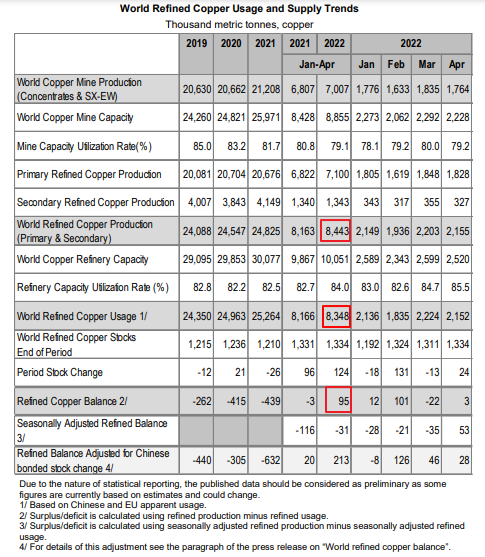
See the latest stats for the copper market in the table below.
World Refined Copper Usage and Supply Trends

Source: The International Copper Study Group (ICSG)
 

According to the table above, the world refined copper production has increased to 8.44 million metric tons in the first four months this year, compared to 8.16 million metric tons for the same period last year.

At the same time, the world usage or demand has grown up either to 8.35 million metric tons in January-April this year from 8.17 million metric tons last year.

As a result, this year the copper balance turned into a surplus of 95 thousand metric tons compared to a deficit of 3 thousand metric tons last year. Moreover, if we take the last line of the table that shows the refined balance of the market adjusted for the Chinese bonded stock change is in even bigger oversupply of 213 thousand metric tons.

As we can see, the market fundamentals could have undermined the uptrend in the copper price in the first place. The following speed up of the futures collapse was fueled by the hawkish Fed, Chinese lockdowns and a new scaring mantra that has been circulating recently in the media about upcoming recession.

One could call it a self-fulfilling prophecy as last Friday the Atlanta Fed posted a second quarterly decline of a real GDP in a row on its GDPNow tracker. The second quarter reading is minus 2.1%, the first quarter reading was minus 1.6%. Technically speaking, this could mean that the forecasted recession is already here.

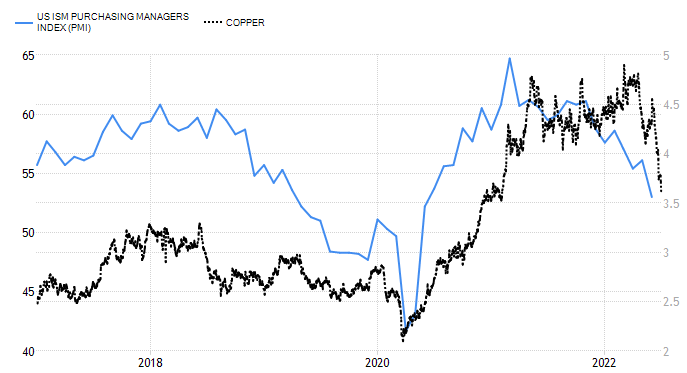
The auxiliary economic data from the graphs below also confirms the economic headwinds for the copper market.
US PMI vs Copper

Source: tradingeconomics.com
 

United States ISM Purchasing Managers Index (PMI) (blue) fell to 53 in June of 2022 from 56.1 in May, demonstrating the slowest growth in factory activity since June of 2020, and below market forecasts of 54.9.

The robust uptrend of copper futures (black) in 2020 was in an accord with U.S. PMI until the start of 2021 where the factory activity has peaked and then started to collapse. The copper price firstly continued further up on the market inertia and then dropped huge to finally catch up with the current fundamentals.
China Industrial Production vs Copper

Source: tradingeconomics.com
 

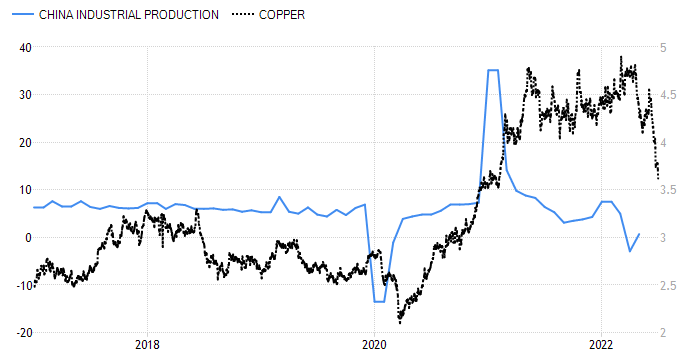
The similar situation has been seen in the chart above of Chinese industrial production (blue). The “World’s factory” performance has also peaked last year, ahead of the top in copper futures (black).

We could see here that the metal has more room to the downside into the $3 area to reach the corresponding level of Chinese data. It is worth to note that the industrial production in China has grown up by 0.7% recently after a relaxation in COVID-19 curbs in some major Chinese cities.
US Consumer Sentiment vs Copper

Source: tradingeconomics.com
 

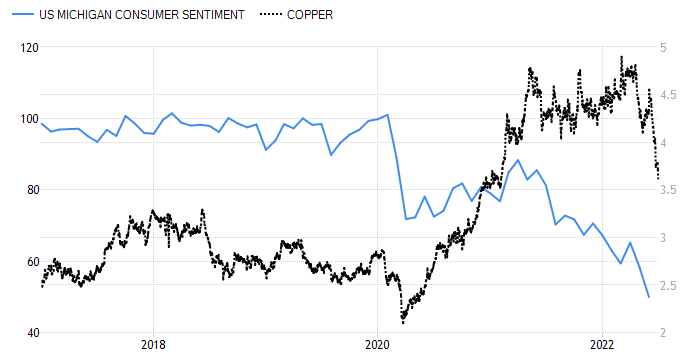
To complete the picture, we should look at the chart above that shows the U.S. consumer confidence (blue) as a main indicator of the initial demand.

The situation is even more depressed here as we can see no progress since the pandemic outbreak. The indicator just made a small rebound within the consolidation in 2020 and then continued to the downside to hit the record low of 50.0 in June 2022.

Let’s look at the updated chart of copper futures below.
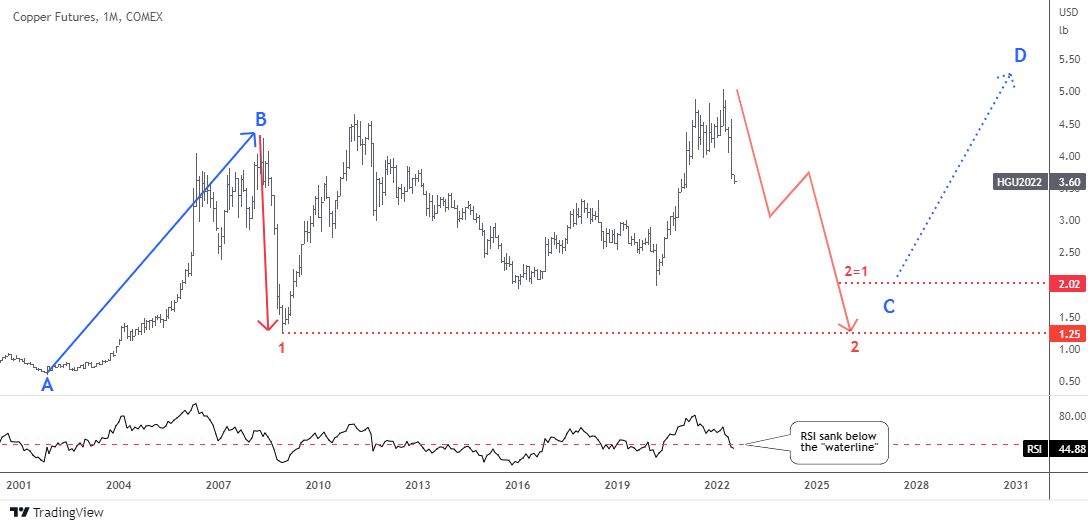
Copper Futures Monthly

Source: TradingView
 

The copper futures price goes well with the plan posted almost a year ago. It didn’t advance too much to the upside to fit with the extended consolidation pattern. We entered the red leg 2 down.

The latter could unfold either like the first straight leg down with a panic selling amid financial crisis of 2008 or it could build a zigzag with a corrective phase in the middle of the drop. More often than not, two legs are not alike.

Two possible downward targets could be set. The closest one is computed using the distance of the first red leg down subtracted from the new all-time high; it is aimed at $2.02. This area coincides with the valley of 2016 and 2020.

The next target is an old one as it Is located at the minimum of the first red leg down at $1.25.

The RSI sank below the so-called “waterline” beneath the crucial 50 level. If it closes this month there than the bearish trend is confirmed.

Intelligent trades!

Aibek Burabayev
INO.com Contributor

Disclosure: This contributor has no positions in any stocks mentioned in this article. This article is the opinion of the contributor themselves. The above is a matter of opinion provided for general information purposes only and is not intended as investment advice. This contributor is not receiving compensation (other than from INO.com) for their opinion.

By Ino.com – See our Trader Blog, INO TV Free & Market Analysis Alerts

Source: Copper Fears Recession

June jobs report suggests Fed could avoid a recession – but room for error is minuscule

By Christopher Decker, University of Nebraska Omaha 

The U.S. economy added more jobs than expected in June, signaling the labor market remains strong even as the Federal Reserve tries to weaken it to tame inflation. The July 8, 2022, jobs report also showed the unemployment rate remained at a 70-year low of 3.6%.

Does this mean the U.S. will avoid a Fed-induced recession?

We asked Christopher Decker, an economist at the University of Nebraska Omaha, to explain the numbers and what they mean for the Fed and the economy.

What did we learn in the June jobs report?

The report showed that the economy added 372,000 jobs in June. While this figure is down from a revised increase of 384,000 in May and is much lower than other recent gains, it’s still very good by historical standards.

Gains were across the board with all key sectors adding to the total increase in nonfarm payrolls.

Generally speaking, people continue to be pulled back into the labor force, largely by higher wages as well as the rising cost of living, which makes it harder for families to go without a steady income stream. For example, the number of people employed part time for economic reasons declined by 707,000 in June. This seems to suggest that there is increased desire for, and an ability to secure, a higher-paying, more stable full-time job.

The female labor force participation rate declined slightly to 56.8% – which is over a percentage point below what it was before the COVID-19 pandemic. This figure is worth watching closely and may be because women are hesitant to reenter the workforce or are struggling to find child care.

So does this mean there won’t be a recession?

That’s the big question.

June gains were strong, but the job market is clearly cooling off. And there’s evidence the broader economy is weakening – two signs the Fed’s recent aggressive efforts to reduce inflation by choking off growth are working.

The housing market is a case in point. Average 30-year mortgage rates shot up to a 13-year high of 5.8% in June after the Fed lifted rates by 0.75 percentage point, which has had a chilling effect on home purchases.

And now we’re seeing the effect in residential construction jobs, which declined for the first time in a year as higher borrowing costs dampened demand. This is a sector I like to look at closely to help determine if what the Fed is doing is taking root in the economy.

In addition, in May, retail sales unexpectedly declined and a forward-looking economic index fell for a second straight month – both signals of a slowing economy.

Can a recession be avoided?

It may seem strange that the U.S. central bank is trying to actually hurt economic growth, but that just shows how important policymakers think it is to fight soaring inflation, which is currently the highest in over 40 years.

The problem of rising prices is of major concern to the Fed, as it is a key component of its “dual mandate” to control inflation and maintain healthy job growth.

Runaway inflation is cancerous to any economy. When price growth outpaces that of income, consumers have to curb spending. Production declines and people lose their jobs. The Fed’s only means of reducing inflation is to curb demand by reducing the supply of money and increasing interest rates. This, however, also curbs economic growth. So the Fed is trying to manage a “soft landing” – which means reducing inflation without hurting growth so much that it causes a recession.

There are some early signs the Fed is succeeding. The economy is slowing, though June jobs show underlying strength in the labor market. At the same time, inflation appears to be easing as well, in part thanks to falling global demand for oil. U.S. gasoline prices – the most visible price consumers see every single day – has come down in recent weeks after peaking at a record US$5 in June.

But executing a soft landing is a delicate dance for the Fed. The central bank can reduce demand for things via interest rates, but it can’t do much about supply. The primary reason energy and food costs have been skyrocketing in recent months is not high demand but the war in Ukraine.

Sanctions on Russia, the world’s second-largest crude oil exporter, and reduced shipments from Russia to parts of Europe have disrupted energy markets and driven up global oil prices.

And Ukraine, a key producer of food and other agricultural goods, is struggling to export corn, wheat and other products because Russia is blockading key ports.

Continuing shortages of energy and food mean inflation could stay elevated no matter what the Fed does. And that could result in the Fed’s having to lift interest rates a lot and cut growth to the bone to have a meaningful effect on rising prices.

This makes the Fed’s current dance the most delicate it has attempted since the 1980s, and it must be executed flawlessly for it to succeed. The June jobs report is good news, but the economy isn’t out of the woods yet. Data in August and September will be crucial to knowing in which direction the economy is heading – toward recession or not.The Conversation

About the Author:

Christopher Decker, Professor of Economics, University of Nebraska Omaha

This article is republished from The Conversation under a Creative Commons license. Read the original article.


Shooting of Shinzo Abe is a huge shock for Japan and the world

By Craig Mark, Kyoritsu Women’s University 

Japan is reeling from the assassination of its longest-serving former prime minister, Shinzo Abe. He was campaigning for the ruling Liberal Democratic Party for the Upper House elections due on Sunday, in the city of Nara in western Japan, when he was shot from behind with an apparently home-made sawn-off shotgun.

The alleged assailant, reportedly a 42-year old local man, was arrested at the scene. There is no known motive at this time, but there are reports the suspect is a former member of the Japanese Maritime Self-Defense Forces.

Abe was seen lying bleeding on the ground, before being taken by helicopter to a nearby hospital where he was later pronounced dead.

Political violence, and gun violence in general, is extremely rare in postwar Japan, so this incident has deeply shocked the Japanese public. Gun ownership is tightly regulated, and mostly restricted to registered hunters.

There have been occasional shootings by organised crime groups, typically targeting each other, but Japan has consistently had low rates of violent crime.

Far-right groups have been responsible for a few attacks on politicians in the postwar period: in 1990, the then mayor of Nagasaki, Hitoshi Motoshima, was shot and wounded; and in 1960 Inejirō Asanuma, leader of the opposition Japan Socialist Party, was stabbed and murdered.

In the pre-war era, democratic politicians found themselves subject to frequent attacks and intimidation by militarists. Prime Minister Inukai Tsuyoshi was murdered by Imperial Navy officers in an attempted coup on May 15 1932.

Abe’s political legacy

Abe, 67, is the grandson of former prime minister Nobusuke Kishi, and was a scion of the conservative Liberal Democratic Party, which has been in government for most of the postwar era. His first stint as prime minister lasted roughly a year, from 2006 to 2007, before he resigned due to ulcerative colitis following his party’s poor performance in the 2007 Upper House elections.

He made a remarkable political comeback in 2012, reclaiming the leadership of the Liberal Democratic Party and winning the general election that December. Abe won national elections in 2014 and 2017, entrenching his power over the weak and divided opposition parties.

He introduced his signature economic policy, “Abenomics”, based on massive deficit spending, quantitative easing and attempts at structural reform. However, twice raising the consumption tax undermined these attempts to lift the Japanese economy out of its decades-long stagnation.

A member of the ultranationalist lobby group Nippon Kaigi, Abe carried out a far-reaching transformation of Japanese foreign and defence policy, reinterpreting the pacifist Article 9 of the Constitution, to allow greater overseas deployment of the Self-Defense Forces.

His government increased defence spending annually, and in 2015 the Diet (the Japanese parliament) passed controversial security bills that allowed the Self-Defense Forces to participate in collective defence operations with allied countries, particularly the United States but potentially also Australia, India and the United Kingdom.

Abe originally raised the concept of the Quad security partnership between Japan, the US, Australia and India, and in 2016 formalised the phrase “free and open Indo-Pacific” as Japan’s main foreign policy goal to preserve the US-led rules-based liberal order in international relations.

His longevity in office saw him become one of the most experienced world leaders, and he used his foreign policy experience to steadily manage the US alliance, handling the erratic President Donald Trump through “golf diplomacy”.

Abe was able to maintain fairly stable relations with neighbouring China, Japan’s largest trading partner, despite the long-running territorial dispute over the Senkaku Islands (claimed as the Daioyus by China). Relations with South Korea remained poor, however, due to disputes over historical issues stemming from Japan’s colonial rule of Korea.

A member of the largest conservative faction in the Liberal Democratic Party, Abe’s dominance over the party and Japanese politics began to erode when the ruling coalition lost its two-thirds majority in the 2019 Upper House election. A long-running series of nepotism scandals also dented his public standing; investigations by public prosecutors led to charges against some of Abe’s associates and political staff, although Abe himself was never indicted.

While Japan coped fairly well with the COVID pandemic, largely due to cooperation with recommended health measures by the public, Abe’s government came under increasing criticism for a series of inept pandemic responses as the economy went into a sharp recession. Abe’s ill-health returned, and he resigned in August 2020, replaced the following month by his former chief cabinet secretary, Yoshihide Suga.

Abe remained in the Diet, and last year became the leader of the Hosoda faction, after backing his former foreign minister and current prime minister Fumio Kishida in the race to become the party’s leader.

Situation still developing

In response to this tragedy, the Liberal Democratic Party has requested that its candidates cease campaigning, and opposition party politicians have also announced they will suspend campaign activities.

Kishida has returned to the prime minister’s office to monitor the situation, but at the time of writing, there has been no announcement about voting arrangements for the Upper House election, due to proceed on Sunday July 10.

In pre-election polling, the Liberal Democratic Party was expected to win a comfortable majority, in partnership with its junior partner, the Komeito party.

The 2022 Upper House election will now remain under the shadow of one of the most disturbing events in Japan’s modern political history.The Conversation

About the Author:

Craig Mark, Professor, Faculty of International Studies, Kyoritsu Women’s University

This article is republished from The Conversation under a Creative Commons license. Read the original article.


How to Prepare for a Hard-Hitting Bear Market (Think 1929-1932)

This metric of bullishness is higher than it was at the top of the dot-com mania

By Elliott Wave International

An important step in preparing for a historic bear market is to embrace cash or cash equivalents.

This may seem obvious, but even with the stock market in a downtrend, cash is shunned by many an investor — retail and professional. Many of these investors believe the bull market will resume — sooner rather than later.

As the May Elliott Wave Theorist, a monthly publication which analyzes financial markets and major cultural trends, noted:

The percentage of assets dedicated to equities in American Association of Individual Investors members’ portfolios remains near a bullish extreme. … They think a “correction” is in force but not a bear market.

So, AAII members have been holding more stocks than cash.

Here in July, investors continue to hold out hope for a resurgence of the bull. This chart and commentary are from the just-published Elliott Wave Financial Forecast:

This chart shows the percentage that U.S. households have in equities relative to their total assets and provides long term context. At 27.5%, the latest reading, from the end of the first quarter, is higher than the peak reading of 26.3% at the top of the dot-com mania in the first quarter of 2000!

Professional market observers likewise dislike cash (Bloomberg, July 27):

S&P Analysts Haven’t Been This Bullish In 20 Years

The point is: If you have a portfolio of mainly cash (or equivalents), you’ll be in the minority, which history shows is usually the best place to be when a market is transitioning from a bear to bull or bull to bear.

Just make sure your cash is kept in the safest institution possible.

You see, speaking of history, Elliott Wave International President Robert Prechter wrote this in his March Elliott Wave Theorist:

Between 1929 and 1933, 9000 banks in the United States closed their doors. … Well before a worldwide depression dominates our daily lives, you will need to deposit your capital into safe institutions.

You may say, “My deposits are insured up to $250,000 by the Federal Insurance Deposit Corporation — why should I worry about my bank’s stability?”

The March Elliott Wave Theorist explains why you should not rely on the F.D.I.C. and provides a wealth of other insights into protecting your financial safety — as well as your physical safety.

If the bear market turns out to be as severe as Elliott Wave International anticipates, social and political turmoil are likely to erupt.

Now is the time to learn the important message of the stock market’s Elliott wave pattern.

If you’re unfamiliar with Elliott wave analysis, you are encouraged to read Frost & Prechter’s Elliott Wave Principle: Key to Market Behavior. Here’s a quote from this Wall Street classic:

The practical goal of any analytical method is to identify market lows suitable for buying (or covering shorts) and market highs suitable for selling (or selling short). When developing a system of trading or investing, you should adopt certain patterns of thought that will help you remain both flexible and decisive, both defensive and aggressive, depending upon the demands of the situation. The Elliott Wave Principle is not such a system, but is unparalleled as a basis for creating one.

Despite the fact that many analysts do not treat it as such, the Wave Principle is by all means an objective study, or as [Charles J.] Collins put it, “a disciplined form of technical analysis.”

Here’s the good news: You can read the entire online version of the book for free once you become a Club EWI member.

Club EWI is the world’s largest Elliott wave educational community with approximately 500,000 worldwide members and is free to join. Members enjoy free access to a treasure trove of Elliott wave resources on investing and trading without any obligations.

Interested? If so, just follow the link and you can have the book on your screen in just a few moments: Elliott Wave Principle: Key to Market Behavior (free and unlimited access).

This article was syndicated by Elliott Wave International and was originally published under the headline How to Prepare for a Hard-Hitting Bear Market (Think 1929-1932). EWI is the world’s largest market forecasting firm. Its staff of full-time analysts led by Chartered Market Technician Robert Prechter provides 24-hour-a-day market analysis to institutional and private investors around the world.

Ichimoku Cloud Analysis 08.07.2022 (EURUSD, GBPUSD, NZDUSD)

Article By RoboForex.com

EURUSD, “Euro vs US Dollar”

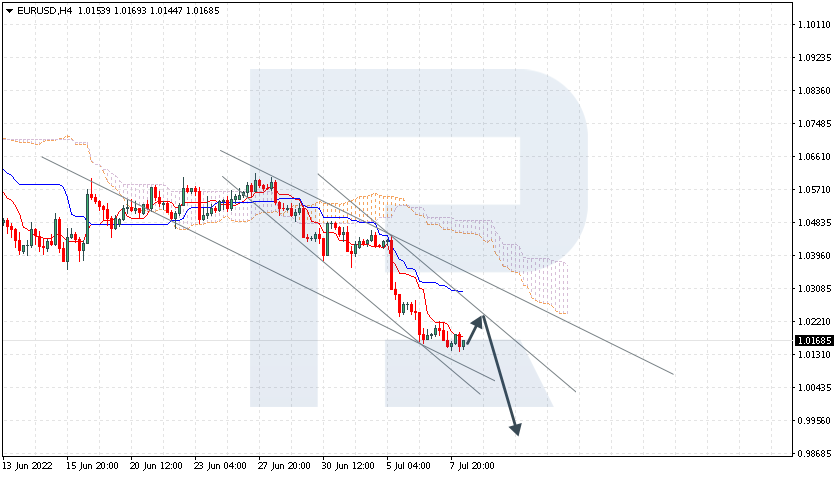
EURUSD is testing Tenkan-Sen. The instrument is currently moving below Ichimoku Cloud, thus indicating a descending tendency. The markets could indicate that the price may test Kijun-Sen at 1.0465 and then resume moving downwards to reach 1.0255. Another signal in favour of a further downtrend will be a rebound from the descending channel’s upside border. However, the bearish scenario may no longer be valid if the price breaks the cloud’s upside border and fixes above 1.0465. In this case, the pair may continue growing towards 1.0575.

EURUSD
Risk Warning: the result of previous trading operations do not guarantee the same results in the future

GBPUSD, “Great Britain Pound vs US Dollar”

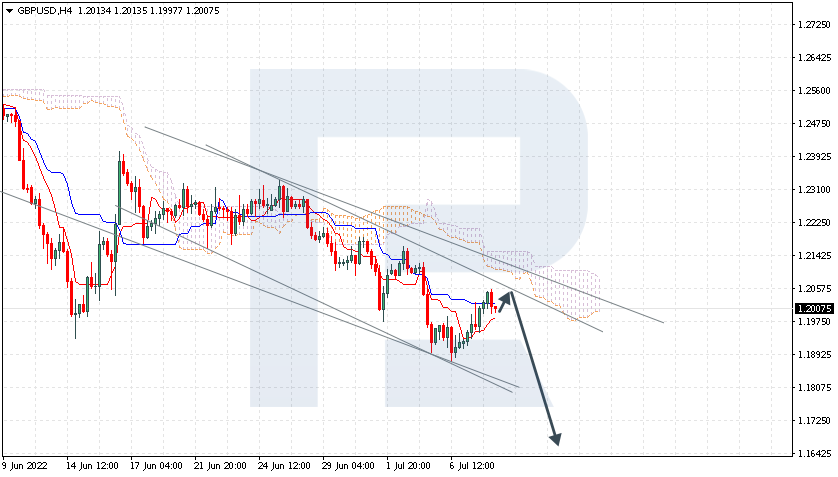
GBPUSD has rebounded from the support level. The instrument is currently moving below Ichimoku Cloud, thus indicating a descending tendency. The markets could indicate that the price may test Kijun-Sen at 1.2055 and then resume moving downwards to reach 1.1645 Another signal in favour of a further downtrend will be a rebound from the descending channel’s upside border. However, the bearish scenario may no longer be valid if the price breaks the cloud’s upside border and fixes above 1.2175. In this case, the pair may continue growing towards 1.2265.

GBPUSD
Risk Warning: the result of previous trading operations do not guarantee the same results in the future

NZDUSD, “New Zealand Dollar vs US Dollar”

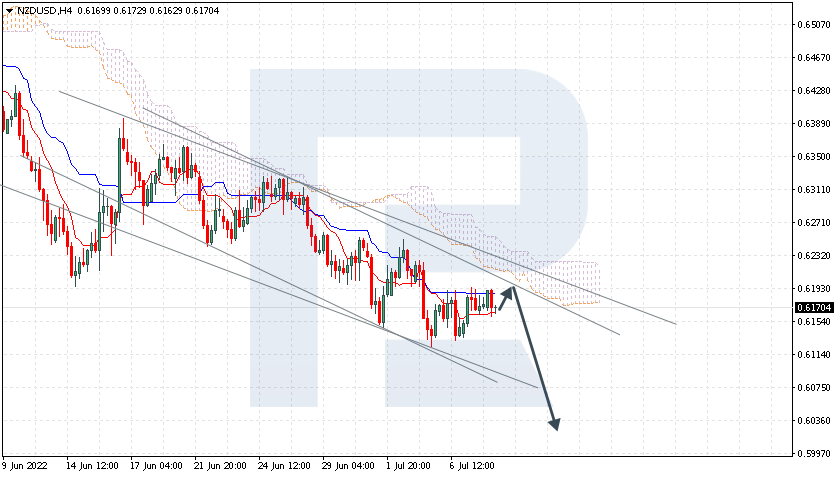
NZDUSD is testing the support level. The instrument is currently moving below Ichimoku Cloud, thus indicating a descending tendency. The markets could indicate that the price may test the cloud’s downside border at 0.6195 and then resume moving downwards to reach 0.6035. Another signal in favour of a further downtrend will be a rebound from the descending channel’s upside border. However, the bearish scenario may no longer be valid if the price breaks the cloud’s upside border and fixes above 0.6265. In this case, the pair may continue growing towards 0.6355.

NZDUSD

Article By RoboForex.com

Attention!
Forecasts presented in this section only reflect the author’s private opinion and should not be considered as guidance for trading. RoboForex LP bears no responsibility for trading results based on trading recommendations described in these analytical reviews.

Week Ahead: Higher-than-expected US inflation could see more USD strength

By ForexTime

Inflation.

You’re probably sick of hearing about it, and likelier still to be sick of living with it.

But that doesn’t mean that markets will ignore it.

Inflation remains arguably the single most important piece of economic data for markets in signalling the road ahead for central banks and the global economy.

With all that in mind, the market’s collective focus is set to be primed towards the upcoming release of the US consumer price index (CPI) amid these scheduled economic data releases and events across major economies:


Monday, July 11

  • CNH: China June FDI
  • JPY: Bank of Japan Governor Haruhiko Kuroda speech
  • NOK: Norway June CPI
  • GBP: BOE Governor Andrew Bailey appears before UK Treasury Committee
  • USD: New York Fed President John Williams speech
  • Natural Gas: Nord Stream 1 gas pipeline undergoes maintenance through July 21

Tuesday, July 12

  • AUD: Australia July consumer and business confidence
  • EUR: Germany July ZEW survey expectations
  • GBP: BOE Governor Andrew Bailey speech

Wednesday, July 13

  • CNH: China June external trade
  • NZD: RBNZ rate decision
  • EUR: Eurozone May industrial production, Germany June CPI (final print)
  • GBP: UK May GDP, industrial production, external trade
  • USD: US June CPI, Fed Beige Book
  • CAD: Bank of Canada rate decision
  • US crude: EIA weekly oil inventory report

Thursday, July 14

  • JPY: Japan May industrial production (final print)
  • AUD: Australia June unemployment, July consumer inflation expectations
  • USD: US weekly jobless claims
  • S&P 500: US earnings season kicks off – JPMorgan, Morgan Stanley

Friday, July 15

  • CNH: China Q2 GDP, June industrial production, retail sales
  • USD: US June retail sales, industrial production, July consumer sentiment, Atlanta Fed President Raphael Bostic speech
  • Wells Fargo, Citigroup Q2 earnings


The median estimate for the June CPI is 8.8%, and if so, would mark the fastest year-on-year rise in consumer prices since the 8.9% print back in December 1981.

Should headline inflation exceed market expectations, that could lead to even more gains for the US dollar.

For recent reference, one only has to look at what transpired immediately following the higher-than-expected May CPI released on June 10th.

That upside inflation surprise placed the equally-weighted USD index en route to a fresh 2022 high, before eventually claiming the 1.20 mark, where it still lingers closeby.


At the time of writing, markets have yet to fully price in another jumbo-sized 75 basis point hike by the Fed at its next policy meeting in the final week of July.

Recall that the Fed triggered a 75bps hike last month – its largest hike since 1994 – with the aim of subduing consumer prices.

Further evidence that US inflation remains stubbornly elevated, despite the Fed already raising rates by 150 basis points so far this year, could mean that the Fed has to remain aggressive in order to maintain its inflation-fighting credibility.


Such a narrative could mean a stronger greenback, especially given that the US economy appears better able to withstand higher interest rates compared to other major economies such as the Eurozone and the UK.

Note these six pairs that make up this USD index, all in equal weights:

  • EURUSD
  • GBPUSD
  • USDCHF
  • USDCAD
  • AUDUSD
  • NZDUSD

Greater divergence in the Fed’s rate hiking plans relative to the ECB/BOE’s (and also widening yield spreads across the Atlantic) could ultimately allow the USD index to keep its head above 1.20, pending how the buck reacts to the US nonfarm payrolls print due in a few hours from now.


Forex-Time-LogoArticle by ForexTime

ForexTime Ltd (FXTM) is an award winning international online forex broker regulated by CySEC 185/12 www.forextime.com

The cryptocurrency market digest (BTC, ETH, XRP). Overview for 08.07.2022

Article By RoboForex.com

The major cryptocurrency is keeping its positive momentum on Friday – the asset has been growing for three session sin a row. At the moment, the instrument is mostly trading around $21,765. The crypto market capitalisation is also increasing – it reached $0.970 trillion. The sector is following the US stock indices. The correlation between S&P 500/NASDAQ and the BTC helps the cryptocurrency to rise.

Later today, market players will closely watch the US labour statistics for June. Strong numbers will make capital markets continue rising, while weak ones will help bears regain dominance.

Technically, the BTC is currently trying to reach the resistance at $23,500 – the asset must fix above this level if it wants to continue rising. If it happens, all the discussions about crypto winter may quiet down. Of course, this scenario may come true, but it’s highly unlikely.

Top 10: BTC and ETH gained the lead

In the last 24 hours, all major cryptos from Top 10 have climbed into positive territory. The best of them were the BTC and the ETH. DOGE, SOL, and ADA gained about 3.5%. The weakest but still positive dynamics were seen in BNB (+1.9%).

Ripple: closer to reality

Ripple and the Columbian government launched the national system to Issue land registry certificates based on XRP Ledger. The system will allow users to register digital assets on XRPL and verify their authenticity with a QRCode.

The UK wants to lay a tax on DeFi

The British government is considering a possibility of laying a tax on crypto loans, as well as token staking in the context of decentralised finance. As a first step, it should be realised how to reduce expenses for industry taxpayers, and then specify whether the taxation scheme can fit to transaction economics.

Article By RoboForex.com

Attention!
Forecasts presented in this section only reflect the author’s private opinion and should not be considered as guidance for trading. RoboForex LP bears no responsibility for trading results based on trading recommendations described in these analytical reviews.

The Analytical Overview of the Main Currency Pairs on 2022.07.08

By JustForex

The EUR/USD currency pair

Technical indicators of the currency pair:
  • Prev Open: 1.0181
  • Prev Close: 1.0161
  • % chg. over the last day: -0.20%

The US dollar declined in the European session on Thursday but remained near a 20-year high yesterday as the Federal Reserve remained hawkish. Many factors are contributing to the dollar’s rise, but the main among them is an aggressive tightening of monetary policy by the US Central Bank. Fed’s last meeting minutes, released on Wednesday, indicated another 75 basis point hike in July. According to analysts, if Europe and the US fall into recession in the third quarter while the Fed continues to raise rates, the EUR/USD exchange rate will fall below 1. The published minutes of the European Central Bank’s June meeting suggest the door is still open for a rate hike of more than 25 basis points at the upcoming July 21 meeting. But for now, the baseline scenario of the ECB raising interest rates by 25 bps in July and another 50 bps in September has the highest probability.

Trading recommendations
  • Support levels: 1.0135
  • Resistance levels: 1.0221, 1.0284, 1.0365, 1.0415, 1.0504, 1.0564, 1.0611

From the technical point of view, the trend on the EUR/USD currency pair on the hourly time frame is bearish. At the moment, the price is trading below the moving averages, and the MACD indicator is in the negative zone, but there is a strong divergence. Under such market conditions, sell deals can be considered from the resistance level of 1.0221 or 1.0284, but only after the additional confirmation. Buy trades are best to look for on intraday time frames from the support level of 1.0135, but only with confirmation and short targets.

Alternative scenario: if the price breaks out through the 1.0415 resistance level and fixes above, the uptrend will likely resume.

EUR/USD
News feed for 2022.07.08:
  • – Eurozone ECB President Lagarde Speaks at 14:55 (GMT+3);
  • – US Nonfarm Payrolls (m/m) at 15:30 (GMT+3);
  • – US Unemployment Rate (m/m) at 15:30 (GMT+3);
  • – US FOMC Member Williams Speaks at 18:00 (GMT+3).

The GBP/USD currency pair

Technical indicators of the currency pair:
  • Prev Open: 1.1921
  • Prev Close: 1.2023
  • % chg. over the last day: +0.86%

Boris Johnson announced that he is stepping down as British Prime Minister. But this did not affect the British pound, on the contrary, the British currency increased yesterday. Traders and investors had already expected this move after dozens of senior ministers resigned in recent days in protest against Johnson’s leadership. Growing obstacles on the macroeconomic front for the UK and monetary policy divergence between the US Federal Reserve and the Bank of England will continue to be the main catalysts for price movements on the GBP/USD currency pair.

Trading recommendations
  • Support levels: 1.1985, 1.1929
  • Resistance levels: 1.2065, 1.2095, 1.2137

From the technical point of view, the trend on the GBP/USD currency pair on the hourly time frame is bearish. The euro and the pound do not correlate at the moment, with the pound showing more resilience. The price is trading below the moving averages, the MACD indicator has become positive, and there is buying pressure. Under such market conditions, sell deals can be considered from the resistance level of 1.2065, but only after the additional confirmation. Buy trades are best to look for on intraday time frames from the support level of 1.1985 or 1.1929, but only with confirmation and short targets.

Alternative scenario: if the price breaks out through the 1.2137 resistance level and fixes above, the uptrend will likely resume.

GBP/USD
There is no news feed for today.

The USD/JPY currency pair

Technical indicators of the currency pair:
  • Prev Open: 135.92
  • Prev Close: 136.01
  • % chg. over the last day: +0.15%

Terrible news came from Japan. During the speech of the former Japanese Prime Minister Shinzo Abe, there was an attempted attack on the Prime Minister, as a result of which, according to preliminary information, Abe suffered a cardiac arrest from his injuries. Shinzo Abe is now in hospital, and his condition is unknown. Several other people were also injured. The suspect has been arrested. The Japanese yen reacted to this event with slight growth.

Trading recommendations
  • Support levels: 135.40, 134.64, 134.11, 133.35, 131.67, 131.00, 130.12, 129.48, 128.76
  • Resistance levels: 135.87, 136.48

From the technical point of view, the medium-term trend on the USD/JPY currency pair is bullish. The MACD indicator has become inactive, and the price continues to form a wide balance. Under such market conditions, buy trades can be considered from the support level of 135.40, but with confirmation. A resistance level of 136.48 is good for sell deals, but only with additional confirmation and short targets.

Alternative scenario: If the price fixes below 133.35, the downtrend will likely resume.

USD/JPY
There is no news feed for today.

The USD/CAD currency pair

Technical indicators of the currency pair:
  • Prev Open: 1.3045
  • Prev Close: 1.2966
  • % chg. over the last day: -0.61%

The outlook for the Canadian dollar is becoming less optimistic due to growing recession fears. Many analysts believe the Canadian dollar has strengthened throughout the year due to rising oil prices. Oil has fallen about $25 in recent weeks, diving below $100 a barrel, and Canada’s commodity-linked stock market has fallen by 15% below its March record high. However, it should be noted that the Bank of Canada has been aggressively raising interest rates during this time to keep up with the US Federal Reserve’s fight against inflation. Meanwhile, the Bank of Canada intends to raise its overnight rate by 75 basis points next week and another 50 bps in September. Currently, the risks are shifting to a lower Canadian dollar if a recession in the US occurs before Canada and oil prices continue to fall.

Trading recommendations
  • Support levels: 1.2959, 1.2934, 1.2894
  • Resistance levels: 1.3021, 1.3052

In terms of technical analysis, the trend on the USD/CAD currency pair is bullish. The price has corrected to the average values, and the MACD indicator has become inactive. Under such market conditions, it is best to look for buy trades on the lower time frames from the support level of 1.2959 or 1.2934. For sell deals, it is best to consider the resistance level of 1.3021, but it is also better with confirmation and short targets.

Alternative scenario: if the price breaks through and consolidates below the 1.2894 support level, the downtrend will likely resume.

USD/CAD
News feed for 2022.07.08:
  • – Canada Unemployment Rate (m/m) at 15:30 (GMT+3).

By JustForex


This article reflects a personal opinion and should not be interpreted as an investment advice, and/or offer, and/or a persistent request for carrying out financial transactions, and/or a guarantee, and/or a forecast of future events.

Boris Johnson has resigned. Assassination attempt on former Japanese Prime Minister Shinzo Abe

By JustForex

The US Federal Reserve officials Bullard and Waller had nothing new to say yesterday. The labor market remains resilient, monetary tightening is already affecting the economy, and expectations for economic growth – that was said many times before. To summarize, the US Fed remains hawkish. The minutes of the Fed’s last meeting, released Wednesday, indicated another 75 basis point hike in July.

Initial US jobless claims rose to their highest level since January. Analysts continue to note that the labor market remains tight. The main focus of investors today will be Non-farm Payrolls data in the US. If the data is worse than expected, it could be a reason for the Fed to reconsider a rate hike down to 50 basis points in July.

US indices jumped yesterday thanks to a rebound in energy stocks on the back of rising oil prices. The Dow Jones (US30) added 1.12% at the close of trading, while the S&P 500 (US500) increased by 1.50%. The Technology Index NASDAQ (US100) gained 2.28% on Thursday. All three indices closed on the plus side at the end of the day.

Stock markets in Europe were mostly up yesterday. German DAX (DE30) gained 1.97%, French CAC 40 (FR40) jumped by 1.60%, Spanish IBEX 35 (ES35) gained 2.19%, British FTSE 100 (UK100) was up by 1.14%.

Deutsche Bank suggested that the euro could fall into the $0.95-0.97 range if Europe and the US are dragged into a deeper recession. The Eurozone’s single currency has been steadily declining as recession fears are heightened amid growing uncertainty over energy supplies as Russia threatens to cut gas supplies to Germany further and the continent as a whole.

Boris Johnson has announced that he is stepping down as British prime minister. Traders and investors had already expected this step after dozens of high-ranking ministers resigned in recent days in protest against Johnson’s leadership.

Hungary’s national bank raised its key weekly deposit rate by 200 basis points to 9.75%, the highest level in a decade, to stem a weakening currency exacerbating an increasingly acute inflation problem. Core consumer prices in the country rose more than 12% from the beginning of the year through May, while food prices rose by 20% a year earlier.

Natural gas futures continue to rise as the EIA reports a smaller-than-expected increase in US inventories. The government said total working gas inventories in storage are 2.311 trillion cubic feet, down 261 billion cubic feet from a year ago and 322 billion cubic feet below the five-year average.

Oil prices soared again yesterday, with WTI climbing sharply above $100 amid rumors of a power outage in Texas that could lead to capacity cuts. Meanwhile, crude oil inventories data unexpectedly rose by 8.2 million barrels while forecasting a decline of 2.8 million barrels. There is still a supply shortage, so analysts think traders should not expect oil prices to fall too much.

Asian markets closed yesterday with a growth. Japan’s Nikkei 225 (JP225) gained 1.47% yesterday, Hong Kong’s Hang Seng (HK50) gained 0.26% on the day, and Australia’s S&P/ASX 200 (AU200) was up by 0.81% on Thursday.

Terrible news came from Japan. During the speech of the former Japanese Prime Minister Shinzo Abe, there was an attack on the prime minister. According to preliminary information, Abe suffered a cardiac arrest from his injuries. Shinzo Abe is now in hospital, and his condition is unknown. There were also several other people. The suspect has been arrested.

S&P 500 (F) (US500) 3,902.62 +57.54 (+1.50%)

Dow Jones (US30) 31,384.55 +346.87 (+1.12%)

DAX (DE40) 12,843.22 +248.70 (+1.97%)

FTSE 100 (UK100) 7,189.08 +81.31 (+1.14%)

USD Index 107.09 0.00 (+0.00%)

Important events for today:
  • – Eurozone ECB President Lagarde Speaks at 14:55 (GMT+3);
  • – US Nonfarm Payrolls (m/m) at 15:30 (GMT+3);
  • – US Unemployment Rate (m/m) at 15:30 (GMT+3);
  • – Canada Unemployment Rate (m/m) at 15:30 (GMT+3);
  • – US FOMC Member Williams Speaks at 18:00 (GMT+3).

By JustForex


This article reflects a personal opinion and should not be interpreted as an investment advice, and/or offer, and/or a persistent request for carrying out financial transactions, and/or a guarantee, and/or a forecast of future events.

UK political drama adds to GBP’s woes

By ForexTime

News that Boris Johnson has resigned as UK Prime Minister offered scant relief for the British Pound.

Though climbing some 0.4% at the time of writing, GBPUSD is straining to hang on to the psychologically-important 1.20 level.

Today’s bounce could be down to some price action surrounding the rumour and the fact, noting that expectations surrounding Johnson’s resignation had been bubbling for some time now.

Technical forces could even be at play today, with GBPUSD’s 14-day relative strength index pulling away from the 30 threshold which denotes oversold conditions.

Overall, today’s headlines out of 10 Downing Street hasn’t resulted in a seismic move for GBPUSD.


To be fair to the beleaguered Sterling, it is set for its largest single-day gain so far this month – scant consolation when put into its proper context, as seen in the chart above.

The British Pound though is registering an advance against all of its G10 peers for the day, except against commodity-linked currencies such as the Australian dollar and the New Zealand dollar.


And yet, there are other more-pressing factors that are set to keep the Pound on the back foot for the months ahead.


For one, the UK may already be in a recession, considering that its economic data has made for some dismal reading:

  • UK economy saw an unexpected contraction back in April, shrinking by 0.3% compared to March – its sharpest drop in over a year. Q2 data suggests another quarterly contraction – fulfilling the criteria for a technical recession.
  • The UK is running a massive current account deficit, which ran at 4.2% of its GDP in the first quarter this year – one of the largest such deficits in the world!
  • UK inflation is at its highest in 40 years. The May consumer price index (CPI – which is used to measure top line inflation) rose by 9.1% in May – its highest reading since Q1 1982. Inflation is also forecasted to reach double-digits in Q4 2022.


And although the Bank of England (BOE) appears committed to hiking its rates in the name of cooling scorching-hot inflation, such aggressive moves only ramp up the prospects of a UK recession, given such weak underlying economic fundamentals.

In fact, the BOE had already issued a warning back in May of a possible recession.

Also back in May, our article featured this line: “A path towards 1.20 may prove likelier for this currency pair known as ‘cable’, rather than a path back up to 1.30.”


But wait, there’s more.

There are still Brexit risks to contend with, while surge in Covid-19 cases in the UK aren’t helping matters.


Of course, the fiscal outlook (how the government can support the UK economy) is very much dependent on the policies of the incoming UK Prime Minister, and it could be weeks or months before Johnson’s replacement is determined, with more time needed for their policies to be formed, and later still to be enacted before showing up in the real economic data.

As things stand, markets are pricing in a 60% chance that we could see GBPUSD reach 1.15 sometime in Q4.

In short, there’s hardly any reason to be optimistic about the UK economic outlook, which is set to expose GBPUSD to more downside, while hampering cable’s ability to register any significant recovery over the near term.


Forex-Time-LogoArticle by ForexTime

ForexTime Ltd (FXTM) is an award winning international online forex broker regulated by CySEC 185/12 www.forextime.com