COT Week 29 Charts: Stock Market Speculator bets mostly higher led by Russell 2000 & Nasdaq

By InvestMacro | COT | Data Tables | COT Leaders | Downloads | COT Newsletter

Here are the latest charts and statistics for the Commitment of Traders (COT) data published by the Commodities Futures Trading Commission (CFTC).

The latest COT data is updated through Tuesday July 19th and shows a quick view of how large traders (for-profit speculators and commercial entities) were positioned in the futures markets.

Weekly Speculator Changes

COT stock market speculator bets were mostly higher this week as five out of the seven stock markets we cover had higher positioning this week while the other three markets had lower contracts.

Leading the weekly gains for stock markets was Russell 2000 Mini (17,089 contracts) with the Nasdaq Mini (8,701 contracts), S&P500 Mini (7,380 contracts) and the Dow Jones Industrial Average Mini (4,006 contracts) also showing positive weeks.

The stock markets leading the declines in speculator bets this week were MSCI EAFE Mini (-3,637 contracts) with VIX (-3,533 contracts) and Nikkei 225 USD (-1,176 contracts) also registering lower bets on the week.


Data Snapshot of Stock Market Traders | Columns Legend
Jul-19-2022OIOI-IndexSpec-NetSpec-IndexCom-NetCOM-IndexSmalls-NetSmalls-Index
S&P500-Mini2,335,3199-208,14818266,346100-58,19814
Nikkei 22513,3247-3,127633,34146-21426
Nasdaq-Mini256,3884628,11791-19,55514-8,56231
DowJones-Mini71,27730-15,8371620,98488-5,14711
VIX308,12429-69,9007476,07726-6,17761
Nikkei 225 Yen64,010495,1775025,66889-30,84511


Strength Scores

Strength Scores (a normalized measure of Speculator positions over a 3-Year range, from 0 to 100 where above 80 is extreme bullish and below 20 is extreme bearish) show that the Nasdaq-Mini (90.7 percent) lead the stocks is currently in a bullish extreme level. The VIX (74.2 percent) and the Nikkei USD (62.6 percent) comes in as the next highest stock markets in strength scores. On the downside, the EAFE-Mini (8.5 percent) comes in at the lowest strength level currently and is followed by the Russell 2000-Mini (10.1 percent), the DowJones-Mini (16.1 percent) and the S&P500-Mini (17.6 percent). All four of those markets are in bearish extreme levels at the moment (below 20 percent).

Strength Statistics:
VIX (74.2 percent) vs VIX previous week (76.0 percent)
S&P500-Mini (17.6 percent) vs S&P500-Mini previous week (16.3 percent)
DowJones-Mini (16.1 percent) vs DowJones-Mini previous week (11.1 percent)
Nasdaq-Mini (90.7 percent) vs Nasdaq-Mini previous week (85.9 percent)
Russell2000-Mini (10.1 percent) vs Russell2000-Mini previous week (0.5 percent)
Nikkei USD (62.6 percent) vs Nikkei USD previous week (68.2 percent)
EAFE-Mini (8.5 percent) vs EAFE-Mini previous week (12.6 percent)

Strength Trends

Strength Score Trends (or move index, calculates the 6-week changes in strength scores) show that the Nasdaq-Mini (6.2 percent) and DowJones-Mini (5.7 percent) lead the past six weeks trends for stocks this week. The S&P500-Mini (-35.4 percent) leads the downside trend scores currently while the next market with lower trend scores were the EAFE-Mini (-30.9 percent) followed by the Nikkei USD (-21.8 percent).

Strength Trend Statistics:
VIX (-6.3 percent) vs VIX previous week (-10.8 percent)
S&P500-Mini (-35.4 percent) vs S&P500-Mini previous week (-44.0 percent)
DowJones-Mini (5.7 percent) vs DowJones-Mini previous week (7.8 percent)
Nasdaq-Mini (6.2 percent) vs Nasdaq-Mini previous week (7.7 percent)
Russell2000-Mini (-15.3 percent) vs Russell2000-Mini previous week (-22.2 percent)
Nikkei USD (-21.8 percent) vs Nikkei USD previous week (5.4 percent)
EAFE-Mini (-30.9 percent) vs EAFE-Mini previous week (-20.7 percent)


Individual Markets:

VIX Volatility Futures:

VIX Volatility Futures COT ChartThe VIX Volatility large speculator standing this week equaled a net position of -69,900 contracts in the data reported through Tuesday. This was a weekly decline of -3,533 contracts from the previous week which had a total of -66,367 net contracts.

This week’s current strength score (the trader positioning range over the past three years, measured from 0 to 100) shows the speculators are currently Bullish with a score of 74.2 percent. The commercials are Bearish with a score of 26.1 percent and the small traders (not shown in chart) are Bullish with a score of 61.4 percent.

VIX Volatility Futures StatisticsSPECULATORSCOMMERCIALSSMALL TRADERS
– Percent of Open Interest Longs:15.556.87.9
– Percent of Open Interest Shorts:38.232.19.9
– Net Position:-69,90076,077-6,177
– Gross Longs:47,762175,04324,318
– Gross Shorts:117,66298,96630,495
– Long to Short Ratio:0.4 to 11.8 to 10.8 to 1
NET POSITION TREND:
– Strength Index Score (3 Year Range Pct):74.226.161.4
– Strength Index Reading (3 Year Range):BullishBearishBullish
NET POSITION MOVEMENT INDEX:
– 6-Week Change in Strength Index:-6.36.4-2.4


S&P500 Mini Futures:

The S&P500 Mini large speculator standing this week equaled a net position of -208,148 contracts in the data reported through Tuesday. This was a weekly boost of 7,380 contracts from the previous week which had a total of -215,528 net contracts.

This week’s current strength score (the trader positioning range over the past three years, measured from 0 to 100) shows the speculators are currently Bearish-Extreme with a score of 17.6 percent. The commercials are Bullish-Extreme with a score of 100.0 percent and the small traders (not shown in chart) are Bearish-Extreme with a score of 14.2 percent.

S&P500 Mini Futures StatisticsSPECULATORSCOMMERCIALSSMALL TRADERS
– Percent of Open Interest Longs:10.776.89.6
– Percent of Open Interest Shorts:19.665.412.1
– Net Position:-208,148266,346-58,198
– Gross Longs:250,3871,792,747223,471
– Gross Shorts:458,5351,526,401281,669
– Long to Short Ratio:0.5 to 11.2 to 10.8 to 1
NET POSITION TREND:
– Strength Index Score (3 Year Range Pct):17.6100.014.2
– Strength Index Reading (3 Year Range):Bearish-ExtremeBullish-ExtremeBearish-Extreme
NET POSITION MOVEMENT INDEX:
– 6-Week Change in Strength Index:-35.433.8-4.9


Dow Jones Mini Futures:

Dow Jones Mini Futures COT ChartThe Dow Jones Mini large speculator standing this week equaled a net position of -15,837 contracts in the data reported through Tuesday. This was a weekly gain of 4,006 contracts from the previous week which had a total of -19,843 net contracts.

This week’s current strength score (the trader positioning range over the past three years, measured from 0 to 100) shows the speculators are currently Bearish-Extreme with a score of 16.1 percent. The commercials are Bullish-Extreme with a score of 88.2 percent and the small traders (not shown in chart) are Bearish-Extreme with a score of 10.9 percent.

Dow Jones Mini Futures StatisticsSPECULATORSCOMMERCIALSSMALL TRADERS
– Percent of Open Interest Longs:24.659.914.6
– Percent of Open Interest Shorts:46.930.421.8
– Net Position:-15,83720,984-5,147
– Gross Longs:17,56742,66710,371
– Gross Shorts:33,40421,68315,518
– Long to Short Ratio:0.5 to 12.0 to 10.7 to 1
NET POSITION TREND:
– Strength Index Score (3 Year Range Pct):16.188.210.9
– Strength Index Reading (3 Year Range):Bearish-ExtremeBullish-ExtremeBearish-Extreme
NET POSITION MOVEMENT INDEX:
– 6-Week Change in Strength Index:5.7-6.85.0


Nasdaq Mini Futures:

The Nasdaq Mini large speculator standing this week equaled a net position of 28,117 contracts in the data reported through Tuesday. This was a weekly advance of 8,701 contracts from the previous week which had a total of 19,416 net contracts.

This week’s current strength score (the trader positioning range over the past three years, measured from 0 to 100) shows the speculators are currently Bullish-Extreme with a score of 90.7 percent. The commercials are Bearish-Extreme with a score of 14.5 percent and the small traders (not shown in chart) are Bearish with a score of 30.9 percent.

Nasdaq Mini Futures StatisticsSPECULATORSCOMMERCIALSSMALL TRADERS
– Percent of Open Interest Longs:30.054.213.5
– Percent of Open Interest Shorts:19.061.916.8
– Net Position:28,117-19,555-8,562
– Gross Longs:76,826139,08834,491
– Gross Shorts:48,709158,64343,053
– Long to Short Ratio:1.6 to 10.9 to 10.8 to 1
NET POSITION TREND:
– Strength Index Score (3 Year Range Pct):90.714.530.9
– Strength Index Reading (3 Year Range):Bullish-ExtremeBearish-ExtremeBearish
NET POSITION MOVEMENT INDEX:
– 6-Week Change in Strength Index:6.2-11.415.4


Russell 2000 Mini Futures:

The Russell 2000 Mini large speculator standing this week equaled a net position of -100,689 contracts in the data reported through Tuesday. This was a weekly lift of 17,089 contracts from the previous week which had a total of -117,778 net contracts.

This week’s current strength score (the trader positioning range over the past three years, measured from 0 to 100) shows the speculators are currently Bearish-Extreme with a score of 10.1 percent. The commercials are Bullish-Extreme with a score of 90.6 percent and the small traders (not shown in chart) are Bearish-Extreme with a score of 11.6 percent.

Russell 2000 Mini Futures StatisticsSPECULATORSCOMMERCIALSSMALL TRADERS
– Percent of Open Interest Longs:9.186.73.5
– Percent of Open Interest Shorts:26.568.44.4
– Net Position:-100,689105,868-5,179
– Gross Longs:53,055503,44920,163
– Gross Shorts:153,744397,58125,342
– Long to Short Ratio:0.3 to 11.3 to 10.8 to 1
NET POSITION TREND:
– Strength Index Score (3 Year Range Pct):10.190.611.6
– Strength Index Reading (3 Year Range):Bearish-ExtremeBullish-ExtremeBearish-Extreme
NET POSITION MOVEMENT INDEX:
– 6-Week Change in Strength Index:-15.314.8-4.0


Nikkei Stock Average (USD) Futures:

The Nikkei Stock Average (USD) large speculator standing this week equaled a net position of -3,127 contracts in the data reported through Tuesday. This was a weekly reduction of -1,176 contracts from the previous week which had a total of -1,951 net contracts.

This week’s current strength score (the trader positioning range over the past three years, measured from 0 to 100) shows the speculators are currently Bullish with a score of 62.6 percent. The commercials are Bearish with a score of 46.4 percent and the small traders (not shown in chart) are Bearish with a score of 25.6 percent.

Nikkei Stock Average Futures StatisticsSPECULATORSCOMMERCIALSSMALL TRADERS
– Percent of Open Interest Longs:17.061.920.9
– Percent of Open Interest Shorts:40.536.822.5
– Net Position:-3,1273,341-214
– Gross Longs:2,2698,2412,783
– Gross Shorts:5,3964,9002,997
– Long to Short Ratio:0.4 to 11.7 to 10.9 to 1
NET POSITION TREND:
– Strength Index Score (3 Year Range Pct):62.646.425.6
– Strength Index Reading (3 Year Range):BullishBearishBearish
NET POSITION MOVEMENT INDEX:
– 6-Week Change in Strength Index:-21.814.521.3


MSCI EAFE Mini Futures:

MSCI EAFE Mini Futures COT ChartThe MSCI EAFE Mini large speculator standing this week equaled a net position of -25,673 contracts in the data reported through Tuesday. This was a weekly decrease of -3,637 contracts from the previous week which had a total of -22,036 net contracts.

This week’s current strength score (the trader positioning range over the past three years, measured from 0 to 100) shows the speculators are currently Bearish-Extreme with a score of 8.5 percent. The commercials are Bullish-Extreme with a score of 96.8 percent and the small traders (not shown in chart) are Bearish with a score of 48.9 percent.

MSCI EAFE Mini Futures StatisticsSPECULATORSCOMMERCIALSSMALL TRADERS
– Percent of Open Interest Longs:5.591.62.2
– Percent of Open Interest Shorts:11.686.31.4
– Net Position:-25,67322,2453,428
– Gross Longs:22,869382,7619,198
– Gross Shorts:48,542360,5165,770
– Long to Short Ratio:0.5 to 11.1 to 11.6 to 1
NET POSITION TREND:
– Strength Index Score (3 Year Range Pct):8.596.848.9
– Strength Index Reading (3 Year Range):Bearish-ExtremeBullish-ExtremeBearish
NET POSITION MOVEMENT INDEX:
– 6-Week Change in Strength Index:-30.932.21.6


Article By InvestMacroReceive our weekly COT Reports by Email

*COT Report: The COT data, released weekly to the public each Friday, is updated through the most recent Tuesday (data is 3 days old) and shows a quick view of how large speculators or non-commercials (for-profit traders) were positioned in the futures markets.

The CFTC categorizes trader positions according to commercial hedgers (traders who use futures contracts for hedging as part of the business), non-commercials (large traders who speculate to realize trading profits) and nonreportable traders (usually small traders/speculators) as well as their open interest (contracts open in the market at time of reporting).See CFTC criteria here.

COT Week 29 Charts: Energy Speculator bets go higher led by Natural Gas & Gasoline

By InvestMacro | COT | Data Tables | COT Leaders | Downloads | COT Newsletter

Here are the latest charts and statistics for the Commitment of Traders (COT) data published by the Commodities Futures Trading Commission (CFTC).

The latest COT data is updated through Tuesday July 19th and shows a quick view of how large traders (for-profit speculators and commercial entities) were positioned in the futures markets.

Weekly Speculator Changes

COT energy market speculator bets were mostly higher this week as four out of the six energy markets we cover had higher positioning this week while the other two markets had lower contracts.

Leading the gains for energy markets was Natural Gas (11,280 contracts) with Gasoline (7,074 contracts), WTI Crude Oil (2,763 contracts) and Heating Oil (2,515 contracts) also showing  positive weeks.

The energy markets leading the declines in speculator bets this week was the Bloomberg Commodity Index (-3,413 contracts) with Brent Crude Oil (-2,914 contracts) also registering lower bets on the week.


Data Snapshot of Commodity Market Traders | Columns Legend
Jul-19-2022OIOI-IndexSpec-NetSpec-IndexCom-NetCOM-IndexSmalls-NetSmalls-Index
WTI Crude1,577,6160271,0911-293,68910022,59847
Gold524,7862194,9550-112,26210017,3070
Silver145,247121,3600-8,2131006,8532
Copper174,5928-23,8362523,745769126
Palladium6,9153-3,75124,30299-55112
Platinum75,06947-4,2822-273984,55526
Natural Gas953,3250-120,3234286,6995833,62460
Brent177,88922-41,3024240,8436145915
Heating Oil267,576229,24356-23,8004614,55749
Soybeans602,9870102,59345-74,42761-28,16623
Corn1,308,4580209,94057-165,61148-44,32918
Coffee196,041327,97963-28,02644470
Sugar703,6140127,16263-141,8424114,68026
Wheat292,70026,522283,17364-9,69560


Strength Scores

Strength Scores (a normalized measure of Speculator positions over a 3-Year range, from 0 to 100 where above 80 is extreme bullish and below 20 is extreme bearish) show that the Heating Oil (56.0 percent) and the Bloomberg Commodity Index (53.4 percent) lead the energy markets with both above the 50 percent level of the past three year ranges. On the downside, WTI Crude Oil (0.9 percent) comes in at the lowest strength level currently and is followed by Gasoline (11.8 percent) with both in bearish extreme levels (below 20 percent).


Strength Statistics:
WTI Crude Oil (0.9 percent) vs WTI Crude Oil previous week (0.0 percent)
Brent Crude Oil (41.9 percent) vs Brent Crude Oil previous week (46.8 percent)
Natural Gas (42.5 percent) vs Natural Gas previous week (39.1 percent)
Gasoline (11.8 percent) vs Gasoline previous week (4.7 percent)
Heating Oil (56.0 percent) vs Heating Oil previous week (52.3 percent)
Bloomberg Commodity Index (53.4 percent) vs Bloomberg Commodity Index previous week (66.5 percent)

Strength Trends

Strength Score Trends (or move index, calculates the 6-week changes in strength scores) show that the Gasoline (9.4 percent) leads the past six weeks trends for energy this week. Heating Oil (6.4 percent) is the only positive mover in the latest trends data. The Bloomberg Commodity Index (-22.0 percent) leads the downside trend scores currently while the next market with lower trend scores were WTI Crude Oil (-17.8 percent) followed by Brent Crude Oil (-8.7 percent).


Strength Trend Statistics:
WTI Crude Oil (-17.8 percent) vs WTI Crude Oil previous week (-20.1 percent)
Brent Crude Oil (-8.7 percent) vs Brent Crude Oil previous week (4.2 percent)
Natural Gas (-1.8 percent) vs Natural Gas previous week (-6.4 percent)
Gasoline (9.4 percent) vs Gasoline previous week (-1.0 percent)
Heating Oil (6.4 percent) vs Heating Oil previous week (9.7 percent)
Bloomberg Commodity Index (-22.0 percent) vs Bloomberg Commodity Index previous week (-0.6 percent)


Individual Markets:

WTI Crude Oil Futures:

The WTI Crude Oil Futures large speculator standing this week totaled a net position of 271,091 contracts in the data reported through Tuesday. This was a weekly advance of 2,763 contracts from the previous week which had a total of 268,328 net contracts.

This week’s current strength score (the trader positioning range over the past three years, measured from 0 to 100) shows the speculators are currently Bearish-Extreme with a score of 0.9 percent. The commercials are Bullish-Extreme with a score of 100.0 percent and the small traders (not shown in chart) are Bearish with a score of 46.8 percent.

WTI Crude Oil Futures StatisticsSPECULATORSCOMMERCIALSSMALL TRADERS
– Percent of Open Interest Longs:23.736.84.7
– Percent of Open Interest Shorts:6.655.43.2
– Net Position:271,091-293,68922,598
– Gross Longs:374,677580,33073,482
– Gross Shorts:103,586874,01950,884
– Long to Short Ratio:3.6 to 10.7 to 11.4 to 1
NET POSITION TREND:
– Strength Index Score (3 Year Range Pct):0.9100.046.8
– Strength Index Reading (3 Year Range):Bearish-ExtremeBullish-ExtremeBearish
NET POSITION MOVEMENT INDEX:
– 6-Week Change in Strength Index:-17.823.9-25.6


Brent Crude Oil Futures:

Brent Last Day Crude Oil Futures COT ChartThe Brent Crude Oil Futures large speculator standing this week totaled a net position of -41,302 contracts in the data reported through Tuesday. This was a weekly reduction of -2,914 contracts from the previous week which had a total of -38,388 net contracts.

This week’s current strength score (the trader positioning range over the past three years, measured from 0 to 100) shows the speculators are currently Bearish with a score of 41.9 percent. The commercials are Bullish with a score of 61.2 percent and the small traders (not shown in chart) are Bearish-Extreme with a score of 15.4 percent.

Brent Crude Oil Futures StatisticsSPECULATORSCOMMERCIALSSMALL TRADERS
– Percent of Open Interest Longs:15.652.53.9
– Percent of Open Interest Shorts:38.829.63.6
– Net Position:-41,30240,843459
– Gross Longs:27,72493,4116,899
– Gross Shorts:69,02652,5686,440
– Long to Short Ratio:0.4 to 11.8 to 11.1 to 1
NET POSITION TREND:
– Strength Index Score (3 Year Range Pct):41.961.215.4
– Strength Index Reading (3 Year Range):BearishBullishBearish-Extreme
NET POSITION MOVEMENT INDEX:
– 6-Week Change in Strength Index:-8.711.0-19.4


Natural Gas Futures:

Natural Gas Futures COT ChartThe Natural Gas Futures large speculator standing this week totaled a net position of -120,323 contracts in the data reported through Tuesday. This was a weekly lift of 11,280 contracts from the previous week which had a total of -131,603 net contracts.

This week’s current strength score (the trader positioning range over the past three years, measured from 0 to 100) shows the speculators are currently Bearish with a score of 42.5 percent. The commercials are Bullish with a score of 58.2 percent and the small traders (not shown in chart) are Bullish with a score of 59.8 percent.

Natural Gas Futures StatisticsSPECULATORSCOMMERCIALSSMALL TRADERS
– Percent of Open Interest Longs:19.342.06.6
– Percent of Open Interest Shorts:31.932.93.1
– Net Position:-120,32386,69933,624
– Gross Longs:183,610400,46863,072
– Gross Shorts:303,933313,76929,448
– Long to Short Ratio:0.6 to 11.3 to 12.1 to 1
NET POSITION TREND:
– Strength Index Score (3 Year Range Pct):42.558.259.8
– Strength Index Reading (3 Year Range):BearishBullishBullish
NET POSITION MOVEMENT INDEX:
– 6-Week Change in Strength Index:-1.86.4-33.7


Gasoline Blendstock Futures:

RBOB Gasoline Energy Futures COT ChartThe Gasoline Blendstock Futures large speculator standing this week totaled a net position of 39,816 contracts in the data reported through Tuesday. This was a weekly advance of 7,074 contracts from the previous week which had a total of 32,742 net contracts.

This week’s current strength score (the trader positioning range over the past three years, measured from 0 to 100) shows the speculators are currently Bearish-Extreme with a score of 11.8 percent. The commercials are Bullish-Extreme with a score of 87.7 percent and the small traders (not shown in chart) are Bullish with a score of 50.6 percent.

Nasdaq Mini Futures StatisticsSPECULATORSCOMMERCIALSSMALL TRADERS
– Percent of Open Interest Longs:26.951.77.3
– Percent of Open Interest Shorts:12.268.65.2
– Net Position:39,816-45,5015,685
– Gross Longs:72,688139,64619,650
– Gross Shorts:32,872185,14713,965
– Long to Short Ratio:2.2 to 10.8 to 11.4 to 1
NET POSITION TREND:
– Strength Index Score (3 Year Range Pct):11.887.750.6
– Strength Index Reading (3 Year Range):Bearish-ExtremeBullish-ExtremeBullish
NET POSITION MOVEMENT INDEX:
– 6-Week Change in Strength Index:9.4-3.5-37.9


#2 Heating Oil NY-Harbor Futures:

NY Harbor Heating Oil Energy Futures COT ChartThe #2 Heating Oil NY-Harbor Futures large speculator standing this week totaled a net position of 9,243 contracts in the data reported through Tuesday. This was a weekly increase of 2,515 contracts from the previous week which had a total of 6,728 net contracts.

This week’s current strength score (the trader positioning range over the past three years, measured from 0 to 100) shows the speculators are currently Bullish with a score of 56.0 percent. The commercials are Bearish with a score of 45.9 percent and the small traders (not shown in chart) are Bearish with a score of 48.8 percent.

Heating Oil Futures StatisticsSPECULATORSCOMMERCIALSSMALL TRADERS
– Percent of Open Interest Longs:14.154.115.7
– Percent of Open Interest Shorts:10.662.910.3
– Net Position:9,243-23,80014,557
– Gross Longs:37,695144,63542,056
– Gross Shorts:28,452168,43527,499
– Long to Short Ratio:1.3 to 10.9 to 11.5 to 1
NET POSITION TREND:
– Strength Index Score (3 Year Range Pct):56.045.948.8
– Strength Index Reading (3 Year Range):BullishBearishBearish
NET POSITION MOVEMENT INDEX:
– 6-Week Change in Strength Index:6.40.7-17.3


Bloomberg Commodity Index Futures:

The Bloomberg Commodity Index Futures large speculator standing this week totaled a net position of -14,128 contracts in the data reported through Tuesday. This was a weekly reduction of -3,413 contracts from the previous week which had a total of -10,715 net contracts.

This week’s current strength score (the trader positioning range over the past three years, measured from 0 to 100) shows the speculators are currently Bullish with a score of 53.4 percent. The commercials are Bearish with a score of 46.8 percent and the small traders (not shown in chart) are Bearish-Extreme with a score of 18.2 percent.

Bloomberg Index Futures StatisticsSPECULATORSCOMMERCIALSSMALL TRADERS
– Percent of Open Interest Longs:19.176.90.5
– Percent of Open Interest Shorts:40.056.30.2
– Net Position:-14,12813,905223
– Gross Longs:12,86851,893364
– Gross Shorts:26,99637,988141
– Long to Short Ratio:0.5 to 11.4 to 12.6 to 1
NET POSITION TREND:
– Strength Index Score (3 Year Range Pct):53.446.818.2
– Strength Index Reading (3 Year Range):BullishBearishBearish-Extreme
NET POSITION MOVEMENT INDEX:
– 6-Week Change in Strength Index:-22.023.2-11.8


Article By InvestMacroReceive our weekly COT Reports by Email

*COT Report: The COT data, released weekly to the public each Friday, is updated through the most recent Tuesday (data is 3 days old) and shows a quick view of how large speculators or non-commercials (for-profit traders) were positioned in the futures markets.

The CFTC categorizes trader positions according to commercial hedgers (traders who use futures contracts for hedging as part of the business), non-commercials (large traders who speculate to realize trading profits) and nonreportable traders (usually small traders/speculators) as well as their open interest (contracts open in the market at time of reporting).See CFTC criteria here.

Chart Spotlight: Albemarle Corp. (ALB)

By Ino.com

– Governments all over the world are pushing for a greener future.

The U.S. wants to cut emissions by up to 52%. Europe says it’ll cut emission by up to 55%. China says it will stop releasing CO2 in the next 40 years.

To help, leaders want millions of zero-emission electric vehicles on the roads as of yesterday.

The International Energy Agency (IEA) estimates we could see 135 million EVs in the next 10 years. Analysts at Ernst & Young say EV sales could outpace combustion engines in Europe, China, and the U.S. in the next 12 years.

There’s just one problem.

Every electric vehicle requires 22 pounds of lithium – the main ingredient in rechargeable batteries and energy storage devices.

Unfortunately, we don’t have enough supply to meet demand.

In fact, according to Investing News, “With sales of electric vehicles expected to continue to surge in key markets, demand for lithium is forecast to grow exponentially, and if there’s one thing producers agree on is that more supply is needed. Figures as to how much output will be required vary slightly, but the speed at which the industry has to scale up to reach those levels is unprecedented.”

That being said, I expect to see higher highs for lithium prices, and for related stocks, like Albemarle Corp. (ALB), the industry’s 800-pound gorilla.

Fundamentally, ALB is undervalued, trading with a PEG ratio of just 0.50. With lithium demand only rising, I don’t expect for ALB to remain undervalued for long.

Plus, the company recently raised its guidance twice. In May, for example, the company raised its forecast for the full-year, noting it expects for 2022 sales to come in between $5.8 billion and $6.2 billion. Adjusted EBITDA is now expected to come in between $2.2 billion and $2.5 billion, with adjusted EPS of between $9.25 and $12.25.

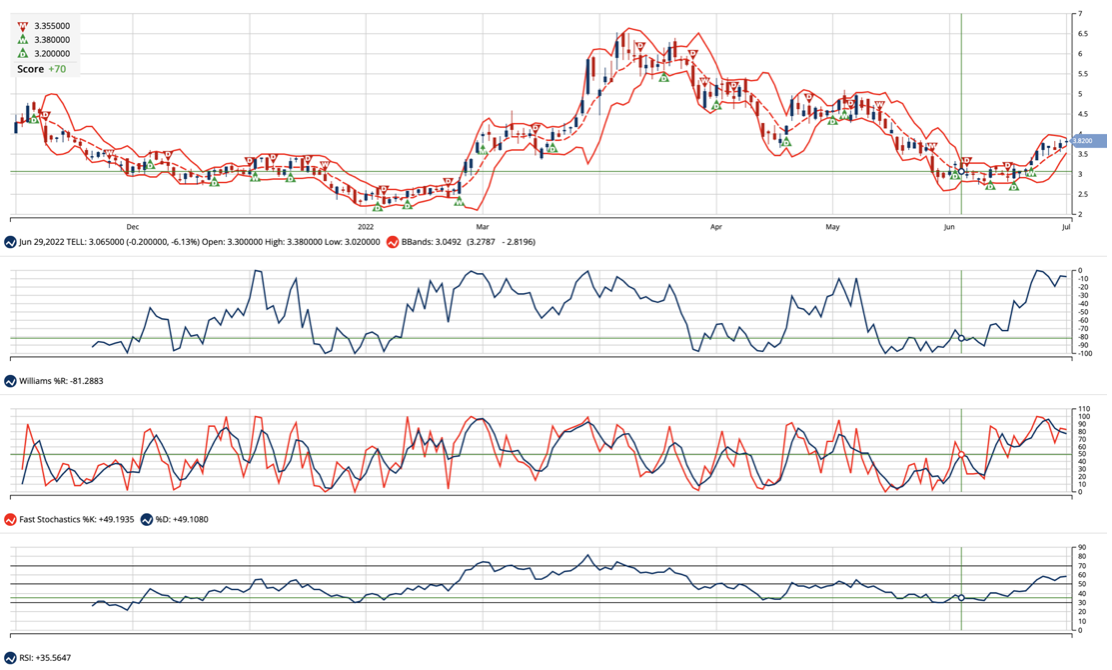
ALB stock is also technically oversold. In fact, if we pull up a one-year chart, we can see the stock just caught double bottom support dating back to April. We can also see the stock is oversold at its lower Bollinger Band, with over-extensions on Williams’ %R, Fast Stochastics, and RSI.

ALB Chart with Trade Triangles

Source: MarketClub
 

From a current price of $198.65, I’d like to see Albemarle Corp. (ALB) refill its bearish gap around $230 a share initially. Longer-term, I’d like to see it closer to $250.

Ian Cooper
INO.com Contributor

Disclosure: This contributor did not hold a position in any investment mentioned above at the time this blog post was published. This article is the opinion of the contributor themselves. The above is a matter of opinion provided for general information purposes only and is not intended as investment advice. This contributor is not receiving compensation (other than from INO.com) for their opinion.

By Ino.com – See our Trader Blog, INO TV Free & Market Analysis Alerts

Source: Chart Spotlight: Albemarle Corp. (ALB)

Landsat at 50: How satellites revolutionized the way we see – and protect – the natural world

By Stacy Morford, The Conversation 

Fifty years ago, U.S. scientists launched a satellite that dramatically changed how we see the world.

It captured images of Earth’s surface in minute detail, showing how wildfires burned landscapes, how farms erased forests, and many other ways humans were changing the face of the planet.

The first satellite in the Landsat series launched on July 23, 1972. Eight others followed, providing the same views so changes could be tracked over time, but with increasingly powerful instruments. Landsat 8 and Landsat 9 are orbiting the planet today, and NASA and the U.S. Geological Survey are planning a new Landsat mission.

The images and data from these satellites are used to track deforestation and changing landscapes around the world, locate urban heat islands, and understand the impact of new river dams, among many other projects. Often, the results help communities respond to risks that may not be obvious from the ground.

Here are three examples of Landsat in action, from The Conversation’s archive.

Tracking changes in the Amazon

A river meanders through the Amazon Basin, seen from Landsat.
NASA

When work began on the Belo Monte Dam project in the Brazilian Amazon in 2015, Indigenous tribes living along the Big Bend of the Xingu River started noticing changes in the river’s flow. The water they relied on for food and transportation was disappearing.

Upstream, a new channel would eventually divert as much as 80% of the water to the hydroelectric dam, bypassing the bend.

The consortium that runs the dam argued that there was no scientific proof that the change in water flow harmed fish.

But there is clear proof of the Belo Monte Dam project’s impact – from above, write Pritam Das, Faisal Hossain, Hörður Helgason and Shahzaib Khan at the University of Washington. Using satellite data from the Landsat program, the team showed how the dam dramatically altered the hydrology of the river.

“As scientists who work with remote sensing, we believe satellite observations can empower populations around the world who face threats to their resources,” Das and his colleagues write.

It’s hot in the city – and even hotter in some neighborhoods

Landsat’s instruments can also measure surface temperatures, allowing scientists to map heat risk street by street within cities as global temperatures rise.

“Cities are generally hotter than surrounding rural areas, but even within cities, some residential neighborhoods get dangerously warmer than others just a few miles away,” writes Daniel P. Johnson, who uses satellites to study the urban heat island effect at Indiana University.

Neighborhoods with more pavement and buildings and fewer trees can be 10 degrees Fahrenheit (5.5 C) or more warmer than leafier neighborhoods, Johnson writes. He found that the hottest neighborhoods tend to be low-income, have majority Black or Hispanic residents and had been subjected to redlining, the discriminatory practice once used to deny loans in racial and ethnic minority communities.

Two maps of New York City show how vegetation matches cooler areas by temperature.
Comparing maps of New York City’s vegetation and temperature shows the cooling effect of parks and neighborhoods with more trees.
NASA/USGS Landsat

“Within these ‘micro-urban heat islands,’ communities can experience heat wave conditions well before officials declare a heat emergency,” Johnson writes.

Knowing which neighborhoods face the highest risks allows cities to organize cooling centers and other programs to help residents manage the heat.

The making of ghost forests

Dead tree trunks with low ground cover below.
The white trunks of a ghost forest mark a coastal North Carolina landscape.
Emily Ury, CC BY-ND

Satellites that scan the same areas year after year can be crucial for spotting changes in hard-to-reach regions. They can monitor snow and ice cover, and, along U.S. Atlantic coast, dying wetland forests.

These eerie landscapes of dead, often bleached-white tree trunks have earned the nickname “ghost forests.”

Emily Ury, an ecologist now at the University of Waterloo in Ontario, used Landsat data to spot wetland changes. She then zoomed in with high-resolution images from Google Earth – which includes Landsat images – to confirm that they were ghost forests.

“The results were shocking. We found that more than 10% of forested wetland within the Alligator River National Wildlife Refuge [in North Carolina] was lost over the past 35 years. This is federally protected land, with no other human activity that could be killing off the forest,” Ury writes.

A satellite image of the coast with red spots along a river inlet indicating dead forests
Landsat’s view of the Alligator River and refuge shows signs of ghost forests on the east side of the river.
NASA Earth Observatory

As the planet warms and sea levels rise, more salt water is reaching these areas, increasing the amount of salt in the soil of coastal woodlands from Maine to Florida. “Rapid sea level rise seems to be outpacing the ability of these forests to adapt to wetter, saltier conditions,” Ury writes.

Many more stories can be found in Landsat’s images, such as an overview of the war’s effects on Ukraine’s wheat crop, and how algae blooms have spread in Florida’s Lake Okeechobee. Countless projects are using Landsat data to track global change and possibly find solutions to problems, from deforestation in the Amazon to the fires that have put Alaska on pace for another historic fire season. The Conversation

An illustration of a satellite with a large solar panel for power high over a coastal area
An artist’s rendering of Landsat 8.
NASA/Goddard Space Flight Center Conceptual Image Lab

About the Author:

Stacy Morford, Environment + Climate Editor, The Conversation

This article is republished from The Conversation under a Creative Commons license. Read the original article.


Ichimoku Cloud Analysis 22.07.2022 (EURUSD, XAUUSD, NZDUSD)

Article By RoboForex.com

XAUUSD, “Gold vs US Dollar”

As we can see in the H4 chart, XAUUSD has formed a Harami reversal pattern not far from the resistance area. At the moment, the asset may reverse in the form of a new correctional impulse. In this case, the downside correctional target may be the support level at 1650.00. At the same time, the opposite scenario implies that the price may continue growing to reach 1740.00 without any pullbacks.

XAUUSD
Risk Warning: the result of previous trading operations do not guarantee the same results in the future

NZDUSD, “New Zealand vs US Dollar”

As we can see in the H4 chart, NZDUSD has formed a Hammer reversal pattern close to the support area. At the moment, the asset may reverse in the form of another ascending impulse. In this case, the upside target may be at 0.6290. After that, the asset may break the resistance level and continue moving upwards. However, an alternative scenario implies that the price may fall to reach 0.6190 before resuming its growth towards the resistance level.

NZDUSD
Risk Warning: the result of previous trading operations do not guarantee the same results in the future

GBPUSD, “Great Britain Pound vs US Dollar”

As we can see in the H4 chart, GBPUSD has formed a Harami reversal pattern near the resistance level. At the moment, the pair may reverse in the form of a new descending impulse. In this case, the downside target may be the support area at 1.1845. Later, the market may break this level and continue falling. Still, there might be an alternative scenario, in which the asset may correct to reach the resistance level at 1.2055 first and then resume the descending tendency.

GBPUSD

Article By RoboForex.com

Attention!
Forecasts presented in this section only reflect the author’s private opinion and should not be considered as guidance for trading. RoboForex LP bears no responsibility for trading results based on trading recommendations described in these analytical reviews.

Japanese Candlesticks Analysis 22.07.2022 (XAUUSD, NZDUSD, GBPUSD)

Article By RoboForex.com

XAUUSD, “Gold vs US Dollar”

As we can see in the H4 chart, XAUUSD has formed a Harami reversal pattern not far from the resistance area. At the moment, the asset may reverse in the form of a new correctional impulse. In this case, the downside correctional target may be the support level at 1650.00. At the same time, the opposite scenario implies that the price may continue growing to reach 1740.00 without any pullbacks.

XAUUSD
Risk Warning: the result of previous trading operations do not guarantee the same results in the future

NZDUSD, “New Zealand vs US Dollar”

As we can see in the H4 chart, NZDUSD has formed a Hammer reversal pattern close to the support area. At the moment, the asset may reverse in the form of another ascending impulse. In this case, the upside target may be at 0.6290. After that, the asset may break the resistance level and continue moving upwards. However, an alternative scenario implies that the price may fall to reach 0.6190 before resuming its growth towards the resistance level.

NZDUSD
Risk Warning: the result of previous trading operations do not guarantee the same results in the future

GBPUSD, “Great Britain Pound vs US Dollar”

As we can see in the H4 chart, GBPUSD has formed a Harami reversal pattern near the resistance level. At the moment, the pair may reverse in the form of a new descending impulse. In this case, the downside target may be the support area at 1.1845. Later, the market may break this level and continue falling. Still, there might be an alternative scenario, in which the asset may correct to reach the resistance level at 1.2055 first and then resume the descending tendency.

GBPUSD

Article By RoboForex.com

Attention!
Forecasts presented in this section only reflect the author’s private opinion and should not be considered as guidance for trading. RoboForex LP bears no responsibility for trading results based on trading recommendations described in these analytical reviews.

How record-setting heat waves in cities across UK, US and mainland Europe could punish economies already reeling from inflation

By Derek Lemoine, University of Arizona 

Hundreds of millions of people struggled to keep cool amid a sweltering summer heat wave as cities across the U.S. and mainland Europe experienced record-high temperatures. In the U.K., thermometers topped 104 Fahrenheit (40 degrees Celsius) on July 19, 2022, the highest ever recorded.

While all this broiling heat is surely punishing on a personal level, it also has significant impacts on the broader economy.

As an economist who has studied the effects of weather and climate change, I have examined a large body of work that links heat to economic outcomes. Here are four ways extreme heat hurts the economy.

1. Growth takes a hit

Research has found that extreme heat can directly hurt economic growth.

For example, a 2018 study found that the economies of U.S. states tend to grow at a slower pace during relatively hot summers. The data shows that annual economic growth falls 0.15 to 0.25 percentage points for every 1 degree Fahrenheit (0.56 C) that a state’s average summer temperature is above normal.

Laborers in weather-exposed industries such as construction work fewer hours when it’s hotter. But higher summer temperatures also reduce growth in many industries that tend to involve indoor work, including retail, services and finance. Workers are less productive when it’s hotter out.

2. Crop yields drop

Agriculture is obviously exposed to weather: After all, crops grow outdoors.

While temperatures up to around 85 F to 90 F (29-32 C) can benefit crop growth, yields fall sharply when thermostats rise further. Some of the crops that can be hit hard by extreme heat include corn, soybeans and cotton. These reductions in yields could be costly for U.S. agriculture.

For example, a recent study I conducted found that an additional 2 degrees C (3.6 F) of global warming would eliminate profits from an average acre of farmland in the eastern U.S.

A prominent example of this was the collapse of the Russian wheat harvest in response to the country’s 2010 heat wave, which raised wheat prices throughout the world.

3. Energy use soars

Of course, when it’s hot, energy use goes up as people and businesses run their air conditioners and other cooling equipment at full blast.

A 2011 study found that just one extra day with temperatures above 90 F (32 C) increases annual household energy use by 0.4%. More recent research shows that energy use increases the most in places that tend to be hotter, probably because more households have air conditioning.

This increase in electricity use on hot days stresses electric grids right when people depend on them most, as seen in California and Texas during past heat waves. Blackouts can be quite costly for the economy, as inventories of food and other goods can spoil and many businesses either have to run generators or shut down. For instance, the 2019 California blackouts cost an estimated US$10 billion.

4. Education and earnings suffer

A long-term impact of increasingly hotter weather involves how it affects children’s ability to learn – and thus their future earnings.

Research has shown that hot weather during the school year reduces test scores. Math scores decrease more and more as the temperature rises beyond 70 F (21 C). Reading scores are more resistant to high temperatures, which this research claims is consistent with how different regions of the brain respond to heat.

One study suggested that students in schools that lack air conditioning learn 1% less for every 1 degree Fahrenheit (0.56 C) increase in the school year’s average temperature. It also found that minority students are especially affected by hotter school years, as their schools are more likely to lack air conditioning.

Lost learning results in lower lifetime earnings and hurts future economic growth.

The impact of extreme heat on development, in fact, begins before we’re even born. Research has found that adults who were exposed to extreme heat as fetuses earn less during their lifetimes. Each extra day with average temperature above 90 F (32 C) reduces earnings 30 years later by 0.1%.

Air conditioning can help – to a point

Air conditioning can offset some of these effects.

For example, studies have found that having a working air conditioner means fewer people die, student learning isn’t compromised and extreme heat outside during pregnancy doesn’t hurt fetuses.

Not everyone has air conditioners, however, especially in states such as Oregon and countries such as the U.K. that have more temperate climates but have nonetheless recently experienced unusually extreme temperatures. And many people can’t afford to own or operate them. Survey data from 2017 found that around half of homes in the U.S. Pacific Northwest
lacked air conditioning. And about 42% of U.S. classrooms lack an air conditioner.

While heat waves are shown to induce more households to install air conditioning, it’s hardly a panacea. By 2100, higher use of air conditioning could increase residential energy consumption by 83% globally. If that energy comes from fossil fuels, it could end up amplifying the heat waves that are causing the higher demand in the first place.

And in the U.S. South, where air conditioning is omnipresent, hotter-than-usual summers still take the greatest toll on states’ economic growth.

In other words, as temperatures rise, economies will continue to suffer.

This is an updated version of an article originally published on Aug. 2, 2021.The Conversation

About the Author:

Derek Lemoine, Associate Professor of Economics, University of Arizona

This article is republished from The Conversation under a Creative Commons license. Read the original article.


The Analytical Overview of the Main Currency Pairs on 2022.07.22

By JustForex

The EUR/USD currency pair

Technical indicators of the currency pair:
  • Prev Open: 1.0176
  • Prev Close: 1.0228
  • % chg. over the last day: +0.51%

The European Central Bank unexpectedly raised the interest rate by 0.5%, although Christine Lagarde had indicated that the first increase would be 0.25%. The ECB report indicates that the decision is based on an updated assessment of inflation risks, as rising prices are a growing concern for households and companies. The future trajectory of interest rates will depend on new inflation data. ECB policymakers also agreed to provide additional assistance to the currency bloc’s 19 heavily indebted countries, including Italy, with a new bond-buying scheme designed to limit their rising borrowing costs and thus limit financial fragmentation. Against this news, the euro strengthened significantly.

Trading recommendations
  • Support levels: 1.0188, 1.0154, 1.0106, 1.0035, 1.0000
  • Resistance levels: 1.0284, 1.0365, 1.0415, 1.050

From the technical point of view, the trend on the EUR/USD currency pair on the hourly time frame is bullish. The price is forming a wide balance, and the MACD indicator has become inactive, but the buyer’s pressure remains. Under such market conditions, it is best to look for buy trades on intraday time frames from the support level of 1.0188 or 1.0106, but only with confirmation. Sell trades can be considered from the resistance level of 1.0284, but only after additional confirmation and only with short targets.

Alternative scenario: if the price breaks down through the 1.0000 support level and fixes below, the downtrend will likely resume.

EUR/USD
News feed for 2022.07.22:
  • – Eurozone France Manufacturing PMI (m/m) at 10:15 (GMT+3);
  • – Eurozone France Services PMI (m/m) at 10:15 (GMT+3);
  • – Eurozone German Manufacturing PMI (m/m) at 10:30 (GMT+3);
  • – Eurozone German Services PMI (m/m) at 10:30 (GMT+3);
  • – Eurozone Manufacturing PMI (m/m) at 11:00 (GMT+3);
  • – Eurozone Services PMI (m/m) at 11:00 (GMT+3);
  • – US Manufacturing PMI (m/m) at 16:45 (GMT+3);
  • – US Services PMI (m/m) at 16:45 (GMT+3).

The GBP/USD currency pair

Technical indicators of the currency pair:
  • Prev Open: 1.1974
  • Prev Close: 1.1999
  • % chg. over the last day: -0.21%

In the UK, investors are watching the race for Prime Minister’s seat. Former Treasury Secretary Rishi Sunak and Foreign Secretary Liz Truss made it to the last round of the contest to become party leaders. A number of reports will also be released today. Traders expect a slowdown in the UK Manufacturing PMI for June and a decline in retail sales. If the data is worse than forecast, the British pound may react with a decline.

Trading recommendations
  • Support levels: 1.1955, 1.1907, 1.1803
  • Resistance levels: 1.2065, 1.2137

From the technical point of view, the trend on the GBP/USD currency pair on the hour time is bullish. The price has slightly corrected and is trading at the level of the moving averages. The MACD indicator has become inactive. Under such market conditions, it is best to look for buy trades on intraday time frames from the support level of 1.1955 or 1.1907, but only with confirmation. Sell trades can be considered intraday from the resistance level of 1.2065, but only after additional confirmation and with short targets.

Alternative scenario: if the price breaks down through the 1.1803 support level and fixes below, the downtrend will likely resume.

GBP/USD
News feed for 2022.07.22:
  • – UK Retail Sales (m/m) at 09:00 (GMT+3);
  • – UK Manufacturing PMI (m/m) at 11:30 (GMT+3);
  • – UK Services PMI (m/m) at 11:30 (GMT+3).

The USD/JPY currency pair

Technical indicators of the currency pair:
  • Prev Open: 138.13
  • Prev Close: 137.34
  • % chg. over the last day: -0.57%

Japan’s key inflation indicator has further exceeded the Bank of Japan’s target of 2%. According to data released Friday by the Ministry of Internal Affairs, core consumer prices (excluding food and fuel prices) reached an annualized rate of 2.2%. The result was in line with economists’ estimates. Despite the continued rise in prices, the Bank of Japan is unlikely to budge anytime soon, as the Bank of Japan remains unconvinced that inflation in the country is sustainable. Bank of Japan Governor Kuroda has repeatedly said that current cost inflation is unsustainable and that the central bank needs constant easing until it is demand-driven and accompanied by sustained wage growth. But wage growth has not kept pace with inflation, with May data showing that real wages are down 1.8% from a year ago.

Trading recommendations
  • Support levels: 137.11, 136.48, 135.92, 135.40, 134.64, 134.11
  • Resistance levels: 138.25, 138.56, 140.29

From the technical point of view, the medium-term trend on the USD/JPY currency pair is bullish. But the price has corrected to the priority change level and traded below the moving averages, indicating temporary sellers pressure. Under such market conditions, buy trades can be sought intraday from the support level of 137.11, but with confirmation. For sell deals, traders can consider the resistance level of 138.25, but only with additional confirmation and short targets.

Alternative scenario: If the price fixes below 137.11, the downtrend will likely resume.

USD/JPY
News feed for 2022.07.22:
  • – Japan National Core Consumer Price Index at 02:30 (GMT+3).

The USD/CAD currency pair

Technical indicators of the currency pair:
  • Prev Open: 1.2879
  • Prev Close: 1.2864
  • % chg. over the last day: -0.11%

The Canadian dollar is a commodity currency and is highly dependent on instruments such as the dollar index and oil. Both the US Dollar Index and oil quotes decreased yesterday. As a result, the USD/CAD currency pair traded in a volatile corridor. Volatility in the market increased due to a sharp increase in the ECB rate, which led to a sharp rise in the euro and a decline in the dollar index. Today the retail sales report will be published in Canada. Analysts are predicting an increase in value. If the actual value is better than the forecast, the Canadian dollar may strengthen even more (USD/CAD decline).

Trading recommendations
  • Support levels: 1.2853, 1.2781
  • Resistance levels: 1.2934, 1.3006, 1.3085, 1.3154

In terms of technical analysis, the trend on the USD/CAD currency pair is bearish. The price is forming a balance and trades at the levels of the moving average lines. The MACD indicator has become inactive. Under such market conditions, it is best to consider sell deals from the resistance level of 1.2934, but with confirmation. Buy trades should be viewed on the lower time frames from the support level 1.2853, but only with confirmation and short targets.

Alternative scenario: if the price breaks out and consolidates above the 1.3085 resistance level, the uptrend will likely resume.

USD/CAD
News feed for 2022.07.22:
  • – Canada Retail Sales (m/m) at 15:30 (GMT+3).

By JustForex


This article reflects a personal opinion and should not be interpreted as an investment advice, and/or offer, and/or a persistent request for carrying out financial transactions, and/or a guarantee, and/or a forecast of future events.


Week Ahead: Lower dollar if Fed surprises with “smaller” 50bps hike

By ForexTime

Are you ready for yet another jumbo-sized Fed rate hike?

Markets have been preparing for such an outcome at the upcoming FOMC policy decision, which will star in next week’s economic calendar

Monday, July 25

  • EUR: Germany July IFO business climate
  • GBP: UK PM candidates’ debate – Rishi Sunak vs. Liz Truss

Tuesday, July 26

  • JPY: Bank of Japan June meeting minutes
  • USD: US July consumer confidence
  • IMF releases updated world economic outlook
  • Alphabet 2Q earnings

Wednesday, July 27

  • AUD: Australia Q2 CPI
  • CNH: China June industrial profits
  • USD: Fed rate decision
  • US crude: EIA weekly oil inventory report
  • Meta Platforms 2Q earnings

Thursday, July 28

  • AUD: Australia June retail sales
  • EUR: Germany July CPI, Eurozone July economic and consumer confidence
  • USD: US Q2 GDP, weekly jobless claims
  • Amazon 2Q earnings
  • Apple 2Q earnings

Friday, July 29

  • JPY: Japan June unemployment, retail sales, industrial production; July Tokyo CPI
  • EUR: Eurozone July CPI, Q2 GDP
  • USD: US June personal income and spending, PCE core deflator, July consumer sentiment
  • Exxon 2Q earnings
  • Chevron 2Q earnings


Markets have fully priced in a second consecutive 75-basis point hike at next week’s FOMC policy meeting, as the US central bank continues its battle against the hottest inflation in 40 years.

However, that 75bps hike is a relative step down from the 100-basis point hike that some segments of the markets were expecting. Hence the recent unwinding of gains in the equally-weighted USD index. Still, this instrument is well within its uptrend since Q1 2022.

Note that this index compares the US dollar’s performance against six of its major peers, all in equal weights:

  • Euro
  • British Pound
  • Swiss Franc
  • Australian Dollar
  • New Zealand Dollar
  • Canadian Dollar


Any other outcome that deviates from the 75bps script would be a surprise.

  • DOVISH: A “mere” 50bps hike, though still twice the size of the traditional 25bps rate adjustments per meeting deployed by central bankers worldwide, should prompt more declines in the USD index, potentially moving it closer to its 50-day simple moving average (SMA) around the 1.175 region.
  • HAWKISH: Although the bar has been set high for a hawkish outcome at next week’s meeting, a 100bps shocker would reinvigorate dollar bulls into sending this USD index back above the 1.20 line. More dollar gains may also ensue if Fed Chair Jerome Powell, during his press conference, refuses to rule out a 100bps hike at upcoming meetings.


Ultimately, policymakers at the US central bank, as well as market participants, will continue to be guided by the inflation data.

And on that point, after the FOMC meeting concludes, next Friday’s release of the June PCE deflator will be closely watched, considering that it’s the Fed’s preferred way of measuring inflation.

The PCE deflator is forecasted to come in at 6.6% in June, which would mean that it has posted a reading of 6% or higher for every month so far this year. 6.6% is also more than three times the Fed’s 2% target, underscoring the tremendous task that the Fed is up against.

Further evidence of stubbornly elevated price pressures is set to force the Fed into triggering even more jumbo-sized rate hikes over the coming months. Such hawkish expectations could then see the USD index being restored to the last cycle high at 1.21859, or perhaps even higher.

Overall, as long as the Fed keeps the “pedal to the metal” while leaving other major central banks struggling to catch up with their own rate hikes, that should leave the buck with an easier path to climb even higher.


Forex-Time-LogoArticle by ForexTime

ForexTime Ltd (FXTM) is an award winning international online forex broker regulated by CySEC 185/12 www.forextime.com

The European Central Bank surprised the markets. Political crisis in Italy

By JustForex

The US stock indices increased yesterday on the technology sector’s growth, as better-than-expected Tesla earnings supported the sector. The Dow Jones (US30) added 0.51% at the close, while the S&P 500 (US500) increased by 0.99%. The Technology Index NASDAQ (US100) jumped by 1.36%.

Shares of Tesla Inc (TSLA) jumped by 9.7% yesterday, giving confidence to the entire industry and the sector. Shares of Snap Inc (SNAP) fell by 24% in over-the-counter trading Thursday as the company said third-quarter revenue growth was flat and its results were affected by Apple’s privacy changes. Shares of American Airlines (AAL) fell by 7% on the report, even as the company projected third-quarter earnings thanks to increased demand for travel services.

Biden tested positive for coronavirus. The US president has moderate symptoms and is working remotely.

Stock markets in Europe traded flat Thursday. German DAX (DE30) decreased by 0.27% yesterday, French CAC 40 (FR40) added 0.27%, Spanish IBEX 35 (ES35) lost 0.20%, British FTSE 100 (UK100) was up by 0.09%.

The European Central Bank unexpectedly raised its interest rate by 0.5%, even though Christine Lagarde had promised the first increase of 0.25%. The ECB report indicates that the decision is based on an updated assessment of inflation risks, as rising prices are a growing concern for households and companies. The future trajectory of interest rates will depend on the new data. ECB policymakers also agreed to provide additional assistance to the currency bloc’s 19 heavily indebted countries, including Italy, with a new bond-buying scheme designed to limit their rising borrowing costs and thus limit financial fragmentation.

Investors are also closely watching the political situation in Italy, as Prime Minister Mario Draghi resigned on Thursday, and the president accepted his resignation, followed by the dissolution of parliament.

The Nord Stream 1 pipeline reopened after a 10-day hiatus. Germany’s grid regulator has indicated that they are back to a capacity level of 40%. With the resumption of gas flows through Nord Stream, investors are more conciliatory on the part of Russia to continue supplying oil and petroleum products to Europe in the coming weeks or months.

Oil prices have fallen below $100 after a massive inventory build-up in the United States. But demand remains strong in mid-summer, so with production levels lagging, traders should not expect a significant drop in prices.

Asian markets mostly rose yesterday. Japan’s Nikkei 225 (JP225) gained 2.67%, Hong Kong’s Hang Seng (HK50) added 1.11%, and Australia’s S&P/ASX 200 (AU200) closed by 1.65% higher.

Japan’s key inflation indicator was even higher than the Bank of Japan’s target of 2%. According to data released on Friday by the Ministry of the Interior, core consumer prices (excluding food and fuel prices) reached an annualized rate of 2.2%. The result was in line with economists’ estimates. Despite the continued rise in prices, the Bank of Japan is unlikely to budge anytime soon, as the Bank of Japan remains unconvinced that inflation in the country is sustainable. The BoJ Governor Kuroda has repeatedly said that current cost inflation is unsustainable and that the central bank needs constant easing until it is demand-driven and accompanied by sustained wage growth. But wage growth has not kept pace with inflation, with May data showing that real wages are down 1.8% from a year ago.

In Australia, a NAB report showed that the RBA would raise rates to 2.85% by the end of the year. Since the monetary rate is still well below “neutral,” this indicates continued rapid normalization in the coming months. This means a 50 bp interest rate hike at each of the next two meetings and then a pause to assess the impact of the rate hike.

S&P 500 (F) (US500) 3,998.95 +39.05 (+0.99%)

Dow Jones (US30) 32,036.90 +162.06 (+0.51%)

DAX (DE40) 13,246.64 −35.34 (−0.27%)

FTSE 100 (UK100) 7,270.51 +6.20 (+0.085%)

USD Index 106.77 −0.31 (−0.29%)

Important events for today:
  • – Australia Manufacturing PMI (m/m) at 02:00 (GMT+3);
  • – Japan National Core Consumer Price Index at 02:30 (GMT+3);
  • – UK Retail Sales (m/m) at 09:00 (GMT+3);
  • – Eurozone France Manufacturing PMI (m/m) at 10:15 (GMT+3);
  • – Eurozone France Services PMI (m/m) at 10:15 (GMT+3);
  • – Eurozone German Manufacturing PMI (m/m) at 10:30 (GMT+3);
  • – Eurozone German Services PMI (m/m) at 10:30 (GMT+3);
  • – Eurozone Manufacturing PMI (m/m) at 11:00 (GMT+3);
  • – Eurozone Services PMI (m/m) at 11:00 (GMT+3);
  • – UK Manufacturing PMI (m/m) at 11:30 (GMT+3);
  • – UK Services PMI (m/m) at 11:30 (GMT+3);
  • – Canada Retail Sales (m/m) at 15:30 (GMT+3);
  • – US Manufacturing PMI (m/m) at 16:45 (GMT+3);
  • – US Services PMI (m/m) at 16:45 (GMT+3).

By JustForex


This article reflects a personal opinion and should not be interpreted as an investment advice, and/or offer, and/or a persistent request for carrying out financial transactions, and/or a guarantee, and/or a forecast of future events.