The cryptocurrency market digest (BTC, SOL). Overview for 03.08.2022

Article By RoboForex.com

After five trading sessions of declining, the BTC managed to reach stability and is even trying to grow a bit. The asset is mostly fluctuating at $23,412.

There isn’t too much activity in the cryptocurrency. It could be explained by controversial external background, investors’ concerns about geopolitics, and so on. However, the fact is: the crypto market has no trading ideas of its own and market players believe it would be unwise to buy without any support from stock indices.

Interestingly enough, the BTC wasn’t too effective in talking advantage of the uptrend in S&P 500 and NASDAQ that took place earlier. Of course, the major crypto asset moved away from the lows, but it still hasn’t been able to break the resistance at $23,500. The daily chart shows that if bulls take control, the BTC may break $23,500 and continue rising to reach $24,200-$24,500. Otherwise, the first downside target might be $22,500.

The crypto market capitalisation is currently estimated at $1.06 trillion; the fear index is up to 34 points.

Minexmr shuts down

One of the key Monero mining pools will shut down on 12 August. It is known that the pool controls about 40% of all Monero mining facilities.

Solana suffered from exploit

Solana seriously suffered from the hacker attack. According to OtterSec, hackers got access to 8,000 wallets and stole over $8 million. The most part of these wallets didn’t record any activities in the last six months. The ecosystem’s reputation might be compromised: all transactions were signed by wallet owners, which means that hackers had their private keys.

Variant: investments in crypto companies

Venture company Variant announced it raised $450 million for two new funds. One of them is Web-3, which will get about $300 million, while the others are new startups. Variant is very interested in crypto projects: earlier, it invested in the DeFi-platform Goldfinch and some other companies.

Article By RoboForex.com

Attention!
Forecasts presented in this section only reflect the author’s private opinion and should not be considered as guidance for trading. RoboForex LP bears no responsibility for trading results based on trading recommendations described in these analytical reviews.

JPY: under pressure. Overview for 03.08.2022

Article By RoboForex.com

After moving away from its 8-week low, USDJPY is recovering.

The Japanese Yen is falling against the USD on Wednesday. The current quote for the instrument is 133.17.

The Yen was in demand when the US bond yield was plunging and the “greenback” was getting weaker, but these tendencies are now over. Nevertheless, the Yen managed to run away from its 8-week lows.

Another factor that supported the Japanese currency was market players’ demand for “safe haven” assets.

Speaking about currency exchange rates yesterday, the Japanese Minister of Finance said that the Yen’s recent dynamics were rather uncontrollable. To make the financial system look stable, currency exchange rates should be stable and reasonable, backed by fundamental indicators.

The Yen might get under pressure if the Bank of Japan keeps the benchmark interest rate negative and provides no insight into what will happen to the Japanese economy in the future.

A bit later, investors will understand what is happening to the Yen right now: whether it’s a rebound from the highs or a proper reversal in favour of the devaluation scenario.

Article By RoboForex.com

Attention!
Forecasts presented in this section only reflect the author’s private opinion and should not be considered as guidance for trading. RoboForex LP bears no responsibility for trading results based on trading recommendations described in these analytical reviews.

The Analytical Overview of the Main Currency Pairs on 2022.08.03

By JustForex

The EUR/USD currency pair

Technical indicators of the currency pair:
  • Prev Open: 1.0261
  • Prev Close: 1.0165
  • % chg. over the last day: -0.94%

New tensions between the US and China triggered a rise in the US dollar. Investors returned to safe-haven assets yesterday amid growing tensions between the US and China over a visit by the US speaker to the island of Taiwan, which China considers its territory. Also, the dollar was strengthened by Fed officials’ statements, which indicated that a 0.75% rate hike at the September meeting is also under active consideration. A possible economic slowdown is needed to slow inflation. The euro and other assets fell against the dollar.

Trading recommendations
  • Support levels: 1.0112, 1.0035, 1.0000
  • Resistance levels: 1.0191, 1.0264, 1.0284, 1.0365, 1.0415, 1.050

From the technical point of view, the trend on the EUR/USD currency pair on the hourly time frame is bullish. The price is still forming a wide volatile balance, but the sellers’ initiative has replaced the buyers’ pressure. The MACD indicator has become negative. Under such market conditions, buy trades are best sought on intraday time frames from the support level of 1.0112. Sell trades can be considered from the resistance level of 1.0191 or 1.0264, but only after additional confirmation and only with short targets.

Alternative scenario: if the price breaks down through the 1.0112 support level and fixes below, the downtrend will likely resume.

EUR/USD
News feed for 2022.08.03:
  • – US FOMC Member Bullard Speaks (m/m) at 01:45 (GMT+3);
  • – German Services PMI (m/m) at 10:55 (GMT+3);
  • – Eurozone Services PMI (m/m) at 11:00 (GMT+3);
  • – Eurozone Retail Sales (m/m) at 12:00 (GMT+3);
  • – US ISM Services PMI (m/m) at 17:00 (GMT+3).

The GBP/USD currency pair

Technical indicators of the currency pair:
  • Prev Open: 1.2241
  • Prev Close: 1.2161
  • % chg. over the last day: -0.65%

The Bank of England will hold its monetary policy and interest rate meeting tomorrow. Five consecutive 25 basis point hikes have raised the bank rate to 1.25%, but actual inflation continues to rise, and inflation expectations remain dangerously high. Three bank officials last time wanted a 50 basis point increase, and with the economy’s apparent growing problems, a majority may now favor a larger move. Also, tomorrow, the Bank of England is due to present a plan to reduce its balance sheet. QE is still a whopping £843.8 billion, and just last month, Bank of England Governor Bailey said that the Central Bank was considering cutting its assets.

Trading recommendations
  • Support levels: 1.2152, 1.2114, 1.2114, 1.2063, 1.1907, 1.1803
  • Resistance levels: 1.2203, 1.2294

From the technical point of view, the GBP/USD currency pair trend on the hourly time frame is bullish. The price is now balanced and trading between the moving averages. The MACD indicator is in the negative zone, and there is an initiative from the sellers. Under such market conditions, it is better to look for buy trades on the intraday time frames from the support level 1.2152 or 1.2114, but only with confirmation. Sell trades can be considered from the resistance level of 1.2203, but only after additional confirmation and with short targets.

Alternative scenario: if the price breaks down through the 1.2006 support level and fixes below, the downtrend will likely resume.

GBP/USD
News feed for 2022.08.03:
  • – UK Services PMI (m/m) at 11:30 (GMT+3).

The USD/JPY currency pair

Technical indicators of the currency pair:
  • Prev Open: 131.69
  • Prev Close: 133.15
  • % chg. over the last day: +1.11%

The Japanese yen was on track for its biggest gain since the coronavirus crisis in March 2020, as growing tensions between the US and China over Taiwan and deepening fears of a global economic slowdown increased the appeal of safe-haven assets. Against the dollar, the Japanese currency brought its cumulative gains to nearly 4.5% in five trading sessions. But the US dollar is also a safe-haven currency, so yesterday, it closed the day in the background of the dollar index growth. It is also worth keeping in mind that the US Federal Reserve is on the path to higher interest rates, while the Bank of Japan keeps its monetary policy soft. Such opposite policy plays in favor of USD/JPY quotes growth.

Trading recommendations
  • Support levels: 132.42, 131.37, 130.85
  • Resistance levels: 133.17, 134.00, 135.29, 136.03, 137.11

From the technical point of view, the medium-term trend on the USD/JPY currency pair is bearish. In the last trading sessions, the Japanese yen has strengthened, but yesterday the dollar intercepted the initiative. The MACD indicator became positive. Under such market conditions, buy trades can be sought from the support level of 132.42 or 131.37, but with additional confirmation. Resistance levels of 134.00 may be considered for sell deals, but only with additional confirmation and short targets.

Alternative scenario: If the price fixes above 135.29, the uptrend will likely resume.

USD/JPY
News feed for 2022.08.03:
  • – Japan Services PMI (m/m) at 03:30 (GMT+3).

The USD/CAD currency pair

Technical indicators of the currency pair:
  • Prev Open: 1.2841
  • Prev Close: 1.2879
  • % chg. over the last day: +0.29%

USD/CAD quotes increased yesterday on the back of a rising dollar and because of lower oil prices. The Canadian weakness was also affected by the manufacturing data. The manufacturing PMI fell from 54.6 to 52.5. The latest survey showed a new decline in production and new orders, while employment growth slowed. The sector was hit particularly hard in July by a drop in export sales. Cost pressures continued on the price front, with higher material, food, and transportation costs often cited as the main drivers of inflation.

Trading recommendations
  • Support levels: 1.2786
  • Resistance levels: 1.2880, 1.2923, 1.3006, 1.3085, 1.3154

In terms of technical analysis, the USD/CAD currency pair trend is bearish. At the moment, the price is forming a wide balance. The MACD indicator became positive, and there was an initiative of buyers. Under such market conditions, it is better to consider sell deals from the resistance level of 1.2880, but with confirmation. Buy trades should be considered on the lower time frames from the support level of 1.2786 or from the lower border of the channel, but only with confirmation and short targets.

Alternative scenario: if the price breaks out and consolidates above the 1.3006 resistance level, the uptrend will likely resume.

USD/CAD
News feed for 2022.08.03:
  • – US Crude Oil Reserves (w/w) at 17:30 (GMT+3).

By JustForex


This article reflects a personal opinion and should not be interpreted as an investment advice, and/or offer, and/or a persistent request for carrying out financial transactions, and/or a guarantee, and/or a forecast of future events.

New tensions between the US and China provoked investors to return to safe-haven assets

By JustForex

According to analysts at JPMorgan, the US stock market is ready for further growth, likely starting as early as the second half of this year. Easing inflation expectations and falling bond yields indicate that the peak of the hawkish sentiment has probably already passed, and for this reason, analysts at JPMorgan believe that the US economy will avoid recession, despite the negative GDP growth for two consecutive quarters. JPMorgan’s year-end target for the S&P 500 is 4,800 points, which represents a growth potential of 17% from current levels.

Cleveland Fed President Loretta Mester said yesterday that it would take some time to get inflation back to the 2% level and brushed aside concerns about a slowing economy, stressing that a slowdown is necessary. The comments came just hours after San Francisco Fed President Mary Daly said the Fed’s work on lowering inflation is far from over and that raising interest rates another 0.75% at the September meeting is also under active consideration by the Committee.

As the stock market closed yesterday, the Dow Jones Index (US30) decreased by 1.22%, and the S&P 500 Index (US500) lost 0.66%. The NASDAQ Technology Index (US100) fell by 0.10%.

An American special flight carrying US House Speaker Nancy Pelosi landed in Taipei, the administrative capital of Taiwan. According to preliminary information, Taiwanese fighters escorting Nancy Pelosi’s plane opened warning fire on Chinese fighters that had entered the air defense zone of Taiwan. The Chinese Foreign Ministry summoned the US ambassador and protested about Nancy Pelosi’s visit to Taiwan. “China’s response will be powerful and strong,” the Chinese ambassador to the US said. The US military installations in the Indo-Pacific region are on high alert.

Geopolitical tensions rose higher during the day after Chinese battery giant CATL said it would suspend plans to invest billions of dollars in a new battery plant in the United States because of House Speaker Nancy Pelosi’s trip to Taiwan.

Uber Technologies (Uber) reported its first positive cash flow and earnings that beat expectations. The company’s stock jumped by 17% on the report. Pinterest (PINS) jumped more than 12% despite quarterly results missing the Wall Street estimates. Caterpillar (CAT) showed a drop in earnings as a business exit from Russia, higher costs, and a stronger dollar impacted performance. The company’s stock is down more than 4%.

Booking (BKNG), Moderna (MRNA), Regeneron Pharma (REGN), Nintendo ADR (NTDOY), MetLife (MET), eBay (EBAY), and others report today.

Stock markets in Europe were mostly down on Tuesday. German DAX (DE30) fell by 0.23%, French CAC 40 (FR40) lost 0.42%, Spanish IBEX 35 (ES35) gained 0.15%, British FTSE 100 (UK100) closed down by 0.06%.

Challenging summer conditions, including extreme heat and drought, led to new highs in European energy prices. Rivers are too warm to cool nuclear plants in France, and water levels are too low to deliver coal to power plants, limiting Europe’s electricity supply. This means countries rely even more on gas to meet additional electricity demand. Further cuts in Russian supplies to the continent will further exacerbate the situation. Analysts believe that electricity prices in Europe will rise even higher.

Energy stocks, meanwhile, remained flat amid uncertainty over whether major oil producers will decide to raise production at Wednesday’s meeting. Commerzbank said the outcome of the OPEC+ meeting is impossible to predict for now, but there is speculation that the current output will remain unchanged.

Asian markets traded flat yesterday. Japan’s Nikkei 225 (JP225) decreased by 1.42%, Hong Kong’s Hang Seng (HK50) ended down by 2.36%, and Australia’s S&P/ASX 200 (AU200) was up by 0.07%.

S&P 500 (F) (US500) 4,091.35 −27.28 (−0.66%)

Dow Jones (US30) 32,396.76 −401.64 (−1.22%)

DAX (DE40) 13,449.20 −30.43 (−0.23%)

FTSE 100 (UK100) 7,409.11 −4.31 (−0.058%)

USD Index 106.25 +0.80 (+0.76%)

Important events for today:
  • – US FOMC Member Bullard Speaks (m/m) at 01:45 (GMT+3);
  • – New Zealand Unemployment Rate at 01:45 (GMT+3);
  • – Japan Services PMI (m/m) at 03:30 (GMT+3);
  • – Australia Retail Sales (m/m) at 04:30 (GMT+3);
  • – China Caixin Services PMI (m/m) at 04:45 (GMT+3);
  • – Switzerland Consumer Price Index (m/m) at 09:30 (GMT+3);
  • – German Services PMI (m/m) at 10:55 (GMT+3);
  • – Eurozone Services PMI (m/m) at 11:00 (GMT+3);
  • – UK Services PMI (m/m) at 11:30 (GMT+3);
  • – Eurozone Retail Sales (m/m) at 12:00 (GMT+3);
  • – US ISM Services PMI (m/m) at 17:00 (GMT+3);
  • – US Crude Oil Reserves (w/w) at 17:30 (GMT+3).

By JustForex


This article reflects a personal opinion and should not be interpreted as an investment advice, and/or offer, and/or a persistent request for carrying out financial transactions, and/or a guarantee, and/or a forecast of future events.

Mid-Week Technical Outlook: FX Movers & Shakers

By ForexTime 

– Financial markets were injected with fresh volatility this week as geopolitical tensions between the United States and China rocked sentiment.

Some action was witnessed across the FX markets yesterday as the mighty dollar regained some of its mojo amid the risk-off mood and hawkish Fed commentary. Even the Japanese Yen fought back briefly, enacting sweet revenge against other G10 currencies before later surrendering gains. Sterling seems to be on standby ahead of the Bank of England (BoE) rate decision on Thursday while oil prices remain under pressure as the OPEC+ meeting looms. After weakening on hawkish comments from Fed officials, gold is likely to trade within a tight range ahead of the US jobs report on Friday.

The second half of the week could be wild for markets given the string of high-risk events and potential market shakers. Situations like this could present fresh trading opportunities across FX, commodity, and equity markets.

Below we will discuss potential movers & shakers to watch out for this week and beyond using technical analysis.

DXY rebounds from 105.00 support

Dollar bulls drew support from the risk-off mood and hawkish comments from Fed officials on Tuesday. After staging a rebound from the 105.00 support level, prices are trading marginally above 106.00 as of writing. Should this level prove to be reliable support, a move back towards 107.30 and 109.14 could be on the cards.

Equally weighted USD Index rebounds

After rebounding from the 1.1700 level, the equally weighted USD Index has found itself back within a wide range. The upside momentum may take prices back towards 1.1950. Beyond this level, bulls could challenge 1.21840.

EURUSD trapped in a range

A classic breakout/down opportunity could be forming on the EURUSD with support at 1.0100 and resistance at 1.0270. A solid daily close above 1.0270 may open the doors towards 1.0350 and 1.0480. Alternatively, a selloff below 1.0100 could inspire a move back towards parity.

GBPUSD waits for BoE

Where the GBPUSD concludes this week may be heavily influenced by the BoE rate decision on Thursday. Key levels of interest can be found at 1.2060 and 1.2350. A move back above the 50-day Simple Moving Average may encourage an incline back towards 1.2350.

AUDUSD back within a range

It’s the same old story for the AUDUSD as prices trade within a very wide range. After yesterday’s steep selloff, prices are back under the 50-day Simple Moving Average. A decline back towards 0.6850 could be on the cards.

NZDUSD breakdown pending?

An appreciating dollar could drag the NZDUSD back below the 0.6220 support level. Such a move may open doors towards 0.6100 and potentially lower. If 0.6200 proves to be reliable support, prices may rebound back towards 0.6375.

USDCAD sticky around 1.2860

The subtitle says it all. Prices remain in a sticky range with 1.2860 acting as a key level of interest. Should this level prove to be reliable support, the next key level can be found at 1.3050. Weakness below 1.2860 may open the doors back towards the 100 and 200-day Simple Moving Average.

EURJPY set to rebound?

After rebounding from the 200-day Simple Moving Average, is the EURJPY primed for a major rebound? The trend remains bearish and prices are trading below the 50 and 100-day Simple Moving Average. Even the MACD is trading below zero, reinforcing the bearish bias on the EURJPY. Prices have the potential to bounce from the 134.50 region towards 138.00 which is below the 100-day SMA. Beyond this point, bulls may target 139.00 and 141.50.

Bonus: Gold

Gold is trading below the 50, 100, and 200-day Simple Moving Average while the MACD is trading below zero. However, prices are respecting a minor bullish channel with resistance at $1785. A strong break above this level could encourage a move towards $1809 and beyond. If the precious metal breaks under $1752, a decline towards $1724 and $1700 could be on the table.


Forex-Time-LogoArticle by ForexTime

ForexTime Ltd (FXTM) is an award winning international online forex broker regulated by CySEC 185/12 www.forextime.com


As tech giants face a financial downturn, some new players are focusing on people over profit

By Peter Bloom, University of Essex 

The tech industry has been rocked by recent economic woes. While once thought of as close to recession proof, companies from Netflix to Meta are suddenly experiencing serious financial setbacks. As the Washington Post reported last week: “Big tech is bracing for a possible recession, spooking other industries”. Meta (the company that owns Facebook) has seen its share prices drop by more than 50% this year, with its iconoclastic CEO, Mark Zuckerberg, “visibly frustrated” at recent company Q&As with employees.

There are a range of reasons for this downturn, including a troubling mix of reduced consumer spending and fears of an uncertain future. The tech-focused Nasdaq index has dropped 24% in value since January in this year alone, while lay-offs have been announced across the industry – with some reports counting more than 60,000 tech redundancies globally so far this year.

In addition to cutting staff, technology companies are passing on these problems to consumers. People are already facing higher prices for some streaming services, and more increases are expected. Netflix has raised prices for consumers in countries including the UK and the US. They are also trying to stop people from different households sharing passwords. Amazon has also been criticised for increasing its subscription fees recently for Prime delivery and streaming services.

Users have been cancelling subscriptions to cut costs. Many of these services have become heavily embedded in our lives, however, with new technologies fundamentally transforming the way people interact, communicate, work and entertain themselves in recent years.

But there are growing concerns about the way these companies operate, aside from their profit levels and cost burden at a time of belt-tightening. Many users resent the fact that they still have relatively little power over how these technologies are developed and consumed. Tech corporations largely set the prices and conditions for both users and workers.

While many consumers accept this state of affairs, others are attempting to challenge huge tech conglomerates with platforms that give consumers, creators and workers more power. This idea is extending into data use as well. Even before the economic downturn, people were raising serious concerns about the use of algorithms to shape what we listen to and watch, for example, as well as questioning business models based on profiting from user data.

Emerging tech alternatives

New tech startups such as browser provider Gener8 are seeking to target this consumer dissatisfaction. With tens of thousands of users already, this platform allows users to choose their privacy levels and get paid for the data collected from their search activity. They can also use these funds to directly support ethical projects of their choosing.

Across a range of other sectors, platform cooperatives want to revolutionise industries including transport and delivery by providing workers with fair wages and better conditions. Consumers are also given more say with the ability to jointly own, design and run these platforms according to their needs. Such initiatives are just starting to make inroads against their much more powerful for-profit corporate competitors.

This movement is also affecting the entertainment industry by attempting to challenge for-profit streaming services. Means TV was created by the media producers Naomi Burton and Nick Hayes – famous for their viral campaign ad for New York congresswoman Alexandria Ocasia-Cortez. It bills itself as the “world’s first worker-owned, anti-capitalist streaming service”, with a democratic, cooperative structure in which all decisions are made by its employees, cooperative contractors and content creators. Members pay a US$10 (£8.18) monthly fee, but there are also reduced rate options for those who cannot afford this amount.

One full-time employee told the Guardian that what makes Means TV so special is that the platform enables people to make TV and other media content with a small amount of money. Its subscription charges and donations directly fund artists so there are no pressures relating to advertising or corporate overheads.

The cooperative music streaming service Resonate applies the same concept to the music industry, in that it is owned by “artists, listeners and workers”. While less explicitly political than Means TV, Resonate still aims to provide consumers with a new level of power and control.

Under the logo “play fair, pay fair”, the platform gives users monthly credits to spend as they listen to music and after streaming the same track nine times, it is added to their library. It advertises itself as ad and bot-free, and doesn’t sell user data. Resonate’s payment system was also designed to pay artists fairly and more with each listen. By 2021, the service had almost 1,400 monthly users and could potentially handle another 2 million users, according its creators.

These are just a few examples of alternatives that, more than simply rivalling popular tech giants’ offerings, provide people with greater power over the technology they consume. And while these ethical alternatives are still relatively small, they could signal the beginning of an important new era of consumer power for the tech sector.The Conversation

About the Author:

Peter Bloom, Professor of Management, University of Essex

This article is republished from The Conversation under a Creative Commons license. Read the original article.


Inflation is spiking around the world – not just in the United States

By Christopher Decker, University of Nebraska Omaha 

The 9.1% increase in U.S. consumer prices in the 12 months ending in June 2022, the highest in four decades, has prompted many sobering headlines.

Meanwhile, annual inflation in Germany and the U.K. – countries with comparable economies – ran nearly as high: 7.5% and 8.2%, respectively, for the 12 months ending in June 2022. In Spain, inflation has hit 10%.

It might seem like U.S. policies brought on this predicament, but economists like me doubt it because inflation is spiking everywhere, with few exceptions. Rates averaged 9.65% in the 38 largely wealthy countries that belong to the Organization for Economic Cooperation and Development through May 2022.

What revved up those price increases starting in early 2021?

Scarcity put pressure on prices everywhere

When the COVID-19 pandemic began, demand for computers and other high-tech goods soared as many people switched from working in offices to clocking in at home.

Computer chip manufacturers struggled to keep up, leading to chip shortages and higher prices for a dizzying array of devices and machines requiring them, including refrigerators, cars and smartphones.

It’s not just chips. Many of the goods Americans consume, such as cars, televisions and prescription drugs, are imported from all corners of the world.

Supply chain strains

On top of problems tied to supply and demand changes, there have been major disruptions to how goods move to manufacturers and then onto consumers along what’s known as the supply chain.

Freight disruption, whether by ship, train or truck, has interfered with the delivery of all sorts of goods since 2020. That’s caused the cost of shipping goods to rise sharply.

These massive shipping disruptions have exposed the disadvantages of the popular just-in-time practice for managing inventory.

By keeping as little of the materials needed to make their products on hand, companies become more vulnerable to shortages and transportation snafus. And when manufacturers are unable to make their products quickly, shortages occur and prices surge.

This approach, especially when it involves the reliance on far-flung suppliers, has left businesses much more susceptible to market shocks.

Labor complications

The beginning of the pandemic also sent shock waves through labor markets with lasting effects.

Many businesses either fired or furloughed large numbers of workers in 2020. When governments began to relax restrictions related to the pandemic, many employers found that significant numbers of their former workers were unwilling to return to work.

Whether those workers had chosen to retire early, seek new jobs offering a better work-life balance or become disabled, the results were the same: labor shortages that required higher wages to recruit replacements and retain other employees.

Again, all of these dynamics are occurring globally, not just in the U.S.

War in Ukraine compounded these woes

Russia’s war on Ukraine, which began officially on Feb. 24, 2022, has also exacerbated inflation by interfering with the global supply of fuels and grains.

The conflict’s effects are reverberating around the globe and fueling inflation.

Russia is the world’s second-largest exporter of crude oil. Sanctions against Russian imports, combined with Russia halting oil shipments to European countries in retaliation, has led to disruptions in the global oil market.

As Europe buys more oil from the Middle East, demand for oil from that region increases, prompting price increases. Crude prices jumped from $101 per barrel in late February 2022, to $123 a month later. Prices stayed high for several months but by late July were around $100 a barrel again.

Food prices have increased substantially in the U.S. and elsewhere, partly due to this conflict. Ukraine possesses some of the most fertile soil in the world and is the third-largest exporter of corn.

Russia’s destruction of Ukrainian crops and its blockade of Ukrainian exports have led to significant price increases worldwide for agricultural commodities.

How will the world respond?

Support for globalization and international trade has waned in recent years. Given supply chain disruptions and the war in Ukraine fueling inflation, this trend will likely continue.

However, as an economist, I believe the benefits of free and open trade still outweigh current challenges.

In my view, there isn’t anything fundamentally wrong with the globalization that cannot be fixed. But, like quelling inflation and alleviating supply chain bottlenecks, it will take time.The Conversation

About the Author:

Christopher Decker, Professor of Economics, University of Nebraska Omaha

This article is republished from The Conversation under a Creative Commons license. Read the original article.


Why Nancy Pelosi’s visit to Taiwan puts the White House in delicate straits of diplomacy with China

By Meredith Oyen, University of Maryland, Baltimore County 

U.S. House Speaker Nancy Pelosi arrived in Taiwan on Aug. 2, 2022 – a highly controversial trip that has been strongly opposed by China.

Such is the sensitivity over the island’s status that even before Pelosi’s plane touched down in the capital of Taipei, mere reports of the proposed trip prompted a warning by China of “serious consequences.” In the hours before she set foot on the island, Chinese fighter jets flew close to the median line separating Taiwan and China, while Chinese foreign minister Wang Yi commented that U.S. politicians who “play with fire” on Taiwan would “come to no good end”.

For it’s part, the U.S. has distanced itself from the visit. Prior to the trip President Joe Biden said it was “not a good idea.”

As someone who has long studied the U.S.‘s delicate diplomatic dance over Taiwan, I understand why this trip has sparked reaction in both Washington and Beijing, given the current tensions in the region. It also marks the continuation of a process that has seen growing U.S. political engagement with Taiwan – much to China’s annoyance.

Cutting diplomatic ties

The controversy over Pelosi’s visit stems from the “one China” policy – the diplomatic stance under which the U.S. recognizes China and acknowledges Beijing’s position that Taiwan is part of China. The policy has governed U.S. relations with Taiwan for the last 40-plus years.

In 1979, the U.S. abandoned its previous policy of recognizing the government of Taiwan as that of all of China, instead shifting recognition to the government on the mainland.

As part of this change, the U.S. cut off formal diplomatic ties with Taiwan, with the U.S. embassy in Taiwan replaced by a nongovernmental entity called the American Institute in Taiwan.

The institute was a de facto embassy – though until 2002, Americans assigned to the institute would have to resign from U.S. State Department to go there, only to be rehired once their term was over. And contact between the two governments was technically unofficial.

As the government in Taiwan pursued democracy – starting from the lifting of martial law in 1987 through the first fully democratic elections in 1996 – it shifted away from the assumption once held by governments in both China and Taiwan of eventual reunification with the mainland. The government in China, however, has never abandoned the idea of “one China” and rejects the legitimacy of Taiwanese self-government. That has made direct contact between Taiwan and U.S. representatives contentious to Chinese officials.

Indeed, in 1995, when Lee Teng-hui, Taiwan’s first democratically elected president, touched down in Hawaii en route to Central America, he didn’t even set foot on the tarmac. The U.S. State Department had already warned that the president would be refused an entry visa to the U.S., but had allowed for a brief, low-level reception in the airport lounge during refueling. Apparently feeling snubbed, Lee refused to leave the airplane.

Previous political visits

Two years after this incident came a visit to Taiwan by then-House Speaker Newt Gingrich.

Similarly to the Pelosi visit, the one by Gingrich annoyed Beijing. But it was easier for the White House to distance itself from Gingrich – he was a Republican politician visiting Taiwan in his own capacity, and clearly not on behalf of then-President Bill Clinton.

Pelosi’s visit my be viewed differently by Beijing, because she is a member of the same party as President Joe Biden. China may assume she has Biden’s blessing, despite his comments to the contrary.

Asked on July 20 about his views on the potential Pelosi trip, Biden responded that the “military thinks it’s not a good idea right now.”

The comment echoes the White House’s earlier handling of a comment by Biden in which he suggested in May 2022 that the U.S. would intervene “militarily” should China invade Taiwan. Officials in the Biden administration rolled back the comment, which would have broken a long-standing policy of ambiguity over what the U.S. would do if China tried to take Taiwan by force.

Similarly with Pelosi, the White House is distancing itself from a position that suggests a shift in U.S.-Taiwanese relations following a period in which the U.S. had already been trying to rethink how it interacts with Taiwan.

Shifting policy?

In 2018, Congress passed the bipartisan Taiwan Travel Act. This departed from previous policy in that it allowed bilateral official visits between the U.S. and Taiwan, although they are still considered to be subdiplomatic.

In the wake of that act, Donald Trump’s Health and Human Services secretary, Alex Azar, became the highest-ranking U.S. official to visit Taiwan since 1979. Then in 2020, Keith Krach, undersecretary for economic growth, energy and the environment, visited Taiwan.

And in April 2022, a U.S. congressional delegation visited Taiwan. Pelosi herself was reportedly due to visit the island that same month, but canceled after testing positive for COVID-19.

Each of these visits has provoked angry statements from Beijing.

A high-profile visit – even one without the public backing of the White House – would signal support to the island at a time when the invasion of Ukraine by Russia has raised questions over the international community’s commitment to protect smaller states from more powerful neighbors.

Meanwhile, the erosion of democracy in Hong Kong has undermined China’s commitment to the idea of “one nation, two systems.” The principle, which allowed Hong Kong to maintain its economic, political and social systems while returning to the mainland after the end of British rule, had been cited as a model for reunification with Taiwan. The Chinese Communist Party also plans to hold its 20th congress in the coming months, making the timing sensitive for a Taiwan visit from a high-profile U.S. political figure such as Pelosi.

Editor’s note: This is an updated version of an article originally published on July 26, 2022.The Conversation

About the Author:

Meredith Oyen, Associate Professor of History and Asian Studies, University of Maryland, Baltimore County

This article is republished from The Conversation under a Creative Commons license. Read the original article.

 

Murrey Math Lines 02.08.2022 (AUDUSD, NZDUSD)

Article By RoboForex.com

AUDUSD, “Australian Dollar vs US Dollar”

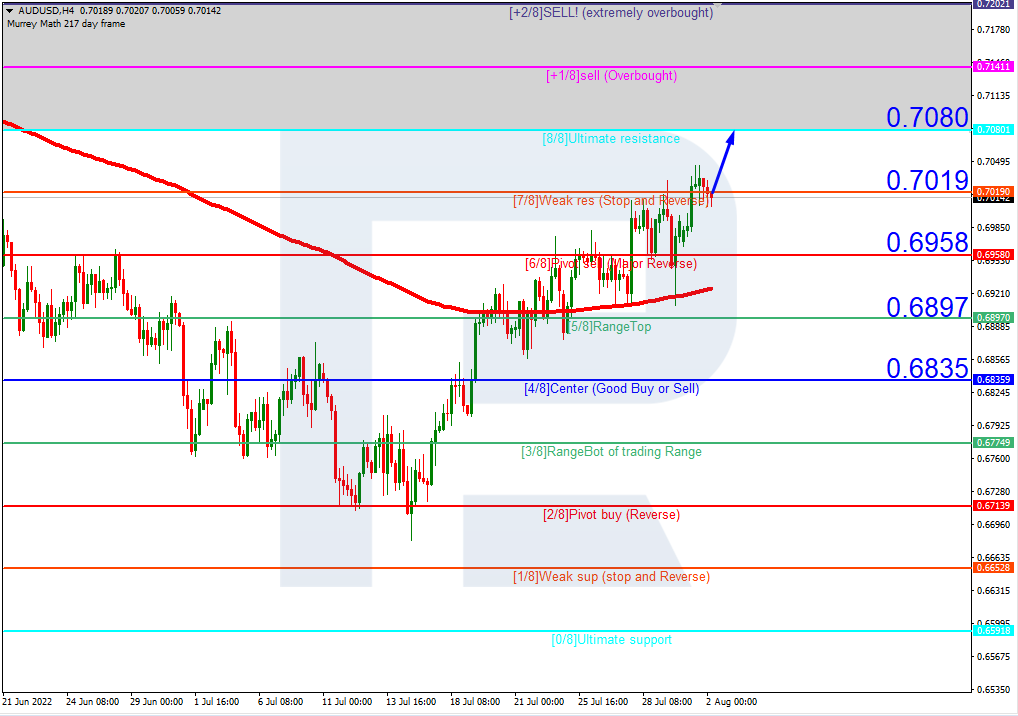
In the H4 chart, AUDUSD is trading above the 200-day Moving Average, thus indicating an ascending tendency. In this case, the price is expected to break 7/8 and continue growing to reach the resistance at 8/8. However, this scenario may no longer be valid if the price breaks 6/8 to the downside. After that, the instrument may reverse and resume falling to return to the support at 5/8.

AUDUSDH4
Risk Warning: the result of previous trading operations do not guarantee the same results in the future

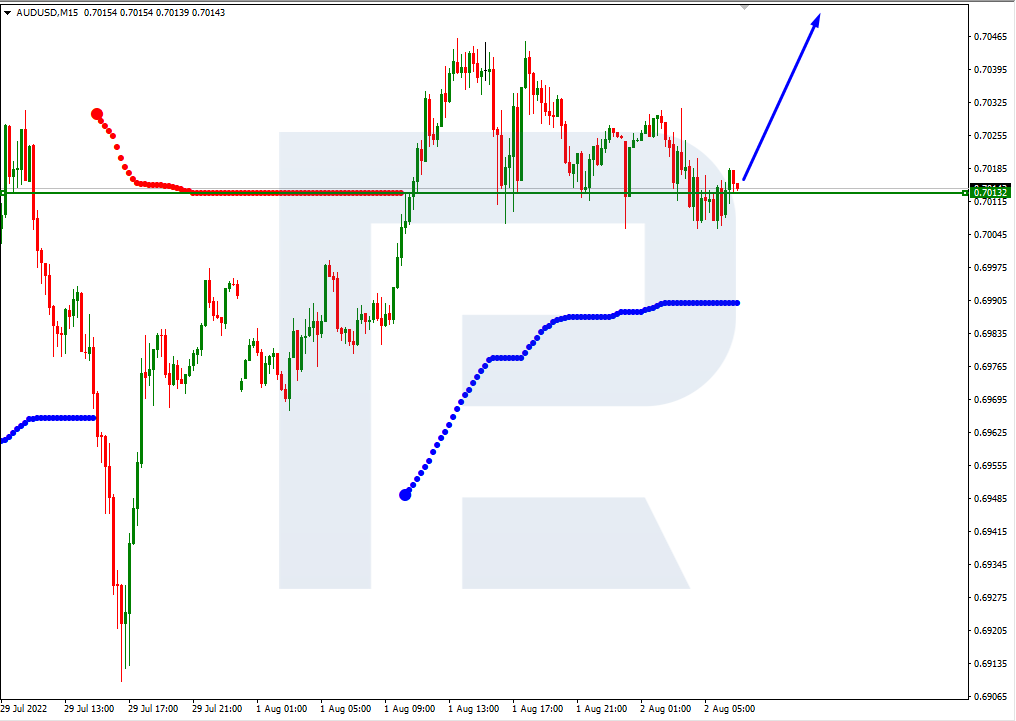
As we can see in the M15 chart, the pair has broken the upside line of the VoltyChannel indicator and, as a result, may continue moving upwards.

AUDUSD_M15
Risk Warning: the result of previous trading operations do not guarantee the same results in the future

NZDUSD, “New Zealand Dollar vs US Dollar”

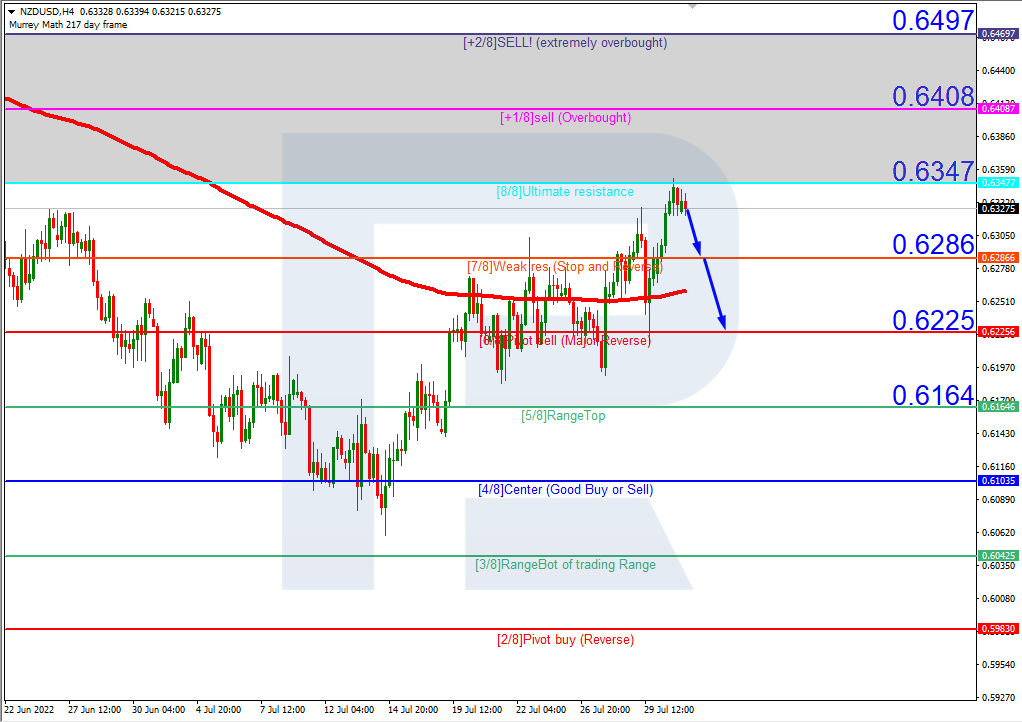
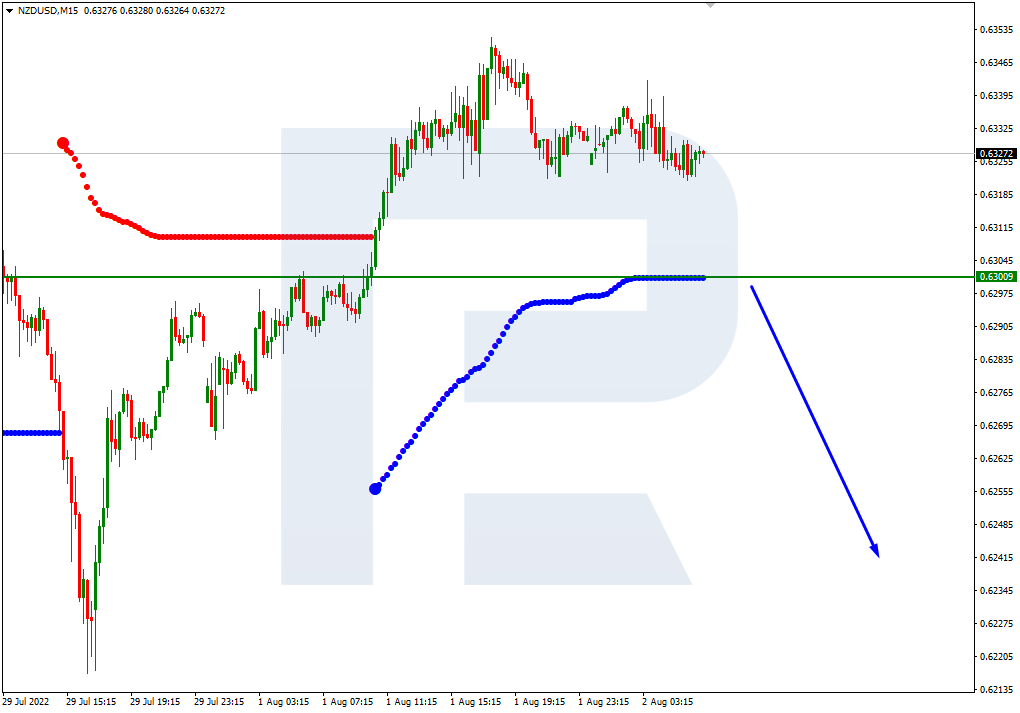
As we can see in the H4 chart, NZDUSD has reached the “overbought area”. In this case, the price is expected to rebound from 8/8 and resume moving downwards to reach the support at 6/8. However, this scenario may no longer be valid if the price breaks the resistance at 8/8 to the upside. After that, the instrument may continue growing towards +1/8.

NZDUSD_H4
Risk Warning: the result of previous trading operations do not guarantee the same results in the future

In the M15 chart, the pair may break the downside line of the VoltyChannel indicator and, as a result, continue its decline.

NZDUSD_M15

Article By RoboForex.com

Attention!
Forecasts presented in this section only reflect the author’s private opinion and should not be considered as guidance for trading. RoboForex LP bears no responsibility for trading results based on trading recommendations described in these analytical reviews.

The Euro is heading up. Overview for 02.08.2022

Article By RoboForex.com

EURUSD resumed its growth after weak PMI releases.

The major currency pair is back to growing. The current quote for the instrument is 1.0244.

The start of this trading week was rather struggling – the economic calendar offered a lot of PMI data from China, the US, and the Euro Area, which was minor.

On the other hand, it would be stupid to expect anything else. Most of the global central banks are tightening their monetary policies to fight inflation, which, in its turn, reduces business activities. Now, take a look around and you will see that the plan is working. Except that the possible consequences are looking terrifying.

The ISM Manufacturing PMI report showed 52.8 points in July after being 53.0 points the month before. However, the expected number was 52.3 points, so the actual data wasn’t too bad. Nevertheless, it’s the lowest reading since June 2020.

The components of the report showed that the major contribution to the decline was made by new orders, employment, production, and supplier deliveries.

Today’s calendar contains no important statistics, either from the US or the Euro Area. It means that investors will have to work with the facts that they already know.

Article By RoboForex.com

Attention!
Forecasts presented in this section only reflect the author’s private opinion and should not be considered as guidance for trading. RoboForex LP bears no responsibility for trading results based on trading recommendations described in these analytical reviews.