Expert Says Health Tech Co. Is in Another Buy Spot

Source: Clive Maund  (11/30/22)

Expert Clive Maund reviews the 1-year chart for Reliq Health Technologies to tell you why he believes it is in another buy spot.

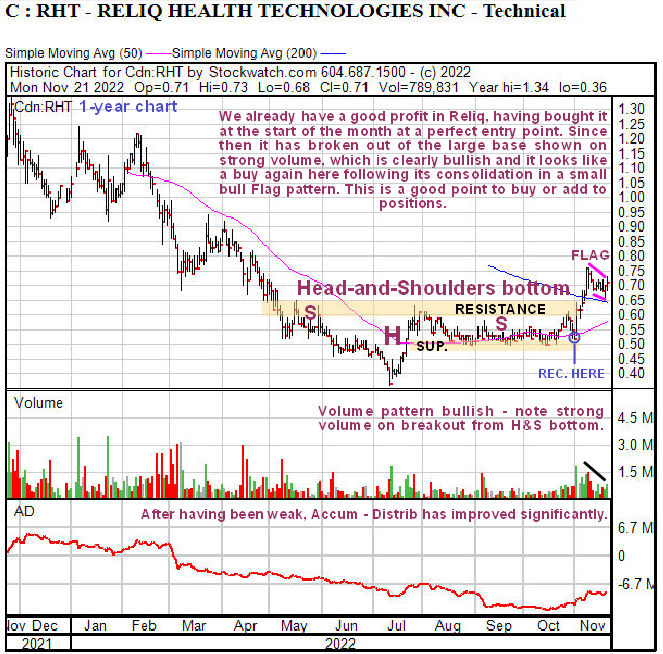
We caught a perfect buy spot when we went for Reliq Health Technologies Inc. (RHT:TSX.V; RQHTF:OTCQB; A2AJTB:WKN) at the start of the month (it was recommended in a Market Notebook update), as right after it proceeded to break out of a quite large Head-and-Shoulders bottom to rise quite steeply, resulting in good percentage gains for us in a short space of time.

The purpose of this update is to point out that it still looks good here.

It is, in fact, at another buy spot as it is starting to break out of a completing bull Flag that has formed over the past couple of weeks, as we can see on its latest 1-year chart below.

November 21, 2022, would have been the perfect time to buy, of course, because it ended up adding CA$0.04 by the end of the day, but it still looks good here as a breakout from the Flag should lead to a rally of similar magnitude to the one preceding the Flag.

We, therefore, stay long and this is a good point to add to positions or make fresh purchases. Reliq trades in reasonable volumes on the US OTC market.

Reliq Health Tech closed for trading at CA$0.71, $0.54 on November 21, 2022. It is currently trading at CA$0.69.

CliveMaund.com Disclosures

The above represents the opinion and analysis of Mr. Maund, based on data available to him, at the time of writing. Mr. Maund’s opinions are his own, and are not a recommendation or an offer to buy or sell securities. Mr. Maund is an independent analyst who receives no compensation of any kind from any groups, individuals or corporations mentioned in his reports. As trading and investing in any financial markets may involve serious risk of loss, Mr. Maund recommends that you consult with a qualified investment advisor, one licensed by appropriate regulatory agencies in your legal jurisdiction and do your own due diligence and research when making any kind of a transaction with financial ramifications. Although a qualified and experienced stock market analyst, Clive Maund is not a Registered Securities Advisor. Therefore Mr. Maund’s opinions on the market and stocks can only be construed as a solicitation to buy and sell securities when they are subject to the prior approval and endorsement of a Registered Securities Advisor operating in accordance with the appropriate regulations in your area of jurisdiction.

Disclosures:
1) Clive Maund: I, or members of my immediate household or family, own securities of the following companies mentioned in this article: None. I personally am, or members of my immediate household or family are, paid by the following companies mentioned in this article: None.

2) The following companies mentioned in this article are billboard sponsors of Streetwise Reports: Reliq Health Technologies Inc. Click here for important disclosures about sponsor fees.

3) Statements and opinions expressed are the opinions of the author and not of Streetwise Reports or its officers. The author is wholly responsible for the validity of the statements. The author was not paid by Streetwise Reports for this article. Streetwise Reports was not paid by the author to publish or syndicate this article. Streetwise Reports requires contributing authors to disclose any shareholdings in, or economic relationships with, companies that they write about. Streetwise Reports relies upon the authors to accurately provide this information and Streetwise Reports has no means of verifying its accuracy.

4) This article does not constitute investment advice. Each reader is encouraged to consult with his or her individual financial professional and any action a reader takes as a result of information presented here is his or her own responsibility. By opening this page, each reader accepts and agrees to Streetwise Reports’ terms of use and full legal disclaimer. This article is not a solicitation for investment. Streetwise Reports does not render general or specific investment advice and the information on Streetwise Reports should not be considered a recommendation to buy or sell any security. Streetwise Reports does not endorse or recommend the business, products, services or securities of any company mentioned on Streetwise Reports.

5) From time to time, Streetwise Reports LLC and its directors, officers, employees or members of their families, as well as persons interviewed for articles and interviews on the site, may have a long or short position in securities mentioned. Directors, officers, employees or members of their immediate families are prohibited from making purchases and/or sales of those securities in the open market or otherwise from the time of the decision to publish an article until three business days after the publication of the article. The foregoing prohibition does not apply to articles that in substance only restate previously published company releases. As of the date of this article, officers and/or employees of Streetwise Reports LLC (including members of their household) own securities of Reliq Health Technologies Inc., a company mentioned in this article.

Equipment Dealer Posts Record 88% Increase in Q3 EPS

Source: Streetwise Reports  (12/1/22)

Shares of Titan Machinery Inc. traded 26% higher yesterday to a new 52-week high after the company reported Q3/23 financial results, highlighting a 47.3% YoY increase in revenue. The firm additionally raised its full-year revenue and earnings estimates.

Agricultural and construction equipment dealer

Titan Machinery Inc. (TITN:NASDA), which owns and operates more than 100 full-service stores in the U.S. and Europe, yesterday announced financial results for the third quarter of 2023, which ended October 31, 2022.

The company’s Chairman and CEO, David Meyer, led off the report by stating, “We delivered another consecutive quarter of record financial results, with third-quarter earnings per share of US$1.82. The ongoing strength of the agriculture sector combined with our customer-centric focus drove consolidated revenue growth of 47%, which was supported by strong contributions across each of our revenue streams – equipment, parts, and service . . . Given these strong third-quarter results, coupled with our expectations for the solid market fundamentals continuing through the fourth quarter, we are increasing our earnings per share modeling assumption for the fiscal year 2023 to a midpoint of US$4.70 per share.”

Gross profit in Q3/23 rose to US$139.6 million (20.9%), up from US$92.5 million (20.4%) in Q3/22. The company indicated that the increases were due mostly to stronger margins from equipment sales.

The firm reported that total revenue during Q3/23 increased by 47.3% to US$668.8 million, compared to US$454.0 million in Q3/22.

Revenues across almost all business segments increased versus the same period in the prior year and consisted of US$509.0 million from Equipment sales, US$108.7 million from parts sales, US$39.0 from Service, and US$12.1 million from rental and other sales.

Gross profit in Q3/23 rose to US$139.6 million (20.9%), up from US$92.5 million (20.4%) in Q3/22. The company indicated that the increases were due mostly to stronger margins from equipment sales.

Titan Machinery reported that for Q3/23, it recorded a net income of US$41.3 million, or US$1.83 per diluted share, versus a net income of US$21.8 million, or US$0.97 per share in Q3/22.

The firm added that during Q3/23, adjusted EBITDA increased by 80% to US$63.5 million, compared to US$35.3 million in Q3/22.

The company advised that in Q3/23, agriculture segment revenues grew to US$493.3 million, compared to US$281.5 million in Q3/22. The firm said the gains were the result of a combination of positive organic growth and contributions from three separate company acquisitions.

Titan added that during Q3/23, construction segment revenues increased to US$86.4 million, up from US$79.7 million in Q3/22, driven by increased demand for equipment, and listed that it posted revenues of US$89.0 million in its international segment.

CEO Meyer commented further that “The momentum in our business continues to be visible across all aspects of Titan Machinery, as favorable industry conditions combine with several years of operational improvements and solid growth through accretive and strategic acquisitions . . . Looking ahead, we are very well positioned to serve the strong industries that we operate in with our robust balance sheet and powerful operational performance.”

The company offered some upward adjusted forward guidance and stated that for FY/23, it expects that agriculture revenue will be up 55-60% year-over-year, compared to its prior estimates of 50-55%. The firm stated that construction revenue is expected to decrease by 0-5% y-o-y, and international segment revenue is also projected to be down by 0-5% y-o-y. Titan Machinery added that for FY/23, it now expects it will have diluted earnings per share (EPS) of US$4.55-4.85. Prior estimates called for diluted EPS of US$3.70-4.00.

Titan Machinery owns and operates full-service agricultural and construction equipment dealer locations in North America and Europe. The company is based in West Fargo, N.D., and offers products and services to farmers, ranchers, and other commercial customers from its network of over 100 dealer locations in Europe and 13 U.S. midwestern and western states.

The firm’s international stores are located in Bulgaria, Germany, Romania, and Ukraine. Titan noted that each of its store locations represents one or more of CNH Industrial N.V.’s (CNHI:NYSE; CNHI:MI) equipment brands, including Case Construction, Case IH, CNH Capital, New Holland Agriculture, and New Holland Construction.

Titan Machinery started the day with a market cap of around US$787.17 million yesterday with approximately 22.57 million shares outstanding. TITN shares opened 15% higher yesterday at US$40.20 (+US$5.32, +15.25%) over the previous day’s US$34.88 closing price and reached a new 52-week high price yesterday afternoon of US$44.29. The stock traded yesterday between US$38.31 and US$44.29 per share and closed for trading at US$44.03 (+US$9.15, +26.23%).

Disclosures:

1) Stephen Hytha wrote this article for Streetwise Reports LLC and provides services to Streetwise Reports as an independent contractor. He or members of his household own securities of the following companies mentioned in the article: None. He or members of his household are paid by the following companies mentioned in this article: None.

2) The following companies mentioned in this article are billboard sponsors of Streetwise Reports: None. Click here for important disclosures about sponsor fees.

3) Comments and opinions expressed are those of the specific experts and not of Streetwise Reports or its officers. The information provided above is for informational purposes only and is not a recommendation to buy or sell any security.

4) The article does not constitute investment advice. Each reader is encouraged to consult with his or her individual financial professional and any action a reader takes as a result of information presented here is his or her own responsibility. By opening this page, each reader accepts and agrees to Streetwise Reports’ terms of use and full legal disclaimer. This article is not a solicitation for investment. Streetwise Reports does not render general or specific investment advice and the information on Streetwise Reports should not be considered a recommendation to buy or sell any security. Streetwise Reports does not endorse or recommend the business, products, services or securities of any company mentioned on Streetwise Reports.

5) From time to time, Streetwise Reports LLC and its directors, officers, employees or members of their families, as well as persons interviewed for articles and interviews on the site, may have a long or short position in securities mentioned. Directors, officers, employees or members of their immediate families are prohibited from making purchases and/or sales of those securities in the open market or otherwise from the time of the decision to publish an article until three business days after the publication of the article. The foregoing prohibition does not apply to articles that in substance only restate previously published company releases.

The Economy May Not Look Good but Oil and Energy Transport Stocks Do

Source: Ron Struthers  (11/29/22) 

Expert Ron Struthers believes consumers are on an unsustainable path of wracking up credit card debt, and it is only a matter of when the economy buckles, meanwhile big profits are being made by tanker companies and oil and gas/energy transmission companies as supplies continue to tighten.

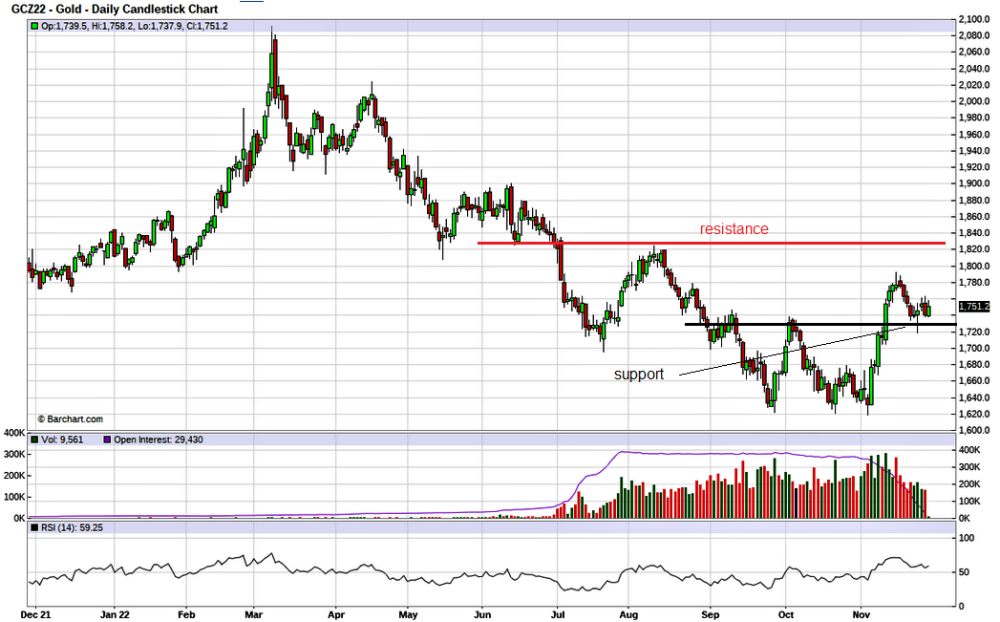
Gold bounced off the US$1730 support area I outlined in my Nov 22, 2022 update. Last week witnessed a hammer candle stick down to US$1720. So far, we are holding above my support level, and my new bull market theory is looking good so far. A break above US$1830 would be a strong sign of a new bull move.
A U.S. consumer confidence survey fell to 100.2 in November and touched the lowest level in four months, reflecting growing angst about a softening economy and potential recession. The closely followed index dropped 2 points from 102.2 in the prior month, the nonprofit Conference Board said today.

The U.S. Housing Market

The U.S. housing market pulled back even more in September, with prices slipping 1.2% from a month earlier. It was the third straight decline for the seasonally adjusted measure of prices in 20 large U.S. cities, according to the S&P CoreLogic Case-Shiller index.

Canada is setting records. Home sales had fallen for eight straight months before October brought a small uptick. Not only is that the longest stretch of falling sales on record, but it is also the steepest, said a CIBC team. “And it’s not really over yet.”

Prices are also setting records. With the average price of a home in Canada down 20% since February, the correction is already the steepest on record, said CIBC.

Well, this is no surprise to us. I believe the bad effect on Canadian Banks will be delayed some. I have learned that many of the variable rate mortgages have fixed payments but increase the amount of the payment that is interest only as rates rise until some trigger point is met, and the mortgagee will then have to make a large lump sum payment.

Skyrocketing home prices and massive interest rate spikes have driven affordability to its worst level in decades, according to a TD Economics report, leaving some first-time buyers shut out of the market altogether.

It is hard to get a handle on the numbers, but there was an article last week where the Bank of Canada said 50% of variable rate mortgages have hit the trigger. I quote from that article.

“After hiking the overnight rate from near zero at the start of the year to 3.75%, the Bank of Canada said this week that about 50% of borrowers with variable-rate, fixed-payment mortgages have reached a trigger rate — the point at which set monthly payments cover only the interest while the principal remains unpaid. Nearly 13% of all Canadian mortgages are affected, according to the central bank.

Federal rules stipulate that mortgages must be amortizing — meaning borrowers must be repaying principal — but lenders have three options once a trigger-rate threshold is reached: raise monthly payments, require a lump-sum pre-payment on the mortgage, or allow borrowers to slip into negative or reverse amortization for a period under rules set by banking authorities and mortgage insurers.”

I expect the majority of affected mortgages are in Ontario. This has likely delayed defaults and more selling pressure, and the banks have not had to increase their loss reserves as quickly as past housing declines. That said, Canadian Banks are reporting financials this week, so we will get a picture of how much their earnings are declining, but they won’t feel the heavy brunt of the housing decline until 2023.

Canada house prices will fall much further. Skyrocketing home prices and massive interest rate spikes have driven affordability to its worst level in decades, according to a TD Economics report, leaving some first-time buyers shut out of the market altogether.

The drop in prices has not offset the effect of higher interest rates,” said RBC economist Robert Hogue. “Our affordability measure is still deteriorating.

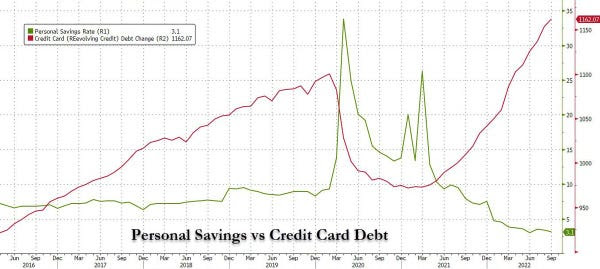
Another factor is that homeowners and consumers are piling up credit card debt, which only delays the reckoning.

Equifax Canada’s consumer survey released end of October found the average credit card balance held by Canadians was at a record high of CA$2,121 by the end of September.

This chart was posted by @zerohedge on Twitter. U.S. consumers are piling on credit card debt even faster than Canadians.
Cyber Monday Vs. Black Friday

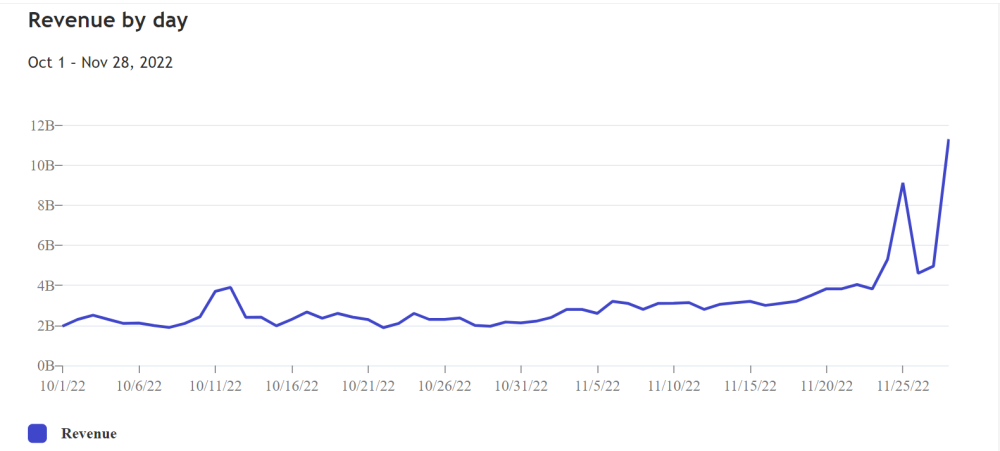
According to Adobe Analytics, the e-commerce-focused Cyber Monday has usurped Black Friday as the premier sales day of the holiday season.

Consumers spent US$11.79B on Cyber Monday sales, comfortably above the US$9.12B recorded for Black Friday, which was a new record.

It would appear that U.S. consumers are not worried about high-interest rates and a recession or maybe don’t know what one is. At the moment, there is no sign of a recession, but avoiding one by making ends meet with credit cards is just a band-aid.

The chart next page shows the spike in Monday online sales over Black Friday.
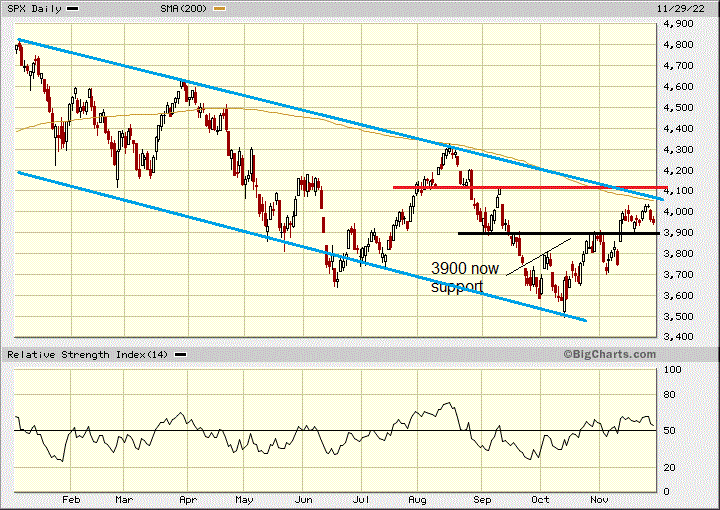
Meanwhile, the equity markets seem to be undecided about their direction.

I think there is some more room to rally up to around 4,100, but if we see a drop below 3,900, it would likely mean this bear market rally is over.
The Oil Market

Now let’s get to some better news for us with our shipping stocks, ATCO and DHT. And a look at the oil market.
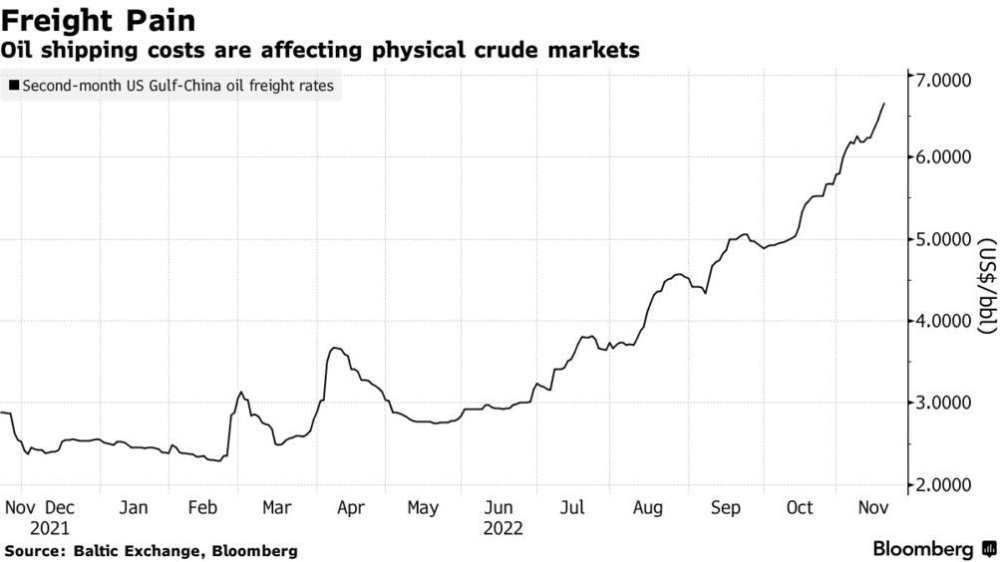
Earnings on the U.S. Gulf Coast-to-China shipping route have soared above US$100,000 per day, equivalent to US$7 per barrel, demonstrating the shrinking availability of crude tankers lately.

As reported by Bloomberg, global long-term LNG contracts before 2026 are all sold out, meaning that over the upcoming three years (until Qatar’s upgrades are commissioned), Europe and Asia will remain on a collision course for remaining spot cargoes.

The recent weakness in oil is probably because of shipping costs. Spot differentials for crudes across the Americas are tanking because of higher shipping costs — free-on-board prices for WTI plummeted a whopping US$5 per barrel week-on-week to reflect the shipping.

Oilprice.com pointed out last week that the shortage of tankers is taking place across all vessel categories; even VLCC freight costs from the Middle East into Asia Pacific have tripled year-on-year. The news of Freeport LNG pushing its restart into March 2023 following a damning report from federal pipeline safety regulators has pushed U.S. natural gas prices to US$6.7 per mmBtu, aggravated by forecasts for colder weather into December.

Germany’s LNG Terminal Costs Soar

The cost of purchasing and maintaining floating LNG terminals to help Germany survive this winter and diversify away from Russian gas has doubled to some US$6.6 billion, with the first unit already completed at the North Sea port of Wilhelmshaven.

As reported by Bloomberg, global long-term LNG contracts before 2026 are all sold out, meaning that over the upcoming three years (until Qatar’s upgrades are commissioned), Europe and Asia will remain on a collision course for remaining spot cargoes.

Remember, the oil sanctions on Russia were only announced, and the EU sanctions are supposed to come into effect in less than two weeks. Italy is considering several options to save its largest refinery, operated by Russia’s Lukoil in Sicily; one of them is to ask the EU for a temporary waiver.

A petition from a range of public interest groups is pushed the U.S. government to condition the approval of federal drilling permits on operators posting the upfront cost to clean up wells, trying to deter cases when small producers file for bankruptcy to avoid cleanup costs.

More Biden Administration negative influence on oil and gas exploration. The only thing I know for certain is the whole energy sector is in a mess and will just get worse. This winter will be horrific for many. However, as investors, there are great ways to profit from the government fiasco. Our two shipping stocks are doing great.

Atlas Energy Group

Atlas Energy Group, LLC (ATLS:OTCMKT) is being bought out at US$15.50 and will be taken private by Q2 2023, and they will keep paying the dividend until then.

You can hold the stock and get US$15.50 or sell now and put funds into one of my other millennium stocks.

We have a yield of 6.8%, but that is based on our US$7.33 buy price. The current yield is 3.2%, and there are other stocks on my Millennium Index with higher yields. A good replacement could be—

Energy Transfer

Energy Transfer Partners L.P. (ET:NYSE) is yielding 8.5% paying US$0.265 per quarter. The company plans to get back to its pre covid dividend of US$0.305 per quarter. I see no reason why they will not get there.

ET reported very good Q3 results on September 30, 2022. Net income attributable to partners for the three months ended September 30, 2022, of US$1.01 billion, a US$371 million increase from the same period last year. For the same period, net income per limited partner unit (basic and diluted) was US$0.29 per unit.

In the third quarter of 2022, the partnership experienced a US$126 million charge in the crude oil transportation and services segment related to a legal matter. In addition, Energy Transfer’s third quarter 2022 results were impacted by an approximately US$130 million negative adjustment related to hedged inventory in the NGL and refined products transportation and services segment.

These two items impacted the third quarter of 2022’s Adjusted EBITDA by approximately US$260 million in aggregate. Otherwise, ET numbers could have been better still.

During the third quarter of 2022, each of Energy Transfer’s five core segments realized higher volumes compared with the same period in 2021.

  • Intrastate natural gas transportation volumes were up 28% and set a new Partnership record.
  • Interstate natural gas transportation volumes were up 43%.
  • Midstream gathered volumes were up 47% and set a new Partnership record.
  • NGL transportation volumes were up 5%.
  • NGL fractionation volumes were up 6% and set a new Partnership record.
  • Crude oil transportation and terminal volumes were up 10% and 14%, respectively.

Over 90% of ET’s growth capital spending is comprised of projects that are already on-line or expected to be on-line and contributing cash flow at very attractive returns before the end of 2023.

The project backlog includes Gulf Run Pipeline in Louisiana, Grey Wolf and Bear processing plants in the Permian Basin, Fractionator VIII in Mont Belvieu, and LPG facilities projects at Energy Transfer’s Nederland Terminal.

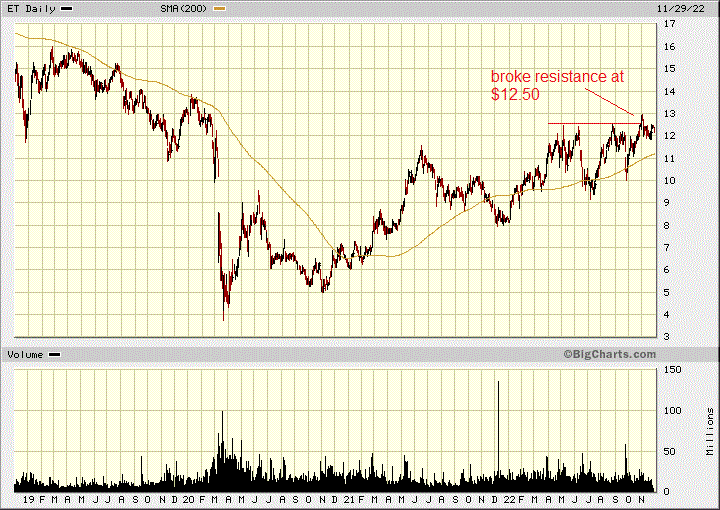
There is no good reason why this stock is not back to the higher levels witnessed in 2019. The recent break above US$12.50 is a good signal the stock is headed higher.
DHT Holdings

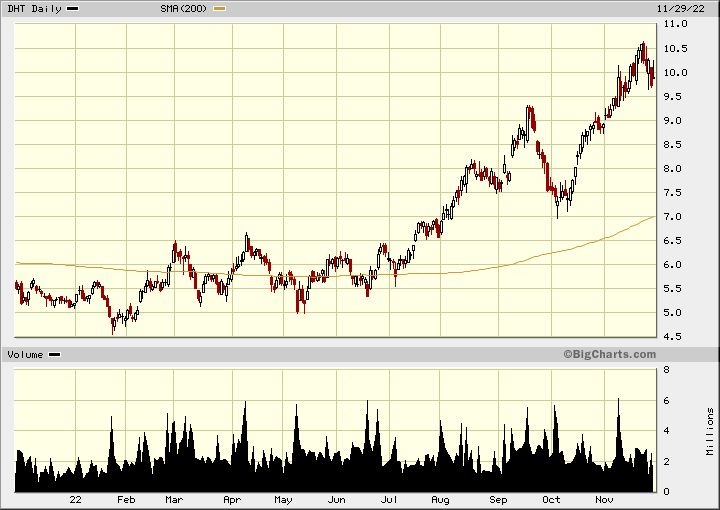
DHT Holdings Inc.’s (DHT:NYSE) stock moved very quickly for us, breaking out to highs and prices not seen since 2012. The oil shipping market will probably get tighter still this winter. Since we bought the stock in early October, they released their Q3 results on November 7, 2022.

In the third quarter of 2022, the Company achieved combined time charter equivalent earnings of US$25,400 per day, comprised of US$35,300 per day for the Company’s VLCCs on time-charter and US$22,000 per day for the Company’s VLCCs operating in the spot market. Adjusted EBITDA for the third quarter of 2022 was US$35.6 million. Net profit for the quarter was US$7.5 million, which equates to US$0.04 per basic share. DHT is paying a US$0.04 dividend, payable today.

Profits and dividends are going much higher. Look at the rates they are getting so far in Q4 compared to the above. Thus far, in the fourth quarter of 2022, 69% of the available VLCC spot days have been booked at an average rate of US$61,800 per day on a discharge-to-discharge basis.

77% of the available VLCC days, combined spot and time-charter days, have been booked at an average rate of US$53,100 per day (not including any potential profit splits on time charters).

Our timing to buy the stock was perfect, with the dip under US$7.50. The pullback from the recent US$10.50 is healthy market action, and I would buy on any dip below US$9.50.
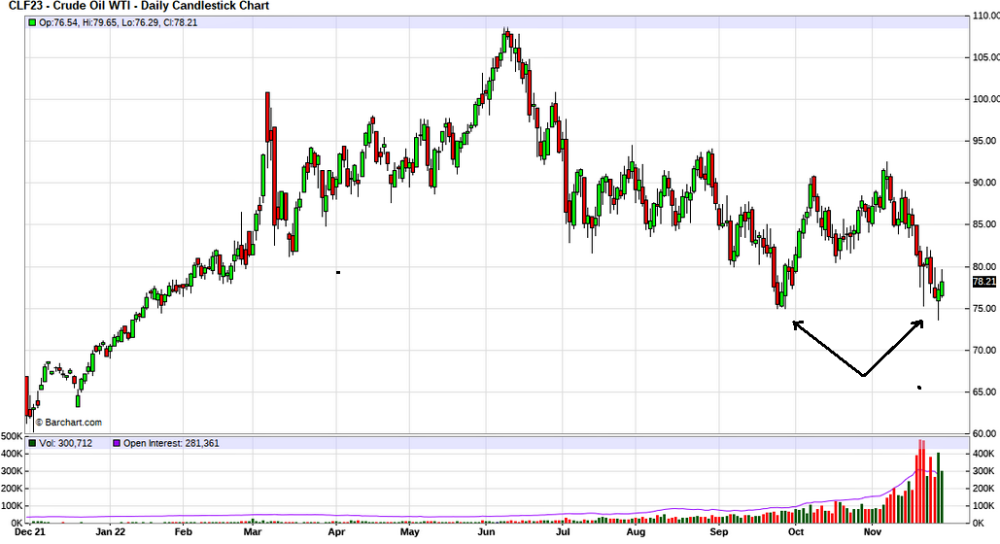
Sentiment in the oil market has been weak, with the China Covid-19 lockdowns causing demand fear.

At the same time, liquidity in the key contracts traded is wafer-thin as last week’s volatility prompted the sell-off of an equivalent of 90 million barrels, with open interest in WTI falling to the lowest since 2015.

Oil dropped under US$40 in 2015, where it bottomed, so this low open interest is likely another bottom with a second test of US$75.
The Emergencies Act

I hate to say I told you so because it is not good news.

Early this year, I commented that invoking the Emergencies Act in Canada caused a bank run and would result in strong capital outflows from Canada.

Capital flows are transactions involving financial assets between international entities.

The Emergencies Act was invoked in February, and you can see the steep plunge since then. The last biggest steep plunge was in the 2008 financial crisis, which saw a plunge from around +6000 to -11,000 (click 25-year chart). This current plunge is much more than that.

Financial assets to be included can be bank deposits, loans, equity securities, debt securities, etc. Capital outflow generally results from economic uncertainty in a country, whereas large amounts of capital inflow indicate a growing economy.

It has been a while now since Trudeau made his ridiculous move, and we have some data.

This is a 10-year chart of Canada Capital flows from Statistics Canada.

You can see that Capital flows were improving with the recovery from the pandemic and high oil prices that in the past have been a big benefit to Canada.

From around 2001 to 2008, Canada had its strongest inflows when oil ran from around US$60 to US$150. Canada was running at the 10,000 mark on the plus side back then.
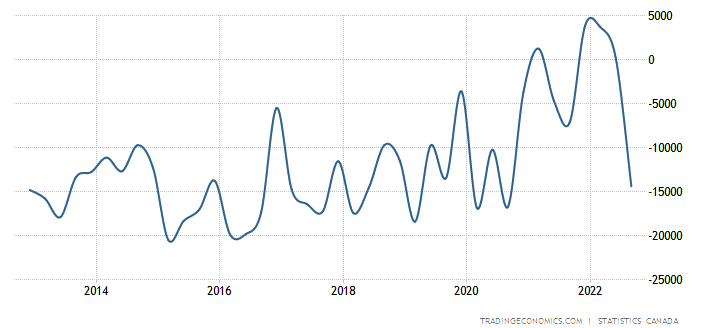
The Emergencies Act was invoked in February, and you can see the steep plunge since then. The last biggest steep plunge was in the 2008 financial crisis, which saw a plunge from around +6000 to -11,000 (click 25-year chart). This current plunge is much more than that, and we have not seen the bottom yet. There is no doubt we are seeing the greatest outflow of money from Canada in its history.

The Emergencies Act in Canada was all about going after the ‘Freedom Convoy’ money. The big Canadian banks admitted just that in the current parliament inquiry underway. I am not going to get into that and the political BS right now, but it is no surprise business confidence is plunging also.

Small business confidence in Canada has hit one of its lowest levels ever, according to the Canadian Federation of Independent Business (CFIB). Meanwhile, the long-term index, based on a 12-month outlook, dropped 1.2 points to 50.0 this month — the lowest recorded since 2009, outside of the 2008/09 and 2020 recessions, the CFIB said.

Right now, markets in Canada and the U.S. are trading on the proverbial ‘soft landing’ that seldom occurs. A severe recession is coming that will get started in Europe this winter as they are forced to shut down industries because of energy shortages.

Putin’s recent attacks on Ukraine’s energy grid will result in more shortages as Ukraine is no longer able to export electricity to Europe.

I hate to say it, but another bad news told-you-so will sadly occur this winter.

From a personal experience, I have an emergency kerosene heater and paid around US$20 for an 18 to 19-liter jug of fuel. A recent discussion prompted me to check prices, and I found out those jugs of fuel are now selling for over US$100. And that is if you can find one.

Struthers Stock Report Disclaimers: 

All forecasts and recommendations are based on opinion. Markets change direction with consensus beliefs, which may change at any time and without notice. The author/publisher of this publication has taken every precaution to provide the most accurate information possible. The information & data were obtained from sources believed to be reliable, but because the information & data source are beyond the author’s control, no representation or guarantee is made that it is complete or accurate.

The reader accepts information on the condition that errors or omissions shall not be made the basis for any claim, demand or cause for action. Because of the ever-changing nature of information & statistics the author/publisher strongly encourages the reader to communicate directly with the company and/or with their personal investment adviser to obtain up to date information.

Past results are not necessarily indicative of future results. Any statements non-factual in nature constitute only current opinions, which are subject to change. The author/publisher may or may not have a position in the securities and/or options relating thereto, & may make purchases and/or sales of these securities relating thereto from time to time in the open market or otherwise. Neither the information, nor opinions expressed, shall be construed as a solicitation to buy or sell any stock, futures or options contract mentioned herein. The author/publisher of this letter is not a qualified financial adviser & is not acting as such in this publication.

Disclosures: 

Charts provided by the author.

1) Ron Struthers: I, or members of my immediate household or family, own shares of the following companies mentioned in this article: Energy Transfer and DHT Holdings. I personally am, or members of my immediate household or family are, paid by the following companies mentioned in this article: None. My company currently has a financial relationship with the following companies mentioned in this article: None. I determined which companies would be included in this article based on my research and understanding of the sector.

2) The following companies mentioned in this article are billboard sponsors of Streetwise Reports: None. Click here for important disclosures about sponsor fees. The information provided above is for informational purposes only and is not a recommendation to buy or sell any security.

3) Statements and opinions expressed are the opinions of the author and not of Streetwise Reports or its officers. The author is wholly responsible for the validity of the statements. The author was not paid by Streetwise Reports for this article. Streetwise Reports was not paid by the author to publish or syndicate this article. Streetwise Reports requires contributing authors to disclose any shareholdings in, or economic relationships with, companies that they write about. Streetwise Reports relies upon the authors to accurately provide this information and Streetwise Reports has no means of verifying its accuracy.

4) This article does not constitute investment advice. Each reader is encouraged to consult with his or her individual financial professional and any action a reader takes as a result of information presented here is his or her own responsibility. By opening this page, each reader accepts and agrees to Streetwise Reports’ terms of use and full legal disclaimer. This article is not a solicitation for investment. Streetwise Reports does not render general or specific investment advice and the information on Streetwise Reports should not be considered a recommendation to buy or sell any security. Streetwise Reports does not endorse or recommend the business, products, services, or securities of any company mentioned on Streetwise Reports.

5) From time to time, Streetwise Reports LLC and its directors, officers, employees, or members of their families, as well as persons interviewed for articles and interviews on the site, may have a long or short position in the securities mentioned. Directors, officers, employees, or members of their immediate families are prohibited from making purchases and/or sales of those securities in the open market or otherwise from the time of the decision to publish an article until three business days after the publication of the article. The foregoing prohibition does not apply to articles that in substance only restate previously published company releases.

 

Ichimoku Cloud Analysis 01.12.2022 (EURUSD, XAUUSD, USDCAD)

By RoboForex.com

EURUSD, “Euro vs US Dollar”

The currency pair is testing the upper border of the Triangle pattern. The instrument is going above the Ichimoku Cloud, which suggests an uptrend. A test of the upper border of the Cloud at 1.0360 is expected, followed by growth to 1.0765. An additional signal confirming the growth will be a bounce off the lower border of the bullish channel. The scenario can be cancelled by a breakaway of the lower border of the Cloud and securing under 1.0245, which will mean further falling to 1.0155. The growth can be supported by a breakaway of the upper border of the Triangle pattern and securing above 1.0555.

EURUSD
Risk Warning: the result of previous trading operations do not guarantee the same results in the future

XAUUSD, “Gold vs US Dollar”

Gold is getting ready to break through the resistance level. The instrument is going above the Ichimoku Cloud, which suggests an uptrend. A test of the upper border of the Cloud at 1755 is expected, followed by growth to 1855. An additional signal confirming the growth will be a bounce off the upper border of the descening channel. The scenario can be cancelled by a breakaway of the lower border of the Cloud and securing under 1725, which will mean further falling to 1675.

XAUUSD
Risk Warning: the result of previous trading operations do not guarantee the same results in the future

USDCAD, “US Dollar vs Canadian Dollar”

The currency pair is correcting in a bullish channel. The instrument is going above the Ichimoku Cloud, which suggests an uptrend. A test of the upper border of the Cloud at 1.3375 is expected, followed by growth to 1.3750. An additional signal confirming the growth will be a bounce off the lower border of the bullish channel. The scenario can be cancelled by a breakaway of the lower border of the Cloud and securing under 1.3315, which will mean further falling to 1.3220.

USDCAD

Article By RoboForex.com

Attention!
Forecasts presented in this section only reflect the author’s private opinion and should not be considered as guidance for trading. RoboForex LP bears no responsibility for trading results based on trading recommendations described in these analytical reviews.

EUR: what did Powell say? Overview for 01.12.2022

By RoboForex.com

The market major on Thursday is growing. The current quote is 1.0450.

Yesterday was full of statistics, but the key catalyst was different. Activity of investors heated up after the speech of the head of the US Fed Jerome Powell. He confirmed that the next increase in the interest rate might be more modest that the previous ones.

The idea is to raise the interest rate by 50 base points instead of 75 points, like it used to be raised for several meetings in a row. Simultaneously, Powell mentioned that the monetary policy on the whole would remain limiting at least for some time in the future – until there appear some confirmations that the inflation has subsided.

So, according to the CME observations, the market now considers a 50 base point increase of the rate to be 75% possible, so that at the meeting on 14 December the interest rate will reach 4.50% y/y. As for inflation, Powell acknowledged that it was too early to celebrate victory.

It seems that all that Powell has said lately are the main highlights for understanding the future steps of the regulator. Let us just stick to them.

For the USD, the slow-down in the growth of the interest rate became a negative signal.

Article By RoboForex.com

Attention!
Forecasts presented in this section only reflect the author’s private opinion and should not be considered as guidance for trading. RoboForex LP bears no responsibility for trading results based on trading recommendations described in these analytical reviews.

The Analytical Overview of the Main Currency Pairs on 2022.12.01

By JustMarkets

The EUR/USD currency pair

Technical indicators of the currency pair:
  • Prev Open: 1.0329
  • Prev Close: 1.0407
  • % chg. over the last day: +0.76 %

Eurozone’s inflation eased in November from 10.6 to 10% y/y due to falling energy prices. Core inflation remained stable at 5%. Nevertheless, economists warn that lower inflation is unlikely to prevent the European Central Bank from raising interest rates as food inflation continues to rise. Whether this is the peak of overall inflation remains to be seen. But the current economic situation could push the European Central Bank to hike less by 50 basis points next month.

Trading recommendations
  • Support levels: 1.0361, 1.0332, 1.0284, 1.0193, 1.0092, 1.0043, 0.9968
  • Resistance levels: 1.0444, 1.0504

The trend on the EUR/USD currency pair on the hourly time frame is bullish. The price is trading above the moving averages, and the MACD indicator is in the positive zone with no signs of reversal. Buy trades are best considered from the support level of 1.0361, but with additional confirmation. Sell deals can be considered from the resistance level of 1.0444, but it is better with confirmation in the form of reverse initiative.

Alternative scenario: if the price breaks down through the support level of 1.0284 and fixes below it, the downtrend will likely resume.

EUR/USD
News feed for 2022.12.01:
  • – German Retail Sales (m/m) at 09:00 (GMT+3);
  • – Spanish Manufacturing PMI (m/m) at 10:15 (GMT+3);
  • – Italian Manufacturing PMI (m/m) at 10:45 (GMT+3);
  • – French Manufacturing PMI (m/m) at 10:50 (GMT+3);
  • – German Manufacturing PMI (m/m) at 10:55 (GMT+3);
  • – Eurozone Manufacturing PMI (m/m) at 11:00 (GMT+3);
  • – Eurozone Unemployment Rate (m/m) at 12:00 (GMT+3);
  • – US PCE Price index (m/m) at 15:30 (GMT+3);
  • – US Initial Jobless Claims (w/w) at 15:30 (GMT+3);
  • – US FOMC Member Bowman Speaks at 16:30 (GMT+3);
  • – US ISM Manufacturing PMI (m/m) at 17:00 (GMT+3).

The GBP/USD currency pair

Technical indicators of the currency pair:
  • Prev Open: 1.1958
  • Prev Close: 1.2056
  • % chg. over the last day: +0.82 %

A Bank of England spokesman said yesterday that UK inflation will fall rapidly in the 2nd half of 2023. But it is not yet the reason how this will happen, as at the moment, the UK labor market remains weak, and household incomes are shrinking. The Bank of England intends to raise interest rates at the next meeting, which will put even more pressure on the economy.

Trading recommendations
  • Support levels: 1.2015, 1.1964, 1.1684, 1.1476, 1.1418, 1.1172, 1.1093
  • Resistance levels: 1.2113, 1.2147, 1.2167

From the technical point of view, the trend on the GBP/USD currency pair on the hourly time frame is bullish. The price is trading above the moving levels. The MACD indicator became positive, and the buyers’ pressure inside the day. Under such market conditions, it is better to look for buy trades from the support level of 1.2015, but with confirmation. Sell trades are best sought on intraday time frames from resistance levels of 1.2113, but also better with confirmation, as the level has already been tested.

Alternative scenario: if the price breaks down of the 1.1900 support level and fixes below it, the downtrend will likely resume.

GBP/USD
News feed for 2022.12.01:
  • – UK Manufacturing PMI (m/m) at 11:30 (GMT+3).

The USD/JPY currency pair

Technical indicators of the currency pair:
  • Prev Open: 138.63
  • Prev Close: 138.08
  • % chg. over the last day: -0.40%

Japan refrained from intervening in the foreign exchange market in November, the Treasury Department said Wednesday, as rumors grew that the US Federal Reserve would slow the pace of rate hikes as inflation peaked. Weaker-than-expected US inflation data this month somewhat diminished the prospect of aggressive rate hikes by the US Federal Reserve. At the same time, the Bank of Japan remains committed to ultra-low interest rates.

Trading recommendations
  • Support levels: 136.49, 135.20
  • Resistance levels: 137.65, 139.09, 140.75, 143.17, 145.16

From the technical point of view, the medium-term trend on the currency pair USD/JPY is bearish. The MACD indicator is in the negative zone, but on higher time frames, a divergence is formed, which indicates a certain weakness of the sellers. Under such market conditions, buy trades can be looked for on intraday time frames from the support level of 136.49, but only with confirmation. Selling could be sought from the resistance level of 137.65 or 139.09, provided there is a reverse reaction.

Alternative scenario: If the price fixes above 140.75, the uptrend will likely resume.

USD/JPY
News feed for 2022.12.01:
  • – Japan Manufacturing PMI (m/m) at 02:30 (GMT+3).

The USD/CAD currency pair

Technical indicators of the currency pair:
  • Prev Open: 1.3578
  • Prev Close: 1.3414
  • % chg. over the last day: -1.22 %

Dovish comments from Federal Reserve Chairman Jerome Powell and signs of declining inflation in the US raised hopes that the Central Bank would be less aggressive about raising interest rates. The dollar index began to lose ground on such statements, and as a result, USD/CAD went down. The Biden administration is keeping its promise to cut the use of oil reserves in the US, which contributes to the maximum reduction of crude oil reserves in the country in a week. This helped oil prices rise by 3%, which is good for the Canadian currency, as it’s a commodity currency.

Trading recommendations
  • Support levels: 1.3386, 1.3360, 1.3281, 1.3212
  • Resistance levels: 1.3479, 1.3522, 1.3658, 1.3682, 1.3776, 1.3855

From the point of view of technical analysis, the trend on the USD/CAD currency pair has changed to bullish. But the price is close to changing a priority. The MACD indicator is in the negative zone with no signs of reversal. Sellers’ pressure is still present. Buy trades should be considered on the lower time frames from the support level of 1.3386 or 1.3360, but with additional confirmation. For sell deals, it is better to consider the resistance level of 1.3479 but with confirmation in the form of reverse initiative.

Alternative scenario: if the price breaks down and consolidates below the support level of 1.3386, the downtrend will likely resume.

USD/CAD
News feed for 2022.12.01:
  • – Canada Manufacturing PMI (m/m) at 16:30 (GMT+3).

By JustMarkets


This article reflects a personal opinion and should not be interpreted as an investment advice, and/or offer, and/or a persistent request for carrying out financial transactions, and/or a guarantee, and/or a forecast of future events.

The US Federal Reserve will reduce the pace of rate hikes. Inflation in the Eurozone is falling

By JustMarkets

Federal Reserve Chairman Jerome Powell said Wednesday that the rate hikes are likely to slow, but the peak rate will be higher than previously expected, as there is a long way to go to curb inflation. About 70% of traders expect the Fed to slow rate hikes to 50 basis points in December, down from the 75 basis points seen in the previous four meetings. The Fed has targeted the labor market in its fight against inflation, hoping that tighter monetary policy will help reduce demand enough to curb wage growth and, ultimately, inflation. Such “dovish” statements by the head of the US Federal Reserve were seen by investors as positive. Stock indices jumped after Powell’s speech. At the close of the stock market yesterday, Dow Jones (US30) gained 2.18%, and S&P 500 (US500) added 3.09%. The NASDAQ Technology Index (US100) jumped by 4.41% on Wednesday.

The US inflation-adjusted GDP rose by 2.9% year-over-year for the latest quarter. For Federal Reserve policymakers, the overall GDP growth picture is what they want to see in line with the economy’s long-term trend.

Elon Musk believes a recession is coming and fears that Federal Reserve attempts to reduce inflation could make it worse. In a tweet yesterday, the Tesla CEO and the Twitter owner called on the Fed to immediately lower interest rates. Otherwise, the Fed risks increasing the likelihood of a serious recession.

Stock markets in Europe traded higher yesterday. Germany’s DAX (DE30) gained 0.29%, France’s CAC 40 (FR40) added 1.04%, Spain’s IBEX 35 index (ES35) increased by 0.49%, Britain’s FTSE 100 (UK100) closed Wednesday up by 0.81%.

The oil price rose to $85-86 on news that OPEC+ countries are willing to cut OPEC production even further. The talks are about an additional 2 million BPD of production cuts.

In November, inflation in the Eurozone fell from 10.6% to 10% year-on-year due to falling energy prices. Core inflation remained stable at 5%. Nevertheless, economists warn that lower inflation is unlikely to prevent the European Central Bank from raising interest rates as food inflation rises. Whether this is the peak of overall inflation remains to be seen. But the current economic situation could push the European Central Bank to hike less by 50 basis points next month

The KOF economic barometer fell slightly in November and now stands at 89.5 points. This is the fifth consecutive drop in the barometer. The outlook for the Swiss economy in the coming months thus remains subdued.

Oil rose almost 3% yesterday on a decline in US crude oil inventories. Traders are also betting that China will ease Covid restrictions and OPEC countries will resort to deeper production cuts this Sunday.

Asian markets mostly rose yesterday. Japan’s Nikkei 225 (JP225) decreased by 0.21% for the day, Hong Kong’s Hang Seng (HK50) jumped 2.16%, and Australia’s S&P/ASX 200 (AU200) was up 0.43% by the end of the day.

Asian indices were boosted by growing optimism that China is easing its stance on COVID-19-related restrictions. Despite high infection rates, several cities in the world’s second-largest economy lifted regional blockades.

S&P 500 (F) (US500) 4,080.11 +122.48 (+3.09%)

Dow Jones (US30) 34,589.77 +737.24 (+2.18%)

DAX (DE40) 14,397.04 +41.59 (+0.29%)

FTSE 100 (UK100) 7,573.05 +61.05 (+0.81%)

USD Index 106.03 -0.79 (-0.74%)

Important events for today:
  • – Japan Manufacturing PMI (m/m) at 02:30 (GMT+3);
  • – China Caixin Manufacturing PMI (m/m) at 04:45 (GMT+3);
  • – German Retail Sales (m/m) at 09:00 (GMT+3);
  • – Switzerland Retail Sales (m/m) at 09:30 (GMT+3);
  • – Switzerland Consumer Price Index (m/m) at 09:30 (GMT+3);
  • – Spanish Manufacturing PMI (m/m) at 10:15 (GMT+3);
  • – Italian Manufacturing PMI (m/m) at 10:45 (GMT+3);
  • – French Manufacturing PMI (m/m) at 10:50 (GMT+3);
  • – German Manufacturing PMI (m/m) at 10:55 (GMT+3);
  • – Eurozone Manufacturing PMI (m/m) at 11:00 (GMT+3);
  • – UK Manufacturing PMI (m/m) at 11:30 (GMT+3);
  • – Eurozone Unemployment Rate (m/m) at 12:00 (GMT+3);
  • – US PCE Price index (m/m) at 15:30 (GMT+3);
  • – US Initial Jobless Claims (w/w) at 15:30 (GMT+3);
  • – Canada Manufacturing PMI (m/m) at 16:30 (GMT+3);
  • – US FOMC Member Bowman Speaks at 16:30 (GMT+3);
  • – US ISM Manufacturing PMI (m/m) at 17:00 (GMT+3);
  • – US Natural Gas Storage (w/w) at 17:30 (GMT+3).

By JustMarkets


This article reflects a personal opinion and should not be interpreted as an investment advice, and/or offer, and/or a persistent request for carrying out financial transactions, and/or a guarantee, and/or a forecast of future events.

S&P 500 Respects Strong Bullish Trend

By ForexTime 

The S&P 500 was in a downtrend until a lower bottom formed on 13 October.  Bulls found the price attractive at those levels and the momentum in the market started shifting.

A closer look at the Momentum Oscillator reveals positive divergence between points “a” and “b” when comparing the bottoms at 3559.0 and 3492.4. This could have alerted technical traders that the current trend might be losing steam.

After the lower bottom at 3492.4, the price of the S&P 500 broke through the weekly resistance level at 3661.5, and the bullish activity was further confirmed when the 15 and 34 Simple Moving Averages and the Momentum Oscillator broke through the 100 base-line into bullish territory.

Since then the market has made four impulse waves in the uptrend before a lower top formed on 24 November and the market seemed to begin to lose some bullish momentum. The bears tried to pull the market lower but the bulls found new backing near the weekly support level at 3920.0 and a new impulse wave started on 30 November.

As long as the bulls can sustain the upward momentum, the outlook for the S&P 500 on the D1 time frame will remain bullish.


Forex-Time-LogoArticle by ForexTime

ForexTime Ltd (FXTM) is an award winning international online forex broker regulated by CySEC 185/12 www.forextime.com

Inflation: how financial speculation is making the global food price crisis worse

By Sophie van Huellen, University of Manchester 

UK households, like those in many other countries, are struggling to make ends meet. More than half of households have only £2.66 per week left after paying for bills and essentials, according to figures from the supermarket chain Asda.

The extreme spikes in the cost of energy and food that we have seen this year are mostly to blame for this shift. Basic grocery prices have increased by 17% on average from last year, according to the Office for National Statistics, while some products such as pasta have increased by as much as 60%. This is because the cost of staple food crops, such as wheat, have increased by more than 30% since the beginning of 2021.

The drivers of these soaring prices are multiple: Russia’s war on Ukraine (a major wheat exporter), the effect of extreme weather on harvests, and pandemic-era supply chain bottlenecks that are still being felt due to ongoing lockdowns, labour shortages and loss of capacity by producers.

But these supply factors do not entirely explain recent price movements. Bumper grain harvests have been reported by China in 2021 and the US in 2022, and the UN’s Food and Agriculture Organization (FAO) predicts a “comfortable supply situation” for grain in 2022-23. This calls into question whether soaring food prices can be attributed solely to supply shortages.

When the world last experienced a major food crisis in 2008, financial speculation with food-based derivatives was seen as a contributing factor. Indeed, my research on that food crisis suggests the world is once again likely to be experiencing a food price crisis rather than a food supply crisis.

The role of traders

While soaring food prices threaten food security globally, large food trading firms are profiting. These companies bet on the direction of food prices by storing or trading substantial amounts of goods – making big financial gains as a result.

But it’s not just physical goods that are traded. Financial markets also see producers and consumers, alongside banks, brokers and investors, trading in commodities such as food. Sometimes called paper trading because it involves the use of “futures contracts” rather than actual crops, this activity happens on commodity exchanges around the world.

Traders can buy (called “being long”) or sell (“short”) on these exchanges, and most contracts end before the delivery date so a trader doesn’t have to own or receive the goods to benefit – or not – from price changes. Similarly, traders only have to place a deposit with an exchange, from which gains and losses are added or taken. They do not have to put down the full value of the crop they are buying or selling via the commodity exchange unless they take delivery of the physical item at the end of the contract.

The role of speculators

While this can of course promote speculation, commodity exchanges also help producers, consumers and traders in physical food commodities to manage their risk. For instance, a farmer might take a short position (essentially betting that prices will fall) on the price of wheat via a contract that ends (or matures) close to the time of harvest. If prices fall while the crop grows, the contract gains in value and makes up for the farmer’s losses if the actual crops are worth less. It’s like an insurance policy that enables the farmer to plan ahead at the time of planting the crop.

For risk management to work, however, the physical price of the commodity must track the futures price. To guarantee this close relationship, the price of a physical contract is based on the price of a specific futures contract. For example, the Brent Crude futures contract traded on the Intercontinental Exchange is a globally accepted benchmark for a certain type of oil. Global food prices are similarly determined on financial futures markets.

The use of benchmarks is often justified by the claim that financial markets are good at “price discovery” – determining the current value of a product. The “efficient market paradigm” states that all information about market fundamentals – that is, physical demand and supply conditions – is reflected in the futures price.

Ignoring the fundamentals

For this to hold, trading activity must be based on this fundamental information alone. However, my research shows that financial traders use a variety of trading strategies that are not based on reading market fundamentals. This has important implications for food prices.

Take “index traders”, for example. These are typically large investors such as pension or insurance funds that invest in indices that track certain types of assets. They use commodity derivatives for diversification, to balance out the effects of inflation on other parts of their investment portfolios. They are also known as “noise traders” because their trading decisions support price increases that are completely unrelated to actual demand and supply.

On the other hand, hedge funds and investment banks tend to make trading decisions based on a mix of both market fundamentals and statistical charts or graphs showing historical price trends. This is known as “positive feedback trading” because it replicates and amplifies real price trends.

Research I conducted in 2020 shows that positive feedback and noise traders can have a substantial and prolonged impact on commodity futures prices. This means high food prices do not always signal a food shortage. An increase in speculative activity on food commodity markets since 2020 suggests that financial speculation could well have contributed to recent price highs.

This indicates that the current food crisis is a price crisis, rather than a supply crisis. But this does not mean that there are no food shortages.

High prices have severe consequences for food import-dependent countries that don’t have the facilities or money to secure supplies for their own people. Stockpiling by larger countries in anticipation of rising food prices, with the intent of securing access to food for their own citizens, further squeezes the physical supply of food. This is how a food price crisis can quickly turn into a food supply crisis.

And as the world saw when prices spiked in 2007-2008, when speculation creates a disconnect between real food supply and demand conditions, it can have devastating consequences for food security globally.The Conversation

About the Author:

Sophie van Huellen, Lecturer in Development Economics, University of Manchester

This article is republished from The Conversation under a Creative Commons license. Read the original article.

Little Drone Co. Could Have Big Impact

Source: Streetwise Reports  (11/29/22)

Volatus Aerospace Corp. could be a company to watch in the fast-growing drone aviation market.

Volatus Aerospace Corp. (VOL:TSX; VLTTF:OTCQB) is a small, little-known player that could make a big impact in the burgeoning but rapidly growing multi-billion dollar commercial drone market.

Volatus is one of several players looking to carve a piece out of the global drone market expected to approach US$50 billion in annual revenues in the next seven years.

Earlier this month, the Canadian-based company, which serves the commercial and defense markets with integrated drone solutions, reported record revenue of CA$11.12 million, up 68% over the previous quarter and a 238% jump from the same period a year ago.

Building Revenue

Volatus is building revenue from sales of drone equipment, drones-as-a-service, training services, and crewed aircraft sales and services. The recent jump in revenue was driven by organic growth, scale in drone activities, and an increase in aviation revenue.

Global revenue from drones was valued at US$6.51 billion last year, expected to reach US$8.15 billion this year and jump to US$47.38 billion by 2029, according to a report by Fortune Business Insights.

The war in Ukraine has created a need for drones that will continue long after the conflict has ended, said Volatus Chief Executive Officer Glen Lynch during a conference call about the company’s earnings results earlier this month.

“Drones will have a major role to play in the reconstruction . . .  of the country,” Lynch said. “The conflict in Ukraine literally changed the way countries around the world are looking at the use of drones and modern warfare. So, we’re responding to numerous opportunities right now for sales in NATO countries that are not currently engaged in fighting directly in the conflict in Ukraine; we’re looking at a fairly robust future for drones in the defense sector.”

Volatus provides the commercial and defense markets with integrated drone solutions. It uses a network of more than 1,200 contract pilots across the Americas, providing imaging and security, equipment sales, and support and training.

The company is also providing aerial surveillance and monitoring of oil and gas pipelines, a market Volatus executives believe is valued at US$58.4 billion.

Catalyst: Two New Acquisitions

Volatus may have taken another step toward cornering the market for monitoring the oil and gas pipeline market with its recent acquisition of Synergy Aviation. The company believes Synergy, based in Edmonton, Alberta, will strengthen its position to provide green drone technologies for oil and gas infrastructure monitoring as an alternative to less environmentally friendly helicopters and airplanes.

Volatus also completed an acquisition of iRed Remote Sensing of Emsworth, England, to reinforce the company’s ability in infrared inspection while expanding its presence in the UK and Europe.

Today, November 28, 2022, Volatus announced another acquisition, signing to annex Syracuse-based Empire Drone Company LLC. This company is known as one of North America’s burgeoning distributors and integrators for unmanned aerial systems. Empire Drone’s projected 2022 revenue is CA$2.5M with a 6% EBITDA margin.

With this acquisition, Volatus will purchase 100% of the company for a cash consideration of US$300,000, and equity of US$350,000 with a minimum floor price of $0.65. This includes, according to the company, “an earn-out of US$350,000 paid in equity after one year anniversary based on the 30-day volume weighted average price (VWAP) with a minimum floor price of US$0.65 per share and assume the long-term debt of US$225,000.”

Volatus Taking Off With Drone Sector

Global revenue from drones was valued at US$6.51 billion last year, expected to reach US$8.15 billion this year and jump to US$47.38 billion by 2029, according to a report by Fortune Business Insights.

While the report says drones will likely have several commercial applications, including medical emergency transportation, and filming and photography, it also concluded that a “rise in demand for unmanned systems in the oil and  gas, energy, and power generation sector is likely to fuel market growth in the upcoming years.”

“I believe it’s only a matter of time before it eventually hits US$5.00,” Volatus Investor Edward Vranic wrote.

In addition to its third-quarter record revenue growth, Volatus also reported a gross profit of CA$3.3 million, up from CA$2.6 million in the year-ago period. The company also reported a gross margin of 30%, an increase of 127 basis points over its second quarter of this year.

Volatus says its recent acquisitions of Synergy and iRed provide approximately US$7.5 million in proforma revenue and US$1 million in proforma EBITDA for the first nine months, boosting the company’s revenue to US$30 million with a proforma EBITDA of US$1.63 million for the same three quarters.

Volatus is also working to improve Beyond Visual Line of Sight (BVLOS), a technology that helps drone operators avoid collisions with other aircraft when their drones are out of visual range. Volatus is currently trading at US$0.30. But the company’s stock could see a dramatic rise as it continues to grow aggressively in multiple areas in the drone sector, wrote Edward Vranic, a Volatus investor, in his Canadian small-cap investment blog on Oct. 31.

“I believe it’s only a matter of time before it eventually hits US$5.00,” he wrote. “With that stock price increase coming from a mix of continued revenue growth, an ability to achieve cash flow positive operations within two years, and improved market sentiment leading to more aggressive valuation multiples. VOL is a thinly traded stock, and it won’t take much to send it into rocket ship emoji mode.”

Ownership and Share Structure

Top shareholders in the company include CEO Lynch with 26.62% or 38.46 million shares and Chairman of The Board of Directors and Hauge Court advisory member Ian Alexander McDougall with 27% or 39 million shares, according to the company.

It has a market cap of CA$36.18 million with 113.9 million shares outstanding, 36 million of them free-floating. It trades in a 52-week range of CA$0.89 and CA$0.23.

Disclosures:
1) Pete Barlas wrote this article for Streetwise Reports LLC and provides services to Streetwise Reports as an independent contractor. He or members of his household own securities of the following companies mentioned in the article: None. He or members of his household are paid by the following companies mentioned in this article: None.

2) The following companies mentioned in this article are billboard sponsors of Streetwise Reports: None. Click here for important disclosures about sponsor fees. The information provided above is for informational purposes only and is not a recommendation to buy or sell any security. As of the date of this article, an affiliate of Streetwise Reports has a consulting relationship with Volatus Aerospace Corp. Please click here for more information.

3) Statements and opinions expressed are the opinions of the author and not of Streetwise Reports or its officers. The author is wholly responsible for the validity of the statements. The author was not paid by Streetwise Reports for this article. Streetwise Reports was not paid by the author to publish or syndicate this article. Streetwise Reports requires contributing authors to disclose any shareholdings in, or economic relationships with, companies that they write about. Streetwise Reports relies upon the authors to accurately provide this information and Streetwise Reports has no means of verifying its accuracy.

4) This article does not constitute investment advice. Each reader is encouraged to consult with his or her individual financial professional and any action a reader takes as a result of information presented here is his or her own responsibility. By opening this page, each reader accepts and agrees to Streetwise Reports’ terms of use and full legal disclaimer. This article is not a solicitation for investment. Streetwise Reports does not render general or specific investment advice and the information on Streetwise Reports should not be considered a recommendation to buy or sell any security. Streetwise Reports does not endorse or recommend the business, products, services or securities of any company mentioned on Streetwise Reports.

5) From time to time, Streetwise Reports LLC and its directors, officers, employees or members of their families, as well as persons interviewed for articles and interviews on the site, may have a long or short position in securities mentioned. Directors, officers, employees or members of their immediate families are prohibited from making purchases and/or sales of those securities in the open market or otherwise from the time of the decision to publish an article until three business days after the publication of the article. The foregoing prohibition does not apply to articles that in substance only restate previously published company releases. As of the date of this article, officers and/or employees of Streetwise Reports LLC (including members of their household) own securities of Volatus Aerospace Corp., a company mentioned in this article.