The Bank of Japan has disappointed investors. Switzerland hosts an annual economic forum

By JustMarkets

The US indices traded yesterday without a single trend. At yesterday’s stock market close, Dow Jones (US30) decreased by 1.14%, and S&P 500 (US500) lost 0.20%. The NASDAQ Technology Index (US100) gained 0.14% on Tuesday.

The Empire State Manufacturing Index, which measures activity in New York State, fell to 32.9 in January, the worst reading since the pandemic.

Goldman Sachs (GS) financial performance fell short of expectations. The company’s price fell more than 6% on the report. The report showed weakness in consumer banking and a 48% drop in investment banking revenue. On the other hand, Morgan Stanley’s (MS) stock was up more than 6% on the report. Record revenues in the asset management business offset weakness in investment banking.

Investors are waiting for Netflix’s quarterly results to be released Thursday. Analysts at UBS said they expect the streaming giant’s subscriber count to rise in the fourth quarter amid “strong content and seasonality.” Netflix is expected to add about 4.5 million subscribers in the fourth quarter, up from 2.4 million in the previous quarter.

Tesla (TSLA) shares jumped by 6% after Deutsche Bank issued its recommendation to buy the company on expectations that recent price declines are likely to support sales growth.

According to Harvard University professor Kenneth Rogoff, sustained inflation above the 2% target will force Federal Reserve policymakers to keep interest rates higher for longer. Eventually, inflation will fall, but interest rates will not fall to the level they were before.

The Ukrainian government has hired BlackRock Inc. to help set up the country’s reconstruction fund.

According to a survey released at the annual World Economic Forum in Davos, two-thirds of private and public sector economists surveyed expect a global recession this year. Meanwhile, German Chancellor Olaf Scholz said Europe’s largest economy would avoid a recession this year thanks to efforts to limit the impact of the region’s energy crisis on the economy. Bob Prince, chief investment officer at Bridgewater Associates, said the economic cycle has returned and that more people will have to lose their jobs before inflation is brought under control. According to the chief economist of the European Bank for Reconstruction and Development, it will take years for sanctions against Russia to force Vladimir Putin to back down because oil and gas revenues outweigh sanctions losses many times over. Hopes that US and European sanctions will change the balance of power in the near future are an unrealistic scenario.

Equity markets in Europe mostly rose yesterday. German DAX (DE30) gained 0.35%, French CAC 40 (FR40) jumped by 0.48%, Spanish IBEX 35 (ES35) added +0.15%, and British FTSE 100 (UK100) closed yesterday down by 0.12%.

Germany’s inflation rate fell sharply from 10% to 8.6% year-on-year. The inflation rate slowed in December 2022, mainly due to lower energy prices. But despite the decline in inflation rates across Europe, according to Philip Lane, chief economist at the ECB, the central bank should continue to aggressively raise rates to levels that will begin to limit growth.

The British FTSE 100 index is close to an all-time high. Yesterday’s labor market data showed that the UK unemployment rate remained at 3.7%, but average earnings rose to 6.4% from 6.1% the previous month, the highest rate of growth. Wage growth is a major concern for the Bank of England, as there is a risk of a wage-price spiral that will eventually lead to higher inflationary expectations. UK inflation data will be released today, where consumer prices are expected to fall for the first time in 12 months.

Reuters predicts that gold prices will return to their all-time highs above the psychologically critical $2,000 level this year unless, of course, there is a major change in the US inflation picture. The highest gold price ever in US dollars is $2077.88. This peak was reached on August 7, 2020.

Oil prices continue to rise amid hopes for a rebound in Chinese demand, even despite weak economic data. The Organization of the Petroleum Exporting Countries (OPEC) reported in its monthly report that oil demand in China will increase by 510,000 BPD this year. The rise in oil was also supported by a weaker US dollar, which fell against most major currencies on Tuesday. A weaker dollar makes oil less expensive for other currency holders.

Asian markets traded flat yesterday. Japan’s Nikkei 225 (JP225) added 1.23% on Tuesday, China’s FTSE China A50 (CHA50) decreased by 0.47%, Hong Kong’s Hang Seng (HK50) ended the day down by 0.78%, India’s NIFTY 50 (IND50) added 0.89%, and Australia’s S&P/ASX 200 (AU200) ended the day up by 0.03%.

The Bank of Japan left all policy settings unchanged at its meeting. This includes the discount rate (maintained at -0.1%) and the 10-year bond yield target of about 0%. Policymakers also mentioned that they would continue to buy bonds with a degree of flexibility. This underscores the central bank’s intention to continue to control the yield curve as planned. This disappointed investors who had hoped for the first steps of monetary policy normalization.

S&P 500 (F) (US500) 3,990.97 −8.12  (−0.20%)

Dow Jones (US30) 33,910.85  −391.76 (−1.14%)

DAX (DE40) 15,187.07 +53.03 (+0.35%)

FTSE 100 (UK100) 7,851.03 −9.04 (−0.12%)

USD Index 102.40 +0.20 (+0.19%)

Important events for today:
  • – Japan BoJ Interest Rate Decision at 05:00 (GMT+2);
  • – Japan BoJ Monetary Policy Statement at 05:00 (GMT+2);
  • – Japan BoJ Outlook Report at 05:00 (GMT+2);
  • – Japan Industrial Production (m/m) at 06:30 (GMT+2);
  • – Japan BoJ Press Conference (Tentative);
  • – UK Consumer Price Index (m/m) at 09:00 (GMT+2);
  • – World Economic Forum Annual Meetings at 10:00 (GMT+2);
  • – Eurozone Consumer Price Index (m/m) at 12:00 (GMT+2);
  • – US Retail Sales (m/m) at 15:30 (GMT+2);
  • – US Producer Price Index (m/m) at 15:30 (GMT+2);
  • – US Industrial Production (m/m) at 16:15 (GMT+2);
  • – US FOMC Member Harker Speaks at 21:00 (GMT+2).

By JustMarkets


This article reflects a personal opinion and should not be interpreted as an investment advice, and/or offer, and/or a persistent request for carrying out financial transactions, and/or a guarantee, and/or a forecast of future events.

EURUSD H4: Bears ready to pounce if Bulls fail to breach key resistance

By ForexTime

The EURUSD on the H4 time frame was in an uptrend until 16 January when a last higher top was recorded at 1.08735.

A closer look at the Momentum Oscillator reveals negative divergence between point “a” and “b” when comparing the tops at 1.08671 and 1.08735. This could have alerted technically inclined traders that the bullish trend might lose power.

After the higher top at 1.08735, the price dropped through the 15 and 34 Simple Moving Averages and the Momentum Oscillator followed by moving into bearish territory.

A possible critical support level formed when a lower bottom was recorded on 18 January at 1.07654. The bulls are currently trying to drive the price higher.

If the price of EURUSD breaks through the critical support level at 1.07654, then three possible price targets may be projected from there.

Attaching the Fibonacci tool to the lower bottom at 1.07654 and dragging it to near a resistance level that was created on 17 January at 1.08734, the following targets may be anticipated:

  • The first target can be estimated at 1.06987 (161.8%).
  • The second price target may be calculated at 1.05907 (261.8%).
  • The third and final target can be expected at 1.04160 (423.6%).

If the resistance level at 1.08734 is broken, the above scenario must be re-examined.

After all, this could be a case of Euro bulls consolidating around 1.087, before mustering enough mass to punch past the immediate resistance levels that had thwarted EURUSD’s upside since last week.


As long as the bears continue their negative mindset and supply continues overcoming demand, the outlook for the EURUSD currency pair will remain bearish.


Forex-Time-LogoArticle by ForexTime

ForexTime Ltd (FXTM) is an award winning international online forex broker regulated by CySEC 185/12 www.forextime.com

What does ESG mean? Two business scholars explain what environmental, social and governance standards and principles are

By Luciana Echazú, University of New Hampshire and Diego C. Nocetti, Clarkson University 

Environmental, social and governance business standards and principles, often referred to as ESG, are becoming both more commonplace and controversial.

But what does “ESG” really mean?

It’s shorthand for the way that many corporations operate in accordance with the belief that their long-term survival and their ability to generate profits require accounting for the impact their decisions and actions have on the environment, society as a whole and their own workforce.

These practices grew out of long-standing efforts to make businesses more socially and environmentally responsible.

ESG investing, sometimes called sustainable investment, also takes these considerations into account.

Zeroing in on the E, S and G

ESG priorities vary widely, but there are some common themes.

These priorities usually emphasize environmental sustainability – the E in ESG – with a focus on contributing to efforts to slow the pace of climate change.

There’s also an effort to uphold high ethical standards through corporate operations. These social concerns – the S – can include, for example, ensuring that a company doesn’t buy goods and services from exploitative suppliers, or treats its employees well. Or it might entail taking care to hire and retain a diverse workforce and taking steps to reduce social injustices in the communities where a corporation operates.

Companies embracing ESG principles should also have high-quality governance – the G. Governance includes oversight, handled by a competent and qualified board of directors, regarding the hiring and firing of top corporate leaders, executive compensation and any dividends paid to shareholders.

Governance also pertains to whether a company’s leadership operates fairly and responsibly, with transparency and accountability.

Why ESG matters

By 2026, the total amount invested globally according to these principles will nearly double to US$34 trillion from $18.4 trillion in 2021, the accounting firm PwC estimates. However, increasing scrutiny of which investments really qualify as ESG could mean it takes longer to reach that volume.

This corporate concept is becoming a political touchstone in the U.S. because some states, like Florida and Kentucky, arguing that these practices divert from the focus on maximizing profits and can be detrimental to investors by making other considerations a priority, have barred their pension funds from using ESG principles as part of their investment considerations. Some very large asset managers, including BlackRock, aren’t allowed to work with those pension funds anymore.

Many of the arguments against embracing these principles hold that they reduce profits by taking other factors into account. But how do ESG practices affect financial performance?

A team of New York University scholars looked at the results of 1,000 different studies that had sought to answer this question. It found mixed results: Some of the studies found that ESG principles increased returns, others found that they weakened performance, and a third group determined that these principles made no difference at all.

It’s possible that the disparities among results could be due largely to the lack of clarity regarding what counts and does not count as ESG, which has been a long-standing discussion and makes it hard to assess how ESG investments perform.

The NYU scholars also found two consistent results regarding ESG strategies. First, they help protect investors against risks such as losses resulting from the failure of a supply chain due to environmental or geopolitical issues, and they can protect companies from volatility during periods of economic instability and downturns. Second, investors and companies benefit more from ESG strategies in the long term than in the short term.The Conversation

About the Authors:

Luciana Echazú, Associate Dean of Undergraduate Education; Associate Professor of Economics, University of New Hampshire and Diego C. Nocetti, Dean, School of Business; Professor of Economics and Financial Studies, Clarkson University

This article is republished from The Conversation under a Creative Commons license. Read the original article.


Why America has a debt ceiling: 5 questions answered

By Steven Pressman, The New School 

Republicans and Democrats are again preparing to play a game of chicken over the U.S. debt ceiling – with the nation’s financial stability at stake.

The Treasury Department on Jan. 13, 2023, said it expects the U.S. to hit the current debt limit of US$31.38 trillion on Jan. 19. After that, the government will take “extraordinary measures” – which could extend the deadline until May or June – to avoid default.

But it’s not clear whether Republicans in the House will agree to lifting the debt ceiling without strings attached – strings that President Joe Biden and Senate Democrats have vowed to reject. Right-wing Republicans demanded that, in exchange for voting for Kevin McCarthy as speaker of the House, he would seek steep government spending cuts as a condition of raising the borrowing limit.

Economist Steve Pressman explains what the debt ceiling is and why we have it – and why it’s time to abolish it.

1. What is the debt ceiling?

Like the rest of us, governments must borrow when they spend more money than they receive. They do so by issuing bonds, which are IOUs that promise to repay the money in the future and make regular interest payments. Government debt is the total sum of all this borrowed money.

The debt ceiling, which Congress established a century ago, is the maximum amount the government can borrow. It’s a limit on the national debt.

2. What’s the national debt?

On Jan. 10, 2023, U.S. government debt was $30.92 trillion, about 22% more than the value of all goods and services that will be produced in the U.S. economy this year.

Around one-quarter of this money the government actually owes itself. The Social Security Administration has accumulated a surplus and invests the extra money, currently $2.8 trillion, in government bonds. And the Federal Reserve holds $5.5 trillion in U.S. Treasurys.

The rest is public debt. As of October 2022, foreign countries, companies and individuals owned $7.2 trillion of U.S. government debt. Japan and China are the largest holders, with around $1 trillion each. The rest is owed to U.S. citizens and businesses, as well as state and local governments.

3. Why is there a borrowing limit?

Before 1917, Congress would authorize the government to borrow a fixed sum of money for a specified term. When loans were repaid, the government could not borrow again without asking Congress for approval.

The Second Liberty Bond Act of 1917, which created the debt ceiling, changed this. It allowed a continual rollover of debt without congressional approval.

Congress enacted this measure to let then-President Woodrow Wilson spend the money he deemed necessary to fight World War I without waiting for often-absent lawmakers to act. Congress, however, did not want to write the president a blank check, so it limited borrowing to $11.5 billion and required legislation for any increase.

The debt ceiling has been increased dozens of times since then and suspended on several occasions. The last change occurred in December 2021, when it was raised to $31.38 trillion.

4. What happens when the US hits the ceiling?

Currently, the U.S. Treasury has under $400 billion cash on hand, and the U.S. government expects to borrow around $100 billion each month this year.

When the U.S. nears its debt limit, the Treasury secretary – currently Janet Yellen – can use “extraordinary measures” to conserve cash, which she indicated would begin on Jan. 19. One such measure is temporarily not funding retirement programs for government employees. The expectation will be that once the ceiling is raised, the government would make up the difference. But this will buy only a small amount of time.

If the debt ceiling isn’t raised before the Treasury Department exhausts its options, decisions will have to be made about who gets paid with daily tax revenues. Further borrowing will not be possible. Government employees or contractors may not be paid in full. Loans to small businesses or college students may stop.

When the government can’t pay all its bills, it is technically in default. Policymakers, economists and Wall Street are concerned about a calamitous financial and economic crisis. Many fear that a government default would have dire economic consequences – soaring interest rates, financial markets in panic and maybe an economic depression.

Under normal circumstances, once markets start panicking, Congress and the president usually act. This is what happened in 2013 when Republicans sought to use the debt ceiling to defund the Affordable Care Act.

But we no longer live in normal political times. The major political parties are more polarized than ever, and the concessions McCarthy gave right-wing Republicans may make it impossible to get a deal on the debt ceiling.

5. Is there a better way?

One possible solution is a legal loophole allowing the U.S. Treasury to mint platinum coins of any denomination. If the U.S. Treasury were to mint a $1 trillion coin and deposit it into its bank account at the Federal Reserve, the money could be used to pay for government programs or repay government bondholders. This could even be justified by appealing to Section 4 of the 14th Amendment to the U.S. Constitution: “The validity of the public debt of the United States … shall not be questioned.”

Few countries even have a debt ceiling. Other governments operate effectively without it. America could too. A debt ceiling is dysfunctional and periodically puts the U.S. economy in jeopardy because of political grandstanding.

The best solution would be to scrap the debt ceiling altogether. Congress already approved the spending and the tax laws that require more debt. Why should it also have to approve the additional borrowing?

It should be remembered that the original debt ceiling was put in place because Congress couldn’t meet quickly and approve needed spending to fight a war. In 1917 cross-country travel was by rail, requiring days to get to Washington. This made some sense then. Today, when Congress can vote online from home, this is no longer the case.

This is an updated version of an article first published on July 18, 2019.The Conversation

About the Author:

Steven Pressman, Part-Time Professor of Economics, The New School

This article is republished from The Conversation under a Creative Commons license. Read the original article.

Ichimoku Cloud Analysis 17.01.2023 (EURUSD, BRENT, USDCAD)

By RoboForex.com

EURUSD, “Euro vs US Dollar”

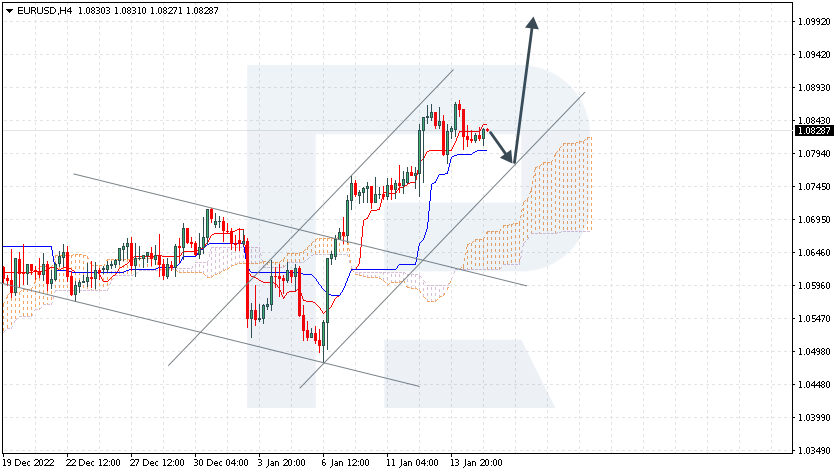
The currency pair is pushing off the signal lines of the indicator. The instrument is going above the Ichimoku Cloud, implying an uptrend. A test of the Kijun-Sen line is expected at 1.0775, followed by growth to 1.1005. An additional signal confirming the growth will be a bounce off the lower border of the bullish channel. The scenario can be cancelled by a breakaway of the lower border of the Cloud and securing under 1.0575, which will indicate further falling to 1.0485.

EURUSD
Risk Warning: the result of previous trading operations do not guarantee the same results in the future

BRENT

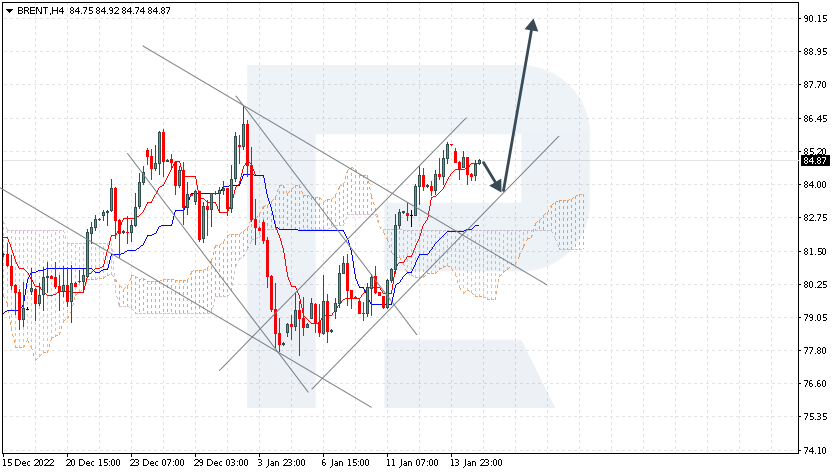
Oil is testing the Tenkan-Sen line of the indicator. The instrument is going above the Ichimoku Cloud, which implies an uptrend. A test of the support area at 84.00 is expected, followed by growth to 90.00. An additional signal confirming the growth will be a bounce off the lower border of the ascending channel. The scenario can be cancelled by a breakaway of the lower border of the Cloud and securing under 77.00, which will entail further falling to 73.00.

BRENT
Risk Warning: the result of previous trading operations do not guarantee the same results in the future

USDCAD, “US Dollar vs Canadian Dollar”

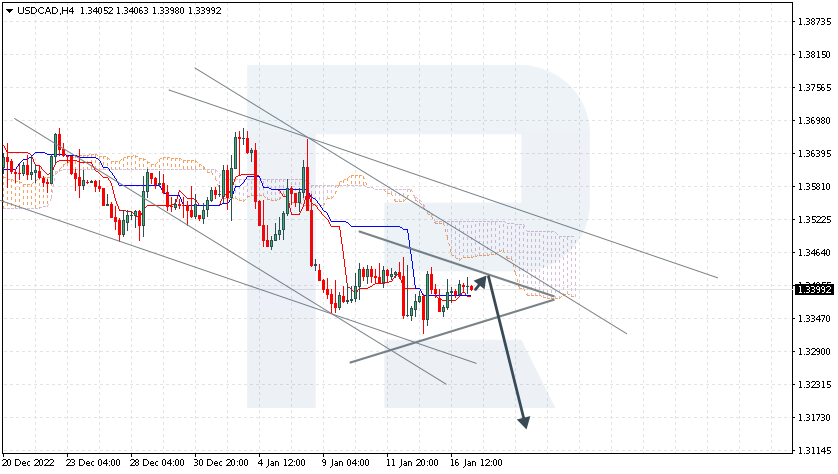
The currency pair is correcting inside a Triangle pattern. The instrument is going under the Ichimoku Cloud, which implies a downtrend. A test of the resistance level at 1.3405 is expected, followed by falling to 1.3165. An additional signal confirming the decline will be a bounce off the upper border of the Triangle pattern. The scenario can be cancelled by a breakaway of the upper border of the Cloud and securing above 1.3545, which will indicate growth to 1.3635. The decline may be confirmed by a breakaway of the lower border of the Triangle pattern and securing above 1.3295.

USDCAD

Article By RoboForex.com

Attention!
Forecasts presented in this section only reflect the author’s private opinion and should not be considered as guidance for trading. RoboForex LP bears no responsibility for trading results based on trading recommendations described in these analytical reviews.

China’s stock market rally underscores expectations of economic recovery

By JustMarkets

The US stock market did not trade yesterday due to the holiday. But futures on indices traded in the European and partly in the US session. By the close of the futures market on Monday, the indices were down a bit, so the stock market’s opening on Tuesday will be accompanied by a price gap.

Traders should not forget that it is the earnings season in the United States. Such companies as Morgan Stanley (MS), Goldman Sachs (GS), Interactive Brokers (IBKR), and United Airlines Holdings (UAL) are reporting today.

Equity markets in Europe were mostly up yesterday. German DAX (DE30) gained 0.31%, French CAC 40 (FR40) added 0.28%, Spanish IBEX 35 (ES35) fell by 0.12%, and British FTSE 100 (UK100) closed on Monday with a 0.20% gain.

Short-term interest rate differentials are a good indicator of the future trajectory of relative monetary policy cycles. Using central bank policy projections, economists expect the two-year EUR/USD swap differential to reverse this year. Right now, swaps are trading at about 125 basis points in favor of the dollar, and by the end of this year, that differential could change to 40 basis points in favor of the euro. If this materializes, the EUR/USD currency pair will reach the 1.20 level before the end of the year.

In Europe, a surprisingly warm winter led to a drop in natural gas prices. Europe may come out of the heating season with more than 50% of its storage capacity filled. This could limit the jump in natural gas prices in the second half of 2023 to around €140-160/MWh. This is still high but well below the €250-300/MWh level seen last summer.

Goldman Sachs raised its aluminum price forecast due to rising demand in China and Europe. According to analysts, the metal is likely to cost an average of $3125 per tonne this year. However, it is pointed out that the upward price impulse will gradually increase in the spring.

Oil prices fell on Monday, consolidating after a strong rise last week ahead of the publication of demand forecasts from OPEC and IEA. These monthly reports strongly influence oil market trends in global oil demand. They may be essentially this month, given the importance the market attaches to a potential recovery in oil demand in China.

Asian markets traded flat yesterday. Japan’s Nikkei 225 (JP225) decreased by 1.14% on Monday, China’s FTSE China A50 (CHA50) added 1.50%, Hong Kong’s Hang Seng (HK50) was up by 0.04% on the day, India’s NIFTY 50 (IND50) fell by 0.34%, and Australia’s S&P/ASX 200 (AU200) was positive by 0.82%.

China’s GDP growth slowed in the latest quarter to +2.9% year-over-year, down from +3.9% in the previous quarter. But industrial production rose by 1.3% last month, while the unemployment rate fell to 5.5% from 5.7%. Analysts say rising domestic demand in China could be an important counterbalance to slowing growth in the US and Europe. Investors are once again buying up Chinese blue chips, from large consumer goods to financial companies. China’s stock market rally underscores expectations of an economic recovery at a time when most developed countries are in a recession. Foreign capital inflows into China reached about 44 billion yuan last week, the highest since May 2021.

There is a growing possibility that the Bank of Japan may announce a significant policy change this week as bond yields reach the upper limit again. According to economists, there are two options at the moment. The first (main scenario) is the abolition of the yield curve control policy. This might lead to a sell-off in Japanese equities, which would strengthen the yen. The second scenario is that Japan’s central bank can extend the range to 75 basis points on either side of its 0% target for 10-year government bonds. This would save time until the end of the quarter when Kuroda resigns. Either way, the closer we get to spring, the more likely the Bank of Japan will change course.

S&P 500 (F) (US500) 3,999.09 0 (0%)

Dow Jones (US30)34,302.61 0 (0%)

DAX (DE40) 15,134.04 +47.52 (+0.31%)

FTSE 100 (UK100) 7,860.07 +16.00 (+0.20%)

USD Index 102.39 +0.19 (+0.18%)

Important events for today:
  • – China GDP (q/q) at 04:00 (GMT+2);
  • – China Industrial Production (m/m) at 04:00 (GMT+2);
  • – China Retail Sales (m/m) at 04:00 (GMT+2);
  • – China Unemployment Rate (m/m) at 04:00 (GMT+2).
  • – UK Average Earnings Index (m/m) at 09:00 (GMT+2);
  • – UK Claimant Count Change (m/m) at 09:00 (GMT+2);
  • – UK Unemployment Rate (m/m) at 09:00 (GMT+2);
  • – German Consumer Price Index (m/m) at 09:00 (GMT+2);
  • – World Economic Forum Annual Meetings at 10:00 (GMT+2);
  • – German ZEW Economic Sentiment (m/m) at 12:00 (GMT+2);
  • – Eurozone ZEW Economic Sentiment (m/m) at 12:00 (GMT+2);
  • – Canada Consumer Price Index (m/m) at 15:30 (GMT+2);
  • – US NY Empire State Manufacturing Index (m/m) at 15:30 (GMT+2);
  • – US FOMC Member Williams Speaks at 22:00 (GMT+2).

By JustMarkets


This article reflects a personal opinion and should not be interpreted as an investment advice, and/or offer, and/or a persistent request for carrying out financial transactions, and/or a guarantee, and/or a forecast of future events.

EUR Renewed Its Highs

By RoboForex Analytical Department

EUR/USD starts this new week of January in a strong position. It is mainly fluctuating near 1.0855, which is very close to five-month highs. After the market got at hand some facts about a slow-down of the US inflation, dollar got under fierce attacks. This time, investors abandoned the “but on rumors, sell on facts” strategy and went on getting rid of the USD.

Market participants suppose that some positive signals from the background will let the Fed launch the final phase of the tight monetary policy.

Investors estimate the increase in the interest rate, expected by the market in February, as 25 base points. This is forecast by almost 92% of the poll participants.

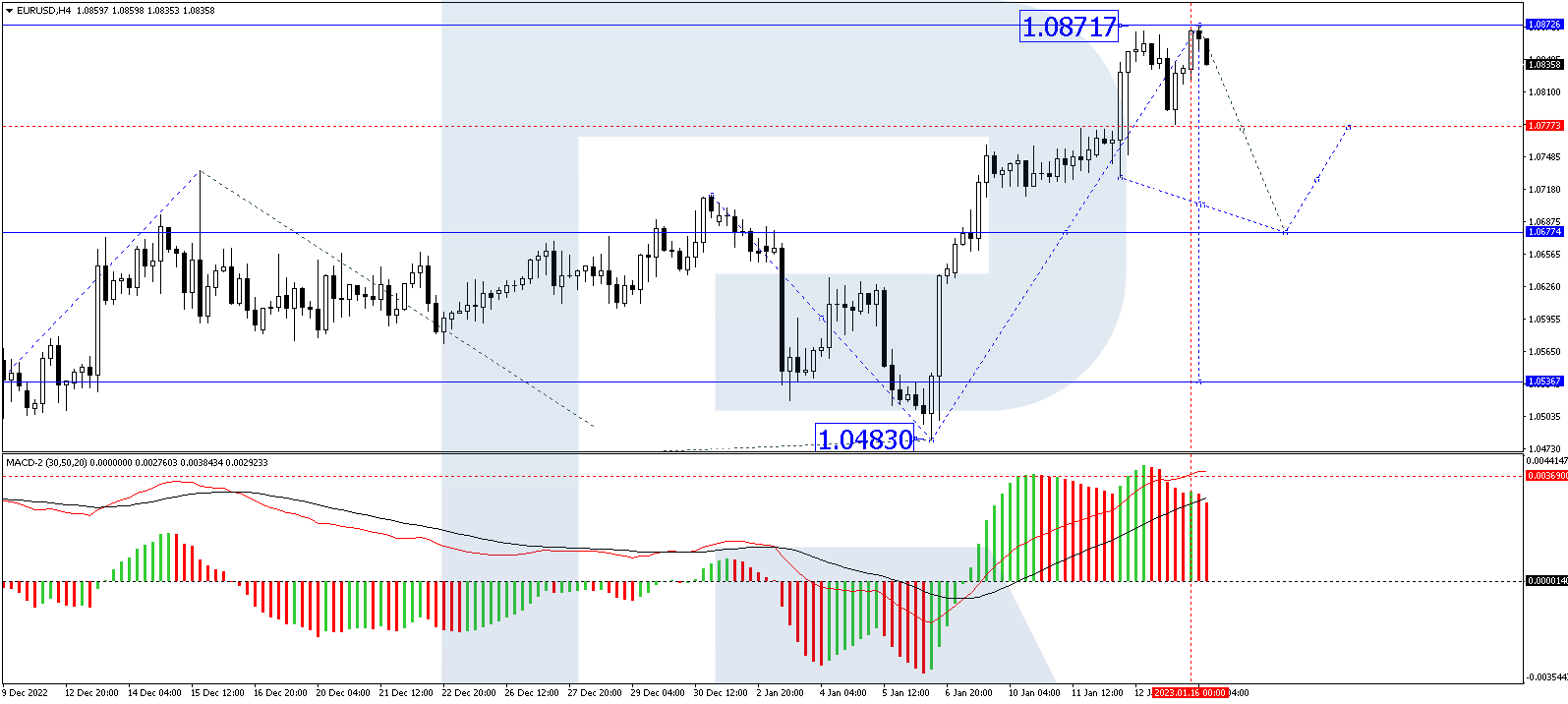
On H4, EUR/USD has completed a wave of growth to 1.0871. Today the market is forming an impulse of decline to 1.0777. Practically, a consolidation range is likely to develop at these levels. With an escape downwards, a wave of decline should continue to 1.0677. Technically, this scenario is confirmed by the MACD: its signal line is at the highs, getting ready for a decline to zero.

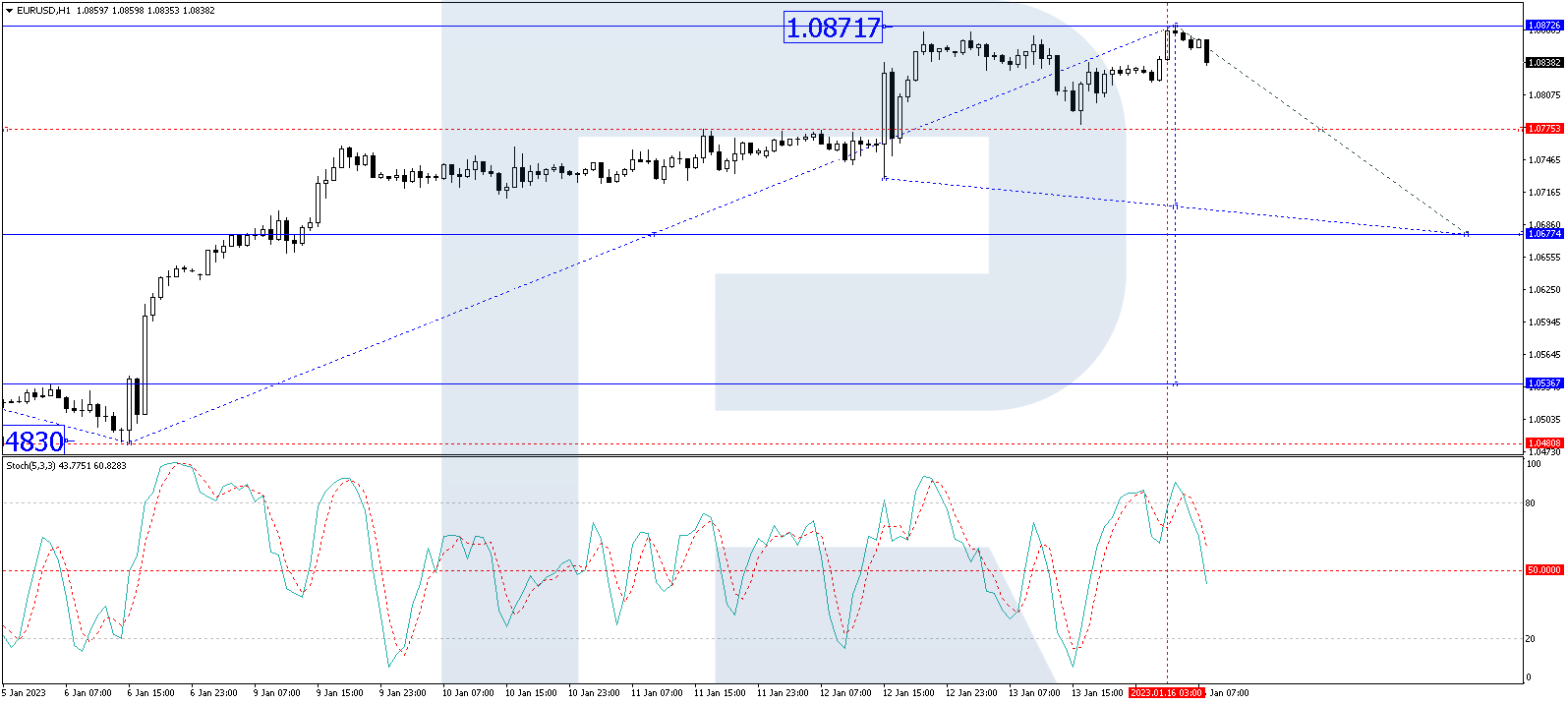
On H1, the pair has formed a structure of a wave of growth to 1.0872. Today the market is developing the first wave of decline to 1.0775. After this level is reached, a link of correction to 1.0808 is not excluded, followed by a decline to 1.0677. Technically, this scenario is confirmed by the Stochastic oscillator. Its signal line is above 80. A decline to 50 is expected. With a breakaway downwards here, a pathway for 20 will open.

Disclaimer

Any forecasts contained herein are based on the author’s particular opinion. This analysis may not be treated as trading advice. RoboForex bears no responsibility for trading results based on trading recommendations and reviews contained herein.

Pound to soar if UK & EU reach post-Brexit NI protocol deal

By George Prior

The British pound will be given a “much-needed and significant bounce” if a political agreement between the UK and the EU on the Northern Ireland protocol is reached, says the CEO of deVere Group.

Nigel Green, the chief executive and founder of one of the world’s largest independent financial advisory, asset management and fintech organizations, is speaking out as the UK and European Union negotiators are reportedly closing in on a deal to end their long-running row over post-Brexit trading arrangements in Northern Ireland.

The protocol keeps Northern Ireland inside the EU’s single market for goods, meaning trade can flow across the land border without additional documentation or checks.  But, it also means there are further checks and more paperwork on goods entering Northern Ireland from Great Britain, angering some businesses and is opposed by unionists in Northern Ireland.

The deVere Group CEO says: “After sealing an agreement last week on trade data, the two sides are also nearing a resolution on customs aimed at reducing frictions between Great Britain and Northern Ireland since Brexit.

“It’s hoped that this could lead to a broader deal on the Northern Ireland Protocol and, ultimately, easing the political stalemate at Stormont.”

He continues: “Should this happen, we expect the pound to benefit from a significant bounce.

The hitherto hard-line approach on the Protocol has delivered a body blow to the British currency as it has hit businesses hard, impacting growth and investment, and the political uncertainty has whipped up market turbulence.”

Nigel Green goes on to add that a relief rally would be welcomed by many given the currency’s dismal performance last year.

“A boost is much-needed as sterling was the third-worst performing major currency of 2022.”

He concludes: “As the mood music on both sides improves with negotiators preparing for intensified talks this week, the pound will react positively.

“If a solution is found, pound pessimism will have peaked and we expect the currency to experience a decent rally.”

About:

deVere Group is one of the world’s largest independent advisors of specialist global financial solutions to international, local mass affluent, and high-net-worth clients.  It has a network of more than 70 offices across the world, over 80,000 clients and $12bn under advisement.

Trade of the Week: Yen on high alert with BoJ decision looming

By ForexTime 

Brace yourself!

We could be in for the-most-volatile week for USDJPY since the onset of the Covid-19 pandemic, at least going by the 1-week implied volatility for this pair:


USDJPY: What could trigger this week’s big move?

All eyes are on the Bank of Japan (BoJ) policy meeting on Wednesday, even as December’s shocker rings fresh in the market’s minds.

Recall how, last month, the BoJ unexpectedly doubled the ceiling for 10-year yields up to 0.50%.

Such adjustments are widely seen as a precursor to the eventual BoJ rate hike, which markets expect to happen in April.


With all that in mind, here are 3 key things to look out for at this week’s BoJ meeting:

  1. Rate hike?

    It’s unlikely (only a 21% chance, based on market forecasts), but the Japanese central bank could deliver a shocker of epic proportions if it decides to hike its policy balance rate, which currently stands at minus 0.1%.

  2. Tweaks to policy language / inflation forecasts?

    The Yen is ready to react to any hints that the current BoJ Governor Haruhiko Kuroda may drop about potential policy adjustments by the central bank before he steps down in April.

    Also, the central bank is due to release its quarterly economic projections this week. If the latest forecasts for core inflation (excluding food and energy) shows that the BoJ’s 2% target is drawing closer, that may invoke heightened market chatter than a BoJ rate hike will arrive sooner than expected, with such chatter likely to spur on further JPY gains.

  3. Yields cap hike, redux?

    Markets are bracing for another yet another upward adjustment to Japan’s 10-year yields cap, just as it did last month.

    Such forecasts can be derived from how Japan’s 10-year benchmark yields have behaved in recent days, with traders even willing to challenge the new ceiling, sending yields past the 0.5% cap since this past Friday:

Note that, generally speaking, higher yields lend themselves to a stronger currency.

Hence, no surprise that these surging yields have helped the Japanese Yen take full advantage of the weaker US dollar, with the former being one of the best-performing G10 currencies against the greenback so far this year.


But be warned! The BoJ could disappoint.

Given the market’s aggressive expectations for another policy adjustment, should the BoJ stand pat this week, that could upset Yen bulls and prompt the unwinding of the Yen’s 2.2% year-to-date gains against the US dollar.

The BoJ may also be inclined to push back against market expectations, at least to “save face” and not give the impression that December’s adjustment was inadequate, with policymakers having to “catch up” with bond markets since its last meeting.

Potential scenarios for USDJPY

Here are the same scenarios for USDJPY as stated in our Week Ahead article published last Friday:

  • If Governor Kuroda pushes back against the market’s expectations for a rate hike this year, that may prompt the Japanese Yen to unwind some of its recent gains and potentially pull USDJPY back above the psychologically-important 130 mark.
  • On the other hand, should markets detect the slightest of hawkish hints (BoJ is getting closer to a rate hike) out of Governor Kuroda next (update: this) week, that should move USDJPY closer towards 126.0 and potentially test the lower downtrend line that began in November.

Going back to the 1-week implied volatility chart at the top of this article, it also suggests a 70% chance that USDJPY could this week reach either as low as 123.9, or back up as high as 132.4.


It may all boil down to the incoming BoJ policy signals, and whether the central bank leans into or against market expectations for more policy tightening to come.

Technical pullback?

However, looking at the chart below, USDJPY’s 14-day relative strength index careened close to the 30 threshold which denotes “oversold conditions”.

That may explain the pullback in this currency pair at the time of writing, as USJPY recovers from such oversold conditions.

However, once the froth is cleared, that may pave the way for the next big move for USDJPY over the coming days.

Also look out for: Japan national CPI (consumer price index) due Friday, January 20

The headline inflation print out of the world’s third largest economy is due before the weekend, and is forecasted to post a 4% print – its highest in over three decades!

BOJ Governor Haruhiko Kuroda has been willing to look beyond such elevated inflation numbers because he believes that the cost-push drivers are temporary. He wants to see more sustainable demand-pull inflation stemming from wage growth.

Still, a higher-than-expected CPI print may embolden those expecting the eventual BoJ rate hike to arrive perhaps as soon as Kuroda’s replacement takes the helm of the Japanese central bank in April.

The narrative above may boost the Yen’s fortunes further, even after its terrific start to the new year.

NOTE: Back on Jan 4, 2023, we highlighted JPY as one of the 3 potential winners of 2023, with USDJPY potentially dropping down to the 125 mark.

Forex-Time-LogoArticle by ForexTime

ForexTime Ltd (FXTM) is an award winning international online forex broker regulated by CySEC 185/12 www.forextime.com

WEF will “spectacularly fail” unless it advances crypto rules

By George Prior

The World Economic Forum (WEF), which starts today in Davos, Switzerland, will “spectacularly fail” unless it advances cryptocurrency regulation, warns the CEO and founder of one of the world’s largest financial advisory, asset management and fintech organizations.

The stark warning from Nigel Green of deVere Group comes as business, financial, economic, political, media, academic and civic leaders head to the Swiss mountain resort for the annual four-day conference.

It’s returning to its traditional timeslot and destination after two years of pandemic-triggered disruption.

Its return coincides with Bitcoin, the world’s biggest crypto by market capitalisation, recording a staggering 28% jump in value since the beginning of January.

The deVere CEO says: “The leaders assembled in Davos at the WEF must next week return home to their governments who then need to insist that their financial regulators must stop ‘talking the talk’ and begin to up the ante on regulating the cryptocurrency market.

“The time for endless platitudes on greater regulatory scrutiny is over. Action is required.

“Should those in attendance at the WEF not advance the agenda of crypto regulation as a result of the 2023 summit, they will have spectacularly failed.”

Nigel Green, who has long been an internationally high-profile champion of digital currencies such as Bitcoin, cites three key reasons why regulation is needed.

“First, as more and more institutional investors – including pension funds, mutual funds, investment banks, commercial trusts and hedge funds – as well as individual investors, increase their exposure to crypto, and as mass adoption increasingly takes hold, inevitably cryptocurrencies will play an ever-greater role in the international financial system.

“Yet crypto remains a relatively young market and, therefore, a volatile one.

“As such, in the interests of avoiding wide-scale disruption to the safety and soundness of the broader global financial system, crypto must be brought into the regulatory tent and held to the same standards as the rest of the system.”

He continues: “Second, after a year of significant crypto firm collapses, accusations of top-level fraud and prison sentences for insider trading, there’s no denying that greater scrutiny would help protect investors.

“Third, regulation could provide a potential long-term, sustainable economic boost to those countries which introduce it as crypto is widely regarded as the future of finance.”

What is needed now, says Nigel Green, is a workable internationally agreed and recognised regulatory framework that “is sensible and doesn’t hamper innovation or compromise the inherent nature of the digital assets and market.”

After Bitcoin reached above $21,095 on January 13 for the first time since November 8 2022, he told the media that: “The ‘crypto winter’ is thawing amid growing signs that inflation is beginning to cool. Of course, the crypto market will not go in a straight line – no market ever does – but we expect the bears to go into hibernation and bulls are ready to run!”

He concludes: “Cryptocurrencies are here to stay and the market is only set to grow exponentially.

“There can be no doubt that regulation of the crypto ecosystem is required, and it should be a priority at this year’s WEF in Davos.”

About:

deVere Group is one of the world’s largest independent advisors of specialist global financial solutions to international, local mass affluent, and high-net-worth clients.  It has a network of more than 70 offices across the world, over 80,000 clients and $12bn under advisement.