Pound Holds Its Breath Ahead of Bank of England Decision

By RoboForex Analytical Department

The British pound declined to around $1.3300 against the US dollar on Wednesday, as UK inflation undershot expectations and reinforced market convictions that the Bank of England (BoE) will cut interest rates on Thursday.

The annual Consumer Prices Index (CPI) inflation rate slowed to 3.2% in November, missing forecasts of 3.5% and falling below the central bank’s projection of 3.4%. This followed labour market data earlier in the week, which revealed unemployment rose to its highest level since 2021, while wage growth eased – albeit less sharply than anticipated.

The economic backdrop has weakened further following last week’s Gross Domestic Product (GDP) data, which confirmed the UK economy contracted for a second consecutive month in October. Given this deteriorating picture, the BoE is now widely expected to resume its monetary easing cycle, cutting the Bank Rate by 25 basis points to 3.75% – its lowest level since 2022. The central bank has held rates steady at its last two meetings in September and November.

Money markets have adjusted their expectations in response, now pricing in approximately 66 basis points of total easing by the end of 2026, up from around 58 basis points before the latest inflation report.

Technical Analysis: GBP/USD

H4 Chart:

On the H4 chart, the pair is developing a downward wave structure with a target at 1.3300. We expect this level to be tested today. Subsequently, a corrective rebound towards 1.3370 is likely. Once this correction is complete, the primary downtrend is anticipated to resume, targeting 1.3240, with potential for an extension towards 1.3175.

This bearish scenario is technically confirmed by the MACD indicator. Its signal line has exited the histogram zone and is near the zero mark, suggesting it will decline to new lows.

H1 Chart:

On the H1 chart, the market is forming a downward impulse targeting 1.3290 as its initial objective. Following this, a correction towards 1.3370 is likely. Upon completion of this corrective phase, the focus will shift to the potential continuation of the downtrend.

This outlook is supported by the Stochastic oscillator. Its signal line is below the 50 level and is pointing firmly downwards towards 20.

Conclusion

The pound remains under clear pressure ahead of Thursday’s pivotal BoE meeting, with soft inflation and growth data significantly raising the odds of a rate cut. The technical posture is bearish across timeframes, suggesting any near-term corrective bounce is likely to be sold into, paving the way for a test of lower support levels.


Disclaimer:

Any forecasts contained herein are based on the author’s particular opinion. This analysis may not be treated as trading advice. RoboForex bears no responsibility for trading results based on trading recommendations and reviews contained herein.

Humbling Hubris

Source: Michael Ballanger (12/16/25)

Michael Ballanger of GGM Advisory Inc. shares some words of wisdom and his 2026 outlook.

Originating in Greek mythology as a challenge to divine order, the term “hubris” remains a significant theme in literature and life, representing a dangerous belief in one’s own invincibility or superiority. Strictly defined, it is “excessive pride, arrogance, or overconfidence that leads to a person’s downfall, often by causing them to overstep limits, defy gods, or ignore warnings.

Mark Twain had a different definition that we as humans know all too well. Twain once wrote, “It ain’t what you don’t know that gits ya into trouble. It’s what you know for sure that ain’t exactly so.”

I had a teacher who reminded me at a very young age that making blind assumptions without checking one’s facts is a recipe for disaster and, worse still, embarrassment. “You know what you do when you ‘ASSUME’ something? You make an “ASS” of “U” and “ME.”

In the practice of writing newsletters, one tends to get elevated to the undeserved role of “authority,” as in, “he/she is an authority on gold and silver.” Sometimes, authors of financial newsletters are assigned designations like “guru” or “pundit” or “expert” but the reality of this pastime (as opposed to profession) is that most of us are simply common folks that for some unworldly reason have the intestinal fortitude and rhinoceros-like skin to put their opinions, expert or not, out there in full view for all the world to judge and rejoice or judge and condemn. The rejoicing comes after a particularly good guess (as opposed to calculation) at the future direction and amplitude of a particular stock or commodity. The condemnation occurs when one’s stab at the future direction and amplitude of a particular stock or commodity winds up in the trash bin. Reward or punishment for well-executed speculations is either more or fewer followers, and depending on whether one is paid as a “content provider” or under the subscriber model, loss or gain of people that grew accustomed to one’s accurate (or inaccurate) guesses.

As a young boy, I used to sell papers in the wee hours of weekend mornings at Woodbine Racetrack in northwest Toronto where the industry professionals such as trainers and grooms and jockeys would all arrive as the sun was rising and pay a dime for the “Daily Racing Form” which had all the races and the horses listed along with a list of their last three heats on either the turf (grass) or mud (dirt). One section of the paper featured the section where the handicappers wrote a column with their “touts” for the day’s races, which is where the term “tout sheet” was first derived. There was “Peter’s Picks,” “The Trackman,” and “The OddsMaker” all picking winners, placers, and showers for the expressed benefit of the amateur handicapper or weekend gambler who would lay down their minimum $2 bets with absolute certainty after reading through the hieroglyphics contained in the form.

One day, I decided to keep track of all the picks made by the “expert” race appraisers, so for the next few months of the summer, I wrote down the names of all the horses and where they finished each race. At the same time, I would pick three horses to win, place, and show in the same races, all based on their “colours” which were bay, chestnut, black, brown, or gray. At the end of the season, I tallied up all the results, and to no one’s particular surprise (except mine), a 12-year-old boy picking horses based on the colour of their coats outperformed the “experts” all equipped with 30-odd years of bookmaking and handicapping under their belts.

That is eerily similar to the late 1970s when newsletter guru and former E.F. Hutton Senior Technical Analyst Joe Granville would ask chimpanzees (dressed up as Wall Street bankers) to throw darts at the stock pages of the Wall Street Journal and then compare their track records to those of the “bank trust officers” that are today’s “market strategists.

The results were all the same. Sometimes the monkeys would be on top of the pack (usually in down markets), and sometimes they would be in the middle of the pack, but rarely did they trail the pack, once again proving that “A Random Walk down Wall Street” author Burton G. Malkiel was more than just a theorist but more of a statistician.

Over the years, I have found that investment success was more common in areas in which I was familiar, such as the junior mining space. I think the reason that my career evolved around commodities and mining was my fascination with those horses at Woodbine. You could look at two dozen horses under two dozen different jockeys, and only in the manner in which both horse and rider displayed a certain “swagger” could one recognize the importance of “presence” in the sport of kings. In a similar manner, CEO’s of successful mining and or exploration companies would emit a similar “swagger” when they entered a boardroom.

The firmness of a handshake or the directness of focus when being introduced seemed to accompany the great ones. However, at the end of the day, even the great ones (like Friedland, Beattie, or Netolitzky) would be the first to admit that really great geologists need an ample serving of good fortune in order to amass enviable track records. Luck does play a big part in any discovery because even the most sophisticated technology in geophysics or geochemistry cannot prevent Mother Nature and Lady Luck from playing a cruel trick with ruthless regularity and tempestuous timing.

Technical analysts would have us believe that all those squiggly lines on a graph are infinitely more predictive than the soggy leaves at the bottom of a teacup or a wishbone-shaped piece of driftwood in locating subsurface water. However, despite finding personal success in using the tool called “technical analysis” (“TA”) in improving returns, I learned a valuable lesson this past week. About a month ago, with gold prices approaching $4,400, I used TA to identify a series of extreme readings that, in past eras, have led to trend reversals.

As a result, on October 17, I sent out an email alert calling for a top in gold, which resulted in an outside key reversal day followed by a retest the following Monday that also failed. As a result, my call for the near-term top in gold was then and remains today as a solid one, with February gold still $213 below the top of $4,433 seen the prior Friday.

Inflated with inner peace and burgeoning with the pride one feels when a particular call goes well, I waited with the patience of a lion-hunter for another popular metal to display characteristics similar to that of gold. I lurked silently in the bushes until late November, and with all the hubris and swagger of a Secretariat or Northern Dancer approaching the starting gate, I elected to make the call that I now regret, and that call was “Sell silver.” The price was around $57.00 per ounce basis March.

During the week immediately following that call, I began to sense that there had been a kind of shift, as in “there’s been a shift in the force, Luke” from Star Wars fame, as silver spat in the face of GGMA “expertise” and drove northward through $59. On Monday, March silver gapped through $60, and by Thursday, it hit $65.

What changed?

As I sat in my office overlooking the lovely and now-frozen Scugog Swamp listening intently to Fed Chairman Jerome Powell, I decided to write the following to my subscribers:

“In keeping with the Fed’s dual mandates of “price stability” and “maximum full employment,” their clandestine third mandate “protecting Wall Street” was delivered wonderfully today by Fed Chairman Jerome Powell as he walked the world through the 2:30 presser with nary a thought about inflation but ample comments about the “weakening jobs market.” Wall Street took that as a “dovish” tilt and took the DJIA to a 600-point gain and the S&P 500 to a 55-point gain. Traders also took the U.S. dollar down with the DXY down .568 to 98.632, and gold from down $30 to up $27, and silver from down $0.27 to up $1.36.

With this kind of cheerleading, the Fed has given traders an early Christmas gift, so my speculation of a weaker, 2018-style close to 2025 must be shuttered. Also, the hedges on gold and silver being used in the GGMA 2025 Trading Account have to be re-examined as the dovish Fed has now thrown the U.S. dollar overboard in favour of easier money. The Fed has also reintroduced a mild form of quantitative easing, or as the commentators called it, “soft QE.” In a scenario of Fed purchases of $40 billion of T-bills every month, we are back to a stimulative environment, which, from where I sit, is patently absurd given the S&P within a chip shot of record highs. Any time the Fed engineers a “risk on” policy move, stocks and the metals always move higher, so to be hedged against a stimulative Fed is at once dangerous and stupid.

I look for traders to now have a free rein to take stocks and the metals higher into year-end. While I will not move to add to any new long positions in the gold or silver space, I now expect February gold to re-test the high of October 19th at $4,433. Gold traders cannot ignore the breathtaking breakout in silver, so I suspect that there will be a lot of short-covering by the end of the month. I will be looking at the RSI and the HUI:US to see if we get a confirmed new high for gold. If we get one, I will open new speculative positions in the leveraged ETFs and in options.”

This week, the HUI:US broke out above the October 15 high of 693.10 and moved to a new record high of 715.70. All that is required for there to be a confirmed new “leg” of the precious metals bull is for February gold to close above $4,433. At Friday’s high, it was $4,387.80, so we are banging on the proverbial door.

I used a phrase in this Thursday’s alert that should be recalled and recited, and that is this: “It is not a sin to be wrong, but it IS a sin to STAY wrong.”

May we never forget the wisdom of that adage.

2026

Moving into 2026 is going to be a very interesting endeavour as I am now forced to begin to formulate the GGMA 2026 Forecast Issue, which seems to be getting more difficult each and every year. The newsletter I write focuses on a given theme each year, after starting off in 2020 with the idea that escalating debt levels in the West would eventually require collateralization of sovereign debt with gold reserves, and whether it was pandemics or regional bank problems, each crisis was met with monetization.

Debt has remained a dominant theme and rationale for gold and silver ownership every year since the service was founded, but in the past two years, the electrification movement and the macroeconomic outlook for copper sent me scurrying for senior and junior opportunities in the northern and southern hemispheres. I used my beloved Freeport-McMoRan Inc. (FCX:NYSE) as a proxy for not only copper but also gold, as the globe’s premier producer of the red metal is also a significant member of the gold club, thanks largely to its part-ownership of the mighty Grasberg Mine in Indonesia.

With great trepidation and fear verging upon abject guilt, I exited FCX in early July based largely on my concern that the huge gap between London Metals Exchange copper (at $4.40/lb.) was too much of a discount to CME (U.S.) copper, which had been “tariffed” into a $1.50 premium over London due solely to political posturing. A seminal event occurred in July when the Trump Administration elected to remove tariffs on imports of “raw copper,” causing a cataclysmic crash in U.S. copper prices to align perfectly with London prices. I bought back my position in July at sub-$40 and then exited again in September when copper prices had rebounded into overbought conditions.

Then the news hit of the Grasberg “mud rush”  accident that caused a halt in operations in that portion of the mine complex, after which the stock cratered to just above $35. I fully expected that overvalued equity markets would weaken during the seasonally soft August-October period, but resilient equities and a stubbornly strong copper price prevented the target price of “sub-$30” from ever being achieved. So, here I sit, with 13 trading sessions left in 2025, and I am bereft of my beloved FCX as it steams northward at $47.38 after hitting $49 earlier today. Every single time I exit FCX, karma bites me in the backside, shaking its skeletal finger while shrieking “Sacrilege!

The good news is that I have been blessed with a couple of junior copper deals that caught my attention in 2025. One is not new in that I have been an investor in Australian Campbell Smyth’s

Fitzroy Minerals Inc. (FTZ:TSX.V; FTZFF:OTCQB) since 2019, when he launched Norseman Silver into what we both thought could be a rip-roaring silver market in 2020. The company went through growing pains in 2020-2022 and then went “dark” in 2023 before finding a new team of managers and projects in U.K.-based CEO Merlin Marr-Johnson and Santiago-based COO Gilberto Schubert and after bottoming in late 2023 at $.035, the shares responded favourably to the management change and since then have not had time to even glance into the rear-view mirror.

Smyth has put together one superb team of highly-skilled professionals and is now backed by Crux Investor founder Matt Gordon as a major shareholder as well as Technical Advisor Craig Perry in their quest for copper stardom in the Atacama Region of the Chilean Andes. Searching for copper in Chile is like looking for seashells in the Bahamas in that, despite declining grade and reserves in some of the legendary state-run Codelco operations, it is the prime locale for copper discoveries. Blessed with a wonderfully hospitable mining environment, only the province of Quebec in Canada is friendlier to people with money looking to find metals while employing people, a notion that the Canadian provinces of Ontario and B.C. might consider. Smyth and friends have raised over CA$20 million since the lows of 2023 and have since come up with a brand new copper-gold-molybdenum discovery in their Caballos project that serves as a wonderful complement to their oxide copper deposit at Buen Retiro.

However, the seriously underpromoted and underemphasized component of that property is what may or may not be lurking under that massive oxide copper-bearing cap. Management has been quite “coy” about revealing anything about drilling intentions until their press release of December 2, where they reported: “Hole 43, 150 metres north of hole 42, is currently underway. Crucially, the core photographs look very similar to the style of mineralization from within the resource zone at Candelaria. These holes are the first time that Fitzroy has seen consistent sulphide mineralization of this nature, which further enhances the exploration model at this project.

Followers of this publication are quite familiar with my contention that Buen Retiro is one of those projects where management has — most appropriately — de-risked the project by drilling of the easily fundable oxide cap, where CAPEX requirements are relatively low, while carefully and very much under the cloak of darkness, valiantly trying to unlock the secrets of the deeper regions of Andean geology. All I can say is that it is exciting to be a shareholder, and we will leave it at that.

The other Chilean project is Grafton Resources Inc. (GFT:CSE; PMSXF:OTC), where essentially the same management group as Fitzroy has attempted to firewall the two main projects (Buen Retiro and Caballos) from further dilution by way of the creation of this new company.

New prospects that come across Schubert’s desk are funnelled into Grafton while the team focuses 100% on near-term production for Fitzroy, which is somewhat akin to one car driving in the middle lane of the Autobahn while the other is in the outside lane with full throttle, taking the moniker of “aggressive exploration.

With a capital structure time-warped from the 1980s, GFT has only 25 million shares issued, $4m in the bank, and a project (Alicahue) approved for drilling in January. All that needs to be completed is an airborne MMT survey to be completed in the very early New Year, and then it is “Game on.”

Many of the people who follow me are asking questions about Getchell Gold Corp. (GTCH:CSE; GGLDF:OTCQB) and the dismal lack of performance in this latest move in the mining stocks, as evidenced by the HUI:US move to 715 this week.

As a starter, the promotions of the last few years are not exactly at new highs. Let’s start with the greatest promotion in eastern Canada since the Hibernia oil discoveries in the late 1970s —

New Found Gold Corp. (NFG:TSX.V; NFGC:NYSE.American) — a highly publicized holding of billionaire Eric Sprott, who loves to have his name on private placements in order to attract institutional accompaniment.

The stock topped in 2021 at CA$13.50 per share, only to go through a series of disappointing resource calculations and board-level resignations. The stock is now at $3.93 despite an advance in gold from $1,700 in the month it topped in 2021 to the current level of $4,329.

Those who bought shares in NFG in 2021 as a proxy for a) gold and b) Eric Sprott’s brain have been squarely left in the camp of the “Bagholder Blues.” Let us take another look at the famous gold promotions of the past few years.

How about Novo Resources Corp. (NVO:TSX.V; NSRPF:OTCQX).

This company is touted by both Eric Sprott and legendary geoscientist Quentin Hennigh.

It topped at over $8.00 in 2017 and now resides at $0.12.

I would ask you all: Is it any wonder why a company staffed with solid management and loyal shareholders, developing an economically-viable project in an infinitely-promotable jurisdiction (Nevada), cannot cop a bid from the Sprotts or Rules of this world? Why does it take years to attract the favor of really well-intentioned and seasoned influencers?

Of my subscriber base, every single one has a story of some beautifully-promoted Canadian mining stock that sounds wonderful with really wealthy people talking it up that wound up with a frying-pan forehead from an irate wife that found out what hubby did with her inheritance money from Uncle Buck. Everyone has a New Found Gold or Novo skeleton hiding in their closet so when a real company with a real story comes along and asks new investors to look at the PEA which suggest that the stock should trade north of $1.00 at $2,250 gold and probably $5.00 at $4,000 gold and is available “on offer” at CA$0.385, their first instinct is to run for the hills as this story MUST be “too good to be true.

I could sit here and write another ten paragraphs, but it would be a wasted effort as I have been a loyal shareholder since 2018 and watched the company go from near-disintegration to virtual ecstasy earlier this month. Relative to other well-managed and well-sponsored juniors, GTCH/GGLDF is a takeover waiting to happen — a classic example where management is powerless to attract the value-add investor that takes a big position and then brings in his billionaire friends to take out all the weak hands. Make no mistake, CEO Mike Sieb has done a superb job finding gold and is fully capable of finding more, but finding gold and finding investors are two mutually exclusive exercises. It is one thing to find a mineralized trend, but it is many times as difficult to find a self-multiplying group of buyers of stock.

Nonetheless, Getchell Gold Corp.’s Fondaway Canyon asset is a jewel of an asset and will get bought at some price by some entity, especially at $4,400 gold that could easily be $8,400 gold in the next year, as I have been suggesting since 2020, when I first launched this letter. Chairman Robert Bass and his family own over 20% of issued capital and are staunch believers in the integrity of the project. So do I.

End of discussion.


Important Disclosures:

  1. As of the date of this article, officers, contractors, shareholders, and/or employees of Streetwise Reports LLC (including members of their household) own securities of Fitzroy Minerals Inc., Grafton Resources Inc., and Getchell Gold Corp.
  2. Michael Ballanger: I, or members of my immediate household or family, own securities of: Fitzroy Minerals Inc., Grafton Resources Inc., and Getchell Gold Corp. My company has a financial relationship with: None. My company has purchased stocks mentioned in this article for my management clients: None. I determined which companies would be included in this article based on my research and understanding of the sector.
  3. Statements and opinions expressed are the opinions of the author and not of Streetwise Reports, Street Smart, or their officers. The author is wholly responsible for the accuracy of the statements. Streetwise Reports was not paid by the author to publish or syndicate this article. Streetwise Reports requires contributing authors to disclose any shareholdings in, or economic relationships with, companies that they write about. Any disclosures from the author can be found  below. Streetwise Reports relies upon the authors to accurately provide this information and Streetwise Reports has no means of verifying its accuracy.
  4.  This article does not constitute investment advice and is not a solicitation for any investment. Streetwise Reports does not render general or specific investment advice and the information on Streetwise Reports should not be considered a recommendation to buy or sell any security. Each reader is encouraged to consult with his or her personal financial adviser and perform their own comprehensive investment research. By opening this page, each reader accepts and agrees to Streetwise Reports’ terms of use and full legal disclaimer. Streetwise Reports does not endorse or recommend the business, products, services or securities of any company.

For additional disclosures, please click here.

Michael Ballanger Disclosures

This letter makes no guarantee or warranty on the accuracy or completeness of the data provided. Nothing contained herein is intended or shall be deemed to be investment advice, implied or otherwise. This letter represents my views and replicates trades that I am making but nothing more than that. Always consult your registered advisor to assist you with your investments. I accept no liability for any loss arising from the use of the data contained on this letter. Options and junior mining stocks contain a high level of risk that may result in the loss of part or all invested capital and therefore are suitable for experienced and professional investors and traders only. One should be familiar with the risks involved in junior mining and options trading and we recommend consulting a financial adviser if you feel you do not understand the risks involved.

Tariffs 101: What they are, who pays them, and why they matter now

By Kent Jones, Babson College 

The U.S. Supreme Court is currently reviewing a case to determine whether President Donald Trump’s global tariffs are legal.

Until recently, tariffs rarely made headlines. Yet today, they play a major role in U.S. economic policy, affecting the prices of everything from groceries to autos to holiday gifts, as well as the outlook for unemployment, inflation and even recession.

I’m an economist who studies trade policy, and I’ve found that many people have questions about tariffs. This primer explains what they are, what effects they have, and why governments impose them.

What are tariffs, and who pays them?

Tariffs are taxes on imports of goods, usually for purposes of protecting particular domestic industries from import competition. When an American business imports goods, U.S. Customs and Border Protection sends it a tariff bill that the company must pay before the merchandise can enter the country.

Because tariffs raise costs for U.S. importers, those companies usually pass the expense on to their customers by raising prices. Sometimes, importers choose to absorb part of the tariff’s cost so consumers don’t switch to more affordable competing products. However, firms with low profit margins may risk going out of business if they do that for very long. In general, the longer tariffs are in place, the more likely companies are to pass the costs on to customers.

Importers can also ask foreign suppliers to absorb some of the tariff cost by lowering their export price. But exporters don’t have an incentive to do that if they can sell to other countries at a higher price.

Studies of Trump’s 2025 tariffs suggest that U.S. consumers and importers are already paying the price, with little evidence that foreign suppliers have borne any of the burden. After six months of the tariffs, importers are absorbing as much as 80% of the cost, which suggests that they believe the tariffs will be temporary. If the Supreme Court allows the Trump tariffs to continue, the burden on consumers will likely increase.

While tariffs apply only to imports, they tend to indirectly boost the prices of domestically produced goods, too. That’s because tariffs reduce demand for imports, which in turn increases the demand for substitutes. This allows domestic producers to raise their prices as well.

A brief history of tariffs

The U.S. Constitution assigns all tariff- and tax-making power to Congress. Early in U.S. history, tariffs were used to finance the federal government. Especially after the Civil War, when U.S. manufacturing was growing rapidly, tariffs were used to shield U.S. industries from foreign competition.

The introduction of the individual income tax in 1913 displaced tariffs as the main source of U.S. tax revenue. The last major U.S. tariff law was the Smoot-Hawley Tariff Act of 1930, which established an average tariff rate of 20% on all imports by 1933.

Those tariffs sparked foreign retaliation and a global trade war during the Great Depression. After World War II, the U.S. led the formation of the General Agreement on Tariffs and Trade, or GATT, which promoted tariff reduction policies as the key to economic stability and growth. As a result, global average tariff rates dropped from around 40% in 1947 to 3.5% in 2024. The U.S. average tariff rate fell to 2.5% that year, while about 60% of all U.S. imports entered duty-free.

While Congress is officially responsible for tariffs, it can delegate emergency tariff power to the president for quick action as long as constitutional boundaries are followed. The current Supreme Court case involves Trump’s use of the International Emergency Economic Powers Act, or IEEPA, to unilaterally change all U.S. general tariff rates and duration, country by country, by executive order. The controversy stems from the claim that Trump has overstepped his constitutional authority granted by that act, which does not mention tariffs or specifically authorize the president to impose them.

The pros and cons of tariffs

In my view, though, the bigger question is whether tariffs are good or bad policy. The disastrous experience of the tariff war during the Great Depression led to a broad global consensus favoring freer trade and lower tariffs. Research in economics and political science tends to back up this view, although tariffs have never disappeared as a policy tool, particularly for developing countries with limited sources of tax revenue and the desire to protect their fledgling industries from imports.

Yet Trump has resurrected tariffs not only as a protectionist device, but also as a source of government revenue for the world’s largest economy. In fact, Trump insists that tariffs can replace individual income taxes, a view contested by most economists.

Most of Trump’s tariffs have a protectionist purpose: to favor domestic industries by raising import prices and shifting demand to domestically produced goods. The aim is to increase domestic output and employment in tariff-protected industries, whose success is presumably more valuable to the economy than the open market allows. The success of this approach depends on labor, capital and long-term investment flowing into protected sectors in ways that improve their efficiency, growth and employment.

Critics argue that tariffs come with trade-offs: Favoring one set of industries necessarily disfavors others, and it raises prices for consumers. Manipulating prices and demand results in market inefficiency, as the U.S. economy produces more goods that are less efficiently made and fewer that are more efficiently made. In addition, U.S. tariffs have already resulted in foreign retaliatory trade actions, damaging U.S. exporters.

Trump’s tariffs also carry an uncertainty cost because he is constantly threatening, changing, canceling and reinstating them. Companies and financiers tend to invest in protected industries only if tariff levels are predictable. But Trump’s negotiating strategy has involved numerous reversals and new threats, making it difficult for investors to calculate the value of those commitments. One study estimates that such uncertainty has actually reduced U.S. investment by 4.4% in 2025.

A major, if underappreciated, cost of Trump’s tariffs is that they have violated U.S. global trade agreements and GATT rules on nondiscrimination and tariff-binding. This has made the U.S. a less reliable trading partner. The U.S. had previously championed this system, which brought stability and cooperation to global trade relations. Now that the U.S. is conducting trade policy through unilateral tariff hikes and antagonistic rhetoric, its trading partners are already beginning to look for new, more stable and growing trade relationships.

So what’s next? Trump has vowed to use other emergency tariff measures if the Supreme Court strikes down his IEEPA tariffs. So as long as Congress is unwilling to step in, it’s likely that an aggressive U.S. tariff regime will continue, regardless of the court’s judgment. That means public awareness of tariffs ⁠– and of who pays them and what they change ⁠– will remain crucial for understanding the direction of the U.S. economy.The Conversation

About the Author:

Kent Jones, Professor Emeritus, Economics, Babson College

This article is republished from The Conversation under a Creative Commons license. Read the original article.

Weak labor market data fueled expectations of additional Fed policy easing in 2026

By JustMarkets 

On Tuesday, the Dow Jones Index (US30) fell by 0.62%. The S&P 500 Index (US500) declined by 0.24%. The tech-heavy Nasdaq Index (US100) closed higher by 0.23%. The November labor market report indicated a moderate cooling of the economy: employment growth was only 64K, accompanied by a sharp downward revision of October data and an increase in the unemployment rate to 4.6% – the highest level since 2021. Weaker US labor market and consumption data strengthened expectations for further Fed easing in 2026. Stagnant retail sales served as an additional signal of weakening demand. The energy sector pressured the indices due to oil prices falling below $55 per barrel, while tech giants traded mixed; gains in Nvidia, Meta, and Tesla, along with a recovery in Broadcom and Oracle, supported the Nasdaq.

The Mexican peso (MXN) strengthened above 18 per US dollar, hitting its highest level since July 2024, amid dollar weakness and the maintenance of a relatively tight monetary policy in Mexico. At the same time, Mexico’s November inflation came in above expectations at approximately 3.8%, and the core indicator accelerated to the mid-4% range, confirming Banxico’s cautious stance. Consequently, attractive real rates and a stable yield differential continue to support capital inflows and demand for the peso.

European stock markets mostly declined yesterday. Germany’s DAX (DE40) fell by 0.63%, France’s CAC 40 (FR 40) closed lower by 0.23%, Spain’s IBEX 35 (ES35) dropped by 0.70%, and the UK’s FTSE 100 (UK100) closed negative 0.68%. Preliminary PMI indices indicated mixed dynamics in the Eurozone economy: overall private sector activity slowed due to weakness in the services sector and a continuing slump in manufacturing. Germany was the key factor in the deterioration, where the decline in manufacturing activity intensified, while in France, the slowdown in the services sector was more pronounced than the market expected, heightening concerns regarding the region’s growth rate.

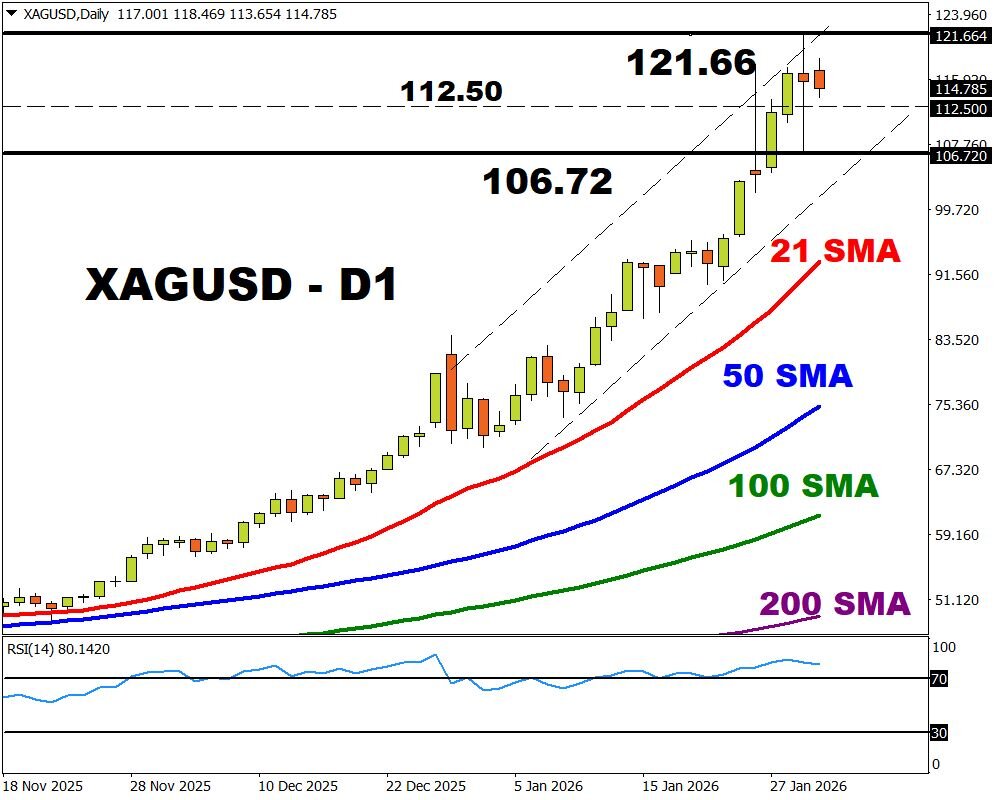
Silver (XAG) hit an all-time high on Wednesday, rising toward $66 per ounce, driven by increased demand for alternative assets following the mixed US labor market report. Silver is further supported by fundamental factors: since the beginning of the year, the metal has appreciated by nearly 130% amid declining inventories and steady demand from industry and retail, particularly from the solar energy, electric vehicle, and data center sectors.

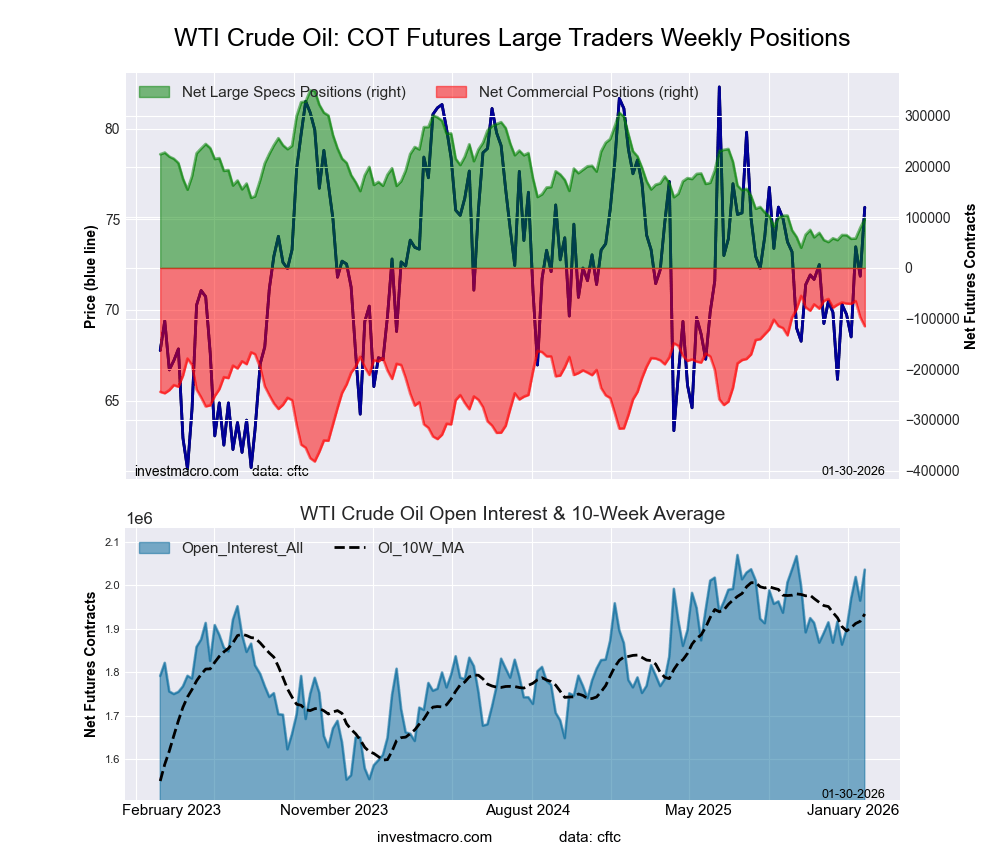
On Tuesday, WTI oil prices fell by more than 2%, trading around $55.5 per barrel, the lowest level since early 2021. This brought year-to-date losses to approximately 22%, the worst annual performance since 2018. Expectations that the war in Ukraine might be nearing an end increased the likelihood of easing restrictions on Russian oil supplies, which would limit potential supply disruptions in an already well-supplied market. Simultaneously, economic data from China points to ongoing weakness in the world’s second-largest economy, clouding the demand outlook. However, downside risks were partially offset by the possibility of US military action in Venezuela following the Trump administration’s seizure of a supertanker last week.

Asian markets traded lower on Tuesday. Japan’s Nikkei 225 (JP225) fell by 1.56%, China’s FTSE China A50 (CHA50) declined by 1.11%, Hong Kong’s Hang Seng (HK50) was down 1.54%, and Australia’s ASX 200 (AU200) showed a negative result of 0.42%.

The Australian dollar remained virtually unchanged, holding around $0.662, breaking its recent decline as latest government budget adjustments had no notable impact on central bank policy expectations. The budget deficit for the 2025/26 financial year is expected to be slightly lower at AUD 36.8 billion due to higher-than-projected tax revenues, while bond issuance plans remained unchanged. Amid steady spending, investors increased expectations that the Reserve Bank of Australia (RBA) might need to raise the cash rate from the current 3.6% as early as June to curb inflation: analysts at CBA and NAB now allow for a rate hike in February, while Westpac considers such a move premature.

S&P 500 (US500) 6,800.26 −16.25 (−0.24%)

Dow Jones (US30) 48,114.26 −302.30 (−0.62%)

DAX (DE40) 24,076.87 −153.04 (−0.63%)

FTSE 100 (UK100) 9,684.79 −66.52 (−0.68%)

USD Index 98.22 −0.09% (−0.09%)

News feed for: 2025.12.17

  • Japan Trade Balance (m/m) at 01:50 (GMT+2); – JPY (MED)
  • UK Consumer Price Index (m/m) at 09:00 (GMT+2); – GBP, UK100 (HIGH)
  • Germany Ifo Business Climate (m/m) at 11:00 (GMT+2); – EUR, DE40 (MED)
  • Eurozone Consumer Price Index (m/m) at 12:00 (GMT+2); – EUR, DE40 (MED)
  • US Crude Oil Reserves (w/w) at 17:30 (GMT+2); – WTI (HIGH)
  • New Zealand GDP (q/q) at 23:45 (GMT+2). – NZD (MED)

By JustMarkets


This article reflects a personal opinion and should not be interpreted as an investment advice, and/or offer, and/or a persistent request for carrying out financial transactions, and/or a guarantee, and/or a forecast of future events.

Silver Hits Record High on Demand and Data

By RoboForex Analytical Department 

On Wednesday, silver surged past 66 USD per ounce, setting a new all-time high. The rally was driven by a mixed US employment report, which sparked investor interest in alternative high-return assets for portfolio diversification.

The November labour market data revealed the unemployment rate climbing to 4.6% – its highest level since 2021 – even as job creation exceeded expectations.

Silver’s year-to-date gain of nearly 130% is further supported by declining inventories and robust demand from both retail investors and industrial users. In particular, expanding sectors such as solar energy, electric vehicles, and data centres are driving increased industrial consumption.

Technical Analysis: XAG/USD

H4 Chart:

On the H4 chart, XAG/USD established a consolidation range around 57.65 USD. Following an upward breakout, the market has extended to 66.72 USD, with scope for further gains towards 69.79 USD. Having completed a growth impulse to 66.51 USD, a minor correction towards 64.64 USD appears possible before the uptrend resumes.

The MACD indicator supports the bullish outlook, with its signal line firmly above zero, indicating sustained upward momentum.

H1 Chart:

On the H1 chart, silver completed a growth wave to 65.30 USD and has since formed a consolidation range around this level. An upward breakout has extended the move to 66.51 USD. A technical pullback towards 65.65 USD may occur; a break below this level could extend the correction towards 60.85 USD. Conversely, a rebound from 65.65 USD would favour a continuation of the uptrend toward 66.72 USD.

The Stochastic oscillator aligns with this view, with its signal line above 80 and trending upward, though nearing overbought territory.

Conclusion

Silver’s record rally reflects strong fundamentals – tightening supply, robust industrial demand, and its appeal as a hedge amid economic uncertainty. While the near-term trend remains bullish, the market is approaching overextended levels, increasing the likelihood of a short-term correction. Key support lies around 65.65 USD, with a break below potentially signalling a deeper pullback. Until then, the momentum favours further tests towards 66.72 USD and possibly 69.79 USD.


Disclaimer:

Any forecasts contained herein are based on the author’s particular opinion. This analysis may not be treated as trading advice. RoboForex bears no responsibility for trading results based on trading recommendations and reviews contained herein.

Oil dropped to a 2021 low. The Canadian dollar hit a three-month high

By JustMarkets 

On Monday, the Dow Jones Index (US30) fell by 0.09%. The S&P 500 Index (US500) was cheaper by 0.16%. The tech-heavy Nasdaq Index (US100) closed lower by 0.51%. Concerns surrounding debt-funded investments in artificial intelligence intensified the sell-off in technology, energy, and communication services sectors: Broadcom lost over 4%, continuing its sharp decline from late last week, Oracle and Salesforce notably decreased, and ServiceNow plunged by more than 10% on rumors of a major acquisition and a rating downgrade. Most tech giants also traded in the red, although Nvidia and Tesla managed to post gains. Overall, the market adopted a wait-and-see stance ahead of a busy week featuring the release of key US employment and inflation data, which could determine the further direction of momentum.

Today, the US will release the Non-Farm employment report. The report is coming out on an unusual day due to delays caused by the prolonged US government shutdown and combines data for October and November 2025, making it particularly important for assessing the state of the labor market and the trajectory of economic growth. According to the latest economic calendar and analysts’ expectations, markets anticipate a moderate increase in employment of around 50K, reflecting a continued slowdown in job growth after September (+119K). This could negatively impact investor sentiment and put pressure on both the Dollar Index and US stock indices. However, gold might gain momentum. Higher-than-expected employment and wage data would strengthen the dollar and could delay further Fed rate cuts in 2026.

The Canadian dollar strengthened above the 1.38 mark against the US dollar, reaching a three-month high, as markets assessed the Bank of Canada’s (BoC) firm stance and softer expectations regarding Fed policy. The Headline Consumer Price Index remained at 2.2%, and core measures fell to a ten-month low of 2.8%, increasing confidence that inflationary pressure is gradually moving towards the target level without the need for an abrupt policy change. In this environment, the Bank of Canada’s decision to keep the rate at 2.25% and its signal that the current policy is “roughly at the right level” curbed expectations of swift aggressive easing, stabilized interest rate differentials, and supported demand for the Canadian currency.

European stock markets were mostly up yesterday. Germany’s DAX (DE40) rose by 0.18%, France’s CAC 40 (FR 40) closed higher by 0.70%, Spain’s IBEX 35 (ES35) gained 1.11%, and the UK’s FTSE 100 (UK100) closed positive 1.06%. Investor attention in Europe is focused on the ECB meeting, where markets expect rates to remain unchanged, but possibly an upward revision of GDP growth expectations following recent statements by Christine Lagarde. The Riksbank and Norges Bank are also likely to keep their policy parameters unchanged. The geopolitical background remains in focus due to negotiations between the US and Ukraine, especially after signals from Volodymyr Zelenskyy about readiness to postpone the issue of NATO membership.

WTI oil prices fell to around $56.3 per barrel, the lowest level since early 2021, as persistent pressure from oversupply outweighed the influence of geopolitical risks. The global market remains well-supplied with oil: high inventories, coupled with production growth in the US, Brazil, and Guyana, reinforce expectations that production growth rates will outpace demand growth until at least 2026, maintaining a physical supply surplus. On the demand side, weak signals from China, including a slowdown in industrial activity and the growing role of renewable energy in power generation, are adding pressure, fueling concerns about insufficient oil consumption growth.

Asian markets traded lower on Monday. Japan’s Nikkei 225 (JP225) fell by 1.31%, China’s FTSE China A50 (CHA50) declined by 0.34%, Hong Kong’s Hang Seng (HK50) was down 1.34%, and Australia’s ASX 200 (AU200) showed a negative result of 0.72%. Market pressure came from weak November macroeconomic data from China: industrial production growth slowed to a 15-month low, and retail sales showed the weakest increase in nearly three years, dampening expectations for domestic demand. Against this backdrop, the technology sector fell by 2.5%, consumer staples by 2.1%, and real estate stocks declined by 1.6% after China Vanke bondholders refused to approve a payment extension, which again heightened default fears and underscored the continued stress in the Chinese construction sector.

S&P 500 (US500) 6,816.51 −10.90 (−0.16%)

Dow Jones (US30) 48,416.56 −41.49 (−0.09%)

DAX (DE40) 24,229.91 +43.42 (+0.18%)

FTSE 100 (UK100) 9,751.31 +102.28 (+1.06%)

USD Index 98.31 −0.09% (−0.09%)

News feed for: 2025.12.16

  • Australia Manufacturing and Services PMI (m/m) at 00:00 (GMT+2); – AUD (MED)
  • Japan Manufacturing and Services PMI (m/m) at 02:30 (GMT+2); – JPY (MED)
  • UK Unemployment Rate (m/m) at 09:00 (GMT+2); – GBP (HIGH)
  • Eurozone Manufacturing and Services PMI (m/m) at 11:00 (GMT+2); – EUR (MED)
  • UK Manufacturing and Services PMI (m/m) at 11:30 (GMT+2); – GBP (MED)
  • Eurozone ZEW Economic Sentiment (m/m) at 12:00 (GMT+2); – EUR (LOW)
  • US Non-Farm Payrolls (m/m) at 15:30 (GMT+2); – USD, XAU, US Indices (HIGH)
  • US Unemployment Rate (m/m) at 15:30 (GMT+2); – USD, XAU, US Indices (HIGH)
  • US Manufacturing and Services PMI (m/m) at 16:45 (GMT+2). – USD (MED)

By JustMarkets


This article reflects a personal opinion and should not be interpreted as an investment advice, and/or offer, and/or a persistent request for carrying out financial transactions, and/or a guarantee, and/or a forecast of future events.

Brent Crude Slides on Peace Talk Optimism and Demand Concerns

By RoboForex Analytical Department

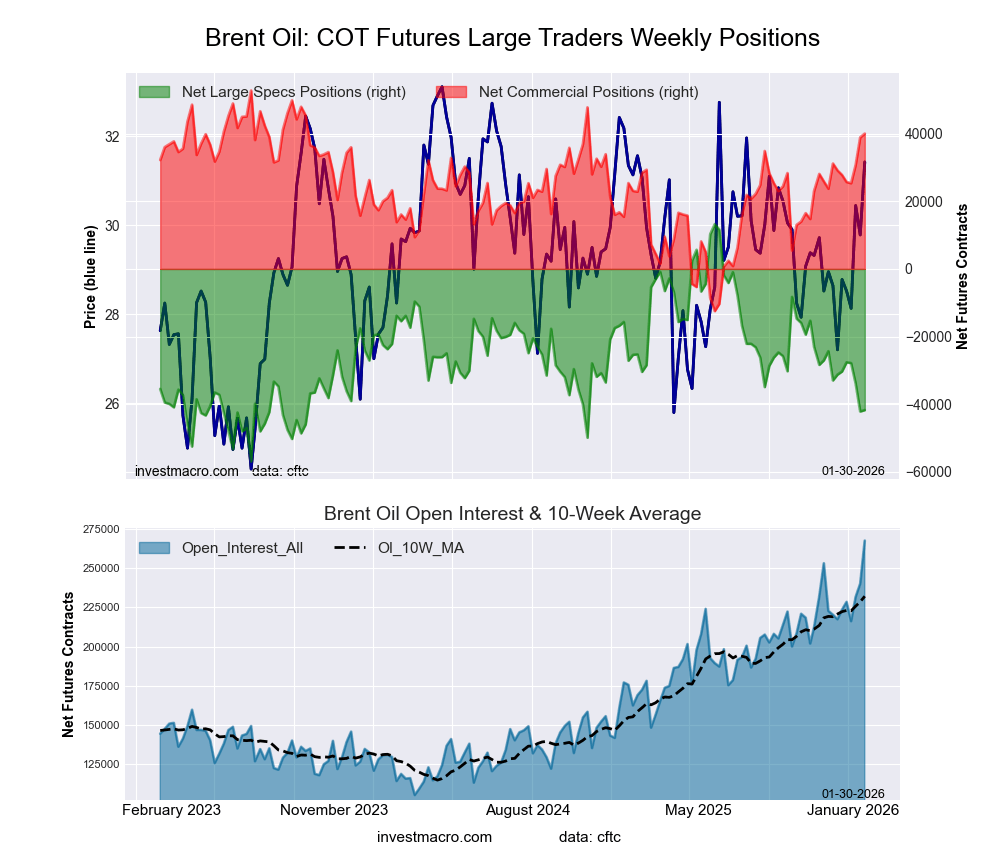
Brent crude oil fell to 60.00 USD per barrel on Tuesday, marking its lowest price since early 2021. The sell-off was driven by two primary factors: renewed speculation about progress in Russia-Ukraine peace talks and mounting fears of a global supply glut.

The prospect of a peace agreement has raised the possibility that the US will lift sanctions on Russian oil exports, potentially releasing a significant volume of crude into an already well-supplied market.

Bearish sentiment was further amplified by weaker-than-expected economic data from China on Monday, intensifying concerns about slowing energy demand in the world’s largest crude importer.

These downward pressures effectively overshadowed lingering geopolitical risks, including escalating tensions between the US and Venezuela, which could otherwise have supported prices through fears of supply disruption.

Technical Analysis: Brent Crude

H4 Chart:

On the H4 chart, Brent crude broke downwards from a consolidation range around 61.61 USD, confirming the resumption of the bearish trend. This breakdown activated a downward wave with an initial target at 59.30 USD. We anticipate a near-term continuation of the decline to approximately 59.59 USD, likely to be followed by a minor technical rebound towards 60.45 USD.

Following this corrective bounce, we expect the downtrend to reassert itself, driving prices towards the primary target of 59.30 USD, where the current bearish impulse is likely to be exhausted. This outlook is supported by the MACD indicator, whose signal line remains firmly below zero, indicating sustained selling momentum.

H1 Chart:

On the H1 chart, the market continues to develop a clear downward wave structure following its rejection from the 61.60 USD resistance. The immediate path points towards a decline to at least 59.59 USD. A brief rebound from this level towards 60.45 USD is plausible, representing a short-term correction before the next leg down targets the 59.30 USD support.

The Stochastic oscillator corroborates this near-term bearish bias. Its signal line is at the 50 midpoint and is turning downward, suggesting that selling pressure is re-emerging.

Conclusion

Brent crude is under significant pressure, caught between the bearish implications of potential peace-driven supply increases and concerns over Chinese demand. Technically, the break below 61.61 USD has solidified a negative outlook, with a clear path towards the 59.30 USD target. Any near-term rebounds are likely to be corrective within this broader downtrend. Traders should monitor the 59.30 USD level closely; a decisive break below may trigger an acceleration of the sell-off, while a strong rebound from this support would suggest a period of consolidation.


Disclaimer:

Any forecasts contained herein are based on the author’s particular opinion. This analysis may not be treated as trading advice. RoboForex bears no responsibility for trading results based on trading recommendations and reviews contained herein.

US oil industry doesn’t see profit in Trump’s ‘pro-petroleum’ moves

By Skip York, Rice University 

As the Trump administration makes announcement after announcement about its efforts to promote the U.S. fossil fuel industry, the industry isn’t exactly jumping at new opportunities.

Some high-profile oil and gas industry leaders and organizations have objected to changes to long-standing government policy positions that give companies firm ground on which to make their plans.

And the financial picture around oil and gas drilling is moving against the Trump administration’s hopes. Though politicians may tout new opportunities to drill offshore or in Arctic Alaska, the commercial payoff is not clear and even unlikely.

Having worked in and studied the energy industry for decades, I’ve seen a number of discoveries that companies struggled to moved forward with because either the discovery was not large enough to be commercially profitable or the geology was too difficult to make development plausible. Market conditions are the prime drivers of U.S. energy investment – not moves by politicians seeking to seem supportive of the industry.

Market fundamentals trump policy announcements

The general decline in oil prices from 2022 through late 2025 has reduced the attractiveness of many drilling investments.

And opening the East and West coasts to drilling may sound significant, but these regions have unconfirmed reserves. That means a lot of subsurface work, such as seismic surveys, stratigraphic mapping and reservoir characterization – potentially taking years – would need to be done before any drilling would begin.

Offshore drilling also faces enormous opposition.

On the West Coast, California Gov. Gavin Newsom and California Attorney General Rob Bonta have made forceful statements against any new California offshore oil drilling. They have said any effort is economically unnecessary, environmentally reckless and “dead on arrival” politically in the state.

California local governments, environmental groups, business alliances and coastal communities also oppose drilling and have vowed to use legal and political tools to block them.

There is opposition on the East Coast, too. More than 250 East Coast local governments have passed resolutions against drilling.

Governors on both sides of the aisle, including Democrat Josh Stein of North Carolina and Republicans Brian Kemp of Georgia and Henry McMaster of South Carolina, have spoken out against drilling off their coasts.

Arctic drilling is even harder

Drilling for oil and gas in the Arctic National Wildlife Refuge and the Beaufort Sea off Prudhoe Bay in Alaska would be a massive undertaking. These projects require years of development and are subject to future reversals in federal policy – just as Trump has lifted long-standing drilling bans in those areas, at least for now.

In addition, Alaska is one of the most expensive and technically challenging places to drill. Specialized equipment, infrastructure for frozen landscapes, and risk mitigation for extreme weather drive costs far above other regions. These projects also face logistical challenges, such as pipelines running hundreds of miles through remote, icy terrain.

Natural gas from Alaska would likely be sold to Asian buyers, who increasingly have alternative sources of supply from Australia, Canada, Qatar and even the U.S. Gulf Coast. As production rises in those places, the entrance of Alaskan natural gas into the market raises the risk for global oversupply, which could depress prices and reduce profitability.

Despite political support from the Trump administration, the oil and gas companies would need financing to pay for the drilling. And those loans won’t come if the oil companies don’t have agreements with buyers for the petroleum products that are produced. Major oil companies have withdrawn from Alaska and signaled skepticism about attractive long-term returns.

Trump has helped some

In the first 10 months of the second Trump administration, the president has signed at least 13 executive orders pertaining to the energy industry. Most of them focus on streamlining U.S. energy regulation and removing barriers to the development and procurement of domestic energy resources. However, the broad nature of some of these orders may fall short of establishing the stable regulatory environment necessary for the development of capital-intensive energy projects with long time horizons.

Those efforts have reversed the Biden administration’s go-slow approach to oil drilling, reducing – though not completely eliminating – the backlog of requests for onshore and offshore drilling permits that accumulated during Biden’s presidency.

Delays in permit approvals increase project costs, risk and uncertainty. Delays can increase the chances that a project ultimately is downsized – as happened with ConocoPhillips’ Willow project in Alaska – or canceled altogether. Longer timelines increase financing and carrying costs, because capital is tied up without generating revenue and developers must pay interest on the debt while waiting for approvals. Delays also lead to higher project costs, eroding project economics and sometimes preventing the project from turning a profit.

Investment follows economics, not politics

Unlike in some countries, such as with Saudi Arabia’s Aramco, Norway’s Equinor or China’s CHN Energy, the U.S. does not have a national oil or gas company. All of the major energy producers in the U.S. are privately owned and answer to shareholders, not the government.

Executive orders or political slogans may set a tone or direction, but they cannot override the fundamental requirement for profitability. Investments can’t be mandated by presidential decree: Projects must make economic sense. Without that, whether due to low prices, high costs, uncertain demand or changing regulations, companies will not proceed.

Even if federal policies open new areas for drilling or relieve some regulatory restrictions, companies will invest only if they see a clear path to profit over the long term.

With most energy investments costing large amounts of money over many years, the industry likely wants a sense of policy stability from the Trump administration. That could include lowering barriers to profitable investments by accelerating the approval process for supporting infrastructure, such as transmission power lines, pipelines, storage capacity and other logistics, rather than relying on sweeping announcements that lack market traction.The Conversation

About the Author:

Skip York, Nonresident Fellow in Energy and Global Oil, Baker Institute for Public Policy, Rice University

This article is republished from The Conversation under a Creative Commons license. Read the original article.


Whether Netflix or Paramount buys Warner Bros., entertainment oligopolies are back – bigger and more anticompetitive than ever

By Matthew Jordan, Penn State 

News of Netflix’s bid to buy Warner Bros. last week sent shock waves through the media ecosystem.

The pending US$83 billion deal is being described as an upending of the existing entertainment order, a sign that it’s now dominated by the tech platforms rather than the traditional Hollywood power brokers.

As David Zaslav, CEO of Warner Bros. Discovery, put it, “The deal with Netflix acknowledges a generational shift: The rules of Hollywood are no longer the same.”

Maybe so. But what are those rules? And are they being rewritten, or will moviegoers and TV audiences simply find themselves back in the early 20th century, when a few powerful players directed the fate of the entertainment industry?

The rise of the Hollywood oligopolies

As Hollywood rose to prominence in the 1920s, theater chain owner Adolf Zuker spearheaded a new business model.

Cartoon of man straddling three different horses and cracking them with a whip.
Lew Merrell’s 1920 cartoon for Exhibitors Herald, a film industry trade publication, depicts Adolf Zukor performing the feat of vertical integration.
Wikimedia Commons

He used Wall Street financing to acquire and merge his film distribution company, Famous Players-Lasky, the film production company Paramount and the Balaban and Katz chain of theaters under the Paramount name. Together, they created a vertically integrated studio that would emulate the assembly line production of the auto industry: Films would be produced, distributed and shown under the same corporate umbrella.

Meanwhile, Harry, Albert, Sam and Jack Warner – the Warner brothers – had been pioneer theater owners during the nickelodeon era, the period from roughly 1890 to 1915, when movie exhibition shifted from traveling shows to permanent, storefront theaters called nickelodeons.

They used the financial backing of investment bank Goldman Sachs to follow Zucker’s Hollywood model. They merged their theaters with several independent production companies: the Vitagraph film distribution company, the Skouras Brothers theater chain and, eventually, First National.

But the biggest of the Hollywood conglomerates was Metro-Goldwyn-Mayer, created when the Loews theater chain merged Metro Pictures, Goldwyn Pictures and Mayer Pictures.

At its high point, MGM had the biggest stars of the day under noncompete contracts and accounted for roughly three-quarters of the entire industry’s gross revenues.

By the mid-1930s, a handful of vertically integrated studios dominated Hollywood – MGM, Paramount, Warner Brothers, RKO and 20th Century Fox – functioning like a state-sanctioned oligopoly. They controlled who worked, what films were made and what made it into the theaters they owned. And though the studios’ holdings came and went, the rules of the industry remained stable until after World War II.

Old Hollywood loses its cartel power

In 1938, the Department of Justice and the Federal Trade Commission sued the “Big Five” studios, arguing that their vertically integrated model was anti-competitive.

After the Supreme Court decided in favor of the U.S. government in 1948 – in what became known as the Paramount Decisionthe studios were forced to sell off their theater chains, which checked their ability to squeeze theaters and squeeze out independent producers.

With the studios’ cartel power weakened, independent filmmakers like Elia Kazan and John Cassavetes flourished in the 1950s, making pictures like “On the Waterfrontthat the studios had rejected. Foreign films found their ways to American screens no longer constrained by block booking, a practice that forced exhibitors to pay for a lot of mediocre films if they wanted the good ones, too.

By the 1960s, a new generation of filmmakers like Mike Nichols and Stanley Kubrick scored big with audiences hungry for something different than the escapist spectacles Hollywood was green-lighting. They took risks by hiring respected writers and unknown actors to tell stories that were truer to life. In doing so, they flipped Hollywood’s generic formulas upside down.

A decade ago, I wrote about how Netflix’s streaming model pointed to a renaissance of innovative storytelling, similar to the period after the Paramount Decision.

By streaming their indie film “Beast of No Nation” directly to subscribers at home, Netflix posed a direct threat to Hollywood’s blockbuster model, in which studios invested heavily in a small number of big-budget films designed to earn enormous box office returns. At the time, Netflix’s 65 million global subscribers gave it the capital to produce exclusive content for its expanding markets.

Hollywood quickly closed the streaming gap, developing its own platforms and restricting access of its vast catalogs to subscribers.

Warner Bros. bought and sold

In 2018, AT&T acquired Time Warner, the biggest media conglomerate of the time, and DirectTV. It hoped to merge its 125 million-plus telecommunication customers with Time Warner’s content and create a streaming giant to compete with Netflix.

Then came the COVID-19 pandemic, and the theatrical model for film distribution collapsed.

The pressure on AT&T’s stock led the company to sell off HBO and WarnerMedia to Discovery in 2022 for $43 billion. Armed with the HBO and Warner Bros. libraries – along with the advertising potential of CNN, TNT and Turner Sports – CEO David Zaslav was bullish about the company’s potential for growth.

Warner Bros. Discovery became the third-largest streaming platform in terms of subscribers behind Netflix and Disney+, which had gobbled up 20th Century Fox.

But the results have been bad for audiences.

In 2023, Zaslav rolled out a bundled streaming platform called Max that combined the libraries of HBO Max and Discovery+, which ended up confusing consumers and the market. So it reverted back to HBO Max because consumers recognized the brand.

Zaslav then decided it was more cost effective to cancel innovative projects or write off completed films as losses. Zaslav often claims his deals are “good for consumers,” in that they get more content in one place. But conglomerates who defend their anti-competitive practices as signs of an efficient market that benefit “consumer welfare” frequently say that, even when they are making the product worse and limiting choices.

His deals have been especially bad for the television side, yielding gutted newsrooms and canceled scripted shows.

Effectively, in only three years, the Warner Bros. Discovery merger has validated nearly all the concerns that critics of “market first” policymaking have warned about for years. Once it had a dominant market share, the company started providing less and charging more.

Meet the new boss – same as the old boss

If it does go through, the Netflix-Warner Bros. merger will likely please Wall Street, but it will further decrease the power of creators and consumers.

Like other companies that have moved from being a growth stock to a mature stock, Netflix is under pressure to be profitable. Indeed, it has been squeezing its subscribers with higher fees and more restrictive login protocols. It’s a sign of what tech blogger Cory Doctorow describes as the logic of “enshittification,” whereby platforms that have locked in audiences and producers start to squeeze both. Buying the competition – HBO Max – will mean Netflix can charge even more.

After the Netflix deal was announced, Paramount joined forces with President Donald Trump’s son-in-law Jared Kushner, the Saudi Sovereign Wealth fund and others to announce a hostile counteroffer.

Now, all bets are off. Whichever platform acquires Warner Bros. will have enormous power over the kind of stories that get sold and told.

In either case, Warner Bros. would be bought by a direct competitor. The Department of Justice, under the first Trump administration, already pushed to sunset the Paramount Decision, claiming that the distribution model had changed to such an extent that it was unlikely that Hollywood could ever reinstate its cartel. It’s hard to imagine that Trump 2.0 will forbid more media concentration, especially if the new parent company is friendly to the administration.

No matter which bidder becomes the belle of Trump’s ballroom, this merger illustrates how show business works: When dominant platforms also own the studios and their assets, they control the fate of the movie business – of actors, writers, producers and theaters.

Importantly, the concentration is taking place as artificial intelligence threatens to displace many aspects of film production. These corporate behemoths will determine if the film libraries spanning a century of Hollywood production will be used to train the machines that could replace artists and creatives. And with each prospective buyer taking on over $50 billion in bank debt to pay for the deal, the new parent of Warner Bros. will be looking everywhere for profits and opportunities to cut costs.

If history is any guide, there will be struggles ahead for consumers and competing creatives. In a media system that has veered back to following Hollywood’s yellow brick rules of the road, the new oligopolies are an awful lot like the old ones.The Conversation

About the Author:

Matthew Jordan, Professor of Media Studies, Penn State

This article is republished from The Conversation under a Creative Commons license. Read the original article.


Bitcoin fell below $90,000 again. US stock indices came under a sell-off on Friday

By JustMarkets 

On Friday, the Dow Jones Index (US30) fell by 0.51% (for the week, +1.01%). The S&P 500 Index (US500) was cheaper by 1.07% (for the week, -0.70%). The tech-heavy Nasdaq Index (US100) closed lower by 1.69% (-1.87%). The US stock markets sharply declined on Friday amid a massive sell-off in the technology sector following a 11.4% drop in Broadcom shares, triggered by a warning about margin pressure. This prompted a rotation of capital from high-valuation stocks related to AI and semiconductors into more cyclical and defensive sectors. Significant losses were also incurred by Nvidia, Oracle, Palantir, AMD, and Micron, reflecting growing investor caution regarding the margin potential of AI companies, despite the Fed’s recent interest rate cuts. An additional factor was the comments from the Cleveland Fed President, who expressed a preference for a tougher policy to control inflation.

Bitcoin dropped below $90,000, hitting a two-week low amid the global sell-off in tech stocks and reduced risk appetite. Pressure intensified due to fears of inflated valuations and massive spending in the AI sector, as well as uncertainty surrounding the Fed’s policy trajectory for the next year. An additional negative factor was the warning from MicroStrategy CEO Michael Saylor about potential market consequences from MSCI’s initiative to exclude companies with over 50% digital asset holdings from its indices. Analysts estimate this could trigger significant capital outflow and increase the volatility of Bitcoin and related assets.

European stocks mostly went down on Friday. Germany’s DAX (DE40) fell by 0.45% (for the week, +0.71%), France’s CAC 40 (FR 40) closed lower by 0.21% (for the week, -0.37%), Spain’s IBEX 35 (ES35) fell by 0.28% (for the week, +1.46%), and the UK’s FTSE 100 (UK100) closed negative 0.56% (for the week, -0.19%).

WTI oil prices rose to $57.7 per barrel on Monday, partially recovering from last week’s over 4% drop, as geopolitical risks temporarily outweighed concerns about a global supply surplus. Prices were supported by increased US pressure on Venezuela, including the seizure of a tanker, the imposition of new sanctions, and a military buildup in the region, as well as supply disruption risks amid ongoing Ukrainian drone attacks on Russian oil infrastructure. The detention of a foreign tanker by Iran in the Gulf of Oman added another factor of uncertainty.

The price of silver (XAG/USD) pulled back below $62 per ounce on Friday after hitting record levels earlier in the session, as investors took profits and the market entered a short-term consolidation phase before the weekend. However, the overall bullish backdrop remains: the Fed’s recent rate cut and a less hawkish expectation support medium-term expectations, and Powell gave no signal of a return to tightening, pointing instead to further rate cuts in the following years. Strong ETF inflows and sustained retail demand are also fueling expectations of a silver deficit next year.

Asian markets traded without a single dynamic last week. Japan’s Nikkei 225 (JP225) rose by 0.38%, China’s FTSE China A50 (CHA50) declined by 0.40%, Hong Kong’s Hang Seng (HK50) was down 0.35%, and Australia’s ASX 200 (AU200) showed a positive result of 1.18% over the five days.

The offshore yuan strengthened to around 7.05 per dollar, hitting a high since late September, despite weak economic data from China. November statistics pointed to a slowdown in growth: retail sales sharply missed projections, industrial production declined more than expected, and fixed-asset investment showed the deepest slump since the pandemic, with the ongoing real estate crisis intensifying pressure on the economy. The deteriorating macroeconomic environment heightened expectations for new fiscal and monetary support measures early next year, which partially offset the negative sentiment.

The New Zealand dollar weakened to around $0.578, retreating from a two-month high after the Reserve Bank of New Zealand signaled its intention to keep the Official Cash Rate unchanged for an extended period. RBNZ Governor Breman noted that the economy is largely evolving in line with the regulator’s prognoses, and inflation is moving towards the 2% target by mid-2026. Market participants’ attention is now focused on upcoming macro statistics, including the third-quarter GDP report, though pressure on the currency is partially restrained by the continuing weakening of the US dollar amid a softer-than-expected stance from the Federal Reserve.

S&P 500 (US500) 6,827.41 −73.59 (−1.07%)

Dow Jones (US30) 48,458.05 −245.96 (−0.51%)

DAX (DE40) 24,186.49 −108.12 (−0.45%)

FTSE 100 (UK100) 9,649.03 −54.13 (−0.56%)

USD Index 99.39 +0.05% (+0.05%)

News feed for: 2025.12.15

  • Japan Tankan Large Manufacturers (m/m) at 01:50 (GMT+2); – JPY (LOW)
  • China Industrial Production (m/m) at 04:00 (GMT+2); – CHA50, HK50 (MED)
  • China Retail Sales (m/m) at 04:00 (GMT+2); – CHA50, HK50 (MED)
  • China Unemployment Rate (m/m) at 04:00 (GMT+2); – CHA50, HK50 (MED)
  • Eurozone Industrial Production (m/m) at 12:00 (GMT+2); – EUR (LOW)
  • Canada Consumer Price Index (m/m) at 15:30 (GMT+2). – CAD (HIGH)

By JustMarkets


This article reflects a personal opinion and should not be interpreted as an investment advice, and/or offer, and/or a persistent request for carrying out financial transactions, and/or a guarantee, and/or a forecast of future events.